Cambridge IGCSE Mathematics 0580 — 2016 May/June Paper 2 · Variant 3
0580/23/M/J/16 · 23 questions · 70 marks · ≈79 min
The question paper and its mark scheme, free to read here and free to download. This is Cambridge’s own paper, exactly as it was sat.
Question paper12 pages
Mark scheme4 pages
Answers below. Sit the paper first if you are practising.
Questions as text
Q1 · Find the cube root of 4913
1 Find the cube root of 4913. .................................................. [1]
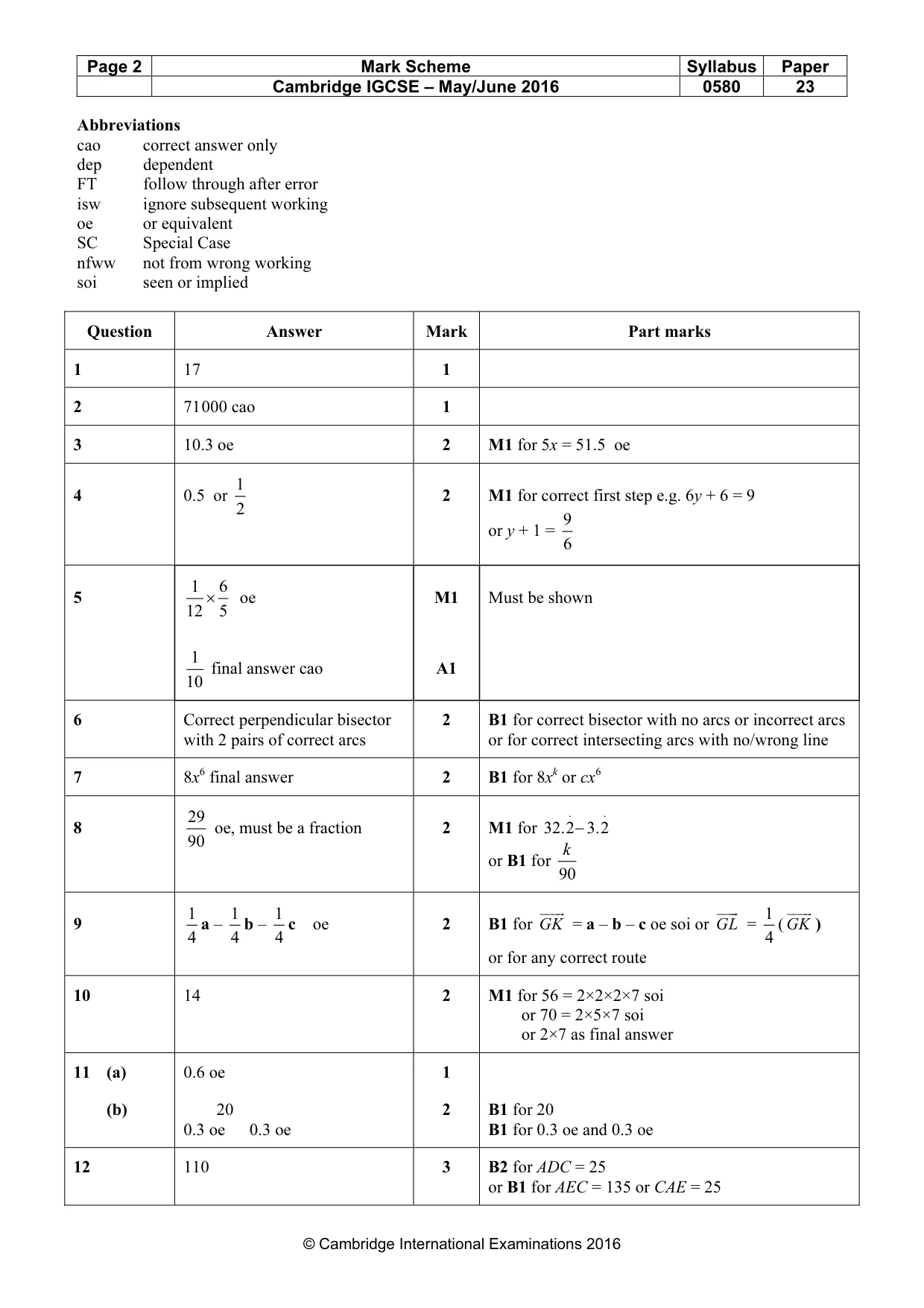
Mark scheme: Question Answer Mark Part marks 1 17 1
Q2 · Write 71 496 correct to 2 significant figures
2 Write 71 496 correct to 2 significant figures. .................................................. [1]
Mark scheme: 2 71 000 cao 1
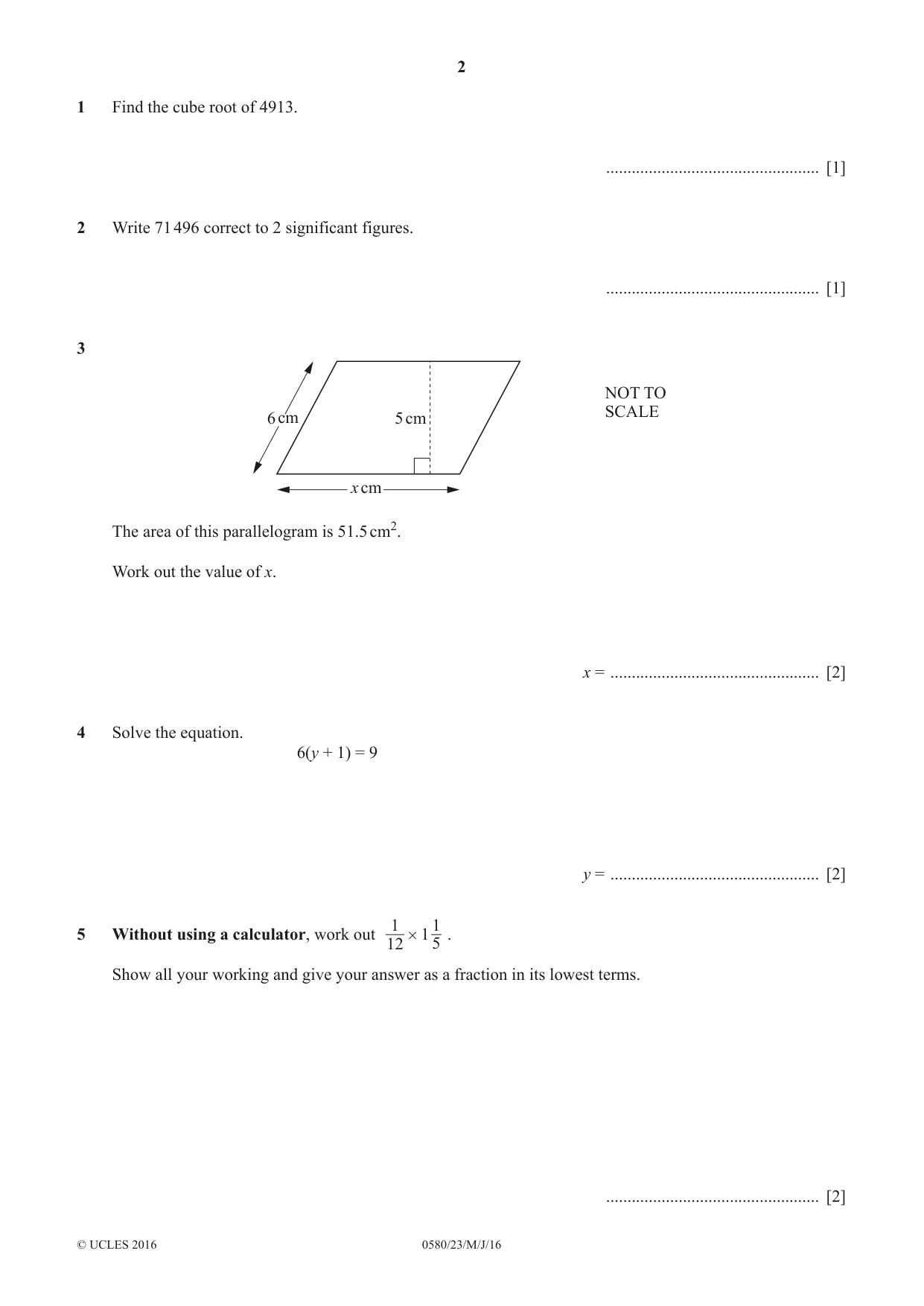
Q3 · NOT TO SCALE 6 cm 5 cm x cm The area of this parallelogram is 51.5 cm2
3 NOT TO SCALE 6 cm 5 cm x cm The area of this parallelogram is 51.5 cm2. Work out the value of x. x = ................................................. [2]
Mark scheme: 3 10.3 oe 2 M1 for 5x = 51.5 oe 1
Question 4
4 Solve the equation. 6(y + 1) = 9 y = ................................................. [2]
Mark scheme: 1 4 0.5 or 2 M1 for correct first step e.g. 6y + 6 = 9 2 9 or y + 1 = 6 1 6
Q5 · 1 # 1 5 .5 Without using a calculator, work out 12 Show all your working and give your…
1 1 # 1 5 .5 Without using a calculator, work out 12 Show all your working and give your answer as a fraction in its lowest terms. .................................................. [2]
Mark scheme: 1 6 5 × oe M1 Must be shown 12 5 1 final answer cao A1 10
Q6 · Using a straight edge and compasses only, construct the perpendicular bisector of the…
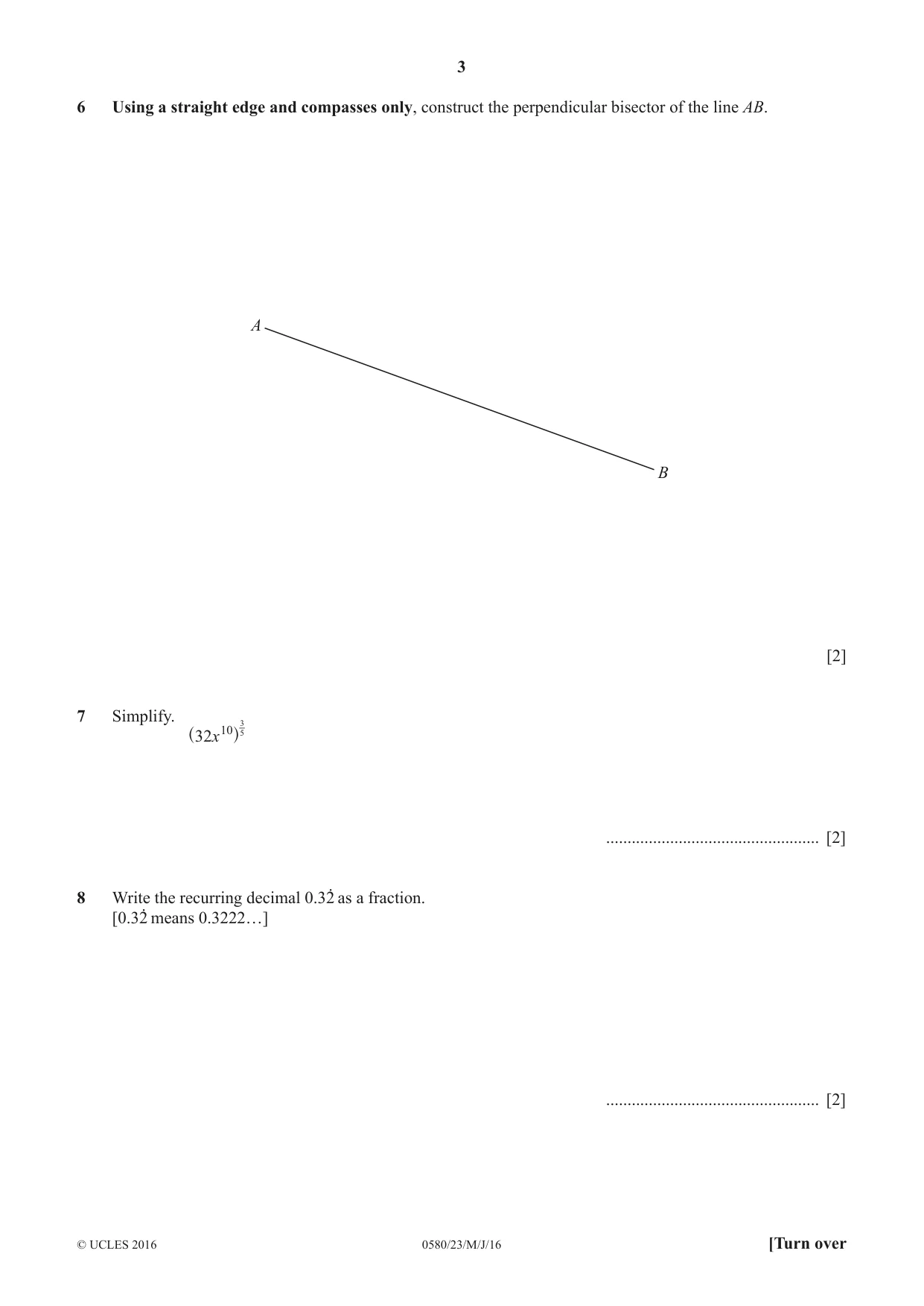
6 Using a straight edge and compasses only, construct the perpendicular bisector of the line AB. A B [2]
Mark scheme: 6 Correct perpendicular bisector 2 B1 for correct bisector with no arcs or incorrect arcs with 2 pairs of correct arcs or for correct intersecting arcs with no/wrong line 6 k 6
Question 7
7 Simplify. 3 5 ^32x10h .................................................. [2]
Mark scheme: 7 8x6 final answer 2 B1 for 8xk or cx6 29 . .
Q8 · Write the recurring decimal 0.32˙ as a fraction
8 Write the recurring decimal 0.32˙ as a fraction. [0.32˙ means 0.3222…] .................................................. [2]
Mark scheme: 29 8 oe, must be a fraction 2 M1 for 32.2 − 3.2 90 k or B1 for 90 1 1 1 1
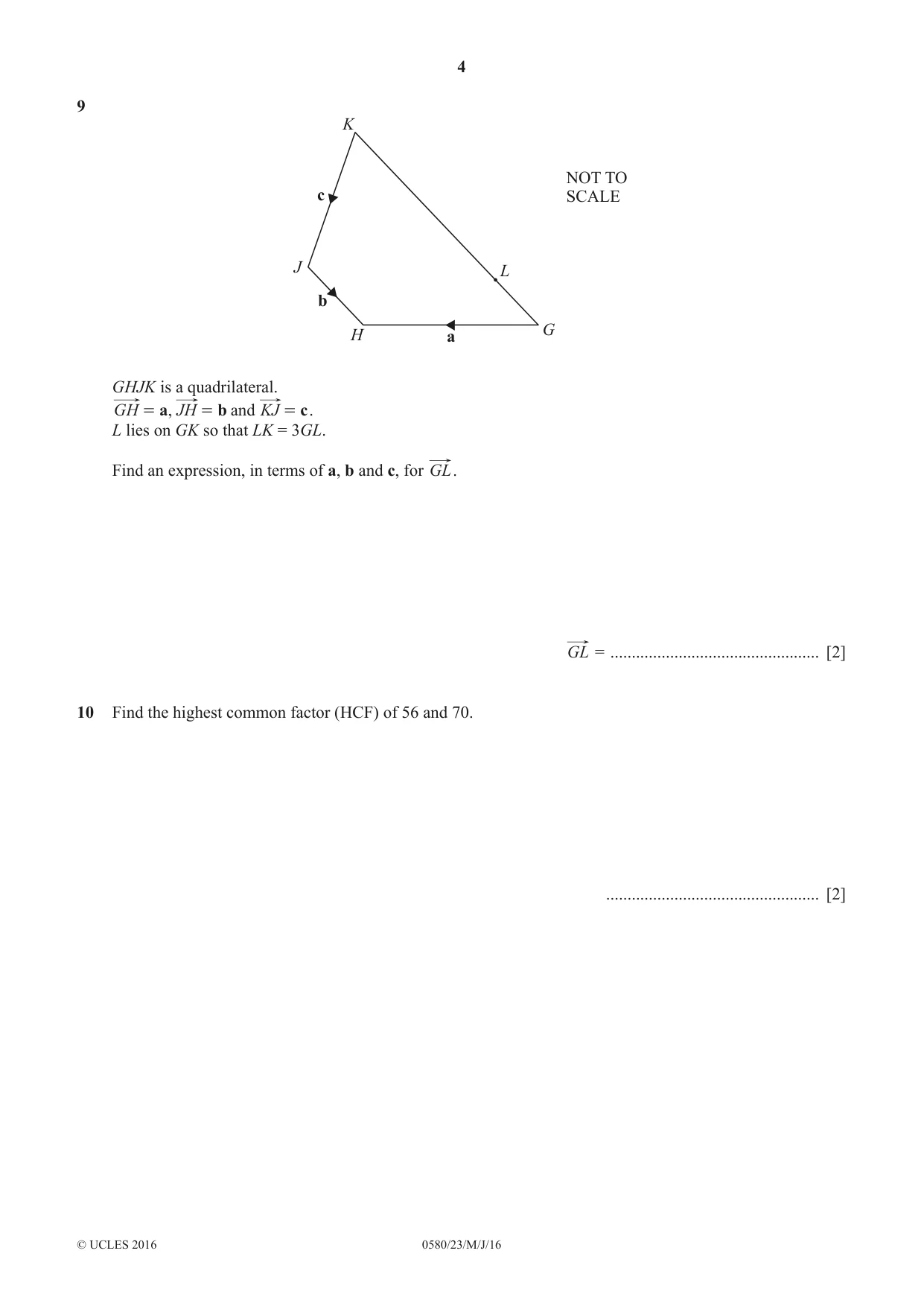
Q9 · K NOT TO c SCALE J L b G H a GHJK is a quadrilateral
9 K NOT TO c SCALE J L b G H a GHJK is a quadrilateral. GH = a, JH = b and KJ = c . L lies on GK so that LK = 3GL. Find an expression, in terms of a, b and c, for GL. GL = ................................................. [2]
Mark scheme: 1 1 1 1 9 a – b – c oe 2 B1 for GK = a – b – c oe soi or GL = (GK ) 4 4 4 4 or for any correct route
Q10 · Find the highest common factor (HCF) of 56 and 70
10 Find the highest common factor (HCF) of 56 and 70. .................................................. [2]
Mark scheme: 10 14 2 M1 for 56 = 2×2×2×7 soi or 70 = 2×5×7 soi or 2×7 as final answer
Q11 · Hattie has a box of coloured pens
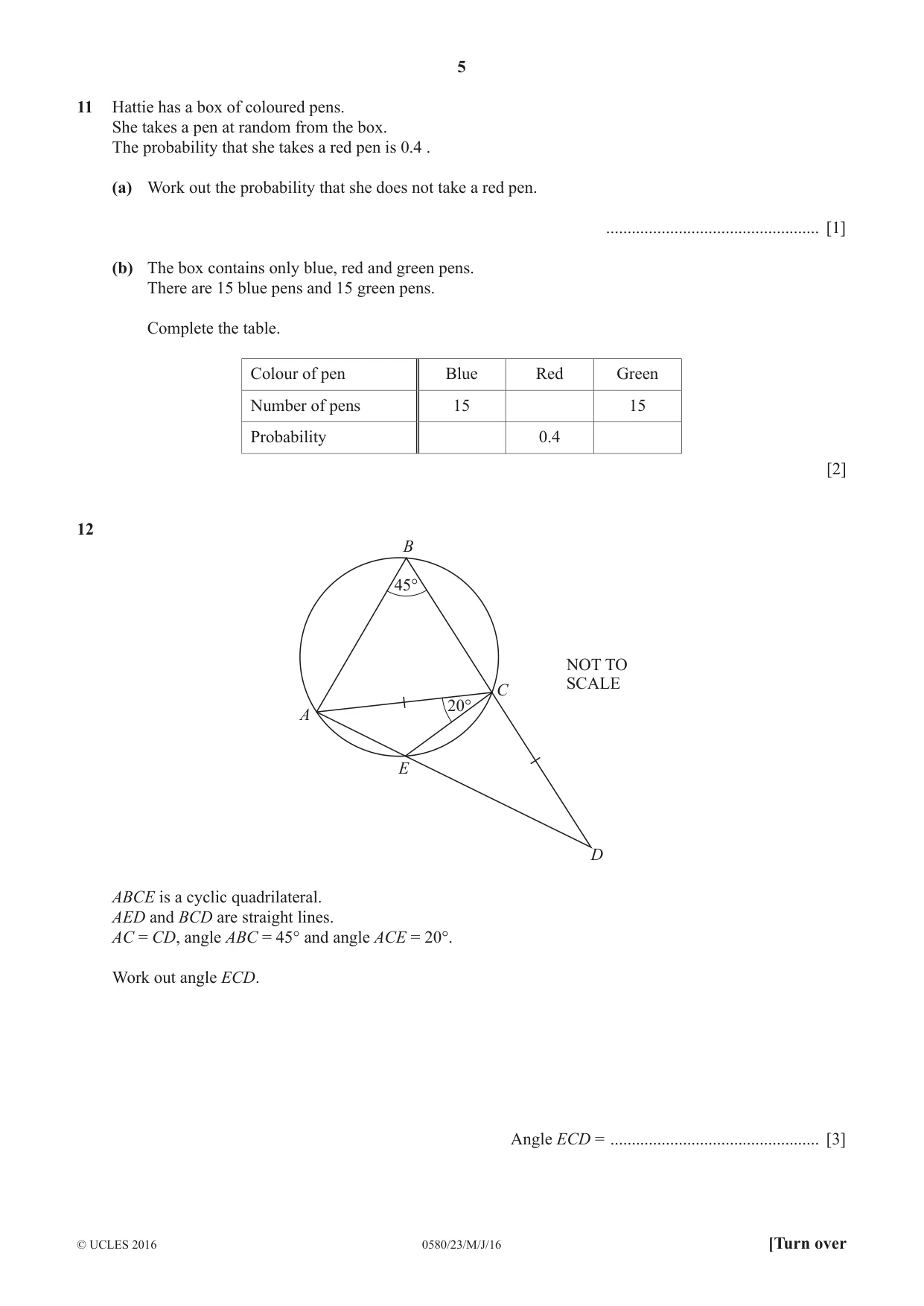
11 Hattie has a box of coloured pens. She takes a pen at random from the box. The probability that she takes a red pen is 0.4 . (a) Work out the probability that she does not take a red pen. .................................................. [1] (b) The box contains only blue, red and green pens. There are 15 blue pens and 15 green pens. Complete the table. Colour of pen Blue Red Green Number of pens 15 15 Probability 0.4 [2]
Mark scheme: 11 (a) 0.6 oe 1 (b) 20 2 B1 for 20 0.3 oe 0.3 oe B1 for 0.3 oe and 0.3 oe
Q12 · B 45° NOT TO SCALE C 20° A E D ABCE is a cyclic quadrilateral
12 B 45° NOT TO SCALE C 20° A E D ABCE is a cyclic quadrilateral. AED and BCD are straight lines. AC = CD, angle ABC = 45° and angle ACE = 20°. Work out angle ECD. Angle ECD = ................................................. [3]
Mark scheme: 12 110 3 B2 for ADC = 25 or B1 for AEC = 135 or CAE = 25
Q13 · NOT TO SCALE x° y° 42° The diagram is made from 5 congruent kites
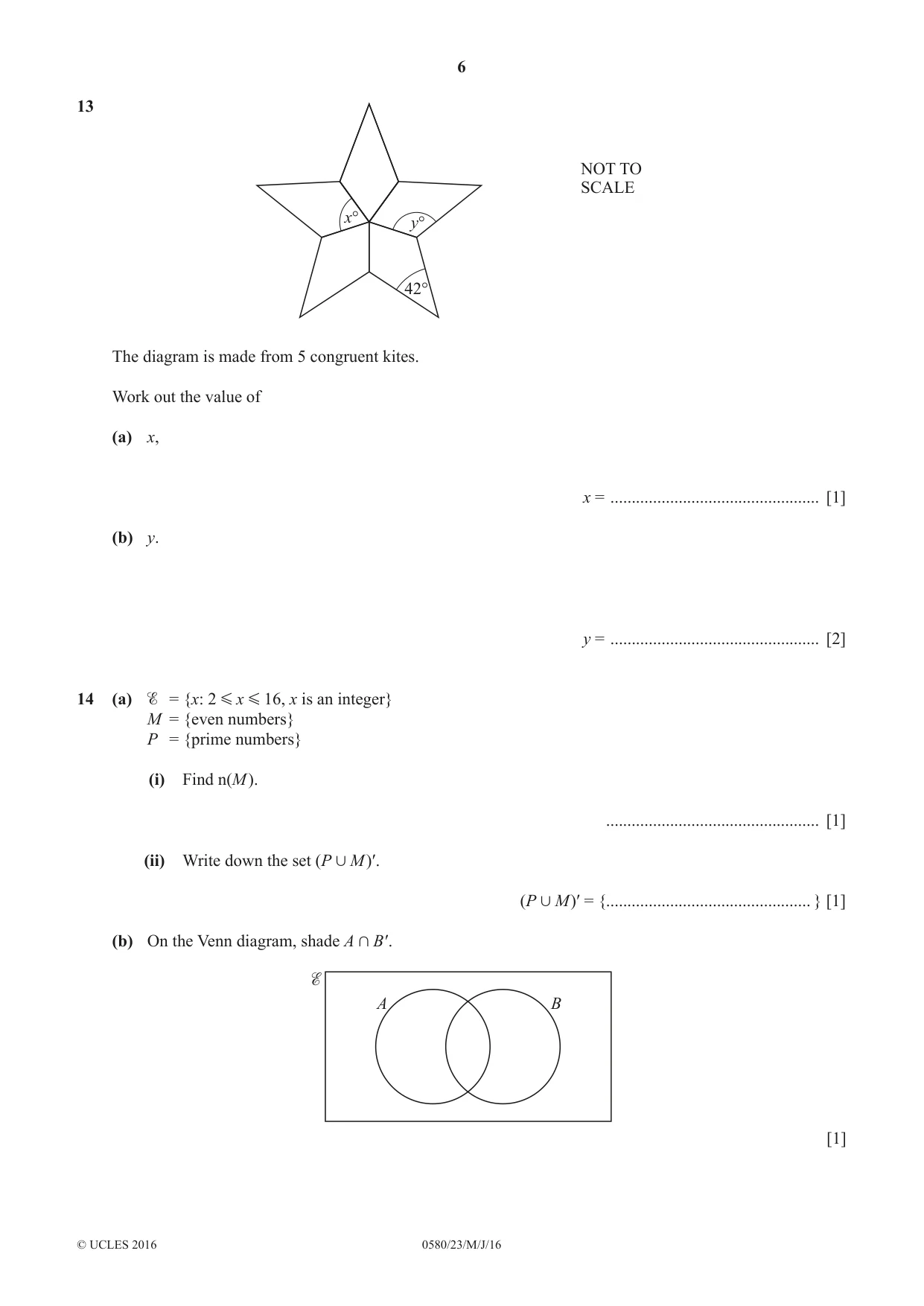
13 NOT TO SCALE x° y° 42° The diagram is made from 5 congruent kites. Work out the value of (a) x, x = ................................................. [1] (b) y. y = ................................................. [2]
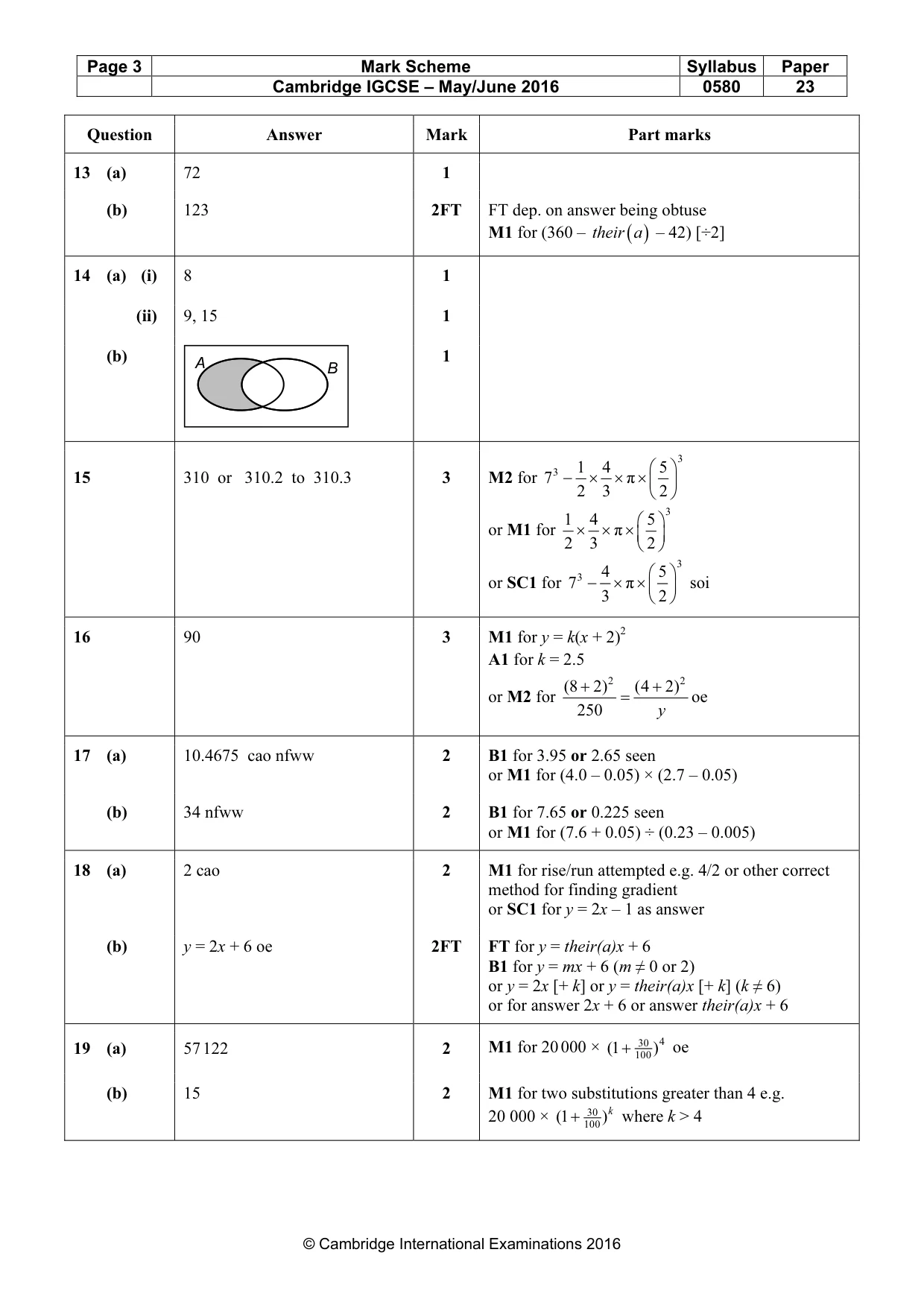
Mark scheme: 13 (a) 72 1 (b) 123 2FT FT dep. on answer being obtuse M1 for (360 – their ( a ) – 42) [÷2]
Q14 · = {x: 2 G x G 16, x is an integer} M = {even numbers} P = {prime numbers} (i) Find n(M)
14 (a) = {x: 2 G x G 16, x is an integer} M = {even numbers} P = {prime numbers} (i) Find n(M). .................................................. [1] (ii) Write down the set (P , M)′. (P , M)′ = {................................................ } [1] (b) On the Venn diagram, shade A + B′. A B [1]
Mark scheme: 14 (a) (i) 8 1 (ii) 9, 15 1 (b) 1 A B 3 3 1 4 5
Q15 · A solid consists of a metal cube with a hemisphere cut out of it
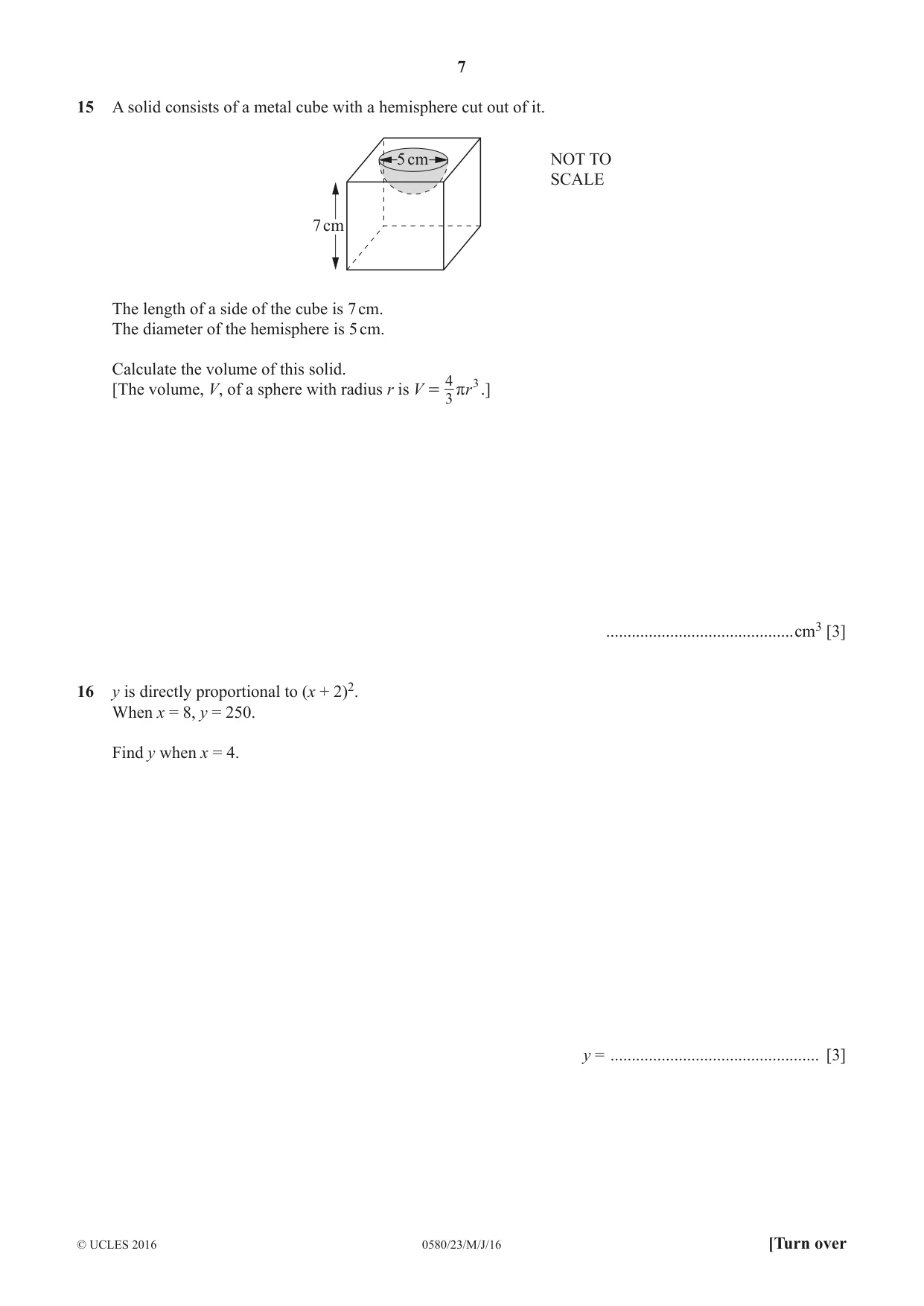
15 A solid consists of a metal cube with a hemisphere cut out of it. 5 cm NOT TO SCALE 7 cm The length of a side of the cube is 7 cm. The diameter of the hemisphere is 5 cm. Calculate the volume of this solid. 4 rr3 .] [The volume, V, of a sphere with radius r is V = 3 ............................................cm3 [3]
Mark scheme: 3 1 4 5 15 310 or 310.2 to 310.3 3 M2 for 7 − × × π × 2 3 2 3 1 4 5 or M1 for × × π × 2 3 2 3 3 4 5 or SC1 for 7 − × π × soi 3 2 2
Q16 · Y is directly proportional to (x + 2)2
16 y is directly proportional to (x + 2)2. When x = 8, y = 250. Find y when x = 4. y = ................................................. [3]
Mark scheme: 16 90 3 M1 for y = k(x + 2)2 A1 for k = 2.5 (8 + 2) 2 (4 + 2) 2 or M2 for = oe 250 y
Q17 · V = IR In an experiment I and R are both measured correct to 1 decimal place
17 (a) V = IR In an experiment I and R are both measured correct to 1 decimal place. When I = 4.0 and R = 2.7, find the lower bound for V. .................................................. [2] D (b) S = T In an experiment D and T are both measured correct to 2 significant figures. When D = 7.6 and T = 0.23, find the upper bound for S. .................................................. [2]
Mark scheme: 17 (a) 10.4675 cao nfww 2 B1 for 3.95 or 2.65 seen or M1 for (4.0 – 0.05) × (2.7 – 0.05) (b) 34 nfww 2 B1 for 7.65 or 0.225 seen or M1 for (7.6 + 0.05) ÷ (0.23 – 0.005)
Q18 · Y 7 6 L 5 4 3 2 1 x –3 –2 –1 0 1 2 3 4 5 6 –1 –2 –3 (a) Work out the gradient of the line…
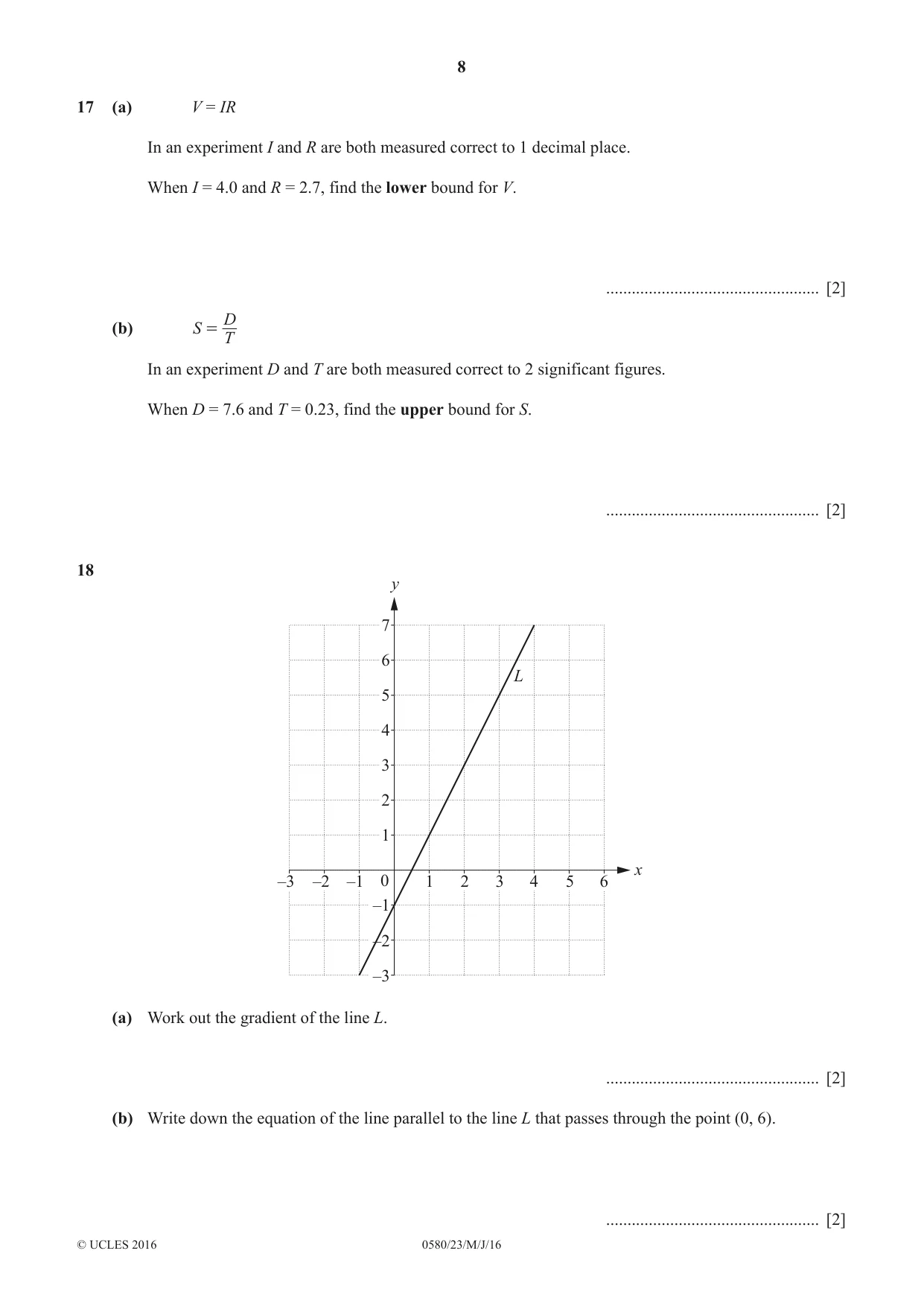
18 y 7 6 L 5 4 3 2 1 x –3 –2 –1 0 1 2 3 4 5 6 –1 –2 –3 (a) Work out the gradient of the line L. .................................................. [2] (b) Write down the equation of the line parallel to the line L that passes through the point (0, 6). .................................................. [2]
Mark scheme: 18 (a) 2 cao 2 M1 for rise/run attempted e.g. 4/2 or other correct method for finding gradient or SC1 for y = 2x – 1 as answer (b) y = 2x + 6 oe 2FT FT for y = their(a)x + 6 B1 for y = mx + 6 (m ≠ 0 or 2) or y = 2x [+ k] or y = their(a)x [+ k] (k ≠ 6) or for answer 2x + 6 or answer their(a)x + 6 30 4
Q19 · At the start of an experiment there are 20 000 bacteria
19 At the start of an experiment there are 20 000 bacteria. The number of bacteria increases at a rate of 30% per hour. (a) Work out the number of bacteria after 4 hours. .................................................. [2] (b) After how many whole hours, from the start of the experiment, will the number of bacteria be greater than one million? ......................................... hours [2]
Mark scheme: 19 (a) 57 122 2 M1 for 20 000 × (1 + 10030 ) 4 oe (b) 15 2 M1 for two substitutions greater than 4 e.g. 20 000 × (1 + 10030 )k where k > 4
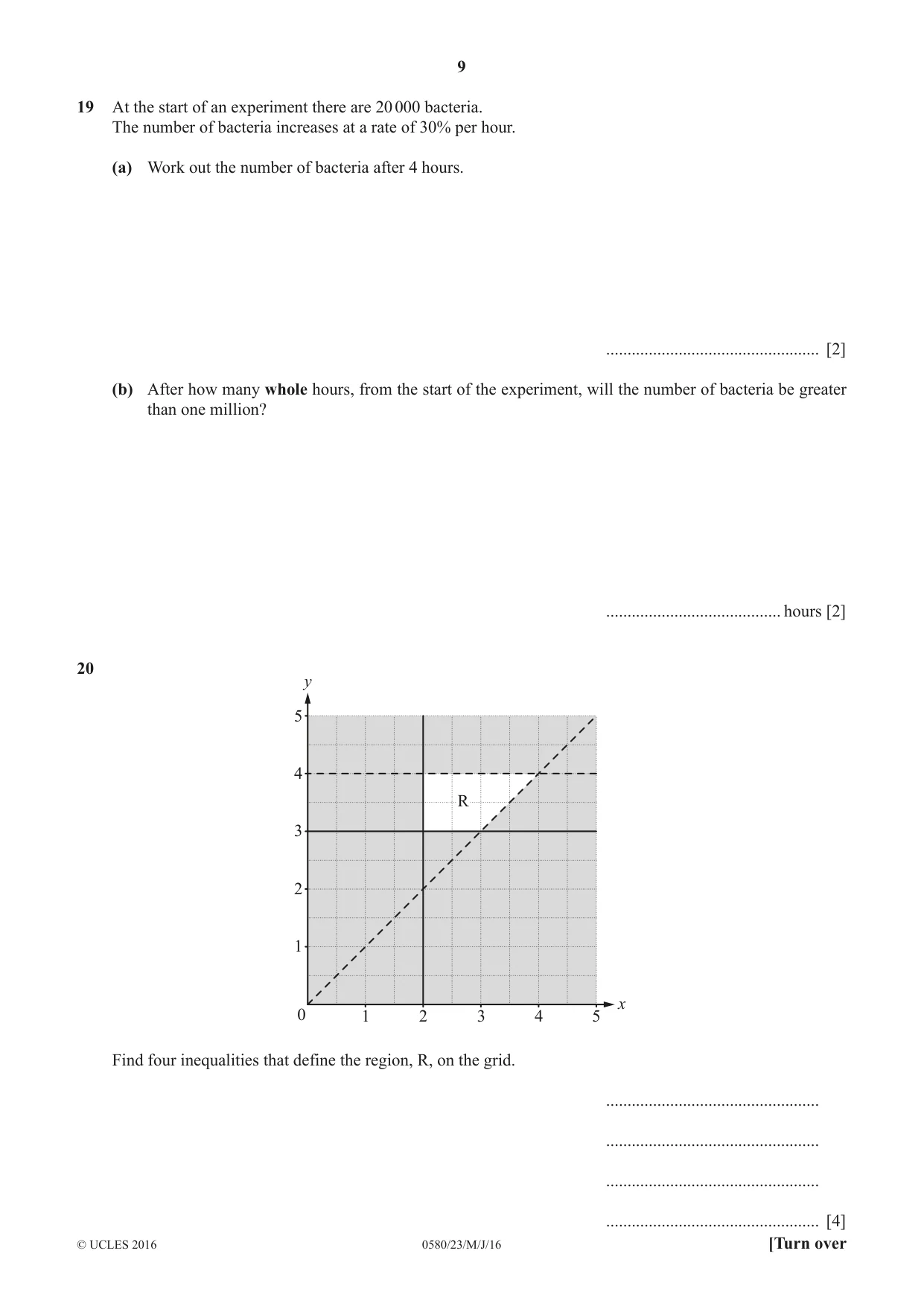
Q20 · Y 5 4 R 3 2 1 x 0 1 2 3 4 5 Find four inequalities that define the region, R, on the grid
20 y 5 4 R 3 2 1 x 0 1 2 3 4 5 Find four inequalities that define the region, R, on the grid. .................................................. .................................................. .................................................. .................................................. [4]
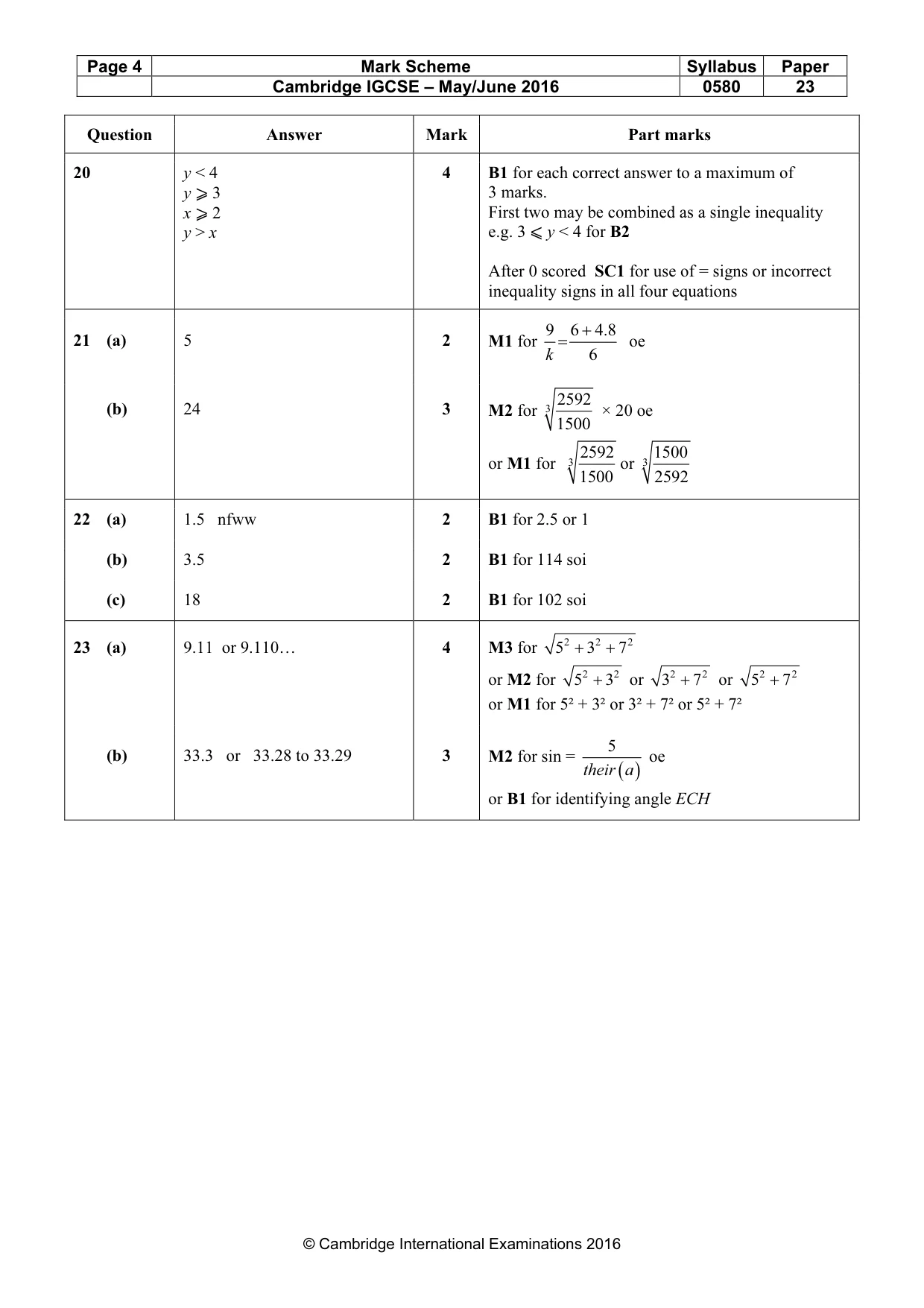
Mark scheme: 20 y < 4 4 B1 for each correct answer to a maximum of y ⩾ 3 3 marks. x ⩾ 2 First two may be combined as a single inequality y > x e.g. 3 ⩽ y < 4 for B2 After 0 scored SC1 for use of = signs or incorrect inequality signs in all four equations 9 6 + 4 8
Q21 · B 4.8 cm NOT TO E 6 cm SCALE 9 cm k cm C D A Triangles CBA and CED are similar
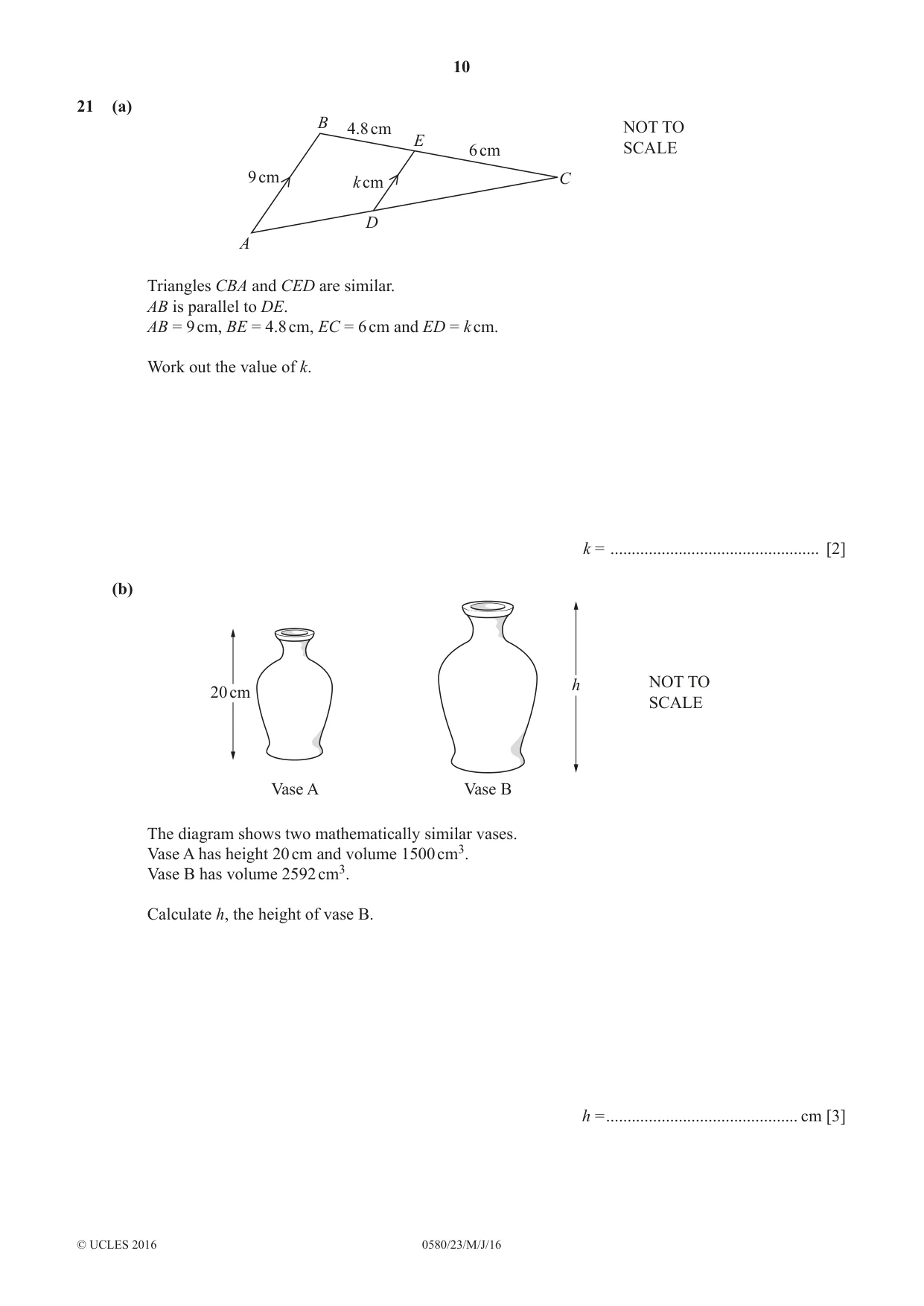
21 (a) B 4.8 cm NOT TO E 6 cm SCALE 9 cm k cm C D A Triangles CBA and CED are similar. AB is parallel to DE. AB = 9 cm, BE = 4.8 cm, EC = 6 cm and ED = k cm. Work out the value of k. k = ................................................. [2] (b) h NOT TO 20 cm SCALE Vase A Vase B The diagram shows two mathematically similar vases. Vase A has height 20 cm and volume 1500 cm3. Vase B has volume 2592 cm3. Calculate h, the height of vase B. h = ............................................. cm [3]
Mark scheme: 9 6 + 4.8 21 (a) 5 2 M1 for = oe k 6 2592 (b) 24 3 M2 for 3 × 20 oe 1500 2592 1500 or M1 for 3 or 3 1500 2592
Q22 · The cumulative frequency diagram shows information about the trunk diameter, in metres…
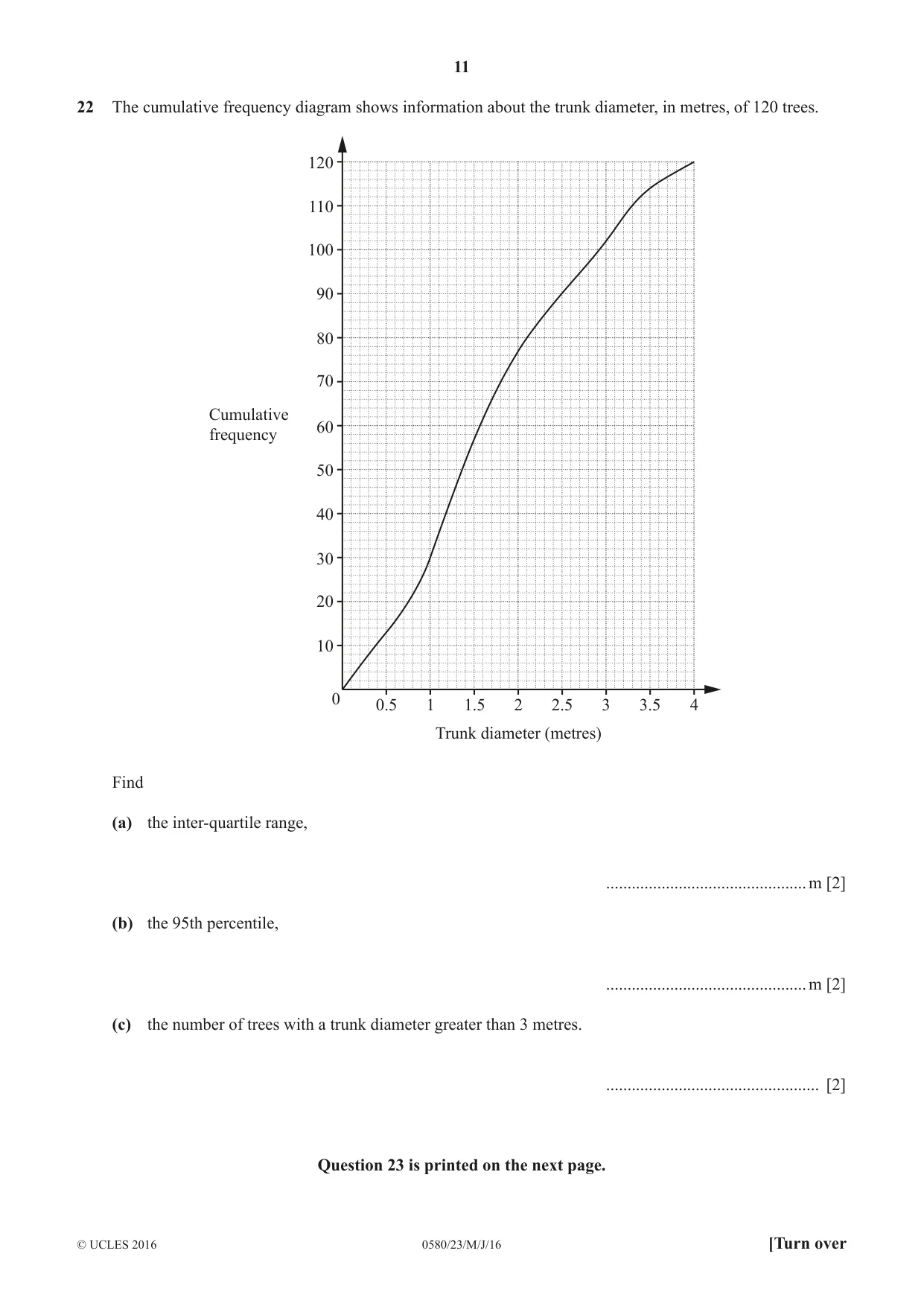
22 The cumulative frequency diagram shows information about the trunk diameter, in metres, of 120 trees. 120 110 100 90 80 70 Cumulative 60 frequency 50 40 30 20 10 0 0.5 1 1.5 2 2.5 3 3.5 4 Trunk diameter (metres) Find (a) the inter-quartile range, ...............................................m [2] (b) the 95th percentile, ...............................................m [2] (c) the number of trees with a trunk diameter greater than 3 metres. .................................................. [2] Question 23 is printed on the next page.
Mark scheme: 22 (a) 1.5 nfww 2 B1 for 2.5 or 1 (b) 3.5 2 B1 for 114 soi (c) 18 2 B1 for 102 soi 2 2 2
Q23 · 7 cm E F 5 cm B NOT TO A SCALE H G 3 cm D C The diagram shows a cuboid
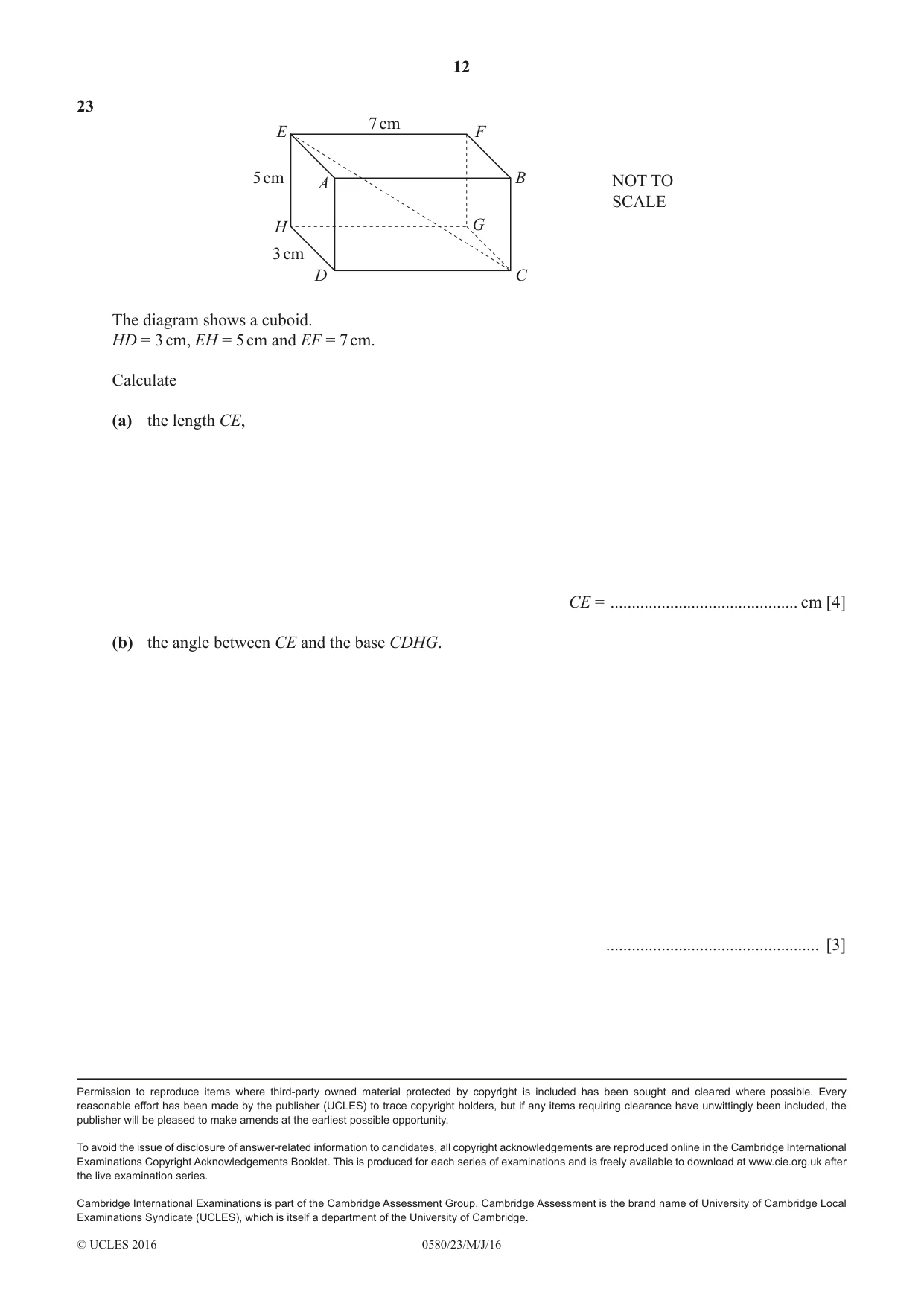
23 7 cm E F 5 cm B NOT TO A SCALE H G 3 cm D C The diagram shows a cuboid. HD = 3 cm, EH = 5 cm and EF = 7 cm. Calculate (a) the length CE, CE = ............................................ cm [4] (b) the angle between CE and the base CDHG. .................................................. [3]
Mark scheme: 23 (a) 9.11 or 9.110… 4 M3 for 5 2 + 32 + 7 2 or M2 for 5 2 + 32 or 32 + 7 2 or 5 2 + 7 2 or M1 for 5² + 3² or 3² + 7² or 5² + 7² 5 (b) 33.3 or 33.28 to 33.29 3 M2 for sin = oe their ( a ) or B1 for identifying angle ECH
What was in this paper
The subtopics covered by these 23 questions, and how many questions each got. Open one in a new tab to see every Cambridge question on it.
2Fractions, decimals and percentages2Limits of accuracy2Powers and roots2Surface area and volume2Area and perimeter1Cumulative frequency diagrams1Equations1Geometrical constructions1Gradient of linear graphs1Inequalities1Introduction to probability1Percentages1Pythagoras’ theorem1Ratio and proportion1Sets1Types of number1Vectors in two dimensions1What you needed in this session
Cambridge’s own grade thresholds for 2016 May/June, Paper 2 · Variant 3. A higher threshold means an easier paper — the bar moves with how the cohort did.