Cambridge IGCSE Mathematics 0580 — 2017 Feb/March Paper 2 · Variant 2
0580/22/F/M/17 · 21 questions · 70 marks · ≈79 min
The question paper and its mark scheme, free to read here and free to download. This is Cambridge’s own paper, exactly as it was sat.
Question paper12 pages
Mark scheme5 pages
Answers below. Sit the paper first if you are practising.
Questions as text
Q1 · Expand the brackets and simplify
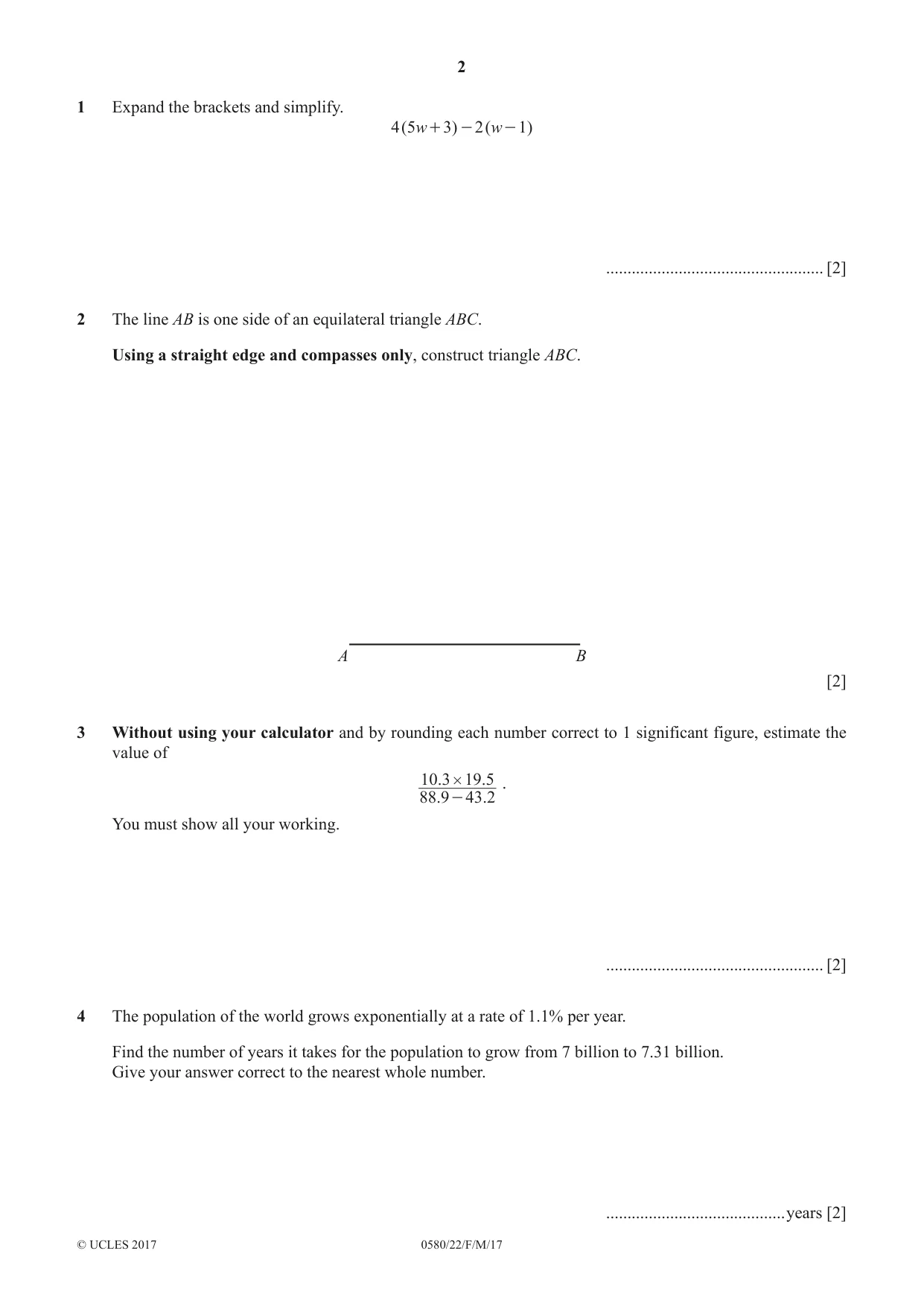
1 Expand the brackets and simplify. 4 (5w + 3 ) - 2 (w - 1 ) ................................................... [2]
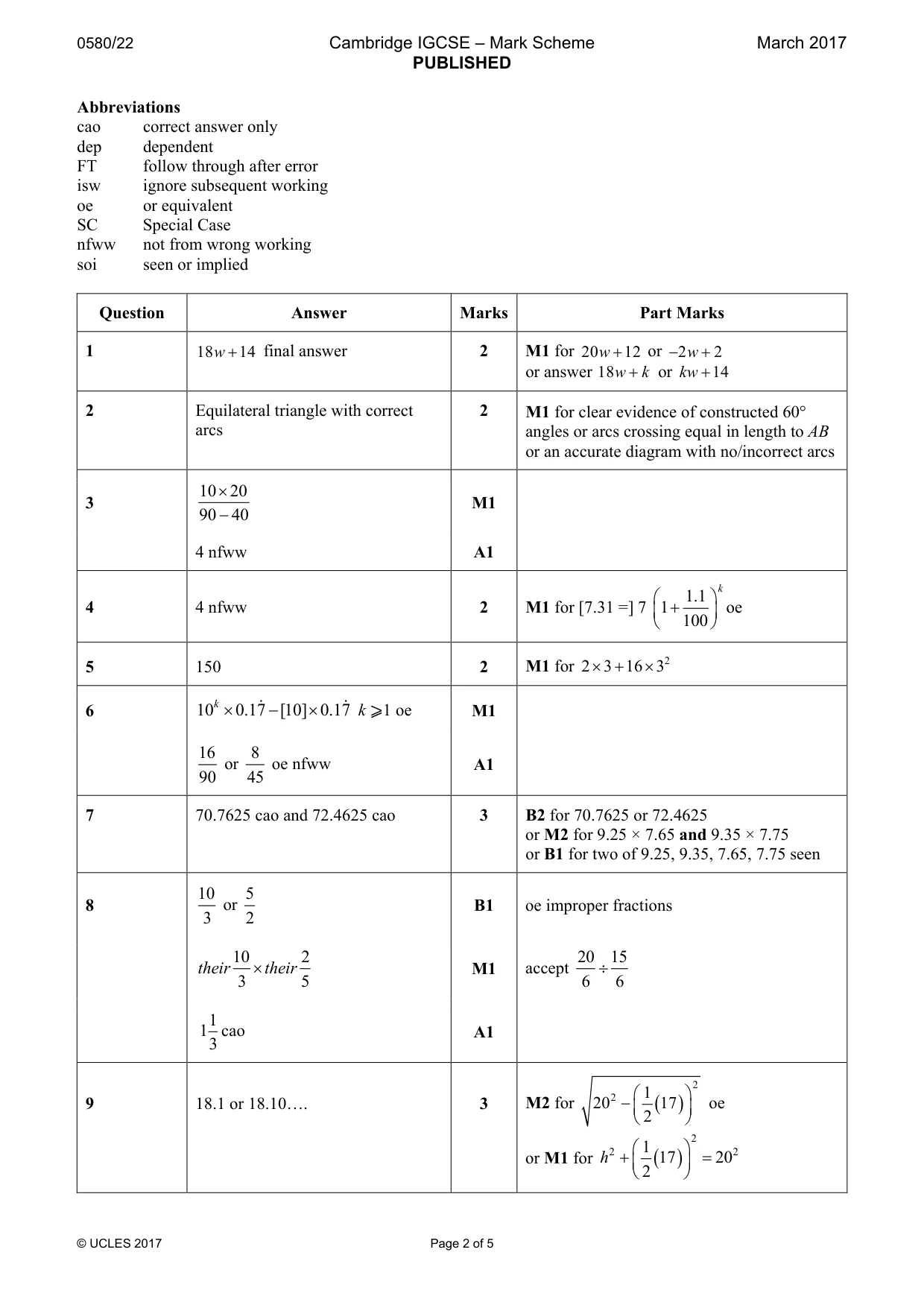
Mark scheme: Question Answer Marks Part Marks 1 18 w + 14 final answer 2 M1 for 20 w + 12 or − 2 w + 2 or answer 18 w + k or kw + 14
Q2 · The line AB is one side of an equilateral triangle ABC
2 The line AB is one side of an equilateral triangle ABC. Using a straight edge and compasses only, construct triangle ABC. A B [2]
Mark scheme: 2 Equilateral triangle with correct 2 M1 for clear evidence of constructed 60° arcs angles or arcs crossing equal in length to AB or an accurate diagram with no/incorrect arcs 10 × 20
Q3 · Without using your calculator and by rounding each number correct to 1 significant…
3 Without using your calculator and by rounding each number correct to 1 significant figure, estimate the value of 10.3 # 19.5 . 88.9 - 43.2 You must show all your working. ................................................... [2]
Mark scheme: 10 × 20 3 M1 90 − 40 4 nfww A1 1 1 k
Q4 · The population of the world grows exponentially at a rate of 1.1% per year
4 The population of the world grows exponentially at a rate of 1.1% per year. Find the number of years it takes for the population to grow from 7 billion to 7.31 billion. Give your answer correct to the nearest whole number. ..........................................years [2]
Mark scheme: 1.1 4 4 nfww 2 M1 for [7.31 =] 7 1 + oe 100 2
Q5 · S = ut + 16t 2 Find the value of s when u = 2 and t = 3
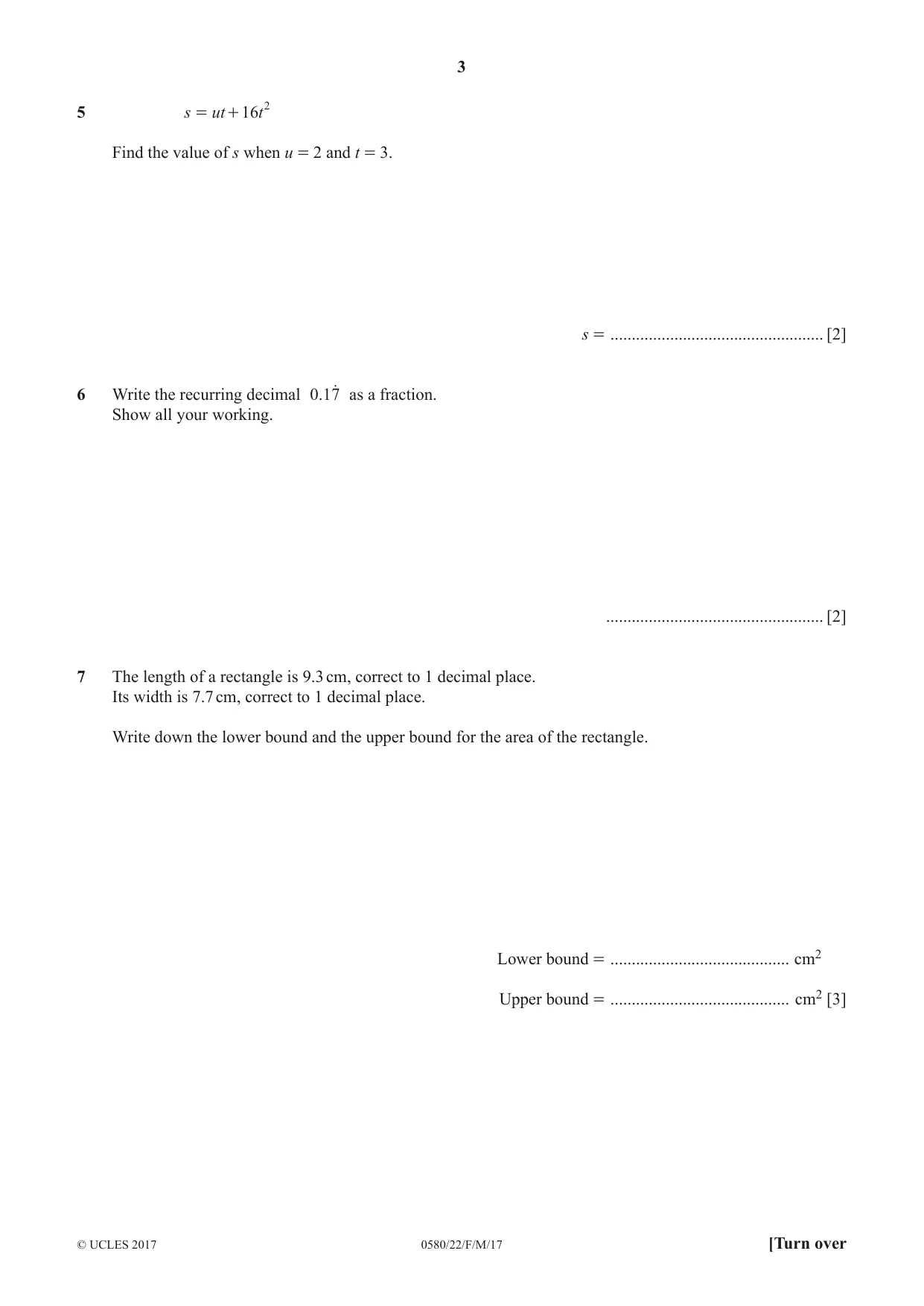
5 s = ut + 16t 2 Find the value of s when u = 2 and t = 3. s = .................................................. [2]
Mark scheme: 5 150 2 M1 for 2 × 3 + 16 × 32 k
Q6 · Write the recurring decimal .017o as a fraction
6 Write the recurring decimal .017o as a fraction. Show all your working. ................................................... [2]
Mark scheme: 6 10 k × 0.17 − [10] × 0.17 k ⩾1 oe M1 16 8 or oe nfww A1 90 45
Q7 · The length of a rectangle is 9.3 cm, correct to 1 decimal place
7 The length of a rectangle is 9.3 cm, correct to 1 decimal place. Its width is 7.7 cm, correct to 1 decimal place. Write down the lower bound and the upper bound for the area of the rectangle. Lower bound = .......................................... cm2 Upper bound = .......................................... cm2 [3]
Mark scheme: 7 70.7625 cao and 72.4625 cao 3 B2 for 70.7625 or 72.4625 or M2 for 9.25 × 7.65 and 9.35 × 7.75 or B1 for two of 9.25, 9.35, 7.65, 7.75 seen 10 5
Q8 · 18 Without using your calculator, work out 3 ' 2
1 18 Without using your calculator, work out 3 ' 2 . 3 2 You must show all your working and give your answer as a mixed number in its simplest form. ................................................... [3]
Mark scheme: 10 5 8 or B1 oe improper fractions 3 2 10 2 20 15 their × their M1 accept ÷ 3 5 6 6 1 13 cao A1 2 1 2
Q9 · The diagram shows a pyramid with a square base ABCD
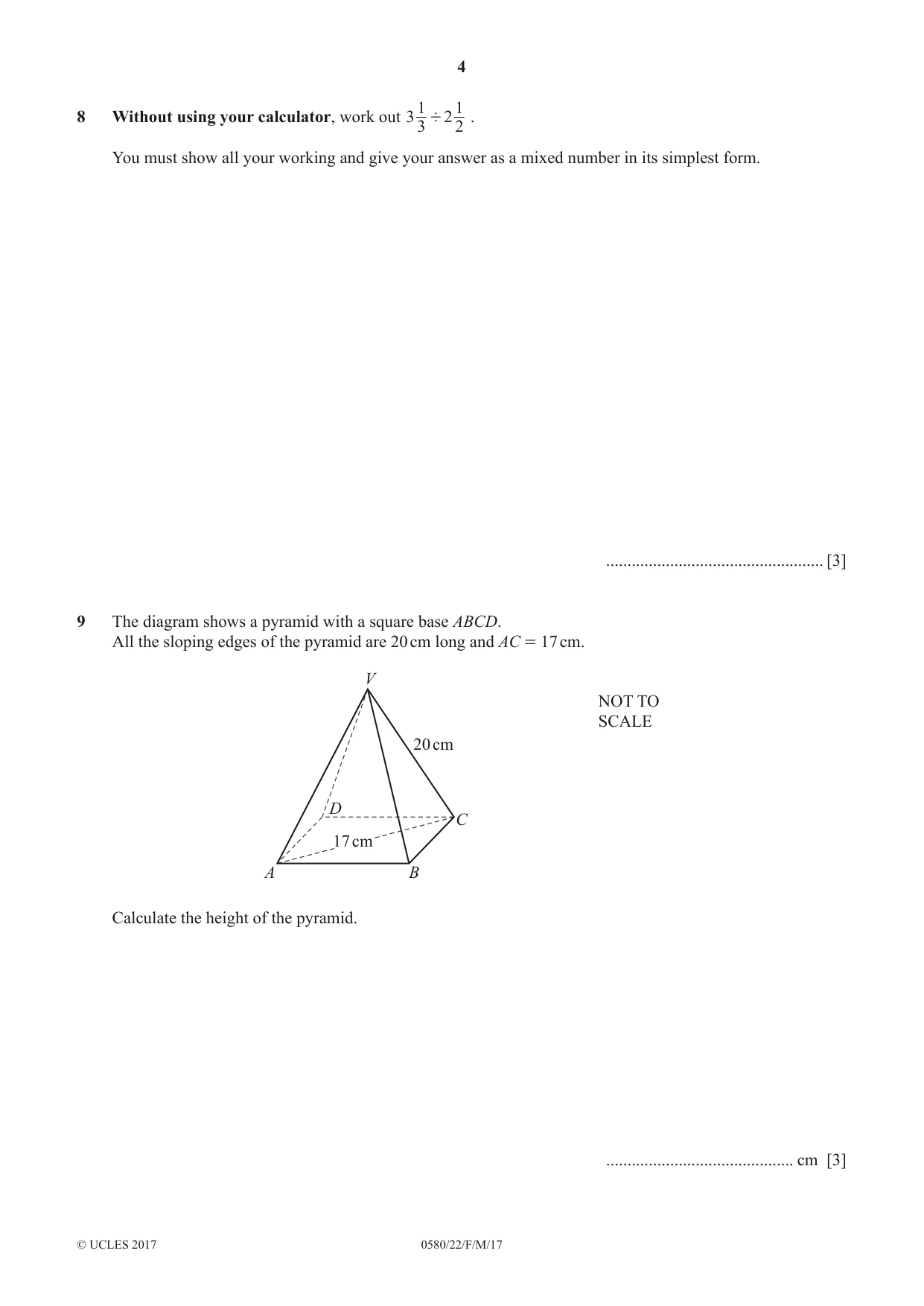
9 The diagram shows a pyramid with a square base ABCD. All the sloping edges of the pyramid are 20 cm long and AC = 17 cm. V NOT TO SCALE 20 cm D C 17 cm A B Calculate the height of the pyramid. ............................................ cm [3]
Mark scheme: 2 1 oe9 18.1 or 18.10…. 3 M2 for 20 − (17 ) 2 2 1 2 2 20 or M1 for h + ( 17 ) = 2
Q10 · Indira buys a television in a sale for $924
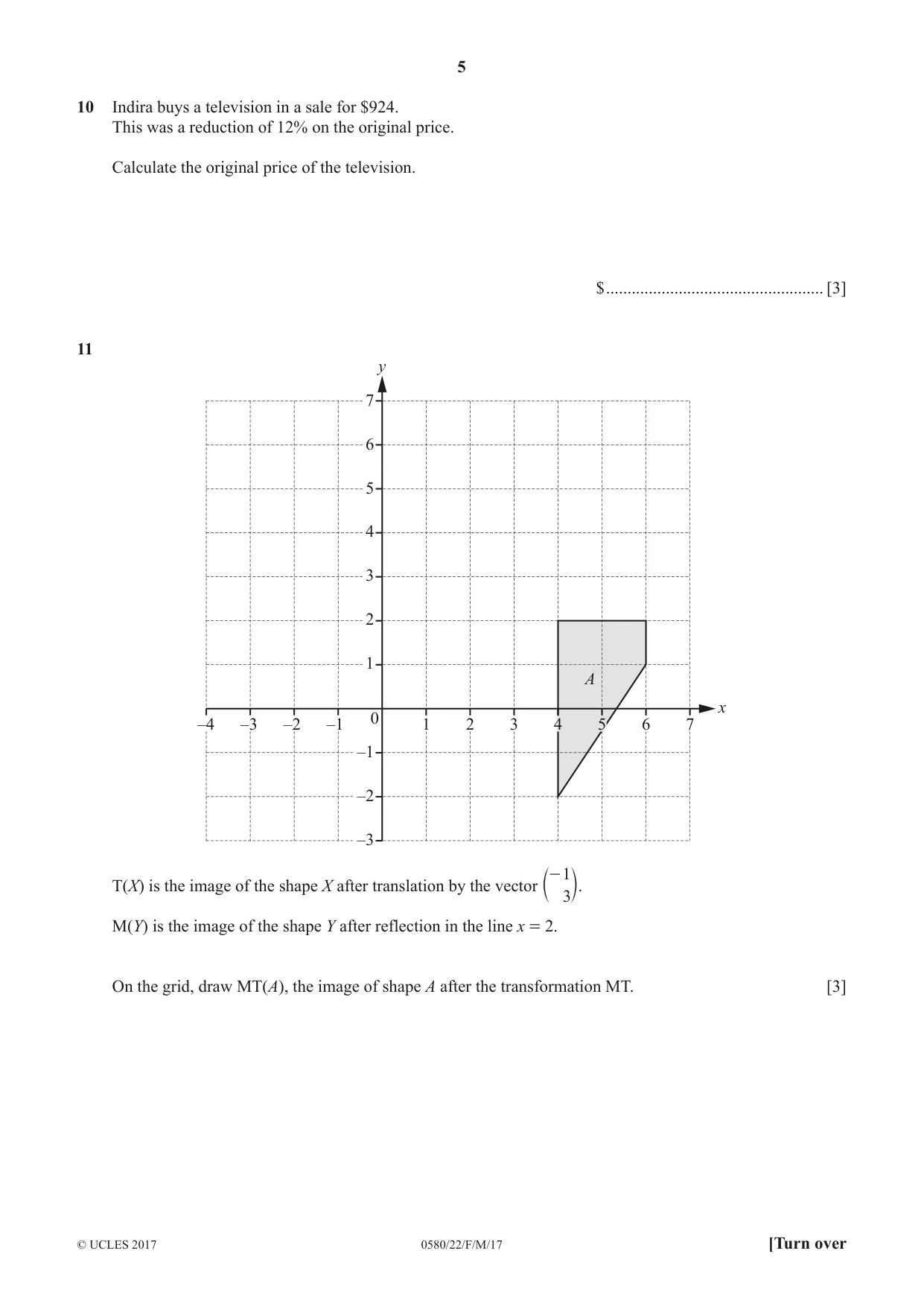
10 Indira buys a television in a sale for $924. This was a reduction of 12% on the original price. Calculate the original price of the television. $ ................................................... [3]
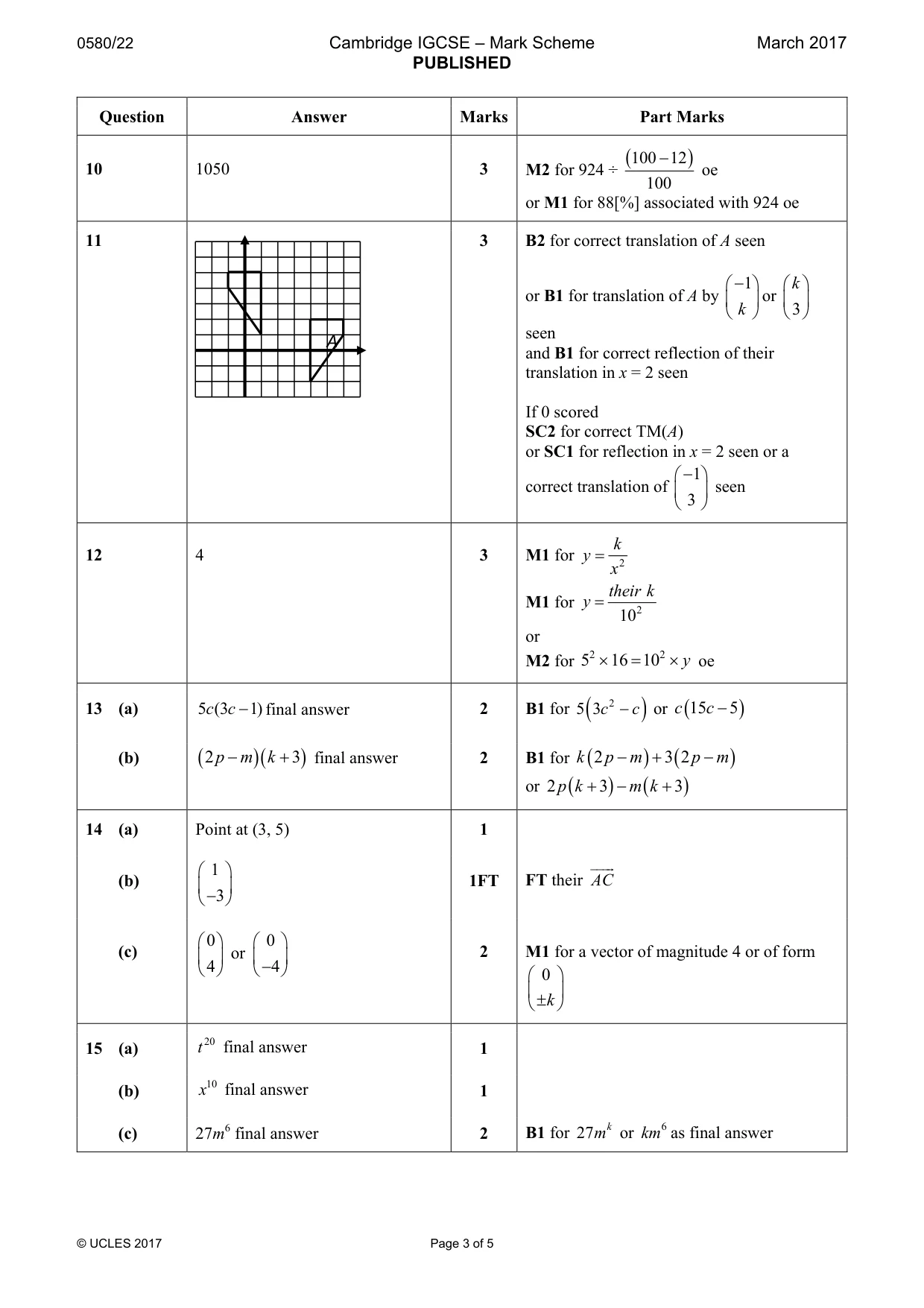
Mark scheme: (100 12 )10 1050 3 M2 for 924 ÷ oe 100 or M1 for 88[%] associated with 924 oe
Q11 · Y 7 6 5 4 3 2 1 A x 0 –4 –3 –2 –1 1 2 3 4 5 6 7 –1 –2 –3 - 1 T(X) is the image of the…
11 y 7 6 5 4 3 2 1 A x 0 –4 –3 –2 –1 1 2 3 4 5 6 7 –1 –2 –3 - 1 T(X) is the image of the shape X after translation by the vector c 3m. M(Y) is the image of the shape Y after reflection in the line x = 2. On the grid, draw MT(A), the image of shape A after the transformation MT. [3]
Mark scheme: 11 3 B2 for correct translation of A seen −1 k or B1 for translation of A by or k 3 seen A and B1 for correct reflection of their translation in x = 2 seen If 0 scored SC2 for correct TM(A) or SC1 for reflection in x = 2 seen or a −1 correct translation of seen 3 k
Q12 · Y is inversely proportional to x2
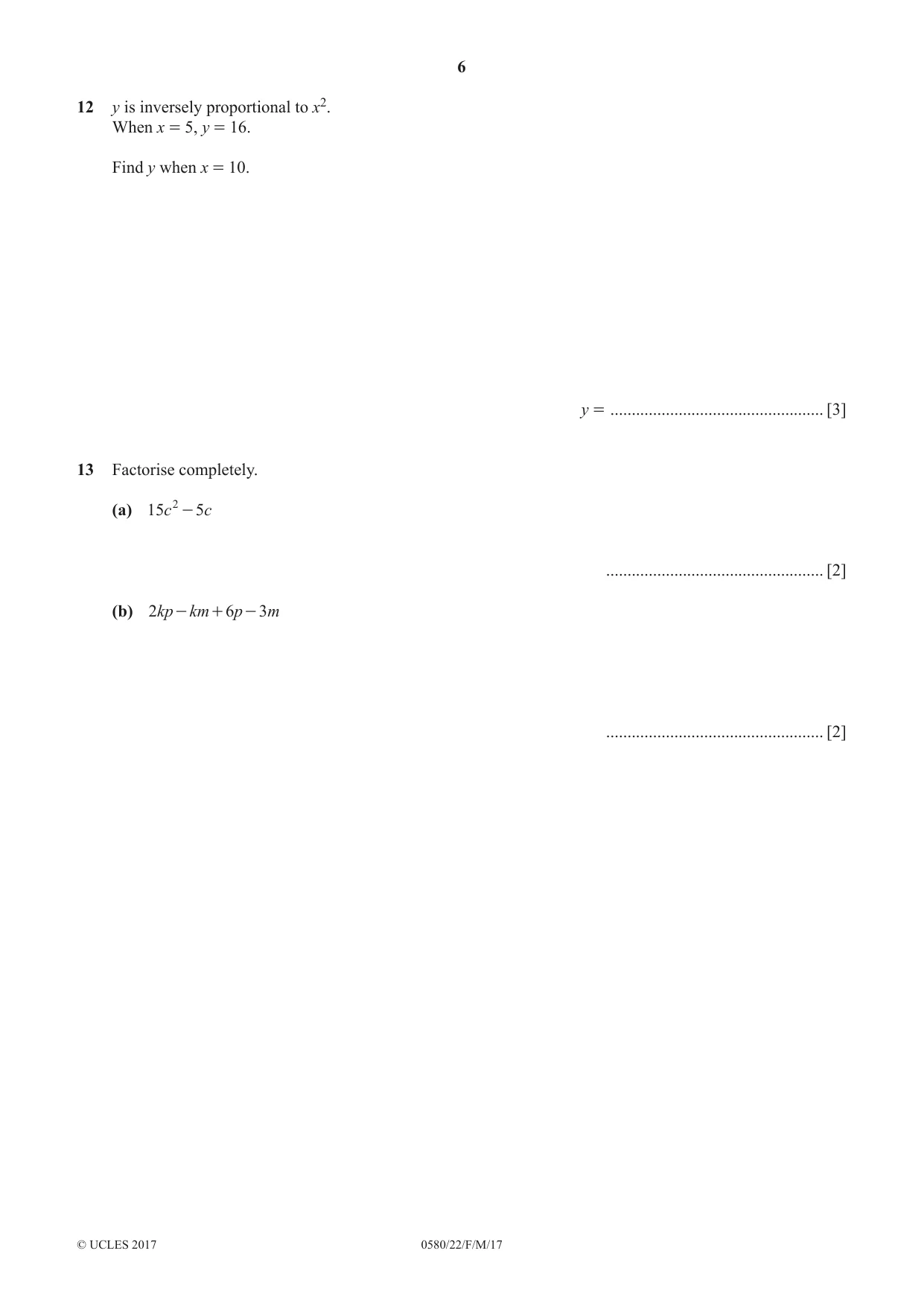
12 y is inversely proportional to x2. When x = 5, y = 16. Find y when x = 10. y = .................................................. [3]
Mark scheme: k 12 4 3 M1 for y = x 2 their k M1 for y = 10 2 or M2 for 52 × 16 = 10 2 × y oe 2 ( ) ( )
Question 13
13 Factorise completely. (a) 15c 2 - 5c ................................................... [2] (b) 2kp - km + 6p - 3m ................................................... [2]
Mark scheme: 3c 2 − c or c (15c − 5 )13 (a) 5c (3c − 1) final answer 2 B1 for 5 ( ) (b) ( 2 p − m )( k + 3 ) final answer 2 B1 for k ( 2 p − m ) + 3 ( 2 p − m ) or 2 p ( k + 3 ) − m ( k + 3 )
Q14 · Y 10 9 A 8 7 6 B 5 4 3 2 1 x 0 1 2 3 4 5 6 7 8 9 10 Points A and B are marked on the grid
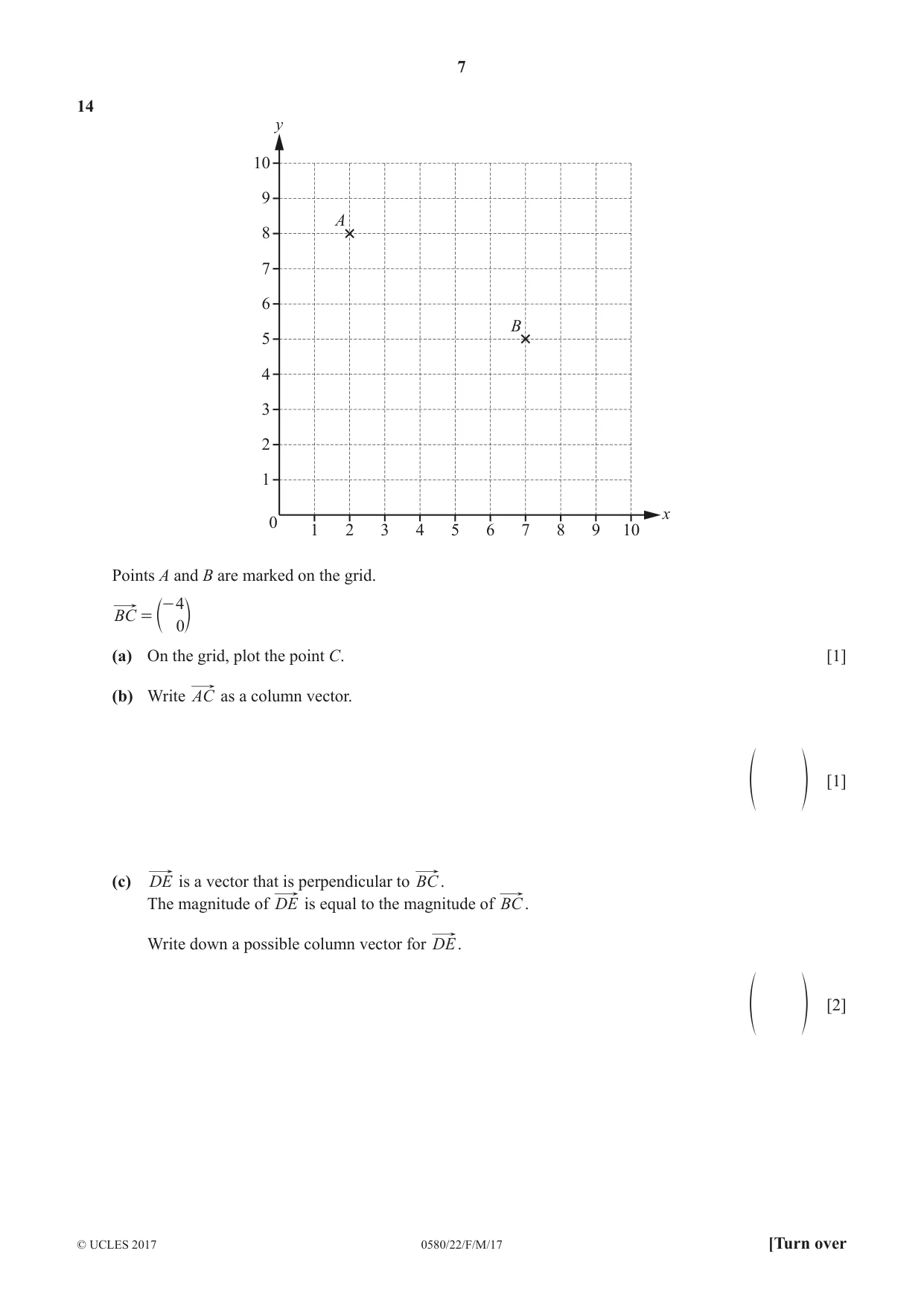
14 y 10 9 A 8 7 6 B 5 4 3 2 1 x 0 1 2 3 4 5 6 7 8 9 10 Points A and B are marked on the grid. - 4 BC = c 0m (a) On the grid, plot the point C. [1] (b) Write AC as a column vector. [1] f p (c) DE is a vector that is perpendicular to BC. The magnitude of DE is equal to the magnitude of BC. Write down a possible column vector for DE. [2] f p
Mark scheme: 14 (a) Point at (3, 5) 1 1 JJJG (b) 1FT FT their AC −3 0 0 (c) or 2 M1 for a vector of magnitude 4 or of form 4 −4 0 ± k 20
Question 15
15 Work out. (a) t 24 ' t 4 ................................................... [1] (b) x5 2 ^ h ................................................... [1] 8 43 (c) 81m ^ h ................................................... [2]
Mark scheme: 15 (a) t 20 final answer 1 (b) x10 final answer 1 (c) 27m6 final answer 2 B1 for 27 m k or km 6 as final answer
Q16 · The speed-time graph shows the first 60 seconds of a train journey
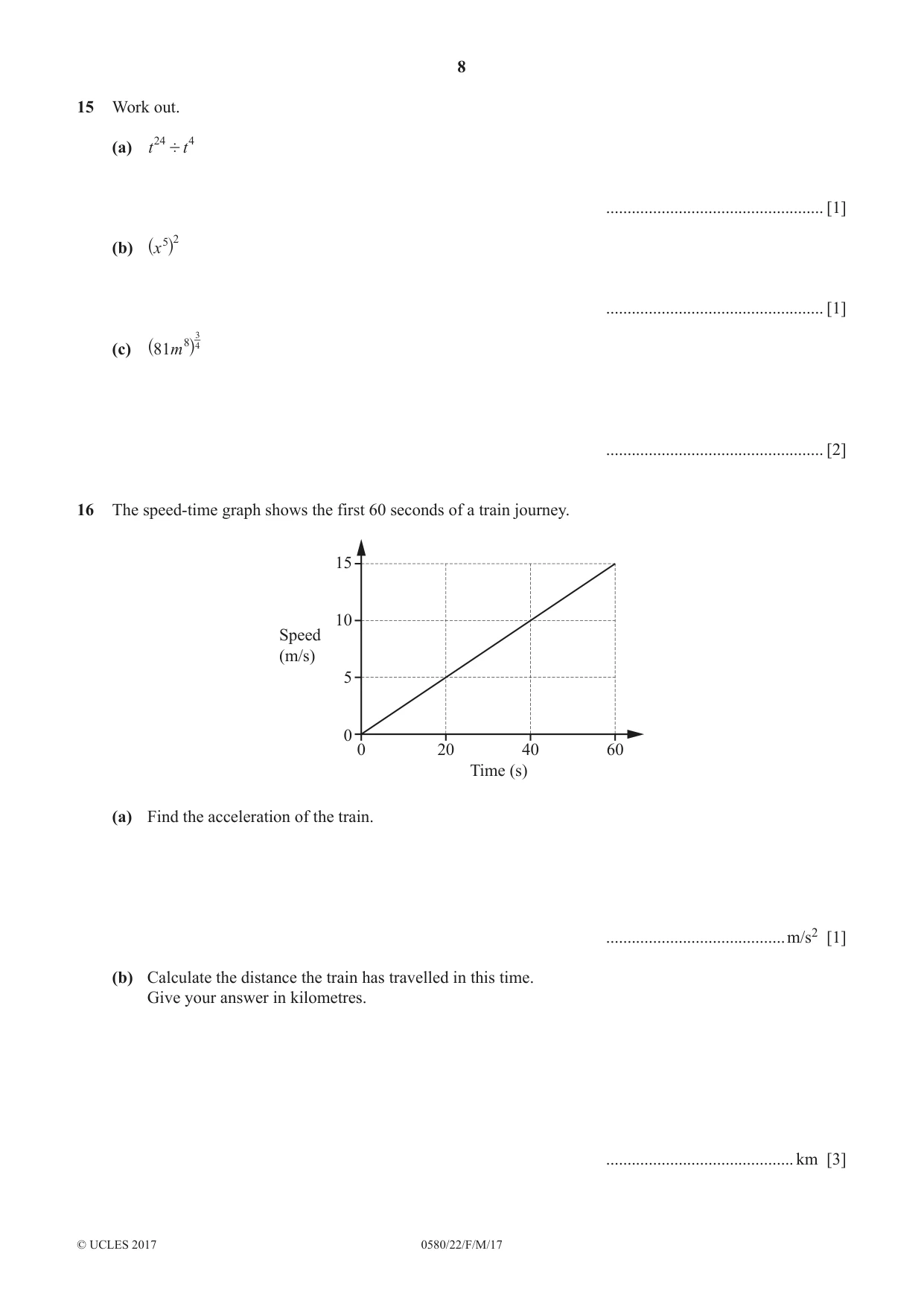
16 The speed-time graph shows the first 60 seconds of a train journey. 15 10 Speed (m/s) 5 0 0 20 40 60 Time (s) (a) Find the acceleration of the train. ..........................................m/s2 [1] (b) Calculate the distance the train has travelled in this time. Give your answer in kilometres. ............................................ km [3]
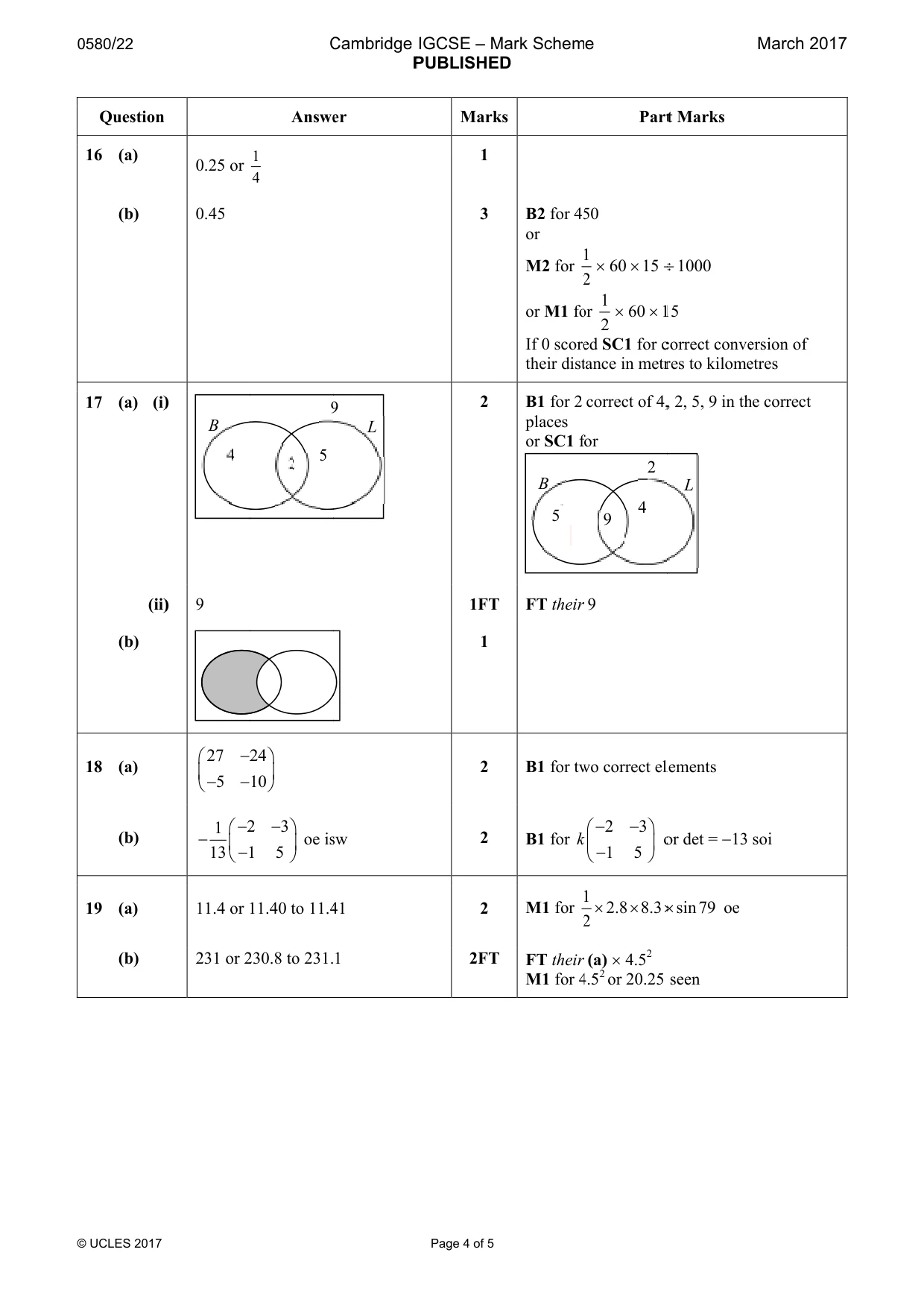
Mark scheme: 16 (a) 1 1 0.25 or 4 (b) 0.45 3 B2 for 4550 or 1 M2 for × 60 × 15 ÷÷ 1000 22 1 or M1 foor × 60 × 115 2 If 0 scoreed SC1 for ccorrect conveersion of their disttance in metrres to kilomeetres
Q17 · A total of 20 trucks were tested at a checkpoint
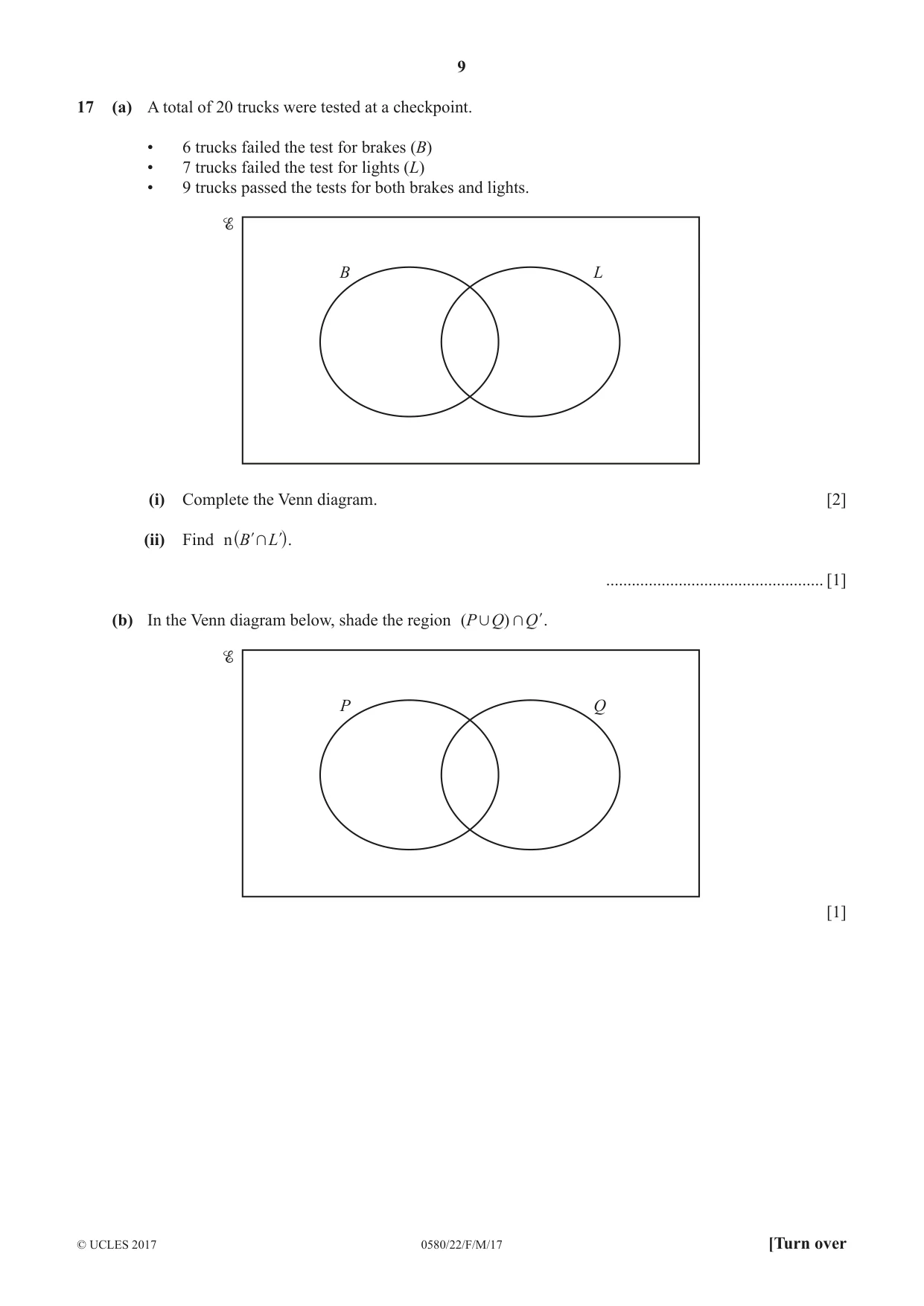
17 (a) A total of 20 trucks were tested at a checkpoint. • 6 trucks failed the test for brakes (B) • 7 trucks failed the test for lights (L) • 9 trucks passed the tests for both brakes and lights. B L (i) Complete the Venn diagram. [2] (ii) Find n B l + L l ^ h. ................................................... [1] (b) In the Venn diagram below, shade the region (P , Q) + Q l. P Q [1]
Mark scheme: 17 (a) (i)) 2 B1 for 2 correct of 4,, 2, 5, 9 in thhe correct 99 B L places or SC1 forf 4 5 2 29 B L 54 92 45 (ii)) 9 1FT FT their 9 (b) 1 27 −224
Q18 · 3 3 - 6 18 M = N = c1 - 2 m c4 2m Calculate (a) MN, [2] f p (b) M−1
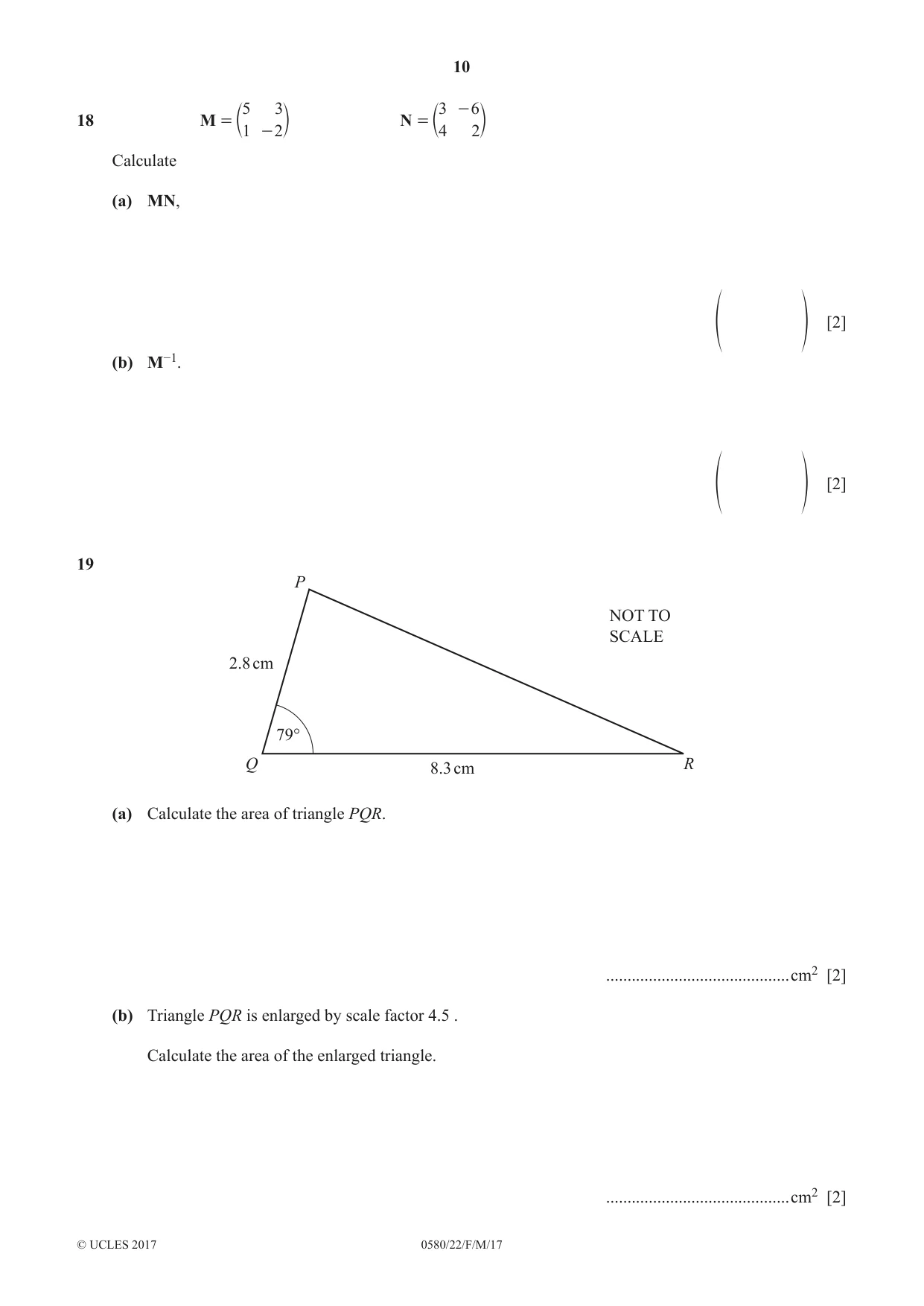
5 3 3 - 6 18 M = N = c1 - 2 m c4 2m Calculate (a) MN, [2] f p (b) M−1. [2] f p
Mark scheme: 27 224 18 (a) − 5 −10 2 B1 for twwo correct elelements 1 −22 −3 −2 −3 (b) − oe issw 2 B1 for kk oor det = −13 soi 13 − 11 5 −1 5 1
Q19 · P NOT TO SCALE 2.8 cm 79° Q 8.3 cm R (a) Calculate the area of triangle PQR
19 P NOT TO SCALE 2.8 cm 79° Q 8.3 cm R (a) Calculate the area of triangle PQR. ...........................................cm2 [2] (b) Triangle PQR is enlarged by scale factor 4.5 . Calculate the area of the enlarged triangle. ...........................................cm2 [2]
Mark scheme: 1 19 (a) 11.4 or 111.40 to 11.441 2 M1 for × 2.8 × 8.3 ×× sin79 oe 22 (b) 231 or 2230.8 to 231.1 2FT FT their (a) × 4.52 M1 for 4.524 or 20.25 seen
Q20 · Y l 5 4 3 2 1 x 0 –3 –2 –1 1 2 3 4 5 –1 –2 –3 (a) Find the equation of the line l
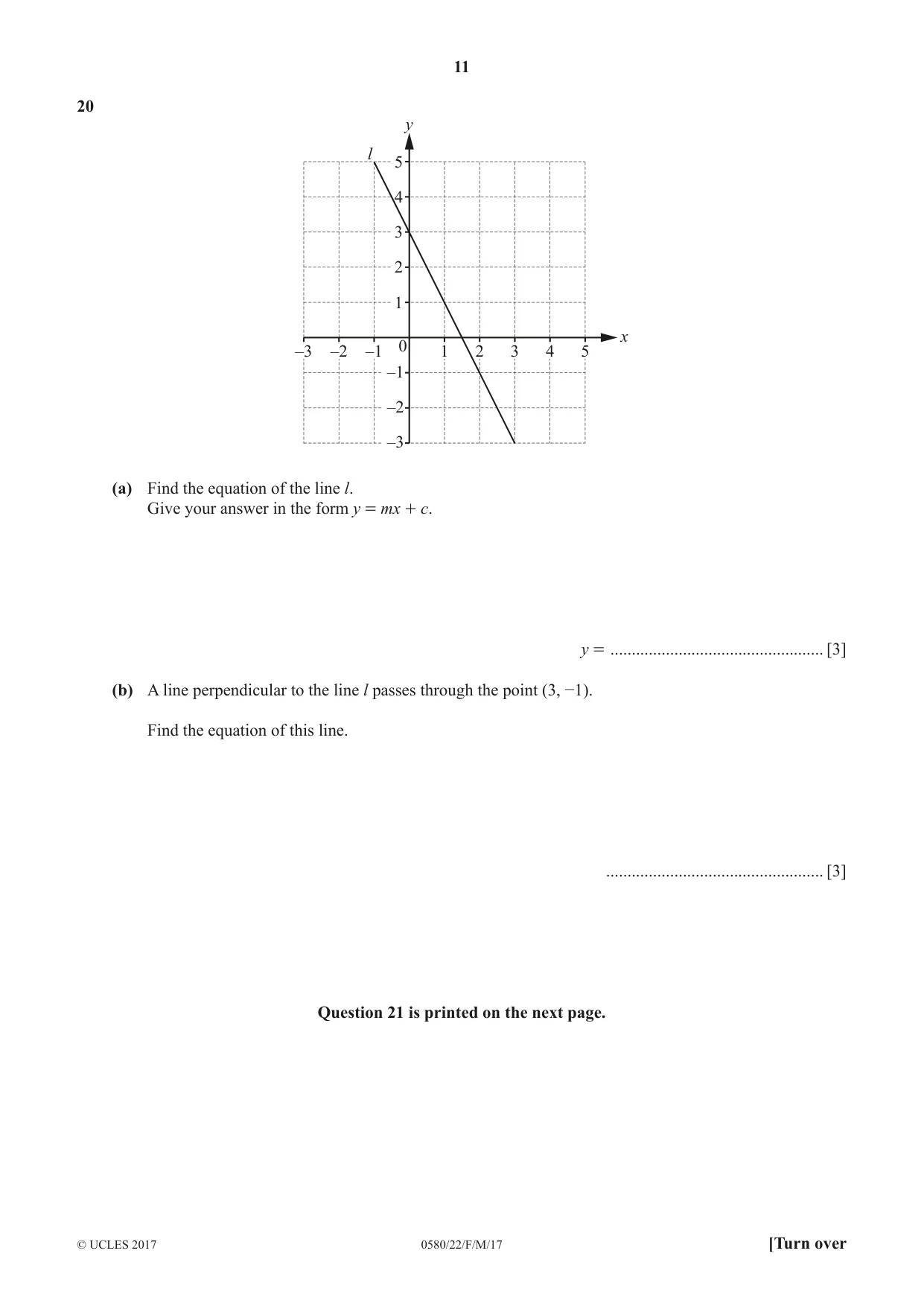
20 y l 5 4 3 2 1 x 0 –3 –2 –1 1 2 3 4 5 –1 –2 –3 (a) Find the equation of the line l. Give your answer in the form y = mx + c. y = .................................................. [3] (b) A line perpendicular to the line l passes through the point (3, −1). Find the equation of this line. ................................................... [3] Question 21 is printed on the next page.
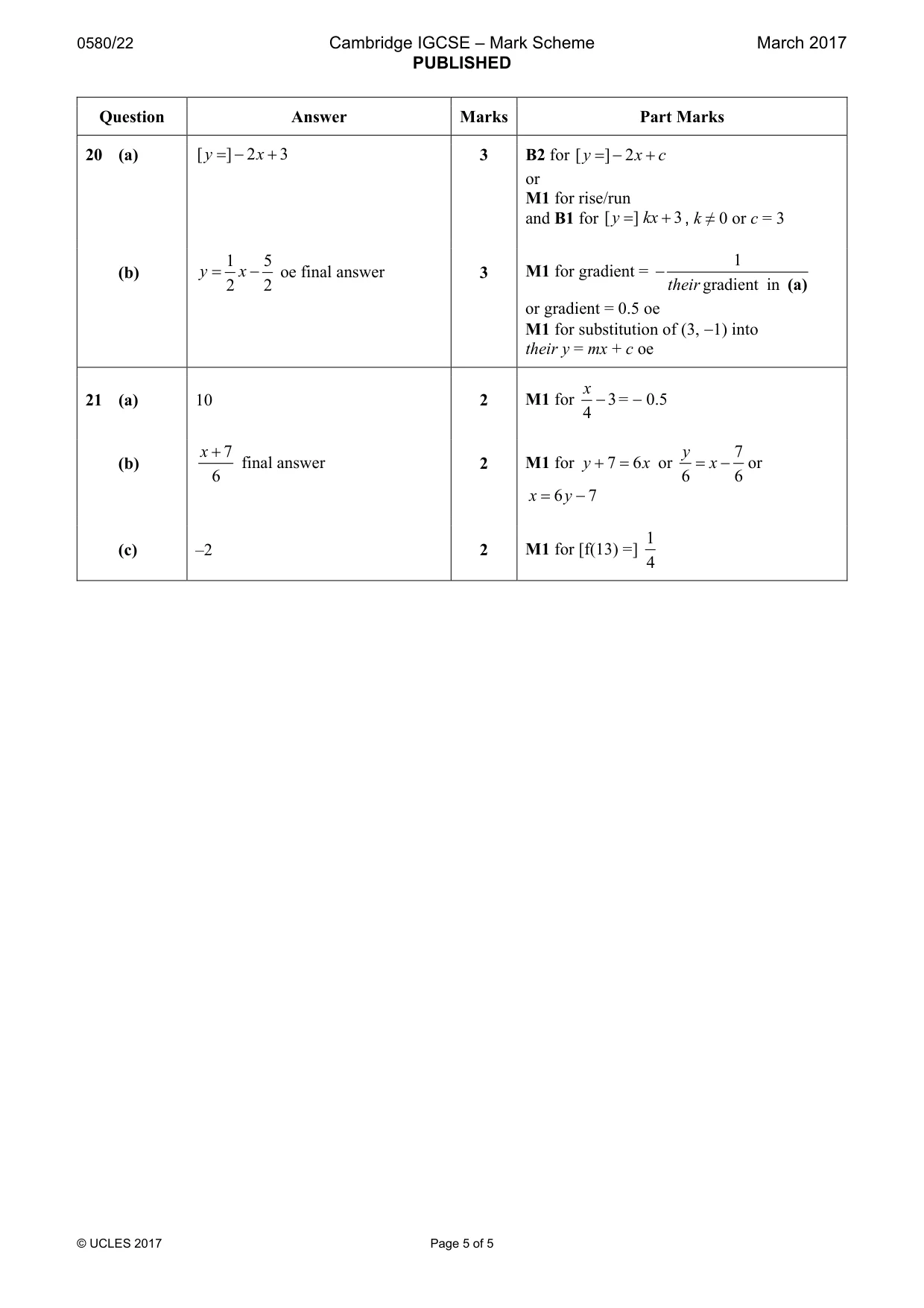
Mark scheme: 20 (a) [ y = ] − 2 x + 3 3 B2 for [ y = ] − 2 x + c or M1 for rise/run and B1 for [ y = ] kx + 3 , k ≠ 0 or c = 3 1 5 1 x − (b) y = oe final answer 3 M1 for gradient = −their gradient in (a) 2 2 or gradient = 0.5 oe M1 for substitution of (3, −1) into their y = mx + c oe x
Q21 · X21 f (x) = - 3 g ( x) = 6x - 7 h (x) = 2x 4 (a) Work out the value of x when f(x) = -0.5
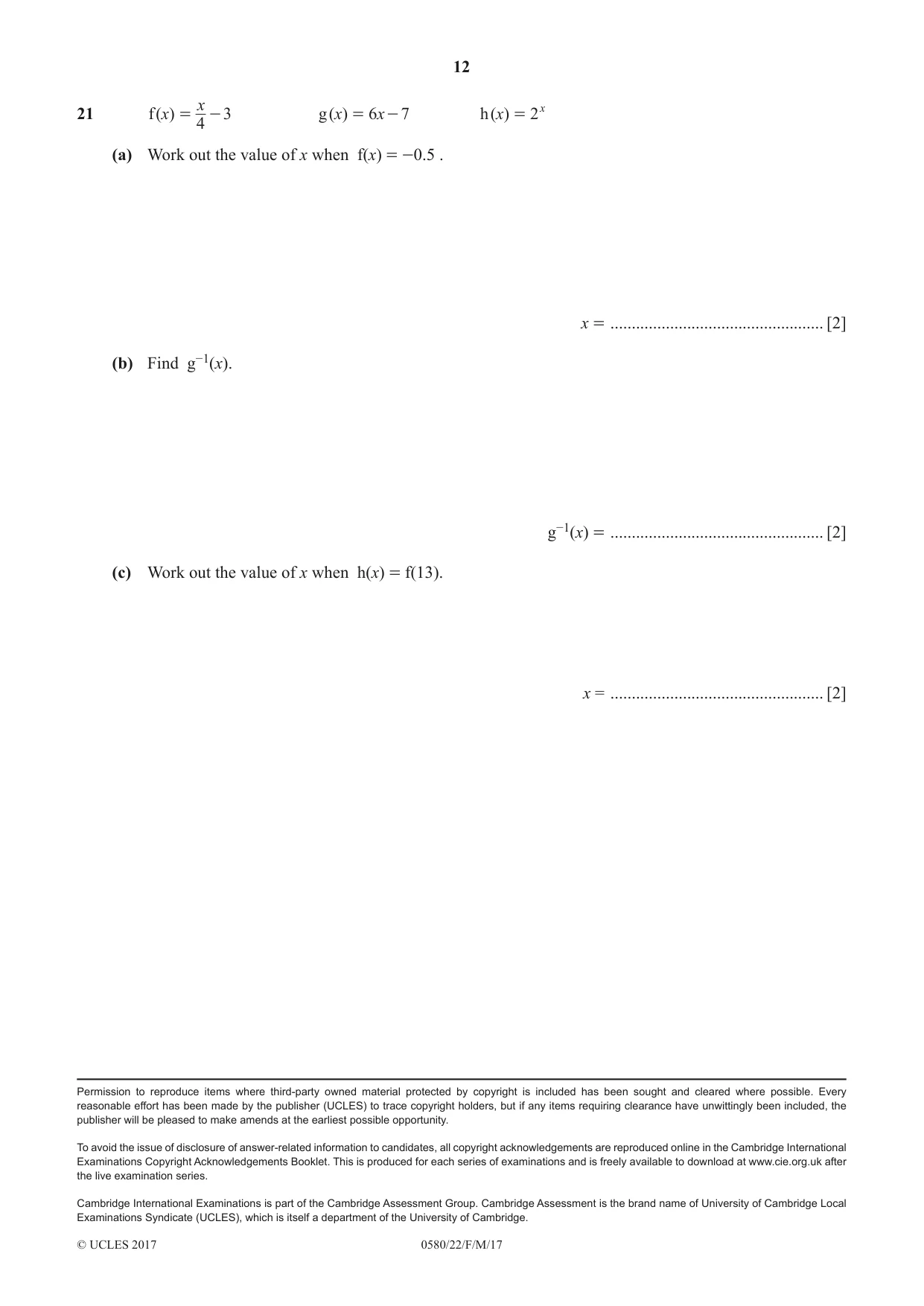
x21 f (x) = - 3 g ( x) = 6x - 7 h (x) = 2x 4 (a) Work out the value of x when f(x) = -0.5 . x = .................................................. [2] (b) Find g−1(x). g−1(x) = .................................................. [2] (c) Work out the value of x when h(x) = f(13). x = .................................................. [2]
Mark scheme: x 21 (a) 10 2 M1 for − 3 = − 0.5 4 x + 7 y 7 (b) final answer 2 M1 for y + 7 = 6 x or = x − or 6 6 6 x = 6 y − 7 1 (c) –2 2 M1 for [f(13) =] 4
What was in this paper
The subtopics covered by these 21 questions, and how many questions each got. Open one in a new tab to see every Cambridge question on it.
3Area and perimeter2Fractions, decimals and percentages2Classifying statistical data1Equations1Equations of linear graphs1Estimation1Exponential growth and decay1Geometrical constructions1Indices I1Limits of accuracy1Percentages1Pythagoras’ theorem1Ratio and proportion1Sets1Transformations1Vectors in two dimensions1What you needed in this session
Cambridge’s own grade thresholds for 2017 Feb/March, Paper 2 · Variant 2. A higher threshold means an easier paper — the bar moves with how the cohort did.