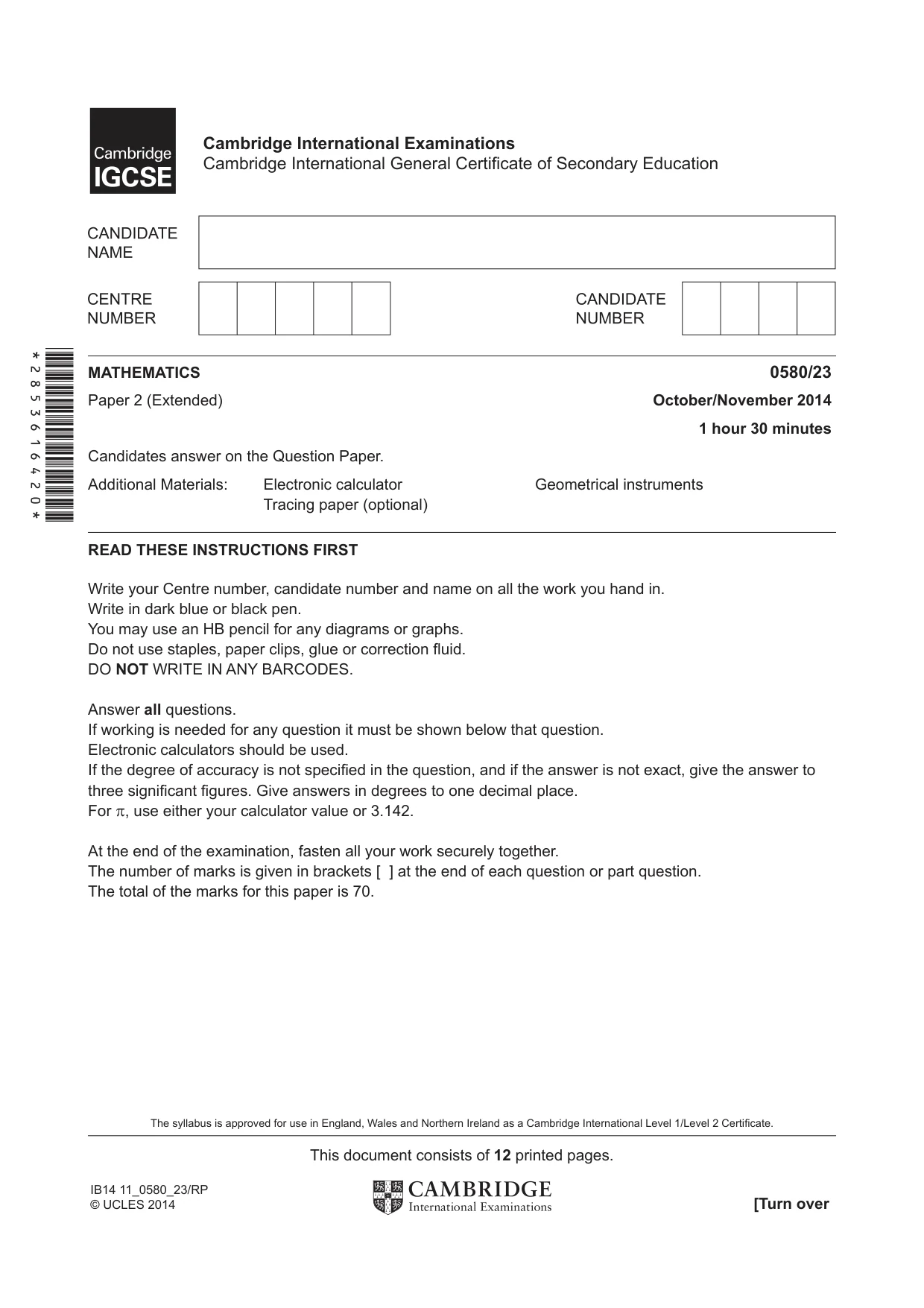
Cambridge IGCSE Mathematics 0580 — 2014 Oct/Nov Paper 2 · Variant 3
0580/23/O/N/14 · 19 questions · 70 marks · ≈79 min
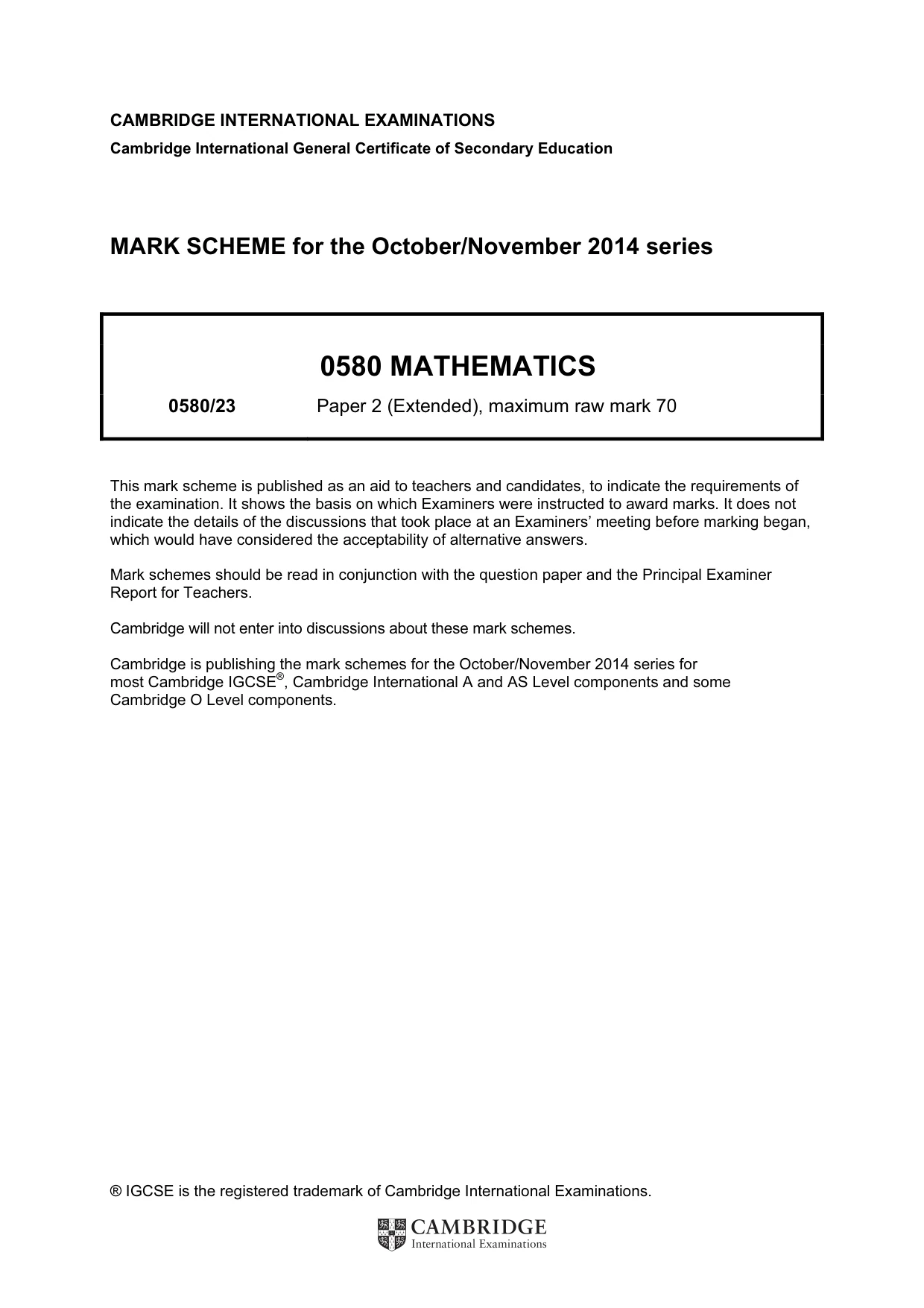
The question paper and its mark scheme, free to read here and free to download. This is Cambridge’s own paper, exactly as it was sat.
Question paper12 pages
Mark scheme4 pages
Answers below. Sit the paper first if you are practising.
Questions as text
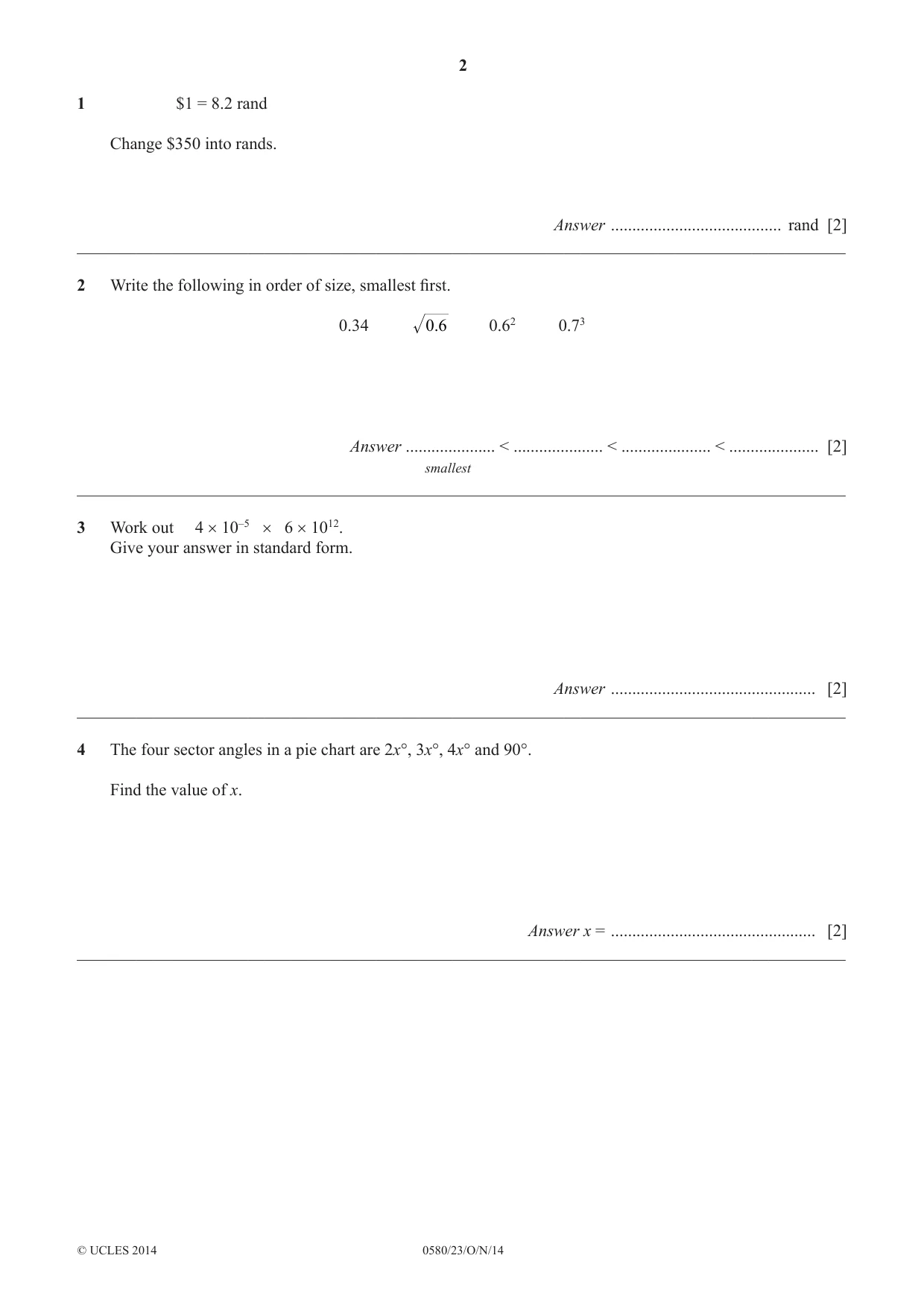
Q1 · $1 = 8.2 rand Change $350 into rands
1 $1 = 8.2 rand Change $350 into rands. Answer ........................................ rand [2] __________________________________________________________________________________________
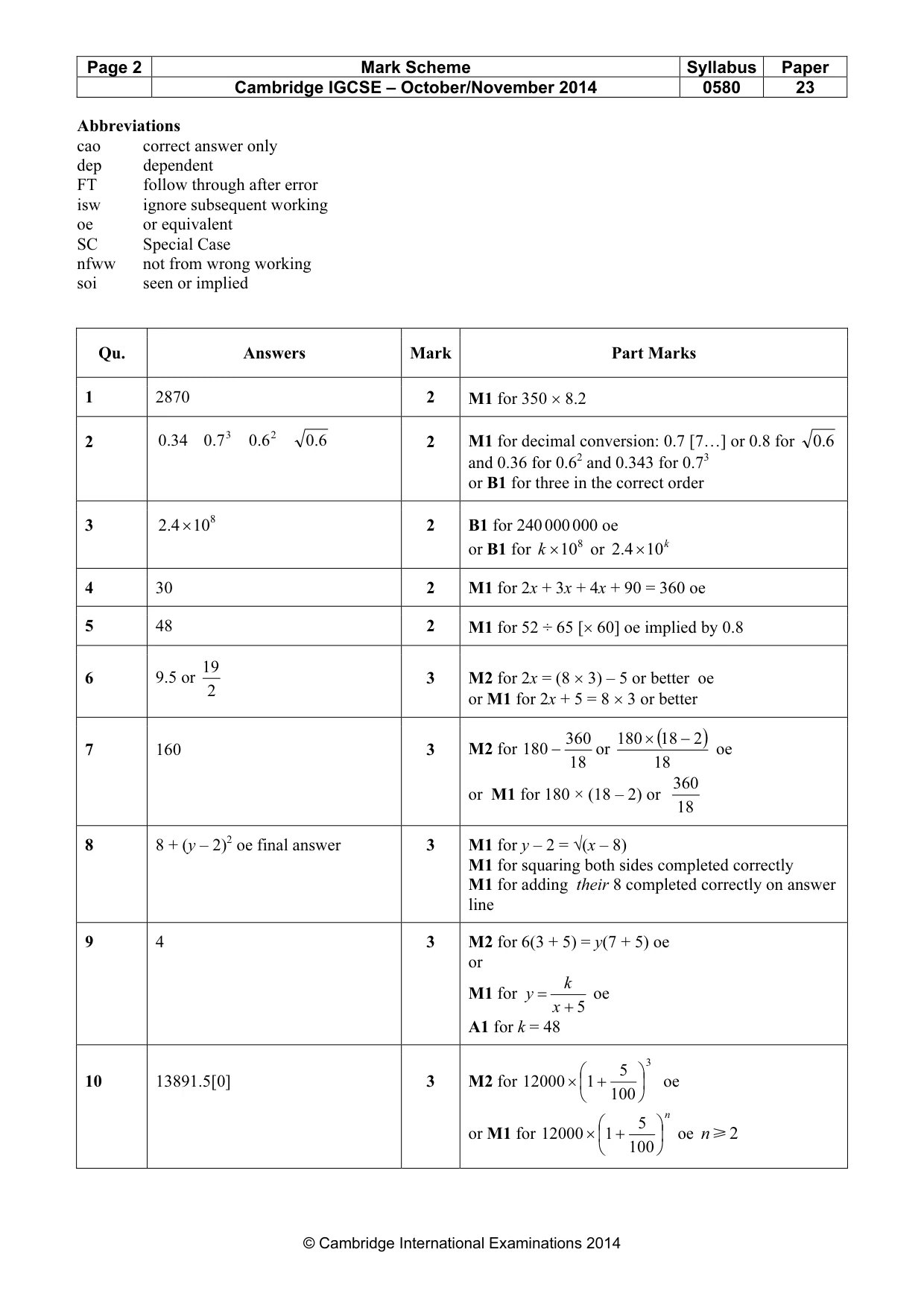
Mark scheme: Qu. Answers Mark Part Marks 1 2870 2 M1 for 350 × 8.2
Q2 · Write the following in order of size, smallest fi rst
2 Write the following in order of size, smallest fi rst. 0.34 0.6 0.62 0.73 Answer ..................... < ..................... < ..................... < ..................... [2] smallest __________________________________________________________________________________________
Mark scheme: 2 .0 34 7.0 3 6.0 2 6.0 2 M1 for decimal conversion: 0.7 [7…] or 0.8 for 6.0 and 0.36 for 0.62 and 0.343 for 0.73 or B1 for three in the correct order
Q3 · Work out 4 × 10–5 × 6 × 1012
3 Work out 4 × 10–5 × 6 × 1012. Give your answer in standard form. Answer ................................................ [2] __________________________________________________________________________________________
Mark scheme: 3 4.2 × 10 8 2 B1 for 240 000 000 oe or B1 for k × 10 8 or 4.2 × 10 k
Q4 · The four sector angles in a pie chart are 2x°, 3x°, 4x° and 90°
4 The four sector angles in a pie chart are 2x°, 3x°, 4x° and 90°. Find the value of x. Answer x = ................................................ [2] __________________________________________________________________________________________
Mark scheme: 4 30 2 M1 for 2x + 3x + 4x + 90 = 360 oe
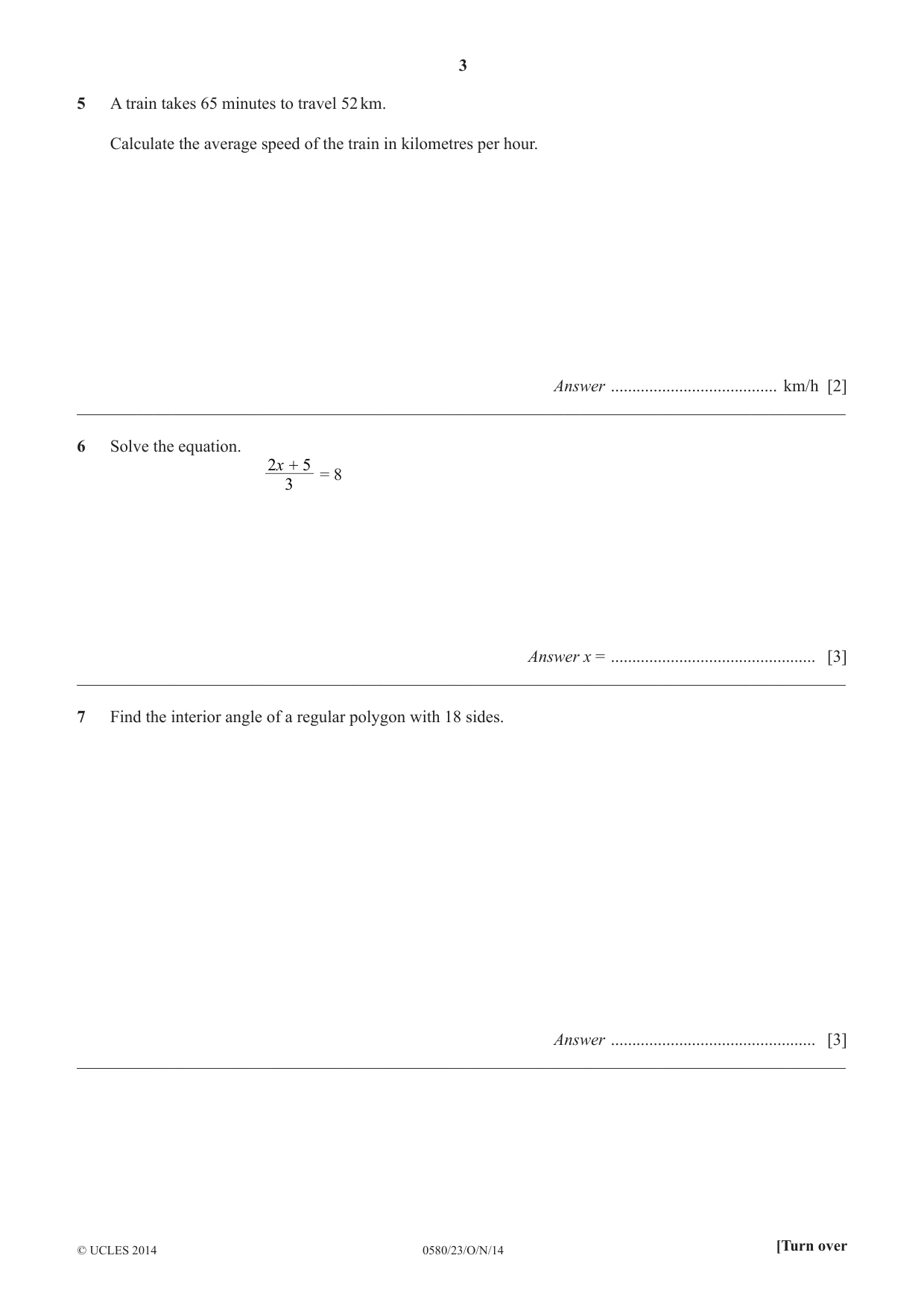
Q5 · A train takes 65 minutes to travel 52 km
5 A train takes 65 minutes to travel 52 km. Calculate the average speed of the train in kilometres per hour. Answer ....................................... km/h [2] __________________________________________________________________________________________
Mark scheme: 5 48 2 M1 for 52 ÷ 65 [× 60] oe implied by 0.8 19
Question 6
6 Solve the equation. 2x + 5 = 8 3 Answer x = ................................................ [3] __________________________________________________________________________________________
Mark scheme: 19 6 9.5 or 3 M2 for 2x = (8 × 3) – 5 or better oe 2 or M1 for 2x + 5 = 8 × 3 or better 360 180× (18 2 )
Q7 · Find the interior angle of a regular polygon with 18 sides
7 Find the interior angle of a regular polygon with 18 sides. Answer ................................................ [3] __________________________________________________________________________________________
Mark scheme: 360 180 × (18 − 2 ) 7 160 3 M2 for 180 − or oe 18 18 360 or M1 for 180 × (18 – 2) or 18
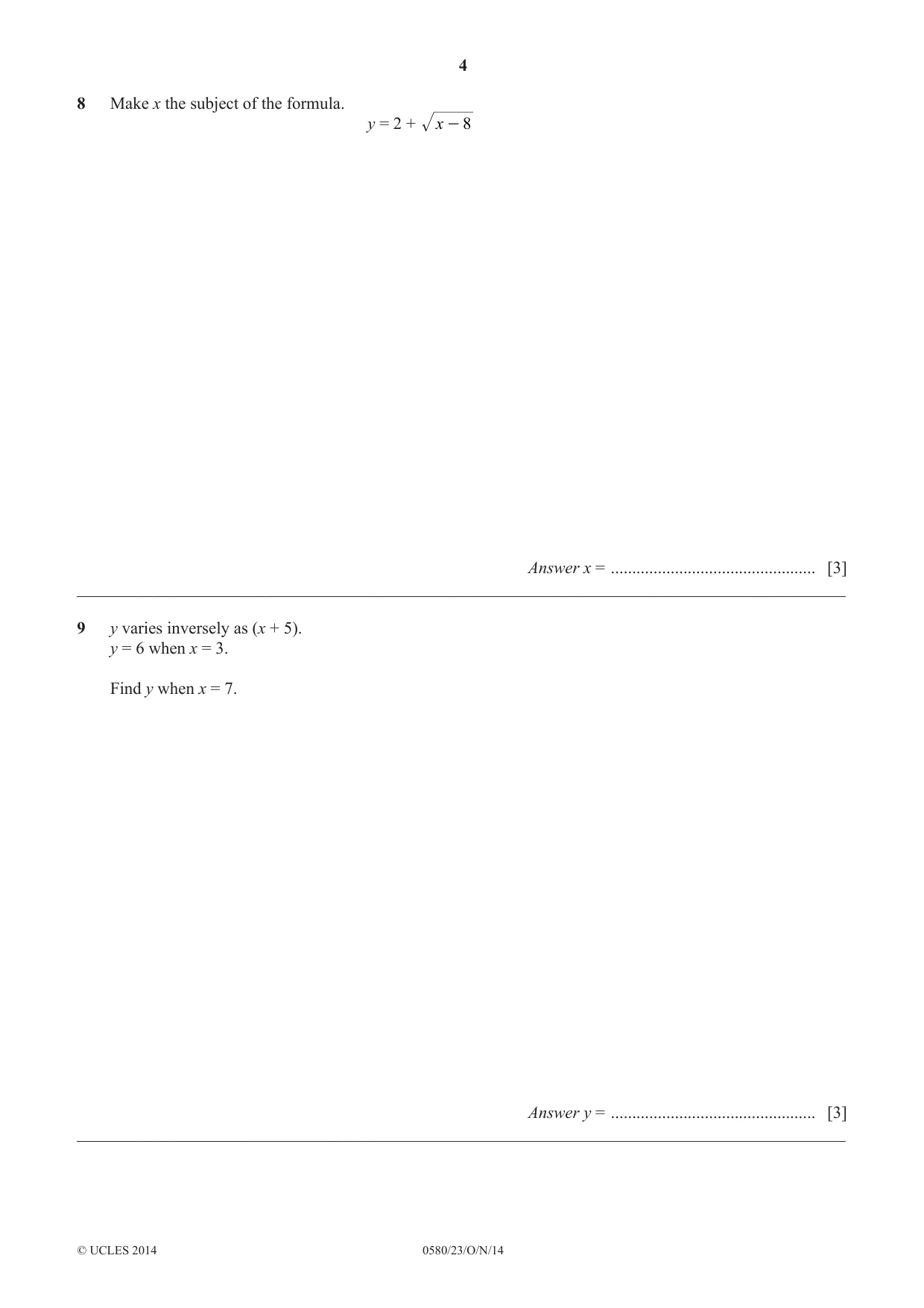
Q8 · Make x the subject of the formula
8 Make x the subject of the formula. y = 2 + x - 8 Answer x = ................................................ [3] __________________________________________________________________________________________
Mark scheme: 8 8 + (y – 2)2 oe final answer 3 M1 for y – 2 = √(x – 8) M1 for squaring both sides completed correctly M1 for adding their 8 completed correctly on answer line
Q9 · Y varies inversely as (x + 5)
9 y varies inversely as (x + 5). y = 6 when x = 3. Find y when x = 7. Answer y = ................................................ [3] __________________________________________________________________________________________
Mark scheme: 9 4 3 M2 for 6(3 + 5) = y(7 + 5) oe or k M1 for y = oe x + 5 A1 for k = 48 3 5
Q10 · Maryah borrows $12 000 to start a business
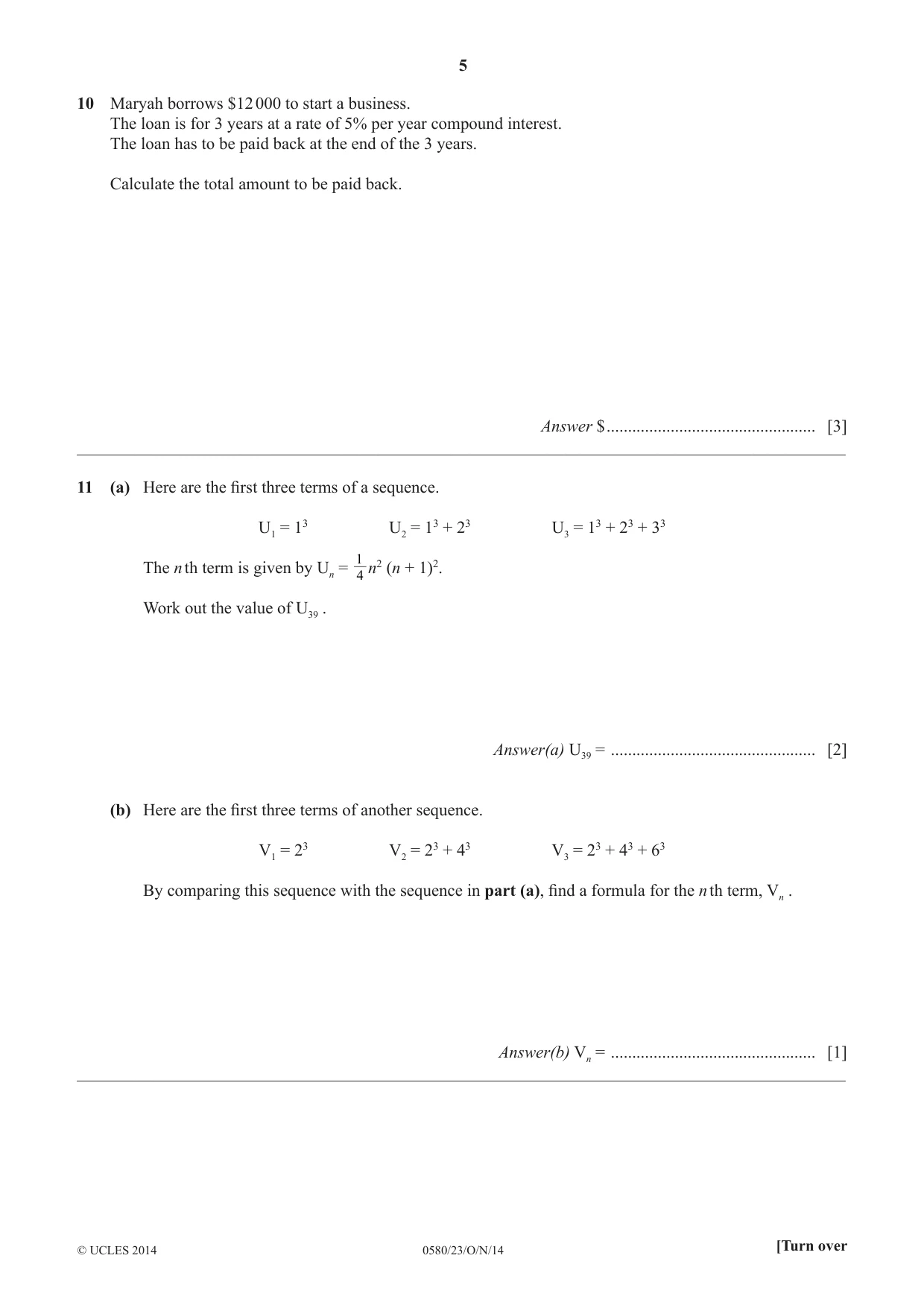
10 Maryah borrows $12 000 to start a business. The loan is for 3 years at a rate of 5% per year compound interest. The loan has to be paid back at the end of the 3 years. Calculate the total amount to be paid back. Answer $ ................................................. [3] __________________________________________________________________________________________
Mark scheme: 5 10 13891.5[0] 3 M2 for 12000 × + 1 oe 100 n 5 or M1 for 12000 × + 1 oe n > 2 100 1
Q11 · Here are the fi rst three terms of a sequence
11 (a) Here are the fi rst three terms of a sequence. U1 = 13 U2 = 13 + 23 U3 = 13 + 23 + 33 1 The n th term is given by Un = 4 n2 (n + 1)2. Work out the value of U39 . Answer(a) U39 = ................................................ [2] (b) Here are the fi rst three terms of another sequence. V1 = 23 V2 = 23 + 43 V3 = 23 + 43 + 63 By comparing this sequence with the sequence in part (a), fi nd a formula for the n th term, Vn . Answer(b) Vn = ................................................ [1] __________________________________________________________________________________________
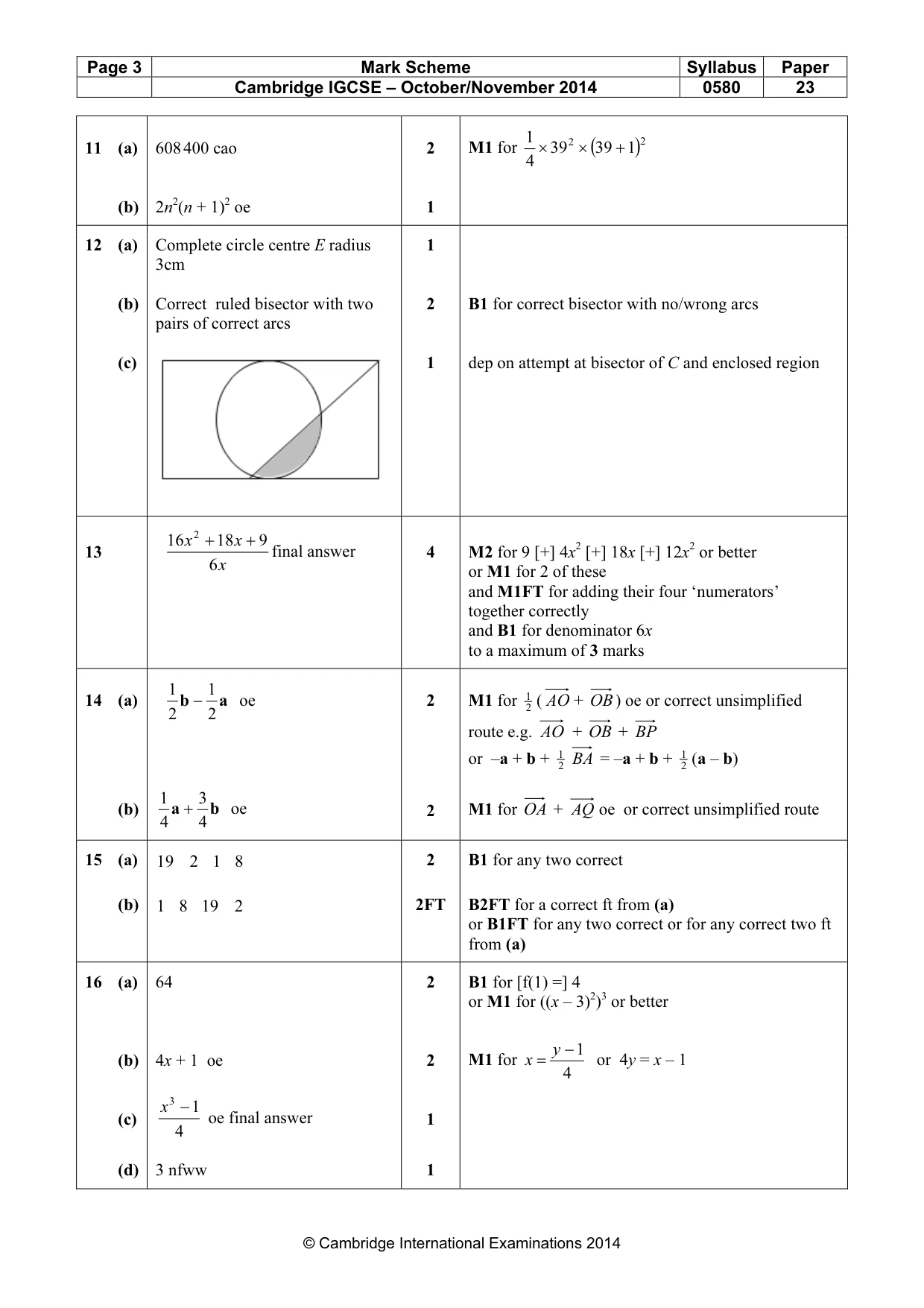
Mark scheme: 1 211 (a) 608 400 cao 2 M1 for × 39 × (39 + 1)2 4 (b) 2n2(n + 1)2 oe 1
Q12 · D C E A B (a) Draw the locus of the points which are 3 cm from E
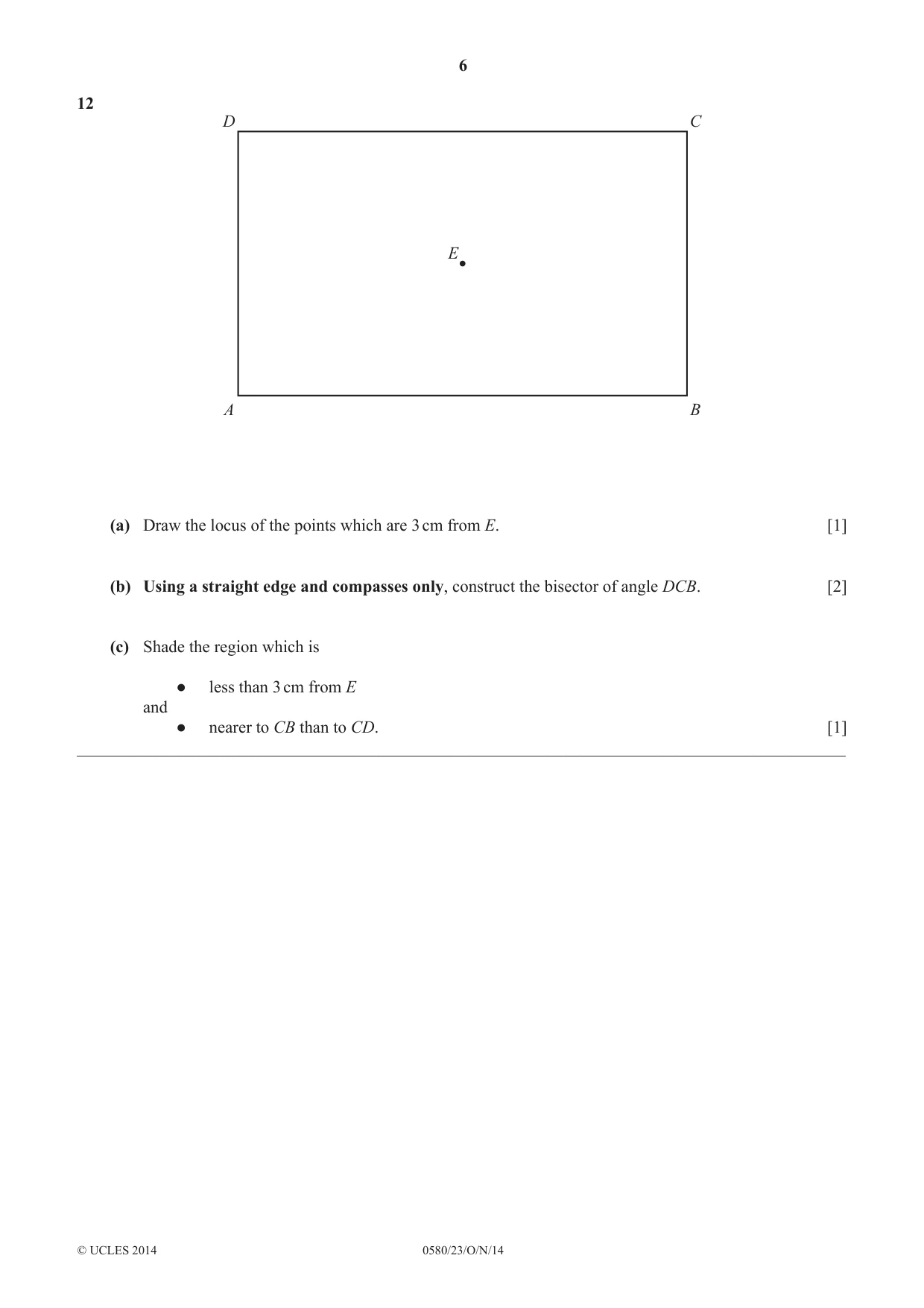
12 D C E A B (a) Draw the locus of the points which are 3 cm from E. [1] (b) Using a straight edge and compasses only, construct the bisector of angle DCB. [2] (c) Shade the region which is ● less than 3 cm from E and ● nearer to CB than to CD. [1] __________________________________________________________________________________________
Mark scheme: 12 (a) Complete circle centre E radius 1 3cm (b) Correct ruled bisector with two 2 B1 for correct bisector with no/wrong arcs pairs of correct arcs (c) 1 dep on attempt at bisector of C and enclosed region 16 x 2 + 18 x + 9
Q13 · Write as a single fraction, in its simplest form
13 Write as a single fraction, in its simplest form. 3 2x + + 3 + 2x 2x 3 Answer ................................................ [4] __________________________________________________________________________________________
Mark scheme: 16 x + 18 x + 9 13 final answer 4 M2 for 9 [+] 4x2 [+] 18x [+] 12x2 or better 6 x or M1 for 2 of these and M1FT for adding their four ‘numerators’ together correctly and B1 for denominator 6x to a maximum of 3 marks 1 1
Q14 · P Q A B NOT TO SCALE a b O The diagram shows two points, P and Q, on a straight line AB
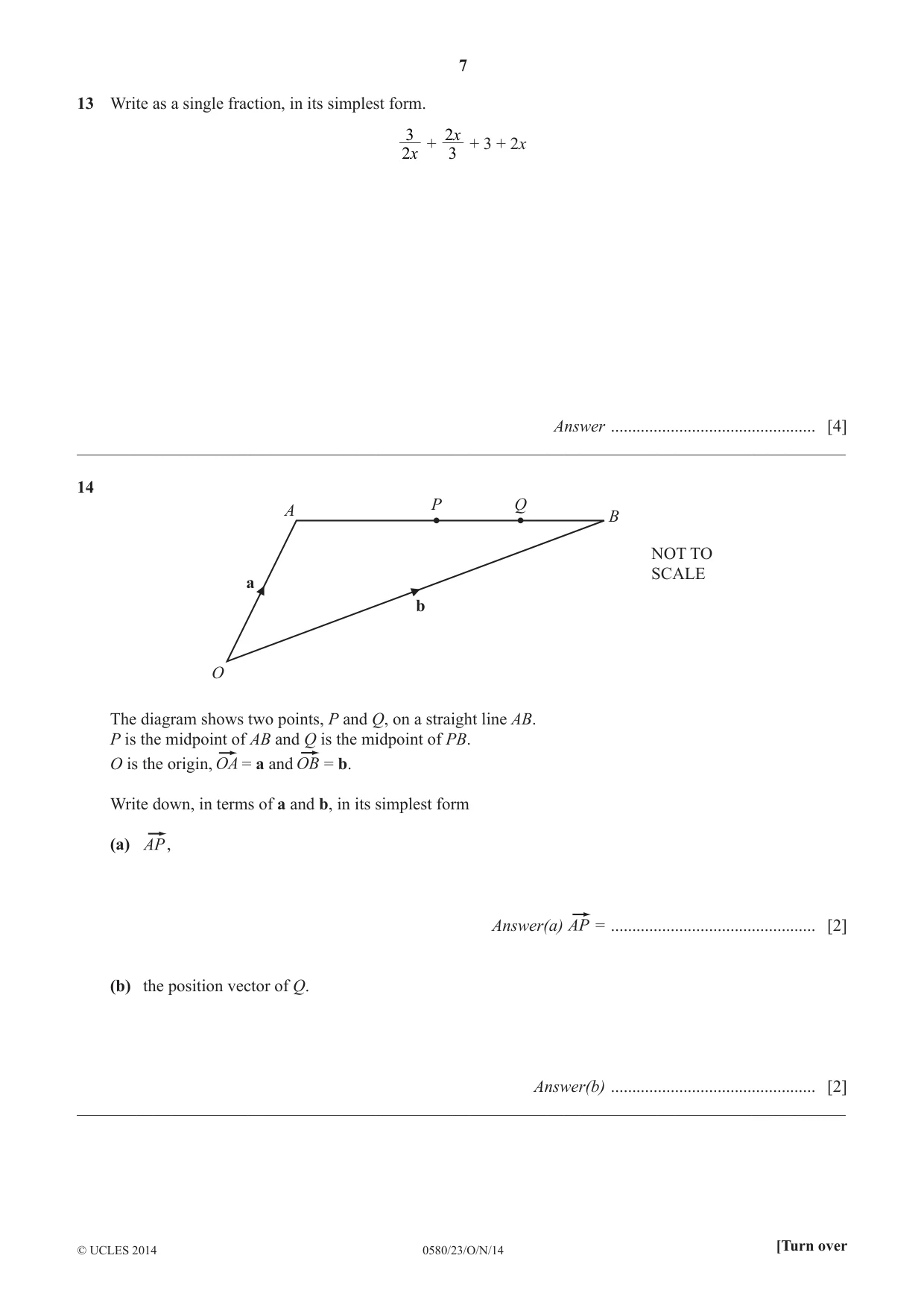
14 P Q A B NOT TO SCALE a b O The diagram shows two points, P and Q, on a straight line AB. P is the midpoint of AB and Q is the midpoint of PB. O is the origin, = a and = b. Write down, in terms of a and b, in its simplest form (a) , Answer(a) = ................................................ [2] (b) the position vector of Q. Answer(b) ................................................ [2] __________________________________________________________________________________________
Mark scheme: 1 114 (a) b − a oe 2 M1 for 12 ( AO + OB) oe or correct unsimplified 2 2 route e.g. AO + OB + BP or –a + b + 12 BA = –a + b + 12 (a – b) 1 3 (b) a + b oe 2 M1 for OA + AQ oe or correct unsimplified route 4 4
Q15 · The lights and brakes of 30 bicycles are tested
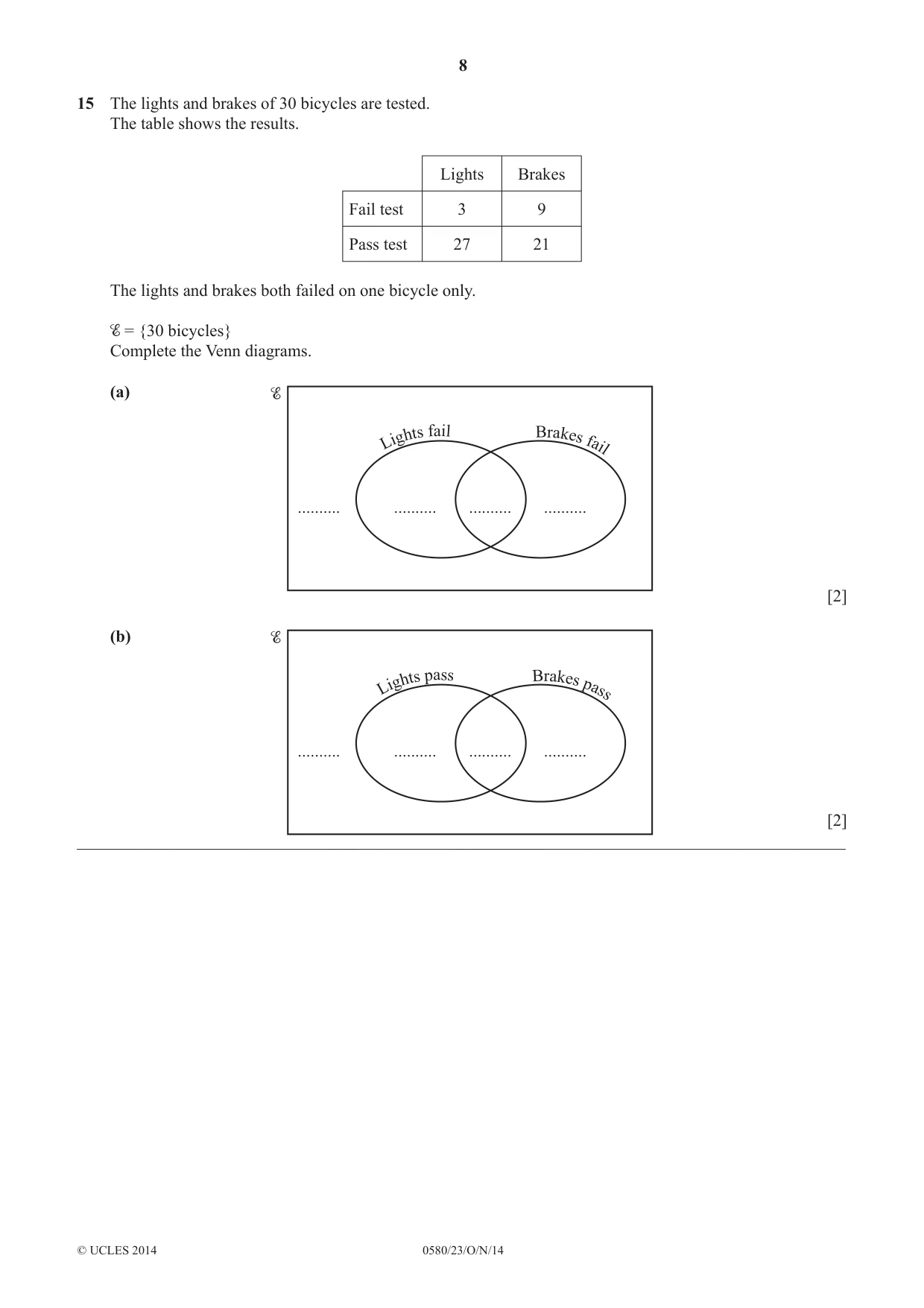
15 The lights and brakes of 30 bicycles are tested. The table shows the results. Lights Brakes Fail test 3 9 Pass test 27 21 The lights and brakes both failed on one bicycle only. = {30 bicycles} Complete the Venn diagrams. (a) Lights fail Brake sfail .......... .......... .......... .......... [2] (b) Lights pass Brake spass .......... .......... .......... .......... [2] __________________________________________________________________________________________
Mark scheme: 15 (a) 19 2 1 8 2 B1 for any two correct (b) 1 8 19 2 2FT B2FT for a correct ft from (a) or B1FT for any two correct or for any correct two ft from (a)
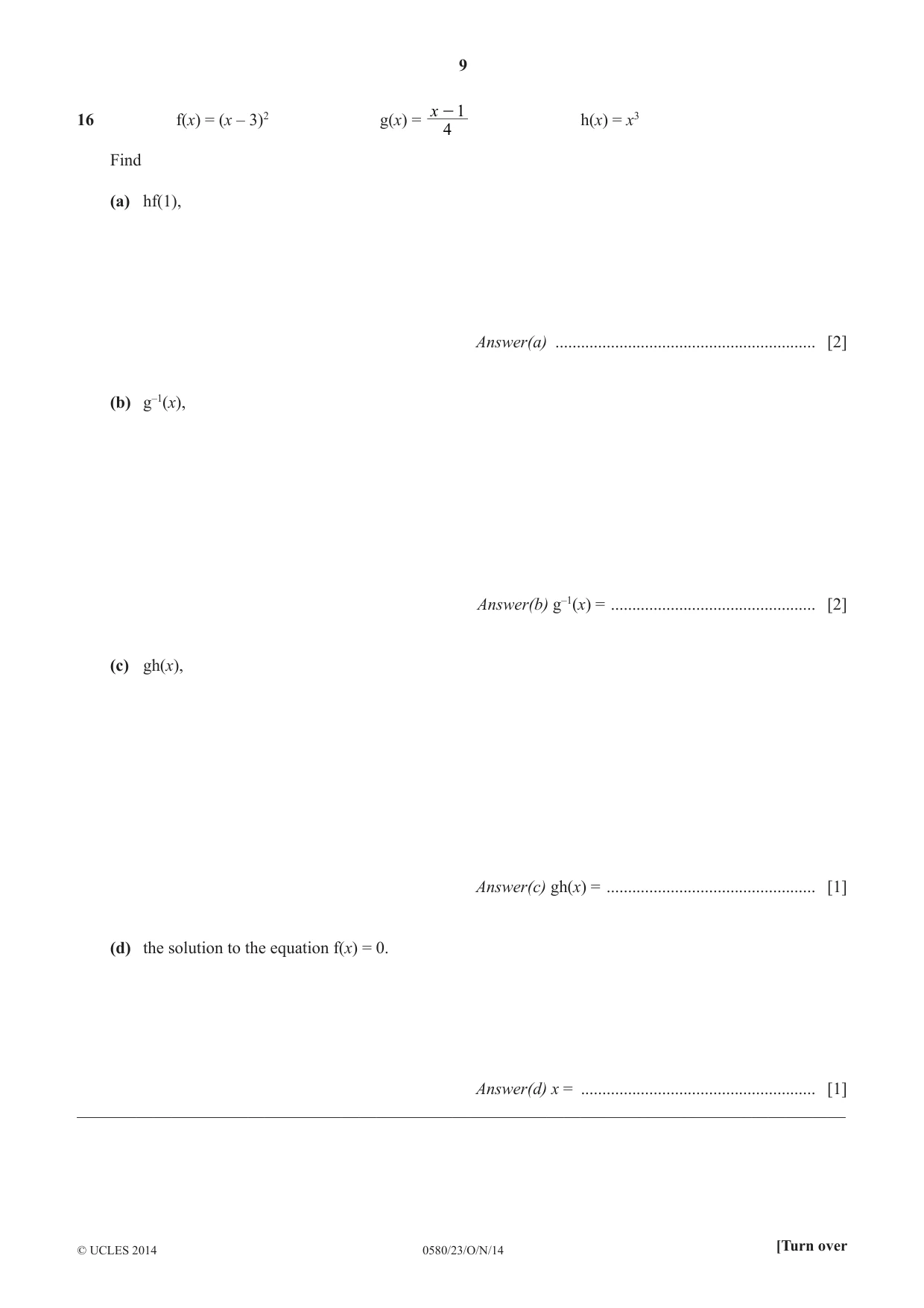
Q16 · X - 116 f(x) = (x – 3)2 g(x) = h(x) = x3 4 Find (a) hf(1), Answer(a)…
x - 116 f(x) = (x – 3)2 g(x) = h(x) = x3 4 Find (a) hf(1), Answer(a) ............................................................. [2] (b) g–1(x), Answer(b) g–1(x) = ................................................ [2] (c) gh(x), Answer(c) gh(x) = ................................................. [1] (d) the solution to the equation f(x) = 0. Answer(d) x = ....................................................... [1] __________________________________________________________________________________________
Mark scheme: 16 (a) 64 2 B1 for [f(1) =] 4 or M1 for ((x – 3)2)3 or better y − 1 (b) 4x + 1 oe 2 M1 for x = or 4y = x – 1 4 x 3 − 1 (c) oe final answer 1 4 (d) 3 nfww 1
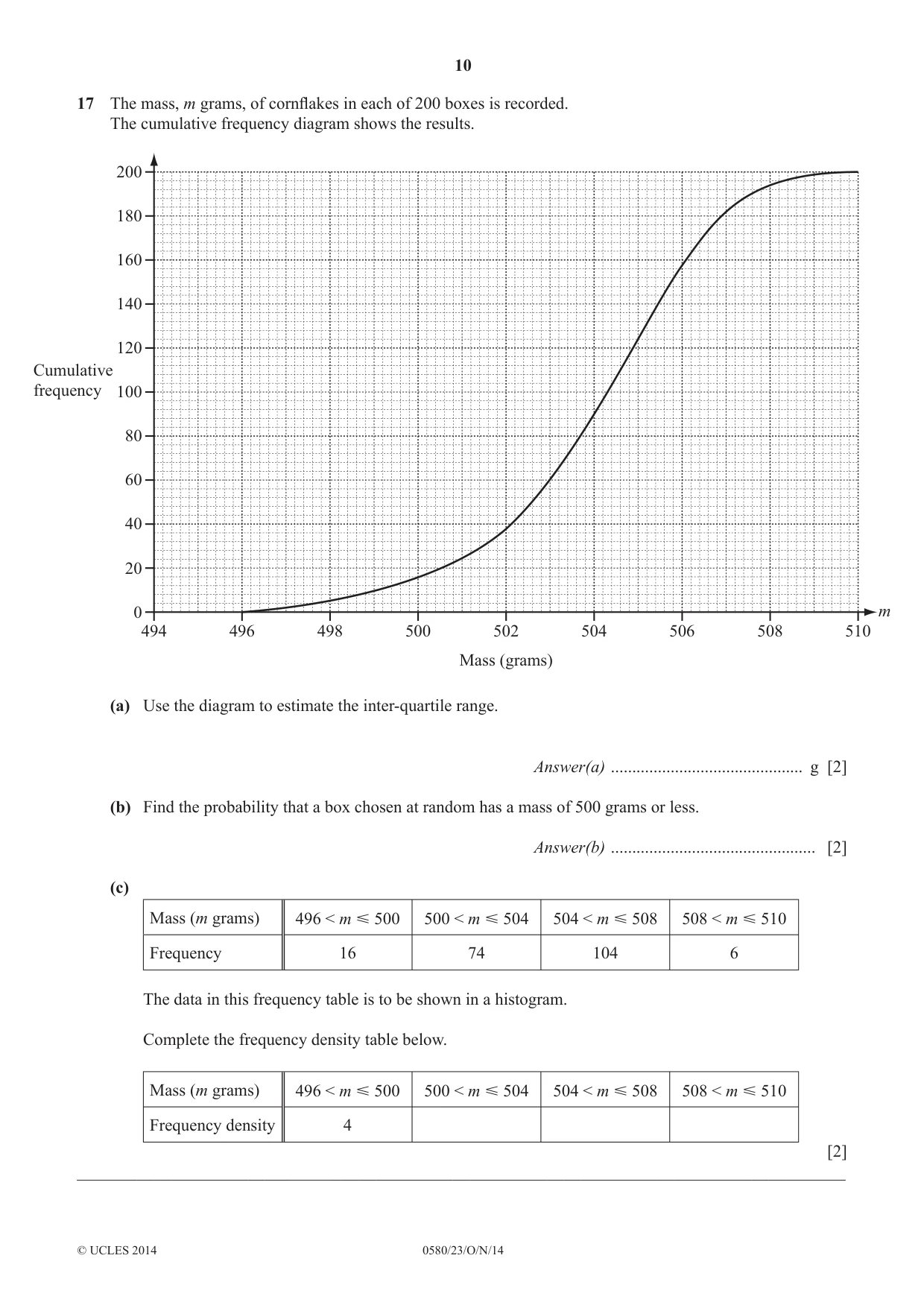
Q17 · The mass, m grams, of cornfl akes in each of 200 boxes is recorded
17 The mass, m grams, of cornfl akes in each of 200 boxes is recorded. The cumulative frequency diagram shows the results. 200 180 160 140 120 Cumulative frequency 100 80 60 40 20 0 m 494 496 498 500 502 504 506 508 510 Mass (grams) (a) Use the diagram to estimate the inter-quartile range. Answer(a) ............................................. g [2] (b) Find the probability that a box chosen at random has a mass of 500 grams or less. Answer(b) ................................................ [2] (c) Mass (m grams) 496 < m Y 500 500 < m Y 504 504 < m Y 508 508 < m Y 510 Frequency 16 74 104 6 The data in this frequency table is to be shown in a histogram. Complete the frequency density table below. Mass (m grams) 496 < m Y 500 500 < m Y 504 504 < m Y 508 508 < m Y 510 Frequency density 4 [2] __________________________________________________________________________________________
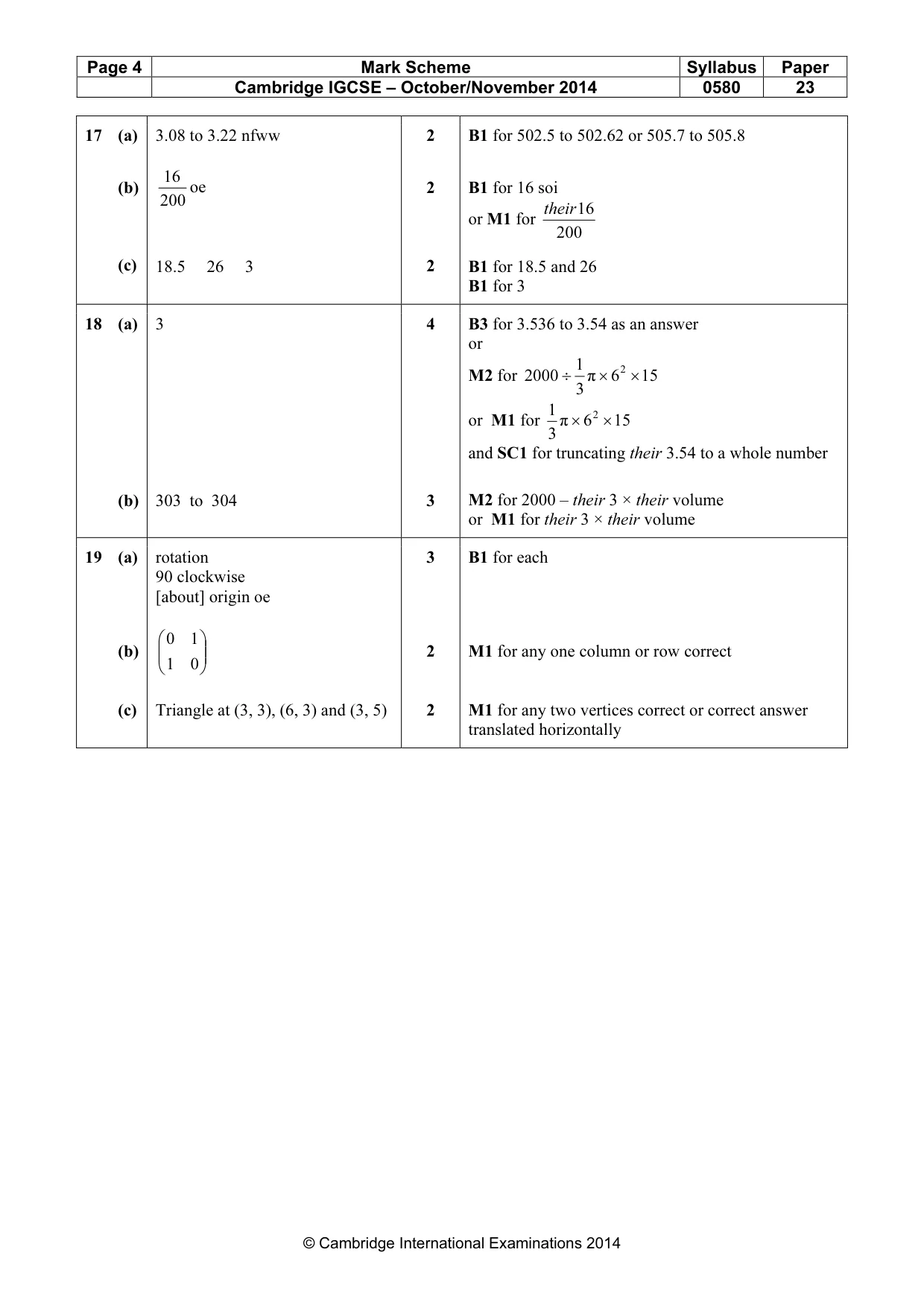
Mark scheme: 17 (a) 3.08 to 3.22 nfww 2 B1 for 502.5 to 502.62 or 505.7 to 505.8 16 (b) oe 2 B1 for 16 soi 200 their 16 or M1 for 200 (c) 18.5 26 3 2 B1 for 18.5 and 26 B1 for 3
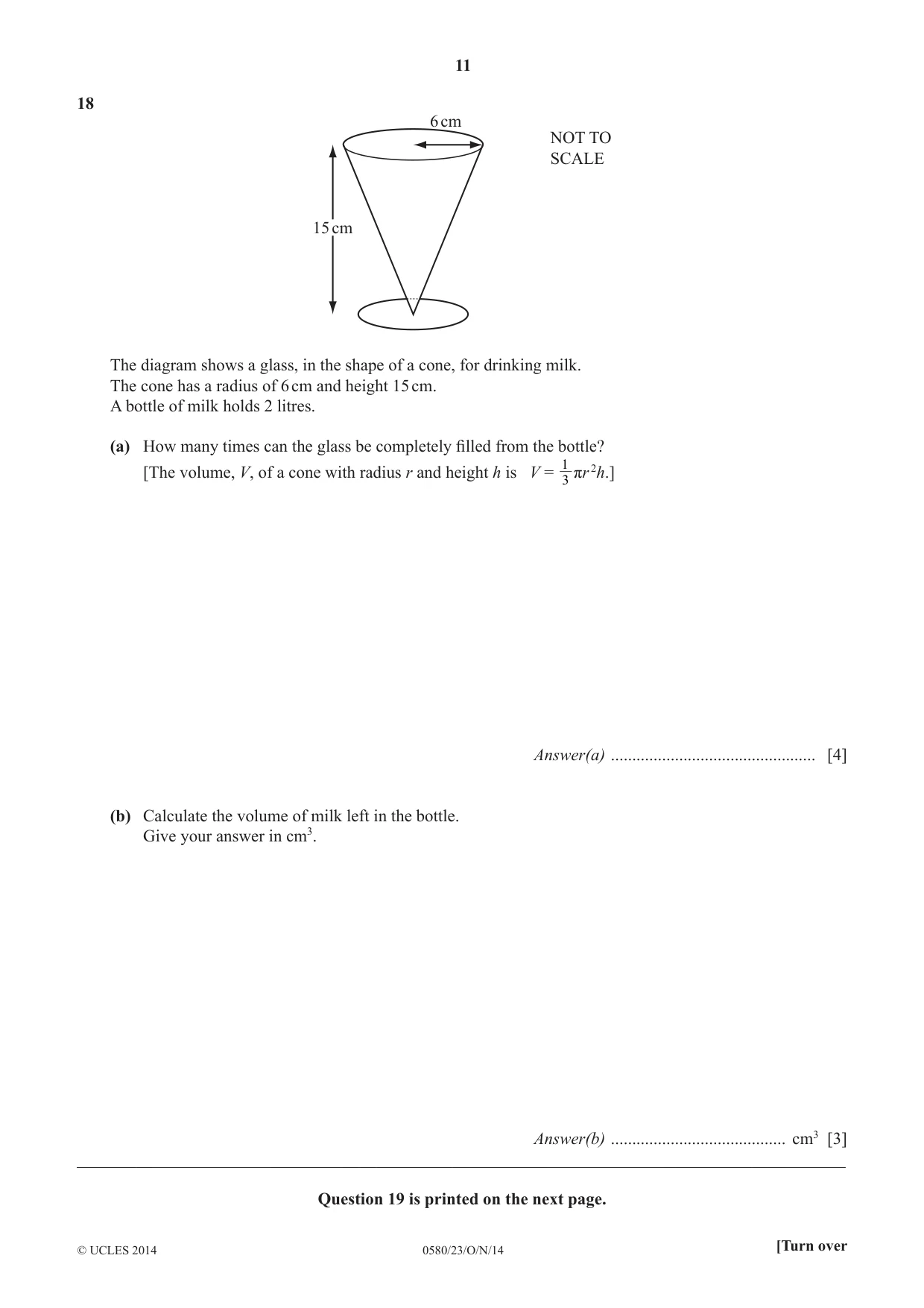
Q18 · 6 cm NOT TO SCALE 15 cm The diagram shows a glass, in the shape of a cone, for drinking…
18 6 cm NOT TO SCALE 15 cm The diagram shows a glass, in the shape of a cone, for drinking milk. The cone has a radius of 6 cm and height 15 cm. A bottle of milk holds 2 litres. (a) How many times can the glass be completely fi lled from the bottle? 1 [The volume, V, of a cone with radius r and height h is V = πr 2h.] 3 Answer(a) ................................................ [4] (b) Calculate the volume of milk left in the bottle. Give your answer in cm3. Answer(b) ......................................... cm3 [3] __________________________________________________________________________________________ Question 19 is printed on the next page.
Mark scheme: 18 (a) 3 4 B3 for 3.536 to 3.54 as an answer or 1 2 M2 for 2000 ÷ π × 6 × 15 3 1 2 or M1 for π × 6 × 15 3 and SC1 for truncating their 3.54 to a whole number (b) 303 to 304 3 M2 for 2000 – their 3 × their volume or M1 for their 3 × their volume
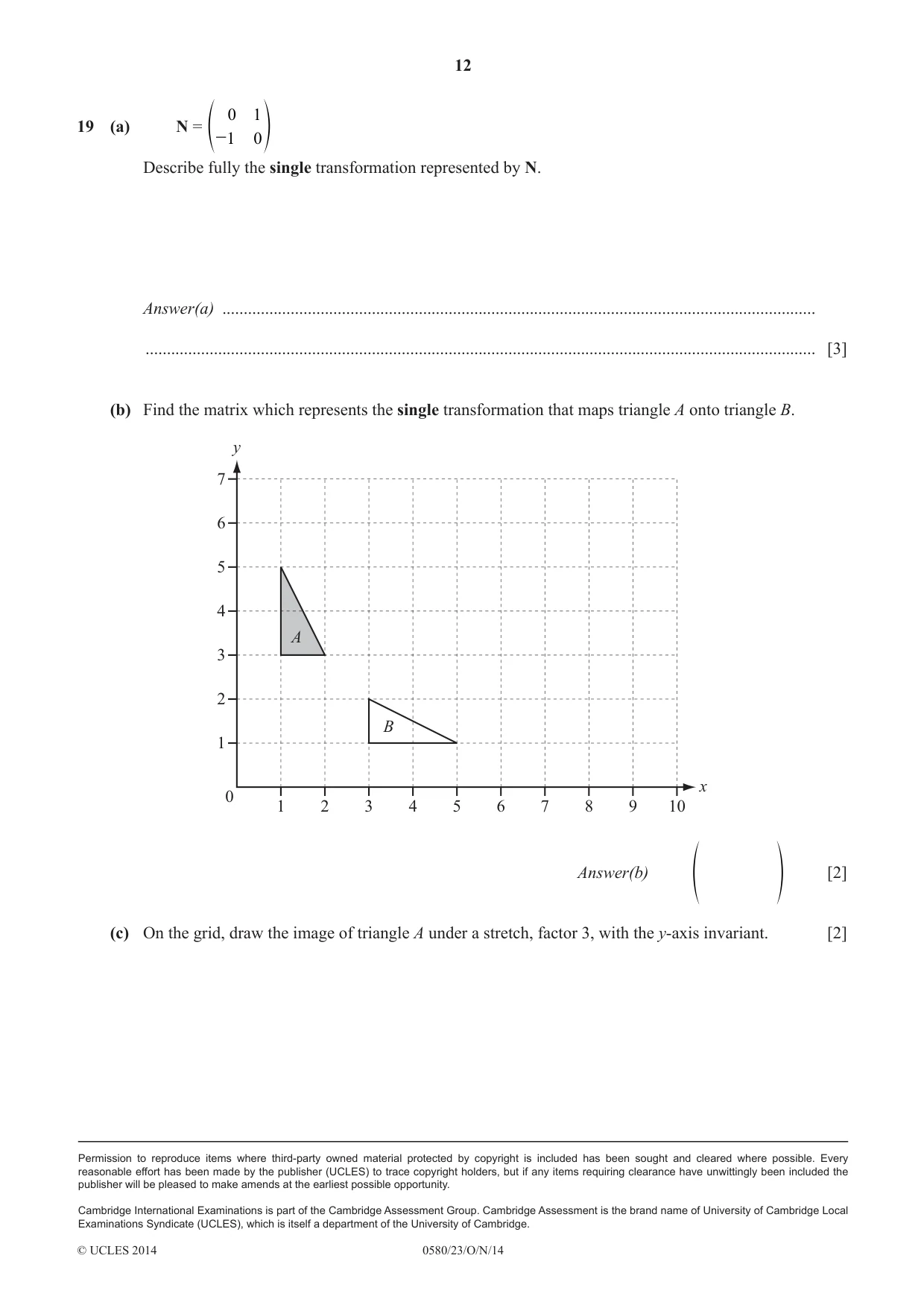
Q19 · 1 19 (a) N = f -1 0 p Describe fully the single transformation represented by N
0 1 19 (a) N = f -1 0 p Describe fully the single transformation represented by N. Answer(a) ........................................................................................................................................... ............................................................................................................................................................. [3] (b) Find the matrix which represents the single transformation that maps triangle A onto triangle B. y 7 6 5 4 A 3 2 B 1 x 0 1 2 3 4 5 6 7 8 9 10 Answer(b) [2] f p (c) On the grid, draw the image of triangle A under a stretch, factor 3, with the y-axis invariant. [2]
Mark scheme: 19 (a) rotation 3 B1 for each 90 clockwise [about] origin oe 0 1 (b) 2 M1 for any one column or row correct 1 0 (c) Triangle at (3, 3), (6, 3) and (3, 5) 2 M1 for any two vertices correct or correct answer translated horizontally
What was in this paper
The subtopics covered by these 19 questions, and how many questions each got. Open one in a new tab to see every Cambridge question on it.
What you needed in this session
Cambridge’s own grade thresholds for 2014 Oct/Nov, Paper 2 · Variant 3. A higher threshold means an easier paper — the bar moves with how the cohort did.