Cambridge IGCSE Mathematics 0580 — 2015 May/June Paper 2 · Variant 2
0580/22/M/J/15 · 13 questions · 70 marks · ≈79 min
The question paper and its mark scheme, free to read here and free to download. This is Cambridge’s own paper, exactly as it was sat.
Question paper16 pages
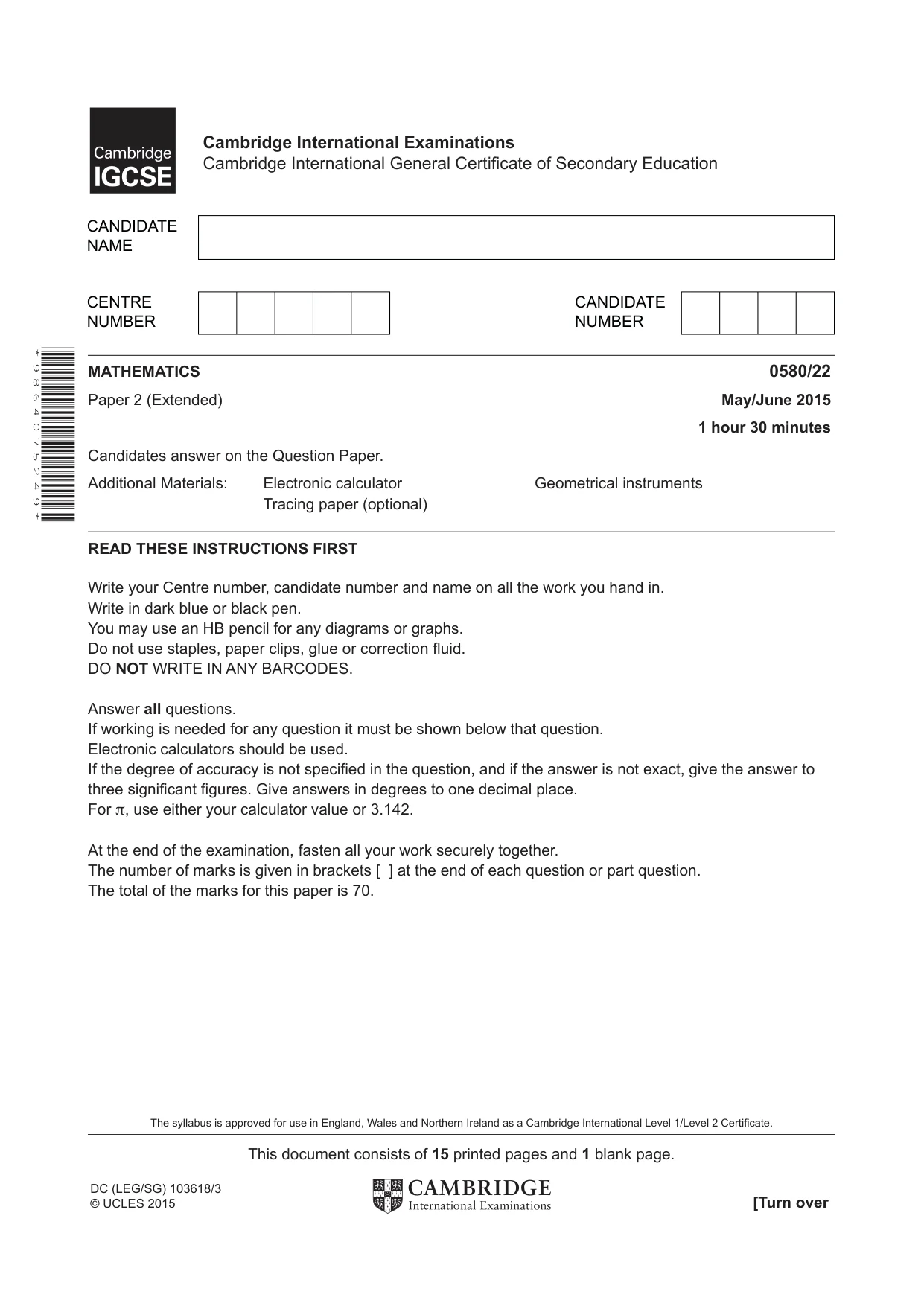
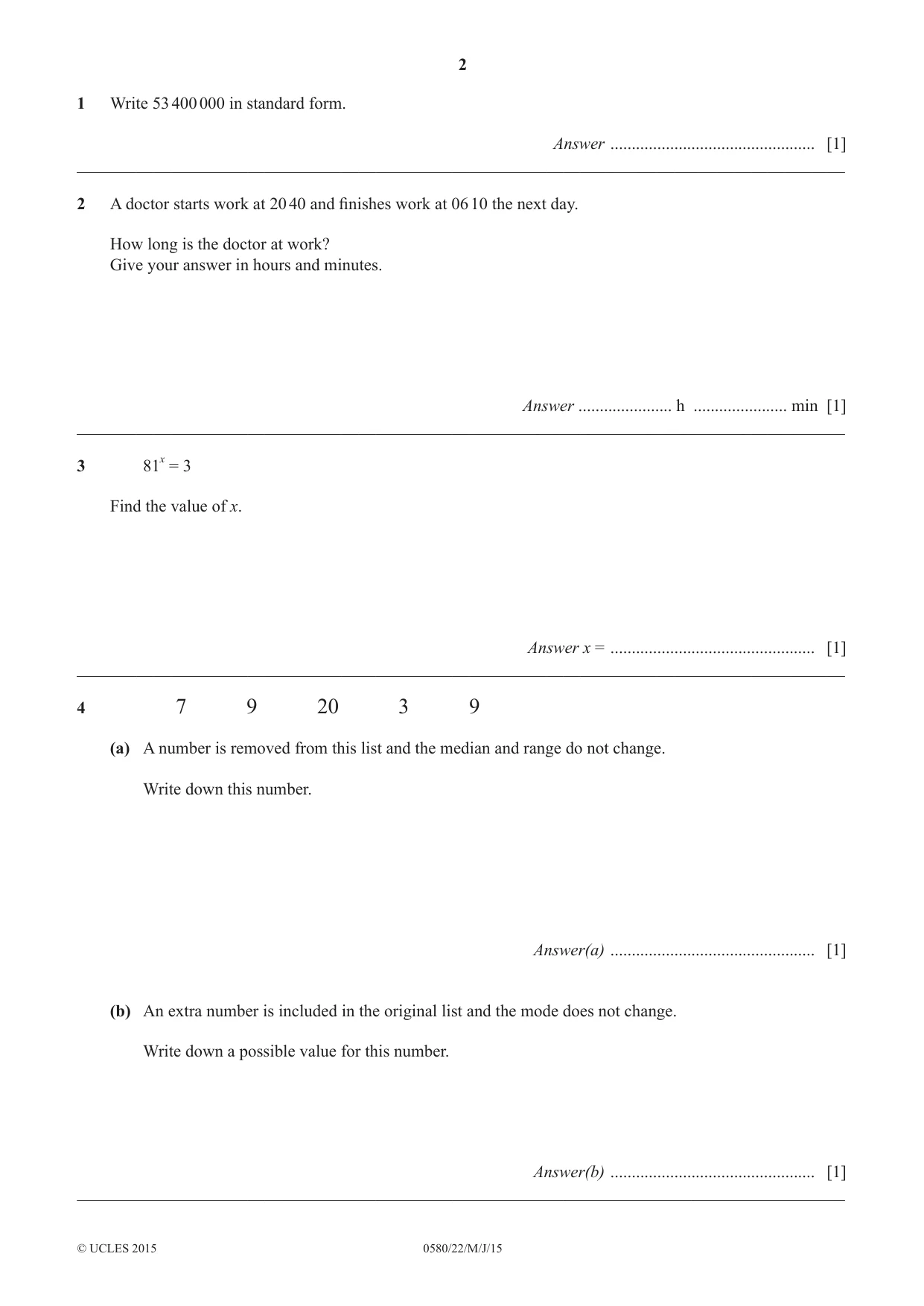
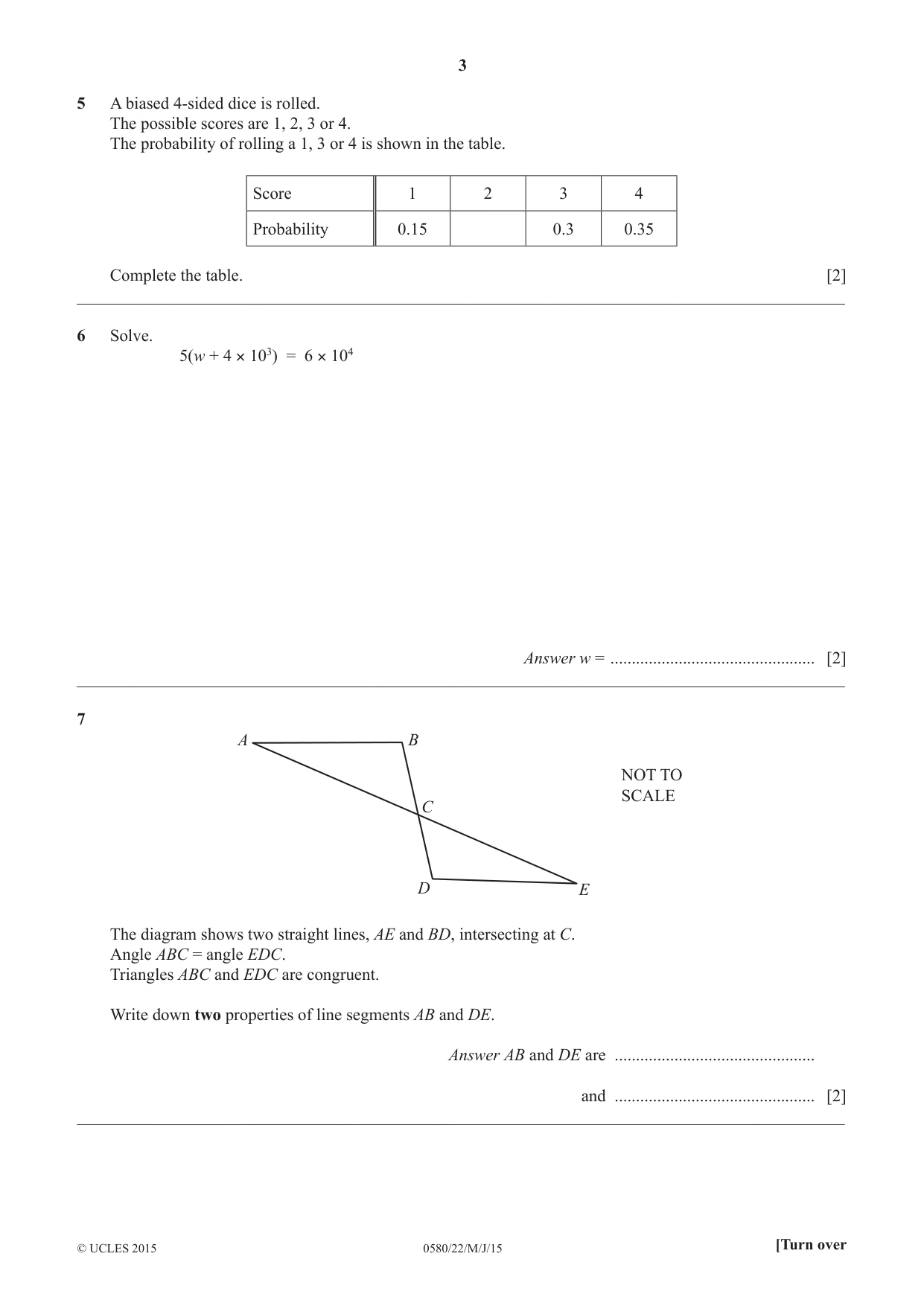
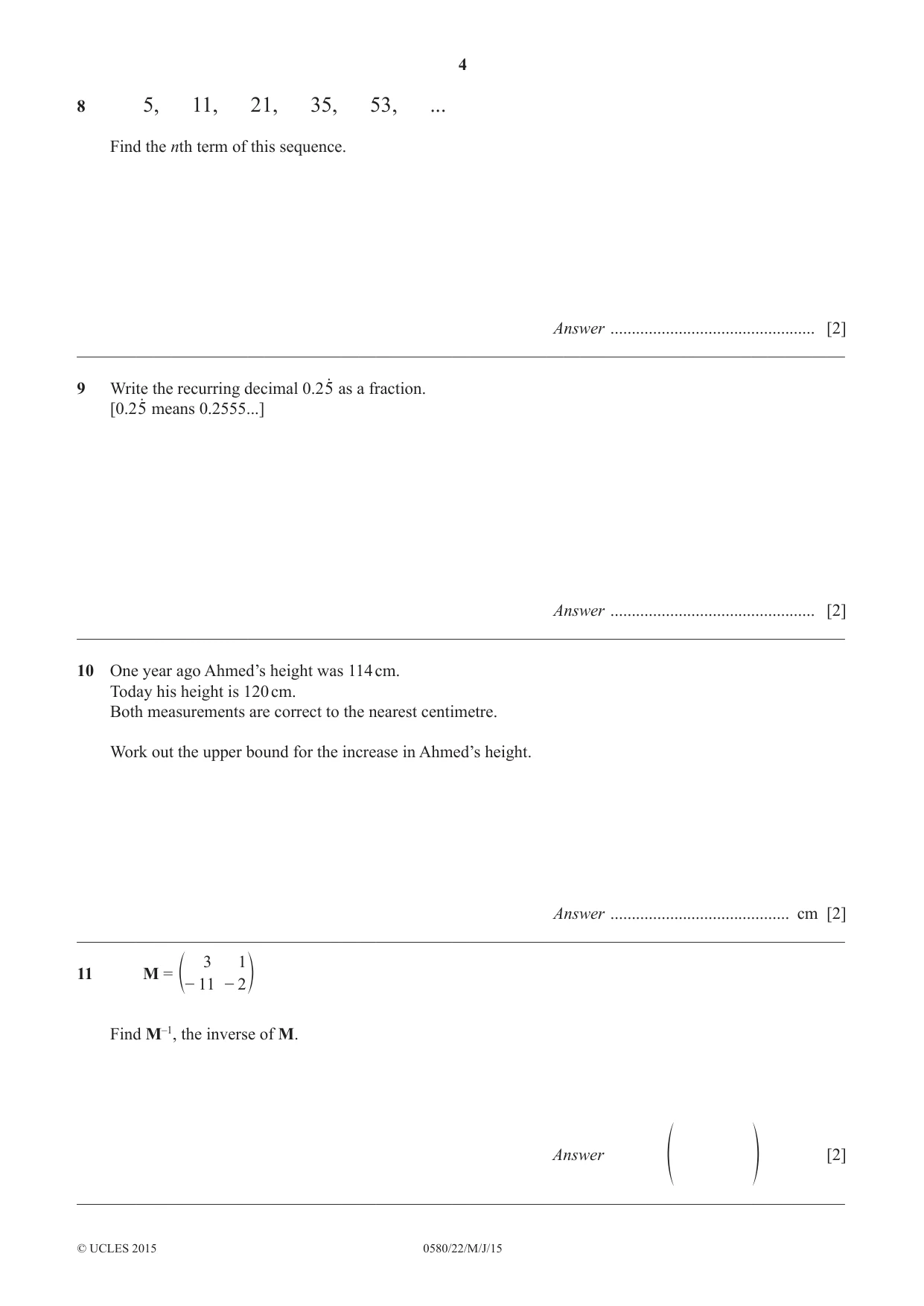
Mark scheme5 pages
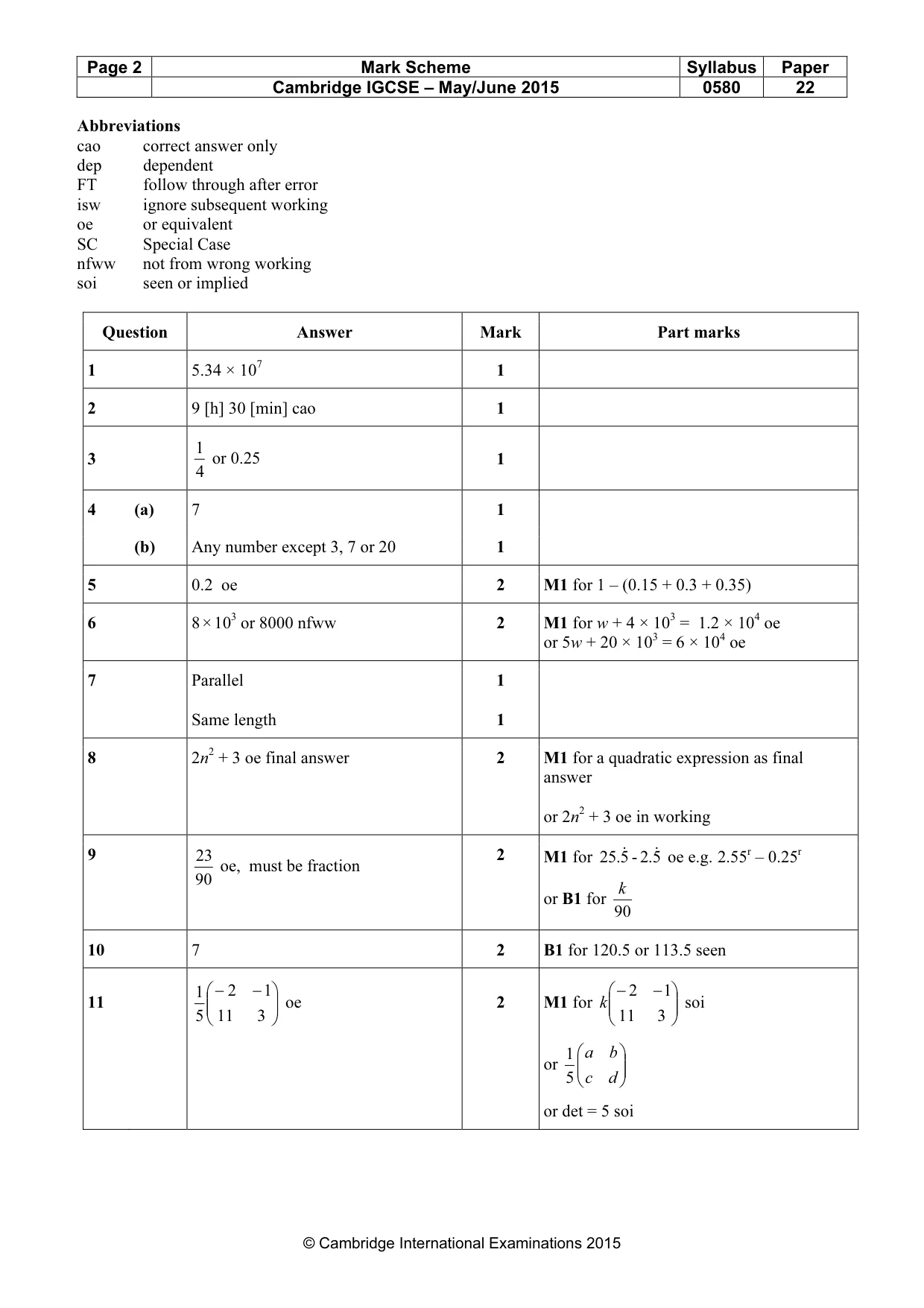
Answers below. Sit the paper first if you are practising.
Questions as text
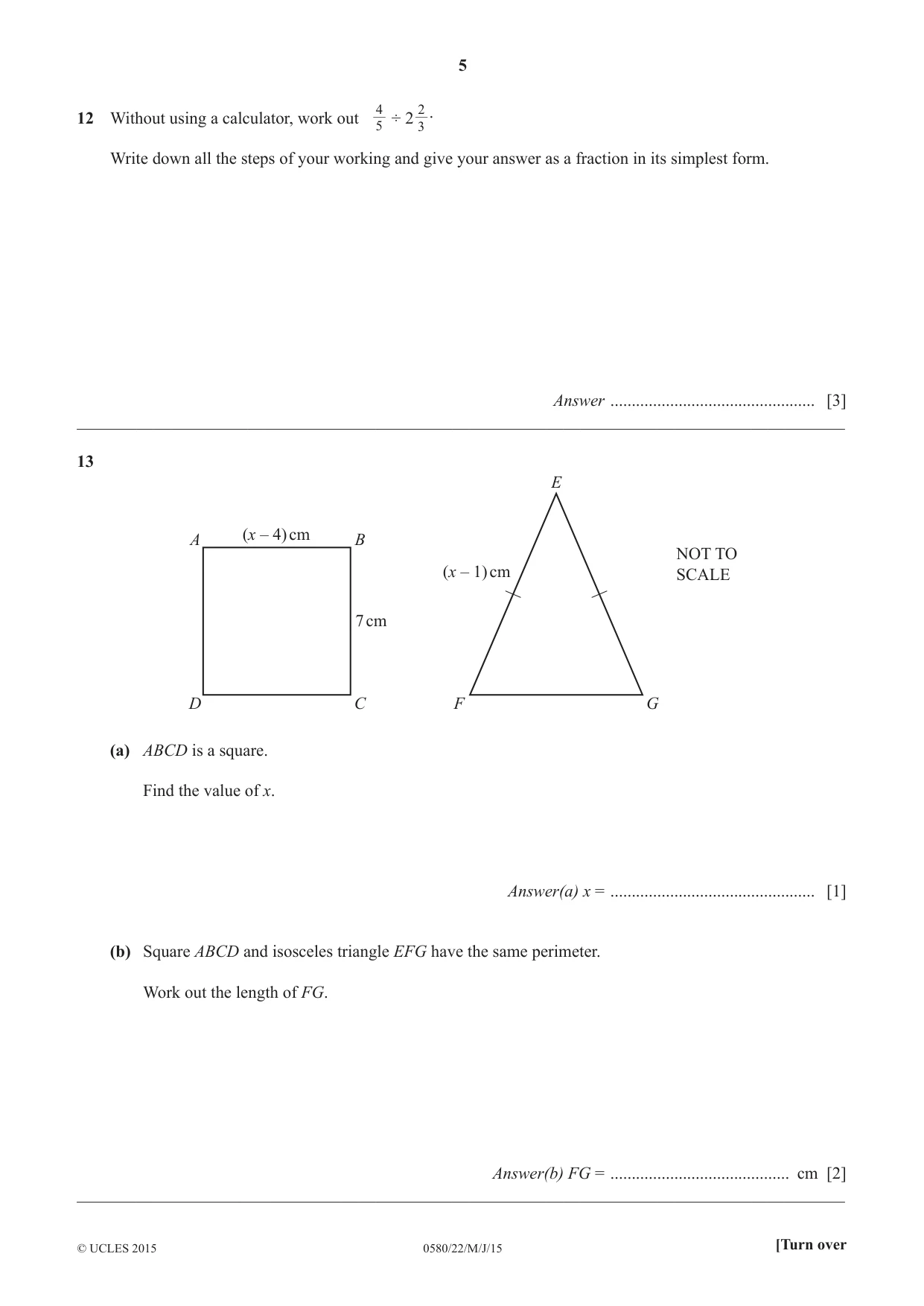
Q12 · 2 .12 Without using a calculator, work out 5 ÷ 2 3 Write down all the steps of your…
4 2 .12 Without using a calculator, work out 5 ÷ 2 3 Write down all the steps of your working and give your answer as a fraction in its simplest form. Answer ................................................ [3] __________________________________________________________________________________________
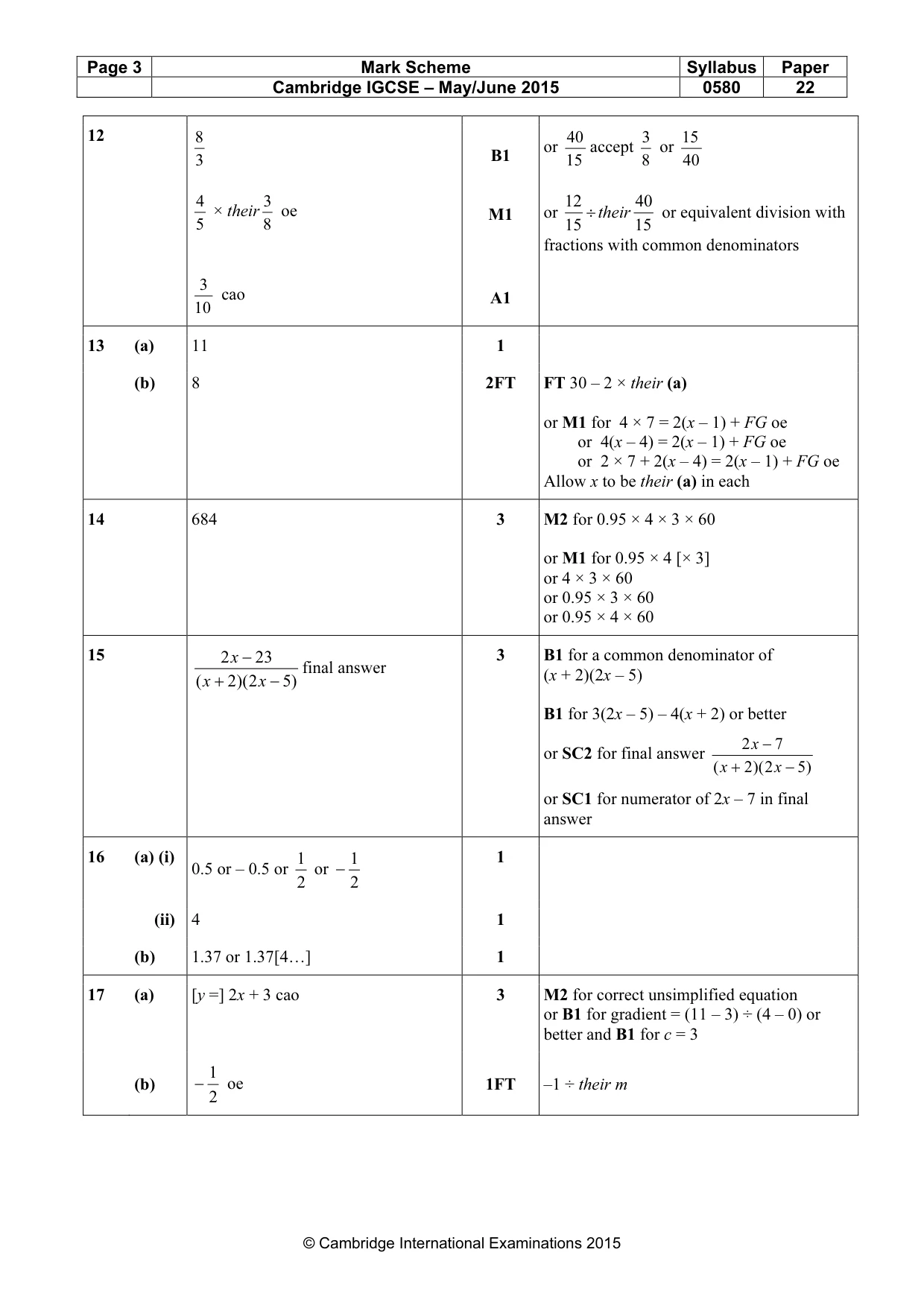
Mark scheme: 12 8 40 3 15 B1 or accept or 3 15 8 40 4 3 12 40 × their oe M1 or ÷ their or equivalent division with 5 8 15 15 fractions with common denominators 3 cao A1 10
Q13 · E (x – 4) cm A B NOT TO (x – 1) cm SCALE 7 cm D C F G (a) ABCD is a square
13 E (x – 4) cm A B NOT TO (x – 1) cm SCALE 7 cm D C F G (a) ABCD is a square. Find the value of x. Answer(a) x = ................................................ [1] (b) Square ABCD and isosceles triangle EFG have the same perimeter. Work out the length of FG. Answer(b) FG = .......................................... cm [2] __________________________________________________________________________________________
Mark scheme: 13 (a) 11 1 (b) 8 2FT FT 30 – 2 × their (a) or M1 for 4 × 7 = 2(x – 1) + FG oe or 4(x – 4) = 2(x – 1) + FG oe or 2 × 7 + 2(x – 4) = 2(x – 1) + FG oe Allow x to be their (a) in each
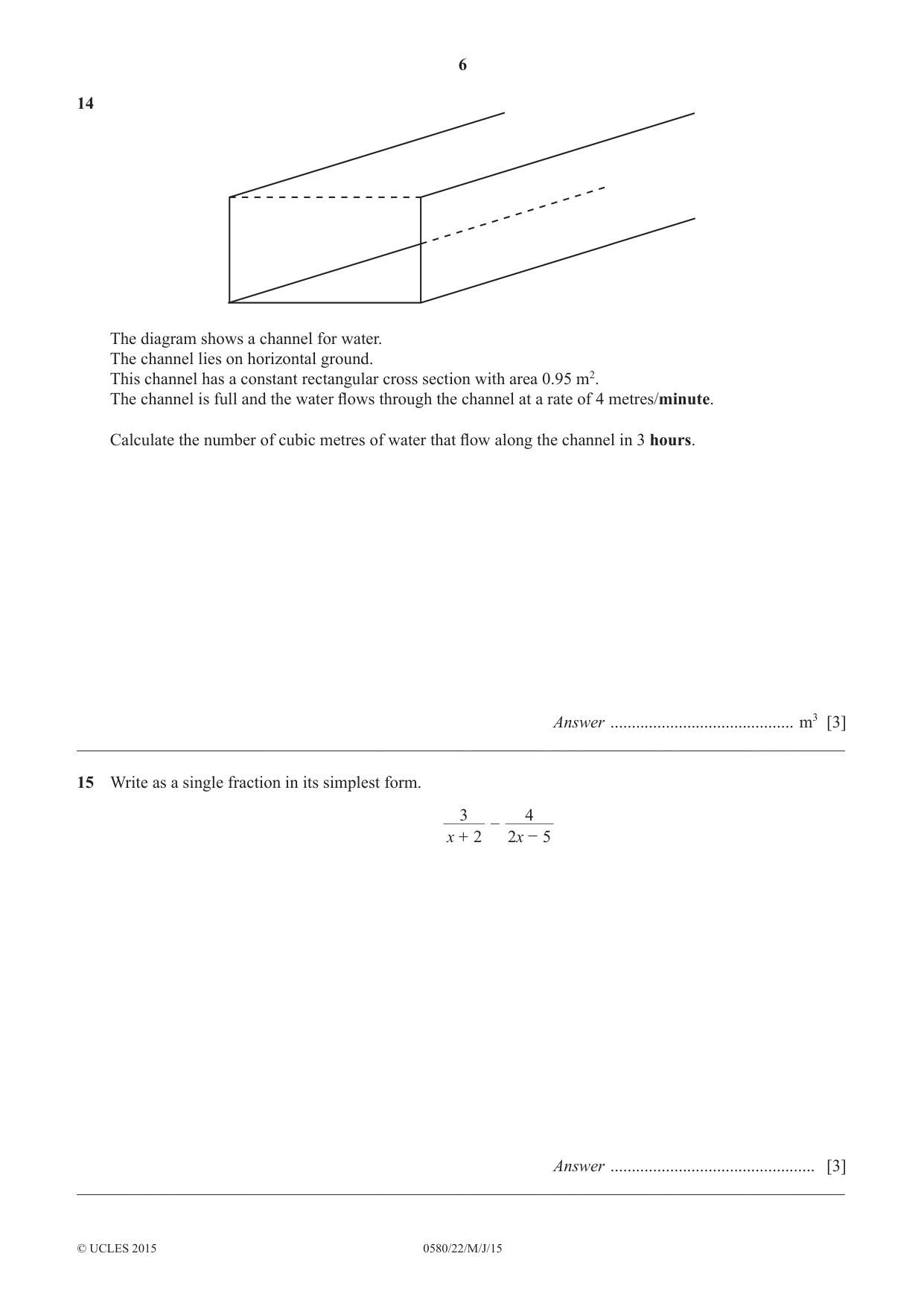
Q14 · The diagram shows a channel for water
14 The diagram shows a channel for water. The channel lies on horizontal ground. This channel has a constant rectangular cross section with area 0.95 m2. The channel is full and the water flows through the channel at a rate of 4 metres/minute. Calculate the number of cubic metres of water that flow along the channel in 3 hours. Answer ........................................... m3 [3] __________________________________________________________________________________________
Mark scheme: 14 684 3 M2 for 0.95 × 4 × 3 × 60 or M1 for 0.95 × 4 [× 3] or 4 × 3 × 60 or 0.95 × 3 × 60 or 0.95 × 4 × 60
Q15 · Write as a single fraction in its simplest form
15 Write as a single fraction in its simplest form. 3 4 – x + 2 2x - 5 Answer ................................................ [3] __________________________________________________________________________________________
Mark scheme: 15 3 B1 for a common denominator of 2 x − 23 final answer (x + 2)(2x – 5) ( x + 2 )( 2 x − 5) B1 for 3(2x – 5) – 4(x + 2) or better 2 x − 7 or SC2 for final answer ( x + 2 )( 2 x − 5 ) or SC1 for numerator of 2x – 7 in final answer
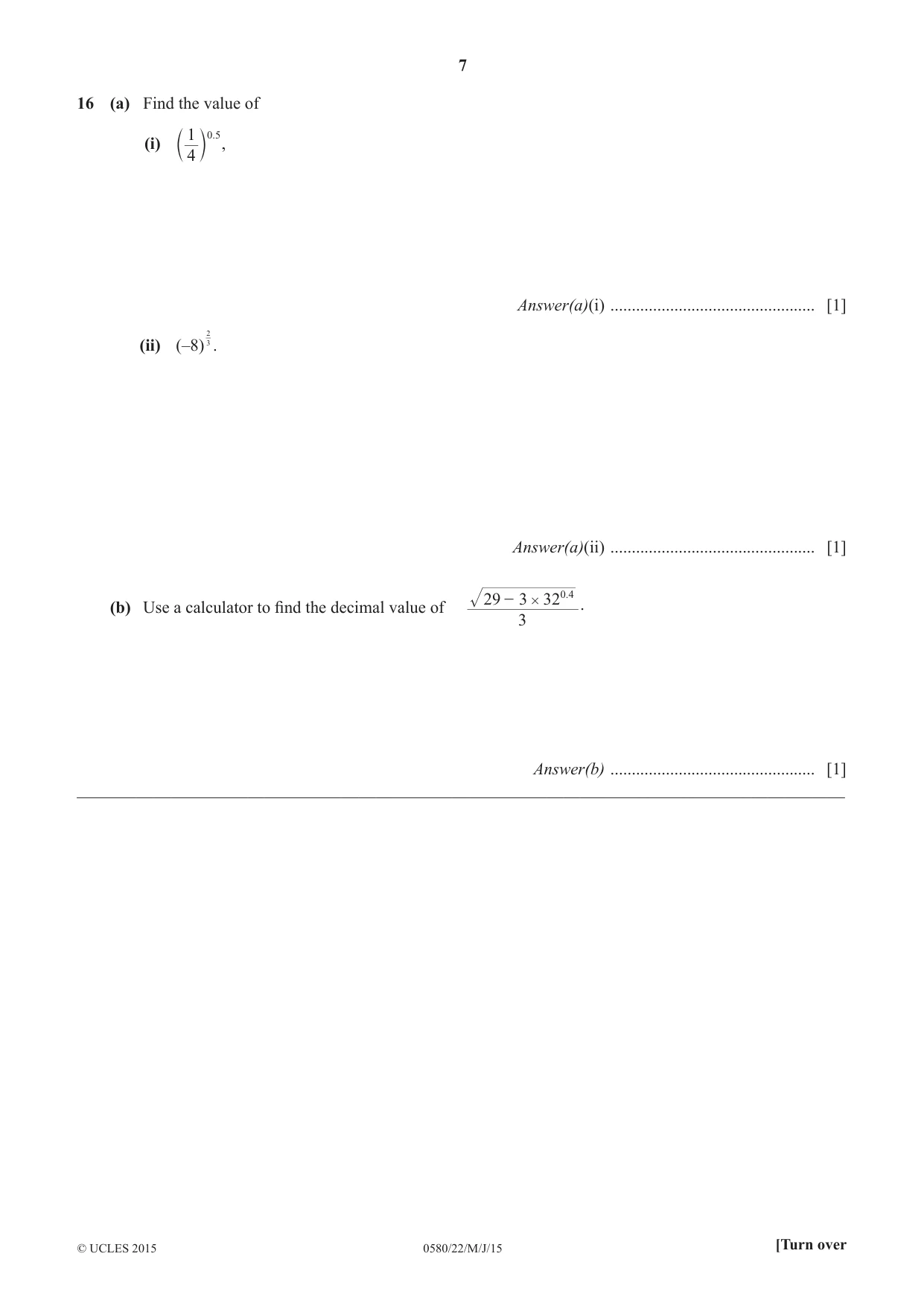
Q16 · Find the value of 1 .05 (i) c 4 m , Answer(a)(i)…
16 (a) Find the value of 1 .05 (i) c 4 m , Answer(a)(i) ................................................ [1] 2 (ii) (–8) 3 . Answer(a)(ii) ................................................ [1] 29 - 3 # 32 0.4 (b) Use a calculator to find the decimal value of . 3 Answer(b) ................................................ [1] __________________________________________________________________________________________
Mark scheme: 16 (a) (i) 1 1 1 0.5 or – 0.5 or or − 2 2 (a)(ii) 4 1 (b) 1.37 or 1.37[4…] 1
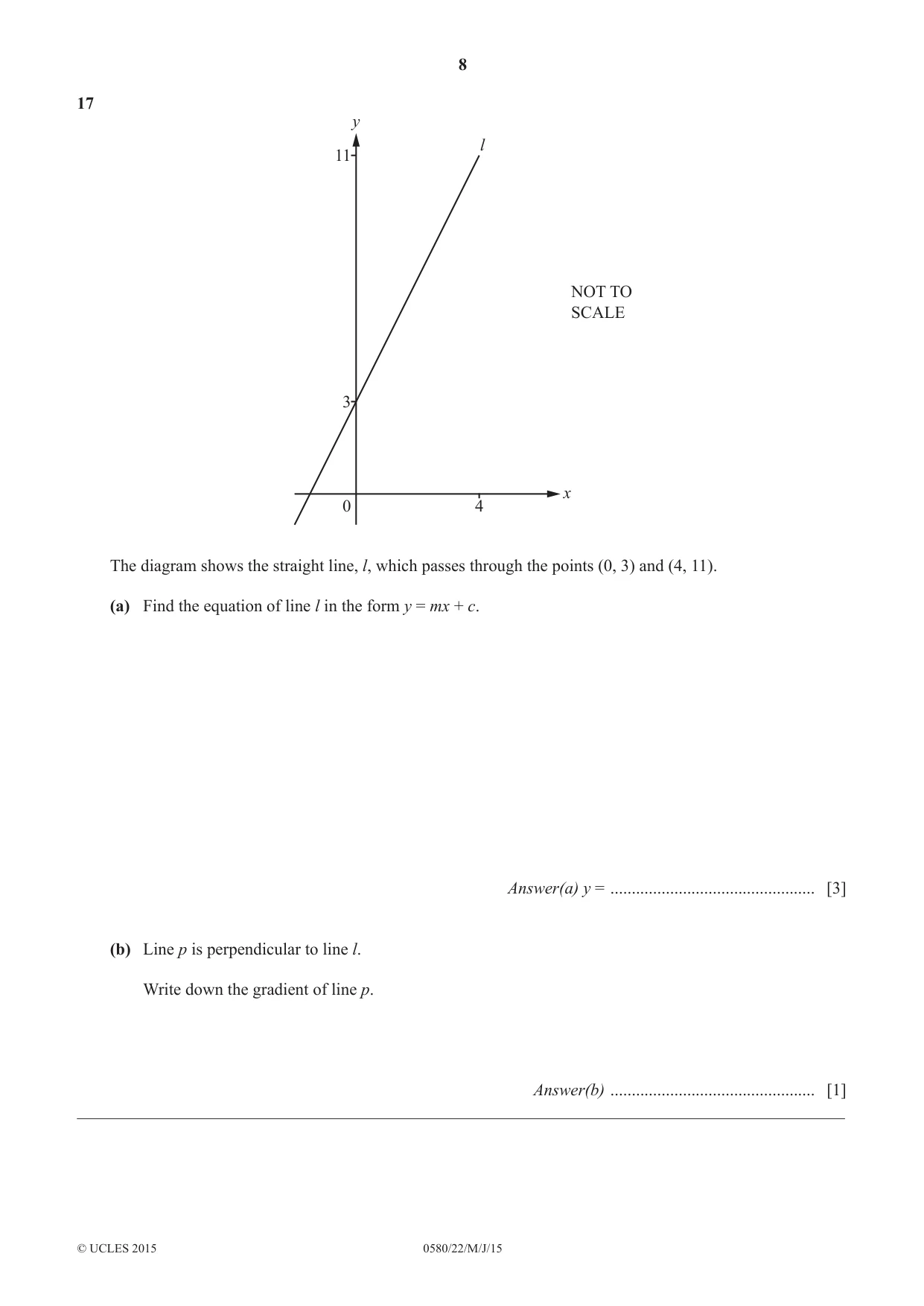
Q17 · Y l 11 NOT TO SCALE 3 x 0 4 The diagram shows the straight line, l, which passes through…
17 y l 11 NOT TO SCALE 3 x 0 4 The diagram shows the straight line, l, which passes through the points (0, 3) and (4, 11). (a) Find the equation of line l in the form y = mx + c. Answer(a) y = ................................................ [3] (b) Line p is perpendicular to line l. Write down the gradient of line p. Answer(b) ................................................ [1] __________________________________________________________________________________________
Mark scheme: 17 (a) [y =] 2x + 3 cao 3 M2 for correct unsimplified equation or B1 for gradient = (11 – 3) ÷ (4 – 0) or better and B1 for c = 3 1 (b) − oe 1FT –1 ÷ their m 2 1
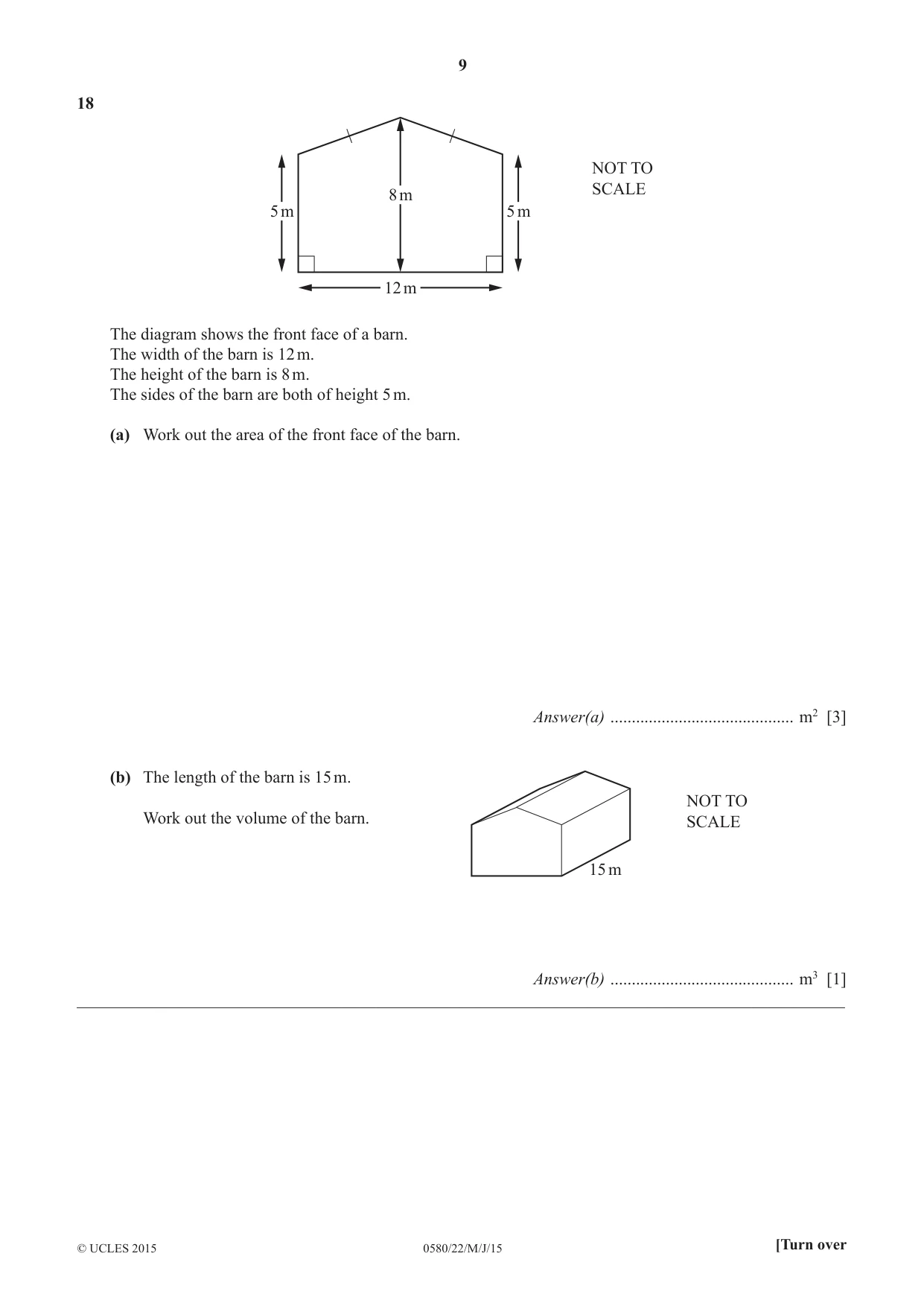
Q18 · NOT TO SCALE 8 m 5 m 5 m 12 m The diagram shows the front face of a barn
18 NOT TO SCALE 8 m 5 m 5 m 12 m The diagram shows the front face of a barn. The width of the barn is 12 m. The height of the barn is 8 m. The sides of the barn are both of height 5 m. (a) Work out the area of the front face of the barn. Answer(a) ........................................... m2 [3] (b) The length of the barn is 15 m. NOT TO Work out the volume of the barn. SCALE 15 m Answer(b) ........................................... m3 [1] __________________________________________________________________________________________
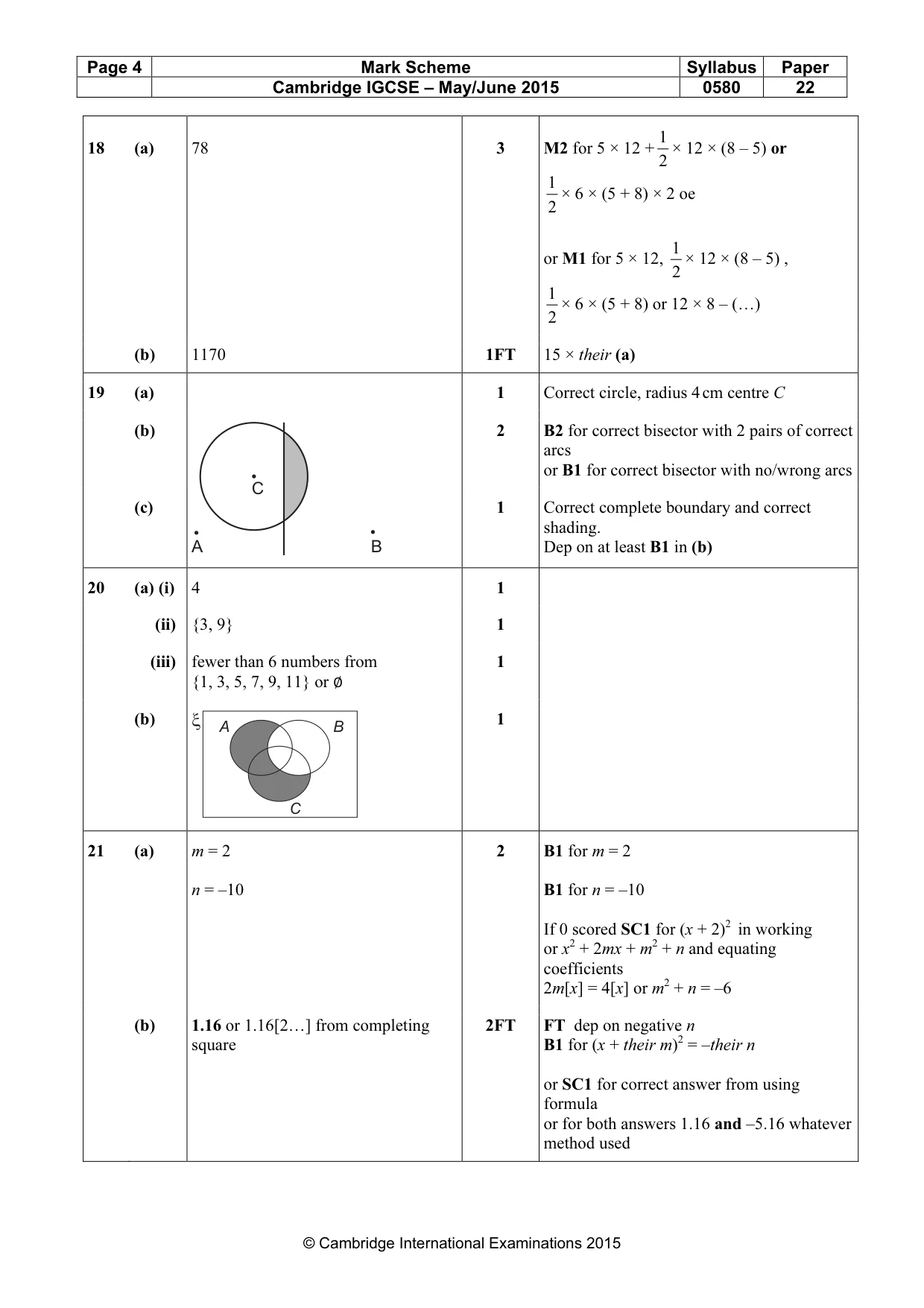
Mark scheme: 1 18 (a) 78 3 M2 for 5 × 12 + × 12 × (8 – 5) or 2 1 × 6 × (5 + 8) × 2 oe 2 1 or M1 for 5 × 12, × 12 × (8 – 5) , 2 1 × 6 × (5 + 8) or 12 × 8 – (…) 2 (b) 1170 1FT 15 × their (a)
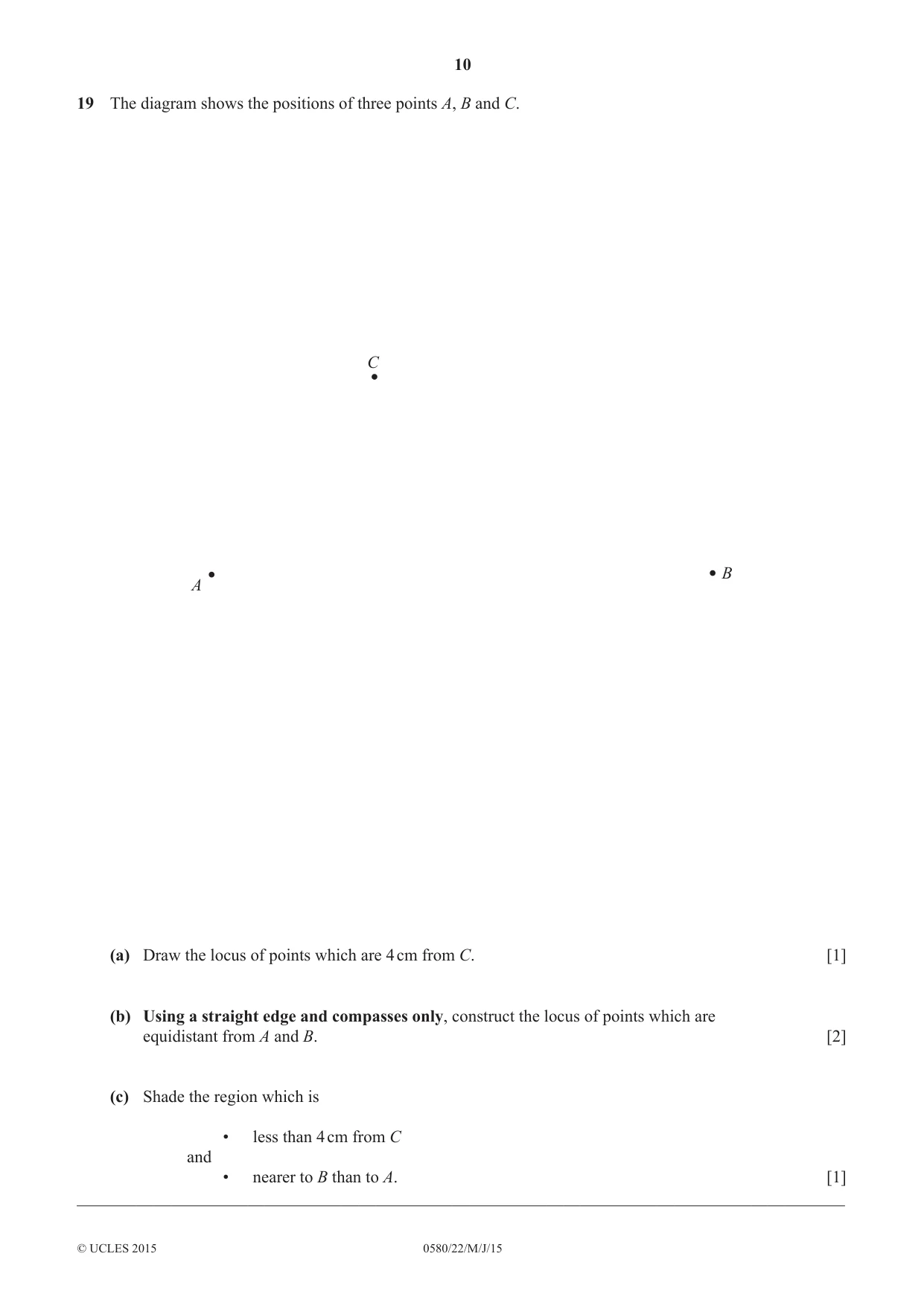
Q19 · The diagram shows the positions of three points A, B and C
19 The diagram shows the positions of three points A, B and C. C B A (a) Draw the locus of points which are 4 cm from C. [1] (b) Using a straight edge and compasses only, construct the locus of points which are equidistant from A and B. [2] (c) Shade the region which is • less than 4 cm from C and • nearer to B than to A. [1] __________________________________________________________________________________________
Mark scheme: 19 (a) 1 Correct circle, radius 4 cm centre C (b) 2 B2 for correct bisector with 2 pairs of correct arcs or B1 for correct bisector with no/wrong arcs C (c) 1 Correct complete boundary and correct shading. A B Dep on at least B1 in (b)
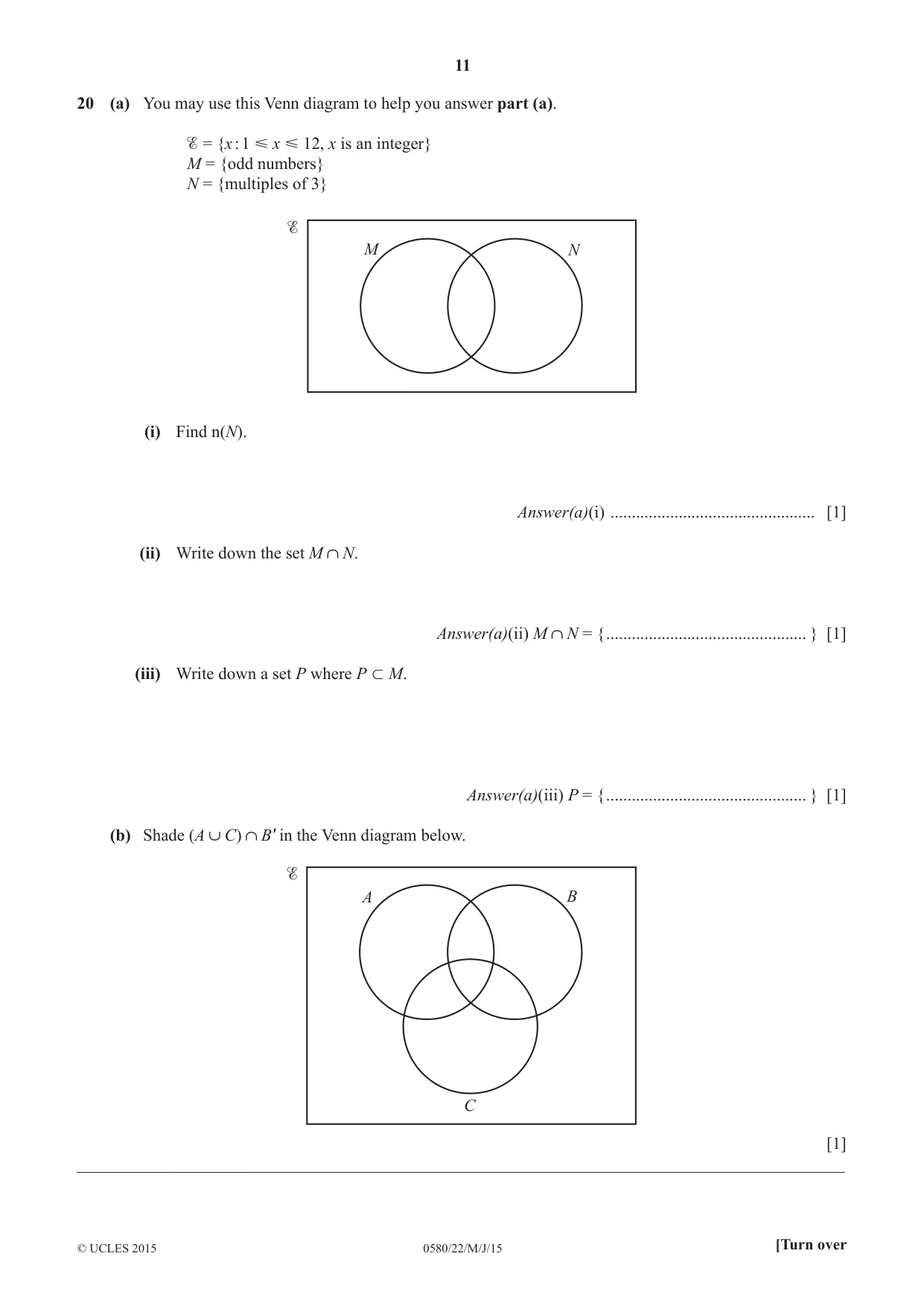
Q20 · You may use this Venn diagram to help you answer part (a)
20 (a) You may use this Venn diagram to help you answer part (a). = {x : 1 x 12, x is an integer} M = {odd numbers} N = {multiples of 3} M N (i) Find n(N). Answer(a)(i) ................................................ [1] (ii) Write down the set M N. Answer(a)(ii) M N = { ............................................... } [1] (iii) Write down a set P where P 1 M. Answer(a)(iii) P = { ............................................... } [1] (b) Shade (A C) B' in the Venn diagram below. A B C [1] __________________________________________________________________________________________
Mark scheme: 20 (a) (i) 4 1 (ii) {3, 9} 1 (iii) fewer than 6 numbers from 1 {1, 3, 5, 7, 9, 11} or ∅ (b) ξ 1 A B C
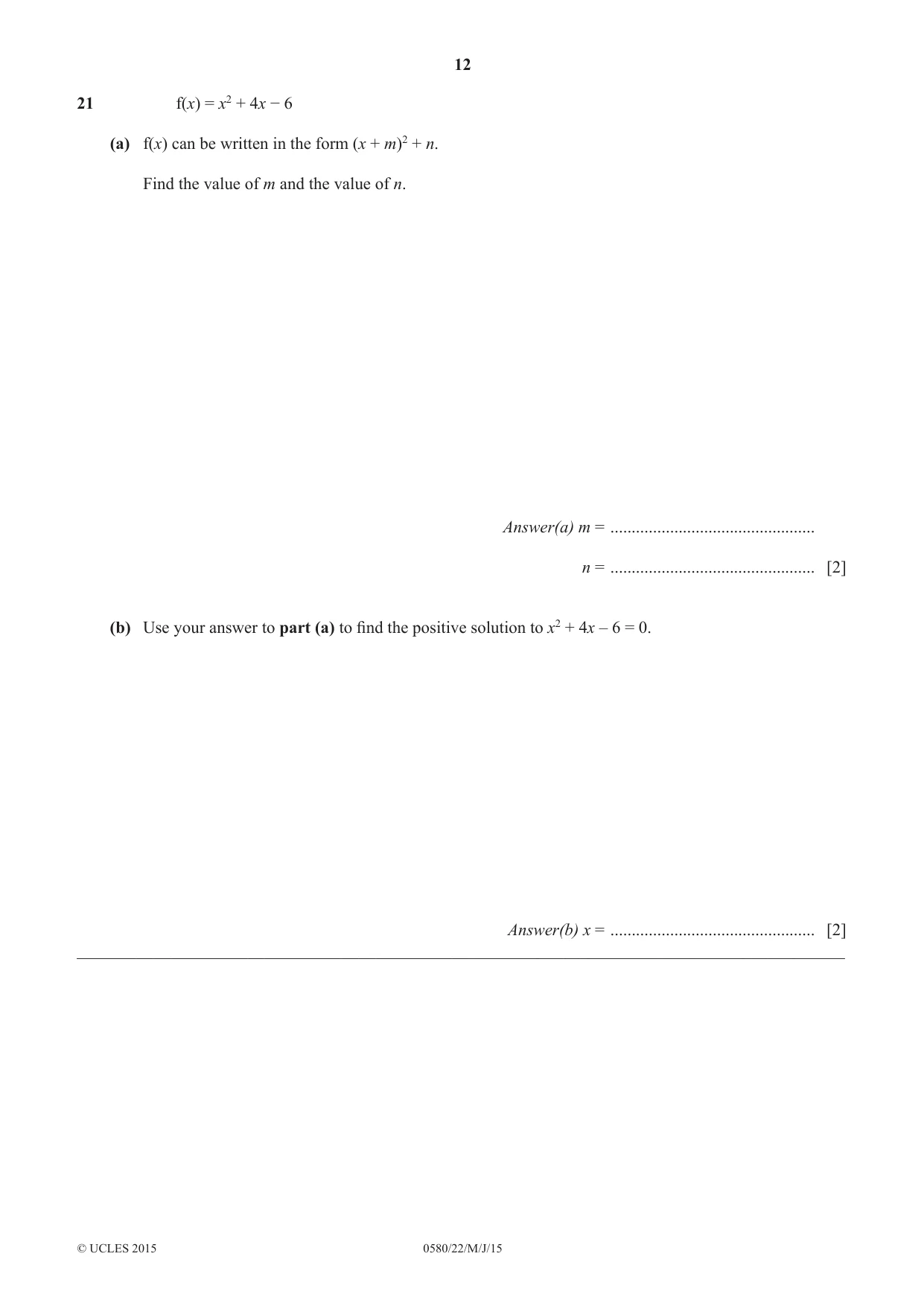
Q21 · F(x) = x2 + 4x − 6 (a) f(x) can be written in the form (x + m)2 + n
21 f(x) = x2 + 4x − 6 (a) f(x) can be written in the form (x + m)2 + n. Find the value of m and the value of n. Answer(a) m = ................................................ n = ................................................ [2] (b) Use your answer to part (a) to find the positive solution to x2 + 4x – 6 = 0. Answer(b) x = ................................................ [2] __________________________________________________________________________________________
Mark scheme: 21 (a) m = 2 2 B1 for m = 2 n = –10 B1 for n = –10 If 0 scored SC1 for (x + 2)2 in working or x2 + 2mx + m2 + n and equating coefficients 2m[x] = 4[x] or m2 + n = –6 (b) 1.16 or 1.16[2…] from completing 2FT FT dep on negative n square B1 for (x + their m)2 = –their n or SC1 for correct answer from using formula or for both answers 1.16 and –5.16 whatever method used
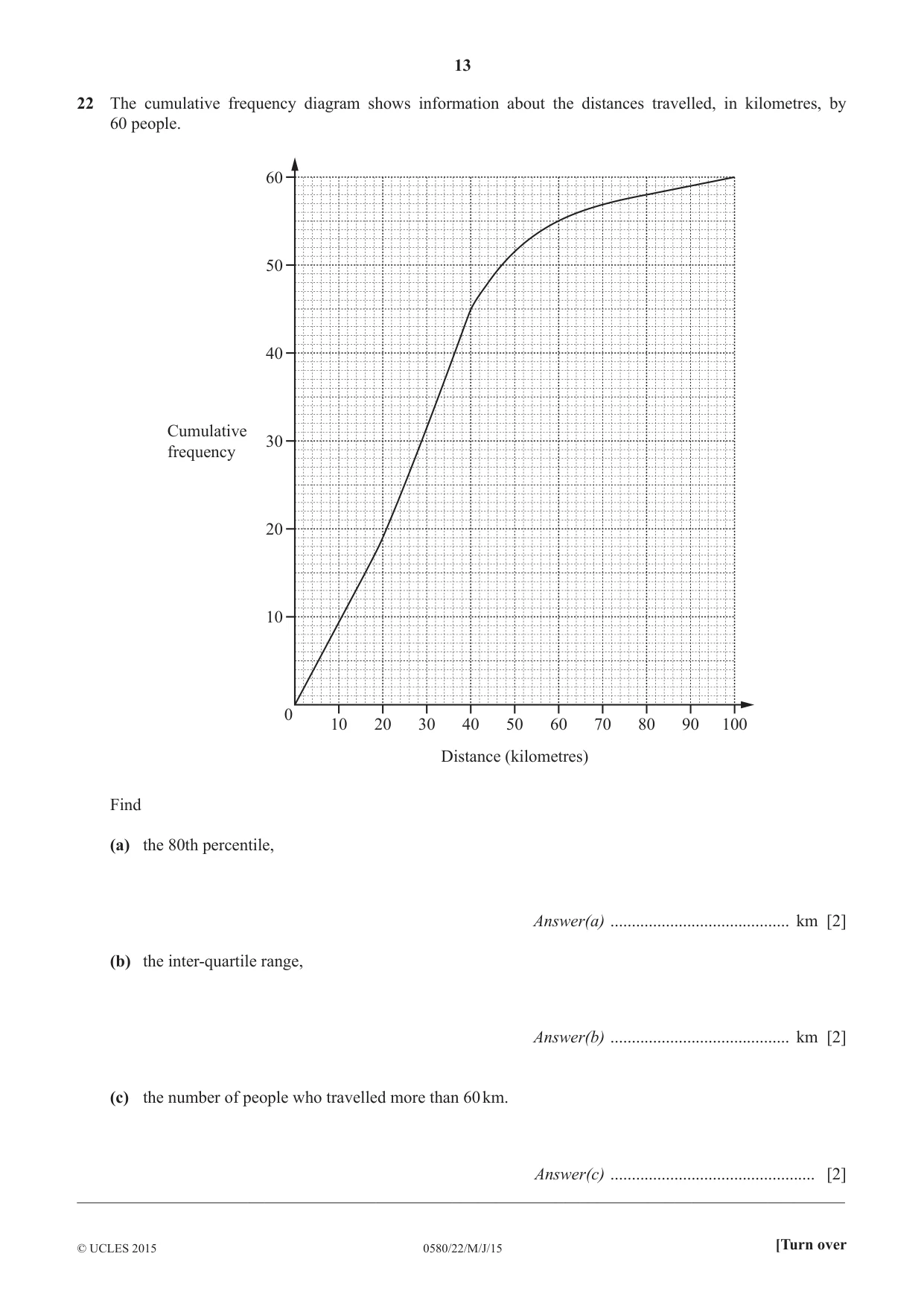
Q22 · The cumulative frequency diagram shows information about the distances travelled, in…
22 The cumulative frequency diagram shows information about the distances travelled, in kilometres, by 60 people. 60 50 40 Cumulative 30 frequency 20 10 0 10 20 30 40 50 60 70 80 90 100 Distance (kilometres) Find (a) the 80th percentile, Answer(a) .......................................... km [2] (b) the inter-quartile range, Answer(b) .......................................... km [2] (c) the number of people who travelled more than 60 km. Answer(c) ................................................ [2] __________________________________________________________________________________________
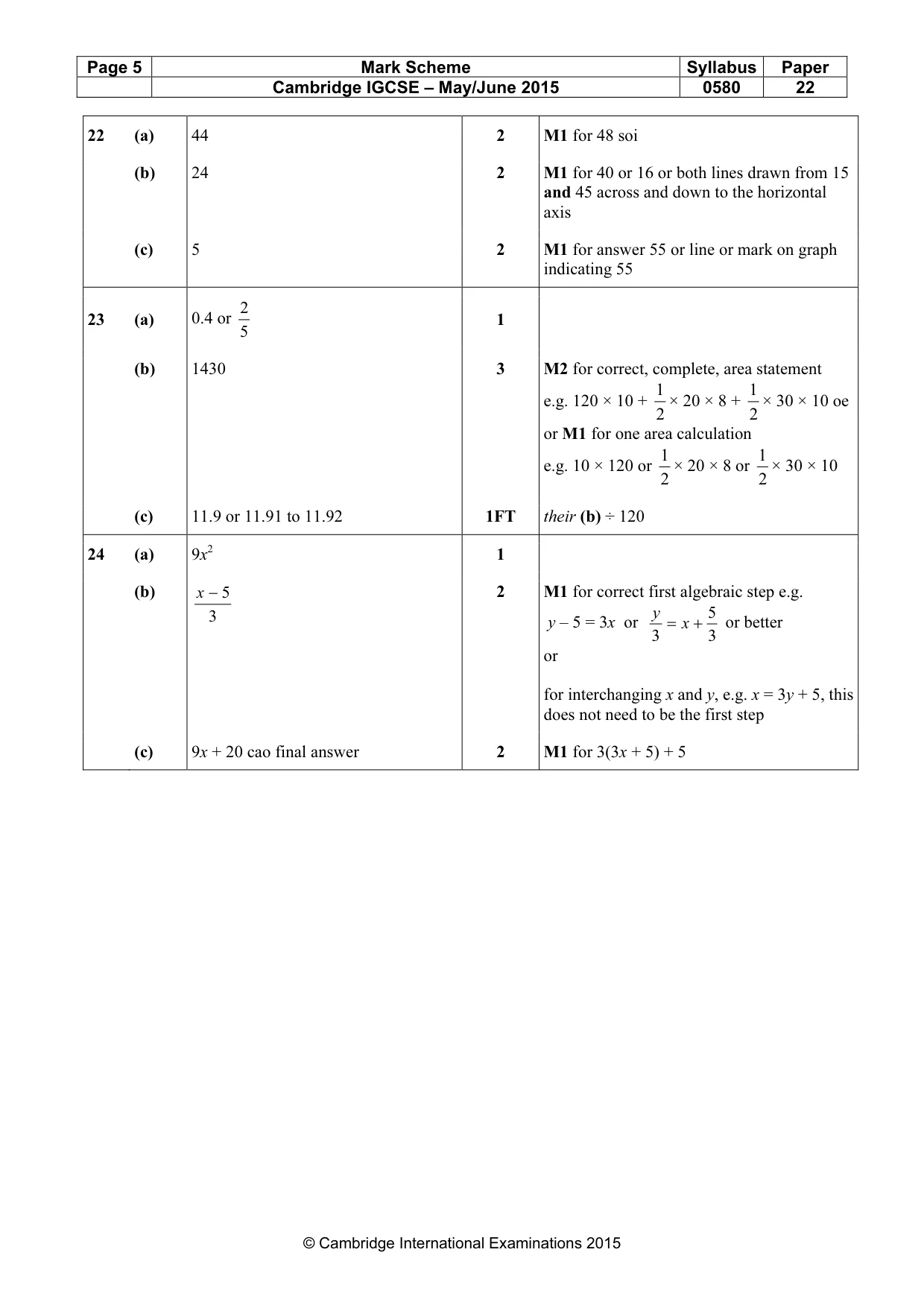
Mark scheme: 22 (a) 44 2 M1 for 48 soi (b) 24 2 M1 for 40 or 16 or both lines drawn from 15 and 45 across and down to the horizontal axis (c) 5 2 M1 for answer 55 or line or mark on graph indicating 55 2
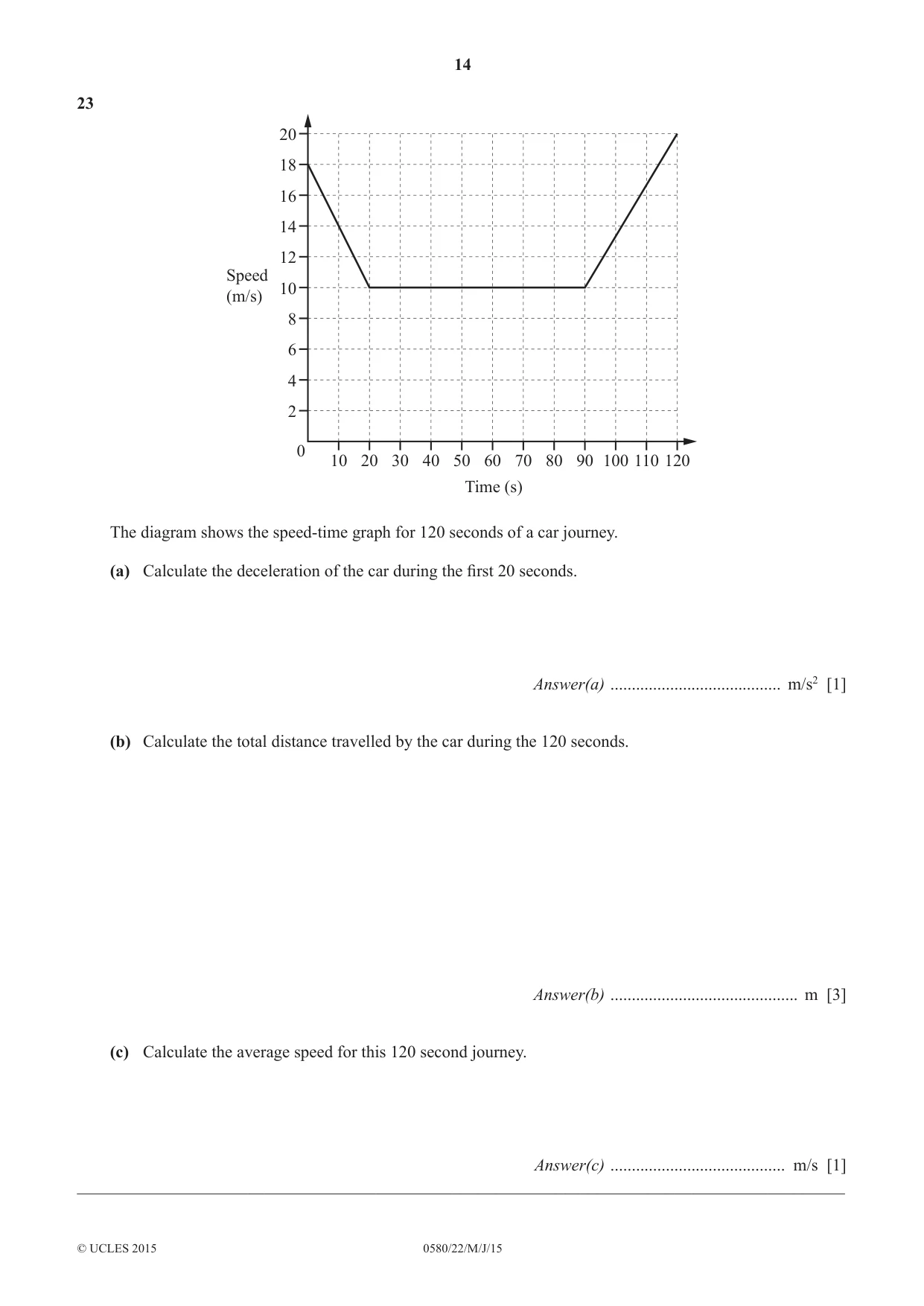
Q23 · 20 18 16 14 12 Speed 10 (m/s) 8 6 4 2 0 10 20 30 40 50 60 70 80 90 100 110 120 Time (s)…
23 20 18 16 14 12 Speed 10 (m/s) 8 6 4 2 0 10 20 30 40 50 60 70 80 90 100 110 120 Time (s) The diagram shows the speed-time graph for 120 seconds of a car journey. (a) Calculate the deceleration of the car during the first 20 seconds. Answer(a) ........................................ m/s2 [1] (b) Calculate the total distance travelled by the car during the 120 seconds. Answer(b) ............................................ m [3] (c) Calculate the average speed for this 120 second journey. Answer(c) ......................................... m/s [1] __________________________________________________________________________________________
Mark scheme: 2 23 (a) 0.4 or 1 5 (b) 1430 3 M2 for correct, complete, area statement 1 1 e.g. 120 × 10 + × 20 × 8 + × 30 × 10 oe 2 2 or M1 for one area calculation 1 1 e.g. 10 × 120 or × 20 × 8 or × 30 × 10 2 2 (c) 11.9 or 11.91 to 11.92 1FT their (b) ÷ 120
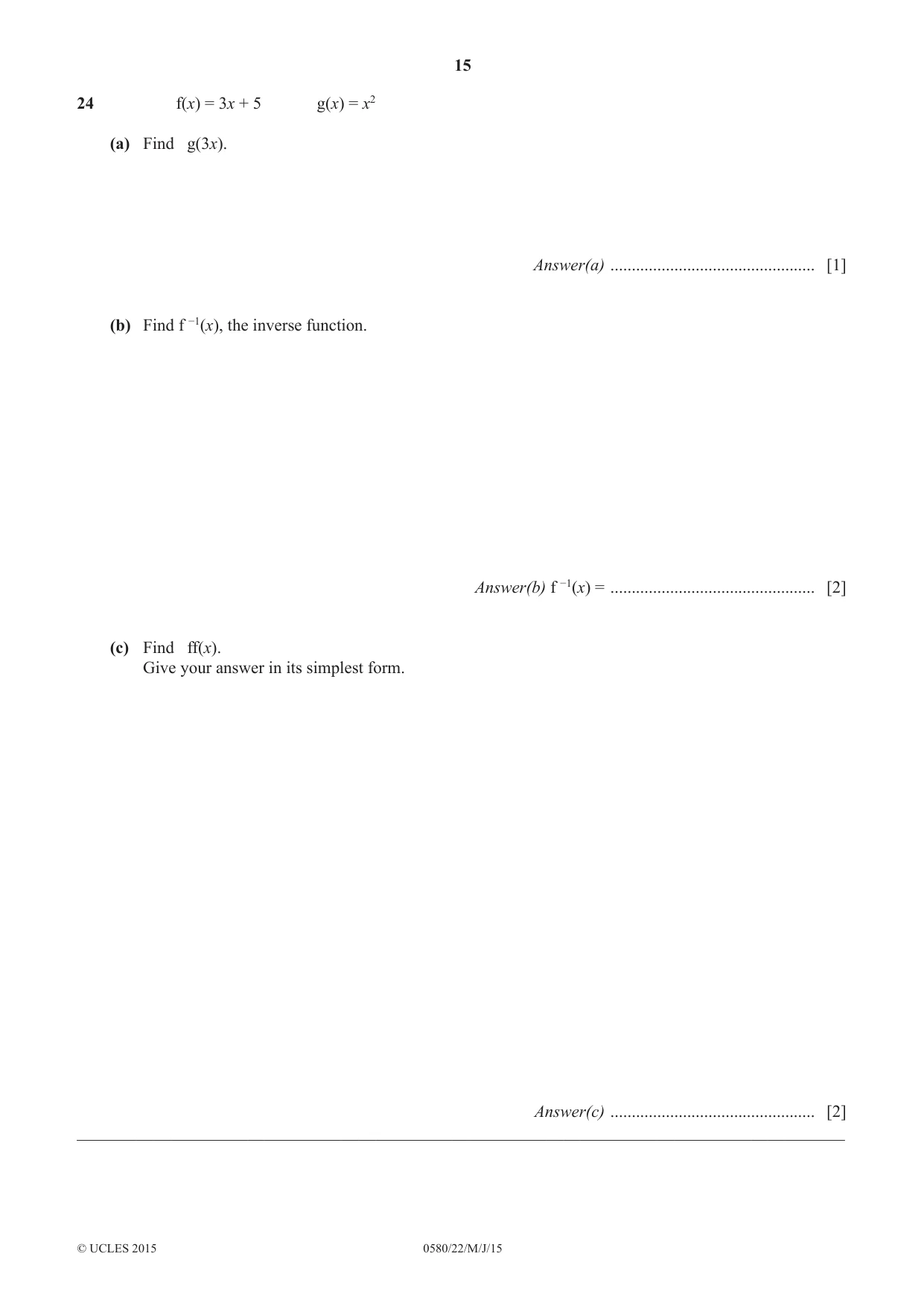
Q24 · F(x) = 3x + 5 g(x) = x2 (a) Find g(3x)
24 f(x) = 3x + 5 g(x) = x2 (a) Find g(3x). Answer(a) ................................................ [1] (b) Find f −1(x), the inverse function. Answer(b) f −1(x) = ................................................ [2] (c) Find ff(x). Give your answer in its simplest form. Answer(c) ................................................ [2] __________________________________________________________________________________________
Mark scheme: 24 (a) 9x2 1 (b) x − 5 2 M1 for correct first algebraic step e.g. 3 y 5 y – 5 = 3x or = x + or better 3 3 or for interchanging x and y, e.g. x = 3y + 5, this does not need to be the first step (c) 9x + 20 cao final answer 2 M1 for 3(3x + 5) + 5
What was in this paper
The subtopics covered by these 13 questions, and how many questions each got. Open one in a new tab to see every Cambridge question on it.
What you needed in this session
Cambridge’s own grade thresholds for 2015 May/June, Paper 2 · Variant 2. A higher threshold means an easier paper — the bar moves with how the cohort did.