Cambridge IGCSE Mathematics 0580 — 2017 Oct/Nov Paper 2 · Variant 1
0580/21/O/N/17 · 23 questions · 70 marks · ≈79 min
The question paper and its mark scheme, free to read here and free to download. This is Cambridge’s own paper, exactly as it was sat.
Question paper12 pages
Mark scheme5 pages
Answers below. Sit the paper first if you are practising.
Questions as text
Q1 · NOT TO 72° 83° SCALE 104° x° The diagram shows a quadrilateral
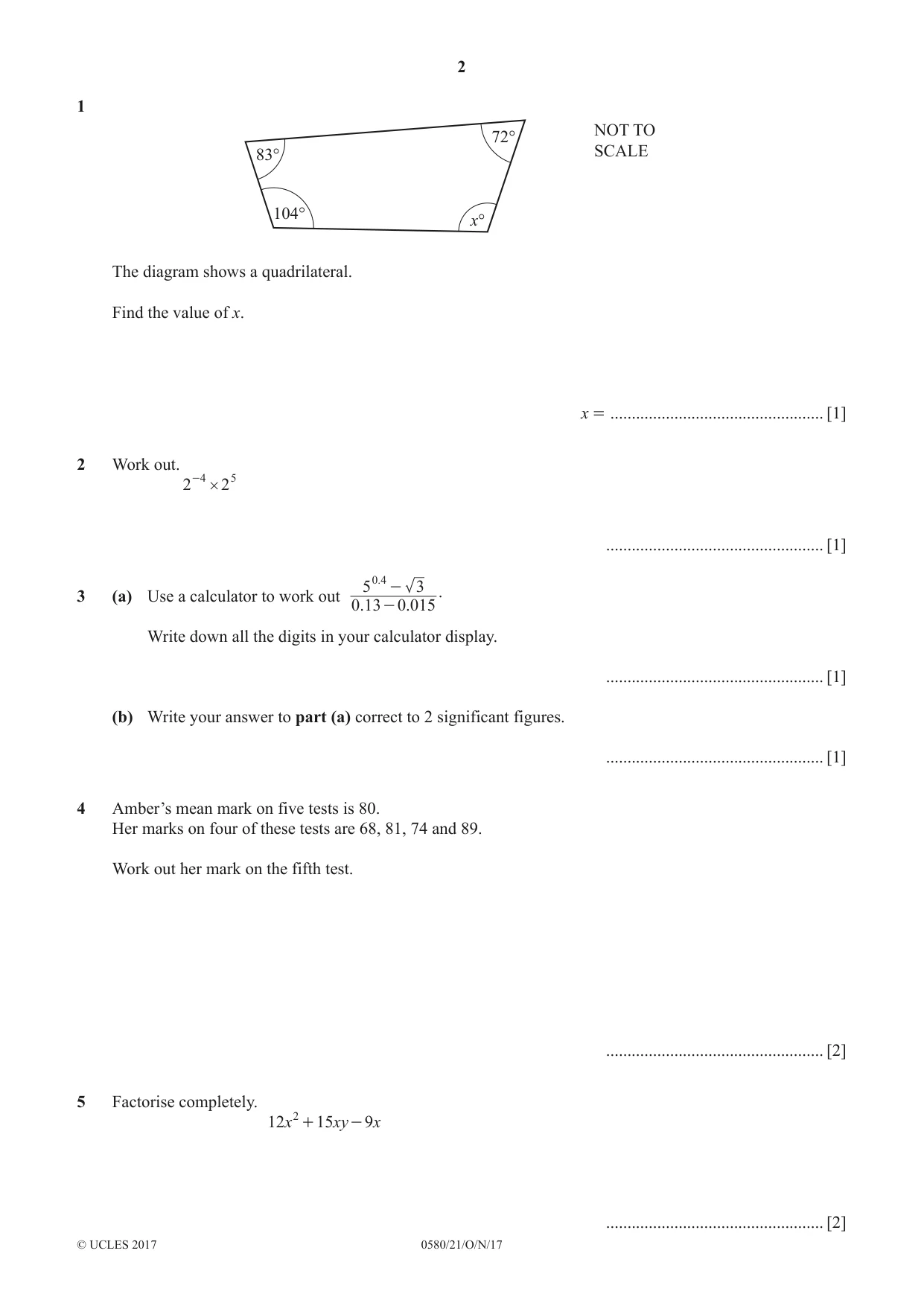
1 NOT TO 72° 83° SCALE 104° x° The diagram shows a quadrilateral. Find the value of x. x = .................................................. [1]
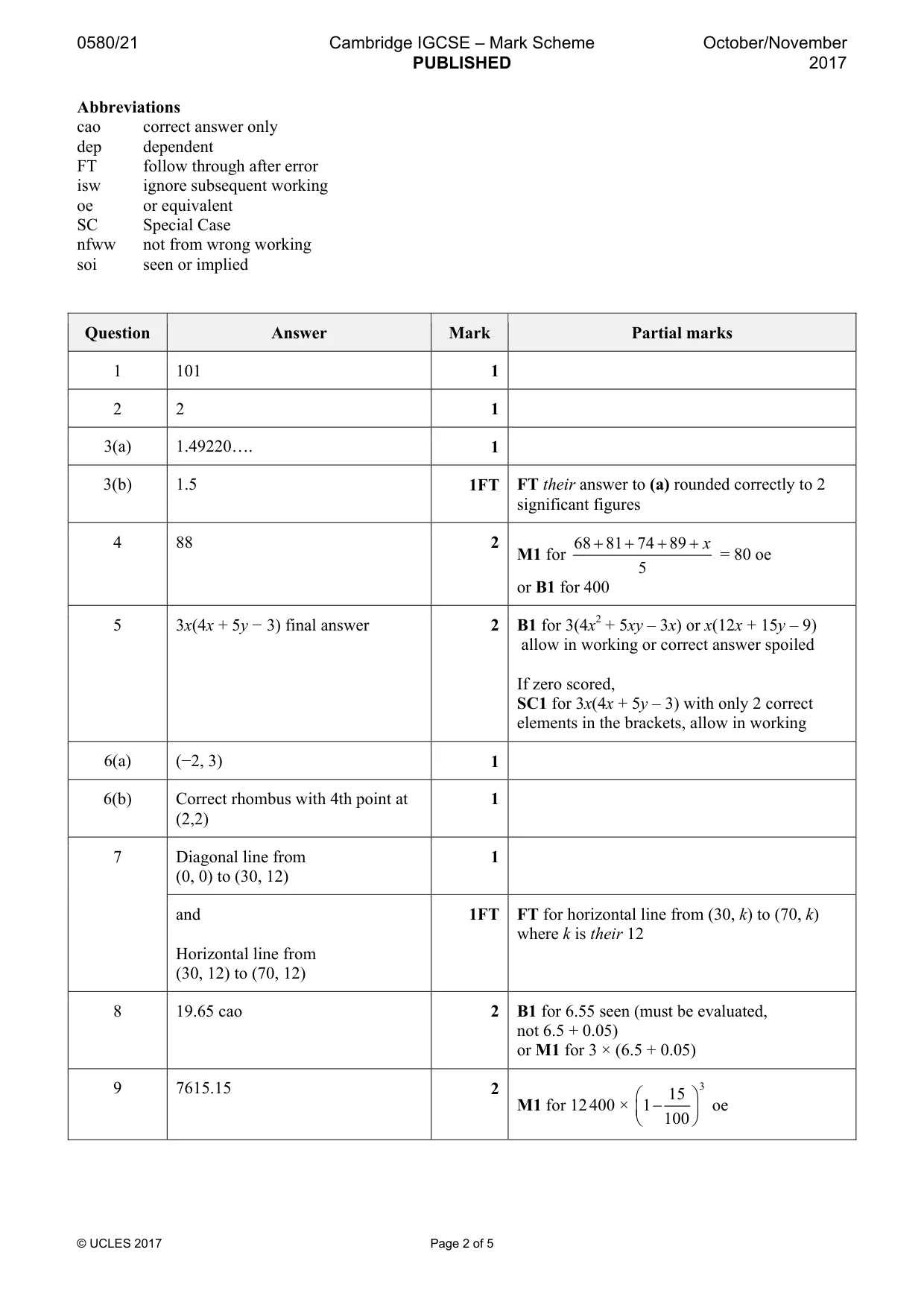
Mark scheme: Question Answer Mark Partial marks 1 101 1
Question 2
2 Work out. 2 -4 # 2 5 ................................................... [1]
Mark scheme: 2 2 1
Q3 · 04 - 33 (a) Use a calculator to work out
5 .04 - 33 (a) Use a calculator to work out . 0.13 - 0. 015 Write down all the digits in your calculator display. ................................................... [1] (b) Write your answer to part (a) correct to 2 significant figures. ................................................... [1]
Mark scheme: 3(a) 1.49220…. 1 3(b) 1.5 1FT FT their answer to (a) rounded correctly to 2 significant figures
Q4 · Amber’s mean mark on five tests is 80
4 Amber’s mean mark on five tests is 80. Her marks on four of these tests are 68, 81, 74 and 89. Work out her mark on the fifth test. ................................................... [2]
Mark scheme: 4 88 2 68 + 81 + 74 + 89 + x M1 for = 80 oe 5 or B1 for 400
Question 5
5 Factorise completely. 12x 2 + 15xy - 9x ................................................... [2]
Mark scheme: 5 3x(4x + 5y − 3) final answer 2 B1 for 3(4x2 + 5xy – 3x) or x(12x + 15y – 9) allow in working or correct answer spoiled If zero scored, SC1 for 3x(4x + 5y – 3) with only 2 correct elements in the brackets, allow in working
Q6 · Y 5 4 A 3 2 1 x –5 –4 –3 –2 –1 0 1 2 3 4 5 –1 B –2 C –3 –4 –5 The diagram shows two sides…
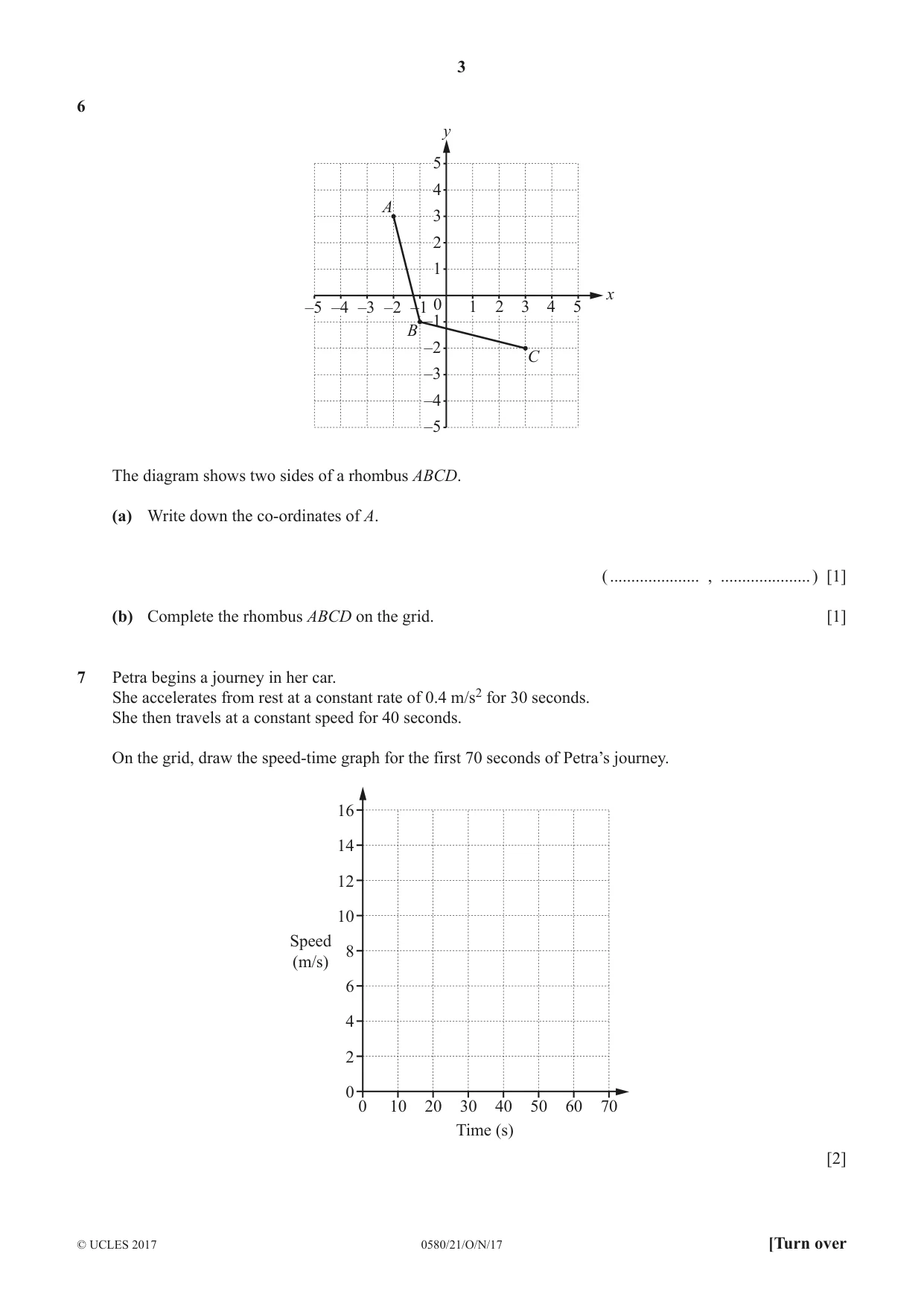
6 y 5 4 A 3 2 1 x –5 –4 –3 –2 –1 0 1 2 3 4 5 –1 B –2 C –3 –4 –5 The diagram shows two sides of a rhombus ABCD. (a) Write down the co-ordinates of A. ( ..................... , ..................... ) [1] (b) Complete the rhombus ABCD on the grid. [1]
Mark scheme: 6(a) (−2, 3) 1 6(b) Correct rhombus with 4th point at 1 (2,2)
Q7 · Petra begins a journey in her car
7 Petra begins a journey in her car. She accelerates from rest at a constant rate of 0.4 m/s2 for 30 seconds. She then travels at a constant speed for 40 seconds. On the grid, draw the speed-time graph for the first 70 seconds of Petra’s journey. 16 14 12 10 Speed 8 (m/s) 6 4 2 0 0 10 20 30 40 50 60 70 Time (s) [2]
Mark scheme: 7 Diagonal line from 1 (0, 0) to (30, 12) and 1FT FT for horizontal line from (30, k) to (70, k) where k is their 12 Horizontal line from (30, 12) to (70, 12)
Q8 · NOT TO SCALE The diagram shows three identical cuboids in a tower
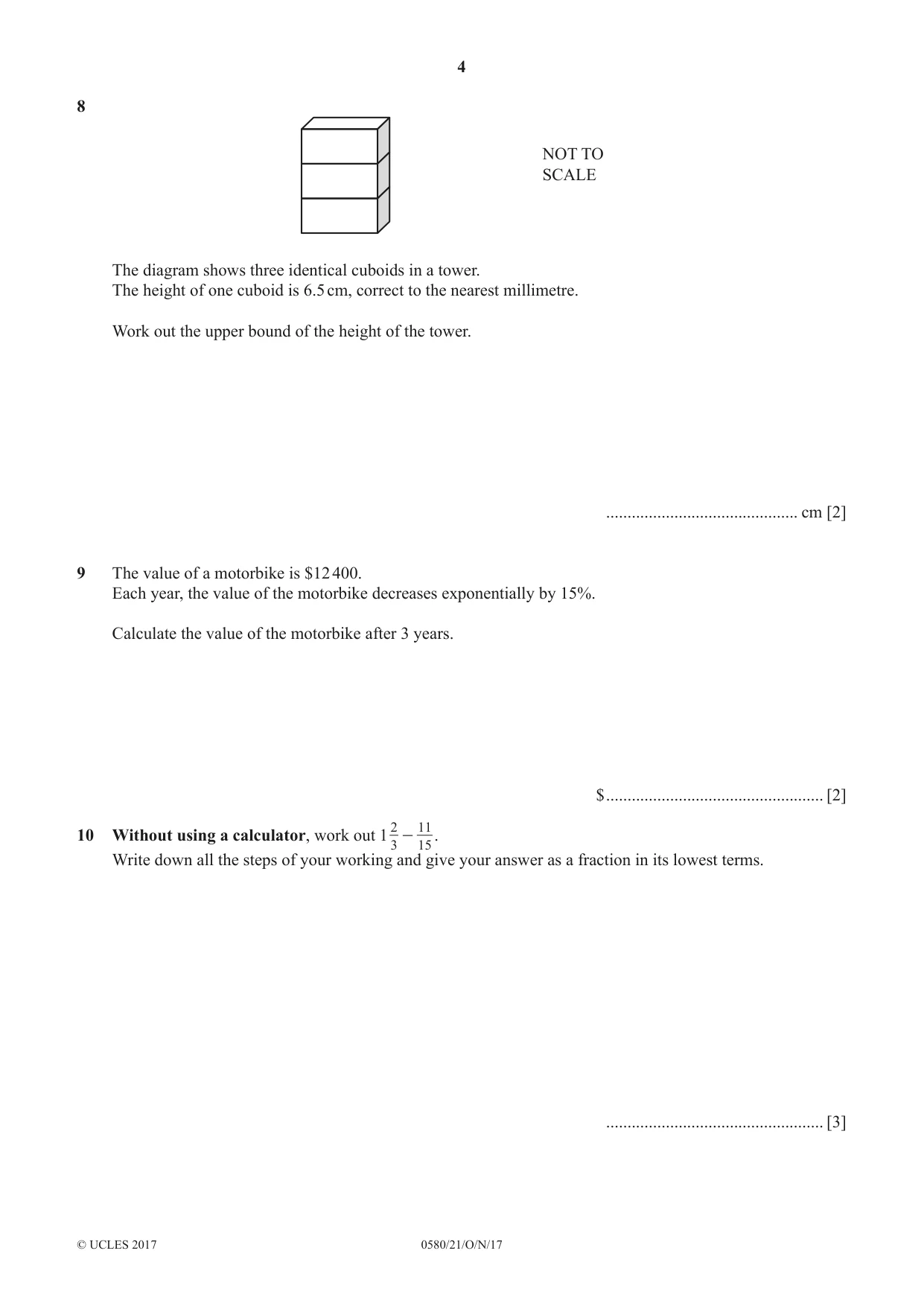
8 NOT TO SCALE The diagram shows three identical cuboids in a tower. The height of one cuboid is 6.5 cm, correct to the nearest millimetre. Work out the upper bound of the height of the tower. ............................................. cm [2]
Mark scheme: 8 19.65 cao 2 B1 for 6.55 seen (must be evaluated, not 6.5 + 0.05) or M1 for 3 × (6.5 + 0.05)
Q9 · The value of a motorbike is $12 400
9 The value of a motorbike is $12 400. Each year, the value of the motorbike decreases exponentially by 15%. Calculate the value of the motorbike after 3 years. $ ................................................... [2]
Mark scheme: 9 7615.15 2 3 15 M1 for 12 400 × 1 − oe 100
Q10 · 1110 Without using a calculator, work out 1 -
2 1110 Without using a calculator, work out 1 - . 3 15 Write down all the steps of your working and give your answer as a fraction in its lowest terms. ................................................... [3]
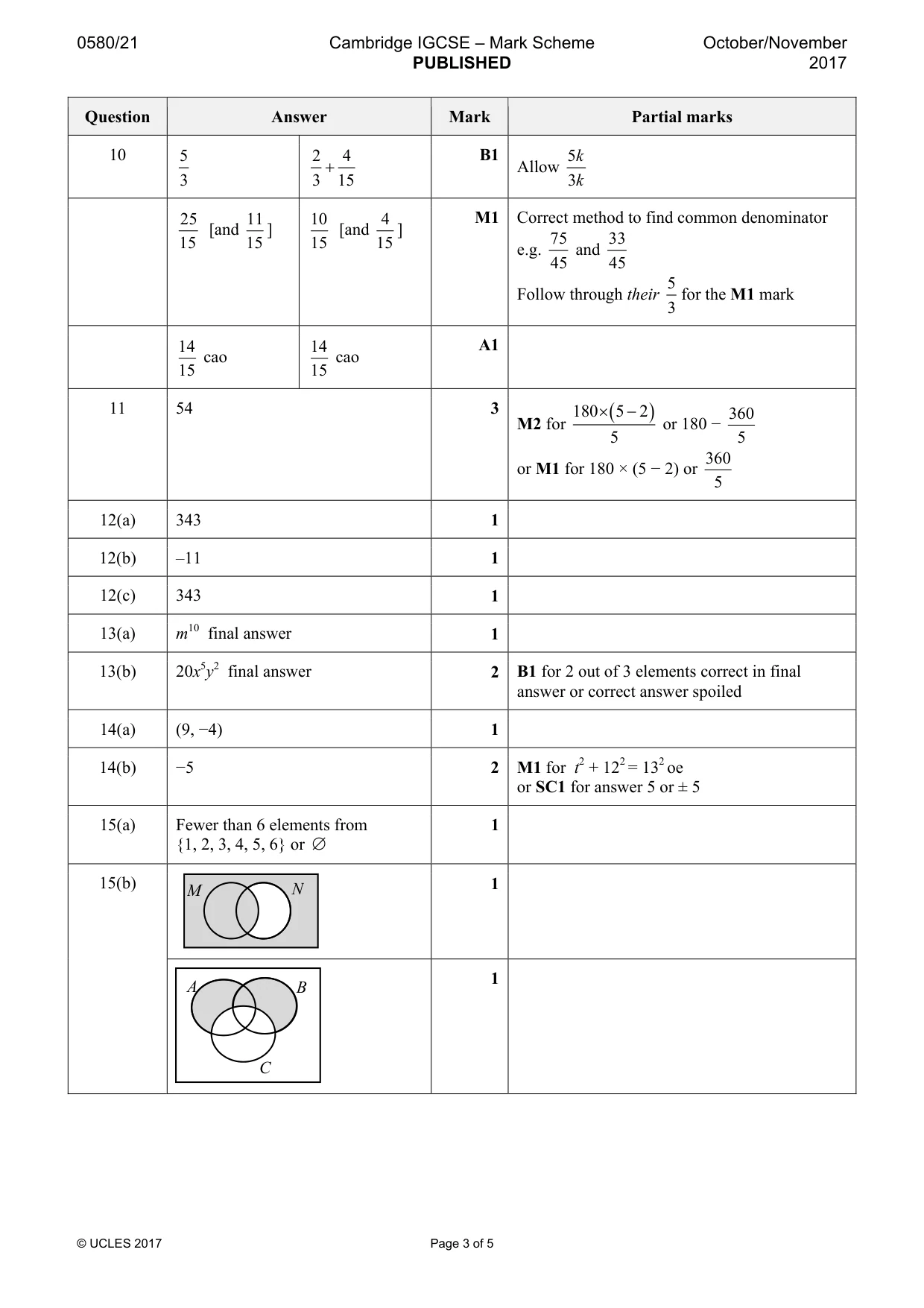
Mark scheme: 10 5 2 4 B1 5 k + Allow 3 3 15 3k 25 11 10 4 M1 Correct method to find common denominator [and ] [and ] 15 15 15 15 75 33 e.g. and 45 45 5 Follow through their for the M1 mark 3 14 14 A1 cao cao 15 15
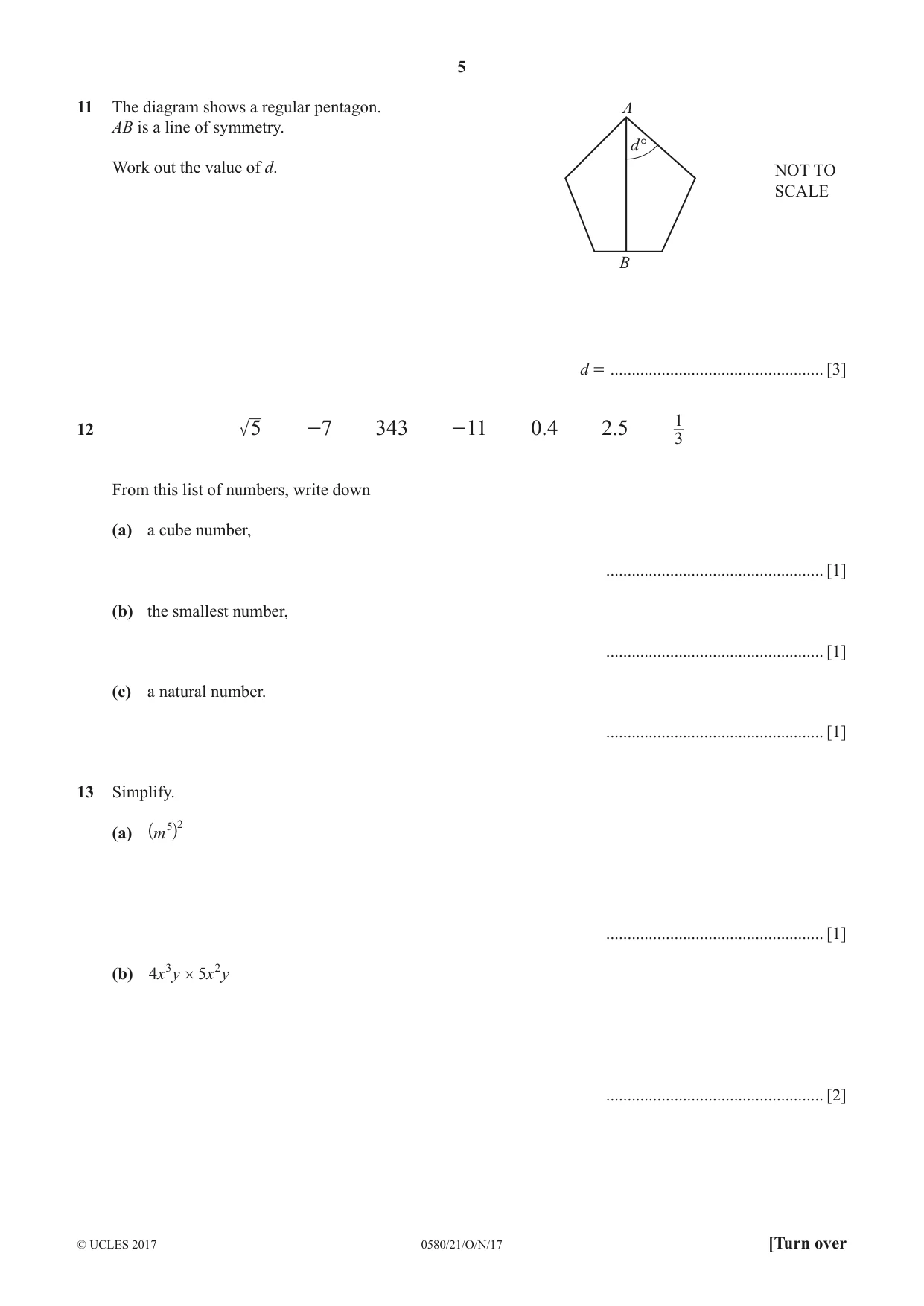
Q11 · The diagram shows a regular pentagon
11 The diagram shows a regular pentagon. A AB is a line of symmetry. d ° Work out the value of d. NOT TO SCALE B d = .................................................. [3]
Mark scheme: 11 54 3 180 × ( 5 − 2 ) 360 M2 for or 180 − 5 5 360 or M1 for 180 × (5 − 2) or 5
Q12 · 2 5 -7 343 -11 0.4 2.5 3 From this list of numbers, write down (a) a cube number…
112 5 -7 343 -11 0.4 2.5 3 From this list of numbers, write down (a) a cube number, ................................................... [1] (b) the smallest number, ................................................... [1] (c) a natural number. ................................................... [1]
Mark scheme: 12(a) 343 1 12(b) –11 1 12(c) 343 1
Question 13
13 Simplify. (a) m5 2 ^ h ................................................... [1] (b) 4x 3 y # 5 x 2 y ................................................... [2]
Mark scheme: 13(a) m10 final answer 1 13(b) 20x5y2 final answer 2 B1 for 2 out of 3 elements correct in final answer or correct answer spoiled
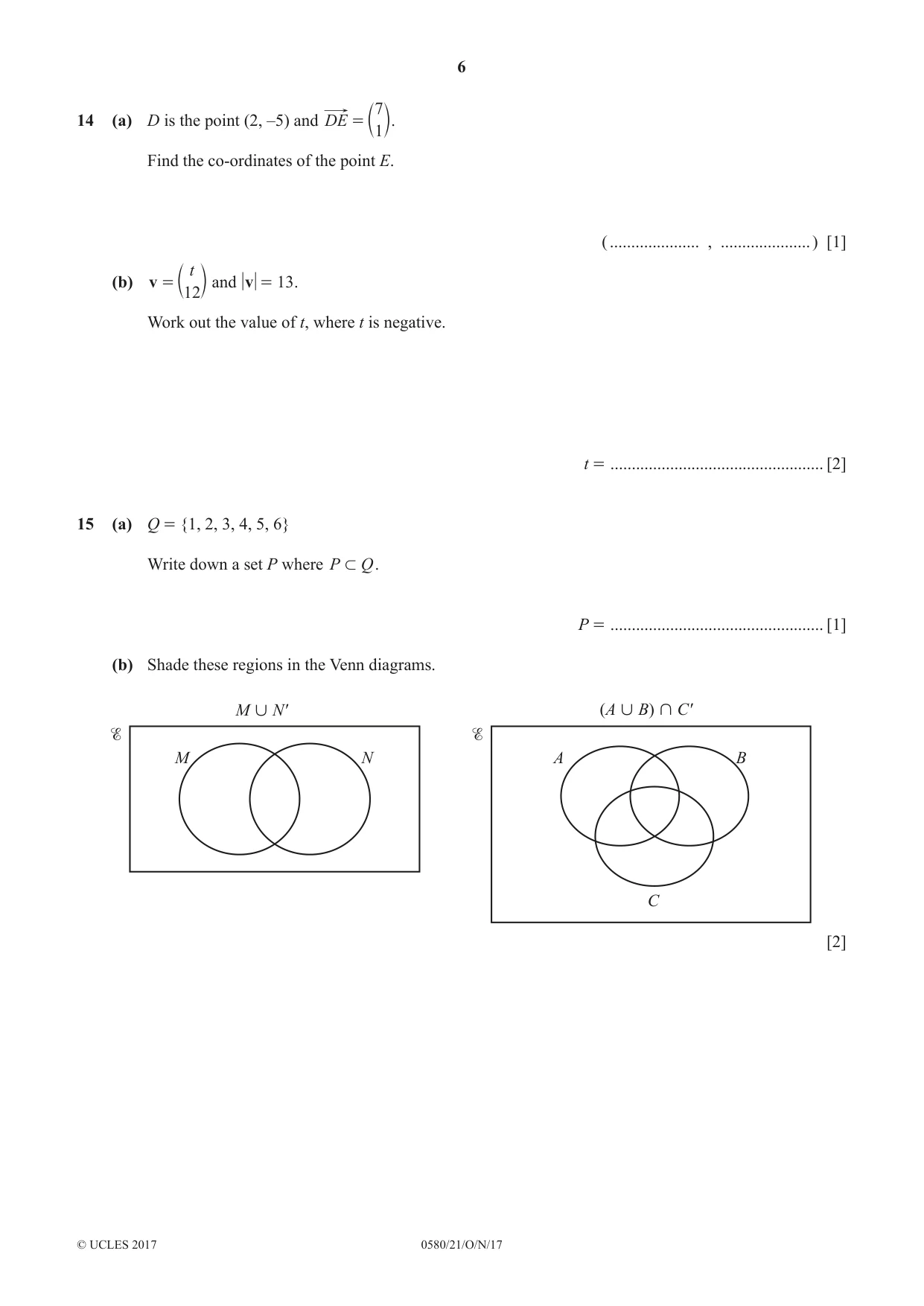
Q14 · 14 (a) D is the point (2, ‒5) and DE = c 1 m
7 14 (a) D is the point (2, ‒5) and DE = c 1 m. Find the co-ordinates of the point E. ( ..................... , ..................... ) [1] t (b) v = and v = 13 . c12m Work out the value of t, where t is negative. t = .................................................. [2]
Mark scheme: 14(a) (9, −4) 1 14(b) −5 2 M1 for t2 + 122 = 132 oe or SC1 for answer 5 or ± 5
Q15 · Q = {1, 2, 3, 4, 5, 6} Write down a set P where P 1 Q
15 (a) Q = {1, 2, 3, 4, 5, 6} Write down a set P where P 1 Q . P = .................................................. [1] (b) Shade these regions in the Venn diagrams. M N' (A B) C' M N A B C [2]
Mark scheme: 15(a) Fewer than 6 elements from 1 {1, 2, 3, 4, 5, 6} or ∅ 15(b) 1 M N 1 A B C
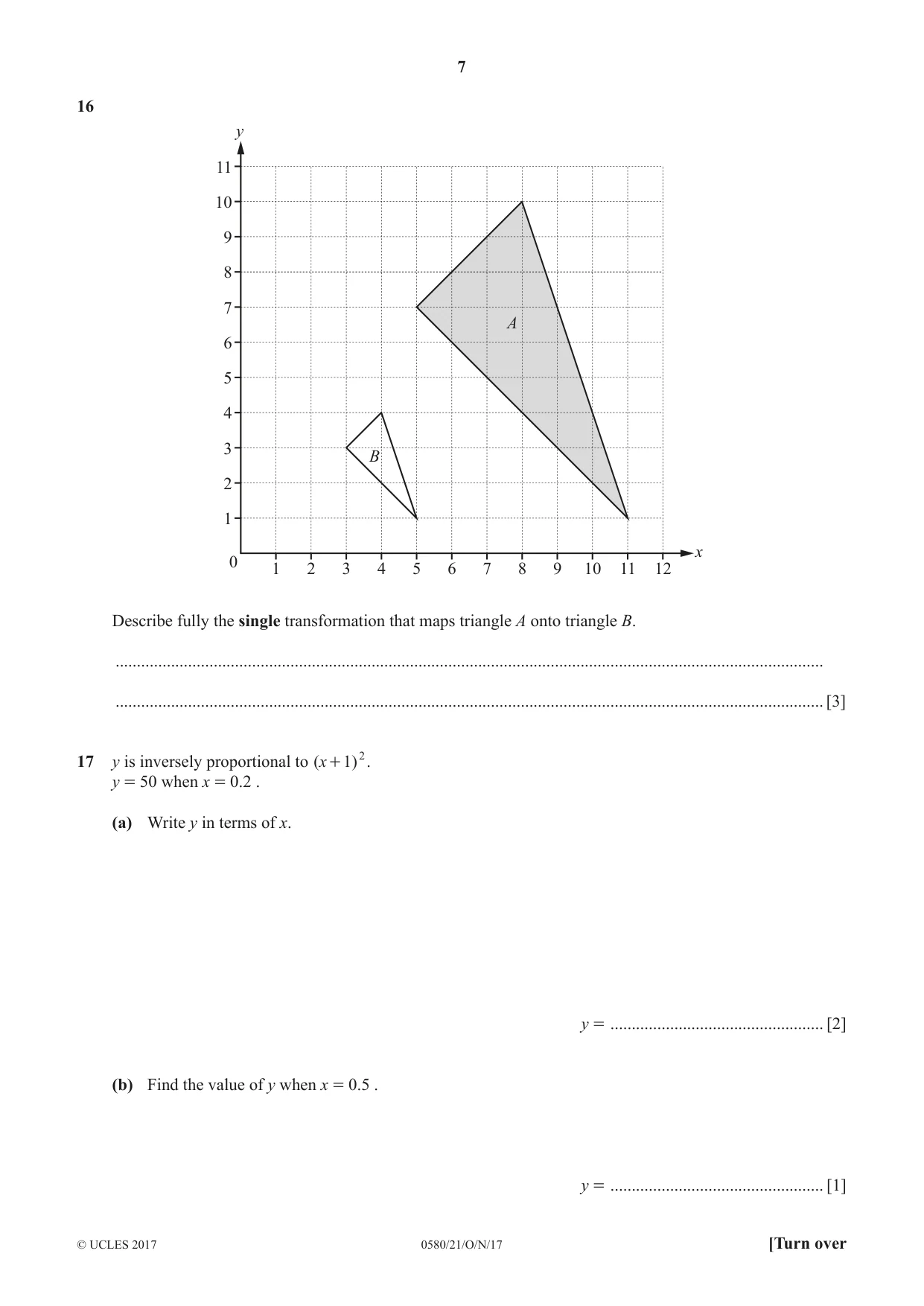
Q16 · Y 11 10 9 8 7 A 6 5 4 3 B 2 1 x 0 1 2 3 4 5 6 7 8 9 10 11 12 Describe fully the single…
16 y 11 10 9 8 7 A 6 5 4 3 B 2 1 x 0 1 2 3 4 5 6 7 8 9 10 11 12 Describe fully the single transformation that maps triangle A onto triangle B. ...................................................................................................................................................................... ...................................................................................................................................................................... [3]
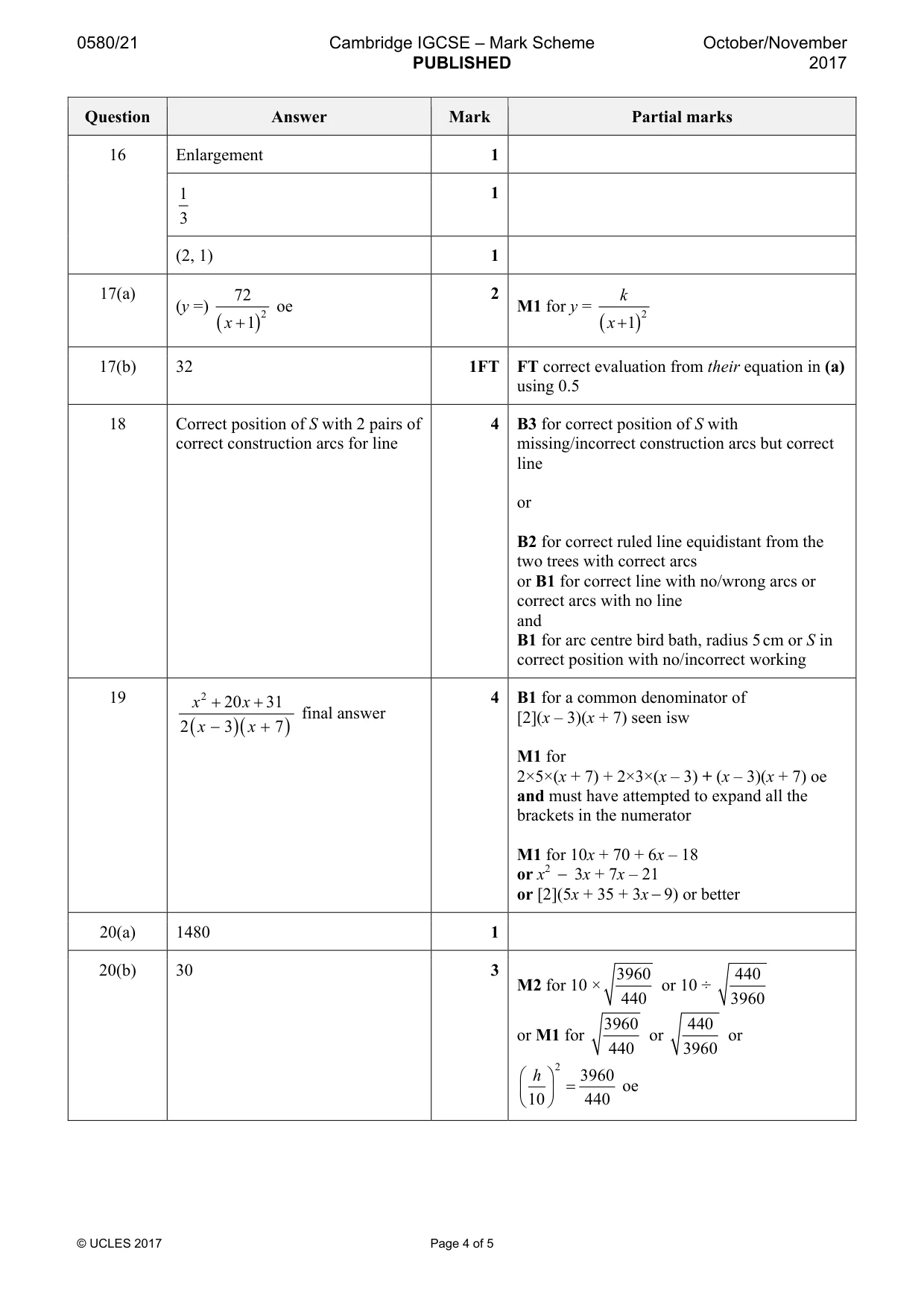
Mark scheme: 16 Enlargement 1 1 1 3 (2, 1) 1
Q17 · Y is inversely proportional to (x + 1) 2
17 y is inversely proportional to (x + 1) 2 . y = 50 when x = 0.2 . (a) Write y in terms of x. y = .................................................. [2] (b) Find the value of y when x = 0.5 . y = .................................................. [1]
Mark scheme: 17(a) 72 2 k (y =) oe M1 for y = ( x + 1) 2 ( x+ 1) 2 17(b) 32 1FT FT correct evaluation from their equation in (a) using 0.5
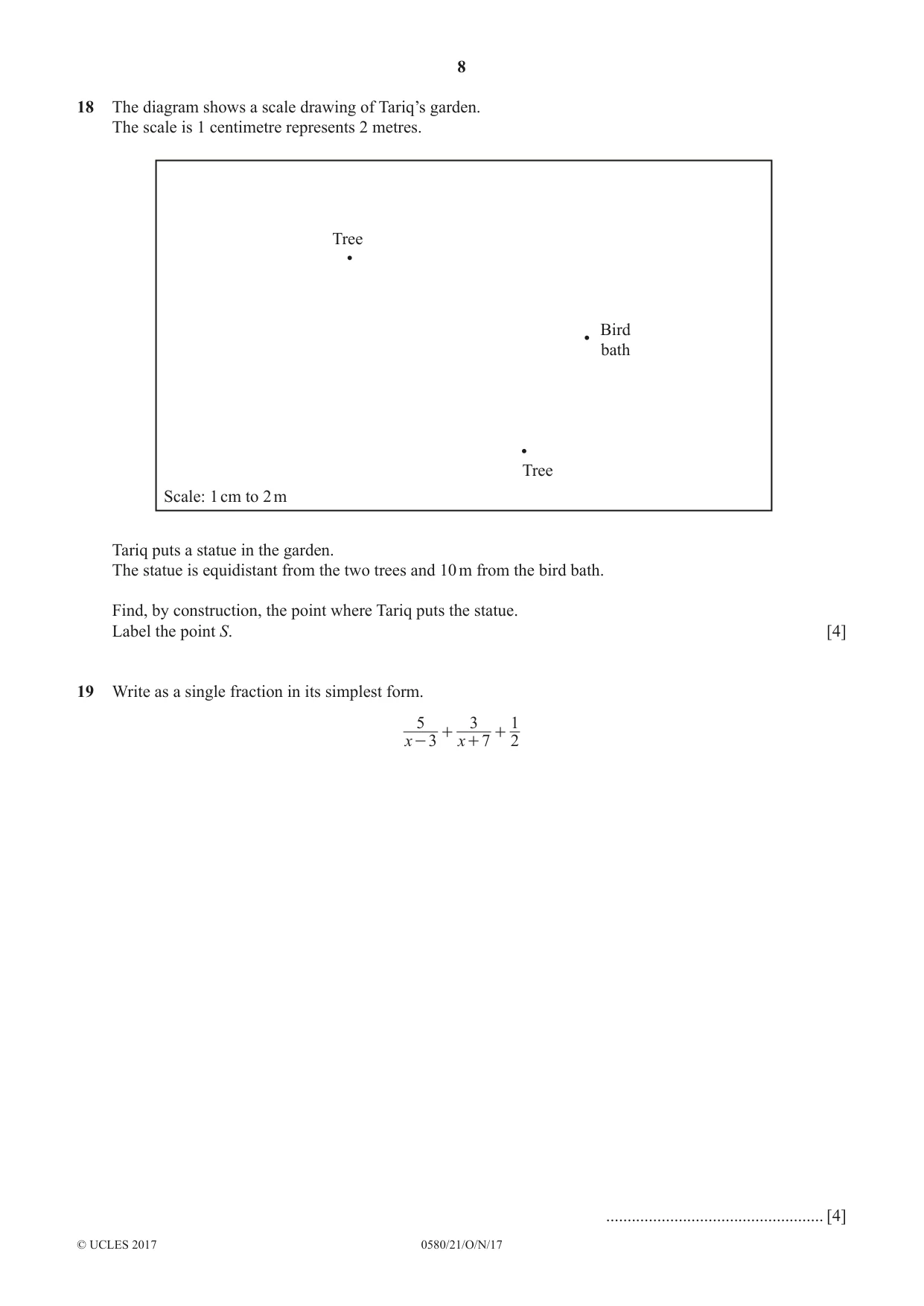
Q18 · The diagram shows a scale drawing of Tariq’s garden
18 The diagram shows a scale drawing of Tariq’s garden. The scale is 1 centimetre represents 2 metres. Tree Bird bath Tree Scale: 1 cm to 2 m Tariq puts a statue in the garden. The statue is equidistant from the two trees and 10 m from the bird bath. Find, by construction, the point where Tariq puts the statue. Label the point S. [4]
Mark scheme: 18 Correct position of S with 2 pairs of 4 B3 for correct position of S with correct construction arcs for line missing/incorrect construction arcs but correct line or B2 for correct ruled line equidistant from the two trees with correct arcs or B1 for correct line with no/wrong arcs or correct arcs with no line and B1 for arc centre bird bath, radius 5 cm or S in correct position with no/incorrect working
Q19 · Write as a single fraction in its simplest form
19 Write as a single fraction in its simplest form. 5 3 1 + + x - 3 x + 7 2 ................................................... [4]
Mark scheme: 19 x 2 + 20 x + 31 4 B1 for a common denominator of final answer [2](x ‒ 3)(x + 7) seen isw 2 ( x − 3 )( x + 7 ) M1 for 2×5×(x + 7) + 2×3×(x ‒ 3) + (x ‒ 3)(x + 7) oe and must have attempted to expand all the brackets in the numerator M1 for 10x + 70 + 6x ‒ 18 or x2 − 3x + 7x ‒ 21 or [2](5x + 35 + 3x −9) or better
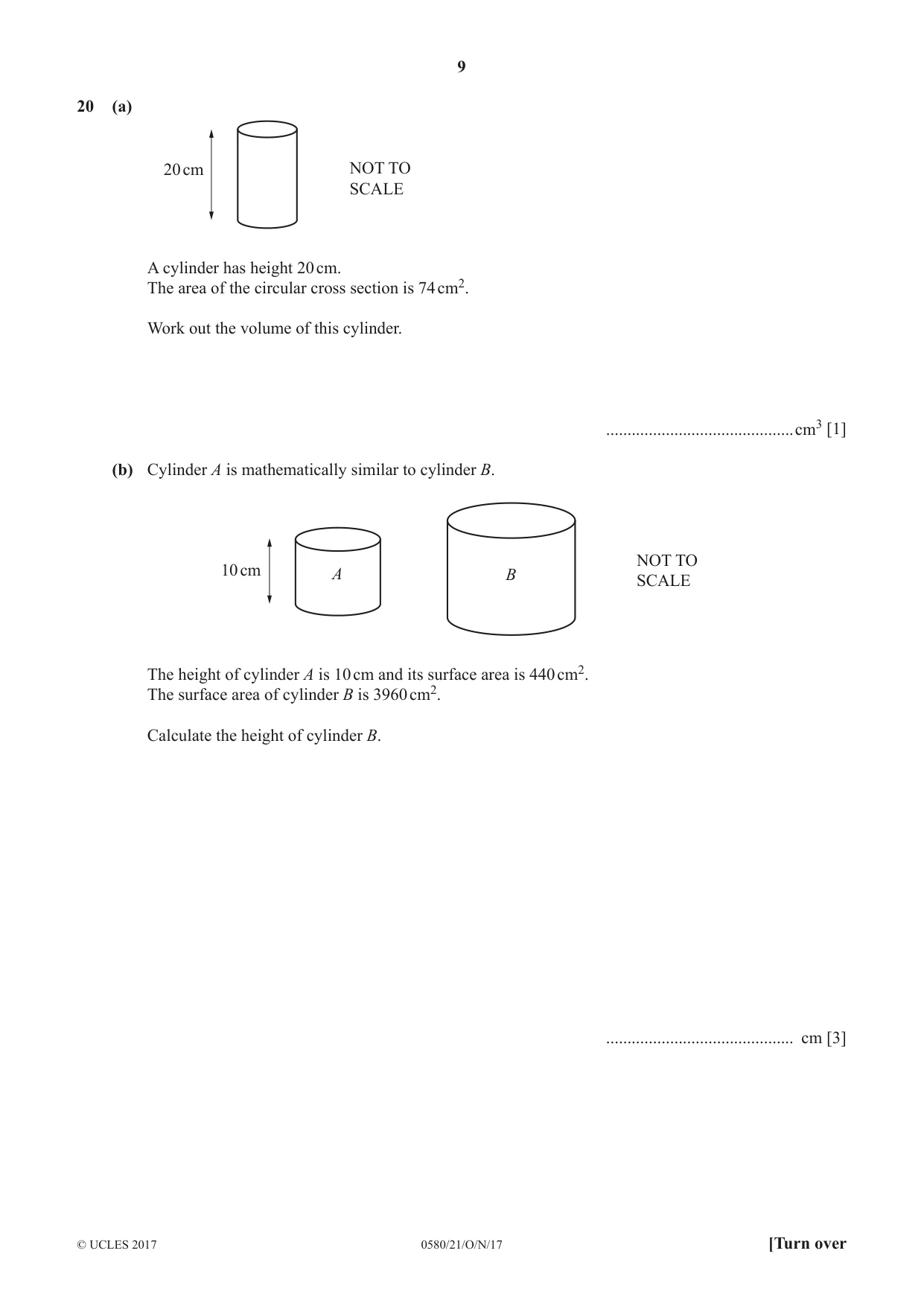
Q20 · 20 cm NOT TO SCALE A cylinder has height 20 cm
20 (a) 20 cm NOT TO SCALE A cylinder has height 20 cm. The area of the circular cross section is 74 cm2. Work out the volume of this cylinder. ............................................cm3 [1] (b) Cylinder A is mathematically similar to cylinder B. NOT TO 10 cm A B SCALE The height of cylinder A is 10 cm and its surface area is 440 cm2. The surface area of cylinder B is 3960 cm2. Calculate the height of cylinder B. ............................................ cm [3]
Mark scheme: 20(a) 1480 1 20(b) 30 3 3960 440 M2 for 10 × or 10 ÷ 440 3960 3960 440 or M1 for or or 440 3960 h 2 3960 oe = 10 440
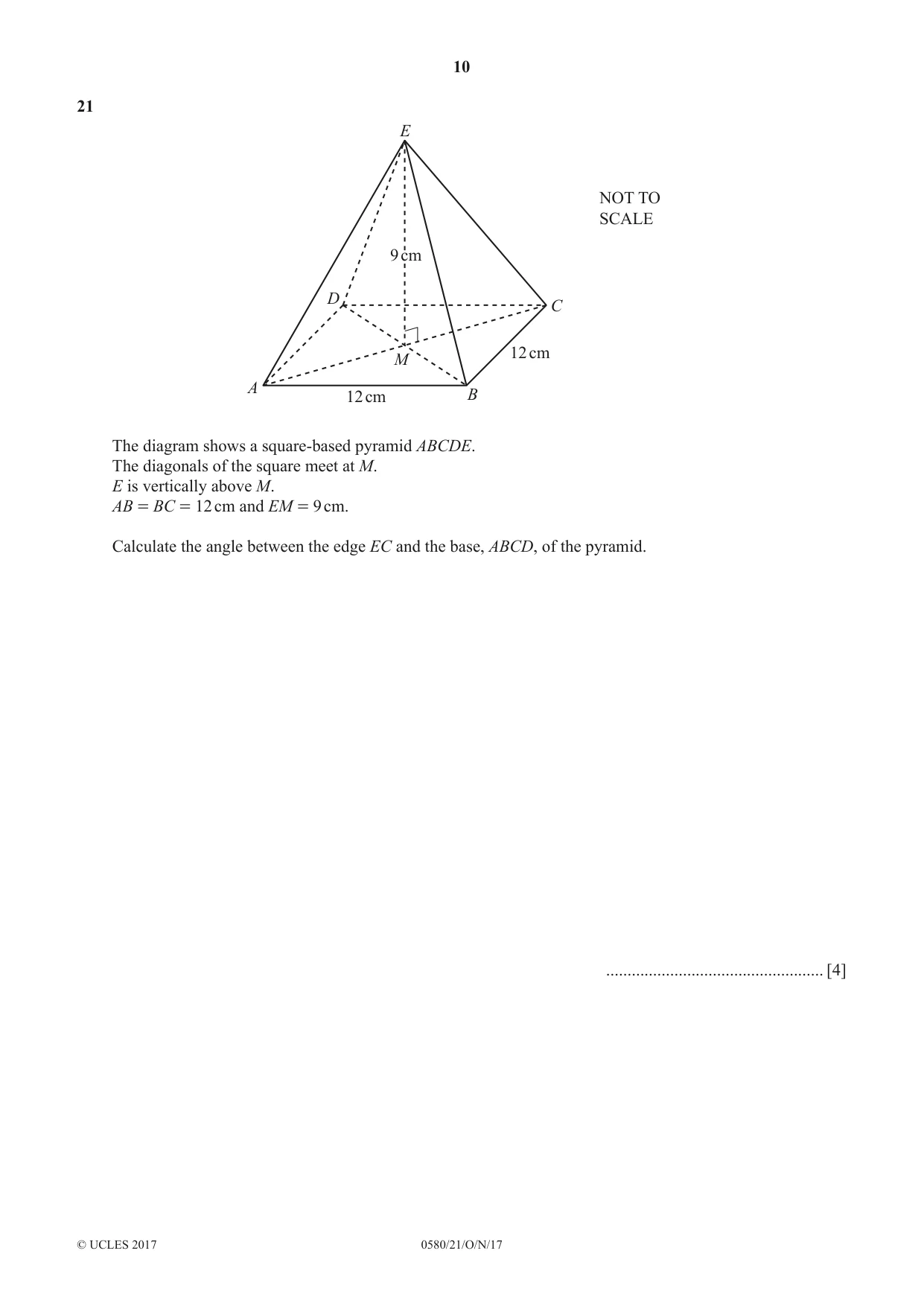
Q21 · E NOT TO SCALE 9 cm D C 12 cm M A 12 cm B The diagram shows a square-based pyramid ABCDE
21 E NOT TO SCALE 9 cm D C 12 cm M A 12 cm B The diagram shows a square-based pyramid ABCDE. The diagonals of the square meet at M. E is vertically above M. AB = BC = 12 cm and EM = 9 cm. Calculate the angle between the edge EC and the base, ABCD, of the pyramid. ................................................... [4]
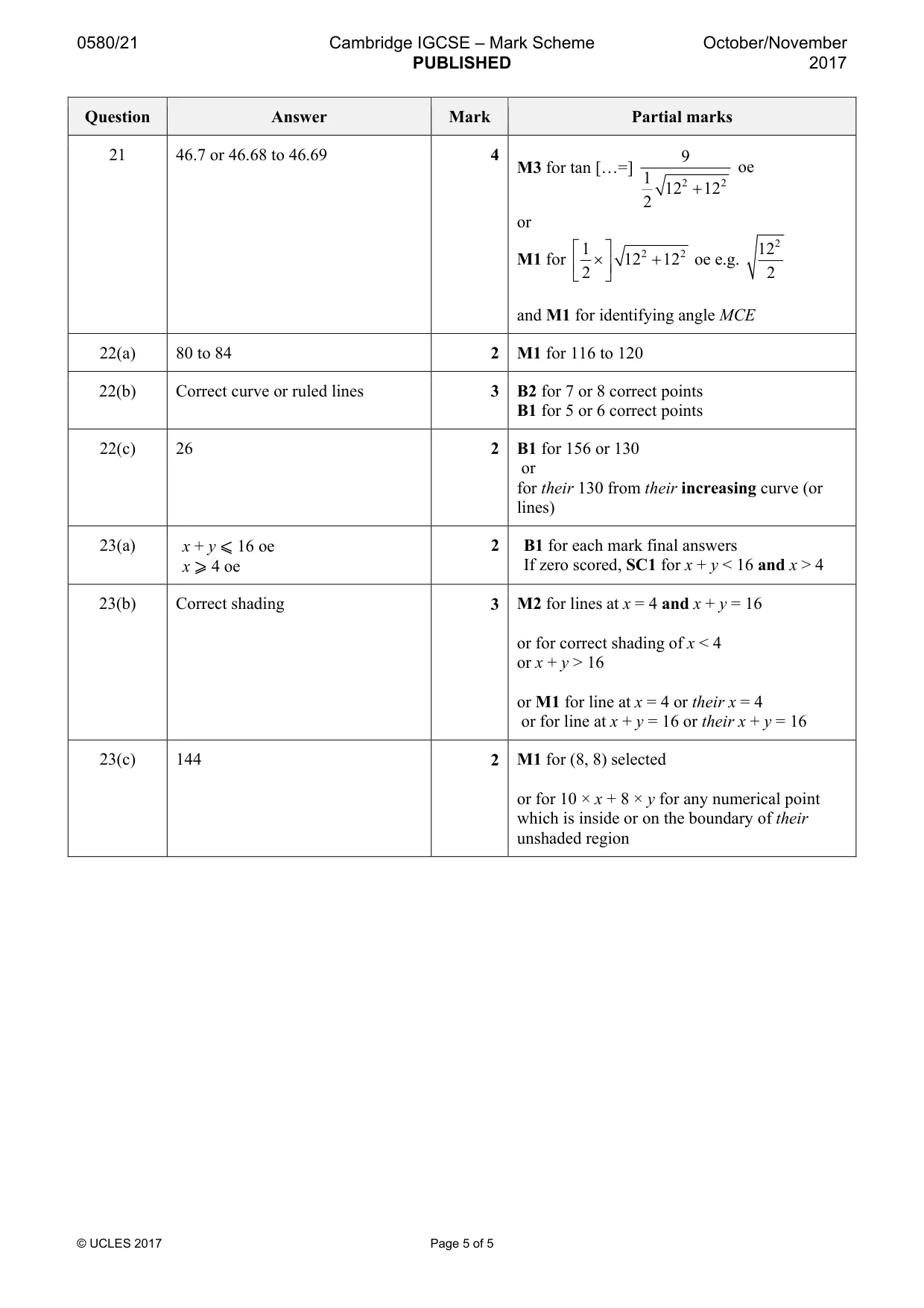
Mark scheme: 21 46.7 or 46.68 to 46.69 4 9 M3 for tan […=] oe 1 2 2 12 + 12 2 or 1 2 2 12 2 M1 for × 12 + 12 oe e.g. 2 2 and M1 for identifying angle MCE
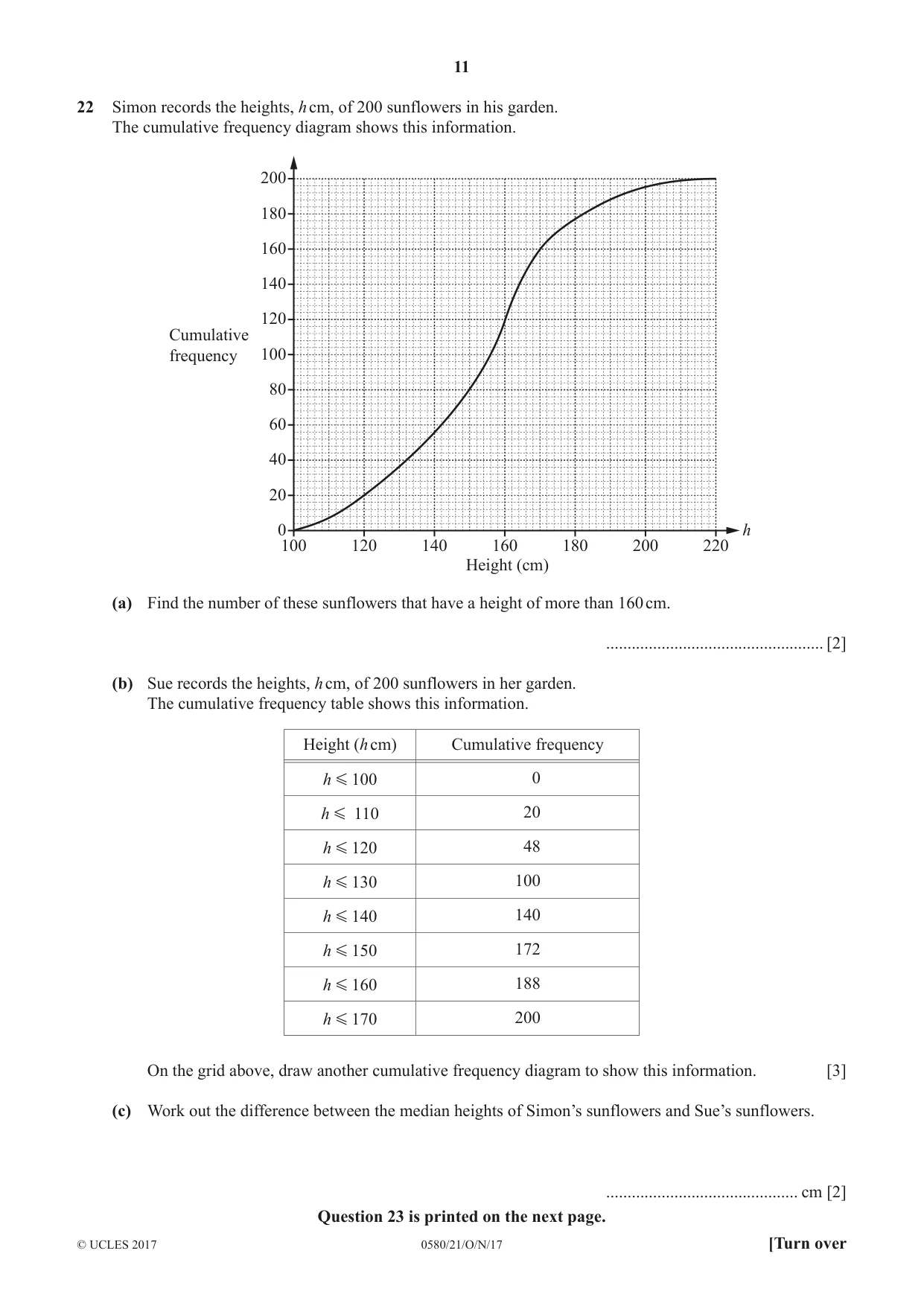
Q22 · Simon records the heights, h cm, of 200 sunflowers in his garden
22 Simon records the heights, h cm, of 200 sunflowers in his garden. The cumulative frequency diagram shows this information. 200 180 160 140 120 Cumulative frequency 100 80 60 40 20 0 h 100 120 140 160 180 200 220 Height (cm) (a) Find the number of these sunflowers that have a height of more than 160 cm. ................................................... [2] (b) Sue records the heights, h cm, of 200 sunflowers in her garden. The cumulative frequency table shows this information. Height (h cm) Cumulative frequency h G 100 0 h G 110 20 h G 120 48 h G 130 100 h G 140 140 h G 150 172 h G 160 188 h G 170 200 On the grid above, draw another cumulative frequency diagram to show this information. [3] (c) Work out the difference between the median heights of Simon’s sunflowers and Sue’s sunflowers. ............................................. cm [2] Question 23 is printed on the next page.
Mark scheme: 22(a) 80 to 84 2 M1 for 116 to 120 22(b) Correct curve or ruled lines 3 B2 for 7 or 8 correct points B1 for 5 or 6 correct points 22(c) 26 2 B1 for 156 or 130 or for their 130 from their increasing curve (or lines)
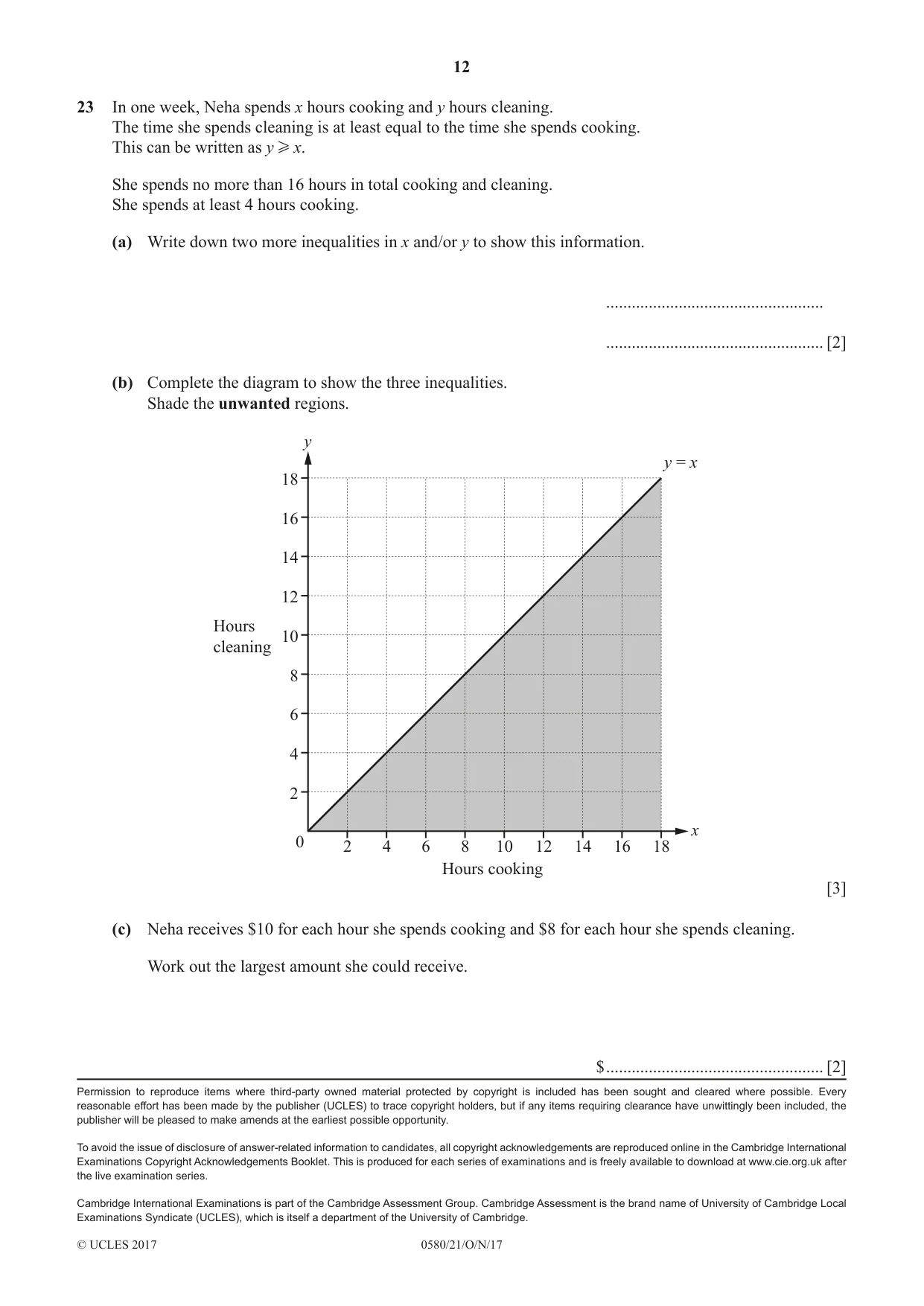
Q23 · In one week, Neha spends x hours cooking and y hours cleaning
23 In one week, Neha spends x hours cooking and y hours cleaning. The time she spends cleaning is at least equal to the time she spends cooking. This can be written as y H x. She spends no more than 16 hours in total cooking and cleaning. She spends at least 4 hours cooking. (a) Write down two more inequalities in x and/or y to show this information. ................................................... ................................................... [2] (b) Complete the diagram to show the three inequalities. Shade the unwanted regions. y y = x 18 16 14 12 Hours 10 cleaning 8 6 4 2 x 0 2 4 6 8 10 12 14 16 18 Hours cooking [3] (c) Neha receives $10 for each hour she spends cooking and $8 for each hour she spends cleaning. Work out the largest amount she could receive. $ ................................................... [2]
Mark scheme: 23(a) x + y ⩽ 16 oe 2 B1 for each mark final answers x ⩾ 4 oe If zero scored, SC1 for x + y < 16 and x > 4 23(b) Correct shading 3 M2 for lines at x = 4 and x + y = 16 or for correct shading of x < 4 or x + y > 16 or M1 for line at x = 4 or their x = 4 or for line at x + y = 16 or their x + y = 16 23(c) 144 2 M1 for (8, 8) selected or for 10 × x + 8 × y for any numerical point which is inside or on the boundary of their unshaded region
What was in this paper
The subtopics covered by these 23 questions, and how many questions each got. Open one in a new tab to see every Cambridge question on it.
2Angles2Graphs in practical situations2Algebraic fractions1Averages and measures of spread1Coordinates1Exponential growth and decay1Fractions, decimals and percentages1Geometrical constructions1Indices I1Limits of accuracy1Magnitude of a vector1Powers and roots1Ratio and proportion1Right-angled triangles1Sets1Similarity1Statistical charts and diagrams1Transformations1Using a calculator1What you needed in this session
Cambridge’s own grade thresholds for 2017 Oct/Nov, Paper 2 · Variant 1. A higher threshold means an easier paper — the bar moves with how the cohort did.