Questions as text
Q1 · Answer the whole of this question on a sheet of graph paper 0580/41 May/June 2005
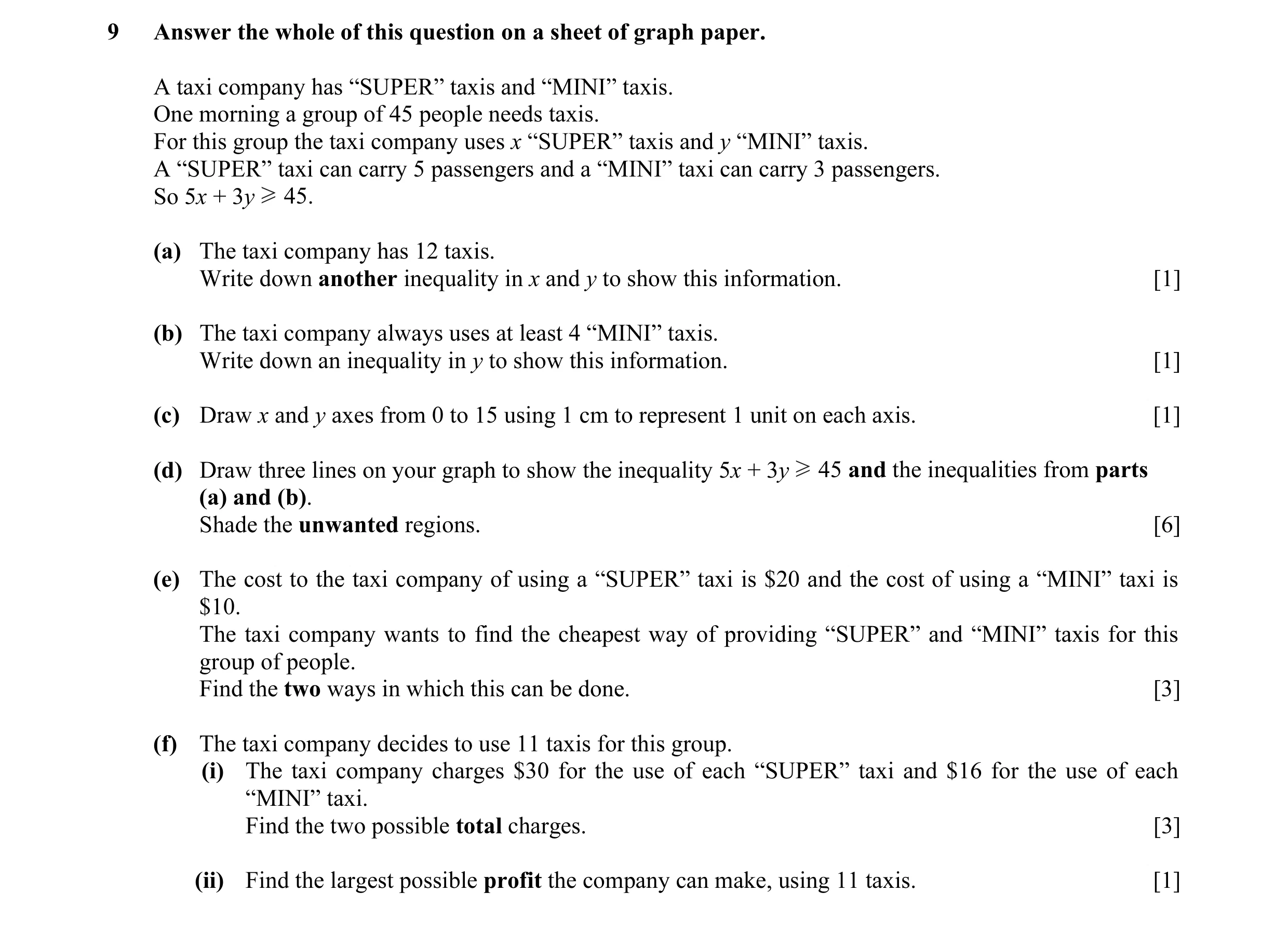
9 Answer the whole of this question on a sheet of graph paper. A taxi company has “SUPER” taxis and “MINI” taxis. One morning a group of 45 people needs taxis. For this group the taxi company uses x “SUPER” taxis and y “MINI” taxis. A “SUPER” taxi can carry 5 passengers and a “MINI” taxi can carry 3 passengers. So 5x + 3y 45. (a) The taxi company has 12 taxis. Write down another inequality in x and y to show this information. [1] (b) The taxi company always uses at least 4 “MINI” taxis. Write down an inequality in y to show this information. [1] (c) Draw x and y axes from 0 to 15 using 1 cm to represent 1 unit on each axis. [1] (d) Draw three lines on your graph to show the inequality 5x + 3y 45 and the inequalities from parts (a) and (b). Shade the unwanted regions. [6] (e) The cost to the taxi company of using a “SUPER” taxi is $20 and the cost of using a “MINI” taxi is $10. The taxi company wants to find the cheapest way of providing “SUPER” and “MINI” taxis for this group of people. Find the two ways in which this can be done. [3] (f) The taxi company decides to use 11 taxis for this group. (i) The taxi company charges $30 for the use of each “SUPER” taxi and $16 for the use of each “MINI” taxi. Find the two possible total charges. [3] (ii) Find the largest possible profit the company can make, using 11 taxis. [1]
16 marks
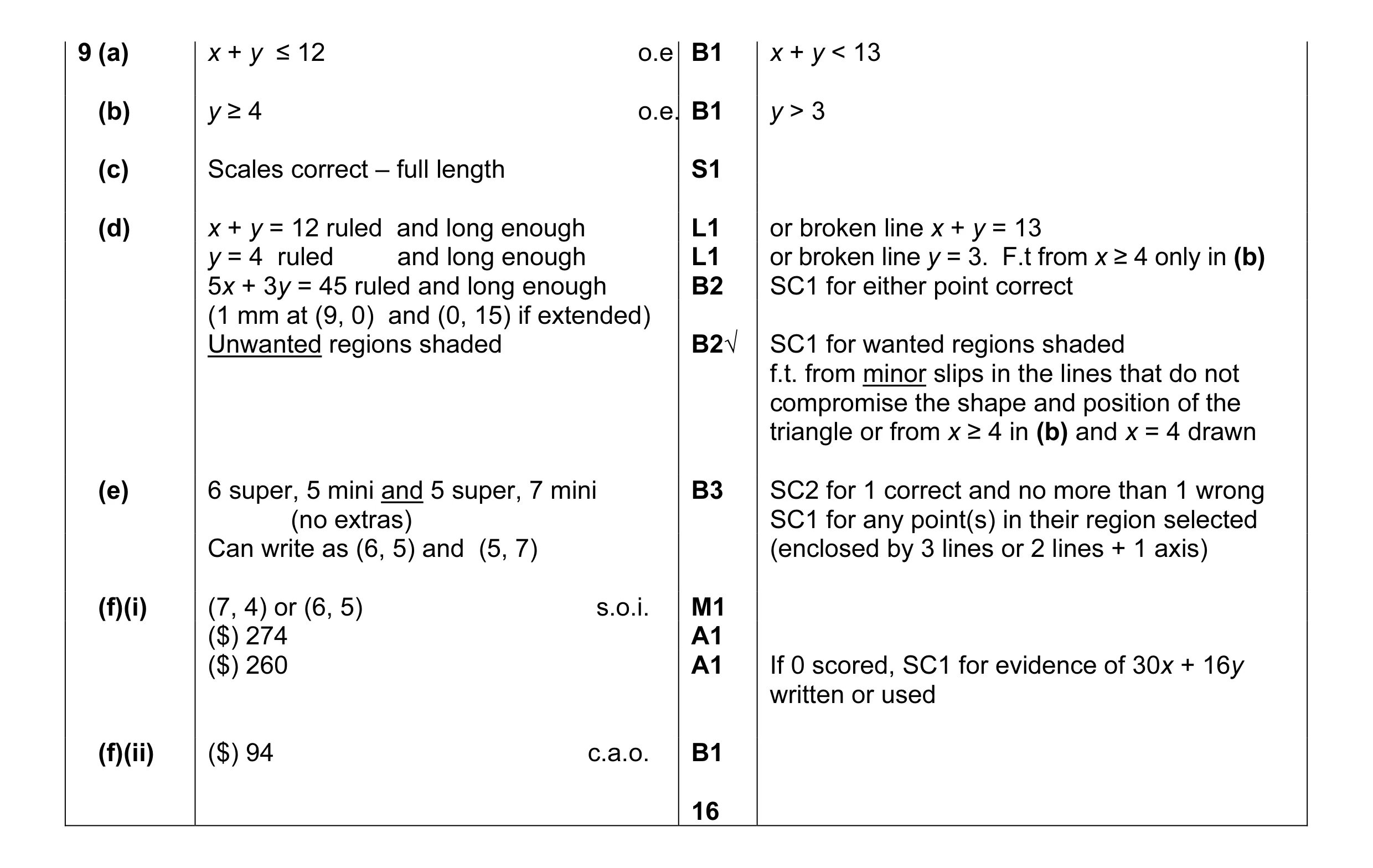
Mark scheme: 9 (a) x + y ≤ 12 o.e B1 x + y < 13 (b) y ≥ 4 o.e. B1 y > 3 (c) Scales correct – full length S1 (d) x + y = 12 ruled and long enough L1 or broken line x + y = 13 y = 4 ruled and long enough L1 or broken line y = 3. F.t from x ≥ 4 only in (b) 5x + 3y = 45 ruled and long enough B2 SC1 for either point correct (1 mm at (9, 0) and (0, 15) if extended) Unwanted regions shaded B2√ SC1 for wanted regions shaded f.t. from minor slips in the lines that do not compromise the shape and position of the triangle or from x ≥ 4 in (b) and x = 4 drawn (e) 6 super, 5 mini and 5 super, 7 mini B3 SC2 for 1 correct and no more than 1 wrong (no extras) SC1 for any point(s) in their region selected Can write as (6, 5) and (5, 7) (enclosed by 3 lines or 2 lines + 1 axis) (f)(i) (7, 4) or (6, 5) s.o.i. M1 ($) 274 A1 ($) 260 A1 If 0 scored, SC1 for evidence of 30x + 16y written or used (f)(ii) ($) 94 c.a.o. B1 16
This question in 0580/41 May/June 2005
Q2 · Peter wants to plant x plum trees and y apple trees 0580/41 May/June 2011
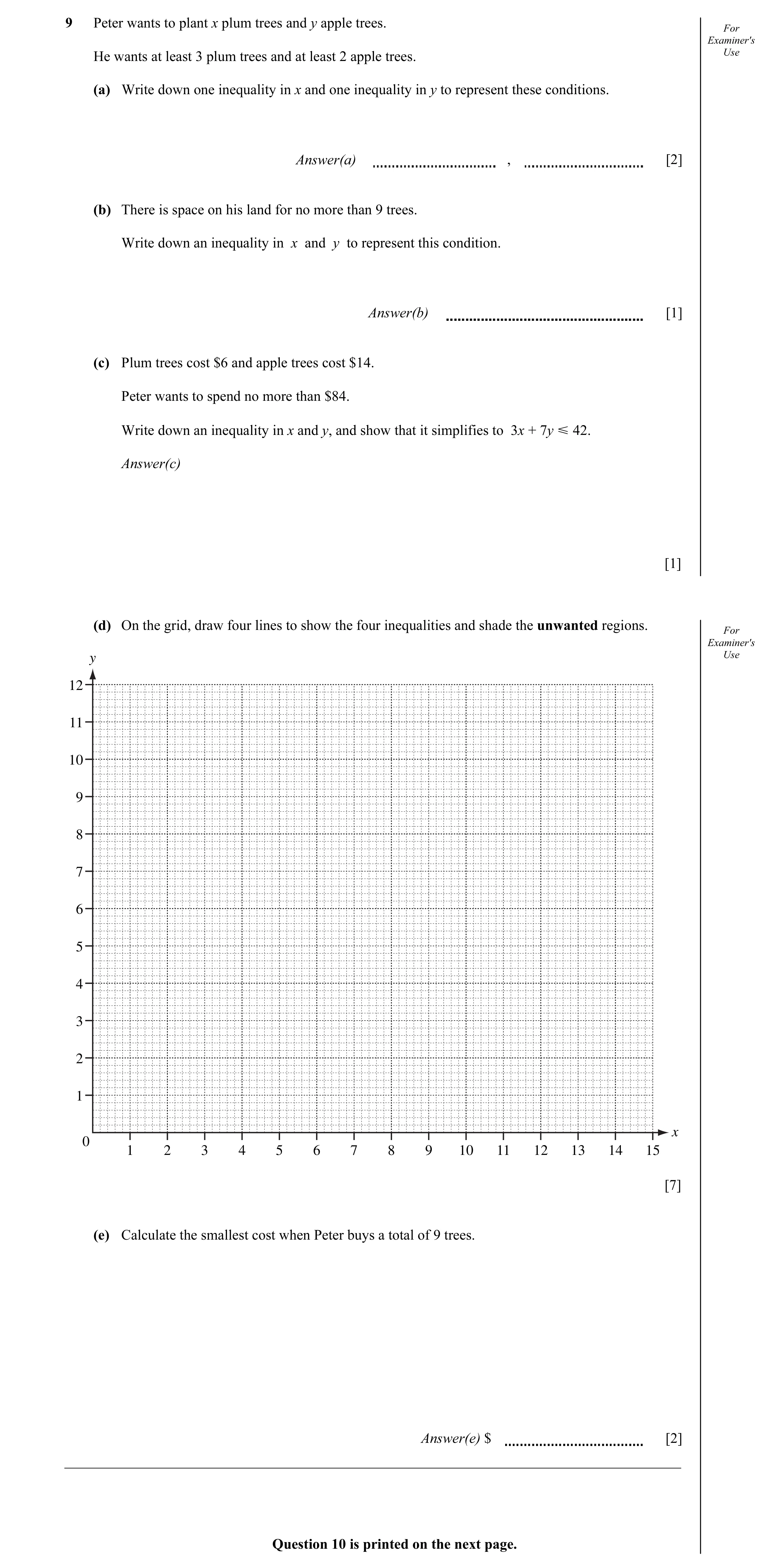
9 Peter wants to plant x plum trees and y apple trees. For Examiner's He wants at least 3 plum trees and at least 2 apple trees. Use (a) Write down one inequality in x and one inequality in y to represent these conditions. Answer(a) , [2] (b) There is space on his land for no more than 9 trees. Write down an inequality in x and y to represent this condition. Answer(b) [1] (c) Plum trees cost $6 and apple trees cost $14. Peter wants to spend no more than $84. Write down an inequality in x and y, and show that it simplifies to 3x + 7y Y 42. Answer(c) [1] (d) On the grid, draw four lines to show the four inequalities and shade the unwanted regions. For Examiner's y Use 12 11 10 9 8 7 6 5 4 3 2 1 x 0 1 2 3 4 5 6 7 8 9 10 11 12 13 14 15 [7] (e) Calculate the smallest cost when Peter buys a total of 9 trees. Answer(e) $ [2] Question 10 is printed on the next page.
13 marks
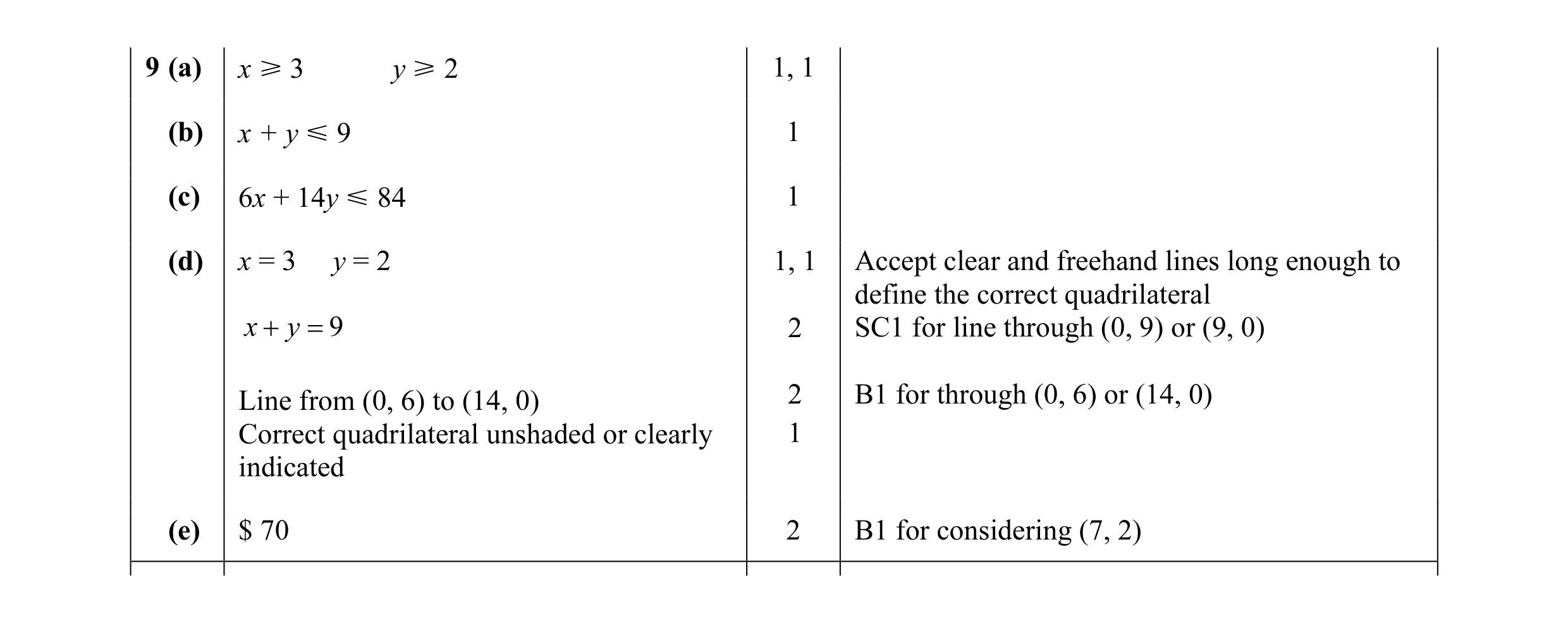
Mark scheme: 9 (a) x [=3 y [=2 1, 1 (b) x + y Y 9 1 (c) 6x + 14y Y 84 1 (d) x = 3 y = 2 1, 1 Accept clear and freehand lines long enough to define the correct quadrilateral x + y = 9 2 SC1 for line through (0, 9) or (9, 0) Line from (0, 6) to (14, 0) 2 B1 for through (0, 6) or (14, 0) Correct quadrilateral unshaded or clearly 1 indicated (e) $ 70 2 B1 for considering (7, 2)
This question in 0580/41 May/June 2011
Q3 · Solve 9 I 3n + 6 Y 21 for integer values of n 0580/42 May/June 2011
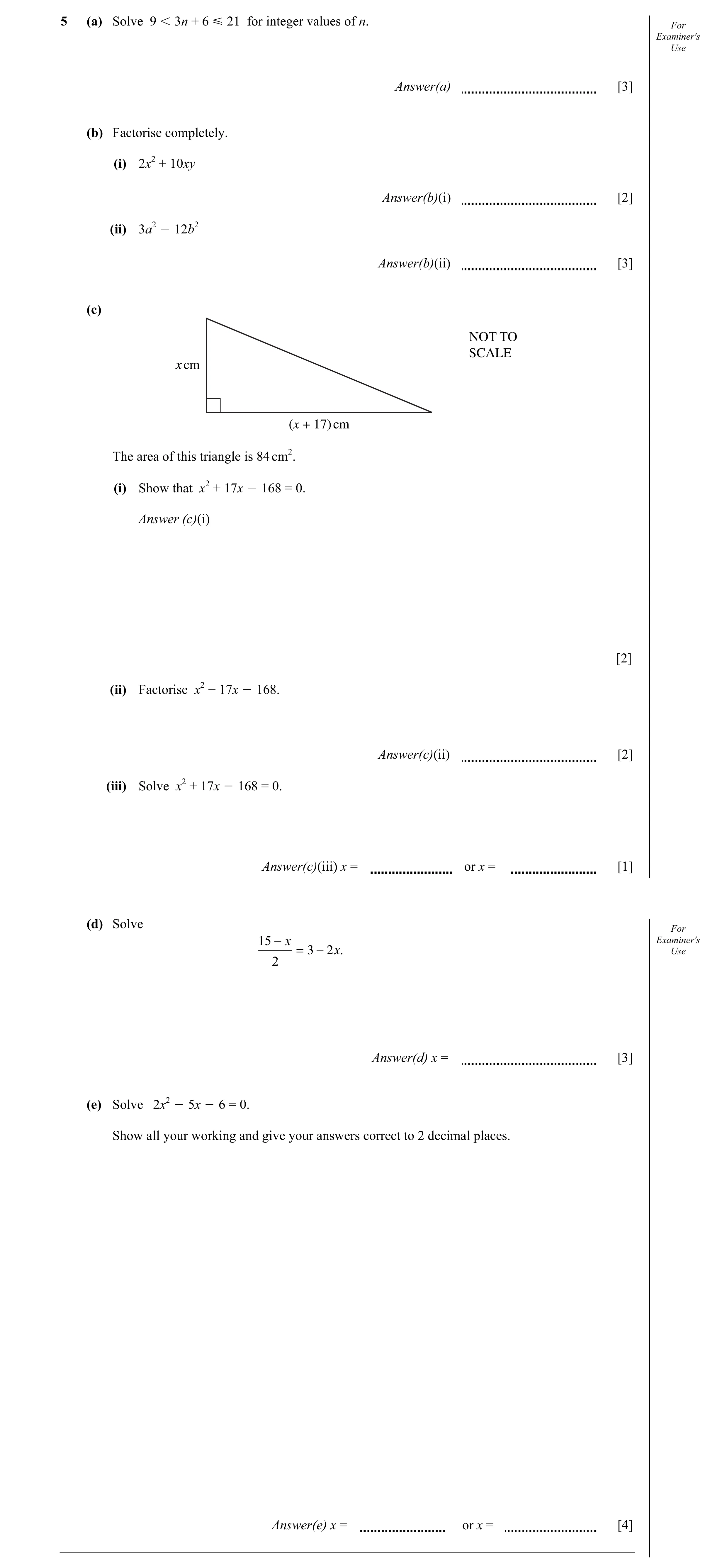
5 (a) Solve 9 I 3n + 6 Y 21 for integer values of n. For Examiner's Use Answer(a) [3] (b) Factorise completely. (i) 2x2 + 10xy Answer(b)(i) [2] (ii) 3a2 O 12b2 Answer(b)(ii) [3] (c) NOT TO SCALE x cm (x + 17) cm The area of this triangle is 84 cm2. (i) Show that x2 + 17x O 168 = 0. Answer (c)(i) [2] (ii) Factorise x2 + 17x O 168. Answer(c)(ii) [2] (iii) Solve x2 + 17x O 168 = 0. Answer(c)(iii) x = or x = [1] (d) Solve For 15 − x Examiner's = 3 − 2 x. Use 2 Answer(d) x = [3] (e) Solve 2x2 O 5x O 6 = 0. Show all your working and give your answers correct to 2 decimal places. Answer(e) x = or x = [4]
20 marks
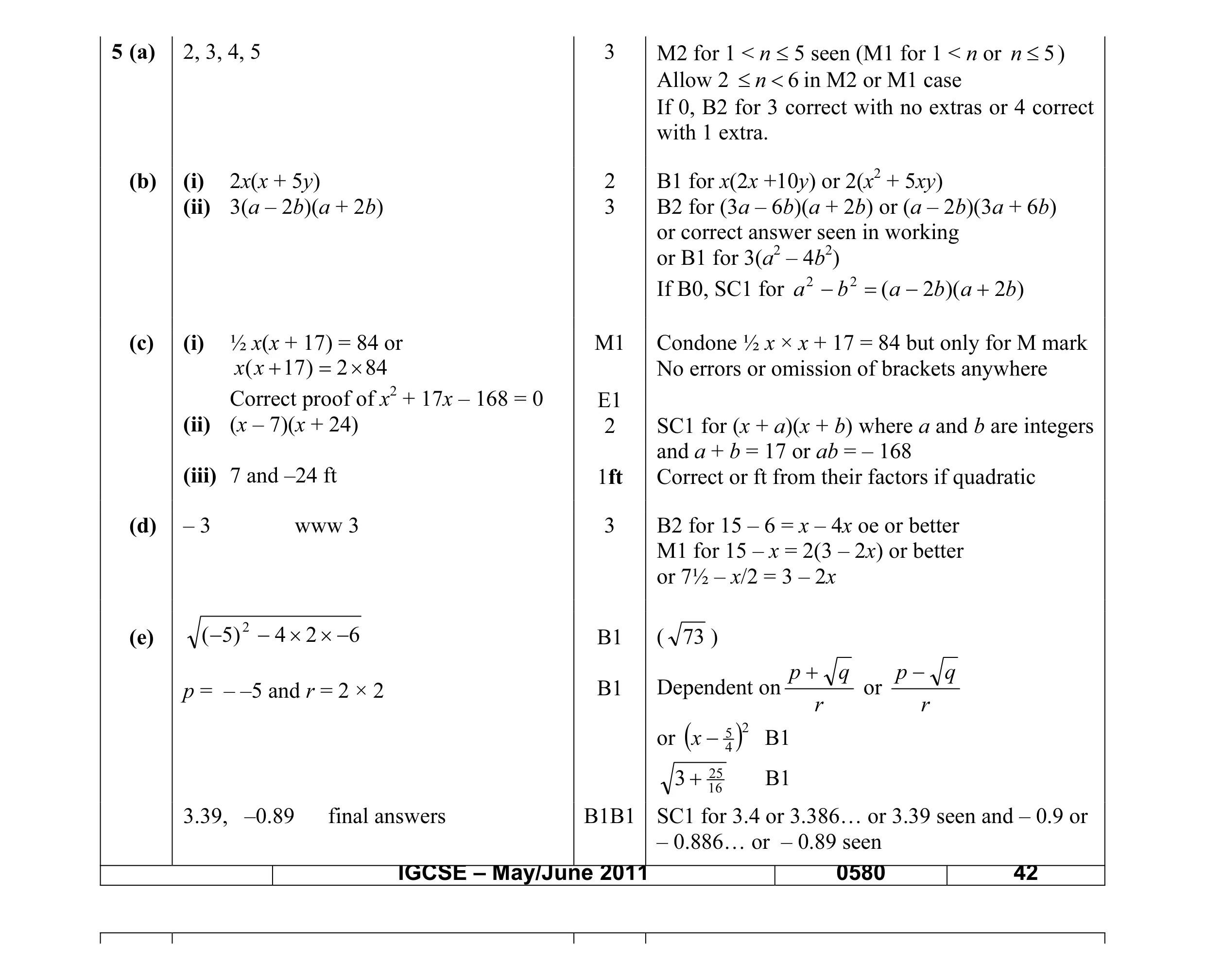
Mark scheme: 5 (a) 2, 3, 4, 5 3 M2 for 1 < n ≤ 5 seen (M1 for 1 < n or n ≤ 5 ) Allow 2 ≤n < 6 in M2 or M1 case If 0, B2 for 3 correct with no extras or 4 correct with 1 extra. (b) (i) 2x(x + 5y) 2 B1 for x(2x +10y) or 2(x2 + 5xy) (ii) 3(a – 2b)(a + 2b) 3 B2 for (3a – 6b)(a + 2b) or (a – 2b)(3a + 6b) or correct answer seen in working or B1 for 3(a2 – 4b2) If B0, SC1 for a 2 − b 2 = ( a − 2b )( a + 2b ) (c) (i) ½ x(x + 17) = 84 or M1 Condone ½ x × x + 17 = 84 but only for M mark x ( x + 17 ) = 2 × 84 No errors or omission of brackets anywhere Correct proof of x2 + 17x – 168 = 0 E1 (ii) (x – 7)(x + 24) 2 SC1 for (x + a)(x + b) where a and b are integers and a + b = 17 or ab = – 168 (iii) 7 and –24 ft 1ft Correct or ft from their factors if quadratic (d) – 3 www 3 3 B2 for 15 – 6 = x – 4x oe or better M1 for 15 – x = 2(3 – 2x) or better or 7½ – x/2 = 3 – 2x (e) ( −5) 2 − 4 × 2 × −6 B1 ( 73 ) p + q p − q p = – –5 and r = 2 × 2 B1 Dependent on or r r 5 or ( x − 4 )2 B1 3 + 1625 B1 3.39, –0.89 final answers B1B1 SC1 for 3.4 or 3.386… or 3.39 seen and – 0.9 or – 0.886… or – 0.89 seen IGCSE – May/June 2011 0580 42
This question in 0580/42 May/June 2011
Q4 · Find the integer values for x which satisfy the inequality –3 I 2x –1 Y 6 0580/41 Oct/Nov 2011
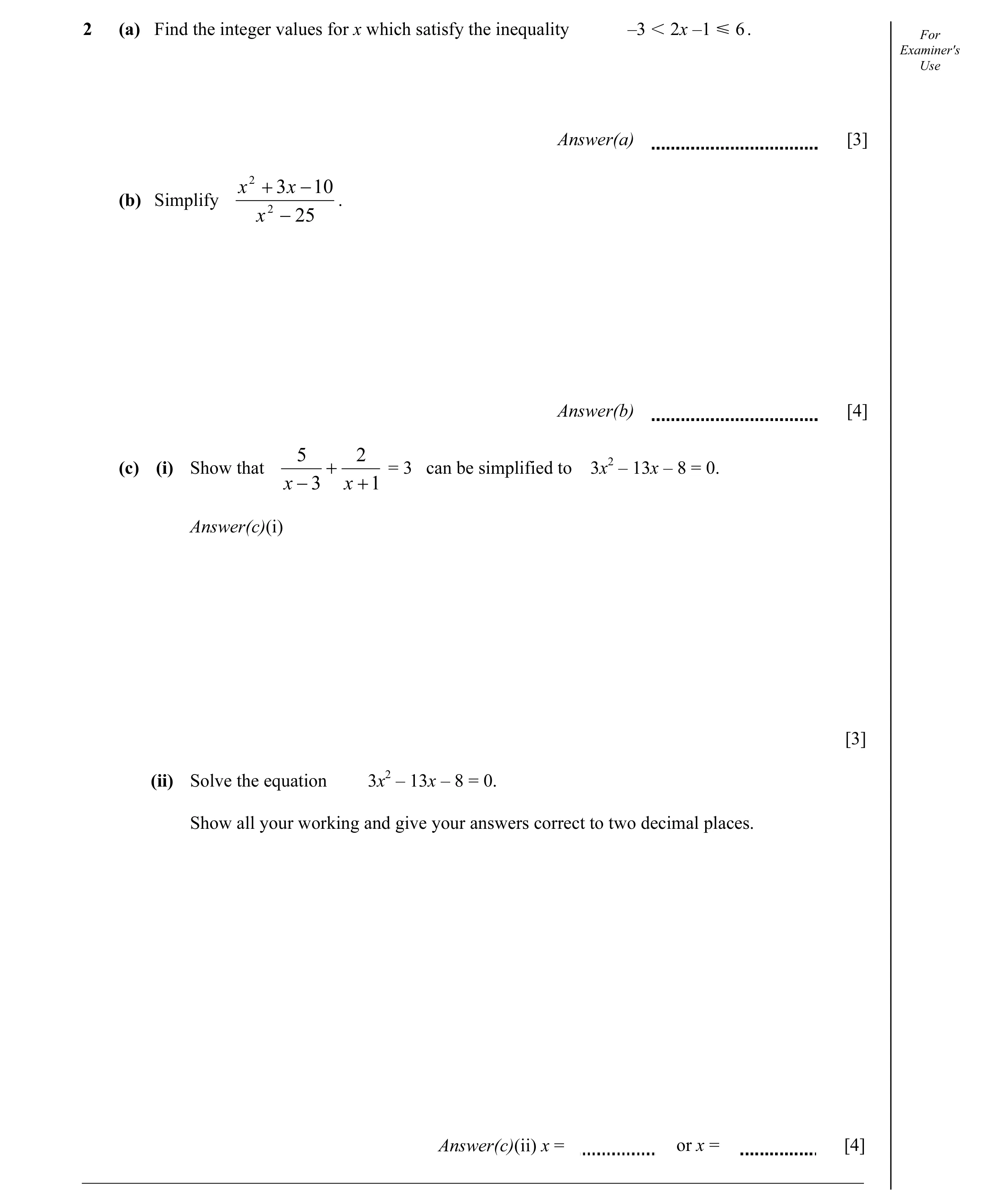
2 (a) Find the integer values for x which satisfy the inequality –3 I 2x –1 Y 6 . For Examiner's Use Answer(a) [3] x 2 + 3 x − 10 (b) Simplify 2 . x − 25 Answer(b) [4] 5 2 (c) (i) Show that + = 3 can be simplified to 3x2 – 13x – 8 = 0. x − 3 x + 1 Answer(c)(i) [3] (ii) Solve the equation 3x2 – 13x – 8 = 0. Show all your working and give your answers correct to two decimal places. Answer(c)(ii) x = or x = [4]
14 marks
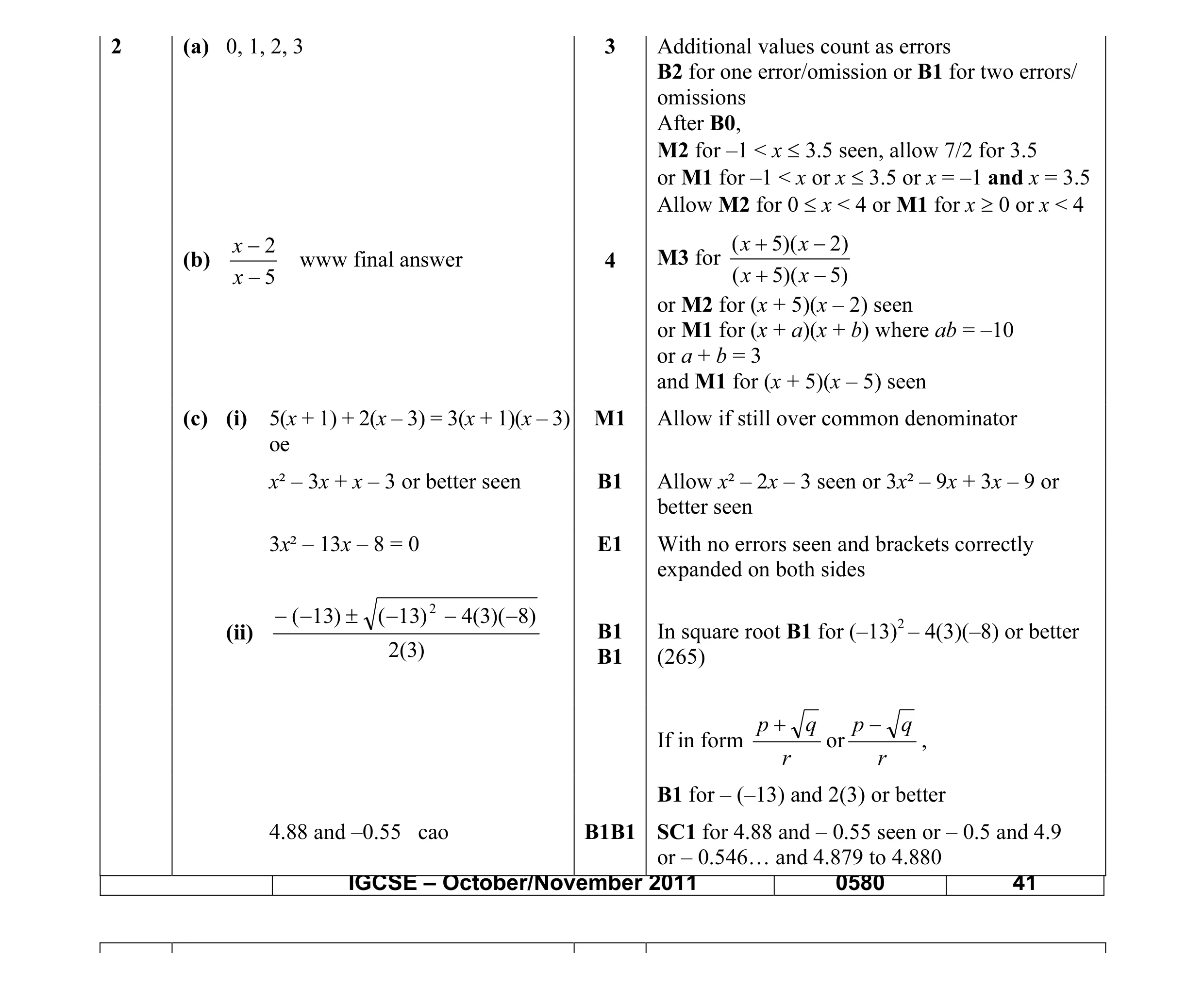
Mark scheme: 2 (a) 0, 1, 2, 3 3 Additional values count as errors B2 for one error/omission or B1 for two errors/ omissions After B0, M2 for –1 < x ≤ 3.5 seen, allow 7/2 for 3.5 or M1 for –1 < x or x ≤ 3.5 or x = –1 and x = 3.5 Allow M2 for 0 ≤ x < 4 or M1 for x ≥ 0 or x < 4 x − 2 ( x + 5)( x − 2) (b) www final answer 4 M3 for x − 5 ( x + 5)( x − 5) or M2 for (x + 5)(x – 2) seen or M1 for (x + a)(x + b) where ab = –10 or a + b = 3 and M1 for (x + 5)(x – 5) seen (c) (i) 5(x + 1) + 2(x – 3) = 3(x + 1)(x – 3) M1 Allow if still over common denominator oe x² – 3x + x – 3 or better seen B1 Allow x² – 2x – 3 seen or 3x² – 9x + 3x – 9 or better seen 3x² – 13x – 8 = 0 E1 With no errors seen and brackets correctly expanded on both sides − ( −13) ± ( −13) 2 − 4(3)( −8) (ii) B1 In square root B1 for (–13)2 – 4(3)(–8) or better 2(3) B1 (265) p + q p − q If in form or , r r B1 for – (–13) and 2(3) or better 4.88 and –0.55 cao B1B1 SC1 for 4.88 and – 0.55 seen or – 0.5 and 4.9 or – 0.546… and 4.879 to 4.880 IGCSE – October/November 2011 0580 41
This question in 0580/41 Oct/Nov 2011
Q5 · Hassan stores books in large boxes and small boxes 0580/43 Oct/Nov 2011
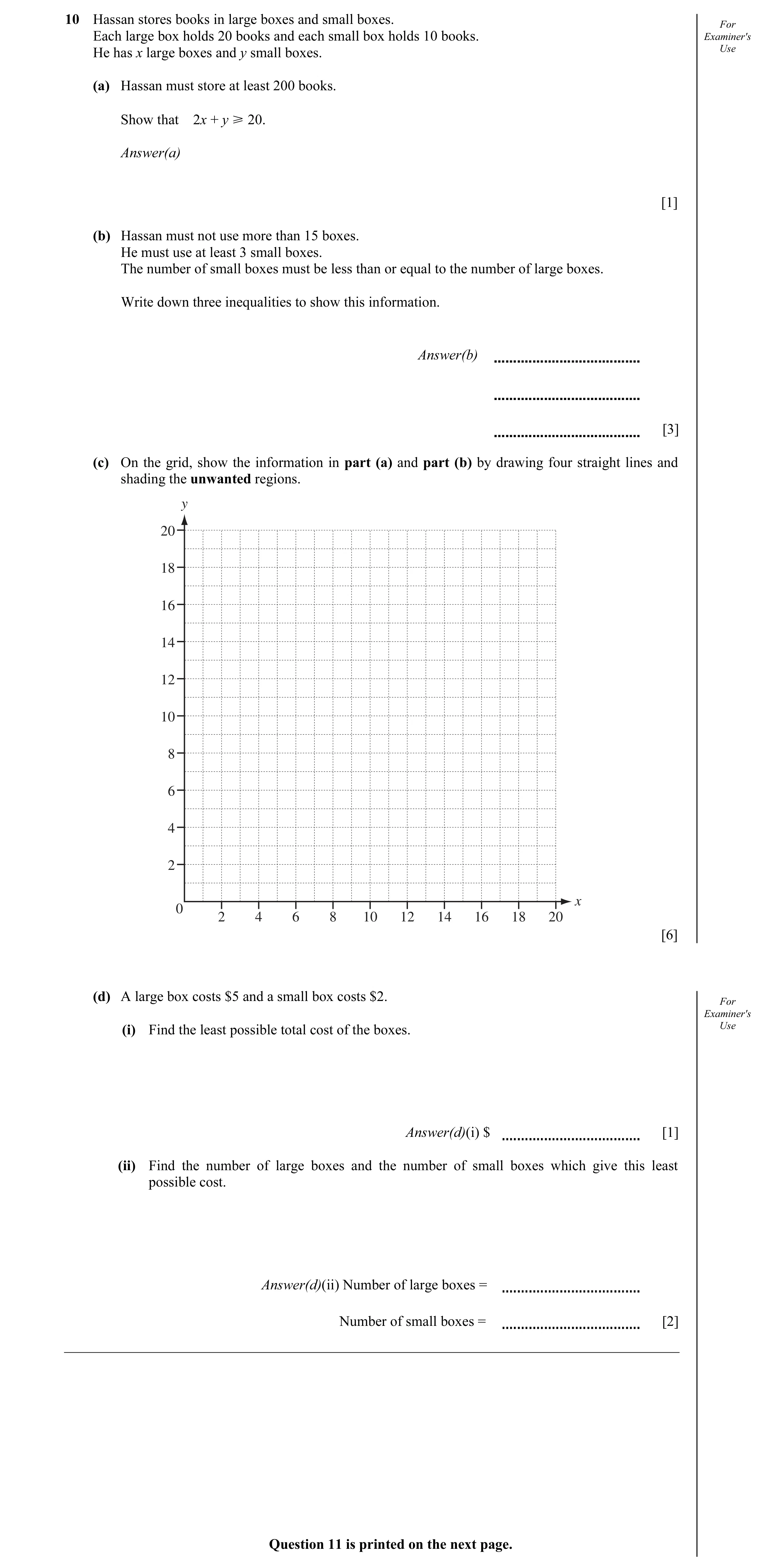
10 Hassan stores books in large boxes and small boxes. For Each large box holds 20 books and each small box holds 10 books. Examiner's He has x large boxes and y small boxes. Use (a) Hassan must store at least 200 books. Show that 2x + y [ 20. Answer(a) [1] (b) Hassan must not use more than 15 boxes. He must use at least 3 small boxes. The number of small boxes must be less than or equal to the number of large boxes. Write down three inequalities to show this information. Answer(b) [3] (c) On the grid, show the information in part (a) and part (b) by drawing four straight lines and shading the unwanted regions. y 20 18 16 14 12 10 8 6 4 2 x 0 2 4 6 8 10 12 14 16 18 20 [6] (d) A large box costs $5 and a small box costs $2. For Examiner's (i) Find the least possible total cost of the boxes. Use Answer(d)(i) $ [1] (ii) Find the number of large boxes and the number of small boxes which give this least possible cost. Answer(d)(ii) Number of large boxes = Number of small boxes = [2] Question 11 is printed on the next page.
13 marks
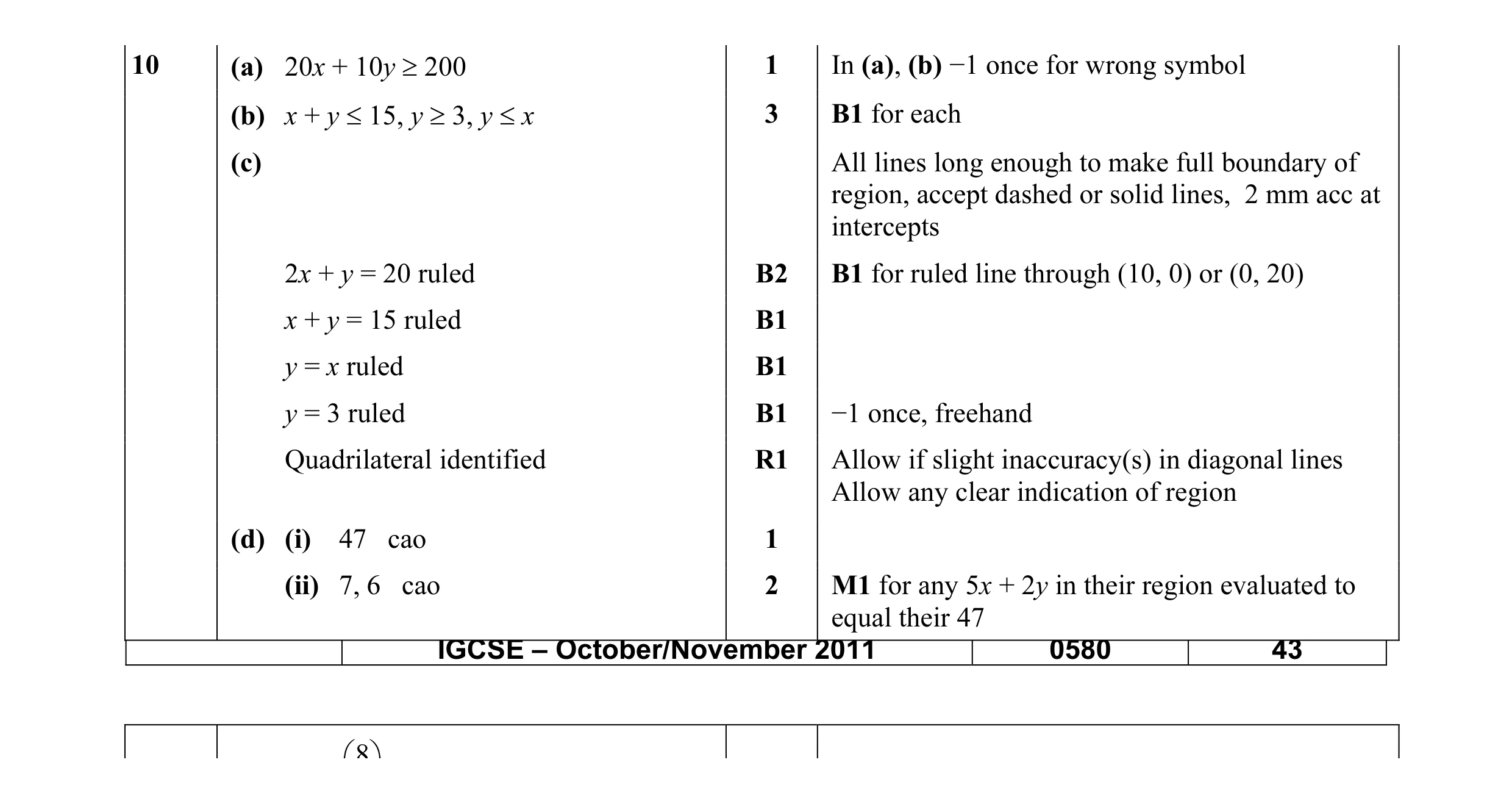
Mark scheme: 10 (a) 20x + 10y ≥ 200 1 In (a), (b) −1 once for wrong symbol (b) x + y ≤ 15, y ≥ 3, y ≤ x 3 B1 for each (c) All lines long enough to make full boundary of region, accept dashed or solid lines, 2 mm acc at intercepts 2x + y = 20 ruled B2 B1 for ruled line through (10, 0) or (0, 20) x + y = 15 ruled B1 y = x ruled B1 y = 3 ruled B1 −1 once, freehand Quadrilateral identified R1 Allow if slight inaccuracy(s) in diagonal lines Allow any clear indication of region (d) (i) 47 cao 1 (ii) 7, 6 cao 2 M1 for any 5x + 2y in their region evaluated to equal their 47 IGCSE – October/November 2011 0580 43 8
This question in 0580/43 Oct/Nov 2011
Q6 · Pablo plants x lemon trees and y orange trees 0580/42 May/June 2012
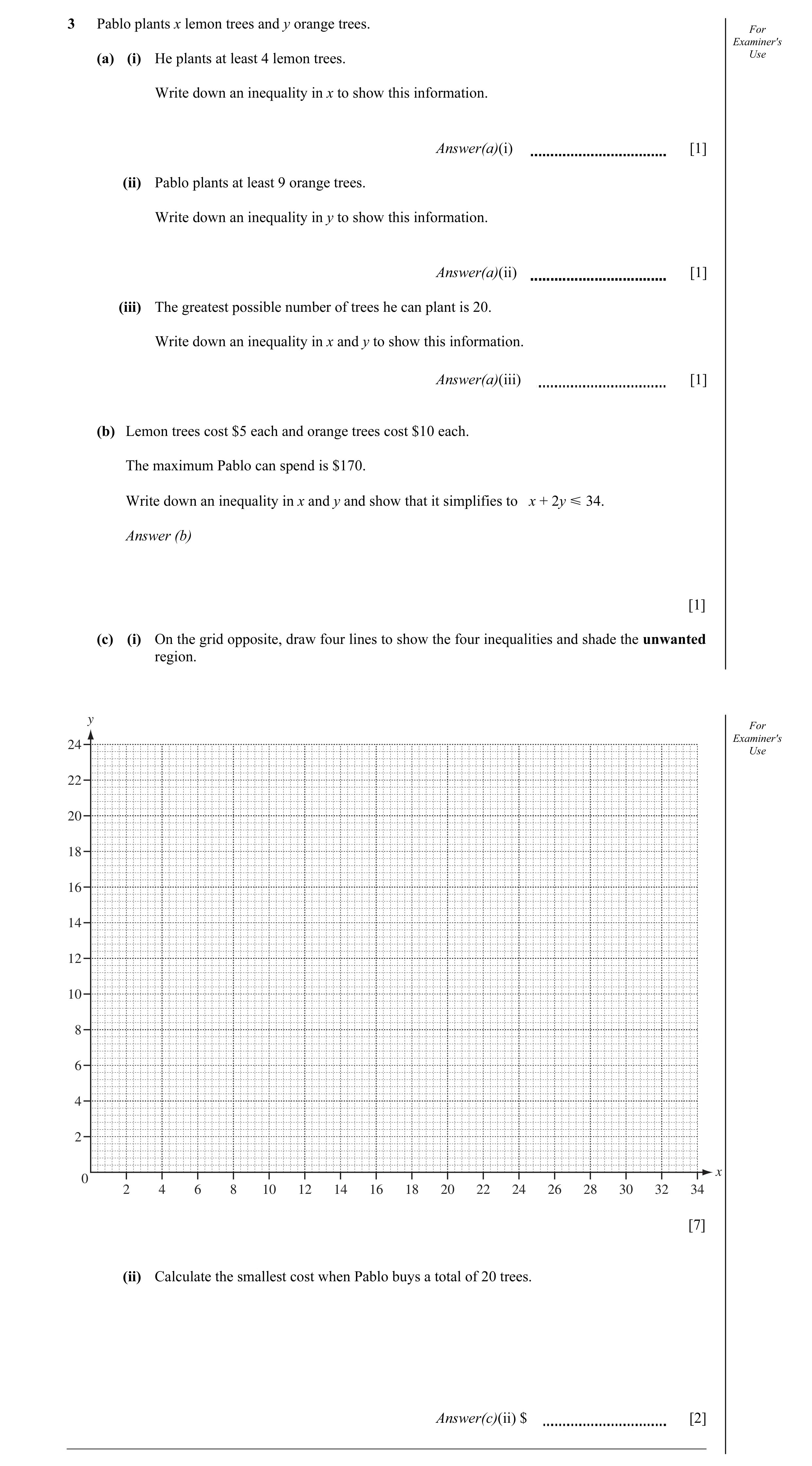
3 Pablo plants x lemon trees and y orange trees. For Examiner's (a) (i) He plants at least 4 lemon trees. Use Write down an inequality in x to show this information. Answer(a)(i) [1] (ii) Pablo plants at least 9 orange trees. Write down an inequality in y to show this information. Answer(a)(ii) [1] (iii) The greatest possible number of trees he can plant is 20. Write down an inequality in x and y to show this information. Answer(a)(iii) [1] (b) Lemon trees cost $5 each and orange trees cost $10 each. The maximum Pablo can spend is $170. Write down an inequality in x and y and show that it simplifies to x + 2y Y 34. Answer (b) [1] (c) (i) On the grid opposite, draw four lines to show the four inequalities and shade the unwanted region. y For Examiner's 24 Use 22 20 18 16 14 12 10 8 6 4 2 x 0 2 4 6 8 10 12 14 16 18 20 22 24 26 28 30 32 34 [7] (ii) Calculate the smallest cost when Pablo buys a total of 20 trees. Answer(c)(ii) $ [2]
13 marks
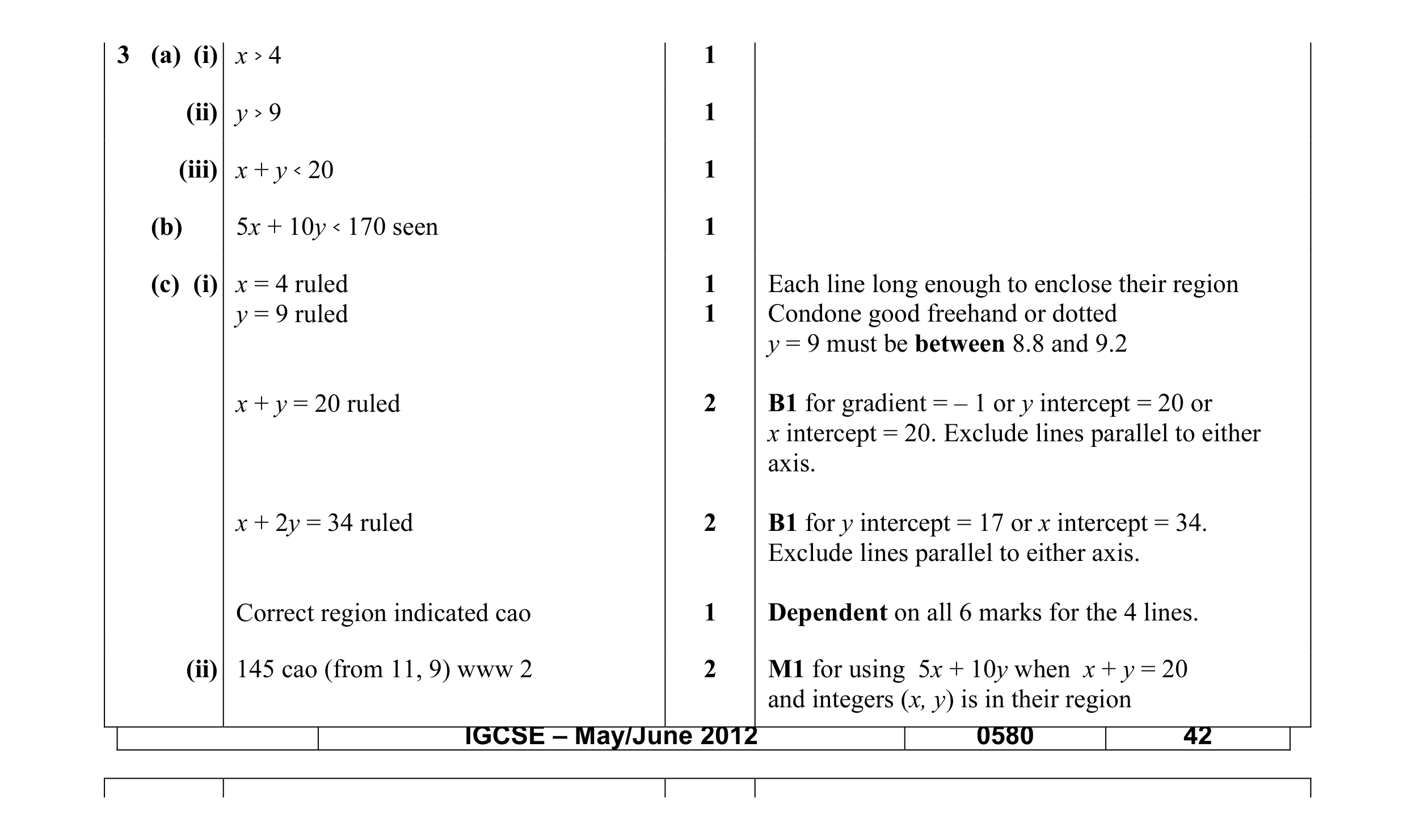
Mark scheme: 3 (a) (i) x > 4 1 (ii) y > 9 1 (iii) x + y < 20 1 (b) 5x + 10y < 170 seen 1 (c) (i) x = 4 ruled 1 Each line long enough to enclose their region y = 9 ruled 1 Condone good freehand or dotted y = 9 must be between 8.8 and 9.2 x + y = 20 ruled 2 B1 for gradient = – 1 or y intercept = 20 or x intercept = 20. Exclude lines parallel to either axis. x + 2y = 34 ruled 2 B1 for y intercept = 17 or x intercept = 34. Exclude lines parallel to either axis. Correct region indicated cao 1 Dependent on all 6 marks for the 4 lines. (ii) 145 cao (from 11, 9) www 2 2 M1 for using 5x + 10y when x + y = 20 and integers (x, y) is in their region IGCSE – May/June 2012 0580 42
This question in 0580/42 May/June 2012
Q7 · Luk wants to buy x goats and y sheep 0580/43 May/June 2013
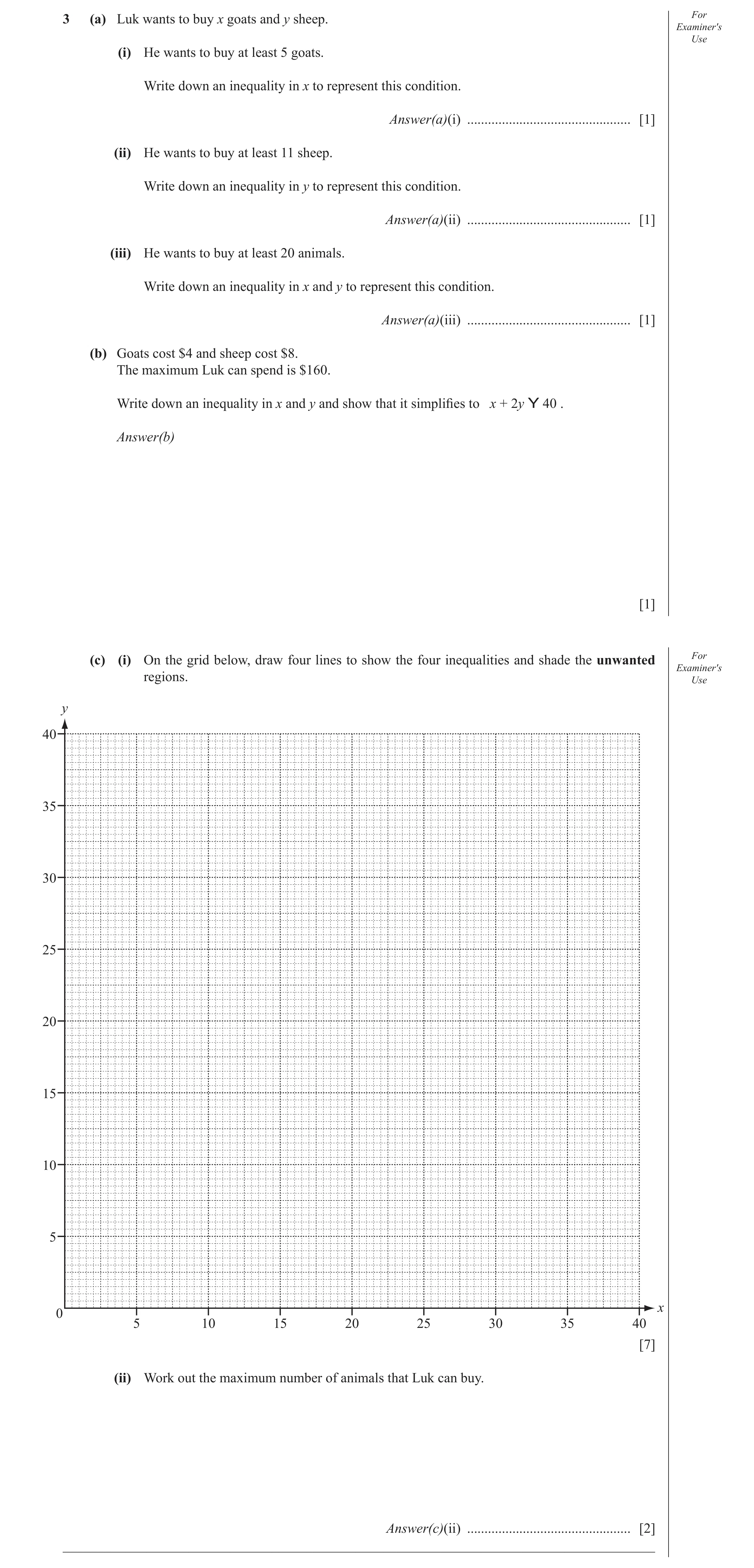
3 (a) Luk wants to buy x goats and y sheep. For Examiner′s Use (i) He wants to buy at least 5 goats. Write down an inequality in x to represent this condition. Answer(a)(i) … [1] (ii) He wants to buy at least 11 sheep. Write down an inequality in y to represent this condition. Answer(a)(ii) … [1] (iii) He wants to buy at least 20 animals. Write down an inequality in x and y to represent this condition. Answer(a)(iii) … [1] (b) Goats cost $4 and sheep cost $8. The maximum Luk can spend is $160. Write down an inequality in x and y and show that it simplifi es to x + 2y Y 40 . Answer(b) [1] (c) (i) On the grid below, draw four lines to show the four inequalities and shade the unwanted For Examiner′s regions. Use y 40 35 30 25 20 15 10 5 x 0 5 10 15 20 25 30 35 40 [7] (ii) Work out the maximum number of animals that Luk can buy. Answer(c)(ii) … [2] _____________________________________________________________________________________
13 marks
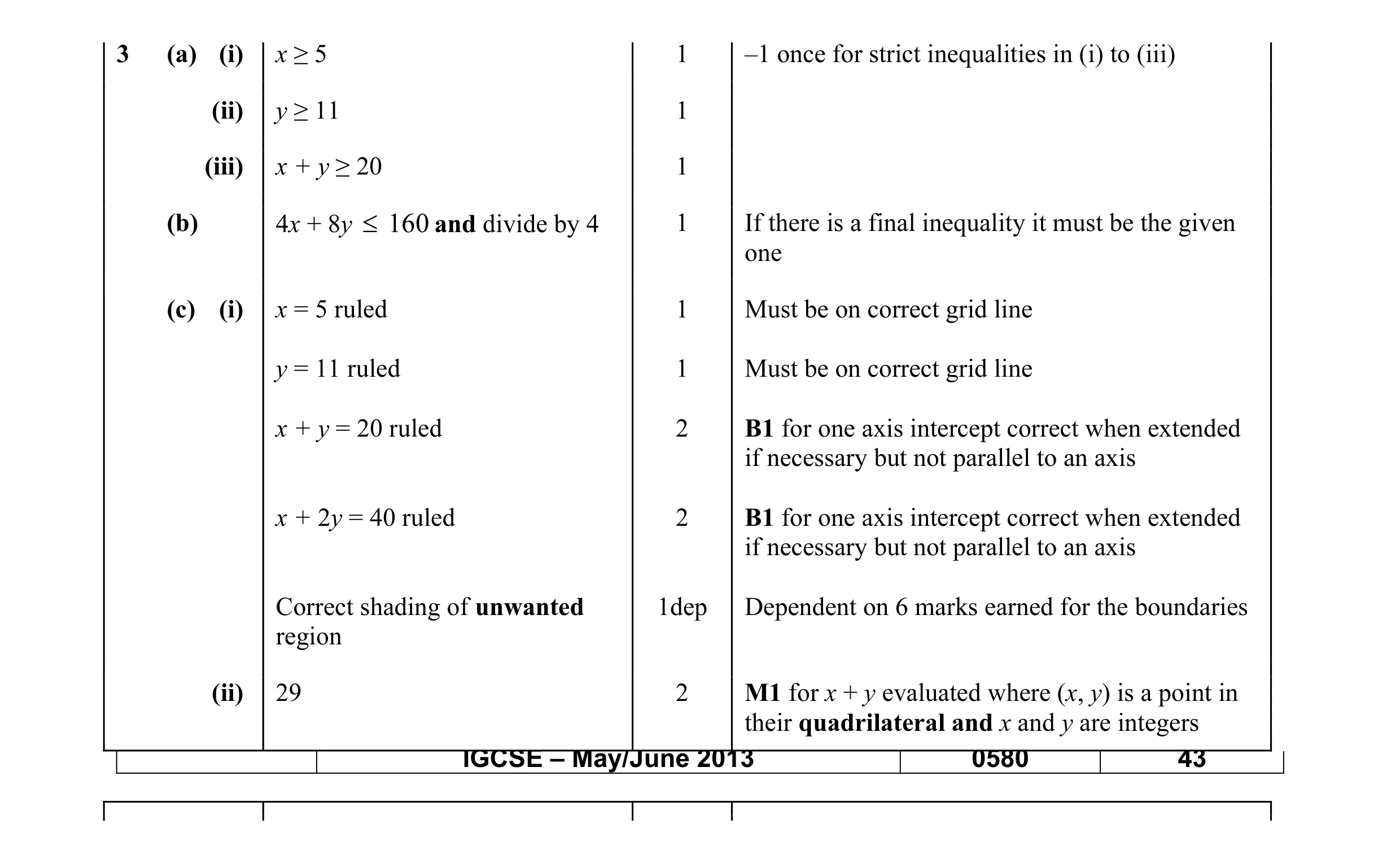
Mark scheme: 3 (a) (i) x ≥ 5 1 –1 once for strict inequalities in (i) to (iii) (ii) y ≥ 11 1 (iii) x + y ≥ 20 1 (b) 4x + 8y ≤ 160 and divide by 4 1 If there is a final inequality it must be the given one (c) (i) x = 5 ruled 1 Must be on correct grid line y = 11 ruled 1 Must be on correct grid line x + y = 20 ruled 2 B1 for one axis intercept correct when extended if necessary but not parallel to an axis x + 2y = 40 ruled 2 B1 for one axis intercept correct when extended if necessary but not parallel to an axis Correct shading of unwanted 1dep Dependent on 6 marks earned for the boundaries region (ii) 29 2 M1 for x + y evaluated where (x, y) is a point in their quadrilateral and x and y are integers IGCSE – May/June 2013 0580 43
This question in 0580/43 May/June 2013
Q8 · For Examiner′s y Use L2 5 4 3 R 2 L1 1 x 0 1 2 3 4 5 6 7 8 9 10 L3 (a) Find the equations… 0580/41 Oct/Nov 2013
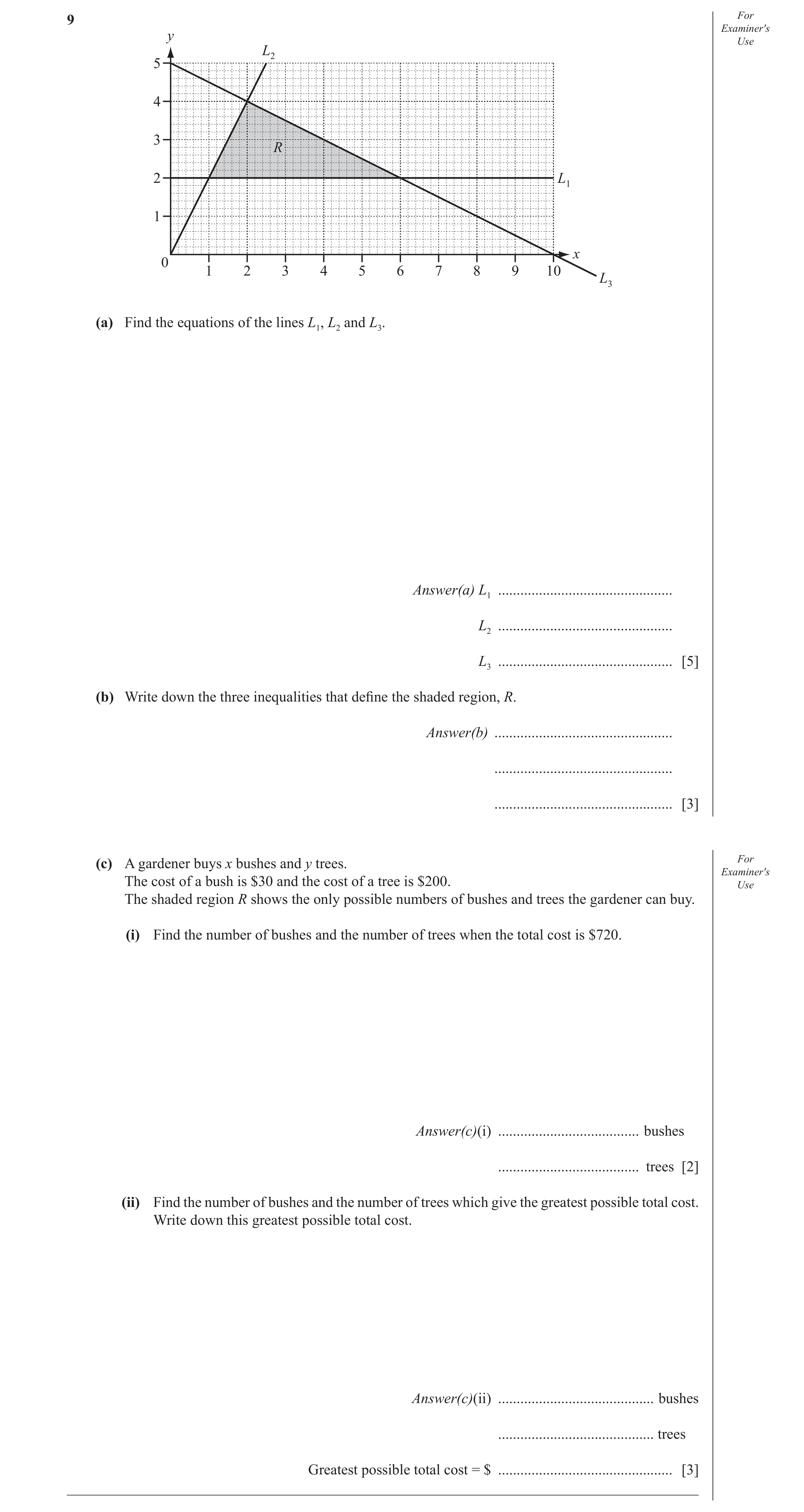
9 For Examiner′s y Use L2 5 4 3 R 2 L1 1 x 0 1 2 3 4 5 6 7 8 9 10 L3 (a) Find the equations of the lines L1, L2 and L3. Answer(a) L1 … L2 … L3 … [5] (b) Write down the three inequalities that defi ne the shaded region, R. Answer(b) … … … [3] (c) A gardener buys x bushes and y trees. For Examiner′s The cost of a bush is $30 and the cost of a tree is $200. Use The shaded region R shows the only possible numbers of bushes and trees the gardener can buy. (i) Find the number of bushes and the number of trees when the total cost is $720. Answer(c)(i) … bushes … trees [2] (ii) Find the number of bushes and the number of trees which give the greatest possible total cost. Write down this greatest possible total cost. Answer(c)(ii) … bushes … trees Greatest possible total cost = $ … [3] _____________________________________________________________________________________
13 marks
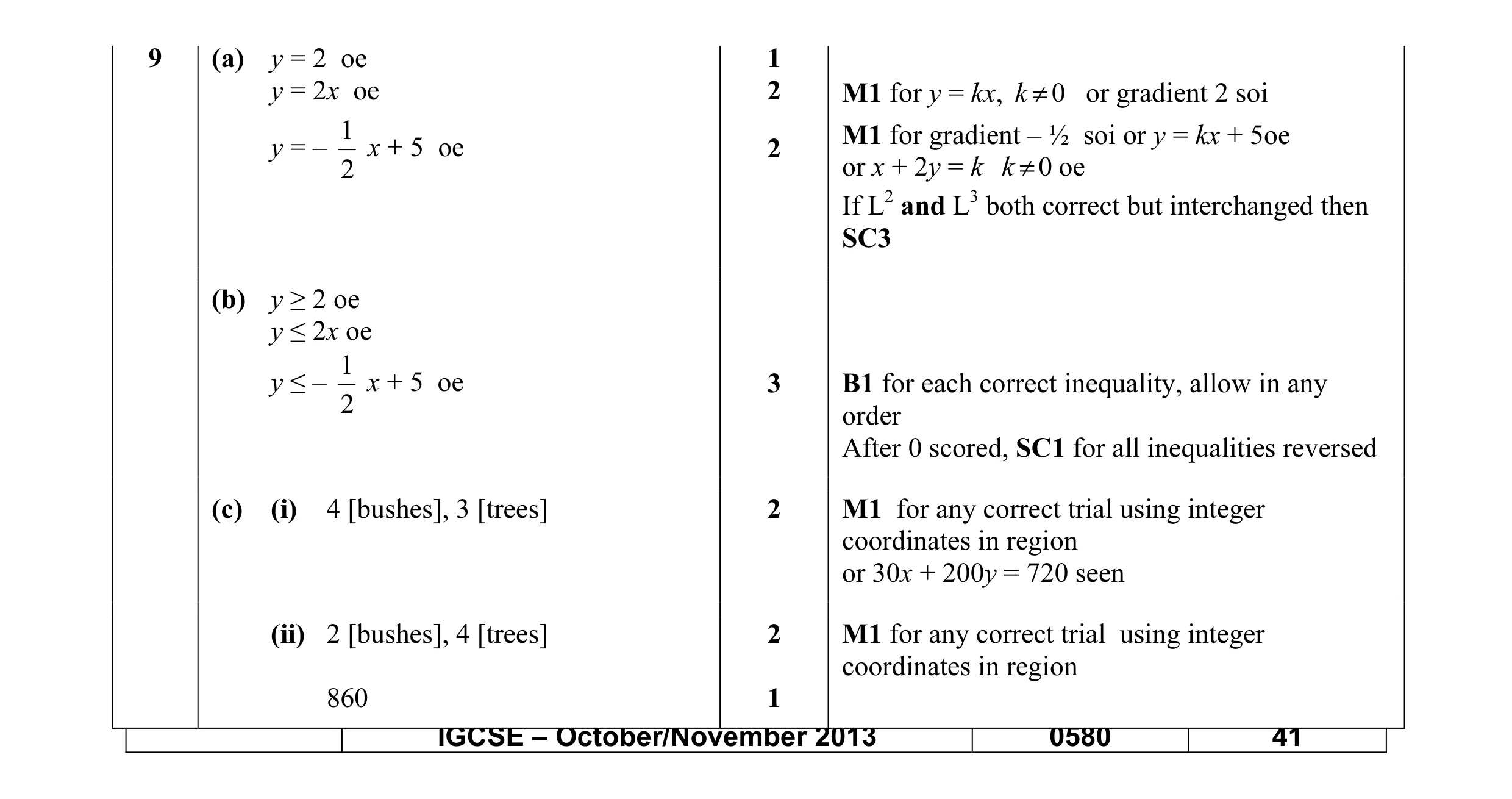
Mark scheme: 9 (a) y = 2 oe 1 y = 2x oe 2 M1 for y = kx, k ≠ 0 or gradient 2 soi 1 M1 for gradient – ½ soi or y = kx + 5oe y = – x + 5 oe 2 2 or x + 2y = k k ≠ 0 oe If L2 and L3 both correct but interchanged then SC3 (b) y ≥ 2 oe y ≤ 2x oe 1 y ≤ – x + 5 oe 3 B1 for each correct inequality, allow in any 2 order After 0 scored, SC1 for all inequalities reversed (c) (i) 4 [bushes], 3 [trees] 2 M1 for any correct trial using integer coordinates in region or 30x + 200y = 720 seen (ii) 2 [bushes], 4 [trees] 2 M1 for any correct trial using integer coordinates in region 860 1 IGCSE – October/November 2013 0580 41
This question in 0580/41 Oct/Nov 2013
Q9 · A rectangular metal sheet measures 9 cm by 7 cm 0580/43 Oct/Nov 2013
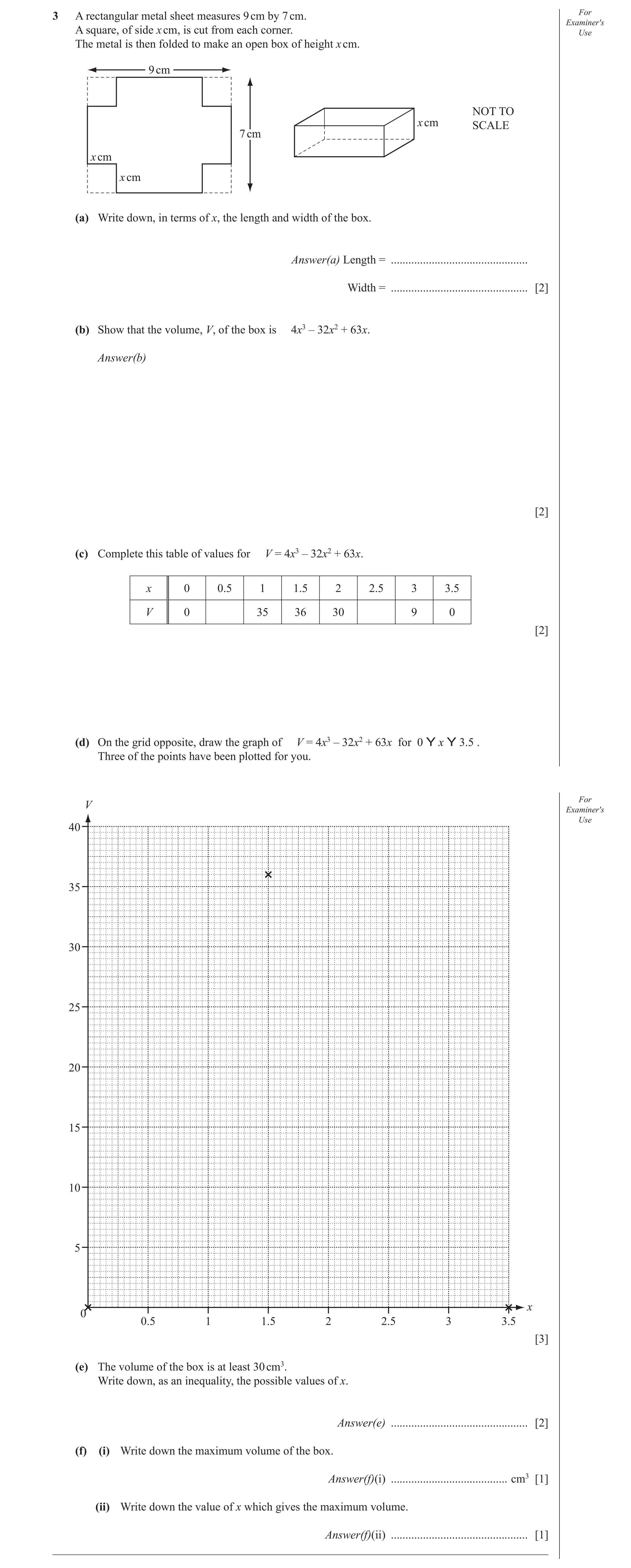
3 A rectangular metal sheet measures 9 cm by 7 cm. For Examiner′s A square, of side x cm, is cut from each corner. Use The metal is then folded to make an open box of height x cm. 9 cm NOT TO x cm SCALE 7 cm x cm x cm (a) Write down, in terms of x, the length and width of the box. Answer(a) Length = … Width = … [2] (b) Show that the volume, V, of the box is 4x3 – 32x2 + 63x. Answer(b) [2] (c) Complete this table of values for V = 4x3 – 32x2 + 63x. x 0 0.5 1 1.5 2 2.5 3 3.5 V 0 35 36 30 9 0 [2] (d) On the grid opposite, draw the graph of V = 4x3 – 32x2 + 63x for 0 Y x Y 3.5 . Three of the points have been plotted for you. For V Examiner′s Use 40 35 30 25 20 15 10 5 x 0 0.5 1 1.5 2 2.5 3 3.5 [3] (e) The volume of the box is at least 30 cm3. Write down, as an inequality, the possible values of x. Answer(e) … [2] (f) (i) Write down the maximum volume of the box. Answer(f)(i) … cm3 [1] (ii) Write down the value of x which gives the maximum volume. Answer(f)(ii) … [1] _____________________________________________________________________________________
13 marks
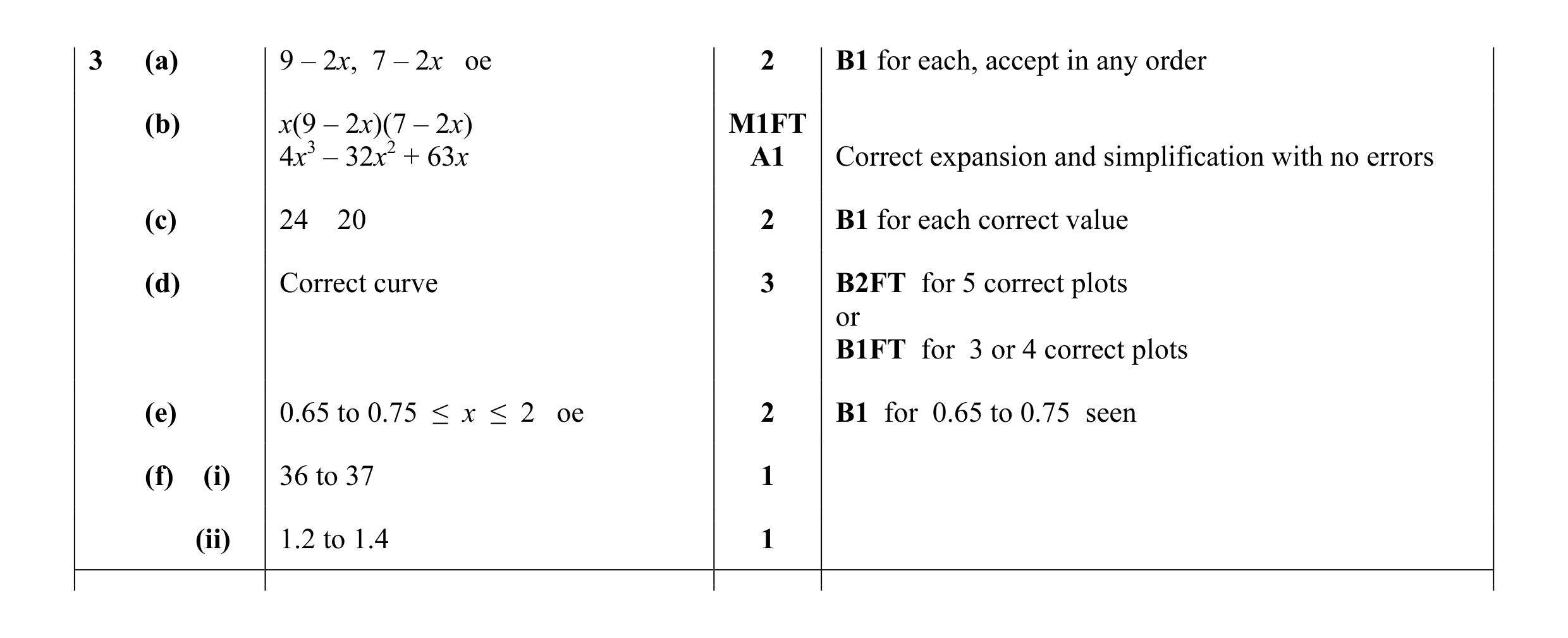
Mark scheme: 3 (a) 9 – 2x, 7 – 2x oe 2 B1 for each, accept in any order (b) x(9 – 2x)(7 – 2x) M1FT 4x3 – 32x2 + 63x A1 Correct expansion and simplification with no errors (c) 24 20 2 B1 for each correct value (d) Correct curve 3 B2FT for 5 correct plots or B1FT for 3 or 4 correct plots (e) 0.65 to 0.75 ≤ x ≤ 2 oe 2 B1 for 0.65 to 0.75 seen (f) (i) 36 to 37 1 (ii) 1.2 to 1.4 1
This question in 0580/43 Oct/Nov 2013
Q10 · Complete the table of values for y = x3 – 3x + 1 0580/41 May/June 2014
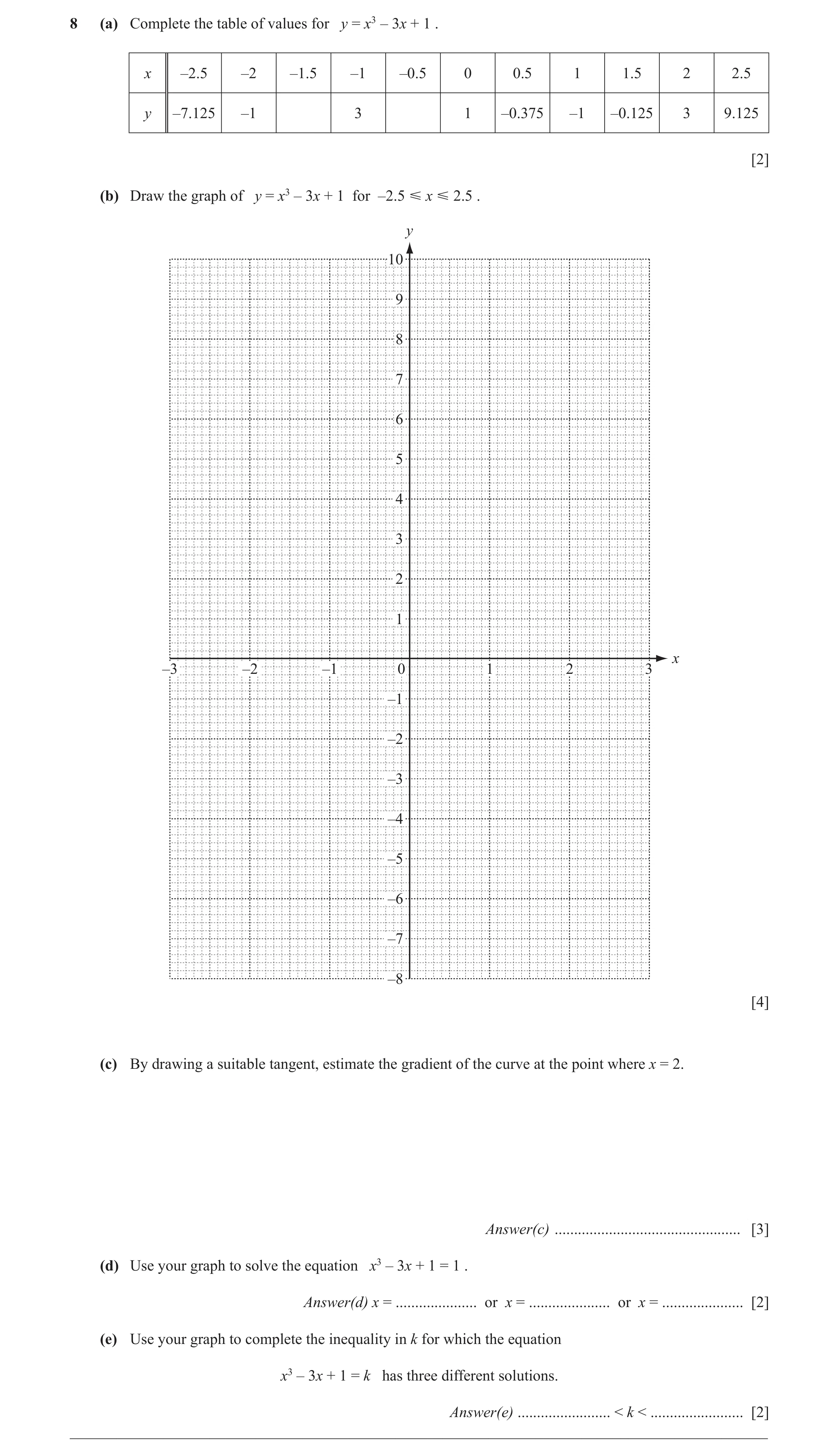
8 (a) Complete the table of values for y = x3 – 3x + 1 . x –2.5 –2 –1.5 –1 –0.5 0 0.5 1 1.5 2 2.5 y –7.125 –1 3 1 –0.375 –1 –0.125 3 9.125 [2] (b) Draw the graph of y = x3 – 3x + 1 for –2.5 Ğ x Ğ 2.5 . y 10 9 8 7 6 5 4 3 2 1 x –3 –2 –1 0 1 2 3 –1 –2 –3 –4 –5 –6 –7 –8 [4] (c) By drawing a suitable tangent, estimate the gradient of the curve at the point where x = 2. Answer(c) … [3] (d) Use your graph to solve the equation x3 – 3x + 1 = 1 . Answer(d) x = … or x = … or x = … [2] (e) Use your graph to complete the inequality in k for which the equation x3 – 3x + 1 = k has three different solutions. Answer(e) … < k < … [2] __________________________________________________________________________________________
13 marks
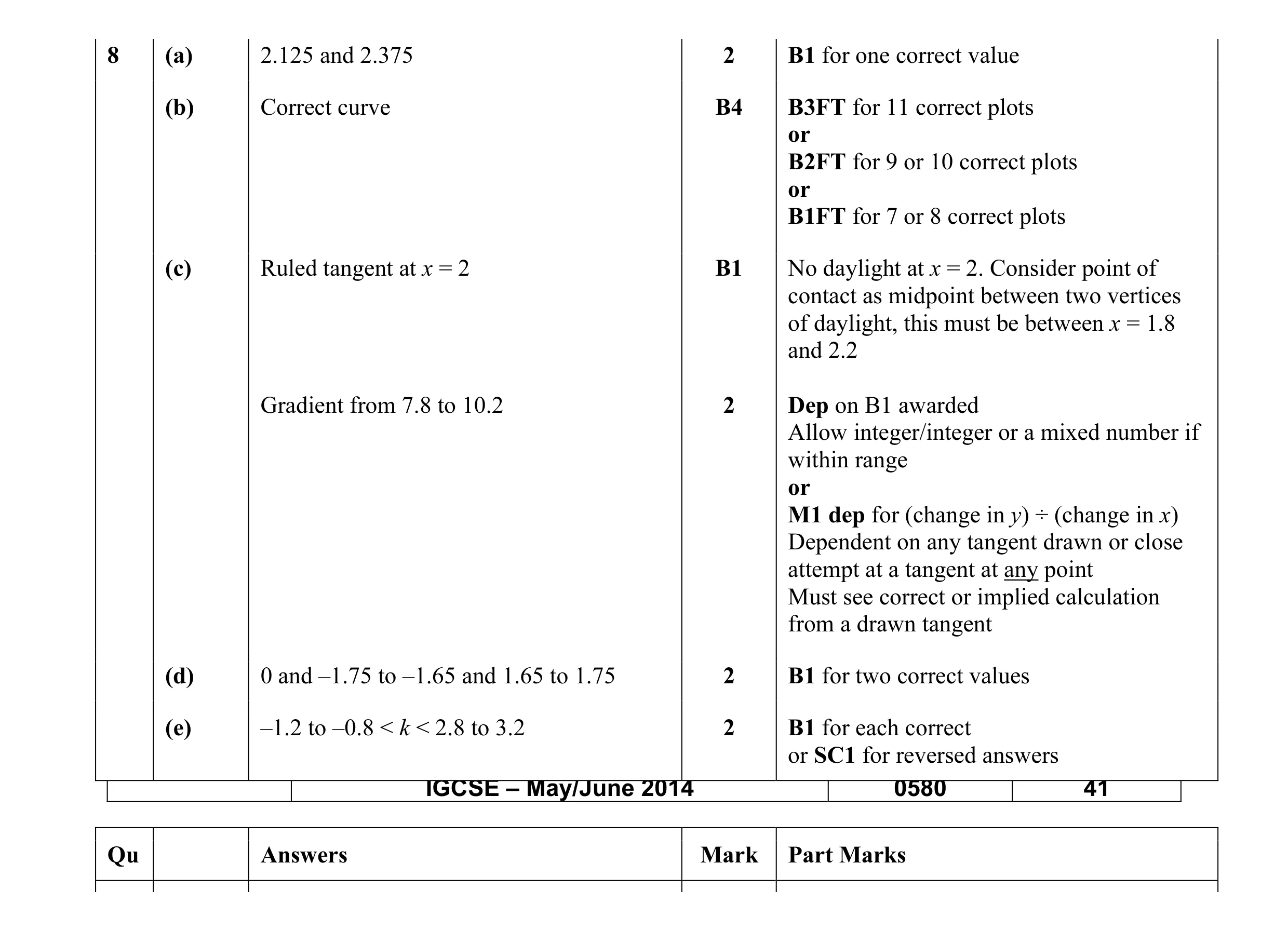
Mark scheme: 8 (a) 2.125 and 2.375 2 B1 for one correct value (b) Correct curve B4 B3FT for 11 correct plots or B2FT for 9 or 10 correct plots or B1FT for 7 or 8 correct plots (c) Ruled tangent at x = 2 B1 No daylight at x = 2. Consider point of contact as midpoint between two vertices of daylight, this must be between x = 1.8 and 2.2 Gradient from 7.8 to 10.2 2 Dep on B1 awarded Allow integer/integer or a mixed number if within range or M1 dep for (change in y) ÷ (change in x) Dependent on any tangent drawn or close attempt at a tangent at any point Must see correct or implied calculation from a drawn tangent (d) 0 and –1.75 to –1.65 and 1.65 to 1.75 2 B1 for two correct values (e) –1.2 to –0.8 < k < 2.8 to 3.2 2 B1 for each correct or SC1 for reversed answers IGCSE – May/June 2014 0580 41 Qu Answers Mark Part Marks
This question in 0580/41 May/June 2014
Question 11 0580/41 Oct/Nov 2014
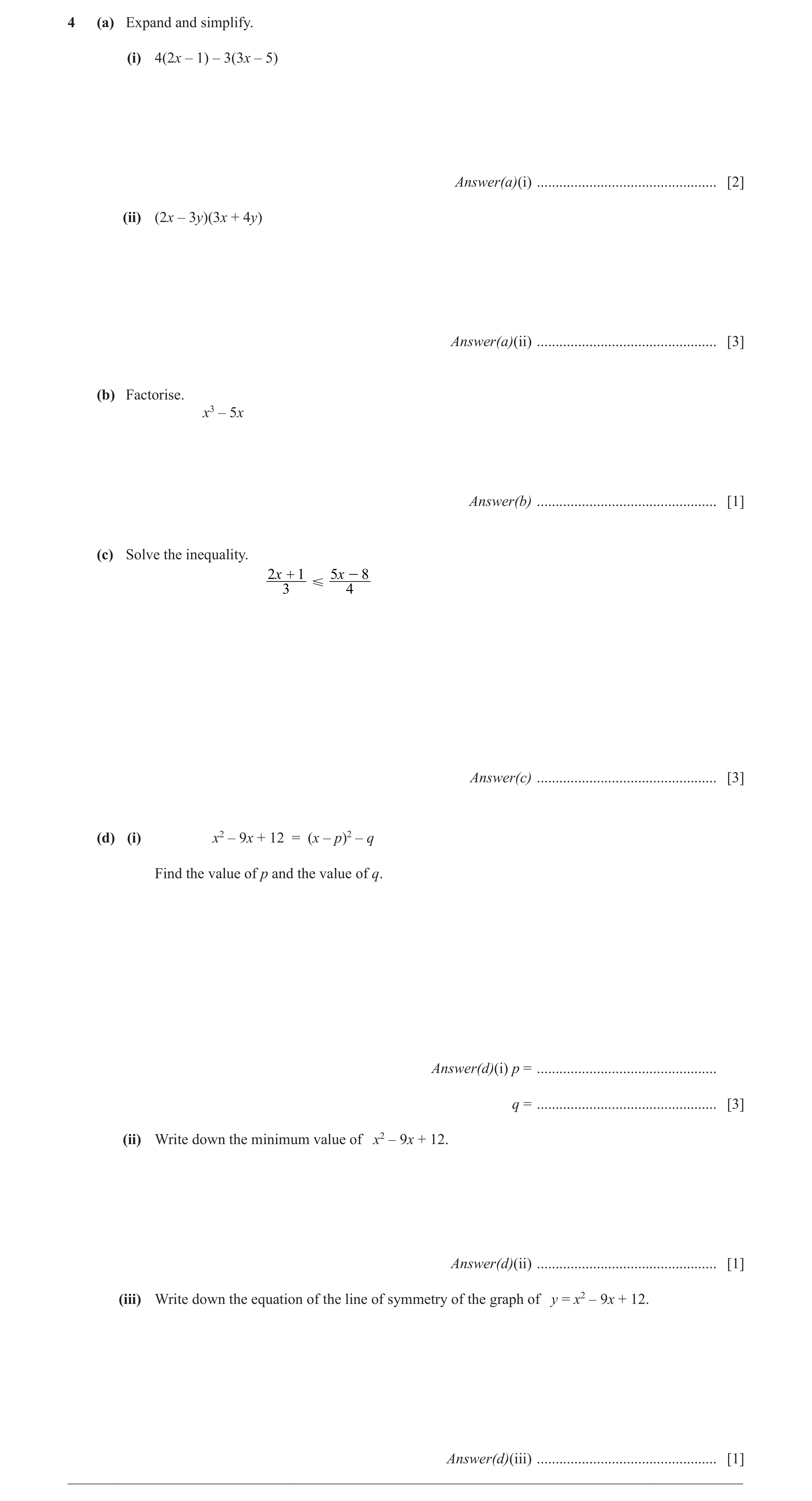
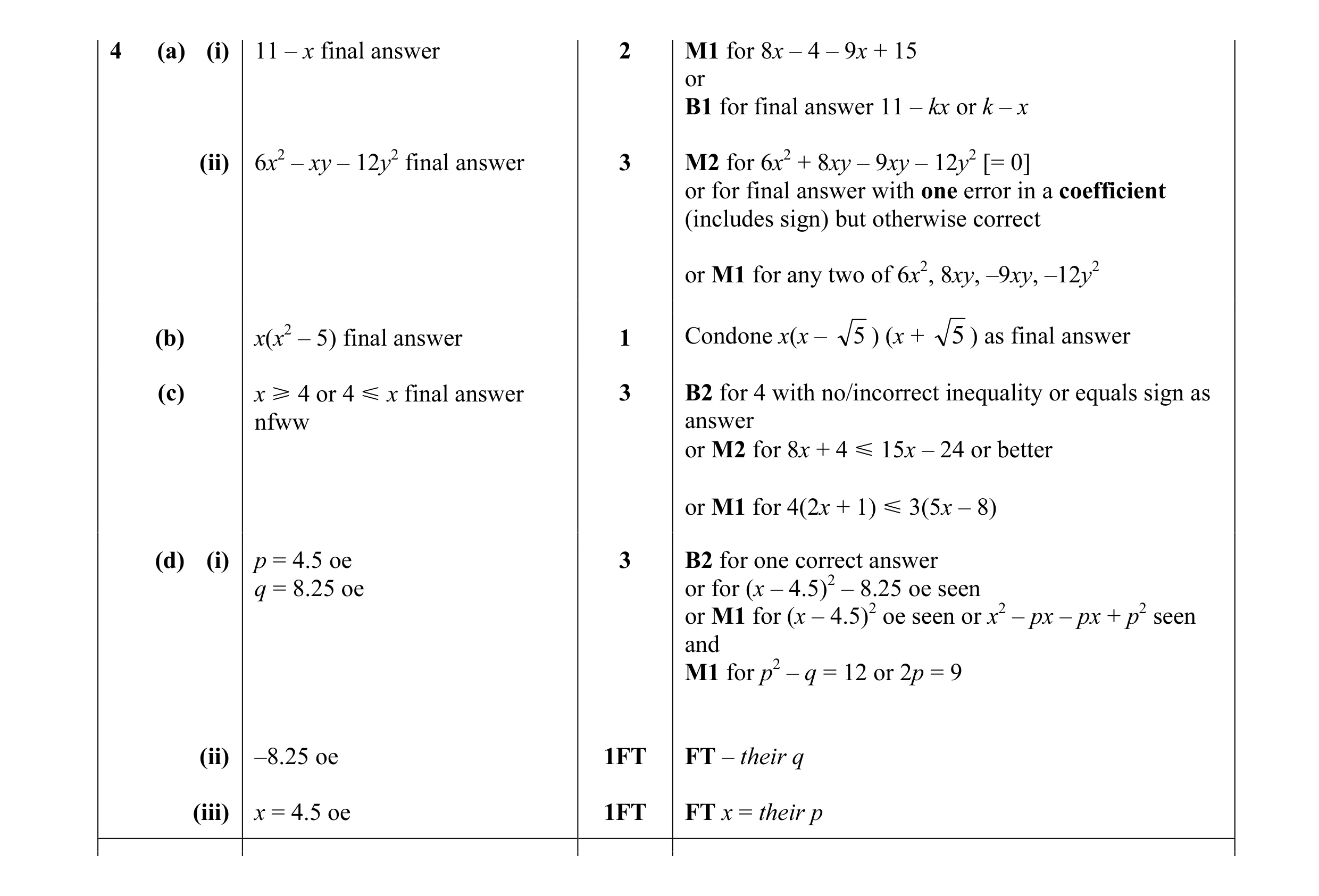
4 (a) Expand and simplify. (i) 4(2x – 1) – 3(3x – 5) Answer(a)(i) … [2] (ii) (2x – 3y)(3x + 4y) Answer(a)(ii) … [3] (b) Factorise. x3 – 5x Answer(b) … [1] (c) Solve the inequality. 2x + 1 5x - 8 Y= 3 4 Answer(c) … [3] (d) (i) x2 – 9x + 12 = (x – p)2 – q Find the value of p and the value of q. Answer(d)(i) p = … q = … [3] (ii) Write down the minimum value of x2 – 9x + 12. Answer(d)(ii) … [1] (iii) Write down the equation of the line of symmetry of the graph of y = x2 – 9x + 12. Answer(d)(iii) … [1] __________________________________________________________________________________________
14 marks
Mark scheme: 4 (a) (i) 11 – x final answer 2 M1 for 8x – 4 – 9x + 15 or B1 for final answer 11 – kx or k – x (ii) 6x2 – xy – 12y2 final answer 3 M2 for 6x2 + 8xy – 9xy – 12y2 [= 0] or for final answer with one error in a coefficient (includes sign) but otherwise correct or M1 for any two of 6x2, 8xy, –9xy, –12y2 (b) x(x2 – 5) final answer 1 Condone x(x – 5 ) (x + 5 ) as final answer (c) x [ 4 or 4 Y x final answer 3 B2 for 4 with no/incorrect inequality or equals sign as nfww answer or M2 for 8x + 4 Y 15x – 24 or better or M1 for 4(2x + 1) Y 3(5x – 8) (d) (i) p = 4.5 oe 3 B2 for one correct answer q = 8.25 oe or for (x – 4.5)2 – 8.25 oe seen or M1 for (x – 4.5)2 oe seen or x2 – px – px + p2 seen and M1 for p2 – q = 12 or 2p = 9 (ii) –8.25 oe 1FT FT – their q (iii) x = 4.5 oe 1FT FT x = their p
This question in 0580/41 Oct/Nov 2014
Q12 · The school cook buys potatoes in small sacks, each of mass 4 kg, and large sacks, each of… 0580/42 Feb/March 2015
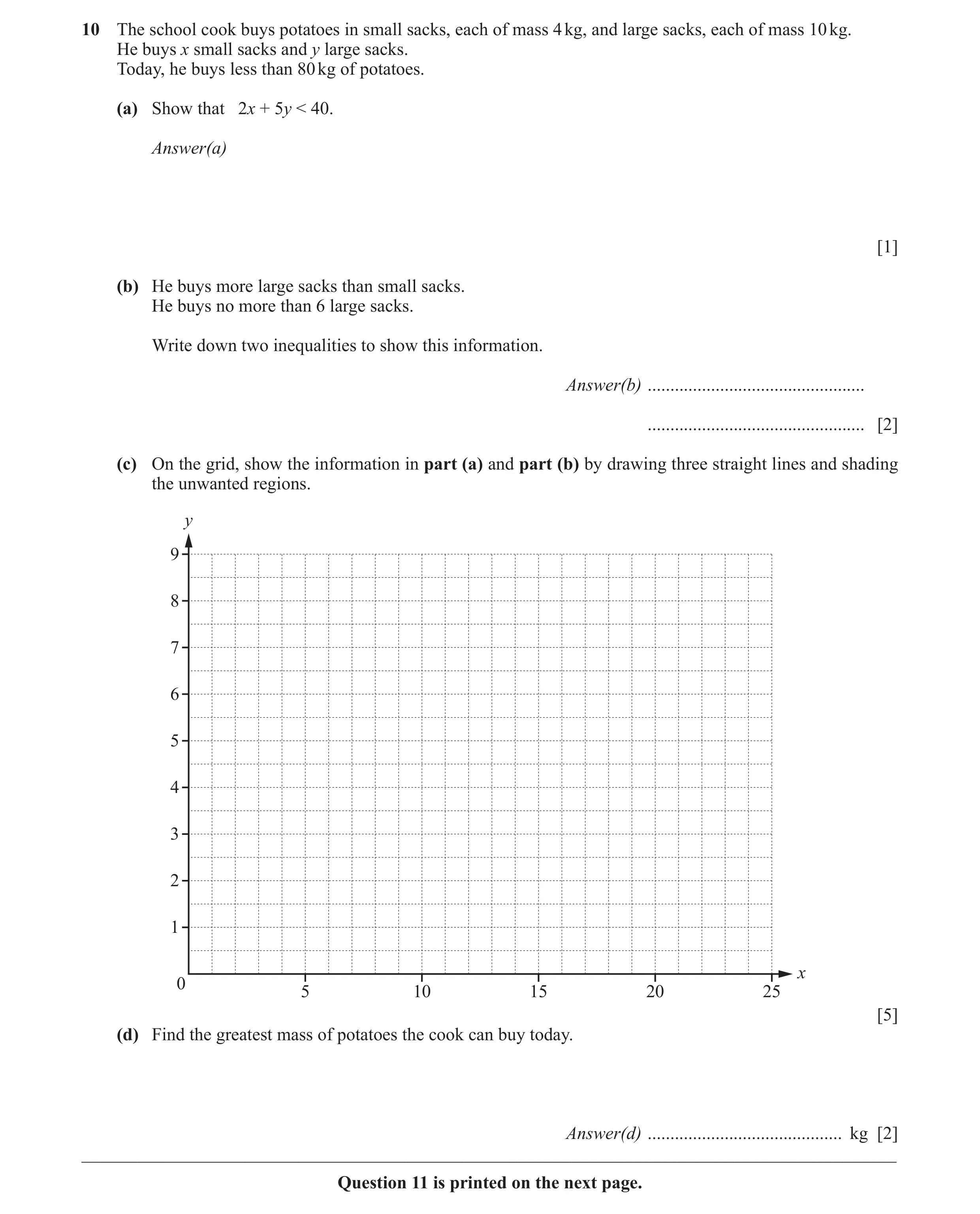
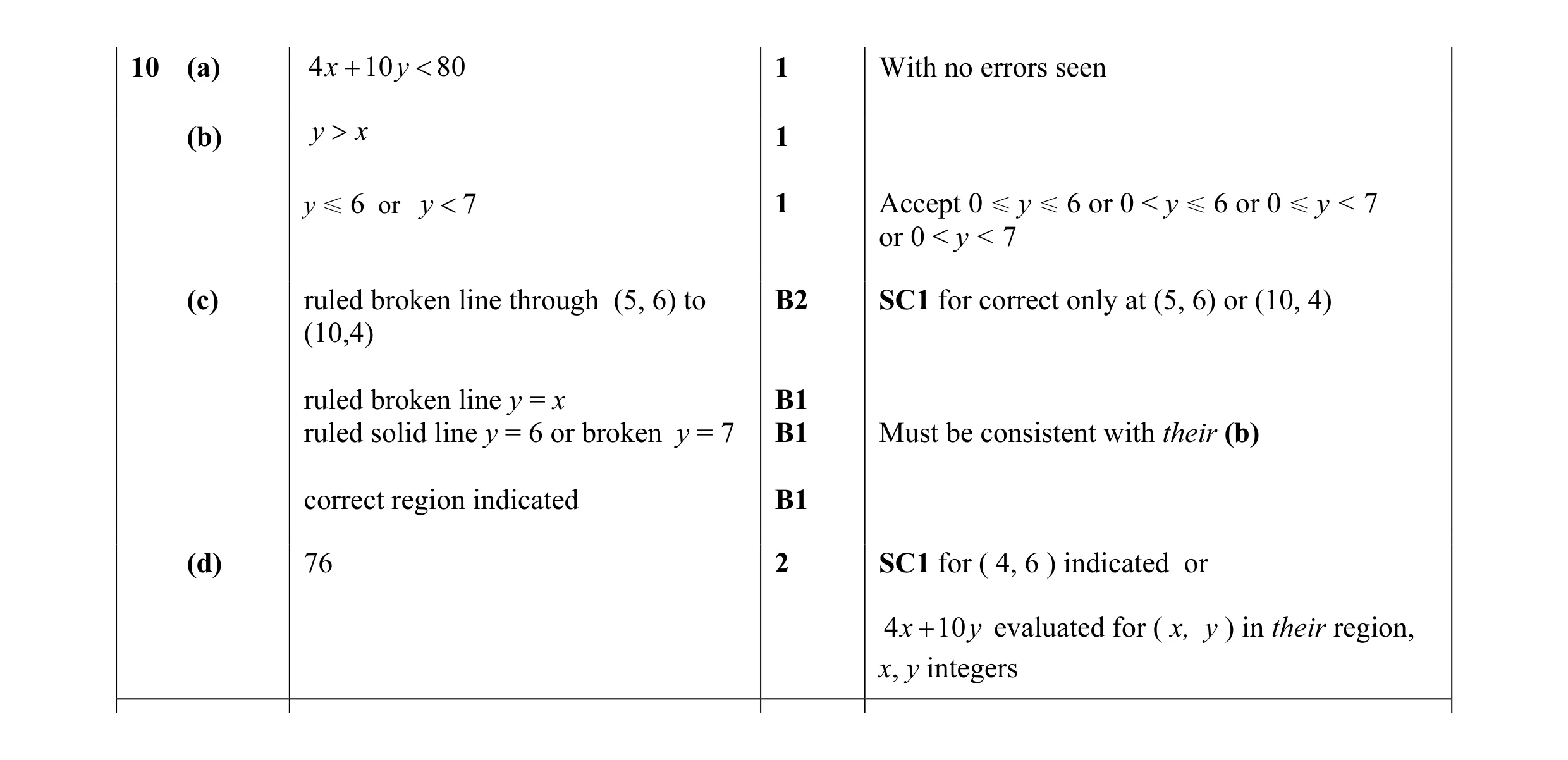
10 The school cook buys potatoes in small sacks, each of mass 4 kg, and large sacks, each of mass 10 kg. He buys x small sacks and y large sacks. Today, he buys less than 80 kg of potatoes. (a) Show that 2x + 5y < 40. Answer(a) [1] (b) He buys more large sacks than small sacks. He buys no more than 6 large sacks. Write down two inequalities to show this information. Answer(b) … … [2] (c) On the grid, show the information in part (a) and part (b) by drawing three straight lines and shading the unwanted regions. y 9 8 7 6 5 4 3 2 1 x 0 5 10 15 20 25 [5] (d) Find the greatest mass of potatoes the cook can buy today. Answer(d) … kg [2] __________________________________________________________________________________________ Question 11 is printed on the next page.
10 marks
Mark scheme: 10 (a) 4 x + 10 y < 80 1 With no errors seen (b) y > x 1 y ≤ 6 or y < 7 1 Accept 0 ≤ y ≤ 6 or 0 < y ≤ 6 or 0 ≤ y < 7 or 0 < y < 7 (c) ruled broken line through (5, 6) to B2 SC1 for correct only at (5, 6) or (10, 4) (10,4) ruled broken line y = x B1 ruled solid line y = 6 or broken y = 7 B1 Must be consistent with their (b) correct region indicated B1 (d) 76 2 SC1 for ( 4, 6 ) indicated or 4 x + 10 y evaluated for ( x, y ) in their region, x, y integers
This question in 0580/42 Feb/March 2015
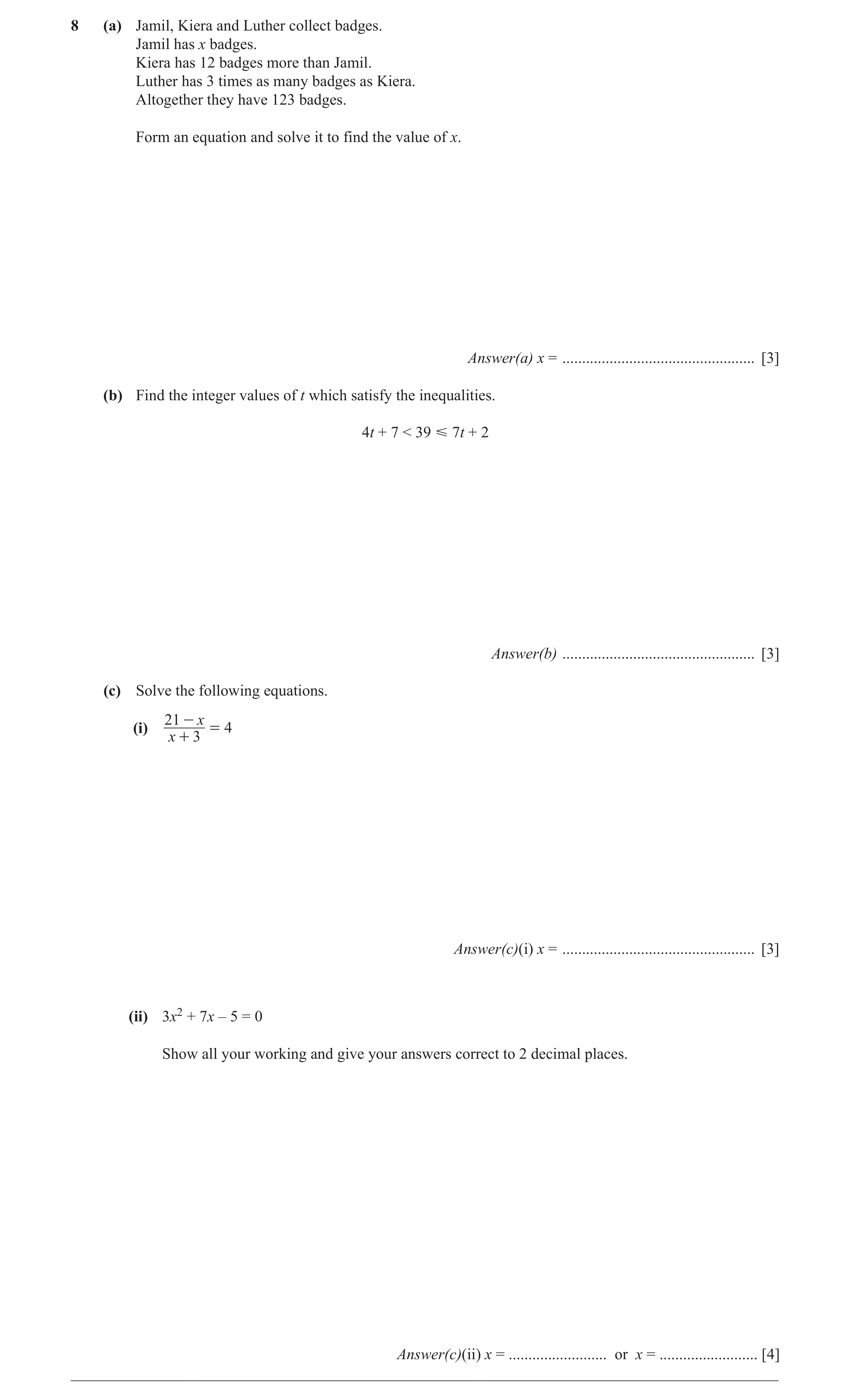
Q13 · Jamil, Kiera and Luther collect badges 0580/41 May/June 2015
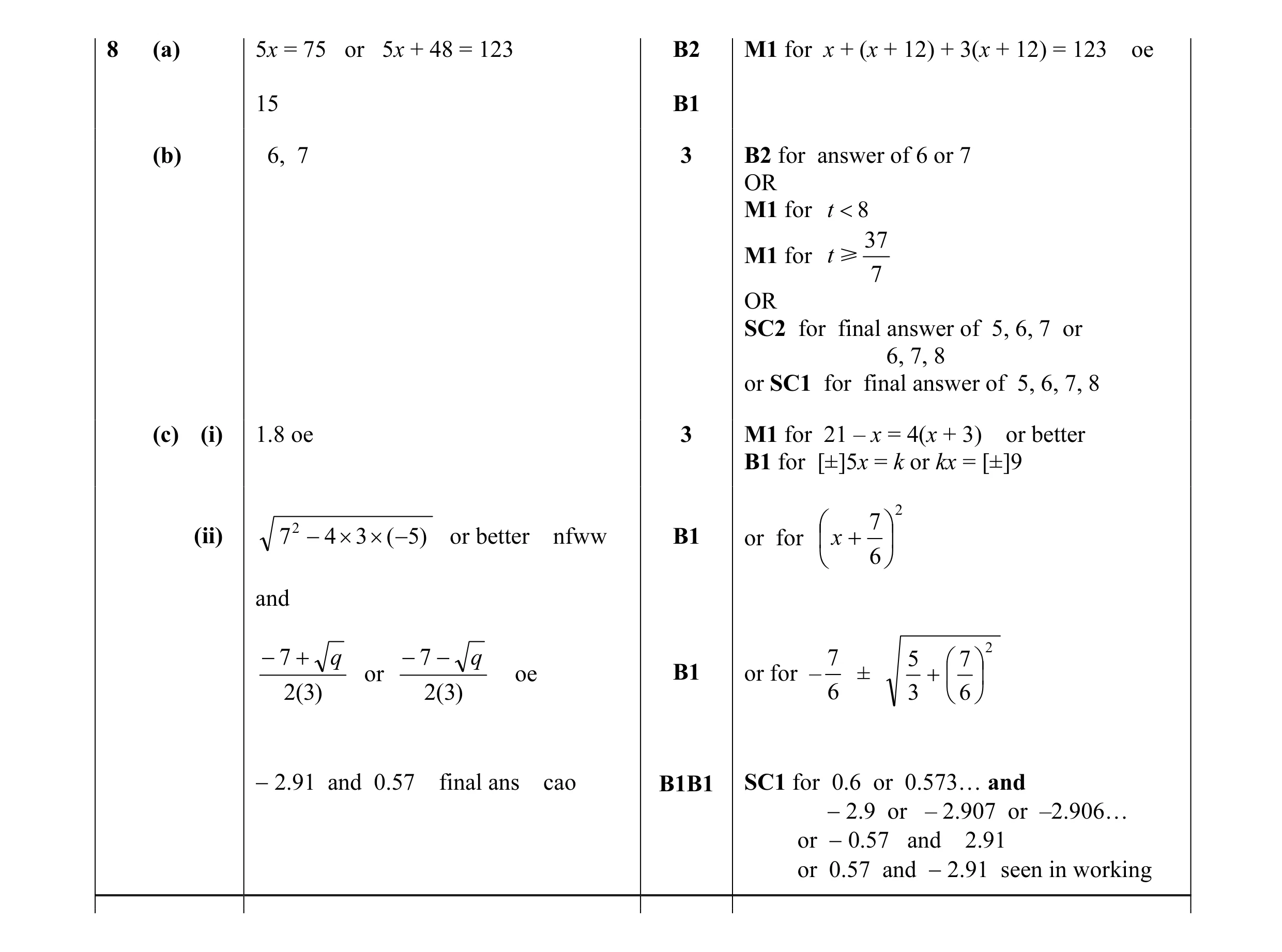
8 (a) Jamil, Kiera and Luther collect badges. Jamil has x badges. Kiera has 12 badges more than Jamil. Luther has 3 times as many badges as Kiera. Altogether they have 123 badges. Form an equation and solve it to find the value of x. Answer(a) x = … [3] (b) Find the integer values of t which satisfy the inequalities. 4t + 7 < 39 7t + 2 Answer(b) … [3] (c) Solve the following equations. 21 - x = 4 (i) 3 x + Answer(c)(i) x = … [3] (ii) 3x2 + 7x – 5 = 0 Show all your working and give your answers correct to 2 decimal places. Answer(c)(ii) x = … or x = … [4] __________________________________________________________________________________________
13 marks
Mark scheme: 8 (a) 5x = 75 or 5x + 48 = 123 B2 M1 for x + (x + 12) + 3(x + 12) = 123 oe 15 B1 (b) 6, 7 3 B2 for answer of 6 or 7 OR M1 for t < 8 37 M1 for t [ 7 OR SC2 for final answer of 5, 6, 7 or 6, 7, 8 or SC1 for final answer of 5, 6, 7, 8 (c) (i) 1.8 oe 3 M1 for 21 – x = 4(x + 3) or better B1 for [±]5x = k or kx = [±]9 2 7 (ii) 72 − 4 × 3 × ( −5) or better nfww B1 or for x + 6 and − 7 + q − 7 − q 7 5 7 2 or oe B1 or for – ± + 2()3 2 (3) 6 3 6 − 2.91 and 0.57 final ans cao B1B1 SC1 for 0.6 or 0.573… and − 2.9 or – 2.907 or –2.906… or − 0.57 and 2.91 or 0.57 and − 2.91 seen in working
This question in 0580/41 May/June 2015
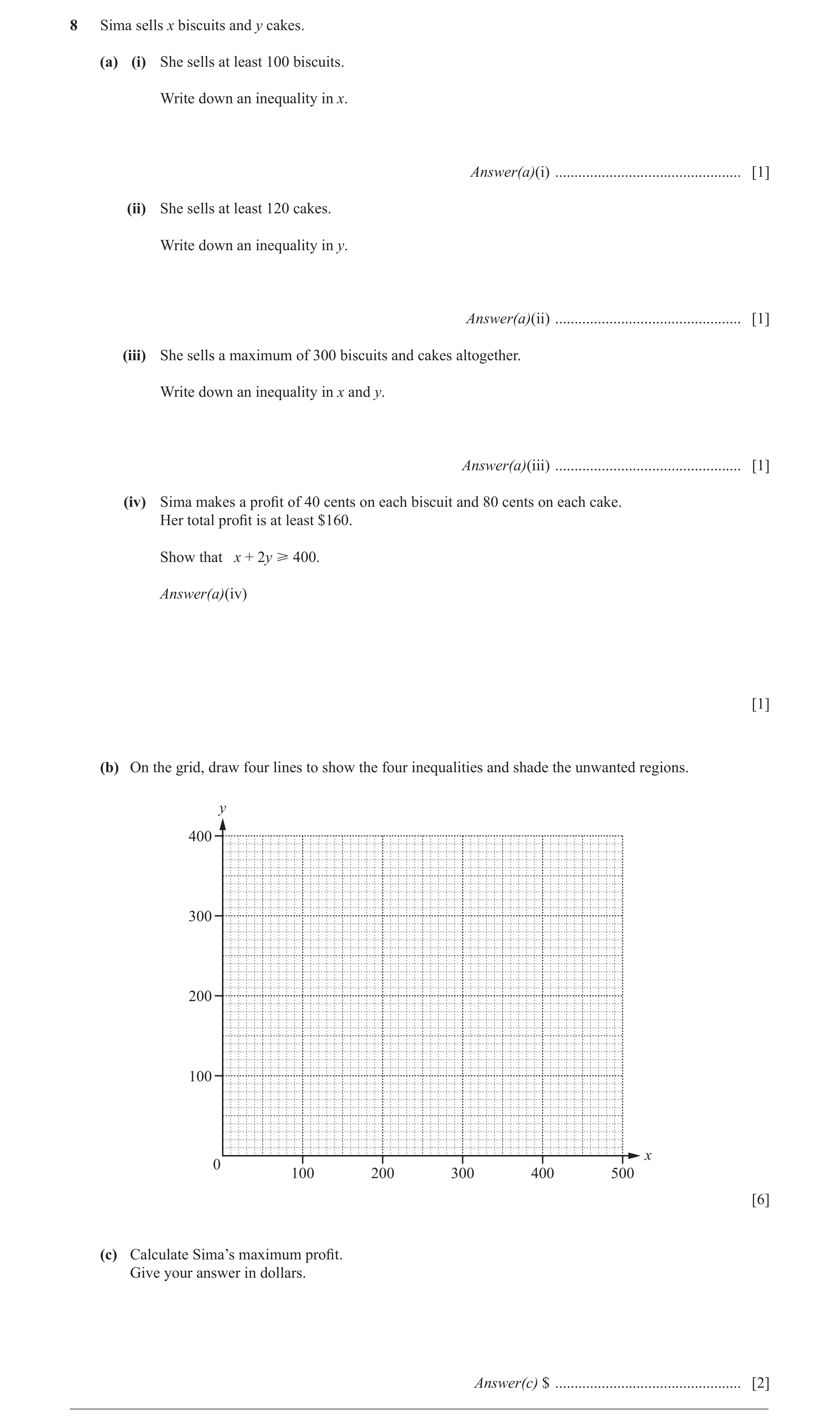
Q14 · Sima sells x biscuits and y cakes 0580/42 May/June 2015
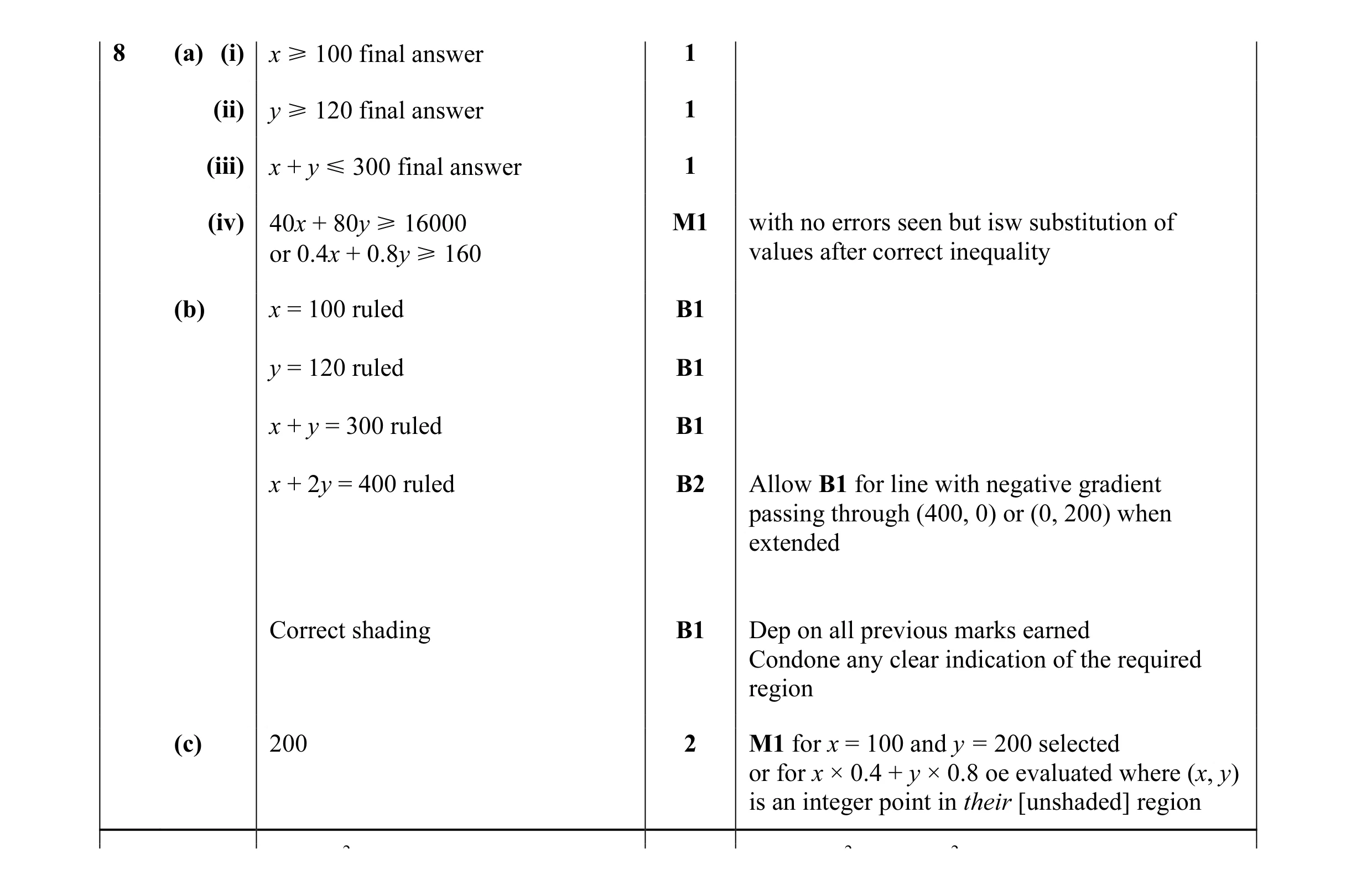
8 Sima sells x biscuits and y cakes. (a) (i) She sells at least 100 biscuits. Write down an inequality in x. Answer(a)(i) … [1] (ii) She sells at least 120 cakes. Write down an inequality in y. Answer(a)(ii) … [1] (iii) She sells a maximum of 300 biscuits and cakes altogether. Write down an inequality in x and y. Answer(a)(iii) … [1] (iv) Sima makes a profit of 40 cents on each biscuit and 80 cents on each cake. Her total profit is at least $160. Show that x + 2y 400. Answer(a)(iv) [1] (b) On the grid, draw four lines to show the four inequalities and shade the unwanted regions. y 400 300 200 100 x 0 100 200 300 400 500 [6] (c) Calculate Sima’s maximum profit. Give your answer in dollars. Answer(c) $ … [2] __________________________________________________________________________________________
12 marks
Mark scheme: 8 (a) (i) x [ 100 final answer 1 (ii) y [ 120 final answer 1 (iii) x + y Y 300 final answer 1 (iv) 40x + 80y [ 16000 M1 with no errors seen but isw substitution of or 0.4x + 0.8y [ 160 values after correct inequality (b) x = 100 ruled B1 y = 120 ruled B1 x + y = 300 ruled B1 x + 2y = 400 ruled B2 Allow B1 for line with negative gradient passing through (400, 0) or (0, 200) when extended Correct shading B1 Dep on all previous marks earned Condone any clear indication of the required region (c) 200 2 M1 for x = 100 and y = 200 selected or for x × 0.4 + y × 0.8 oe evaluated where (x, y) is an integer point in their [unshaded] region 2 2 2
This question in 0580/42 May/June 2015
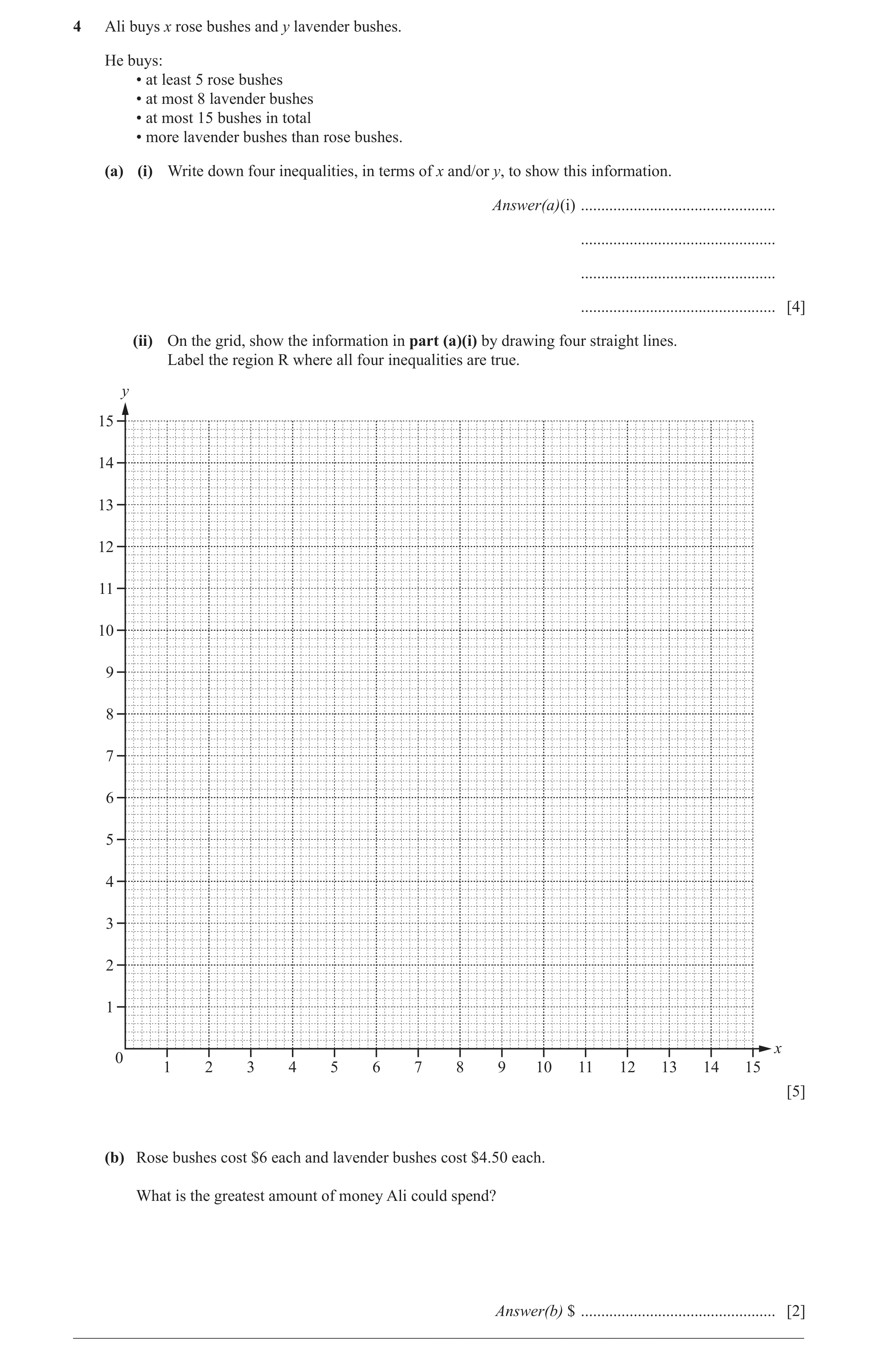
Q15 · Ali buys x rose bushes and y lavender bushes 0580/41 Oct/Nov 2015
4 Ali buys x rose bushes and y lavender bushes. He buys: • at least 5 rose bushes • at most 8 lavender bushes • at most 15 bushes in total • more lavender bushes than rose bushes. (a) (i) Write down four inequalities, in terms of x and/or y, to show this information. Answer(a)(i) … … … … [4] (ii) On the grid, show the information in part (a)(i) by drawing four straight lines. Label the region R where all four inequalities are true. y 15 14 13 12 11 10 9 8 7 6 5 4 3 2 1 x 0 1 2 3 4 5 6 7 8 9 10 11 12 13 14 15 [5] (b) Rose bushes cost $6 each and lavender bushes cost $4.50 each. What is the greatest amount of money Ali could spend? Answer(b) $ … [2] __________________________________________________________________________________________
11 marks
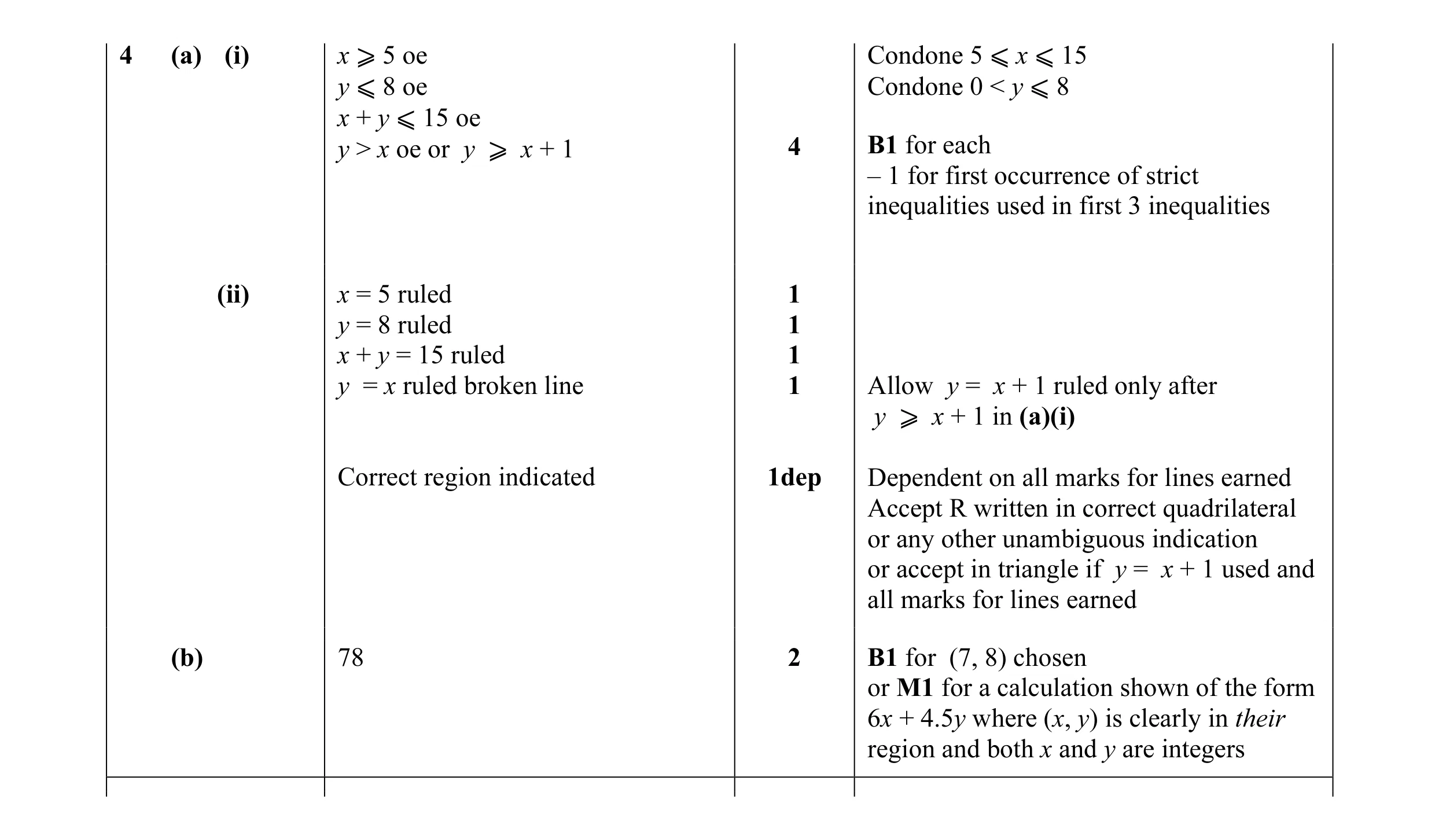
Mark scheme: 4 (a) (i) x ⩾ 5 oe Condone 5 ⩽ x ⩽ 15 y ⩽ 8 oe Condone 0 < y ⩽ 8 x + y ⩽ 15 oe y > x oe or y ⩾ x + 1 4 B1 for each – 1 for first occurrence of strict inequalities used in first 3 inequalities (ii) x = 5 ruled 1 y = 8 ruled 1 x + y = 15 ruled 1 y = x ruled broken line 1 Allow y = x + 1 ruled only after y ⩾ x + 1 in (a)(i) Correct region indicated 1dep Dependent on all marks for lines earned Accept R written in correct quadrilateral or any other unambiguous indication or accept in triangle if y = x + 1 used and all marks for lines earned (b) 78 2 B1 for (7, 8) chosen or M1 for a calculation shown of the form 6x + 4.5y where (x, y) is clearly in their region and both x and y are integers
This question in 0580/41 Oct/Nov 2015
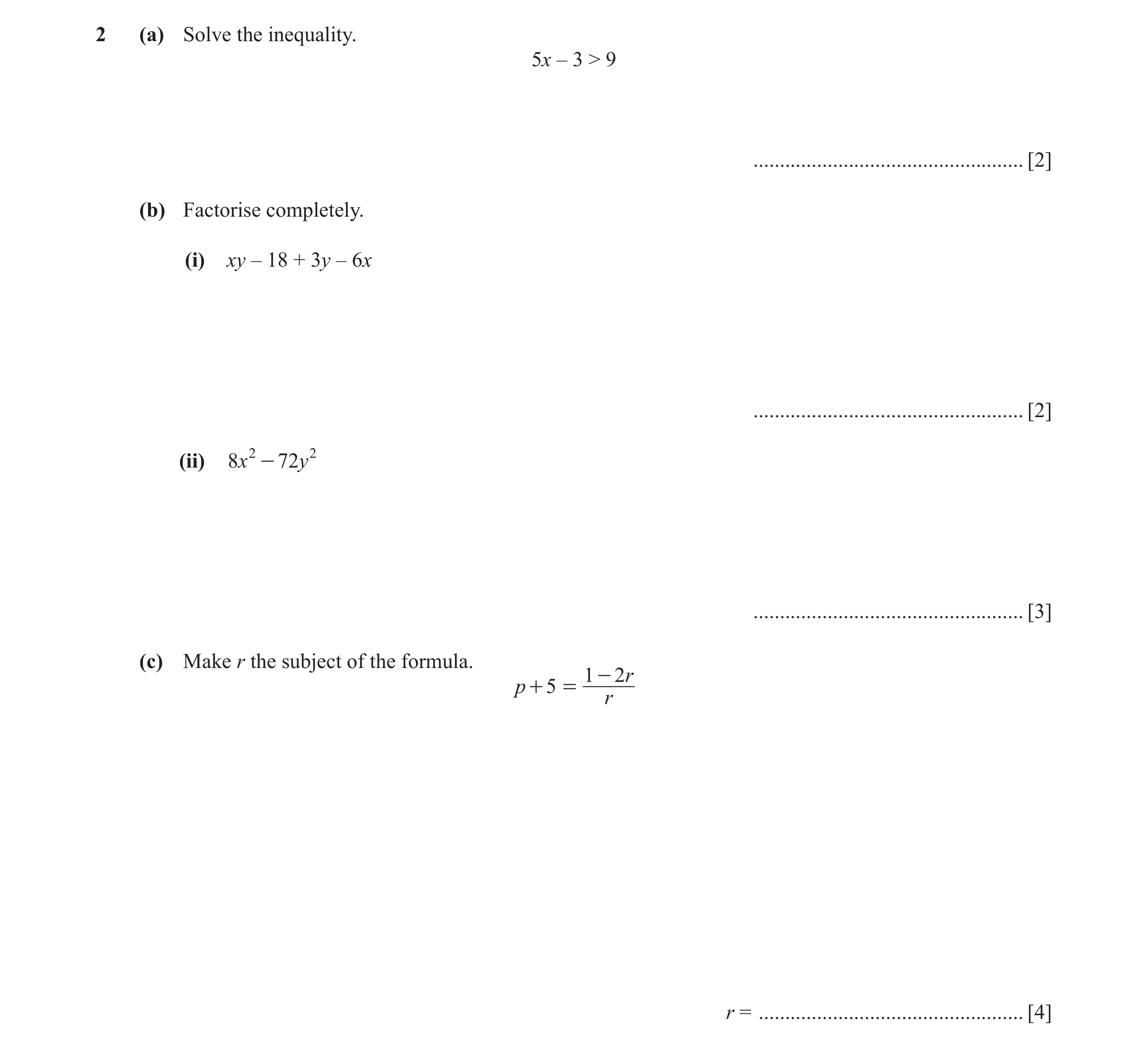
Question 16 0580/43 May/June 2016
2 (a) Solve the inequality. 5x – 3 > 9 … [2] (b) Factorise completely. (i) xy – 18 + 3y – 6x … [2] (ii) 8x 2 - 72y 2 … [3] (c) Make r the subject of the formula. 1 - 2r p + 5 = r r = … [4]
11 marks
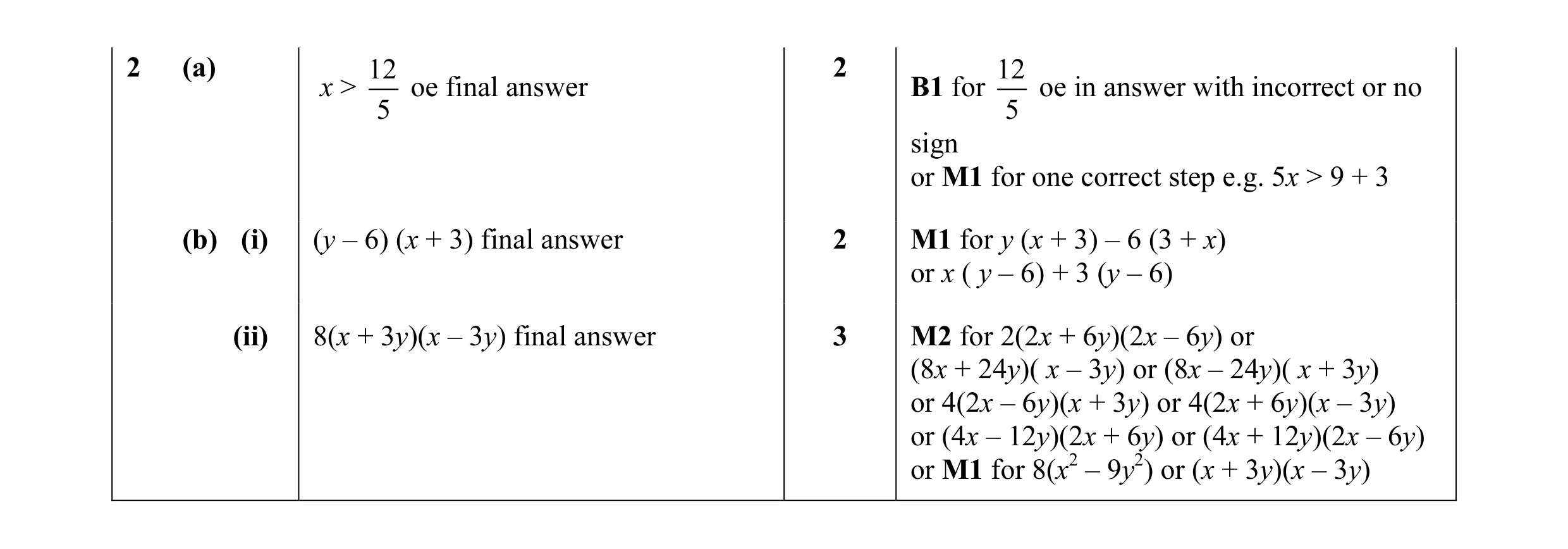
Mark scheme: 2 (a) 12 2 12 x > oe final answer B1 for oe in answer with incorrect or no 5 5 sign or M1 for one correct step e.g. 5x > 9 + 3 (b) (i) (y – 6) (x + 3) final answer 2 M1 for y (x + 3) – 6 (3 + x) or x ( y – 6) + 3 (y – 6) (ii) 8(x + 3y)(x – 3y) final answer 3 M2 for 2(2x + 6y)(2x – 6y) or (8x + 24y)( x – 3y) or (8x – 24y)( x + 3y) or 4(2x – 6y)(x + 3y) or 4(2x + 6y)(x – 3y) or (4x – 12y)(2x + 6y) or (4x + 12y)(2x – 6y) or M1 for 8(x2 – 9y2) or (x + 3y)(x – 3y)
This question in 0580/43 May/June 2016
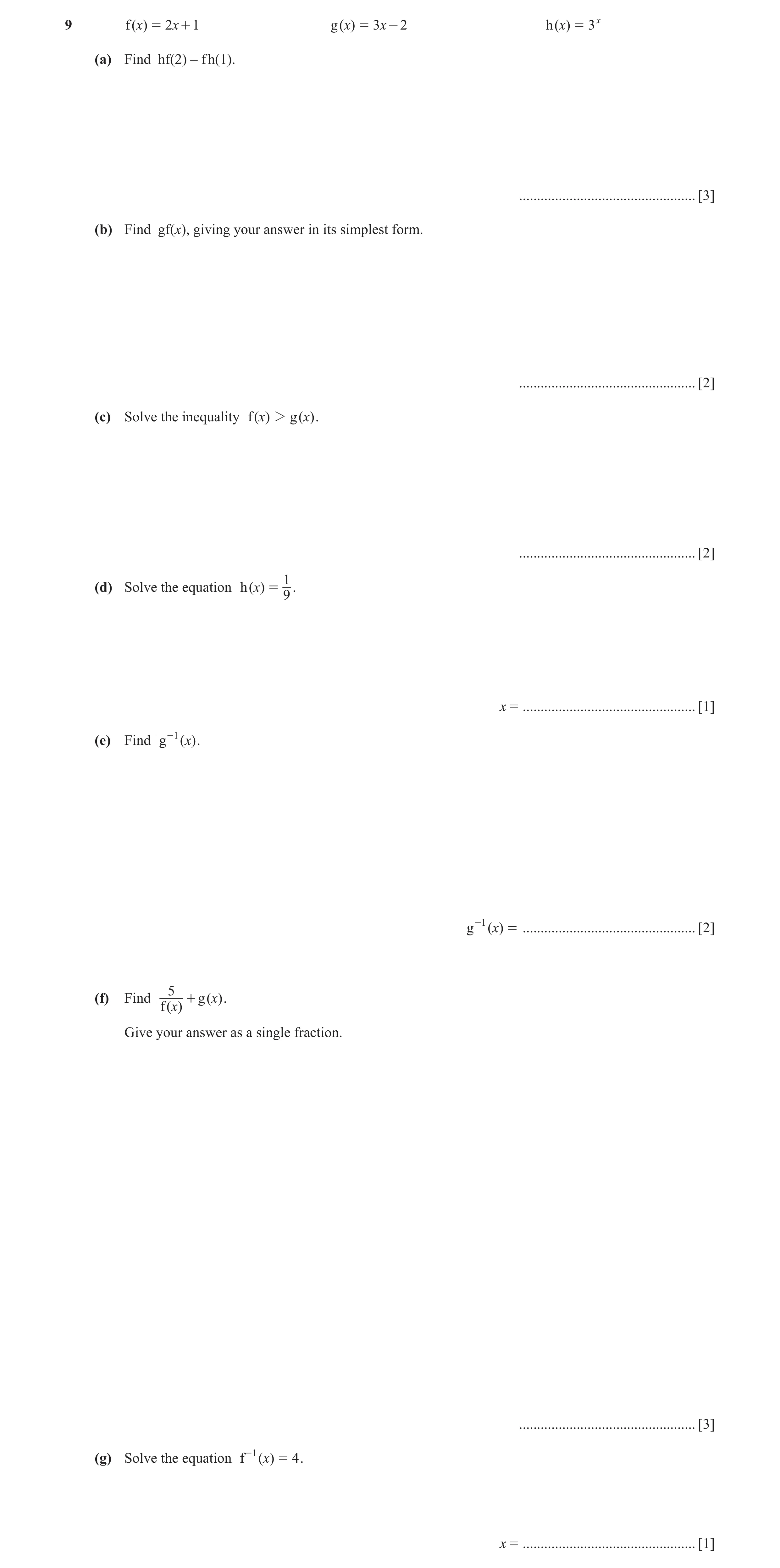
Q17 · F(x) = 2x + 1 g(x) = 3x - 2 h(x) = 3 x (a) Find hf(2) – f h(1) 0580/41 Oct/Nov 2016
9 f(x) = 2x + 1 g(x) = 3x - 2 h(x) = 3 x (a) Find hf(2) – f h(1). … [3] (b) Find gf(x), giving your answer in its simplest form. … [2] (c) Solve the inequality f(x) 2 g (x) . … [2] 1 (d) Solve the equation h(x) = . 9 x = … [1] (e) Find g -1 ()x . g -1 ()x = … [2] 5(f) Find + g(x) . f(x) Give your answer as a single fraction. … [3] (g) Solve the equation f -1 (x) = 4 . x = … [1]
14 marks
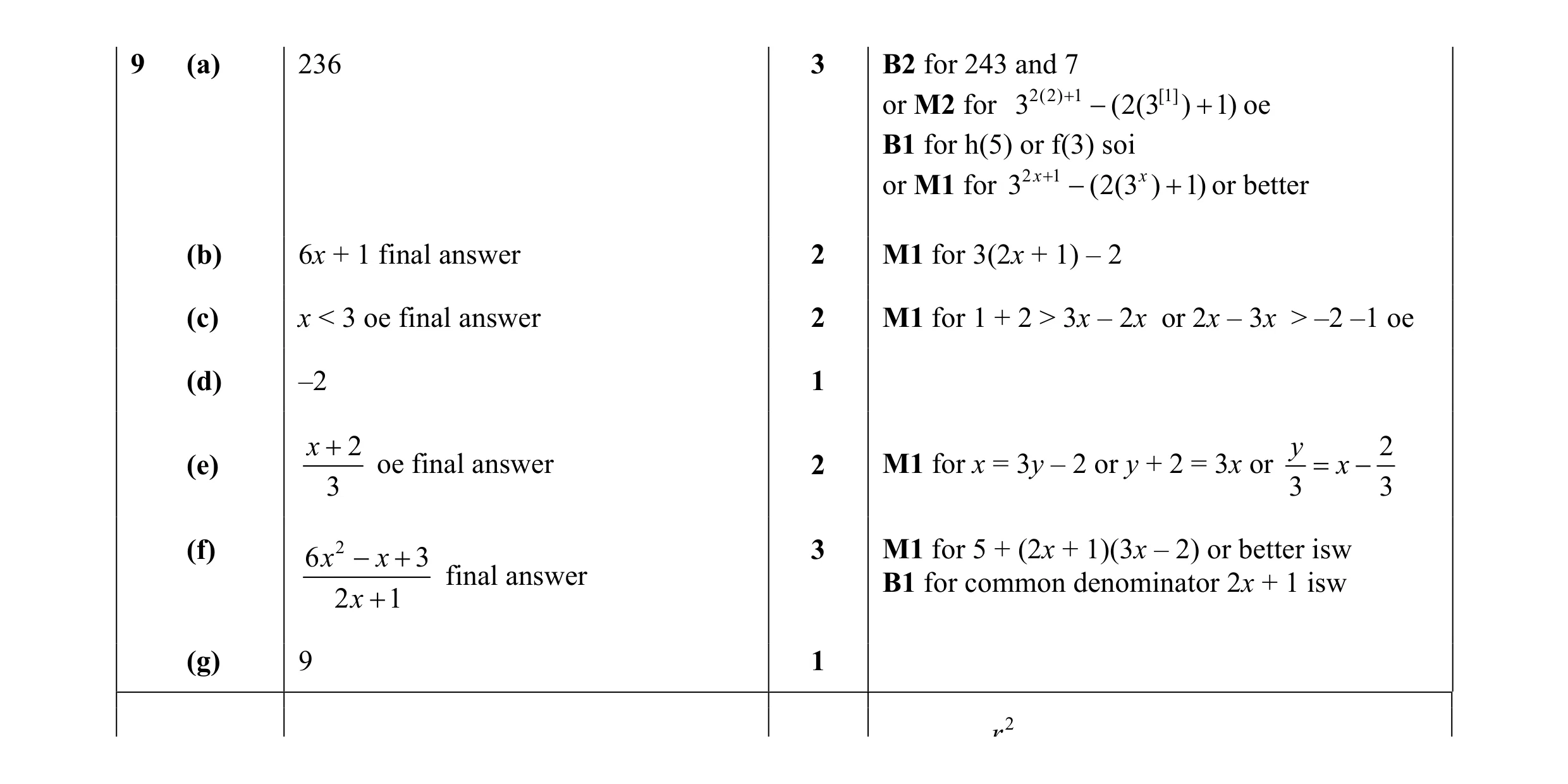
Mark scheme: 9 (a) 236 3 B2 for 243 and 7 or M2 for 32(2) +1 − (2(3[1] ) + 1) oe B1 for h(5) or f(3) soi or M1 for 32 x +1 − (2(3 x ) + 1) or better (b) 6x + 1 final answer 2 M1 for 3(2x + 1) – 2 (c) x < 3 oe final answer 2 M1 for 1 + 2 > 3x – 2x or 2x – 3x > –2 –1 oe (d) –2 1 x + 2 y 2 (e) oe final answer 2 M1 for x = 3y – 2 or y + 2 = 3x or = x − 3 3 3 (f) 6 x 2 − x + 3 3 M1 for 5 + (2x + 1)(3x – 2) or better isw final answer B1 for common denominator 2x + 1 isw 2 x + 1 (g) 9 1 2r
This question in 0580/41 Oct/Nov 2016
Question 18 0580/43 Oct/Nov 2016
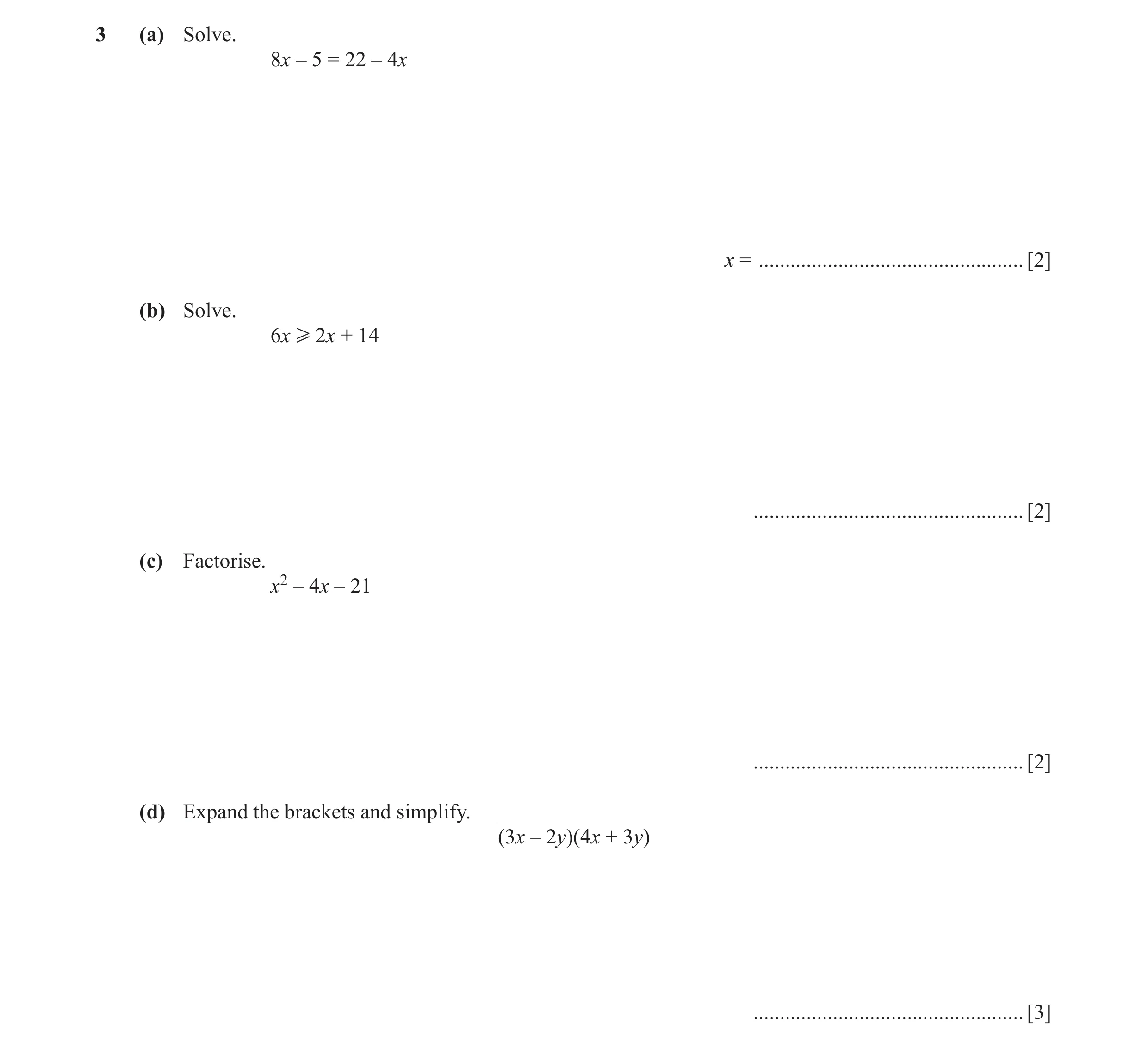
3 (a) Solve. 8x – 5 = 22 – 4x x = … [2] (b) Solve. 6x H 2x + 14 … [2] (c) Factorise. x2 – 4x – 21 … [2] (d) Expand the brackets and simplify. (3x – 2y)(4x + 3y) … [3]
9 marks
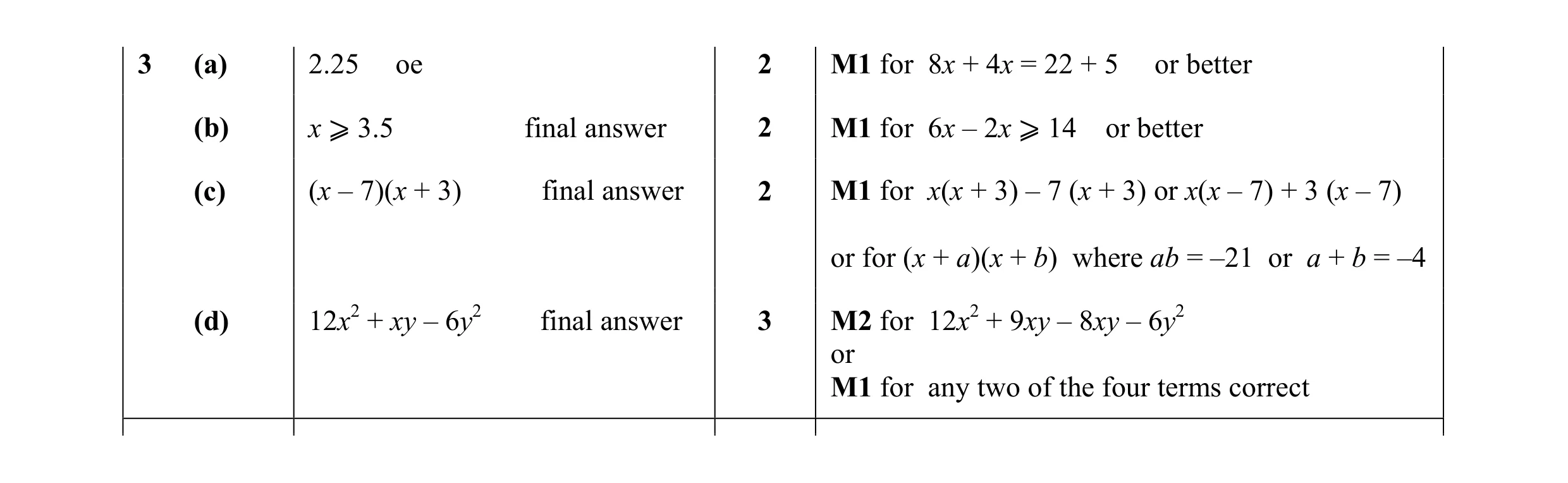
Mark scheme: 3 (a) 2.25 oe 2 M1 for 8x + 4x = 22 + 5 or better (b) x ⩾ 3.5 final answer 2 M1 for 6x – 2x ⩾ 14 or better (c) (x – 7)(x + 3) final answer 2 M1 for x(x + 3) – 7 (x + 3) or x(x – 7) + 3 (x – 7) or for (x + a)(x + b) where ab = –21 or a + b = –4 (d) 12x2 + xy – 6y2 final answer 3 M2 for 12x2 + 9xy – 8xy – 6y2 or M1 for any two of the four terms correct
This question in 0580/43 Oct/Nov 2016
Q19 · Bernie buys x packets of seeds and y plants for his garden 0580/42 Feb/March 2017
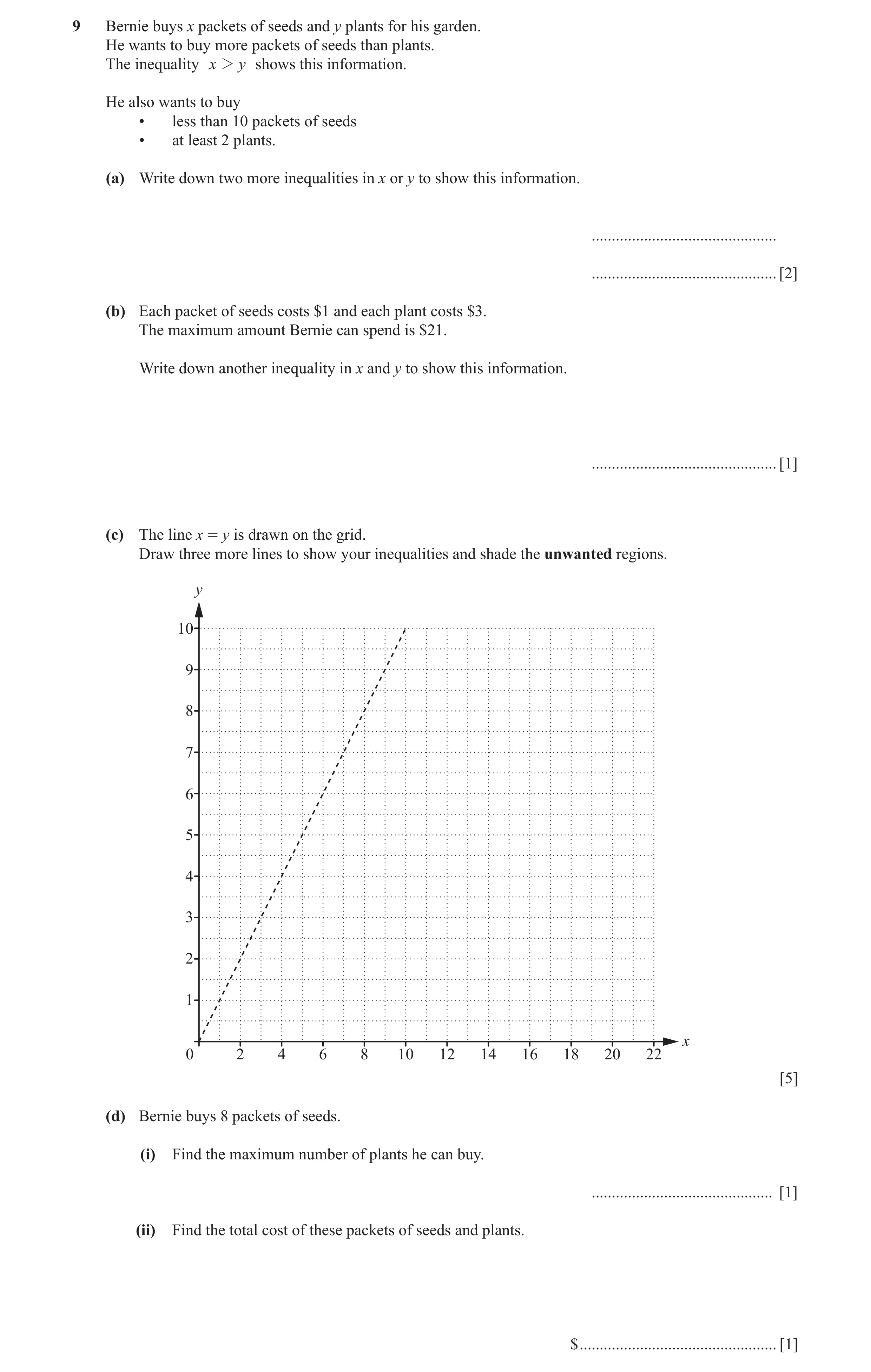
9 Bernie buys x packets of seeds and y plants for his garden. He wants to buy more packets of seeds than plants. The inequality x 2 y shows this information. He also wants to buy • less than 10 packets of seeds • at least 2 plants. (a) Write down two more inequalities in x or y to show this information. … … [2] (b) Each packet of seeds costs $1 and each plant costs $3. The maximum amount Bernie can spend is $21. Write down another inequality in x and y to show this information. … [1] (c) The line x = y is drawn on the grid. Draw three more lines to show your inequalities and shade the unwanted regions. y 10 9 8 7 6 5 4 3 2 1 x 0 2 4 6 8 10 12 14 16 18 20 22 [5] (d) Bernie buys 8 packets of seeds. (i) Find the maximum number of plants he can buy. … [1] (ii) Find the total cost of these packets of seeds and plants. $ … [1]
10 marks
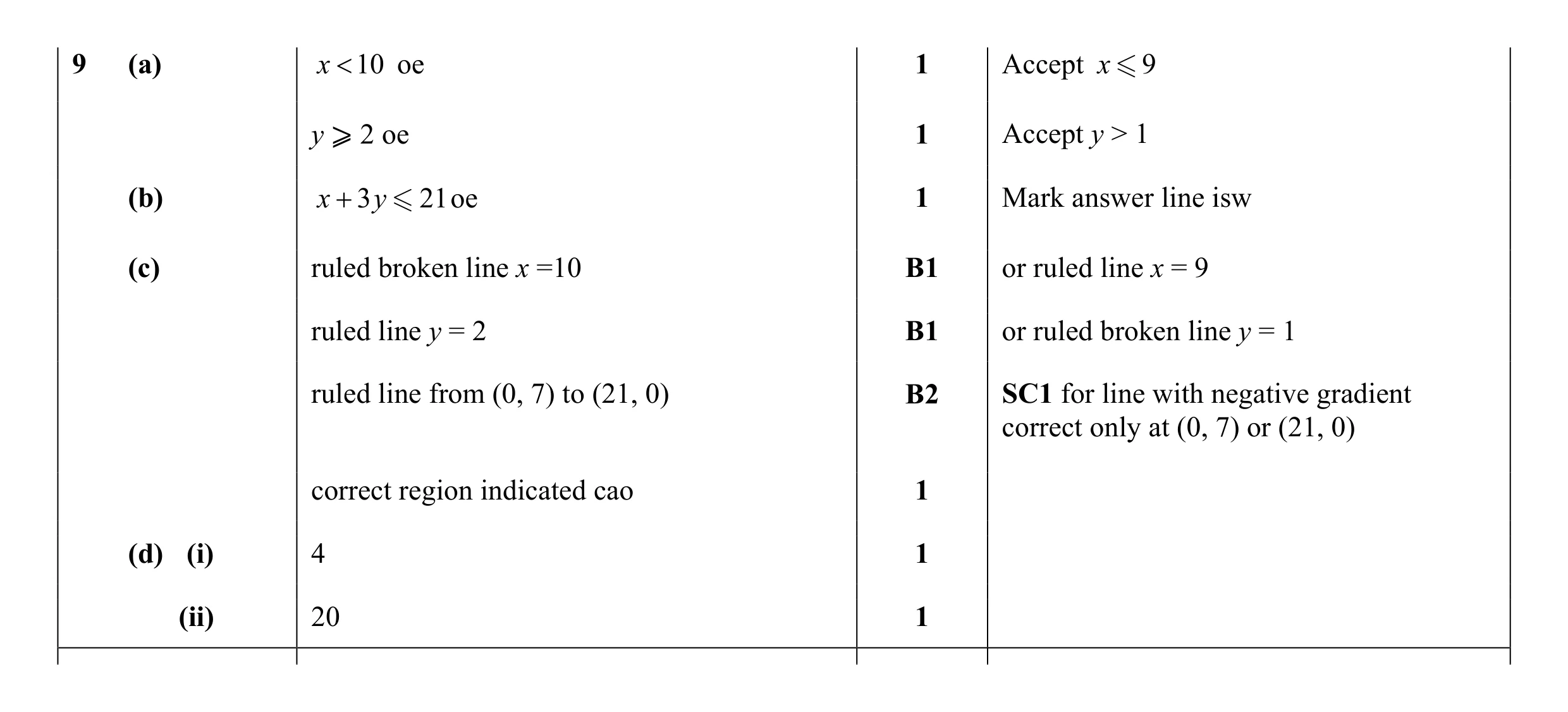
Mark scheme: 9 (a) x < 10 oe 1 Accept x - 9 y ⩾ 2 oe 1 Accept y > 1 (b) x + 3 y - 21 oe 1 Mark answer line isw (c) ruled broken line x =10 B1 or ruled line x = 9 ruled line y = 2 B1 or ruled broken line y = 1 ruled line from (0, 7) to (21, 0) B2 SC1 for line with negative gradient correct only at (0, 7) or (21, 0) correct region indicated cao 1 (d) (i) 4 1 (ii) 20 1
This question in 0580/42 Feb/March 2017
Q20 · Find the equation of the straight line that is perpendicular to the line y = x + 1 and… 0580/43 May/June 2018
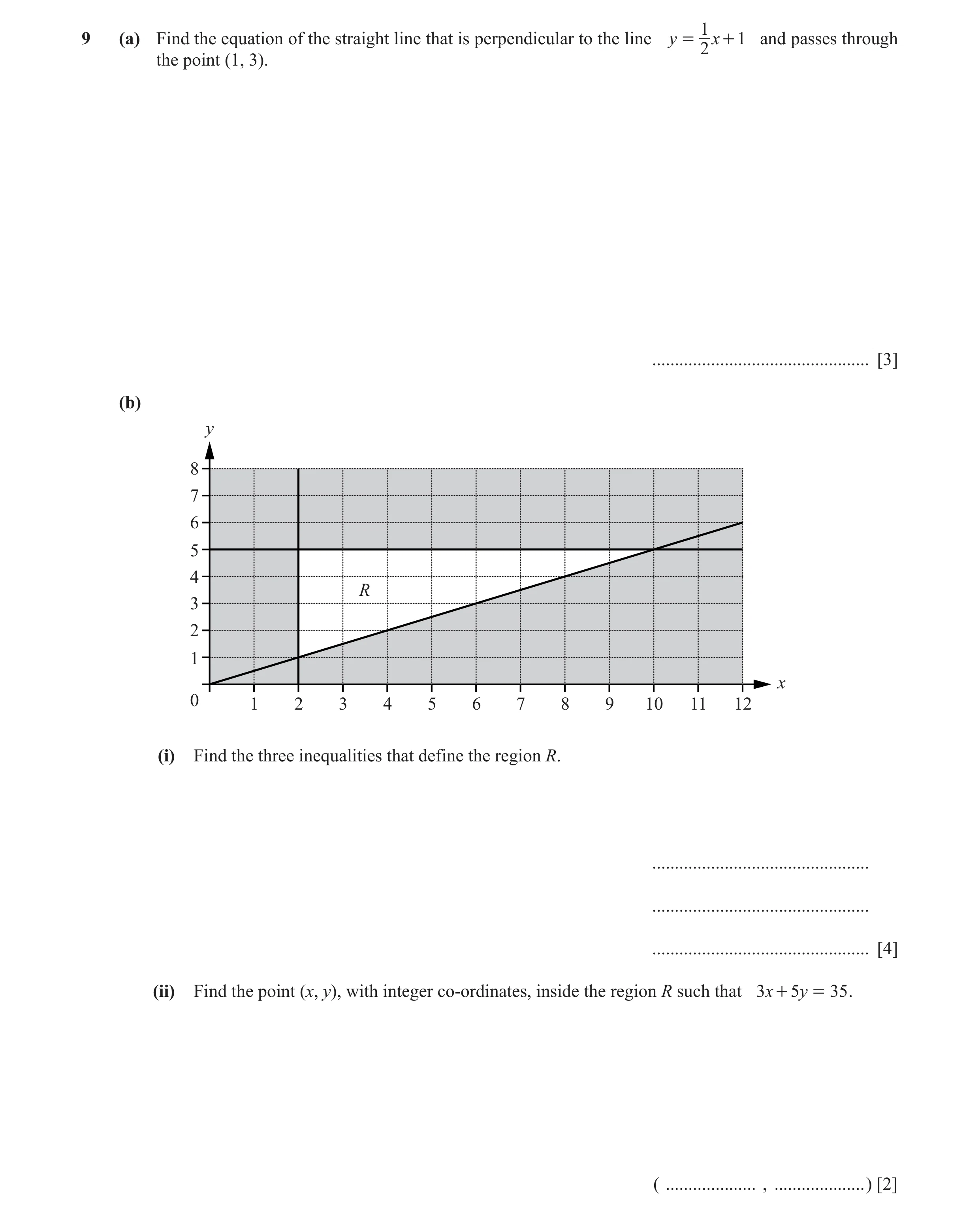
19 (a) Find the equation of the straight line that is perpendicular to the line y = x + 1 and passes through 2 the point (1, 3). … [3] (b) y 8 7 6 5 4 R 3 2 1 x 0 1 2 3 4 5 6 7 8 9 10 11 12 (i) Find the three inequalities that define the region R. … … … [4] (ii) Find the point (x, y), with integer co-ordinates, inside the region R such that 3x + 5y = 35 . ( … , … ) [2]
9 marks
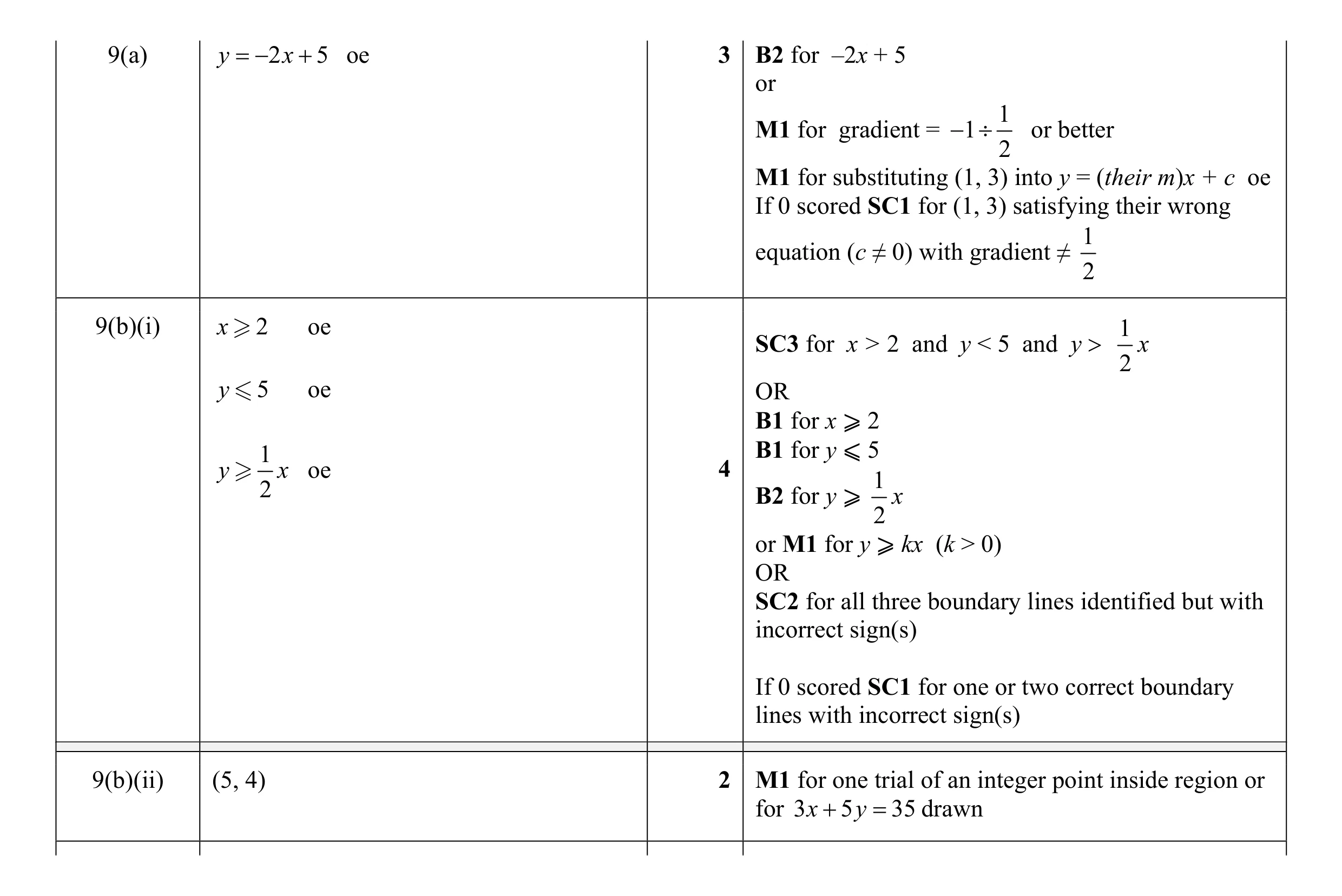
Mark scheme: 9(a) y = −2 x + 5 oe 3 B2 for –2x + 5 or 1 M1 for gradient = −÷1 or better 2 M1 for substituting (1, 3) into y = (their m)x + c oe If 0 scored SC1 for (1, 3) satisfying their wrong 1 equation (c ≠ 0) with gradient ≠ 2 9(b)(i) x . 2 oe 1 SC3 for x > 2 and y < 5 and y > x 2 y - 5 oe OR B1 for x ⩾ 2 1 B1 for y ⩽ 5 y . x oe 4 1 2 B2 for y ⩾ x 2 or M1 for y ⩾ kx (k > 0) OR SC2 for all three boundary lines identified but with incorrect sign(s) If 0 scored SC1 for one or two correct boundary lines with incorrect sign(s) 9(b)(ii) (5, 4) 2 M1 for one trial of an integer point inside region or for 3 x + 5 y = 35 drawn
This question in 0580/43 May/June 2018
Q21 · Solve the simultaneous equations 0580/42 Feb/March 2019
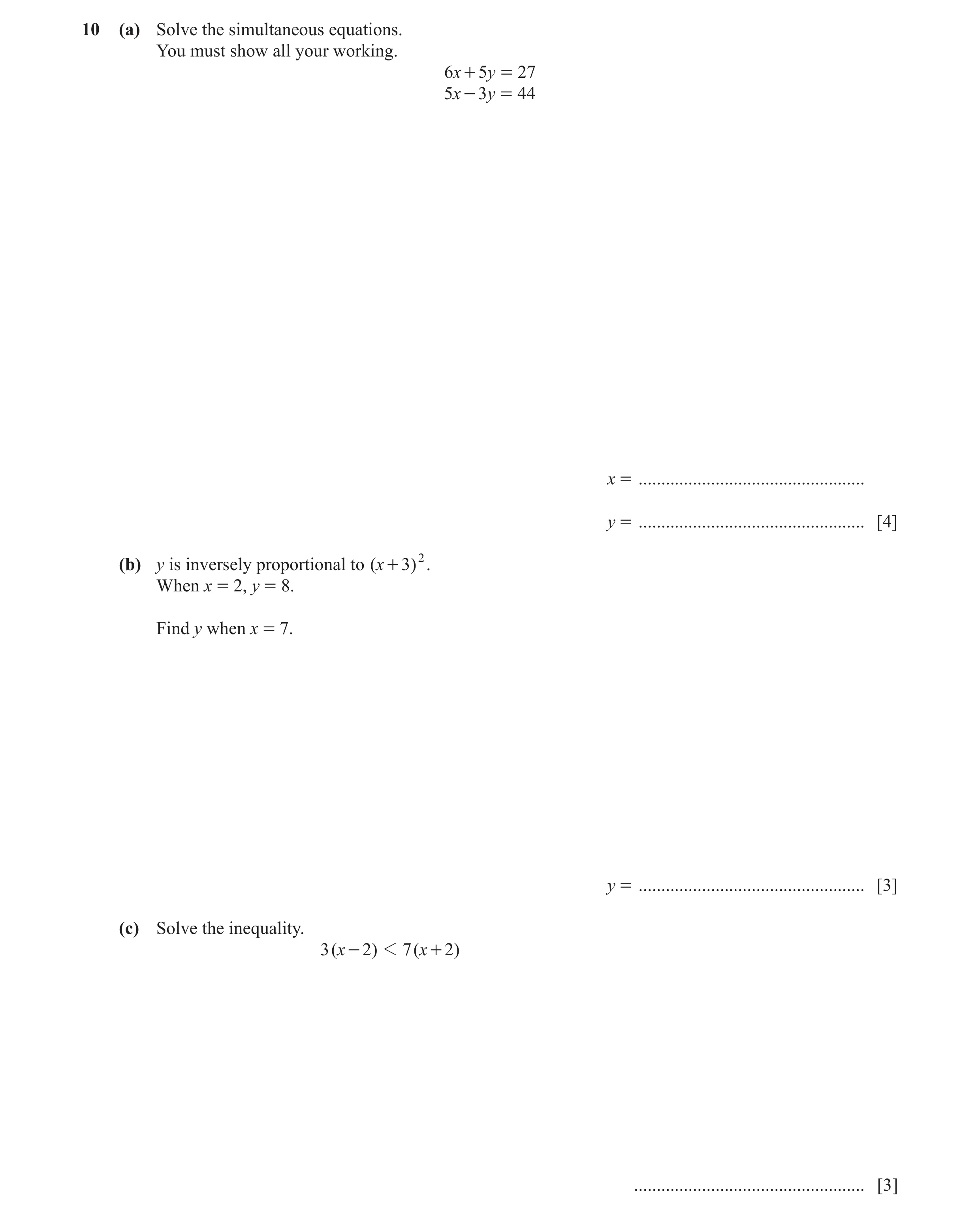
10 (a) Solve the simultaneous equations. You must show all your working. 6x + 5y = 27 5x - 3y = 44 x = … y = … [4] (b) y is inversely proportional to (x + 3) 2 . When x = 2, y = 8. Find y when x = 7. y = … [3] (c) Solve the inequality. 3 (x - 2) 1 7 (x + 2) … [3]
10 marks
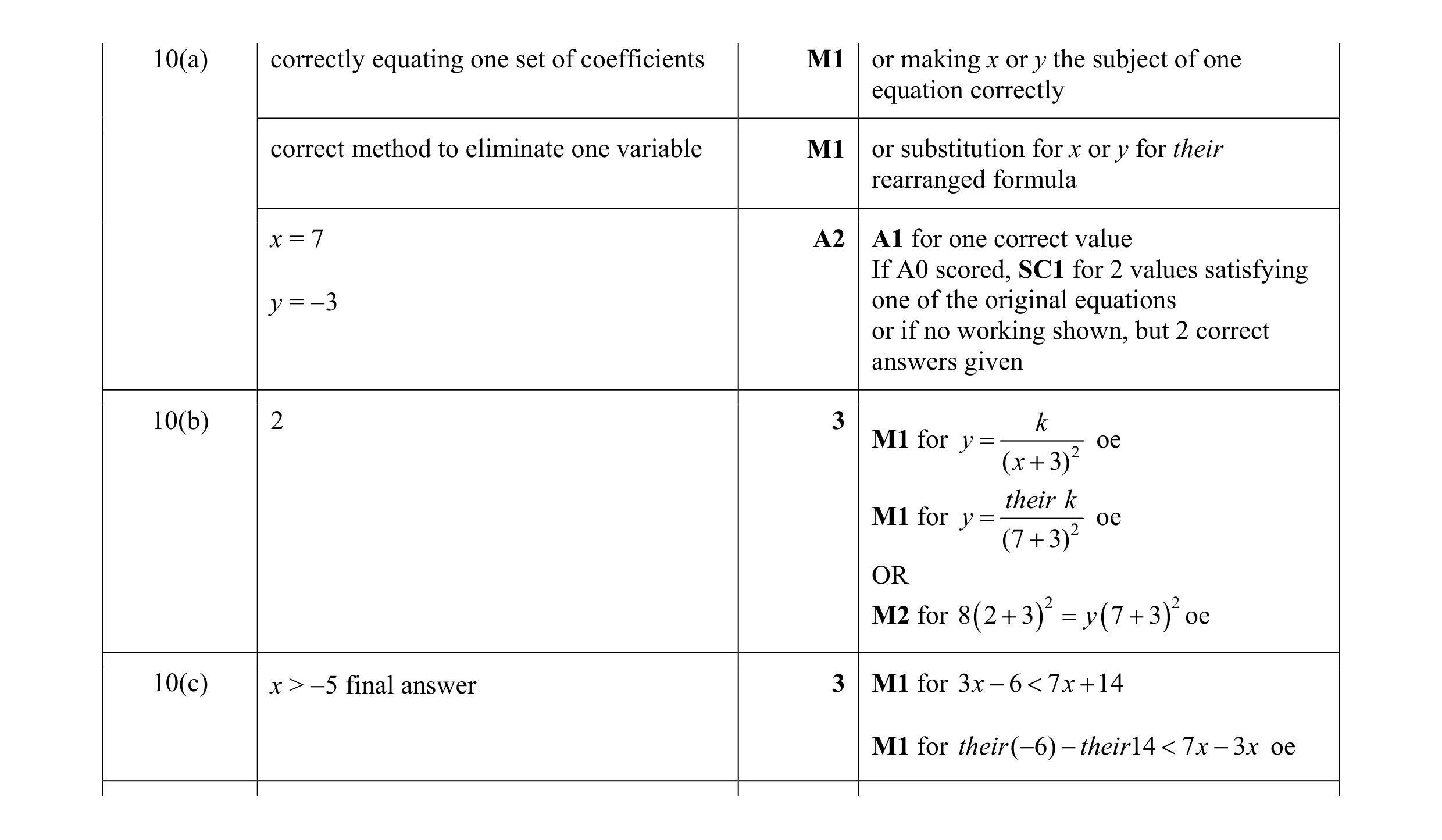
Mark scheme: 10(a) correctly equating one set of coefficients M1 or making x or y the subject of one equation correctly correct method to eliminate one variable M1 or substitution for x or y for their rearranged formula x = 7 A2 A1 for one correct value If A0 scored, SC1 for 2 values satisfying y = −3 one of the original equations or if no working shown, but 2 correct answers given 10(b) 2 3 k M1 for y = oe ( x + 3) 2 their k M1 for y = oe (7 + 3) 2 OR M2 for 8 ( 2 + 3 ) 2 = y ( 7 + 3 ) 2 oe 10(c) x > −5 final answer 3 M1 for 3 x − 6 < 7 x + 14 M1 for their ( −6) − their14 < 7 x − 3 x oe
This question in 0580/42 Feb/March 2019
Question 22 0580/43 May/June 2019
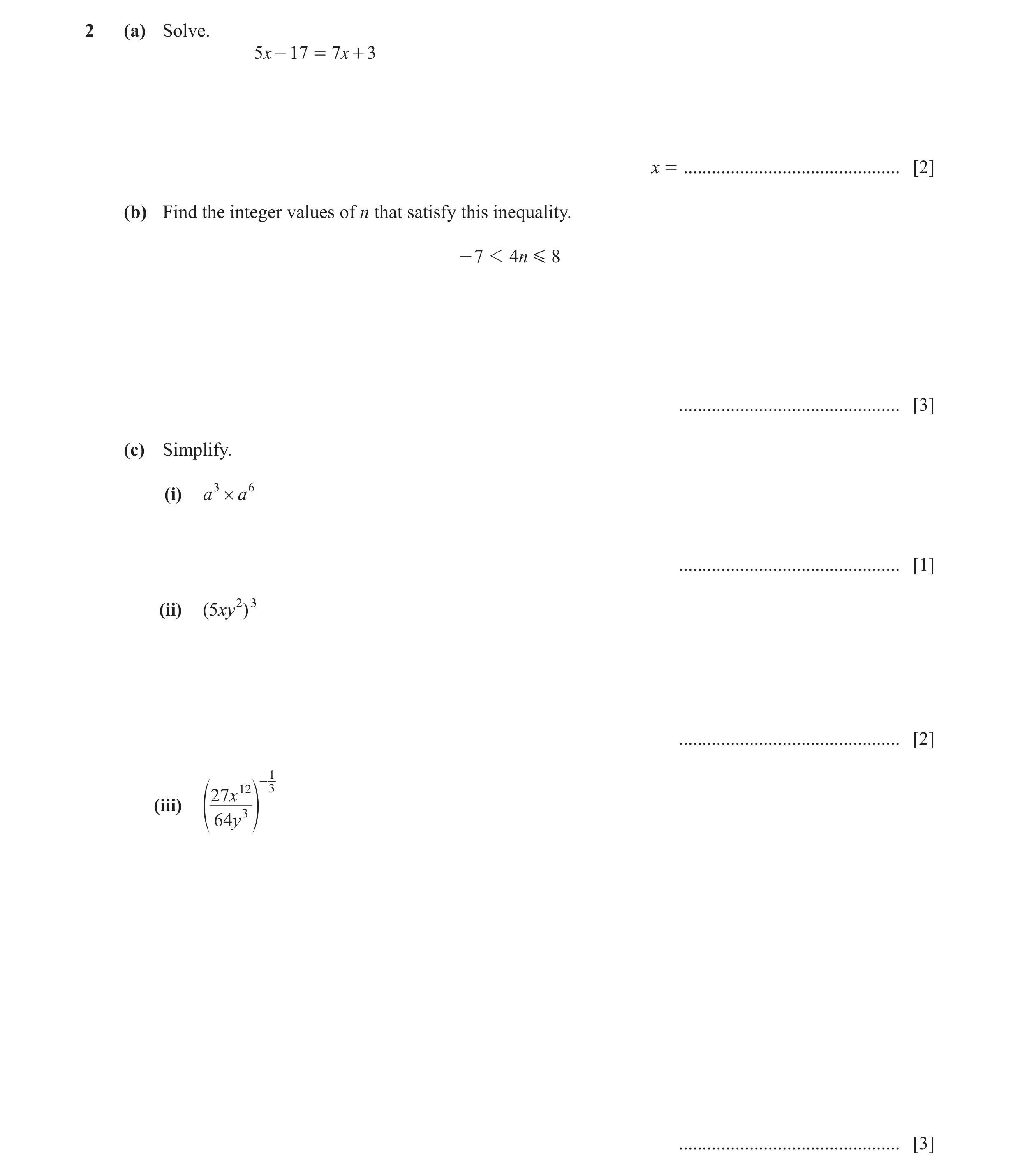
2 (a) Solve. 5x - 17 = 7x + 3 x = … [2] (b) Find the integer values of n that satisfy this inequality. - 7 1 4n G 8 … [3] (c) Simplify. (i) a 3 # a 6 … [1] (ii) (5xy 2 ) 3 … [2] 1 12 - 3 27x (iii) 3 f 64y p … [3]
11 marks
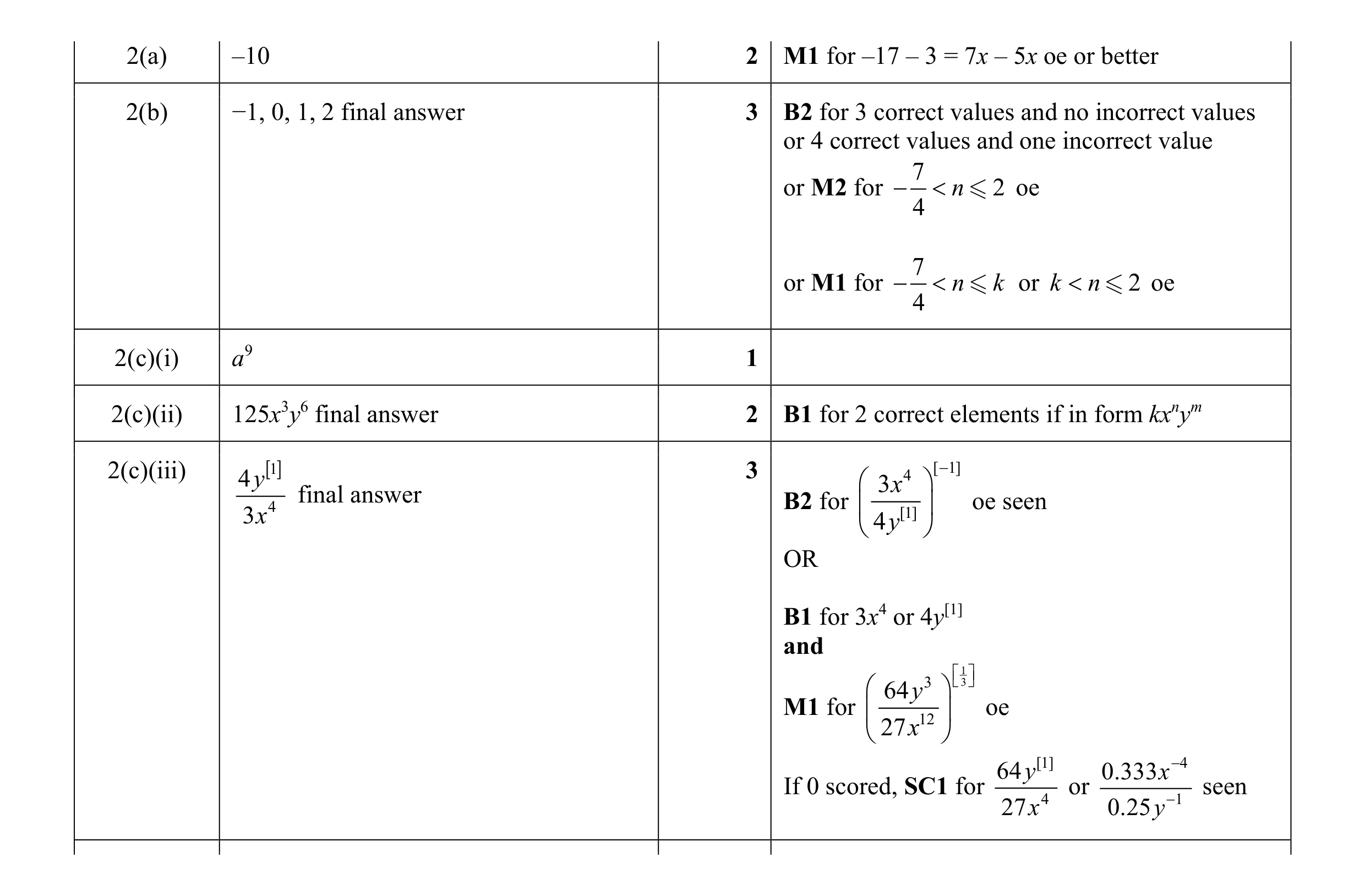
Mark scheme: 2(a) –10 2 M1 for –17 – 3 = 7x – 5x oe or better 2(b) −1, 0, 1, 2 final answer 3 B2 for 3 correct values and no incorrect values or 4 correct values and one incorrect value 7 or M2 for − < n - 2 oe 4 7 or M1 for − < n - k or k < n- 2 oe 4 2(c)(i) a9 1 2(c)(ii) 125x3y6 final answer 2 B1 for 2 correct elements if in form kxnym 2(c)(iii) []1 3 4 [ −1] 4 y 3 x 4 final answer B2 for [1] oe seen 3 x 4 y OR B1 for 3x4 or 4y[1] and 13 3 64 y M1 for 12 oe 27 x 64 y [1] 0.333 x − 4 If 0 scored, SC1 for or seen 27 x 4 0.25 y − 1
This question in 0580/43 May/June 2019
Q23 · A car hire company has x small cars and y large cars 0580/41 Oct/Nov 2019
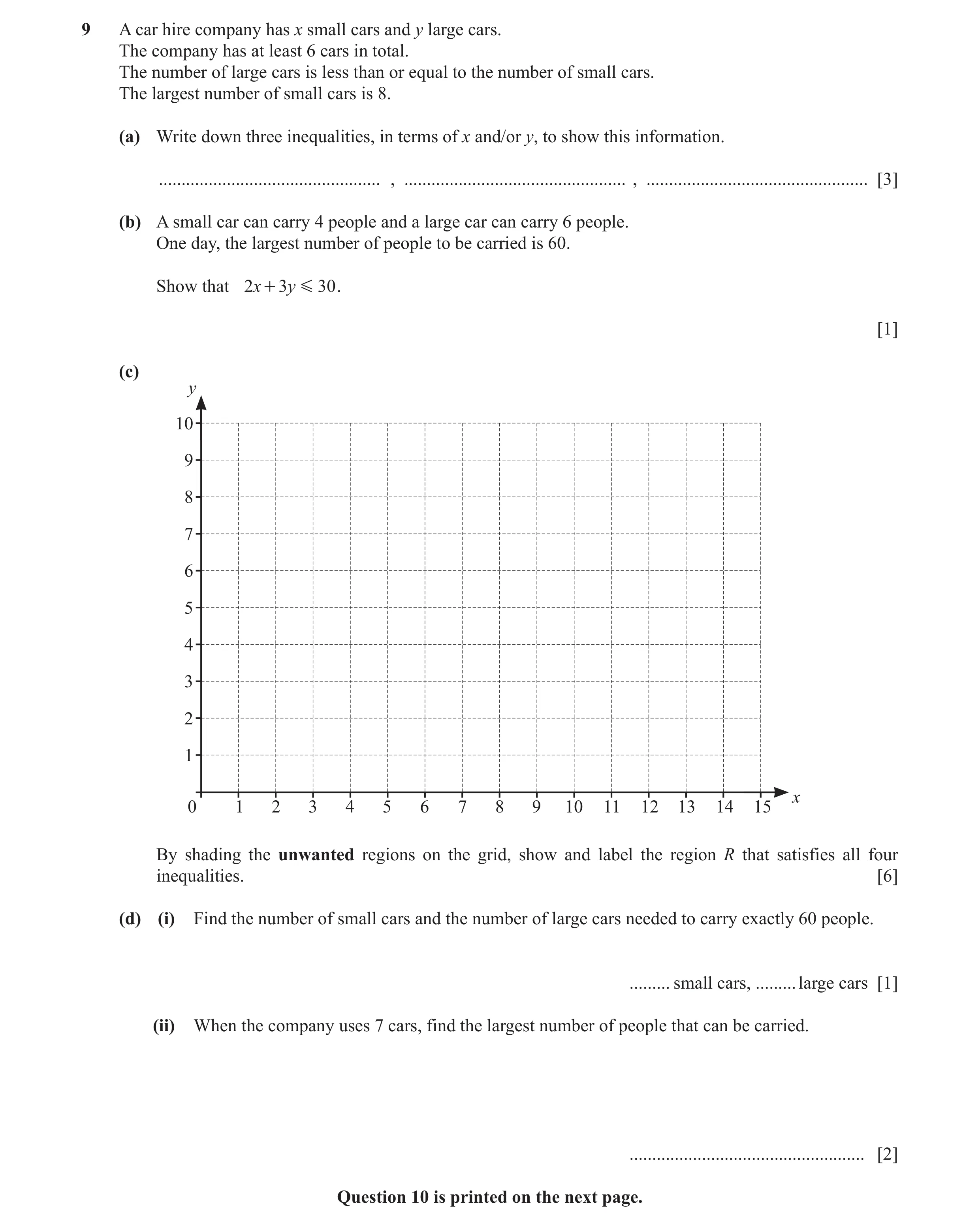
9 A car hire company has x small cars and y large cars. The company has at least 6 cars in total. The number of large cars is less than or equal to the number of small cars. The largest number of small cars is 8. (a) Write down three inequalities, in terms of x and/or y, to show this information. … , … , … [3] (b) A small car can carry 4 people and a large car can carry 6 people. One day, the largest number of people to be carried is 60. Show that 2x + 3y G 30 . [1] (c) y 10 9 8 7 6 5 4 3 2 1 x 0 1 2 3 4 5 6 7 8 9 10 11 12 13 14 15 By shading the unwanted regions on the grid, show and label the region R that satisfies all four inequalities. [6] (d) (i) Find the number of small cars and the number of large cars needed to carry exactly 60 people. … small cars, … large cars [1] (ii) When the company uses 7 cars, find the largest number of people that can be carried. … [2] Question 10 is printed on the next page.
13 marks
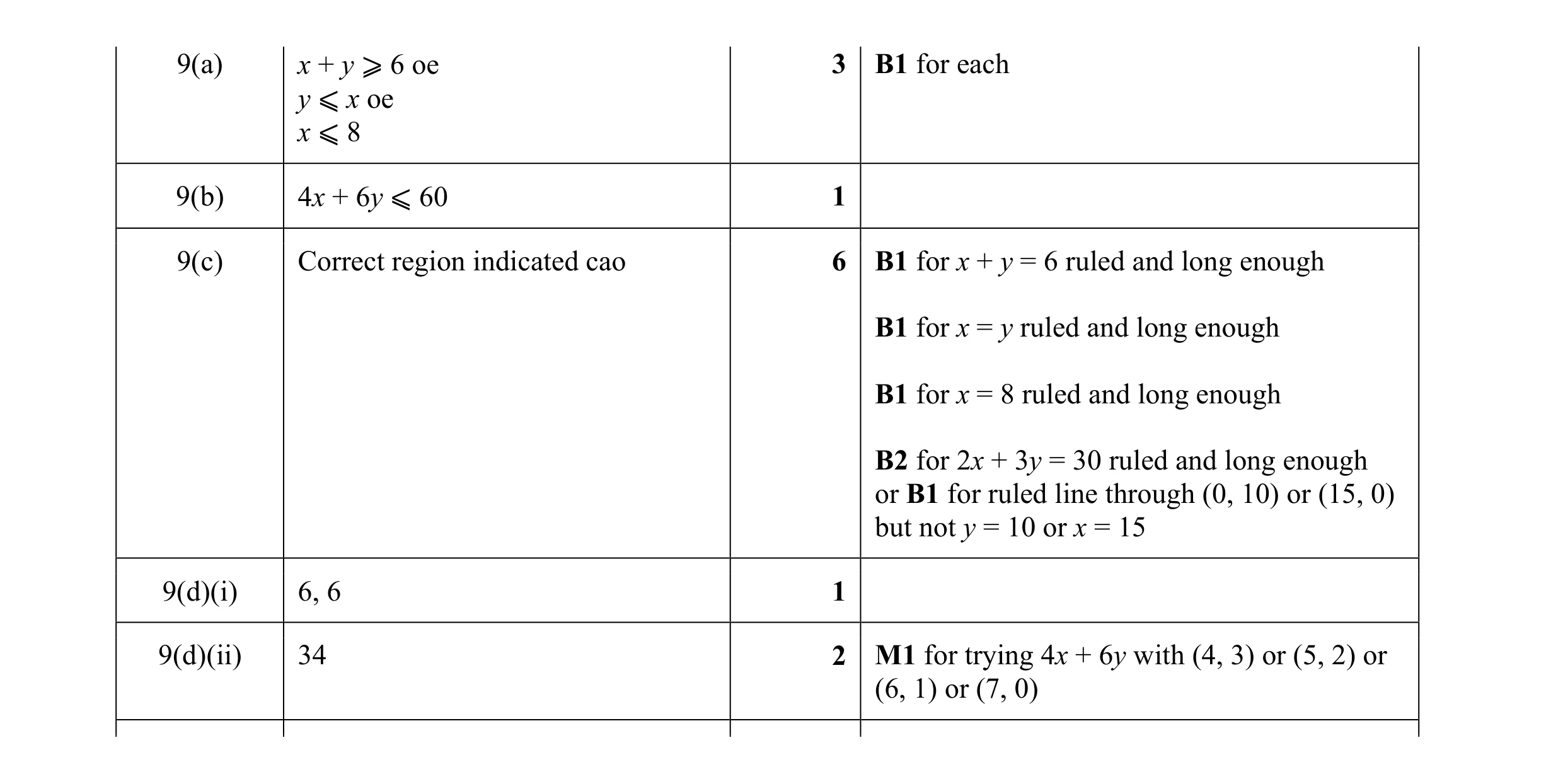
Mark scheme: 9(a) x + y ⩾ 6 oe 3 B1 for each y ⩽ x oe x ⩽ 8 9(b) 4x + 6y ⩽ 60 1 9(c) Correct region indicated cao 6 B1 for x + y = 6 ruled and long enough B1 for x = y ruled and long enough B1 for x = 8 ruled and long enough B2 for 2x + 3y = 30 ruled and long enough or B1 for ruled line through (0, 10) or (15, 0) but not y = 10 or x = 15 9(d)(i) 6, 6 1 9(d)(ii) 34 2 M1 for trying 4x + 6y with (4, 3) or (5, 2) or (6, 1) or (7, 0)
This question in 0580/41 Oct/Nov 2019
Q24 · Naga has n marbles 0580/42 Feb/March 2020
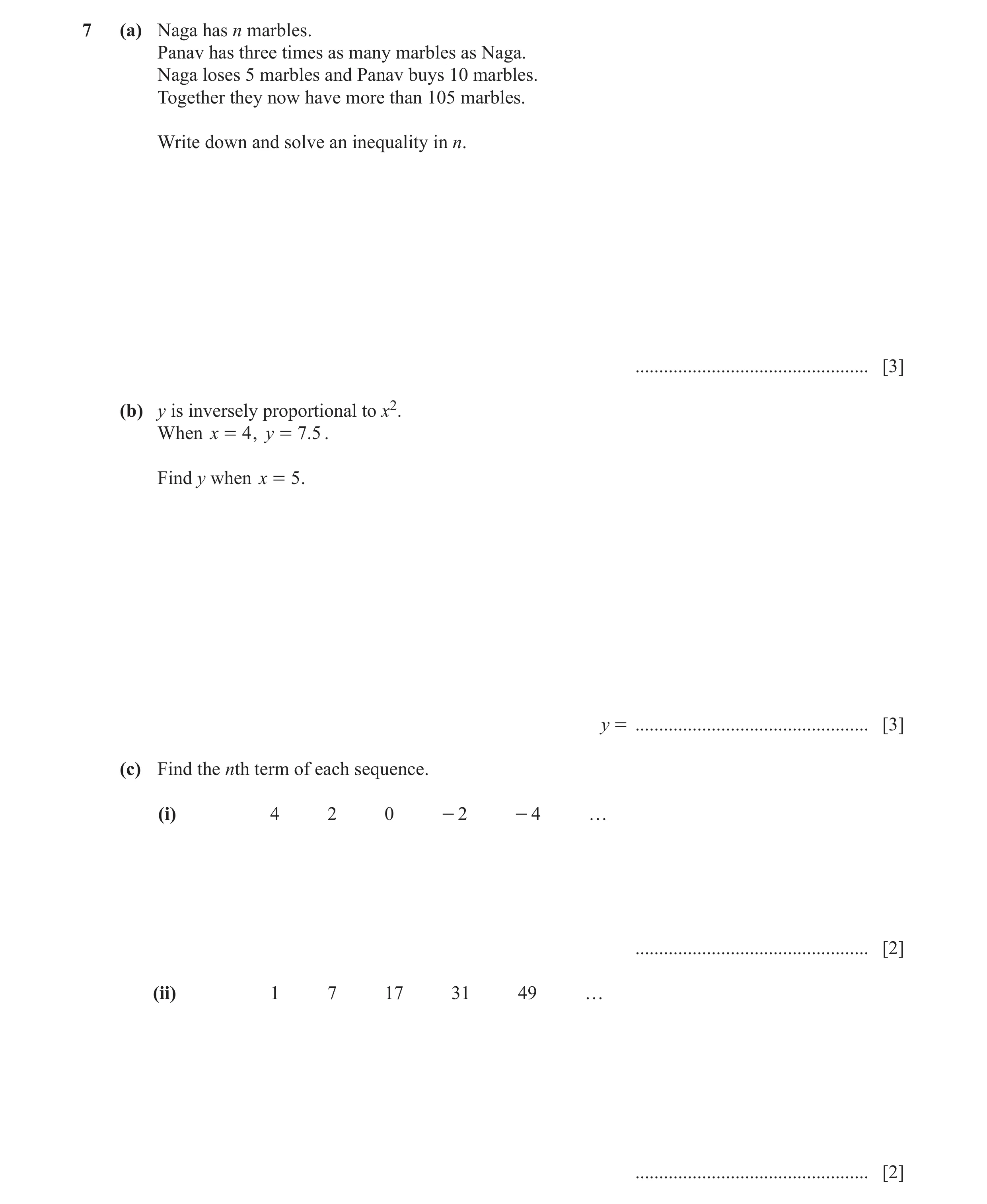
7 (a) Naga has n marbles. Panav has three times as many marbles as Naga. Naga loses 5 marbles and Panav buys 10 marbles. Together they now have more than 105 marbles. Write down and solve an inequality in n. … [3] (b) y is inversely proportional to x2. When x = 4 , y = 7.5 . Find y when x = 5 . y = … [3] (c) Find the nth term of each sequence. (i) 4 2 0 - 2 - 4 … … [2] (ii) 1 7 17 31 49 … … [2]
10 marks
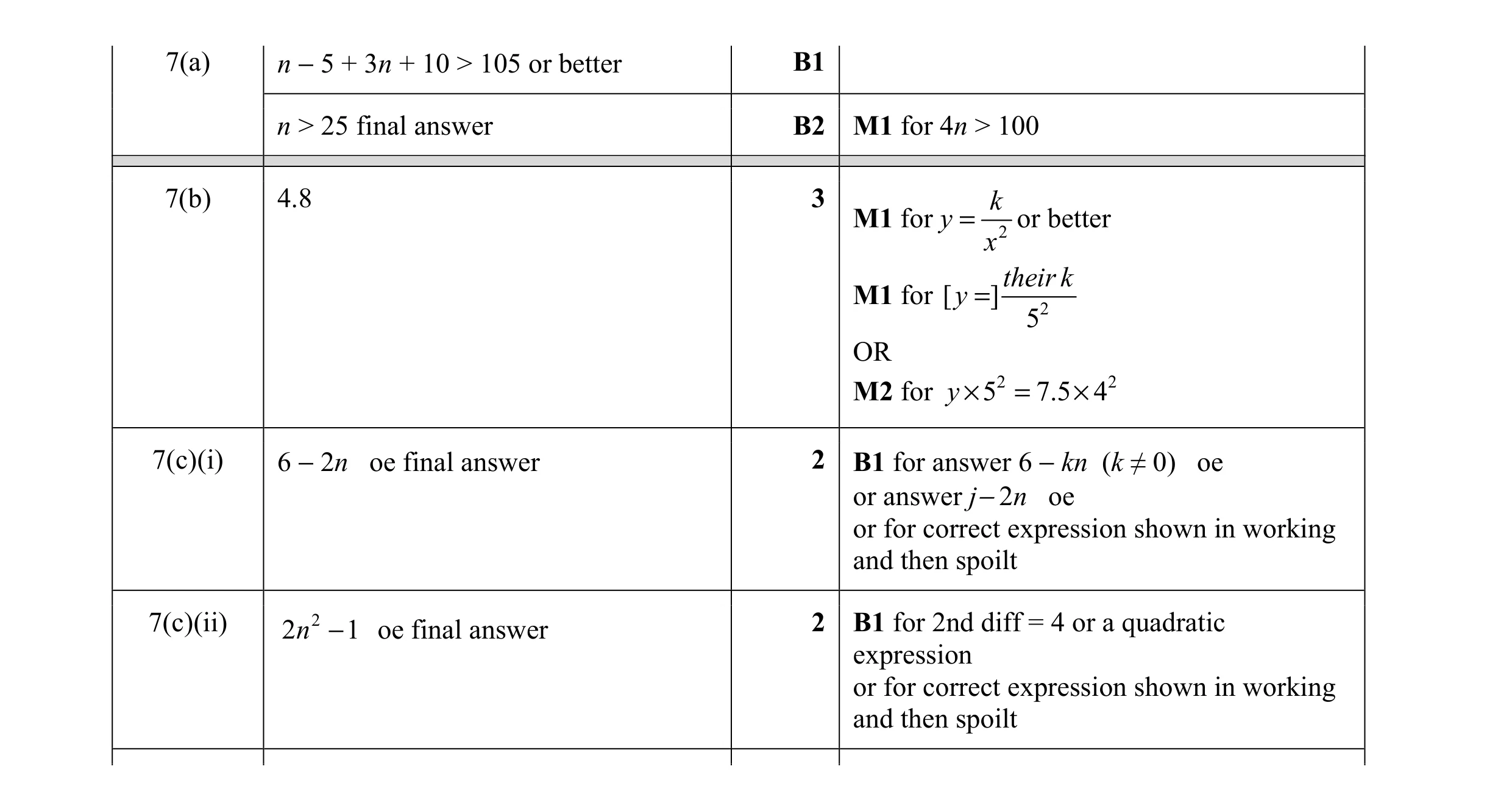
Mark scheme: 7(a) n − 5 + 3n + 10 > 105 or better B1 n > 25 final answer B2 M1 for 4n > 100 7(b) 4.8 3 k M1 for y = or better x 2 their k M1 for [ y = ] 5 2 OR M2 for y × 5 2 = 7.5 × 4 2 7(c)(i) 6 − 2n oe final answer 2 B1 for answer 6 − kn (k ≠ 0) oe or answer j−2n oe or for correct expression shown in working and then spoilt 7(c)(ii) 2 n 2 − 1 oe final answer 2 B1 for 2nd diff = 4 or a quadratic expression or for correct expression shown in working and then spoilt
This question in 0580/42 Feb/March 2020
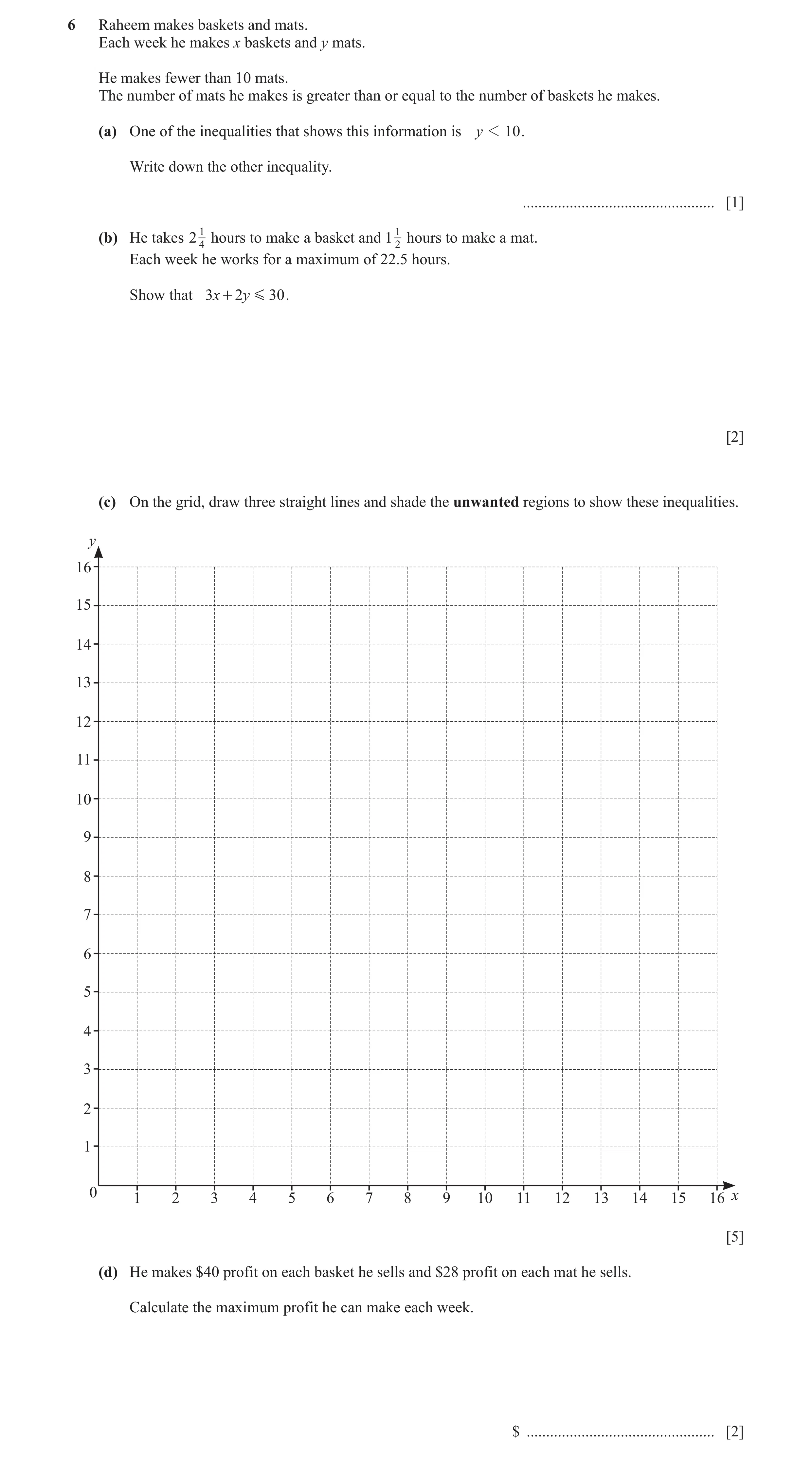
Q25 · Raheem makes baskets and mats 0580/41 May/June 2020
6 Raheem makes baskets and mats. Each week he makes x baskets and y mats. He makes fewer than 10 mats. The number of mats he makes is greater than or equal to the number of baskets he makes. (a) One of the inequalities that shows this information is y 1 10 . Write down the other inequality. … [1] (b) He takes 2 14 hours to make a basket and 1 12 hours to make a mat. Each week he works for a maximum of 22.5 hours. Show that 3x + 2y G 30 . [2] (c) On the grid, draw three straight lines and shade the unwanted regions to show these inequalities. y 16 15 14 13 12 11 10 9 8 7 6 5 4 3 2 1 0 1 2 3 4 5 6 7 8 9 10 11 12 13 14 15 16 x [5] (d) He makes $40 profit on each basket he sells and $28 profit on each mat he sells. Calculate the maximum profit he can make each week. $ … [2]
10 marks
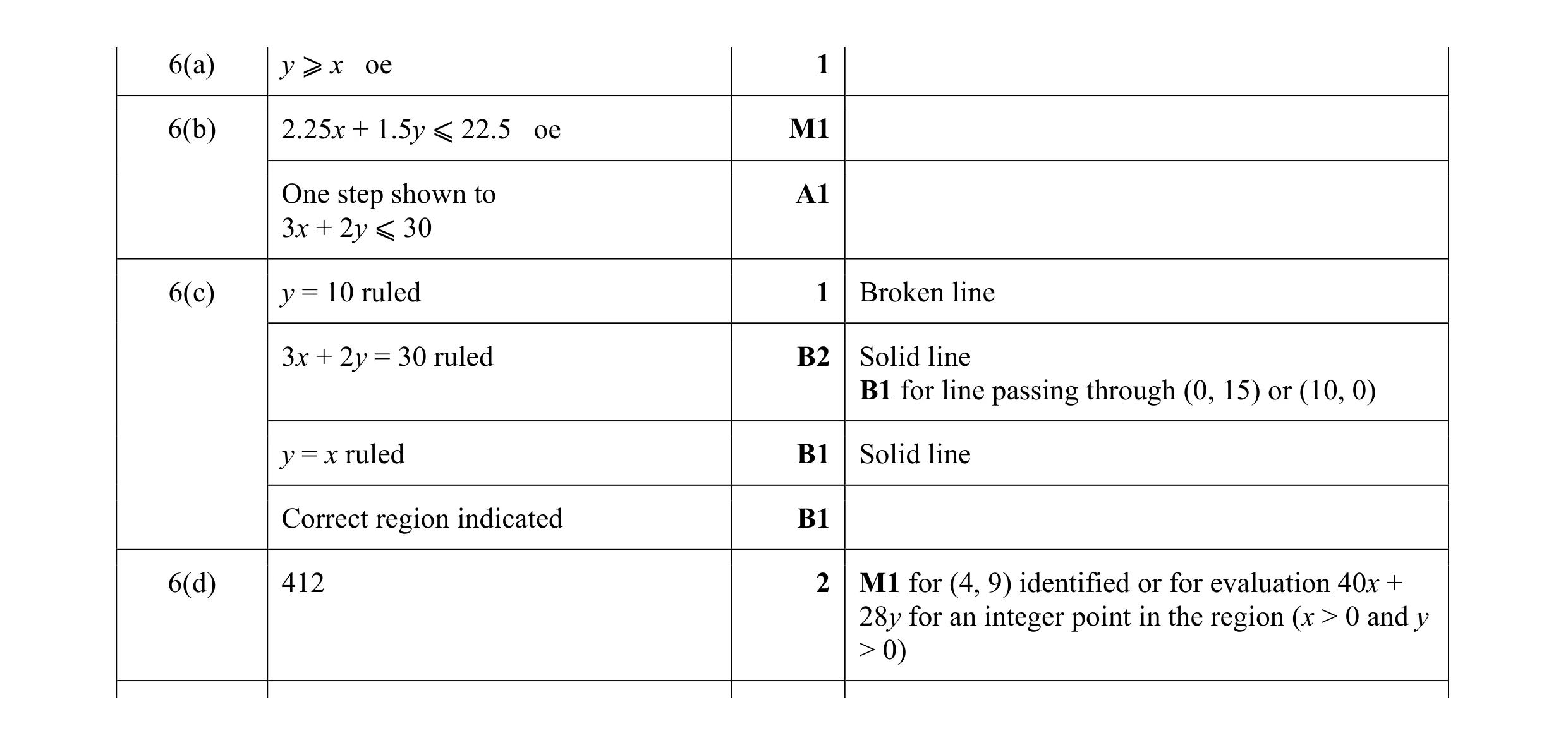
Mark scheme: 6(a) y ⩾ x oe 1 6(b) 2.25x + 1.5y ⩽ 22.5 oe M1 One step shown to A1 3x + 2y ⩽ 30 6(c) y = 10 ruled 1 Broken line 3x + 2y = 30 ruled B2 Solid line B1 for line passing through (0, 15) or (10, 0) y = x ruled B1 Solid line Correct region indicated B1 6(d) 412 2 M1 for (4, 9) identified or for evaluation 40x + 28y for an integer point in the region (x > 0 and y > 0)
This question in 0580/41 May/June 2020
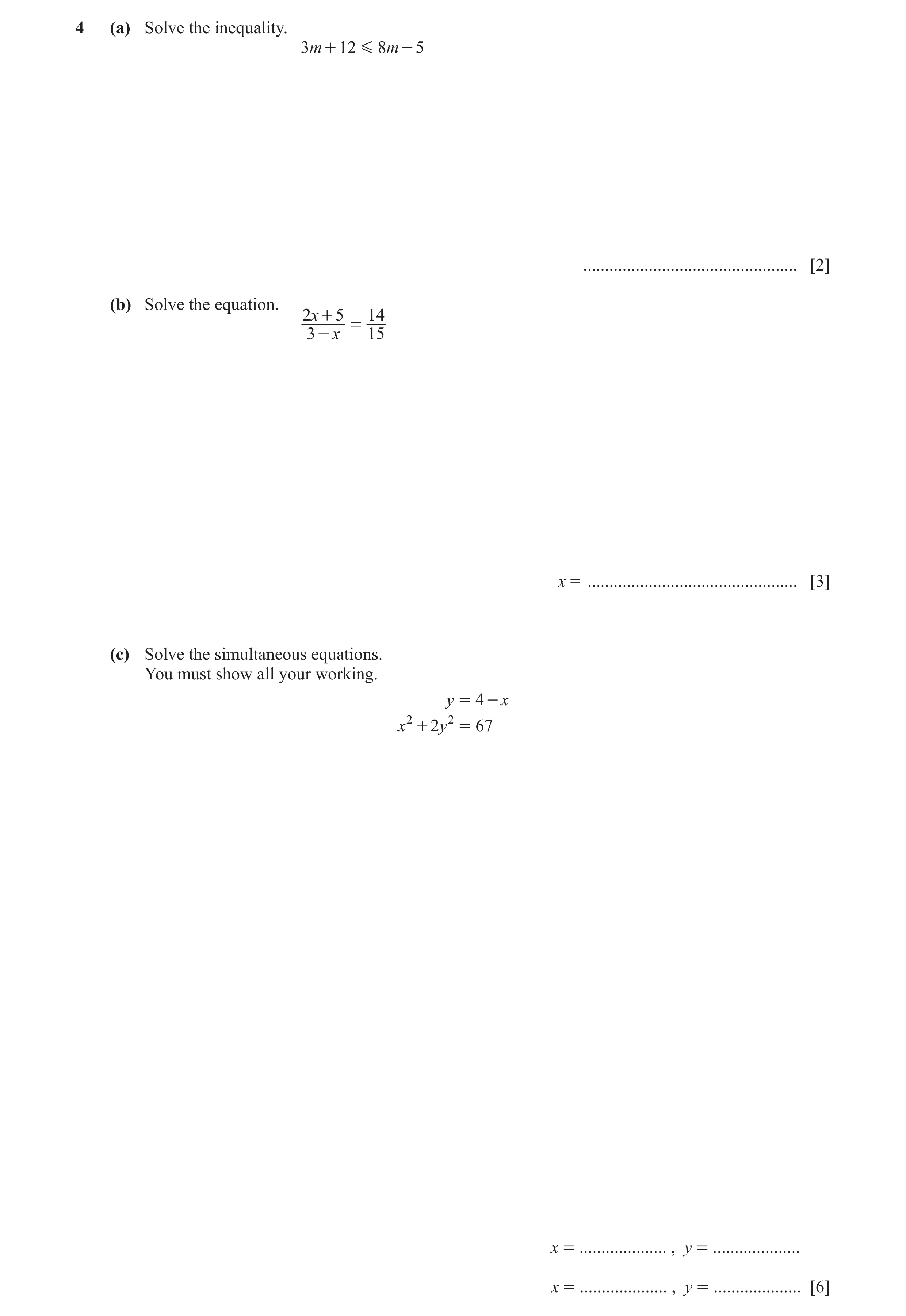
Question 26 0580/43 May/June 2020
4 (a) Solve the inequality. 3m + 12 G 8m - 5 … [2] (b) Solve the equation. 2x + 5 14 = 3 - x 15 x = … [3] (c) Solve the simultaneous equations. You must show all your working. y = 4 - x x 2 + 2y 2 = 67 x = … , y = … x = … , y = … [6]
11 marks
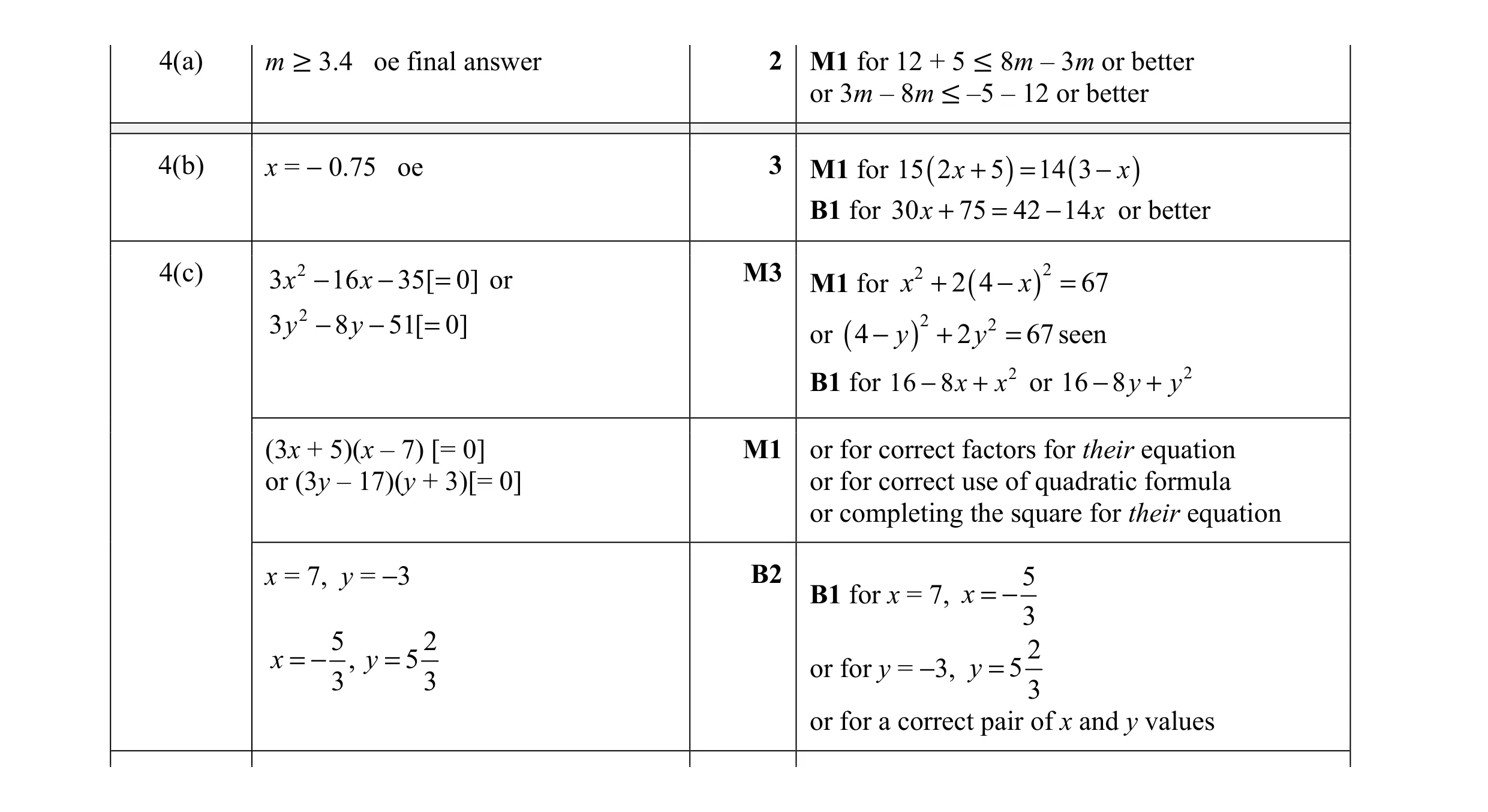
Mark scheme: 4(a) m ≥ 3.4 oe final answer 2 M1 for 12 + 5 ≤ 8m – 3m or better or 3m – 8m ≤ –5 – 12 or better 4(b) x = − 0.75 oe 3 M1 for 15 ( 2 x + 5 ) = 14 ( 3 − x ) B1 for 30 x + 75 = 42 − 14 x or better 4(c) 3 x 2 − 16 x − 35[ = 0] or M3 M1 for x 2 + 2 ( 4 − x ) 2 = 67 3 y 2 − 8 y − 51[ = 0] 2 2 or ( 4 − y ) + 2 y = 67 seen B1 for 16 − 8x + x 2 or 16 − 8y + y 2 (3x + 5)(x – 7) [= 0] M1 or for correct factors for their equation or (3y – 17)(y + 3)[= 0] or for correct use of quadratic formula or completing the square for their equation x = 7, y = −3 B2 5 B1 for x = 7, x = − 3 5 2 2 x = − , y = 5 or for y = −3, y = 5 3 3 3 or for a correct pair of x and y values
This question in 0580/43 May/June 2020
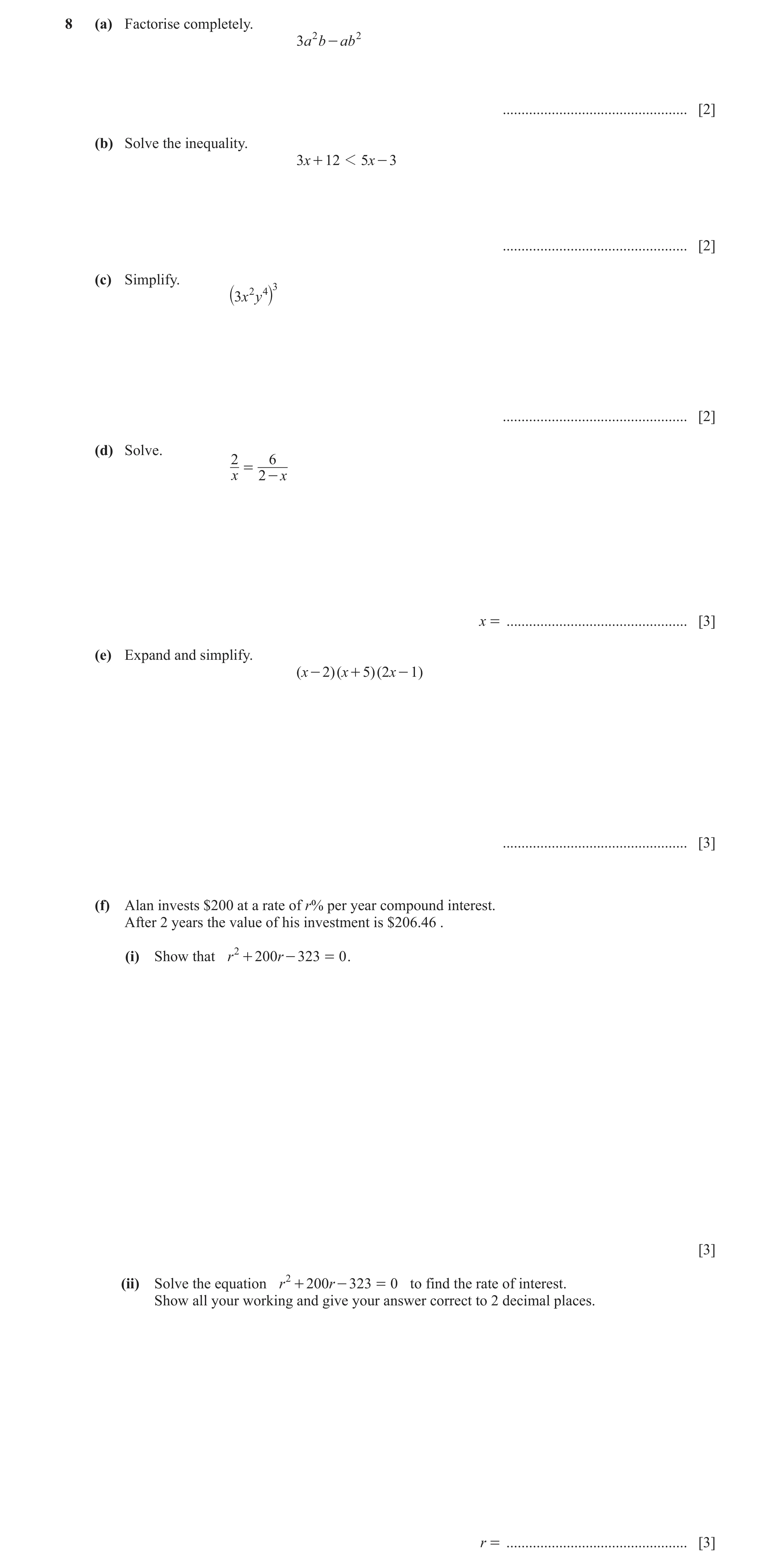
Question 27 0580/41 Oct/Nov 2020
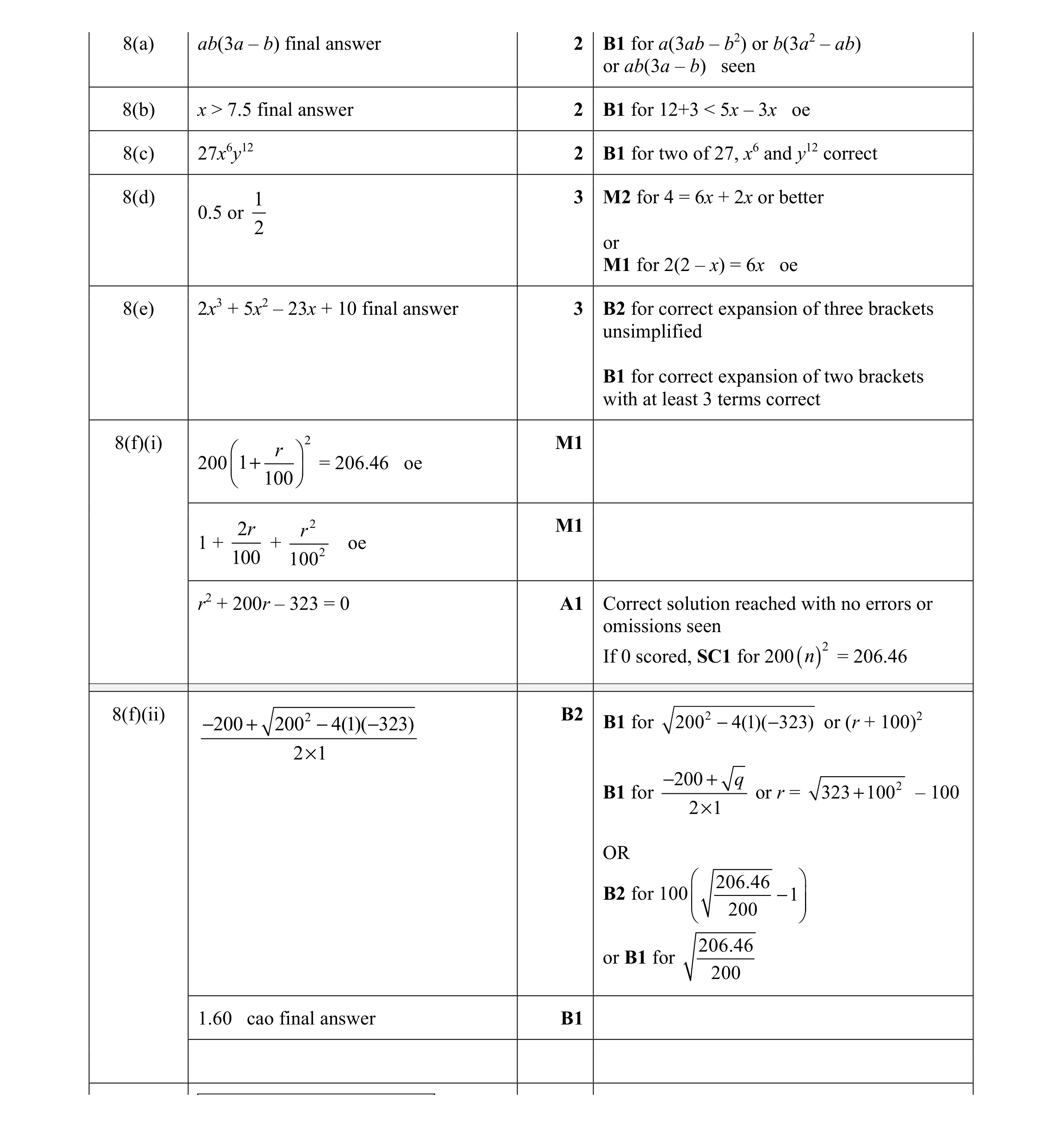
8 (a) Factorise completely. 3a 2 b - ab 2 … [2] (b) Solve the inequality. 3x + 12 1 5x - 3 … [2] (c) Simplify. 3 3x 2 y 4 ` j … [2] (d) Solve. 2 6 = x 2 - x x = … [3] (e) Expand and simplify. ( x - 2)( x + 5)( 2x - 1) … [3] (f) Alan invests $200 at a rate of r% per year compound interest. After 2 years the value of his investment is $206.46 . (i) Show that r 2 + 200r - 323 = 0 . [3] (ii) Solve the equation r 2 + 200r - 323 = 0 to find the rate of interest. Show all your working and give your answer correct to 2 decimal places. r = … [3]
18 marks
Mark scheme: 8(a) ab(3a – b) final answer 2 B1 for a(3ab – b2) or b(3a2 – ab) or ab(3a – b) seen 8(b) x > 7.5 final answer 2 B1 for 12+3 < 5x – 3x oe 8(c) 27x6y12 2 B1 for two of 27, x6 and y12 correct 8(d) 1 3 M2 for 4 = 6x + 2x or better 0.5 or 2 or M1 for 2(2 – x) = 6x oe 8(e) 2x3 + 5x2 – 23x + 10 final answer 3 B2 for correct expansion of three brackets unsimplified B1 for correct expansion of two brackets with at least 3 terms correct 8(f)(i) 2 M1 r 200 1 + = 206.46 oe 100 2r r 2 M1 1 + + oe 100 100 2 r2 + 200r – 323 = 0 A1 Correct solution reached with no errors or omissions seen If 0 scored, SC1 for 200( n ) 2 = 206.46 8(f)(ii) 2 B2 2 −200 + 200 − 4(1)( −323) B1 for 200 − 4(1)( − 323) or (r + 100)2 2 × 1 −200 + q 2 B1 for or r = 323 + 100 – 100 2 × 1 OR 206.46 B2 for 100 − 1 200 206.46 or B1 for 200 1.60 cao final answer B1
This question in 0580/41 Oct/Nov 2020
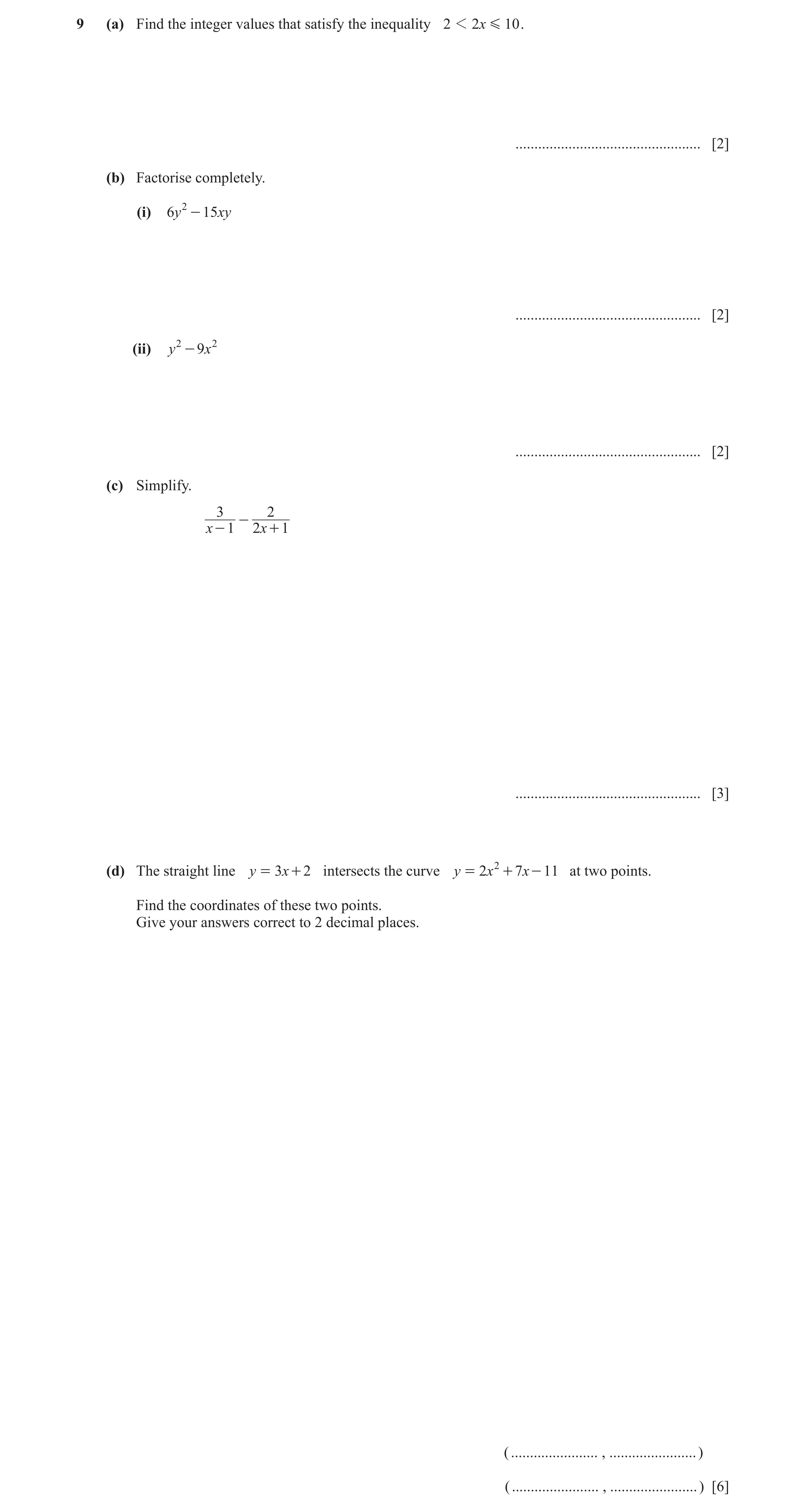
Q28 · Find the integer values that satisfy the inequality 2 1 2 x G 10 0580/43 Oct/Nov 2020
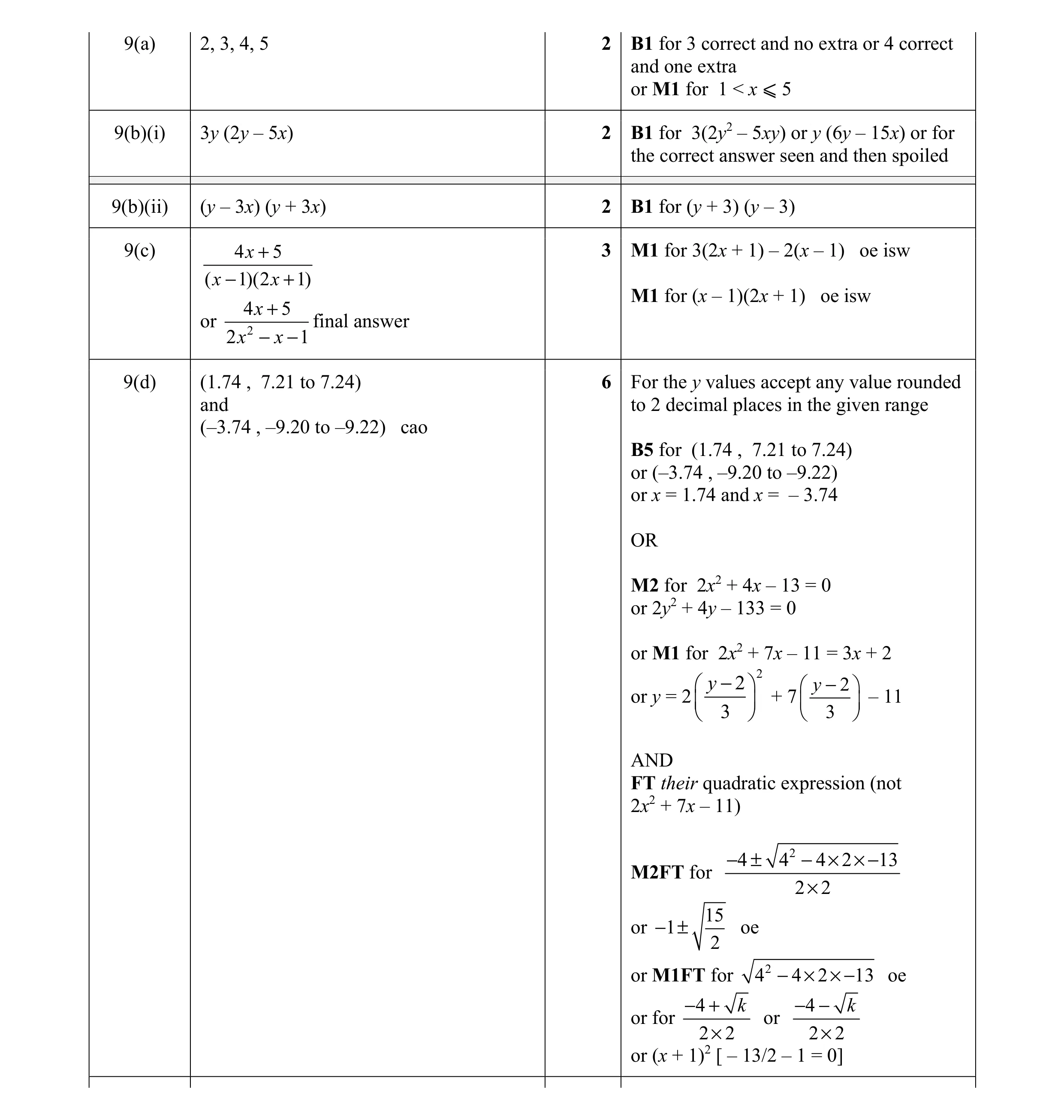
9 (a) Find the integer values that satisfy the inequality 2 1 2 x G 10 . … [2] (b) Factorise completely. (i) 6y 2 - 15 xy … [2] (ii) y 2 - 9x 2 … [2] (c) Simplify. 3 2 - x - 1 2x + 1 … [3] (d) The straight line y = 3x + 2 intersects the curve y = 2x 2 + 7x - 11 at two points. Find the coordinates of these two points. Give your answers correct to 2 decimal places. ( … , … ) ( … , … ) [6]
15 marks
Mark scheme: 9(a) 2, 3, 4, 5 2 B1 for 3 correct and no extra or 4 correct and one extra or M1 for 1 < x ⩽ 5 9(b)(i) 3y (2y – 5x) 2 B1 for 3(2y2 – 5xy) or y (6y – 15x) or for the correct answer seen and then spoiled 9(b)(ii) (y – 3x) (y + 3x) 2 B1 for (y + 3) (y – 3) 9(c) 4 x + 5 3 M1 for 3(2x + 1) – 2(x – 1) oe isw ( x − 1)(2 x + 1) M1 for (x – 1)(2x + 1) oe isw 4 x + 5 or final answer 2 x 2 − x − 1 9(d) (1.74 , 7.21 to 7.24) 6 For the y values accept any value rounded and to 2 decimal places in the given range (–3.74 , –9.20 to –9.22) cao B5 for (1.74 , 7.21 to 7.24) or (–3.74 , –9.20 to –9.22) or x = 1.74 and x = – 3.74 OR M2 for 2x2 + 4x – 13 = 0 or 2y2 + 4y – 133 = 0 or M1 for 2x2 + 7x – 11 = 3x + 2 y − 2 2 y − 2 or y = 2 + 7 – 11 3 3 AND FT their quadratic expression (not 2x2 + 7x – 11) −±4 4 2 −×4 2 × −13 M2FT for 2 × 2 15 or −±1 oe 2 or M1FT for 4 2 − 4 × 2 × −13 oe −+4 k −−4 k or for or 2 × 2 2 × 2 or (x + 1)2 [ – 13/2 – 1 = 0]
This question in 0580/43 Oct/Nov 2020
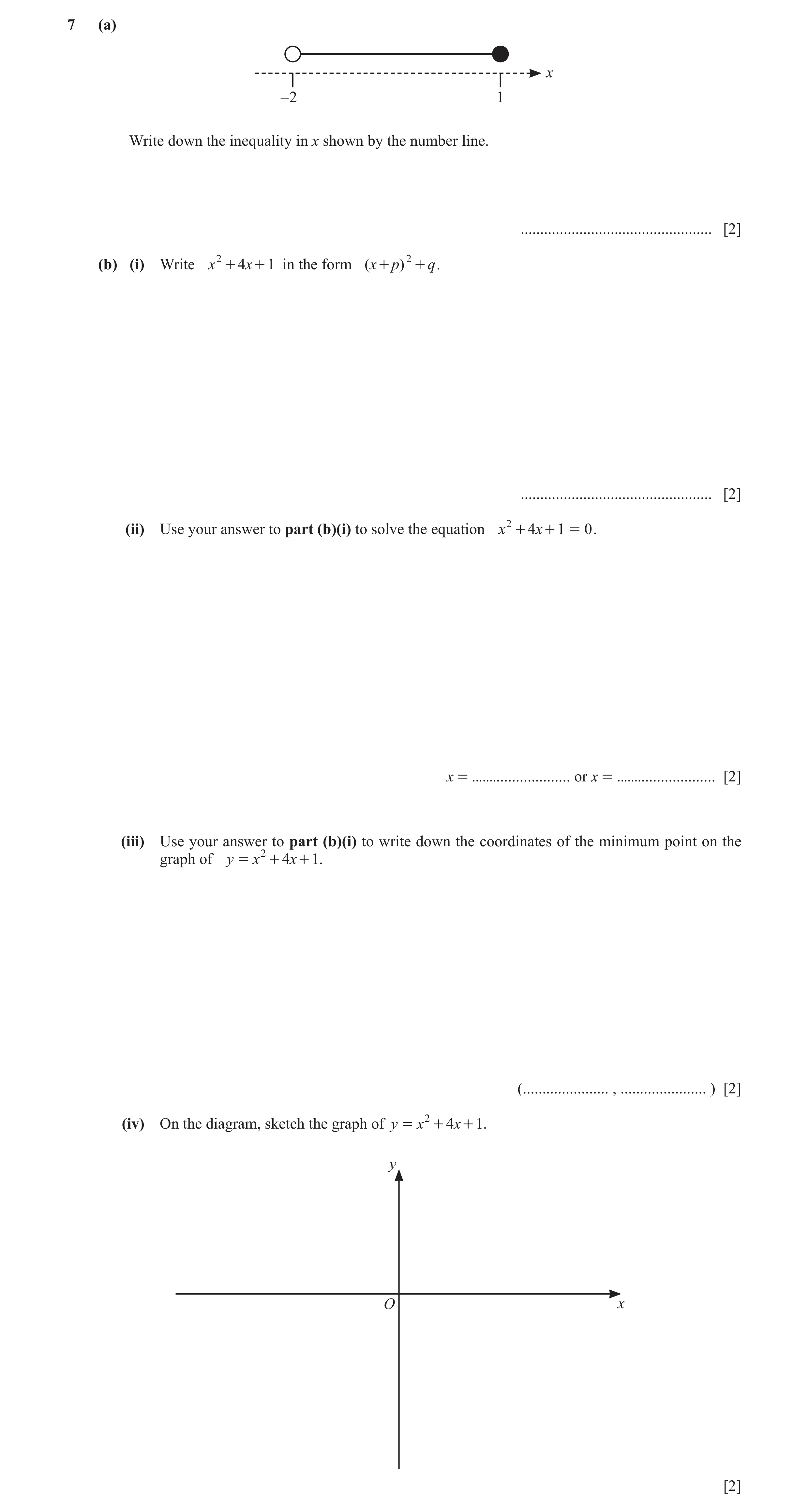
Q29 · X –2 1 Write down the inequality in x shown by the number line 0580/43 May/June 2021
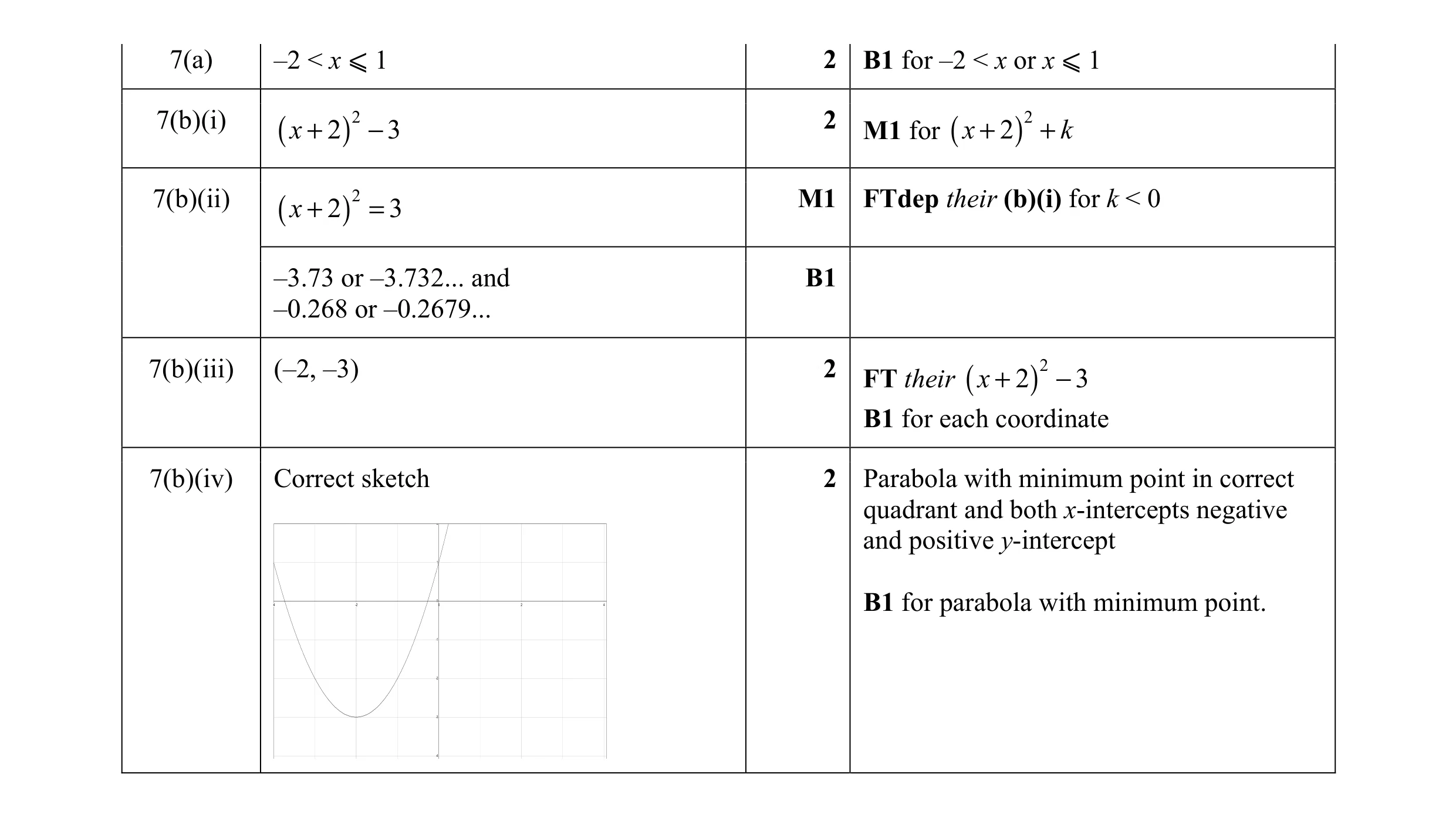
7 (a) x –2 1 Write down the inequality in x shown by the number line. … [2] (b) (i) Write x 2 + 4x + 1 in the form ( x + p) 2 + q . … [2] (ii) Use your answer to part (b)(i) to solve the equation x 2 + 4x + 1 = 0 . x = … or x = … [2] (iii) Use your answer to part (b)(i) to write down the coordinates of the minimum point on the graph of y = x 2 + 4x + 1. ( … , … ) [2] (iv) On the diagram, sketch the graph of y = x 2 + 4x + 1. y O x [2]
10 marks
Mark scheme: 7(a) –2 < x ⩽ 1 2 B1 for –2 < x or x ⩽ 1 7(b)(i) ( x + 2 ) 2 − 3 2 M1 for ( x + 2 ) 2 + k 7(b)(ii) ( x + 2 ) 2 = 3 M1 FTdep their (b)(i) for k < 0 –3.73 or –3.732... and B1 –0.268 or –0.2679... 7(b)(iii) (–2, –3) 2 2 FT their ( x + 2 ) − 3 B1 for each coordinate 7(b)(iv) Correct sketch 2 Parabola with minimum point in correct 2222 quadrant and both x-intercepts negative and positive y-intercept 1111 4444 -2-2-2-2 0000 0000 2222 4444 B1 for parabola with minimum point. -1-1-1-1 -2-2-2-2 -3-3-3-3 -4-4-4-4
This question in 0580/43 May/June 2021
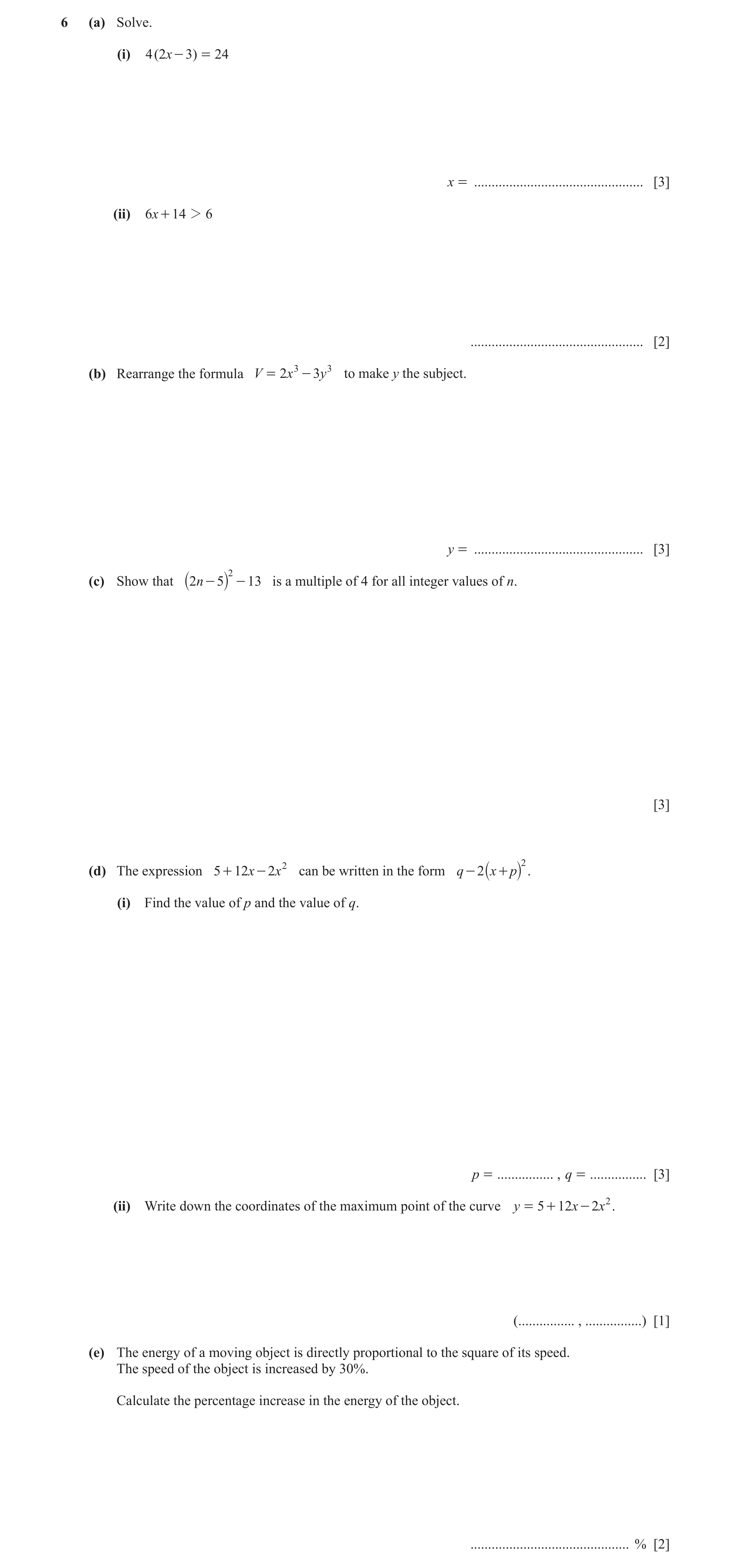
Question 30 0580/42 Oct/Nov 2021
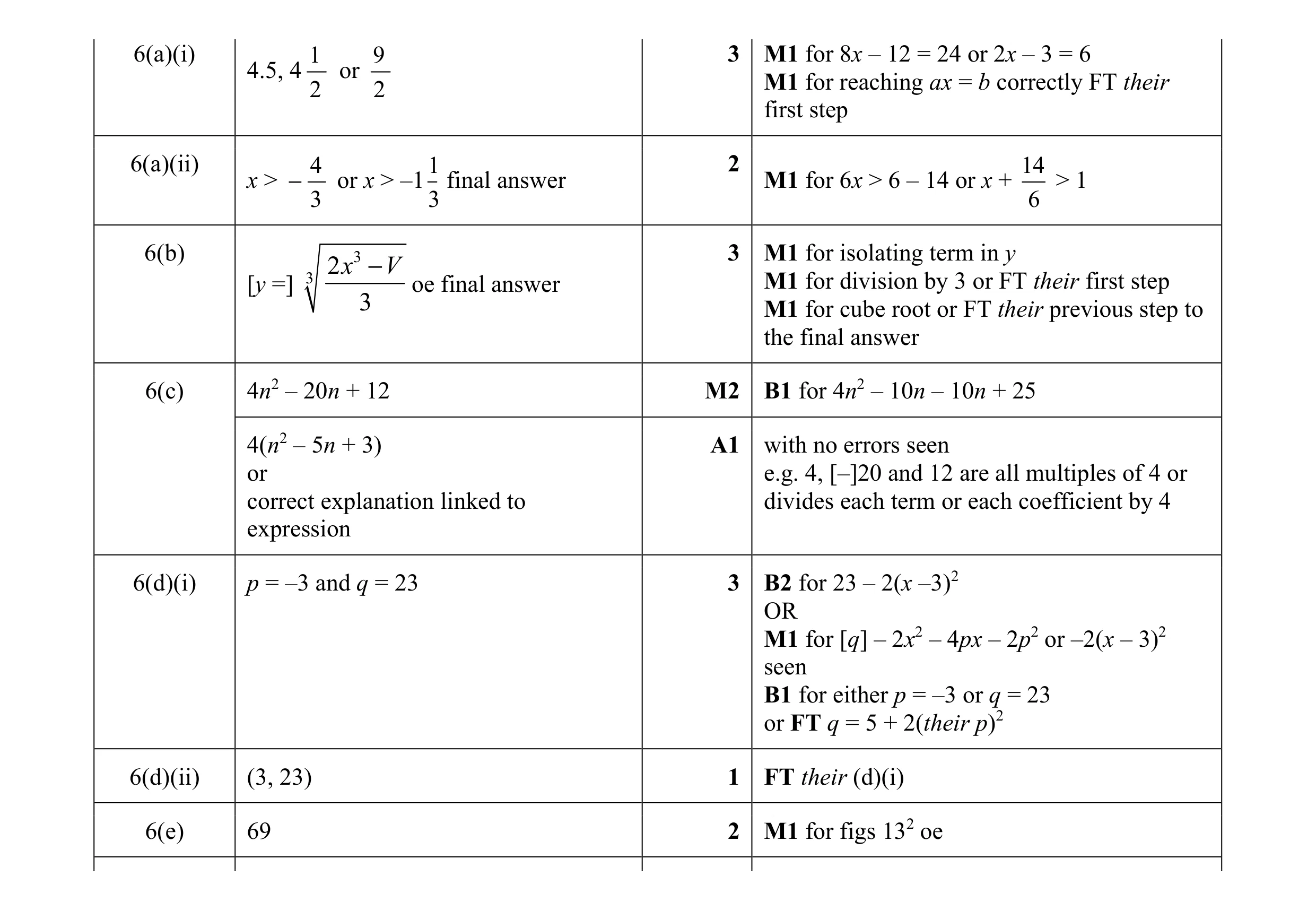
6 (a) Solve. (i) 4 ( 2x - 3) = 24 x = … [3] (ii) 6x + 14 2 6 … [2] (b) Rearrange the formula V = 2x 3 - 3y 3 to make y the subject. y = … [3] 2 (c) Show that 2n - 5 - 13 is a multiple of 4 for all integer values of n. ` j [3] 2 2(d) The expression 5 + 12x - 2x can be written in the form q - 2 x + p . ` j (i) Find the value of p and the value of q. p = … , q = … [3] (ii) Write down the coordinates of the maximum point of the curve y = 5 + 12x - 2x 2 . ( … , … ) [1] (e) The energy of a moving object is directly proportional to the square of its speed. The speed of the object is increased by 30%. Calculate the percentage increase in the energy of the object. … % [2]
17 marks
Mark scheme: 6(a)(i) 1 9 3 M1 for 8x – 12 = 24 or 2x – 3 = 6 4.5, 4 or M1 for reaching ax = b correctly FT their 2 2 first step 6(a)(ii) 4 2 14 x > − or x > –11 final answer M1 for 6x > 6 – 14 or x + > 1 3 3 6 6(b) 3 3 M1 for isolating term in y 2 x − V [y =] 3 oe final answer M1 for division by 3 or FT their first step 3 M1 for cube root or FT their previous step to the final answer 6(c) 4n2 – 20n + 12 M2 B1 for 4n2 – 10n – 10n + 25 4(n2 – 5n + 3) A1 with no errors seen or e.g. 4, [–]20 and 12 are all multiples of 4 or correct explanation linked to divides each term or each coefficient by 4 expression 6(d)(i) p = –3 and q = 23 3 B2 for 23 – 2(x –3)2 OR M1 for [q] – 2x2 – 4px – 2p2 or –2(x – 3)2 seen B1 for either p = –3 or q = 23 or FT q = 5 + 2(their p)2 6(d)(ii) (3, 23) 1 FT their (d)(i) 6(e) 69 2 M1 for figs 132 oe
This question in 0580/42 Oct/Nov 2021
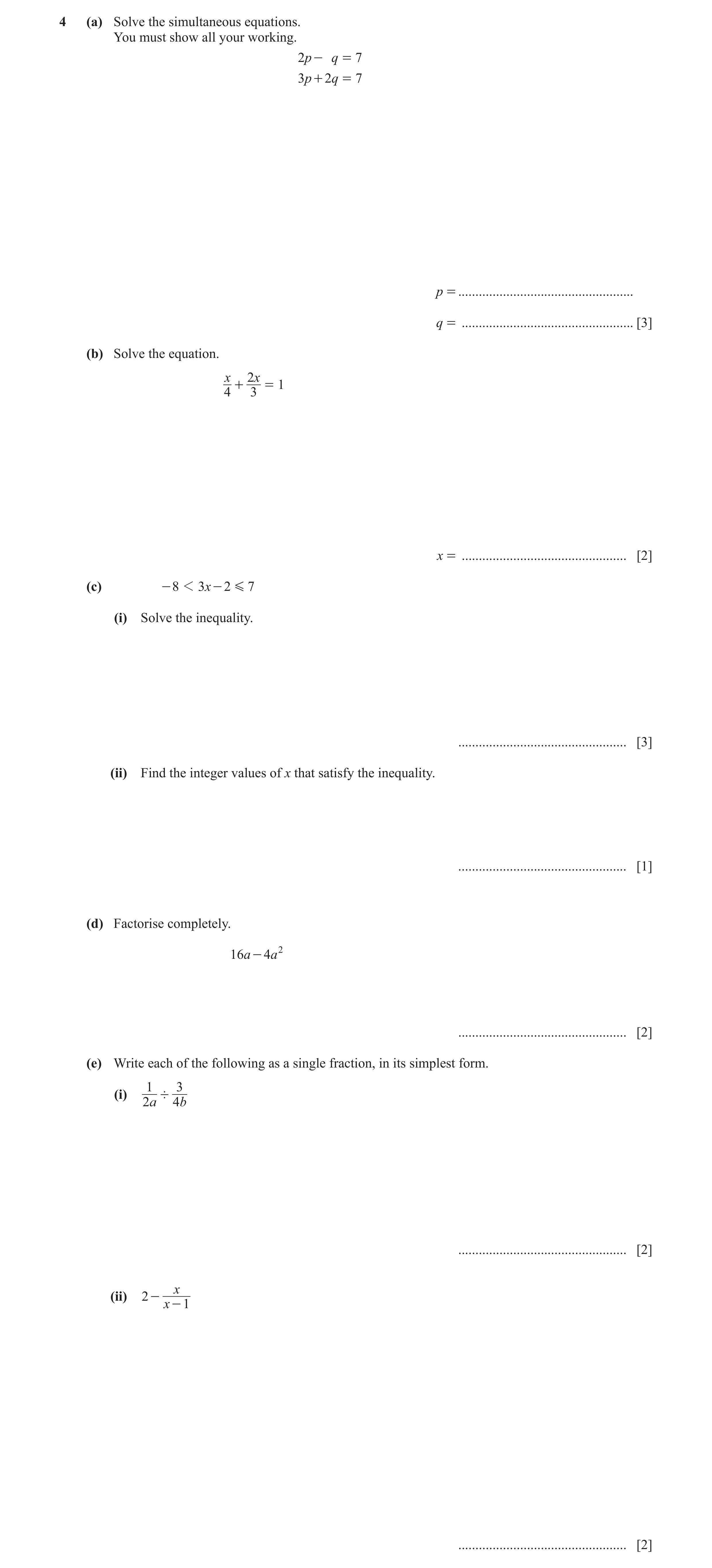
Q31 · Solve the simultaneous equations 0580/43 Oct/Nov 2021
4 (a) Solve the simultaneous equations. You must show all your working. 2p - q = 7 3p + 2q = 7 p = … q = … [3] (b) Solve the equation. x 2x + = 1 4 3 x = … [2] (c) - 8 1 3x - 2 G 7 (i) Solve the inequality. … [3] (ii) Find the integer values of x that satisfy the inequality. … [1] (d) Factorise completely. 16a - 4 a 2 … [2] (e) Write each of the following as a single fraction, in its simplest form. 1 3 (i) ' 2a 4b … [2] x (ii) 2 - x - 1 … [2]
15 marks
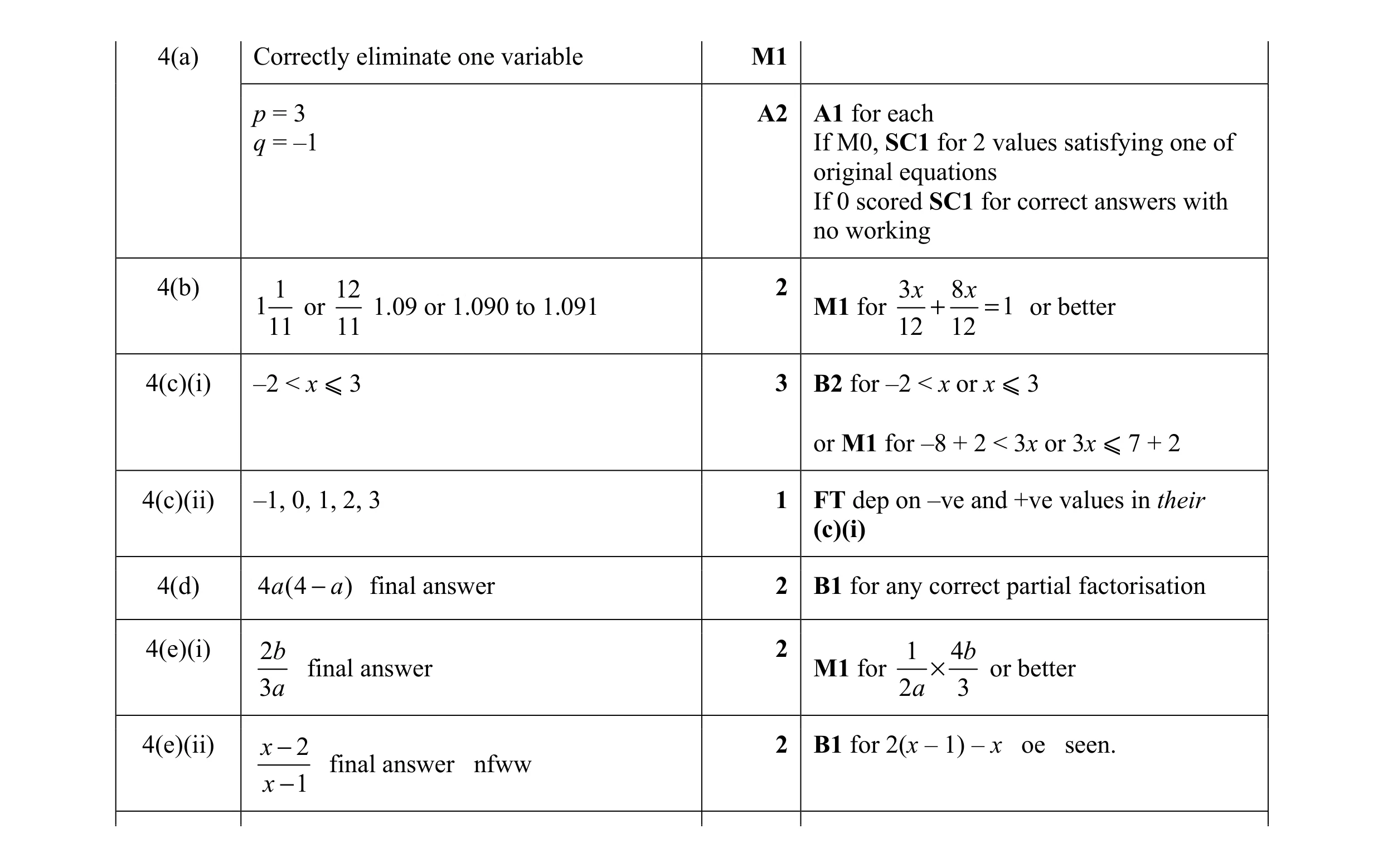
Mark scheme: 4(a) Correctly eliminate one variable M1 p = 3 A2 A1 for each q = –1 If M0, SC1 for 2 values satisfying one of original equations If 0 scored SC1 for correct answers with no working 4(b) 1 12 2 3 x 8 x 111 or 11 1.09 or 1.090 to 1.091 M1 for 12 + 12 = 1 or better 4(c)(i) –2 < x ⩽ 3 3 B2 for –2 < x or x ⩽ 3 or M1 for –8 + 2 < 3x or 3x ⩽ 7 + 2 4(c)(ii) –1, 0, 1, 2, 3 1 FT dep on –ve and +ve values in their (c)(i) 4(d) 4 a (4 − a ) final answer 2 B1 for any correct partial factorisation 4(e)(i) 2b 2 1 4b final answer M1 for × or better 3a 2 a 3 4(e)(ii) x − 2 2 B1 for 2(x – 1) – x oe seen. final answer nfww x − 1
This question in 0580/43 Oct/Nov 2021
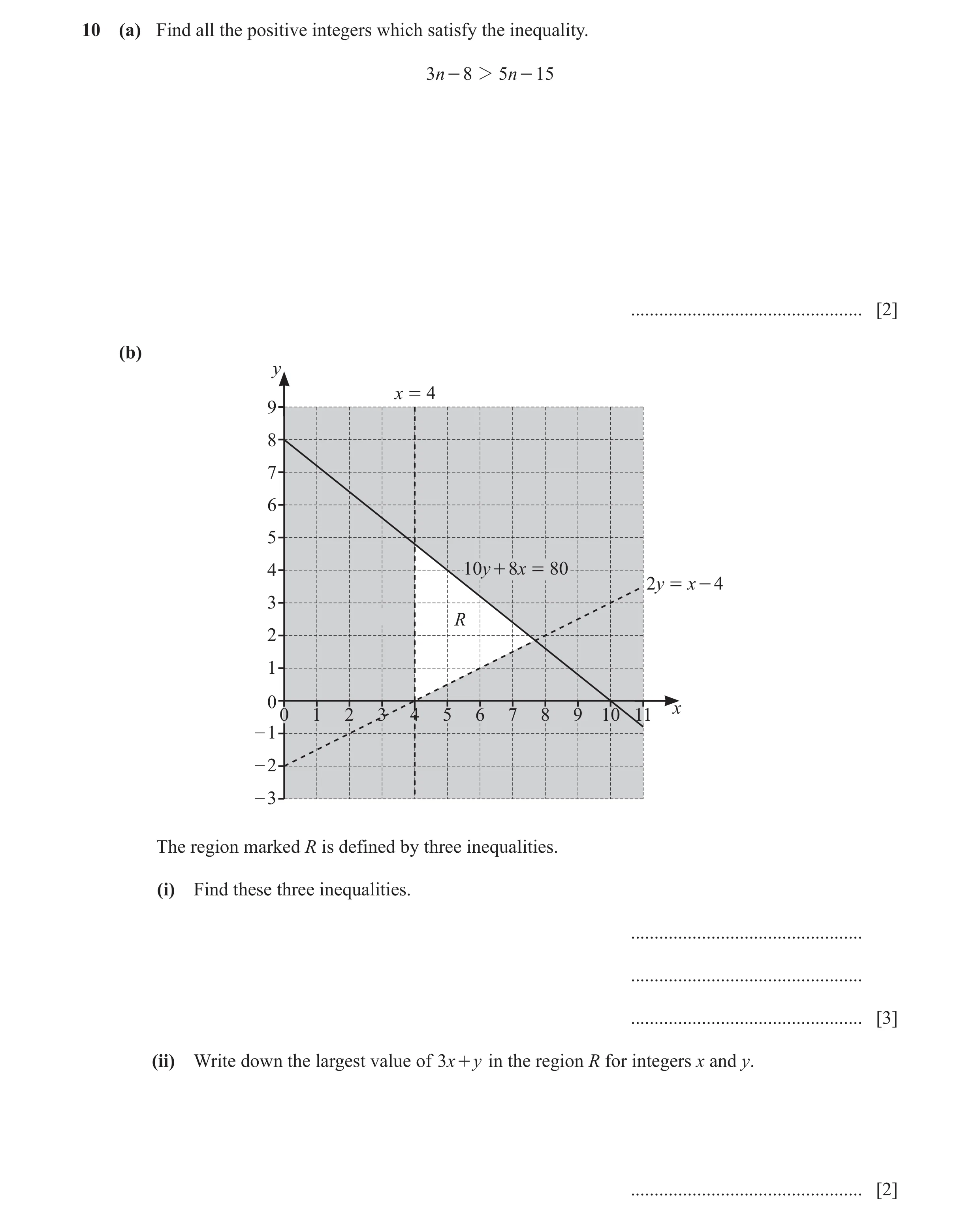
Q32 · Find all the positive integers which satisfy the inequality 0580/42 May/June 2022
10 (a) Find all the positive integers which satisfy the inequality. 3n - 8 2 5n - 15 … [2] (b) y x = 4 9 8 7 6 5 4 10y + 8 x = 80 2y = x - 4 3 R 2 1 0 x 0 1 2 3 4 5 6 7 8 9 10 11 – 1 – 2 – 3 The region marked R is defined by three inequalities. (i) Find these three inequalities. … … … [3] (ii) Write down the largest value of 3x + y in the region R for integers x and y. … [2]
7 marks
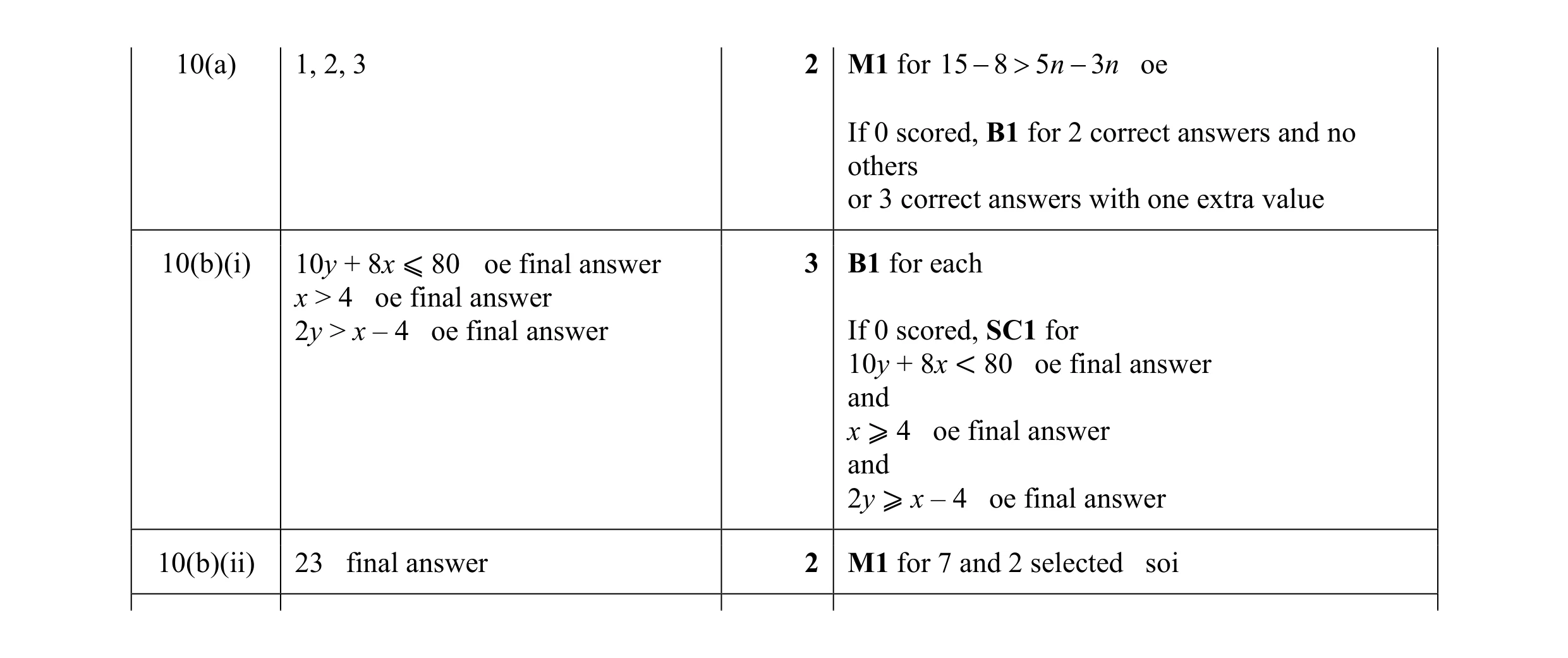
Mark scheme: 10(a) 1, 2, 3 2 M1 for 15 8 5 n 3n oe If 0 scored, B1 for 2 correct answers and no others or 3 correct answers with one extra value 10(b)(i) 10y + 8x ⩽ 80 oe final answer 3 B1 for each x > 4 oe final answer 2y > x – 4 oe final answer If 0 scored, SC1 for 10y + 8x < 80 oe final answer and x ⩾ 4 oe final answer and 2y ⩾ x – 4 oe final answer 10(b)(ii) 23 final answer 2 M1 for 7 and 2 selected soi
This question in 0580/42 May/June 2022
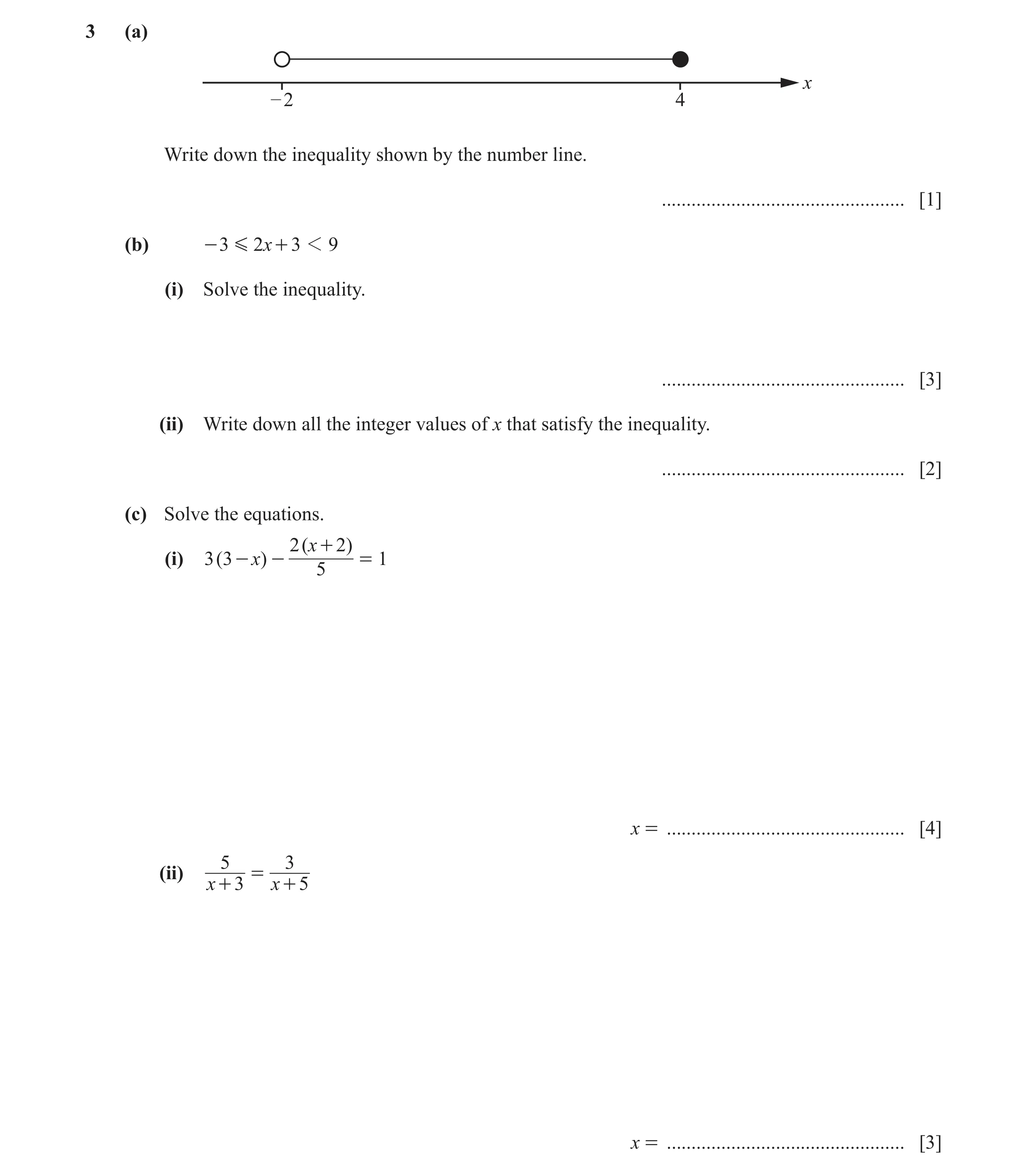
Q33 · X – 2 4 Write down the inequality shown by the number line 0580/41 Oct/Nov 2022
3 (a) x – 2 4 Write down the inequality shown by the number line. … [1] (b) - 3 G 2x + 3 1 9 (i) Solve the inequality. … [3] (ii) Write down all the integer values of x that satisfy the inequality. … [2] (c) Solve the equations. 2 ( x + 2) (i) 3 ( 3 - x) - = 1 5 x = … [4] 5 3 (ii) = x + 3 x + 5 x = … [3]
13 marks
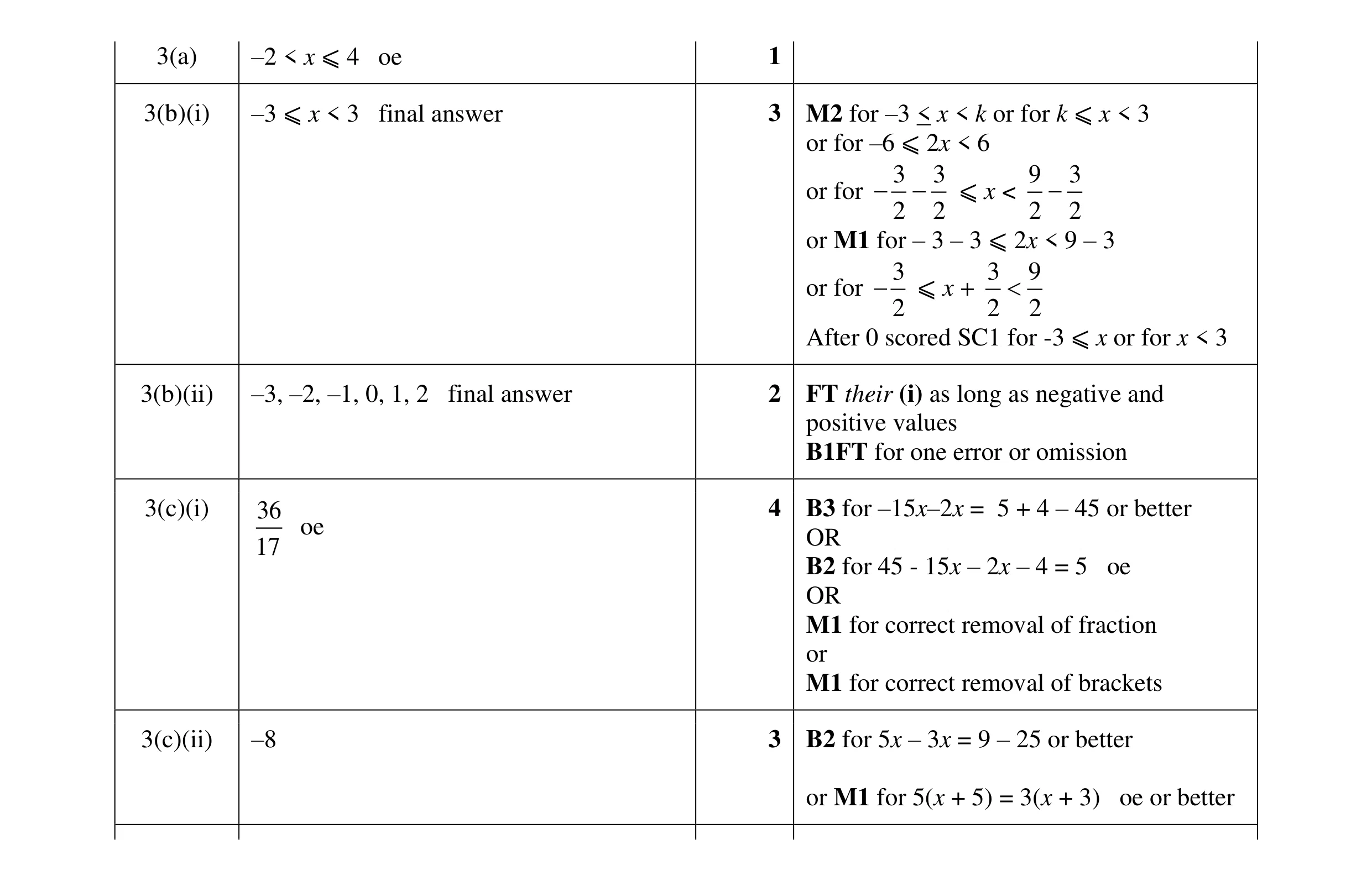
Mark scheme: 3(a) –2 < x ⩽ 4 oe 1 3(b)(i) –3 ⩽ x < 3 final answer 3 M2 for –3 < x < k or for k ⩽ x < 3 or for –6 ⩽ 2x < 6 3 3 9 3 or for − − ⩽ x < − 2 2 2 2 or M1 for – 3 – 3 ⩽ 2x < 9 – 3 3 3 9 or for − ⩽ x + 2 2 2 After 0 scored SC1 for -3 ⩽ x or for x < 3 3(b)(ii) –3, –2, –1, 0, 1, 2 final answer 2 FT their (i) as long as negative and positive values B1FT for one error or omission 3(c)(i) 36 4 B3 for –15x–2x = 5 + 4 – 45 or better oe OR 17 B2 for 45 - 15x – 2x – 4 = 5 oe OR M1 for correct removal of fraction or M1 for correct removal of brackets 3(c)(ii) –8 3 B2 for 5x – 3x = 9 – 25 or better or M1 for 5(x + 5) = 3(x + 3) oe or better
This question in 0580/41 Oct/Nov 2022
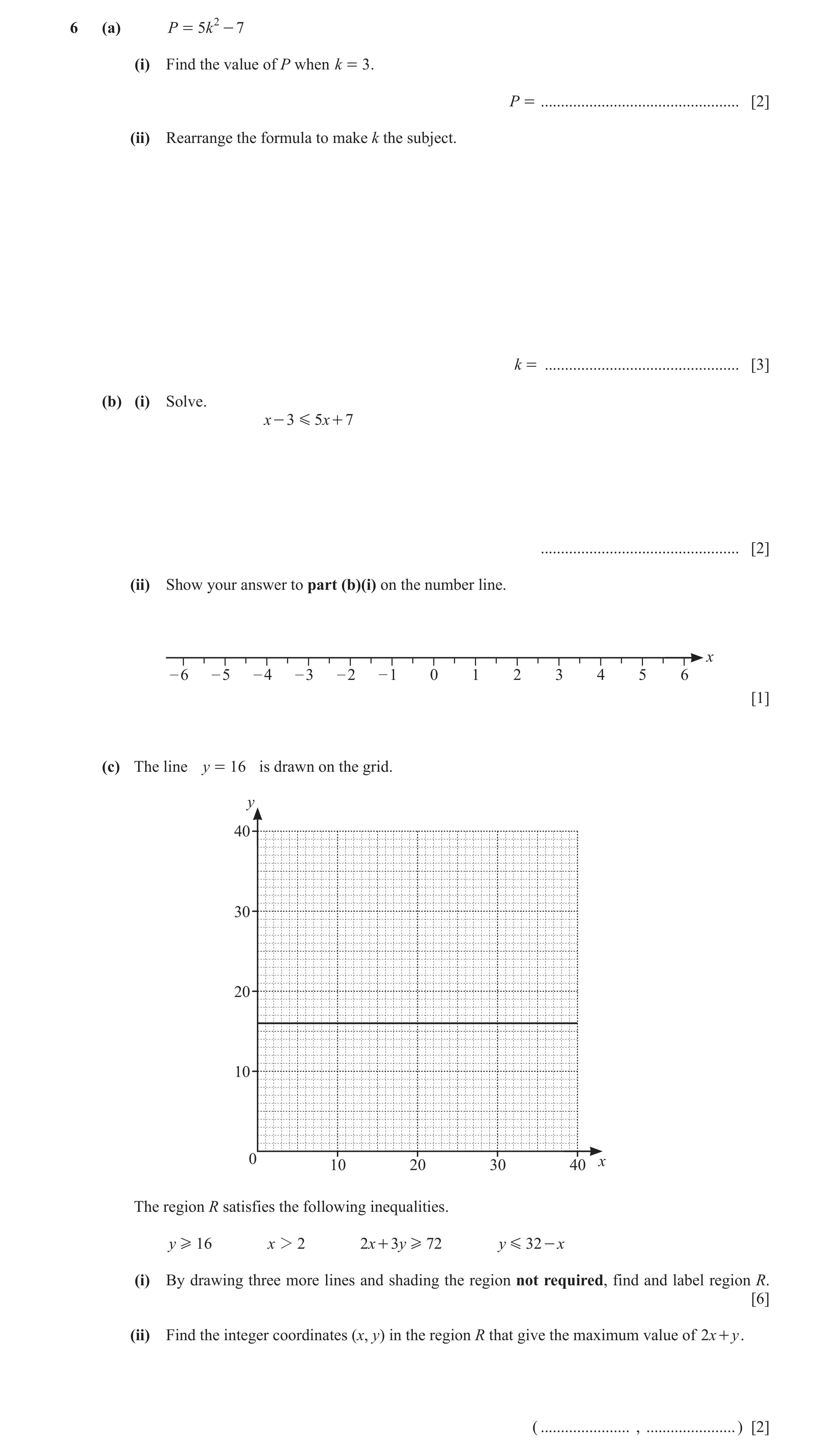
Q34 · P = 5k 2 - 7 (i) Find the value of P when k = 3 0580/43 Oct/Nov 2022
6 (a) P = 5k 2 - 7 (i) Find the value of P when k = 3 . P = … [2] (ii) Rearrange the formula to make k the subject. k = … [3] (b) (i) Solve. x - 3 G 5x + 7 … [2] (ii) Show your answer to part (b)(i) on the number line. x – 6 – 5 – 4 – 3 – 2 – 1 0 1 2 3 4 5 6 [1] (c) The line y = 16 is drawn on the grid. y 40 30 20 10 0 10 20 30 40 x The region R satisfies the following inequalities. y H 16 x 2 2 2x + 3y H 72 y G 32 - x (i) By drawing three more lines and shading the region not required, find and label region R. [6] (ii) Find the integer coordinates (x, y) in the region R that give the maximum value of 2x + y . ( … , … ) [2]
16 marks
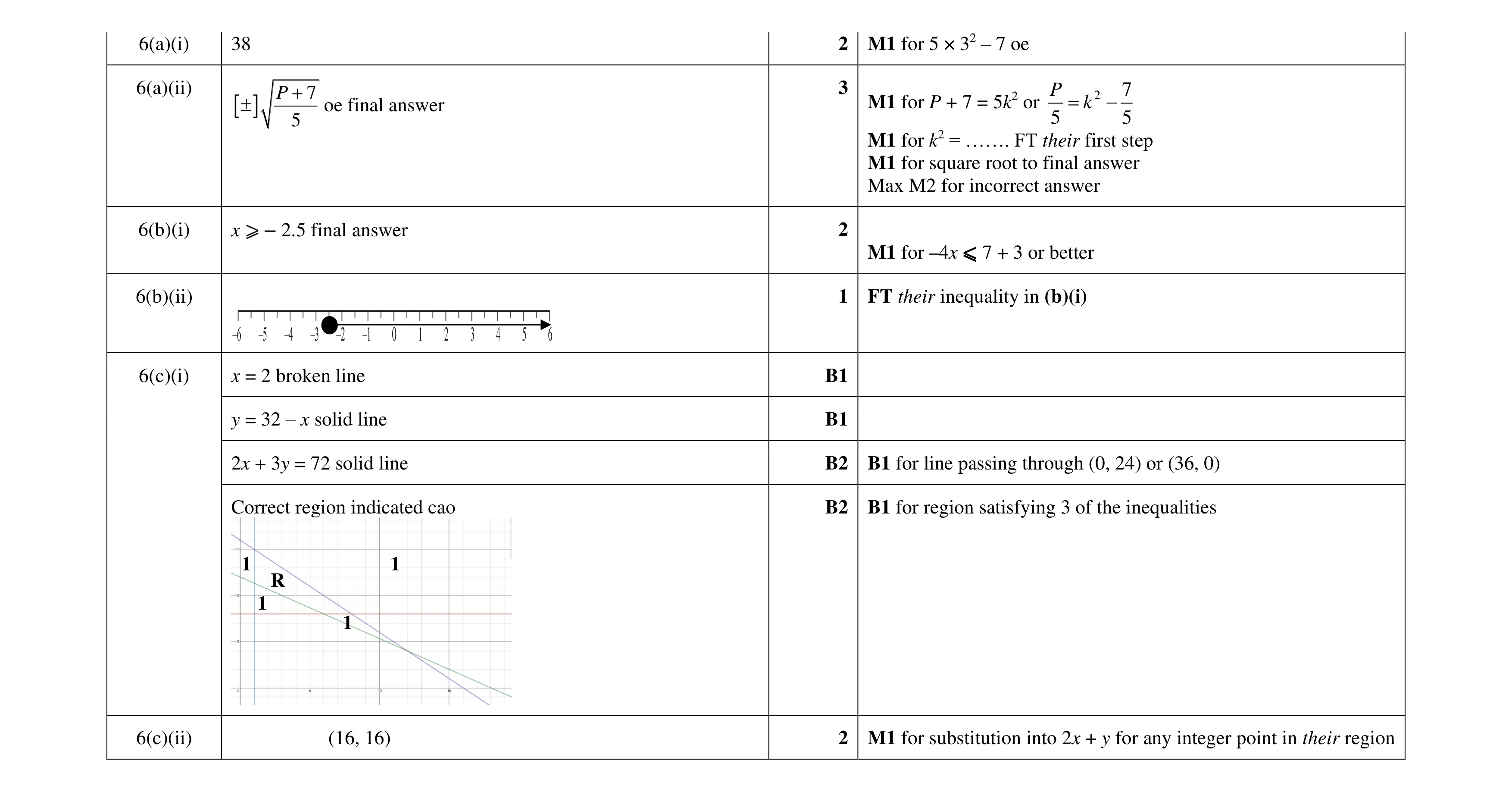
Mark scheme: 6(a)(i) 38 2 M1 for 5 × 32 – 7 oe 6(a)(ii) P + 7 3 P 2 7 oe final answer M1 for P + 7 = 5k2 or = k − 5 5 5 M1 for k2 = ……. FT their first step M1 for square root to final answer Max M2 for incorrect answer 6(b)(i) x ⩾ – 2.5 final answer 2 M1 for –4x ⩽ 7 + 3 or better 6(b)(ii) 1 FT their inequality in (b)(i) –6 –5 –4 –3 –2 –1 0 1 2 3 4 5 6 6(c)(i) x = 2 broken line B1 y = 32 – x solid line B1 2x + 3y = 72 solid line B2 B1 for line passing through (0, 24) or (36, 0) Correct region indicated cao B2 B1 for region satisfying 3 of the inequalities 1 1 R 1 1 6(c)(ii) (16, 16) 2 M1 for substitution into 2x + y for any integer point in their region
This question in 0580/43 Oct/Nov 2022
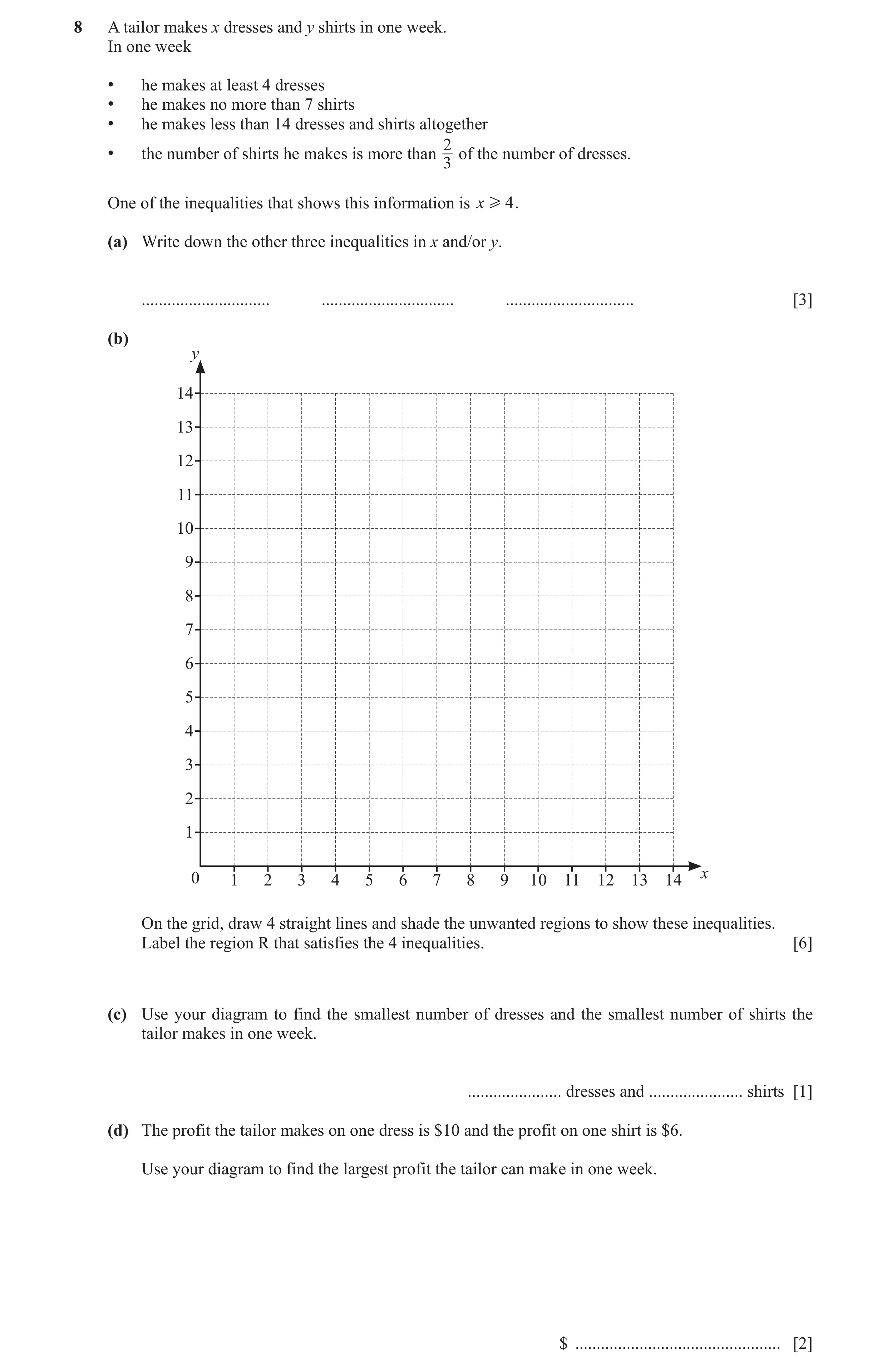
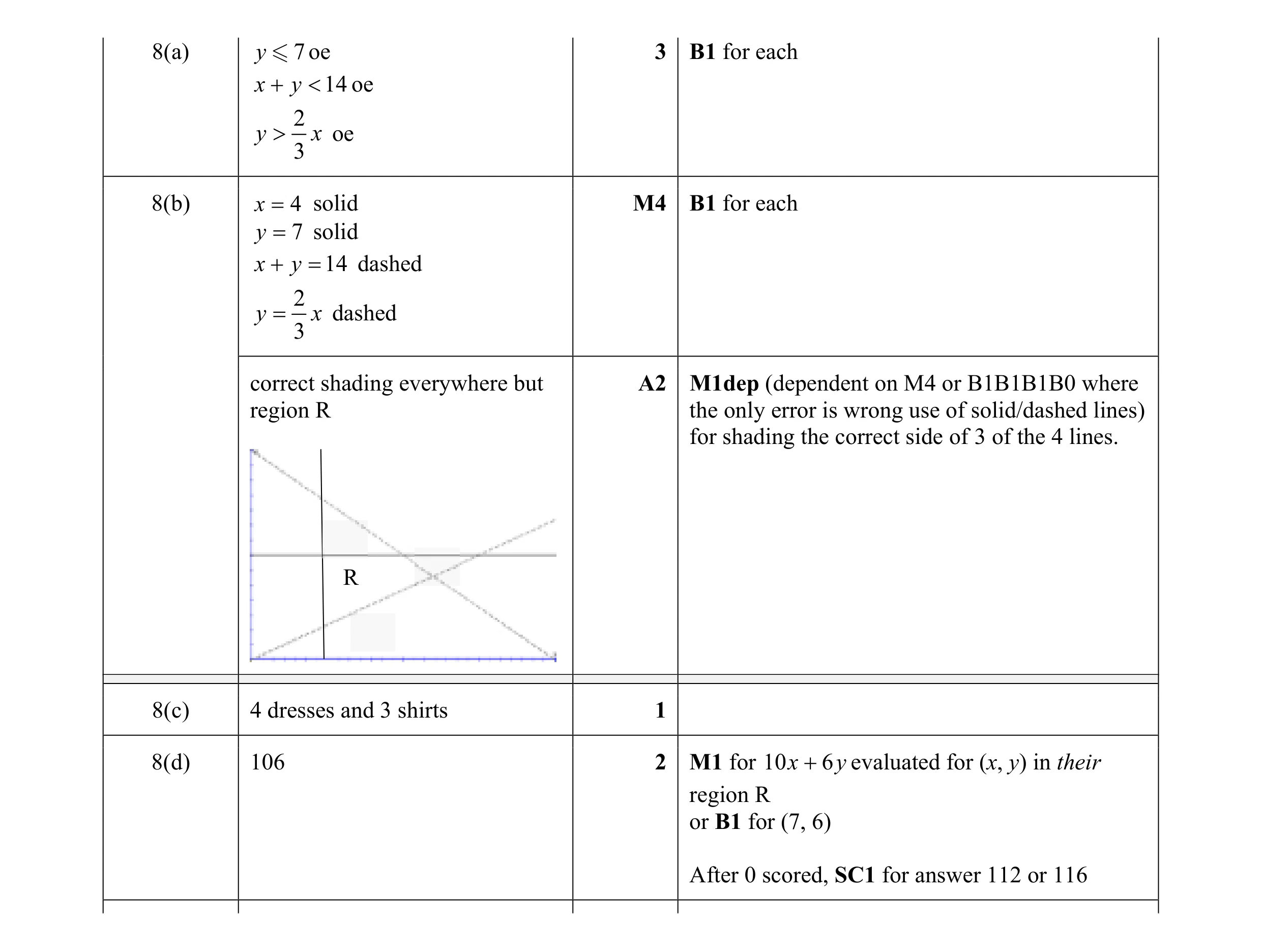
Q35 · A tailor makes x dresses and y shirts in one week 0580/41 May/June 2023
8 A tailor makes x dresses and y shirts in one week. In one week • he makes at least 4 dresses • he makes no more than 7 shirts • he makes less than 14 dresses and shirts altogether 2 • the number of shirts he makes is more than of the number of dresses. 3 One of the inequalities that shows this information is x H 4 . (a) Write down the other three inequalities in x and/or y. … … … [3] (b) y 14 13 12 11 10 9 8 7 6 5 4 3 2 1 x 0 1 2 3 4 5 6 7 8 9 10 11 12 13 14 On the grid, draw 4 straight lines and shade the unwanted regions to show these inequalities. Label the region R that satisfies the 4 inequalities. [6] (c) Use your diagram to find the smallest number of dresses and the smallest number of shirts the tailor makes in one week. … dresses and … shirts [1] (d) The profit the tailor makes on one dress is $10 and the profit on one shirt is $6. Use your diagram to find the largest profit the tailor can make in one week. $ … [2]
12 marks
Mark scheme: 8(a) y 7 oe 3 B1 for each x y 14 oe 2 y x oe 3 8(b) x 4 solid M4 B1 for each y 7 solid x y 14 dashed 2 y x dashed 3 correct shading everywhere but A2 M1dep (dependent on M4 or B1B1B1B0 where region R the only error is wrong use of solid/dashed lines) for shading the correct side of 3 of the 4 lines. R 8(c) 4 dresses and 3 shirts 1 8(d) 106 2 M1 for 10 x 6 y evaluated for (x, y) in their region R or B1 for (7, 6) After 0 scored, SC1 for answer 112 or 116
This question in 0580/41 May/June 2023
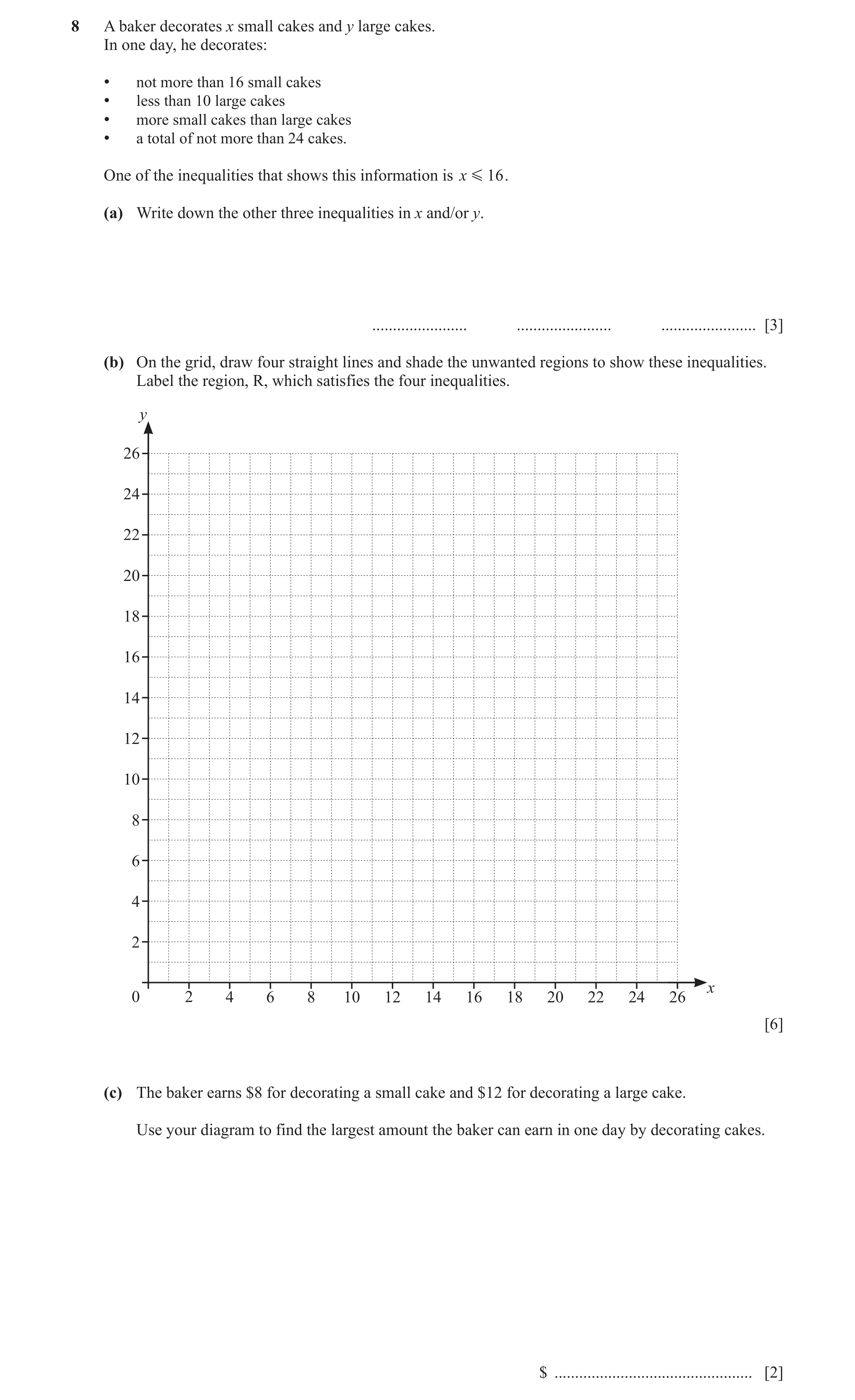
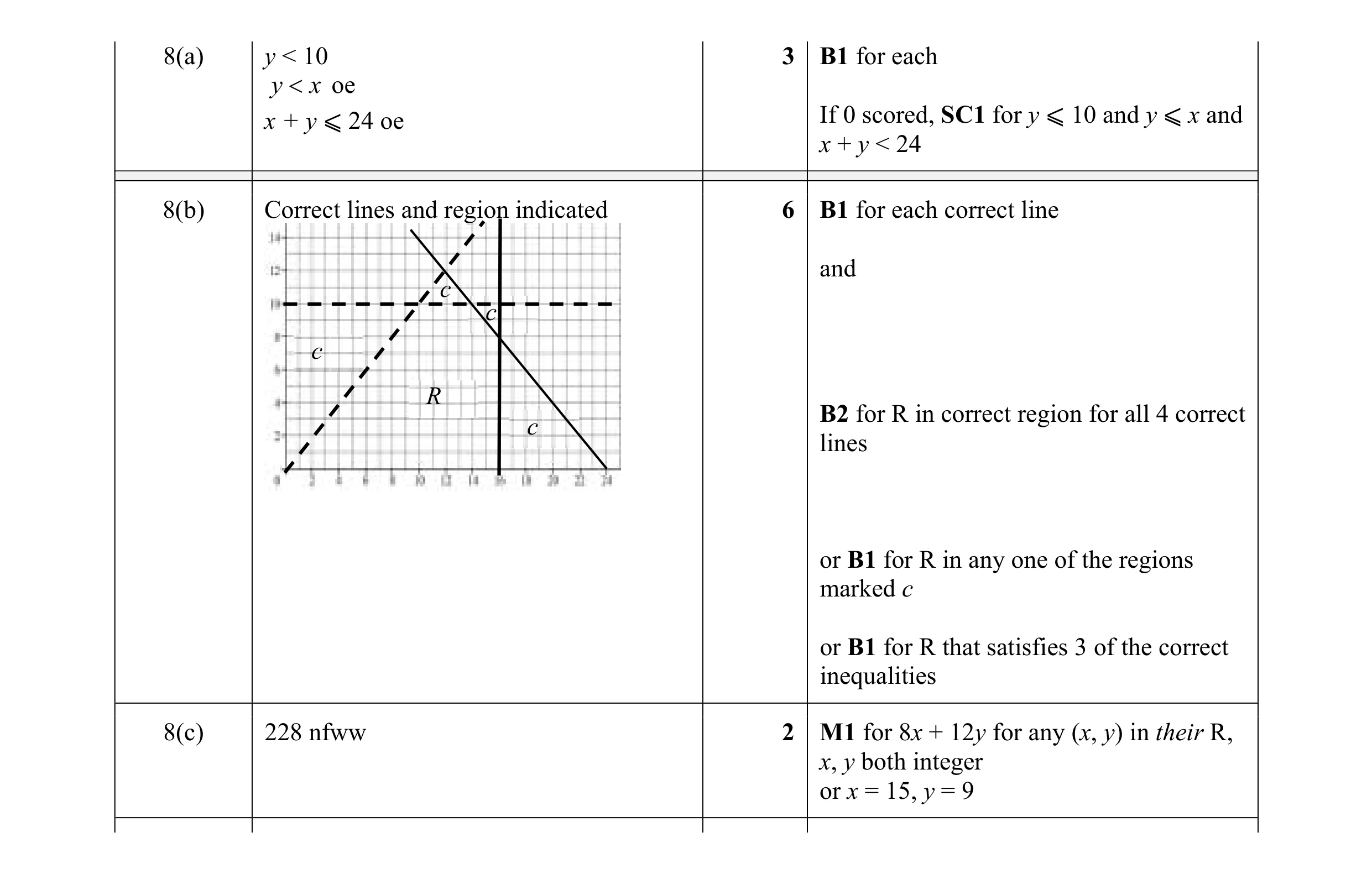
Q36 · A baker decorates x small cakes and y large cakes 0580/42 May/June 2024
8 A baker decorates x small cakes and y large cakes. In one day, he decorates: • not more than 16 small cakes • less than 10 large cakes • more small cakes than large cakes • a total of not more than 24 cakes. One of the inequalities that shows this information is x G 16 . (a) Write down the other three inequalities in x and/or y. … … … [3] (b) On the grid, draw four straight lines and shade the unwanted regions to show these inequalities. Label the region, R, which satisfies the four inequalities. y 26 24 22 20 18 16 14 12 10 8 6 4 2 x 0 2 4 6 8 10 12 14 16 18 20 22 24 26 [6] (c) The baker earns $8 for decorating a small cake and $12 for decorating a large cake. Use your diagram to find the largest amount the baker can earn in one day by decorating cakes. $ … [2]
11 marks
Mark scheme: 8(a) y < 10 3 B1 for each y x oe x + y ⩽ 24 oe If 0 scored, SC1 for y ⩽ 10 and y ⩽ x and x + y < 24 8(b) Correct lines and region indicated 6 B1 for each correct line and c c c R B2 for R in correct region for all 4 correct c lines or B1 for R in any one of the regions marked c or B1 for R that satisfies 3 of the correct inequalities 8(c) 228 nfww 2 M1 for 8x + 12y for any (x, y) in their R, x, y both integer or x = 15, y = 9
This question in 0580/42 May/June 2024
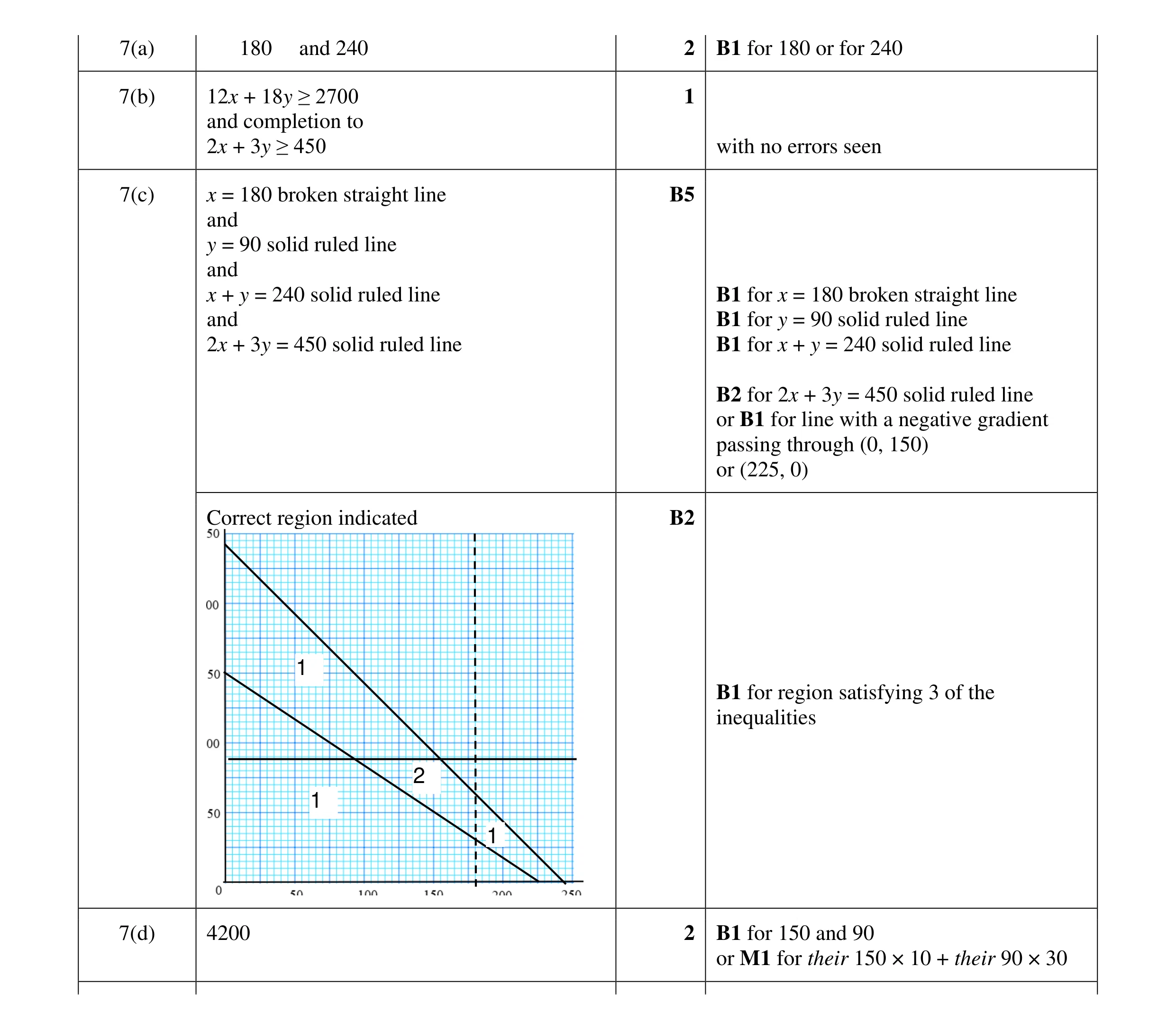
Q37 · A company makes scientific calculators and graphic calculators 0580/41 Oct/Nov 2024
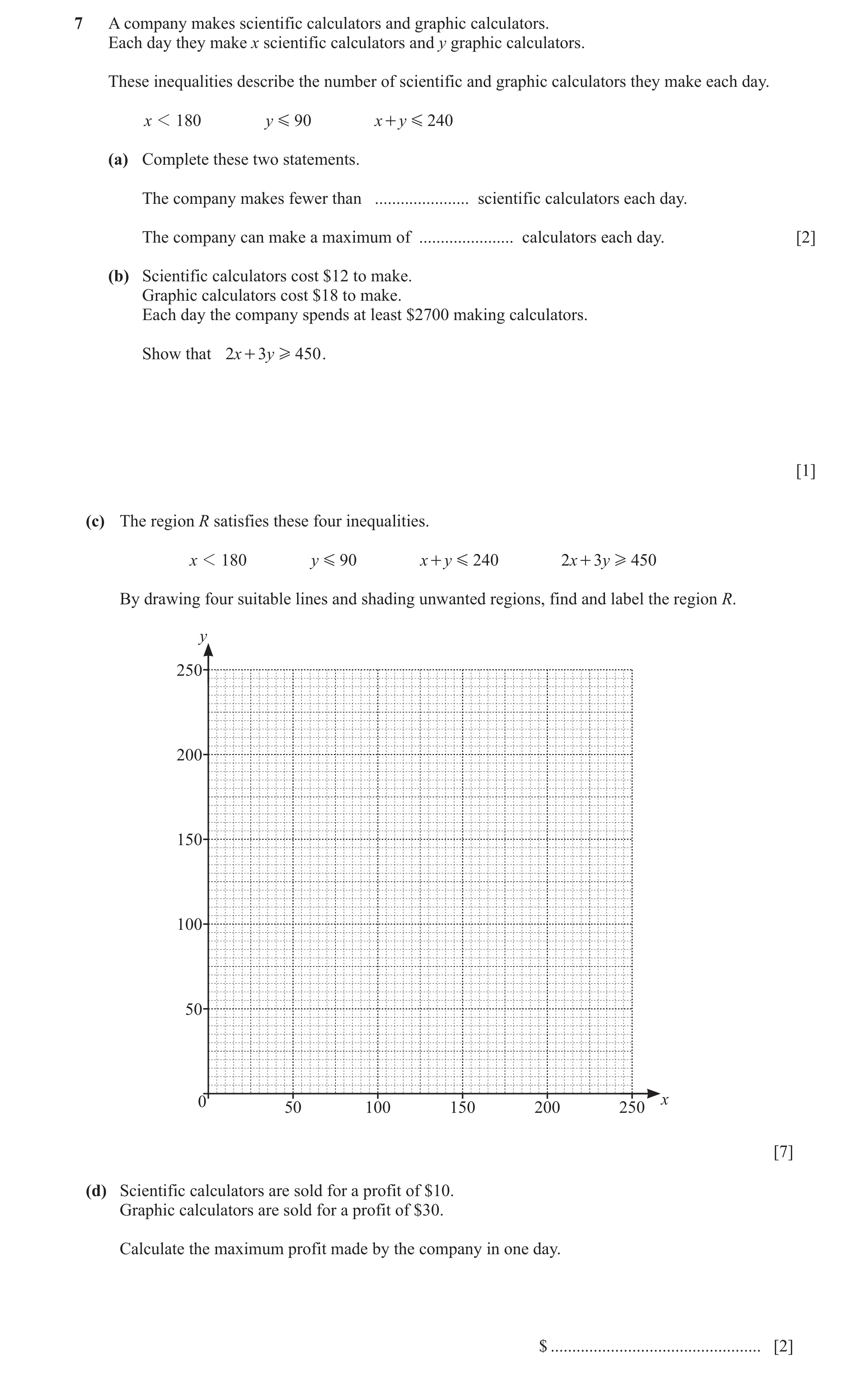
7 A company makes scientific calculators and graphic calculators. Each day they make x scientific calculators and y graphic calculators. These inequalities describe the number of scientific and graphic calculators they make each day. x 1 180 y G 90 x + y G 240 (a) Complete these two statements. The company makes fewer than … scientific calculators each day. The company can make a maximum of … calculators each day. [2] (b) Scientific calculators cost $12 to make. Graphic calculators cost $18 to make. Each day the company spends at least $2700 making calculators. Show that 2x + 3y H 450 . [1] (c) The region R satisfies these four inequalities. x 1 180 y G 90 x + y G 240 2x + 3y H 450 By drawing four suitable lines and shading unwanted regions, find and label the region R. y 250 200 150 100 50 0 x 50 100 150 200 250 [7] (d) Scientific calculators are sold for a profit of $10. Graphic calculators are sold for a profit of $30. Calculate the maximum profit made by the company in one day. $ … [2]
12 marks
Mark scheme: 7(a) 180 and 240 2 B1 for 180 or for 240 7(b) 12x + 18y ≥ 2700 1 and completion to 2x + 3y ≥ 450 with no errors seen 7(c) x = 180 broken straight line B5 and y = 90 solid ruled line and x + y = 240 solid ruled line B1 for x = 180 broken straight line and B1 for y = 90 solid ruled line 2x + 3y = 450 solid ruled line B1 for x + y = 240 solid ruled line B2 for 2x + 3y = 450 solid ruled line or B1 for line with a negative gradient passing through (0, 150) or (225, 0) Correct region indicated B2 1 B1 for region satisfying 3 of the inequalities 2 1 1 7(d) 4200 2 B1 for 150 and 90 or M1 for their 150 × 10 + their 90 × 30
This question in 0580/41 Oct/Nov 2024
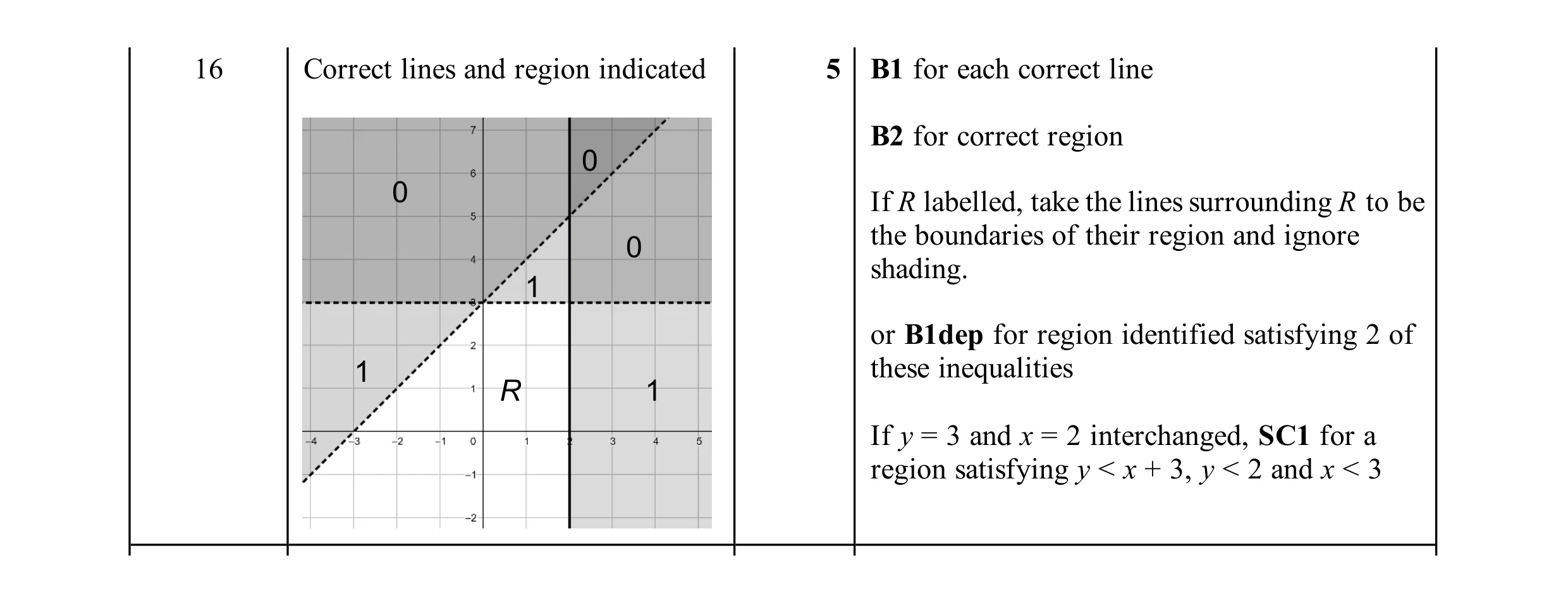
Q38 · Y 7 6 5 4 3 2 1 – 4 – 3 – 2 – 1 0 1 2 3 4 5 x – 1 – 2 By shading the unwanted regions of… 0580/43 May/June 2025
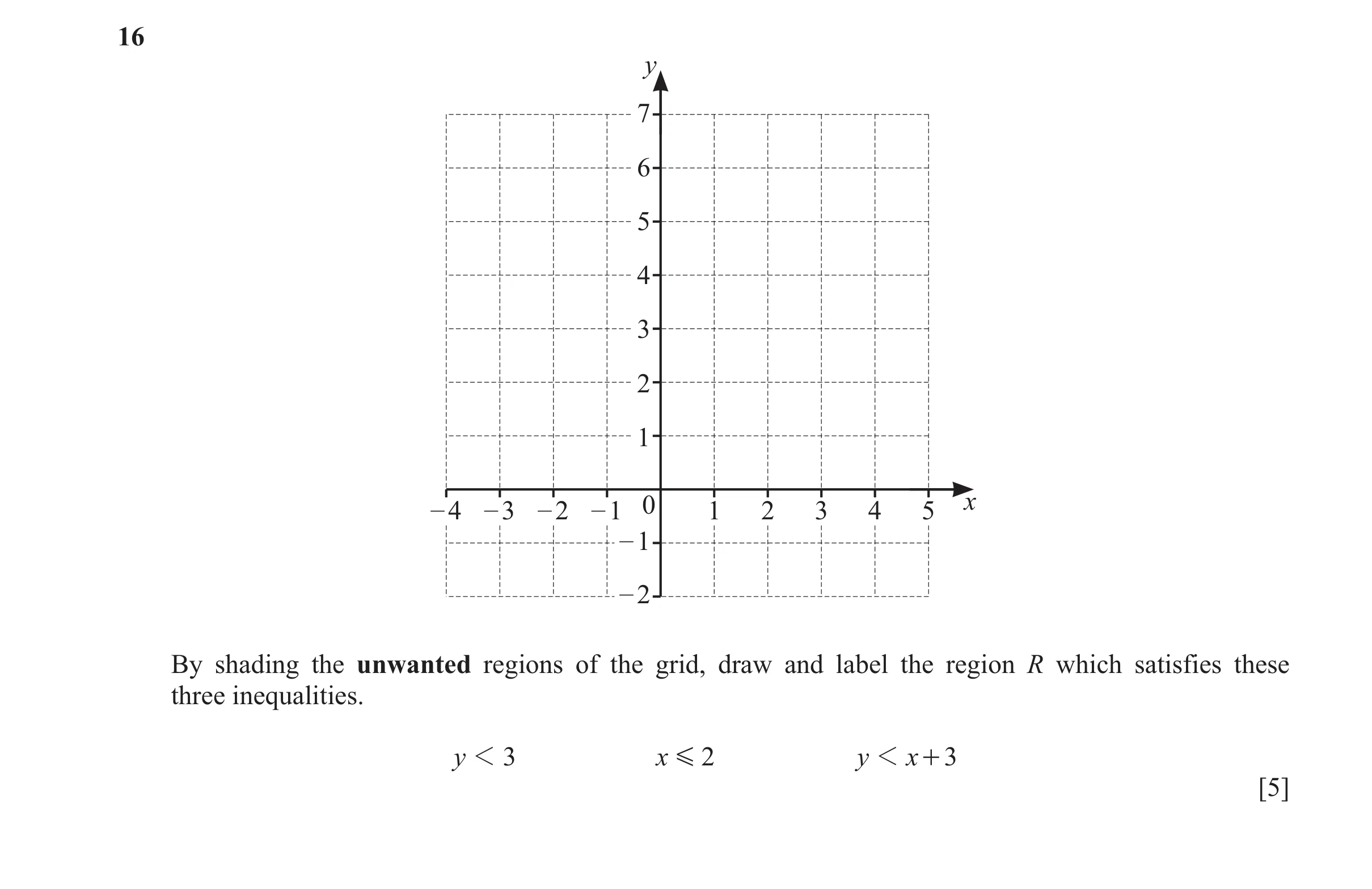
16 y 7 6 5 4 3 2 1 – 4 – 3 – 2 – 1 0 1 2 3 4 5 x – 1 – 2 By shading the unwanted regions of the grid, draw and label the region R which satisfies these three inequalities. y 1 3 x G 2 y 1 x + 3 [5]
5 marks
Mark scheme: 16 Correct lines and region indicated 5 B1 for each correct line B2 for correct region 0 0 If R labelled, take the lines surrounding R to be the boundaries of their region and ignore 0 shading. 1 or B1dep for region identified satisfying 2 of 1 these inequalities R 1 If y = 3 and x = 2 interchanged, SC1 for a region satisfying y < x + 3, y < 2 and x < 3
This question in 0580/43 May/June 2025
 1 / 53
 6 / 53
 20 / 53
 25 / 53
 27 / 53
 30 / 53
 31 / 53
 32 / 53
 33 / 53
 34 / 53
 46 / 53
 47 / 53
 53 / 53
 16
 13
 20
 14
 13
 13
 13
 13
 13
 13
 14
 10
 13
 12
 11
 11
 14
 9
 10
 9
 10
 11
 13
 10
 10
 11
 18
 15
 10
 17
 15
 7
 13
 16
 12
 11
 12
 5