Questions as text
Q1 · A Spanish family went to Scotland for a holiday 0580/41 Oct/Nov 2005
1 A Spanish family went to Scotland for a holiday. (a) The family bought 800 pounds (£) at a rate of £1 = 1.52 euros (€). How much did this cost in euros? [1] (b) The family returned home with £118 and changed this back into euros. They received €173.46. Calculate how many euros they received for each pound. [1] (c) A toy which costs €11.50 in Spain costs only €9.75 in Scotland. Calculate, as a percentage of the cost in Spain, how much less it costs in Scotland. [2] (d) The total cost of the holiday was €4347.00. In the family there were 2 adults and 3 children. The cost for one adult was double the cost for one child. Calculate the cost for one child. [2] (e) The original cost of the holiday was reduced by 10% to €4347.00. Calculate the original cost. [2] (f) The plane took 3 hours 15 minutes to return to Spain. The length of this journey was 2350 km. Calculate the average speed of the plane in (i) kilometres per hour, [2] (ii) metres per second. [1]
11 marks
Mark scheme: 1 (a) 1216 B1 (b) 1.47 B1 (c) 11 . 5 − 9 . 75 M1 × 100 11 . 5 15.2 A1 ww2 SC1 for 17.9 (d) 4347 ÷ 7 o.e. M1 621 A1 ww2 (e) 4347 ÷ 0 . 9 o.e. M1 4830 A1 ww2 (f)(i) 2350 M1 Must deal with the minutes correctly o.e. 3 . 25 723 to 723.1 A1 ww2 (ii) 200.9 to 201 A1ft their (i) ÷ 3.6 r.o.t. to 3sf or better [11]
This question in 0580/41 Oct/Nov 2005
Q2 · A train completed a journey of 850 kilometres with an average speed of 80 kilometres per… 0580/41 May/June 2006
1 (a) A train completed a journey of 850 kilometres with an average speed of 80 kilometres per hour. Calculate, giving exact answers, the time taken for this journey in (i) hours, [2] (ii) hours, minutes and seconds. [1] (b) Another train took 10 hours 48 minutes to complete the same 850 km journey. (i) It departed at 19 20. At what time, on the next day, did this train complete the journey? [1] (ii) Calculate the average speed, in kilometres per hour, for the journey. [2] (c) 25 C D 20 Speed 15 BB (metres per second) 10 A 5 O 1 2 3 4 5 6 7 8 9 10 Time (seconds) The solid line OABCD on the grid shows the first 10 seconds of a car journey. (i) Describe briefly what happens to the speed of the car between B and C. [1] (ii) Describe briefly what happens to the acceleration of the car between B and C. [1] (iii) Calculate the acceleration between A and B. [2] (iv) Using the broken straight line OC, estimate the total distance travelled by the car in the whole 10 seconds. [3] (v) Explain briefly why, in this case, using the broken line makes the answer to part (iv) a good estimate of the distance travelled. [1] (vi) Calculate the average speed of the car during the 10 seconds. Give your answer in kilometres per hour. [2]
16 marks
Mark scheme: 1 (a) (i) 850 ÷ 80 M1 10.625 (hrs) Must be exact A1 (ii) 10 hours 37 mins 30 secs B1 (b) (i) (0)6 08 (a.m.) B1 (ii) 850 ÷ 10 hrs 48 mins M1 78.7 (km/hr) (78.7037037) A1 (c) (i) Increasing (more slowly) B1 Accept speed going from 15 to 20. (ii) Decreasing B1 Accept accel. going from 12.5 to 0 (iii) 15 − 5 M1 1 . 8 − 1 12.5 (m/s2) A1 (iv) 1 M1 Alt Meth. 20 x 10 or 20 x 7 or × 3 × 20 2 1 x 3 x 20 2 Second area and addition s.o.i. dep M1 Sec. area and correct subtraction 170 (m) A1 (v) Areas above and below broken line are B1 approx. equal o.e. (vi) (their 1 7 0 ÷ 10) x 3.6 o.e. M1 61.2 (km/hr) A1 16
This question in 0580/41 May/June 2006
Q3 · A packet of sweets contains chocolates and toffees 0580/41 May/June 2007
8 A packet of sweets contains chocolates and toffees. (a) There are x chocolates which have a total mass of 105 grams. Write down, in terms of x, the mean mass of a chocolate. [1] (b) There are x + 4 toffees which have a total mass of 105 grams. Write down, in terms of x, the mean mass of a toffee. [1] (c) The difference between the two mean masses in parts (a) and (b) is 0.8 grams. Write down an equation in x and show that it simplifies to x2 + 4x – 525 = 0. [4] (d) (i) Factorise x2 + 4x – 525. [2] (ii) Write down the solutions of x2 + 4x – 525 = 0. [1] (e) Write down the total number of sweets in the packet. [1] (f) Find the mean mass of a sweet in the packet. [2]
12 marks
Mark scheme: 8 (a) 105 B1 Do not allow x = , but allow other letter and condone presence of units x (b) 105 B1 Do not allow x = , but allow other letter and condone presence of units x + 4 (c) 105 105 M2 SC1 if ± signs between terms incorrect = 8.0 oe or SC1 for their (a) – their (b) = 0.8 oe x −x + 4 if (a) and (b) are fractions with linear denominators 105(x + 4) – 105x = 0.8x(x + 4) oe M1 Dep on M2 or SC1 and allow all over x(x + 4) at this stage Condone any sign error in any 0.8x2 + 3.2x – 420 = 0 oe expanding done first (this is taken into account in the E mark) Completed without any errors x2 + 4x – 525 = 0 E1 dep on M3 (d) (i) (x + 25)(x – 21) B2 B1 for (x – 25)(x + 21) (ii) -25, 21 B1 ft - allow 25 and -21 from above only (e) 46 B1 ft ft 2 × a positive root + 4 (f) 210 ÷ ( their (e)) M1 4.57 or better (4.565…) ft A1 ft www 2, but 4.6 ww scores zero [12] IGCSE – May/June 2007 0580 and 0581 04
This question in 0580/41 May/June 2007
Q4 · Vreni took part in a charity walk 0580/41 May/June 2008
1 Vreni took part in a charity walk. She walked a distance of 20 kilometres. (a) She raised money at a rate of $12.50 for each kilometre. (i) How much money did she raise by walking the 20 kilometres? [1] 5 (ii) The money she raised in part (a)(i) was of the total money raised. 52 Work out the total money raised. [2] (iii) In the previous year the total money raised was $2450. Calculate the percentage increase on the previous year’s total. [2] (b) Part of the 20 kilometres was on a road and the rest was on a footpath. The ratio road distance : footpath distance was 3:2. (i) Work out the road distance. [2] (ii) Vreni walked along the road at 3 km / h and along the footpath at 2.5 km / h. How long, in hours and minutes, did Vreni take to walk the 20 kilometres? [2] (iii) Work out Vreni’s average speed. [1] (iv) Vreni started at 08 55. At what time did she finish? [1] (c) On a map, the distance of 20 kilometres was represented by a length of 80 centimetres. The scale of the map was 1 : n. Calculate the value of n. [2]
13 marks
Mark scheme: 1 (a) (i) 250 B1 (ii) their (a)(i) ÷ 5× 52 o.e. M1 SC1 for 12.5 ÷ 5× 52, implied by 130 2600 ft www2 A1 ft (iii) their (a)(ii) − 2450 their (a)(ii) 2450 150 × 100 o.e. × 100 − 100 , = M1 2450 2450 100 x A1ft 6.1(22……..) ft www2 ft M & A only if their (a)(ii) > 2450 (b) (i) 20 ÷ 5× 3 M1 12 www2 A1 Accept 12, 8 or 8, 12 (ii) their (b)(i) ÷ 3 and (20 – their (b)(i)) ÷ 2.5 M1 4 and 3.2 or 7.2 or 7h 20 mins seen imply M1 7 hours 12 mins cao www2 A1 Condone poor notation e.g. 7-12 (iii) 2.78 (2.777–2.778) o.e. cao B1 o.e. must have units stated e.g. o.e. in other units 0.7716..m/s, 46.29 – 46.30 m/min (iv) 16 07 o.e. ft B1 ft ft their (b)(ii) + 08 55 iff finishes on same day and (b)(ii) has hours and mins (c) 20× 100000 ÷ 80 o.e. M1 25 000 or 2.5× 10⁴ www2 A1 25 000 seen in final ans. After M0, SC1 for figs 25 or 0.00004 final answer [13]
This question in 0580/41 May/June 2008
Q5 · Examiner's North Use A NOT TO SCALE 180 km 115 km 90 km T H 30° 70° R The diagram shows… 0580/42 May/June 2010
5 Examiner's North Use A NOT TO SCALE 180 km 115 km 90 km T H 30° 70° R The diagram shows some straight line distances between Auckland (A), Hamilton (H), Tauranga (T) and Rotorua (R). AT = 180 km, AH = 115 km and HT = 90 km. (a) Calculate angle HAT. Show that this rounds to 25.0°, correct to 3 significant figures. Answer(a) [4] (b) The bearing of H from A is 150°. Find the bearing of (i) T from A, Answer(b)(i) [1] (ii) A from T. Answer(b)(ii) [1] For (c) Calculate how far T is east of A. Examiner's Use Answer(c) km [3] (d) Angle THR = 30° and angle HRT = 70°. Calculate the distance TR. Answer(d) km [3] (e) On a map the distance representing HT is 4.5cm. The scale of the map is 1 : n. Calculate the value of n. Answer(e) n = [2]
14 marks
Mark scheme: 180 + 115 90 5 (a) (cos) M2 M1 for correct implicit expression 902 = …… 2 × 180 × 115 24.98 – 24.99 A2 A1 for (cos) = 0.9064… (b) (i) 125(.0….) ft 1ft ft 150 – their (a) (ii) 305(.0….) ft 1ft ft 180 + their (b)(i) (c) 180sin (54.98 to 55) M2 B1 for 54.98 to 55 or 35 to 35.02 soi in correct or 180cos (35 to 35.02) oe position. or 180sin (360 – their (b)(ii)) Provided either angle is acute or 180cos(their (b)(i) – 90) oe 147(.4….) cao www 3 A1 90 sin 30 TR 90 (d) M2 M1 for = or other correct sin 70 sin 30 sin 70 implicit equation 47.9 (47.88 – 47.89) cao www 3 A1 (e) 2 000 000 oe 2 Allow 1 : 2 000 000 as answer. SC1 figs 2 in answer which could be a ratio. 4 3
This question in 0580/42 May/June 2010
Q6 · For Examiner's 4 cm Use NOT TO SCALE 13 cm The diagram shows a cone of radius 4 cm and… 0580/42 Oct/Nov 2010
4 (a) For Examiner's 4 cm Use NOT TO SCALE 13 cm The diagram shows a cone of radius 4 cm and height 13 cm. It is filled with soil to grow small plants. Each cubic centimetre of soil has a mass of 2.3g. (i) Calculate the volume of the soil inside the cone. 1 2 [The volume, V, of a cone with radius r and height h is V = π r h .] 3 Answer(a)(i) cm3 [2] (ii) Calculate the mass of the soil. Answer(a)(ii) g [1] (iii) Calculate the greatest number of these cones which can be filled completely using 50 kg of soil. Answer(a)(iii) [2] (b) A similar cone of height 32.5 cm is used for growing larger plants. Calculate the volume of soil used to fill this cone. Answer(b) cm3 [3] (c) For Examiner's Use NOT TO SCALE 12 cm Some plants are put into a cylindrical container with height 12 cm and volume 550 cm3. Calculate the radius of the cylinder. Answer(c) cm [3]
11 marks
Mark scheme: 4 (a) (i) 218 (217.7 to 218) 2 M1 for 1/3π × 42 × 13 (ii) 501 (500.7 to 501.4) 1ft ft their (a) × 2.3 (iii) 99 2ft ft 50 000 ÷ their (a)(ii) and truncated to whole number M1 for 50 000 ÷ their (a)(ii) oe or answers 99.8 or 100 3 325. (b) their (a)(i) × oe M2 or 1/3π × 102 × 32.5 13 or M1 for (32.5 ÷ 13)³ (=15.625) seen or (13 ÷ 32.5)³ (= 0.064) seen 3400 or 3410 (3401 to 3407) A1 www3 (c) (r² =) 550 ÷ 12π M2 (14.58 to 14.6) or M1 for 12π r² = 550 or better 3.82 (3.818 to 3.821) A1 www3 IGCSE – October/November 2010 0580 42
This question in 0580/42 Oct/Nov 2010
Q7 · For L 5480 km Examiner's Use D NOT TO 165° 3300 km SCALE C The diagram shows the… 0580/42 Oct/Nov 2010
6 For L 5480 km Examiner's Use D NOT TO 165° 3300 km SCALE C The diagram shows the positions of London (L), Dubai (D) and Colombo (C). (a) (i) Show that LC is 8710 km correct to the nearest kilometre. Answer(a)(i) [4] (ii) Calculate the angle CLD. Answer(a)(ii) Angle CLD = [3] (b) A plane flies from London to Dubai and then to Colombo. For It leaves London at 01 50 and the total journey takes 13 hours and 45 minutes. Examiner's The local time in Colombo is 7 hours ahead of London. Use Find the arrival time in Colombo. Answer(b) [2] (c) Another plane flies the 8710 km directly from London to Colombo at an average speed of 800 km/h. How much longer did the plane in part (b) take to travel from London to Colombo? Give your answer in hours and minutes, correct to the nearest minute. Answer(c) h min [4]
13 marks
Mark scheme: 6 (a) (i) 54802 + 33002 – 2 × 5480 × 3300 M2 (75 856 005) M1 for implicit version × cos165 8709.5.. E2 If E0, A1 for 75800000 to 75900000 sin 165 sin L sin 165 (ii) (sinL =) × 3300 M2 M1 for = oe (allow 8709.5.) 8710 3300 8710 (0.09806…) Could use cosine rule using 8710 or better – M2 for explicit form or M1 for implicit form (allow 5.6 to 5.63 for A mark) 5.6 (5.62 to 5.63) A1 www3 (b) 22 35 or 10 35 pm 2 Accept 22 35 pm B1 for 15 35 or 3 35 pm seen or answers 22h 35 mins or (0)8 35(am) or 10 35(am) (c) 8710 ÷ 800 M1 10.88 to 10.9 with no conversion to A1 Implied by correct final ans 2hrs 52 mins if not h/min shown or 10 (hrs) 52 (mins) to 10 (hrs) 54 (mins) oe 13 hrs 45 mins – their time in hrs and M1 Dep on first M1 mins oe e.g. 13 hrs 45mins – 11 hrs 29 mins or 13.75 – their decimal time and a or 13.75 – 10.9 then 2hrs 51 mins correct conversion to hrs and mins or minutes 2 hr 52 mins cao A1 www4 (2 hrs 51.75 mins) IGCSE – October/November 2010 0580 42
This question in 0580/42 Oct/Nov 2010
Q8 · Sacha either walks or cycles to school 0580/43 Oct/Nov 2010
6 Sacha either walks or cycles to school. For 3 Examiner's On any day, the probability that he walks to school is . Use 5 (a) (i) A school term has 55 days. Work out the expected number of days Sacha walks to school. Answer(a)(i) [1] (ii) Calculate the probability that Sacha walks to school on the first 5 days of the term. Answer(a)(ii) [2] 1 (b) When Sacha walks to school, the probability that he is late is . 4 1 When he cycles to school, the probability that he is late is . 8 (i) Complete the tree diagram by writing the probabilities in the four spaces provided. 1 late 4 3 walks 5 not late … … late … cycles not late … [3] (ii) Calculate the probability that Sacha cycles to school and is late. For Examiner's Use Answer(b)(ii) [2] (iii) Calculate the probability that Sacha is late to school. Answer(b)(iii) [2]
10 marks
Mark scheme: 6 Accept fraction, %, dec equivalents (3sf or better) throughout but not ratio or words i.s.w. incorrect cancelling/conversion to other forms Pen –1 once for 2 sf answers (a) (i) 33 1 5 243 (ii) (0.07776) 2 Accept 0.0778. M1 for 3 oe 3125 5 2 3 1 7 2 3 1 7 (b) (i) , , , 3 B1 for and B1 for B1 for 5 4 8 8 5 4 8 8 1 2 1 (ii) (0.05) cao 2 M1 for their × their 20 5 8 1 3 3 1 (iii) (0.2) ft 2ft ft + their (b)(ii) or M1 for × 5 20 5 4
This question in 0580/43 Oct/Nov 2010
Q9 · For Examiner's NOT TO Use SCALE 3 cm 12 cm The diagram shows a solid made up of a… 0580/43 Oct/Nov 2010
8 For Examiner's NOT TO Use SCALE 3 cm 12 cm The diagram shows a solid made up of a hemisphere and a cylinder. The radius of both the cylinder and the hemisphere is 3 cm. The length of the cylinder is 12 cm. (a) (i) Calculate the volume of the solid. 4 3 [ The volume, V, of a sphere with radius r is V = πr .] 3 Answer(a)(i) cm3 [4] (ii) The solid is made of steel and 1 cm3 of steel has a mass of 7.9 g. Calculate the mass of the solid. Give your answer in kilograms. Answer(a)(ii) kg [2] (iii) The solid fits into a box in the shape of a cuboid, 15 cm by 6 cm by 6 cm. For Calculate the volume of the box not occupied by the solid. Examiner's Use Answer(a)(iii) cm3 [2] (b) (i) Calculate the total surface area of the solid. You must show your working. [ The surface area, A, of a sphere with radius r is A = 4πr 2 .] Answer(b)(i) cm2 [5] (ii) The surface of the solid is painted. The cost of the paint is $0.09 per millilitre. One millilitre of paint covers an area of 8 cm2. Calculate the cost of painting the solid. Answer(b)(ii) $ [2]
15 marks
Mark scheme: 2 8 (a) (i) 396 (395.6 – 396) 4 M1 for × π × 33 and M1 (independent) for 3 π × 32 × 12, M1 (dependent on M2) for adding 126 π implies M3 (ii) 3.13 (3.125 – 3.128….) ft 2ft ft their (i) × 7.9 ÷ 1000 . M1 for × 7.9 soi by figs 313 or 3125 – 3128… (iii) 144 (144 – 144.4) ft 2ft ft 15 × 6 × 6 – their (a)(i) M1 for 6 × 6 × 15 oe (b) (i) 311 (310.8 – 311.1) 5 M1 for 2 × π × 32 and M1 (independent) for π × 6 × 12 and M1 for π × 32, M1 (dependent on M3) for adding. (99π implies M4) (ii) 3.50 (3.496 to 3.50) ft 2ft ft their (b)(i) × 0.01125 M1 for their (b)(i) ÷ 8 and × figs 9 implied by figs 3496 to 350 9
This question in 0580/43 Oct/Nov 2010
Q10 · For Examiner's Use Diagram 1 Diagram 2 Diagram 3 Diagram 4 The first four Diagrams in a… 0580/43 Oct/Nov 2010
11 For Examiner's Use Diagram 1 Diagram 2 Diagram 3 Diagram 4 The first four Diagrams in a sequence are shown above. Each Diagram is made from dots and one centimetre lines. The area of each small square is 1 cm2. (a) Complete the table for Diagrams 5 and 6. Diagram 1 2 3 4 5 6 Area (cm2) 2 6 12 20 Number of dots 6 12 20 30 Number of one centimetre lines 7 17 31 49 [4] (b) The area of Diagram n is n ( n + )1 cm2. (i) Find the area of Diagram 50. Answer(b)(i) cm2 [1] (ii) Which Diagram has an area of 930 cm2? Answer(b)(ii) [1] (c) Find, in terms of n, the number of dots in Diagram n. Answer(c) [1] (d) The number of one centimetre lines in Diagram n is 2 n 2 + pn + 1 . For Examiner's Use (i) Show that p = 4. Answer(d)(i) [2] (ii) Find the number of one centimetre lines in Diagram 10. Answer(d)(ii) [1] (iii) Which Diagram has 337 one centimetre lines? Answer(d)(iii) [3] (e) For each Diagram, the number of squares of area 1 cm2 is A, the number of dots is D and the number of one centimetre lines is L. Find a connection between A, D and L that is true for each Diagram. Answer(e) [1]
14 marks
Mark scheme: 11 (a) 30 42 4 B3 for 2 correct rows 42 56 or B2 for 1 correct row 71 97 or B1 for any term in column 5 correct (b) (i) 2550 1 (ii) 30 1 (c) (n + 1)(n + 2) oe final ans 1 (d) (i) 2n2 + pn + 1 = t 2 Uses a value of n up to 6 and a matching t from the table e.g. puts n = 3 and t = 31 2 × 3² + 3p + 1 = 31 M1 Correct solution shown with 1 intermediate step to p = 4 E1 OR Use p = 4 to get 2n² + 4n + 1 = 31 and simplifies to 3 term eqn M1 Solve correctly to get n = 3 E1 OR both 2 × 9 + 4 × 3 + 1 (= 31) M1 Conclusion e.g. 31 = 31 E1 with one part evaluated OR n(n + 1) + (n + 1)(n + 2) – 1 Correct simplification to 2n2 + 4n + 1 E1 or better M1 (ii) 241 1 (iii) 12 3 M1 for 2n2 + 4n + 1 = 337 and M1 for (n – 12)(n +14) or correct expression for n using formula (e) L = A + D − 1 oe 1
This question in 0580/43 Oct/Nov 2010
Q11 · For 0.8 m Examiner's Use 0.5 m NOT TO SCALE 1.2 m 1.2 m d 0.4 m A rectangular tank… 0580/43 Oct/Nov 2011
1 For 0.8 m Examiner's Use 0.5 m NOT TO SCALE 1.2 m 1.2 m d 0.4 m A rectangular tank measures 1.2 m by 0.8 m by 0.5 m. (a) Water flows from the full tank into a cylinder at a rate of 0.3 m3/min. Calculate the time it takes for the full tank to empty. Give your answer in minutes and seconds. Answer(a) min s [3] (b) The radius of the cylinder is 0.4 m. For Examiner's Calculate the depth of water, d, when all the water from the rectangular tank is in the cylinder. Use Answer(b) d = m [3] (c) The cylinder has a height of 1.2 m and is open at the top. The inside surface is painted at a cost of $2.30 per m2. Calculate the cost of painting the inside surface. Answer(c) $ [4]
10 marks
Mark scheme: Qu. Answers Mark Part Marks 1 (a) 1 min 36 s www 3 M1 for 1.2 × 0.8 × 0.5 (= 0.48) A1 1.6 or 96 If A0, B1 for correctly converting to min and sec Dep on M1 (b) 0.954 to 0.956 www 3 their 0.48 M2 for or M1 for π × 0.42 × d = ‘0.48’ π × 0.4 2 (c) 8.09 to 8.10 www 4 M1 for π × 0.42 (0.503) condone × 2 and M1 for π × 0.8 × 1.2 (3.02) M1 for their area × 2.3 (dep M1 M1)
This question in 0580/43 Oct/Nov 2011
Q12 · In Portugal, Miguel buys a book about planets 0580/42 May/June 2012
5 (a) In Portugal, Miguel buys a book about planets. For The book costs €34.95. Examiner's In England the same book costs £27.50. Use The exchange rate is £1 = €1.17. Calculate the difference in pounds (£) between the cost of the book in Portugal and England. Answer(a) £ [2] (b) In the book, the distance between two planets is given as 4.07 × 10¹² kilometres. The speed of light is 1.1 × 10⁹ kilometres per hour. Calculate the time taken for light to travel from one of these planets to the other. Give your answer in days and hours. Answer(b) days hours [3] (c) In one of the pictures in the book, a rectangle is drawn. The rectangle has length 9.3 cm and width 5.6 cm, both correct to one decimal place. (i) What is the lower bound for the length? Answer(c)(i) cm [1] (ii) Work out the lower and upper bounds for the area of the rectangle. Answer(c)(ii) Lower bound = cm2 Upper bound = cm2 [2]
8 marks
Mark scheme: 5 (a) (£) 2.37 or 2.371 to 2.372 www 2 2 M1 for 34.95 ÷ 1.17 implied by 29.87…or 29.9 or SC1 for 2.77 or 2.78 or 2.775 (b) 154 days 4 hours cao 3 M1 for 4.07 × 10¹² ÷ (1.1 × 10⁹) implied by figs 37 or 154. (….) A1 for 3700 seen or 3.7 × 10³ seen or 154 16 oe or 154 rem 4 (c) (i) 9.25 1 (ii) Lower = 51.3375 final answer 1 After 0 scored Upper = 52.8275 final answer 1 SC1 for answers reversed or 9.35 and 5.65 seen or 51.3375 and 52.8275 seen
This question in 0580/42 May/June 2012
Q13 · Distances from the Sun can be measured in astronomical units, AU 0580/41 Oct/Nov 2012
9 Distances from the Sun can be measured in astronomical units, AU. For Earth is a distance of 1 AU from the Sun. Examiner's Use One AU is approximately 1.496 × 10⁸ km. The table shows distances from the Sun. Name Distance from the Sun in AU Distance from the Sun in kilometres Earth 1 1.496 × 10⁸ Mercury 0.387 Jupiter 7.79 × 10⁸ Pluto 5.91 × 10⁹ (a) Complete the table. [3] (b) Light travels at approximately 300 000 kilometres per second. (i) How long does it take light to travel from the Sun to Earth? Give your answer in seconds. Answer(b)(i) s [2] (ii) How long does it take light to travel from the Sun to Pluto? Give your answer in minutes. Answer(b)(ii) min [2] (c) One light year is the distance that light travels in one year (365 days). How far is one light year in kilometres? Give your answer in standard form. Answer(c) km [3] (d) How many astronomical units (AU) are equal to one light year? Answer(d) AU [2]
12 marks
Mark scheme: 9 (a) 5.79 × 10⁷ oe 1 Accept ans in range 57890000 to 57900000 5.21 1 5.207 39.5 1 39.50…. or 39.51 Accept answers to greater than 3sf (b) (i) 498.6... to 499 2 M1 for 1.496 × 10 8 ÷ 300 000 (ii) 328 or 328.3... 2 M1 for figs 197 or figs 328[3.. ] seen Or their 39.5 × their (b)(i) (c) 9.46[0] to 9.461 × 10¹² 3 B2 for any correct equivalent or M1 for 300 000 × 3600 × 24 × 365 oe or for answer figs 946 to 9461 (d) 63200 or 63235 to 63242 oe 2 M1 for figs (their (c) ÷ 1496). Implied by first 3 figs correct
This question in 0580/41 Oct/Nov 2012
Q14 · The Martinez family travels by car to Seatown 0580/43 Oct/Nov 2012
1 (a) The Martinez family travels by car to Seatown. For The distance is 92 km and the journey takes 1 hour 25 minutes. Examiner's Use (i) The family leaves home at 07 50. Write down the time they arrive at Seatown. Answer(a)(i) [1] (ii) Calculate the average speed for the journey. Answer(a)(ii) km/h [2] (iii) During the journey, the family stops for 10 minutes. Calculate 10 minutes as a percentage of 1 hour 25 minutes. Answer(a)(iii) % [1] (iv) 92 km is 15% more than the distance from Seatown to Deecity. Calculate the distance from Seatown to Deecity. Answer(a)(iv) km [3] (b) The Martinez family spends $150 in the ratio For Examiner's fuel : meals : gifts = 11 : 16 : 3 . Use (i) Show that $15 is spent on gifts. Answer (b)(i) [2] (ii) The family buys two gifts. The first gift costs $8.25. Find the ratio cost of first gift : cost of second gift. Give your answer in its simplest form. Answer(b)(ii) : [2]
11 marks
Mark scheme: Qu. Answers Mark Part Marks 1 (a) (i) [0]9 15 [am] 1 Any acceptable form of time (ii) 64.9 or 65.[0] or 64.92 to 2 M1 for 92 ÷ (1 and 25 mins) or 92/85 × 60 oe 64.98 or 92 ÷ (1.41 to 1.42) (iii) 11.76…or 11.8 1 (iv) 80 3 M2 for 92 ÷ 1.15 oe or M1 for 115% associated with 92 (b) (i) 150 ÷ (11 + 16 + 3) or M1 Correct first step 150 × 3 oe then × 3 or ÷ 30 E1 Correct conclusion (ii) 11 : 9 final answer 2 M1 for 8.25 : (15 – 8.25) oe For M1 e.g. allow 1 : 0.818 [0.8181 to 0.8182] or 1.22 : 1 [1.222…] After M0, SC1 for 9 : 11 as final answer −11 k
This question in 0580/43 Oct/Nov 2012
Q15 · A metal cuboid has a volume of 1080 cm3 and a mass of 8 kg 0580/43 Oct/Nov 2012
3 A metal cuboid has a volume of 1080 cm3 and a mass of 8 kg. For Examiner's (a) Calculate the mass of one cubic centimetre of the metal. Use Give your answer in grams. Answer(a) g [1] (b) The base of the cuboid measures 12 cm by 10 cm. Calculate the height of the cuboid. Answer(b) cm [2] (c) The cuboid is melted down and made into a sphere with radius r cm. (i) Calculate the value of r. 4 [The volume, V, of a sphere with radius r is V = πr 3.] 3 Answer(c)(i) r = [3] (ii) Calculate the surface area of the sphere. For Examiner's [The surface area, A, of a sphere with radius r is A = 4πr 2.] Use Answer(c)(ii) cm2 [2] (d) A larger sphere has a radius R cm. The surface area of this sphere is double the surface area of the sphere with radius r cm in part (c). R Find the value of . r Answer(d) [2]
10 marks
Mark scheme: 3 (a) 7.407….. or 7.41 1 (b) 9 2 M1 for 1080 ÷ (12 × 10) oe 1080 (c) (i) 6.36 to 6.37 www 3 M2 for 3 4 oe π 3 1080 or M1 for 4 oe [ 257.7 to 258.7] π 3 Accept 4.18 to 4.19 for 4/3 π (ii) 508 to 510 2 M1 for 4 × π × (their (c)(i))2 (d) 2 or 1.41 [1.414…] www 2 Allow over 1 or 2 : 1 etc M1 for (R / r)2 = 2 oe or [R2 =] (2 × their (c)(ii))/4π or [R2 =] 2 × (their (c)(i))²
This question in 0580/43 Oct/Nov 2012
Q16 · Emily cycles along a path for 2 minutes 0580/41 Oct/Nov 2013
2 Emily cycles along a path for 2 minutes. For Examiner′s She starts from rest and accelerates at a constant rate until she reaches a speed of 5 m/s after 40 seconds. Use She continues cycling at 5 m/s for 60 seconds. She then decelerates at a constant rate until she stops after a further 20 seconds. (a) On the grid, draw a speed-time graph to show Emily’s journey. 5 4 3 Speed (m/s) 2 1 0 10 20 30 40 50 60 70 80 90 100 110 120 Time (seconds) [2] (b) Find Emily’s acceleration. Answer(b) … m/s2 [1] (c) Calculate Emily’s average speed for the journey. Answer(c) … m/s [4] _____________________________________________________________________________________
7 marks
Mark scheme: 2 (a) 3 correct lines on grid 2 Allow good freehand (0, 0) to (40, 5) SC1FT for 2 lines correct, FT from an incorrect (40, 5) to (100, 5) line (100, 5) to (120, 0) 5 (b) oe 1 40 (c) 3.75 4 M2 for 0.5 × 40 × 5 + 60 × 5 + 0.5 × 20 × 5 oe [450] or M1 for evidence of a relevant area = distance and M1dep their area (or distance) ÷ 120 IGCSE – October/November 2013 0580 41
This question in 0580/41 Oct/Nov 2013
Q17 · Noma fl ies from Johannesburg to Hong Kong 0580/42 Oct/Nov 2013
7 Noma fl ies from Johannesburg to Hong Kong. For Examiner′s Her plane leaves Johannesburg at 18 45 and arrives in Hong Kong 13 hours and 25 minutes later. Use The local time in Hong Kong is 6 hours ahead of the time in Johannesburg. (a) At what time does Noma arrive in Hong Kong? Answer(a) … [2] (b) Noma sleeps for part of the journey. The time that she spends sleeping is given by the ratio sleeping : awake = 3 : 4 . Calculate how long Noma sleeps during the journey. Give your answer in hours and minutes. Answer(b) … h … min [2] (c) (i) The distance from Hong Kong to Johannesburg is 10 712 km. For Examiner′s The time taken for the journey is 13 hours and 25 minutes. Use Calculate the average speed of the plane for this journey. Answer(c)(i) … km/h [2] (ii) The plane uses fuel at the rate of 1 litre for every 59 metres travelled. Calculate the number of litres of fuel used for the journey from Johannesburg to Hong Kong. Give your answer in standard form. Answer(c)(ii) … litres [4] (d) The cost of Noma’s journey is 10 148 South African Rand (R). This is an increase of 18% on the cost of the journey one year ago. Calculate the cost of the same journey one year ago. Answer(d) R … [3] _____________________________________________________________________________________
13 marks
Mark scheme: 7 (a) 14 10 or 2 10 pm final answer 2 M1 for (0)8 10 oe or answer 14 hours and 10 minutes or answer 2 10 [am] (b) 5 hours 45 minutes cao 2 M1 for 345 [mins] seen or for 805 /7 × 3 oe or 5.75 seen 25 (c) (i) 798 or 798.2 to 798.4…. 2 M1 for 10712 / 13 or 10712 ÷ 13.4… 60 (ii) 1.82 × 10⁵ 4 B3 for 182000 or 181500 to 181600 seen or 1.815 × 10⁵ to 1.816 × 10⁵ or M2 for 10712000/59 oe or M1 for figs 10712/figs 59 soi by figs 182 or figs 1815 to 1816 and B1 FT for their number of litres correctly converted to standard form rounded to 3sf or better (d) 8600 3 M2 for 10148 ÷ 1.18 oe or M1 for 10148 associated with 118[%]
This question in 0580/42 Oct/Nov 2013
Q18 · Ali leaves home at 10 00 to cycle to his grandmother’s house 0580/41 May/June 2014
2 Ali leaves home at 10 00 to cycle to his grandmother’s house. He arrives at 13 00. The distance-time graph represents his journey. 40 30 Distance from home (km) 20 10 0 10 00 11 00 12 00 13 00 14 00 15 00 16 00 17 00 Time (a) Calculate Ali’s speed between 10 00 and 11 30. Give your answer in kilometres per hour. Answer(a) … km/h [2] (b) Show that Ali’s average speed for the whole journey to his grandmother’s house is 12 km/h. Answer(b) [2] (c) Change 12 kilometres per hour into metres per minute. Answer(c) … m/min [2] (d) Ali stays for 45 minutes at his grandmother’s house and then returns home. He arrives home at 16 42. Complete the distance-time graph. [2] __________________________________________________________________________________________
8 marks
Mark scheme: 2 (a) 8 2 M1 for 12 ÷ 1.5 oe (b) [Distance =] 36 B1 their36 ÷ 3 [= 12] oe M1 (c) 200 2 M1 for 12 × 1000 ÷ 60 oe e.g. 36 000 ÷ 180 (d) Horizontal line at 36 to 13 45 1 (their 13 45, 36) joined to (16 42, 0) 1FT
This question in 0580/41 May/June 2014
Q19 · The distance a train travels on a journey is 600 km 0580/42 May/June 2014
8 The distance a train travels on a journey is 600 km. (a) Write down an expression, in terms of x, for the average speed of the train when (i) the journey takes x hours, Answer(a)(i) … km/h [1] (ii) the journey takes (x + 1) hours. Answer(a)(ii) … km/h [1] (b) The difference between the average speeds in part(a)(i) and part(a)(ii) is 20 km/h. (i) Show that x 2 + x – 30 = 0 . Answer(b)(i) [3] (ii) Find the average speed of the train for the journey in part(a)(ii). Show all your working. Answer(b)(ii) … km/h [4] __________________________________________________________________________________________
9 marks
Mark scheme: 600 600 8 (a) (i) 1 Not x = x x 600 600 (ii) 1 Not x = x + 1 x + 1 600 600 (b) (i) – = 20 oe M1FT FT their (a)(i) – their (a)(ii) = 20 oe x x + 1 If M0, SC1FT for their(a)(ii) – their (a)(i) = 20 oe 600 ( x + )1 − 600 x = 20 x ( x + )1 or better A1 May still be over common denominator and can be implied by third line. Allow recovery if bracket omitted 600 x + 600 − 600 x = 20 x 2 + 20 x A1 Dep on M1A1 and conclusion reached with at 0 = 20 x 2 + 20 x − 600 least one of the interim lines and without any 2 errors or omissions x + x − 30 = 0 IGCSE – May/June 2014 0580 42 Qu Answers Mark Part Marks (ii) x = 5 B3 B2 for ( x + 6 )( x − 5) [= 0] oe or SC1 for ( x + a )( x + b ) where ab = – 30 or a + b = 1 − 1 + or − 12 − .1.4 − 30 or B2 for 1.2 2 1 1 or 30 + − 2 2 − 1 + or − q or B1 for or 12 − 1.4 − 30 1.2 2 1 or x + 2 100 B1FT FT 600 ÷ (their x + 1) if x > 0 correctly evaluated 1 9 1 2 1 9 1 2
This question in 0580/42 May/June 2014
Q20 · NOT TO SCALE 75 cm 55 cm 120 cm The diagram shows a water tank in the shape of a cuboid… 0580/42 Oct/Nov 2014
7 NOT TO SCALE 75 cm 55 cm 120 cm The diagram shows a water tank in the shape of a cuboid measuring 120 cm by 55 cm by 75 cm. The tank is fi lled completely with water. (a) Show that the capacity of the water tank is 495 litres. Answer(a) [2] (b) (i) The water from the tank fl ows into an empty cylinder at a uniform rate of 750 millilitres per second. Calculate the length of time, in minutes, for the water to be completely emptied from the tank. Answer(b)(i) … min [2] (ii) When the tank is completely empty, the height of the water in the cylinder is 112 cm. NOT TO SCALE 112 cm Calculate the radius of the cylinder. Answer(b)(ii) … cm [3] (c) x cm NOT TO SCALE 75 cm cm 145 55 cm 120 cm A rod of length 145 cm is placed inside the water tank. One end of the rod is in the bottom corner of the tank as shown. The other end of the rod is x cm below the top corner of the tank as shown. Calculate the value of x. Answer(c) x = … [4] (d) Calculate the angle that the rod makes with the base of the tank. Answer(d) … [3] __________________________________________________________________________________________
14 marks
Mark scheme: 7 (a) (i) 120 × 55 × 75 [= 495000] M1 M1 ÷ 1000 [= 495] or 495[l] × 1000 = 495000[ml] (b) (i) 11 2 M1 for 495000 ÷ 750 [÷ 60] oe [660] After 0 scored, SC1 for answer figs 11 figs 495 (ii) 37.5 or 37.50 to 37.51 3 M2 for oe 112π 2 figs 495 or M1 for [112r = ] or π 2 figs 495 [ πr = ] or better 112 (c) 15 4 B3 for answer 60 or M3 for 75 – 145 2 − (55 2 + 120 2 ) oe M2 for 145 2 − ( 55 2 + 120 2 ) oe or M1 for 55 2 + 120 2 2 + 120 2 /145) oe, e.g. (d) 24.4[4..] to 24.45 3 M2 for cos–1 ( 55 or sin −(751 – their (c))/145 or tan −((751 – their (c))/ 55 2 + 120 2 ) or M1 for cos = 55 2 + 120 2 /145 oe or sin = (75 – their (c))/145 or tan = (75 – their (c))/ 55 2 + 120 2
This question in 0580/42 Oct/Nov 2014
Q21 · North NOT TO SCALE P 58 km L North 74 km Q A ship sails from port P to port Q 0580/42 Oct/Nov 2014
8 North NOT TO SCALE P 58 km L North 74 km Q A ship sails from port P to port Q. Q is 74 km from P on a bearing of 142°. A lighthouse, L, is 58 km from P on a bearing of 110°. (a) Show that the distance LQ is 39.5 km correct to 1 decimal place. Answer(a) [5] (b) Use the sine rule to calculate angle PQL. Answer(b) Angle PQL = … [3] (c) Find the bearing of (i) P from Q, Answer(c)(i) … [2] (ii) L from Q. Answer(c)(ii) … [1] (d) The ship takes 2 hours and 15 minutes to sail the 74 km from P to Q. Calculate the average speed in knots. [1 knot = 1.85 km/h] Answer(d) … knots [3] (e) Calculate the shortest distance from the lighthouse to the path of the ship. Answer(e) … km [3] __________________________________________________________________________________________
17 marks
Mark scheme: 8 (a) Angle LPQ = 32 soi B1 582 + 742 – 2 × 58 × M2 M1 for correct implicit cos rule 74 cos their P A2 A1 for 1560.3 to 1560.4 or 1560 39.50[1...] 58 sin their P sin PQL sin( their P ) (b) sin PQL = oe M2 M1 for = oe 395. 58 395. 51.1 or 51.08 to 51.09 B1 (c) (i) 322 2 M1 for 180 + 142 oe (ii) [0]13[.1] or 13.08 to 13.09 1FT FT their (b) – 38 (d) 17.8 or 17.77 to 17.78 3 M1 for 74 ÷ 2.25 oe soi by 32.888… to 3 sf or better M1 for dist or speed ÷ 1.85 (e) 30.7 or 30.73 to 30.74… 3 M2 for 58 sin their P oe or 39.5 sin their (b) x or M1 for = sin their P oe 58 x or = sin their (b) 395.
This question in 0580/42 Oct/Nov 2014
Q22 · Ricardo asks some motorists how many litres of fuel they use in one day 0580/43 Oct/Nov 2014
9 (a) Ricardo asks some motorists how many litres of fuel they use in one day. The numbers of litres, correct to the nearest litre, are shown in the table. Number of litres 16 17 18 19 20 Number of motorists 11 10 p 4 8 (i) For this table, the mean number of litres is 17.7 . Calculate the value of p. Answer(a)(i) p = … [4] (ii) Find the median number of litres. Answer(a)(ii) … litres [1] (b) Manuel completed a journey of 320 km in his car. The fuel for the journey cost $1.28 for every 6.4 km travelled. (i) Calculate the cost of fuel for this journey. Answer(b)(i) $ … [2] (ii) When Manuel travelled 480 km in his car it used 60 litres of fuel. Manuel’s car used fuel at the same rate for the journey of 320 km. Calculate the number of litres of fuel the car used for the journey of 320 km. Answer(b)(ii) … litres [2] (iii) Calculate the cost per litre of fuel used for the journey of 320 km. Answer(b)(iii) $ … [2] (c) Ellie drives a car at a constant speed of 30 m/s correct to the nearest 5 m/s. She maintains this speed for 5 minutes correct to the nearest 10 seconds. Calculate the upper bound of the distance in kilometres that Ellie could have travelled. Answer(c) … km [5] __________________________________________________________________________________________
16 marks
Mark scheme: 16 × 11 + 17 × 10 + 18 p + 19 × 4 + 20 × 8 9 (a) (i) 7 4 M2 for = 177. 11 + 10 + 4 + 8 + p or better or M1 for sum of two correct products or better or for [total =] 11 + 10 + 4 + 8 + p and B1 for 582 + 18p = 17.7 (33 + p) (ii) 17 1FT STRICT FT median for their p if integer 320 (b) (i) 64 2 M1 for × 1.28 oe 4.6 320 (ii) 40 2 M1 for × 60 oe 480 (iii) 1.6[0] 2FT FT their (b)(i) / their (b)(ii) evaluated correctly to 2dp 480 M1 for their (b)(i) / their (b)(ii) or × 1.28 ÷ 60 4.6 (c) 9.9125 cao 5 B4 for answer 9912.5 or M1 for 25 to 35 × 290 to 310 oe and B1 for 32.5 used and B1 for 305 or 5 mins 5 secs used and M1 indep for any correct conversion seen m to km
This question in 0580/43 Oct/Nov 2014
Q23 · On the first part of a journey, Alan drove a distance of x km and his car used 6 litres… 0580/42 May/June 2015
3 On the first part of a journey, Alan drove a distance of x km and his car used 6 litres of fuel. 600 The rate of fuel used by his car was litres per 100 km. x (a) Alan then drove another (x + 20) km and his car used another 6 litres of fuel. (i) Write down an expression, in terms of x, for the rate of fuel used by his car on this part of the journey. Give your answer in litres per 100 km. Answer(a)(i) … litres per 100 km [1] (ii) On this part of the journey the rate of fuel used by the car decreased by 1.5 litres per 100 km. Show that x2 + 20x – 8000 = 0. Answer(a)(ii) [4] (b) Solve the equation x2 + 20x – 8000 = 0. Answer(b) x = … or x = … [3] (c) Find the rate of fuel used by Alan’s car for the complete journey. Give your answer in litres per 100 km. Answer(c) … litres per 100 km [2] __________________________________________________________________________________________
10 marks
Mark scheme: 600 3 (a) (i) final answer 1 x + 20 600 600 (ii) − their = 1.5 oe M1 x x + 20 600(x + 20) – 600x = 1.5x(x + 20) M1 Correctly clearing, or correctly collecting into a single fraction, two fractions both with algebraic or 600 denominators, one being 600( x + 20) − 600 x x [= their1.5] x ( x + 20 ) 600x + 12 000 – 600x = 1.5x2 + 30x M1 Dep on previous M1, correctly multiplying their brackets and clearing fraction [0 = 1.5x2 + 30x – 12 000] 0 = x2 + 20x – 8000 A1 With no errors or omissions seen, dep on M3 (b) –100, 80 3 M2 for (x + 100)(x – 80) or M1 for (x + a)(x + b) where ab = –8000 or a + b = 20 OR B1 for 20 2 − 4 × 1 × ( − 8000 ) or better and − 20 + q − 20 − q B1 for or 2 × 1 2 × 1 12 (c) 2FT FT × 100 correctly evaluated 6.67 or 6.666 to 6.667 oe 2(their 80) + 20 to at least 3 sf M1 for choosing and using their positive root
This question in 0580/42 May/June 2015
Q24 · The total surface area of a cone is given by the formula A = πrl + πr2 0580/43 May/June 2015
7 (a) The total surface area of a cone is given by the formula A = πrl + πr2. (i) Find A when r = 6.2 cm and l = 10.8 cm. Answer(a)(i) … cm2 [2] (ii) Rearrange the formula to make l the subject. Answer(a)(ii) l = … [2] (b) (i) Irina walks 10 km at 4 km/h and then a further 8 km at 5 km/h. Calculate Irina’s average speed for the whole journey. Answer(b)(i) … km/h [3] (ii) Dariella walks x km at 5 km/h and then runs (x + 4) km at 10 km/h. The average speed of this journey is 7 km/h. Find the value of x. Show all your working. Answer(b)(ii) x = … [5] (c) (i) Priyantha sells her model car for $19.80 at a profit of 20%. Calculate the original price of the model car. Answer(c)(i) $ … [3] (ii) Dev sells his model car for $x at a profit of y %. Find an expression, in terms of x and y, for the original price of this model car. Write your answer as a single fraction. Answer(c)(ii) $ … [3]
18 marks
Mark scheme: 27 (a) (i) 331 or 331.1 to 331.2 2 M1 for π × 2.6 × 10⁸. + π × 2.6 A − π r 2 (ii) oe final answer 2 M1 for correct re-arrangement isolating term π r in l M1 for correct division by π r 10 8 (b) (i) 4.39 or 4.390… 3 M2 for 18 ÷ + 4 5 10 8 or M1 for or 4 5 (ii) x + x + 4 oe B1 Must be seen x x + 4 or B1 Must be seen 5 10 x + x + 4 = 7 oe M2 or M1 for evidence of total distance ÷ their x x + 4 + total time 5 10 12 B1 20 (c) (i) 16.5[0] final answer 3 M2 for 19.8 ÷ + 1 oe 100 or M1 for evidence of (100 + 20)% associated with 19.8 100 x x x (ii) final answer 3 B2 for or oe 100 + y y 1+ .001 y 1 + 100 y or B1 for 1 + or 100 + y or 1 + 0.01y 100 seen Qu Answers Mark Part Marks ( )
This question in 0580/43 May/June 2015
Q25 · A cylindrical tank contains 180 000 cm3 of water 0580/43 May/June 2015
8 (a) A cylindrical tank contains 180 000 cm3 of water. 45 cm The radius of the tank is 45 cm. NOT TO SCALE Calculate the height of water in the tank. Answer(a) … cm [2] (b) D C NOT TO 70 cm SCALE 40 cm 150 cm A 50 cm B The diagram shows an empty tank in the shape of a horizontal prism of length 150 cm. The cross section of the prism is an isosceles trapezium ABCD. AB = 50 cm, CD = 70 cm and the vertical height of the trapezium is 40 cm. (i) Calculate the volume of the tank. Answer(b)(i) … cm3 [3] (ii) Write your answer to part (b)(i) in litres. Answer(b)(ii) … litres [1] (c) The 180 000 cm3 of water flows from the tank in part (a) into the tank in part (b) at a rate of 15 cm3/s. Calculate the time this takes. Give your answer in hours and minutes. Answer(c) … h … min [3] (d) D 70 cm C x cm NOT TO F E SCALE 40 cm h cm A 50 cm B The 180 000 cm3 of water reaches the level EF as shown above. EF = x cm and the height of the water is h cm. (i) Using the properties of similar triangles, show that h = 2(x – 50). Answer(d)(i) [2] (ii) Using h = 2(x – 50), show that the shaded area, in cm2, is x2 – 2500. Answer(d)(ii) [1] (iii) Find the value of x. Answer(d)(iii) x = … [2] (iv) Find the value of h. Answer(d)(iv) h = … [1]
15 marks
Mark scheme: 28 (a) 28.3 or 28.29… 2 M1 for 180 000 ÷ (π × 45 ) 1 (b) (i) 360 000 3 M2 for (70 + 50 ) × 40 × 150 oe 2 1 or M1 for (70 + 50 ) × 40 oe 2 or their area of ABCD × 150 dependent on their area being two dimensional (ii) 360 1FT FT their (b)(i) ÷ 1000 (c) 3 h 20 min 3 M2 for 180 000 ÷ 15 ÷ 60 (implied by 200) or M1 for 180 000 ÷ 15 (implied by 12000) or correct conversion of their seconds into h and min h 12 ( x − 50 ) (d) (i) = oe M1 i.e. a correct statement from similar figures 40 10 which must contain h, x and numbers h = 2 ( x − 50 ) A1 Answer established with at least one more step and no errors or omissions 1 (ii) ( x + 50 ) 2( x − 50) M1 2 2 − 2500) ×150 = 180 000 or better (iii) 60.8 or 60.82 to 60.83 2 M1 for ( x (iv) 21.7 or 21.65 to 21.66 1FT FT for 2(their (d)(iii) – 50) evaluated only if x > 50 Qu Answers Mark Part Marks 2 13
This question in 0580/43 May/June 2015
Q26 · The diagram shows a horizontal water trough in the shape of a prism 0580/43 Oct/Nov 2015
3 The diagram shows a horizontal water trough in the shape of a prism. NOT TO 35 cm SCALE 12 cm 6 cm 120 cm 25 cm The cross section of this prism is a trapezium. The trapezium has parallel sides of lengths 35 cm and 25 cm and a perpendicular height of 12 cm. The length of the prism is 120 cm. (a) Calculate the volume of the trough. Answer(a) … cm3 [3] (b) The trough contains water to a depth of 6 cm. (i) Show that the volume of water is 19 800 cm3. Answer (b)(i) [2] (ii) Calculate the percentage of the trough that contains water. Answer(b)(ii) … % [1] (c) The water is drained from the trough at a rate of 12 litres per hour. Calculate the time it takes to empty the trough. Give your answer in hours and minutes. Answer(c) … h … min [4] (d) The water from the trough just fills a cylinder of radius r cm and height 3r cm. Calculate the value of r. Answer(d) r = … [3] (e) The cylinder has a mass of 1.2 kg. 1 cm3 of water has a mass of 1 g. Calculate the total mass of the cylinder and the water. Give your answer in kilograms. Answer(e) … kg [2] __________________________________________________________________________________________
15 marks
Mark scheme: 3 (a) 43 200 3 M2 for 0.5 × (35 + 25) × 12 × 120 oe or M1 for 0.5 × (35 + 25) × 12 oe (b) (i) 0.5 × (25 + 30) × 6 ×120 [= 19 800] M2 Dep on a valid method for obtaining the width of 30 cm B1 for 0.5 × (25 + 35) oe 19 800 (ii) 45.8 or 45.83… 1FT FT for × 100 their (a) (c) 1 hr 39 min 4 33 B3 for 1.65 [h] or 99 mins or 20 19 800 or M2 for oe 12 × 1000 19 800 19 800 or M1 for or or 12 × 1000 12 1000 If zero scored then SC1 for figs 165 and B1 for converting their time (in hours) into hours and minutes 19 800 (d) 12.8 or 12.80 to 12.81 3 M2 for 3 3 π or M1 for π r 2 3r = 19 800 19 800 (e) 21[.0] 2 M1 for + 2.1 1000
This question in 0580/43 Oct/Nov 2015
Q27 · Mr Chan flies from London to Los Angeles, a distance of 8800 km 0580/42 May/June 2016
1 Mr Chan flies from London to Los Angeles, a distance of 8800 km. The flight takes 11 hours and 10 minutes. (a) (i) His plane leaves London at 09 35 local time. The local time in Los Angeles is 8 hours behind the time in London. Calculate the local time when the plane arrives in Los Angeles. … [2] (ii) Work out the average speed of the plane in km/h. … km/h [2] (b) There are three types of tickets, economy, business and first class. The price of these tickets is in the ratio economy : business : first class = 2 : 5 : 9. (i) The price of a business ticket is $2350. Calculate the price of a first class ticket. $ … [2] (ii) Work out the price of an economy ticket as a percentage of the price of a first class ticket. … % [1] (c) The price of a business ticket for the same journey with another airline is $2240. (i) The price of a first class ticket is 70% more than a business ticket. Calculate the price of this first class ticket. $ … [2] (ii) The price of a business ticket is 180% more than an economy ticket. Calculate the price of this economy ticket. $ … [3] (d) Mr Chan hires a car in Los Angeles. The charges are shown below. Car Hire $28.00 per day plus $6.50 per day insurance. $1.25 for every kilometre travelled after the first 800 km. The first 800 km are included in the price. Mr Chan hired the car for 12 days and paid $826.50 . (i) Find the number of kilometres Mr Chan travelled in this car. … km [4] (ii) The car used fuel at an average rate of 1 litre for every 10 km travelled. Fuel costs $1.30 per litre. Calculate the cost of the fuel used by the car during the 12 days. $ … [2]
18 marks
Mark scheme: Question Answer Mark Part marks 1 (a) (i) 12 45 [pm] 2 B1 for 20 45 seen or 8 45 pm seen or [0]1 35 seen (ii) 788 or 787.8 to 788.1 2 M1 for 8800 ÷ 11h 10 mins oe (b) (i) 4230[.00] 2 M1 for 2350 ÷ 5 oe (ii) 22.2 or 22.2… 1 100 + 70 (c) (i) 3808 final answer 2 M1 for 2240 × oe 100 100 + 180 (ii) 800 3 M2 for 2240 ÷ oe 100 or M1 for 2240 associated with 280% (d) (i) 1130 4 M3 for (826.5[0] – 12 × (28 + 6.5[0])) ÷ 1.25 seen or M2 for 826.5[0] – 12 × (28 + 6.5[0]) seen or M1 for 12 × (28 + 6.5[0]) seen (ii) $146.9[0] final answer 2FT FT their(d)(i) × 0.13 correctly evaluated If answer not exact to at least 3 sf or better M1 for their (d)(i) ÷ 10 × 1.3
This question in 0580/42 May/June 2016
Q28 · Alfonso runs 10 km at an average speed of x km/h 0580/43 May/June 2016
7 Alfonso runs 10 km at an average speed of x km/h. The next day he runs 12 km at an average speed of (x – 1) km/h. The time taken for the 10 km run is 30 minutes less than the time taken for the 12 km run. (a) (i) Write down an equation in x and show that it simplifies to x2 – 5x – 20 = 0. [4] (ii) Use the quadratic formula to solve the equation x2 – 5x – 20 = 0. Show your working and give your answers correct to 2 decimal places. x = … or x = … [4] (iii) Find the time that Alfonso takes to complete the 12 km run. Give your answer in hours and minutes correct to the nearest minute. … hours … minutes [2] (b) A cheetah runs for 60 seconds. The diagram shows the speed-time graph. NOT TO SCALE Speed 25 (m/s) 0 10 55 60 Time (seconds) (i) Work out the acceleration of the cheetah during the first 10 seconds. … m/s2 [1] (ii) Calculate the distance travelled by the cheetah. … m [3]
14 marks
Mark scheme: 12 10 12 10 7 (a) (i) − = 0.5 oe M2 M1 for x − 1 x x −or1 x 10 12 12x – 10(x – 1) = 0.5x(x – 1) or better M1 FT − = 0.5 only x x − 1 Brackets expanded x2 – 5x – 20 = 0 with no errors or A1 Dep on M3 and brackets expanded omissions seen (ii) 5 2 ( −5) 2 − 4(1)( −20) or better B1 Seen anywhere or ( x − ) oe 2 p + q p − q B1 p = –(– 5), r = 2(1) or better Must be in the form or r r 2 2 5 5 5 5 or for + + 20 or − + 20 2 2 2 2 – 2.62, 7.62 final answers B1B1 SC1 for – 2.6 or – 2.623 to – 2.624 and 7.6 or 7.623 to 7.624 or –2.62 and 7.62 seen in working or answers 2.62 and – 7.62 (iii) 1 [ hr] 49 [mins] 2FT FT 12 ÷ (their +ve root – 1) or 0.5 + 10 ÷ (their 7.62) in hrs and mins, rounded to nearest min M1 for 12 ÷ (their +ve root – 1) or 0.5 + 10 ÷ (their 7.62) (b) (i) 2.5 1 (ii) 1312.5 final answer 3 M2 for any complete correct method e.g 25 × 10 ÷ 2 + 45 × 25 + 5 × 25 ÷ 2 M1 for any correct method for a relevant area under the graph
This question in 0580/43 May/June 2016
Q29 · 200 people run 10 km 0580/42 Oct/Nov 2016
4 200 people run 10 km. The table shows some information about the times, t minutes, taken to run the 10 km. Time 30 1 t G 40 40 1 t G 45 45 1 t G 50 50 1 t G 55 55 1 t G 60 60 1 t G 80 (t minutes) Frequency 8 22 95 55 14 6 (a) Howard takes 40 minutes to run the 10 km. Calculate his average speed in kilometres per hour. … km/h [2] (b) Calculate an estimate of the mean time. … min [4] (c) Complete the histogram to show the information in the table. 20 18 16 14 12 Frequency density 10 8 6 4 2 0 t 30 40 50 60 70 80 Time (minutes) [4] (d) (i) Use the frequency table opposite to complete the cumulative frequency table. Time t G 40 t G 45 t G 50 t G 55 t G 60 t G 80 (t minutes) Cumulative 8 30 194 200 frequency [1] (ii) Draw a cumulative frequency diagram to show the information in the table above. 200 180 160 140 120 Cumulative frequency 100 80 60 40 20 0 t 30 40 50 60 70 80 Time (minutes) [3] (iii) Use your diagram to find (a) the median, … min [1] (b) the 90th percentile, … min [1] (c) the number of people who took more than 58 minutes to run the 10 km. … [2]
18 marks
Mark scheme: 4 (a) 15 2 M1 for 10 ÷ 40 [× 60] (b) 49.2 nfww 4 M1 for 35, 42.5, 47.5, 52.5, 57.5, 70 soi M1 for Σ fx 8 × 35 + 22 × 42.5 + 95 × 47.5 + 55 × 52.5 + 14 × 57.5 + 6 × 70 M1 dep for their Σ fx ÷ 200 (c) Fully correct histogram 4 B3 for 4 correct blocks or B2 for 2 or 3 correct blocks or B1 for 1 correct block If zero scored, SC1 for correct frequency densities 0.8, 19, 11, 2.8, 0.3 soi (d) (i) 125, 180 1 (ii) Correct diagram 3 B1FT their (d)(i) for 6 correct heights within correct square(including boundaries) or touching correct line if should be on a grid line and B1 for 6 points at upper ends of intervals on correct vertical line and B1FT (dep on at least B1) for increasing curve or polygon through 6 points If zero scored, SC1FT for 5 correct points plotted (iii) (a) 48 to 49 1 (b) 55 1 (c) 8 to 14 2FT B1FT for 186 to 192 seen
This question in 0580/42 Oct/Nov 2016
Q30 · D C NOT TO SCALE 40 km B L 61.1 km North 92.1 km A The diagram shows the position of a… 0580/43 Oct/Nov 2016
6 D C NOT TO SCALE 40 km B L 61.1 km North 92.1 km A The diagram shows the position of a port, A, and a lighthouse, L. The circle, centre L and radius 40 km, shows the region where the light from the lighthouse can be seen. The straight line, ABCD, represents the course taken by a ship after leaving the port. When the ship reaches position B it is due west of the lighthouse. AL = 92.1 km, AB = 61.1 km and BL = 40 km. (a) Use the cosine rule to show that angle ABL = 130.1°, correct to 1 decimal place. [4] (b) Calculate the bearing of the lighthouse, L, from the port, A. … [4] (c) The ship sails at a speed of 28 km/h. Calculate the length of time for which the light from the lighthouse can be seen from the ship. Give your answer correct to the nearest minute. … h … min [5]
13 marks
Mark scheme: 6 (a) 40 2 + 61.12 − 92.12 [cosABL =] 2 × 40 × 61.1 M2 M1 for correct implicit version 130.11… 7873 A2 A1 for [cosABL =] –0.644… or – or 12220 3149.2 – 4888 40sin130.1 61.1sin130.1 (b) [0]59.5 or 59.50 to 59.511 4 M2 for or 92.1 92.1 or sin A sin130.1 sin L sin130.1 M1 for = or = 40 92.1 61.1 92.1 and A1 for 19.39 to 19.4… or 30.48 to 30.49…
This question in 0580/43 Oct/Nov 2016
Q31 · The Smith family paid $5635 for a holiday in India 0580/42 Feb/March 2017
1 The Smith family paid $5635 for a holiday in India. The total cost was divided in the ratio travel : accommodation : entertainment = 10 : 17 : 8. (a) Calculate the percentage of the total cost spent on entertainment. … % [2] (b) Show that the amount spent on accommodation was $2737. [2] (c) The $5635 was the total amount Mr Smith received from an investment he made 5 years ago. Compound interest at a rate of 2.42% per year was paid on this investment. Calculate the amount he invested 5 years ago. $ … [3] (d) Mr Smith, his wife and their three children visit a theme park. The tickets cost 2500 Rupees for an adult and 1650 Rupees for a child. Calculate the total cost of the tickets. … Rupees [2] (e) One day the youngest child spent 130 Rupees on sweets. On this day the exchange rate was 1 Rupee = $0.0152 . Calculate the value of the sweets in dollars, correct to the nearest cent. $ … [2]
11 marks
Mark scheme: Question Answer Marks Part Marks 1 (a) 22.9 or 22.85 to 22.86 2 8 M1 for [× 100] oe 10 + 17 + 8 17 5635 (b) 5635 × or better [= 2737] 2 M1 for 10 + 17 + 8 (10 + 17 + 8) 2.42 5 (c) 5000 3 M2 for 5635 = k 1 + oe 100 2.42 or B1 for 1 + 100 (d) 9950 2 M1 for 2 × 2500 or 3 × 1650 (e) 1.98 final answer 2 B1 for 1.976 or 1.98 not final answer or M1 for 130 × 0.0152
This question in 0580/42 Feb/March 2017
Q32 · A library has a total of 10 494 fiction and non-fiction books 0580/41 Oct/Nov 2017
1 (a) A library has a total of 10 494 fiction and non-fiction books. The ratio fiction books : non-fiction books = 13 : 5. Find the number of non-fiction books the library has. … [2] (b) The library has DVDs on crime, adventure and science fiction. The ratio crime : adventure : science fiction = 11 : 6 : 10. The library has 384 more science fiction DVDs than adventure DVDs. Calculate the number of crime DVDs the library has. … [2] (c) Every Monday, Sima travels by car to the library. The distance is 20 km and the journey takes 23 minutes. (i) Calculate the average speed for the journey in kilometres per hour. … km/h [2] (ii) One Monday, she is delayed and her average speed is reduced to 32 km/h. Calculate the percentage increase in the journey time. … % [5] (d) In Spain, the price of a book is 11.99 euros. In the USA, the price of the same book is $12.99 . The exchange rate is $1 = 0.9276 euros. Calculate the difference between these prices. Give your answer in dollars, correct to the nearest cent. $ … [3] (e) 7605 books were borrowed from the library in 2016. This was 22% less than in 2015. Calculate the number of books borrowed in 2015. … [3]
17 marks
Mark scheme: Question Answer Marks Partial marks 1(a) 2915 2 M1 for 10 494 ÷ (13 + 5) oe 1(b) 1056 2 M1 for 384 ÷ (10 – 6) oe 1(c)(i) 2 M1 for 20 ÷ 23 or 20 × 60 or 23 ÷ 60 isw 52.2 or 52.17… If zero scored, SC1 for answer 52.6 (from use of 0.38) 1(c)(ii) 63[.0] or 63.03 to 63.05… 5 their 52.17... − 32 M4 for × 100 oe 32 their 52.17... − 32 or M3 for oe or 32 their 52.17... × 100 oe 32 OR 5 B2 for [hours] oe or 37.5 [minutes] 8 or M1 for 20 ÷ 32 or better and their 37.5 − 23 M2 for × 100 oe 23 their 37.5 − 23 their 37.5 or M1 for or ×100 23 23 1(d) 0.06 final answer nfww 3 M1 for 11.99 ÷ 0.9276 or 12.99 × 0.9276 A1 for 12.93 or 12.925 to 12.926 1(e) 9750 3 22 M2 for 7605 ÷ 1 − oe 100 or M1 for (100 – 22)[%] correctly associated with 7605 seen
This question in 0580/41 Oct/Nov 2017
Q33 · Luigi and Alfredo run in a 10 km race 0580/43 Oct/Nov 2017
9 Luigi and Alfredo run in a 10 km race. Luigi’s average speed was x km/h. Alfredo’s average speed was 0.5 km/h slower than Luigi’s average speed. 10 (a) Luigi took hours to run the race. x Write down an expression, in terms of x, for the time that Alfredo took to run the race. … h [1] (b) Alfredo took 0.25 hours longer than Luigi to run the race. (i) Show that 2x 2 - x - 40 = 0 . [4] (ii) Use the quadratic formula to solve 2x 2 - x - 40 = 0 . Show all your working and give your answers correct to 2 decimal places. x = … or x = … [4] (iii) Work out the time that Luigi took to run the 10 km race. Give your answer in hours and minutes, correct to the nearest minute. … h … min [3] Question 10 is printed on the next page.
12 marks
Mark scheme: 9(a) 10 1 20 oe final answer Accept x − 0.5 2 x − 1 9(b)(i) 10 10 M1 FT their (a) − = 0.25 oe x − 0.5 x 10x – 10(x – 0.5) = 0.25x (x – 0.5) M1 Clears algebraic denominators or collects as a oe single fraction FT their algebraic fractions dep on two fractions with algebraic denominators 10x – 10x + 5 = 0.25x2 – 0.125x or B1 Expands brackets better 2x2 – x – 40 = 0 A1 Dep on M1M1B1 and no errors seen 9(b)(ii) 2 B2 2 −−±1 ( − 1) − 4 × 2 × −40 B1 for ( −1) − 4(2)( −40) or better oe 2 × 2 −−+1 q −−−1 q or B1 for or or both 2 × 2 2 × 2 –4.23 and 4.73 final answers B1 B1 SC1 for –4.229… and 4.729… or for –4.23 and 4.73 seen in working or for –4.73 and 4.23 as final answer or for –4.2 or –4.22 and 4.7 or 4.72 as final answer 9(b)(iii) 2 [hours] 7 [minutes] 3 B2 for 2.11 or 2.114 to 2.115 or 126.8 to 126.9 or 127 or M1 for 10 ÷ their positive root from (b)(ii)
This question in 0580/43 Oct/Nov 2017
Q34 · The diagram shows the speed−time graph for part of a journey for two people, a runner and… 0580/42 Oct/Nov 2018
6 The diagram shows the speed−time graph for part of a journey for two people, a runner and a walker. Runner 3.0 NOT TO Speed SCALE (m/s) Walker 1.2 0 0 3 15 19 Time (t seconds) (a) Calculate the acceleration of the runner for the first 3 seconds. … m/s2 [1] (b) Calculate the total distance travelled by the runner in the 19 seconds. … m [3] (c) The runner and the walker are travelling in the same direction along the same path. When t = 0, the runner is 10 metres behind the walker. Find how far the runner is ahead of the walker when t = 19. … m [3]
7 marks
Mark scheme: 6(a) 0.6 1 6(b) 50.7 3 1 M2 for 1.2 × 19 + (19 + 12) × 1.8 oe 2 or M1 for method for finding any relevant area 6(c) 17.9 3 M2 for their 50.7 – 1.2 × 19 [– 10] oe or M1 for 1.2 × 19 oe seen isw
This question in 0580/42 Oct/Nov 2018
Q35 · The diagram shows the positions of three cities, Geneva (G), Budapest (B) and Hamburg (H) 0580/42 Oct/Nov 2018
8 The diagram shows the positions of three cities, Geneva (G), Budapest (B) and Hamburg (H). North H NOT TO 67° SCALE 928 km 864 km B G (a) A plane flies from Geneva to Hamburg. The flight takes 2 hours 20 minutes. Calculate the average speed in kilometres per hour. … km/h [2] (b) Use the cosine rule to calculate the distance from Geneva to Budapest. … km [4] (c) The bearing of Budapest from Hamburg is 133°. (i) Find the bearing of Hamburg from Budapest. … [2] (ii) Calculate the bearing of Budapest from Geneva. … [4]
12 marks
Mark scheme: 8(a) 370 or 370.2 to 370.3 2 M1 for 864 ÷ their time 8(b) 991 or 990.5 … 4 M2 for 8642 + 9282 – 2 × 864 × 928cos 67 or M1 for correct implicit version A1 for 981100 to 981110 8(c)(i) 313 2 M1 for 180 + 133 or 360 – 47 8(c)(ii) [0]79.5 to [0]79.6 … 4 928 × sin67 864 × sin67 M2 for or oe their 991 their 991 or M1 for implicit form of either A1 for [angle HGB =] 59.5 to 59.6 … or [angle HBG =] 53.4 or 53.37 to 53.42 M1 dep for their angle HGB + 20 leading to answer or for 133 – their angle HBG leading to answer
This question in 0580/42 Oct/Nov 2018
Q36 · The lake behind a dam has an area of 55 hectares 0580/42 Oct/Nov 2018
10 (a) The lake behind a dam has an area of 55 hectares. When the gates in the dam are open, water flows out at a rate of 75 000 litres per second. (i) Show that 90 million litres of water flows out in 20 minutes. [1] (ii) Beneath the surface, the lake has vertical sides. Calculate the drop in the water level of the lake when the gates are open for 20 minutes. Give your answer in centimetres. [1 hectare = 104 m2, 1000 litres = 1 m3] … cm [3] (iii) 8.5 m NOT TO SCALE 76° The cross-section of a gate is a sector of a circle with radius 8.5 m and angle 76°. Calculate the perimeter of the sector. … m [3] (b) NOT TO 36 cm SCALE 10 cm A solid metal cone has radius 10 cm and height 36 cm. (i) Calculate the volume of this cone. 1 [The volume, V, of a cone with radius r and height h is V = r r 2h.] 3 … cm3 [2] (ii) The cone is cut, parallel to its base, to give a smaller cone. NOT TO SCALE The volume of the smaller cone is half the volume of the original cone. The smaller cone is melted down to make two different spheres. The ratio of the radii of these two spheres is 1 : 2. Calculate the radius of the smaller sphere. 4 [The volume, V, of a sphere with radius r is V = rr3.] 3 … cm [4]
13 marks
Mark scheme: 10(a)(i) 75 000 × 60 × 20 oe M1 Allow × 1200 for × 60 × 20 10(a)(ii) 16.4 or 16.36 … 3 9 × 10 7 × 100 M2 for 4 oe 1000 × 55 × 10 or B2 for answer 0.164 or 0.1636 … or B1 for answer figs 164 or 1636 … or M1 for figs 9 ÷ figs 55 10(a)(iii) 28.3 or 28.27 to 28.28 3 76 M2 for × 2π × 8.5 + 2 × 8.5 oe 360 76 or M1 for × 2π × 8.5 oe 360 10(b)(i) 3770 or 3769 to 3770. … 2 1 2 M1 for × π × 10 × 36 3 10(b)(ii) 3.68 or 3.683 to 3.684 … 4 1 3 M3 for [r3 =] × their (b)(i) × oe 2 4π × 9 or M2 for 4πr 3 4π ( 2 r ) 3 1 + = × their (b)(i) 3 3 2 4πr 3 1 1 or for = × × their (b)(i) 3 1 + 8 2 4πr 3 4π ( 2 r ) 3 or M1 for + 3 3 1 π × 10 2 × 36 1 or × or their (b)(i) seen 2 3 2 or ratio of vols = 1 : 23 oe seen
This question in 0580/42 Oct/Nov 2018
Q37 · Amol and Priya deliver 645 parcels in the ratio Amol : Priya = 11 : 4 0580/42 Feb/March 2019
1 Amol and Priya deliver 645 parcels in the ratio Amol : Priya = 11 : 4. (a) Calculate the number of parcels Amol delivers. … [2] (b) Amol drives his truck at an average speed of 50 km/h. He leaves at 07 00 and arrives at 11 15. Calculate the distance he drives. … km [2] (c) Priya drives her van a distance of 54 km. She leaves at 10 55 and arrives at 12 38. Calculate her average speed. … km/h [3] (d) Priya has 50 identical parcels. Each parcel has a mass of 17 kg, correct to the nearest kilogram. Find the upper bound for the total mass of the 50 parcels. … kg [1] (e) 67 of the 645 parcels are damaged on the journey. Calculate the percentage of parcels that are damaged. … % [1] (f) (i) 29 parcels each have a value of $68. By writing each of these numbers correct to 1 significant figure, find an estimate for the total value of these 29 parcels. $ … [1] (ii) Without doing any calculation, complete this statement. The actual total value of these 29 parcels is less than the answer to part (f)(i) because … [1]
11 marks
Mark scheme: Question Answer Marks Partial Marks 1(a) 473 2 M1 for 645 ÷ (11 + 4) 1(b) 212.5 2 M1 for 50 × 4.25 1(c) 31.5 or 31.45 to 31.46 3 43 M2 for 54 ÷ 160 oe or M1 for time =1h 43min or 103 [mins] or 54 ÷ their time 1(d) 875 1 1(e) 10.4 or 10.38 to 10.39 1 1(f)(i) 30 [×] 70 and 2100 1 1(f)(ii) both numbers rounded up oe 1
This question in 0580/42 Feb/March 2019
Q38 · Brad travelled from his home in New York to Chamonix 0580/41 May/June 2019
11 Brad travelled from his home in New York to Chamonix. • He left his home at 16 30 and travelled by taxi to the airport in New York. This journey took 55 minutes and had an average speed of 18 km/h. • He then travelled by plane to Geneva, departing from New York at 22 15. The flight path can be taken as an arc of a circle of radius 6400 km with a sector angle of 55.5°. The local time in Geneva is 6 hours ahead of the local time in New York. Brad arrived in Geneva at 11 25 the next day. • To complete his journey, Brad travelled by bus from Geneva to Chamonix. This journey started at 13 00 and took 1 hour 36 minutes. The average speed was 65 km/h. The local time in Chamonix is the same as the local time in Geneva. Find the overall average speed of Brad’s journey from his home in New York to Chamonix. Show all your working and give your answer in km/h. … km/h [11]
11 marks
Mark scheme: 11 [Total time =]16 h 6 min or 16.1 h 2 B1 for 22 h 6 min or 22.1h or 966 mins If 0 scored, SC1 for 9 h 41 min [Distance to airport in New York =] 16.5 2 M1 for 18 × 55 [Arc length =] 3 55.5 M2 for × 2 × π × 6400 6200 or 6199 to 6200. … 360 55.5 or M1 for or 2 × π × 2400 360 [Distance Geneva to Chamonix = ] 104 2 M1 for 65 × 1.6 or 65 × 96 oe 392 to 393 2 6316 to 6322.4 M1 for their 16.1 Must be correct value in numerator
This question in 0580/41 May/June 2019
Q39 · Here is part of a train timetable for a journey from London to Marseille 0580/43 May/June 2019
1 Here is part of a train timetable for a journey from London to Marseille. All times given are in local time. The local time in Marseille is 1 hour ahead of the local time in London. London 07 19 Ashford 07 55 Lyon 13 00 Avignon 14 08 Marseille 14 46 (a) (i) Work out the total journey time from London to Marseille. Give your answer in hours and minutes. … h … min [2] (ii) The distance from London to Ashford is 90 km. The local time in London is the same as the local time in Ashford. Work out the average speed, in km/h, of the train between London and Ashford. … km/h [3] (iii) During the journey, the train takes 35 seconds to completely cross a bridge. The average speed of the train during this crossing is 90 km/h. The length of the train is 95 metres. Calculate the length, in metres, of this bridge. … m [4] (b) The fares for the train journey are shown in the table below. From London to Marseille Standard fare Premier fare Adult $84 $140 Child $60 $96 (i) For the standard fare, write the ratio adult fare : child fare in its simplest form. … : … [1] (ii) For an adult, find the percentage increase in the cost of the standard fare to the premier fare. … % [3] (iii) For one journey from London to Marseille, the ratio number of adults : number of children = 11 : 2. There were 220 adults in total on this journey. All of the children and 70% of the adults paid the standard fare. The remaining adults paid the premier fare. Calculate the total of the fares paid by the adults and the children. $ … [5] (c) There were 3.08 # 105 passengers that made this journey in 2018. This was a 12% decrease in the number of passengers that made this journey in 2017. Find the number of passengers that made this journey in 2017. Give your answer in standard form. … [3]
21 marks
Mark scheme: Question Answer Marks Partial Marks 1(a)(i) 6h 27 mins 2 B1 for answer … h 27 mins 1(a)(ii) 150 km/h 3 90 M2 for × 60 36 90 or M1 for their time or B1 for 36 [mins] seen 1(a)(iii) 780 4 35 M3 for 90 × × 1000 – 95 oe 3600 or 35 M2 for 90 × × 1000 oe 3600 or B1 for figs 875 35 or M1 for 90 × seen 3600 1000 or for 90 × oe 3600 If 0 scored, SC1 for their distance (> 95) – 95 1(b)(i) 7 : 5 1 1(b)(ii) 66.7 or 66.66 to 66.67 3 140 − 84 M2 for [× 100] oe 84 140 or for × 100 oe 84 140 or M1 for oe 84 1(b)(iii) 24 576 5 M4 for complete method, 40 × 60 + 0.7 × 220 × 84 + 0.3 × 220 × 140 oe OR B1 for 40 [children] M1 for 0.7 × 220 × 84 oe M1 for 0.3 × 220 × 140 oe B1 for 2400 or 12936 or 9240 nfww 1(c) 3.5 × 10⁵ nfww 3 100 − 12 M2 for 3.08 × 10⁵ ÷ oe 100 or M1 for 3.08 [× 105] associated with (100–12)%
This question in 0580/43 May/June 2019
Q40 · North NOT TO SCALE A 120 m 150 m B 180 m C The diagram shows a triangular field, ABC, on… 0580/41 Oct/Nov 2019
5 North NOT TO SCALE A 120 m 150 m B 180 m C The diagram shows a triangular field, ABC, on horizontal ground. (a) Olav runs from A to B at a constant speed of 4 m/s and then from B to C at a constant speed of 3 m/s. He then runs at a constant speed from C to A. His average speed for the whole journey is 3.6 m/s. Calculate his speed when he runs from C to A. … m/s [3] (b) Use the cosine rule to find angle BAC. Angle BAC = … [4] (c) The bearing of C from A is 210°. (i) Find the bearing of B from A. … [1] (ii) Find the bearing of A from B. … [2] (d) D is the point on AC that is nearest to B. Calculate the distance from D to A. … m [2]
12 marks
Mark scheme: 5(a) 4.29 or 4.285 to 4.286 3 150 M2 for 450 120 180 − − 6.3 4 3 or M1 for [time =] 120 ÷ 4 or 180 ÷ 3 or 150 + 180 + 120 450 ÷ 3.6 or 3.6 = total time 5(b) 82.8 or 82.81 to 82.82 using cosine 4 150 2 + 120 2 − 180 2 M2 for rule 2 × 150 × 120 or M1 for 180 2 = 120 2 + 150 2 − 2 × 120 × 150 cos(...) 4500 A1 for oe 36000 5(c)(i) 127.2 or 127.1 to 127.2 or 127 1 FT 210 – their (b) 5(c)(ii) 307.2 or 307.1 to 307.2 or 307 2 FT 180 + their(c)(i) M1 for 180 + their (c)(i) 5(d) 15 or 14.99 to 15.04 2 dist M1 for cos ( their ( b ) ) = oe 120
This question in 0580/41 Oct/Nov 2019
Q41 · Car A and car B take part in a race around a circular track 0580/42 Oct/Nov 2019
9 Car A and car B take part in a race around a circular track. One lap of the track measures 7.6 km. Car A takes 2 minutes and 40 seconds to complete each lap of the track. Car B takes 2 minutes and 25 seconds to complete each lap of the track. Both cars travel at a constant speed. (a) Calculate the speed of car A. Give your answer in kilometres per hour. … km/h [3] (b) Both cars start the race from the same position, S, at the same time. (i) Find the time taken when both car A and car B are next at position S at the same time. Give your answer in minutes and seconds. … min … s [4] (ii) Find the distance that car A has travelled at this time. … km [2]
9 marks
Mark scheme: 9(a) 171 or 171.0… 3 6.7 M2 for × 60 × 60 oe 160 7.6 7.6 7.6 or M1 for or or 160 2 2min 40sec 2 3 If 0 scored, SC1 for answer 189 or 188.6 to 188.7 9(b)(i) 77 [min] 20 [s] 4 32 M3 for × 29 oe 12 58 or B2 for 4640 or 1.29 or 1.288 to 1.289, 45 oe or 32 laps or 29 laps or M2 for 25× 5 × 29 oe or M1 for 2 m 40 sec ÷ (2 m 40 sec – 2 m 25 sec) soi for 2 m 25 sec ÷ (2 m 40 sec – 2 m 25 sec) soi or for an attempt to find LCM or 23 200 seen or correctly find prime factors of 145 or 160 7.6 7.6 7.6 or for or or oe, 145 5 2min 25sec 212 provided SC1 not earned in part (a) 9(b)(ii) 220.4 2 M1 for their (b)(i) ÷ 2min 40 sec [× 7.6] oe or their (a) × their (b)(i) ÷ 60 oe
This question in 0580/42 Oct/Nov 2019
Q42 · In a cycling club, the number of members are in the ratio males : females = 8 : 3 0580/43 Oct/Nov 2019
1 (a) In a cycling club, the number of members are in the ratio males : females = 8 : 3. The club has 342 females. (i) Find the total number of members. … [2] (ii) Find the percentage of the total number of members that are female. … % [1] (b) The price of a bicycle is $1020. Club members receive a 15% discount on this price. Find how much a club member pays for this bicycle. $ … [2] (c) In 2019, the membership fee of the cycling club is $79.50 . This is 6% more than last year. Find the increase in the cost of the membership. $ … [3] (d) Asif cycles a distance of 105 km. On the first part of his journey he cycles 60 km in 2 hours 24 minutes. On the second part of his journey he cycles 45 km at 20 km/h. Find his average speed for the whole journey. … km/h [4] (e) Bryan invested $480 in an account 4 years ago. The account pays compound interest at a rate of 2.1% per year. Today, he uses some of the money in this account to buy a bicycle costing $430. Calculate how much money remains in his account. $ … [3] 1 2(f) The formula s = at is used to calculate the distance, s, travelled by a bicycle. 2 When a = 3 and t = 10 , each correct to the nearest integer, calculate the lower bound of the distance, s. … [2]
17 marks
Mark scheme: Question Answer Marks Partial Marks 1(a)(i) 1254 2 M1 for 342 ÷ 3 1(a)(ii) 27.3 or 27.27… 1 1(b) 867 2 15 M1 for 1020 × oe 100 15 or 1020 × 1 − oe 100 1(c) 4.5[0] 3 79.5 [ 0 M2 for ][× 6 ] oe 100 + 6 79.5 [ 0 ] or × 100 oe 100 + 6 or M1 for 79.5[0] associated with 106[%] 1(d) 22.6 or 22.58… nfww 4 45 M1 for or better 20 and 60 + 45 M2 for 45 their 2h 24min + their 20 45 or M1 for their + their 2h 24min 20 1(e) 91.6[0] to 91.61 3 4 2.1 M2 for 480 × 1 + − 430 oe 100 2.1 4 OR M1 for 480 × 1 + oe 100 A1 for 522, 521.6[0] to 521.61 1(f) 112.8125 2 B1 for 2.5 or 9.5 seen
This question in 0580/43 Oct/Nov 2019
Q43 · North B 80 m NOT TO A SCALE 72° 115 m C The diagram shows the positions of three points… 0580/41 May/June 2020
7 North B 80 m NOT TO A SCALE 72° 115 m C The diagram shows the positions of three points A, B and C in a field. (a) Show that BC is 118.1 m, correct to 1 decimal place. [3] (b) Calculate angle ABC. Angle ABC = … [3] (c) The bearing of C from A is 147°. Find the bearing of (i) A from B, … [3] (ii) B from C. … [2] (d) Mitchell takes 35 seconds to run from A to C. Calculate his average running speed in kilometres per hour. … km/h [3] (e) Calculate the shortest distance from point B to AC. … m [3]
17 marks
Mark scheme: 7(a) [BC2 =] 802 + 1152 – 2 × 80 × M1 115 cos 72 oe 118.06… A2 A1 for 13939… 7(b) 67.8 or 67.9 or 67.83 to 67.88 3 115 × sin72 M2 for [sin B =] oe 118.1 115 118.1 or M1 for = oe sin B sin72 7(c)(i) 255 3 B1 for bearing of B from A is 75 soi M1 for 180 + 75 oe 7(c)(ii) [00]7.2 2 M1 for their (c)(i) – their (b) –180 7(d) 11.8 or 11.82 to 11.83 3 M1 for 115 ÷ 35 oe M1 for their speed in m/s × 60 × 60 ÷ 1000 7(e) 76.1 or 76.08 to 76.09 3 distance M2 for = sin72 oe 80 or M1 for distance required is perpendicular to AC soi
This question in 0580/41 May/June 2020
Q44 · North D NOT TO SCALE 140° A 450 m 400 m B 350 m C The diagram shows a field ABCD 0580/42 May/June 2020
5 North D NOT TO SCALE 140° A 450 m 400 m B 350 m C The diagram shows a field ABCD. The bearing of B from A is 140°. C is due east of B and D is due north of C. AB = 400 m, BC = 350 m and CD = 450 m. (a) Find the bearing of D from B. … [2] (b) Calculate the distance from D to A. … m [6] (c) Jono runs around the field from A to B, B to C, C to D and D to A. He runs at a speed of 3 m/s. Calculate the total time Jono takes to run around the field. Give your answer in minutes and seconds, correct to the nearest second. … min … s [4]
12 marks
Mark scheme: 5(a) [0]38 or [0]37.9 or [0]37.87... 2 350 M1 for tan = oe 450 If 0 scored, SC1 for answer [0]52 or [0]52.1 or [0]52.12 to [0]52.13 5(b) 624 or 623.8 to 623.9 6 M2 for 450 – 400 sin 50 ... or M1 for sin 50 = 400 M2 for 350 + 400 cos 50 ... or M1 for cos 50 = 400 M1 for (their (450 – 400 sin 50))2 + (their (350 + 400 cos 50))2 5(c) 10 min 8 s 4 B3 for 10.1 or 10.13… or M2 for (400 + 350 + 450 + their DA) ÷ 3 [÷ 60] oe or M1 for any distance ÷ 3 M1 for rounding their minutes into minutes and seconds to nearest second if clearly seen
This question in 0580/42 May/June 2020
Q45 · Karel travelled from London to Johannesburg and then from Johannesburg to Windhoek 0580/42 Oct/Nov 2020
1 Karel travelled from London to Johannesburg and then from Johannesburg to Windhoek. (a) The flight from London to Johannesburg took 11 hours 10 minutes. The average speed was 813 km/h. Calculate the distance travelled from London to Johannesburg. Give your answer correct to the nearest 10 km. … km [3] (b) The total time for Karel’s journey from London to Windhoek was 15 hours 42 minutes. The total distance travelled from London to Windhoek was 10 260 km. (i) Calculate the average speed for this journey. … km/h [2] (ii) The cost of Karel’s journey from London to Windhoek was $470. (a) Calculate the distance travelled per dollar. … km per dollar [1] (b) Calculate the cost per 100 km of this journey. Give your answer correct to the nearest cent. $ … per 100 km [2] (c) Karel changed $300 into 3891 Namibian dollars. Complete the statement. $1 = … Namibian dollars [1]
9 marks
Mark scheme: Question Answer Marks Partial Marks 1(a) 9080 cao 3 B2 for 9078 to 9081… or M1 for 813 × their 11h 10min 1(b)(i) 654 or 653.5… 2 M1 for 10260 ÷ 15 h 42 min oe 1(b)(ii)(a) 21.8 or 21.82 to 21.83 1 1(b)(ii)(b) 4.58 or 4.59 cao 2 M1 for 470 ÷ (10260 ÷ 100) oe or 100 ÷ their (b)(ii)(a) 1(c) 12.97 1
This question in 0580/42 Oct/Nov 2020
Q46 · A box is a cuboid with length 45 cm, width 30 cm and height 42 cm 0580/42 Feb/March 2021
10 (a) A box is a cuboid with length 45 cm, width 30 cm and height 42 cm. The box is completely filled with 90.72 kg of sand. Calculate the density of this sand in kg/m3. [Density = mass ÷ volume] … kg/m3 [3] (b) A bag contains 15000 cm 3 of sand. Some of this sand is used to completely fill a hole in the shape of a cylinder. The hole is 30 cm deep and has radius 10 cm. Calculate the percentage of the sand from the bag that is used. … % [3] (c) Sand costs $98.90 per tonne. This cost includes a tax of 15%. Calculate the amount of tax paid per tonne of sand. $ … [3] (d) Raj buys some sand for 3540 rupees. Calculate the cost in dollars when the exchange rate is $1 = 70.8 rupees. $ … [2]
11 marks
Mark scheme: 10(a) 1600 3 B2 for answer figs 16 or M2 for 90.72 ÷ (figs45 × figs3 × figs42) or M1 for volume = figs 45 × figs 3 × figs 42 isw 10(b) 62.8 or 62.83 to 62.84 3 π× 10 2 × 30 M2 for × 100 15000 or M1 for π × 10 2 × 30 10(c) 12.9[0] 3 B2 for 86 OR 98.9 98.9 M2 for × 0.15 oe or 98.9 − oe 15 15 1 + 1 + 100 100 15 or M1 for 1 + a = 98.9 oe isw 100 10(d) 50 2 M1 for 3540 ÷ 70.8
This question in 0580/42 Feb/March 2021
Q47 · Darpan runs a distance of 12 km and then cycles a distance of 26 km 0580/42 Feb/March 2022
8 Darpan runs a distance of 12 km and then cycles a distance of 26 km. His running speed is x km / h and his cycling speed is 10 km / h faster than his running speed. He takes a total time of 2 hours 48 minutes. 12 (a) An expression for the time, in hours, Darpan takes to run the 12 km is . x Write an equation, in terms of x, for the total time he takes in hours. … [3] (b) Show that this equation simplifies to 7x 2 - 25x - 300 = 0 . [4] (c) Use the quadratic formula to solve 7x 2 - 25x - 300 = 0 . You must show all your working. x = … or x = … [4] (d) Calculate the number of minutes Darpan takes to run the 12 km. … min [2]
13 marks
Mark scheme: 8(a) 12 26 3 12 26 + = 2.8 oe isw B2 for + oe isw x x + 10 x x + 10 OR 26 B1 for seen x + 10 168 48 B1 for time = 2.8 or or 2 oe 60 60 8(b) 12 ( x + 10 ) + 26 x = 2.8 x ( x + 10 ) or M2 FT their time, provided 2 algebraic fractions one in x and other in ± x ± 10 better M1 for 12 ( x + 10 ) + 26 x seen or better 12 x + 120 + 26 x = 2.8 x 2 + 28 x M1 FT their equation dep on M2 2.8 x 2 − 10 x − 120 = 0 oe A1 or 30x + 300 + 65x = 7x2 + 70x or better 2 with no errors or omissions leading to 7 x − 25 x − 300 = 0 8(c) 2 B2 2 [ −− ]25 ± ( [ − ]25 ) − 4 × 7 × −300 B1 for ( [ − ]25 ) − 4(7)( −300) or better 2 × 7 [ −− ]25 + q [ −− ]25 − q oe or for or 2 × 7 2 × 7 − 5 and 8.57 or 8.571… B2 B1 for each or SC1 for final answers 5 and –8.57 8(d) 84 to 84.01… 2 720 FT to 3 sf or better their positive answer 12 M1 for [× 60 ] oe their positive answer
This question in 0580/42 Feb/March 2022
Q48 · O O NOT TO SCALE x° A B 2.4 cm AB The volume of a paper cone of radius 2.4 cm is 95.4 cm3 0580/42 Feb/March 2022
9 (a) O O NOT TO SCALE x° A B 2.4 cm AB The volume of a paper cone of radius 2.4 cm is 95.4 cm3. The paper is cut along the slant height from O to AB. The cone is opened to form a sector OAB of a circle with centre O. Calculate the sector angle x°. 1 2 [The volume, V, of a cone with radius r and height h is V = rr h .] 3 … [6] (b) An empty fuel tank is filled using a cylindrical pipe with diameter 8 cm. Fuel flows along this pipe at a rate of 2 metres per second. It takes 24 minutes to fill the tank. Calculate the capacity of the tank. Give your answer in litres. … litres [4]
10 marks
Mark scheme: 9(a) 54[.0] or 53.99 to 54.03… 6 M2 for [h = ] 95.4 × 3 ÷ ( π × 2.42) oe 1 2 or M1 for 95.4 = × π × 2.4 × h 3 M2 for [slant ht , l = ] ( their h ) 2 + 2.4 2 or M1 for (their h)2 + 2.42 x M1 for × 2 × π × theirl = 2 × π × 2.4 oe 360 x 2 or × π × ( theirl ) = π × 2.4 × theirl 360 9(b) 14500 or 14470 to 14480 4 M3 for 200 × 60 × 24 × π × 42 [÷1000] or 2 × 60 ×24 ×π × 0.042 [×1000] or M2 for 200 × π × 42 or for 2 × π × 0.042 or M1 for π × 42 oe or π × 0.042 seen oe isw or 1000 cm3 = 1 litre soi or 1 m3 = 1000 litres soi or for 24 × 60 seen oe
This question in 0580/42 Feb/March 2022
Q49 · Find the lowest common multiple (LCM) of 30 and 75 0580/42 May/June 2022
1 (a) Find the lowest common multiple (LCM) of 30 and 75. … [2] (b) Share $608 in the ratio 4 : 5 : 7. $ … $ … $ … [3] 6 .39 # 10 4 (c) Work out 6 . 2 .45 # 10 Give your answer in standard form. … [2] (d) Write .027o o as a fraction. … [1] (e) A stone has volume 45 cm 3 and mass 126 g. Find the density of the stone, giving the units of your answer. [Density = mass ' volume] … … [2]
10 marks
Mark scheme: Question Answer Marks Partial Marks 1(a) 150 2 B1 for answer 150k or M1 for prime factors of 30 or 75 seen or a list of multiples of both 30 and 75 with at least 3 of each 30 75 or for oe 15 or for answer 2 3 52 1(b) 152 3 Accept in any order B2 for two correct answers 190 608 or M1 for k oe where k =1, 4, 5, 7 4 5 7 266 1(c) 2.61 10–2 2.61 10 2 or 2 B1 for figs 2608 or 261 seen 2.608… 10–2 If 0 scored, SC1 for answer 2.6[0] 10–2 without more accurate value in standard form seen 1(d) 27 1 oe fraction 99 1(e) 2.8 1 g/cm3 or g cm–3 1
This question in 0580/42 May/June 2022
Q50 · NOT TO 50 cm SCALE 40 cm 1.2 m 36 cm The diagram shows a water trough in the shape of a… 0580/43 Oct/Nov 2022
5 NOT TO 50 cm SCALE 40 cm 1.2 m 36 cm The diagram shows a water trough in the shape of a prism. The prism has a cross-section in the shape of an isosceles trapezium. The trough is completely filled with water. (a) Show that the volume of water in the trough is 206.4 litres. [3] (b) The water from the trough is emptied at a rate of 600 ml per second. Calculate the time taken, in minutes and seconds, for the trough to be emptied. … minutes … seconds [3] (c) All the water from the trough is emptied into a vertical cylindrical tank. The depth of the water in the tank is 84 cm. (i) Calculate the radius of the tank. … cm [3] (ii) The tank is 60% full. Calculate the height of the tank. … cm [2] (d) M NOT TO 50 cm SCALE 40 cm 1.2 m A 36 cm A steel rod AM is placed inside the empty water trough as shown in the diagram. A is a vertex at the base of the isosceles trapezium and M is the midpoint of the top edge on the opposite face. Calculate the length of the steel rod, AM. AM = … cm [4]
15 marks
Mark scheme: 5(a) (36 + 50) 40 120 oe M2 2 (36 + 50) 40 (0.36 + 0.5) 0.4 or M1 for oe or oe 2 2 (0.36 + 0.5) 0.4 1.2 oe 2 206400 ÷ 1000 = 206.4 A1 Must see an explicit conversion or 0.2064 × 1000 = 206.4 nfww 5(b) 5 [minutes] 44 seconds 3 B2 for 344 [seconds] oe 5.73…[mins] or M1 for figs206.4 ÷ figs 6 oe 5(c)(i) 28[.0] or 27.96 to 27.97 3 figs 2064 M2 for [r2=] ( figs84) or M1 for r 2 figs 84 = figs 2064 5(c)(ii) 140 cao 2 M1 for 0.6h = 84 oe ALT method 2 M1 for ( their (c)(i) ) h = figs 206400 0.6 oe 5(d) 128 or 127.7 to 127.8 4 B3 for 40 2 + 120 2 + 18 2 oe OR B1 for horizontal length 18 soi M1 for any correct attempt at 2-dimensional Pythagoras’ 182 + 1202, 1202 + 402, 182 + 402
This question in 0580/43 Oct/Nov 2022
Q51 · North C NOT TO SCALE 60 km 87 km 38° B A The diagram shows the straight roads between… 0580/42 May/June 2023
7 North C NOT TO SCALE 60 km 87 km 38° B A The diagram shows the straight roads between town A, town B and town C. AC = 60 km , CB = 87 km and B is due east of A. The bearing of C from A is 038°. (a) Show that angle ACB = 95.1° , correct to 1 decimal place. [5] (b) Without stopping, a car travels from town A to town C then to town B, before returning directly to town A. The total time taken for the journey is 3 hours 20 minutes. Calculate the average speed of the car for this journey. Give your answer in kilometres per hour. … km/h [6]
11 marks
Mark scheme: 7(a) Angle CAB = 52 B1 1 60sin their 52 M3 60sin their 52 180 – 52 – sin M2 for [sin[...] ] oe 87 87 60 87 or M1 for oe sin B sin their 52 95.08… A1 7(b) 77.1 or 77.08 to 77.11 6 B4 for dist travelled = 256.9 to 257[.0…] or B3 for [AB =] 109.9 to 110[.0…] or M3 for 60 + 87 + 60 2 87 2 – 2 60 87 cos 95.1 oe or M2 for 60 2 87 2 – 2 60 87 cos 95.1 oe or AB2 = 12093. … to 12097. … 87sin95.1 or oe sin their 52 or M1 for AB2 = 602 + 872 – 2 × 60 × 87 × cos 95.1 oe sin95.1 sin their 52 or oe AB 87 20 M1 for their total distance ÷ 3 oe 60
This question in 0580/42 May/June 2023
Q52 · North B C 11 km 25° NOT TO A SCALE 32 km 14 km 55° H The diagram shows the positions of… 0580/41 May/June 2024
6 North B C 11 km 25° NOT TO A SCALE 32 km 14 km 55° H The diagram shows the positions of two lighthouses A and B, a boat C and a harbour H . C is due east of B. (a) Find the bearing of the harbour from boat C. … [1] (b) (i) Show that angle CBH = 100c . [1] (ii) Show that BH = 13.7 km, correct to 1 decimal place. [3] (c) Calculate the bearing of A from B. … [5] (d) At 1 pm boat C sails 32 km directly to the harbour at a speed of 10 knots. (i) Calculate the time when boat C arrives at the harbour. Give this time correct to the nearest minute. [1 knot = 1.852 km/h] … [4] (ii) Calculate the distance of boat C to the harbour when boat C is at the shortest distance from lighthouse B. … km [3]
17 marks
Mark scheme: 6(a) 245 1 6(b)(i) 180 – (55 + 25) [=100] M1 6(b)(ii) 32 sin 25 M2 sin 25 sin100 oe M1 for oe sin100 BH 32 13.73… A1 6(c) 258 or 257.9 to 258.0… 5 B4 for 67.9 to 68.0… OR 112 13.7 2 14 2 M2 for [cos =] 2 13.7 11 A1 for 0.3738 to 0.376 or M1 for 142 = 112 + 13.72 – 2× 11 × 13.7 × cos B M1dep on at least M1 for 190 + their angle B 6(d)(i) 2 44 pm or 14 44 cao 4 B3 for 1 hour 44 or 1 hour 43.6 to 1 hour 43.8 or 104 or 103.6 to 103.8 or B2 for 1.727 to 1.73 32 or M2 for 60 10 1.852 or M1 for 32 ÷ (10 × 1.852) 6(d)(ii) 7.857 to 7.88 3 x M2 for cos55 oe 13.7 or M1 for dist to H occurs when perpendicular from B meets CH soi
This question in 0580/41 May/June 2024
Q53 · A car travels 50 km at an average speed of 75 km/h 0580/43 May/June 2024
7 (a) (i) A car travels 50 km at an average speed of 75 km/h. Find the time taken. Give your answer in minutes. … min [2] (ii) Another car travels 47 km, correct to the nearest kilometre. The average speed of this car is 75 km/h, correct to the nearest 5 km/h. Calculate the lower bound of the time taken. Give your answer in minutes. … min [3] (b) A train travels a total of 240 km. The train travels for t minutes at an average speed of 100 km/h. It then travels for ( t + 60 ) minutes at an average speed of 110 km/h. Find the average speed for the whole journey. … km/h [6]
11 marks
Mark scheme: 7(a)(i) 40 2 50 M1 for [ 60] oe 75 7(a)(ii) 36 nfww 3 47 0.5 46 to 47 M2 for [ 60] or [ 75to 80 75 2.5 60] or M1 for 47+0.5 or 47 – 0.5 or 75 + 2.5 or 75– 2.5 7(b) 107 or 107.2... 6 240 M5 for [speed = ] 60 oe 260 2 7 60 OR B5 for [total time = ] 134 or 134.2 to 134.3 or 2.24 or 2.238... or B4 for (t = ) 37.1 or 37.14... OR t t 60 M2 for 100 + 110 = 240 60 60 oe t t 60 or M1 for 100 or 110 oe 60 60 M1 for correct equation of form at = b from their equation containing two terms in t and involving the speeds. 240 M1 for [× 60] 2 theirt 60
This question in 0580/43 May/June 2024
Q54 · Anvi buys a new car 0580/42 Oct/Nov 2024
1 (a) Anvi buys a new car. (i) The price of the car is $28 240. She is given a 7.5% discount. Calculate the amount she pays. $ … [2] (ii) The fuel tank in the new car has a capacity of 45 litres. This is 72% of the capacity of the fuel tank in her old car. Calculate the capacity of the fuel tank in her old car. … litres [2] (b) Aadi buys a new car costing $28 000. He pays for the car using a finance plan. The finance plan is • a deposit • 47 equal monthly payments of $330 • a final payment of $11 490. Using this finance plan, Aadi pays a total of $31 900 for the car. Calculate the deposit paid as a percentage of $28 000. … % [4] (c) A car travels 64 km and uses 2.5 litres of fuel. It then travels 128 km and uses 6 litres of fuel. Calculate the rate at which the car uses fuel during the whole journey. Give your answer in litres per 100 km. … litres per 100 km [2] (d) At the start of 2021 the value of a car was $46 500. At the end of 2021 the value of the car was 20% less. At the end of 2022 the value of the car was 15% less than its value at the end of 2021. Calculate the value of the car at the end of 2022. $ … [2]
12 marks
Mark scheme: Question Answer Marks Partial Marks 1(a)(i) 26 122 cao 2 7.5 M1 for 28 240 1 − oe 100 or B1 for answer 2118 1(a)(ii) 62.5 2 72 M1 for C = 45 oe or better 100 1(b) 17.5 4 31900 – 11490 – (47 330) M3 for [ 100] 28000 or M2 for 31 900 – 11 490 – (47 330) or M1 for 47 330 or for 31 900 – 11 490 1(c) 4.43 or 4.427… 2 2.5 + 6 M1 for [ 100] oe 64 + 128 1(d) 31 620 2 20 15 M1 for 46 500 1 − 1 − 100 100 15 20 or 46 500 1 − 1 − 100 100 20 15 or for 1 − 1 − 100 100
This question in 0580/42 Oct/Nov 2024
Q55 · The cumulative frequency diagram shows information about the distance travelled by each… 0580/42 Oct/Nov 2024
5 (a) The cumulative frequency diagram shows information about the distance travelled by each of 80 motorists in a month. 80 60 Cumulative 40 frequency 20 0 0 400 800 1200 1600 2000 2400 Distance (km) (i) Use the cumulative frequency diagram to find an estimate for (a) the median … km [1] (b) the interquartile range … km [2] (ii) One of these motorists is picked at random. Find the probability that this motorist travels more than 1800 km. … [2] (b) The distance around a racing track is 5.104 km. The time taken by a car to complete one lap of the track is 1 min 18 s. Calculate the average speed of the car. Give your answer in km/h. … km/h [3] (c) The top speed, v km/h, of each of 160 cars is recorded. The histogram shows this information. 2.0 1.5 Frequency 1.0 density 0.5 0 v 100 140 180 220 260 300 Top speed (km / h) (i) Show that there are 8 cars with a top speed in the interval 120 1 v G 160 . [1] (ii) Calculate an estimate of the mean top speed. You must show all your working. … km/h [6]
15 marks
Mark scheme: 5(a)(i)(a) 1480 1 5(a)(i)(b) 440 2 M1 for [UQ =] 1600 soi or [LQ =] 1160 soi 5(a)(ii) 8 2 oe M1 for 72 or 8 written 80 5(b) 236 or 235.5 to 235.6 3 5.104 M2 for 60 oe 1.3 5.104 or M1 for their time 5(c)(i) (160 – 120) 0.2 [ = 8] 1 with no errors seen 5(c)(ii) 22, 36, 64, 30 seen B2 B1 for 2 or 3 correct frequencies or M1 for three of 1.1 (180 – 160), 1.8 (200 – 180), 1.6 (240 – 200) and 0.5 (300 – 240) oe (8 × 140 + their22 × 170 M3 + their36 × 190 + their64 × 220 M1 for midpoints soi + their30 × 270) ÷ 160 M1 for fx , x in interval or boundary of interval M1 dep on second M1 for fx ÷ 160 211.75 B1
This question in 0580/42 Oct/Nov 2024
Q56 · Naomi runs 100 m in 15 seconds 0580/43 Oct/Nov 2024
5 (a) Naomi runs 100 m in 15 seconds. Calculate Naomi’s average speed in kilometres per hour. … km/h [2] (b) Olav runs for 45 minutes at a speed of 9.5 km/h. He then runs 8.1 km at a speed of 7.5 km/h. Calculate Olav’s average speed for the whole run. … km/h [3] (c) A train has length p metres. The train passes through a station of length q metres. The speed of the train is v kilometres per hour. Find an expression for the time the train takes to completely pass through the station. Give your answer in seconds, in terms of p, q and v. … s [3]
8 marks
Mark scheme: 5(a) 24 2 100or0.1 M1 for time or B1 for figs 24 5(b) 8.32 or 8.319 to 8.320 3 45 M1 for 9.5 oe 60 8.1 M1 for 7.5 5(c) 18( p + q ) 3 ( p + q ) oe final answer M1 for [k ] for some k 0 5v v 1000 M1 for v oe soi 3600
This question in 0580/43 Oct/Nov 2024
Q57 · Martha walks a distance of 10 km at a speed of x km/h 0580/41 Oct/Nov 2025
24 Martha walks a distance of 10 km at a speed of x km/h. She then runs a distance of 5 km at a speed of ( x + 4 ) km/h. The total time taken for the whole journey is 3.5 hours. (a) Write down an expression in terms of x for the time Martha is walking. … h [1] (b) Show that 7x 2 - 2 x - 80 = 0 . [4] (c) Solve 7x 2 - 2 x - 80 = 0 , giving your answers correct to 2 decimal places. You must show all your working. x = … or x = … [3] (d) Calculate the difference between the time Martha is walking and the time she is running. Give your answer in hours and minutes correct to the nearest minute. … h … min [3]
11 marks
Mark scheme: 24(a) 10 1 x 24(b) their10 + 5 = 7 oe M1 x x + 4 2 20 x + 80 + 10 x = 7 x 2 + 28 x oe M2 Strict FT for correctly clearing fractions from their three-term equation with two algebraic denominators in x and x + 4 and expanding all brackets Strict M1FT for correctly expressing their two algebraic fractions with two denominators in x and x + 4 as a single fraction or with a common denominator within a correct equation or for correctly clearing fractions from their three-term equation with two algebraic denominators in x and x + 4 but not all brackets expanded Leading to 7 x 2 − 2 x − 80 = 0 A1 No errors or omissions 24(c) 2 B2 2 −−( 2 ) ([ − ]2) − 4 ( 7 )( −80 ) or B1 for ([ −]2) − 4 ( 7 )( −80 ) oe or for oe 2 ( 7 ) −−( 2) − p −−( 2) + p oe or for oe 2(7) 2(7) 2 2 or x − 14 –3.24 and 3.53 B1 24(d) 2h 10min 3 B2 for 2.168 to 2.18 [h] or for 130.08 to 130.8 [min] or for 2hours 10.08 min to 2 hours 10.8 min OR 10 5 M2 for − their positive x their positive x + 4 or 10 5 M1 for or their positive x their positive x + 4
This question in 0580/41 Oct/Nov 2025
 1 / 86
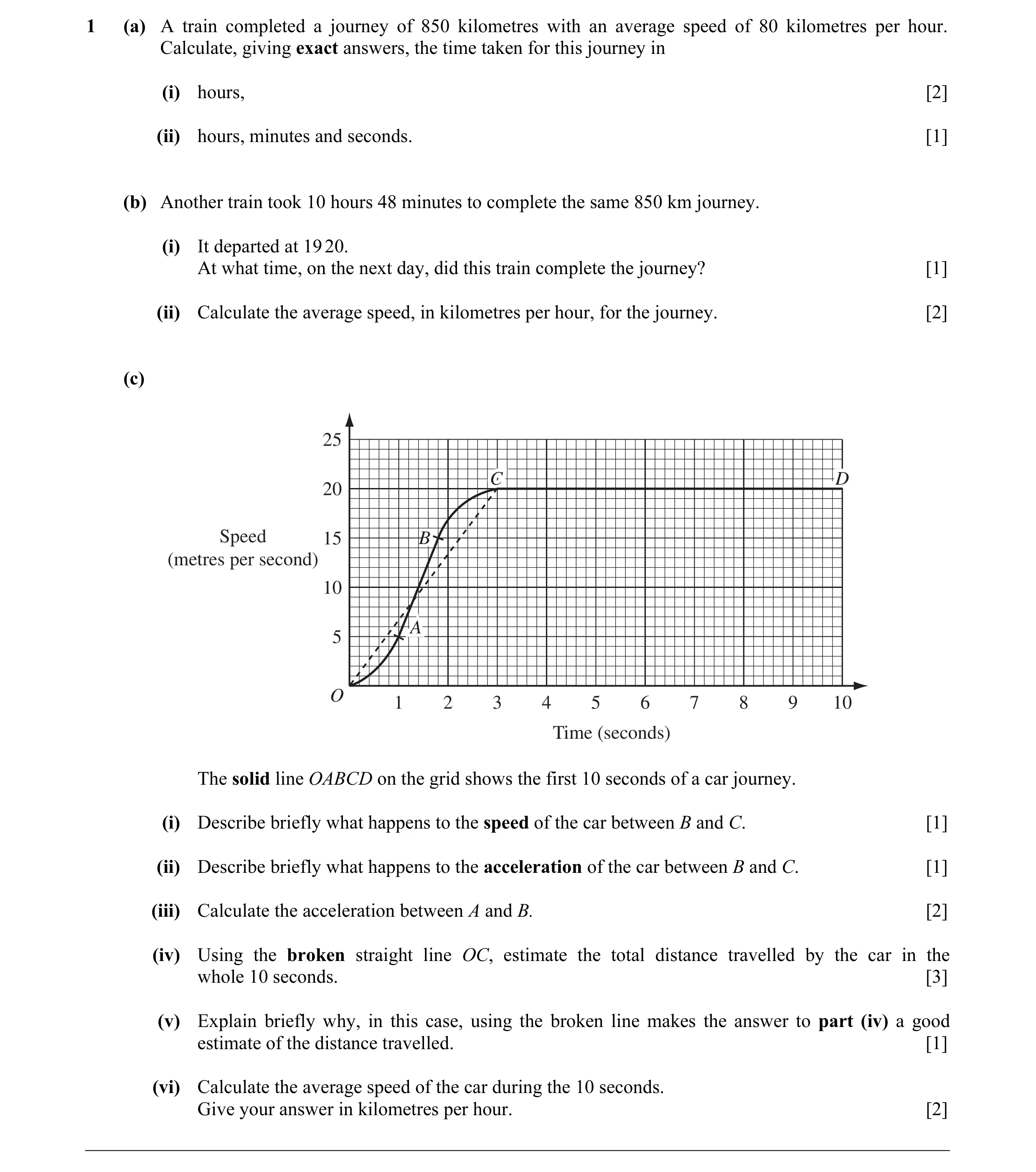 2 / 86
 3 / 86
 4 / 86
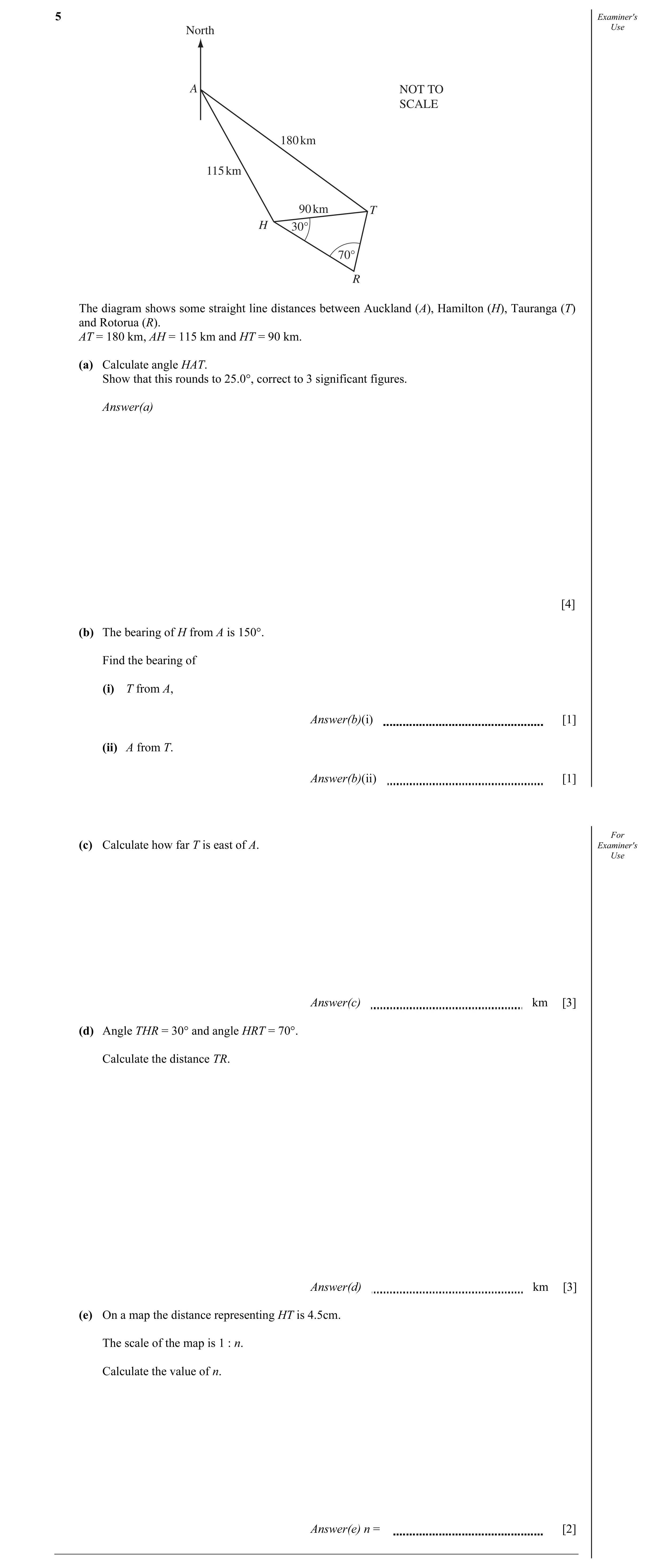
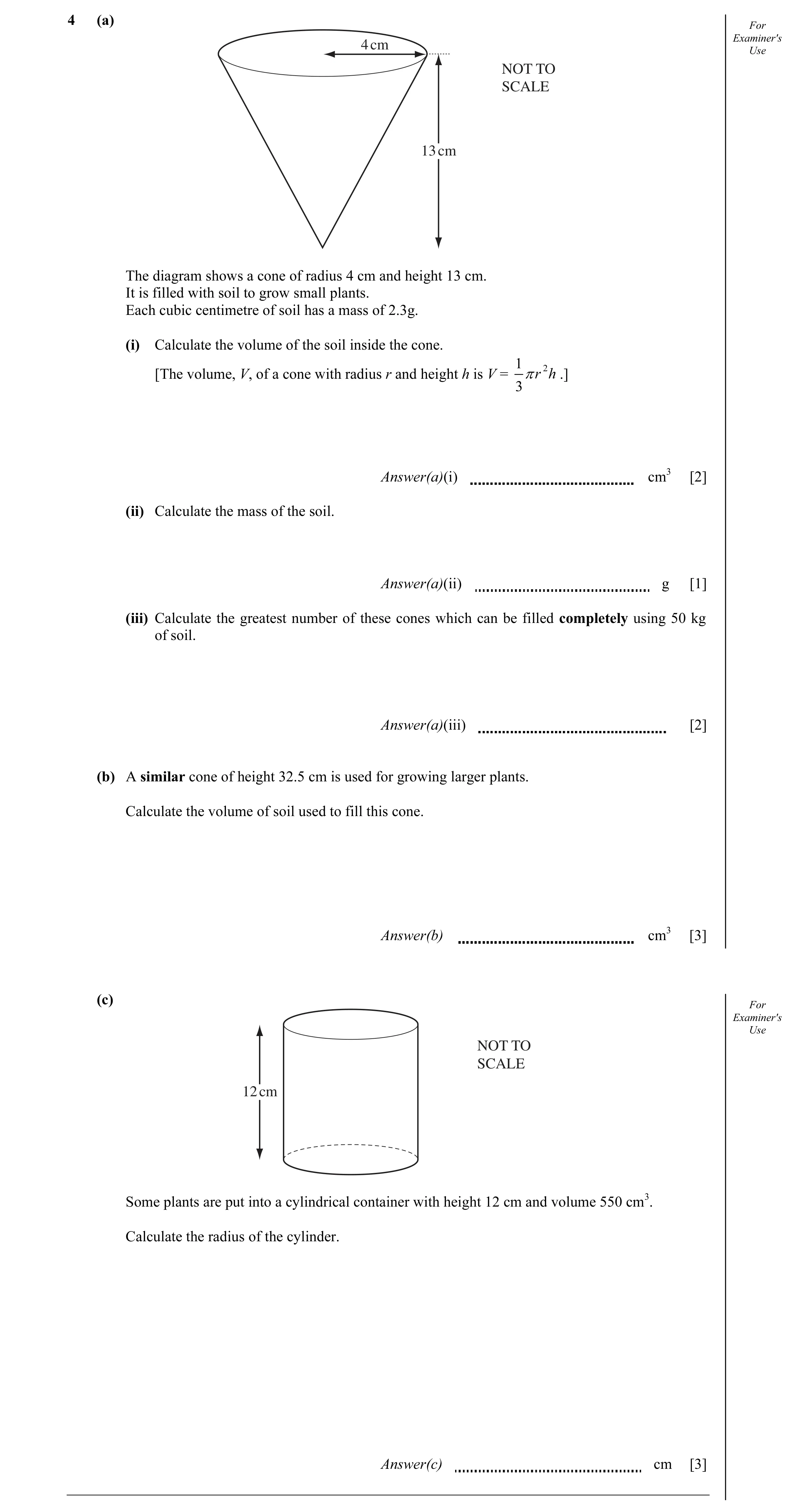
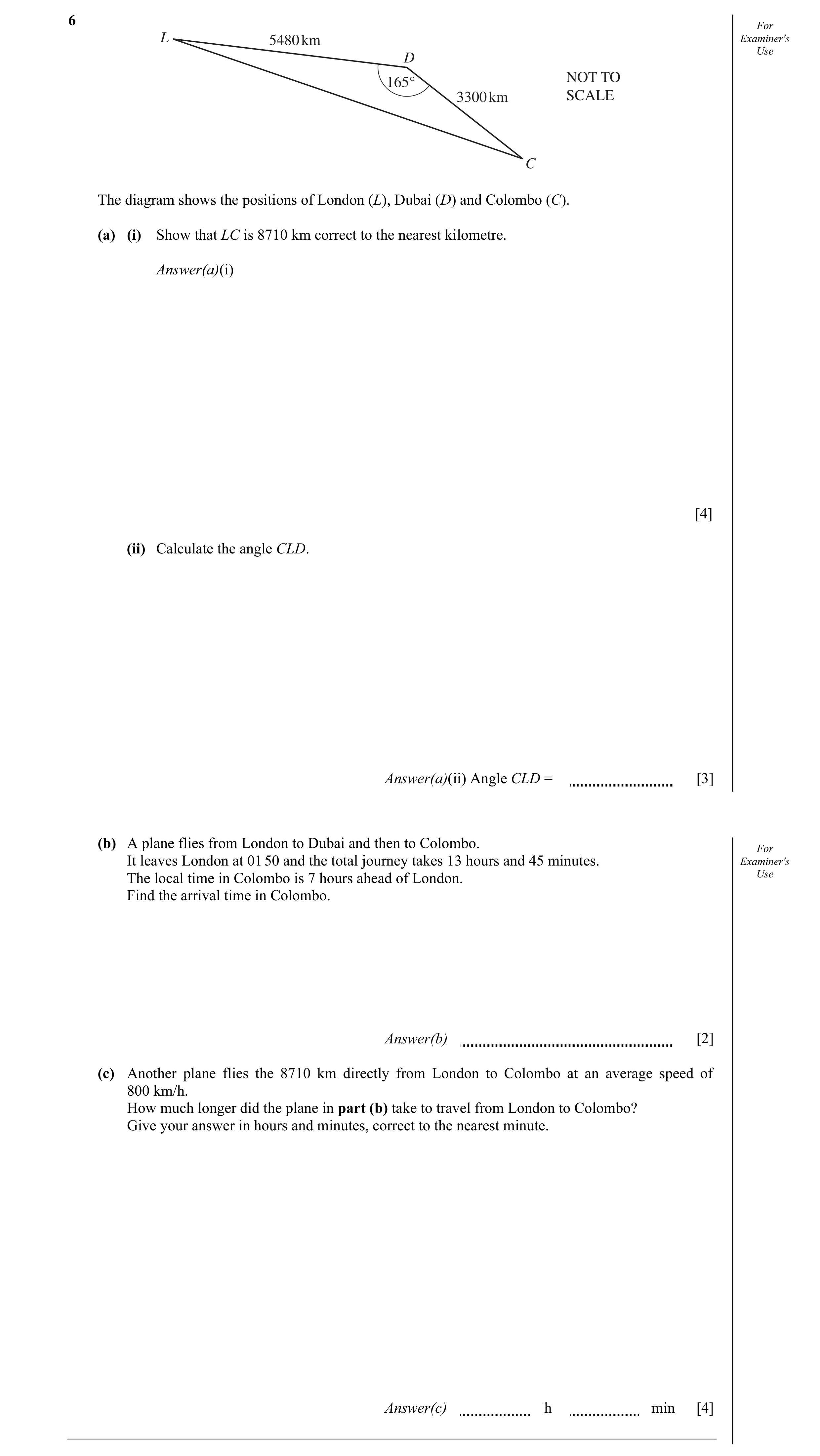
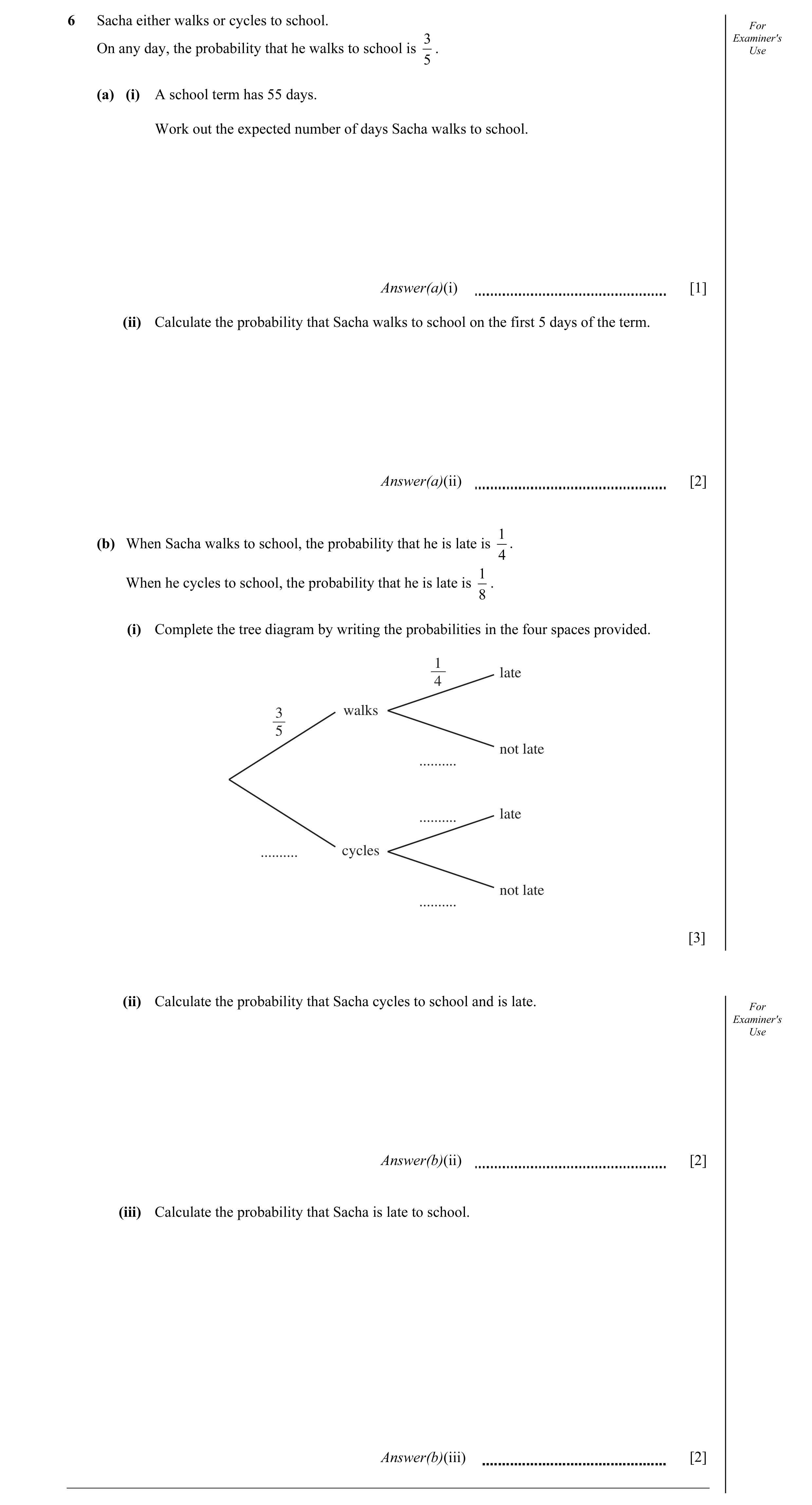
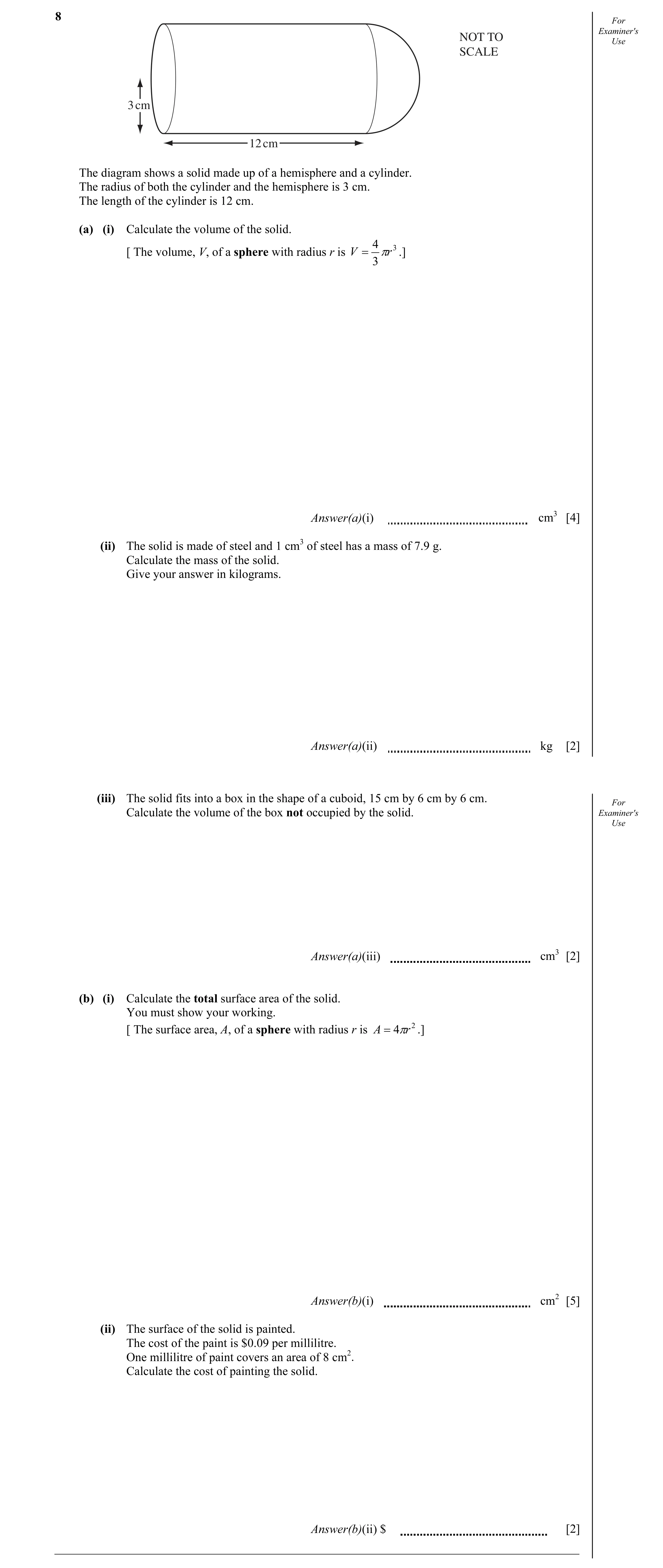
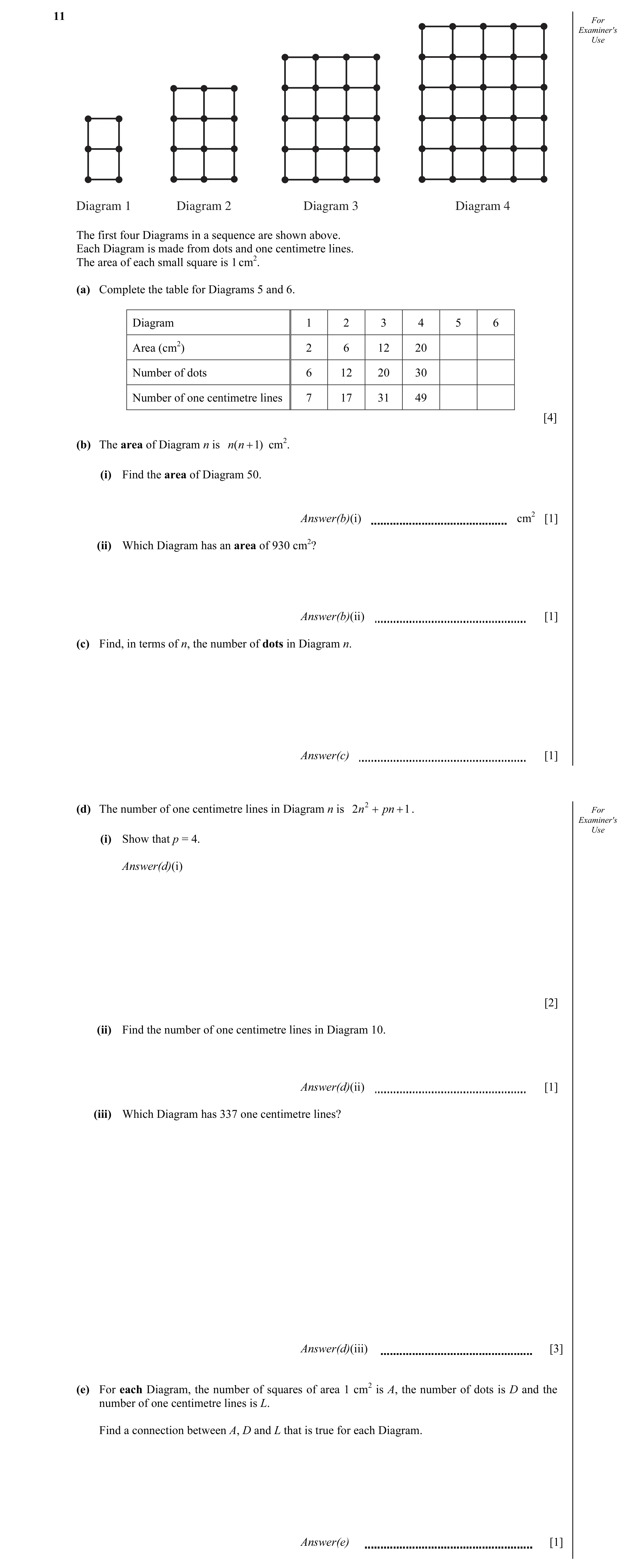
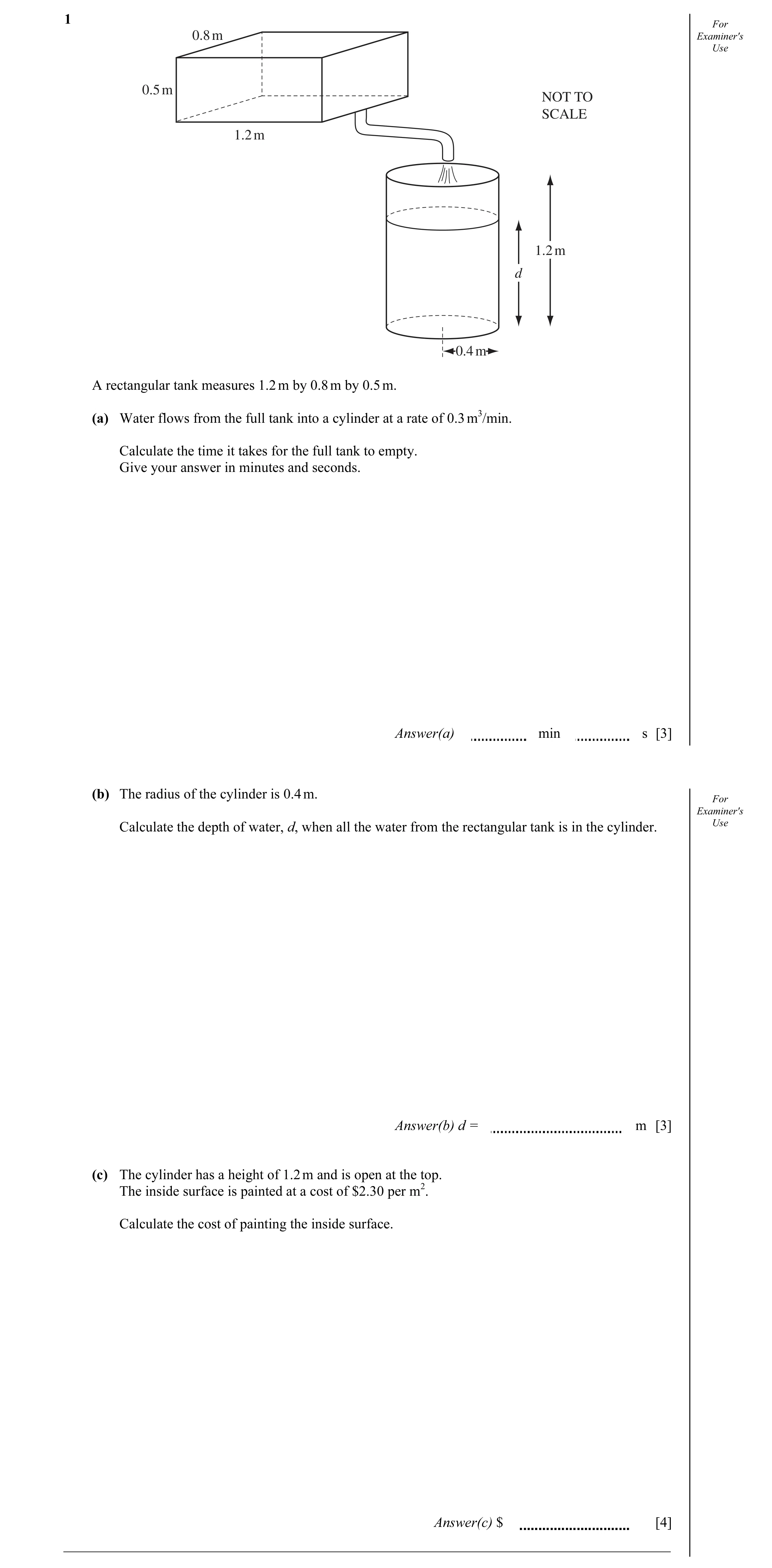
 19 / 86
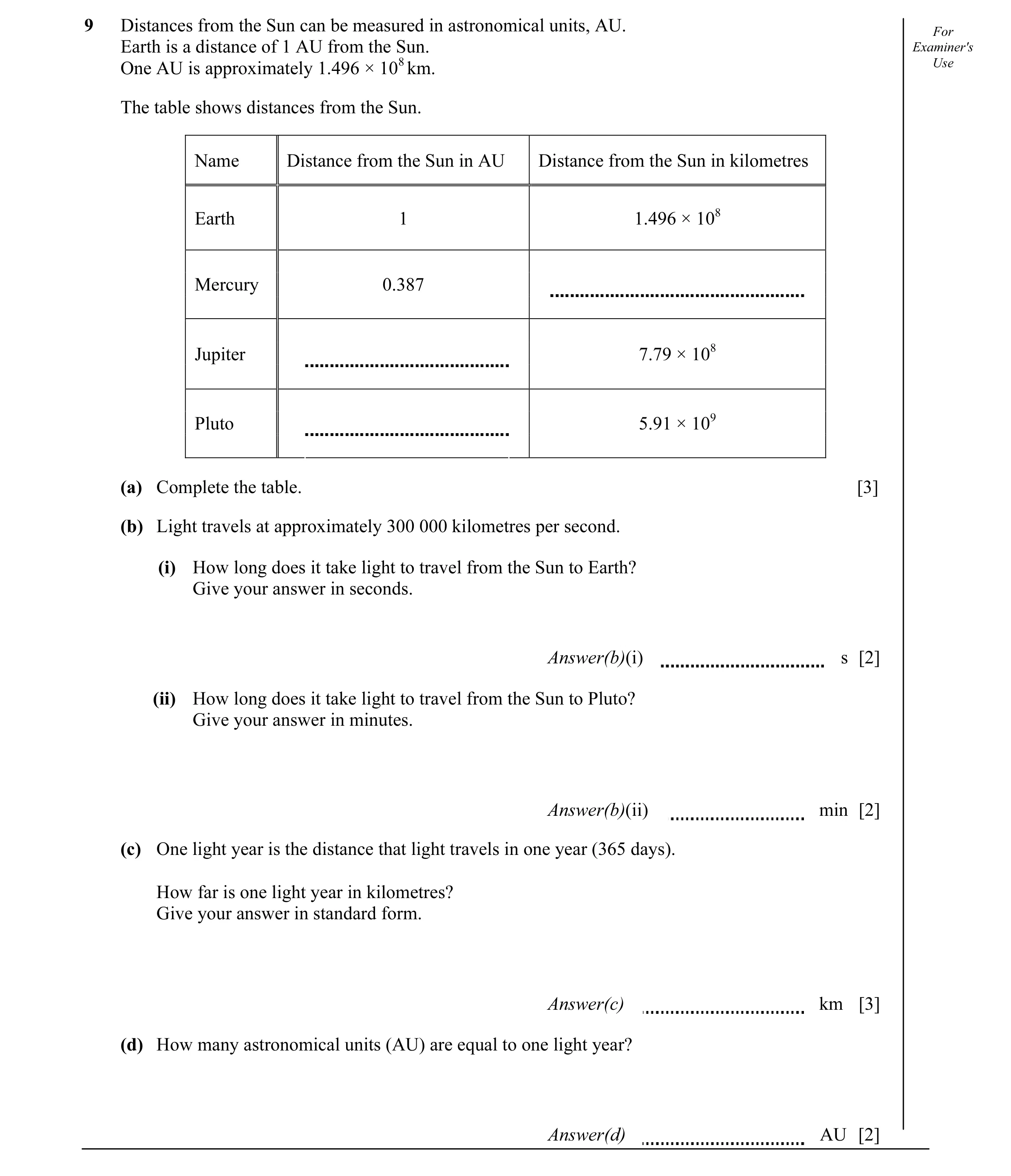 20 / 86
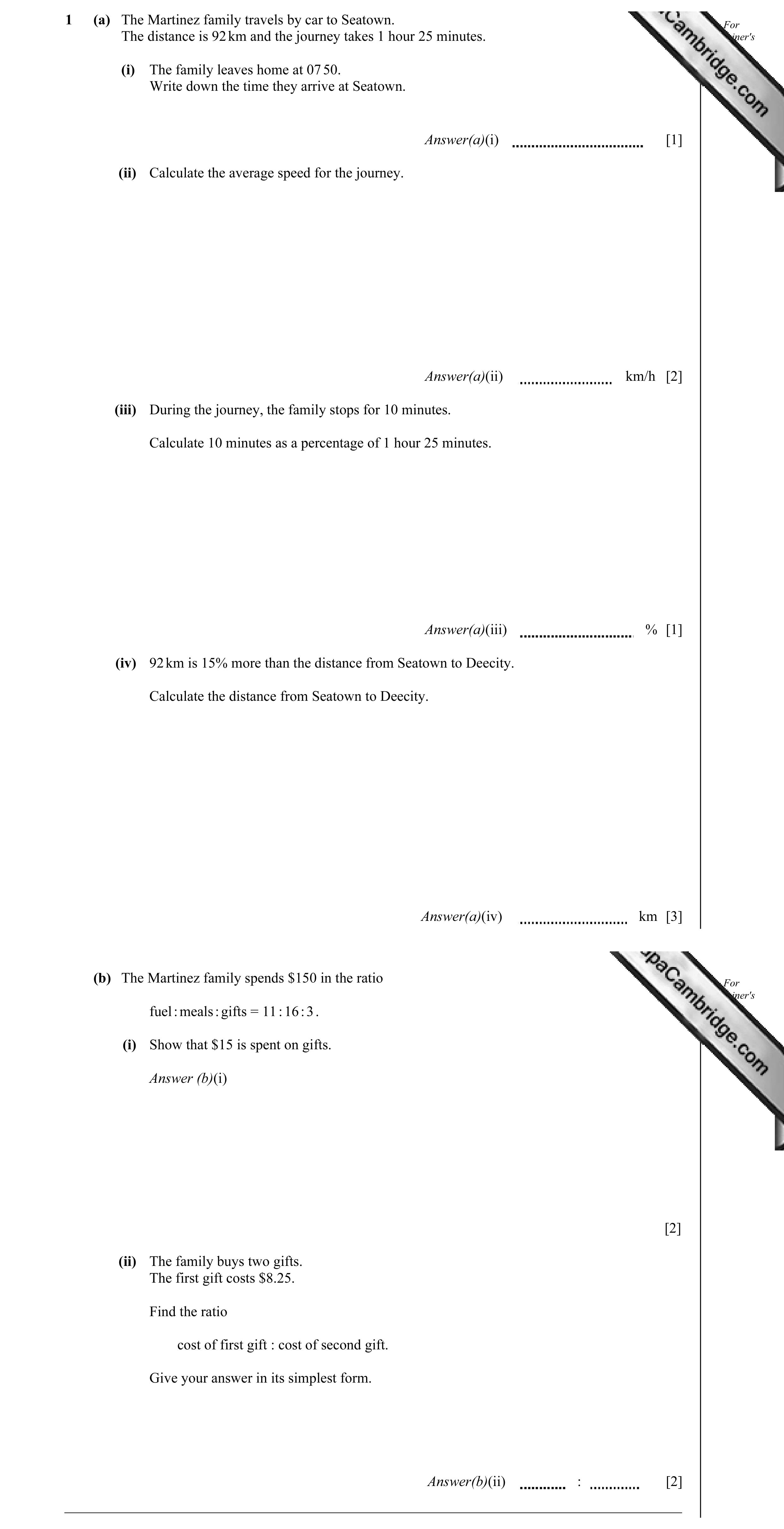
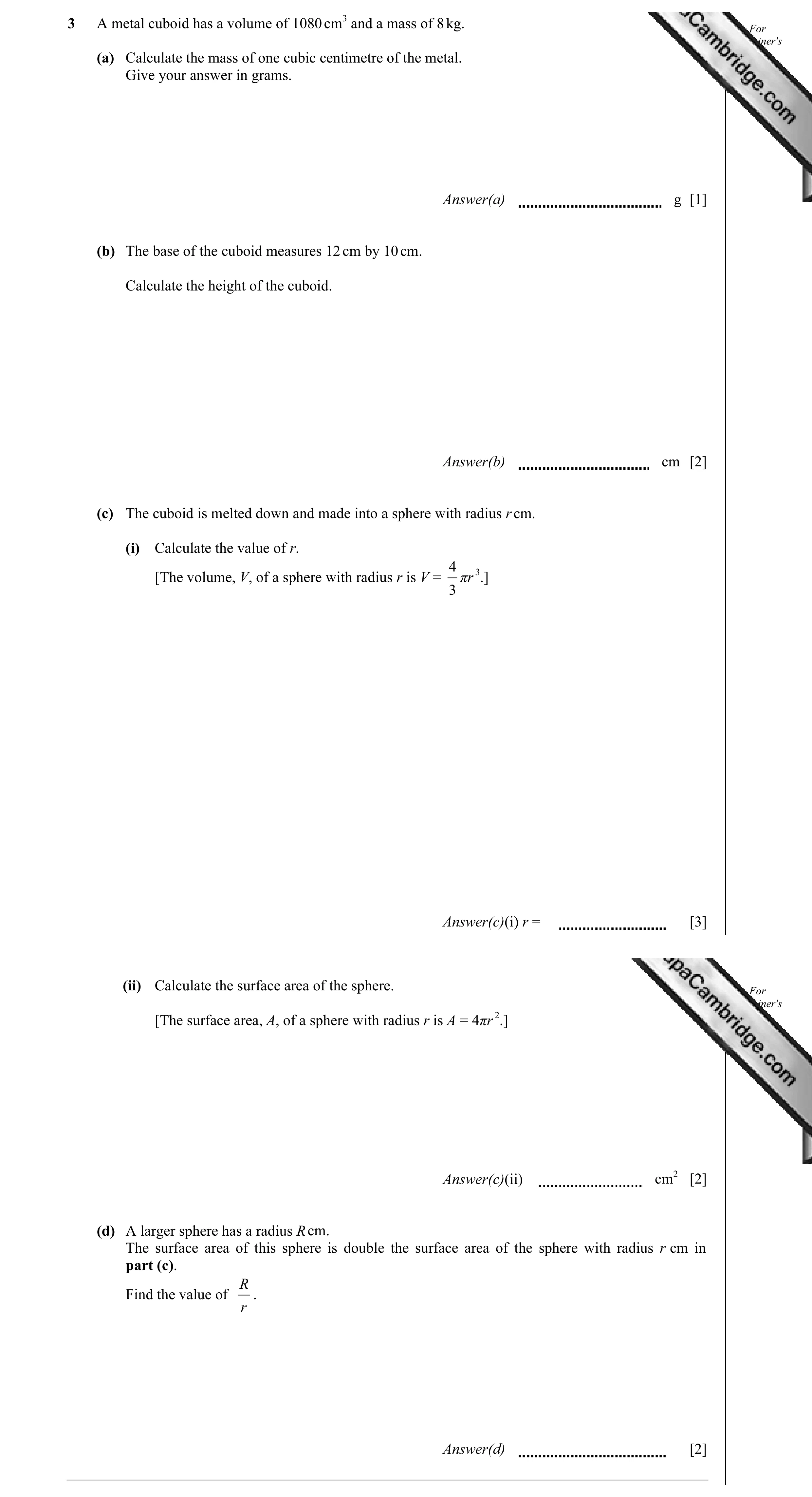
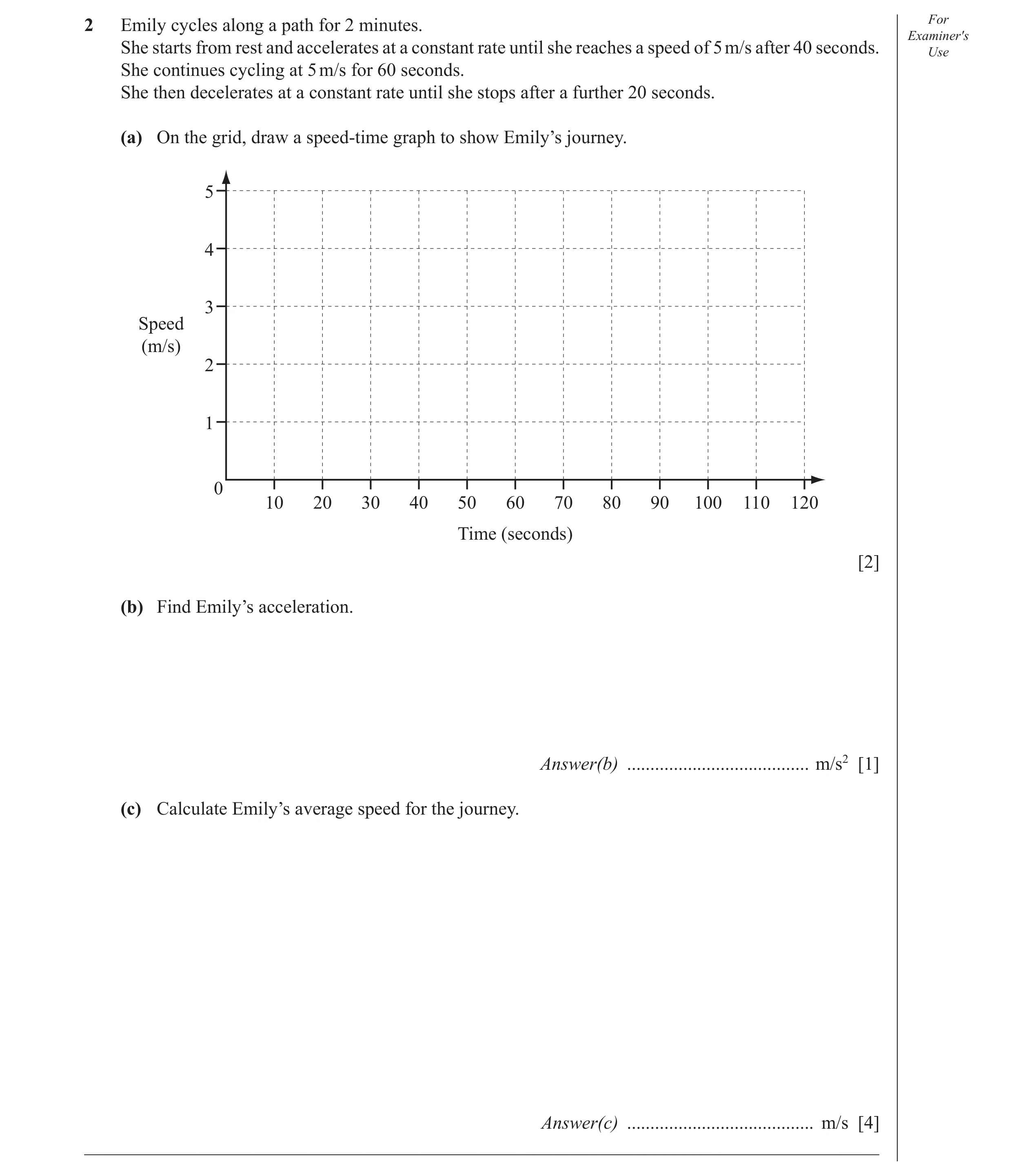 25 / 86
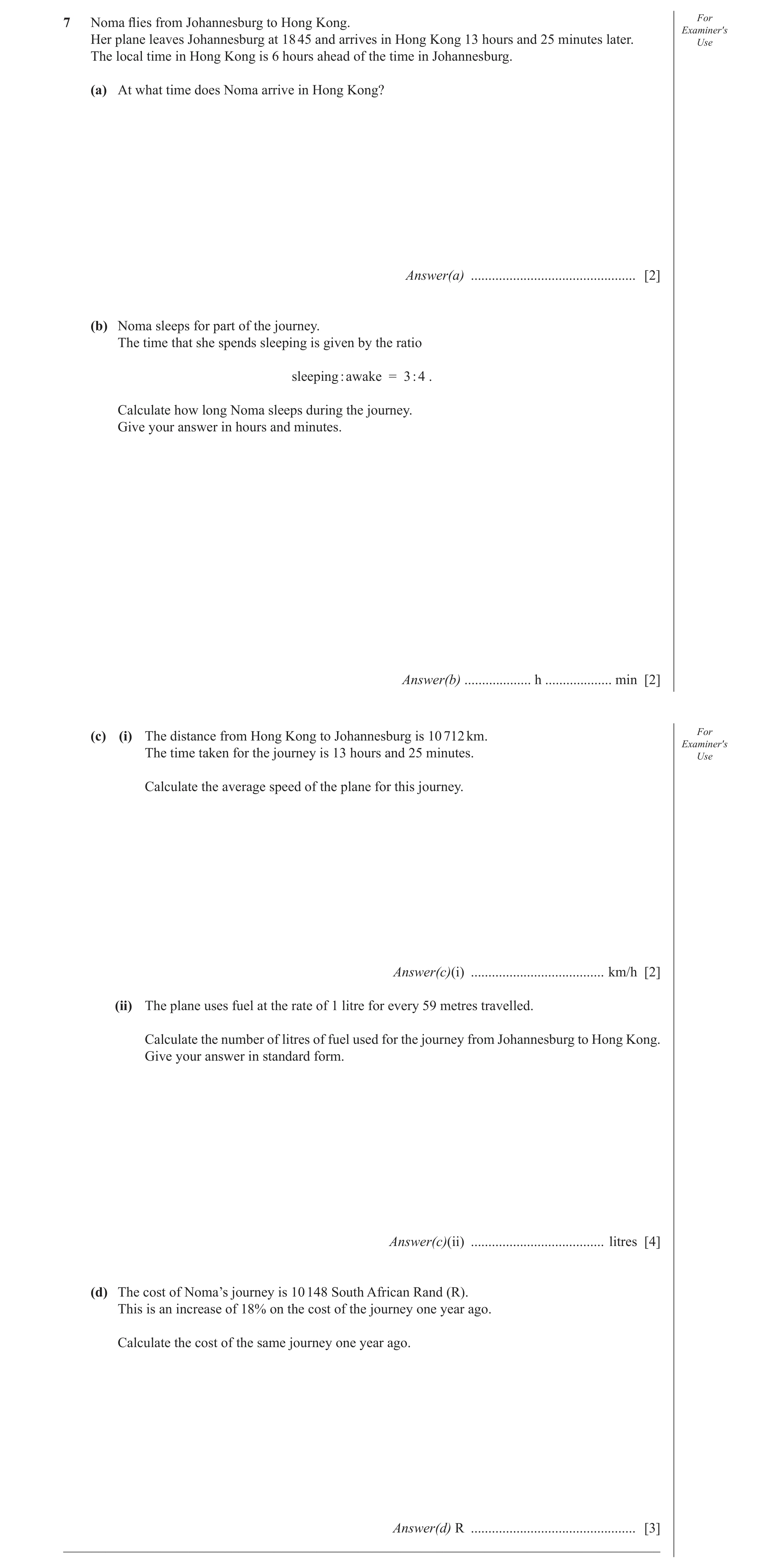
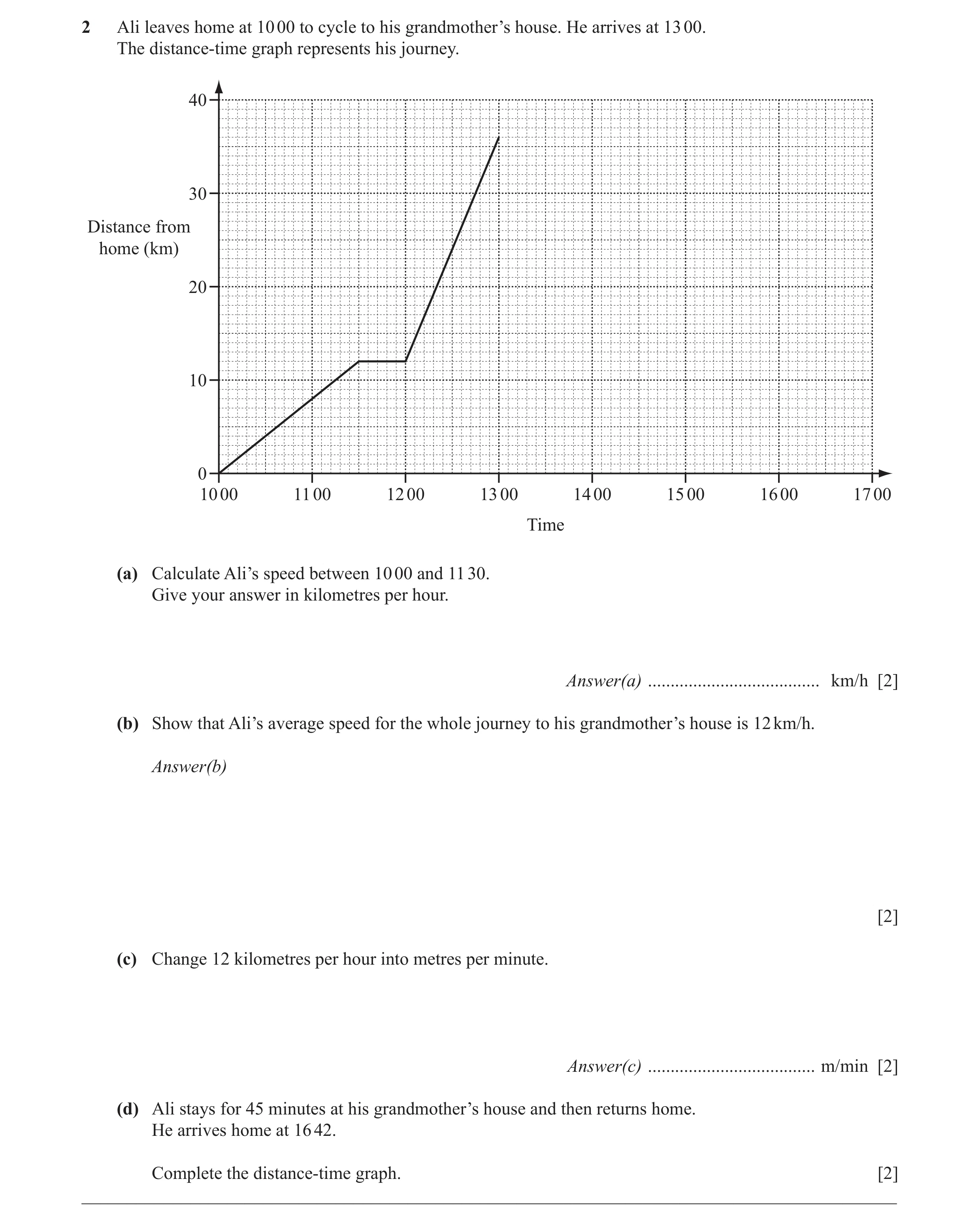 28 / 86
 29 / 86
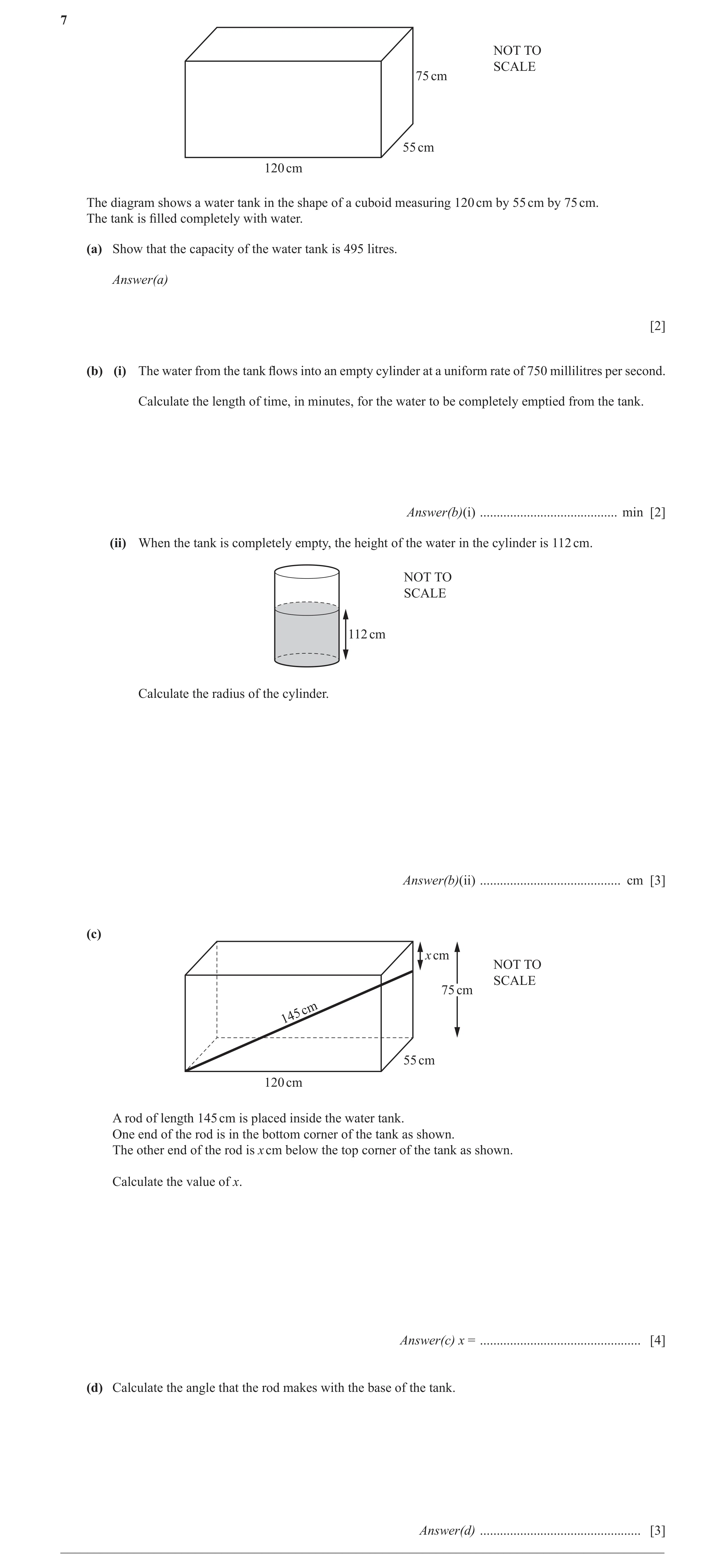
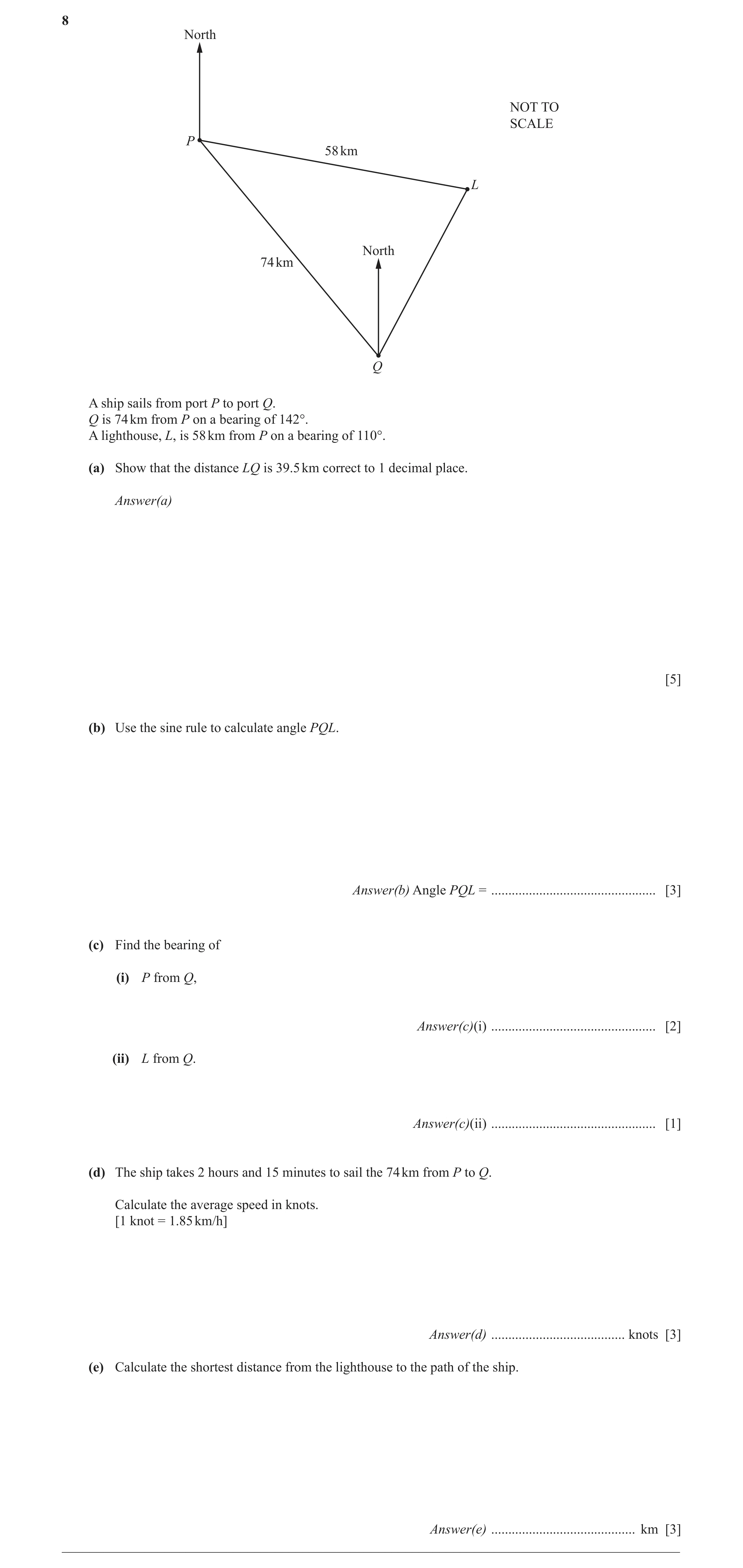
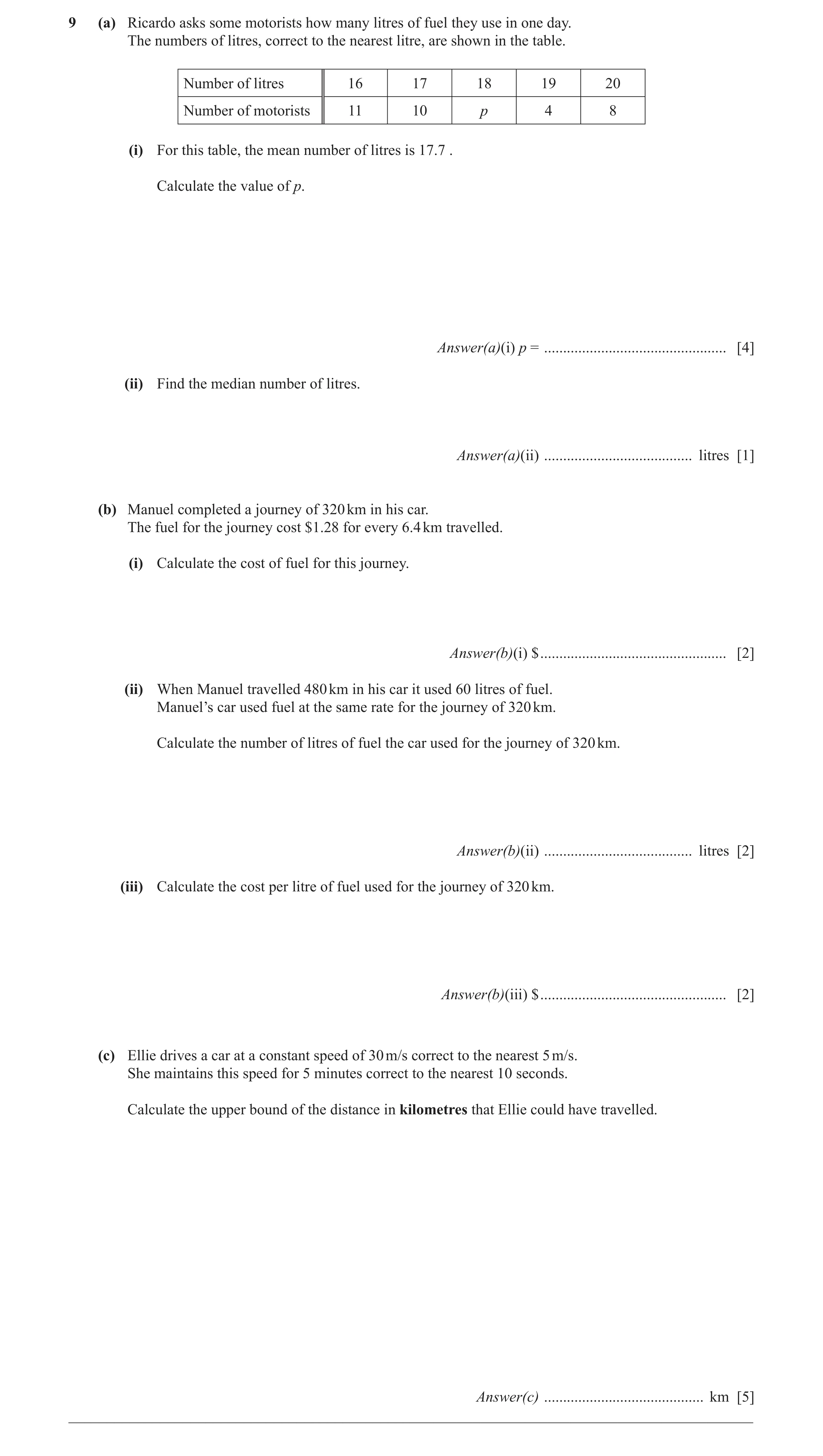
 35 / 86
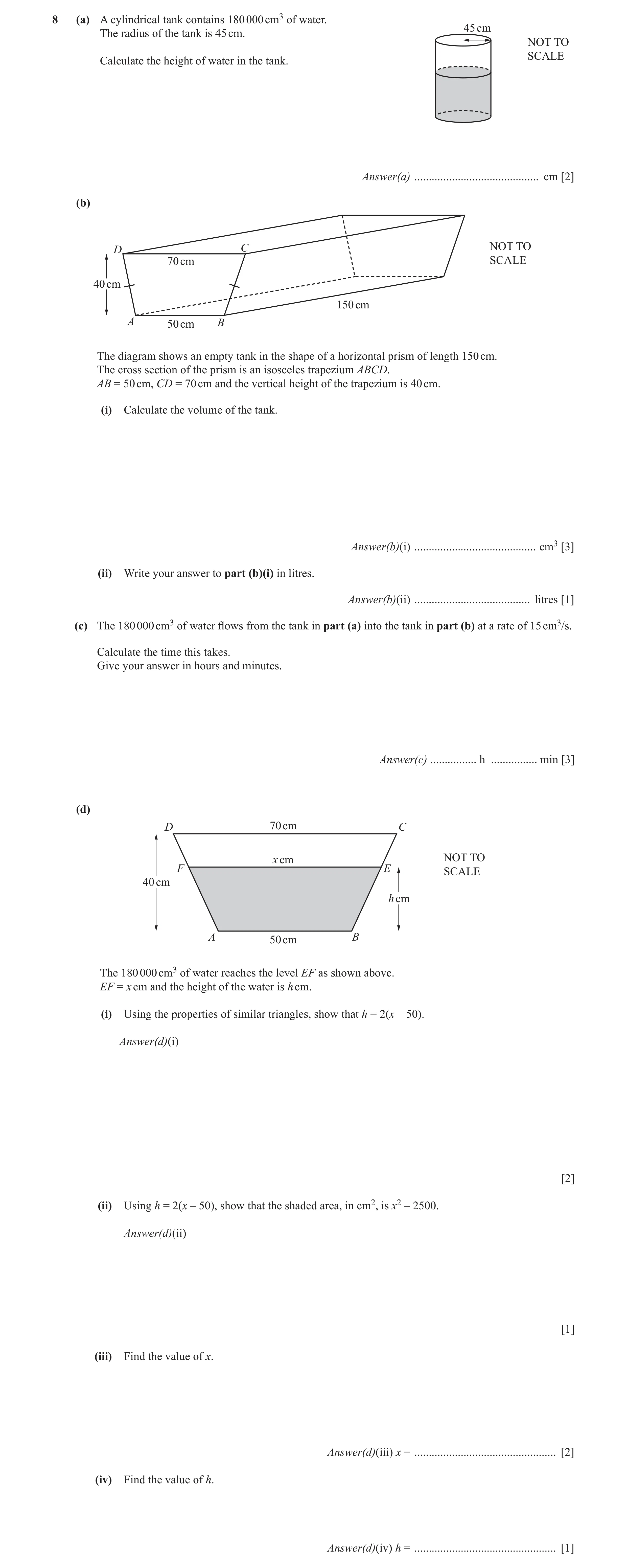
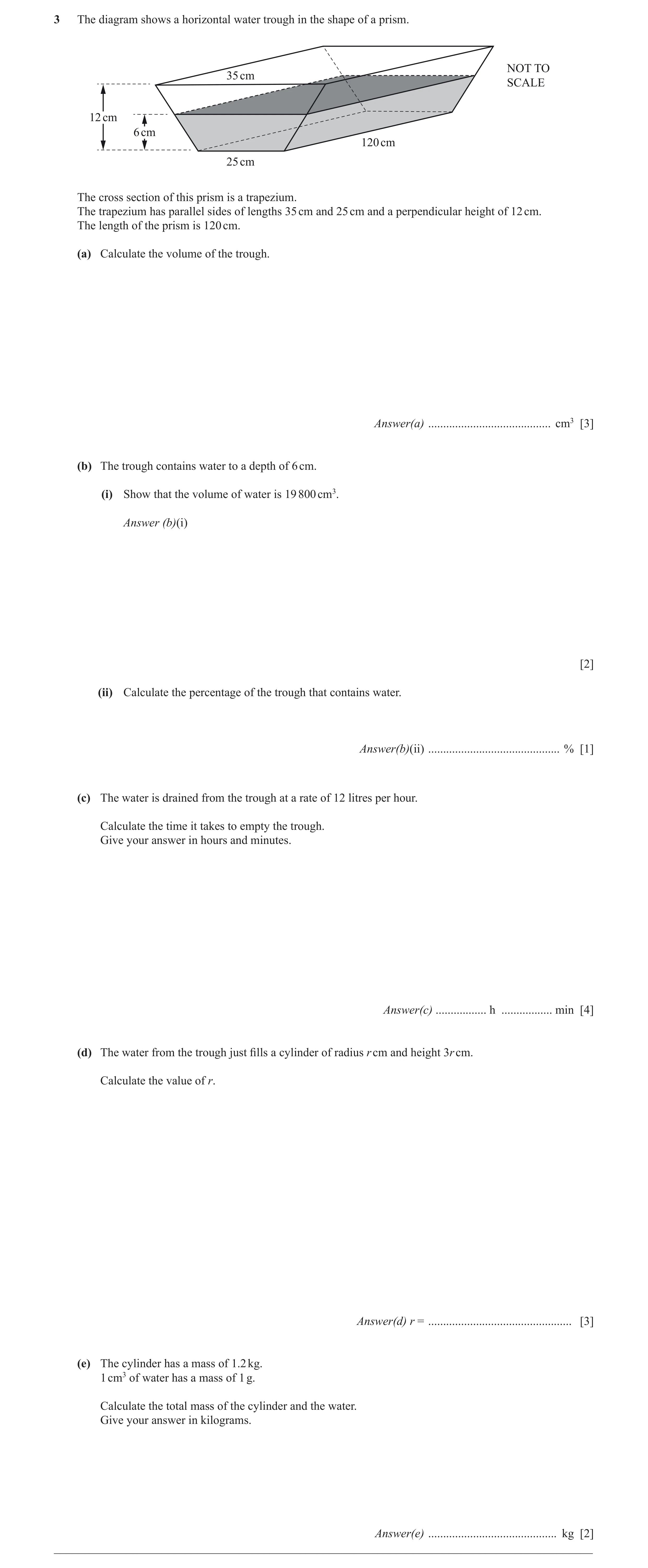
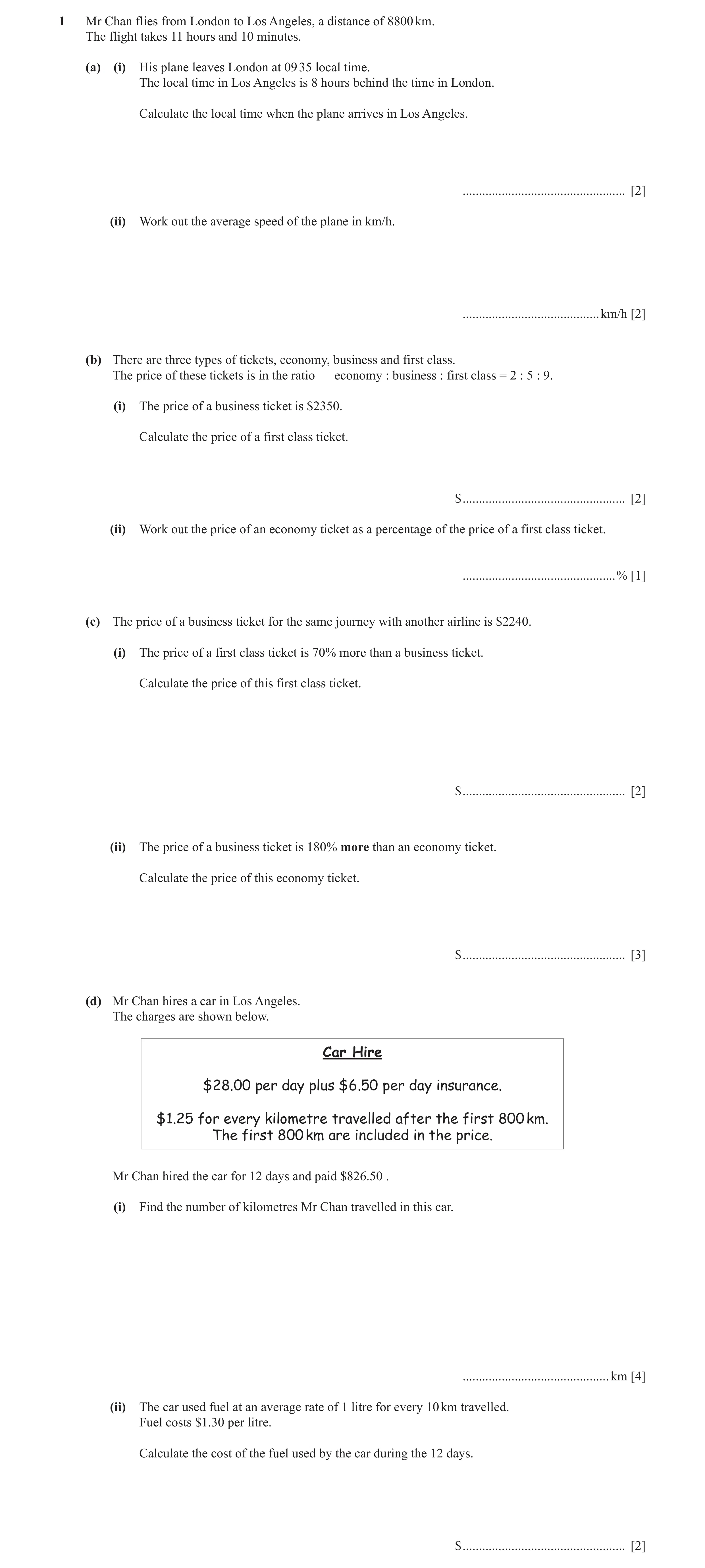
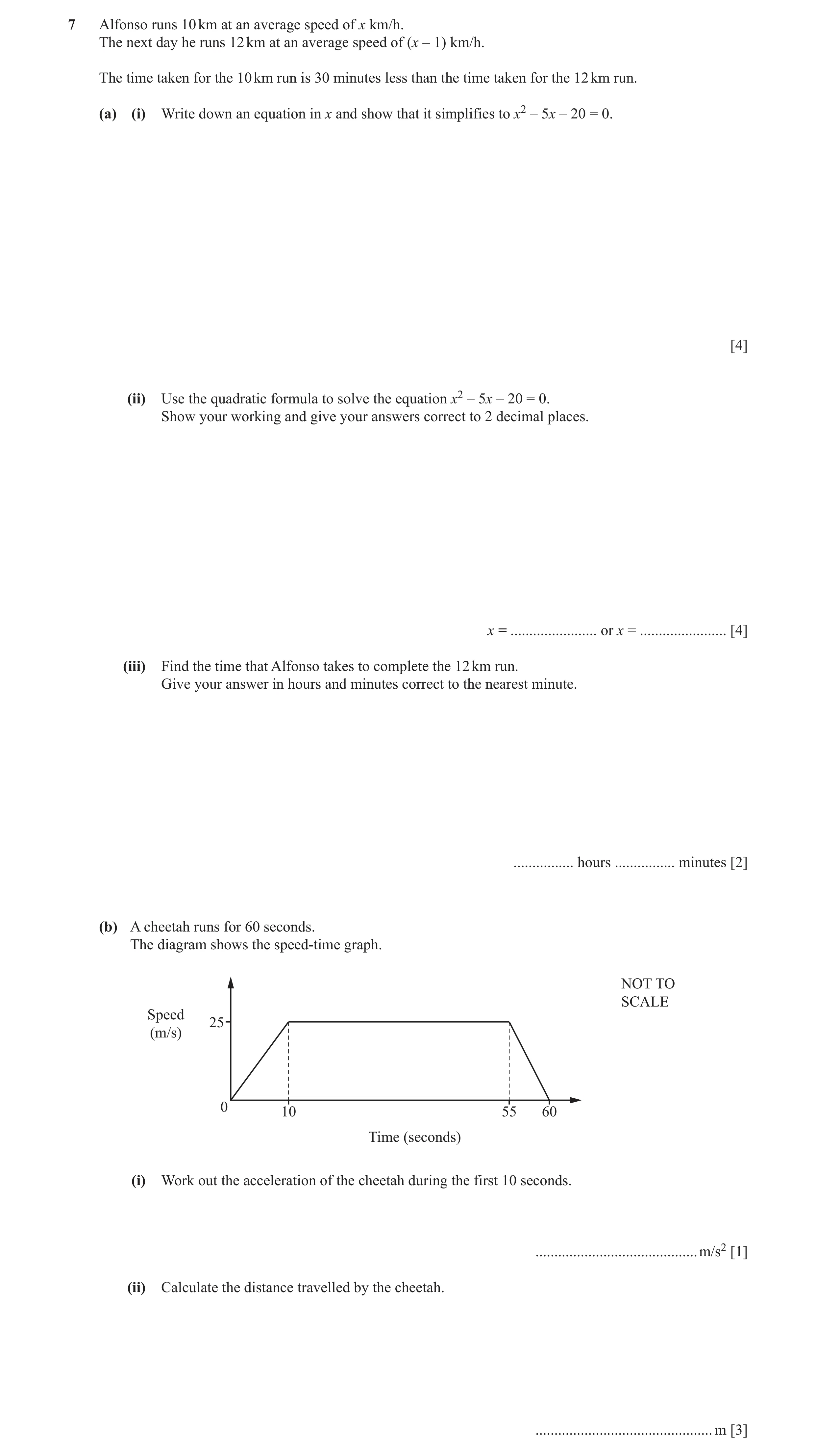
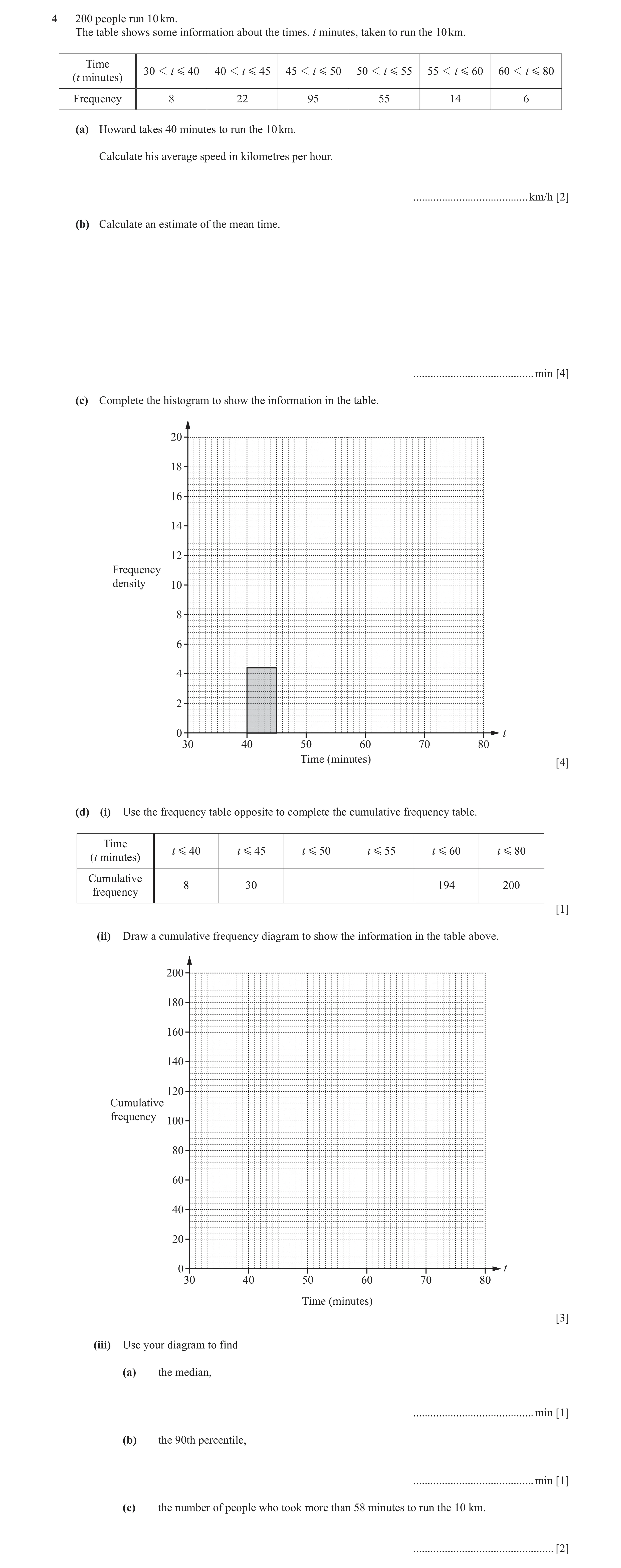
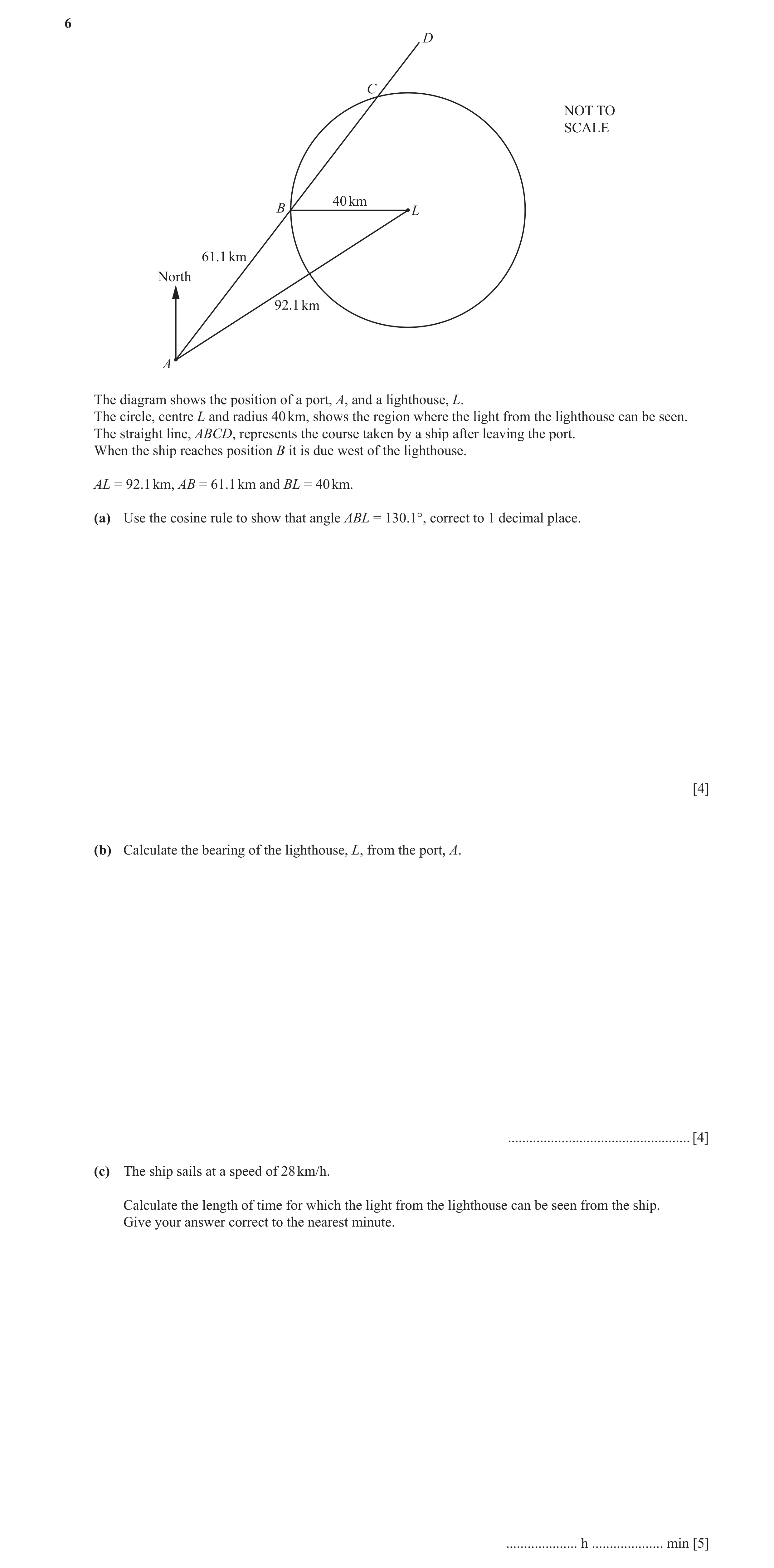
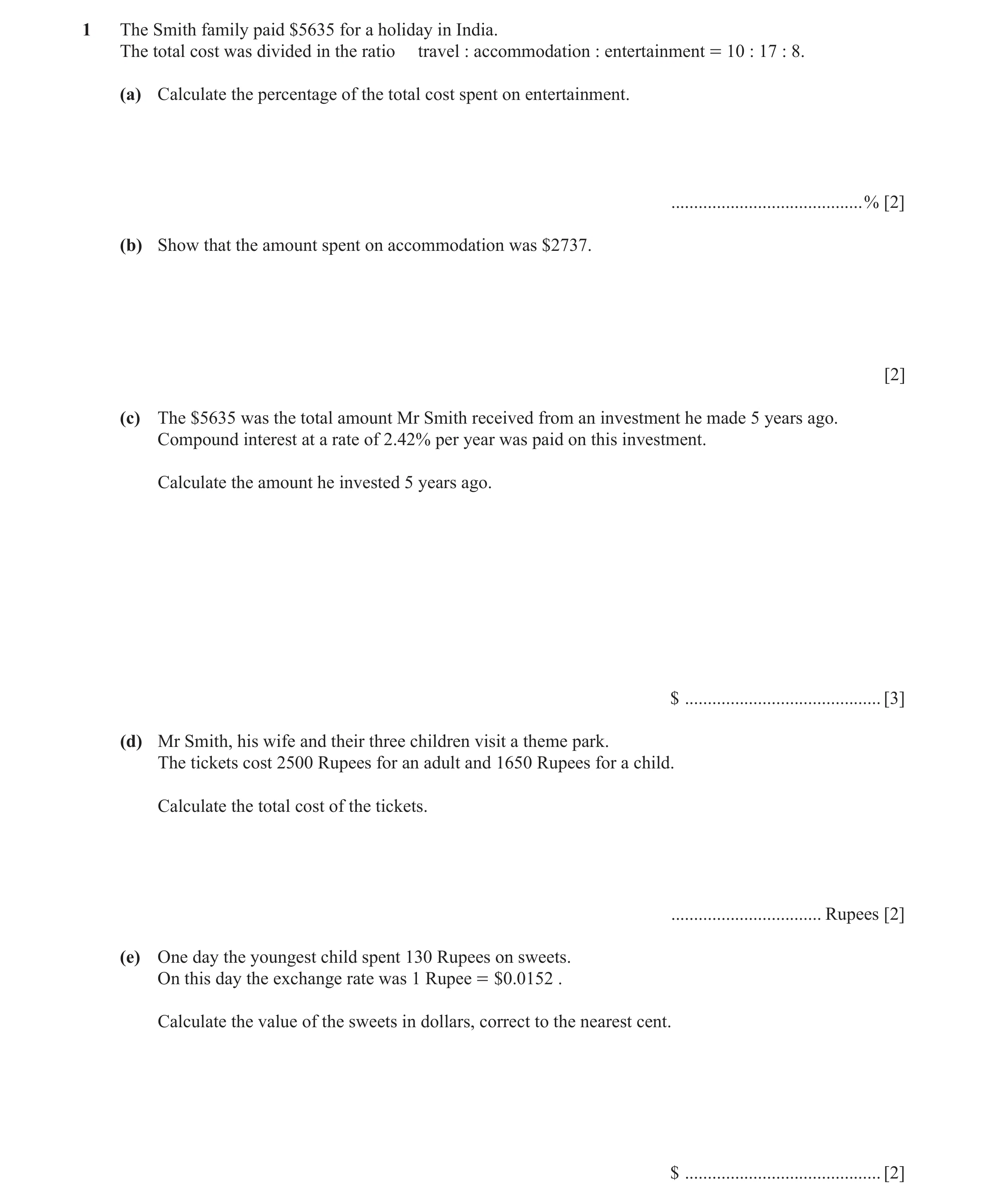 49 / 86
 52 / 86
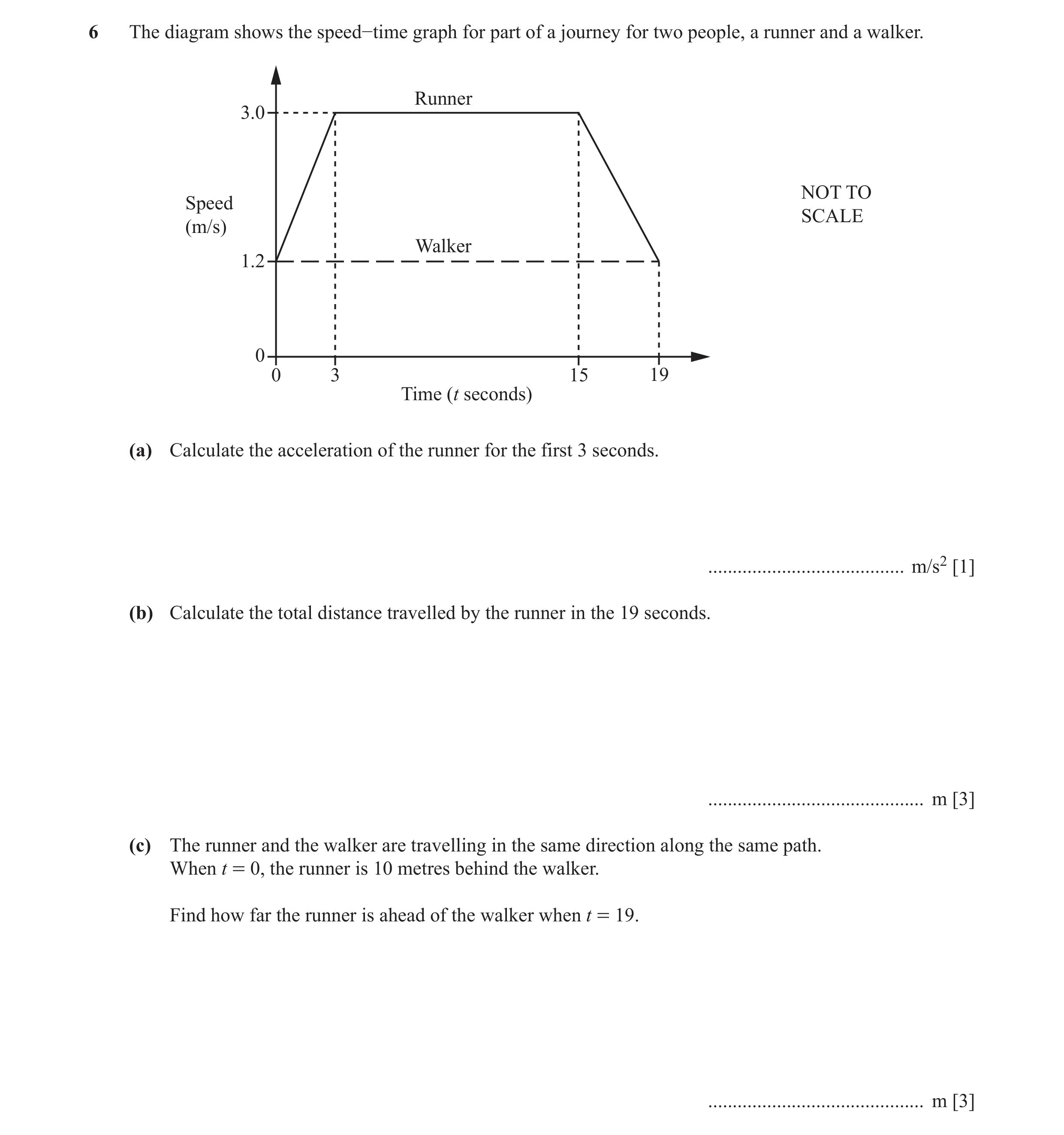 53 / 86
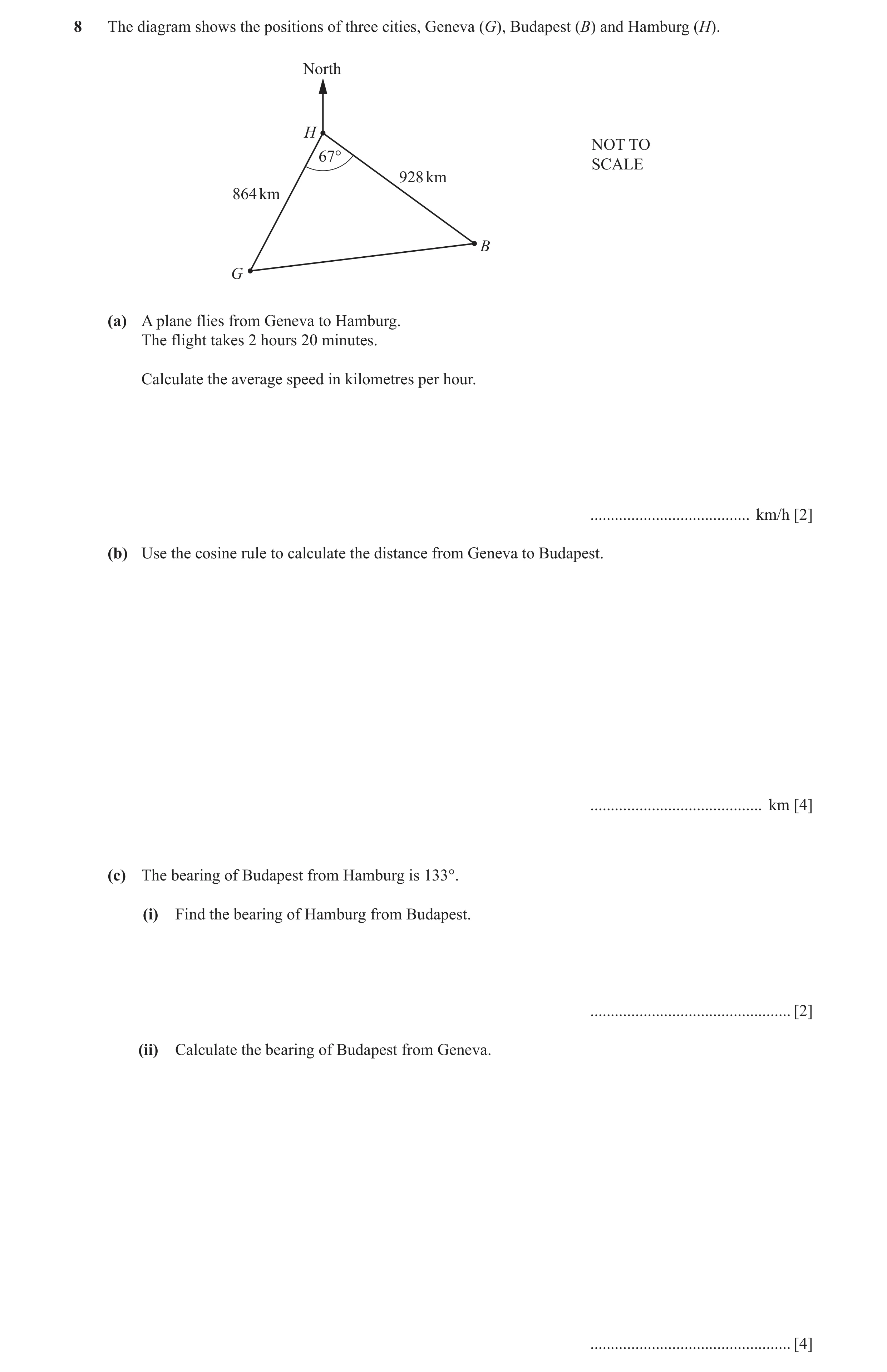
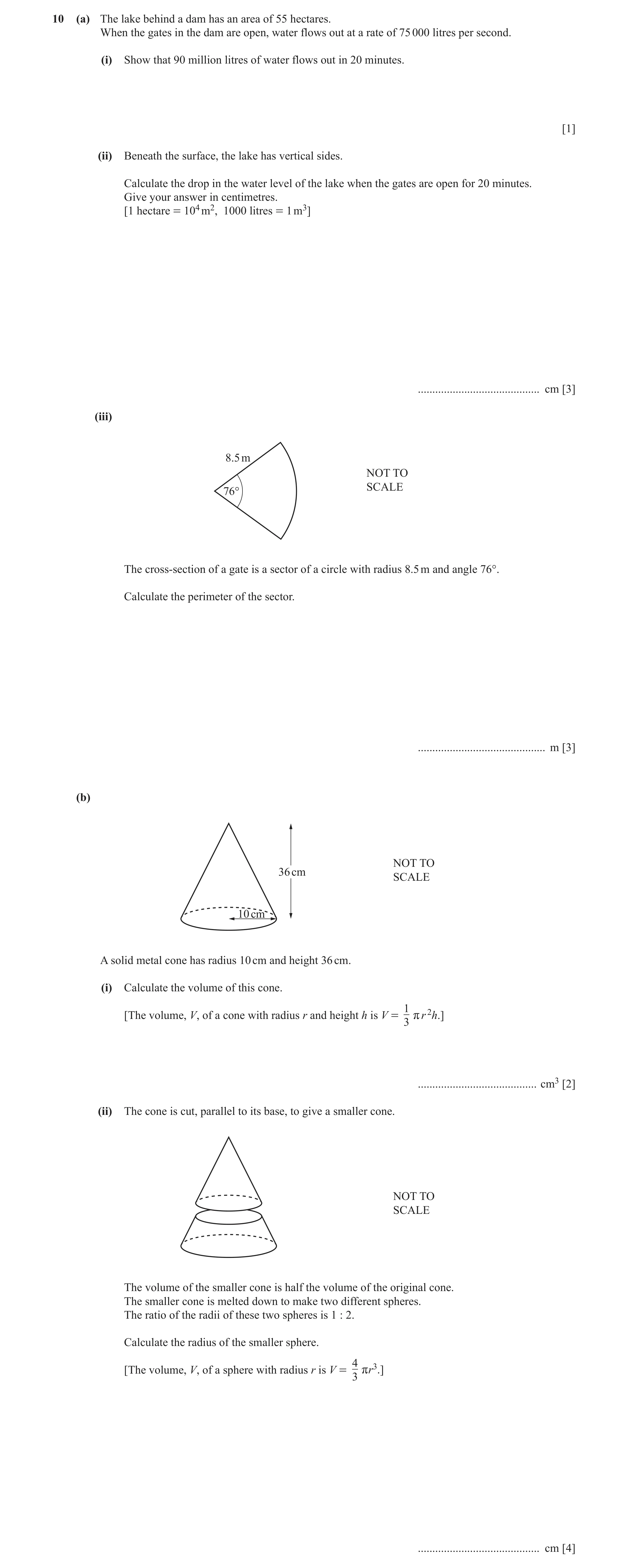
 59 / 86
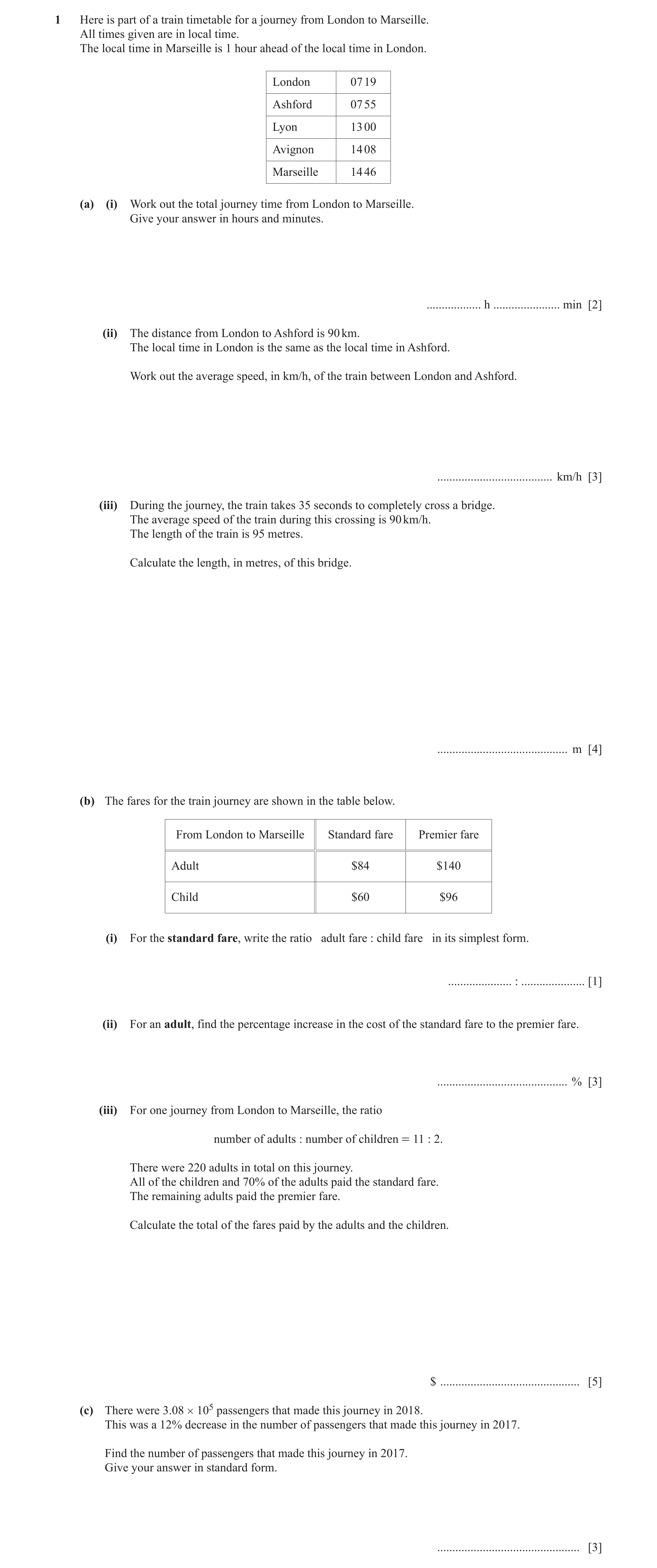
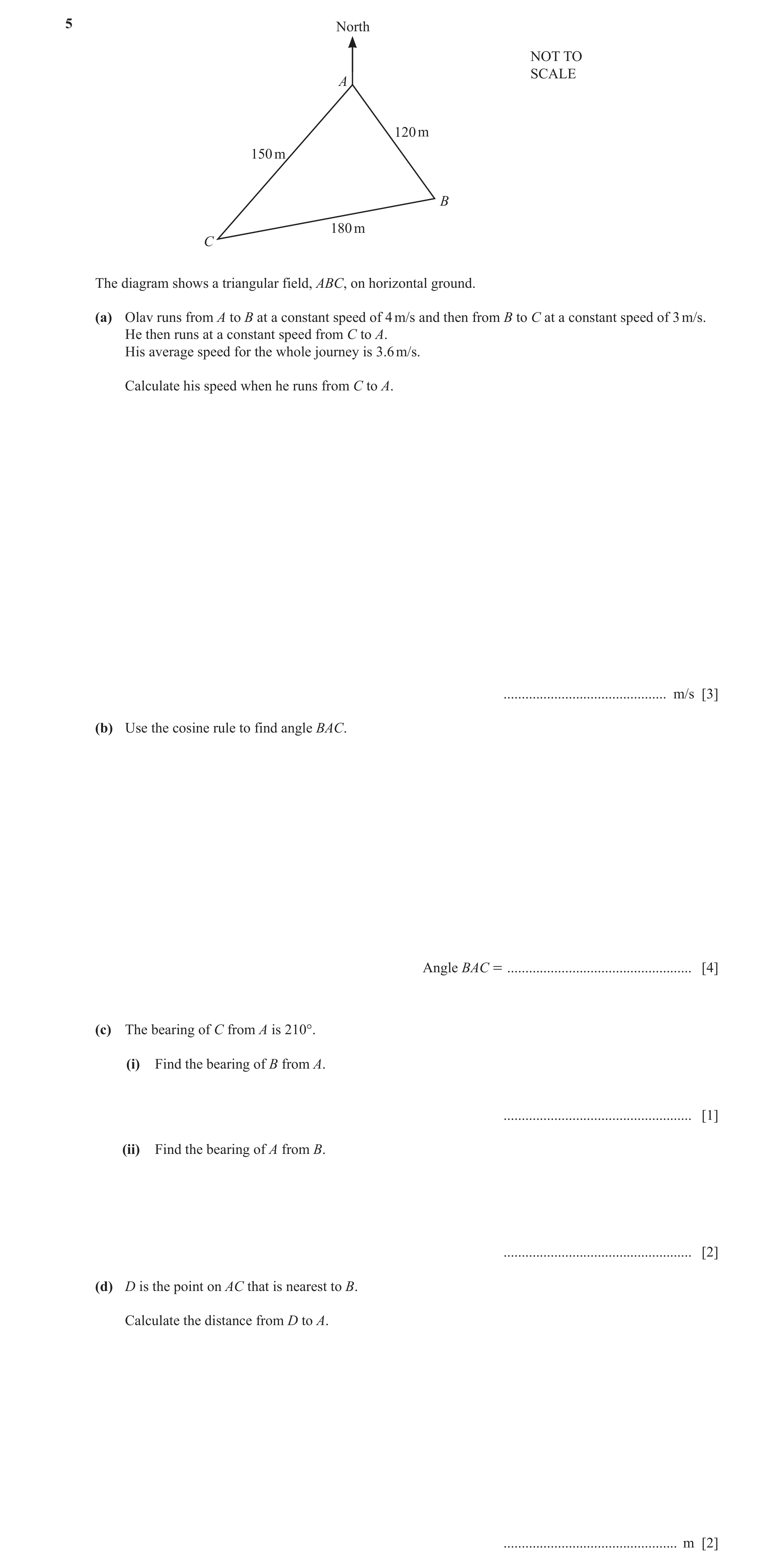
 64 / 86
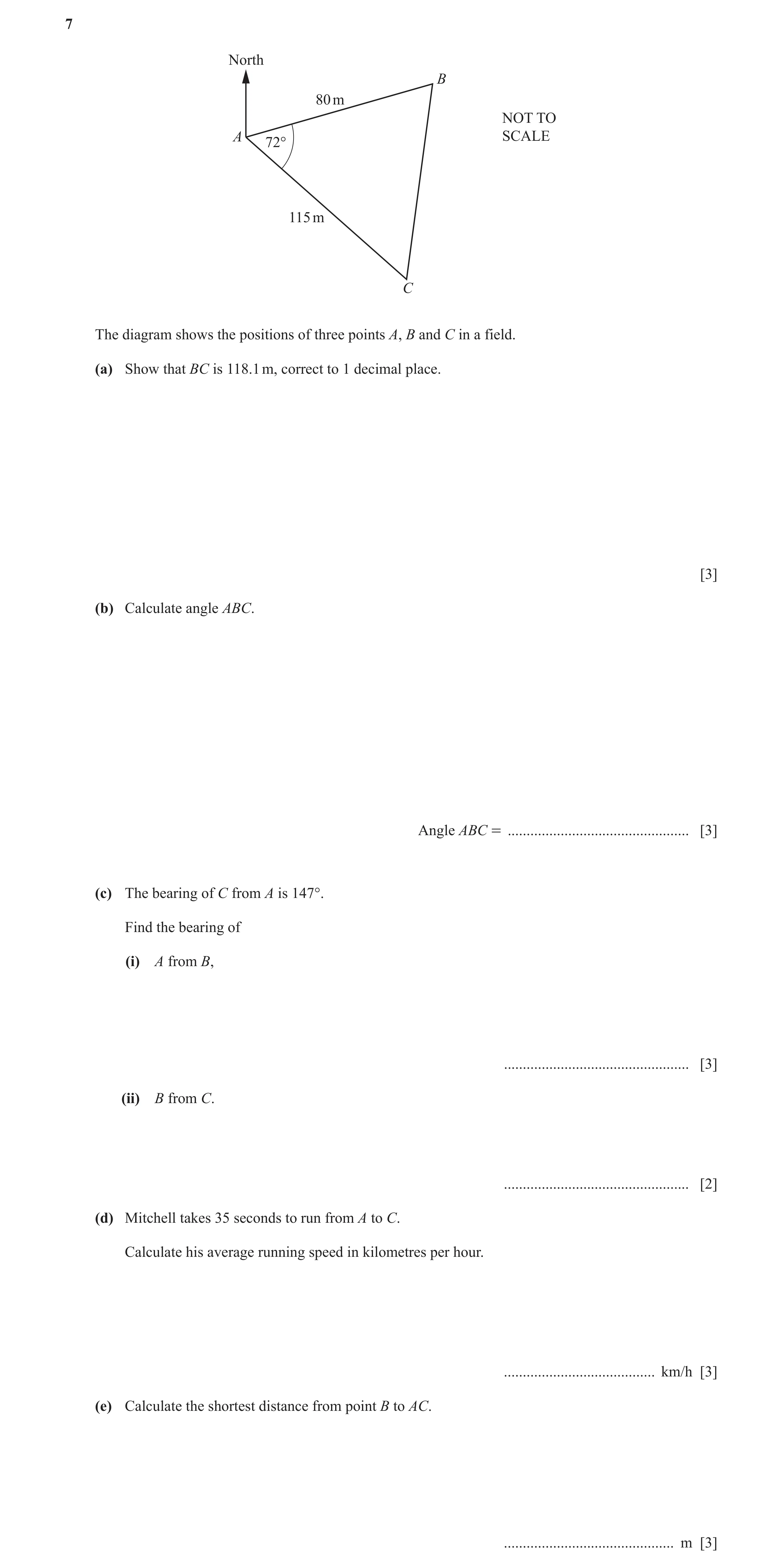
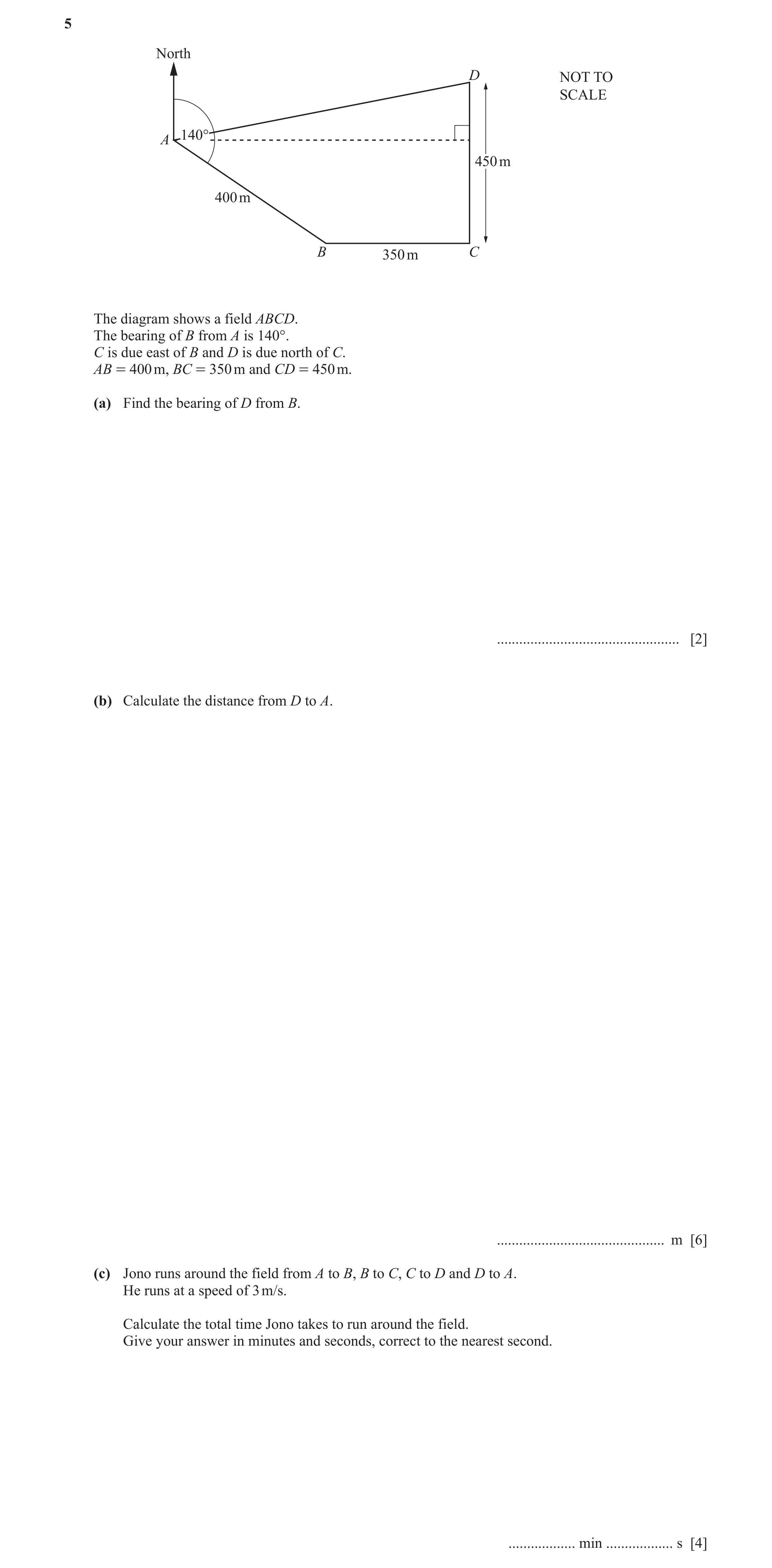
 70 / 86
 71 / 86
 72 / 86
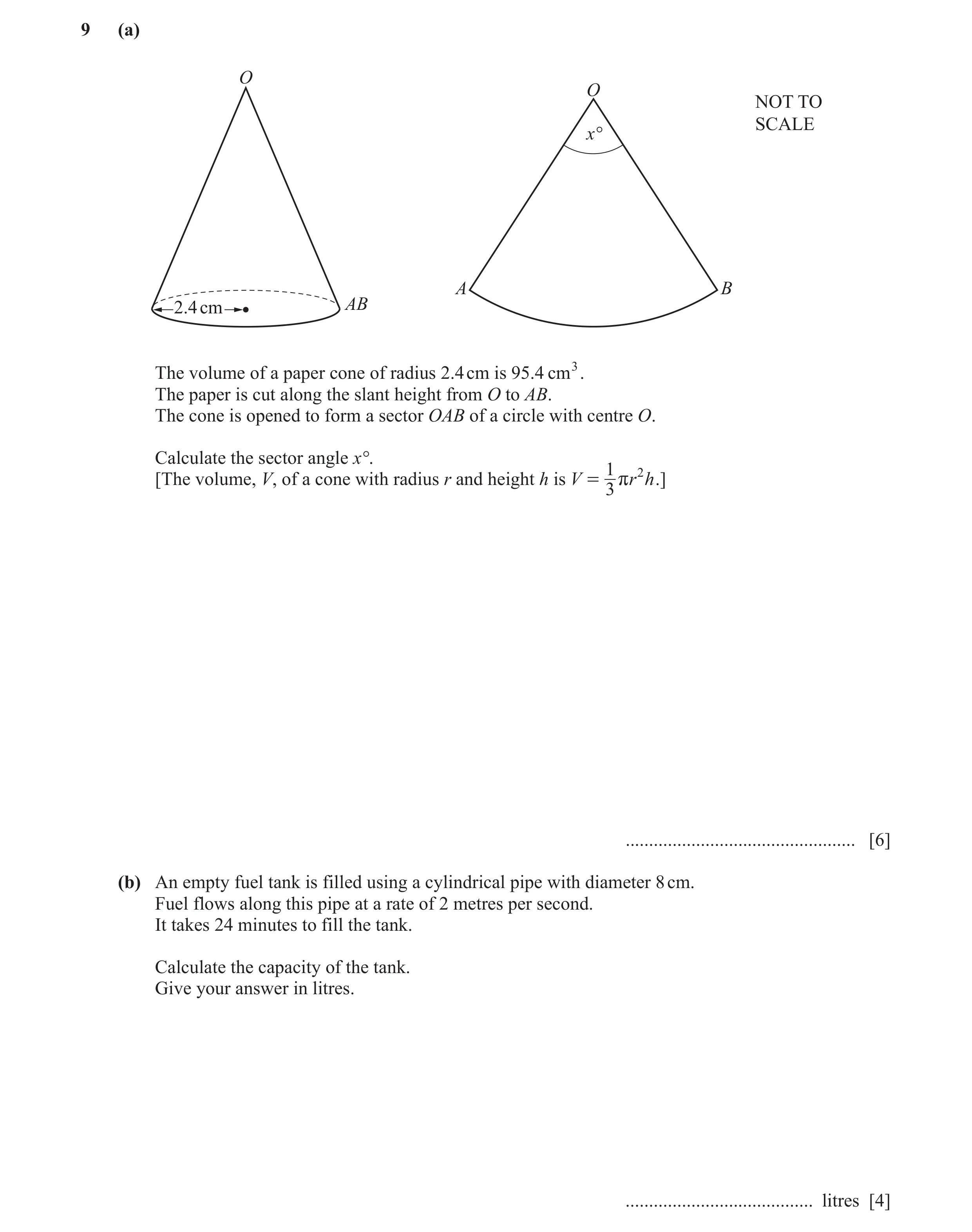 73 / 86
 74 / 86
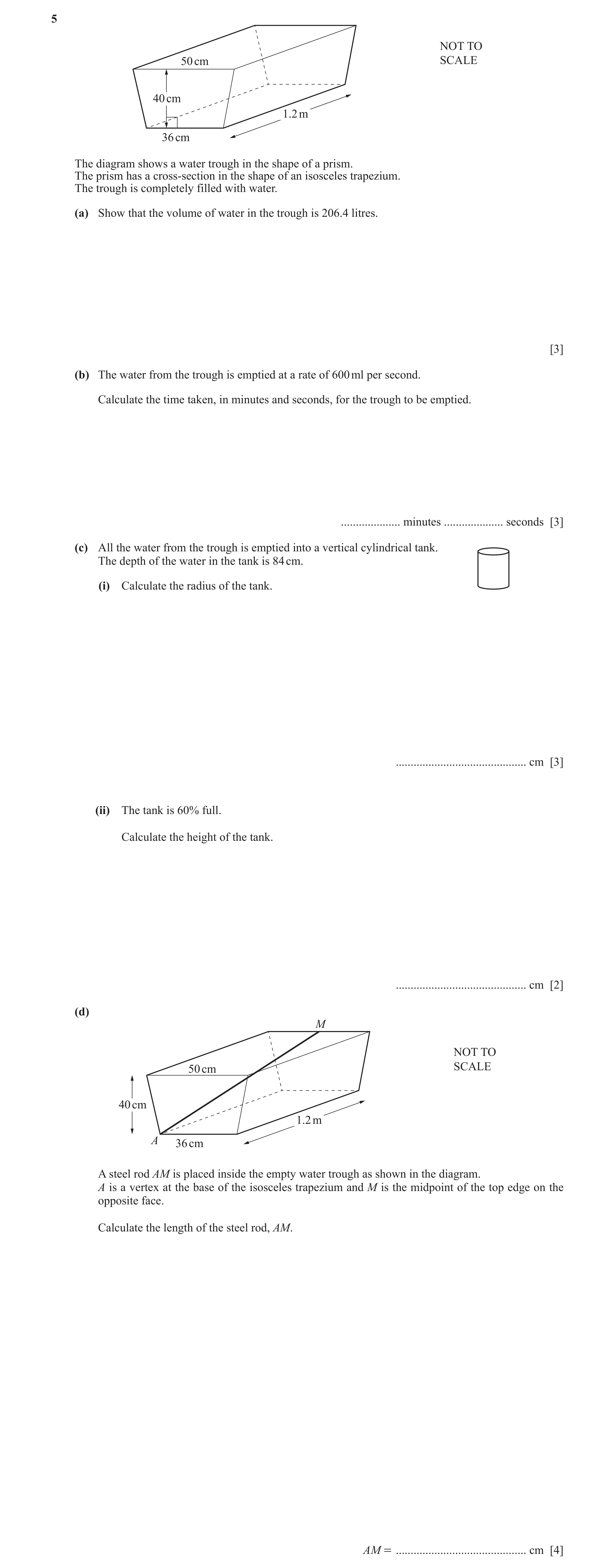
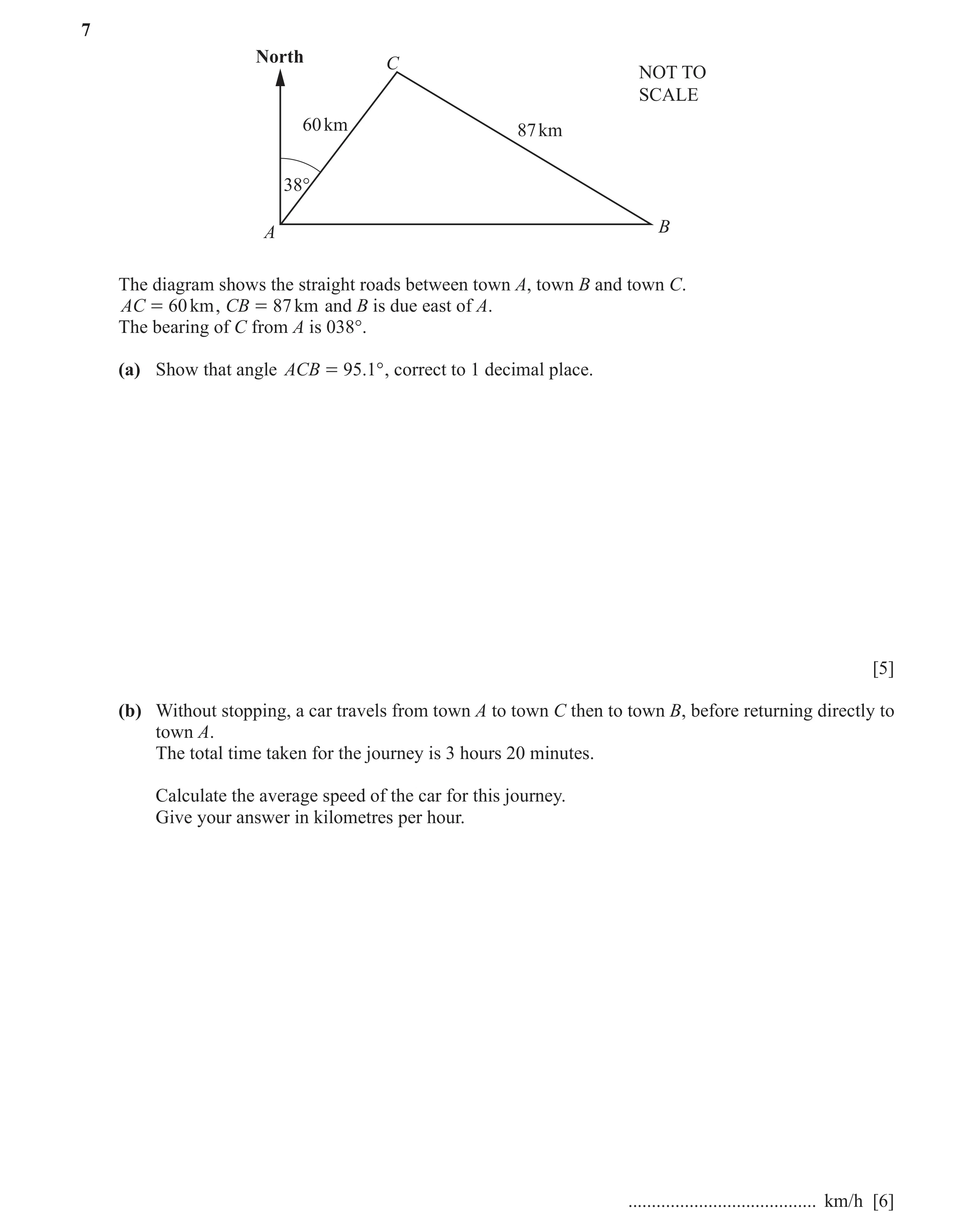 77 / 86
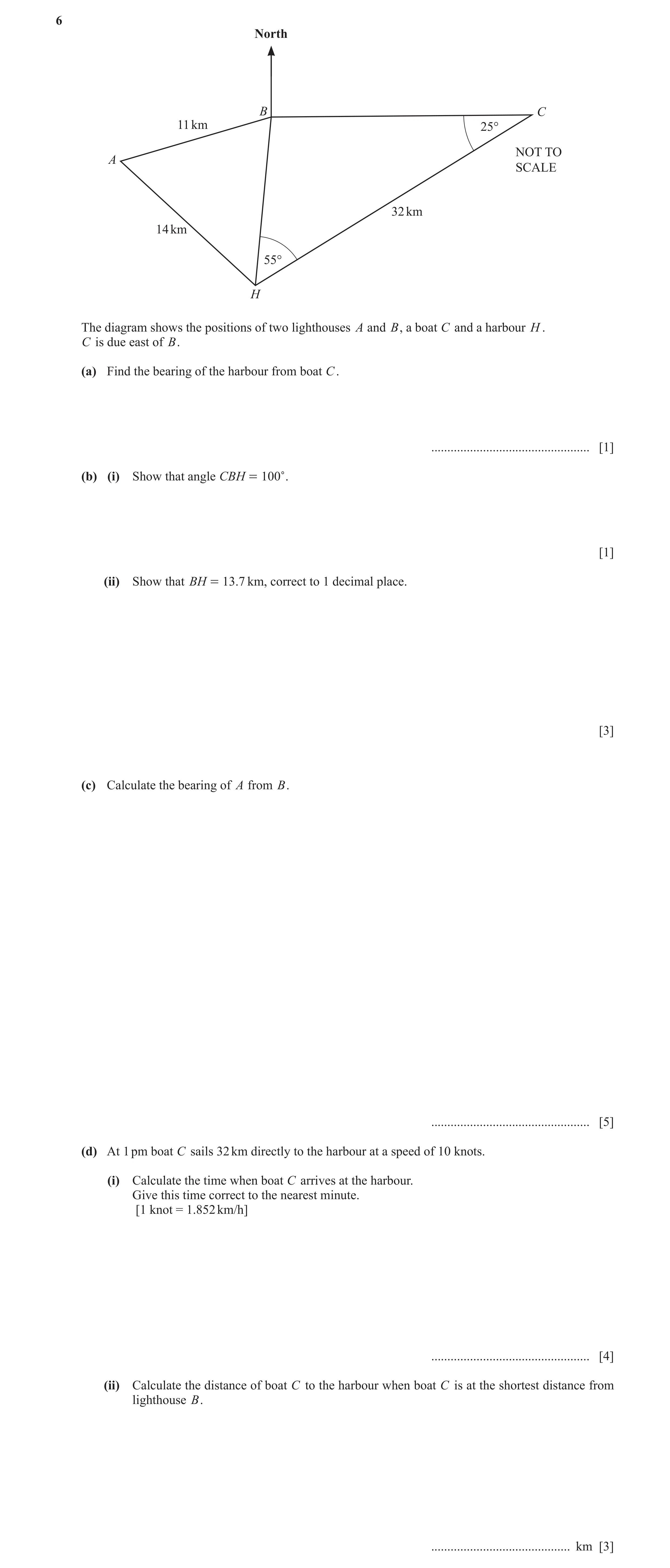
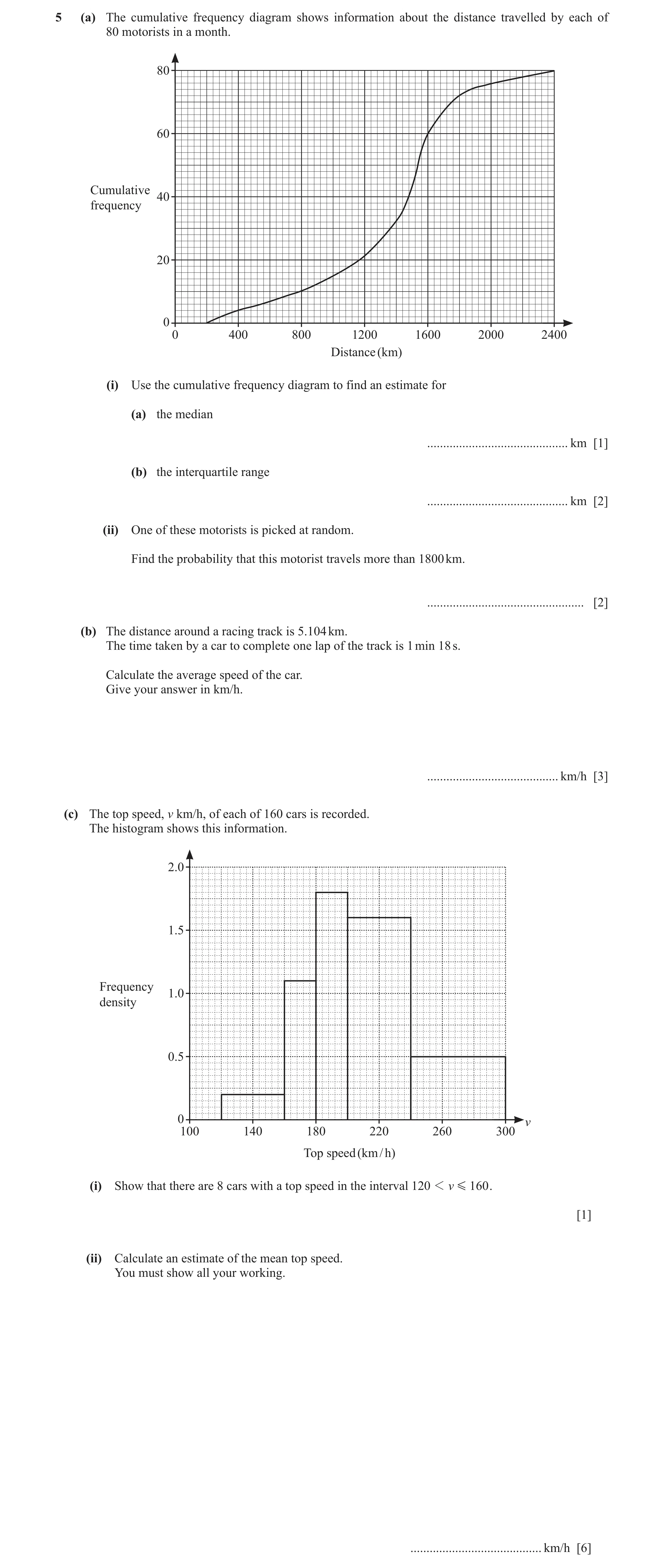
 85 / 86
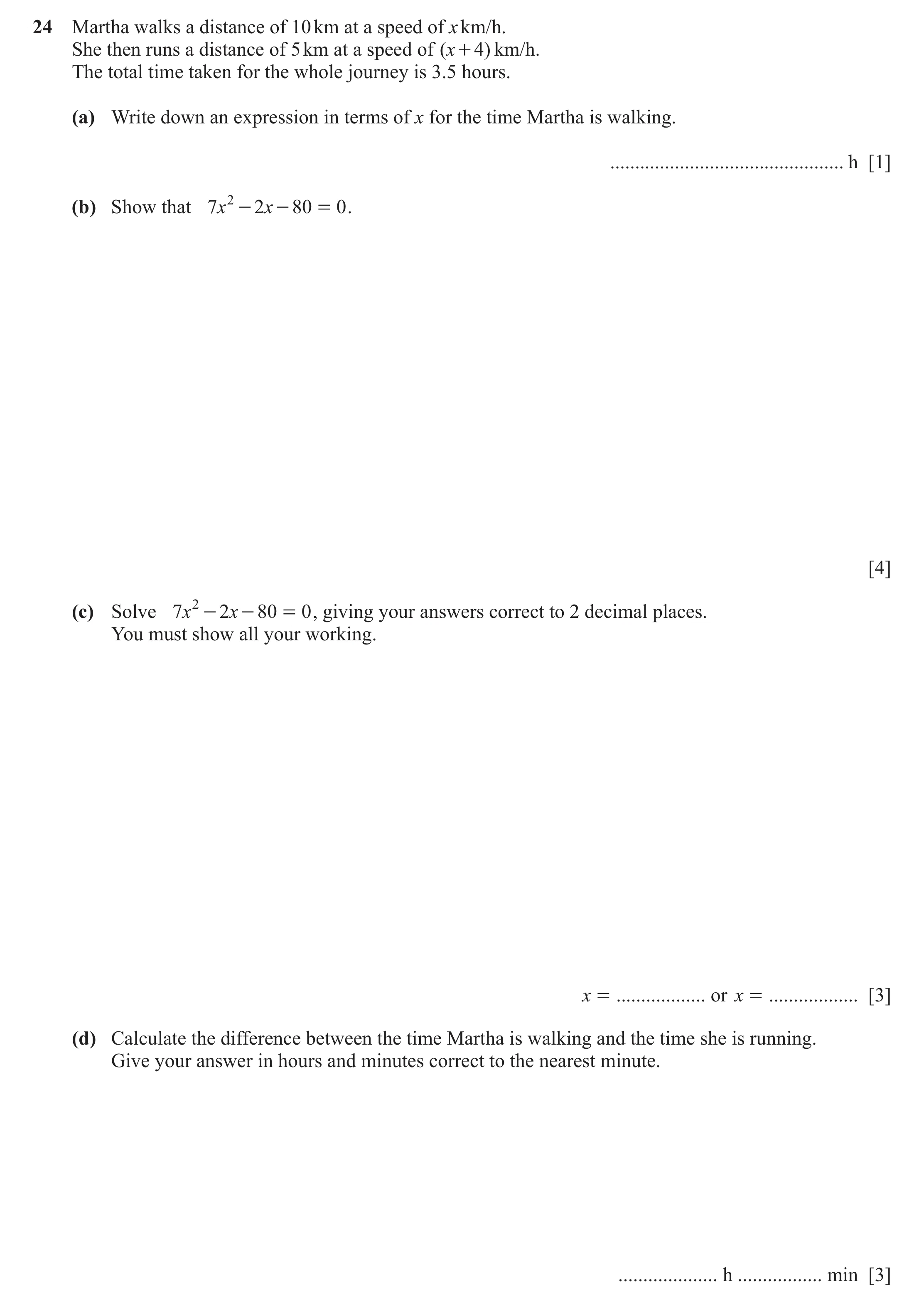 86 / 86
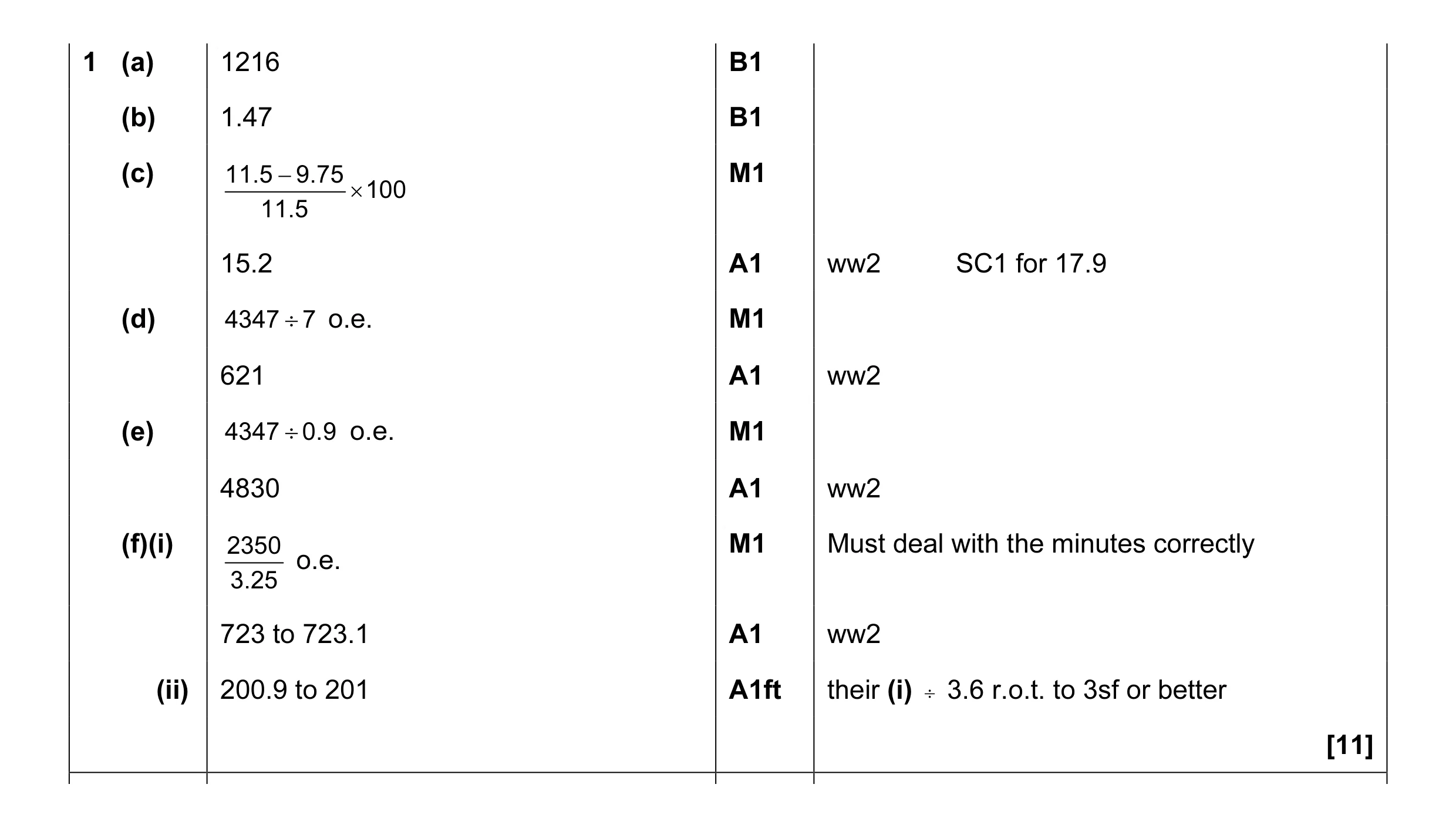 11
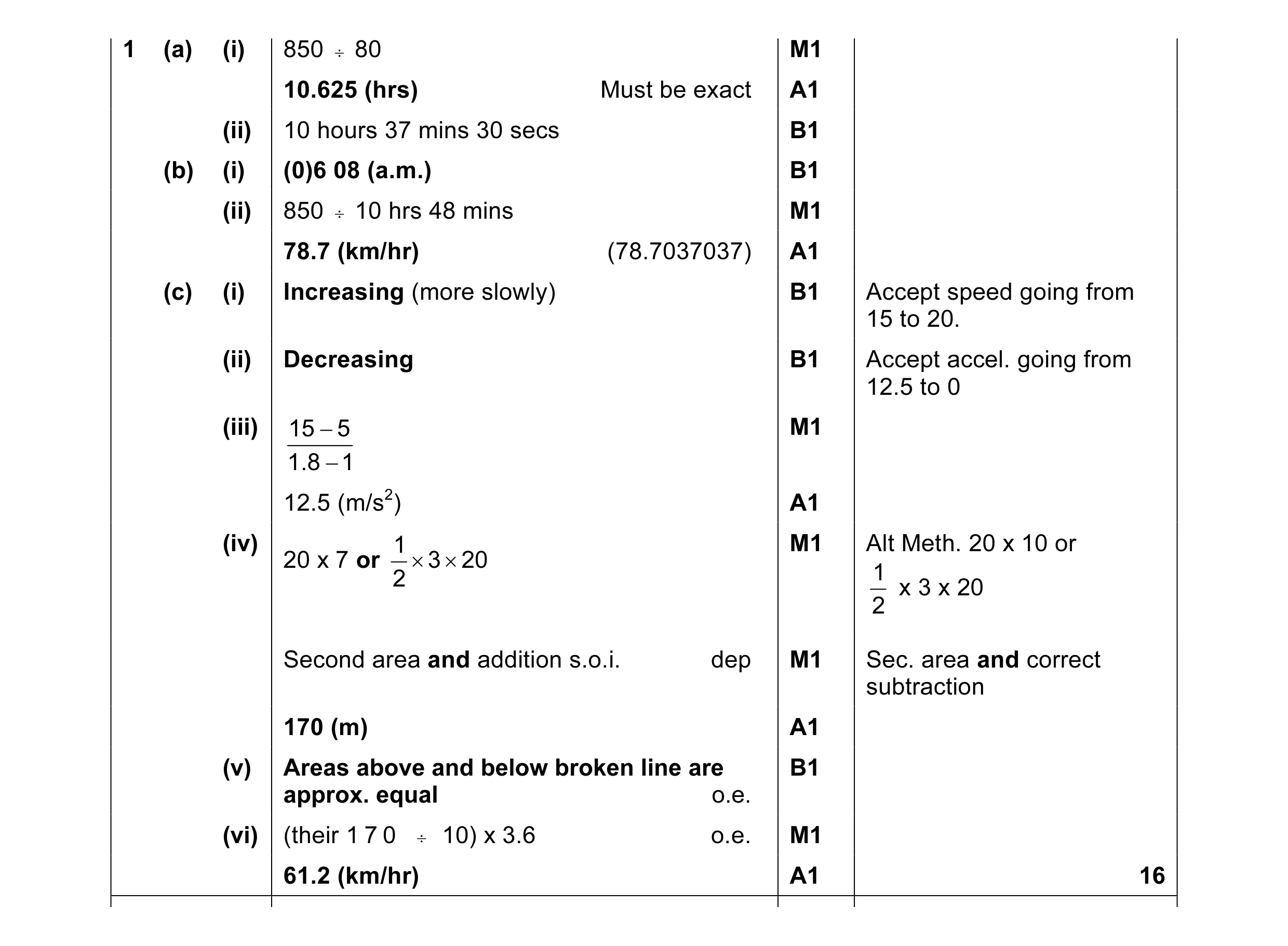 16
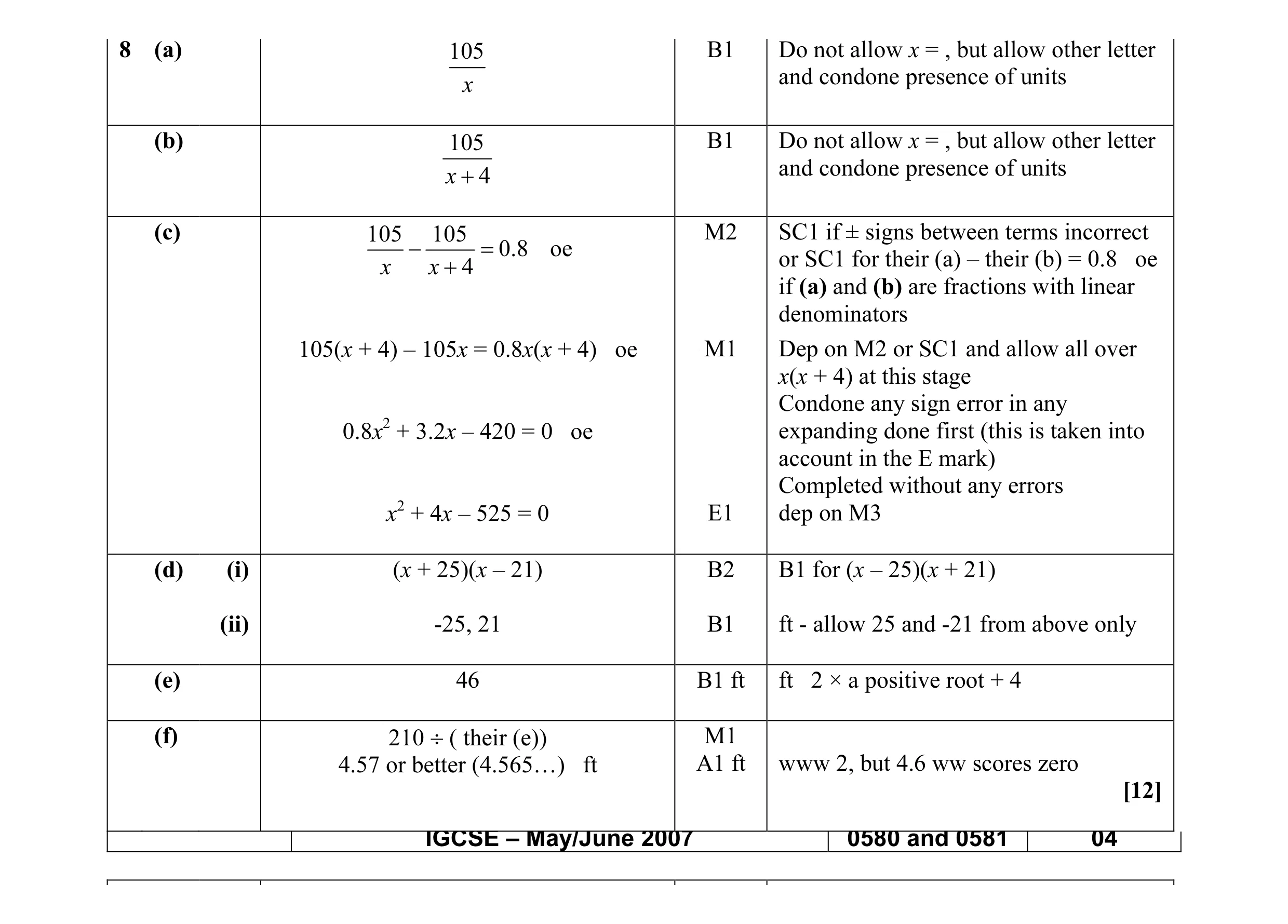 12
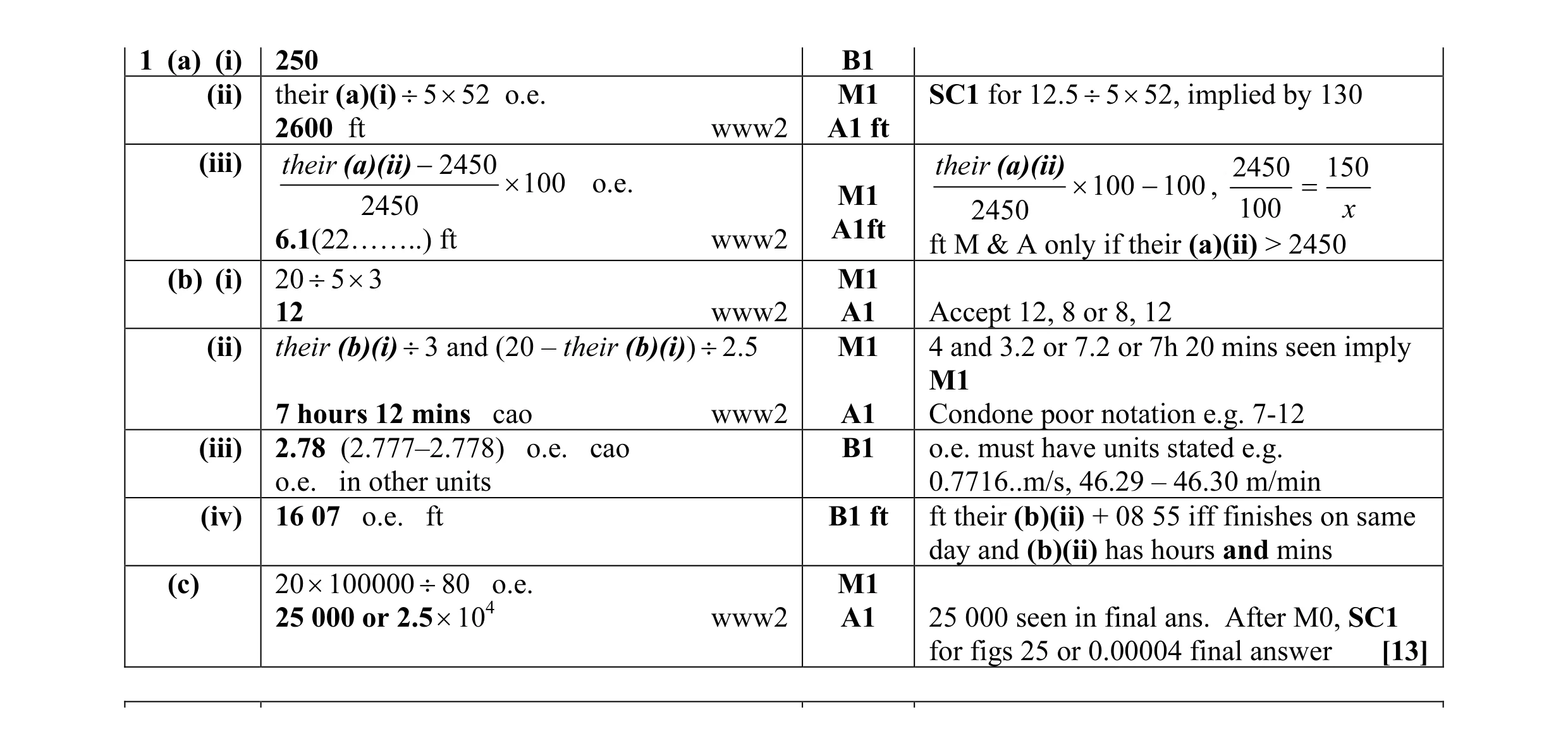 13
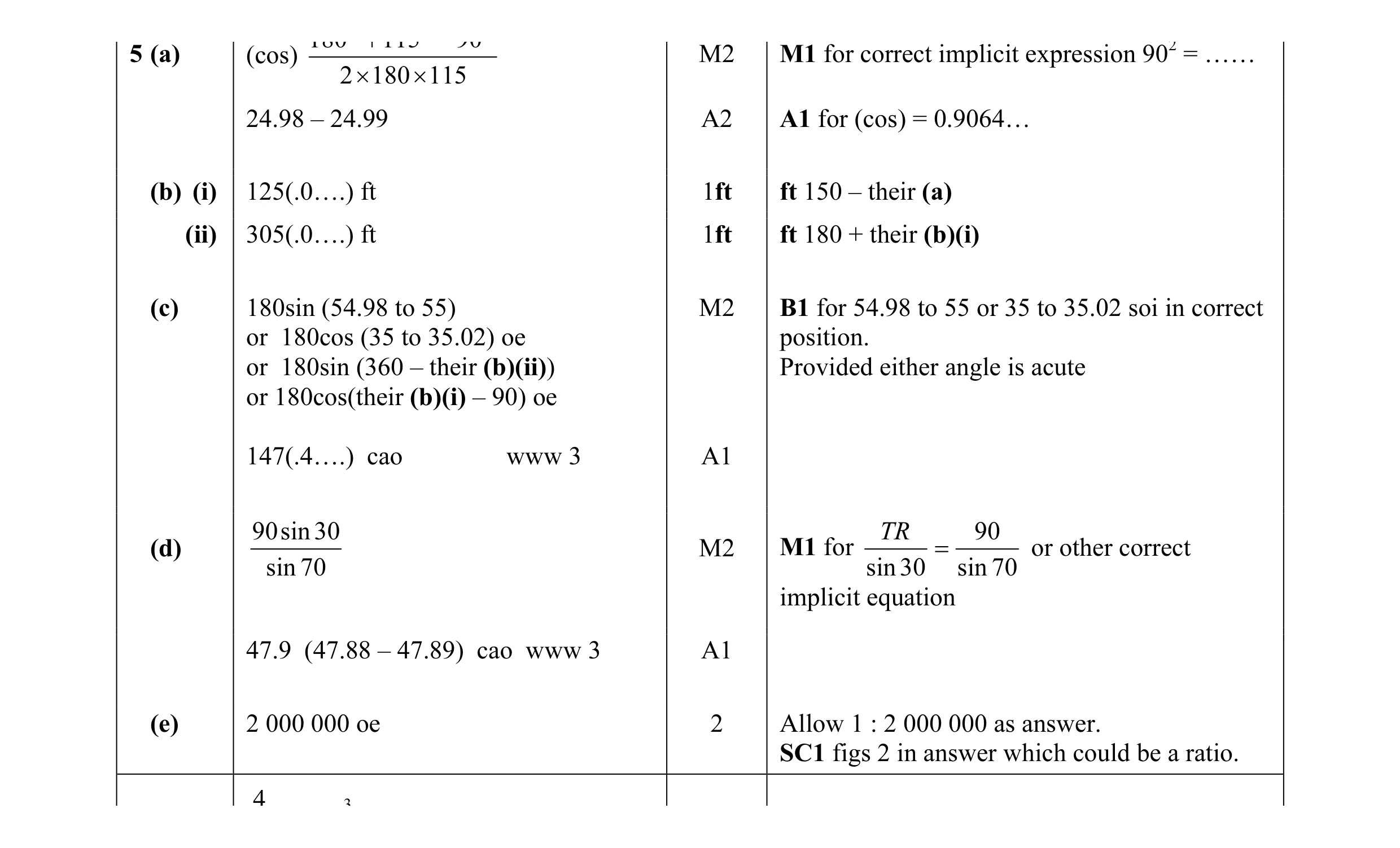 14
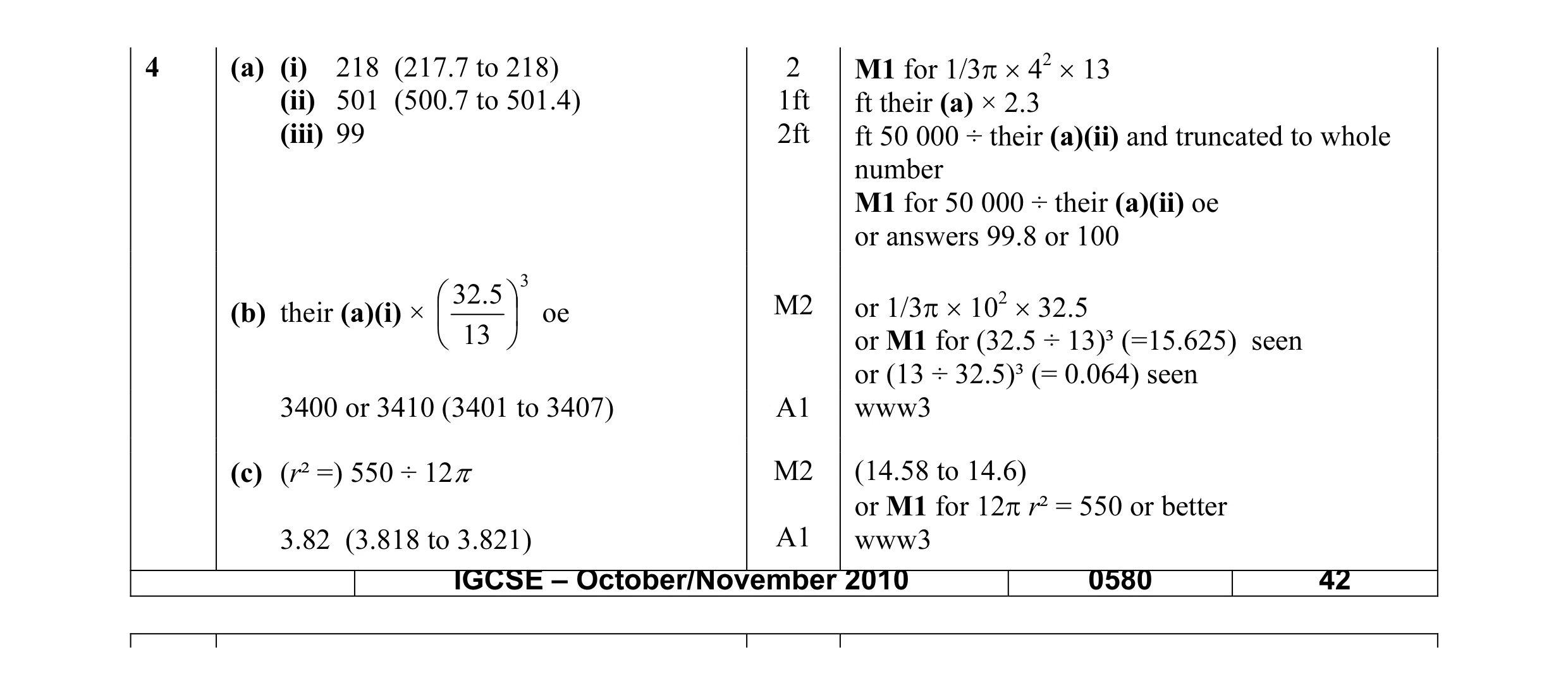 11
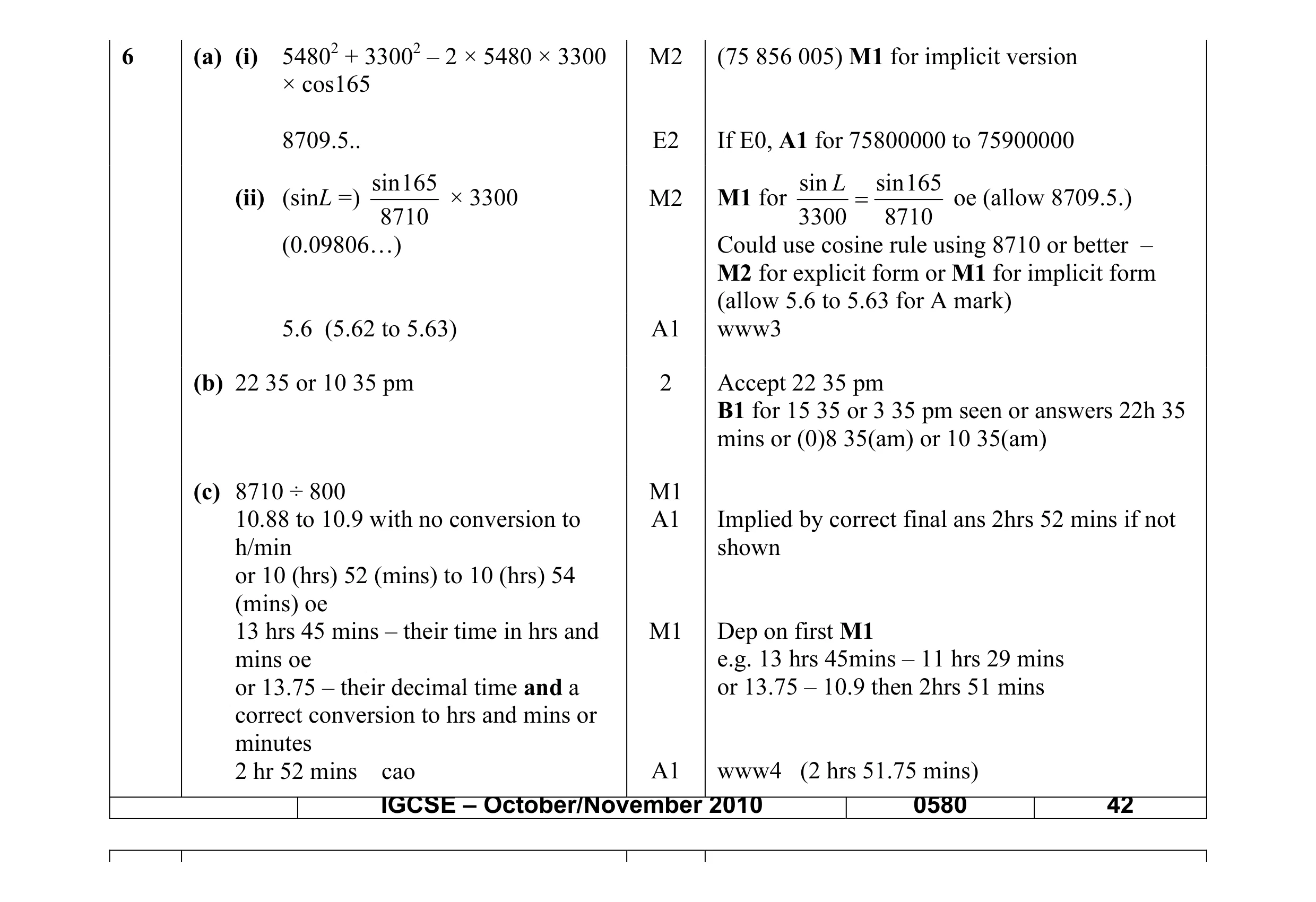 13
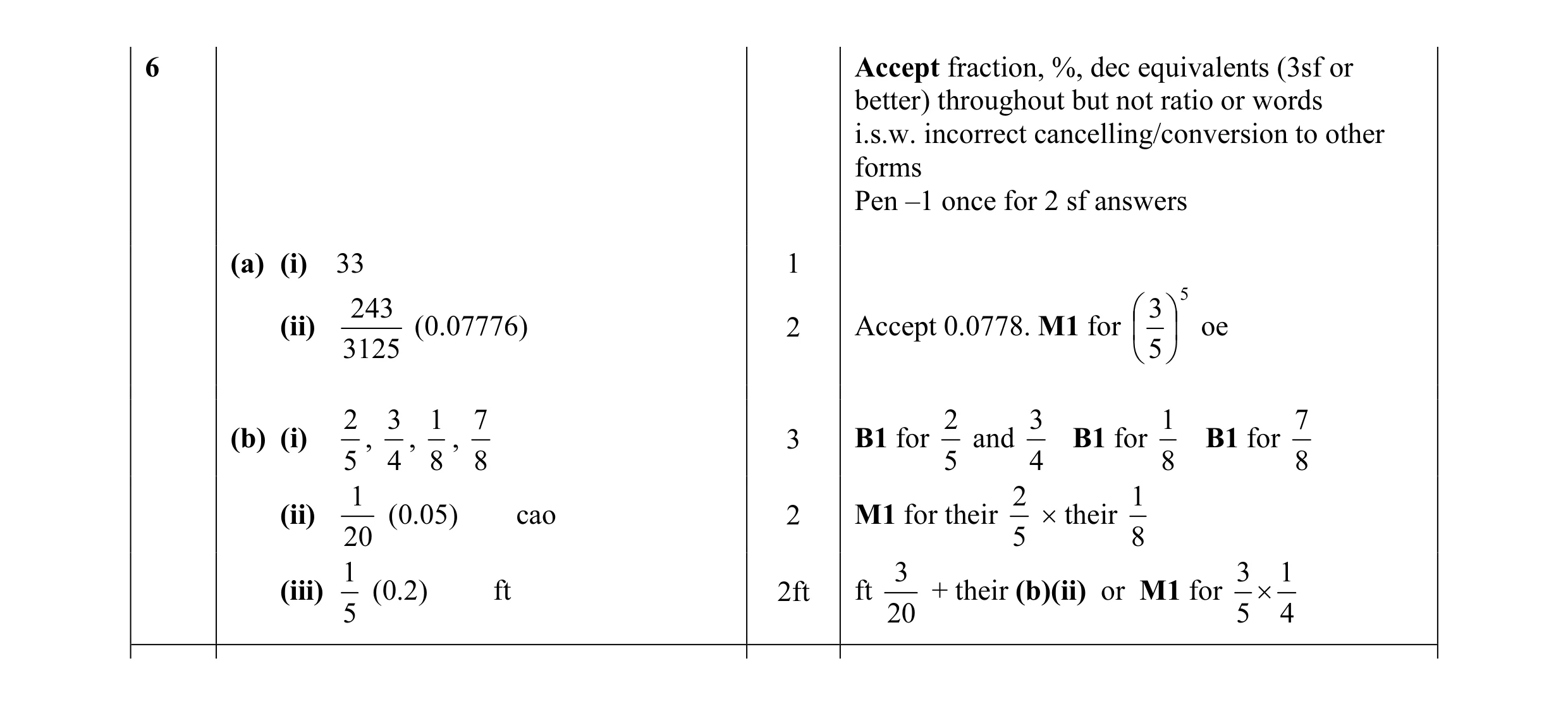 10
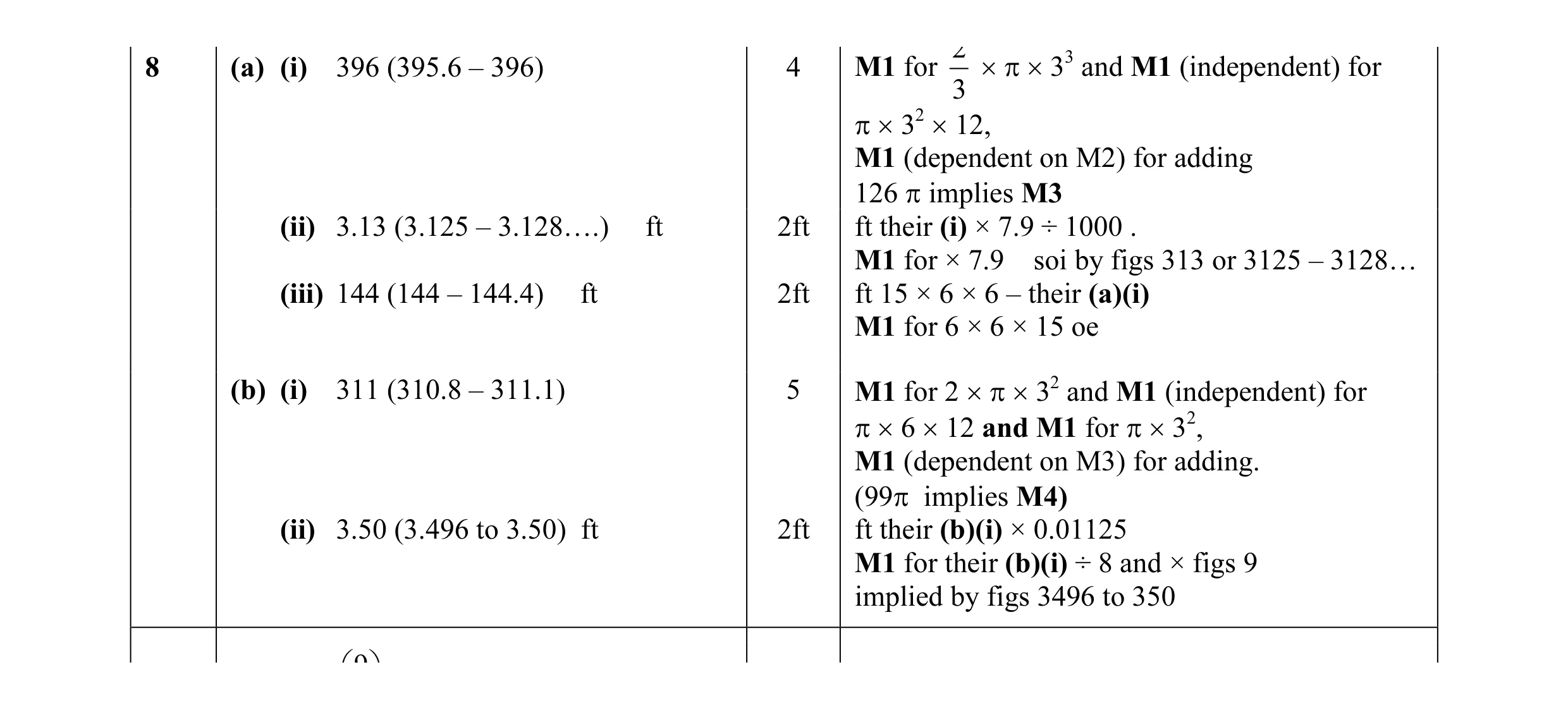 15
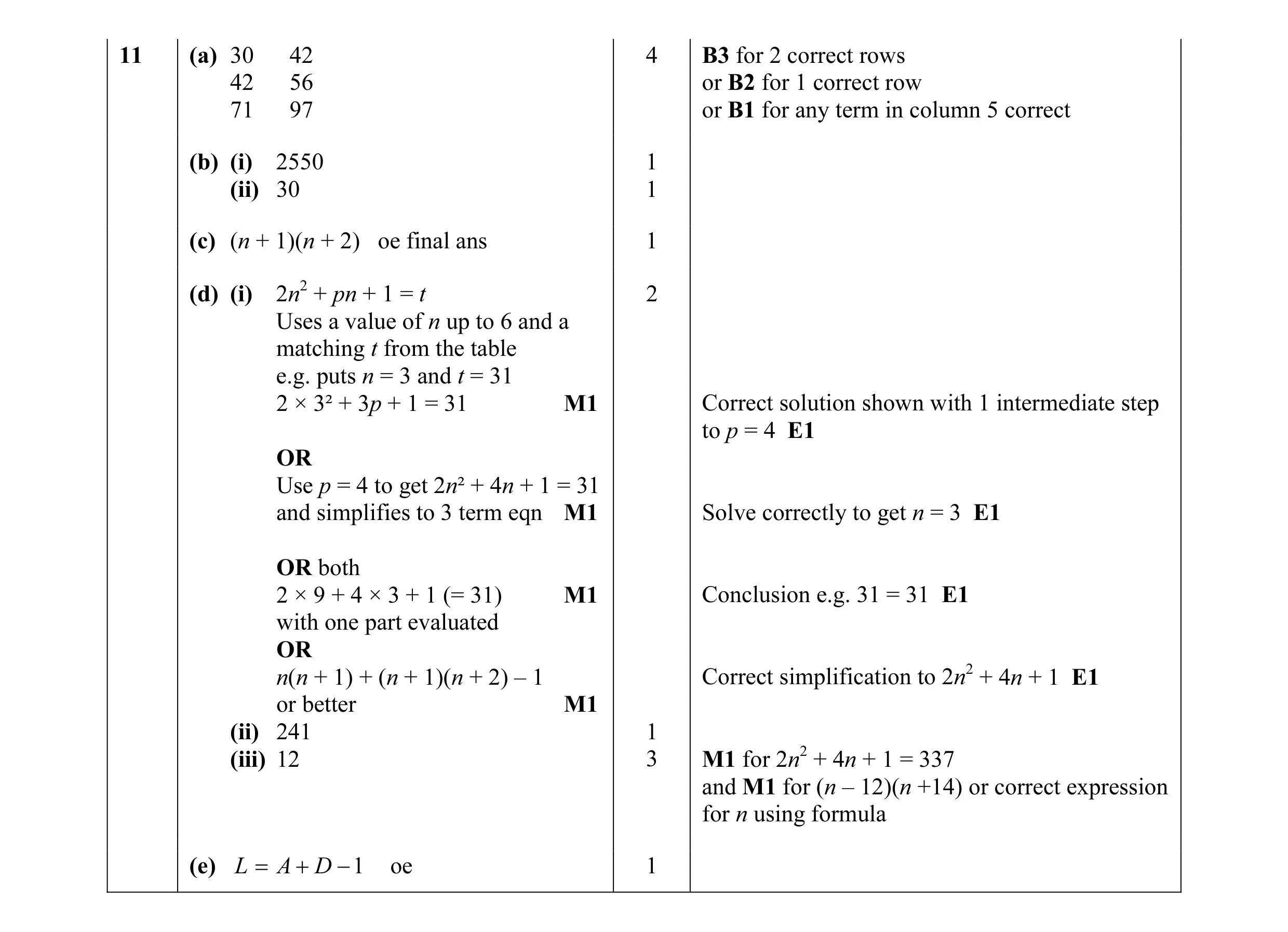 14
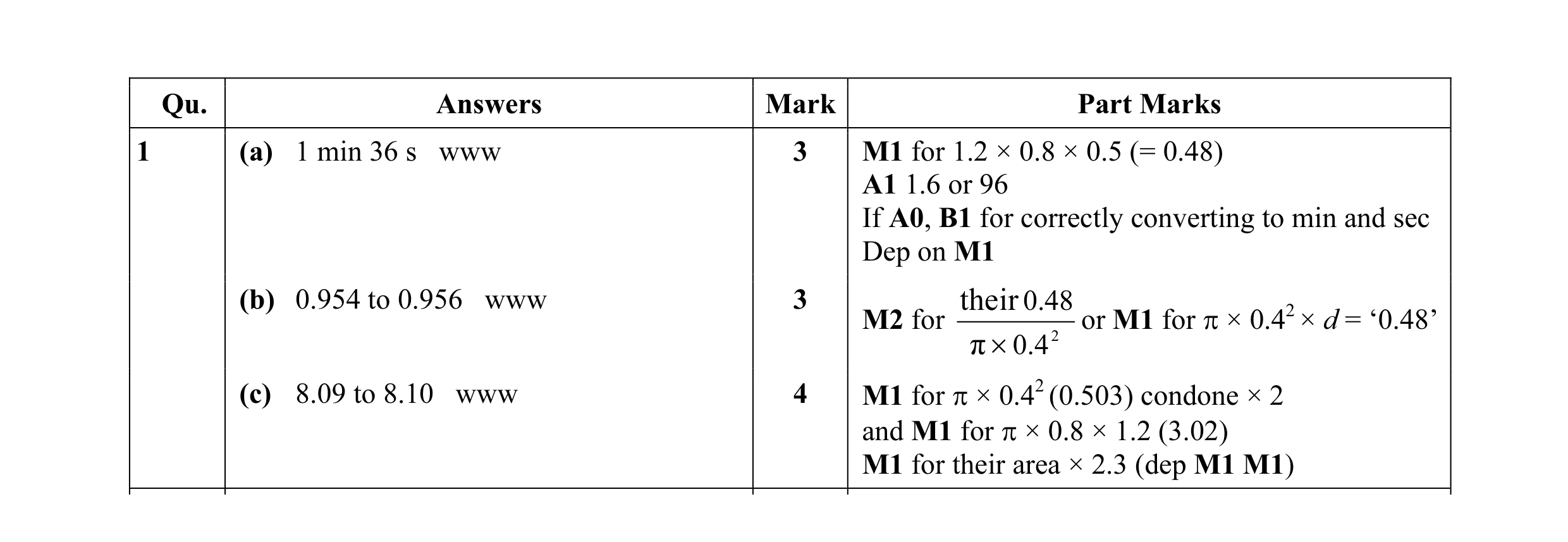 10
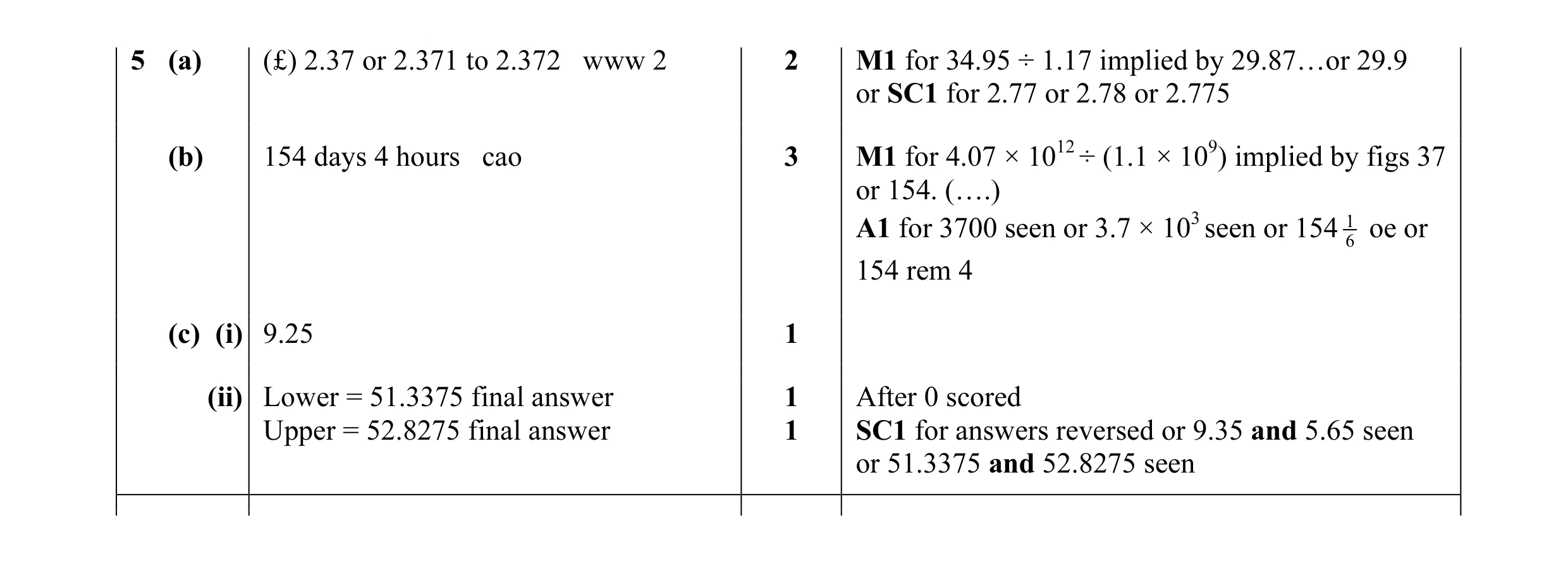 8
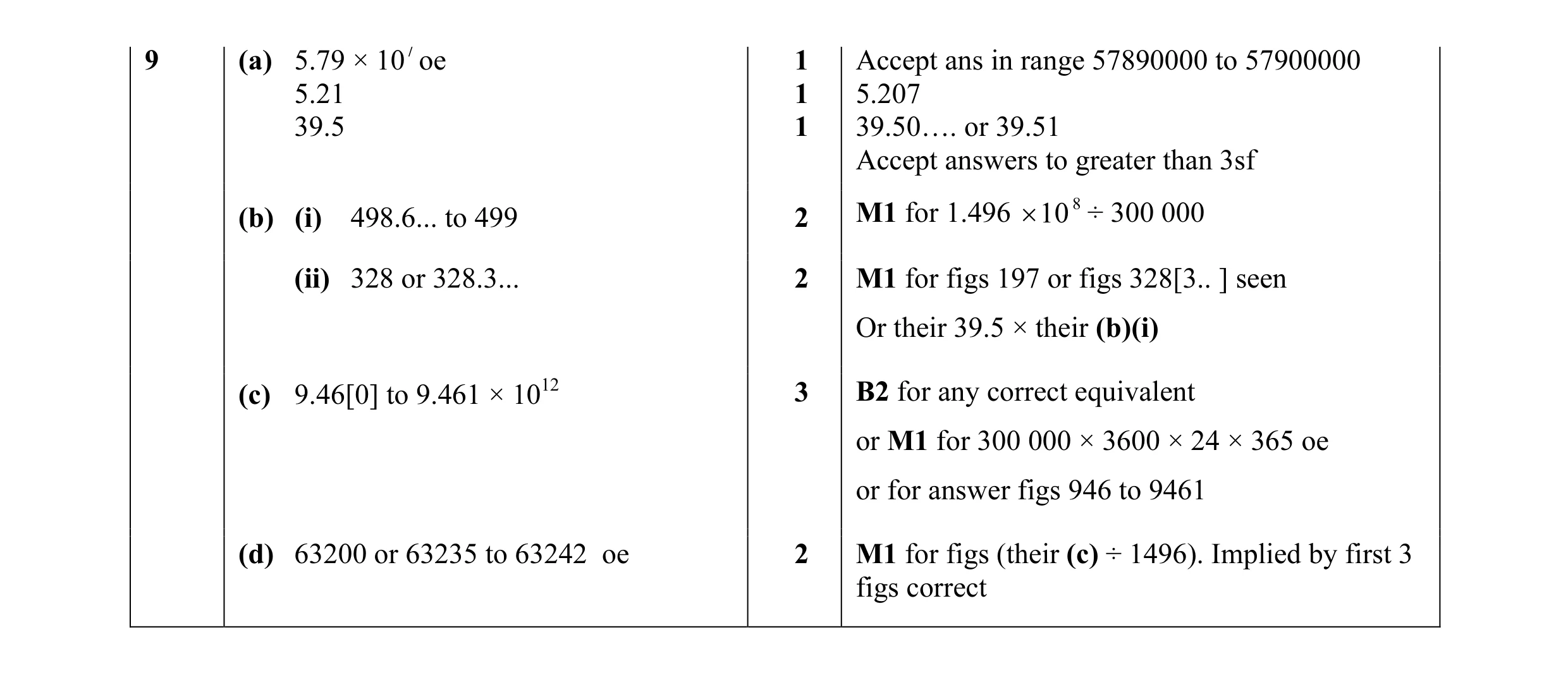 12
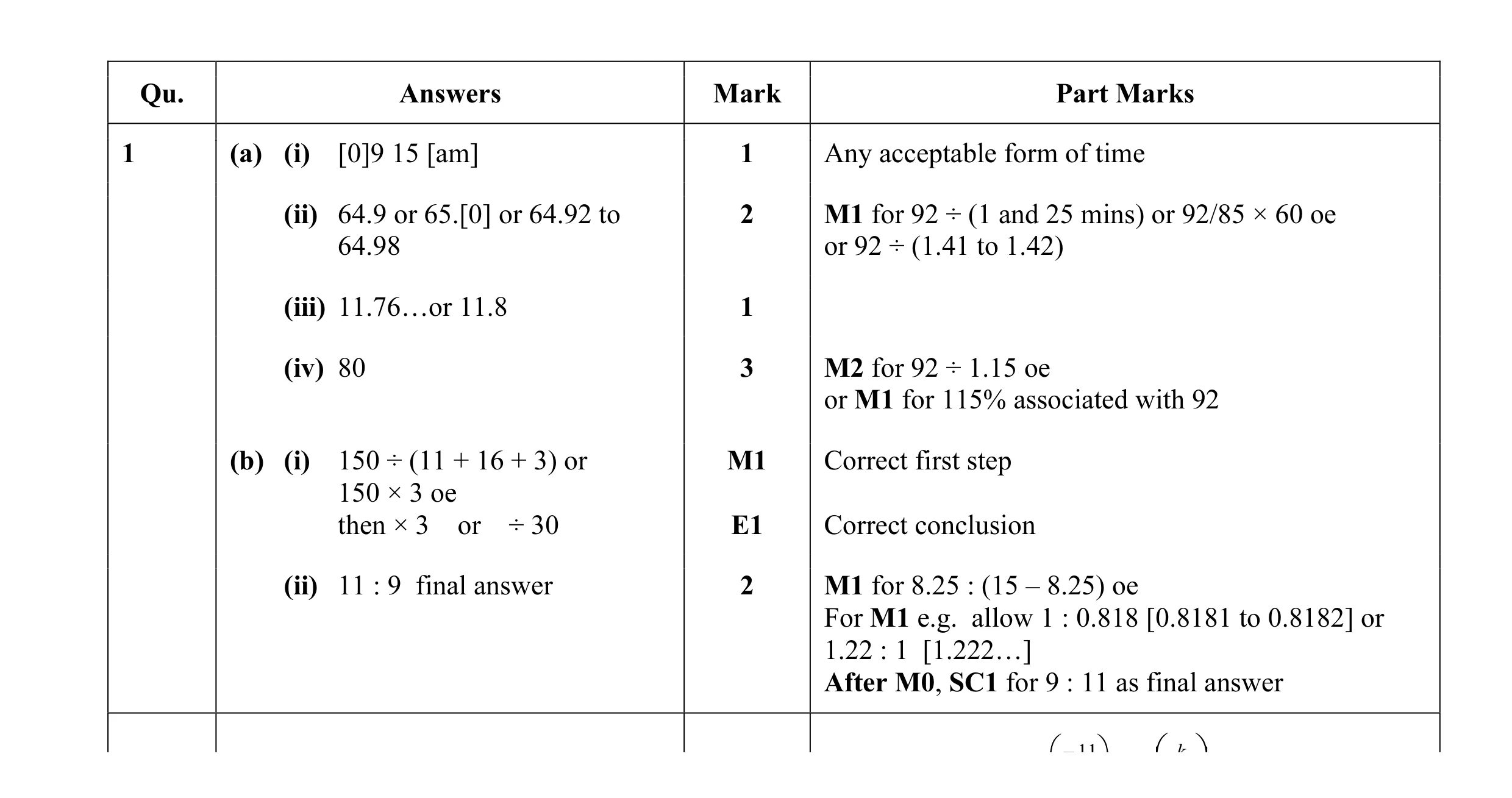 11
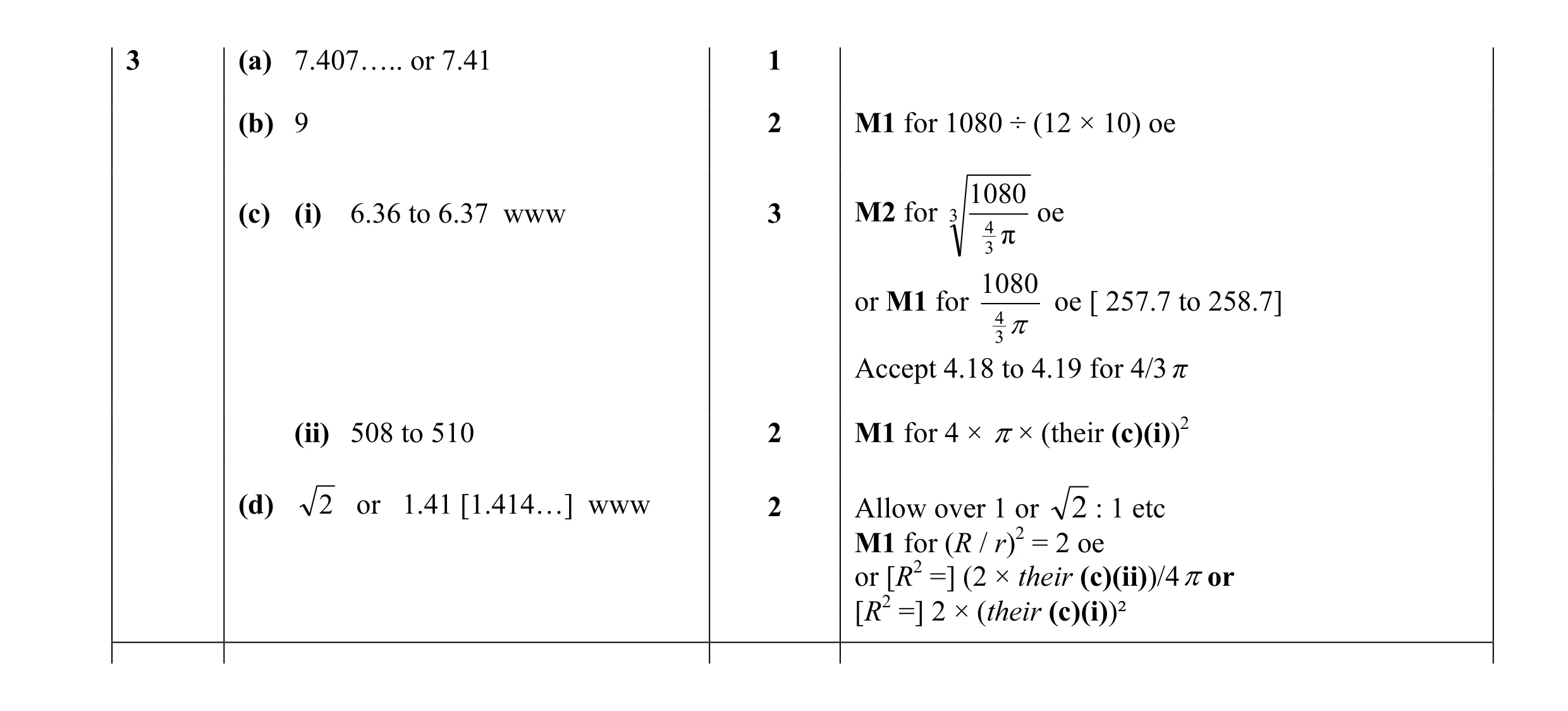 10
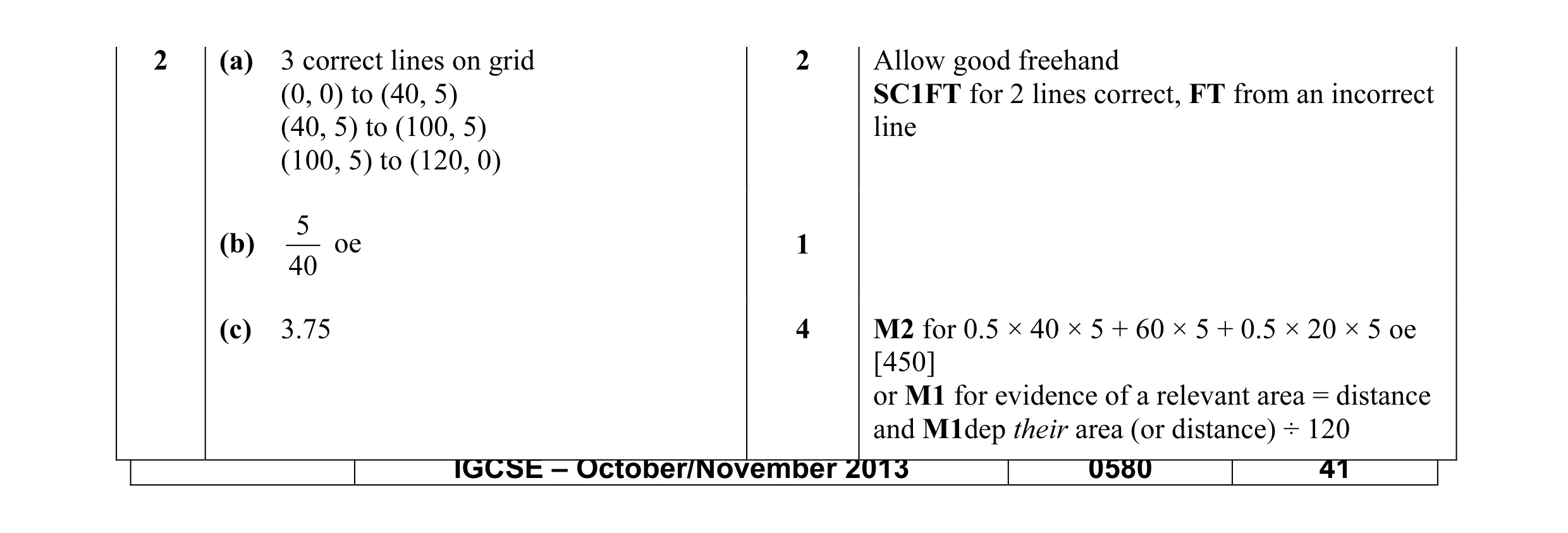 7
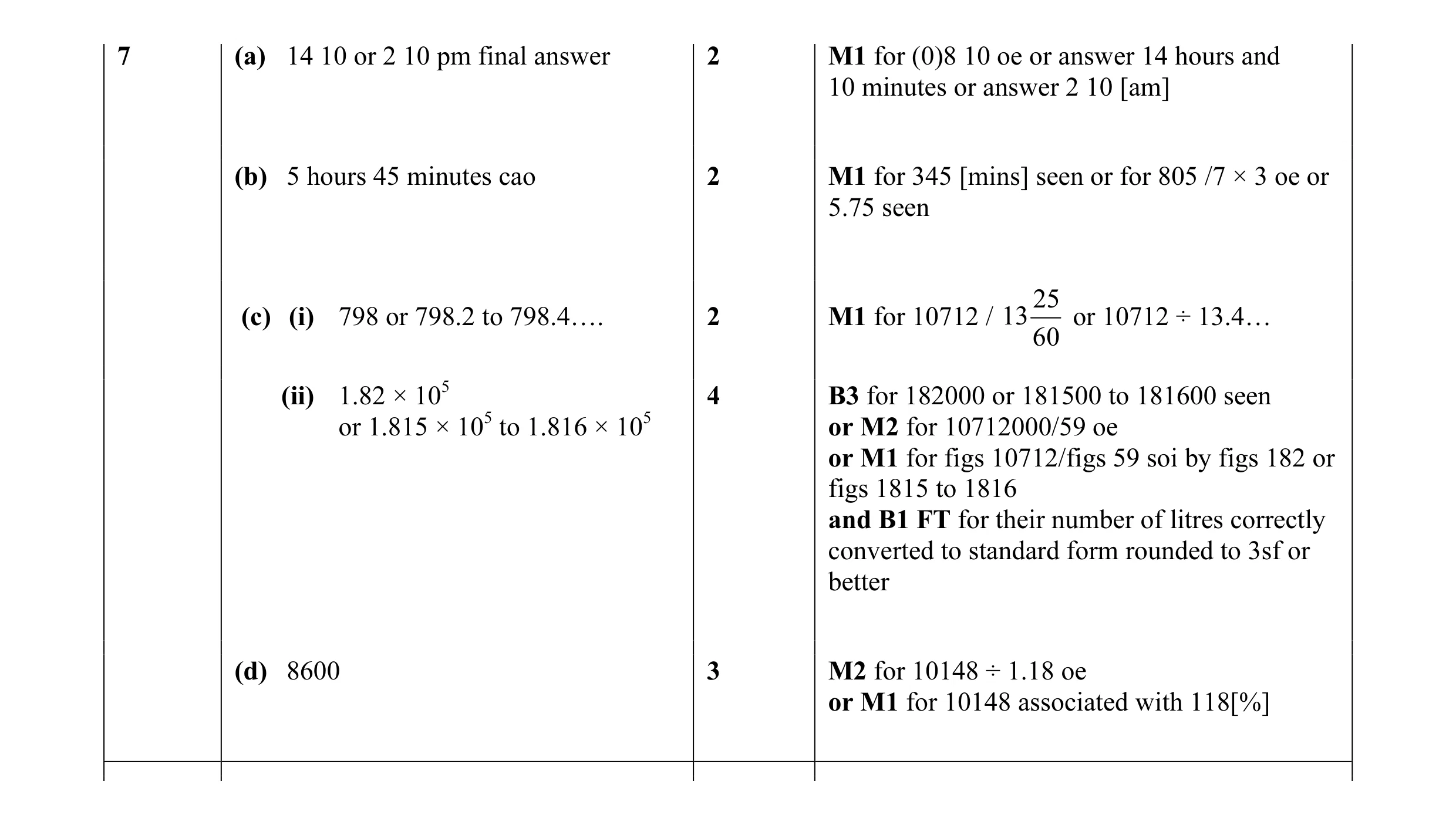 13
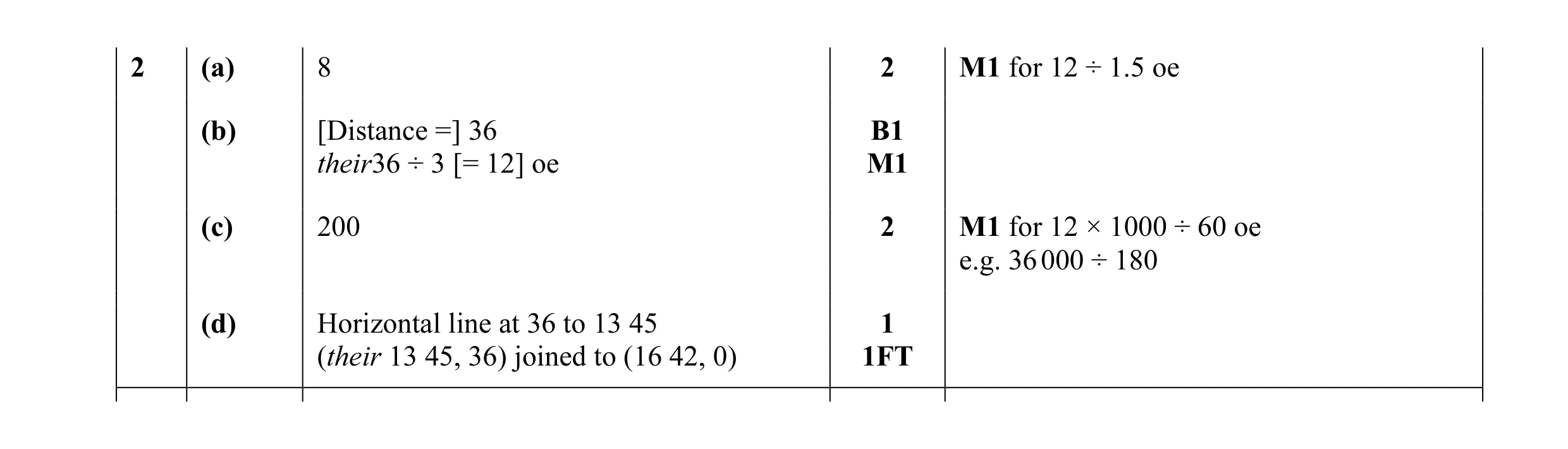 8
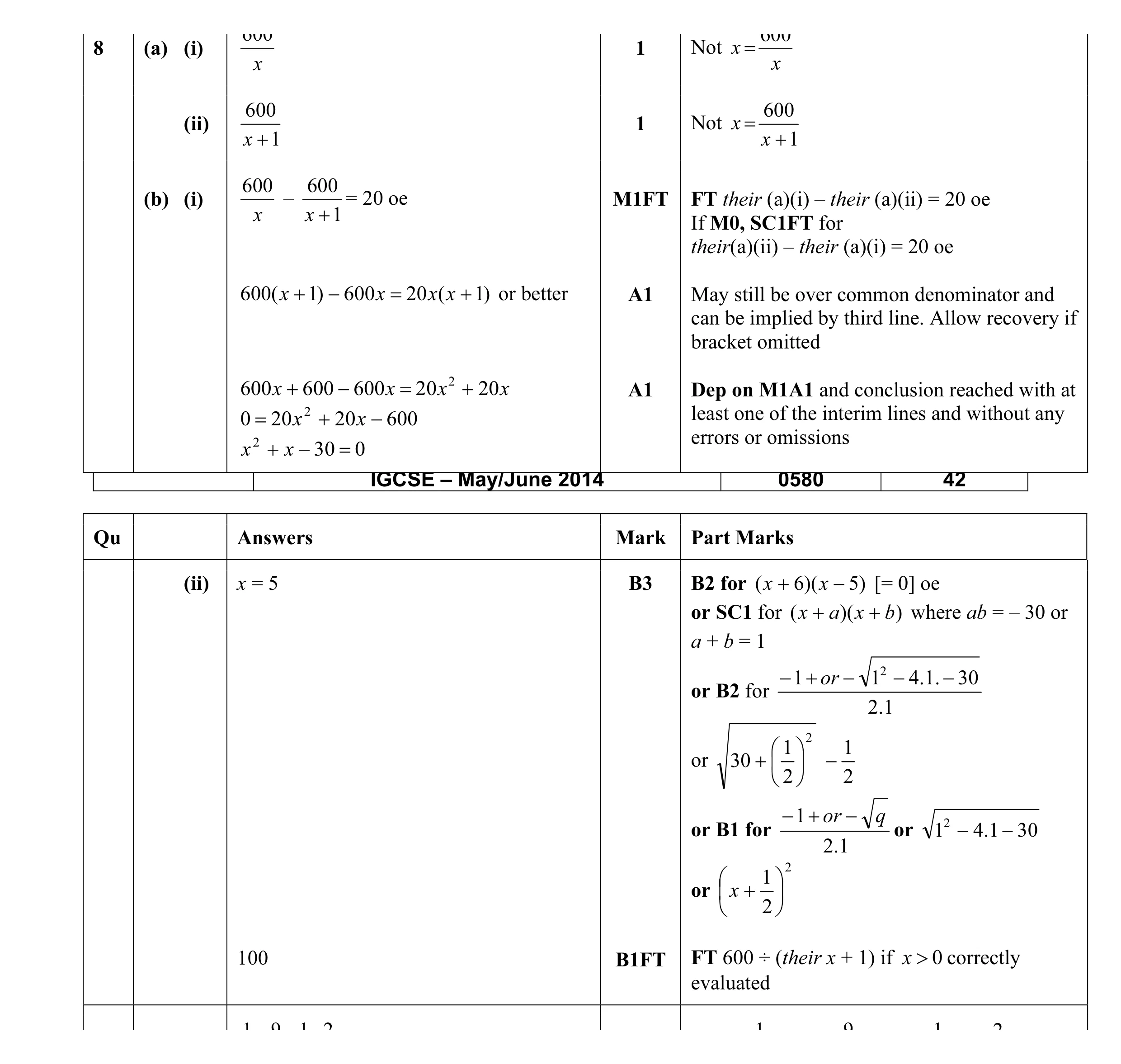 9
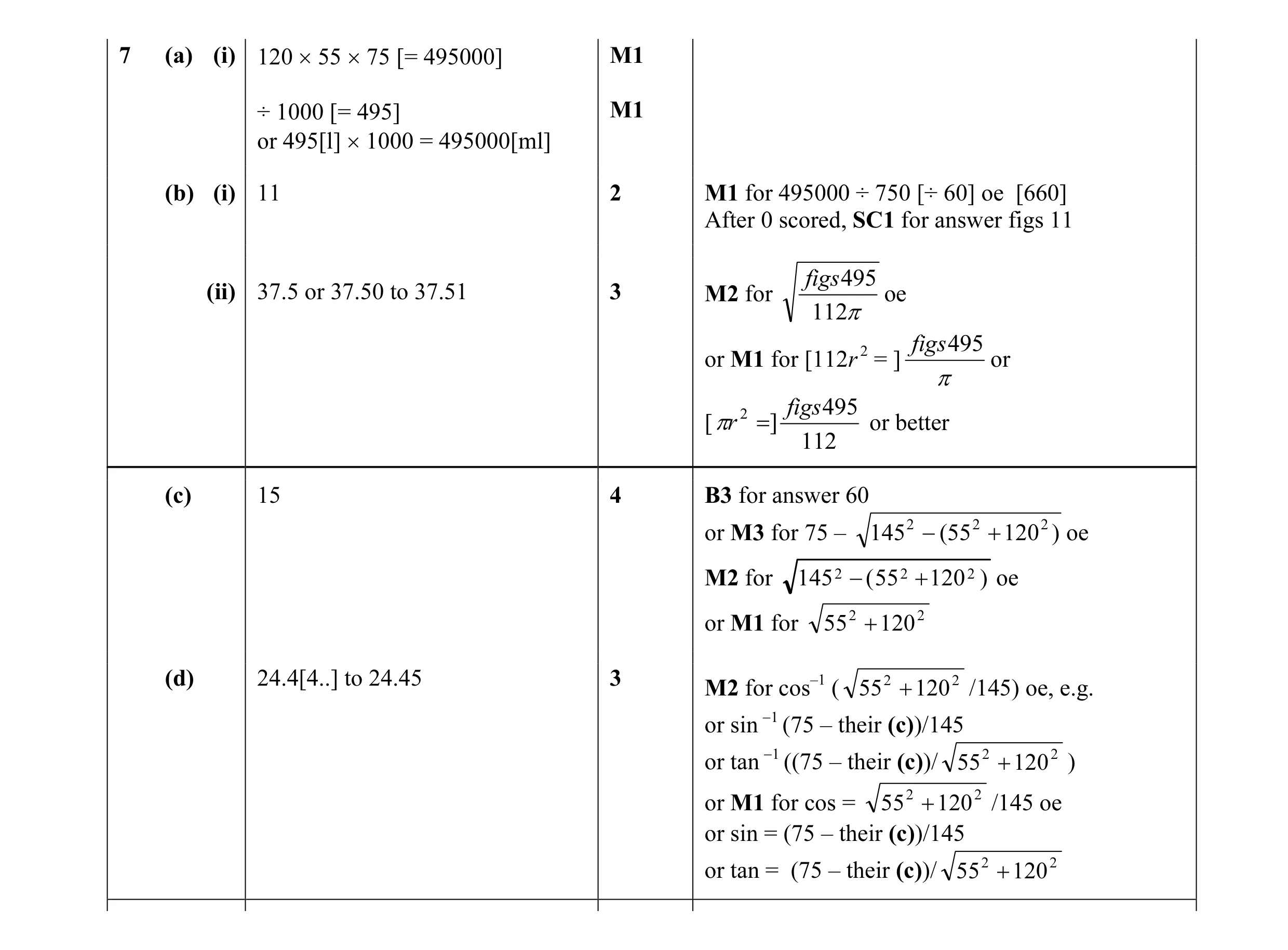 14
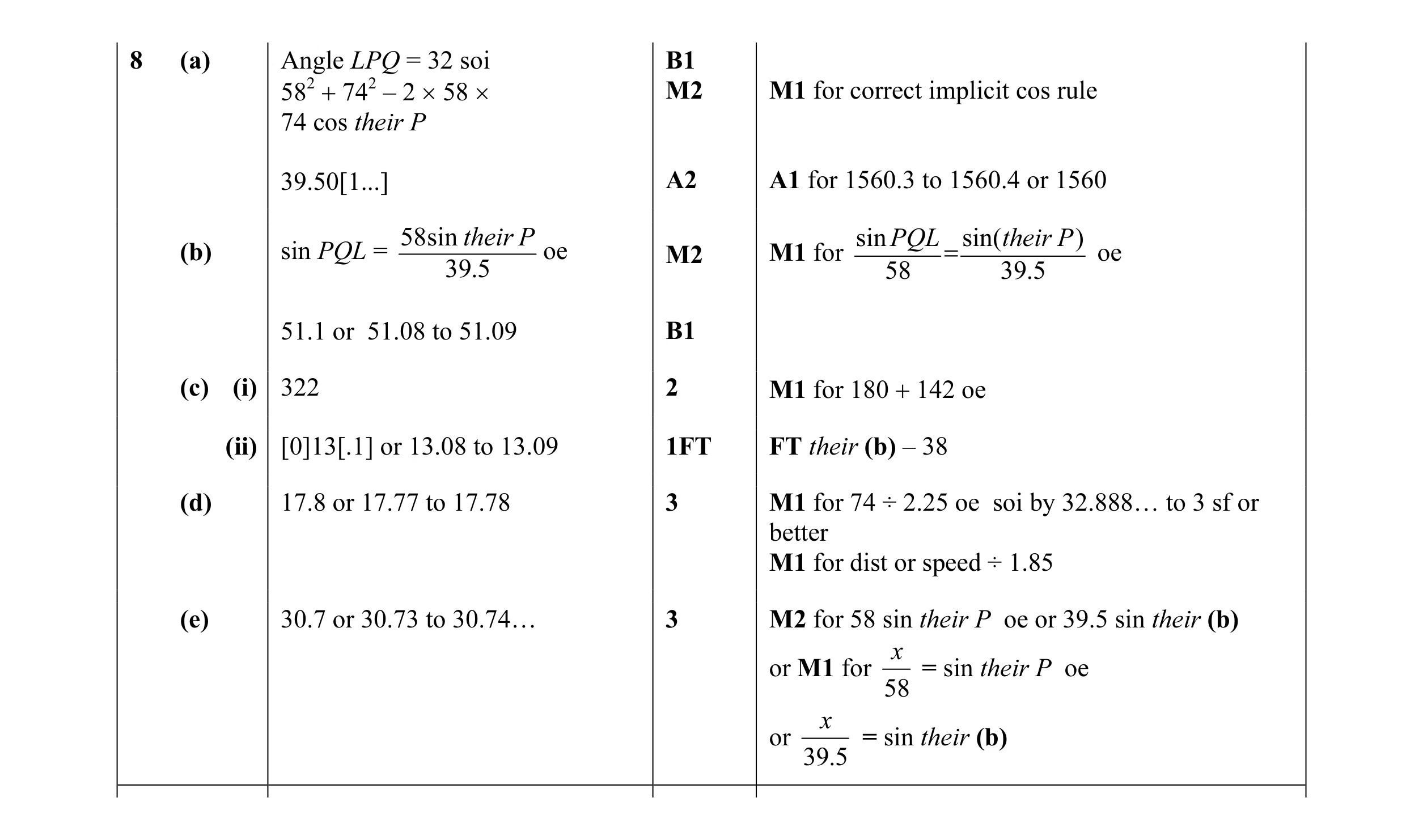 17
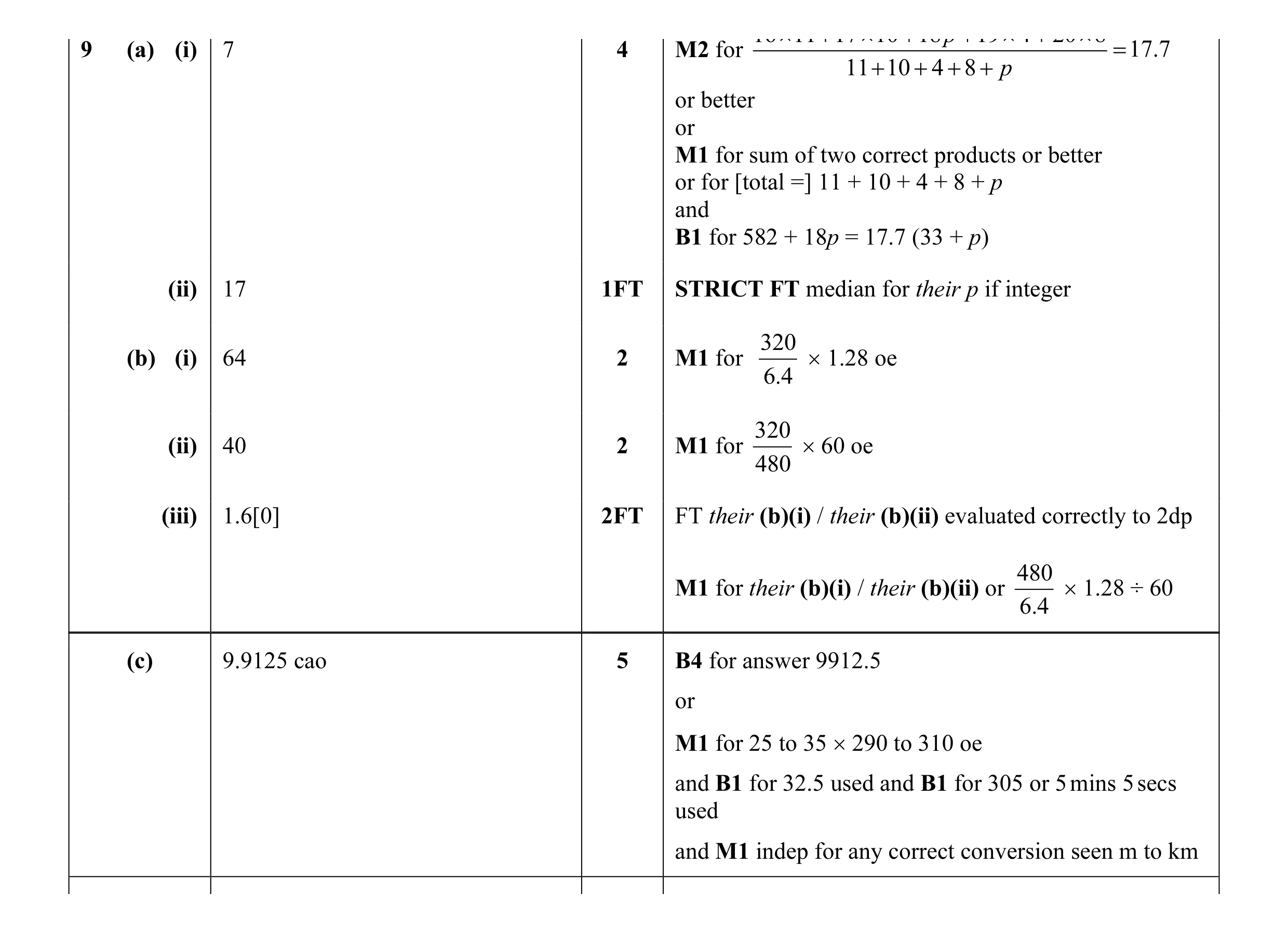 16
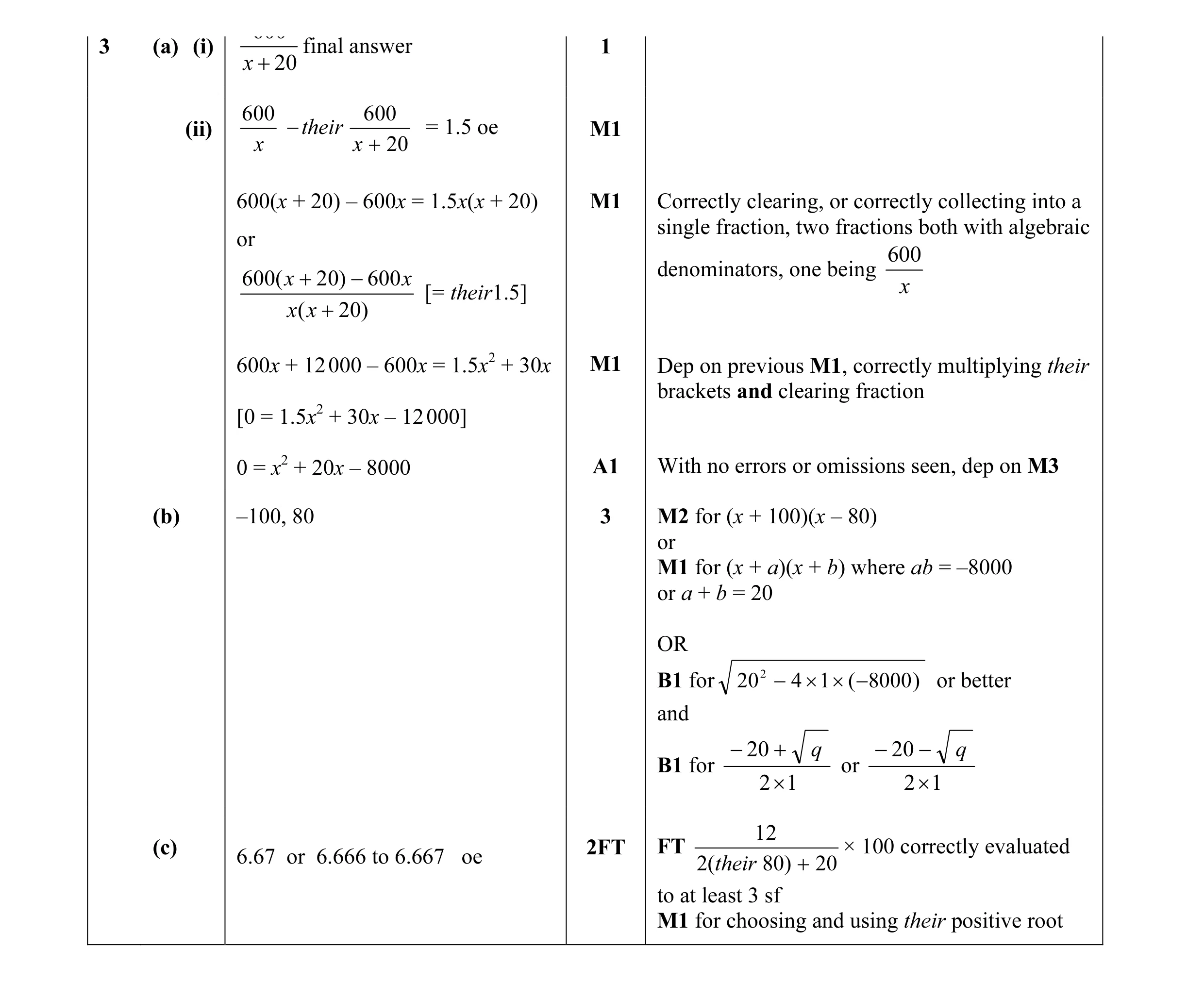 10
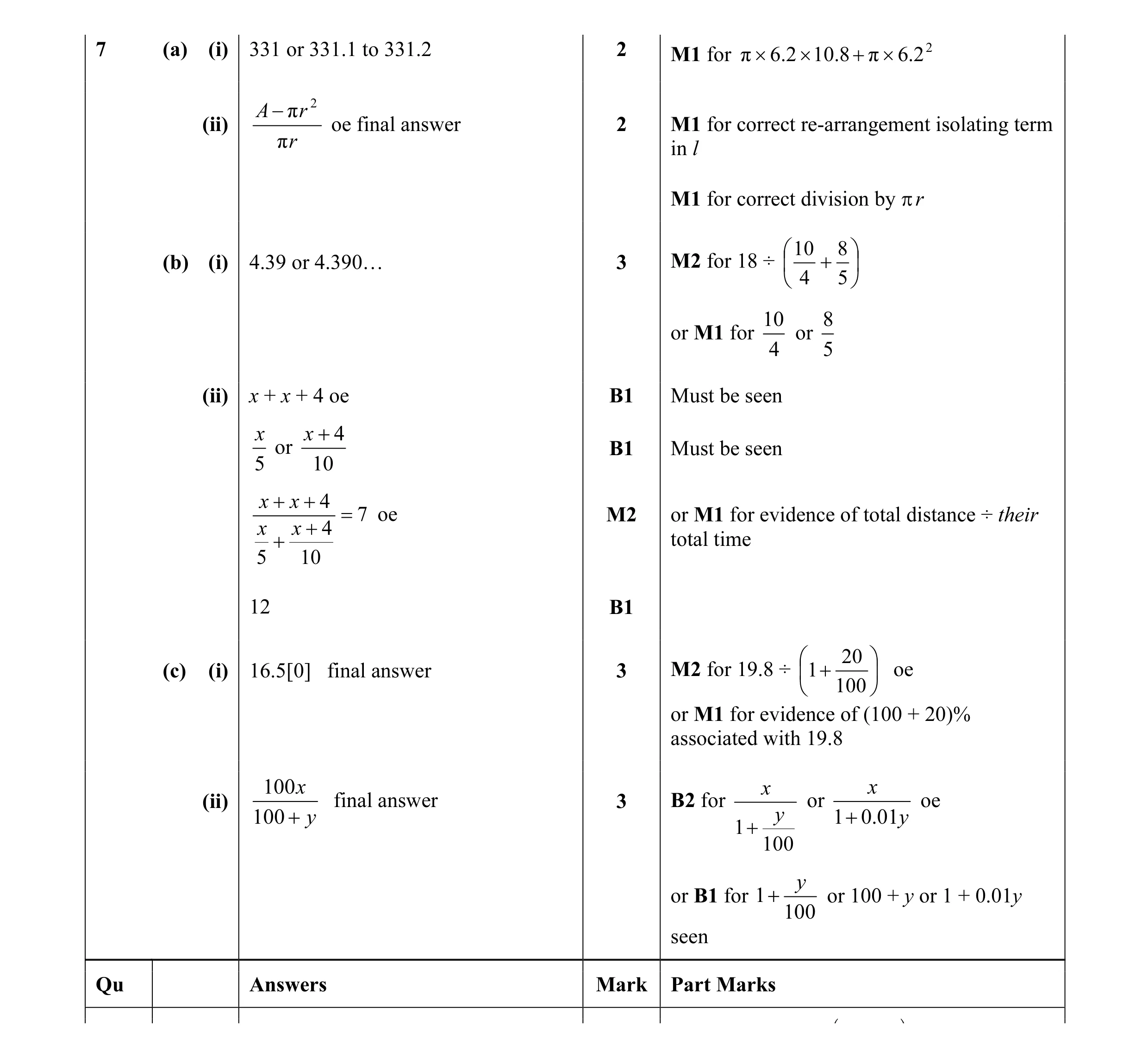 18
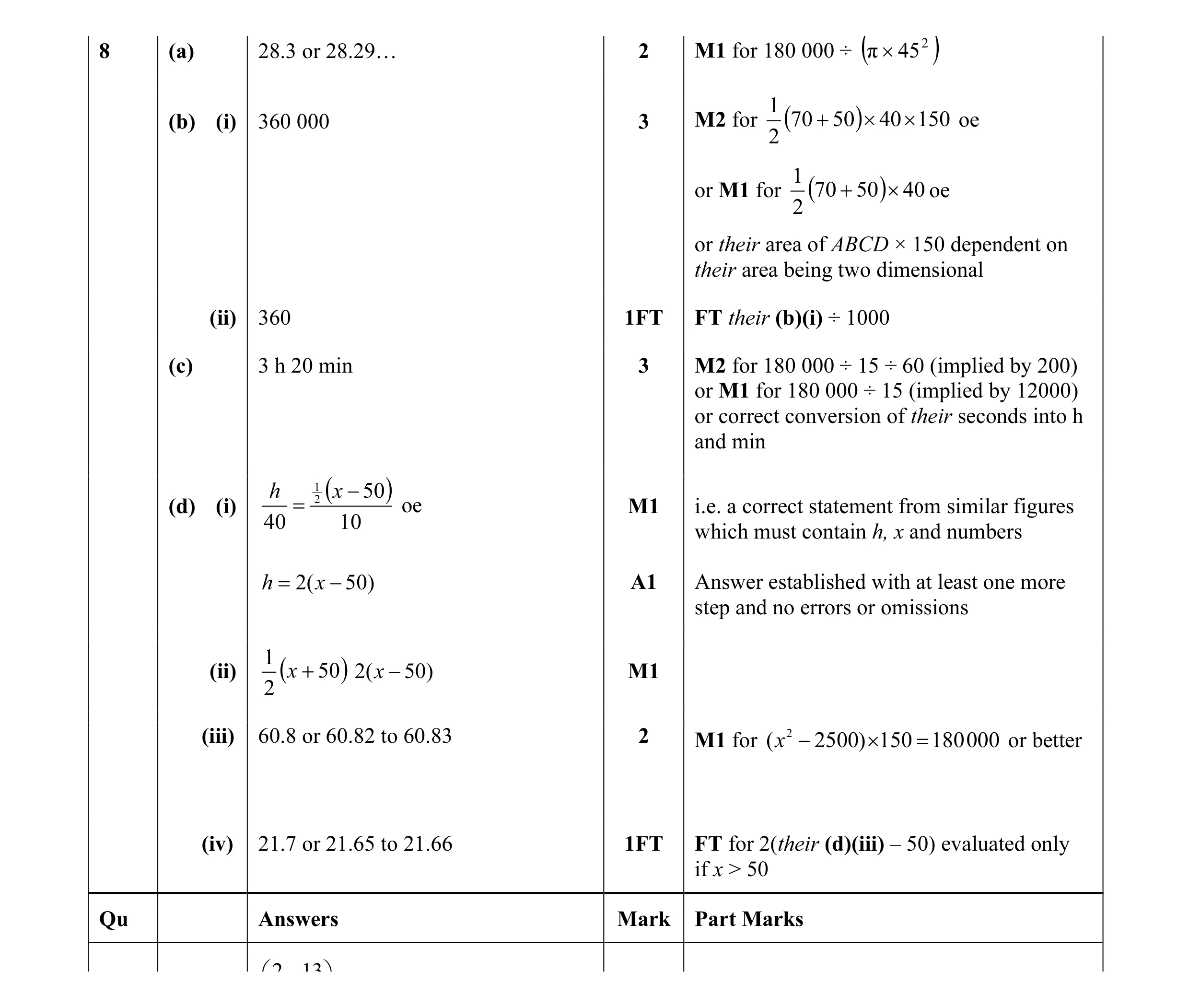 15
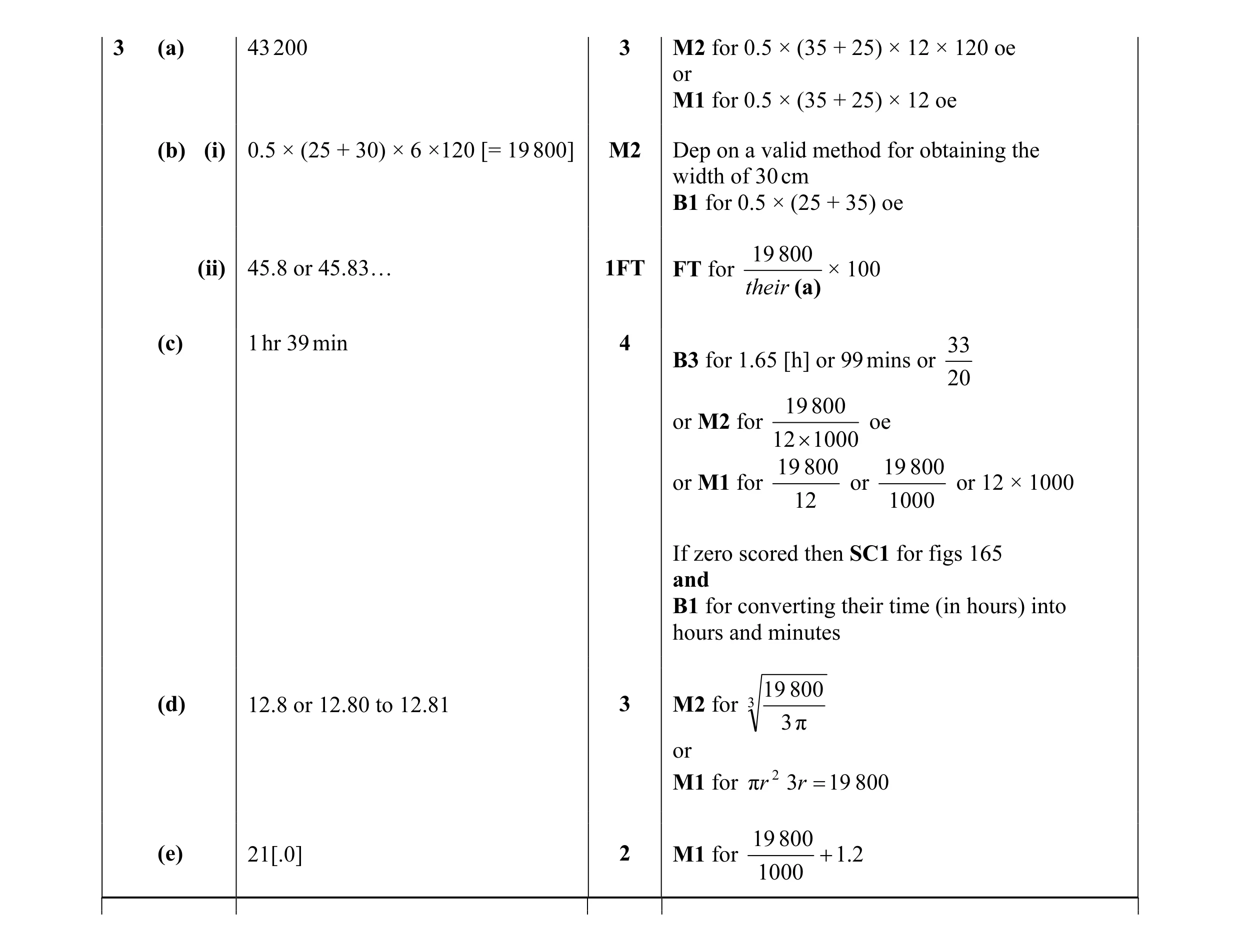 15
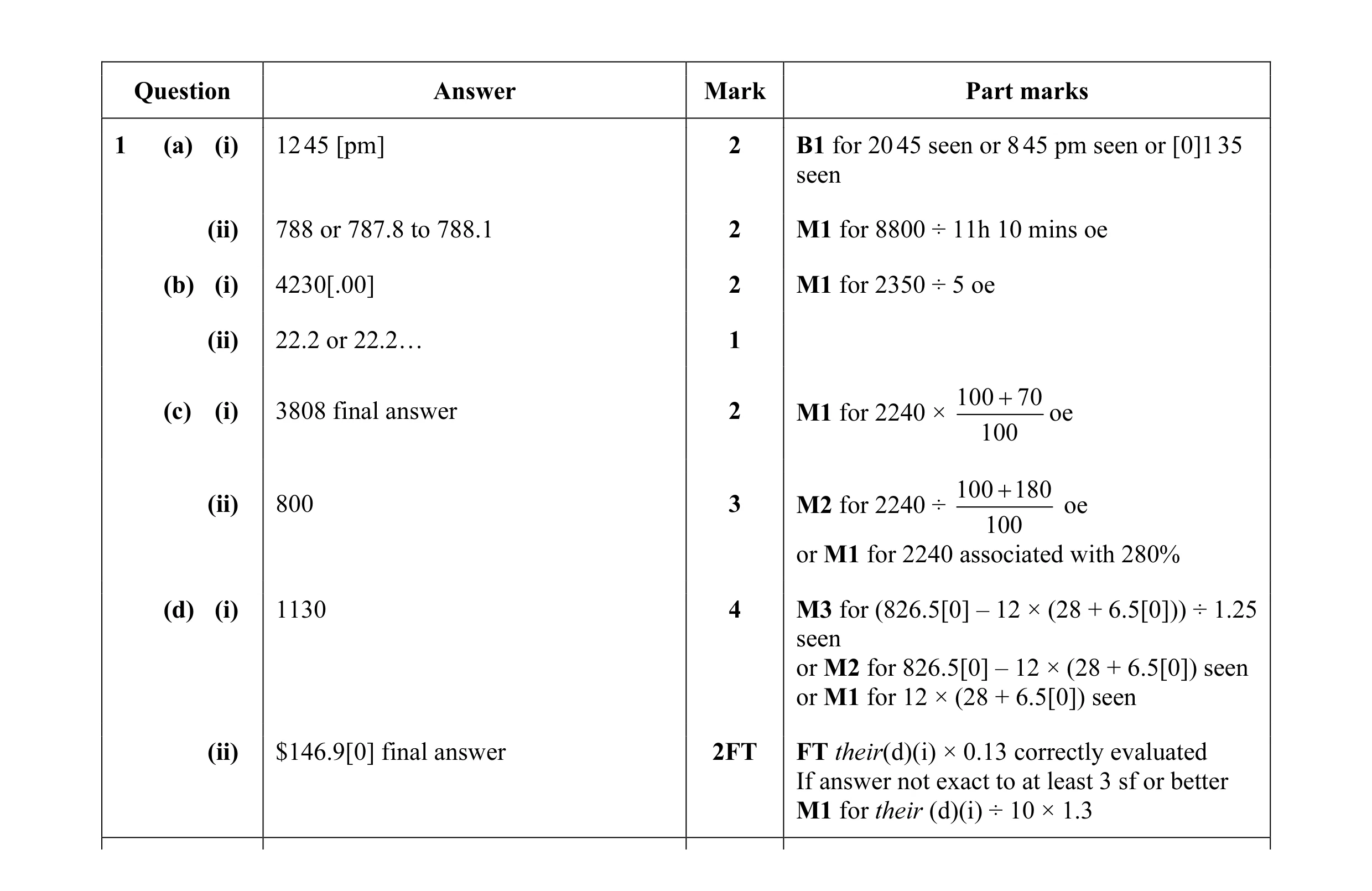 18
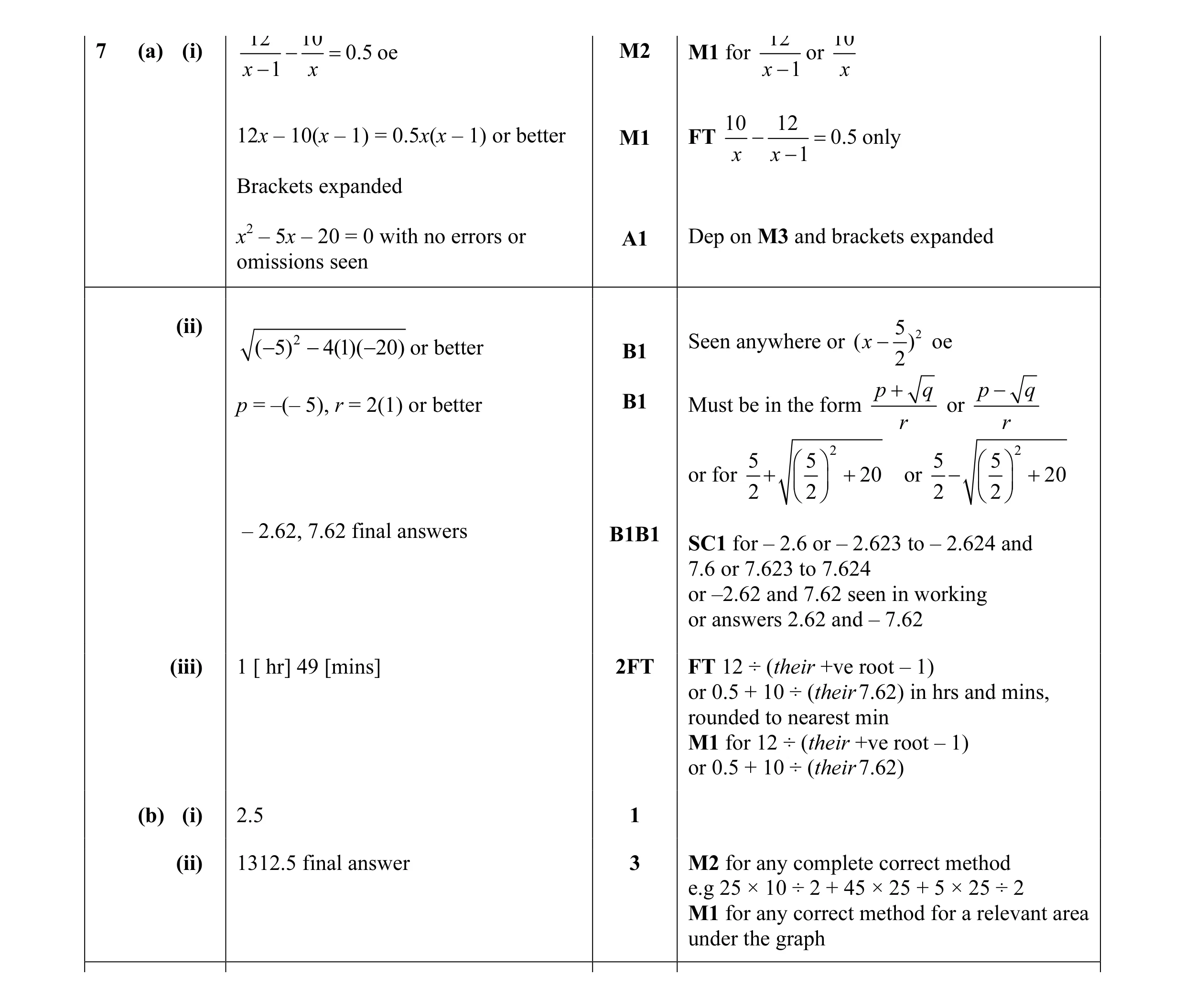 14
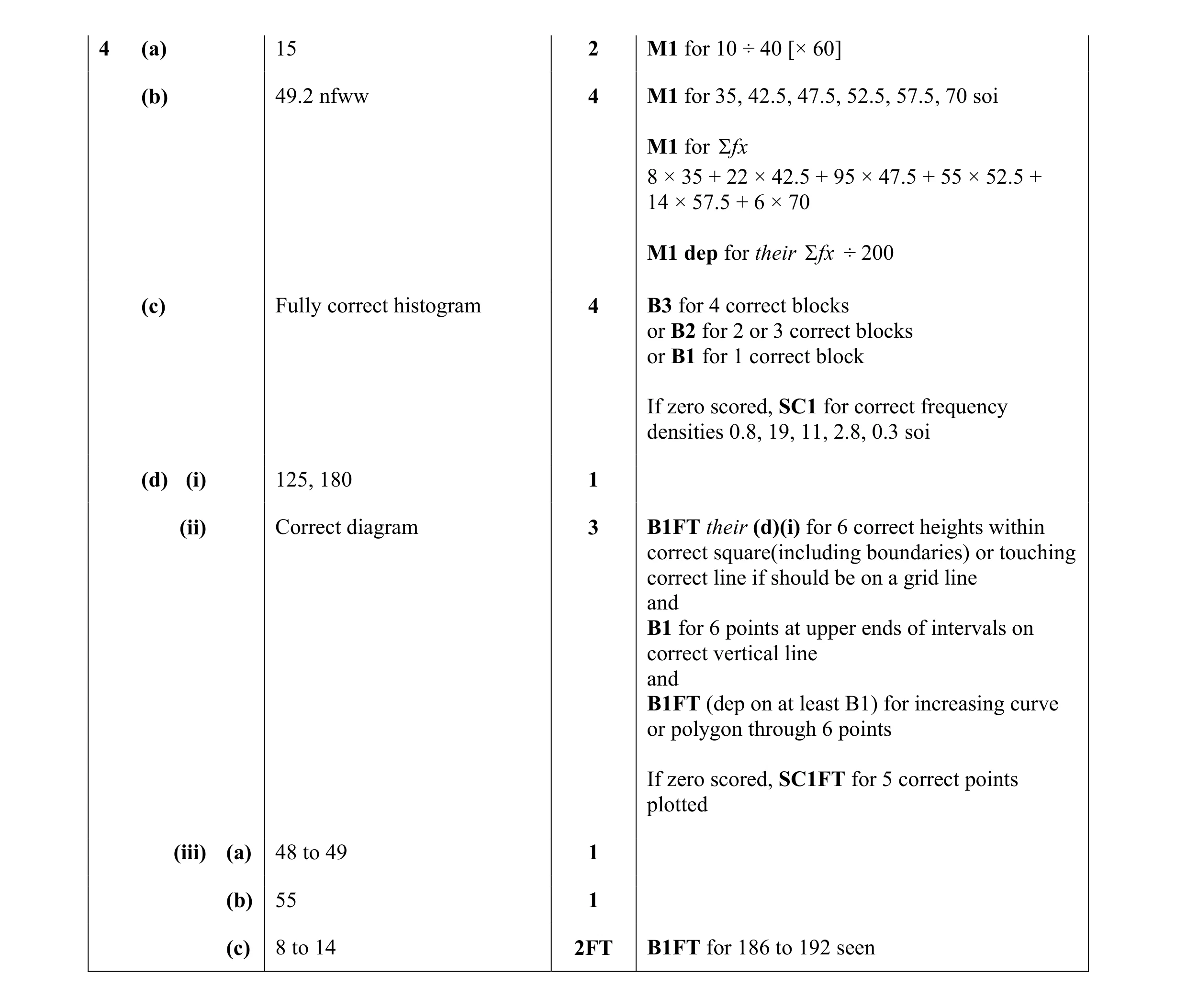 18
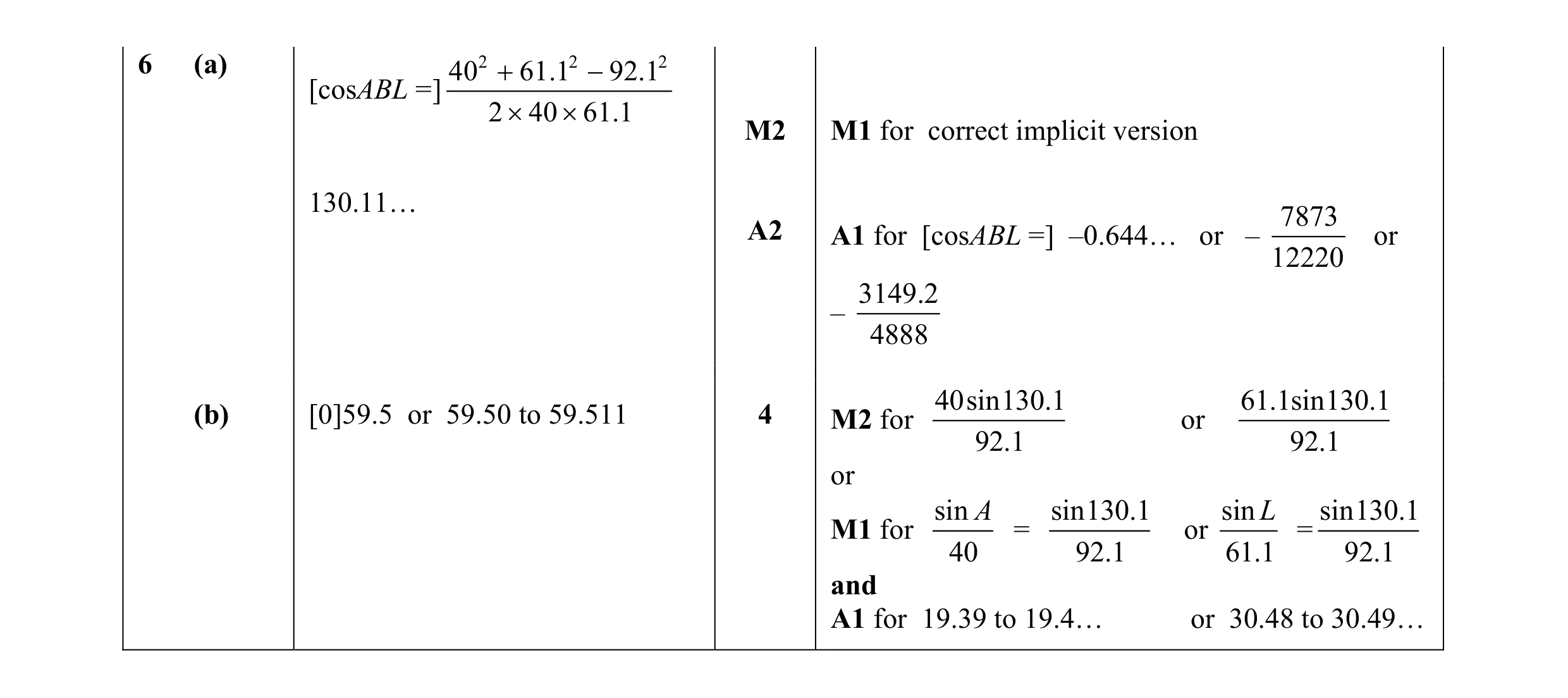 13
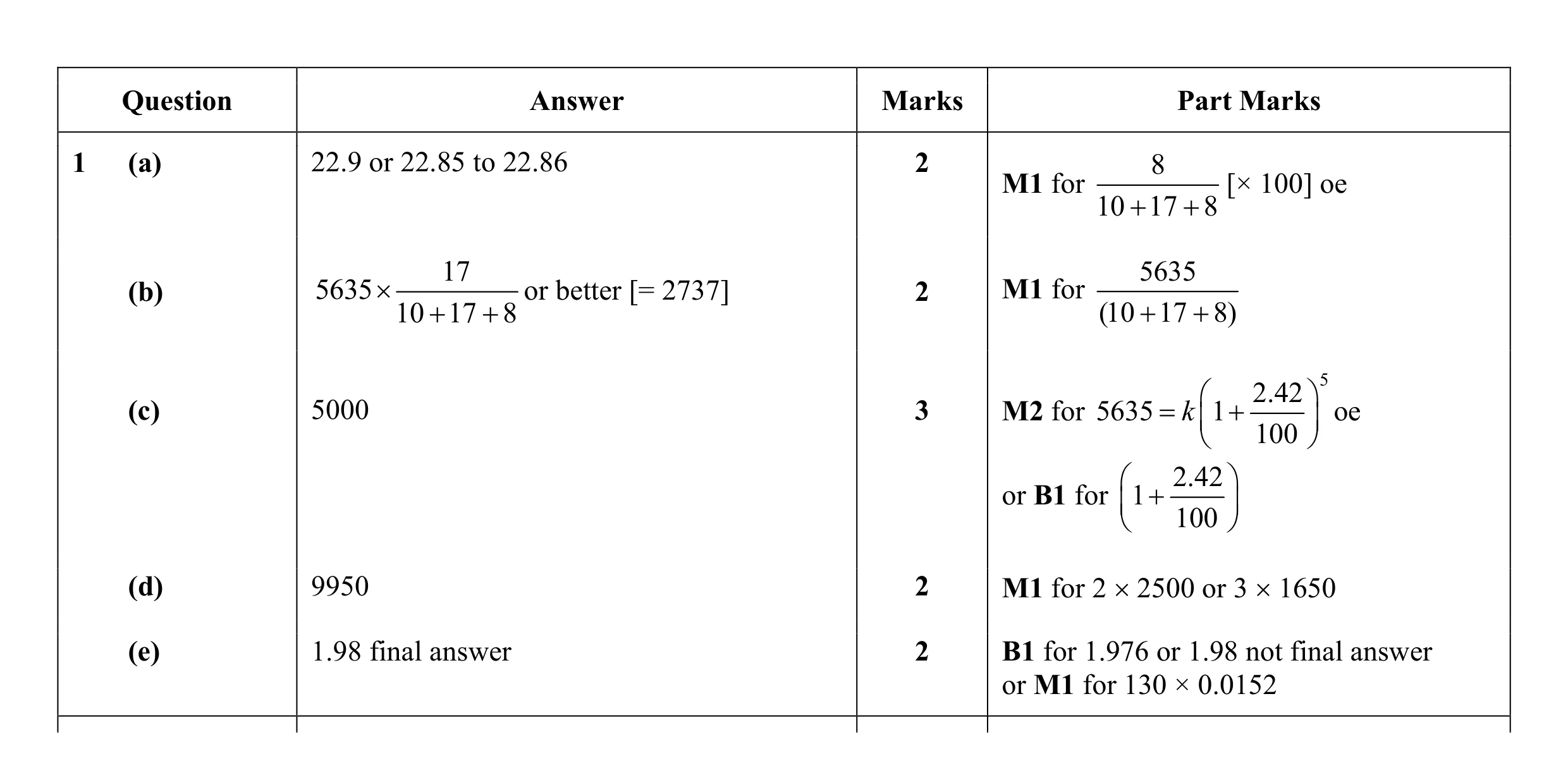 11
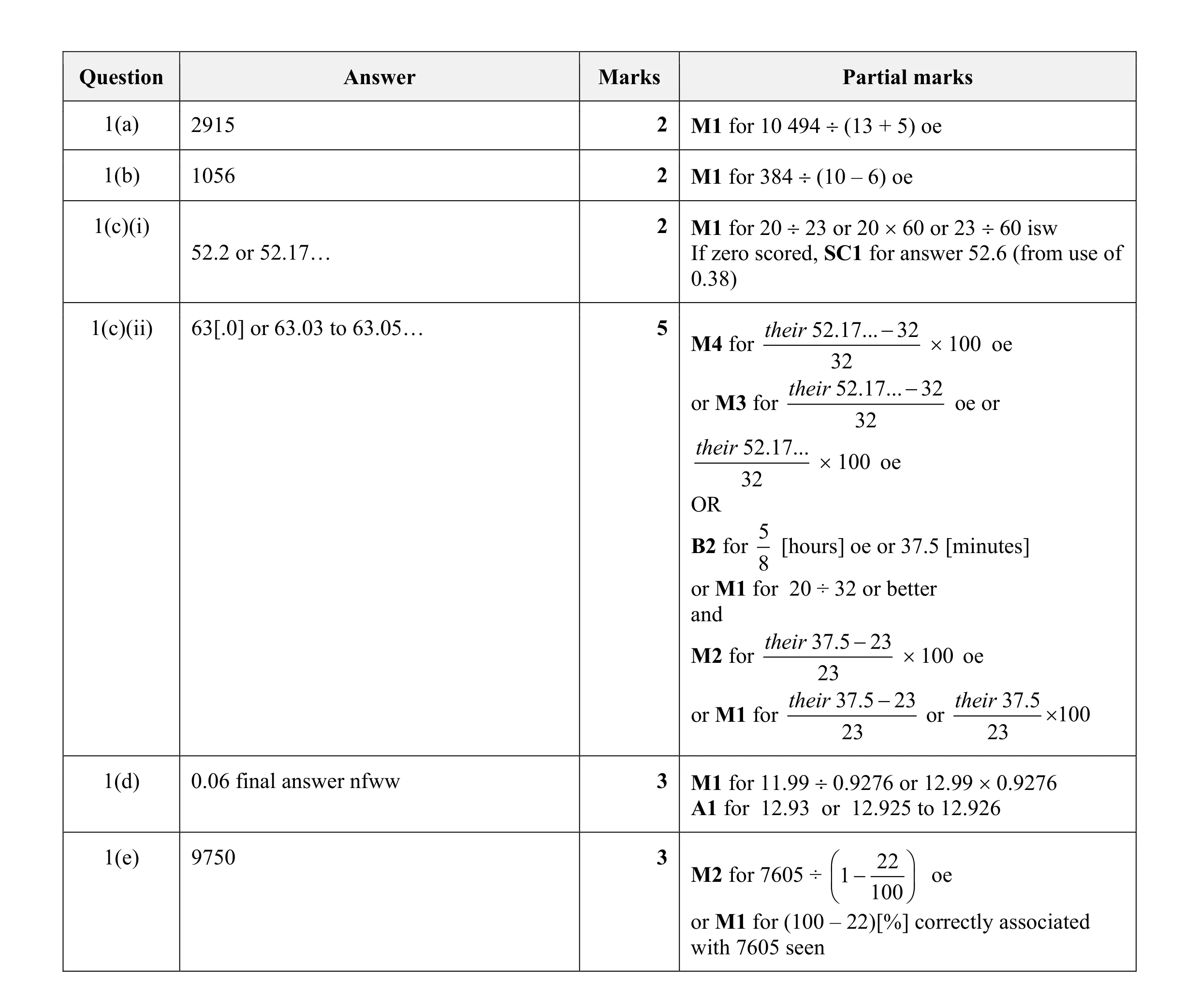 17
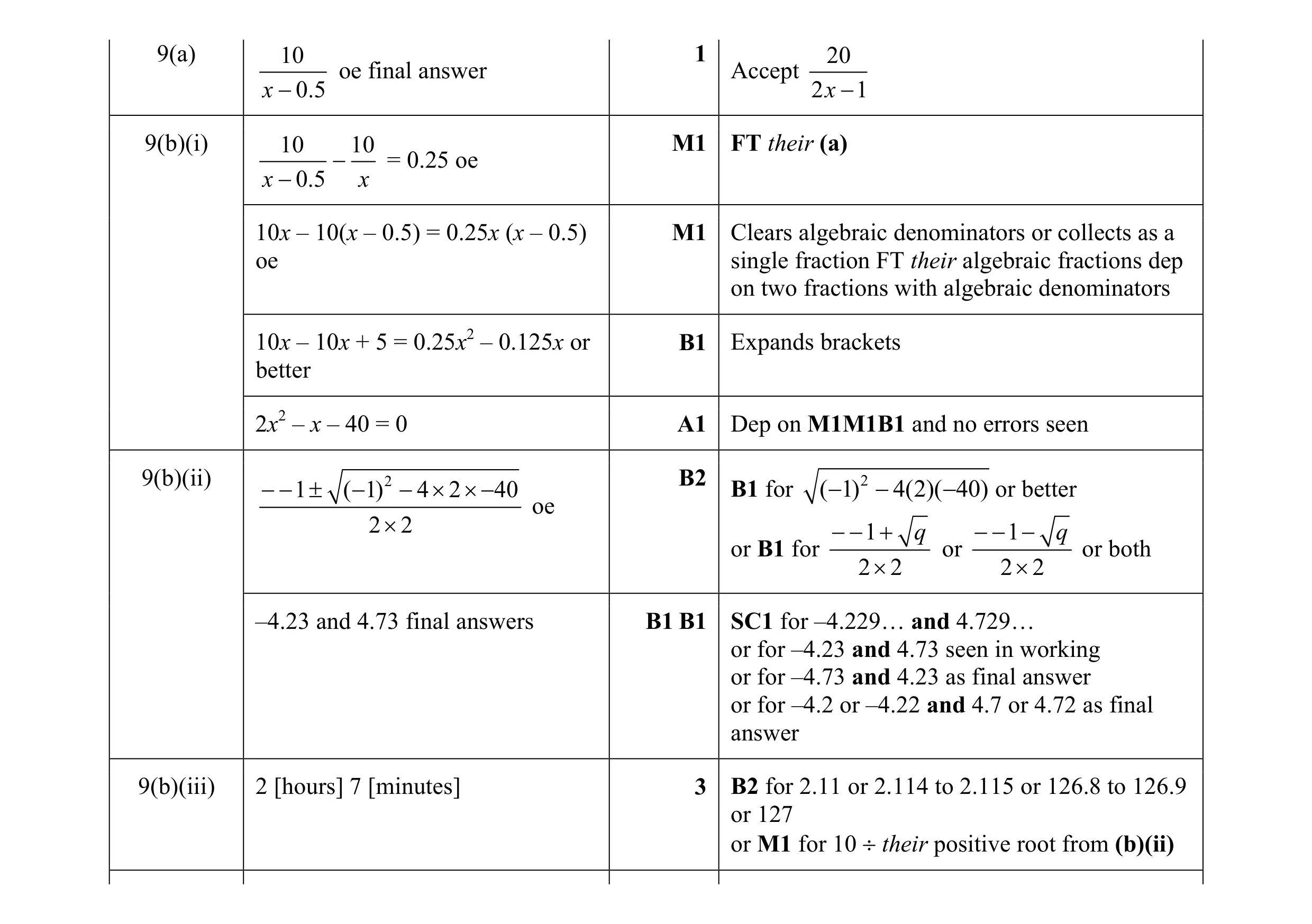 12
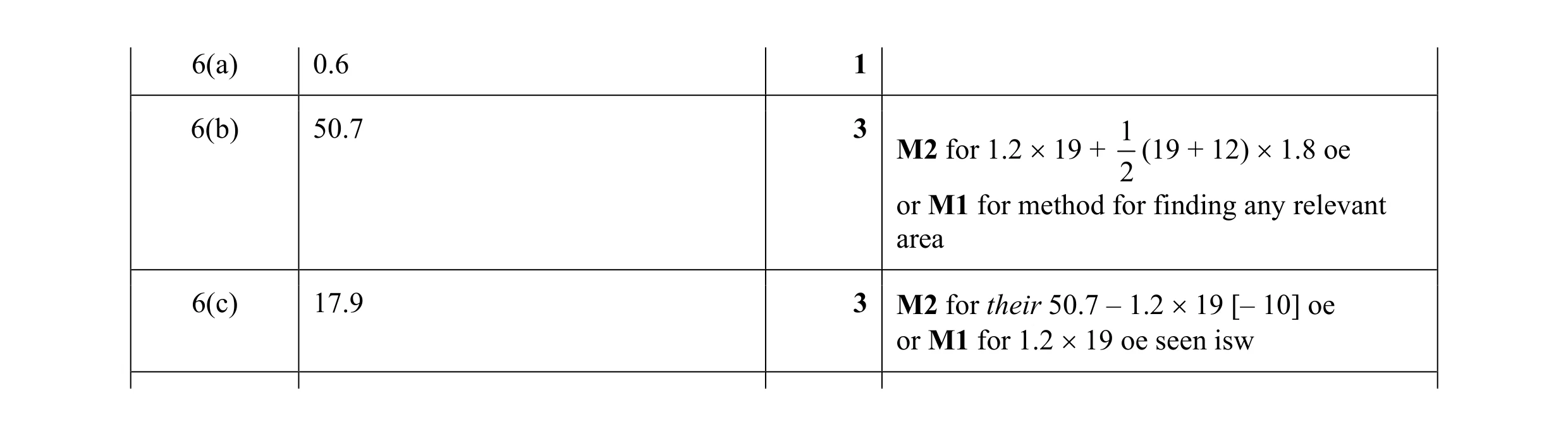 7
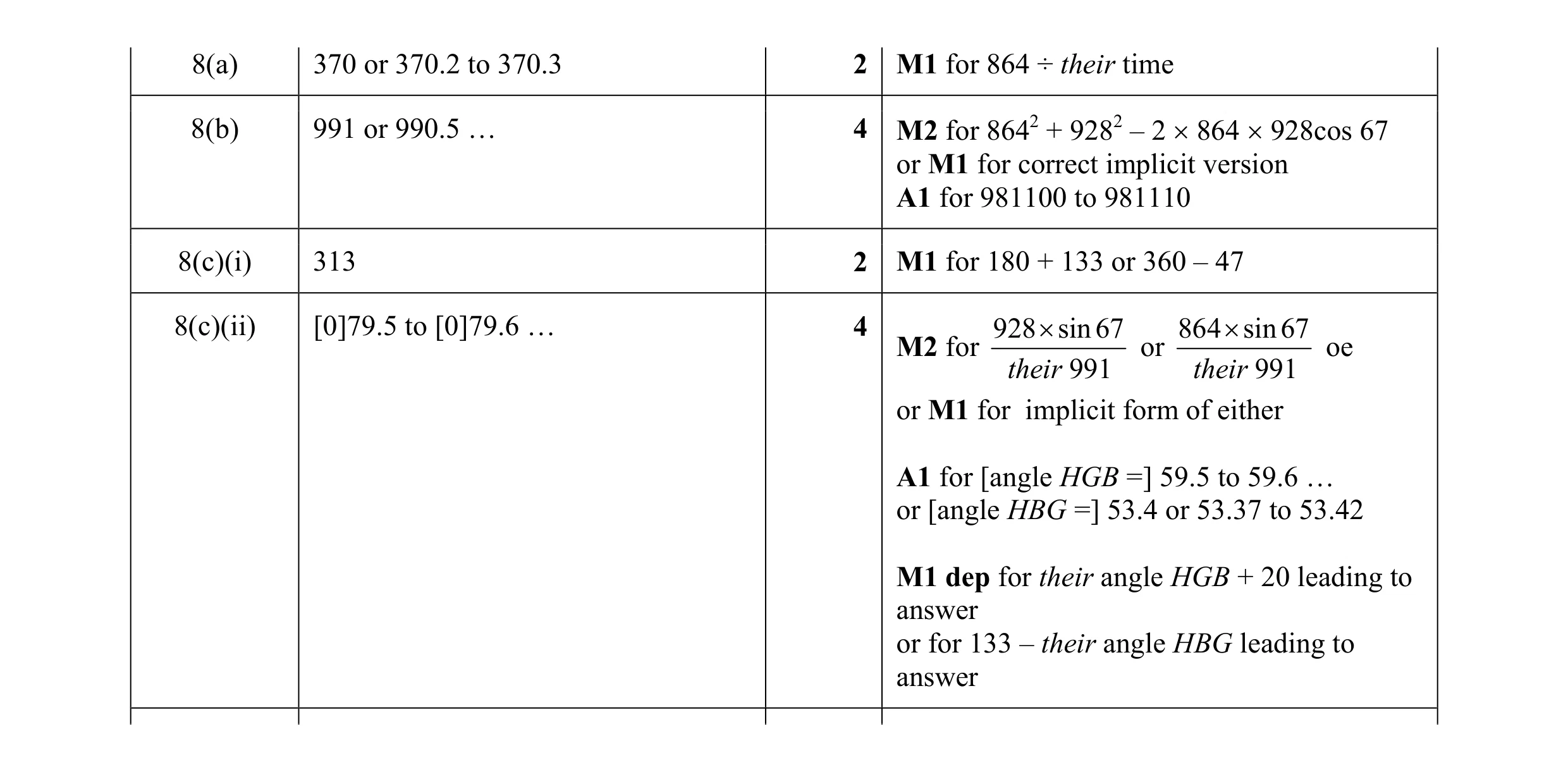 12
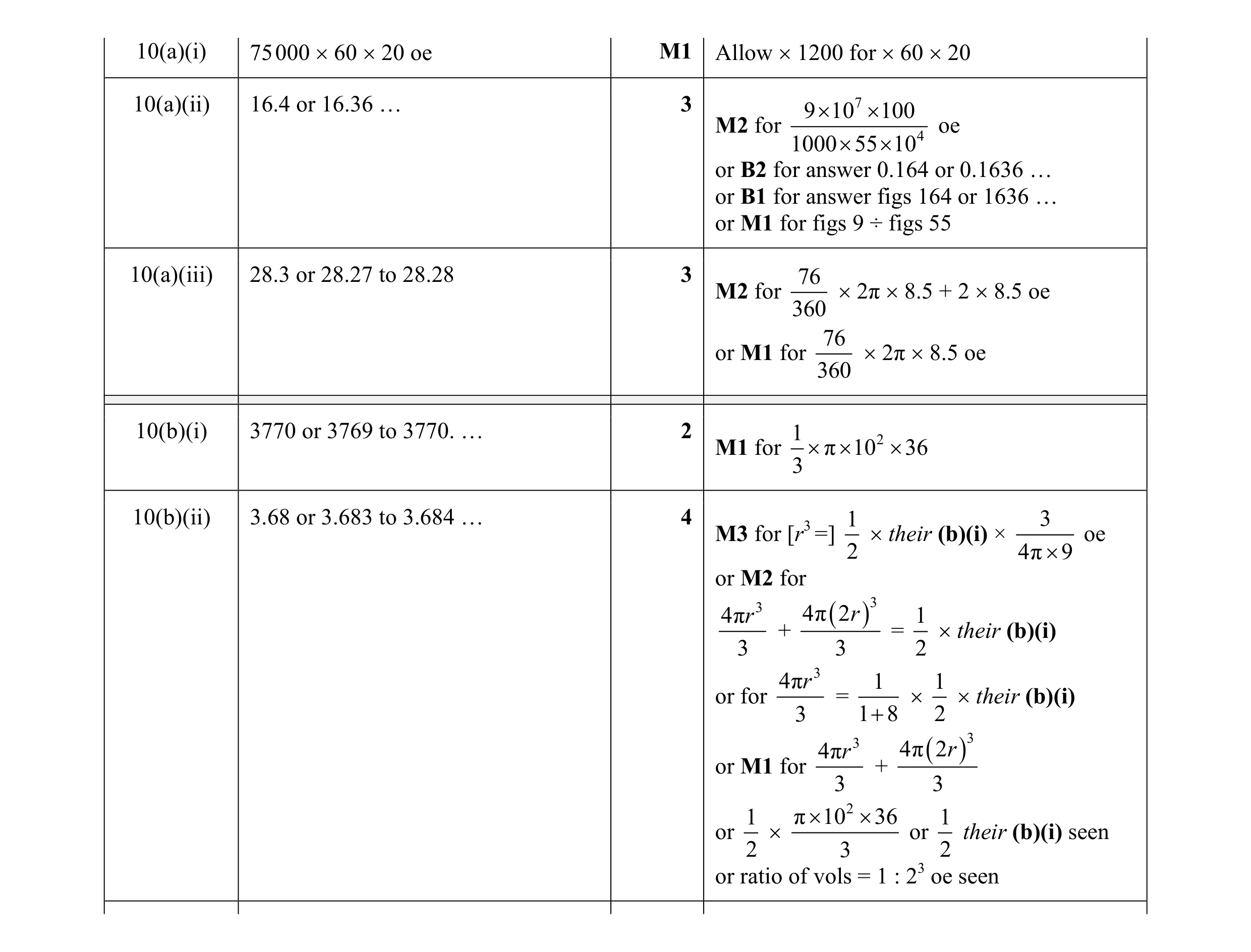 13
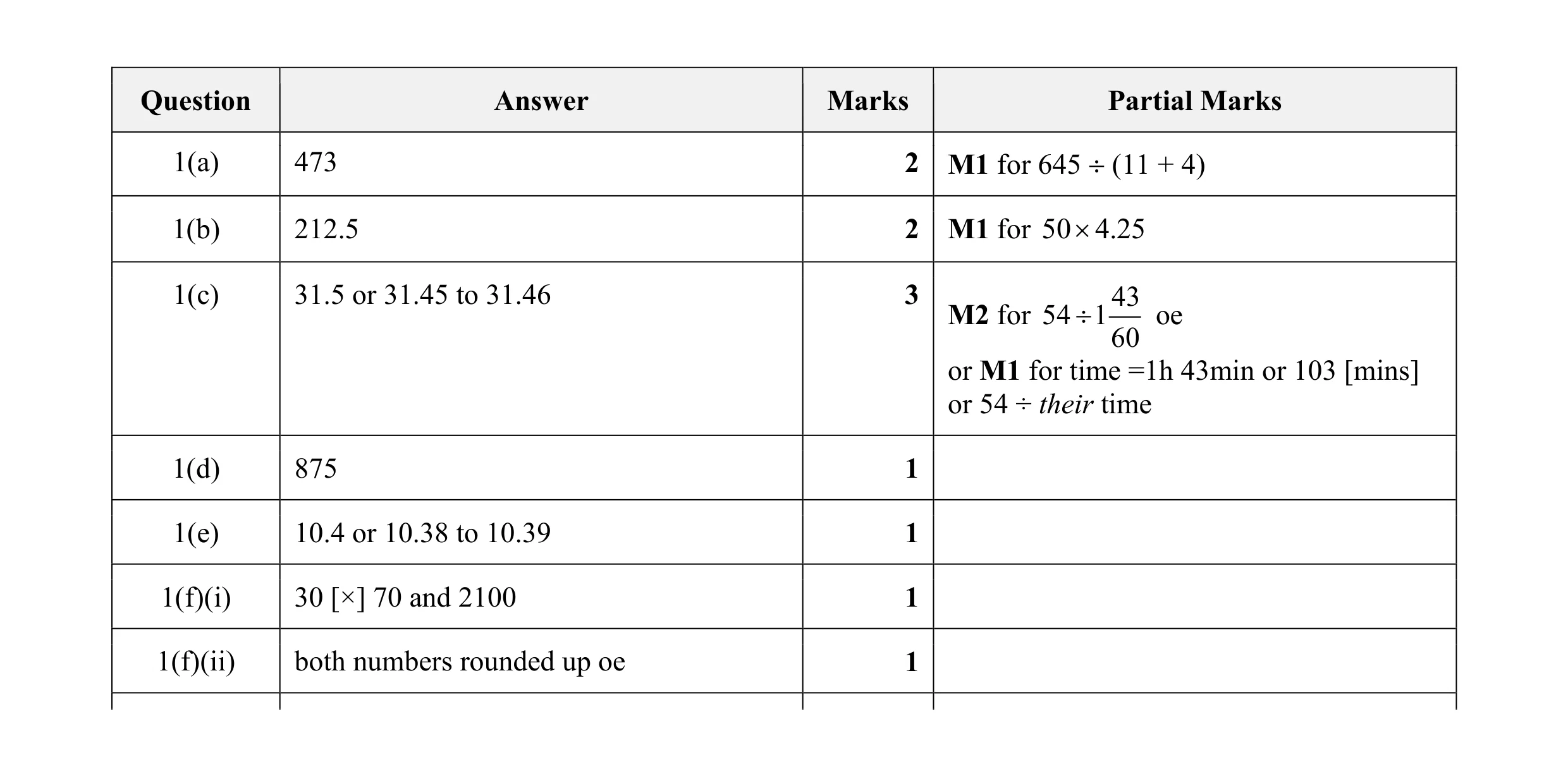 11
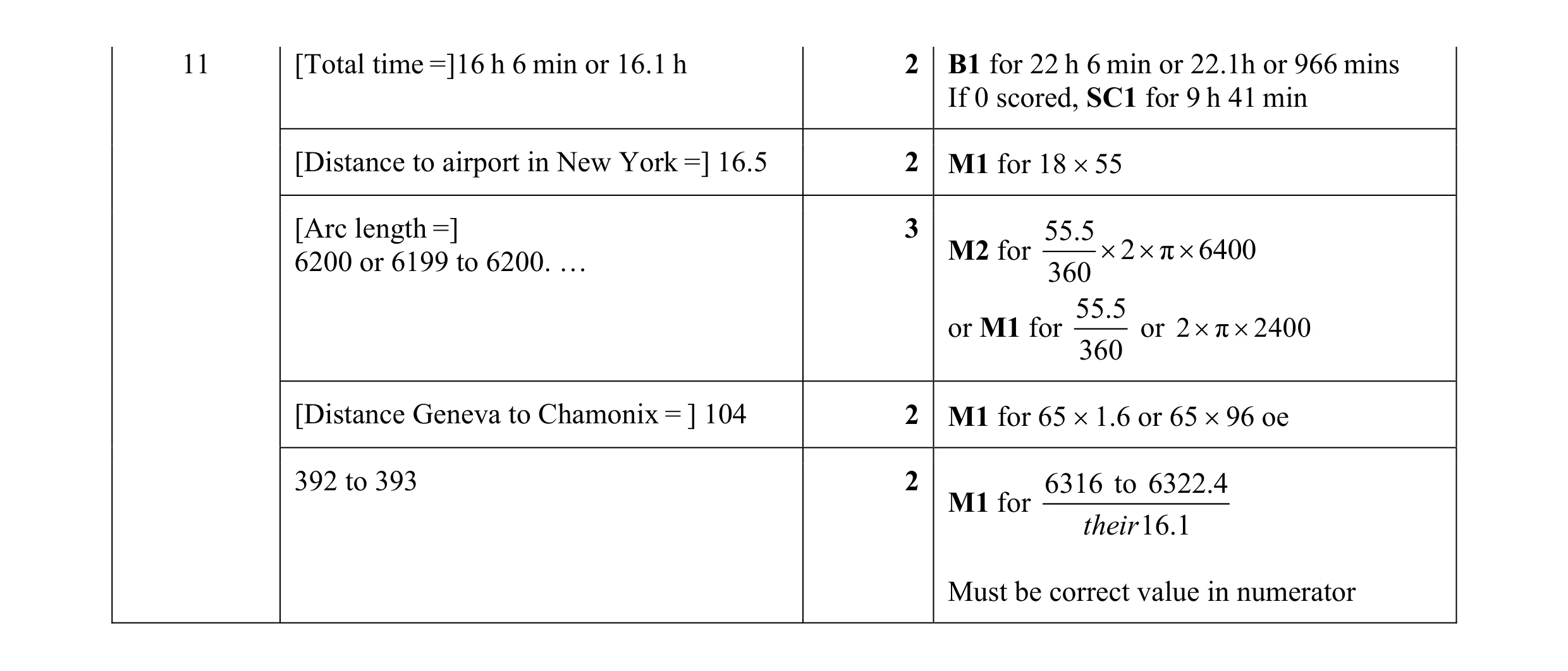 11
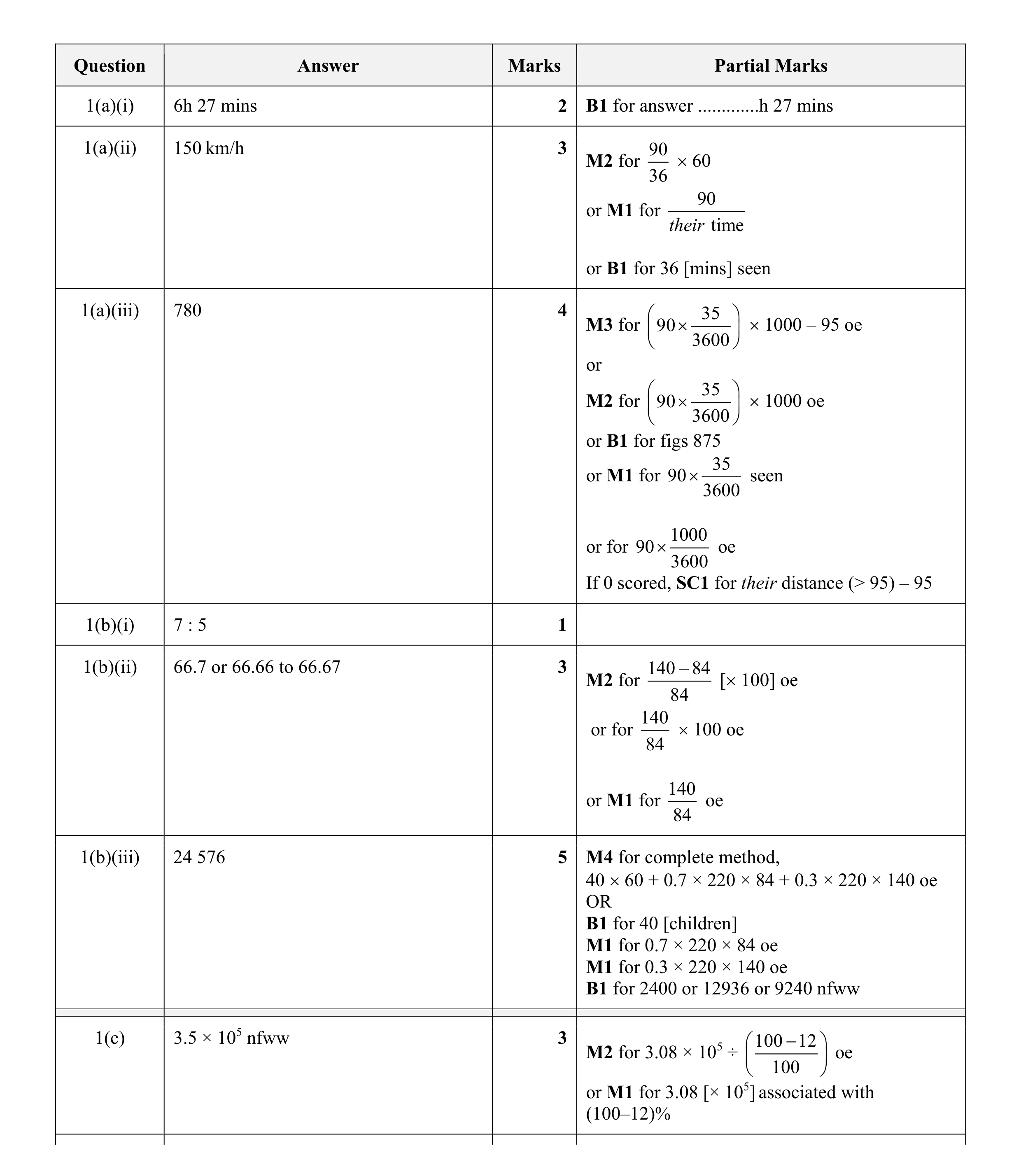 21
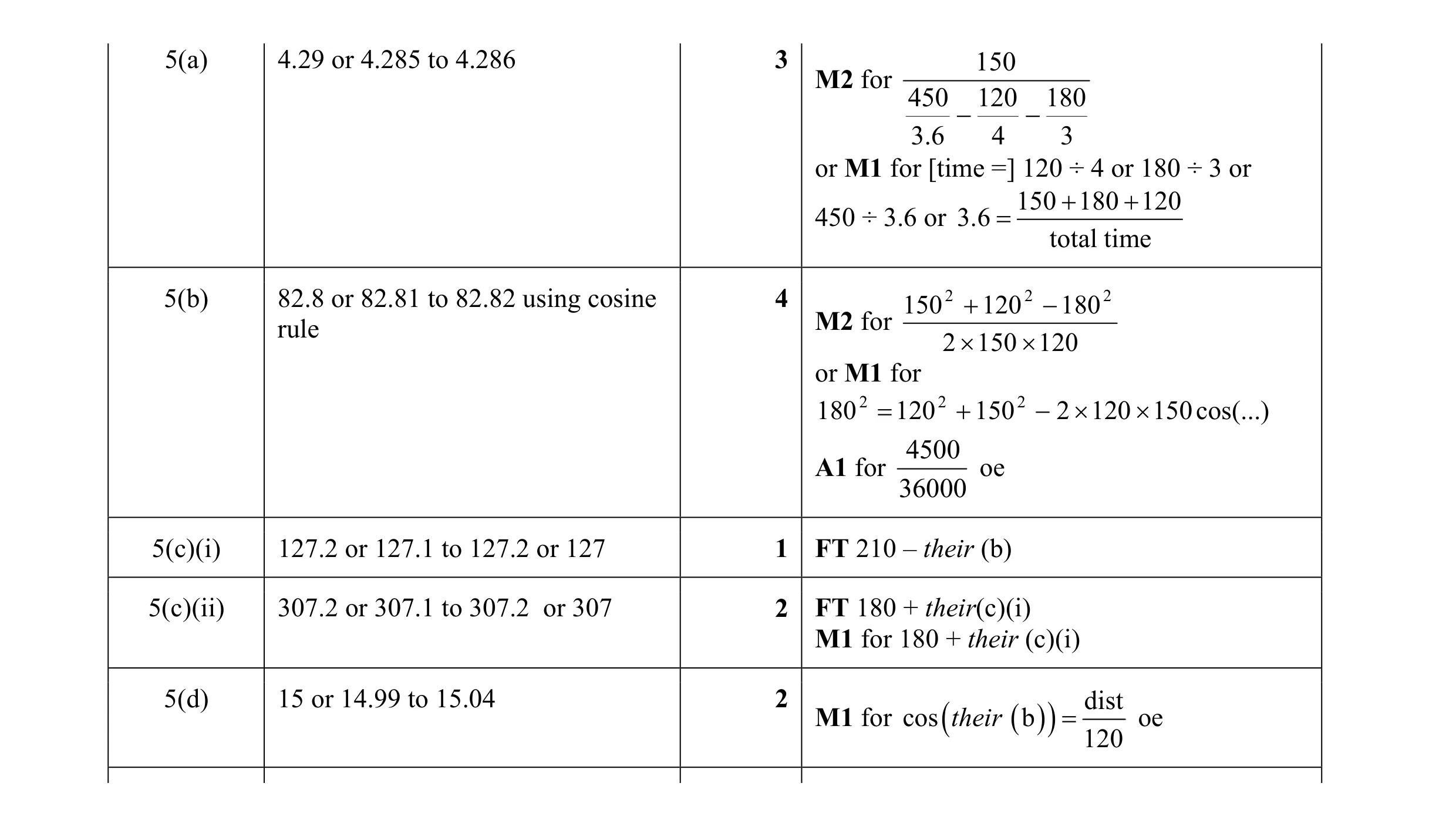 12
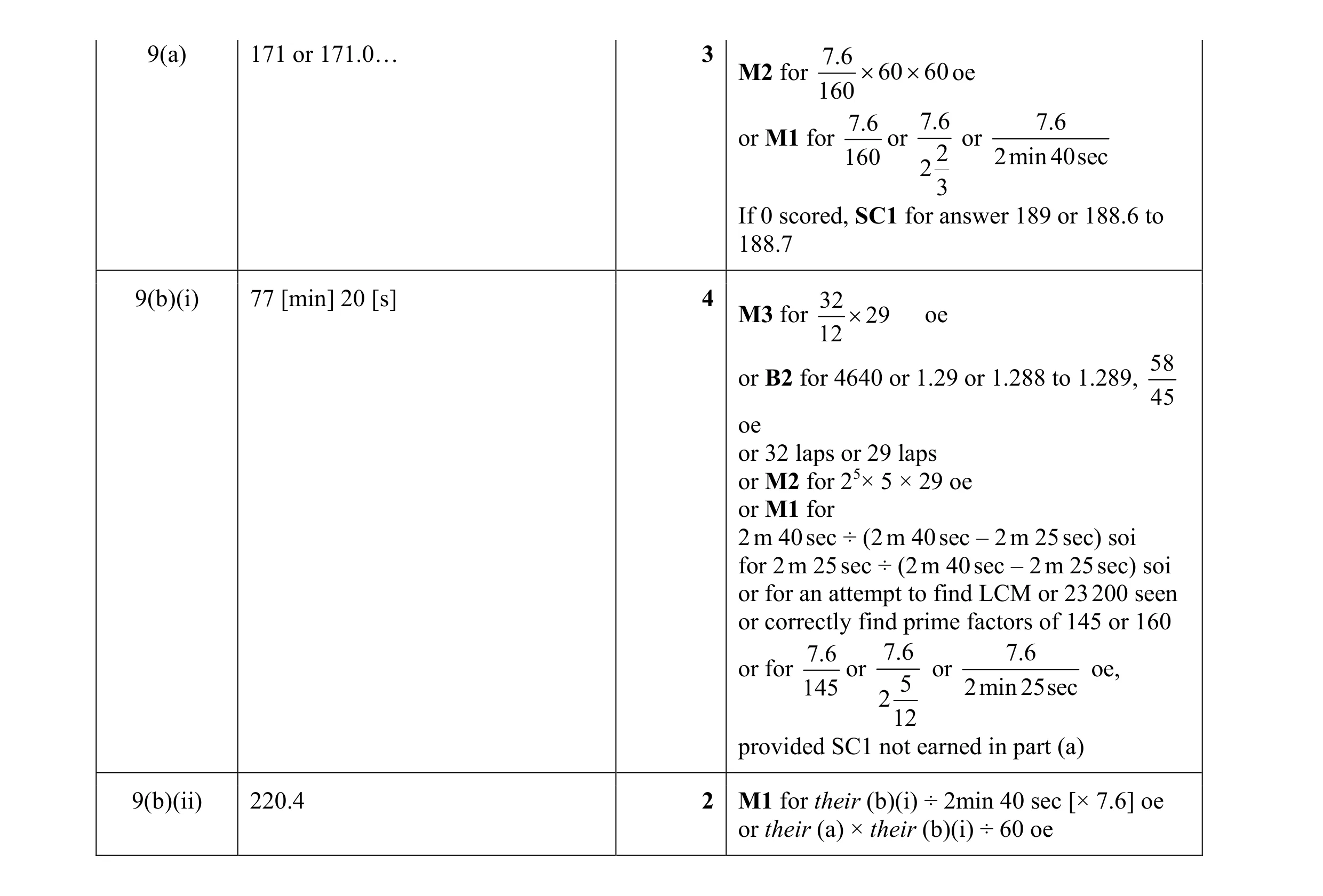 9
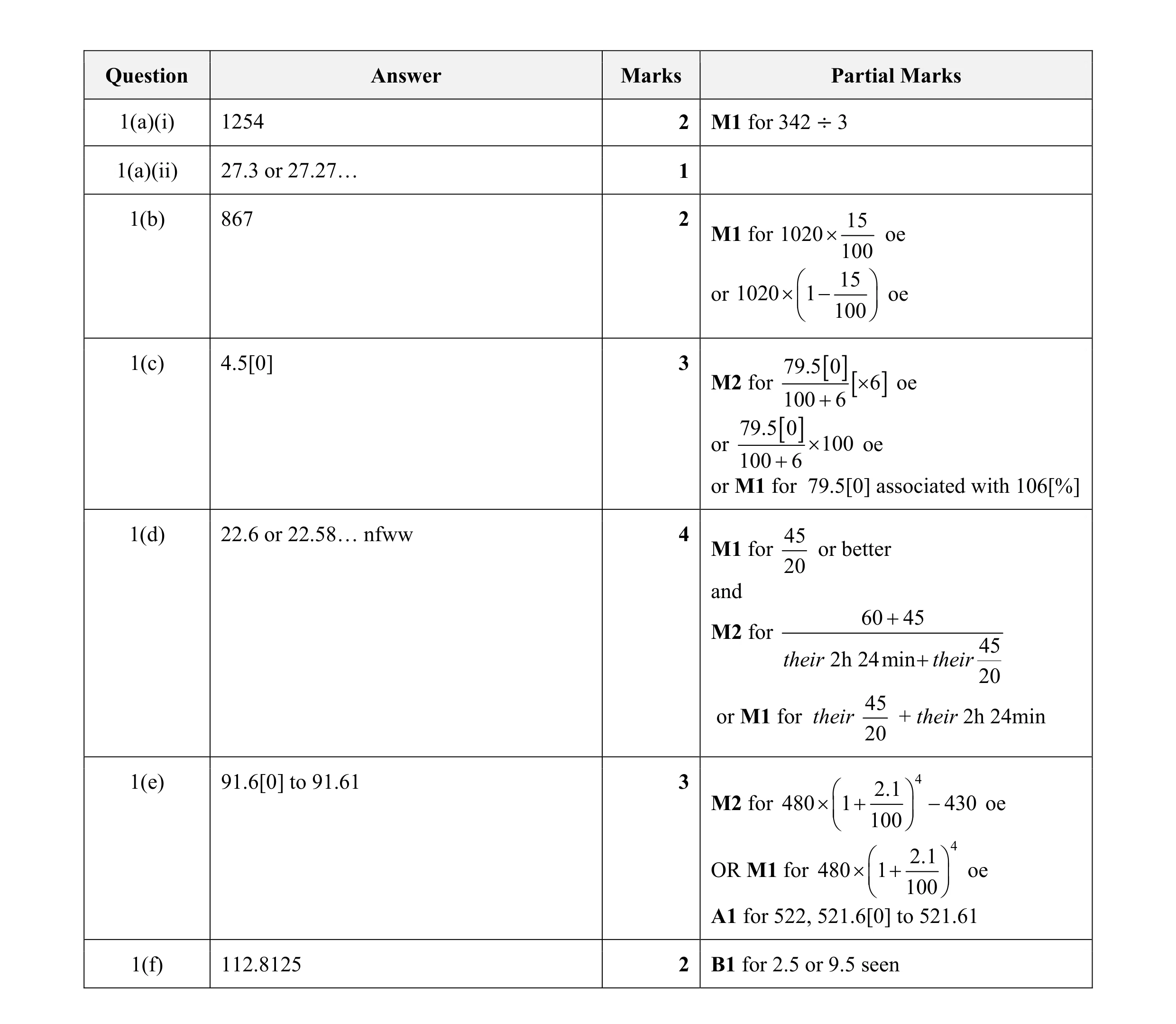 17
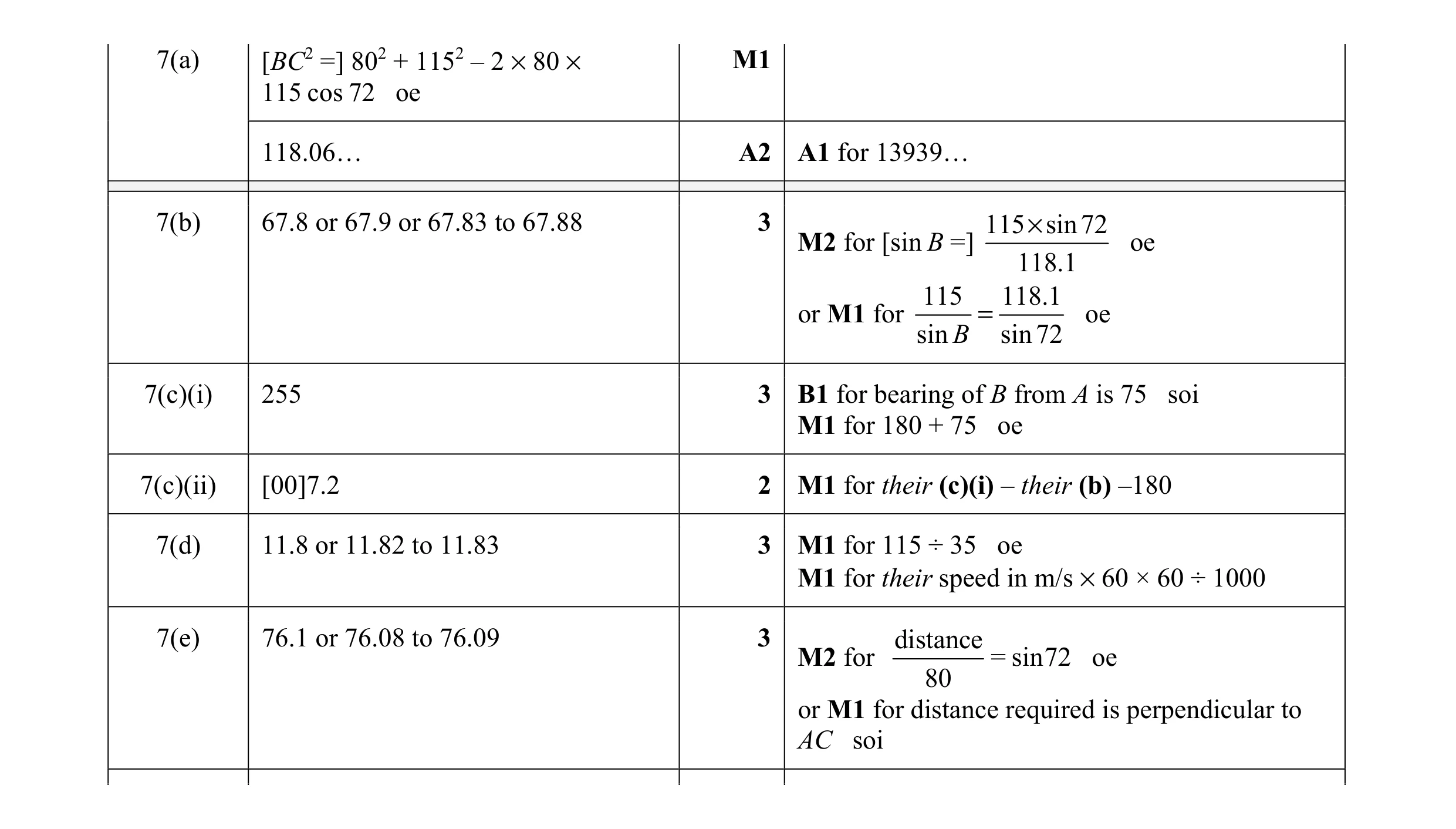 17
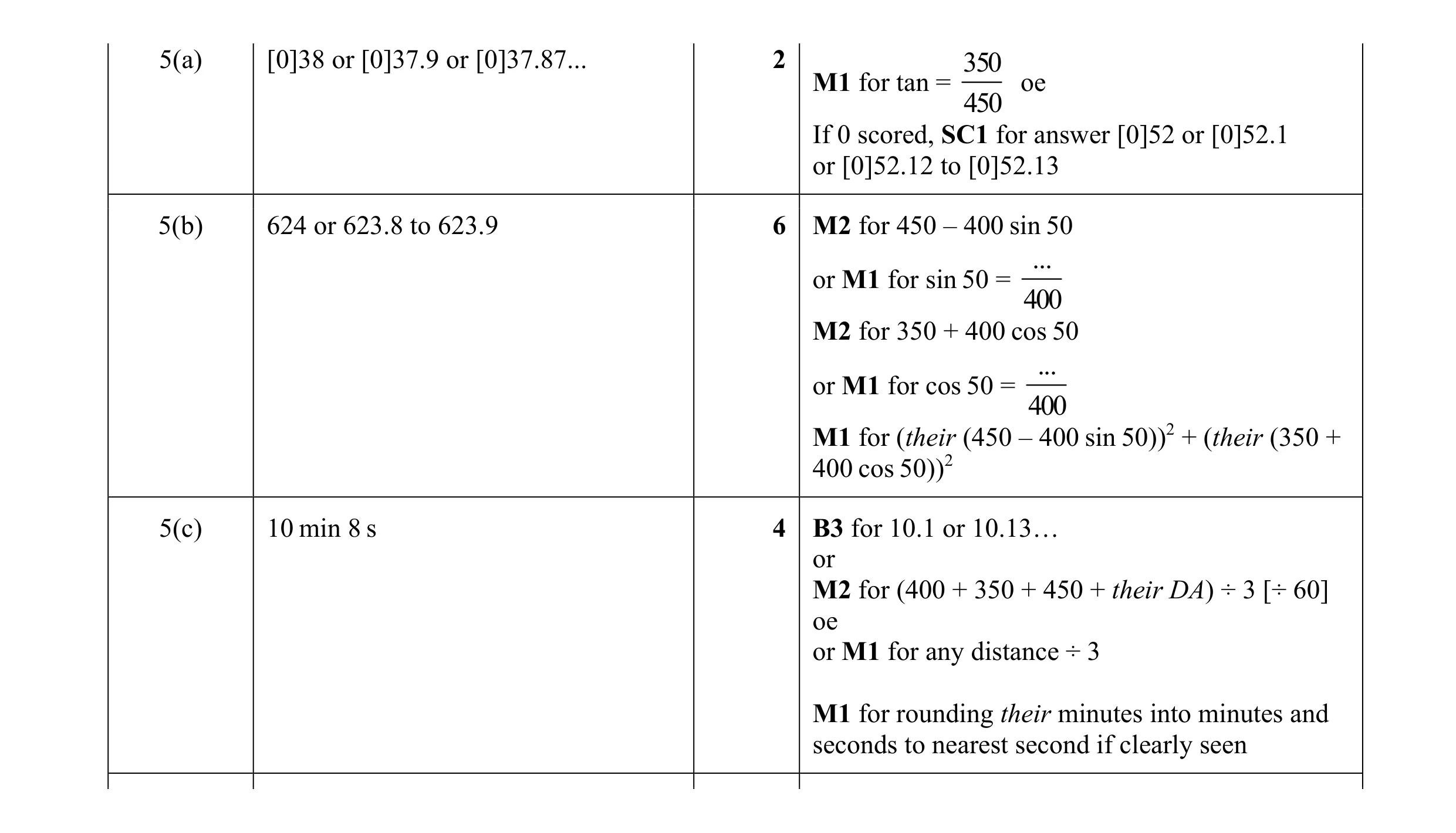 12
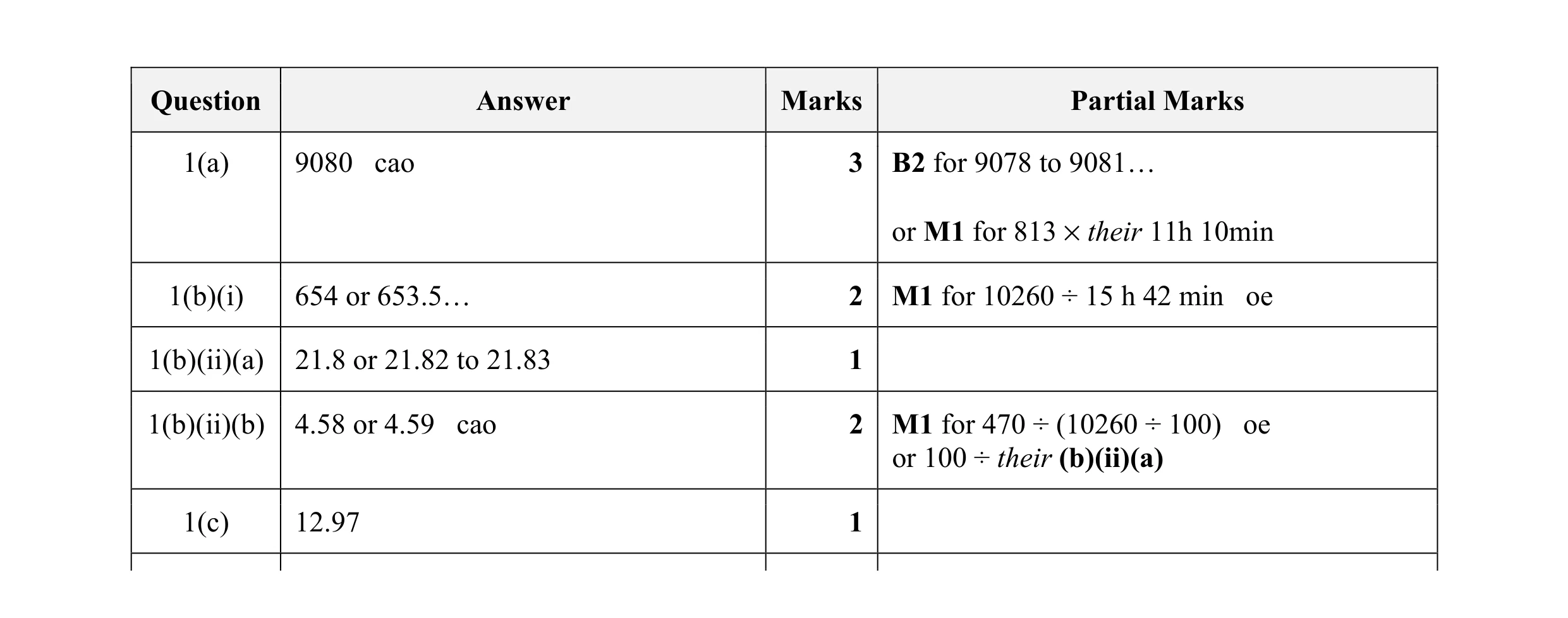 9
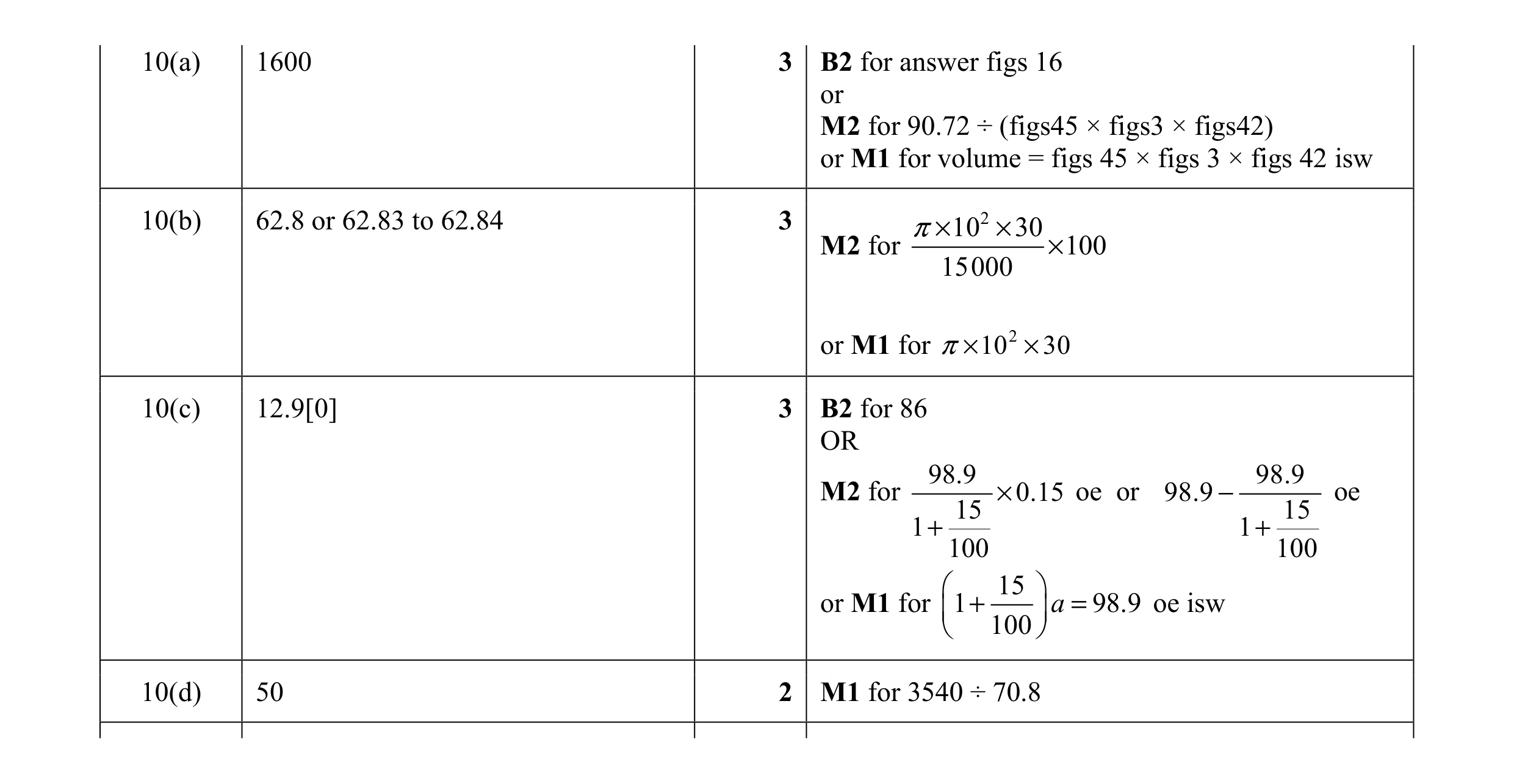 11
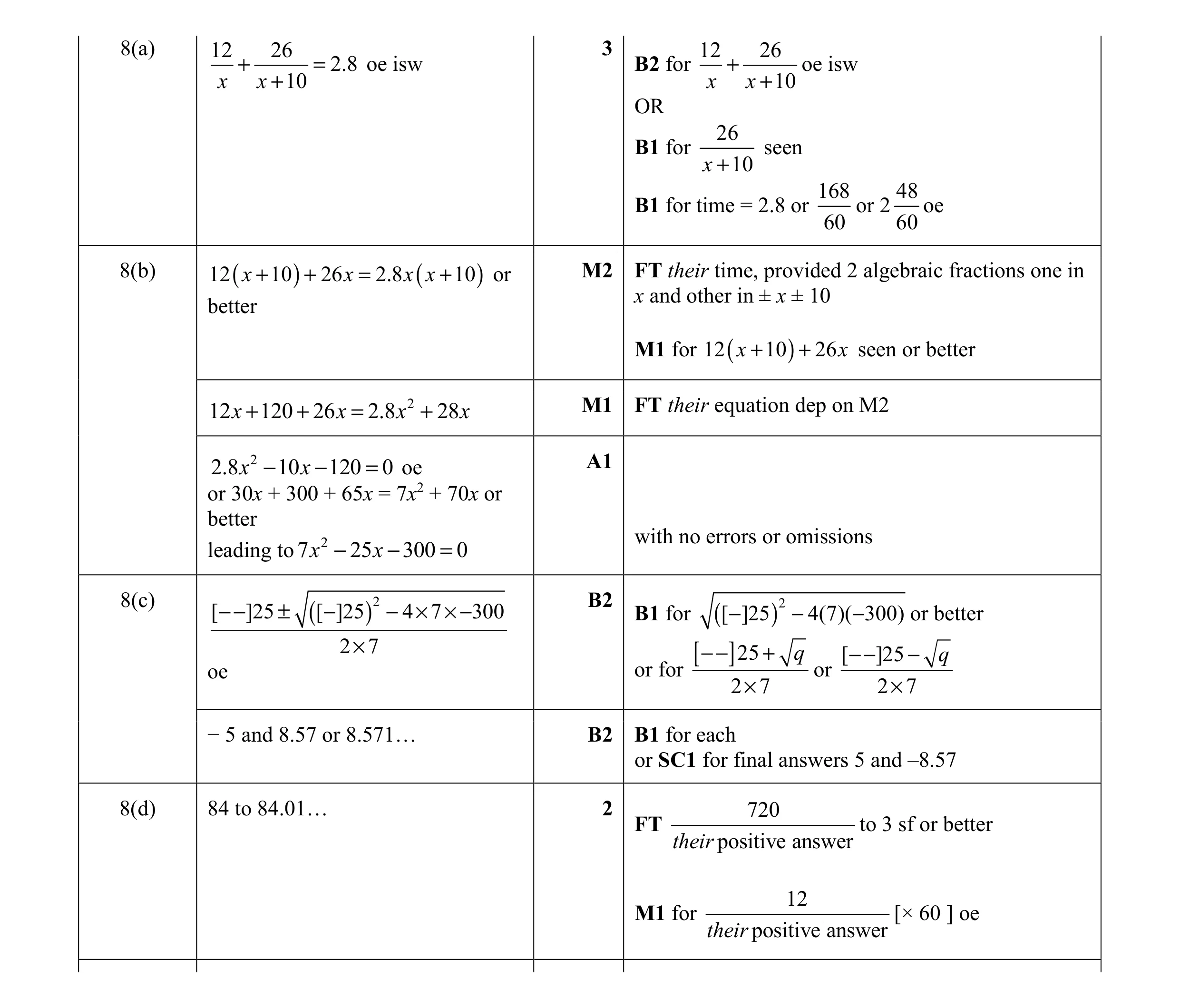 13
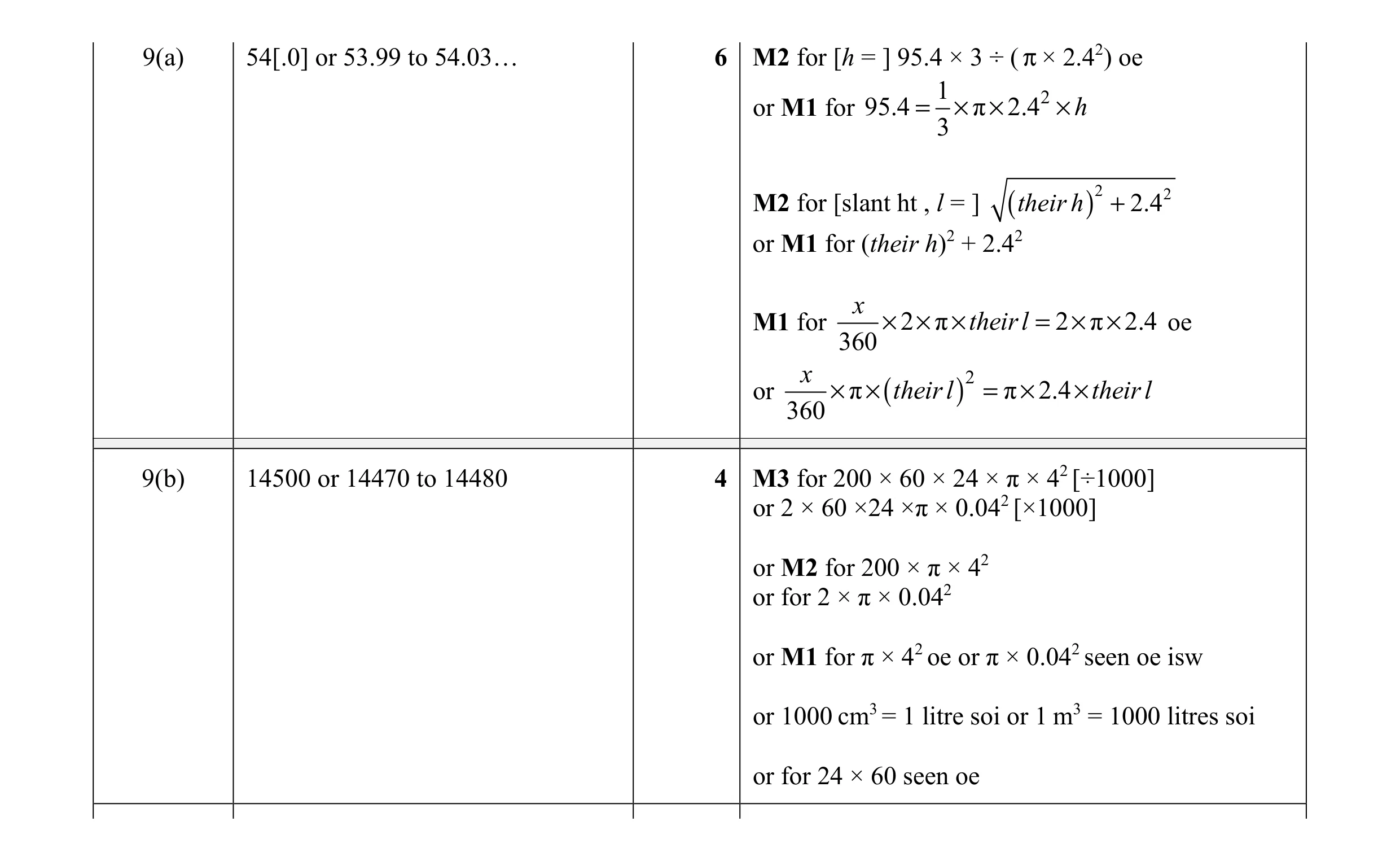 10
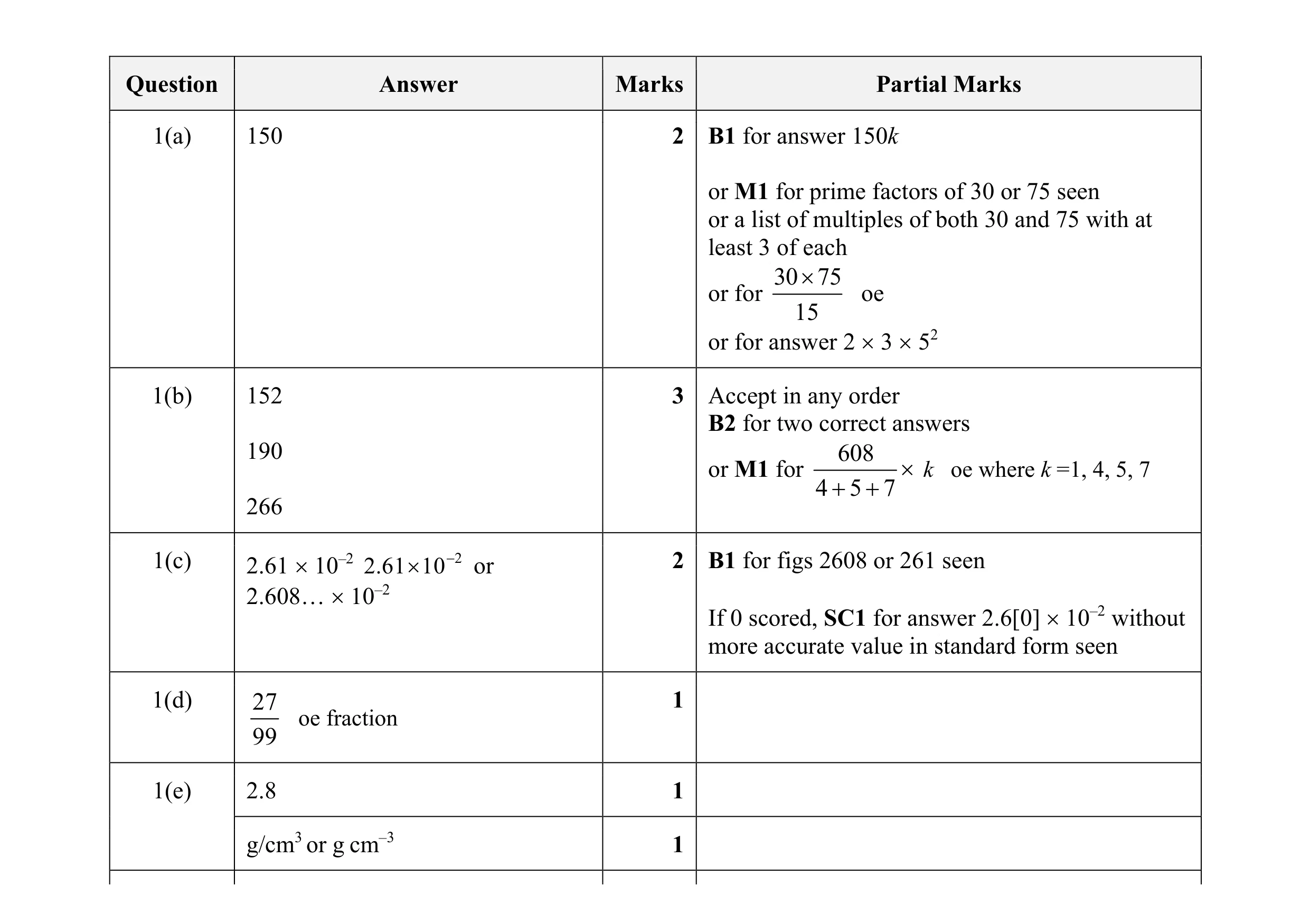 10
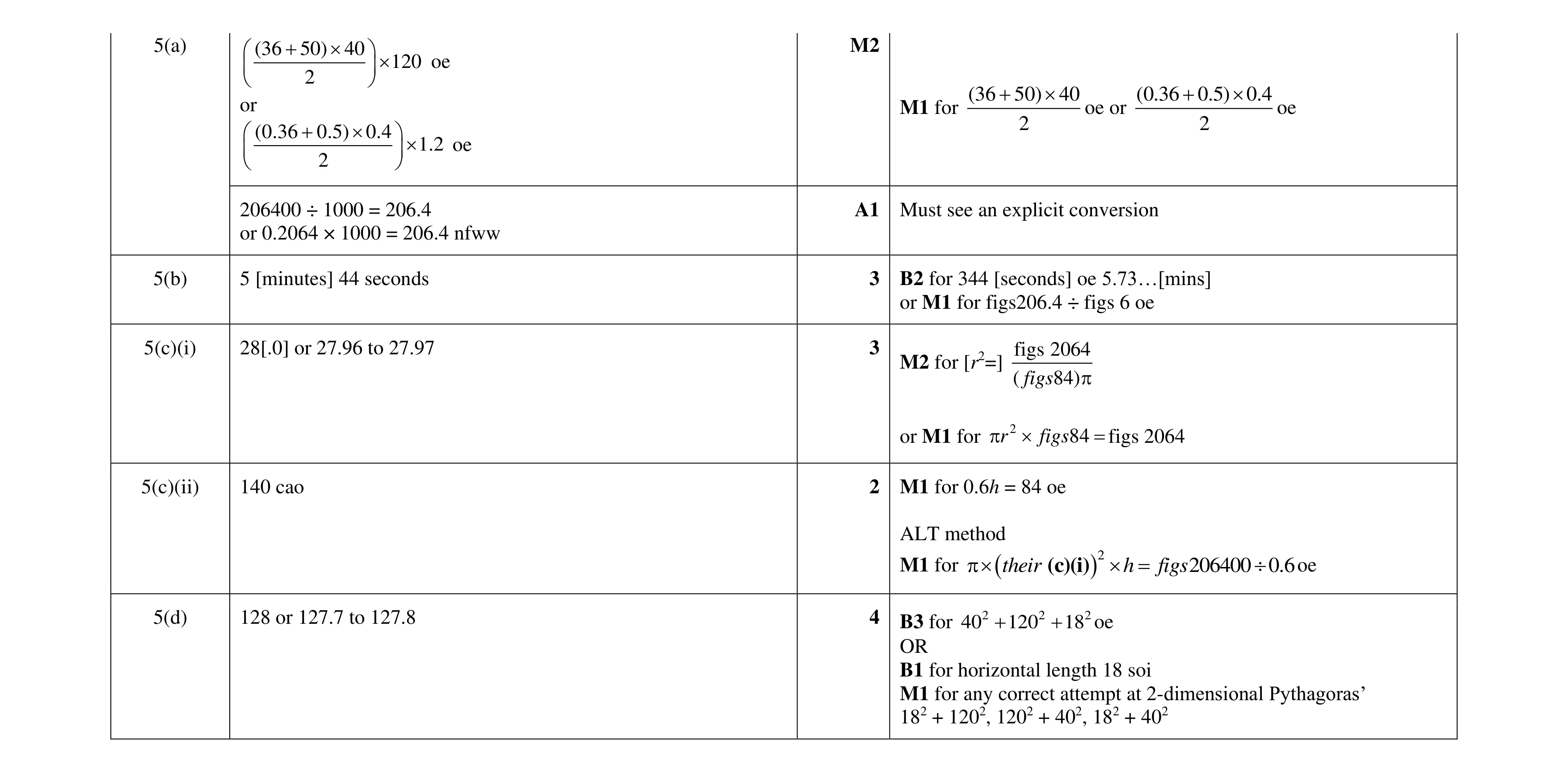 15
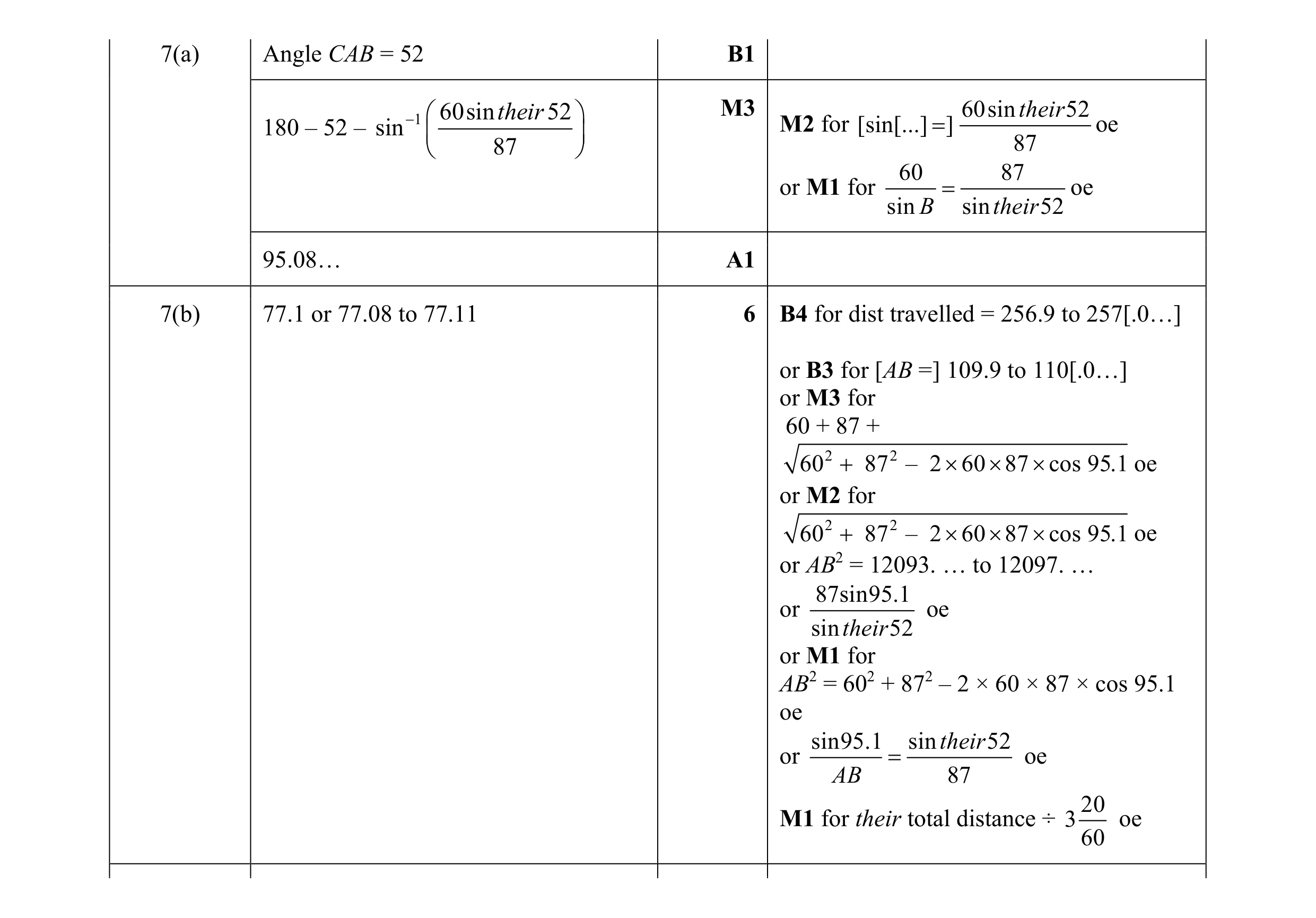 11
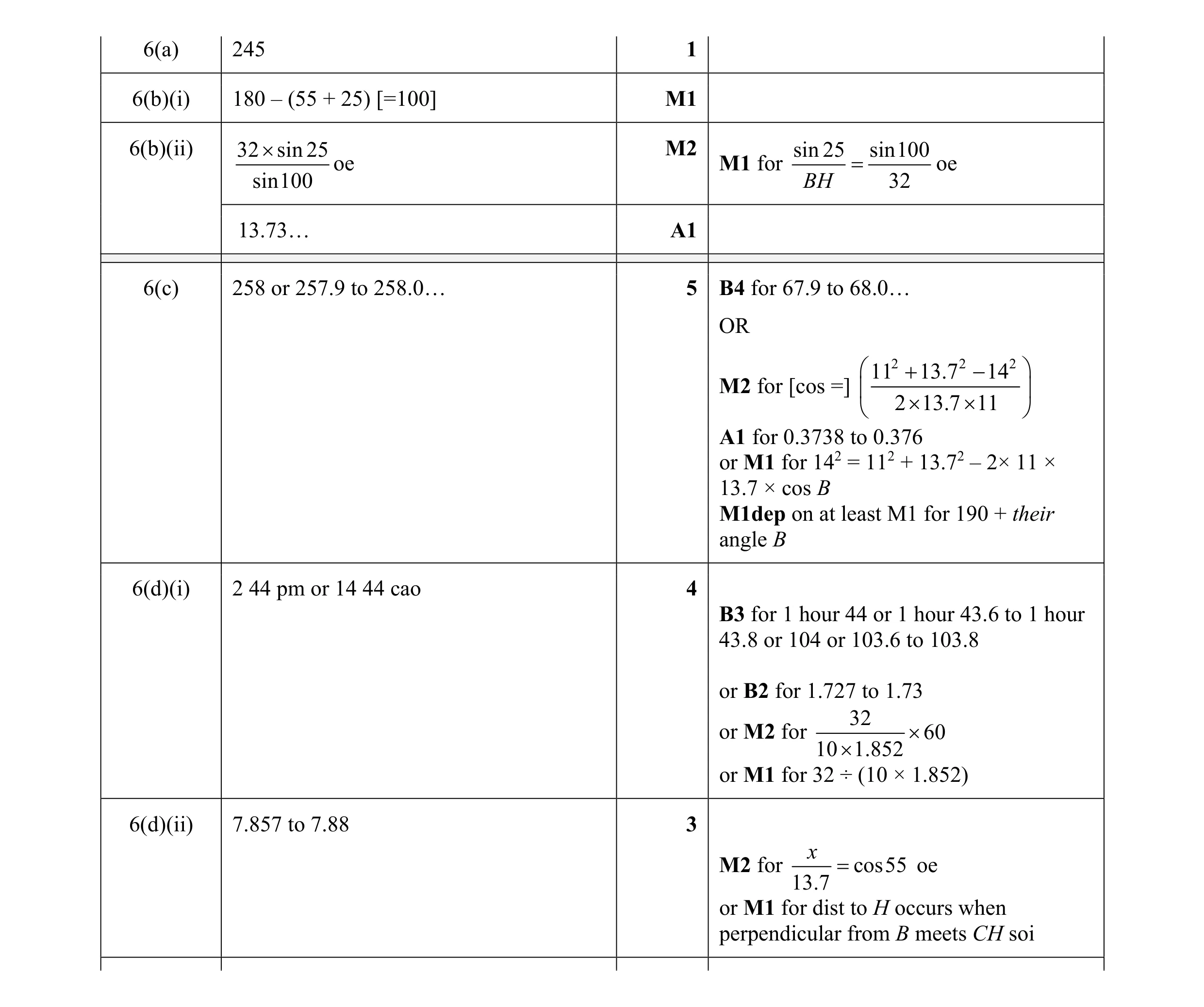 17
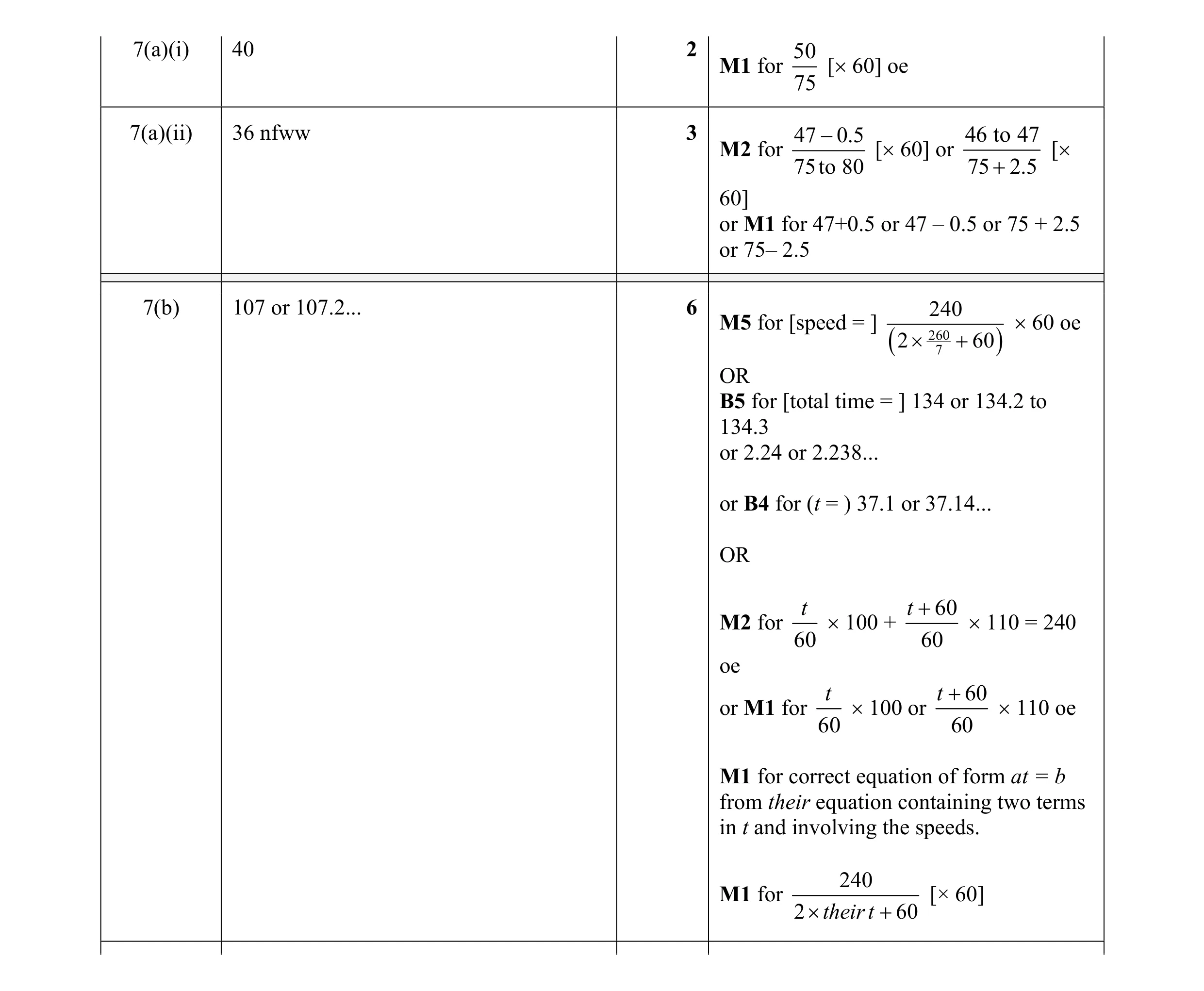 11
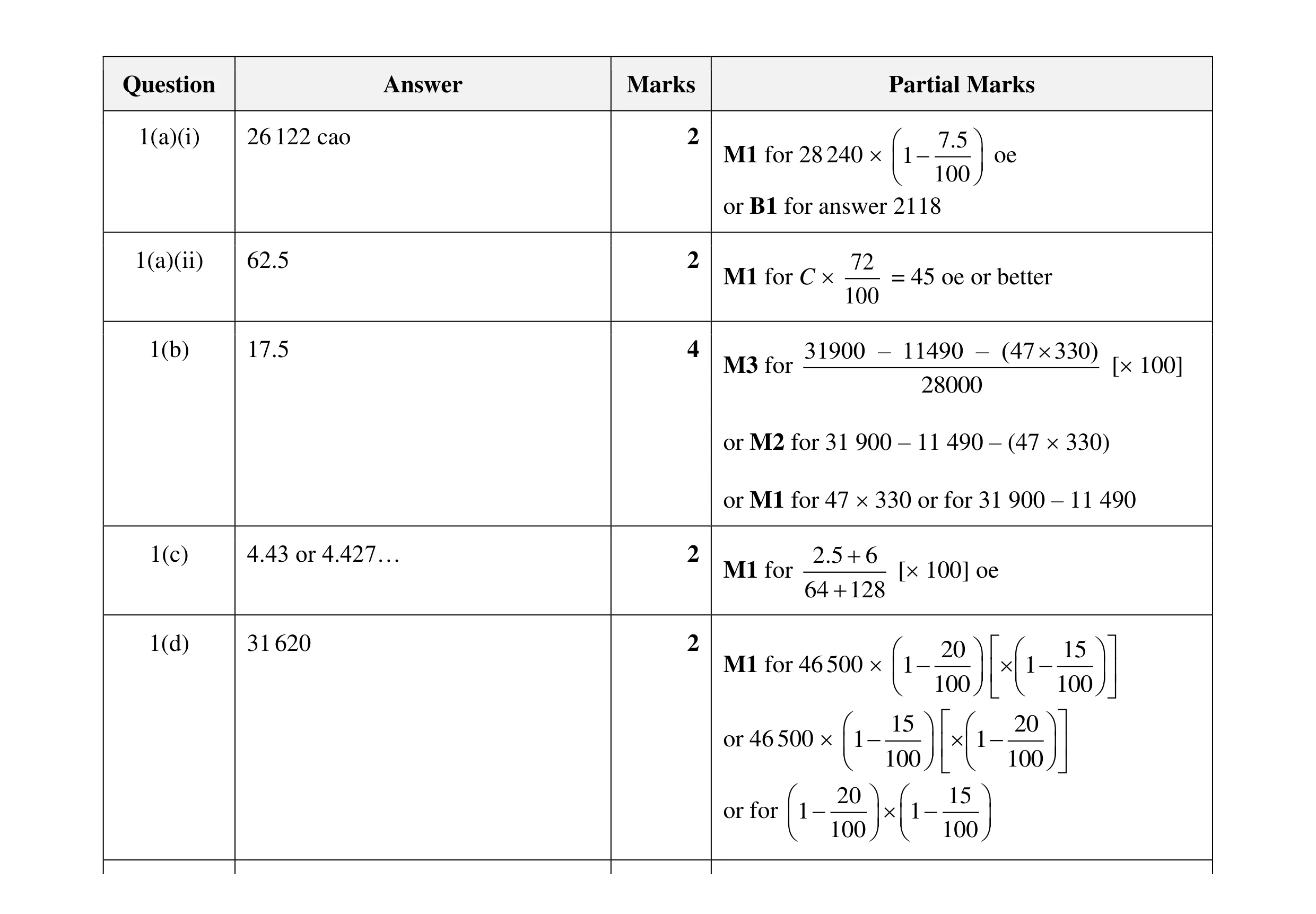 12
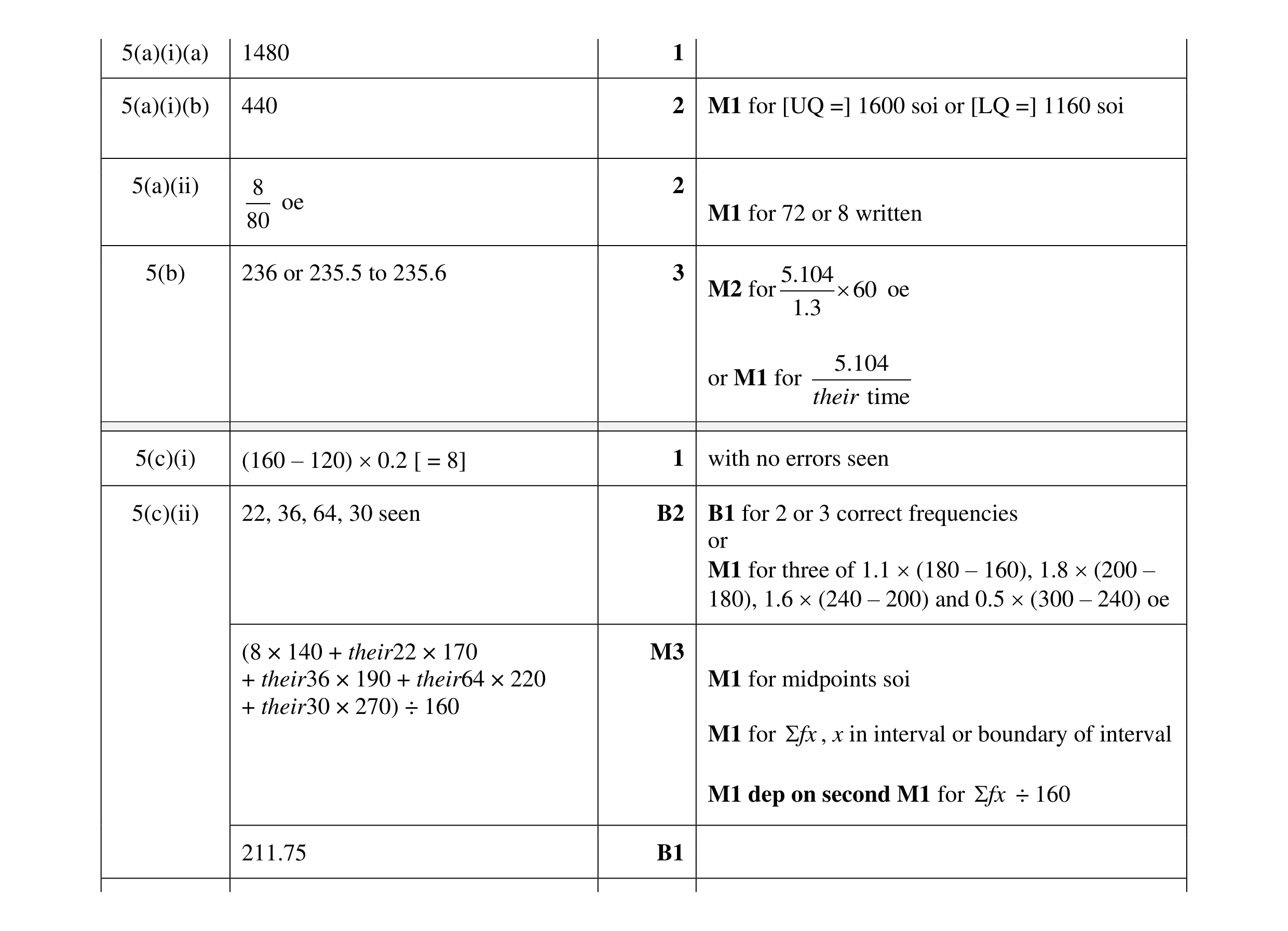 15
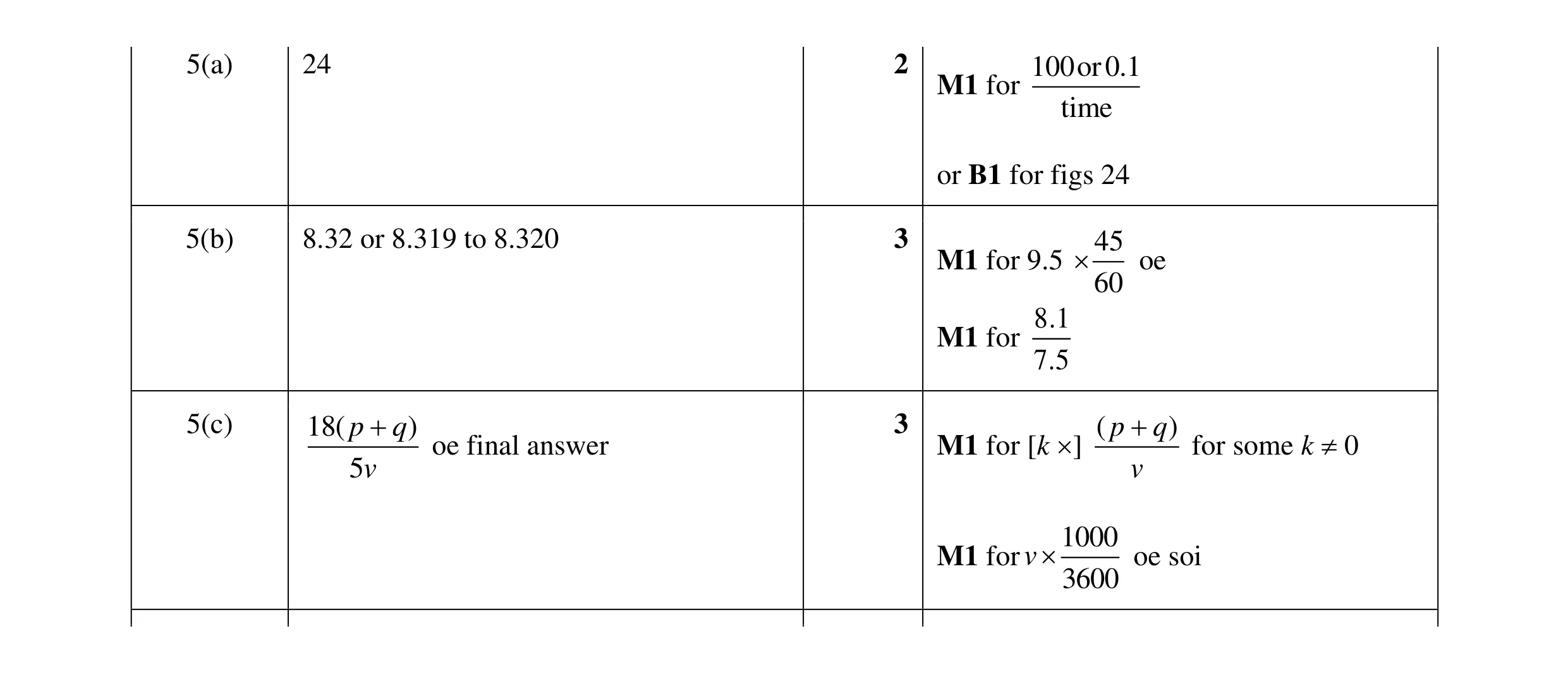 8
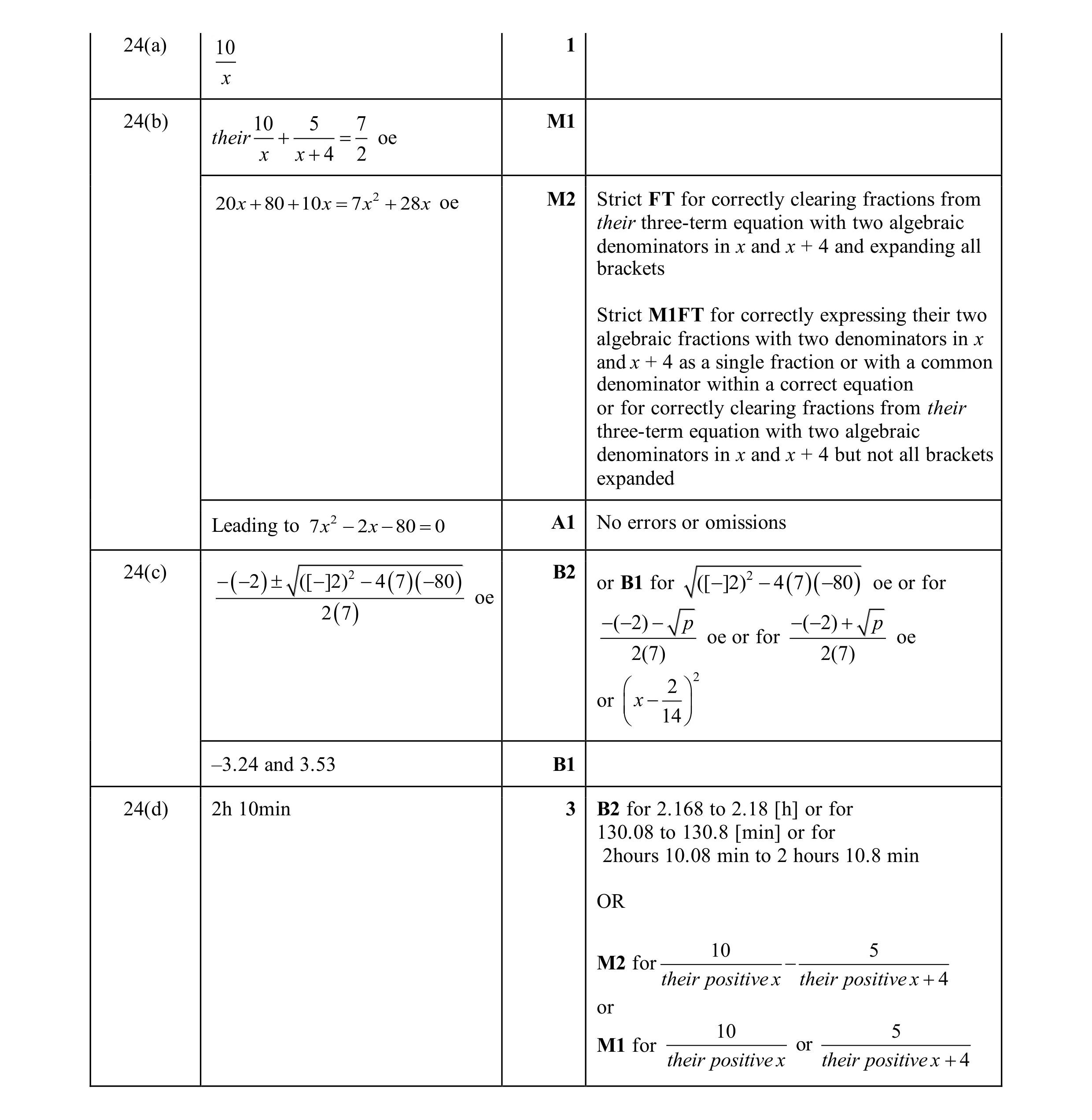 11