Cambridge IGCSE Mathematics 0580 — 2017 Oct/Nov Paper 4 · Variant 3
0580/43/O/N/17 · 10 questions · 130 marks · ≈146 min
The question paper and its mark scheme, free to read here and free to download. This is Cambridge’s own paper, exactly as it was sat.
Question paper16 pages
Mark scheme7 pages
Answers below. Sit the paper first if you are practising.
Questions as text
Q1 · The angles of a triangle are in the ratio 2 : 3 : 5
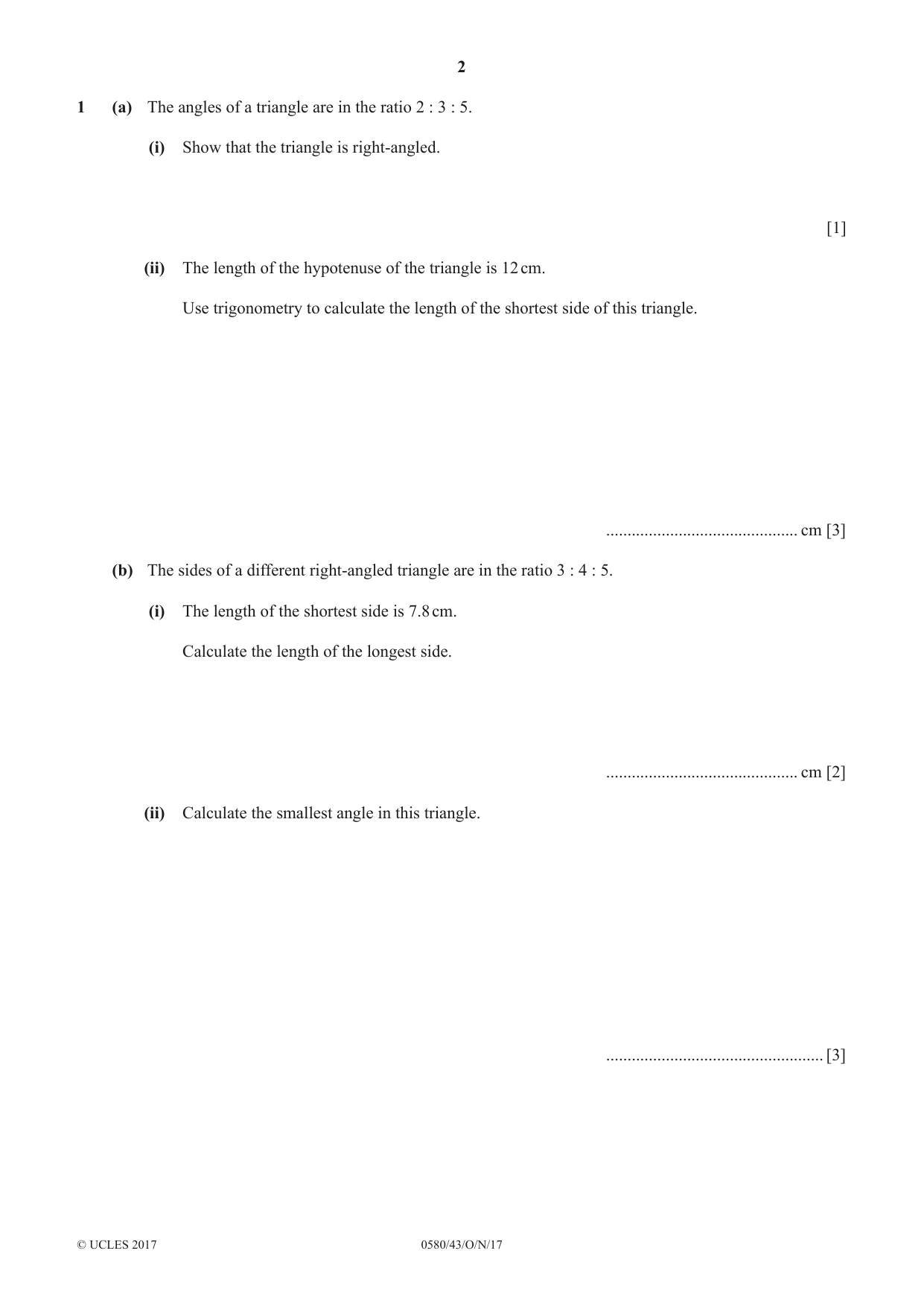
1 (a) The angles of a triangle are in the ratio 2 : 3 : 5. (i) Show that the triangle is right-angled. [1] (ii) The length of the hypotenuse of the triangle is 12 cm. Use trigonometry to calculate the length of the shortest side of this triangle. ............................................. cm [3] (b) The sides of a different right-angled triangle are in the ratio 3 : 4 : 5. (i) The length of the shortest side is 7.8 cm. Calculate the length of the longest side. ............................................. cm [2] (ii) Calculate the smallest angle in this triangle. ................................................... [3]
Mark scheme: Question Answer Marks Partial Marks 1(a)(i) 180 ÷ (2 + 3 + 5) × 5 [= 90] 1 with no errors seen 1(a)(ii) 7.05 or 7.053…. 3 x M2 for = sin36 oe or better 12 or B1 for 36 or 54 seen 1(b)(i) 13 2 M1 for 7.8 ÷ 3 soi 1(b)(ii) 36.9 or 36.86 to 36.87 3 B1 for smallest angle identified 3 M1 for sin[ ] = oe 5 7.8 or sin[ ] = oe their ( b )(i) If zero scored, SC1 for calculation of 53.1
Question 2
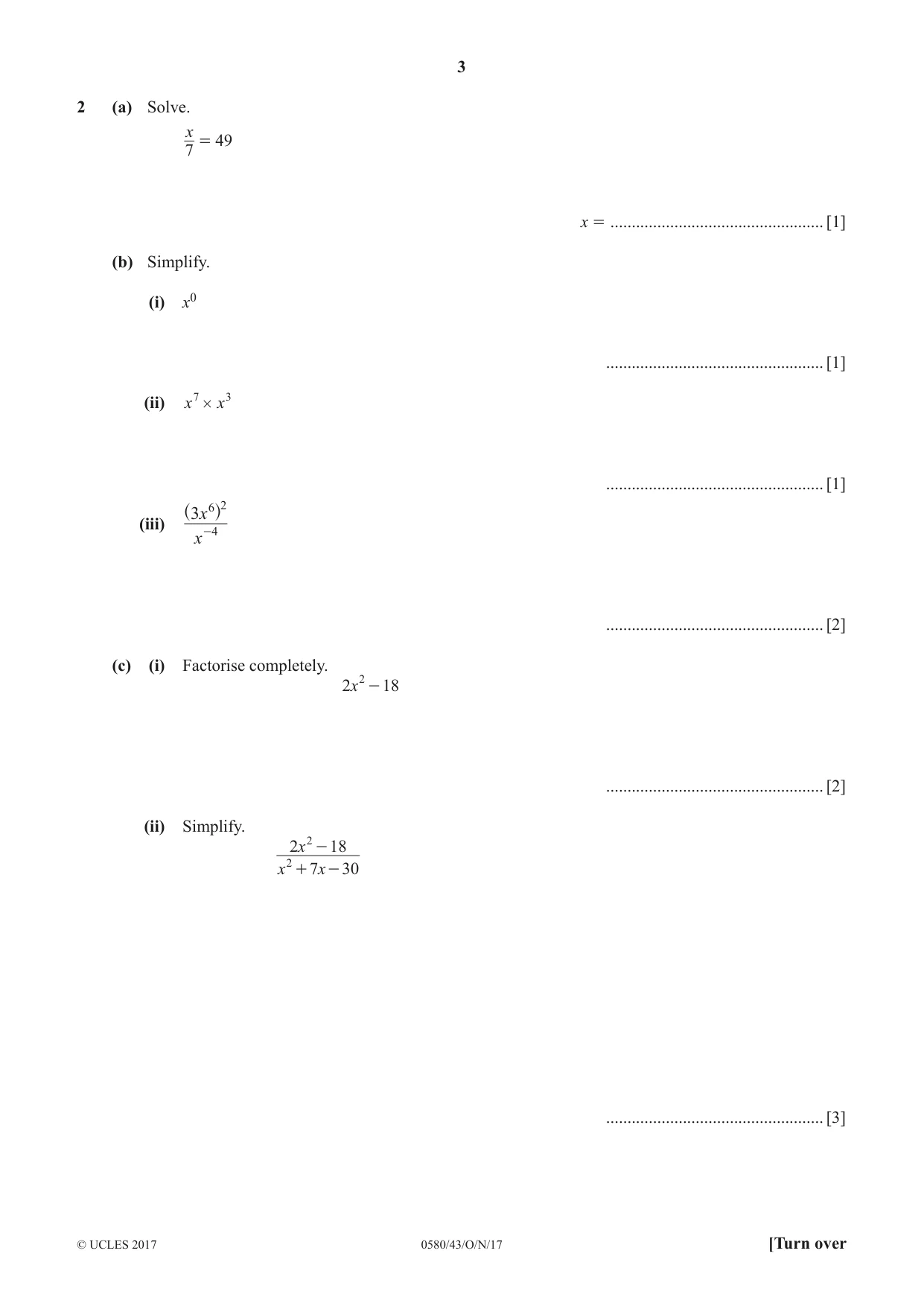
2 (a) Solve. x = 49 7 x = .................................................. [1] (b) Simplify. (i) x0 ................................................... [1] (ii) x 7 # x 3 ................................................... [1] 6 2 3x (iii) ^ -4h x ................................................... [2] (c) (i) Factorise completely. 2x 2 - 18 ................................................... [2] (ii) Simplify. 2x 2 - 18 x 2 + 7x - 30 ................................................... [3]
Mark scheme: 2(a) 343 1 2(b)(i) 1 1 2(b)(ii) x10 final answer 1 2(b)(iii) 9x16 final answer 2 B1 for x12 or x16 or (3x8)2 seen 2(c)(i) 2(x – 3)(x + 3) final answer 2 M1 for (2x + 6)(x – 3) or (2x – 6)(x + 3) or (x – 3)(x + 3) 2(c)(ii) 2( x + 3) 2 x + 6 3 M2 for (x + 10)(x – 3) or or x + 10 x + 10 M1 for (x + a)(x + b) where ab = –30 final answer nfww or a + b = 7
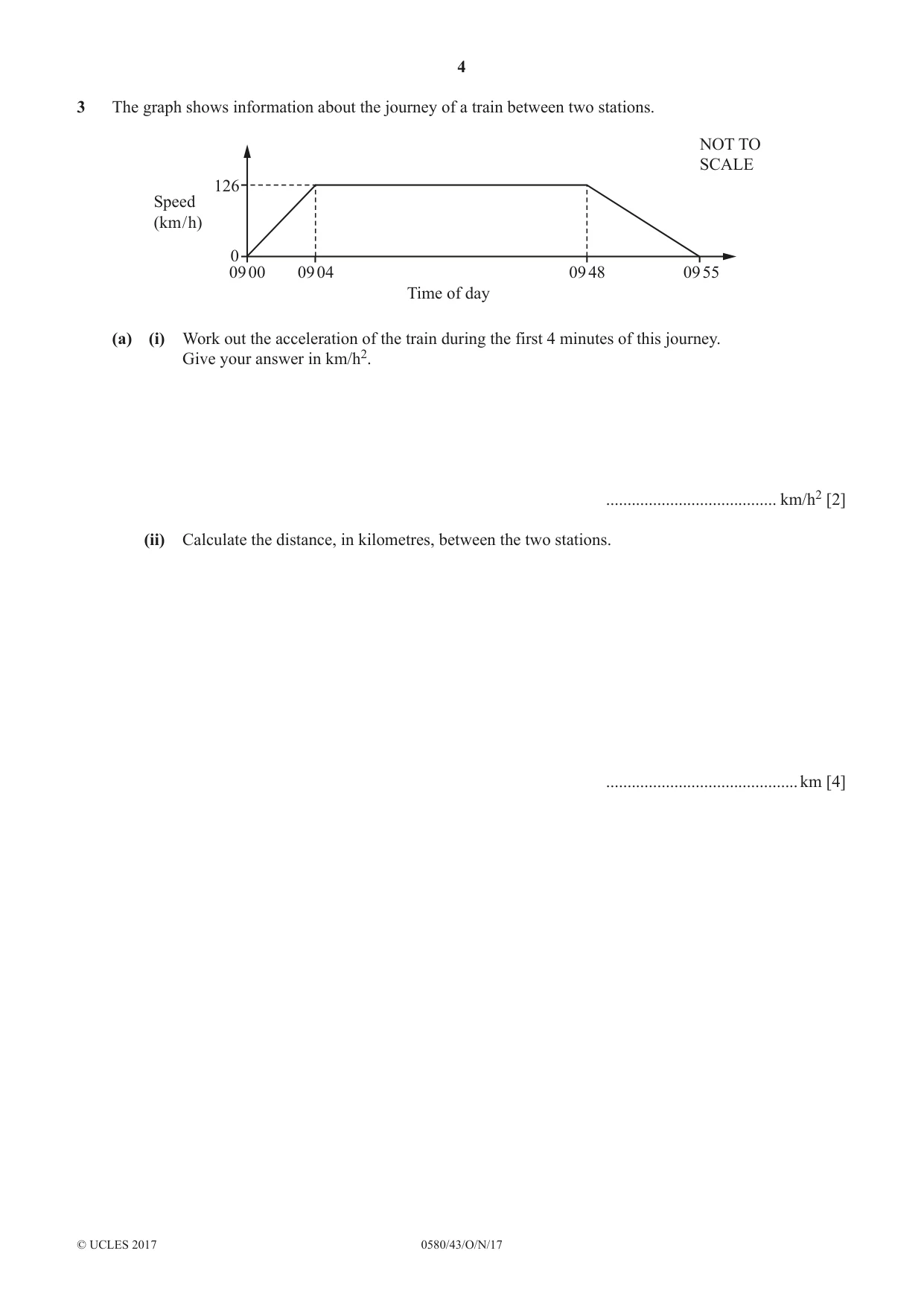
Q3 · The graph shows information about the journey of a train between two stations
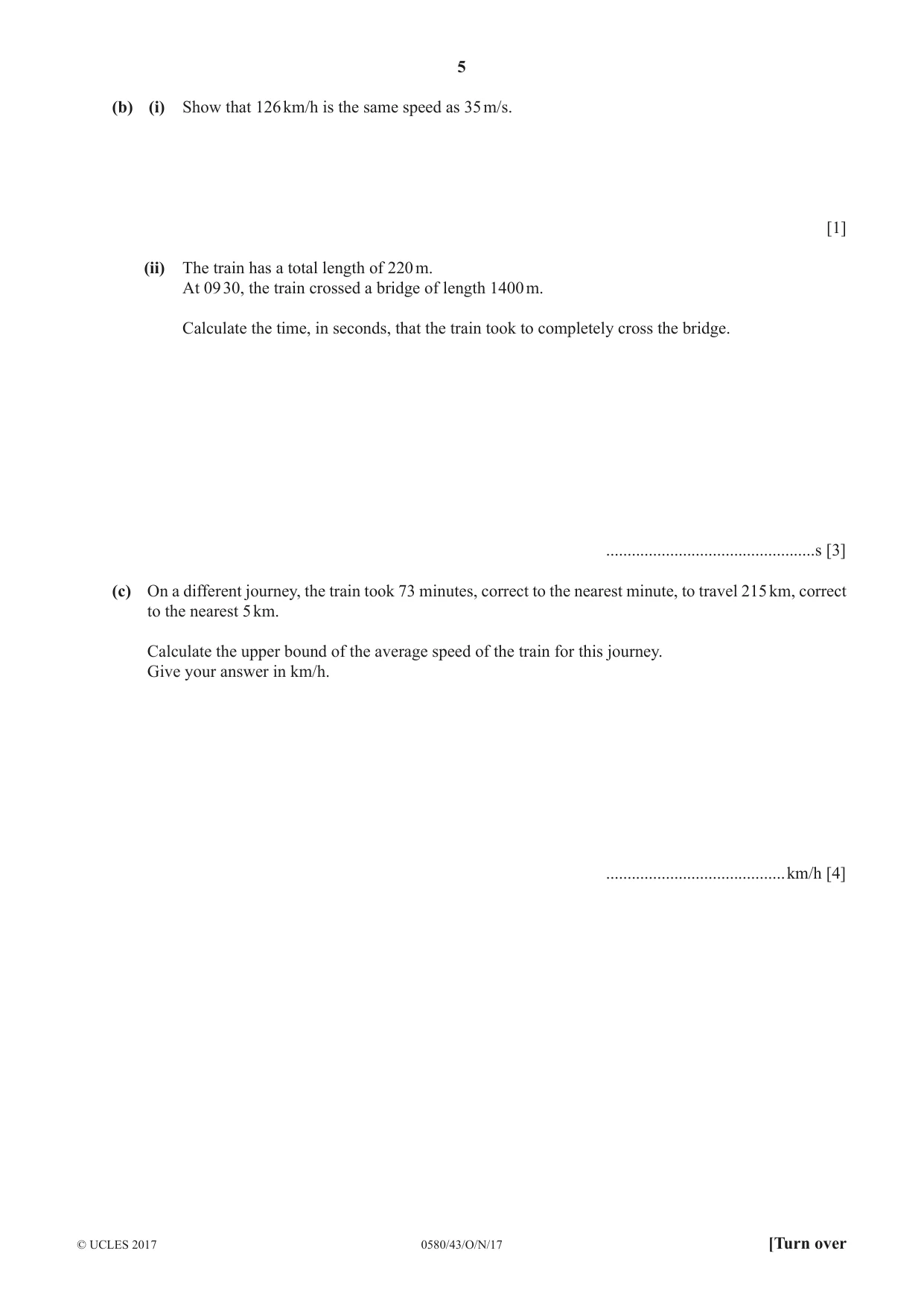
3 The graph shows information about the journey of a train between two stations. NOT TO SCALE 126 Speed (km / h) 0 09 00 09 04 09 48 09 55 Time of day (a) (i) Work out the acceleration of the train during the first 4 minutes of this journey. Give your answer in km/h2. ........................................ km/h2 [2] (ii) Calculate the distance, in kilometres, between the two stations. .............................................km [4] (b) (i) Show that 126 km/h is the same speed as 35 m/s. [1] (ii) The train has a total length of 220 m. At 09 30, the train crossed a bridge of length 1400 m. Calculate the time, in seconds, that the train took to completely cross the bridge. .................................................s [3] (c) On a different journey, the train took 73 minutes, correct to the nearest minute, to travel 215 km, correct to the nearest 5 km. Calculate the upper bound of the average speed of the train for this journey. Give your answer in km/h. ..........................................km/h [4]
Mark scheme: 3(a)(i) 1890 2 M1 for 126 ÷ 4 [× 60] oe If zero scored, SC1 for answer 31.5 3(a)(ii) 103.95 4 44 55 M3 for 0.5 × + × 126 oe 60 60 or SC3 for figs 10395 or figs 104 or M2 for two correct area methods or for a full method without minutes to hours conversion or M1 for one correct area with or without minutes to hours conversion 3(b)(i) 126 × 1000 ÷ (60 × 60) 1 3(b)(ii) 46.3 or 46.28 to 46.29 3 M2 for (1400 + 220) ÷ 35 oe or M1 for distance ÷ speed or 1400 + 220 3(c) 180 nfww 4 B3 for final answer 3 OR 217.5 M3 for × 60 oe 72.5 or M2 for 217.5 ÷ 72.5 oe 210 to 220 or × 60 72.5 217.5 or × 60 72 to 74 215 or M1 for 217.5 or 72.5 seen or × 60 73
Q4 · The table shows information about the time, t minutes, taken for each of 150 girls to…
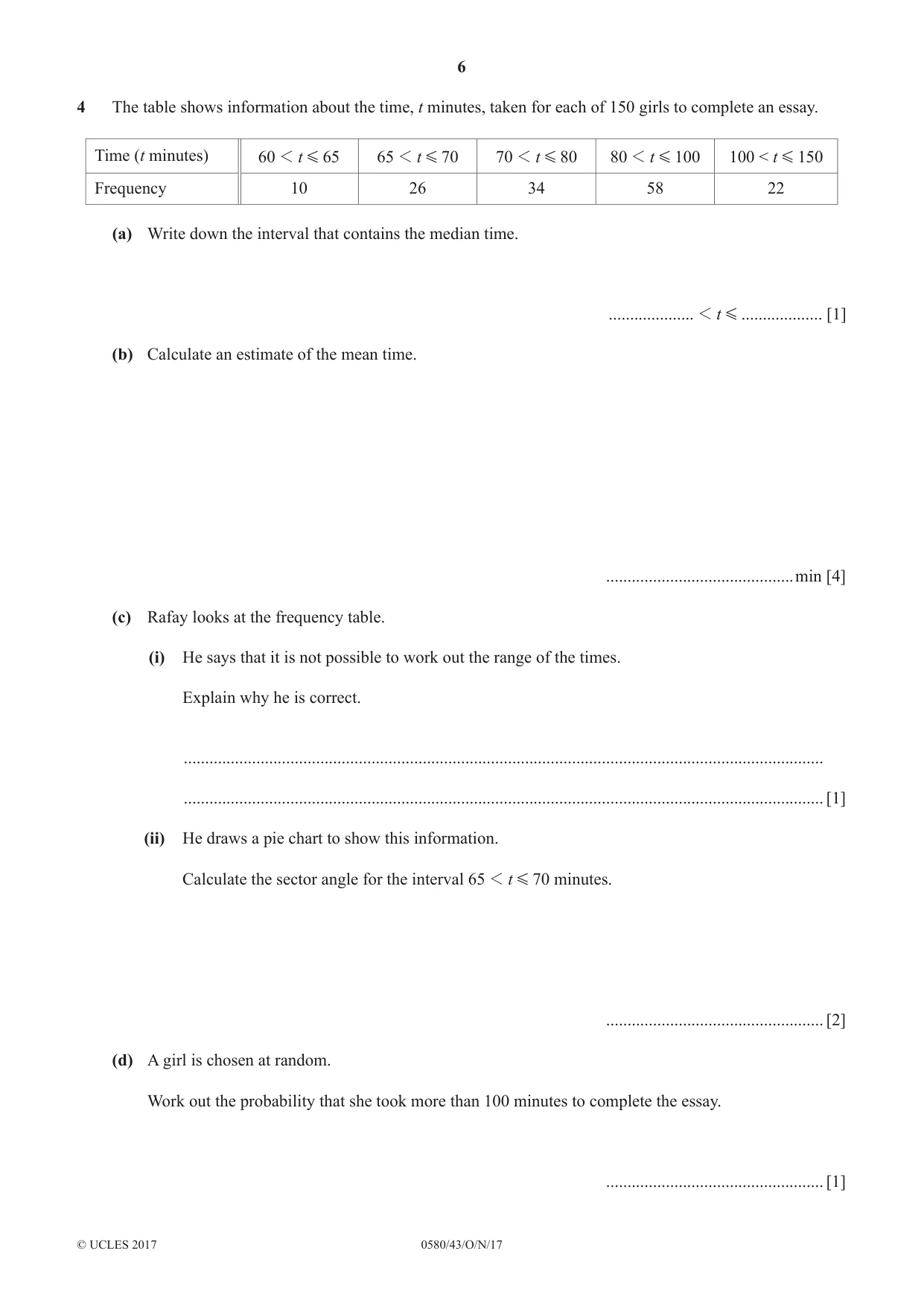
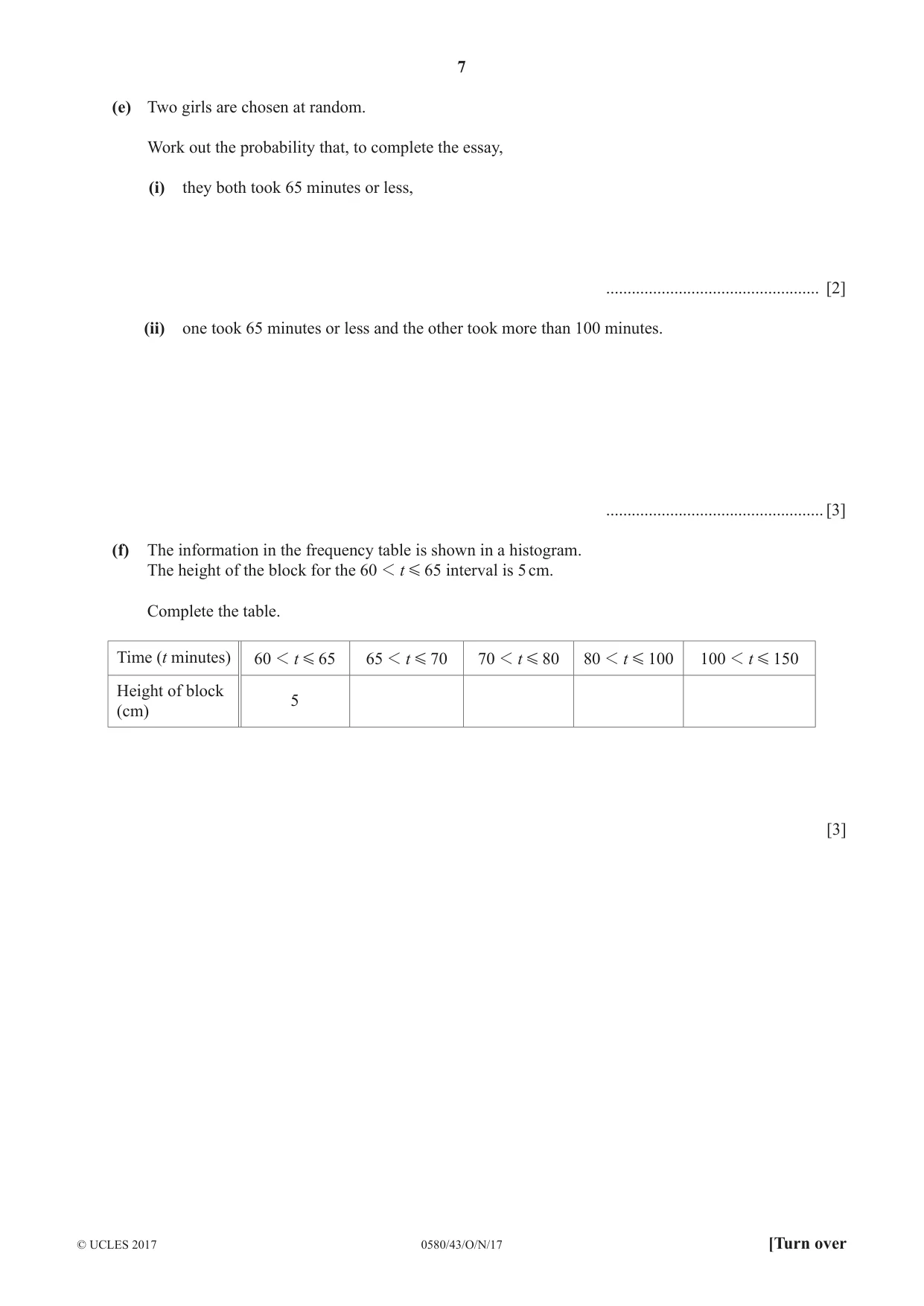
4 The table shows information about the time, t minutes, taken for each of 150 girls to complete an essay. Time (t minutes) 60 1 t G 65 65 1 t G 70 70 1 t G 80 80 1 t G 100 100 < t G 150 Frequency 10 26 34 58 22 (a) Write down the interval that contains the median time. .................... 1 t G ................... [1] (b) Calculate an estimate of the mean time. ............................................min [4] (c) Rafay looks at the frequency table. (i) He says that it is not possible to work out the range of the times. Explain why he is correct. ...................................................................................................................................................... ...................................................................................................................................................... [1] (ii) He draws a pie chart to show this information. Calculate the sector angle for the interval 65 1 t G 70 minutes. ................................................... [2] (d) A girl is chosen at random. Work out the probability that she took more than 100 minutes to complete the essay. ................................................... [1] (e) Two girls are chosen at random. Work out the probability that, to complete the essay, (i) they both took 65 minutes or less, .................................................. [2] (ii) one took 65 minutes or less and the other took more than 100 minutes. ................................................... [3] (f) The information in the frequency table is shown in a histogram. The height of the block for the 60 1 t G 65 interval is 5 cm. Complete the table. Time (t minutes) 60 1 t G 65 65 1 t G 70 70 1 t G 80 80 1 t G 100 100 1 t G 150 Height of block 5 (cm) [3]
Mark scheme: 4(a) 80 < t ⩽100 1 4(b) 86 nfww 4 M1 for midpoints soi M1 for use of Σfx with x in correct interval including both boundaries M1 (dep on 2nd M1) for Σfx ÷ 150 4(c)(i) Reference to not knowing the 1 individual values so we do not know the highest or the lowest values 4(c)(ii) 62.4 2 M1 for 26 ÷ 150 or 360 ÷ 150 soi 4(d) 22 1 oe 150 4(e)(i) 90 2 10 9 oe M1 for × 22350 150 149 100 After zero scored, SC1 for answer oe 22500 4(e)(ii) 440 3 10 22 22 10 oe M2 for × + × oe 22350 150 149 150 149 or 10 22 22 10 M1 for × or × oe 150 149 150 149 440 After zero scored, SC1 for answer oe 22500 4(f) 13, 8.5, 7.25, 1.1 3 B2 for 3 correct or B1 for 1 correct or for 3 correct FD.s 5.2, 3.4, 2.9, 0.44 oe
Q5 · Y 8 7 6 5 4 3 B 2 A 1 x –6 –5 –4 –3 –2 –1 0 1 2 3 4 5 6 7 8 –1 –2 –3 –4 –5 –6 (a) Draw…
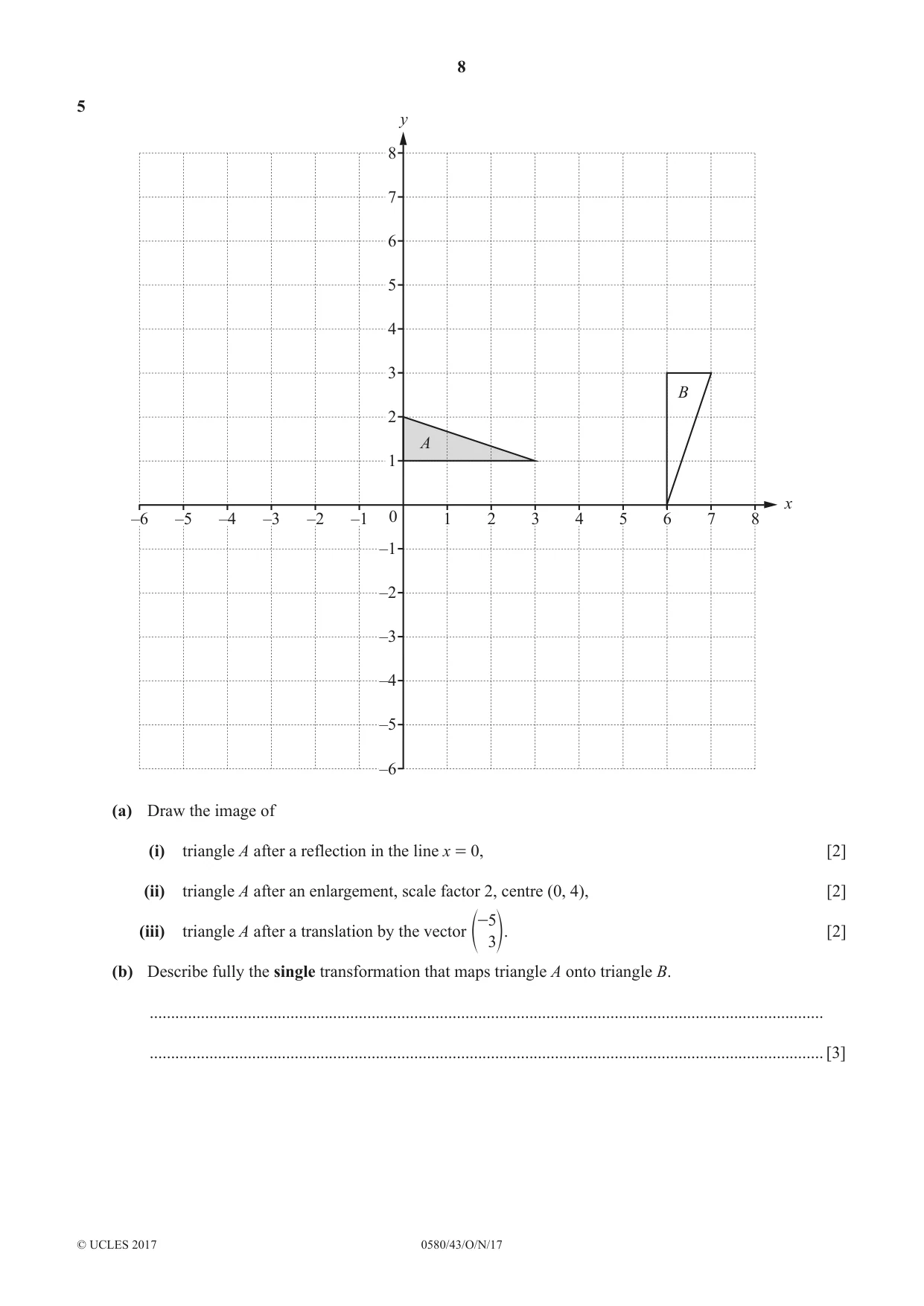
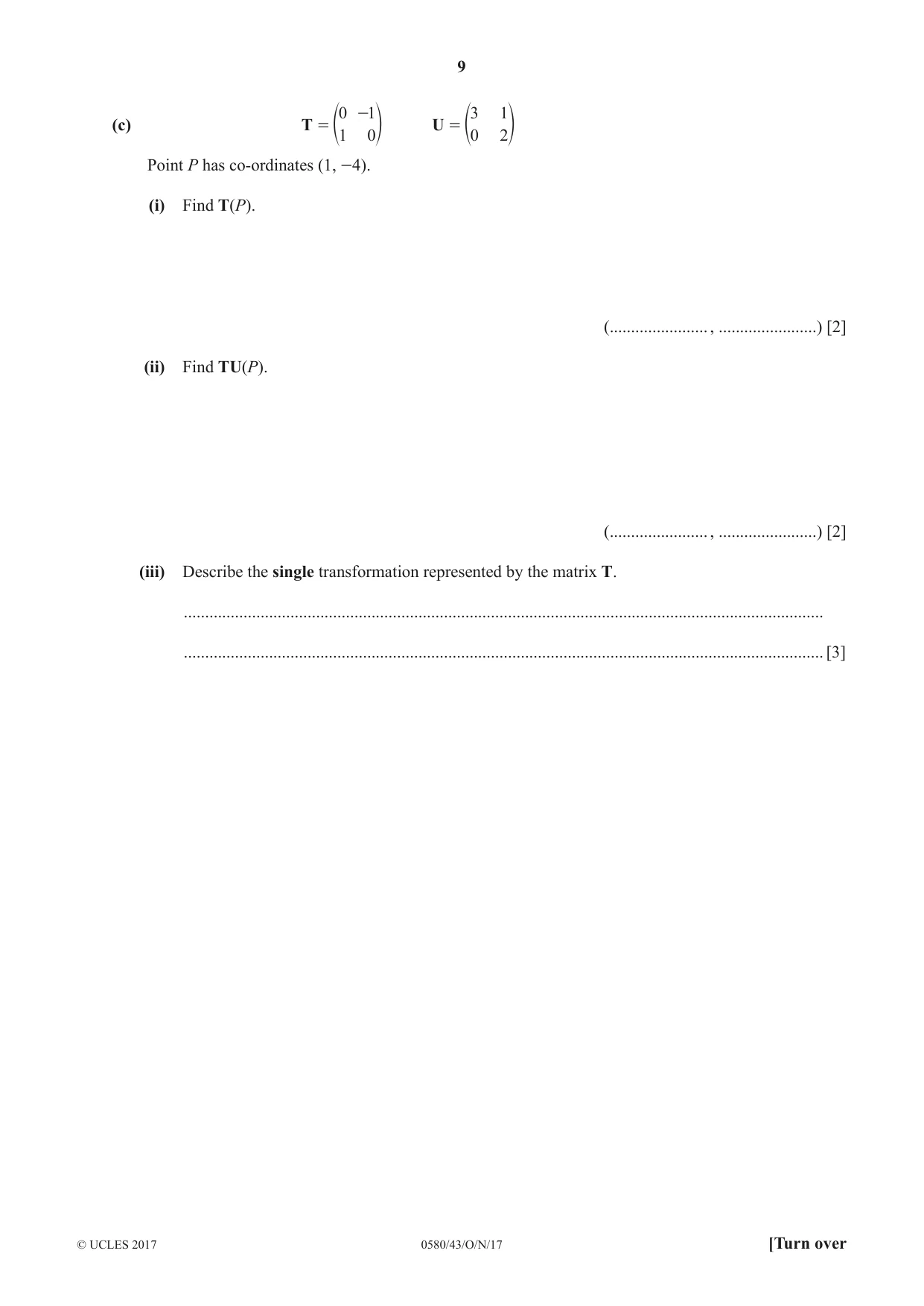
5 y 8 7 6 5 4 3 B 2 A 1 x –6 –5 –4 –3 –2 –1 0 1 2 3 4 5 6 7 8 –1 –2 –3 –4 –5 –6 (a) Draw the image of (i) triangle A after a reflection in the line x = 0, [2] (ii) triangle A after an enlargement, scale factor 2, centre (0, 4), [2] -5 (iii) triangle A after a translation by the vector [2] f 3p. (b) Describe fully the single transformation that maps triangle A onto triangle B. .............................................................................................................................................................. .............................................................................................................................................................. [3] 0 -1 3 1 (c) T = U = f1 0p f0 2p Point P has co-ordinates (1, -4). (i) Find T(P). (....................... , .......................) [2] (ii) Find TU(P). (....................... , .......................) [2] (iii) Describe the single transformation represented by the matrix T. ...................................................................................................................................................... ...................................................................................................................................................... [3]
Mark scheme: 5(a)(i) Image at (0, 1), (0, 2), (–3, 1) 2 B1 for reflection in y = 0 or x = k 5(a)(ii) Image at (0, 0), (0, –2), (6, –2) 2 B1 for correct size and correct orientation wrong position or for 2 correct vertices plotted 5(a)(iii) Image at (–5, 4), (–5, 5), (–2, 4) 2 − 5 k B1 for translation by or k 3 5(b) Rotation 3 B1 for each 90° clockwise oe (4, –1) 5(c)(i) (4, 1) 2 0 − 1 1 M1 for 1 0 − 4 5(c)(ii) (8, –1) 2 0 − 1 3 1 1 M1 for 1 0 0 2 − 4 0 − 2 1 or 3 1 − 4 0 − 1 − 1 or 1 0 − 8 5(c)(iii) Rotation 3 B1 for each 90° anti-clockwise oe Origin oe
Q6 · R h NOT TO SCALE 10 cm The diagrams show a cube, a cylinder and a hemisphere
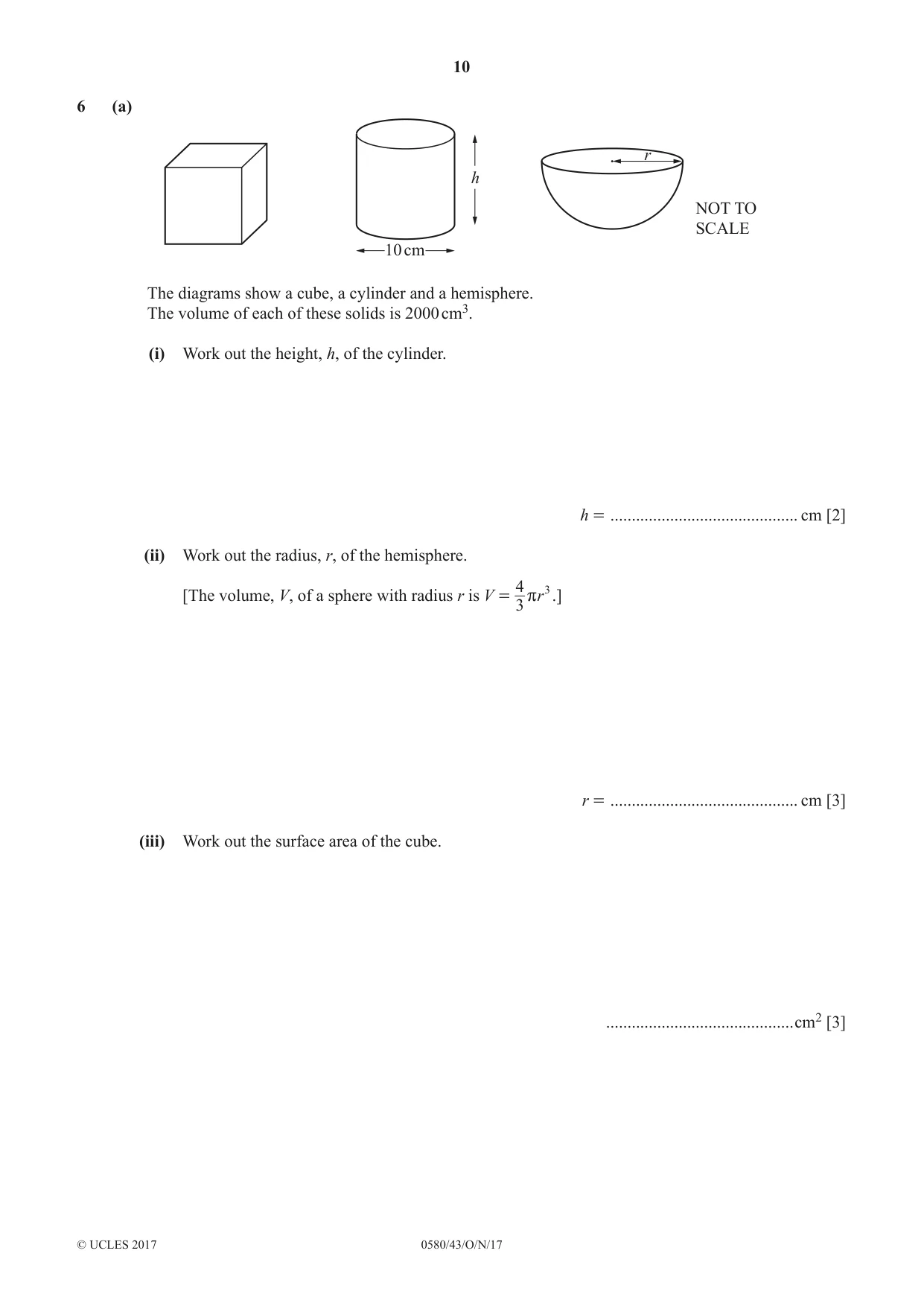
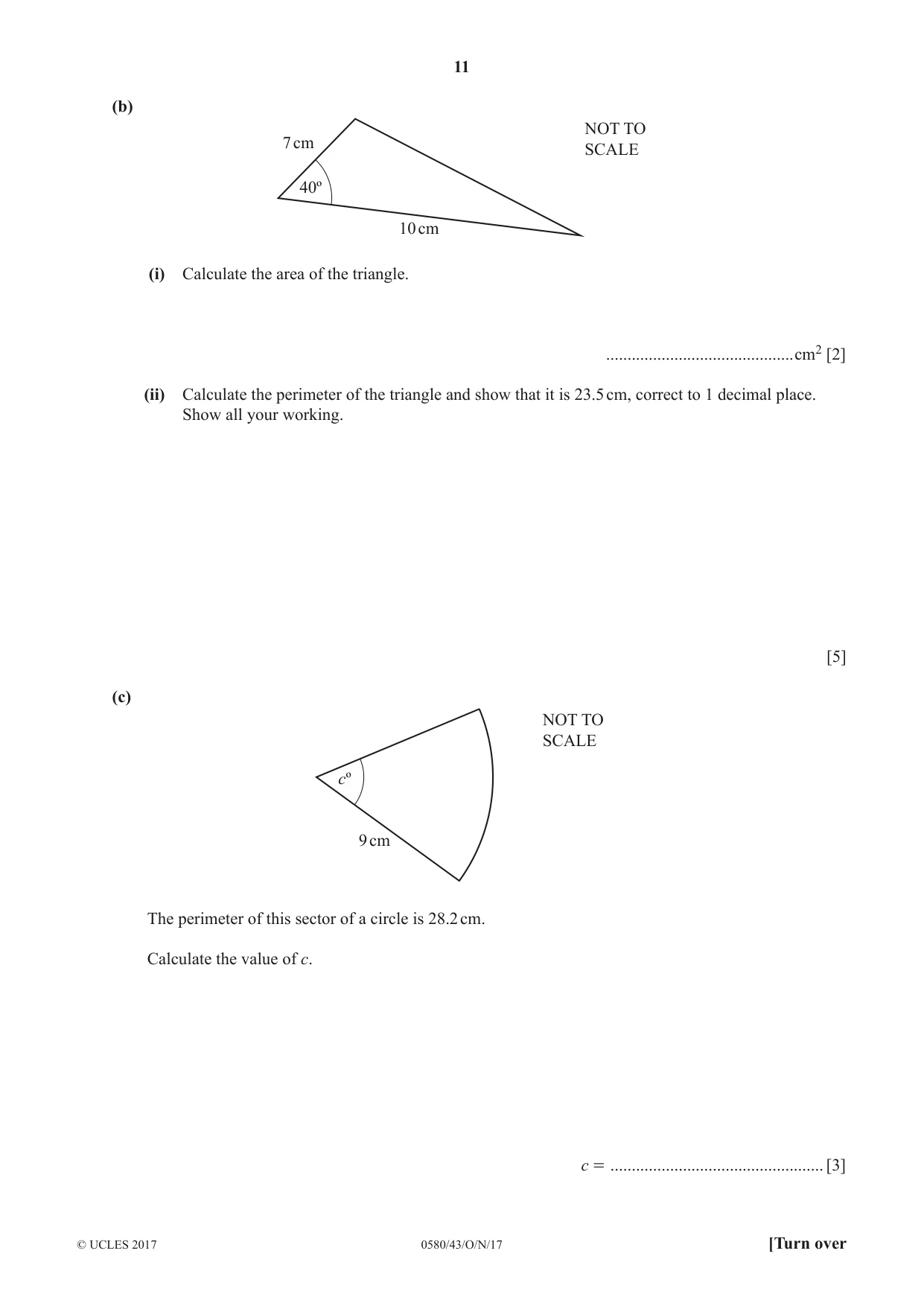
6 (a) r h NOT TO SCALE 10 cm The diagrams show a cube, a cylinder and a hemisphere. The volume of each of these solids is 2000 cm3. (i) Work out the height, h, of the cylinder. h = ............................................ cm [2] (ii) Work out the radius, r, of the hemisphere. 4 3 [The volume, V, of a sphere with radius r is V = r r .] 3 r = ............................................ cm [3] (iii) Work out the surface area of the cube. ............................................cm2 [3] (b) NOT TO 7 cm SCALE 40º 10 cm (i) Calculate the area of the triangle. ............................................cm2 [2] (ii) Calculate the perimeter of the triangle and show that it is 23.5 cm, correct to 1 decimal place. Show all your working. [5] (c) NOT TO SCALE cº 9 cm The perimeter of this sector of a circle is 28.2 cm. Calculate the value of c. c = .................................................. [3]
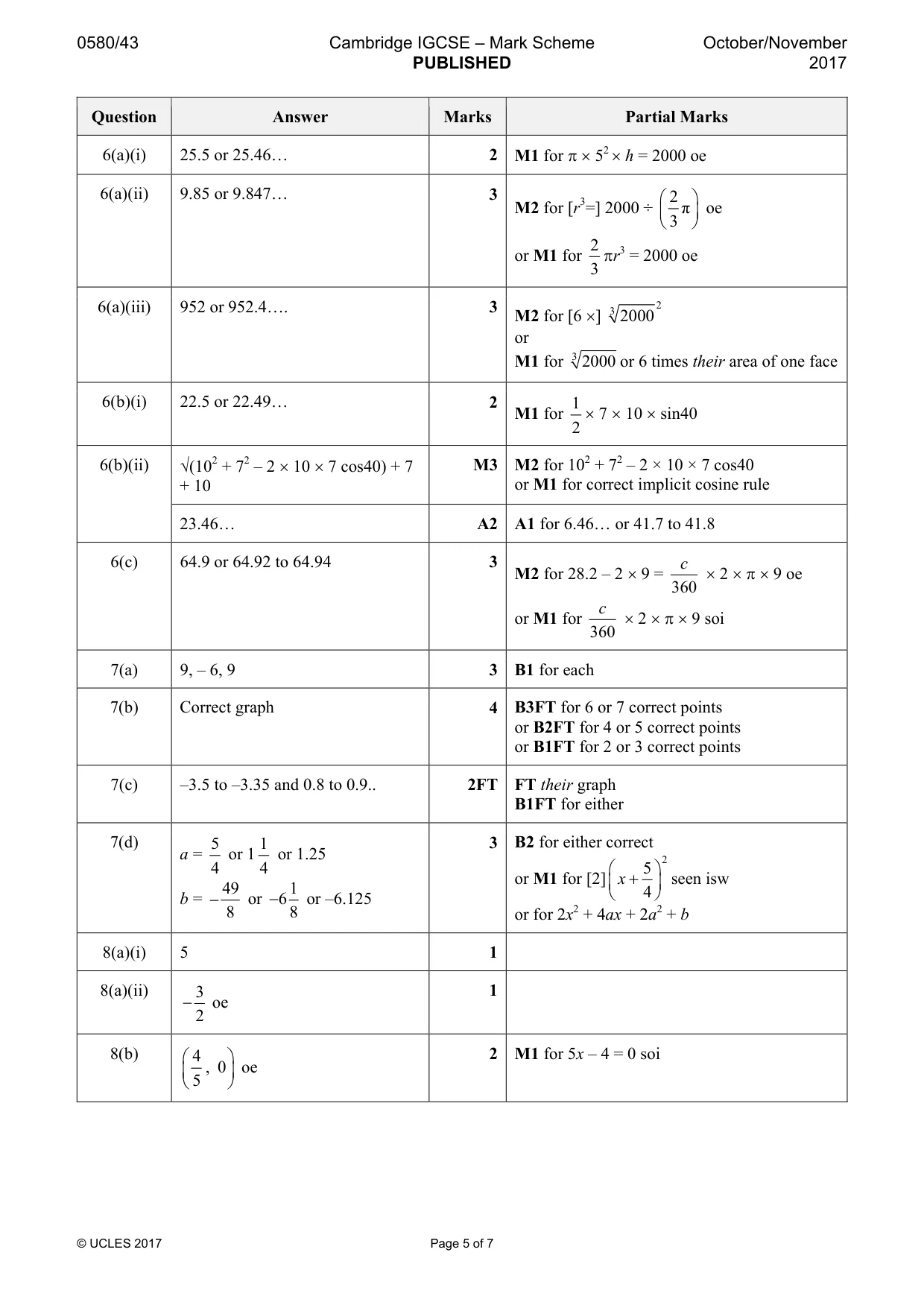
Mark scheme: 6(a)(i) 25.5 or 25.46… 2 M1 for π × 52 × h = 2000 oe 6(a)(ii) 9.85 or 9.847… 3 2 M2 for [r3=] 2000 ÷ π oe 3 2 or M1 for πr3 = 2000 oe 3 6(a)(iii) 952 or 952.4…. 3 3 2 M2 for [6 ×] 2000 or M1 for 3 2000 or 6 times their area of one face 6(b)(i) 22.5 or 22.49… 2 1 M1 for × 7 × 10 × sin40 2 6(b)(ii) √(102 + 72 – 2 × 10 × 7 cos40) + 7 M3 M2 for 102 + 72 – 2 × 10 × 7 cos40 + 10 or M1 for correct implicit cosine rule 23.46… A2 A1 for 6.46… or 41.7 to 41.8 6(c) 64.9 or 64.92 to 64.94 3 c M2 for 28.2 – 2 × 9 = × 2 × π × 9 oe 360 c or M1 for × 2 × π × 9 soi 360
Q7 · The table shows some values of y = 2x 2 + 5x - 3 for -4 G x G 1.5
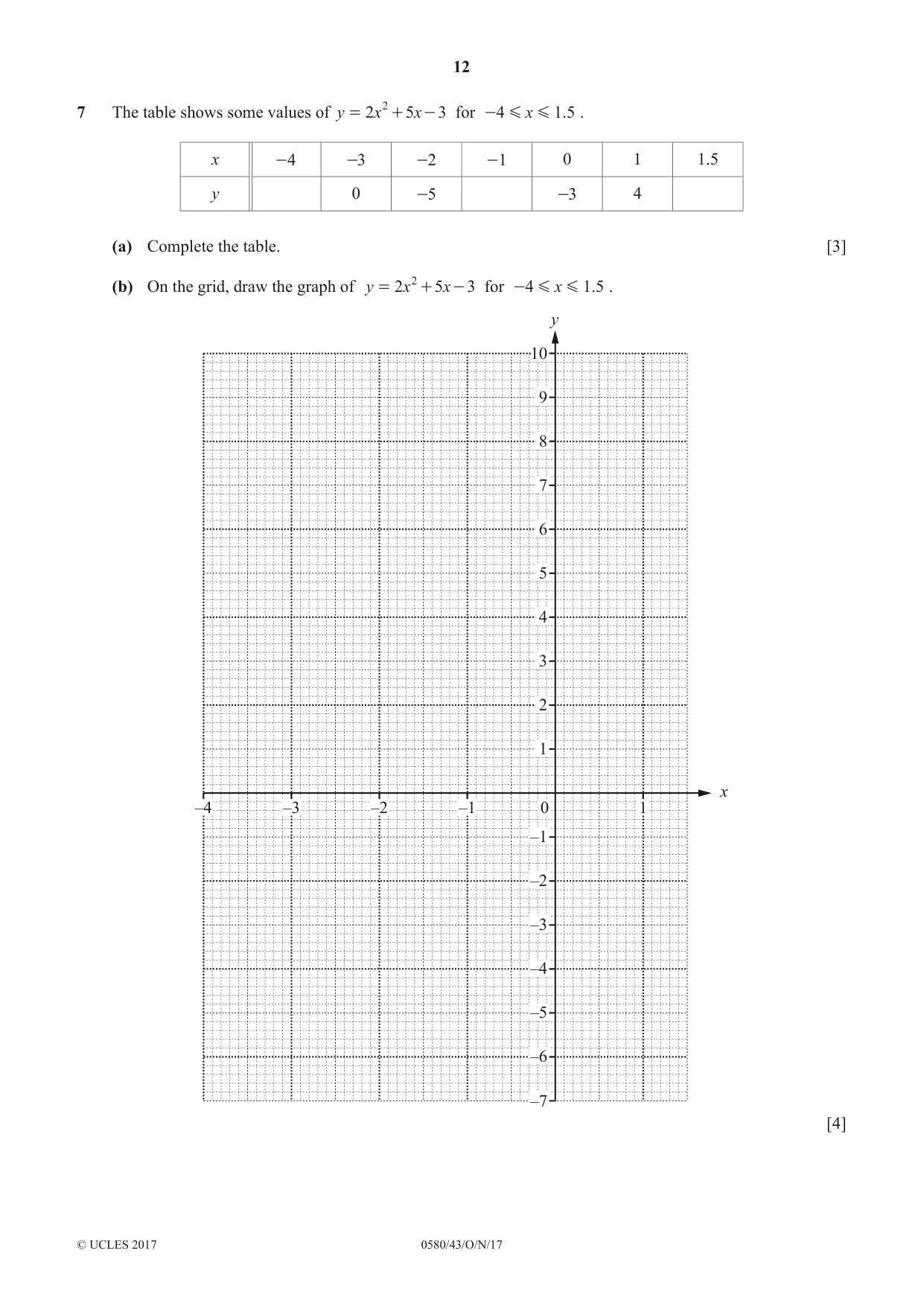
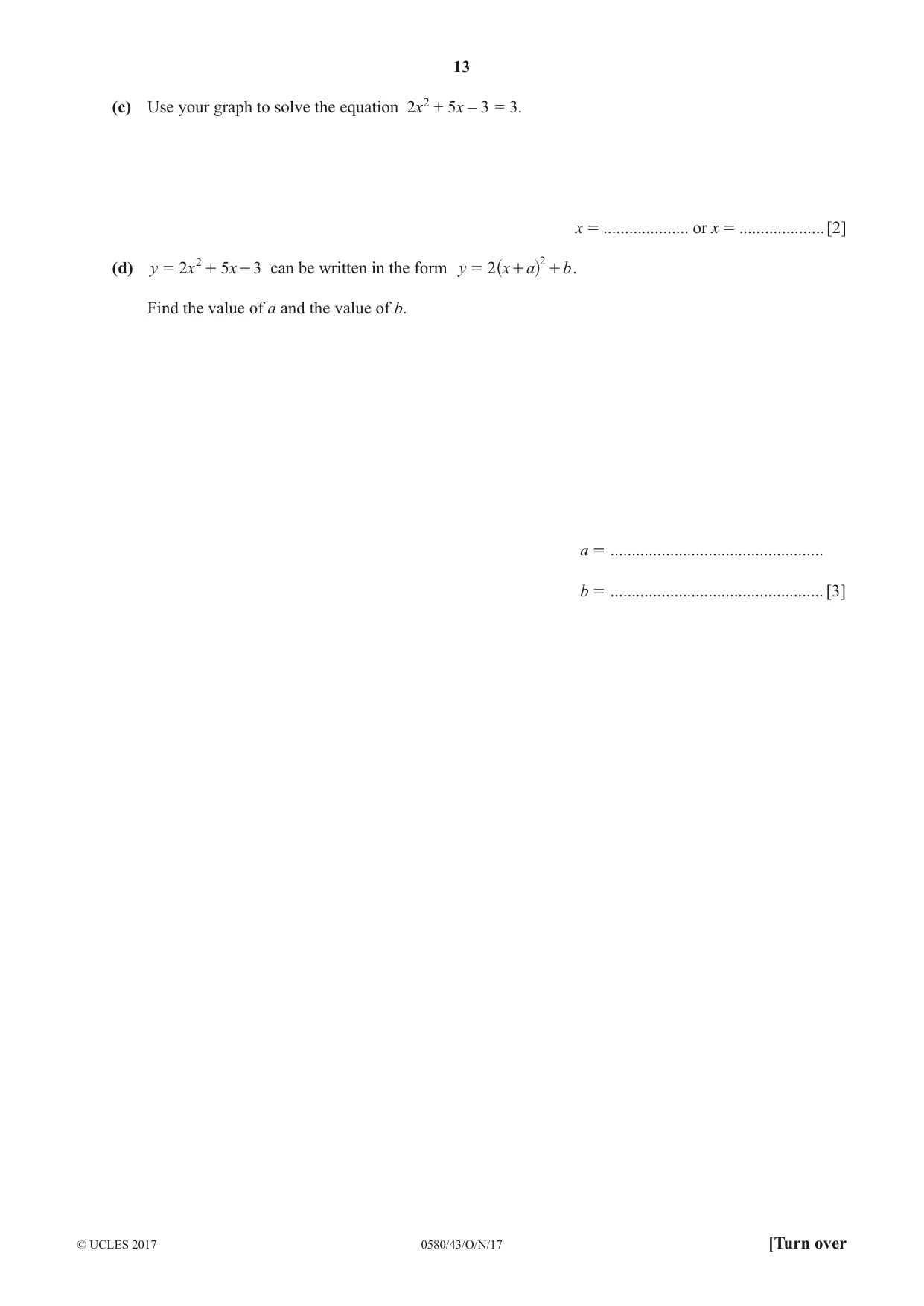
7 The table shows some values of y = 2x 2 + 5x - 3 for -4 G x G 1.5 . x -4 -3 -2 -1 0 1 1.5 y 0 -5 -3 4 (a) Complete the table. [3] (b) On the grid, draw the graph of y = 2x 2 + 5x - 3 for -4 G x G 1.5 . y 10 9 8 7 6 5 4 3 2 1 x –4 –3 –2 –1 0 1 –1 –2 –3 –4 –5 –6 –7 [4] (c) Use your graph to solve the equation 2x2 + 5x – 3 = 3. x = .................... or x = .................... [2] (d) y = 2x 2 + 5x - 3 can be written in the form y = 2 x + a 2 + b . ^ h Find the value of a and the value of b. a = .................................................. b = .................................................. [3]
Mark scheme: 7(a) 9, – 6, 9 3 B1 for each 7(b) Correct graph 4 B3FT for 6 or 7 correct points or B2FT for 4 or 5 correct points or B1FT for 2 or 3 correct points 7(c) –3.5 to –3.35 and 0.8 to 0.9.. 2FT FT their graph B1FT for either 7(d) 5 1 3 B2 for either correct a = or 1 or 1.25 2 4 4 5 or M1 for [2] x + seen isw 49 1 4 b = − 8 or − 68 or –6.125 or for 2x2 + 4ax + 2a2 + b
Q8 · Line A has equation y = 5x - 4
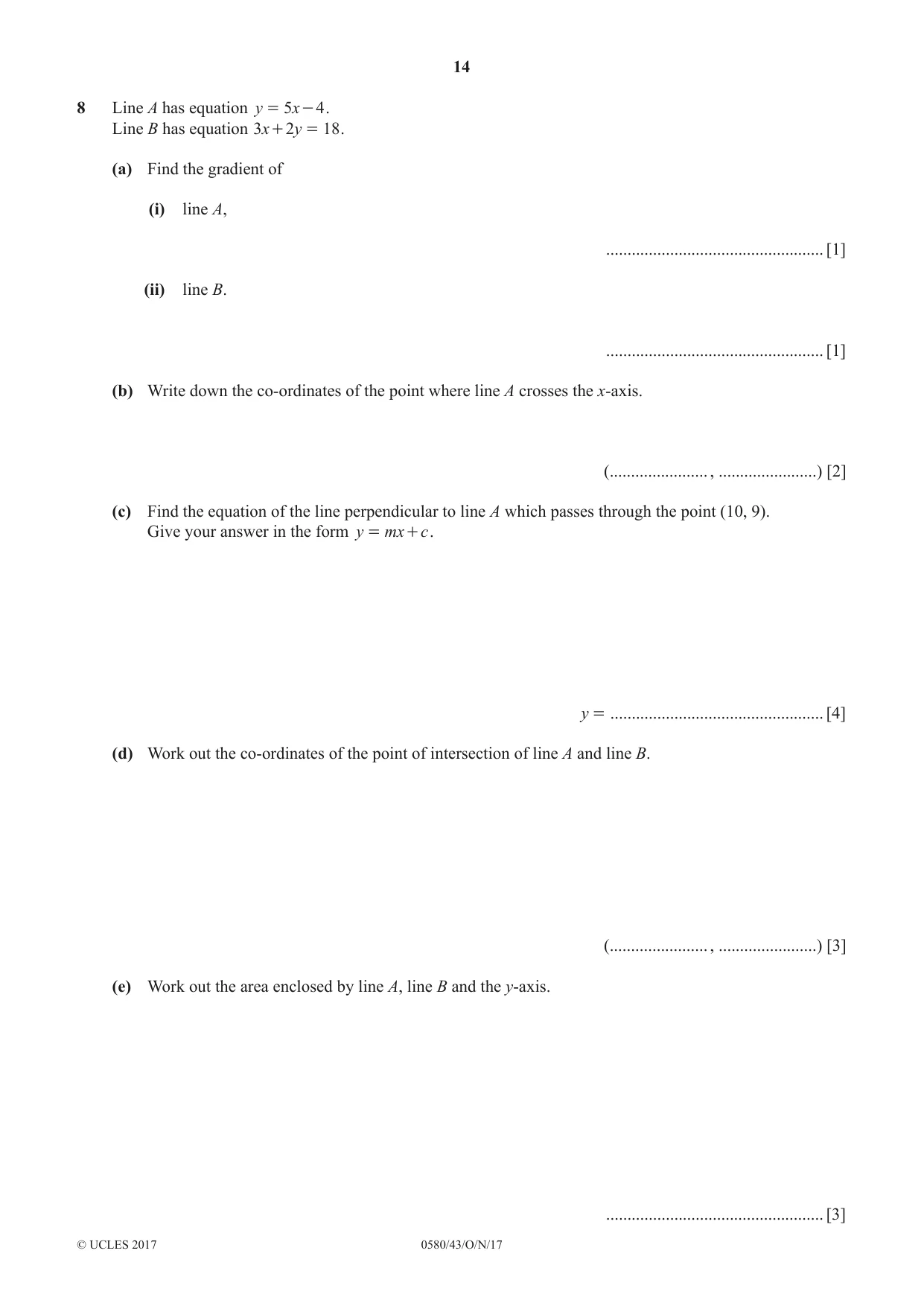
8 Line A has equation y = 5x - 4 . Line B has equation 3x + 2y = 18 . (a) Find the gradient of (i) line A, ................................................... [1] (ii) line B. ................................................... [1] (b) Write down the co-ordinates of the point where line A crosses the x-axis. (....................... , .......................) [2] (c) Find the equation of the line perpendicular to line A which passes through the point (10, 9). Give your answer in the form y = mx + c . y = .................................................. [4] (d) Work out the co-ordinates of the point of intersection of line A and line B. (....................... , .......................) [3] (e) Work out the area enclosed by line A, line B and the y-axis. ................................................... [3]
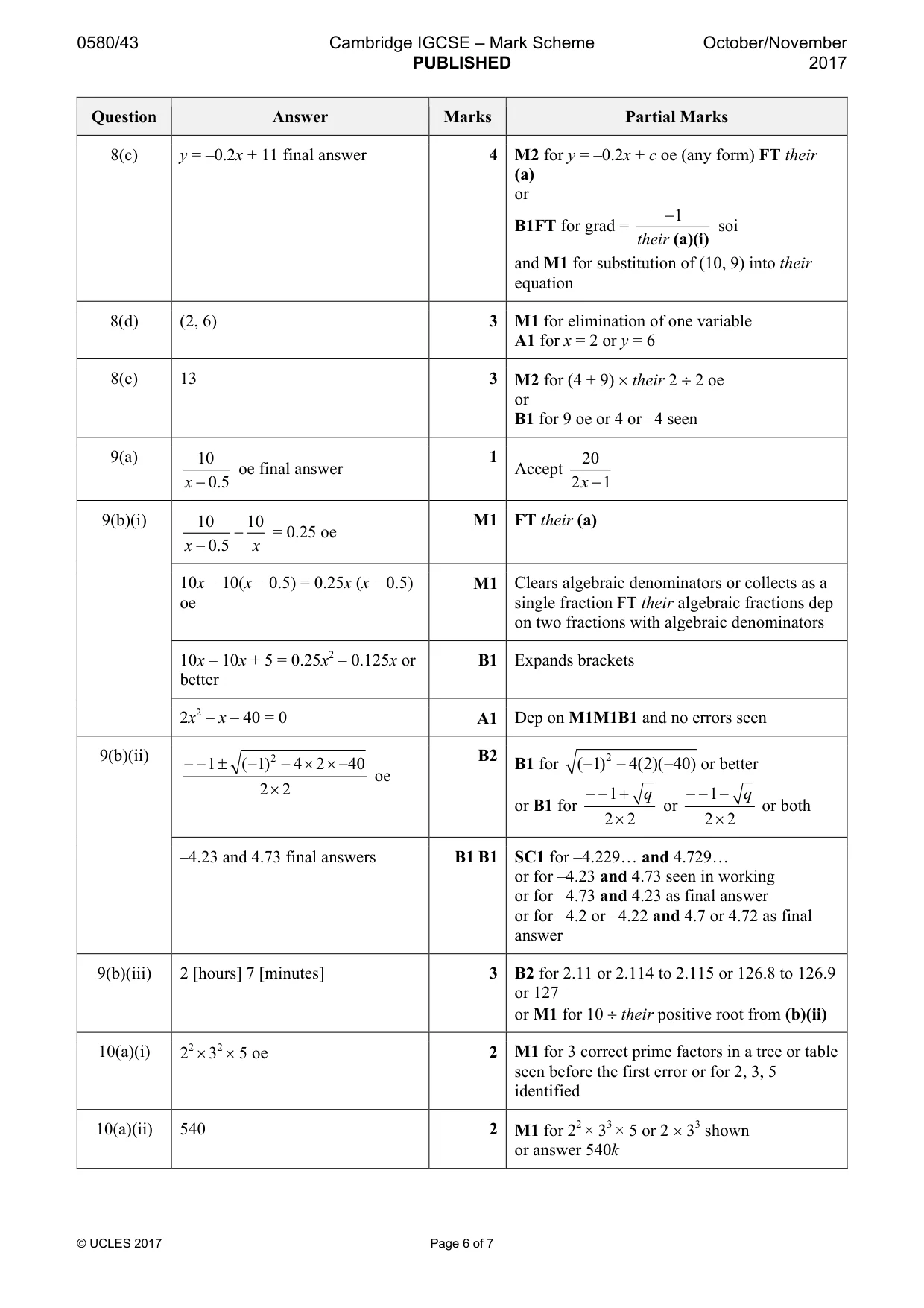
Mark scheme: 8(a)(i) 5 1 8(a)(ii) 3 1 − oe 2 8(b) 4 2 M1 for 5x – 4 = 0 soi , 0 oe 5 8(c) y = –0.2x + 11 final answer 4 M2 for y = –0.2x + c oe (any form) FT their (a) or −1 B1FT for grad = soi their (a)(i) and M1 for substitution of (10, 9) into their equation 8(d) (2, 6) 3 M1 for elimination of one variable A1 for x = 2 or y = 6 8(e) 13 3 M2 for (4 + 9) × their 2 ÷ 2 oe or B1 for 9 oe or 4 or –4 seen
Q9 · Luigi and Alfredo run in a 10 km race
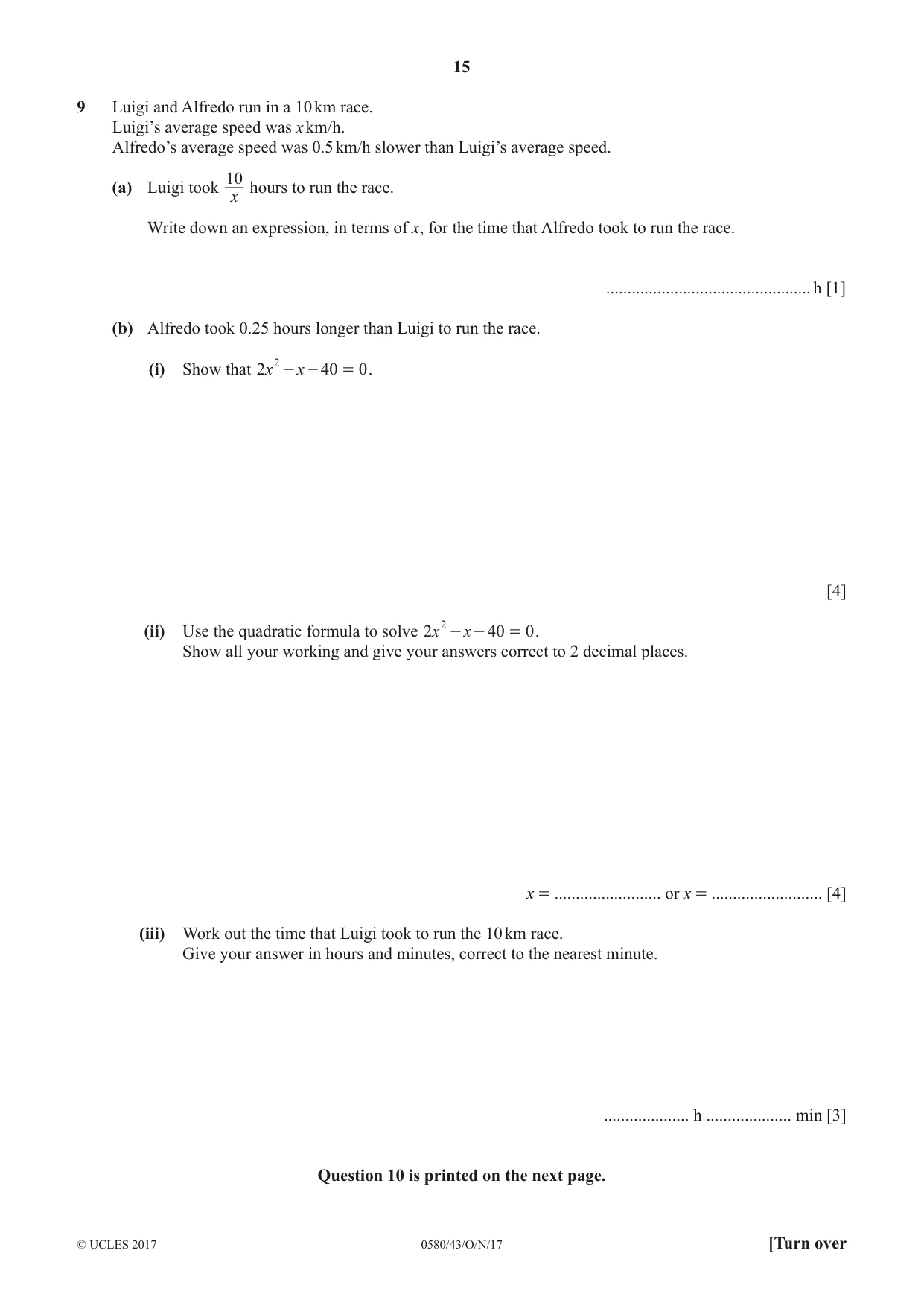
9 Luigi and Alfredo run in a 10 km race. Luigi’s average speed was x km/h. Alfredo’s average speed was 0.5 km/h slower than Luigi’s average speed. 10 (a) Luigi took hours to run the race. x Write down an expression, in terms of x, for the time that Alfredo took to run the race. ................................................ h [1] (b) Alfredo took 0.25 hours longer than Luigi to run the race. (i) Show that 2x 2 - x - 40 = 0 . [4] (ii) Use the quadratic formula to solve 2x 2 - x - 40 = 0 . Show all your working and give your answers correct to 2 decimal places. x = ......................... or x = .......................... [4] (iii) Work out the time that Luigi took to run the 10 km race. Give your answer in hours and minutes, correct to the nearest minute. .................... h .................... min [3] Question 10 is printed on the next page.
Mark scheme: 9(a) 10 1 20 oe final answer Accept x − 0.5 2 x − 1 9(b)(i) 10 10 M1 FT their (a) − = 0.25 oe x − 0.5 x 10x – 10(x – 0.5) = 0.25x (x – 0.5) M1 Clears algebraic denominators or collects as a oe single fraction FT their algebraic fractions dep on two fractions with algebraic denominators 10x – 10x + 5 = 0.25x2 – 0.125x or B1 Expands brackets better 2x2 – x – 40 = 0 A1 Dep on M1M1B1 and no errors seen 9(b)(ii) 2 B2 2 −−±1 ( − 1) − 4 × 2 × −40 B1 for ( −1) − 4(2)( −40) or better oe 2 × 2 −−+1 q −−−1 q or B1 for or or both 2 × 2 2 × 2 –4.23 and 4.73 final answers B1 B1 SC1 for –4.229… and 4.729… or for –4.23 and 4.73 seen in working or for –4.73 and 4.23 as final answer or for –4.2 or –4.22 and 4.7 or 4.72 as final answer 9(b)(iii) 2 [hours] 7 [minutes] 3 B2 for 2.11 or 2.114 to 2.115 or 126.8 to 126.9 or 127 or M1 for 10 ÷ their positive root from (b)(ii)
Q10 · Write 180 as a product of its prime factors
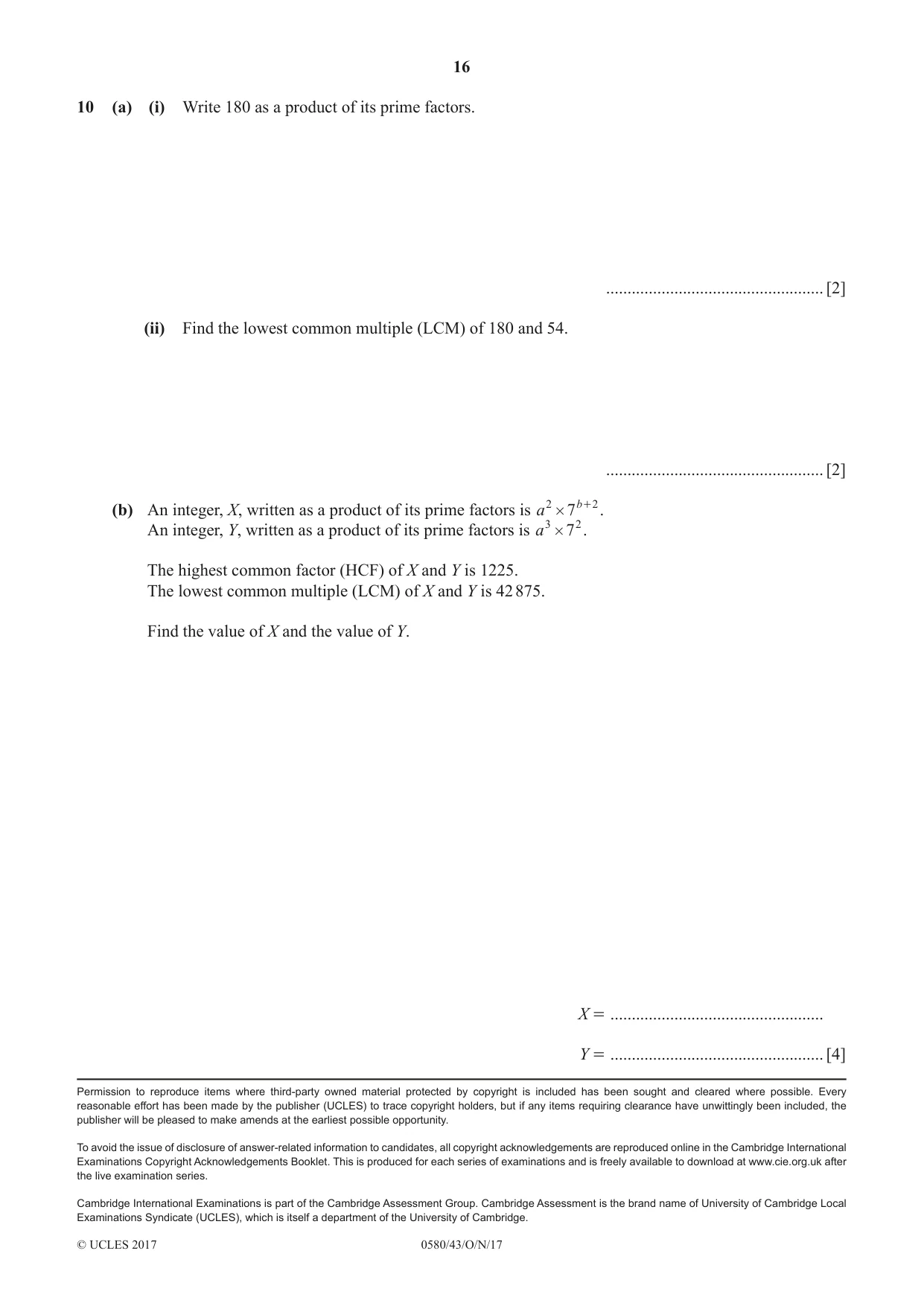
10 (a) (i) Write 180 as a product of its prime factors. ................................................... [2] (ii) Find the lowest common multiple (LCM) of 180 and 54. ................................................... [2] (b) An integer, X, written as a product of its prime factors is a 2 # 7b + 2 . An integer, Y, written as a product of its prime factors is a 3 # 72 . The highest common factor (HCF) of X and Y is 1225. The lowest common multiple (LCM) of X and Y is 42 875. Find the value of X and the value of Y. X = .................................................. Y = .................................................. [4]
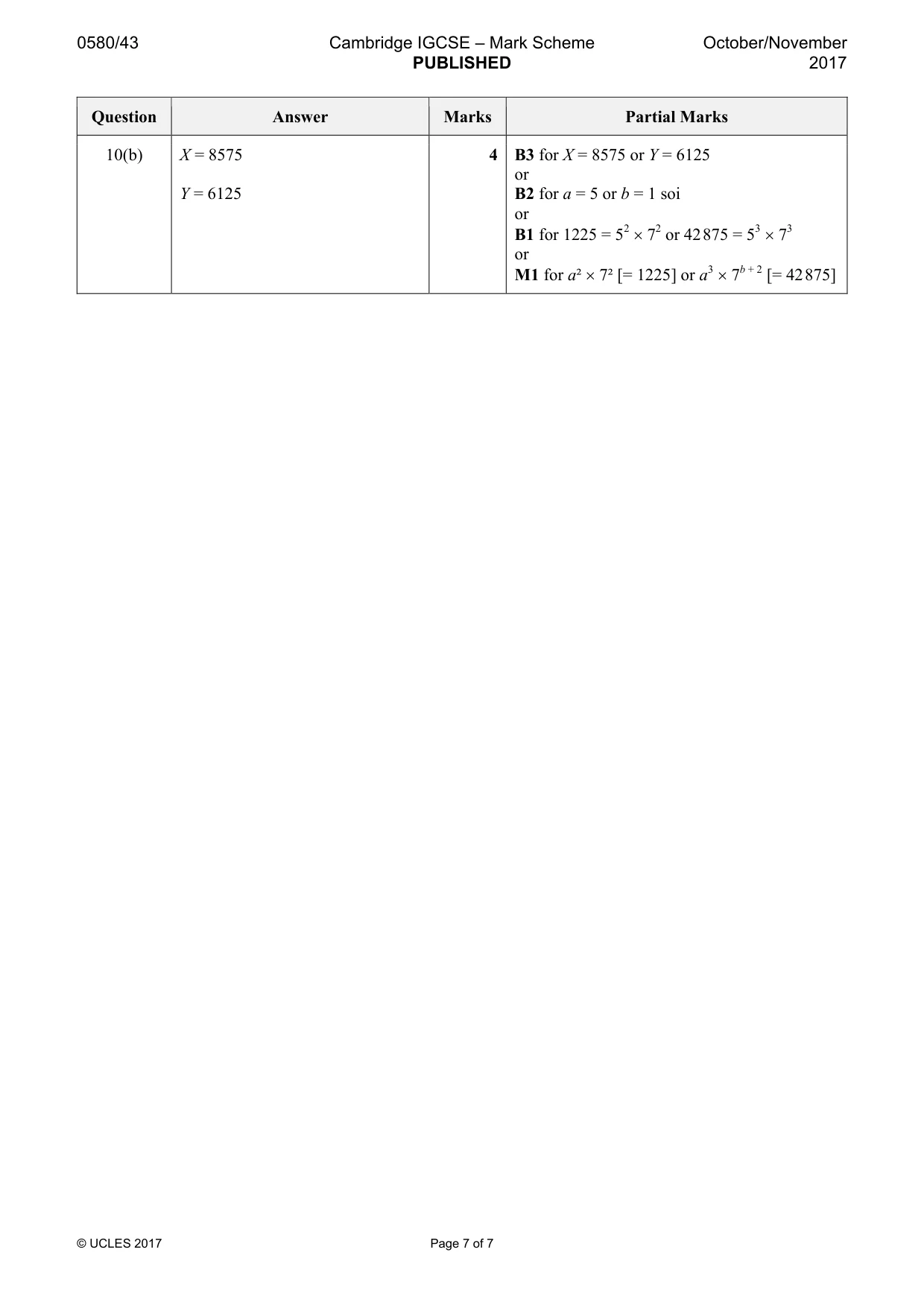
Mark scheme: 10(a)(i) 22 × 32 × 5 oe 2 M1 for 3 correct prime factors in a tree or table seen before the first error or for 2, 3, 5 identified 10(a)(ii) 540 2 M1 for 22 × 33 × 5 or 2 × 33 shown or answer 540k 10(b) X = 8575 4 B3 for X = 8575 or Y = 6125 or Y = 6125 B2 for a = 5 or b = 1 soi or B1 for 1225 = 52 × 72 or 42 875 = 53 × 73 or M1 for a² × 7² [= 1225] or a3 × 7b + 2 [= 42 875]
What was in this paper
The subtopics covered by these 10 questions, and how many questions each got. Open one in a new tab to see every Cambridge question on it.
What you needed in this session
Cambridge’s own grade thresholds for 2017 Oct/Nov, Paper 4 · Variant 3. A higher threshold means an easier paper — the bar moves with how the cohort did.