Questions as text
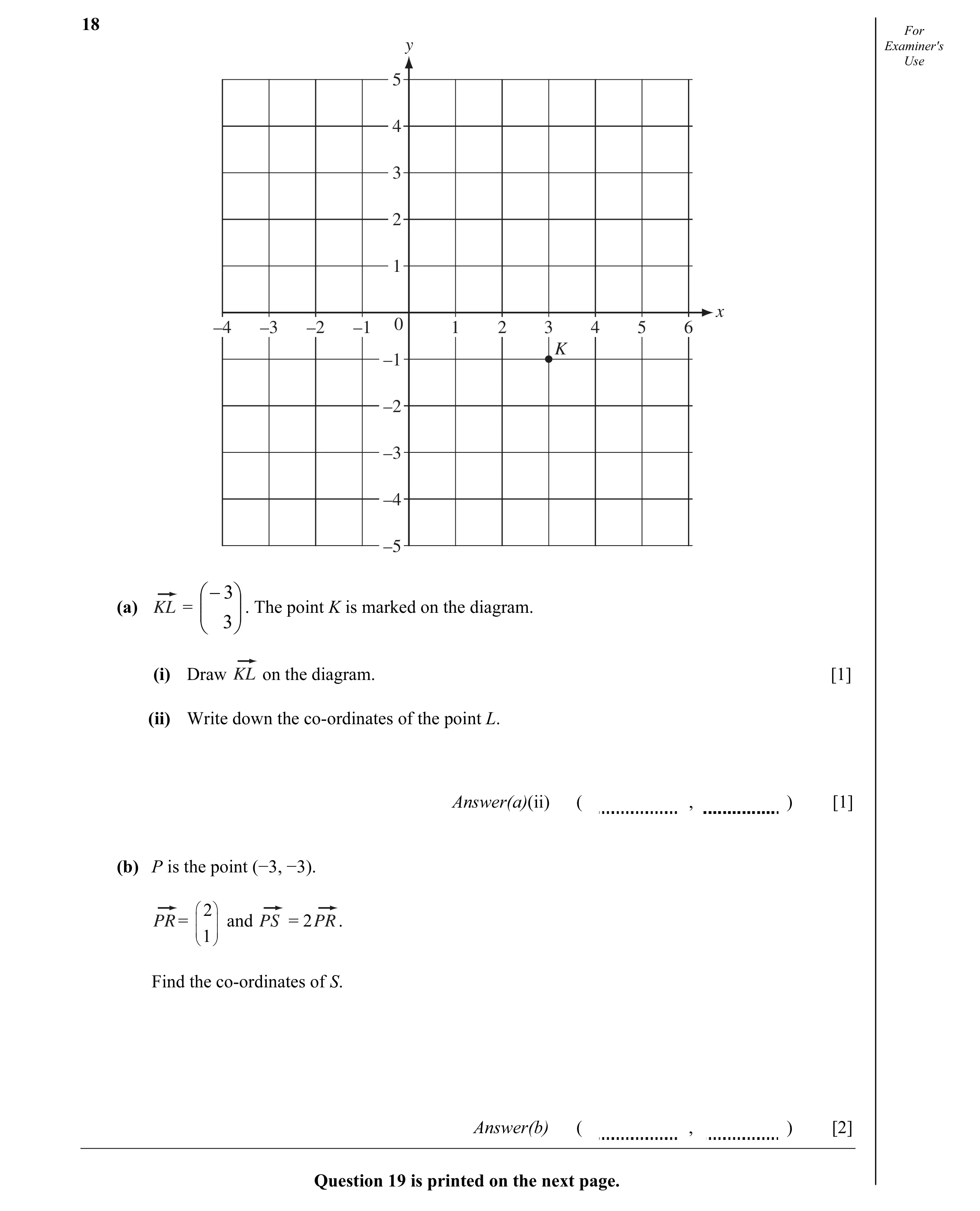
Q1 · For y Examiner's Use 5 4 3 2 1 x –4 –3 –2 –1 0 1 2 3 4 5 6 K –1 –2 –3 –4 –5 − 3 (a) KL… 0580/11 Oct/Nov 2007
18 For y Examiner's Use 5 4 3 2 1 x –4 –3 –2 –1 0 1 2 3 4 5 6 K –1 –2 –3 –4 –5 − 3 (a) KL = . The point K is marked on the diagram. 3 (i) Draw KL on the diagram. [1] (ii) Write down the co-ordinates of the point L. Answer(a)(ii) ( , ) [1] (b) P is the point (−3, −3). 2 PR= and PS = 2PR. 1 Find the co-ordinates of S. Answer(b) ( , ) [2] Question 19 is printed on the next page.
4 marks
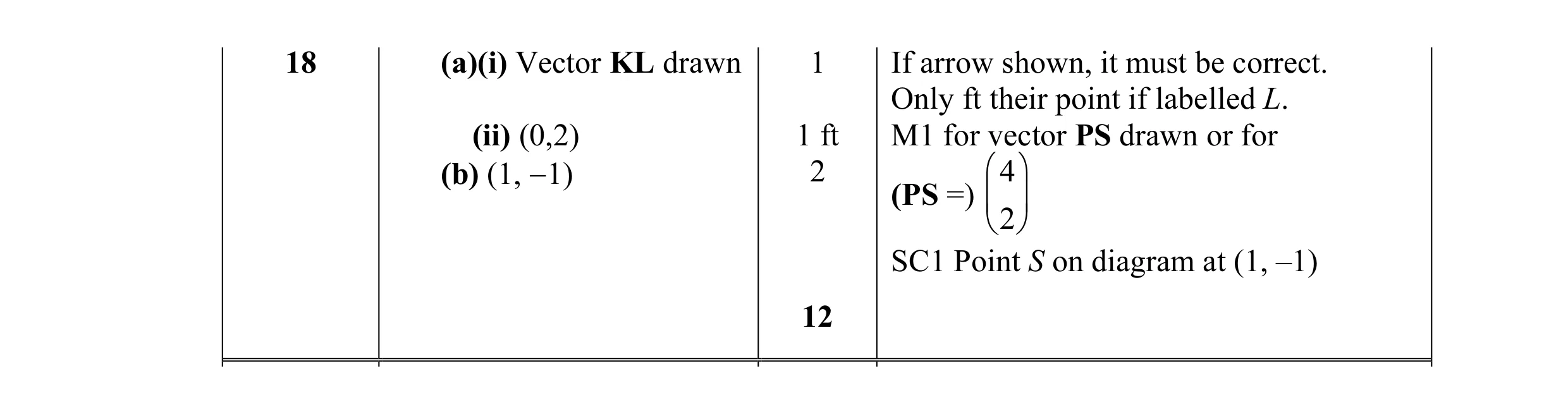
Mark scheme: 18 (a)(i) Vector KL drawn 1 If arrow shown, it must be correct. Only ft their point if labelled L. (ii) (0,2) 1 ft M1 for vector PS drawn or for (b) (1, −1) 2 4 (PS =) 2 SC1 Point S on diagram at (1, –1) 12
This question in 0580/11 Oct/Nov 2007
Q2 · Y 3 l 2 B 1 x –4 –3 –2 –1 0 1 2 3 4 –1 –2 –3 (a) Mark clearly on the diagram the point… 0580/11 Oct/Nov 2008
15 y 3 l 2 B 1 x –4 –3 –2 –1 0 1 2 3 4 –1 –2 –3 (a) Mark clearly on the diagram the point with co-ordinates (3, 2) and label it A. [1] (b) Write down the co-ordinates of the point B. Answer(b) ( , ) [1] (c) Find the gradient of the line l. Answer(c) [1]
3 marks
Mark scheme: 15 (a) Point marked at (3, 2) 1 Missing label not penalised. (b) ( −2, 1) 1 More than 1 point seen, must be labelled (c) 1 1 By eye 2mm −0.5 or − 2
This question in 0580/11 Oct/Nov 2008
Q3 · For y Examiner's G Use 5 4 3 2 F 1 x –3 –2 –1 0 1 2 3 4 5 –1 –2 –3 –4 The points F and G… 0580/11 Oct/Nov 2009
13 For y Examiner's G Use 5 4 3 2 F 1 x –3 –2 –1 0 1 2 3 4 5 –1 –2 –3 –4 The points F and G are shown on the grid. (a) Write down the co-ordinates of the point F. Answer(a)( , ) [1] (b) Write as a column vector. Answer(b) = ( ) [1] _2 (c) GH = . Mark and label the point H on the grid. [1] _7
3 marks
Mark scheme: 13 (a) (–2, 1) 1 All coordinates/components reversed. 4 ie (a) (1, −2), (b) , (c) (−3, 3) 6 6 (b) 1 mark 0, 0, SC1 4 (c) H at (2, –2) 1
This question in 0580/11 Oct/Nov 2009
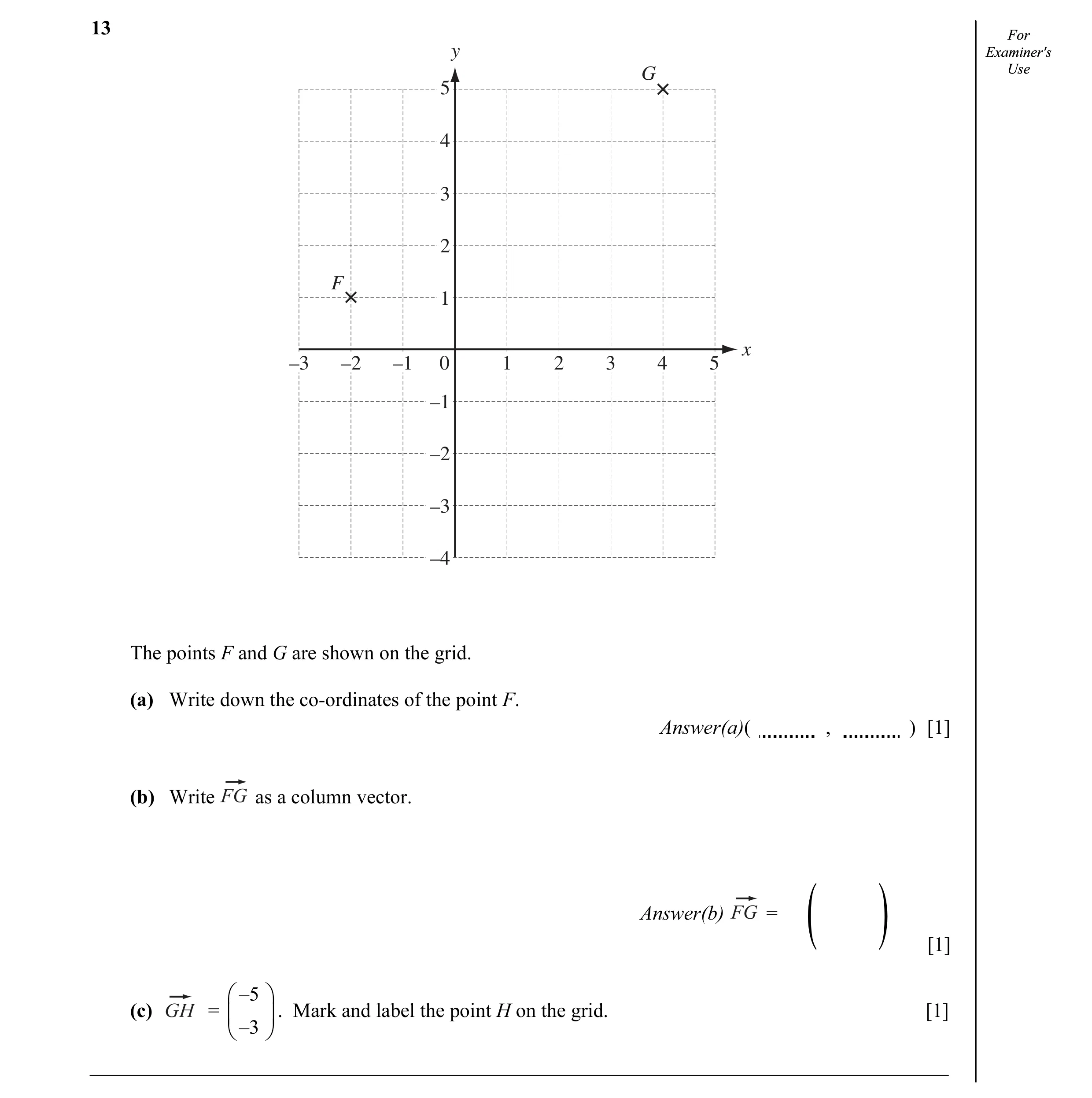
Q4 · ForFor y Examiner'sExaminer's G UseUse 5 4 3 2 F 1 x –3 –2 –1 0 1 2 3 4 5 –1 –2 –3 –4 The… 0580/12 Oct/Nov 2009
13 ForFor y Examiner'sExaminer's G UseUse 5 4 3 2 F 1 x –3 –2 –1 0 1 2 3 4 5 –1 –2 –3 –4 The points F and G are shown on the grid. (a) Write down the co-ordinates of the point F. Answer(a)( , ) [1] (b) Write as a column vector. Answer(b) = ( ) [1] _5 (c) = . Mark and label the point H on the grid. [1] _3
3 marks
Mark scheme: 13 (a) (–2, 1) 1 All coordinates/components reversed. 4 ie (a) (1, −2), (b) , (c) (1, 0) 6 6 (b) 1 mark 0, 0, SC1 4 (c) H at (–1, 2) 1
This question in 0580/12 Oct/Nov 2009
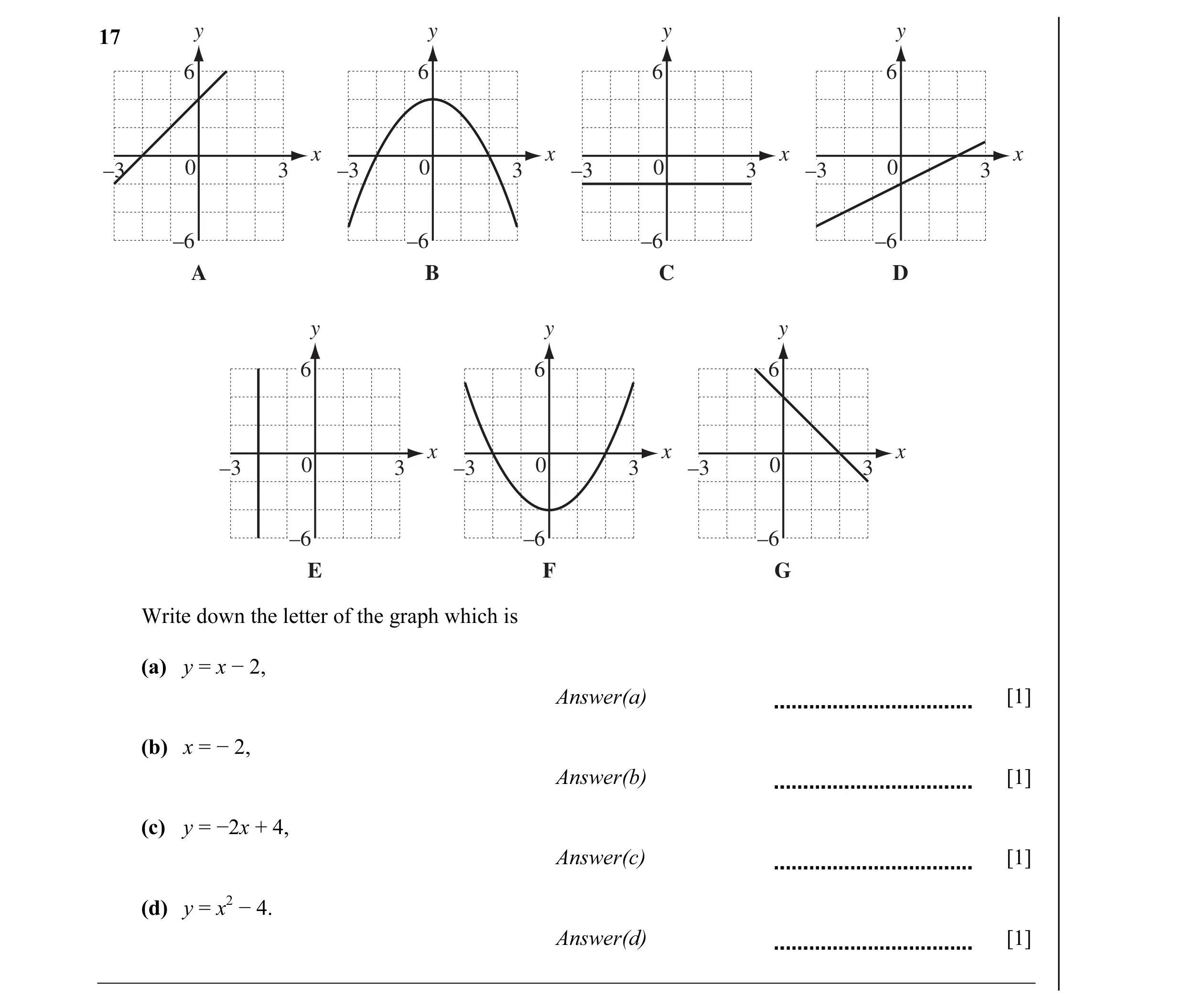
Q5 · Y y y y17 6 6 6 6 x x x x –3 0 3 –3 0 3 –3 0 3 –3 0 3 –6 –6 –6 –6 A B C D y y y 6 6 6 x x… 0580/12 May/June 2010
y y y y17 6 6 6 6 x x x x –3 0 3 –3 0 3 –3 0 3 –3 0 3 –6 –6 –6 –6 A B C D y y y 6 6 6 x x x –3 0 3 –3 0 3 –3 0 3 –6 –6 –6 E F G Write down the letter of the graph which is (a) y = x − 2, Answer(a) [1] (b) x = − 2, Answer(b) [1] (c) y = −2x + 4, Answer(c) [1] (d) y = x2 − 4. Answer(d) [1]
4 marks
Mark scheme: 17 (a) D 1 (b) E 1 (c) G 1 (d) F 1 7
This question in 0580/12 May/June 2010
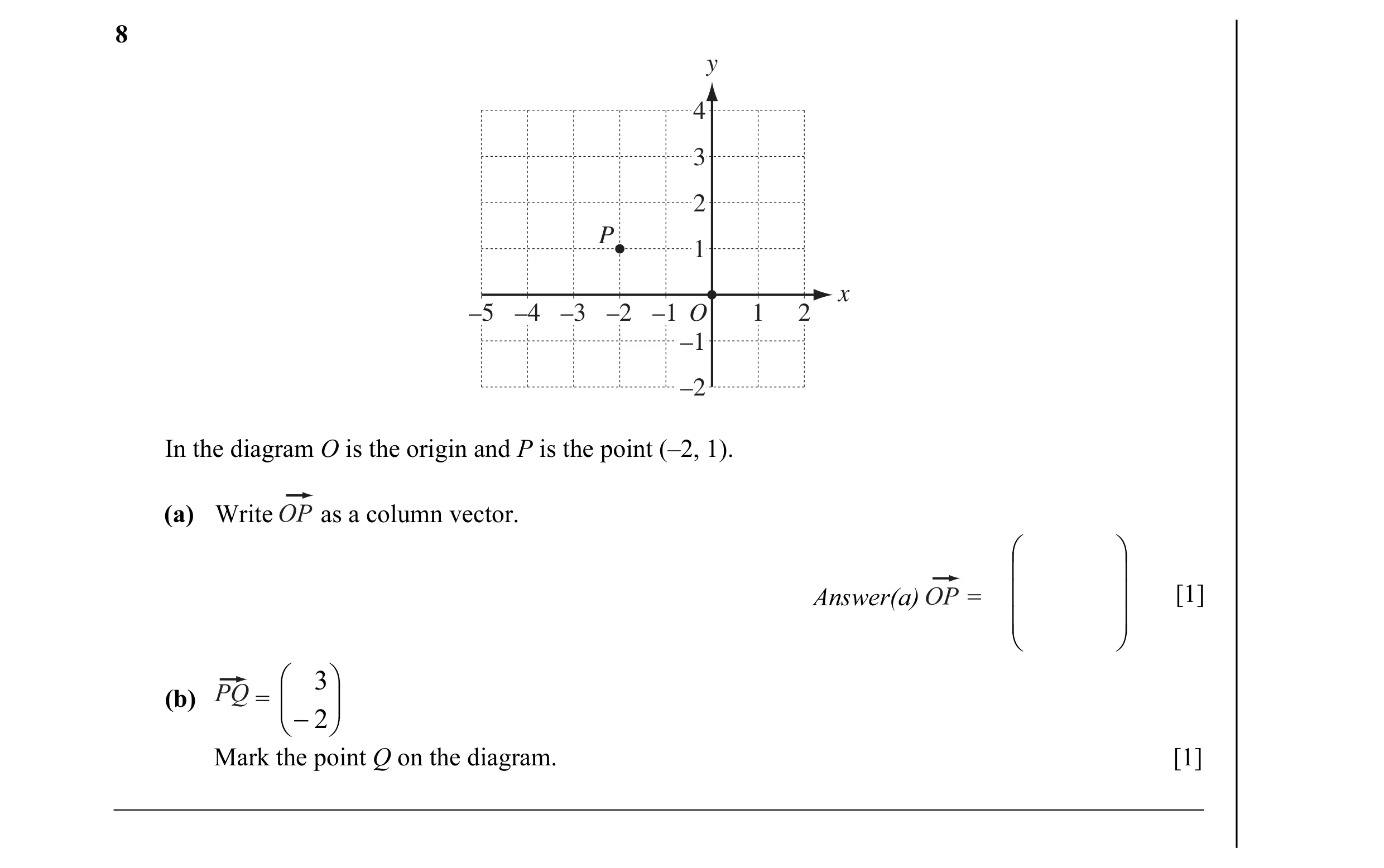
Q6 · Y 4 3 2 P 1 x –5 –4 –3 –2 –1 O 1 2 –1 –2 In the diagram O is the origin and P is the… 0580/13 May/June 2011
8 y 4 3 2 P 1 x –5 –4 –3 –2 –1 O 1 2 –1 –2 In the diagram O is the origin and P is the point (–2, 1). (a) Write as a column vector. Answer(a) = [1] 3 (b) = −2 Mark the point Q on the diagram. [1]
2 marks
Mark scheme: 8 (a) − 2 1 1 (b) 1 Point marked at (1, −1)
This question in 0580/13 May/June 2011
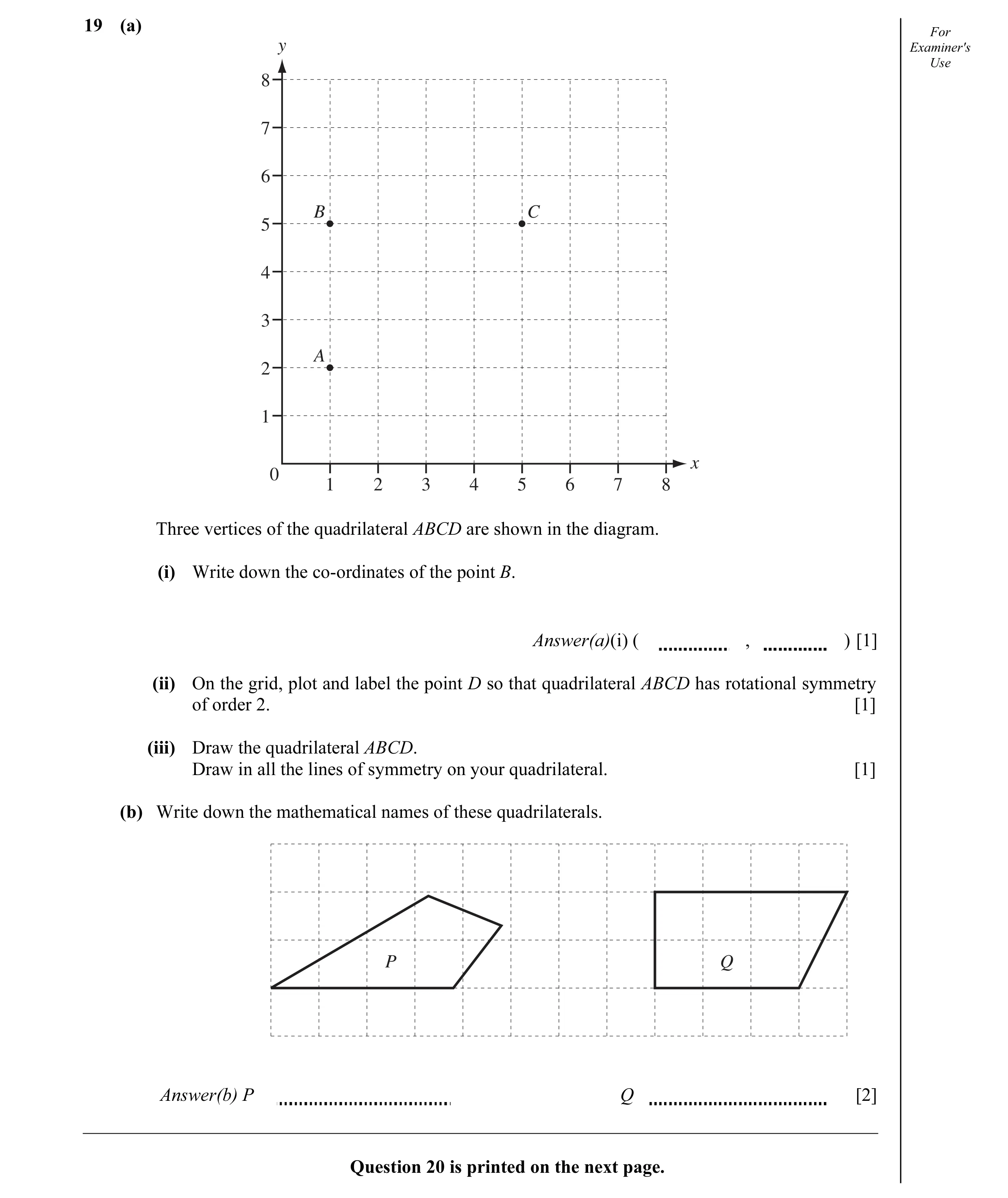
Q7 · For y Examiner's Use 8 7 6 B C 5 4 3 A 2 1 x 0 1 2 3 4 5 6 7 8 Three vertices of the… 0580/12 Oct/Nov 2011
19 (a) For y Examiner's Use 8 7 6 B C 5 4 3 A 2 1 x 0 1 2 3 4 5 6 7 8 Three vertices of the quadrilateral ABCD are shown in the diagram. (i) Write down the co-ordinates of the point B. Answer(a)(i) ( , ) [1] (ii) On the grid, plot and label the point D so that quadrilateral ABCD has rotational symmetry of order 2. [1] (iii) Draw the quadrilateral ABCD. Draw in all the lines of symmetry on your quadrilateral. [1] (b) Write down the mathematical names of these quadrilaterals. P Q Answer(b) P Q [2] Question 20 is printed on the next page.
5 marks
Mark scheme: 19 (a) (i) (1, 5) 1 (ii) D at (5, 2) 1 (iii) Lines x = 3 and y = 3.5 only 1 Dep on (a)(ii) Extra line(s) zero drawn Lines should at least meet the sides (b) Kite Trapezium 1, 1 1 mark for each
This question in 0580/12 Oct/Nov 2011
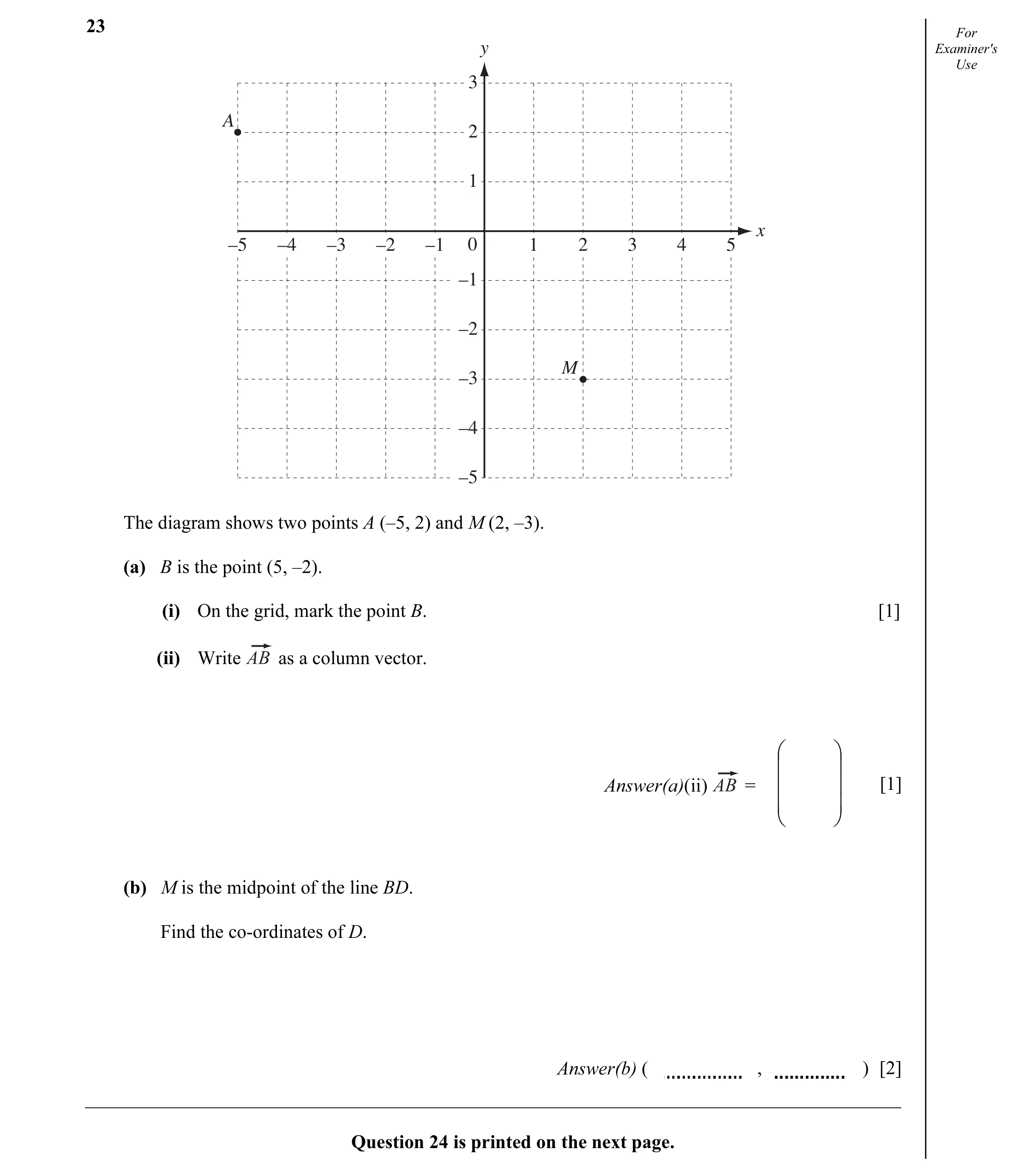
Q8 · For y Examiner's Use 3 A 2 1 x –5 –4 –3 –2 –1 0 1 2 3 4 5 –1 –2 M –3 –4 –5 The diagram… 0580/13 Oct/Nov 2011
23 For y Examiner's Use 3 A 2 1 x –5 –4 –3 –2 –1 0 1 2 3 4 5 –1 –2 M –3 –4 –5 The diagram shows two points A (–5, 2) and M (2, –3). (a) B is the point (5, –2). (i) On the grid, mark the point B. [1] (ii) Write as a column vector. Answer(a)(ii) = [1] (b) M is the midpoint of the line BD. Find the co-ordinates of D. Answer(b) ( , ) [2] Question 24 is printed on the next page.
4 marks
Mark scheme: 23 (a) (i) B at (5, −2) 1 10 (ii) 1ft −4 (b) (–1, –4) 2ft B1, B1 follow through their B plotted 2 2 ( )
This question in 0580/13 Oct/Nov 2011
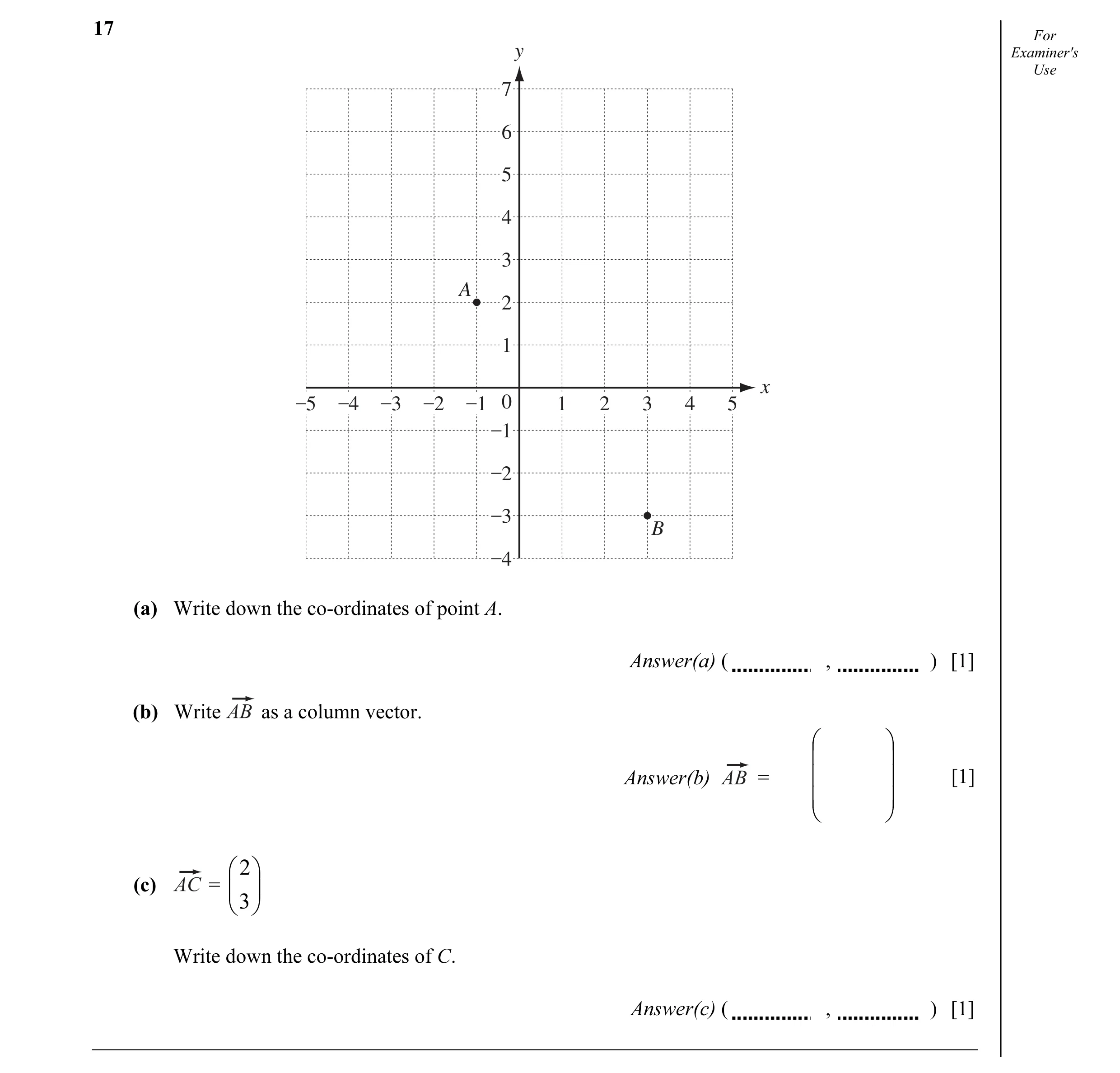
Q9 · For y Examiner's Use 7 6 5 4 3 A 2 1 x –5 –4 –3 –2 –1 0 1 2 3 4 5 –1 –2 –3 B –4 (a) Write… 0580/11 May/June 2012
17 For y Examiner's Use 7 6 5 4 3 A 2 1 x –5 –4 –3 –2 –1 0 1 2 3 4 5 –1 –2 –3 B –4 (a) Write down the co-ordinates of point A. Answer(a) ( , ) [1] (b) Write as a column vector. Answer(b) = [1] 2 (c) = 3 Write down the co-ordinates of C. Answer(c) ( , ) [1]
3 marks
Mark scheme: 17 (a) (–1, 2) 1 4 (b) 1 −5 (c) 1 (1, 5)
This question in 0580/11 May/June 2012
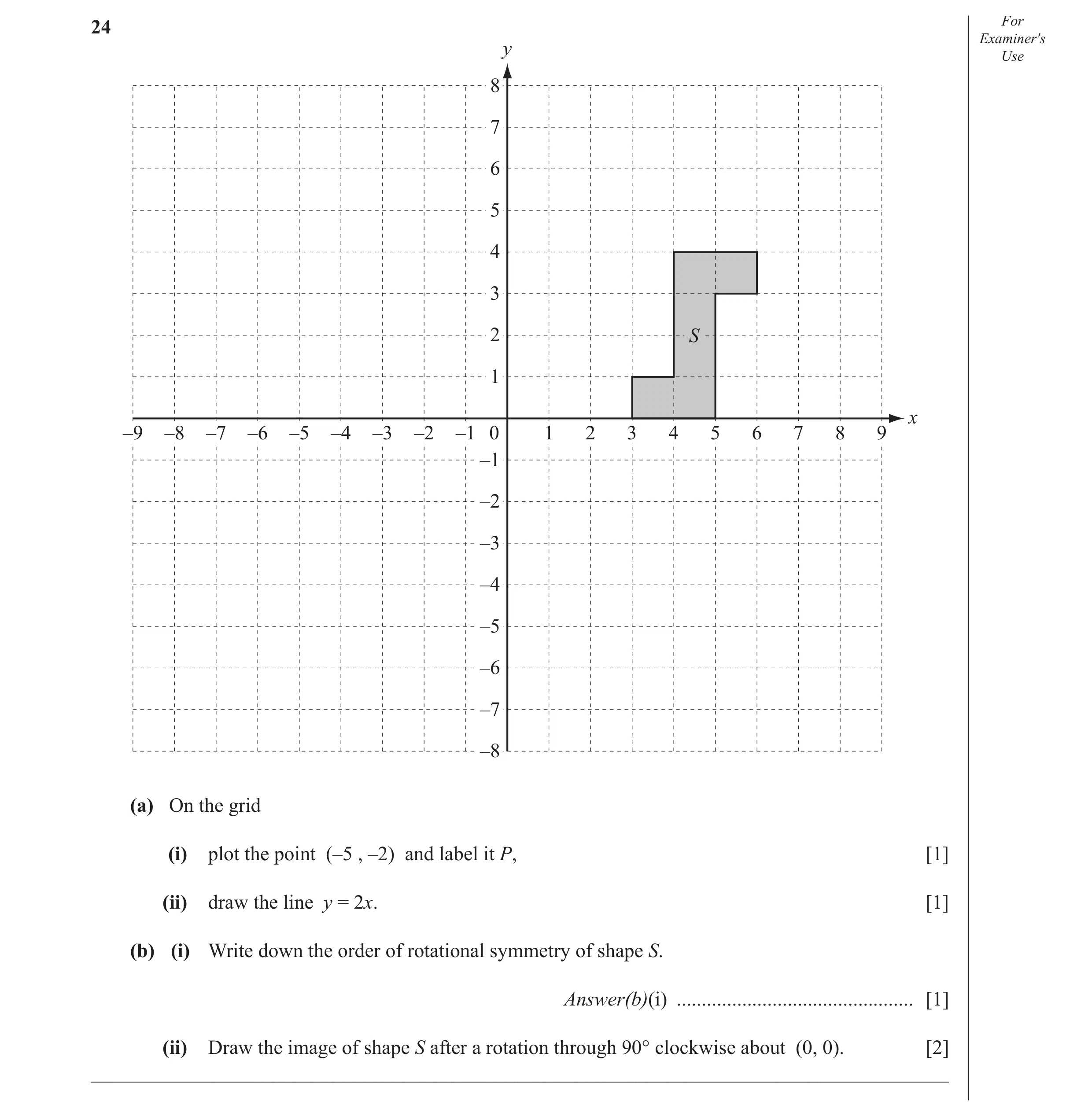
Q10 · For Examiner′s y Use 8 7 6 5 4 3 2 S 1 x –9 –8 –7 –6 –5 –4 –3 –2 –1 0 1 2 3 4 5 6 7 8 9… 0580/12 May/June 2013
24 For Examiner′s y Use 8 7 6 5 4 3 2 S 1 x –9 –8 –7 –6 –5 –4 –3 –2 –1 0 1 2 3 4 5 6 7 8 9 –1 –2 –3 –4 –5 –6 –7 –8 (a) On the grid (i) plot the point (–5 , –2) and label it P, [1] (ii) draw the line y = 2x. [1] (b) (i) Write down the order of rotational symmetry of shape S. Answer(b)(i) … [1] (ii) Draw the image of shape S after a rotation through 90° clockwise about (0, 0). [2] _____________________________________________________________________________________
5 marks
Mark scheme: 24 (a) (i) P in correct position at (– 5, – 2) 1 (ii) y = 2x drawn 1 (b) (i) 2 1 (ii) S rotated correctly 2 SC1 if rotated 90acw or 90cw about wrong centre.
This question in 0580/12 May/June 2013
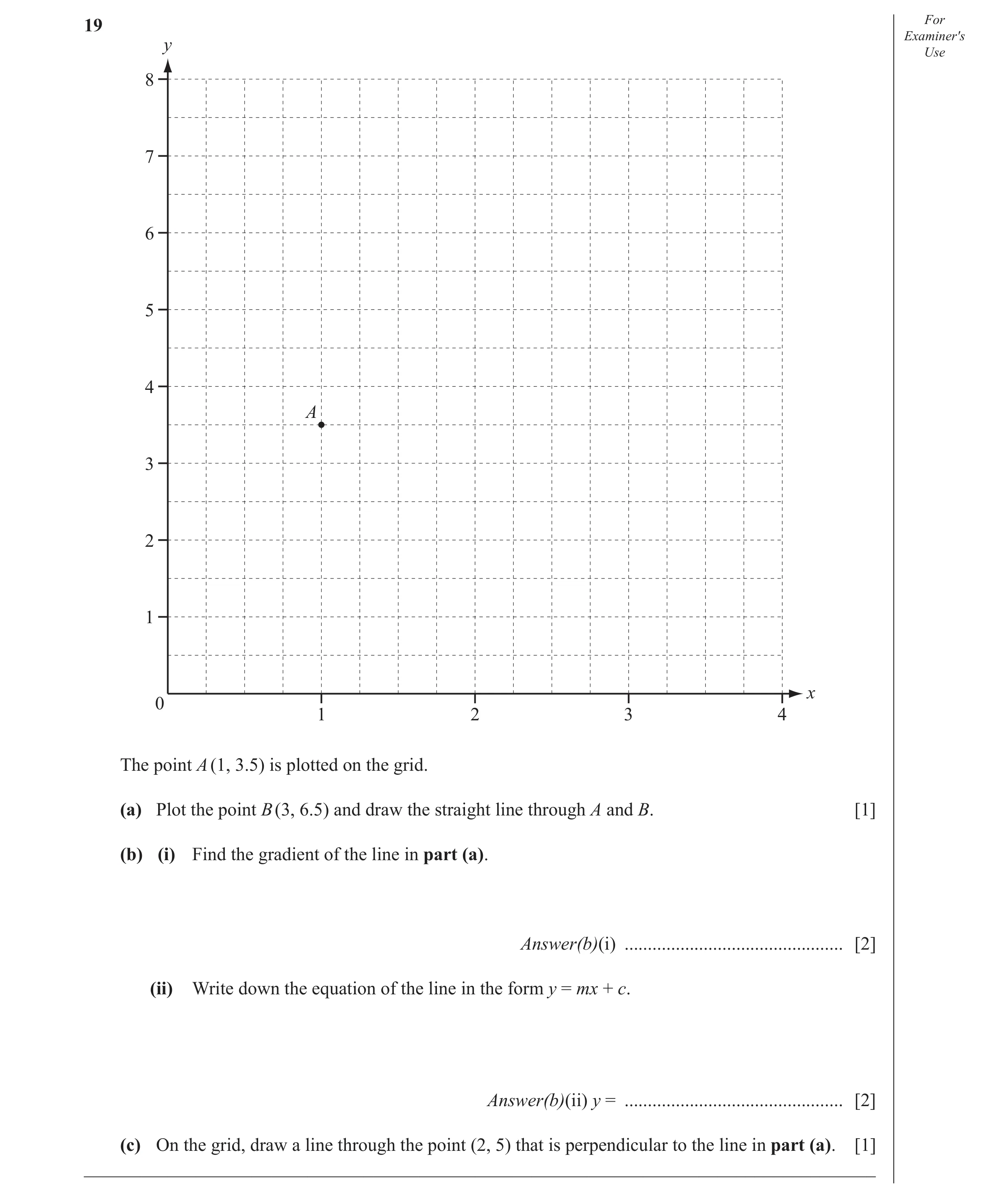
Q11 · For Examiner′s y Use 8 7 6 5 4 A 3 2 1 x 0 1 2 3 4 The point A (1, 3.5) is plotted on the… 0580/13 May/June 2013
19 For Examiner′s y Use 8 7 6 5 4 A 3 2 1 x 0 1 2 3 4 The point A (1, 3.5) is plotted on the grid. (a) Plot the point B (3, 6.5) and draw the straight line through A and B. [1] (b) (i) Find the gradient of the line in part (a). Answer(b)(i) … [2] (ii) Write down the equation of the line in the form y = mx + c. Answer(b)(ii) y = … [2] (c) On the grid, draw a line through the point (2, 5) that is perpendicular to the line in part (a). [1] _____________________________________________________________________________________
6 marks
Mark scheme: 19 (a) B (3 , 6.5) plotted and a ruled line A to B 1 Rise (b) (i) 1.5 oe 2ft M1 for applied to their line Run (ii) (y = ) 1.5 x + 2 2ft B1 for their (b) (i) x + a ( a ≠ 2) or b x + their 2 (b ≠ 0 or 1.5) (c) Ruled Line perpendicular to their line 1ft (±2º) and through the point (2 , 5) IGCSE – May/June 2013 0580 13
This question in 0580/13 May/June 2013
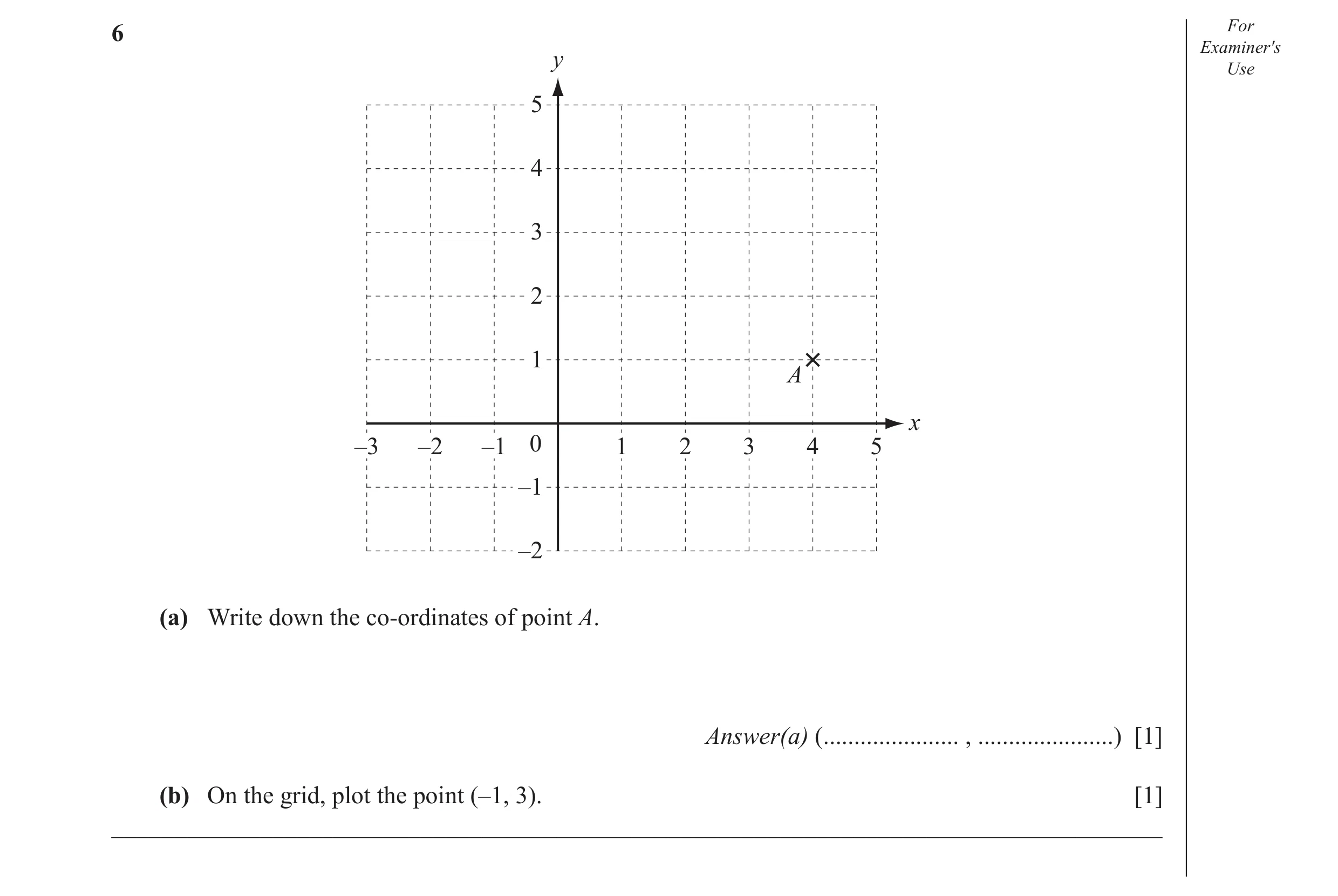
Q12 · For Examiner′s y Use 5 4 3 2 1 A x –3 –2 –1 0 1 2 3 4 5 –1 –2 (a) Write down the… 0580/11 Oct/Nov 2013
6 For Examiner′s y Use 5 4 3 2 1 A x –3 –2 –1 0 1 2 3 4 5 –1 –2 (a) Write down the co-ordinates of point A. Answer(a) ( … , … ) [1] (b) On the grid, plot the point (–1, 3). [1] _____________________________________________________________________________________
2 marks
Mark scheme: 6 (a) (4, 1) 1 (b) Point plotted at (–1, 3) 1
This question in 0580/11 Oct/Nov 2013
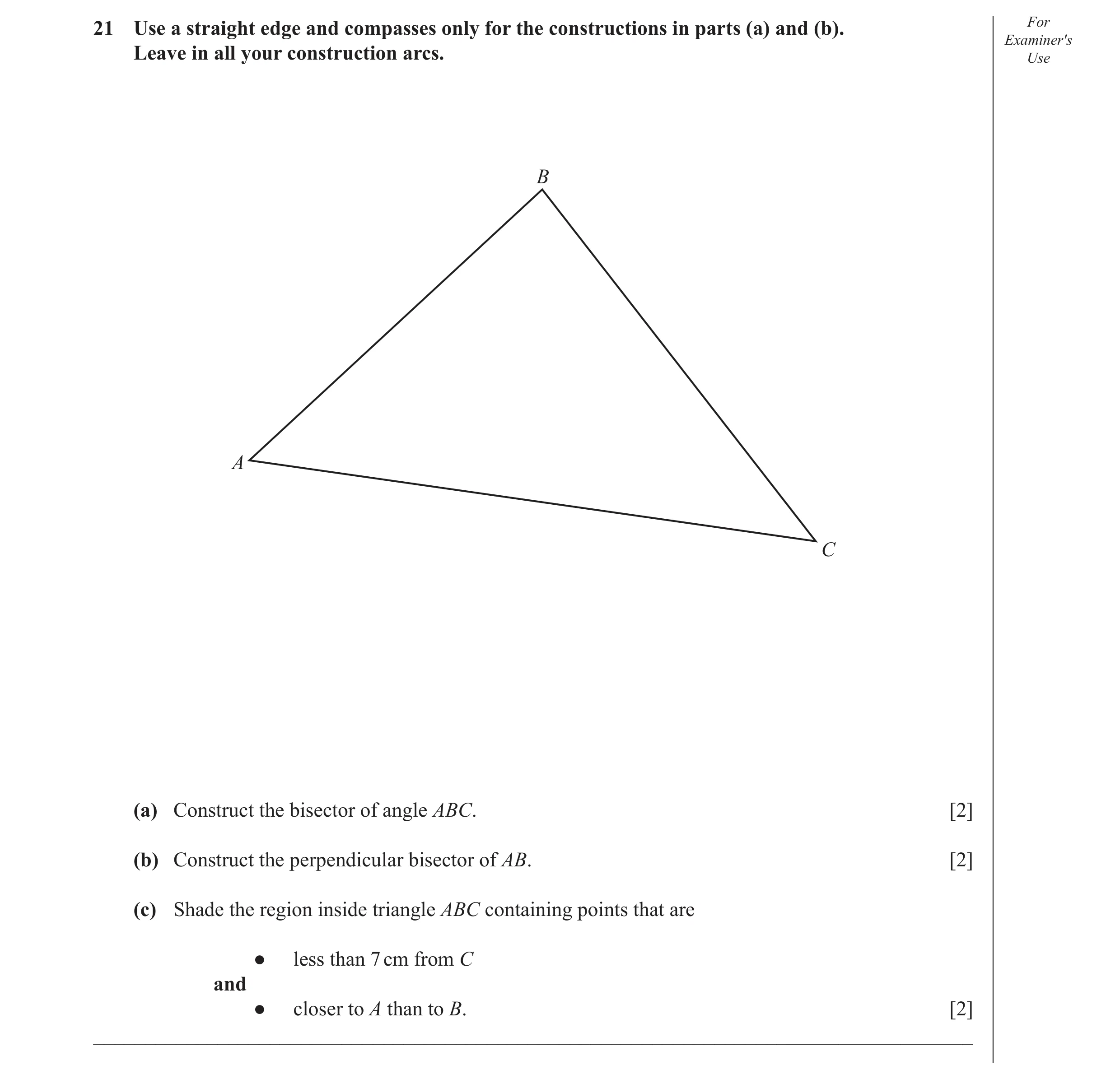
Q13 · Use a straight edge and compasses only for the constructions in parts (a) and (b) 0580/12 Oct/Nov 2013
21 Use a straight edge and compasses only for the constructions in parts (a) and (b). For Examiner′s Leave in all your construction arcs. Use B A C (a) Construct the bisector of angle ABC. [2] (b) Construct the perpendicular bisector of AB. [2] (c) Shade the region inside triangle ABC containing points that are ● less than 7 cm from C and ● closer to A than to B. [2] _____________________________________________________________________________________
6 marks
Mark scheme: 21 (a) Angle bisector with correct arcs 2 B1 for correct line, with incorrect or no arcs or correct arcs with incorrect or no line (b) Perpendicular bisector with two 2 B1 for correct line, with incorrect or no arcs or correct pairs of arcs correct arcs with incorrect or no line (c) Arc centre C, radius 7cm 1 Correct region shaded 1FT FT their arc centre C
This question in 0580/12 Oct/Nov 2013
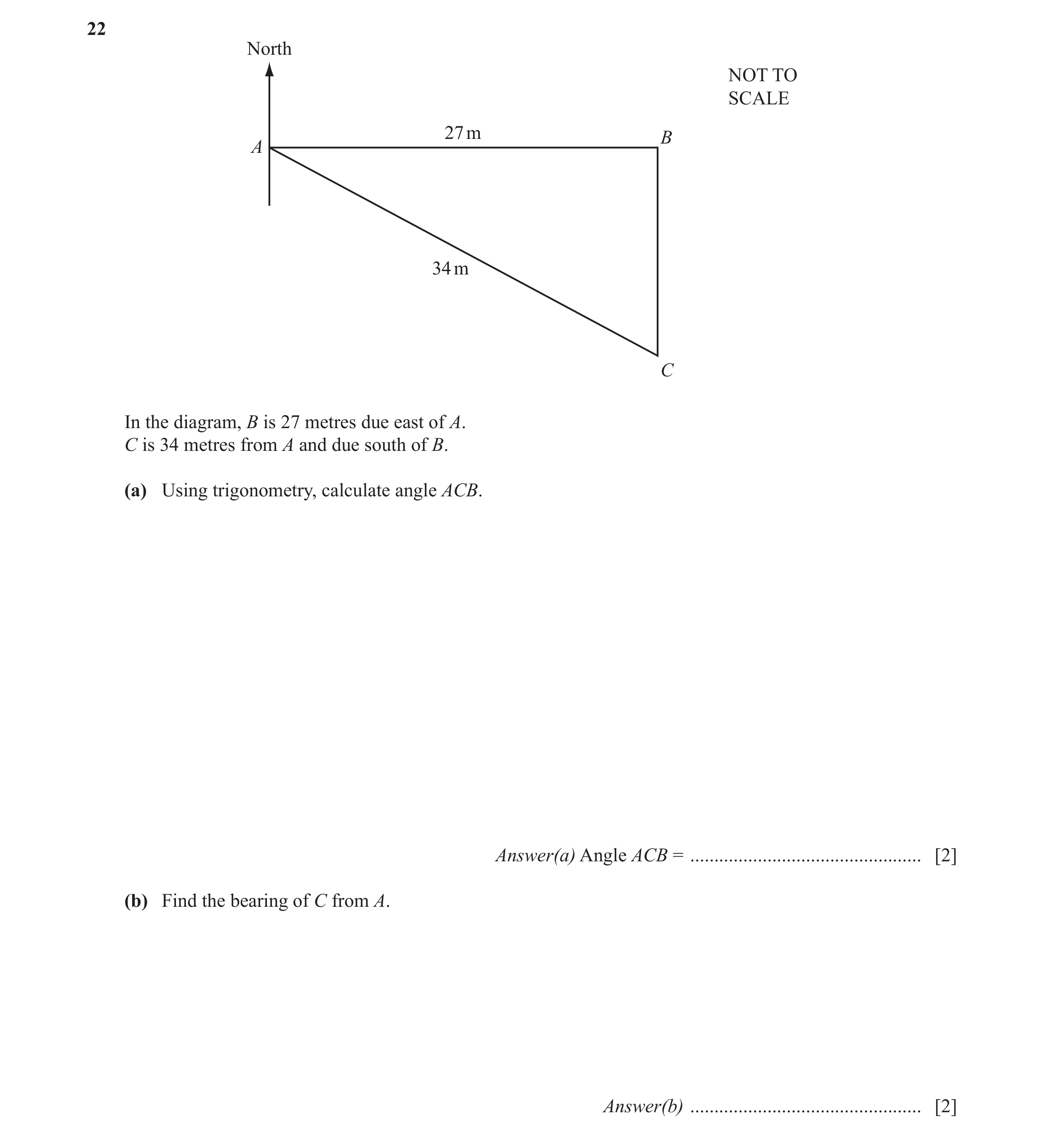
Q14 · North NOT TO SCALE 27 m B A 34 m C In the diagram, B is 27 metres due east of A 0580/11 May/June 2014
22 North NOT TO SCALE 27 m B A 34 m C In the diagram, B is 27 metres due east of A. C is 34 metres from A and due south of B. (a) Using trigonometry, calculate angle ACB. Answer(a) Angle ACB = … [2] (b) Find the bearing of C from A. Answer(b) … [2]
4 marks
Mark scheme: 27 22 (a) 52.6 2 M1 for sin [ ] = 34 (b) 127 or 127.4[…] 2FT 180 – their part (a) B1 for [BAC =] 90 − their part (a)
This question in 0580/11 May/June 2014
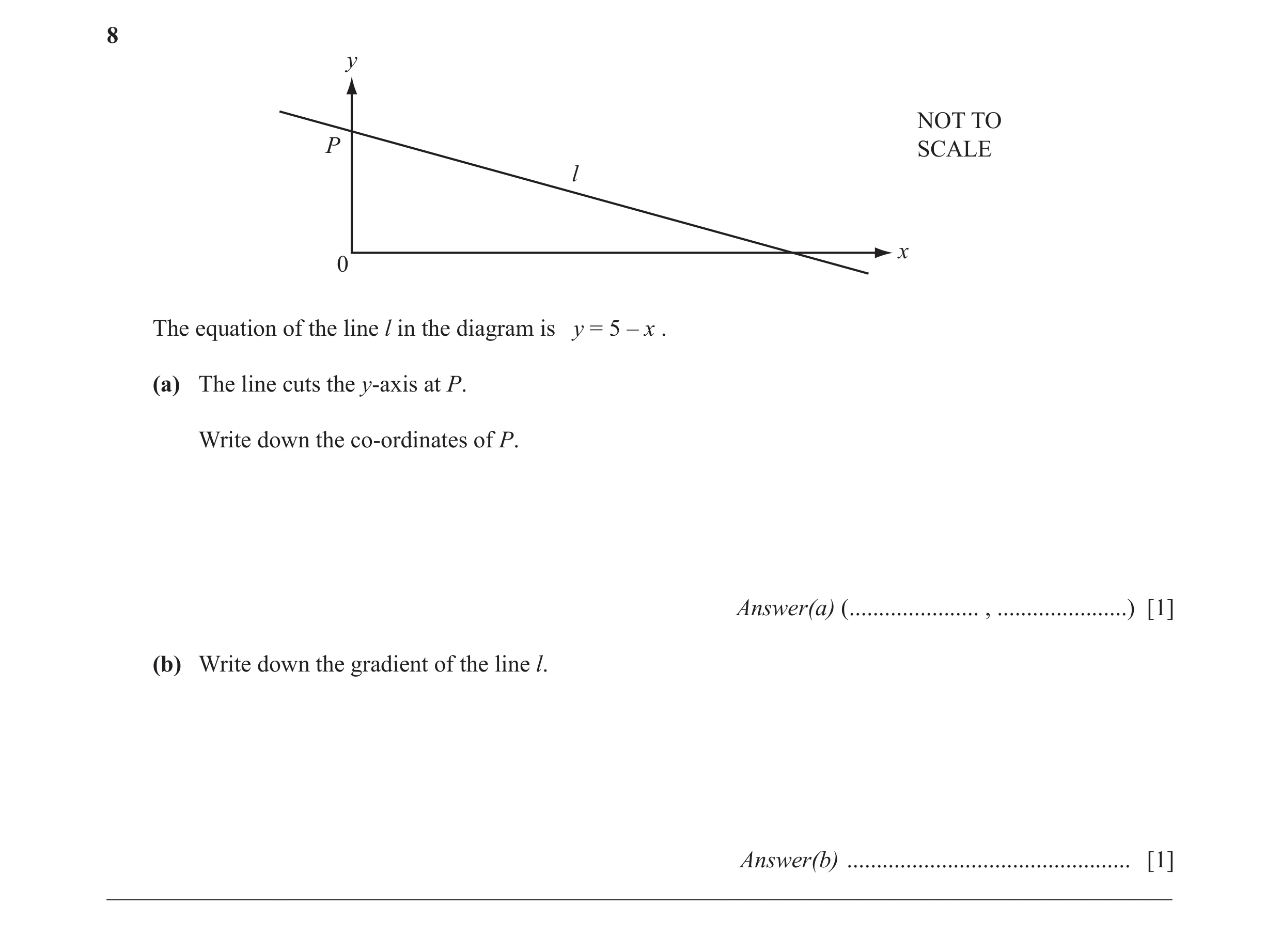
Q15 · Y NOT TO P SCALE l x 0 The equation of the line l in the diagram is y = 5 – x 0580/12 May/June 2014
8 y NOT TO P SCALE l x 0 The equation of the line l in the diagram is y = 5 – x . (a) The line cuts the y-axis at P. Write down the co-ordinates of P. Answer(a) ( … , … ) [1] (b) Write down the gradient of the line l. Answer(b) … [1] __________________________________________________________________________________________
2 marks
Mark scheme: 8 (a) (0, 5) 1 (b) – 1 1
This question in 0580/12 May/June 2014
Q16 · Y 5 4 A 3 2 1 x –6 –5 –4 –3 –2 –1 0 1 2 3 4 B –1 –2 –3 –4 –5 Points A and B are shown on… 0580/11 Oct/Nov 2014
1 y 5 4 A 3 2 1 x –6 –5 –4 –3 –2 –1 0 1 2 3 4 B –1 –2 –3 –4 –5 Points A and B are shown on the grid. Write as a column vector. Answer [1] f p __________________________________________________________________________________________
1 marks
Mark scheme: Qu. Answers Mark Part Marks 7 7 1 1 −4
This question in 0580/11 Oct/Nov 2014
Q17 · Y 4 B 3 2 1 x –4 –3 –2 –1 0 1 2 3 4 A –1 –2 –3 –4 Points A and B are shown on the grid 0580/12 Oct/Nov 2014
10 y 4 B 3 2 1 x –4 –3 –2 –1 0 1 2 3 4 A –1 –2 –3 –4 Points A and B are shown on the grid. (a) Write as a column vector. Answer(a) = [1] f p (b) Write 3 as a column vector. Answer(b) 3 = [1] f p __________________________________________________________________________________________
2 marks
Mark scheme: 10 (a) − 5 1 4 (b) − 15 1FT FT for 3 × their (a) 12 17 15
This question in 0580/12 Oct/Nov 2014
Q18 · D C E A B (a) Draw the locus of the points which are 3 cm from E 0580/13 Oct/Nov 2014
20 D C E A B (a) Draw the locus of the points which are 3 cm from E. [1] (b) Using a straight edge and compasses only, construct the bisector of angle DCB. [2] (c) Shade the region which is ● less than 3 cm from E and ● nearer to CB than to CD. [1] __________________________________________________________________________________________
4 marks
Mark scheme: 20 (a) Complete circle centre E radius 3 cm 1 (b) Correct ruled bisector with two pairs of 2 B1 for correct bisector with no/wrong correct arcs arcs (c) 1 dep on attempt at bisector of C and enclosed region
This question in 0580/13 Oct/Nov 2014
Q19 · Y 6 A 5 4 B 3 2 1 x 0 1 2 3 4 5 6 7 8 (a) Write down the co-ordinates of A 0580/13 May/June 2015
17 y 6 A 5 4 B 3 2 1 x 0 1 2 3 4 5 6 7 8 (a) Write down the co-ordinates of A. Answer(a) ( … , … ) [1] (b) Write down the vector . Answer(b) = [1] f p (c) Work out. + 6 5 e- 4 2 o e o Answer(c) [1] f p (d) Work out. - 3 6 e 7 o Answer(d) [1] f p __________________________________________________________________________________________
4 marks
Mark scheme: 17 (a) 1, 5 1 5 (b) 1 −2 6 (c) 1 −1 − 18 (d) 1 42
This question in 0580/13 May/June 2015
Q20 · Y 8 7 B 6 5 4 3 2 1 A x 0 0.5 1 1.5 2 2.5 3 The line AB is drawn on the grid 0580/11 May/June 2016
21 (a) y 8 7 B 6 5 4 3 2 1 A x 0 0.5 1 1.5 2 2.5 3 The line AB is drawn on the grid. (i) Write down the co-ordinates of A. ( … , … ) [1] (ii) Work out the gradient of the line AB. … [2] (iii) Write down the equation of the line AB in the form y = mx + c. y = … [2] (b) Write down the equation of a straight line that is parallel to y = 5x – 3. … [1]
6 marks
Mark scheme: 21 (a) (i) 0, 1 1 (ii) 2 2 M1 for a correct rise ÷ run e.g. 4 ÷ 2 or for right-angled triangle marked on graph with run = 1 and rise = 2 oe (iii) [y =] 2x + 1 final answer 2FT FT their (a)(i) for c and their (a)(ii) for m B1 for y = 2x + c ( c ≠ 1) or y = mx + 1 (m ≠ 2 or 0) (b) y = 5x + c oe final answer 1 where c ≠ −3
This question in 0580/11 May/June 2016
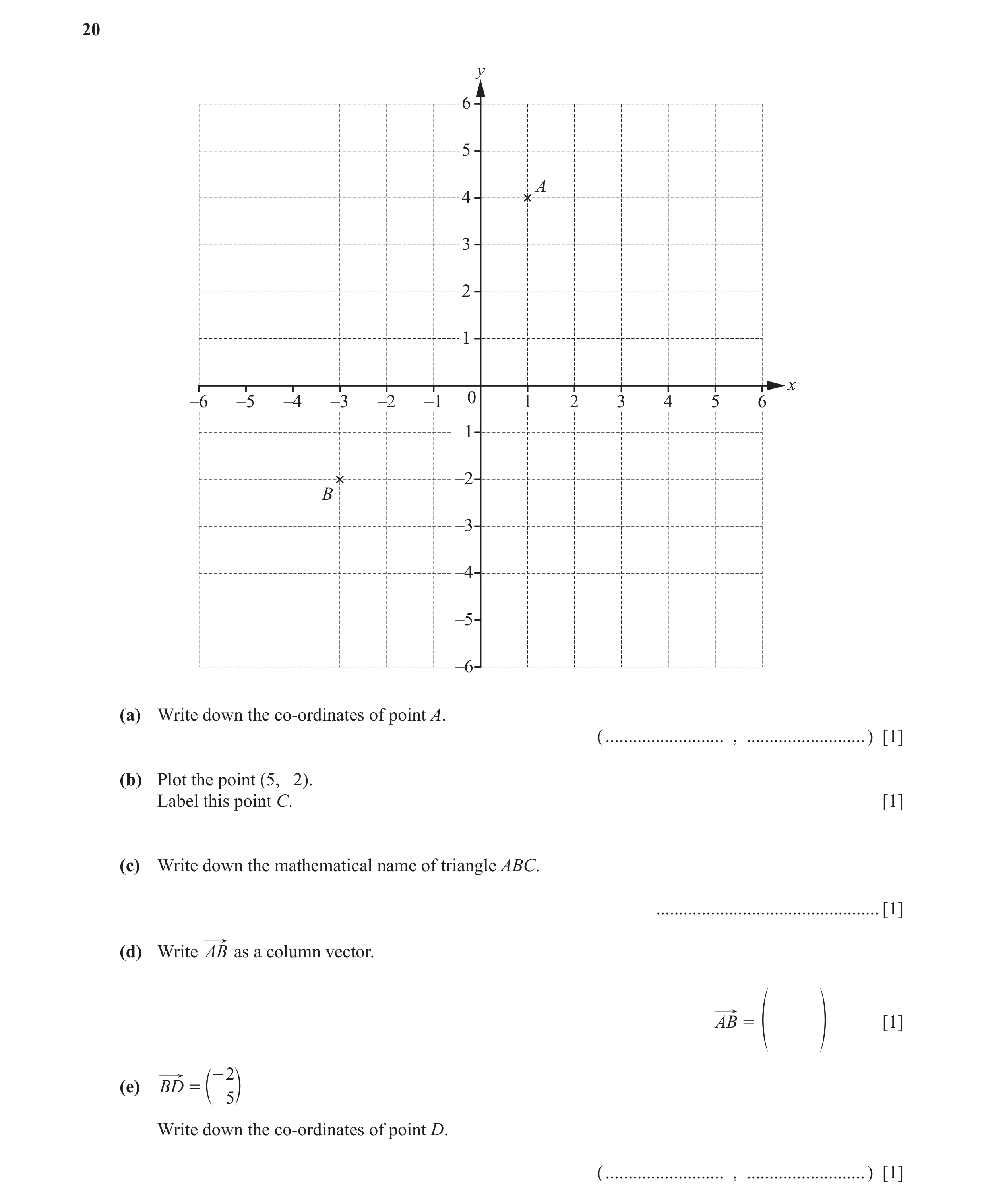
Q21 · Y 6 5 A 4 3 2 1 x –6 –5 –4 –3 –2 –1 0 1 2 3 4 5 6 –1 –2 B –3 –4 –5 –6 (a) Write down the… 0580/11 Oct/Nov 2016
20 y 6 5 A 4 3 2 1 x –6 –5 –4 –3 –2 –1 0 1 2 3 4 5 6 –1 –2 B –3 –4 –5 –6 (a) Write down the co-ordinates of point A. ( … , … ) [1] (b) Plot the point (5, –2). Label this point C. [1] (c) Write down the mathematical name of triangle ABC. … [1] (d) Write AB as a column vector. AB = [1] f p - 2 (e) BD = c 5m Write down the co-ordinates of point D. ( … , … ) [1]
5 marks
Mark scheme: 20 (a) (1, 4) 1 (b) Point plotted at ( 5, −2) 1 (c) Isosceles 1FT Strict FT of their (b) −4 (d) 1 −6 (e) (−5, 3) 1
This question in 0580/11 Oct/Nov 2016
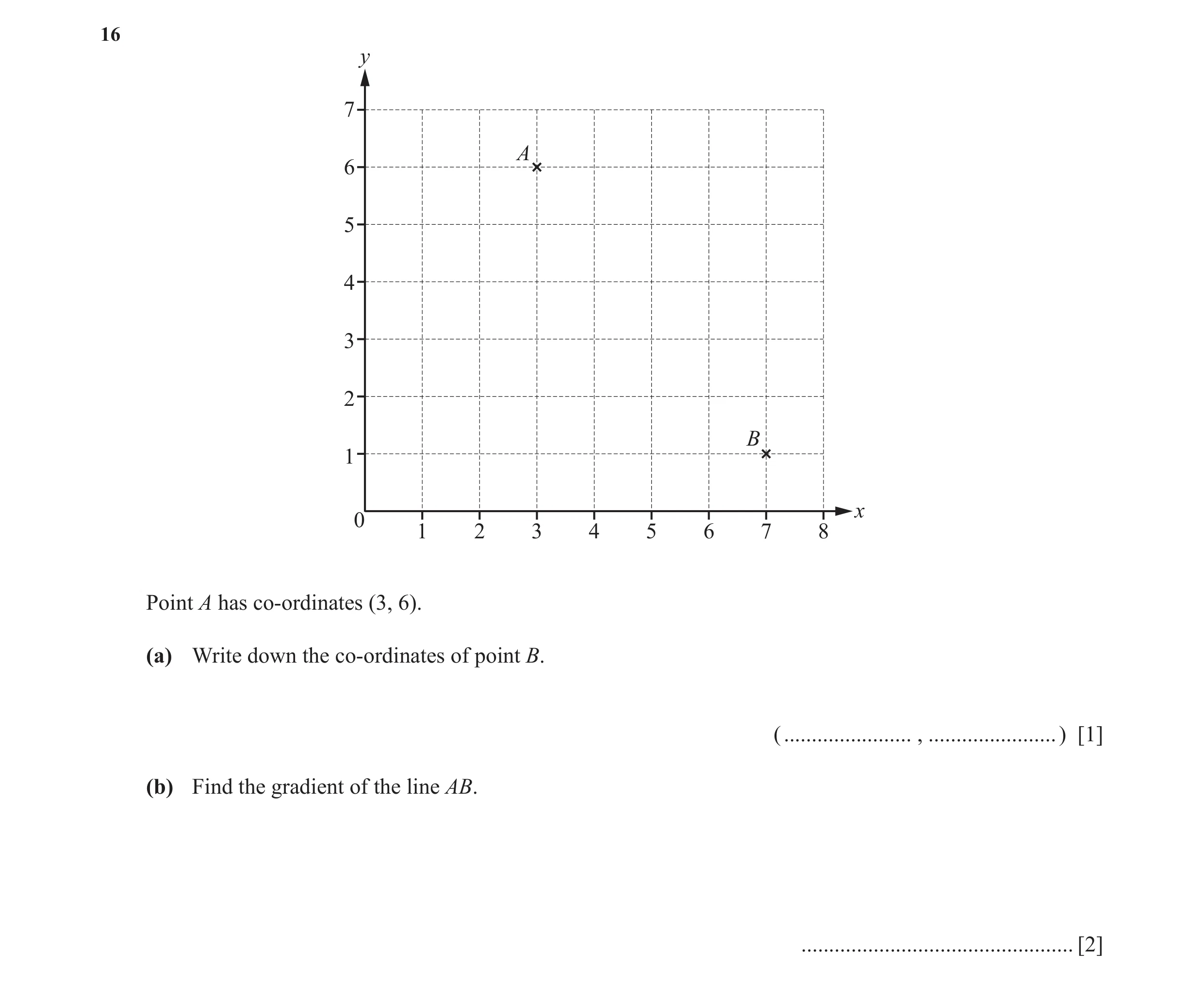
Q22 · Y 7 A 6 5 4 3 2 B 1 x 0 1 2 3 4 5 6 7 8 Point A has co-ordinates (3, 6) 0580/12 Oct/Nov 2016
16 y 7 A 6 5 4 3 2 B 1 x 0 1 2 3 4 5 6 7 8 Point A has co-ordinates (3, 6). (a) Write down the co-ordinates of point B. ( … , … ) [1] (b) Find the gradient of the line AB. … [2]
3 marks
Mark scheme: 16 (a) (7 , 1) 1 5 1 (b) –1.25 or − or − 2 M1 for rise/run 4 14
This question in 0580/12 Oct/Nov 2016
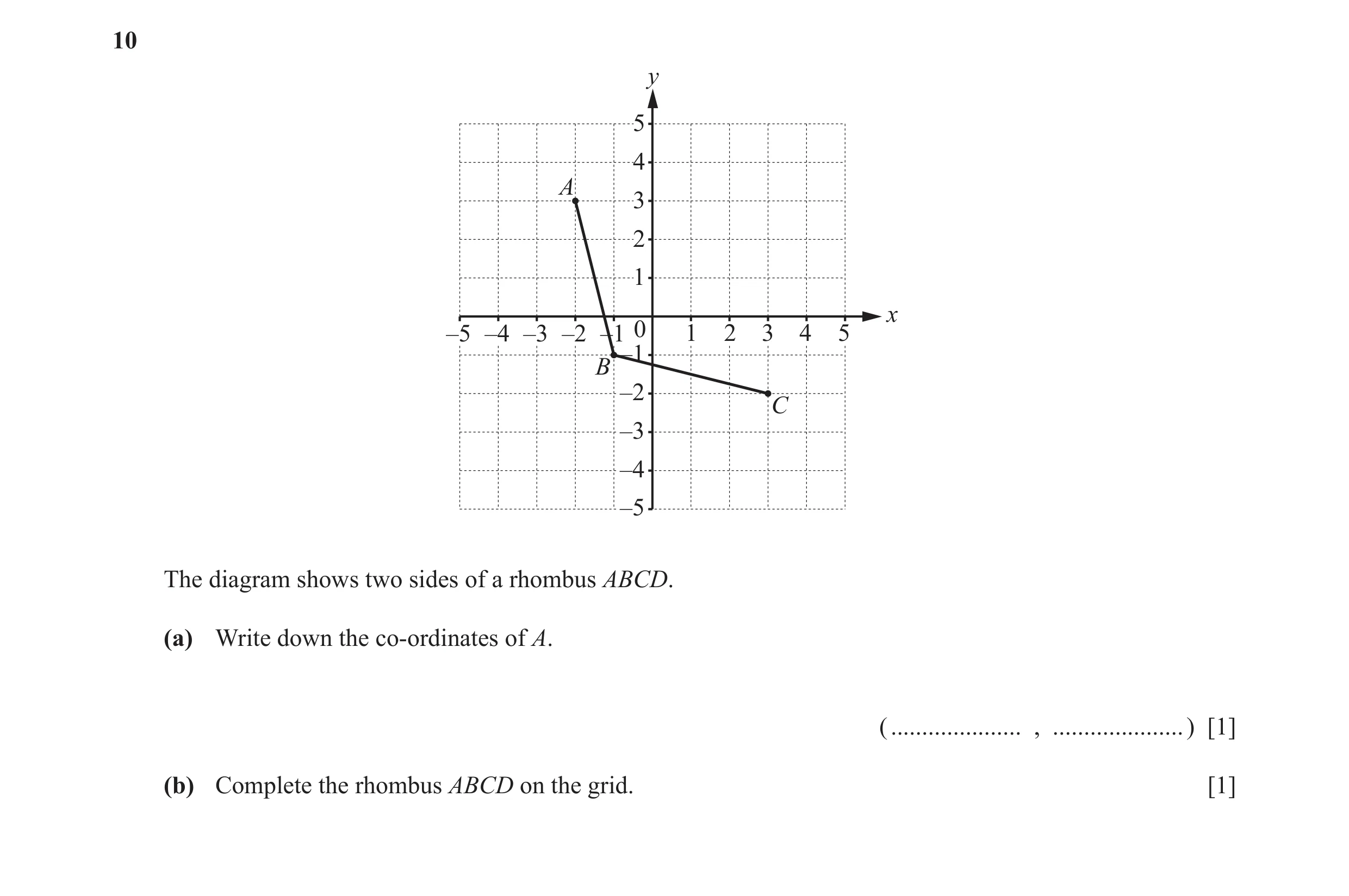
Q23 · Y 5 4 A 3 2 1 x –5 –4 –3 –2 –1 0 1 2 3 4 5 –1 B –2 C –3 –4 –5 The diagram shows two sides… 0580/11 Oct/Nov 2017
10 y 5 4 A 3 2 1 x –5 –4 –3 –2 –1 0 1 2 3 4 5 –1 B –2 C –3 –4 –5 The diagram shows two sides of a rhombus ABCD. (a) Write down the co-ordinates of A. ( … , … ) [1] (b) Complete the rhombus ABCD on the grid. [1]
2 marks
Mark scheme: 10(a) (–2, 3) 1 10(b) Correct rhombus with 4th point at (2,2) 1
This question in 0580/11 Oct/Nov 2017
Q24 · Y 7 6 A 5 4 3 2 1 x –5 –4 –3 –2 –1 0 1 2 3 4 5 6 7 8 –1 B –2 –3 –4 (a) Write down the… 0580/12 Oct/Nov 2017
16 y 7 6 A 5 4 3 2 1 x –5 –4 –3 –2 –1 0 1 2 3 4 5 6 7 8 –1 B –2 –3 –4 (a) Write down the co-ordinates of point A. ( … , … ) [1] (b) Plot point C at (7, -2). [1] (c) Write down the mathematical name of the triangle formed by joining the points A, B and C. … [1]
3 marks
Mark scheme: 16(a) (2, 5) 1 16(b) Point plotted at (7, −2) 1 16(c) Isosceles cao 1
This question in 0580/12 Oct/Nov 2017
Q25 · AB is a straight line 0580/12 Oct/Nov 2017
17 AB is a straight line. A B (a) Measure the length of AB. … cm [1] (b) Mark the midpoint of AB. [1] (c) Draw a line perpendicular to AB. [1]
3 marks
Mark scheme: 17(a) 9 1 17(b) Midpoint marked 1 17(c) Perpendicular line drawn 1
This question in 0580/12 Oct/Nov 2017
Q26 · Y 4 3 L A 2 1 −4 −3 −2 −1 0 1 2 3 4 x −1 −2 −3 −4 (a) Write down the co-ordinates of… 0580/12 Oct/Nov 2018
20 y 4 3 L A 2 1 −4 −3 −2 −1 0 1 2 3 4 x −1 −2 −3 −4 (a) Write down the co-ordinates of point A. ( … , … ) [1] (b) On the grid, plot point B (1, –3). [1] (c) Find the gradient of line L. … [2] (d) Find the equation of line L in the form y = mx + c . y = … [1]
5 marks
Mark scheme: 20(a) –3, 2 1 20(b) B plotted at (1, –3) 1 20(c) 1 2 Rise 2 2 −− 1 or 0.5 M1 for e.g. or 2 Run 4 2 −− 4 20(d) 1 1 FT their (c) e.g.[ y =] their (c) x + 1 oe y = x + 1 oe 2
This question in 0580/12 Oct/Nov 2018
Q27 · Y 8 7 6 B 5 4 A 3 2 1 0 x –5 –4 –3 –2 –1 1 2 3 4 5 6 –1 –2 –3 –4 (a) Write down the… 0580/13 Oct/Nov 2018
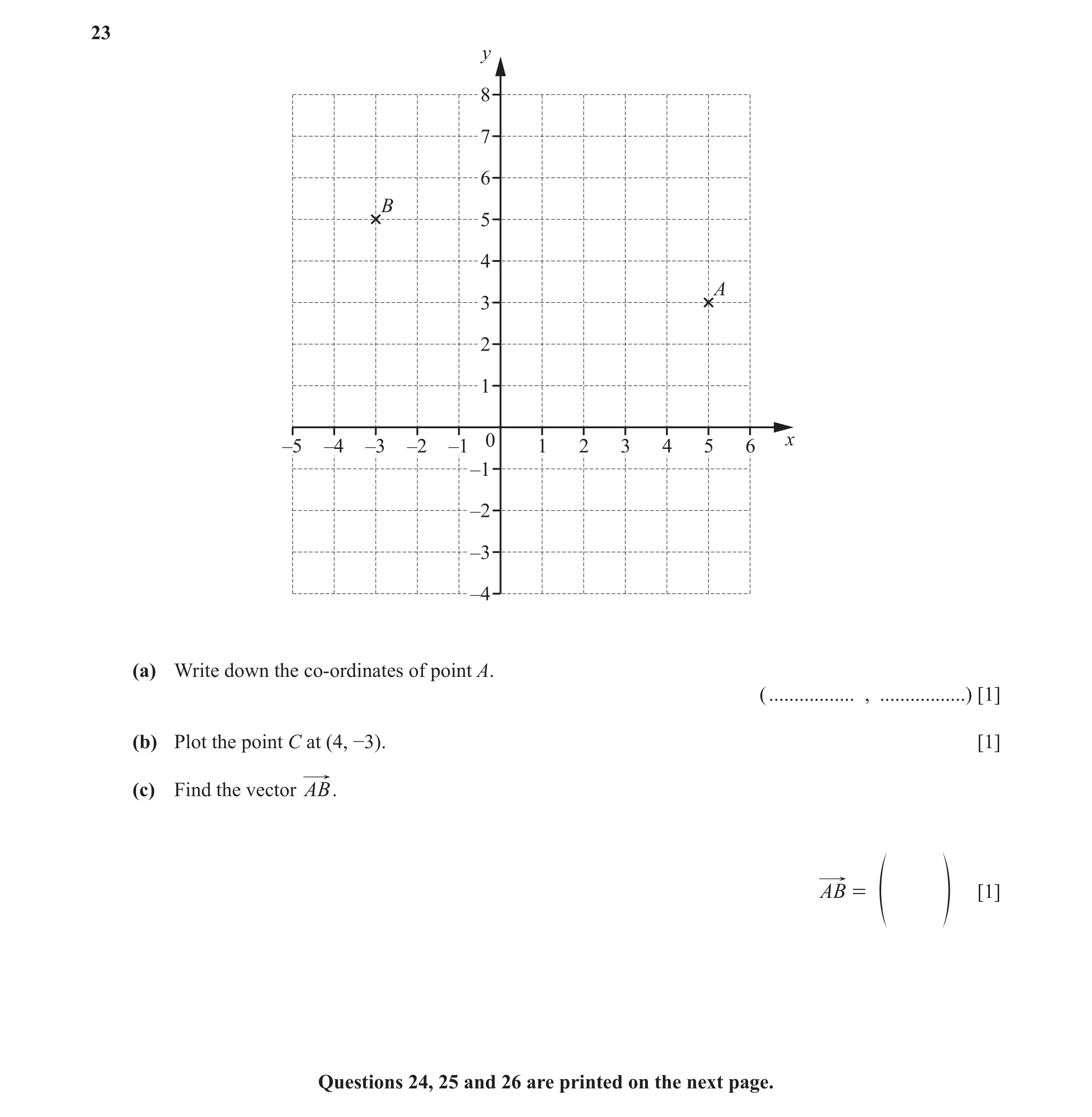
23 y 8 7 6 B 5 4 A 3 2 1 0 x –5 –4 –3 –2 –1 1 2 3 4 5 6 –1 –2 –3 –4 (a) Write down the co-ordinates of point A. ( … , … ) [1] (b) Plot the point C at (4, −3). [1] (c) Find the vector AB. AB = [1] f p Questions 24, 25 and 26 are printed on the next page.
3 marks
Mark scheme: 23(a) (5, 3) 1 23(b) Point plotted at (4, −3) 1 23(c) −8 1 2
This question in 0580/13 Oct/Nov 2018
Q28 · The diagram shows a point P and a line L 0580/11 May/June 2019
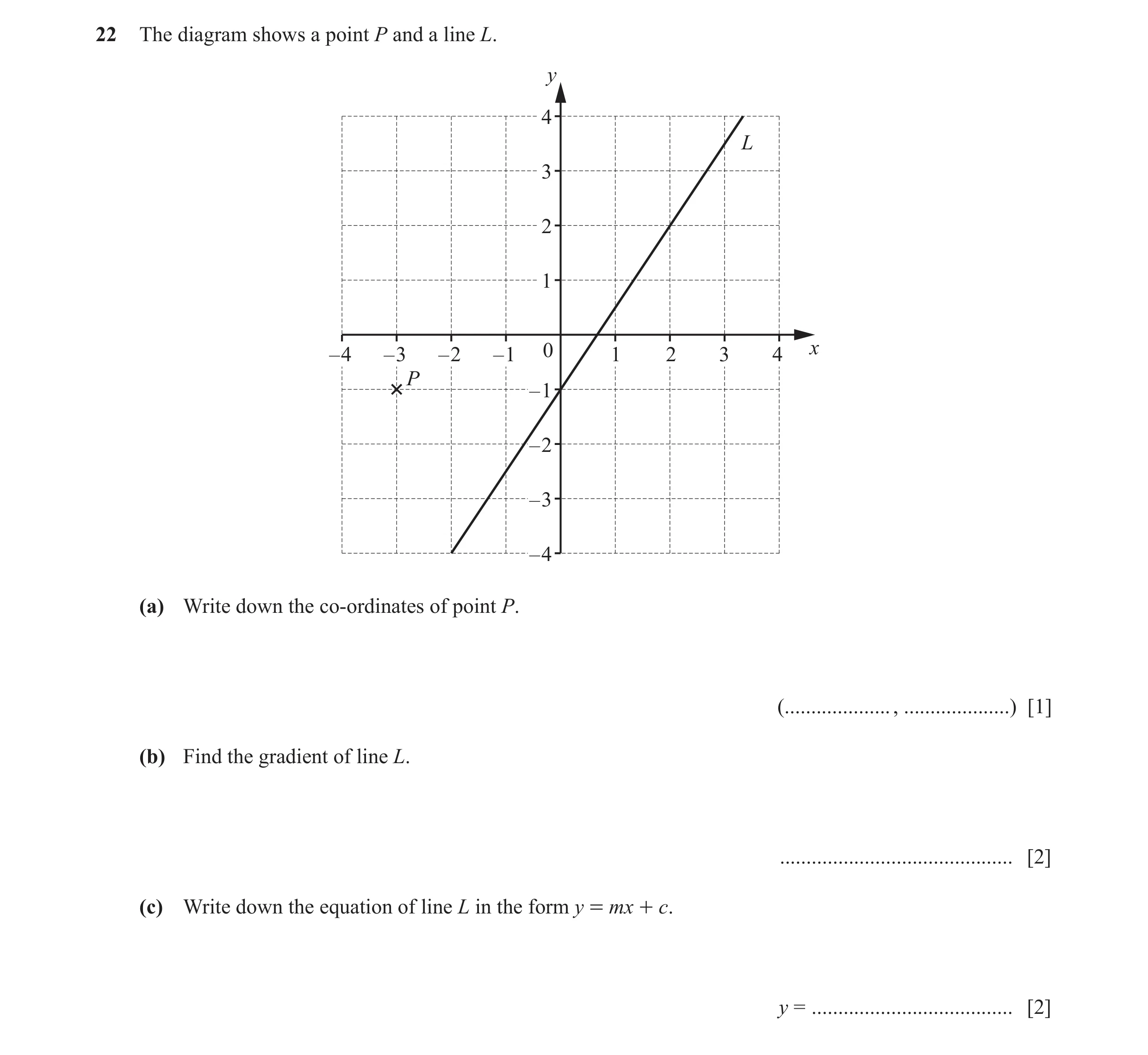
22 The diagram shows a point P and a line L. y 4 L 3 2 1 – 4 – 3 – 2 – 1 0 1 2 3 4 x P – 1 – 2 – 3 – 4 (a) Write down the co-ordinates of point P. ( … , … ) [1] (b) Find the gradient of line L. … [2] (c) Write down the equation of line L in the form y = mx + c. y = … [2]
5 marks
Mark scheme: 22(a) −3, −1 1 22(b) 1.5 oe 2 6 M1 for rise ÷ run e.g. 4 22(c) [y =] 1.5x − 1 oe 2 B1 for jx – 1 j ≠ 0 or 1.5x + k or their(b)x + k
This question in 0580/11 May/June 2019
Q29 · Y 6 A 5 4 B 3 2 1 C 0 1 2 3 4 5 6 7 8 x (a) Write down the co-ordinates of point B 0580/13 Oct/Nov 2019
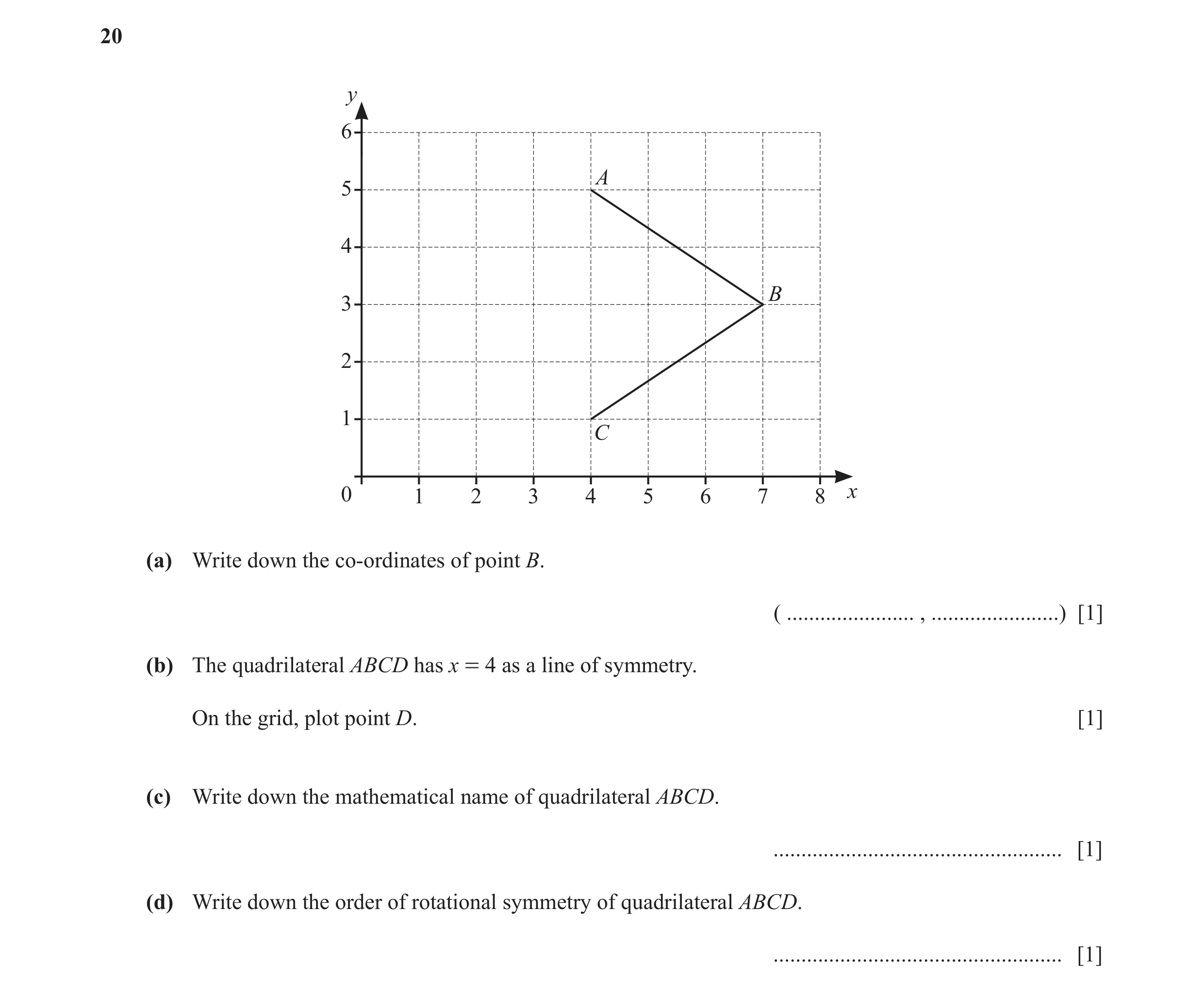
20 y 6 A 5 4 B 3 2 1 C 0 1 2 3 4 5 6 7 8 x (a) Write down the co-ordinates of point B. ( … , … ) [1] (b) The quadrilateral ABCD has x = 4 as a line of symmetry. On the grid, plot point D. [1] (c) Write down the mathematical name of quadrilateral ABCD. … [1] (d) Write down the order of rotational symmetry of quadrilateral ABCD. … [1]
4 marks
Mark scheme: 20(a) 7 3 1 20(b) point plotted at (1, 3) 1 20(c) rhombus 1 20(d) 2 1 strict FT their diagram
This question in 0580/13 Oct/Nov 2019
Q30 · Y 4 B 3 2 A C 1 x – 4 – 3 – 2 – 1 0 1 2 3 4 – 1 – 2 – 3 – 4 Points A, B and C are shown… 0580/12 May/June 2020
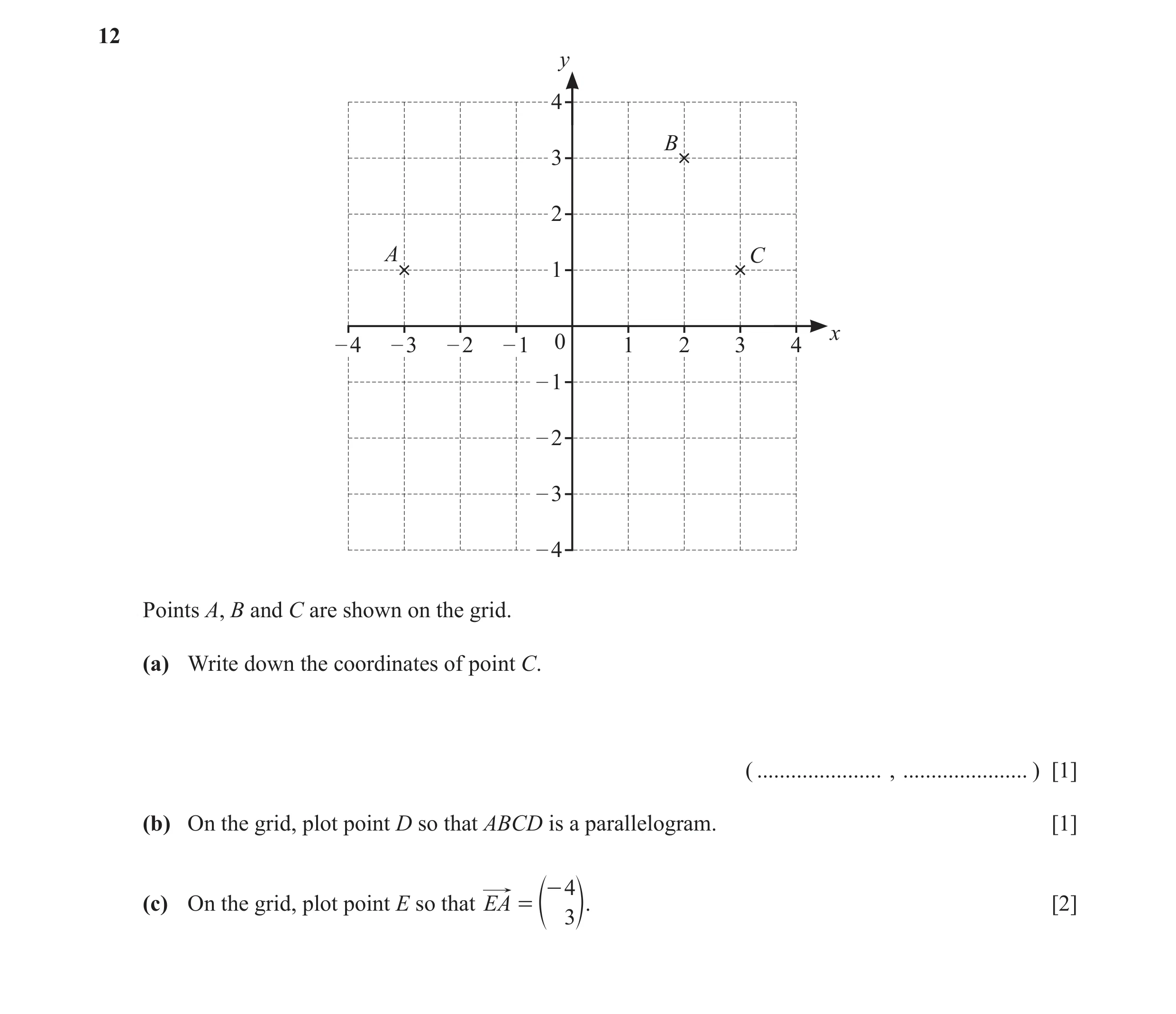
12 y 4 B 3 2 A C 1 x – 4 – 3 – 2 – 1 0 1 2 3 4 – 1 – 2 – 3 – 4 Points A, B and C are shown on the grid. (a) Write down the coordinates of point C. ( … , … ) [1] (b) On the grid, plot point D so that ABCD is a parallelogram. [1] - 4 (c) On the grid, plot point E so that EA = [2] e 3o.
4 marks
Mark scheme: 12(a) (3, 1) 1 12(b) D plotted at (–2, –1) 1 12(c) E plotted at (1, –2) 2 B1 for E plotted at (1, k) or (k, –2) or 4 AE = − 3
This question in 0580/12 May/June 2020
Q31 · Y 7 6 A 5 4 L 3 2 1 x – 6 – 5 – 4 – 3 – 2 – 1 0 1 2 3 4 5 6 – 1 – 2 – 3 – 4 (i) Write… 0580/12 Oct/Nov 2020
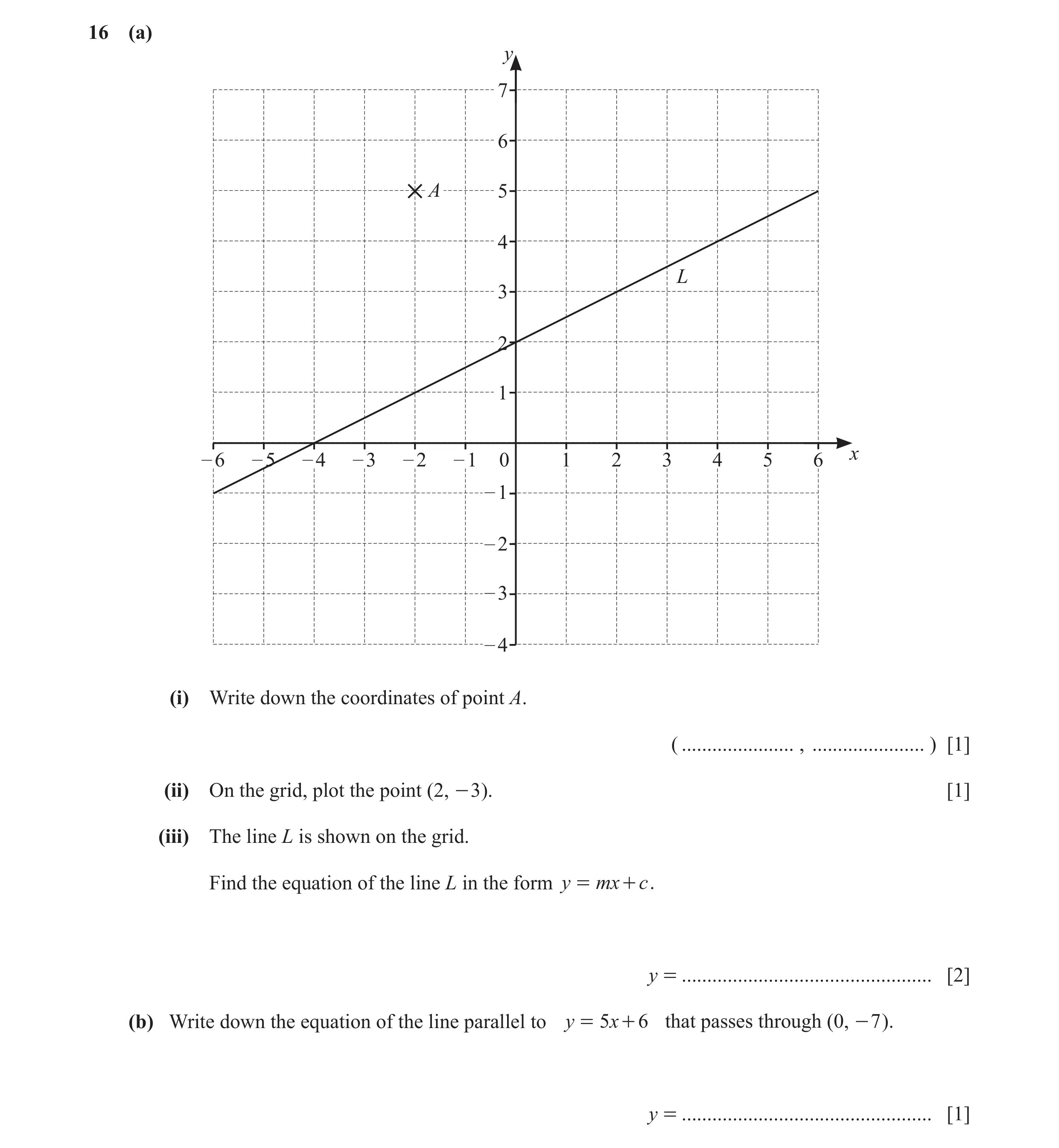
16 (a) y 7 6 A 5 4 L 3 2 1 x – 6 – 5 – 4 – 3 – 2 – 1 0 1 2 3 4 5 6 – 1 – 2 – 3 – 4 (i) Write down the coordinates of point A. ( … , … ) [1] (ii) On the grid, plot the point (2, - 3 ). [1] (iii) The line L is shown on the grid. Find the equation of the line L in the form y = mx + c . y = … [2] (b) Write down the equation of the line parallel to y = 5x + 6 that passes through (0, - 7 ). y = … [1]
5 marks
Mark scheme: 16(a)(i) (–2, 5) 1 16(a)(ii) Point plotted at (2, –3) 1 16(a)(iii) [y =] 0.5x +2 2 B1 for 0.5x + j or kx + 2 k ≠ 0 as final answer rise or M1 for with correct values run 16(b) [y=] 5x –7 1
This question in 0580/12 Oct/Nov 2020
Q32 · Points A and B are plotted on the grid 0580/13 Oct/Nov 2021
2 Points A and B are plotted on the grid. y 4 3 B 2 1 – 3 – 2 – 1 0 1 2 3 x – 1 A – 2 – 3 (a) Write down the coordinates of point B. ( … , … ) [1] (b) Write AB as a vector. [1] f p (c) On the grid, plot point C at (-2, 3). [1]
3 marks
Mark scheme: 2(a) (2, 3) 1 2(b) 4 1 5 2(c) C plotted at (–2, 3) 1
This question in 0580/13 Oct/Nov 2021
Q33 · The equation of a line is y = 5 x + 7 0580/12 Feb/March 2022
13 The equation of a line is y = 5 x + 7 . (a) Write down the gradient of this line. … [1] (b) (i) Find the coordinates of the point where this line crosses the y-axis. ( … , … ) [1] (ii) Find the coordinates of the point where this line crosses the x-axis. ( … , … ) [2]
4 marks
Mark scheme: 13(a) 5 1 13(b)(i) (0, 7) 1 13(b)(ii) 7 2 B1 for 0 = 5 x + 7 oe − , 0 oe 5
This question in 0580/12 Feb/March 2022
Q34 · B A (a) Measure the length of the line AB in millimetres 0580/13 May/June 2022
2 B A (a) Measure the length of the line AB in millimetres. … mm [1] (b) Mark the midpoint, M, of the line AB. [1] (c) Draw a line through M that is perpendicular to the line AB. [1]
3 marks
Mark scheme: 2(a) 86 1 2(b) Point marked at 4.3 cm from A 1 2(c) Ruled line through M perpendicular to 1 AB
This question in 0580/13 May/June 2022
Q35 · The grid shows point P and point R 0580/13 May/June 2022
11 The grid shows point P and point R. y 5 P 4 3 2 1 – 5 – 4 – 3 – 2 – 1 0 1 2 3 4 5 x – 1 – 2 – 3 R – 4 – 5 (a) Write down the coordinates of point P. ( … , … ) [1] 3 (b) PQ = e- 2o Mark point Q on the grid. [1] (c) Find QR. QR = [1] f p (d) Complete this statement. [1] PQ + QR = …
4 marks
Mark scheme: 11(a) (−1, 4) 1 11(b) Q marked at (2, 2) 1 11(c) 6 1 FT their point Q 5 11(d) PR 1
This question in 0580/13 May/June 2022
Q36 · Point A and line L are shown on the grid 0580/12 Oct/Nov 2023
22 Point A and line L are shown on the grid. y 9 L 8 7 6 5 4 3 2 1 -3 -2 -1 0 1 2 3 x -1 -2 × A -3 -4 (a) Write down the coordinates of point A. ( … , … ) [1] (b) On the grid, plot the point ( - 2 , 4). [1] (c) Find the equation of line L. … [3]
5 marks
Mark scheme: 22(a) (1, –2) 1 22(b) Point plotted at (–2, 4) 1 22(c) y = 2x + 3 oe final answer 3 B2 for 2x + 3 or y = 2x + c or y = mx + 3 m ≠ 0 where m is their gradient or B1 for 2x + c or for mx + 3 m ≠ 0 where m is their gradient
This question in 0580/12 Oct/Nov 2023
Q37 · T S Mark the midpoint of the line ST 0580/12 Feb/March 2024
3 T S Mark the midpoint of the line ST. [1]
1 marks
Mark scheme: 3 Midpoint of ST marked 1
This question in 0580/12 Feb/March 2024
Q38 · Y 8 7 6 A 5 4 3 C 2 1 B x – 8 – 7 – 6 – 5 – 4 – 3 – 2 – 1 0 1 2 3 4 5 – 1 – 2 The diagram… 0580/11 May/June 2024
9 y 8 7 6 A 5 4 3 C 2 1 B x – 8 – 7 – 6 – 5 – 4 – 3 – 2 – 1 0 1 2 3 4 5 – 1 – 2 The diagram shows two sides of a parallelogram ABCD. Find the coordinates of point D. ( … , … ) [2]
2 marks
Mark scheme: 9 (–3, 7) 2 B1 for correct diagram or for correct coordinates for their point D or for (-3, k) or (k, 7)
This question in 0580/11 May/June 2024
Q39 · Find the coordinates of the point where the line y = 3x - 5 crosses the y-axis 0580/11 May/June 2024
13 Find the coordinates of the point where the line y = 3x - 5 crosses the y-axis. ( … , … ) [1]
1 marks
Mark scheme: 13 0, 5 1
This question in 0580/11 May/June 2024
Q40 · The diagram shows the positions of three towns A, B and C 0580/13 May/June 2024
20 The diagram shows the positions of three towns A, B and C. North B North North 103° NOT TO SCALE A C Angle ABC = 103° . The bearing of town B from town A is 048°. Town C is due east of town A. Find the bearing of town C from town B. … [4]
4 marks
Mark scheme: 20 125 4 B1 for 48 between the North line and AB at A. M1 for 180 ─ their 48 M1 dep for 360 ─ (103 + their 132) OR M1 for [angle ACB =] 180 ─ 103 ─ (90 ─ their 48) M1 dep for 90 + their ACB or for 180 ─ (90 ─ their ACB)
This question in 0580/13 May/June 2024
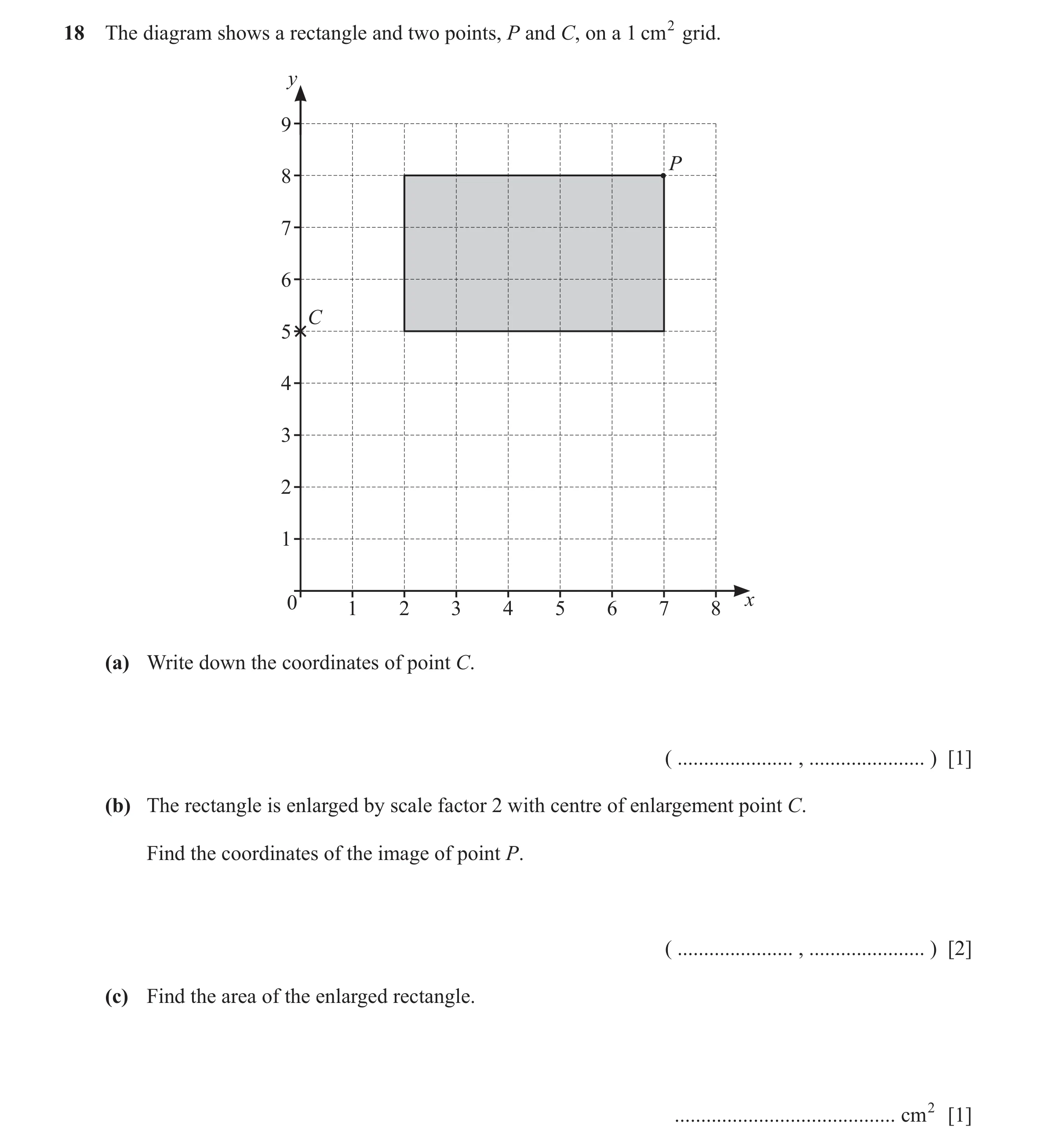
Q41 · The diagram shows a rectangle and two points, P and C, on a 1 cm2 grid 0580/11 Oct/Nov 2024
18 The diagram shows a rectangle and two points, P and C, on a 1 cm2 grid. y 9 P 8 7 6 C 5 4 3 2 1 0 x 1 2 3 4 5 6 7 8 (a) Write down the coordinates of point C. ( … , … ) [1] (b) The rectangle is enlarged by scale factor 2 with centre of enlargement point C. Find the coordinates of the image of point P. ( … , … ) [2] (c) Find the area of the enlarged rectangle. … cm2 [1]
4 marks
Mark scheme: 18(a) (0, 5) 1 18(b) (14, 11) 2 B1 for each 18(c) 60 1
This question in 0580/11 Oct/Nov 2024
Q42 · The diagram shows a point P and three triangles, A, B and C, on a 1 cm2 grid 0580/12 May/June 2025
16 The diagram shows a point P and three triangles, A, B and C, on a 1 cm2 grid. y 7 6 5 4 C 3 B 2 1 A x - 4 -3 -2 -1 0 1 2 3 4 5 6 -1 -2 P -3 - 4 - 5 - 6 (a) Find the area of triangle B. … cm2 [1] (b) (i) Write down the coordinates of point P. ( … , … ) [1] - 20 (ii) Work out the coordinates of point P after a translation by the vector e o. 12 ( … , … ) [1] (c) Draw the image of triangle A after a reflection in the line y =-1. [2] (d) Describe fully the single transformation that maps (i) triangle A onto triangle B … … [3] (ii) triangle A onto triangle C. … … [3]
11 marks
Mark scheme: 16(a) 6 1 16(b)(i) 4, –3 1 16(b)(ii) –16, 9 1 FT their (b)(i) 16(c) Triangle drawn with coordinates 2 B1 for reflection in y = k or in x = −1 (1, −2 ) , ( 2, −2 ) and ( 2, −5 ) 16(d)(i) Enlargement 3 B1 for each [scale factor] 2 [centre] ( −1,0 ) 16(d)(ii) Rotation 3 B1 for each 90˚ clockwise [centre] (2,3 )
This question in 0580/12 May/June 2025
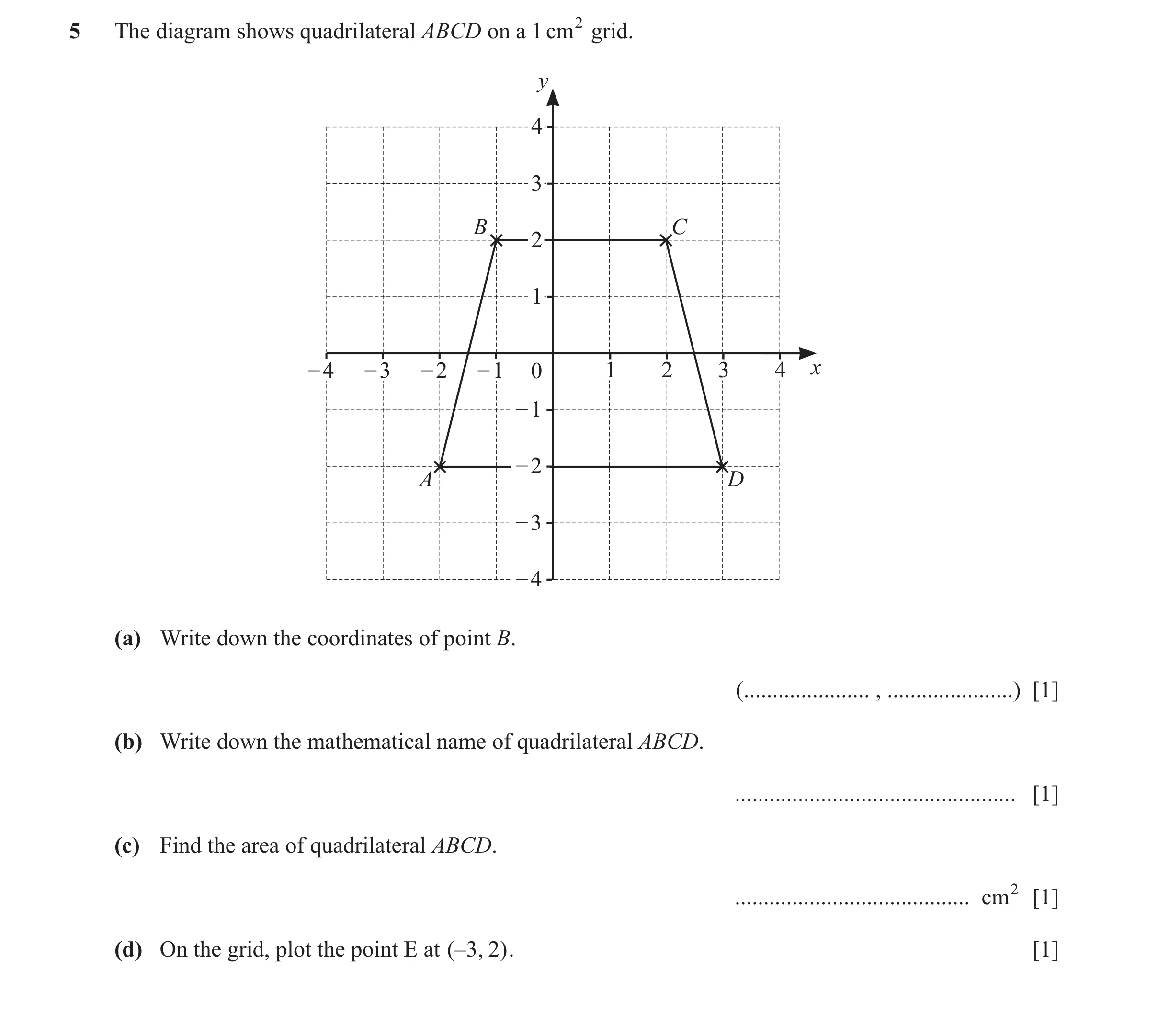
Q43 · The diagram shows quadrilateral ABCD on a 1 cm 2 grid 0580/13 Oct/Nov 2025
5 The diagram shows quadrilateral ABCD on a 1 cm 2 grid. y 4 3 B C 2 1 – 4 – 3 – 2 – 1 0 1 2 3 4 x – 1 – 2 A D – 3 – 4 (a) Write down the coordinates of point B. ( … , … ) [1] (b) Write down the mathematical name of quadrilateral ABCD. … [1] (c) Find the area of quadrilateral ABCD. … cm2 [1] (d) On the grid, plot the point E at ( –3 , 2) . [1]
4 marks
Mark scheme: 5(a) (–1, 2) 1 5(b) trapezium 1 5(c) 16 1 5(d) Point plotted at (–3,2) 1
This question in 0580/13 Oct/Nov 2025
 1 / 39
![Question 2: y 3 l 2 B 1 x –4 –3 –2 –1 0 1 2 3 4 –1 –2 –3 (a) Mark clearly on the diagram the point with co-ordinates (3, 2) and label it A. [1] (b) Wri…](https://img.pastlit.com/crops/000bb0b9-c819-48df-8870-30712efa0fa7/q15.webp) 2 / 39
2 / 39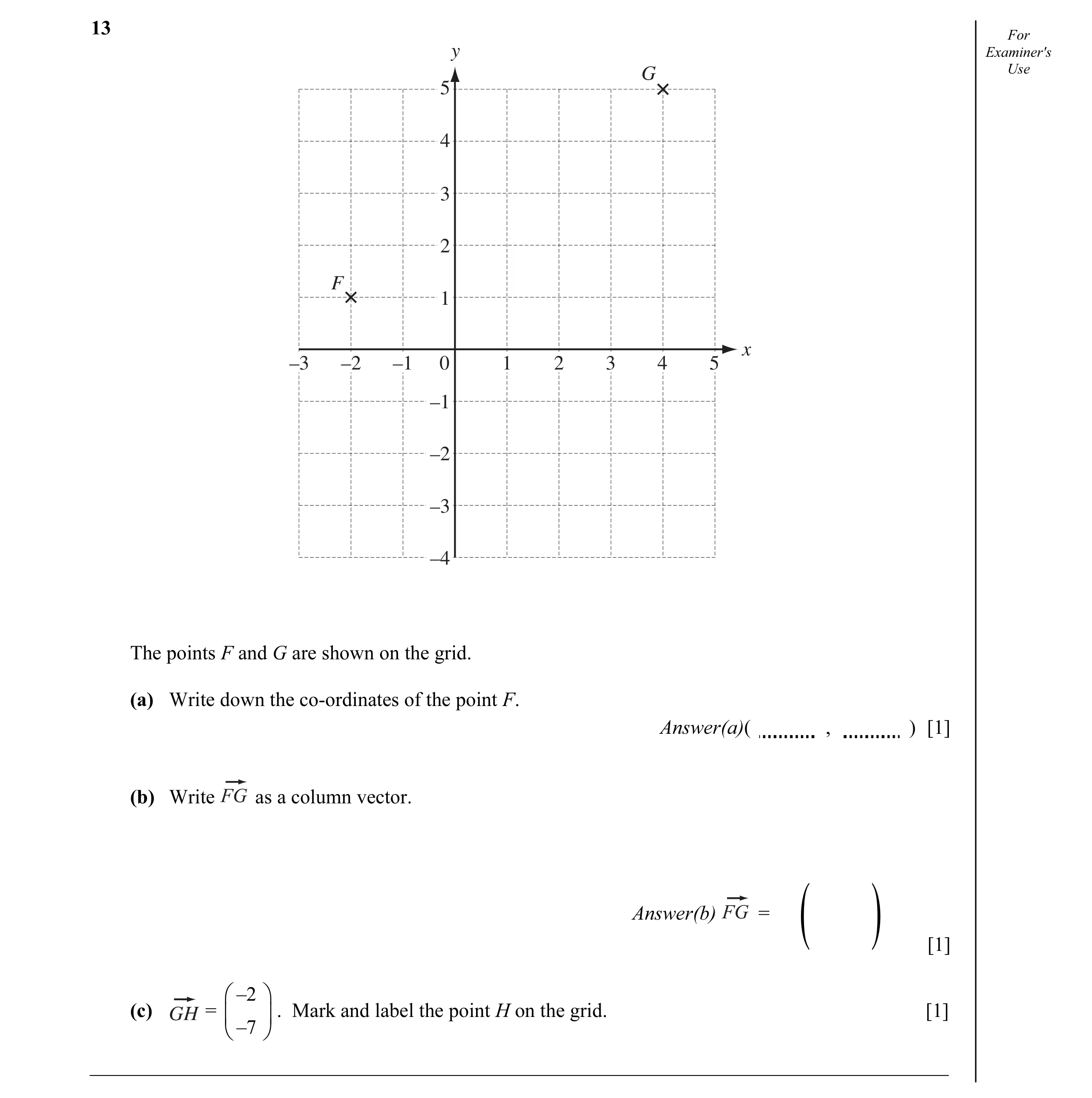 3 / 39
 4 / 39
 5 / 39
 6 / 39
 7 / 39
 8 / 39
 9 / 39
 10 / 39
 11 / 39
 12 / 39
 13 / 39
 14 / 39
 15 / 39
![Question 16: y 5 4 A 3 2 1 x –6 –5 –4 –3 –2 –1 0 1 2 3 4 B –1 –2 –3 –4 –5 Points A and B are shown on the grid. Write as a column vector. Answer [1] f p…](https://img.pastlit.com/crops/48182f3f-1f1c-4d7e-8344-1bacb49e1242/q1.webp) 16 / 39
16 / 39![Question 17: y 4 B 3 2 1 x –4 –3 –2 –1 0 1 2 3 4 A –1 –2 –3 –4 Points A and B are shown on the grid. (a) Write as a column vector. Answer(a) = [1] f p (…](https://img.pastlit.com/crops/995b067f-2a2c-4637-9e3d-bce7f14bfad7/q10.webp) 17 / 39
17 / 39![Question 18: D C E A B (a) Draw the locus of the points which are 3 cm from E. [1] (b) Using a straight edge and compasses only, construct the bisector …](https://img.pastlit.com/crops/1f09a007-32ea-4e7b-b386-f13353221f62/q20.webp) 18 / 39
18 / 39![Question 19: y 6 A 5 4 B 3 2 1 x 0 1 2 3 4 5 6 7 8 (a) Write down the co-ordinates of A. Answer(a) (...................... , ......................) [1]…](https://img.pastlit.com/crops/e9e30d36-31f0-4b84-8b8a-8c2dc4464acb/q17.webp) 19 / 39
19 / 39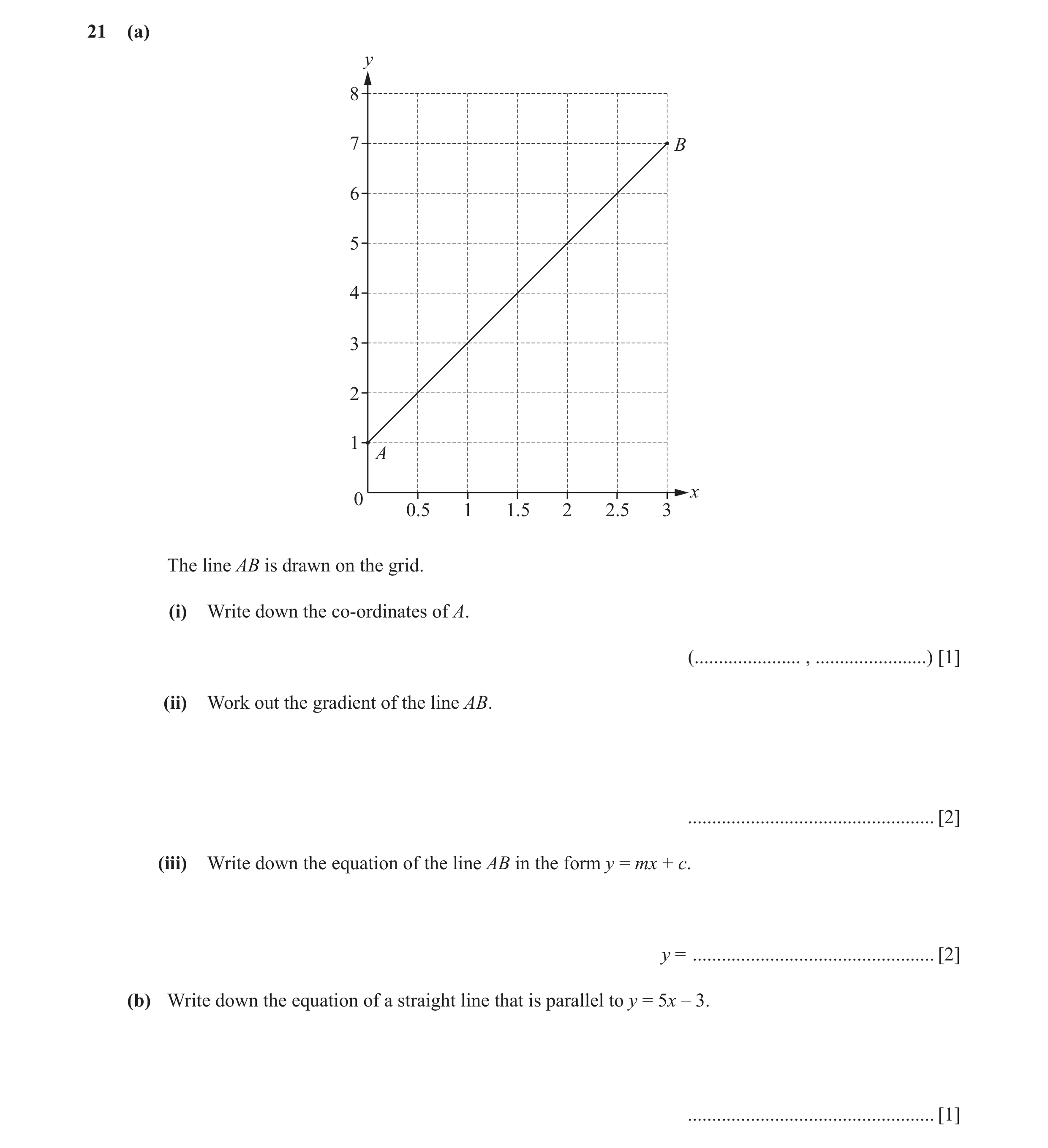 20 / 39
 21 / 39
 22 / 39
 23 / 39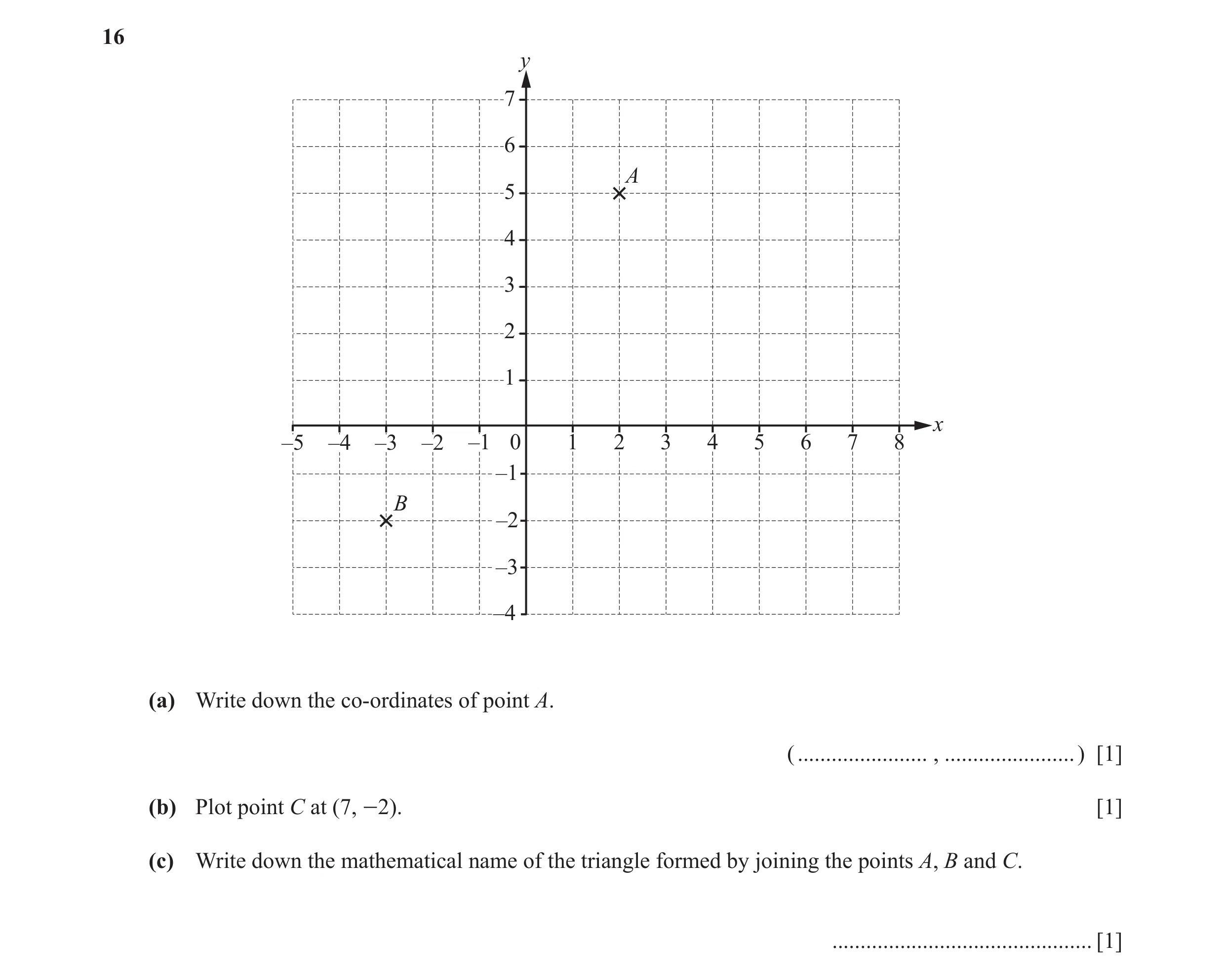
![Question 25: AB is a straight line. A B (a) Measure the length of AB. ........................................ cm [1] (b) Mark the midpoint of AB. [1] (…](https://img.pastlit.com/crops/d4ef36e9-0a3a-4bb7-bb9d-c43398a2763b/q17.webp) 24 / 39
24 / 39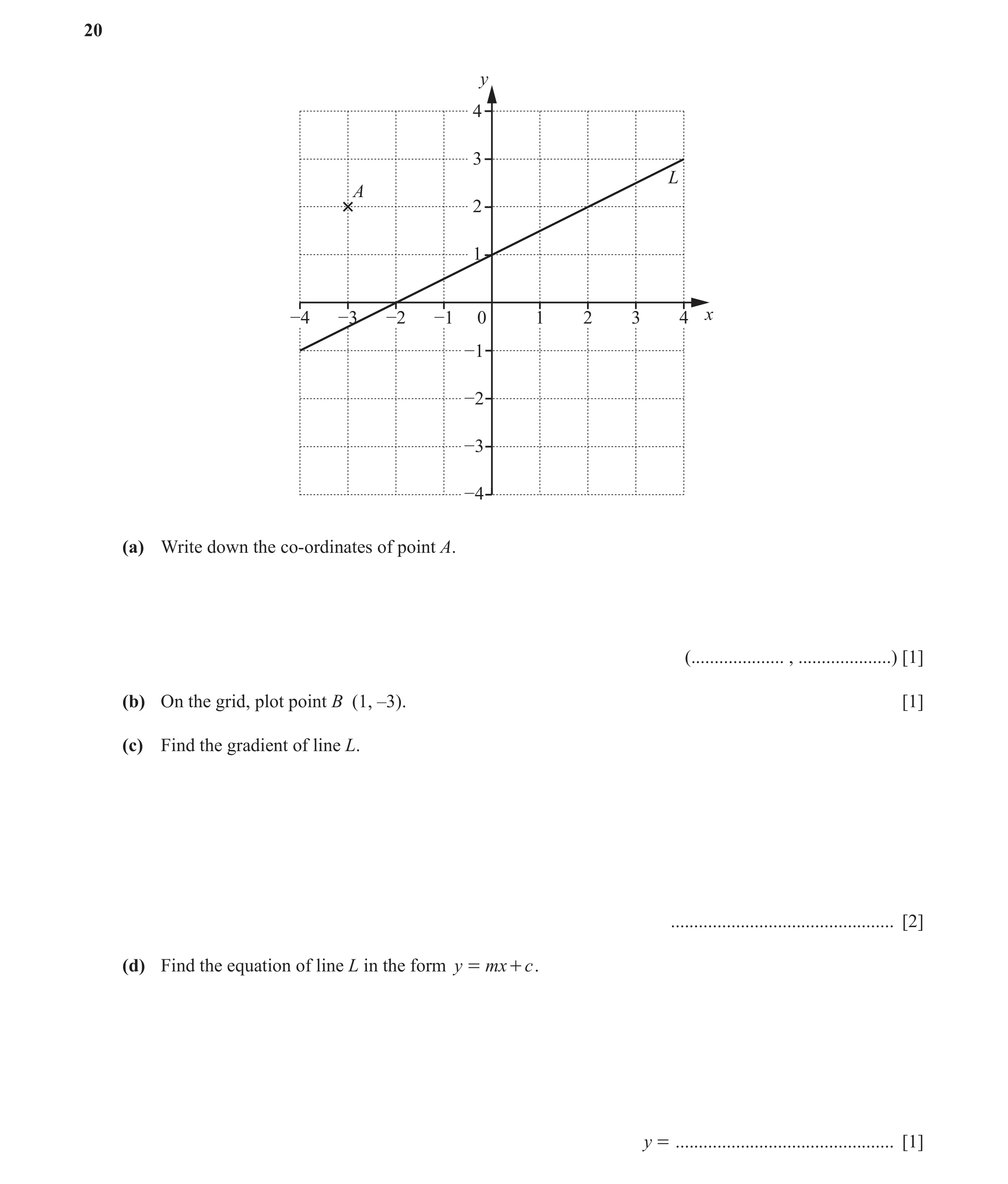 25 / 39
 26 / 39
 27 / 39
 28 / 39
 29 / 39
 30 / 39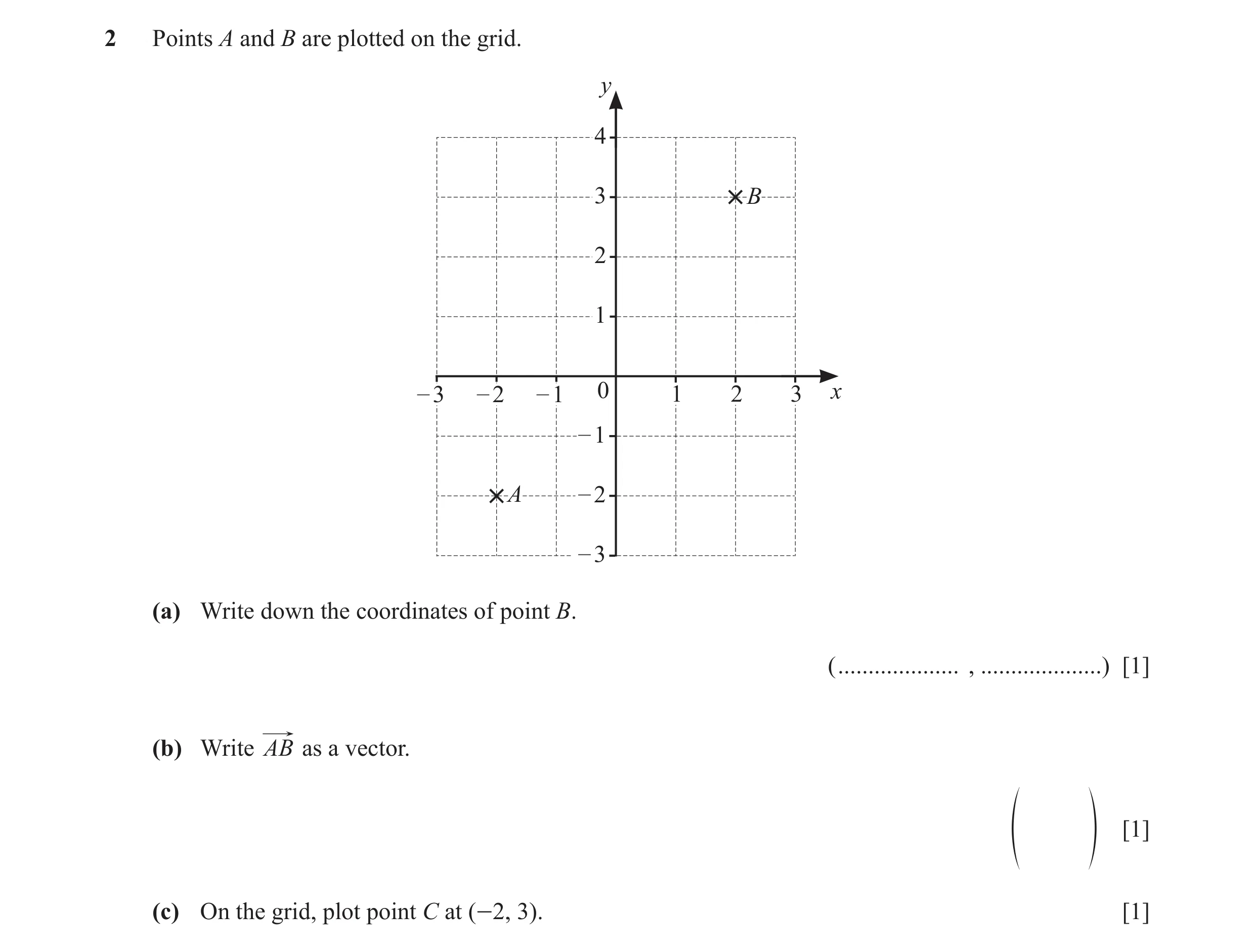
![Question 33: The equation of a line is y = 5 x + 7 . (a) Write down the gradient of this line. ................................................. [1] (b)…](https://img.pastlit.com/crops/e4f35e16-bd14-402b-9780-a20b03e66f6a/q13.webp) 31 / 39
31 / 39![Question 34: B A (a) Measure the length of the line AB in millimetres. .......................................... mm [1] (b) Mark the midpoint, M, of th…](https://img.pastlit.com/crops/ff614652-0cec-4230-a5a6-a2b28e458d4c/q2.webp) 32 / 39
32 / 39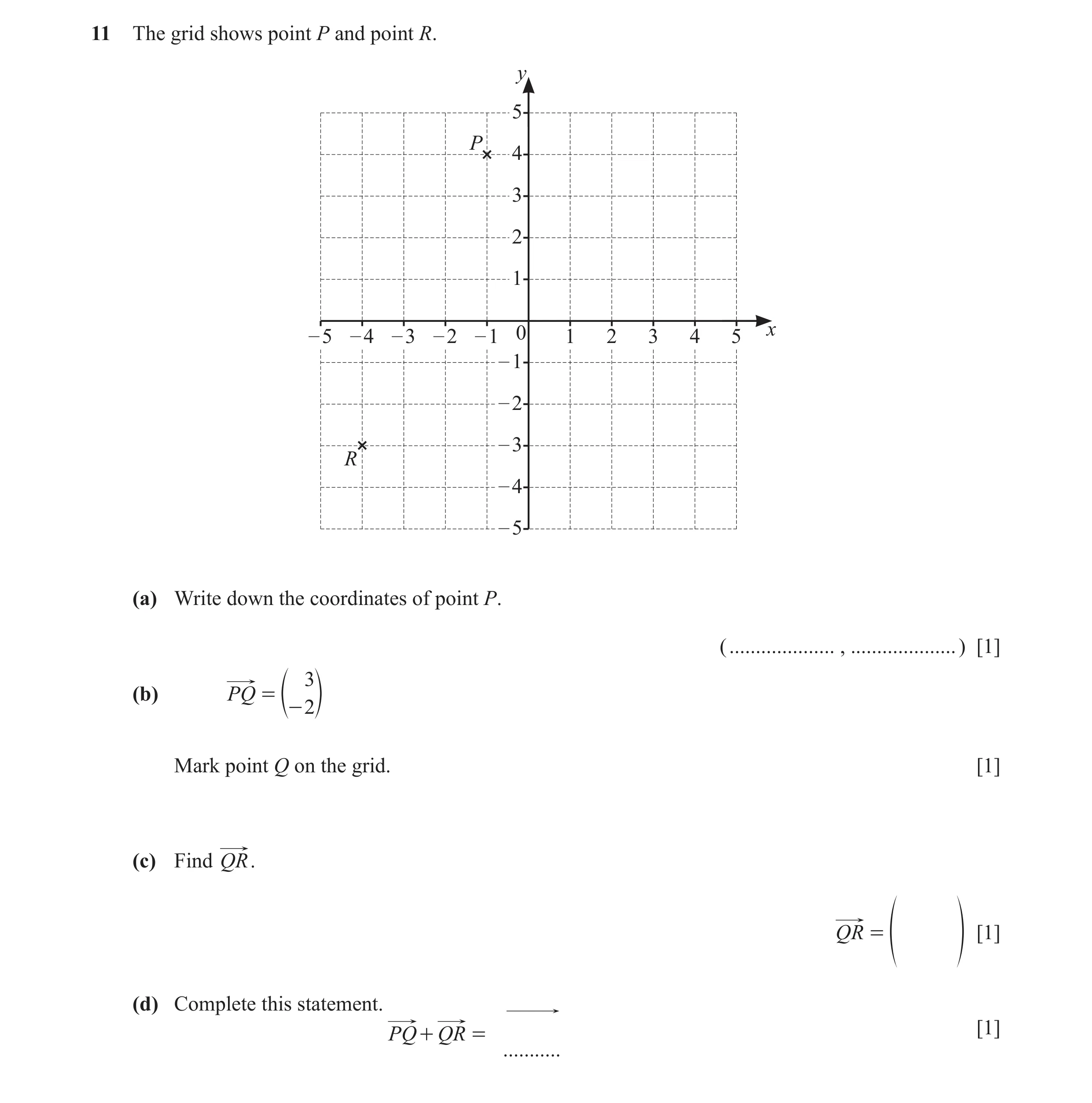 33 / 39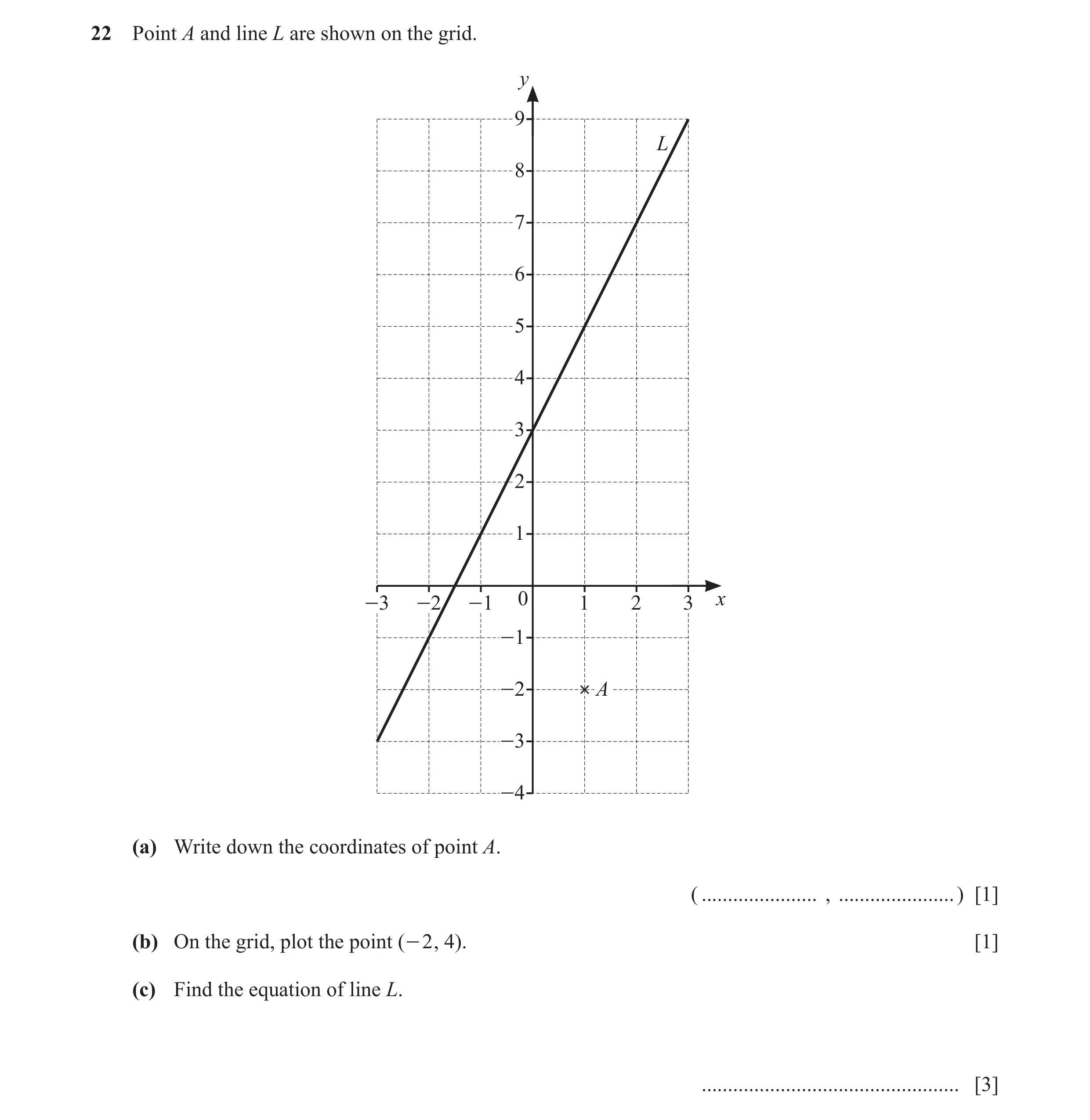
![Question 37: T S Mark the midpoint of the line ST. [1]](https://img.pastlit.com/crops/e61c3206-1c8c-48f9-8834-4cc244a2c6a2/q3.webp) 34 / 39
34 / 39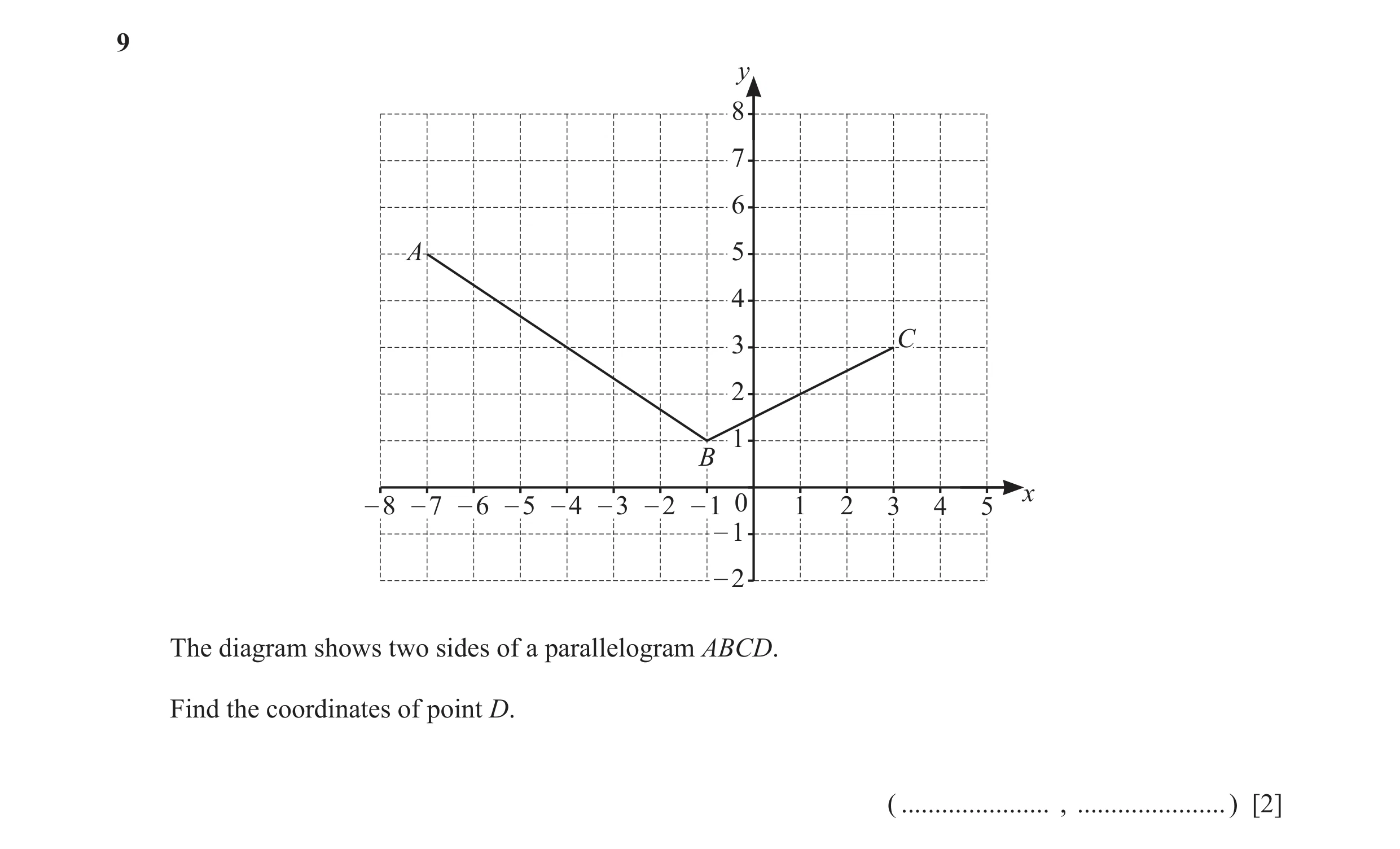
![Question 39: Find the coordinates of the point where the line y = 3x - 5 crosses the y-axis. ( ...................... , ...................... ) [1]](https://img.pastlit.com/crops/b99c3f8e-1e15-4a06-a0c3-2e94c5f2da3e/q13.webp) 35 / 39
35 / 39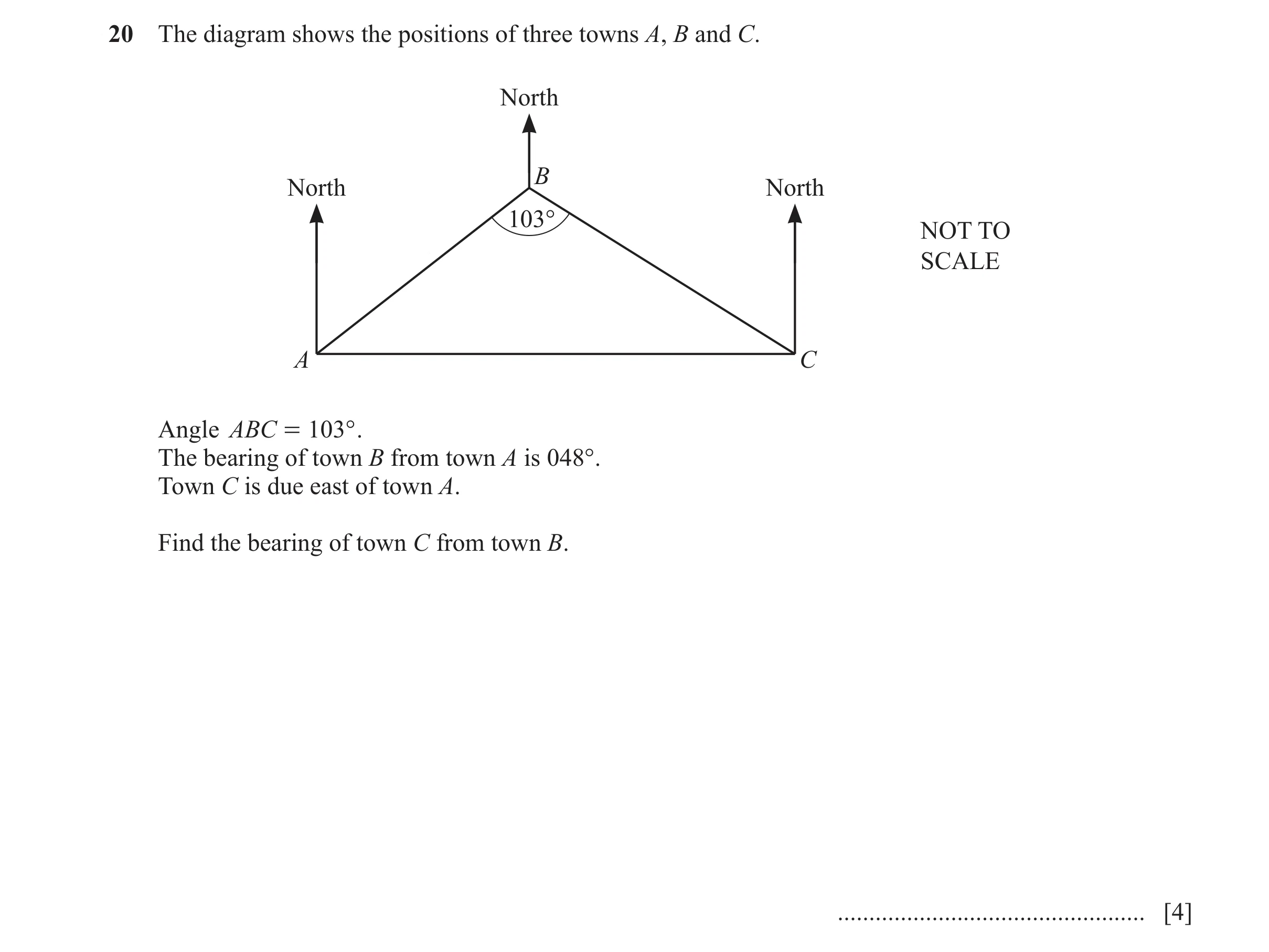 36 / 39
 37 / 39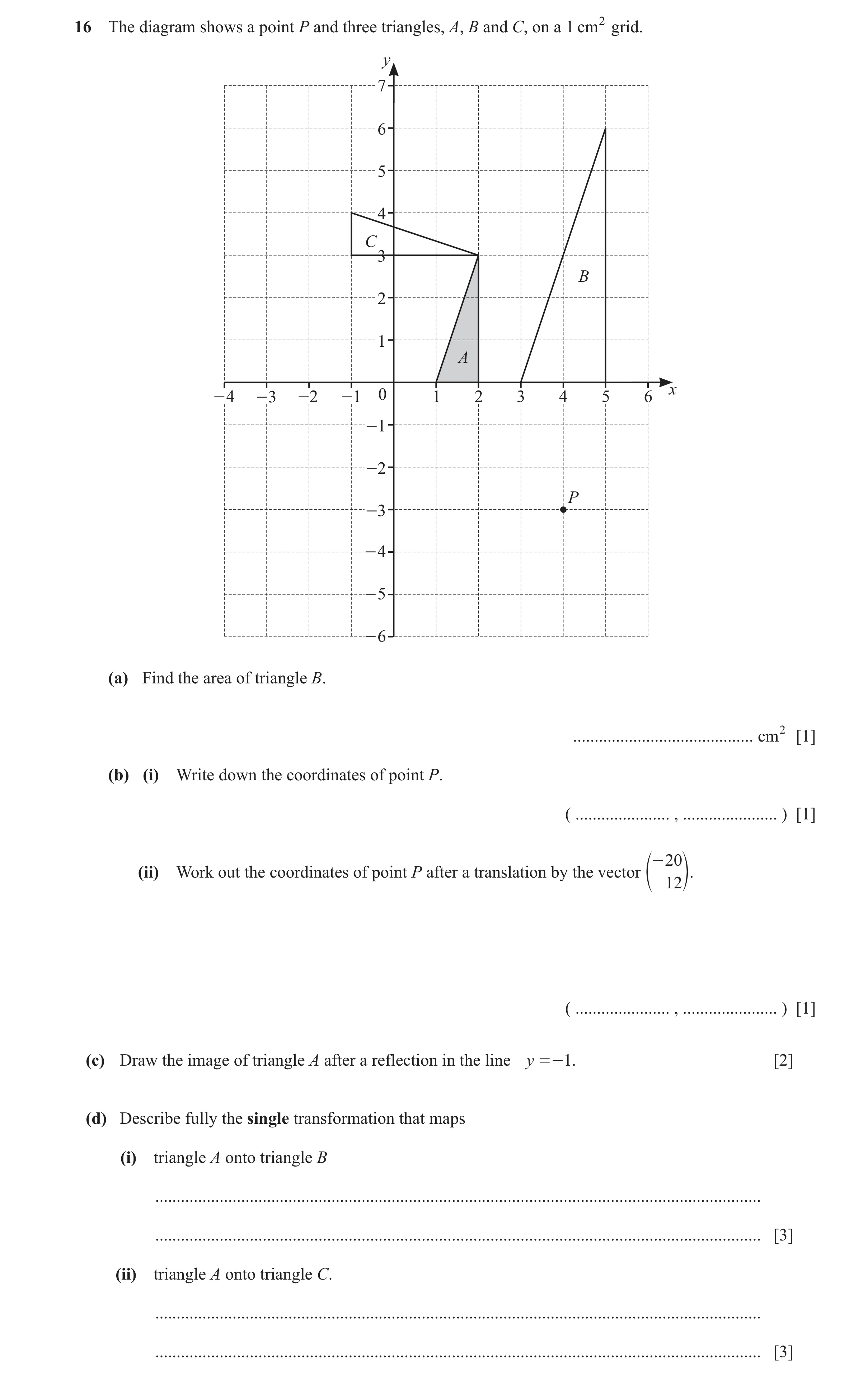
 39 / 39
 4
4 3
3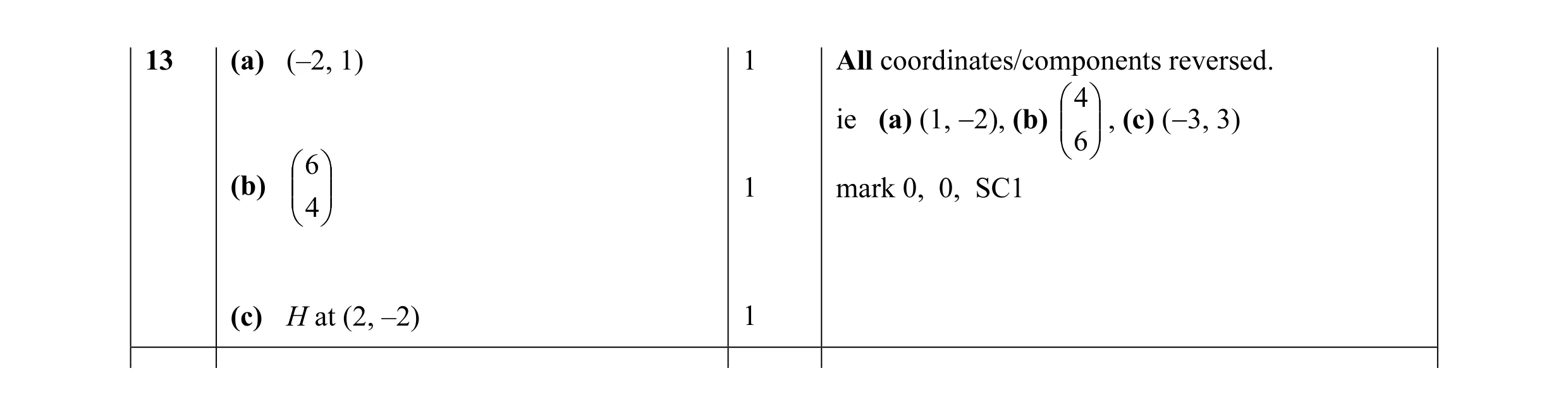 3
3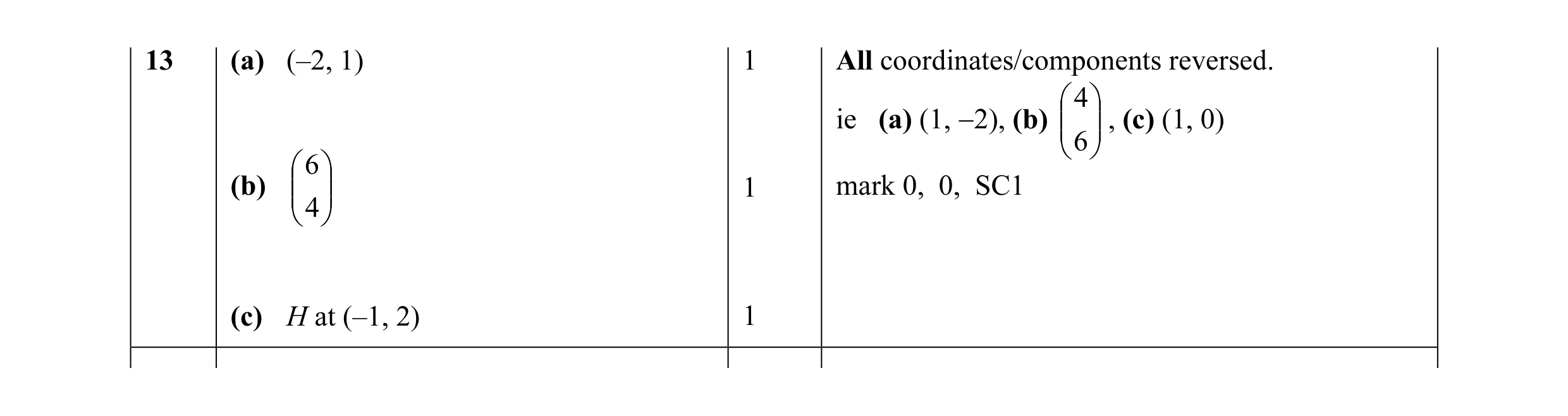 3
3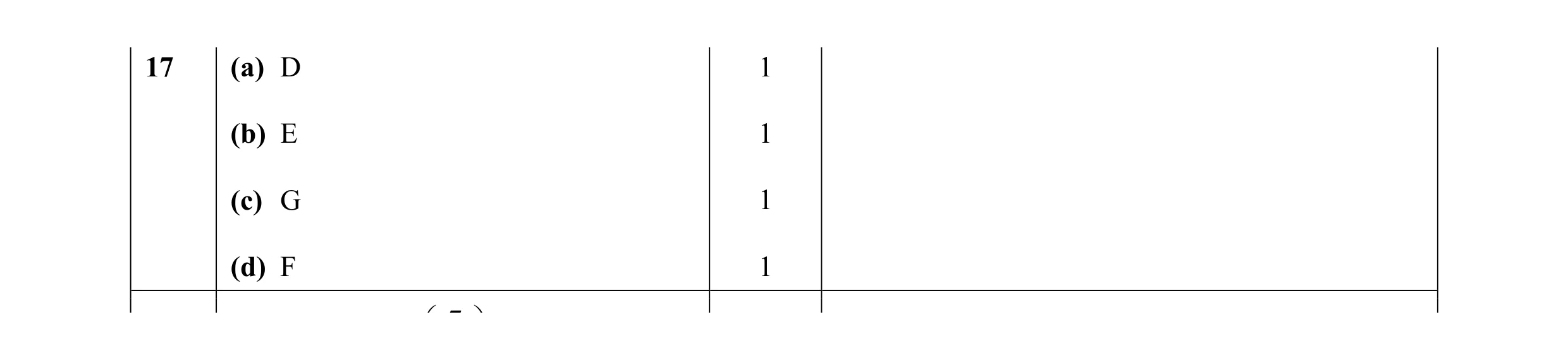 4
4 2
2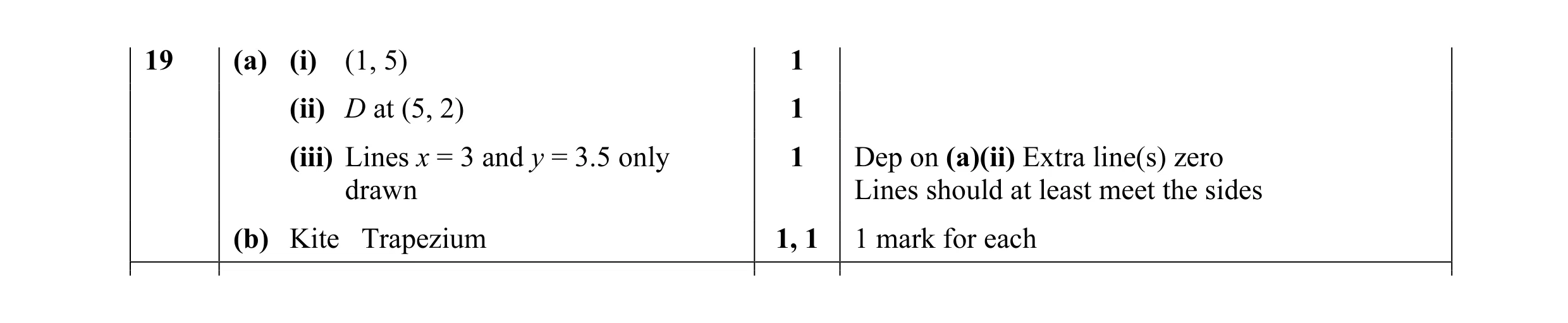 5
5 4
4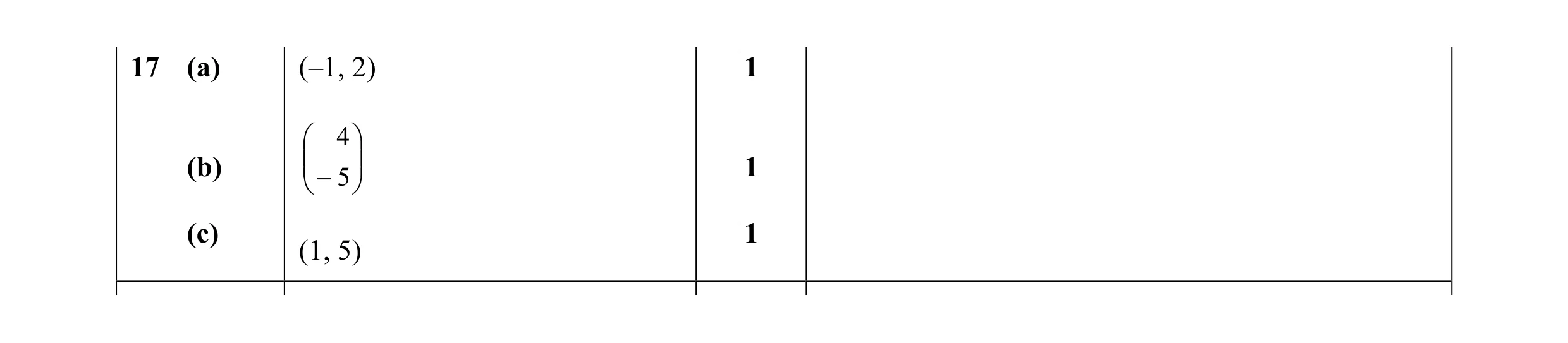 3
3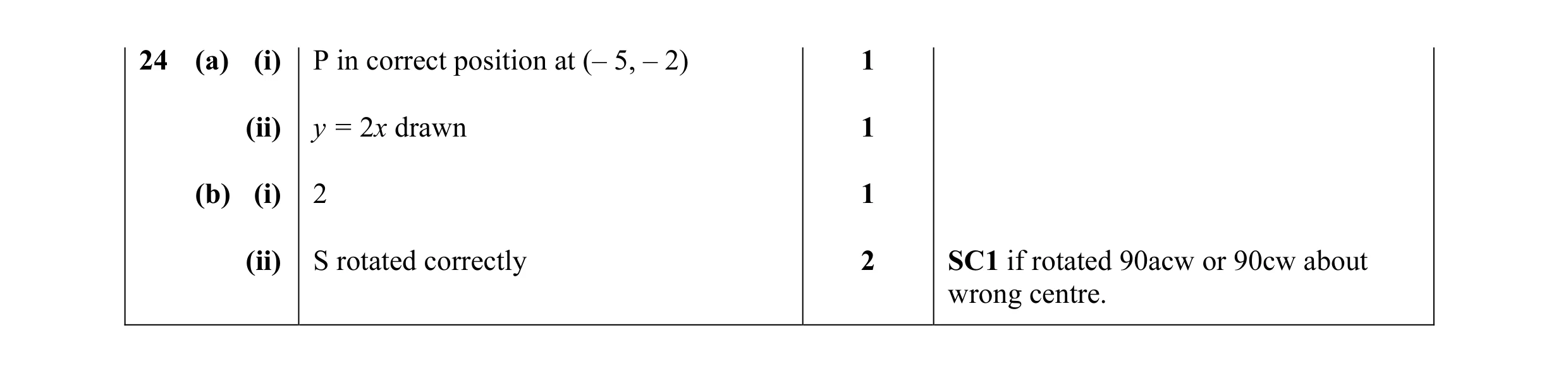 5
5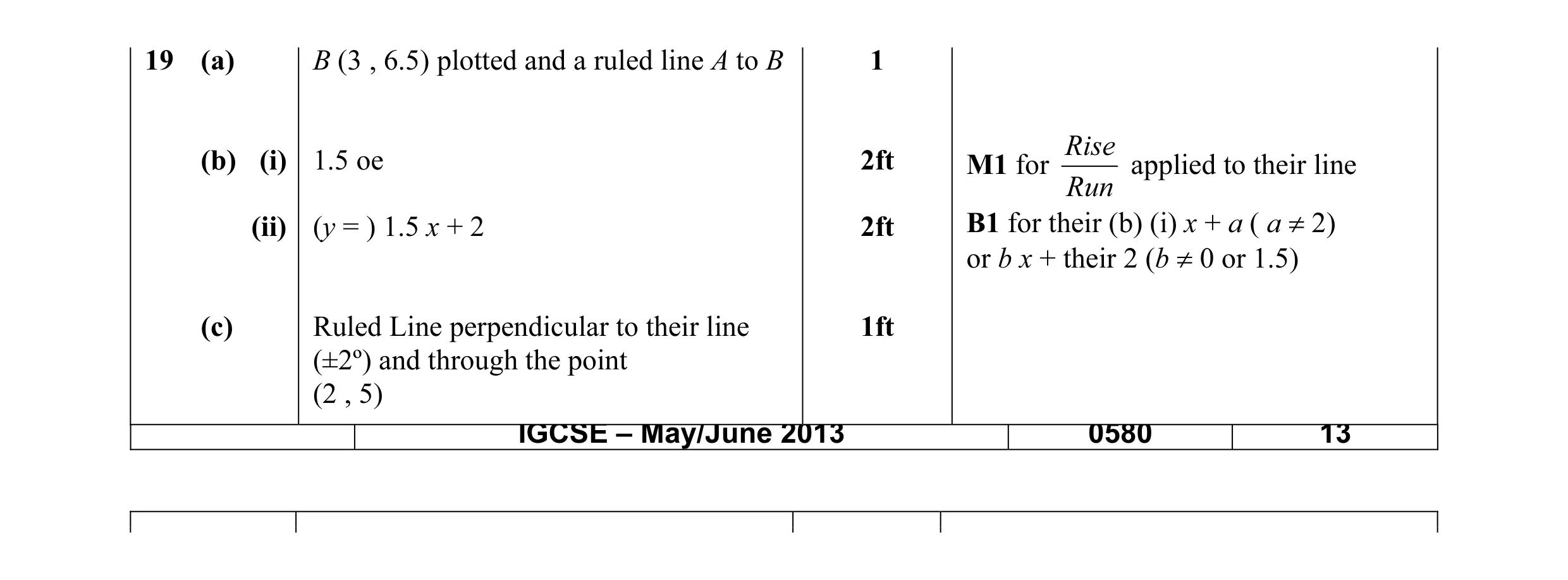 6
6 2
2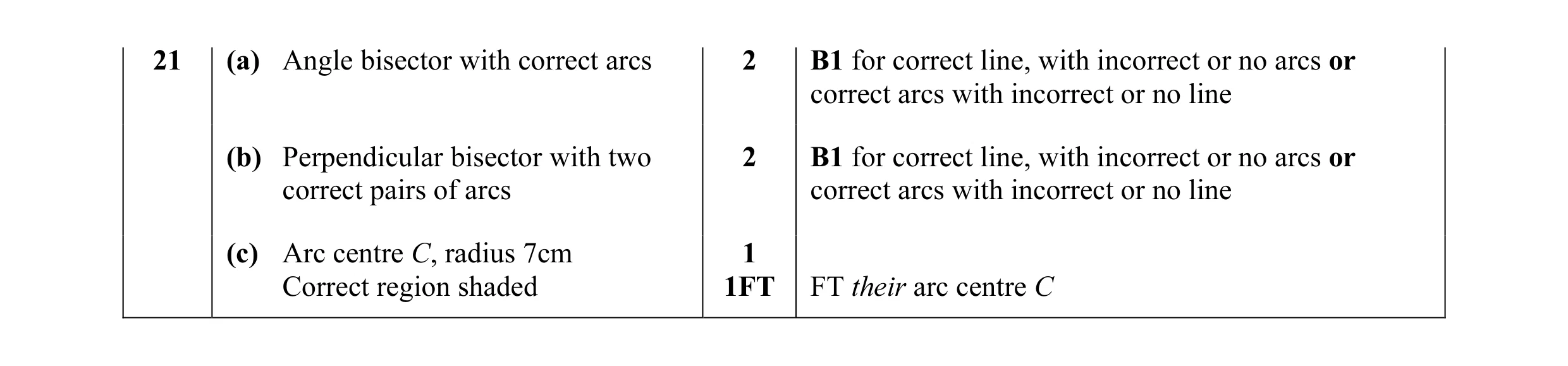 6
6 4
4 2
2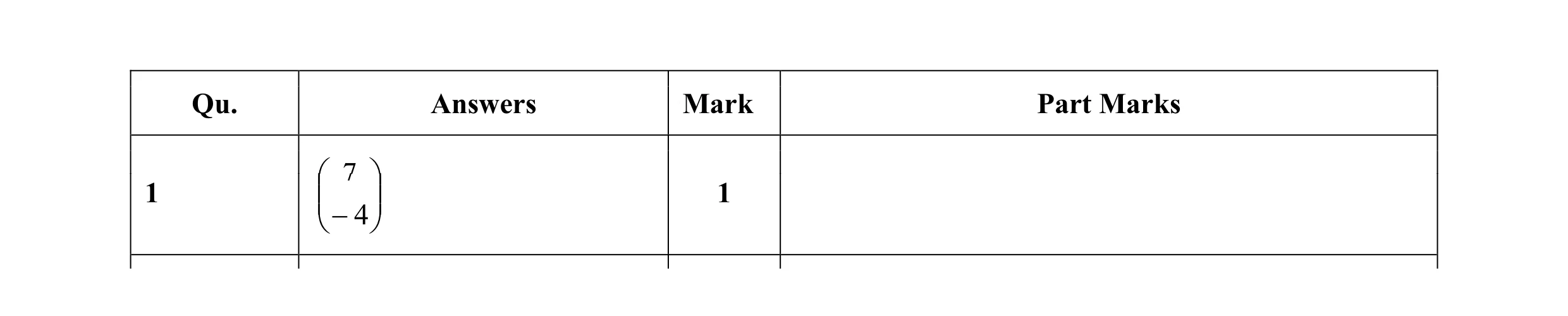 1
1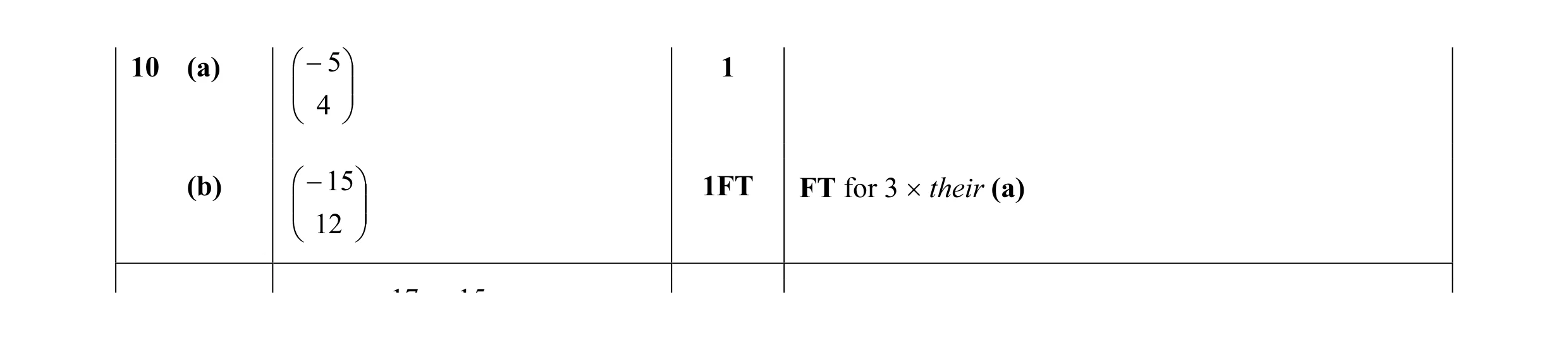 2
2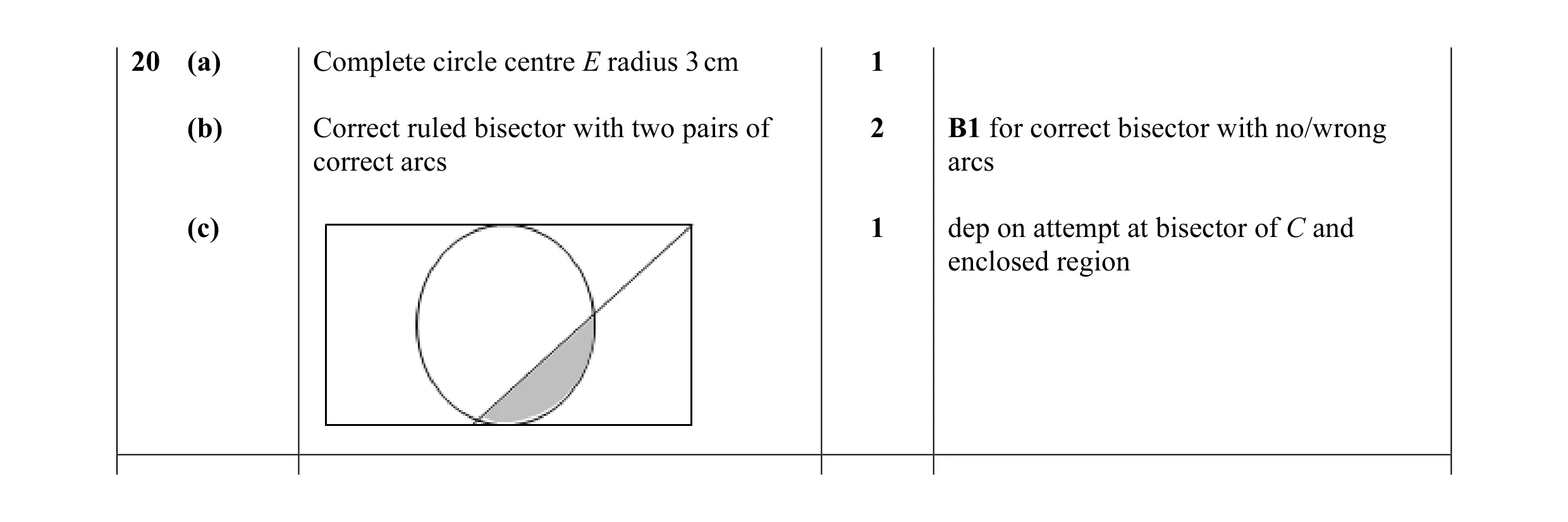 4
4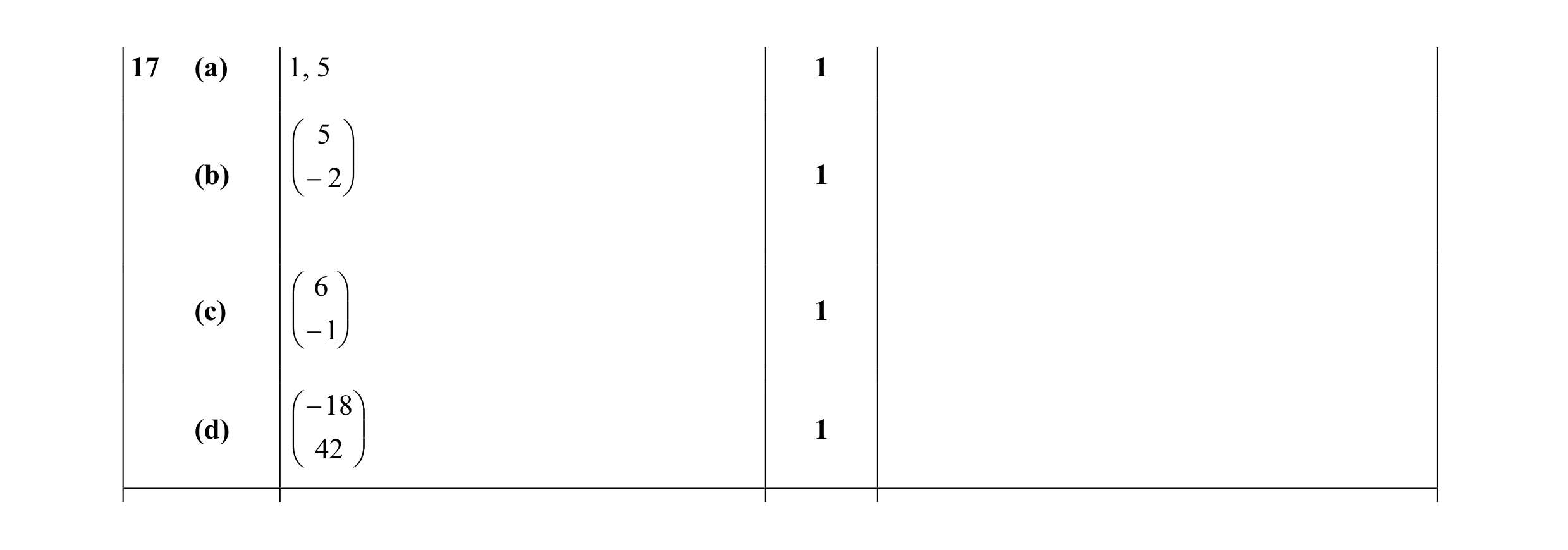 4
4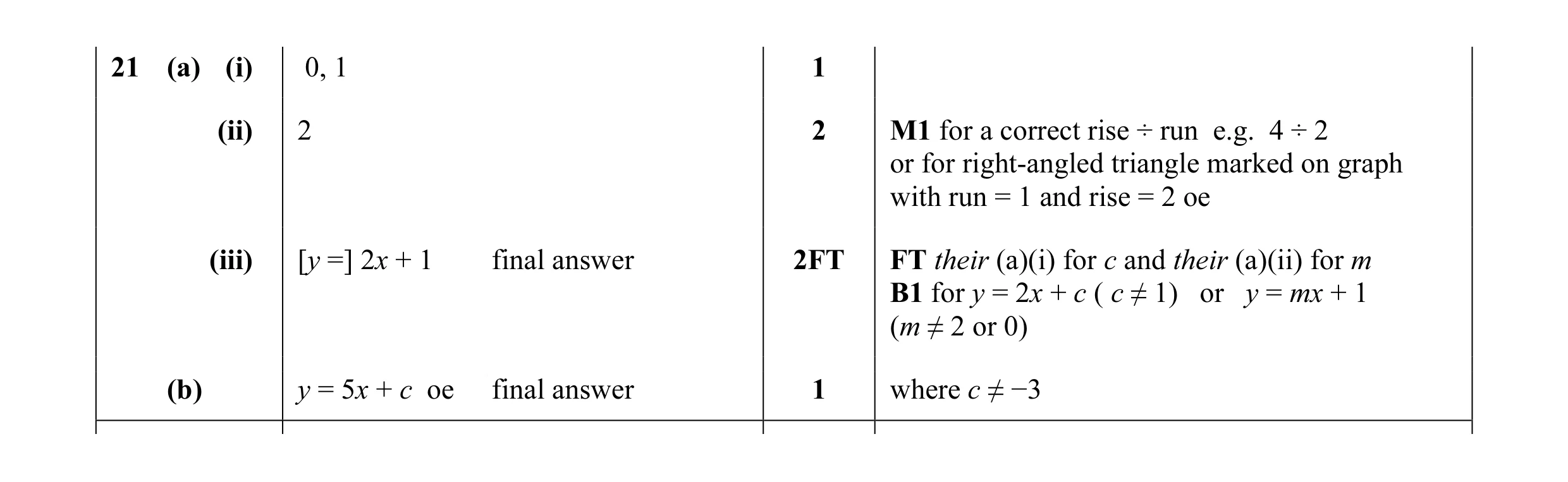 6
6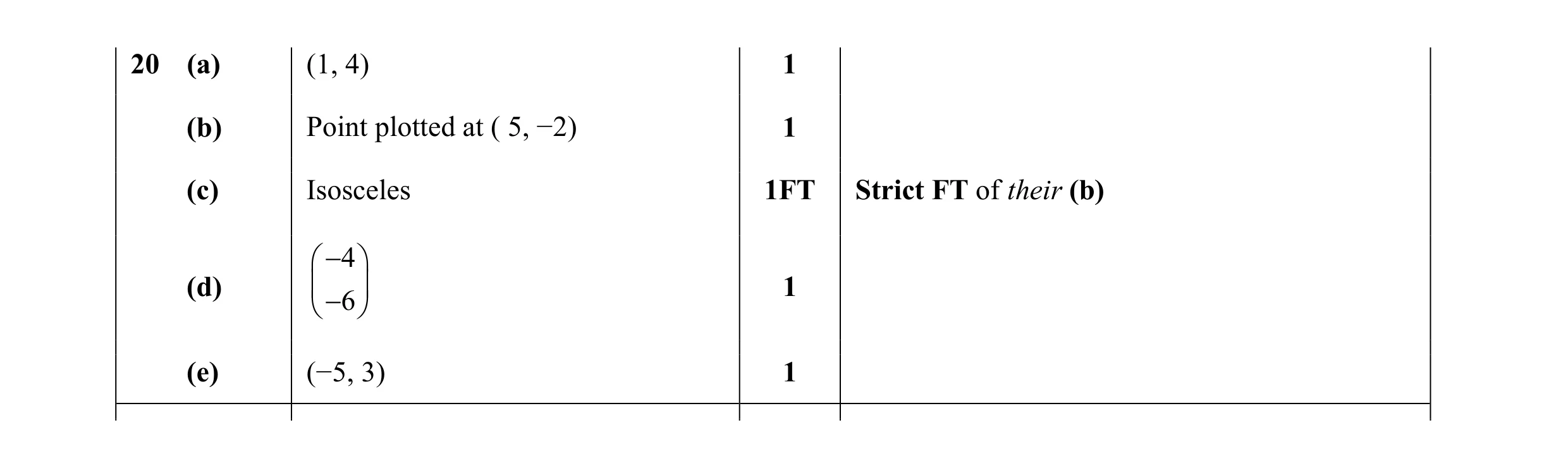 5
5 3
3 2
2 3
3 3
3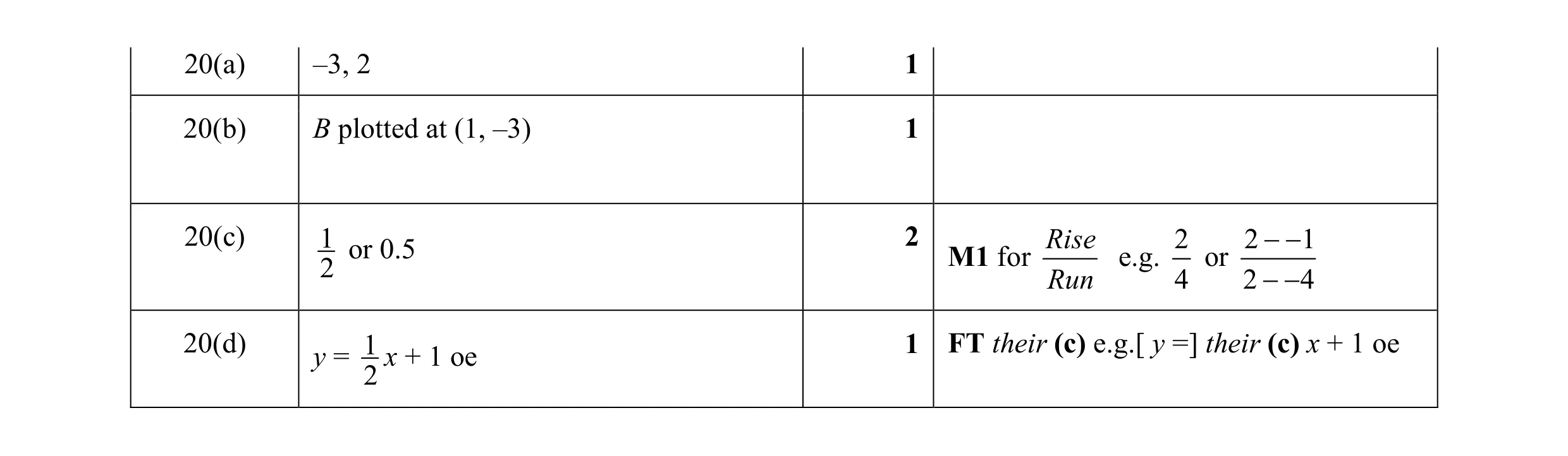 5
5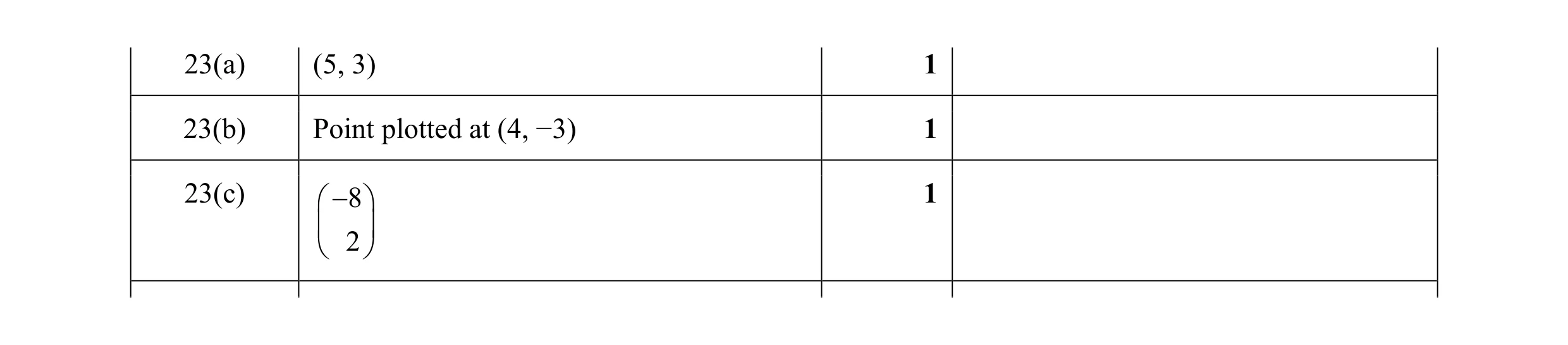 3
3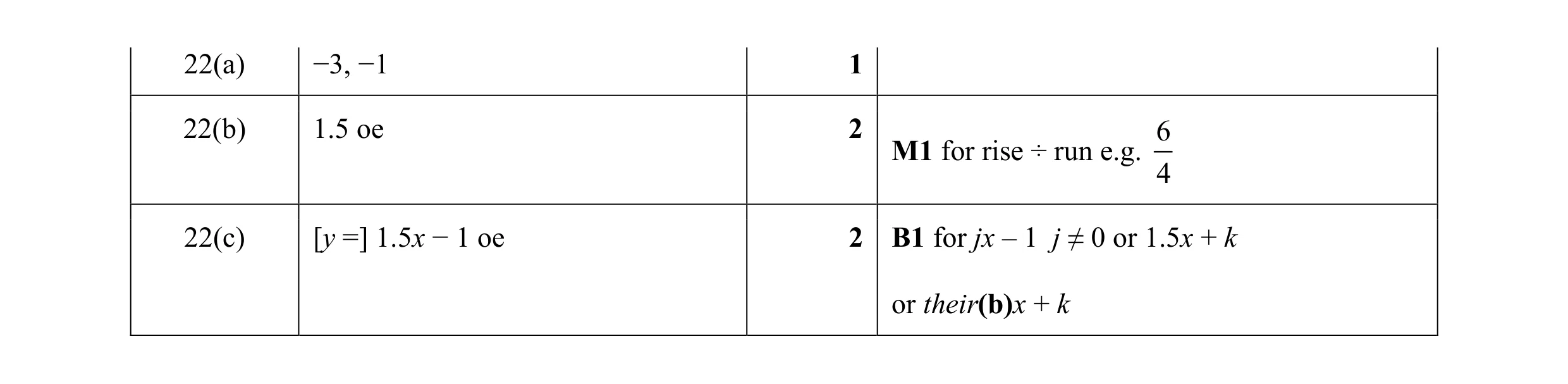 5
5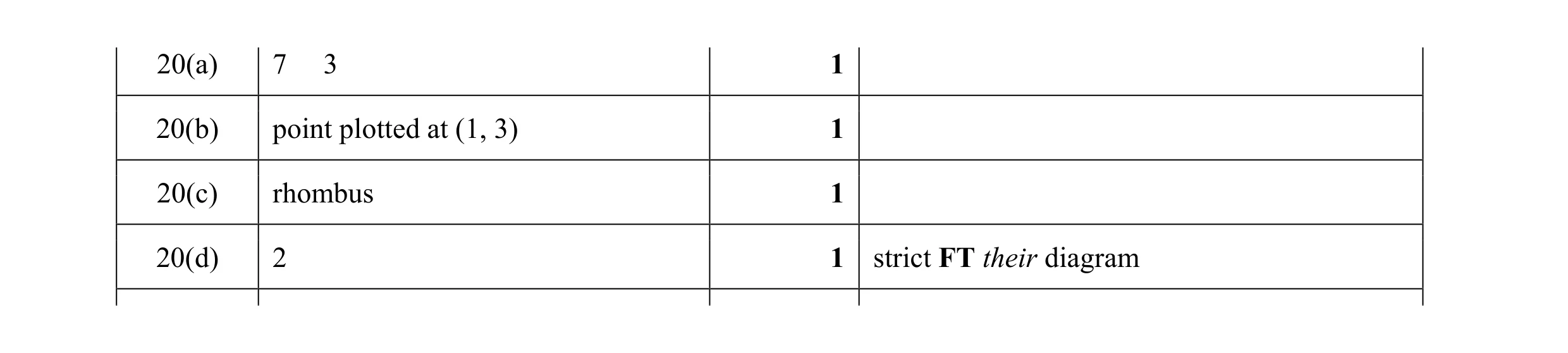 4
4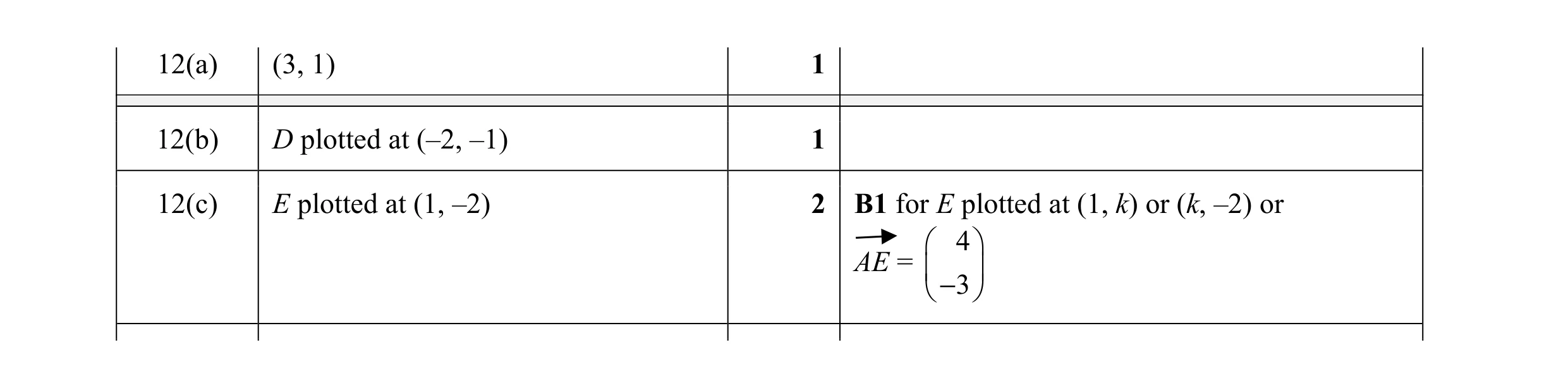 4
4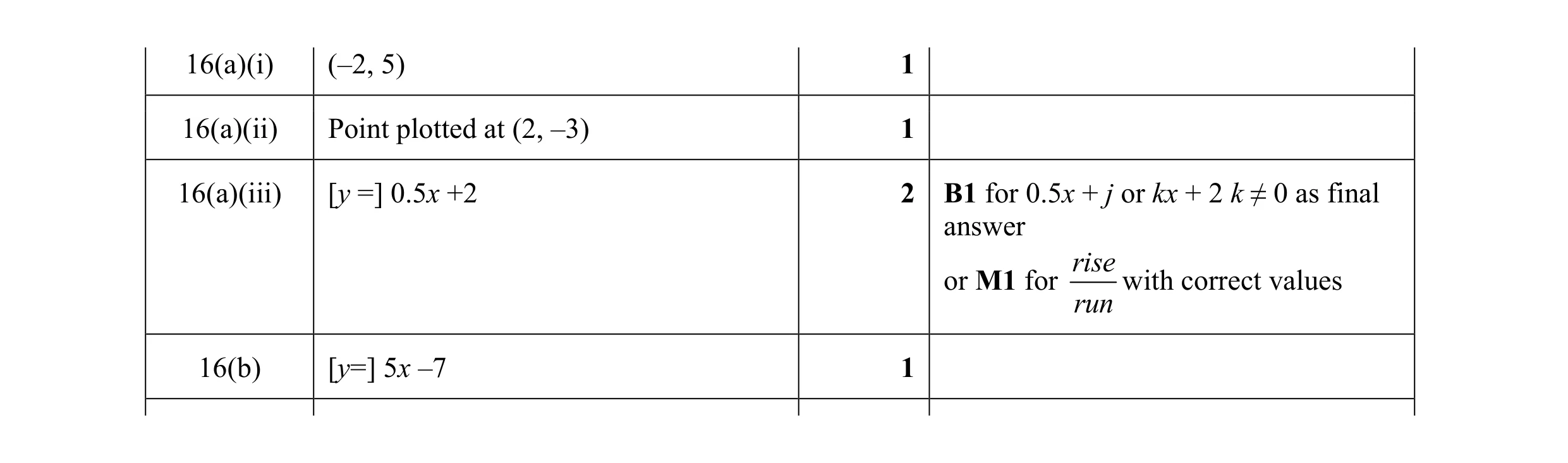 5
5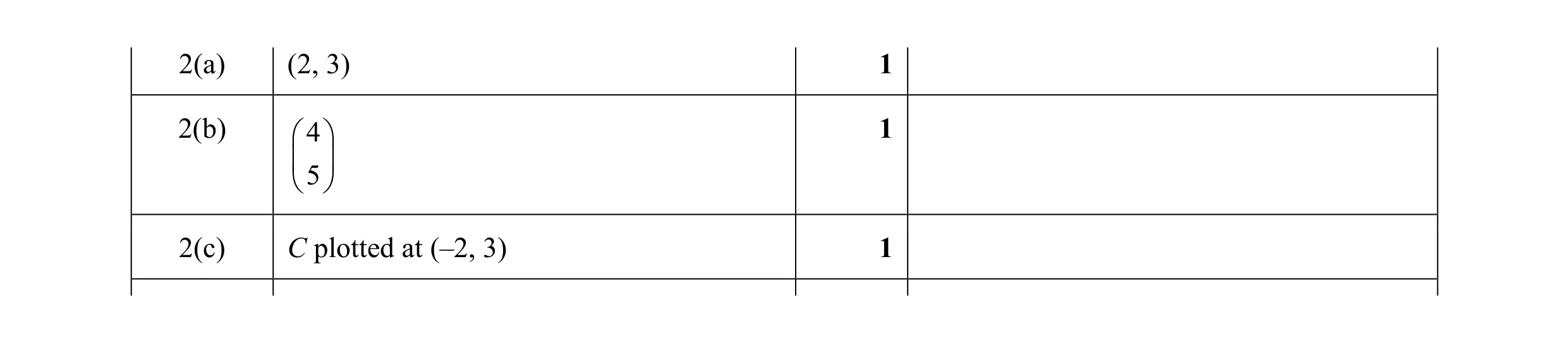 3
3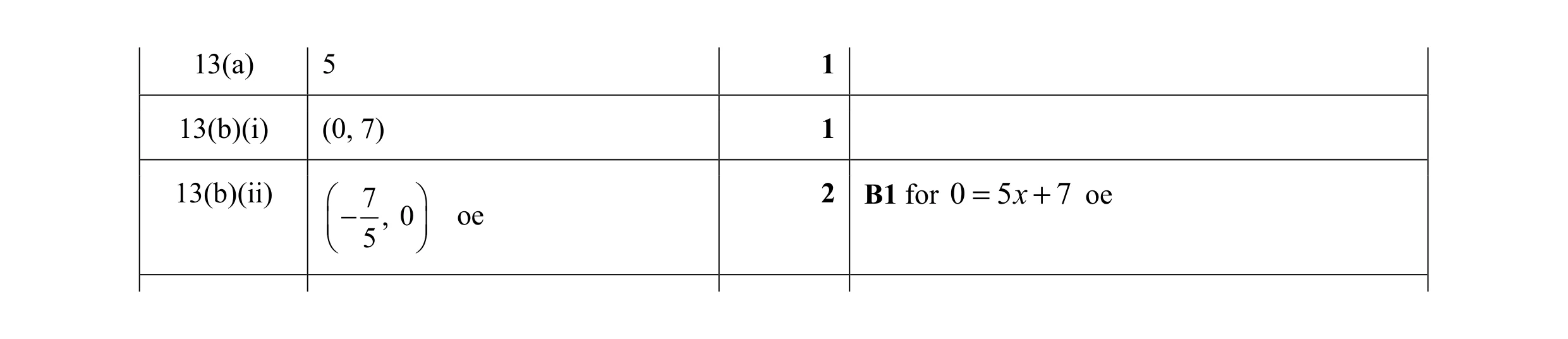 4
4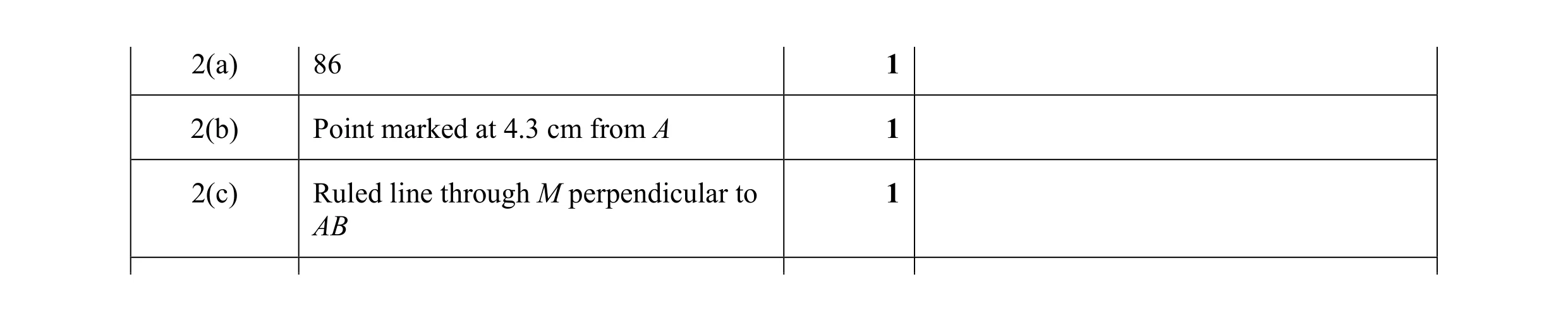 3
3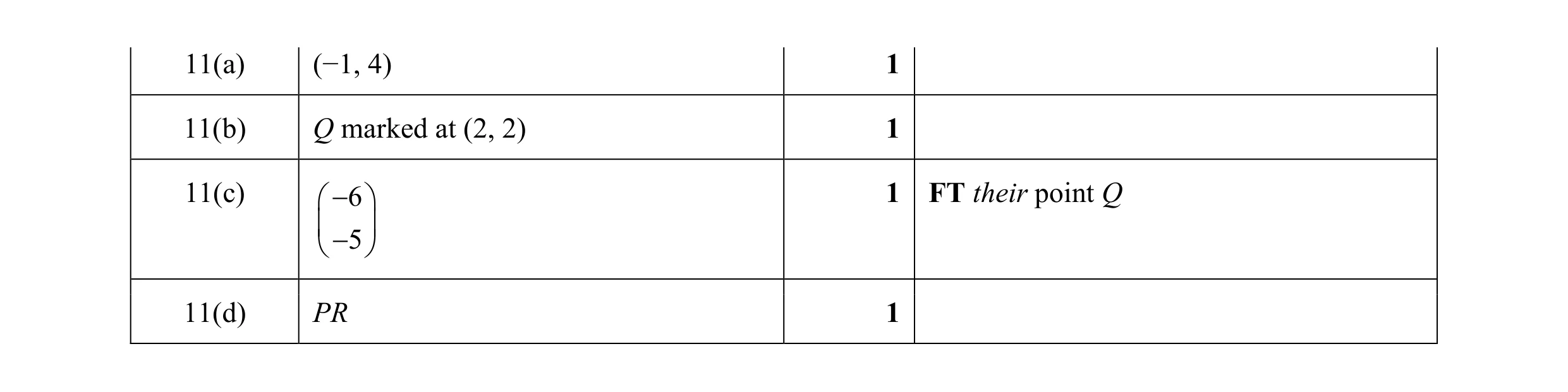 4
4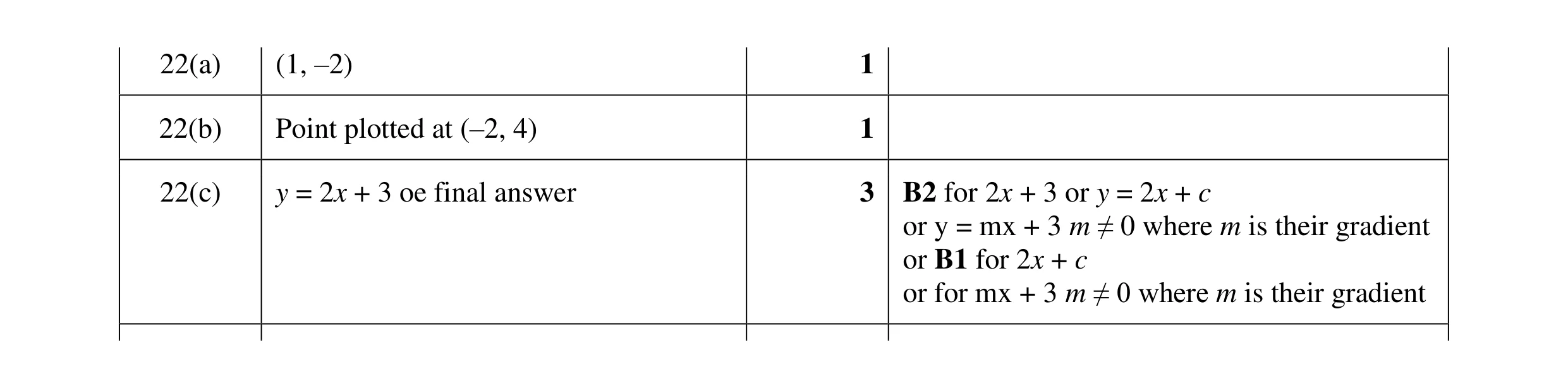 5
5 1
1 2
2 1
1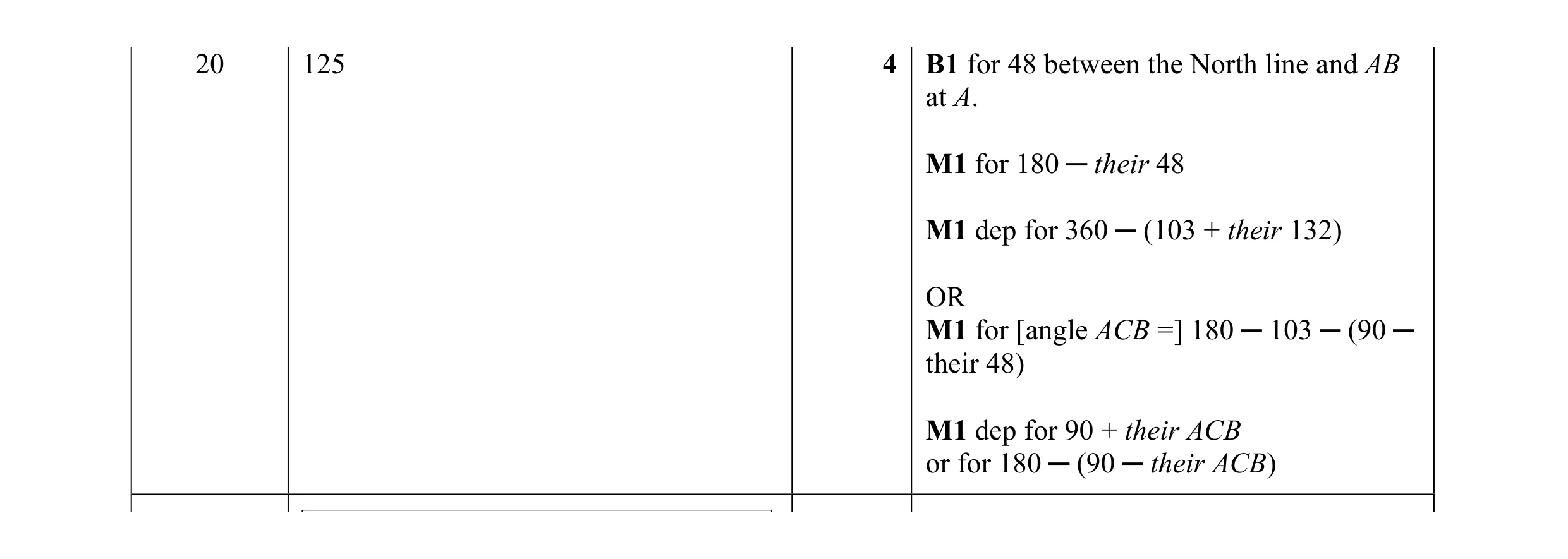 4
4 4
4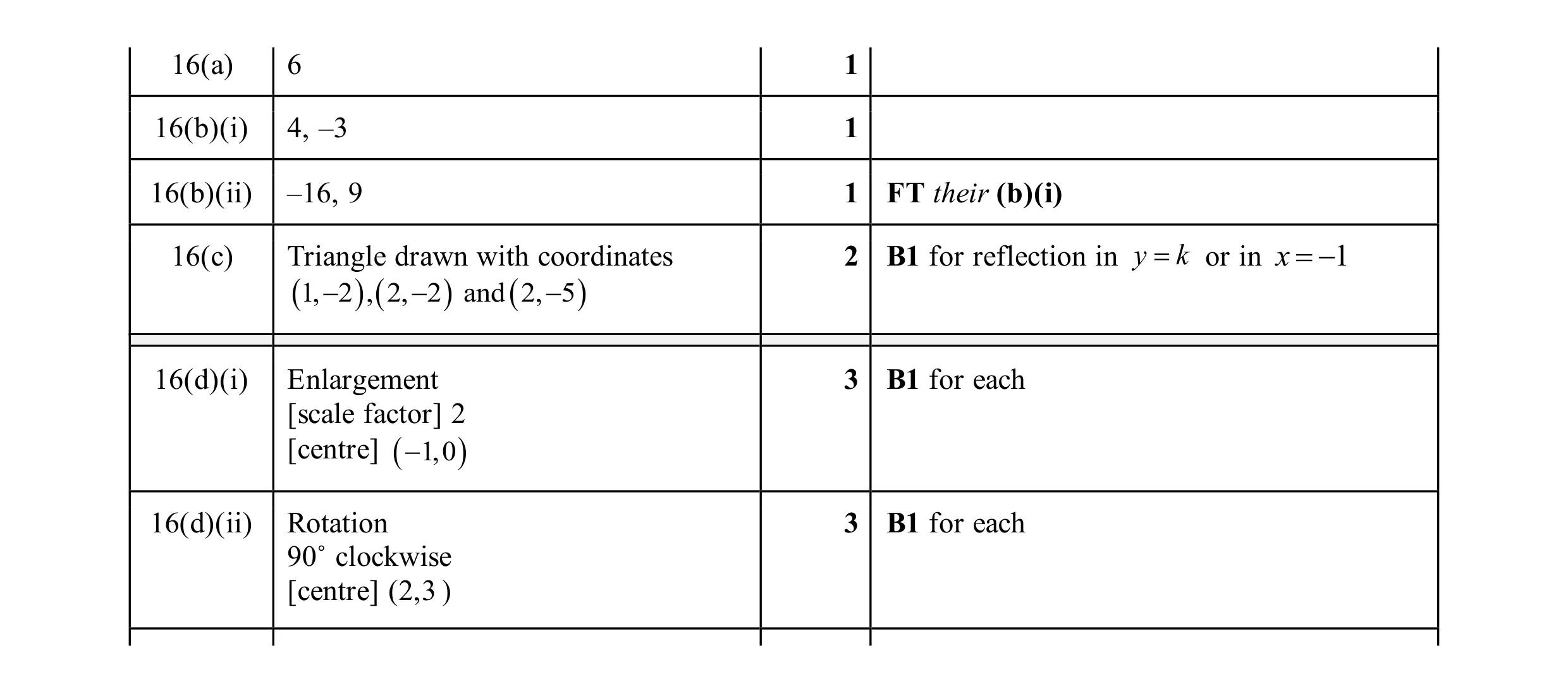 11
11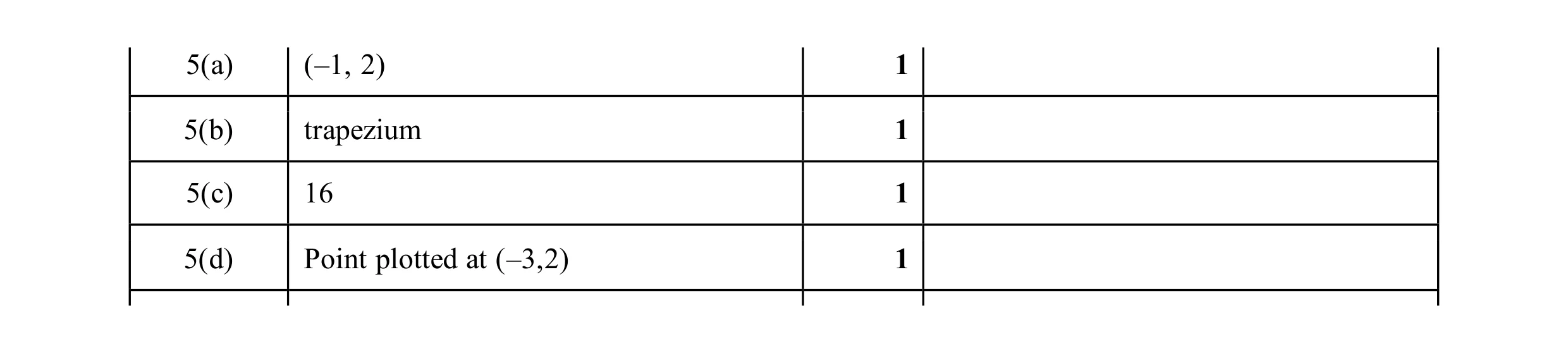 4
4