Cambridge IGCSE Mathematics 0580 — 2011 May/June Paper 1 · Variant 3
0580/13/M/J/11 · 19 questions · 56 marks · ≈63 min
The question paper and its mark scheme, free to read here and free to download. This is Cambridge’s own paper, exactly as it was sat.
Question paper8 pages
Mark scheme3 pages
Answers below. Sit the paper first if you are practising.
Questions as text
Q1 · Write down ten thousand and seventy three in figures
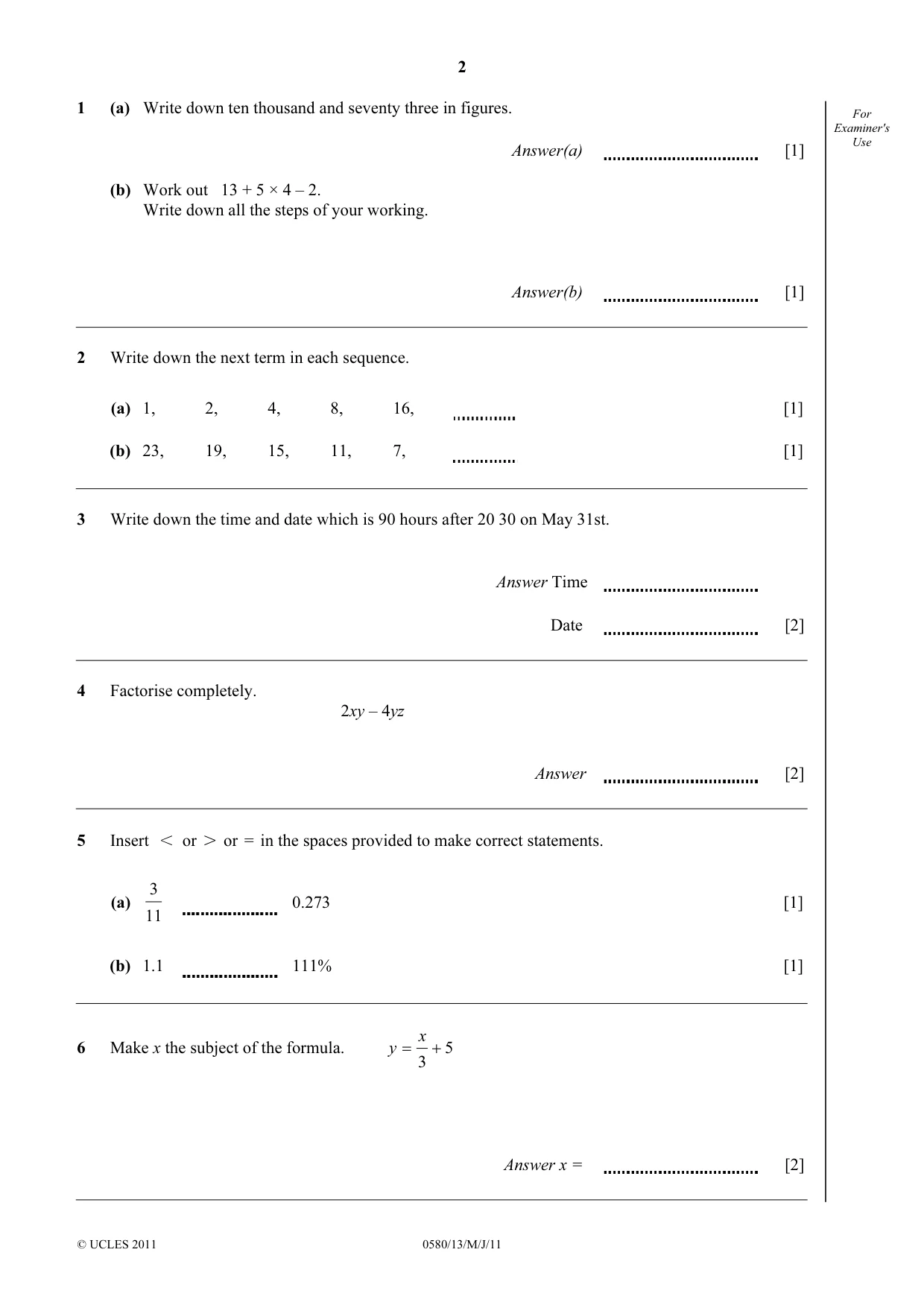
1 (a) Write down ten thousand and seventy three in figures. For Examiner's Answer(a) [1] Use (b) Work out 13 + 5 × 4 – 2. Write down all the steps of your working. Answer(b) [1]
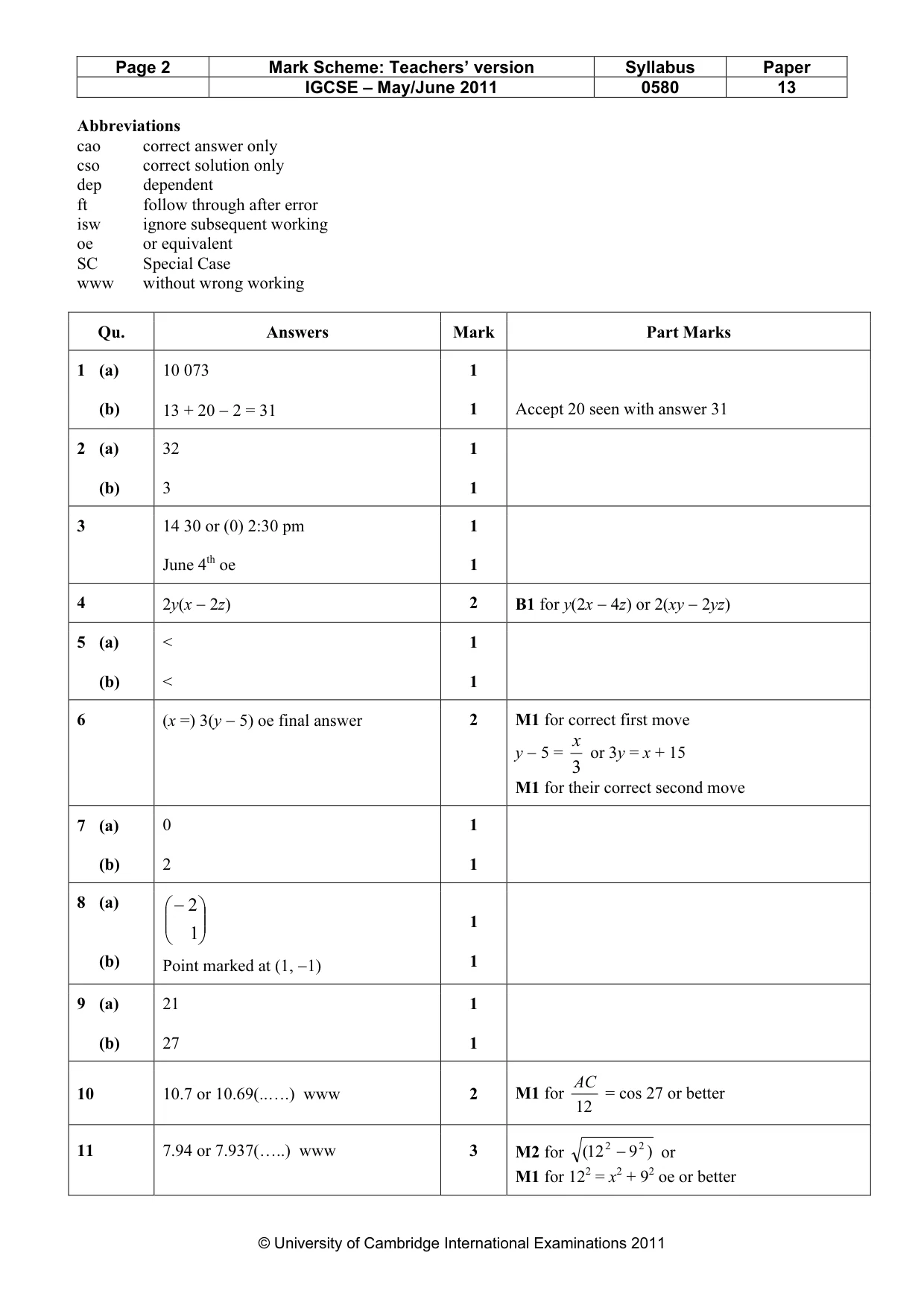
Mark scheme: Qu. Answers Mark Part Marks 1 (a) 10 073 1 (b) 13 + 20 − 2 = 31 1 Accept 20 seen with answer 31
Q2 · Write down the next term in each sequence
2 Write down the next term in each sequence. (a) 1, 2, 4, 8, 16, [1] (b) 23, 19, 15, 11, 7, [1]
Mark scheme: 2 (a) 32 1 (b) 3 1
Q3 · Write down the time and date which is 90 hours after 20 30 on May 31st
3 Write down the time and date which is 90 hours after 20 30 on May 31st. Answer Time Date [2]
Mark scheme: 3 14 30 or (0) 2:30 pm 1 June 4th oe 1
Question 4
4 Factorise completely. 2xy – 4yz Answer [2]
Mark scheme: 4 2y(x − 2z) 2 B1 for y(2x − 4z) or 2(xy − 2yz)
Q6 · X 6 Make x the subject of the formula
x 6 Make x the subject of the formula. y = + 5 3 Answer x = [2]
Mark scheme: 6 (x =) 3(y − 5) oe final answer 2 M1 for correct first move x y − 5 = or 3y = x + 15 3 M1 for their correct second move
Q7 · For Examiner's Use For the diagram, write down (a) the number of lines of symmetry…
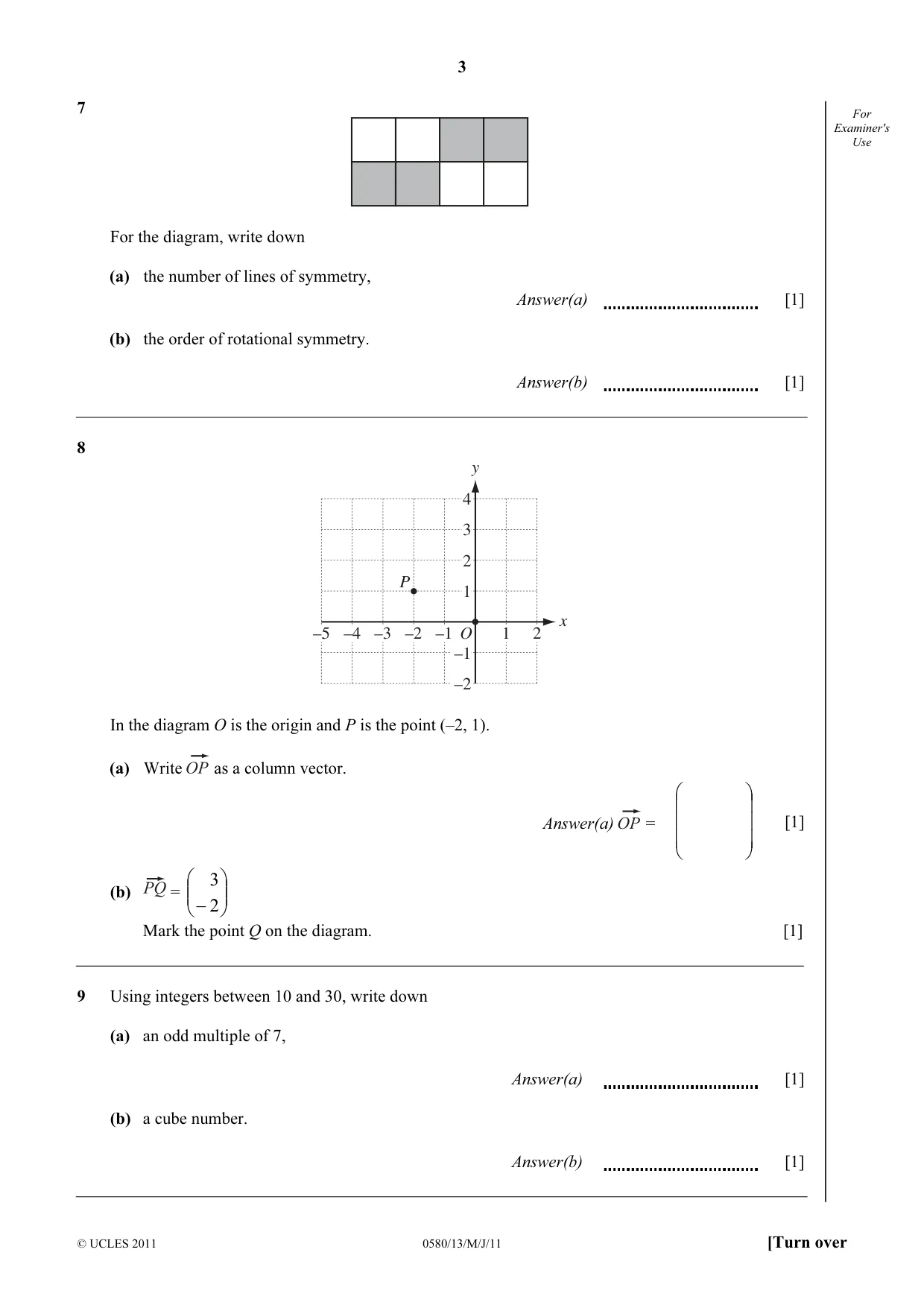
7 For Examiner's Use For the diagram, write down (a) the number of lines of symmetry, Answer(a) [1] (b) the order of rotational symmetry. Answer(b) [1]
Mark scheme: 7 (a) 0 1 (b) 2 1
Q8 · Y 4 3 2 P 1 x –5 –4 –3 –2 –1 O 1 2 –1 –2 In the diagram O is the origin and P is the…
8 y 4 3 2 P 1 x –5 –4 –3 –2 –1 O 1 2 –1 –2 In the diagram O is the origin and P is the point (–2, 1). (a) Write as a column vector. Answer(a) = [1] 3 (b) = −2 Mark the point Q on the diagram. [1]
Mark scheme: 8 (a) − 2 1 1 (b) 1 Point marked at (1, −1)
Q9 · Using integers between 10 and 30, write down (a) an odd multiple of 7, Answer(a) [1] (b)…
9 Using integers between 10 and 30, write down (a) an odd multiple of 7, Answer(a) [1] (b) a cube number. Answer(b) [1]
Mark scheme: 9 (a) 21 1 (b) 27 1 AC
Q10 · For C Examiner's A 27° Use NOT TO 12 cm SCALE B In triangle ABC, AB = 12 cm, angle C =…
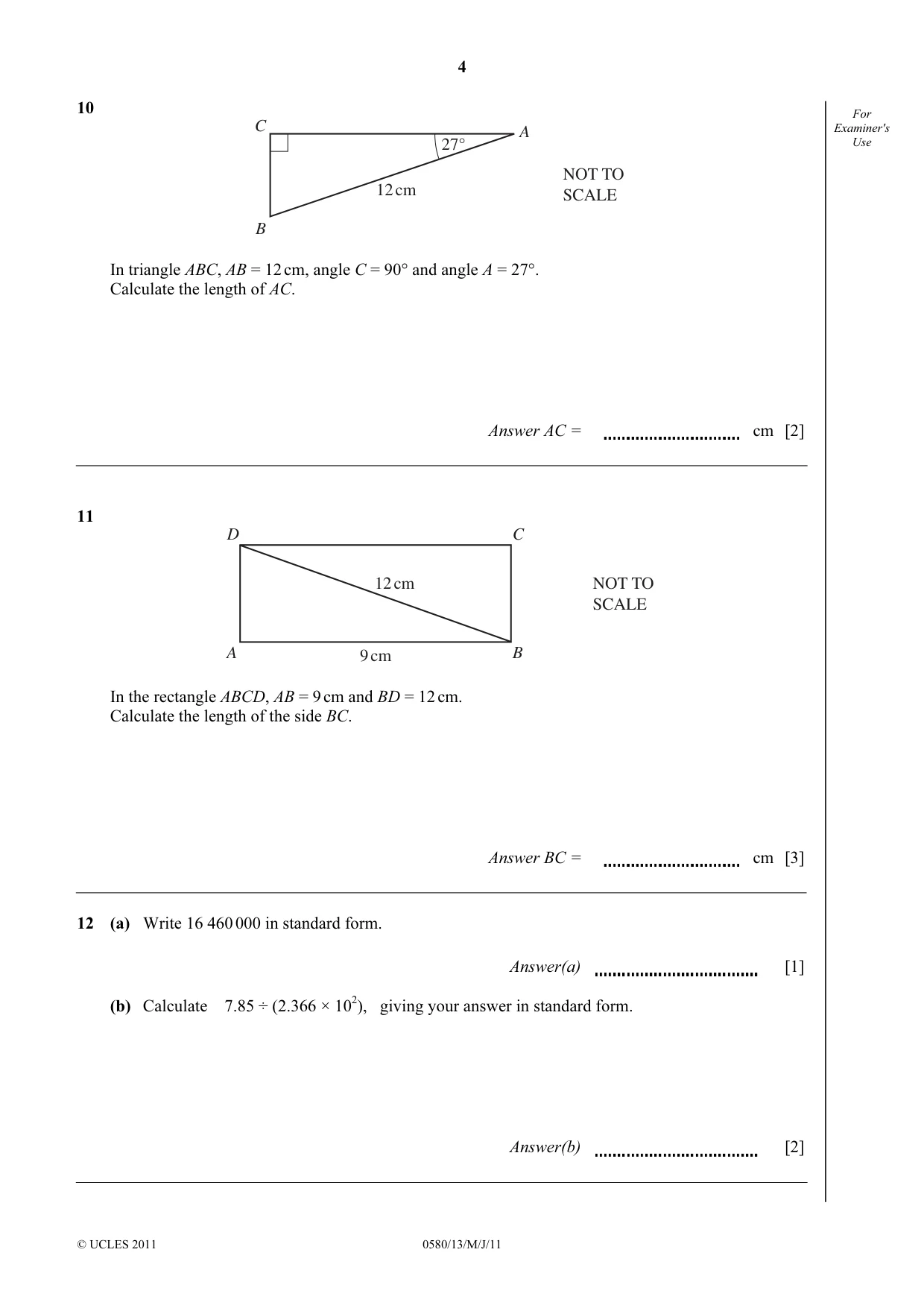
10 For C Examiner's A 27° Use NOT TO 12 cm SCALE B In triangle ABC, AB = 12 cm, angle C = 90° and angle A = 27°. Calculate the length of AC. Answer AC = cm [2]
Mark scheme: AC 10 10.7 or 10.69(..….) www 2 M1 for = cos 27 or better 12 2 2
Q11 · D C 12 cm NOT TO SCALE A 9 cm B In the rectangle ABCD, AB = 9 cm and BD = 12 cm
11 D C 12 cm NOT TO SCALE A 9 cm B In the rectangle ABCD, AB = 9 cm and BD = 12 cm. Calculate the length of the side BC. Answer BC = cm [3]
Mark scheme: 11 7.94 or 7.937(…..) www 3 M2 for (12 2 − 9 2 ) or M1 for 122 = x2 + 92 oe or better IGCSE – May/June 2011 0580 13 7
Q12 · Write 16 460 000 in standard form
12 (a) Write 16 460 000 in standard form. Answer(a) [1] (b) Calculate 7.85 ÷ (2.366 × 10²), giving your answer in standard form. Answer(b) [2]
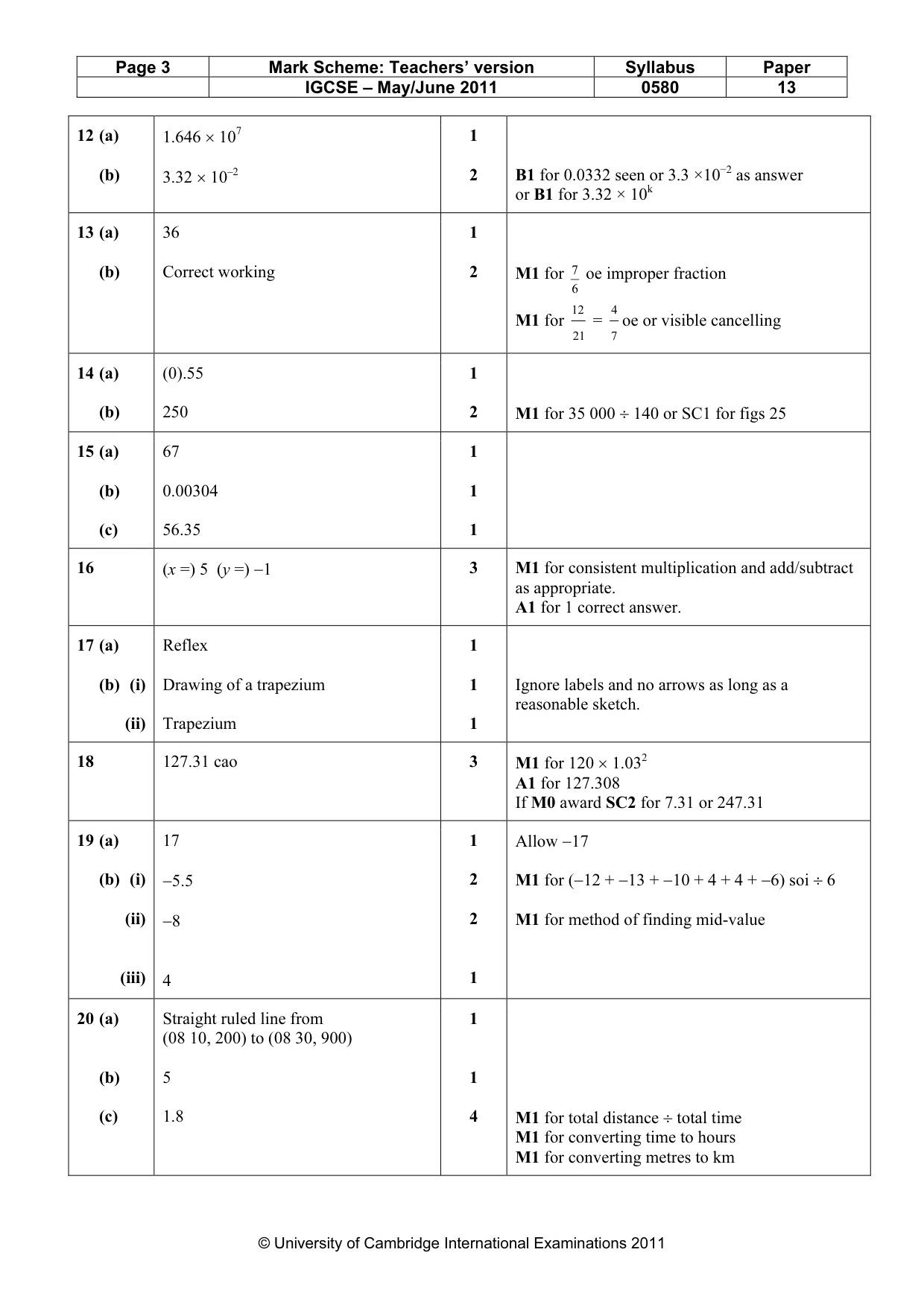
Mark scheme: 12 (a) 1.646 × 10⁷ 1 (b) 3.32 × 10⁻² 2 B1 for 0.0332 seen or 3.3 ×10⁻² as answer or B1 for 3.32 × 10k
Q13 · 27 For 13 (a) Find the value of x when =
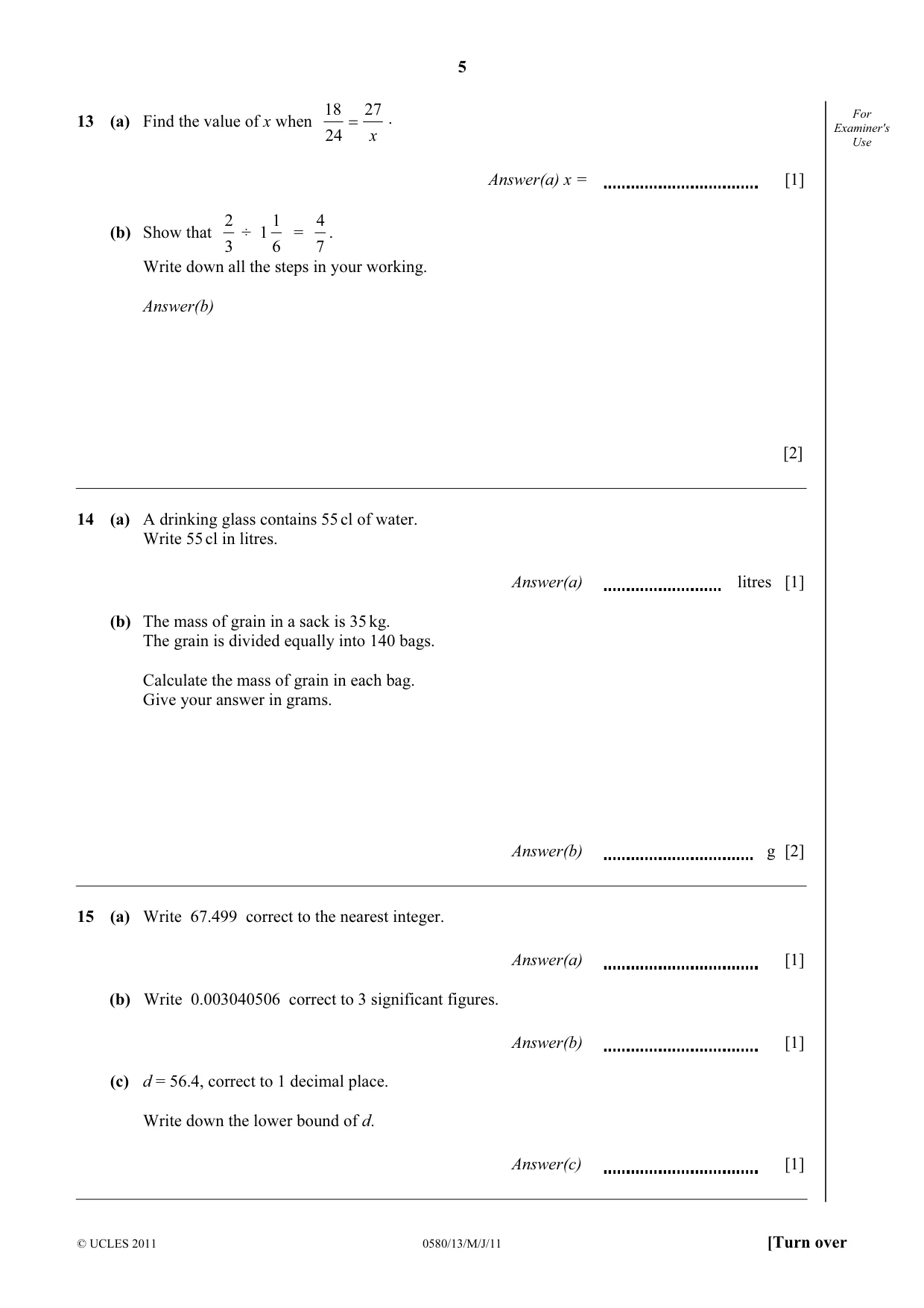
18 27 For 13 (a) Find the value of x when = . Examiner's 24 x Use Answer(a) x = [1] 2 1 4 (b) Show that ÷ 1 = . 3 6 7 Write down all the steps in your working. Answer(b) [2]
Mark scheme: 13 (a) 36 1 (b) Correct working 2 M1 for 7 oe improper fraction 6 12 4 M1 for = oe or visible cancelling 21 7
Q14 · A drinking glass contains 55 cl of water
14 (a) A drinking glass contains 55 cl of water. Write 55 cl in litres. Answer(a) litres [1] (b) The mass of grain in a sack is 35 kg. The grain is divided equally into 140 bags. Calculate the mass of grain in each bag. Give your answer in grams. Answer(b) g [2]
Mark scheme: 14 (a) (0).55 1 (b) 250 2 M1 for 35 000 ÷ 140 or SC1 for figs 25
Q15 · Write 67.499 correct to the nearest integer
15 (a) Write 67.499 correct to the nearest integer. Answer(a) [1] (b) Write 0.003040506 correct to 3 significant figures. Answer(b) [1] (c) d = 56.4, correct to 1 decimal place. Write down the lower bound of d. Answer(c) [1]
Mark scheme: 15 (a) 67 1 (b) 0.00304 1 (c) 56.35 1
Q16 · Solve the simultaneous equations
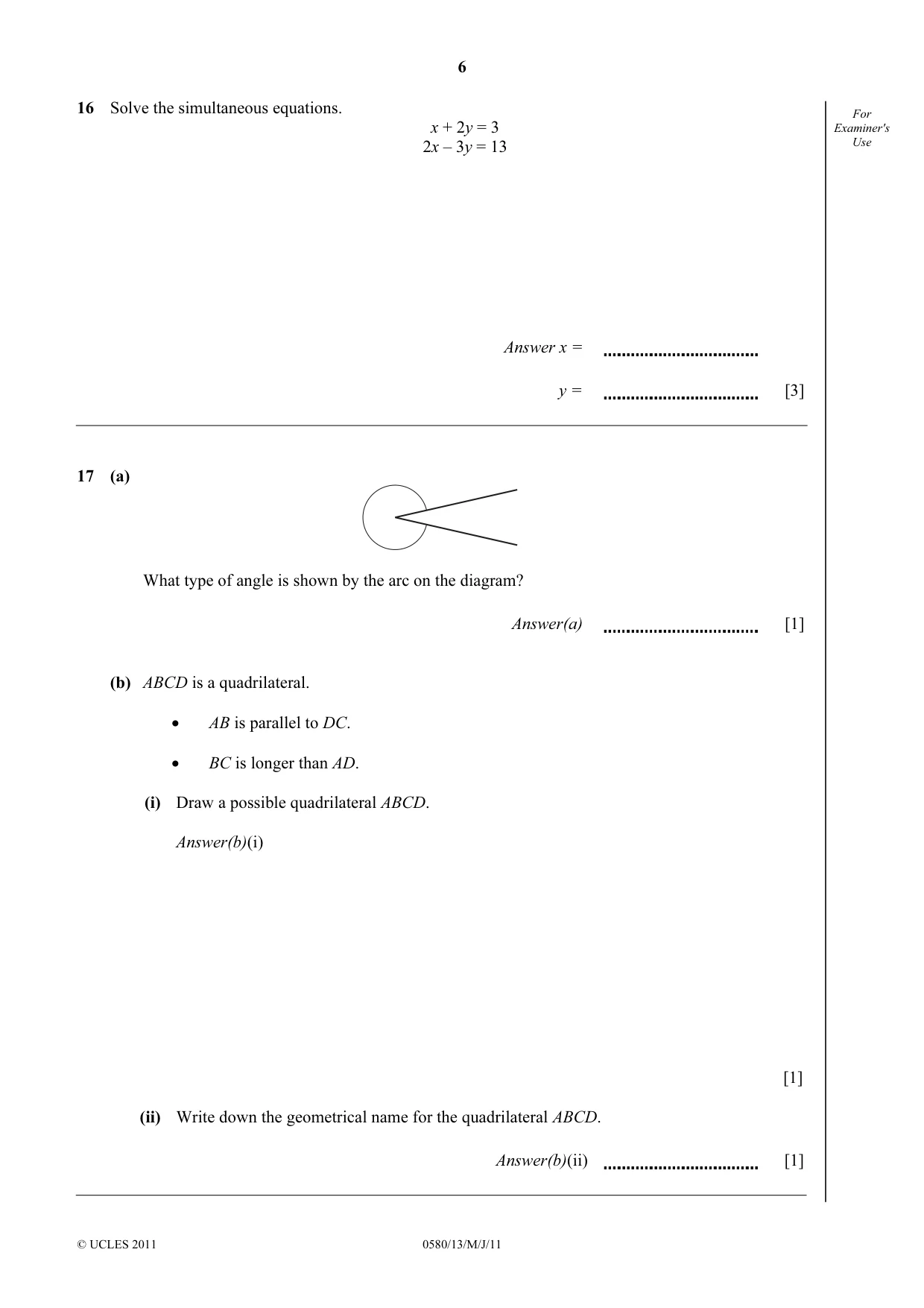
16 Solve the simultaneous equations. For x + 2y = 3 Examiner's 2x – 3y = 13 Use Answer x = y = [3]
Mark scheme: 16 (x =) 5 (y =) −1 3 M1 for consistent multiplication and add/subtract as appropriate. A1 for 1 correct answer.
Q17 · What type of angle is shown by the arc on the diagram?
17 (a) What type of angle is shown by the arc on the diagram? Answer(a) [1] (b) ABCD is a quadrilateral. • AB is parallel to DC. • BC is longer than AD. (i) Draw a possible quadrilateral ABCD. Answer(b)(i) [1] (ii) Write down the geometrical name for the quadrilateral ABCD. Answer(b)(ii) [1]
Mark scheme: 17 (a) Reflex 1 (b) (i) Drawing of a trapezium 1 Ignore labels and no arrows as long as a reasonable sketch. (ii) Trapezium 1 2
Q18 · Eva invests $120 at a rate of 3% per year compound interest
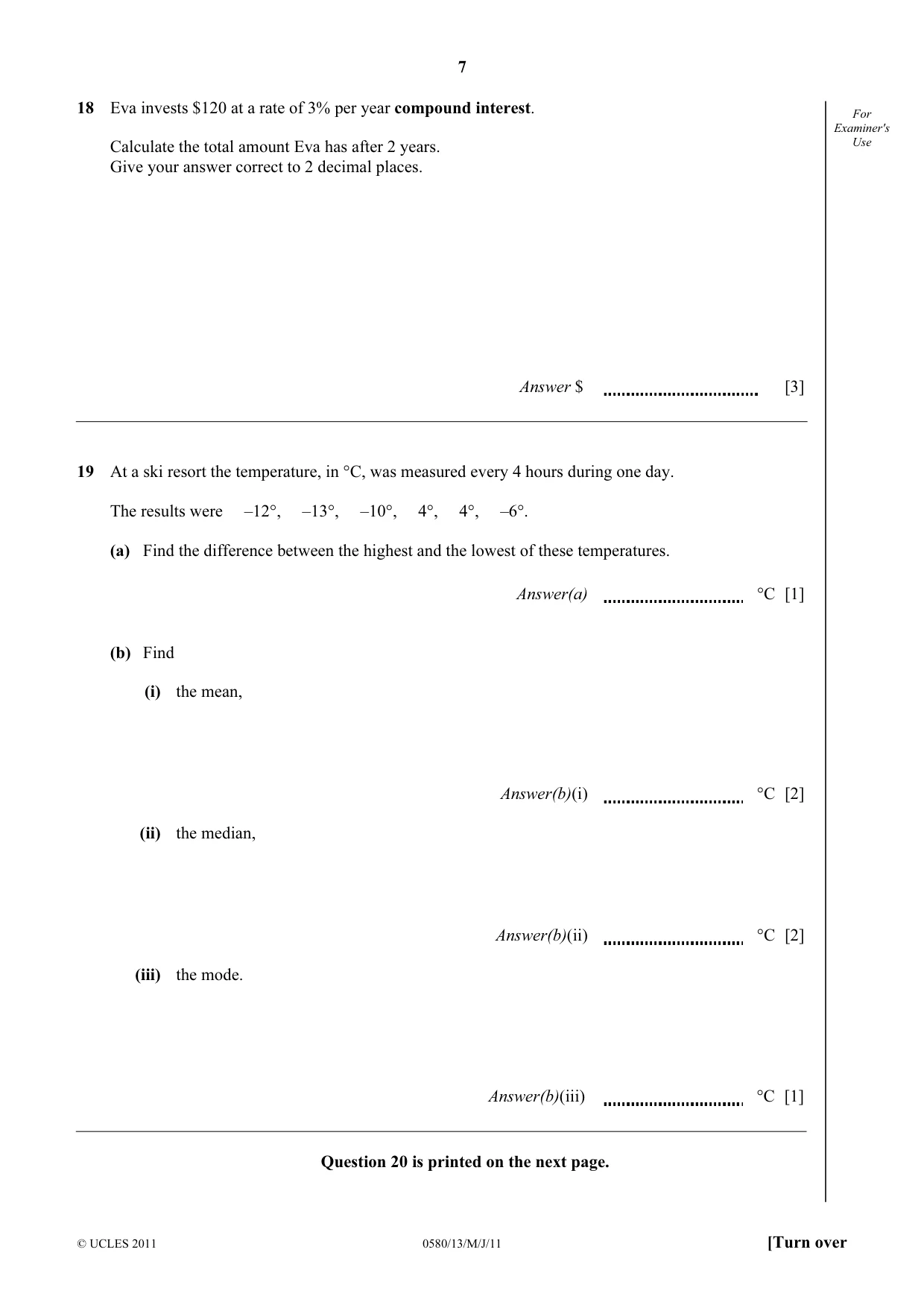
18 Eva invests $120 at a rate of 3% per year compound interest. For Examiner's Calculate the total amount Eva has after 2 years. Use Give your answer correct to 2 decimal places. Answer $ [3]
Mark scheme: 18 127.31 cao 3 M1 for 120 × 1.032 A1 for 127.308 If M0 award SC2 for 7.31 or 247.31
Q19 · At a ski resort the temperature, in °C, was measured every 4 hours during one day
19 At a ski resort the temperature, in °C, was measured every 4 hours during one day. The results were –12°, –13°, –10°, 4°, 4°, –6°. (a) Find the difference between the highest and the lowest of these temperatures. Answer(a) °C [1] (b) Find (i) the mean, Answer(b)(i) °C [2] (ii) the median, Answer(b)(ii) °C [2] (iii) the mode. Answer(b)(iii) °C [1] Question 20 is printed on the next page.
Mark scheme: 19 (a) 17 1 Allow −17 (b) (i) −5.5 2 M1 for (−12 + −13 + −10 + 4 + 4 + −6) soi ÷ 6 (ii) −8 2 M1 for method of finding mid-value (iii) 4 1
Q20 · For School 900 Examiner's Use 800 700 600 500 Distance (metres) 400 300 Friend’s house…
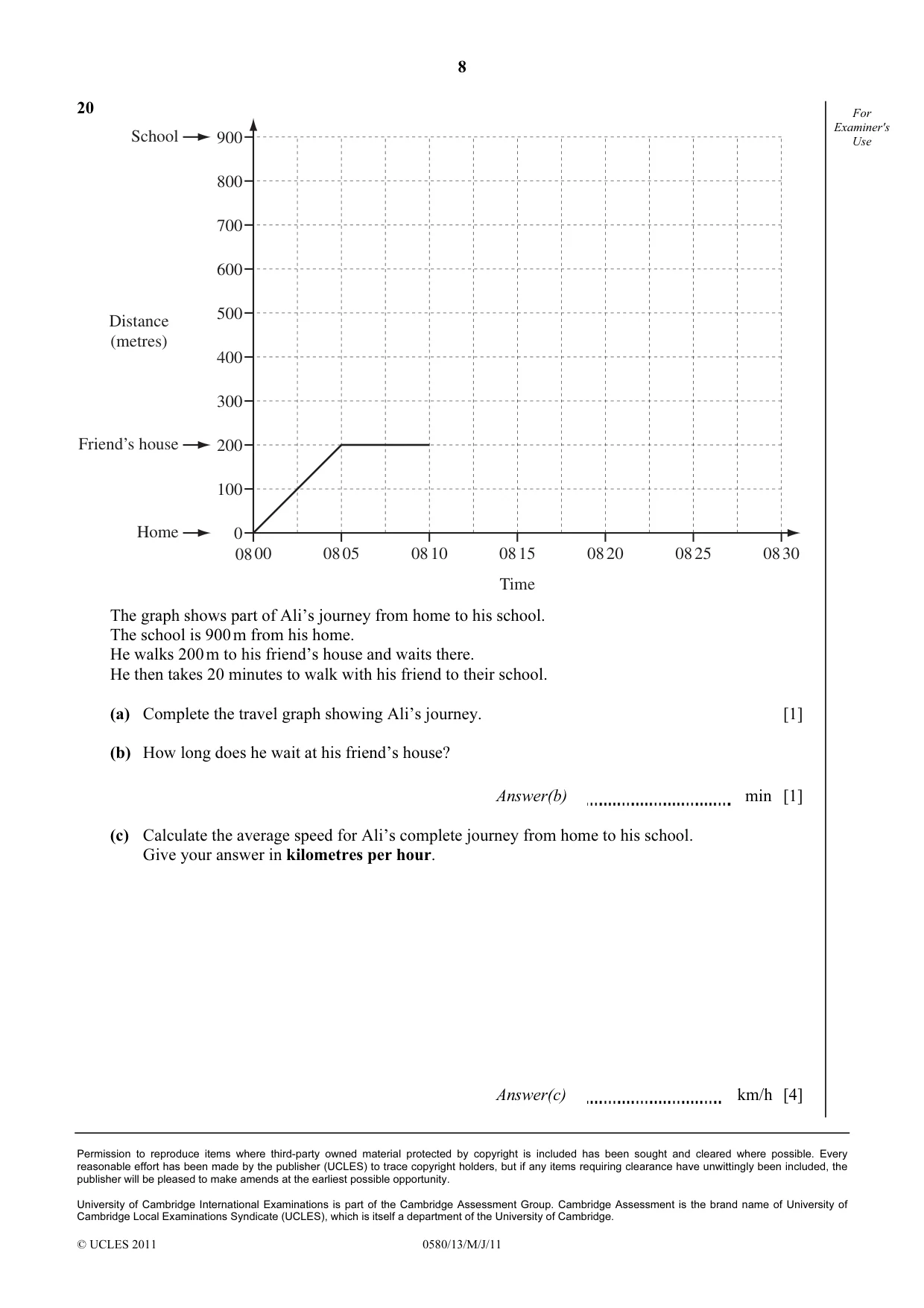
20 For School 900 Examiner's Use 800 700 600 500 Distance (metres) 400 300 Friend’s house 200 100 Home 0 08 00 08 05 08 10 08 15 08 20 08 25 08 30 Time The graph shows part of Ali’s journey from home to his school. The school is 900 m from his home. He walks 200 m to his friend’s house and waits there. He then takes 20 minutes to walk with his friend to their school. (a) Complete the travel graph showing Ali’s journey. [1] (b) How long does he wait at his friend’s house? Answer(b) min [1] (c) Calculate the average speed for Ali’s complete journey from home to his school. Give your answer in kilometres per hour. Answer(c) km/h [4]
Mark scheme: 20 (a) Straight ruled line from 1 (08 10, 200) to (08 30, 900) (b) 5 1 (c) 1.8 4 M1 for total distance ÷ total time M1 for converting time to hours M1 for converting metres to km
What was in this paper
The subtopics covered by these 19 questions, and how many questions each got. Open one in a new tab to see every Cambridge question on it.
What you needed in this session
Cambridge’s own grade thresholds for 2011 May/June, Paper 1 · Variant 3. A higher threshold means an easier paper — the bar moves with how the cohort did.