Cambridge IGCSE Mathematics 0580 — 2016 May/June Paper 1 · Variant 1
0580/11/M/J/16 · 22 questions · 56 marks · ≈63 min
The question paper and its mark scheme, free to read here and free to download. This is Cambridge’s own paper, exactly as it was sat.
Question paper12 pages
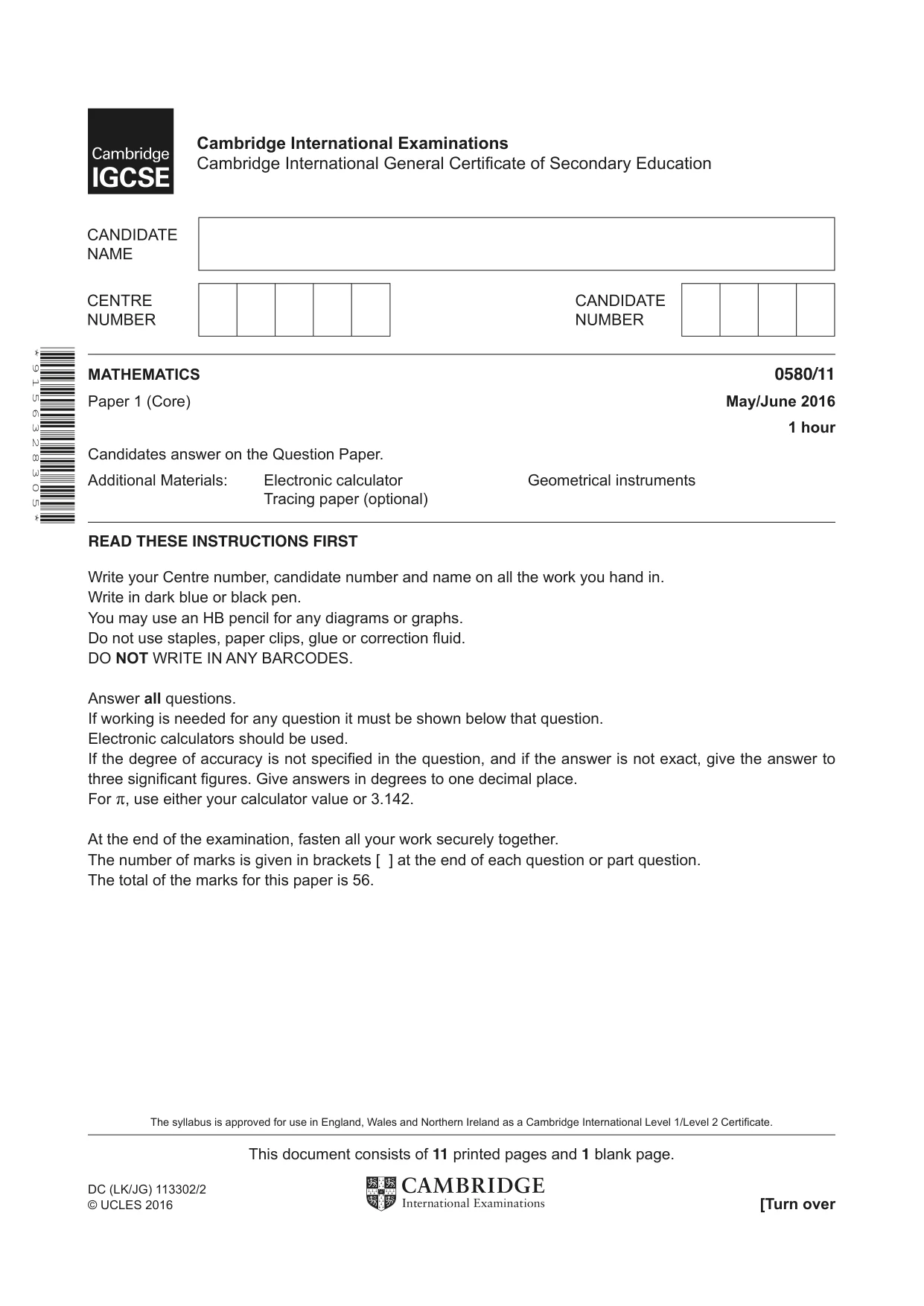
Mark scheme4 pages
Answers below. Sit the paper first if you are practising.
Questions as text
Q1 · A train leaves Zurich at 22 40 and arrives in Vienna at 07 32 the next day
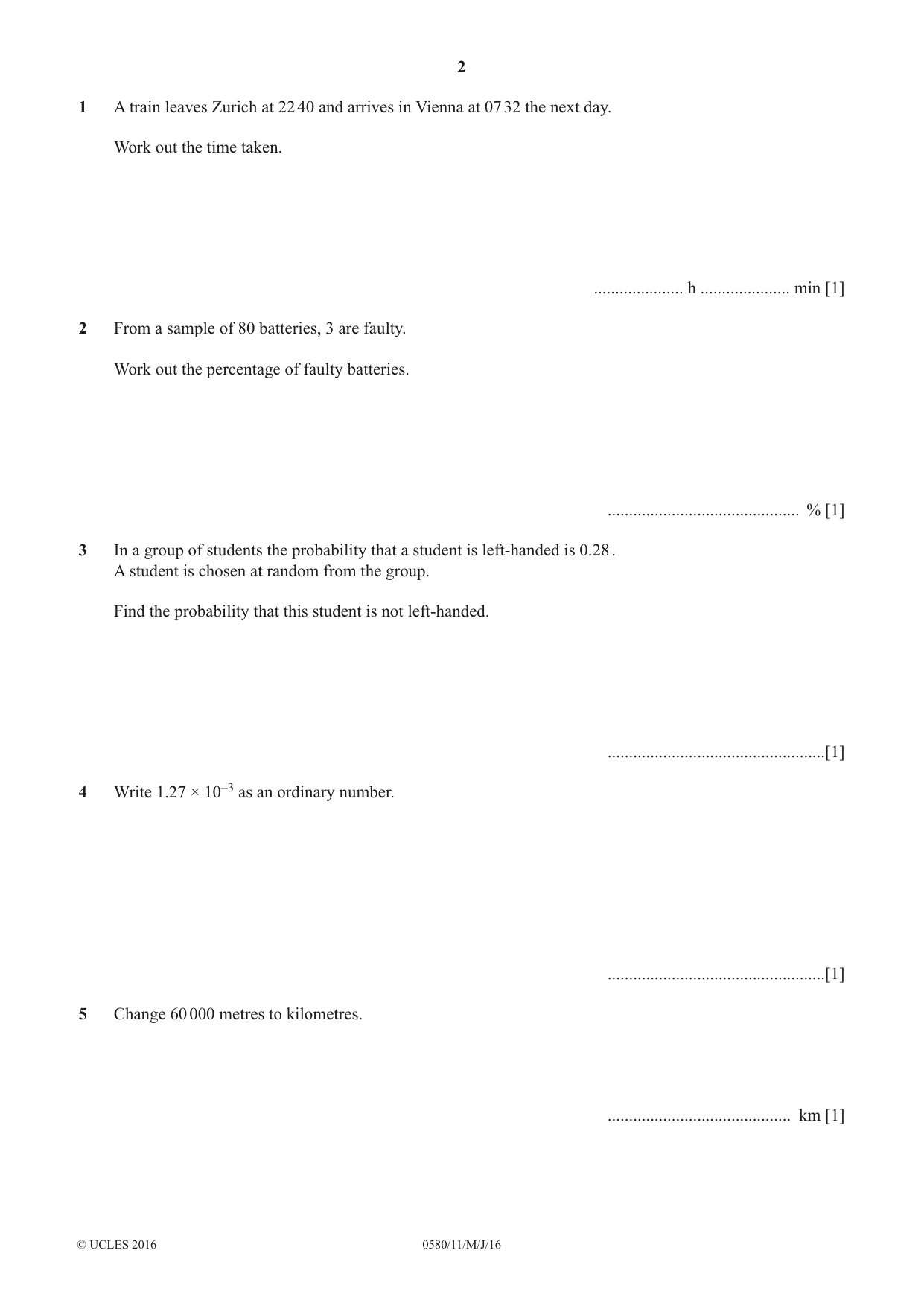
1 A train leaves Zurich at 22 40 and arrives in Vienna at 07 32 the next day. Work out the time taken. ..................... h ..................... min [1]
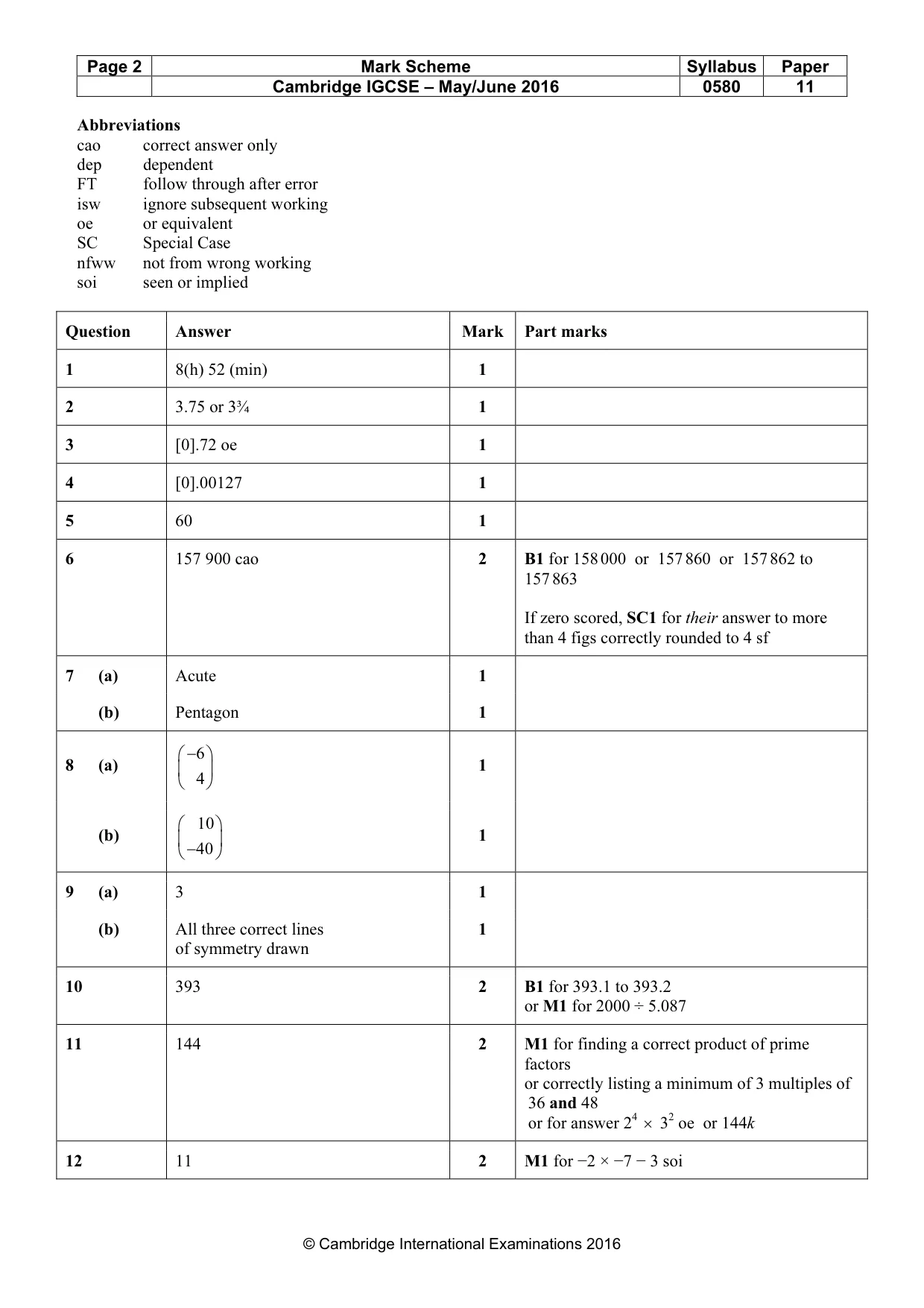
Mark scheme: Question Answer Mark Part marks 1 8(h) 52 (min) 1
Q2 · From a sample of 80 batteries, 3 are faulty
2 From a sample of 80 batteries, 3 are faulty. Work out the percentage of faulty batteries. ............................................. % [1]
Mark scheme: 2 3.75 or 3¾ 1
Q3 · In a group of students the probability that a student is left-handed is 0.28
3 In a group of students the probability that a student is left-handed is 0.28 . A student is chosen at random from the group. Find the probability that this student is not left-handed. ...................................................[1]
Mark scheme: 3 [0].72 oe 1
Q4 · Write 1.27 × 10⁻³ as an ordinary number
4 Write 1.27 × 10⁻³ as an ordinary number. ...................................................[1]
Mark scheme: 4 [0].00127 1
Q5 · Change 60 000 metres to kilometres
5 Change 60 000 metres to kilometres. ........................................... km [1]
Mark scheme: 5 60 1
Q6 · Calculate (2.1 − 0.078)17, giving your answer correct to 4 significant figures
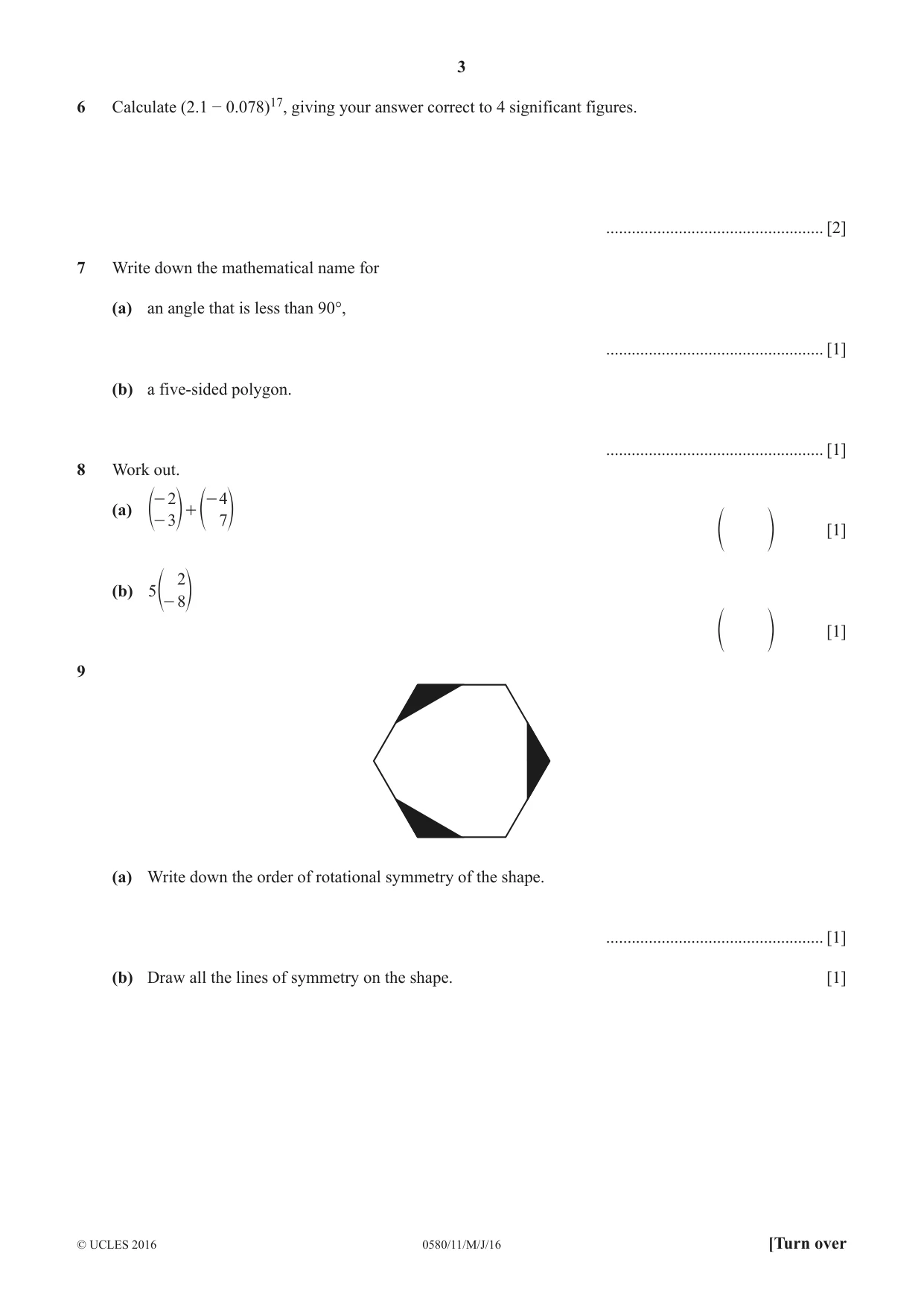
6 Calculate (2.1 − 0.078)17, giving your answer correct to 4 significant figures. ................................................... [2]
Mark scheme: 6 157 900 cao 2 B1 for 158 000 or 157 860 or 157 862 to 157 863 If zero scored, SC1 for their answer to more than 4 figs correctly rounded to 4 sf
Q7 · Write down the mathematical name for (a) an angle that is less than 90°…
7 Write down the mathematical name for (a) an angle that is less than 90°, ................................................... [1] (b) a five-sided polygon. ................................................... [1]
Mark scheme: 7 (a) Acute 1 (b) Pentagon 1 6
Question 8
8 Work out. - 2 - 4 (a) + 3 7 f- p f p [1] e o 2 (b) 5 8 f- p [1] e o
Mark scheme: − 6 8 (a) 1 4 10 (b) 1 − 40
Q9 · Write down the order of rotational symmetry of the shape
9 (a) Write down the order of rotational symmetry of the shape. ................................................... [1] (b) Draw all the lines of symmetry on the shape. [1]
Mark scheme: 9 (a) 3 1 (b) All three correct lines 1 of symmetry drawn
Q10 · Omar changes 2000 Saudi Arabian riyals (SAR) into euros (€) when the exchange rate is €1…
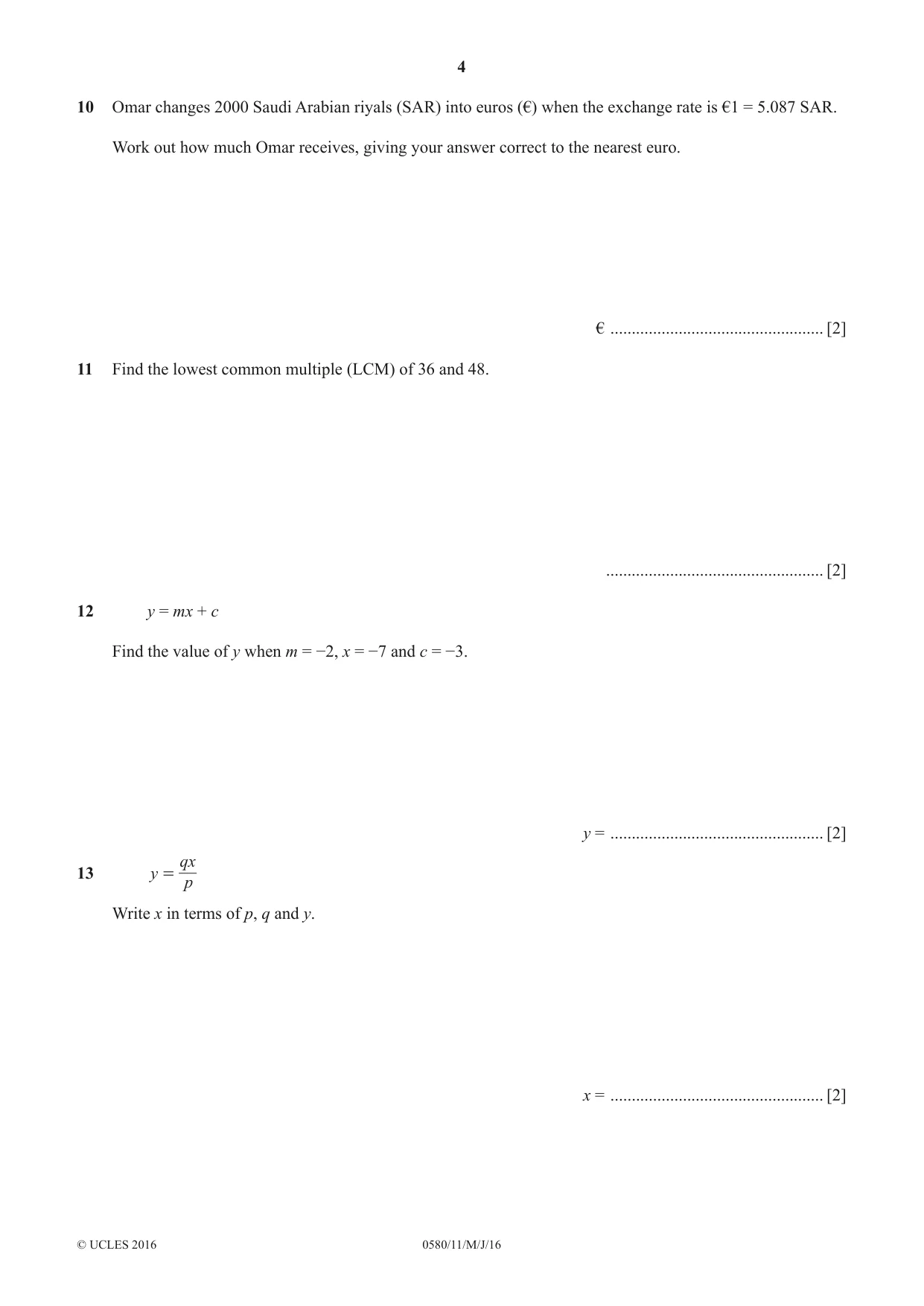
10 Omar changes 2000 Saudi Arabian riyals (SAR) into euros (€) when the exchange rate is €1 = 5.087 SAR. Work out how much Omar receives, giving your answer correct to the nearest euro. € .................................................. [2]
Mark scheme: 10 393 2 B1 for 393.1 to 393.2 or M1 for 2000 ÷ 5.087
Q11 · Find the lowest common multiple (LCM) of 36 and 48
11 Find the lowest common multiple (LCM) of 36 and 48. ................................................... [2]
Mark scheme: 11 144 2 M1 for finding a correct product of prime factors or correctly listing a minimum of 3 multiples of 36 and 48 or for answer 24 × 32 oe or 144k
Q12 · Y = mx + c Find the value of y when m = −2, x = −7 and c = −3
12 y = mx + c Find the value of y when m = −2, x = −7 and c = −3. y = .................................................. [2]
Mark scheme: 12 11 2 M1 for −2 × −7 − 3 soi
Q13 · Qx 13 y = p Write x in terms of p, q and y
qx 13 y = p Write x in terms of p, q and y. x = .................................................. [2]
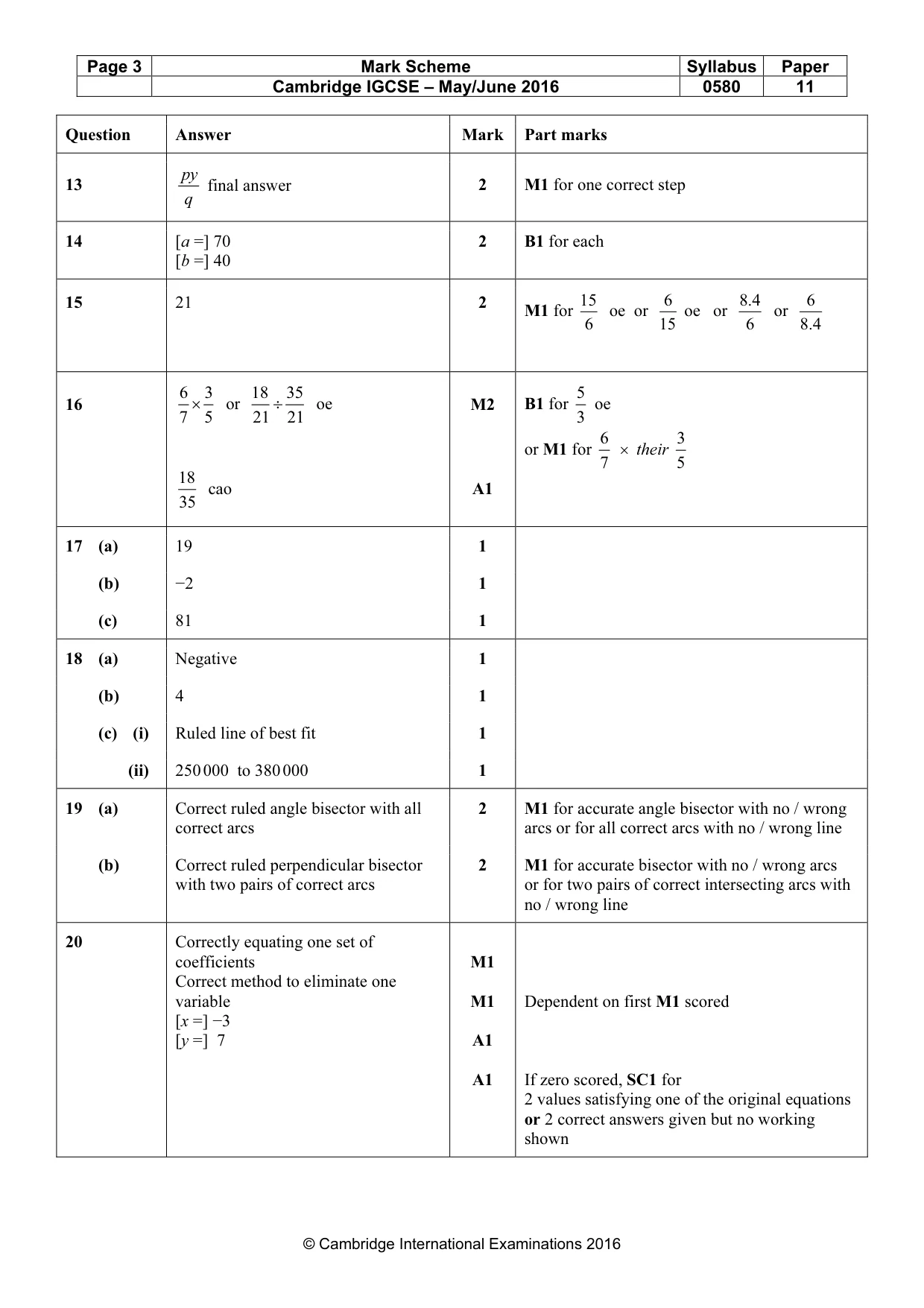
Mark scheme: py13 2 M1 for one correct step final answer q
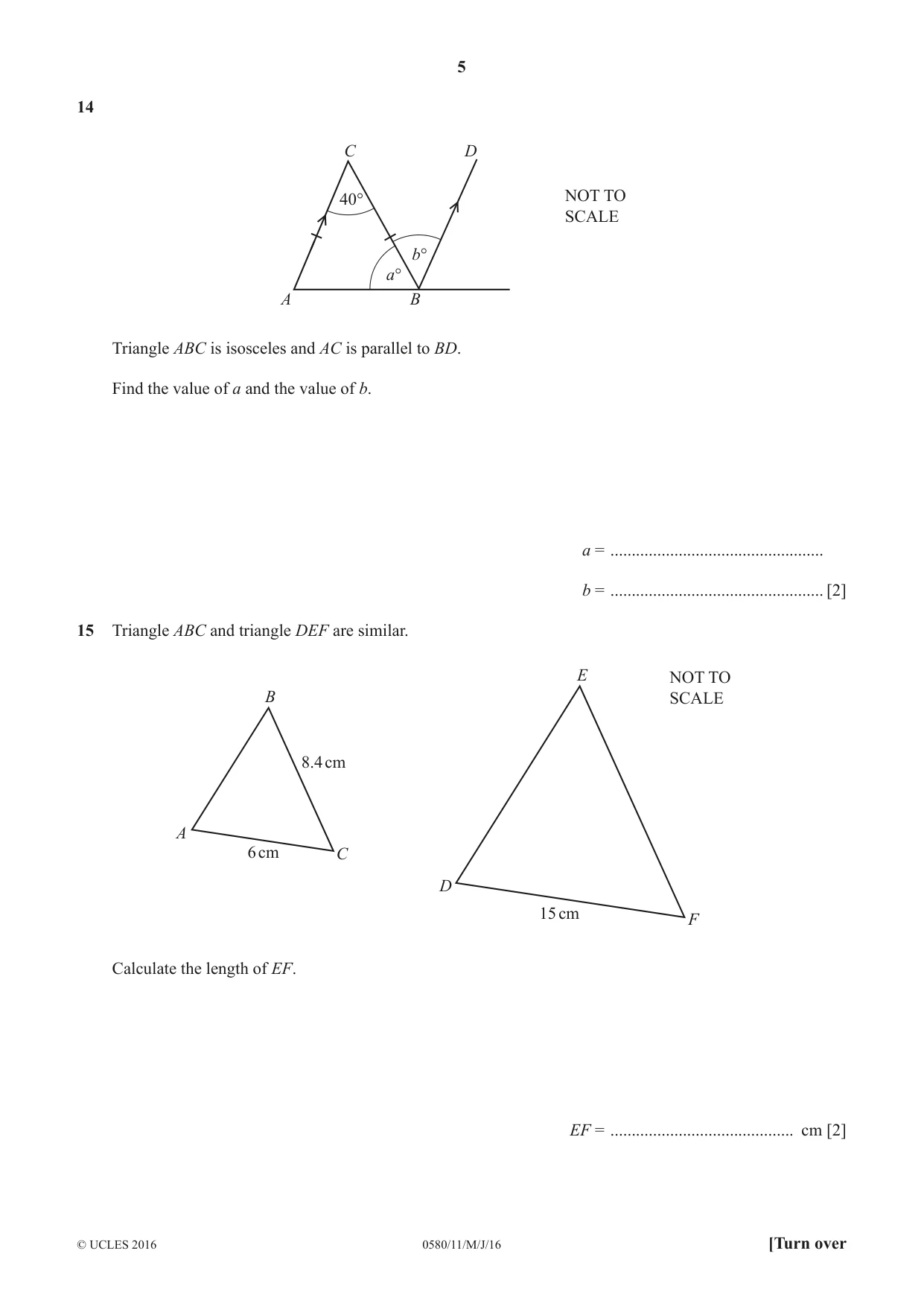
Q14 · C D 40° NOT TO SCALE b° a° A B Triangle ABC is isosceles and AC is parallel to BD
14 C D 40° NOT TO SCALE b° a° A B Triangle ABC is isosceles and AC is parallel to BD. Find the value of a and the value of b. a = .................................................. b = .................................................. [2]
Mark scheme: 14 [a =] 70 2 B1 for each [b =] 40
Q15 · Triangle ABC and triangle DEF are similar
15 Triangle ABC and triangle DEF are similar. E NOT TO B SCALE 8.4 cm A 6 cm C D 15 cm F Calculate the length of EF. EF = ........................................... cm [2]
Mark scheme: 15 21 2 M1 for 15 oe or 6 oe or 8.4 or 6 6 15 6 8.4 6 3 18 35 5
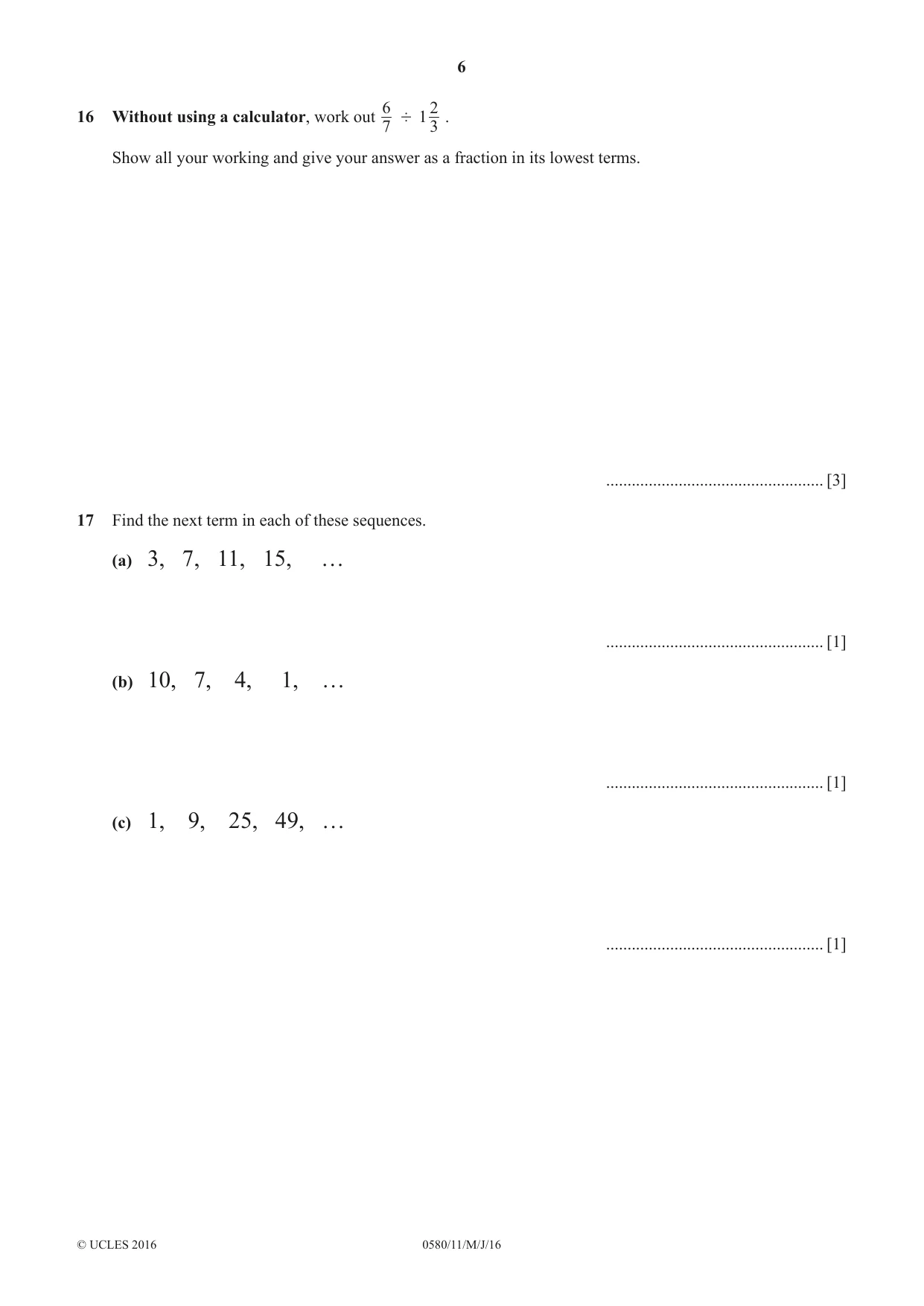
Q16 · 2 16 Without using a calculator, work out 7 ' 1 3
6 2 16 Without using a calculator, work out 7 ' 1 3 . Show all your working and give your answer as a fraction in its lowest terms. ................................................... [3]
Mark scheme: 6 3 18 35 5 16 × or ÷ oe M2 B1 for oe 7 5 21 21 3 6 3 or M1 for × their 7 5 18 cao A1 35
Q17 · Find the next term in each of these sequences
17 Find the next term in each of these sequences. (a) 3, 7, 11, 15, … ................................................... [1] (b) 10, 7, 4, 1, … ................................................... [1] (c) 1, 9, 25, 49, … ................................................... [1]
Mark scheme: 17 (a) 19 1 (b) −2 1 (c) 81 1
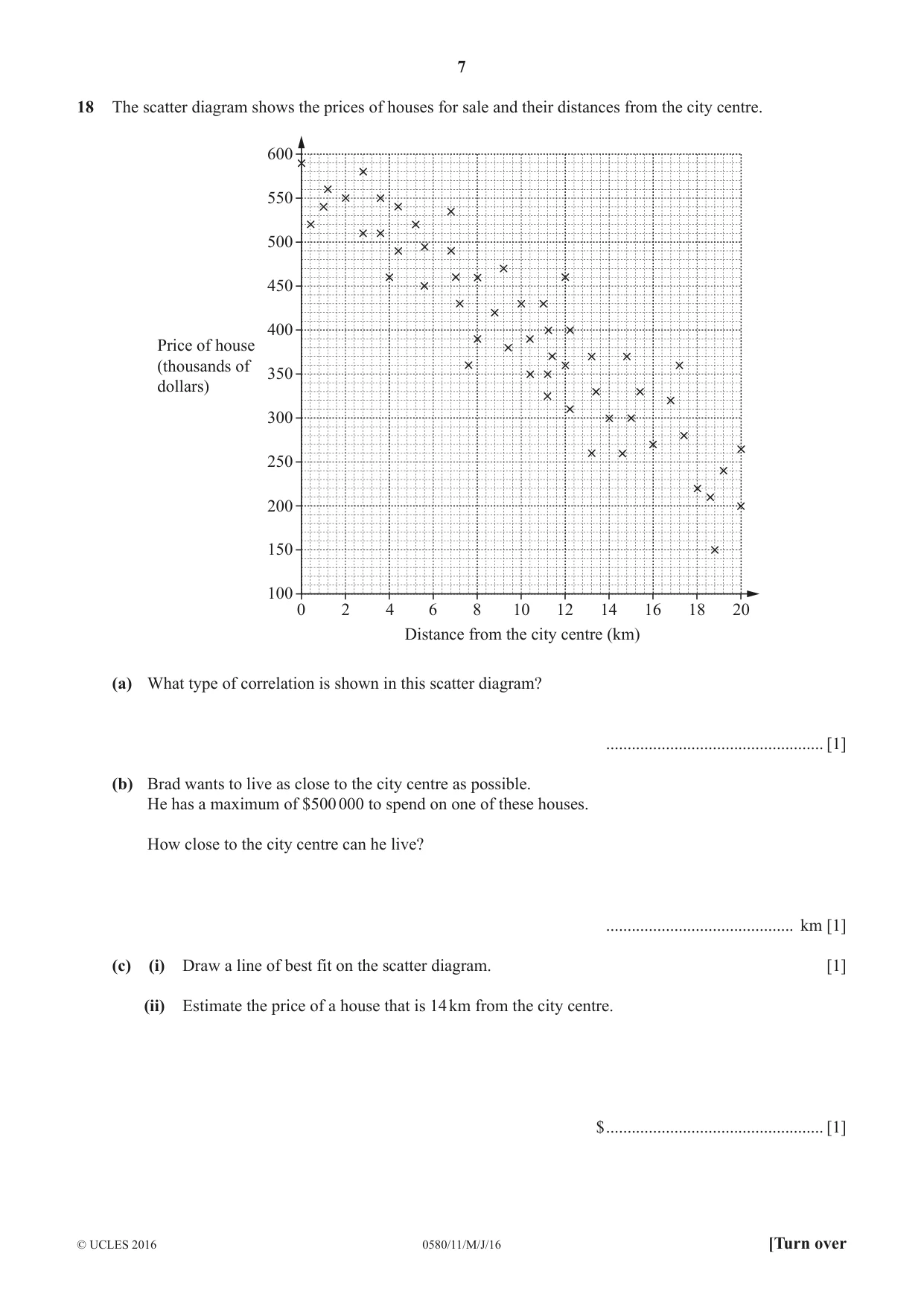
Q18 · The scatter diagram shows the prices of houses for sale and their distances from the city…
18 The scatter diagram shows the prices of houses for sale and their distances from the city centre. 600 550 500 450 400 Price of house (thousands of 350 dollars) 300 250 200 150 100 0 2 4 6 8 10 12 14 16 18 20 Distance from the city centre (km) (a) What type of correlation is shown in this scatter diagram? ................................................... [1] (b) Brad wants to live as close to the city centre as possible. He has a maximum of $500 000 to spend on one of these houses. How close to the city centre can he live? ............................................ km [1] (c) (i) Draw a line of best fit on the scatter diagram. [1] (ii) Estimate the price of a house that is 14 km from the city centre. $ ................................................... [1]
Mark scheme: 18 (a) Negative 1 (b) 4 1 (c) (i) Ruled line of best fit 1 (ii) 250 000 to 380 000 1
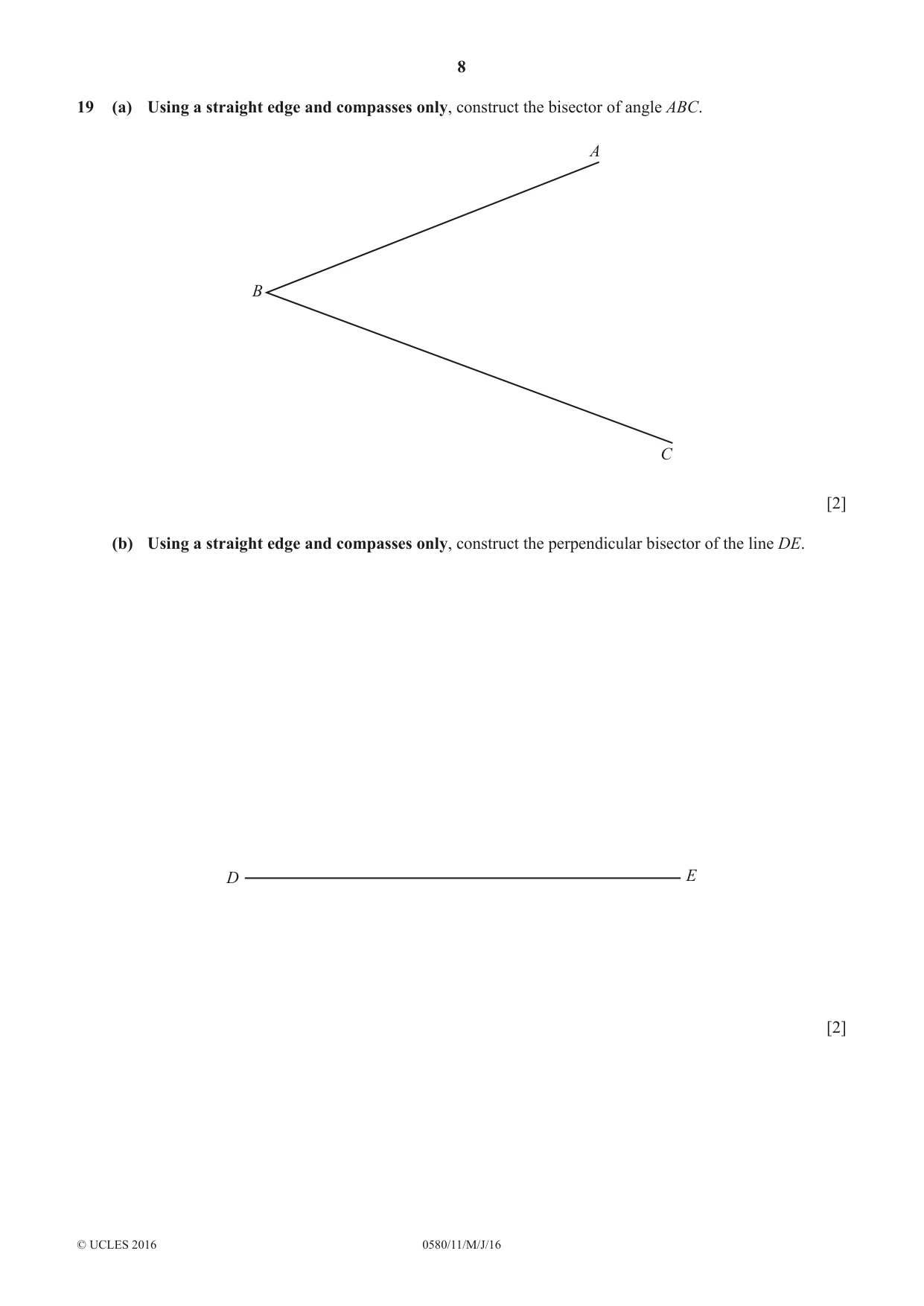
Q19 · Using a straight edge and compasses only, construct the bisector of angle ABC
19 (a) Using a straight edge and compasses only, construct the bisector of angle ABC. A B C [2] (b) Using a straight edge and compasses only, construct the perpendicular bisector of the line DE. D E [2]
Mark scheme: 19 (a) Correct ruled angle bisector with all 2 M1 for accurate angle bisector with no / wrong correct arcs arcs or for all correct arcs with no / wrong line (b) Correct ruled perpendicular bisector 2 M1 for accurate bisector with no / wrong arcs with two pairs of correct arcs or for two pairs of correct intersecting arcs with no / wrong line
Q20 · Solve the simultaneous equations
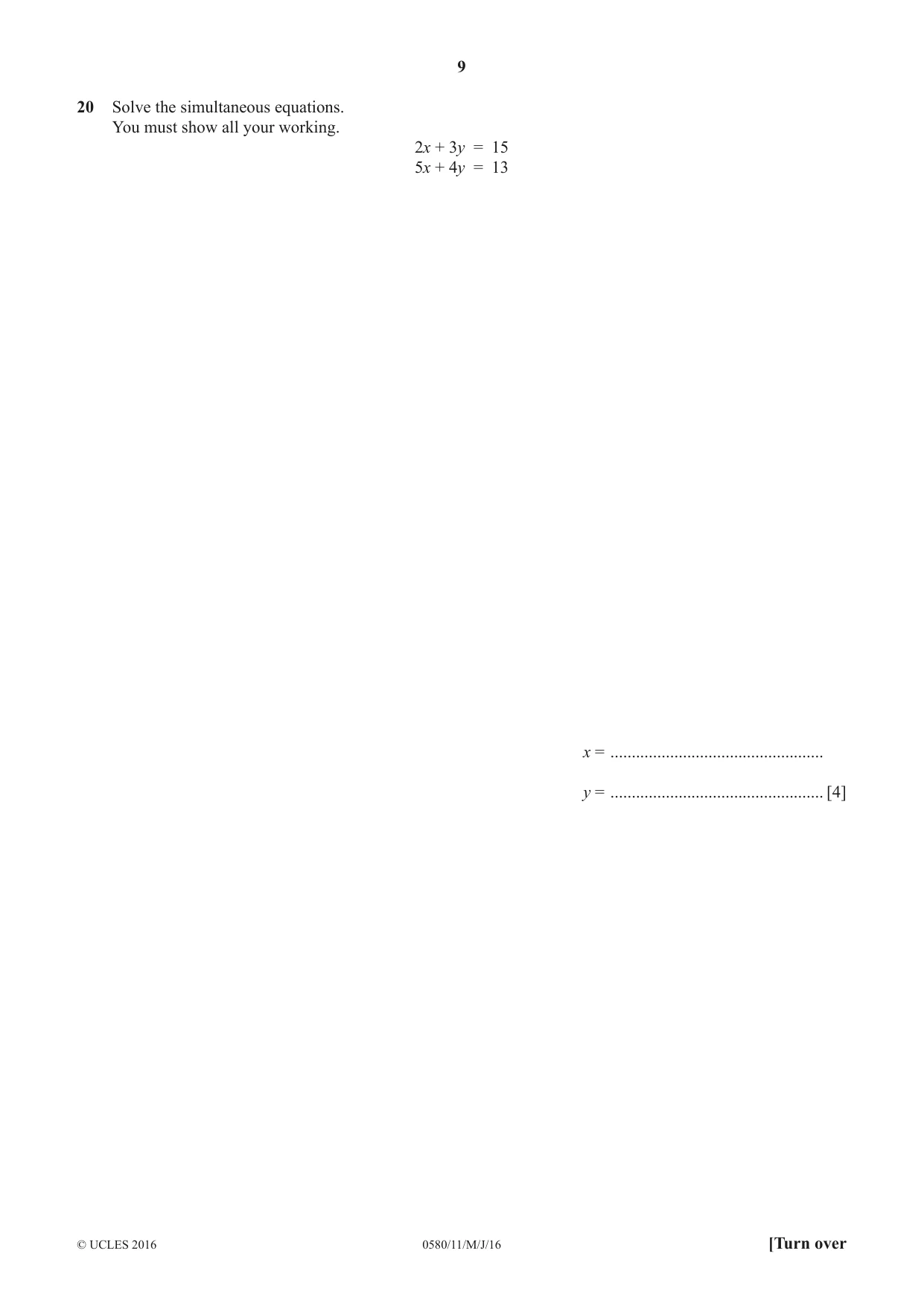
20 Solve the simultaneous equations. You must show all your working. 2x + 3y = 15 5x + 4y = 13 x = .................................................. y = .................................................. [4]
Mark scheme: 20 Correctly equating one set of coefficients M1 Correct method to eliminate one variable M1 Dependent on first M1 scored [x =] −3 [y =] 7 A1 A1 If zero scored, SC1 for 2 values satisfying one of the original equations or 2 correct answers given but no working shown
Q21 · Y 8 7 B 6 5 4 3 2 1 A x 0 0.5 1 1.5 2 2.5 3 The line AB is drawn on the grid
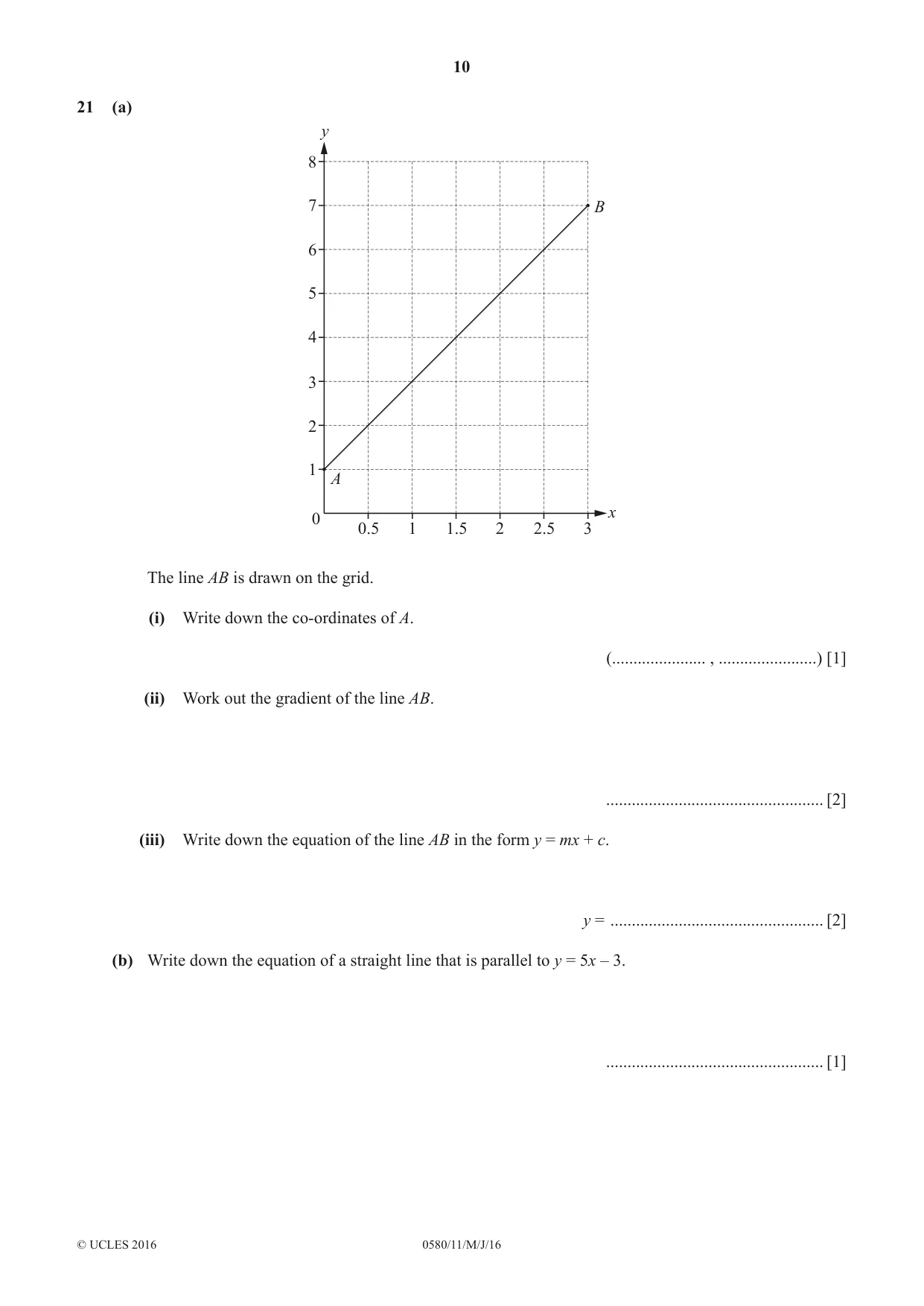
21 (a) y 8 7 B 6 5 4 3 2 1 A x 0 0.5 1 1.5 2 2.5 3 The line AB is drawn on the grid. (i) Write down the co-ordinates of A. (...................... , .......................) [1] (ii) Work out the gradient of the line AB. ................................................... [2] (iii) Write down the equation of the line AB in the form y = mx + c. y = .................................................. [2] (b) Write down the equation of a straight line that is parallel to y = 5x – 3. ................................................... [1]
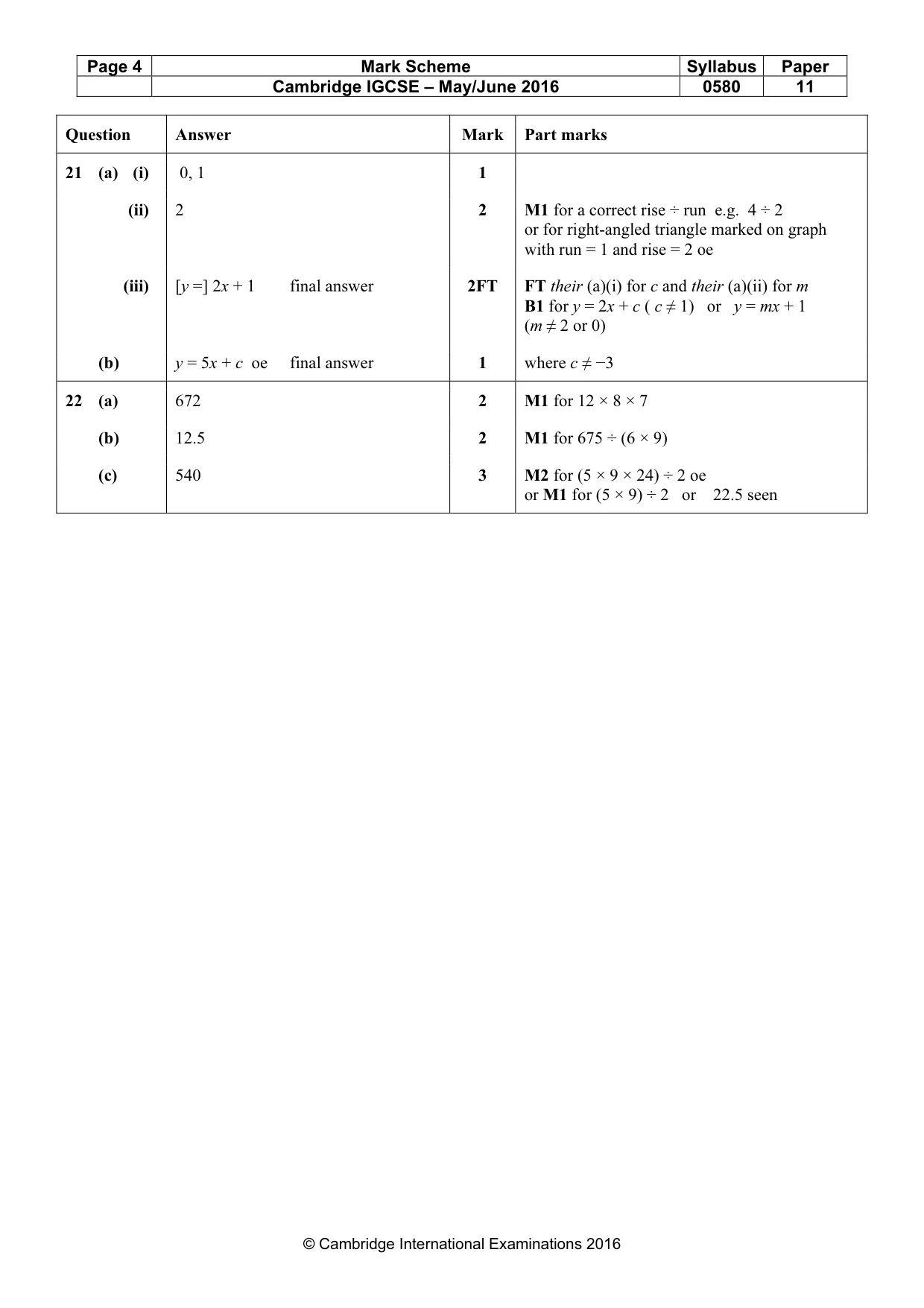
Mark scheme: 21 (a) (i) 0, 1 1 (ii) 2 2 M1 for a correct rise ÷ run e.g. 4 ÷ 2 or for right-angled triangle marked on graph with run = 1 and rise = 2 oe (iii) [y =] 2x + 1 final answer 2FT FT their (a)(i) for c and their (a)(ii) for m B1 for y = 2x + c ( c ≠ 1) or y = mx + 1 (m ≠ 2 or 0) (b) y = 5x + c oe final answer 1 where c ≠ −3
Q22 · NOT TO 8 cm SCALE 7 cm 12 cm Calculate the volume of this cuboid
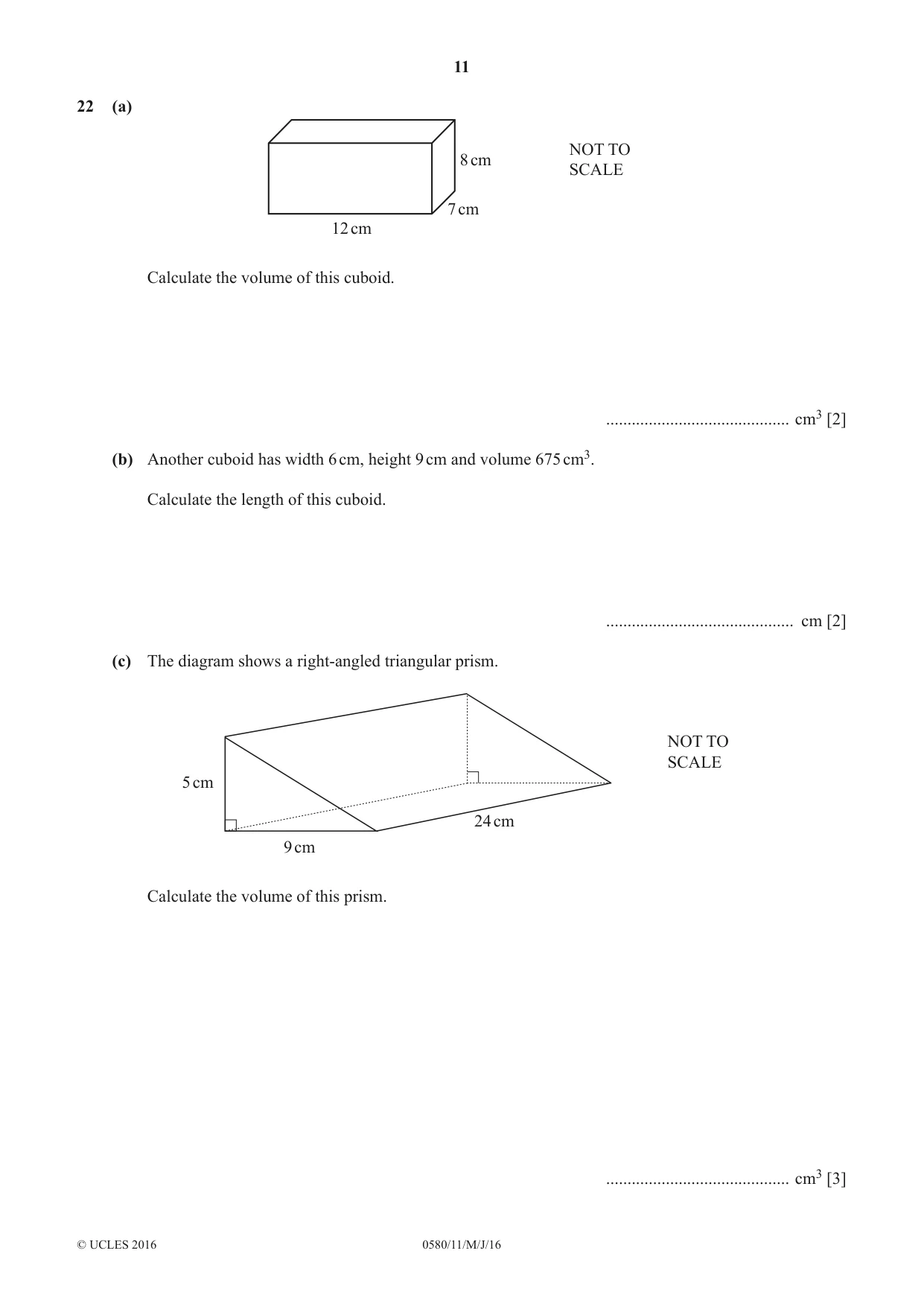
22 (a) NOT TO 8 cm SCALE 7 cm 12 cm Calculate the volume of this cuboid. ........................................... cm3 [2] (b) Another cuboid has width 6 cm, height 9 cm and volume 675 cm3. Calculate the length of this cuboid. ............................................ cm [2] (c) The diagram shows a right-angled triangular prism. NOT TO SCALE 5 cm 24 cm 9 cm Calculate the volume of this prism. ........................................... cm3 [3]
Mark scheme: 22 (a) 672 2 M1 for 12 × 8 × 7 (b) 12.5 2 M1 for 675 ÷ (6 × 9) (c) 540 3 M2 for (5 × 9 × 24) ÷ 2 oe or M1 for (5 × 9) ÷ 2 or 22.5 seen
What was in this paper
The subtopics covered by these 22 questions, and how many questions each got. Open one in a new tab to see every Cambridge question on it.
2Algebraic manipulation1Coordinates1Equations1Fractions, decimals and percentages1Geometrical constructions1Introduction to algebra1Introduction to probability1Percentages1Ratio and proportion1Scatter diagrams1Sequences1Similarity1Standard form1Surface area and volume1Symmetry1Time1Types of number1Units of measure1Using a calculator1Vectors in two dimensions1What you needed in this session
Cambridge’s own grade thresholds for 2016 May/June, Paper 1 · Variant 1. A higher threshold means an easier paper — the bar moves with how the cohort did.