Cambridge IGCSE Mathematics 0580 — 2020 Oct/Nov Paper 1 · Variant 2
0580/12/O/N/20 · 23 questions · 56 marks · ≈63 min
The question paper and its mark scheme, free to read here and free to download. This is Cambridge’s own paper, exactly as it was sat.
Question paper12 pages
Mark scheme6 pages
Answers below. Sit the paper first if you are practising.
Questions as text
Q1 · Write two hundred thousand and seventeen in figures
1 Write two hundred thousand and seventeen in figures. ................................................. [1]
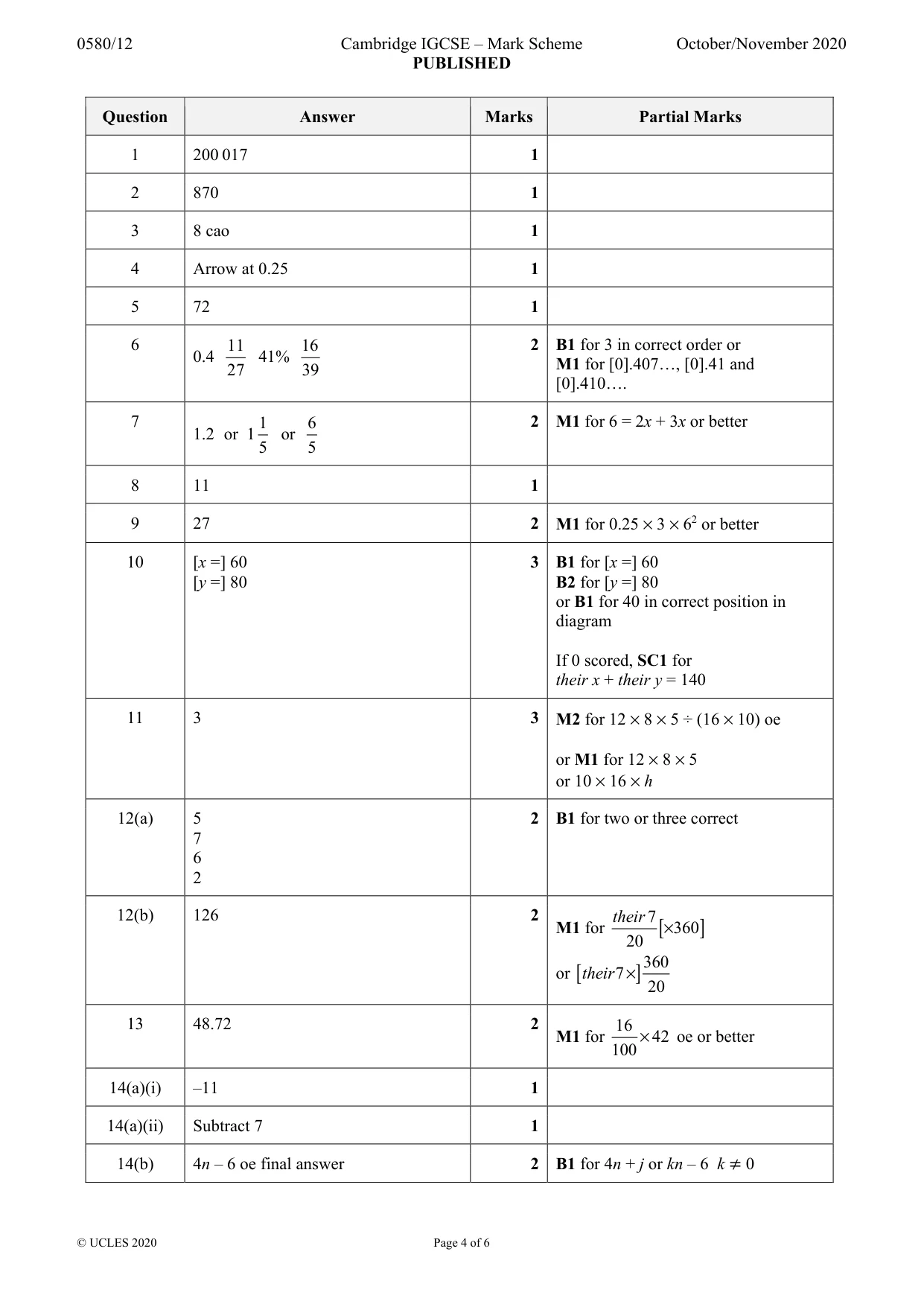
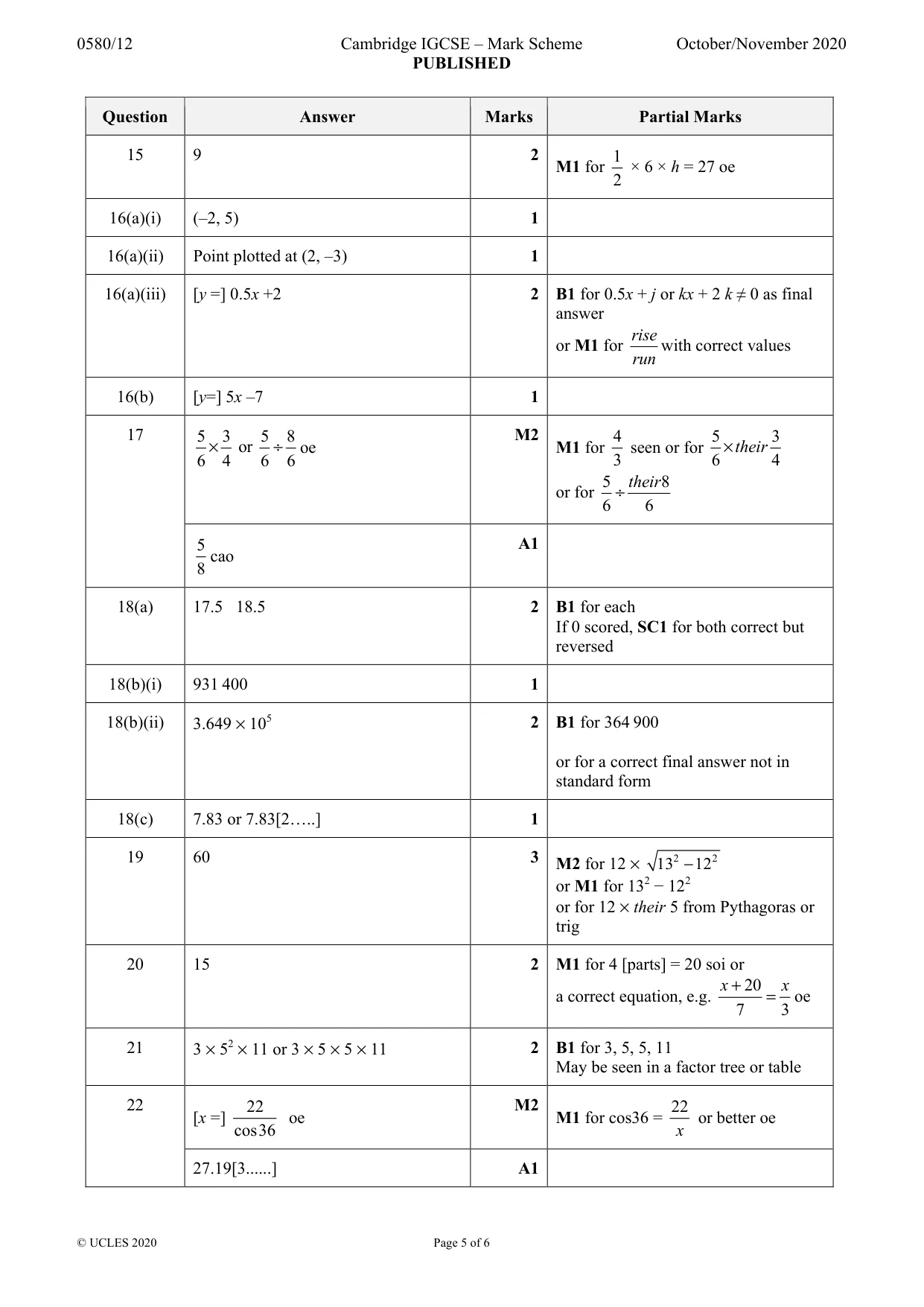
Mark scheme: Question Answer Marks Partial Marks 1 200 017 1
Q2 · Write 867 correct to the nearest ten
2 Write 867 correct to the nearest ten. ................................................. [1]
Mark scheme: 2 870 1
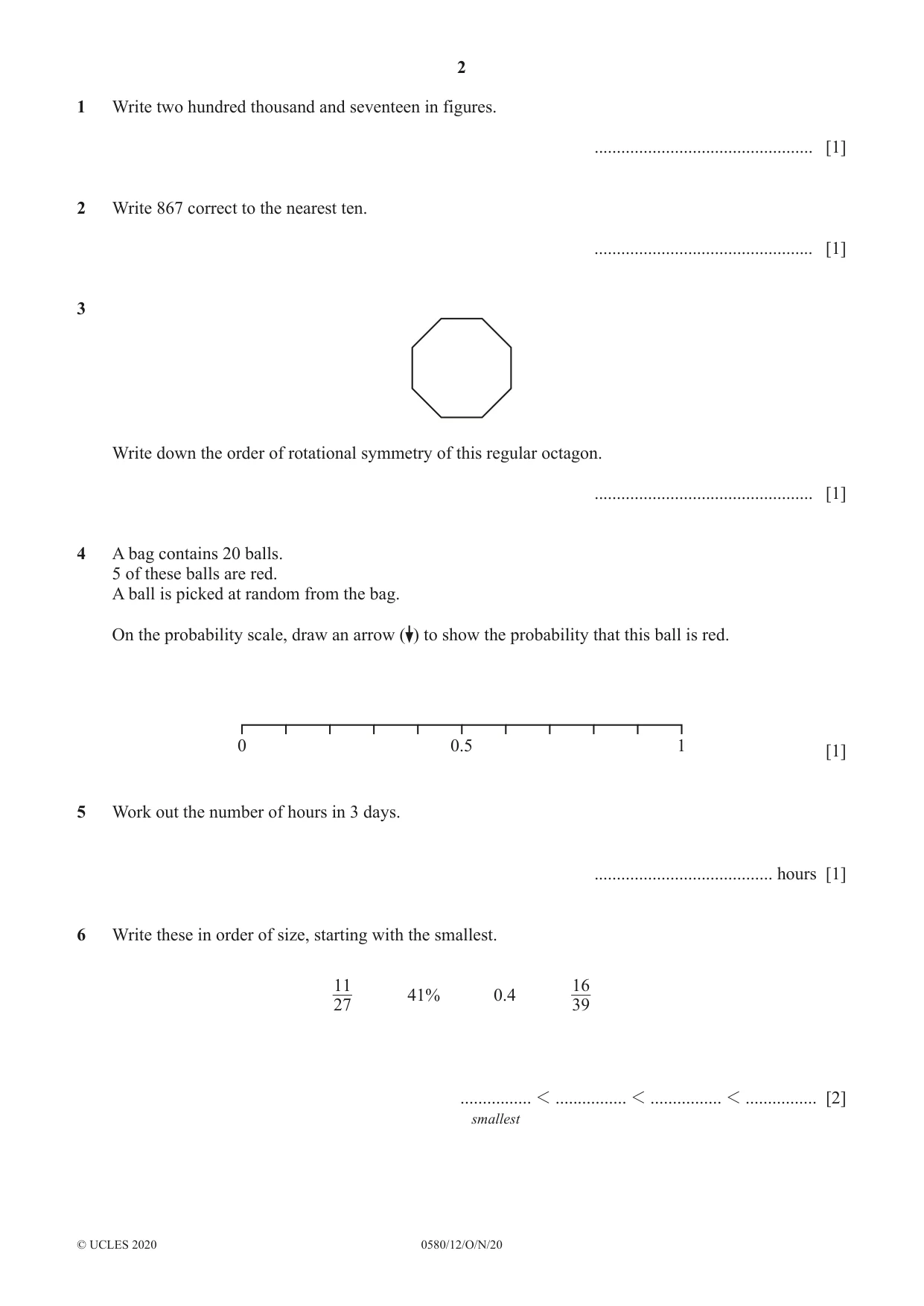
Q3 · Write down the order of rotational symmetry of this regular octagon
3 Write down the order of rotational symmetry of this regular octagon. ................................................. [1]
Mark scheme: 3 8 cao 1
Q4 · A bag contains 20 balls
4 A bag contains 20 balls. 5 of these balls are red. A ball is picked at random from the bag. On the probability scale, draw an arrow ( ) to show the probability that this ball is red. 0 0.5 1 [1]
Mark scheme: 4 Arrow at 0.25 1
Q5 · Work out the number of hours in 3 days
5 Work out the number of hours in 3 days. ........................................ hours [1]
Mark scheme: 5 72 1
Q6 · Write these in order of size, starting with the smallest
6 Write these in order of size, starting with the smallest. 11 16 41% 0.4 27 39 ................ 1 ................ 1 ................ 1 ................ [2] smallest
Mark scheme: 6 11 16 2 B1 for 3 in correct order or 0.4 41% M1 for [0].407…, [0].41 and 27 39 [0].410….
Question 7
7 Solve the equation. 6 - 2x = 3x x = ................................................. [2]
Mark scheme: 7 1 6 2 M1 for 6 = 2x + 3x or better 1.2 or 1 or 5 5
Q8 · Work out the difference in temperature between - 6 °C and 5 °C
8 Work out the difference in temperature between - 6 °C and 5 °C. ............................................. °C [1]
Mark scheme: 8 11 1
Q9 · 29 A = bc 4 Calculate the value of A when b = 3 and c = 6
1 29 A = bc 4 Calculate the value of A when b = 3 and c = 6 . ................................................. [2]
Mark scheme: 9 27 2 M1 for 0.25 × 3 × 62 or better
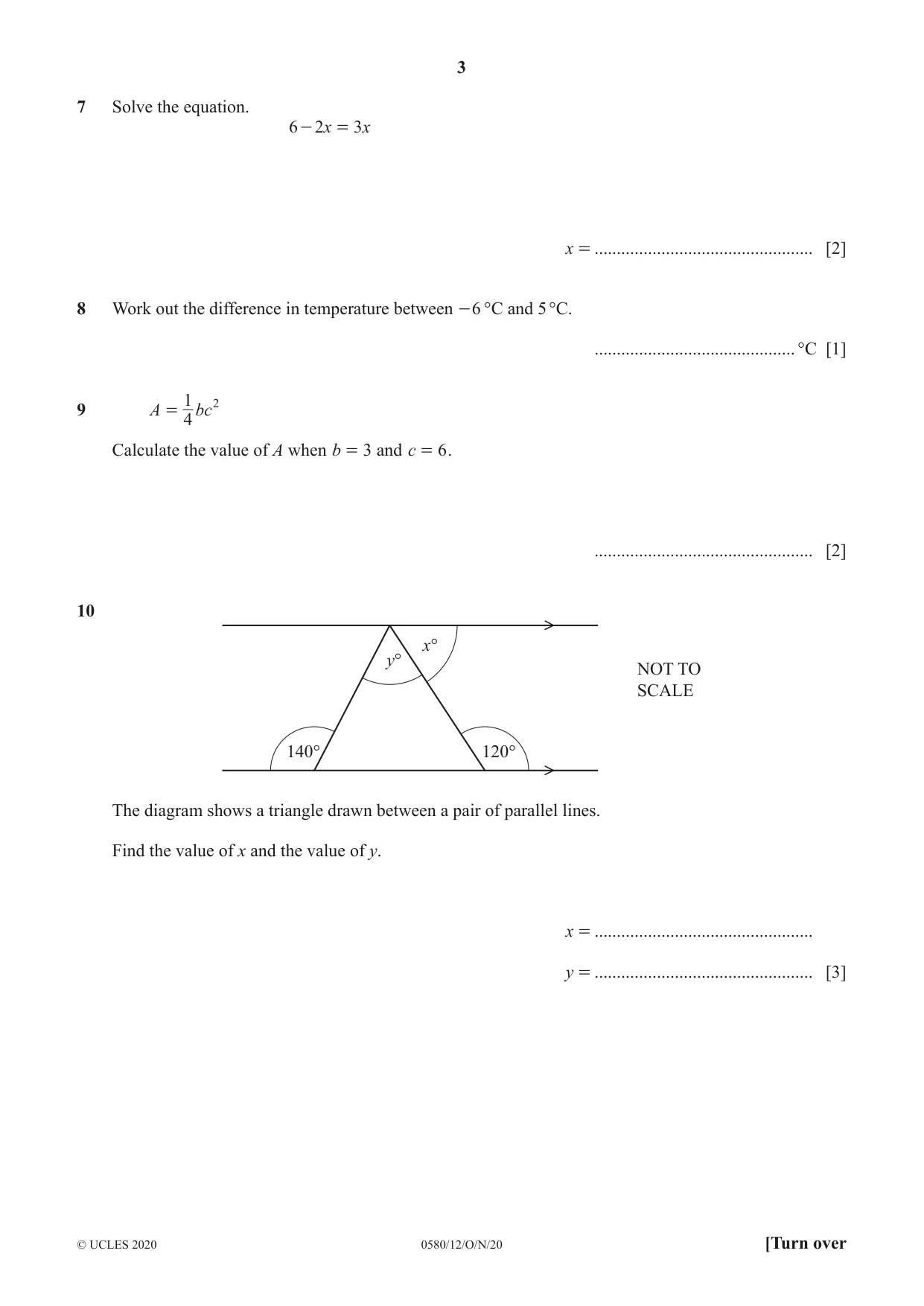
Q10 · X° y° NOT TO SCALE 140° 120° The diagram shows a triangle drawn between a pair of…
10 x° y° NOT TO SCALE 140° 120° The diagram shows a triangle drawn between a pair of parallel lines. Find the value of x and the value of y. x = ................................................. y = ................................................. [3]
Mark scheme: 10 [x =] 60 3 B1 for [x =] 60 [y =] 80 B2 for [y =] 80 or B1 for 40 in correct position in diagram If 0 scored, SC1 for their x + their y = 140
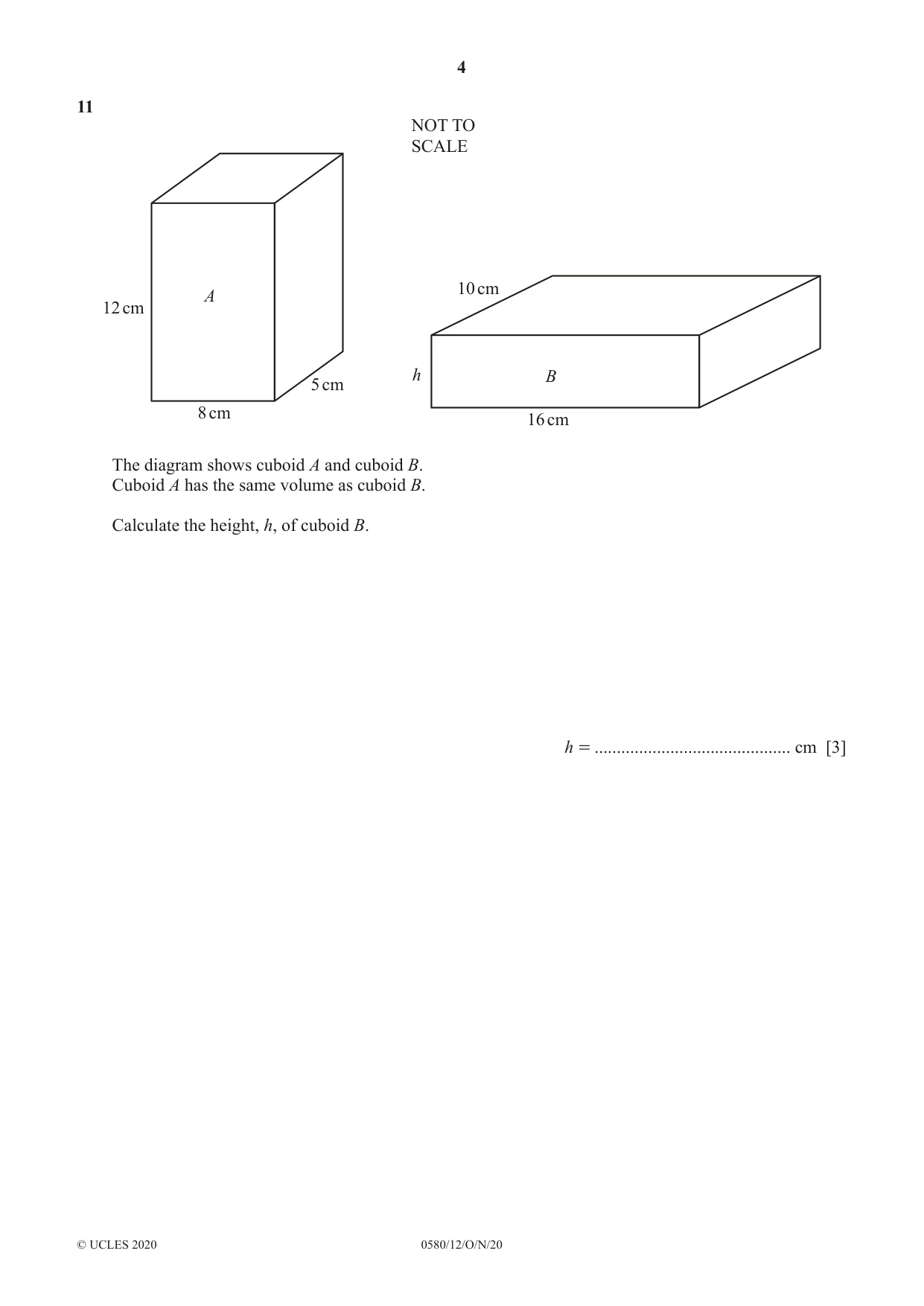
Q11 · NOT TO SCALE 10 cm A 12 cm h B 5 cm 8 cm 16 cm The diagram shows cuboid A and cuboid B
11 NOT TO SCALE 10 cm A 12 cm h B 5 cm 8 cm 16 cm The diagram shows cuboid A and cuboid B. Cuboid A has the same volume as cuboid B. Calculate the height, h, of cuboid B. h = ............................................ cm [3]
Mark scheme: 11 3 3 M2 for 12 × 8 × 5 ÷ (16 × 10) oe or M1 for 12 × 8 × 5 or 10 × 16 × h
Q12 · Fernando records the favourite sport of each of 20 people
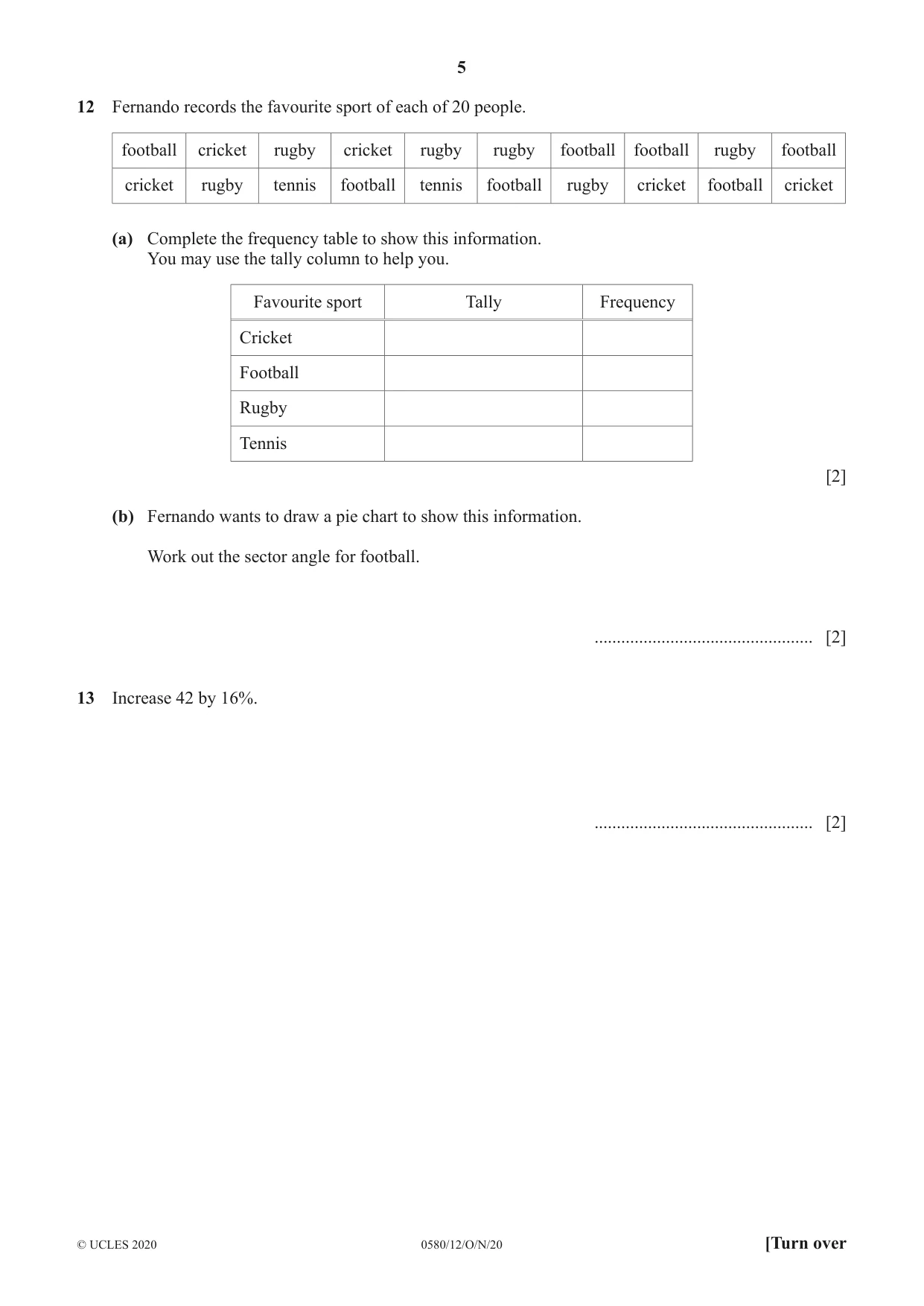
12 Fernando records the favourite sport of each of 20 people. football cricket rugby cricket rugby rugby football football rugby football cricket rugby tennis football tennis football rugby cricket football cricket (a) Complete the frequency table to show this information. You may use the tally column to help you. Favourite sport Tally Frequency Cricket Football Rugby Tennis [2] (b) Fernando wants to draw a pie chart to show this information. Work out the sector angle for football. ................................................. [2]
Mark scheme: 12(a) 5 2 B1 for two or three correct 7 6 2 12(b) 126 2 their 7 M1 for [× 360 ] 20 or [ their 7 ×]360 20
Q13 · Increase 42 by 16%
13 Increase 42 by 16%. ................................................. [2]
Mark scheme: 13 48.72 2 16 M1 for × 42 oe or better 100
Q14 · These are the first four terms of a sequence
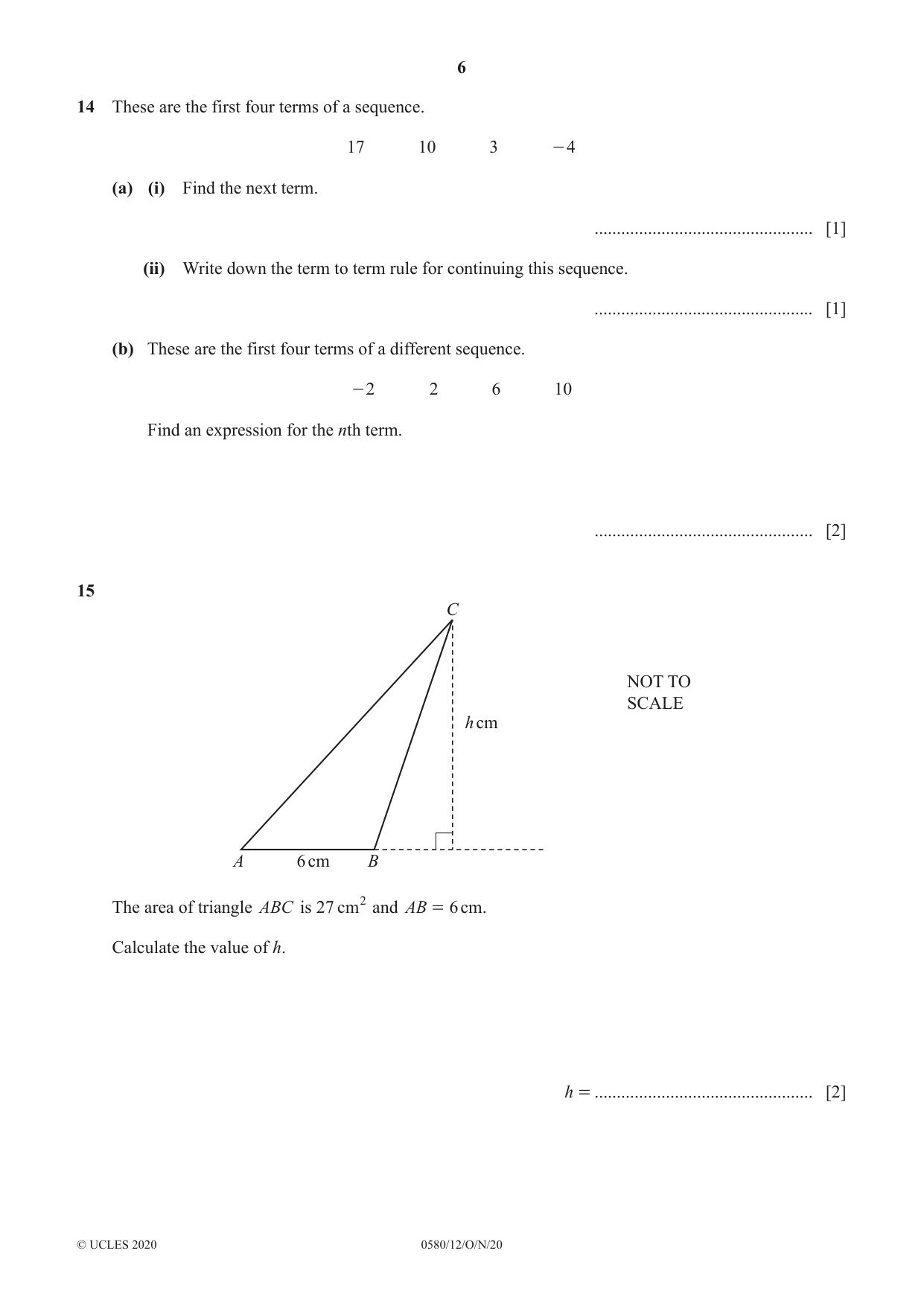
14 These are the first four terms of a sequence. 17 10 3 - 4 (a) (i) Find the next term. ................................................. [1] (ii) Write down the term to term rule for continuing this sequence. ................................................. [1] (b) These are the first four terms of a different sequence. - 2 2 6 10 Find an expression for the nth term. ................................................. [2]
Mark scheme: 14(a)(i) –11 1 14(a)(ii) Subtract 7 1 14(b) 4n – 6 oe final answer 2 B1 for 4n + j or kn – 6 k ≠ 0
Q15 · C NOT TO SCALE h cm A 6 cm B The area of triangle ABC is 27 cm2 and AB = 6 cm
15 C NOT TO SCALE h cm A 6 cm B The area of triangle ABC is 27 cm2 and AB = 6 cm. Calculate the value of h. h = ................................................. [2]
Mark scheme: 15 9 2 1 M1 for × 6 × h = 27 oe 2
Q16 · Y 7 6 A 5 4 L 3 2 1 x – 6 – 5 – 4 – 3 – 2 – 1 0 1 2 3 4 5 6 – 1 – 2 – 3 – 4 (i) Write…
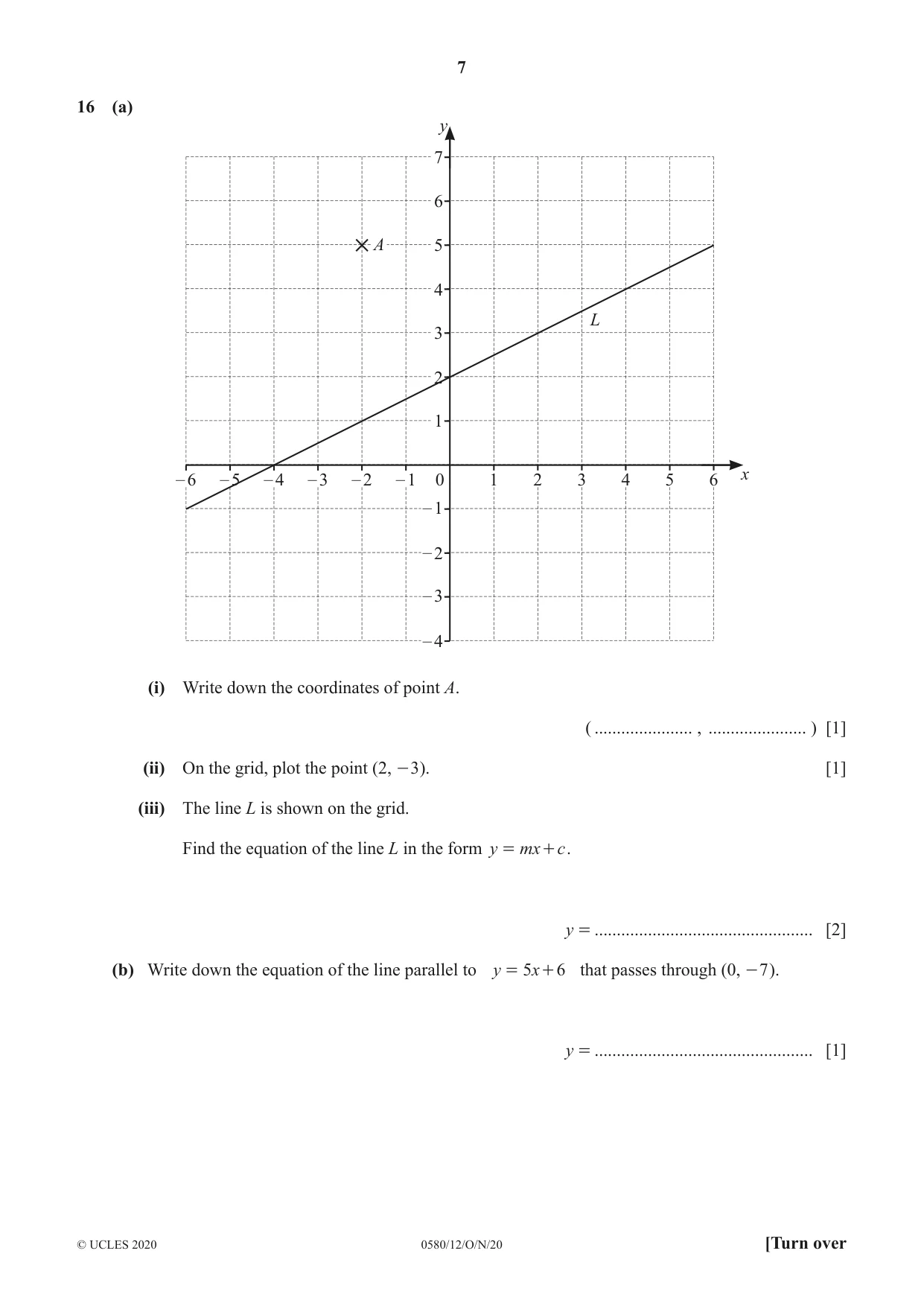
16 (a) y 7 6 A 5 4 L 3 2 1 x – 6 – 5 – 4 – 3 – 2 – 1 0 1 2 3 4 5 6 – 1 – 2 – 3 – 4 (i) Write down the coordinates of point A. ( ...................... , ...................... ) [1] (ii) On the grid, plot the point (2, - 3 ). [1] (iii) The line L is shown on the grid. Find the equation of the line L in the form y = mx + c . y = ................................................. [2] (b) Write down the equation of the line parallel to y = 5x + 6 that passes through (0, - 7 ). y = ................................................. [1]
Mark scheme: 16(a)(i) (–2, 5) 1 16(a)(ii) Point plotted at (2, –3) 1 16(a)(iii) [y =] 0.5x +2 2 B1 for 0.5x + j or kx + 2 k ≠ 0 as final answer rise or M1 for with correct values run 16(b) [y=] 5x –7 1
Q17 · 117 Without using a calculator, work out ' 1
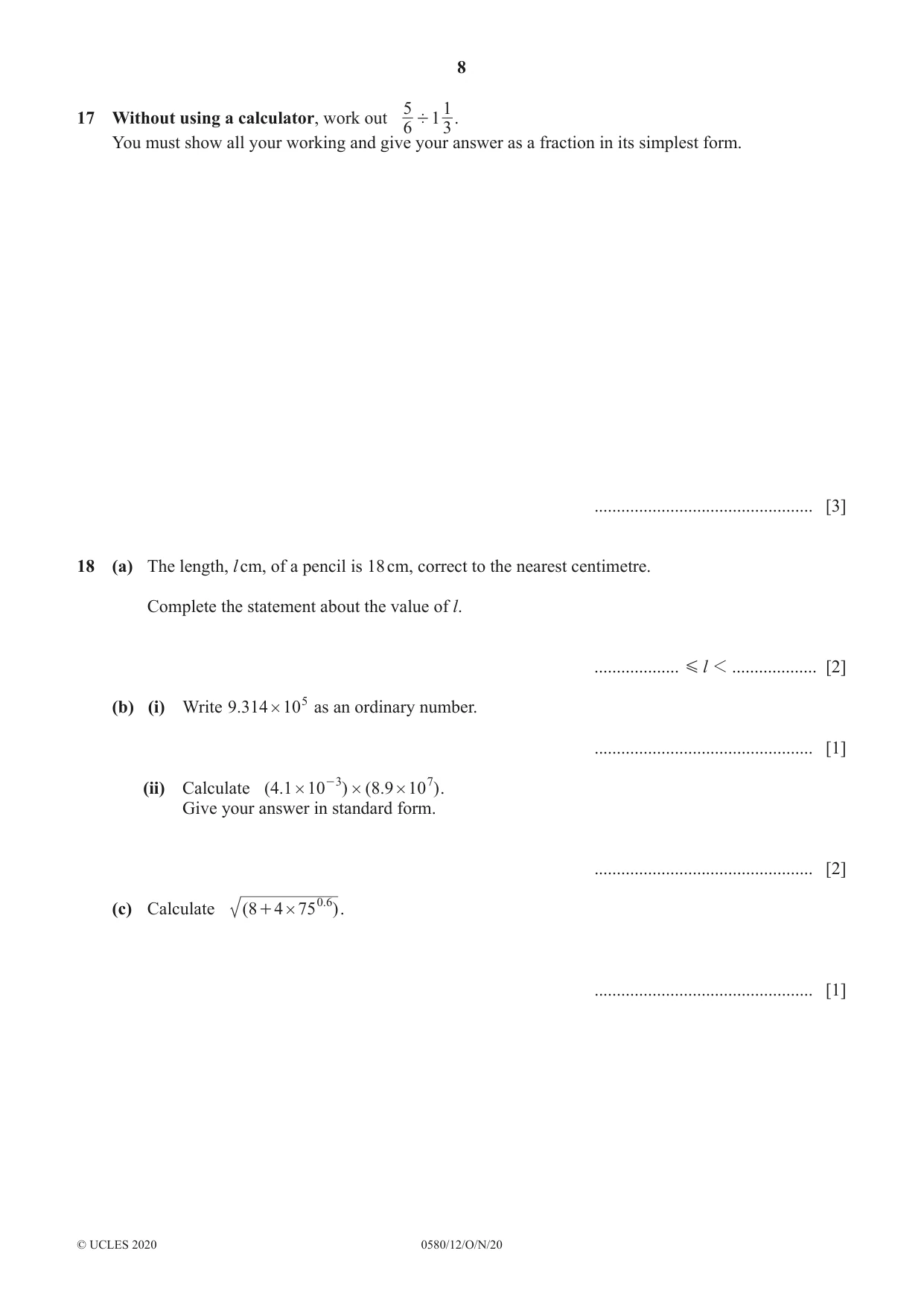
5 117 Without using a calculator, work out ' 1 . 6 3 You must show all your working and give your answer as a fraction in its simplest form. ................................................. [3]
Mark scheme: 17 5 3 5 8 M2 4 5 3 × or ÷ oe M1 for seen or for ×their 6 4 6 6 3 6 4 5 their 8 or for ÷ 6 6 5 A1 cao 8
Q18 · The length, l cm, of a pencil is 18 cm, correct to the nearest centimetre
18 (a) The length, l cm, of a pencil is 18 cm, correct to the nearest centimetre. Complete the statement about the value of l. ................... G l 1 ................... [2] (b) (i) Write .9314 # 105 as an ordinary number. ................................................. [1] (ii) Calculate ( 4.1 # 10 - 3 ) # (8 .9 # 10 7 ) . Give your answer in standard form. ................................................. [2] (c) Calculate ( 8 + 4 # 75 .06 ) . ................................................. [1]
Mark scheme: 18(a) 17.5 18.5 2 B1 for each If 0 scored, SC1 for both correct but reversed 18(b)(i) 931 400 1 18(b)(ii) 3.649 × 10⁵ 2 B1 for 364 900 or for a correct final answer not in standard form 18(c) 7.83 or 7.83[2…..] 1
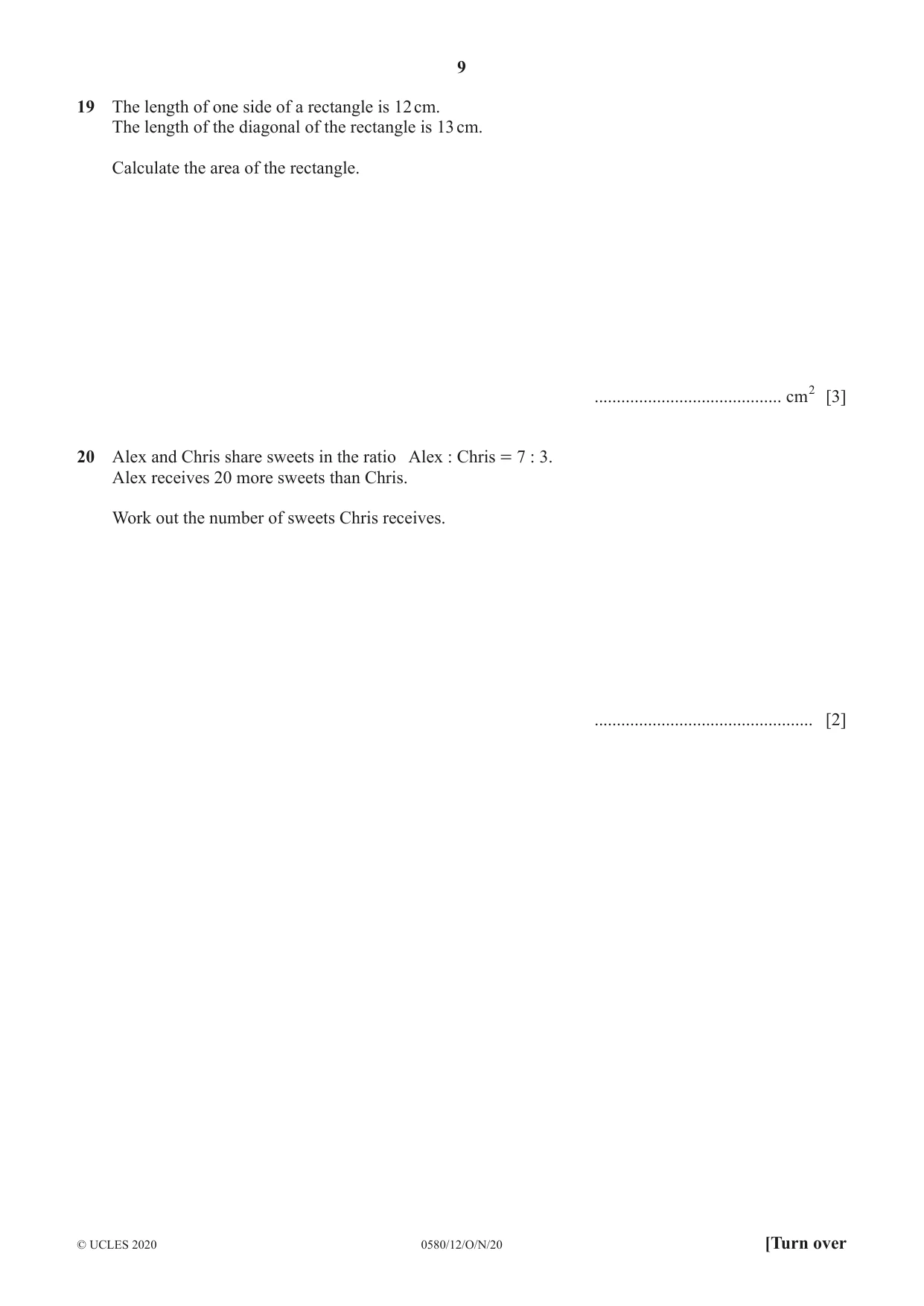
Q19 · The length of one side of a rectangle is 12 cm
19 The length of one side of a rectangle is 12 cm. The length of the diagonal of the rectangle is 13 cm. Calculate the area of the rectangle. .......................................... cm2 [3]
Mark scheme: 19 60 3 2 2 M2 for 12 × 13 − 12 or M1 for 132 − 122 or for 12 × their 5 from Pythagoras or trig
Q20 · Alex and Chris share sweets in the ratio Alex : Chris = 7 : 3
20 Alex and Chris share sweets in the ratio Alex : Chris = 7 : 3. Alex receives 20 more sweets than Chris. Work out the number of sweets Chris receives. ................................................. [2]
Mark scheme: 20 15 2 M1 for 4 [parts] = 20 soi or x + 20 x a correct equation, e.g. = oe 7 3
Q21 · Write 825 as the product of its prime factors
21 Write 825 as the product of its prime factors. ................................................. [2]
Mark scheme: 21 3 × 52 × 11 or 3 × 5 × 5 × 11 2 B1 for 3, 5, 5, 11 May be seen in a factor tree or table
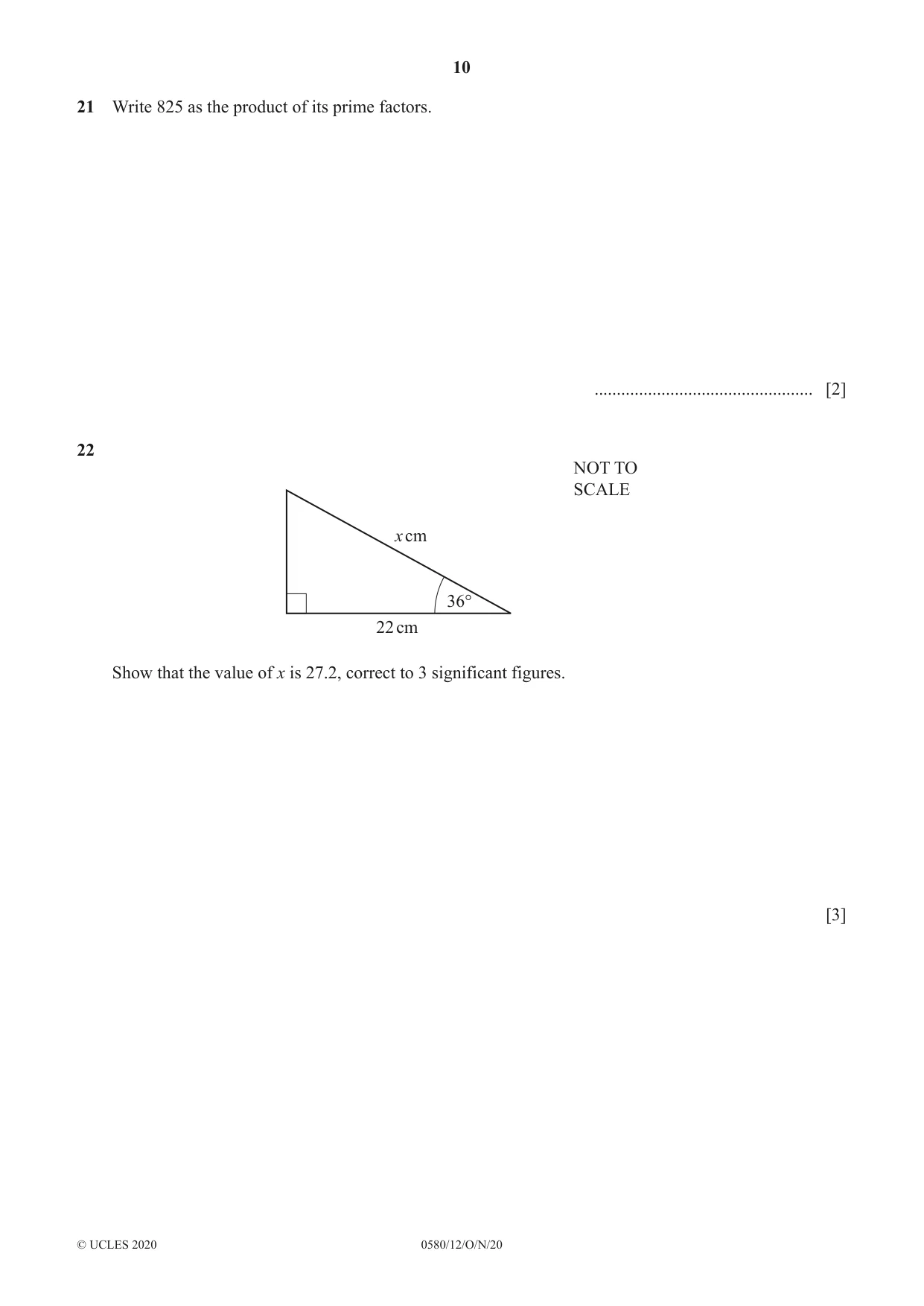
Q22 · NOT TO SCALE x cm 36° 22 cm Show that the value of x is 27.2, correct to 3 significant…
22 NOT TO SCALE x cm 36° 22 cm Show that the value of x is 27.2, correct to 3 significant figures. [3]
Mark scheme: 22 22 M2 22 [x =] oe M1 for cos36 = or better oe cos36 x 27.19[3......] A1
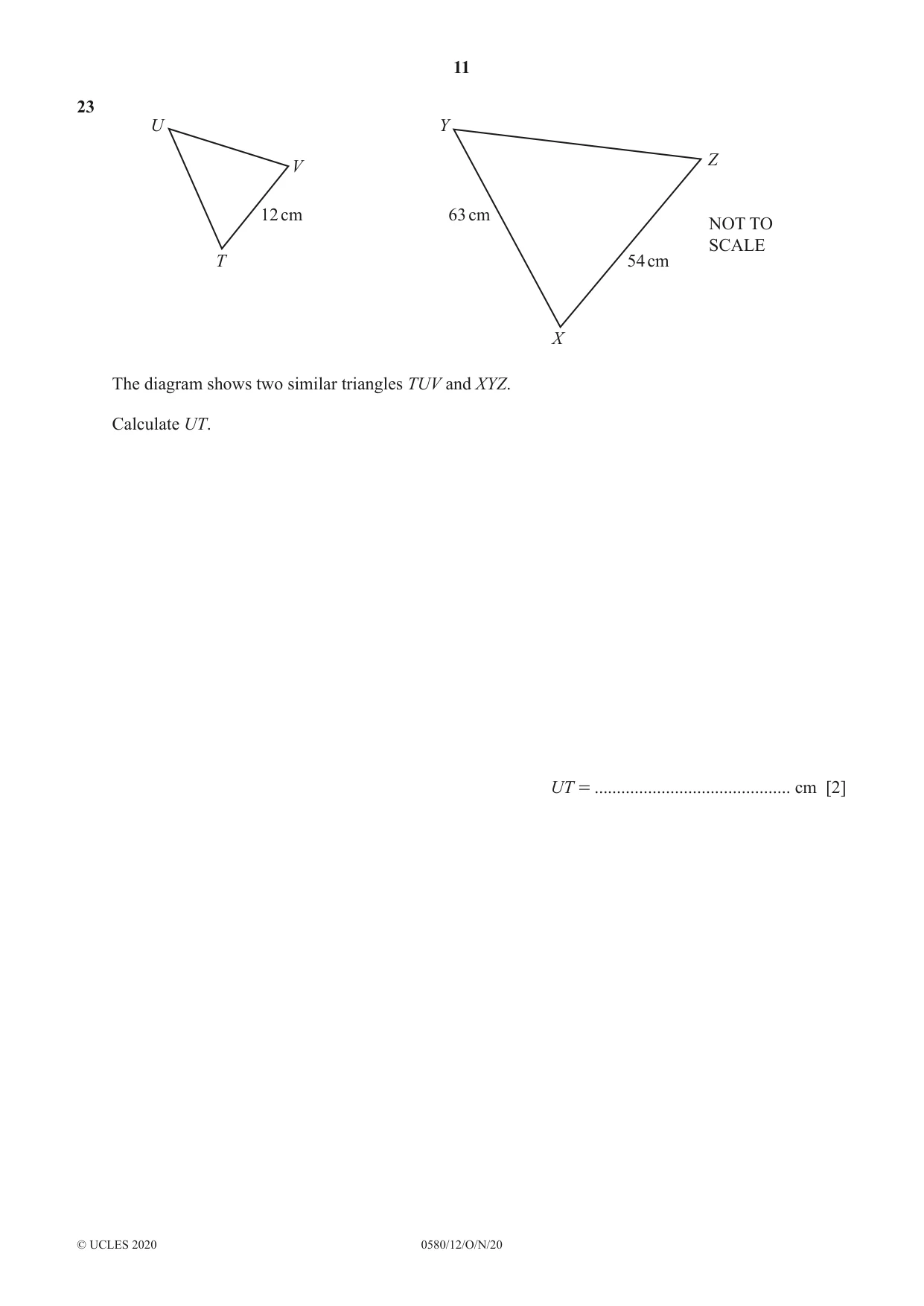
Q23 · U Y Z V 12 cm 63 cm NOT TO SCALE T 54 cm X The diagram shows two similar triangles TUV…
23 U Y Z V 12 cm 63 cm NOT TO SCALE T 54 cm X The diagram shows two similar triangles TUV and XYZ. Calculate UT. UT = ............................................ cm [2]
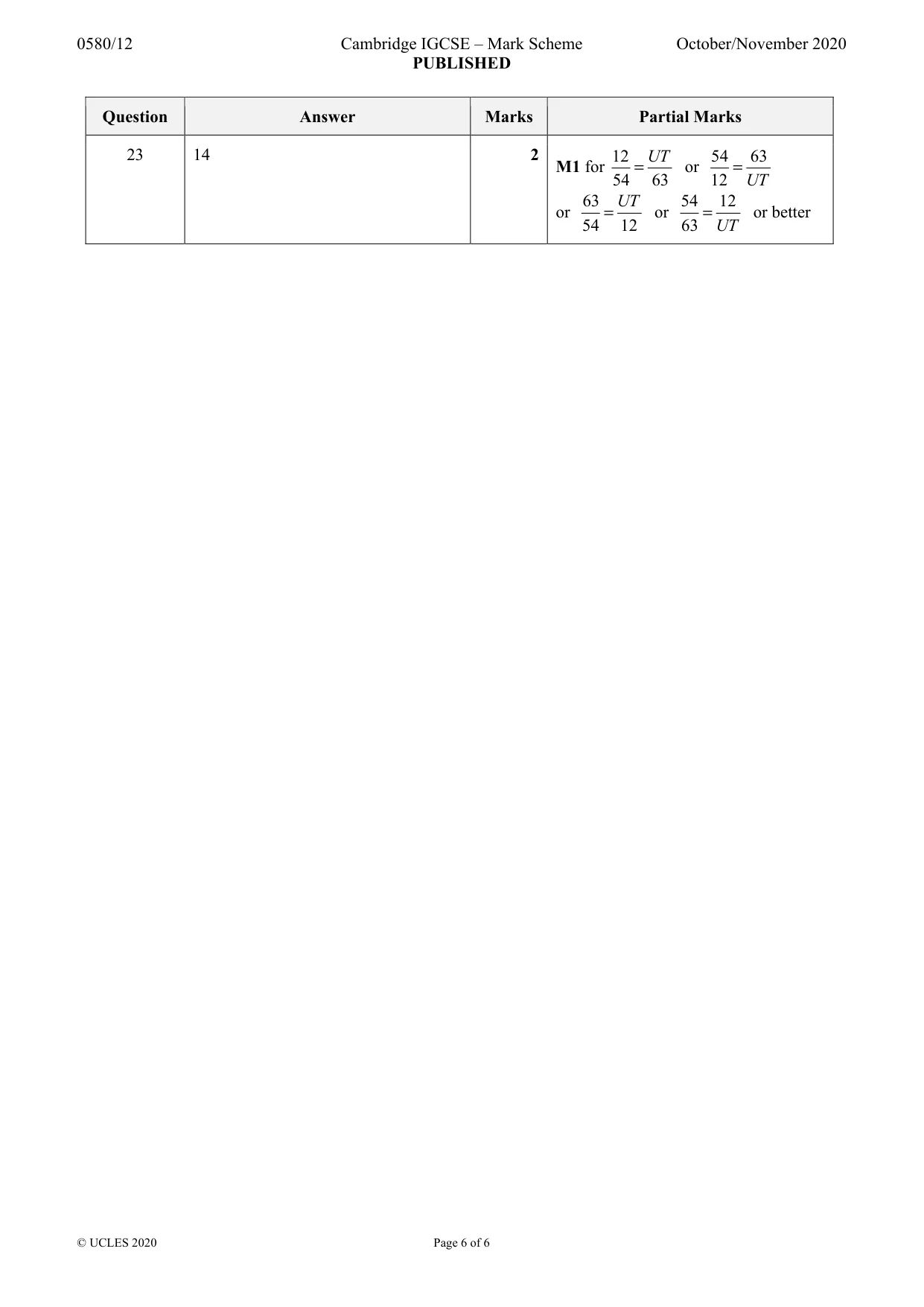
Mark scheme: 23 14 2 12 UT 54 63 M1 for = or = 54 63 12 UT 63 UT 54 12 or = or = or better 54 12 63 UT
What was in this paper
The subtopics covered by these 23 questions, and how many questions each got. Open one in a new tab to see every Cambridge question on it.
2Angles1Area and perimeter1Classifying statistical data1Coordinates1Equations1Fractions, decimals and percentages1Introduction to probability1Limits of accuracy1Ordering1Percentages1Pythagoras’ theorem1Ratio and proportion1Right-angled triangles1Sequences1Similarity1Standard form1Surface area and volume1Symmetry1The four operations1Time1Types of number1What you needed in this session
Cambridge’s own grade thresholds for 2020 Oct/Nov, Paper 1 · Variant 2. A higher threshold means an easier paper — the bar moves with how the cohort did.