Cambridge IGCSE Mathematics 0580 — 2016 Oct/Nov Paper 1 · Variant 2
0580/12/O/N/16 · 21 questions · 56 marks · ≈63 min
The question paper and its mark scheme, free to read here and free to download. This is Cambridge’s own paper, exactly as it was sat.
Question paper12 pages
Mark scheme4 pages
Answers below. Sit the paper first if you are practising.
Questions as text
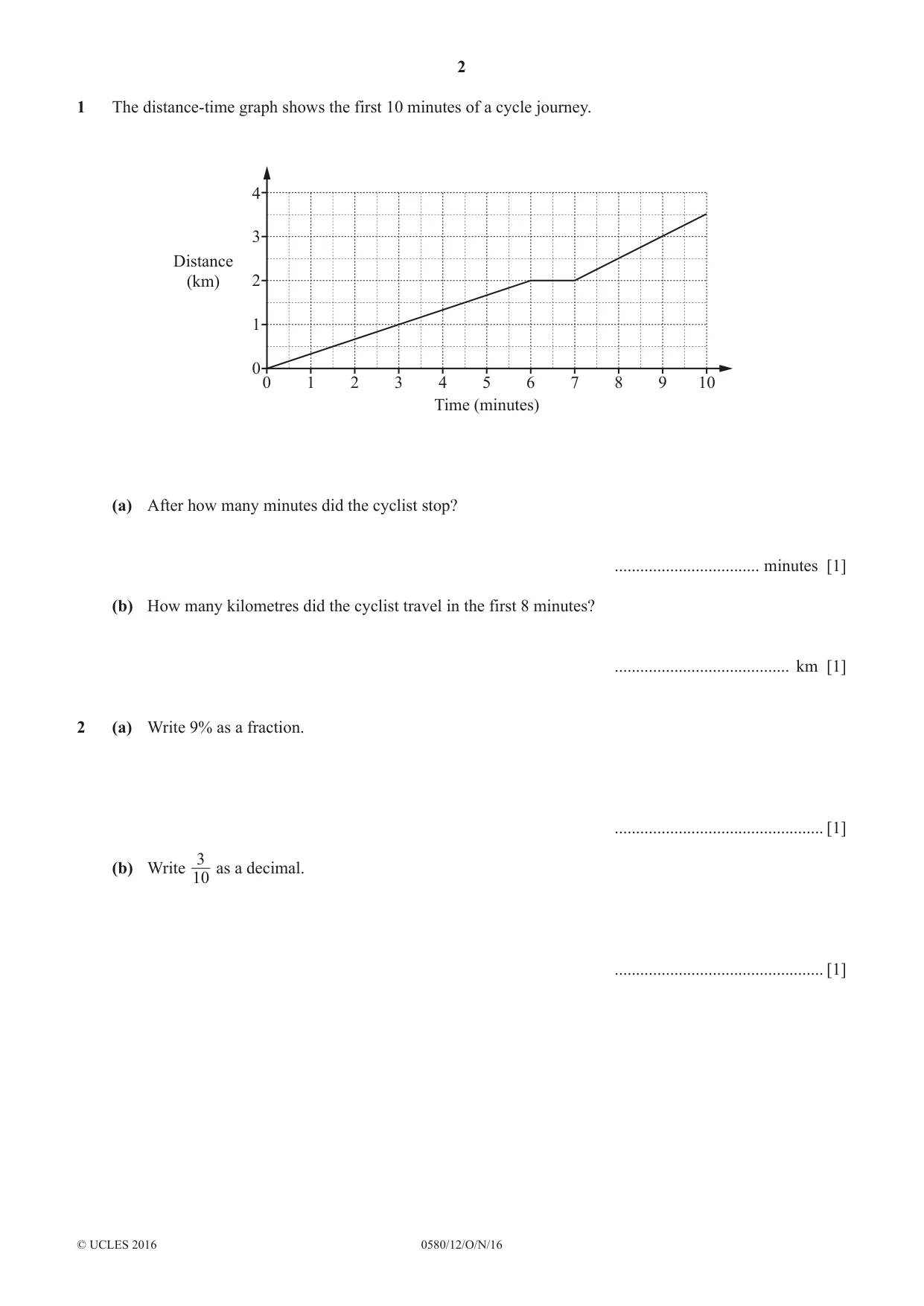
Q1 · The distance-time graph shows the first 10 minutes of a cycle journey
1 The distance-time graph shows the first 10 minutes of a cycle journey. 4 3 Distance (km) 2 1 0 0 1 2 3 4 5 6 7 8 9 10 Time (minutes) (a) After how many minutes did the cyclist stop? .................................. minutes [1] (b) How many kilometres did the cyclist travel in the first 8 minutes? ......................................... km [1]
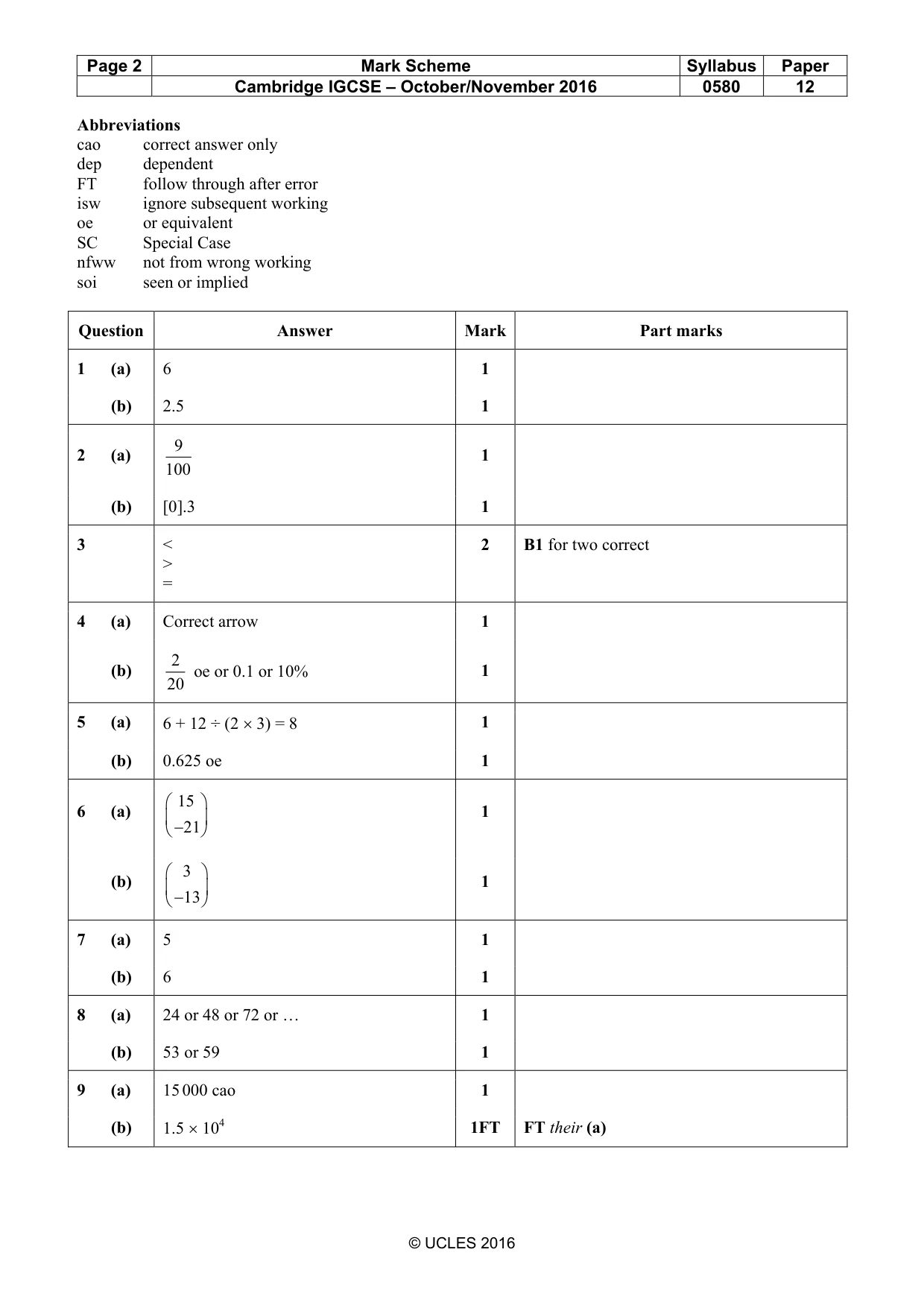
Mark scheme: Question Answer Mark Part marks 1 (a) 6 1 (b) 2.5 1 9
Q2 · Write 9% as a fraction
2 (a) Write 9% as a fraction. ................................................. [1] 3 (b) Write 10 as a decimal. ................................................. [1]
Mark scheme: 9 2 (a) 1 100 (b) [0].3 1
Q3 · Write the correct symbol, 2 , = or 1 in each statement
3 Write the correct symbol, 2 , = or 1 in each statement. 500 m ................ 5 km 50 mm ................ 0.5 cm 5000 cm ............. 0.05 km [2]
Mark scheme: 3 < 2 B1 for two correct > =
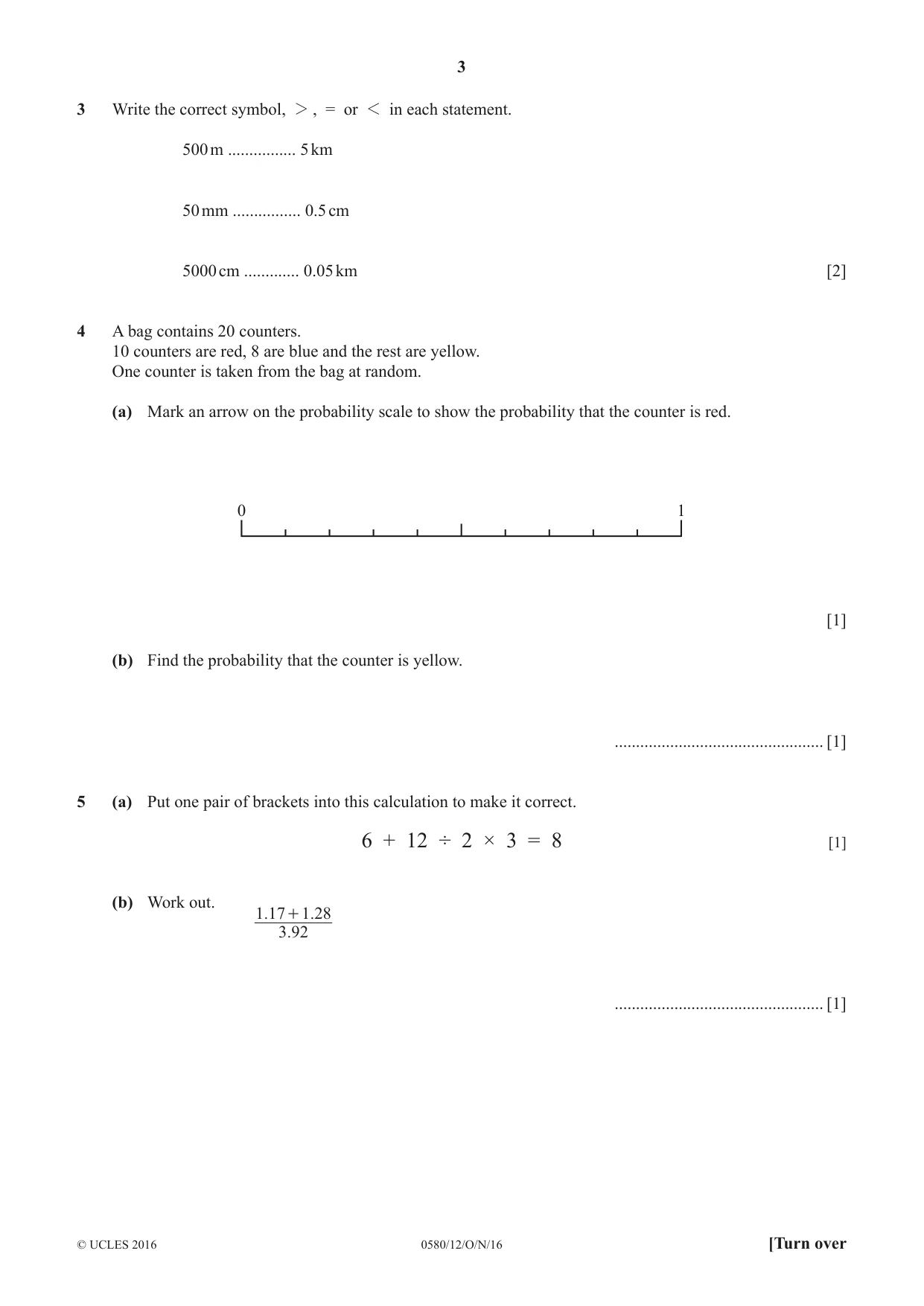
Q4 · A bag contains 20 counters
4 A bag contains 20 counters. 10 counters are red, 8 are blue and the rest are yellow. One counter is taken from the bag at random. (a) Mark an arrow on the probability scale to show the probability that the counter is red. 0 1 [1] (b) Find the probability that the counter is yellow. ................................................. [1]
Mark scheme: 4 (a) Correct arrow 1 2 (b) oe or 0.1 or 10% 1 20
Q5 · Put one pair of brackets into this calculation to make it correct
5 (a) Put one pair of brackets into this calculation to make it correct. 6 + 12 ÷ 2 × 3 = 8 [1] (b) Work out. 1.17 + 1.28 3.92 ................................................. [1]
Mark scheme: 5 (a) 6 + 12 ÷ (2 × 3) = 8 1 (b) 0.625 oe 1 15
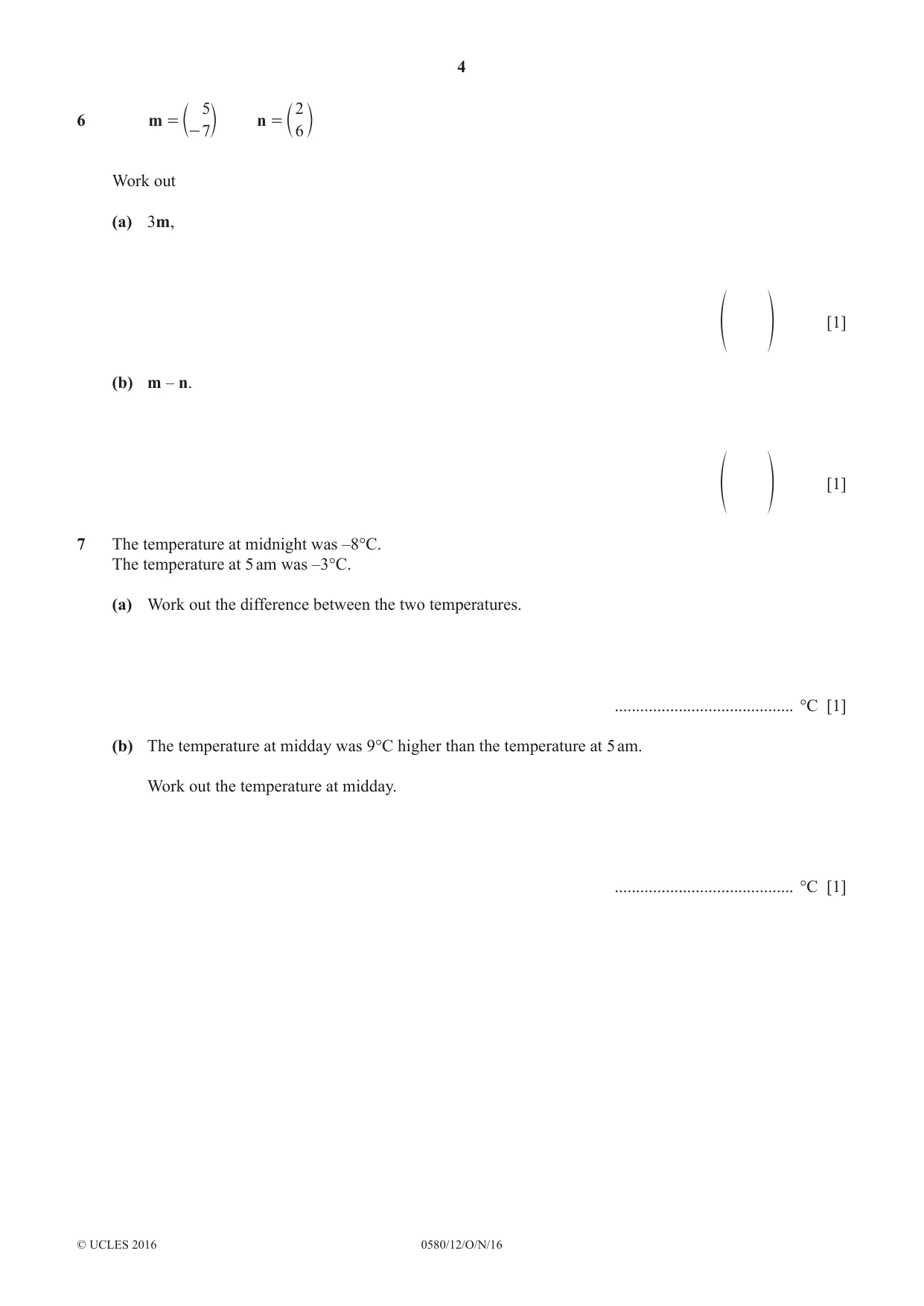
Q6 · 2 6 m = n = c- 7m c 6 m Work out (a) 3m, [1] f p (b) m – n
5 2 6 m = n = c- 7m c 6 m Work out (a) 3m, [1] f p (b) m – n. [1] f p
Mark scheme: 15 6 (a) 1 − 21 3 (b) 1 − 13
Q7 · The temperature at midnight was –8°C
7 The temperature at midnight was –8°C. The temperature at 5 am was –3°C. (a) Work out the difference between the two temperatures. .......................................... °C [1] (b) The temperature at midday was 9°C higher than the temperature at 5 am. Work out the temperature at midday. .......................................... °C [1]
Mark scheme: 7 (a) 5 1 (b) 6 1
Q8 · Write down a common multiple of 8 and 12
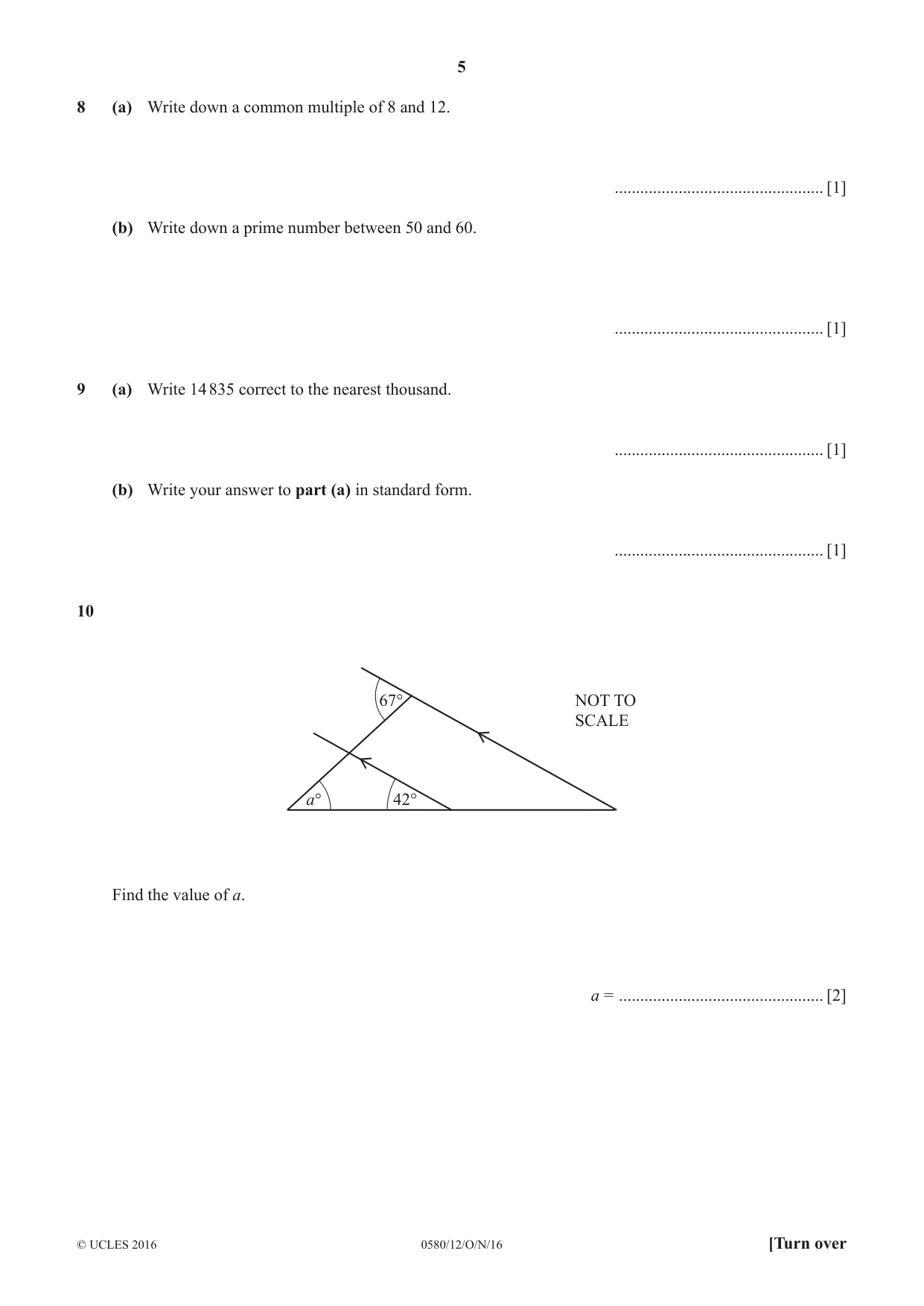
8 (a) Write down a common multiple of 8 and 12. ................................................. [1] (b) Write down a prime number between 50 and 60. ................................................. [1]
Mark scheme: 8 (a) 24 or 48 or 72 or … 1 (b) 53 or 59 1
Q9 · Write 14 835 correct to the nearest thousand
9 (a) Write 14 835 correct to the nearest thousand. ................................................. [1] (b) Write your answer to part (a) in standard form. ................................................. [1]
Mark scheme: 9 (a) 15 000 cao 1 (b) 1.5 × 10⁴ 1FT FT their (a)
Q10 · 67° NOT TO SCALE a° 42° Find the value of a
10 67° NOT TO SCALE a° 42° Find the value of a. a = ................................................ [2]
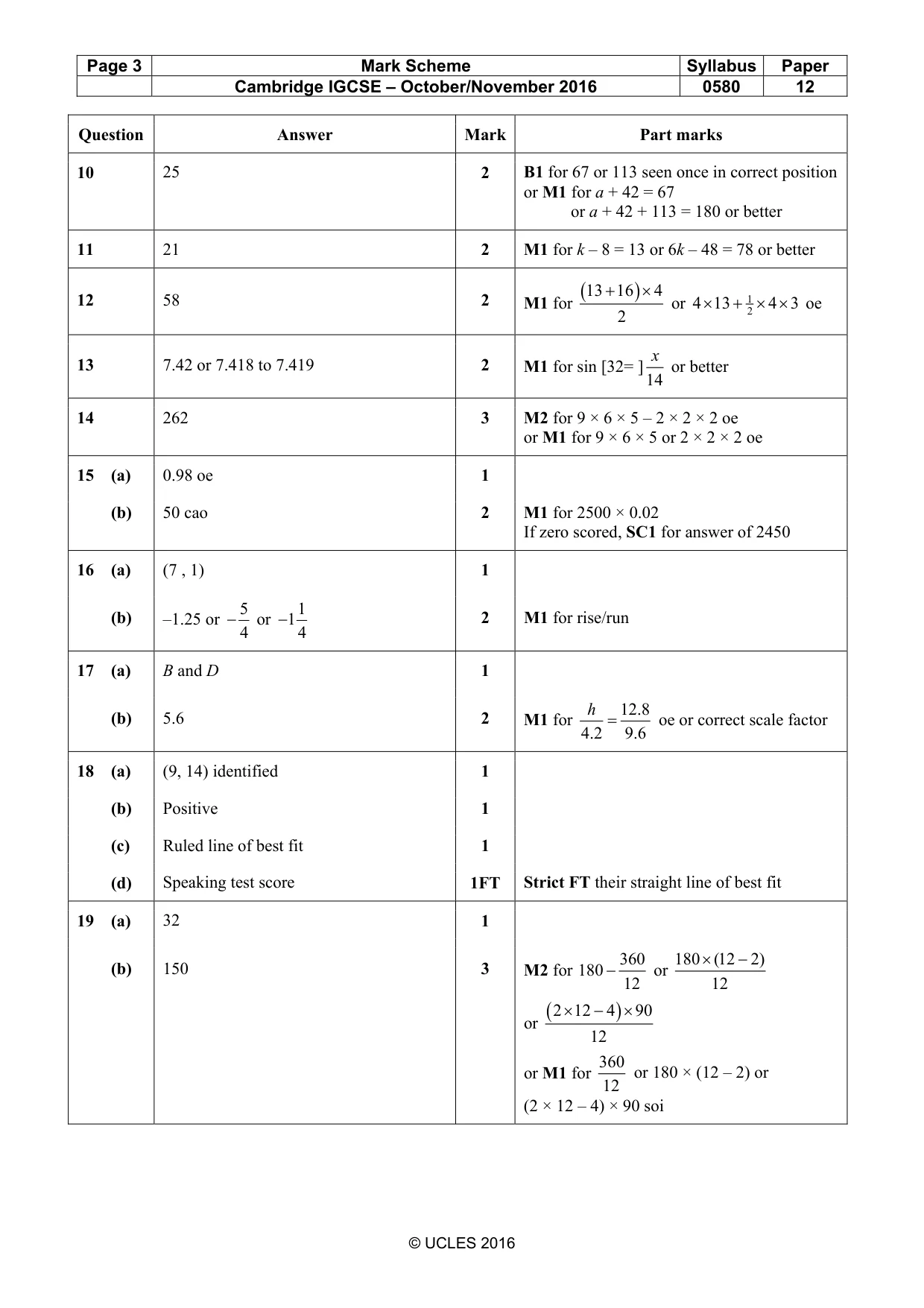
Mark scheme: 10 25 2 B1 for 67 or 113 seen once in correct position or M1 for a + 42 = 67 or a + 42 + 113 = 180 or better
Question 11
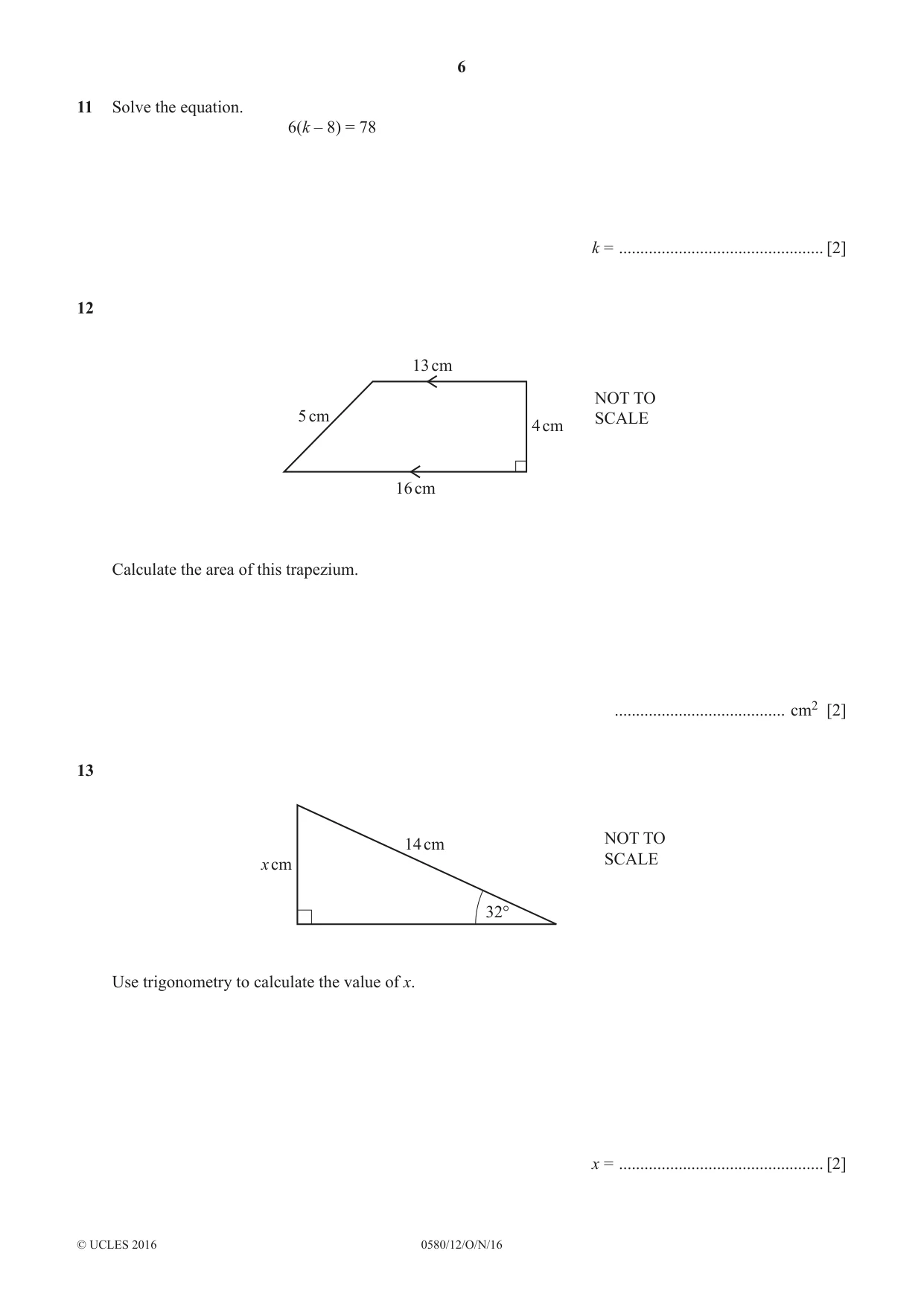
11 Solve the equation. 6(k – 8) = 78 k = ................................................ [2]
Mark scheme: 11 21 2 M1 for k – 8 = 13 or 6k – 48 = 78 or better (13 + 16 ) × 4
Q12 · 13 cm NOT TO 5 cm SCALE 4 cm 16 cm Calculate the area of this trapezium
12 13 cm NOT TO 5 cm SCALE 4 cm 16 cm Calculate the area of this trapezium. ........................................ cm2 [2]
Mark scheme: (13 + 16 ) × 412 58 2 M1 for or 4 × 13 + 12 × 4 × 3 oe 2 x
Q13 · NOT TO 14 cm SCALE x cm 32° Use trigonometry to calculate the value of x
13 NOT TO 14 cm SCALE x cm 32° Use trigonometry to calculate the value of x. x = ................................................ [2]
Mark scheme: x 13 7.42 or 7.418 to 7.419 2 M1 for sin [32= ]14 or better
Q14 · NOT TO 5 cm SCALE 6 cm 9 cm The diagram shows a solid in the shape of a cuboid with a…
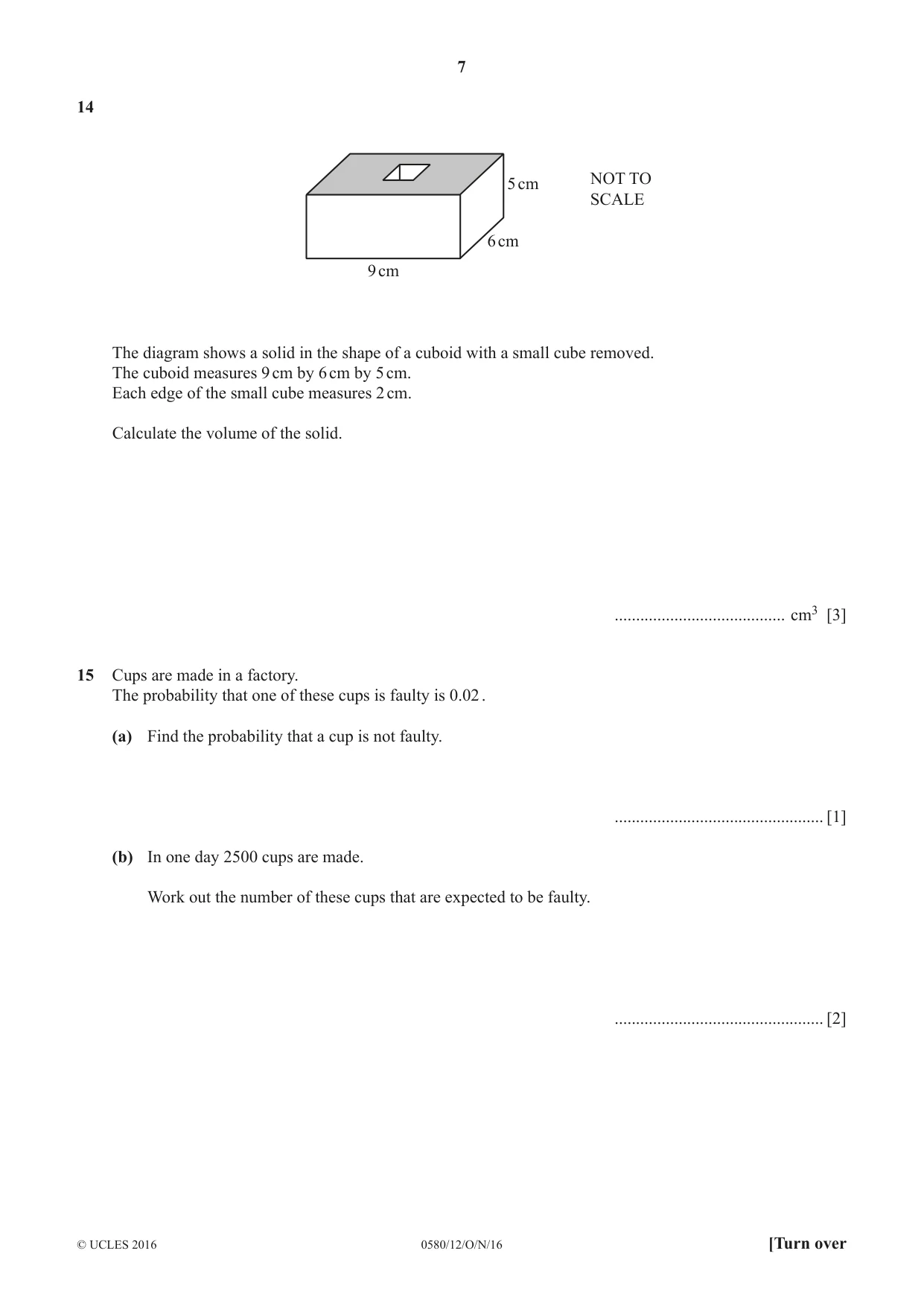
14 NOT TO 5 cm SCALE 6 cm 9 cm The diagram shows a solid in the shape of a cuboid with a small cube removed. The cuboid measures 9 cm by 6 cm by 5 cm. Each edge of the small cube measures 2 cm. Calculate the volume of the solid. ........................................ cm3 [3]
Mark scheme: 14 262 3 M2 for 9 × 6 × 5 – 2 × 2 × 2 oe or M1 for 9 × 6 × 5 or 2 × 2 × 2 oe
Q15 · Cups are made in a factory
15 Cups are made in a factory. The probability that one of these cups is faulty is 0.02 . (a) Find the probability that a cup is not faulty. ................................................. [1] (b) In one day 2500 cups are made. Work out the number of these cups that are expected to be faulty. ................................................. [2]
Mark scheme: 15 (a) 0.98 oe 1 (b) 50 cao 2 M1 for 2500 × 0.02 If zero scored, SC1 for answer of 2450
Q16 · Y 7 A 6 5 4 3 2 B 1 x 0 1 2 3 4 5 6 7 8 Point A has co-ordinates (3, 6)
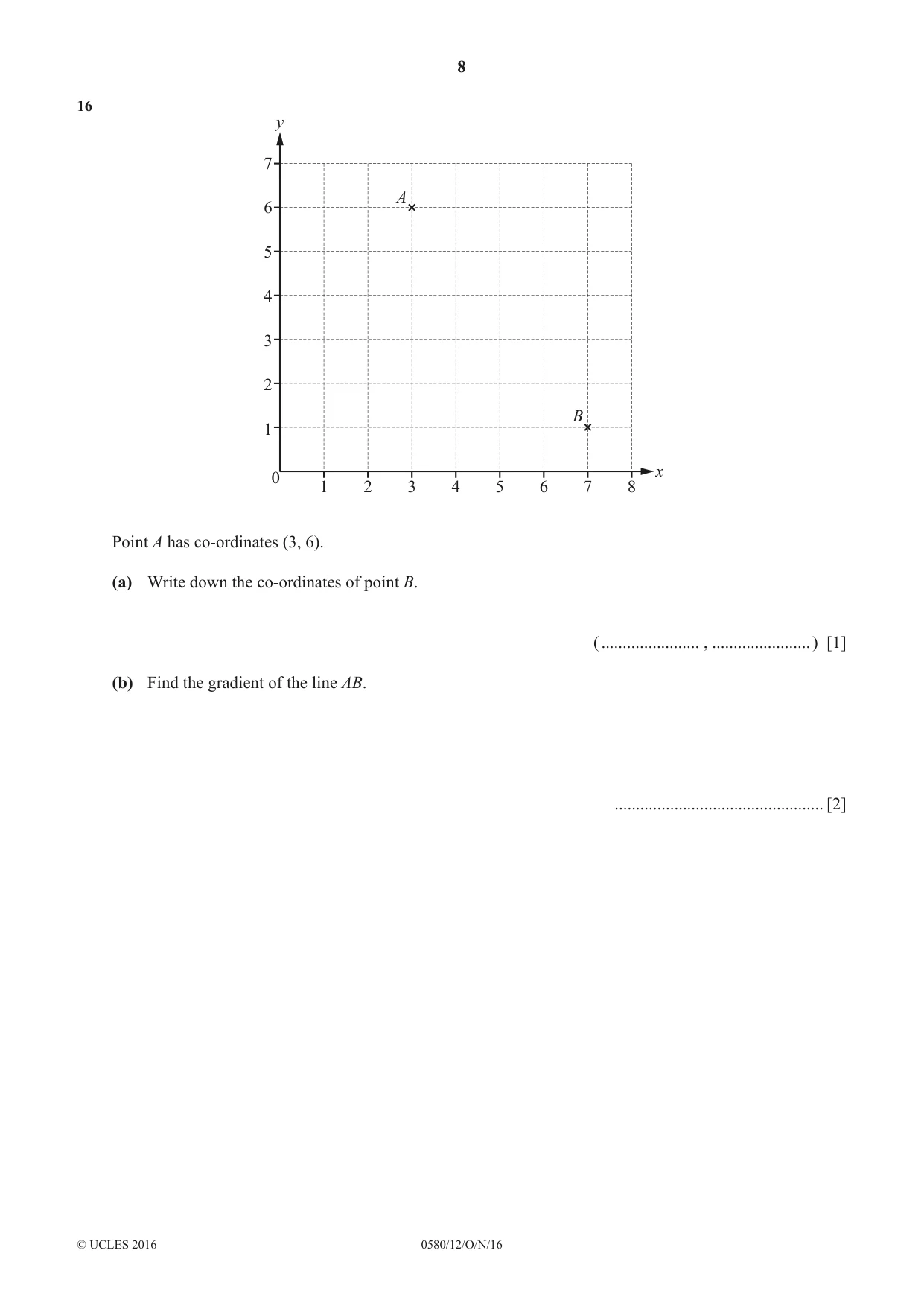
16 y 7 A 6 5 4 3 2 B 1 x 0 1 2 3 4 5 6 7 8 Point A has co-ordinates (3, 6). (a) Write down the co-ordinates of point B. ( ....................... , ....................... ) [1] (b) Find the gradient of the line AB. ................................................. [2]
Mark scheme: 16 (a) (7 , 1) 1 5 1 (b) –1.25 or − or − 2 M1 for rise/run 4 14
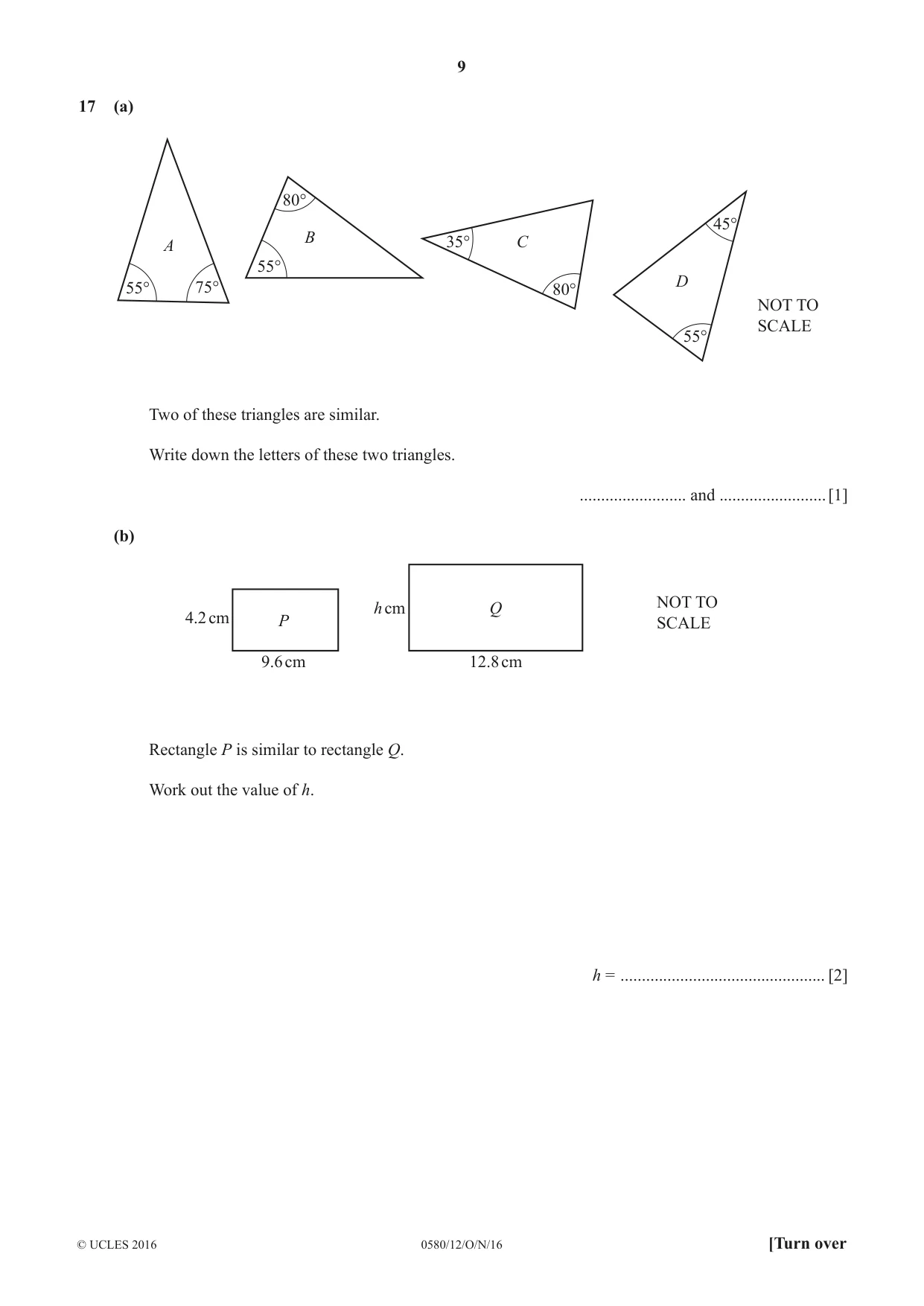
Q17 · 80° 45° B A 35° C 55° D 55° 75° 80° NOT TO SCALE 55° Two of these triangles are similar
17 (a) 80° 45° B A 35° C 55° D 55° 75° 80° NOT TO SCALE 55° Two of these triangles are similar. Write down the letters of these two triangles. ......................... and ......................... [1] (b) NOT TO h cm Q 4.2 cm P SCALE 9.6 cm 12.8 cm Rectangle P is similar to rectangle Q. Work out the value of h. h = ................................................ [2]
Mark scheme: 17 (a) B and D 1 h 12.8 (b) 5.6 2 M1 for = oe or correct scale factor 4.2 9.6
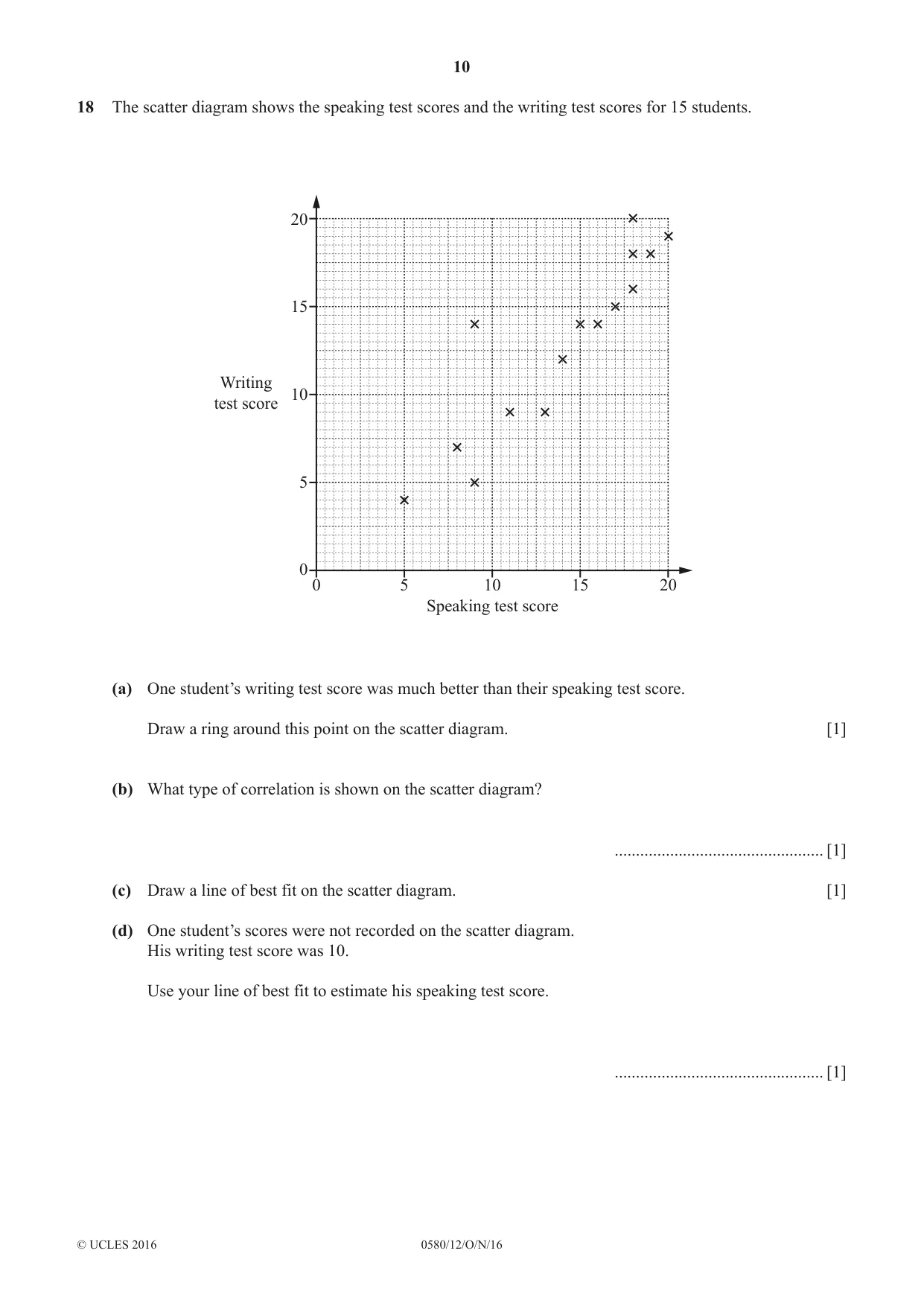
Q18 · The scatter diagram shows the speaking test scores and the writing test scores for 15…
18 The scatter diagram shows the speaking test scores and the writing test scores for 15 students. 20 15 Writing 10 test score 5 0 0 5 10 15 20 Speaking test score (a) One student’s writing test score was much better than their speaking test score. Draw a ring around this point on the scatter diagram. [1] (b) What type of correlation is shown on the scatter diagram? ................................................. [1] (c) Draw a line of best fit on the scatter diagram. [1] (d) One student’s scores were not recorded on the scatter diagram. His writing test score was 10. Use your line of best fit to estimate his speaking test score. ................................................. [1]
Mark scheme: 18 (a) (9, 14) identified 1 (b) Positive 1 (c) Ruled line of best fit 1 (d) Speaking test score 1FT Strict FT their straight line of best fit
Q19 · Work out the perimeter of a regular octagon with side length 4 cm
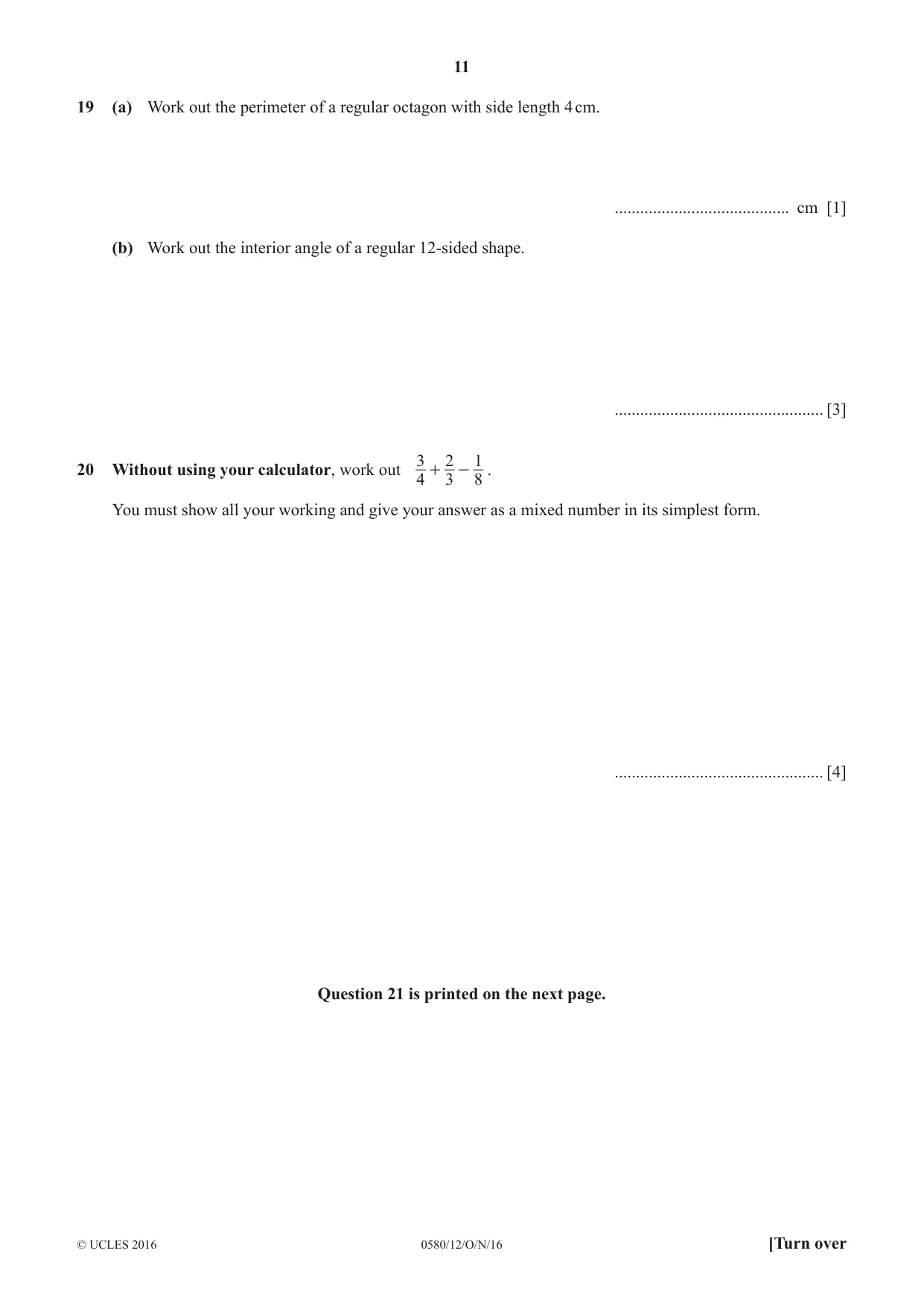
19 (a) Work out the perimeter of a regular octagon with side length 4 cm. ......................................... cm [1] (b) Work out the interior angle of a regular 12-sided shape. ................................................. [3]
Mark scheme: 19 (a) 32 1 360 180 × (12 − 2) (b) 150 3 M2 for 180 − or 12 12 ( 2 × 12 − 4 ) × 90 or 12 360 or M1 for or 180 × (12 – 2) or 12 (2 × 12 – 4) × 90 soi
Q20 · 2 1 20 Without using your calculator, work out 4 + 3 - 8
3 2 1 20 Without using your calculator, work out 4 + 3 - 8 . You must show all your working and give your answer as a mixed number in its simplest form. ................................................. [4] Question 21 is printed on the next page.
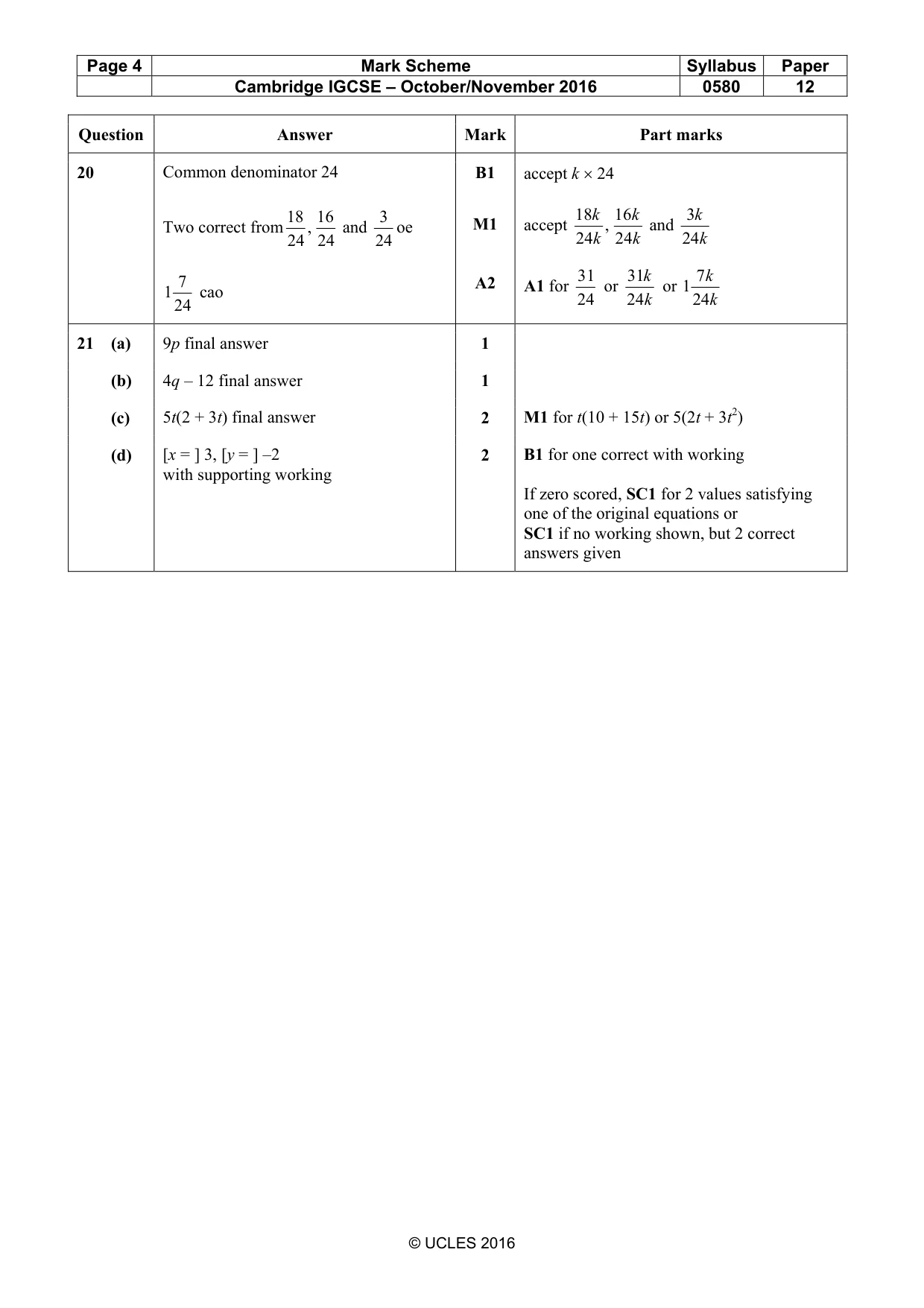
Mark scheme: 20 Common denominator 24 B1 accept k × 24 18 16 3 18 k 16 k 3k Two correct from , and oe M1 accept , and 24 24 24 24 k 24 k 24 k 31 31k 7 k 7 A2 A1 for or or cao 24 24 k 124 k 124
Question 21
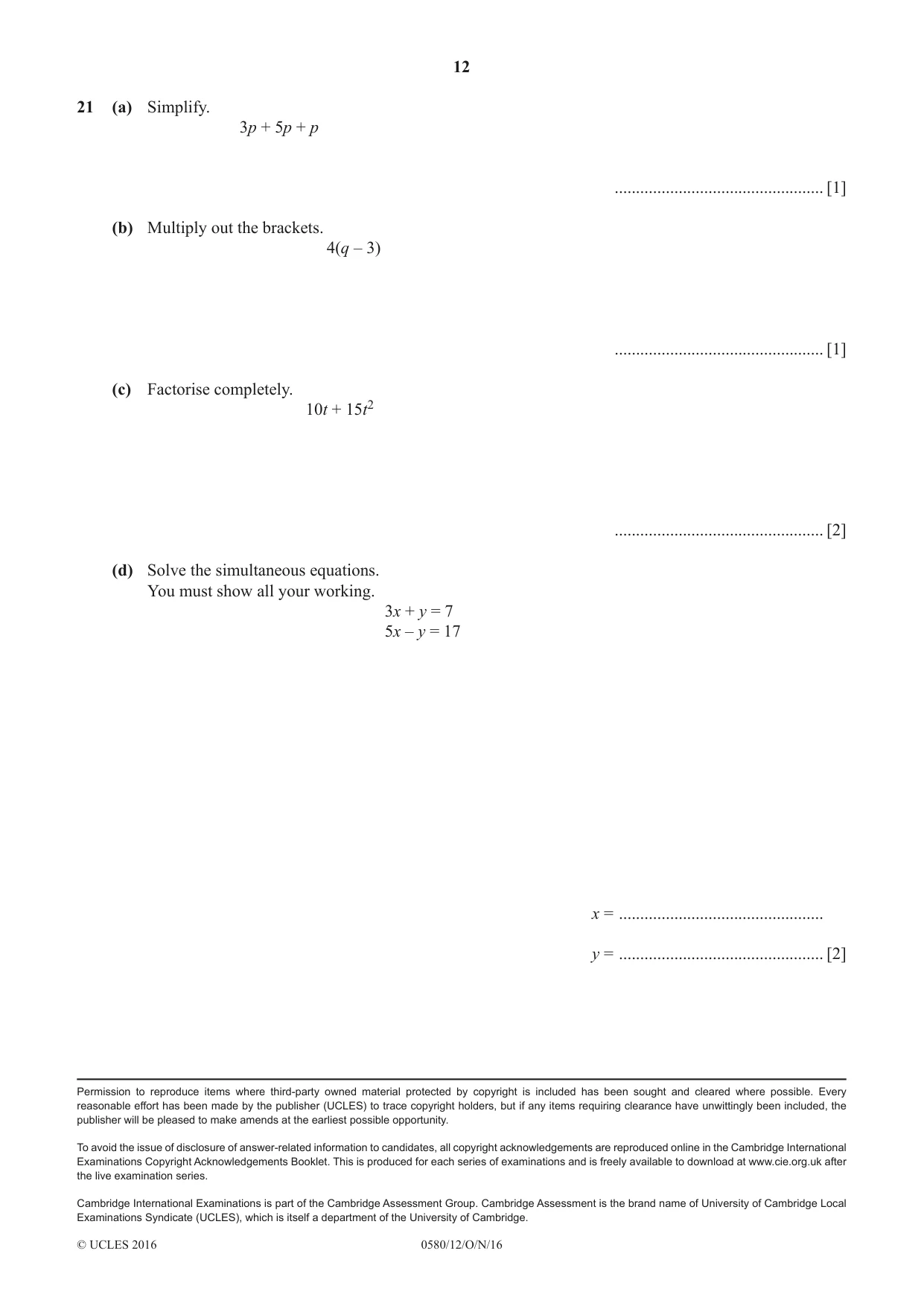
21 (a) Simplify. 3p + 5p + p ................................................. [1] (b) Multiply out the brackets. 4(q – 3) ................................................. [1] (c) Factorise completely. 10t + 15t2 ................................................. [2] (d) Solve the simultaneous equations. You must show all your working. 3x + y = 7 5x – y = 17 x = ................................................ y = ................................................ [2]
Mark scheme: 21 (a) 9p final answer 1 (b) 4q – 12 final answer 1 (c) 5t(2 + 3t) final answer 2 M1 for t(10 + 15t) or 5(2t + 3t2) (d) [x = ] 3, [y = ] –2 2 B1 for one correct with working with supporting working If zero scored, SC1 for 2 values satisfying one of the original equations or SC1 if no working shown, but 2 correct answers given
What was in this paper
The subtopics covered by these 21 questions, and how many questions each got. Open one in a new tab to see every Cambridge question on it.
2Fractions, decimals and percentages2The four operations2Algebraic manipulation1Angles1Equations1Gradient of linear graphs1Interpreting statistical data1Introduction to probability1Limits of accuracy1Ordering1Relative and expected frequencies1Right-angled triangles1Scatter diagrams1Similarity1Surface area and volume1Types of number1Vectors in two dimensions1What you needed in this session
Cambridge’s own grade thresholds for 2016 Oct/Nov, Paper 1 · Variant 2. A higher threshold means an easier paper — the bar moves with how the cohort did.