Cambridge IGCSE Mathematics 0580 — 2011 Oct/Nov Paper 1 · Variant 3
0580/13/O/N/11 · 24 questions · 56 marks · ≈63 min
The question paper and its mark scheme, free to read here and free to download. This is Cambridge’s own paper, exactly as it was sat.
Question paper12 pages
Mark scheme3 pages
Answers below. Sit the paper first if you are practising.
Questions as text
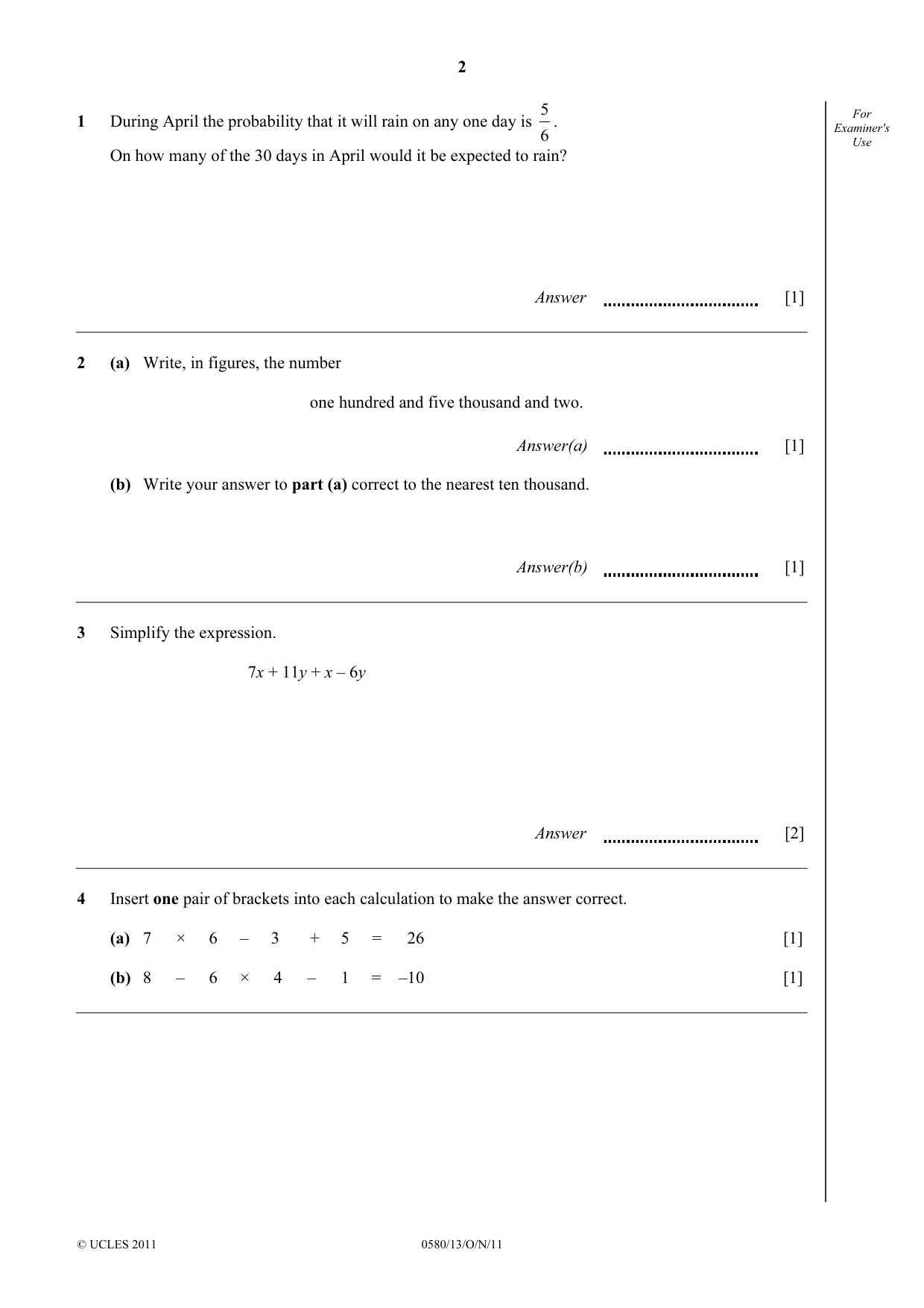
Q1 · For 1 During April the probability that it will rain on any one day is
5 For 1 During April the probability that it will rain on any one day is . Examiner's 6 Use On how many of the 30 days in April would it be expected to rain? Answer [1]
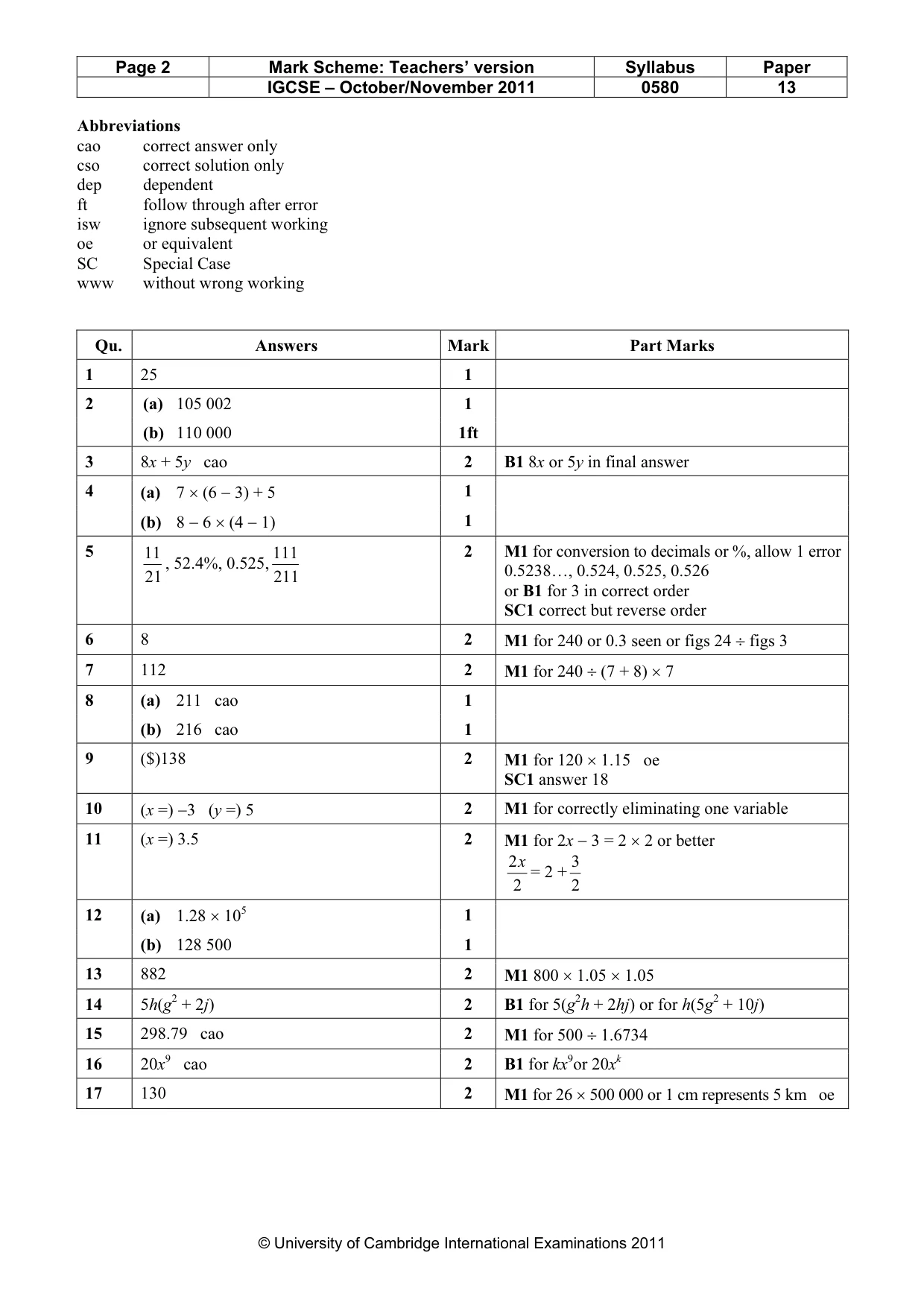
Mark scheme: Qu. Answers Mark Part Marks 1 25 1
Q2 · Write, in figures, the number one hundred and five thousand and two
2 (a) Write, in figures, the number one hundred and five thousand and two. Answer(a) [1] (b) Write your answer to part (a) correct to the nearest ten thousand. Answer(b) [1]
Mark scheme: 2 (a) 105 002 1 (b) 110 000 1ft
Question 3
3 Simplify the expression. 7x + 11y + x – 6y Answer [2]
Mark scheme: 3 8x + 5y cao 2 B1 8x or 5y in final answer
Q4 · Insert one pair of brackets into each calculation to make the answer correct
4 Insert one pair of brackets into each calculation to make the answer correct. (a) 7 × 6 – 3 + 5 = 26 [1] (b) 8 – 6 × 4 – 1 = –10 [1]
Mark scheme: 4 (a) 7 × (6 − 3) + 5 1 (b) 8 − 6 × (4 − 1) 1
Q5 · Write the following in order of size, starting with the smallest
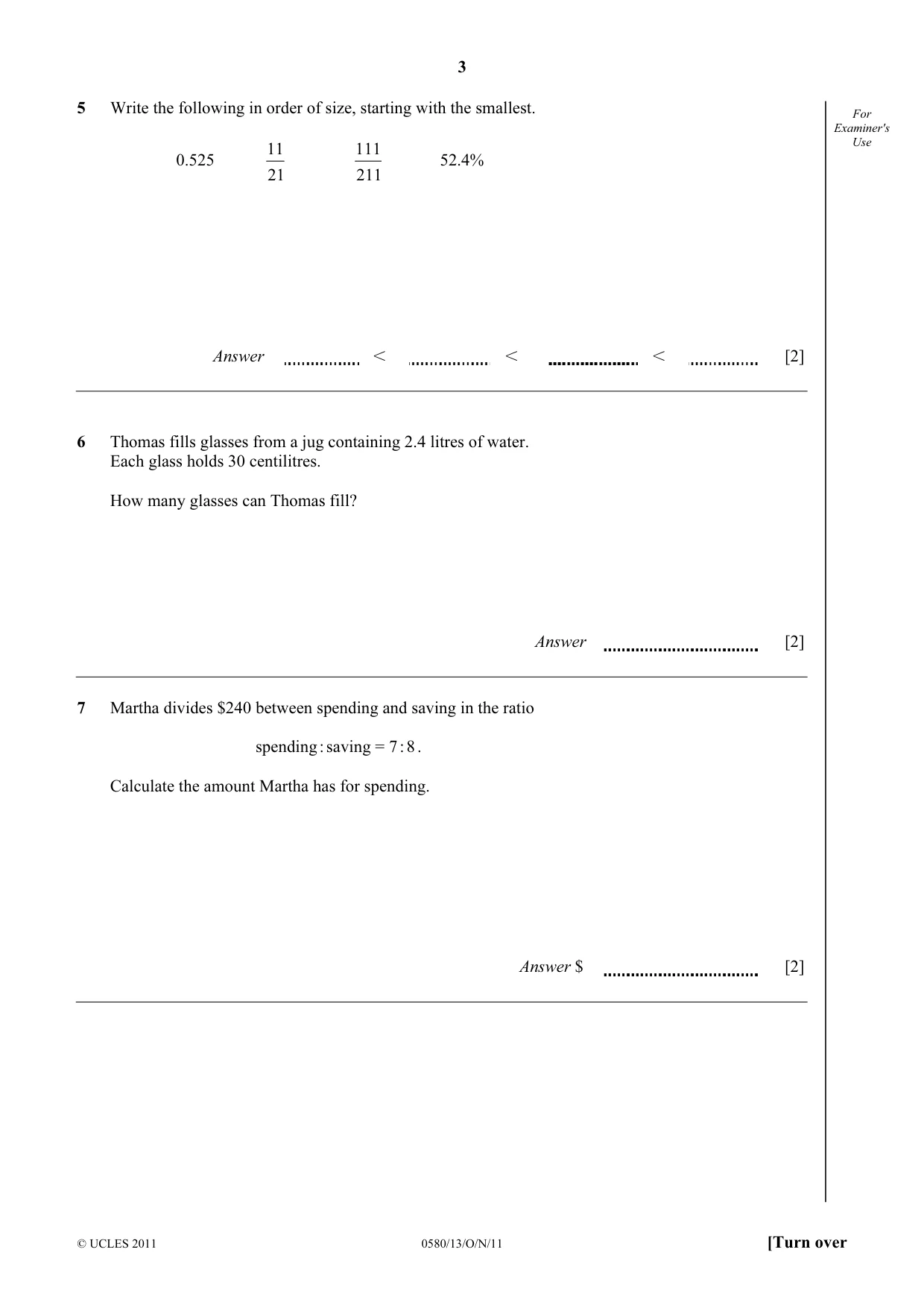
5 Write the following in order of size, starting with the smallest. For Examiner's 11 111 Use 0.525 52.4% 21 211 Answer I I I [2]
Mark scheme: 5 11 111 2 M1 for conversion to decimals or %, allow 1 error , 52.4%, 0.525, 0.5238…, 0.524, 0.525, 0.526 21 211 or B1 for 3 in correct order SC1 correct but reverse order
Q6 · Thomas fills glasses from a jug containing 2.4 litres of water
6 Thomas fills glasses from a jug containing 2.4 litres of water. Each glass holds 30 centilitres. How many glasses can Thomas fill? Answer [2]
Mark scheme: 6 8 2 M1 for 240 or 0.3 seen or figs 24 ÷ figs 3
Q7 · Martha divides $240 between spending and saving in the ratio spending : saving = 7 : 8
7 Martha divides $240 between spending and saving in the ratio spending : saving = 7 : 8 . Calculate the amount Martha has for spending. Answer $ [2]
Mark scheme: 7 112 2 M1 for 240 ÷ (7 + 8) × 7
Q8 · 210 211 212 213 214 215 216 For Examiner's From the list of numbers, find Use (a) a prime…
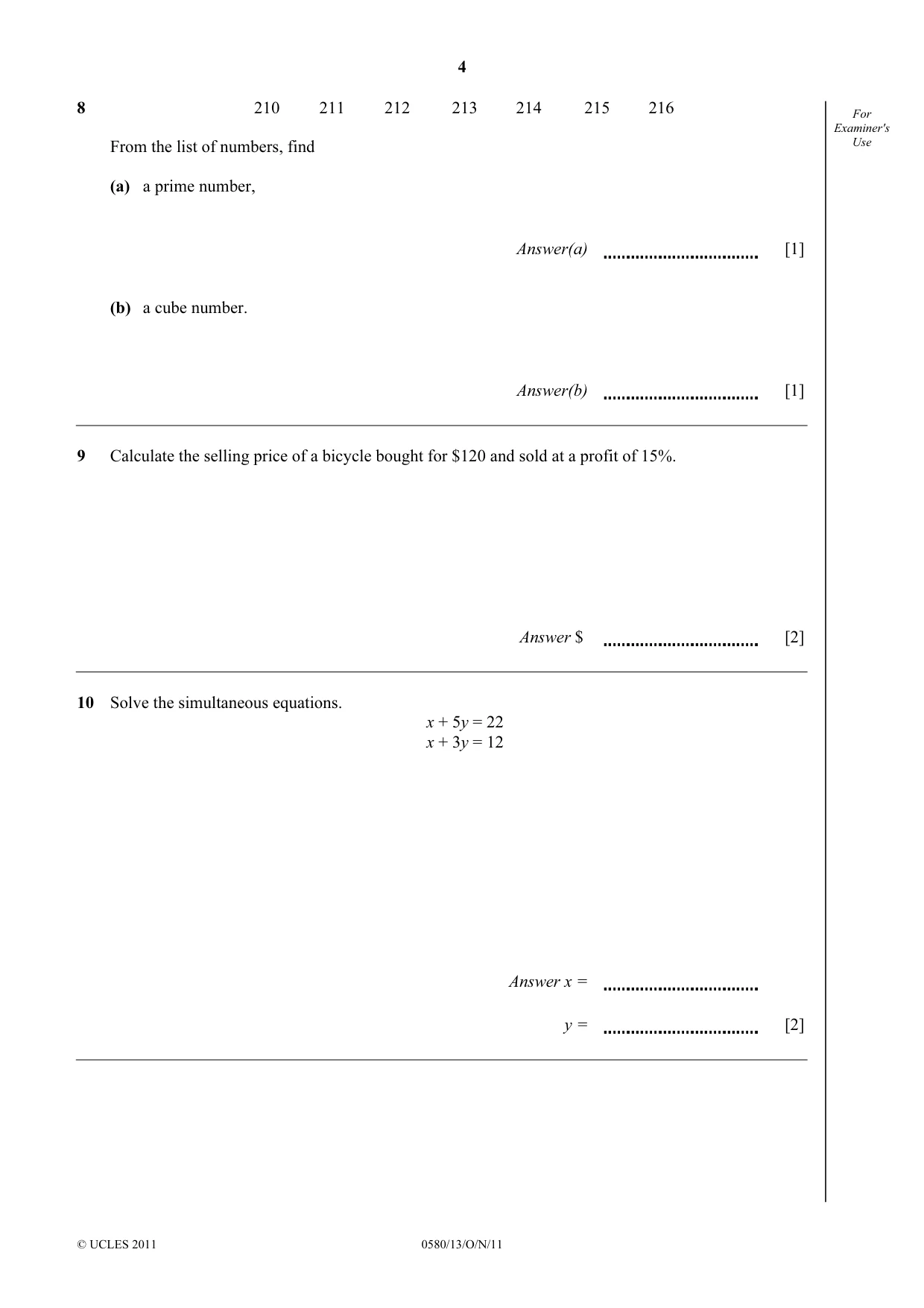
8 210 211 212 213 214 215 216 For Examiner's From the list of numbers, find Use (a) a prime number, Answer(a) [1] (b) a cube number. Answer(b) [1]
Mark scheme: 8 (a) 211 cao 1 (b) 216 cao 1
Q9 · Calculate the selling price of a bicycle bought for $120 and sold at a profit of 15%
9 Calculate the selling price of a bicycle bought for $120 and sold at a profit of 15%. Answer $ [2]
Mark scheme: 9 ($)138 2 M1 for 120 × 1.15 oe SC1 answer 18
Q10 · Solve the simultaneous equations
10 Solve the simultaneous equations. x + 5y = 22 x + 3y = 12 Answer x = y = [2]
Mark scheme: 10 (x =) −3 (y =) 5 2 M1 for correctly eliminating one variable
Question 11
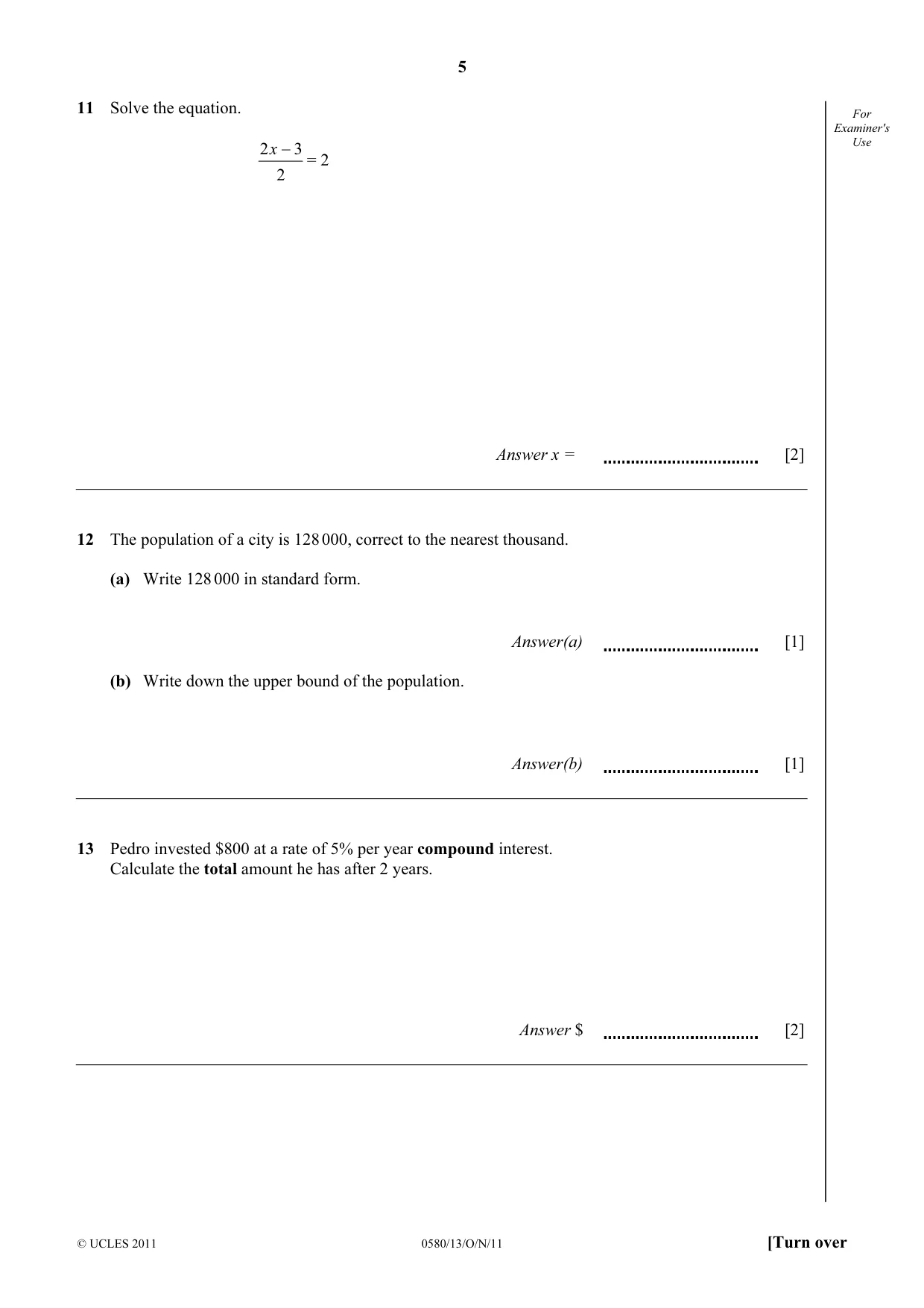
11 Solve the equation. For Examiner's 2 x − 3 Use = 2 2 Answer x = [2]
Mark scheme: 11 (x =) 3.5 2 M1 for 2x − 3 = 2 × 2 or better 2x 3 = 2 + 2 2 5
Q12 · The population of a city is 128 000, correct to the nearest thousand
12 The population of a city is 128 000, correct to the nearest thousand. (a) Write 128 000 in standard form. Answer(a) [1] (b) Write down the upper bound of the population. Answer(b) [1]
Mark scheme: 12 (a) 1.28 × 10⁵ 1 (b) 128 500 1
Q13 · Pedro invested $800 at a rate of 5% per year compound interest
13 Pedro invested $800 at a rate of 5% per year compound interest. Calculate the total amount he has after 2 years. Answer $ [2]
Mark scheme: 13 882 2 M1 800 × 1.05 × 1.05 2 2 2
Question 14
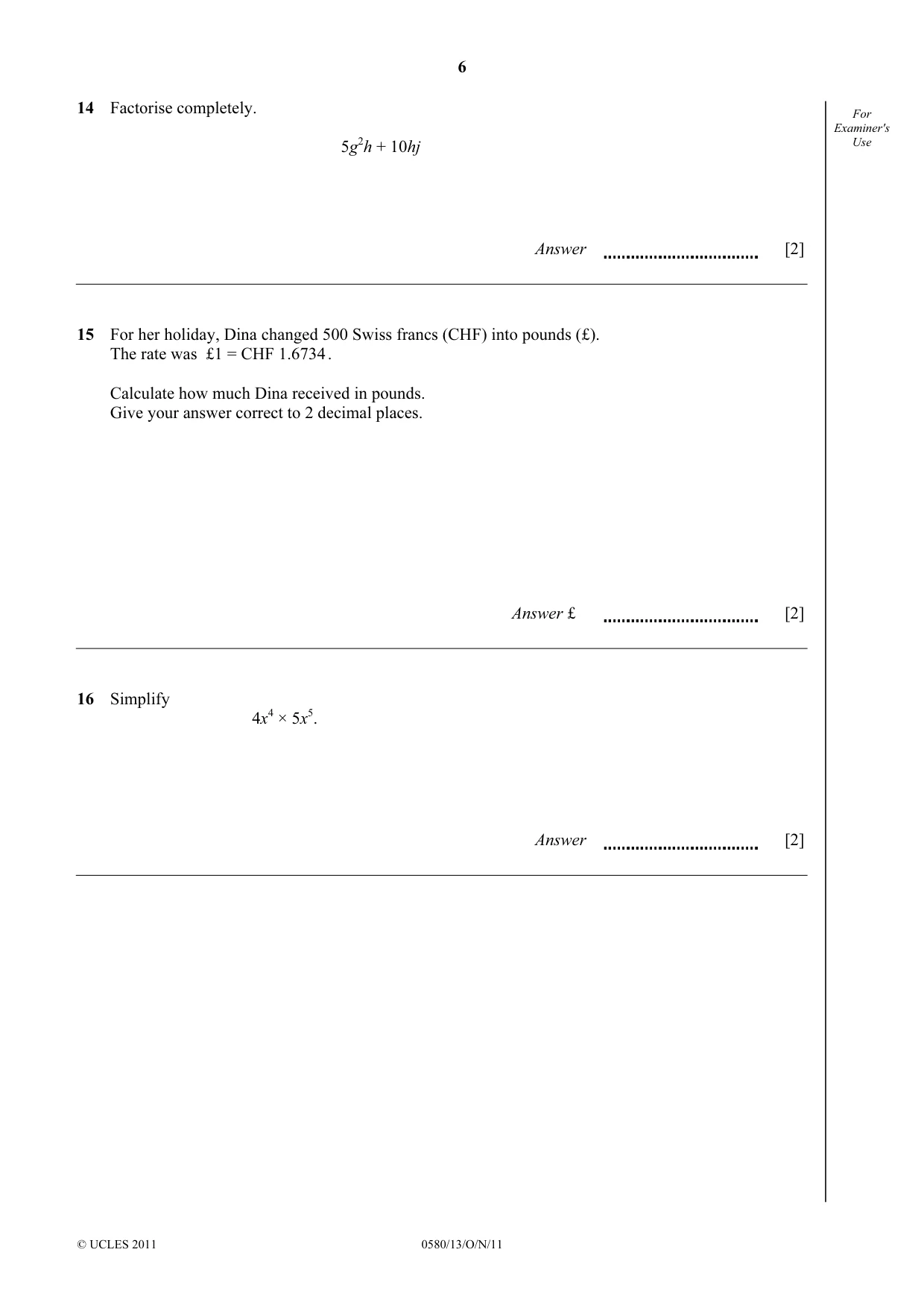
14 Factorise completely. For Examiner's 5g2h + 10hj Use Answer [2]
Mark scheme: 14 5h(g2 + 2j) 2 B1 for 5(g2h + 2hj) or for h(5g2 + 10j)
Q15 · For her holiday, Dina changed 500 Swiss francs (CHF) into pounds (£)
15 For her holiday, Dina changed 500 Swiss francs (CHF) into pounds (£). The rate was £1 = CHF 1.6734 . Calculate how much Dina received in pounds. Give your answer correct to 2 decimal places. Answer £ [2]
Mark scheme: 15 298.79 cao 2 M1 for 500 ÷ 1.6734 9 9 k
Q16 · Simplify 4x4 × 5x5
16 Simplify 4x4 × 5x5. Answer [2]
Mark scheme: 16 20x9 cao 2 B1 for kx9or 20xk
Q17 · The scale of a map is 1 : 500 000
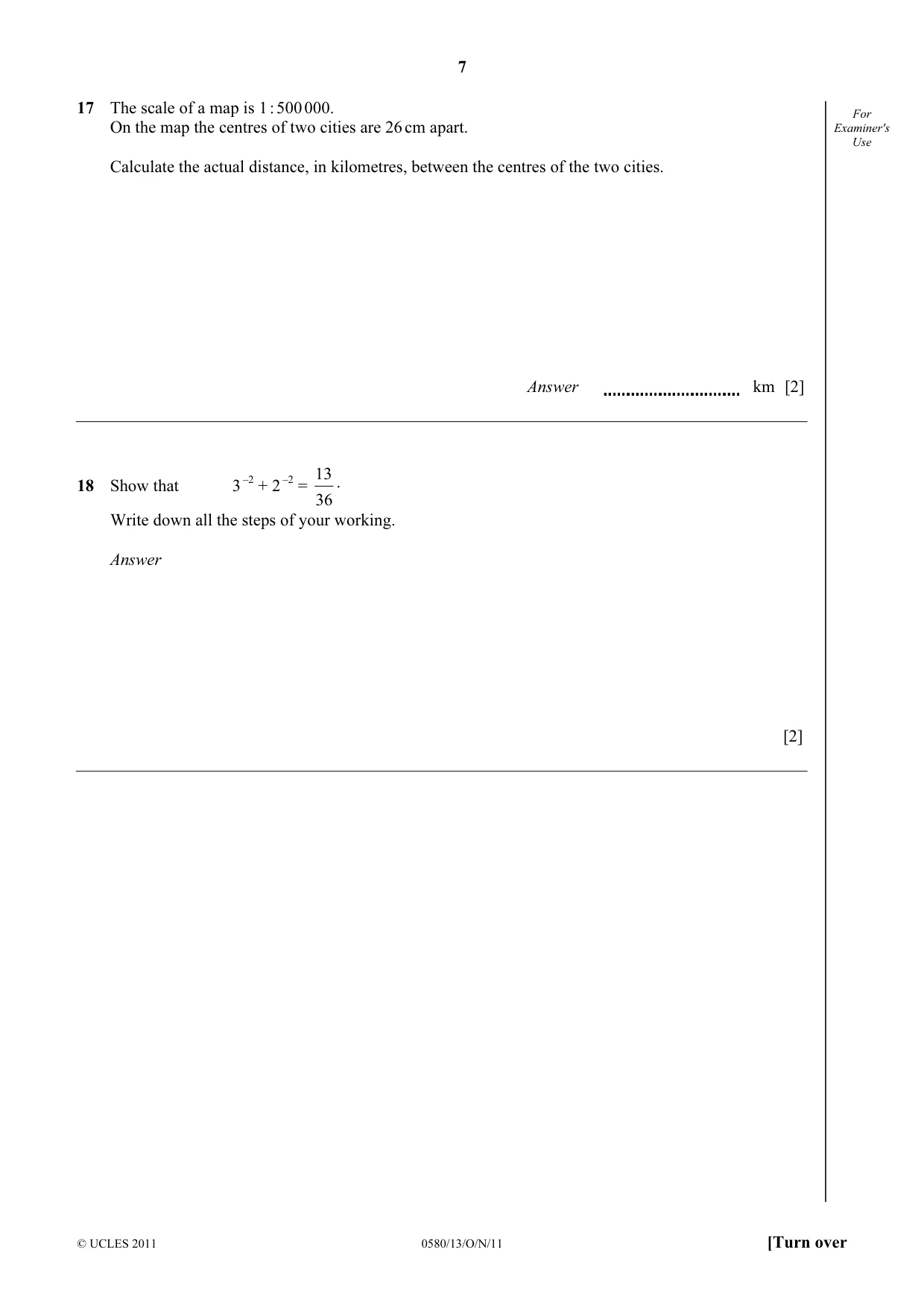
17 The scale of a map is 1 : 500 000. For On the map the centres of two cities are 26 cm apart. Examiner's Use Calculate the actual distance, in kilometres, between the centres of the two cities. Answer km [2]
Mark scheme: 17 130 2 M1 for 26 × 500 000 or 1 cm represents 5 km oe IGCSE – October/November 2011 0580 13 1 1
Q18 · –2 –2 1318 Show that 3 + 2 =
–2 –2 1318 Show that 3 + 2 = . 36 Write down all the steps of your working. Answer [2]
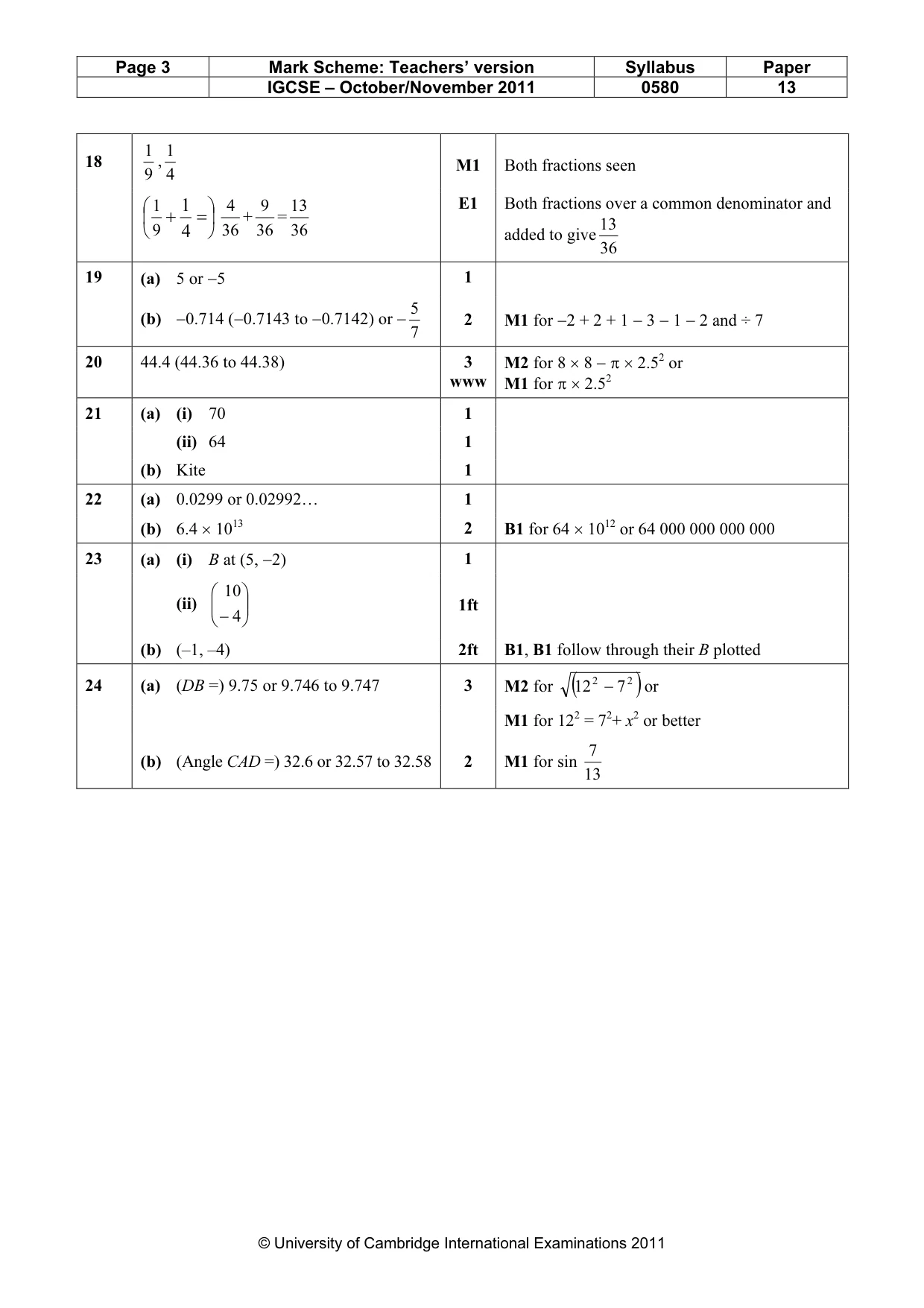
Mark scheme: 1 1 18 , M1 Both fractions seen 9 4 1 1 4 9 13 E1 Both fractions over a common denominator and + = + = 13 9 4 36 36 36 added to give 36
Q19 · In Vienna, the mid-day temperatures, in °C, are recorded during a week in December
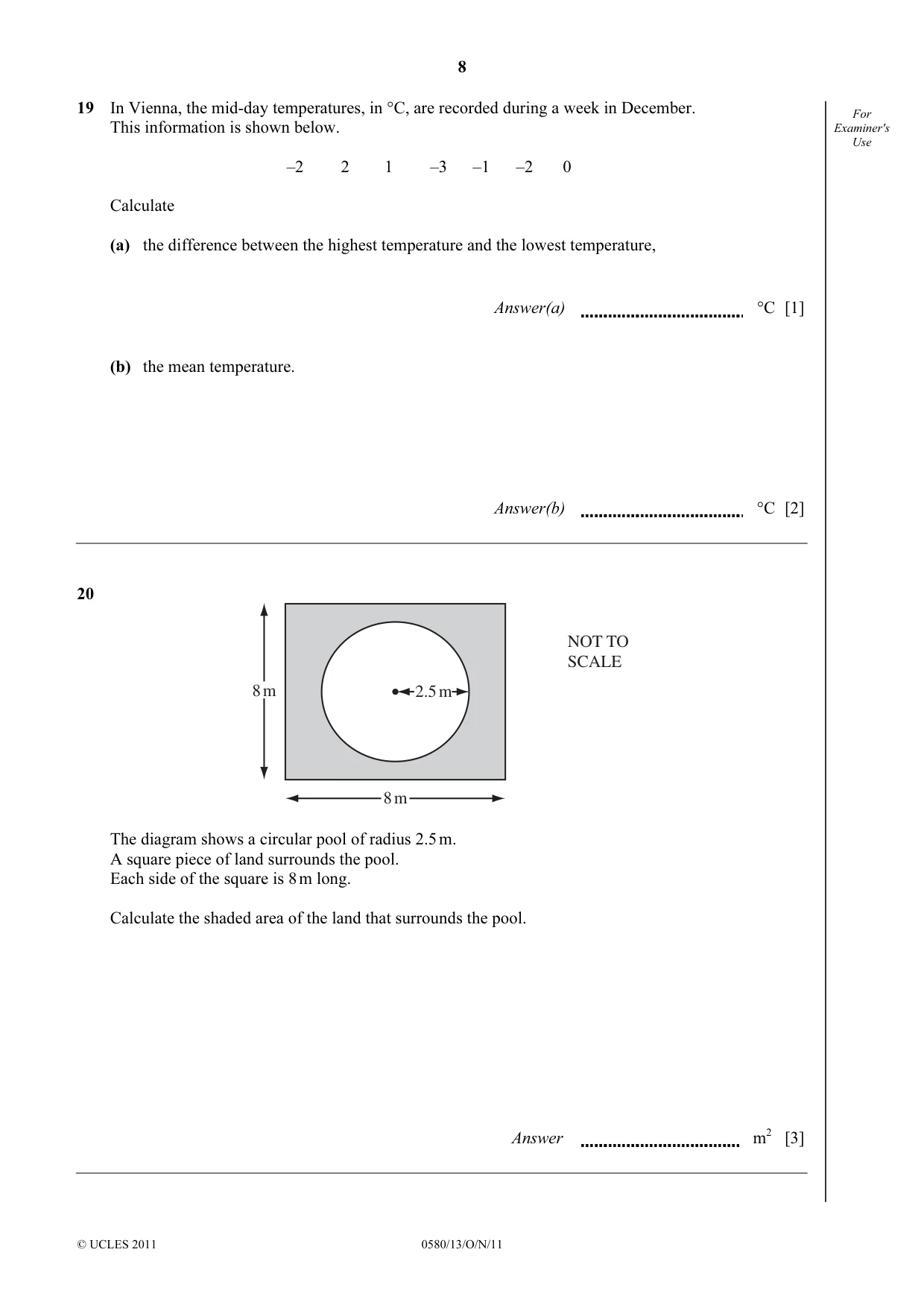
19 In Vienna, the mid-day temperatures, in °C, are recorded during a week in December. For This information is shown below. Examiner's Use –2 2 1 –3 –1 –2 0 Calculate (a) the difference between the highest temperature and the lowest temperature, Answer(a) °C [1] (b) the mean temperature. Answer(b) °C [2]
Mark scheme: 19 (a) 5 or −5 1 5 (b) −0.714 (−0.7143 to −0.7142) or −7 2 M1 for −2 + 2 + 1 − 3 − 1 − 2 and ÷ 7 2
Q20 · NOT TO SCALE 8 m 2.5 m 8 m The diagram shows a circular pool of radius 2.5 m
20 NOT TO SCALE 8 m 2.5 m 8 m The diagram shows a circular pool of radius 2.5 m. A square piece of land surrounds the pool. Each side of the square is 8 m long. Calculate the shaded area of the land that surrounds the pool. Answer m2 [3]
Mark scheme: 20 44.4 (44.36 to 44.38) 3 M2 for 8 × 8 − π × 2.52 or www M1 for π × 2.52
Q21 · For D Examiner's Use C NOT TO SCALE 58° 40° A B In the quadrilateral ABCD, AB = AD and CB…
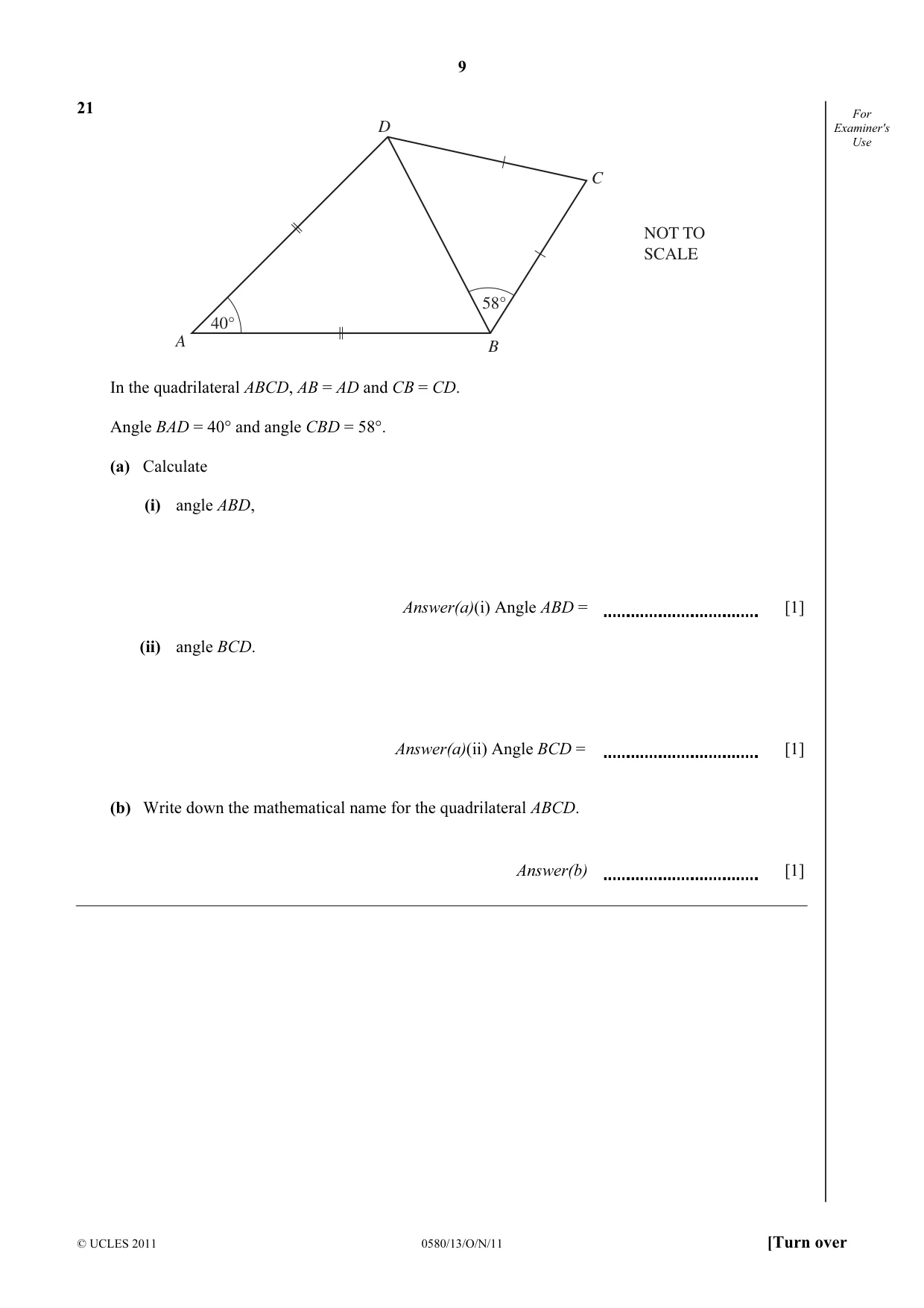
21 For D Examiner's Use C NOT TO SCALE 58° 40° A B In the quadrilateral ABCD, AB = AD and CB = CD. Angle BAD = 40° and angle CBD = 58°. (a) Calculate (i) angle ABD, Answer(a)(i) Angle ABD = [1] (ii) angle BCD. Answer(a)(ii) Angle BCD = [1] (b) Write down the mathematical name for the quadrilateral ABCD. Answer(b) [1]
Mark scheme: 21 (a) (i) 70 1 (ii) 64 1 (b) Kite 1
Q22 · 0 For .22 (a) Calculate Examiner's 3 28.6 Use Answer(a) [1] (b) Work out (8 × 10⁶)2…
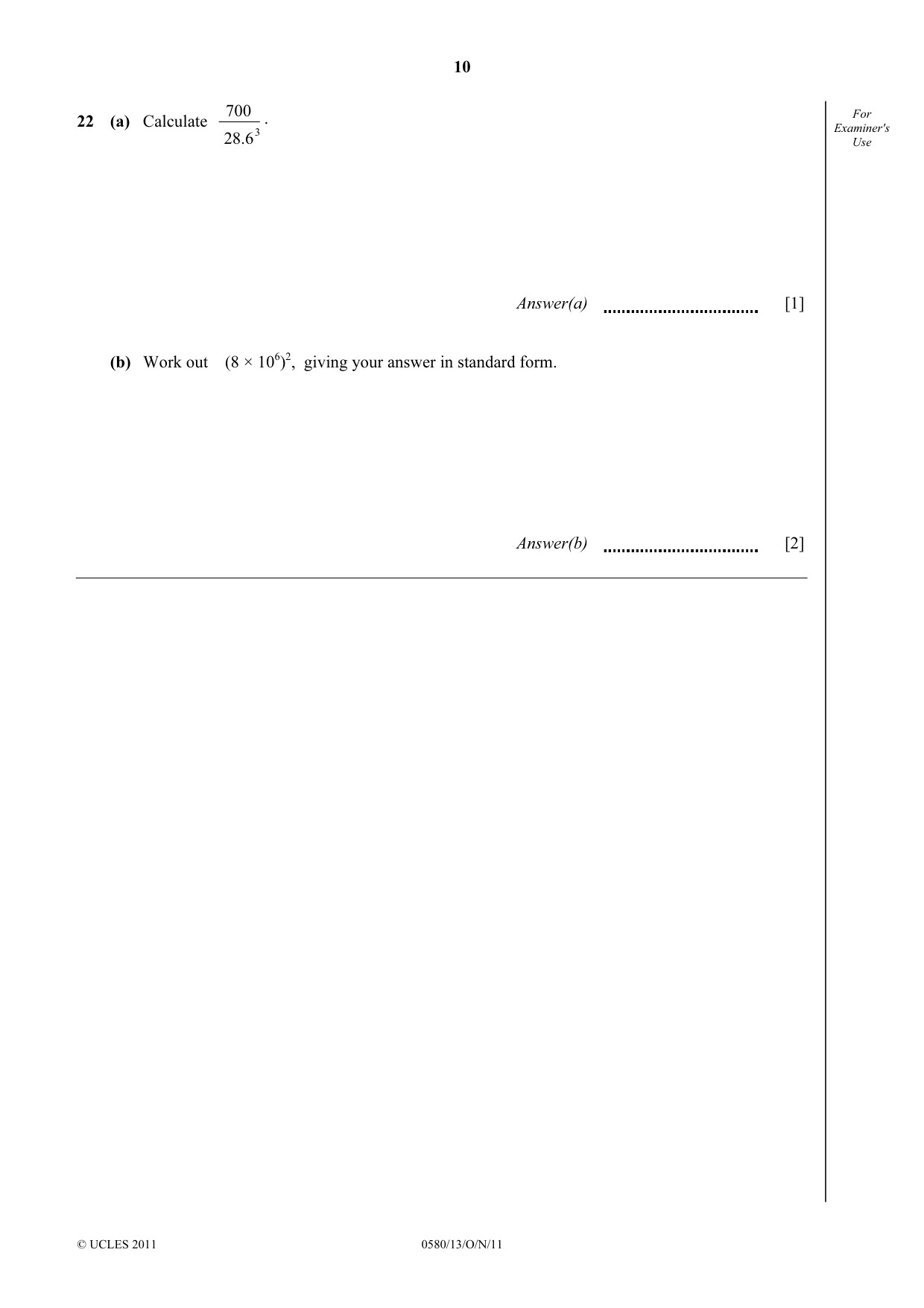
700 For .22 (a) Calculate Examiner's 3 28.6 Use Answer(a) [1] (b) Work out (8 × 10⁶)2, giving your answer in standard form. Answer(b) [2]
Mark scheme: 22 (a) 0.0299 or 0.02992… 1 (b) 6.4 × 10¹³ 2 B1 for 64 × 1012 or 64 000 000 000 000
Q23 · For y Examiner's Use 3 A 2 1 x –5 –4 –3 –2 –1 0 1 2 3 4 5 –1 –2 M –3 –4 –5 The diagram…
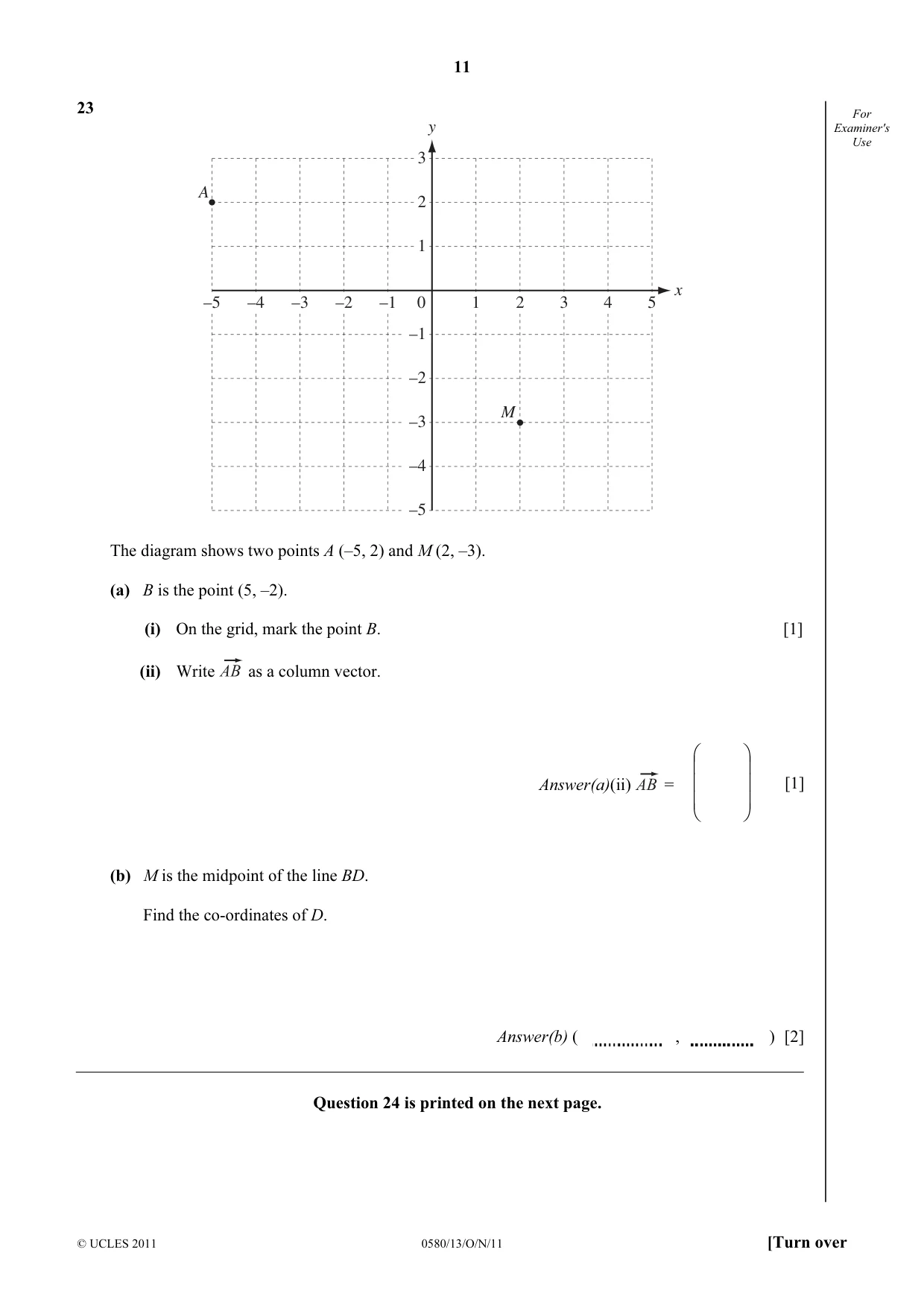
23 For y Examiner's Use 3 A 2 1 x –5 –4 –3 –2 –1 0 1 2 3 4 5 –1 –2 M –3 –4 –5 The diagram shows two points A (–5, 2) and M (2, –3). (a) B is the point (5, –2). (i) On the grid, mark the point B. [1] (ii) Write as a column vector. Answer(a)(ii) = [1] (b) M is the midpoint of the line BD. Find the co-ordinates of D. Answer(b) ( , ) [2] Question 24 is printed on the next page.
Mark scheme: 23 (a) (i) B at (5, −2) 1 10 (ii) 1ft −4 (b) (–1, –4) 2ft B1, B1 follow through their B plotted 2 2 ( )
Q24 · For C Examiner's Use NOT TO SCALE 13 cm 12 cm 7 cm A B D In triangle ABC, D is on AB so…
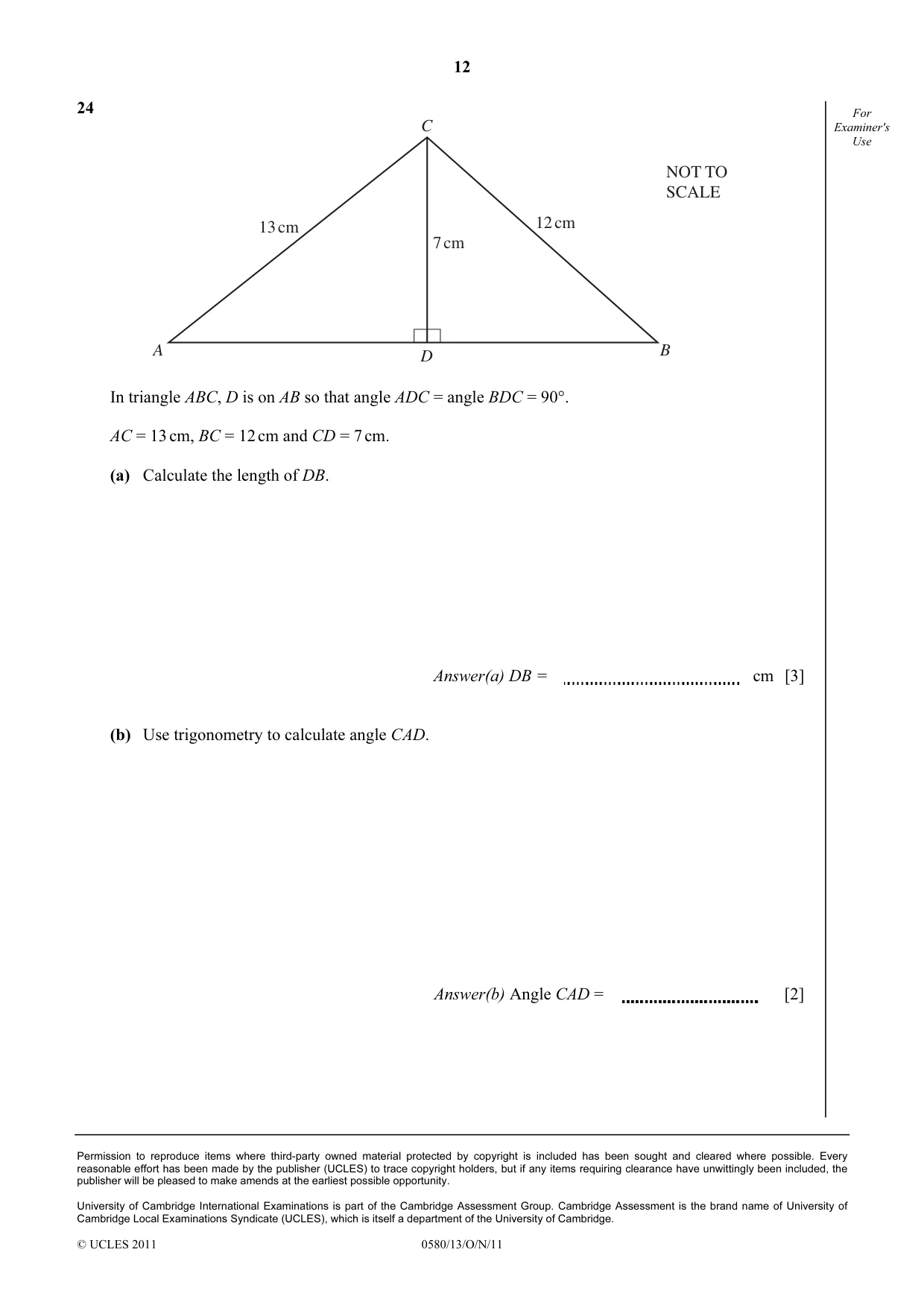
24 For C Examiner's Use NOT TO SCALE 13 cm 12 cm 7 cm A B D In triangle ABC, D is on AB so that angle ADC = angle BDC = 90°. AC = 13 cm, BC = 12 cm and CD = 7 cm. (a) Calculate the length of DB. Answer(a) DB = cm [3] (b) Use trigonometry to calculate angle CAD. Answer(b) Angle CAD = [2]
Mark scheme: 24 (a) (DB =) 9.75 or 9.746 to 9.747 3 M2 for (12 2 − 7 2 ) or M1 for 122 = 72+ x2 or better 7 (b) (Angle CAD =) 32.6 or 32.57 to 32.58 2 M1 for sin 13
What was in this paper
The subtopics covered by these 24 questions, and how many questions each got. Open one in a new tab to see every Cambridge question on it.
What you needed in this session
Cambridge’s own grade thresholds for 2011 Oct/Nov, Paper 1 · Variant 3. A higher threshold means an easier paper — the bar moves with how the cohort did.