Cambridge IGCSE Mathematics 0580 — 2014 Oct/Nov Paper 1 · Variant 3
0580/13/O/N/14 · 13 questions · 56 marks · ≈63 min
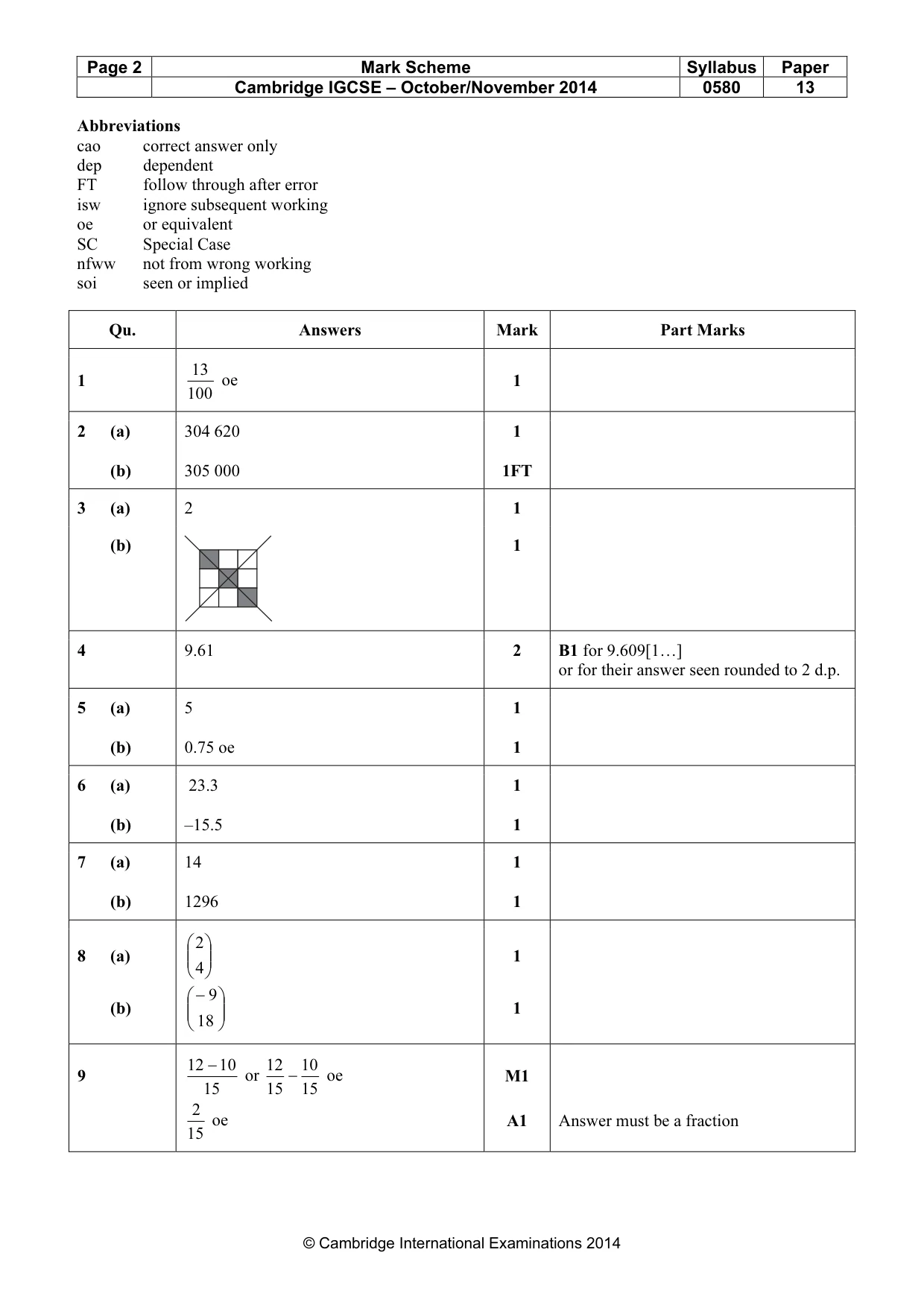
The question paper and its mark scheme, free to read here and free to download. This is Cambridge’s own paper, exactly as it was sat.
Question paper12 pages
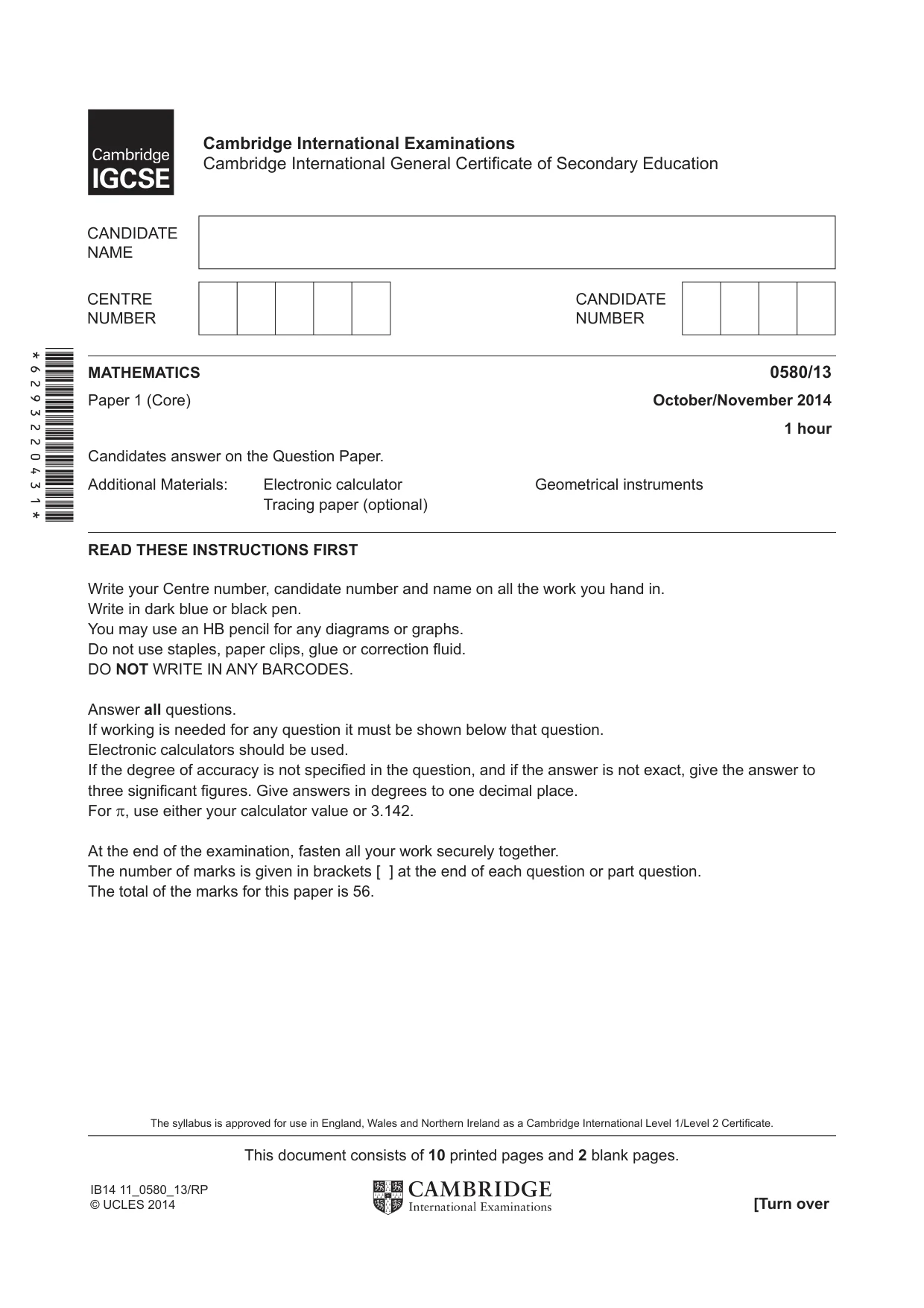
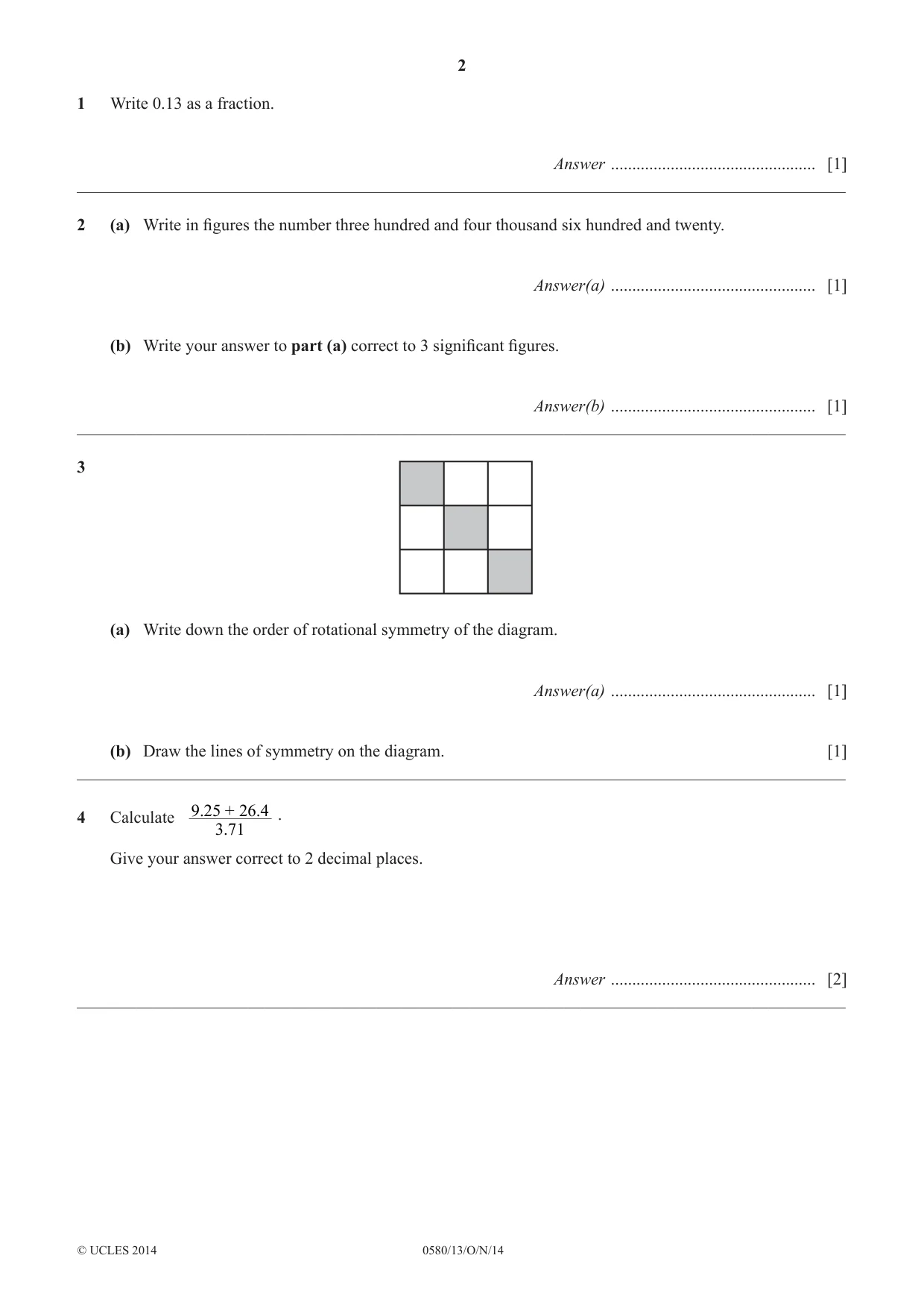
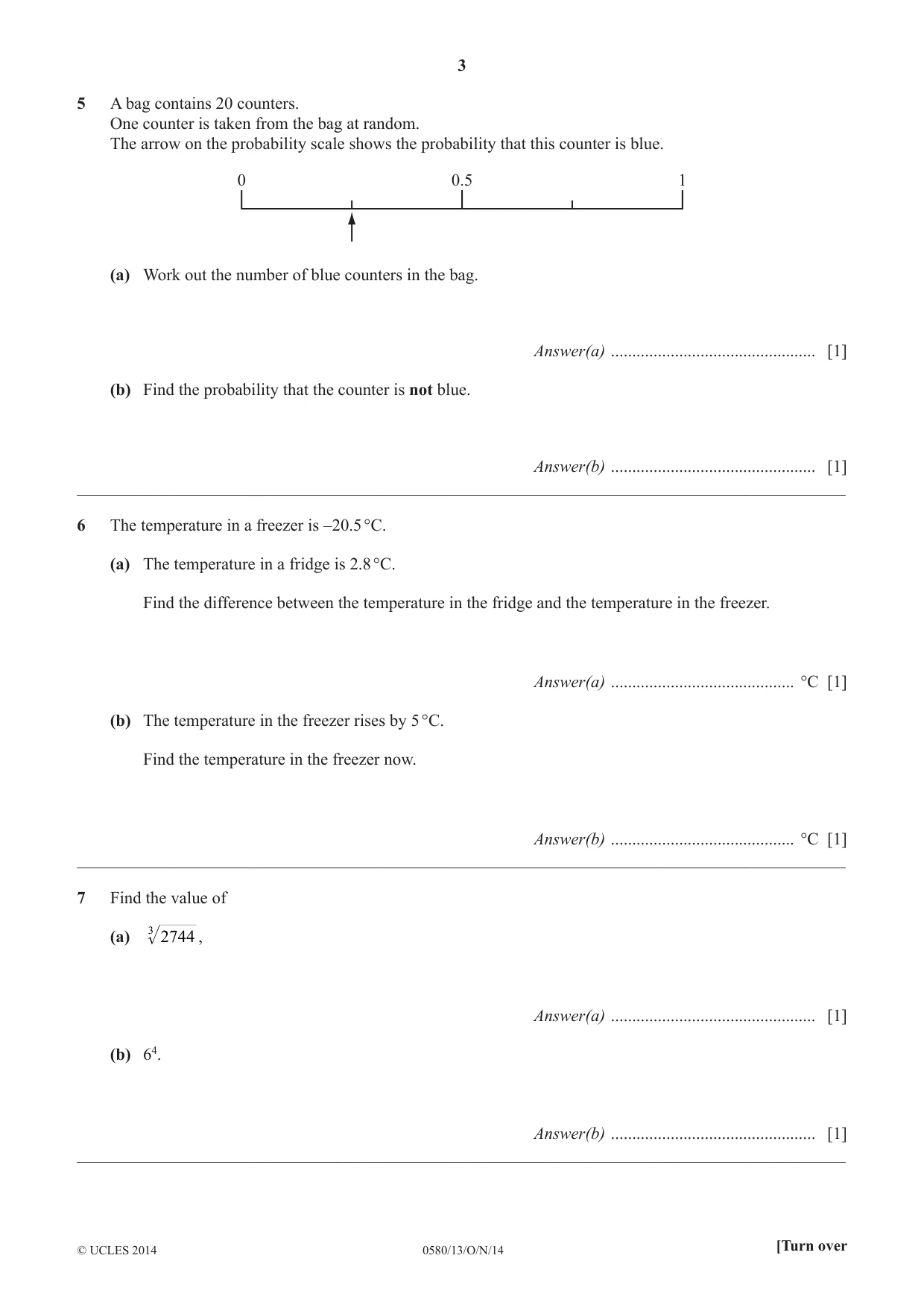
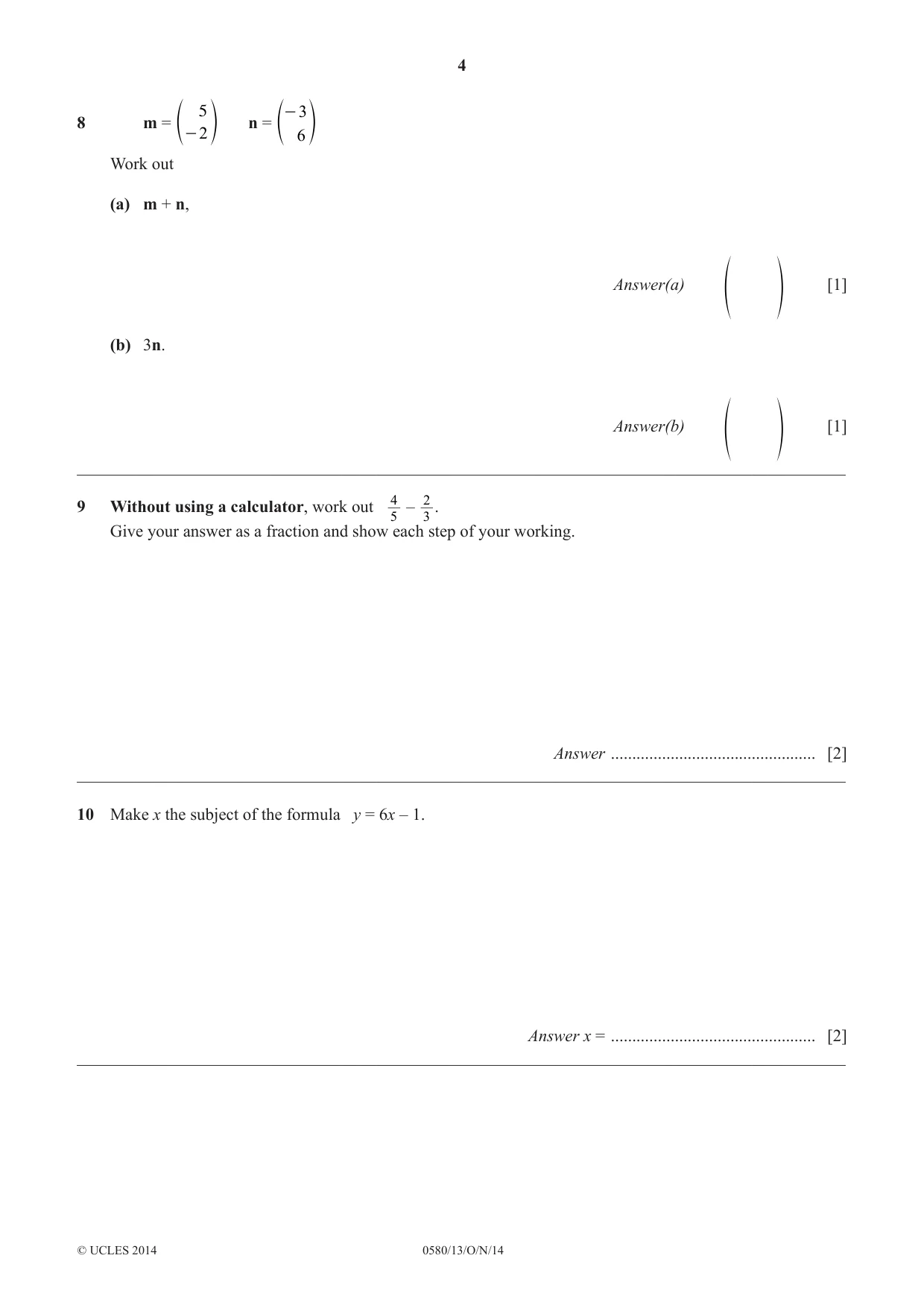
Mark scheme4 pages
Answers below. Sit the paper first if you are practising.
Questions as text
Q10 · Make x the subject of the formula y = 6x – 1
10 Make x the subject of the formula y = 6x – 1. Answer x = ................................................ [2] __________________________________________________________________________________________
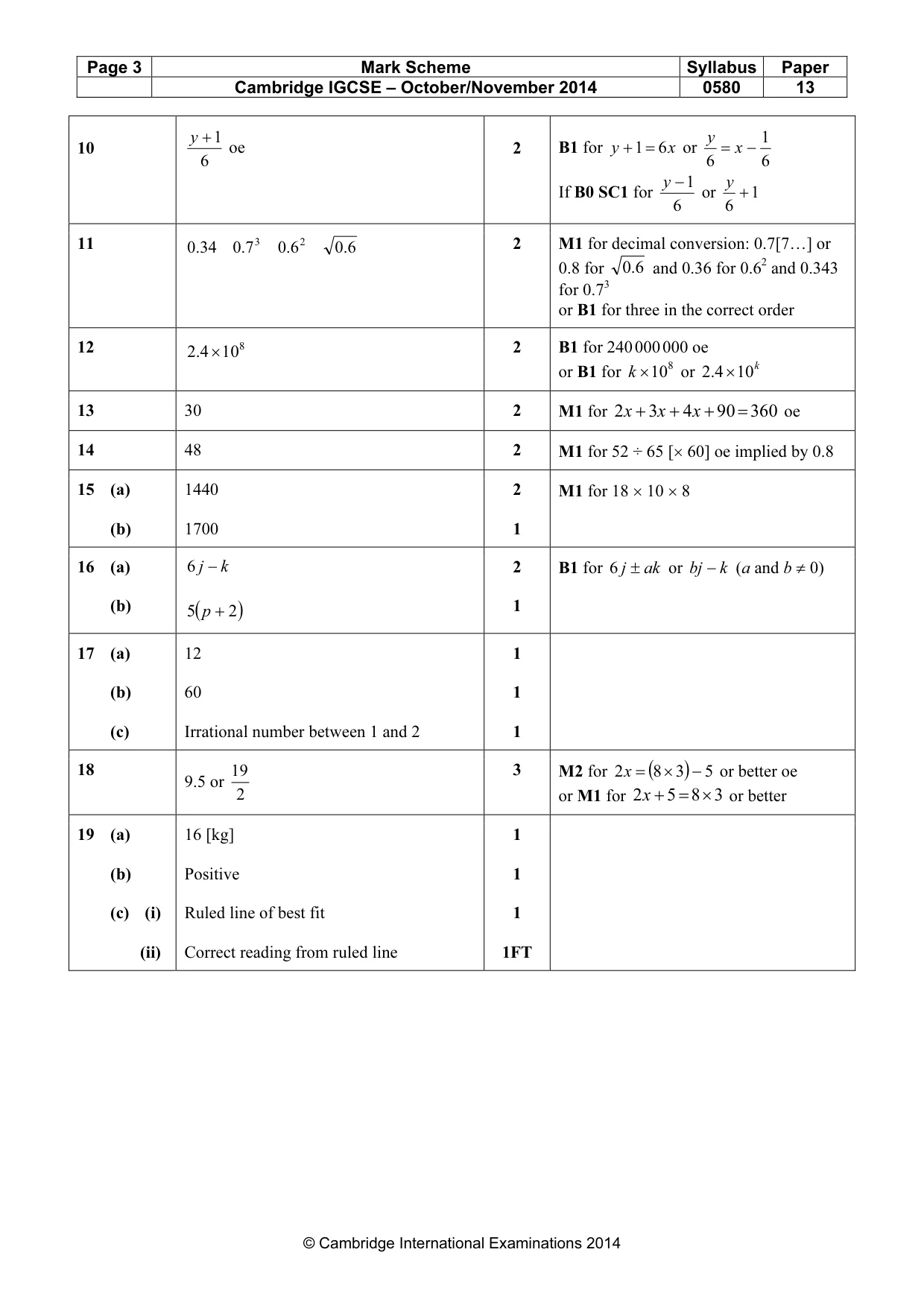
Mark scheme: y + 1 y 1 10 oe 2 B1 for y + 1= 6 x or = x − 6 6 6 y − 1 y If B0 SC1 for or + 1 6 6
Q11 · Write the following in order of size, smallest fi rst
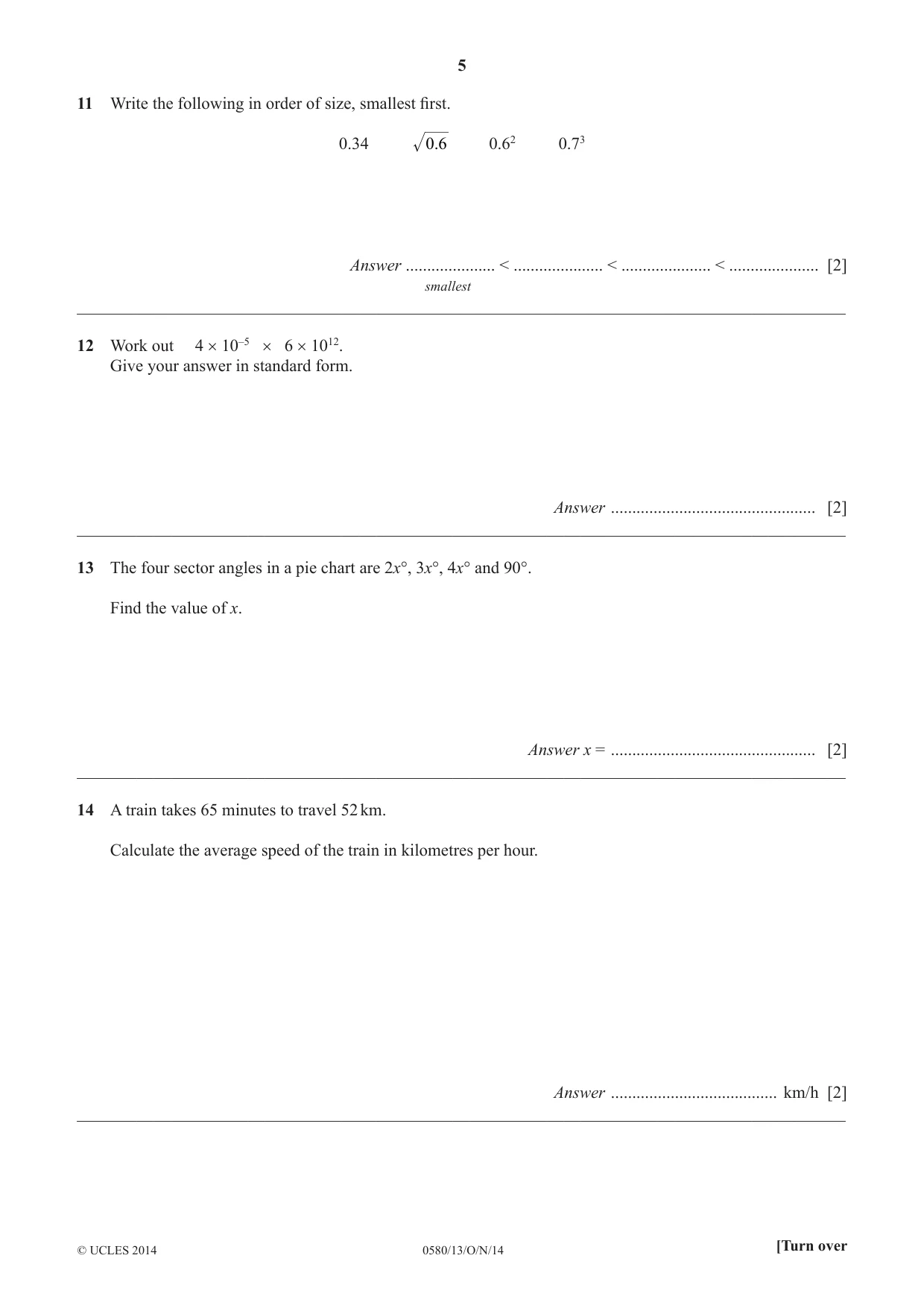
11 Write the following in order of size, smallest fi rst. 0.34 0.6 0.62 0.73 Answer ..................... < ..................... < ..................... < ..................... [2] smallest __________________________________________________________________________________________
Mark scheme: 11 .0 34 7.0 3 6.0 2 6.0 2 M1 for decimal conversion: 0.7[7…] or 0.8 for 6.0 and 0.36 for 0.62 and 0.343 for 0.73 or B1 for three in the correct order
Q12 · Work out 4 × 10–5 × 6 × 1012
12 Work out 4 × 10–5 × 6 × 1012. Give your answer in standard form. Answer ................................................ [2] __________________________________________________________________________________________
Mark scheme: 12 4.2 × 10 8 2 B1 for 240 000 000 oe or B1 for k × 10 8 or 4.2 × 10 k
Q13 · The four sector angles in a pie chart are 2x°, 3x°, 4x° and 90°
13 The four sector angles in a pie chart are 2x°, 3x°, 4x° and 90°. Find the value of x. Answer x = ................................................ [2] __________________________________________________________________________________________
Mark scheme: 13 30 2 M1 for 2 x + 3x + 4 x + 90 = 360 oe
Q14 · A train takes 65 minutes to travel 52 km
14 A train takes 65 minutes to travel 52 km. Calculate the average speed of the train in kilometres per hour. Answer ....................................... km/h [2] __________________________________________________________________________________________
Mark scheme: 14 48 2 M1 for 52 ÷ 65 [× 60] oe implied by 0.8
Q15 · A parcel is in the shape of a cuboid of length 18 cm, width 10 cm and height 8 cm
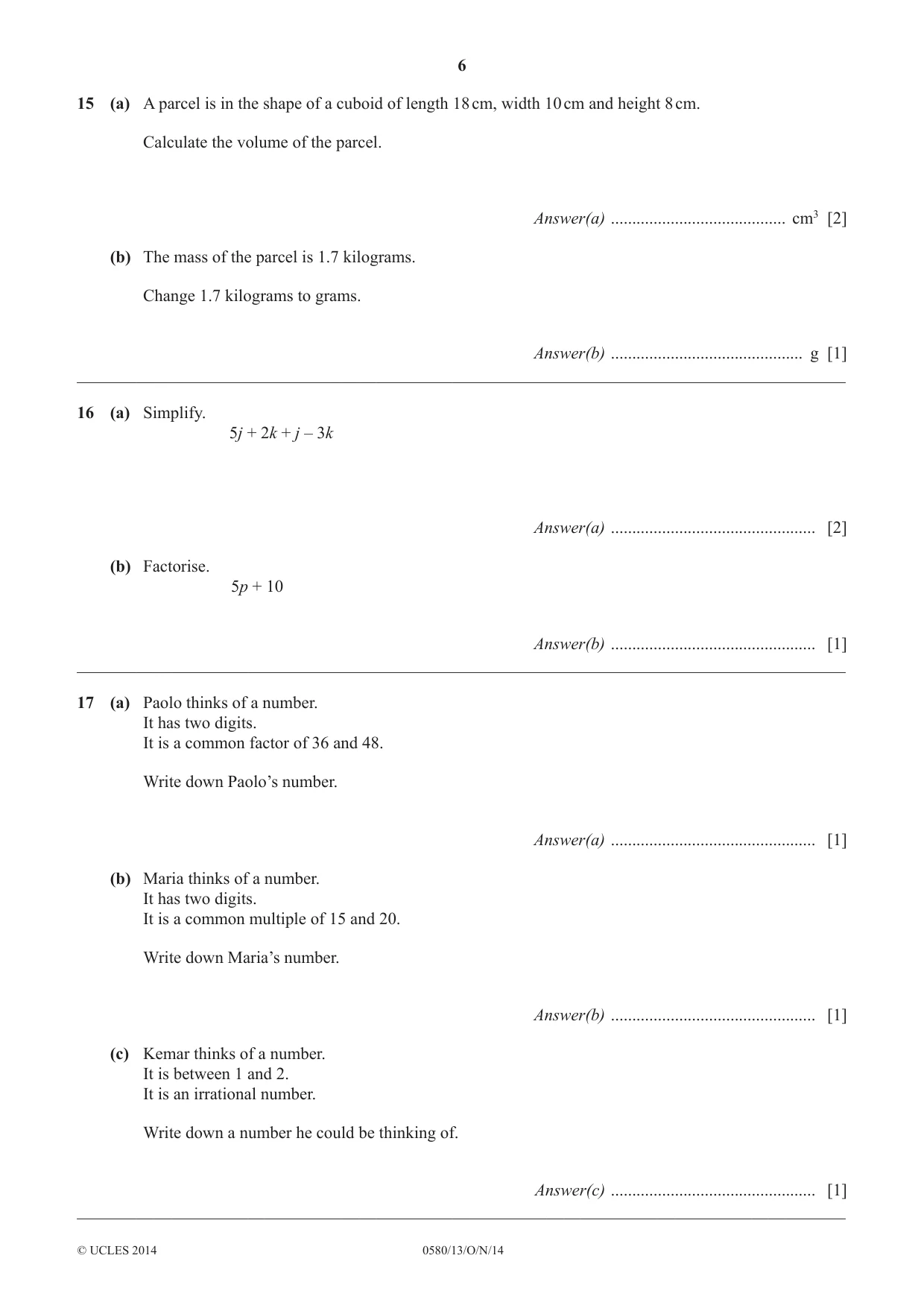
15 (a) A parcel is in the shape of a cuboid of length 18 cm, width 10 cm and height 8 cm. Calculate the volume of the parcel. Answer(a) ......................................... cm3 [2] (b) The mass of the parcel is 1.7 kilograms. Change 1.7 kilograms to grams. Answer(b) ............................................. g [1] __________________________________________________________________________________________
Mark scheme: 15 (a) 1440 2 M1 for 18 × 10 × 8 (b) 1700 1
Question 16
16 (a) Simplify. 5j + 2k + j – 3k Answer(a) ................................................ [2] (b) Factorise. 5p + 10 Answer(b) ................................................ [1] __________________________________________________________________________________________
Mark scheme: 16 (a) 6 j − k 2 B1 for 6 j ± ak or bj − k (a and b ≠ 0) (b) 1 5( p + 2 )
Q17 · Paolo thinks of a number
17 (a) Paolo thinks of a number. It has two digits. It is a common factor of 36 and 48. Write down Paolo’s number. Answer(a) ................................................ [1] (b) Maria thinks of a number. It has two digits. It is a common multiple of 15 and 20. Write down Maria’s number. Answer(b) ................................................ [1] (c) Kemar thinks of a number. It is between 1 and 2. It is an irrational number. Write down a number he could be thinking of. Answer(c) ................................................ [1] __________________________________________________________________________________________
Mark scheme: 17 (a) 12 1 (b) 60 1 (c) Irrational number between 1 and 2 1 ( )
Question 18
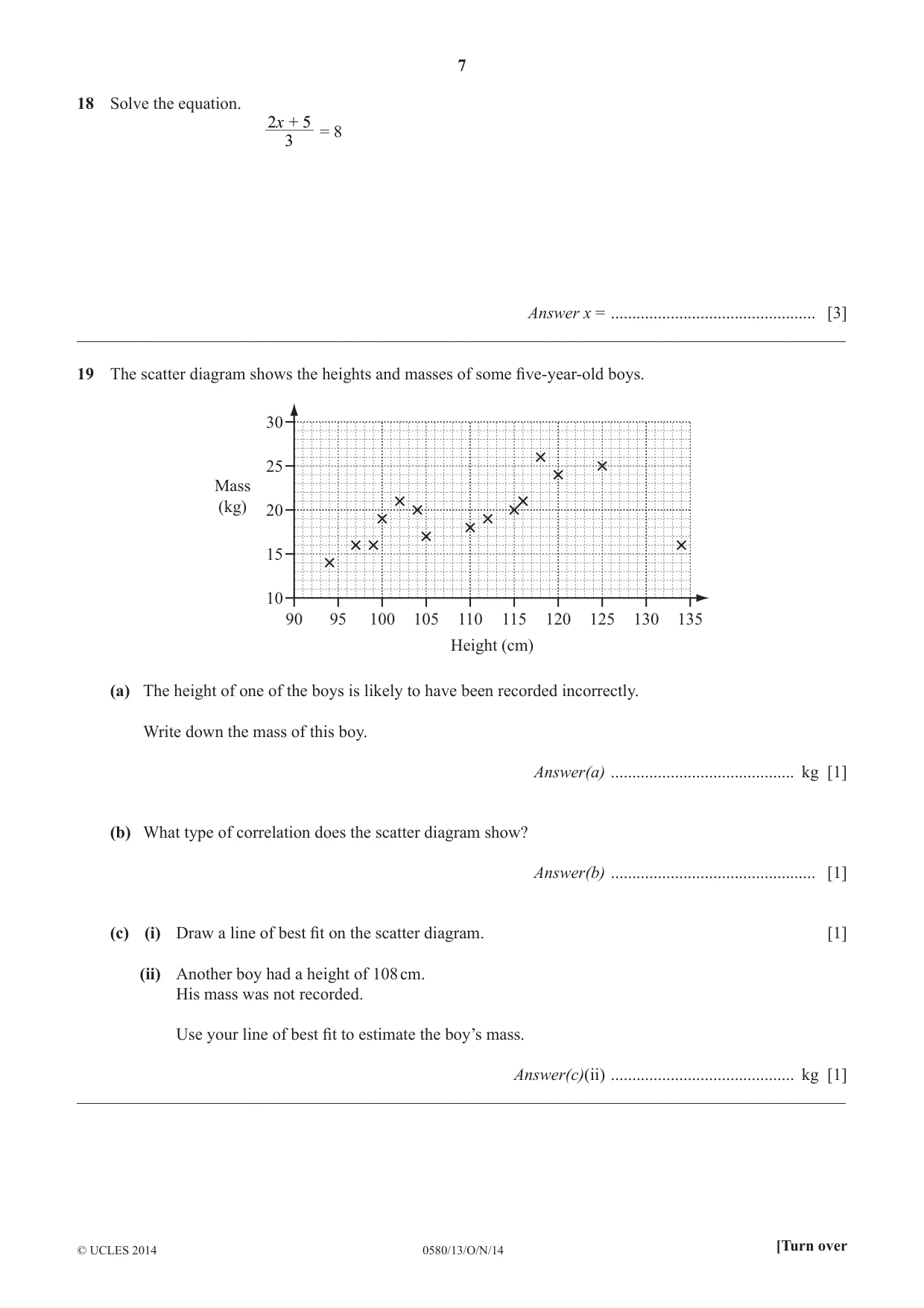
18 Solve the equation. 2x + 5 = 8 3 Answer x = ................................................ [3] __________________________________________________________________________________________
Mark scheme: 18 19 3 M2 for 2 x = (8 × 3) − 5 or better oe 9.5 or 2 or M1 for 2 x + 5 = 8 × 3 or better
Q19 · The scatter diagram shows the heights and masses of some fi ve-year-old boys
19 The scatter diagram shows the heights and masses of some fi ve-year-old boys. 30 25 Mass (kg) 20 15 10 90 95 100 105 110 115 120 125 130 135 Height (cm) (a) The height of one of the boys is likely to have been recorded incorrectly. Write down the mass of this boy. Answer(a) ........................................... kg [1] (b) What type of correlation does the scatter diagram show? Answer(b) ................................................ [1] (c) (i) Draw a line of best fi t on the scatter diagram. [1] (ii) Another boy had a height of 108 cm. His mass was not recorded. Use your line of best fi t to estimate the boy’s mass. Answer(c)(ii) ........................................... kg [1] __________________________________________________________________________________________
Mark scheme: 19 (a) 16 [kg] 1 (b) Positive 1 (c) (i) Ruled line of best fit 1 (ii) Correct reading from ruled line 1FT
Q20 · D C E A B (a) Draw the locus of the points which are 3 cm from E
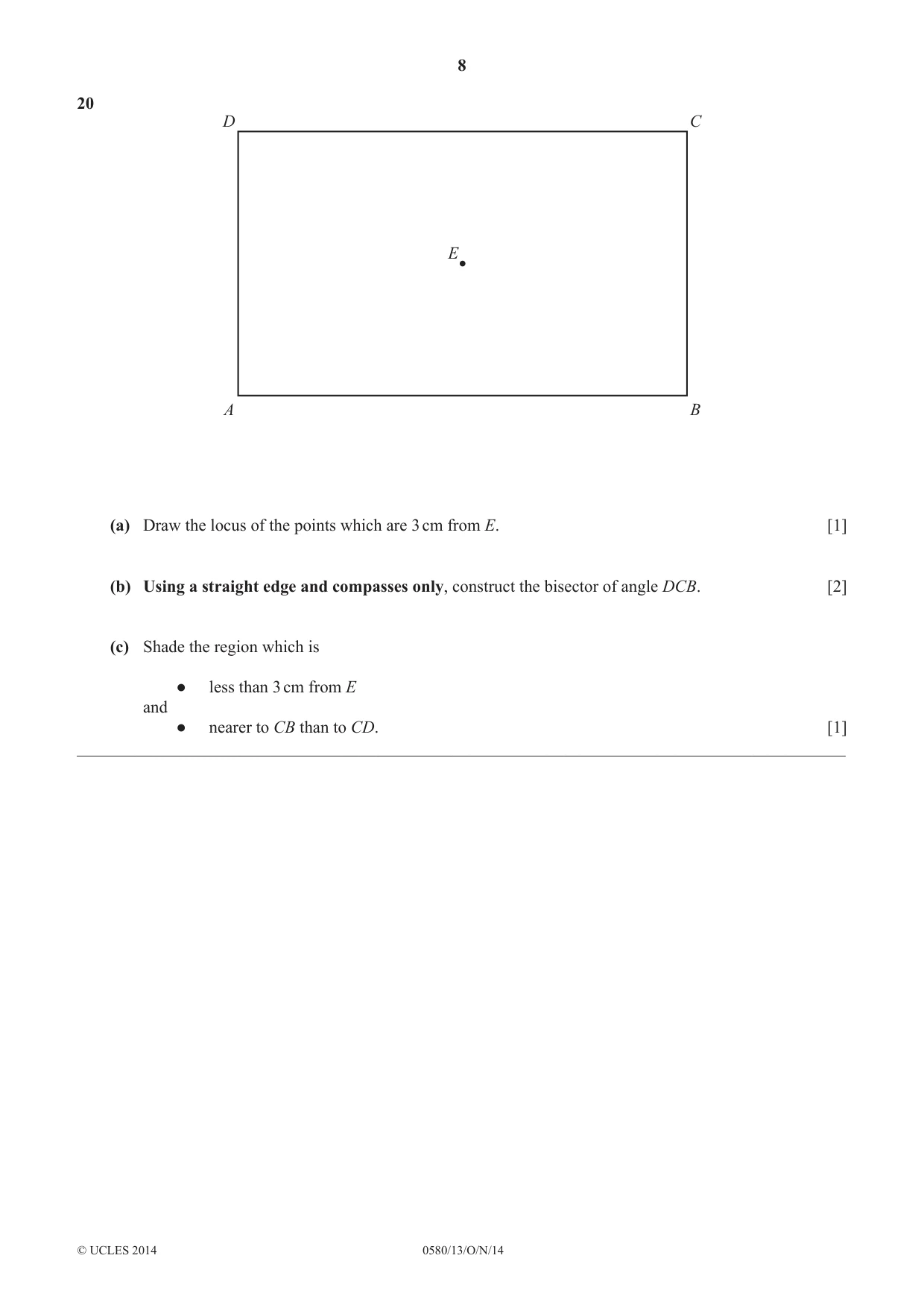
20 D C E A B (a) Draw the locus of the points which are 3 cm from E. [1] (b) Using a straight edge and compasses only, construct the bisector of angle DCB. [2] (c) Shade the region which is ● less than 3 cm from E and ● nearer to CB than to CD. [1] __________________________________________________________________________________________
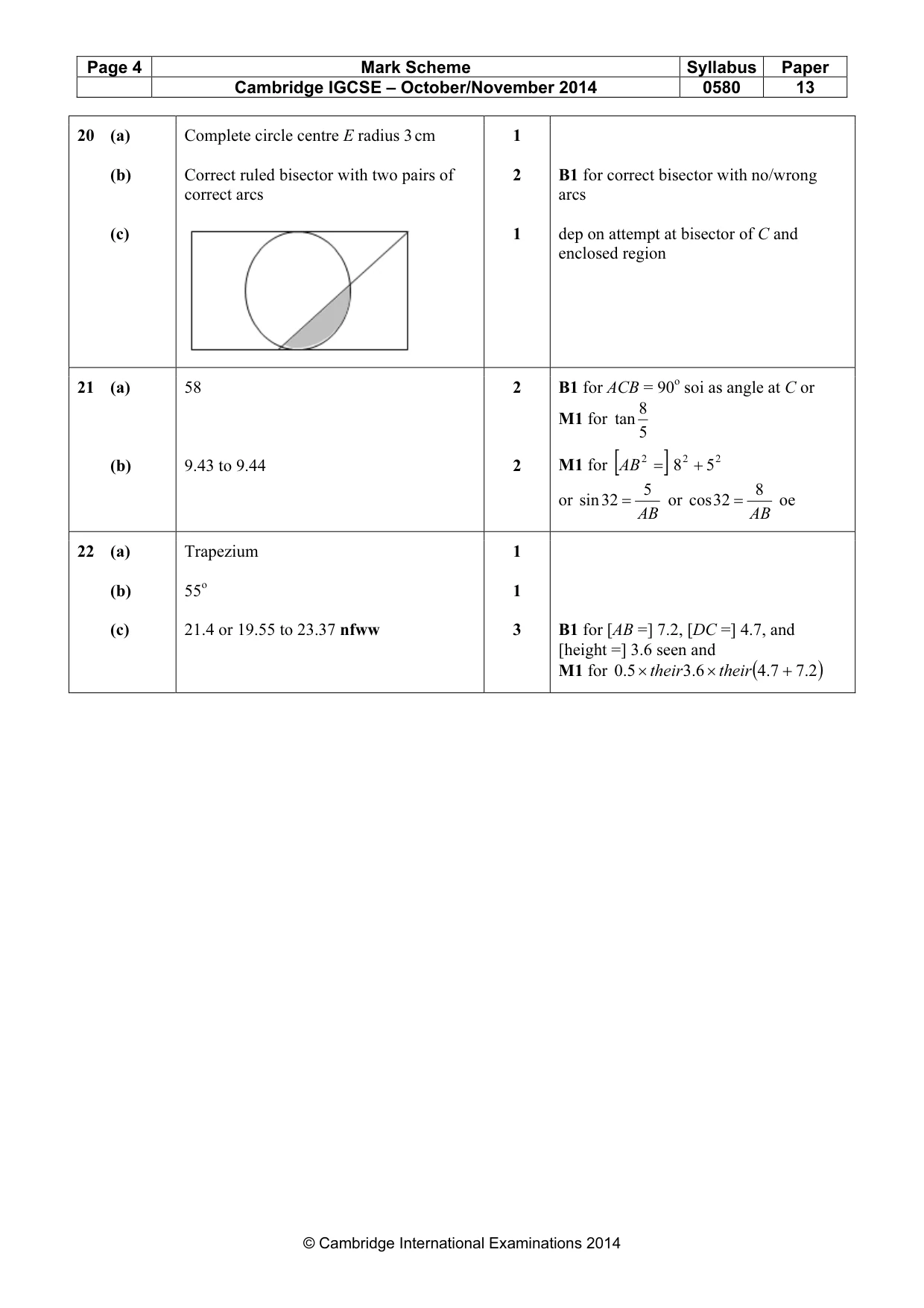
Mark scheme: 20 (a) Complete circle centre E radius 3 cm 1 (b) Correct ruled bisector with two pairs of 2 B1 for correct bisector with no/wrong correct arcs arcs (c) 1 dep on attempt at bisector of C and enclosed region
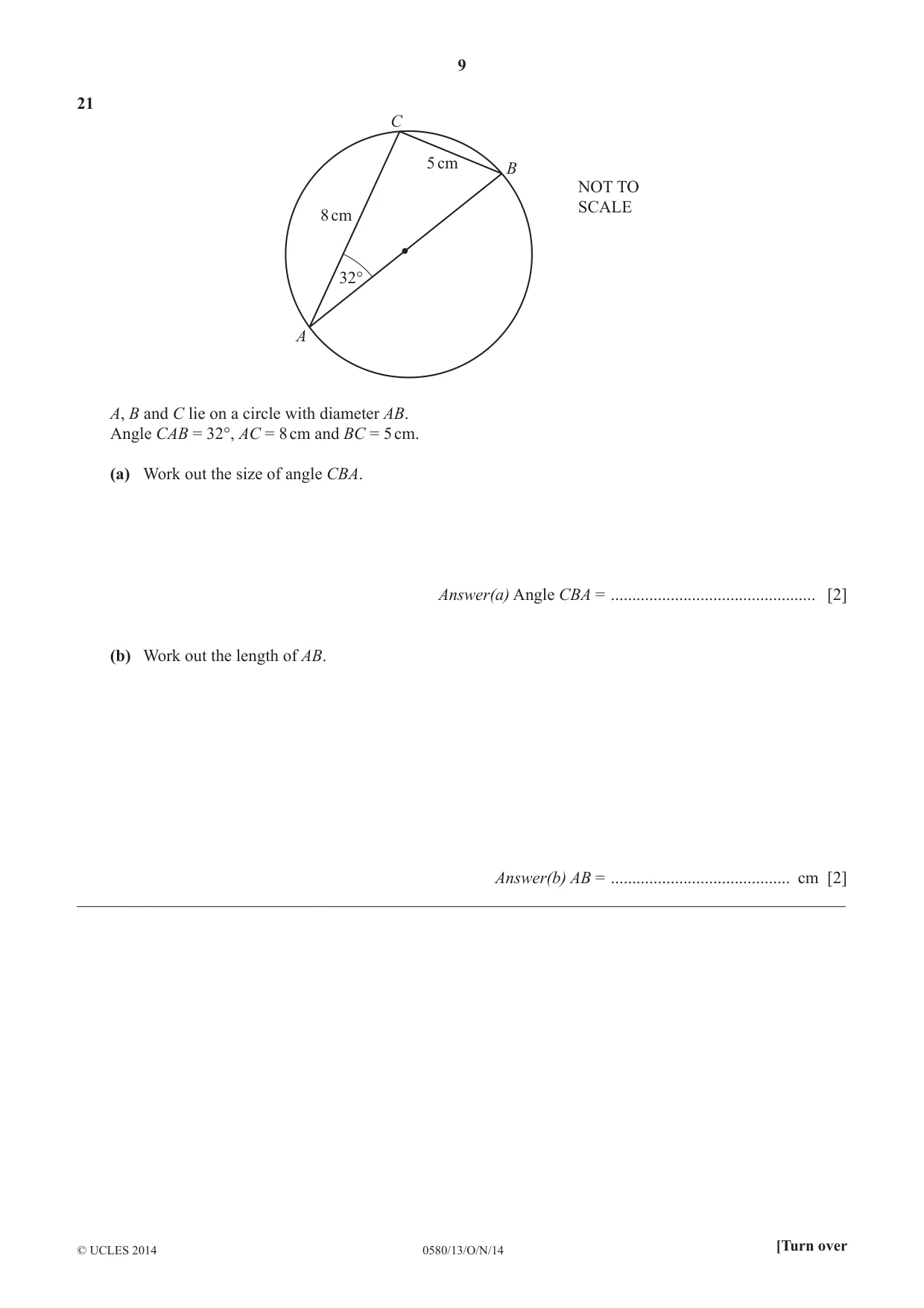
Q21 · C 5 cm B NOT TO SCALE 8 cm 32° A A, B and C lie on a circle with diameter AB
21 C 5 cm B NOT TO SCALE 8 cm 32° A A, B and C lie on a circle with diameter AB. Angle CAB = 32°, AC = 8 cm and BC = 5 cm. (a) Work out the size of angle CBA. Answer(a) Angle CBA = ................................................ [2] (b) Work out the length of AB. Answer(b) AB = .......................................... cm [2] __________________________________________________________________________________________
Mark scheme: 21 (a) 58 2 B1 for ACB = 90o soi as angle at C or 8 M1 for tan 5 2 + 5 2 (b) 9.43 to 9.44 2 M1 for [AB 2 = ] 8 5 8 or sin 32 = or cos 32 = oe AB AB
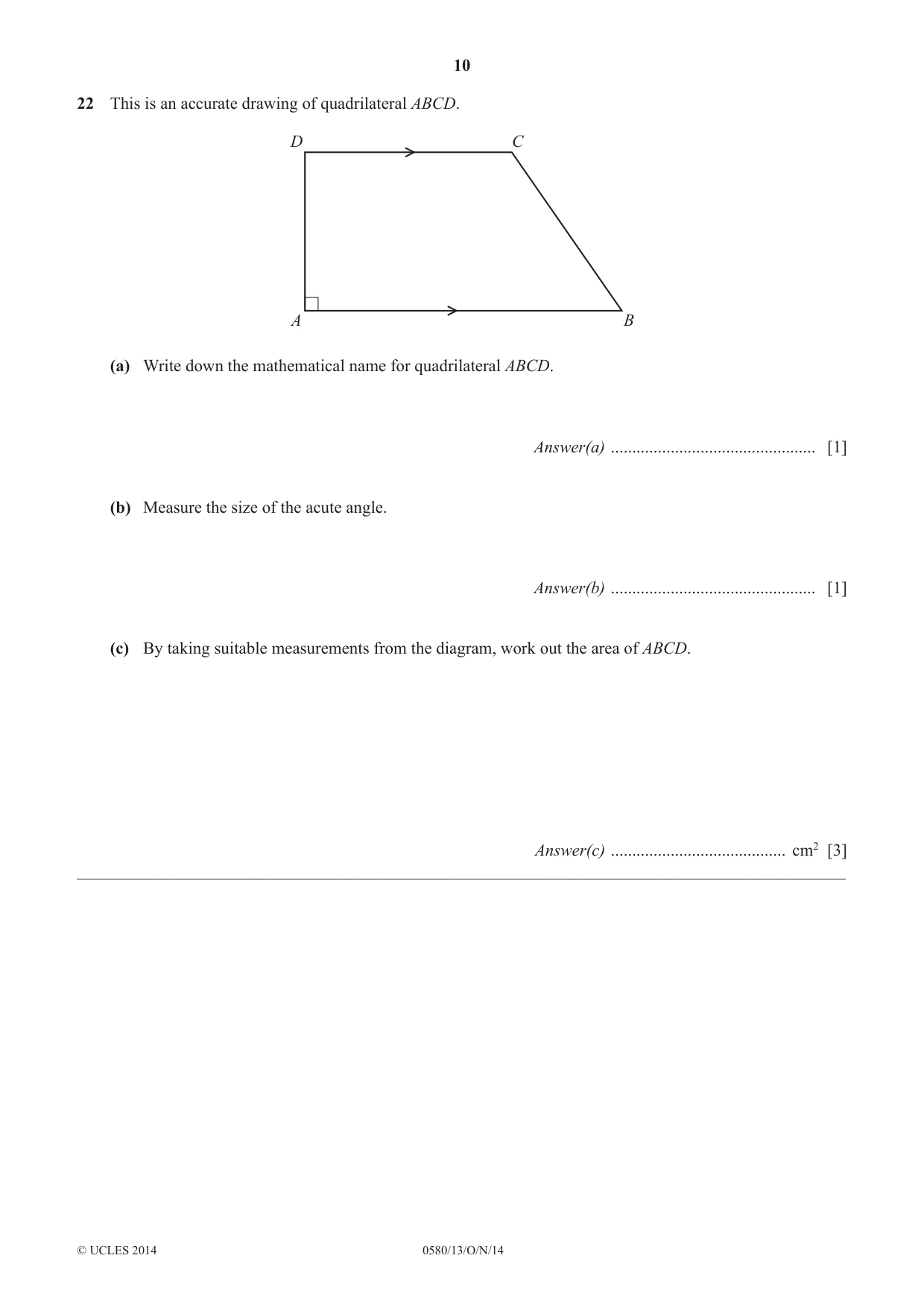
Q22 · This is an accurate drawing of quadrilateral ABCD
22 This is an accurate drawing of quadrilateral ABCD. D C A B (a) Write down the mathematical name for quadrilateral ABCD. Answer(a) ................................................ [1] (b) Measure the size of the acute angle. Answer(b) ................................................ [1] (c) By taking suitable measurements from the diagram, work out the area of ABCD. Answer(c) ......................................... cm2 [3] __________________________________________________________________________________________
Mark scheme: 22 (a) Trapezium 1 (b) 55o 1 (c) 21.4 or 19.55 to 23.37 nfww 3 B1 for [AB =] 7.2, [DC =] 4.7, and [height =] 3.6 seen and M1 for 5.0 × their 6.3 × their (7.4 + 2.7 )
What was in this paper
The subtopics covered by these 13 questions, and how many questions each got. Open one in a new tab to see every Cambridge question on it.
What you needed in this session
Cambridge’s own grade thresholds for 2014 Oct/Nov, Paper 1 · Variant 3. A higher threshold means an easier paper — the bar moves with how the cohort did.