Cambridge IGCSE Mathematics 0580 — 2014 May/June Paper 1 · Variant 1
0580/11/M/J/14 · 22 questions · 56 marks · ≈63 min
The question paper and its mark scheme, free to read here and free to download. This is Cambridge’s own paper, exactly as it was sat.
Question paper12 pages
Mark scheme4 pages
Answers below. Sit the paper first if you are practising.
Questions as text
Question 1
1 Work out. 10 – 3 × 2 Answer ................................................ [1] __________________________________________________________________________________________
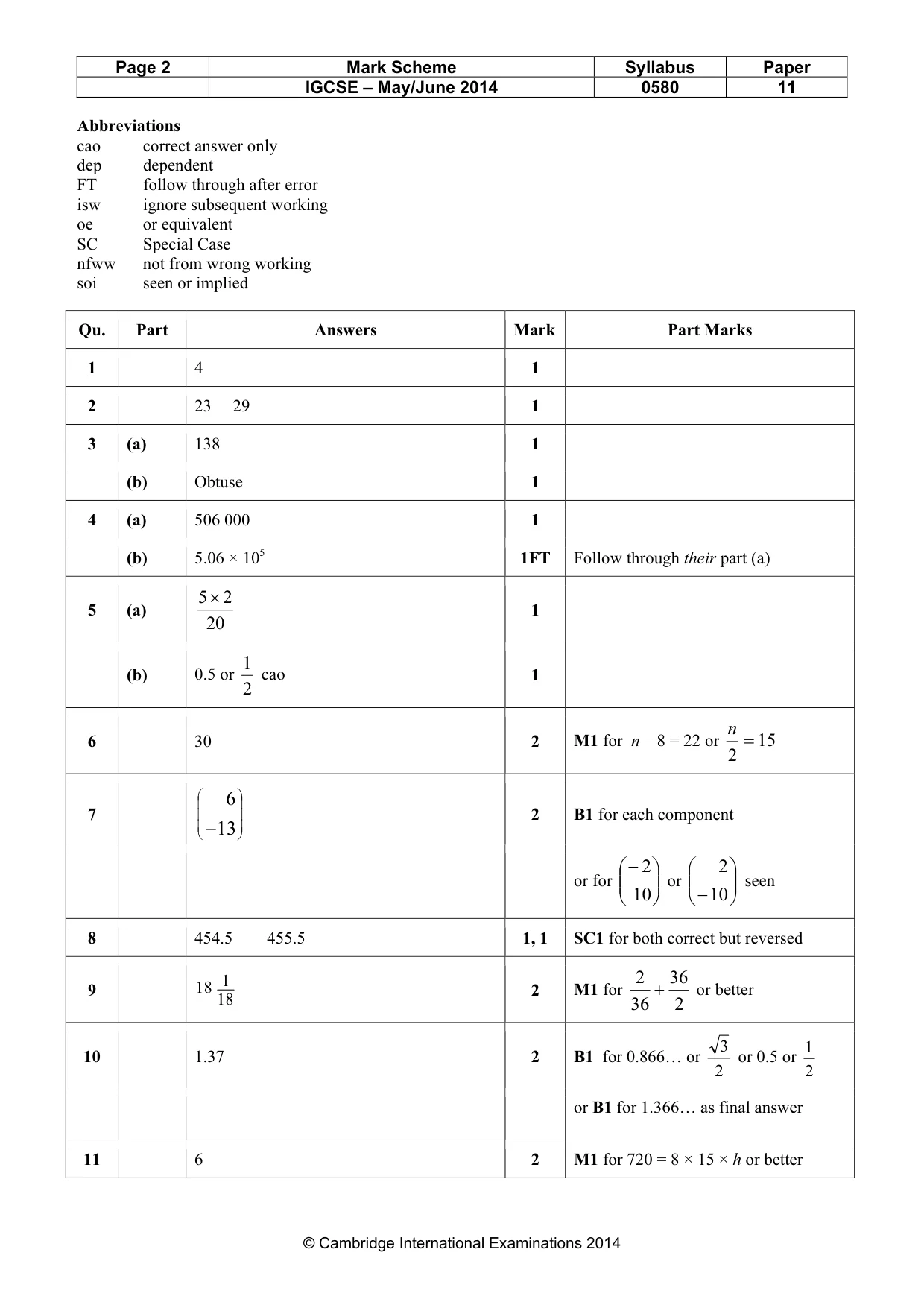
Mark scheme: 1 4 1
Q2 · Write down the prime numbers between 20 and 30
2 Write down the prime numbers between 20 and 30. Answer ................................................ [1] __________________________________________________________________________________________
Mark scheme: 2 23 29 1
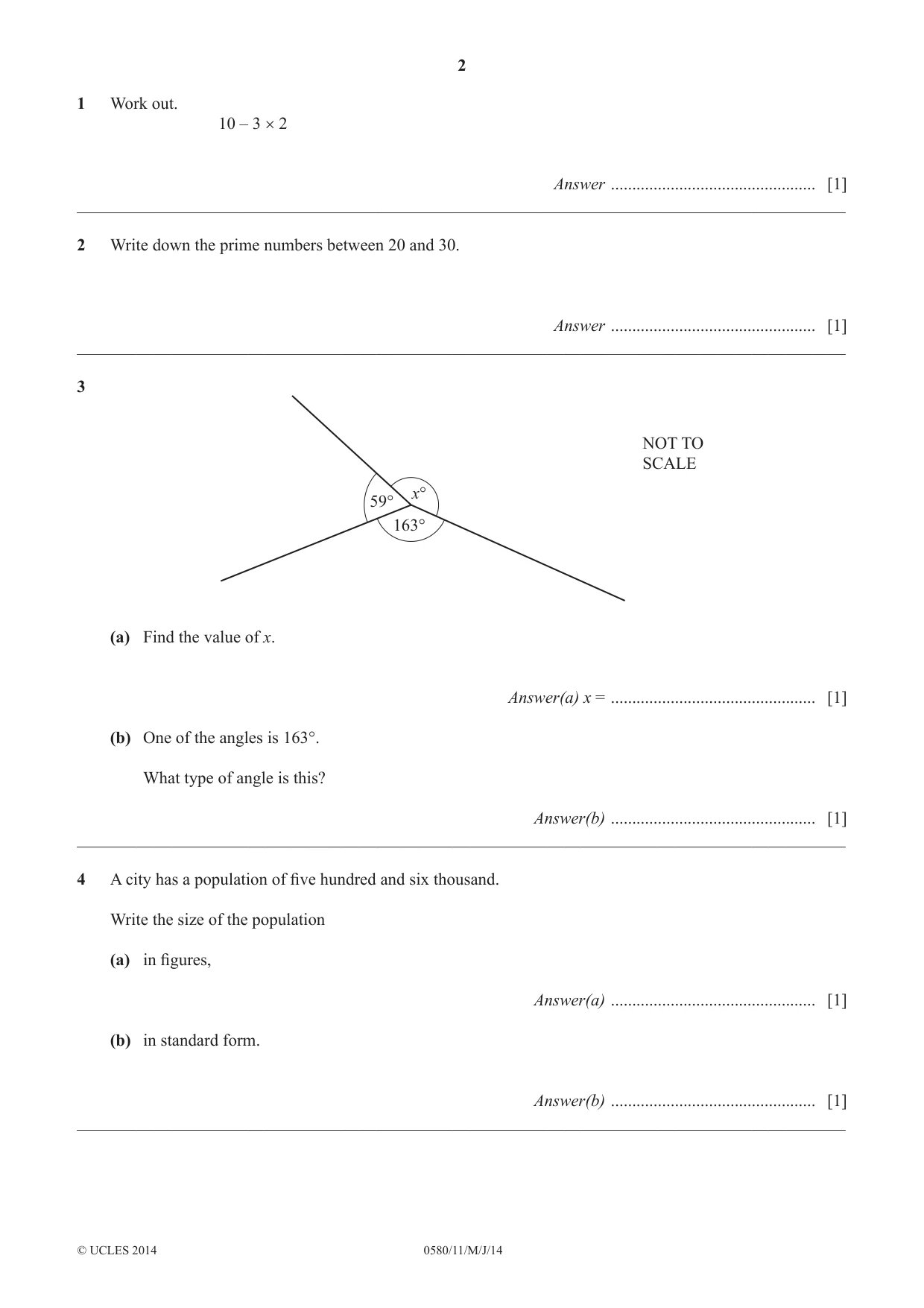
Q3 · NOT TO SCALE x° 59° 163° (a) Find the value of x
3 NOT TO SCALE x° 59° 163° (a) Find the value of x. Answer(a) x = ................................................ [1] (b) One of the angles is 163°. What type of angle is this? Answer(b) ................................................ [1] __________________________________________________________________________________________
Mark scheme: 3 (a) 138 1 (b) Obtuse 1
Q4 · A city has a population of fi ve hundred and six thousand
4 A city has a population of fi ve hundred and six thousand. Write the size of the population (a) in fi gures, Answer(a) ................................................ [1] (b) in standard form. Answer(b) ................................................ [1] __________________________________________________________________________________________
Mark scheme: 4 (a) 506 000 1 (b) 5.06 × 10⁵ 1FT Follow through their part (a) 5× 2
Q5 · 8 # 1.98276 5 p = 16.83 (a) In the spaces provided, write each number in this calculation…
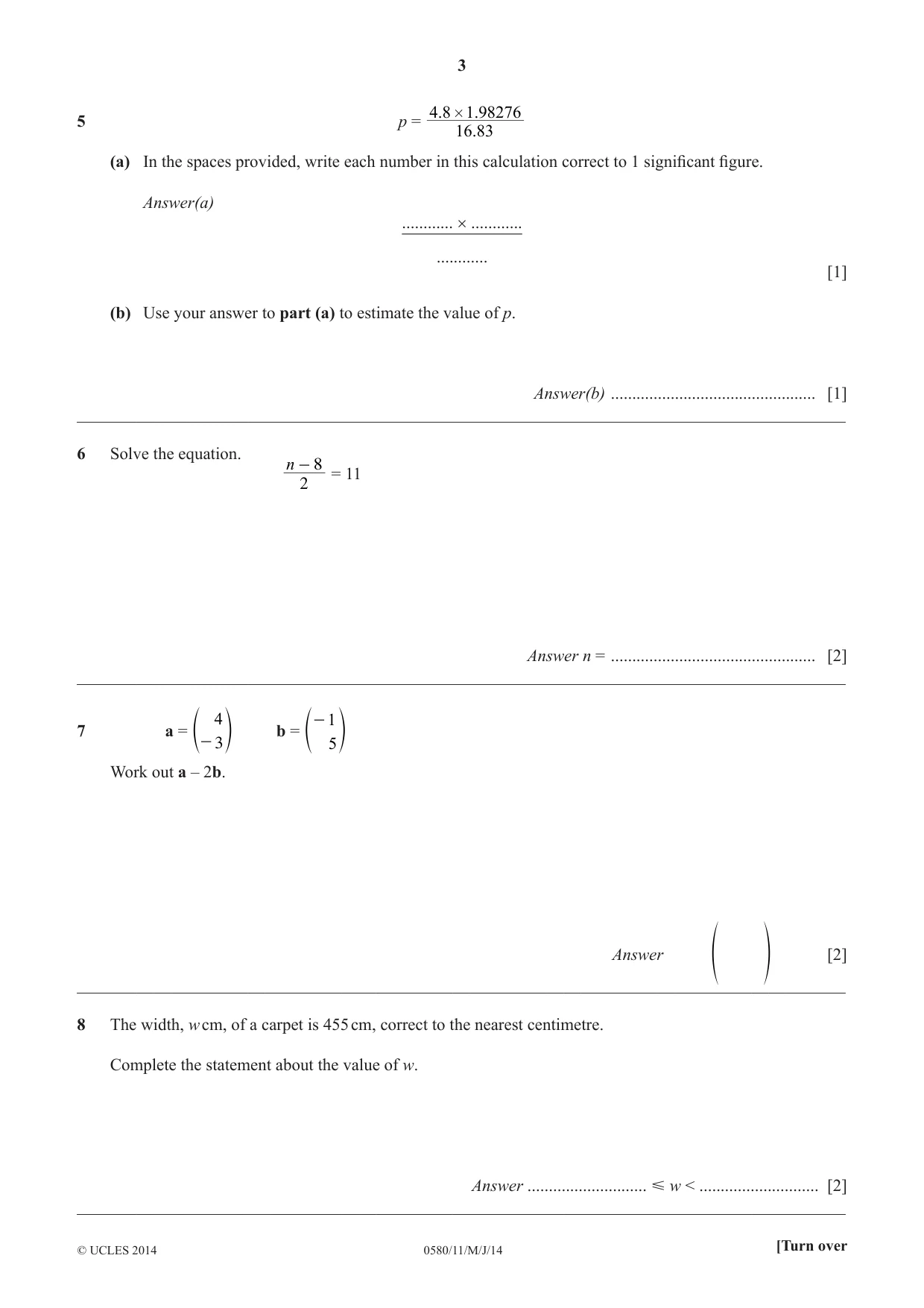
4.8 # 1.98276 5 p = 16.83 (a) In the spaces provided, write each number in this calculation correct to 1 signifi cant fi gure. Answer(a) ............ × ............ ............ [1] (b) Use your answer to part (a) to estimate the value of p. Answer(b) ................................................ [1] __________________________________________________________________________________________
Mark scheme: 5× 2 5 (a) 1 20 1 (b) 0.5 or cao 1 2 n
Question 6
6 Solve the equation. n - 8 = 11 2 Answer n = ................................................ [2] __________________________________________________________________________________________
Mark scheme: n 6 30 2 M1 for n – 8 = 22 or = 15 2 6
Q7 · - 1 7 a = b = e- 3 o e 5 o Work out a – 2b
4 - 1 7 a = b = e- 3 o e 5 o Work out a – 2b. Answer [2] f p__________________________________________________________________________________________
Mark scheme: 7 2 B1 for each component −13 − 2 2 or for or seen 10 −10
Q8 · The width, w cm, of a carpet is 455 cm, correct to the nearest centimetre
8 The width, w cm, of a carpet is 455 cm, correct to the nearest centimetre. Complete the statement about the value of w. Answer ............................ Ğ w < ............................ [2] __________________________________________________________________________________________
Mark scheme: 8 454.5 455.5 1, 1 SC1 for both correct but reversed 1 2 36 18
Q9 · X 2 9 y = 2 + x 2 Find the value of y when x = 6
2 x 2 9 y = 2 + x 2 Find the value of y when x = 6. Give your answer as a mixed number in its simplest form. Answer y = ................................................ [2] __________________________________________________________________________________________
Mark scheme: 1 2 36 9 18 2 M1 for + or better 18 36 2 3 1
Q10 · 0 Use your calculator to work out + 2–1
310 Use your calculator to work out + 2–1. 4 Give your answer correct to 2 decimal places. Answer ................................................ [2] __________________________________________________________________________________________
Mark scheme: 3 1 10 1.37 2 B1 for 0.866… or or 0.5 or 2 2 or B1 for 1.366… as final answer
Q11 · The diagram shows a cuboid
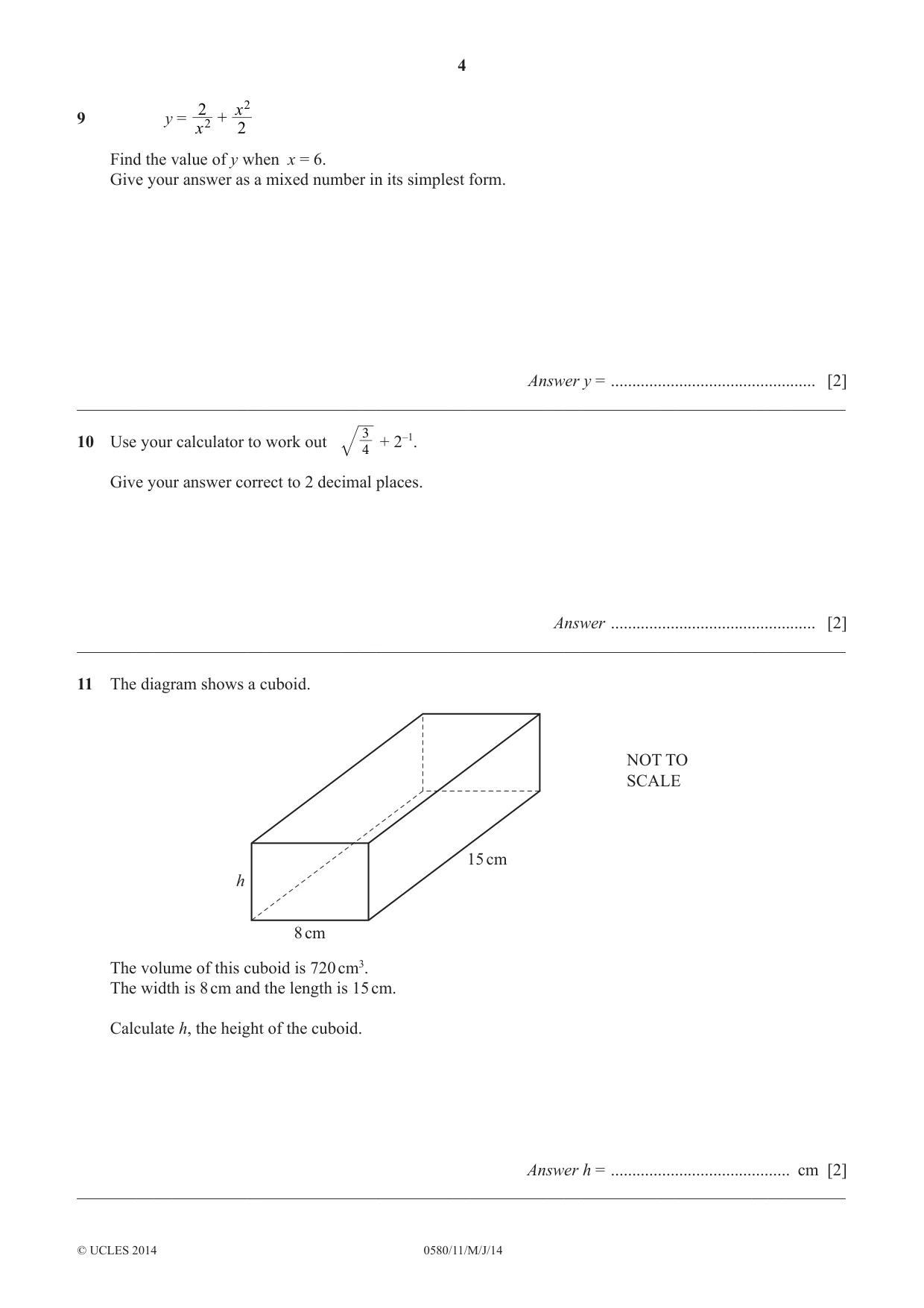
11 The diagram shows a cuboid. NOT TO SCALE 15 cm h 8 cm The volume of this cuboid is 720 cm3. The width is 8 cm and the length is 15 cm. Calculate h, the height of the cuboid. Answer h = .......................................... cm [2] __________________________________________________________________________________________
Mark scheme: 11 6 2 M1 for 720 = 8 × 15 × h or better IGCSE – May/June 2014 0580 11
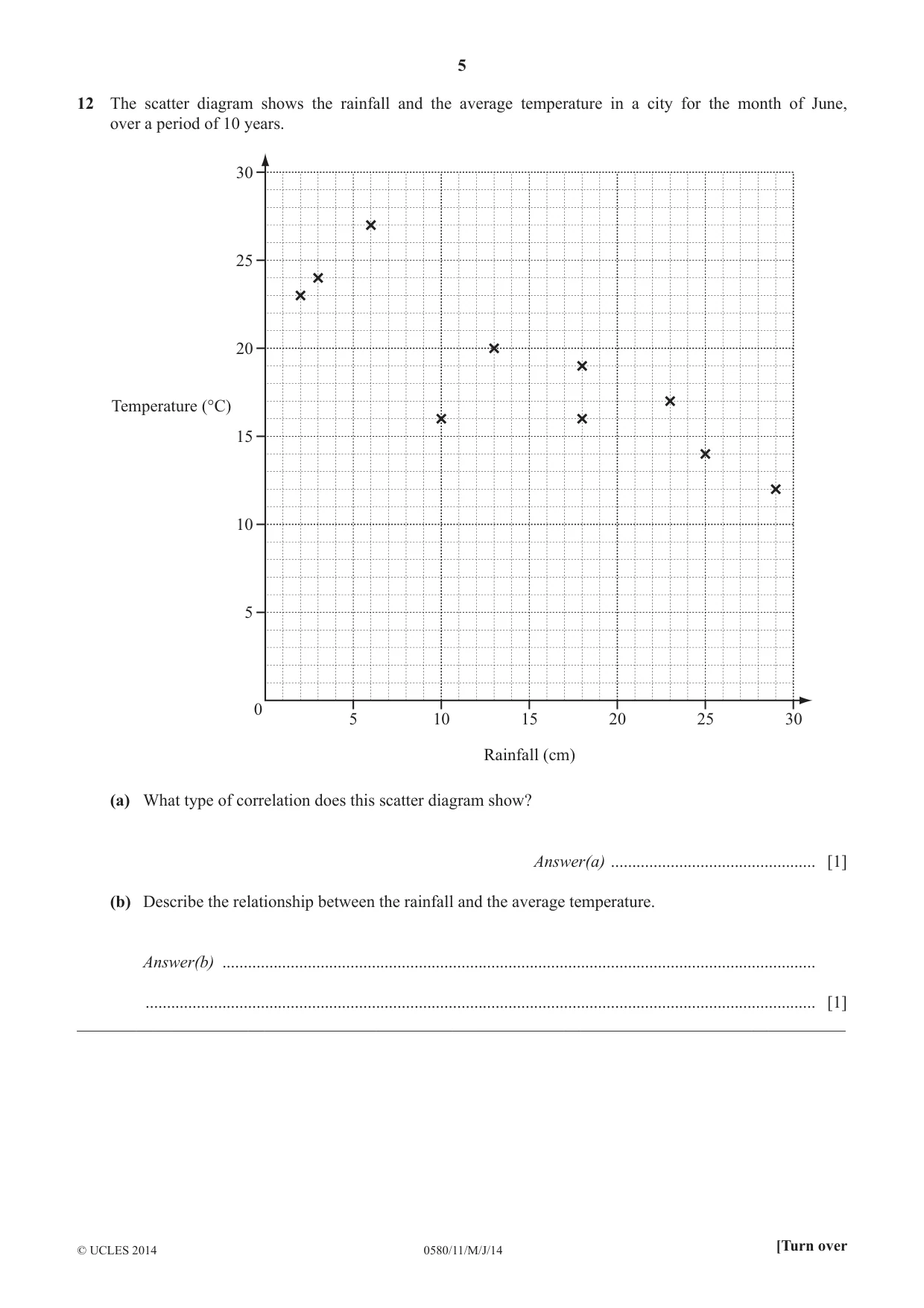
Q12 · The scatter diagram shows the rainfall and the average temperature in a city for the…
12 The scatter diagram shows the rainfall and the average temperature in a city for the month of June, over a period of 10 years. 30 25 20 Temperature (°C) 15 10 5 0 5 10 15 20 25 30 Rainfall (cm) (a) What type of correlation does this scatter diagram show? Answer(a) ................................................ [1] (b) Describe the relationship between the rainfall and the average temperature. Answer(b) ........................................................................................................................................... ............................................................................................................................................................. [1] __________________________________________________________________________________________
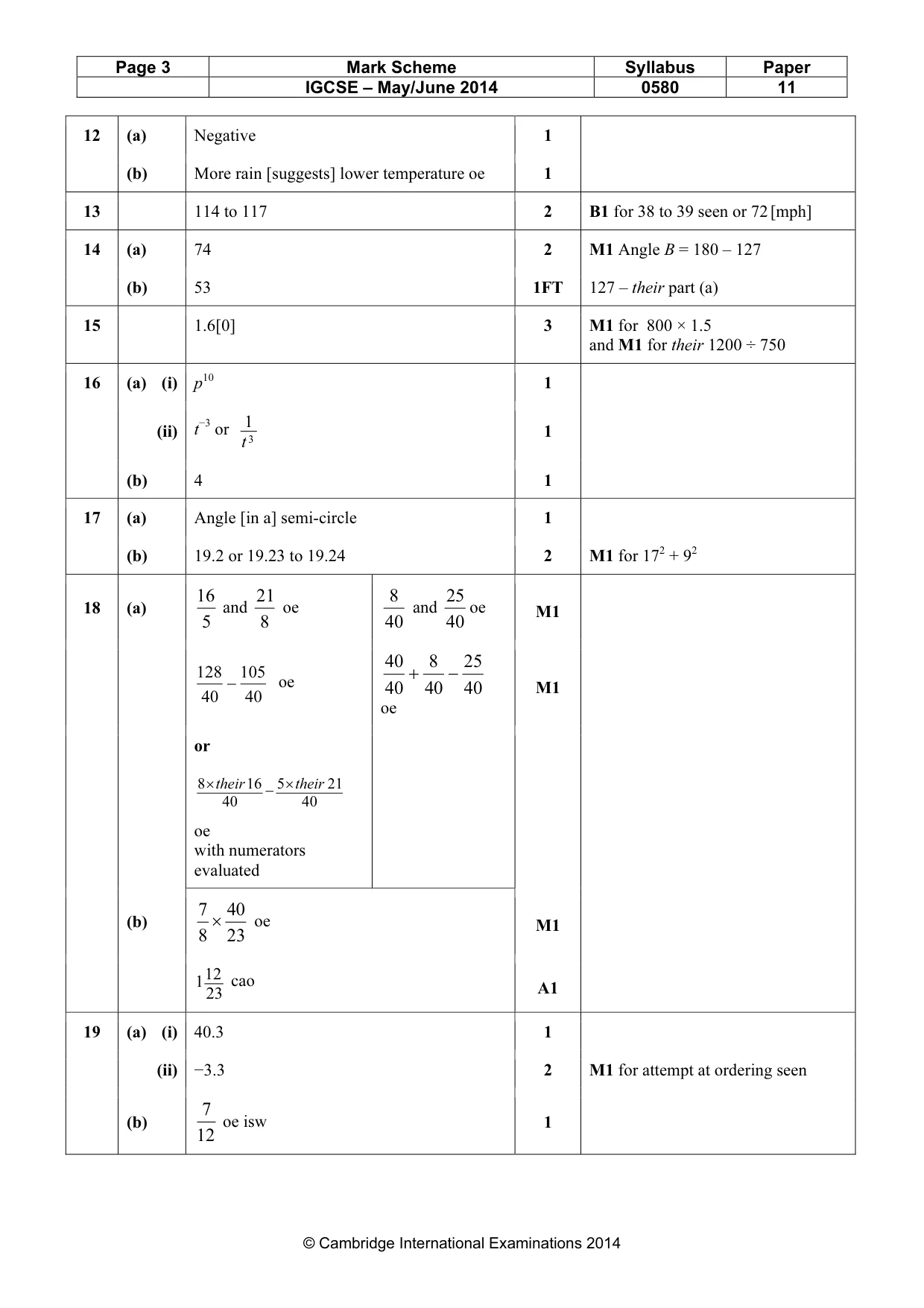
Mark scheme: 12 (a) Negative 1 (b) More rain [suggests] lower temperature oe 1
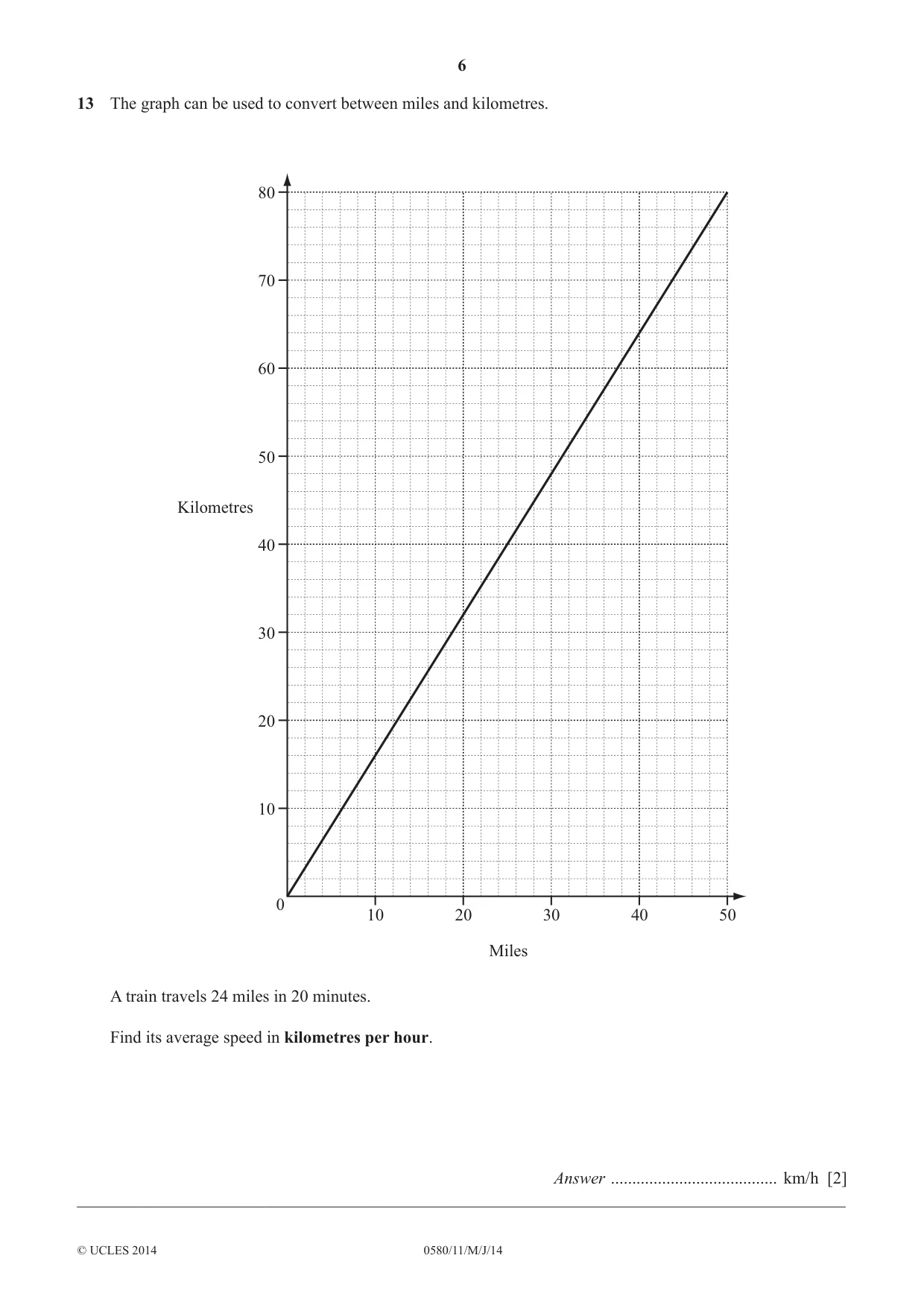
Q13 · The graph can be used to convert between miles and kilometres
13 The graph can be used to convert between miles and kilometres. 80 70 60 50 Kilometres 40 30 20 10 0 10 20 30 40 50 Miles A train travels 24 miles in 20 minutes. Find its average speed in kilometres per hour. Answer ....................................... km/h [2] __________________________________________________________________________________________
Mark scheme: 13 114 to 117 2 B1 for 38 to 39 seen or 72 [mph]
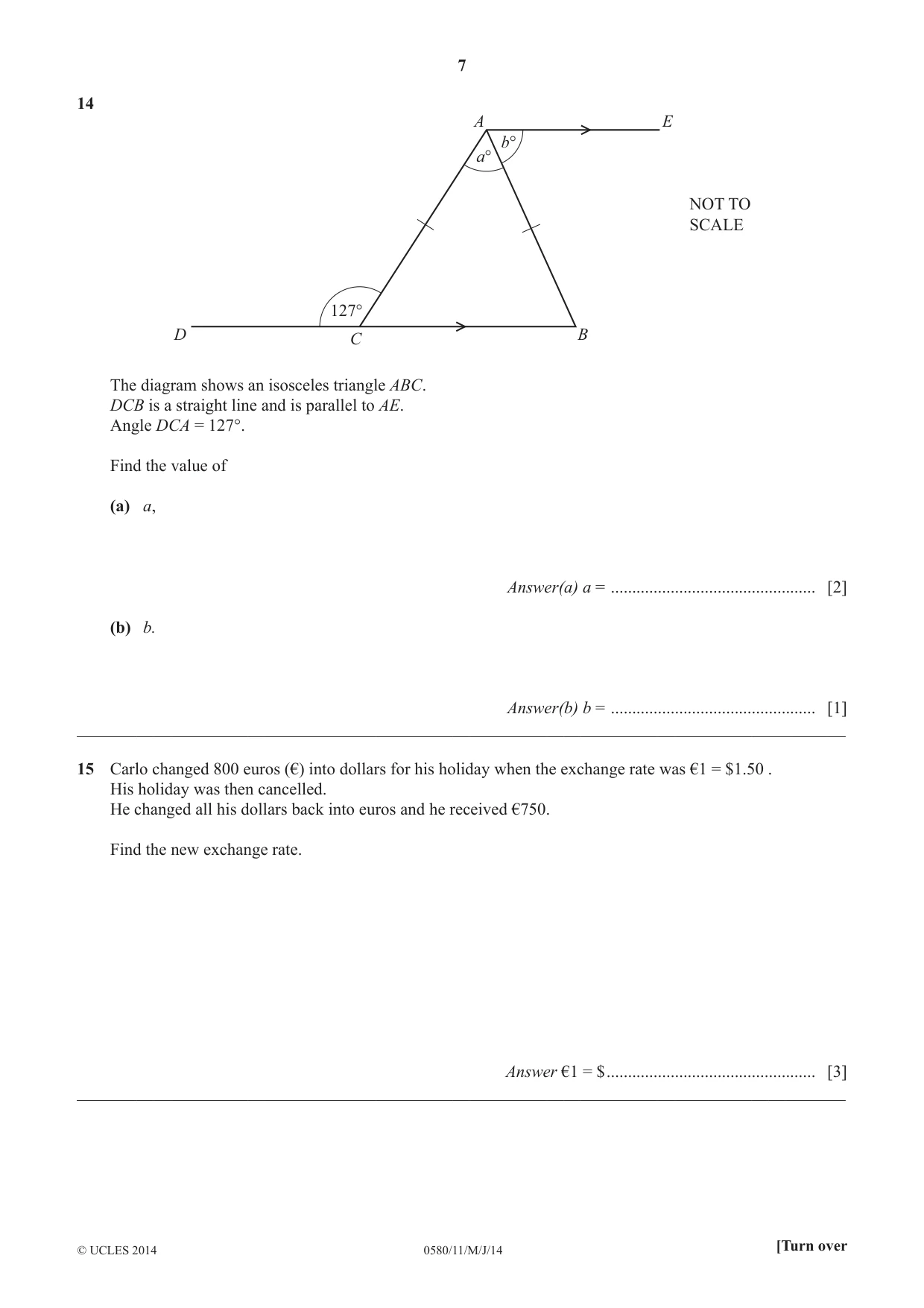
Q14 · A E b° a° NOT TO SCALE 127° D C B The diagram shows an isosceles triangle ABC
14 A E b° a° NOT TO SCALE 127° D C B The diagram shows an isosceles triangle ABC. DCB is a straight line and is parallel to AE. Angle DCA = 127°. Find the value of (a) a, Answer(a) a = ................................................ [2] (b) b. Answer(b) b = ................................................ [1] __________________________________________________________________________________________
Mark scheme: 14 (a) 74 2 M1 Angle B = 180 – 127 (b) 53 1FT 127 – their part (a)
Q15 · Carlo changed 800 euros (€) into dollars for his holiday when the exchange rate was €1 =…
15 Carlo changed 800 euros (€) into dollars for his holiday when the exchange rate was €1 = $1.50 . His holiday was then cancelled. He changed all his dollars back into euros and he received €750. Find the new exchange rate. Answer €1 = $ ................................................. [3] __________________________________________________________________________________________
Mark scheme: 15 1.6[0] 3 M1 for 800 × 1.5 and M1 for their 1200 ÷ 750 10
Question 16
16 (a) Simplify the expressions. (i) p 3 × p 7 Answer(a)(i) ................................................ [1] (ii) t 5 ÷ t 8 Answer(a)(ii) ................................................ [1] k (b) (h3) = h12 Find the value of k. Answer(b) k = ................................................ [1] __________________________________________________________________________________________
Mark scheme: 16 (a) (i) p10 1 1 (ii) t−3 or 3 1 t (b) 4 1
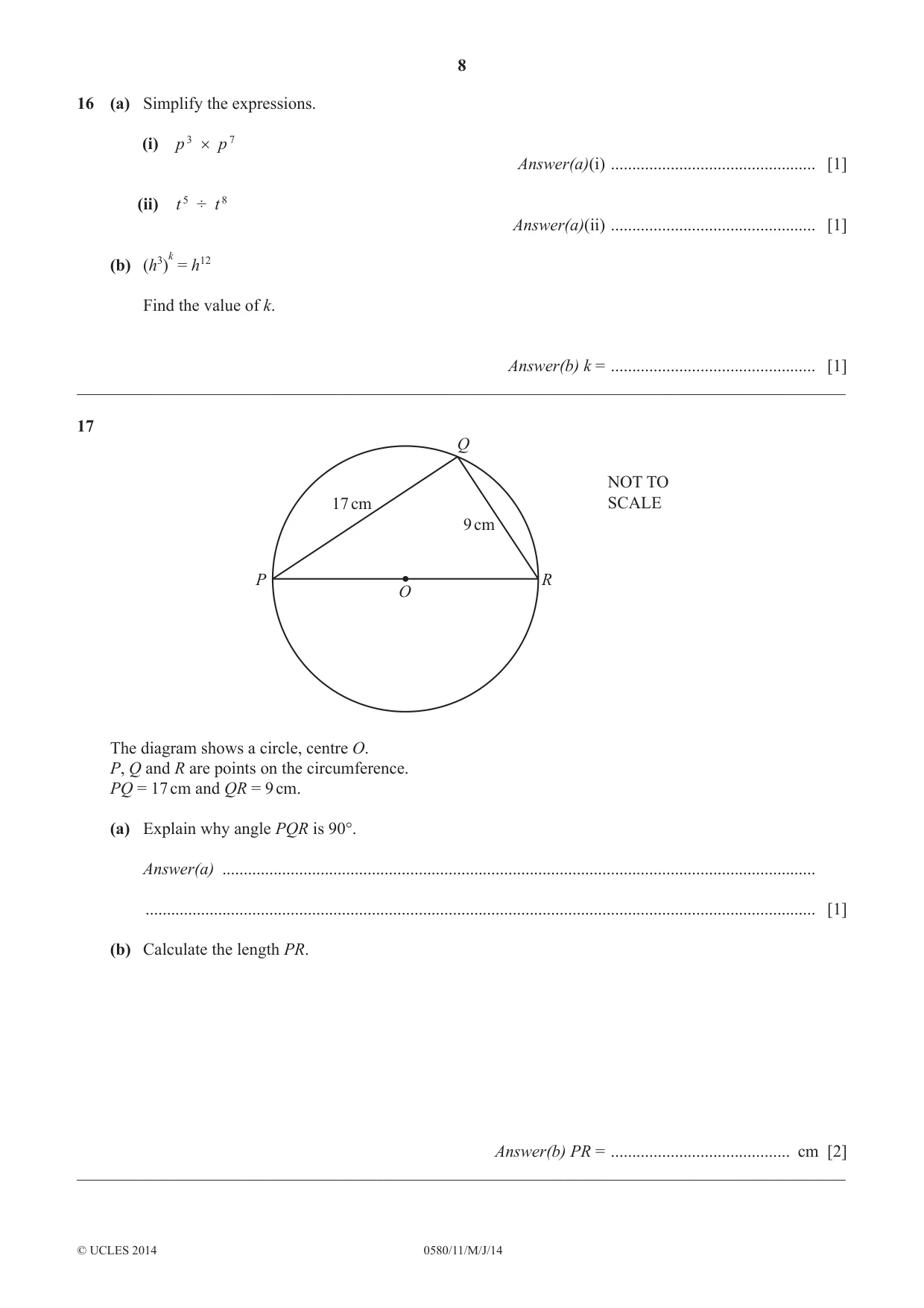
Q17 · Q NOT TO 17 cm SCALE 9 cm P R O The diagram shows a circle, centre O
17 Q NOT TO 17 cm SCALE 9 cm P R O The diagram shows a circle, centre O. P, Q and R are points on the circumference. PQ = 17 cm and QR = 9 cm. (a) Explain why angle PQR is 90°. Answer(a) ........................................................................................................................................... ............................................................................................................................................................. [1] (b) Calculate the length PR. Answer(b) PR = .......................................... cm [2] __________________________________________________________________________________________
Mark scheme: 17 (a) Angle [in a] semi-circle 1 (b) 19.2 or 19.23 to 19.24 2 M1 for 172 + 92 16 21 8 25
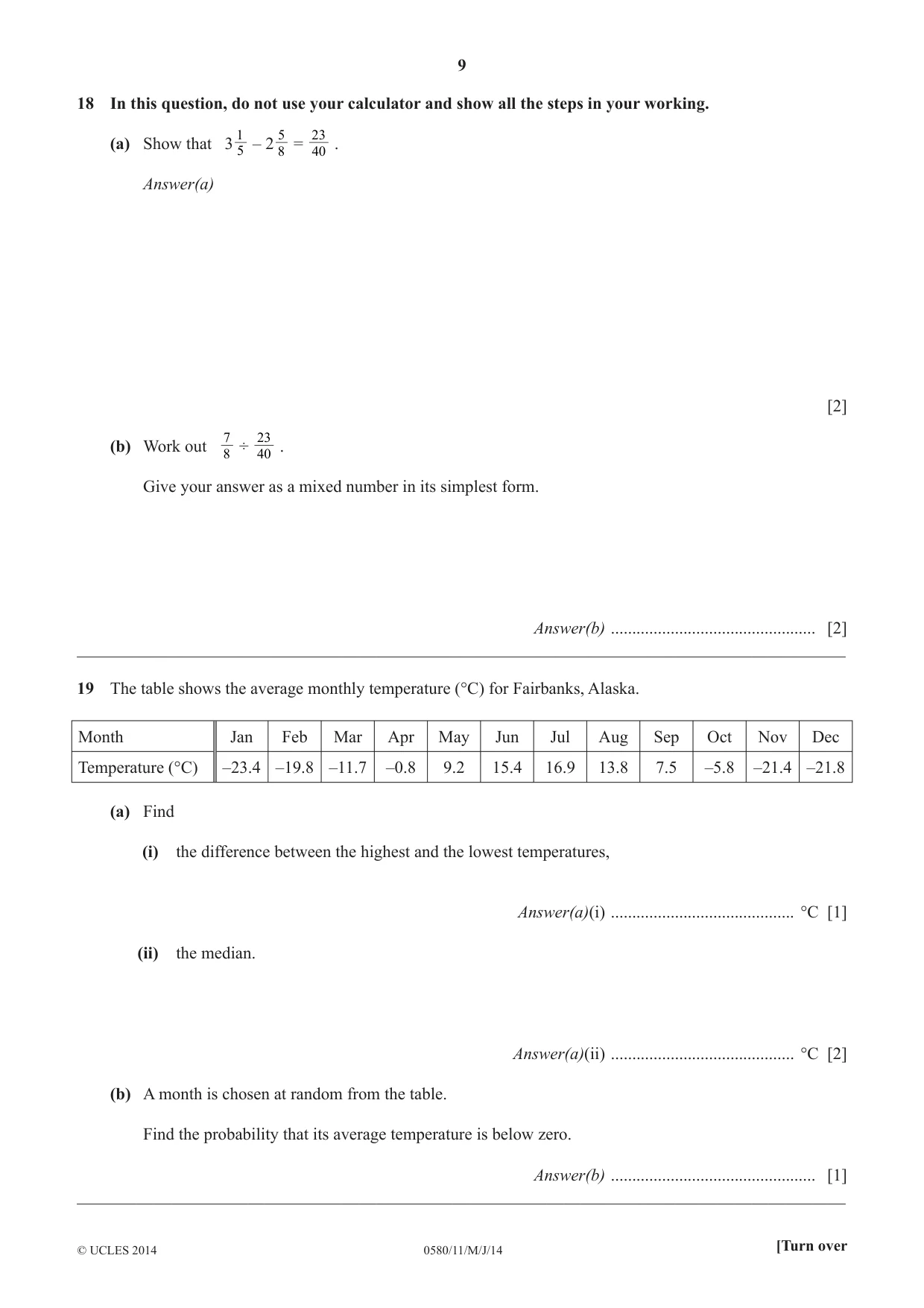
Q18 · In this question, do not use your calculator and show all the steps in your working
18 In this question, do not use your calculator and show all the steps in your working. 1 5 23 (a) Show that 3 – 2 = . 5 8 40 Answer(a) [2] 7 23 (b) Work out ÷ . 8 40 Give your answer as a mixed number in its simplest form. Answer(b) ................................................ [2] __________________________________________________________________________________________
Mark scheme: 16 21 8 25 18 (a) and oe and oe M1 5 8 40 40 40 8 25 128 105 + − − oe 40 40 40 M1 40 40 oe or 8 × their 16 5 × their 21 − 40 40 oe with numerators evaluated 7 40 (b) × oe M1 8 23 12 1 cao A1 23
Q19 · The table shows the average monthly temperature (°C) for Fairbanks, Alaska
19 The table shows the average monthly temperature (°C) for Fairbanks, Alaska. Month Jan Feb Mar Apr May Jun Jul Aug Sep Oct Nov Dec Temperature (°C) –23.4 –19.8 –11.7 –0.8 9.2 15.4 16.9 13.8 7.5 –5.8 –21.4 –21.8 (a) Find (i) the difference between the highest and the lowest temperatures, Answer(a)(i) ........................................... °C [1] (ii) the median. Answer(a)(ii) ........................................... °C [2] (b) A month is chosen at random from the table. Find the probability that its average temperature is below zero. Answer(b) ................................................ [1] __________________________________________________________________________________________
Mark scheme: 19 (a) (i) 40.3 1 (ii) −3.3 2 M1 for attempt at ordering seen 7 (b) oe isw 1 12 IGCSE – May/June 2014 0580 11
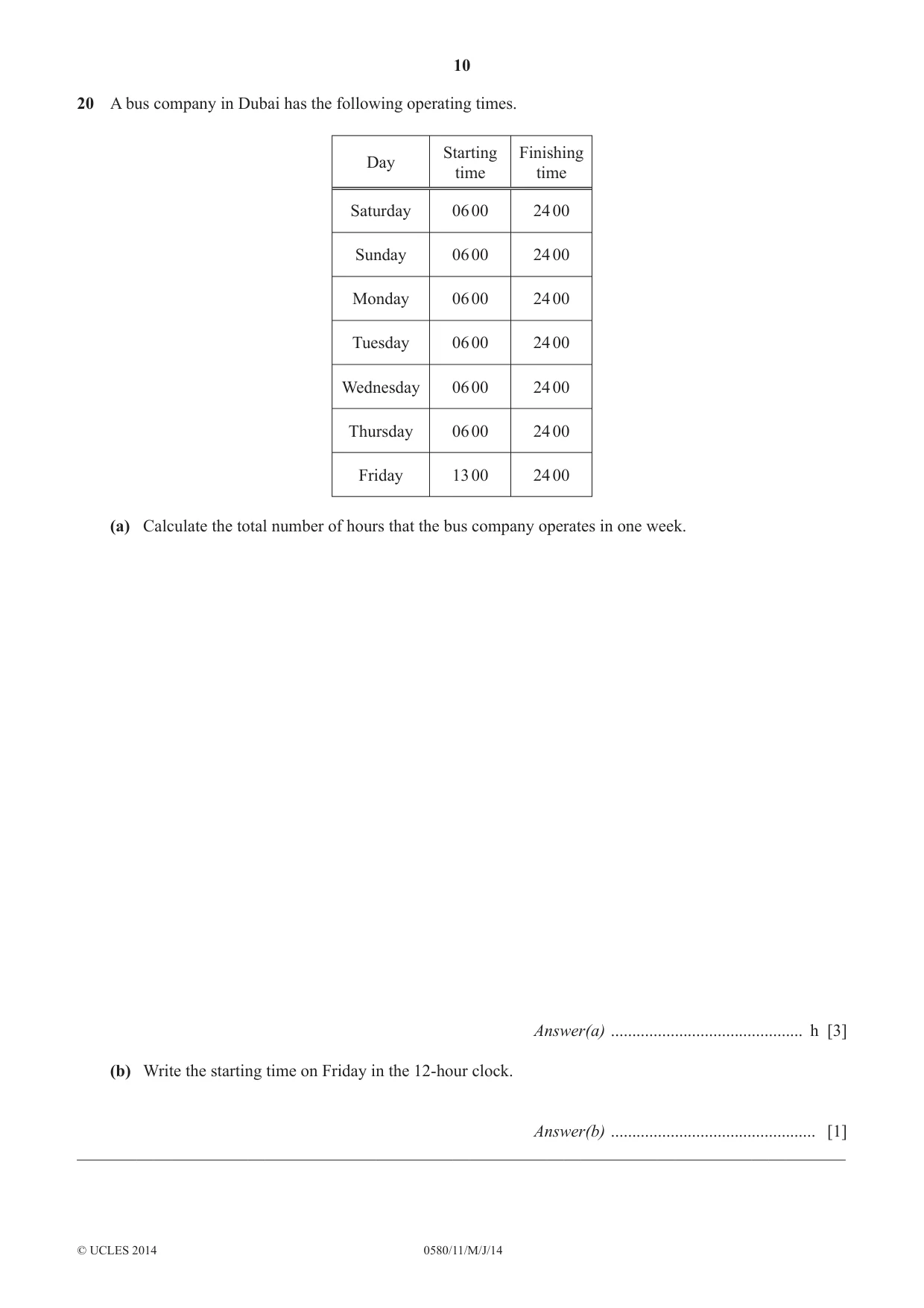
Q20 · A bus company in Dubai has the following operating times
20 A bus company in Dubai has the following operating times. Starting Finishing Day time time Saturday 06 00 24 00 Sunday 06 00 24 00 Monday 06 00 24 00 Tuesday 06 00 24 00 Wednesday 06 00 24 00 Thursday 06 00 24 00 Friday 13 00 24 00 (a) Calculate the total number of hours that the bus company operates in one week. Answer(a) ............................................. h [3] (b) Write the starting time on Friday in the 12-hour clock. Answer(b) ................................................ [1] __________________________________________________________________________________________
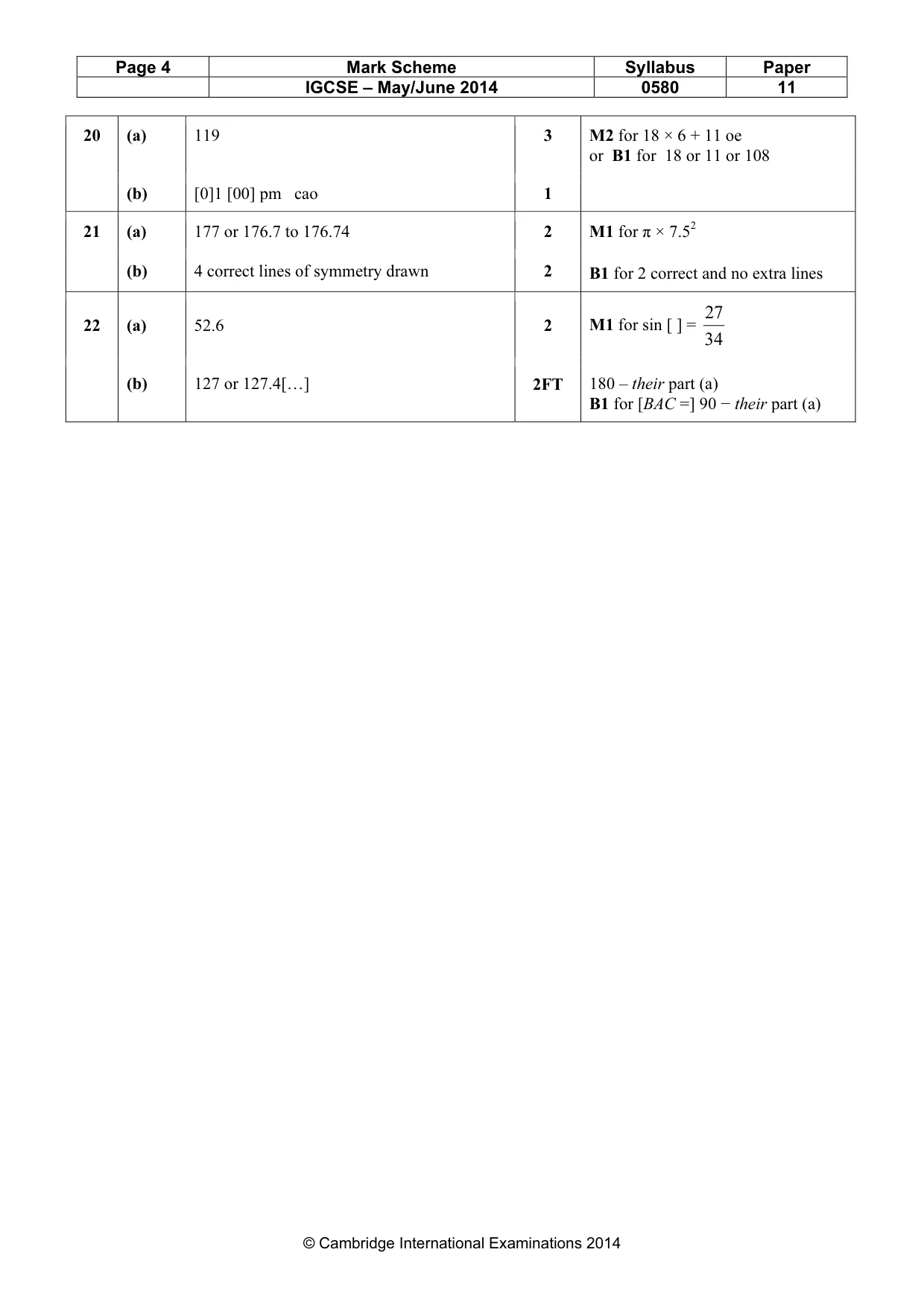
Mark scheme: 20 (a) 119 3 M2 for 18 × 6 + 11 oe or B1 for 18 or 11 or 108 (b) [0]1 [00] pm cao 1 2
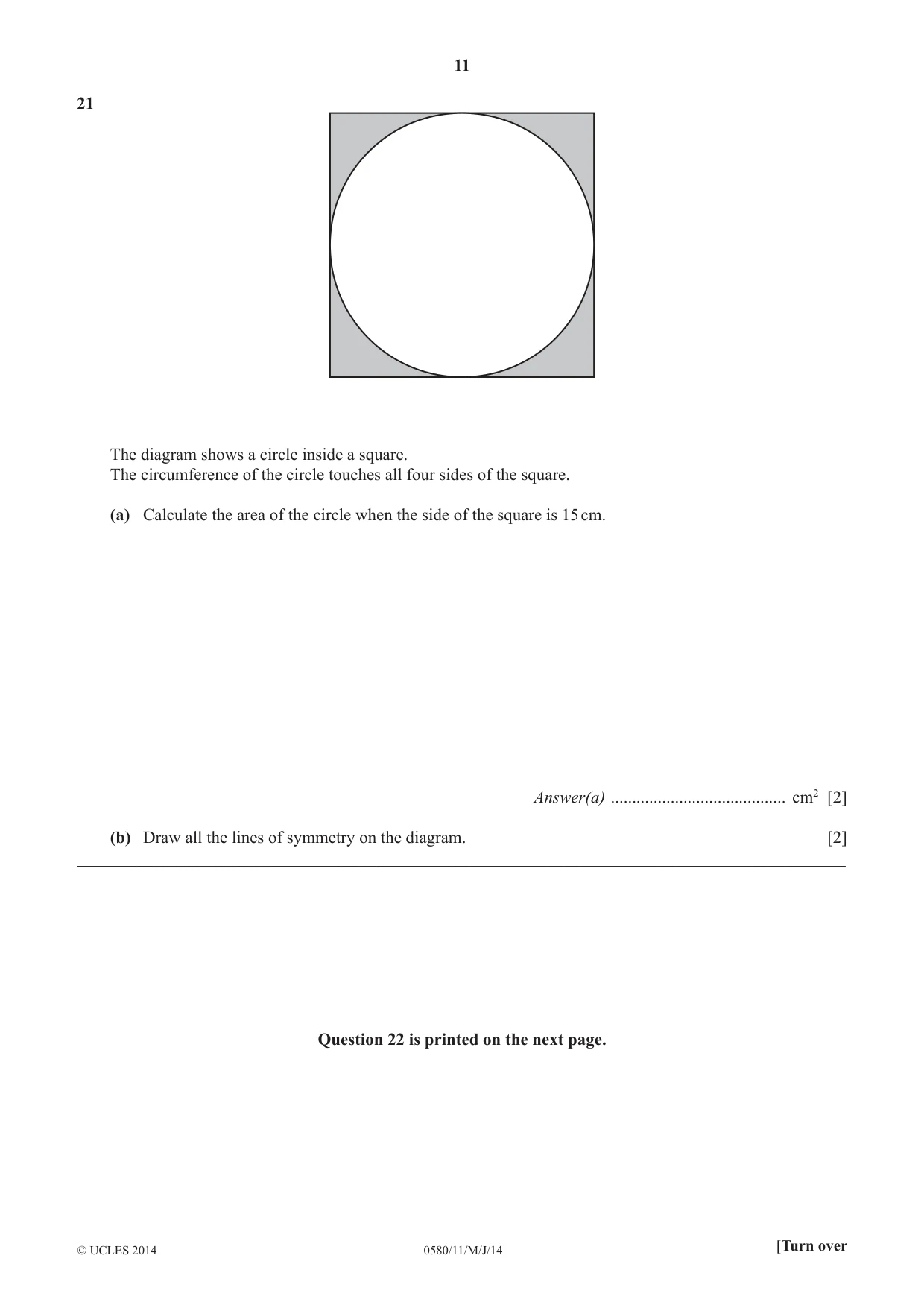
Q21 · The diagram shows a circle inside a square
21 The diagram shows a circle inside a square. The circumference of the circle touches all four sides of the square. (a) Calculate the area of the circle when the side of the square is 15 cm. Answer(a) ......................................... cm2 [2] (b) Draw all the lines of symmetry on the diagram. [2] __________________________________________________________________________________________ Question 22 is printed on the next page.
Mark scheme: 21 (a) 177 or 176.7 to 176.74 2 M1 for π × 7.52 (b) 4 correct lines of symmetry drawn 2 B1 for 2 correct and no extra lines 27
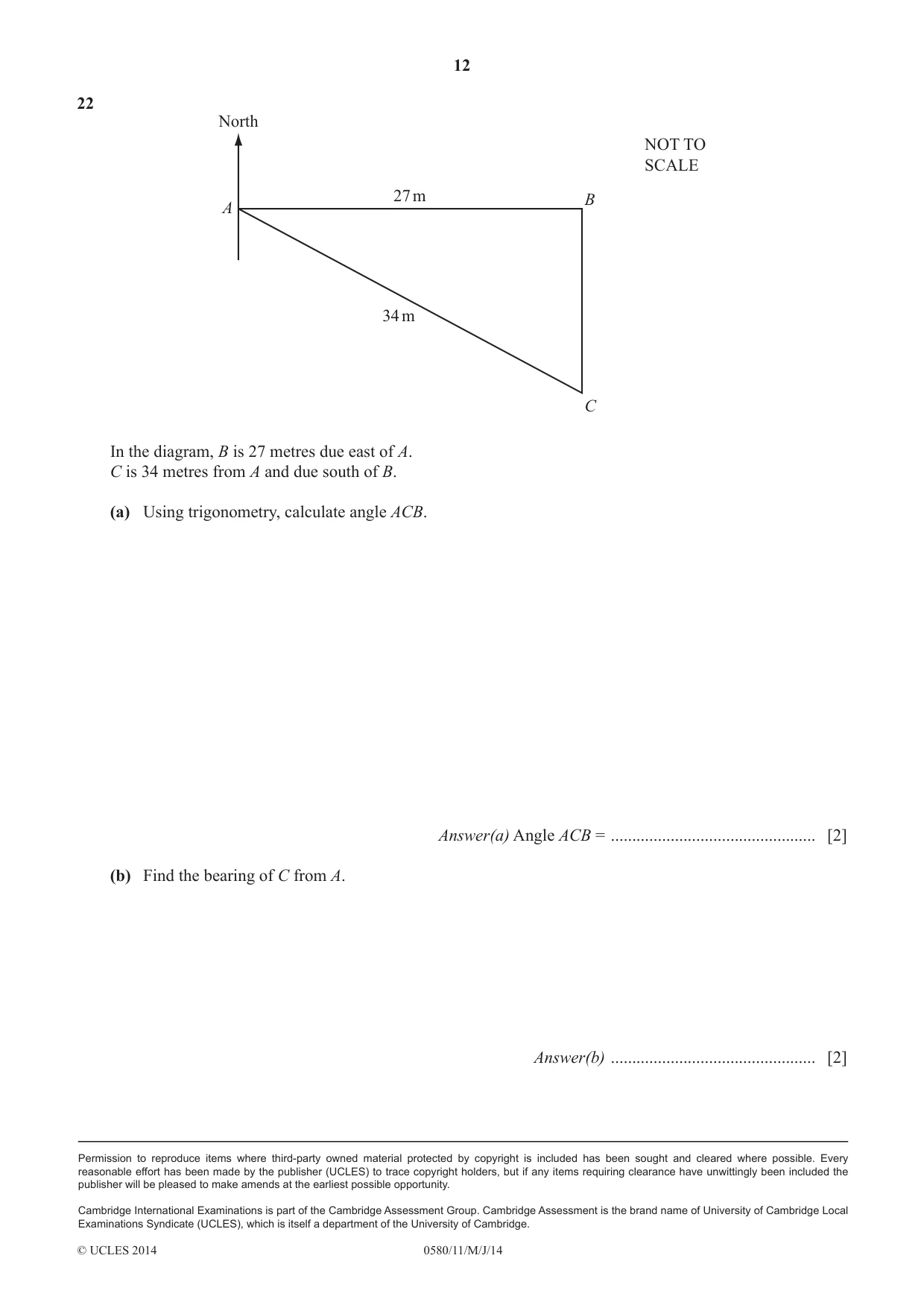
Q22 · North NOT TO SCALE 27 m B A 34 m C In the diagram, B is 27 metres due east of A
22 North NOT TO SCALE 27 m B A 34 m C In the diagram, B is 27 metres due east of A. C is 34 metres from A and due south of B. (a) Using trigonometry, calculate angle ACB. Answer(a) Angle ACB = ................................................ [2] (b) Find the bearing of C from A. Answer(b) ................................................ [2]
Mark scheme: 27 22 (a) 52.6 2 M1 for sin [ ] = 34 (b) 127 or 127.4[…] 2FT 180 – their part (a) B1 for [BAC =] 90 − their part (a)
What was in this paper
The subtopics covered by these 22 questions, and how many questions each got. Open one in a new tab to see every Cambridge question on it.
2Fractions, decimals and percentages2Limits of accuracy2Averages and range1Circles, arcs and sectors1Equations1Indices I1Non-right-angled triangles1Pythagoras’ theorem1Rates1Ratio and proportion1Scatter diagrams1Standard form1Surface area and volume1The four operations1Time1Types of number1Using a calculator1Vectors in two dimensions1What you needed in this session
Cambridge’s own grade thresholds for 2014 May/June, Paper 1 · Variant 1. A higher threshold means an easier paper — the bar moves with how the cohort did.