Cambridge IGCSE Mathematics 0580 — 2025 May/June Paper 1 · Variant 2
0580/12/M/J/25 · 24 questions · 80 marks · 90 min
The question paper and its mark scheme, free to read here and free to download. This is Cambridge’s own paper, exactly as it was sat.
Question paper16 pages
Mark scheme10 pages
Answers below. Sit the paper first if you are practising.
Questions as text
Q1 · Write the number sixteen thousand and sixty-two in figures
1 Write the number sixteen thousand and sixty-two in figures. ................................................. [1]
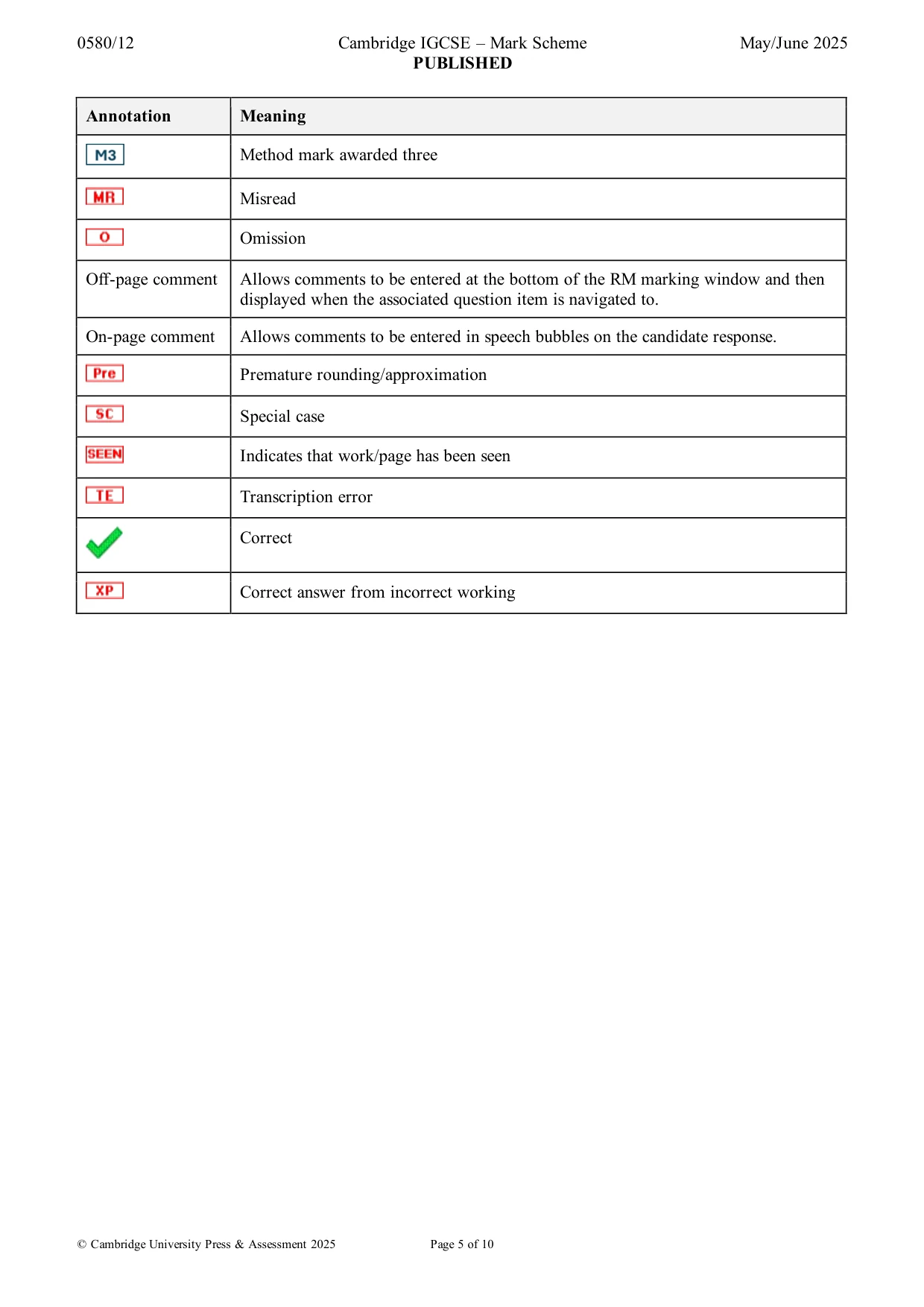
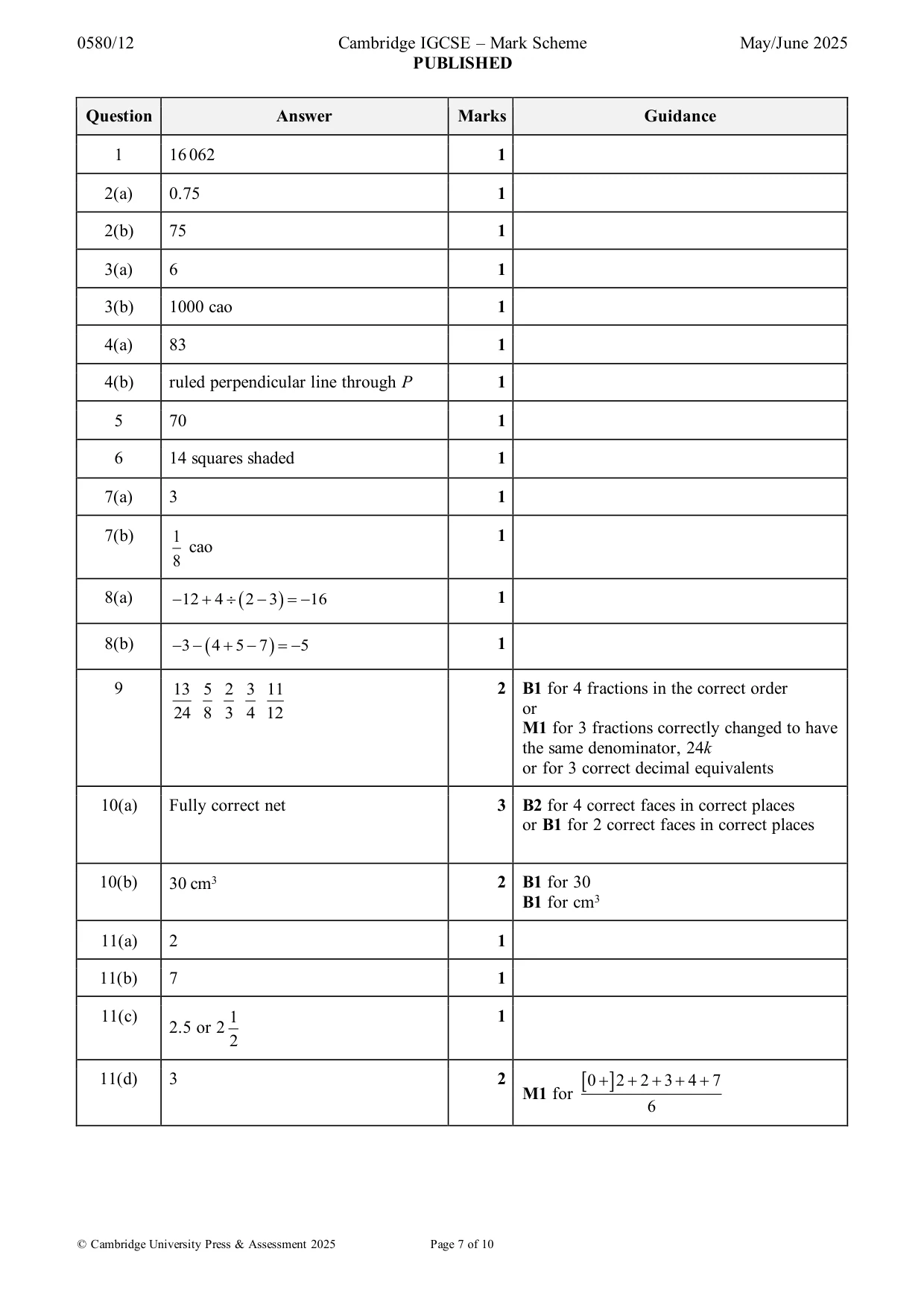
Mark scheme: Question Answer Marks Guidance 1 16 062 1
Q2 · Write three-quarters as (a) a decimal ................................................
2 Write three-quarters as (a) a decimal ................................................. [1] (b) a percentage. ..............................................% [1]
Mark scheme: 2(a) 0.75 1 2(b) 75 1
Q3 · Write down the value of (a) 36 ................................................
3 Write down the value of (a) 36 ................................................. [1] (b) 103. ................................................. [1]
Mark scheme: 3(a) 6 1 3(b) 1000 cao 1
Q4 · The diagram shows a line AB and a point P
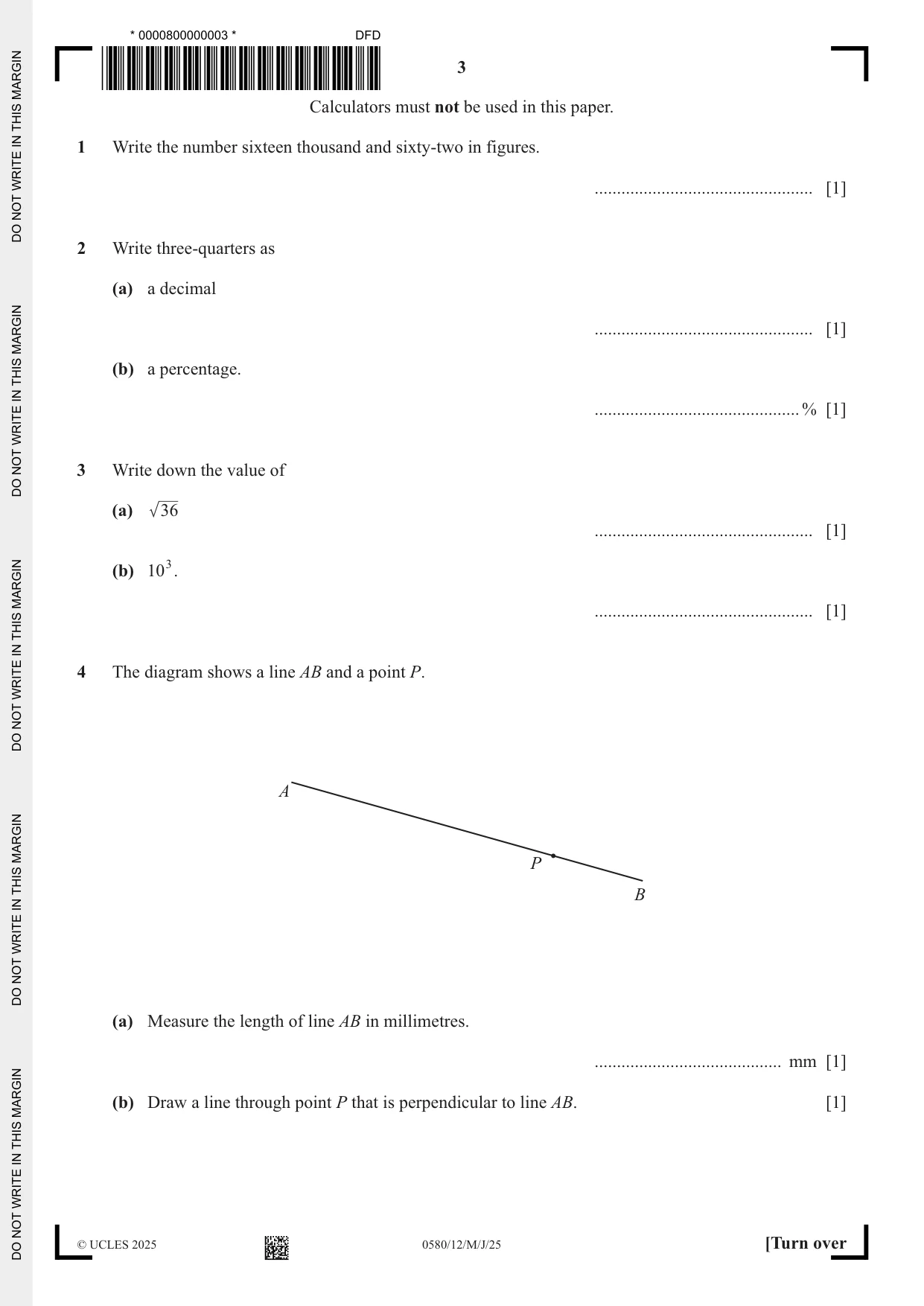
4 The diagram shows a line AB and a point P. A P B (a) Measure the length of line AB in millimetres. .......................................... mm [1] (b) Draw a line through point P that is perpendicular to line AB. [1]
Mark scheme: 4(a) 83 1 4(b) ruled perpendicular line through P 1
Question 5
5 Complete this statement. 10 weeks is ...................... days. [1]
Mark scheme: 5 70 1
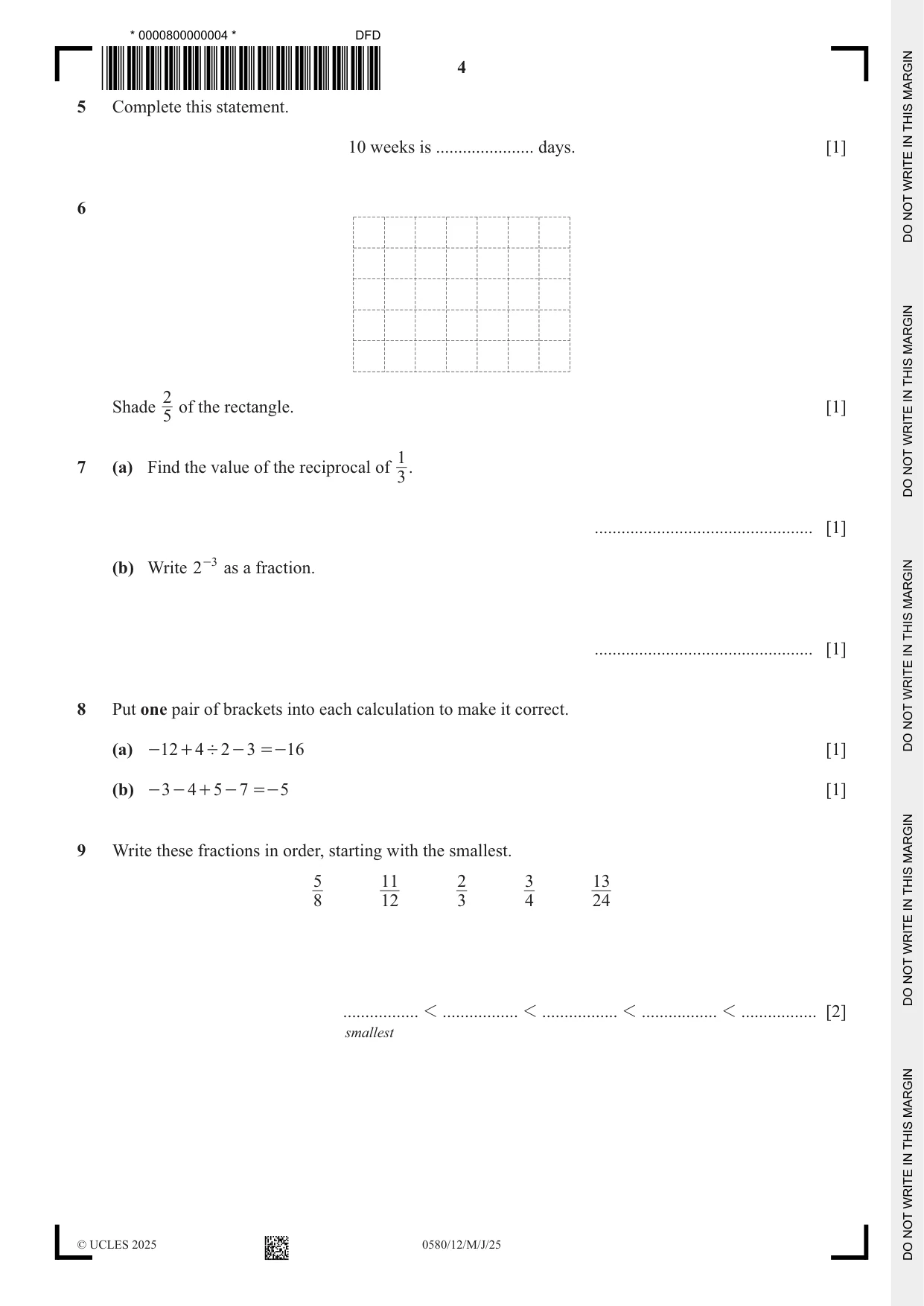
Q6 · L-----4------ 4 Lb ts [1] Shade < of the rectangle
L-----4------ 4 Lb ts [1] Shade < of the rectangle.
Mark scheme: 6 14 squares shaded 1
Q7 · Find the value of the reciprocal of 1
7 (a) Find the value of the reciprocal of 1. 3 ................................................. [1] (b) Write 2 -3 as a fraction. ................................................. [1]
Mark scheme: 7(a) 3 1 7(b) 1 1 cao 8
Q9 · Write these fractions in order, starting with the smallest
9 Write these fractions in order, starting with the smallest. 5 11 2 3 13 8 12 3 4 24 ................. 1 ................. 1 ................. 1 ................. 1 ................. [2] smallest
Mark scheme: 9 13 5 2 3 11 2 B1 for 4 fractions in the correct order or 24 8 3 4 12 M1 for 3 fractions correctly changed to have the same denominator, 24k or for 3 correct decimal equivalents
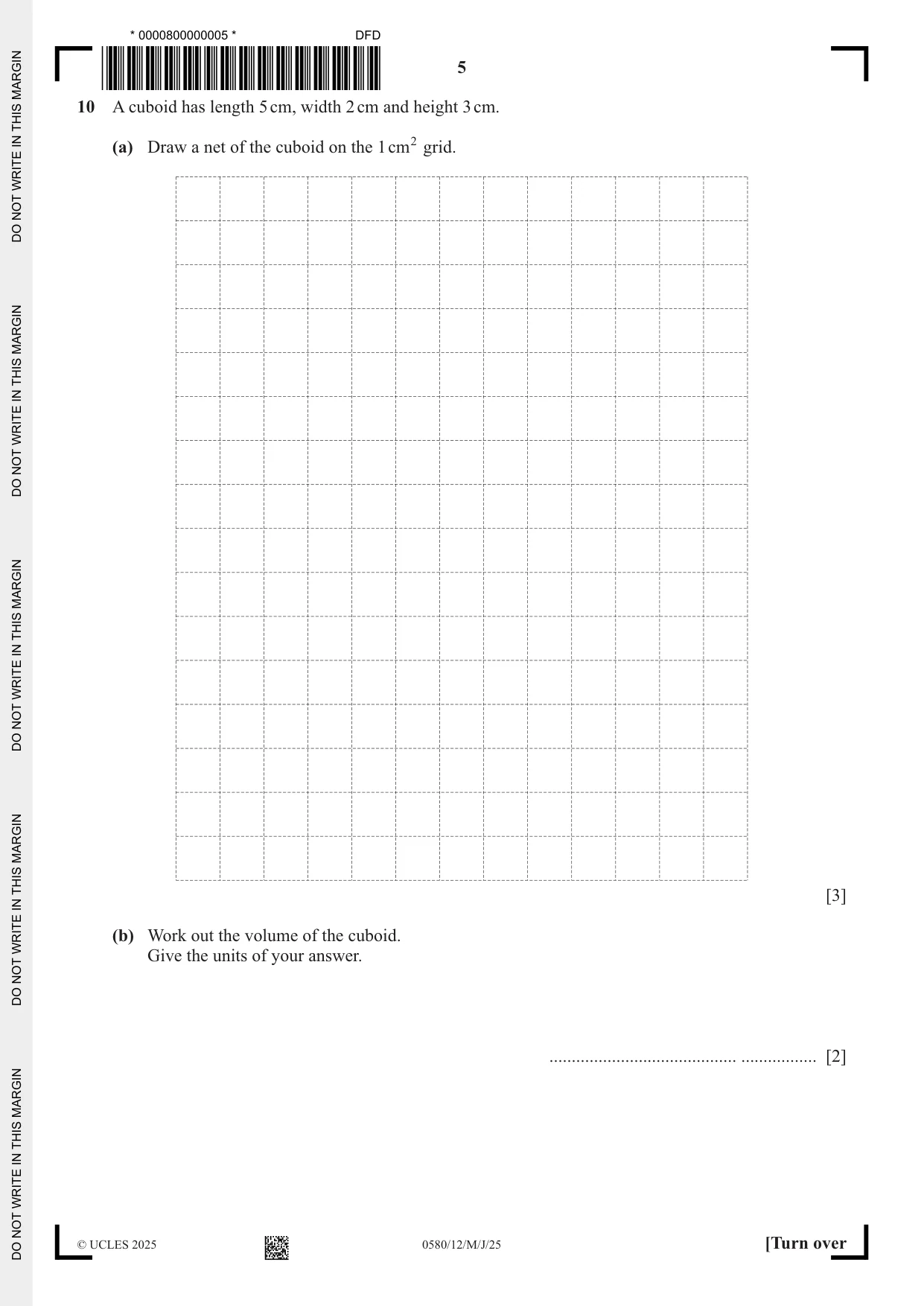
Q10 · A cuboid has length 5 cm, width 2 cm and height 3 cm
10 A cuboid has length 5 cm, width 2 cm and height 3 cm. (a) Draw a net of the cuboid on the 1 cm2 grid. [3] (b) Work out the volume of the cuboid. Give the units of your answer. .......................................... ................. [2]
Mark scheme: 10(a) Fully correct net 3 B2 for 4 correct faces in correct places or B1 for 2 correct faces in correct places 10(b) 30 cm3 2 B1 for 30 B1 for cm3
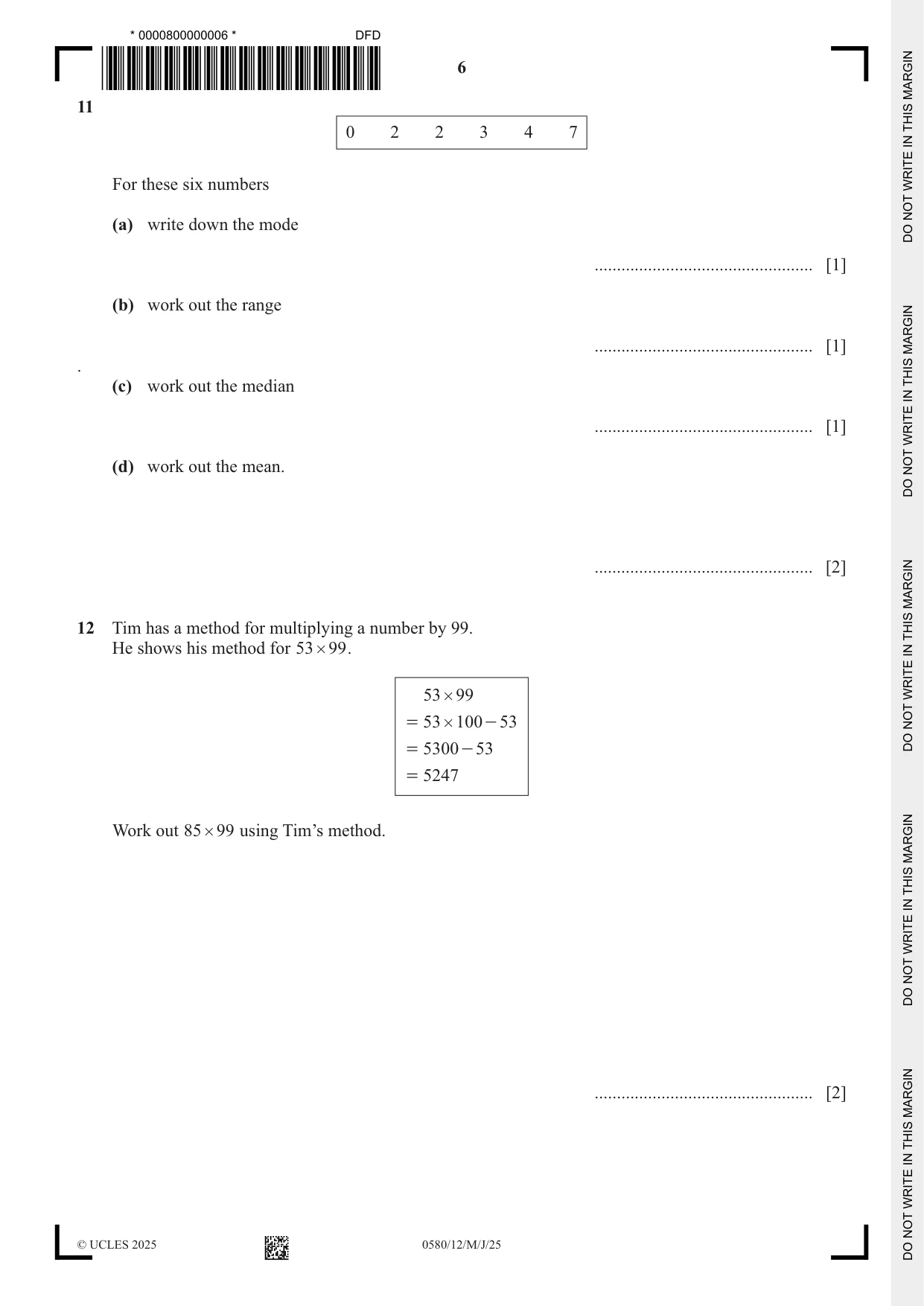
Q11 · 0 2 2 3 4 7 For these six numbers (a) write down the mode…
11 0 2 2 3 4 7 For these six numbers (a) write down the mode ................................................. [1] (b) work out the range ................................................. [1] . (c) work out the median ................................................. [1] (d) work out the mean. ................................................. [2]
Mark scheme: 11(a) 2 1 11(b) 7 1 11(c) 1 1 2.5 or 2 2 11(d) 3 2 0 + 2 + 2 + 3 + 4 + 7 M1 for 6
Q12 · Tim has a method for multiplying a number by 99
12 Tim has a method for multiplying a number by 99. He shows his method for 53 # 99 . 53 # 99 = 53 # 100 - 53 = 5300 - 53 = 5247 Work out 85 # 99 using Tim’s method. ................................................. [2]
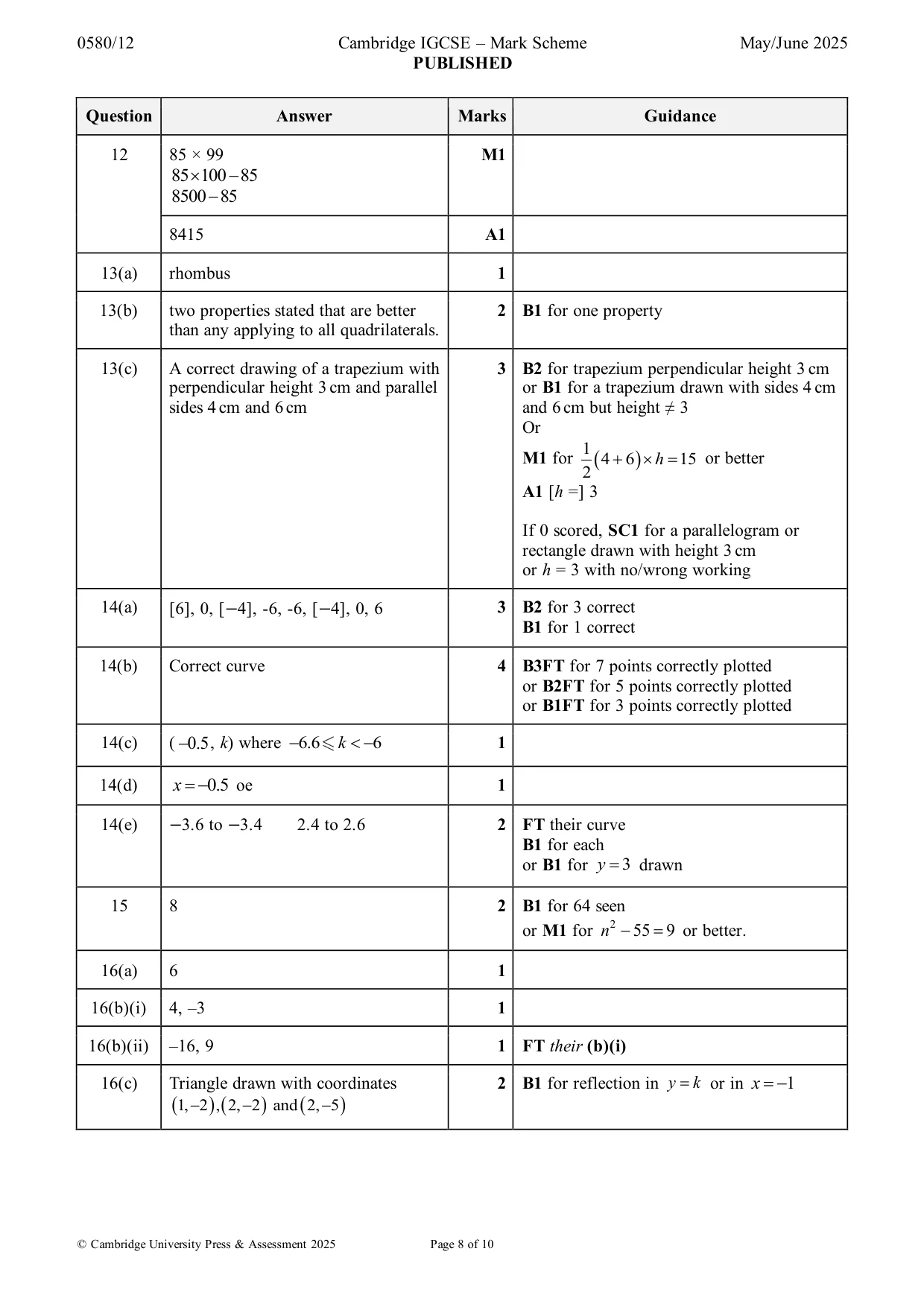
Mark scheme: 12 85 × 99 M1 85 100 − 85 8500 − 85 8415 A1
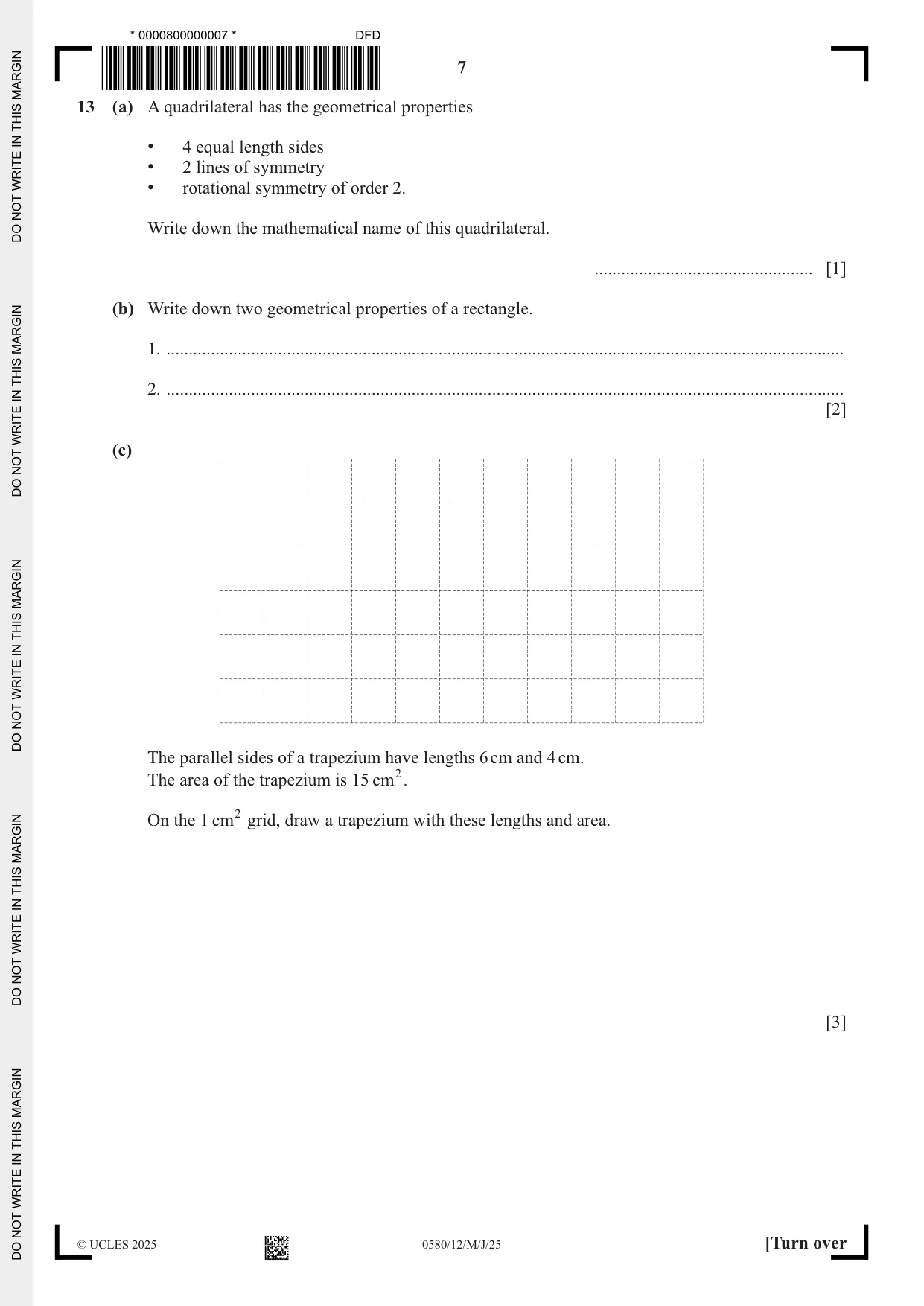
Q13 · A quadrilateral has the geometrical properties • 4 equal length sides • 2 lines of…
13 (a) A quadrilateral has the geometrical properties • 4 equal length sides • 2 lines of symmetry • rotational symmetry of order 2. Write down the mathematical name of this quadrilateral. ................................................. [1] (b) Write down two geometrical properties of a rectangle. 1. ........................................................................................................................................................ 2. ........................................................................................................................................................ [2] (c) The parallel sides of a trapezium have lengths 6 cm and 4 cm. The area of the trapezium is 15 cm2. On the 1 cm2 grid, draw a trapezium with these lengths and area. [3]
Mark scheme: 13(a) rhombus 1 13(b) two properties stated that are better 2 B1 for one property than any applying to all quadrilaterals. 13(c) A correct drawing of a trapezium with 3 B2 for trapezium perpendicular height 3 cm perpendicular height 3 cm and parallel or B1 for a trapezium drawn with sides 4 cm sides 4 cm and 6 cm and 6 cm but height ≠ 3 Or 1 M1 for ( 4 + 6 ) h = 15 or better 2 A1 [h =] 3 If 0 scored, SC1 for a parallelogram or rectangle drawn with height 3 cm or h = 3 with no/wrong working
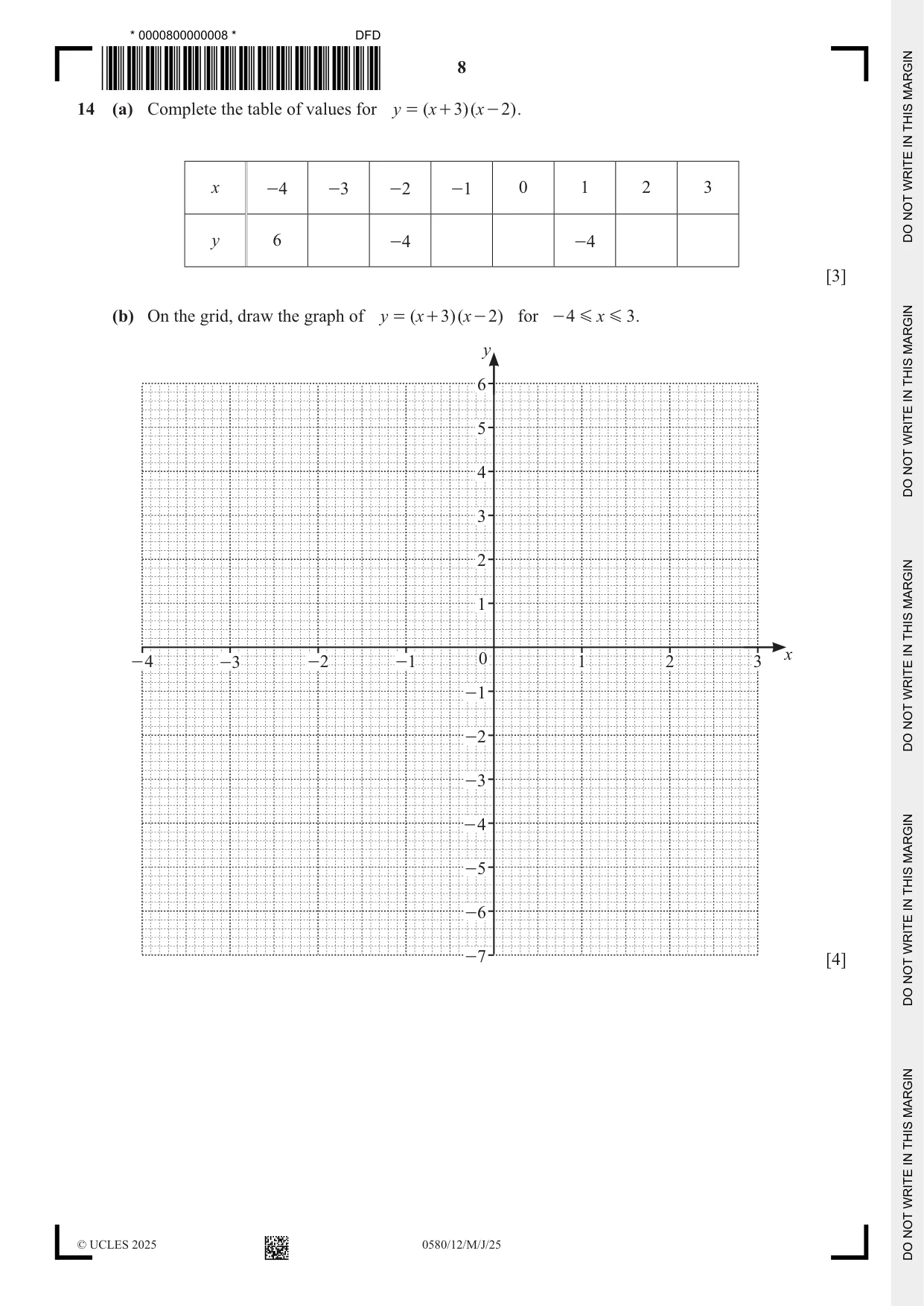
Q14 · Complete the table of values for y = ( x + 3 )( x - 2 )
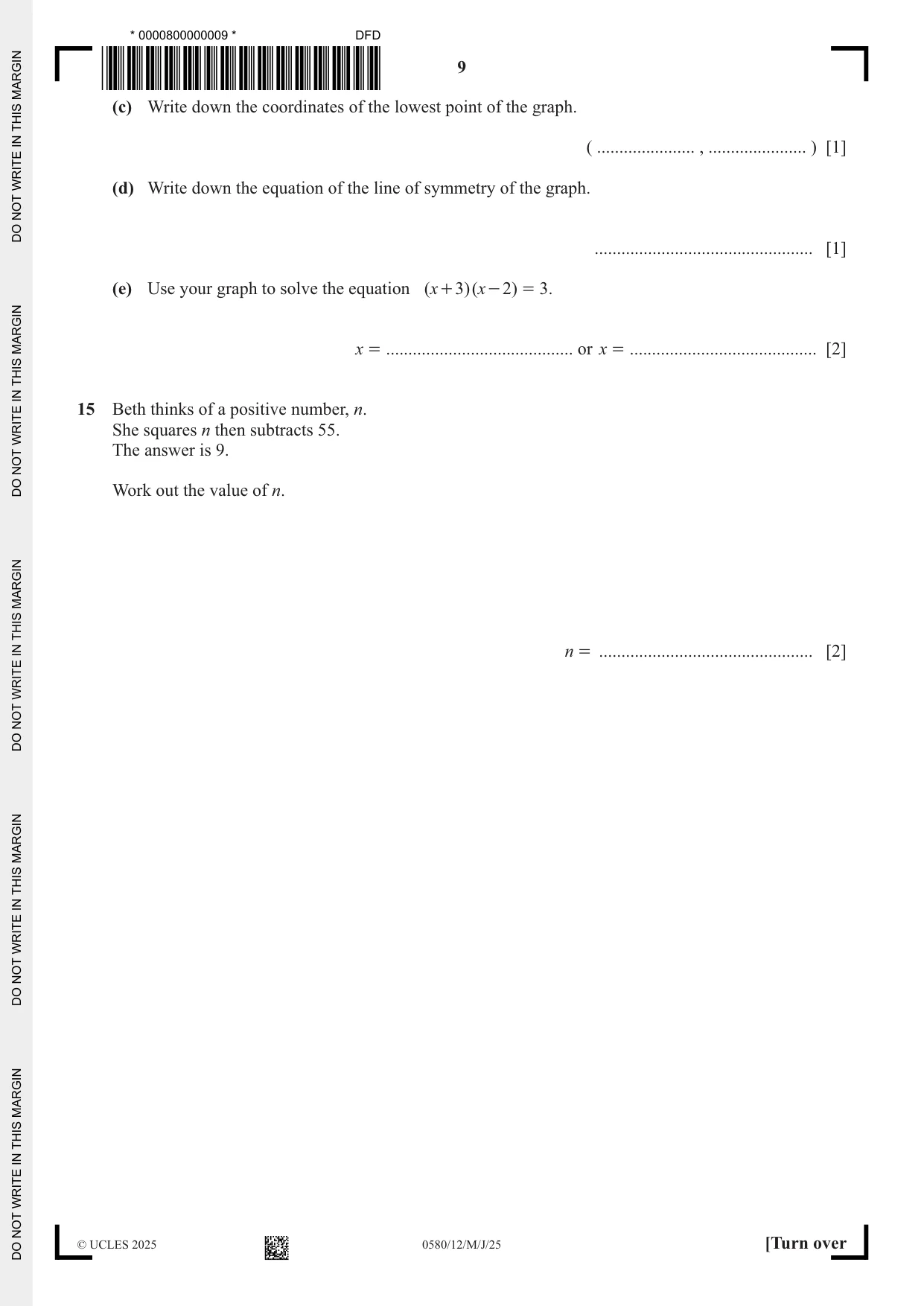
14 (a) Complete the table of values for y = ( x + 3 )( x - 2 ) . x -4 -3 -2 -1 0 1 2 3 y 6 -4 -4 [3] (b) On the grid, draw the graph of y = ( x + 3 )( x - 2 ) for - 4 G x G 3 . y 6 5 4 3 2 1 - 4 -3 -2 -1 0 1 2 3 x -1 -2 -3 - 4 -5 -6 -7 [4] (c) Write down the coordinates of the lowest point of the graph. ( ...................... , ...................... ) [1] (d) Write down the equation of the line of symmetry of the graph. ................................................. [1] (e) Use your graph to solve the equation ( x + 3)( x - 2) = 3 . x = .......................................... or x = .......................................... [2]
Mark scheme: 14(a) [6], 0, [−4], -6, -6, [−4], 0, 6 3 B2 for 3 correct B1 for 1 correct 14(b) Correct curve 4 B3FT for 7 points correctly plotted or B2FT for 5 points correctly plotted or B1FT for 3 points correctly plotted 14(c) ( −0.5 , k) where −6.6 k −6 1 14(d) x = −0.5 oe 1 14(e) −3.6 to −3.4 2.4 to 2.6 2 FT their curve B1 for each or B1 for y = 3 drawn
Q15 · Beth thinks of a positive number, n
15 Beth thinks of a positive number, n. She squares n then subtracts 55. The answer is 9. Work out the value of n. n = ................................................ [2]
Mark scheme: 15 8 2 B1 for 64 seen or M1 for n 2 − 55 = 9 or better.
Q16 · The diagram shows a point P and three triangles, A, B and C, on a 1 cm2 grid
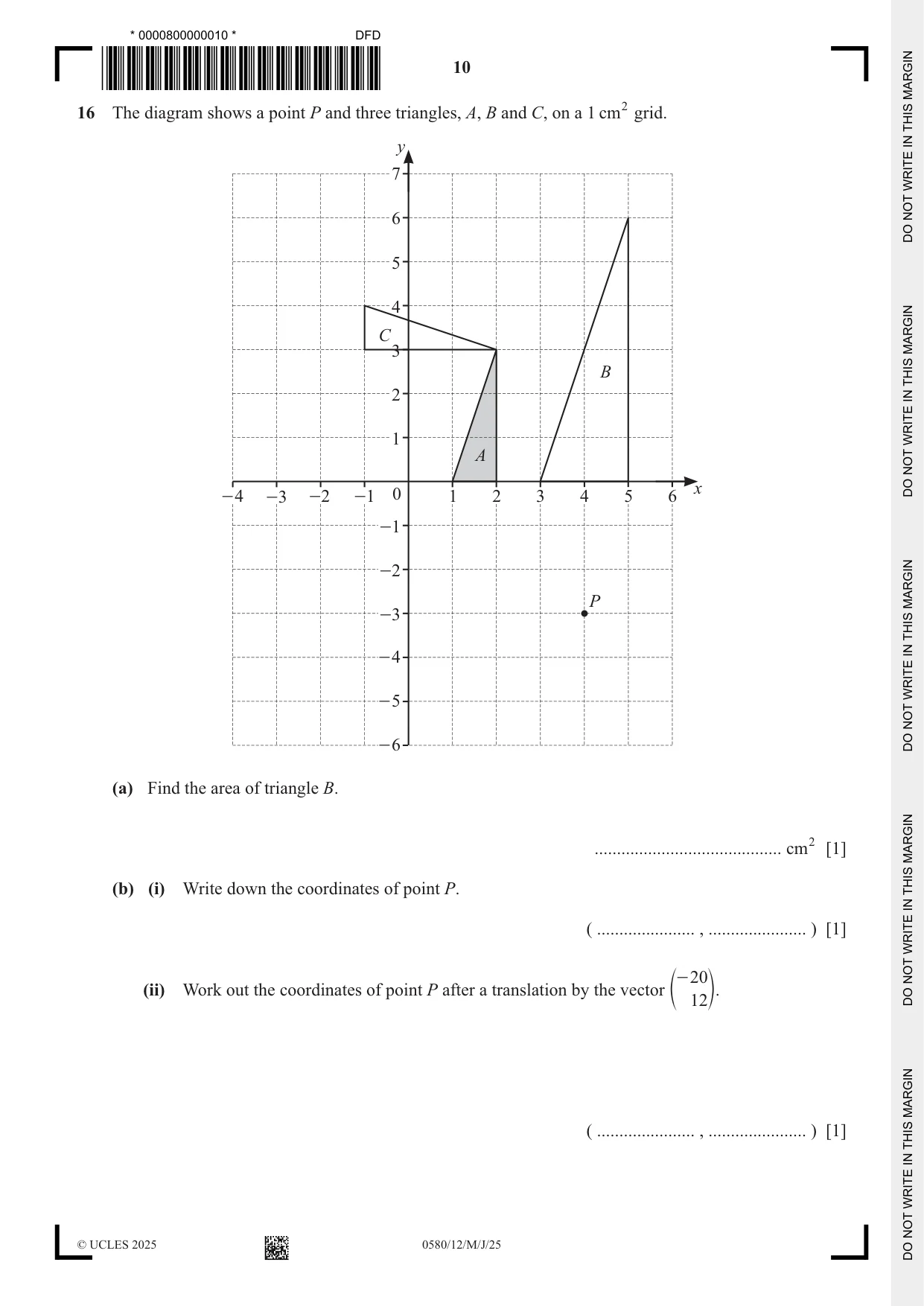
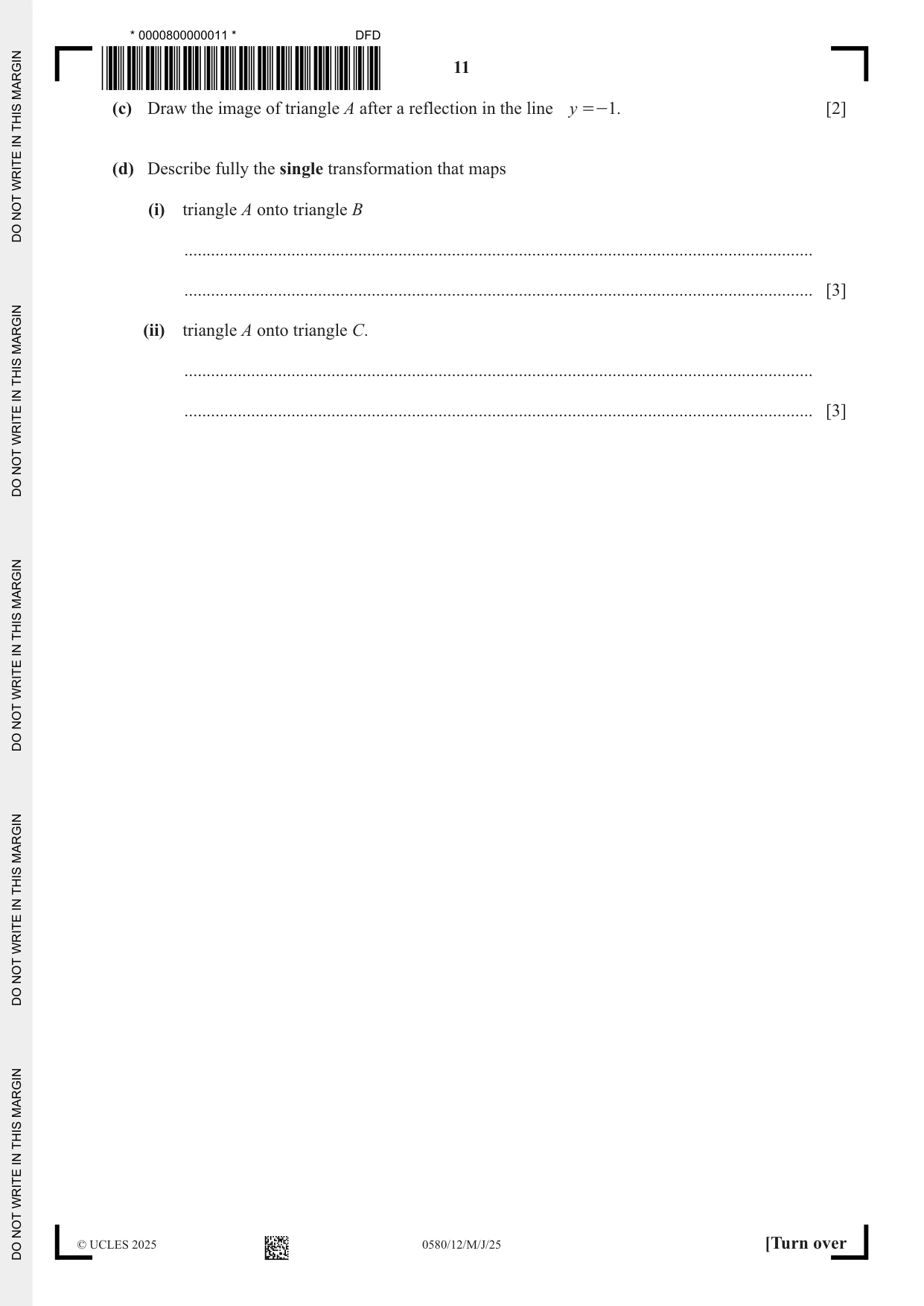
16 The diagram shows a point P and three triangles, A, B and C, on a 1 cm2 grid. y 7 6 5 4 C 3 B 2 1 A x - 4 -3 -2 -1 0 1 2 3 4 5 6 -1 -2 P -3 - 4 - 5 - 6 (a) Find the area of triangle B. .......................................... cm2 [1] (b) (i) Write down the coordinates of point P. ( ...................... , ...................... ) [1] - 20 (ii) Work out the coordinates of point P after a translation by the vector e o. 12 ( ...................... , ...................... ) [1] (c) Draw the image of triangle A after a reflection in the line y =-1. [2] (d) Describe fully the single transformation that maps (i) triangle A onto triangle B ............................................................................................................................................. ............................................................................................................................................. [3] (ii) triangle A onto triangle C. ............................................................................................................................................. ............................................................................................................................................. [3]
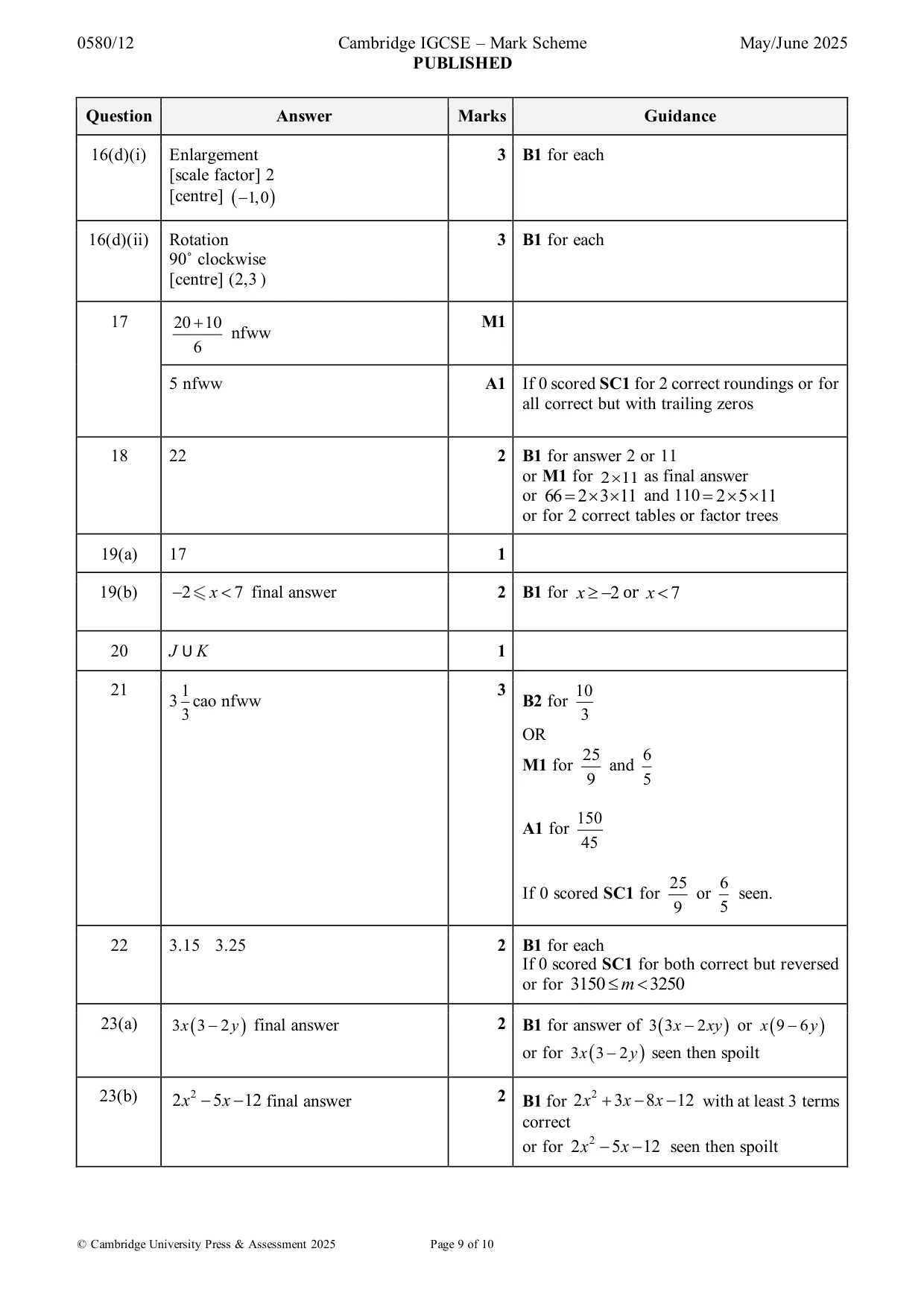
Mark scheme: 16(a) 6 1 16(b)(i) 4, –3 1 16(b)(ii) –16, 9 1 FT their (b)(i) 16(c) Triangle drawn with coordinates 2 B1 for reflection in y = k or in x = −1 (1, −2 ) , ( 2, −2 ) and ( 2, −5 ) 16(d)(i) Enlargement 3 B1 for each [scale factor] 2 [centre] ( −1,0 ) 16(d)(ii) Rotation 3 B1 for each 90˚ clockwise [centre] (2,3 )
Q17 · By writing each number in the calculation correct to 1 significant figure, find an…
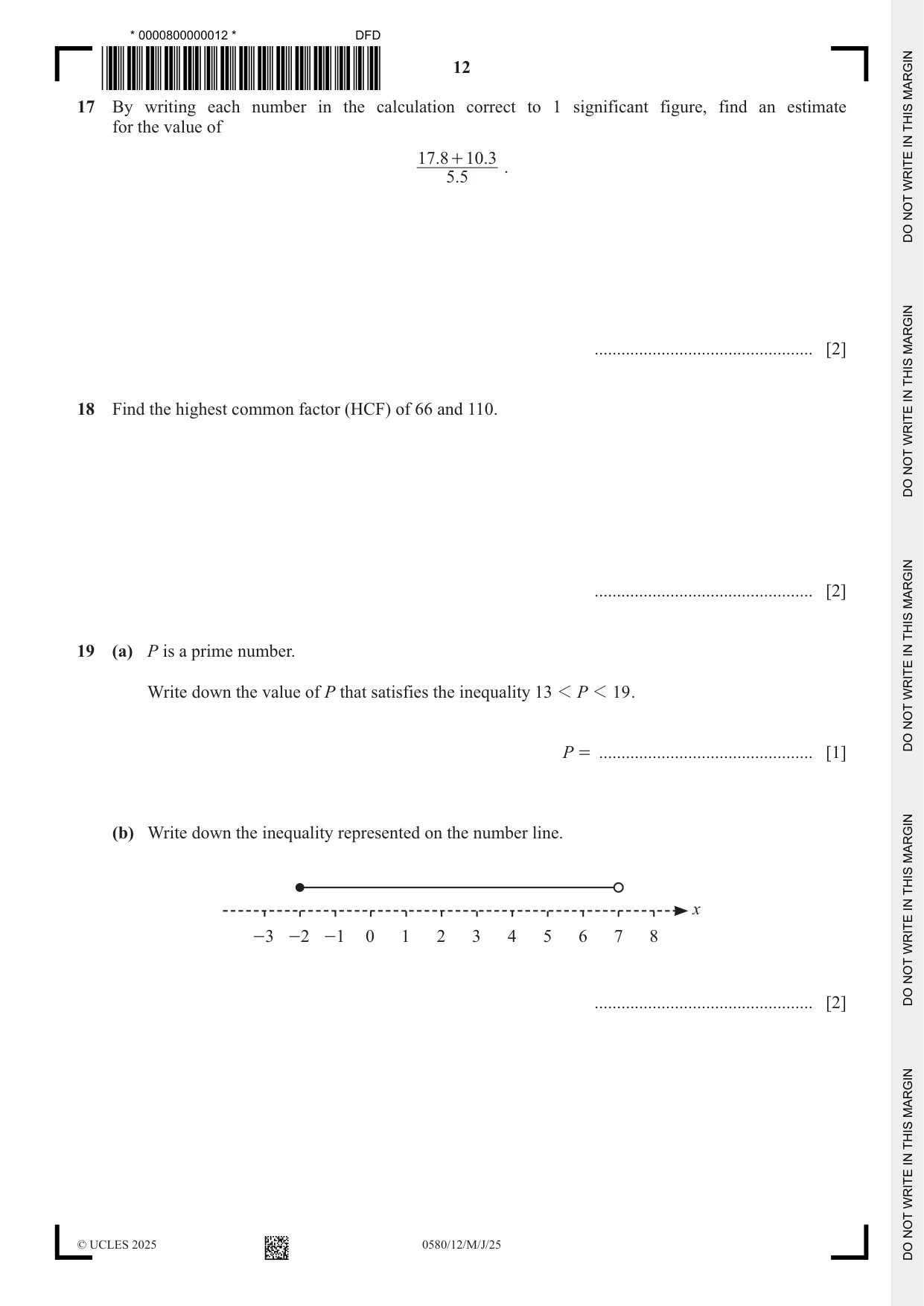
17 By writing each number in the calculation correct to 1 significant figure, find an estimate for the value of 17.8 + 10 .3 . 5 .5 ................................................. [2]
Mark scheme: 17 20 + 10 M1 nfww 6 5 nfww A1 If 0 scored SC1 for 2 correct roundings or for all correct but with trailing zeros
Q18 · Find the highest common factor (HCF) of 66 and 110
18 Find the highest common factor (HCF) of 66 and 110. ................................................. [2]
Mark scheme: 18 22 2 B1 for answer 2 or 11 or M1 for 2 11 as final answer or 66 = 2 3 11 and 110 = 2 5 11 or for 2 correct tables or factor trees
Q19 · P is a prime number
19 (a) P is a prime number. Write down the value of P that satisfies the inequality 13 1 P 1 19 . P = ................................................ [1] (b) Write down the inequality represented on the number line. x -3 -2 -1 0 1 2 3 4 5 6 7 8 ................................................. [2]
Mark scheme: 19(a) 17 1 19(b) −2 x 7 final answer 2 B1 for x −2 or x 7
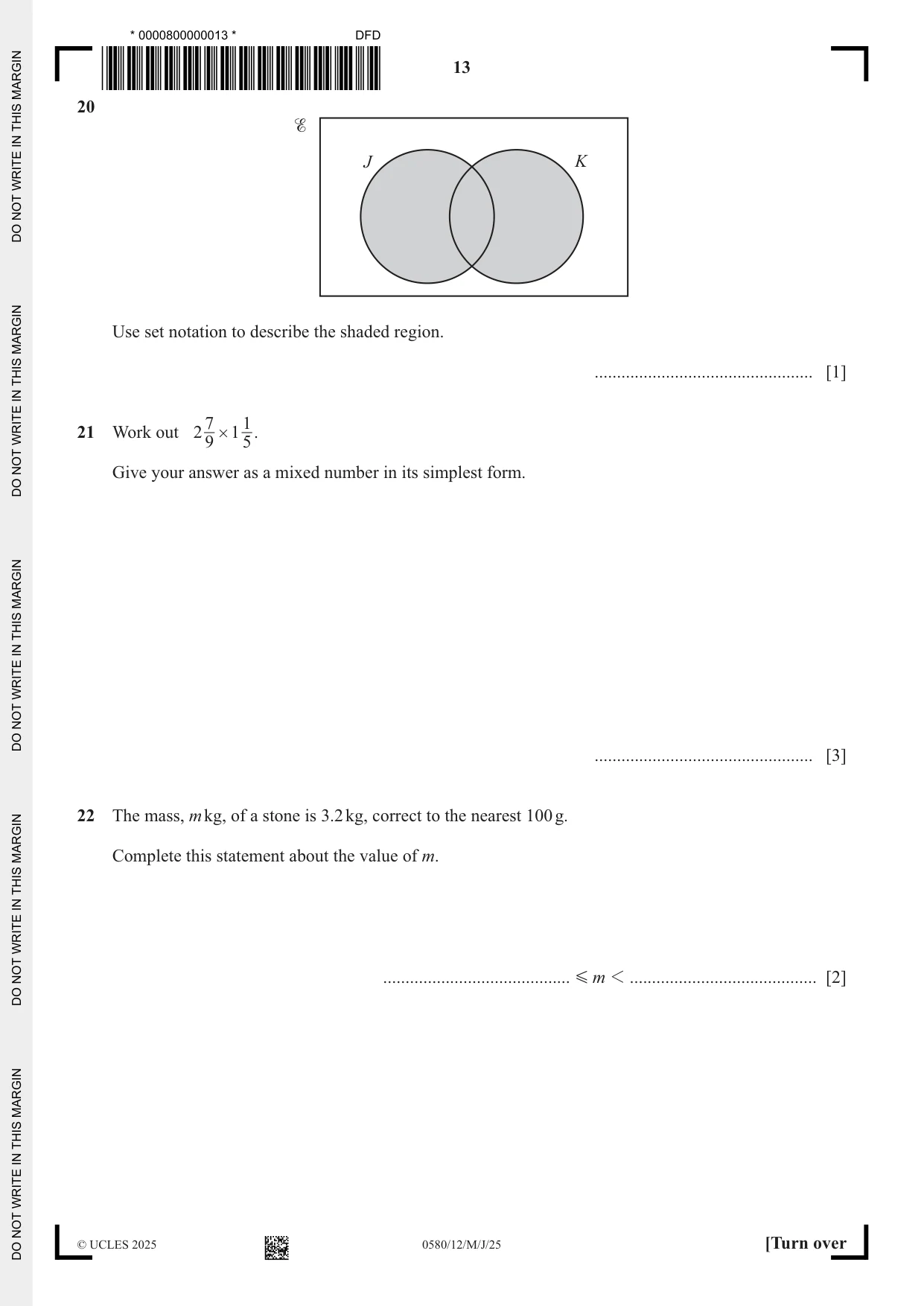
Q20 · % J K Use set notation to describe the shaded region
20 % J K Use set notation to describe the shaded region. ................................................. [1]
Mark scheme: 20 J U K 1
Q21 · 1 21 Work out 2 # 1
7 1 21 Work out 2 # 1 . 9 5 Give your answer as a mixed number in its simplest form. ................................................. [3]
Mark scheme: 21 1 3 10 3 cao nfww B2 for 3 3 OR 25 6 M1 for and 9 5 150 A1 for 45 25 6 If 0 scored SC1 for or seen. 9 5
Q22 · The mass, m kg, of a stone is 3.2 kg, correct to the nearest 100 g
22 The mass, m kg, of a stone is 3.2 kg, correct to the nearest 100 g. Complete this statement about the value of m. .......................................... G m 1 .......................................... [2]
Mark scheme: 22 3.15 3.25 2 B1 for each If 0 scored SC1 for both correct but reversed or for 3150 m 3250
Question 23
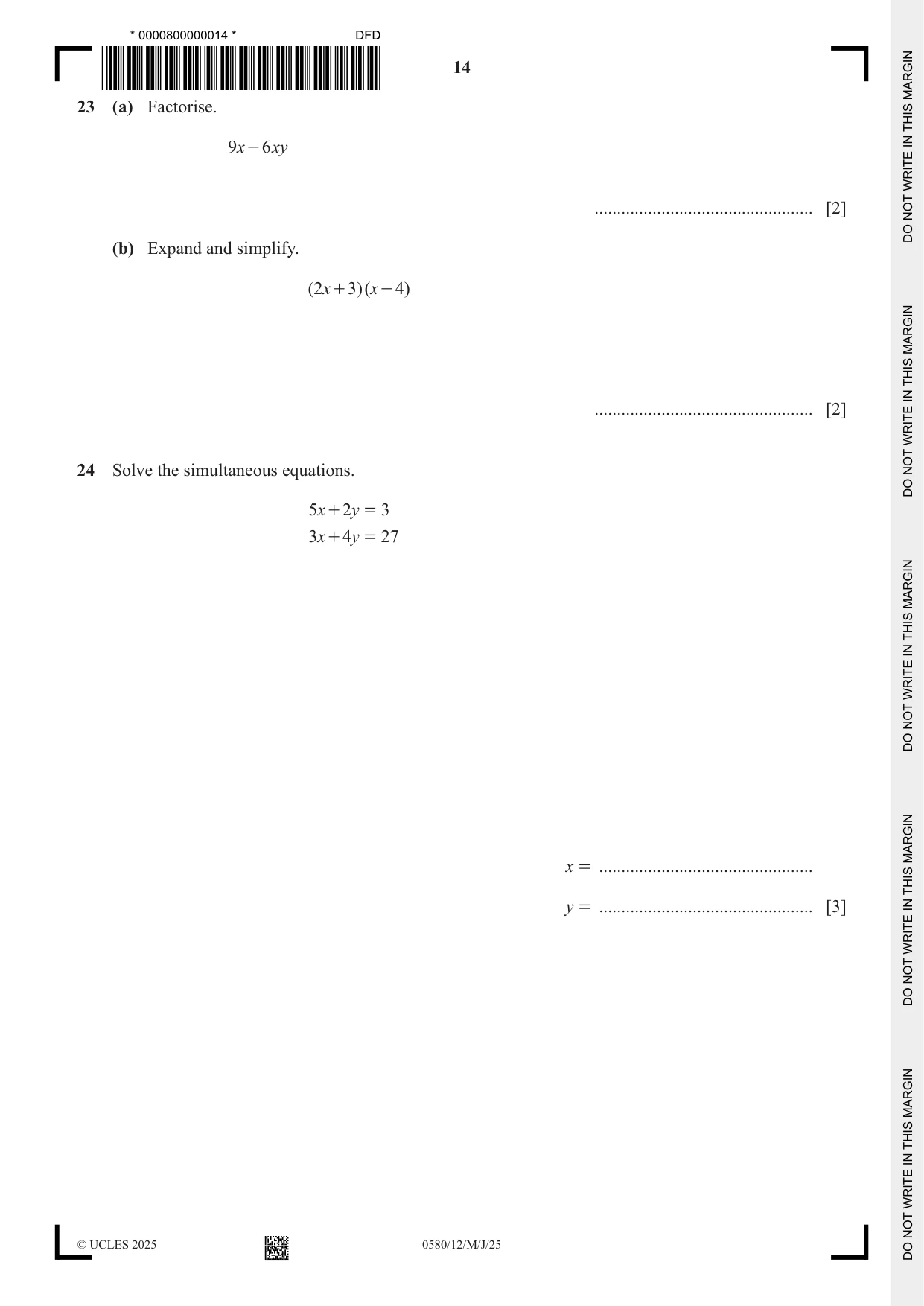
23 (a) Factorise. 9x - 6 xy ................................................. [2] (b) Expand and simplify. ( 2x + 3)( x - 4) ................................................. [2]
Mark scheme: 23(a) 3 x ( 3 − 2 y ) final answer 2 B1 for answer of 3 ( 3 x − 2 xy ) or x ( 9 − 6 y ) or for 3 x ( 3 − 2 y ) seen then spoilt 23(b) 2 x 2 − 5 x − 12 final answer 2 B1 for 2 x 2 + 3 x − 8 x − 12 with at least 3 terms correct or for 2 x 2 − 5 x − 12 seen then spoilt
Q24 · Solve the simultaneous equations
24 Solve the simultaneous equations. 5x + 2y = 3 3x + 4y = 27 x = ................................................ y = ................................................ [3]
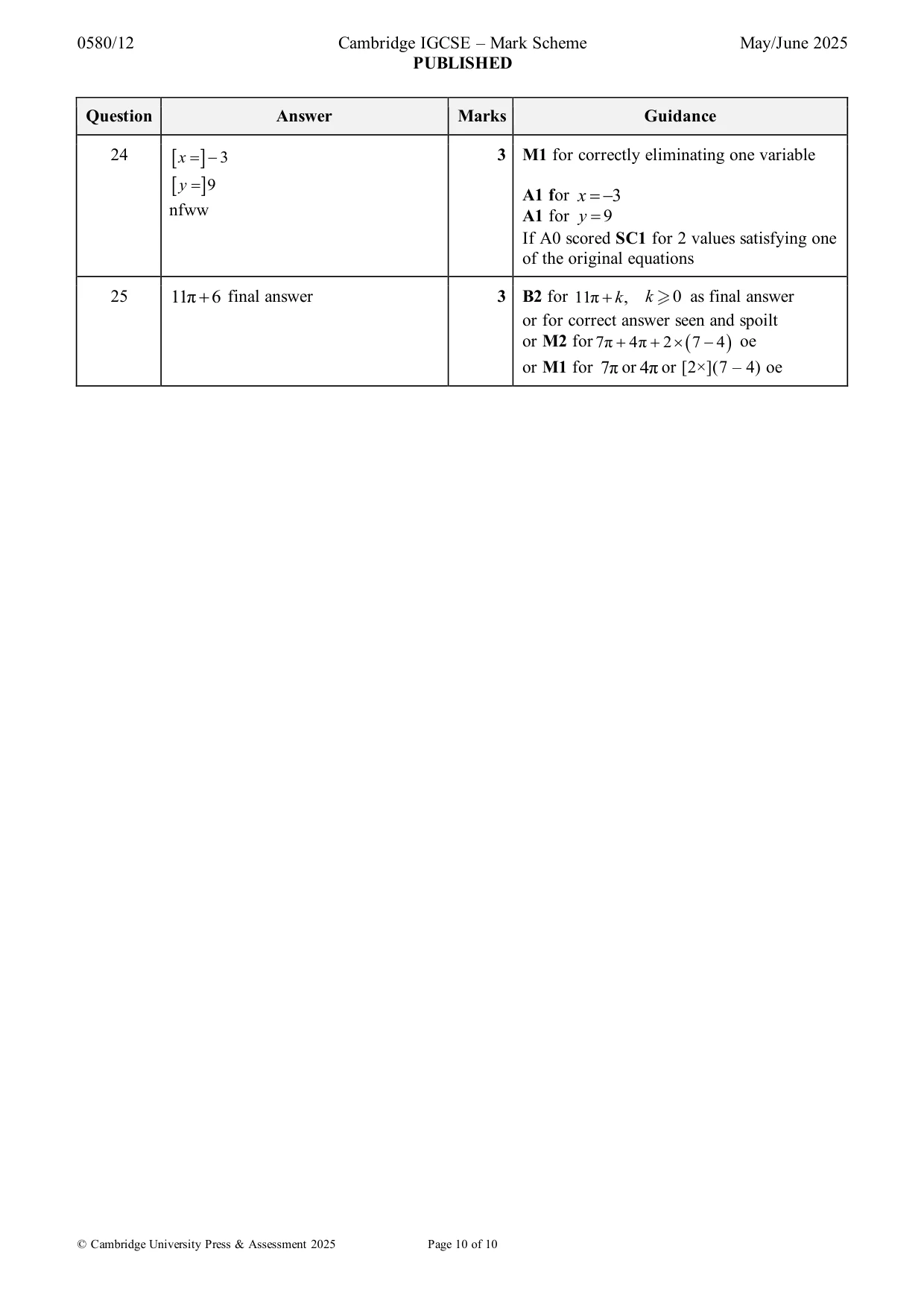
Mark scheme: 24 x = − 3 3 M1 for correctly eliminating one variable y = 9 A1 for x = −3 nfww A1 for y = 9 If A0 scored SC1 for 2 values satisfying one of the original equations
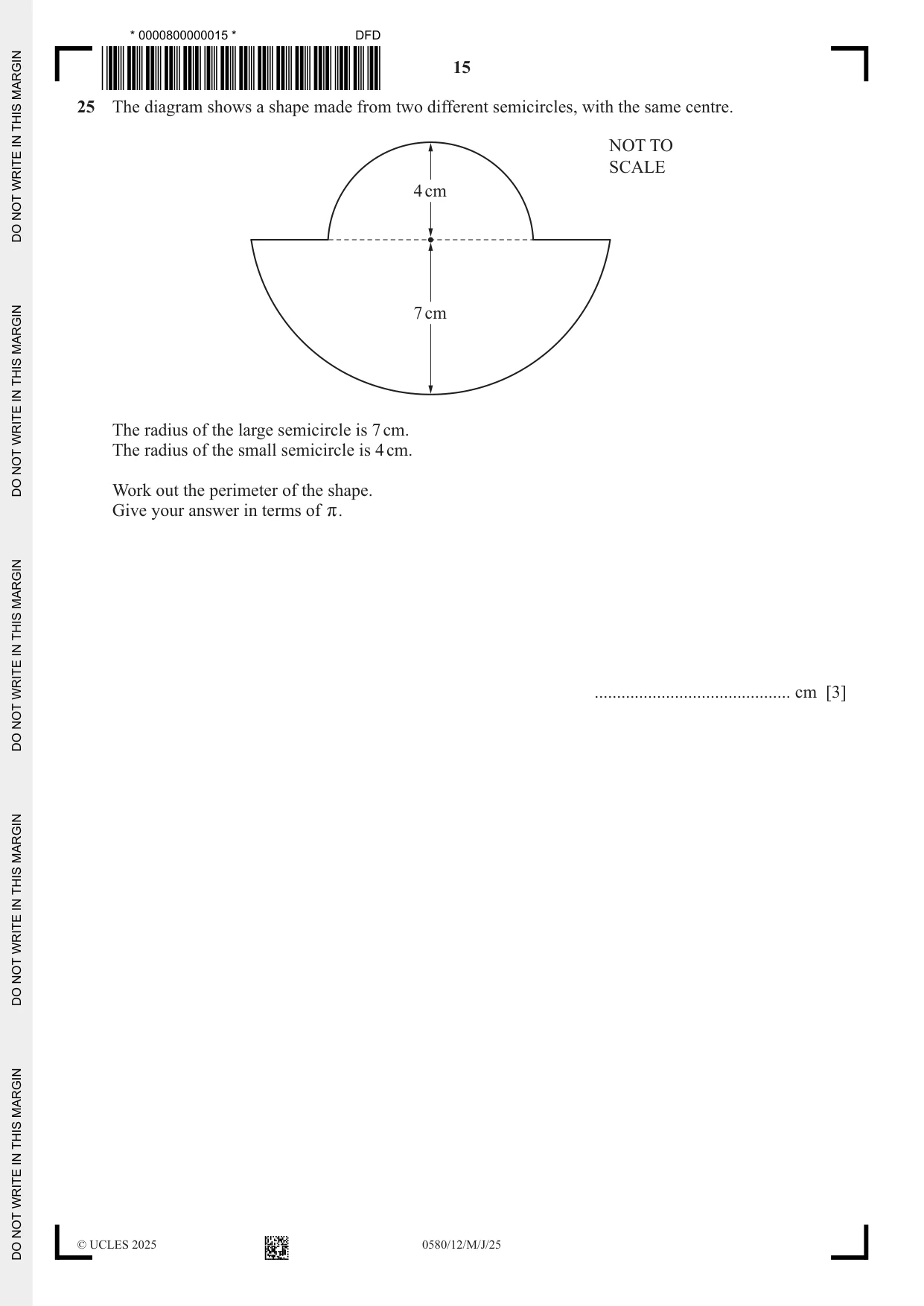
Q25 · The diagram shows a shape made from two different semicircles, with the same centre
25 The diagram shows a shape made from two different semicircles, with the same centre. NOT TO SCALE 4 cm 7 cm The radius of the large semicircle is 7 cm. The radius of the small semicircle is 4 cm. Work out the perimeter of the shape. Give your answer in terms of r. ............................................ cm [3]
Mark scheme: 25 11π + 6 final answer 3 B2 for 11π + ,k k 0 as final answer or for correct answer seen and spoilt or M2 for 7π + 4π + 2 ( 7 − 4 ) oe or M1 for 7π or 4π or [2×](7 – 4) oe
What was in this paper
The subtopics covered by these 24 questions, and how many questions each got. Open one in a new tab to see every Cambridge question on it.
3Types of number3Equations2Algebraic manipulation1Area and perimeter1Averages and range1Circles, arcs and sectors1Estimation1Geometrical terms1Graphs of functions1Inequalities1Limits of accuracy1Ordering1Powers and roots1Sets1The four operations1Time1Transformations1Units of measure1What you needed in this session
Cambridge’s own grade thresholds for 2025 May/June, Paper 1 · Variant 2. A higher threshold means an easier paper — the bar moves with how the cohort did.