Cambridge IGCSE Mathematics 0580 — 2009 Oct/Nov Paper 1 · Variant 2
0580/12/O/N/09 · 19 questions · 56 marks · ≈63 min
The question paper and its mark scheme, free to read here and free to download. This is Cambridge’s own paper, exactly as it was sat.
Question paper12 pages
Mark scheme4 pages
Answers below. Sit the paper first if you are practising.
Questions as text
Q1 · Insert one pair of brackets to make the following equation correct
1 Insert one pair of brackets to make the following equation correct. ForFor Examiner'sExaminer's 2 × 8 − 5 − 4 = 15 UseUse [1]
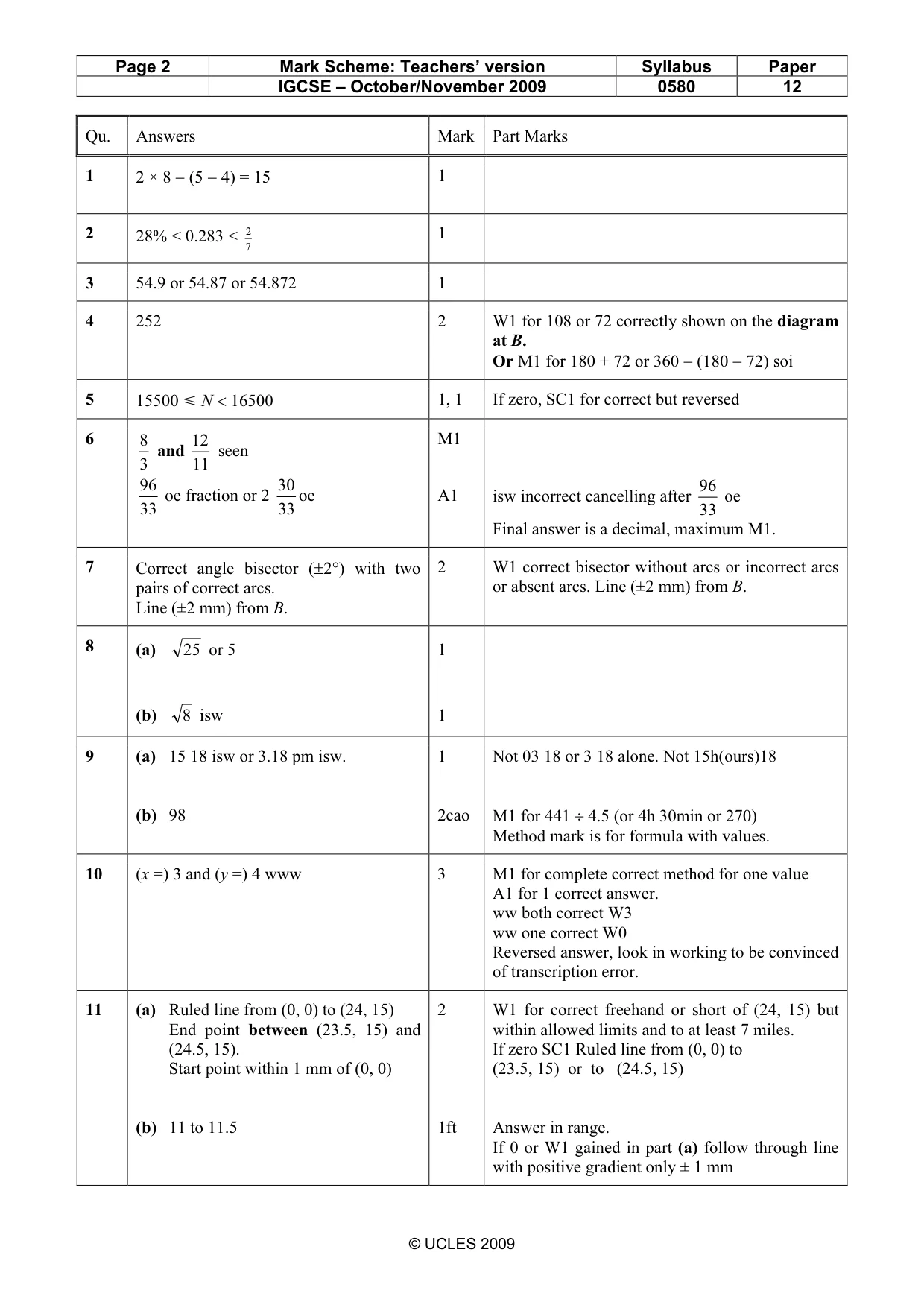
Mark scheme: Qu. Answers Mark Part Marks 1 2 × 8 − (5 − 4) = 15 1
Q2 · Write the following numbers in order starting with the smallest
2 Write the following numbers in order starting with the smallest. 2 0.283 28 % 7 Answer < < [1]
Mark scheme: 2 28% < 0.283 < 2 1 7
Q3 · Find the volume of a cube with sides of 3.8 cm
3 Find the volume of a cube with sides of 3.8 cm. Answer cm3 [1]
Mark scheme: 3 54.9 or 54.87 or 54.872 1
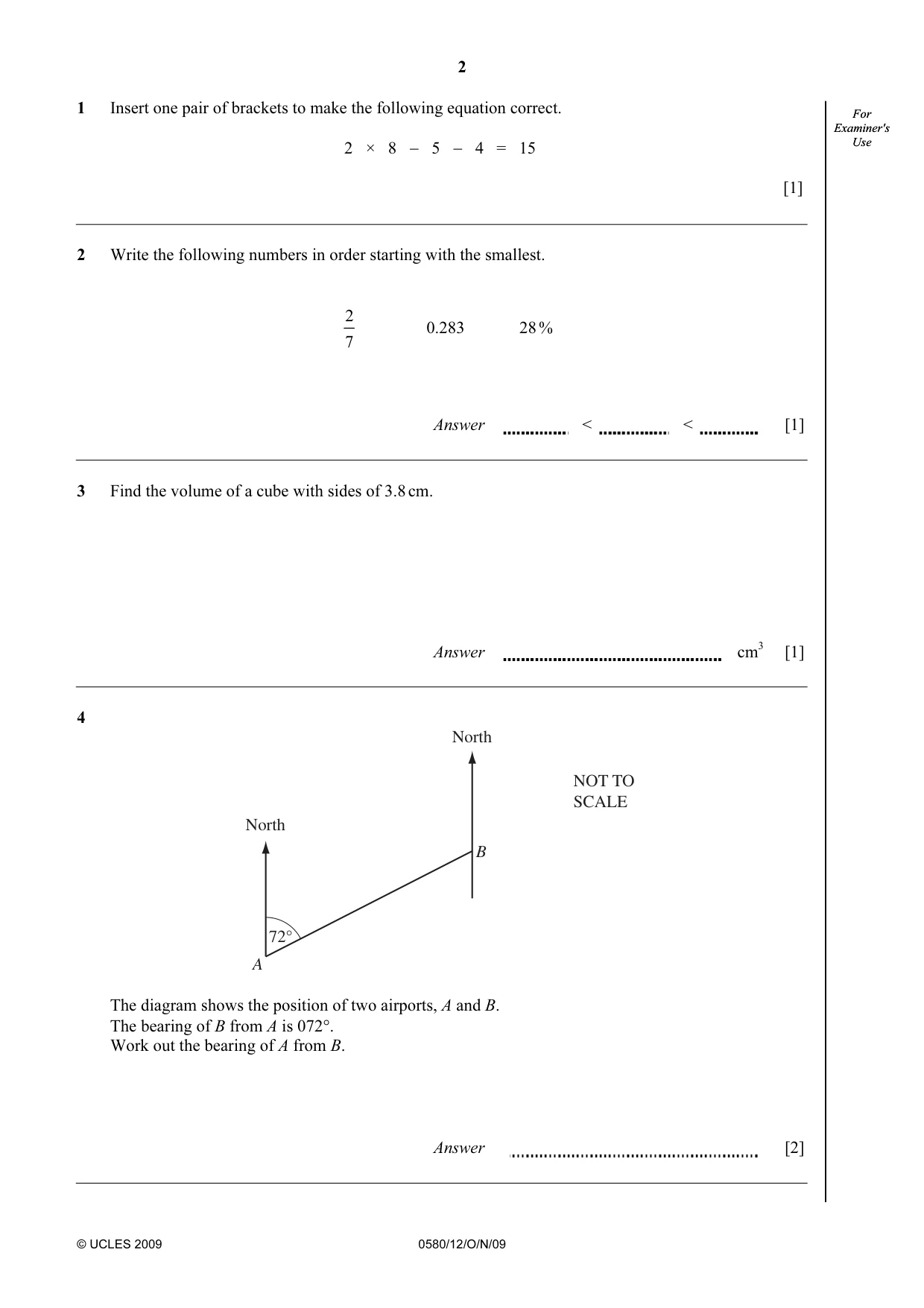
Q4 · North NOT TO SCALE North B 72° A The diagram shows the position of two airports, A and B
4 North NOT TO SCALE North B 72° A The diagram shows the position of two airports, A and B. The bearing of B from A is 072°. Work out the bearing of A from B. Answer [2]
Mark scheme: 4 252 2 W1 for 108 or 72 correctly shown on the diagram at B. Or M1 for 180 + 72 or 360 − (180 − 72) soi
Q5 · The number of spectators, N, at a football match is 16 000, correct to the nearest…
5 The number of spectators, N, at a football match is 16 000, correct to the nearest thousand. ForFor Complete the inequality for N in the answer space. Examiner'sExaminer's UseUse Answer Y N < [2]
Mark scheme: 5 15500 Y N < 16500 1, 1 If zero, SC1 for correct but reversed
Q6 · Work out the value of 2 2 ×1 1
6 Work out the value of 2 2 ×1 1 . 3 11 Show all your working and leave your answer as a fraction. Answer [2]
Mark scheme: 6 8 12 M1 and seen 3 11 96 30 96 oe fraction or 2 oe A1 isw incorrect cancelling after oe 33 33 33 Final answer is a decimal, maximum M1.
Q7 · A B C Using a straight edge and compasses only, construct the locus of points which are…
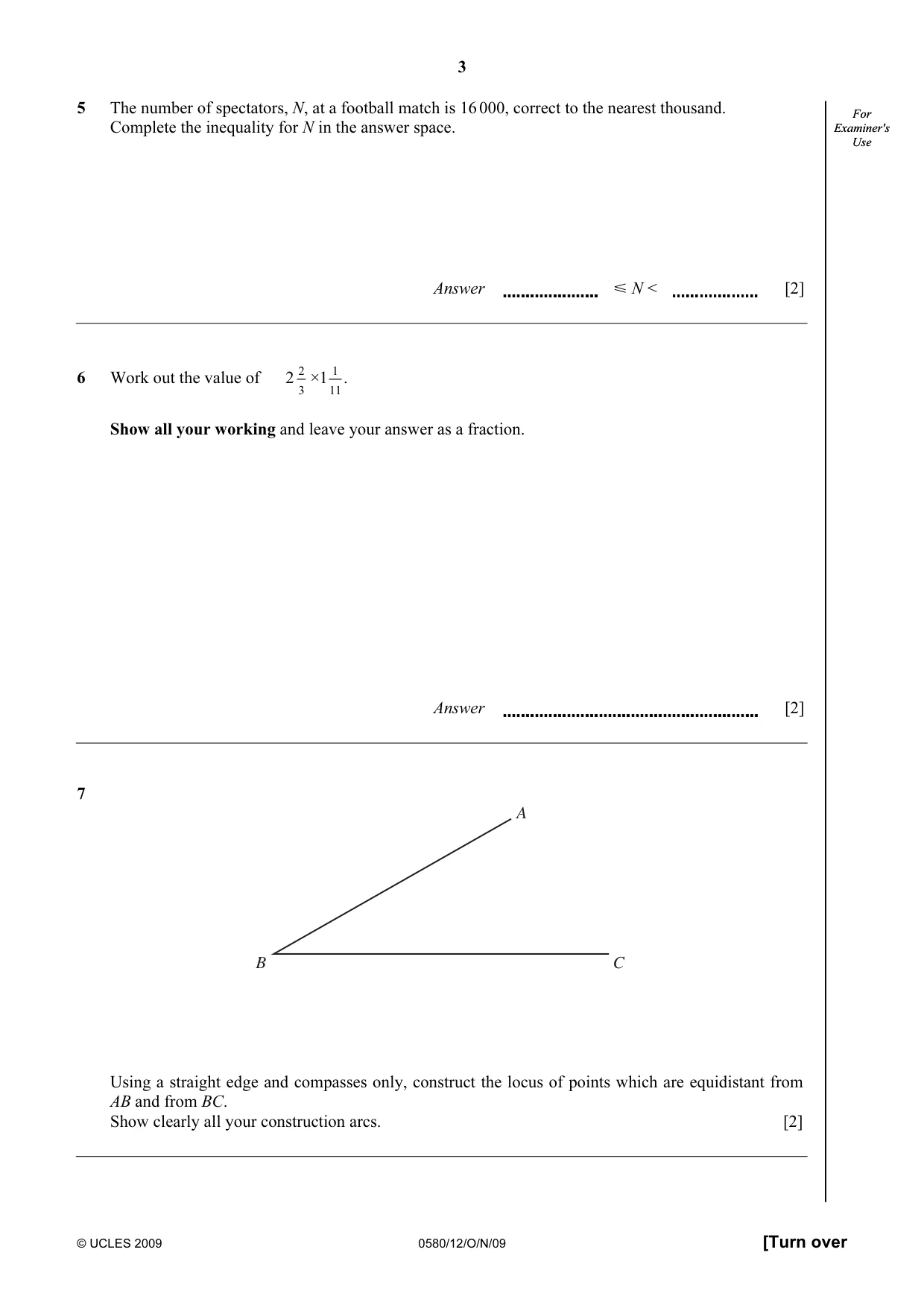
7 A B C Using a straight edge and compasses only, construct the locus of points which are equidistant from AB and from BC. Show clearly all your construction arcs. [2]
Mark scheme: 7 Correct angle bisector (±2°) with two 2 W1 correct bisector without arcs or incorrect arcs pairs of correct arcs. or absent arcs. Line (±2 mm) from B. Line (±2 mm) from B.
Q8 · For 8 4 8 25 0.3333 Examiner's 2 Use From the list above, write down (a) a prime number…
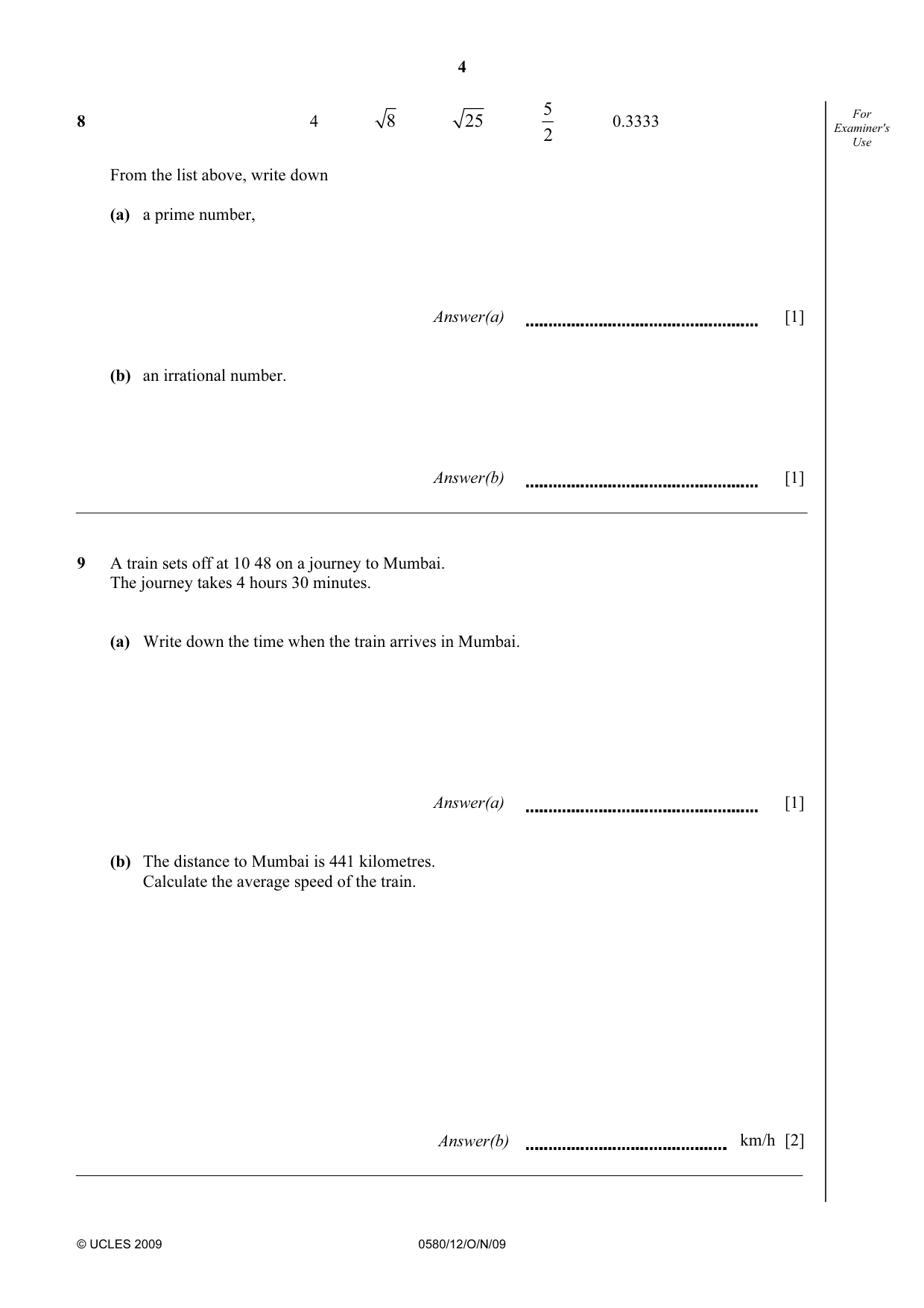
5 For 8 4 8 25 0.3333 Examiner's 2 Use From the list above, write down (a) a prime number, Answer(a) [1] (b) an irrational number. Answer(b) [1]
Mark scheme: 8 (a) 25 or 5 1 (b) 8 isw 1
Q9 · A train sets off at 10 48 on a journey to Mumbai
9 A train sets off at 10 48 on a journey to Mumbai. The journey takes 4 hours 30 minutes. (a) Write down the time when the train arrives in Mumbai. Answer(a) [1] (b) The distance to Mumbai is 441 kilometres. Calculate the average speed of the train. Answer(b) km/h [2]
Mark scheme: 9 (a) 15 18 isw or 3.18 pm isw. 1 Not 03 18 or 3 18 alone. Not 15h(ours)18 (b) 98 2cao M1 for 441 ÷ 4.5 (or 4h 30min or 270) Method mark is for formula with values.
Q10 · Solve the simultaneous equations ForFor Examiner'sExaminer's 5x − 3y = 3, UseUse 6x − y =…
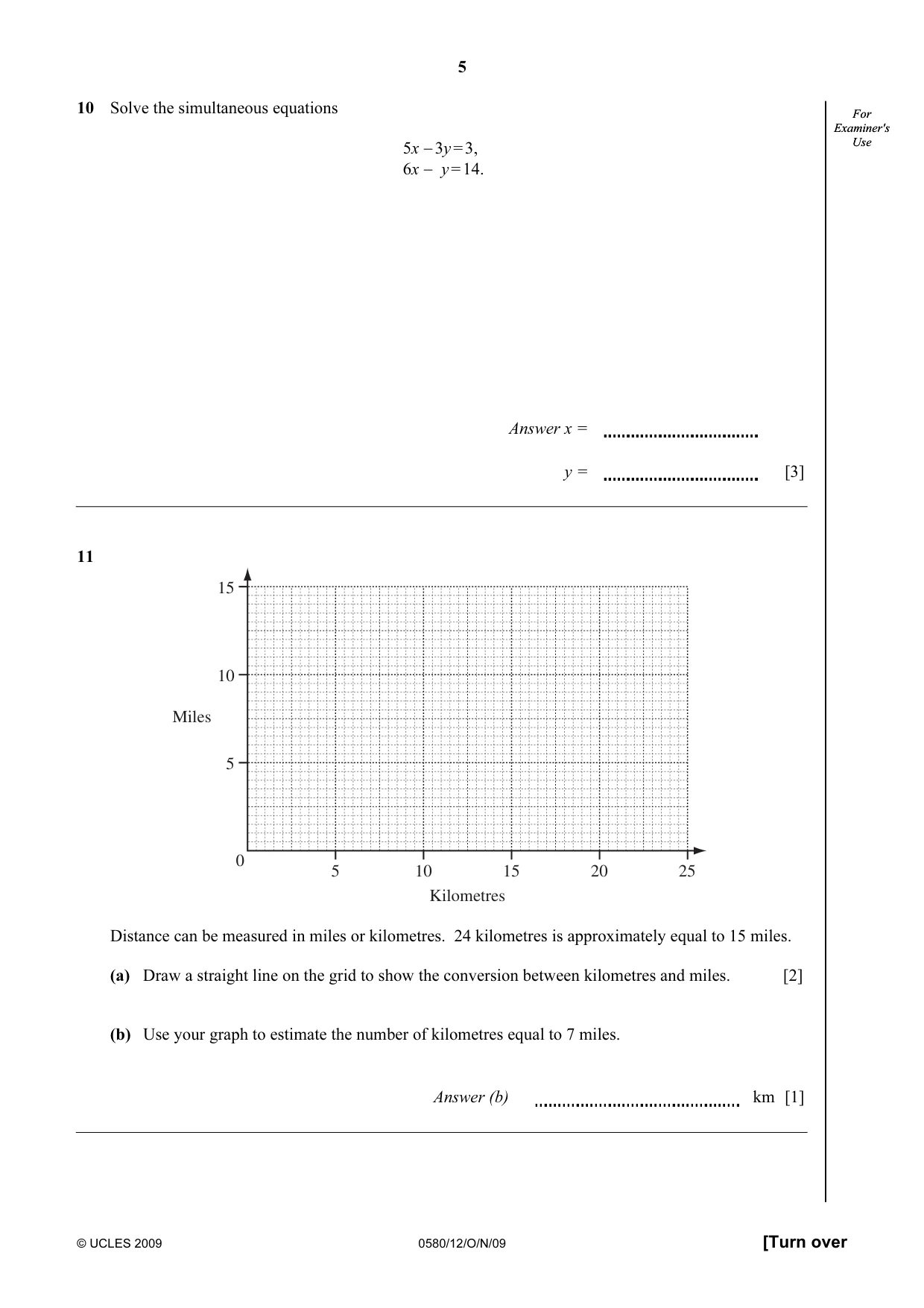
10 Solve the simultaneous equations ForFor Examiner'sExaminer's 5x − 3y = 3, UseUse 6x − y = 14. Answer x = y = [3]
Mark scheme: 10 (x =) 3 and (y =) 4 www 3 M1 for complete correct method for one value A1 for 1 correct answer. ww both correct W3 ww one correct W0 Reversed answer, look in working to be convinced of transcription error.
Q11 · 15 10 Miles 5 0 5 10 15 20 25 Kilometres Distance can be measured in miles or kilometres
11 15 10 Miles 5 0 5 10 15 20 25 Kilometres Distance can be measured in miles or kilometres. 24 kilometres is approximately equal to 15 miles. (a) Draw a straight line on the grid to show the conversion between kilometres and miles. [2] (b) Use your graph to estimate the number of kilometres equal to 7 miles. Answer (b) km [1]
Mark scheme: 11 (a) Ruled line from (0, 0) to (24, 15) 2 W1 for correct freehand or short of (24, 15) but End point between (23.5, 15) and within allowed limits and to at least 7 miles. (24.5, 15). If zero SC1 Ruled line from (0, 0) to Start point within 1 mm of (0, 0) (23.5, 15) or to (24.5, 15) (b) 11 to 11.5 1ft Answer in range. If 0 or W1 gained in part (a) follow through line with positive gradient only ± 1 mm IGCSE – October/November 2009 0580 12
Q12 · For Examiner's Use NOT TO SCALE 4 cm 7 cm The diagram shows a triangular prism of length…
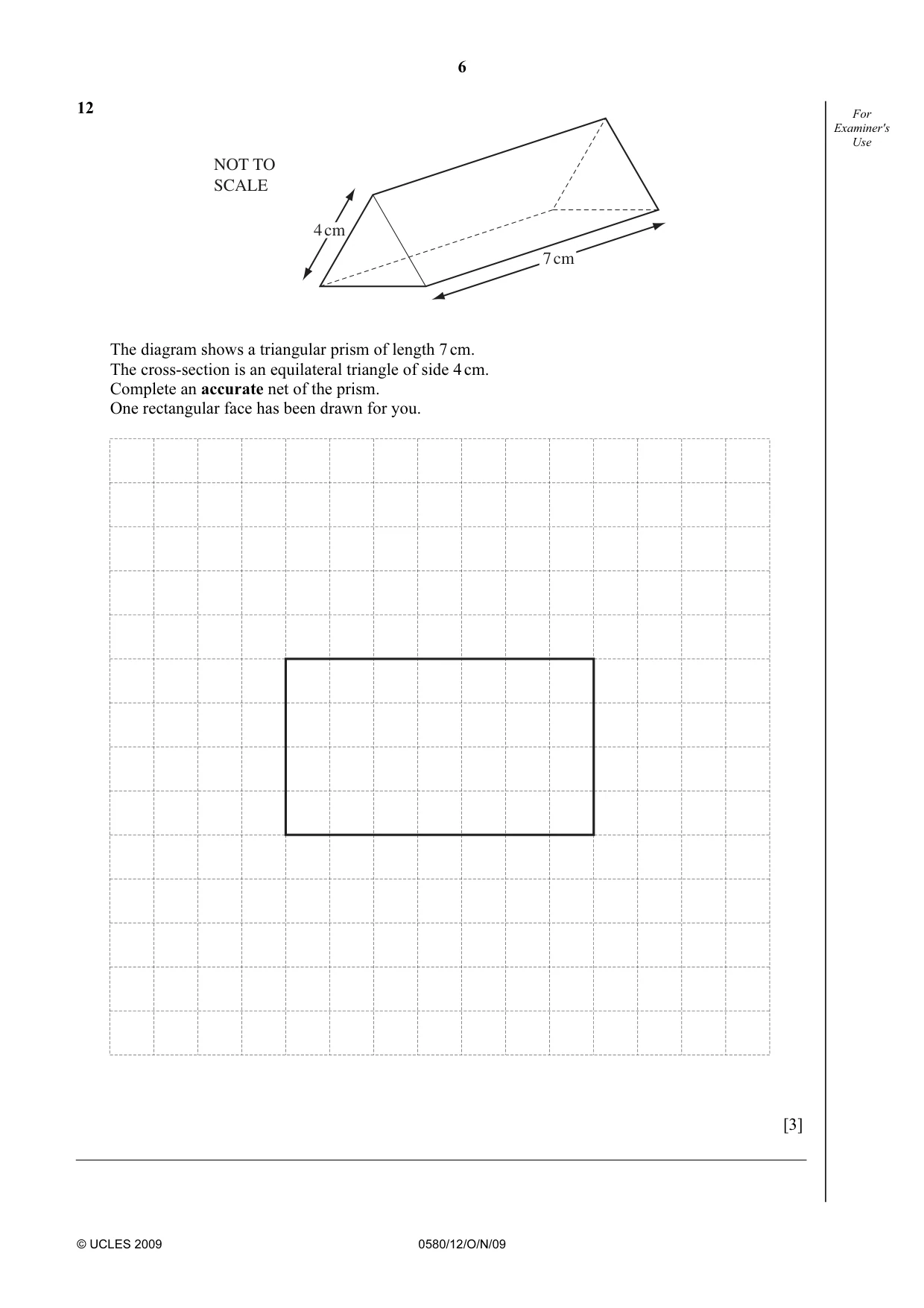
12 For Examiner's Use NOT TO SCALE 4 cm 7 cm The diagram shows a triangular prism of length 7 cm. The cross-section is an equilateral triangle of side 4 cm. Complete an accurate net of the prism. One rectangular face has been drawn for you. [3]
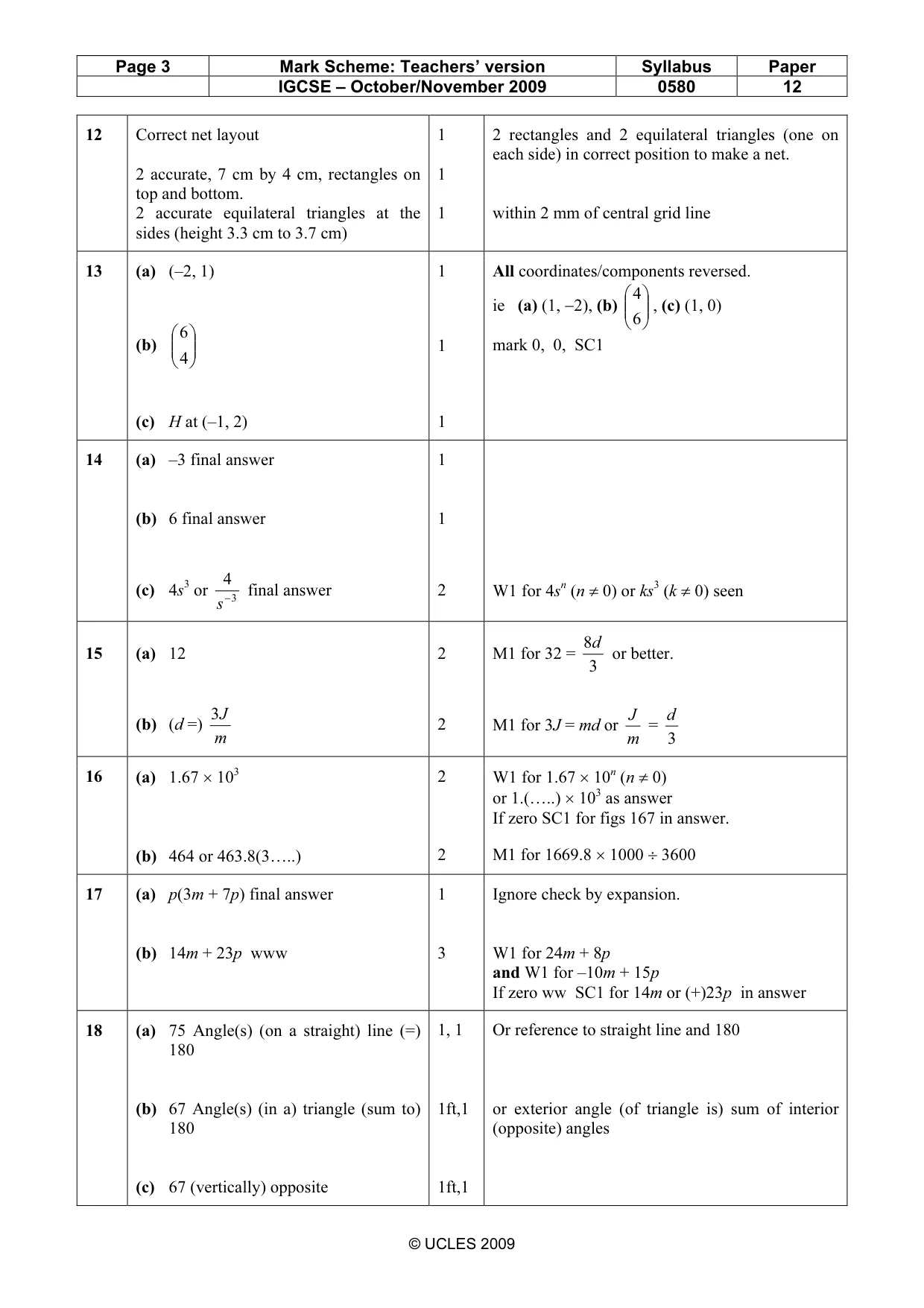
Mark scheme: 12 Correct net layout 1 2 rectangles and 2 equilateral triangles (one on each side) in correct position to make a net. 2 accurate, 7 cm by 4 cm, rectangles on 1 top and bottom. 2 accurate equilateral triangles at the 1 within 2 mm of central grid line sides (height 3.3 cm to 3.7 cm)
Q13 · ForFor y Examiner'sExaminer's G UseUse 5 4 3 2 F 1 x –3 –2 –1 0 1 2 3 4 5 –1 –2 –3 –4 The…
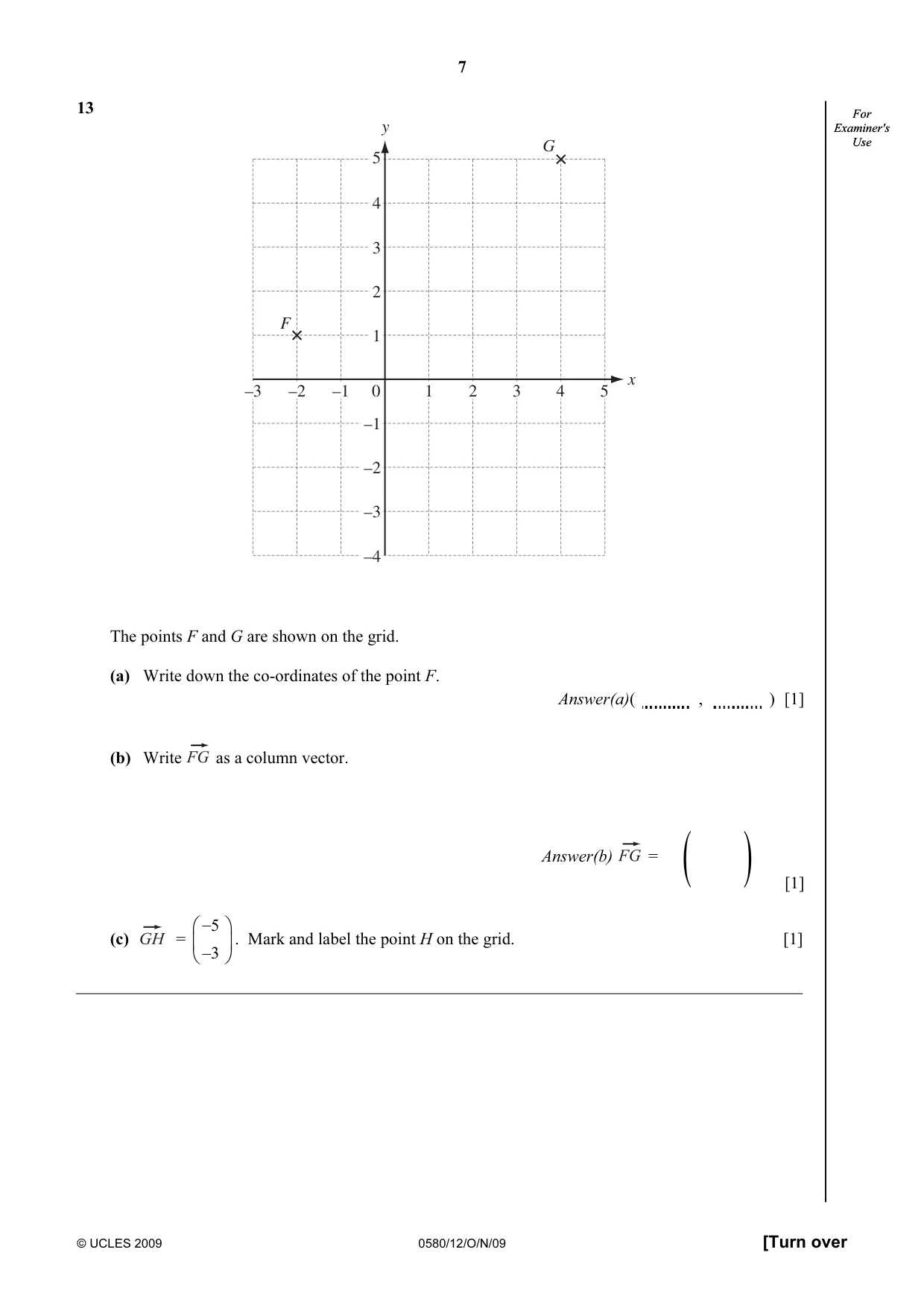
13 ForFor y Examiner'sExaminer's G UseUse 5 4 3 2 F 1 x –3 –2 –1 0 1 2 3 4 5 –1 –2 –3 –4 The points F and G are shown on the grid. (a) Write down the co-ordinates of the point F. Answer(a)( , ) [1] (b) Write as a column vector. Answer(b) = ( ) [1] _5 (c) = . Mark and label the point H on the grid. [1] _3
Mark scheme: 13 (a) (–2, 1) 1 All coordinates/components reversed. 4 ie (a) (1, −2), (b) , (c) (1, 0) 6 6 (b) 1 mark 0, 0, SC1 4 (c) H at (–1, 2) 1
Q14 · Find the value of p when p3 = −27
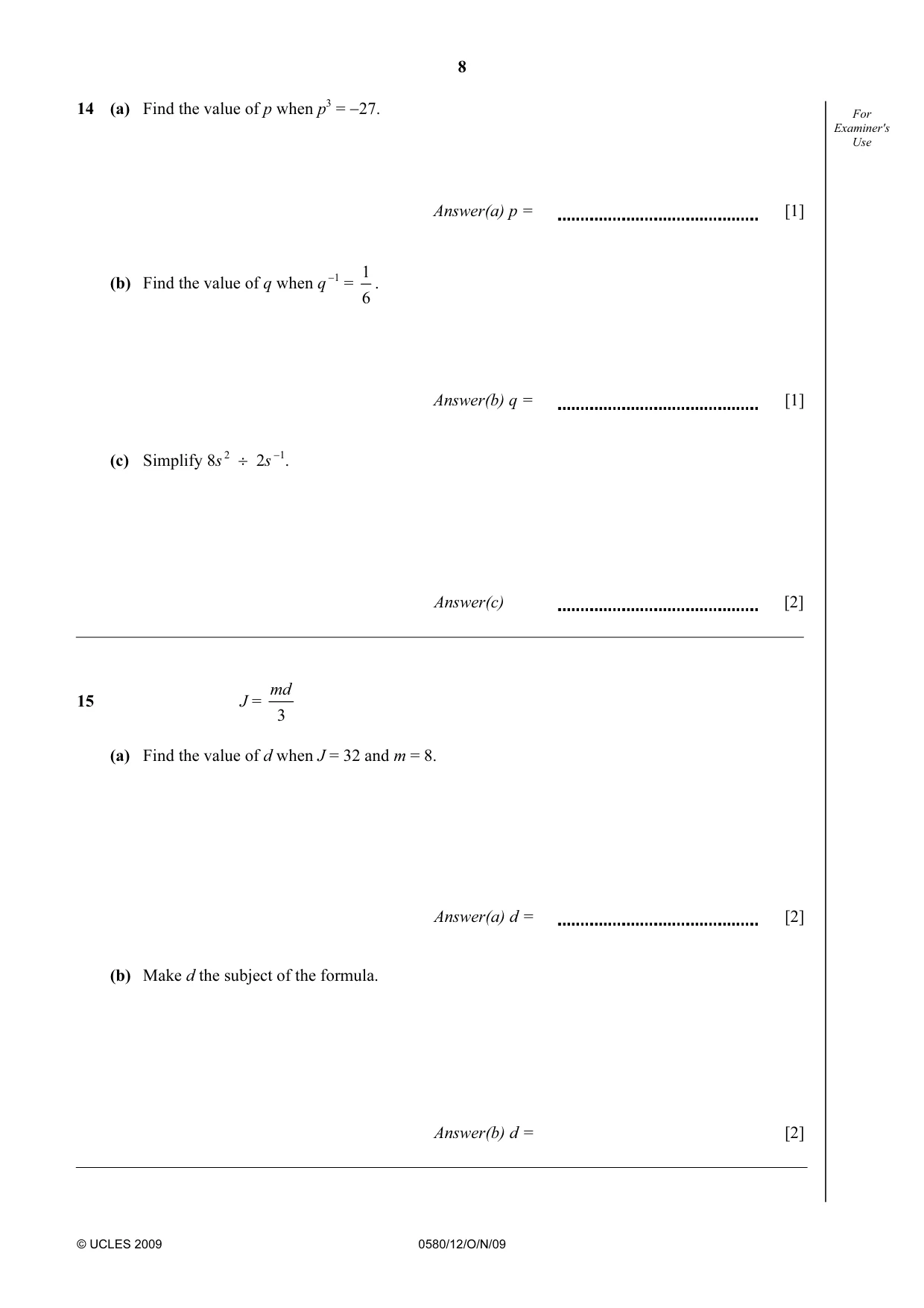
14 (a) Find the value of p when p3 = −27. For Examiner's Use Answer(a) p = [1] −1 1 (b) Find the value of q when q = . 6 Answer(b) q = [1] (c) Simplify 8s 2 ÷ 2s −1. Answer(c) [2]
Mark scheme: 14 (a) –3 final answer 1 (b) 6 final answer 1 4 (c) 4s3 or − 3 final answer 2 W1 for 4sn (n ≠ 0) or ks3 (k ≠ 0) seen s 8d
Q15 · Md 15 J = 3 (a) Find the value of d when J = 32 and m = 8
md 15 J = 3 (a) Find the value of d when J = 32 and m = 8. Answer(a) d = [2] (b) Make d the subject of the formula. Answer(b) d = [2]
Mark scheme: 8d 15 (a) 12 2 M1 for 32 = or better. 3 3 J J d (b) (d =) 2 M1 for 3J = md or = m m 3 3
Q16 · As the earth rotates, a point on the equator moves round at a speed of 1669.8…
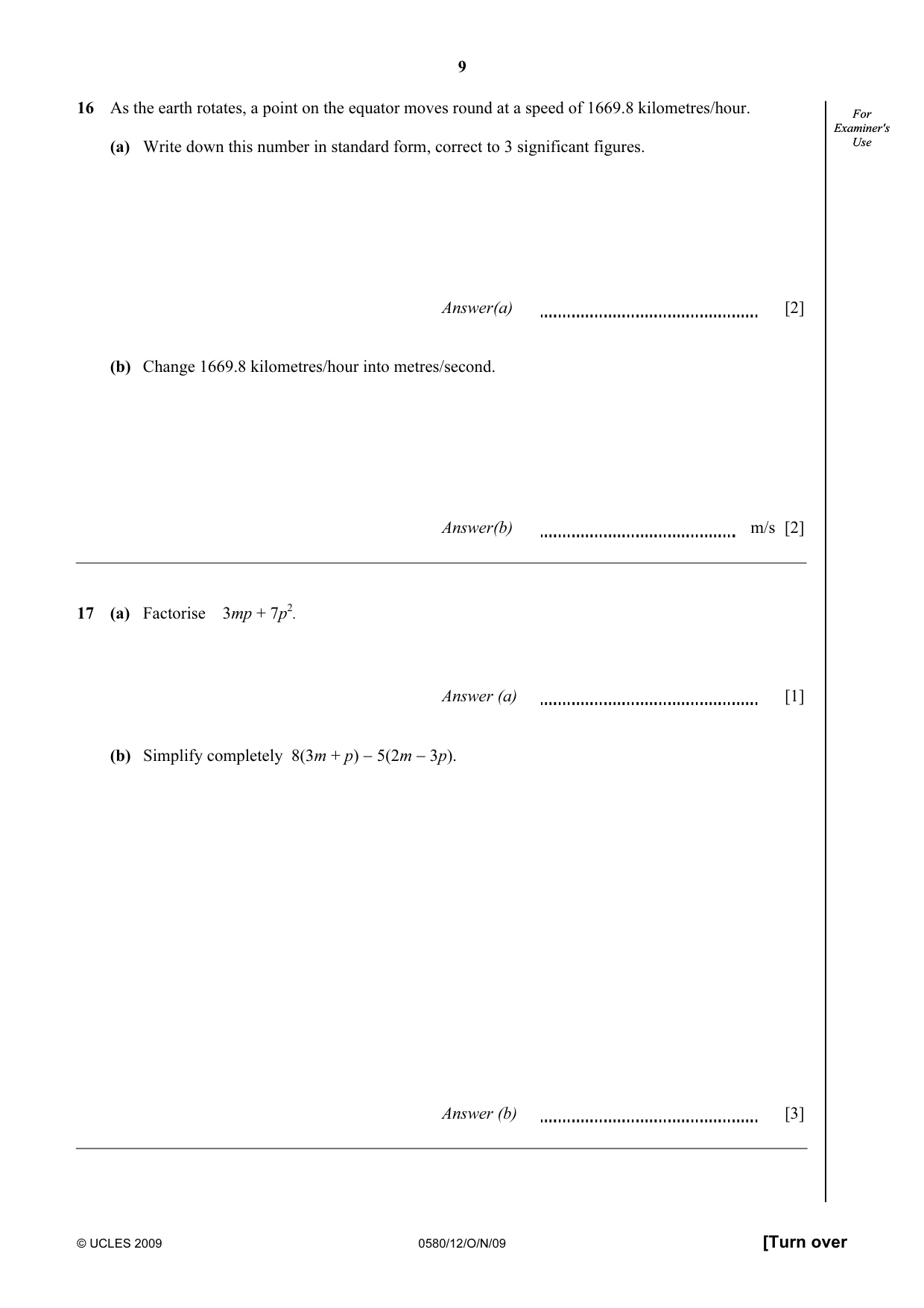
16 As the earth rotates, a point on the equator moves round at a speed of 1669.8 kilometres/hour. ForFor Examiner'sExaminer's (a) Write down this number in standard form, correct to 3 significant figures. UseUse Answer(a) [2] (b) Change 1669.8 kilometres/hour into metres/second. Answer(b) m/s [2]
Mark scheme: 16 (a) 1.67 × 10³ 2 W1 for 1.67 × 10n (n ≠ 0) or 1.(…..) × 103 as answer If zero SC1 for figs 167 in answer. (b) 464 or 463.8(3…..) 2 M1 for 1669.8 × 1000 ÷ 3600
Q17 · Factorise 3mp + 7p2
17 (a) Factorise 3mp + 7p2. Answer (a) [1] (b) Simplify completely 8(3m + p) − 5(2m − 3p). Answer (b) [3]
Mark scheme: 17 (a) p(3m + 7p) final answer 1 Ignore check by expansion. (b) 14m + 23p www 3 W1 for 24m + 8p and W1 for –10m + 15p If zero ww SC1 for 14m or (+)23p in answer
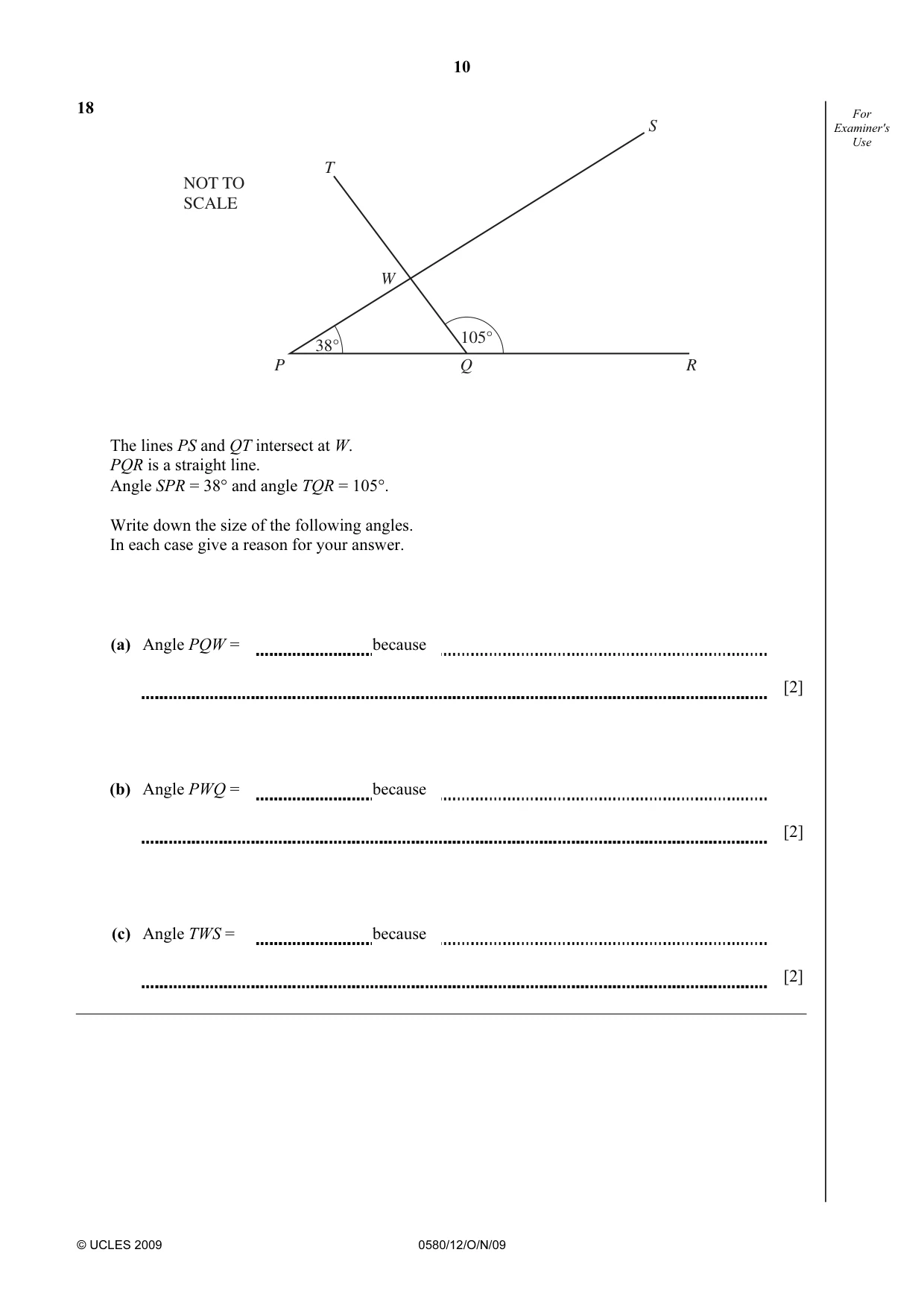
Q18 · For S Examiner's Use T NOT TO SCALE W 105° 38° P Q R The lines PS and QT intersect at W
18 For S Examiner's Use T NOT TO SCALE W 105° 38° P Q R The lines PS and QT intersect at W. PQR is a straight line. Angle SPR = 38° and angle TQR = 105°. Write down the size of the following angles. In each case give a reason for your answer. (a) Angle PQW = because [2] (b) Angle PWQ = because [2] (c) Angle TWS = because [2]
Mark scheme: 18 (a) 75 Angle(s) (on a straight) line (=) 1, 1 Or reference to straight line and 180 180 (b) 67 Angle(s) (in a) triangle (sum to) 1ft,1 or exterior angle (of triangle is) sum of interior 180 (opposite) angles (c) 67 (vertically) opposite 1ft,1 IGCSE – October/November 2009 0580 12
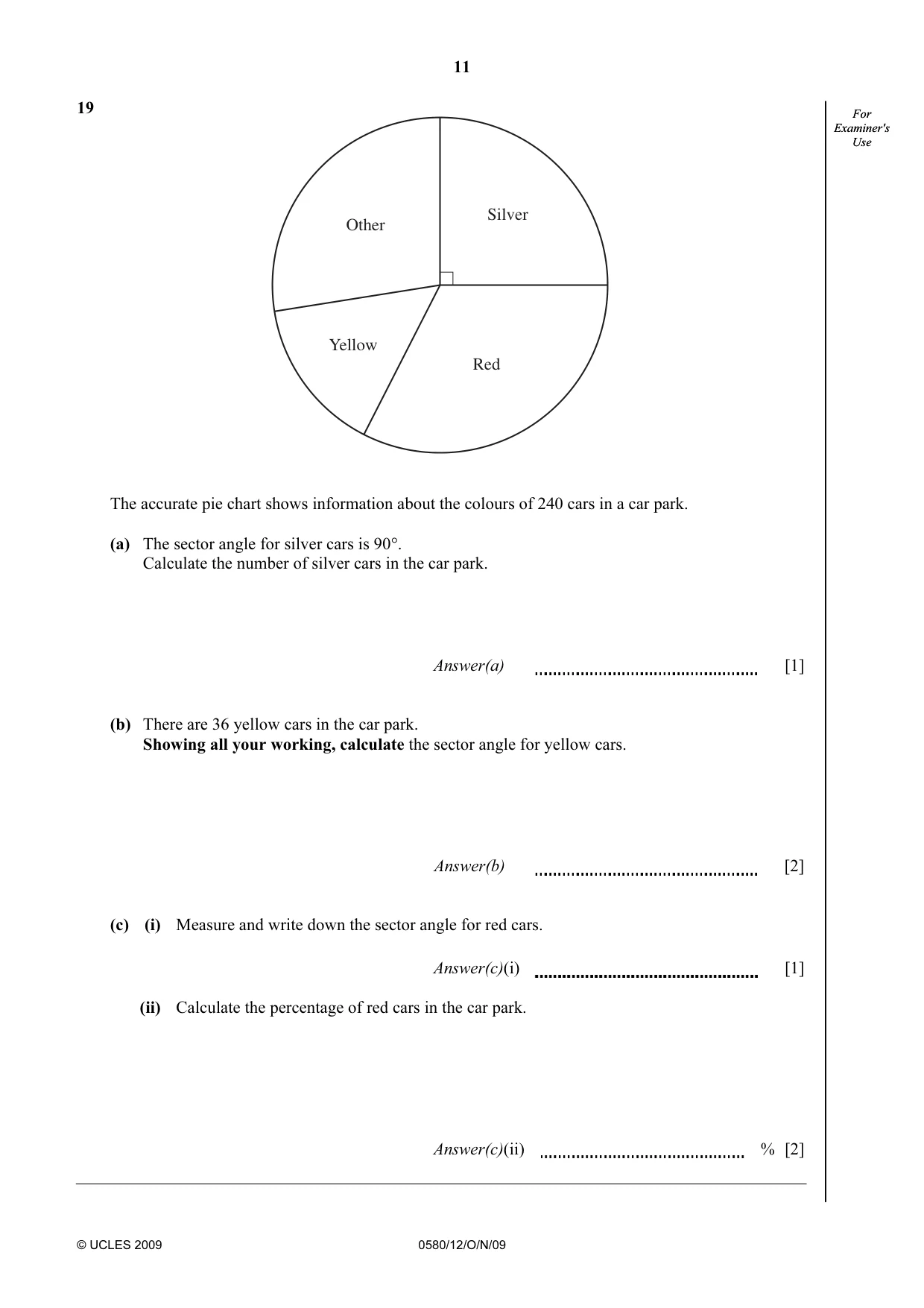
Q19 · ForFor Examiner'sExaminer's UseUse Silver Other Yellow Red The accurate pie chart shows…
19 ForFor Examiner'sExaminer's UseUse Silver Other Yellow Red The accurate pie chart shows information about the colours of 240 cars in a car park. (a) The sector angle for silver cars is 90°. Calculate the number of silver cars in the car park. Answer(a) [1] (b) There are 36 yellow cars in the car park. Showing all your working, calculate the sector angle for yellow cars. Answer(b) [2] (c) (i) Measure and write down the sector angle for red cars. Answer(c)(i) [1] (ii) Calculate the percentage of red cars in the car park. Answer(c)(ii) % [2]
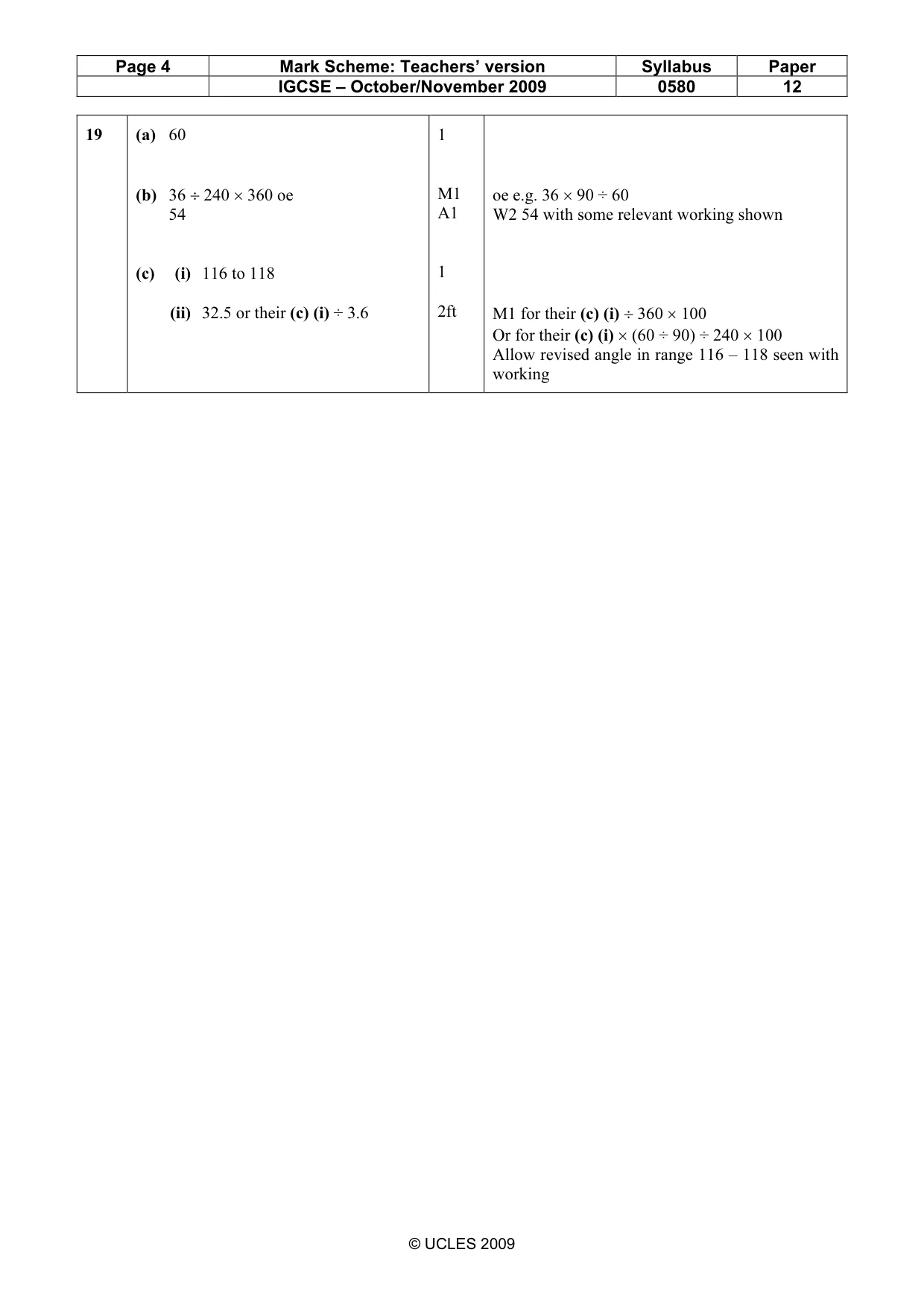
Mark scheme: 19 (a) 60 1 (b) 36 ÷ 240 × 360 oe M1 oe e.g. 36 × 90 ÷ 60 54 A1 W2 54 with some relevant working shown (c) (i) 116 to 118 1 (ii) 32.5 or their (c) (i) ÷ 3.6 2ft M1 for their (c) (i) ÷ 360 × 100 Or for their (c) (i) × (60 ÷ 90) ÷ 240 × 100 Allow revised angle in range 116 – 118 seen with working
What was in this paper
The subtopics covered by these 19 questions, and how many questions each got. Open one in a new tab to see every Cambridge question on it.
What you needed in this session
Cambridge’s own grade thresholds for 2009 Oct/Nov, Paper 1 · Variant 2. A higher threshold means an easier paper — the bar moves with how the cohort did.