Questions as text
Q1 · Which statement about the halogens is correct? 0971/11 May/June 2018
20 Which statement about the halogens is correct? A A sample of bromine reacts with potassium chloride solution. B A sample of bromine reacts with potassium iodide solution. C A sample of chlorine has a higher density than a sample of bromine. D A sample of chlorine is a darker colour than a sample of bromine.
1 marks
Answer: B
This question in 0971/11 May/June 2018
Q2 · Which statement about elements in Group I and Group VII of the Periodic Table is correct? 0971/11 May/June 2019
21 Which statement about elements in Group I and Group VII of the Periodic Table is correct? A Bromine reacts with potassium chloride to produce chlorine. B Iodine is a monoatomic non-metal. C Lithium has a higher melting point than potassium. D Sodium is more reactive with water than potassium.
1 marks
Answer: C
This question in 0971/11 May/June 2019
Q3 · Which pair of elements reacts together most violently? 0971/12 Oct/Nov 2019
21 Which pair of elements reacts together most violently? A chlorine and lithium B chlorine and potassium C iodine and lithium D iodine and potassium
1 marks
Answer: B
This question in 0971/12 Oct/Nov 2019
Q4 · Two tests are carried out on substance Z 0971/11 May/June 2020
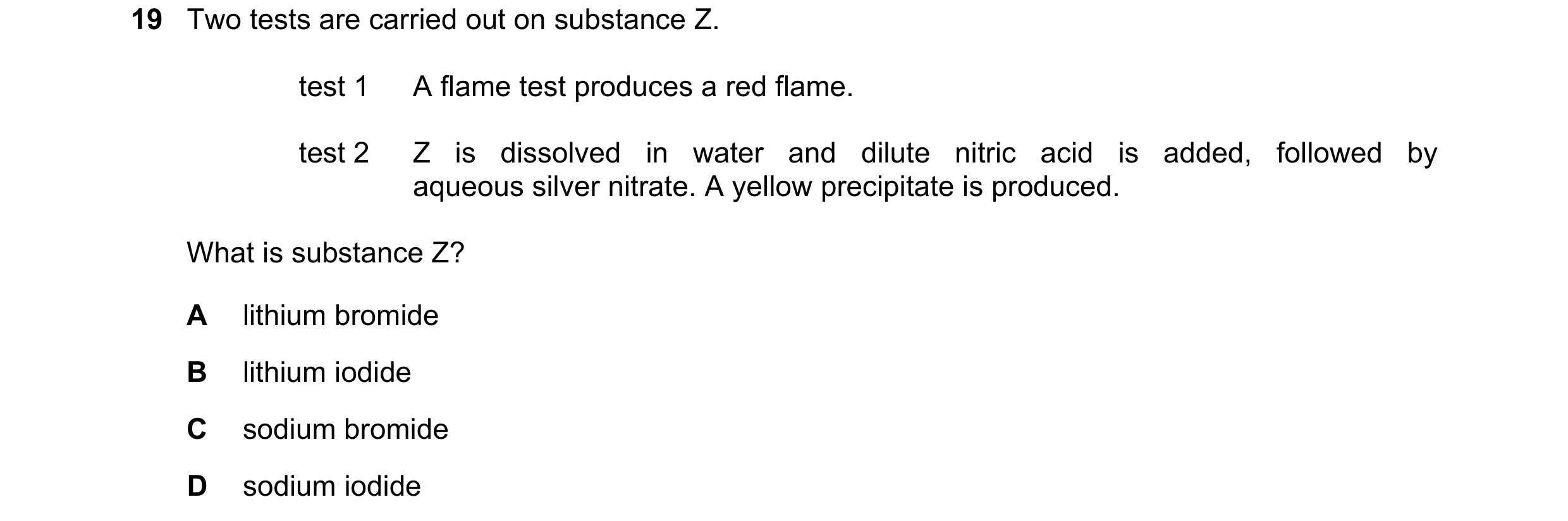
19 Two tests are carried out on substance Z. test 1 A flame test produces a red flame. test 2 Z is dissolved in water and dilute nitric acid is added, followed by aqueous silver nitrate. A yellow precipitate is produced. What is substance Z? A lithium bromide B lithium iodide C sodium bromide D sodium iodide
1 marks
Answer: B
This question in 0971/11 May/June 2020
Q5 · A Group I metal (lithium, sodium or potassium) is reacted with a Group VII element… 0971/11 May/June 2020
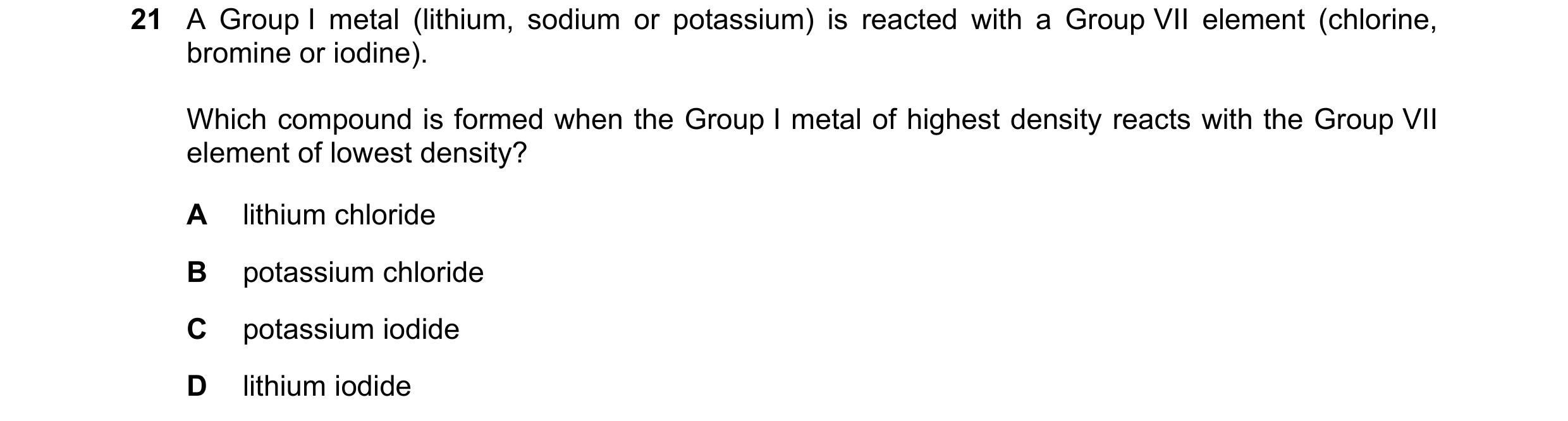
21 A Group I metal (lithium, sodium or potassium) is reacted with a Group VII element (chlorine, bromine or iodine). Which compound is formed when the Group I metal of highest density reacts with the Group VII element of lowest density? A lithium chloride B potassium chloride C potassium iodide D lithium iodide
1 marks
Answer: B
This question in 0971/11 May/June 2020
Q6 · Which statement about Group I and Group VII elements is correct? 0971/12 May/June 2020
21 Which statement about Group I and Group VII elements is correct? A Group VII elements are monoatomic non-metals. B Lithium is more reactive with water than caesium. C The melting points of Group I metals increase down the group. D Potassium bromide reacts with chlorine to produce an orange solution.
1 marks
Answer: D
This question in 0971/12 May/June 2020
Q7 · The formula of which compound contains the largest number of Group VII atoms? 0971/12 Oct/Nov 2020
11 The formula of which compound contains the largest number of Group VII atoms? A C13H13IO8 B Cl 2O6 C Al (BrO3)3 D NaFC2H2O2
1 marks
Answer: C
This question in 0971/12 Oct/Nov 2020
Q8 · Tennessine, Ts, is a newly discovered element 0971/12 Oct/Nov 2020
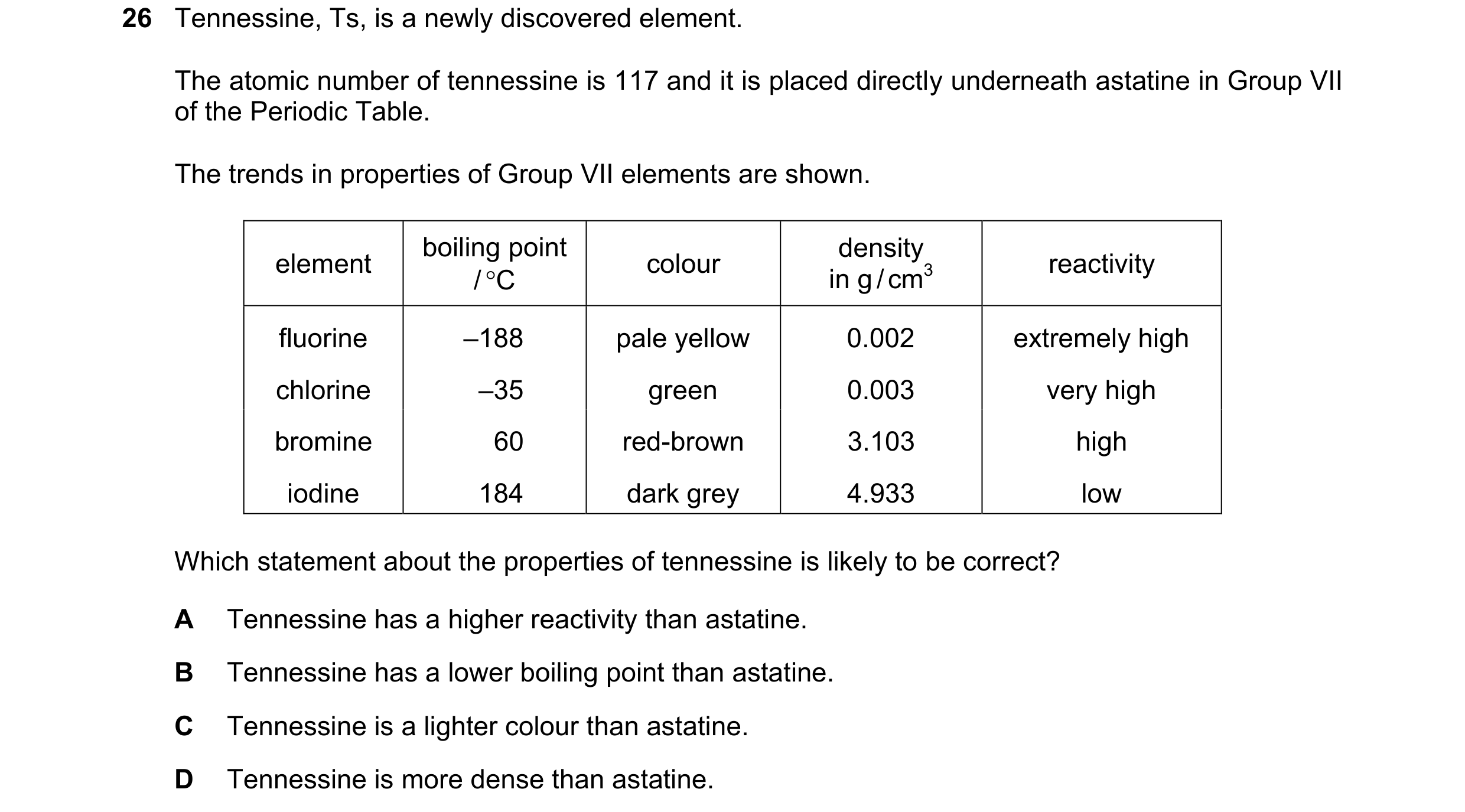
26 Tennessine, Ts, is a newly discovered element. The atomic number of tennessine is 117 and it is placed directly underneath astatine in Group VII of the Periodic Table. The trends in properties of Group VII elements are shown. boiling point density element colour in g / cm3 reactivity / C fluorine –188 pale yellow 0.002 extremely high chlorine –35 green 0.003 very high bromine 60 red-brown 3.103 high iodine 184 dark grey 4.933 low Which statement about the properties of tennessine is likely to be correct? A Tennessine has a higher reactivity than astatine. B Tennessine has a lower boiling point than astatine. C Tennessine is a lighter colour than astatine. D Tennessine is more dense than astatine.
1 marks
Answer: D
This question in 0971/12 Oct/Nov 2020
Q9 · Which statement about the elements in Group VII of the Periodic Table is correct? 0971/12 Oct/Nov 2021
22 Which statement about the elements in Group VII of the Periodic Table is correct? A Chlorine can displace bromine from bromides. B Group VII elements are all solids at room temperature. C Group VII elements occur as monoatomic covalent molecules. D Reactivity increases down Group VII.
1 marks
Answer: A
This question in 0971/12 Oct/Nov 2021
Q10 · Lithium, sodium and potassium are elements in Group I of the Periodic Table 0971/12 May/June 2022
24 Lithium, sodium and potassium are elements in Group I of the Periodic Table. Chlorine, bromine and iodine are elements in Group VII of the Periodic Table. Which row identifies the least dense of these elements in each group? Group I Group VII A lithium chlorine B lithium iodine C potassium chlorine D potassium iodine
1 marks
Answer: A
This question in 0971/12 May/June 2022
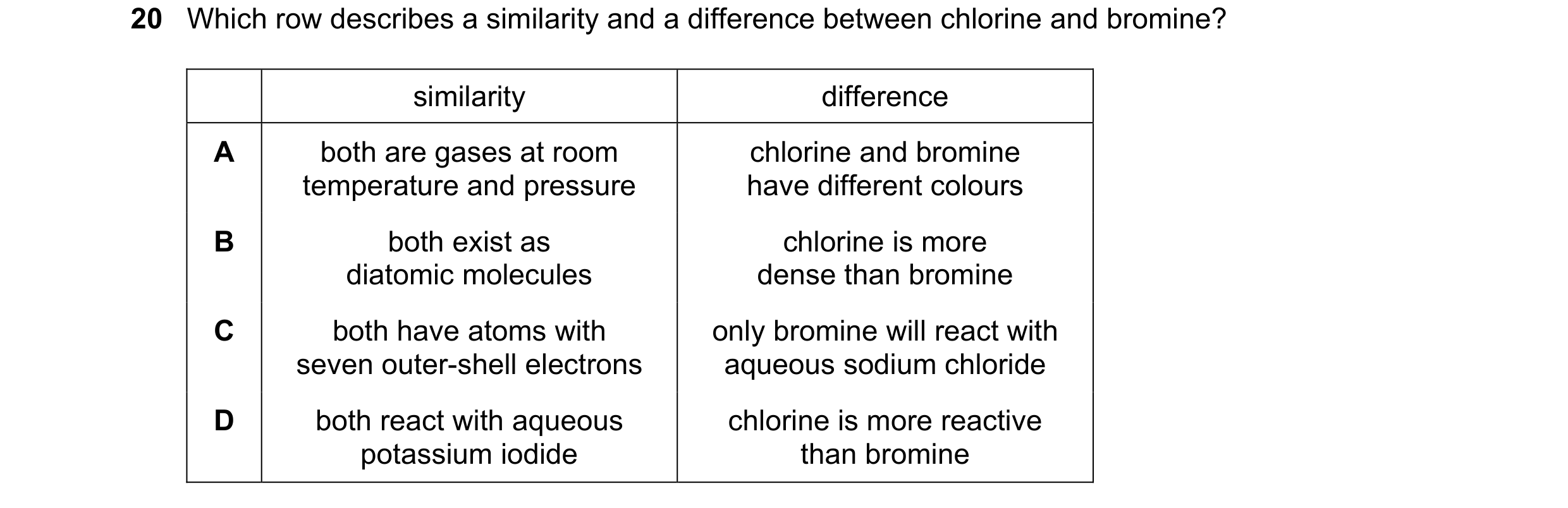
Q11 · Which row describes a similarity and a difference between chlorine and bromine? 0971/11 May/June 2023
20 Which row describes a similarity and a difference between chlorine and bromine? similarity difference A both are gases at room chlorine and bromine temperature and pressure have different colours B both exist as chlorine is more diatomic molecules dense than bromine C both have atoms with only bromine will react with seven outer-shell electrons aqueous sodium chloride D both react with aqueous chlorine is more reactive potassium iodide than bromine
1 marks
Answer: D
This question in 0971/11 May/June 2023
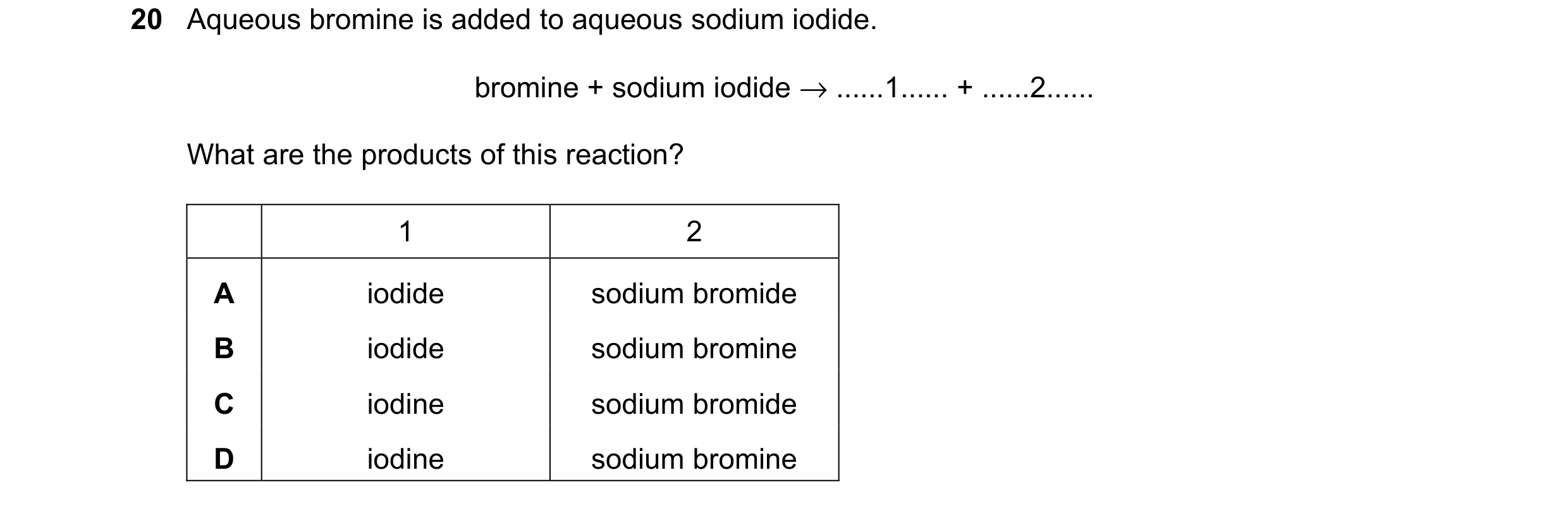
Q12 · Aqueous bromine is added to aqueous sodium iodide 0971/12 May/June 2023
20 Aqueous bromine is added to aqueous sodium iodide. bromine + sodium iodide → … 1 … + … 2 … What are the products of this reaction? 1 2 A iodide sodium bromide B iodide sodium bromine C iodine sodium bromide D iodine sodium bromine
1 marks
Answer: C
This question in 0971/12 May/June 2023
Q13 · An outline of the Periodic Table is shown 0971/12 Oct/Nov 2023
23 An outline of the Periodic Table is shown. Y Which name is given to the elements in column Y? A alkali metals B halogens C noble gases D transition elements
1 marks
Answer: B
This question in 0971/12 Oct/Nov 2023
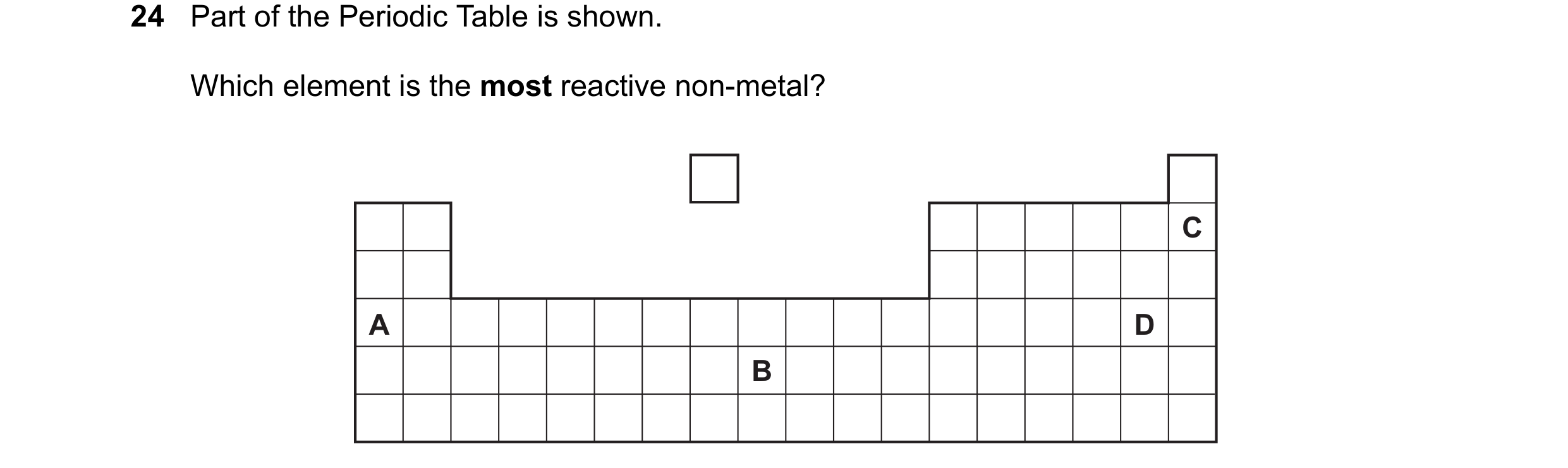
Q14 · Part of the Periodic Table is shown 0971/12 May/June 2024
24 Part of the Periodic Table is shown. Which element is the most reactive non-metal? C A D B
1 marks
Answer: D
This question in 0971/12 May/June 2024
Q15 · Which statement about the halogens and their compounds is correct? 0971/12 May/June 2024
26 Which statement about the halogens and their compounds is correct? A The colour of the element gets lighter going down Group VII. B The elements get less dense going down Group VII. C When chlorine is added to sodium iodide solution, iodine is formed. D When iodine is added to sodium bromide solution, bromine is formed.
1 marks
Answer: C
This question in 0971/12 May/June 2024
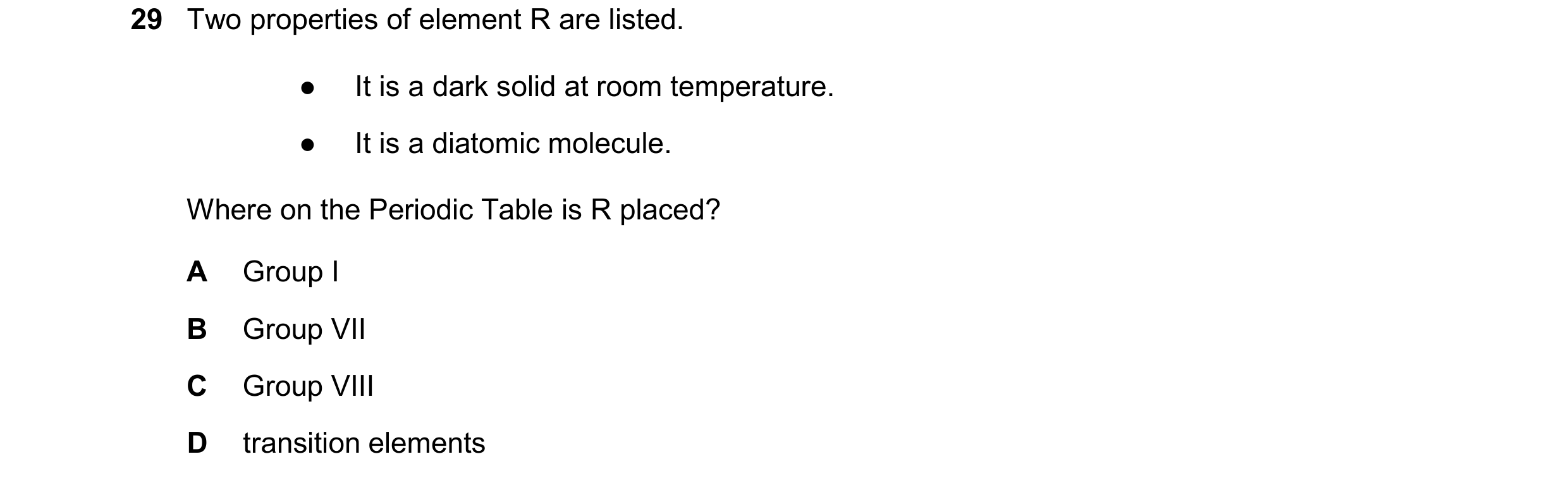
Q16 · Two properties of element R are listed 0971/12 Oct/Nov 2024
29 Two properties of element R are listed. ● It is a dark solid at room temperature. ● It is a diatomic molecule. Where on the Periodic Table is R placed? A Group I B Group VII C Group VIII D transition elements
1 marks
Answer: B
This question in 0971/12 Oct/Nov 2024
Q17 · Which statement about the displacement reactions of the halogens is correct? 0971/12 Oct/Nov 2024
31 Which statement about the displacement reactions of the halogens is correct? A Iodine displaces bromine from aqueous sodium bromide. B Bromine displaces chlorine from aqueous potassium chloride. C Iodine displaces chlorine from aqueous potassium chloride. D Chlorine displaces bromine from aqueous sodium bromide.
1 marks
Answer: D
This question in 0971/12 Oct/Nov 2024
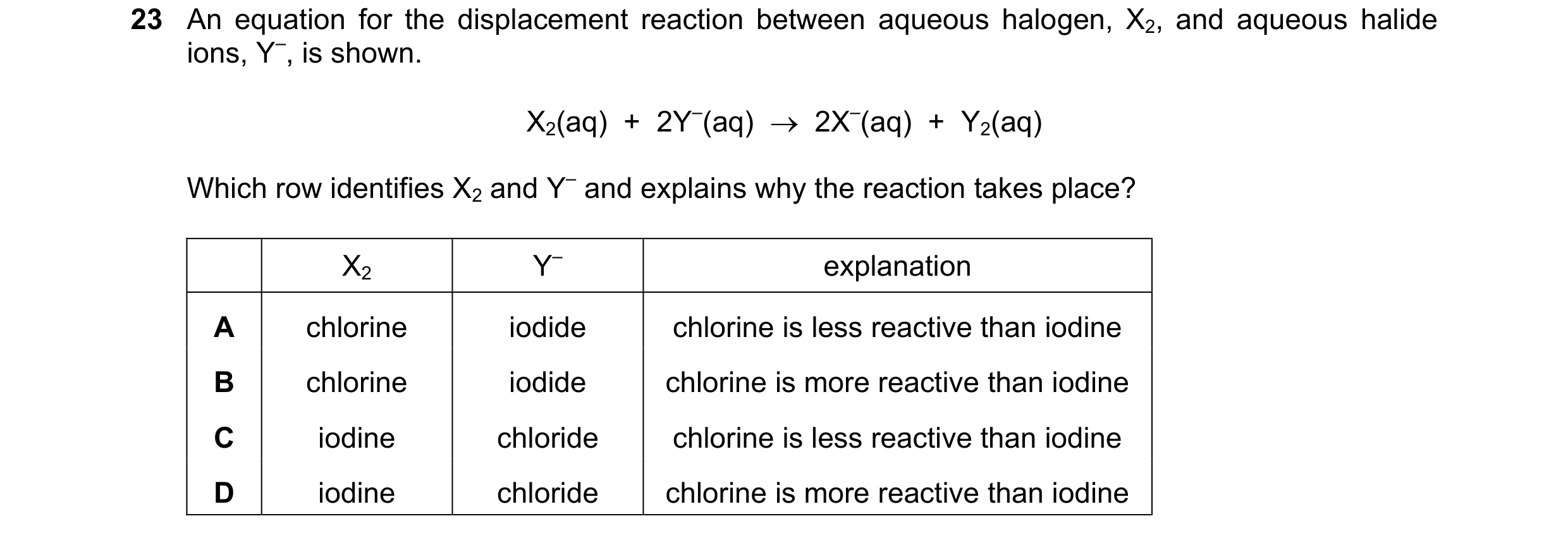
Q18 · An equation for the displacement reaction between aqueous halogen, X2, and aqueous halide… 0971/11 May/June 2025
23 An equation for the displacement reaction between aqueous halogen, X2, and aqueous halide ions, Y–, is shown. X2(aq) + 2Y–(aq) 2X–(aq) + Y2(aq) Which row identifies X2 and Y– and explains why the reaction takes place? X2 Y– explanation A chlorine iodide chlorine is less reactive than iodine B chlorine iodide chlorine is more reactive than iodine C iodine chloride chlorine is less reactive than iodine D iodine chloride chlorine is more reactive than iodine
1 marks
Answer: B
This question in 0971/11 May/June 2025
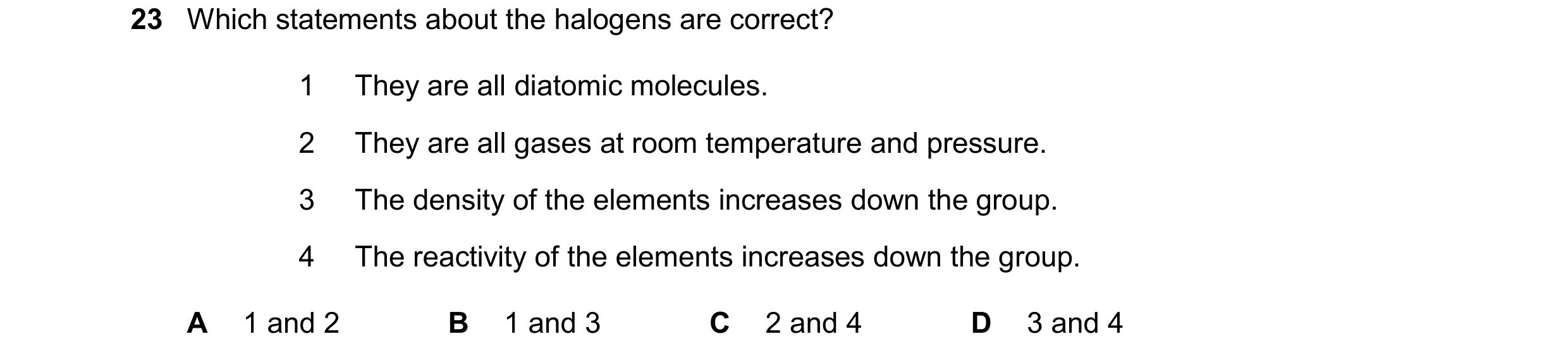
Q19 · Which statements about the halogens are correct? 0971/12 May/June 2025
23 Which statements about the halogens are correct? 1 They are all diatomic molecules. 2 They are all gases at room temperature and pressure. 3 The density of the elements increases down the group. 4 The reactivity of the elements increases down the group. A 1 and 2 B 1 and 3 C 2 and 4 D 3 and 4
1 marks
Answer: B
This question in 0971/12 May/June 2025
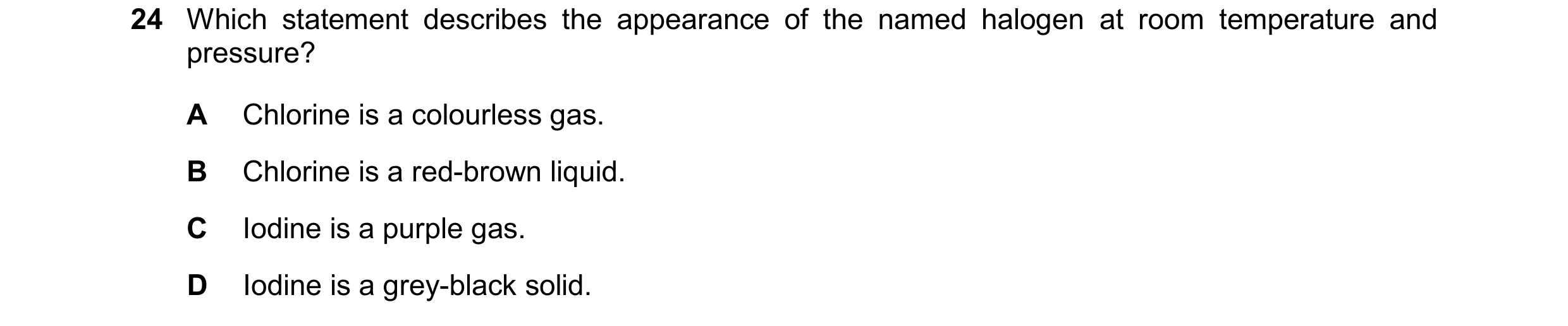
Q20 · Which statement describes the appearance of the named halogen at room temperature and… 0971/12 Oct/Nov 2025
24 Which statement describes the appearance of the named halogen at room temperature and pressure? A Chlorine is a colourless gas. B Chlorine is a red-brown liquid. C Iodine is a purple gas. D Iodine is a grey-black solid.
1 marks
Answer: D
This question in 0971/12 Oct/Nov 2025



 1 / 5
1 / 5

 2 / 5
2 / 5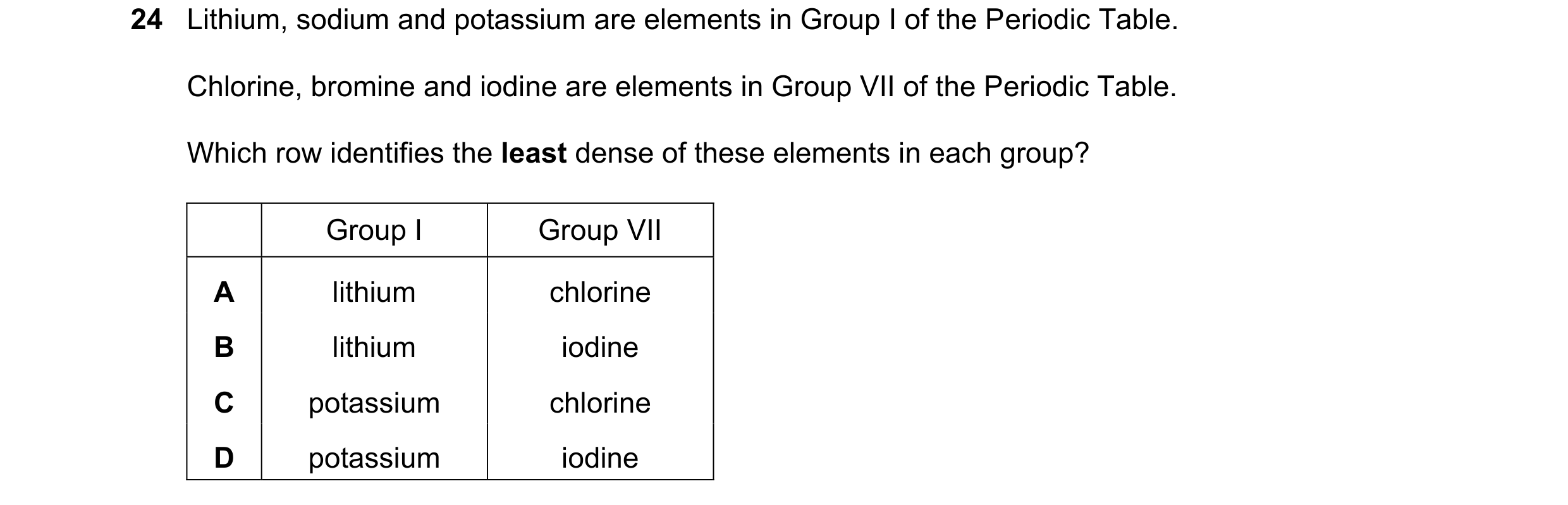
 3 / 5
3 / 5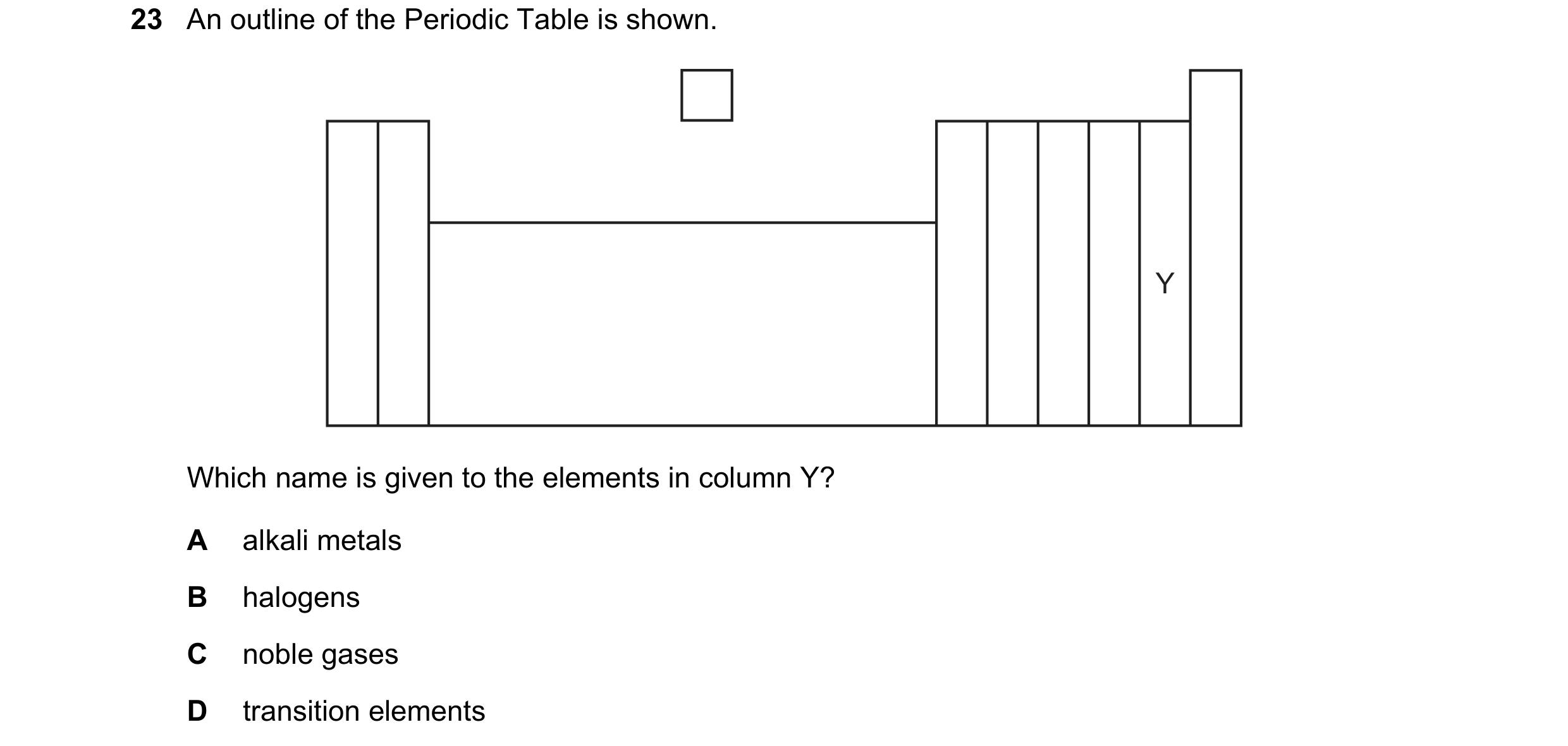

 4 / 5
4 / 5
 5 / 5
5 / 5