Questions as text
Q1 · Chlorine displaces iodide ions from potassium iodide 0971/21 May/June 2018
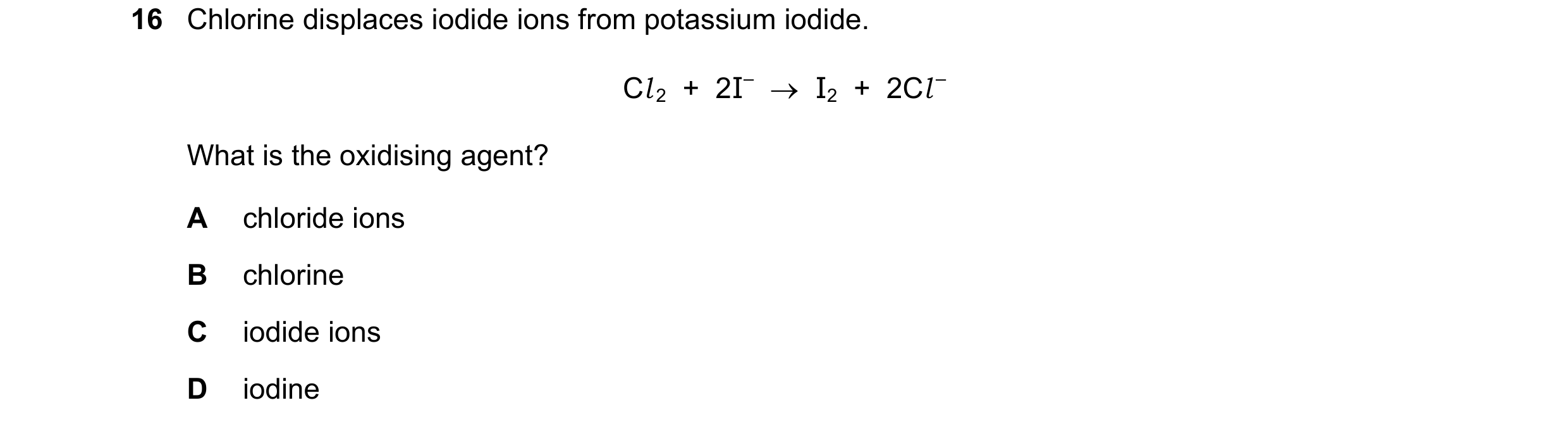
16 Chlorine displaces iodide ions from potassium iodide. Cl 2 + 2I– → I2 + 2Cl – What is the oxidising agent? A chloride ions B chlorine C iodide ions D iodine
1 marks
Answer: B
This question in 0971/21 May/June 2018
Q2 · Which statement about the halogens is correct? 0971/21 May/June 2018
22 Which statement about the halogens is correct? A A sample of bromine reacts with potassium chloride solution. B A sample of bromine reacts with potassium iodide solution. C A sample of chlorine has a higher density than a sample of bromine. D A sample of chlorine is a darker colour than a sample of bromine.
1 marks
Answer: B
This question in 0971/21 May/June 2018
Q3 · The equation shows the reaction between a halogen and aqueous bromide ions 0971/22 Oct/Nov 2018
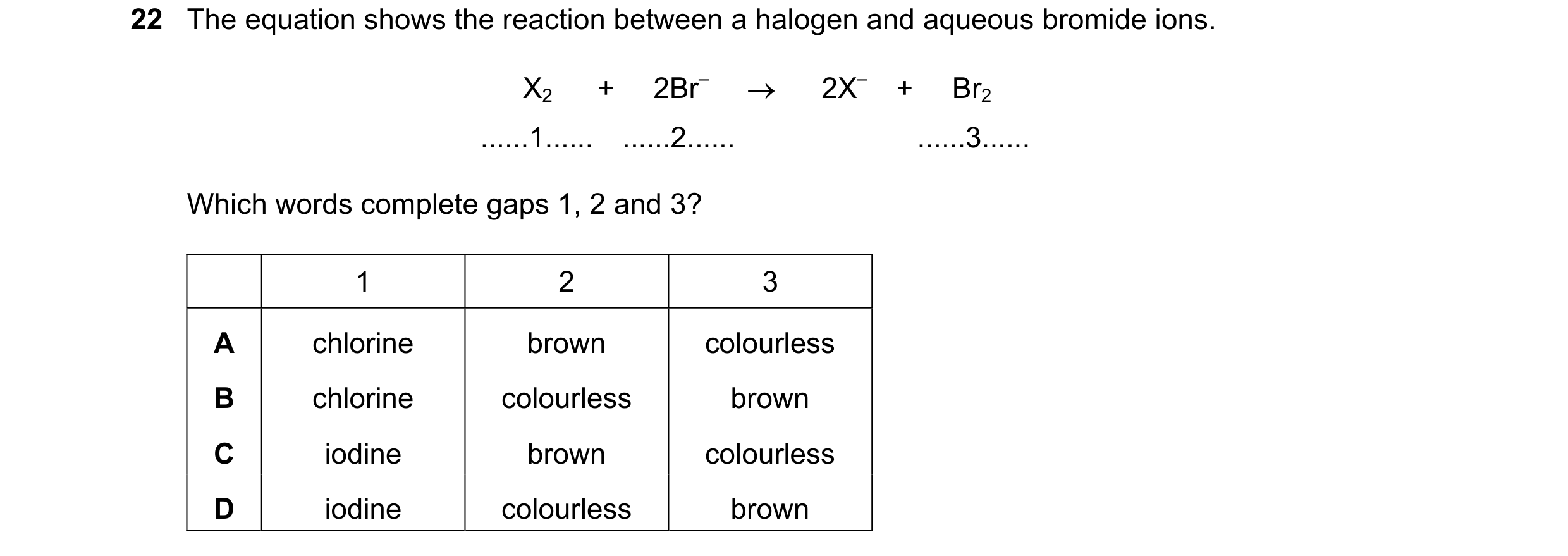
22 The equation shows the reaction between a halogen and aqueous bromide ions. X2 + 2Br– → 2X– + Br2 … 1 … … 2 … … 3 … Which words complete gaps 1, 2 and 3? 1 2 3 A chlorine brown colourless B chlorine colourless brown C iodine brown colourless D iodine colourless brown
1 marks
Answer: B
This question in 0971/22 Oct/Nov 2018
Q4 · Which statement about elements in Group I and Group VII of the Periodic Table is correct? 0971/21 May/June 2019
21 Which statement about elements in Group I and Group VII of the Periodic Table is correct? A Bromine reacts with potassium chloride to produce chlorine. B Iodine is a monoatomic non-metal. C Lithium has a higher melting point than potassium. D Sodium is more reactive with water than potassium.
1 marks
Answer: C
This question in 0971/21 May/June 2019
Q5 · Which pair of elements reacts together most violently? 0971/22 Oct/Nov 2019
24 Which pair of elements reacts together most violently? A chlorine and lithium B chlorine and potassium C iodine and lithium D iodine and potassium
1 marks
Answer: B
This question in 0971/22 Oct/Nov 2019
Q6 · A Group I metal (lithium, sodium or potassium) is reacted with a Group VII element… 0971/21 May/June 2020
22 A Group I metal (lithium, sodium or potassium) is reacted with a Group VII element (chlorine, bromine or iodine). Which compound is formed when the Group I metal of highest density reacts with the Group VII element of lowest density? A lithium chloride B potassium chloride C potassium iodide D lithium iodide
1 marks
Answer: B
This question in 0971/21 May/June 2020
Q7 · Which statement about Group I and Group VII elements is correct? 0971/22 May/June 2020
22 Which statement about Group I and Group VII elements is correct? A Group VII elements are monoatomic non-metals. B Lithium is more reactive with water than caesium. C The melting points of Group I metals increase down the group. D Potassium bromide reacts with chlorine to produce an orange solution.
1 marks
Answer: D
This question in 0971/22 May/June 2020
Q8 · Chlorine gas is bubbled into aqueous potassium iodide 0971/22 Oct/Nov 2021
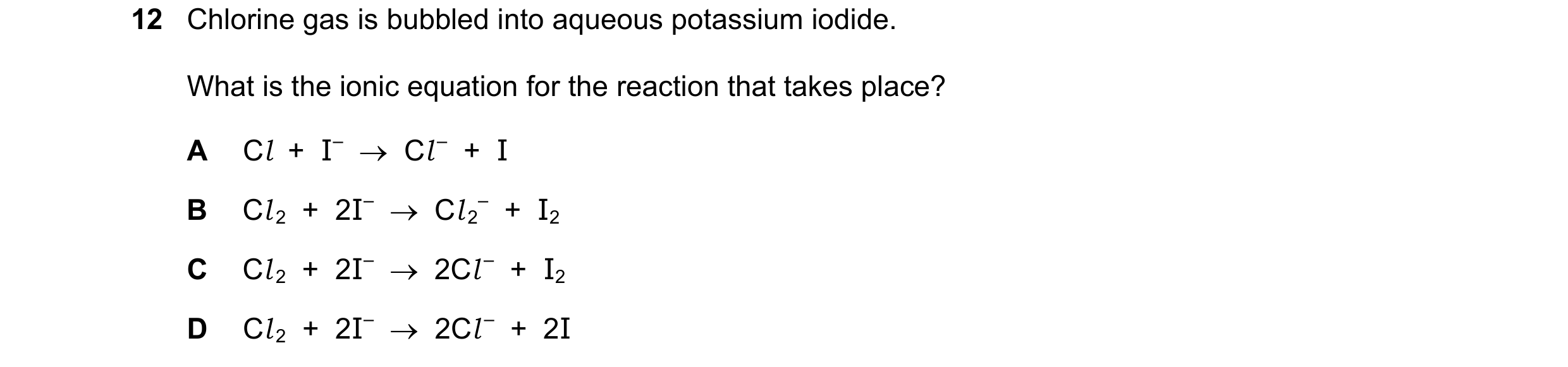
12 Chlorine gas is bubbled into aqueous potassium iodide. What is the ionic equation for the reaction that takes place? A Cl + I– Cl – + I B Cl 2 + 2I– Cl 2 – + I2 C Cl 2 + 2I– 2Cl – + I2 D Cl 2 + 2I– 2Cl – + 2I
1 marks
Answer: C
This question in 0971/22 Oct/Nov 2021
Q9 · Lithium, sodium and potassium are elements in Group I of the Periodic Table 0971/22 May/June 2022
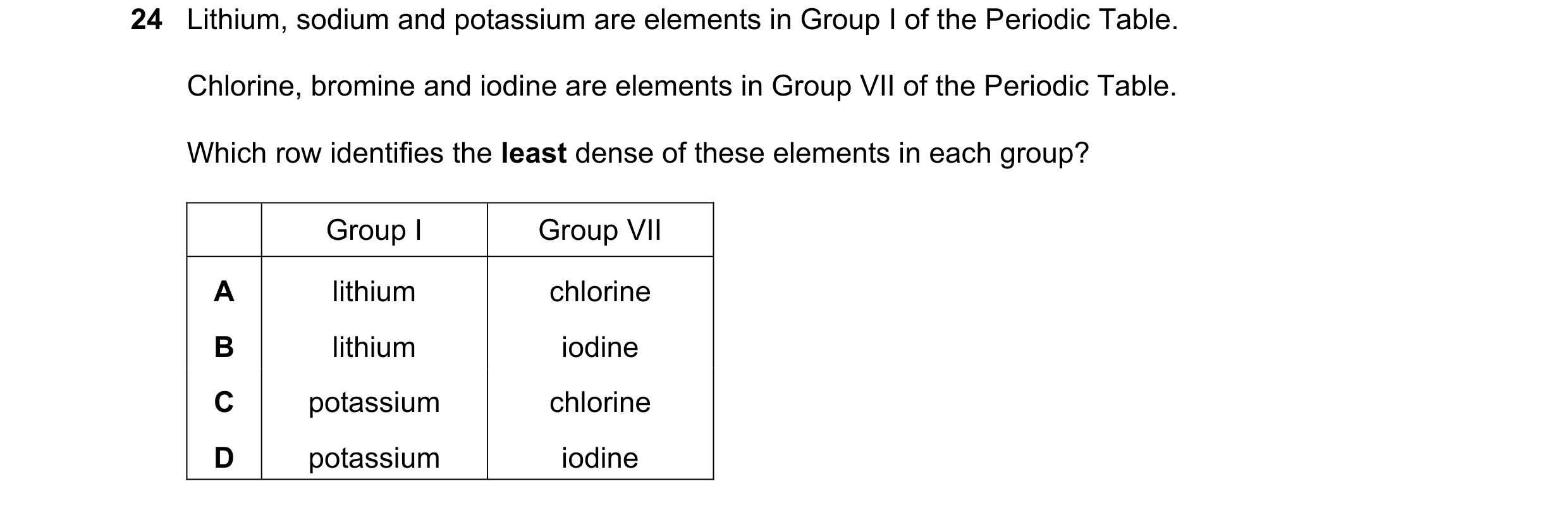
24 Lithium, sodium and potassium are elements in Group I of the Periodic Table. Chlorine, bromine and iodine are elements in Group VII of the Periodic Table. Which row identifies the least dense of these elements in each group? Group I Group VII A lithium chlorine B lithium iodine C potassium chlorine D potassium iodine
1 marks
Answer: A
This question in 0971/22 May/June 2022
Q10 · A new element oxfordium, Ox, was discovered with the following properties 0971/21 May/June 2023
20 A new element oxfordium, Ox, was discovered with the following properties. electrical formula bonding in a solubility conduction of element molecule of Ox2 insoluble in water does not conduct Ox2 Ox Ox In which group of the Periodic Table should the new element be placed? A Group III B Group V C Group VII D Group VIII
1 marks
Answer: B
This question in 0971/21 May/June 2023
Q11 · Which row describes a similarity and a difference between chlorine and bromine? 0971/21 May/June 2023
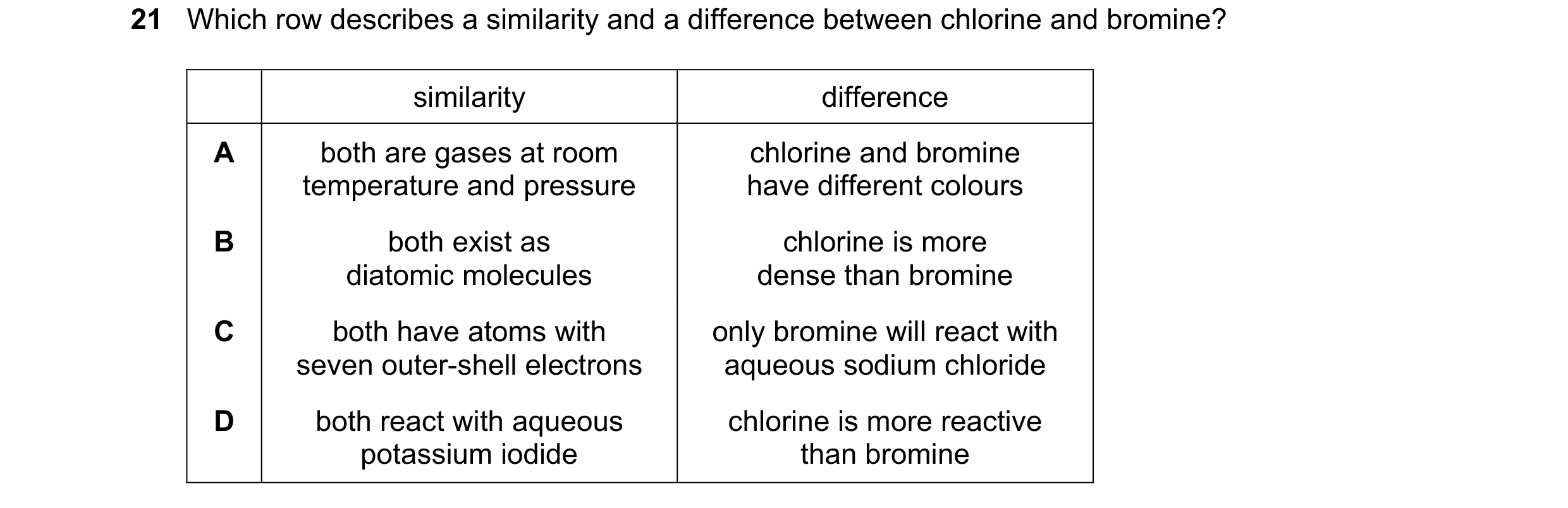
21 Which row describes a similarity and a difference between chlorine and bromine? similarity difference A both are gases at room chlorine and bromine temperature and pressure have different colours B both exist as chlorine is more diatomic molecules dense than bromine C both have atoms with only bromine will react with seven outer-shell electrons aqueous sodium chloride D both react with aqueous chlorine is more reactive potassium iodide than bromine
1 marks
Answer: D
This question in 0971/21 May/June 2023
Q12 · Which row describes the structure of Group VII elements and the trend in their reactivity… 0971/21 May/June 2024
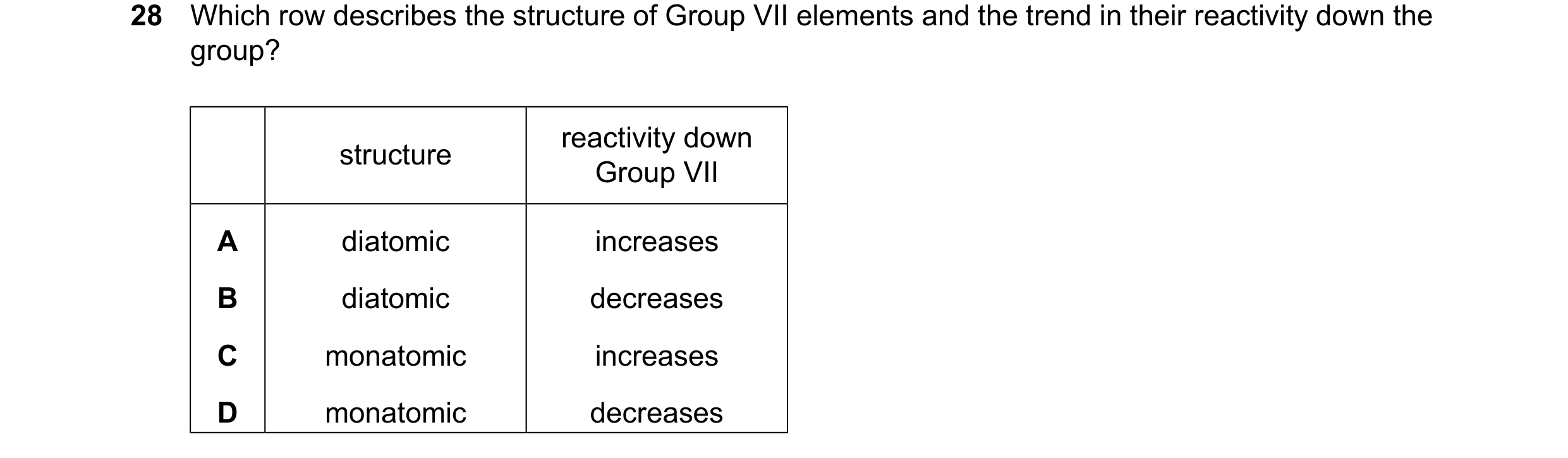
28 Which row describes the structure of Group VII elements and the trend in their reactivity down the group? reactivity down structure Group VII A diatomic increases B diatomic decreases C monatomic increases D monatomic decreases
1 marks
Answer: B
This question in 0971/21 May/June 2024
Q13 · Fluorine is the element at the top of Group VII of the Periodic Table 0971/22 Oct/Nov 2024
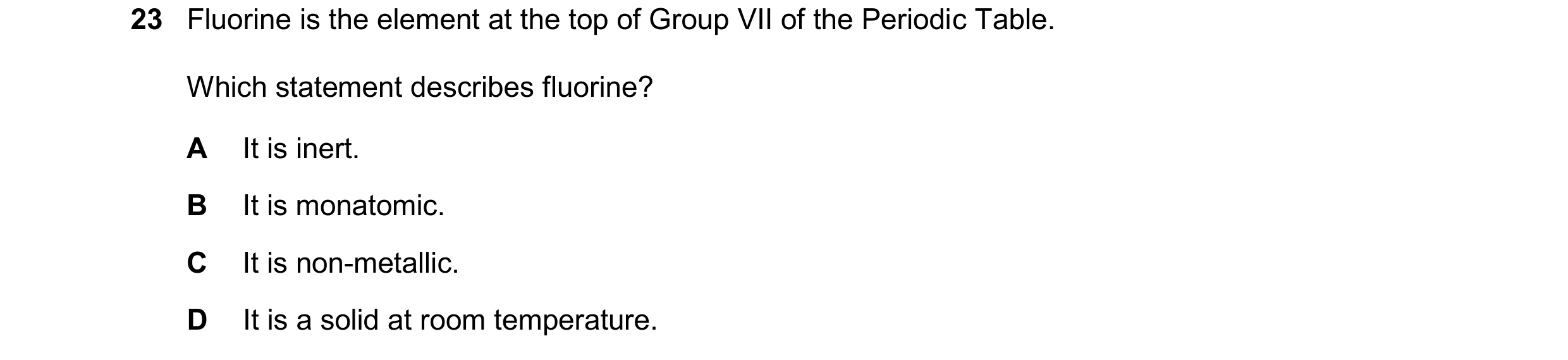
23 Fluorine is the element at the top of Group VII of the Periodic Table. Which statement describes fluorine? A It is inert. B It is monatomic. C It is non-metallic. D It is a solid at room temperature.
1 marks
Answer: C
This question in 0971/22 Oct/Nov 2024
Q14 · Tennessine (atomic number 117) is a manufactured element that is below astatine in Group… 0971/22 May/June 2025
23 Tennessine (atomic number 117) is a manufactured element that is below astatine in Group VII of the Periodic Table. What is the expected state of tennessine at room temperature and pressure? A a diatomic gas B a liquid C a monatomic gas D a solid
1 marks
Answer: D
This question in 0971/22 May/June 2025
Q15 · When chlorine is bubbled into aqueous sodium bromide, a displacement reaction occurs 0971/22 May/June 2025
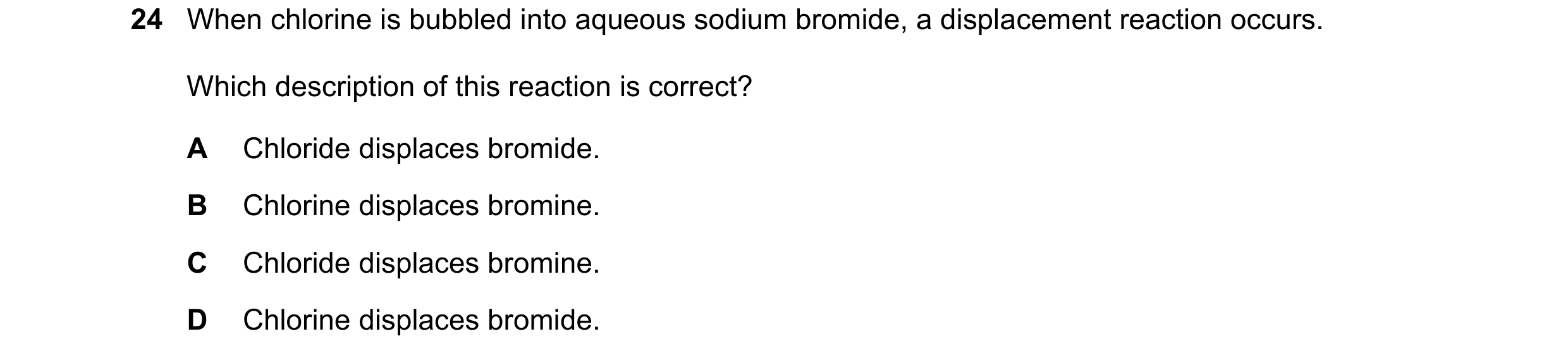
24 When chlorine is bubbled into aqueous sodium bromide, a displacement reaction occurs. Which description of this reaction is correct? A Chloride displaces bromide. B Chlorine displaces bromine. C Chloride displaces bromine. D Chlorine displaces bromide.
1 marks
Answer: B
This question in 0971/22 May/June 2025
Q16 · Which row describes the colour and state of iodine at room temperature and pressure? 0971/22 Oct/Nov 2025
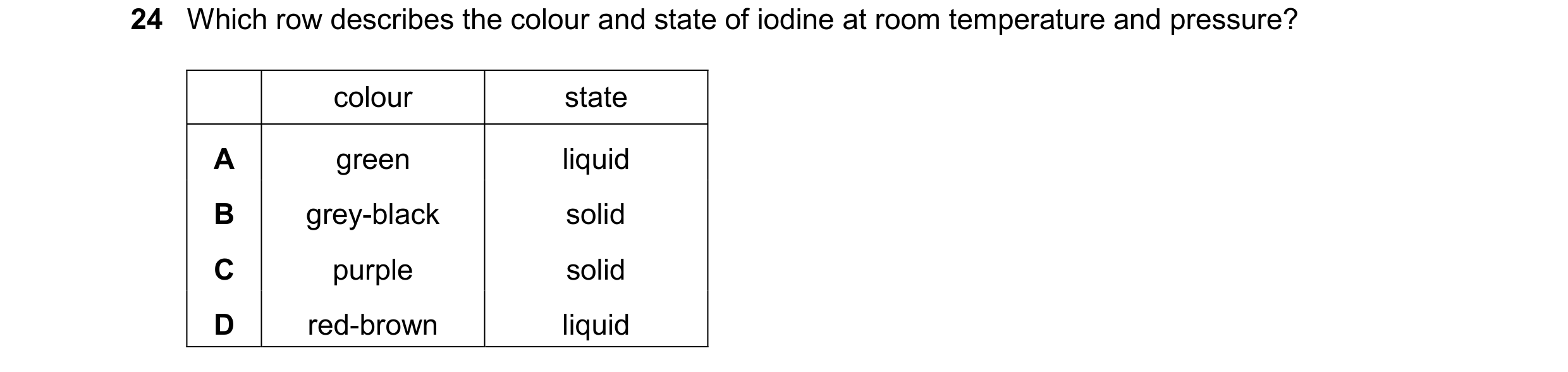
24 Which row describes the colour and state of iodine at room temperature and pressure? colour state A green liquid B grey-black solid C purple solid D red-brown liquid
1 marks
Answer: B
This question in 0971/22 Oct/Nov 2025


 1 / 4
1 / 4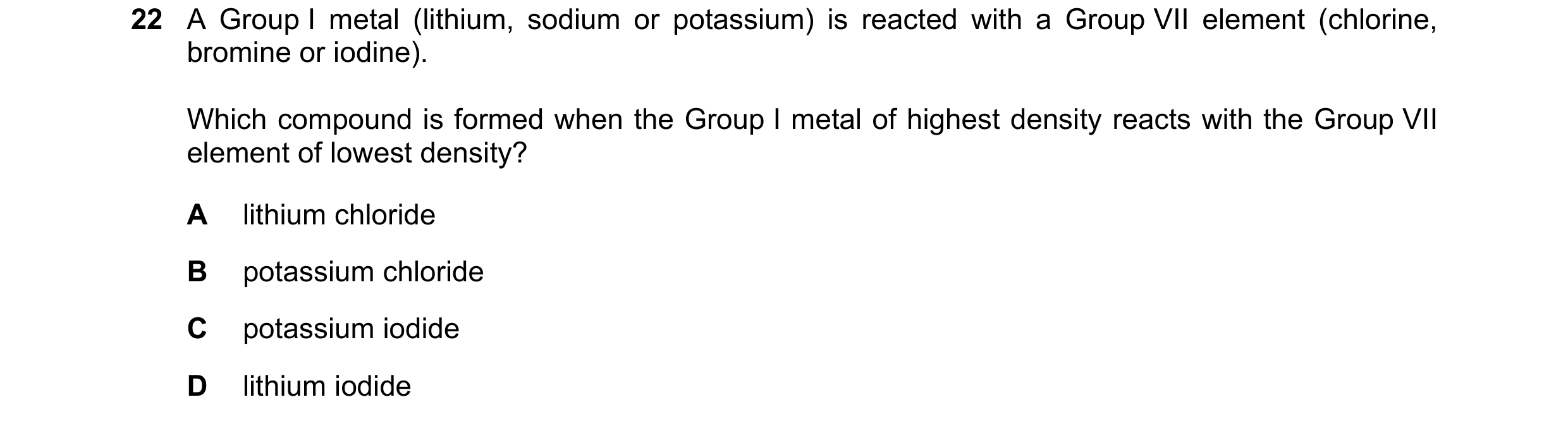

 2 / 4
2 / 4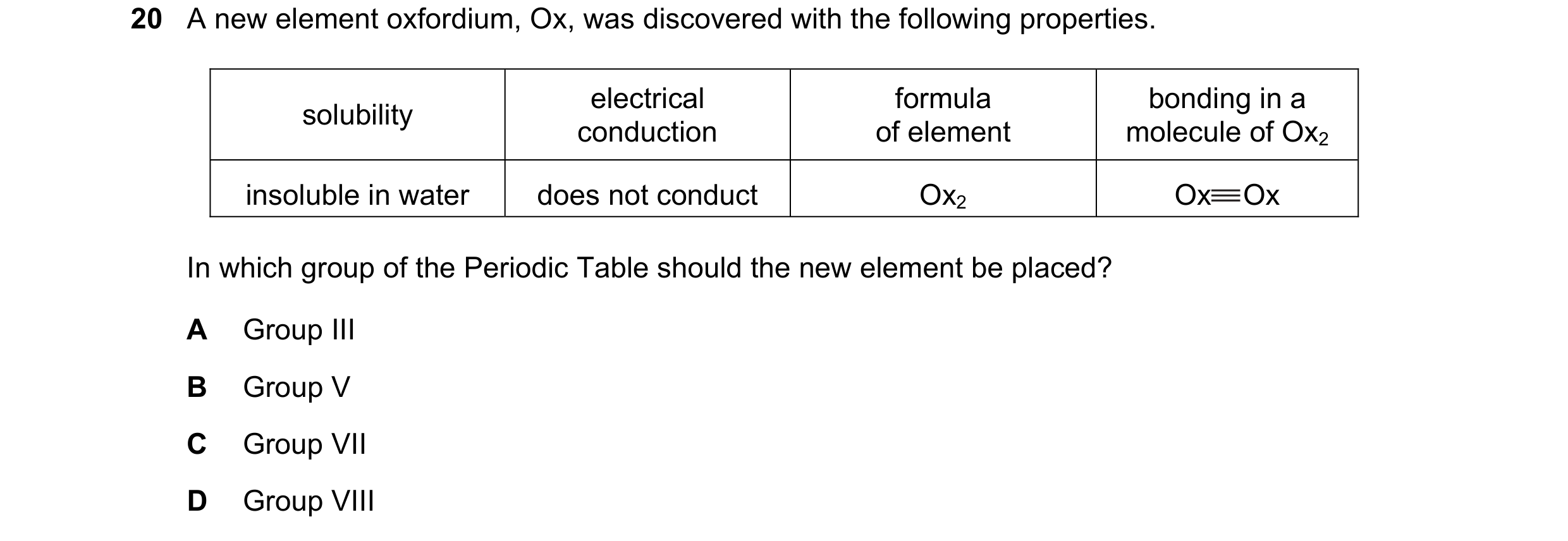
 3 / 4
3 / 4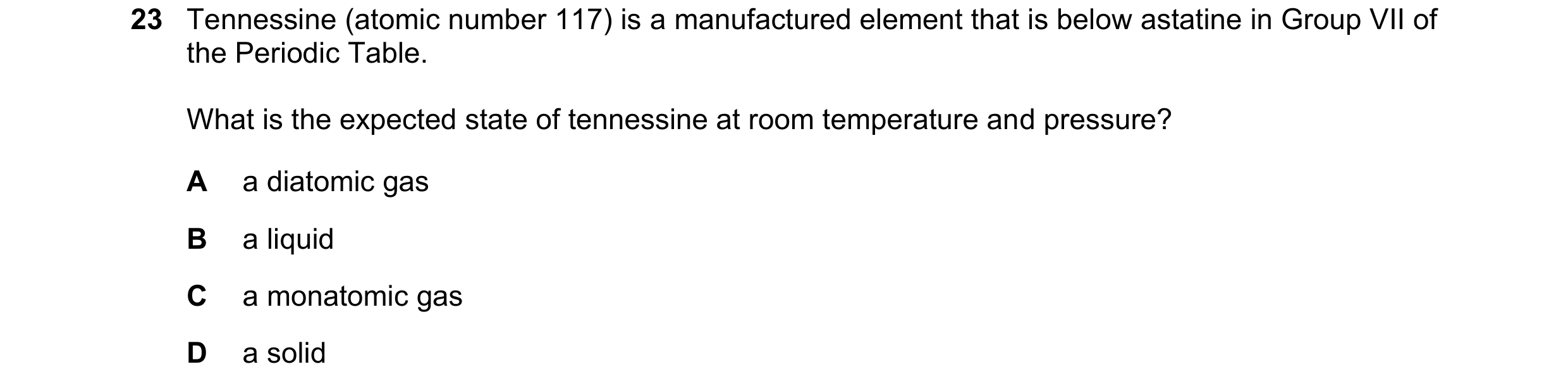
 4 / 4
4 / 4