Questions as text
Q1 · Which reaction is used to make ethanol? 0971/11 May/June 2018
39 Which reaction is used to make ethanol? A adding steam to ethene B addition polymerisation C fractional distillation of petroleum D reacting ethene with aqueous bromine
1 marks
Answer: A
This question in 0971/11 May/June 2018
Q2 · What is the structure of ethanol? 0971/11 May/June 2019
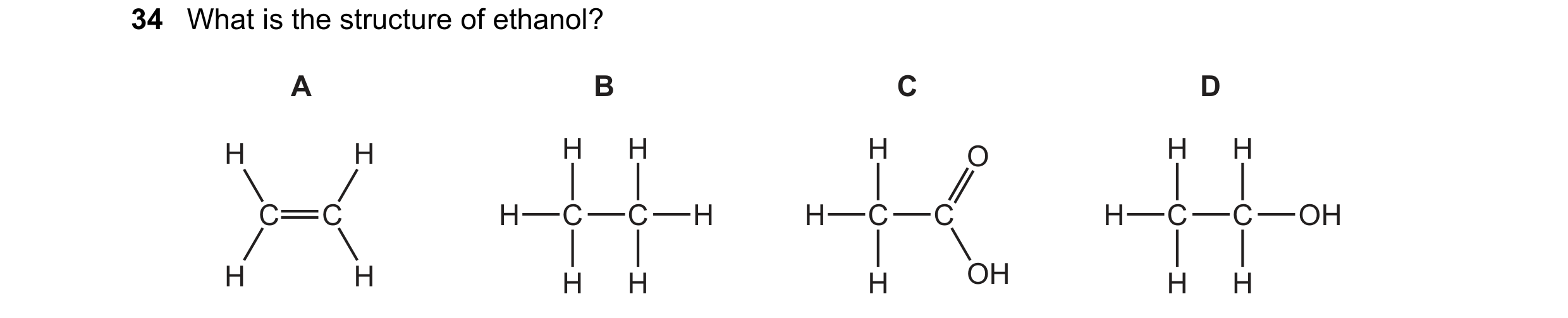
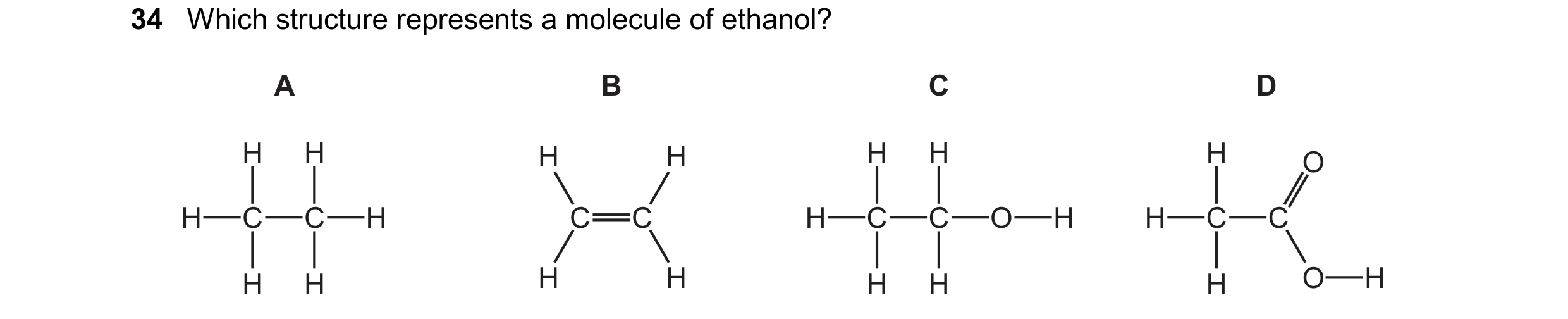
34 What is the structure of ethanol? A B C D H H H H H O H H C C H C C H H C C H C C OH H H H H H OH H H
1 marks
Answer: D
This question in 0971/11 May/June 2019
Q3 · Why is ethanol a member of the homologous series of alcohols but propane is not? 0971/11 May/June 2019
37 Why is ethanol a member of the homologous series of alcohols but propane is not? A Ethanol has two carbon atoms per molecule but propane has three. B Ethanol can be made from ethene but propane is obtained from petroleum. C Ethanol is a liquid but propane is a gas. D Ethanol contains the same functional group as other alcohols but propane does not.
1 marks
Answer: D
This question in 0971/11 May/June 2019
Q4 · Which statements about ethanol are correct? 0971/11 May/June 2019
38 Which statements about ethanol are correct? 1 It can be made by fermentation. 2 It is an unsaturated compound. 3 It burns in air and can be used as a fuel. A 1, 2 and 3 B 1 and 2 only C 1 and 3 only D 2 and 3 only
1 marks
Answer: C
This question in 0971/11 May/June 2019
Q5 · Which statements about ethanol are correct? 0971/11 May/June 2020
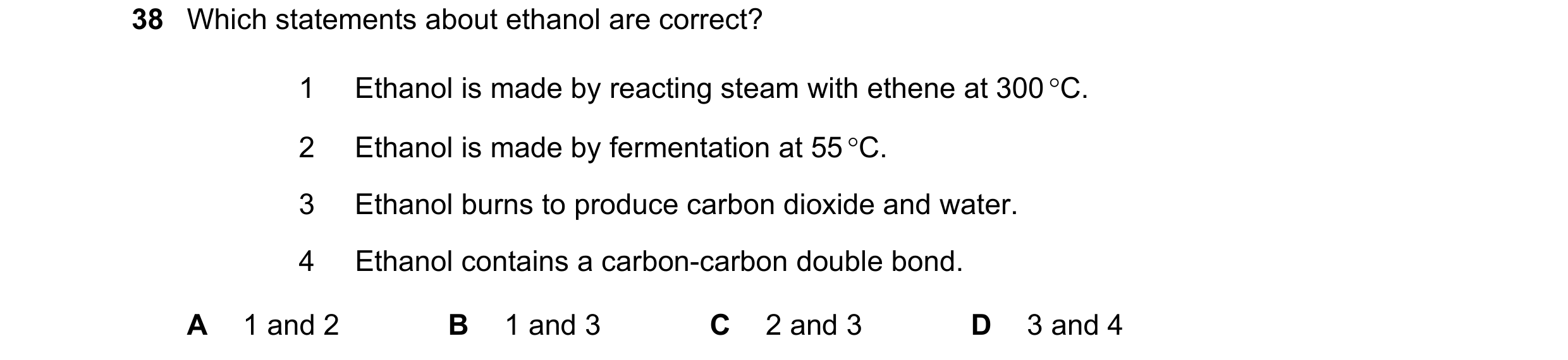
38 Which statements about ethanol are correct? 1 Ethanol is made by reacting steam with ethene at 300 °C. 2 Ethanol is made by fermentation at 55 °C. 3 Ethanol burns to produce carbon dioxide and water. 4 Ethanol contains a carbon-carbon double bond. A 1 and 2 B 1 and 3 C 2 and 3 D 3 and 4
1 marks
Answer: B
This question in 0971/11 May/June 2020
Q6 · Which statement about alcohols is correct? 0971/12 May/June 2020
38 Which statement about alcohols is correct? A Alcohols and carboxylic acids have the same functional group. B Ethanoic acid is produced from the reduction of ethanol. C Ethanol is produced in an addition reaction between ethene and hydrogen. D Water is produced from the combustion of alcohols.
1 marks
Answer: D
This question in 0971/12 May/June 2020
Q7 · Which structure represents a molecule of ethanol? 0971/12 Oct/Nov 2020
35 Which structure represents a molecule of ethanol? A B C D H H H H H H H O H C C H C C H C C O H H C C H H H H H H H O H
1 marks
Answer: C
This question in 0971/12 Oct/Nov 2020
Q8 · The flow chart shows the preparation of ethanol and some important chemistry of ethanol 0971/12 Oct/Nov 2020
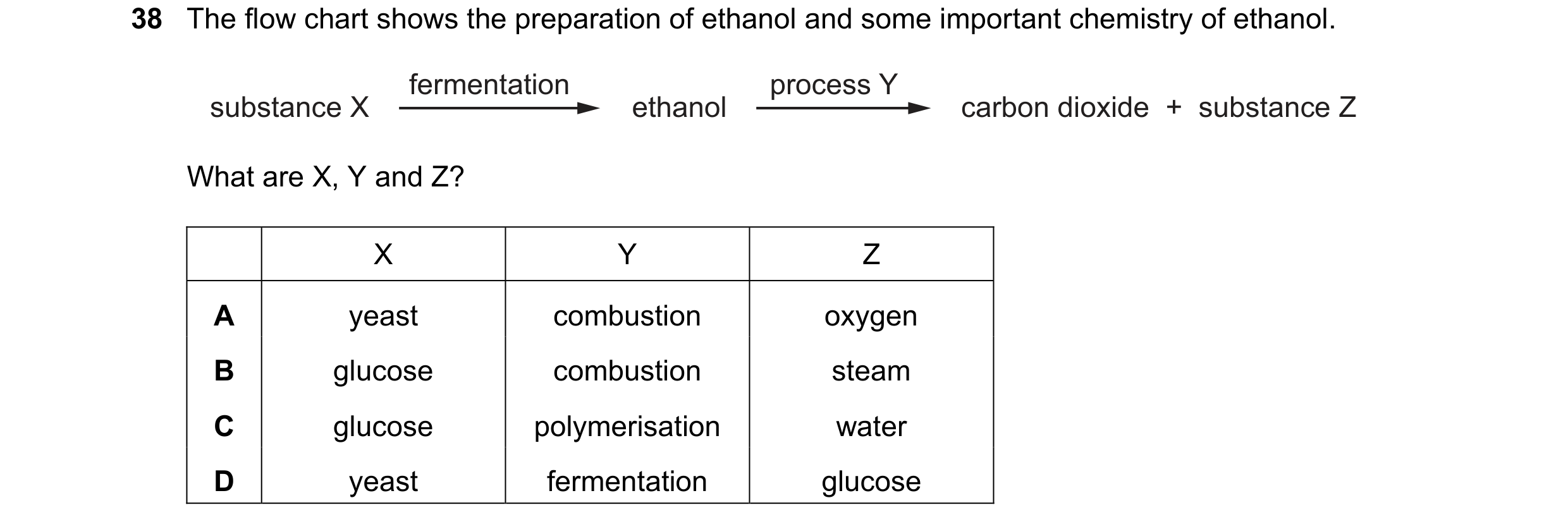
38 The flow chart shows the preparation of ethanol and some important chemistry of ethanol. fermentation process Y substance X ethanol carbon dioxide + substance Z What are X, Y and Z? X Y Z A yeast combustion oxygen B glucose combustion steam C glucose polymerisation water D yeast fermentation glucose
1 marks
Answer: B
This question in 0971/12 Oct/Nov 2020
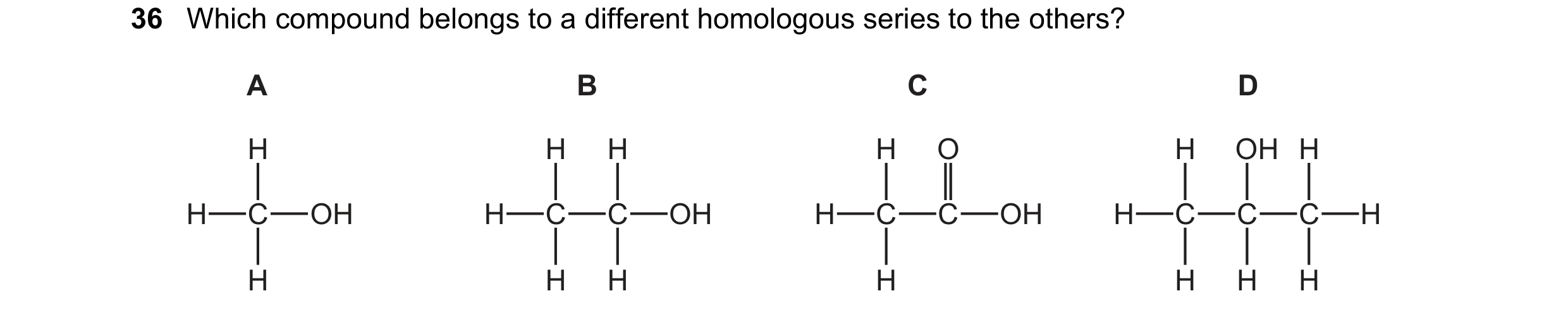
Q9 · Which compound belongs to a different homologous series to the others? 0971/12 Oct/Nov 2021
36 Which compound belongs to a different homologous series to the others? A B C D H H H H O H OH H H C OH H C C OH H C C OH H C C C H H H H H H H H
1 marks
Answer: C
This question in 0971/12 Oct/Nov 2021
Q10 · Which substance is used to produce alcohol by fermentation? 0971/12 Oct/Nov 2021
39 Which substance is used to produce alcohol by fermentation? A phosphoric acid B platinum C iron D yeast
1 marks
Answer: D
This question in 0971/12 Oct/Nov 2021
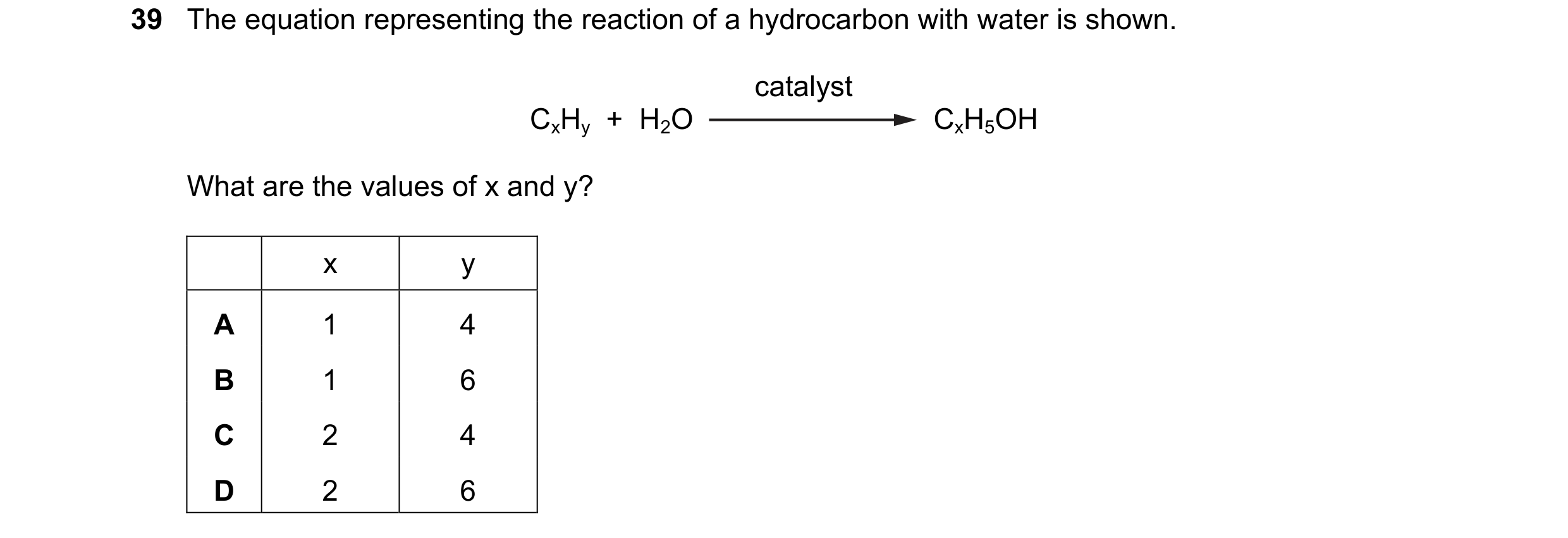
Q11 · The equation representing the reaction of a hydrocarbon with water is shown 0971/11 May/June 2022
39 The equation representing the reaction of a hydrocarbon with water is shown. catalyst CxHy + H2O CxH5OH What are the values of x and y? x y A 1 4 B 1 6 C 2 4 D 2 6
1 marks
Answer: C
This question in 0971/11 May/June 2022
Q12 · Ethene reacts with substance X to form ethanol 0971/12 May/June 2022
35 Ethene reacts with substance X to form ethanol. What is X? A ethanoic acid B glucose C hydrogen D steam
1 marks
Answer: D
This question in 0971/12 May/June 2022
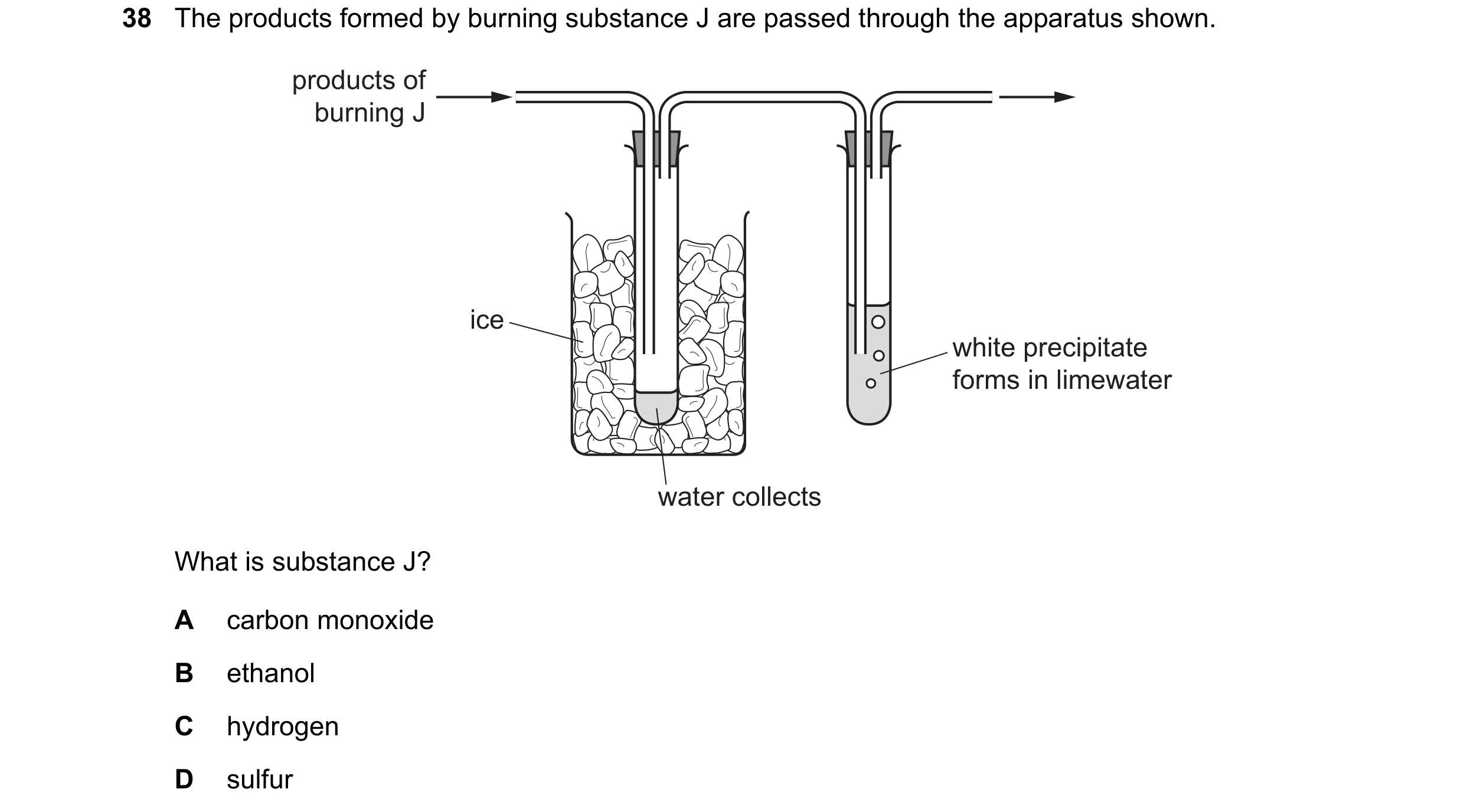
Q13 · The products formed by burning substance J are passed through the apparatus shown 0971/12 May/June 2022
38 The products formed by burning substance J are passed through the apparatus shown. products of burning J ice white precipitate forms in limewater water collects What is substance J? A carbon monoxide B ethanol C hydrogen D sulfur
1 marks
Answer: B
This question in 0971/12 May/June 2022
Q14 · Which statement about both ethane and ethanol is correct? 0971/12 Oct/Nov 2022
34 Which statement about both ethane and ethanol is correct? A They are hydrocarbons. B They contain oxygen. C They contain the same number of atoms. D They produce water when burned.
1 marks
Answer: D
This question in 0971/12 Oct/Nov 2022
Q15 · Which process produces ethanol from glucose? 0971/12 Oct/Nov 2022
38 Which process produces ethanol from glucose? A catalytic addition B cracking C fermentation D polymerisation
1 marks
Answer: C
This question in 0971/12 Oct/Nov 2022
Q16 · Which statements about ethanol are correct? 0971/11 May/June 2023
35 Which statements about ethanol are correct? 1 Ethanol is made by reacting steam with ethene at 300 °C. 2 Ethanol is made by fermentation at 55 °C. 3 Ethanol burns to produce carbon dioxide and water. 4 Ethanol contains a carbon–carbon double bond. A 1 and 2 B 1 and 3 C 2 and 3 D 3 and 4
1 marks
Answer: B
This question in 0971/11 May/June 2023
Q17 · Compound Z has the molecular formula C2H6O 0971/12 May/June 2023
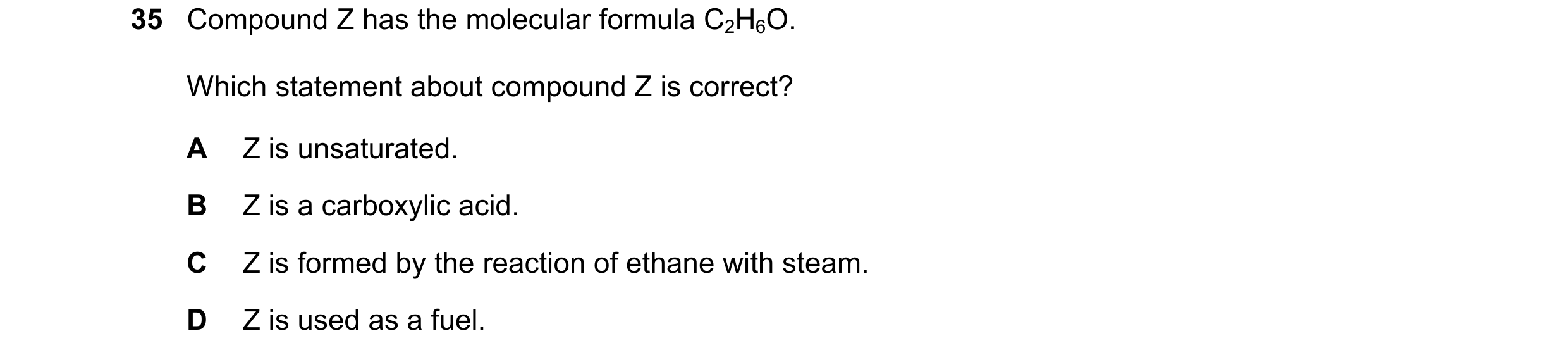
35 Compound Z has the molecular formula C2H6O. Which statement about compound Z is correct? A Z is unsaturated. B Z is a carboxylic acid. C Z is formed by the reaction of ethane with steam. D Z is used as a fuel.
1 marks
Answer: D
This question in 0971/12 May/June 2023
Q18 · Which raw material is used to make ethanol by fermentation? 0971/11 May/June 2024
35 Which raw material is used to make ethanol by fermentation? A carbon dioxide B ethene C glucose D natural gas
1 marks
Answer: C
This question in 0971/11 May/June 2024
Q19 · The structures of four organic compounds are shown 0971/12 May/June 2024
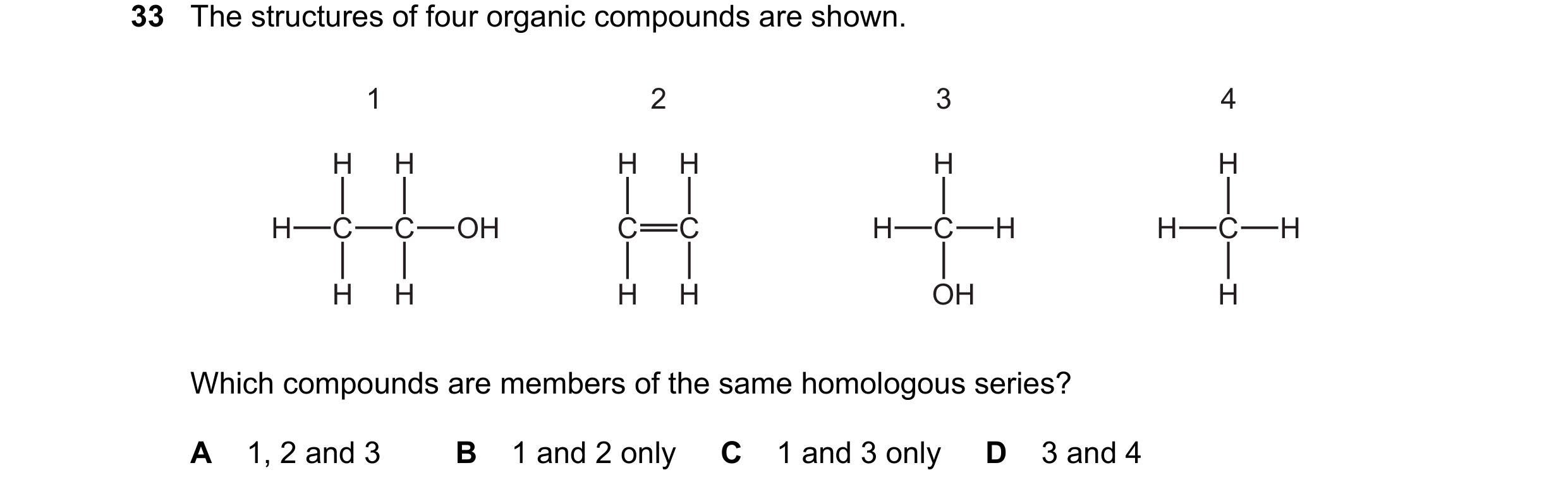
33 The structures of four organic compounds are shown. 1 2 3 4 H H H H H H H C C OH C C H C H H C H H H H H OH H Which compounds are members of the same homologous series? A 1, 2 and 3 B 1 and 2 only C 1 and 3 only D 3 and 4
1 marks
Answer: C
This question in 0971/12 May/June 2024
Q20 · The equation for a reaction that produces ethanol is shown 0971/12 May/June 2024
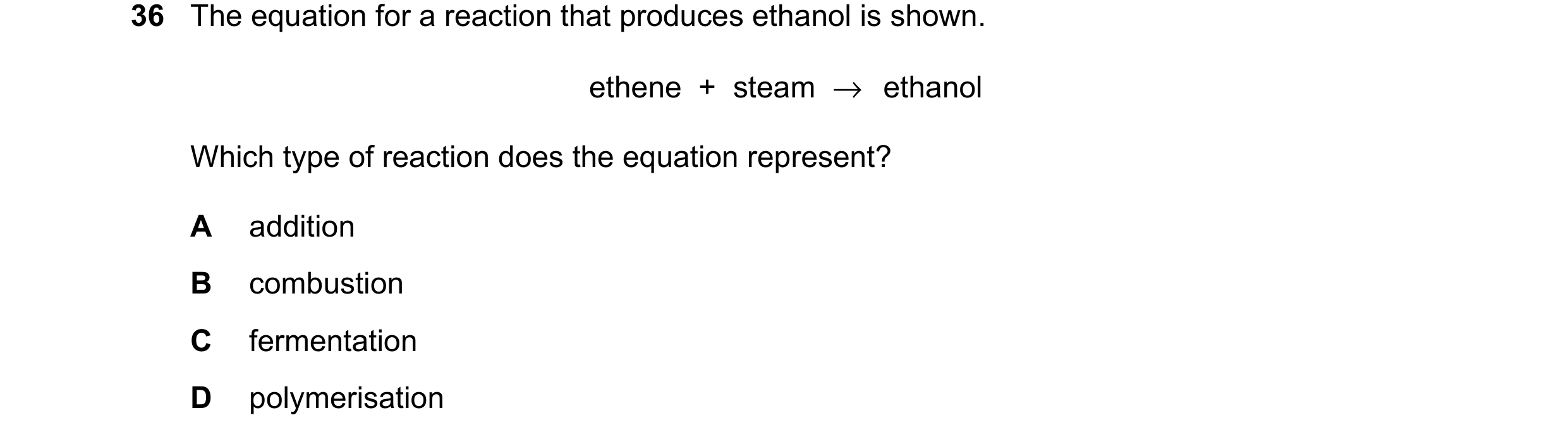
36 The equation for a reaction that produces ethanol is shown. ethene + steam →ethanol Which type of reaction does the equation represent? A addition B combustion C fermentation D polymerisation
1 marks
Answer: A
This question in 0971/12 May/June 2024
Q21 · What are the products formed when glucose is fermented? 0971/12 Oct/Nov 2024
33 What are the products formed when glucose is fermented? A ethanol and carbon dioxide B ethanol and oxygen C ethene and carbon dioxide D ethene and oxygen
1 marks
Answer: A
This question in 0971/12 Oct/Nov 2024
Q22 · Which structure represents a molecule of ethanol? 0971/12 Oct/Nov 2024
34 Which structure represents a molecule of ethanol? A B C D H H H H H H H O H C C H C C H C C O H H C C H H H H H H H O H
1 marks
Answer: C
This question in 0971/12 Oct/Nov 2024
Q23 · Which compound is formed when ethene reacts with steam? 0971/12 May/June 2025
35 Which compound is formed when ethene reacts with steam? A ethane B ethanoic acid C ethanol D poly(ethene)
1 marks
Answer: C
This question in 0971/12 May/June 2025
Q24 · When pink cobalt(II) chloride is heated, it forms a blue solid and water 0971/12 Oct/Nov 2025
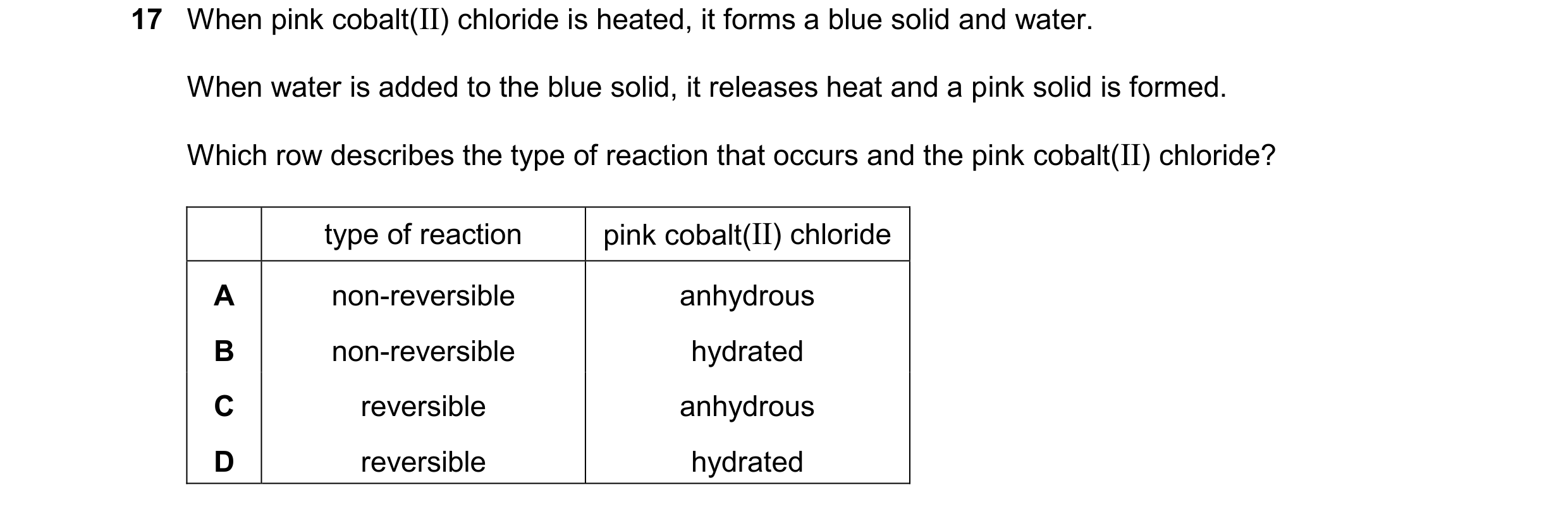
17 When pink cobalt(II) chloride is heated, it forms a blue solid and water. When water is added to the blue solid, it releases heat and a pink solid is formed. Which row describes the type of reaction that occurs and the pink cobalt(II) chloride? type of reaction pink cobalt(II) chloride A non-reversible anhydrous B non-reversible hydrated C reversible anhydrous D reversible hydrated
1 marks
Answer: D
This question in 0971/12 Oct/Nov 2025



 1 / 5
1 / 5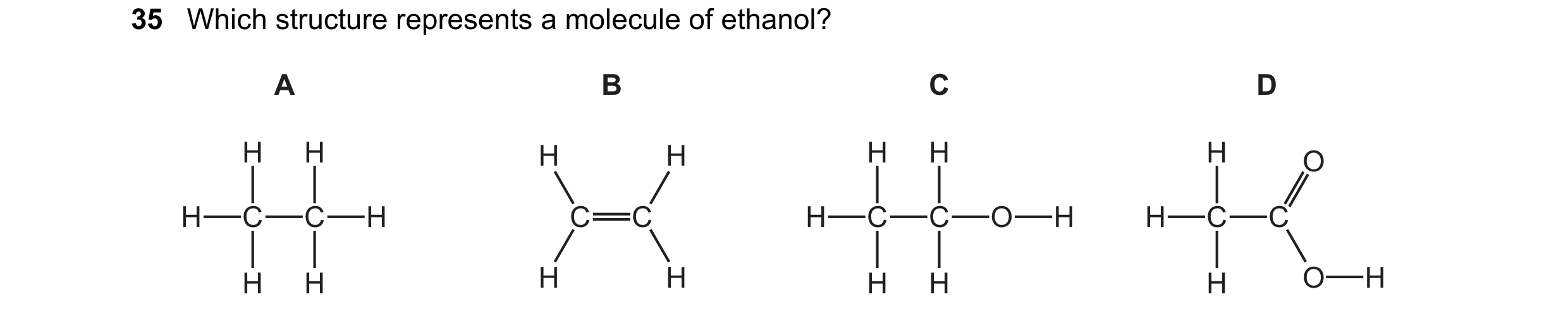

 2 / 5
2 / 5

 3 / 5
3 / 5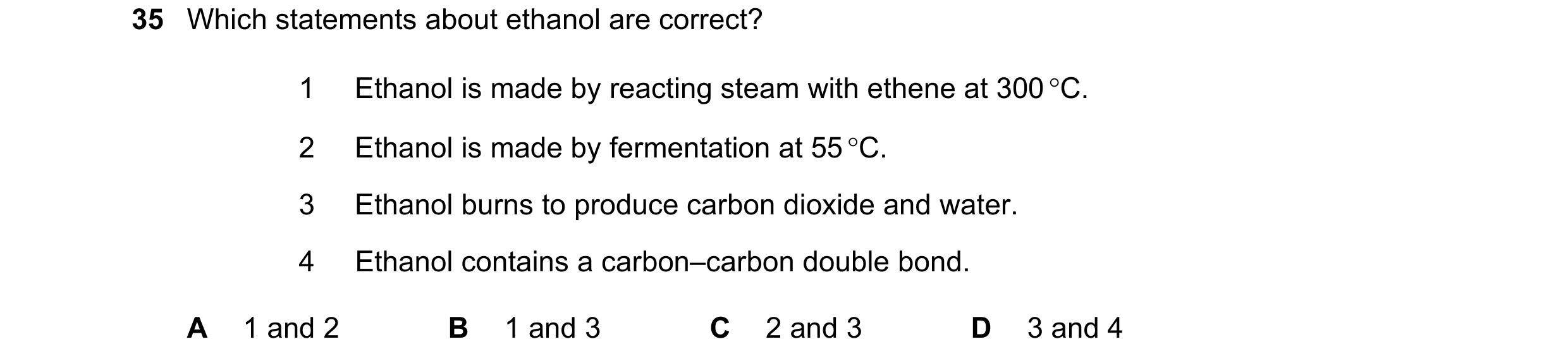

 4 / 5
4 / 5

 5 / 5
5 / 5