Questions as text
Q1 · Joe the Camel most easily recognised by children According to Paul Fischer, young… 9990/42 Feb/March 2018
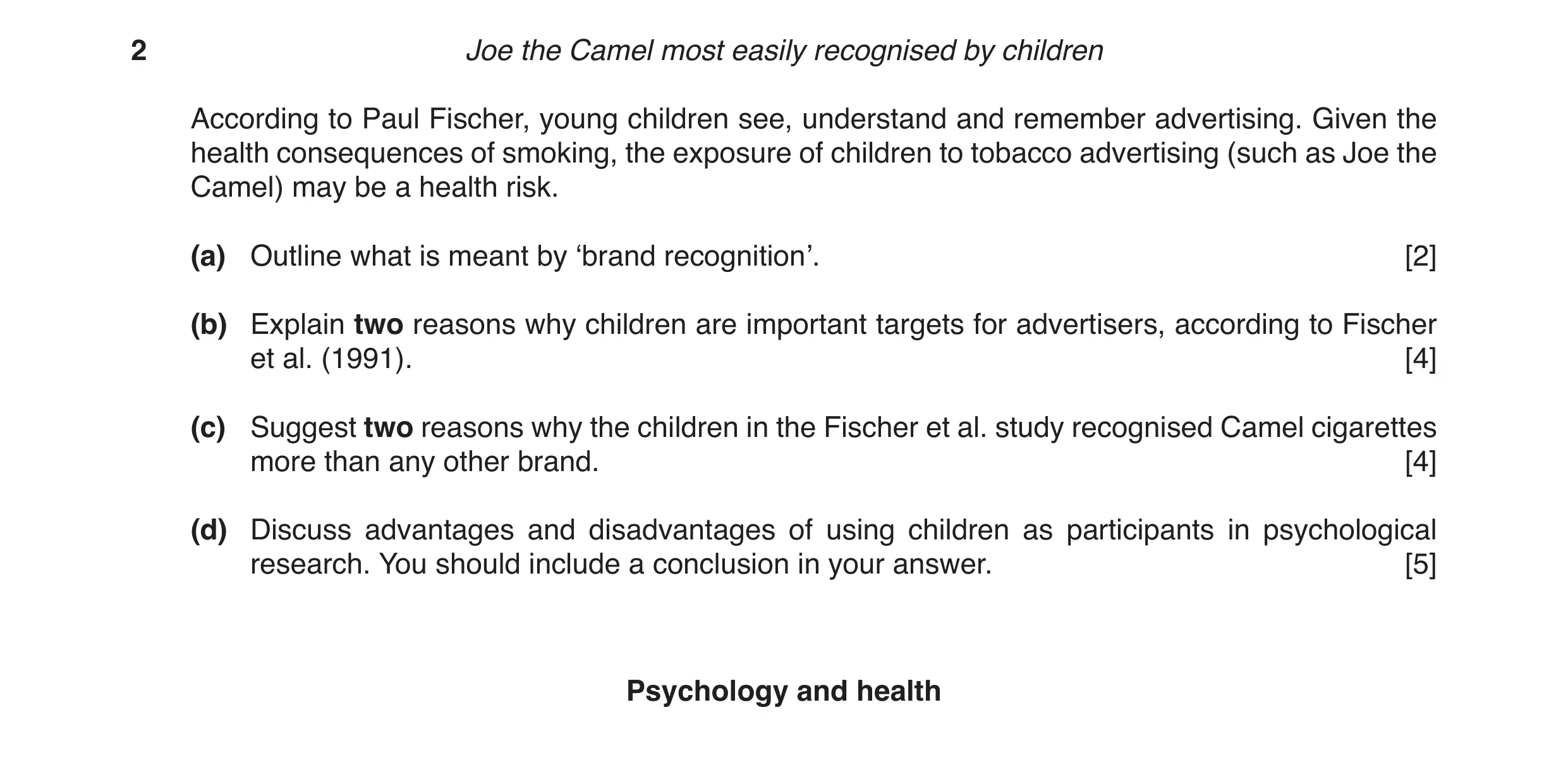
2 Joe the Camel most easily recognised by children According to Paul Fischer, young children see, understand and remember advertising. Given the health consequences of smoking, the exposure of children to tobacco advertising (such as Joe the Camel) may be a health risk. (a) Outline what is meant by ‘brand recognition’. [2] (b) Explain two reasons why children are important targets for advertisers, according to Fischer et al. (1991). [4] (c) Suggest two reasons why the children in the Fischer et al. study recognised Camel cigarettes more than any other brand. [4] (d) Discuss advantages and disadvantages of using children as participants in psychological research. You should include a conclusion in your answer. [5] Psychology and health
15 marks
Mark scheme: 2(a) Outline what is meant by ‘brand recognition’. 2 Marks: 1 mark for basic answer e.g. identification. +1 mark for elaboration/example. Most likely answer (other appropriate responses to be credited): The extent to which people are able to identify a brand by its attributes such as a logo, slogan or colour. 2(b) Explain two reasons why children are important targets for 4 advertisers, according to Fischer et al. (1991). Marks: Question always requires two ‘things’ • 1 mark basic answer. 2 marks elaboration, twice. • Max 2 marks if only ‘one’ is answered. Most likely answer (other appropriate responses to be credited): • Children are major consumers from a young age: food, toys and games, etc. • Children influence household decisions, maybe what a family will eat, where a family will go, etc. • Children are consumers of the future, and brand awareness in children may transfer to adulthood. 2(c) Suggest two reasons why the children in the Fischer et al. study 4 recognised Camel cigarettes more than any other brand. Marks: 1 mark basic answer. 2 marks elaboration, twice. Most likely answer (other appropriate responses to be credited): • Joe the camel is a cartoon character and so is more child friendly; • Joe the camel suggests the package contents are for children rather than adults; • following Bandura et al. (1961) children observe adults with cigarettes and although they may not copy an adult smoking they will imitate ‘smoking behaviours’ to be like an adult. This is made worse when associated with a cartoon character. 2(d) Discuss advantages and disadvantages of using children as 5 participants in psychological research. You should include a conclusion in your answer. Question always plural of each argument. Question always requires conclusion. • 1 mark for each for/against argument up to 4 max. • 1 mark for conclusion. Note: If three (or more) arguments for one side, best two credited. If one argument only, max 2 marks. Most likely answer (other appropriate responses to be credited): Advantages • children are young and naïve and so are more likely to behave naturally, even in laboratory experiments. • children will not question what is happening. • children are consumers so studies involving children are as appropriate as adults as participants. Disadvantages • children may not understand complex instructions and if they do« • they may not be able to explain what they are thinking or how they feel. • children may not exercise the right to withdraw; they may not understand a debriefing. • children may be psychologically harmed by a study which may not be evident for many years. Conclusion: (a decision reached by reasoning) any appropriate conclusion drawn from the discussion that has been presented. Marks: 1 mark if appropriate. 0 marks if the conclusion repeats what has already been stated. Section A: Stimulus question psychology and health
This question in 9990/42 Feb/March 2018
Q2 · Design a study gathering quantitative data to investigate how different types of gift… 9990/42 Feb/March 2018
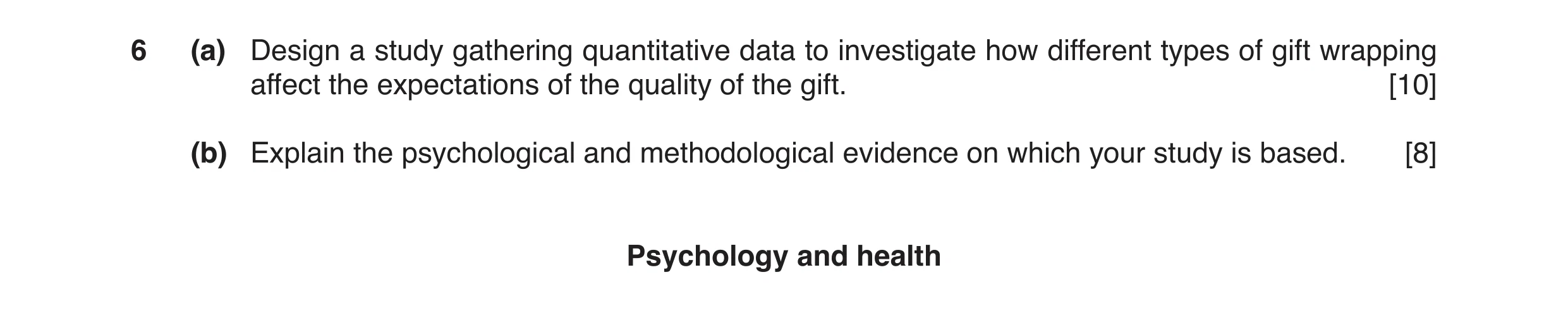
6 (a) Design a study gathering quantitative data to investigate how different types of gift wrapping affect the expectations of the quality of the gift. [10] (b) Explain the psychological and methodological evidence on which your study is based. [8] Psychology and health
18 marks
Mark scheme: 6(a) Design a study gathering quantitative data to investigate how different 10 types of gift wrapping affect the expectations of the quality of the gift. Marks: use generic levels of response ‘Design a study’ question part (a). Additional: Candidates should design the study showing evidence of design features appropriate to the named method. The named method is: any appropriate method, but must gather quantitative data. Typical features: • Experiments: type, IV, DV, controls, experimental design. • Observations: type, setting, response categories, sampling frame, number of observers. • Questionnaires/Interviews: type, setting, example questions. Scoring/rating scale, analysis of responses. Typical features of research methodology: sampling technique and sample, type of data, ethics, reliability, validity, data analysis. 6(b) Explain the psychological and methodological evidence on which your 8 study is based. Marks: use generic levels of response ‘Design a study’ question part (b). Note: If only methodological or psychological explanation is provided max 5 marks Candidates are expected to explain the reasons for the suggested design in part (a). Explanation should be both psychological and methodological. Psychological to include appropriate theory or research. Syllabus: packaging, positioning and placement: gift wrapping (Porublev et al., 2009) Additional: candidates are expected to justify their decisions or evidence presented regarding the design made in answer to question part (a). Psychological: Abstract from study: ‘This paper aims to explore and discuss the expectations surrounding the decision to wrap a gift. Gift wrapping can enable an object to be turned into a gift through the development of meaning that symbolises it as a gift. There are two key expectations surrounding the use of gift wrapping. The first expectation is that receivers prefer gifts to be wrapped and the second expectation is that the gift meets individual and social expectations of what a gift should look like. Data was gathered using three qualitative techniques; observation, interviews and projective workshops.’ Methodological: explanation of method using typical features as above.
This question in 9990/42 Feb/March 2018
Q3 · Design a field experiment conducted on an aeroplane to investigate the effect of noise on… 9990/42 May/June 2018
6 (a) Design a field experiment conducted on an aeroplane to investigate the effect of noise on the perceived sweetness of food. [10] (b) Explain the psychological and methodological evidence on which your experiment is based. [8] Psychology and health
18 marks
Mark scheme: 6(a) Design a field experiment conducted on an aeroplane to investigate 10 the effect of noise on the perceived sweetness of food. Marks: use generic levels of response Design a study question part (a). Additional: Candidates should design the study showing evidence of design features appropriate to the named method. The named method is: field experiment. Typical features: • Experiments: type, IV, DV, controls, experimental design. • Typical features of research methodology: sampling technique and sample, type of data, ethics, reliability, validity, data analysis. 6(b) Explain the psychological and methodological evidence on which your 8 study is based. Marks: use generic levels of response ‘Design a study’ question part (b). Note: If only methodological or psychological explanation is provided max 5 marks. Candidates are expected to explain the reasons for the suggested design in part (a). Explanation should be both psychological and methodological. Psychological to include appropriate theory or research. Additional: candidates are expected to justify their decisions or evidence presented regarding the design made in answer to question part (a). Syllabus: sound and consumer behaviour: background noise and food perception (Woods et al., 2010). Psychological: Woods et al. (2010): We investigated the effects of auditory background noise on the perception of gustatory food properties (sugar level, salt level), food crunchiness and food liking. Participants blindly consumed different foods whilst passively listening to either no sound, or quiet or loud background white noise. The foods were then rated in terms of sweetness, saltiness and liking (Experiment 1) or in terms of overall flavour, crunchiness and liking (Experiment 2). Reported sweetness and saltiness was significantly lower in the loud compared to the quiet sound conditions (Experiment 1), but crunchiness was reported to be more intense (Experiment 2). This suggests that food properties unrelated to sound (sweetness, saltiness) and those conveyed via auditory channels (crunchiness) are differentially affected by background noise. A relationship between ratings of the liking of background noise and ratings of the liking of the food was also found (Experiment 2). We conclude that background sound unrelated to food diminishes gustatory food properties (saltiness, sweetness) which is suggestive of a cross-modal contrasting or attentional effect, whilst enhancing food crunchiness. Methodological: explanation of method using typical features as above.
This question in 9990/42 May/June 2018
Q4 · ‘Product colour associations are universal rather than cultural: everyone likes blue… 9990/42 May/June 2018
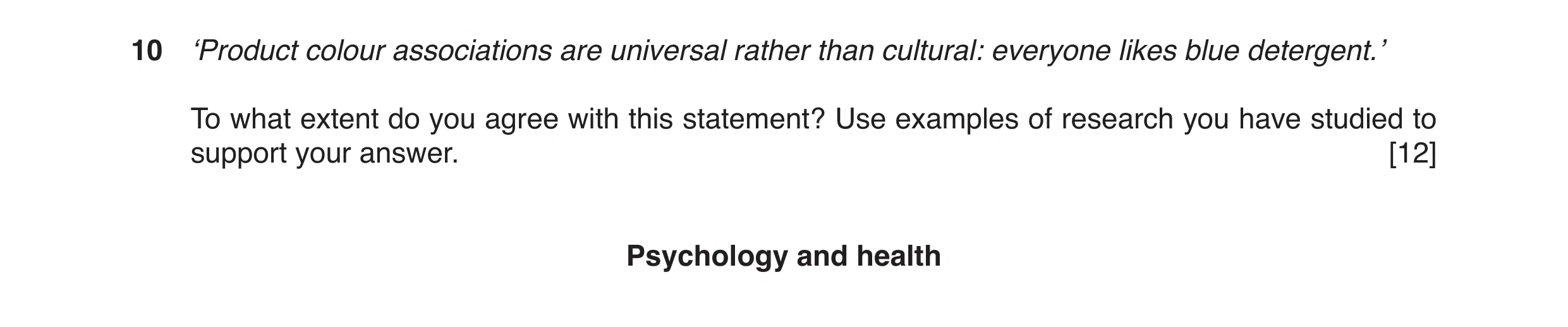
10 ‘Product colour associations are universal rather than cultural: everyone likes blue detergent.’ To what extent do you agree with this statement? Use examples of research you have studied to support your answer. [12] Psychology and health
12 marks
Mark scheme: 10 ‘Product colour associations are universal rather than cultural: 12 everyone likes blue detergent.’ To what extent do you agree with this statement? Use examples of research you have studied to support your answer. Marks: use generic levels of response in table C. Syllabus: packaging, positioning and placement: product colour and associative learning (Grossman & Wisenblit, 1999). Most likely (any other appropriate responses should be credited): For: • Some colour associations among consumers are consistent across countries. Most consumers (more than 50%) of China, Korea, Japan and the USA select green as the appropriate colour for a label on a can of vegetables and many associate yellow with a box of candy. • Worldwide brands are associated with specific colours: cans of cola are red, as is the label on bottles. • Blue is associated with boys and pink with girls in many cultures. • Colours such as red are associated with danger and green with safety (e.g. traffic lights) Against: • colours are associated with more than one thing; it is not one colour for one item; • colours are associated with different things in different cultures. • For example in the West, green is associated with hopefulness, white with purity, black with mourning, red with love or revolution and yellow with hatred. In China, white is associated with righteousness and yellow with trustworthiness. Black is associated with dullness and stupidity in Indian culture, while red suggests ambition and desire (Kreiter and Kreitler, 1972).
This question in 9990/42 May/June 2018
Q5 · The menu: the restaurant’s ‘business card’ 9990/41 Oct/Nov 2018
2 The menu: the restaurant’s ‘business card’. Oliveira’s Brasilian Restaurant Open 24 hours Best selling items today: pão de queijo bolinho de bacalhau pastel (a) Give one reason why the menu is said to be a restaurant’s ‘business card’. [2] (b) Identify two common menu mistakes suggested by Pavesic (2005) and suggest why they are mistakes. [4] (c) Suggest two reasons why menus should include no more than 24 items. [4] (d) Discuss the advantages and disadvantages of using eye movement patterns to design a menu. You should include a conclusion in your answer. [5] Psychology and health
15 marks
Mark scheme: 2(a) Give one reason why the menu is said to be a restaurant’s ‘business 2 card’. Marks: 1 mark for basic answer e.g. identification. 1 mark for elaboration/ example. Most likely answer (other appropriate responses to be credited): Pavesic: ‘It is the only piece of printed advertising that you are virtually 100% sure will be read by the guest. Once placed in the guest’s hand, it can directly influence not only what they will order, but ultimately how much they will spend. Menu design directly influences sales revenue. It introduces the customer to your restaurant, and its design should complement the décor, service, food quality, and price range of the restaurant. The menu design should incorporate the colors and graphics that the customer sees from the table.’ 2(b) Identify two common menu mistakes suggested by Pavesic (2005) and 4 suggest why they are mistakes. Marks: 1 mark identification of each answer. 1 mark for suggestion of why it is a mistake. Most likely answer (other appropriate responses to be credited): (from Pavesic, 2005) • Hard to read. Examples include poor readability because of font size, paper colour and font style; crowded menu pages with elements too numerous and font type too small; and printing on dark paper with dark ink making readability difficult under low-light conditions. • Overemphasising prices. When prices are aligned in a column down the page, guests can summarily discount items based on price alone. • Monotonous design. Using the same graphic design on all menu items so nothing stands out. • Poor use of space. This includes not using the front and back cover for information about the restaurant, e.g., hours, services, history, address, etc. • Incongruent. This includes failing to design the menu to fit the décor and personality of the restaurant. • Too big. The size of the menu needs to take into account the size of the table, the place setting and the table appointments. 2(c) Suggest two reasons why menus should include no more than 24 4 items. Marks: 1 mark basic answer. 2 marks detailed answer/elaboration × 2 Most likely answer (other appropriate responses to be credited): • 60–70% of sales are from this number of items • Customers spend an average of 109 seconds and more items take more time • 109 seconds is efficient: reduces order-taking time and table turn-over time • fewer items means fewer items to cook so reducing stock and wasted food that is unused. • It is better to offer fewer items that can be prepared well rather than many items done poorly. 2(d) Discuss the advantages and disadvantages of using eye movement 5 patterns to design a menu. You should include a conclusion in your answer. Marks: Question requires discussion; always plural of each argument, and always requires conclusion. 1 mark for each advantage/disadvantage (however detailed) and related to the question up to 4 max. 1 mark for two strengths/weaknesses unrelated to the question. 1 mark for conclusion. Most likely answer (other appropriate responses to be credited): Advantages: • it determines the common pattern of where most people look and so menu items can be strategically placed. • it is ‘scientific’ in that it accurately records exactly where the eyes move. • it is reliable – consistent for all participants; • it is valid – it measures eye targets. Disadvantages: • there are individual differences: eye movement is not the same for everyone. • the use of eye magnets deliberately attract the eye to different places on the menu – and so difficult to generalise the typical eye movement pattern. • people must wear the eye tracking apparatus and this may change their normal menu reading pattern. Conclusion: any appropriate conclusion drawn from the discussion that has been presented. 1 mark if appropriate. A conclusion is a ‘decision reached by reasoning’ and so a summary of points already made scores 0 marks.
This question in 9990/41 Oct/Nov 2018
Q6 · ‘Wrapping a gift is irrelevant; it is what is inside that is important.’ To what extent… 9990/42 Feb/March 2019
10 ‘Wrapping a gift is irrelevant; it is what is inside that is important.’ To what extent do you agree with this statement? Use examples of research you have studied to support your answer. [12] Psychology and health
12 marks
Mark scheme: 10 ‘Wrapping a gift is irrelevant: it is what is inside that is important.’ 12 To what extent do you agree with this statement? Use examples of research you have studied to support your answer. Marks: use generic levels of response in table C. Syllabus: gift wrapping (Porublev et al., 2009) Most likely (any other appropriate responses should be credited): For: • Wrapping a gift creates expectation of what is inside • Wrapping a gift shows attention to detail; that the person giving the gift cares. • Quote ‘Wrapping a gift meets individual and social expectations of what a gift should look like’. • Wrapping a gift can create a positive impression in a recipient being met for the first time. Against: • Wrapping a gift might create an expectation of what is inside and if that expectation isn’t met the recipient may be disappointed. • It is the thought that counts. A gift, however wrapped, is better than no gift at all. • A plain gift wrapping may create initial disappointment, leading to higher than average pleasure when the actual gift is revealed. • Quote ‘A naked gift can be acceptable in some circumstances and not acceptable in other circumstances, depending on the context of the exchange. For example, a naked gift can indicate the low worth of relationship (between the giver and the receiver) or that the giver has an unwillingness to personally invest in the gift.’
This question in 9990/42 Feb/March 2019
Q7 · ‘Descriptive food names do not influence perception of food; people will eat what they… 9990/41 Oct/Nov 2019
10 ‘Descriptive food names do not influence perception of food; people will eat what they like.’ To what extent do you agree with this statement? Use examples of research you have studied to support your answer. [12] Psychology and health
12 marks
Mark scheme: 10 ‘Descriptive food names do not influence perception of food; people will 12 eat what they like.’ To what extent do you agree with this statement? Use examples of research you have studied to support your answer. Marks: use generic levels of response in table C. Syllabus: menu design psychology: sensory perception and food name (Wansink et al., 2005) Most likely (any other appropriate responses should be credited): For: • quote from Wansink: those who ate foods with evocative, descriptive menu names generated a larger number of (i) positive comments about the food and (ii) rated it as more appealing, tasty, and calorific than those eating regularly-named counterparts • the use of descriptive names may help improve perceptions of foods in institutional settings, and it may help facilitate the introduction of unfamiliar foods • descriptive names are designed to make the food sound more tasty, appealing and may refer to the quality of the food, or where it is from (e.g. ‘locally sourced’) Against: • descriptions may create an expectation that is not met when the food arrives making the customer disappointed • people choose to eat what they like and do not choose what they dislike. The name is irrelevant • people do not like food descriptions which are too descriptive; restaurants try to make something average sound good that is not
This question in 9990/41 Oct/Nov 2019
Q8 · ‘Descriptive food names do not influence perception of food; people will eat what they… 9990/42 Oct/Nov 2019
10 ‘Descriptive food names do not influence perception of food; people will eat what they like.’ To what extent do you agree with this statement? Use examples of research you have studied to support your answer. [12] Psychology and health
12 marks
Mark scheme: 10 ‘Descriptive food names do not influence perception of food; people will 12 eat what they like.’ To what extent do you agree with this statement? Use examples of research you have studied to support your answer. Marks: use generic levels of response in table C. Syllabus: menu design psychology: sensory perception and food name (Wansink et al., 2005) Most likely (any other appropriate responses should be credited): For: • quote from Wansink: those who ate foods with evocative, descriptive menu names generated a larger number of (i) positive comments about the food and (ii) rated it as more appealing, tasty, and calorific than those eating regularly-named counterparts • the use of descriptive names may help improve perceptions of foods in institutional settings, and it may help facilitate the introduction of unfamiliar foods • descriptive names are designed to make the food sound more tasty, appealing and may refer to the quality of the food, or where it is from (e.g. ‘locally sourced’) Against: • descriptions may create an expectation that is not met when the food arrives making the customer disappointed • people choose to eat what they like and do not choose what they dislike. The name is irrelevant • people do not like food descriptions which are too descriptive; restaurants try to make something average sound good that is not
This question in 9990/42 Oct/Nov 2019
Q9 · ‘Descriptive food names do not influence perception of food; people will eat what they… 9990/43 Oct/Nov 2019
10 ‘Descriptive food names do not influence perception of food; people will eat what they like.’ To what extent do you agree with this statement? Use examples of research you have studied to support your answer. [12] Psychology and health
12 marks
Mark scheme: 10 ‘Descriptive food names do not influence perception of food; people will 12 eat what they like.’ To what extent do you agree with this statement? Use examples of research you have studied to support your answer. Marks: use generic levels of response in table C. Syllabus: menu design psychology: sensory perception and food name (Wansink et al., 2005) Most likely (any other appropriate responses should be credited): For: • quote from Wansink: those who ate foods with evocative, descriptive menu names generated a larger number of (i) positive comments about the food and (ii) rated it as more appealing, tasty, and calorific than those eating regularly-named counterparts • the use of descriptive names may help improve perceptions of foods in institutional settings, and it may help facilitate the introduction of unfamiliar foods • descriptive names are designed to make the food sound more tasty, appealing and may refer to the quality of the food, or where it is from (e.g. ‘locally sourced’) Against: • descriptions may create an expectation that is not met when the food arrives making the customer disappointed • people choose to eat what they like and do not choose what they dislike. The name is irrelevant • people do not like food descriptions which are too descriptive; restaurants try to make something average sound good that is not
This question in 9990/43 Oct/Nov 2019
Question 10 9990/41 May/June 2021
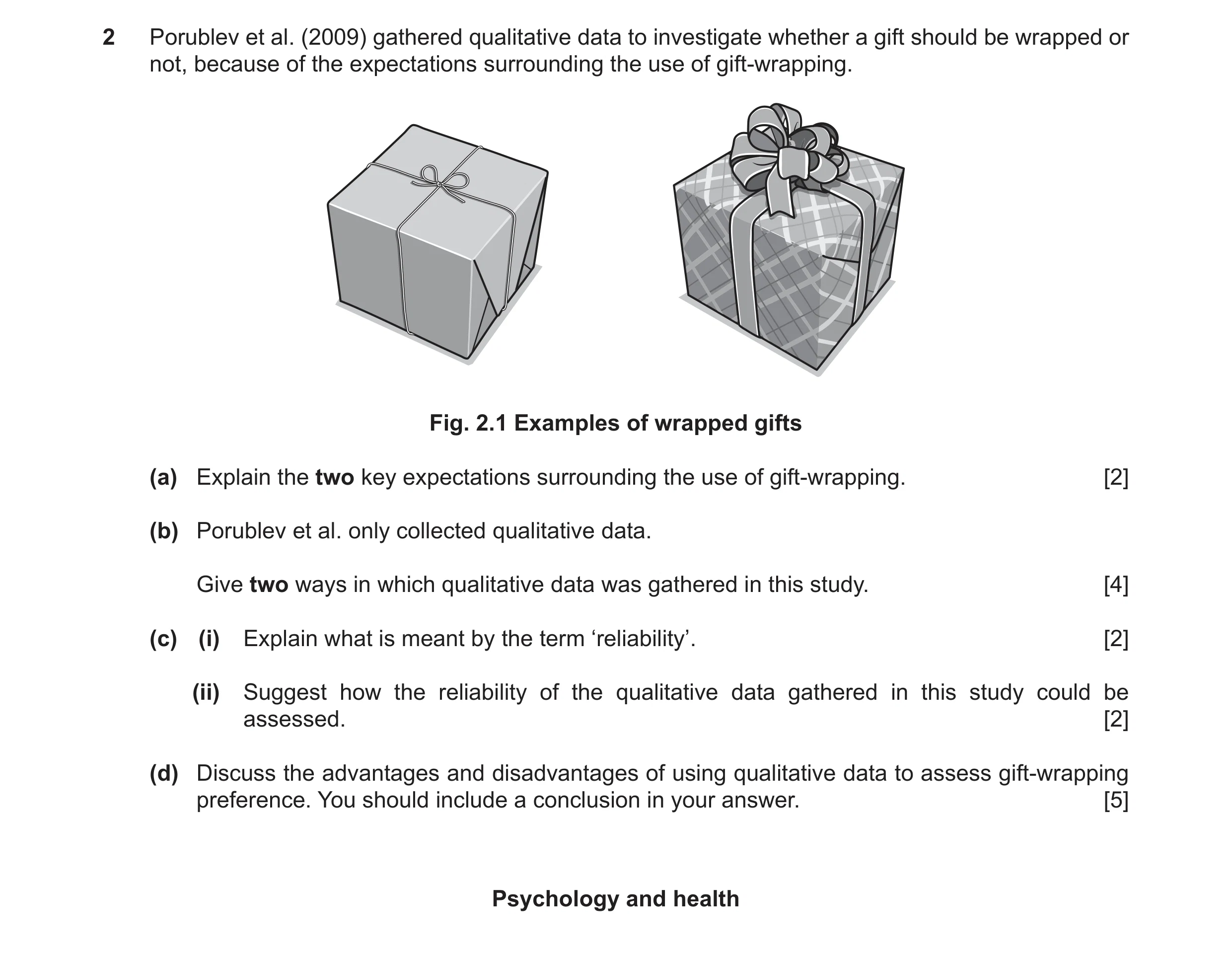
2 Porublev et al. (2009) gathered qualitative data to investigate whether a gift should be wrapped or not, because of the expectations surrounding the use of gift-wrapping. Fig. 2.1 Examples of wrapped gifts (a) Explain the two key expectations surrounding the use of gift-wrapping. [2] (b) Porublev et al. only collected qualitative data. Give two ways in which qualitative data was gathered in this study. [4] (c) (i) Explain what is meant by the term ‘reliability’. [2] (ii) Suggest how the reliability of the qualitative data gathered in this study could be assessed. [2] (d) Discuss the advantages and disadvantages of using qualitative data to assess gift-wrapping preference. You should include a conclusion in your answer. [5] Psychology and health
15 marks
Mark scheme: 2 Porublev et al. (2009) gathered qualitative data to investigate whether a gift should be wrapped or not, because of the expectations surrounding the use of gift-wrapping. 2(a) Explain the two key expectations surrounding the use of gift-wrapping. 2 Definitive answer: (Quoting study) There are two key expectations surrounding the use of gift wrapping. • the first expectation is that receivers prefer gifts to be wrapped and • that the gift meets individual and social expectations of what a gift should look like. Marks: 1 mark for ‘it is wrapped’ +1 mark for ‘it looks like a gift’ Note: 0 marks for ‘who it is for’; ‘where the gift is going’; ‘what the occasion is’ 2(b) Porublev et al. only collected qualitative data. 4 Give two ways in which qualitative data was gathered in this study. Definitive answer Quoting study Data was gathered using three qualitative techniques; • observation (1 mark) of a Christmas gift-wrap stall (2 marks) • interviews (1 mark) twenty in-depth interviews to reflect on gift- wrapping (2 marks) • projective workshops (1 mark) where, in pairs, participants were asked to wrap two gifts, one for someone they are close to and the other for an acquaintance, and have a discussion about gift wrapping whilst doing so (2 marks) Marks: 1 mark basic answer (identification), 2 marks detailed answer/elaboration or use of example (as in brackets above) X2. 2(c)(i) Explain what is meant by the term ‘reliability’. 2 Definitive answer (other appropriate responses to be credited): 1 mark basic answer e.g. reliability means consistency +1 mark: any elaboration or example e.g. reliability is the extent to which a procedure, task or measure produces the same results on different occasions. Alternatively, same measure is tested at a later date on same participant (i.e. test-retest); two or more independent observers are reliable (consistent) in giving the same score to the same behaviour Note: 0 marks for ‘being trustworthy’, repeating a study, or replication. 2(c)(ii) Suggest how the reliability of the qualitative data gathered in this 2 study could be assessed. Most likely answer (other appropriate responses to be credited): • inter-rater reliability, where two or more independent judges or raters assess what is said in the interview, or what is observed, for example. This could be done with predefined response categories and the extent of agreement recorded. Note: no marks for test-retest. Marks: 1 mark basic answer, 2 marks example from ‘this study’ See Q2(b) for examples of what the qualitative data might be. 2(d) Discuss the advantages and disadvantages of using qualitative data to 5 assess gift-wrapping preference. You should include a conclusion in your answer. Marks: 1 mark for each advantage/disadvantage (however basic/detailed) which is related/linked to the question (max 4 marks). 1 mark for conclusion. Conclusion: any appropriate conclusion drawn from the discussion that has been presented. 1 mark if appropriate. A conclusion is a ‘decision reached by reasoning’ and so a summary of points already made scores 0 marks. Most likely answer (other appropriate responses to be credited, such as eye movement patterns): Advantages • Asking people directly means that participants are given the opportunity to express their feelings and explain their experiences rather than the researcher trying to work out reasons for their behaviour from other methods • People can give as much information as they wish about their gift- wrapping preferences, but they can also say little or nothing if they wish. • Data can be qualitative, but may also be quantitative depending on type of question Disadvantages • Some participants may provide socially desirable responses about their gift-wrapping preferences; not give truthful answers; respond to demand characteristics. • Qualitative data tends not to lead to the calculation of statistics to allow comparison. • Researchers have to be careful about use of leading questions; it could affect the validity of the data collected.
This question in 9990/41 May/June 2021
Question 11 9990/43 May/June 2021
2 Porublev et al. (2009) gathered qualitative data to investigate whether a gift should be wrapped or not, because of the expectations surrounding the use of gift-wrapping. Fig. 2.1 Examples of wrapped gifts (a) Explain the two key expectations surrounding the use of gift-wrapping. [2] (b) Porublev et al. only collected qualitative data. Give two ways in which qualitative data was gathered in this study. [4] (c) (i) Explain what is meant by the term ‘reliability’. [2] (ii) Suggest how the reliability of the qualitative data gathered in this study could be assessed. [2] (d) Discuss the advantages and disadvantages of using qualitative data to assess gift-wrapping preference. You should include a conclusion in your answer. [5] Psychology and health
15 marks
Mark scheme: 2 Porublev et al. (2009) gathered qualitative data to investigate whether a gift should be wrapped or not, because of the expectations surrounding the use of gift-wrapping. 2(a) Explain the two key expectations surrounding the use of gift-wrapping. 2 Definitive answer: (Quoting study) There are two key expectations surrounding the use of gift wrapping. • the first expectation is that receivers prefer gifts to be wrapped and • that the gift meets individual and social expectations of what a gift should look like. Marks: 1 mark for ‘it is wrapped’ +1 mark for ‘it looks like a gift’ Note: 0 marks for ‘who it is for’; ‘where the gift is going’; ‘what the occasion is’ 2(b) Porublev et al. only collected qualitative data. 4 Give two ways in which qualitative data was gathered in this study. Definitive answer Quoting study Data was gathered using three qualitative techniques; • observation (1 mark) of a Christmas gift-wrap stall (2 marks) • interviews (1 mark) twenty in-depth interviews to reflect on gift- wrapping (2 marks) • projective workshops (1 mark) where, in pairs, participants were asked to wrap two gifts, one for someone they are close to and the other for an acquaintance, and have a discussion about gift wrapping whilst doing so (2 marks) Marks: 1 mark basic answer (identification), 2 marks detailed answer/elaboration or use of example (as in brackets above) X2. 2(c)(i) Explain what is meant by the term ‘reliability’. 2 Definitive answer (other appropriate responses to be credited): 1 mark basic answer e.g. reliability means consistency +1 mark: any elaboration or example e.g. reliability is the extent to which a procedure, task or measure produces the same results on different occasions. Alternatively, same measure is tested at a later date on same participant (i.e. test-retest); two or more independent observers are reliable (consistent) in giving the same score to the same behaviour Note: 0 marks for ‘being trustworthy’, repeating a study, or replication. 2(c)(ii) Suggest how the reliability of the qualitative data gathered in this 2 study could be assessed. Most likely answer (other appropriate responses to be credited): • inter-rater reliability, where two or more independent judges or raters assess what is said in the interview, or what is observed, for example. This could be done with predefined response categories and the extent of agreement recorded. Note: no marks for test-retest. Marks: 1 mark basic answer, 2 marks example from ‘this study’ See Q2(b) for examples of what the qualitative data might be. 2(d) Discuss the advantages and disadvantages of using qualitative data to 5 assess gift-wrapping preference. You should include a conclusion in your answer. Marks: 1 mark for each advantage/disadvantage (however basic/detailed) which is related/linked to the question (max 4 marks). 1 mark for conclusion. Conclusion: any appropriate conclusion drawn from the discussion that has been presented. 1 mark if appropriate. A conclusion is a ‘decision reached by reasoning’ and so a summary of points already made scores 0 marks. Most likely answer (other appropriate responses to be credited, such as eye movement patterns): Advantages • Asking people directly means that participants are given the opportunity to express their feelings and explain their experiences rather than the researcher trying to work out reasons for their behaviour from other methods • People can give as much information as they wish about their gift- wrapping preferences, but they can also say little or nothing if they wish. • Data can be qualitative, but may also be quantitative depending on type of question Disadvantages • Some participants may provide socially desirable responses about their gift-wrapping preferences; not give truthful answers; respond to demand characteristics. • Qualitative data tends not to lead to the calculation of statistics to allow comparison. • Researchers have to be careful about use of leading questions; it could affect the validity of the data collected.
This question in 9990/43 May/June 2021
Question 12 9990/42 May/June 2022
2 Porublev et al. (2009) used interviews and observations in their investigation into gift-wrapping. In one semi-structured interview, a participant stated: ‘What’s the point of giving a gift if you are not going to wrap it?’ (a) Explain one way in which a gift can be wrapped, when it is presented to a receiver. [2] (b) Suggest two reasons why a semi-structured interview was used in this study. [4] (c) Suggest two features of the type of observation used in this study. [4] (d) Discuss the strengths and weaknesses of using observations to assess gift-wrapping preference. You should include a conclusion in your answer. [5] Psychology and health
15 marks
Mark scheme: 2 Porublev et al. (2009) used interviews and observations in their investigation into gift-wrapping. In one semi-structured interview, a participant stated: ‘What's the point of giving a gift if you are not going to wrap it?’ 2(a) Explain one way in which a gift can be wrapped, when it is presented 2 to a receiver. Most likely answer (other appropriate responses to be credited): (from the study) gifts can be presented two ways; wrapped in a non traditional manner (1 mark) where it may be difficult to determine that the gift is actually a gift, for example, through the use of plain brown paper (2 marks), or the final way is to wrap a gift is in a traditional manner (1 mark) where the gift meets expectations of looking like a gift (2 marks) Marks: 1 mark for identification; 2 marks for elaboration/explanation 0 marks for unwrapped gift 2(b) Suggest two reasons why a semi-structured interview was used in this 4 study. Most likely answer (other appropriate responses to be credited): using some set/fixed questions allows each participant to be asked the same thing (1 mark). For example they were asked ‘do you prefer to receive gifts that are wrapped or unwrapped?’ (2 marks) semi structured allows additional questions to be asked (1 mark) [which may be closed or open] such as ‘why do you prefer wrapped to unwrapped gifts?’ (2 marks). Similarly: if used, open ended questions allows participants to expand on their closed response (1 mark) for example ‘why do you prefer wrapped to unwrapped gifts?’ allows reason (2 marks) if used, closed questions can include quantitative data (1 mark). For example asking the above question (answer yes/no) means numbers of each can be seen (2 marks) Marks: 1 mark for reason, 2 marks for ‘in this study’ 2. 2(c) Suggest two features of the type of observation used in this study. 4 Most likely answer Covert or overt: it is not stated in the study. Candidates can justify either. 0 marks if not justified. Naturalistic as the observation is at a gift-wrap stall. Non-participant as the observer was not wrapping the gift. Structured as the observer was looking to see whether people paid to have their gifts wrapped or not. Marks: 1 mark for correct identification of feature, 2 marks for ‘in this study’ 2 Note: 1 mark for correct ‘in this study’ if feature of observation is not identified. 2(d) Discuss the strengths and weaknesses of using observations to 5 assess gift wrapping preference. You should include a conclusion in your answer. Most likely answer (other appropriate responses to be credited, such as eye movement patterns): Advantages: A covert observation means the person is unaware they are being observed and so behaves naturally Observation of the giving of a gift is real life (naturalistic) so genuine behaviour Observations can have more than one observer so reliability of observations can be checked. A structured observation means that observers know exactly what they are looking for Disadvantages: A covert observation may mean that an observer misses a behaviour (person being observed moves out of view) A structured observation may not account for new or unexpected behaviour A naturalistic observation does not require consent, but on receiving a gift a person may behave in a way they would not wish to be recorded (a hug, kiss?) If observing behaviour only what is said between giver and recipient is not recorded Conclusion: any appropriate conclusion drawn from the discussion that has been presented. 1 mark if appropriate. A conclusion is a ‘decision reached by reasoning’ and so a summary of points already made scores 0 marks. Marks: Question requires discussion; always plural of each argument, and always requires conclusion. 1 mark for each strength/weakness (however detailed) and related to the question up to 4 max. 2 marks max for two strengths/weaknesses unrelated to the question. 1 mark for conclusion.
This question in 9990/42 May/June 2022
Q13 · Colour can be associated with specific products, but colour can also be used where… 9990/41 May/June 2023
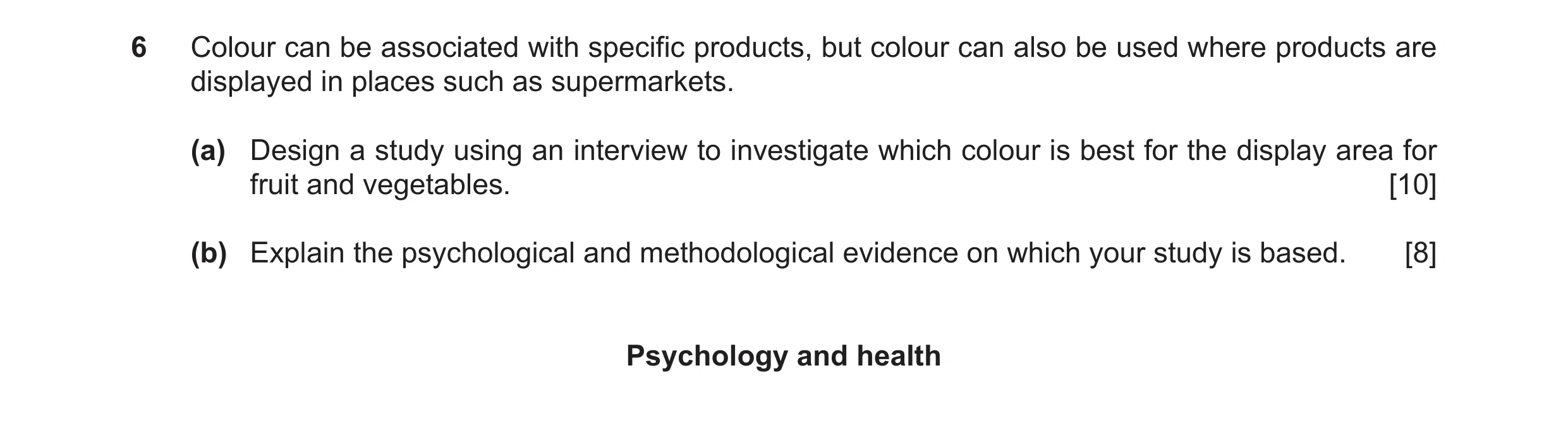
6 Colour can be associated with specific products, but colour can also be used where products are displayed in places such as supermarkets. (a) Design a study using an interview to investigate which colour is best for the display area for fruit and vegetables. [10] (b) Explain the psychological and methodological evidence on which your study is based. [8] Psychology and health
18 marks
Mark scheme: 6(a) Colour can be associated with specific products, but colour can also be 10 used where products are displayed in places such as supermarkets. Design a study using an interview to investigate which colour is best for the display area for fruit and vegetables. Marks: use generic levels of response Design a study question part (a). Additional: Candidates should design the study showing evidence of design features appropriate to the named method. The named method is: interview. Specific features: Questionnaires/Interviews: type, setting, example questions. Scoring/rating scale, analysis of responses. General features of research methodology: sampling technique and sample, type of data, ethics, reliability, validity, data analysis. 6(b) Explain the psychological and methodological evidence on which your 8 study is based. Marks: use generic levels of response ‘Design a study’ question part (b). NB If only methodological or psychological explanation is provided max 5 marks Candidates are expected to explain the reasons for the suggested design in part (a). Explanation should be both psychological and methodological. Psychological to include appropriate theory or research. Additional: candidates are expected to justify their decisions or evidence presented regarding the design made in answer to question part (a). Syllabus: product colour and associative learning (Grossman and Wisenblit, 1999) Psychological: Colours are associated with many things. Washing machines and kitchen goods are white, associated with cleanliness. Colours such as red are associated with danger and green with safety. Worldwide brands are associated with specific colours such as cans of Coca-Cola being red. Green is often an indicator of freshness – many vegetables are green (but some are orange, yellow and other colours). Methodological: explanation of method using general and specific features as above.
This question in 9990/41 May/June 2023
Q14 · Colour can be associated with specific products, but colour can also be used where… 9990/43 May/June 2023
6 Colour can be associated with specific products, but colour can also be used where products are displayed in places such as supermarkets. (a) Design a study using an interview to investigate which colour is best for the display area for fruit and vegetables. [10] (b) Explain the psychological and methodological evidence on which your study is based. [8] Psychology and health
18 marks
Mark scheme: 6(a) Colour can be associated with specific products, but colour can also be 10 used where products are displayed in places such as supermarkets. Design a study using an interview to investigate which colour is best for the display area for fruit and vegetables. Marks: use generic levels of response Design a study question part (a). Additional: Candidates should design the study showing evidence of design features appropriate to the named method. The named method is: interview. Specific features: Questionnaires/Interviews: type, setting, example questions. Scoring/rating scale, analysis of responses. General features of research methodology: sampling technique and sample, type of data, ethics, reliability, validity, data analysis. 6(b) Explain the psychological and methodological evidence on which your 8 study is based. Marks: use generic levels of response ‘Design a study’ question part (b). NB If only methodological or psychological explanation is provided max 5 marks Candidates are expected to explain the reasons for the suggested design in part (a). Explanation should be both psychological and methodological. Psychological to include appropriate theory or research. Additional: candidates are expected to justify their decisions or evidence presented regarding the design made in answer to question part (a). Syllabus: product colour and associative learning (Grossman and Wisenblit, 1999) Psychological: Colours are associated with many things. Washing machines and kitchen goods are white, associated with cleanliness. Colours such as red are associated with danger and green with safety. Worldwide brands are associated with specific colours such as cans of Coca-Cola being red. Green is often an indicator of freshness – many vegetables are green (but some are orange, yellow and other colours). Methodological: explanation of method using general and specific features as above.
This question in 9990/43 May/June 2023
Q15 · From the key study by Becker et al 9990/41 May/June 2024
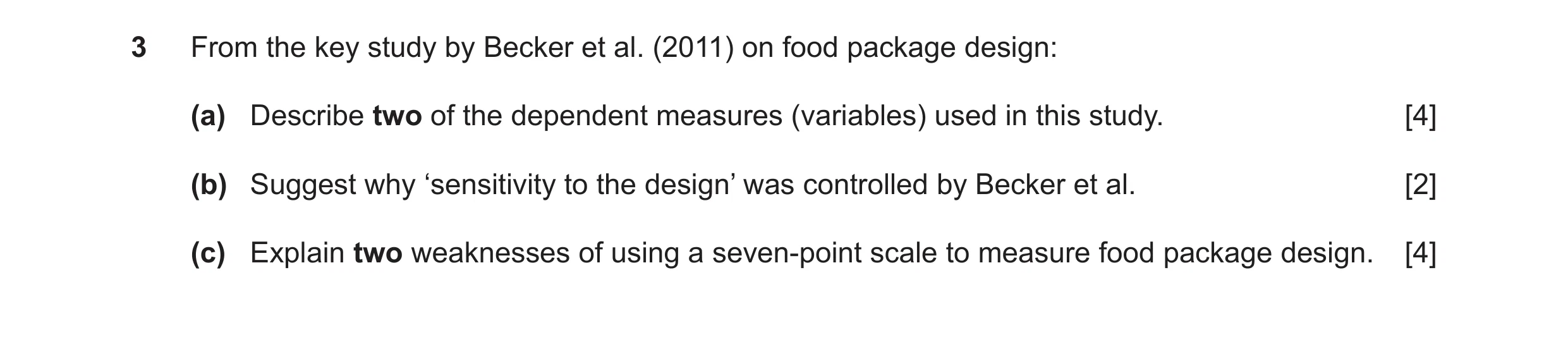
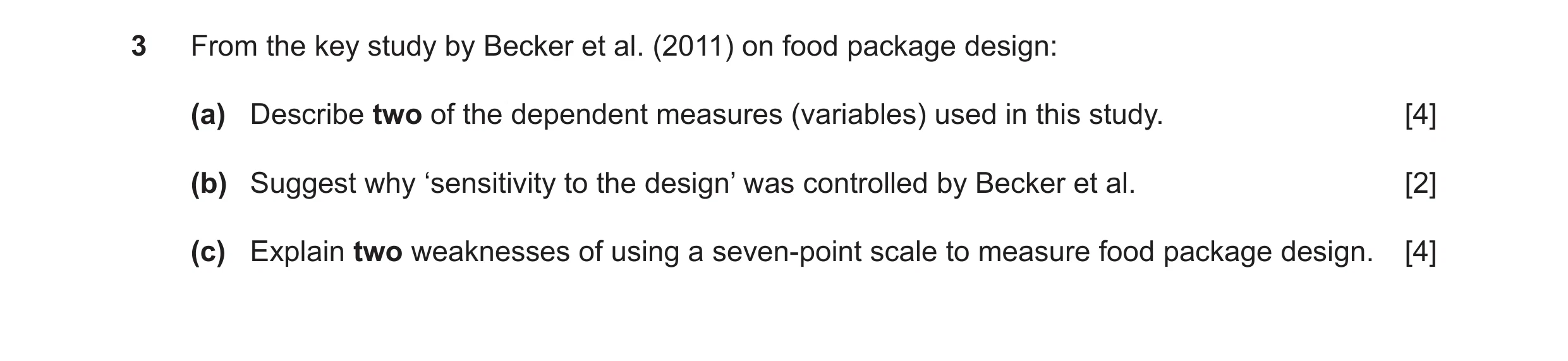
3 From the key study by Becker et al. (2011) on food package design: (a) Describe two of the dependent measures (variables) used in this study. [4] (b) Suggest why ‘sensitivity to the design’ was controlled by Becker et al. [2] (c) Explain two weaknesses of using a seven-point scale to measure food package design. [4]
10 marks
Mark scheme: 3(a) Describe two of the dependent measures (variables) used in this study. 4 Syllabus: 2.4.1 Key study on food package design and taste perceptions: Becker et al. (2011). Award 2 marks for a detailed description. Award 1 mark for a partial description. Definitive answers: taste intensity evaluation (1) (sharp, bitter and mild) were measured on a 7-point scale (2) product evaluation (1) measuring attitudes towards the product (superior, eye-catching, high-quality) measured on a 7-point scale (2) price expectation (1) measured by asking ‘what they thought the price would be’ (measures in Euros) (2) NOTE: 7 point scale: ‘not at all’ to ‘very much so’. 3(b) Suggest why 'sensitivity to the design' was controlled by Becker et al. 2 Award 2 marks for an appropriate suggestion stated and applied to study with detail / elaboration / example. Award 1 mark for an appropriate suggestion identified but not applied. Answers may include: To take into account individual differences in food package design (1) so any ‘low sensitivity’ or ‘high sensitivity’ participants could be analysed in different groups rather than together (2). (NB: sensitivity to design = note it or ignore it) To control for participant variables (1) so any ‘low sensitivity’ or ‘high sensitivity’ participants could be analysed in different groups rather than together (2). To ensure that the study was valid (1) and so low and high sensitivity did not cancel each other (2). Other appropriate responses to be credited. 3(c) Explain two weaknesses of using a seven-point scale to measure food 4 package design. Up to 2 marks for each weakness x 2. Award 2 marks for an appropriate weakness stated and applied as required by the question with detail / elaboration / example. Award 1 mark for an appropriate weakness stated but not applied. Answers may include: A 7-point scale includes a mid-point (neutral response) which might be used as an opt-out (1) and so the effect of food package design cannot be measured (2). Using a 7-point scale provides quantitative data and there is no opportunity to gather qualitative data (1) so no opportunity to give a reason for choice in relation to food package design (2). Other appropriate responses to be credited.
This question in 9990/41 May/June 2024
Q16 · From the key study by Becker et al 9990/43 May/June 2024
3 From the key study by Becker et al. (2011) on food package design: (a) Describe two of the dependent measures (variables) used in this study. [4] (b) Suggest why ‘sensitivity to the design’ was controlled by Becker et al. [2] (c) Explain two weaknesses of using a seven-point scale to measure food package design. [4]
10 marks
Mark scheme: 3(a) Describe two of the dependent measures (variables) used in this study. 4 Syllabus: 2.4.1 Key study on food package design and taste perceptions: Becker et al. (2011). Award 2 marks for a detailed description. Award 1 mark for a partial description. Definitive answers: taste intensity evaluation (1) (sharp, bitter and mild) were measured on a 7-point scale (2) product evaluation (1) measuring attitudes towards the product (superior, eye-catching, high-quality) measured on a 7-point scale (2) price expectation (1) measured by asking ‘what they thought the price would be’ (measures in Euros) (2) NOTE: 7 point scale: ‘not at all’ to ‘very much so’. 3(b) Suggest why 'sensitivity to the design' was controlled by Becker et al. 2 Award 2 marks for an appropriate suggestion stated and applied to study with detail / elaboration / example. Award 1 mark for an appropriate suggestion identified but not applied. Answers may include: To take into account individual differences in food package design (1) so any ‘low sensitivity’ or ‘high sensitivity’ participants could be analysed in different groups rather than together (2). (NB: sensitivity to design = note it or ignore it) To control for participant variables (1) so any ‘low sensitivity’ or ‘high sensitivity’ participants could be analysed in different groups rather than together (2). To ensure that the study was valid (1) and so low and high sensitivity did not cancel each other (2). Other appropriate responses to be credited. 3(c) Explain two weaknesses of using a seven-point scale to measure food 4 package design. Up to 2 marks for each weakness x 2. Award 2 marks for an appropriate weakness stated and applied as required by the question with detail / elaboration / example. Award 1 mark for an appropriate weakness stated but not applied. Answers may include: A 7-point scale includes a mid-point (neutral response) which might be used as an opt-out (1) and so the effect of food package design cannot be measured (2). Using a 7-point scale provides quantitative data and there is no opportunity to gather qualitative data (1) so no opportunity to give a reason for choice in relation to food package design (2). Other appropriate responses to be credited.
This question in 9990/43 May/June 2024
Q17 · Outline two ways in which a gift can be wrapped 9990/42 Feb/March 2025
4 (a) Outline two ways in which a gift can be wrapped. [2] (b) Suggest how an unstructured observation can be used to investigate gift-wrapping behaviour. [2] (c) Explain two strengths of using different features of observation to measure gift-wrapping behaviour. [4] Health Psychology Answer all questions if you have studied this option.
8 marks
Mark scheme: 4(a) Outline two ways in which a gift can be wrapped. 2 AO1 Syllabus: 2.4.1 gift-wrapping including beliefs of giver and recipient: why gifts are wrapped, types of wrapping. Marks: Award 1 marks for ‘way’ or type plus 1 mark for elaboration/example Most likely answer: • wrapped in a traditional manner where the gift meets expectations of looking like a gift with ribbons, bows, etc. (1 mark) • wrapped in a non-traditional manner where it may be difficult to determine that the gift is actually a gift, for example, through the use of plain brown paper (1 mark) Note: award 1 mark if both types are identified only. 4(b) Suggest how an unstructured observation can be used to investigate 2 gift-wrapping behaviour. AO2 Marks: Award 2 marks for an appropriate suggestion and applied to study with detail / elaboration / example. Award 1 mark for an appropriate suggestion but not applied. Answers may include (other appropriate responses to be credited). • an unstructured observation would have no pre-determined response categories (1 mark) and the observer lists gift-wrapping behaviours as they are performed (2 marks) • an unstructured observation could be done in different locations (1 mark) such as in a gift shop compared to at home wrapping a gift for a friend (2 marks) 4(c) Explain two strengths of using different features of observation to 4 measure gift-wrapping behaviour. AO3 Marks: Up to 2 marks for each strength X2 Award 2 marks for an appropriate strength stated and applied as required by the question with detail / elaboration / example. Award 1 mark for an appropriate strength stated but not applied. Answers may include (other appropriate responses to be credited): Strengths: • a covert observation means the person is unaware they are being observed and so behaves naturally (1 mark) wrapping a gift as they usually would (2 marks) • observations can have more than one observer, so reliability of an observation can be checked (1 mark) perhaps all agreeing that a gift is non-traditional (2 marks) • a structured observation means that observers know exactly what they are looking for (1 mark) to see what features are included in a traditional wrapping, such as a bow (2 marks). • A naturalistic observation means that the participant is in a natural environment and unaware (1 mark) that their gift-wrapping behaviour is being observed (2 marks)
This question in 9990/42 Feb/March 2025
Q18 · Outline what is meant by brand awareness 9990/41 May/June 2025
4 (a) Outline what is meant by brand awareness. [2] (b) Suggest one way in which brand awareness could be measured, other than a rating scale. [2] (c) Explain one strength and one weakness of the measurement you suggested in part (b). [4] Health Psychology Answer all questions if you have studied this option.
8 marks
Mark scheme: 4(a) Outline what is meant by brand awareness. 2 Syllabus: 2.5.3 brand awareness, brand image and effective slogans including types and function of slogans; guidelines. Marks: Award 1 mark for a partial outline e.g. ‘can identify/is familiar with a brand’… Award 2 marks for a detailed outline (example/elaboration) e.g.…based on Answers may include (other appropriate responses to be credited): • brand awareness is the extent to which consumers are familiar with a brand’s identity and its product or services (1 mark) any example/elaboration (+1 mark) • based on slogans, logos or name (+1) Note: common indicators of brand awareness are brand recall and brand recognition. • brand recall is the respondent's ability to remember the brand without any aid (+1 mark). • brand recognition is the respondent's ability to identify the brand from a list/array that is provided (+1 mark) 4(b) Suggest one way in which brand awareness could be measured, other 2 than a rating scale. Marks: Award 2 marks for an appropriate suggestion stated and applied to study with detail / elaboration / example. Award 1 mark for an appropriate suggestion identified but not applied. Answers may include (other appropriate responses to be credited): • conduct an experiment (type needed) (1 mark): participants can be exposed to different brands (IV) and complete various tasks (DV) or are then asked about their experiences and/or feelings/satisfaction. • give a questionnaire or interview (include technique or format) (1 mark) to determine brand experiences based on what people think about each brand. • conduct an observation (features) (1 mark) in with various brands and record time taken to identify an item/what product is associated with it. Note: can award 1 mark for correct example with identified method (no detail) 4(c) Explain one strength and one weakness of the measurement you 4 suggested in part (b). Marks: Up to 2 marks for each strength and 2 marks for each weakness. Award 2 marks for an appropriate strength/weakness stated and applied as required by the question with detail / elaboration / example. Award 1 mark for an appropriate strength/weakness stated but not applied. Answers may include (other appropriate responses to be credited): Strengths and Weaknesses • experiment: any strength/weakness of a laboratory experiment or a field experiment (1 mark) related to brand awareness (2 marks) • interview: any strength/weakness of a face-to-face or phone or online interview OR type of interview (structured/semi/unstructured) (1 mark) related to brand awareness (2 marks) • questionnaire: any strength/weakness of closed or open questions OR type of format (paper/pencil or online or postal) (1 mark) related to brand awareness (2 marks) • observation: any strength/weakness (about four features of observations) (1 mark) related to brand awareness (2 marks) Note: strengths and weaknesses must relate to answer in (b) else 0 marks
This question in 9990/41 May/June 2025
Q19 · Outline what is meant by brand awareness 9990/43 May/June 2025
4 (a) Outline what is meant by brand awareness. [2] (b) Suggest one way in which brand awareness could be measured, other than a rating scale. [2] (c) Explain one strength and one weakness of the measurement you suggested in part (b). [4] Health Psychology Answer all questions if you have studied this option.
8 marks
Mark scheme: 4(a) Outline what is meant by brand awareness. 2 Syllabus: 2.5.3 brand awareness, brand image and effective slogans including types and function of slogans; guidelines. Marks: Award 1 mark for a partial outline e.g. ‘can identify/is familiar with a brand’… Award 2 marks for a detailed outline (example/elaboration) e.g.…based on Answers may include (other appropriate responses to be credited): • brand awareness is the extent to which consumers are familiar with a brand’s identity and its product or services (1 mark) any example/elaboration (+1 mark) • based on slogans, logos or name (+1) Note: common indicators of brand awareness are brand recall and brand recognition. • brand recall is the respondent's ability to remember the brand without any aid (+1 mark). • brand recognition is the respondent's ability to identify the brand from a list/array that is provided (+1 mark) 4(b) Suggest one way in which brand awareness could be measured, other 2 than a rating scale. Marks: Award 2 marks for an appropriate suggestion stated and applied to study with detail / elaboration / example. Award 1 mark for an appropriate suggestion identified but not applied. Answers may include (other appropriate responses to be credited): • conduct an experiment (type needed) (1 mark): participants can be exposed to different brands (IV) and complete various tasks (DV) or are then asked about their experiences and/or feelings/satisfaction. • give a questionnaire or interview (include technique or format) (1 mark) to determine brand experiences based on what people think about each brand. • conduct an observation (features) (1 mark) in with various brands and record time taken to identify an item/what product is associated with it. Note: can award 1 mark for correct example with identified method (no detail) 4(c) Explain one strength and one weakness of the measurement you 4 suggested in part (b). Marks: Up to 2 marks for each strength and 2 marks for each weakness. Award 2 marks for an appropriate strength/weakness stated and applied as required by the question with detail / elaboration / example. Award 1 mark for an appropriate strength/weakness stated but not applied. Answers may include (other appropriate responses to be credited): Strengths and Weaknesses • experiment: any strength/weakness of a laboratory experiment or a field experiment (1 mark) related to brand awareness (2 marks) • interview: any strength/weakness of a face-to-face or phone or online interview OR type of interview (structured/semi/unstructured) (1 mark) related to brand awareness (2 marks) • questionnaire: any strength/weakness of closed or open questions OR type of format (paper/pencil or online or postal) (1 mark) related to brand awareness (2 marks) • observation: any strength/weakness (about four features of observations) (1 mark) related to brand awareness (2 marks) Note: strengths and weaknesses must relate to answer in (b) else 0 marks
This question in 9990/43 May/June 2025
Q20 · From the key study by Becker et al 9990/41 Oct/Nov 2025
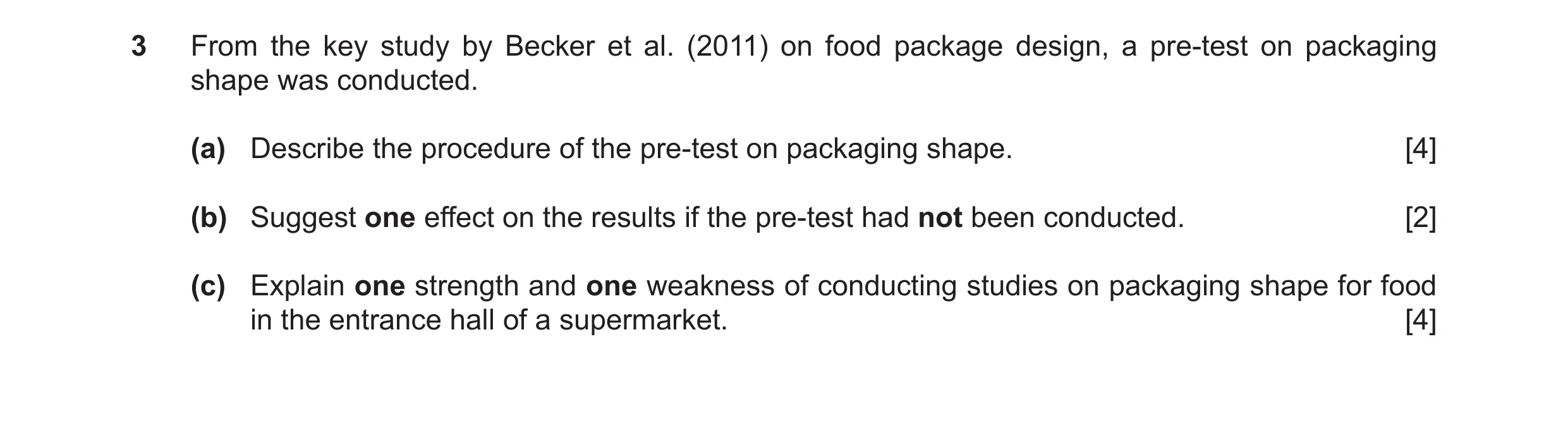
3 From the key study by Becker et al. (2011) on food package design, a pre-test on packaging shape was conducted. (a) Describe the procedure of the pre-test on packaging shape. [4] (b) Suggest one effect on the results if the pre-test had not been conducted. [2] (c) Explain one strength and one weakness of conducting studies on packaging shape for food in the entrance hall of a supermarket. [4]
10 marks
Mark scheme: 3 From the key study by Becker et al. (2011) on food package design, a pre-test on packaging shape was conducted. 3(a) Describe the procedure of the pre-test on packaging shape. 4 Syllabus: 2.4.1 Key study on food package design and taste perceptions: Becker et al. (2011). Marks: Award 1 mark for each different point up to 4 max. Definitive answers: • twenty participants evaluated three pairs of product variants (see Fig. 1) representing the intended shape manipulation • using a 12-item potency construct • comprising the items impressive, sour, mild (reverse coded), weak (reverse coded), humble (reverse coded), pure, bland (reverse coded), bitter, compliant (reverse coded), spicy, rebellious, independent] • participants indicated (using 7-point rating scales ranging from ‘not at all’ to ‘very much so’) to what extent they considered these items descriptive of the shape variants. • the six different cups were presented in random order. 3(b) Suggest one effect on the results if the pre-test had not been conducted. 2 Marks: Award 2 marks for an appropriate suggestion stated and applied to study with detail/elaboration/example. Award 1 mark for an appropriate suggestion identified but not applied. Answers may include (other appropriate responses to be credited): • there could be a lack of validity (1 mark) because the researchers could use a design which would be artificial such testing a ‘square’ yogurt container (or any of the other five container designs) (2 marks) • time could be wasted studying something that was not realistic or would not be used in real-life (1 mark) such as a square yogurt container for example (2 marks) 3(c) Explain one strength and one weakness of conducting studies on 4 package shape for food in the entrance hall of a supermarket. Marks: up to 2 marks for each strength and up to 2 marks for each weakness: Award 2 marks for an appropriate strength/weakness stated and applied as required by the question with detail/elaboration/example. Award 1 mark for an appropriate strength/weakness stated but not applied. Answers may include (other appropriate responses to be credited): Strengths: • the location is congruent with the study (1 mark) people are in a supermarket which sells food so the location is ideal for testing food packaging (2 marks) • using opportunity sampling means that participants are readily available to the researchers (1 mark) with ‘participants coming to them’ ideal for package design testing (2 marks) Weaknesses: • people are in the supermarket to shop and may not fully concentrate on participating in a study (1 mark) which may result in the findings on package shape not being as valid as they otherwise might be (2 marks) • conducting a study, a field experiment, means that not all extraneous variables are controlled (1 mark) conducting a study at the entrance to a supermarket means that there may be many uncontrollable situational variables such as other shoppers (2 marks)
This question in 9990/41 Oct/Nov 2025
Q21 · From the key study by Becker et al 9990/43 Oct/Nov 2025
3 From the key study by Becker et al. (2011) on food package design, a pre-test on packaging shape was conducted. (a) Describe the procedure of the pre-test on packaging shape. [4] (b) Suggest one effect on the results if the pre-test had not been conducted. [2] (c) Explain one strength and one weakness of conducting studies on packaging shape for food in the entrance hall of a supermarket. [4]
10 marks
Mark scheme: 3 From the key study by Becker et al. (2011) on food package design, a pre-test on packaging shape was conducted. 3(a) Describe the procedure of the pre-test on packaging shape. 4 Syllabus: 2.4.1 Key study on food package design and taste perceptions: Becker et al. (2011). Marks: Award 1 mark for each different point up to 4 max. Definitive answers: • twenty participants evaluated three pairs of product variants (see Fig. 1) representing the intended shape manipulation • using a 12-item potency construct • comprising the items impressive, sour, mild (reverse coded), weak (reverse coded), humble (reverse coded), pure, bland (reverse coded), bitter, compliant (reverse coded), spicy, rebellious, independent] • participants indicated (using 7-point rating scales ranging from ‘not at all’ to ‘very much so’) to what extent they considered these items descriptive of the shape variants. • the six different cups were presented in random order. 3(b) Suggest one effect on the results if the pre-test had not been conducted. 2 Marks: Award 2 marks for an appropriate suggestion stated and applied to study with detail/elaboration/example. Award 1 mark for an appropriate suggestion identified but not applied. Answers may include (other appropriate responses to be credited): • there could be a lack of validity (1 mark) because the researchers could use a design which would be artificial such testing a ‘square’ yogurt container (or any of the other five container designs) (2 marks) • time could be wasted studying something that was not realistic or would not be used in real-life (1 mark) such as a square yogurt container for example (2 marks) 3(c) Explain one strength and one weakness of conducting studies on 4 package shape for food in the entrance hall of a supermarket. Marks: up to 2 marks for each strength and up to 2 marks for each weakness: Award 2 marks for an appropriate strength/weakness stated and applied as required by the question with detail/elaboration/example. Award 1 mark for an appropriate strength/weakness stated but not applied. Answers may include (other appropriate responses to be credited): Strengths: • the location is congruent with the study (1 mark) people are in a supermarket which sells food so the location is ideal for testing food packaging (2 marks) • using opportunity sampling means that participants are readily available to the researchers (1 mark) with ‘participants coming to them’ ideal for package design testing (2 marks) Weaknesses: • people are in the supermarket to shop and may not fully concentrate on participating in a study (1 mark) which may result in the findings on package shape not being as valid as they otherwise might be (2 marks) • conducting a study, a field experiment, means that not all extraneous variables are controlled (1 mark) conducting a study at the entrance to a supermarket means that there may be many uncontrollable situational variables such as other shoppers (2 marks)
This question in 9990/43 Oct/Nov 2025
![Question 3: (a) Design a field experiment conducted on an aeroplane to investigate the effect of noise on the perceived sweetness of food. [10] (b) Exp…](https://img.pastlit.com/crops/46469efd-8343-405f-b485-14d7097772c6/q6.webp)
 1 / 7
1 / 7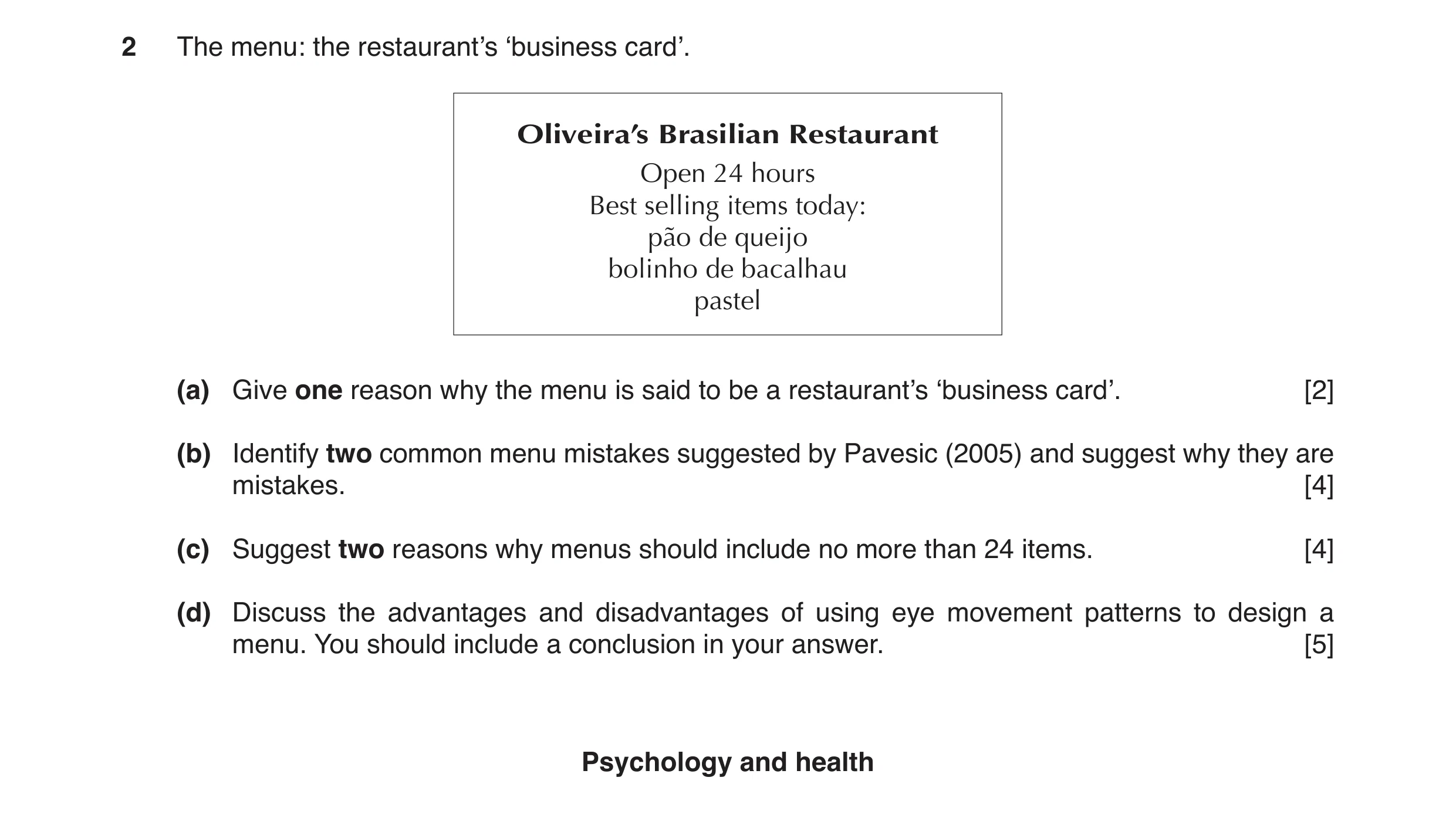
 2 / 7
2 / 7
 3 / 7
3 / 7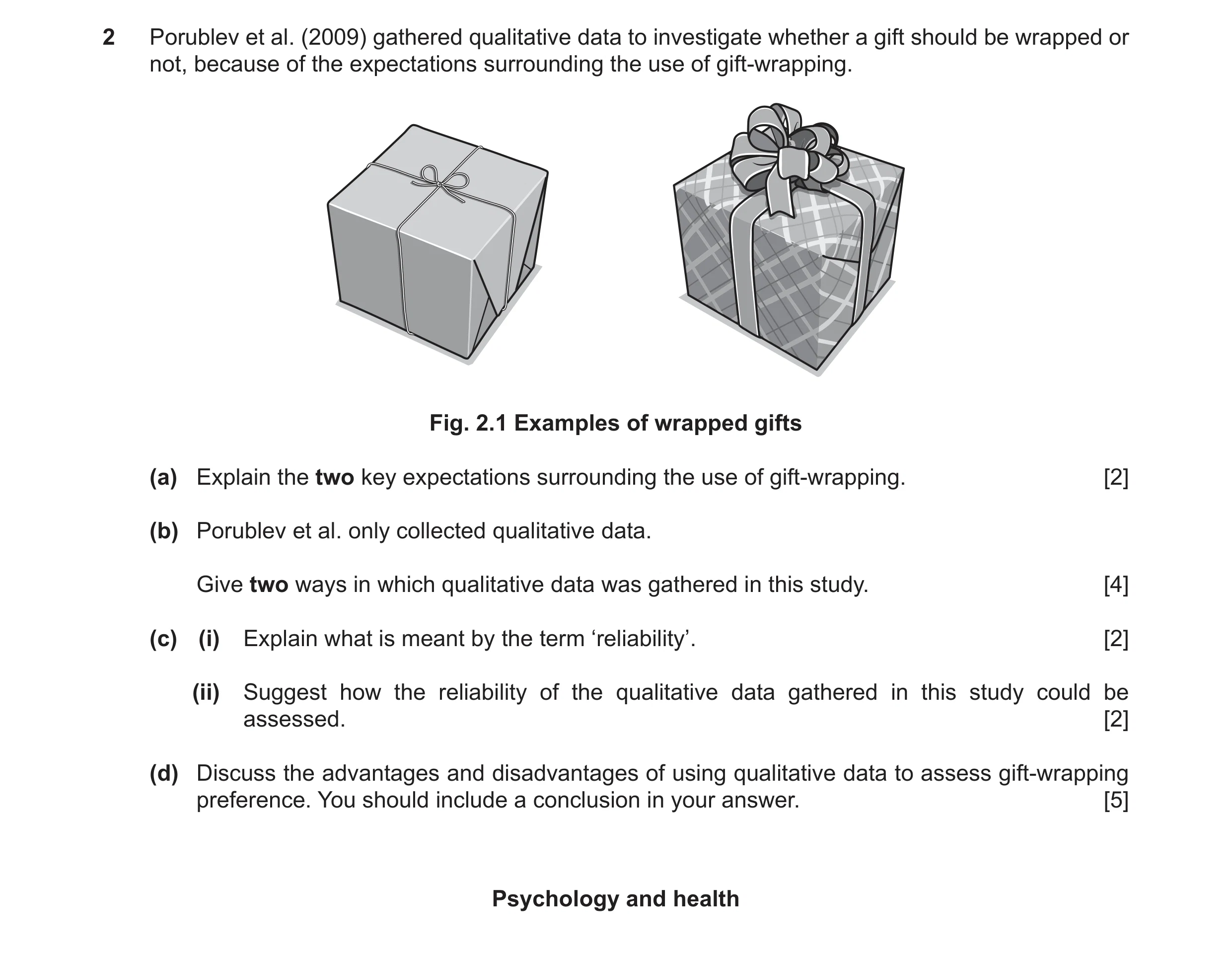
 4 / 7
4 / 7
 5 / 7
5 / 7![Question 17: (a) Outline two ways in which a gift can be wrapped. [2] (b) Suggest how an unstructured observation can be used to investigate gift-wrappi…](https://img.pastlit.com/crops/498fd2b9-779d-498b-91aa-540a4ef65650/q4.webp)
![Question 18: (a) Outline what is meant by brand awareness. [2] (b) Suggest one way in which brand awareness could be measured, other than a rating scale…](https://img.pastlit.com/crops/50b4fd2a-8101-434e-95f5-673b15ac8cef/q4.webp)
![Question 19: (a) Outline what is meant by brand awareness. [2] (b) Suggest one way in which brand awareness could be measured, other than a rating scale…](https://img.pastlit.com/crops/175c06c6-f891-4afe-b8e9-7c043f168c2b/q4.webp)
 6 / 7
6 / 7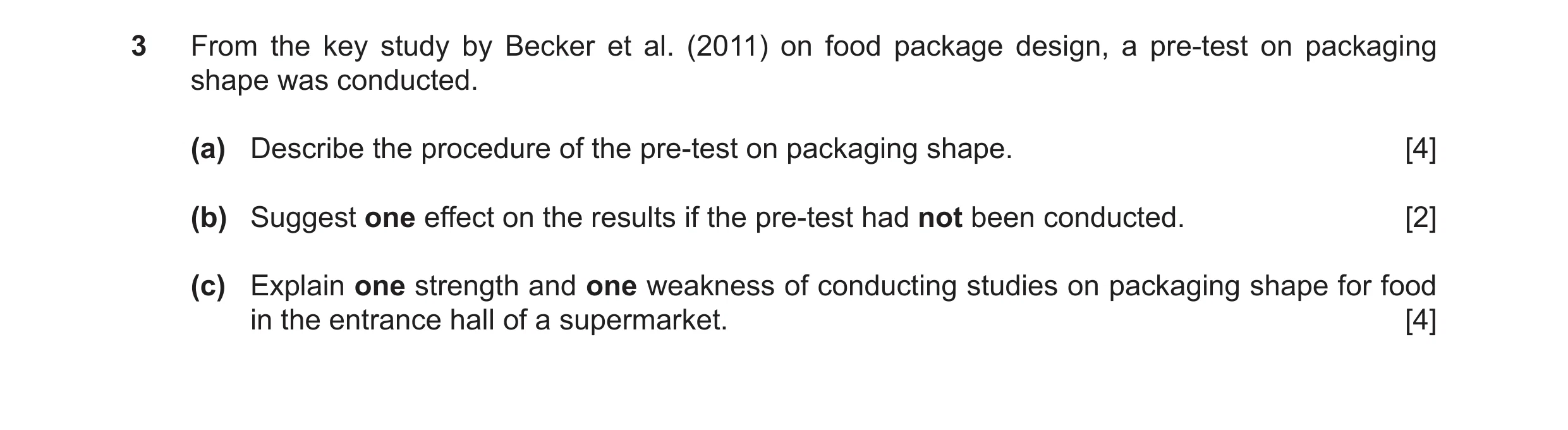 7 / 7
7 / 7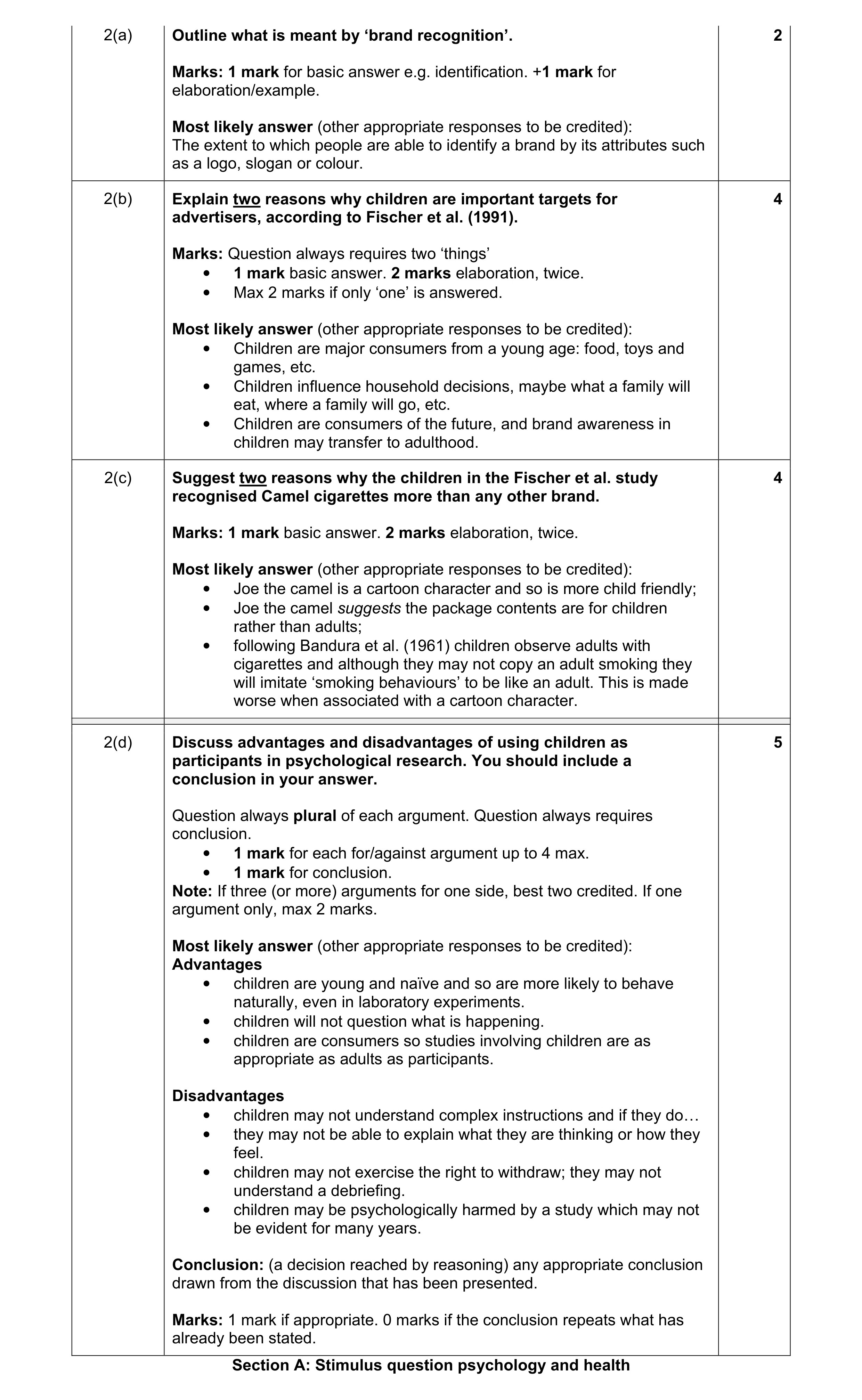 15
15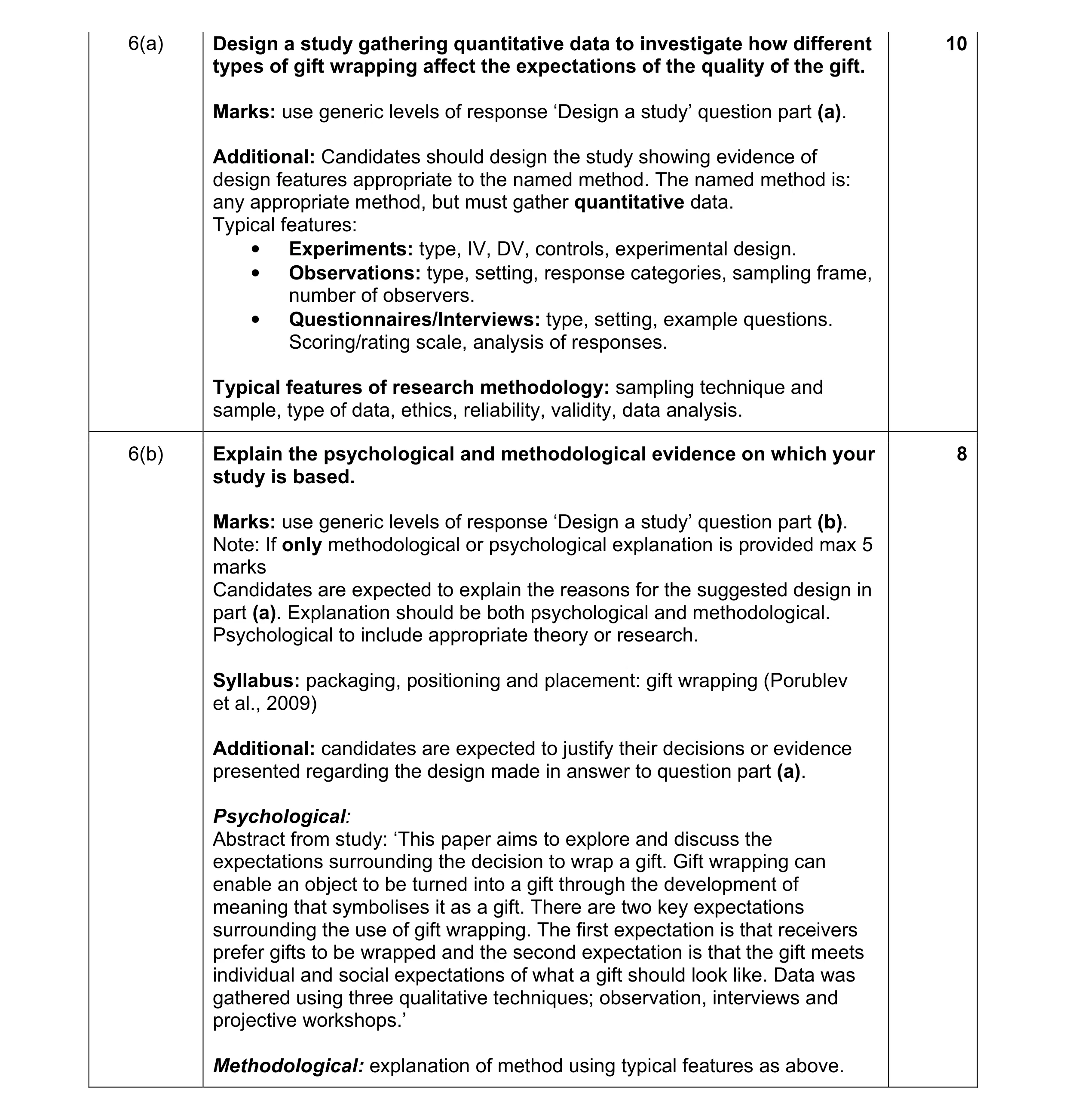 18
18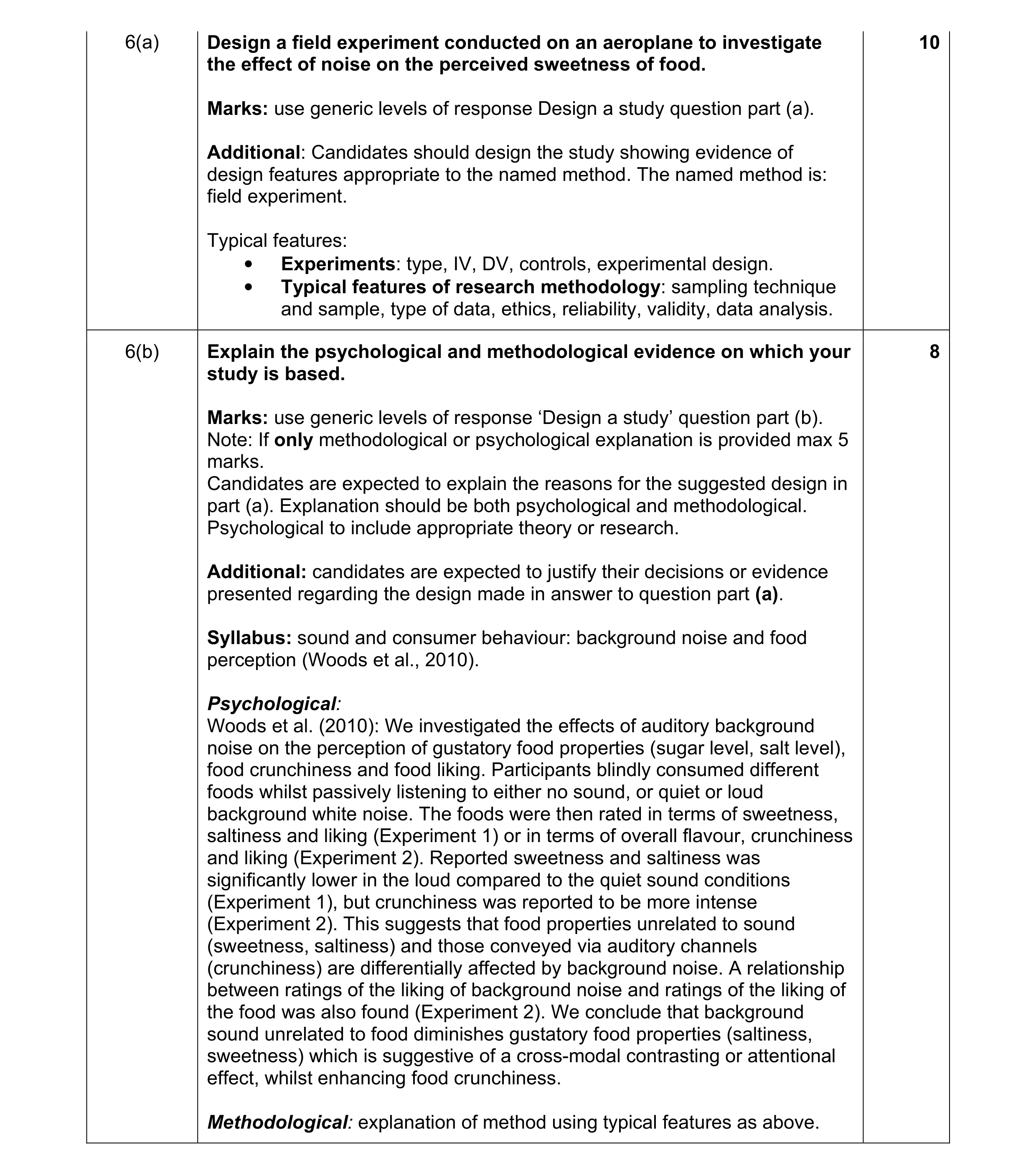 18
18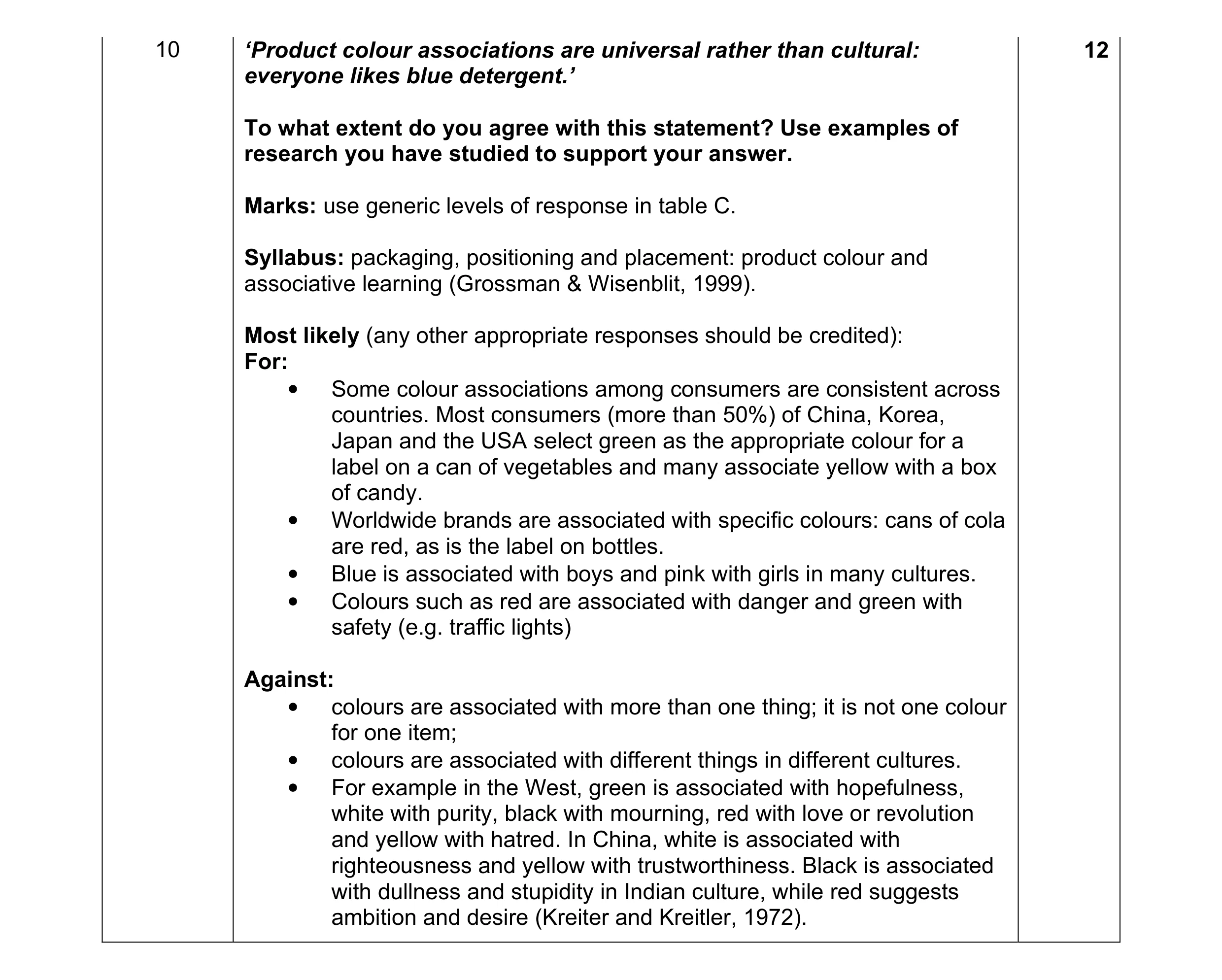 12
12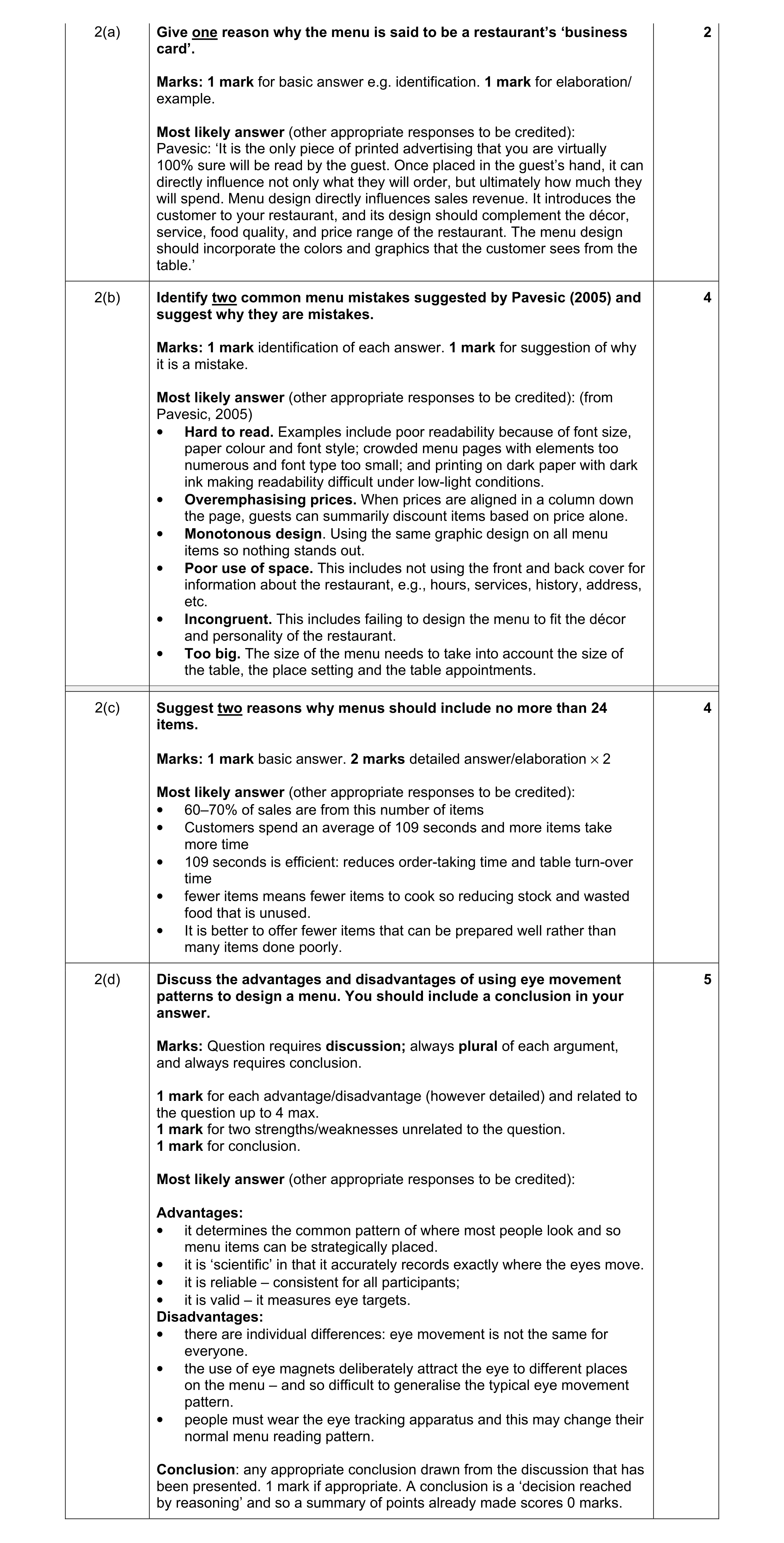 15
15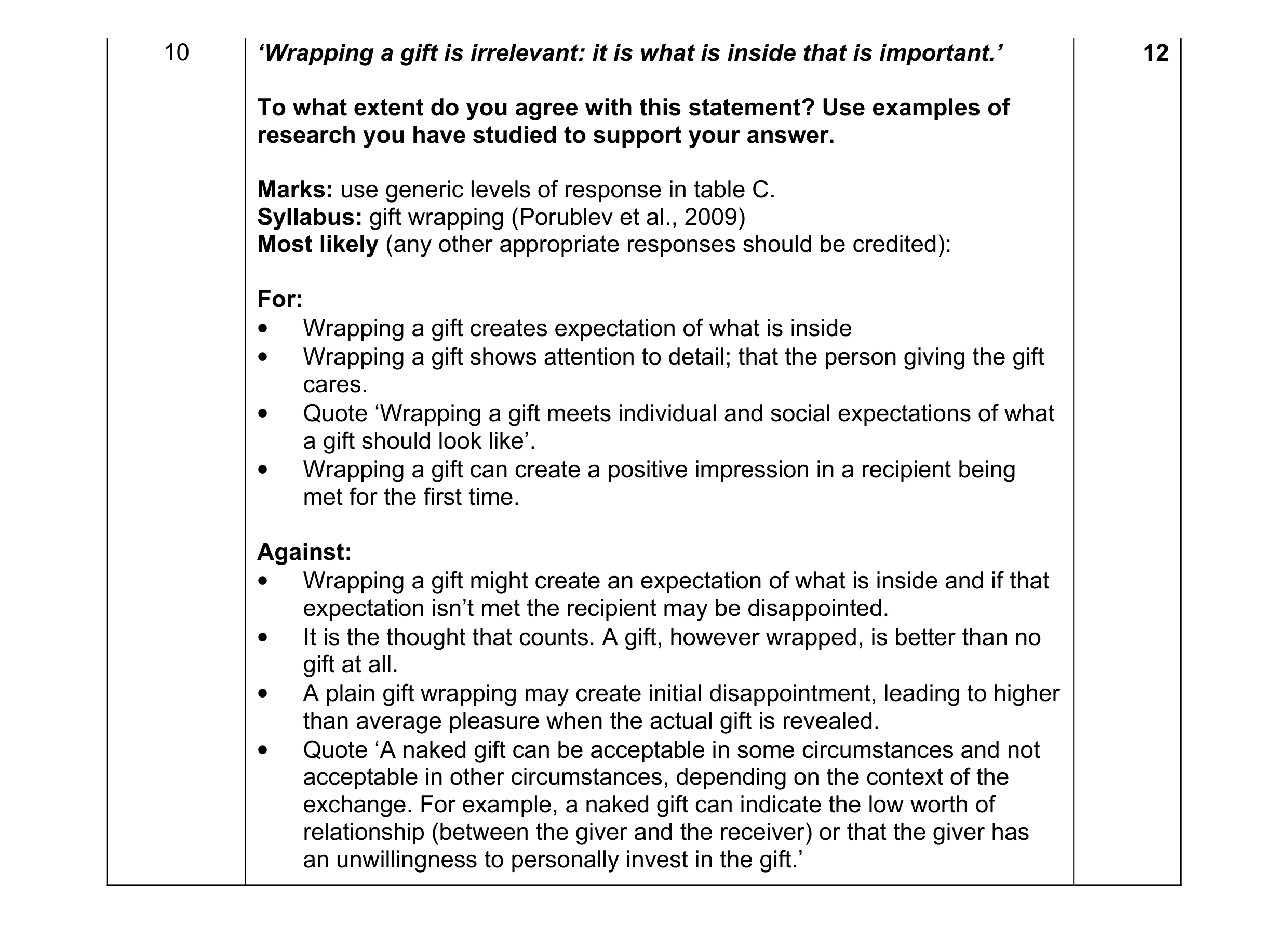 12
12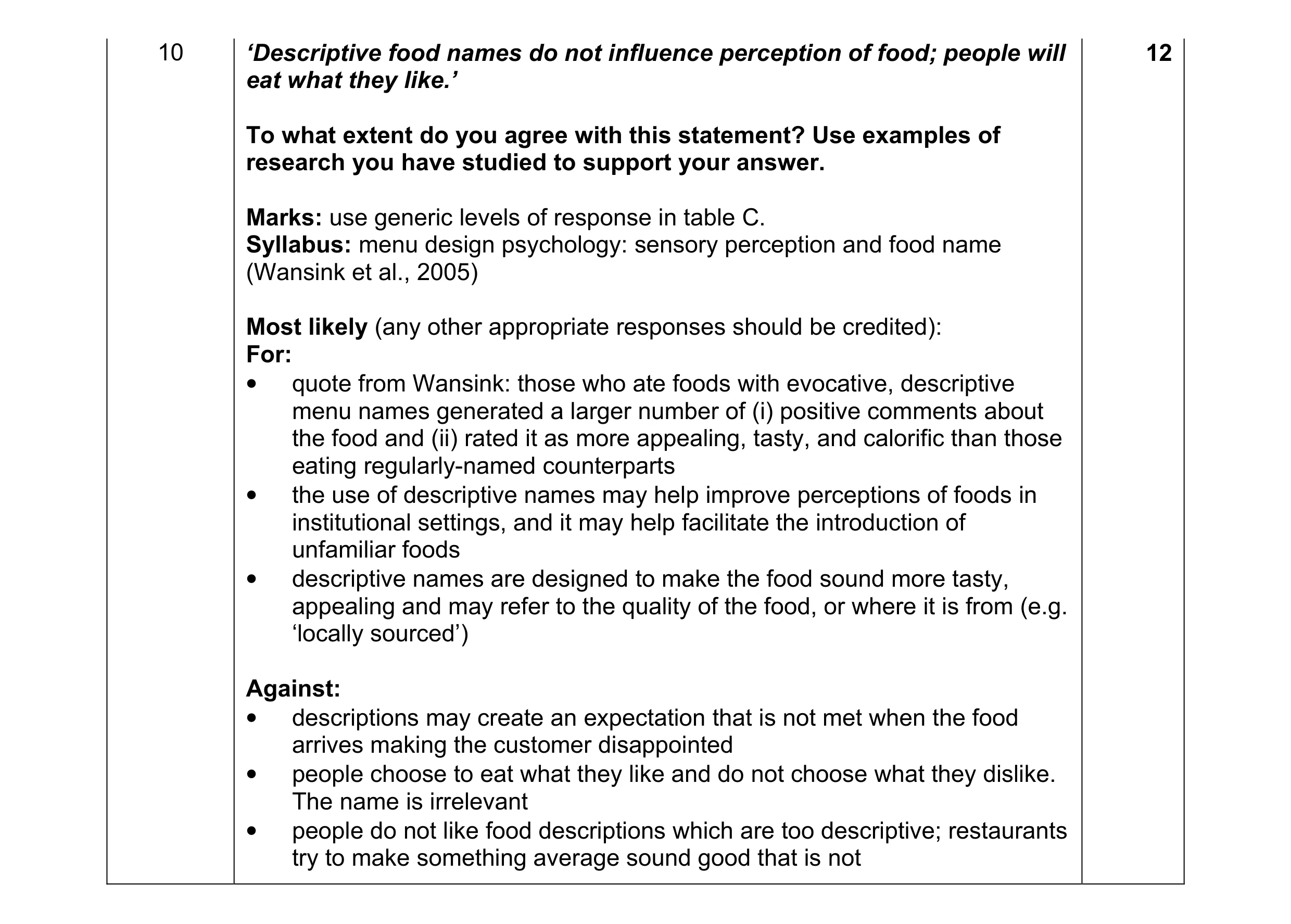 12
12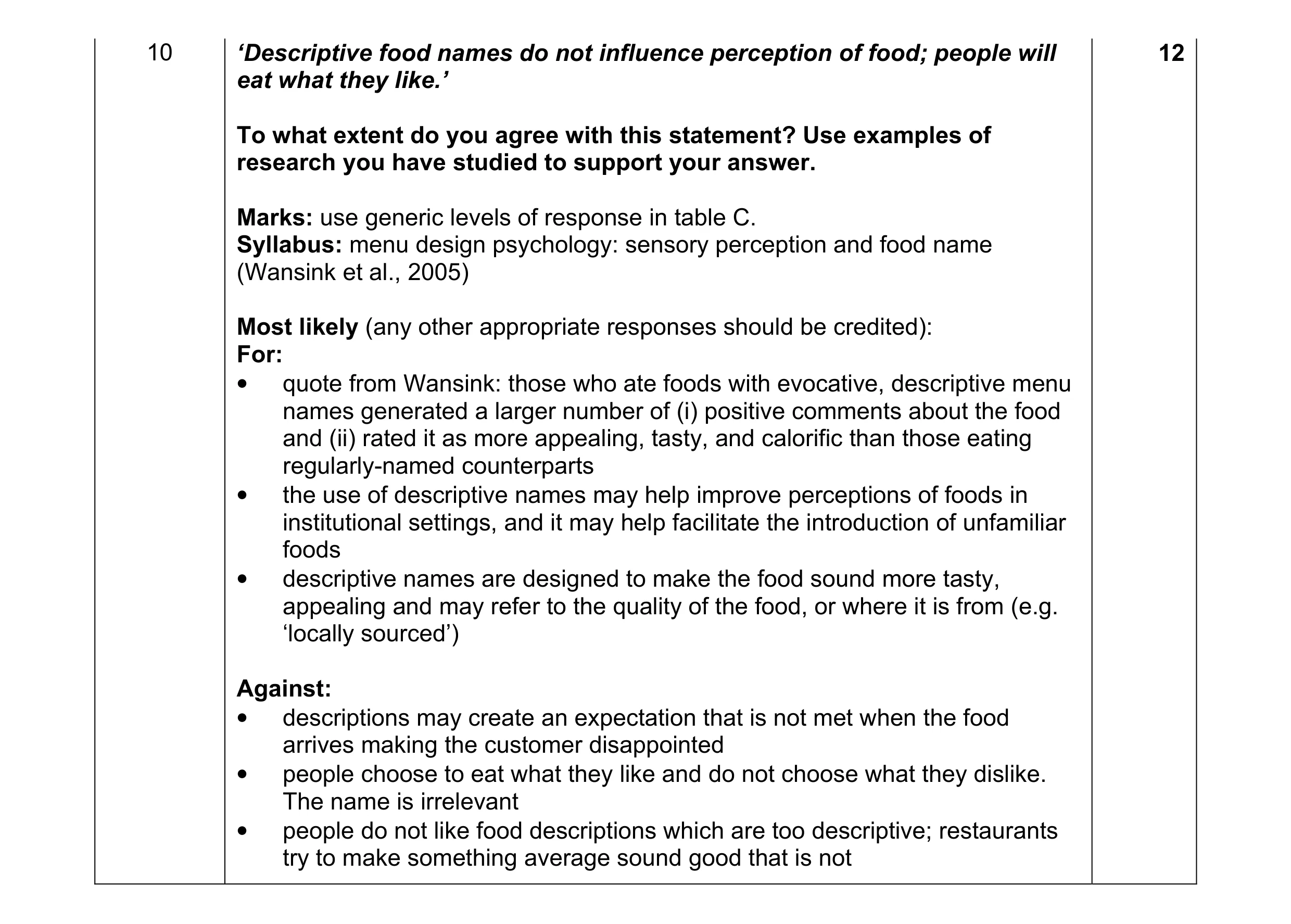 12
12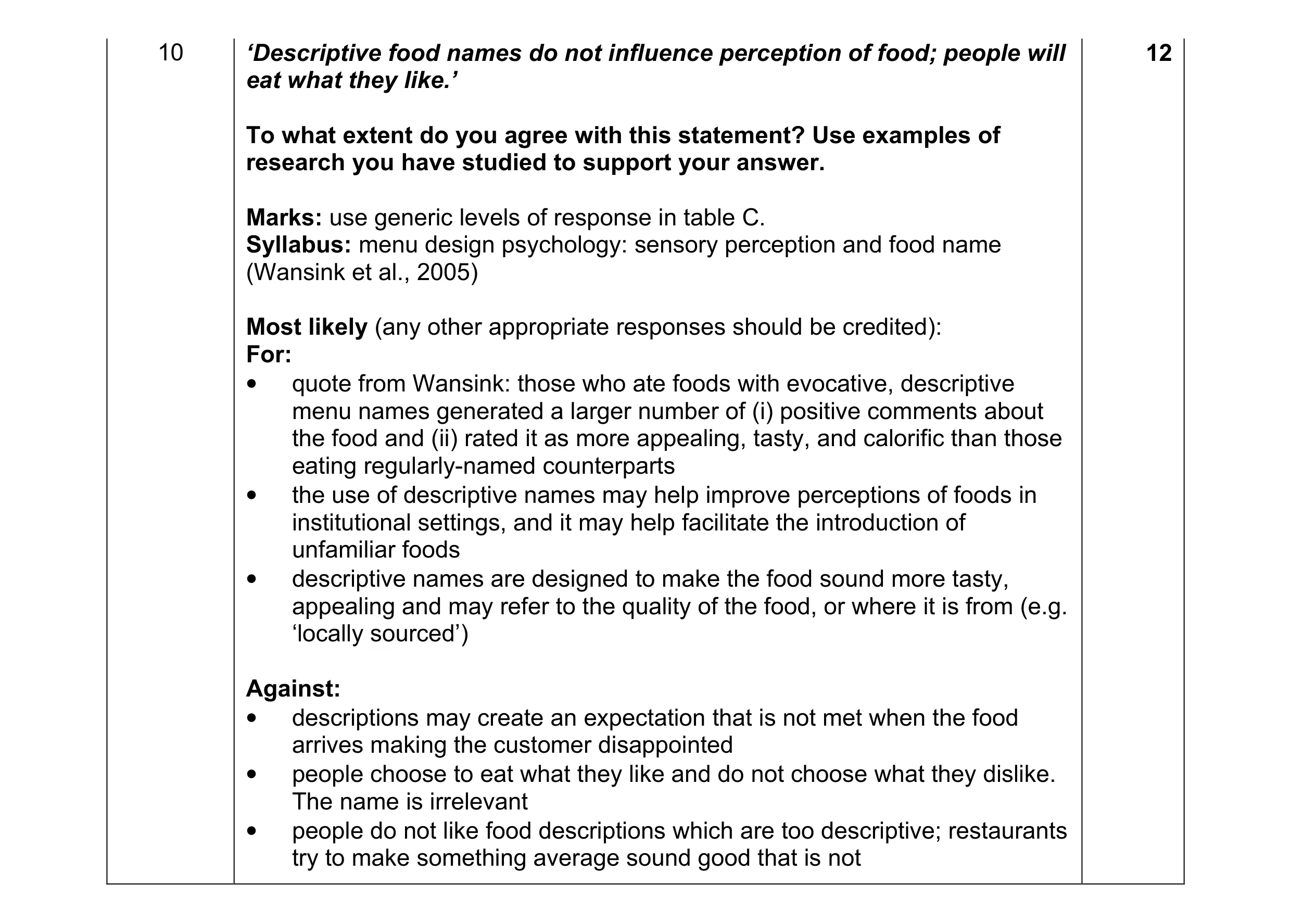 12
12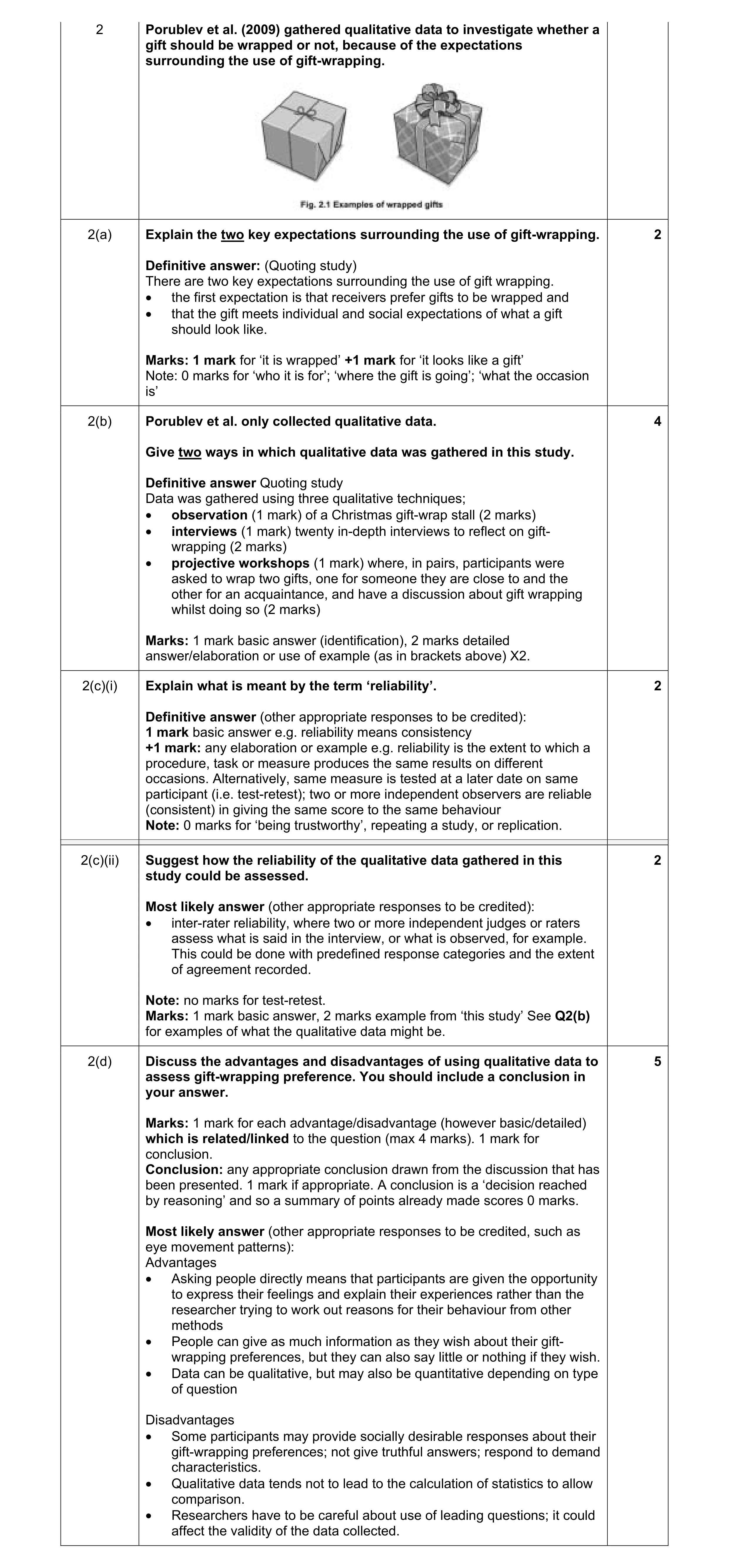 15
15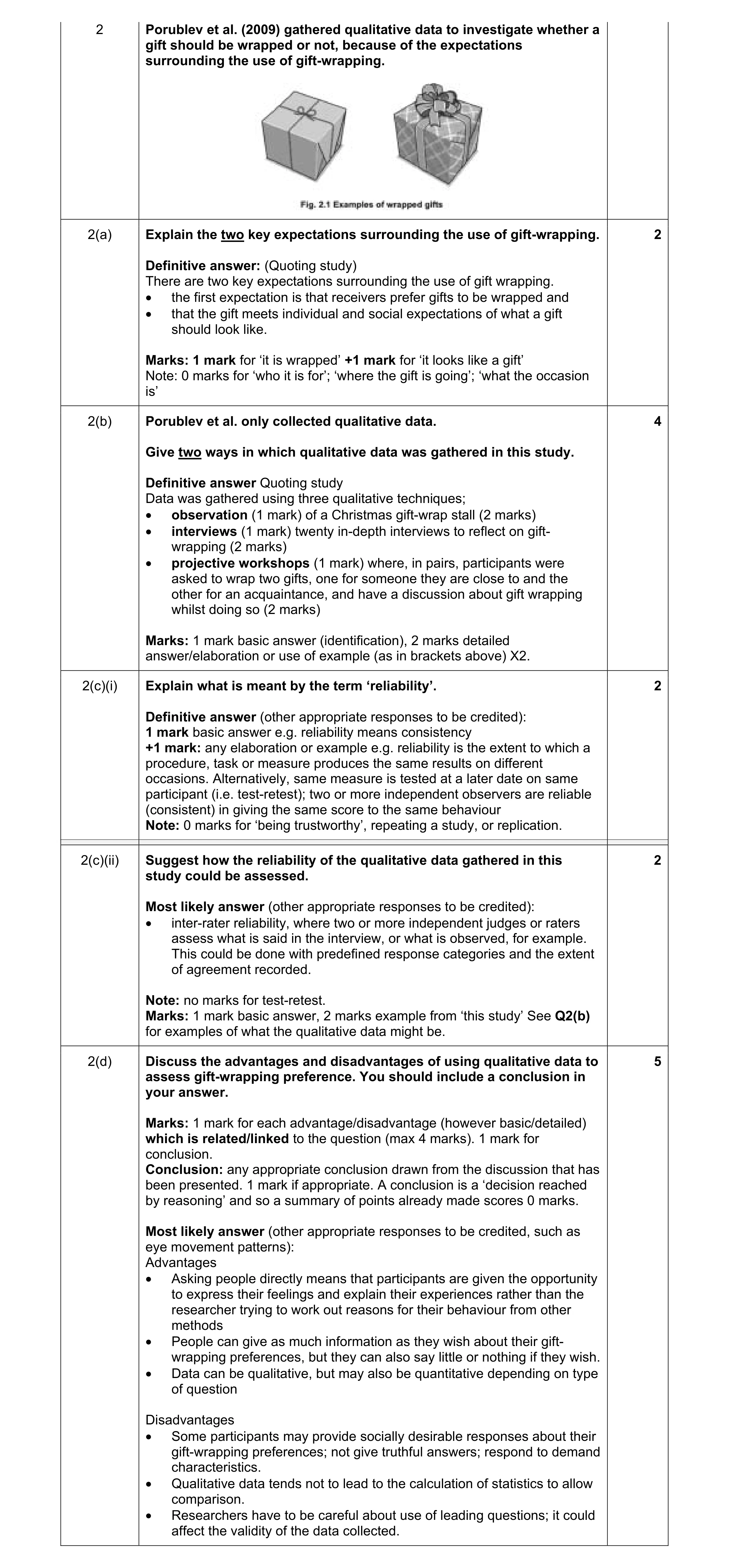 15
15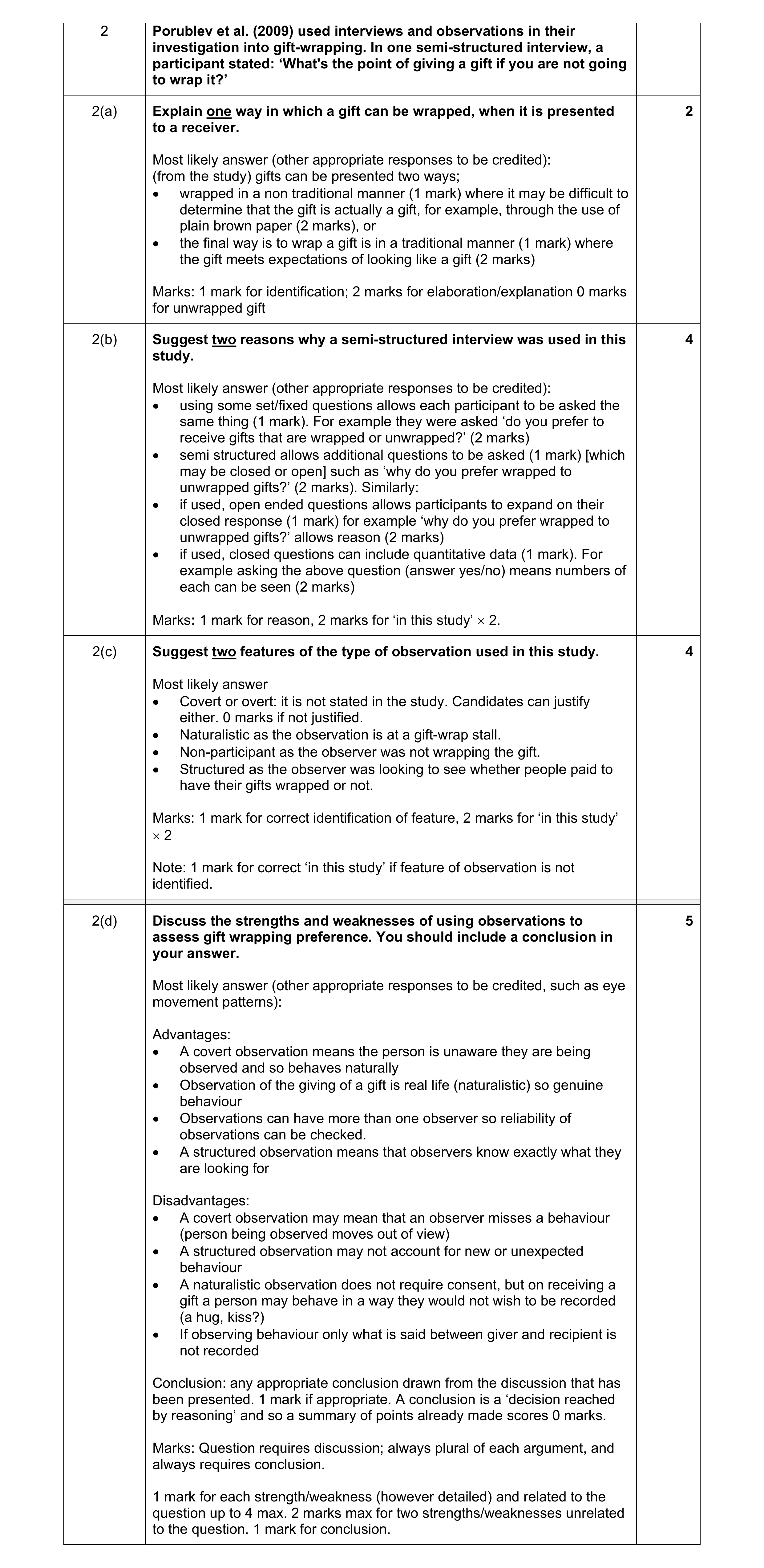 15
15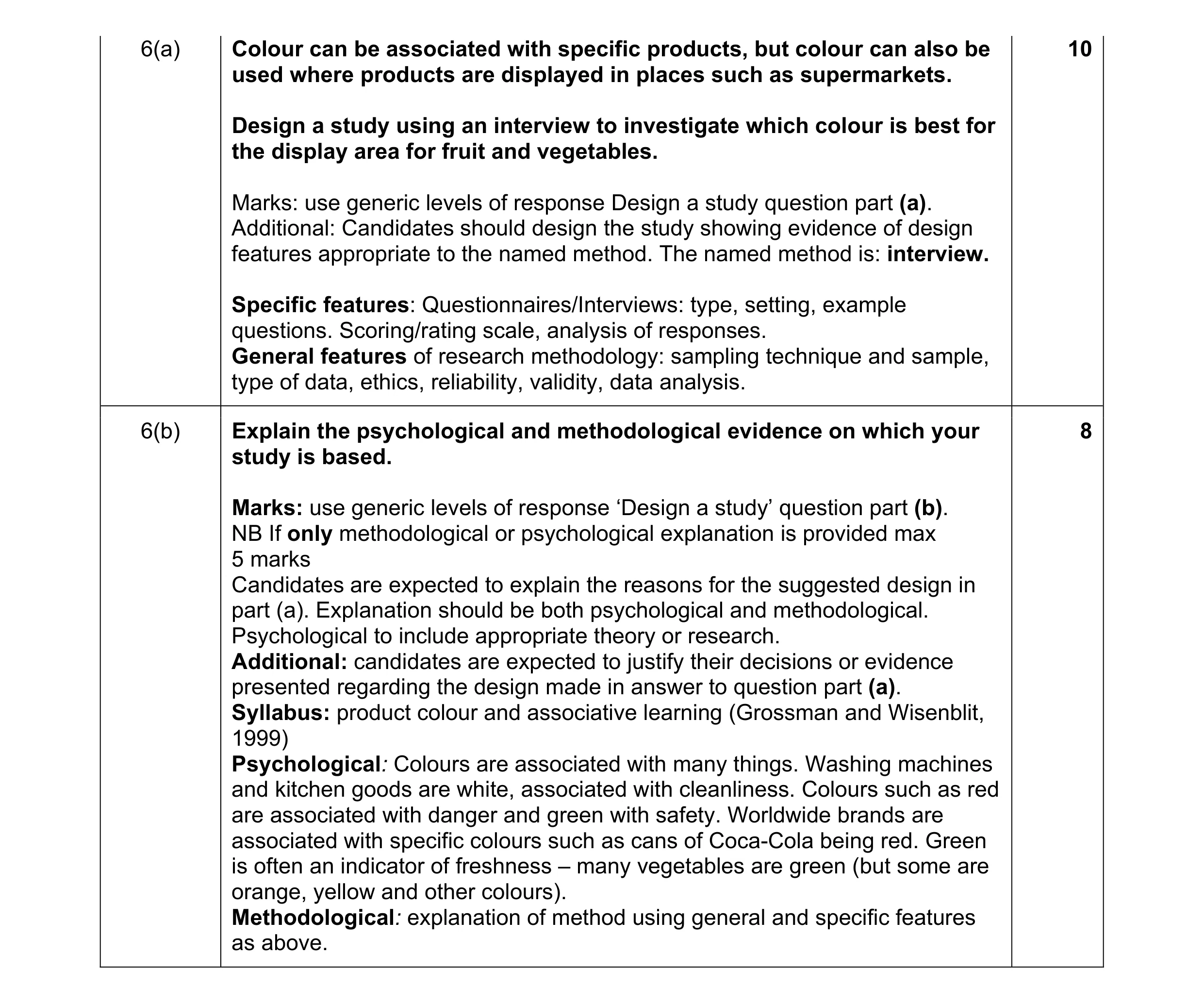 18
18 18
18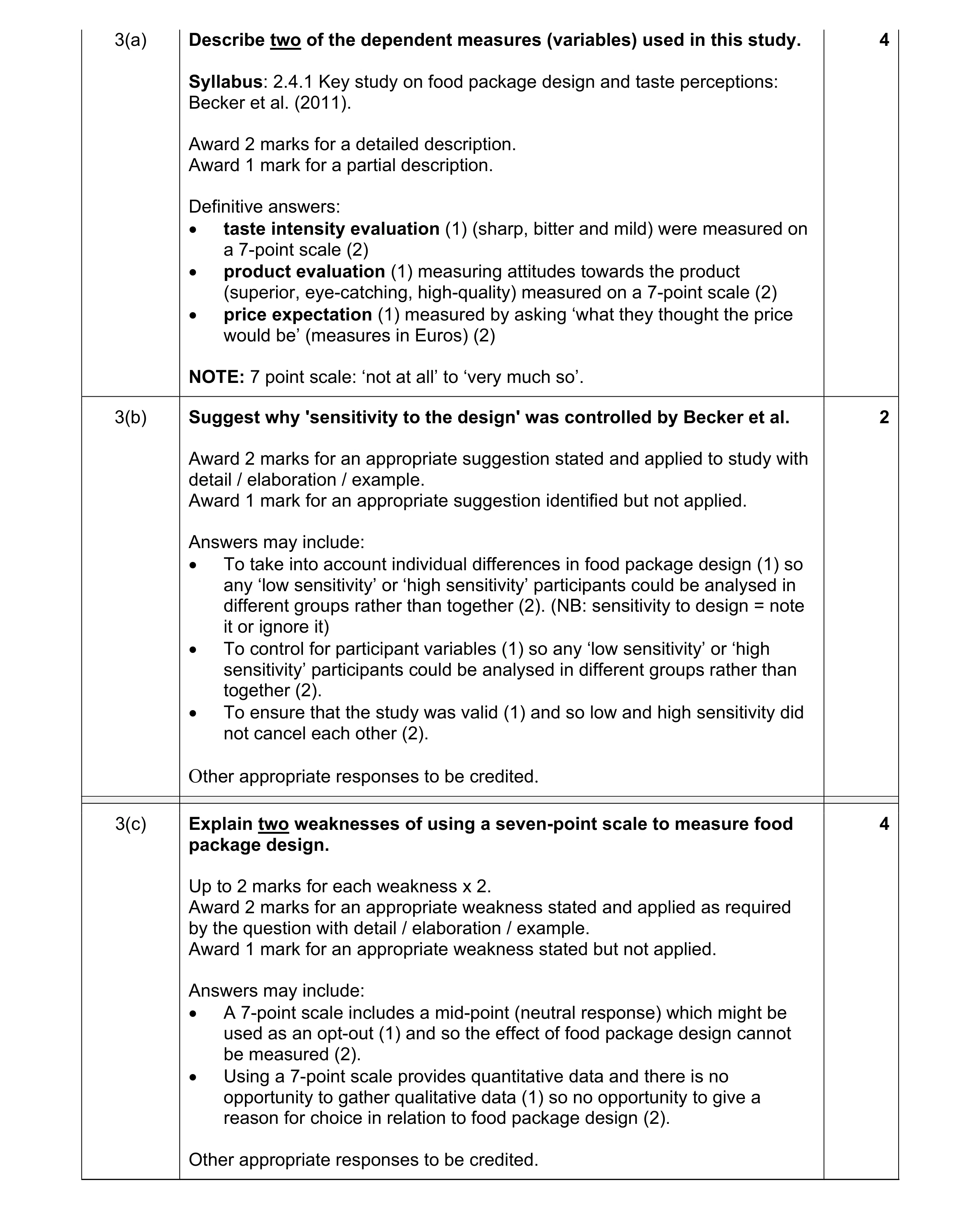 10
10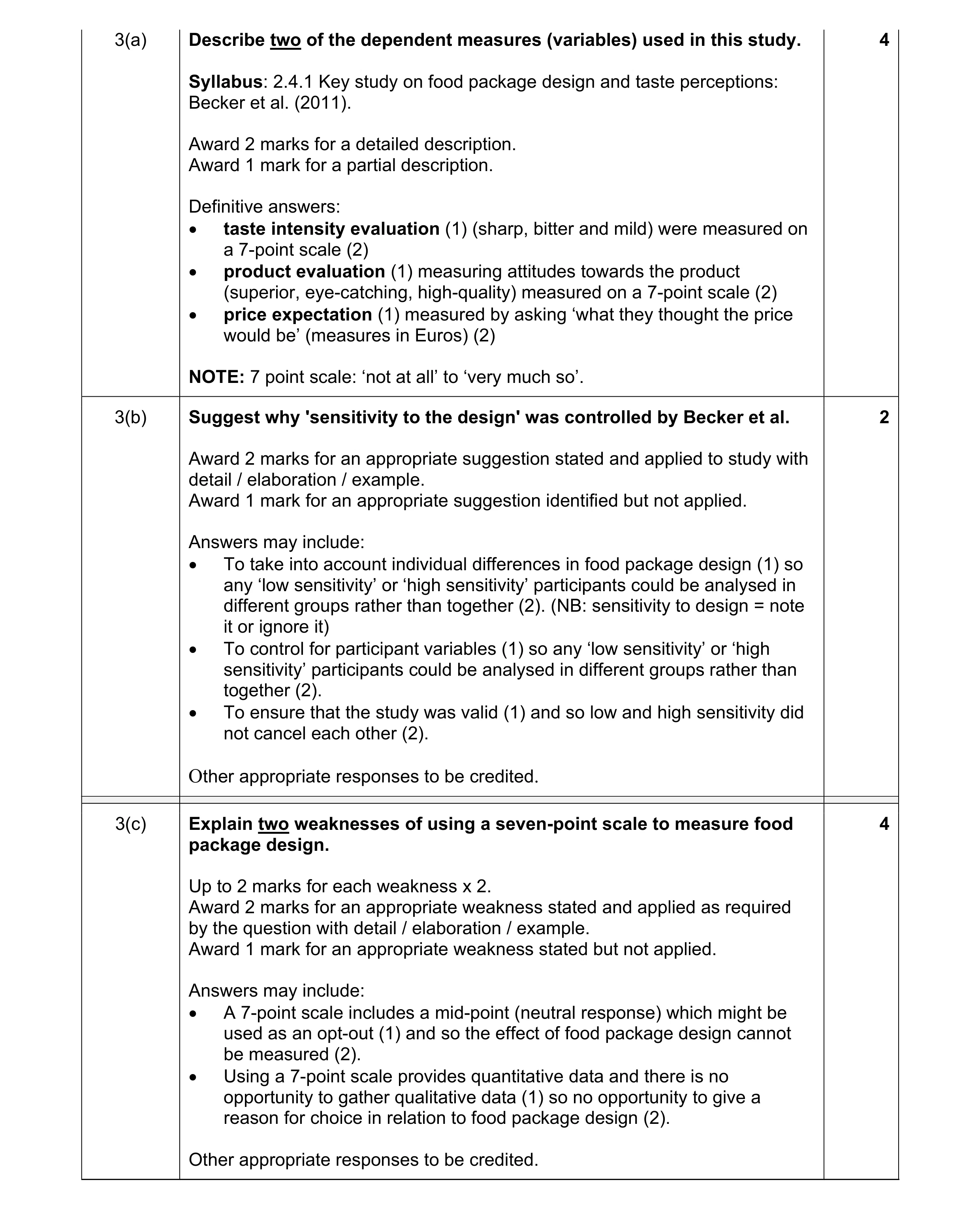 10
10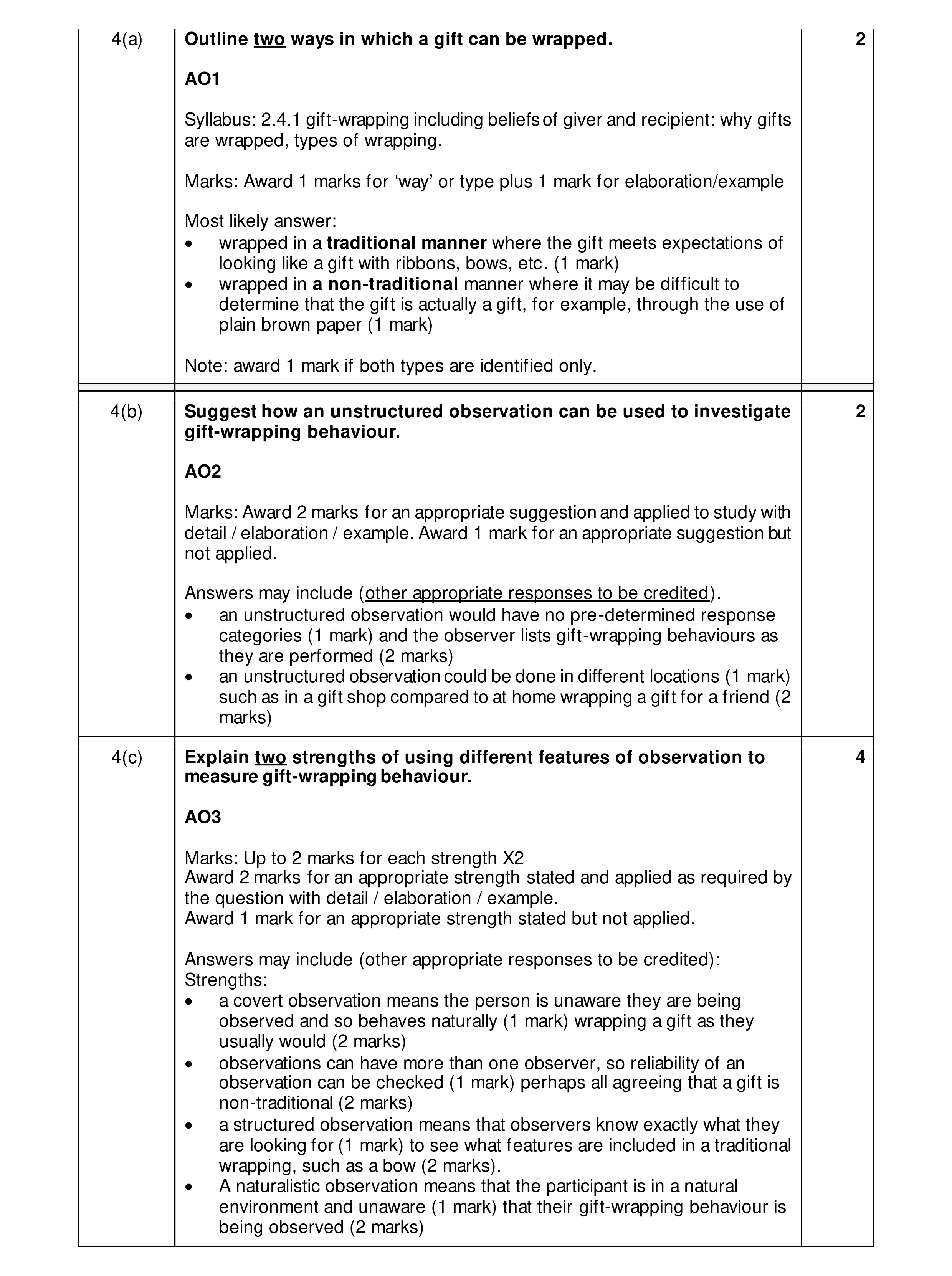 8
8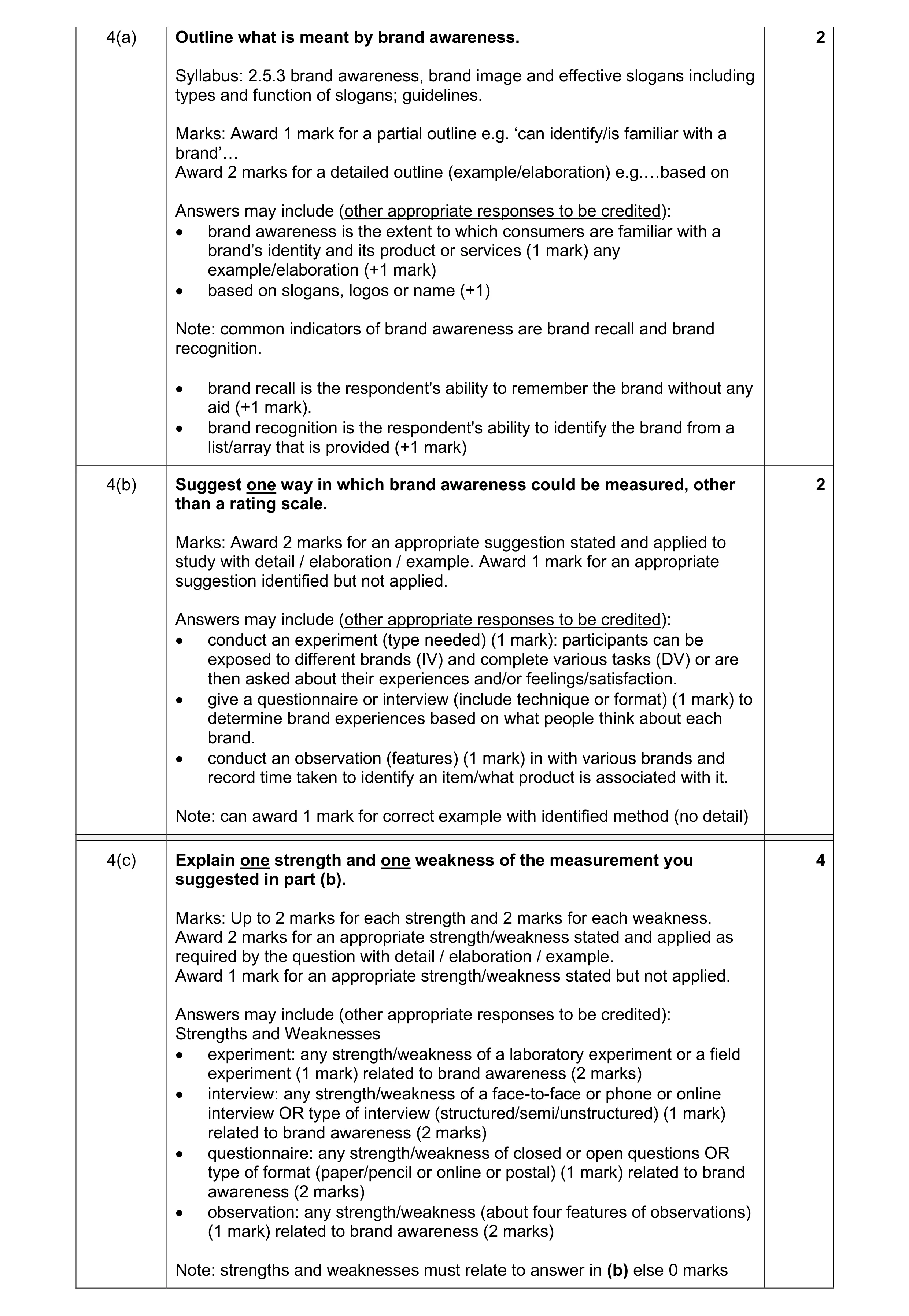 8
8 8
8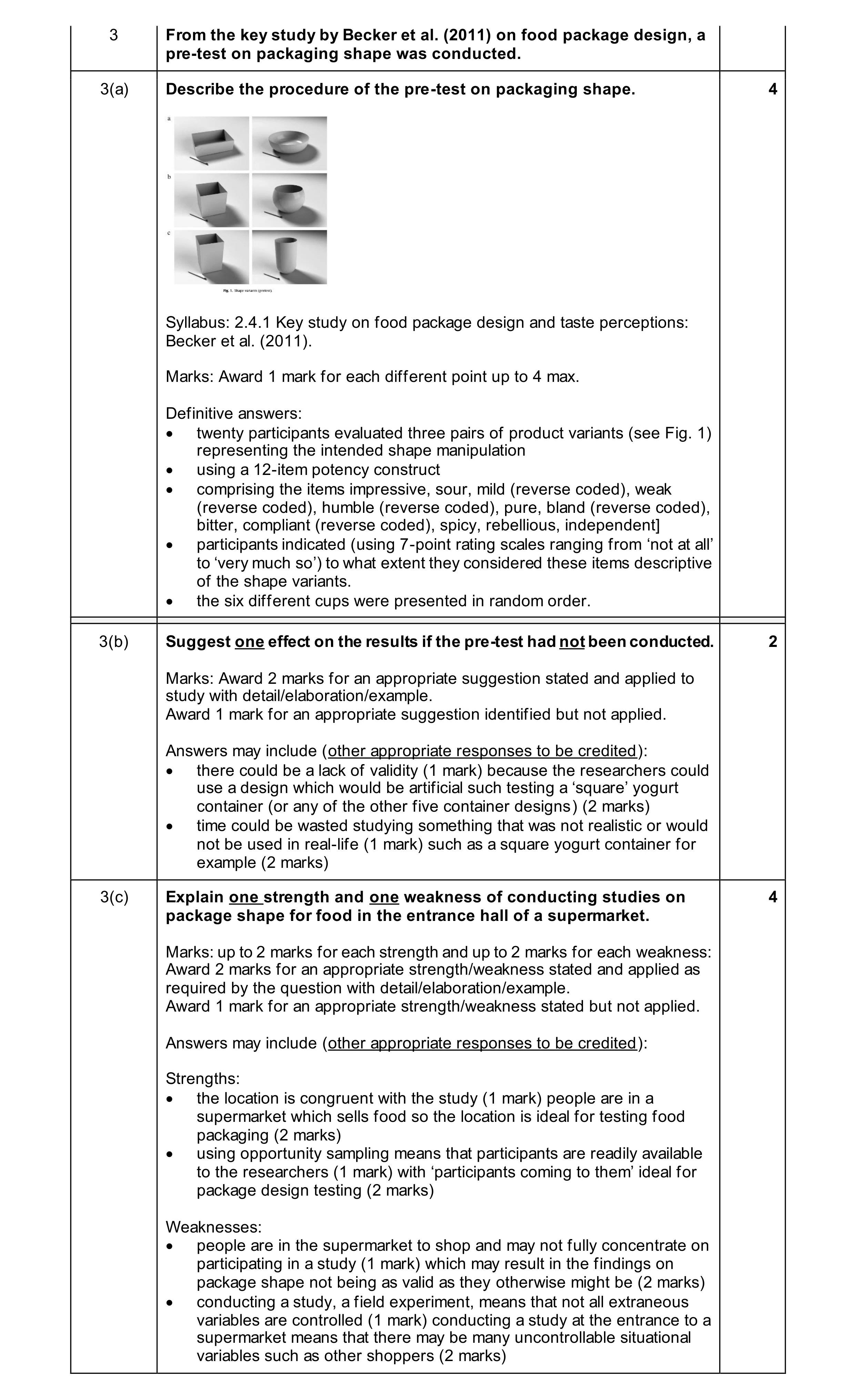 10
10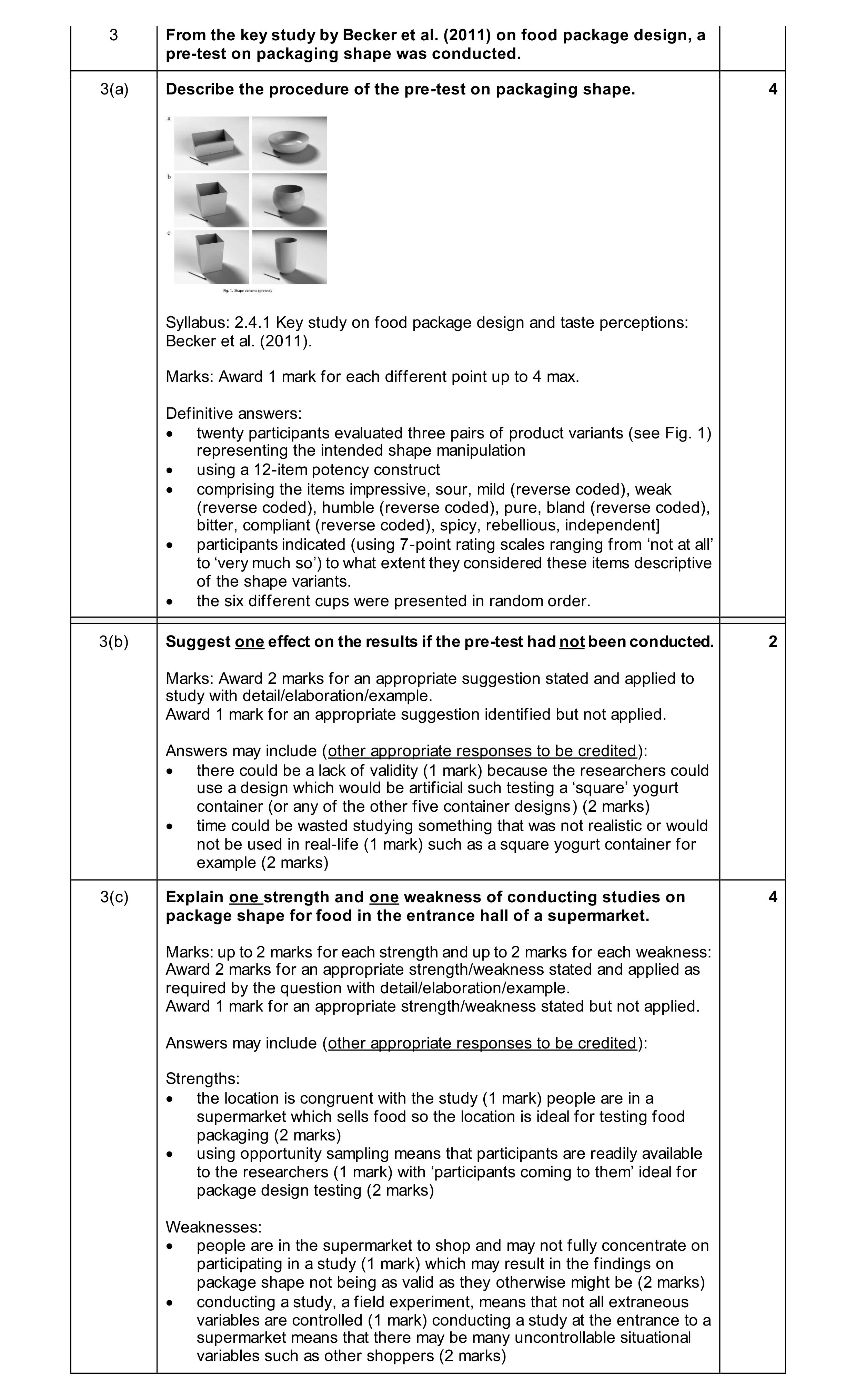 10
10