Questions as text
Q1 · Explain what is meant by a ‘model of communication’ with reference to advertising 9990/31 Oct/Nov 2018
3 (a) Explain what is meant by a ‘model of communication’ with reference to advertising. [2] (b) Describe McCarthy’s ‘4 Ps marketing mix’ model of advertising. [4] (c) Explain one similarity and one difference between McCarthy’s 4 Ps marketing mix model of advertising and Lauterborn’s 4 Cs marketing mix model of advertising. [6]
12 marks
Mark scheme: 3(a) Explain what is meant by a ‘model of communication’ with reference to 2 advertising. Award 1 mark for a basic explanation of the term/concept. Award 2 marks for a detailed explanation of the term/concept. For example: Yale model of communication AIDA model DAGMAR model Hierarchy of effects model General definition – A model of communication with reference to advertising is where the advert will try to persuade the consumer to purchase the item. The models of communication focus on different things advertisers might focus on in order to persuade such as the message itself or the target customer. Other appropriate responses should also be credited. 3(b) Describe McCarthy’s ‘4 Ps marketing mix’ model of advertising. 4 Award 1–2 marks for a basic answer with some understanding of the topic area. Award 3–4 marks for a detailed answer with clear understanding of the topic area. For example: The 4 Ps form a marketing tool that can be used by advertisers. 1 Product – the physical product or service 2 Price – Price of the product – must be appropriate based on market forces (e.g. what the consumer is prepared to pay and prices of other similar products 3 Place – location where the product/service is sold and way product is distributed. 4 Promotion – the advertising of the product be it in the media, sales promotion or cold calling. Other appropriate responses should also be credited. 3(c) Explain one similarity and one difference between McCarthy’s 4 Ps 6 marketing mix model of advertising and Lauterborn’s 4 Cs marketing mix model of advertising. Differences – 4 Cs more focussed on the consumer than the 4 Ps. Specific comparisons e.g. place is replaced by convenience to buy in 4 Cs as consumers buy their products in many different places including the internet. Similarities Holistic nature of the two models Effectiveness of the two models in improving advertising (and therefore sales) for companies. Mark according to the levels of response criteria below: Level 3 (5–6 marks) • Candidates will show a clear understanding of the question and will include one similarity and one difference. • Candidates will provide a good explanation with clear detail. Level 2 (3–4 marks) • Candidates will show an understanding of the question and will include one appropriate similarity in detail or one appropriate difference in detail. OR one similarity and one difference in less detail. • Candidates will provide a good explanation. Level 1 (1–2 marks) • Candidates will show a basic understanding of the question and will attempt a similarity and/or difference. This could include both but just as an attempt. • Candidates will provide a limited explanation. Level 0 (0 marks) • No response worthy of credit. Other appropriate responses should also be credited.
This question in 9990/31 Oct/Nov 2018
Q2 · Explain what is meant by ‘attention and shelf position’ and its effect on product choice 9990/32 Oct/Nov 2018
3 (a) Explain what is meant by ‘attention and shelf position’ and its effect on product choice. [2] (b) Describe the ‘consumer decision model’ for buying a product. [4] (c) Explain one strength and one weakness of the ‘consumer decision model’ for buying a product. [6]
12 marks
Mark scheme: 3(a) Explain what is meant by ‘attention and shelf position’ and its effect on 2 product choice. Award 1 mark for a basic explanation of the term/concept. Award 2 marks for a detailed explanation of the term/concept. For example: This is investigating the effect of gaze on product choice. Evidence shows that consumers are more likely to gaze for longer at products in the middle of an array of goods and therefore more likely to then buy this product. Other appropriate responses should also be credited. 3(b) Describe the ‘consumer decision model’ for buying a product. 4 Award 1–2 marks for a basic answer with some understanding of the topic area. Award 3–4 marks for a detailed answer with clear understanding of the topic area. For example: The model is structured around a seven point decision process: need recognition followed by a search of information both internally and externally, the evaluation of alternatives, purchase, post purchase reflection and finally, divestment. These decisions are influenced by two main factors. Firstly stimuli is received and processed by the consumer in conjunction with memories of previous experiences, and secondly, external variables in the form of either environmental influences or individual differences. The environmental influences identified include: culture; social class; personal influence; family and situation. While the individual influences include: consumer resource; motivation and involvement; knowledge; attitudes; personality; values and lifestyle Other appropriate responses should also be credited. 3(c) Explain one strength and one weakness of the ‘consumer decision 6 model’ for buying a product. Strengths Holistic nature of the model Application/usefulness to companies to improve sales Techniques/advertising that take into account the consumer decision making process Weaknesses Unrealistic nature of the model Cultural bias Deterministic nature of the model Reductionist nature of the model Lack of evidence to support the model Mark according to the levels of response criteria below: Level 3 (5–6 marks) • Candidates will show a clear understanding of the question and will outline one strength and one weakness. • Candidates will provide a good explanation with clear detail. Level 2 (3–4 marks) • Candidates will show an understanding of the question and will outline one appropriate weakness in detail or one appropriate strength in detail. • Candidates will provide a good explanation. Level 1 (1–2 marks) • Candidates will show a basic understanding of the question and will attempt an outline of either a strength or a weakness. • Candidates will provide a limited explanation. Level 0 (0 marks) • No response worthy of credit. Other appropriate responses should also be credited.
This question in 9990/32 Oct/Nov 2018
Q3 · Identify two common menu design mistakes, as outlined by Pavesic (2005) 9990/32 Oct/Nov 2020
3 (a) Identify two common menu design mistakes, as outlined by Pavesic (2005). [2] (b) Describe two findings of the study by Gil et al. (2009) on shopper movement patterns. [4] (c) Explain one strength and one weakness of the study by Gil et al. [6]
12 marks
Mark scheme: 3(a) Identify two common menu design mistakes, as outlined by Pavesic (2005). Award 1 mark for each For example: • Menu is hard to read because of font or colour choices (especially in low light); • Prices over-emphasised; • Poor sales technique because it does not emphasise products the restaurant wants to sell the most; • Menu incongruent with design/décor of restaurant; • Lack of investment in menu, demonstrating a lack of commitment; • Menu is too large. If it takes a long time to read so takes longer for customer to make a choice. As a result turn-over is lower; • Poor use of space; Other appropriate responses should also be credited. 2 3(b) Describe two findings of the study by Gil et al. (2009) on shopper movement patterns. Award 1–2 marks for a basic answer with some understanding of the topic area Award 3–4 marks for a detailed answer with clear understanding of the topic area For example: The researchers found that there were 4 distinct special patterns of movement (1). These were short trip, round trip, central trip and wave trip, with wave and round trips being the most common (2). The results of the other data together with the shoppers’ movement pattern meant the researchers could identify 5 different types of shopper (1) – the explorer (almost always female, regular shopping doing their main shop), the tourist (top up shop but still regular, covering a lot of the floor space) (2), the native (this is the most common, shorter than the explorer duration, regular and similar coverage to explorer), the specialist (higher proportion of males than the others mentioned so far, coverage is most limited to particular areas), and the raider (again, more men represented than the others, large floor area covered but short duration, almost always alone) (2). Other appropriate responses should also be credited. 4 Question Answer Marks 3(c) Explain one strength and one weakness of the study by Gil et al. Likely strengths will be: • Large sample size – 480 shoppers – many factors examined so data should be pretty representative; • Objective – measure of the movement pattern, leading to high validity and reducing need for individual to follow shopper around as carried out remotely. Self-report responses in distinct categorises; • High ecological validity – a very natural situation. All participants would have been expecting to shop on that particular occasion, reducing demand characteristics; • Reliability/Validity – all shoppers treated similarly; • Useful – Allows stores to think about the importance of product placement within shop, displays, and layout, to maximise purchasing opportunities; Likely weaknesses will be: • Reductionist – assumes all shoppers fit into these categories all of the time. However, shoppers may be an explorer one day and then a raider the next day or combine two or more types on one trip; • Lack of generalisability – only one shop at one time and done in UK on adults; • Demand characteristics – shoppers do know they are being tracked so this may change their shopping behaviour; • Cultural bias – only applies to one culture (although, as it relates to shopping patterns then this may be all that researchers are interested in); • Self-report – in interview shoppers may give socially desirable answers. They may want to appear more affluent or more frugal in their shopping habits than then really are, reducing validity; • Gynocentric – most of the shoppers were female. This may represent the shoppers in general or it may be that fewer males were willing to be interviewed and take part. 6 Question Answer Marks 3(c) Mark according to the levels of response criteria below: Level 3 (5–6 marks) • Candidates will show a clear understanding of the question and will discuss one appropriate strength and one appropriate weakness; • Candidates will provide a good explanation with clear detail; Level 2 (3–4 marks) • Candidates will show an understanding of the question and will explain one appropriate strength/weakness in detail or a strength and a weakness in less detail; • Candidates will provide a good explanation; Level 1 (1–2 marks) • Candidates will show a basic understanding of the question and will attempt to explain one strength/weakness; • Candidates will provide a limited explanation; Level 0 (0 marks) No response worthy of credit. Other appropriate responses should also be credited.
This question in 9990/32 Oct/Nov 2020
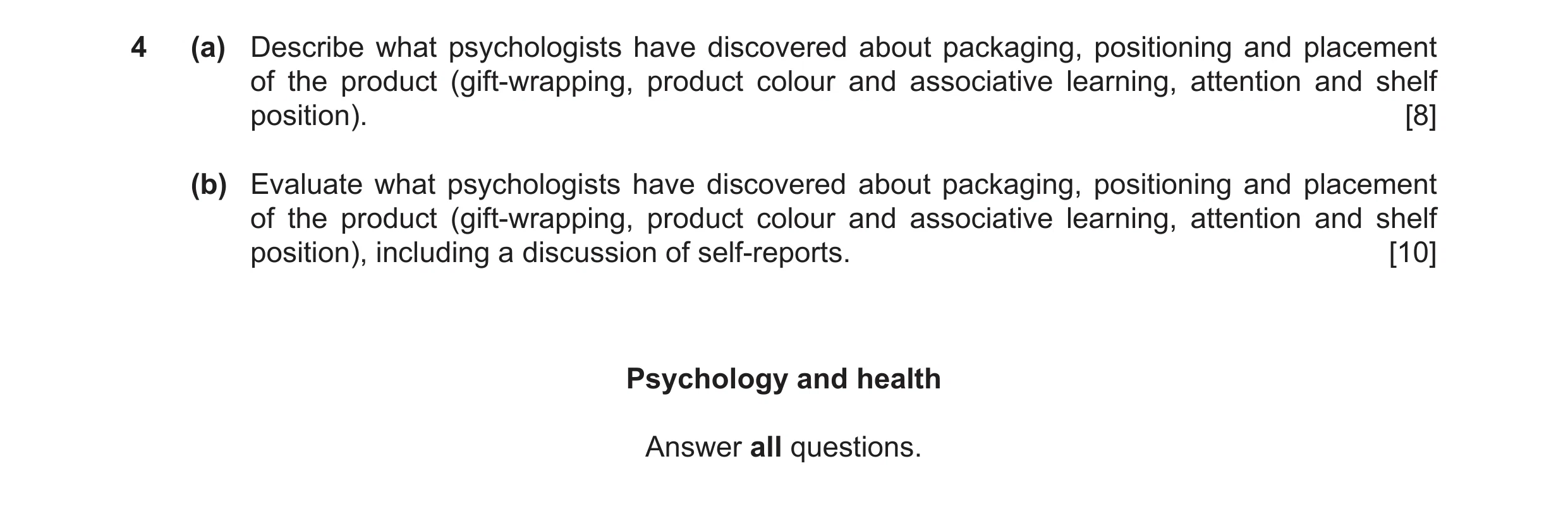
Q4 · Describe what psychologists have discovered about packaging, positioning and placement of… 9990/32 Oct/Nov 2021
4 (a) Describe what psychologists have discovered about packaging, positioning and placement of the product (gift-wrapping, product colour and associative learning, attention and shelf position). [8] (b) Evaluate what psychologists have discovered about packaging, positioning and placement of the product (gift-wrapping, product colour and associative learning, attention and shelf position), including a discussion of self-reports. [10] Psychology and health Answer all questions.
18 marks
Mark scheme: 4(a) Describe what psychologists have discovered about packaging, 8 positioning and placement of the product (gift-wrapping, product colour and associative learning, attention and shelf position). Including • Gift wrapping (Porublev et al., 2009) • Product colour and associative learning (Grossman and Wisenbilt, 1999) • Attention and shelf position (Atalay et al., 2012) Gift wrapping (Porublev et al., 2009) 3 data collection techniques used were observations at a Christmas gift wrapping stall; 20 in-depth interviews where respondents reflected on gift wrapping (including questions such as ‘in what instances do you wrap gifts?’); and 6 workshops where participants were paired and asked to wrap two gifts – one for someone close and one for an acquaintance while they conversed with their partner. Most of the participants (who came from Victoria, Australia and were aged around 25–35 years old) preferred to receive a gift that was wrapped and that there were clear expectations of what a gift should look like. Researchers gathered qualitative data to support these findings. Product colour and associative learning (Grossman and Wisenblit, 1999) Grossman and Wisenblit investigated the role of classical conditioning in colour choices. This has implications for companies that may want to change the colour associations of their products. The researchers looked at a variety of areas. One area of interest was in marketing. Colour consultants can help companies to change their colours e.g. car companies do this by around 30% per year and plan 3–4 years in advance to predict what colours will be on trend. Consumers begin to associate certain colours with certain products, leading to more frequent purchasing. Cheer laundry detergent was used by researchers where red, blue and yellow flakes in white detergent. Blue flakes suggested cleanliness to the consumer. Physiological responses to colour were considered, with dark blue being associated with passivity (due to its link to the night’s sky) and yellows and reds with arousal (sunlight). Development of colour associations can explain cultural perceptions and differences. In some countries, green is associated with hopefulness and red with love. In China, white is associated with righteousness and yellow with trustworthiness. Grey is associated with expensive products in USA and cheaper products in Japan and China. Colour preferences depend on products. For clothing, blue, red and black are popular, for furniture it tends to be beige, and for cars, popular colours are grey, white and red. Certain colours do not work for certain products e.g. a vitamin brand in a black container with white lettering was not liked by consumers as it looked like poison. 4(a) Attention and shelf position (Atalay et al., 2012) Atalay et al. used eye tracking technology to identify customer tendency to choose the option in the centre of an array. An ‘offline’ study also confirmed that the centrally located item is chosen more often even when this is not the centre of the visual field. Several studies were conducted: 1A involved 67 undergraduates in France, average age 20. Using eye- tracking participants reviewed 2 product categories – vitamin supplements and meal replacement bars, each with 3 fictitious names and displayed in a 3 × 3 matrix on a computer screen. Brands in the centre received more frequent eye fixations and overall were looked at for longer. 1B extended 1A by considering horizontal centrality. Participants were 64 undergraduate students in Paris. The set up was similar to 1A but with the matrix shifted away from the centre of the computer screen. Again, products in the centre item were gazed at for longer. Study 2 was a replication in a more realistic setting by placing the products on a shelf rather than a screen. 84 students at Concordia University took part. The products used were fictitious brands of energy drinks. Each brand had a feature attribute: high intensity, extended endurance or muscle recovery but these attributes were rotated around the brands to eliminate effects. Items were displayed in categories of 3 so that each product could be centre, left or right. Participants were tested one at a time and positioned so that the category they had to choose from was to their left or right and never exactly in the centre of their visual field. They were not allowed to reposition themselves. Results found the centrally located brand is more often chosen even when it is not in the centre of the visual field. Participants were asked to evaluate the product and it was found that the chosen product from the centre was not always the most positively evaluated. Mark according to the levels of response descriptors in Table A. Other appropriate responses should also be credited. 4(b) Evaluate what psychologists have discovered about packaging, 10 positioning and placement of the product (gift-wrapping, product colour and associative learning, attention and shelf position), including a discussion of self-reports. A range of issues could be used for evaluation here. These include: • Named issue – self-reports. Atalay used surveys in study 1A to measure brand evaluation (Participants reviewed each product on the screen as if they were on the store shelf and indicated their brand choice. Next, they were asked to complete a survey that assessed their inferences about the brands, memory based attention, product familiarity and demographics). It is possible that the brand choice self- reported by the participants might not have been the same as what the brand choice would be in real life shopping experience. Therefore this self-report could lack validity. The survey conducted has good reliability as it was standardised. Quantitative data was collected which allows for comparisons and statistical analysis. However, it could lack validity as participants might lie / social desirability / demand characteristics. Porublev carried out interviews to gather data. There may be bias in the way questions are asked (so lack of reliability). People may lie. However, qualitative data is being gathered leading to more detail and (probably) more valid answers. A great deal of detailed qualitative data quoted in the study related to gift-wrapping. Note: – Grossman and Wisenblit’s study is a review article and gives some findings relating to choices but lack of detail as to specific use of self-reports • Usefulness • Methods • Sampling and generalisations (including cultural bias) • Reliability • Ethics • Ecological validity Mark according to the levels of response descriptors in Table B. Other appropriate responses should also be credited. Psychology and health
This question in 9990/32 Oct/Nov 2021
Q5 · Lauterborn proposed ‘the 4 Cs marketing mix model’ of advertising 9990/31 May/June 2022
3 (a) Lauterborn proposed ‘the 4 Cs marketing mix model’ of advertising. Identify two of the ‘Cs’. [2] (b) Describe the procedure and one result from the study by Auty and Lewis (2004) on product placement in films. [4] (c) Explain one strength and one weakness of the study by Auty and Lewis. [6]
12 marks
Mark scheme: 3(a) Lauterborn proposed ‘the 4 Cs marketing mix model’ of advertising. Identify two of the ‘Cs’. Award 1 mark for each of the Cs identified up to a maximum of 2 marks. For example: Clients/Consumer/Customer wants and/or needs or Consumer value Costs (to satisfy) Convenience (to buy) Communication Other appropriate responses should also be credited. 3(b) Describe the procedure and one result from the study by Auty and Lewis (2004) on product placement in films. Award 1–2 marks for a basic answer with some understanding of the topic area. Award 3–4 marks for a detailed answer with clear understanding of the topic area. For example: Procedure In the experimental group the children watched a clip of ‘Home Alone’ where the family were eating pizza and drinking milk and Pepsi. (1) In the control group the family were eating macaroni cheese and milk. (1) Ex-students of the school interviewed the children after the study and initially offered them a drink where the choice was either Pepsi or Coca Cola. (1) They were then asked to describe the film and given specific questions if they did not mention Pepsi. (1) Results – Children in the experimental group were more likely to choose Pepsi compared to those in the control group. (1) The control group split between Coke and Pepsi was 58:42 compared with the experimental group’s 38:62 (2) Age was not a significant factor in the choice of drink and exposure to the branded film clip. (1) The number of prompts required for recall was highly dependent on age. (1) Means were 4.43 for the 6–7-year-olds and 2.06 for the 11–12-year-olds. (1) Other appropriate responses should also be credited. 4 Question Answer Marks 3(c) Explain one strength and one weakness of the study by Auty and Lewis. Likely strengths include – Generalisability – fairly good sample size (105) and different age groups used (6–7 and 11–12). Good validity – randomly assigned to the conditions Collected quantitative data which means comparisons can be made and statistical testing can be done. Ethical study as prior written permission to offer children a soft drink during a brief interview was obtained from parents. Parents and teachers were told that children would be asked questions about their observations after they viewed a film clip. Practical applications to companies about using product placement in films to increase sales. Likely weaknesses include – Generalisability (UK and primary / and one secondary school) Validity – the participants were asked immediately after watching the film for a choice of product. Doesn’t show the long-term effects of product placement in films. Use of children in research – issues of generalisability to adults, potential for the children to try to understand what the experiment was about and subject to demand characteristics. As an independent measures design was used it is possible that individual differences such as product preference could have affected the results and lower the validity of the study. Although qualitative data was collected (details of film) this was not analysed as a part of the study and therefore no depth was given for the reasons for the choice of product. Mark according to the levels of response criteria below: Level 3 (5–6 marks) Candidates will show a clear understanding of the question and will explain one strength and one weakness. Candidates will provide a good explanation with clear detail. Level 2 (3–4 marks) Candidates will show an understanding of the question and will explain one appropriate weakness in detail or one appropriate strength in detail. OR one weakness and one strength in less detail. 6 Question Answer Marks 3(c) Level 1 (1–2 marks) Candidates will show a basic understanding of the question and will attempt an explanation of either a strength or a weakness. They could include both but just as an attempt. Candidates will provide a limited explanation. Level 0 (0 marks) No response worthy of credit. Other appropriate responses should also be credited
This question in 9990/31 May/June 2022
Q6 · Identify two of the virtual store layouts in the study by Vrechopoulos (2004) on the… 9990/32 May/June 2022
3 (a) Identify two of the virtual store layouts in the study by Vrechopoulos (2004) on the interior layout of grocery stores. [2] (b) Describe two results from the study by Vrechopoulos. [4] (c) Explain one strength and one weakness of the study by Vrechopoulos. [6]
12 marks
Mark scheme: 3(a) Identify two of the virtual store layouts in the study by Vrechopoulos (2004) on the interior layout of grocery stores. Award 1 mark for each of the store layouts identified up to a maximum of 2 marks. For example: Free-form layout (1) Grid layout (1) Racetrack layout (1) Other appropriate responses should also be credited. 3(b) Describe two results from the study by Vrechopoulos. For each result: 1 mark for identification/basic outline of result 2 marks for description of result For example: The results show that layout significantly affects online consumer behaviour Usefulness: Free-form was useful to find items from list (most useful for conducting planned purchases) (2) Entertainment/preferred: Free-form was perceived as the most entertaining to use (1) No difference between grid and racetrack. (1) Ease of use: Grid was the easiest to use (1) Racetrack was the least easy to use. (1) Time: Racetrack and freeform engaged the consumer for the longest (2) Any two for each for 2 marks - Grid – easiest and least engaging (fastest), same entertainment value as racetrack. Free-form – most useful, most entertaining, in middle for ease of use and engaged customer for longer than grid. Racetrack – Least easy to use, engaged customer for longer than grid, less useful than free-form, not entertaining (same as grid). Other appropriate responses should also be credited. 4 Question Answer Marks 3(c) Explain one strength and one weakness of the study by Vrechopoulous. Likely strengths include: Generalisability – fairly good sample size (120) and different countries (Greece and UK), stratified sampling of different occupations was used. Practical applications to companies selling their products online e.g., increase the number of hyperlinks to make it easier for their customers to find products. If most of the consumers are making planned purchases (e.g., grocery shopping) then the free-form layout would be most useful, however if they are making impulse purchases then racetrack or freeform could be helpful to keep the customer engaged for longer. It could be argued that grid might be better for impulse purchases as it was the easiest to use. Vrechopoulous concludes a mix of grid and freeform is best for online shopping. Good reliability as standardised procedures were used for all participants (e.g., all given the same amount of money to purchase products, similar products). Collected quantitative data which means comparisons can be made and statistical testing can be done. Ethical study as the participants could give informed consent and were not harmed during the study. Ecological validity – although it was in a laboratory it was a real shopping task (the items purchased were delivered to the participants) and people do online shopping in their everyday life. Likely weaknesses include: Generalisability (UK and Greece only) Ecological validity – the participants were in virtual stores which at the time of the study (2004) was unusual. Also the participants knew they were in a study and it was not their own money they were spending. They could behave differently during their own everyday online shopping. No qualitative data was collected. No in-depth analysis of the reasons for the purchases, preferences or time spent in the three types of shops. 6 Question Answer Marks 3(c) Mark according to the levels of response criteria below: Level 3 (5–6 marks) Candidates will show a clear understanding of the question and will explain one strength and one weakness. Candidates will provide a good explanation with clear detail. Level 2 (3–4 marks) Candidates will show an understanding of the question and will explain one appropriate weakness in detail or one appropriate strength in detail. OR one weakness and one strength in less detail. Level 1 (1–2 marks) Candidates will show a basic understanding of the question and will attempt an explanation of either a strength or a weakness. They could include both but just as an attempt. Candidates will provide a limited explanation. Level 0 (0 marks) No response worthy of credit. Other appropriate responses should also be credited.
This question in 9990/32 May/June 2022
Q7 · Lauterborn proposed ‘the 4 Cs marketing mix model’ of advertising 9990/33 May/June 2022
3 (a) Lauterborn proposed ‘the 4 Cs marketing mix model’ of advertising. Identify two of the ‘Cs’. [2] (b) Describe the procedure and one result from the study by Auty and Lewis (2004) on product placement in films. [4] (c) Explain one strength and one weakness of the study by Auty and Lewis. [6]
12 marks
Mark scheme: 3(a) Lauterborn proposed ‘the 4 Cs marketing mix model’ of advertising. Identify two of the ‘Cs’. Award 1 mark for each of the Cs identified up to a maximum of 2 marks. For example: Clients/Consumer/Customer wants and/or needs or Consumer value Costs (to satisfy) Convenience (to buy) Communication Other appropriate responses should also be credited. 3(b) Describe the procedure and one result from the study by Auty and Lewis (2004) on product placement in films. Award 1–2 marks for a basic answer with some understanding of the topic area. Award 3–4 marks for a detailed answer with clear understanding of the topic area. For example: Procedure In the experimental group the children watched a clip of ‘Home Alone’ where the family were eating pizza and drinking milk and Pepsi. (1) In the control group the family were eating macaroni cheese and milk. (1) Ex-students of the school interviewed the children after the study and initially offered them a drink where the choice was either Pepsi or Coca Cola. (1) They were then asked to describe the film and given specific questions if they did not mention Pepsi. (1) Results – Children in the experimental group were more likely to choose Pepsi compared to those in the control group. (1) The control group split between Coke and Pepsi was 58:42 compared with the experimental group’s 38:62 (2) Age was not a significant factor in the choice of drink and exposure to the branded film clip. (1) The number of prompts required for recall was highly dependent on age. (1) Means were 4.43 for the 6–7-year-olds and 2.06 for the 11–12-year-olds. (1) Other appropriate responses should also be credited. 4 Question Answer Marks 3(c) Explain one strength and one weakness of the study by Auty and Lewis. Likely strengths include – Generalisability – fairly good sample size (105) and different age groups used (6–7 and 11–12). Good validity – randomly assigned to the conditions Collected quantitative data which means comparisons can be made and statistical testing can be done. Ethical study as prior written permission to offer children a soft drink during a brief interview was obtained from parents. Parents and teachers were told that children would be asked questions about their observations after they viewed a film clip. Practical applications to companies about using product placement in films to increase sales. Likely weaknesses include – Generalisability (UK and primary / and one secondary school) Validity – the participants were asked immediately after watching the film for a choice of product. Doesn’t show the long-term effects of product placement in films. Use of children in research – issues of generalisability to adults, potential for the children to try to understand what the experiment was about and subject to demand characteristics. As an independent measures design was used it is possible that individual differences such as product preference could have affected the results and lower the validity of the study. Although qualitative data was collected (details of film) this was not analysed as a part of the study and therefore no depth was given for the reasons for the choice of product. Mark according to the levels of response criteria below: Level 3 (5–6 marks) Candidates will show a clear understanding of the question and will explain one strength and one weakness. Candidates will provide a good explanation with clear detail. Level 2 (3–4 marks) Candidates will show an understanding of the question and will explain one appropriate weakness in detail or one appropriate strength in detail. OR one weakness and one strength in less detail. 6 Question Answer Marks 3(c) Level 1 (1–2 marks) Candidates will show a basic understanding of the question and will attempt an explanation of either a strength or a weakness. They could include both but just as an attempt. Candidates will provide a limited explanation. Level 0 (0 marks) No response worthy of credit. Other appropriate responses should also be credited
This question in 9990/33 May/June 2022
Q8 · Outline an associative learning explanation for consumers’ preference for product colour… 9990/31 Oct/Nov 2022
3 (a) Outline an associative learning explanation for consumers’ preference for product colour (Grossman and Wisenblit, 1999). [2] (b) Outline two methods used to collect data in the study by Porublev et al. (2009) on gift-wrapping. [4] (c) Explain one strength and one weakness of the study by Porublev et al. [6]
12 marks
Mark scheme: 3(a) Outline an associative learning explanation for consumers’ preference 2 for product colour (Grossman and Wisenblit, 1999). Award 1 mark for a basic outline of the term/concept. Award 2 marks for a detailed outline of the term/concept. With classical conditioning, we form associations between favourable experiences and a colour, leading to colour preferences, or we may learn to associate certain colours with certain products and therefore against some other products (2). In addition, associations could have been formed early in human history when people first associated blue with night (passivity) and yellow with sunlight (arousal) (1). We tend to assume cool colours like green and blue are calming but warmer colours like red and orange are arousing (1). Other appropriate responses should also be credited. 3(b) Outline two methods used to collect data in the study by Porublev et 4 al. (2009) on gift-wrapping. For each method: Award 1 mark for a basic answer with some understanding of the topic area. Award 2 marks for a detailed answer with clear understanding of the topic area. Two from: • Observation (1) of a Christmas gift-wrapping stall (1) (to see different wrappings and how gifts are wrapped) • In depth interviews (1) with 20 participants from Victoria, Australia aged 25–35 (to reflect on gift-wrapping) with questions regarding gift- wrapping preferences (1) • Six projective workshops where participants in pairs were asked to wrap two gifts, one for someone they are close to and the other for an acquaintance, and have a discussion about gift-wrapping while doing so (2) Researchers photographed the wrapped gifts (1) Other appropriate responses should also be credited. 3(c) Explain one strength and one weakness of the study by Porublev et al. 6 Likely strengths include: • Use of multiple ways of gathering data (observation, interview etc.) means findings are more comprehensive so increasing validity • Standardised procedures in interview and methods of gathering qualitative data increases reliability. Study could easily be carried out elsewhere for comparison • Qualitative data gathered leading to high validity as participants can express views in own words and observers can record detail (for example photographs were taken of the wrapped gifts produced in the workshops) • Although the study was carried out at Christmas time, the expectation of the researchers was that the information gathered would apply to all types of gifts – birthdays, baby shower, Valentine’s etc., so widening the generalisability • Ethical study as participants were aware of taking part in the interview and workshop, giving informed consent and in the case of the observation, participants could reasonably expect to be observed while shopping Likely weaknesses include: • The study centred around Christmas gifts, which may not have an equivalent in other cultures. In other religious festivals where gifts are given, they may be of a different type or not wrapped and expectations about wrapping could be different too • Lack of quantitative data means that it would be more difficult to make comparisons between either different shops or different age groups • Narrow age range / culture of participants so lacking in generalisations. Researchers acknowledge this, but selection made deliberately to get information from those most likely to engage with gifting Mark according to the levels of response criteria below: Level 3 (5–6 marks) • Candidates will show a clear understanding of the question and will explain one strength and one weakness. • Candidates will provide a good explanation with clear detail. Level 2 (3–4 marks) • Candidates will show an understanding of the question and will explain one appropriate weakness in detail or one appropriate strength in detail. OR • one weakness and one strength in less detail. Level 1 (1–2 marks) • Candidates will show a basic understanding of the question and will attempt an explanation of either a strength or a weakness. They could include both but just as an attempt. • Candidates will provide a limited explanation. 3(c) Level 0 (0 marks) No response worthy of credit. Other appropriate responses should also be credited.
This question in 9990/31 Oct/Nov 2022
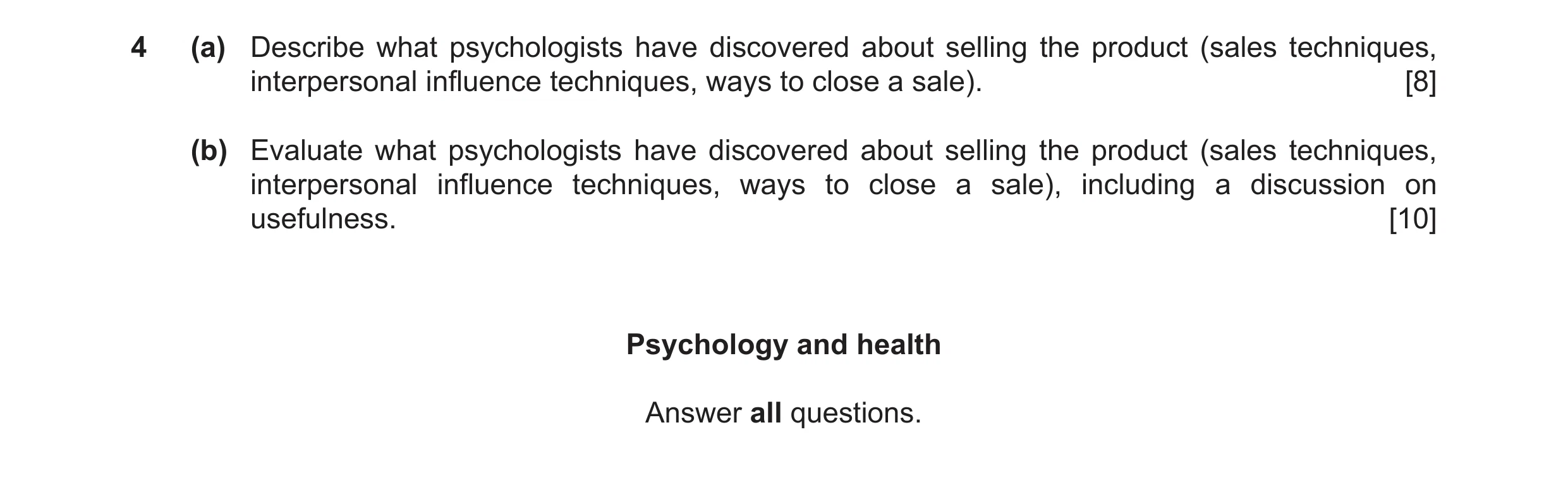
Q9 · Describe what psychologists have discovered about selling the product (sales techniques… 9990/32 Oct/Nov 2022
4 (a) Describe what psychologists have discovered about selling the product (sales techniques, interpersonal influence techniques, ways to close a sale). [8] (b) Evaluate what psychologists have discovered about selling the product (sales techniques, interpersonal influence techniques, ways to close a sale), including a discussion on usefulness. [10] Psychology and health Answer all questions.
18 marks
Mark scheme: 4(a) Describe what psychologists have discovered about selling the 8 product (sales techniques, interpersonal influence techniques, ways to close a sale). Selling the product: • Sales techniques: customer/competitor/product focused • Interpersonal influence techniques; disrupt-then-reframe (Kardes et al., 2007) • Ways to close a sale Sales techniques – customer/competitor/product focused: • Customer-focused: sales technique is used when the seller looks carefully at potential customers to identify what they want. The seller then tailors their techniques to match these needs. The focus is on how the product suits the customer. In order to buy, the customer will want as much information as possible about the product’s value in the long- term and this then increases customer loyalty. A good example might be a salesperson selling a customer a high-value product like a car • Competitor-focused: sales technique involves the seller focusing on how they compare to their competitors. It assumes all customers are the same. This is common in supermarkets in UK, for example (adverts regularly directly compare the price of the ‘weekly shopping basket’ in different supermarkets). Competitor-focused sales techniques tend to be used when products sold are relatively similar in price to competitors. The seller is likely to include the advantage of buying from their outlet e.g. after-sales service, cheaper/better warranty • Product-focused: sales technique is used when the needs of the customer are not considered, instead the emphasis is on producing/selling a quality product. It is assumed that if you are producing the best product on the market then customers will come with you. The seller will be expected to have a great deal of expertise about the specifications of their product and what it is capable of. Apple is a good example of a company employing a product-focused sales technique Interpersonal influence techniques; disrupt-then-reframe (Kardes et al., 2007) Interpersonal influence techniques include disrupt-then-reframe (DTR). It involves deliberately confusing customers with a disruptive (confusing or ambiguous) message and then re-wording (reframing) in a clearer way, so the customer is clearer in their understanding. It uses the idea of the individuals having a ‘need for cognitive closure’ (NFCC i.e. resolving the confusion/ambiguity rather than being left unsure). 4(a) Kardes et al. carried out 3 experiments: 1 A field experiment with 147 participants (43 m, 104 f, mean age 46) approached in a supermarket with candy. In the DTR condition, the seller said ‘The price is now 100 eurocents,’ then after a 2 s pause, ‘that’s 1 euro. It’s a bargain!’. In the reframe only condition, the seller said ‘The price is now 1 euro. It’s a bargain!’. In total 54% of participants bought the box of candy, 65% from the DTR and 44% from the control (reframe only) 2 A field experiment with 155 student participants (59% f, 41% m) from University of Twente in the Netherlands were asked if they would give €3 to a student interest group in order to join the group. The DTR condition was ‘You can now become a member for half a year for 300 eurocents,’ followed by a 2 s pause and ‘That’s 3 euros. That’s a really small investment!’ In the reframe only it was ‘You can now become a member for half a year for 3 euros. That’s a really small investment!’. Participants then completed a 20-item questionnaire assessing their NFCC. Scores on the NFCC questionnaire were assigned as high- or low-NFCC. In total, 22% of participants paid the €3, 30% in the DTR group donated compared to 13% in the reframe only condition. Of those assessed as high-NFCC, 43% complied with the request in the DTR condition. For low-NFCC participants, the effect to the DTR technique was non-significant. This builds on the findings from experiment 1 in that it shows a predicted interaction between DTR and NFCC 3 A lab experiment with 137 undergraduate participants from Indiana University (69 m, 68 f) divided in to 3 conditions: DTR, reframe only and disrupt only. Participants watched a video clip, heard one of the three statements regarding views on an increase in tuition fees of $75 to pay for research to raise the profile of the university. They also completed a 46-item questionnaire to assess NFCC. Results showed again that DTR was effective because of the need for cognitive closure Ways to close a sale Most techniques for closing a sale involve social psychological principles. Cialdini (1984) suggests that there are 6 ways to get people to say ‘yes’: 1 Reciprocity – If you give me the sale, I can give you something e.g. free trial, reduced price 2 Commitment and consistency – getting a micro-commitment (committing to something small) can lead to agreeing to larger (step-by- step technique). This could be signing up to a free newsletter initially 3 Liking – not just the product, but the seller, store, celebrity endorsement etc. as demonstrated by similarity: people like people like themselves; humour can also be effective 4 Authority – Knowing the product, being an expect. Think about how much people are prepared to pay premium prices for beauty products endorsed by people in lab coats (scientists). It’s important to answer questions posed and know about competitors 4(a) 5 Social proof – use of positive customer reviews (e.g. social media). Many retailers encourage buyers to leave positive reviews for their products 6 Scarcity – If an item is in short supply then it is more likely to be bought e.g. ‘last few days’, ‘USA Black Friday’. The ‘best time to close’ strategy is an example of this by emphasising that now in the best time to buy Other techniques include: • Yes set close: get the customer to start saying ‘yes’ and they’ll keep saying yes • Alternative/choice is when the customer is given a choice but each alternative confirms the sale e.g. ‘would you like us to deliver or take it with you now?’ Mark according to the levels of response descriptors in Table A. Other appropriate responses should also be credited. 4(b) Evaluate what psychologists have discovered about selling the 10 product (sales techniques, interpersonal influence techniques, ways to close a sale), including a discussion on usefulness. A range of issues could be used for evaluation here. These include: • Named issue – usefulness: The sales techniques with the different focus (customer, product etc.) could usefully be applied depending on the type of product being sold but in practice more than one of these could be used depending on what is being sold and it may not generalise well. Kardes has some utility in showing a relationship between DTR as a sales technique and NFCC. However, this could be limited as DTR has no significant effect on those who score low on NFCC and this would not be obvious from looking at a customer. The ways to close a sale could be useful to sellers and salespeople particularly as it is direct practical advice that helps to ensure that they succeed in their selling but also that the customer’s needs are met. • Generalisations / Cultural bias • Methods (self-report/observations/experiments) • Quantitative/Qualitative data • Validity • Ethics • Reductionism/holism Mark according to the levels of response descriptors in Table B. Other appropriate responses should also be credited. Psychology and health
This question in 9990/32 Oct/Nov 2022
Q10 · Outline an associative learning explanation for consumers’ preference for product colour… 9990/33 Oct/Nov 2022
3 (a) Outline an associative learning explanation for consumers’ preference for product colour (Grossman and Wisenblit, 1999). [2] (b) Outline two methods used to collect data in the study by Porublev et al. (2009) on gift-wrapping. [4] (c) Explain one strength and one weakness of the study by Porublev et al. [6]
12 marks
Mark scheme: 3(a) Outline an associative learning explanation for consumers’ preference 2 for product colour (Grossman and Wisenblit, 1999). Award 1 mark for a basic outline of the term/concept. Award 2 marks for a detailed outline of the term/concept. With classical conditioning, we form associations between favourable experiences and a colour, leading to colour preferences, or we may learn to associate certain colours with certain products and therefore against some other products (2). In addition, associations could have been formed early in human history when people first associated blue with night (passivity) and yellow with sunlight (arousal) (1). We tend to assume cool colours like green and blue are calming but warmer colours like red and orange are arousing (1). Other appropriate responses should also be credited. 3(b) Outline two methods used to collect data in the study by Porublev et 4 al. (2009) on gift-wrapping. For each method: Award 1 mark for a basic answer with some understanding of the topic area. Award 2 marks for a detailed answer with clear understanding of the topic area. Two from: • Observation (1) of a Christmas gift-wrapping stall (1) (to see different wrappings and how gifts are wrapped) • In depth interviews (1) with 20 participants from Victoria, Australia aged 25–35 (to reflect on gift-wrapping) with questions regarding gift- wrapping preferences (1) • Six projective workshops where participants in pairs were asked to wrap two gifts, one for someone they are close to and the other for an acquaintance, and have a discussion about gift-wrapping while doing so (2) Researchers photographed the wrapped gifts (1) Other appropriate responses should also be credited. 3(c) Explain one strength and one weakness of the study by Porublev et al. 6 Likely strengths include: • Use of multiple ways of gathering data (observation, interview etc.) means findings are more comprehensive so increasing validity • Standardised procedures in interview and methods of gathering qualitative data increases reliability. Study could easily be carried out elsewhere for comparison • Qualitative data gathered leading to high validity as participants can express views in own words and observers can record detail (for example photographs were taken of the wrapped gifts produced in the workshops) • Although the study was carried out at Christmas time, the expectation of the researchers was that the information gathered would apply to all types of gifts – birthdays, baby shower, Valentine’s etc., so widening the generalisability • Ethical study as participants were aware of taking part in the interview and workshop, giving informed consent and in the case of the observation, participants could reasonably expect to be observed while shopping Likely weaknesses include: • The study centred around Christmas gifts, which may not have an equivalent in other cultures. In other religious festivals where gifts are given, they may be of a different type or not wrapped and expectations about wrapping could be different too • Lack of quantitative data means that it would be more difficult to make comparisons between either different shops or different age groups • Narrow age range / culture of participants so lacking in generalisations. Researchers acknowledge this, but selection made deliberately to get information from those most likely to engage with gifting Mark according to the levels of response criteria below: Level 3 (5–6 marks) • Candidates will show a clear understanding of the question and will explain one strength and one weakness. • Candidates will provide a good explanation with clear detail. Level 2 (3–4 marks) • Candidates will show an understanding of the question and will explain one appropriate weakness in detail or one appropriate strength in detail. OR • one weakness and one strength in less detail. Level 1 (1–2 marks) • Candidates will show a basic understanding of the question and will attempt an explanation of either a strength or a weakness. They could include both but just as an attempt. • Candidates will provide a limited explanation. 3(c) Level 0 (0 marks) No response worthy of credit. Other appropriate responses should also be credited.
This question in 9990/33 Oct/Nov 2022
Q11 · Outline ‘convenience’ from Lauterborn’s 4 Cs marketing mix model 9990/32 Feb/March 2024
6 (a) Outline ‘convenience’ from Lauterborn’s 4 Cs marketing mix model. [2] (b) Lauterborn’s model can be applied to everyday life, such as for advertising products. Explain one strength of using ‘convenience’ for advertising a product on the internet. [2]
4 marks
Mark scheme: 6(a) Outline ‘convenience’ from Lauterborn’s 4 Cs marketing mix model. 2 Award 2 marks for an outline of the term/concept Award 1 mark for a basic outline/identification of the term/concept. Content: Convenience (to buy) – ease of location of product, how easy it is to find information/buy and have product delivered. Example: Example on it’s own (e.g. the customer lives close to the shop, or is a frequent visitor so store is familiar) (1) Convenience is how easy it is to purchase a product. (2) It is how easy it is to find information about a product, purchase it and have it delivered. (2) Other appropriate responses should also be credited. 6(b) Lauterborn’s model can be applied to everyday life, such as for 2 Context = advertising product on the advertising products. internet. Explain one strength of using ‘convenience’ for advertising a product on Focus on convenience and internet. the internet. Award 2 marks for a detailed explanation of the strength in context. Award 1 mark for a basic explanation of the strength. Likely strengths – Can advertise to a large audience anywhere in the world. Can target ads to demographic of customers/purchasing and/or browsing history of customer Can include link to online store within advertisement which is very easy and quick for customers to access online store. Can be inexpensive on some websites whereas traditional advertising on television, billboards, etc. is expensive. Advert can be displayed all day Example: One strength is that customers will be able to instantly access the store’s website as the advertisement can provide a web link. (1) Convenience of the product will be highlighted immediately to potential customers as they can interact with internet advertising and access product information/make a purchase with a few clicks of a button. (1) Other appropriate responses should also be credited.
This question in 9990/32 Feb/March 2024
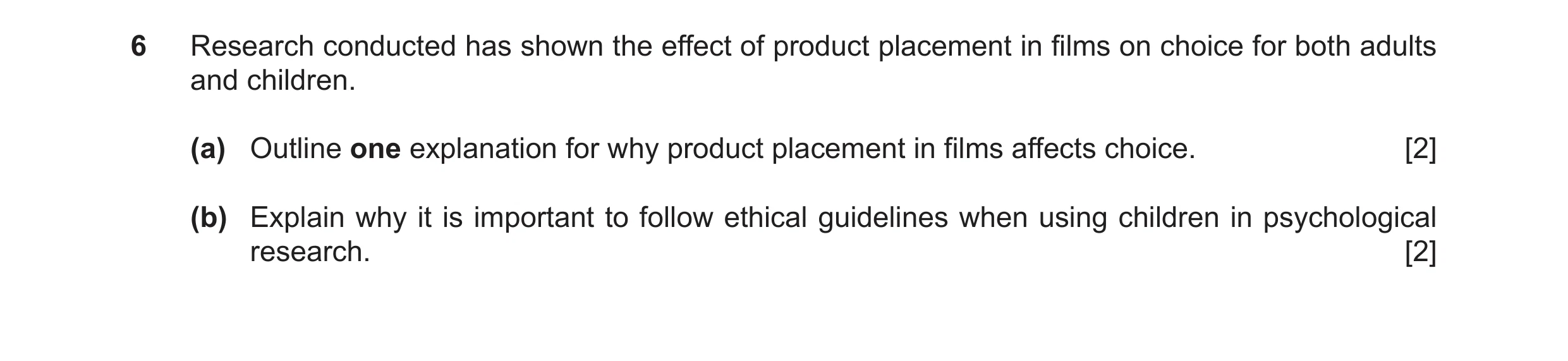
Q12 · Research conducted has shown the effect of product placement in films on choice for both… 9990/32 Feb/March 2025
6 Research conducted has shown the effect of product placement in films on choice for both adults and children. (a) Outline one explanation for why product placement in films affects choice. [2] (b) Explain why it is important to follow ethical guidelines when using children in psychological research. [2]
4 marks
Mark scheme: 6 Research conducted has shown the effect of product placement in films on choice for both adults and children. 6(a) Outline one explanation for why product placement in films affects choice. 2 No credit for a result from A&L without explaining why the result Award 2 marks for an outline of the concept occurred. Award 1 mark for a basic outline/identification of the /concept. Likely answers (2 mark answers) • Repeated / mere exposure to a product leads to increased positive feelings towards it. Those watching the film often don’t realise they are being shown a branded product. Even though it is unconscious the positive feeling could lead the customer to buy the product they saw in the film. • Reminder of a product. People are already familiar with the product but seeing it in a film reminds them of the branded product. They will also have positive feelings about the product. • Credit reference to Auty and Lewis study as an example of reminder of a product. This was seen in the participants who had seen the film before and were in the experimental condition where the main character drank Pepsi. These participants were more likely to choose Pepsi compared to the control group (milk) Therefore, the product placement affects choice as those in the Pepsi condition were reminded of the product. Other appropriate responses should also be credited. 6(b) Explain why it is important to follow ethical guidelines when using children in 2 No credit to cannot get consent psychological research. from children without stating that consent can be obtained from Award 2 marks for an explanation about why following ethical guidelines when using parent/carer. children is important. Award 1 mark for a basic explanation of about why following ethical guidelines when using children is important. Likely answers– Children are vulnerable and need to be protected. Children don’t understand what it means to be in a psychology study so the parent/caregiver must give consent. Even when the parents give their consent, the nature of the study/instructions must be clearly explained so that the children feel comfortable in the study. Many children are anxious in an unfamiliar environment or around strangers so it may be necessary for the parent to stay with them OR often the study will be done in a room at the school the children attend so they will feel safe and comfortable. Example: One reason it is important to follow ethical guidelines when using children is that they are too young to give consent as they do not understand what it means to be in a psychology study. (1) Therefore, their parents give consent once the study is fully explained to them. (1) Other appropriate responses should also be credited.
This question in 9990/32 Feb/March 2025
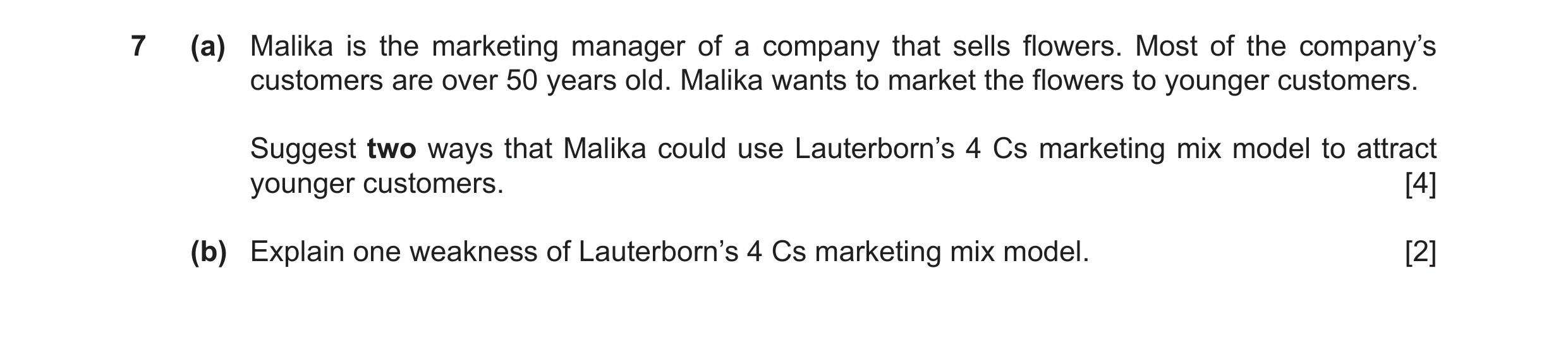
Q13 · Malika is the marketing manager of a company that sells flowers 9990/32 Feb/March 2025
7 (a) Malika is the marketing manager of a company that sells flowers. Most of the company’s customers are over 50 years old. Malika wants to market the flowers to younger customers. Suggest two ways that Malika could use Lauterborn’s 4 Cs marketing mix model to attract younger customers. [4] (b) Explain one weakness of Lauterborn’s 4 Cs marketing mix model. [2]
6 marks
Mark scheme: 7(a) Malika is the marketing manager of a company that sells flowers. Most of the 4 For wants and needs – must company’s customers are over 50 years old. Malika wants to market the flowers to identify the C or describe it and younger customers. then can credit example of Suggest two ways that Malika could use Lauterborn’s 4 Cs marketing mix model things young people might like to attract younger customers. 1 mark identifying or outlining For each way: 4C Award 2 marks for a suggestion using 4Cs marketing mix model to attract younger 1 mark idea suitable/specific to customers. younger customers. Award 1 mark for a basic outline of a suggestion using 4Cs marketing mix model to attract younger customers. Likely suggestions • Customer wants and needs - younger customers who do they buy flowers for and the type of flowers they want. May have environmental concerns with cut flowers and preferred potted flowers. • Cost to satisfy – Younger customers may have less disposable income to spend on flowers so Malika could investigate lower price products and do market research to find out if these will satisfy the potential customers. • Convenience to buy – Flower arrangements should be available online to attract younger customers who prefer online shopping. Advertising on social media with links to purchase will make it easier for the younger customers to become aware of the products and to purchase them. • Communication – Getting feedback from the younger customers is important to find out if the products you have aimed at them are suitable, at the right price, etc. Product reviews with a link provided in the email confirmation of order will encourage customers to leave a review. Online questionnaires that could be completed by potential customers will help Malike with market research to find out if the products and price points are suitable. Online questionnaires can be put on social media which will encourage younger customers to respond. Other appropriate responses should also be credited. 7(b) Explain one weakness of Lauterborn’s 4C’s marketing mix model. 2 Award 2 marks for an explanation of the weakness Award 1 mark for a basic explanation of the weakness Likely problems – (2 mark responses) • Difficult to test which part of the model has been more or less effective. If sales increase, the company won’t necessarily be able to find out if it was their convenience to buy or their communication with customers (or a factor that has nothing to do with the company’s marketing strategy such as a bad press report being released about their competitor) that led to the increased sales. • Cultural bias – model based on research mainly done in USA so it is possible there is cultural bias. Consumers in Western countries have a larger disposable income and also lots of product choice through internet shopping as well as physical stores. • Difficult for small companies to be able to create a marketing campaign, price, convenience to purchase, etc. for all of their customers. Smaller companies may not have the resources to design a high quality website or be able to communicate effectively with all of their customers. • Difficult to quantify ‘cost to satisfy’. May be hard to determine how much time it takes for a customer to purchase the product or whether customers feel uncomfortable buying the product (e.g. because of its impact on the environment). Other appropriate responses should also be credited.
This question in 9990/32 Feb/March 2025
![Question 1: (a) Explain what is meant by a ‘model of communication’ with reference to advertising. [2] (b) Describe McCarthy’s ‘4 Ps marketing mix’ mod…](https://img.pastlit.com/crops/62730e4c-5a1b-4b06-9ee3-d43b07cd82dc/q3.webp)
![Question 2: (a) Explain what is meant by ‘attention and shelf position’ and its effect on product choice. [2] (b) Describe the ‘consumer decision model…](https://img.pastlit.com/crops/3c29d4c6-f995-4018-9bf4-8406b8e7ea17/q3.webp)
![Question 3: (a) Identify two common menu design mistakes, as outlined by Pavesic (2005). [2] (b) Describe two findings of the study by Gil et al. (2009…](https://img.pastlit.com/crops/8e52a706-bc74-4931-bd72-032a06f9d58c/q3.webp)
![Question 5: (a) Lauterborn proposed ‘the 4 Cs marketing mix model’ of advertising. Identify two of the ‘Cs’. [2] (b) Describe the procedure and one res…](https://img.pastlit.com/crops/6865d89a-7a93-405c-997e-aff25650e868/q3.webp) 1 / 3
1 / 3![Question 6: (a) Identify two of the virtual store layouts in the study by Vrechopoulos (2004) on the interior layout of grocery stores. [2] (b) Describ…](https://img.pastlit.com/crops/d8889f82-0b64-4ab6-910a-dc483756b634/q3.webp)
![Question 7: (a) Lauterborn proposed ‘the 4 Cs marketing mix model’ of advertising. Identify two of the ‘Cs’. [2] (b) Describe the procedure and one res…](https://img.pastlit.com/crops/daa169cb-aec6-42cd-86d8-a413cf226300/q3.webp)
![Question 8: (a) Outline an associative learning explanation for consumers’ preference for product colour (Grossman and Wisenblit, 1999). [2] (b) Outlin…](https://img.pastlit.com/crops/c62f3b93-f141-494b-9080-3da23bd5b9db/q3.webp)
![Question 10: (a) Outline an associative learning explanation for consumers’ preference for product colour (Grossman and Wisenblit, 1999). [2] (b) Outlin…](https://img.pastlit.com/crops/6f9025c3-9ce9-42a2-9dc7-0b143ff202e6/q3.webp) 2 / 3
2 / 3![Question 11: (a) Outline ‘convenience’ from Lauterborn’s 4 Cs marketing mix model. [2] (b) Lauterborn’s model can be applied to everyday life, such as f…](https://img.pastlit.com/crops/dc8ed178-dd95-4dfd-8891-7767488eb1db/q6.webp)
 3 / 3
3 / 3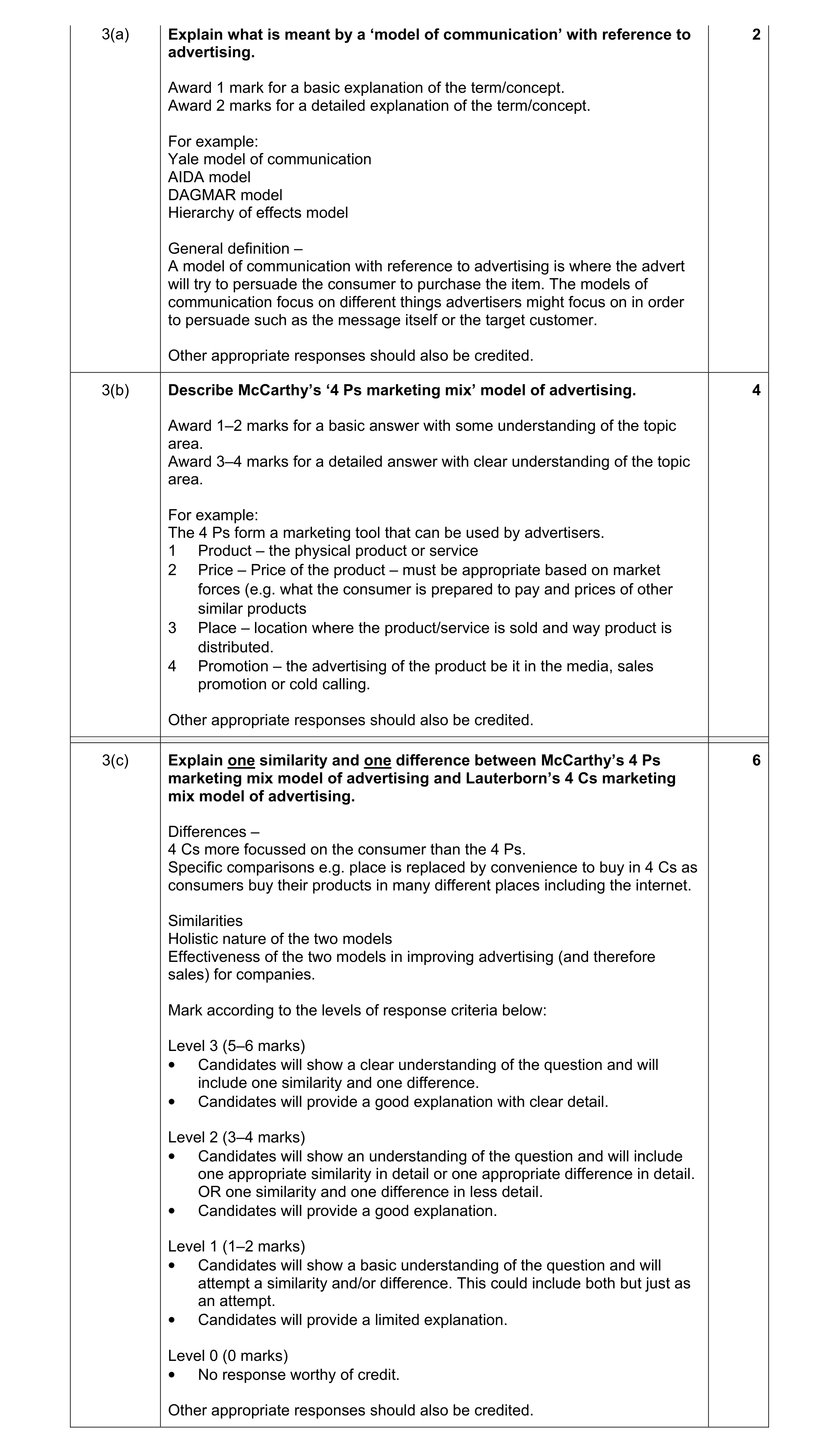 12
12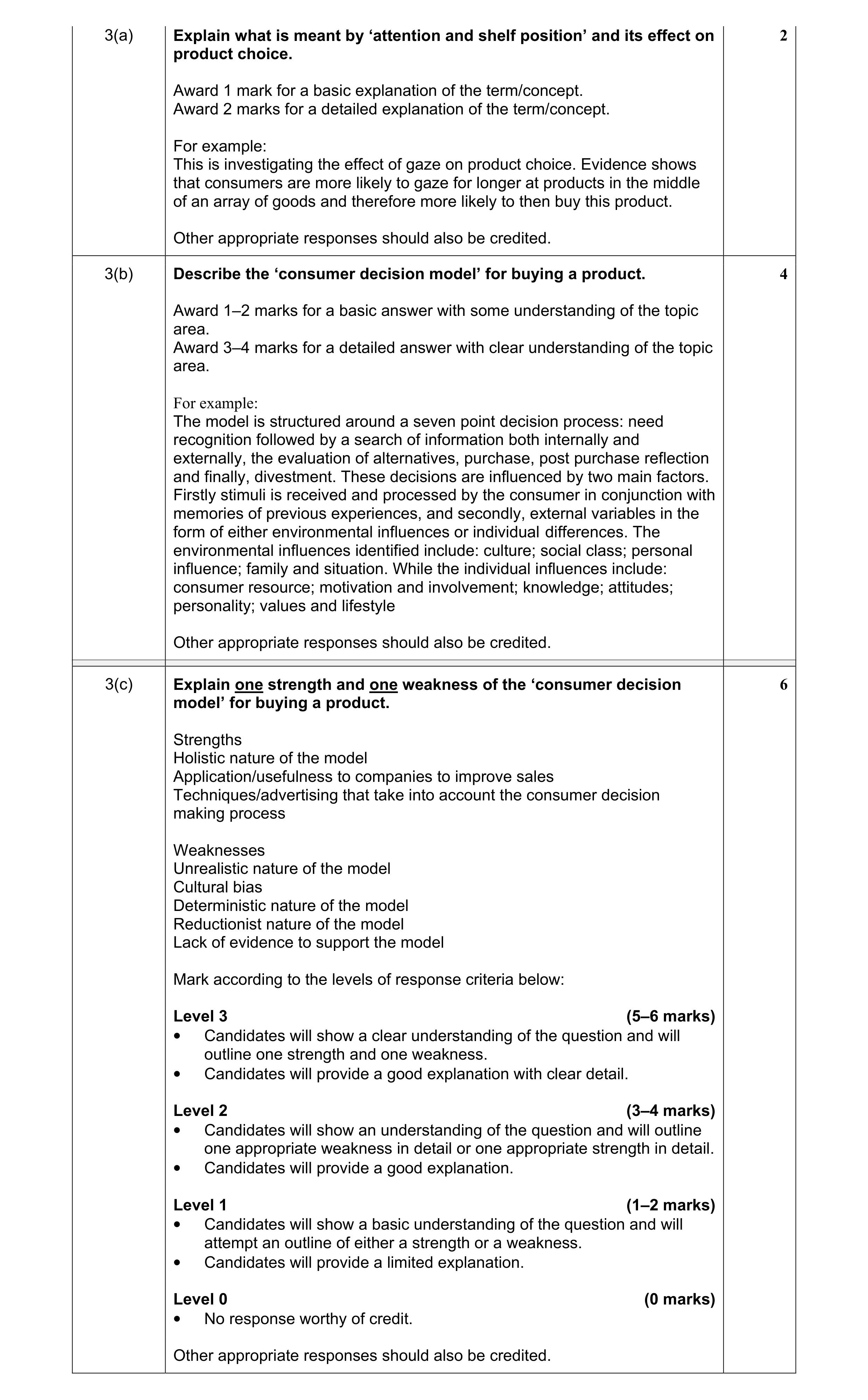 12
12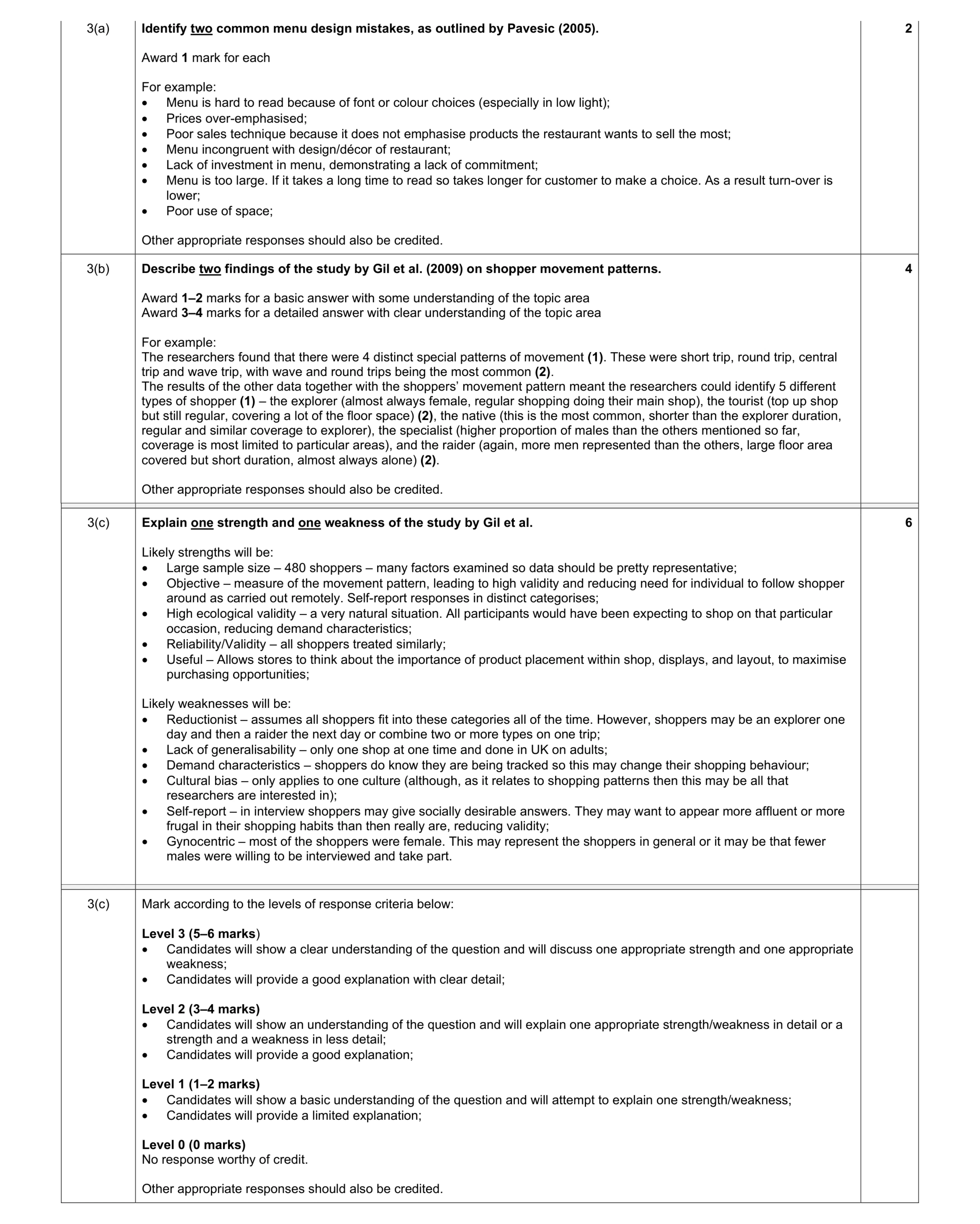 12
12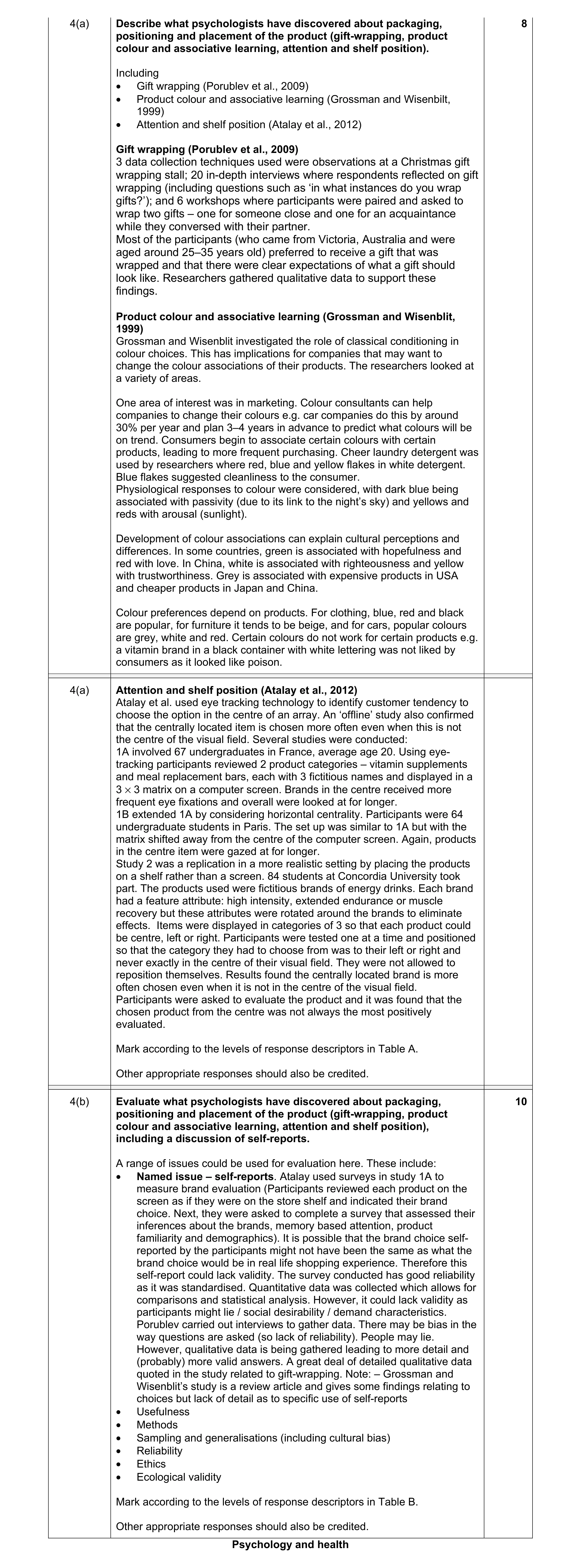 18
18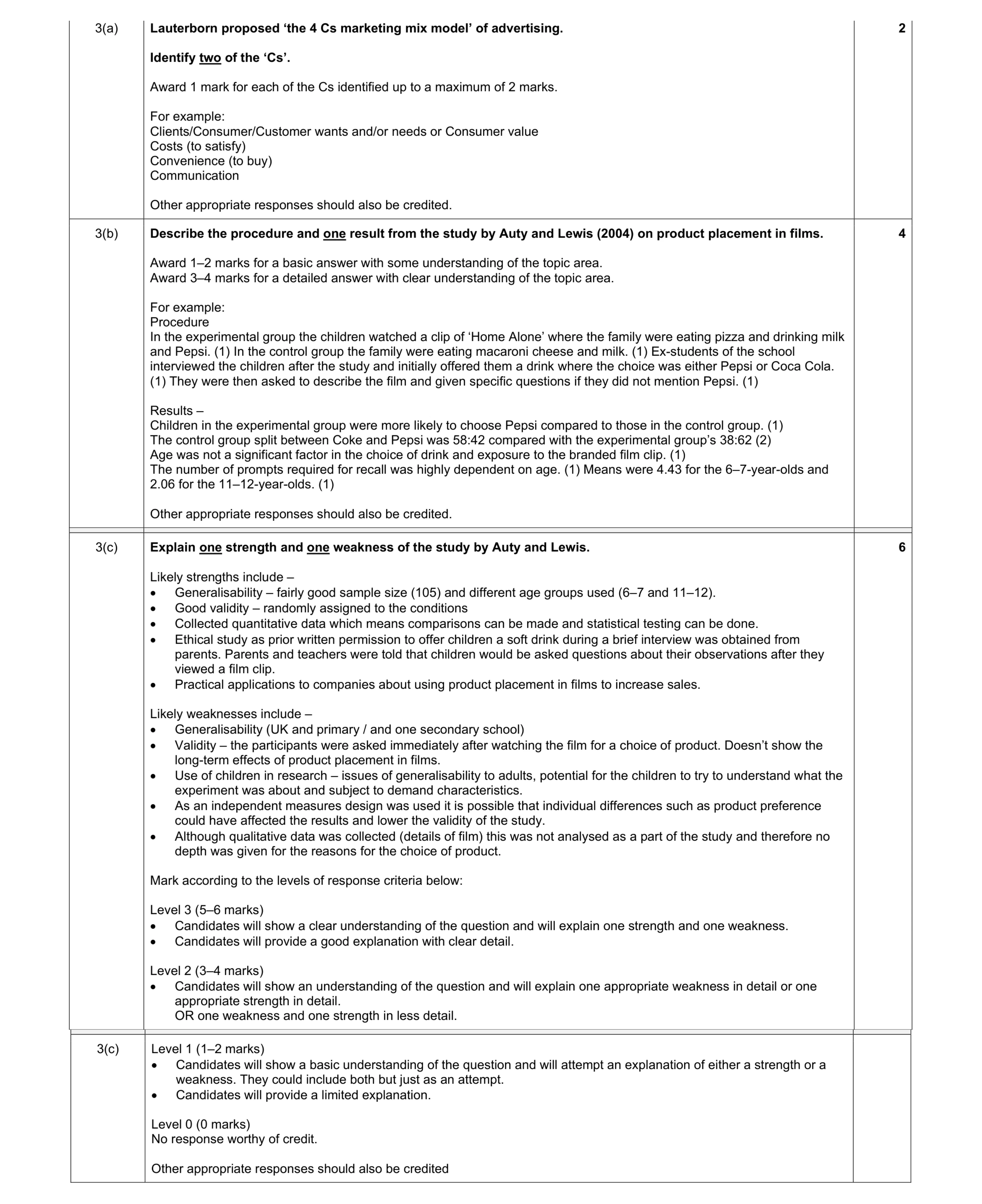 12
12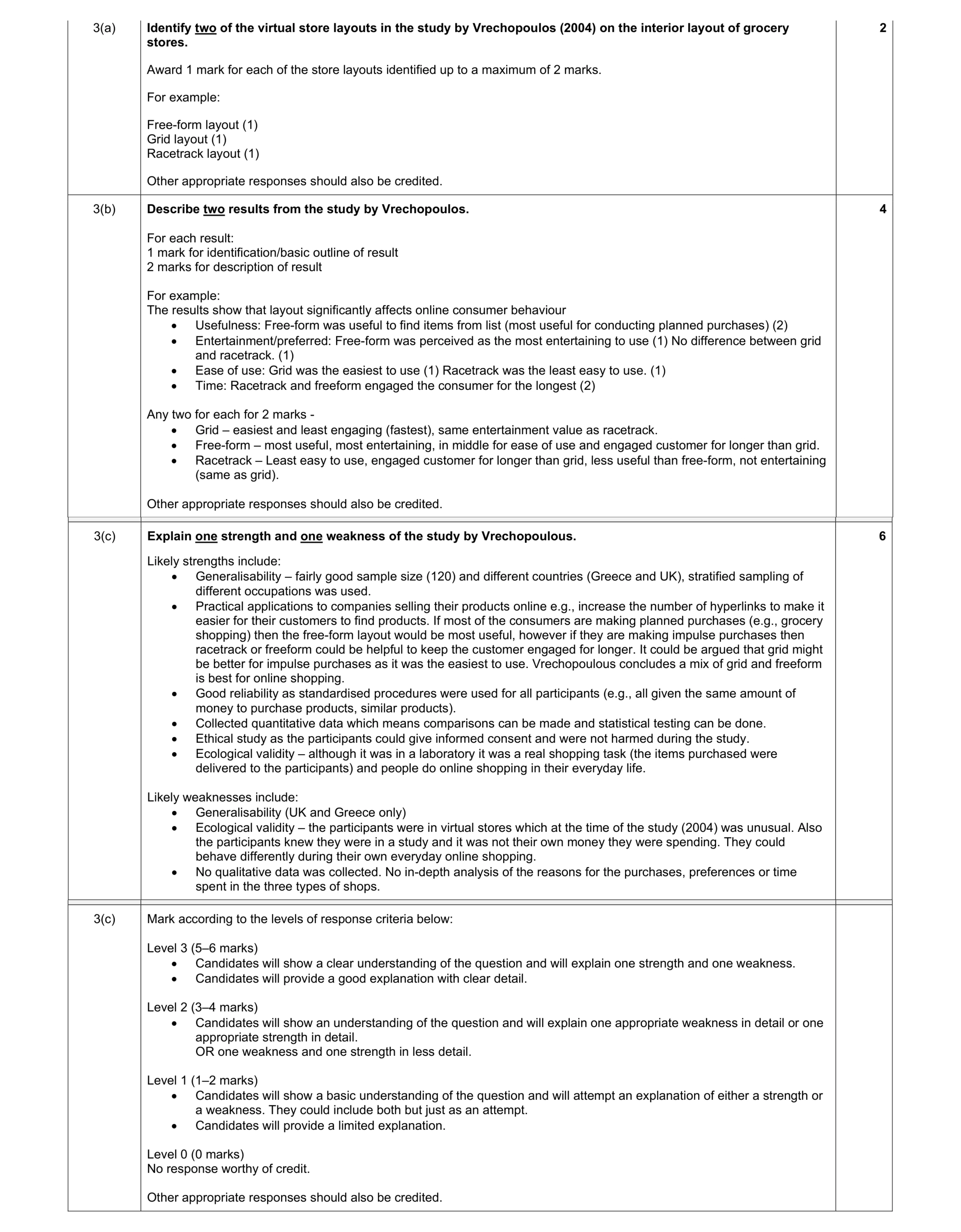 12
12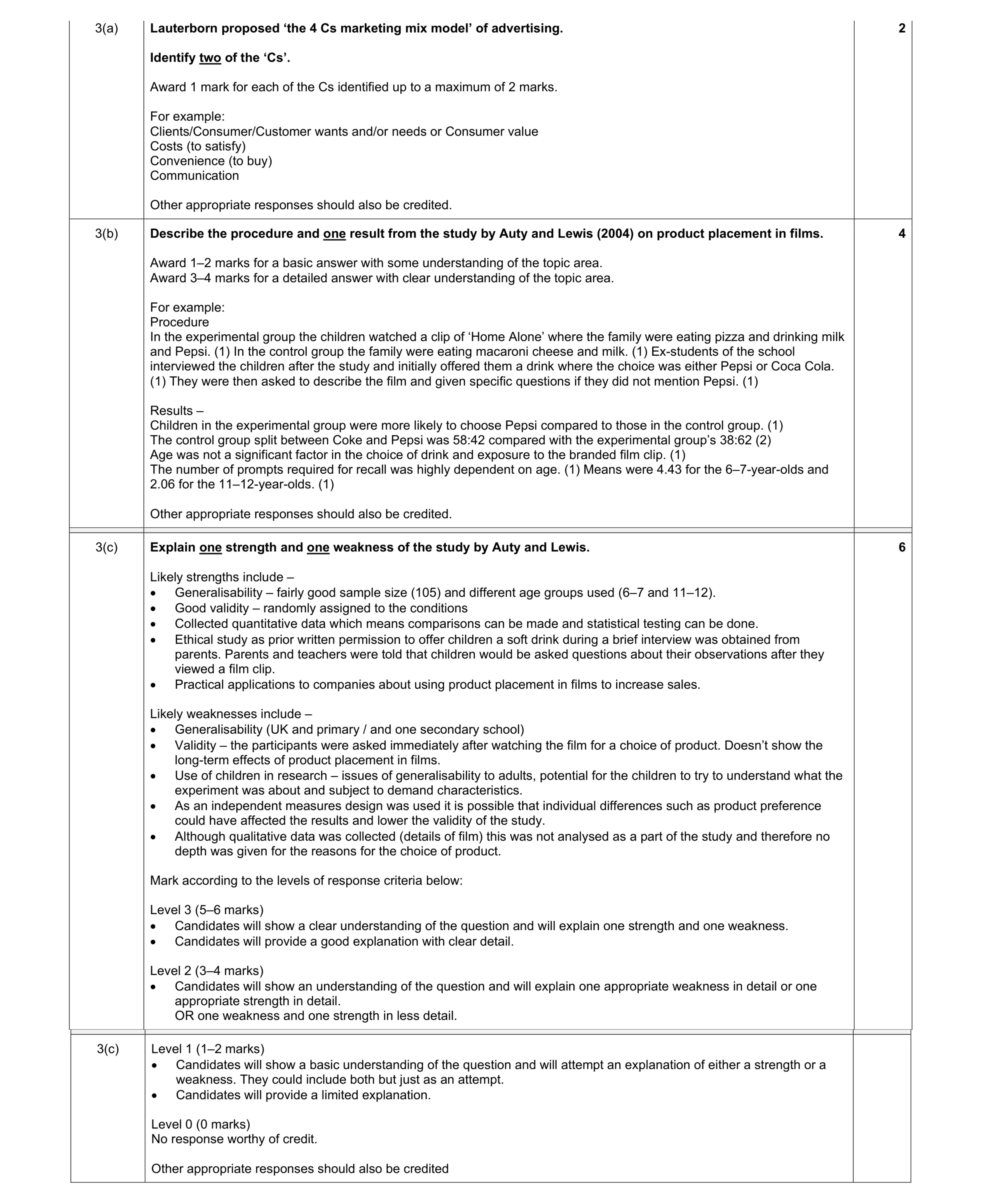 12
12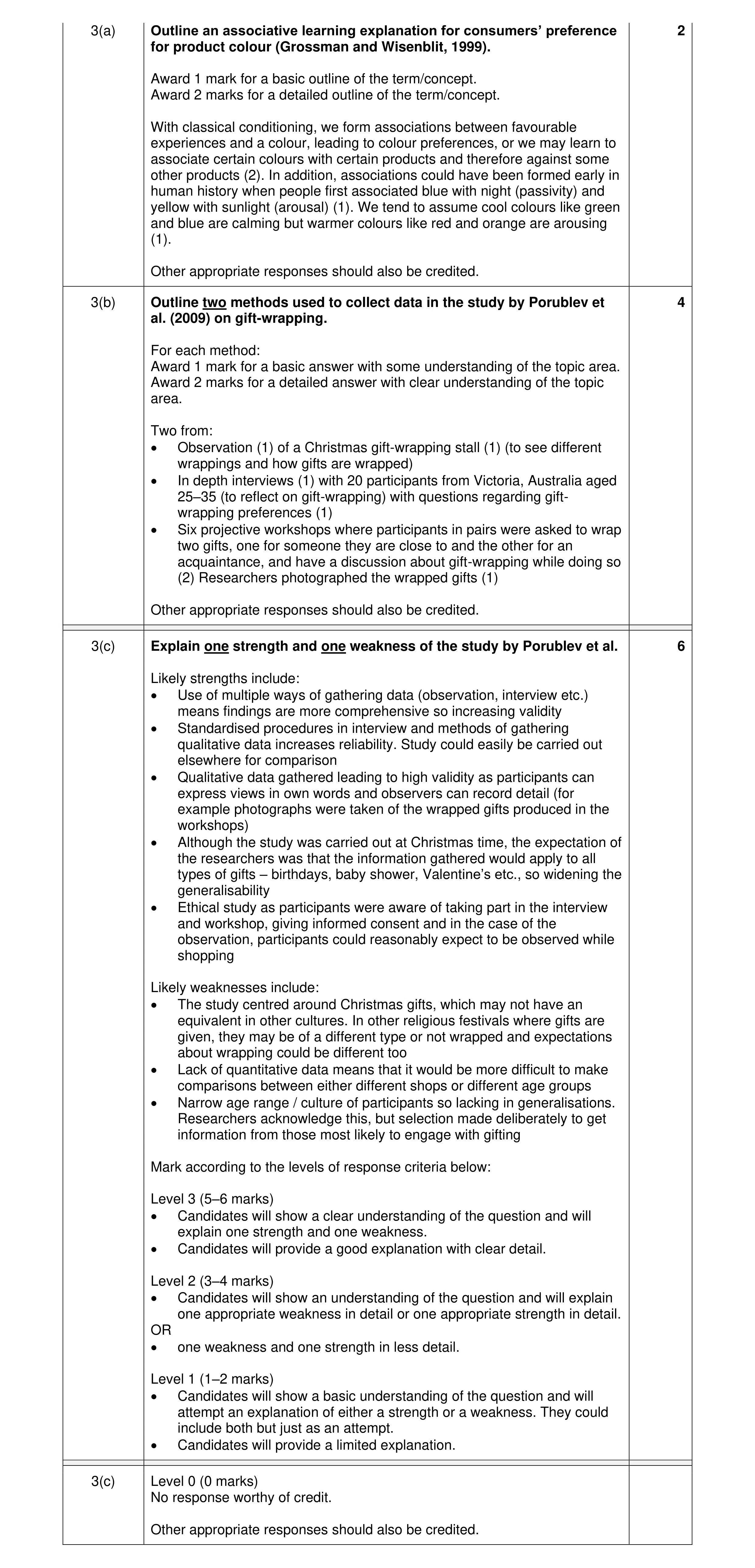 12
12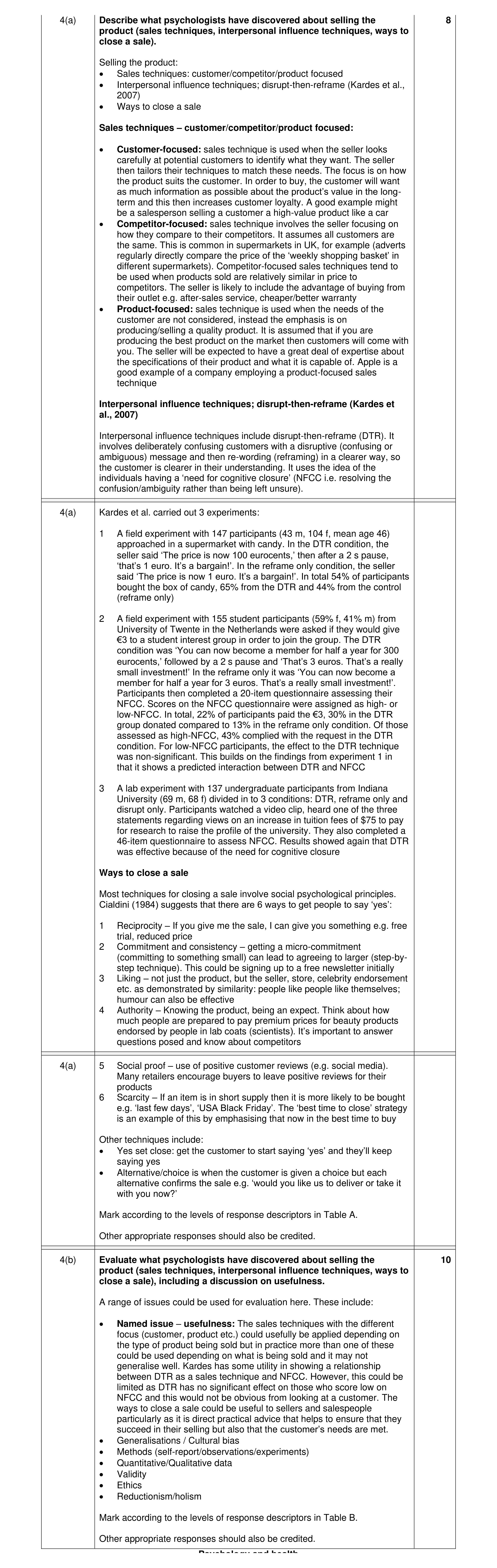 18
18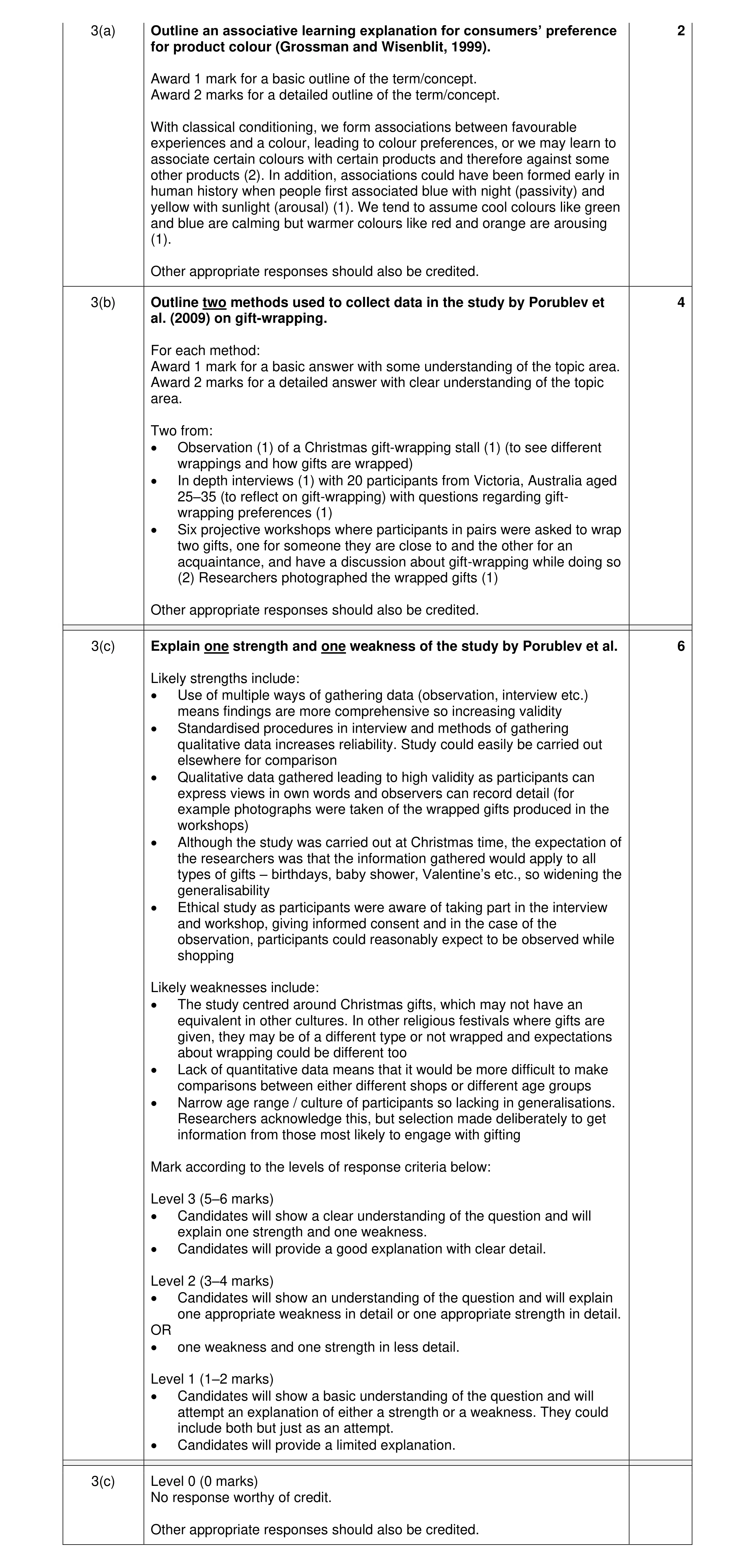 12
12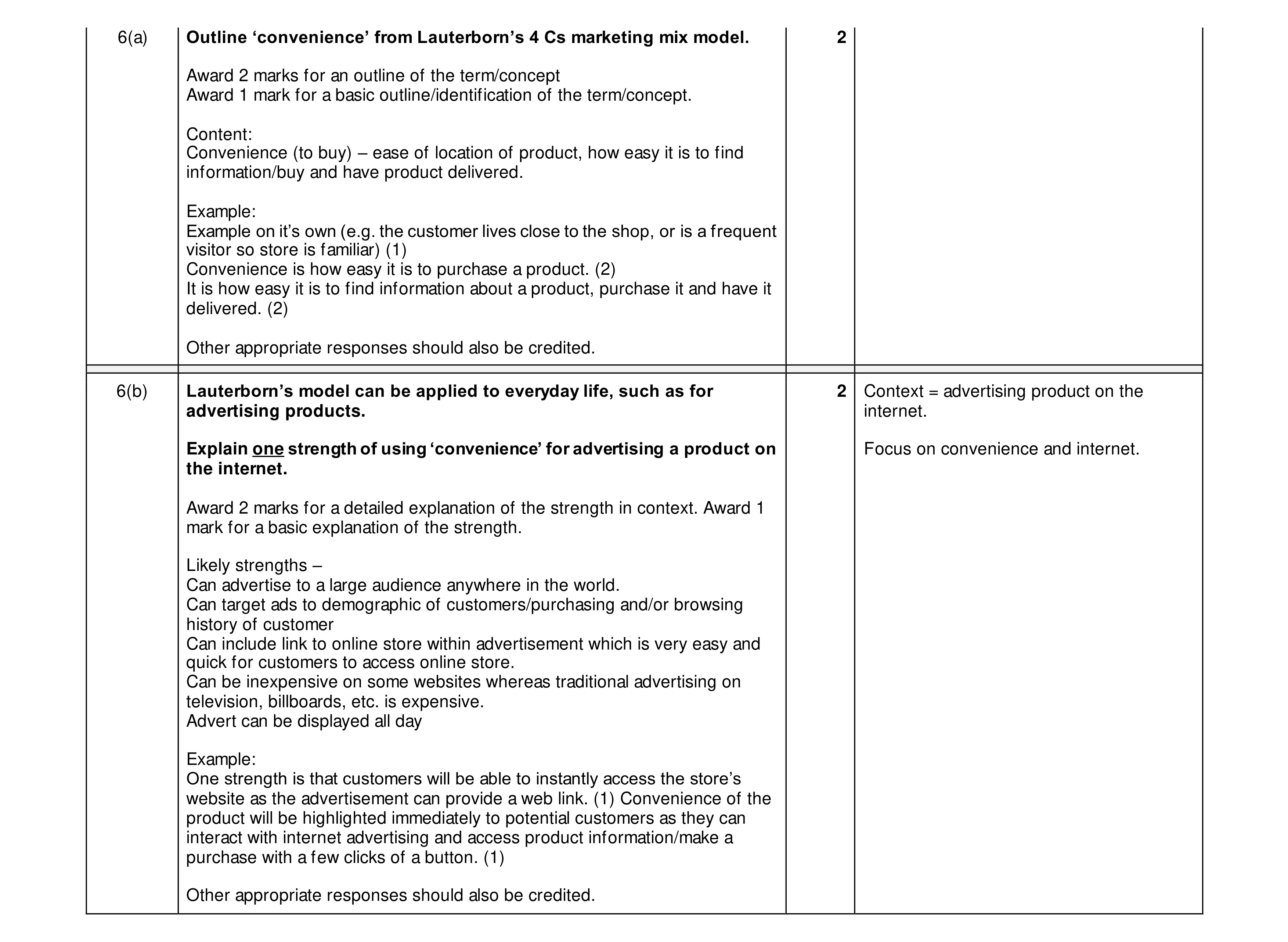 4
4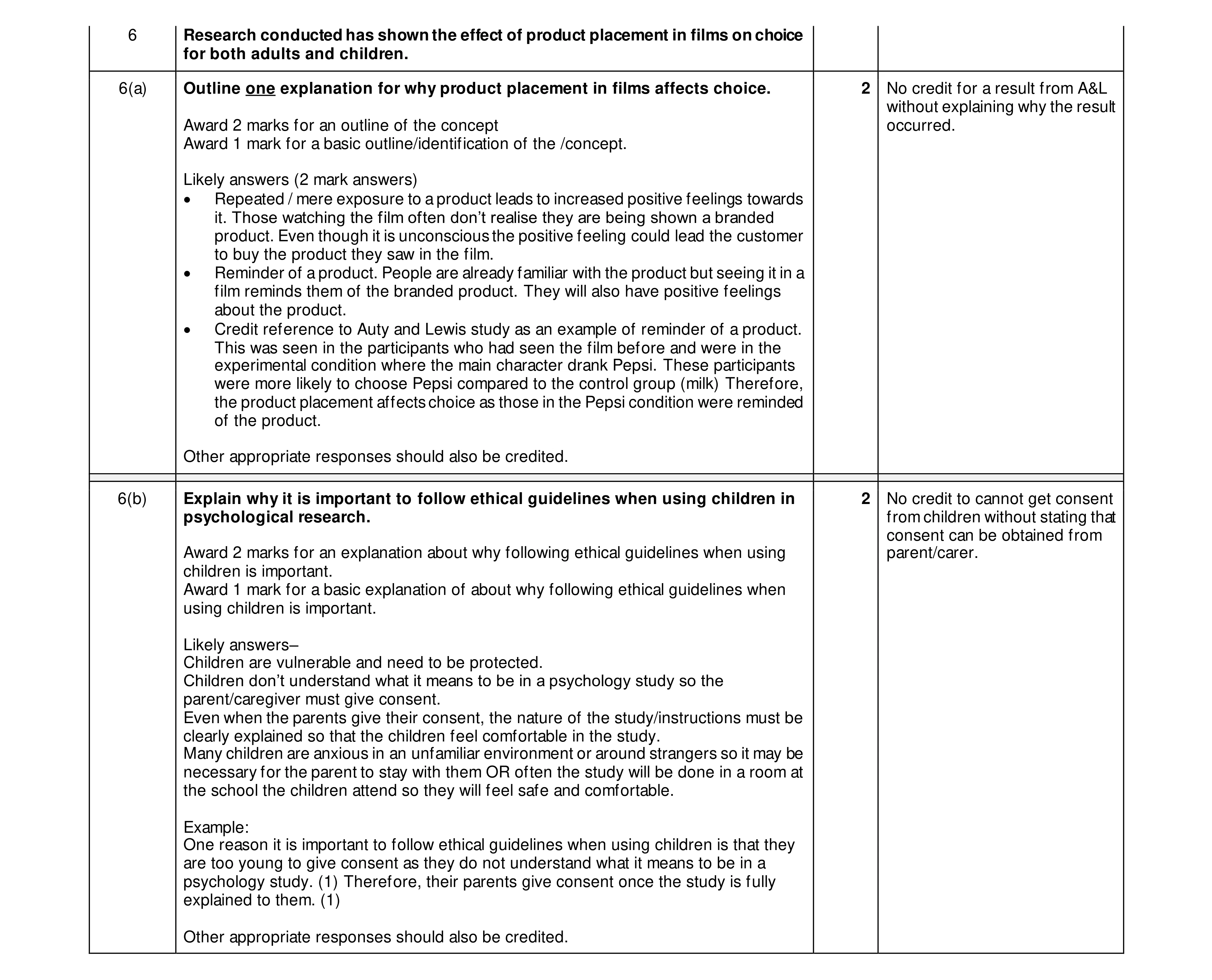 4
4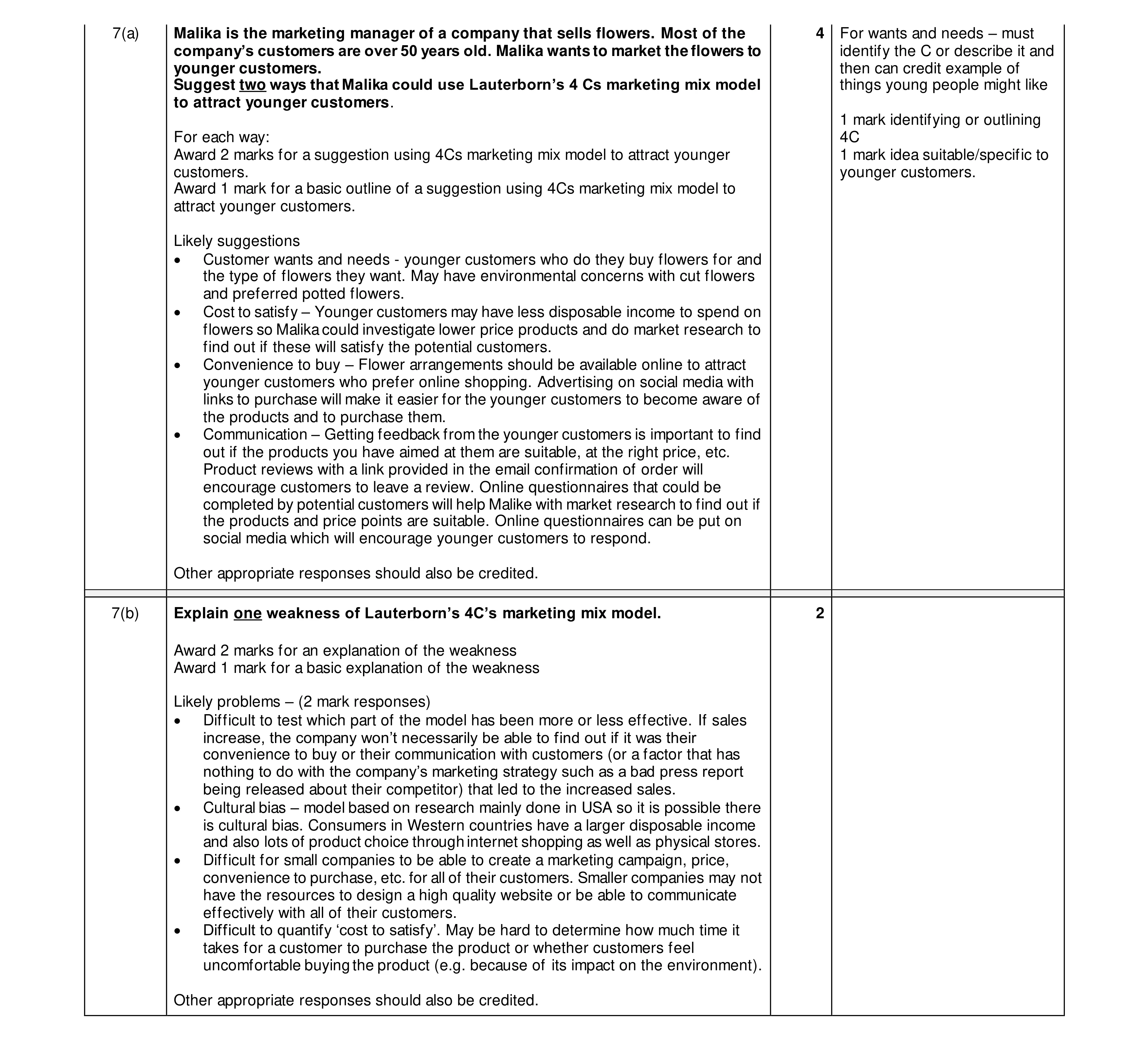 6
6