Cambridge A Level Psychology (from 2018) 9990 — 2025 May/June Paper 4 · Variant 3
9990/43/M/J/25 · 12 questions · 60 marks · 90 min
The question paper and its mark scheme, free to read here and free to download. This is Cambridge’s own paper, exactly as it was sat.
Question paper8 pages
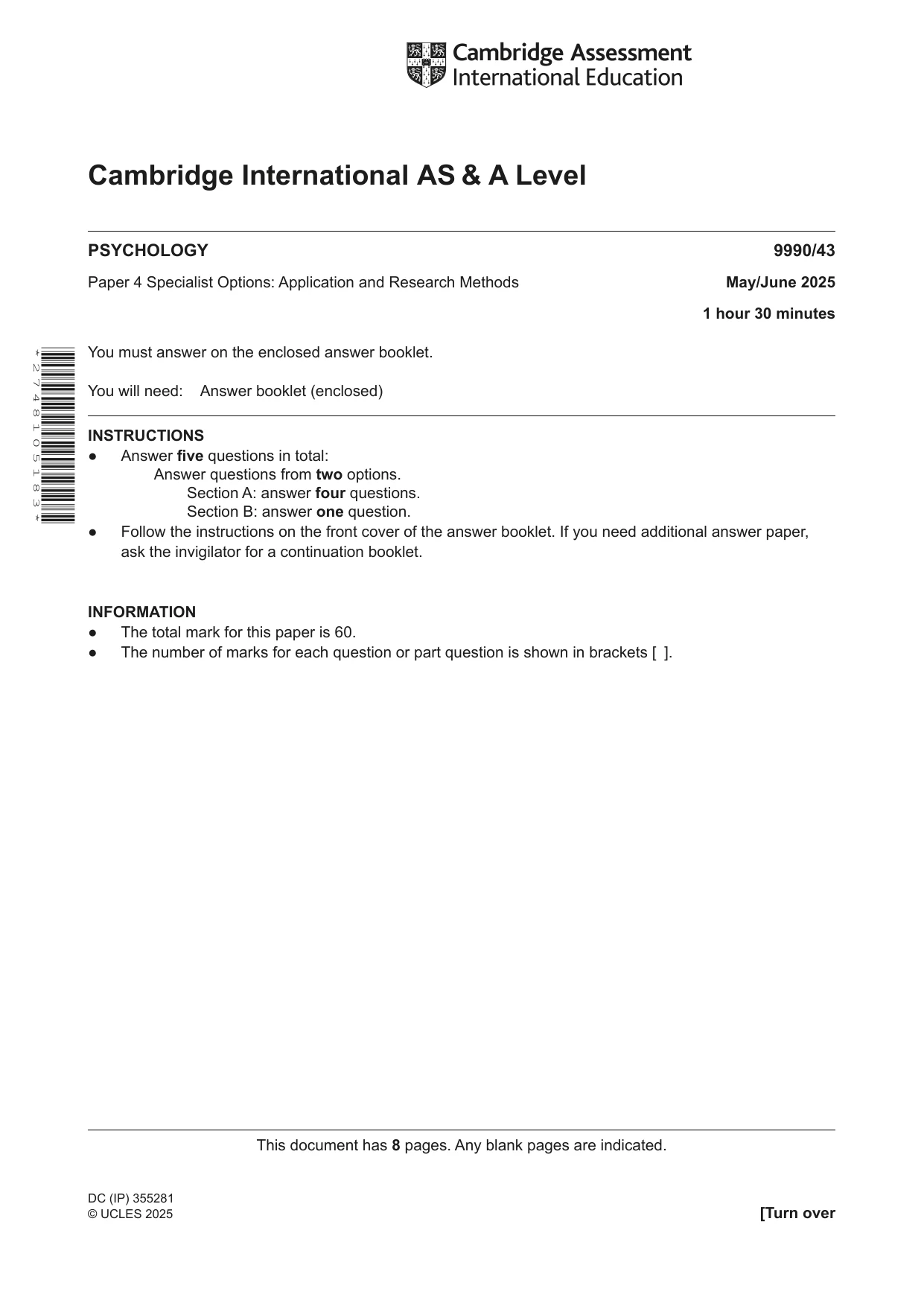


Mark scheme36 pages
Answers below. Sit the paper first if you are practising.
Questions as text
Q1 · The key study by Chapman and DeLapp (2013) on blood/injection/injury phobia used the…
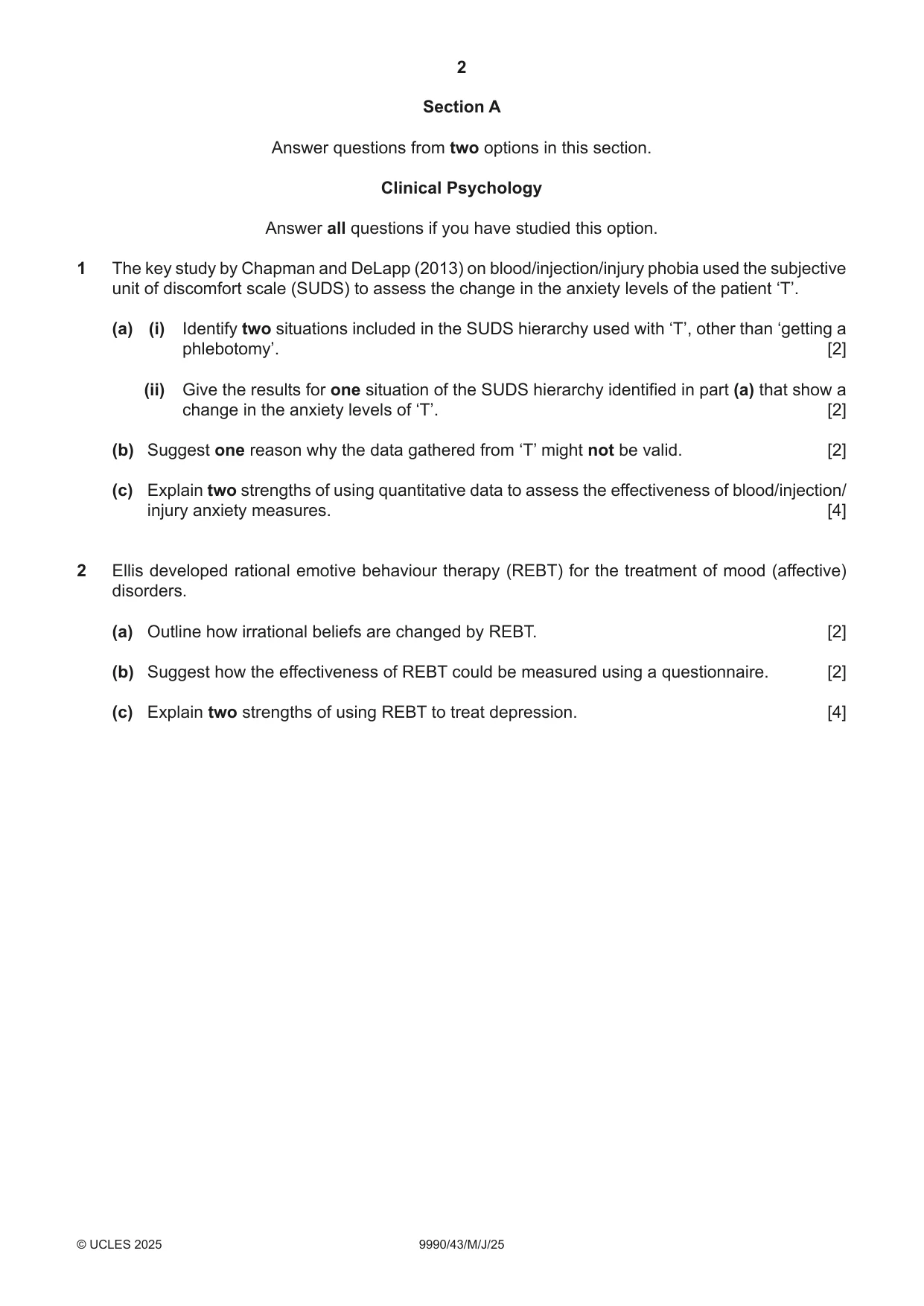
1 The key study by Chapman and DeLapp (2013) on blood/injection/injury phobia used the subjective unit of discomfort scale (SUDS) to assess the change in the anxiety levels of the patient ‘T’. (a) (i) Identify two situations included in the SUDS hierarchy used with ‘T’, other than ‘getting a phlebotomy’. [2] (ii) Give the results for one situation of the SUDS hierarchy identified in part (a) that show a change in the anxiety levels of ‘T’. [2] (b) Suggest one reason why the data gathered from ‘T’ might not be valid. [2] (c) Explain two strengths of using quantitative data to assess the effectiveness of blood/injection/ injury anxiety measures. [4]
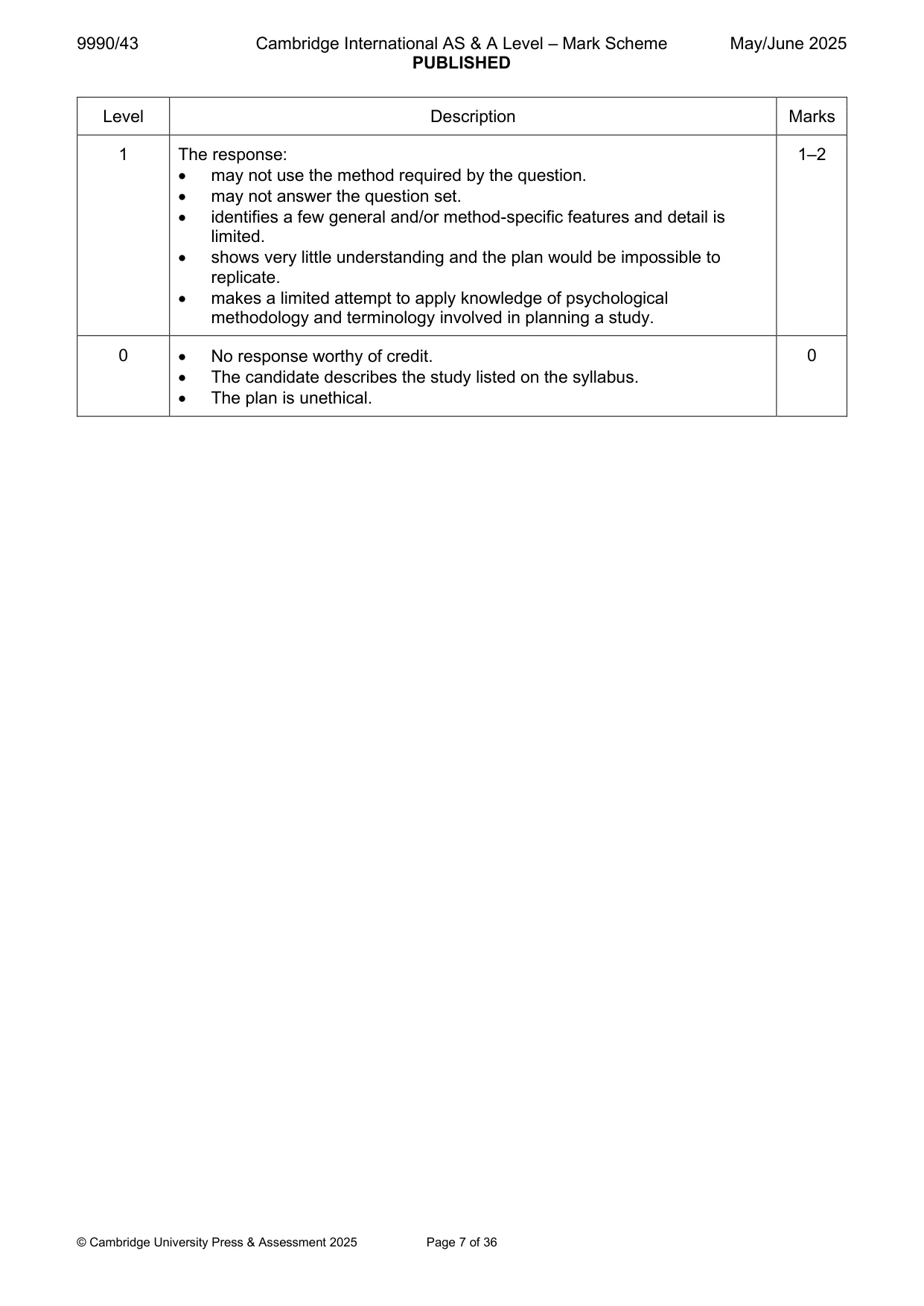
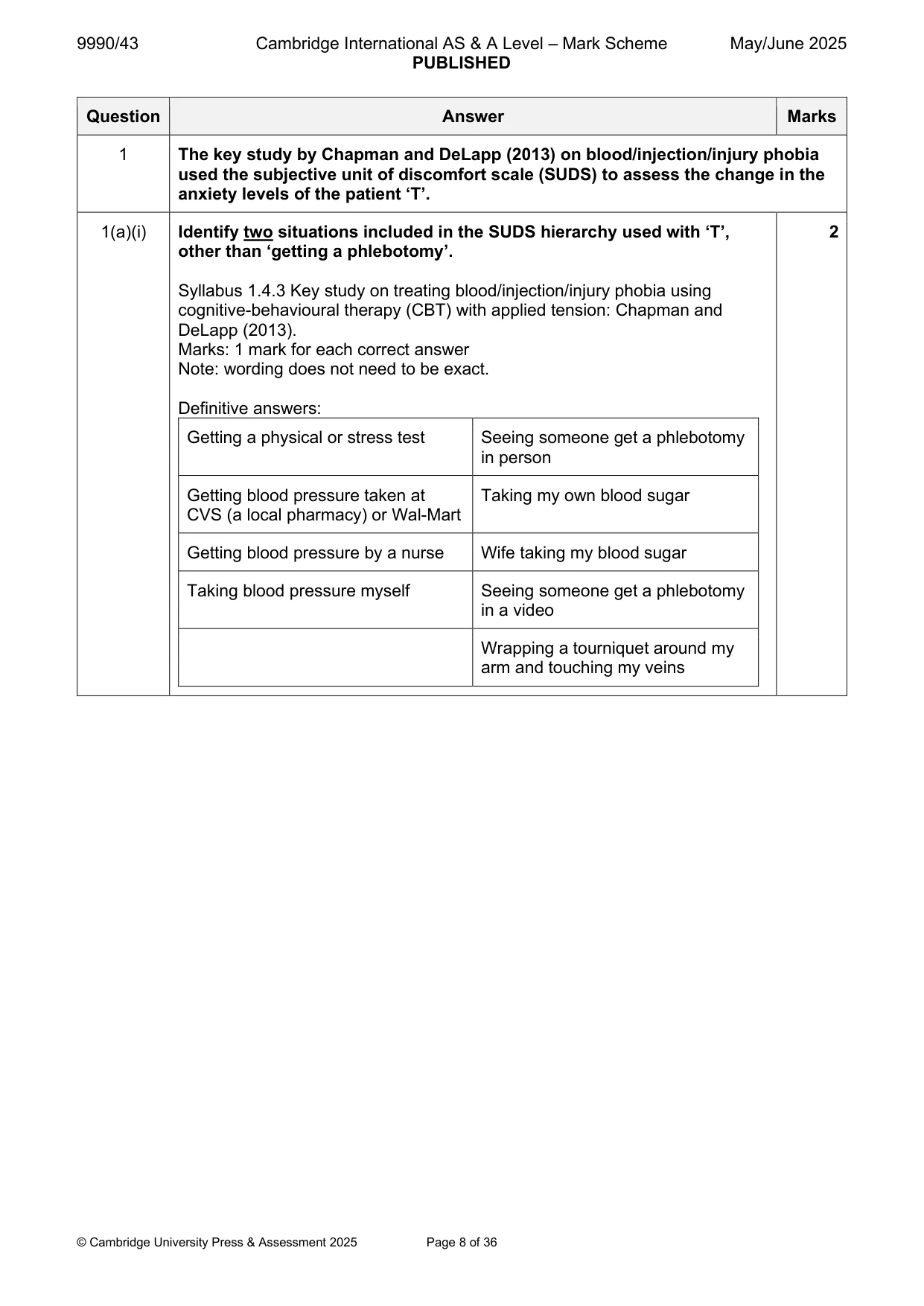
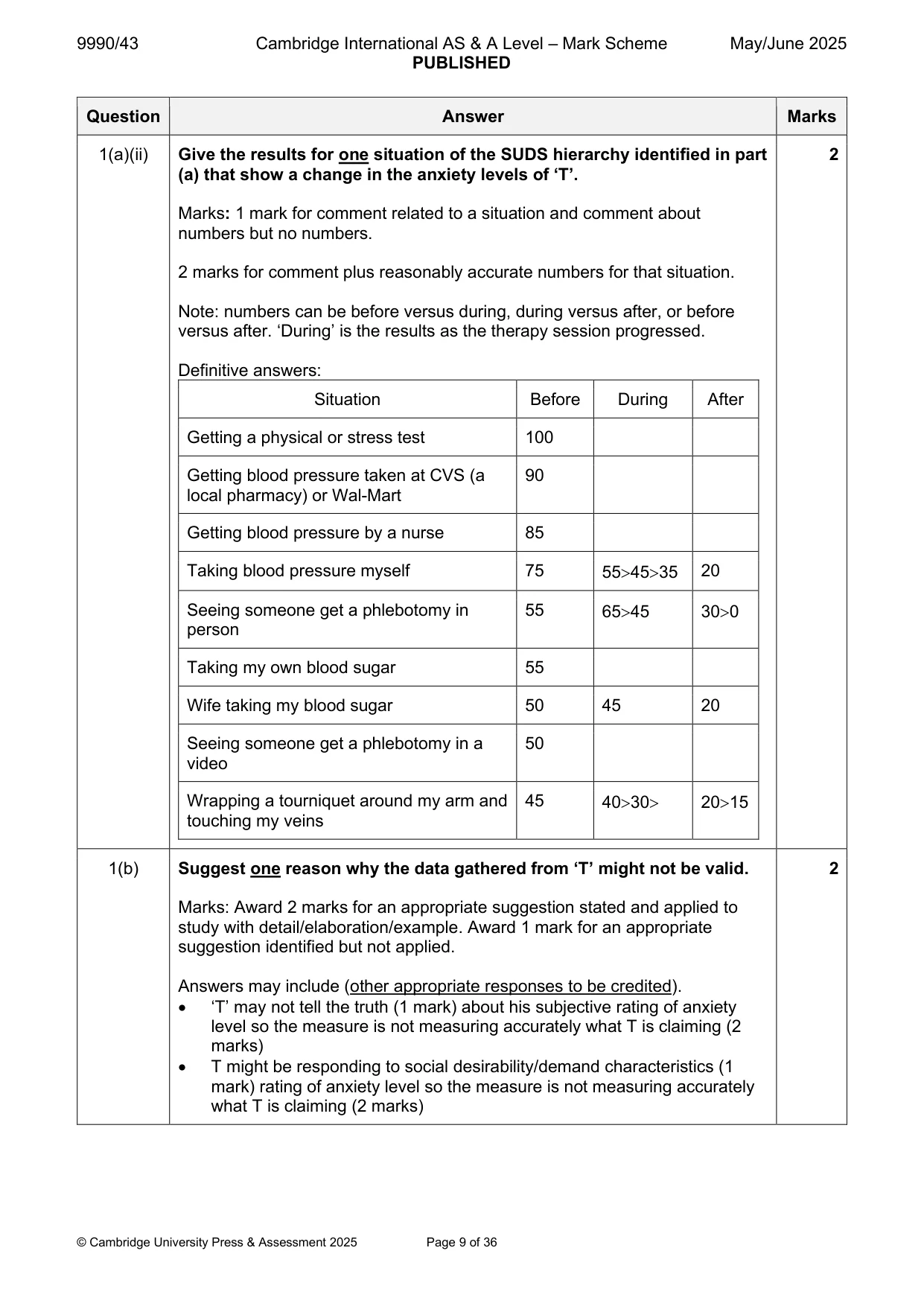
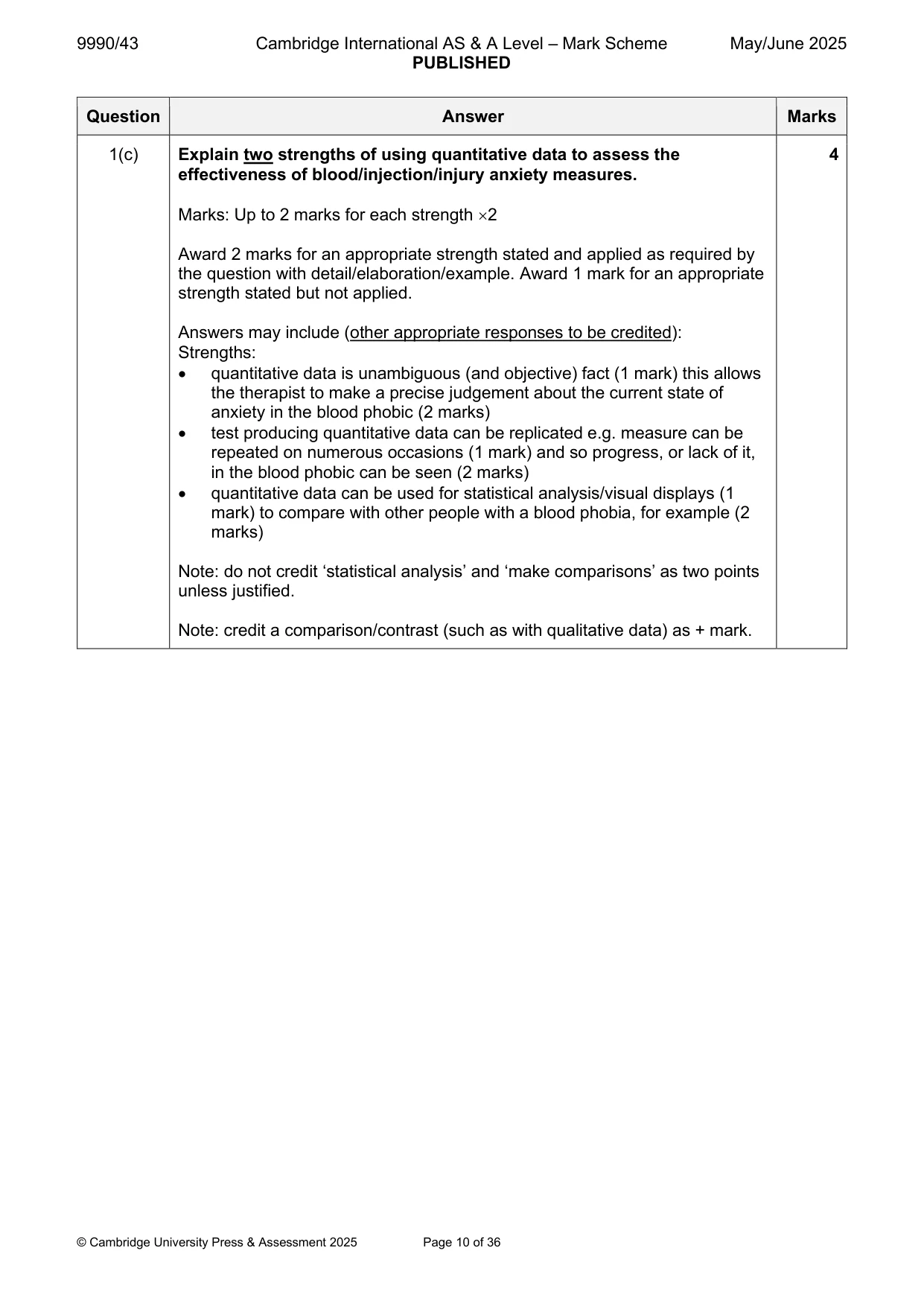
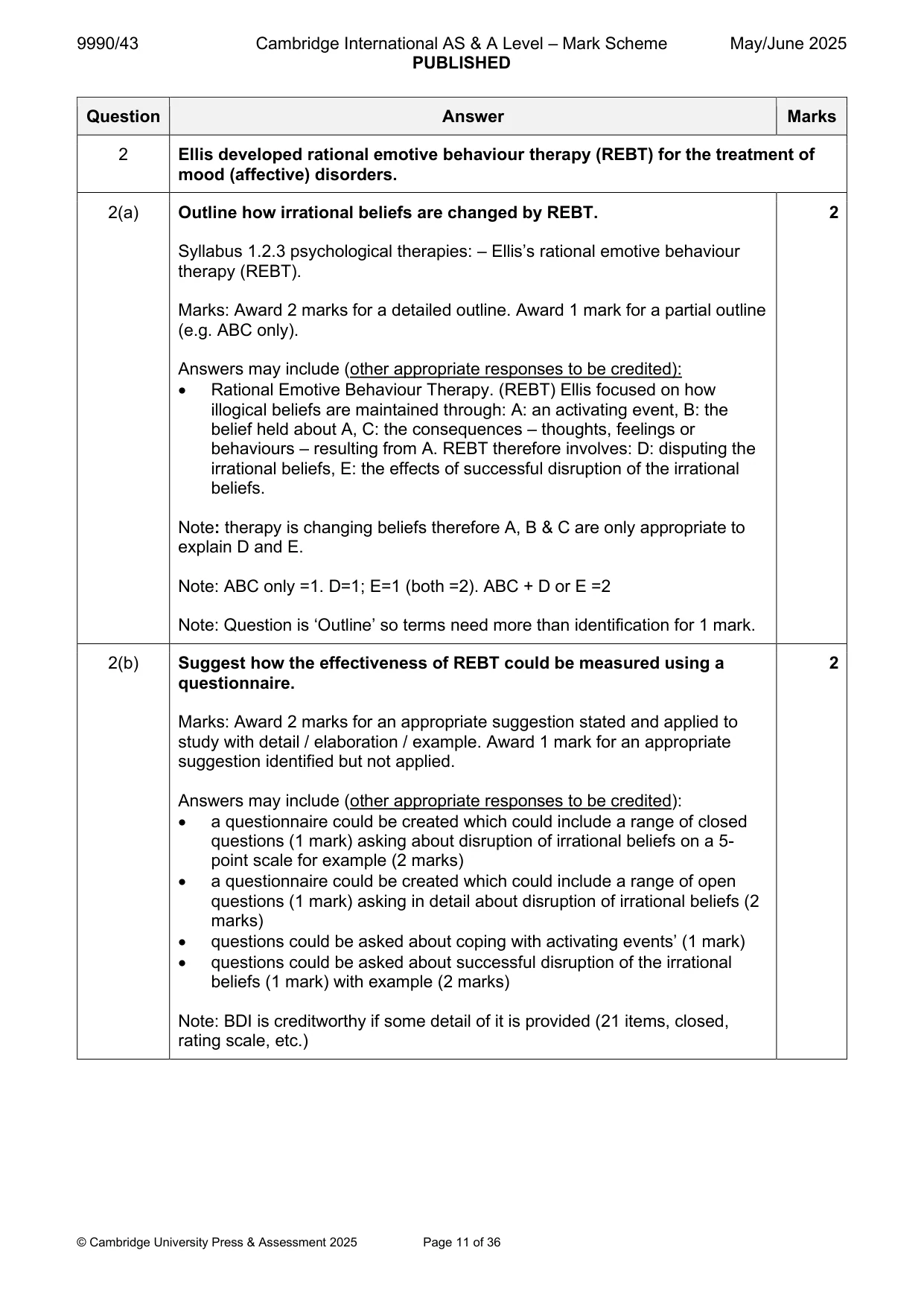
Mark scheme: Question Answer Marks 1 The key study by Chapman and DeLapp (2013) on blood/injection/injury phobia used the subjective unit of discomfort scale (SUDS) to assess the change in the anxiety levels of the patient ‘T’. 1(a)(i) Identify two situations included in the SUDS hierarchy used with ‘T’, 2 other than ‘getting a phlebotomy’. Syllabus 1.4.3 Key study on treating blood/injection/injury phobia using cognitive-behavioural therapy (CBT) with applied tension: Chapman and DeLapp (2013). Marks: 1 mark for each correct answer Note: wording does not need to be exact. Definitive answers: Getting a physical or stress test Seeing someone get a phlebotomy in person Getting blood pressure taken at Taking my own blood sugar CVS (a local pharmacy) or Wal-Mart Getting blood pressure by a nurse Wife taking my blood sugar Taking blood pressure myself Seeing someone get a phlebotomy in a video Wrapping a tourniquet around my arm and touching my veins 1(a)(ii) Give the results for one situation of the SUDS hierarchy identified in part 2 (a) that show a change in the anxiety levels of ‘T’. Marks: 1 mark for comment related to a situation and comment about numbers but no numbers. 2 marks for comment plus reasonably accurate numbers for that situation. Note: numbers can be before versus during, during versus after, or before versus after. ‘During’ is the results as the therapy session progressed. Definitive answers: Situation Before During After Getting a physical or stress test 100 Getting blood pressure taken at CVS (a 90 local pharmacy) or Wal-Mart Getting blood pressure by a nurse 85 Taking blood pressure myself 75 554535 20 Seeing someone get a phlebotomy in 55 6545 300 person Taking my own blood sugar 55 Wife taking my blood sugar 50 45 20 Seeing someone get a phlebotomy in a 50 video Wrapping a tourniquet around my arm and 45 4030 2015 touching my veins 1(b) Suggest one reason why the data gathered from ‘T’ might not be valid. 2 Marks: Award 2 marks for an appropriate suggestion stated and applied to study with detail/elaboration/example. Award 1 mark for an appropriate suggestion identified but not applied. Answers may include (other appropriate responses to be credited). • ‘T’ may not tell the truth (1 mark) about his subjective rating of anxiety level so the measure is not measuring accurately what T is claiming (2 marks) • T might be responding to social desirability/demand characteristics (1 mark) rating of anxiety level so the measure is not measuring accurately what T is claiming (2 marks) 1(c) Explain two strengths of using quantitative data to assess the 4 effectiveness of blood/injection/injury anxiety measures. Marks: Up to 2 marks for each strength 2 Award 2 marks for an appropriate strength stated and applied as required by the question with detail/elaboration/example. Award 1 mark for an appropriate strength stated but not applied. Answers may include (other appropriate responses to be credited): Strengths: • quantitative data is unambiguous (and objective) fact (1 mark) this allows the therapist to make a precise judgement about the current state of anxiety in the blood phobic (2 marks) • test producing quantitative data can be replicated e.g. measure can be repeated on numerous occasions (1 mark) and so progress, or lack of it, in the blood phobic can be seen (2 marks) • quantitative data can be used for statistical analysis/visual displays (1 mark) to compare with other people with a blood phobia, for example (2 marks) Note: do not credit ‘statistical analysis’ and ‘make comparisons’ as two points unless justified. Note: credit a comparison/contrast (such as with qualitative data) as + mark.
More questions on Anxiety disorders and fear-related disorders
Q2 · Ellis developed rational emotive behaviour therapy (REBT) for the treatment of mood…
2 Ellis developed rational emotive behaviour therapy (REBT) for the treatment of mood (affective) disorders. (a) Outline how irrational beliefs are changed by REBT. [2] (b) Suggest how the effectiveness of REBT could be measured using a questionnaire. [2] (c) Explain two strengths of using REBT to treat depression. [4] Consumer Psychology Answer all questions if you have studied this option.
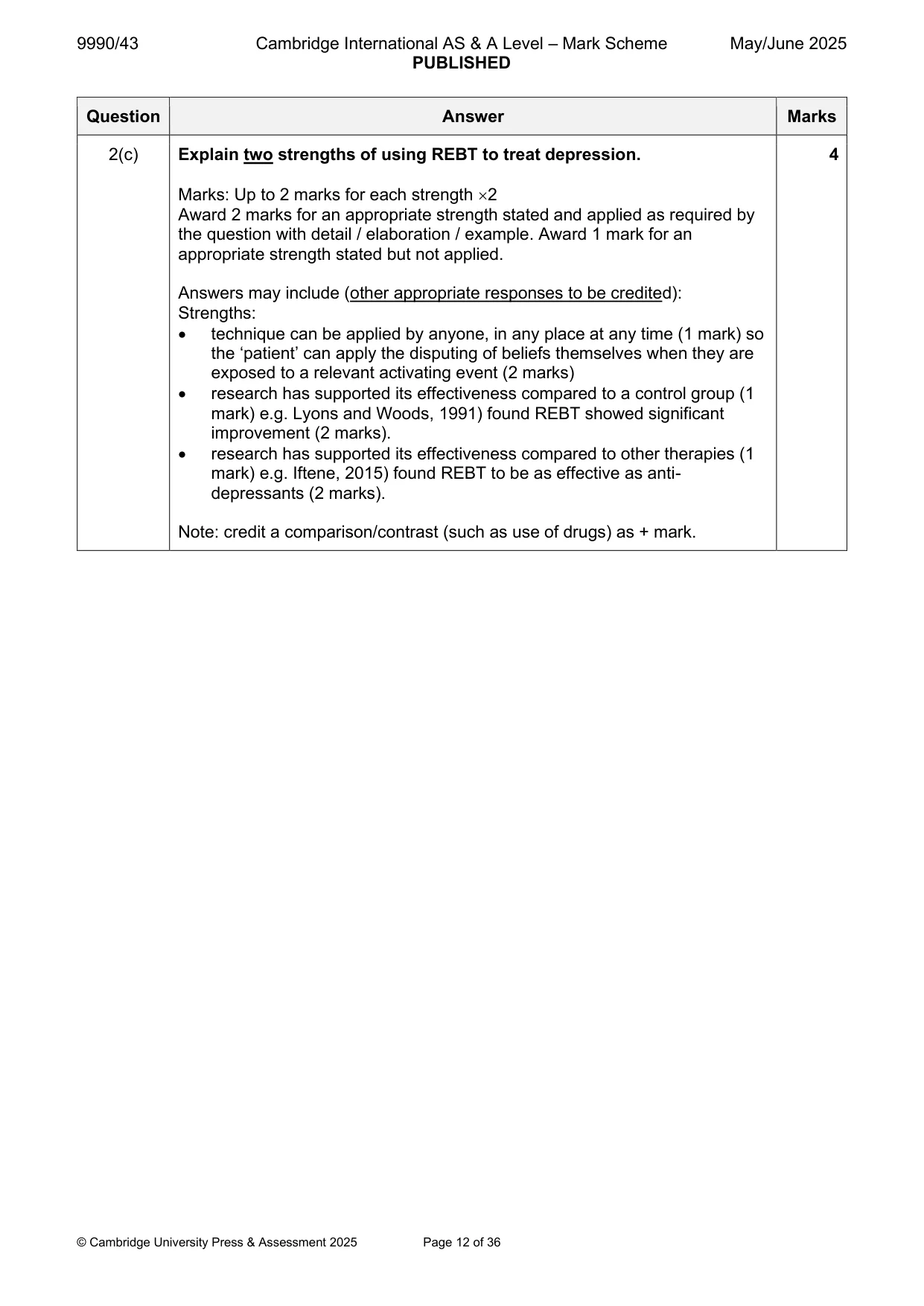
Mark scheme: 2(a) Outline how irrational beliefs are changed by REBT. 2 Syllabus 1.2.3 psychological therapies: – Ellis’s rational emotive behaviour therapy (REBT). Marks: Award 2 marks for a detailed outline. Award 1 mark for a partial outline (e.g. ABC only). Answers may include (other appropriate responses to be credited): • Rational Emotive Behaviour Therapy. (REBT) Ellis focused on how illogical beliefs are maintained through: A: an activating event, B: the belief held about A, C: the consequences – thoughts, feelings or behaviours – resulting from A. REBT therefore involves: D: disputing the irrational beliefs, E: the effects of successful disruption of the irrational beliefs. Note: therapy is changing beliefs therefore A, B & C are only appropriate to explain D and E. Note: ABC only =1. D=1; E=1 (both =2). ABC + D or E =2 Note: Question is ‘Outline’ so terms need more than identification for 1 mark. 2(b) Suggest how the effectiveness of REBT could be measured using a 2 questionnaire. Marks: Award 2 marks for an appropriate suggestion stated and applied to study with detail / elaboration / example. Award 1 mark for an appropriate suggestion identified but not applied. Answers may include (other appropriate responses to be credited): • a questionnaire could be created which could include a range of closed questions (1 mark) asking about disruption of irrational beliefs on a 5- point scale for example (2 marks) • a questionnaire could be created which could include a range of open questions (1 mark) asking in detail about disruption of irrational beliefs (2 marks) • questions could be asked about coping with activating events’ (1 mark) • questions could be asked about successful disruption of the irrational beliefs (1 mark) with example (2 marks) Note: BDI is creditworthy if some detail of it is provided (21 items, closed, rating scale, etc.) 2(c) Explain two strengths of using REBT to treat depression. 4 Marks: Up to 2 marks for each strength 2 Award 2 marks for an appropriate strength stated and applied as required by the question with detail / elaboration / example. Award 1 mark for an appropriate strength stated but not applied. Answers may include (other appropriate responses to be credited): Strengths: • technique can be applied by anyone, in any place at any time (1 mark) so the ‘patient’ can apply the disputing of beliefs themselves when they are exposed to a relevant activating event (2 marks) • research has supported its effectiveness compared to a control group (1 mark) e.g. Lyons and Woods, 1991) found REBT showed significant improvement (2 marks). • research has supported its effectiveness compared to other therapies (1 mark) e.g. Iftene, 2015) found REBT to be as effective as anti- depressants (2 marks). Note: credit a comparison/contrast (such as use of drugs) as + mark.
More questions on Mood (affective) disorders: depressive disorder (unipolar) and bipolar disorder
Q3 · From the key study by Robson et al
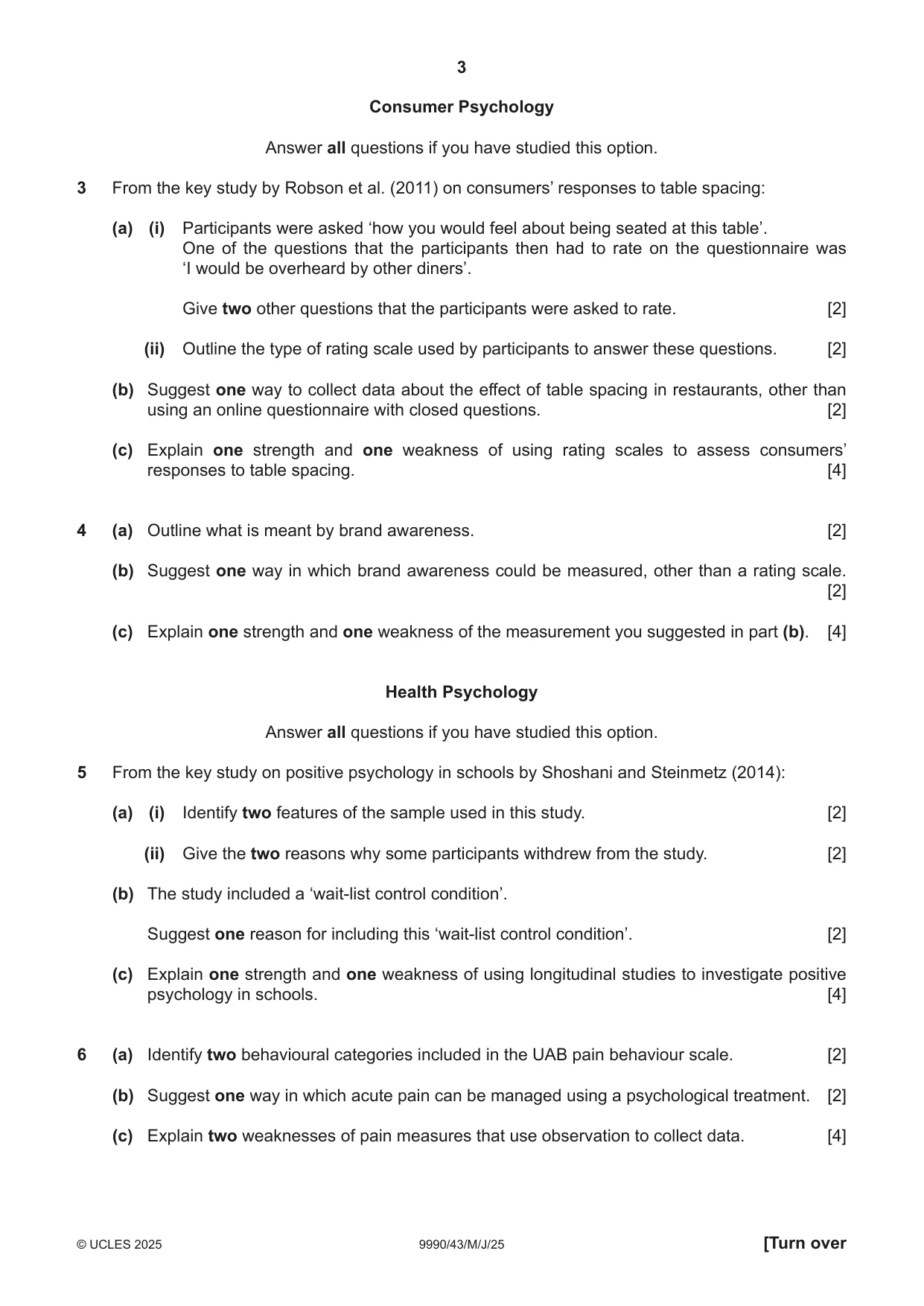
3 From the key study by Robson et al. (2011) on consumers’ responses to table spacing: (a) (i) Participants were asked ‘how you would feel about being seated at this table’. One of the questions that the participants then had to rate on the questionnaire was ‘I would be overheard by other diners’. Give two other questions that the participants were asked to rate. [2] (ii) Outline the type of rating scale used by participants to answer these questions. [2] (b) Suggest one way to collect data about the effect of table spacing in restaurants, other than using an online questionnaire with closed questions. [2] (c) Explain one strength and one weakness of using rating scales to assess consumers’ responses to table spacing. [4]
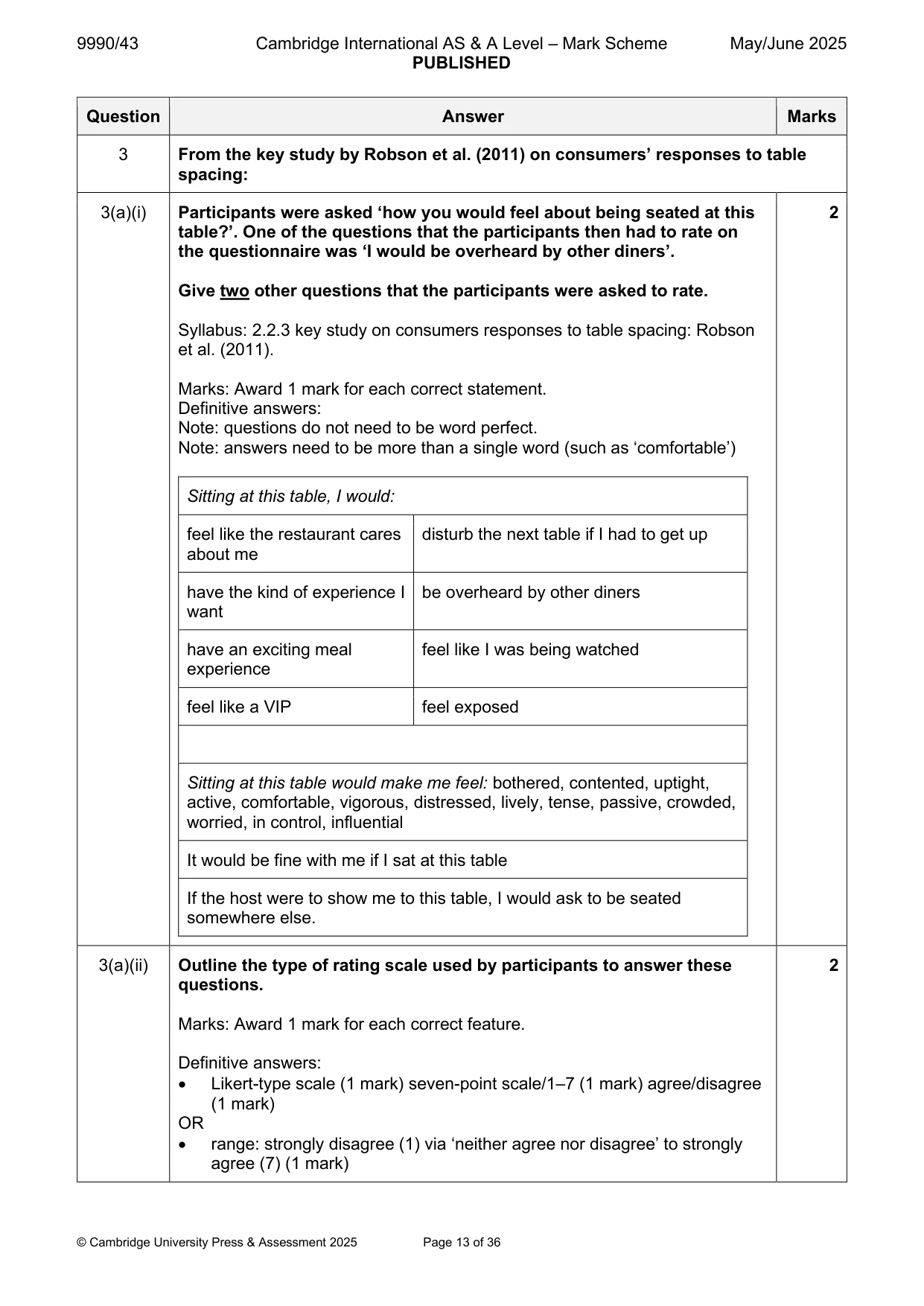
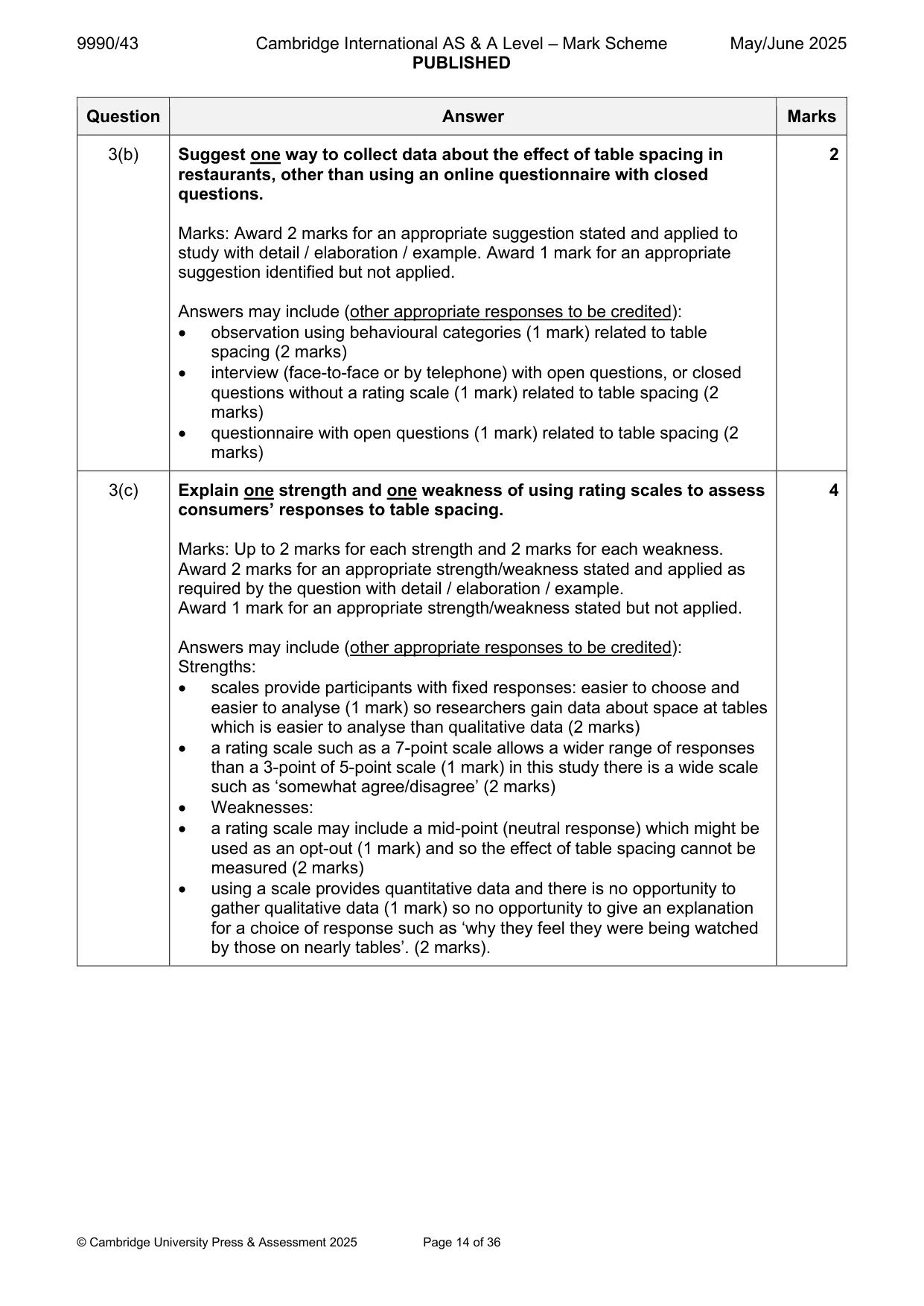
Mark scheme: 3(a)(i) Participants were asked ‘how you would feel about being seated at this 2 table?’. One of the questions that the participants then had to rate on the questionnaire was ‘I would be overheard by other diners’. Give two other questions that the participants were asked to rate. Syllabus: 2.2.3 key study on consumers responses to table spacing: Robson et al. (2011). Marks: Award 1 mark for each correct statement. Definitive answers: Note: questions do not need to be word perfect. Note: answers need to be more than a single word (such as ‘comfortable’) Sitting at this table, I would: feel like the restaurant cares disturb the next table if I had to get up about me have the kind of experience I be overheard by other diners want have an exciting meal feel like I was being watched experience feel like a VIP feel exposed Sitting at this table would make me feel: bothered, contented, uptight, active, comfortable, vigorous, distressed, lively, tense, passive, crowded, worried, in control, influential It would be fine with me if I sat at this table If the host were to show me to this table, I would ask to be seated somewhere else. 3(a)(ii) Outline the type of rating scale used by participants to answer these 2 questions. Marks: Award 1 mark for each correct feature. Definitive answers: • Likert-type scale (1 mark) seven-point scale/1–7 (1 mark) agree/disagree (1 mark) OR • range: strongly disagree (1) via ‘neither agree nor disagree’ to strongly agree (7) (1 mark) 3(b) Suggest one way to collect data about the effect of table spacing in 2 restaurants, other than using an online questionnaire with closed questions. Marks: Award 2 marks for an appropriate suggestion stated and applied to study with detail / elaboration / example. Award 1 mark for an appropriate suggestion identified but not applied. Answers may include (other appropriate responses to be credited): • observation using behavioural categories (1 mark) related to table spacing (2 marks) • interview (face-to-face or by telephone) with open questions, or closed questions without a rating scale (1 mark) related to table spacing (2 marks) • questionnaire with open questions (1 mark) related to table spacing (2 marks) 3(c) Explain one strength and one weakness of using rating scales to assess 4 consumers’ responses to table spacing. Marks: Up to 2 marks for each strength and 2 marks for each weakness. Award 2 marks for an appropriate strength/weakness stated and applied as required by the question with detail / elaboration / example. Award 1 mark for an appropriate strength/weakness stated but not applied. Answers may include (other appropriate responses to be credited): Strengths: • scales provide participants with fixed responses: easier to choose and easier to analyse (1 mark) so researchers gain data about space at tables which is easier to analyse than qualitative data (2 marks) • a rating scale such as a 7-point scale allows a wider range of responses than a 3-point of 5-point scale (1 mark) in this study there is a wide scale such as ‘somewhat agree/disagree’ (2 marks) • Weaknesses: • a rating scale may include a mid-point (neutral response) which might be used as an opt-out (1 mark) and so the effect of table spacing cannot be measured (2 marks) • using a scale provides quantitative data and there is no opportunity to gather qualitative data (1 mark) so no opportunity to give an explanation for a choice of response such as ‘why they feel they were being watched by those on nearly tables’. (2 marks).
Q4 · Outline what is meant by brand awareness
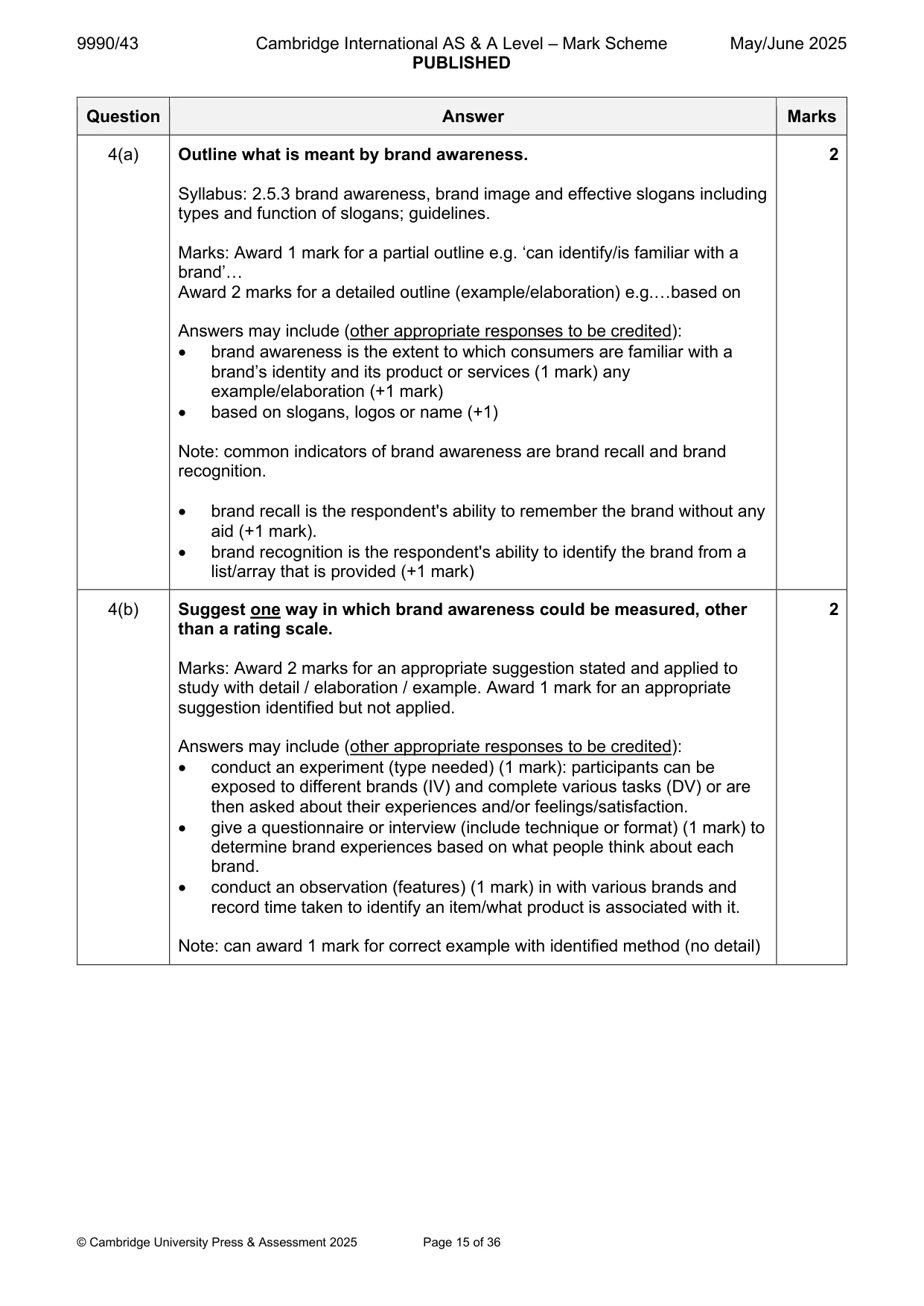
4 (a) Outline what is meant by brand awareness. [2] (b) Suggest one way in which brand awareness could be measured, other than a rating scale. [2] (c) Explain one strength and one weakness of the measurement you suggested in part (b). [4] Health Psychology Answer all questions if you have studied this option.
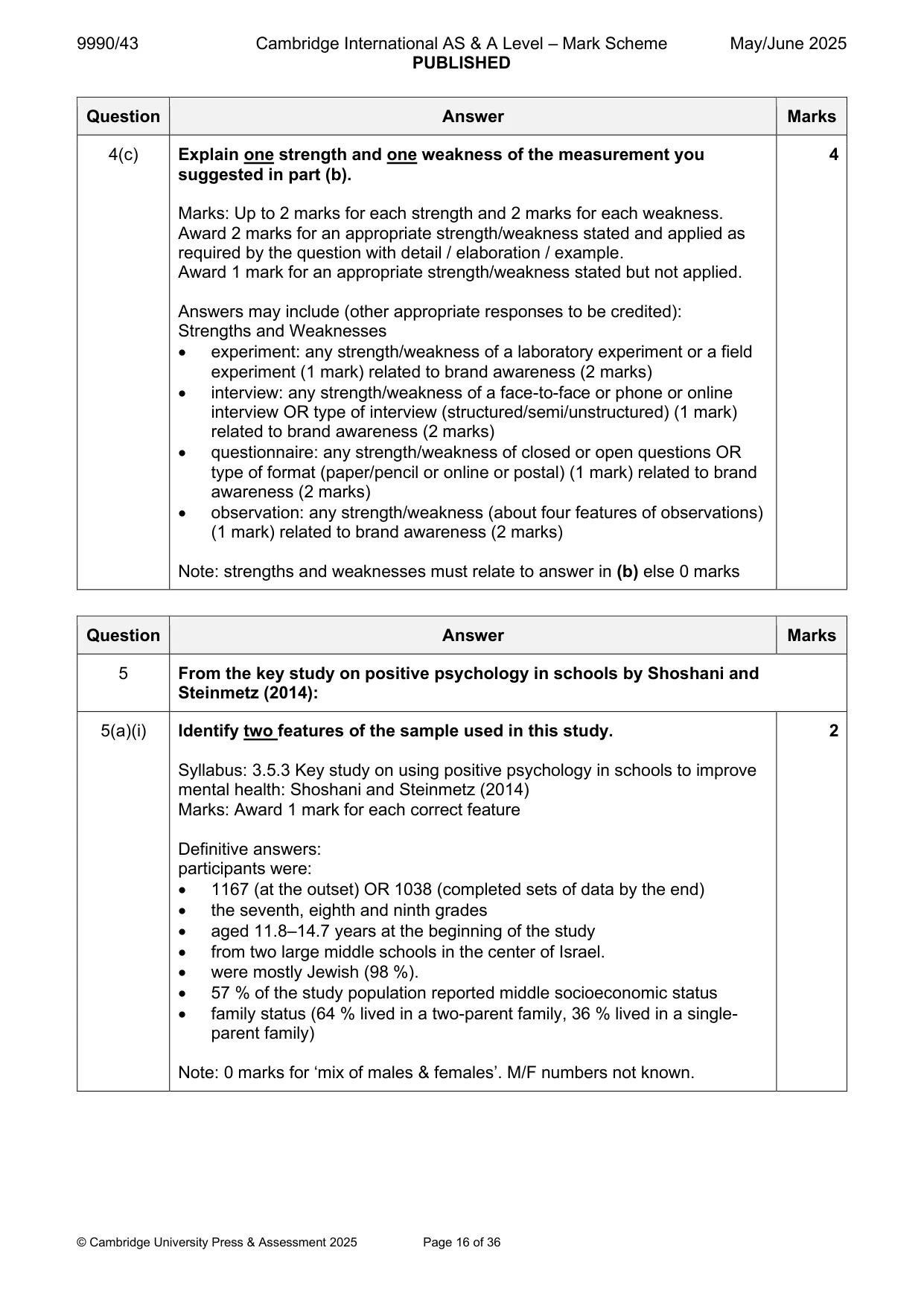
Mark scheme: 4(a) Outline what is meant by brand awareness. 2 Syllabus: 2.5.3 brand awareness, brand image and effective slogans including types and function of slogans; guidelines. Marks: Award 1 mark for a partial outline e.g. ‘can identify/is familiar with a brand’… Award 2 marks for a detailed outline (example/elaboration) e.g.…based on Answers may include (other appropriate responses to be credited): • brand awareness is the extent to which consumers are familiar with a brand’s identity and its product or services (1 mark) any example/elaboration (+1 mark) • based on slogans, logos or name (+1) Note: common indicators of brand awareness are brand recall and brand recognition. • brand recall is the respondent's ability to remember the brand without any aid (+1 mark). • brand recognition is the respondent's ability to identify the brand from a list/array that is provided (+1 mark) 4(b) Suggest one way in which brand awareness could be measured, other 2 than a rating scale. Marks: Award 2 marks for an appropriate suggestion stated and applied to study with detail / elaboration / example. Award 1 mark for an appropriate suggestion identified but not applied. Answers may include (other appropriate responses to be credited): • conduct an experiment (type needed) (1 mark): participants can be exposed to different brands (IV) and complete various tasks (DV) or are then asked about their experiences and/or feelings/satisfaction. • give a questionnaire or interview (include technique or format) (1 mark) to determine brand experiences based on what people think about each brand. • conduct an observation (features) (1 mark) in with various brands and record time taken to identify an item/what product is associated with it. Note: can award 1 mark for correct example with identified method (no detail) 4(c) Explain one strength and one weakness of the measurement you 4 suggested in part (b). Marks: Up to 2 marks for each strength and 2 marks for each weakness. Award 2 marks for an appropriate strength/weakness stated and applied as required by the question with detail / elaboration / example. Award 1 mark for an appropriate strength/weakness stated but not applied. Answers may include (other appropriate responses to be credited): Strengths and Weaknesses • experiment: any strength/weakness of a laboratory experiment or a field experiment (1 mark) related to brand awareness (2 marks) • interview: any strength/weakness of a face-to-face or phone or online interview OR type of interview (structured/semi/unstructured) (1 mark) related to brand awareness (2 marks) • questionnaire: any strength/weakness of closed or open questions OR type of format (paper/pencil or online or postal) (1 mark) related to brand awareness (2 marks) • observation: any strength/weakness (about four features of observations) (1 mark) related to brand awareness (2 marks) Note: strengths and weaknesses must relate to answer in (b) else 0 marks
Q5 · From the key study on positive psychology in schools by Shoshani and Steinmetz (2014)…
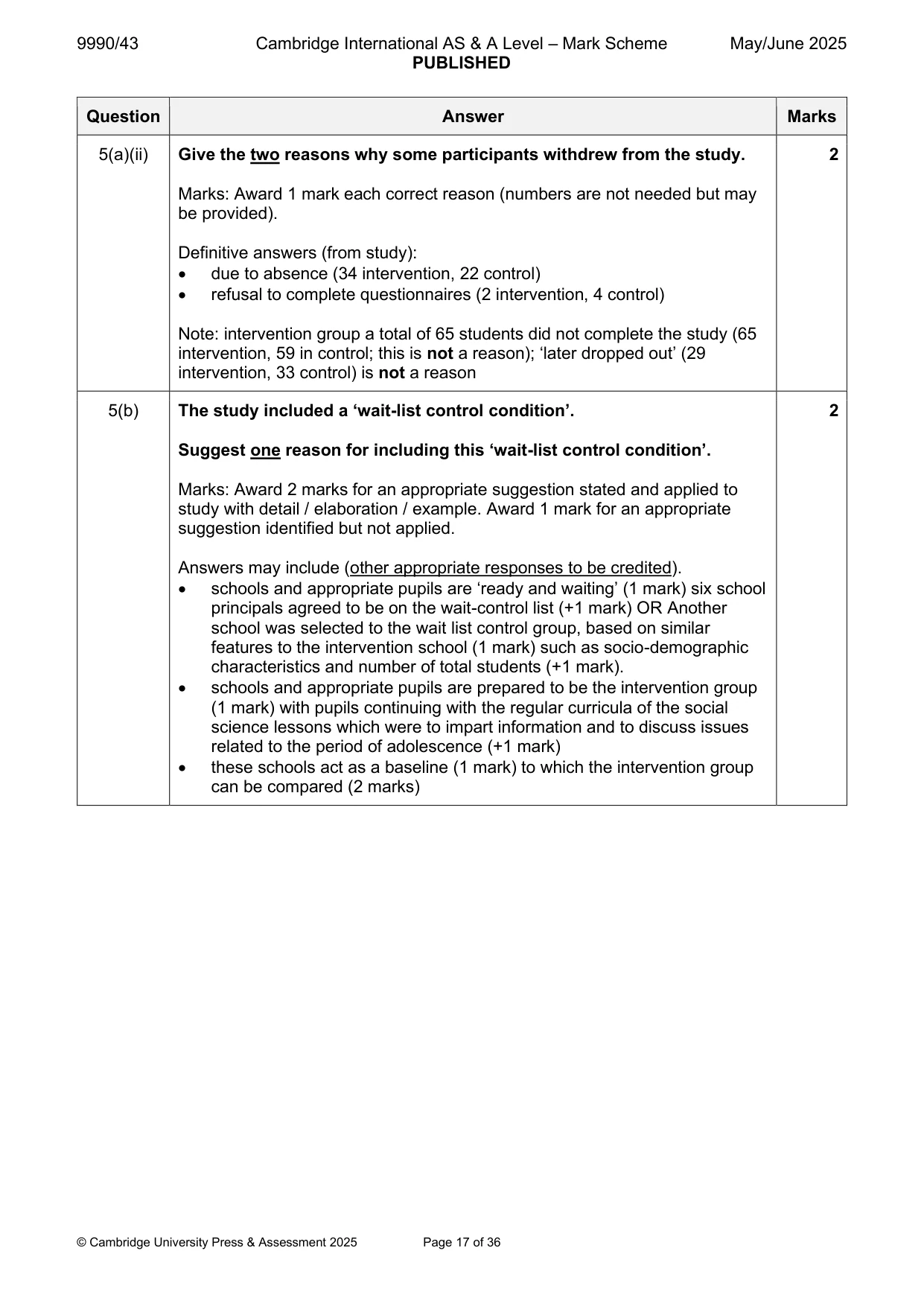
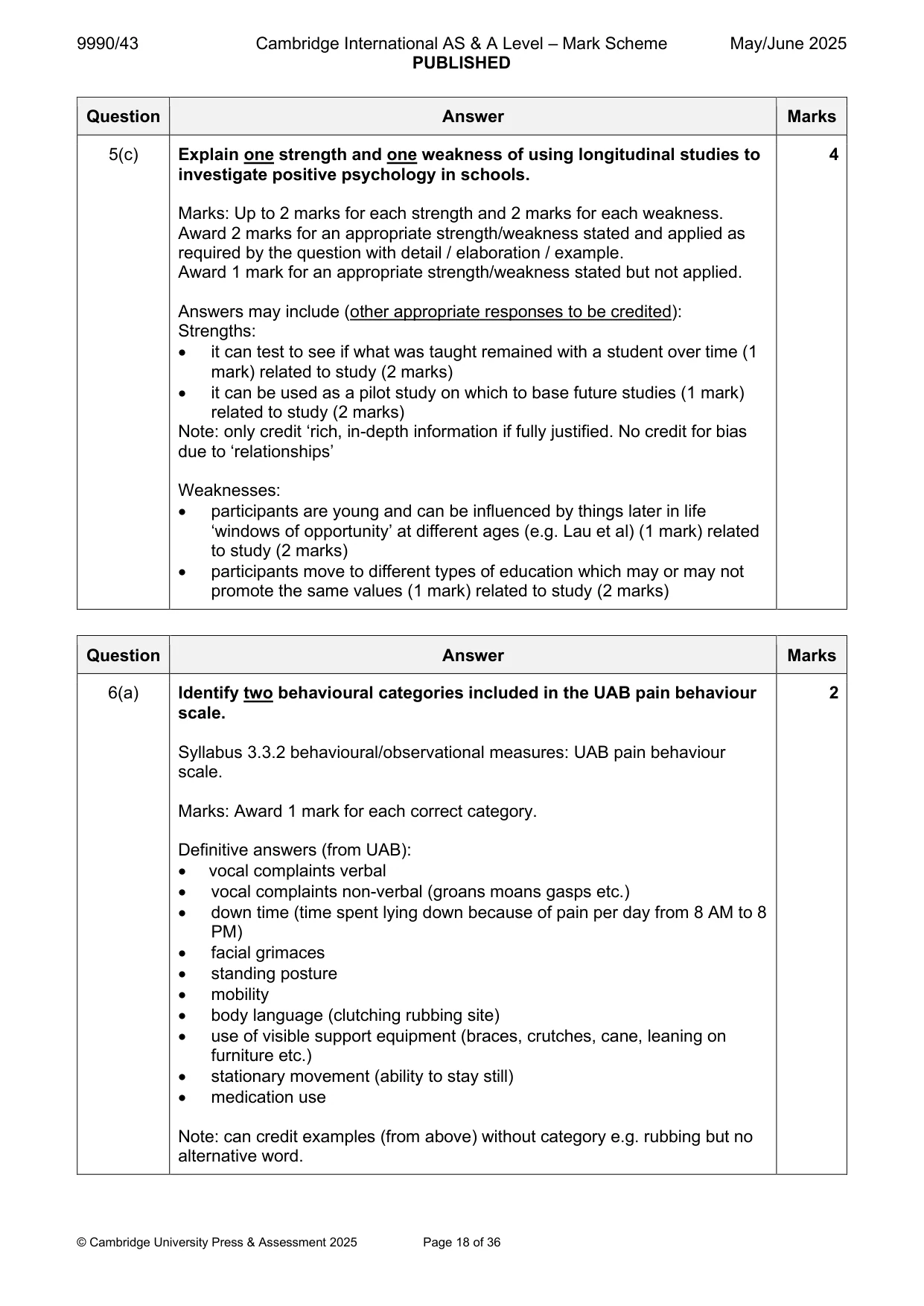
5 From the key study on positive psychology in schools by Shoshani and Steinmetz (2014): (a) (i) Identify two features of the sample used in this study. [2] (ii) Give the two reasons why some participants withdrew from the study. [2] (b) The study included a ‘wait-list control condition’. Suggest one reason for including this ‘wait-list control condition’. [2] (c) Explain one strength and one weakness of using longitudinal studies to investigate positive psychology in schools. [4]
Mark scheme: 5(a)(i) Identify two features of the sample used in this study. 2 Syllabus: 3.5.3 Key study on using positive psychology in schools to improve mental health: Shoshani and Steinmetz (2014) Marks: Award 1 mark for each correct feature Definitive answers: participants were: • 1167 (at the outset) OR 1038 (completed sets of data by the end) • the seventh, eighth and ninth grades • aged 11.8–14.7 years at the beginning of the study • from two large middle schools in the center of Israel. • were mostly Jewish (98 %). • 57 % of the study population reported middle socioeconomic status • family status (64 % lived in a two-parent family, 36 % lived in a single- parent family) Note: 0 marks for ‘mix of males & females’. M/F numbers not known. 5(a)(ii) Give the two reasons why some participants withdrew from the study. 2 Marks: Award 1 mark each correct reason (numbers are not needed but may be provided). Definitive answers (from study): • due to absence (34 intervention, 22 control) • refusal to complete questionnaires (2 intervention, 4 control) Note: intervention group a total of 65 students did not complete the study (65 intervention, 59 in control; this is not a reason); ‘later dropped out’ (29 intervention, 33 control) is not a reason 5(b) The study included a ‘wait-list control condition’. 2 Suggest one reason for including this ‘wait-list control condition’. Marks: Award 2 marks for an appropriate suggestion stated and applied to study with detail / elaboration / example. Award 1 mark for an appropriate suggestion identified but not applied. Answers may include (other appropriate responses to be credited). • schools and appropriate pupils are ‘ready and waiting’ (1 mark) six school principals agreed to be on the wait-control list (+1 mark) OR Another school was selected to the wait list control group, based on similar features to the intervention school (1 mark) such as socio-demographic characteristics and number of total students (+1 mark). • schools and appropriate pupils are prepared to be the intervention group (1 mark) with pupils continuing with the regular curricula of the social science lessons which were to impart information and to discuss issues related to the period of adolescence (+1 mark) • these schools act as a baseline (1 mark) to which the intervention group can be compared (2 marks) 5(c) Explain one strength and one weakness of using longitudinal studies to 4 investigate positive psychology in schools. Marks: Up to 2 marks for each strength and 2 marks for each weakness. Award 2 marks for an appropriate strength/weakness stated and applied as required by the question with detail / elaboration / example. Award 1 mark for an appropriate strength/weakness stated but not applied. Answers may include (other appropriate responses to be credited): Strengths: • it can test to see if what was taught remained with a student over time (1 mark) related to study (2 marks) • it can be used as a pilot study on which to base future studies (1 mark) related to study (2 marks) Note: only credit ‘rich, in-depth information if fully justified. No credit for bias due to ‘relationships’ Weaknesses: • participants are young and can be influenced by things later in life ‘windows of opportunity’ at different ages (e.g. Lau et al) (1 mark) related to study (2 marks) • participants move to different types of education which may or may not promote the same values (1 mark) related to study (2 marks)
More questions on 2 Health promotion in schools and worksites
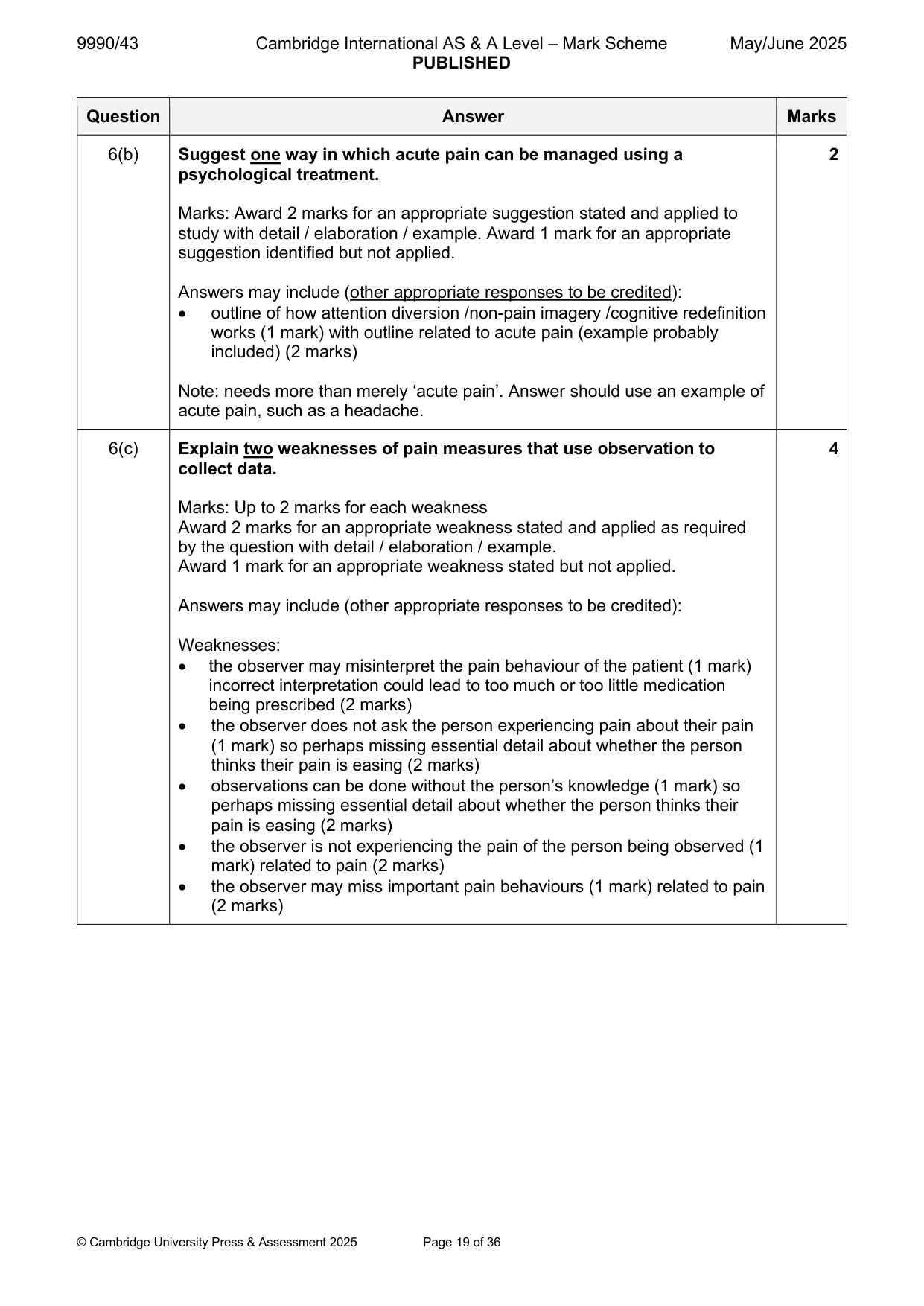
Q6 · Identify two behavioural categories included in the UAB pain behaviour scale
6 (a) Identify two behavioural categories included in the UAB pain behaviour scale. [2] (b) Suggest one way in which acute pain can be managed using a psychological treatment. [2] (c) Explain two weaknesses of pain measures that use observation to collect data. [4] Organisational Psychology Answer all questions if you have studied this option.
Mark scheme: 6(a) Identify two behavioural categories included in the UAB pain behaviour 2 scale. Syllabus 3.3.2 behavioural/observational measures: UAB pain behaviour scale. Marks: Award 1 mark for each correct category. Definitive answers (from UAB): • vocal complaints verbal • vocal complaints non-verbal (groans moans gasps etc.) • down time (time spent lying down because of pain per day from 8 AM to 8 PM) • facial grimaces • standing posture • mobility • body language (clutching rubbing site) • use of visible support equipment (braces, crutches, cane, leaning on furniture etc.) • stationary movement (ability to stay still) • medication use Note: can credit examples (from above) without category e.g. rubbing but no alternative word. 6(b) Suggest one way in which acute pain can be managed using a 2 psychological treatment. Marks: Award 2 marks for an appropriate suggestion stated and applied to study with detail / elaboration / example. Award 1 mark for an appropriate suggestion identified but not applied. Answers may include (other appropriate responses to be credited): • outline of how attention diversion /non-pain imagery /cognitive redefinition works (1 mark) with outline related to acute pain (example probably included) (2 marks) Note: needs more than merely ‘acute pain’. Answer should use an example of acute pain, such as a headache. 6(c) Explain two weaknesses of pain measures that use observation to 4 collect data. Marks: Up to 2 marks for each weakness Award 2 marks for an appropriate weakness stated and applied as required by the question with detail / elaboration / example. Award 1 mark for an appropriate weakness stated but not applied. Answers may include (other appropriate responses to be credited): Weaknesses: • the observer may misinterpret the pain behaviour of the patient (1 mark) incorrect interpretation could lead to too much or too little medication being prescribed (2 marks) • the observer does not ask the person experiencing pain about their pain (1 mark) so perhaps missing essential detail about whether the person thinks their pain is easing (2 marks) • observations can be done without the person’s knowledge (1 mark) so perhaps missing essential detail about whether the person thinks their pain is easing (2 marks) • the observer is not experiencing the pain of the person being observed (1 mark) related to pain (2 marks) • the observer may miss important pain behaviours (1 mark) related to pain (2 marks)
Q7 · From the key study on reasons for sabotage in the workplace by Giacalone and Rosenfeld…
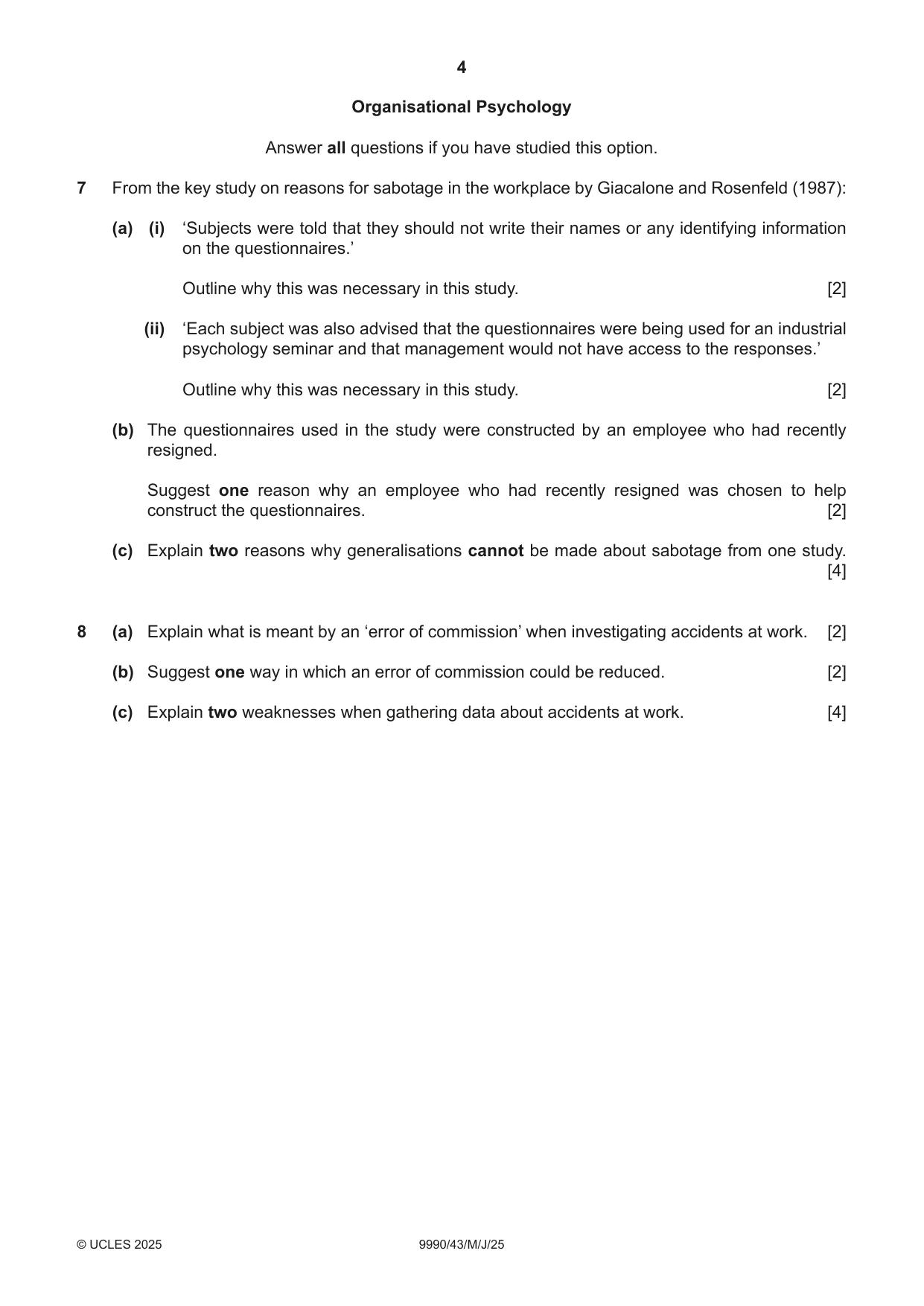
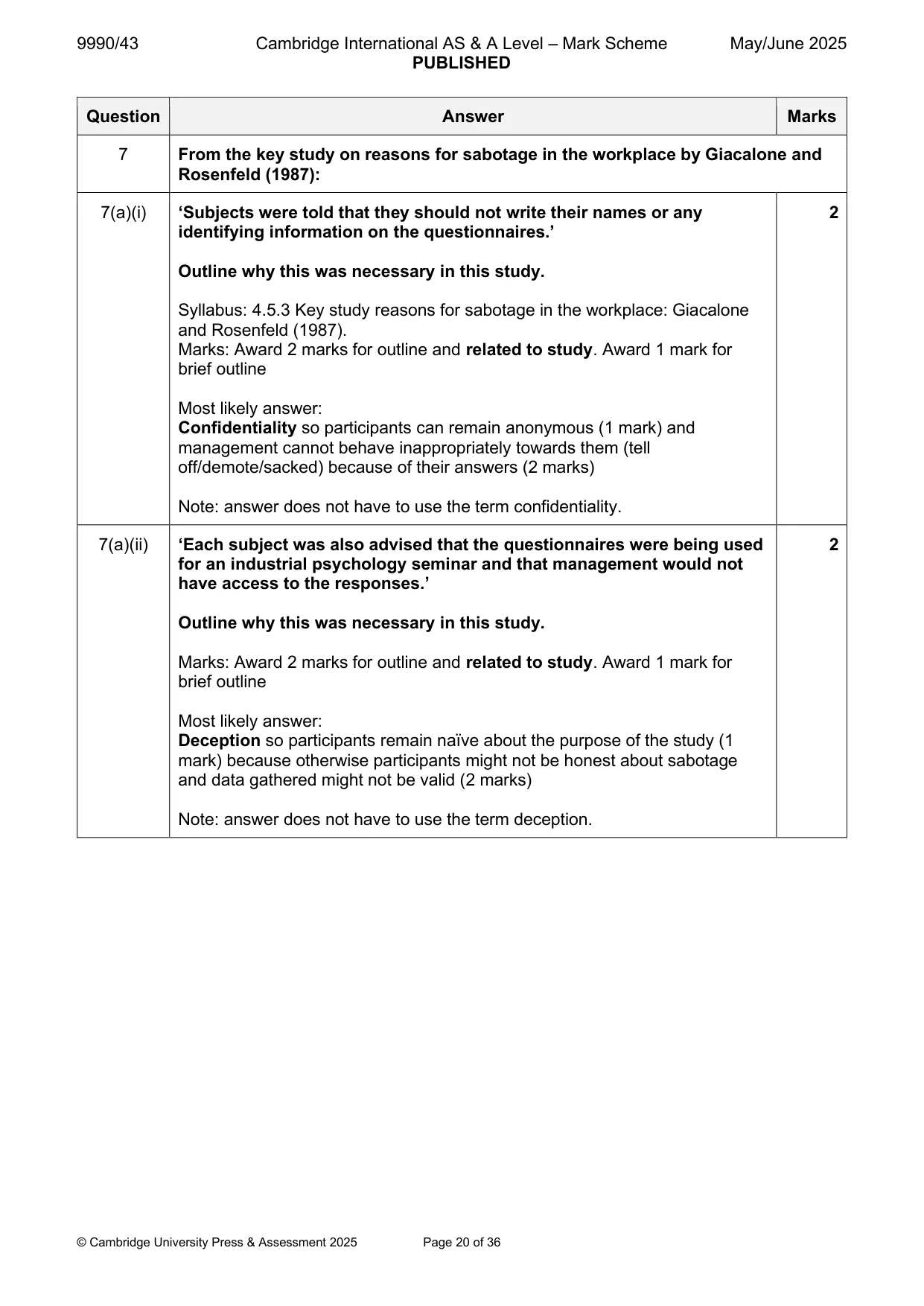
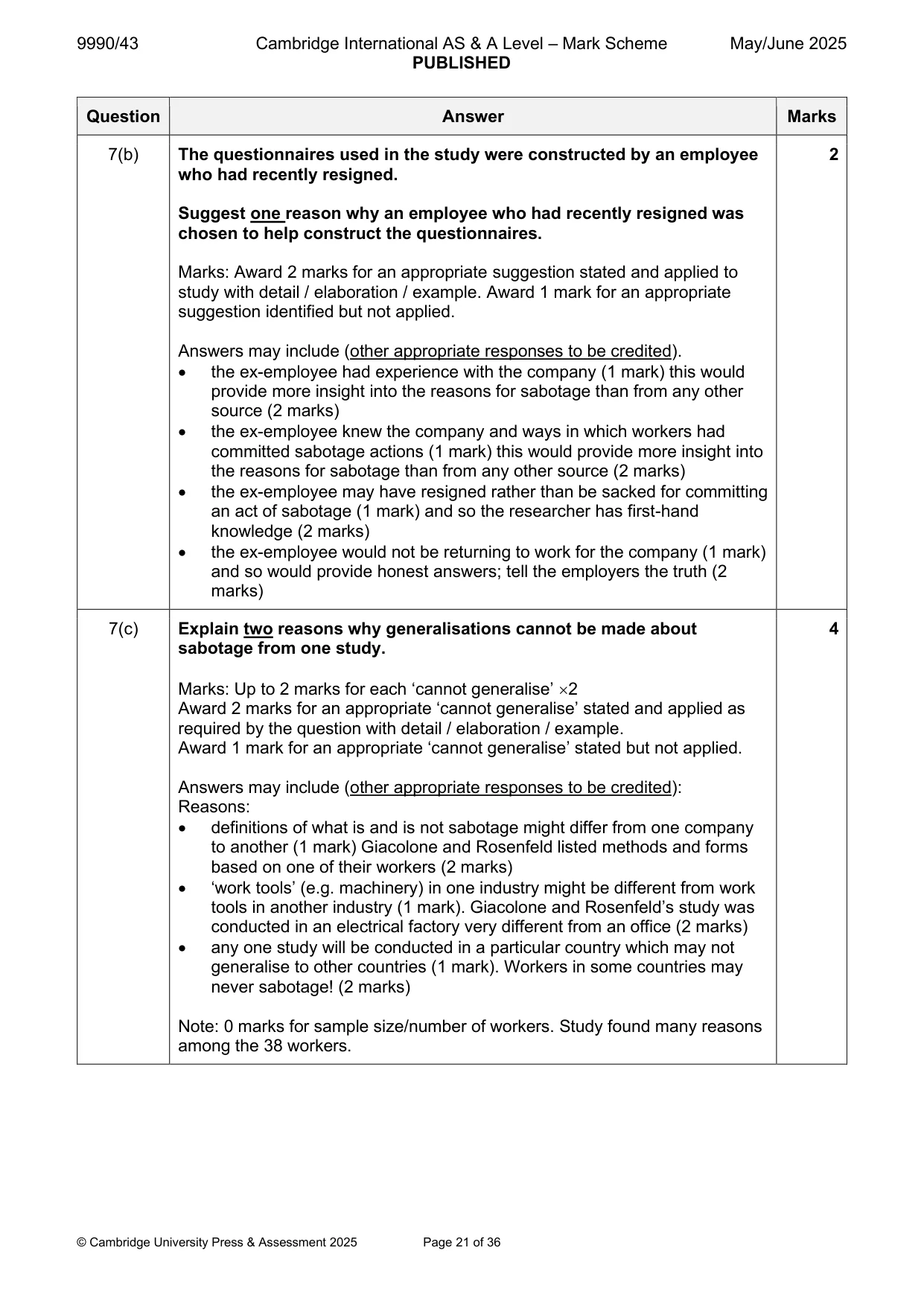
7 From the key study on reasons for sabotage in the workplace by Giacalone and Rosenfeld (1987): (a) (i) ‘Subjects were told that they should not write their names or any identifying information on the questionnaires.’ Outline why this was necessary in this study. [2] (ii) ‘Each subject was also advised that the questionnaires were being used for an industrial psychology seminar and that management would not have access to the responses.’ Outline why this was necessary in this study. [2] (b) The questionnaires used in the study were constructed by an employee who had recently resigned. Suggest one reason why an employee who had recently resigned was chosen to help construct the questionnaires. [2] (c) Explain two reasons why generalisations cannot be made about sabotage from one study. [4]
Mark scheme: 7(a)(i) ‘Subjects were told that they should not write their names or any 2 identifying information on the questionnaires.’ Outline why this was necessary in this study. Syllabus: 4.5.3 Key study reasons for sabotage in the workplace: Giacalone and Rosenfeld (1987). Marks: Award 2 marks for outline and related to study. Award 1 mark for brief outline Most likely answer: Confidentiality so participants can remain anonymous (1 mark) and management cannot behave inappropriately towards them (tell off/demote/sacked) because of their answers (2 marks) Note: answer does not have to use the term confidentiality. 7(a)(ii) ‘Each subject was also advised that the questionnaires were being used 2 for an industrial psychology seminar and that management would not have access to the responses.’ Outline why this was necessary in this study. Marks: Award 2 marks for outline and related to study. Award 1 mark for brief outline Most likely answer: Deception so participants remain naïve about the purpose of the study (1 mark) because otherwise participants might not be honest about sabotage and data gathered might not be valid (2 marks) Note: answer does not have to use the term deception. 7(b) The questionnaires used in the study were constructed by an employee 2 who had recently resigned. Suggest one reason why an employee who had recently resigned was chosen to help construct the questionnaires. Marks: Award 2 marks for an appropriate suggestion stated and applied to study with detail / elaboration / example. Award 1 mark for an appropriate suggestion identified but not applied. Answers may include (other appropriate responses to be credited). • the ex-employee had experience with the company (1 mark) this would provide more insight into the reasons for sabotage than from any other source (2 marks) • the ex-employee knew the company and ways in which workers had committed sabotage actions (1 mark) this would provide more insight into the reasons for sabotage than from any other source (2 marks) • the ex-employee may have resigned rather than be sacked for committing an act of sabotage (1 mark) and so the researcher has first-hand knowledge (2 marks) • the ex-employee would not be returning to work for the company (1 mark) and so would provide honest answers; tell the employers the truth (2 marks) 7(c) Explain two reasons why generalisations cannot be made about 4 sabotage from one study. Marks: Up to 2 marks for each ‘cannot generalise’ 2 Award 2 marks for an appropriate ‘cannot generalise’ stated and applied as required by the question with detail / elaboration / example. Award 1 mark for an appropriate ‘cannot generalise’ stated but not applied. Answers may include (other appropriate responses to be credited): Reasons: • definitions of what is and is not sabotage might differ from one company to another (1 mark) Giacolone and Rosenfeld listed methods and forms based on one of their workers (2 marks) • ‘work tools’ (e.g. machinery) in one industry might be different from work tools in another industry (1 mark). Giacolone and Rosenfeld’s study was conducted in an electrical factory very different from an office (2 marks) • any one study will be conducted in a particular country which may not generalise to other countries (1 mark). Workers in some countries may never sabotage! (2 marks) Note: 0 marks for sample size/number of workers. Study found many reasons among the 38 workers.
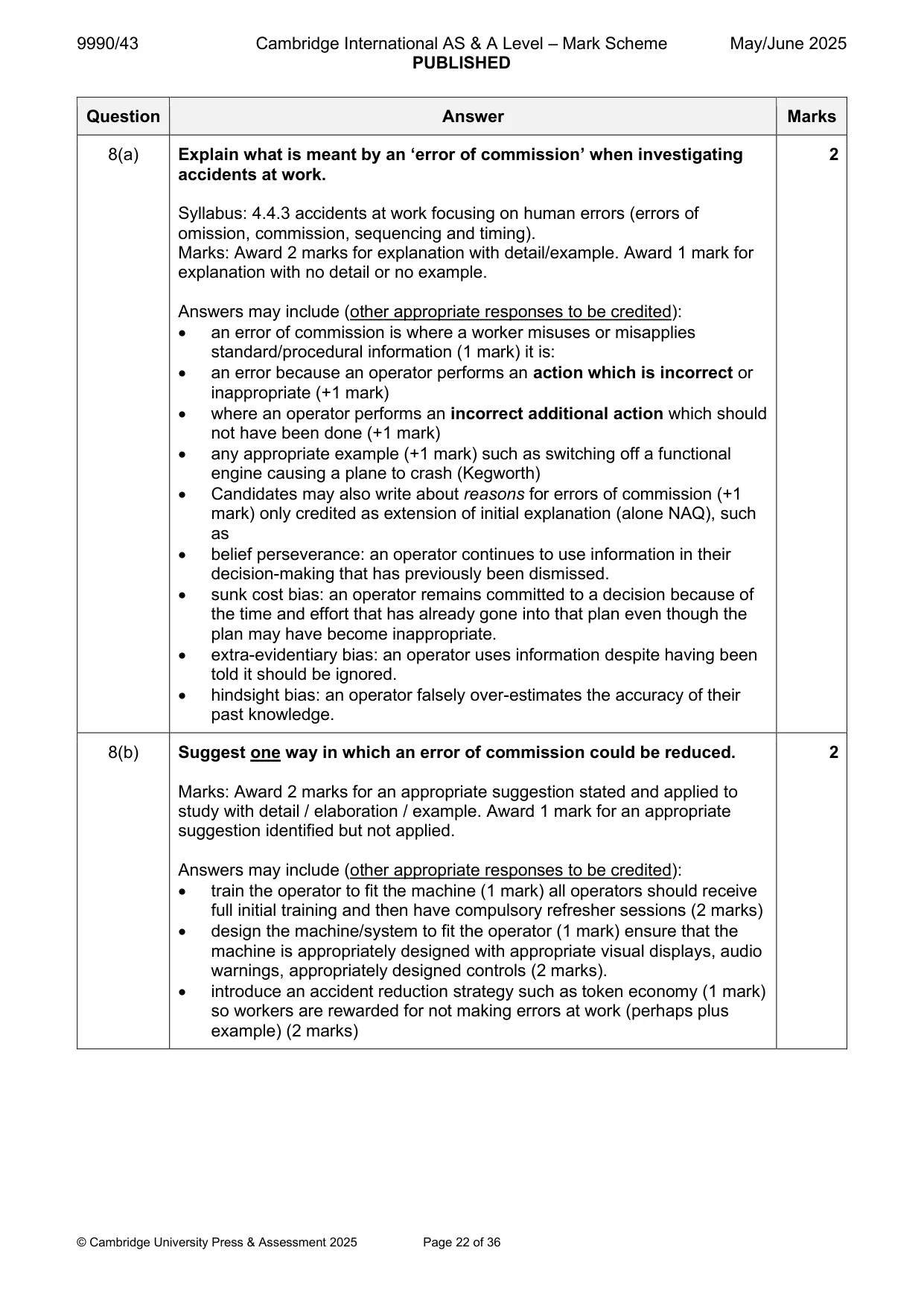
Q8 · Explain what is meant by an ‘error of commission’ when investigating accidents at work
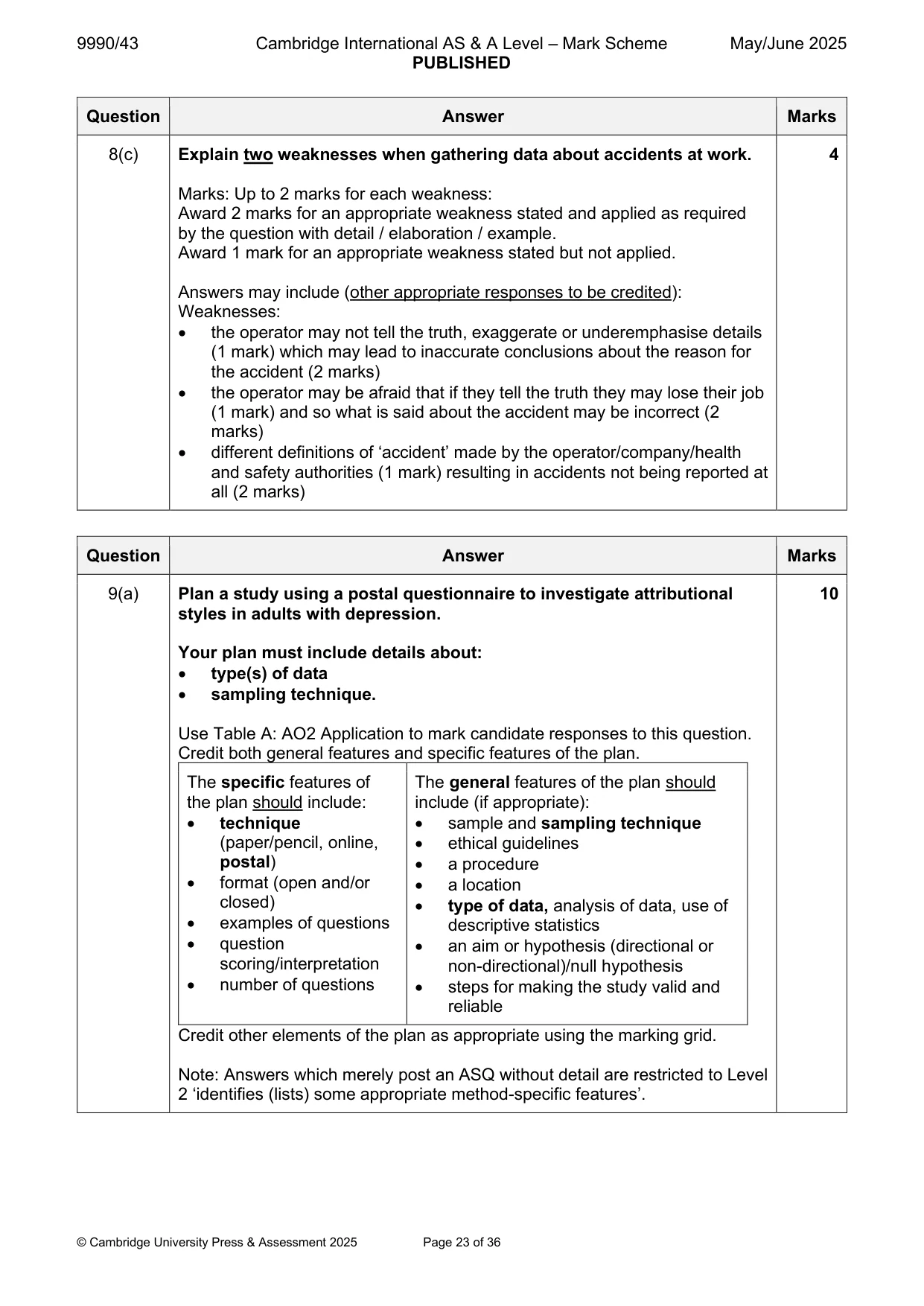
8 (a) Explain what is meant by an ‘error of commission’ when investigating accidents at work. [2] (b) Suggest one way in which an error of commission could be reduced. [2] (c) Explain two weaknesses when gathering data about accidents at work. [4]
Mark scheme: 8(a) Explain what is meant by an ‘error of commission’ when investigating 2 accidents at work. Syllabus: 4.4.3 accidents at work focusing on human errors (errors of omission, commission, sequencing and timing). Marks: Award 2 marks for explanation with detail/example. Award 1 mark for explanation with no detail or no example. Answers may include (other appropriate responses to be credited): • an error of commission is where a worker misuses or misapplies standard/procedural information (1 mark) it is: • an error because an operator performs an action which is incorrect or inappropriate (+1 mark) • where an operator performs an incorrect additional action which should not have been done (+1 mark) • any appropriate example (+1 mark) such as switching off a functional engine causing a plane to crash (Kegworth) • Candidates may also write about reasons for errors of commission (+1 mark) only credited as extension of initial explanation (alone NAQ), such as • belief perseverance: an operator continues to use information in their decision-making that has previously been dismissed. • sunk cost bias: an operator remains committed to a decision because of the time and effort that has already gone into that plan even though the plan may have become inappropriate. • extra-evidentiary bias: an operator uses information despite having been told it should be ignored. • hindsight bias: an operator falsely over-estimates the accuracy of their past knowledge. 8(b) Suggest one way in which an error of commission could be reduced. 2 Marks: Award 2 marks for an appropriate suggestion stated and applied to study with detail / elaboration / example. Award 1 mark for an appropriate suggestion identified but not applied. Answers may include (other appropriate responses to be credited): • train the operator to fit the machine (1 mark) all operators should receive full initial training and then have compulsory refresher sessions (2 marks) • design the machine/system to fit the operator (1 mark) ensure that the machine is appropriately designed with appropriate visual displays, audio warnings, appropriately designed controls (2 marks). • introduce an accident reduction strategy such as token economy (1 mark) so workers are rewarded for not making errors at work (perhaps plus example) (2 marks) 8(c) Explain two weaknesses when gathering data about accidents at work. 4 Marks: Up to 2 marks for each weakness: Award 2 marks for an appropriate weakness stated and applied as required by the question with detail / elaboration / example. Award 1 mark for an appropriate weakness stated but not applied. Answers may include (other appropriate responses to be credited): Weaknesses: • the operator may not tell the truth, exaggerate or underemphasise details (1 mark) which may lead to inaccurate conclusions about the reason for the accident (2 marks) • the operator may be afraid that if they tell the truth they may lose their job (1 mark) and so what is said about the accident may be incorrect (2 marks) • different definitions of ‘accident’ made by the operator/company/health and safety authorities (1 mark) resulting in accidents not being reported at all (2 marks)
Q9 · Plan a study using a postal questionnaire to investigate attributional styles in adults…
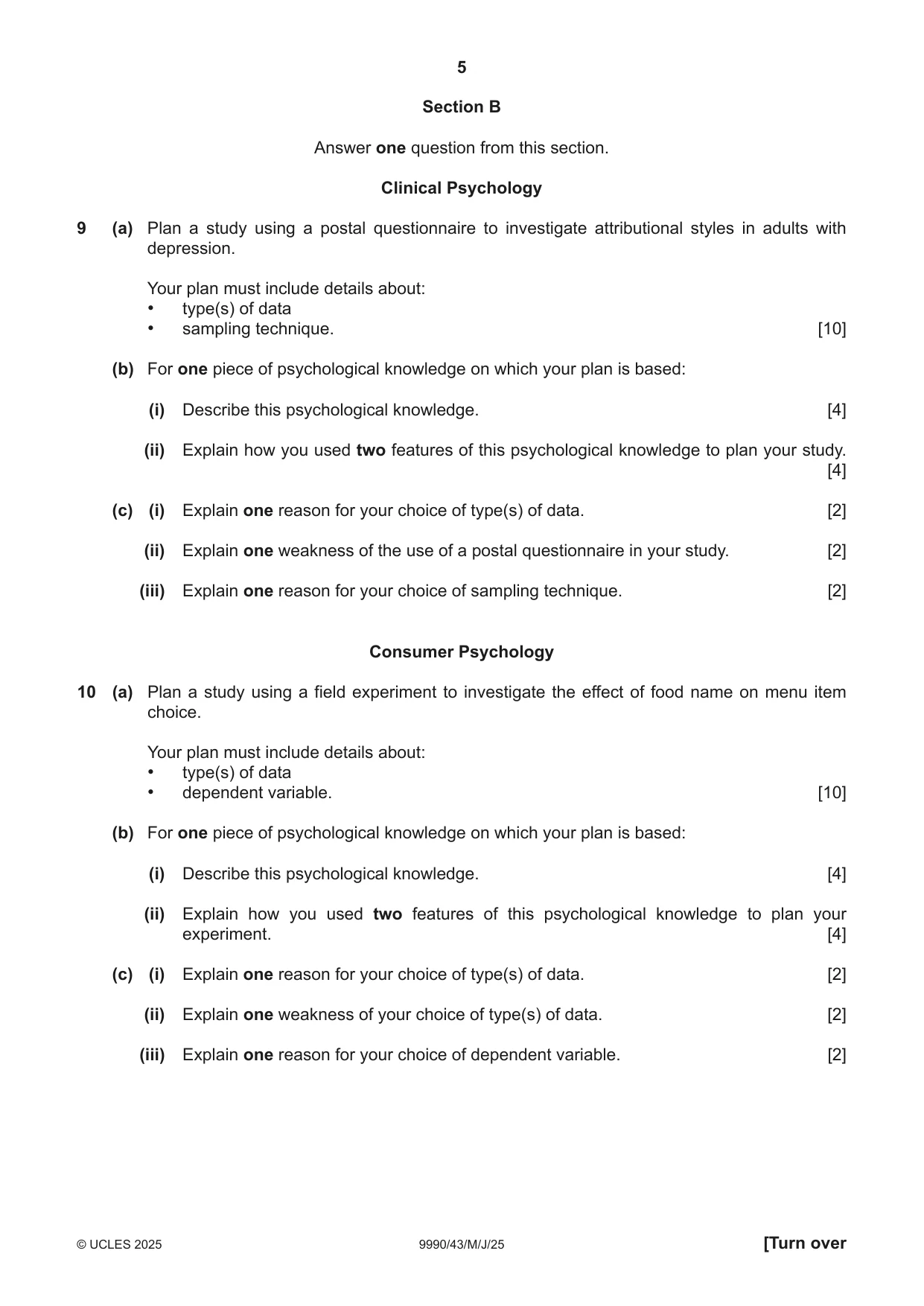
9 (a) Plan a study using a postal questionnaire to investigate attributional styles in adults with depression. Your plan must include details about: • type(s) of data • sampling technique. [10] (b) For one piece of psychological knowledge on which your plan is based: (i) Describe this psychological knowledge. [4] (ii) Explain how you used two features of this psychological knowledge to plan your study. [4] (c) (i) Explain one reason for your choice of type(s) of data. [2] (ii) Explain one weakness of the use of a postal questionnaire in your study. [2] (iii) Explain one reason for your choice of sampling technique. [2] Consumer Psychology
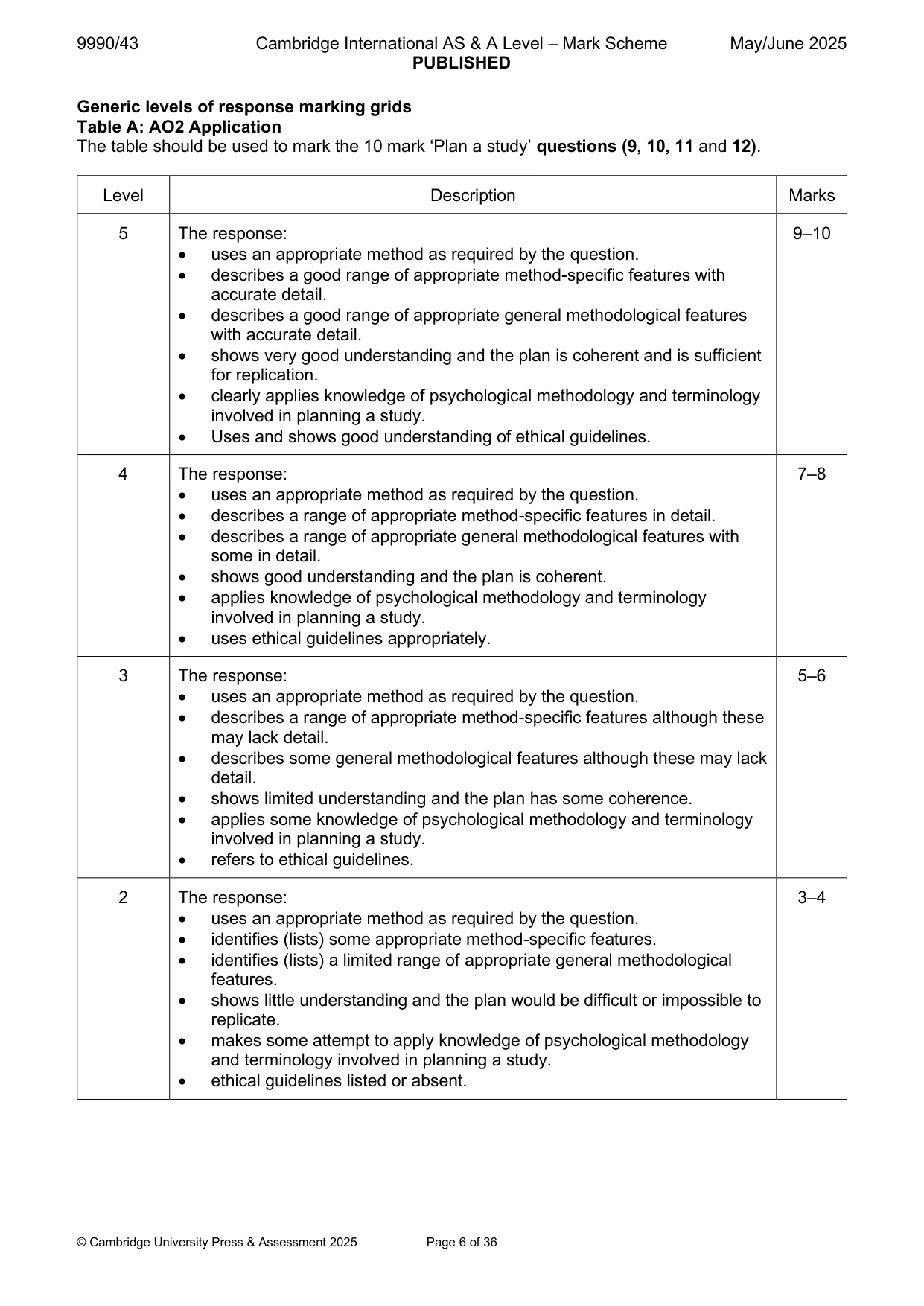
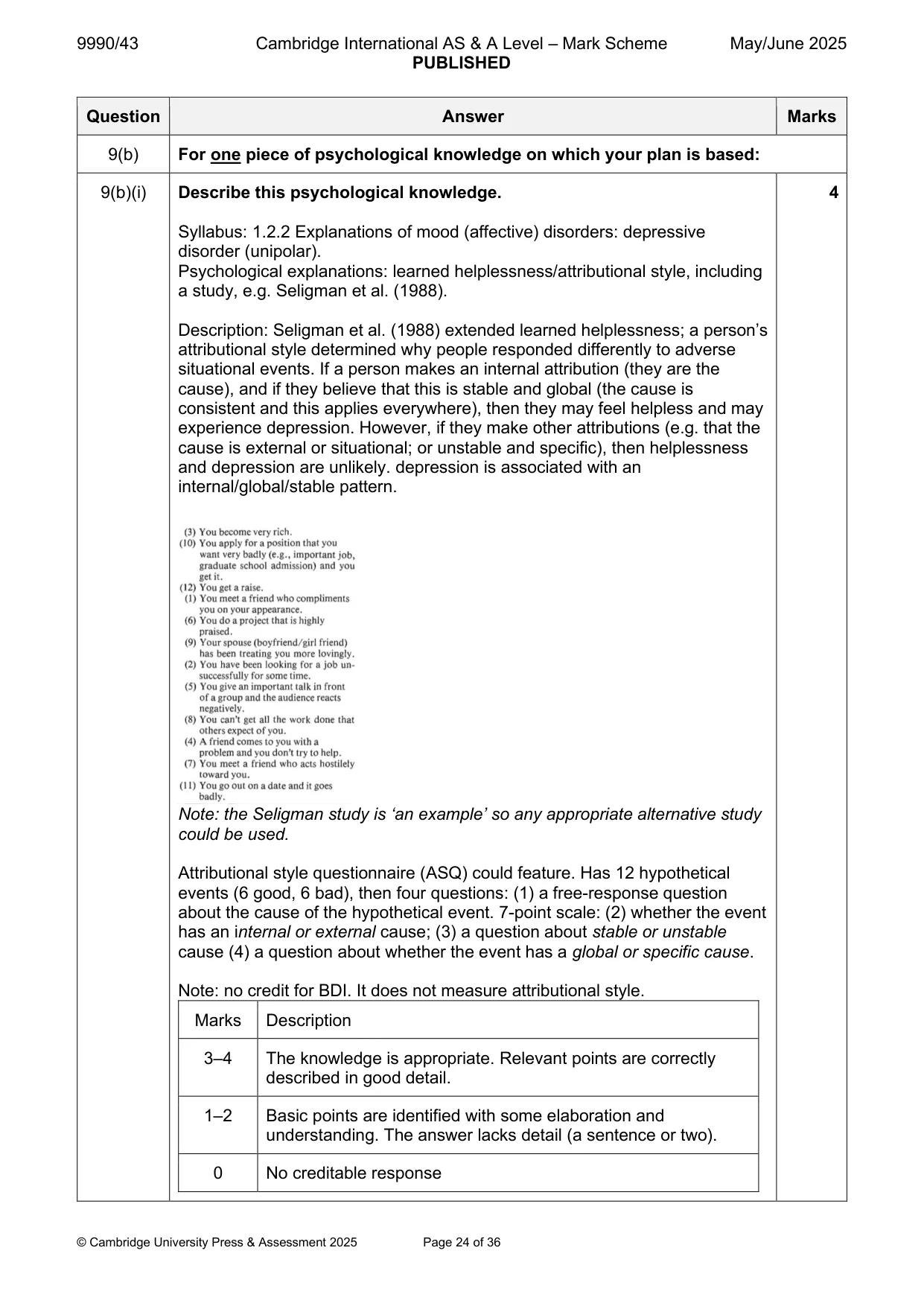
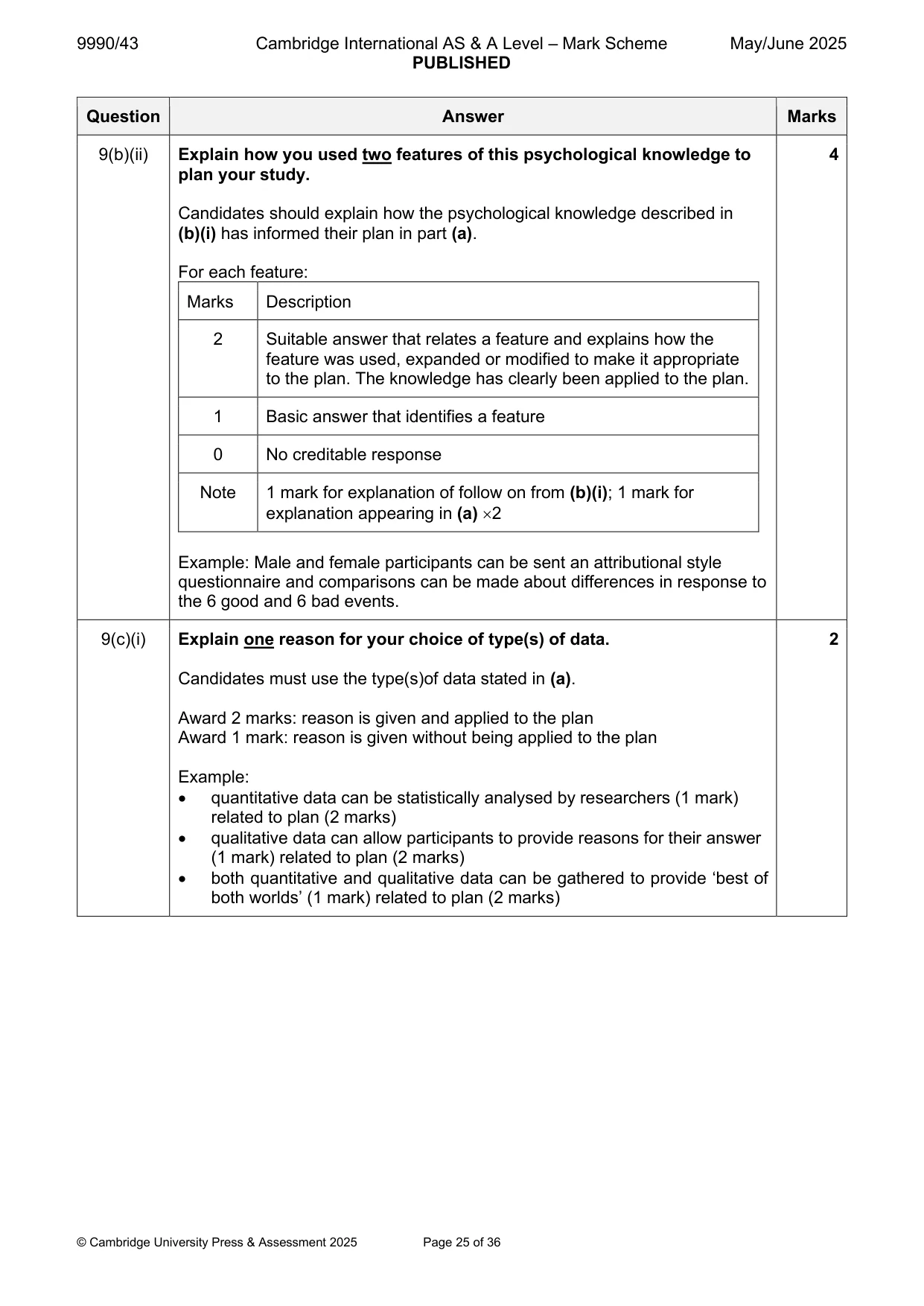
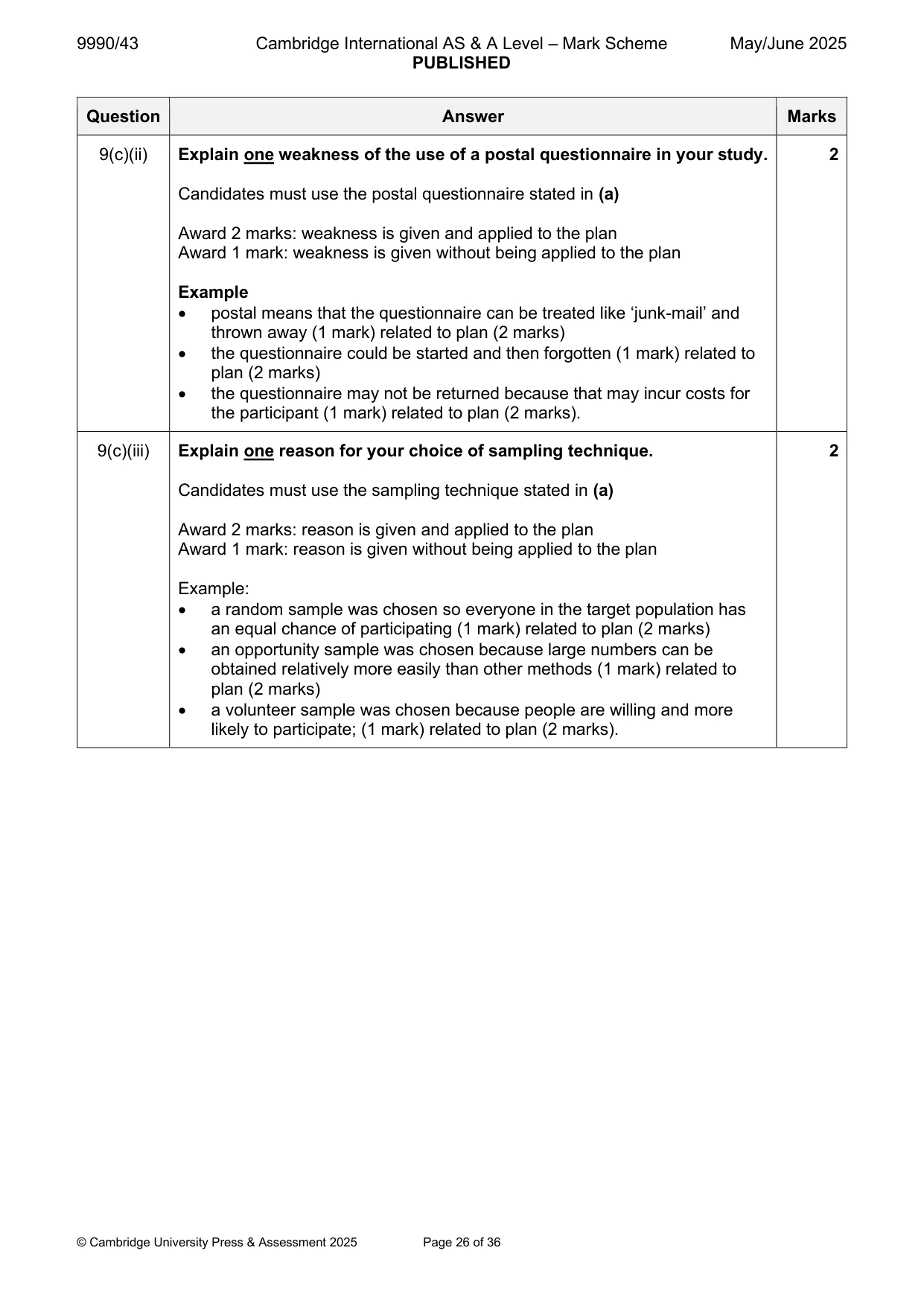
Mark scheme: 9(a) Plan a study using a postal questionnaire to investigate attributional 10 styles in adults with depression. Your plan must include details about: • type(s) of data • sampling technique. Use Table A: AO2 Application to mark candidate responses to this question. Credit both general features and specific features of the plan. The specific features of The general features of the plan should the plan should include: include (if appropriate): • technique • sample and sampling technique (paper/pencil, online, • ethical guidelines postal) • a procedure • format (open and/or • a location closed) • type of data, analysis of data, use of • examples of questions descriptive statistics • question • an aim or hypothesis (directional or scoring/interpretation non-directional)/null hypothesis • number of questions • steps for making the study valid and reliable Credit other elements of the plan as appropriate using the marking grid. Note: Answers which merely post an ASQ without detail are restricted to Level 2 ‘identifies (lists) some appropriate method-specific features’. 9(b) For one piece of psychological knowledge on which your plan is based: 9(b)(i) Describe this psychological knowledge. 4 Syllabus: 1.2.2 Explanations of mood (affective) disorders: depressive disorder (unipolar). Psychological explanations: learned helplessness/attributional style, including a study, e.g. Seligman et al. (1988). Description: Seligman et al. (1988) extended learned helplessness; a person’s attributional style determined why people responded differently to adverse situational events. If a person makes an internal attribution (they are the cause), and if they believe that this is stable and global (the cause is consistent and this applies everywhere), then they may feel helpless and may experience depression. However, if they make other attributions (e.g. that the cause is external or situational; or unstable and specific), then helplessness and depression are unlikely. depression is associated with an internal/global/stable pattern. Note: the Seligman study is ‘an example’ so any appropriate alternative study could be used. Attributional style questionnaire (ASQ) could feature. Has 12 hypothetical events (6 good, 6 bad), then four questions: (1) a free-response question about the cause of the hypothetical event. 7-point scale: (2) whether the event has an internal or external cause; (3) a question about stable or unstable cause (4) a question about whether the event has a global or specific cause. Note: no credit for BDI. It does not measure attributional style. Marks Description 3–4 The knowledge is appropriate. Relevant points are correctly described in good detail. 1–2 Basic points are identified with some elaboration and understanding. The answer lacks detail (a sentence or two). 0 No creditable response 9(b)(ii) Explain how you used two features of this psychological knowledge to 4 plan your study. Candidates should explain how the psychological knowledge described in (b)(i) has informed their plan in part (a). For each feature: Marks Description 2 Suitable answer that relates a feature and explains how the feature was used, expanded or modified to make it appropriate to the plan. The knowledge has clearly been applied to the plan. 1 Basic answer that identifies a feature 0 No creditable response Note 1 mark for explanation of follow on from (b)(i); 1 mark for explanation appearing in (a) 2 Example: Male and female participants can be sent an attributional style questionnaire and comparisons can be made about differences in response to the 6 good and 6 bad events. 9(c)(i) Explain one reason for your choice of type(s) of data. 2 Candidates must use the type(s)of data stated in (a). Award 2 marks: reason is given and applied to the plan Award 1 mark: reason is given without being applied to the plan Example: • quantitative data can be statistically analysed by researchers (1 mark) related to plan (2 marks) • qualitative data can allow participants to provide reasons for their answer (1 mark) related to plan (2 marks) • both quantitative and qualitative data can be gathered to provide ‘best of both worlds’ (1 mark) related to plan (2 marks) 9(c)(ii) Explain one weakness of the use of a postal questionnaire in your study. 2 Candidates must use the postal questionnaire stated in (a) Award 2 marks: weakness is given and applied to the plan Award 1 mark: weakness is given without being applied to the plan Example • postal means that the questionnaire can be treated like ‘junk-mail’ and thrown away (1 mark) related to plan (2 marks) • the questionnaire could be started and then forgotten (1 mark) related to plan (2 marks) • the questionnaire may not be returned because that may incur costs for the participant (1 mark) related to plan (2 marks). 9(c)(iii) Explain one reason for your choice of sampling technique. 2 Candidates must use the sampling technique stated in (a) Award 2 marks: reason is given and applied to the plan Award 1 mark: reason is given without being applied to the plan Example: • a random sample was chosen so everyone in the target population has an equal chance of participating (1 mark) related to plan (2 marks) • an opportunity sample was chosen because large numbers can be obtained relatively more easily than other methods (1 mark) related to plan (2 marks) • a volunteer sample was chosen because people are willing and more likely to participate; (1 mark) related to plan (2 marks).
More questions on Mood (affective) disorders: depressive disorder (unipolar) and bipolar disorder
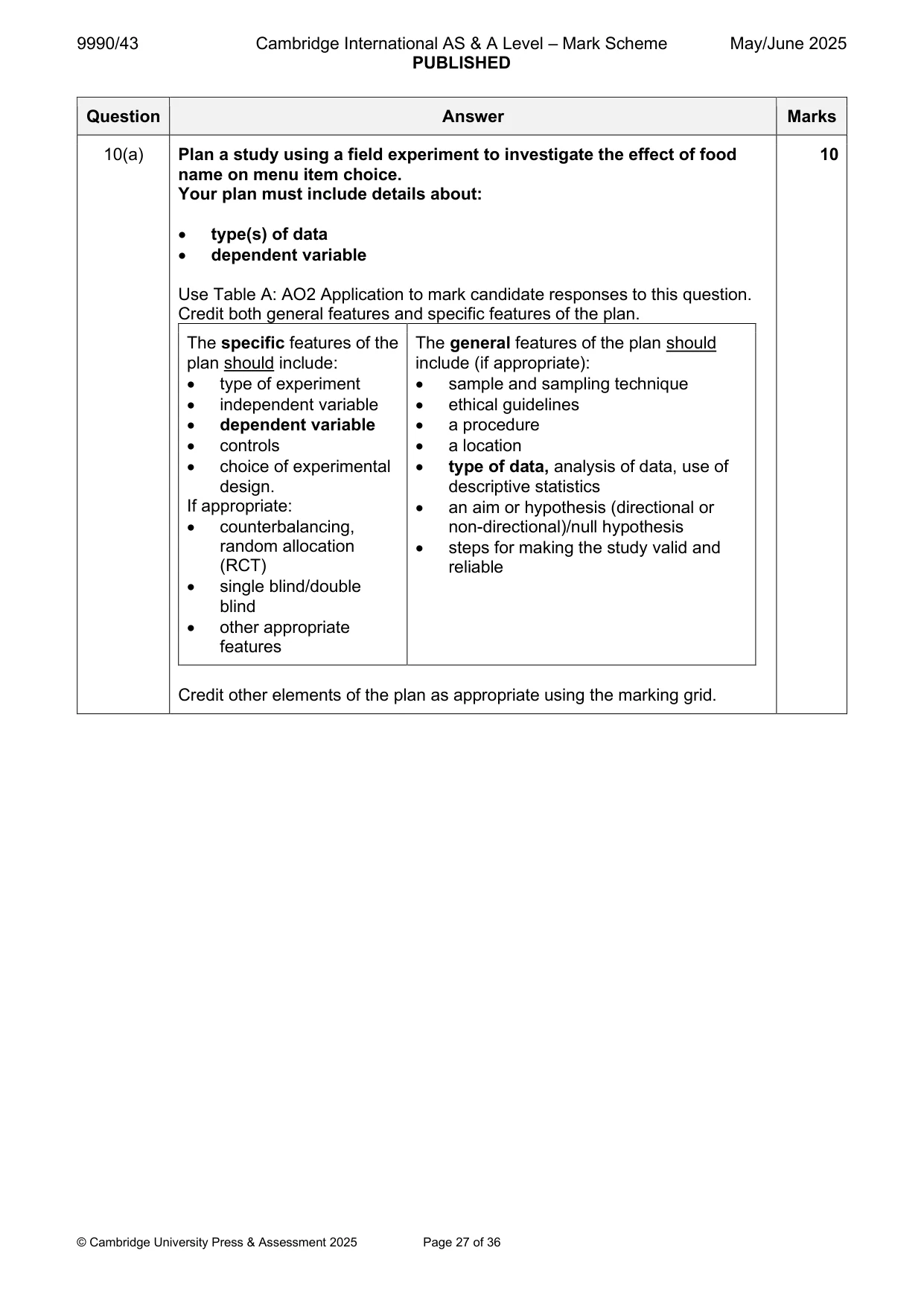
Q10 · Plan a study using a field experiment to investigate the effect of food name on menu item…
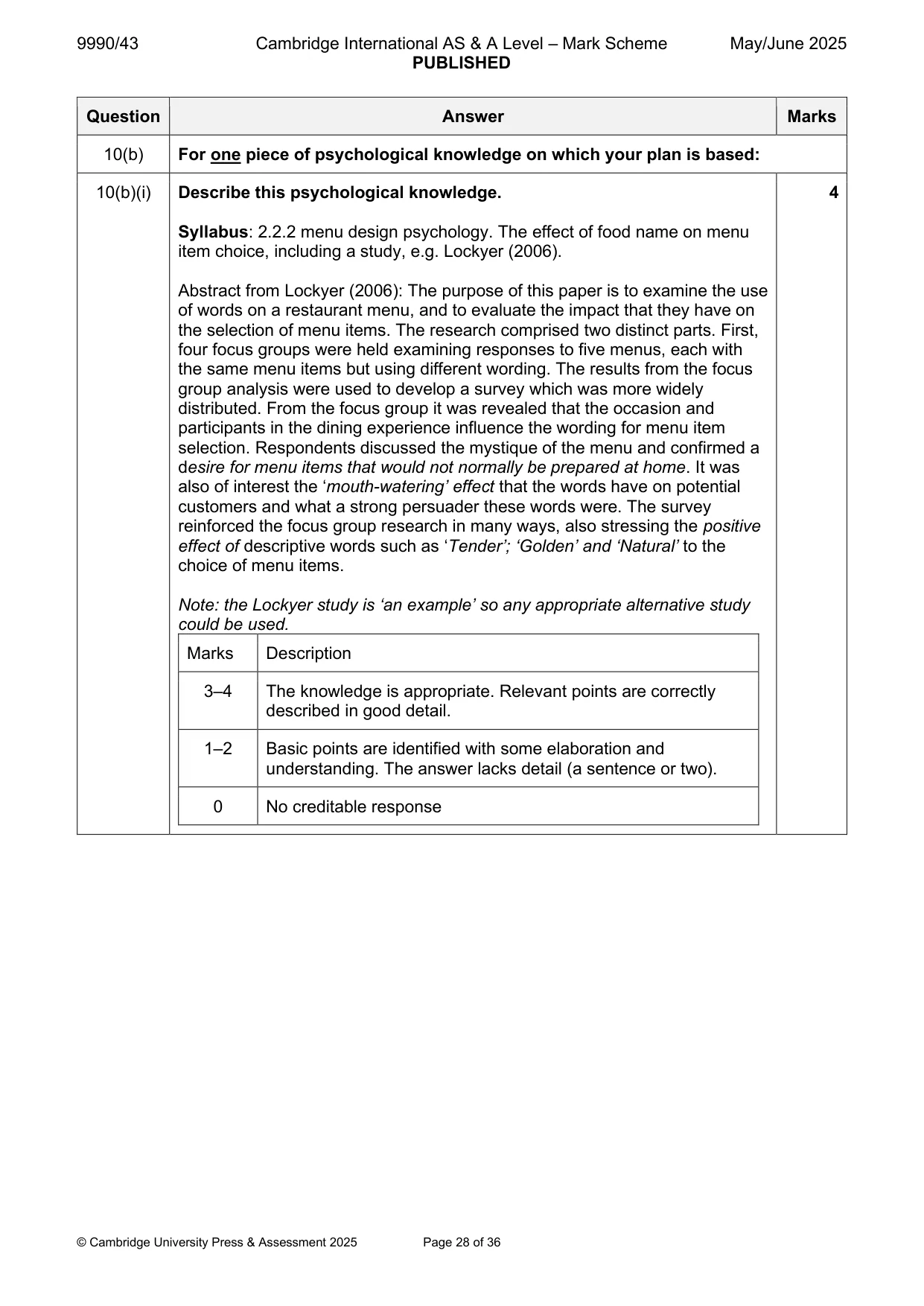
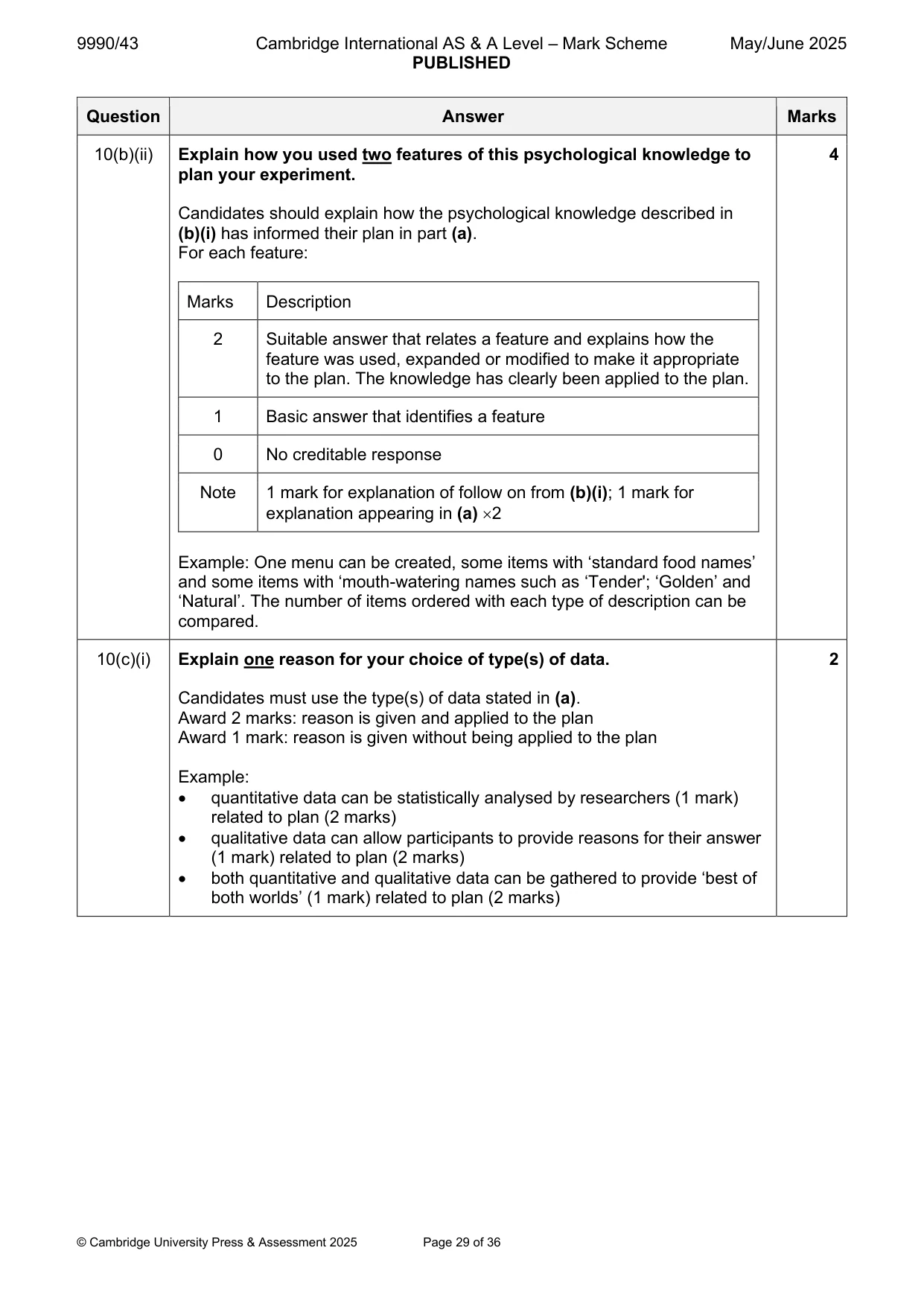
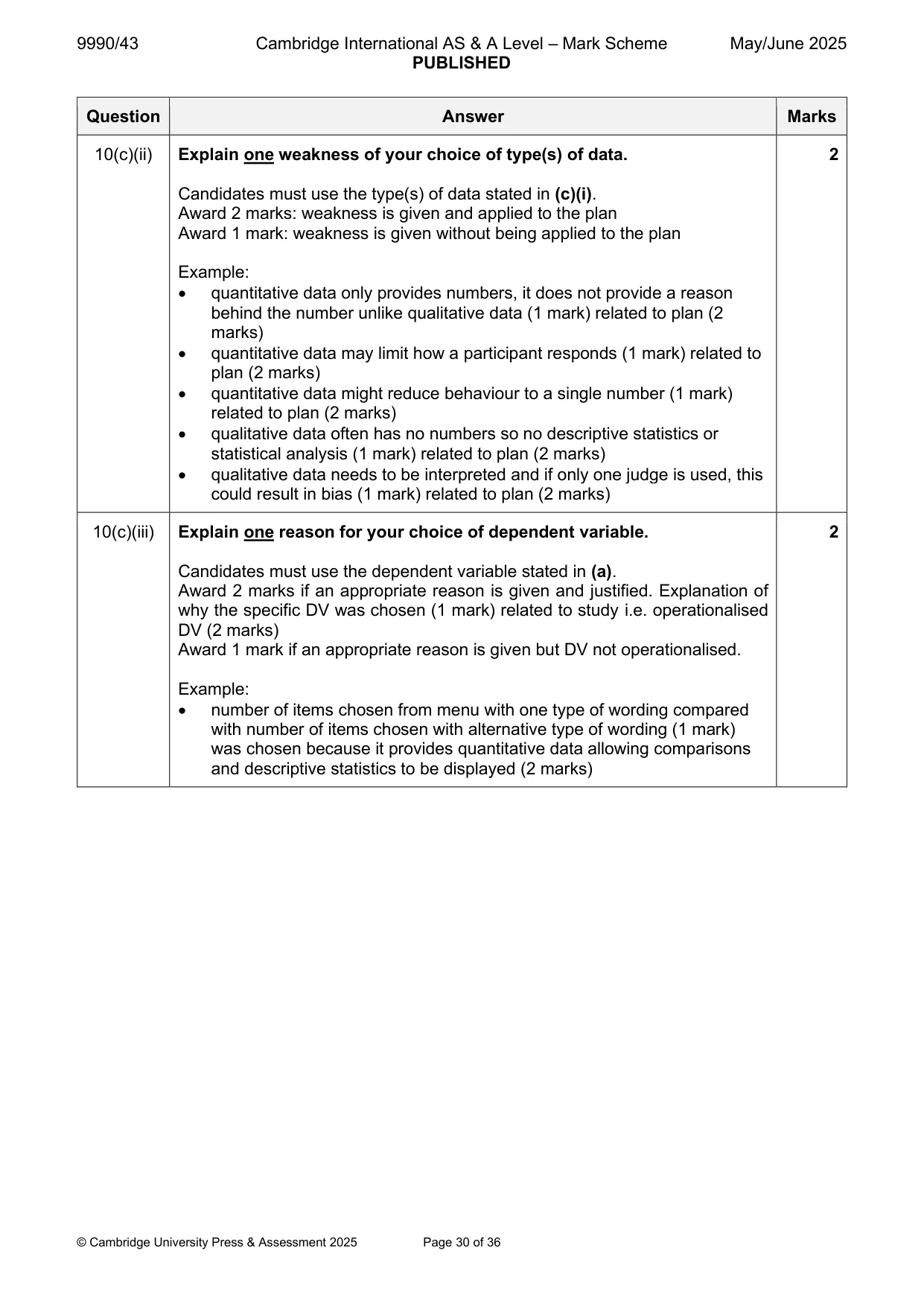
10 (a) Plan a study using a field experiment to investigate the effect of food name on menu item choice. Your plan must include details about: • type(s) of data • dependent variable. [10] (b) For one piece of psychological knowledge on which your plan is based: (i) Describe this psychological knowledge. [4] (ii) Explain how you used two features of this psychological knowledge to plan your experiment. [4] (c) (i) Explain one reason for your choice of type(s) of data. [2] (ii) Explain one weakness of your choice of type(s) of data. [2] (iii) Explain one reason for your choice of dependent variable. [2] Health Psychology
Mark scheme: 10(a) Plan a study using a field experiment to investigate the effect of food 10 name on menu item choice. Your plan must include details about: • type(s) of data • dependent variable Use Table A: AO2 Application to mark candidate responses to this question. Credit both general features and specific features of the plan. The specific features of the The general features of the plan should plan should include: include (if appropriate): • type of experiment • sample and sampling technique • independent variable • ethical guidelines • dependent variable • a procedure • controls • a location • choice of experimental • type of data, analysis of data, use of design. descriptive statistics If appropriate: • an aim or hypothesis (directional or • counterbalancing, non-directional)/null hypothesis random allocation • steps for making the study valid and (RCT) reliable • single blind/double blind • other appropriate features Credit other elements of the plan as appropriate using the marking grid. 10(b) For one piece of psychological knowledge on which your plan is based: 10(b)(i) Describe this psychological knowledge. 4 Syllabus: 2.2.2 menu design psychology. The effect of food name on menu item choice, including a study, e.g. Lockyer (2006). Abstract from Lockyer (2006): The purpose of this paper is to examine the use of words on a restaurant menu, and to evaluate the impact that they have on the selection of menu items. The research comprised two distinct parts. First, four focus groups were held examining responses to five menus, each with the same menu items but using different wording. The results from the focus group analysis were used to develop a survey which was more widely distributed. From the focus group it was revealed that the occasion and participants in the dining experience influence the wording for menu item selection. Respondents discussed the mystique of the menu and confirmed a desire for menu items that would not normally be prepared at home. It was also of interest the ‘mouth-watering’ effect that the words have on potential customers and what a strong persuader these words were. The survey reinforced the focus group research in many ways, also stressing the positive effect of descriptive words such as ‘Tender’; ‘Golden’ and ‘Natural’ to the choice of menu items. Note: the Lockyer study is ‘an example’ so any appropriate alternative study could be used. Marks Description 3–4 The knowledge is appropriate. Relevant points are correctly described in good detail. 1–2 Basic points are identified with some elaboration and understanding. The answer lacks detail (a sentence or two). 0 No creditable response 10(b)(ii) Explain how you used two features of this psychological knowledge to 4 plan your experiment. Candidates should explain how the psychological knowledge described in (b)(i) has informed their plan in part (a). For each feature: Marks Description 2 Suitable answer that relates a feature and explains how the feature was used, expanded or modified to make it appropriate to the plan. The knowledge has clearly been applied to the plan. 1 Basic answer that identifies a feature 0 No creditable response Note 1 mark for explanation of follow on from (b)(i); 1 mark for explanation appearing in (a) 2 Example: One menu can be created, some items with ‘standard food names’ and some items with ‘mouth-watering names such as ‘Tender'; ‘Golden’ and ‘Natural’. The number of items ordered with each type of description can be compared. 10(c)(i) Explain one reason for your choice of type(s) of data. 2 Candidates must use the type(s) of data stated in (a). Award 2 marks: reason is given and applied to the plan Award 1 mark: reason is given without being applied to the plan Example: • quantitative data can be statistically analysed by researchers (1 mark) related to plan (2 marks) • qualitative data can allow participants to provide reasons for their answer (1 mark) related to plan (2 marks) • both quantitative and qualitative data can be gathered to provide ‘best of both worlds’ (1 mark) related to plan (2 marks) 10(c)(ii) Explain one weakness of your choice of type(s) of data. 2 Candidates must use the type(s) of data stated in (c)(i). Award 2 marks: weakness is given and applied to the plan Award 1 mark: weakness is given without being applied to the plan Example: • quantitative data only provides numbers, it does not provide a reason behind the number unlike qualitative data (1 mark) related to plan (2 marks) • quantitative data may limit how a participant responds (1 mark) related to plan (2 marks) • quantitative data might reduce behaviour to a single number (1 mark) related to plan (2 marks) • qualitative data often has no numbers so no descriptive statistics or statistical analysis (1 mark) related to plan (2 marks) • qualitative data needs to be interpreted and if only one judge is used, this could result in bias (1 mark) related to plan (2 marks) 10(c)(iii) Explain one reason for your choice of dependent variable. 2 Candidates must use the dependent variable stated in (a). Award 2 marks if an appropriate reason is given and justified. Explanation of why the specific DV was chosen (1 mark) related to study i.e. operationalised DV (2 marks) Award 1 mark if an appropriate reason is given but DV not operationalised. Example: • number of items chosen from menu with one type of wording compared with number of items chosen with alternative type of wording (1 mark) was chosen because it provides quantitative data allowing comparisons and descriptive statistics to be displayed (2 marks)
Q11 · Plan a study using a face-to-face interview to investigate the effectiveness of…
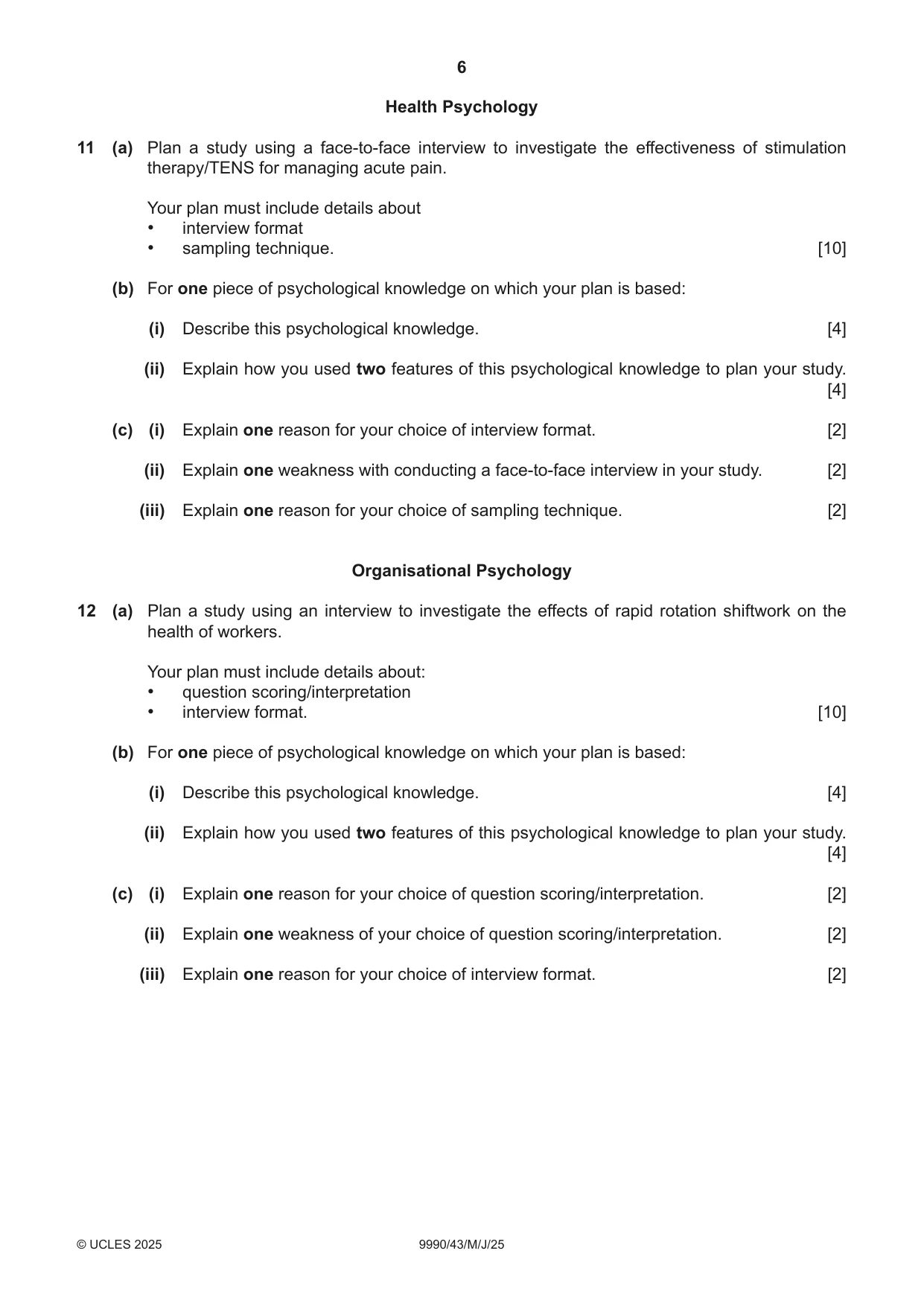
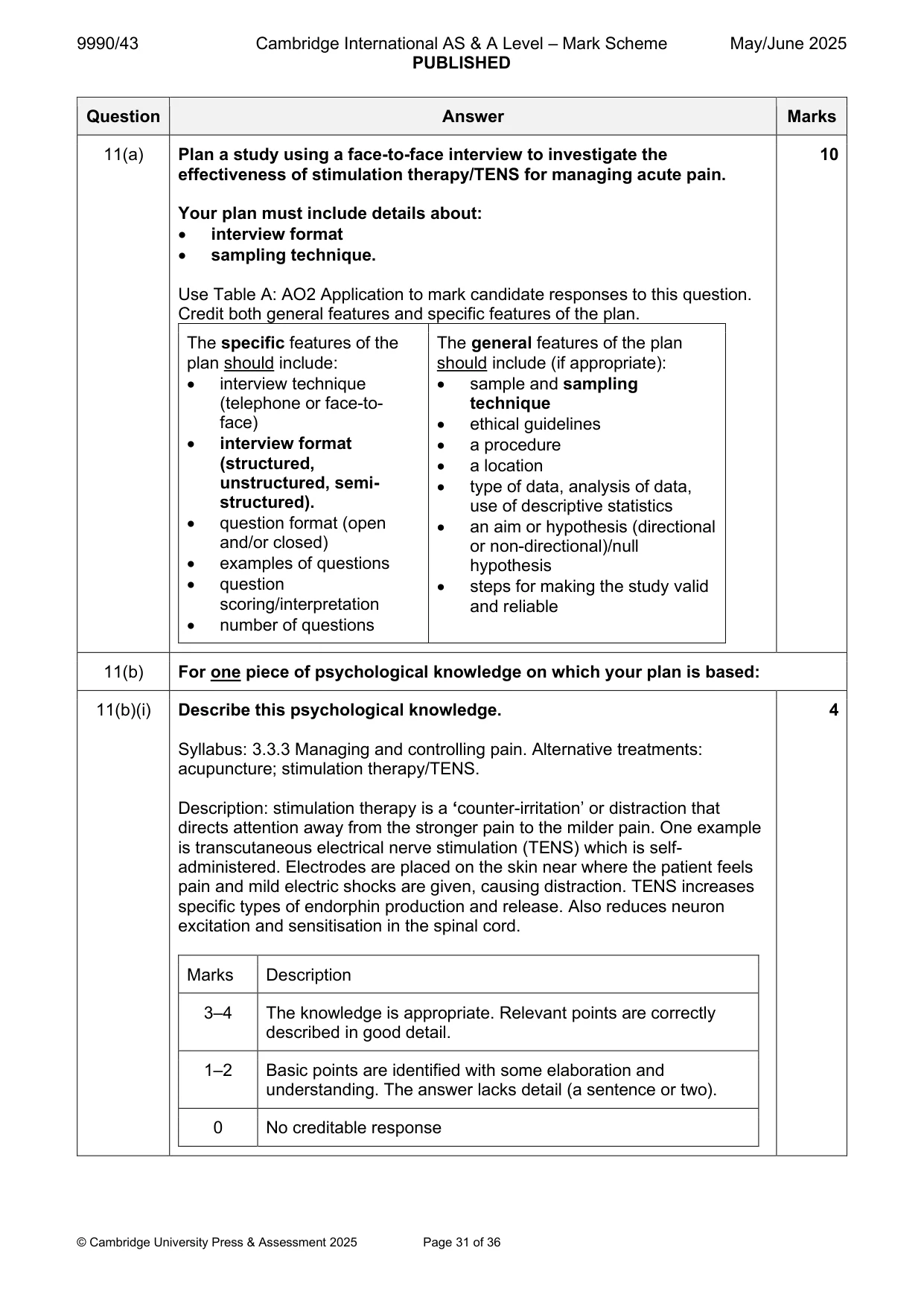
11 (a) Plan a study using a face-to-face interview to investigate the effectiveness of stimulation therapy/TENS for managing acute pain. Your plan must include details about • interview format • sampling technique. [10] (b) For one piece of psychological knowledge on which your plan is based: (i) Describe this psychological knowledge. [4] (ii) Explain how you used two features of this psychological knowledge to plan your study. [4] (c) (i) Explain one reason for your choice of interview format. [2] (ii) Explain one weakness with conducting a face-to-face interview in your study. [2] (iii) Explain one reason for your choice of sampling technique. [2] Organisational Psychology
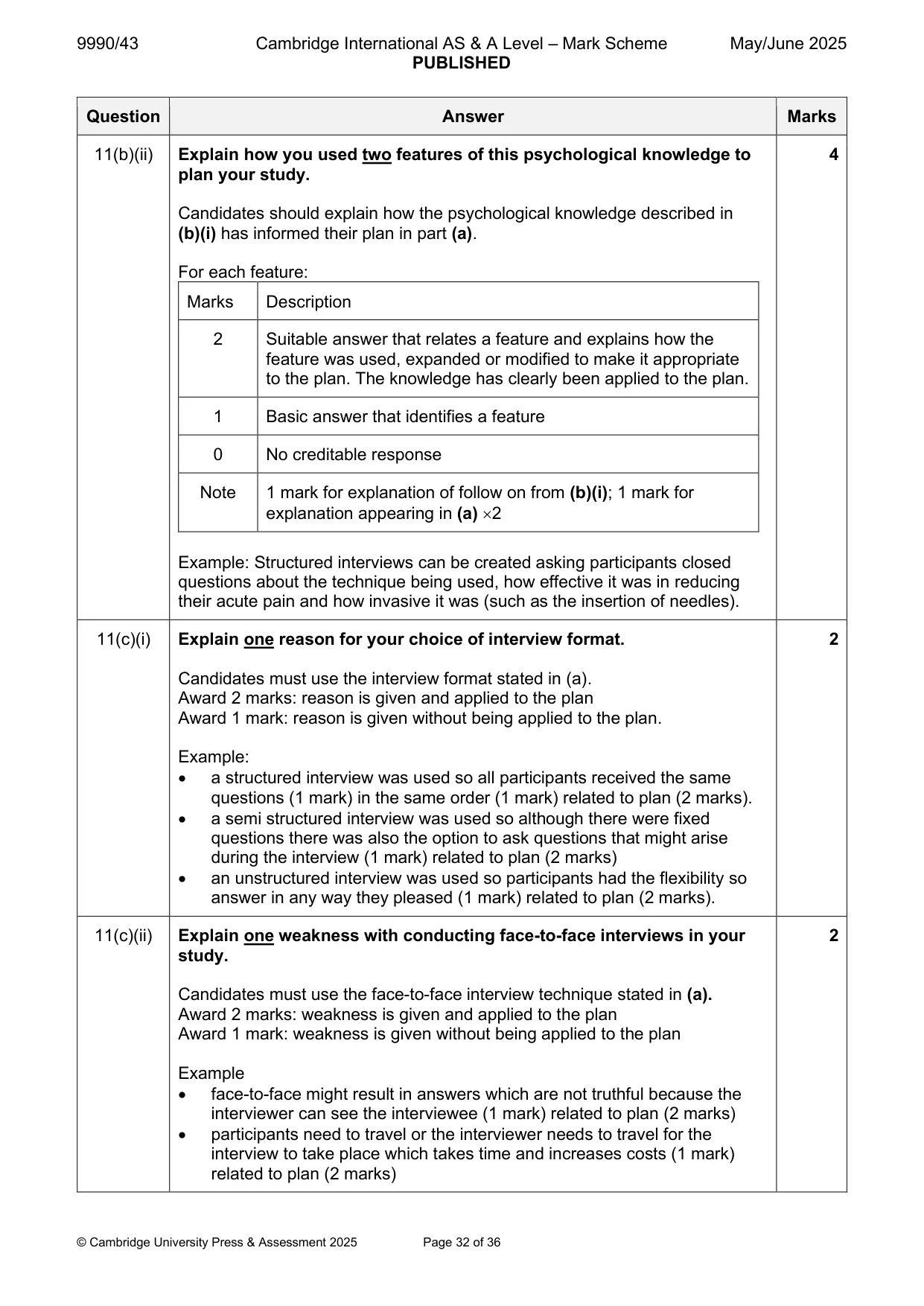
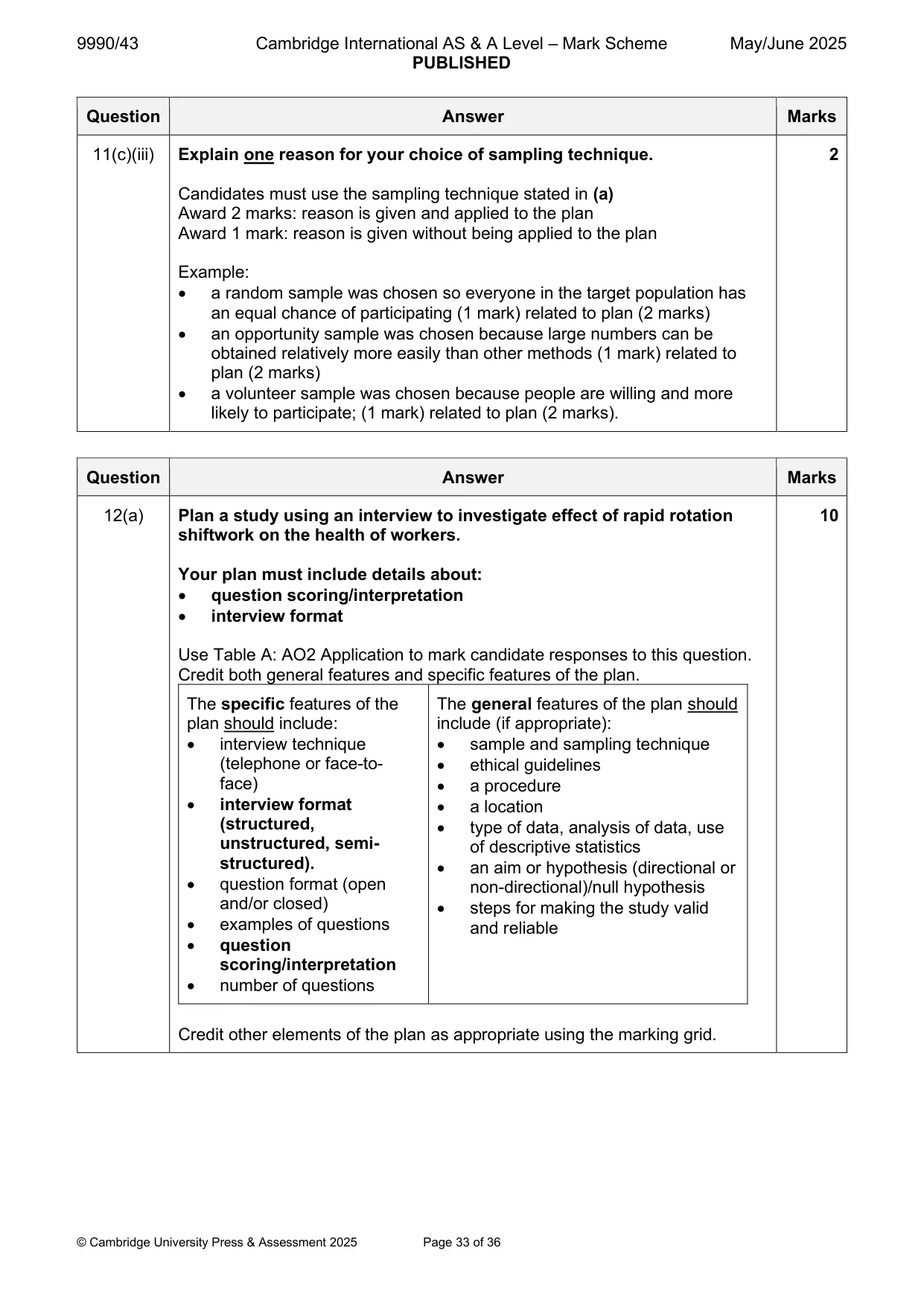
Mark scheme: 11(a) Plan a study using a face-to-face interview to investigate the 10 effectiveness of stimulation therapy/TENS for managing acute pain. Your plan must include details about: • interview format • sampling technique. Use Table A: AO2 Application to mark candidate responses to this question. Credit both general features and specific features of the plan. The specific features of the The general features of the plan plan should include: should include (if appropriate): • interview technique • sample and sampling (telephone or face-to- technique face) • ethical guidelines • interview format • a procedure (structured, • a location unstructured, semi- • type of data, analysis of data, structured). use of descriptive statistics • question format (open • an aim or hypothesis (directional and/or closed) or non-directional)/null • examples of questions hypothesis • question • steps for making the study valid scoring/interpretation and reliable • number of questions 11(b) For one piece of psychological knowledge on which your plan is based: 11(b)(i) Describe this psychological knowledge. 4 Syllabus: 3.3.3 Managing and controlling pain. Alternative treatments: acupuncture; stimulation therapy/TENS. Description: stimulation therapy is a ‘counter-irritation’ or distraction that directs attention away from the stronger pain to the milder pain. One example is transcutaneous electrical nerve stimulation (TENS) which is self- administered. Electrodes are placed on the skin near where the patient feels pain and mild electric shocks are given, causing distraction. TENS increases specific types of endorphin production and release. Also reduces neuron excitation and sensitisation in the spinal cord. Marks Description 3–4 The knowledge is appropriate. Relevant points are correctly described in good detail. 1–2 Basic points are identified with some elaboration and understanding. The answer lacks detail (a sentence or two). 0 No creditable response 11(b)(ii) Explain how you used two features of this psychological knowledge to 4 plan your study. Candidates should explain how the psychological knowledge described in (b)(i) has informed their plan in part (a). For each feature: Marks Description 2 Suitable answer that relates a feature and explains how the feature was used, expanded or modified to make it appropriate to the plan. The knowledge has clearly been applied to the plan. 1 Basic answer that identifies a feature 0 No creditable response Note 1 mark for explanation of follow on from (b)(i); 1 mark for explanation appearing in (a) 2 Example: Structured interviews can be created asking participants closed questions about the technique being used, how effective it was in reducing their acute pain and how invasive it was (such as the insertion of needles). 11(c)(i) Explain one reason for your choice of interview format. 2 Candidates must use the interview format stated in (a). Award 2 marks: reason is given and applied to the plan Award 1 mark: reason is given without being applied to the plan. Example: • a structured interview was used so all participants received the same questions (1 mark) in the same order (1 mark) related to plan (2 marks). • a semi structured interview was used so although there were fixed questions there was also the option to ask questions that might arise during the interview (1 mark) related to plan (2 marks) • an unstructured interview was used so participants had the flexibility so answer in any way they pleased (1 mark) related to plan (2 marks). 11(c)(ii) Explain one weakness with conducting face-to-face interviews in your 2 study. Candidates must use the face-to-face interview technique stated in (a). Award 2 marks: weakness is given and applied to the plan Award 1 mark: weakness is given without being applied to the plan Example • face-to-face might result in answers which are not truthful because the interviewer can see the interviewee (1 mark) related to plan (2 marks) • participants need to travel or the interviewer needs to travel for the interview to take place which takes time and increases costs (1 mark) related to plan (2 marks) 11(c)(iii) Explain one reason for your choice of sampling technique. 2 Candidates must use the sampling technique stated in (a) Award 2 marks: reason is given and applied to the plan Award 1 mark: reason is given without being applied to the plan Example: • a random sample was chosen so everyone in the target population has an equal chance of participating (1 mark) related to plan (2 marks) • an opportunity sample was chosen because large numbers can be obtained relatively more easily than other methods (1 mark) related to plan (2 marks) • a volunteer sample was chosen because people are willing and more likely to participate; (1 mark) related to plan (2 marks).
Q12 · Plan a study using an interview to investigate the effects of rapid rotation shiftwork on…
12 (a) Plan a study using an interview to investigate the effects of rapid rotation shiftwork on the health of workers. Your plan must include details about: • question scoring/interpretation • interview format. [10] (b) For one piece of psychological knowledge on which your plan is based: (i) Describe this psychological knowledge. [4] (ii) Explain how you used two features of this psychological knowledge to plan your study. [4] (c) (i) Explain one reason for your choice of question scoring/interpretation. [2] (ii) Explain one weakness of your choice of question scoring/interpretation. [2] (iii) Explain one reason for your choice of interview format. [2]
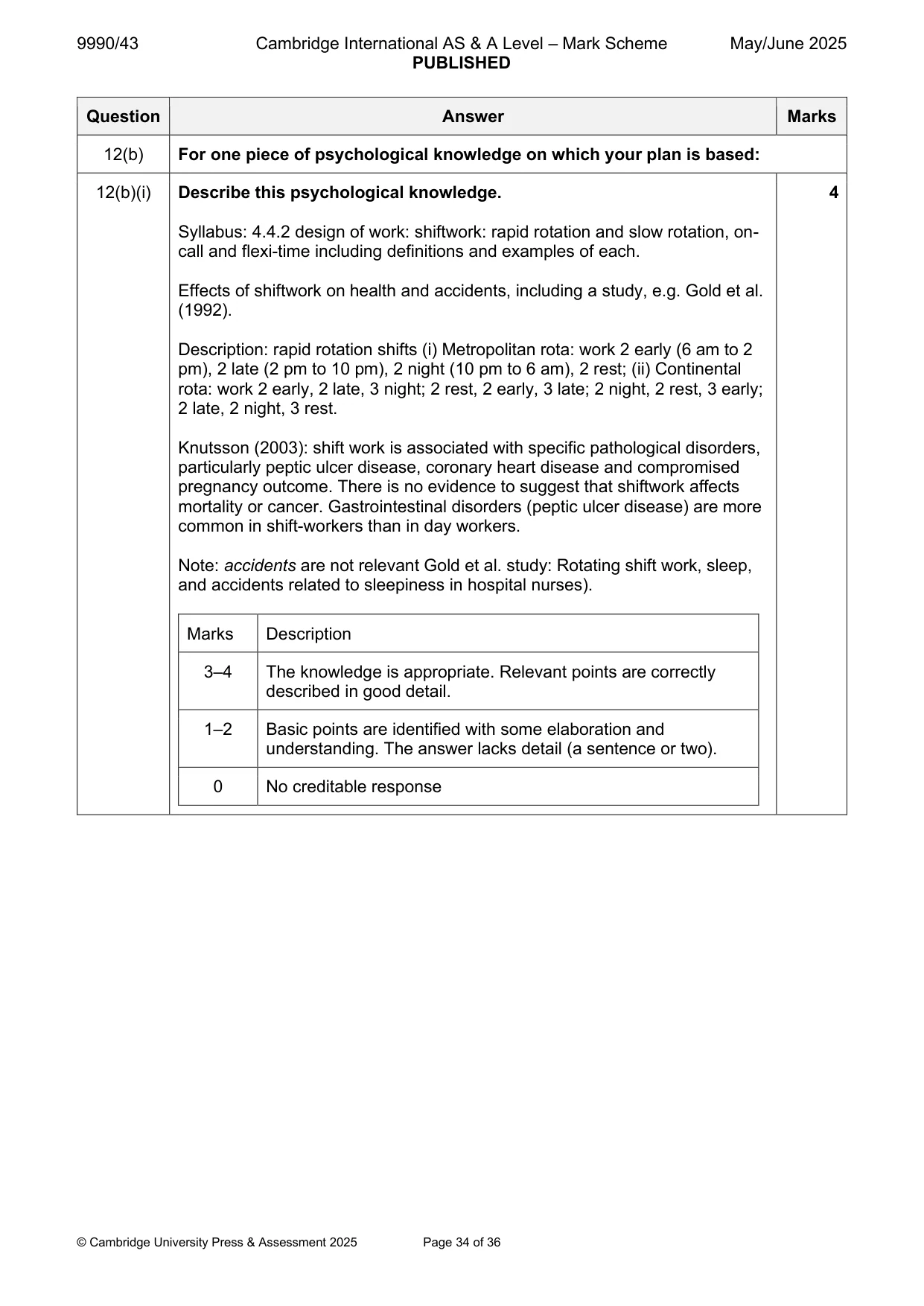
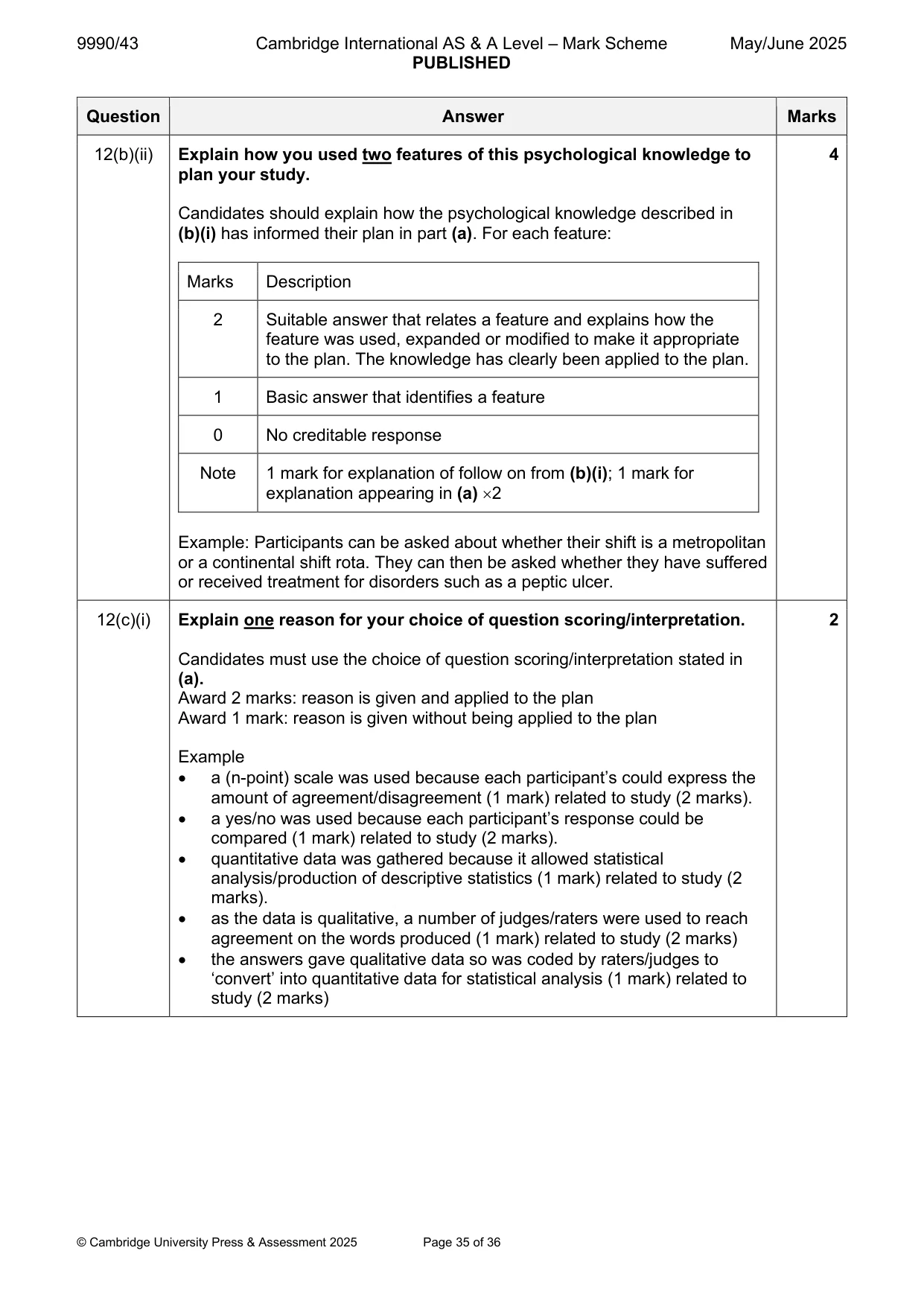
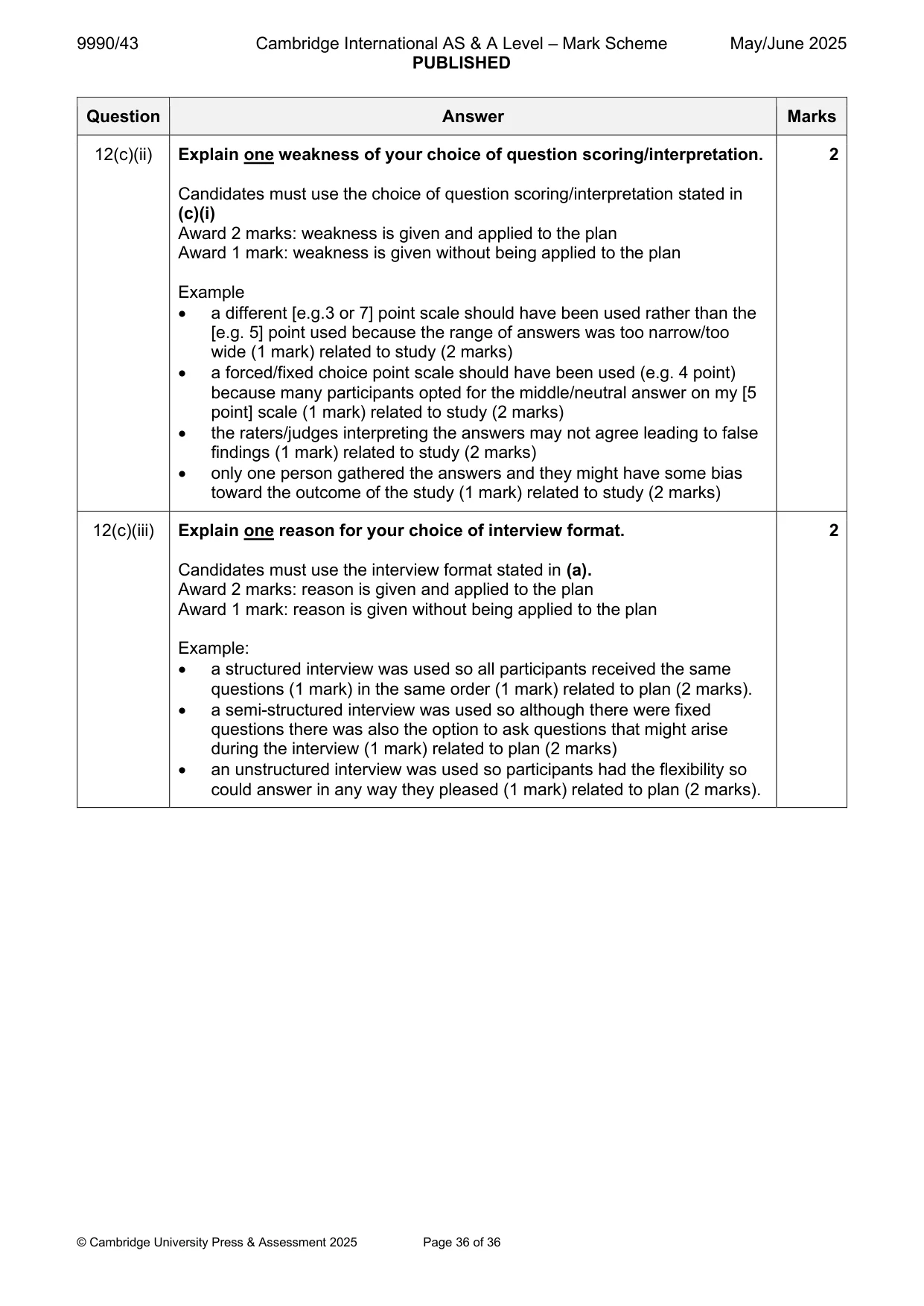
Mark scheme: 12(a) Plan a study using an interview to investigate effect of rapid rotation 10 shiftwork on the health of workers. Your plan must include details about: • question scoring/interpretation • interview format Use Table A: AO2 Application to mark candidate responses to this question. Credit both general features and specific features of the plan. The specific features of the The general features of the plan should plan should include: include (if appropriate): • interview technique • sample and sampling technique (telephone or face-to- • ethical guidelines face) • a procedure • interview format • a location (structured, • type of data, analysis of data, use unstructured, semi- of descriptive statistics structured). • an aim or hypothesis (directional or • question format (open non-directional)/null hypothesis and/or closed) • steps for making the study valid • examples of questions and reliable • question scoring/interpretation • number of questions Credit other elements of the plan as appropriate using the marking grid. 12(b) For one piece of psychological knowledge on which your plan is based: 12(b)(i) Describe this psychological knowledge. 4 Syllabus: 4.4.2 design of work: shiftwork: rapid rotation and slow rotation, on- call and flexi-time including definitions and examples of each. Effects of shiftwork on health and accidents, including a study, e.g. Gold et al. (1992). Description: rapid rotation shifts (i) Metropolitan rota: work 2 early (6 am to 2 pm), 2 late (2 pm to 10 pm), 2 night (10 pm to 6 am), 2 rest; (ii) Continental rota: work 2 early, 2 late, 3 night; 2 rest, 2 early, 3 late; 2 night, 2 rest, 3 early; 2 late, 2 night, 3 rest. Knutsson (2003): shift work is associated with specific pathological disorders, particularly peptic ulcer disease, coronary heart disease and compromised pregnancy outcome. There is no evidence to suggest that shiftwork affects mortality or cancer. Gastrointestinal disorders (peptic ulcer disease) are more common in shift-workers than in day workers. Note: accidents are not relevant Gold et al. study: Rotating shift work, sleep, and accidents related to sleepiness in hospital nurses). Marks Description 3–4 The knowledge is appropriate. Relevant points are correctly described in good detail. 1–2 Basic points are identified with some elaboration and understanding. The answer lacks detail (a sentence or two). 0 No creditable response 12(b)(ii) Explain how you used two features of this psychological knowledge to 4 plan your study. Candidates should explain how the psychological knowledge described in (b)(i) has informed their plan in part (a). For each feature: Marks Description 2 Suitable answer that relates a feature and explains how the feature was used, expanded or modified to make it appropriate to the plan. The knowledge has clearly been applied to the plan. 1 Basic answer that identifies a feature 0 No creditable response Note 1 mark for explanation of follow on from (b)(i); 1 mark for explanation appearing in (a) 2 Example: Participants can be asked about whether their shift is a metropolitan or a continental shift rota. They can then be asked whether they have suffered or received treatment for disorders such as a peptic ulcer. 12(c)(i) Explain one reason for your choice of question scoring/interpretation. 2 Candidates must use the choice of question scoring/interpretation stated in (a). Award 2 marks: reason is given and applied to the plan Award 1 mark: reason is given without being applied to the plan Example • a (n-point) scale was used because each participant’s could express the amount of agreement/disagreement (1 mark) related to study (2 marks). • a yes/no was used because each participant’s response could be compared (1 mark) related to study (2 marks). • quantitative data was gathered because it allowed statistical analysis/production of descriptive statistics (1 mark) related to study (2 marks). • as the data is qualitative, a number of judges/raters were used to reach agreement on the words produced (1 mark) related to study (2 marks) • the answers gave qualitative data so was coded by raters/judges to ‘convert’ into quantitative data for statistical analysis (1 mark) related to study (2 marks) 12(c)(ii) Explain one weakness of your choice of question scoring/interpretation. 2 Candidates must use the choice of question scoring/interpretation stated in (c)(i) Award 2 marks: weakness is given and applied to the plan Award 1 mark: weakness is given without being applied to the plan Example • a different [e.g.3 or 7] point scale should have been used rather than the [e.g. 5] point used because the range of answers was too narrow/too wide (1 mark) related to study (2 marks) • a forced/fixed choice point scale should have been used (e.g. 4 point) because many participants opted for the middle/neutral answer on my [5 point] scale (1 mark) related to study (2 marks) • the raters/judges interpreting the answers may not agree leading to false findings (1 mark) related to study (2 marks) • only one person gathered the answers and they might have some bias toward the outcome of the study (1 mark) related to study (2 marks) 12(c)(iii) Explain one reason for your choice of interview format. 2 Candidates must use the interview format stated in (a). Award 2 marks: reason is given and applied to the plan Award 1 mark: reason is given without being applied to the plan Example: • a structured interview was used so all participants received the same questions (1 mark) in the same order (1 mark) related to plan (2 marks). • a semi-structured interview was used so although there were fixed questions there was also the option to ask questions that might arise during the interview (1 mark) related to plan (2 marks) • an unstructured interview was used so participants had the flexibility so could answer in any way they pleased (1 mark) related to plan (2 marks).
What was in this paper
The subtopics covered by these 12 questions, and how many questions each got. Open one in a new tab to see every Cambridge question on it.
What you needed in this session
Cambridge’s own grade thresholds for 2025 May/June, Paper 4 · Variant 3. A higher threshold means an easier paper — the bar moves with how the cohort did.