Cambridge A Level Psychology (from 2018) 9990 — 2024 May/June Paper 4 · Variant 1
9990/41/M/J/24 · 12 questions · 60 marks · 90 min
The question paper and its mark scheme, free to read here and free to download. This is Cambridge’s own paper, exactly as it was sat.
Question paper8 pages
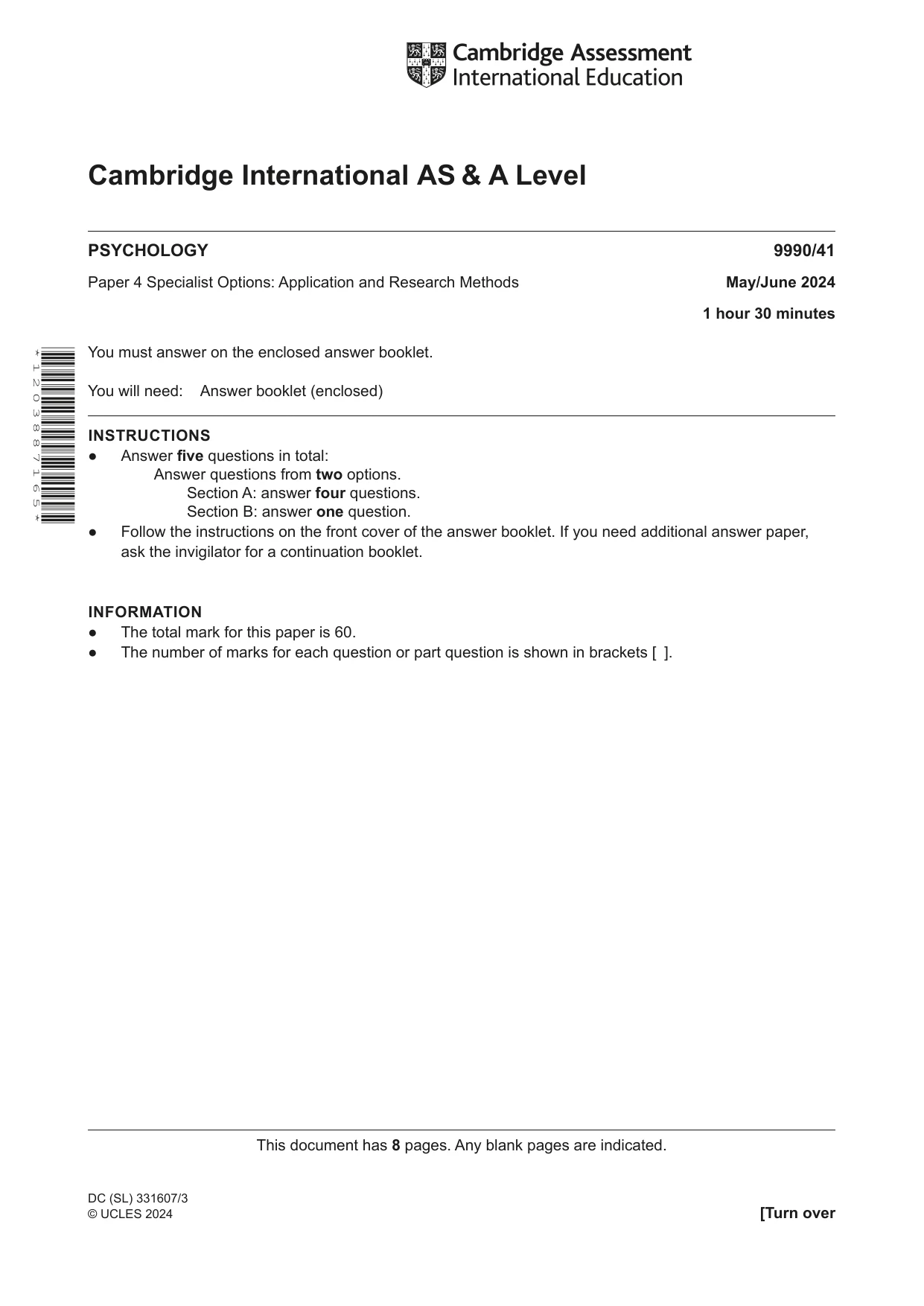



Mark scheme30 pages
Answers below. Sit the paper first if you are practising.
Questions as text
Q1 · The key study by Freeman et al
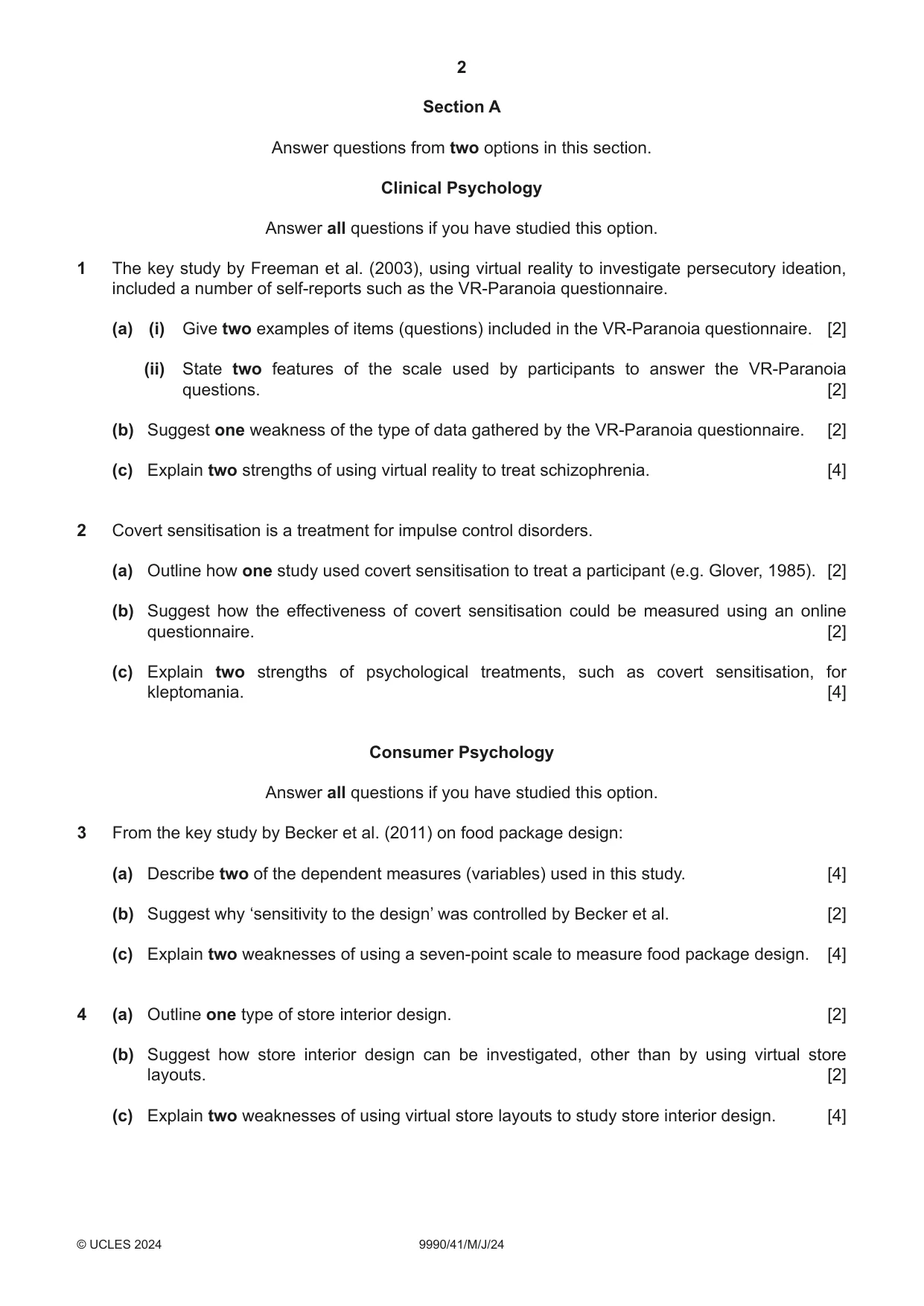
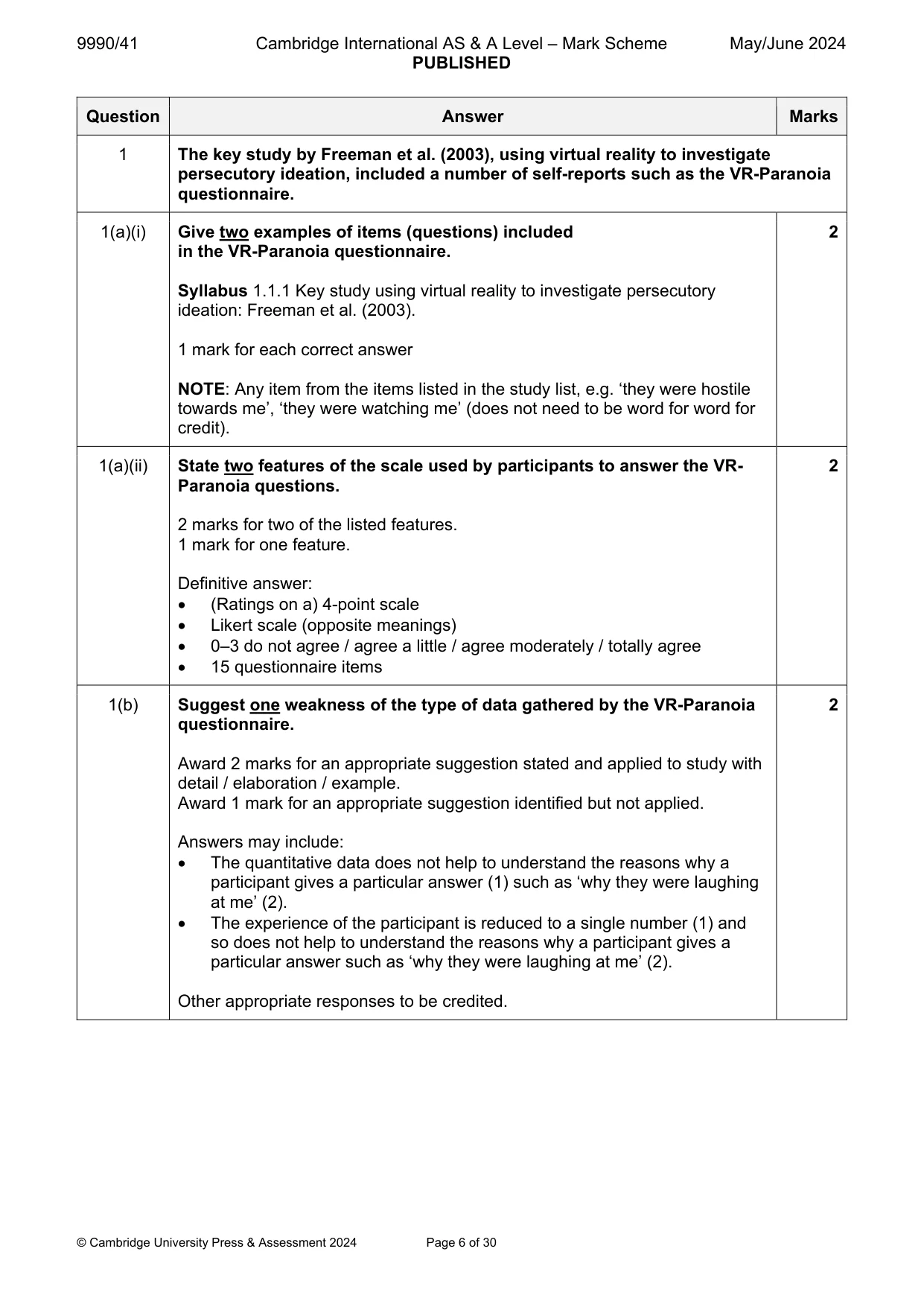
1 The key study by Freeman et al. (2003), using virtual reality to investigate persecutory ideation, included a number of self-reports such as the VR-Paranoia questionnaire. (a) (i) Give two examples of items (questions) included in the VR-Paranoia questionnaire. [2] (ii) State two features of the scale used by participants to answer the VR-Paranoia questions. [2] (b) Suggest one weakness of the type of data gathered by the VR-Paranoia questionnaire. [2] (c) Explain two strengths of using virtual reality to treat schizophrenia. [4]
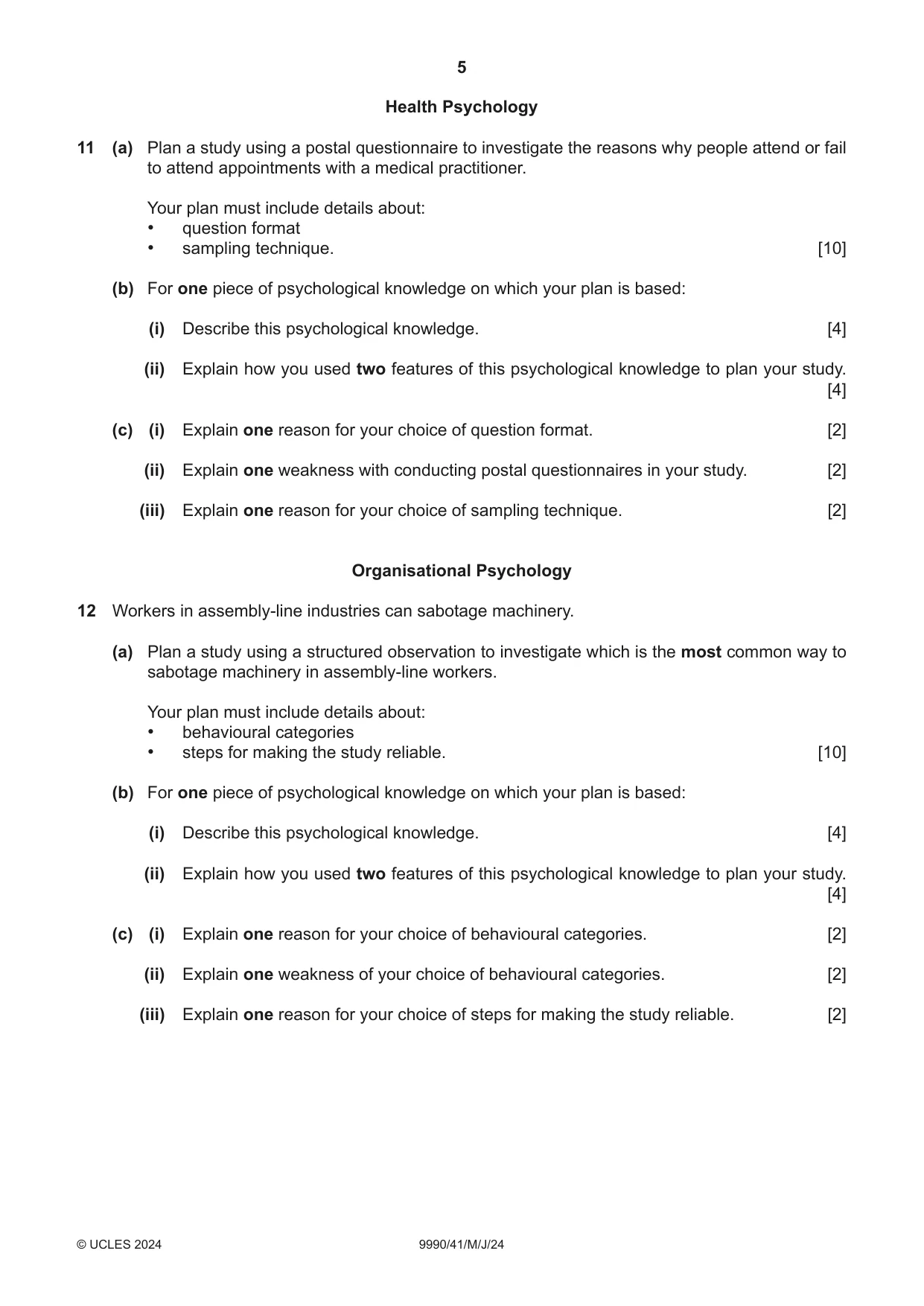
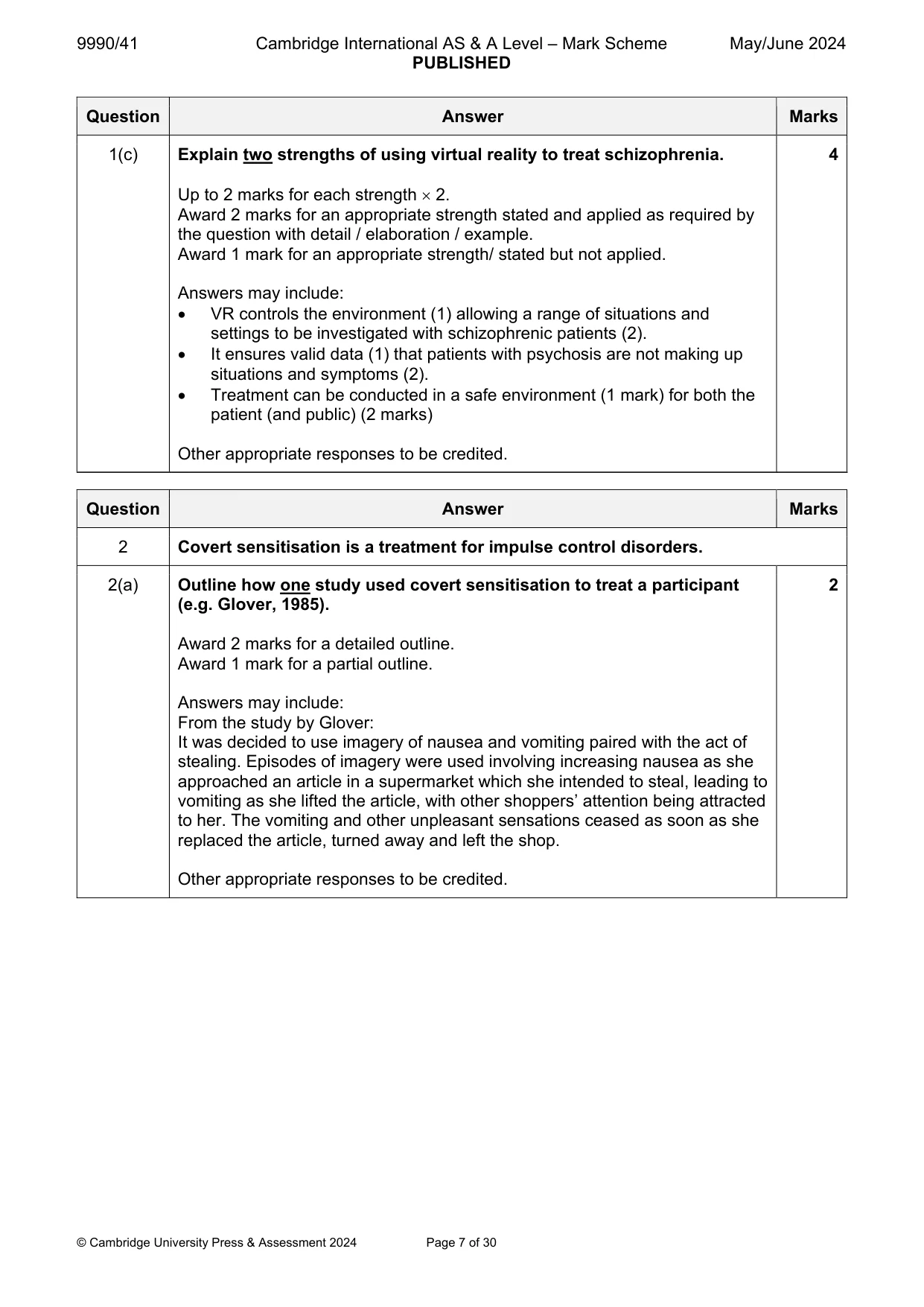
Mark scheme: Question Answer Marks 1 The key study by Freeman et al. (2003), using virtual reality to investigate persecutory ideation, included a number of self-reports such as the VR-Paranoia questionnaire. 1(a)(i) Give two examples of items (questions) included 2 in the VR-Paranoia questionnaire. Syllabus 1.1.1 Key study using virtual reality to investigate persecutory ideation: Freeman et al. (2003). 1 mark for each correct answer NOTE: Any item from the items listed in the study list, e.g. ‘they were hostile towards me’, ‘they were watching me’ (does not need to be word for word for credit). 1(a)(ii) State two features of the scale used by participants to answer the VR- 2 Paranoia questions. 2 marks for two of the listed features. 1 mark for one feature. Definitive answer: (Ratings on a) 4-point scale Likert scale (opposite meanings) 0–3 do not agree / agree a little / agree moderately / totally agree 15 questionnaire items 1(b) Suggest one weakness of the type of data gathered by the VR-Paranoia 2 questionnaire. Award 2 marks for an appropriate suggestion stated and applied to study with detail / elaboration / example. Award 1 mark for an appropriate suggestion identified but not applied. Answers may include: The quantitative data does not help to understand the reasons why a participant gives a particular answer (1) such as ‘why they were laughing at me’ (2). The experience of the participant is reduced to a single number (1) and so does not help to understand the reasons why a participant gives a particular answer such as ‘why they were laughing at me’ (2). Other appropriate responses to be credited. 1(c) Explain two strengths of using virtual reality to treat schizophrenia. 4 Up to 2 marks for each strength 2. Award 2 marks for an appropriate strength stated and applied as required by the question with detail / elaboration / example. Award 1 mark for an appropriate strength/ stated but not applied. Answers may include: VR controls the environment (1) allowing a range of situations and settings to be investigated with schizophrenic patients (2). It ensures valid data (1) that patients with psychosis are not making up situations and symptoms (2). Treatment can be conducted in a safe environment (1 mark) for both the patient (and public) (2 marks) Other appropriate responses to be credited.
Q2 · Covert sensitisation is a treatment for impulse control disorders
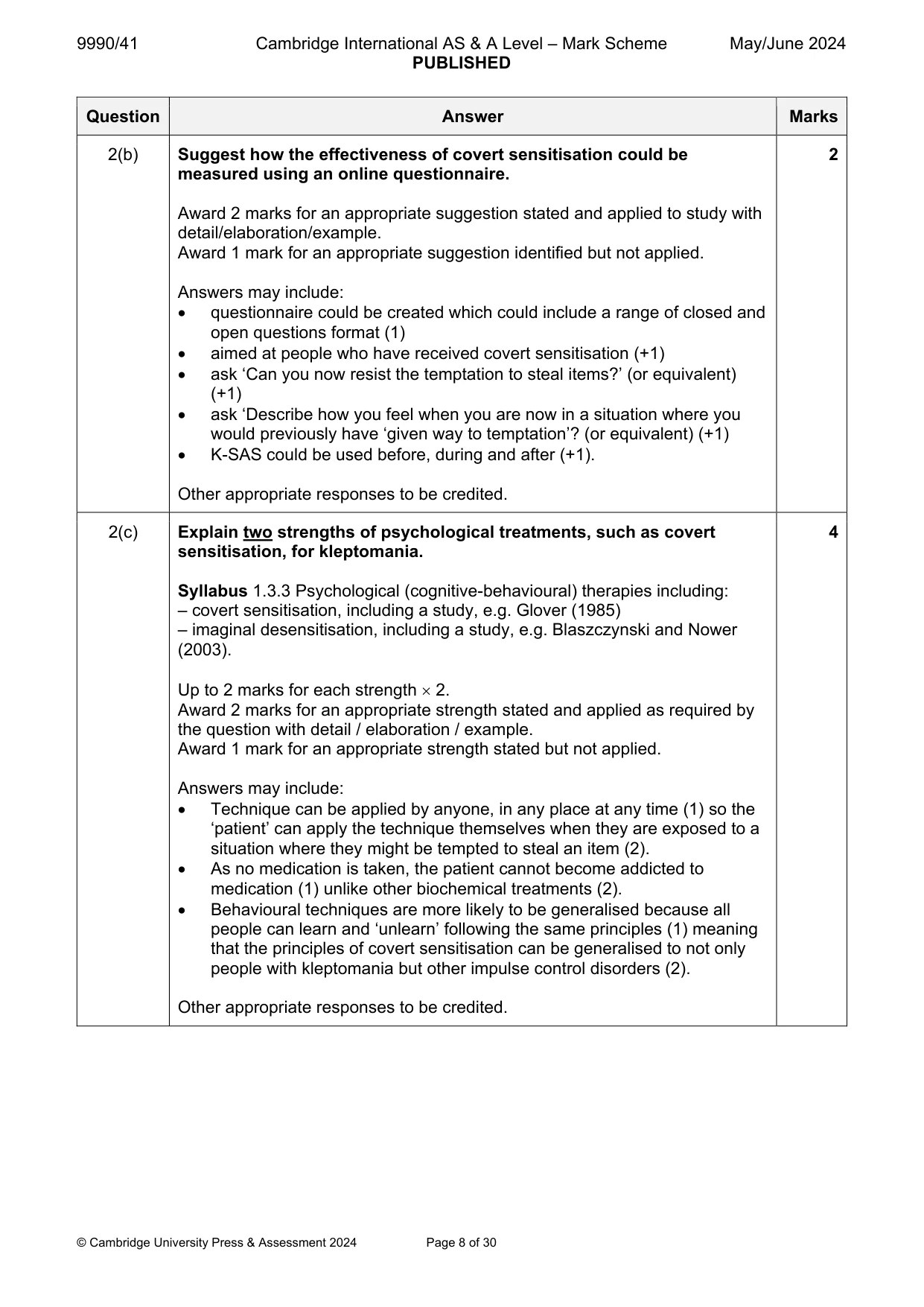
2 Covert sensitisation is a treatment for impulse control disorders. (a) Outline how one study used covert sensitisation to treat a participant (e.g. Glover, 1985). [2] (b) Suggest how the effectiveness of covert sensitisation could be measured using an online questionnaire. [2] (c) Explain two strengths of psychological treatments, such as covert sensitisation, for kleptomania. [4] Consumer Psychology Answer all questions if you have studied this option.
Mark scheme: 2(a) Outline how one study used covert sensitisation to treat a participant 2 (e.g. Glover, 1985). Award 2 marks for a detailed outline. Award 1 mark for a partial outline. Answers may include: From the study by Glover: It was decided to use imagery of nausea and vomiting paired with the act of stealing. Episodes of imagery were used involving increasing nausea as she approached an article in a supermarket which she intended to steal, leading to vomiting as she lifted the article, with other shoppers’ attention being attracted to her. The vomiting and other unpleasant sensations ceased as soon as she replaced the article, turned away and left the shop. Other appropriate responses to be credited. 2(b) Suggest how the effectiveness of covert sensitisation could be 2 measured using an online questionnaire. Award 2 marks for an appropriate suggestion stated and applied to study with detail/elaboration/example. Award 1 mark for an appropriate suggestion identified but not applied. Answers may include: questionnaire could be created which could include a range of closed and open questions format (1) aimed at people who have received covert sensitisation (+1) ask ‘Can you now resist the temptation to steal items?’ (or equivalent) (+1) ask ‘Describe how you feel when you are now in a situation where you would previously have ‘given way to temptation’? (or equivalent) (+1) K-SAS could be used before, during and after (+1). Other appropriate responses to be credited. 2(c) Explain two strengths of psychological treatments, such as covert 4 sensitisation, for kleptomania. Syllabus 1.3.3 Psychological (cognitive-behavioural) therapies including: – covert sensitisation, including a study, e.g. Glover (1985) – imaginal desensitisation, including a study, e.g. Blaszczynski and Nower (2003). Up to 2 marks for each strength 2. Award 2 marks for an appropriate strength stated and applied as required by the question with detail / elaboration / example. Award 1 mark for an appropriate strength stated but not applied. Answers may include: Technique can be applied by anyone, in any place at any time (1) so the ‘patient’ can apply the technique themselves when they are exposed to a situation where they might be tempted to steal an item (2). As no medication is taken, the patient cannot become addicted to medication (1) unlike other biochemical treatments (2). Behavioural techniques are more likely to be generalised because all people can learn and ‘unlearn’ following the same principles (1) meaning that the principles of covert sensitisation can be generalised to not only people with kleptomania but other impulse control disorders (2). Other appropriate responses to be credited.
Q3 · From the key study by Becker et al
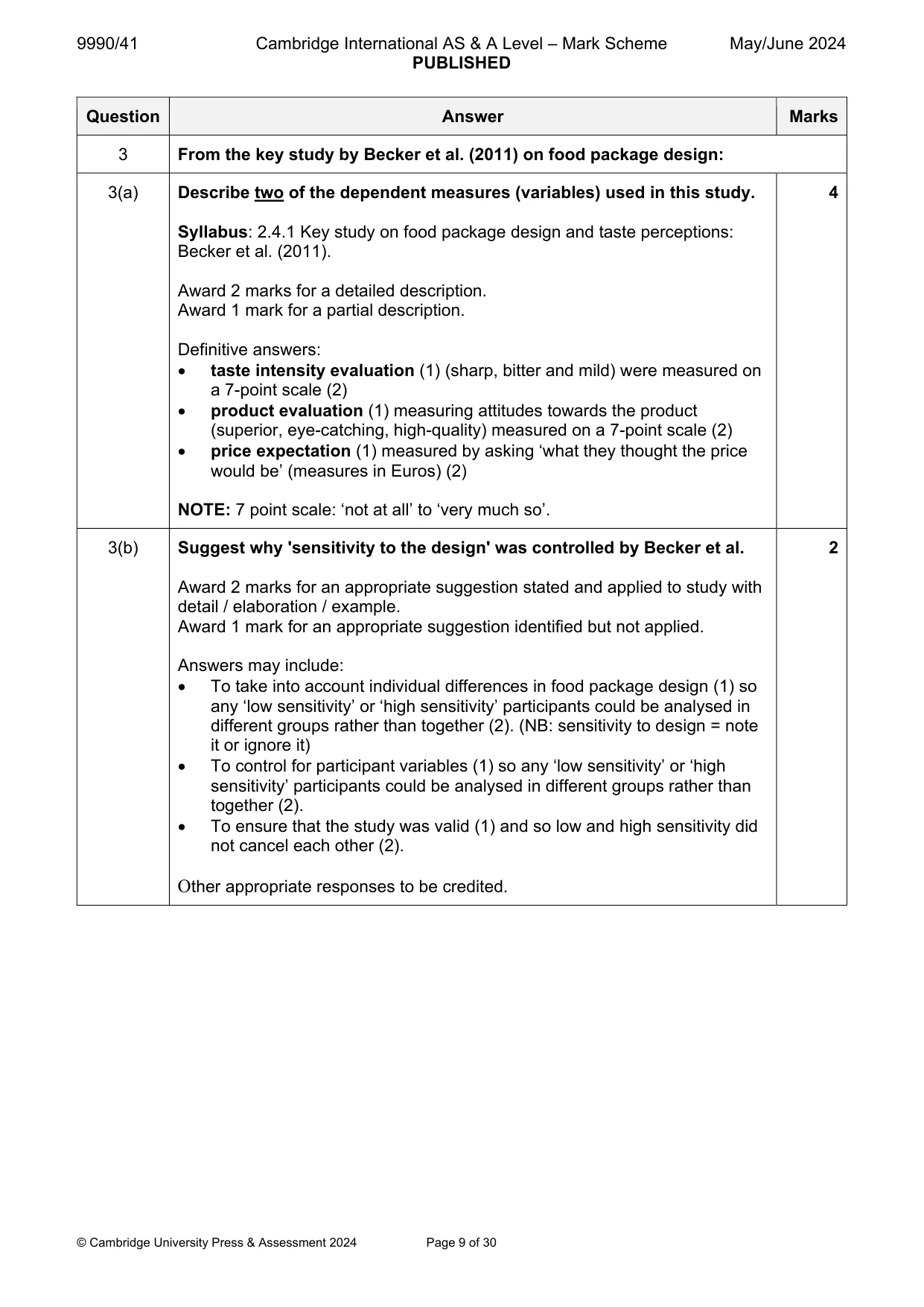
3 From the key study by Becker et al. (2011) on food package design: (a) Describe two of the dependent measures (variables) used in this study. [4] (b) Suggest why ‘sensitivity to the design’ was controlled by Becker et al. [2] (c) Explain two weaknesses of using a seven-point scale to measure food package design. [4]
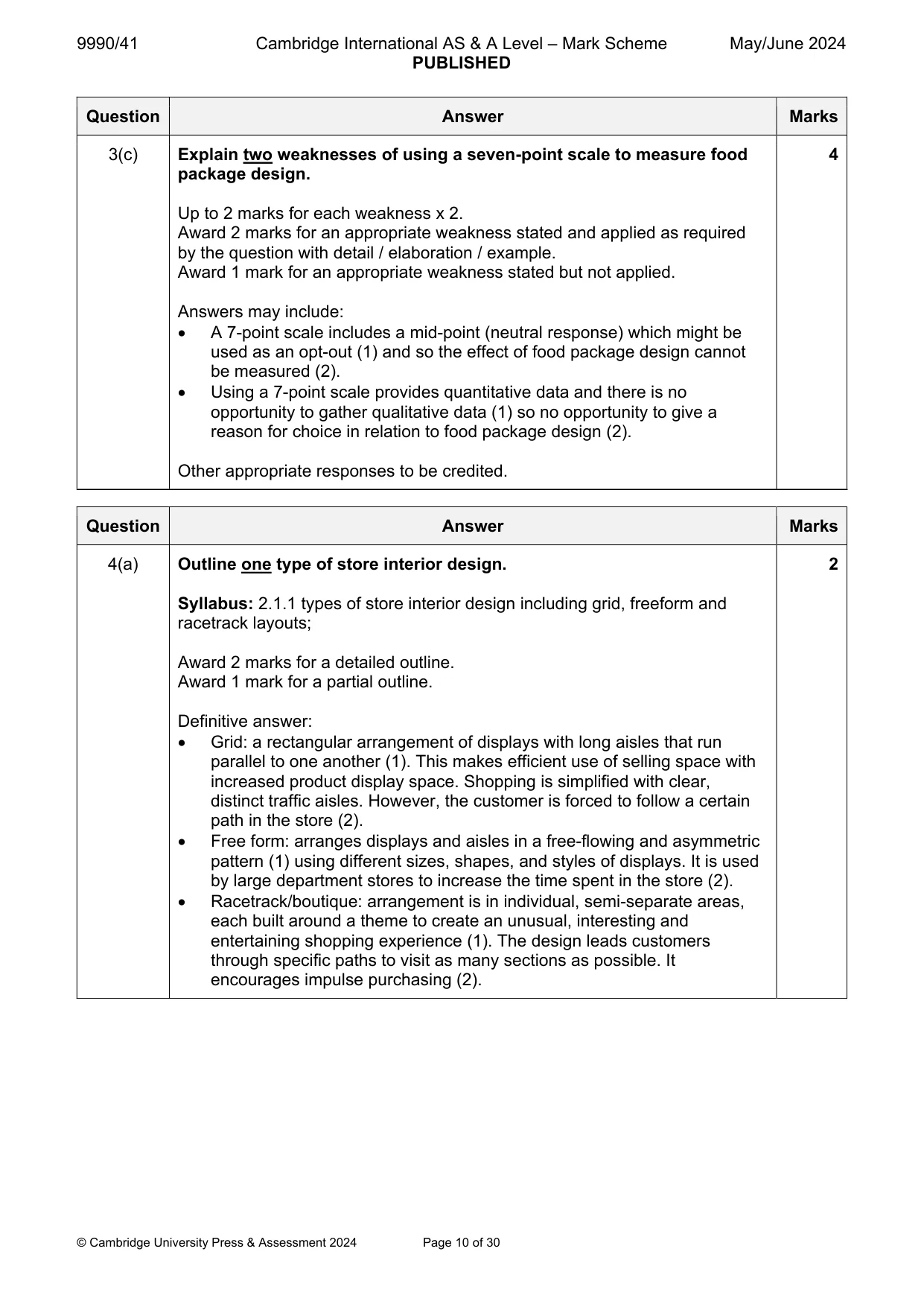
Mark scheme: 3(a) Describe two of the dependent measures (variables) used in this study. 4 Syllabus: 2.4.1 Key study on food package design and taste perceptions: Becker et al. (2011). Award 2 marks for a detailed description. Award 1 mark for a partial description. Definitive answers: taste intensity evaluation (1) (sharp, bitter and mild) were measured on a 7-point scale (2) product evaluation (1) measuring attitudes towards the product (superior, eye-catching, high-quality) measured on a 7-point scale (2) price expectation (1) measured by asking ‘what they thought the price would be’ (measures in Euros) (2) NOTE: 7 point scale: ‘not at all’ to ‘very much so’. 3(b) Suggest why 'sensitivity to the design' was controlled by Becker et al. 2 Award 2 marks for an appropriate suggestion stated and applied to study with detail / elaboration / example. Award 1 mark for an appropriate suggestion identified but not applied. Answers may include: To take into account individual differences in food package design (1) so any ‘low sensitivity’ or ‘high sensitivity’ participants could be analysed in different groups rather than together (2). (NB: sensitivity to design = note it or ignore it) To control for participant variables (1) so any ‘low sensitivity’ or ‘high sensitivity’ participants could be analysed in different groups rather than together (2). To ensure that the study was valid (1) and so low and high sensitivity did not cancel each other (2). Other appropriate responses to be credited. 3(c) Explain two weaknesses of using a seven-point scale to measure food 4 package design. Up to 2 marks for each weakness x 2. Award 2 marks for an appropriate weakness stated and applied as required by the question with detail / elaboration / example. Award 1 mark for an appropriate weakness stated but not applied. Answers may include: A 7-point scale includes a mid-point (neutral response) which might be used as an opt-out (1) and so the effect of food package design cannot be measured (2). Using a 7-point scale provides quantitative data and there is no opportunity to gather qualitative data (1) so no opportunity to give a reason for choice in relation to food package design (2). Other appropriate responses to be credited.
Q4 · Outline one type of store interior design
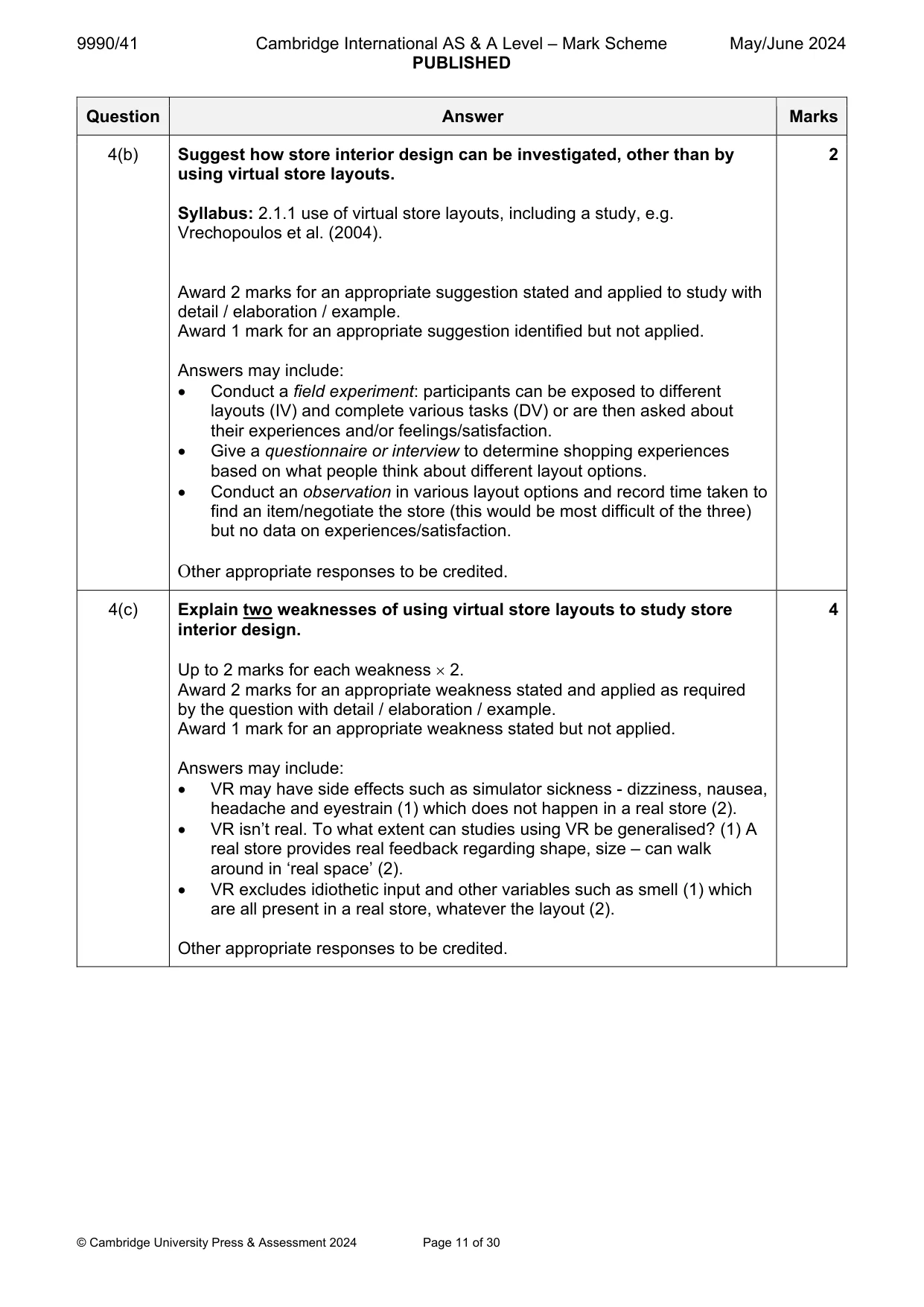
4 (a) Outline one type of store interior design. [2] (b) Suggest how store interior design can be investigated, other than by using virtual store layouts. [2] (c) Explain two weaknesses of using virtual store layouts to study store interior design. [4] Health Psychology Answer all questions if you have studied this option.
Mark scheme: 4(a) Outline one type of store interior design. 2 Syllabus: 2.1.1 types of store interior design including grid, freeform and racetrack layouts; Award 2 marks for a detailed outline. Award 1 mark for a partial outline. Definitive answer: Grid: a rectangular arrangement of displays with long aisles that run parallel to one another (1). This makes efficient use of selling space with increased product display space. Shopping is simplified with clear, distinct traffic aisles. However, the customer is forced to follow a certain path in the store (2). Free form: arranges displays and aisles in a free-flowing and asymmetric pattern (1) using different sizes, shapes, and styles of displays. It is used by large department stores to increase the time spent in the store (2). Racetrack/boutique: arrangement is in individual, semi-separate areas, each built around a theme to create an unusual, interesting and entertaining shopping experience (1). The design leads customers through specific paths to visit as many sections as possible. It encourages impulse purchasing (2). 4(b) Suggest how store interior design can be investigated, other than by 2 using virtual store layouts. Syllabus: 2.1.1 use of virtual store layouts, including a study, e.g. Vrechopoulos et al. (2004). Award 2 marks for an appropriate suggestion stated and applied to study with detail / elaboration / example. Award 1 mark for an appropriate suggestion identified but not applied. Answers may include: Conduct a field experiment: participants can be exposed to different layouts (IV) and complete various tasks (DV) or are then asked about their experiences and/or feelings/satisfaction. Give a questionnaire or interview to determine shopping experiences based on what people think about different layout options. Conduct an observation in various layout options and record time taken to find an item/negotiate the store (this would be most difficult of the three) but no data on experiences/satisfaction. Other appropriate responses to be credited. 4(c) Explain two weaknesses of using virtual store layouts to study store 4 interior design. Up to 2 marks for each weakness 2. Award 2 marks for an appropriate weakness stated and applied as required by the question with detail / elaboration / example. Award 1 mark for an appropriate weakness stated but not applied. Answers may include: VR may have side effects such as simulator sickness - dizziness, nausea, headache and eyestrain (1) which does not happen in a real store (2). VR isn’t real. To what extent can studies using VR be generalised? (1) A real store provides real feedback regarding shape, size – can walk around in ‘real space’ (2). VR excludes idiothetic input and other variables such as smell (1) which are all present in a real store, whatever the layout (2). Other appropriate responses to be credited.
Q5 · In the key study by Bridge et al
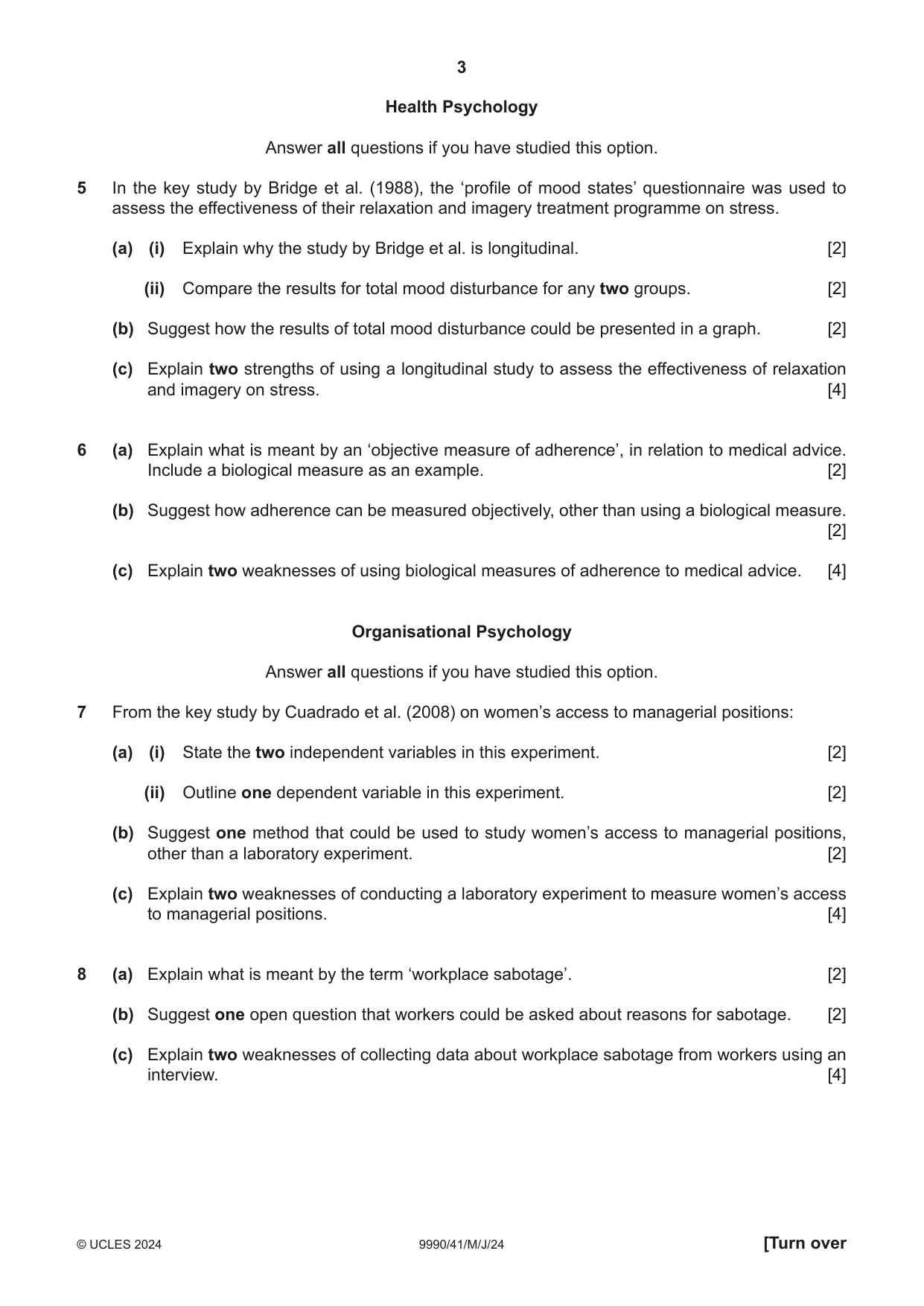
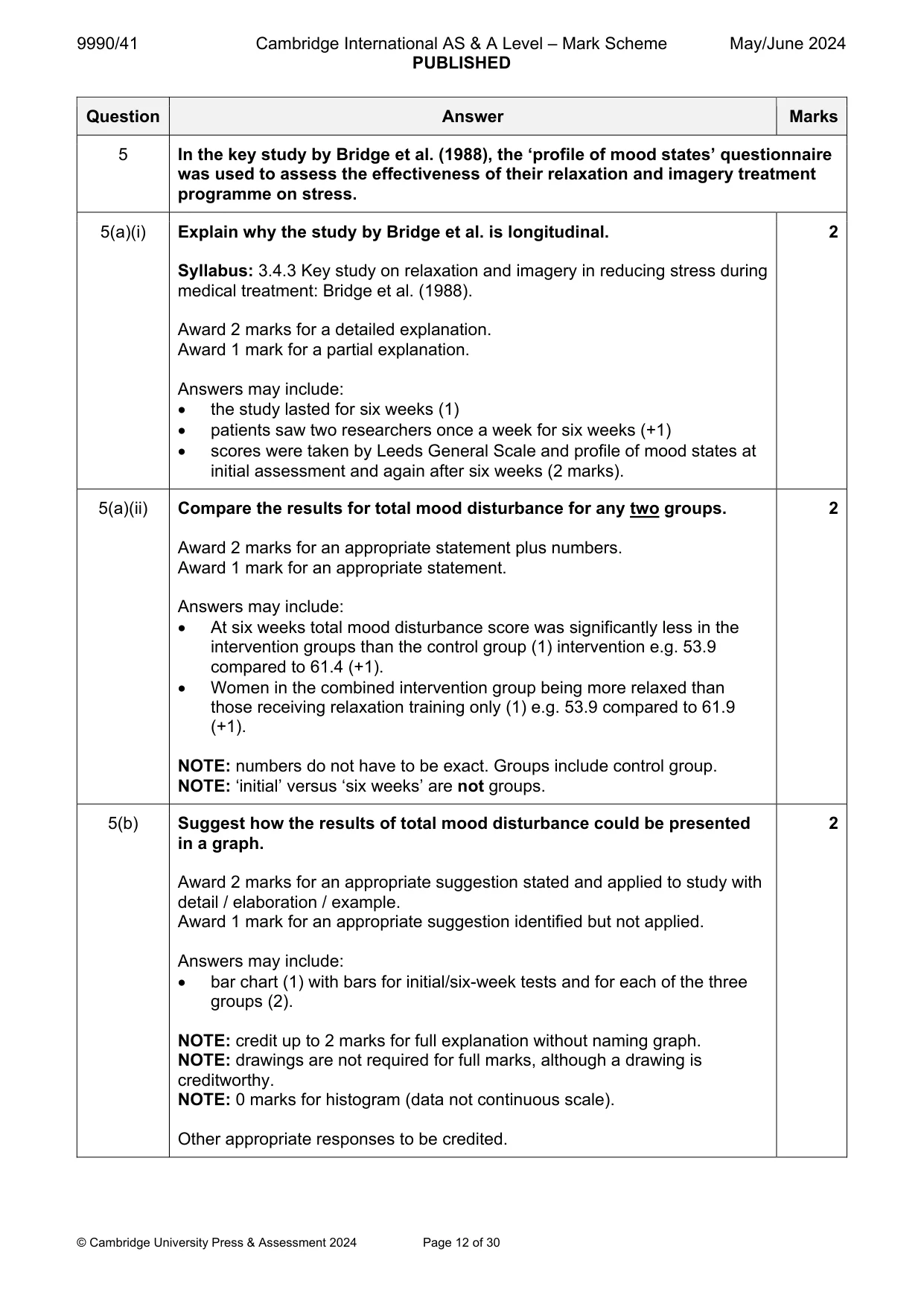
5 In the key study by Bridge et al. (1988), the ‘profile of mood states’ questionnaire was used to assess the effectiveness of their relaxation and imagery treatment programme on stress. (a) (i) Explain why the study by Bridge et al. is longitudinal. [2] (ii) Compare the results for total mood disturbance for any two groups. [2] (b) Suggest how the results of total mood disturbance could be presented in a graph. [2] (c) Explain two strengths of using a longitudinal study to assess the effectiveness of relaxation and imagery on stress. [4]
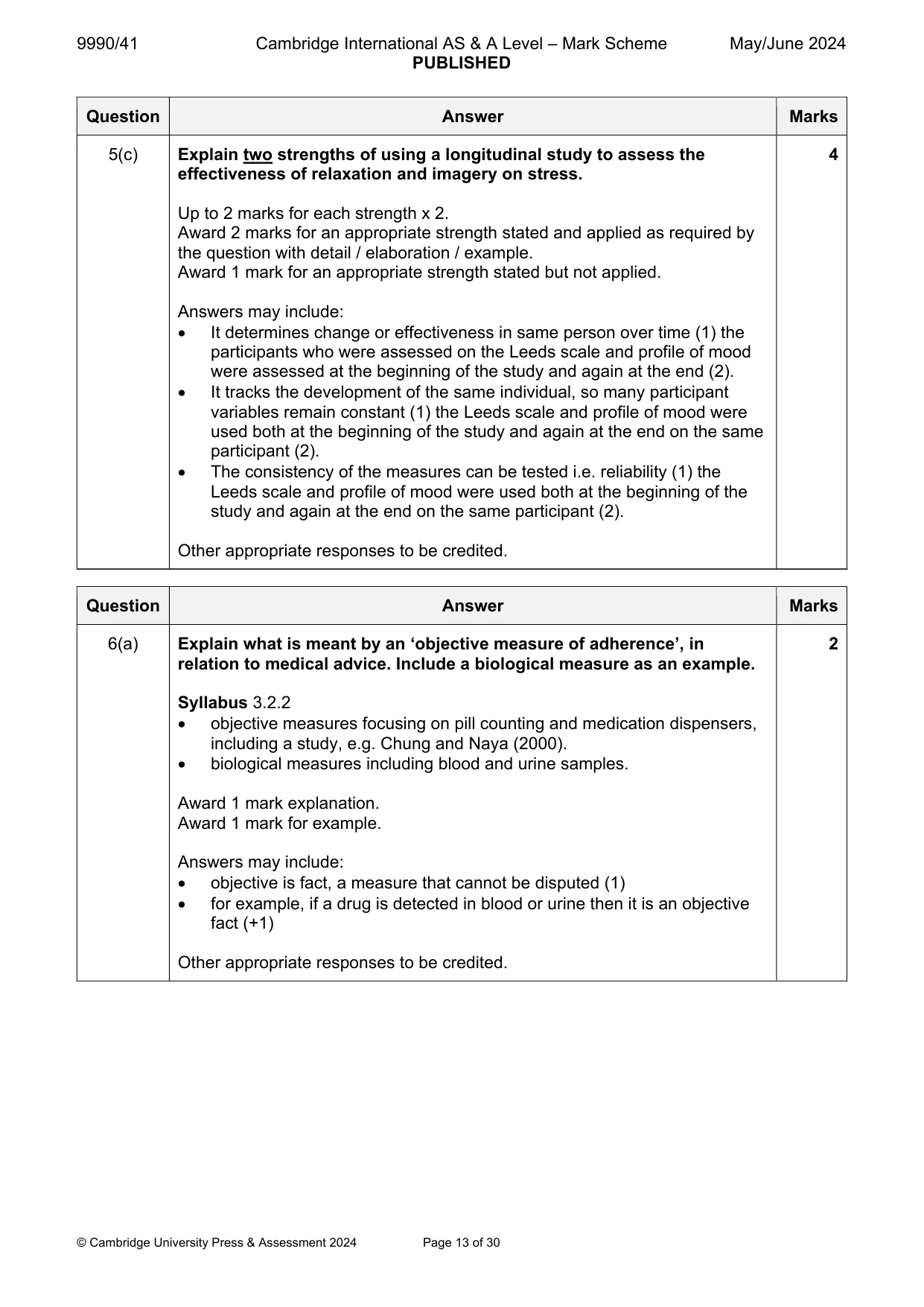
Mark scheme: 5(a)(i) Explain why the study by Bridge et al. is longitudinal. 2 Syllabus: 3.4.3 Key study on relaxation and imagery in reducing stress during medical treatment: Bridge et al. (1988). Award 2 marks for a detailed explanation. Award 1 mark for a partial explanation. Answers may include: the study lasted for six weeks (1) patients saw two researchers once a week for six weeks (+1) scores were taken by Leeds General Scale and profile of mood states at initial assessment and again after six weeks (2 marks). 5(a)(ii) Compare the results for total mood disturbance for any two groups. 2 Award 2 marks for an appropriate statement plus numbers. Award 1 mark for an appropriate statement. Answers may include: At six weeks total mood disturbance score was significantly less in the intervention groups than the control group (1) intervention e.g. 53.9 compared to 61.4 (+1). Women in the combined intervention group being more relaxed than those receiving relaxation training only (1) e.g. 53.9 compared to 61.9 (+1). NOTE: numbers do not have to be exact. Groups include control group. NOTE: ‘initial’ versus ‘six weeks’ are not groups. 5(b) Suggest how the results of total mood disturbance could be presented 2 in a graph. Award 2 marks for an appropriate suggestion stated and applied to study with detail / elaboration / example. Award 1 mark for an appropriate suggestion identified but not applied. Answers may include: bar chart (1) with bars for initial/six-week tests and for each of the three groups (2). NOTE: credit up to 2 marks for full explanation without naming graph. NOTE: drawings are not required for full marks, although a drawing is creditworthy. NOTE: 0 marks for histogram (data not continuous scale). Other appropriate responses to be credited. 5(c) Explain two strengths of using a longitudinal study to assess the 4 effectiveness of relaxation and imagery on stress. Up to 2 marks for each strength x 2. Award 2 marks for an appropriate strength stated and applied as required by the question with detail / elaboration / example. Award 1 mark for an appropriate strength stated but not applied. Answers may include: It determines change or effectiveness in same person over time (1) the participants who were assessed on the Leeds scale and profile of mood were assessed at the beginning of the study and again at the end (2). It tracks the development of the same individual, so many participant variables remain constant (1) the Leeds scale and profile of mood were used both at the beginning of the study and again at the end on the same participant (2). The consistency of the measures can be tested i.e. reliability (1) the Leeds scale and profile of mood were used both at the beginning of the study and again at the end on the same participant (2). Other appropriate responses to be credited.
Q6 · Explain what is meant by an ‘objective measure of adherence’, in relation to medical…
6 (a) Explain what is meant by an ‘objective measure of adherence’, in relation to medical advice. Include a biological measure as an example. [2] (b) Suggest how adherence can be measured objectively, other than using a biological measure. [2] (c) Explain two weaknesses of using biological measures of adherence to medical advice. [4] Organisational Psychology Answer all questions if you have studied this option.
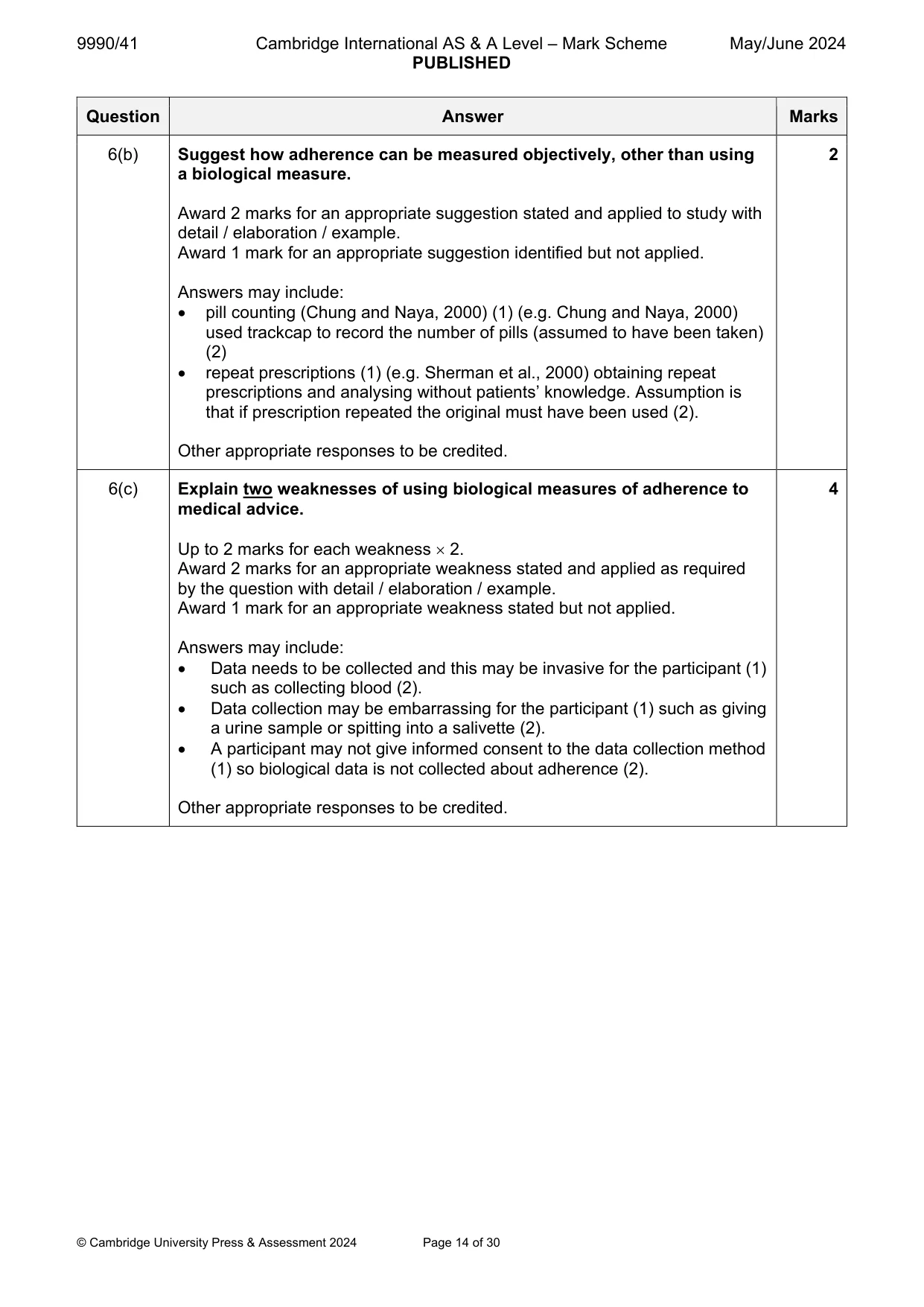
Mark scheme: 6(a) Explain what is meant by an ‘objective measure of adherence’, in 2 relation to medical advice. Include a biological measure as an example. Syllabus 3.2.2 objective measures focusing on pill counting and medication dispensers, including a study, e.g. Chung and Naya (2000). biological measures including blood and urine samples. Award 1 mark explanation. Award 1 mark for example. Answers may include: objective is fact, a measure that cannot be disputed (1) for example, if a drug is detected in blood or urine then it is an objective fact (+1) Other appropriate responses to be credited. 6(b) Suggest how adherence can be measured objectively, other than using 2 a biological measure. Award 2 marks for an appropriate suggestion stated and applied to study with detail / elaboration / example. Award 1 mark for an appropriate suggestion identified but not applied. Answers may include: pill counting (Chung and Naya, 2000) (1) (e.g. Chung and Naya, 2000) used trackcap to record the number of pills (assumed to have been taken) (2) repeat prescriptions (1) (e.g. Sherman et al., 2000) obtaining repeat prescriptions and analysing without patients’ knowledge. Assumption is that if prescription repeated the original must have been used (2). Other appropriate responses to be credited. 6(c) Explain two weaknesses of using biological measures of adherence to 4 medical advice. Up to 2 marks for each weakness 2. Award 2 marks for an appropriate weakness stated and applied as required by the question with detail / elaboration / example. Award 1 mark for an appropriate weakness stated but not applied. Answers may include: Data needs to be collected and this may be invasive for the participant (1) such as collecting blood (2). Data collection may be embarrassing for the participant (1) such as giving a urine sample or spitting into a salivette (2). A participant may not give informed consent to the data collection method (1) so biological data is not collected about adherence (2). Other appropriate responses to be credited.
Q7 · From the key study by Cuadrado et al
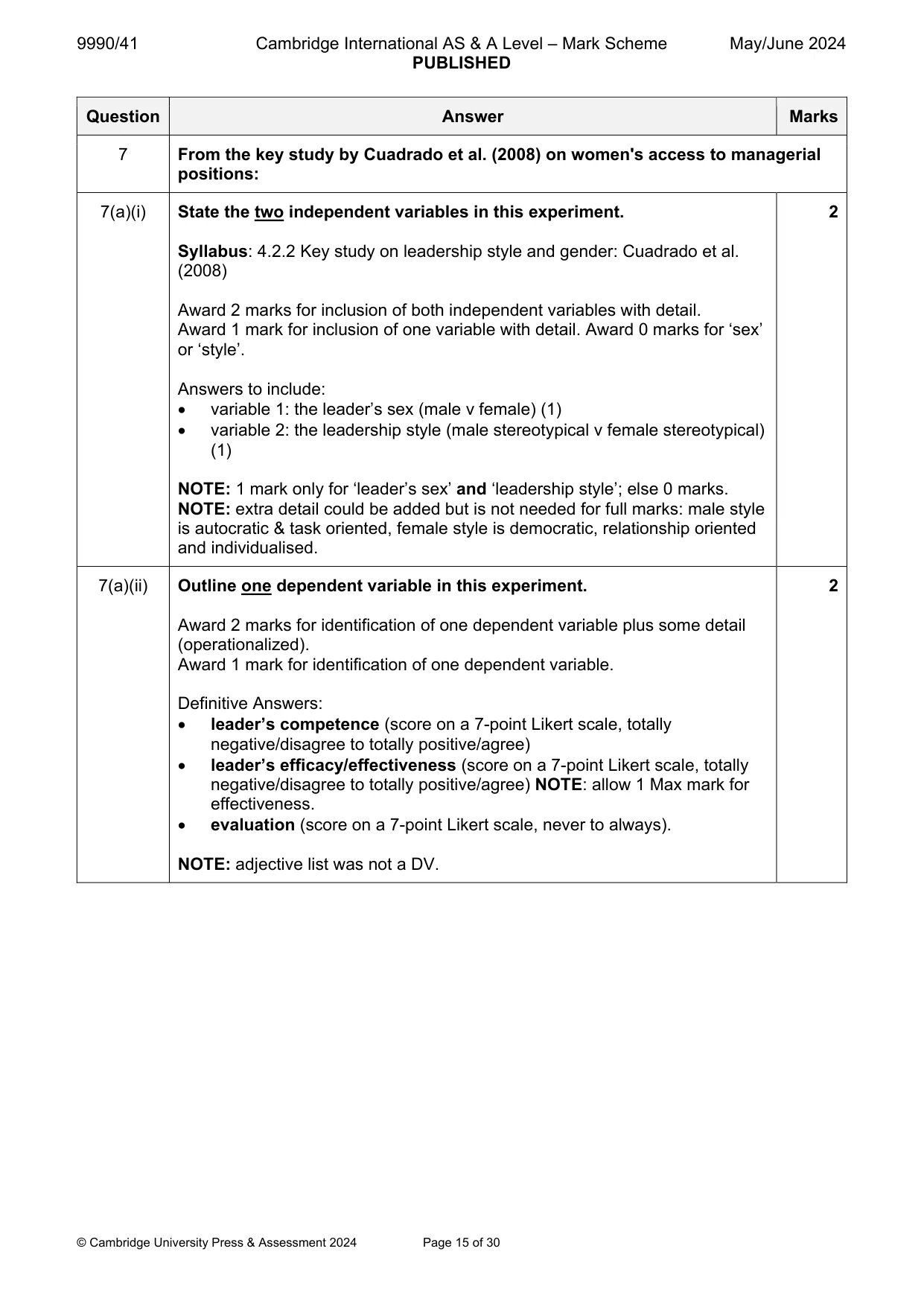
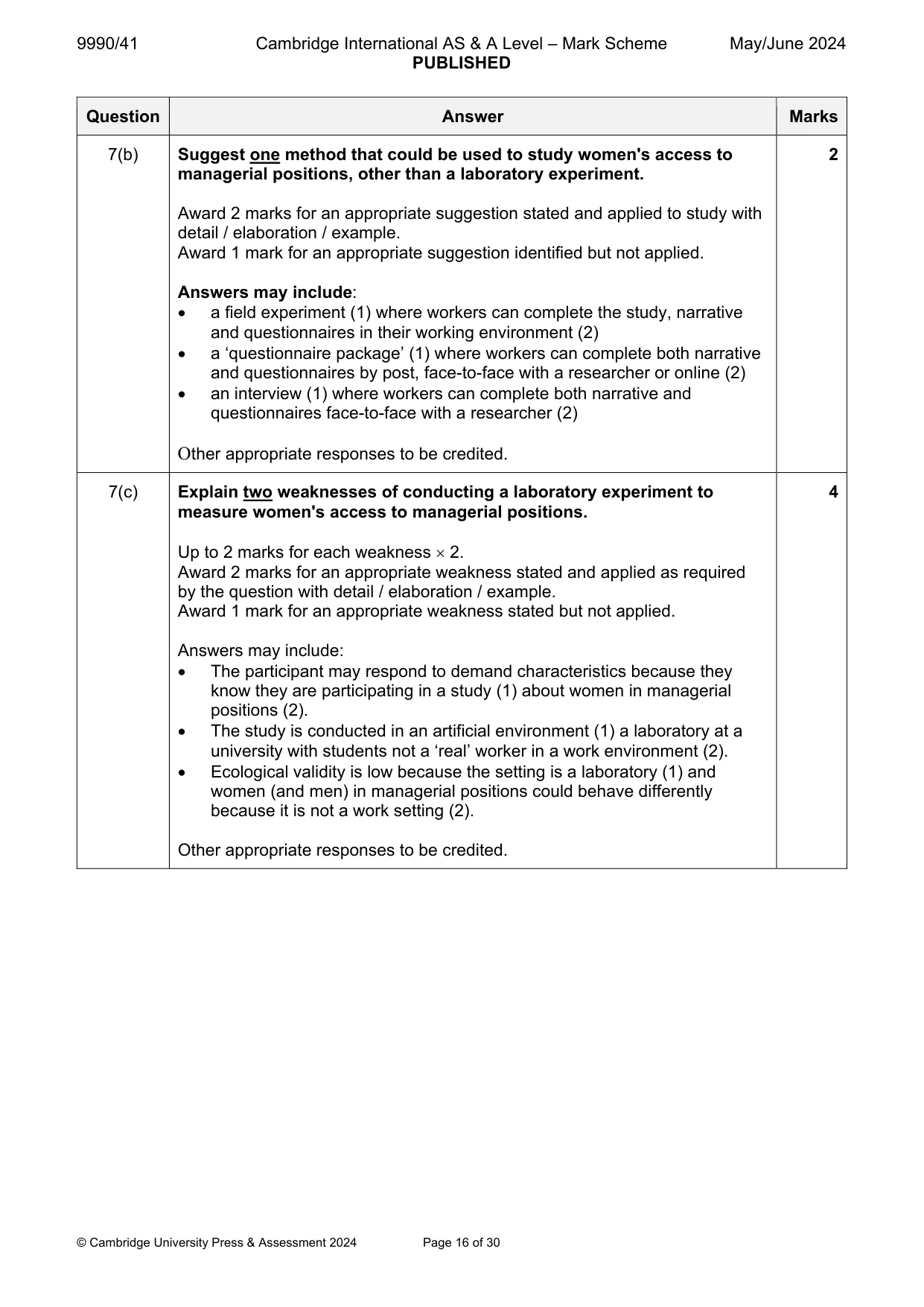
7 From the key study by Cuadrado et al. (2008) on women’s access to managerial positions: (a) (i) State the two independent variables in this experiment. [2] (ii) Outline one dependent variable in this experiment. [2] (b) Suggest one method that could be used to study women’s access to managerial positions, other than a laboratory experiment. [2] (c) Explain two weaknesses of conducting a laboratory experiment to measure women’s access to managerial positions. [4]
Mark scheme: 7(a)(i) State the two independent variables in this experiment. 2 Syllabus: 4.2.2 Key study on leadership style and gender: Cuadrado et al. (2008) Award 2 marks for inclusion of both independent variables with detail. Award 1 mark for inclusion of one variable with detail. Award 0 marks for ‘sex’ or ‘style’. Answers to include: variable 1: the leader’s sex (male v female) (1) variable 2: the leadership style (male stereotypical v female stereotypical) (1) NOTE: 1 mark only for ‘leader’s sex’ and ‘leadership style’; else 0 marks. NOTE: extra detail could be added but is not needed for full marks: male style is autocratic & task oriented, female style is democratic, relationship oriented and individualised. 7(a)(ii) Outline one dependent variable in this experiment. 2 Award 2 marks for identification of one dependent variable plus some detail (operationalized). Award 1 mark for identification of one dependent variable. Definitive Answers: leader’s competence (score on a 7-point Likert scale, totally negative/disagree to totally positive/agree) leader’s efficacy/effectiveness (score on a 7-point Likert scale, totally negative/disagree to totally positive/agree) NOTE: allow 1 Max mark for effectiveness. evaluation (score on a 7-point Likert scale, never to always). NOTE: adjective list was not a DV. 7(b) Suggest one method that could be used to study women's access to 2 managerial positions, other than a laboratory experiment. Award 2 marks for an appropriate suggestion stated and applied to study with detail / elaboration / example. Award 1 mark for an appropriate suggestion identified but not applied. Answers may include: a field experiment (1) where workers can complete the study, narrative and questionnaires in their working environment (2) a ‘questionnaire package’ (1) where workers can complete both narrative and questionnaires by post, face-to-face with a researcher or online (2) an interview (1) where workers can complete both narrative and questionnaires face-to-face with a researcher (2) Other appropriate responses to be credited. 7(c) Explain two weaknesses of conducting a laboratory experiment to 4 measure women's access to managerial positions. Up to 2 marks for each weakness 2. Award 2 marks for an appropriate weakness stated and applied as required by the question with detail / elaboration / example. Award 1 mark for an appropriate weakness stated but not applied. Answers may include: The participant may respond to demand characteristics because they know they are participating in a study (1) about women in managerial positions (2). The study is conducted in an artificial environment (1) a laboratory at a university with students not a ‘real’ worker in a work environment (2). Ecological validity is low because the setting is a laboratory (1) and women (and men) in managerial positions could behave differently because it is not a work setting (2). Other appropriate responses to be credited.
Q8 · Explain what is meant by the term ‘workplace sabotage’
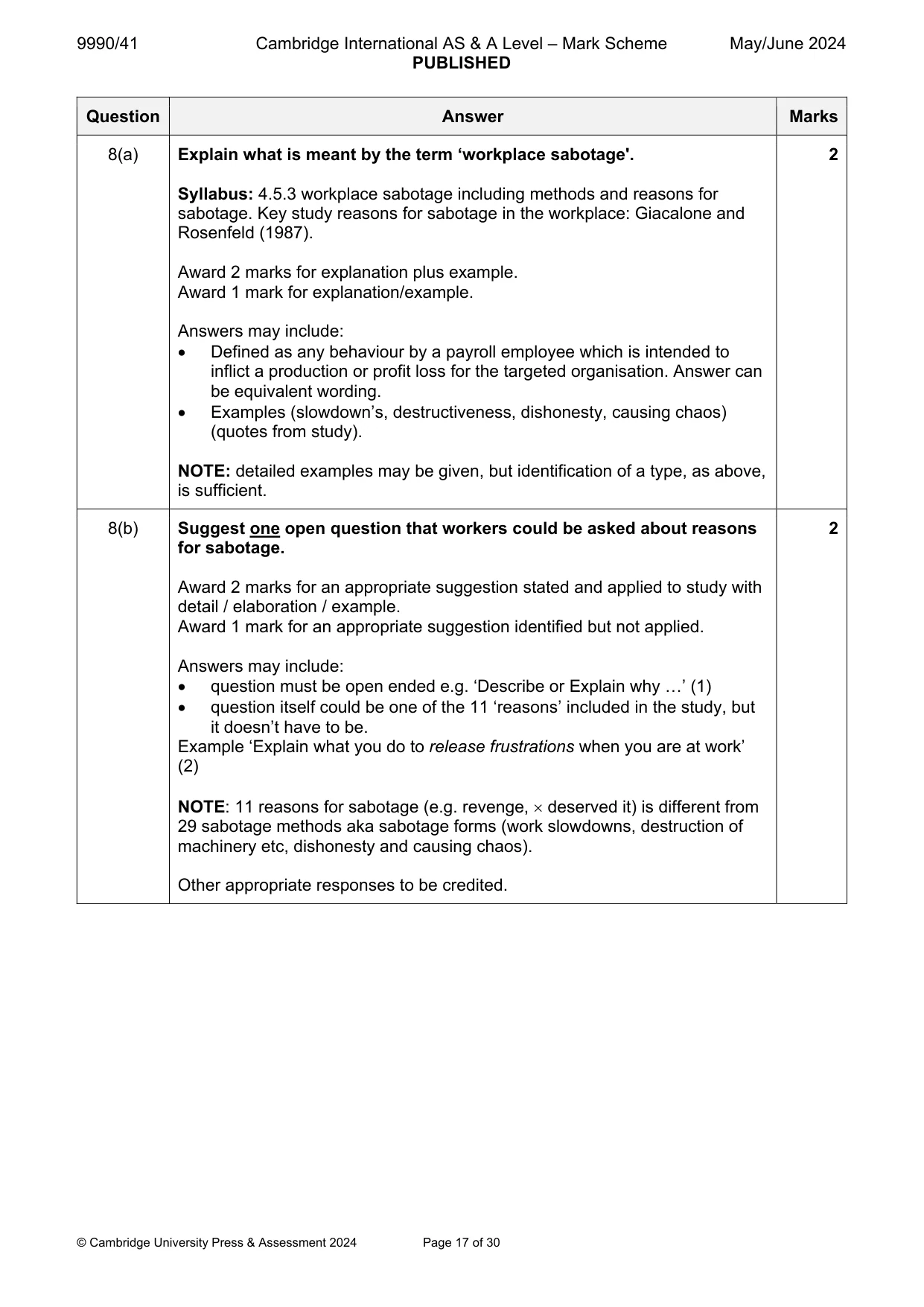
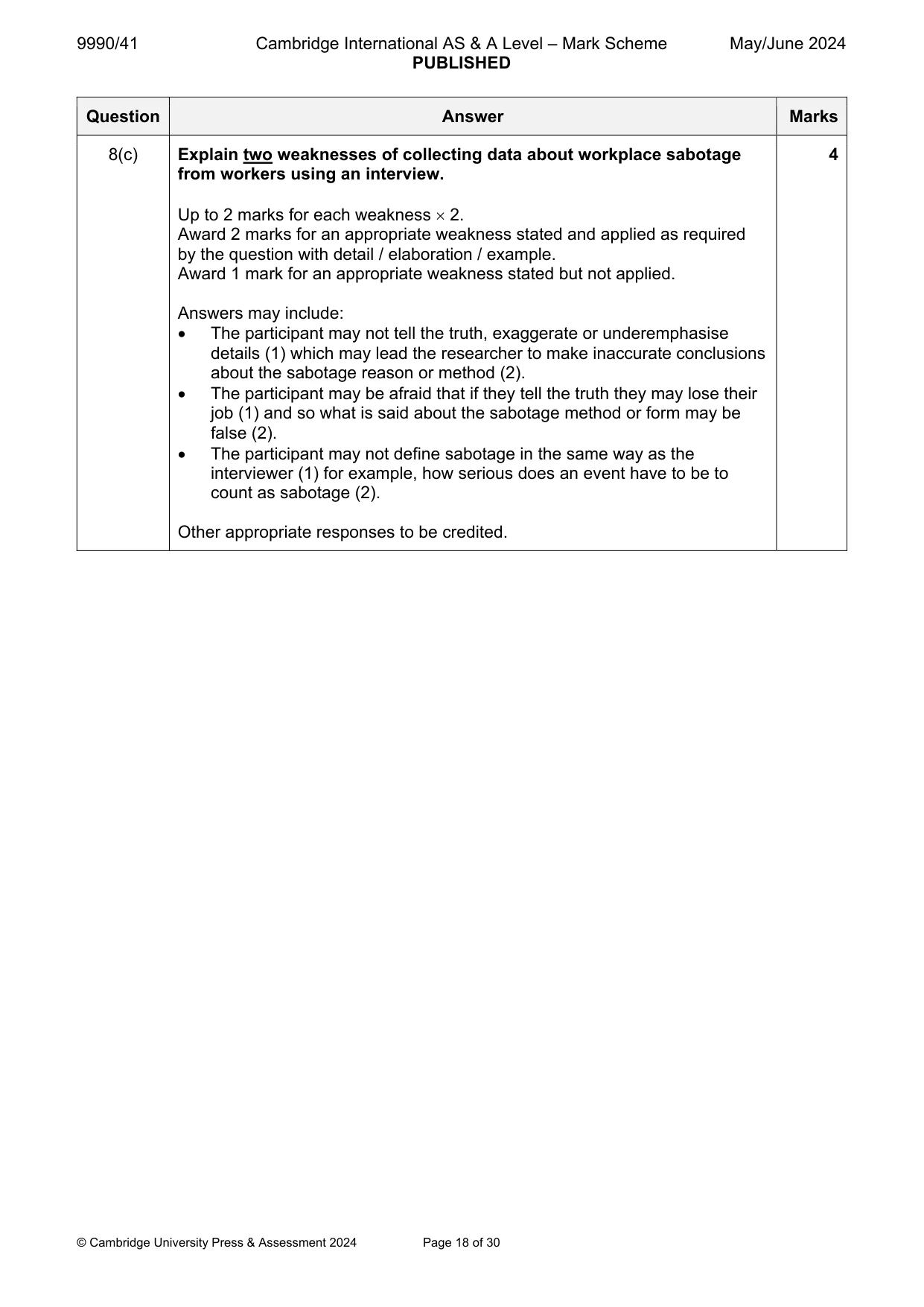
8 (a) Explain what is meant by the term ‘workplace sabotage’. [2] (b) Suggest one open question that workers could be asked about reasons for sabotage. [2] (c) Explain two weaknesses of collecting data about workplace sabotage from workers using an interview. [4]
Mark scheme: 8(a) Explain what is meant by the term ‘workplace sabotage'. 2 Syllabus: 4.5.3 workplace sabotage including methods and reasons for sabotage. Key study reasons for sabotage in the workplace: Giacalone and Rosenfeld (1987). Award 2 marks for explanation plus example. Award 1 mark for explanation/example. Answers may include: Defined as any behaviour by a payroll employee which is intended to inflict a production or profit loss for the targeted organisation. Answer can be equivalent wording. Examples (slowdown’s, destructiveness, dishonesty, causing chaos) (quotes from study). NOTE: detailed examples may be given, but identification of a type, as above, is sufficient. 8(b) Suggest one open question that workers could be asked about reasons 2 for sabotage. Award 2 marks for an appropriate suggestion stated and applied to study with detail / elaboration / example. Award 1 mark for an appropriate suggestion identified but not applied. Answers may include: question must be open ended e.g. ‘Describe or Explain why …’ (1) question itself could be one of the 11 ‘reasons’ included in the study, but it doesn’t have to be. Example ‘Explain what you do to release frustrations when you are at work’ (2) NOTE: 11 reasons for sabotage (e.g. revenge, deserved it) is different from 29 sabotage methods aka sabotage forms (work slowdowns, destruction of machinery etc, dishonesty and causing chaos). Other appropriate responses to be credited. 8(c) Explain two weaknesses of collecting data about workplace sabotage 4 from workers using an interview. Up to 2 marks for each weakness 2. Award 2 marks for an appropriate weakness stated and applied as required by the question with detail / elaboration / example. Award 1 mark for an appropriate weakness stated but not applied. Answers may include: The participant may not tell the truth, exaggerate or underemphasise details (1) which may lead the researcher to make inaccurate conclusions about the sabotage reason or method (2). The participant may be afraid that if they tell the truth they may lose their job (1) and so what is said about the sabotage method or form may be false (2). The participant may not define sabotage in the same way as the interviewer (1) for example, how serious does an event have to be to count as sabotage (2). Other appropriate responses to be credited.
Q9 · There can be problems with using electro-convulsive therapy (ECT) as a treatment for…
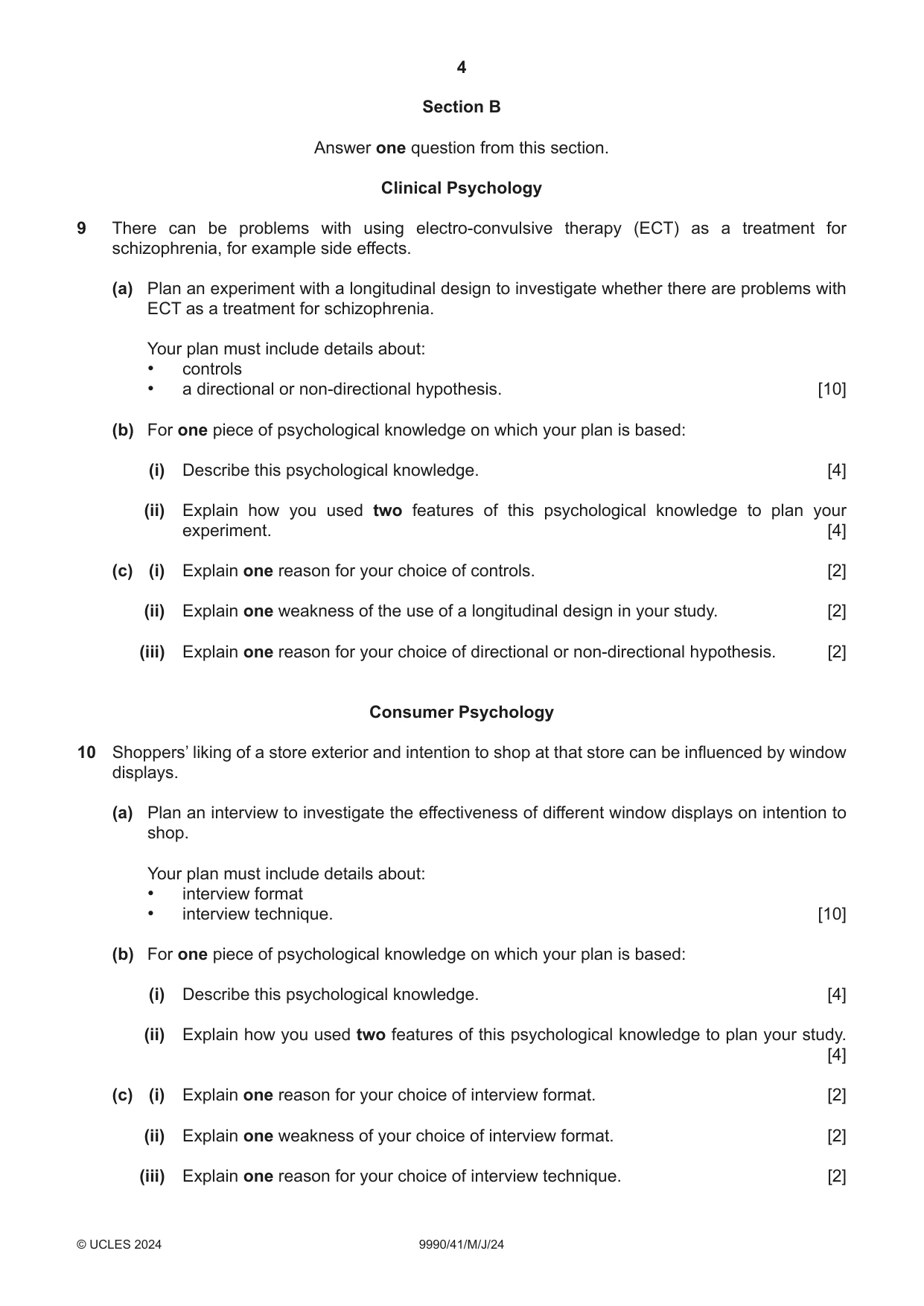
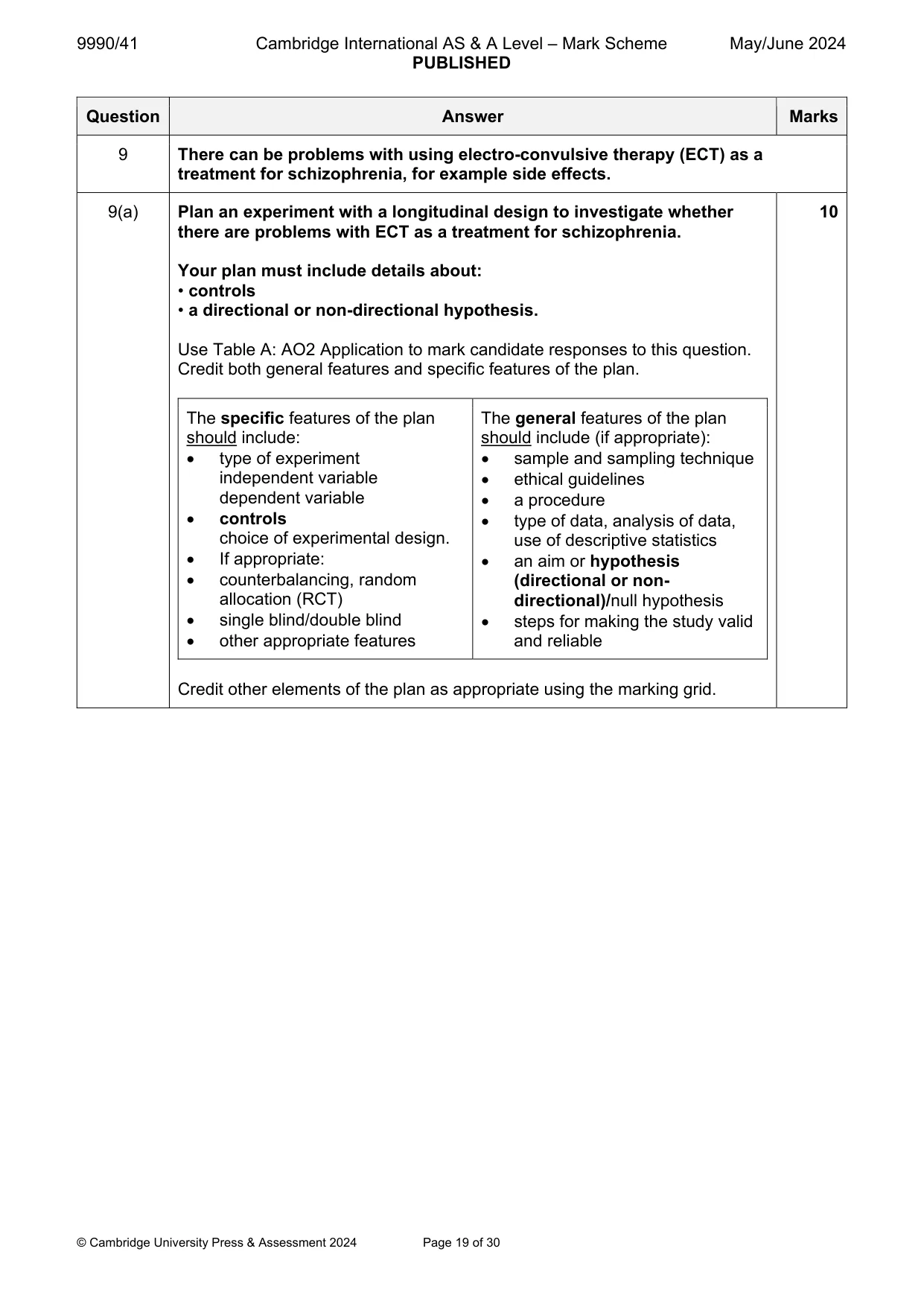
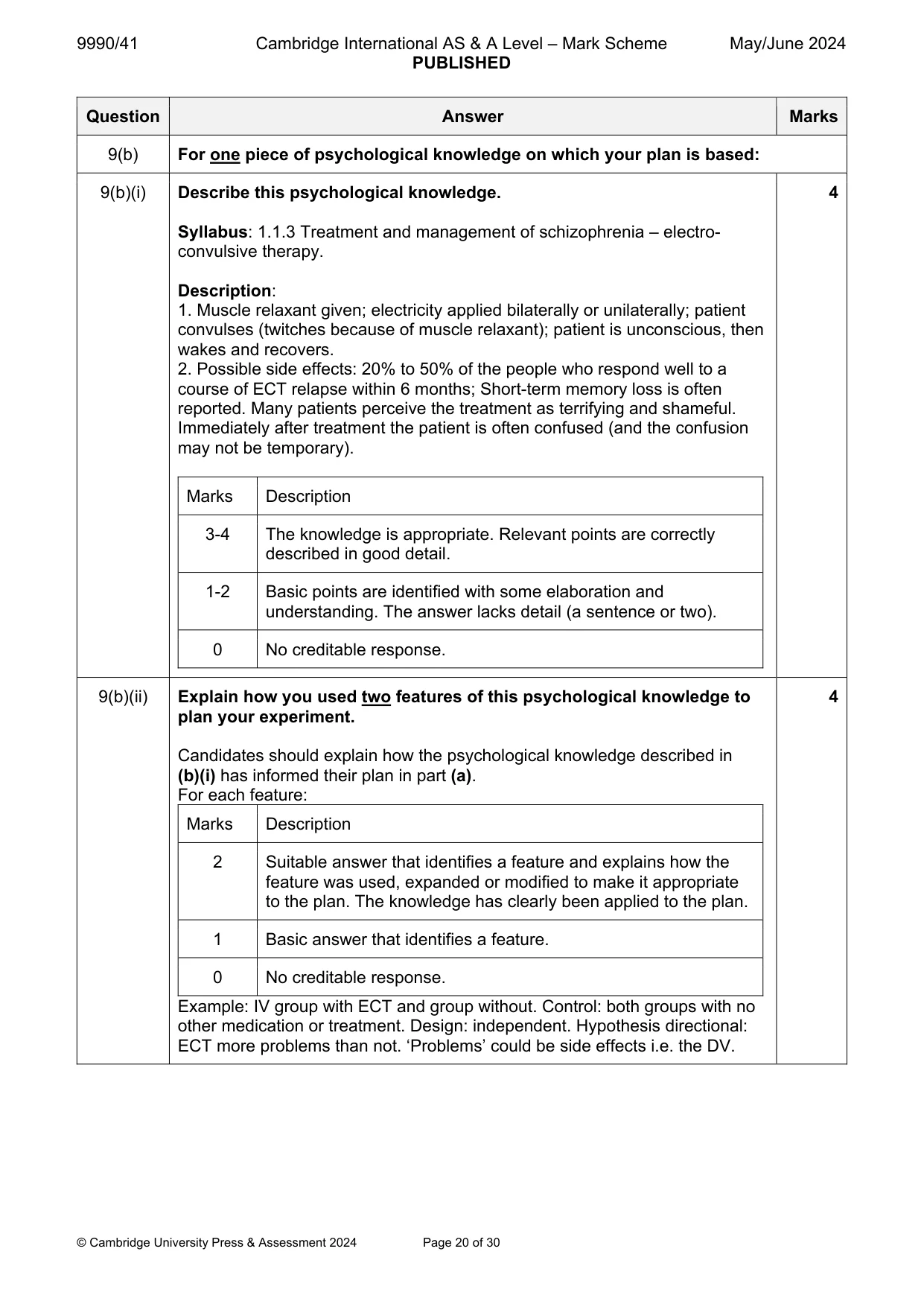
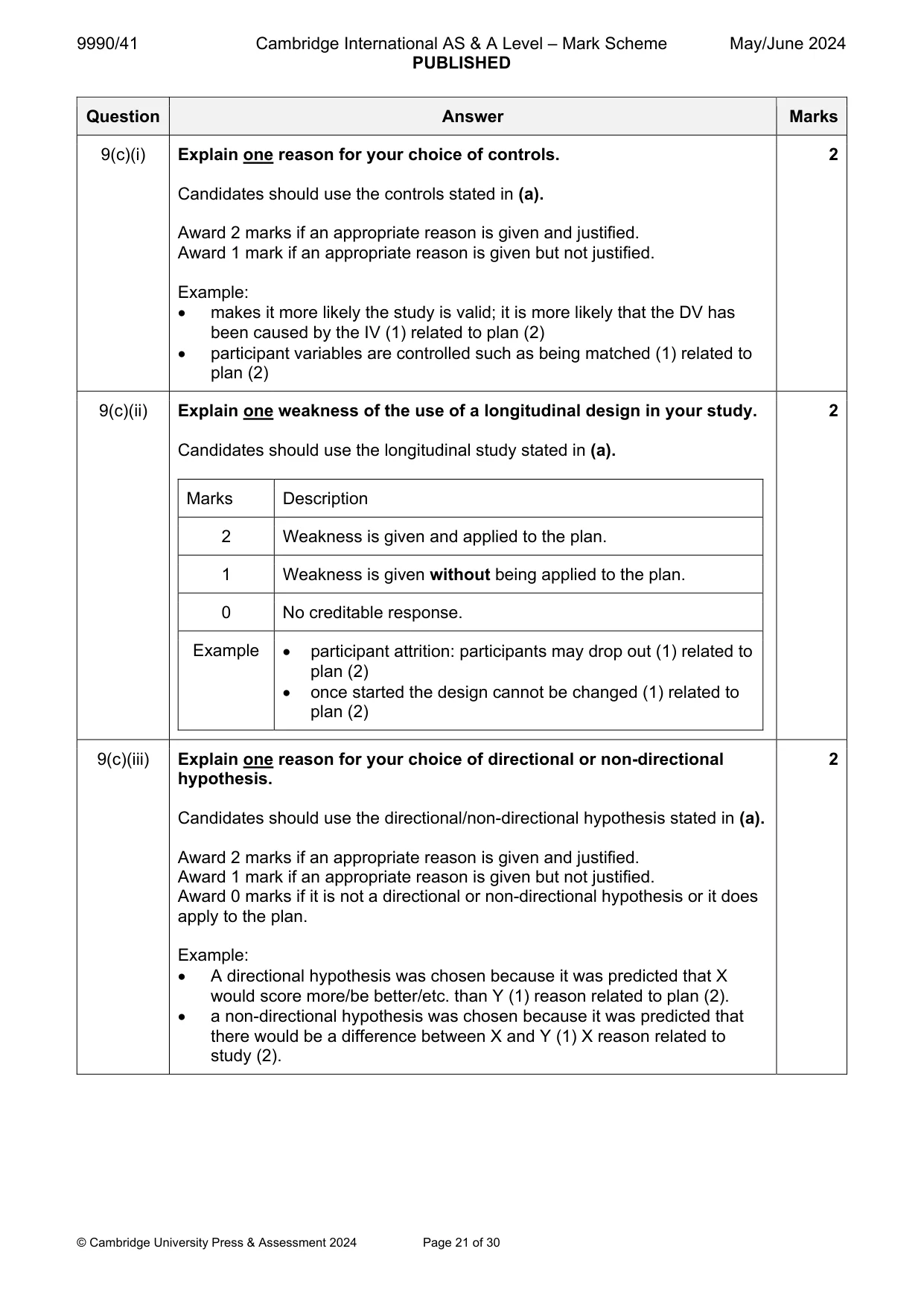
9 There can be problems with using electro-convulsive therapy (ECT) as a treatment for schizophrenia, for example side effects. (a) Plan an experiment with a longitudinal design to investigate whether there are problems with ECT as a treatment for schizophrenia. Your plan must include details about: • controls • a directional or non-directional hypothesis. [10] (b) For one piece of psychological knowledge on which your plan is based: (i) Describe this psychological knowledge. [4] (ii) Explain how you used two features of this psychological knowledge to plan your experiment. [4] (c) (i) Explain one reason for your choice of controls. [2] (ii) Explain one weakness of the use of a longitudinal design in your study. [2] (iii) Explain one reason for your choice of directional or non-directional hypothesis. [2] Consumer Psychology
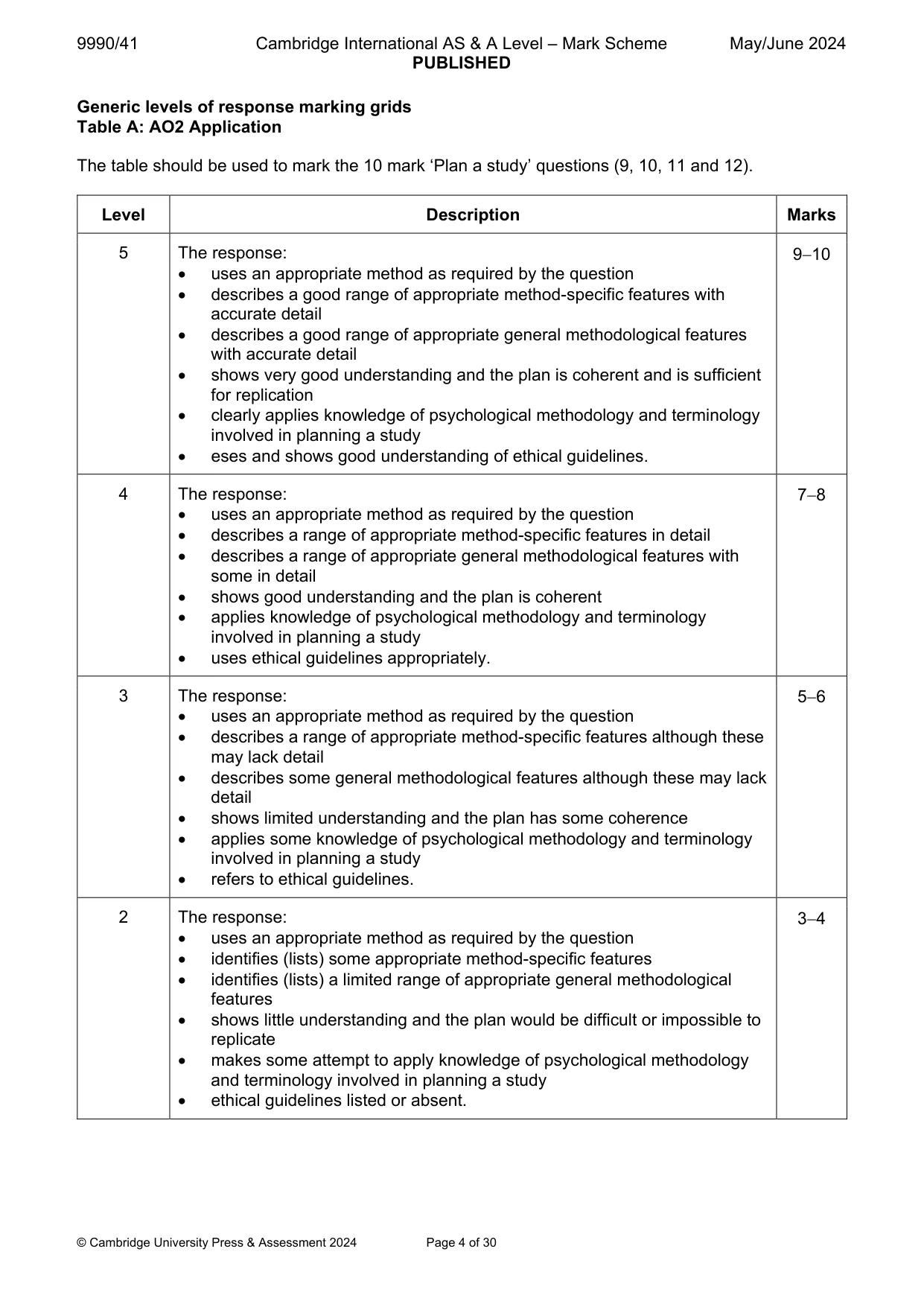
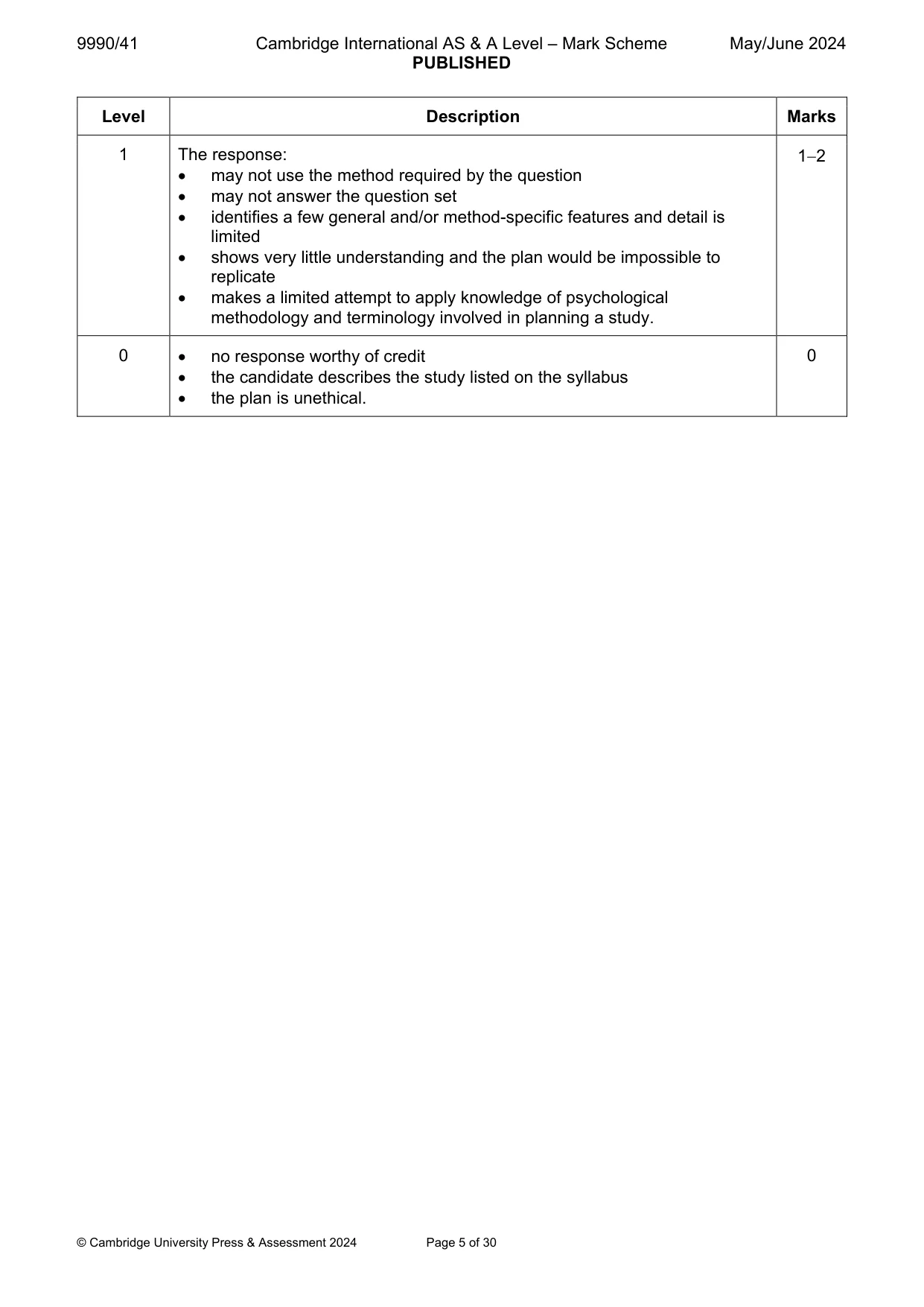
Mark scheme: 9(a) Plan an experiment with a longitudinal design to investigate whether 10 there are problems with ECT as a treatment for schizophrenia. Your plan must include details about: • controls • a directional or non-directional hypothesis. Use Table A: AO2 Application to mark candidate responses to this question. Credit both general features and specific features of the plan. The specific features of the plan The general features of the plan should include: should include (if appropriate): type of experiment sample and sampling technique independent variable ethical guidelines dependent variable a procedure controls type of data, analysis of data, choice of experimental design. use of descriptive statistics If appropriate: an aim or hypothesis counterbalancing, random (directional or non- allocation (RCT) directional)/null hypothesis single blind/double blind steps for making the study valid other appropriate features and reliable Credit other elements of the plan as appropriate using the marking grid. 9(b) For one piece of psychological knowledge on which your plan is based: 9(b)(i) Describe this psychological knowledge. 4 Syllabus: 1.1.3 Treatment and management of schizophrenia – electro- convulsive therapy. Description: 1. Muscle relaxant given; electricity applied bilaterally or unilaterally; patient convulses (twitches because of muscle relaxant); patient is unconscious, then wakes and recovers. 2. Possible side effects: 20% to 50% of the people who respond well to a course of ECT relapse within 6 months; Short-term memory loss is often reported. Many patients perceive the treatment as terrifying and shameful. Immediately after treatment the patient is often confused (and the confusion may not be temporary). Marks Description 3-4 The knowledge is appropriate. Relevant points are correctly described in good detail. 1-2 Basic points are identified with some elaboration and understanding. The answer lacks detail (a sentence or two). 0 No creditable response. 9(b)(ii) Explain how you used two features of this psychological knowledge to 4 plan your experiment. Candidates should explain how the psychological knowledge described in (b)(i) has informed their plan in part (a). For each feature: Marks Description 2 Suitable answer that identifies a feature and explains how the feature was used, expanded or modified to make it appropriate to the plan. The knowledge has clearly been applied to the plan. 1 Basic answer that identifies a feature. 0 No creditable response. Example: IV group with ECT and group without. Control: both groups with no other medication or treatment. Design: independent. Hypothesis directional: ECT more problems than not. ‘Problems’ could be side effects i.e. the DV. 9(c)(i) Explain one reason for your choice of controls. 2 Candidates should use the controls stated in (a). Award 2 marks if an appropriate reason is given and justified. Award 1 mark if an appropriate reason is given but not justified. Example: makes it more likely the study is valid; it is more likely that the DV has been caused by the IV (1) related to plan (2) participant variables are controlled such as being matched (1) related to plan (2) 9(c)(ii) Explain one weakness of the use of a longitudinal design in your study. 2 Candidates should use the longitudinal study stated in (a). Marks Description 2 Weakness is given and applied to the plan. 1 Weakness is given without being applied to the plan. 0 No creditable response. Example participant attrition: participants may drop out (1) related to plan (2) once started the design cannot be changed (1) related to plan (2) 9(c)(iii) Explain one reason for your choice of directional or non-directional 2 hypothesis. Candidates should use the directional/non-directional hypothesis stated in (a). Award 2 marks if an appropriate reason is given and justified. Award 1 mark if an appropriate reason is given but not justified. Award 0 marks if it is not a directional or non-directional hypothesis or it does apply to the plan. Example: A directional hypothesis was chosen because it was predicted that X would score more/be better/etc. than Y (1) reason related to plan (2). a non-directional hypothesis was chosen because it was predicted that there would be a difference between X and Y (1) X reason related to study (2).
Q10 · Shoppers’ liking of a store exterior and intention to shop at that store can be…
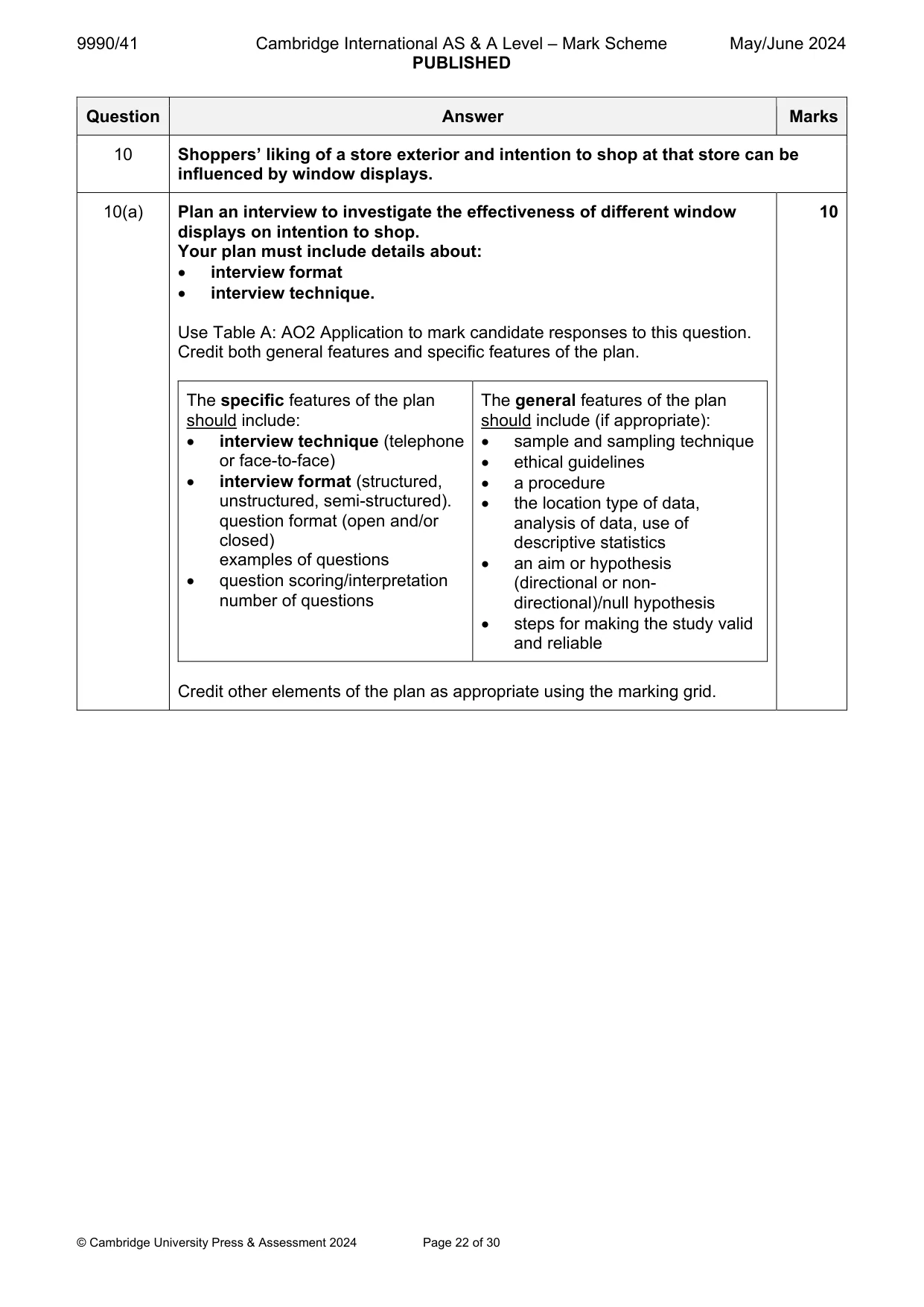
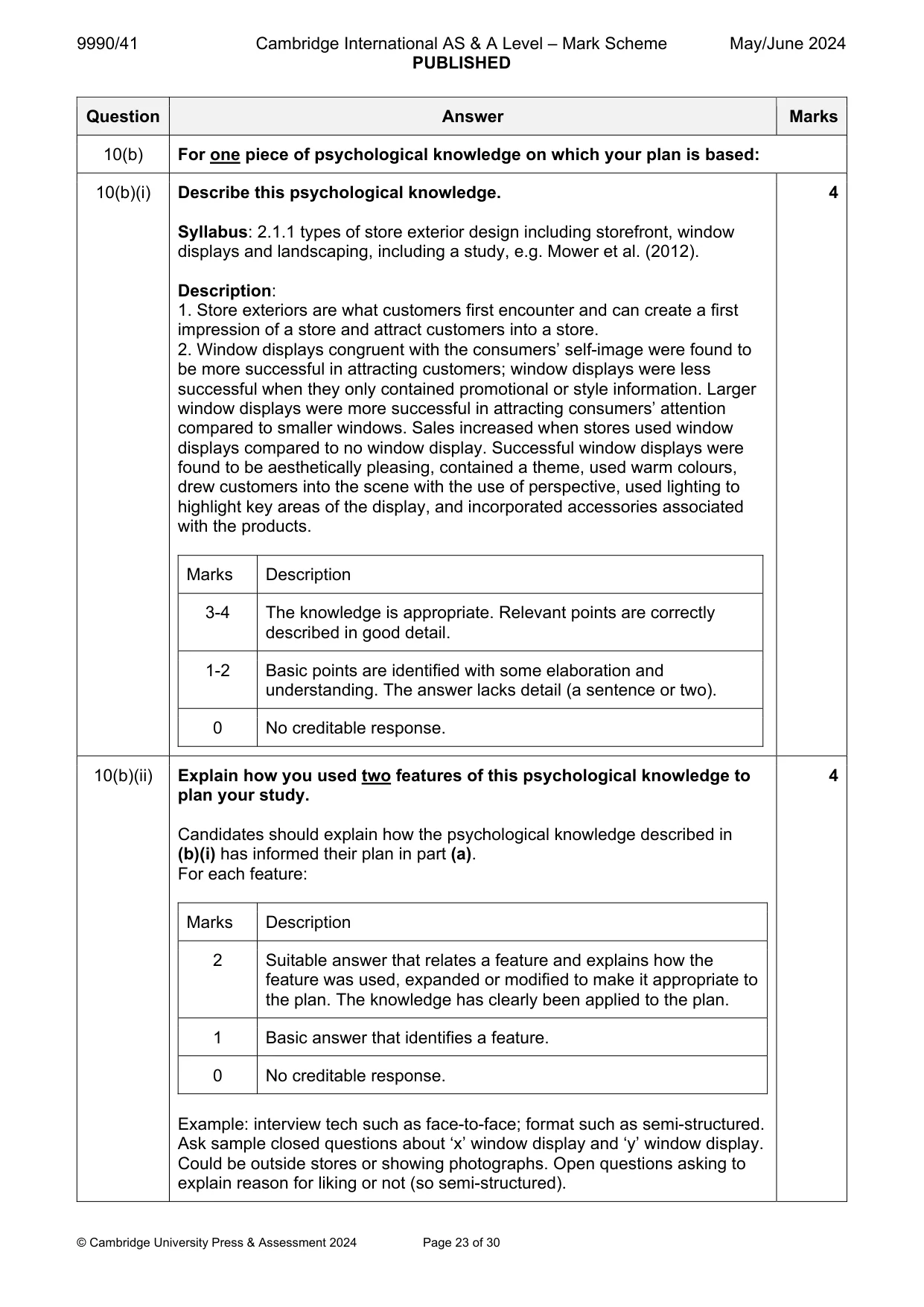
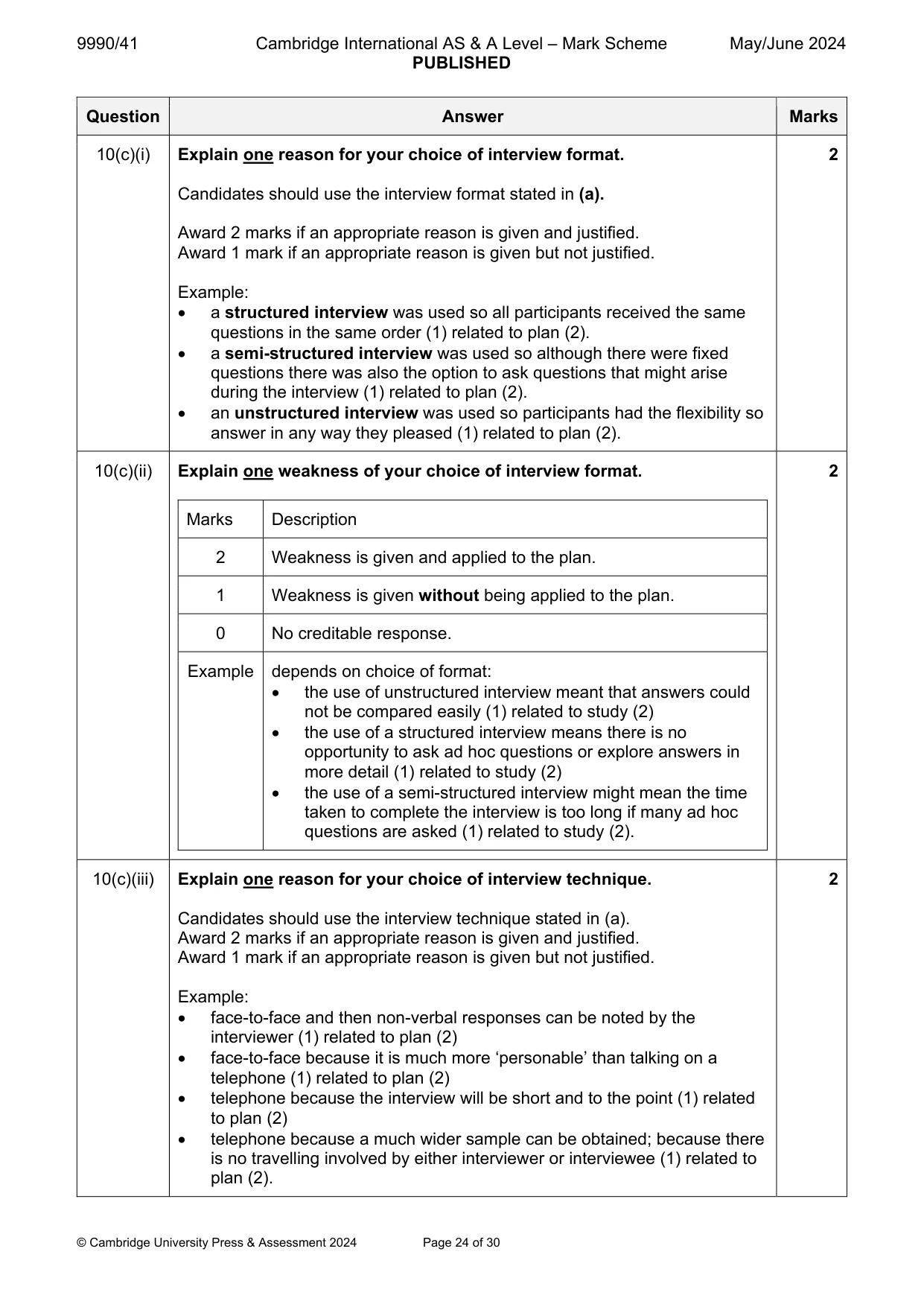
10 Shoppers’ liking of a store exterior and intention to shop at that store can be influenced by window displays. (a) Plan an interview to investigate the effectiveness of different window displays on intention to shop. Your plan must include details about: • interview format • interview technique. [10] (b) For one piece of psychological knowledge on which your plan is based: (i) Describe this psychological knowledge. [4] (ii) Explain how you used two features of this psychological knowledge to plan your study. [4] (c) (i) Explain one reason for your choice of interview format. [2] (ii) Explain one weakness of your choice of interview format. [2] (iii) Explain one reason for your choice of interview technique. [2] Health Psychology
Mark scheme: 10(a) Plan an interview to investigate the effectiveness of different window 10 displays on intention to shop. Your plan must include details about: interview format interview technique. Use Table A: AO2 Application to mark candidate responses to this question. Credit both general features and specific features of the plan. The specific features of the plan The general features of the plan should include: should include (if appropriate): interview technique (telephone sample and sampling technique or face-to-face) ethical guidelines interview format (structured, a procedure unstructured, semi-structured). the location type of data, question format (open and/or analysis of data, use of closed) descriptive statistics examples of questions an aim or hypothesis question scoring/interpretation (directional or non- number of questions directional)/null hypothesis steps for making the study valid and reliable Credit other elements of the plan as appropriate using the marking grid. 10(b) For one piece of psychological knowledge on which your plan is based: 10(b)(i) Describe this psychological knowledge. 4 Syllabus: 2.1.1 types of store exterior design including storefront, window displays and landscaping, including a study, e.g. Mower et al. (2012). Description: 1. Store exteriors are what customers first encounter and can create a first impression of a store and attract customers into a store. 2. Window displays congruent with the consumers’ self-image were found to be more successful in attracting customers; window displays were less successful when they only contained promotional or style information. Larger window displays were more successful in attracting consumers’ attention compared to smaller windows. Sales increased when stores used window displays compared to no window display. Successful window displays were found to be aesthetically pleasing, contained a theme, used warm colours, drew customers into the scene with the use of perspective, used lighting to highlight key areas of the display, and incorporated accessories associated with the products. Marks Description 3-4 The knowledge is appropriate. Relevant points are correctly described in good detail. 1-2 Basic points are identified with some elaboration and understanding. The answer lacks detail (a sentence or two). 0 No creditable response. 10(b)(ii) Explain how you used two features of this psychological knowledge to 4 plan your study. Candidates should explain how the psychological knowledge described in (b)(i) has informed their plan in part (a). For each feature: Marks Description 2 Suitable answer that relates a feature and explains how the feature was used, expanded or modified to make it appropriate to the plan. The knowledge has clearly been applied to the plan. 1 Basic answer that identifies a feature. 0 No creditable response. Example: interview tech such as face-to-face; format such as semi-structured. Ask sample closed questions about ‘x’ window display and ‘y’ window display. Could be outside stores or showing photographs. Open questions asking to explain reason for liking or not (so semi-structured). 10(c)(i) Explain one reason for your choice of interview format. 2 Candidates should use the interview format stated in (a). Award 2 marks if an appropriate reason is given and justified. Award 1 mark if an appropriate reason is given but not justified. Example: a structured interview was used so all participants received the same questions in the same order (1) related to plan (2). a semi-structured interview was used so although there were fixed questions there was also the option to ask questions that might arise during the interview (1) related to plan (2). an unstructured interview was used so participants had the flexibility so answer in any way they pleased (1) related to plan (2). 10(c)(ii) Explain one weakness of your choice of interview format. 2 Marks Description 2 Weakness is given and applied to the plan. 1 Weakness is given without being applied to the plan. 0 No creditable response. Example depends on choice of format: the use of unstructured interview meant that answers could not be compared easily (1) related to study (2) the use of a structured interview means there is no opportunity to ask ad hoc questions or explore answers in more detail (1) related to study (2) the use of a semi-structured interview might mean the time taken to complete the interview is too long if many ad hoc questions are asked (1) related to study (2). 10(c)(iii) Explain one reason for your choice of interview technique. 2 Candidates should use the interview technique stated in (a). Award 2 marks if an appropriate reason is given and justified. Award 1 mark if an appropriate reason is given but not justified. Example: face-to-face and then non-verbal responses can be noted by the interviewer (1) related to plan (2) face-to-face because it is much more ‘personable’ than talking on a telephone (1) related to plan (2) telephone because the interview will be short and to the point (1) related to plan (2) telephone because a much wider sample can be obtained; because there is no travelling involved by either interviewer or interviewee (1) related to plan (2).
Q11 · Plan a study using a postal questionnaire to investigate the reasons why people attend or…
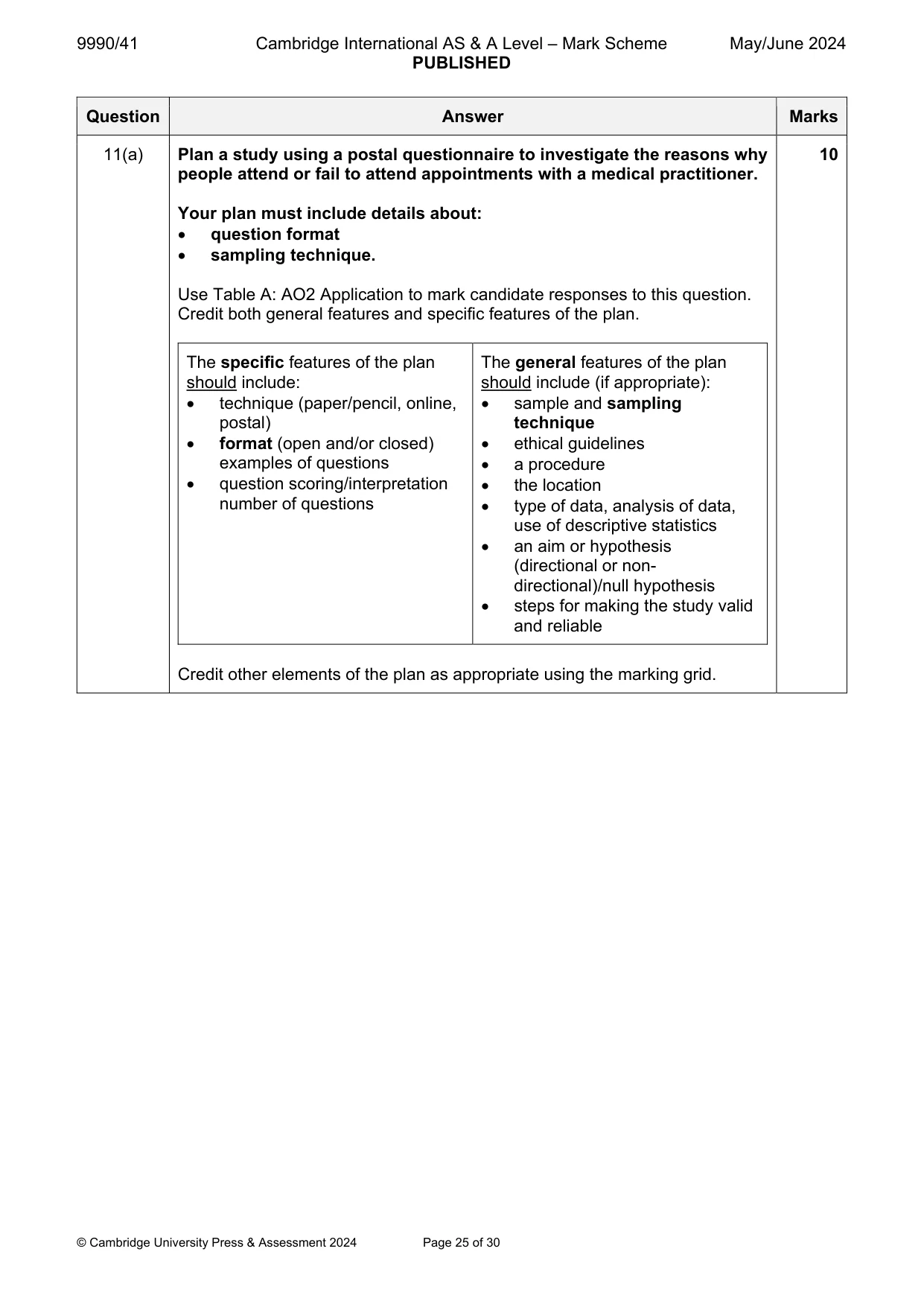
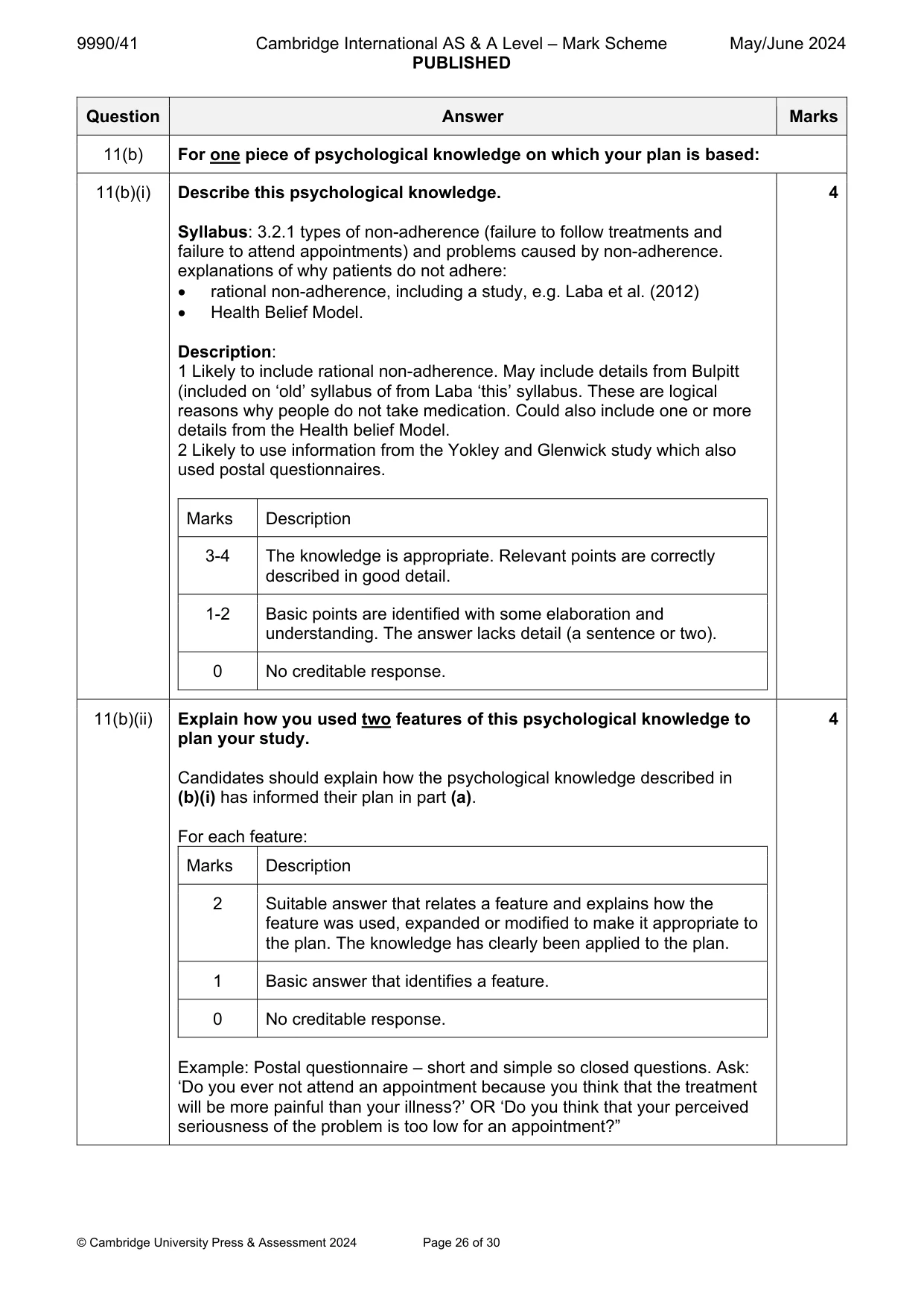
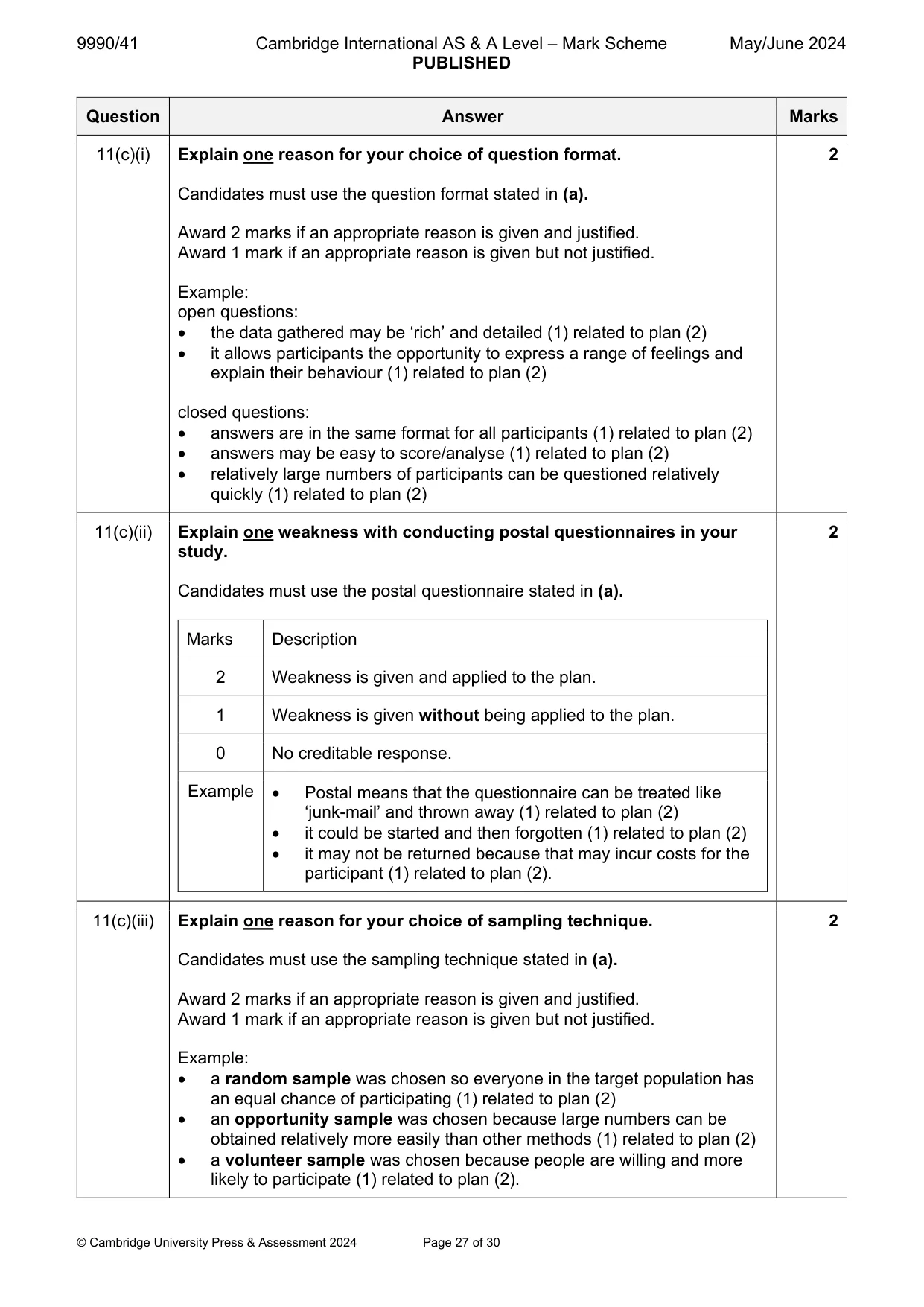
11 (a) Plan a study using a postal questionnaire to investigate the reasons why people attend or fail to attend appointments with a medical practitioner. Your plan must include details about: • question format • sampling technique. [10] (b) For one piece of psychological knowledge on which your plan is based: (i) Describe this psychological knowledge. [4] (ii) Explain how you used two features of this psychological knowledge to plan your study. [4] (c) (i) Explain one reason for your choice of question format. [2] (ii) Explain one weakness with conducting postal questionnaires in your study. [2] (iii) Explain one reason for your choice of sampling technique. [2] Organisational Psychology
Mark scheme: 11(a) Plan a study using a postal questionnaire to investigate the reasons why 10 people attend or fail to attend appointments with a medical practitioner. Your plan must include details about: question format sampling technique. Use Table A: AO2 Application to mark candidate responses to this question. Credit both general features and specific features of the plan. The specific features of the plan The general features of the plan should include: should include (if appropriate): technique (paper/pencil, online, sample and sampling postal) technique format (open and/or closed) ethical guidelines examples of questions a procedure question scoring/interpretation the location number of questions type of data, analysis of data, use of descriptive statistics an aim or hypothesis (directional or non- directional)/null hypothesis steps for making the study valid and reliable Credit other elements of the plan as appropriate using the marking grid. 11(b) For one piece of psychological knowledge on which your plan is based: 11(b)(i) Describe this psychological knowledge. 4 Syllabus: 3.2.1 types of non-adherence (failure to follow treatments and failure to attend appointments) and problems caused by non-adherence. explanations of why patients do not adhere: rational non-adherence, including a study, e.g. Laba et al. (2012) Health Belief Model. Description: 1 Likely to include rational non-adherence. May include details from Bulpitt (included on ‘old’ syllabus of from Laba ‘this’ syllabus. These are logical reasons why people do not take medication. Could also include one or more details from the Health belief Model. 2 Likely to use information from the Yokley and Glenwick study which also used postal questionnaires. Marks Description 3-4 The knowledge is appropriate. Relevant points are correctly described in good detail. 1-2 Basic points are identified with some elaboration and understanding. The answer lacks detail (a sentence or two). 0 No creditable response. 11(b)(ii) Explain how you used two features of this psychological knowledge to 4 plan your study. Candidates should explain how the psychological knowledge described in (b)(i) has informed their plan in part (a). For each feature: Marks Description 2 Suitable answer that relates a feature and explains how the feature was used, expanded or modified to make it appropriate to the plan. The knowledge has clearly been applied to the plan. 1 Basic answer that identifies a feature. 0 No creditable response. Example: Postal questionnaire – short and simple so closed questions. Ask: ‘Do you ever not attend an appointment because you think that the treatment will be more painful than your illness?’ OR ‘Do you think that your perceived seriousness of the problem is too low for an appointment?” 11(c)(i) Explain one reason for your choice of question format. 2 Candidates must use the question format stated in (a). Award 2 marks if an appropriate reason is given and justified. Award 1 mark if an appropriate reason is given but not justified. Example: open questions: the data gathered may be ‘rich’ and detailed (1) related to plan (2) it allows participants the opportunity to express a range of feelings and explain their behaviour (1) related to plan (2) closed questions: answers are in the same format for all participants (1) related to plan (2) answers may be easy to score/analyse (1) related to plan (2) relatively large numbers of participants can be questioned relatively quickly (1) related to plan (2) 11(c)(ii) Explain one weakness with conducting postal questionnaires in your 2 study. Candidates must use the postal questionnaire stated in (a). Marks Description 2 Weakness is given and applied to the plan. 1 Weakness is given without being applied to the plan. 0 No creditable response. Example Postal means that the questionnaire can be treated like ‘junk-mail’ and thrown away (1) related to plan (2) it could be started and then forgotten (1) related to plan (2) it may not be returned because that may incur costs for the participant (1) related to plan (2). 11(c)(iii) Explain one reason for your choice of sampling technique. 2 Candidates must use the sampling technique stated in (a). Award 2 marks if an appropriate reason is given and justified. Award 1 mark if an appropriate reason is given but not justified. Example: a random sample was chosen so everyone in the target population has an equal chance of participating (1) related to plan (2) an opportunity sample was chosen because large numbers can be obtained relatively more easily than other methods (1) related to plan (2) a volunteer sample was chosen because people are willing and more likely to participate (1) related to plan (2).
Q12 · Workers in assembly-line industries can sabotage machinery
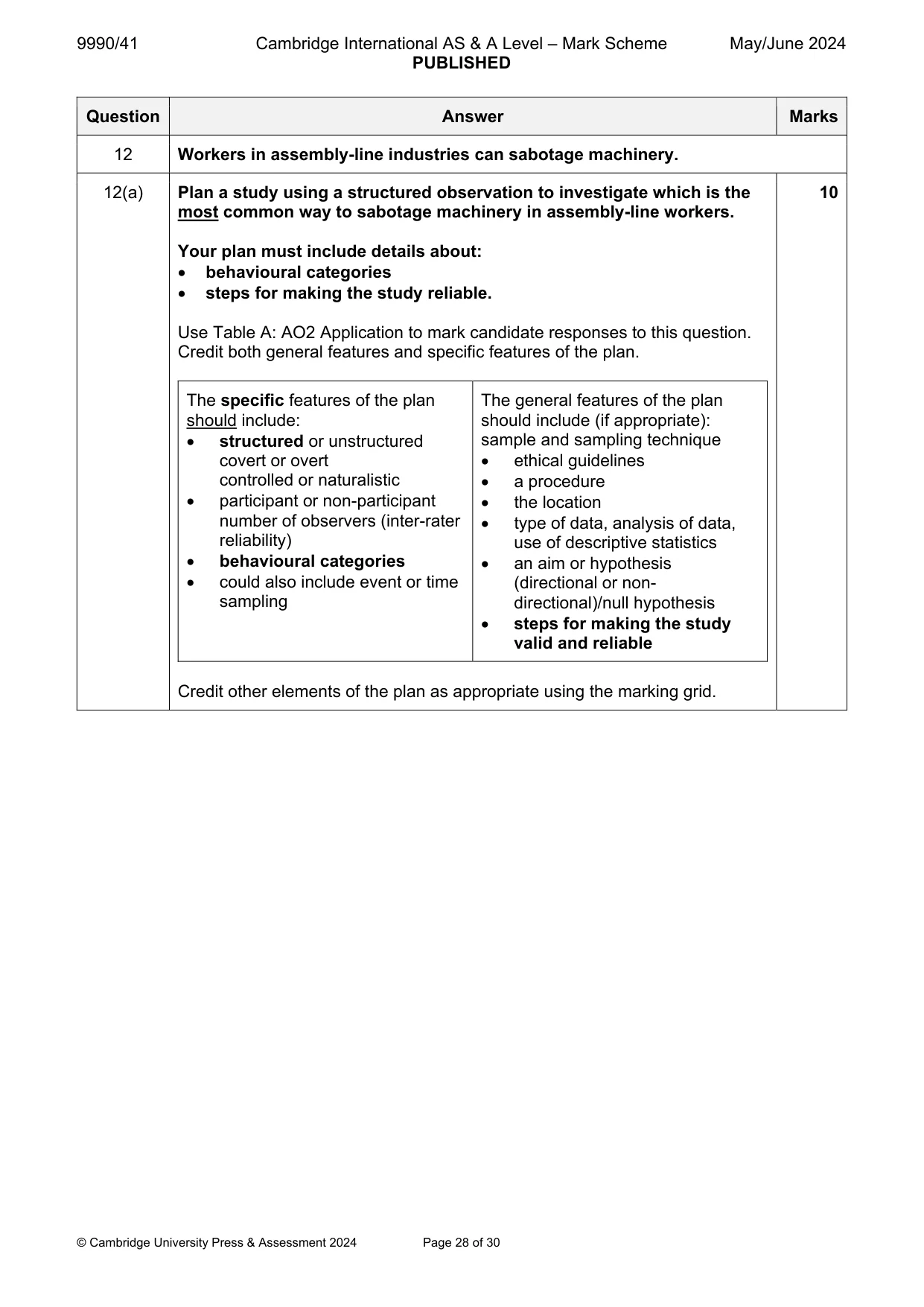
12 Workers in assembly-line industries can sabotage machinery. (a) Plan a study using a structured observation to investigate which is the most common way to sabotage machinery in assembly-line workers. Your plan must include details about: • behavioural categories • steps for making the study reliable. [10] (b) For one piece of psychological knowledge on which your plan is based: (i) Describe this psychological knowledge. [4] (ii) Explain how you used two features of this psychological knowledge to plan your study. [4] (c) (i) Explain one reason for your choice of behavioural categories. [2] (ii) Explain one weakness of your choice of behavioural categories. [2] (iii) Explain one reason for your choice of steps for making the study reliable. [2]
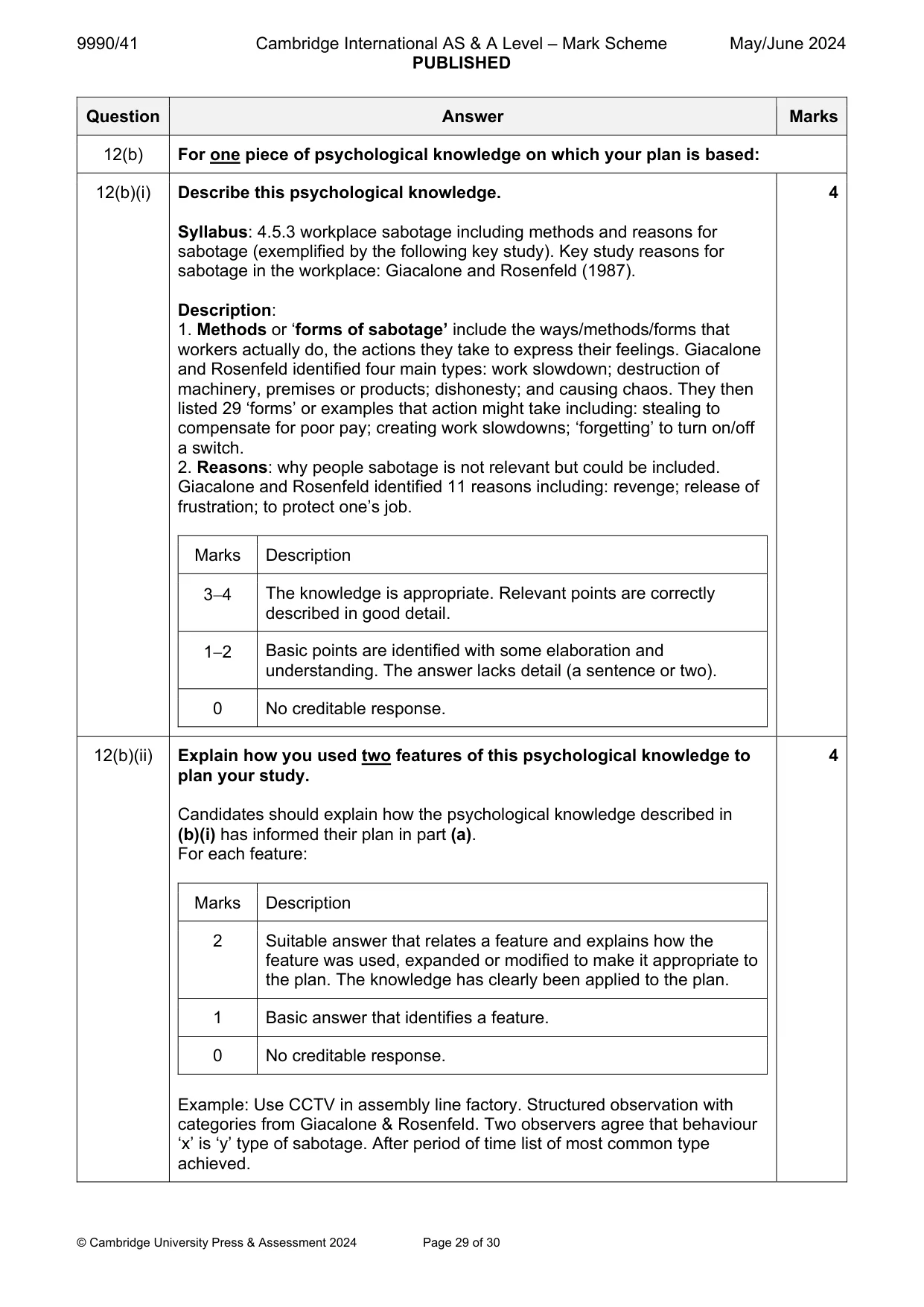
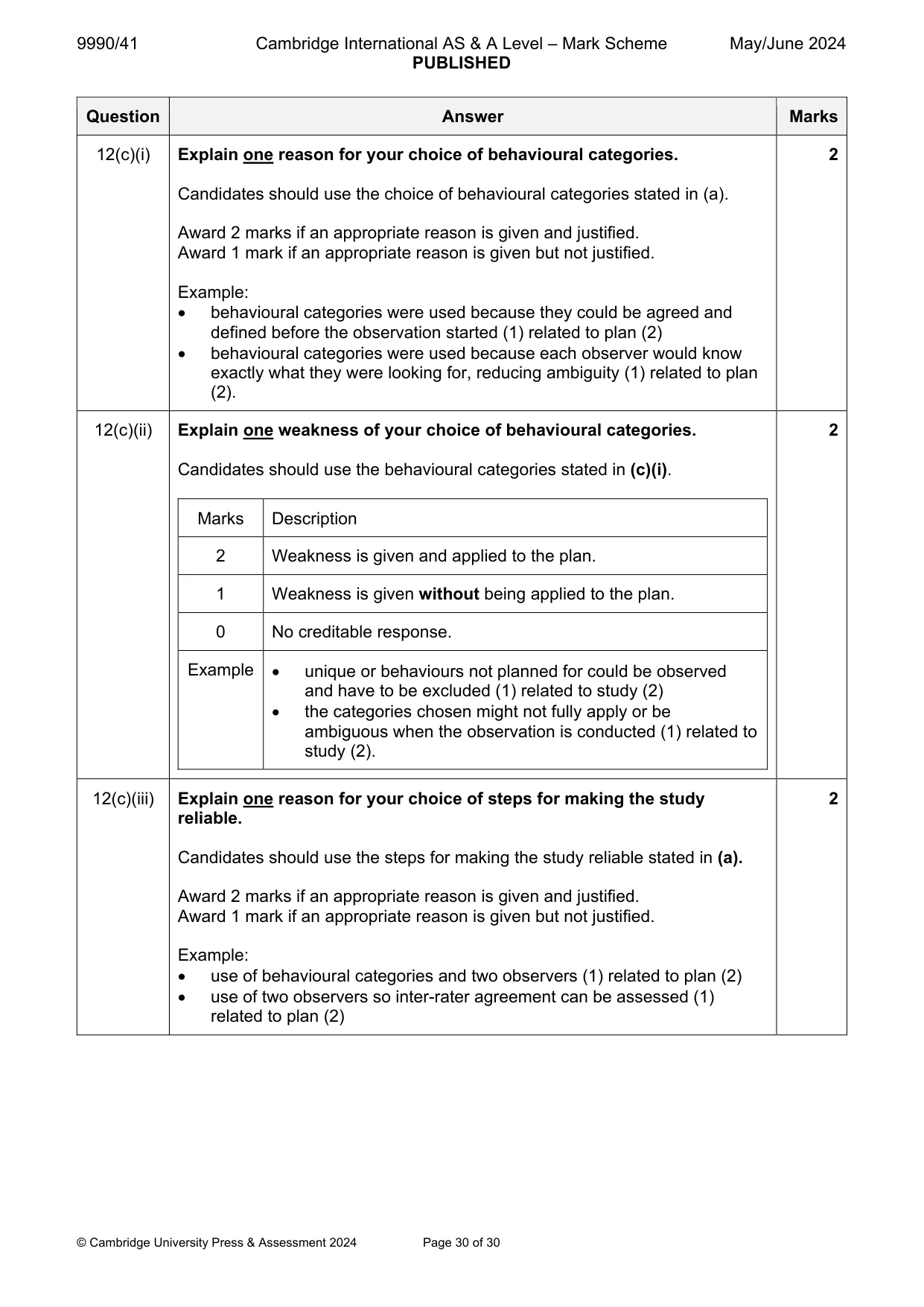
Mark scheme: 12(a) Plan a study using a structured observation to investigate which is the 10 most common way to sabotage machinery in assembly-line workers. Your plan must include details about: behavioural categories steps for making the study reliable. Use Table A: AO2 Application to mark candidate responses to this question. Credit both general features and specific features of the plan. The specific features of the plan The general features of the plan should include: should include (if appropriate): structured or unstructured sample and sampling technique covert or overt ethical guidelines controlled or naturalistic a procedure participant or non-participant the location number of observers (inter-rater type of data, analysis of data, reliability) use of descriptive statistics behavioural categories an aim or hypothesis could also include event or time (directional or non- sampling directional)/null hypothesis steps for making the study valid and reliable Credit other elements of the plan as appropriate using the marking grid. 12(b) For one piece of psychological knowledge on which your plan is based: 12(b)(i) Describe this psychological knowledge. 4 Syllabus: 4.5.3 workplace sabotage including methods and reasons for sabotage (exemplified by the following key study). Key study reasons for sabotage in the workplace: Giacalone and Rosenfeld (1987). Description: 1. Methods or ‘forms of sabotage’ include the ways/methods/forms that workers actually do, the actions they take to express their feelings. Giacalone and Rosenfeld identified four main types: work slowdown; destruction of machinery, premises or products; dishonesty; and causing chaos. They then listed 29 ‘forms’ or examples that action might take including: stealing to compensate for poor pay; creating work slowdowns; ‘forgetting’ to turn on/off a switch. 2. Reasons: why people sabotage is not relevant but could be included. Giacalone and Rosenfeld identified 11 reasons including: revenge; release of frustration; to protect one’s job. Marks Description 34 The knowledge is appropriate. Relevant points are correctly described in good detail. 12 Basic points are identified with some elaboration and understanding. The answer lacks detail (a sentence or two). 0 No creditable response. 12(b)(ii) Explain how you used two features of this psychological knowledge to 4 plan your study. Candidates should explain how the psychological knowledge described in (b)(i) has informed their plan in part (a). For each feature: Marks Description 2 Suitable answer that relates a feature and explains how the feature was used, expanded or modified to make it appropriate to the plan. The knowledge has clearly been applied to the plan. 1 Basic answer that identifies a feature. 0 No creditable response. Example: Use CCTV in assembly line factory. Structured observation with categories from Giacalone & Rosenfeld. Two observers agree that behaviour ‘x’ is ‘y’ type of sabotage. After period of time list of most common type achieved. 12(c)(i) Explain one reason for your choice of behavioural categories. 2 Candidates should use the choice of behavioural categories stated in (a). Award 2 marks if an appropriate reason is given and justified. Award 1 mark if an appropriate reason is given but not justified. Example: behavioural categories were used because they could be agreed and defined before the observation started (1) related to plan (2) behavioural categories were used because each observer would know exactly what they were looking for, reducing ambiguity (1) related to plan (2). 12(c)(ii) Explain one weakness of your choice of behavioural categories. 2 Candidates should use the behavioural categories stated in (c)(i). Marks Description 2 Weakness is given and applied to the plan. 1 Weakness is given without being applied to the plan. 0 No creditable response. Example unique or behaviours not planned for could be observed and have to be excluded (1) related to study (2) the categories chosen might not fully apply or be ambiguous when the observation is conducted (1) related to study (2). 12(c)(iii) Explain one reason for your choice of steps for making the study 2 reliable. Candidates should use the steps for making the study reliable stated in (a). Award 2 marks if an appropriate reason is given and justified. Award 1 mark if an appropriate reason is given but not justified. Example: use of behavioural categories and two observers (1) related to plan (2) use of two observers so inter-rater agreement can be assessed (1) related to plan (2)
What was in this paper
The subtopics covered by these 12 questions, and how many questions each got. Open one in a new tab to see every Cambridge question on it.
What you needed in this session
Cambridge’s own grade thresholds for 2024 May/June, Paper 4 · Variant 1. A higher threshold means an easier paper — the bar moves with how the cohort did.