Questions as text
Q1 · The aim of the study by Lovell et al 9990/42 May/June 2018
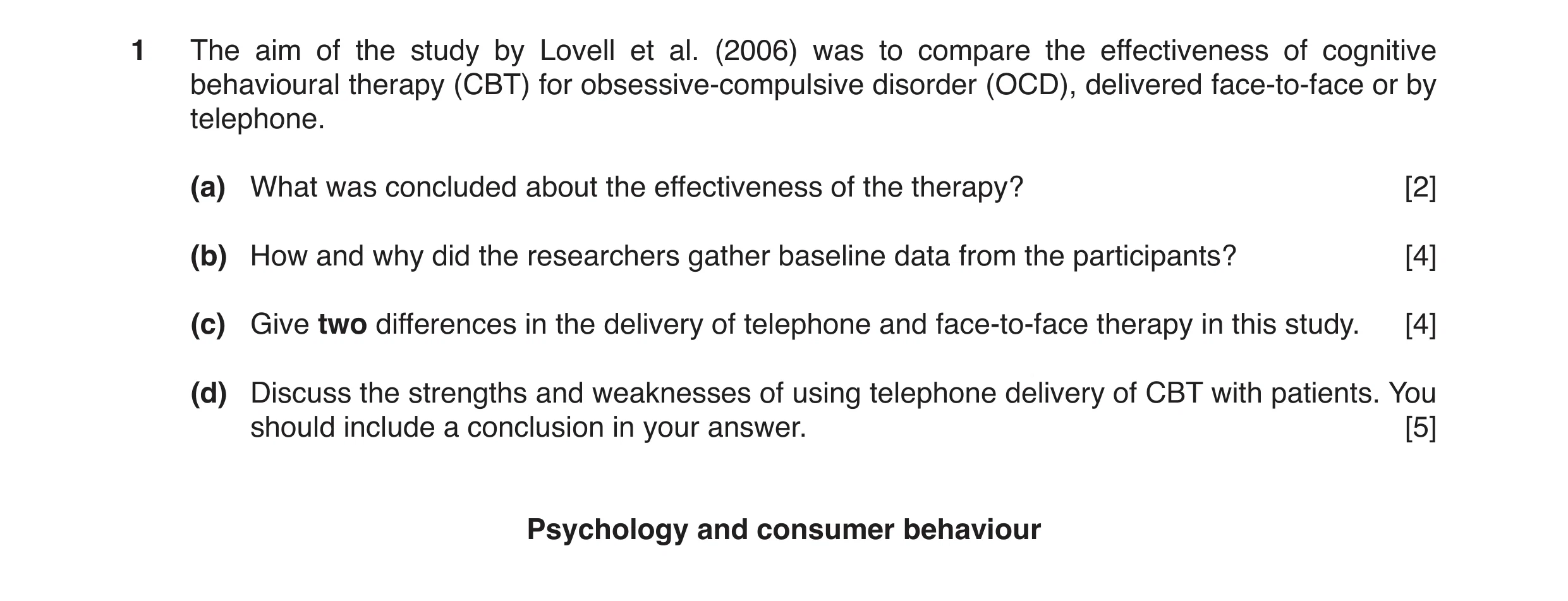
1 The aim of the study by Lovell et al. (2006) was to compare the effectiveness of cognitive behavioural therapy (CBT) for obsessive-compulsive disorder (OCD), delivered face-to-face or by telephone. (a) What was concluded about the effectiveness of the therapy? [2] (b) How and why did the researchers gather baseline data from the participants? [4] (c) Give two differences in the delivery of telephone and face-to-face therapy in this study. [4] (d) Discuss the strengths and weaknesses of using telephone delivery of CBT with patients. You should include a conclusion in your answer. [5] Psychology and consumer behaviour
15 marks
Mark scheme: Question Answer Marks Section A: Stimulus question Psychology and abnormality 1 The aim of the study by Lovell et al. (2006) was to compare the effectiveness of cognitive behavioural therapy (CBT) for obsessive-compulsive disorder (OCD), delivered face-to-face or by telephone. 1(a) What was concluded about the effectiveness of the therapy? 2 Marks: 1 mark for basic answer, e.g. identification, 1 mark for elaboration/example. Most likely answer (other appropriate responses to be credited): Quote from study: The clinical outcome of cognitive behaviour therapy delivered by telephone was equivalent to treatment delivered face to face and similar levels of satisfaction were reported. 1(b) How and why did the researchers gather baseline data from the 4 participants? Marks: 1 mark for ‘how’ and 1 mark for ‘why’; 1 further mark for each for elaboration/example (e.g. use of Y-BOCS (OCD)). Most likely answer (other appropriate responses to be credited): • Quote from study: To establish baseline data we assessed patients twice, with four weeks in between, before randomisation to treatment groups. Researchers blinded to treatment allocation assessed patients at both of the baseline visits, the initial visit after treatment, and at one, three, and six months of follow-up. • Baseline data is gathered to allow a comparison with test data (the results) to determine whether the intervention has been successful. 1(c) Give two differences in the delivery of telephone and face-to-face 4 therapy in this study. Marks: 1 mark basic difference, 2 marks detailed answer/elaboration, × 2 Most likely answer (other appropriate responses to be credited): Face to face therapy • with the therapist on an individual basis. • 10 one hour sessions • No homework • Practise with therapist • Therapist can see non-verbal communication • Travel to clinic/alien environment Telephone therapy • one face-to-face session with the therapist that covered the same material as the first session of the face-to-face, followed by • eight scheduled weekly telephone calls of up to 30 minutes in length. • Treatment was delivered in a shorter period of time • the therapist sent homework sheets to the patient. • Practise at home • No non-verbal communication • No travel/home environment 1(d) Discuss the strengths and weaknesses of using telephone delivery of 5 CBT with patients. You should include a conclusion in your answer. Marks: Question requires discussion; always plural of each argument, and always requires conclusion. 1 mark for each advantage/disadvantage up to 4 max. 1 mark for conclusion. Most likely answer (other appropriate responses to be credited): Strengths: • no travelling time to see the therapist • takes less time – 30 mins on phone. • Person at home is more comfortable being in their familiar environment; is less stressful than in an office. Weaknesses: • no non-verbal communication • therapist can’t review materials (such as homework diary) • therapist can’t control the environment such as no distractions in an office, but may be lots at home. Conclusion: any appropriate conclusion drawn from the discussion that has been presented.
This question in 9990/42 May/June 2018
Q2 · Design a study using a questionnaire to investigate the most common body dysmorphic… 9990/42 May/June 2018
5 (a) Design a study using a questionnaire to investigate the most common body dysmorphic disorder behaviours. [10] (b) Explain the psychological and methodological evidence on which your study is based. [8] Psychology and consumer behaviour
18 marks
Mark scheme: 5(a) Design a study using a questionnaire to investigate the most common 10 body dysmorphic disorder behaviours. Marks: use generic levels of response Design a study question part (a). Additional: Candidates should design the study showing evidence of design features appropriate to the named method. The named method is: questionnaire. Typical features: • Questionnaires/Interviews: type, setting, example questions. Scoring/rating scale, analysis of responses. • Typical features of research methodology: sampling technique and sample, type of data, ethics, reliability, validity, data analysis. 5(b) Explain the psychological and methodological evidence on which your 8 study is based. Marks: use generic levels of response ‘Design a study’ question part (b). Note: If only methodological or psychological explanation is provided max 5 marks. Candidates are expected to explain the reasons for the suggested design in part (a). Explanation should be both psychological and methodological. Psychological to include appropriate theory or research. Additional: candidates are expected to justify their decisions or evidence presented regarding the design made in answer to question part (a). Syllabus: Characteristics of O-C and related disorders: types of and common obsessions, common compulsions, hoarding and body dysmorphic disorder. Psychological: Virtually everyone with BDD engages in one or more BDD-related behaviour. These behaviours are intended to check the perceived defect, obtain reassurance about how it looks, fix it, or hide it from other people. These behaviours are compulsive. Included: camouflaging, comparing with others, checking in mirrors (surfaces), seeking surgery, excessive grooming, seeking reassurance that there is a defect. Methodological: explanation of method using typical features as above.
This question in 9990/42 May/June 2018
Q3 · The Yale-Brown Obsessive-Compulsive Scale (Y-BOCS) is a questionnaire 9990/41 Oct/Nov 2018
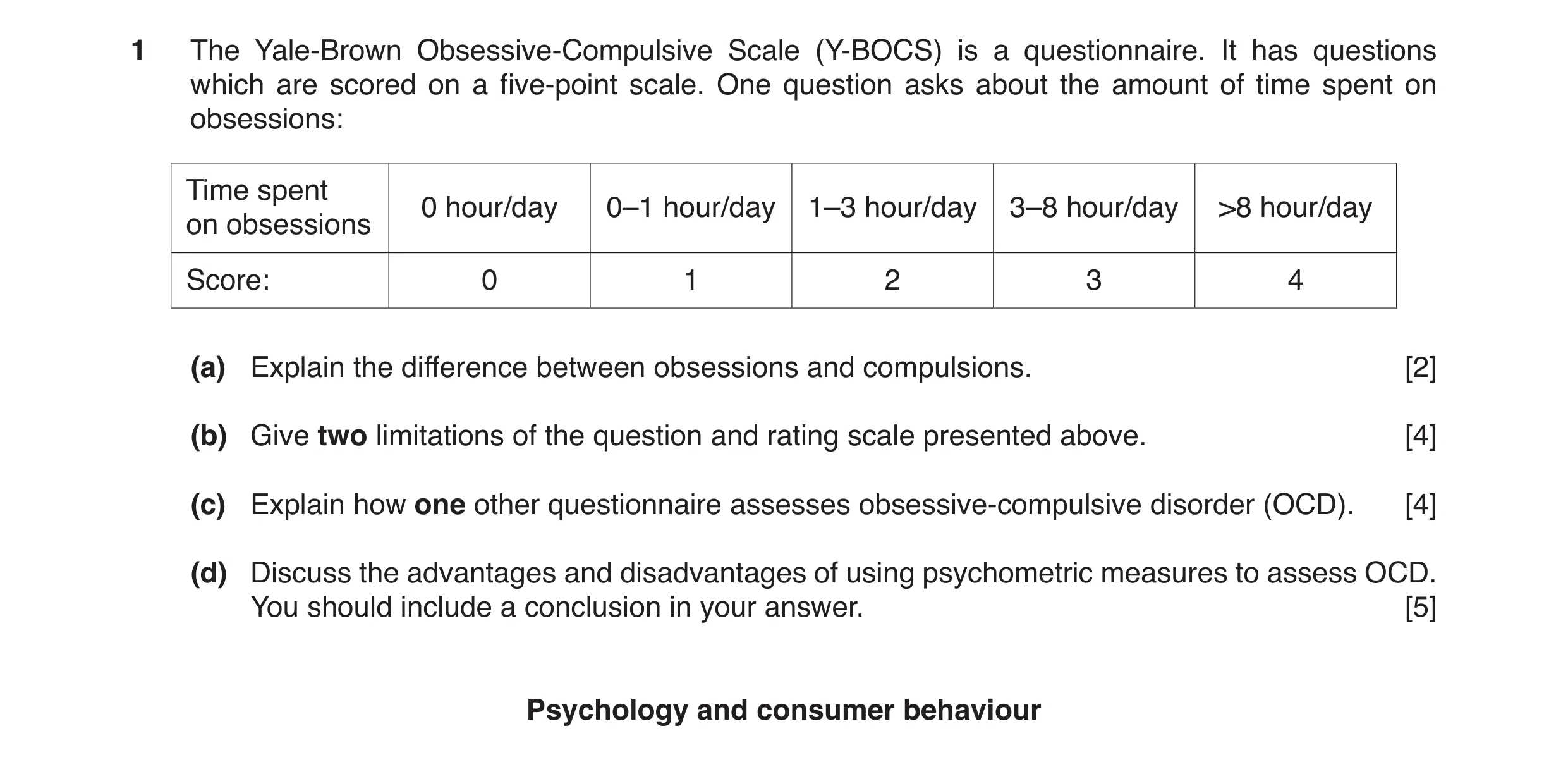
1 The Yale-Brown Obsessive-Compulsive Scale (Y-BOCS) is a questionnaire. It has questions which are scored on a five-point scale. One question asks about the amount of time spent on obsessions: Time spent 0 hour/day 0–1 hour/day 1–3 hour/day 3–8 hour/day >8 hour/day on obsessions Score: 0 1 2 3 4 (a) Explain the difference between obsessions and compulsions. [2] (b) Give two limitations of the question and rating scale presented above. [4] (c) Explain how one other questionnaire assesses obsessive-compulsive disorder (OCD). [4] (d) Discuss the advantages and disadvantages of using psychometric measures to assess OCD. You should include a conclusion in your answer. [5] Psychology and consumer behaviour
15 marks
Mark scheme: Question Answer Marks Section A: Stimulus question Psychology and abnormality 1 The Yale-Brown Obsessive-Compulsive Scale (Y-BOCS) is a questionnaire. It has questions which are scored on a five-point scale. One question asks about the amount of time spent on obsessions: Time spent on 0 0–1 1–3 3–8 >8 obsessions hour/day hour/day hour/day hour/day hour/day Score: 0 1 2 3 4 1(a) Explain the difference between obsessions and compulsions. 2 Marks: 1 mark for basic answer e.g. identification. 1 mark for elaboration/ example. Most likely answer (other appropriate responses to be credited): • Obsessions: a state in which someone thinks about someone or something constantly or frequently; recurrent unwanted thoughts. • Compulsions: repetitive physical behaviours and actions; rituals that are performed over and over again (in an attempt to relieve the anxiety caused by obsessional thoughts). 1(b) Give two limitations of the question and rating scale presented above. 4 Marks: 1 mark basic answer. 2 marks elaboration, twice. Most likely answer (other appropriate responses to be credited): • The categories are not discreet: respondents may not be able to fully distinguish between each description e.g. 1 hour appears (as does 3 hours) for two different categories. • The categories may not apply at all times: Sometimes the respondent may be one category and sometimes another. • It may be difficult to distinguish between time spent on obsessions and time spent on compulsions. 1(c) Explain how one other questionnaire assesses obsessive-compulsive 4 disorder (OCD). Marks: Must be an alternative questionnaire. Any other form of assessment cannot be credited. 1–2 marks basic answer. 3–4 marks detailed answer/elaboration. Most likely answer (other appropriate responses to be credited): The Maudsley Obsessive-Compulsive Inventory (MOCI) is one of the most used tests in clinical psychology for assessing the obsessive and compulsive symptoms in psychiatric patients. Includes 30 items using true/false format; 4 sub-scales: Checking (9 items), Cleaning (11 items), Slowness (7 items), and Doubting (7 items). 1(d) Discuss the advantages and disadvantages of using psychometric 5 measures to assess OCD. You should include a conclusion in your answer. Marks: Question requires discussion; always plural of each argument, and always requires conclusion. 1 mark for each advantage/disadvantage (however detailed) and related to the question up to 4 max. 1 mark for two strengths/weaknesses unrelated to the question. 1 mark for conclusion. Most likely answer (other appropriate responses to be credited): Advantages: • Reliability is the extent to which the test gives consistent data over time i.e. the results from one person should be comparable to results from another person. • Validity is the extent to which a test accurately measures a person’s attributes i.e. OCD. • the test includes items as defined by DSM as typical of people with OCD and any person can be assessed in relation to the norm. • tests produce quantitative data allowing comparisons. Disadvantages: • tests do not take into account individual differences, aspects unique to the person’s OCD. • tests may not allow a person to express their feelings. • Tests may attach a label to a person and the label may ‘stick’ when the label is too vague or inappropriate for the person and their specific OCD. Conclusion: any appropriate conclusion drawn from the discussion that has been presented. 1 mark if appropriate. A conclusion is a ‘decision reached by reasoning’ and so a summary of points already made scores 0 marks.
This question in 9990/41 Oct/Nov 2018
Q4 · ‘Biomedical treatments are perfect for treating obsessive-compulsive and related… 9990/41 Oct/Nov 2018
9 ‘Biomedical treatments are perfect for treating obsessive-compulsive and related disorders.’ To what extent do you agree with this statement? Use examples of research you have studied to support your answer. [12] Psychology and consumer behaviour
12 marks
Mark scheme: 9 ‘Biomedical treatments are perfect for treating obsessive-compulsive 12 and related disorders.’ To what extent do you agree with this statement? Use examples of research you have studied to support your answer. Marks: use generic levels of response in table C. Syllabus: treatment and management of obsessive-compulsive and related disorders: biomedical (SSRIs) Most likely (any other appropriate responses should be credited): For: • Biomedical treatments (SSRIs) directly restore any chemical imbalance that might be causing the OCD. • Biomedical treatments can be given on a fixed schedule with dosage increased or decreased as required. • Biomedical treatments are easy to apply, with little time or effort: e.g. one pill twice per day. Against: • Biomedical treatments may alleviate associated symptoms but not remove the cause. • Biomedical treatments may have side effects which may make the person feel worse. • Biomedical treatments may be addictive and so only used short-term.
This question in 9990/41 Oct/Nov 2018
Q5 · Explanations of obsessive-compulsive disorder (OCD) genetic biomedical biochemical… 9990/42 Feb/March 2019
1 Explanations of obsessive-compulsive disorder (OCD) genetic biomedical biochemical explanations of obsessive-compulsive disorder neurological (OCD) alternative cognitive explanations Fig. 1.1 (a) Outline one neurological explanation of obsessive-compulsive disorder (OCD). [2] (b) Outline one genetic explanation of OCD and one biochemical explanation of OCD. [4] (c) Suggest two ways in which one biomedical explanation differs from cognitive explanations for OCD. [4] (d) Discuss the strengths and weaknesses of the biomedical explanation of OCD. You should include a conclusion in your answer. [5] Psychology and consumer behaviour
15 marks
Mark scheme: Question Answer Marks Section A: Stimulus question Psychology and abnormality 1 Explanations of obsessive-compulsive disorder (OCD) 1(a) Outline one neurological explanation of obsessive-compulsive 2 disorder (OCD). Most likely answer (other appropriate responses to be credited): • Neurological – explanations involving abnormalities of brain structure and function such as abnormalities of basal ganglia and related regions. These regions convert sensory input into thoughts and behaviours, and if these regions do not regulate activity (e.g. they become over- stimulated) it could explain recurring thoughts and behaviour. 0 marks for any other explanation such as a biochemical explanation which involves hormones and neurotransmitters such as oxytocin, or genetic explanation. Marks: 1 mark basic answer (simple description), 2 marks detailed answer/elaboration. 1(b) Outline one genetic explanation of OCD and one biochemical 4 explanation of OCD. Most likely answer (other appropriate responses to be credited): • genetic: genes cause OCD. Mattheisen et al. (2015) found genes PTPRD and SLITRK3 were associated with OCD. Taj et al. (2013) found gene DRD4 was related to uptake of dopamine. • biochemical: Altemus et al. (1993) suggest that OCD is caused by low serotonin levels. Humble et al (2011) found high levels of oxytocin positively correlated with early onset OCD. Marks: 1 mark basic answer (simple description of what it is), 2 marks detailed answer/elaboration or use of example ×2. Names of studies not required for max marks; studies are examples of what might be quoted. 1(c) Suggest two ways in which one biomedical explanation differs from 4 cognitive explanations for OCD. Most likely answer (other appropriate responses to be credited): • Biomedical assumes causes are biological (genetic, neurological, chemical) The cognitive explanation assumes thoughts cause OCD • Biomedical assumes drug treatments are best way to treat OCD. The cognitive explanation would focus on cognitive-behaviour therapy to target obsessions, compulsions or both • Genetic/neurological is nature, cognitive is nurture • Genetic/neurological is biological determinism, cognitive is, perhaps, free-will Marks: 1 mark basic answer, 2 marks detailed answer/elaboration ×2. 1(d) Discuss the strengths and weaknesses of the biomedical explanation 5 of OCD. You should include a conclusion in your answer. Most likely answer (other appropriate responses to be credited): Strengths: • Genetics/chemicals can be studied objectively = scientific data. • Studies can be done experimentally, with cause and effect, and can be replicated. • Studies of biology are more likely to be generalised because all people have the same biological functions Weaknesses: • Biomedical explanations are reductionist, reducing what could be a complex cognitive phenomenon to nothing more than ‘chemicals’. • Biological explanations cannot be generalised because although people have the same biological functioning, there are individual differences in the amount of a particular chemical, such as too much or too little of a chemical causing an imbalance. • Biomedical explanations are reductionist because they don’t consider the interaction between chemicals etc. and a person’s interactions with other people, their learning, etc. Conclusion: any appropriate conclusion drawn from the discussion that has been presented. 1 mark if appropriate. Marks: Question requires discussion. Question always plural of each argument. Question always requires conclusion. • 1 mark for each strength/weakness (however detailed) and related to the question up to 4 max. • 1 mark for two strengths unrelated to the question. 1 mark for two weaknesses unrelated to the question. • 1 mark for conclusion. Note: If three (or more) arguments for one side, best two credited. If strength or weakness only, max 2 marks.
This question in 9990/42 Feb/March 2019
Q6 · Design a study using a questionnaire to investigate the characteristics of hoarding… 9990/42 Feb/March 2019
5 (a) Design a study using a questionnaire to investigate the characteristics of hoarding behaviour. [10] (b) Explain the psychological and methodological evidence on which your study is based. [8] Psychology and consumer behaviour
18 marks
Mark scheme: 5(a) Design a study using a questionnaire to investigate the characteristics 10 of hoarding behaviour. Marks: use generic levels of response Design a study question part (a). Additional: Candidates should design the study showing evidence of design features appropriate to the named method. The named method is: questionnaire. Specific features: Questionnaires/Interviews: type, setting, example questions. Scoring/rating scale, analysis of responses. General features of research methodology: sampling technique and sample, type of data, ethics, reliability, validity, data analysis. 5(b) Explain the psychological and methodological evidence on which your 8 study is based. Marks: use generic levels of response ‘Design a study’ question part (b). Note: If only methodological or psychological explanation is provided max 5 marks Candidates are expected to explain the reasons for the suggested design in part (a). Explanation should be both psychological and methodological. Psychological to include appropriate theory or research. Additional: candidates are expected to justify their decisions or evidence presented regarding the design made in answer to question part (a). Syllabus: Characteristics of O-C and related disorders: types of and common obsessions, common compulsions, hoarding and body dysmorphic disorder. Psychological: Hoarding: (i) accumulation of things that have little or no value. (ii) difficulty in discarding or parting with possessions. Hoarded items: newspapers, magazines, paper and plastic bags, cardboard boxes, photographs, household supplies, etc. Also severe anxiety when attempting to discard items; difficulty categorising or organising possessions; indecision about what to keep or where to put things. Hoarding can also be a part of kleptomania, so this aspect is also legitimate. Methodological: explanation of method using general and specific features as above.
This question in 9990/42 Feb/March 2019
Q7 · Cognitive-behavioural therapy (CBT) can be used to treat obsessive-compulsive disorder… 9990/42 May/June 2021
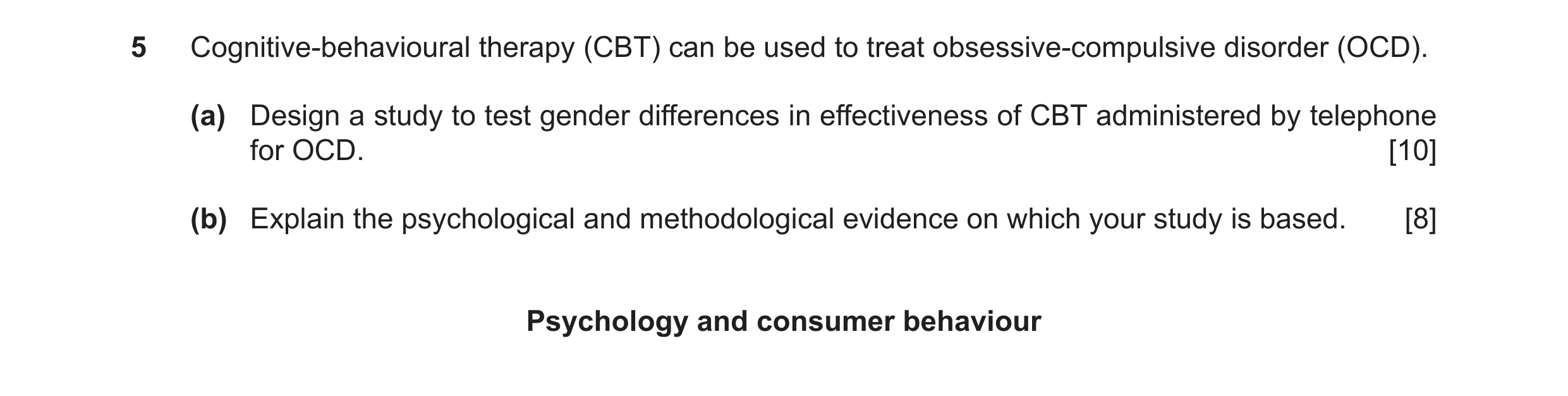
5 Cognitive-behavioural therapy (CBT) can be used to treat obsessive-compulsive disorder (OCD). (a) Design a study to test gender differences in effectiveness of CBT administered by telephone for OCD. [10] (b) Explain the psychological and methodological evidence on which your study is based. [8] Psychology and consumer behaviour
18 marks
Mark scheme: 5(a) Cognitive-behavioural therapy (CBT) can be used to treat obsessive- 10 compulsive disorder (OCD). Design a study to test gender differences in effectiveness of CBT administered by telephone for OCD. Marks: use generic levels of response Design a study question part (a). Additional: Candidates should design the study showing evidence of design features appropriate to the named method. The named method: any appropriate method. Specific features: • Experiments: type, IV, DV, controls, experimental design. • Observations: type, setting, response categories, sampling frame, number of observers. • Questionnaires/Interviews: type, setting, example questions. Scoring/rating scale, analysis of responses. General features of research methodology: sampling technique and sample, type of data, ethics, reliability, validity, data analysis. 5(b) Explain the psychological and methodological evidence on which your 8 study is based. Candidates are expected to explain the reasons for the suggested design in part (a). Explanation should be both psychological and methodological. Psychological to include appropriate theory or research. Marks: use generic levels of response ‘Design a study’ question part (b). ‘Psychological’ = 4 marks; ‘methodological’ = 4 marks If only methodological or psychological explanation is provided max 5 marks If ‘psychological’ described and not related to part (a) max 2 marks. Syllabus: psychological: cognitive (Lovell et al., 2006) and exposure and response prevention (Lehmkuhl et al., 2008) Psychological: Lovell et al. (2006) compared the effectiveness of CBT face-to-face with CBT given over the telephone. The conclusion was that there was no difference in effectiveness. However, there may have been an age difference that was not explored. NB: Lovell used BDI. Methodological: explanation of method using general and specific features as above.
This question in 9990/42 May/June 2021
Q8 · ‘Even though Charles was just one child, Rapoport’s case study of Charles’… 9990/42 May/June 2021
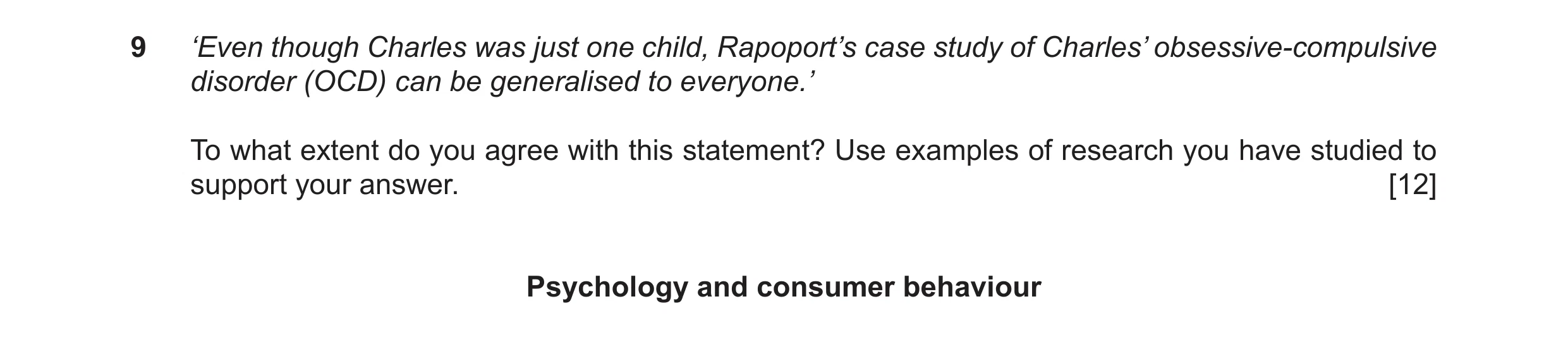
9 ‘Even though Charles was just one child, Rapoport’s case study of Charles’ obsessive-compulsive disorder (OCD) can be generalised to everyone.’ To what extent do you agree with this statement? Use examples of research you have studied to support your answer. [12] Psychology and consumer behaviour
12 marks
Mark scheme: 9 ‘Even though Charles was just one child, Rapoport’s case study of 12 Charles’ obsessive-compulsive disorder (OCD) can be generalised to everyone.’ To what extent do you agree with this statement? Use examples of research you have studied to support your answer. Marks: use generic levels of response in table C. Syllabus: examples and case studies (‘Charles’ by Rappaport,1989) Most likely (any other appropriate responses should be credited): Can be generalised: • Washing behaviour is a common type of OCD • The rituals associated with washing behaviour are common in others. • Comorbidity associated with OCD applies in others. • Treatments undergone with Charles can apply to others Cannot be generalised: • People are different and what applies to many people will not apply to all. • Rituals will occur, but they will be different. • Charles was a child and what he can do/not do will be different in an adults (who has to work, for example).
This question in 9990/42 May/June 2021
Q9 · Design a study to investigate the most common type of compulsive behaviour in people with… 9990/42 Oct/Nov 2021
5 (a) Design a study to investigate the most common type of compulsive behaviour in people with obsessive-compulsive disorder (OCD). [10] (b) Explain the psychological and methodological evidence on which your study is based. [8] Psychology and consumer behaviour
18 marks
Mark scheme: 5(a) Design a study to investigate the most common type of compulsive 10 behaviour in people with obsessive-compulsive disorder (OCD). Marks: use generic levels of response Design a study question part (a). Additional: Candidates should design the study showing evidence of design features appropriate to the named method. The named method: any appropriate method. Specific features: • Experiments: type, IV, DV, controls, experimental design. • Observations: type, setting, response categories, sampling frame, number of observers. • Questionnaires/Interviews: type, setting, example questions. Scoring/rating scale, analysis of responses. General features of research methodology: sampling technique and sample, type of data, ethics, reliability, validity, data analysis 5(b) Explain the psychological and methodological evidence on which your 8 study is based. Marks: use generic levels of response ‘Design a study’ question part (b). NB If only methodological or psychological explanation is provided max 5 marks Candidates are expected to explain the reasons for the suggested design in part (a). Explanation should be both psychological and methodological. Psychological to include appropriate theory or research. Additional: candidates are expected to justify their decisions or evidence presented regarding the design made in answer to question part (a). Syllabus: examples and case studies (‘Charles’ by Rappaport,1989) Psychological: Most likely inclusion of checking, cleaning/washing, slowness, doubting, ordering, repeating. Most likely example: ‘Charles’ was a compulsive ‘washer’, following a daily ritual. Methodological: explanation of method using general and specific features as above.
This question in 9990/42 Oct/Nov 2021
Q10 · ‘Biomedical treatments for obsessive-compulsive and related disorders are irrelevant.’ To… 9990/42 Oct/Nov 2021
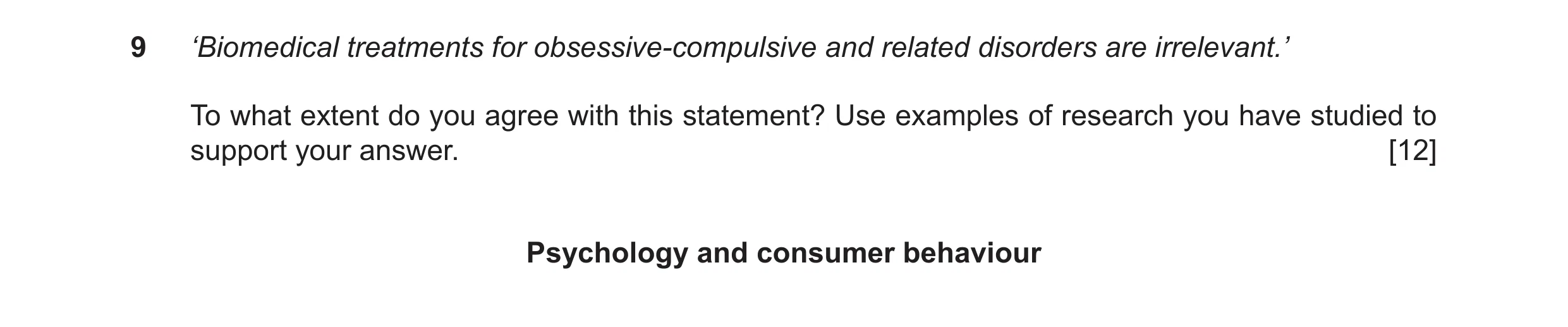
9 ‘Biomedical treatments for obsessive-compulsive and related disorders are irrelevant.’ To what extent do you agree with this statement? Use examples of research you have studied to support your answer. [12] Psychology and consumer behaviour
12 marks
Mark scheme: 9 ‘Biomedical treatments for obsessive-compulsive and related disorders 12 are irrelevant.’ To what extent do you agree with this statement? Use examples of research you have studied to support your answer. Marks: use generic levels of response in table C. Syllabus: types of and common obsessions, common compulsions, hoarding and body dysmorphic disorder (but also explanations of OCD) NB candidates could refer to hoarding and/or BDD in their answer Most likely (any other appropriate responses should be credited): purpose: • if OCD is caused by low serotonin levels, then drugs can be used to increase the activity of serotonin in in the brain • OCD has comorbidity, so drugs can be used to alleviate other symptoms of anxiety or depression • Drugs can create the belief in the person that ‘something is working’, even if it is acting like a placebo. No purpose: • Drugs do not cure the OC/related disorder. It is psychological not physiological • Drugs are not a long-term solution; they cannot be taken forever. • Drugs are often addictive, which can create more problems than they solve.
This question in 9990/42 Oct/Nov 2021
Q11 · ‘Psychometric measures used to assess obsessive-compulsive disorder (OCD) provide… 9990/41 May/June 2022
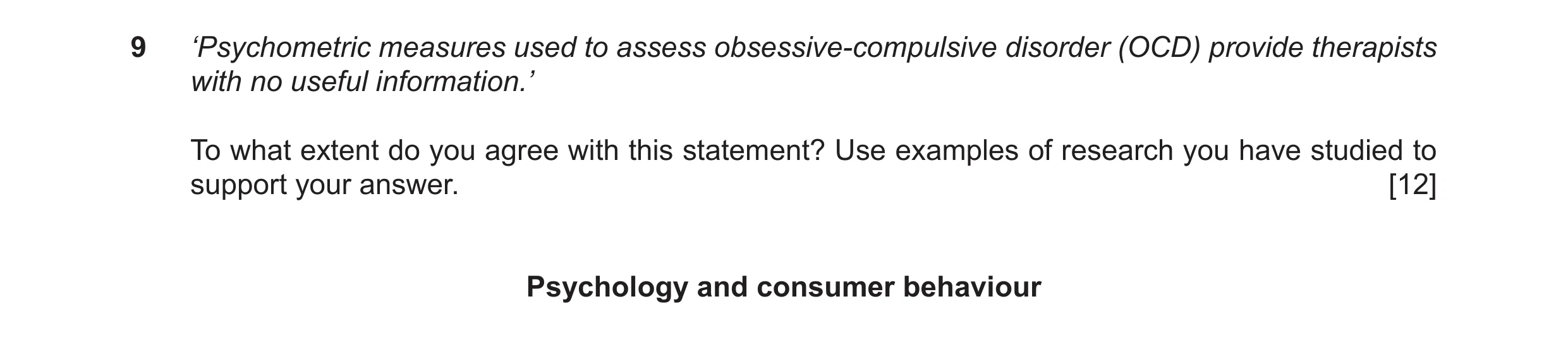
9 ‘Psychometric measures used to assess obsessive-compulsive disorder (OCD) provide therapists with no useful information.’ To what extent do you agree with this statement? Use examples of research you have studied to support your answer. [12] Psychology and consumer behaviour
12 marks
Mark scheme: 9 ‘Psychometric measures used to assess obsessive-compulsive disorder (OCD) provide therapists with no useful information.’ To what extent do you agree with this statement? Use examples of research you have studied to support your answer. Marks: use generic levels of response in table C. Syllabus: measures: Maudsley Obsessive-Compulsive Inventory (MOCI), Yale-Brown Obsessive-Compulsive Scale (Y-BOCS) Most likely (any other appropriate responses should be credited): Useful: measures such as Y-BOCS and MOCI indicate the severity of a disorder these measures can highlight specific features of the disorder these measures can be used as comparisons with others with the same disorder these measures provide quantitative data Not useful: talking to a therapist in a clinical interview can reveal perhaps more than any test the measure can use scales (5 or 7 point) which may not represent what the person thinks: they could take a neutral option people answering the questionnaires may not be honest about everything measures assume people have similarities; they are less individualistic.
This question in 9990/41 May/June 2022
Q12 · ‘Psychometric measures used to assess obsessive-compulsive disorder (OCD) provide… 9990/43 May/June 2022
9 ‘Psychometric measures used to assess obsessive-compulsive disorder (OCD) provide therapists with no useful information.’ To what extent do you agree with this statement? Use examples of research you have studied to support your answer. [12] Psychology and consumer behaviour
12 marks
Mark scheme: 9 ‘Psychometric measures used to assess obsessive-compulsive disorder (OCD) provide therapists with no useful information.’ To what extent do you agree with this statement? Use examples of research you have studied to support your answer. Marks: use generic levels of response in table C. Syllabus: measures: Maudsley Obsessive-Compulsive Inventory (MOCI), Yale-Brown Obsessive-Compulsive Scale (Y-BOCS) Most likely (any other appropriate responses should be credited): Useful: measures such as Y-BOCS and MOCI indicate the severity of a disorder these measures can highlight specific features of the disorder these measures can be used as comparisons with others with the same disorder these measures provide quantitative data Not useful: talking to a therapist in a clinical interview can reveal perhaps more than any test the measure can use scales (5 or 7 point) which may not represent what the person thinks: they could take a neutral option people answering the questionnaires may not be honest about everything measures assume people have similarities; they are less individualistic.
This question in 9990/43 May/June 2022
Q13 · Design a study to investigate the effectiveness of a biomedical treatment (SSRIs) for… 9990/42 Oct/Nov 2022
5 (a) Design a study to investigate the effectiveness of a biomedical treatment (SSRIs) for obsessive-compulsive disorder (OCD). [10] (b) Explain the psychological and methodological evidence on which your study is based. [8] Psychology and consumer behaviour
18 marks
Mark scheme: 5(a) Design a study to investigate the effectiveness of a biomedical 10 treatment (SSRIs) for obsessive-compulsive disorder (OCD). Marks: use generic levels of response Design a study question part (a). Additional: Candidates should design the study showing evidence of design features appropriate to the named method. The named method is: any appropriate method. Specific features: • Experiments: type, IV, DV, controls, experimental design. • Observations: type, setting, response categories, sampling frame, number of observers. • Questionnaires/Interviews: type, setting, example questions. Scoring/ rating scale, analysis of responses. General features of research methodology: sampling technique & sample, type of data, ethics, reliability, validity, data analysis. 5(b) Explain the psychological and methodological evidence on which your 8 study is based. Marks: use generic levels of response ‘Design a study’ question part (b). Note: If only methodological or psychological explanation is provided max 5 marks Candidates are expected to explain the reasons for the suggested design in part (a). Explanation should be both psychological and methodological. Psychological to include appropriate theory or research. Additional: candidates are expected to justify their decisions or evidence presented regarding the design made in answer to question part (a). Syllabus: biochemical (Grant et al., 2008) Psychological: The biochemical treatment using nalmefene is believed by Grant et al. (2008) to help reduce the urge to gamble. To test its effectiveness, participants were assessed to ensure they were suitable to participate. They were then randomly allocated to either a group receiving nalmefene or to a group receiving a placebo. Methodological: explanation of method using general and specific features as above.
This question in 9990/42 Oct/Nov 2022
Q14 · Design a study using an observation to investigate which are the most common compulsions… 9990/42 Feb/March 2023
5 (a) Design a study using an observation to investigate which are the most common compulsions in people with obsessive‑compulsive disorder (OCD). [10] (b) Explain the psychological and methodological evidence on which your study is based. [8] Psychology and consumer behaviour
18 marks
Mark scheme: 5(a) Design a study using an observation to investigate which are the most 10 common compulsions in people with obsessive-compulsive disorder (OCD). Marks: use generic levels of response Design a study question part (a). Additional: Candidates should design the study showing evidence of design features appropriate to the named method. The named method: observation. Specific features: Observations: type, setting, response categories, sampling frame, number of observers. General features of research methodology: sampling technique and sample, type of data, ethics, reliability, validity, data analysis. 5(b) Explain the psychological and methodological evidence on which your 8 study is based. Marks: use generic levels of response ‘Design a study’ question part (b). NB If only methodological or psychological explanation is provided max 5 marks Candidates are expected to explain the reasons for the suggested design in part (a). Explanation should be both psychological and methodological. Psychological to include appropriate theory or research. Additional: candidates are expected to justify their decisions or evidence presented regarding the design made in answer to question part (a). Syllabus: types of and common obsessions, common compulsions, hoarding and body dysmorphic disorder. Psychological: Common compulsive behaviours include: Repeatedly checking to make sure that doors and windows are locked or that appliances are turned off. Excessive cleaning of the house, clothes, and/or body. Counting objects, letters, words, or actions. Doing routine activities repeatedly, like standing up or going up and down stairs. Requesting or demanding reassurance from family members or health practitioners. Repeating phrases or sequences of words either out loud or mentally. Rearranging objects to ensure a specific order and/or symmetry. Doing things in multiples: e.g. turning the light on and off three times. Methodological: explanation of method using general and specific features as above.
This question in 9990/42 Feb/March 2023
Q15 · ‘Cognitive treatment for obsessive‑compulsive and related disorders is not the solution 9990/42 Feb/March 2023
9 ‘Cognitive treatment for obsessive‑compulsive and related disorders is not the solution. Biomedical treatment is the only solution.’ To what extent do you agree with this statement? Use examples of research you have studied to support your answer. [12] Psychology and consumer behaviour
12 marks
Mark scheme: 9 ‘Cognitive treatment for obsessive-compulsive and related disorders is 12 not the solution. Biomedical treatment is the only solution.’ To what extent do you agree with this statement? Use examples of research you have studied to support your answer. Marks: use generic levels of response in table C. Syllabus: Explanations of depression Most likely (any other appropriate responses should be credited): Support biomedical • cognitive therapies need the person to be active and involved in the treatment. Many people prefer to be passive • taking a drug is easy, quick and involves nothing more than swallowing a pill. • drugs treat the symptom, not the cause. Why does the cause need to be known? Support cognitive • cognitive therapies need the person to be active, rather than passive, and involved in their own treatment. This is a good thing. • taking drugs is addictive and long-term consumption will lead to addiction. • cognitive theories determine the cause, faulty thinking and the person is taught how to think positively and to ‘cure’ their depression this way.
This question in 9990/42 Feb/March 2023
Q16 · Obsessive-compulsive disorder (OCD) can be treated with biomedical treatments and it can… 9990/41 May/June 2023
1 Obsessive-compulsive disorder (OCD) can be treated with biomedical treatments and it can be managed with psychological treatments. Biomedical treatments include the use of drugs such as SSRIs. OCD can be managed psychologically using exposure and response prevention. (a) Explain how SSRIs work when treating OCD. [2] (b) (i) Explain what is meant by an obsession, using an example. [2] (ii) Explain what is meant by a compulsion, using an example. [2] (c) Outline one case study where exposure and response prevention was used to treat OCD. [4] (d) Discuss the strengths and weaknesses of using drugs to treat OCD. You should include a conclusion in your answer. [5] Psychology and consumer behaviour
15 marks
Mark scheme: Question Answer Marks 1(a) Obsessive-compulsive disorder (OCD) can be treated with biomedical 2 treatments and it can be managed with psychological treatments. Biomedical treatments include the use of drugs such as SSRIs. OCD can be managed psychologically using exposure and response prevention. Explain how SSRIs work when treating OCD. Most likely answer (other appropriate responses to be credited): It is assumed that OCD is caused by low levels of serotonin. it is thought that SSRIs work by increasing serotonin levels in the brain. serotonin is a neurotransmitter (a messenger chemical that carries signals between nerve cells in the brain). It's thought to have a good influence on mood, emotion and sleep. after carrying a message, serotonin is usually reabsorbed by the nerve cells (known as ‘reuptake’). SSRIs work by blocking (‘inhibiting’) reuptake, meaning more serotonin is available to pass further messages between nearby nerve cells. Marks: 1 mark basic answer; 2 marks elaboration/example. 1(b)(i) Explain what is meant by an obsession, using an example. 2 Most likely answer (other appropriate responses to be credited): Explanation: An obsession is a recurring and persistent thought that interferes with normal behaviour. (1 mark) NB: 0 marks for ‘thoughts’ or ‘obsessive thoughts’; 1 mark for repetitive/recurring thoughts Example: fearing contamination from anything that is unclean fear of losing control fear of losing or not having things you might need. order and symmetry: the idea that everything must line up “just right”. Marks: 1 mark for explanation; 1 mark for example. 1(b)(ii) Explain what is meant by a compulsion, using an example. 2 Most likely answer (other appropriate responses to be credited): Explanation: Compulsions or compulsive acts are repetitious, purposeful physical or mental actions that the individual feels compelled to engage in according to their own strict rules or in a stereotyped manner (1 mark) NB: 0 marks for ‘behaviours’ or ‘compulsive behaviours’ or ‘obsessive behaviours’; 1 mark for repetitive/excessive behaviours; 1 mark for ‘when obsessions are acted upon’. Example: excessive double checking of things such as doors, locks repeating counting, checking words excessive washing or cleaning accumulating things ‘junk’ (hoarding) Marks: 1 mark for explanation; 1 mark for example. NB: 0 marks for examples of impulse control disorders such as pyromania, kleptomania and gambling. 1(c) Outline one case study where exposure and response prevention was 4 used to treat OCD. Most likely answer (other appropriate responses to be credited): exposure and response prevention (ERP) exposure means facing or confronting the feared stimuli and/or situations repeatedly until the fear associated with them subsides, and response prevention means not carrying out the compulsive, avoidant, or escape behaviour. ERP targets the behavioural component of CBT. Lehmkuhl et al. (2008), ERP was used to treat a 12-year-old boy. Jason experienced contamination fears, avoiding ‘contaminated’ items (e.g. door knobs, library books, etc.) He would not sit on chairs, turn pages with his hands, or touch papers that other children had touched. Jason attended ten 50-minute sessions over 16 weeks. Jason was exposed to items he avoided and over the sessions his anxiety dropped. After three months his Y-BOCS score remained low. Marks: 1 mark basic answer (must include ERP and case study of OCD); 2–4 marks description of ERP with increasing detail and quality. NB: 0 marks for ‘Charles’, (OCD but no ERP) or the boy with button phobia (Saavedra and Silverman, ERP but not OCD) 1(d) Discuss the strengths and weaknesses of using drugs to treat OCD. You 5 should include a conclusion in your answer. Most likely answer (other appropriate responses to be credited): Strengths drugs easy to take; swallowing a pill drugs mean the patient is passive in their treatment (and advantage for many people) drugs have been shown to be effective in many studies Weaknesses drugs are addictive so should be short-term use only drugs are effective for associated problems such as anxiety drugs ignore the role of alternative explanations of OCD (treat symptom, not cause) Conclusion: any appropriate conclusion drawn from the discussion that has been presented. 1 mark if appropriate. A conclusion is a ‘decision reached by reasoning’ and so a summary of points already made scores 0 marks. Marks: Question requires discussion; always plural of each argument, and always requires conclusion. 1 mark for each advantage/disadvantage (however detailed) and related to the question up to 4 max. 2 marks max for two strengths/weaknesses unrelated to the question. 1 mark for conclusion.
This question in 9990/41 May/June 2023
Q17 · Patients with obsessive-compulsive disorder (OCD) can receive treatment with a therapist… 9990/41 May/June 2023
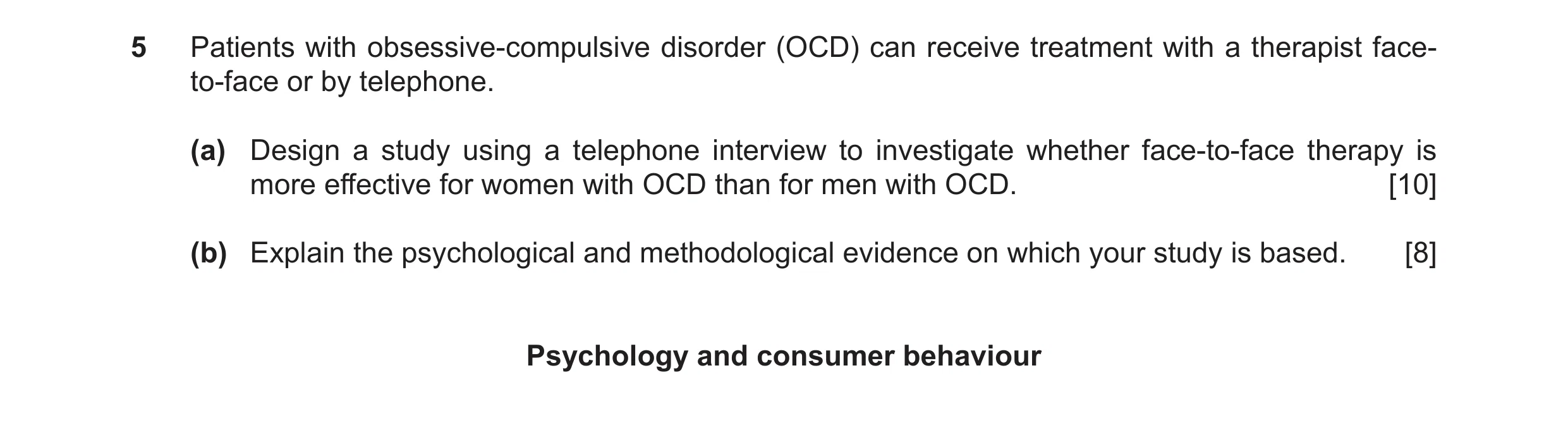
5 Patients with obsessive-compulsive disorder (OCD) can receive treatment with a therapist face- to-face or by telephone. (a) Design a study using a telephone interview to investigate whether face-to-face therapy is more effective for women with OCD than for men with OCD. [10] (b) Explain the psychological and methodological evidence on which your study is based. [8] Psychology and consumer behaviour
18 marks
Mark scheme: 5(a) Patients with obsessive-compulsive disorder (OCD) can receive 10 treatment with a therapist face-to-face or by telephone. Design a study using a telephone interview to investigate whether face- to-face therapy is more effective for women with OCD than for men with OCD. Marks: use generic levels of response Design a study question part (a). Additional: Candidates should design the study showing evidence of design features appropriate to the named method. The named method is: telephone interview. Specific features: Questionnaires/Interviews: type, setting, example questions. Scoring/rating scale, analysis of responses. General features of research methodology: sampling technique and sample, type of data, ethics, reliability, validity, data analysis. 5(b) Explain the psychological and methodological evidence on which your 8 study is based. Marks: use generic levels of response ‘Design a study’ question part (b). NB If only methodological or psychological explanation is provided max 5 marks Candidates are expected to explain the reasons for the suggested design in part (a). Explanation should be both psychological and methodological. Psychological to include appropriate theory or research. Additional: candidates are expected to justify their decisions or evidence presented regarding the design made in answer to question part (a). Syllabus: treatment and management of O-C and related disorders: psychological: cognitive (Lovell et al., 2006) Psychological: (study abstract) Objectives To compare the effectiveness of cognitive behaviour therapy delivered by telephone with the same therapy given face to face in the treatment of obsessive compulsive disorder. Design Randomised controlled non-inferiority trial. Setting Two psychology outpatient departments in the United Kingdom. Participants 72 patients with obsessive compulsive disorder. Intervention 10 weekly sessions of exposure therapy and response prevention delivered by telephone or face to face. Main outcome measures Yale Brown obsessive compulsive disorder scale, Beck depression inventory, and client satisfaction questionnaire. Results Difference in the Yale Brown obsessive compulsive disorder checklist score between the two treatments at six months was – 0.55 (95% confidence interval – 4.26 to 3.15). Patient satisfaction was high for both forms of treatment. Conclusion The clinical outcome of cognitive behaviour therapy delivered by telephone was equivalent to treatment delivered face to face and similar levels of satisfaction were reported. Methodological: explanation of method using general and specific features as above.
This question in 9990/41 May/June 2023
Q18 · Obsessive-compulsive disorder (OCD) can be treated with biomedical treatments and it can… 9990/43 May/June 2023
1 Obsessive-compulsive disorder (OCD) can be treated with biomedical treatments and it can be managed with psychological treatments. Biomedical treatments include the use of drugs such as SSRIs. OCD can be managed psychologically using exposure and response prevention. (a) Explain how SSRIs work when treating OCD. [2] (b) (i) Explain what is meant by an obsession, using an example. [2] (ii) Explain what is meant by a compulsion, using an example. [2] (c) Outline one case study where exposure and response prevention was used to treat OCD. [4] (d) Discuss the strengths and weaknesses of using drugs to treat OCD. You should include a conclusion in your answer. [5] Psychology and consumer behaviour
15 marks
Mark scheme: Question Answer Marks 1(a) Obsessive-compulsive disorder (OCD) can be treated with biomedical 2 treatments and it can be managed with psychological treatments. Biomedical treatments include the use of drugs such as SSRIs. OCD can be managed psychologically using exposure and response prevention. Explain how SSRIs work when treating OCD. Most likely answer (other appropriate responses to be credited): It is assumed that OCD is caused by low levels of serotonin. it is thought that SSRIs work by increasing serotonin levels in the brain. serotonin is a neurotransmitter (a messenger chemical that carries signals between nerve cells in the brain). It's thought to have a good influence on mood, emotion and sleep. after carrying a message, serotonin is usually reabsorbed by the nerve cells (known as ‘reuptake’). SSRIs work by blocking (‘inhibiting’) reuptake, meaning more serotonin is available to pass further messages between nearby nerve cells. Marks: 1 mark basic answer; 2 marks elaboration/example. 1(b)(i) Explain what is meant by an obsession, using an example. 2 Most likely answer (other appropriate responses to be credited): Explanation: An obsession is a recurring and persistent thought that interferes with normal behaviour. (1 mark) NB: 0 marks for ‘thoughts’ or ‘obsessive thoughts’; 1 mark for repetitive/recurring thoughts Example: fearing contamination from anything that is unclean fear of losing control fear of losing or not having things you might need. order and symmetry: the idea that everything must line up “just right”. Marks: 1 mark for explanation; 1 mark for example. 1(b)(ii) Explain what is meant by a compulsion, using an example. 2 Most likely answer (other appropriate responses to be credited): Explanation: Compulsions or compulsive acts are repetitious, purposeful physical or mental actions that the individual feels compelled to engage in according to their own strict rules or in a stereotyped manner (1 mark) NB: 0 marks for ‘behaviours’ or ‘compulsive behaviours’ or ‘obsessive behaviours’; 1 mark for repetitive/excessive behaviours; 1 mark for ‘when obsessions are acted upon’. Example: excessive double checking of things such as doors, locks repeating counting, checking words excessive washing or cleaning accumulating things ‘junk’ (hoarding) Marks: 1 mark for explanation; 1 mark for example. NB: 0 marks for examples of impulse control disorders such as pyromania, kleptomania and gambling. 1(c) Outline one case study where exposure and response prevention was 4 used to treat OCD. Most likely answer (other appropriate responses to be credited): exposure and response prevention (ERP) exposure means facing or confronting the feared stimuli and/or situations repeatedly until the fear associated with them subsides, and response prevention means not carrying out the compulsive, avoidant, or escape behaviour. ERP targets the behavioural component of CBT. Lehmkuhl et al. (2008), ERP was used to treat a 12-year-old boy. Jason experienced contamination fears, avoiding ‘contaminated’ items (e.g. door knobs, library books, etc.) He would not sit on chairs, turn pages with his hands, or touch papers that other children had touched. Jason attended ten 50-minute sessions over 16 weeks. Jason was exposed to items he avoided and over the sessions his anxiety dropped. After three months his Y-BOCS score remained low. Marks: 1 mark basic answer (must include ERP and case study of OCD); 2–4 marks description of ERP with increasing detail and quality. NB: 0 marks for ‘Charles’, (OCD but no ERP) or the boy with button phobia (Saavedra and Silverman, ERP but not OCD) 1(d) Discuss the strengths and weaknesses of using drugs to treat OCD. You 5 should include a conclusion in your answer. Most likely answer (other appropriate responses to be credited): Strengths drugs easy to take; swallowing a pill drugs mean the patient is passive in their treatment (and advantage for many people) drugs have been shown to be effective in many studies Weaknesses drugs are addictive so should be short-term use only drugs are effective for associated problems such as anxiety drugs ignore the role of alternative explanations of OCD (treat symptom, not cause) Conclusion: any appropriate conclusion drawn from the discussion that has been presented. 1 mark if appropriate. A conclusion is a ‘decision reached by reasoning’ and so a summary of points already made scores 0 marks. Marks: Question requires discussion; always plural of each argument, and always requires conclusion. 1 mark for each advantage/disadvantage (however detailed) and related to the question up to 4 max. 2 marks max for two strengths/weaknesses unrelated to the question. 1 mark for conclusion.
This question in 9990/43 May/June 2023
Q19 · Patients with obsessive-compulsive disorder (OCD) can receive treatment with a therapist… 9990/43 May/June 2023
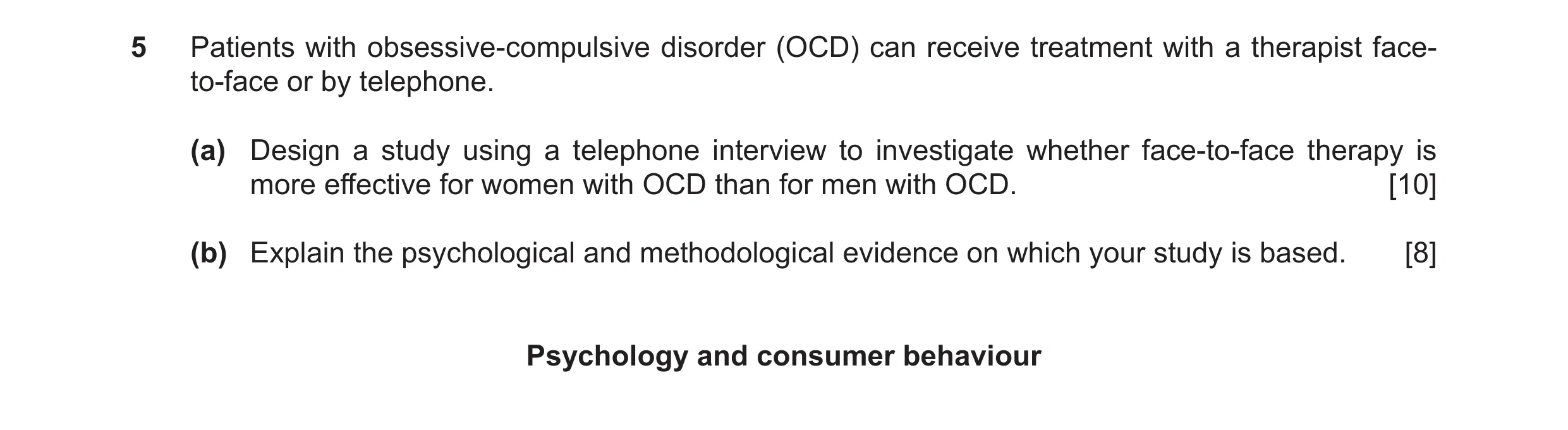
5 Patients with obsessive-compulsive disorder (OCD) can receive treatment with a therapist face- to-face or by telephone. (a) Design a study using a telephone interview to investigate whether face-to-face therapy is more effective for women with OCD than for men with OCD. [10] (b) Explain the psychological and methodological evidence on which your study is based. [8] Psychology and consumer behaviour
18 marks
Mark scheme: 5(a) Patients with obsessive-compulsive disorder (OCD) can receive 10 treatment with a therapist face-to-face or by telephone. Design a study using a telephone interview to investigate whether face- to-face therapy is more effective for women with OCD than for men with OCD. Marks: use generic levels of response Design a study question part (a). Additional: Candidates should design the study showing evidence of design features appropriate to the named method. The named method is: telephone interview. Specific features: Questionnaires/Interviews: type, setting, example questions. Scoring/rating scale, analysis of responses. General features of research methodology: sampling technique and sample, type of data, ethics, reliability, validity, data analysis. 5(b) Explain the psychological and methodological evidence on which your 8 study is based. Marks: use generic levels of response ‘Design a study’ question part (b). NB If only methodological or psychological explanation is provided max 5 marks Candidates are expected to explain the reasons for the suggested design in part (a). Explanation should be both psychological and methodological. Psychological to include appropriate theory or research. Additional: candidates are expected to justify their decisions or evidence presented regarding the design made in answer to question part (a). Syllabus: treatment and management of O-C and related disorders: psychological: cognitive (Lovell et al., 2006) Psychological: (study abstract) Objectives To compare the effectiveness of cognitive behaviour therapy delivered by telephone with the same therapy given face to face in the treatment of obsessive compulsive disorder. Design Randomised controlled non-inferiority trial. Setting Two psychology outpatient departments in the United Kingdom. Participants 72 patients with obsessive compulsive disorder. Intervention 10 weekly sessions of exposure therapy and response prevention delivered by telephone or face to face. Main outcome measures Yale Brown obsessive compulsive disorder scale, Beck depression inventory, and client satisfaction questionnaire. Results Difference in the Yale Brown obsessive compulsive disorder checklist score between the two treatments at six months was – 0.55 (95% confidence interval – 4.26 to 3.15). Patient satisfaction was high for both forms of treatment. Conclusion The clinical outcome of cognitive behaviour therapy delivered by telephone was equivalent to treatment delivered face to face and similar levels of satisfaction were reported. Methodological: explanation of method using general and specific features as above.
This question in 9990/43 May/June 2023
Q20 · From the key study by Lovell et al 9990/42 May/June 2024
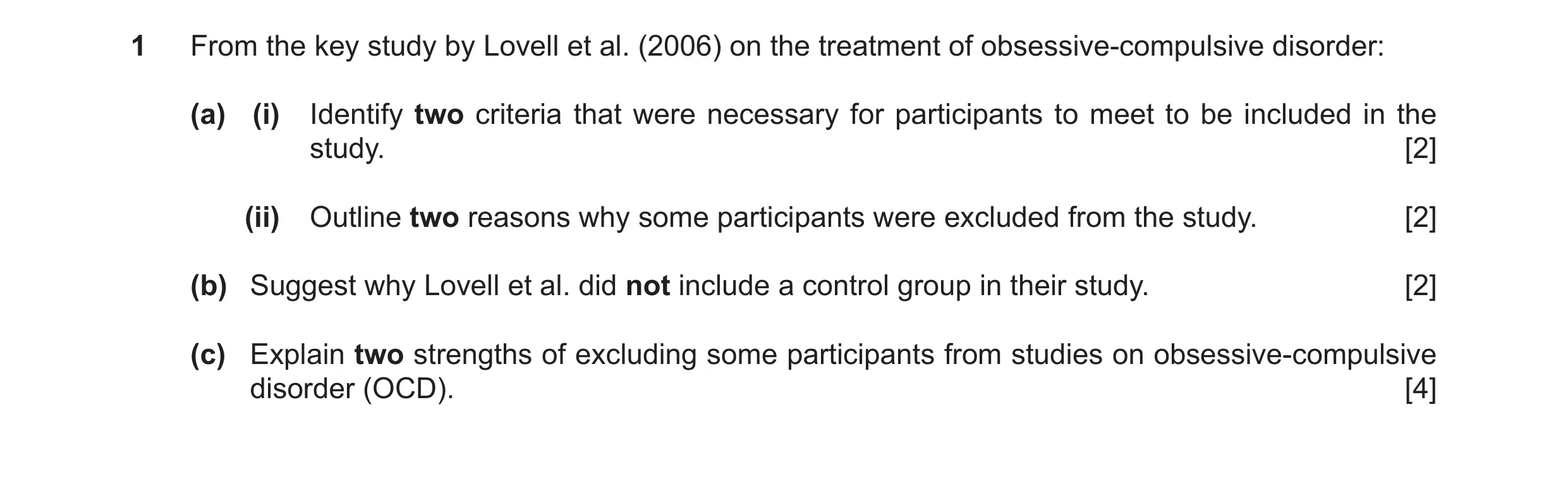
1 From the key study by Lovell et al. (2006) on the treatment of obsessive-compulsive disorder: (a) (i) Identify two criteria that were necessary for participants to meet to be included in the study. [2] (ii) Outline two reasons why some participants were excluded from the study. [2] (b) Suggest why Lovell et al. did not include a control group in their study. [2] (c) Explain two strengths of excluding some participants from studies on obsessive-compulsive disorder (OCD). [4]
10 marks
Mark scheme: Question Answer Marks 1 From the key study by Lovell et al. (2006) on the treatment of obsessive- compulsive disorder: 1(a)(i) Identify two criteria that were necessary for participants to meet to be 2 included in the study. Syllabus: 1.5.3 Key study on treatment of obsessive-compulsive disorder using telephone administered cognitive- behavioural therapy (CBT): Lovell et al. (2006). Award 1 mark for each appropriate reason. Definitive answer: diagnosis of obsessive-compulsive disorder score of 16 or more on YBOCS (Yale-Brown scale) age 16–65. 1(a)(ii) Outline two reasons why some participants were excluded from the 2 study. Award 1 mark for each appropriate reason. Definitive answer: patients with: obsessional slowness organic brain disease a diagnosis of substance misuse severe depression or with suicidal intent patients who had been on anti-depressants or anxiolytics for less than 3 months. NOTE: 0 marks for ‘withdrawing from study’; 0 marks for ‘mixing/doubling up’ with Q1(a)(i) 1(b) Suggest why Lovell et al. did not include a control group in their study. 2 Award 2 marks for an appropriate suggestion stated and applied to study with detail / elaboration / example. Award 1 mark for an appropriate suggestion identified but not applied. Answers may include: a control group was not needed (1) the aim was to see if CBT by telephone was as good as face-to-face; both groups receiving CBT (2) a control group would receive no treatment (1) and if they were to be an appropriate control group they would have to meet the same inclusion criteria as the experimental groups (2). Other appropriate responses to be credited. 1(c) Explain two strengths of excluding some participants from studies on 4 obsessive-compulsive disorder (OCD). Up to 2 marks for each strength 2. Award 2 marks for an appropriate strength stated and applied as required by the question with detail / elaboration / example. Award 1 mark for an appropriate strength/ stated but not applied. Answers may include: maintains ethical guidelines (protection from psychological harm) the participant may not be suitable for the treatment (1) and it may do their OCD more harm that good, particularly if they are undergoing an alternative treatment (2) maintains ethical guidelines (protection from psychological harm) the treatment may not be suitable for the participant (1) a participant may have a problem regarding telephones; they may have hearing problems; may not have a telephone (2) ‘telephone treatment’ was 50% shorter than a face-to-face consultation (1) so this should only be done with suitable OCD participants not those who need longer sessions or face-to-face to help them (2). Other appropriate responses to be credited.
This question in 9990/42 May/June 2024
Q21 · Obsessive-compulsive disorder (OCD) can be measured using psychometric tests such as the… 9990/42 May/June 2025
2 Obsessive-compulsive disorder (OCD) can be measured using psychometric tests such as the Yale-Brown Obsessive-Compulsive Scale (Y-BOCS). (a) Outline the scale used to assess question items on the Y-BOCS. [2] (b) Suggest one way that the reliability of the Y-BOCS could be tested. [2] (c) Explain one strength and one weakness of using psychometric tests to measure OCD. [4] Consumer Psychology Answer all questions if you have studied this option.
8 marks
Mark scheme: 2(a) Outline the scale used to assess question items on the Y-BOCS. 2 Syllabus 1.5.1 Diagnostic criteria for obsessive-compulsive disorder Measures: Yale-Brown Obsessive-Compulsive Scale (Y-BOCS). Marks: Award 1 mark for each correct component (2 marks max) Definitive answer: • 5-point scale • scale has a range from 0 to 4 • scale has a verbal range from none through mild, moderate, severe to extreme • each question has a different descriptor but which matches overall scale Note no marks for number of questions (10 items) or examples of questions. Also, no credit for how total score is assessed (min score 0, max 40) 2(b) Suggest one way that the reliability of the Y-BOCS could be tested. 2 Marks: Award 2 marks for an appropriate suggestion and applied to study with detail / elaboration / example. Award 1 mark for an appropriate suggestion but not applied. Answers may include (other appropriate responses to be credited): • test-retest where the test is repeated at a later date (1 mark). The Y- BOCS could be given to the same participant on different occasions (2 marks) • the split-half method involves splitting the test into two and administering each half of the test to the same person. (1 mark) The Y-BOCS scores from the two halves should show a strong correlation (2 marks) Note: no marks for identification of term only. 2(c) Explain one strength and one weakness of using psychometric tests to 4 measure OCD. Marks: Up to 2 marks for each strength and up to 2 marks for each weakness: Award 2 marks for an appropriate strength/weakness stated and applied as required by the question with detail / elaboration / example. Award 1 mark for an appropriate strength/weakness stated but not applied. Answers may include (other appropriate responses to be credited): Strengths • a psychometric test includes items as defined by ICD as typical of people with OCD and any person can be assessed in relation to the norm (1 mark) such as ‘control over compulsions’ (2 marks). • psychometric tests produce quantitative data allowing comparisons between people and the same person over time (1 mark) such as ‘hours/days spent on obsessions’ (2 marks). Weaknesses • psychometric tests do not take into account individual differences, aspects unique to the person’s OCD (1 mark). • tests may not allow a person to express their feelings (1 mark) about their specific rituals (2 marks).
This question in 9990/42 May/June 2025
Q22 · Plan a study using an observation to investigate which type of compulsion is most common… 9990/42 May/June 2025
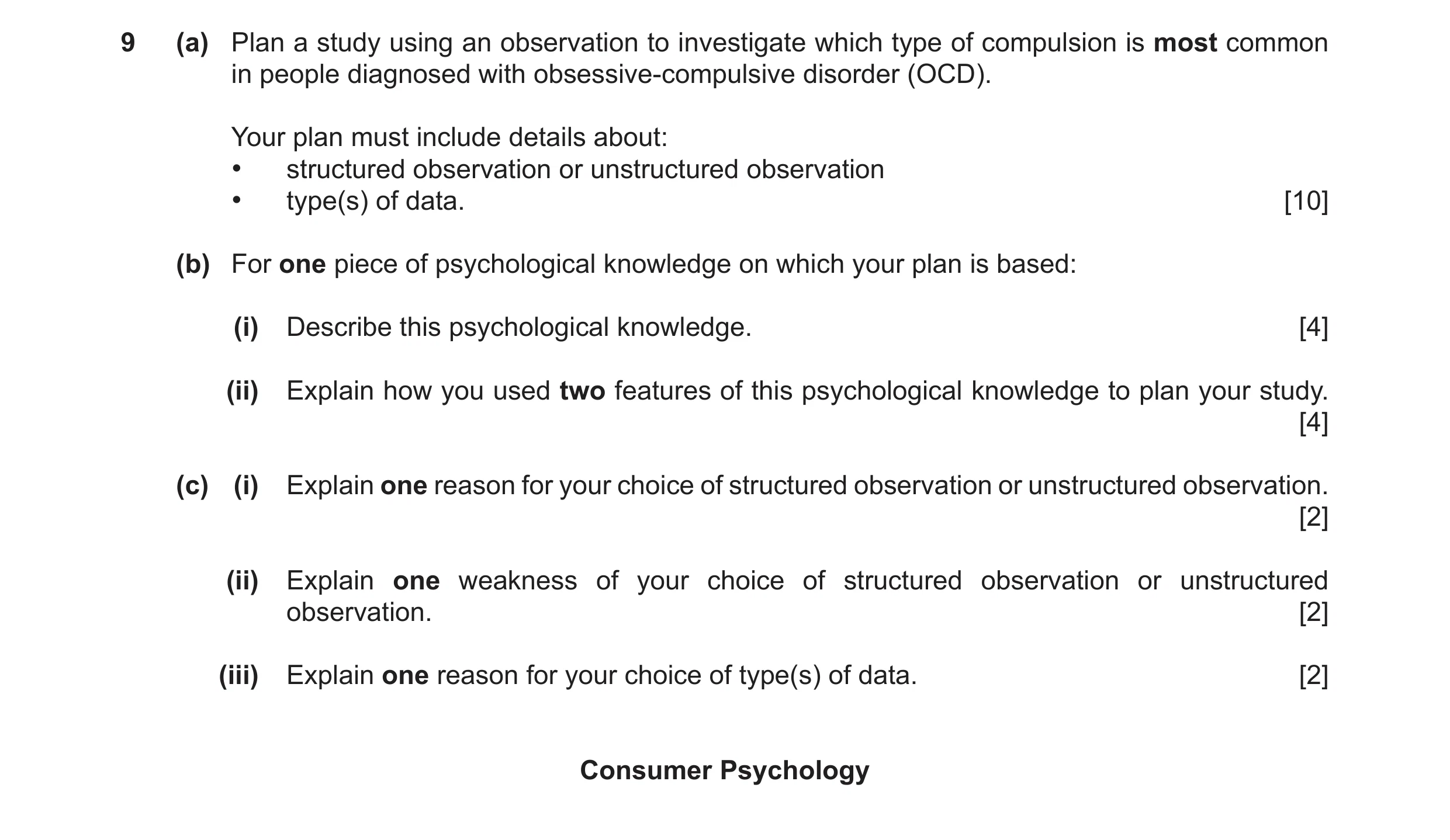
9 (a) Plan a study using an observation to investigate which type of compulsion is most common in people diagnosed with obsessive-compulsive disorder (OCD). Your plan must include details about: • structured observation or unstructured observation • type(s) of data. [10] (b) For one piece of psychological knowledge on which your plan is based: (i) Describe this psychological knowledge. [4] (ii) Explain how you used two features of this psychological knowledge to plan your study. [4] (c) (i) Explain one reason for your choice of structured observation or unstructured observation. [2] (ii) Explain one weakness of your choice of structured observation or unstructured observation. [2] (iii) Explain one reason for your choice of type(s) of data. [2] Consumer Psychology
24 marks
Mark scheme: 9(a) Plan a study using an observation to investigate which type of 10 compulsion is most common in people diagnosed with obsessive- compulsive disorder (OCD). Your plan must include details about: • structured observation or unstructured observation • type(s) of data. Use Table A: AO2 Application to mark candidate responses to this question. Credit both general features and specific features of the plan. The specific features of the The general features of the plan plan should include: should include (if appropriate): • structured or • sample and sampling technique unstructured • ethical guidelines • covert or over • a procedure • controlled or naturalistic • a location • participant or non- • type of data, analysis of data, participant use of descriptive statistics • number of observers (inter- • an aim or hypothesis (directional rater reliability) or non-directional)/null hypothesis • behavioural categories • steps for making the study valid • could include: event or time and reliable sampling Credit other elements of the plan as appropriate using the marking grid. 9(b) For one piece of psychological knowledge on which your plan is based: 9(b)(i) Describe this psychological knowledge. 4 Syllabus: 1.5.1 diagnostic criteria for obsessive-compulsive disorder (ICD-11) focusing on types of obsessions and compulsions, including a study, e.g. Rapoport (1989) ‘Charles’. Description: should focus on compulsions. Common ones include: ritualistic acts: such as excessive cleaning: cleaning items hand washing checking: items such as locking hoarding items doors, that a switch is ‘off’ counting, ordering or arranging personal possessions Details of ‘Charles’ might be included because of his excessive washing behaviour. Marks Description 3–4 The knowledge is appropriate. Relevant points are correctly described in good detail. 1–2 Basic points are identified with some elaboration and understanding. The answer lacks detail (a sentence or two). 0 No creditable response 9(b)(ii) Explain how you used two features of this psychological knowledge to 4 plan your study. Candidates should explain how the psychological knowledge described in (b)(i) has informed their plan in part (a). For each feature: Marks Description 2 Suitable answer that relates a feature and explains how the feature was used, expanded or modified to make it appropriate to the plan. The knowledge has clearly been applied to the plan. 1 Basic answer that identifies a feature 0 No creditable response Note 1 mark for explanation of follow on from (b)(i); 1 mark for explanation appearing in (a) 2 Example: I would use a structured observation with behavioural categories for checking, counting, cleaning and ritualistic behaviours and tally the behaviours for each person with OCD to see which of these behaviours is most common. I would use the case study of ‘Charles’ to identify the behaviours of washing and how data was gathered in that study. 9(c)(i) Explain one reason for your choice of a structured observation or 2 unstructured observation. Candidates must use the choice of structured or unstructured observation stated in (a). Award 2 marks: reason is given and applied to the plan Award 1 mark: reason is given without being applied to the plan Example • a structured observation uses behaviour checklists so observers know exactly what they are looking for; it is more reliable than unstructured observation (1 mark) related to study (2 marks) • a structured observation uses behaviour checklists so two observers can independently record behaviour and their reliability checked (1 mark) related to study (2 marks) • a structured observation can be used as a technique to measure the DV in an experiment (1 mark) related to study (2 marks) • an unstructured observation can be used as a pilot study (1 mark) related to study (2 marks) • an unstructured observation can be used when it is not known what specific behaviours should be observed (1 mark) related to study (2 marks) • an unstructured observation can be used to refine the range of behaviours for further study (1 mark) related to study (2 marks) 9(c)(ii) Explain one weakness of your choice of a structured observation or 2 unstructured observation. Candidates must use the observation feature stated in (c)(i) Award 2 marks: weakness is given and applied to the plan Award 1 mark: weakness is given without being applied to the plan Example • a structured observation may not include all the categories that need to be observed and so important behaviours are not recorded (1 mark) related to study (2 marks) • a structured observation might not have clearly defined categories and be too general (e.g. record counting, but counting what?) (1 mark) related to study (2 marks) • an unstructured observation means that it could be difficult to record all behaviours and so some might be missed (1 mark) related to study (2 marks) • an unstructured observation means that checking the reliability of observers would be problematic (1 mark) related to study (2 marks) 9(c)(iii) Explain one reason for your choice of type(s) of data. 2 Candidates must use the type(s)of data stated in (a). Award 2 marks: reason is given and applied to the plan Award 1 mark: reason is given without being applied to the plan Example • quantitative data can be statistically analysed by researchers (1 mark) related to plan (2 marks) • qualitative data can allow participants to provide reasons for their answer (1 mark) related to plan (2 marks) • both quantitative and qualitative data can be gathered to provide ‘best of both worlds’ (1 mark) related to plan (2 marks)
This question in 9990/42 May/June 2025
Q23 · From the key study by Lovell et al 9990/42 Oct/Nov 2025
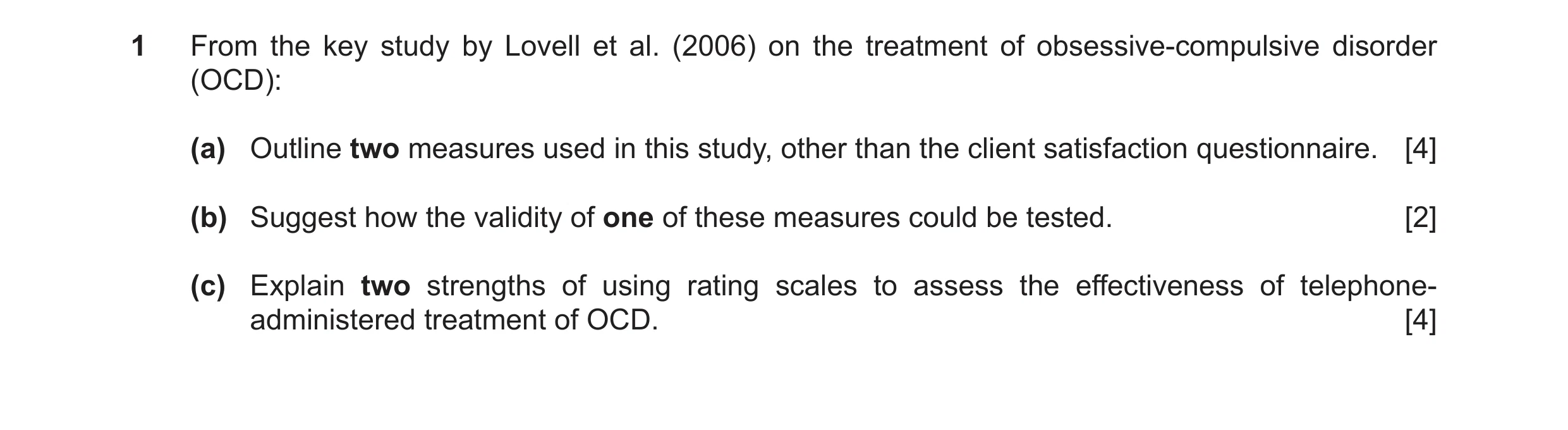
1 From the key study by Lovell et al. (2006) on the treatment of obsessive-compulsive disorder (OCD): (a) Outline two measures used in this study, other than the client satisfaction questionnaire. [4] (b) Suggest how the validity of one of these measures could be tested. [2] (c) Explain two strengths of using rating scales to assess the effectiveness of telephone- administered treatment of OCD. [4]
10 marks
Mark scheme: Question Answer Marks 1 From the key study by Lovell et al. (2006) on the treatment of obsessive-compulsive disorder (OCD): 1(a) Outline two measures used in this study, other than the client 4 satisfaction questionnaire. Syllabus: 1.5.3 Key study on treatment of obsessive-compulsive disorder using telephone administered cognitive-behavioural therapy (CBT): Lovell et al. (2006). Marks: Award 2 marks for a detailed outline (e.g. two or more features of the measure). Award 1 mark for a partial outline (e.g. one feature) Award 1 marks for identification of both; 0 marks for identification of only one. Definitive answer (quote): • Yale Brown obsessive compulsive (Y-BOCS) checklist (self-report version). This is a 10 item questionnaire; each question scores between 0 and 4 (0 no symptoms, 4 severe symptoms). The total score range is 0–7 very mild, 8–15 mild, 16–23 moderate, 24–31 marked, and 32–40 severe. NB: the YBOCS can be administered by a clinician in a semi-structured, face- to-face interview. Lovell et al. used the self-report version, so no credit for ‘interview’. • a secondary outcome measure was the Beck Depression Inventory. (21 items, 0–3 scale, 63 points max) NB: 0 marks for any question or what Y-BOCS/BDI is measuring (ie OCD/Depression) 1(b) Suggest how the validity of one of these measures could be tested. 2 Marks: Award 2 marks for an appropriate suggestion stated and applied to study with detail / elaboration / example. Award 1 mark for an appropriate suggestion identified but not applied. NB does not need to use the terms criterion validity or construct validity. • concurrent validity by comparing the Y-BOCS/BDI to other measures of OCD (1 mark) and if the two scores have a strong correlation the Y-BOCS/BDI could be said to be valid (2 marks) • construct validity by seeing if seeing if the Y-BOCS/BDI matches up with theoretical ideas about what it is supposed to be measuring (1 mark) and if it does the Y-BOCS/BDI could be said to be valid (2 marks). • ecological validity: does the scale apply to real life (1 mark) do the questions (on paper) reflect real life experiences of people with OCD (2 marks) • temporal validity: test the Y-BOCS/BDI over time (1 mark) to see if the person shows any improvement (2 marks) e.g. reduction on obsessions or compulsions could be said to be valid (2 marks) 1(c) Explain two strengths of using rating scales to assess the effectiveness 4 of telephone-administered treatment of OCD. Marks: Up to 2 marks for each strength 2. Award 2 marks for an appropriate strength stated and applied as required by the question with detail / elaboration / example. Award 1 mark for an appropriate strength stated but not applied. Answers may include (other appropriate responses to be credited). • a rating scale can be used to assess the same person over time (1 mark) to see if there is any improvement (or not) in their OCD after treatment (2 marks). • a rating scale can be used to compare one person with another (1 mark) • a rating scale can be used as a diagnostic/assessment tool (1 mark) to determine the features of the person’s OCD and the severity of it on a standardised scale (2 marks).
This question in 9990/42 Oct/Nov 2025
![Question 2: (a) Design a study using a questionnaire to investigate the most common body dysmorphic disorder behaviours. [10] (b) Explain the psycholog…](https://img.pastlit.com/crops/46469efd-8343-405f-b485-14d7097772c6/q5.webp)
 1 / 6
1 / 6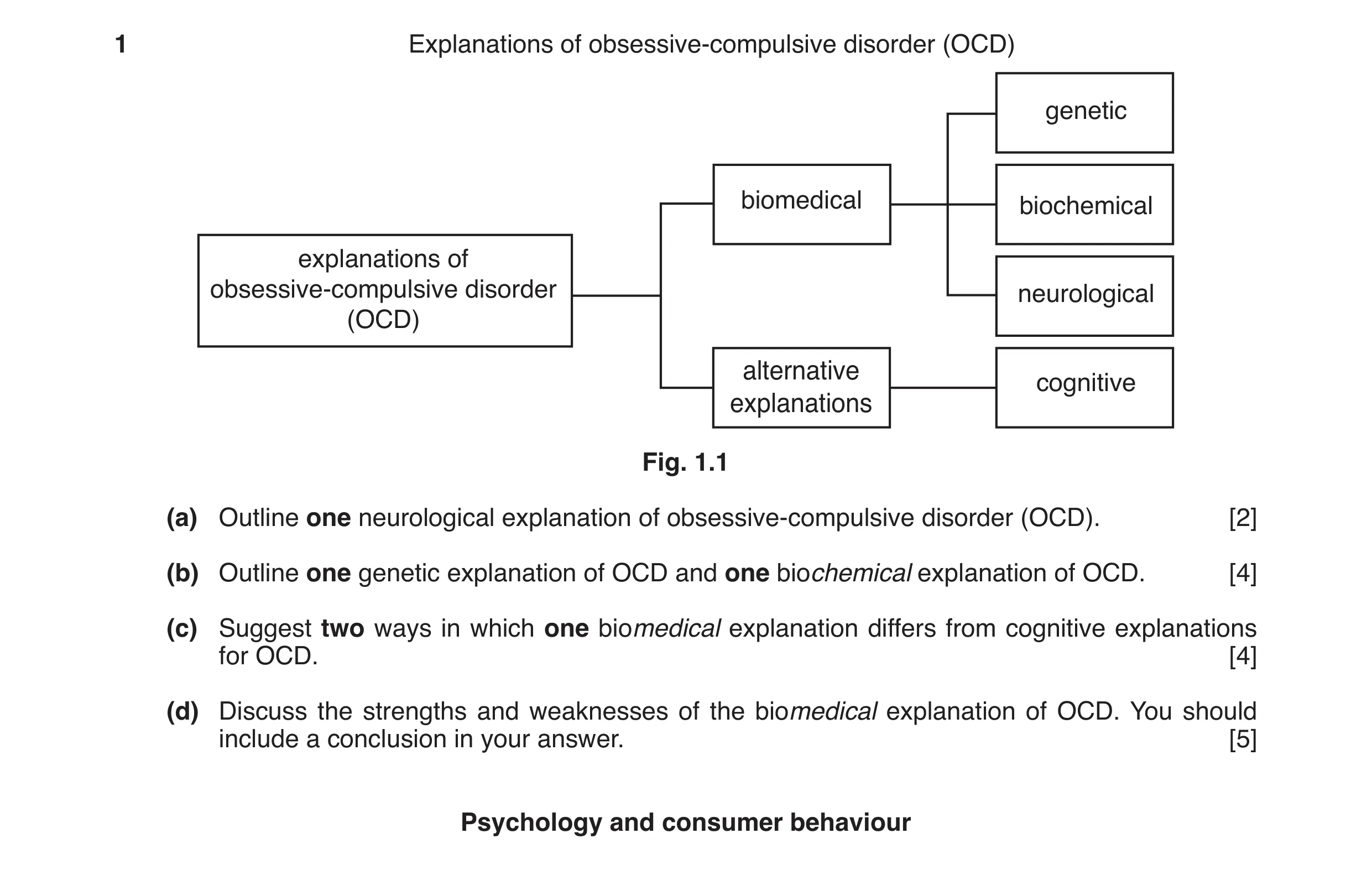
![Question 6: (a) Design a study using a questionnaire to investigate the characteristics of hoarding behaviour. [10] (b) Explain the psychological and m…](https://img.pastlit.com/crops/dfb0b7bc-e4fe-448a-bbfe-b511232d91e0/q5.webp)
 2 / 6
2 / 6![Question 9: (a) Design a study to investigate the most common type of compulsive behaviour in people with obsessive-compulsive disorder (OCD). [10] (b)…](https://img.pastlit.com/crops/d66490fd-52e6-48e4-aa48-3c1701941b9e/q5.webp)
![Question 13: (a) Design a study to investigate the effectiveness of a biomedical treatment (SSRIs) for obsessive-compulsive disorder (OCD). [10] (b) Exp…](https://img.pastlit.com/crops/0fca2ffe-f06f-4b99-bc19-261f74e9ddd6/q5.webp) 3 / 6
3 / 6
 4 / 6
4 / 6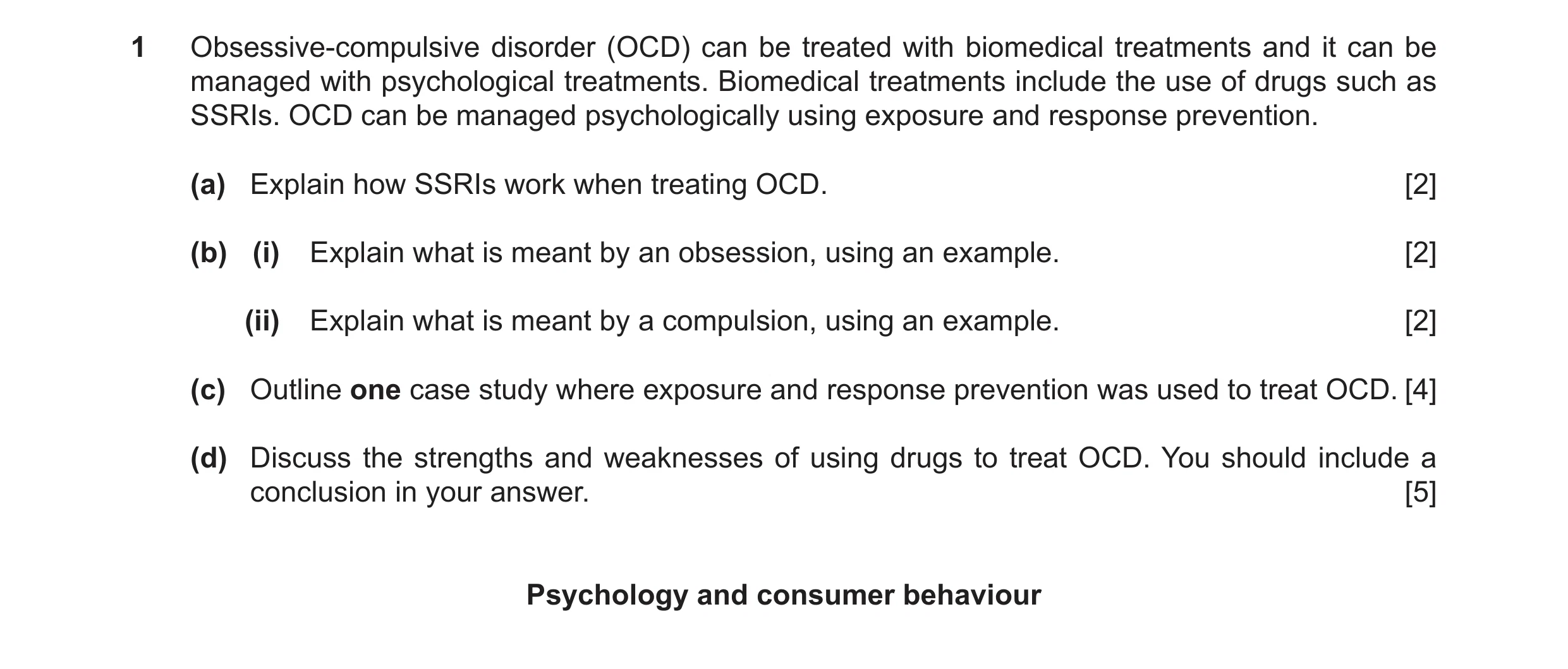
 5 / 6
5 / 6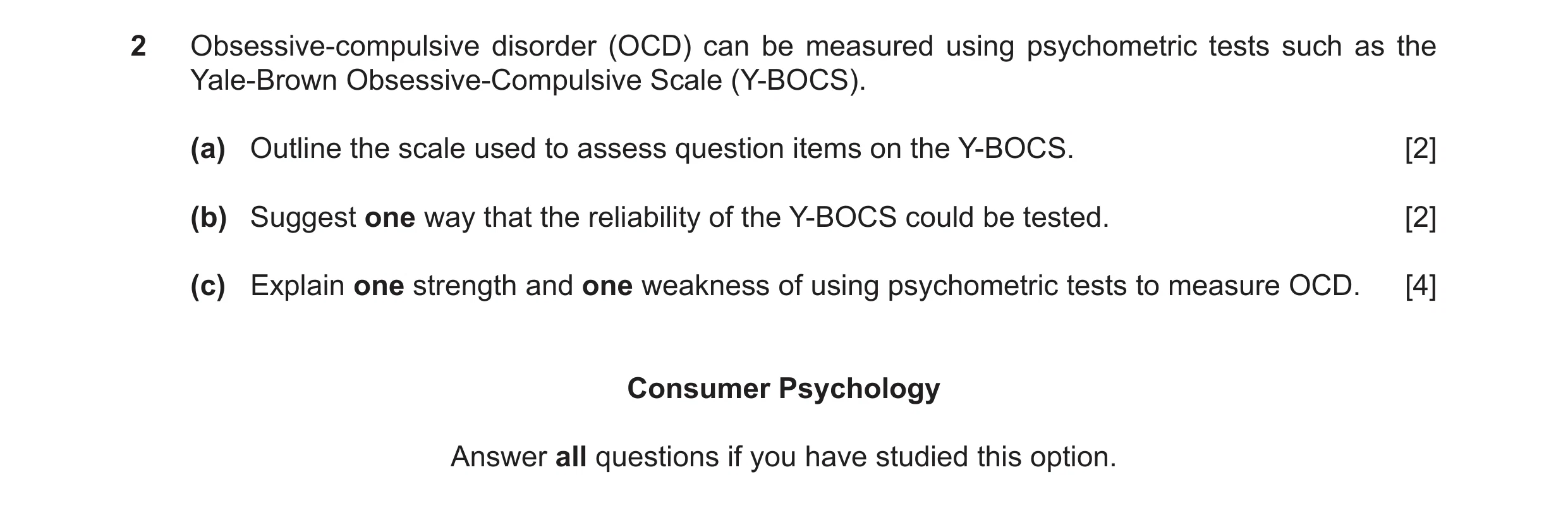
 6 / 6
6 / 6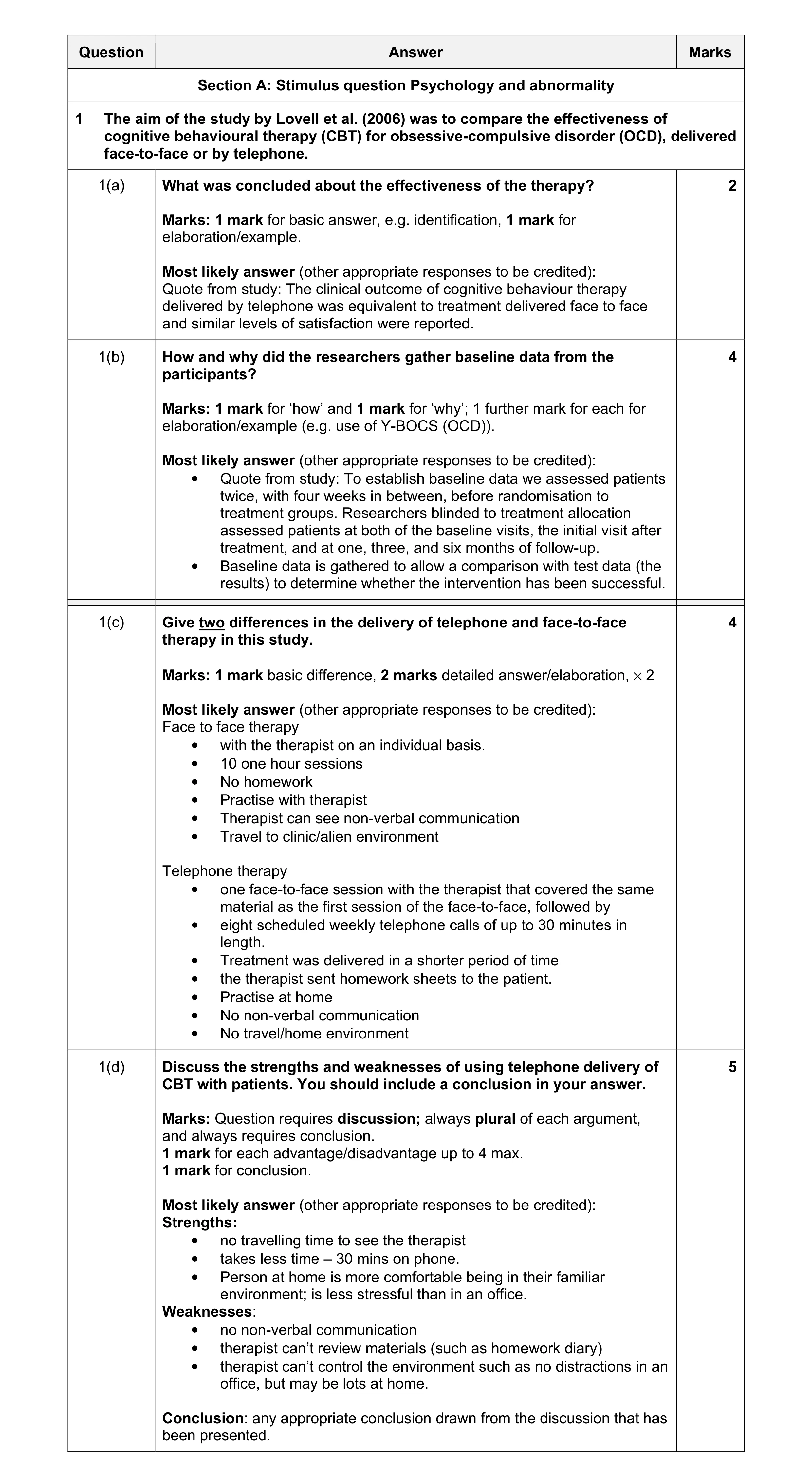 15
15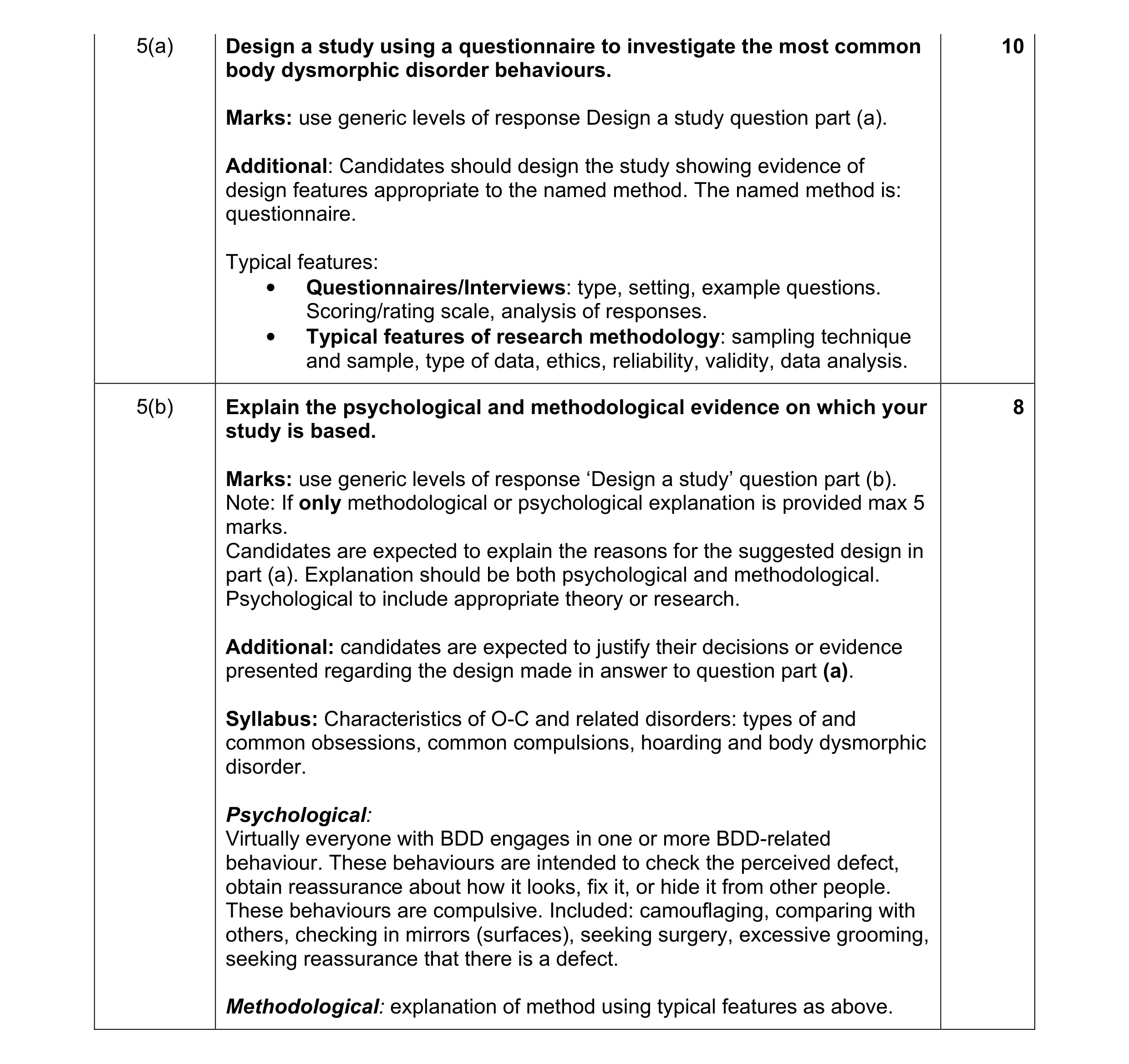 18
18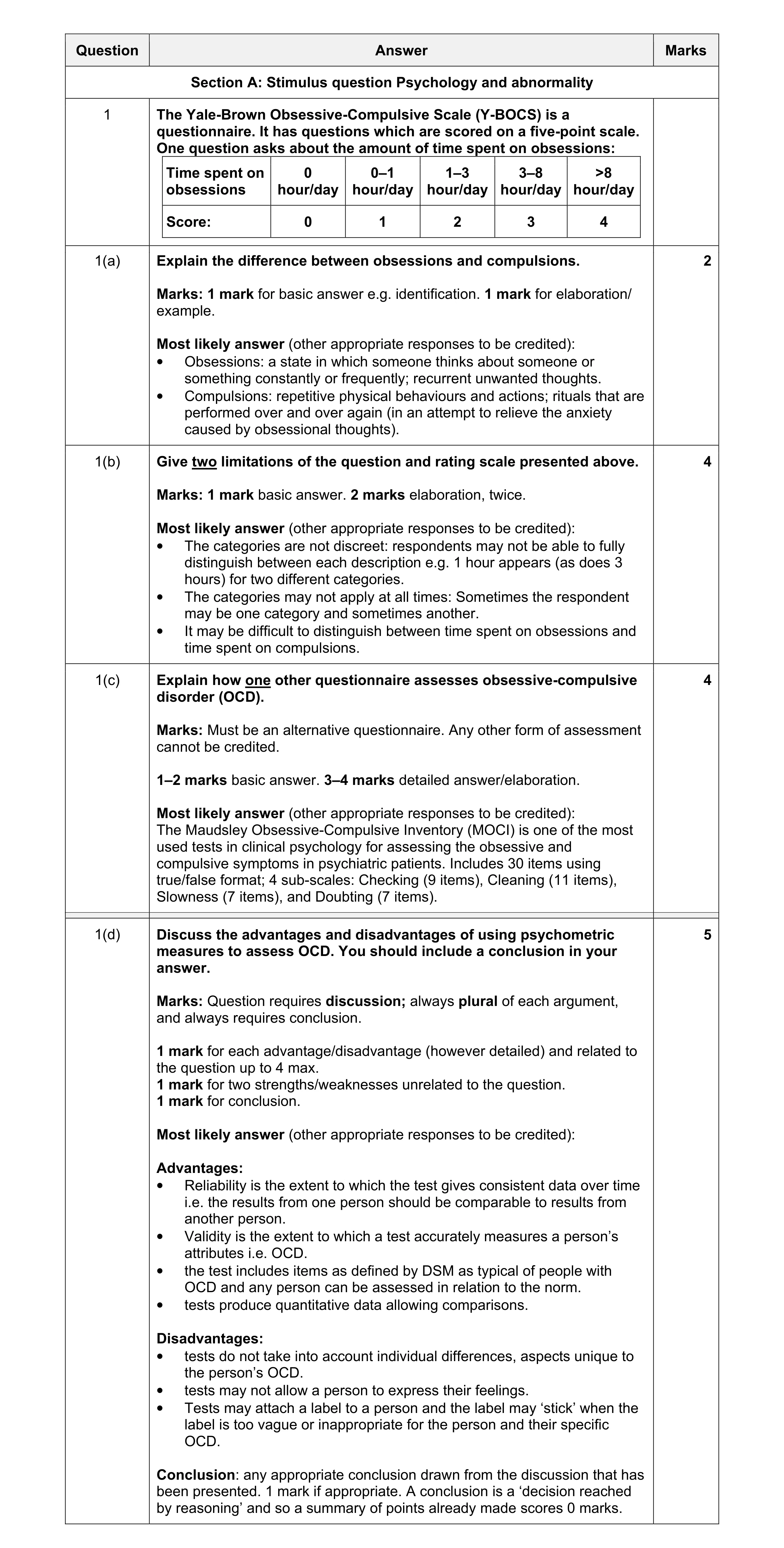 15
15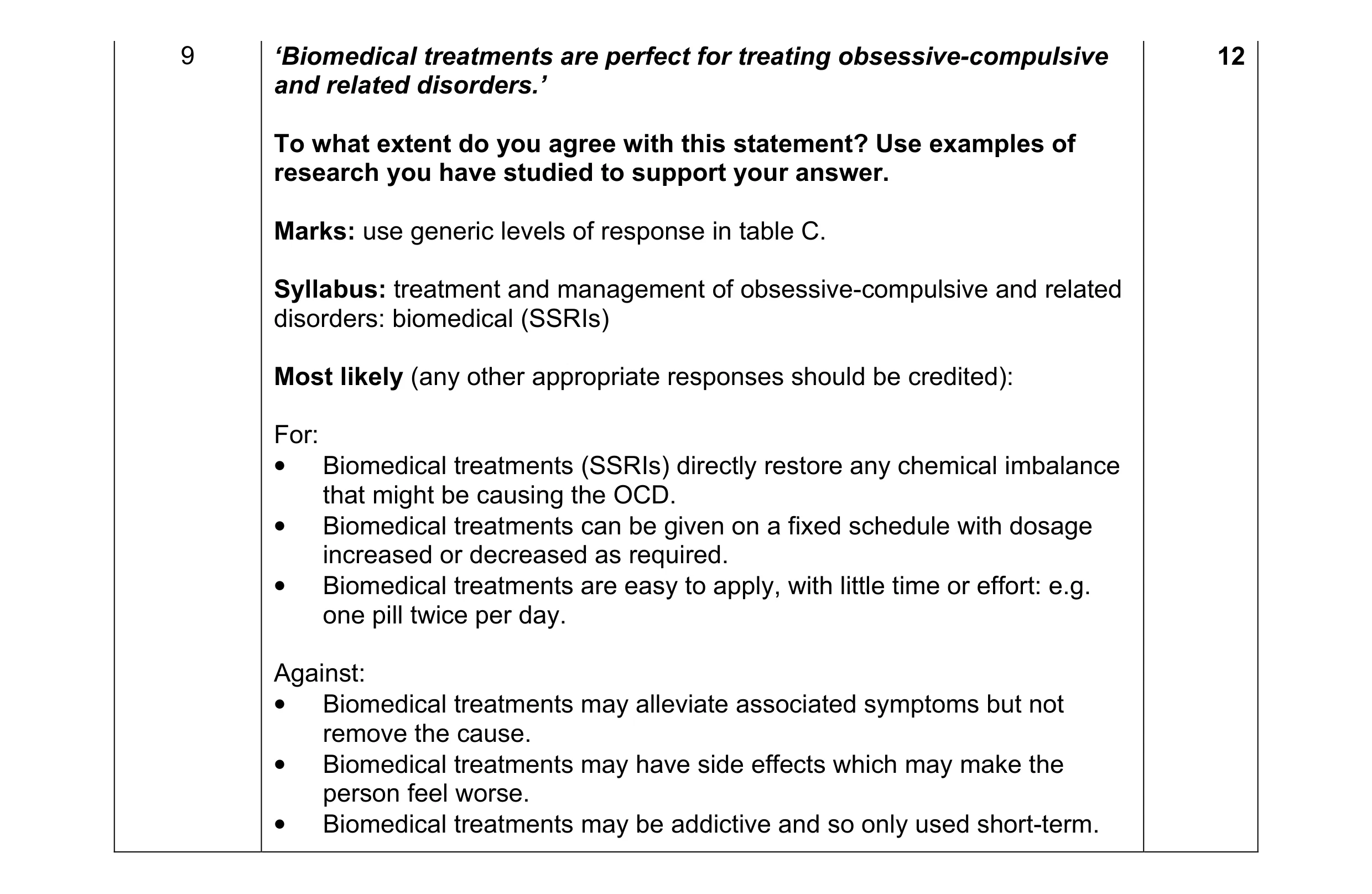 12
12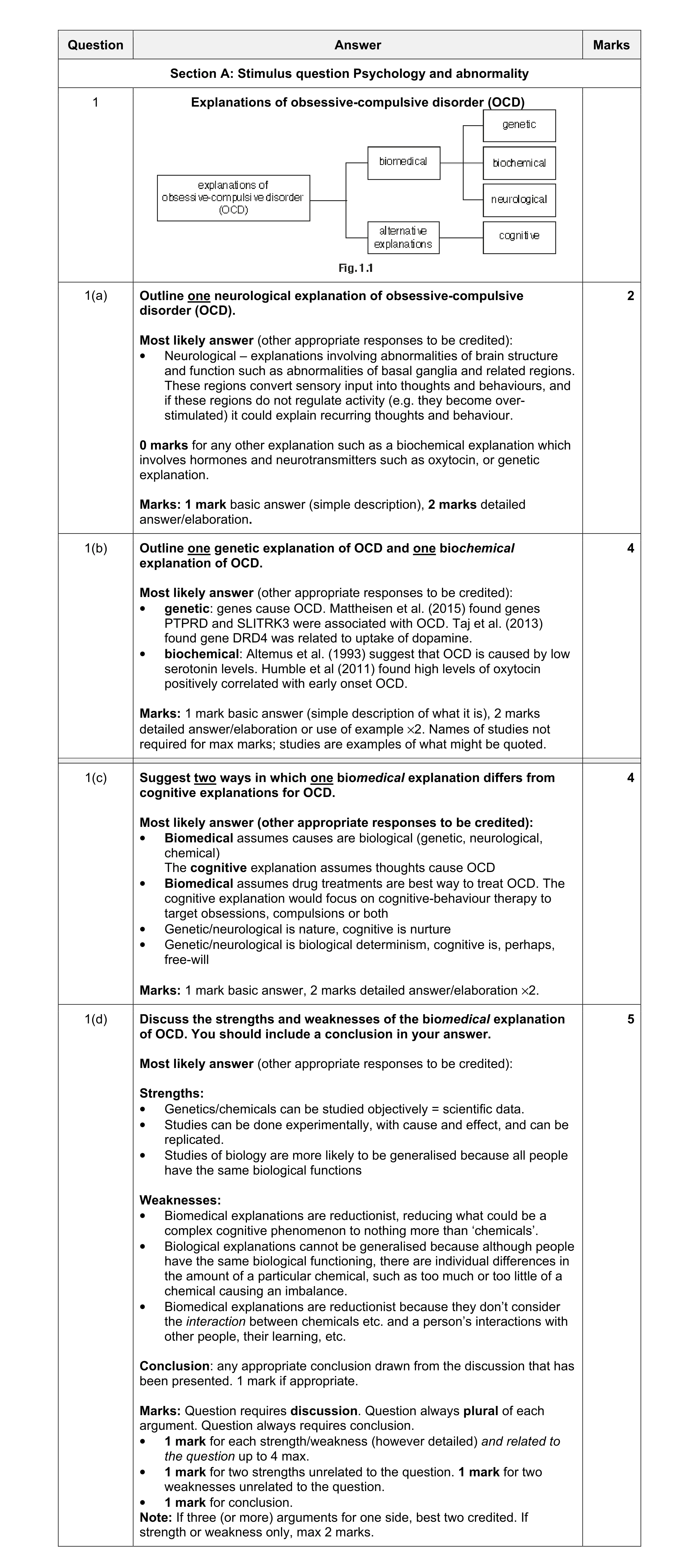 15
15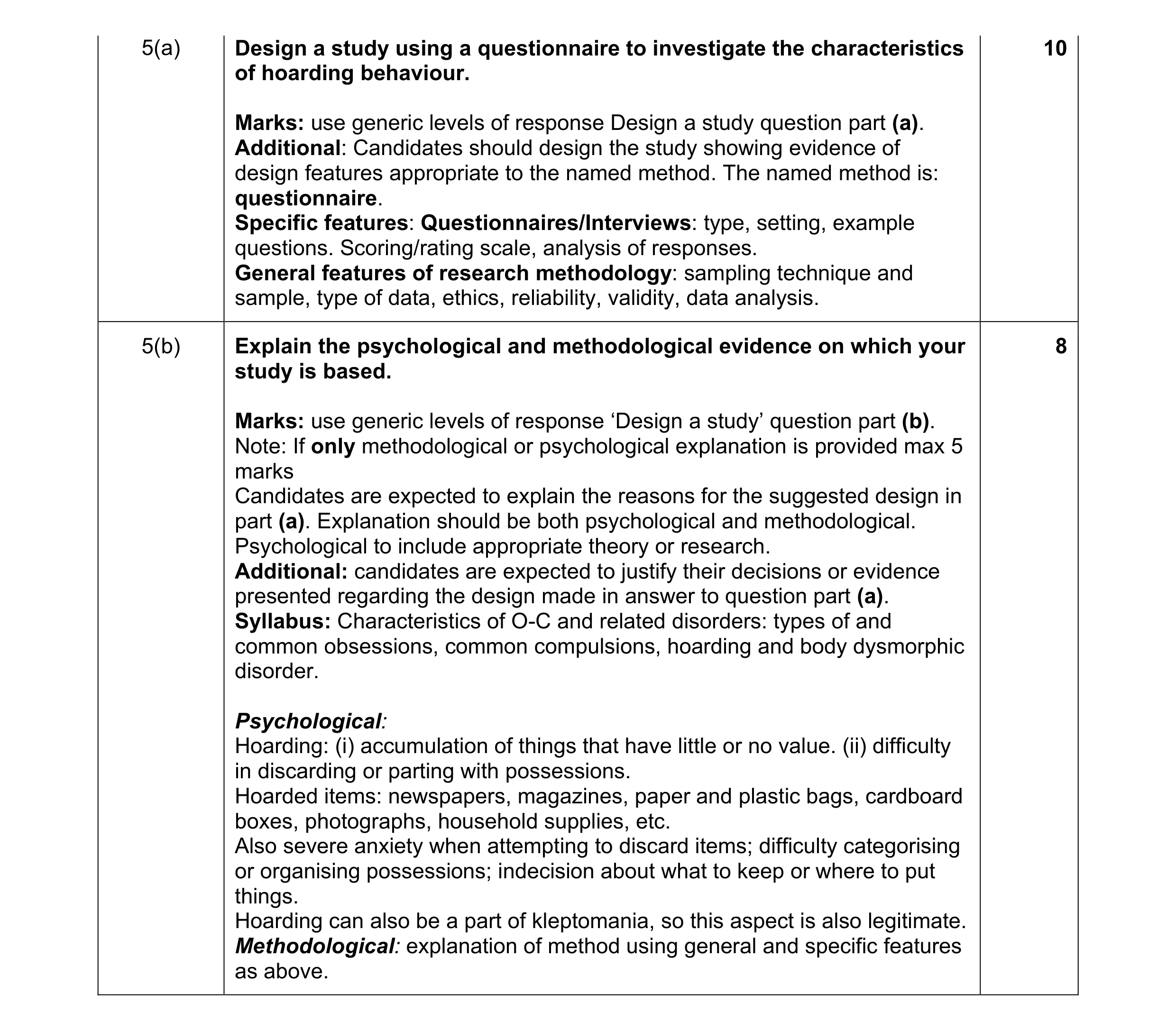 18
18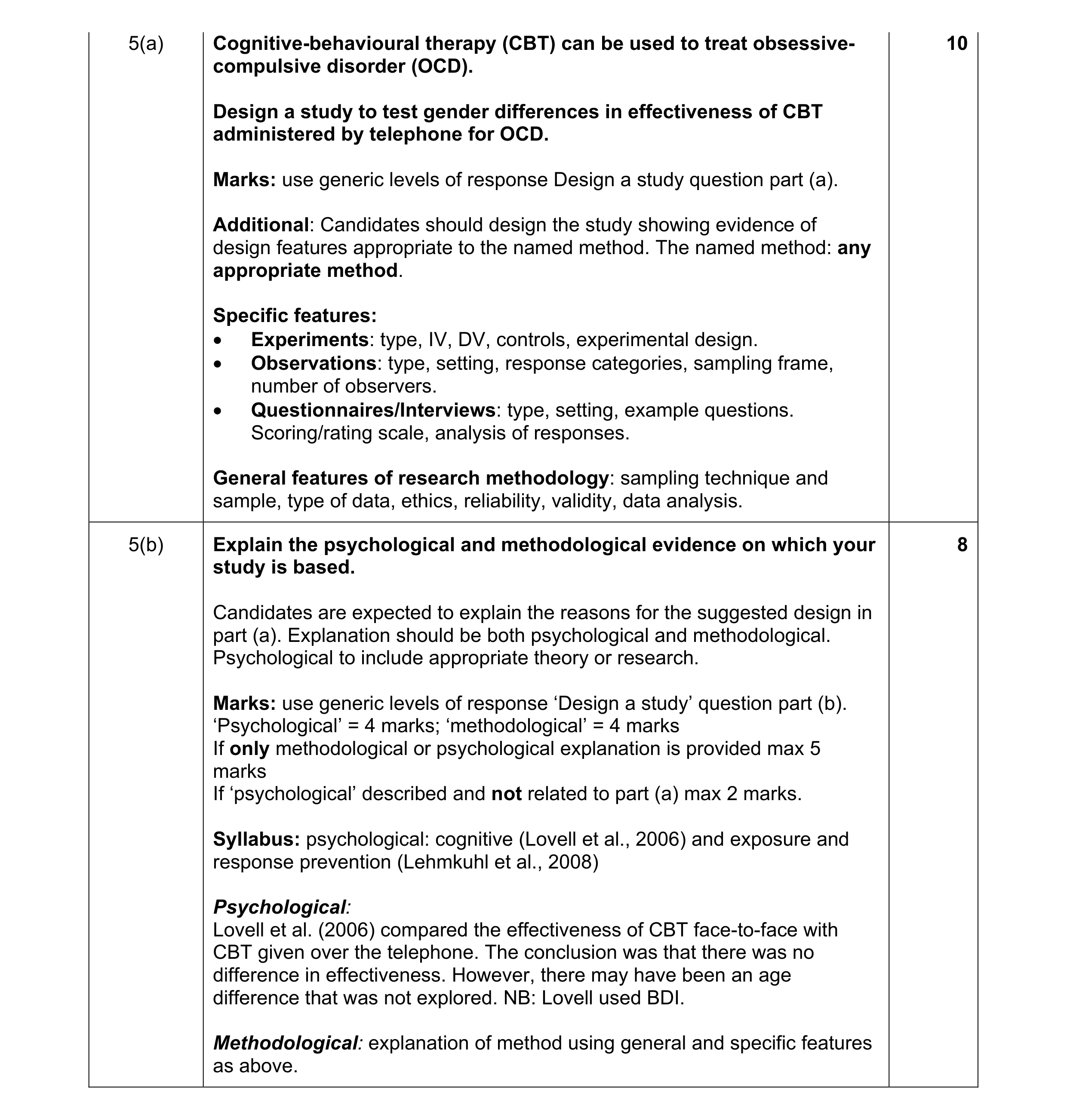 18
18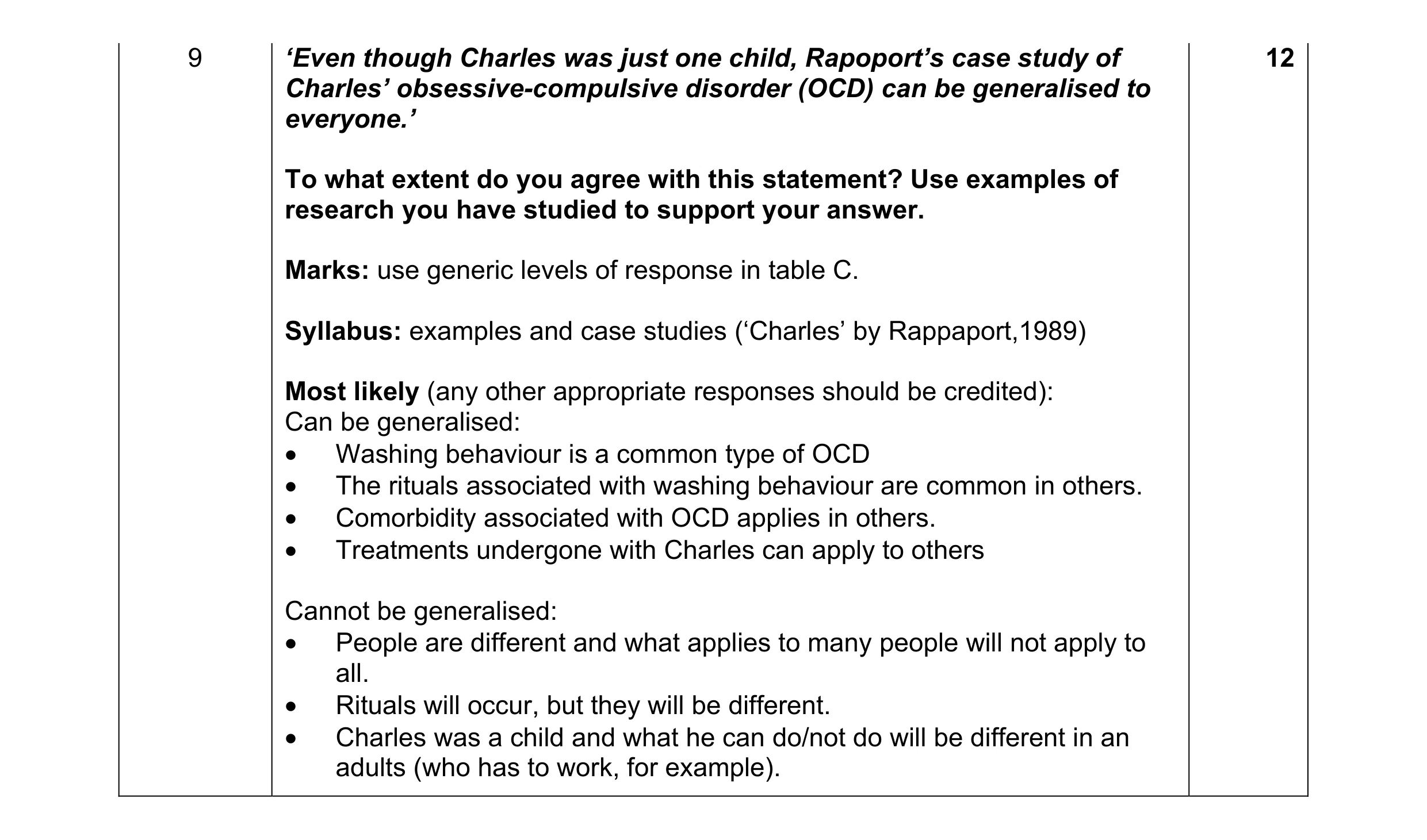 12
12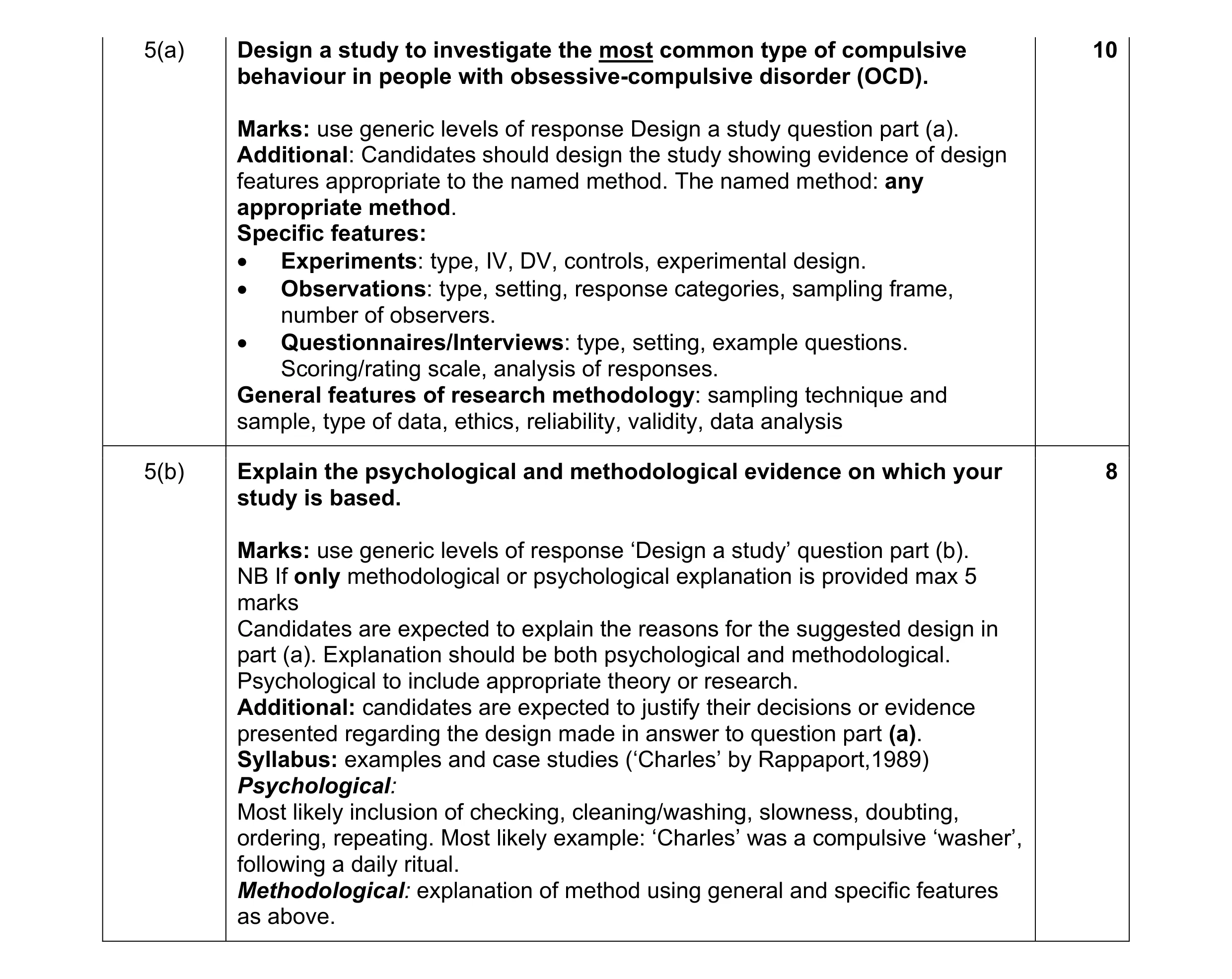 18
18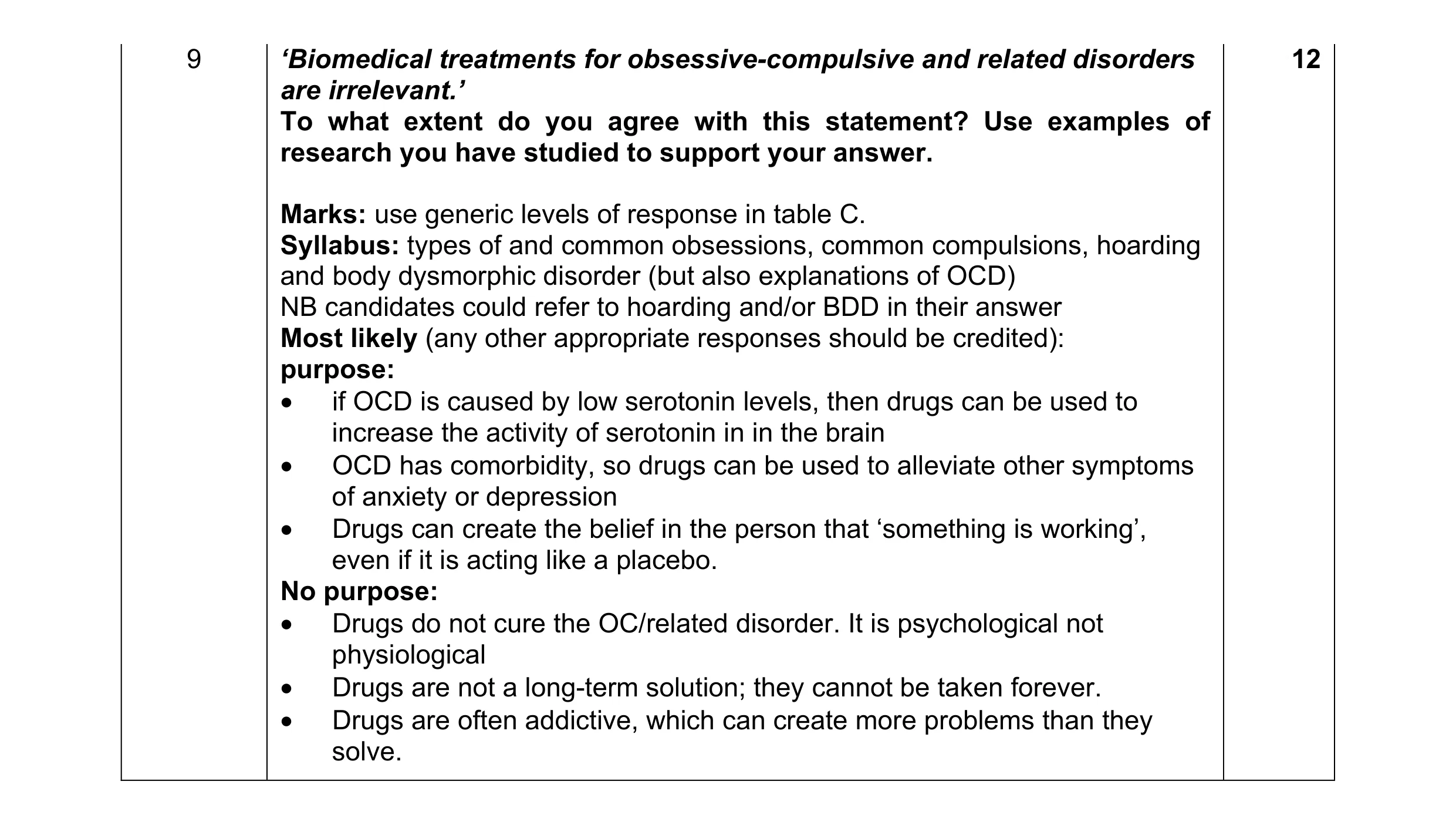 12
12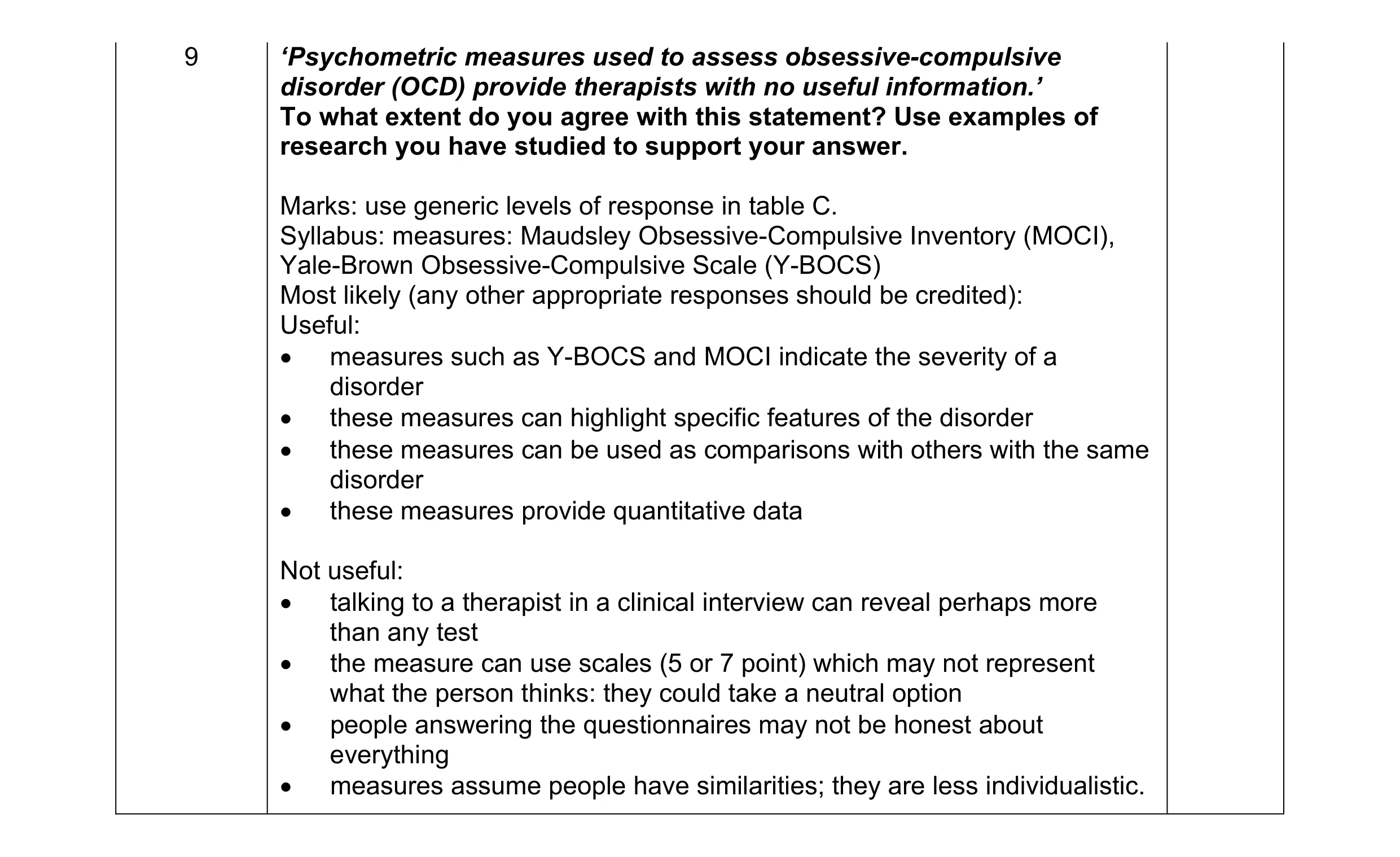 12
12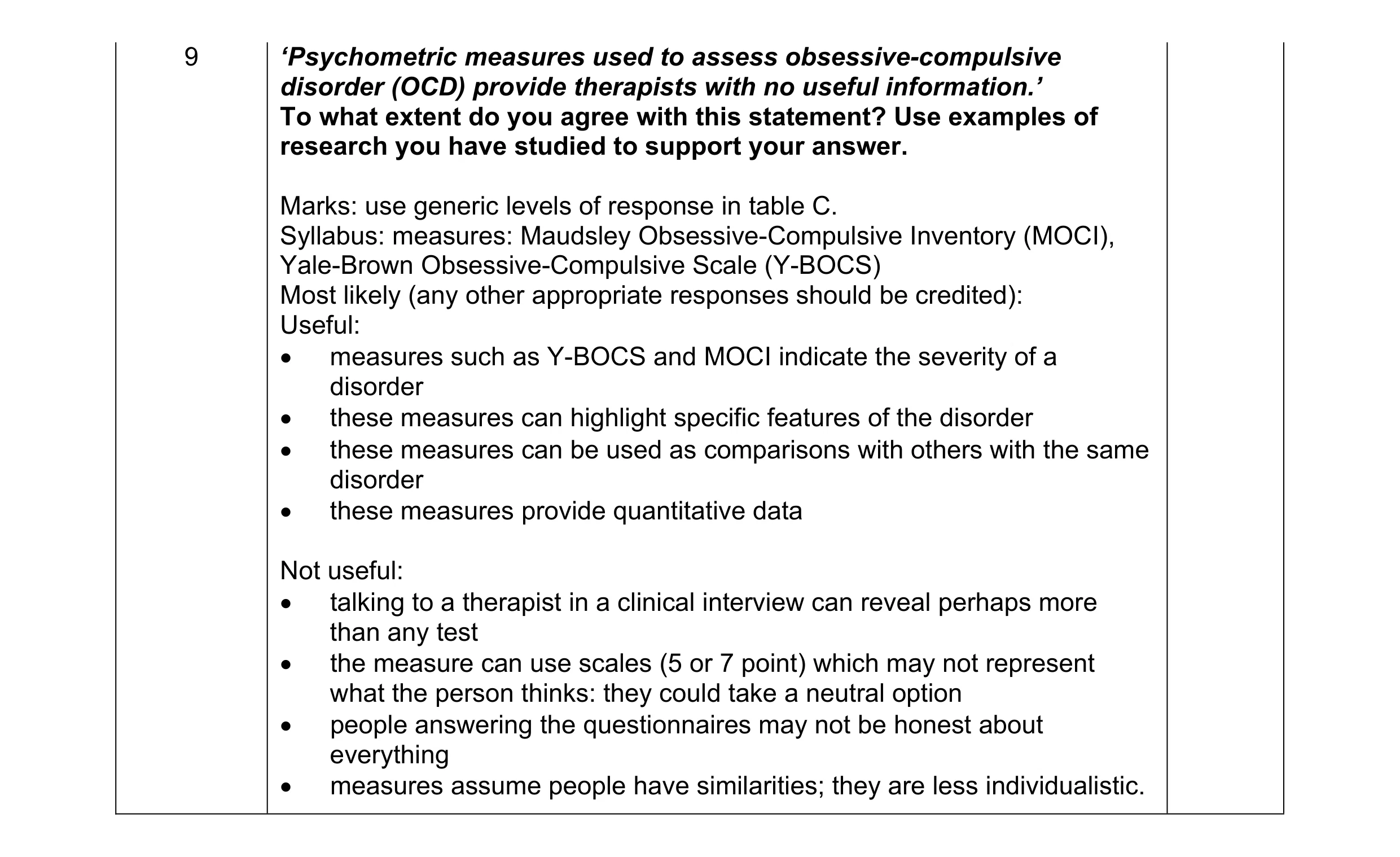 12
12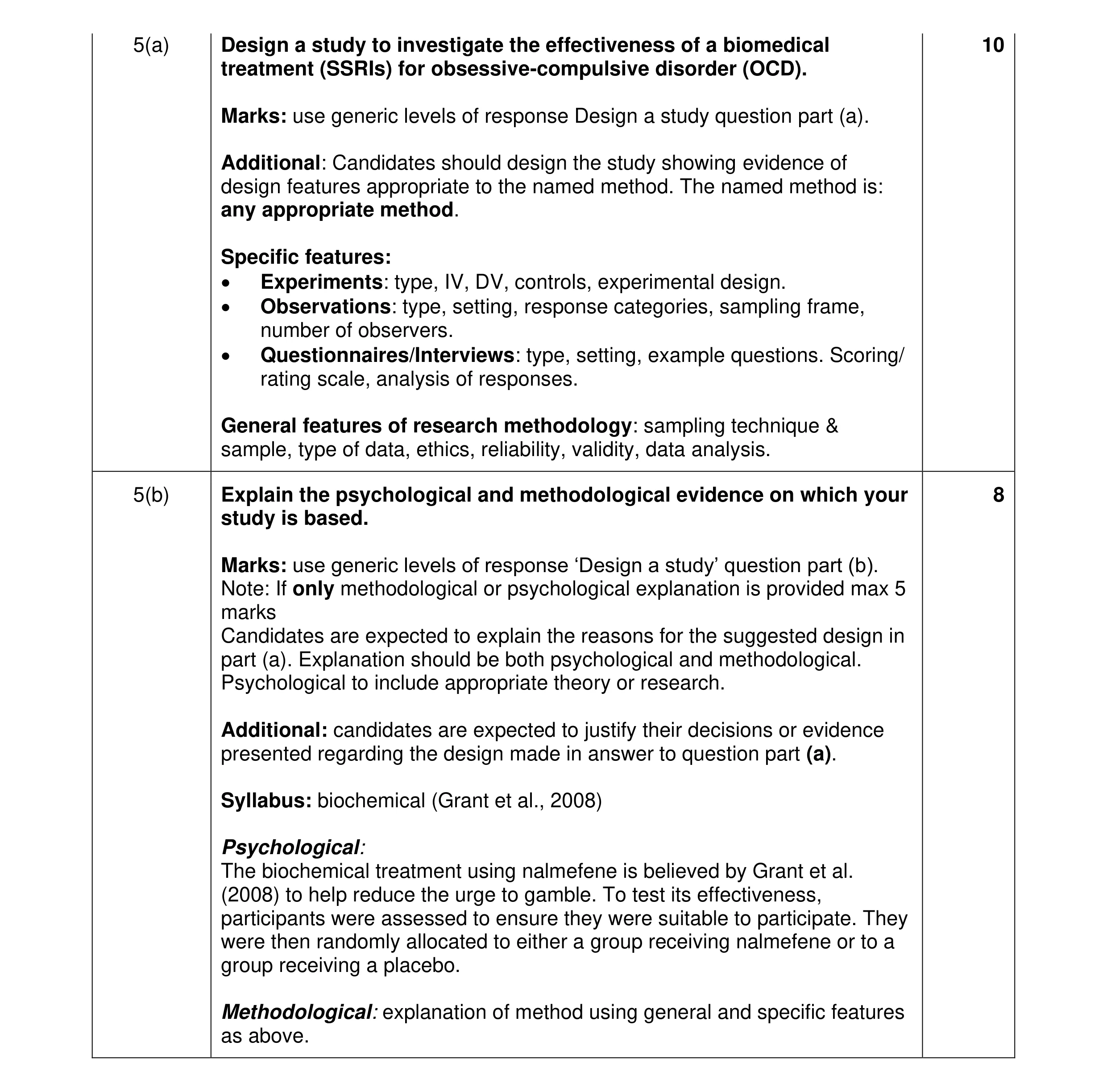 18
18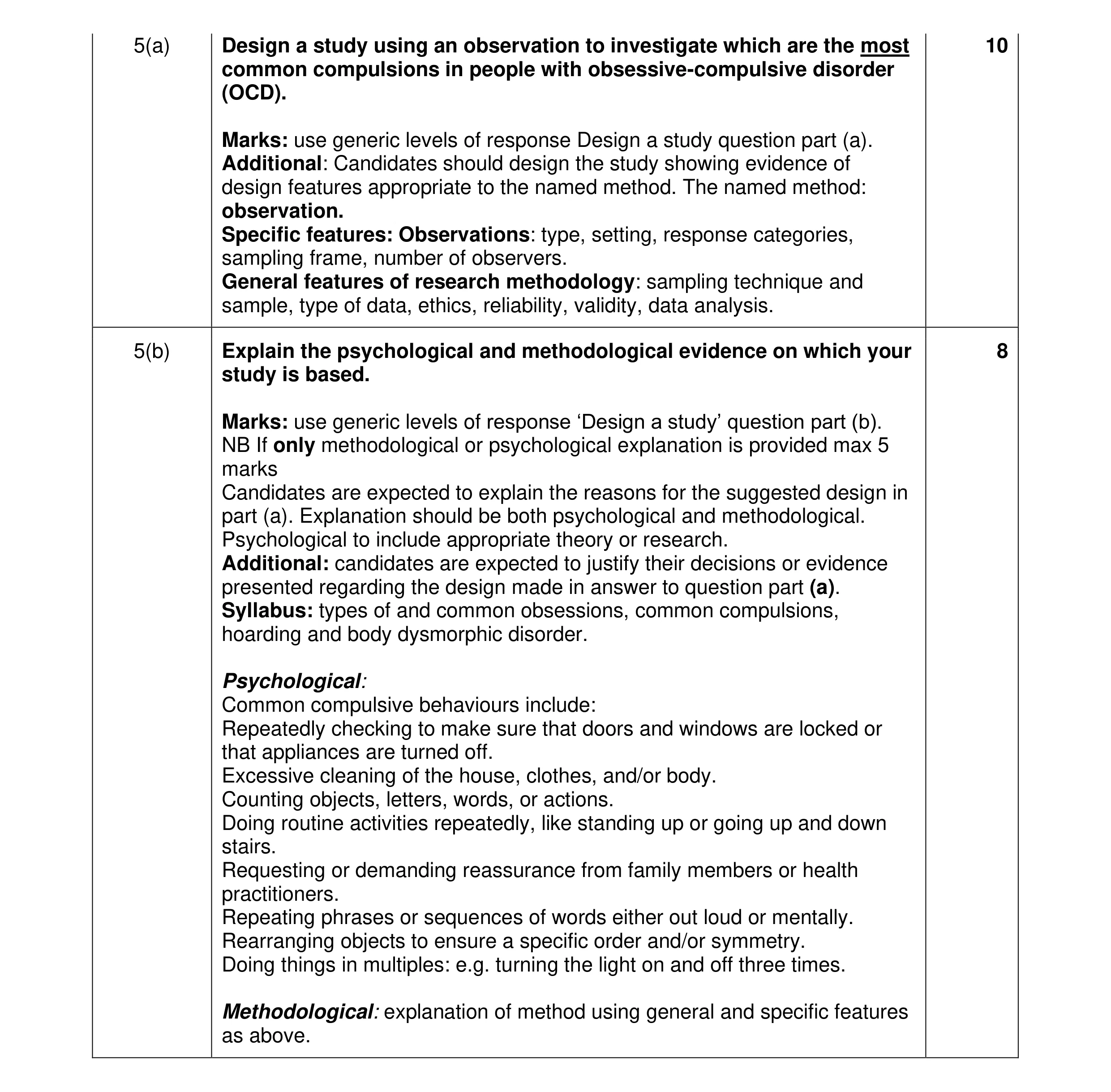 18
18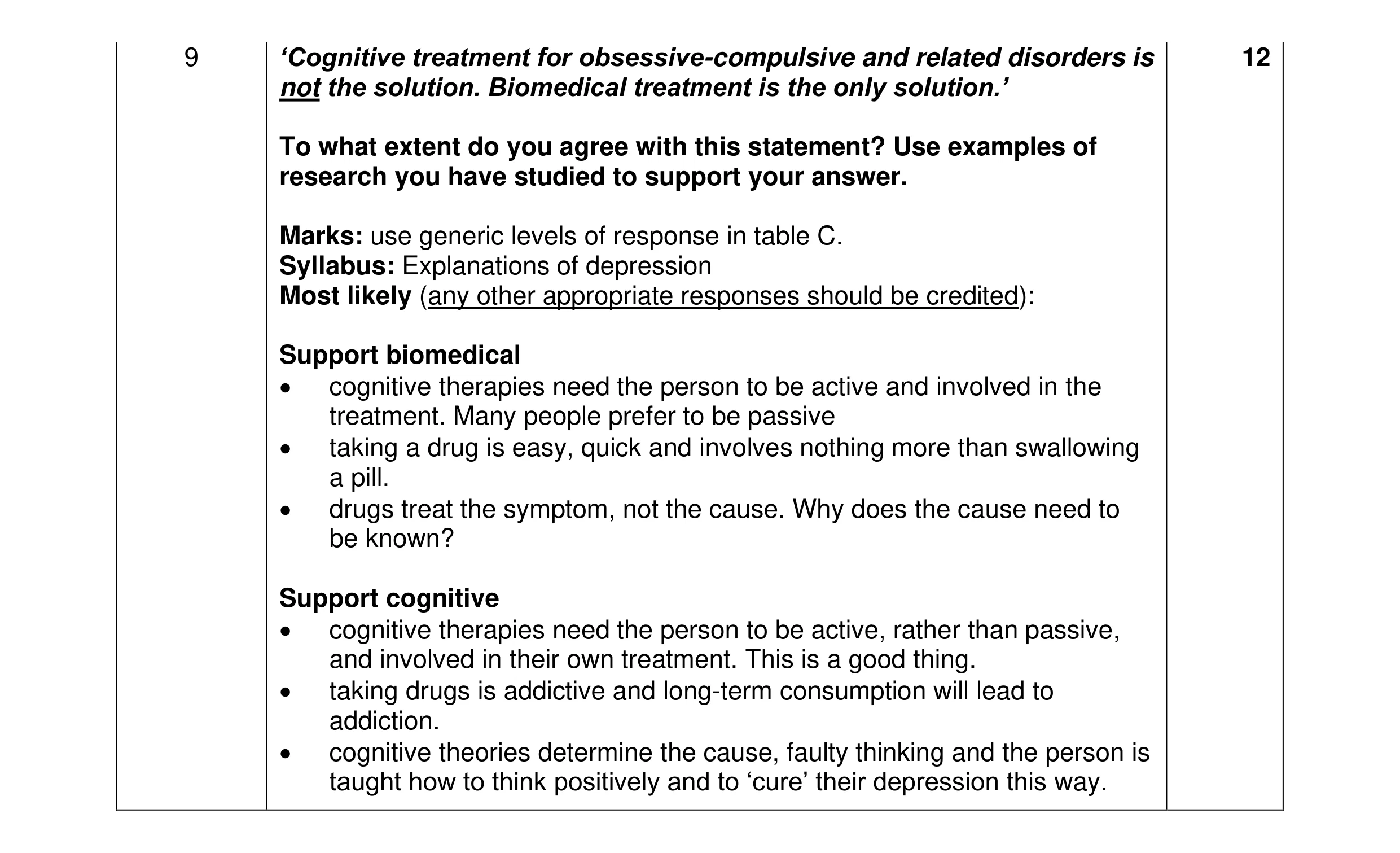 12
12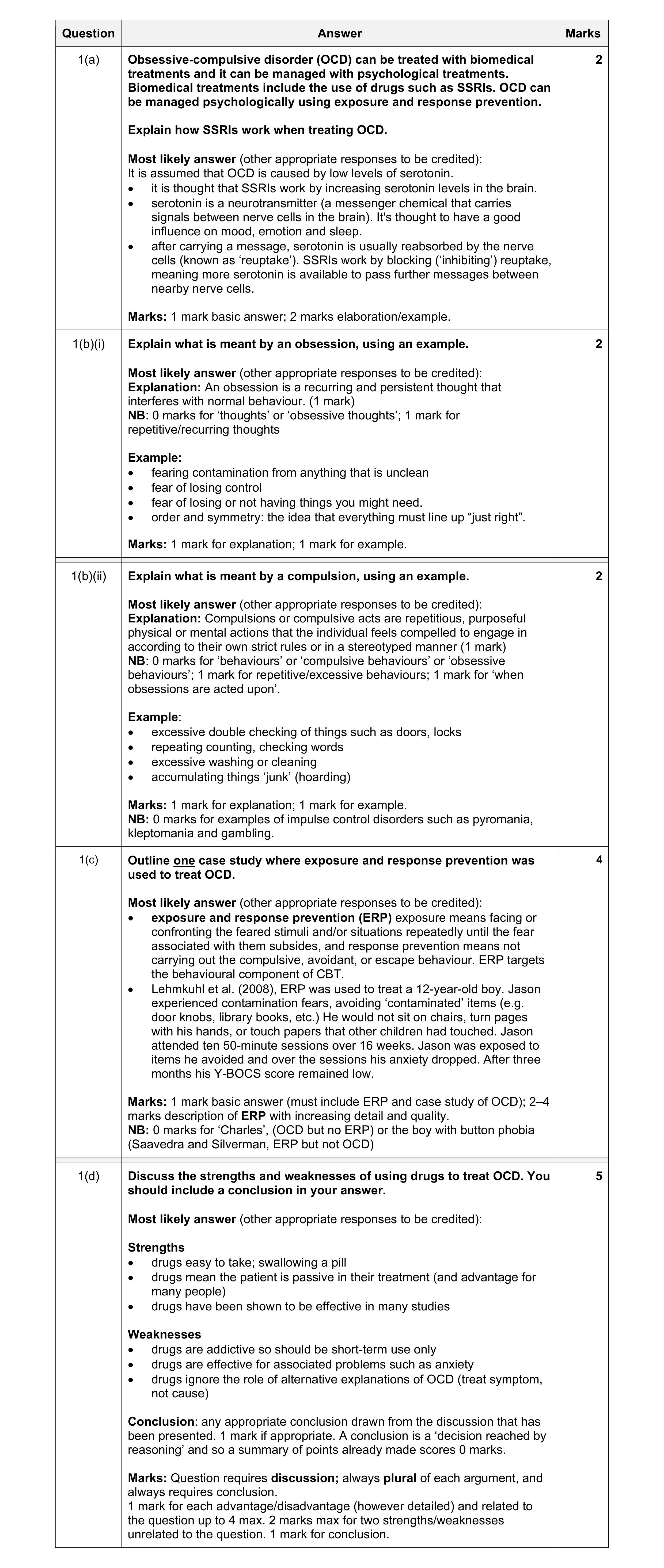 15
15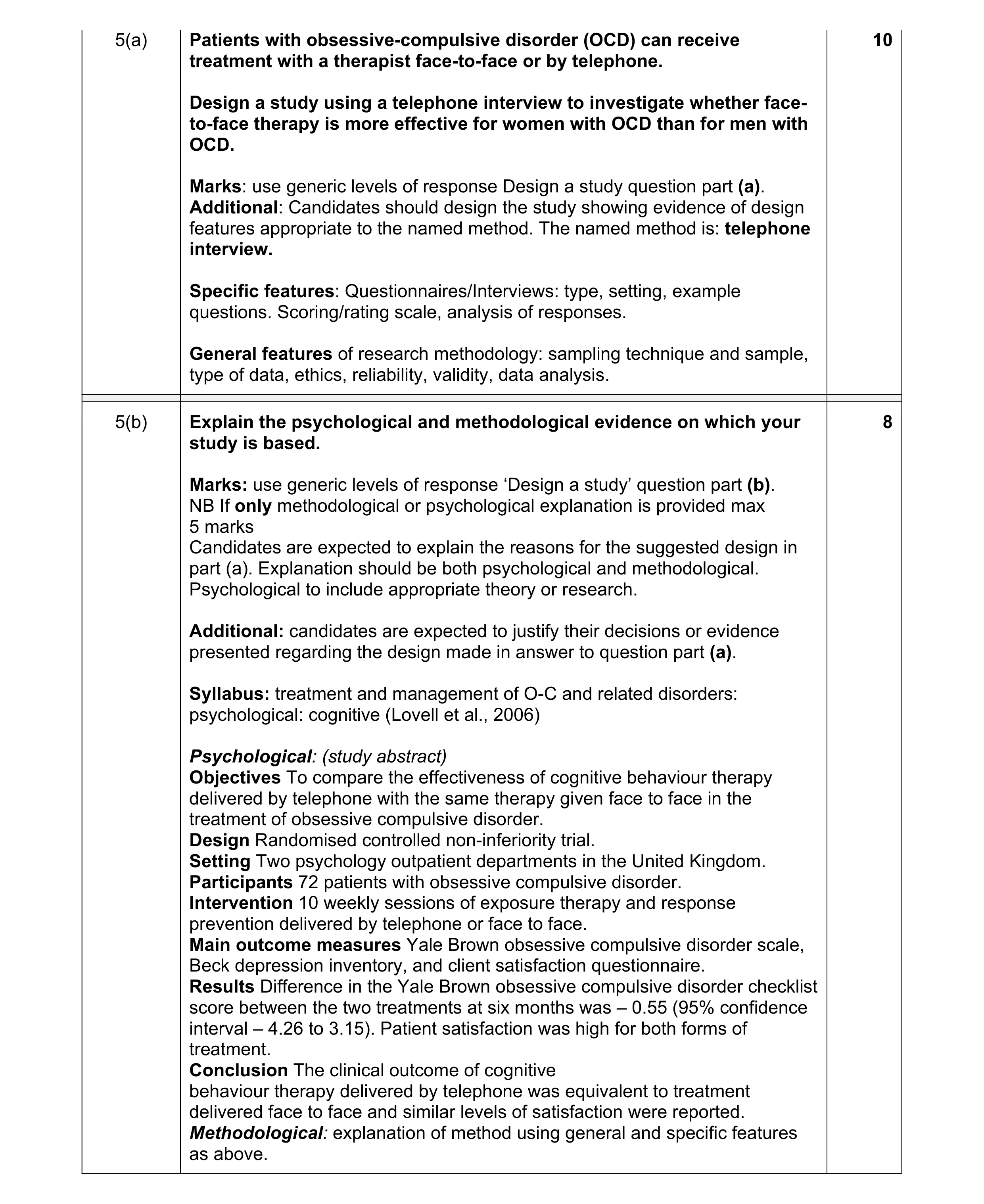 18
18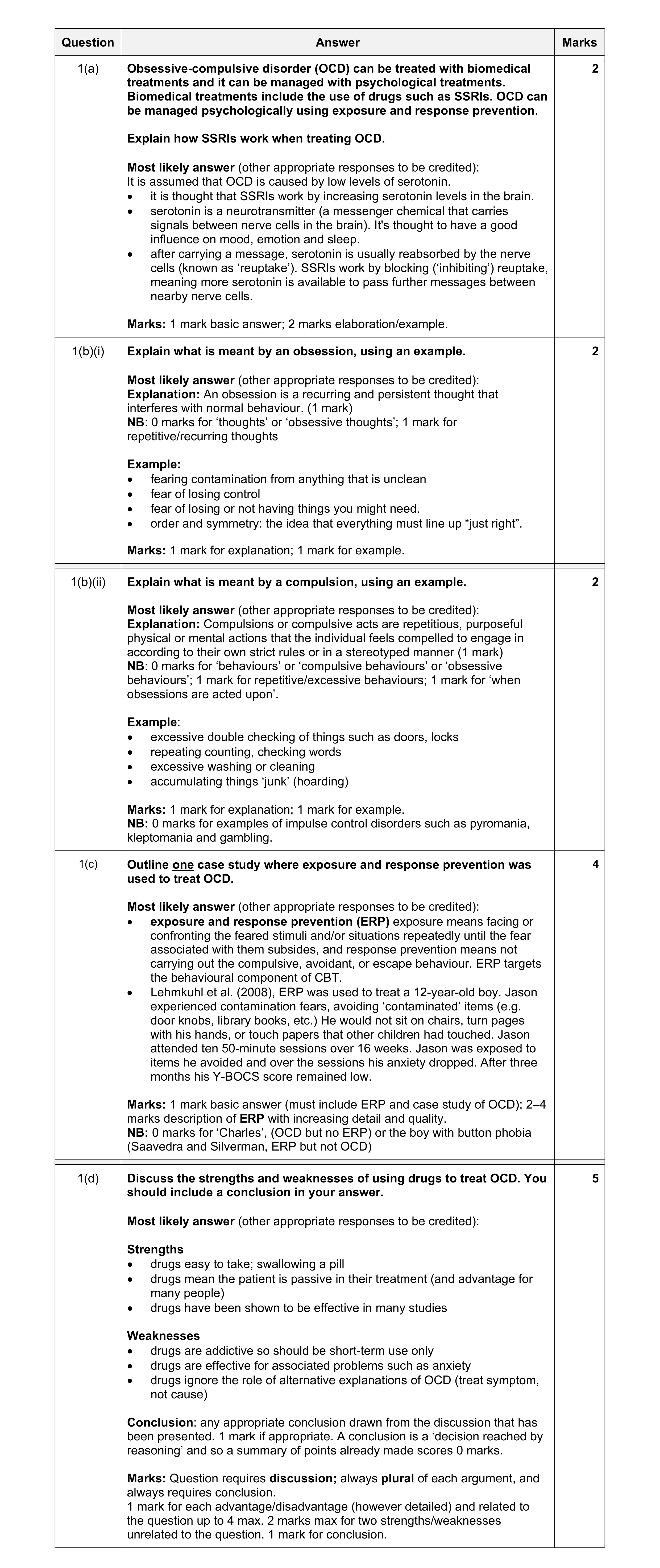 15
15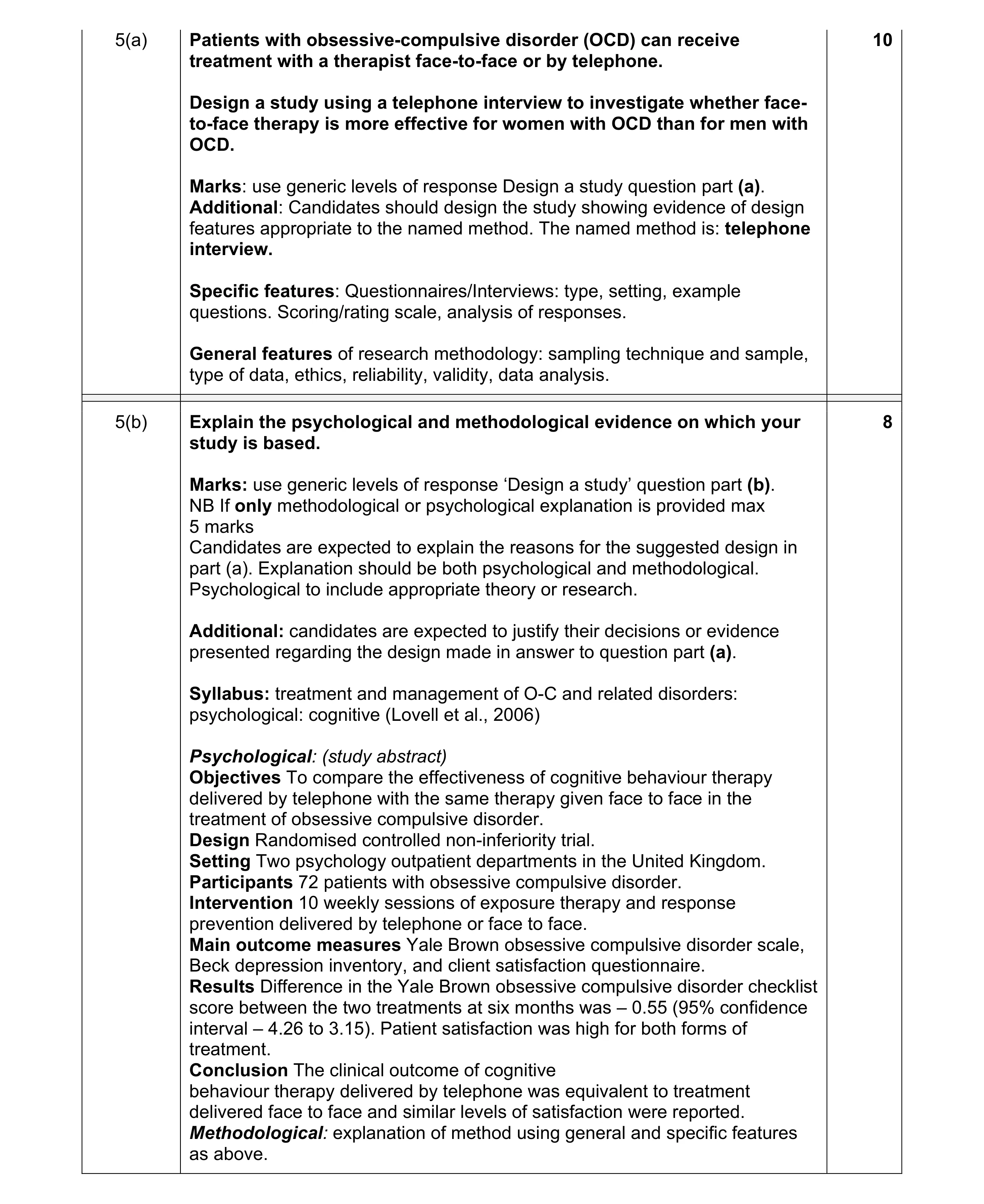 18
18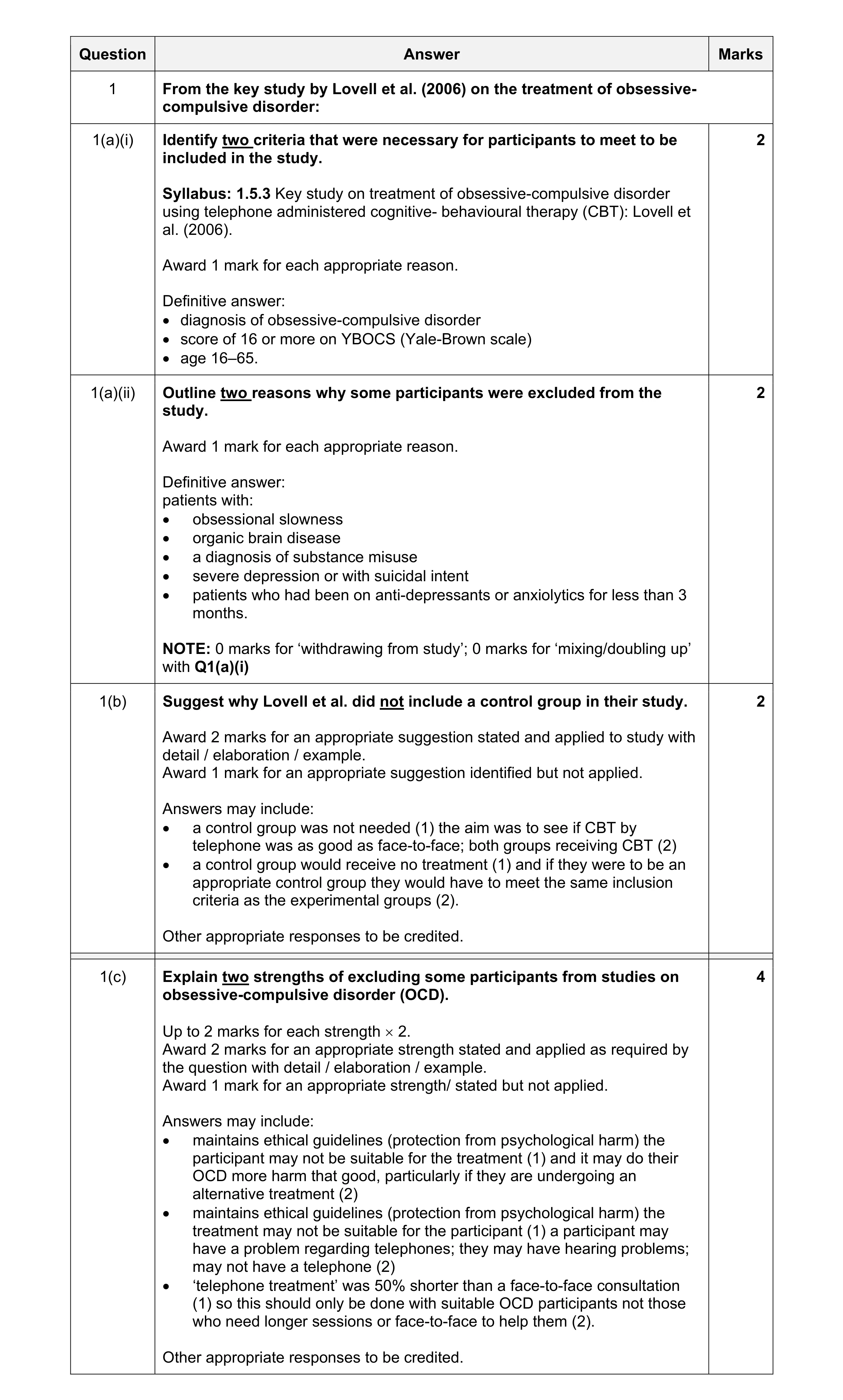 10
10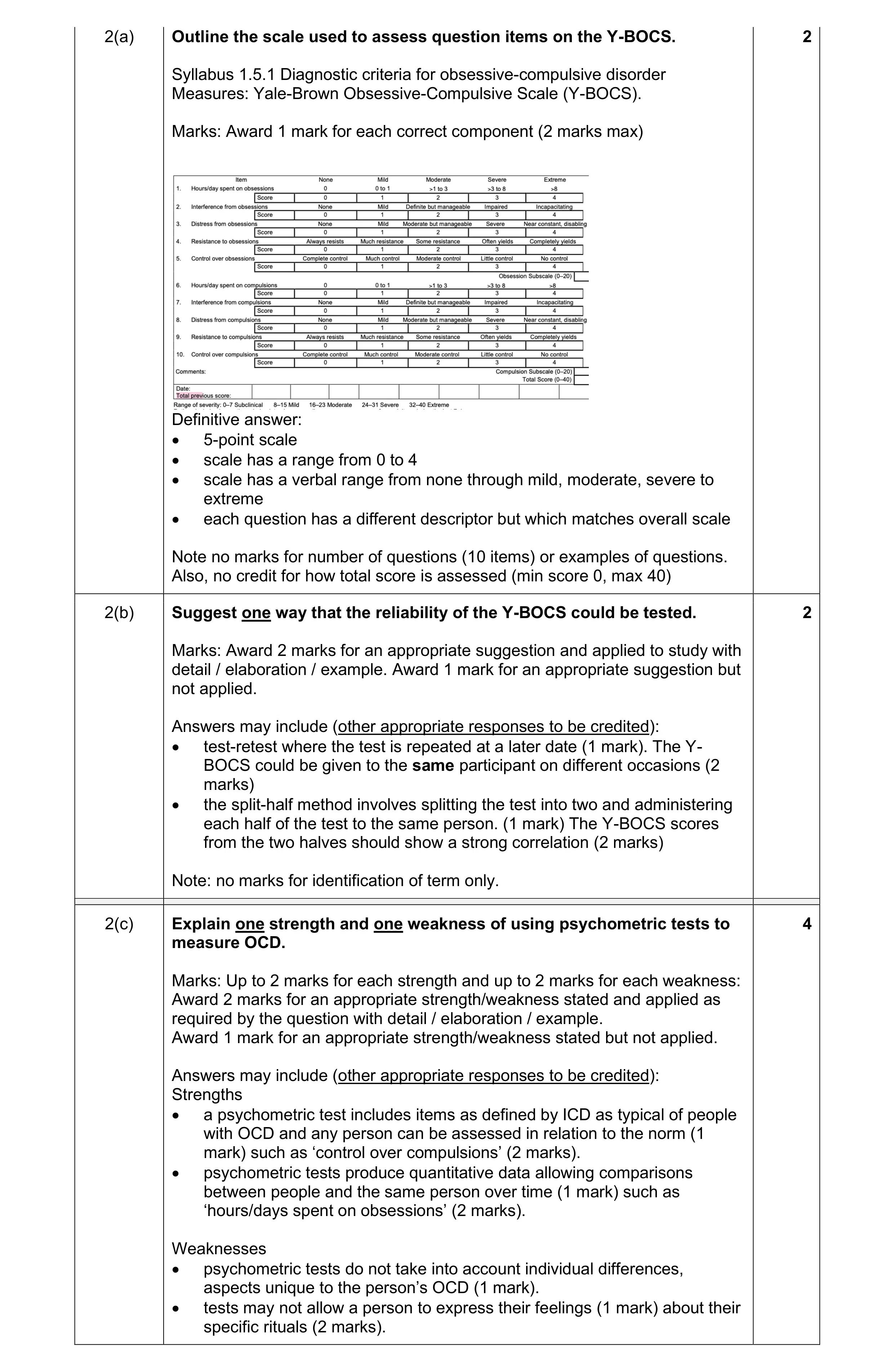 8
8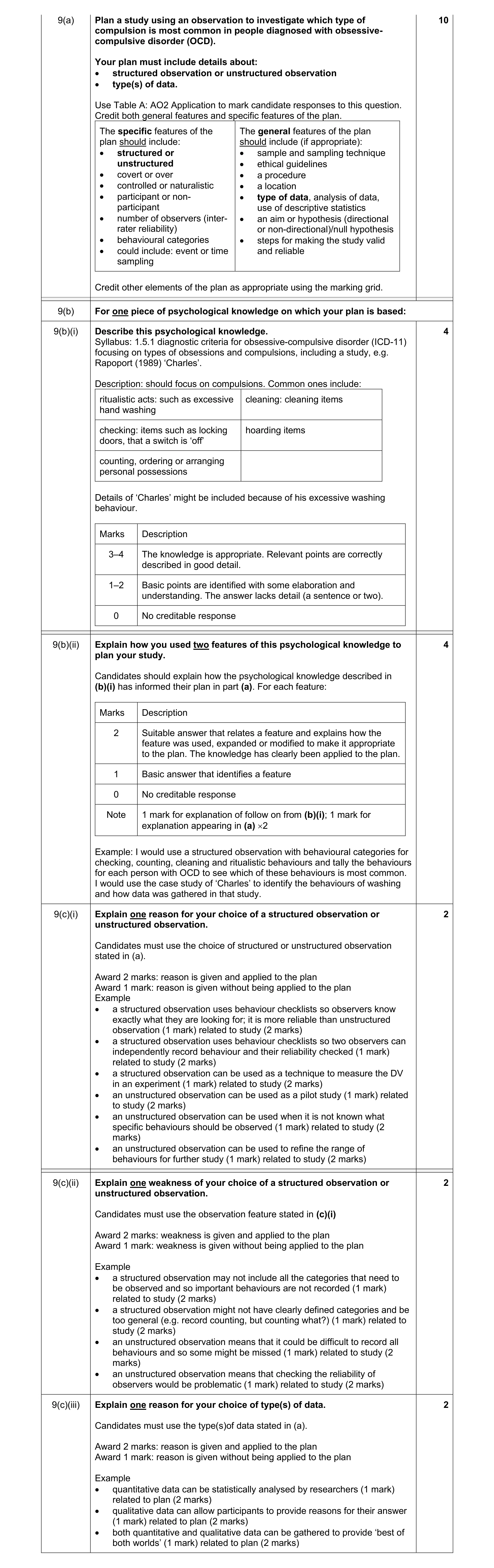 24
24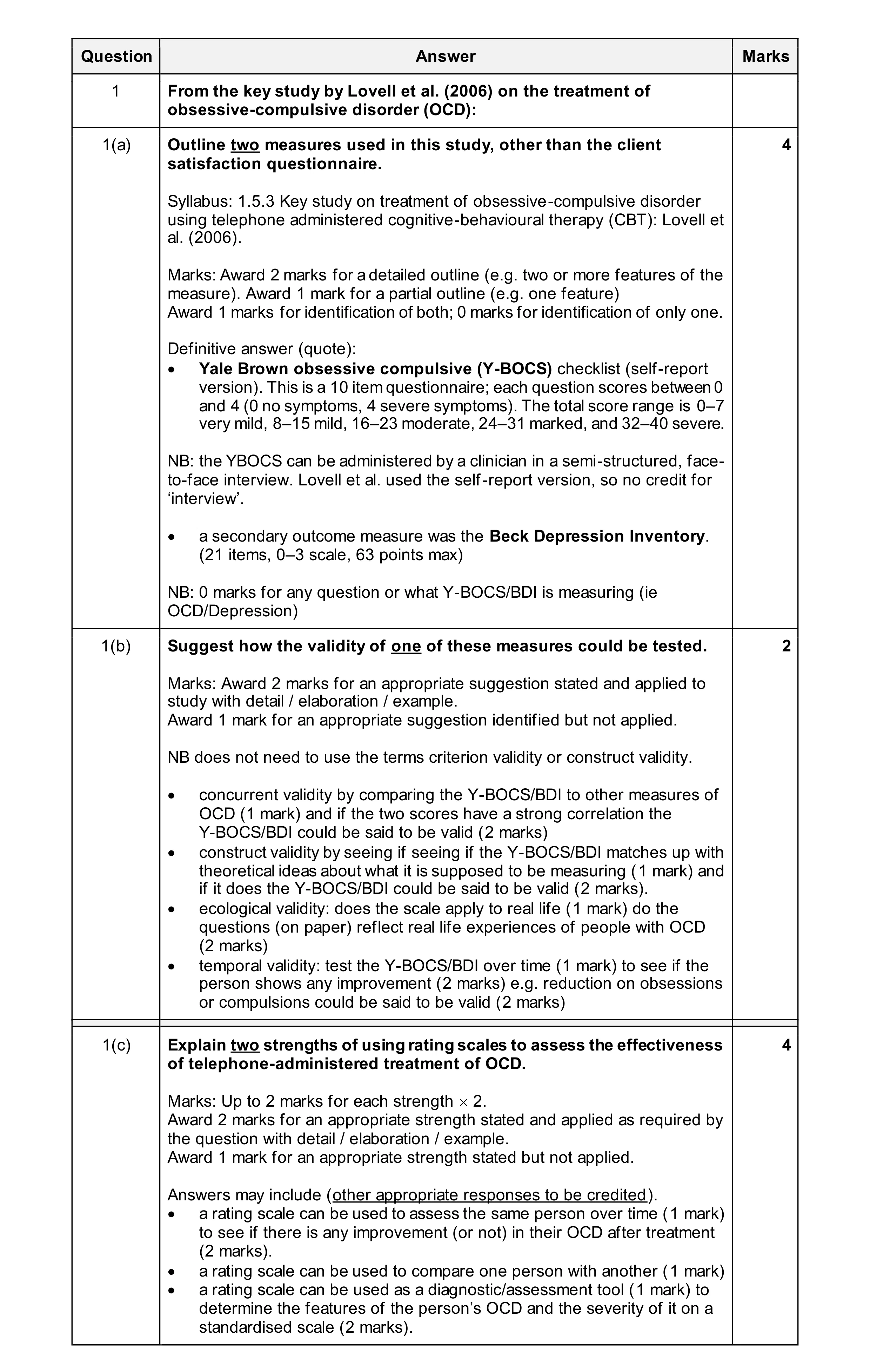 10
10