Cambridge A Level Psychology (from 2018) 9990 — 2021 Oct/Nov Paper 4 · Variant 2
9990/42/O/N/21 · 12 questions · 60 marks · ≈68 min
The question paper and its mark scheme, free to read here and free to download. This is Cambridge’s own paper, exactly as it was sat.
Question paper8 pages



Mark scheme22 pages
Answers below. Sit the paper first if you are practising.
Questions as text
Q1 · The ABC model of psychological change: • Activating event • Beliefs about the event •…
1 The ABC model of psychological change: • Activating event • Beliefs about the event • Consequences: emotional and behavioural responses. Ellis (1962) used this model in rational emotive behaviour therapy (REBT). The aim of REBT is to treat depression by changing a client’s thinking. (a) Explain why a depressed client’s thinking needs to be changed in order to treat their depression. [2] (b) (i) Outline one irrational belief that clients might have before starting REBT. [2] (ii) Outline how irrational beliefs are changed by REBT. [2] (c) Suggest one psychological treatment for depression, other than REBT. [4] (d) Discuss the strengths and weaknesses of psychological treatments for depression. You should include a conclusion in your answer. [5] Psychology and consumer behaviour
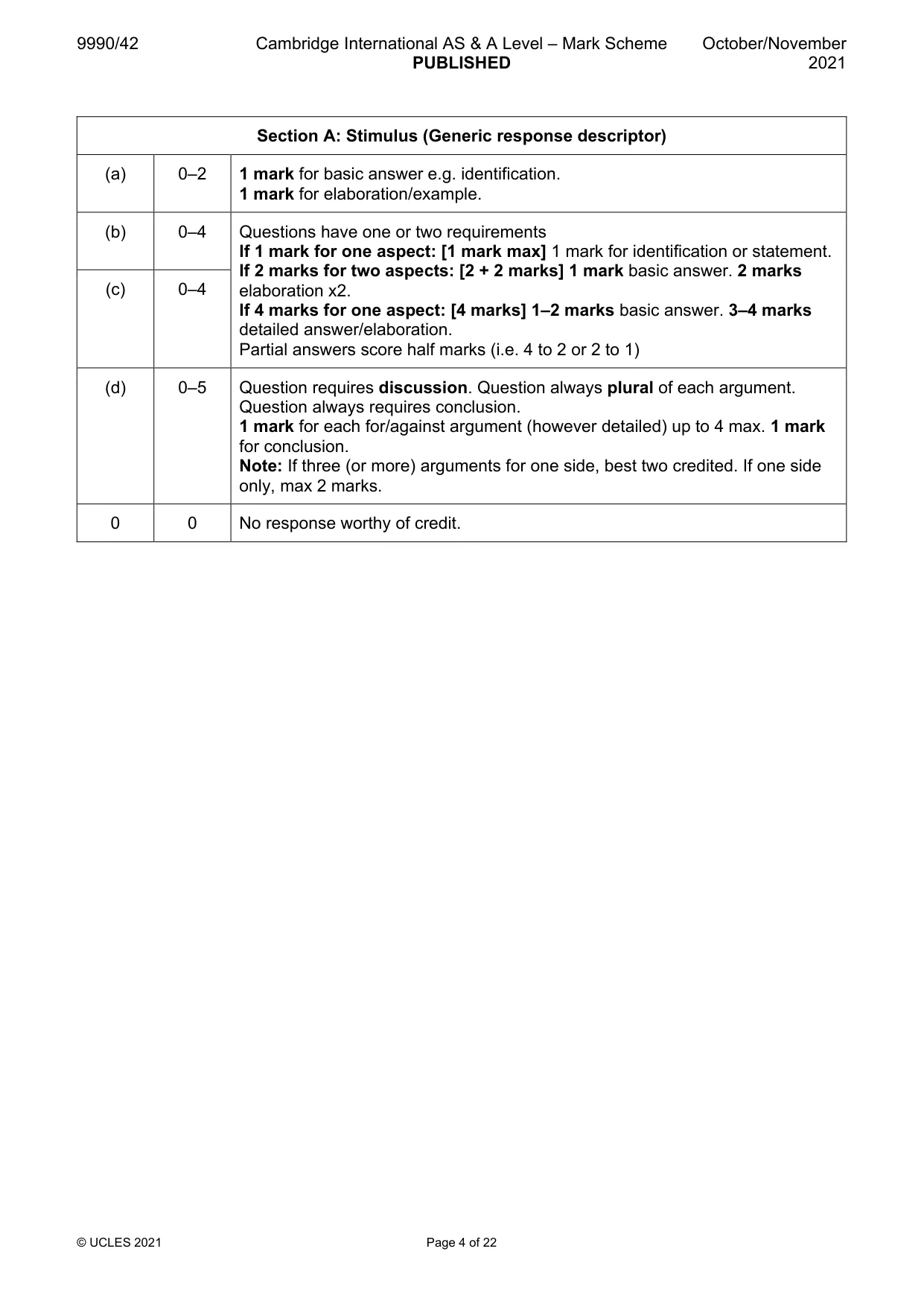
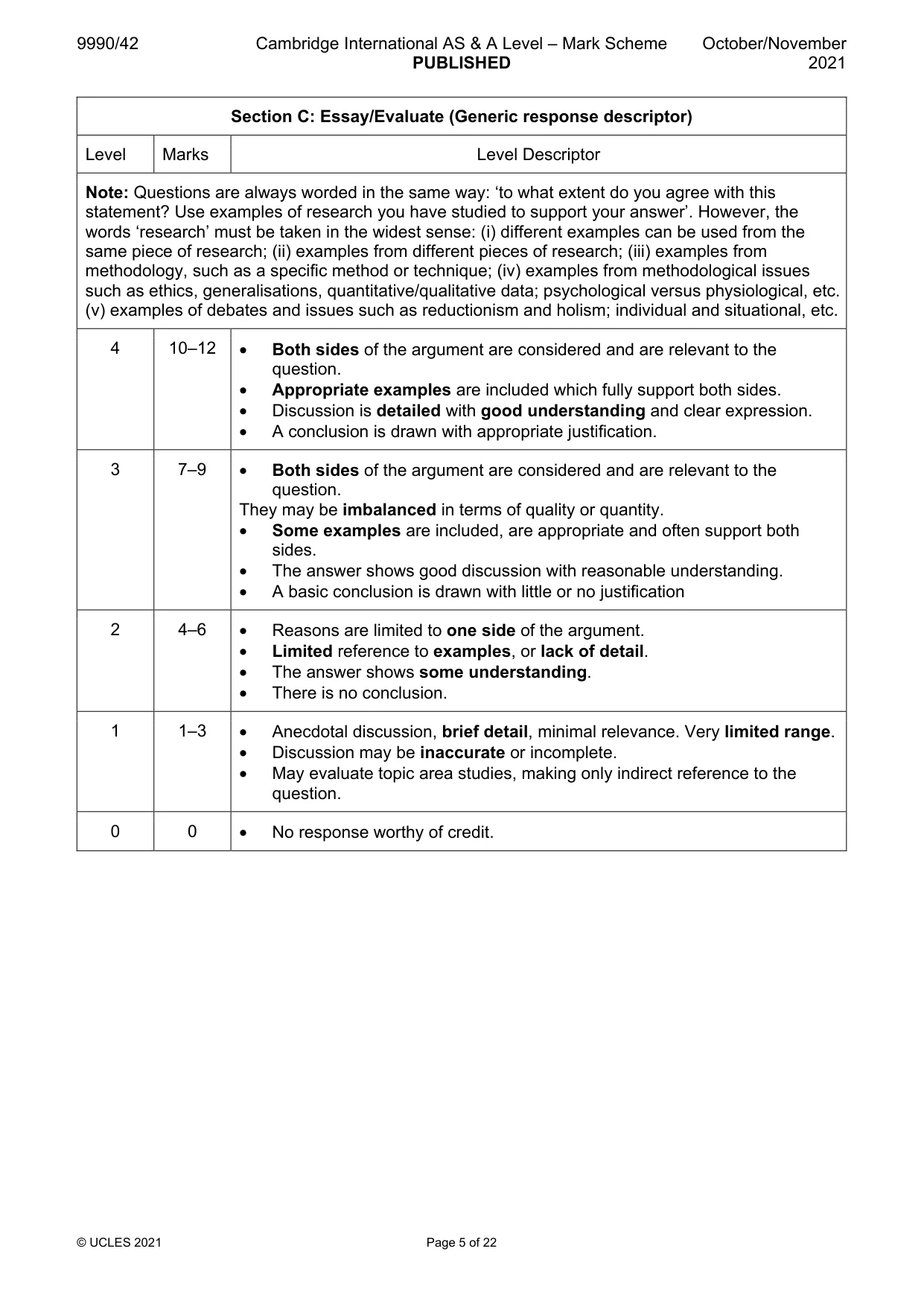
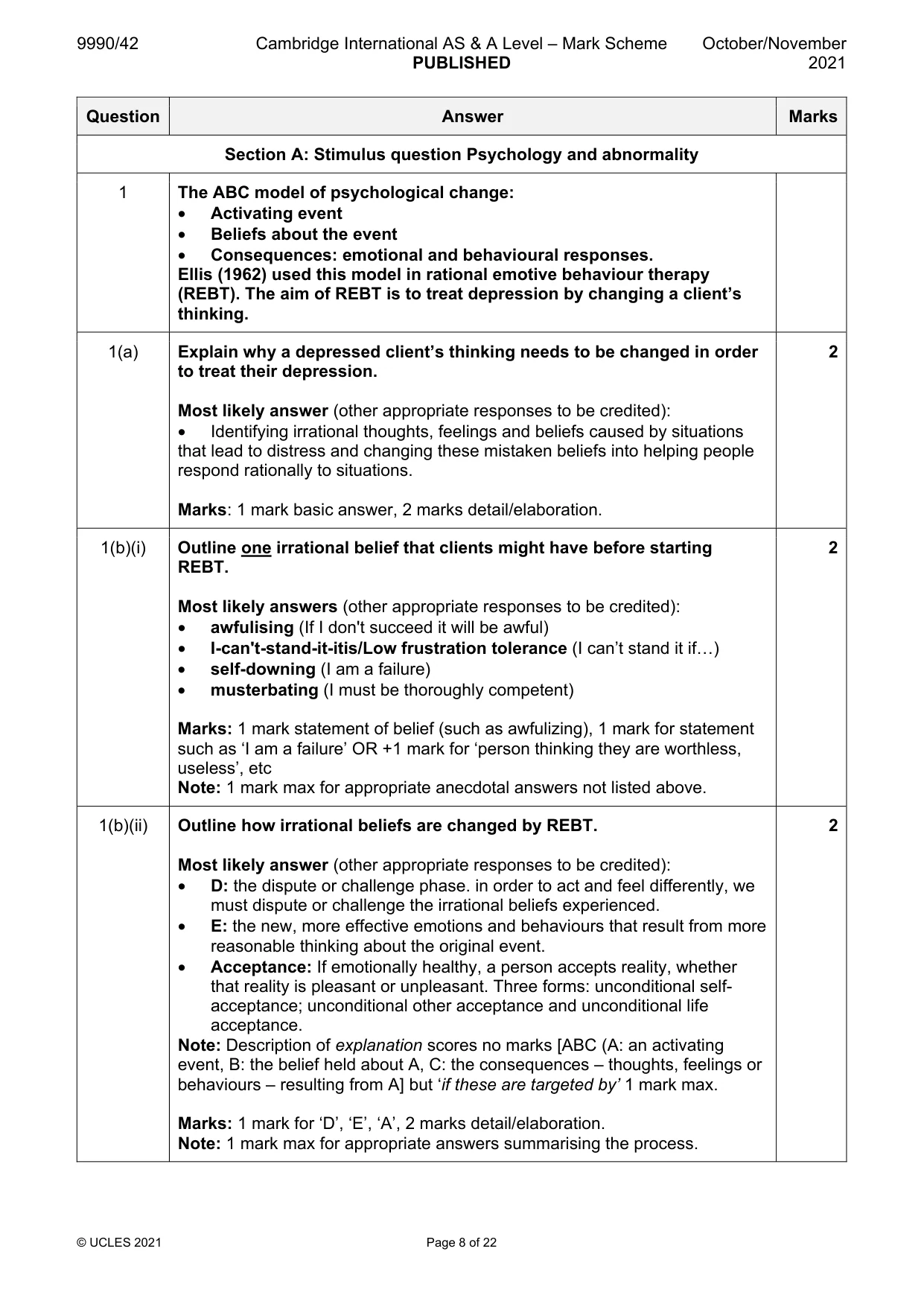
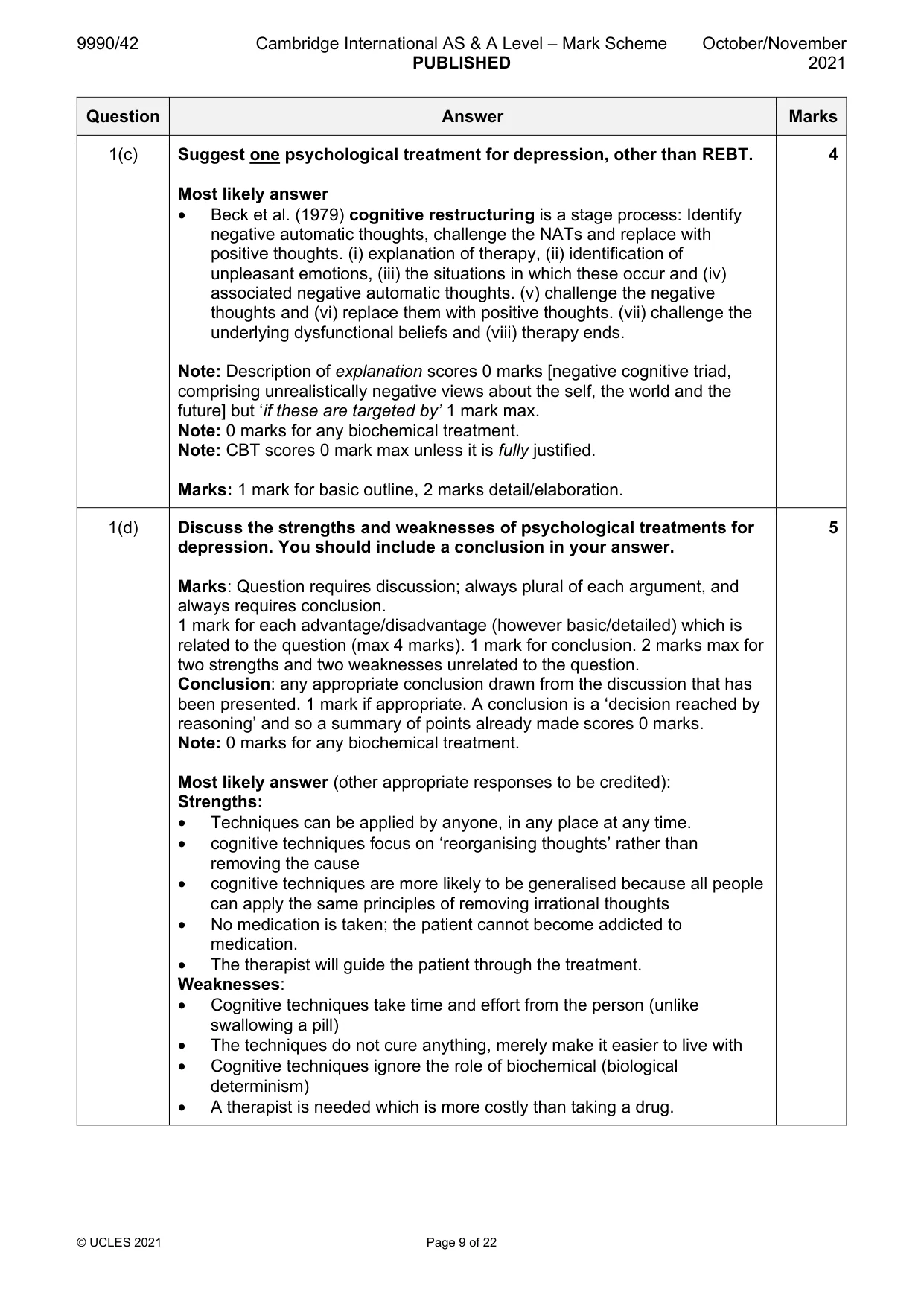
Mark scheme: Question Answer Marks Section A: Stimulus question Psychology and abnormality 1 The ABC model of psychological change: • Activating event • Beliefs about the event • Consequences: emotional and behavioural responses. Ellis (1962) used this model in rational emotive behaviour therapy (REBT). The aim of REBT is to treat depression by changing a client’s thinking. 1(a) Explain why a depressed client’s thinking needs to be changed in order 2 to treat their depression. Most likely answer (other appropriate responses to be credited): • Identifying irrational thoughts, feelings and beliefs caused by situations that lead to distress and changing these mistaken beliefs into helping people respond rationally to situations. Marks: 1 mark basic answer, 2 marks detail/elaboration. 1(b)(i) Outline one irrational belief that clients might have before starting 2 REBT. Most likely answers (other appropriate responses to be credited): • awfulising (If I don't succeed it will be awful) • I-can't-stand-it-itis/Low frustration tolerance (I can’t stand it if…) • self-downing (I am a failure) • musterbating (I must be thoroughly competent) Marks: 1 mark statement of belief (such as awfulizing), 1 mark for statement such as ‘I am a failure’ OR +1 mark for ‘person thinking they are worthless, useless’, etc Note: 1 mark max for appropriate anecdotal answers not listed above. 1(b)(ii) Outline how irrational beliefs are changed by REBT. 2 Most likely answer (other appropriate responses to be credited): • D: the dispute or challenge phase. in order to act and feel differently, we must dispute or challenge the irrational beliefs experienced. • E: the new, more effective emotions and behaviours that result from more reasonable thinking about the original event. • Acceptance: If emotionally healthy, a person accepts reality, whether that reality is pleasant or unpleasant. Three forms: unconditional self- acceptance; unconditional other acceptance and unconditional life acceptance. Note: Description of explanation scores no marks [ABC (A: an activating event, B: the belief held about A, C: the consequences – thoughts, feelings or behaviours – resulting from A] but ‘if these are targeted by’ 1 mark max. Marks: 1 mark for ‘D’, ‘E’, ‘A’, 2 marks detail/elaboration. Note: 1 mark max for appropriate answers summarising the process. 1(c) Suggest one psychological treatment for depression, other than REBT. 4 Most likely answer • Beck et al. (1979) cognitive restructuring is a stage process: Identify negative automatic thoughts, challenge the NATs and replace with positive thoughts. (i) explanation of therapy, (ii) identification of unpleasant emotions, (iii) the situations in which these occur and (iv) associated negative automatic thoughts. (v) challenge the negative thoughts and (vi) replace them with positive thoughts. (vii) challenge the underlying dysfunctional beliefs and (viii) therapy ends. Note: Description of explanation scores 0 marks [negative cognitive triad, comprising unrealistically negative views about the self, the world and the future] but ‘if these are targeted by’ 1 mark max. Note: 0 marks for any biochemical treatment. Note: CBT scores 0 mark max unless it is fully justified. Marks: 1 mark for basic outline, 2 marks detail/elaboration. 1(d) Discuss the strengths and weaknesses of psychological treatments for 5 depression. You should include a conclusion in your answer. Marks: Question requires discussion; always plural of each argument, and always requires conclusion. 1 mark for each advantage/disadvantage (however basic/detailed) which is related to the question (max 4 marks). 1 mark for conclusion. 2 marks max for two strengths and two weaknesses unrelated to the question. Conclusion: any appropriate conclusion drawn from the discussion that has been presented. 1 mark if appropriate. A conclusion is a ‘decision reached by reasoning’ and so a summary of points already made scores 0 marks. Note: 0 marks for any biochemical treatment. Most likely answer (other appropriate responses to be credited): Strengths: • Techniques can be applied by anyone, in any place at any time. • cognitive techniques focus on ‘reorganising thoughts’ rather than removing the cause • cognitive techniques are more likely to be generalised because all people can apply the same principles of removing irrational thoughts • No medication is taken; the patient cannot become addicted to medication. • The therapist will guide the patient through the treatment. Weaknesses: • Cognitive techniques take time and effort from the person (unlike swallowing a pill) • The techniques do not cure anything, merely make it easier to live with • Cognitive techniques ignore the role of biochemical (biological determinism) • A therapist is needed which is more costly than taking a drug.
More questions on Mood (affective) disorders: depressive disorder (unipolar) and bipolar disorder
Q2 · Leisure environment design should serve two functions: to encourage the customer to spend…
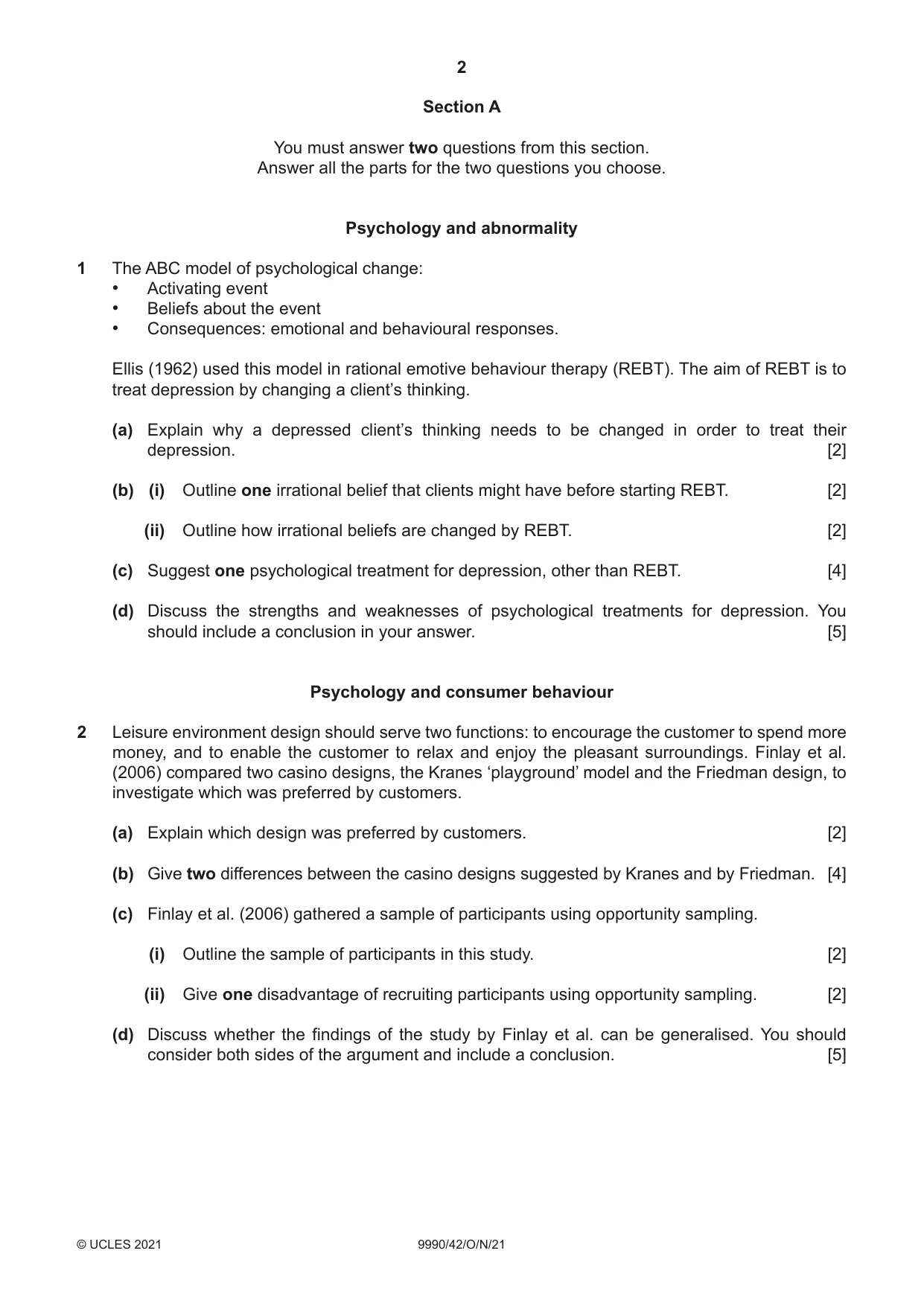
2 Leisure environment design should serve two functions: to encourage the customer to spend more money, and to enable the customer to relax and enjoy the pleasant surroundings. Finlay et al. (2006) compared two casino designs, the Kranes ‘playground’ model and the Friedman design, to investigate which was preferred by customers. (a) Explain which design was preferred by customers. [2] (b) Give two differences between the casino designs suggested by Kranes and by Friedman. [4] (c) Finlay et al. (2006) gathered a sample of participants using opportunity sampling. (i) Outline the sample of participants in this study. [2] (ii) Give one disadvantage of recruiting participants using opportunity sampling. [2] (d) Discuss whether the findings of the study by Finlay et al. can be generalised. You should consider both sides of the argument and include a conclusion. [5] Psychology and health
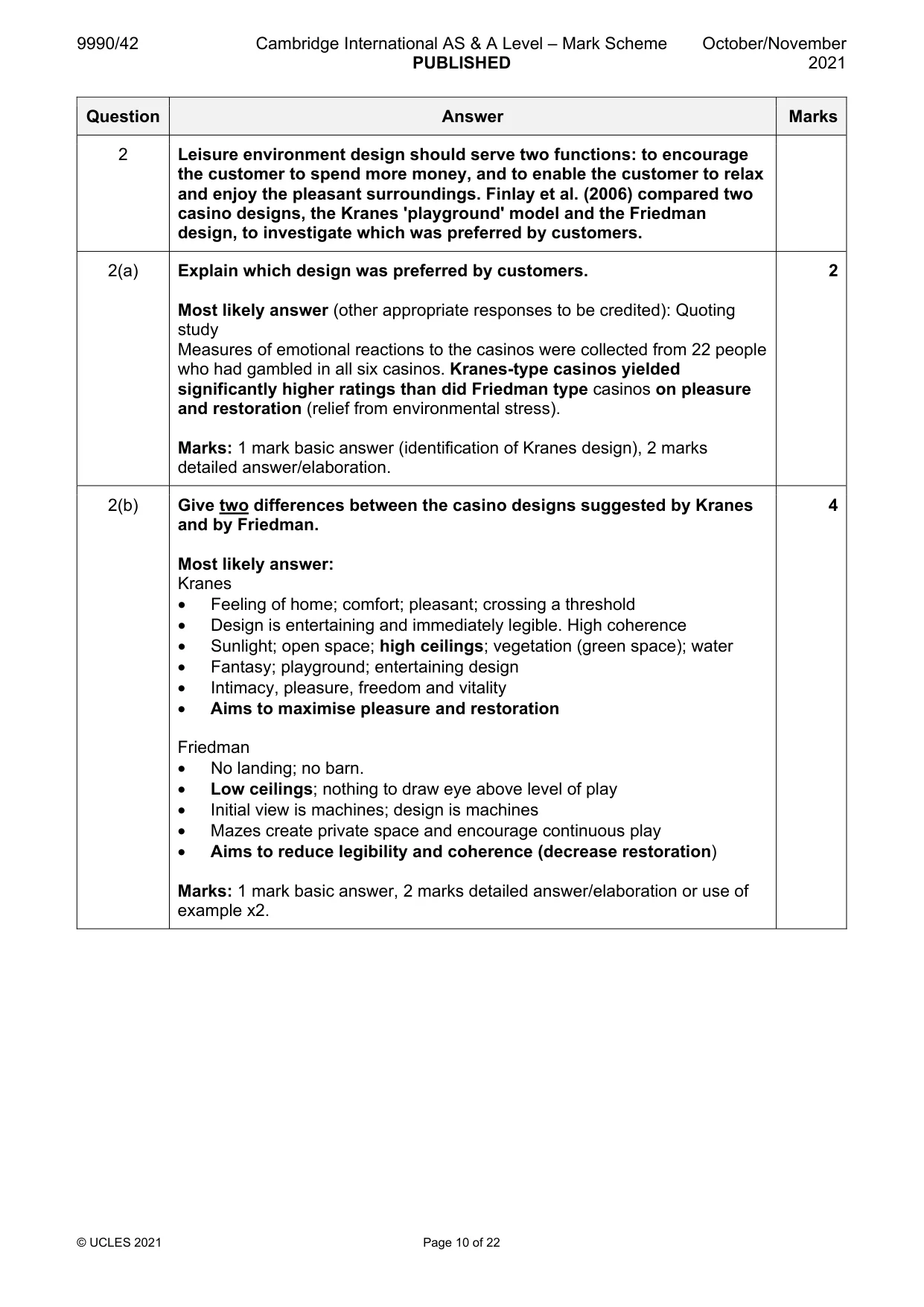
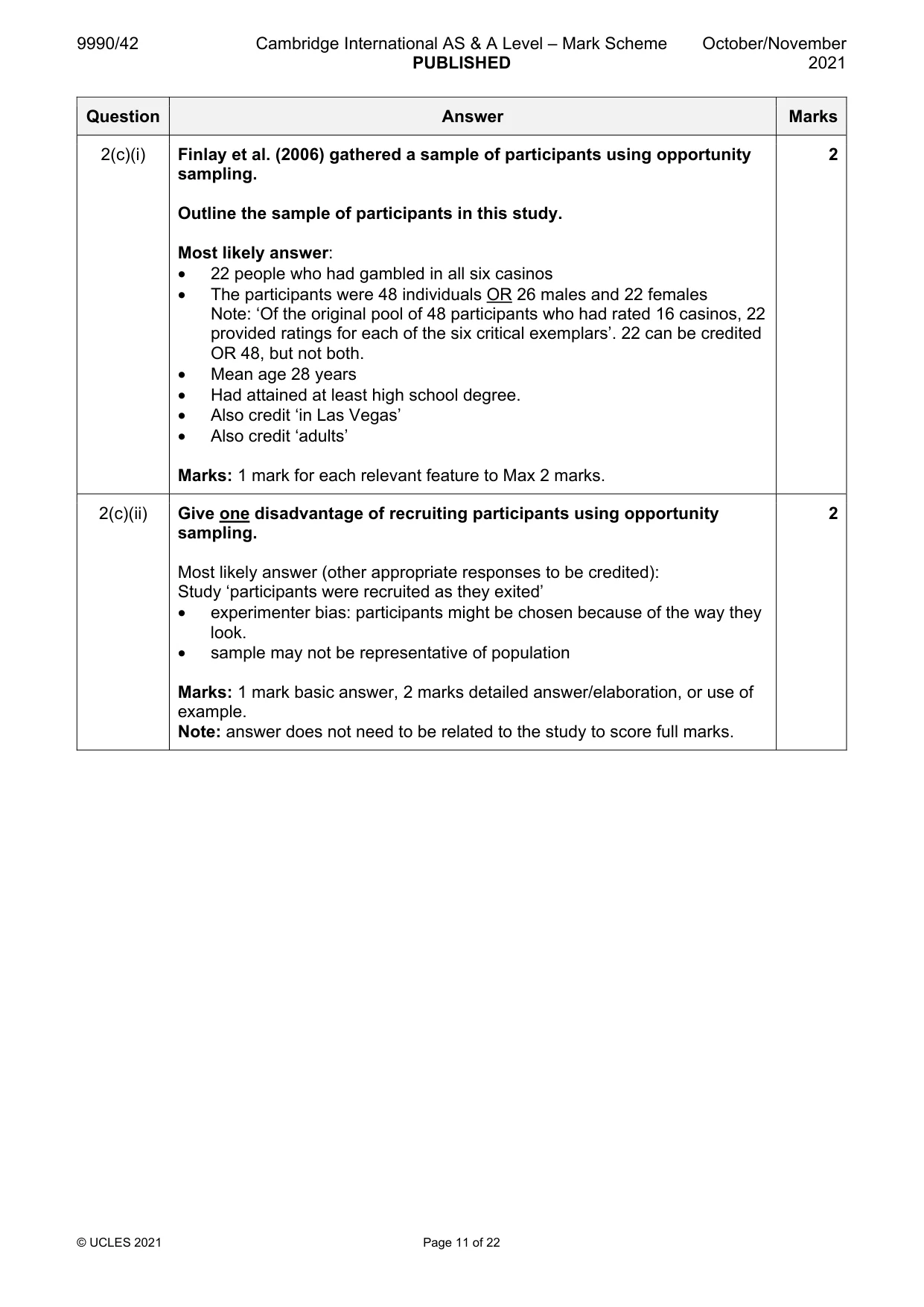
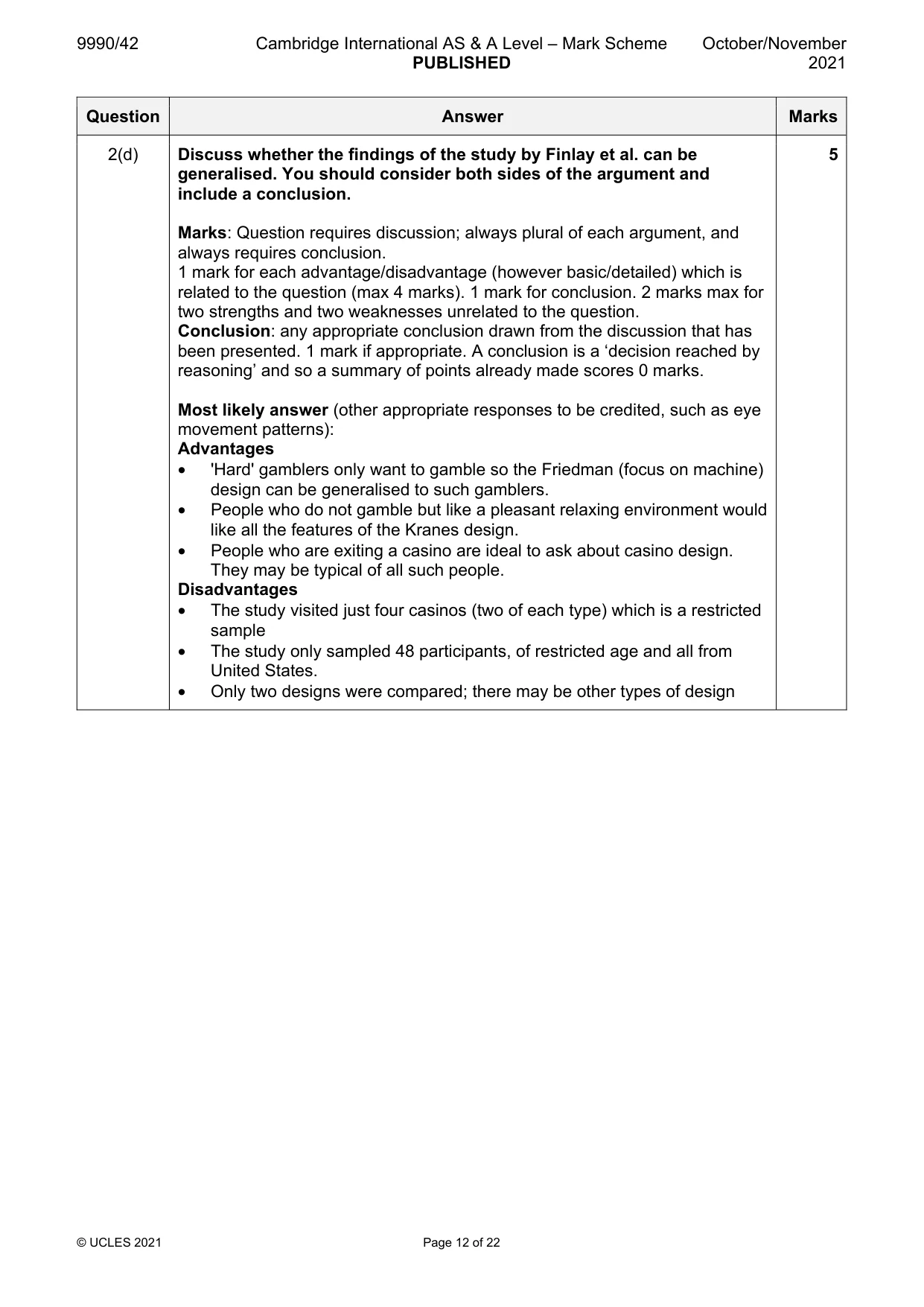
Mark scheme: 2 Leisure environment design should serve two functions: to encourage the customer to spend more money, and to enable the customer to relax and enjoy the pleasant surroundings. Finlay et al. (2006) compared two casino designs, the Kranes 'playground' model and the Friedman design, to investigate which was preferred by customers. 2(a) Explain which design was preferred by customers. 2 Most likely answer (other appropriate responses to be credited): Quoting study Measures of emotional reactions to the casinos were collected from 22 people who had gambled in all six casinos. Kranes-type casinos yielded significantly higher ratings than did Friedman type casinos on pleasure and restoration (relief from environmental stress). Marks: 1 mark basic answer (identification of Kranes design), 2 marks detailed answer/elaboration. 2(b) Give two differences between the casino designs suggested by Kranes 4 and by Friedman. Most likely answer: Kranes • Feeling of home; comfort; pleasant; crossing a threshold • Design is entertaining and immediately legible. High coherence • Sunlight; open space; high ceilings; vegetation (green space); water • Fantasy; playground; entertaining design • Intimacy, pleasure, freedom and vitality • Aims to maximise pleasure and restoration Friedman • No landing; no barn. • Low ceilings; nothing to draw eye above level of play • Initial view is machines; design is machines • Mazes create private space and encourage continuous play • Aims to reduce legibility and coherence (decrease restoration) Marks: 1 mark basic answer, 2 marks detailed answer/elaboration or use of example x2. 2(c)(i) Finlay et al. (2006) gathered a sample of participants using opportunity 2 sampling. Outline the sample of participants in this study. Most likely answer: • 22 people who had gambled in all six casinos • The participants were 48 individuals OR 26 males and 22 females Note: ‘Of the original pool of 48 participants who had rated 16 casinos, 22 provided ratings for each of the six critical exemplars’. 22 can be credited OR 48, but not both. • Mean age 28 years • Had attained at least high school degree. • Also credit ‘in Las Vegas’ • Also credit ‘adults’ Marks: 1 mark for each relevant feature to Max 2 marks. 2(c)(ii) Give one disadvantage of recruiting participants using opportunity 2 sampling. Most likely answer (other appropriate responses to be credited): Study ‘participants were recruited as they exited’ • experimenter bias: participants might be chosen because of the way they look. • sample may not be representative of population Marks: 1 mark basic answer, 2 marks detailed answer/elaboration, or use of example. Note: answer does not need to be related to the study to score full marks. 2(d) Discuss whether the findings of the study by Finlay et al. can be 5 generalised. You should consider both sides of the argument and include a conclusion. Marks: Question requires discussion; always plural of each argument, and always requires conclusion. 1 mark for each advantage/disadvantage (however basic/detailed) which is related to the question (max 4 marks). 1 mark for conclusion. 2 marks max for two strengths and two weaknesses unrelated to the question. Conclusion: any appropriate conclusion drawn from the discussion that has been presented. 1 mark if appropriate. A conclusion is a ‘decision reached by reasoning’ and so a summary of points already made scores 0 marks. Most likely answer (other appropriate responses to be credited, such as eye movement patterns): Advantages • 'Hard' gamblers only want to gamble so the Friedman (focus on machine) design can be generalised to such gamblers. • People who do not gamble but like a pleasant relaxing environment would like all the features of the Kranes design. • People who are exiting a casino are ideal to ask about casino design. They may be typical of all such people. Disadvantages • The study visited just four casinos (two of each type) which is a restricted sample • The study only sampled 48 participants, of restricted age and all from United States. • Only two designs were compared; there may be other types of design
Question 3
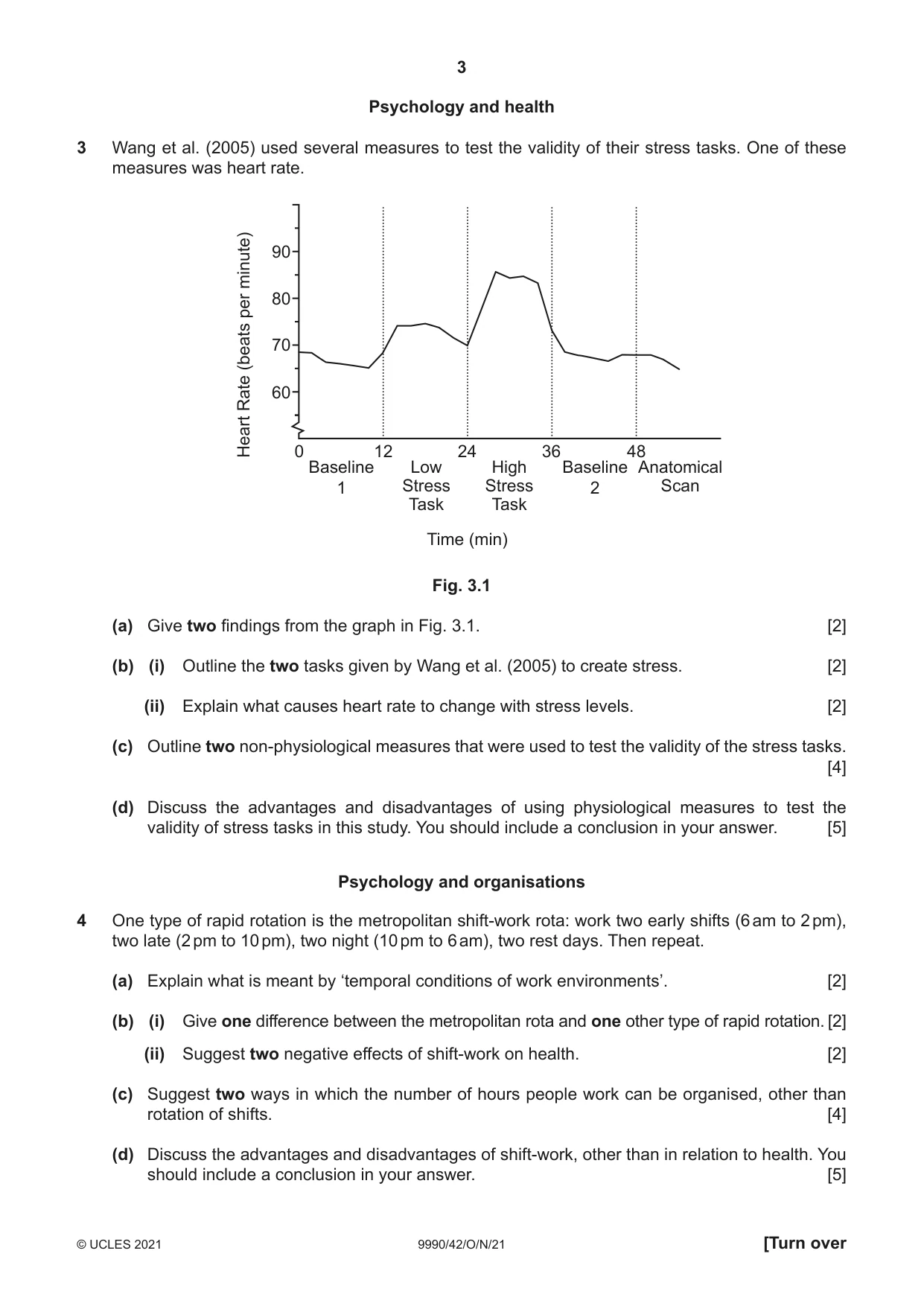
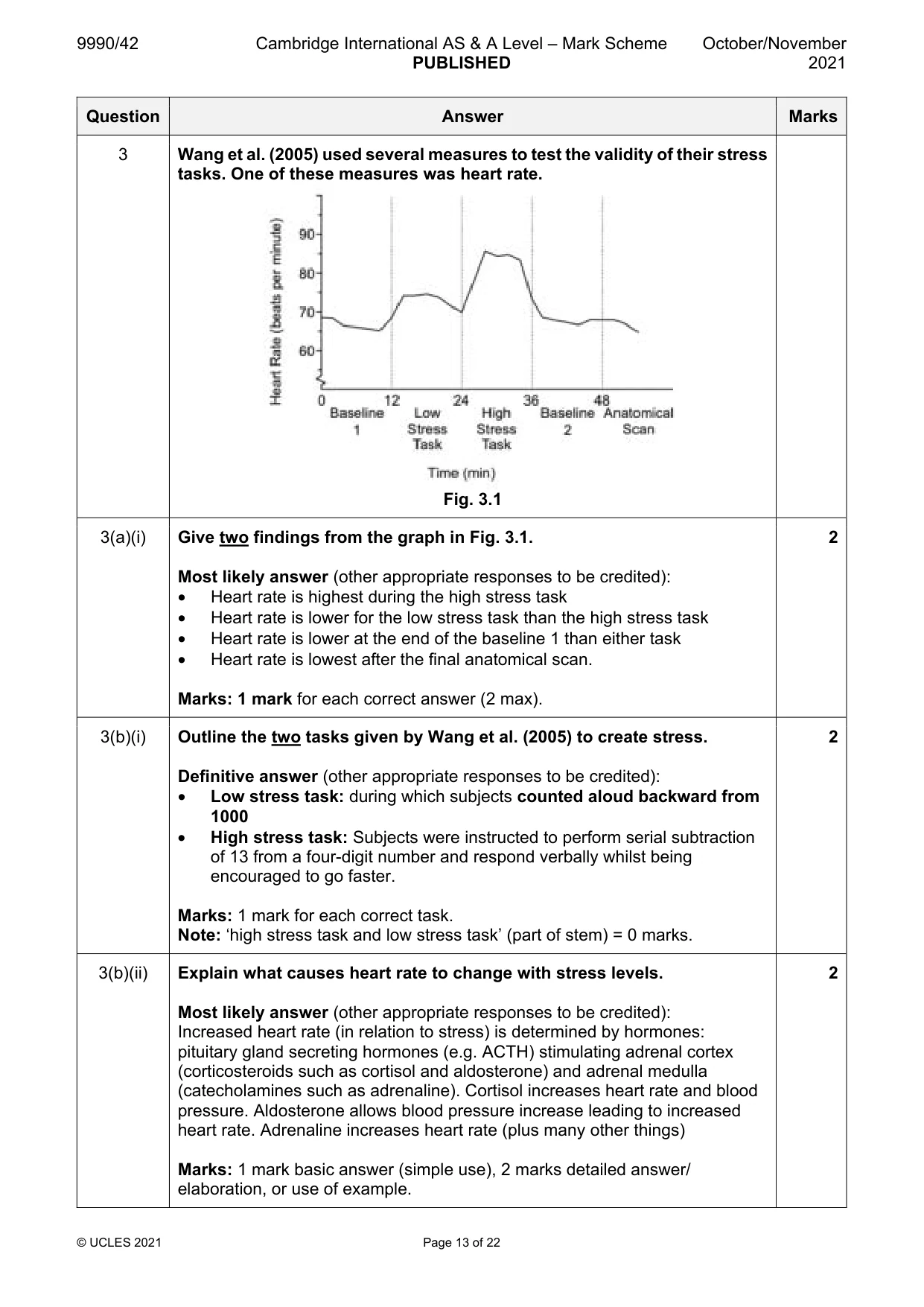
3 Wang et al. (2005) used several measures to test the validity of their stress tasks. One of these measures was heart rate. 90 minute) 80 per 70 (beats 60 Rate Heart 0 12 24 36 48 Baseline Low High Baseline Anatomical 1 Stress Stress 2 Scan Task Task Time (min) Fig. 3.1 (a) Give two findings from the graph in Fig. 3.1. [2] (b) (i) Outline the two tasks given by Wang et al. (2005) to create stress. [2] (ii) Explain what causes heart rate to change with stress levels. [2] (c) Outline two non-physiological measures that were used to test the validity of the stress tasks. [4] (d) Discuss the advantages and disadvantages of using physiological measures to test the validity of stress tasks in this study. You should include a conclusion in your answer. [5] Psychology and organisations
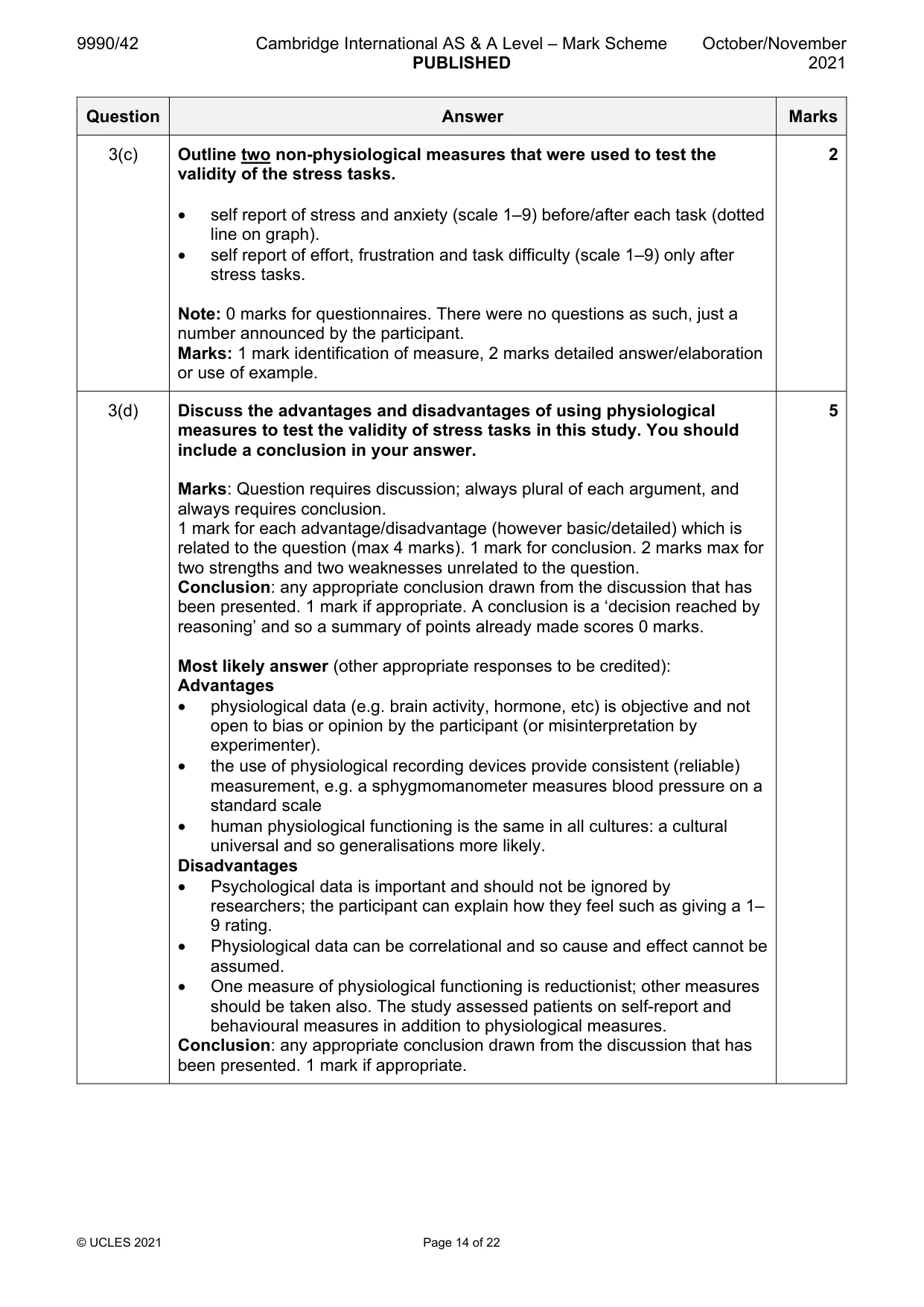
Mark scheme: 3 Wang et al. (2005) used several measures to test the validity of their stress tasks. One of these measures was heart rate. Fig. 3.1 3(a)(i) Give two findings from the graph in Fig. 3.1. 2 Most likely answer (other appropriate responses to be credited): • Heart rate is highest during the high stress task • Heart rate is lower for the low stress task than the high stress task • Heart rate is lower at the end of the baseline 1 than either task • Heart rate is lowest after the final anatomical scan. Marks: 1 mark for each correct answer (2 max). 3(b)(i) Outline the two tasks given by Wang et al. (2005) to create stress. 2 Definitive answer (other appropriate responses to be credited): • Low stress task: during which subjects counted aloud backward from 1000 • High stress task: Subjects were instructed to perform serial subtraction of 13 from a four-digit number and respond verbally whilst being encouraged to go faster. Marks: 1 mark for each correct task. Note: ‘high stress task and low stress task’ (part of stem) = 0 marks. 3(b)(ii) Explain what causes heart rate to change with stress levels. 2 Most likely answer (other appropriate responses to be credited): Increased heart rate (in relation to stress) is determined by hormones: pituitary gland secreting hormones (e.g. ACTH) stimulating adrenal cortex (corticosteroids such as cortisol and aldosterone) and adrenal medulla (catecholamines such as adrenaline). Cortisol increases heart rate and blood pressure. Aldosterone allows blood pressure increase leading to increased heart rate. Adrenaline increases heart rate (plus many other things) Marks: 1 mark basic answer (simple use), 2 marks detailed answer/ elaboration, or use of example. 3(c) Outline two non-physiological measures that were used to test the 2 validity of the stress tasks. • self report of stress and anxiety (scale 1–9) before/after each task (dotted line on graph). • self report of effort, frustration and task difficulty (scale 1–9) only after stress tasks. Note: 0 marks for questionnaires. There were no questions as such, just a number announced by the participant. Marks: 1 mark identification of measure, 2 marks detailed answer/elaboration or use of example. 3(d) Discuss the advantages and disadvantages of using physiological 5 measures to test the validity of stress tasks in this study. You should include a conclusion in your answer. Marks: Question requires discussion; always plural of each argument, and always requires conclusion. 1 mark for each advantage/disadvantage (however basic/detailed) which is related to the question (max 4 marks). 1 mark for conclusion. 2 marks max for two strengths and two weaknesses unrelated to the question. Conclusion: any appropriate conclusion drawn from the discussion that has been presented. 1 mark if appropriate. A conclusion is a ‘decision reached by reasoning’ and so a summary of points already made scores 0 marks. Most likely answer (other appropriate responses to be credited): Advantages • physiological data (e.g. brain activity, hormone, etc) is objective and not open to bias or opinion by the participant (or misinterpretation by experimenter). • the use of physiological recording devices provide consistent (reliable) measurement, e.g. a sphygmomanometer measures blood pressure on a standard scale • human physiological functioning is the same in all cultures: a cultural universal and so generalisations more likely. Disadvantages • Psychological data is important and should not be ignored by researchers; the participant can explain how they feel such as giving a 1– 9 rating. • Physiological data can be correlational and so cause and effect cannot be assumed. • One measure of physiological functioning is reductionist; other measures should be taken also. The study assessed patients on self-report and behavioural measures in addition to physiological measures. Conclusion: any appropriate conclusion drawn from the discussion that has been presented. 1 mark if appropriate.
Q4 · One type of rapid rotation is the metropolitan shift-work rota: work two early shifts (6…
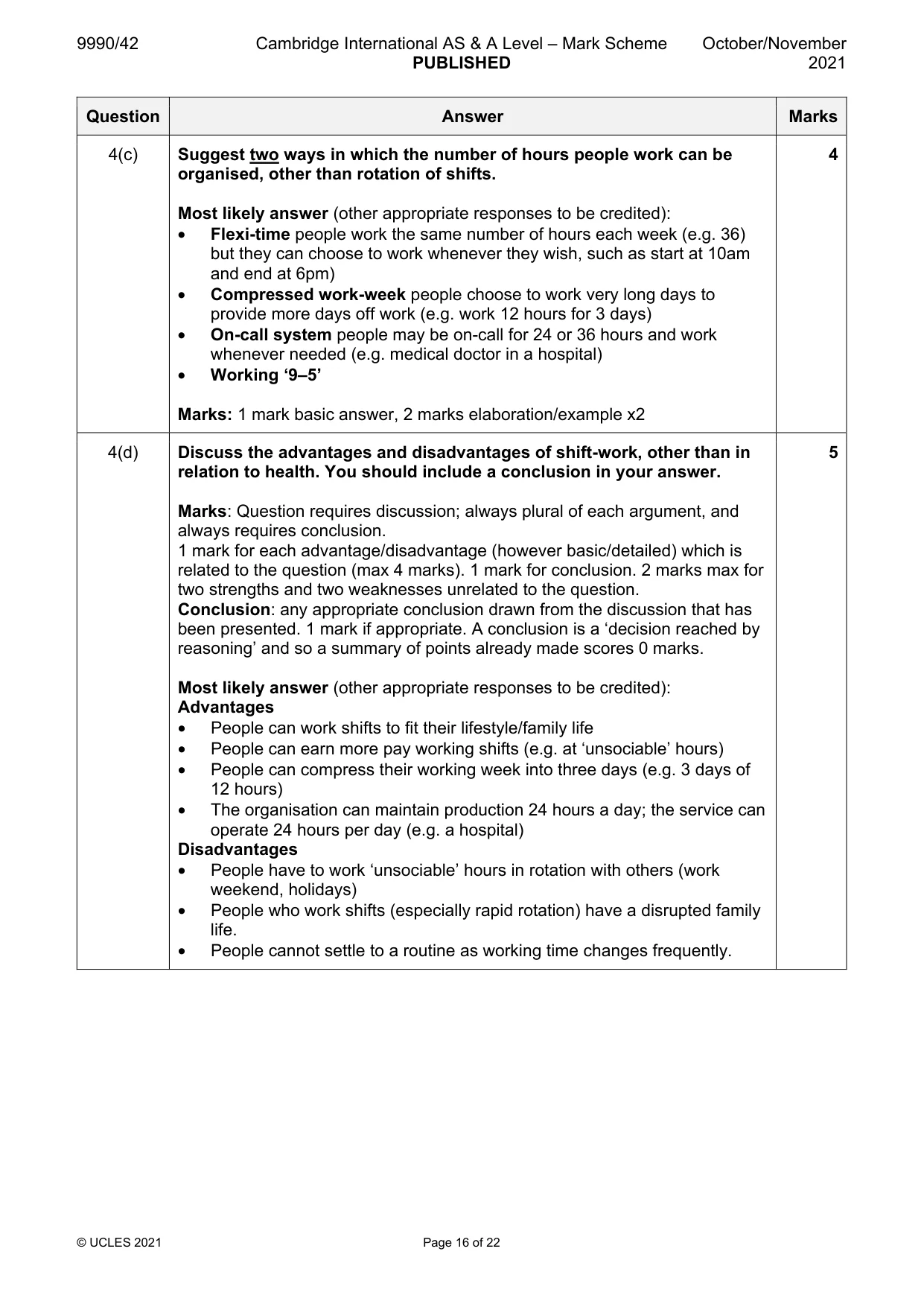
4 One type of rapid rotation is the metropolitan shift-work rota: work two early shifts (6 am to 2 pm), two late (2 pm to 10 pm), two night (10 pm to 6 am), two rest days. Then repeat. (a) Explain what is meant by ‘temporal conditions of work environments’. [2] (b) (i) Give one difference between the metropolitan rota and one other type of rapid rotation. [2] (ii) Suggest two negative effects of shift-work on health. [2] (c) Suggest two ways in which the number of hours people work can be organised, other than rotation of shifts. [4] (d) Discuss the advantages and disadvantages of shift-work, other than in relation to health. You should include a conclusion in your answer. [5]
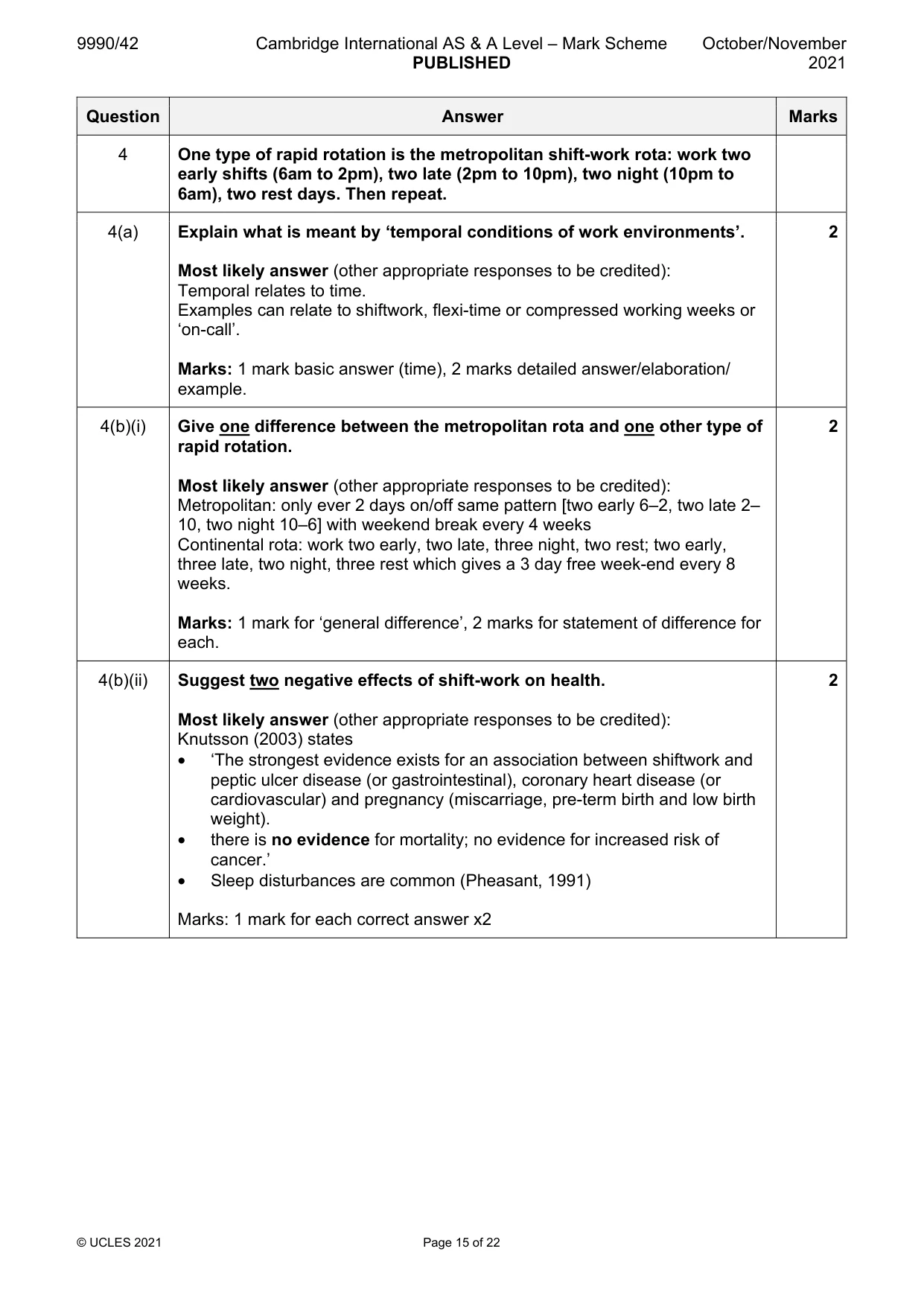
Mark scheme: 4 One type of rapid rotation is the metropolitan shift-work rota: work two early shifts (6am to 2pm), two late (2pm to 10pm), two night (10pm to 6am), two rest days. Then repeat. 4(a) Explain what is meant by ‘temporal conditions of work environments’. 2 Most likely answer (other appropriate responses to be credited): Temporal relates to time. Examples can relate to shiftwork, flexi-time or compressed working weeks or ‘on-call’. Marks: 1 mark basic answer (time), 2 marks detailed answer/elaboration/ example. 4(b)(i) Give one difference between the metropolitan rota and one other type of 2 rapid rotation. Most likely answer (other appropriate responses to be credited): Metropolitan: only ever 2 days on/off same pattern [two early 6–2, two late 2– 10, two night 10–6] with weekend break every 4 weeks Continental rota: work two early, two late, three night, two rest; two early, three late, two night, three rest which gives a 3 day free week-end every 8 weeks. Marks: 1 mark for ‘general difference’, 2 marks for statement of difference for each. 4(b)(ii) Suggest two negative effects of shift-work on health. 2 Most likely answer (other appropriate responses to be credited): Knutsson (2003) states • ‘The strongest evidence exists for an association between shiftwork and peptic ulcer disease (or gastrointestinal), coronary heart disease (or cardiovascular) and pregnancy (miscarriage, pre-term birth and low birth weight). • there is no evidence for mortality; no evidence for increased risk of cancer.’ • Sleep disturbances are common (Pheasant, 1991) Marks: 1 mark for each correct answer x2 4(c) Suggest two ways in which the number of hours people work can be 4 organised, other than rotation of shifts. Most likely answer (other appropriate responses to be credited): • Flexi-time people work the same number of hours each week (e.g. 36) but they can choose to work whenever they wish, such as start at 10am and end at 6pm) • Compressed work-week people choose to work very long days to provide more days off work (e.g. work 12 hours for 3 days) • On-call system people may be on-call for 24 or 36 hours and work whenever needed (e.g. medical doctor in a hospital) • Working ‘9–5’ Marks: 1 mark basic answer, 2 marks elaboration/example x2 4(d) Discuss the advantages and disadvantages of shift-work, other than in 5 relation to health. You should include a conclusion in your answer. Marks: Question requires discussion; always plural of each argument, and always requires conclusion. 1 mark for each advantage/disadvantage (however basic/detailed) which is related to the question (max 4 marks). 1 mark for conclusion. 2 marks max for two strengths and two weaknesses unrelated to the question. Conclusion: any appropriate conclusion drawn from the discussion that has been presented. 1 mark if appropriate. A conclusion is a ‘decision reached by reasoning’ and so a summary of points already made scores 0 marks. Most likely answer (other appropriate responses to be credited): Advantages • People can work shifts to fit their lifestyle/family life • People can earn more pay working shifts (e.g. at ‘unsociable’ hours) • People can compress their working week into three days (e.g. 3 days of 12 hours) • The organisation can maintain production 24 hours a day; the service can operate 24 hours per day (e.g. a hospital) Disadvantages • People have to work ‘unsociable’ hours in rotation with others (work weekend, holidays) • People who work shifts (especially rapid rotation) have a disrupted family life. • People cannot settle to a routine as working time changes frequently.
Q5 · Design a study to investigate the most common type of compulsive behaviour in people with…
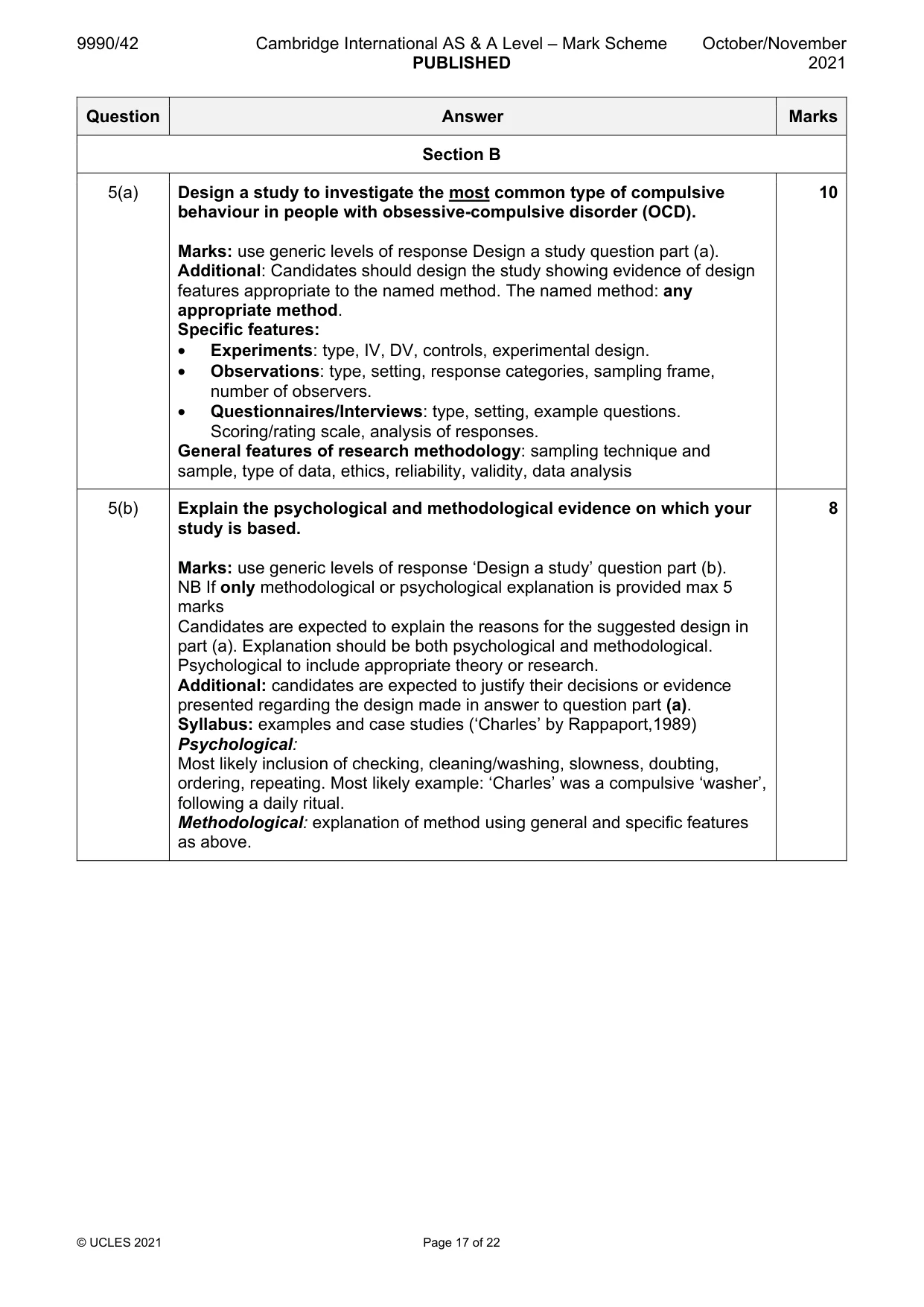
5 (a) Design a study to investigate the most common type of compulsive behaviour in people with obsessive-compulsive disorder (OCD). [10] (b) Explain the psychological and methodological evidence on which your study is based. [8] Psychology and consumer behaviour
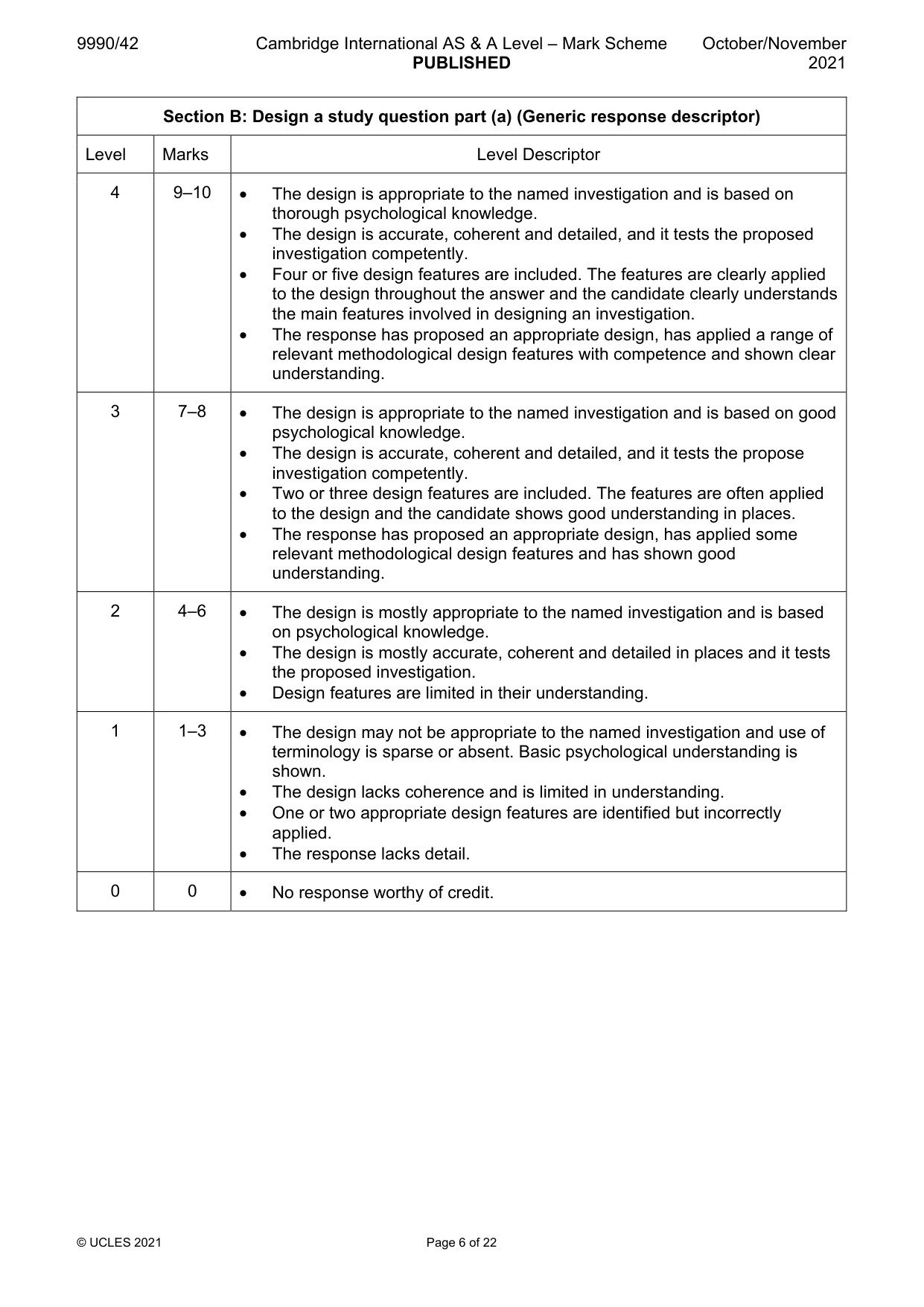
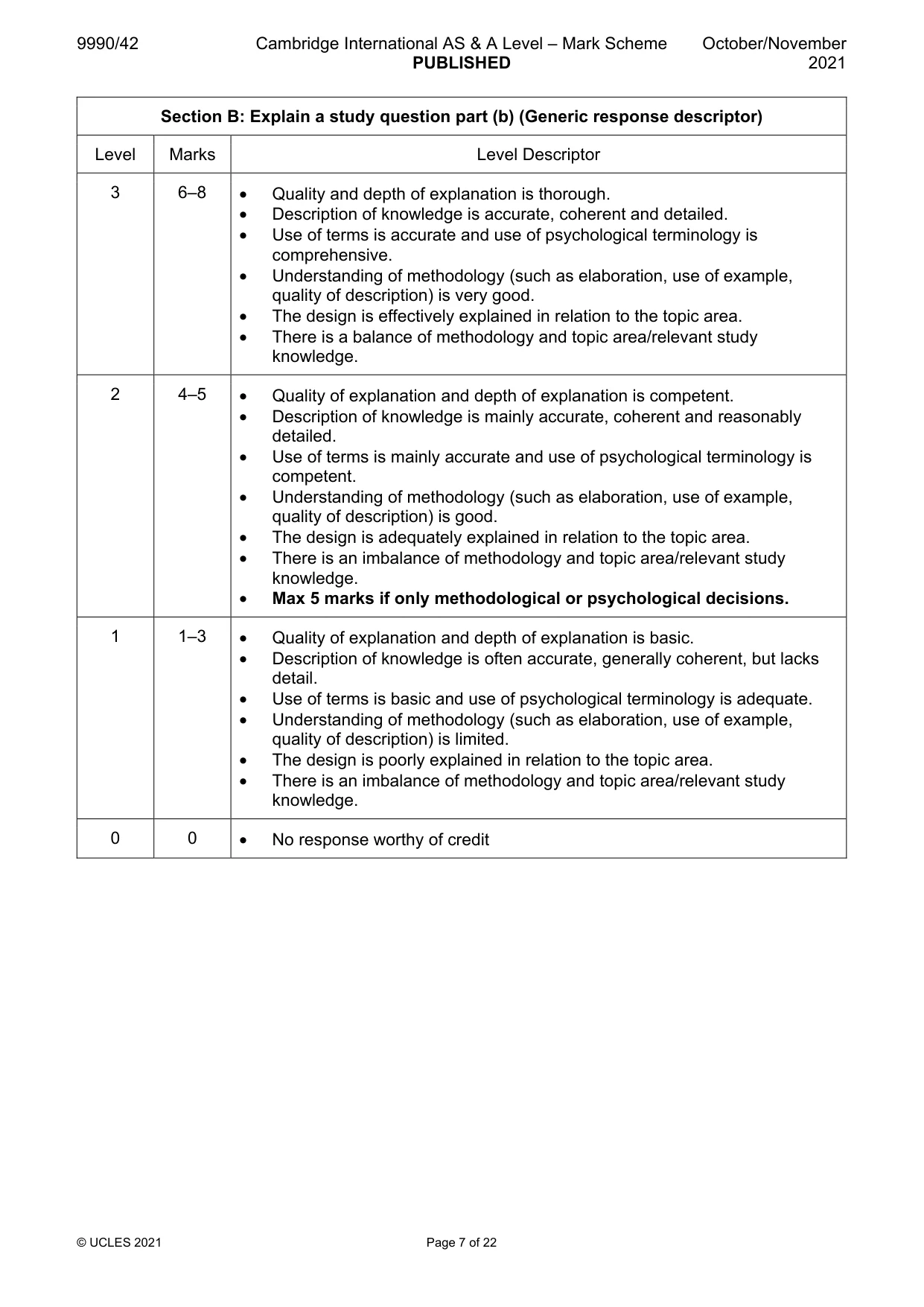
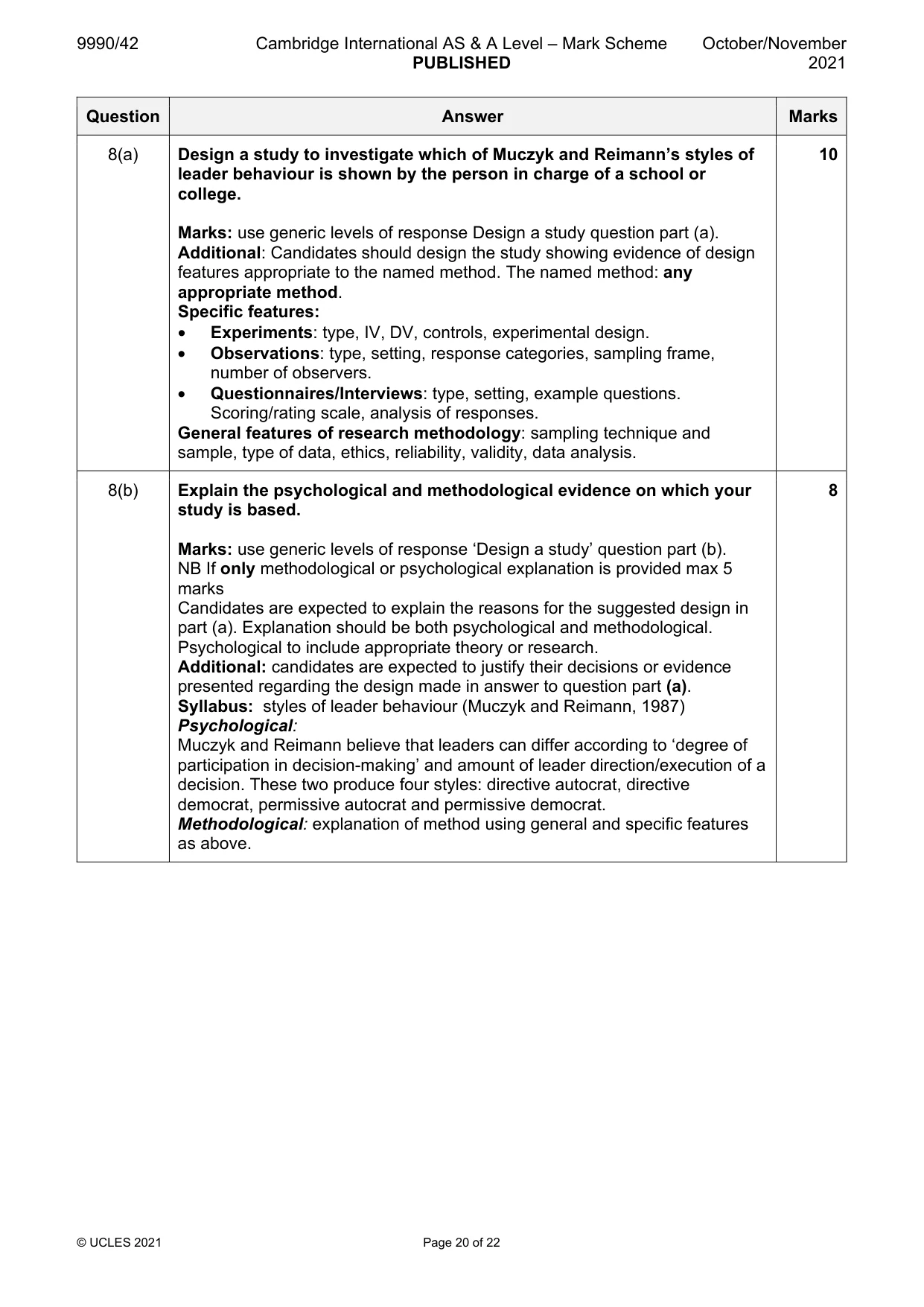
Mark scheme: 5(a) Design a study to investigate the most common type of compulsive 10 behaviour in people with obsessive-compulsive disorder (OCD). Marks: use generic levels of response Design a study question part (a). Additional: Candidates should design the study showing evidence of design features appropriate to the named method. The named method: any appropriate method. Specific features: • Experiments: type, IV, DV, controls, experimental design. • Observations: type, setting, response categories, sampling frame, number of observers. • Questionnaires/Interviews: type, setting, example questions. Scoring/rating scale, analysis of responses. General features of research methodology: sampling technique and sample, type of data, ethics, reliability, validity, data analysis 5(b) Explain the psychological and methodological evidence on which your 8 study is based. Marks: use generic levels of response ‘Design a study’ question part (b). NB If only methodological or psychological explanation is provided max 5 marks Candidates are expected to explain the reasons for the suggested design in part (a). Explanation should be both psychological and methodological. Psychological to include appropriate theory or research. Additional: candidates are expected to justify their decisions or evidence presented regarding the design made in answer to question part (a). Syllabus: examples and case studies (‘Charles’ by Rappaport,1989) Psychological: Most likely inclusion of checking, cleaning/washing, slowness, doubting, ordering, repeating. Most likely example: ‘Charles’ was a compulsive ‘washer’, following a daily ritual. Methodological: explanation of method using general and specific features as above.
Q6 · Design a field experiment to investigate which ambient odour customers prefer in a shop…
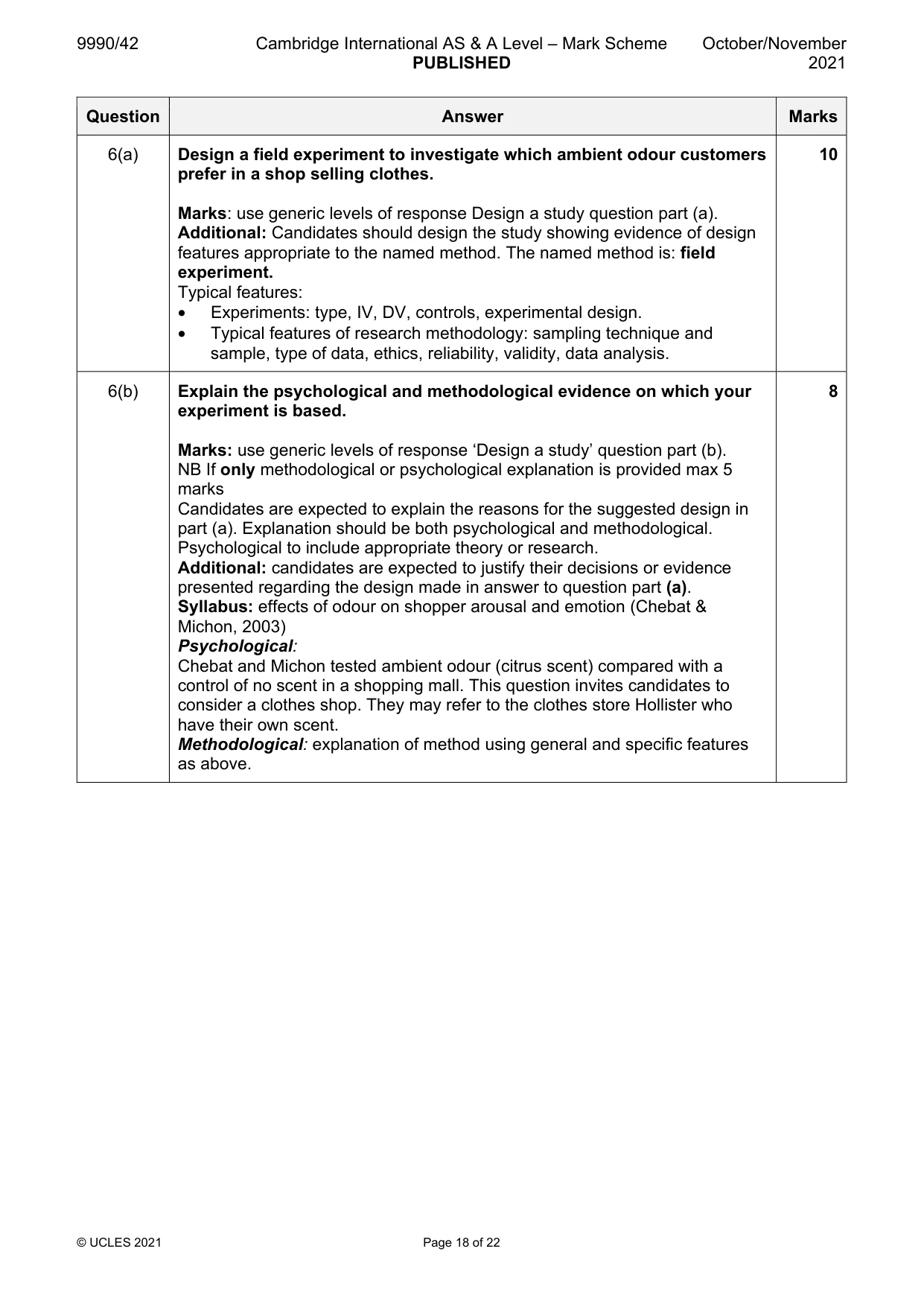
6 (a) Design a field experiment to investigate which ambient odour customers prefer in a shop selling clothes. [10] (b) Explain the psychological and methodological evidence on which your experiment is based. [8] Psychology and health
Mark scheme: 6(a) Design a field experiment to investigate which ambient odour customers 10 prefer in a shop selling clothes. Marks: use generic levels of response Design a study question part (a). Additional: Candidates should design the study showing evidence of design features appropriate to the named method. The named method is: field experiment. Typical features: • Experiments: type, IV, DV, controls, experimental design. • Typical features of research methodology: sampling technique and sample, type of data, ethics, reliability, validity, data analysis. 6(b) Explain the psychological and methodological evidence on which your 8 experiment is based. Marks: use generic levels of response ‘Design a study’ question part (b). NB If only methodological or psychological explanation is provided max 5 marks Candidates are expected to explain the reasons for the suggested design in part (a). Explanation should be both psychological and methodological. Psychological to include appropriate theory or research. Additional: candidates are expected to justify their decisions or evidence presented regarding the design made in answer to question part (a). Syllabus: effects of odour on shopper arousal and emotion (Chebat & Michon, 2003) Psychological: Chebat and Michon tested ambient odour (citrus scent) compared with a control of no scent in a shopping mall. This question invites candidates to consider a clothes shop. They may refer to the clothes store Hollister who have their own scent. Methodological: explanation of method using general and specific features as above.
Q7 · Design an experiment to investigate whether pain treatment using medical techniques…
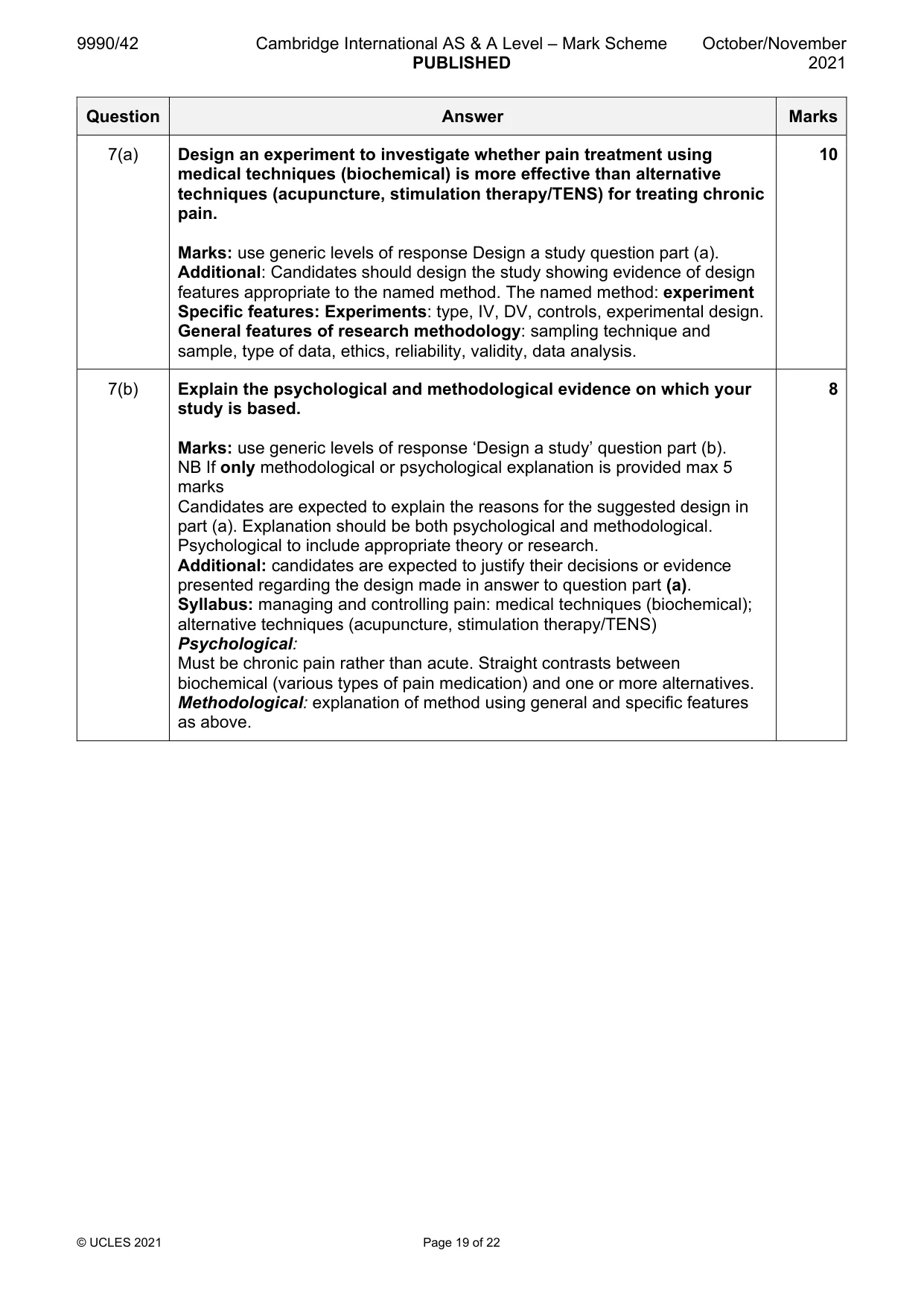
7 (a) Design an experiment to investigate whether pain treatment using medical techniques (biochemical) is more effective than alternative techniques (acupuncture, stimulation therapy/ TENS) for treating chronic pain. [10] (b) Explain the psychological and methodological evidence on which your experiment is based. [8] Psychology and organisations
Mark scheme: 7(a) Design an experiment to investigate whether pain treatment using 10 medical techniques (biochemical) is more effective than alternative techniques (acupuncture, stimulation therapy/TENS) for treating chronic pain. Marks: use generic levels of response Design a study question part (a). Additional: Candidates should design the study showing evidence of design features appropriate to the named method. The named method: experiment Specific features: Experiments: type, IV, DV, controls, experimental design. General features of research methodology: sampling technique and sample, type of data, ethics, reliability, validity, data analysis. 7(b) Explain the psychological and methodological evidence on which your 8 study is based. Marks: use generic levels of response ‘Design a study’ question part (b). NB If only methodological or psychological explanation is provided max 5 marks Candidates are expected to explain the reasons for the suggested design in part (a). Explanation should be both psychological and methodological. Psychological to include appropriate theory or research. Additional: candidates are expected to justify their decisions or evidence presented regarding the design made in answer to question part (a). Syllabus: managing and controlling pain: medical techniques (biochemical); alternative techniques (acupuncture, stimulation therapy/TENS) Psychological: Must be chronic pain rather than acute. Straight contrasts between biochemical (various types of pain medication) and one or more alternatives. Methodological: explanation of method using general and specific features as above.
Q8 · Design a study to investigate which of Muczyk and Reimann's styles of leader behaviour is…
8 (a) Design a study to investigate which of Muczyk and Reimann's styles of leader behaviour is shown by the person in charge of a school or college. [10] (b) Explain the psychological and methodological evidence on which your study is based. [8] Section C You must answer one question from this section. Psychology and abnormality
Mark scheme: 8(a) Design a study to investigate which of Muczyk and Reimann’s styles of 10 leader behaviour is shown by the person in charge of a school or college. Marks: use generic levels of response Design a study question part (a). Additional: Candidates should design the study showing evidence of design features appropriate to the named method. The named method: any appropriate method. Specific features: • Experiments: type, IV, DV, controls, experimental design. • Observations: type, setting, response categories, sampling frame, number of observers. • Questionnaires/Interviews: type, setting, example questions. Scoring/rating scale, analysis of responses. General features of research methodology: sampling technique and sample, type of data, ethics, reliability, validity, data analysis. 8(b) Explain the psychological and methodological evidence on which your 8 study is based. Marks: use generic levels of response ‘Design a study’ question part (b). NB If only methodological or psychological explanation is provided max 5 marks Candidates are expected to explain the reasons for the suggested design in part (a). Explanation should be both psychological and methodological. Psychological to include appropriate theory or research. Additional: candidates are expected to justify their decisions or evidence presented regarding the design made in answer to question part (a). Syllabus: styles of leader behaviour (Muczyk and Reimann, 1987) Psychological: Muczyk and Reimann believe that leaders can differ according to ‘degree of participation in decision-making’ and amount of leader direction/execution of a decision. These two produce four styles: directive autocrat, directive democrat, permissive autocrat and permissive democrat. Methodological: explanation of method using general and specific features as above.
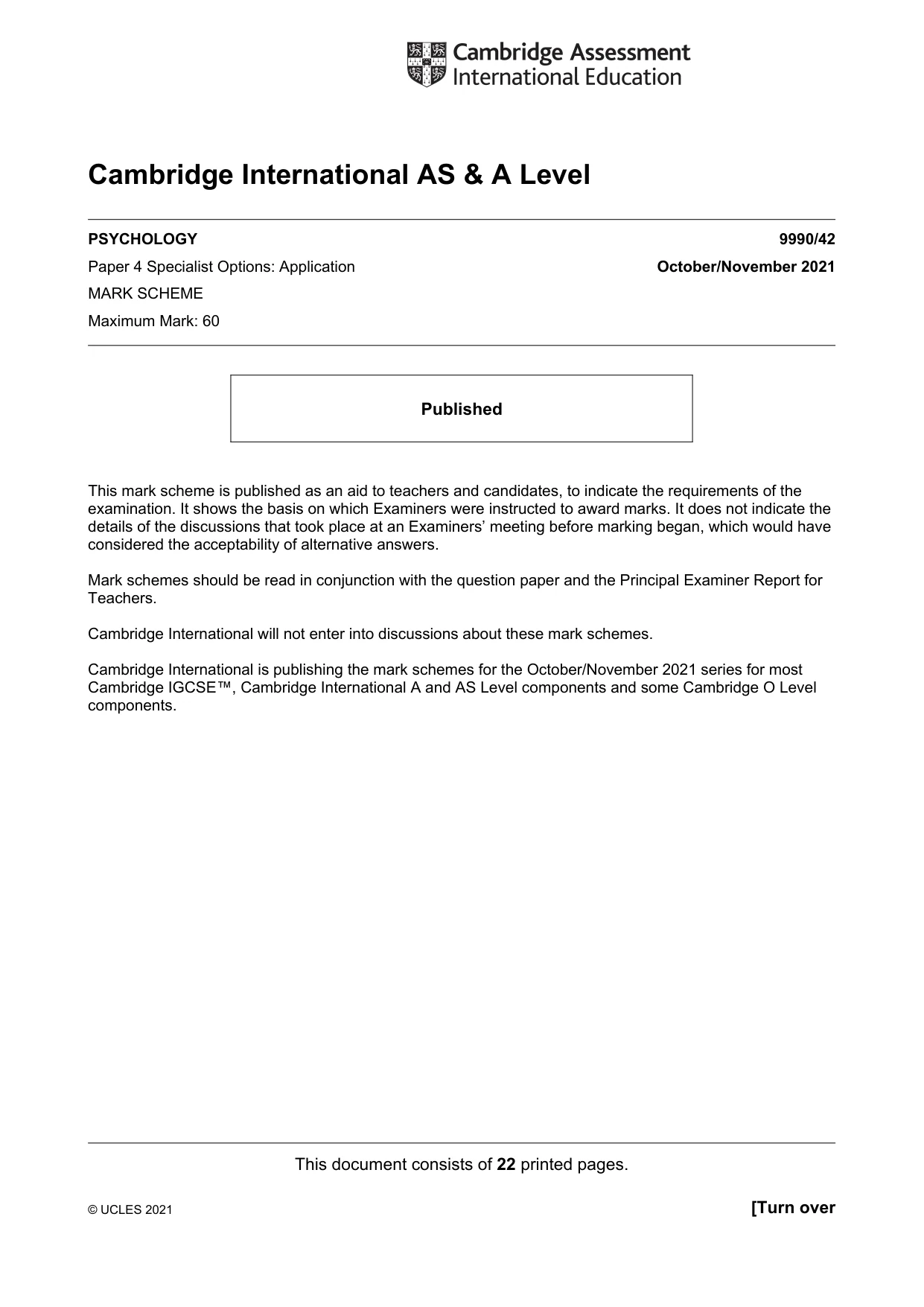
Q9 · ‘Biomedical treatments for obsessive-compulsive and related disorders are irrelevant.’ To…
9 ‘Biomedical treatments for obsessive-compulsive and related disorders are irrelevant.’ To what extent do you agree with this statement? Use examples of research you have studied to support your answer. [12] Psychology and consumer behaviour
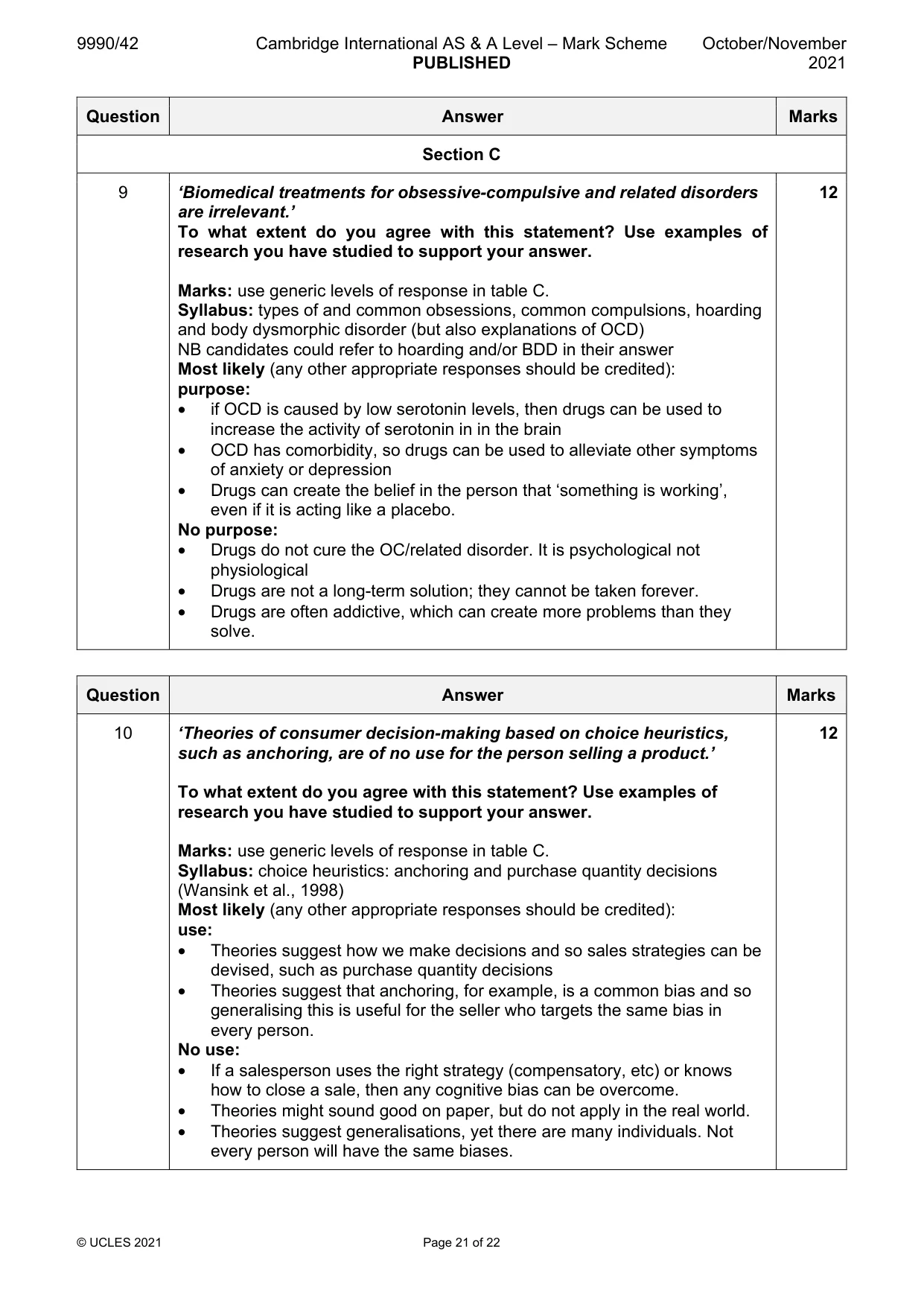
Mark scheme: 9 ‘Biomedical treatments for obsessive-compulsive and related disorders 12 are irrelevant.’ To what extent do you agree with this statement? Use examples of research you have studied to support your answer. Marks: use generic levels of response in table C. Syllabus: types of and common obsessions, common compulsions, hoarding and body dysmorphic disorder (but also explanations of OCD) NB candidates could refer to hoarding and/or BDD in their answer Most likely (any other appropriate responses should be credited): purpose: • if OCD is caused by low serotonin levels, then drugs can be used to increase the activity of serotonin in in the brain • OCD has comorbidity, so drugs can be used to alleviate other symptoms of anxiety or depression • Drugs can create the belief in the person that ‘something is working’, even if it is acting like a placebo. No purpose: • Drugs do not cure the OC/related disorder. It is psychological not physiological • Drugs are not a long-term solution; they cannot be taken forever. • Drugs are often addictive, which can create more problems than they solve.
Q10 · ‘Theories of consumer decision-making based on choice heuristics, such as anchoring, are…
10 ‘Theories of consumer decision-making based on choice heuristics, such as anchoring, are of no use for the person selling a product.’ To what extent do you agree with this statement? Use examples of research you have studied to support your answer. [12] Psychology and health
Mark scheme: 10 ‘Theories of consumer decision-making based on choice heuristics, 12 such as anchoring, are of no use for the person selling a product.’ To what extent do you agree with this statement? Use examples of research you have studied to support your answer. Marks: use generic levels of response in table C. Syllabus: choice heuristics: anchoring and purchase quantity decisions (Wansink et al., 1998) Most likely (any other appropriate responses should be credited): use: • Theories suggest how we make decisions and so sales strategies can be devised, such as purchase quantity decisions • Theories suggest that anchoring, for example, is a common bias and so generalising this is useful for the seller who targets the same bias in every person. No use: • If a salesperson uses the right strategy (compensatory, etc) or knows how to close a sale, then any cognitive bias can be overcome. • Theories might sound good on paper, but do not apply in the real world. • Theories suggest generalisations, yet there are many individuals. Not every person will have the same biases.
Q11 · ‘Psychological measures of stress, such as the measure of life events proposed by Holmes…
11 ‘Psychological measures of stress, such as the measure of life events proposed by Holmes and Rahe, are too subjective to be of any use.’ To what extent do you agree with this statement? Use examples of research you have studied to support your answer. [12] Psychology and organisations
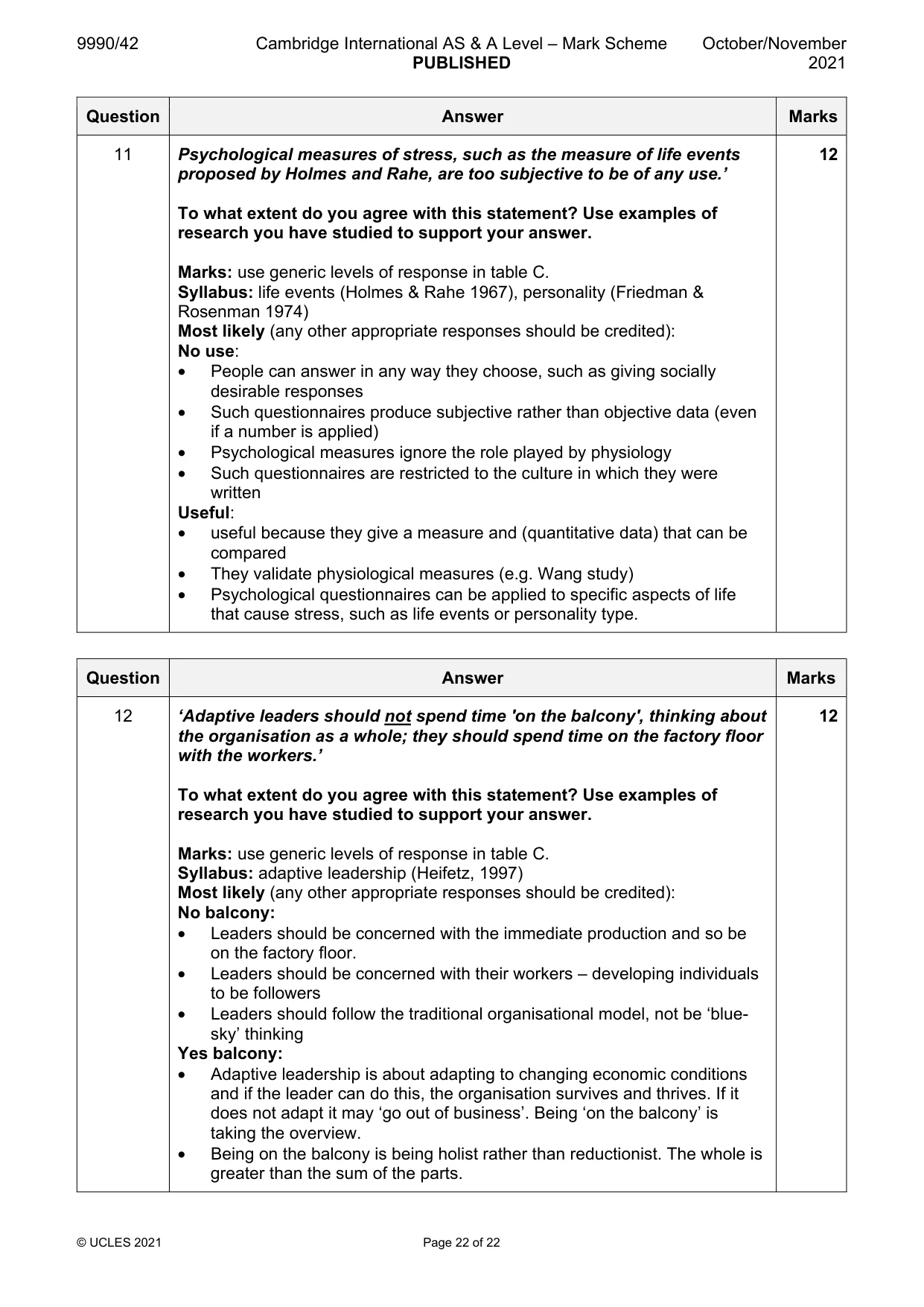
Mark scheme: 11 Psychological measures of stress, such as the measure of life events 12 proposed by Holmes and Rahe, are too subjective to be of any use.’ To what extent do you agree with this statement? Use examples of research you have studied to support your answer. Marks: use generic levels of response in table C. Syllabus: life events (Holmes & Rahe 1967), personality (Friedman & Rosenman 1974) Most likely (any other appropriate responses should be credited): No use: • People can answer in any way they choose, such as giving socially desirable responses • Such questionnaires produce subjective rather than objective data (even if a number is applied) • Psychological measures ignore the role played by physiology • Such questionnaires are restricted to the culture in which they were written Useful: • useful because they give a measure and (quantitative data) that can be compared • They validate physiological measures (e.g. Wang study) • Psychological questionnaires can be applied to specific aspects of life that cause stress, such as life events or personality type.
Q12 · ‘Adaptive leaders should not spend time ‘on the balcony’, thinking about the organisation…
12 ‘Adaptive leaders should not spend time ‘on the balcony’, thinking about the organisation as a whole; they should spend time on the factory floor with the workers.’ To what extent do you agree with this statement? Use examples of research you have studied to support your answer. [12]
Mark scheme: 12 ‘Adaptive leaders should not spend time 'on the balcony', thinking about 12 the organisation as a whole; they should spend time on the factory floor with the workers.’ To what extent do you agree with this statement? Use examples of research you have studied to support your answer. Marks: use generic levels of response in table C. Syllabus: adaptive leadership (Heifetz, 1997) Most likely (any other appropriate responses should be credited): No balcony: • Leaders should be concerned with the immediate production and so be on the factory floor. • Leaders should be concerned with their workers – developing individuals to be followers • Leaders should follow the traditional organisational model, not be ‘blue- sky’ thinking Yes balcony: • Adaptive leadership is about adapting to changing economic conditions and if the leader can do this, the organisation survives and thrives. If it does not adapt it may ‘go out of business’. Being ‘on the balcony’ is taking the overview. • Being on the balcony is being holist rather than reductionist. The whole is greater than the sum of the parts.
What was in this paper
The subtopics covered by these 12 questions, and how many questions each got. Open one in a new tab to see every Cambridge question on it.
What you needed in this session
Cambridge’s own grade thresholds for 2021 Oct/Nov, Paper 4 · Variant 2. A higher threshold means an easier paper — the bar moves with how the cohort did.