Questions as text
Q1 · For a progressive wave, state what is meant by (i) the period, … … [1] (ii) the wavelength 9702/21 May/June 2018
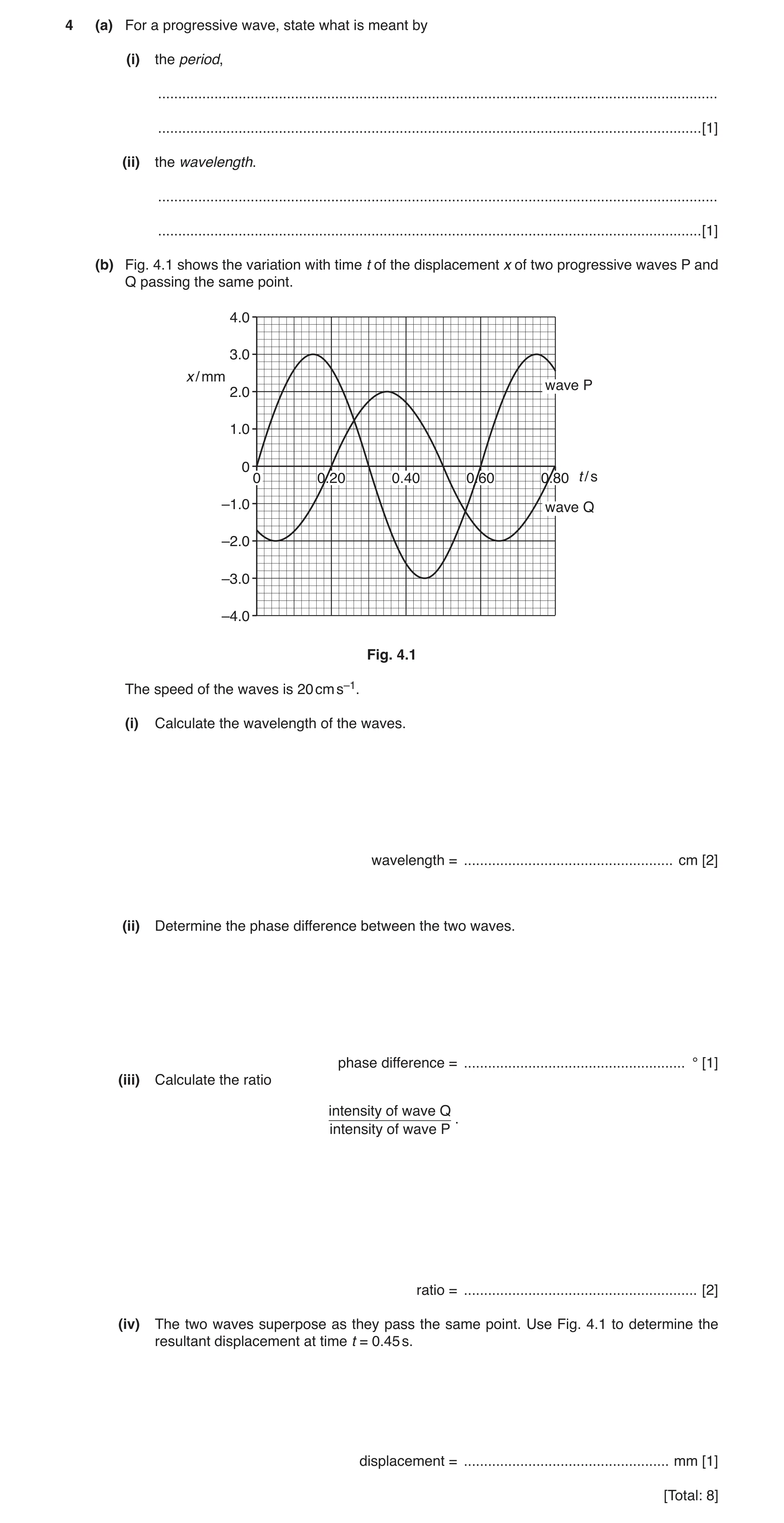
4 (a) For a progressive wave, state what is meant by (i) the period, … … [1] (ii) the wavelength. … … [1] (b) Fig. 4.1 shows the variation with time t of the displacement x of two progressive waves P and Q passing the same point. 4.0 3.0 x / mm wave P 2.0 1.0 0 0 0.20 0.40 0.60 0.80 t / s –1.0 wave Q –2.0 –3.0 –4.0 Fig. 4.1 The speed of the waves is 20 cm s–1. (i) Calculate the wavelength of the waves. wavelength = … cm [2] (ii) Determine the phase difference between the two waves. phase difference = … ° [1] (iii) Calculate the ratio intensity of wave Q . intensity of wave P ratio = … [2] (iv) The two waves superpose as they pass the same point. Use Fig. 4.1 to determine the resultant displacement at time t = 0.45 s. displacement = … mm [1] [Total: 8]
8 marks
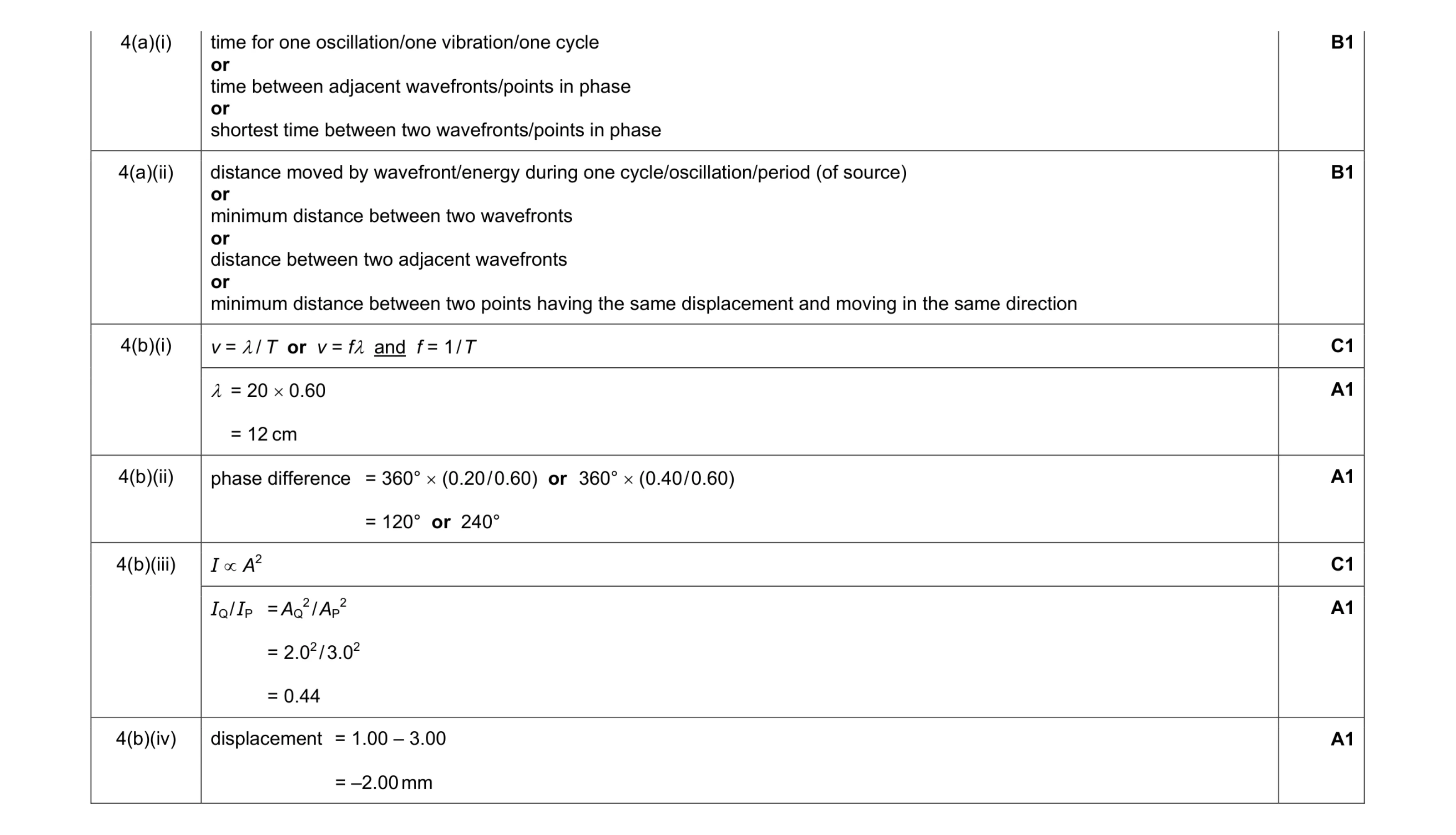
Mark scheme: 4(a)(i) time for one oscillation/one vibration/one cycle or time between adjacent wavefronts/points in phase or shortest time between two wavefronts/points in phase B1 4(a)(ii) distance moved by wavefront/energy during one cycle/oscillation/period (of source) or minimum distance between two wavefronts or distance between two adjacent wavefronts or minimum distance between two points having the same displacement and moving in the same direction B1 4(b)(i) v = λ / T or v = fλ and f = 1 / T C1 λ = 20 × 0.60 = 12 cm A1 4(b)(ii) phase difference = 360° × (0.20 / 0.60) or 360° × (0.40 / 0.60) = 120° or 240° A1 4(b)(iii) I ∝ A2 C1 IQ / IP = AQ 2 / AP 2 = 2.02 / 3.02 = 0.44 A1 4(b)(iv) displacement = 1.00 – 3.00 = –2.00 mm A1
This question in 9702/21 May/June 2018
Q2 · Define the wavelength of a progressive wave 9702/22 May/June 2018
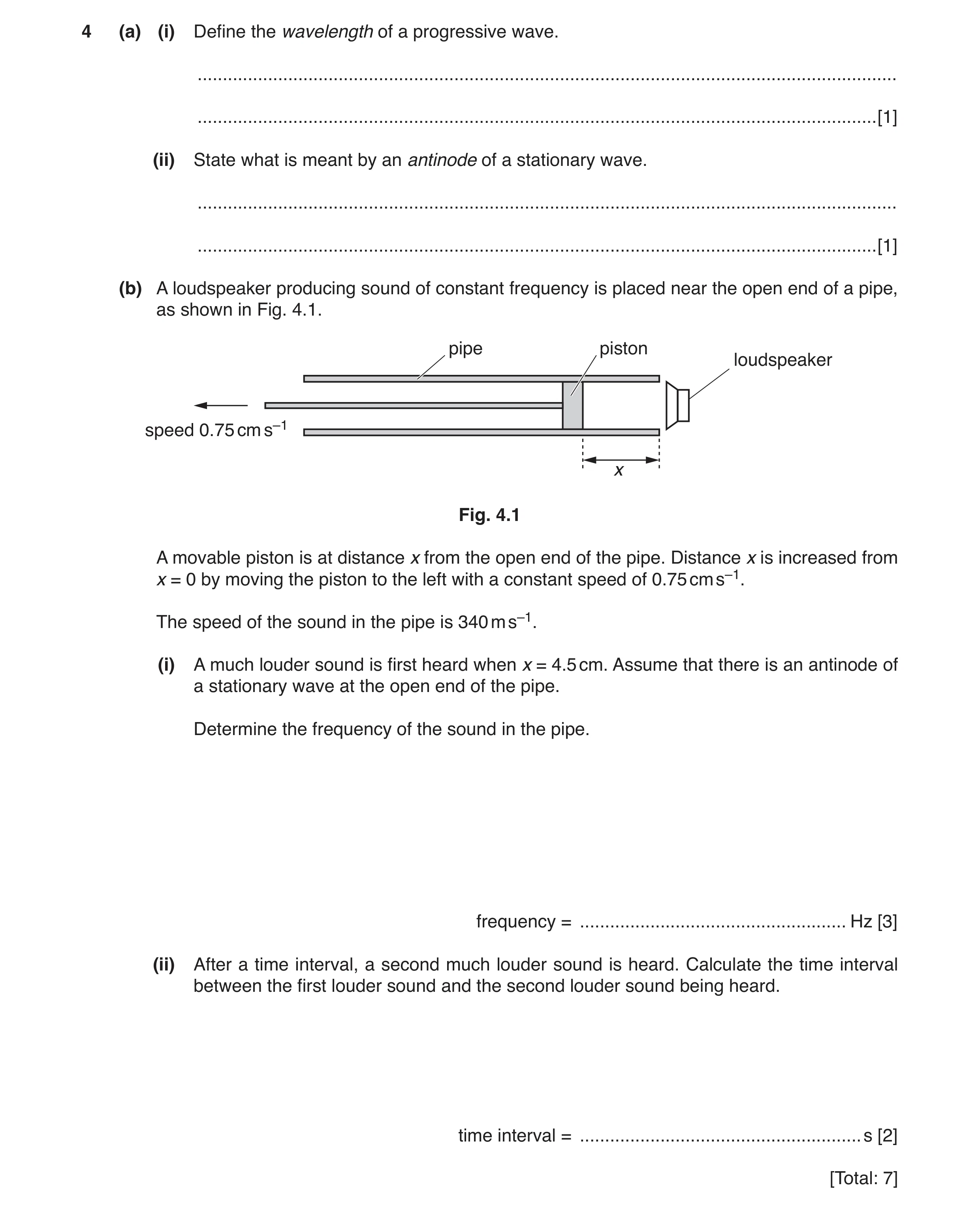
4 (a) (i) Define the wavelength of a progressive wave. … … [1] (ii) State what is meant by an antinode of a stationary wave. … … [1] (b) A loudspeaker producing sound of constant frequency is placed near the open end of a pipe, as shown in Fig. 4.1. pipe piston loudspeaker speed 0.75 cm s–1 x Fig. 4.1 A movable piston is at distance x from the open end of the pipe. Distance x is increased from x = 0 by moving the piston to the left with a constant speed of 0.75 cm s–1. The speed of the sound in the pipe is 340 m s–1. (i) A much louder sound is first heard when x = 4.5 cm. Assume that there is an antinode of a stationary wave at the open end of the pipe. Determine the frequency of the sound in the pipe. frequency = … Hz [3] (ii) After a time interval, a second much louder sound is heard. Calculate the time interval between the first louder sound and the second louder sound being heard. time interval = … s [2] [Total: 7]
7 marks
Mark scheme: 4(a)(i) distance moved by wavefront/energy during one cycle/oscillation/period (of source) or minimum distance between two wavefronts or distance between two adjacent wavefronts B1 4(a)(ii) (position where) maximum amplitude B1 4(b)(i) λ = 4 × 0.045 ( = 0.18 (m) or 18 (cm)) C1 v = fλ C1 f = 340 / 0.18 = 1900 Hz A1 4(b)(ii) distance = λ / 2 ( = 0.09 (m) or 9 (cm)) C1 time = 0.09 / 0.0075 = 12 s A1 or t = 4.5 / 0.75 and t = 13.5 / 0.75 (C1) time = 18 – 6 = 12 s (A1)
This question in 9702/22 May/June 2018
Q3 · State the relationship between the intensity and the amplitude of a wave 9702/23 May/June 2018
5 (a) State the relationship between the intensity and the amplitude of a wave. … … [1] (b) Microwaves of the same amplitude and wavelength are emitted in phase from two sources P and Q. The sources are arranged as shown in Fig. 5.1. P 1.840 m X 2.020 m path of detector Q Fig. 5.1 A microwave detector is moved along a path that is parallel to the line joining P and Q. A series of intensity maxima and intensity minima are detected. When the detector is at a point X, the distance PX is 1.840 m and the distance QX is 2.020 m. The microwaves have a wavelength of 6.0 cm. (i) Calculate the frequency of the microwaves. frequency = … Hz [2] (ii) Describe and explain the intensity of the microwaves detected at X. … … … … … [3] (iii) Describe the effect on the interference pattern along the path of the detector due to each of the following separate changes. 1. The wavelength of the microwaves decreases. … … 2. The phase difference between the microwaves emitted from the sources changes to 180°. … … [2] [Total: 8]
8 marks
Mark scheme: 5(a) B1 5(b)(i) v = fλ or c = fλ C1 f = 3.00 × 10⁸ / 0.060 = 5.0 × 10⁹ Hz A1 5(b)(ii) (at X path) difference = 3λ M1 (at X phase) difference = 0 or 1080° M1 so intensity is at a maximum/it is an intensity maximum A1 5(b)(iii) 1. decrease in the distance between (adjacent intensity) maxima/minima B1 2. (intensity) maxima and minima exchange places B1
This question in 9702/23 May/June 2018
Question 4 9702/23 Oct/Nov 2018
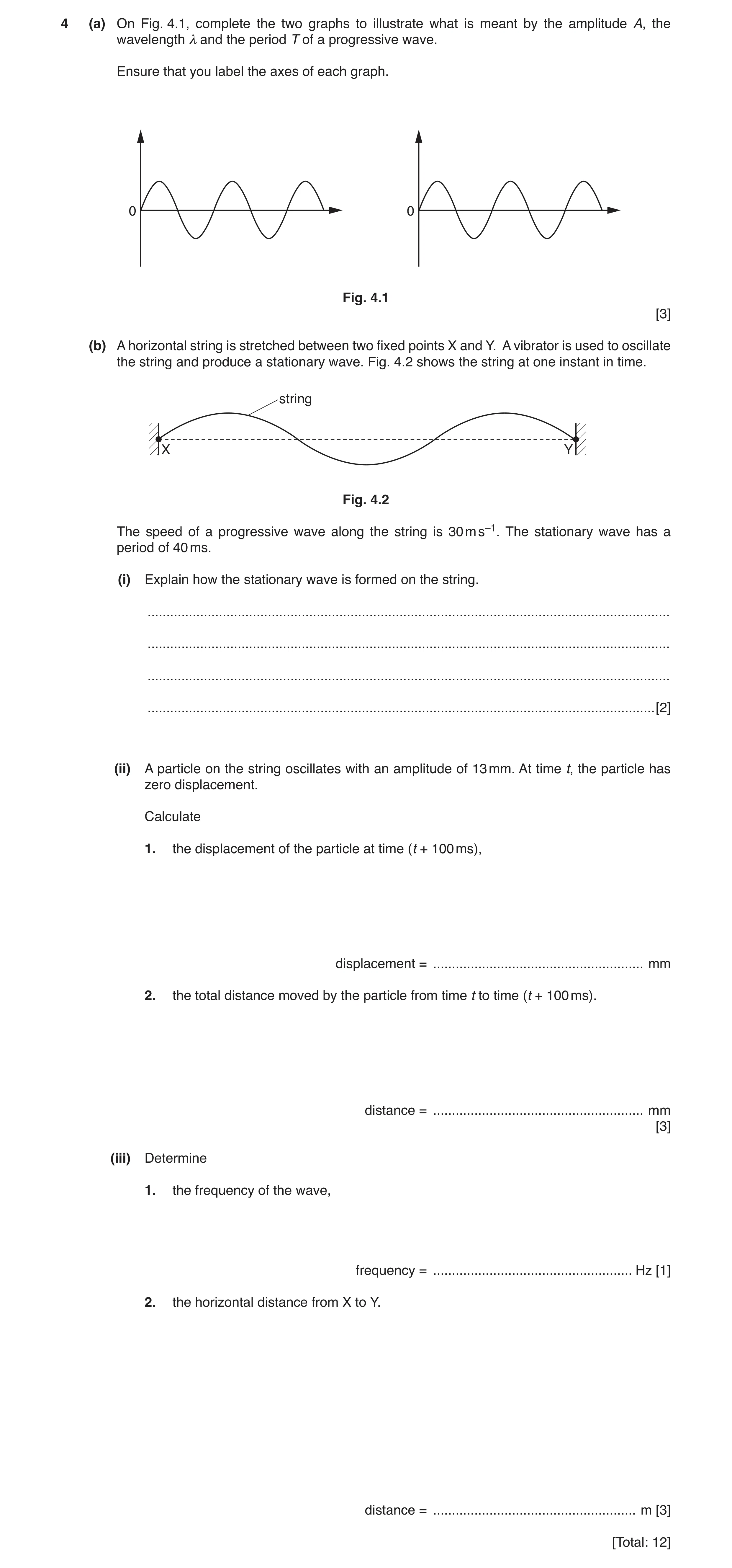
4 (a) On Fig. 4.1, complete the two graphs to illustrate what is meant by the amplitude A, the wavelength λ and the period T of a progressive wave. Ensure that you label the axes of each graph. 0 0 Fig. 4.1 [3] (b) A horizontal string is stretched between two fixed points X and Y. A vibrator is used to oscillate the string and produce a stationary wave. Fig. 4.2 shows the string at one instant in time. string X Y Fig. 4.2 The speed of a progressive wave along the string is 30 m s–1. The stationary wave has a period of 40 ms. (i) Explain how the stationary wave is formed on the string. … … … … [2] (ii) A particle on the string oscillates with an amplitude of 13 mm. At time t, the particle has zero displacement. Calculate 1. the displacement of the particle at time (t + 100 ms), displacement = … mm 2. the total distance moved by the particle from time t to time (t + 100 ms). distance = … mm [3] (iii) Determine 1. the frequency of the wave, frequency = … Hz [1] 2. the horizontal distance from X to Y. distance = … m [3] [Total: 12]
12 marks
Mark scheme: 4(a) B1 graph with x-axis labelled ‘time’ and period/T correctly shown B1 graph with y-axis labelled ‘displacement’ and amplitude/A correctly shown B1 4(b)(i) wave (moves along string and) reflects at fixed point/Y/X/end/wall/boundary B1 the incident and reflected waves interfere/superpose B1 4(b)(ii) 100 / 40 or 2.5 (cycles/periods/T) C1 1. displacement = 0 B1 2. distance = 130 mm A1 4(b)(iii) 1. f = 1 / 40 × 10–3 = 25 Hz A1 2. v = fλ or λ = vT C1 λ = 30 / 25 or 30 × 40 × 10–3 (= 1.2 m) C1 distance = 1.2 × 1.5 = 1.8 m A1
This question in 9702/23 Oct/Nov 2018
Q5 · For a progressive water wave, state what is meant by: (i) displacement … … [1] (ii)… 9702/22 May/June 2019
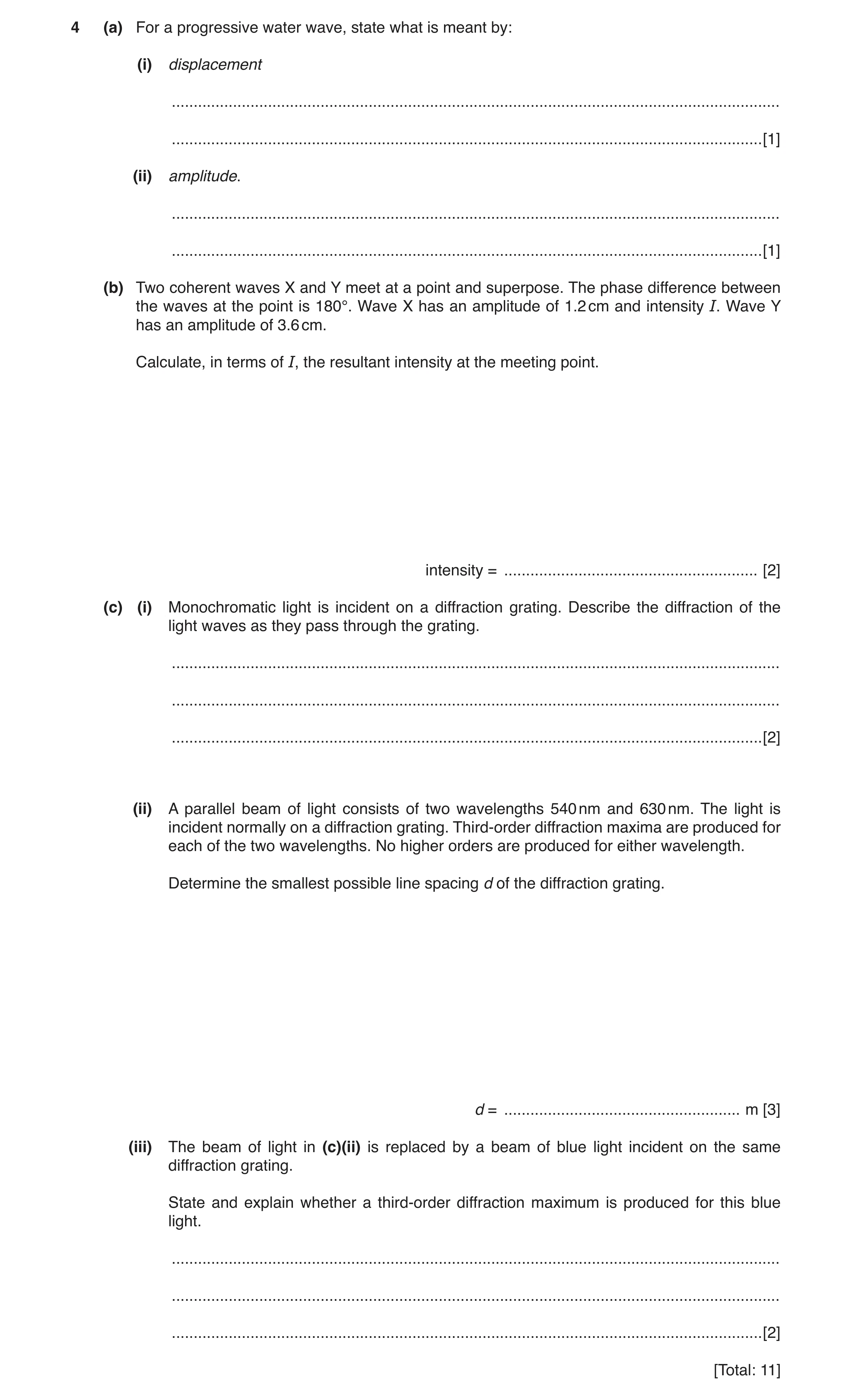
4 (a) For a progressive water wave, state what is meant by: (i) displacement … … [1] (ii) amplitude. … … [1] (b) Two coherent waves X and Y meet at a point and superpose. The phase difference between the waves at the point is 180°. Wave X has an amplitude of 1.2 cm and intensity I. Wave Y has an amplitude of 3.6 cm. Calculate, in terms of I, the resultant intensity at the meeting point. intensity = … [2] (c) (i) Monochromatic light is incident on a diffraction grating. Describe the diffraction of the light waves as they pass through the grating. … … … [2] (ii) A parallel beam of light consists of two wavelengths 540 nm and 630 nm. The light is incident normally on a diffraction grating. Third-order diffraction maxima are produced for each of the two wavelengths. No higher orders are produced for either wavelength. Determine the smallest possible line spacing d of the diffraction grating. d = … m [3] (iii) The beam of light in (c)(ii) is replaced by a beam of blue light incident on the same diffraction grating. State and explain whether a third-order diffraction maximum is produced for this blue light. … … … [2] [Total: 11]
11 marks
Mark scheme: 4(a)(i) distance (in a specified direction of particle/point on wave) from the equilibrium position B1 4(a)(ii) the maximum distance (of particle/point on wave) from the equilibrium position or the maximum displacement (of particle/point on wave) B1 4(b) I ∝ A2 C1 IR / I = (3.6 – 1.2)2 / (1.2)2 resultant intensity = 4.0I A1 4(c)(i) as wave(s) pass through the slit(s) B1 wave(s) spread (into geometric shadow) B1 4(c)(ii) nλ = d sin θ C1 3λ = d sin 90° or 3λ = d C1 d = 3 × 630 × 10–9 = 1.9 × 10⁻⁶ m A1 4(c)(iii) wavelength of blue light is shorter (than 540 nm/630 nm/wavelengths of original light) M1 (so) third order diffraction maximum is produced A1
This question in 9702/22 May/June 2019
Q6 · State what is meant by the wavelength of a progressive wave 9702/22 Oct/Nov 2019
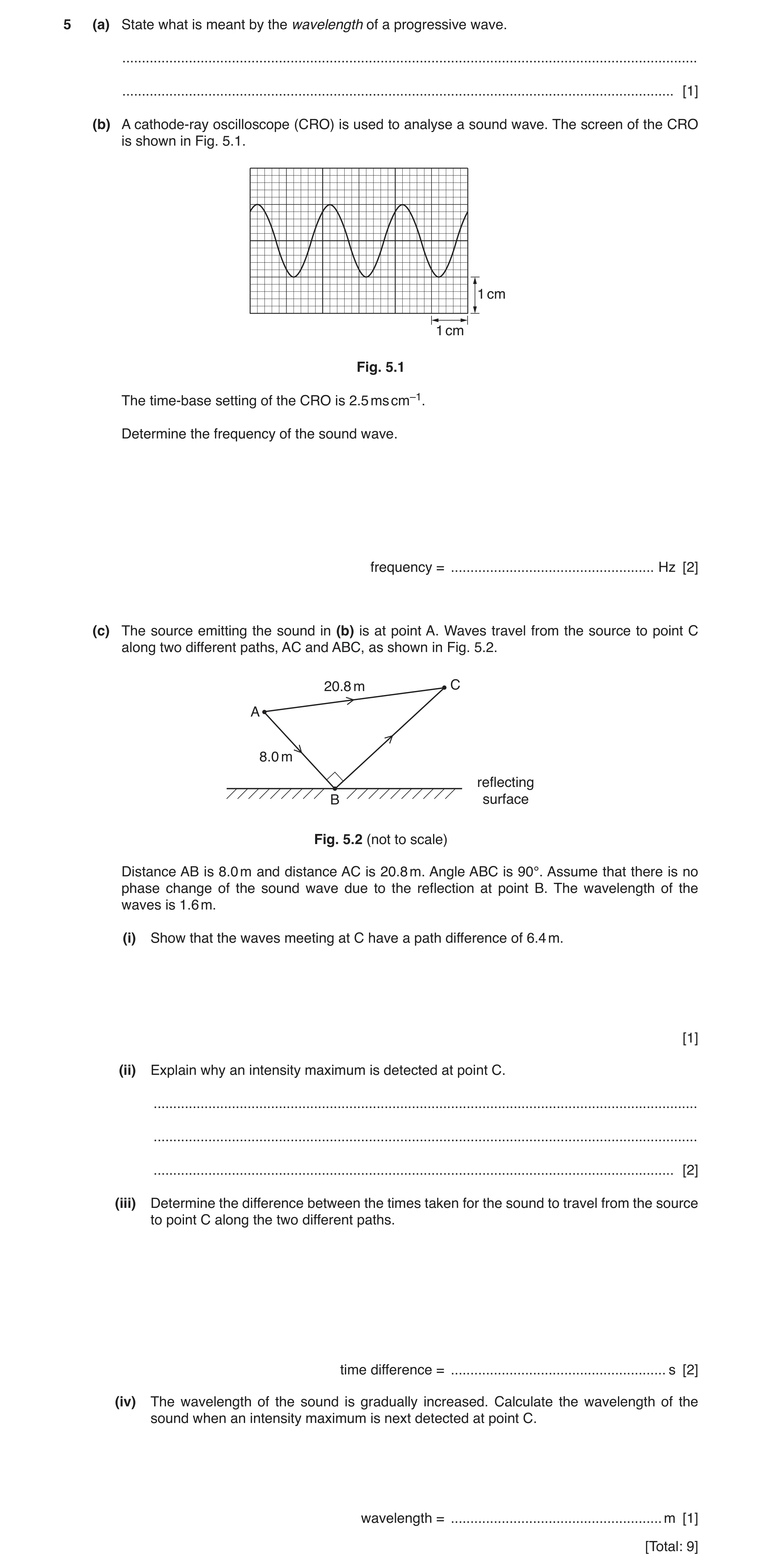
5 (a) State what is meant by the wavelength of a progressive wave. … … [1] (b) A cathode-ray oscilloscope (CRO) is used to analyse a sound wave. The screen of the CRO is shown in Fig. 5.1. 1 cm 1 cm Fig. 5.1 The time-base setting of the CRO is 2.5 ms cm–1. Determine the frequency of the sound wave. frequency = … Hz [2] (c) The source emitting the sound in (b) is at point A. Waves travel from the source to point C along two different paths, AC and ABC, as shown in Fig. 5.2. 20.8 m C A 8.0 m reflecting B surface Fig. 5.2 (not to scale) Distance AB is 8.0 m and distance AC is 20.8 m. Angle ABC is 90°. Assume that there is no phase change of the sound wave due to the reflection at point B. The wavelength of the waves is 1.6 m. (i) Show that the waves meeting at C have a path difference of 6.4 m. [1] (ii) Explain why an intensity maximum is detected at point C. … … … [2] (iii) Determine the difference between the times taken for the sound to travel from the source to point C along the two different paths. time difference = … s [2] (iv) The wavelength of the sound is gradually increased. Calculate the wavelength of the sound when an intensity maximum is next detected at point C. wavelength = … m [1] [Total: 9]
9 marks
Mark scheme: 5(a) distance moved by wavefront/energy during one cycle/oscillation/period (of source) or minimum distance between two wavefronts or distance between two adjacent wavefronts B1 5(b) (T =) 2.0 × 2.5 (= 5.0 ms) or 2.0 × 2.5 × 10–3 (= 5.0 × 10⁻³ s) C1 f = 1 / (5.0 × 10⁻³) = 200 Hz A1 5(c)(i) (path difference =) 8.0 + (20.82 – 8.02)0.5 – 20.8 = 6.4 (m) A1 5(c)(ii) • path difference = 4λ • waves (meet at C) in phase • constructive interference (of waves) any two points, one mark each B2 5(c)(iii) v = 200 × 1.6 v = 320 (m s–1) C1 ∆t = 6.4 / 320 or 27.2 / 320 – 20.8 / 320 = 0.020 s A1 5(c)(iv) 3λ = 6.4 3λ = 2.1 m A1
This question in 9702/22 Oct/Nov 2019
Q7 · For a progressive wave, state what is meant by: (i) the wavelength … … [1] (ii) the… 9702/22 Feb/March 2020
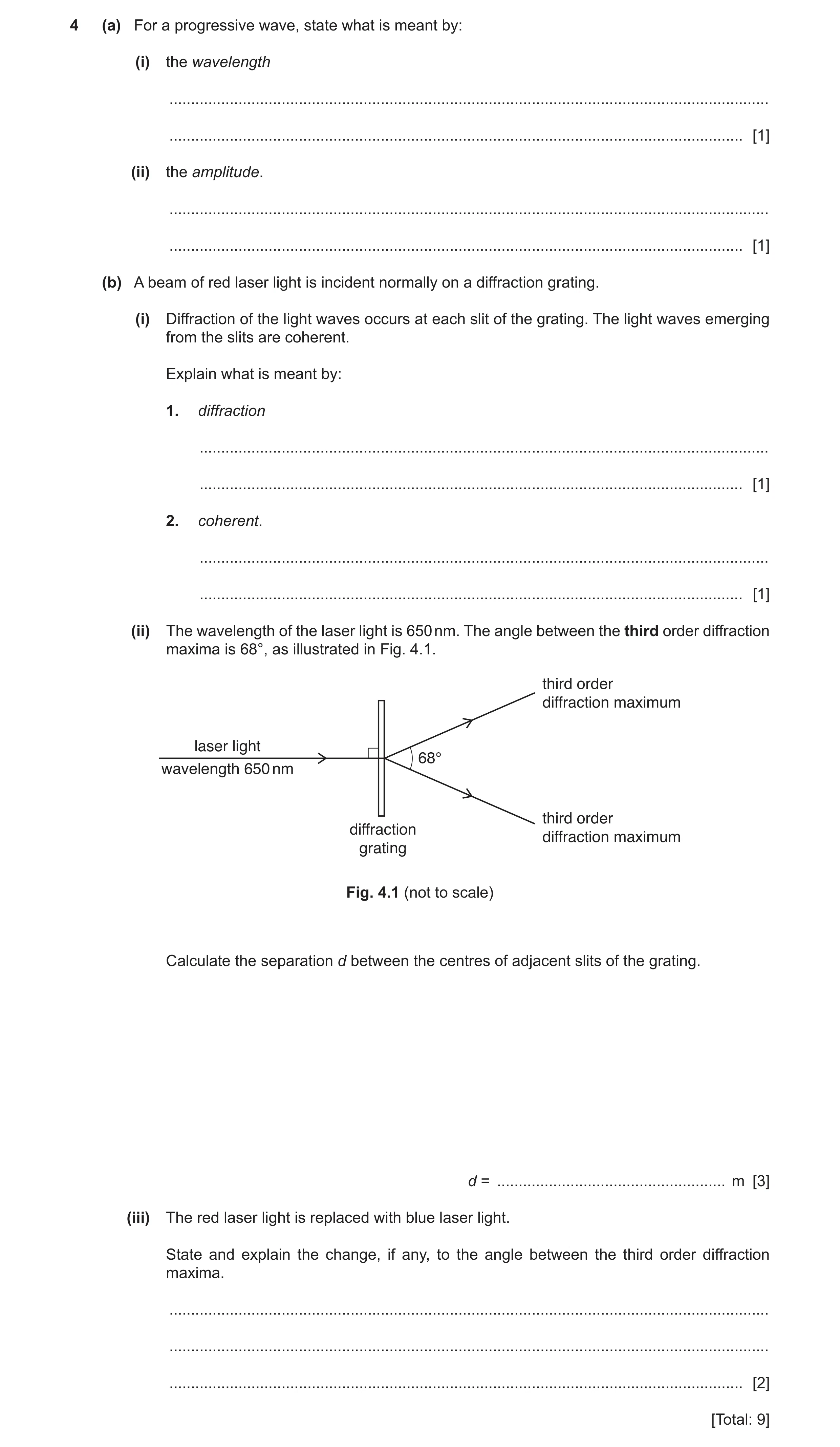
4 (a) For a progressive wave, state what is meant by: (i) the wavelength … … [1] (ii) the amplitude. … … [1] (b) A beam of red laser light is incident normally on a diffraction grating. (i) Diffraction of the light waves occurs at each slit of the grating. The light waves emerging from the slits are coherent. Explain what is meant by: 1. diffraction … … [1] 2. coherent. … … [1] (ii) The wavelength of the laser light is 650 nm. The angle between the third order diffraction maxima is 68°, as illustrated in Fig. 4.1. third order diffraction maximum laser light 68° wavelength 650 nm third order diffraction diffraction maximum grating Fig. 4.1 (not to scale) Calculate the separation d between the centres of adjacent slits of the grating. d = … m [3] (iii) The red laser light is replaced with blue laser light. State and explain the change, if any, to the angle between the third order diffraction maxima. … … … [2] [Total: 9]
9 marks
Mark scheme: 4(a)(i) distance moved by wavefront / energy during one cycle / vibration / oscillation / period (of source) or minimum distance between two wavefronts or distance between two adjacent wavefronts B1 4(a)(ii) maximum displacement (of particle / point on wave) B1 4(b)(i) 1 light / waves spread (at each slit) B1 2 constant phase difference (between light / waves) B1 4(b)(ii) nλ = d sinθ C1 d = 3 × 650 × 10–9 / sin34° C1 d = 3.5 × 10⁻⁶ m A1 4(b)(iii) wavelength of blue light is shorter (than 650 nm / red light) M1 so angle (between third order diffraction maxima) decreases A1
This question in 9702/22 Feb/March 2020
Q8 · Two progressive sound waves Y and Z meet at a fixed point P 9702/23 May/June 2020
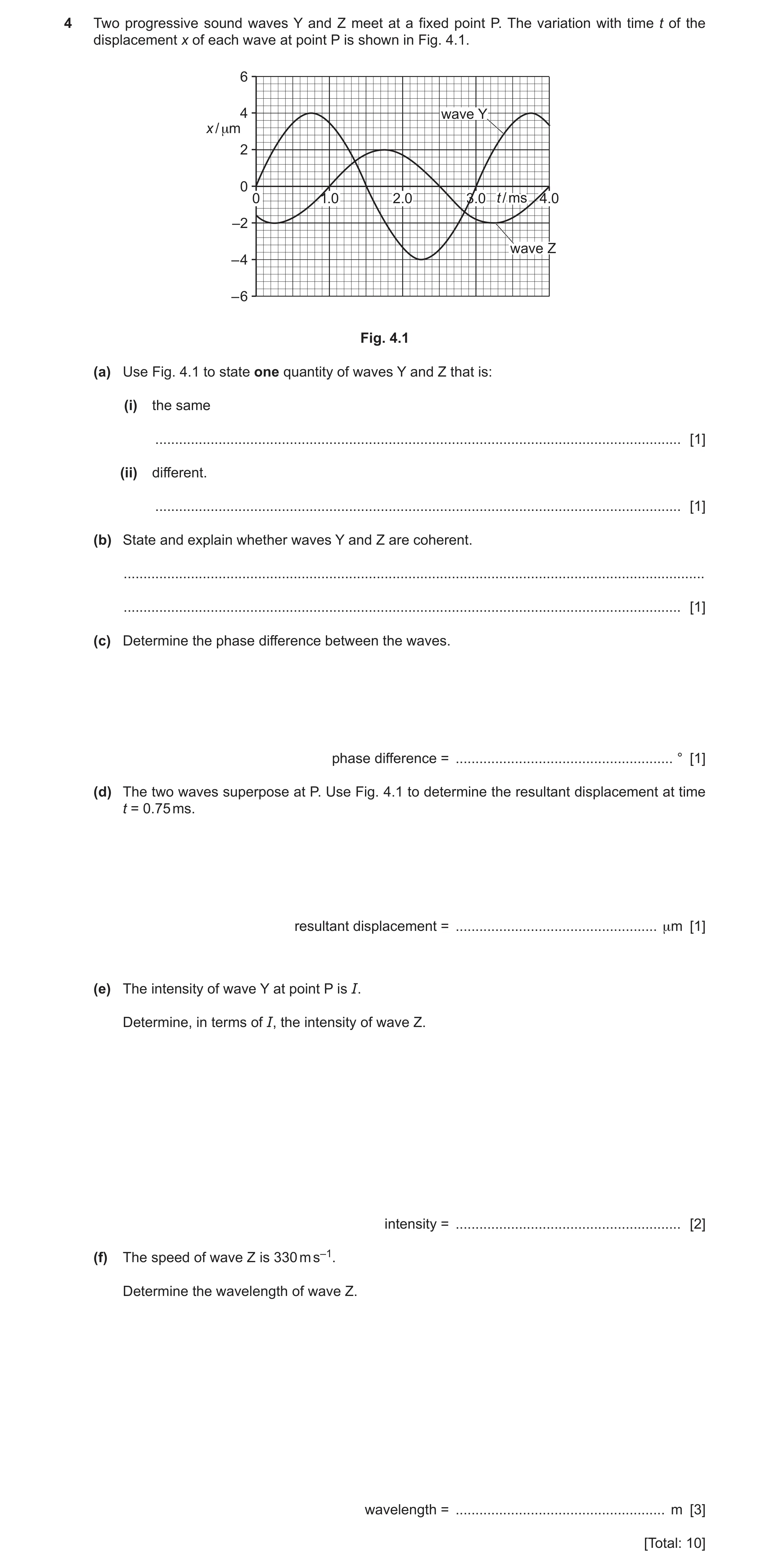
4 Two progressive sound waves Y and Z meet at a fixed point P. The variation with time t of the displacement x of each wave at point P is shown in Fig. 4.1. 6 4 wave Y x / μm 2 0 0 1.0 2.0 3.0 tt // msms 4.0 –2 wave Z –4 –6 Fig. 4.1 (a) Use Fig. 4.1 to state one quantity of waves Y and Z that is: (i) the same … [1] (ii) different. … [1] (b) State and explain whether waves Y and Z are coherent. … … [1] (c) Determine the phase difference between the waves. phase difference = … ° [1] (d) The two waves superpose at P. Use Fig. 4.1 to determine the resultant displacement at time t = 0.75 ms. resultant displacement = … μm [1] (e) The intensity of wave Y at point P is I. Determine, in terms of I, the intensity of wave Z. intensity = … [2] (f) The speed of wave Z is 330 m s–1. Determine the wavelength of wave Z. wavelength = … m [3] [Total: 10]
10 marks
Mark scheme: 4(a)(i) frequency or period B1 4(a)(ii) amplitude B1 4(b) constant phase difference so coherent B1 4(c) 120° B1 4(d) resultant displacement = 4.0 μm – 1.0 μm = 3.0 μm B1 4(e) I ∝ A2 C1 intensity of Z = (22 / 42) I = 0.25 I A1 4(f) v = λ / T or v = fλ and f = 1 /T C1 330 = λ / 3.0 × 10⁻³ C1 λ = 0.99 m A1
This question in 9702/23 May/June 2020
Q9 · A progressive wave Y passes a point P 9702/21 Oct/Nov 2020
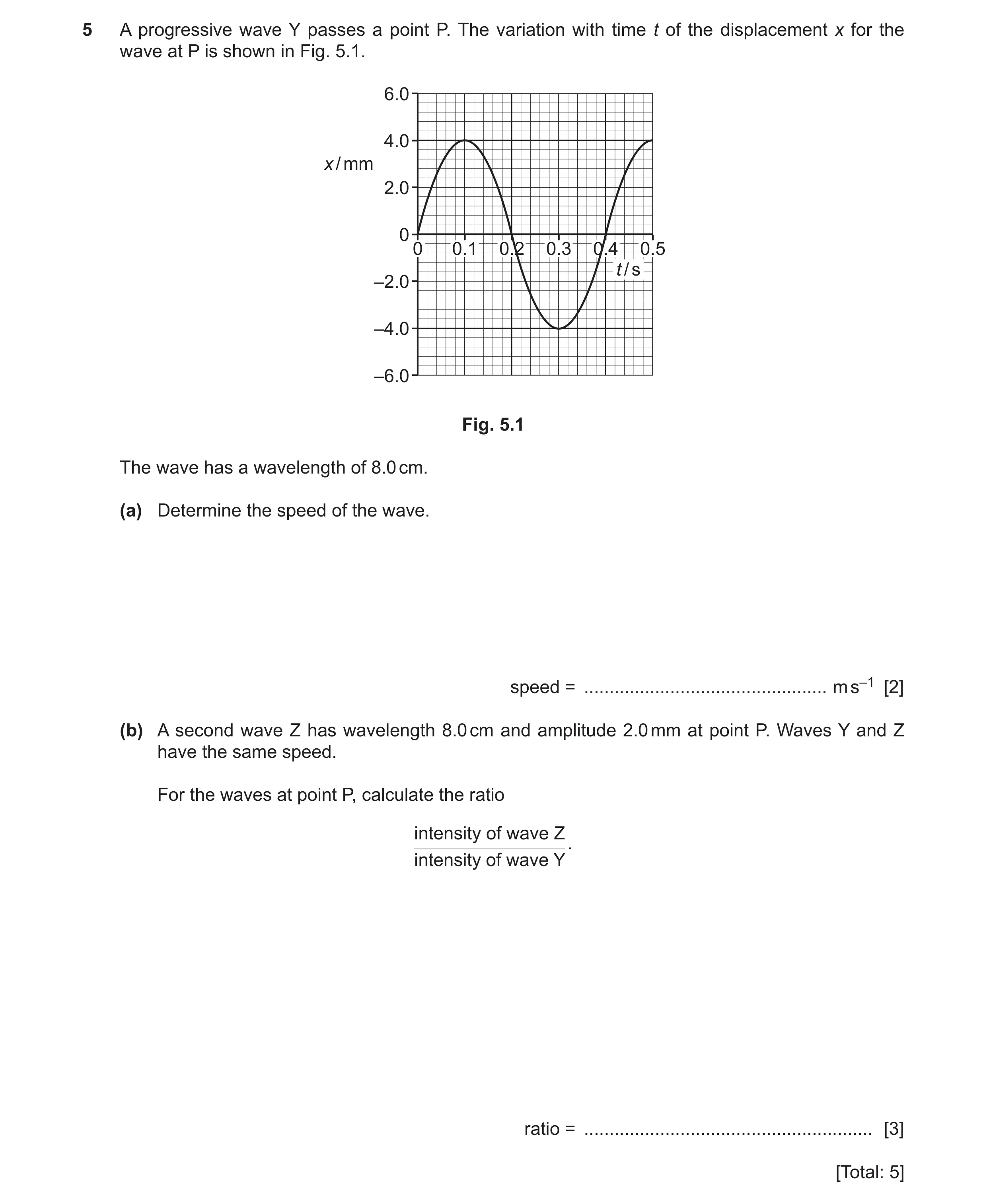
5 A progressive wave Y passes a point P. The variation with time t of the displacement x for the wave at P is shown in Fig. 5.1. 6.0 4.0 x / mm 2.0 0 0 0.1 0.2 0.3 0.4 0.5 t / s –2.0 –4.0 –6.0 Fig. 5.1 The wave has a wavelength of 8.0 cm. (a) Determine the speed of the wave. speed = … m s–1 [2] (b) A second wave Z has wavelength 8.0 cm and amplitude 2.0 mm at point P. Waves Y and Z have the same speed. For the waves at point P, calculate the ratio intensity of wave Z . intensity of wave Y ratio = … [3] [Total: 5]
5 marks
Mark scheme: 5(a) v = λ / T or v = fλ and f = 1 / T v = 8.0 × 10⁻² / 0.40 = 0.20 m s–1 A1 5(b) I ∝ A2 C1 ratio = 22 / 42 C1 = 0.25 A1
This question in 9702/21 Oct/Nov 2020
Q10 · A sound wave is detected by a microphone that is connected to a cathode-ray oscilloscope… 9702/23 Oct/Nov 2020
5 (a) A sound wave is detected by a microphone that is connected to a cathode-ray oscilloscope (CRO). The trace on the screen of the CRO is shown in Fig. 5.1. 1.0 cm 1.0 cm Fig. 5.1 The time-base setting of the CRO is 2.0 × 10⁻⁵ s cm–1. (i) Determine the frequency of the sound wave. frequency = … Hz [2] (ii) The intensity of the sound wave is now doubled. The frequency is unchanged. Assume that the amplitude of the trace is proportional to the amplitude of the sound wave. On Fig. 5.1, sketch the new trace shown on the screen. [2] (iii) The time-base is now switched off. Describe the trace seen on the screen. … … [1] (b) A beam of light of a single wavelength is incident normally on a diffraction grating, as illustrated in Fig. 5.2. diffraction second order grating 16° zero order 16° light beam second order Fig. 5.2 (not to scale) Fig. 5.2 does not show all of the emerging beams from the grating. The angle between the second-order emerging beam and the central zero-order beam is 16°. The grating has a line spacing of 3.4 × 10⁻⁶ m. (i) Calculate the wavelength of the light. wavelength = … m [2] (ii) Determine the highest order of emerging beam from the grating. highest order = … [2] [Total: 9]
9 marks
Mark scheme: 5(a)(i) T = 2.0 × 10–5 × 6.0 (= 1.2 × 10⁻⁴ s) C1 f = 1 / (2.0 × 10–5 × 6.0) = 8300 Hz A1 5(a)(ii) new trace shows the same period B1 new trace shows amplitude of 10 small squares B1 5(a)(iii) (trace is a) vertical line B1 5(b)(i) nλ = d sin θ C1 λ = (3.4 × 10⁻⁶ × sin 16°) / 2 = 4.7 × 10⁻⁷ m A1 5(b)(ii) n = 3.4 × 10⁻⁶ (× sin 90°) / 4.7 × 10⁻⁷ or 2 (× sin 90°) / sin 16° (= 7.2 or 7.3) C1 highest order = 7 A1
This question in 9702/23 Oct/Nov 2020
Q11 · For a progressive wave, state what is meant by its period 9702/22 May/June 2021
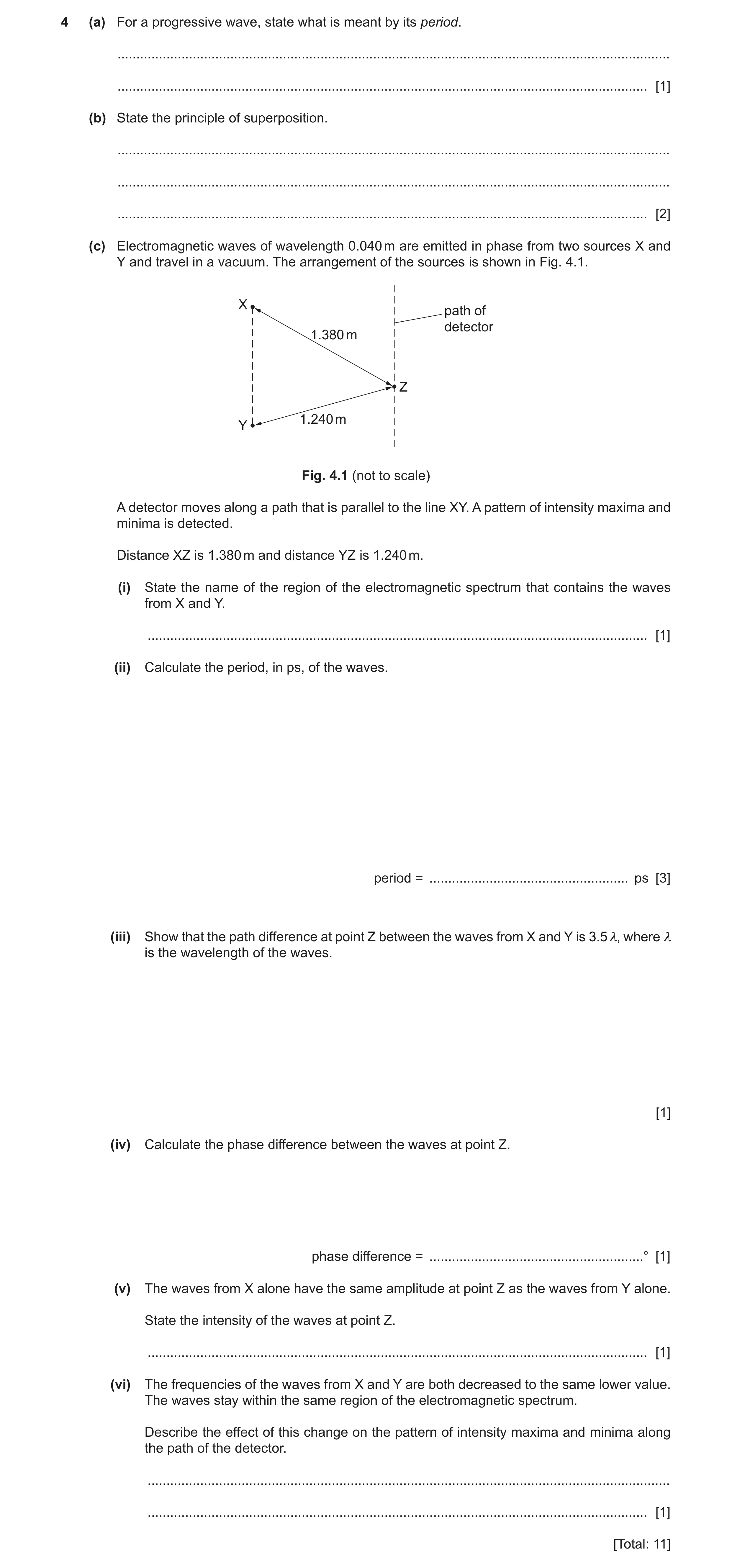
4 (a) For a progressive wave, state what is meant by its period. … … [1] (b) State the principle of superposition. … … … [2] (c) Electromagnetic waves of wavelength 0.040 m are emitted in phase from two sources X and Y and travel in a vacuum. The arrangement of the sources is shown in Fig. 4.1. X path of detector 1.380 m Z 1.240 m Y Fig. 4.1 (not to scale) A detector moves along a path that is parallel to the line XY. A pattern of intensity maxima and minima is detected. Distance XZ is 1.380 m and distance YZ is 1.240 m. (i) State the name of the region of the electromagnetic spectrum that contains the waves from X and Y. … [1] (ii) Calculate the period, in ps, of the waves. period = … ps [3] (iii) Show that the path difference at point Z between the waves from X and Y is 3.5 λ, where λ is the wavelength of the waves. [1] (iv) Calculate the phase difference between the waves at point Z. phase difference = … ° [1] (v) The waves from X alone have the same amplitude at point Z as the waves from Y alone. State the intensity of the waves at point Z. … [1] (vi) The frequencies of the waves from X and Y are both decreased to the same lower value. The waves stay within the same region of the electromagnetic spectrum. Describe the effect of this change on the pattern of intensity maxima and minima along the path of the detector. … … [1] [Total: 11]
11 marks
Mark scheme: 4(a) time for one oscillation/vibration/cycle or time between adjacent wavefronts (passing the same point) or shortest time between two wavefronts (passing the same point) B1 4(b) (when two or more) waves meet/overlap (at a point) B1 (resultant) displacement is sum of the individual displacements B1 4(c)(i) microwave(s) B1 4(c)(ii) v = λ / T or v = fλ and f = 1/T C1 T = 0.040 / 3.00 × 10⁸ C1 = 1.33 × 10⁻¹⁰ (s) = 1.33 × 10⁻¹⁰ / 10–12 (ps) = 130 ps A1 4(c)(iii) (1.380 – 1.240) / 0.040 = 3.5 or 1.380 / 0.040 – 1.240 / 0.040 = 3.5 A1 4(c)(iv) phase difference = 1260° or 180° A1 4(c)(v) (always) zero A1 4(c)(vi) increase in distance between (adjacent intensity) maxima/minima A1
This question in 9702/22 May/June 2021
Q12 · A progressive longitudinal wave travels through a medium from left to right 9702/23 Oct/Nov 2022
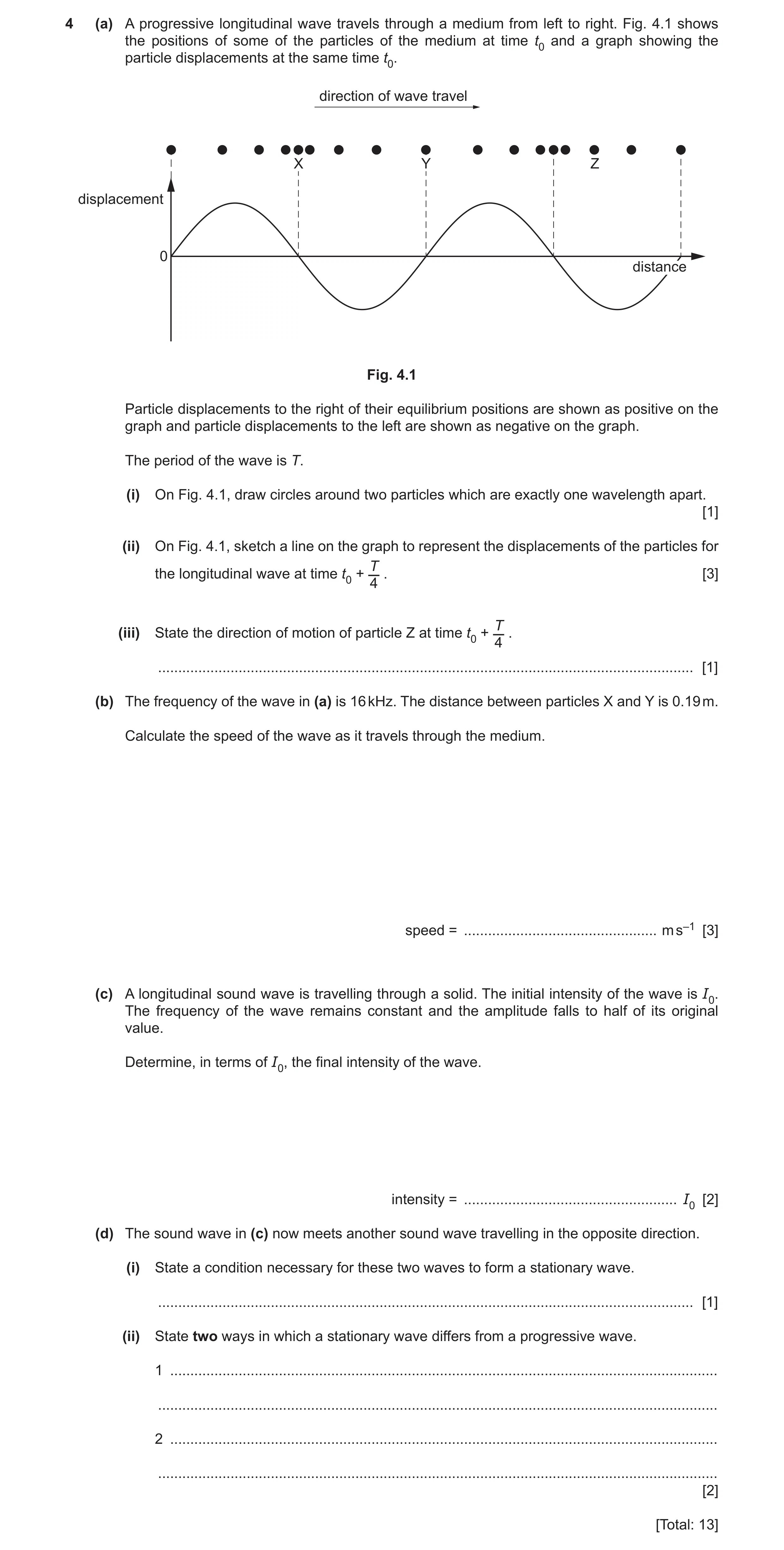
4 (a) A progressive longitudinal wave travels through a medium from left to right. Fig. 4.1 shows the positions of some of the particles of the medium at time t0 and a graph showing the particle displacements at the same time t0. direction of wave travel X Y Z displacement 0 distance Fig. 4.1 Particle displacements to the right of their equilibrium positions are shown as positive on the graph and particle displacements to the left are shown as negative on the graph. The period of the wave is T. (i) On Fig. 4.1, draw circles around two particles which are exactly one wavelength apart. [1] (ii) On Fig. 4.1, sketch a line on the graph to represent the displacements of the particles for T the longitudinal wave at time t0 + . [3] 4 T (iii) State the direction of motion of particle Z at time t0 + . 4 … [1] (b) The frequency of the wave in (a) is 16 kHz. The distance between particles X and Y is 0.19 m. Calculate the speed of the wave as it travels through the medium. speed = … m s–1 [3] (c) A longitudinal sound wave is travelling through a solid. The initial intensity of the wave is I0. The frequency of the wave remains constant and the amplitude falls to half of its original value. Determine, in terms of I0, the final intensity of the wave. intensity = … I0 [2] (d) The sound wave in (c) now meets another sound wave travelling in the opposite direction. (i) State a condition necessary for these two waves to form a stationary wave. … [1] (ii) State two ways in which a stationary wave differs from a progressive wave. 1 … … 2 … … [2] [Total: 13]
13 marks
Mark scheme: 4(a)(i) circles drawn around any two particles with seven (uncircled) particles in between A1 4(a)(ii) curve has an initial negative displacement and initial amplitude same as original curve B1 curve has same amplitude as original curve throughout B1 curve has same wavelength as original curve throughout, with constant (non-zero) phase difference B1 4(a)(iii) (to the) right / rightwards A1 4(b) = 2 0.19 C1 = 0.38 m v = f C1 v = (16 103) 0.38 A1 v = 6100 m s–1 4(c) I A2 C1 I = (1 / 2)2 I0 A1 intensity = 0.25 I0 4(d)(i) same frequency / wavelength / period B1 4(d)(ii) • a stationary wave has nodes/antinodes (and a progressive wave does not) B2 • a stationary wave does not transfer/propagate energy (and a progressive wave does transfer/propagate energy) • different points on a stationary wave have different amplitudes (and all points on a progressive wave have the same/constant amplitude) • stationary wave has adjacent particles that are in phase (and adjacent particles on progressive wave are out of phase) Any two points, 1 mark each. Allow the reverse statement for each marking point.
This question in 9702/23 Oct/Nov 2022
Q13 · A microphone and cathode-ray oscilloscope (CRO) are used to analyse a sound wave of… 9702/22 Feb/March 2023
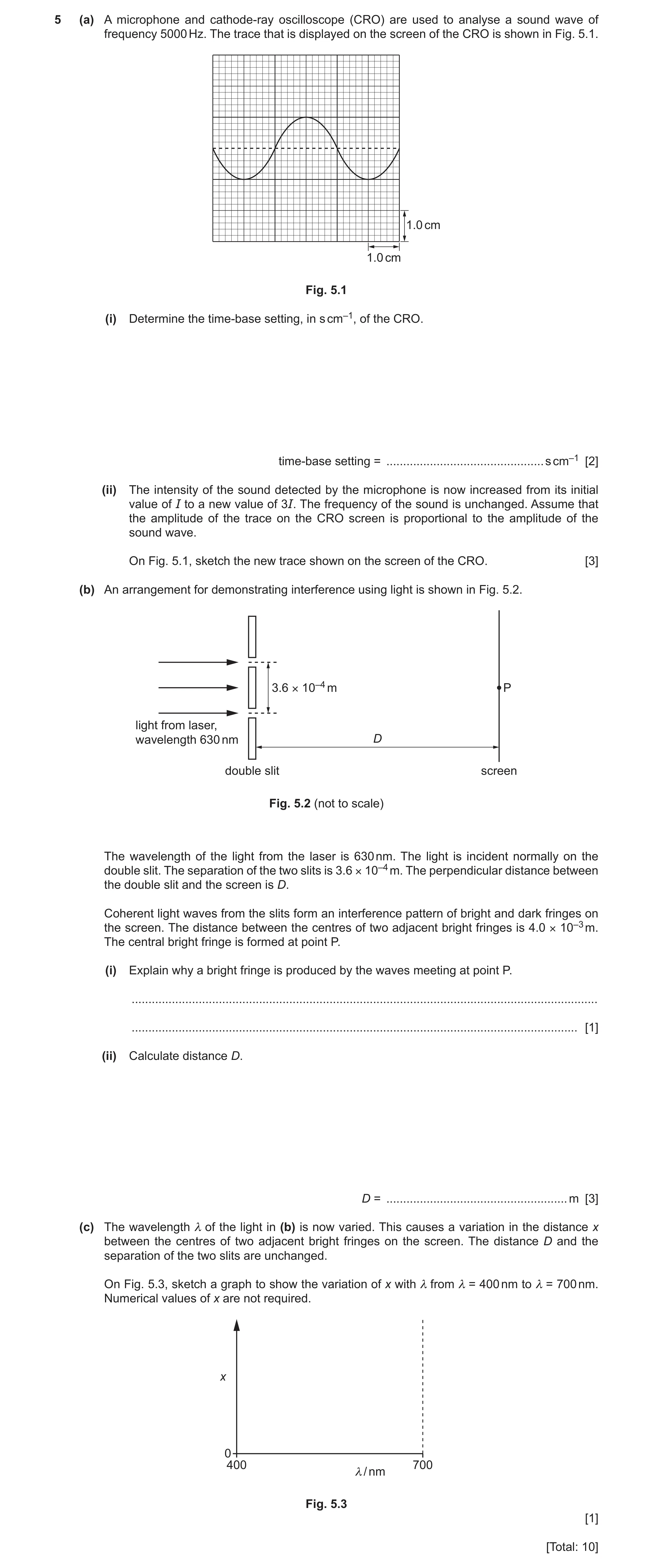
5 (a) A microphone and cathode-ray oscilloscope (CRO) are used to analyse a sound wave of frequency 5000 Hz. The trace that is displayed on the screen of the CRO is shown in Fig. 5.1. 1.0 cm 1.0 cm Fig. 5.1 (i) Determine the time-base setting, in s cm–1, of the CRO. time-base setting = … s cm–1 [2] (ii) The intensity of the sound detected by the microphone is now increased from its initial value of I to a new value of 3I. The frequency of the sound is unchanged. Assume that the amplitude of the trace on the CRO screen is proportional to the amplitude of the sound wave. On Fig. 5.1, sketch the new trace shown on the screen of the CRO. [3] (b) An arrangement for demonstrating interference using light is shown in Fig. 5.2. 3.6 × 10⁻⁴ m P light from laser, wavelength 630 nm D double slit screen Fig. 5.2 (not to scale) The wavelength of the light from the laser is 630 nm. The light is incident normally on the double slit. The separation of the two slits is 3.6 × 10⁻⁴ m. The perpendicular distance between the double slit and the screen is D. Coherent light waves from the slits form an interference pattern of bright and dark fringes on the screen. The distance between the centres of two adjacent bright fringes is 4.0 × 10⁻³ m. The central bright fringe is formed at point P. (i) Explain why a bright fringe is produced by the waves meeting at point P. … … [1] (ii) Calculate distance D. D = … m [3] (c) The wavelength λ of the light in (b) is now varied. This causes a variation in the distance x between the centres of two adjacent bright fringes on the screen. The distance D and the separation of the two slits are unchanged. On Fig. 5.3, sketch a graph to show the variation of x with λ from λ = 400 nm to λ = 700 nm. Numerical values of x are not required. x 0 400 700 λ/ nm Fig. 5.3 [1] [Total: 10]
10 marks
Mark scheme: 5(a)(i) period or T = 1 / 5000 (= 2 10–4 s) C1 time-base setting = 1.5 2 10–4 / 6.0 or 2 10–4 / 4.0 A1 = 5 10–5 s cm–1 5(a)(ii) new trace drawn with same period as original trace B1 new trace drawn with amplitude greater than 1.0 cm M1 new trace drawn with amplitude of 1.7 cm A1 5(b)(i) path difference (from slits to P) is zero or phase difference (between waves at P) is zero (so constructive interference) B1 5(b)(ii) = ax / D C1 D = (3.6 10–4 4.0 10–3) / 630 10–9 C1 = 2.3 m A1 5(c) upward sloping straight line starting from a non-zero value of x at = 400 nm B1
This question in 9702/22 Feb/March 2023
Q14 · For a progressive wave, state what is meant by the frequency 9702/23 May/June 2023
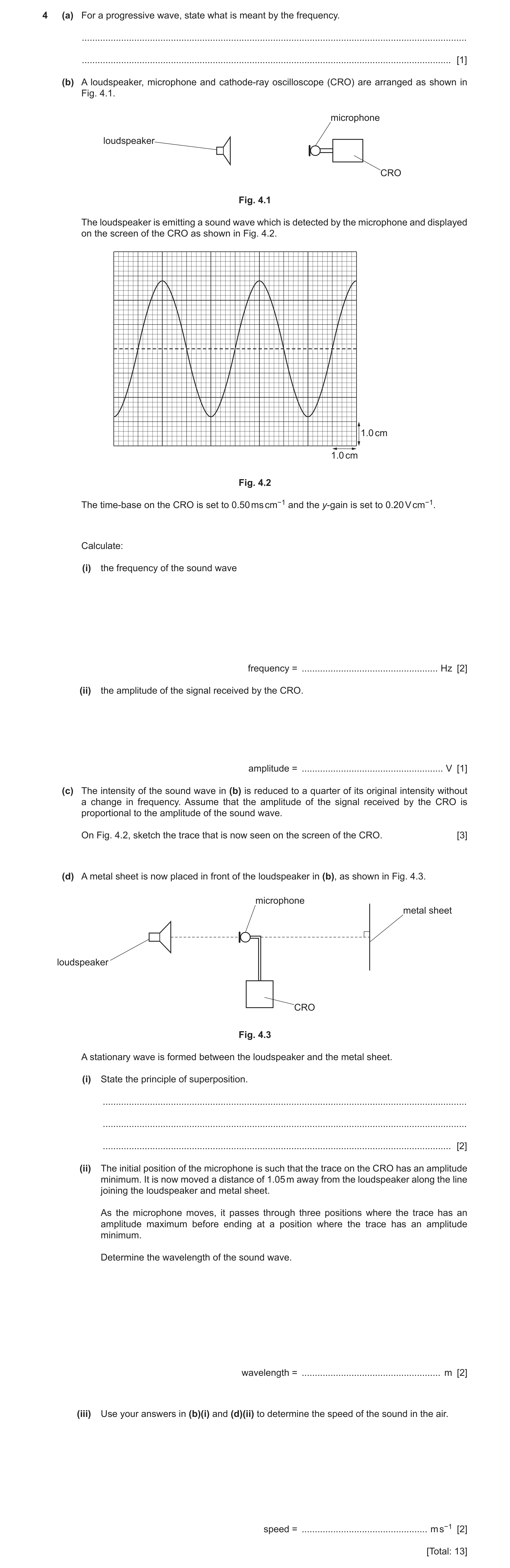
4 (a) For a progressive wave, state what is meant by the frequency. … … [1] (b) A loudspeaker, microphone and cathode-ray oscilloscope (CRO) are arranged as shown in Fig. 4.1. microphone loudspeaker CRO Fig. 4.1 The loudspeaker is emitting a sound wave which is detected by the microphone and displayed on the screen of the CRO as shown in Fig. 4.2. 1.0 cm 1.0 cm Fig. 4.2 The time-base on the CRO is set to 0.50 ms cm−1 and the y-gain is set to 0.20 V cm−1. Calculate: (i) the frequency of the sound wave frequency = … Hz [2] (ii) the amplitude of the signal received by the CRO. amplitude = … V [1] (c) The intensity of the sound wave in (b) is reduced to a quarter of its original intensity without a change in frequency. Assume that the amplitude of the signal received by the CRO is proportional to the amplitude of the sound wave. On Fig. 4.2, sketch the trace that is now seen on the screen of the CRO. [3] (d) A metal sheet is now placed in front of the loudspeaker in (b), as shown in Fig. 4.3. microphone metal sheet loudspeaker CRO Fig. 4.3 A stationary wave is formed between the loudspeaker and the metal sheet. (i) State the principle of superposition. … … … [2] (ii) The initial position of the microphone is such that the trace on the CRO has an amplitude minimum. It is now moved a distance of 1.05 m away from the loudspeaker along the line joining the loudspeaker and metal sheet. As the microphone moves, it passes through three positions where the trace has an amplitude maximum before ending at a position where the trace has an amplitude minimum. Determine the wavelength of the sound wave. wavelength = … m [2] (iii) Use your answers in (b)(i) and (d)(ii) to determine the speed of the sound in the air. speed = … m s−1 [2] [Total: 13]
13 marks
Mark scheme: 4(a) the number of wavefronts/crests/troughs passing a fixed point per unit time or the number of oscillations per unit time (of source / point on wave / particle of medium) B1 4(b)(i) T = 4 0.50 10–3 ( = 2.0 10–3 s) C1 f = 1 / 2.0 10–3 = 500 Hz A1 4(b)(ii) amplitude = 2.8 0.20 = 0.56 V A1 4(c) period same as original trace B1 sinusoidal wave of constant amplitude less than 2.8 cm throughout M1 amplitude 1.4 cm A1 Question Answer Marks 4(d)(i) when (two or more) waves meet (at a point) B1 (resultant) displacement is the sum of the individual displacements B1 4(d)(ii) node-to-node separation is / 2 or microphone moves through 3 node-to-node separations or d = 1.5 C1 = 1.05 / 1.5 = 0.70 m A1 4(d)(iii) v = f C1 = 500 0.70 = 350 m s–1 A1
This question in 9702/23 May/June 2023
Q15 · By reference to the direction of propagation of energy, state what is meant by a… 9702/22 Feb/March 2024
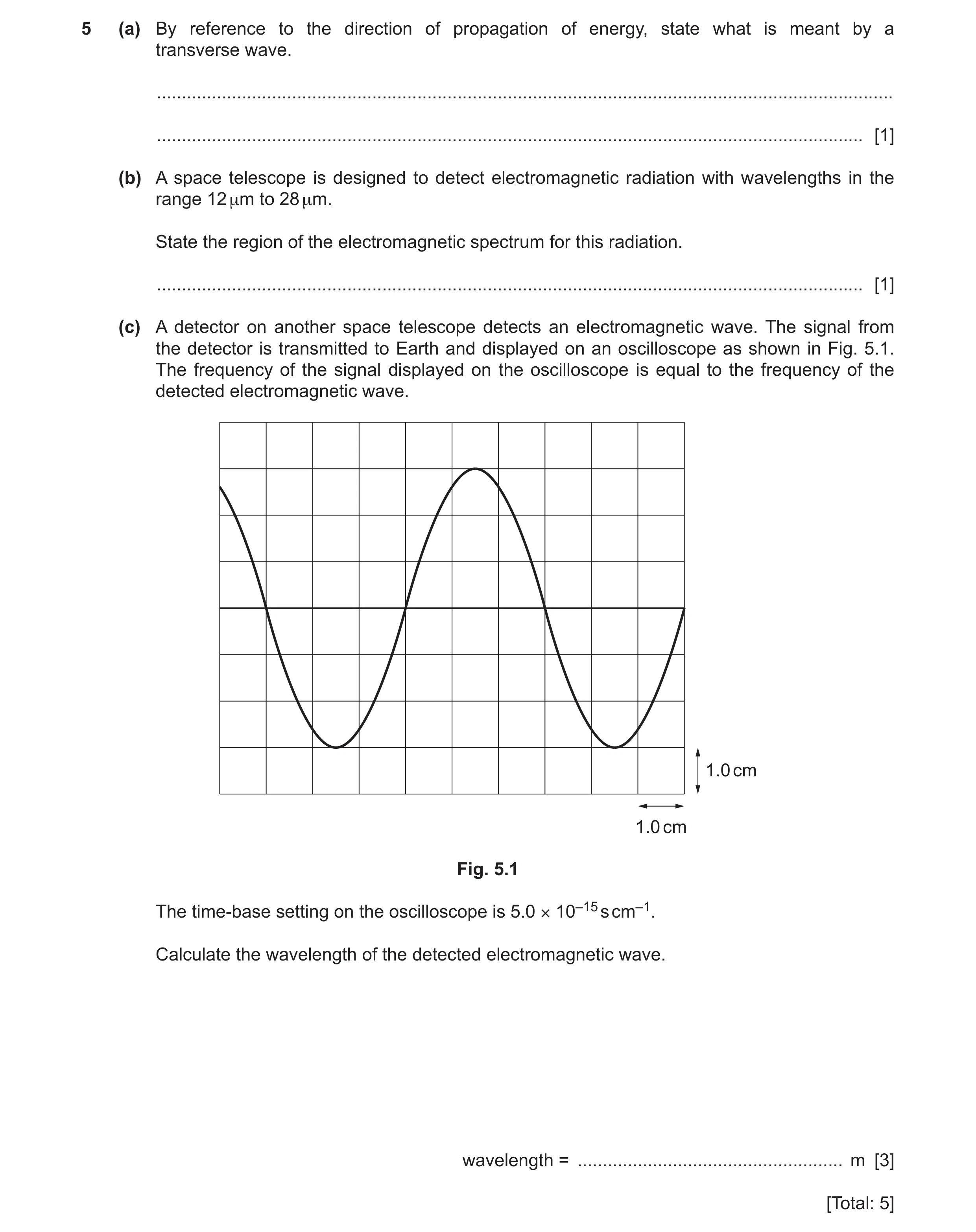
5 (a) By reference to the direction of propagation of energy, state what is meant by a transverse wave. … … [1] (b) A space telescope is designed to detect electromagnetic radiation with wavelengths in the range 12 μm to 28 μm. State the region of the electromagnetic spectrum for this radiation. … [1] (c) A detector on another space telescope detects an electromagnetic wave. The signal from the detector is transmitted to Earth and displayed on an oscilloscope as shown in Fig. 5.1. The frequency of the signal displayed on the oscilloscope is equal to the frequency of the detected electromagnetic wave. 1.0 cm 1.0 cm Fig. 5.1 The time-base setting on the oscilloscope is 5.0 × 10⁻¹⁵ s cm–1. Calculate the wavelength of the detected electromagnetic wave. wavelength = … m [3] [Total: 5]
5 marks
Mark scheme: 5(a) vibrations / oscillations (of the particles / wave) are perpendicular to the direction (of the propagation of energy) B1 5(b) infrared B1 5(c) T = 6 5.0 10–15 C1 T = 3.0 10–14 = c T or = c / f and f = 1 / T C1 = 3.0 108 3.0 10-14 or = 3.0 108 / 3.33 1013 A1 = 9.0 10–6 m
This question in 9702/22 Feb/March 2024
Q16 · A progressive transverse wave travelling from left to right is shown at an instant in… 9702/23 May/June 2024
4 A progressive transverse wave travelling from left to right is shown at an instant in time in Fig. 4.1. R wave direction of travel T Fig. 4.1 R and T are points on the wave. (a) State the phase difference between the points R and T. phase difference = … ° [1] (b) On Fig. 4.1, draw an arrow at point T to show the direction of movement of point T at the instant shown. [1] (c) The horizontal distance between R and T is 0.62 cm, as shown in Fig. 4.2. 0.62 cm R T Fig. 4.2 (not to scale) The speed of the wave is 0.27 m s–1. Calculate the frequency of the wave. frequency = … Hz [3] (d) The wave is a water wave produced by a dipper S1 attached to a vibrator in a ripple tank. An identical dipper S2 is attached to the same vibrator. The two dippers produce an interference pattern on the water in the tank, as shown in Fig. 4.3. water P wave crests wave troughs S1 S2 Fig. 4.3 (not to scale) The wave crests from each source are represented by solid lines on Fig. 4.3 and the wave troughs are represented by dashed lines. At point P in Fig. 4.3, the wave from S1 has the same amplitude A as the wave from S2. Describe and explain the amplitude of the resultant wave at point P. … … … … [3] [Total: 8]
8 marks
Mark scheme: 4(a) 270° A1 4(b) arrow pointing vertically downwards at T A1 4(c) v = f or v = / T and f = 1 / T C1 wavelength = 0.62 10–2 (4 / 3) ( = 0.83 10–2 m) C1 f = 0.27 / (0.83 10–2) = 33 Hz A1 4(d) resultant displacement is the sum of the displacements of the waves (from S1 and S2) or waves (from S1 and S2) superpose (at P) B1 Any one point from: (at P) the waves (from the two sources) (always) destructively interfere (at P) the waves have a path difference that is (always) an odd number of half-wavelengths / their path difference is one and a half wavelengths (at P) the waves have a phase difference that is (always) 180° / they are in antiphase / crest of one wave meets trough of other wave B1 amplitude (of the resultant wave) is zero (at all times) B1
This question in 9702/23 May/June 2024
Q17 · A stationary loudspeaker emits sound of constant frequency 9702/22 Feb/March 2025
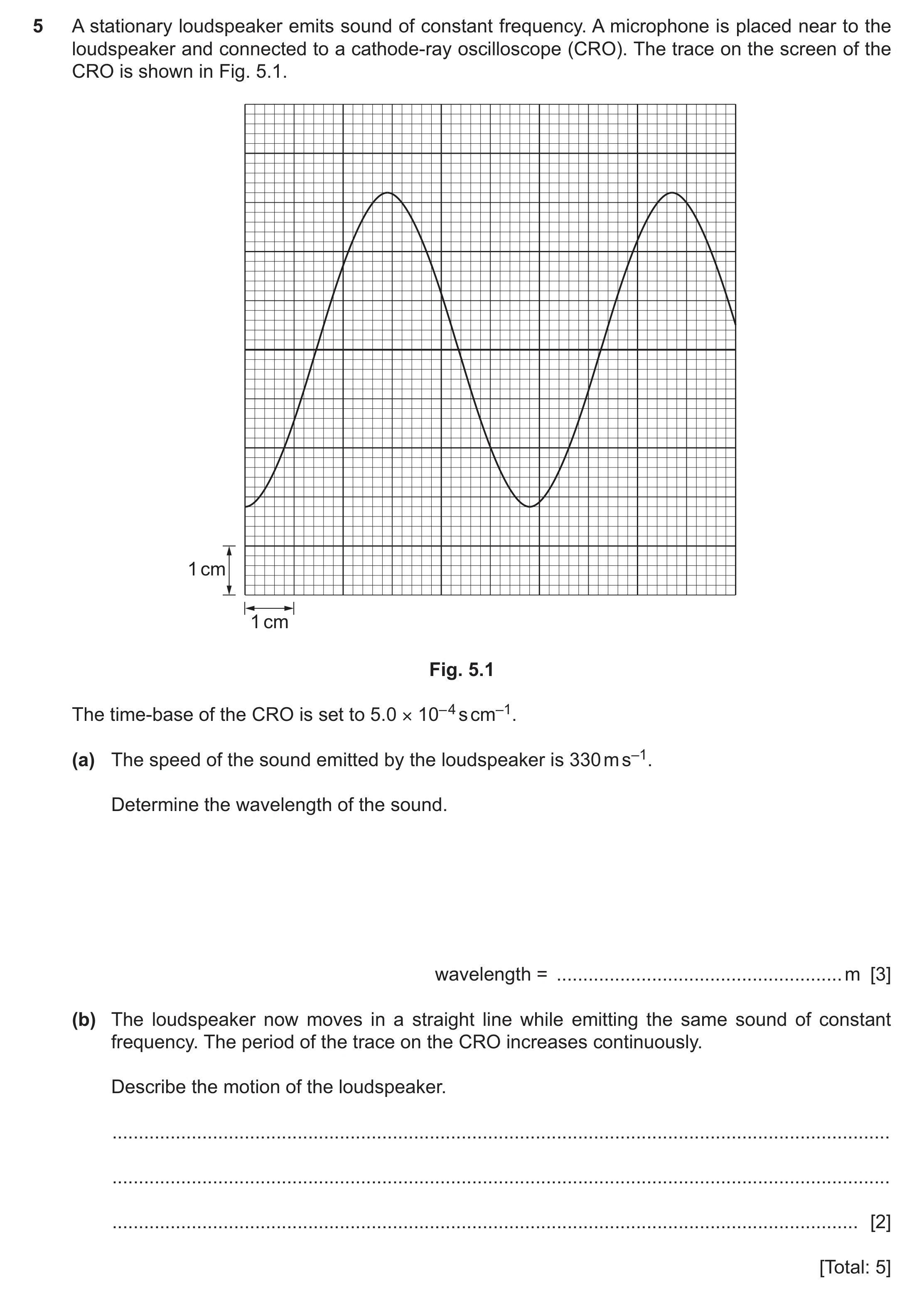
5 A stationary loudspeaker emits sound of constant frequency. A microphone is placed near to the loudspeaker and connected to a cathode-ray oscilloscope (CRO). The trace on the screen of the CRO is shown in Fig. 5.1. 1 cm 1 cm Fig. 5.1 The time-base of the CRO is set to 5.0 × 10– 4 s cm–1. (a) The speed of the sound emitted by the loudspeaker is 330 m s–1. Determine the wavelength of the sound. wavelength = … m [3] (b) The loudspeaker now moves in a straight line while emitting the same sound of constant frequency. The period of the trace on the CRO increases continuously. Describe the motion of the loudspeaker. … … … [2] [Total: 5]
5 marks
Mark scheme: 5(a) T = 5.8 5.0 10–4 C1 = 2.9 10–3 = vT or v = f and f = 1 / T C1 = 330 2.9 10–3 or = 330 / 345 A1 = 0.96 m 5(b) (loudspeaker) moves away (from the microphone) B1 at an increasing speed / whilst accelerating B1
This question in 9702/22 Feb/March 2025
Q18 · Two progressive water waves X and Y travel along a straight line from point A to point B 9702/22 May/June 2025
3 Two progressive water waves X and Y travel along a straight line from point A to point B. The variation of displacement of the waves with distance from A at an instant in time is shown in Fig. 3.1. 20 displacement / cm 10 wave X 0 0 0.2 0.4 0.6 0.8 1.0 distance from A / m –10 wave Y –20 Fig. 3.1 (a) State the amplitude of wave X. amplitude = … cm [1] (b) Both waves have frequency 16 Hz. (i) Determine the speed of wave X. speed = … m s–1 [2] (ii) State and explain whether X and Y are coherent. … … … [1] (c) Wave X and wave Y superpose to form a resultant wave. On Fig. 3.2, sketch the variation of displacement of the resultant wave with distance from A at the instant of time shown in Fig. 3.1. 20 displacement / cm 10 0 0 0.2 0.4 0.6 0.8 1.0 distance from A / m –10 –20 Fig. 3.2 [2] (d) The intensity of wave X is IX. The intensity of wave Y is IY. IX Use Fig. 3.1 to determine the ratio . IY ratio = … [2] [Total: 8]
8 marks
Mark scheme: 3(a) 10.0 cm A1 3(b)(i) v = f C1 = 16 0.40 = 6.4 m s–1 A1 3(b)(ii) (X and Y have a) constant phase difference (of 180°) so (they are) coherent B1 3(c) A single wave of amplitude 10.0 cm B1 A single negative sine wave of wavelength 0.40 m B1 3(d) I A2 C1 I X = 102 / 202 IY ratio = 0.25 A1
This question in 9702/22 May/June 2025
 3 / 28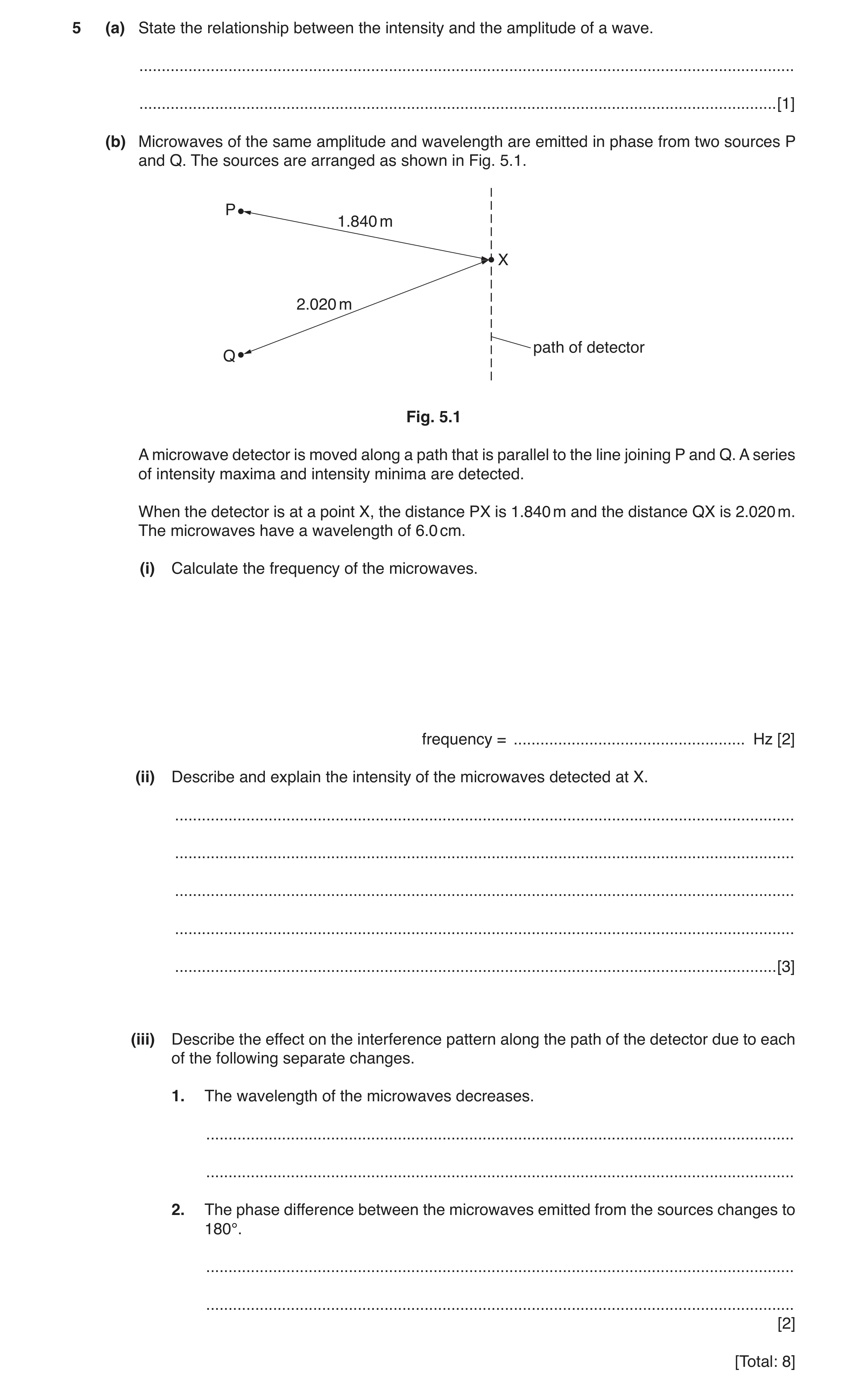
 13 / 28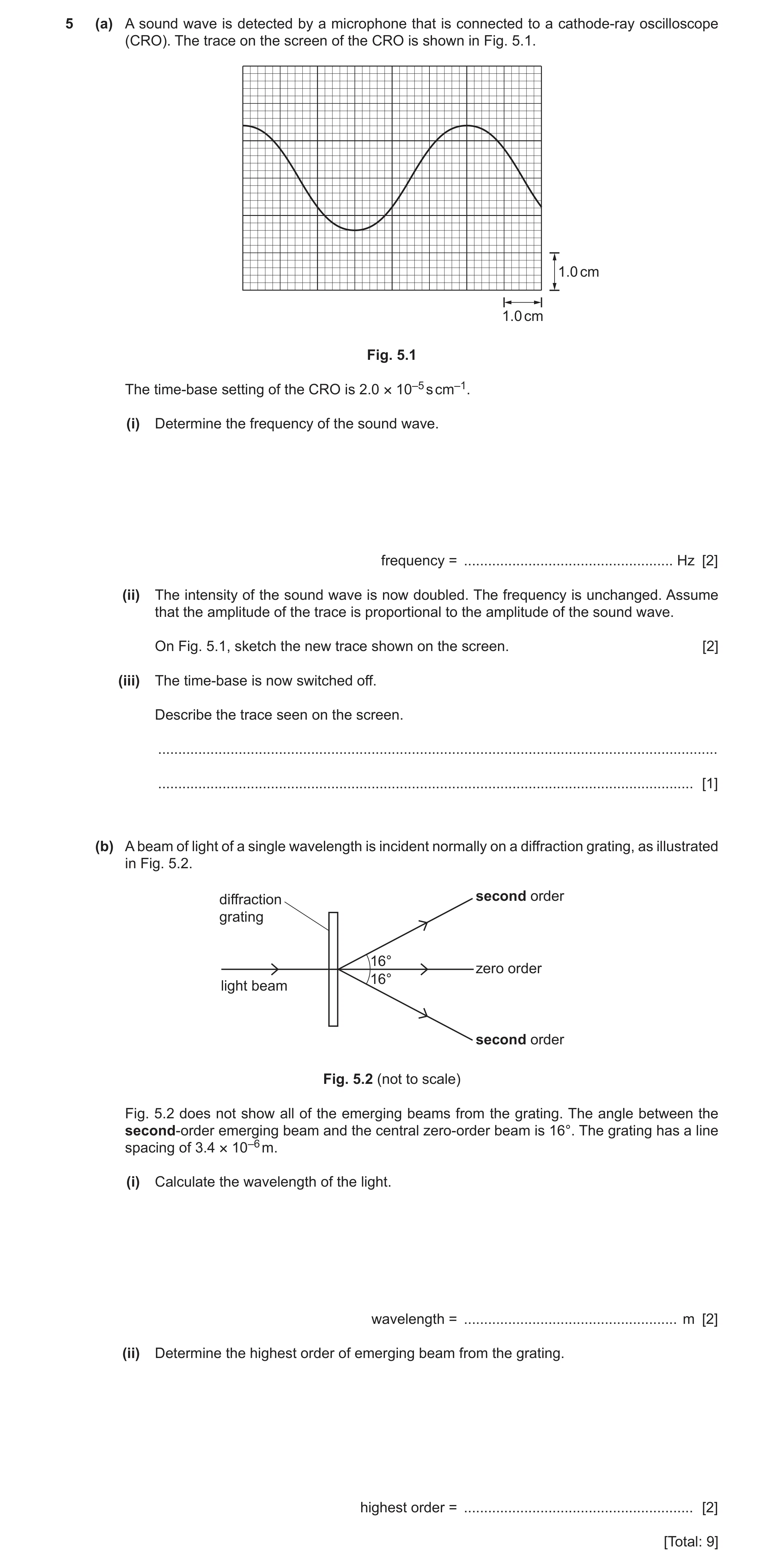
 23 / 28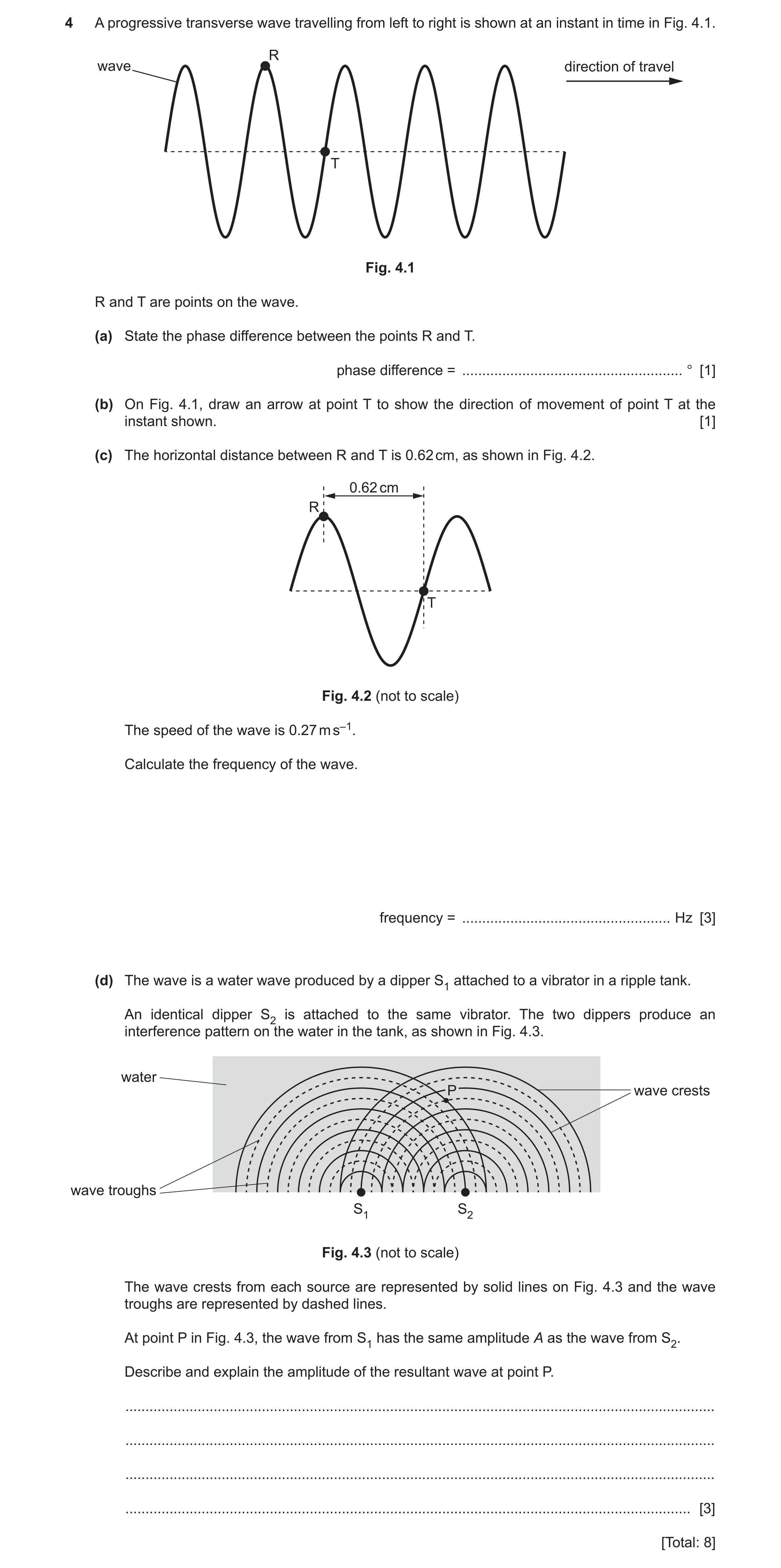
 26 / 28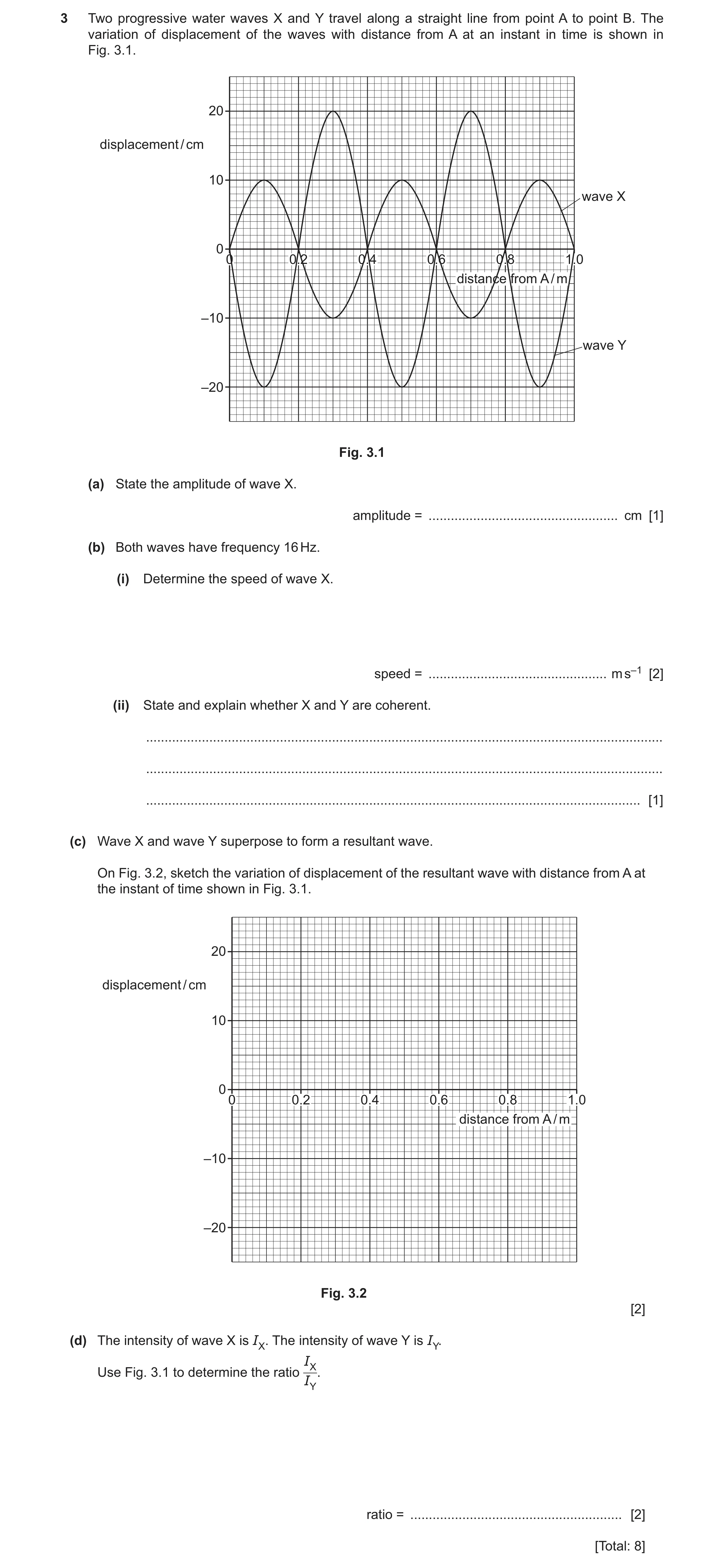
 8
8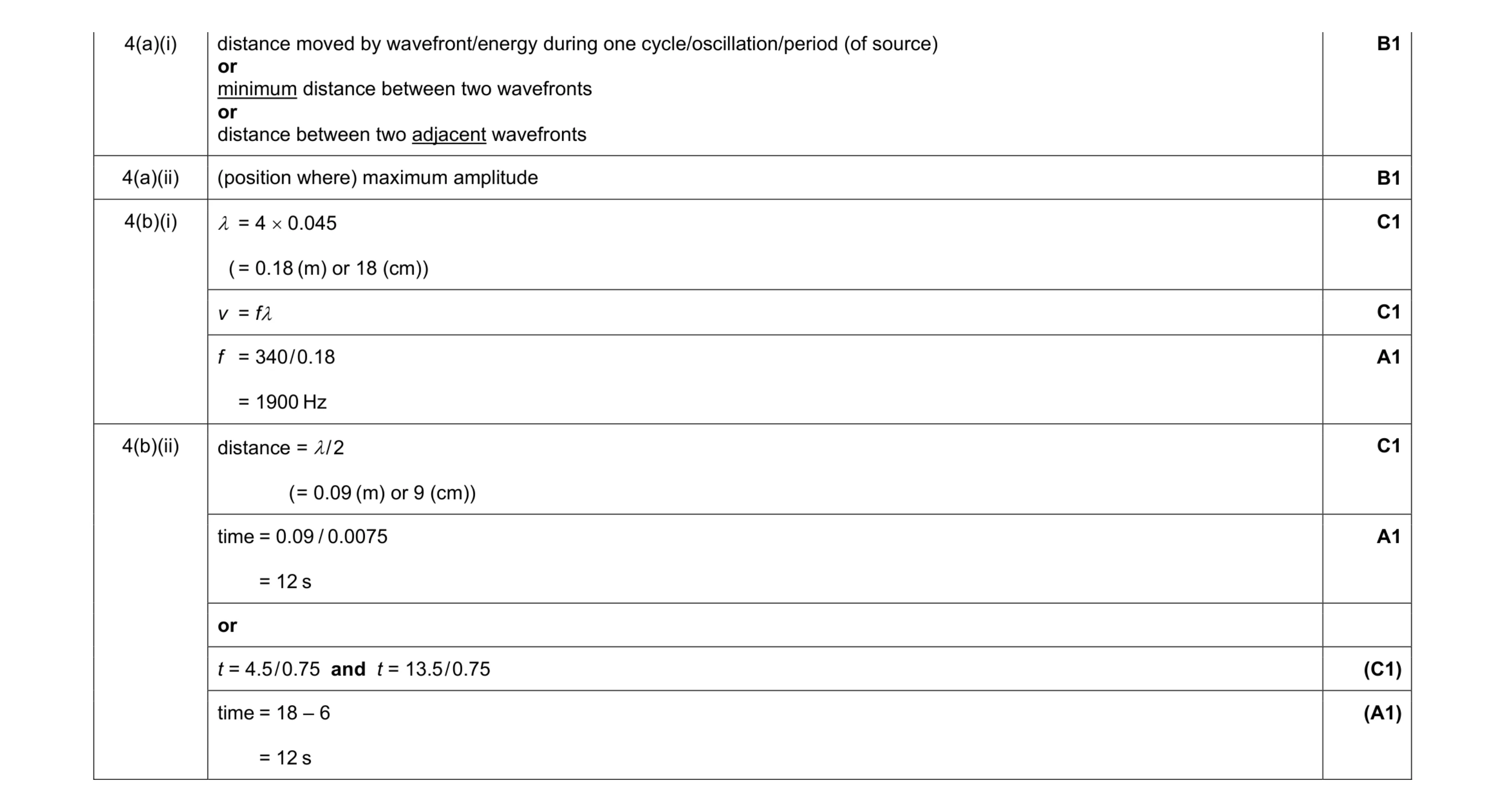 7
7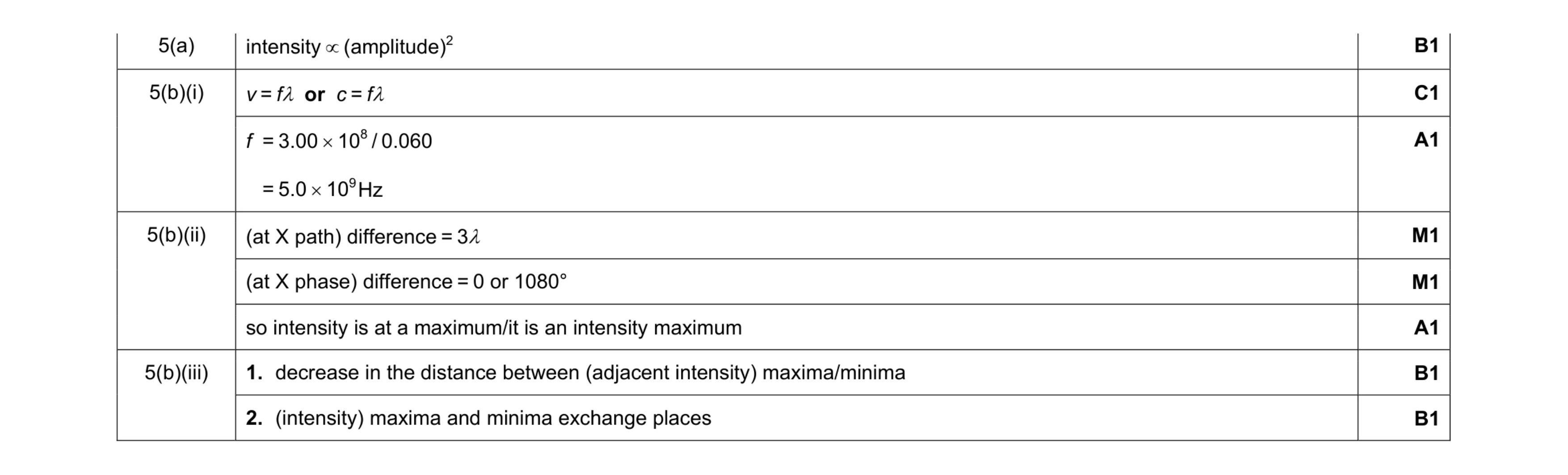 8
8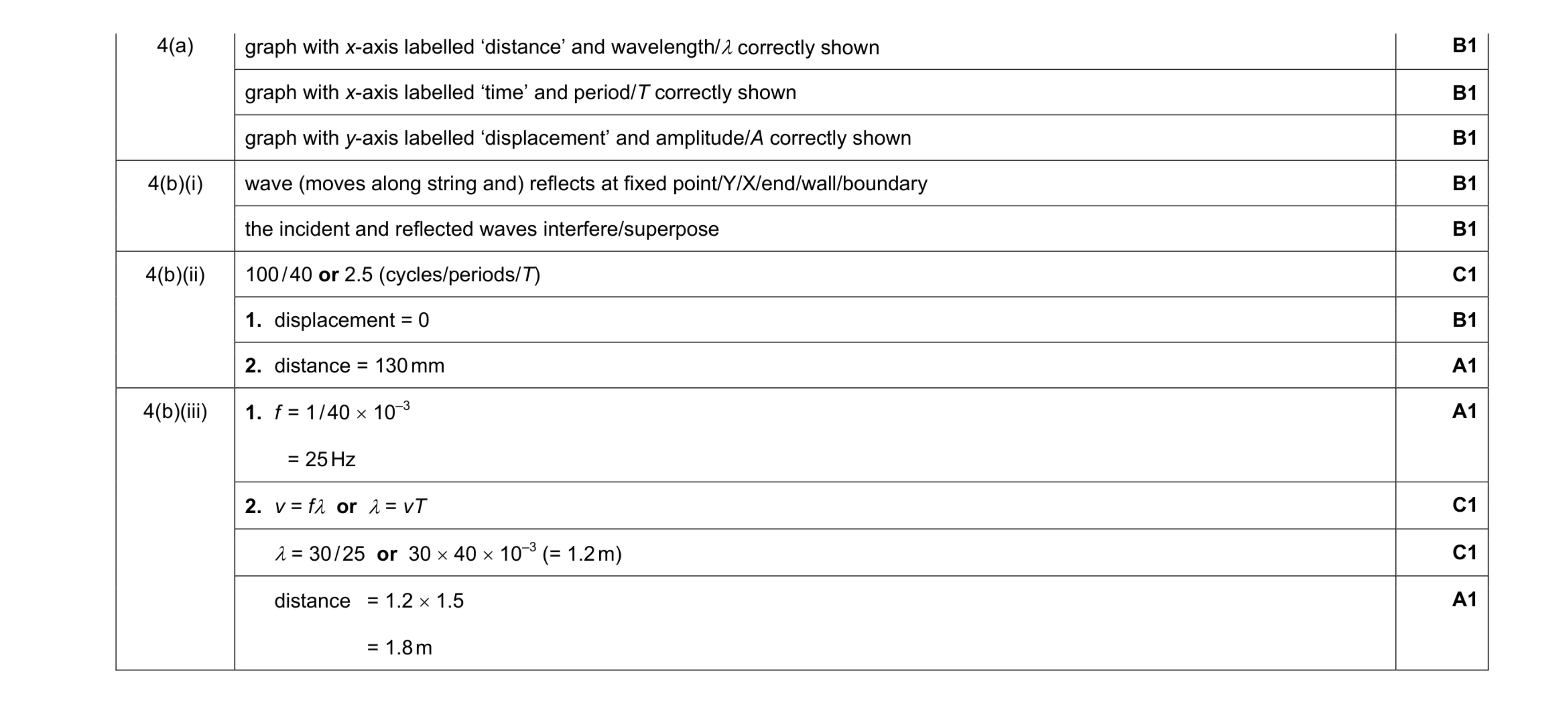 12
12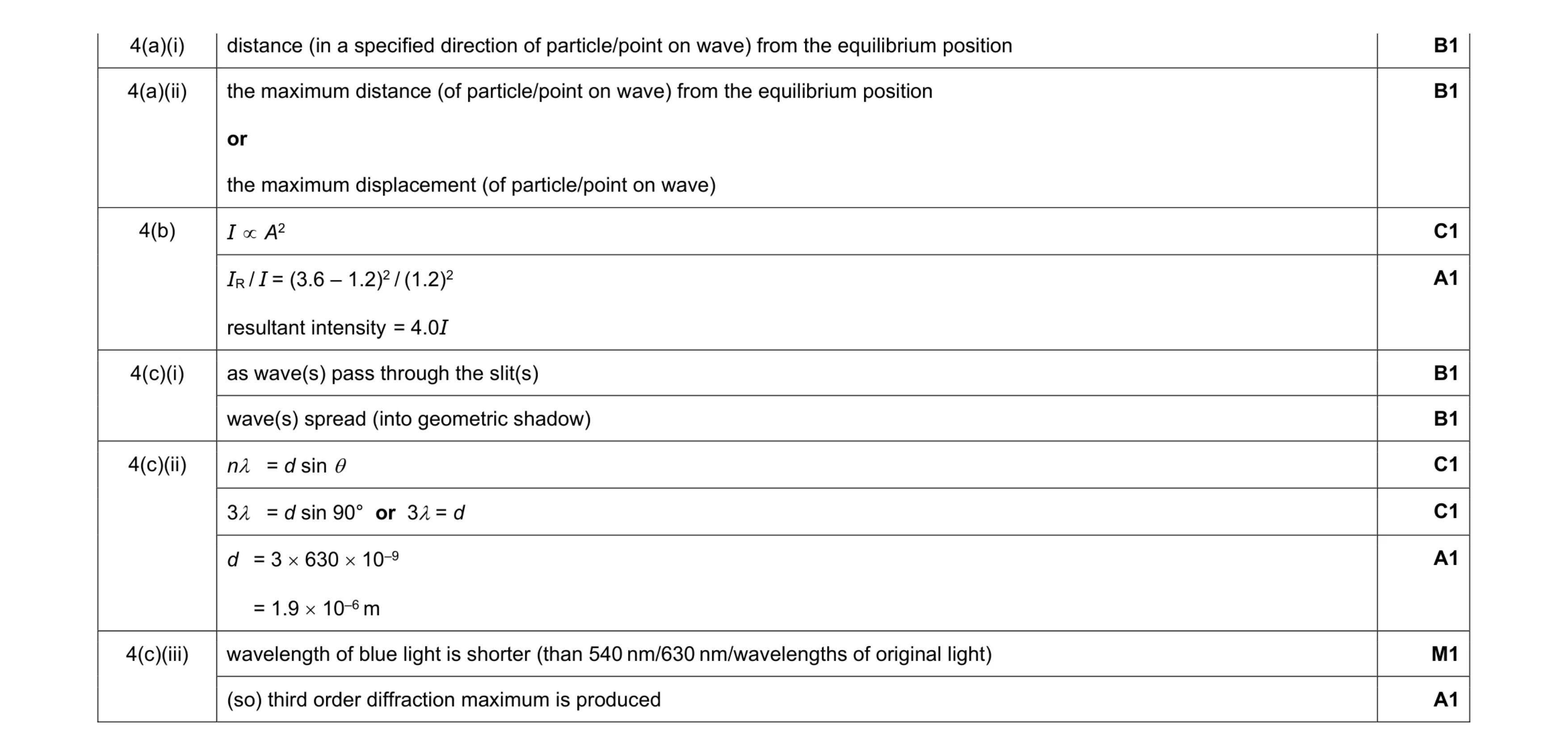 11
11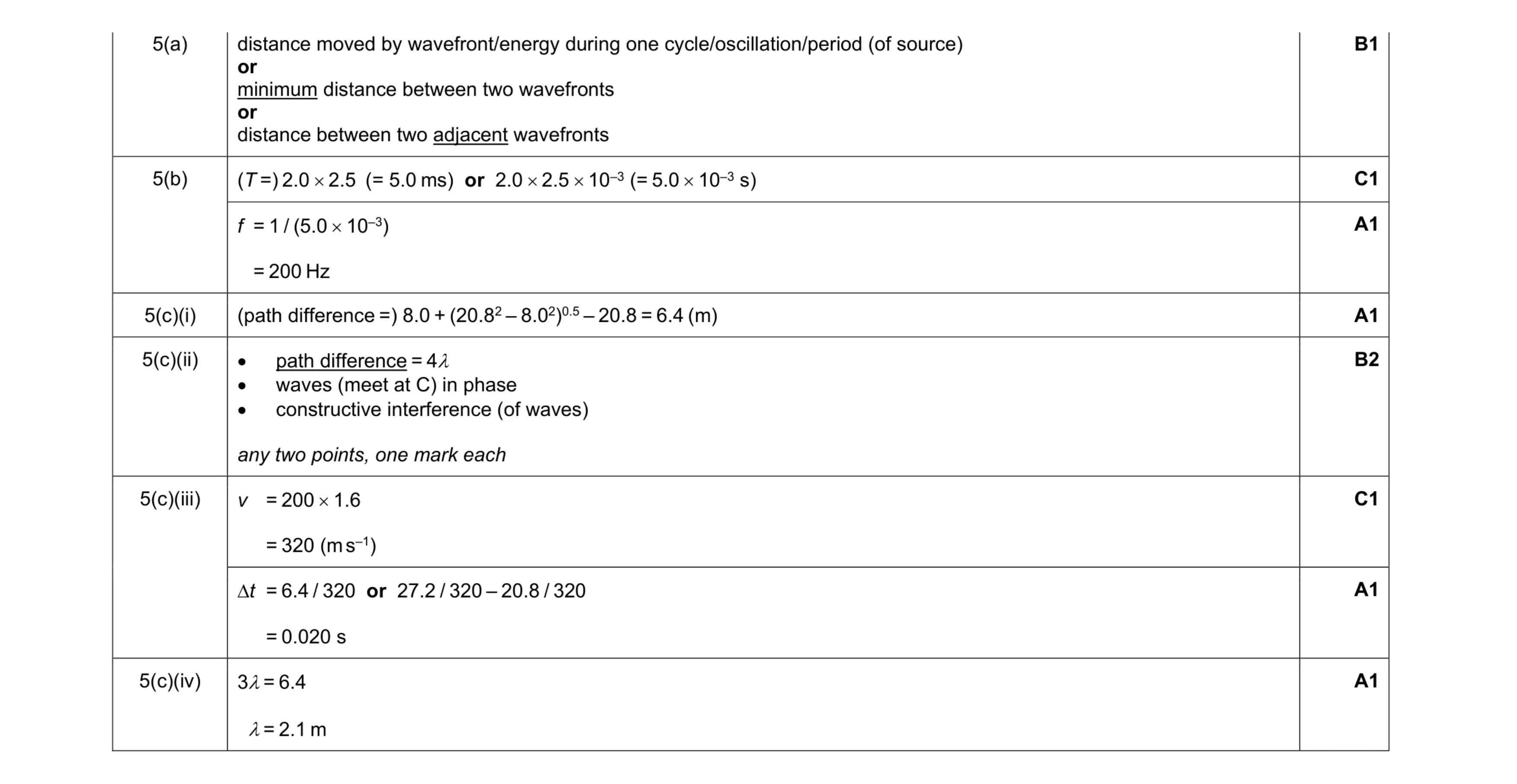 9
9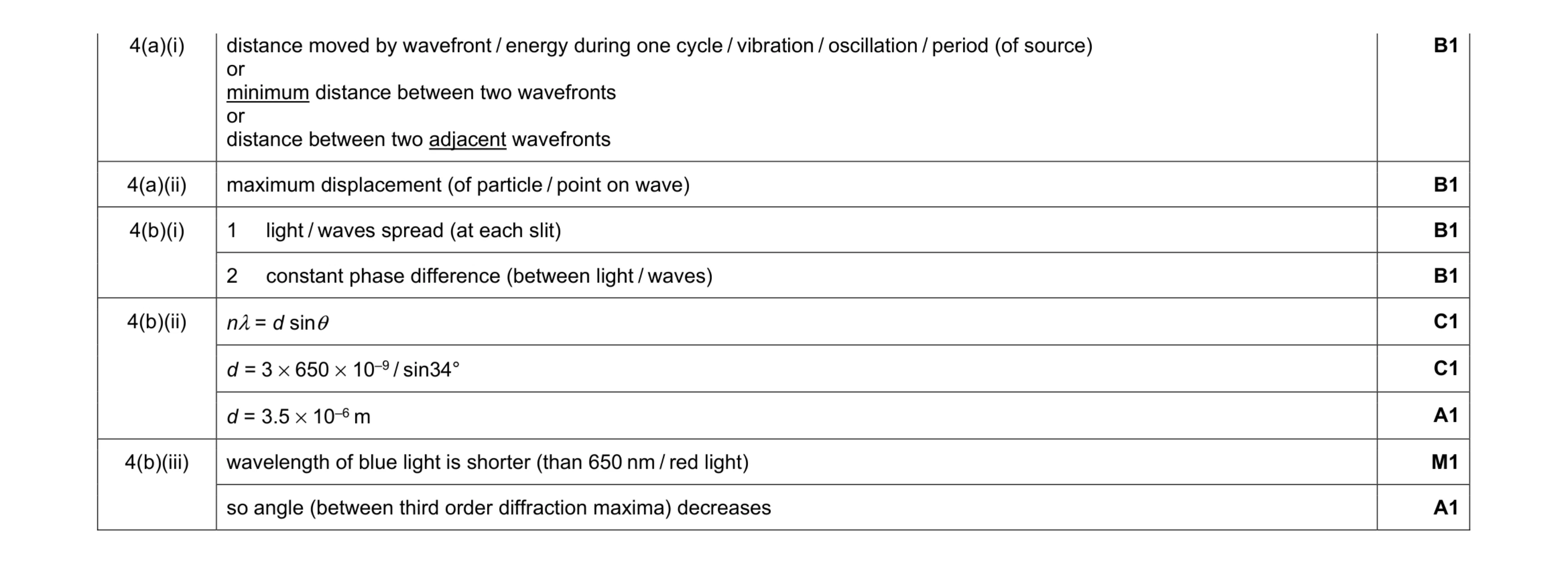 9
9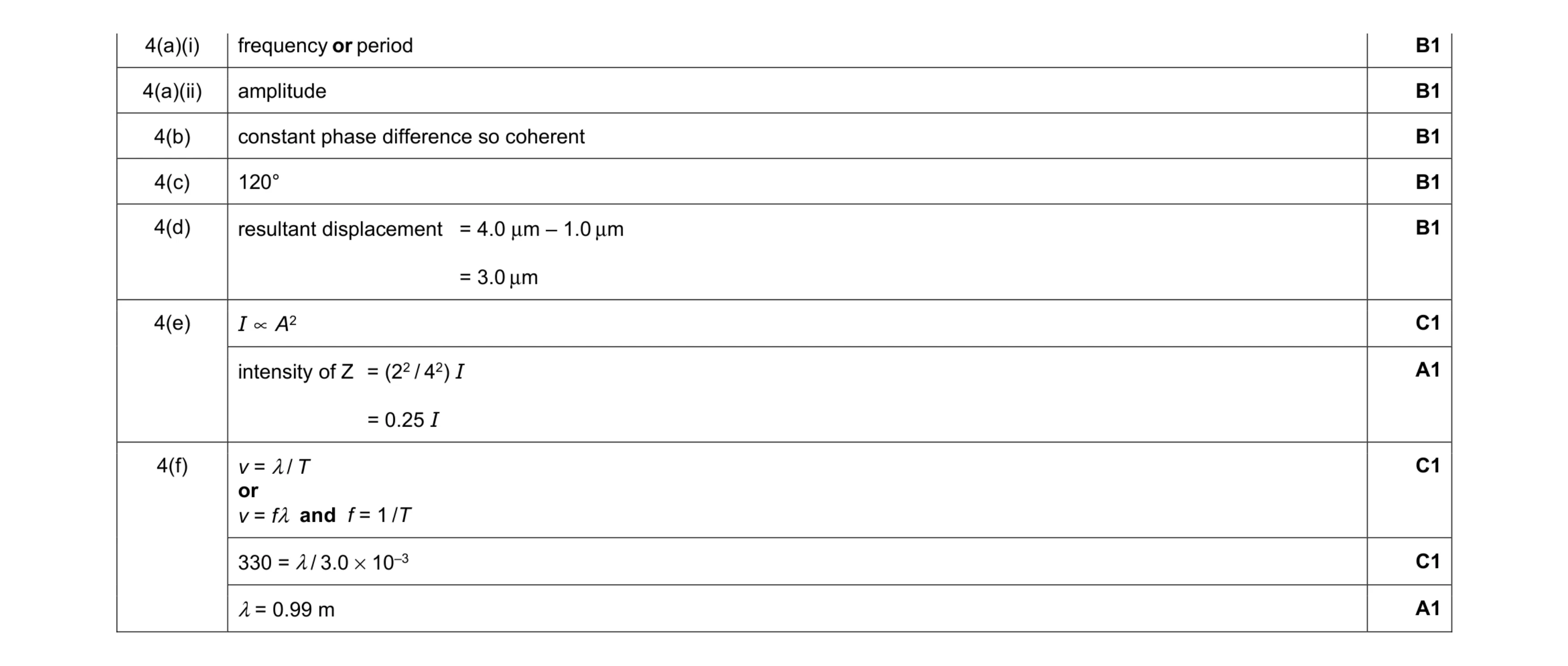 10
10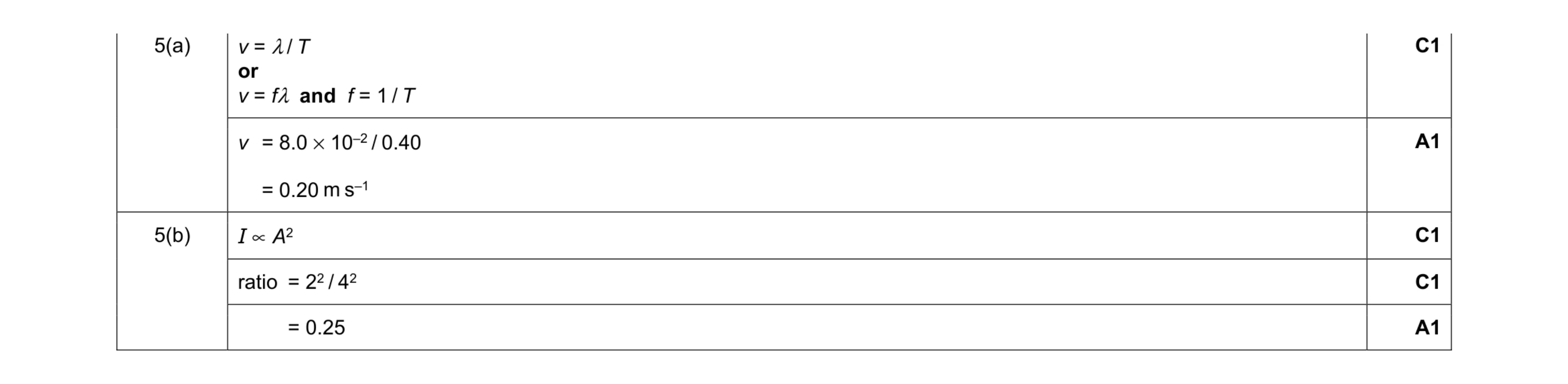 5
5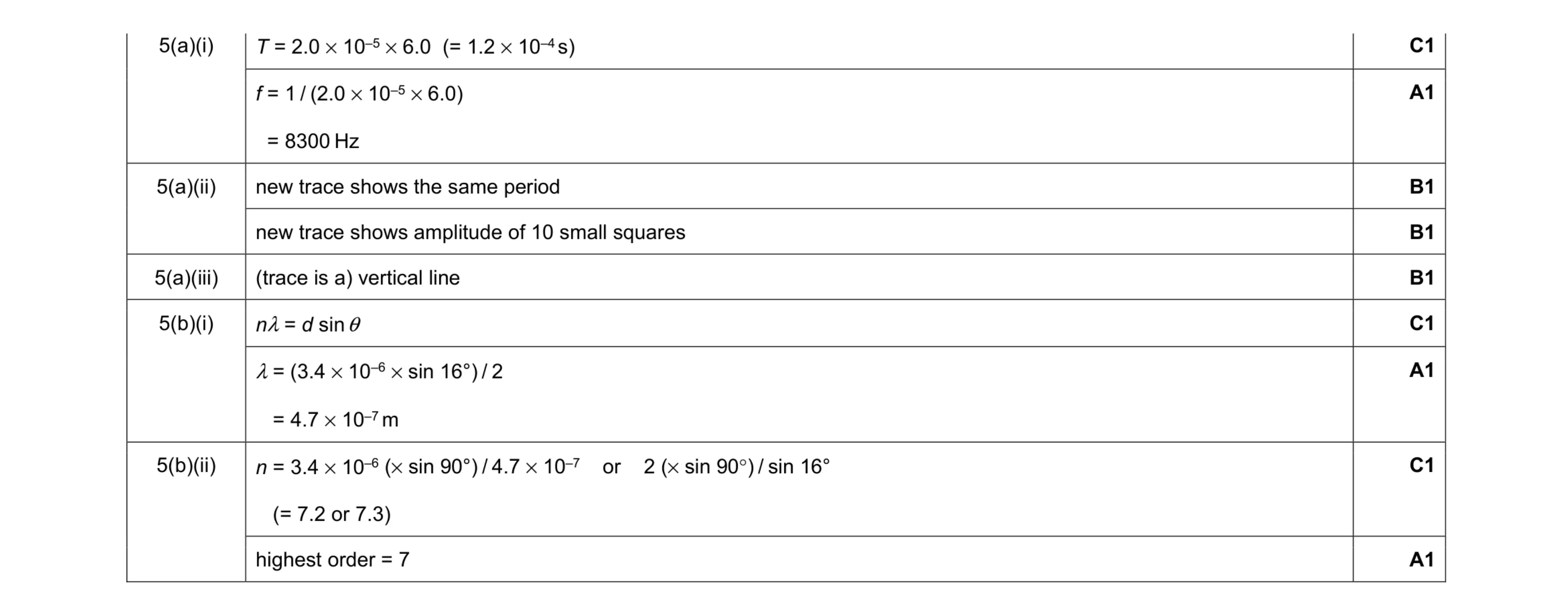 9
9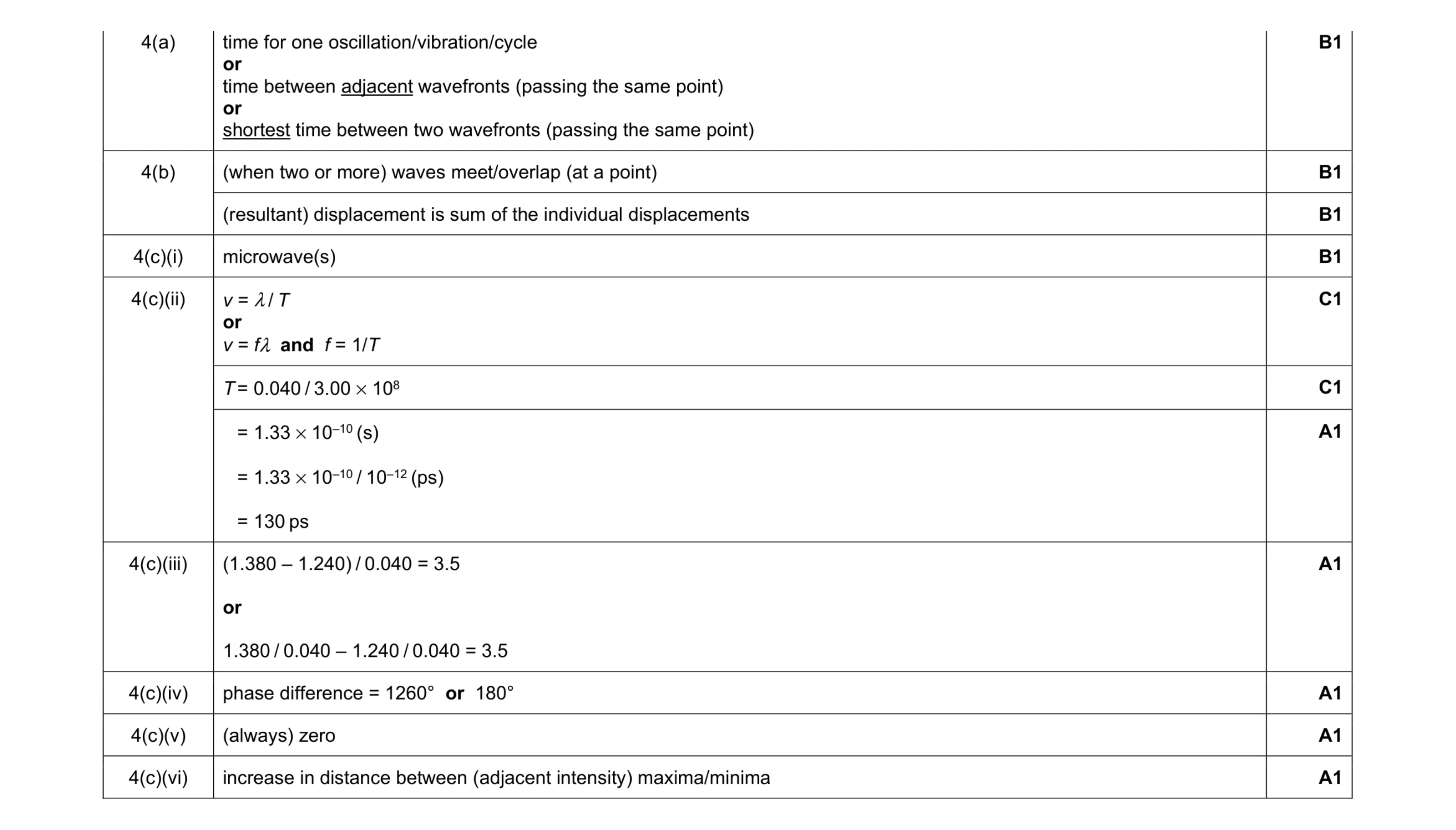 11
11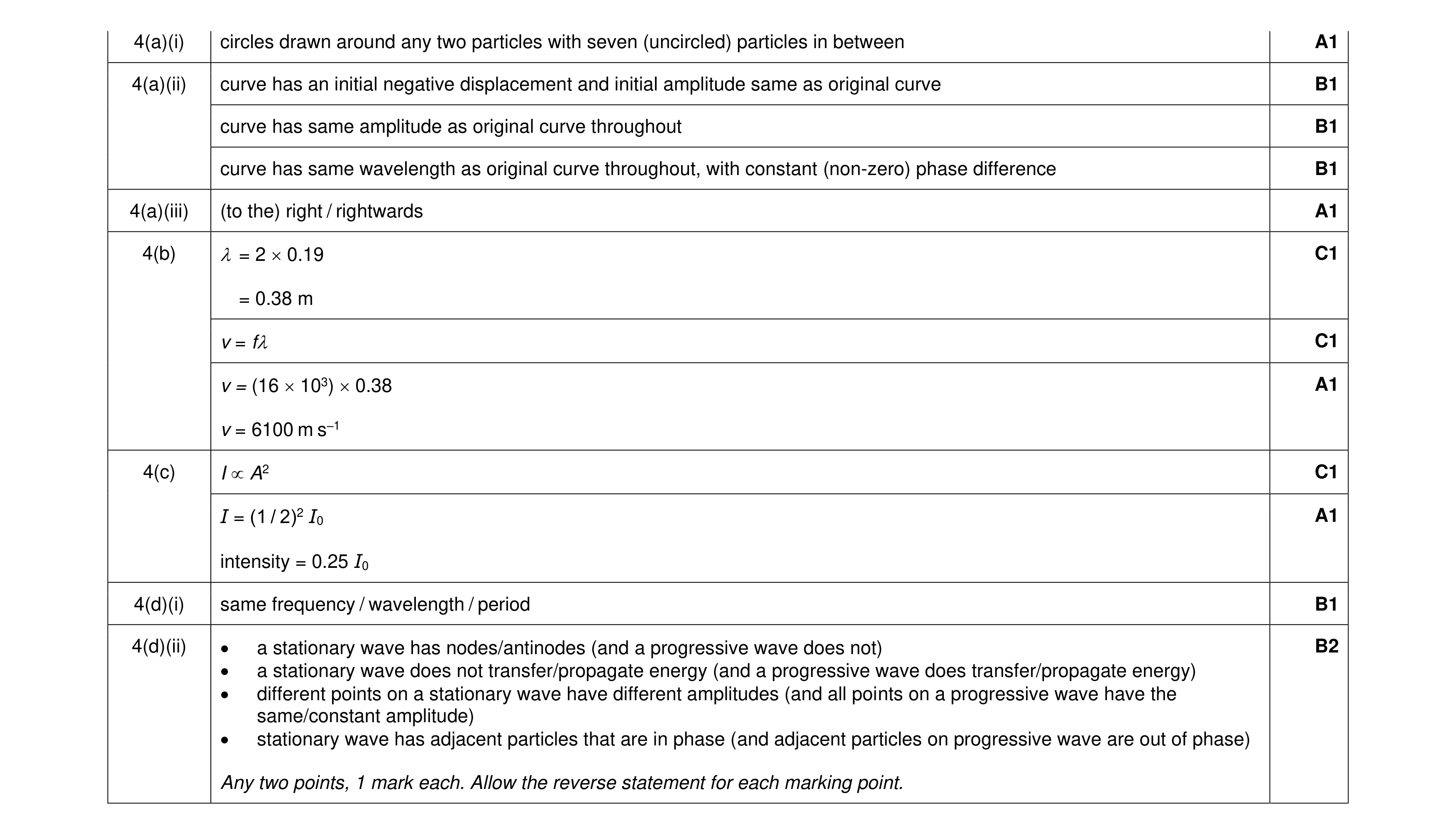 13
13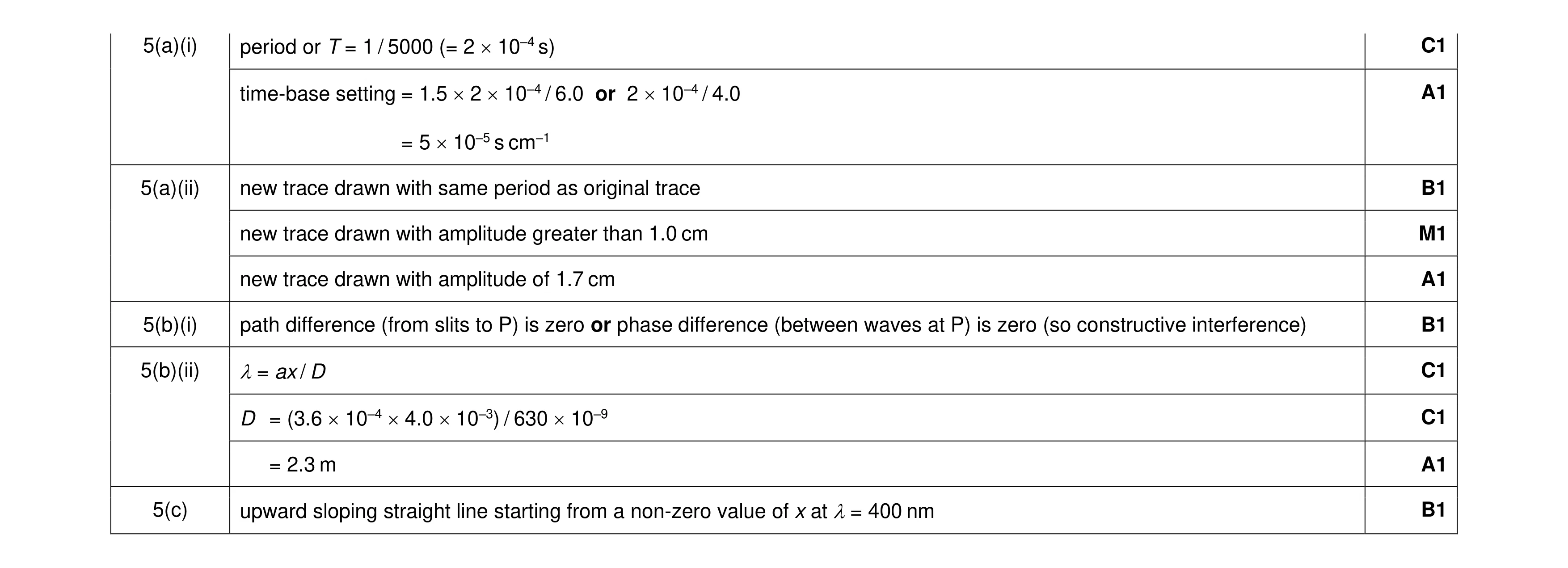 10
10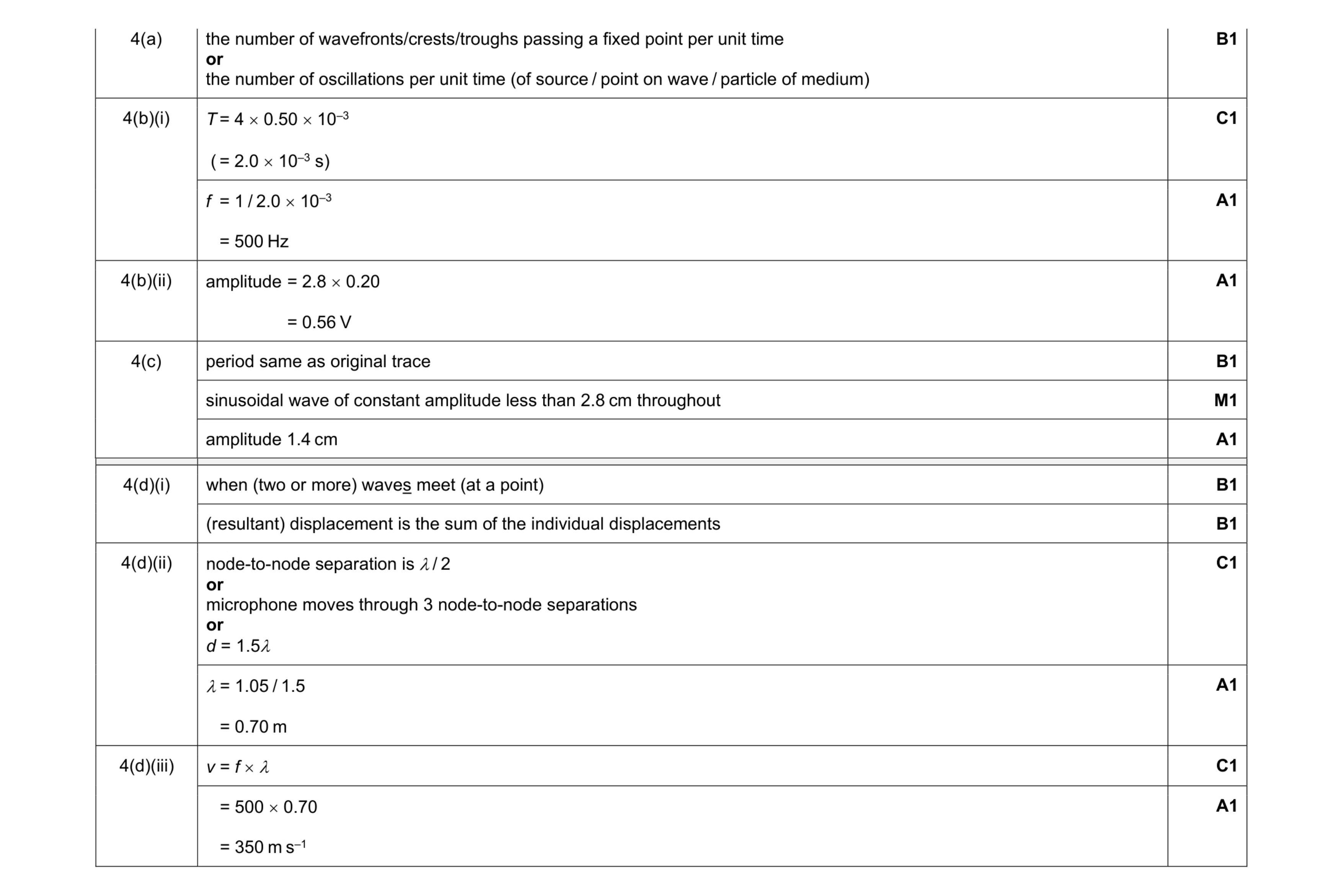 13
13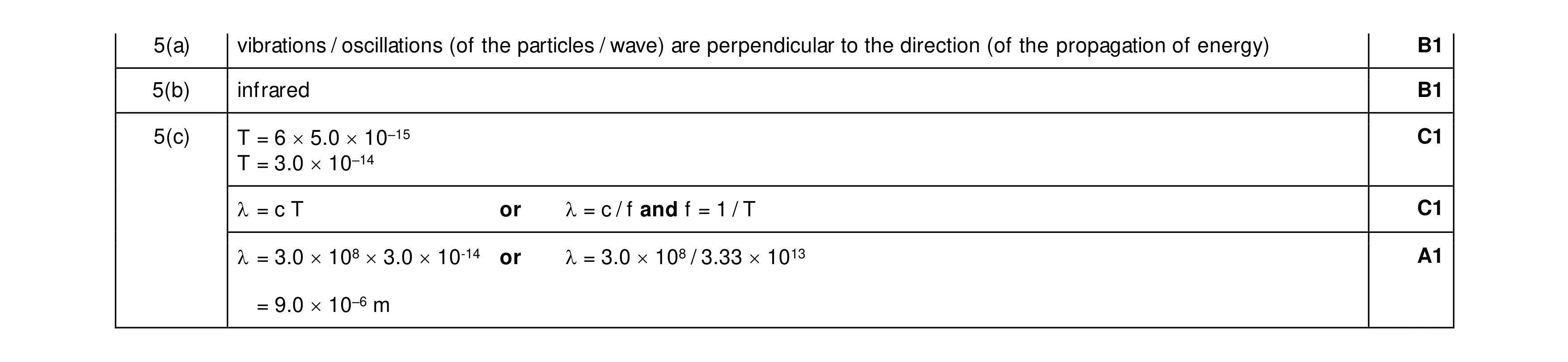 5
5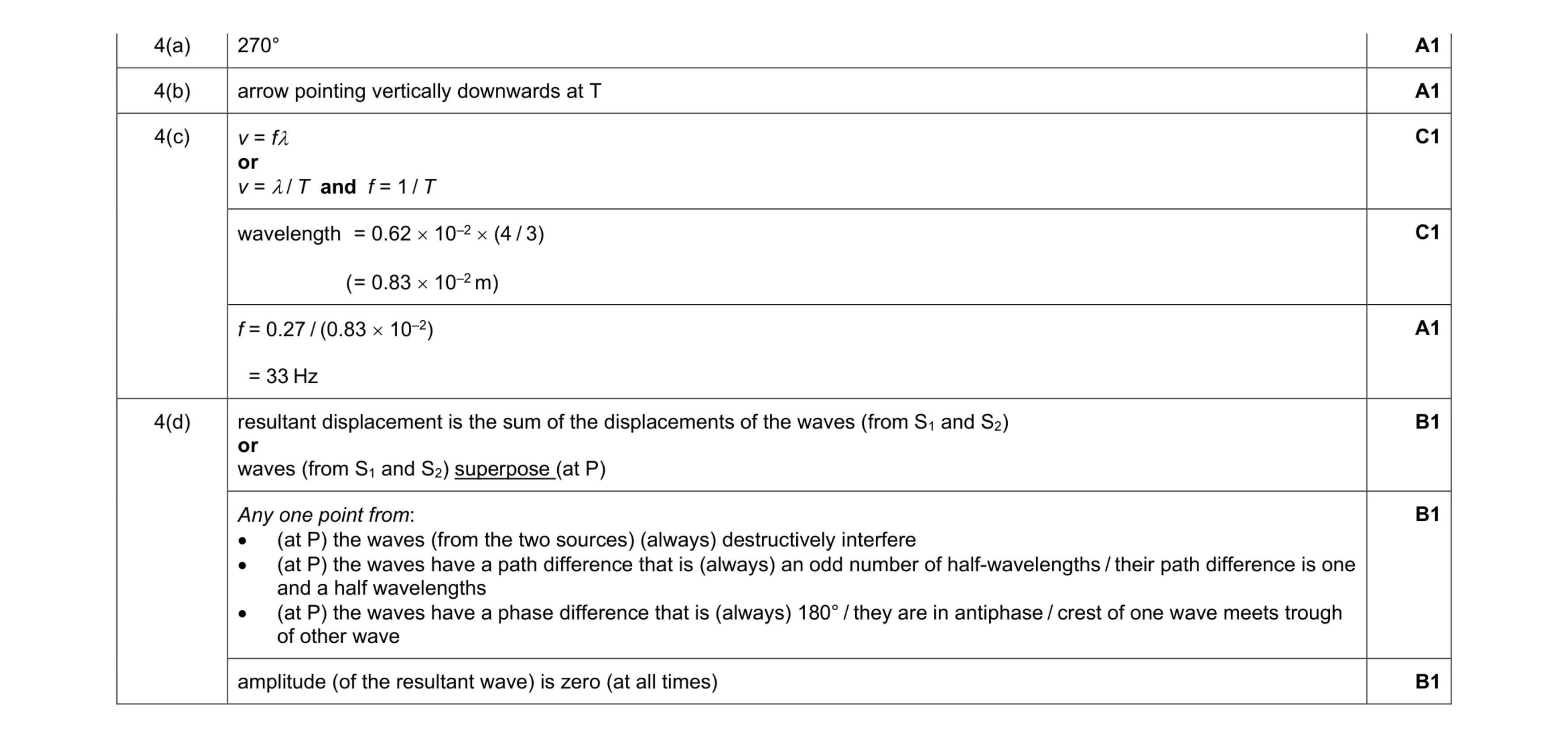 8
8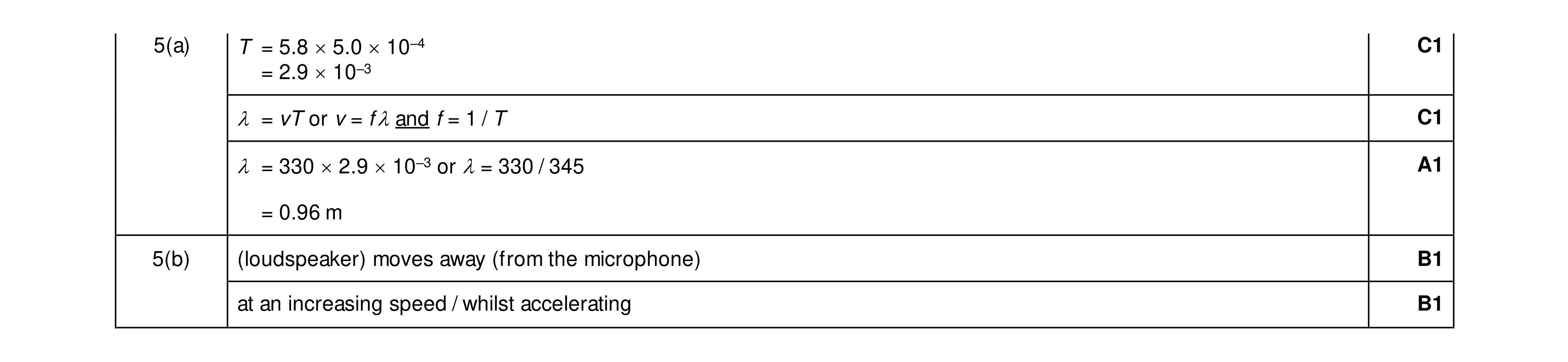 5
5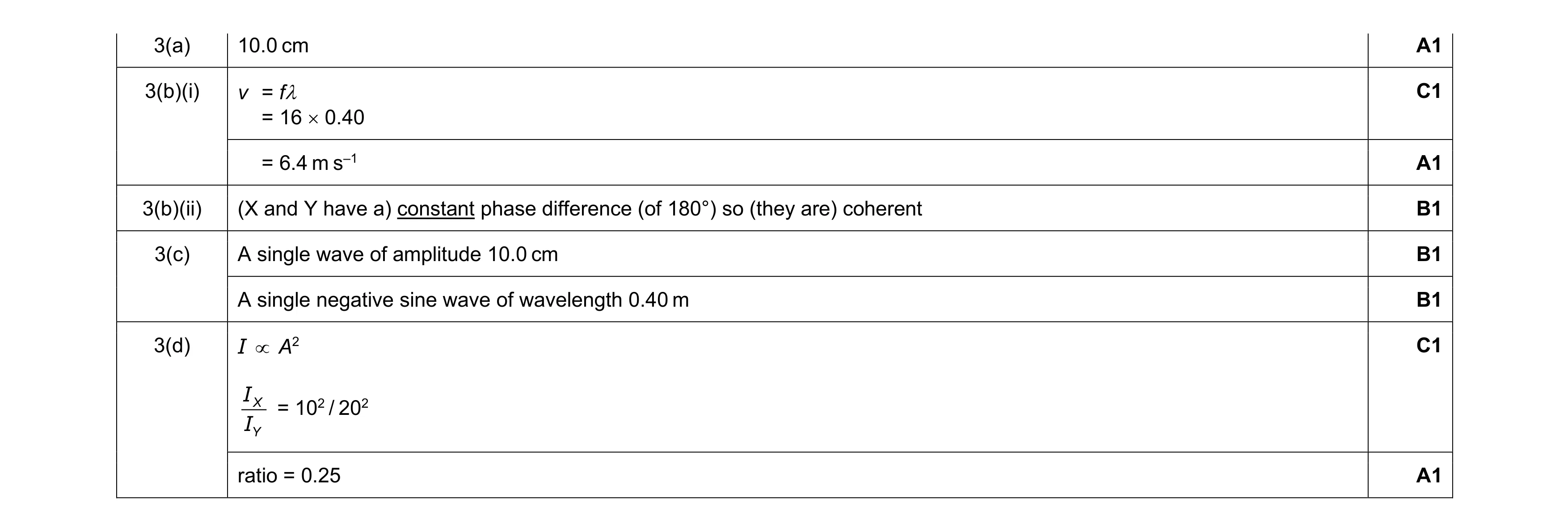 8
8