Questions as text
Question 1 9702/42 May/June 2017
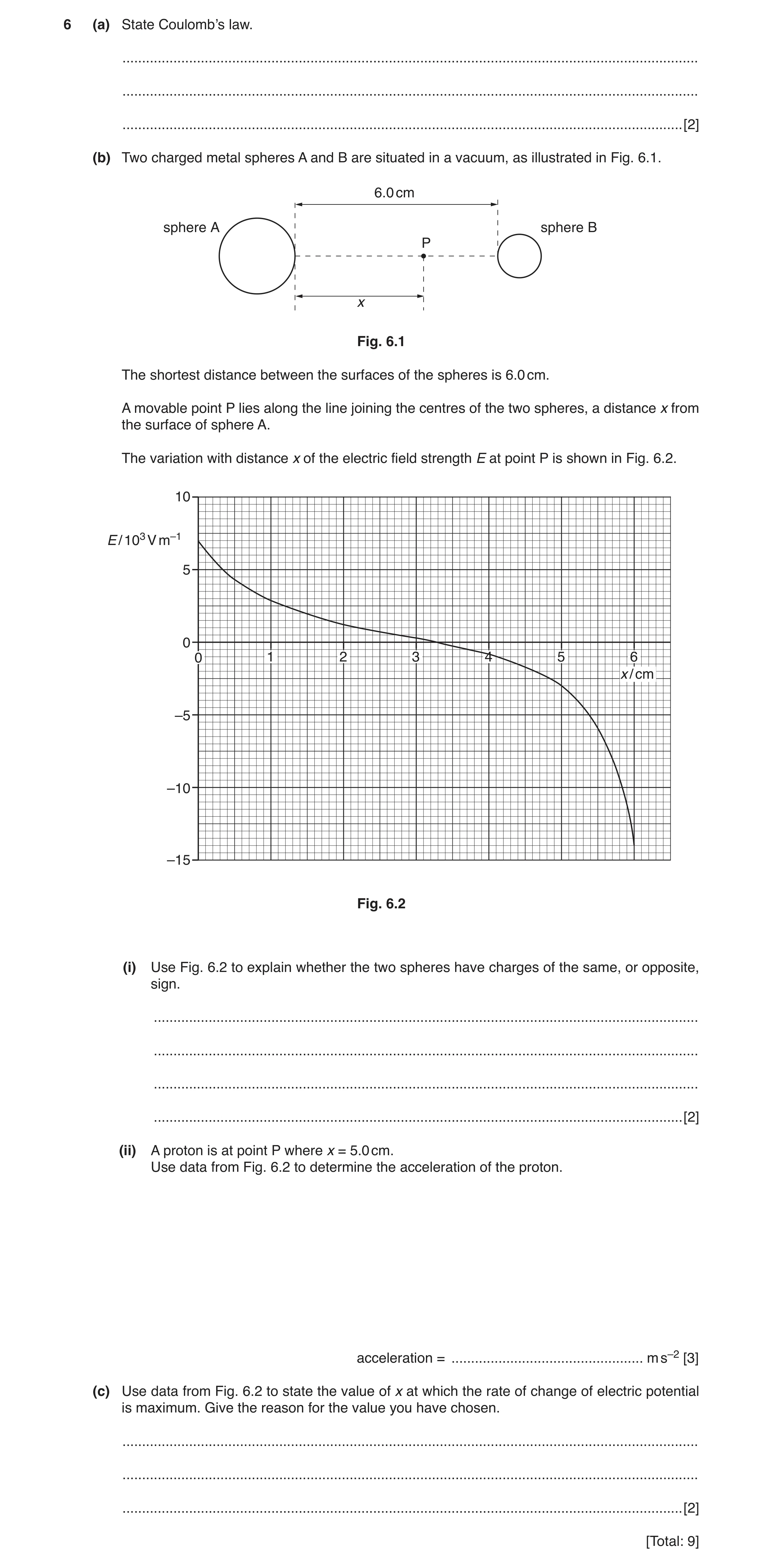
6 (a) State Coulomb’s law. … … … [2] (b) Two charged metal spheres A and B are situated in a vacuum, as illustrated in Fig. 6.1. 6.0 cm sphere A sphere B P x Fig. 6.1 The shortest distance between the surfaces of the spheres is 6.0 cm. A movable point P lies along the line joining the centres of the two spheres, a distance x from the surface of sphere A. The variation with distance x of the electric field strength E at point P is shown in Fig. 6.2. 10 E / 103 V m–1 5 0 0 1 2 3 4 5 6 x / cm –5 –10 –15 Fig. 6.2 (i) Use Fig. 6.2 to explain whether the two spheres have charges of the same, or opposite, sign. … … … … [2] (ii) A proton is at point P where x = 5.0 cm. Use data from Fig. 6.2 to determine the acceleration of the proton. acceleration = … m s–2 [3] (c) Use data from Fig. 6.2 to state the value of x at which the rate of change of electric potential is maximum. Give the reason for the value you have chosen. … … … [2] [Total: 9]
9 marks
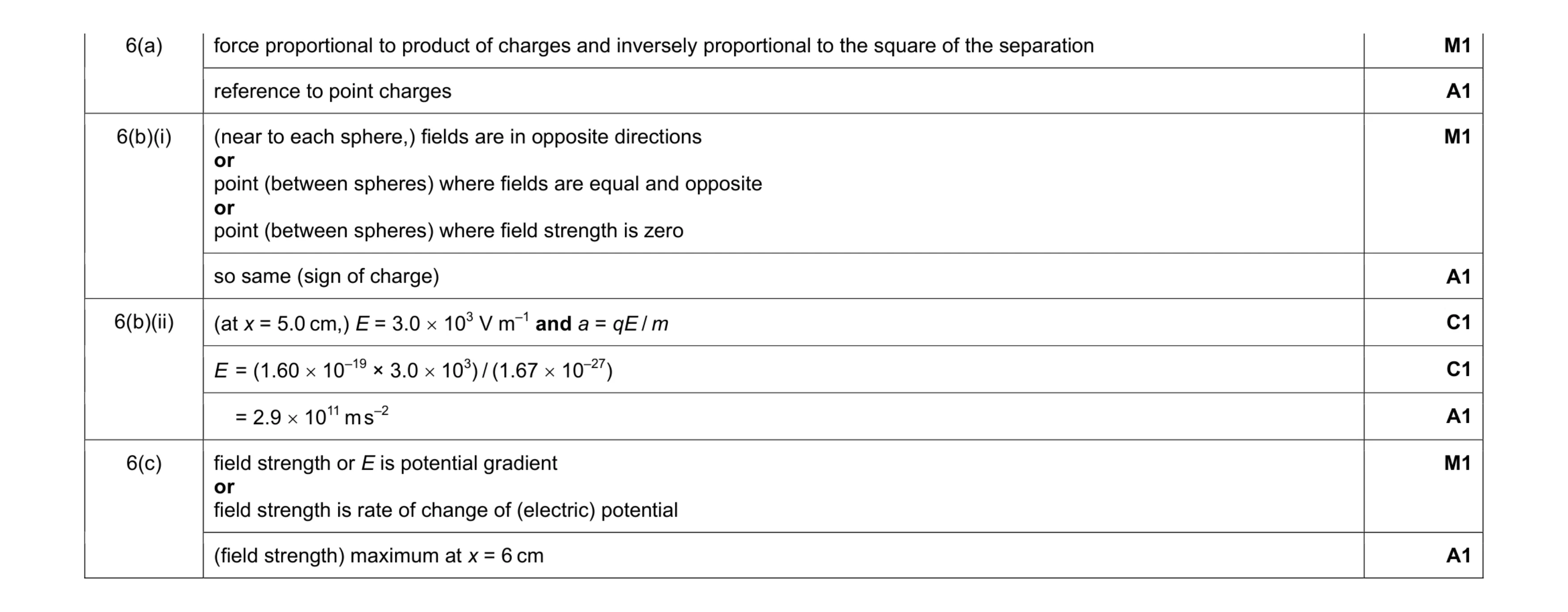
Mark scheme: 6(a) force proportional to product of charges and inversely proportional to the square of the separation M1 reference to point charges A1 6(b)(i) (near to each sphere,) fields are in opposite directions or point (between spheres) where fields are equal and opposite or point (between spheres) where field strength is zero M1 so same (sign of charge) A1 6(b)(ii) (at x = 5.0 cm,) E = 3.0 × 10³ V m–1 and a = qE / m C1 E = (1.60 × 10–19 × 3.0 × 103) / (1.67 × 10⁻²⁷) C1 = 2.9 × 10¹¹ m s–2 A1 6(c) field strength or E is potential gradient or field strength is rate of change of (electric) potential M1 (field strength) maximum at x = 6 cm A1
This question in 9702/42 May/June 2017
Q2 · For any point outside a spherical conductor, the charge on the sphere may be considered… 9702/42 Oct/Nov 2017
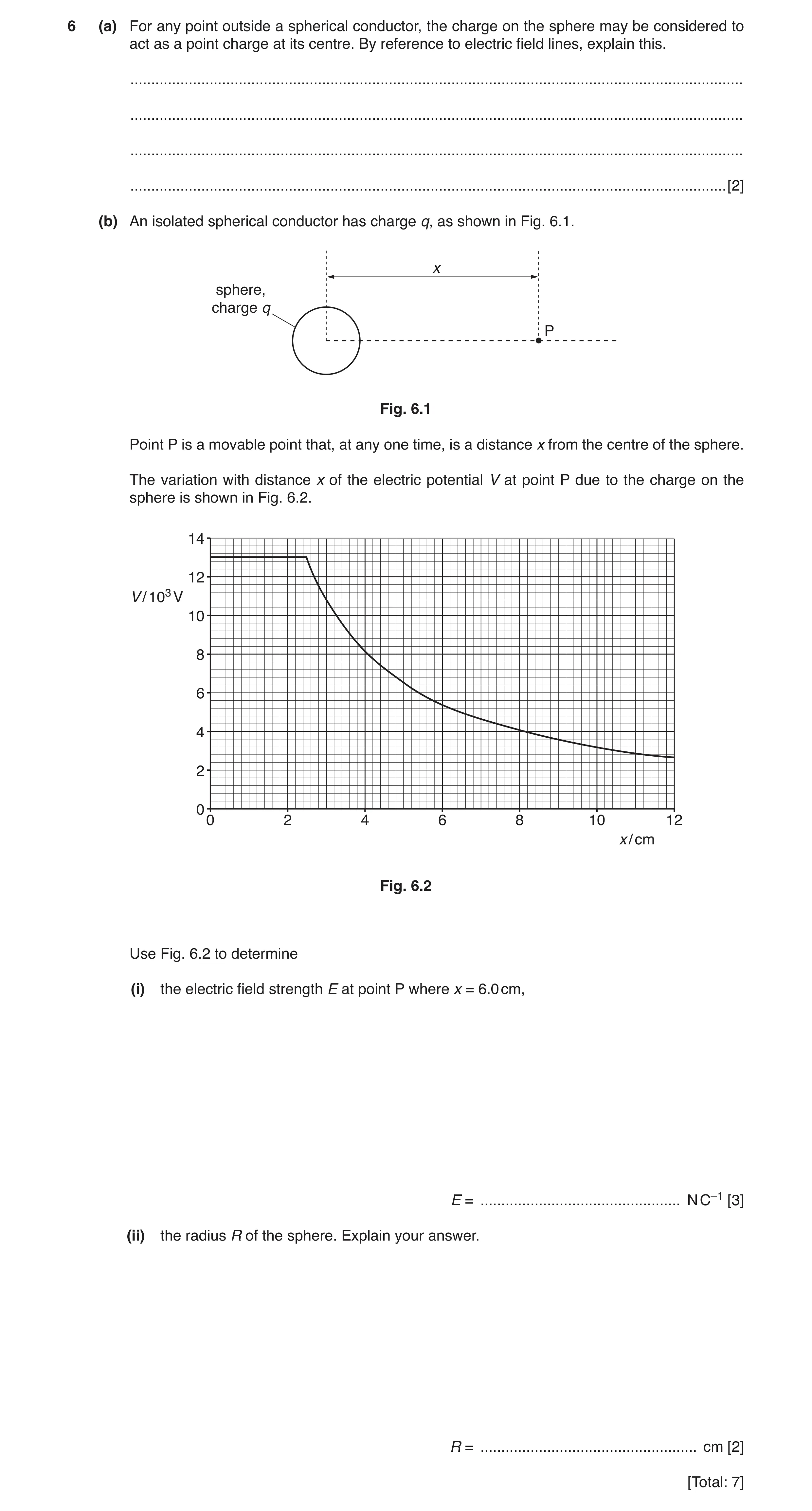
6 (a) For any point outside a spherical conductor, the charge on the sphere may be considered to act as a point charge at its centre. By reference to electric field lines, explain this. … … … … [2] (b) An isolated spherical conductor has charge q, as shown in Fig. 6.1. x sphere, charge q P Fig. 6.1 Point P is a movable point that, at any one time, is a distance x from the centre of the sphere. The variation with distance x of the electric potential V at point P due to the charge on the sphere is shown in Fig. 6.2. 14 12 V / 103 V 10 8 6 4 2 0 0 2 4 6 8 10 12 x / cm Fig. 6.2 Use Fig. 6.2 to determine (i) the electric field strength E at point P where x = 6.0 cm, E = … N C–1 [3] (ii) the radius R of the sphere. Explain your answer. R = … cm [2] [Total: 7]
7 marks
Mark scheme: 6(a) electric field lines are radial/normal to surface (of sphere) B1 electric field lines appear to originate from centre (of sphere) B1 6(b)(i) tangent drawn at x = 6.0 cm and gradient calculation attempted C1 E = 9.0 × 10⁴ N C–1 (1 mark if in range ±1.2; 2 marks if in range ±0.6) A2 or correct pair of values of V and x read from curved part of graph and substituted into V = q / 4πε0x (C1) to give q = 3.6 × 10⁻⁸ C (C1) (then E = q / 4πε0x2 and x = 6 cm gives) E = 9.0 × 10⁴ N C–1 (A1) or (E = q / 4πε0x2 and V = q / 4πε0x and so) E = V / x (C1) giving E = 5.4 × 10³ / 0.060 (C1) = 9.0 × 10⁴ N C–1 (A1) 6(b)(ii) (R =) 2.5 cm B1 potential inside a conductor is constant or field strength inside a conductor zero (so gradient is zero) B1
This question in 9702/42 Oct/Nov 2017
Q3 · State what is meant by electric potential at a point 9702/42 Feb/March 2018
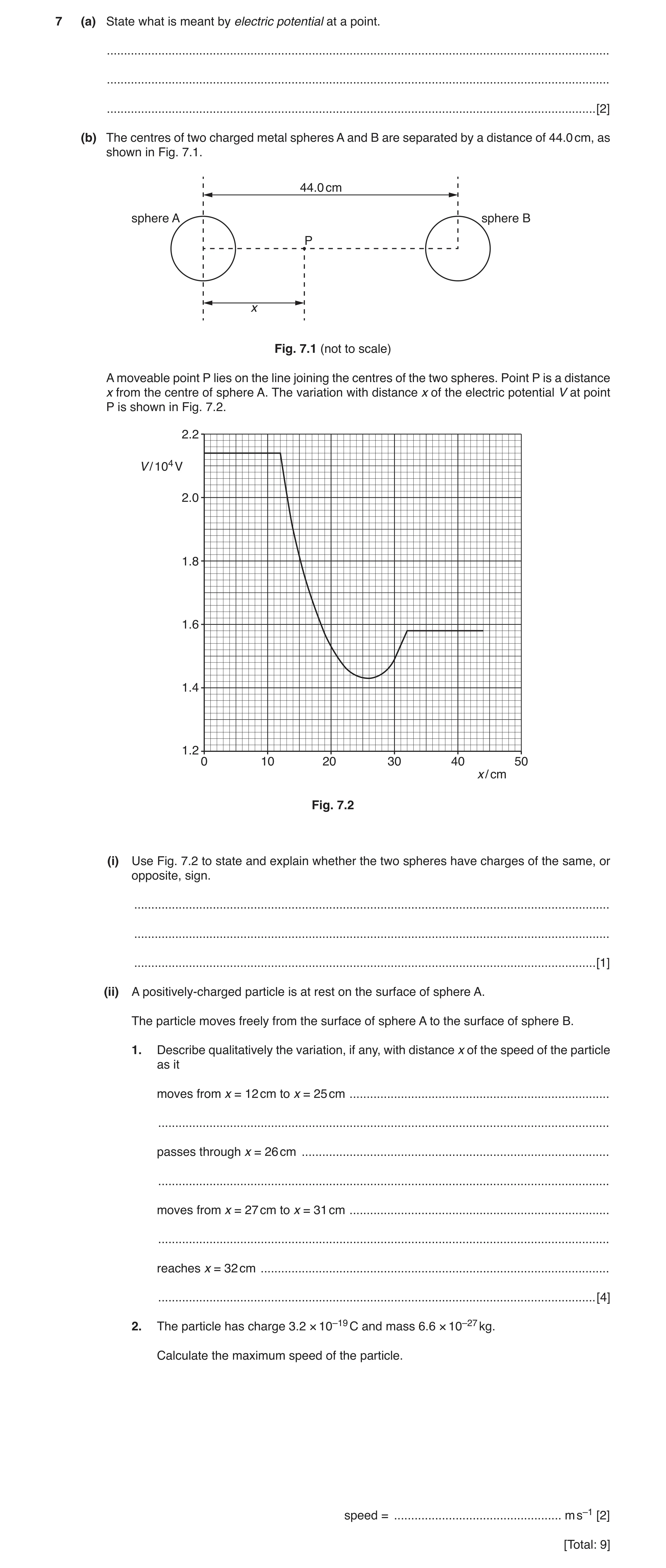
7 (a) State what is meant by electric potential at a point. … … … [2] (b) The centres of two charged metal spheres A and B are separated by a distance of 44.0 cm, as shown in Fig. 7.1. 44.0 cm sphere A sphere B P x Fig. 7.1 (not to scale) A moveable point P lies on the line joining the centres of the two spheres. Point P is a distance x from the centre of sphere A. The variation with distance x of the electric potential V at point P is shown in Fig. 7.2. 2.2 V / 104 V 2.0 1.8 1.6 1.4 1.2 0 10 20 30 40 50 x / cm Fig. 7.2 (i) Use Fig. 7.2 to state and explain whether the two spheres have charges of the same, or opposite, sign. … … … [1] (ii) A positively-charged particle is at rest on the surface of sphere A. The particle moves freely from the surface of sphere A to the surface of sphere B. 1. Describe qualitatively the variation, if any, with distance x of the speed of the particle as it moves from x = 12 cm to x = 25 cm … … passes through x = 26 cm … … moves from x = 27 cm to x = 31 cm … … reaches x = 32 cm … … [4] 2. The particle has charge 3.2 × 10⁻¹⁹ C and mass 6.6 × 10⁻²⁷ kg. Calculate the maximum speed of the particle. speed = … m s–1 [2] [Total: 9]
9 marks
Mark scheme: 7(a) work done per unit charge B1 (work done) moving positive charge from infinity (to the point) B1 7(b)(i) potential always same sign / potential is always positive so same sign of charge B1 Question Answer Marks 7(b)(ii) 1 from x = 12 cm to x = 25 cm: speed increases and from x = 27 cm to x = 31 cm: speed decreases B1 (from x = 12 cm to x = 25 cm: speed increases) at decreasing rate or (from x = 27 cm to x = 31 cm: speed decreases) at increasing rate B1 at x = 26 cm: speed maximum B1 at 32 cm: speed still decreasing B1 2 q ∆V = ½mv2 3.2 × 10–19 × (2.14 – 1.43) × 104 = ½ × 6.6 × 10⁻²⁷ × v2 v2 = 6.88 × 10¹¹ C1 v = 8.3 × 10⁵ m s–1 (8.30) A1
This question in 9702/42 Feb/March 2018
Q4 · Define electric potential at a point 9702/41 Oct/Nov 2018
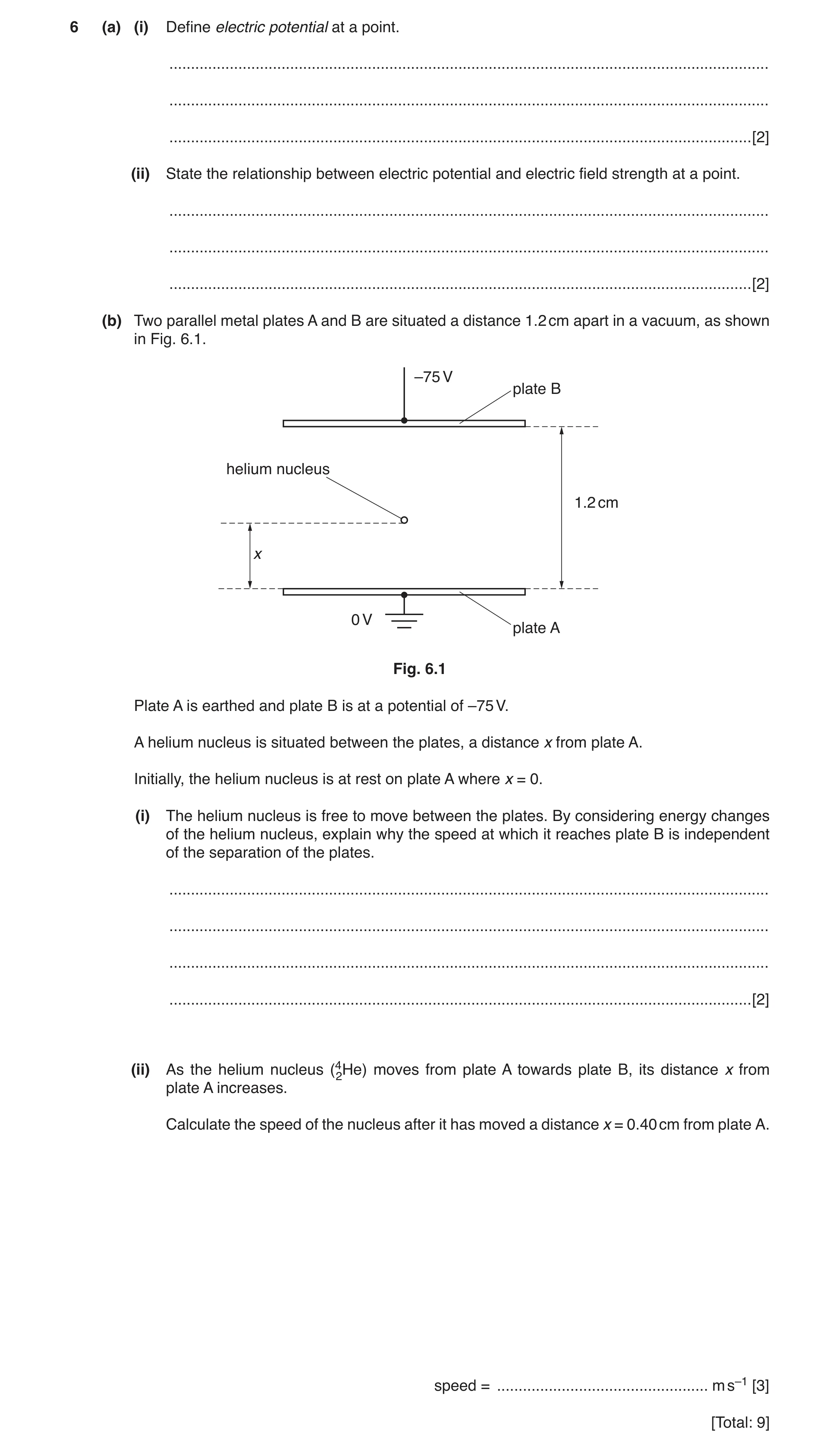
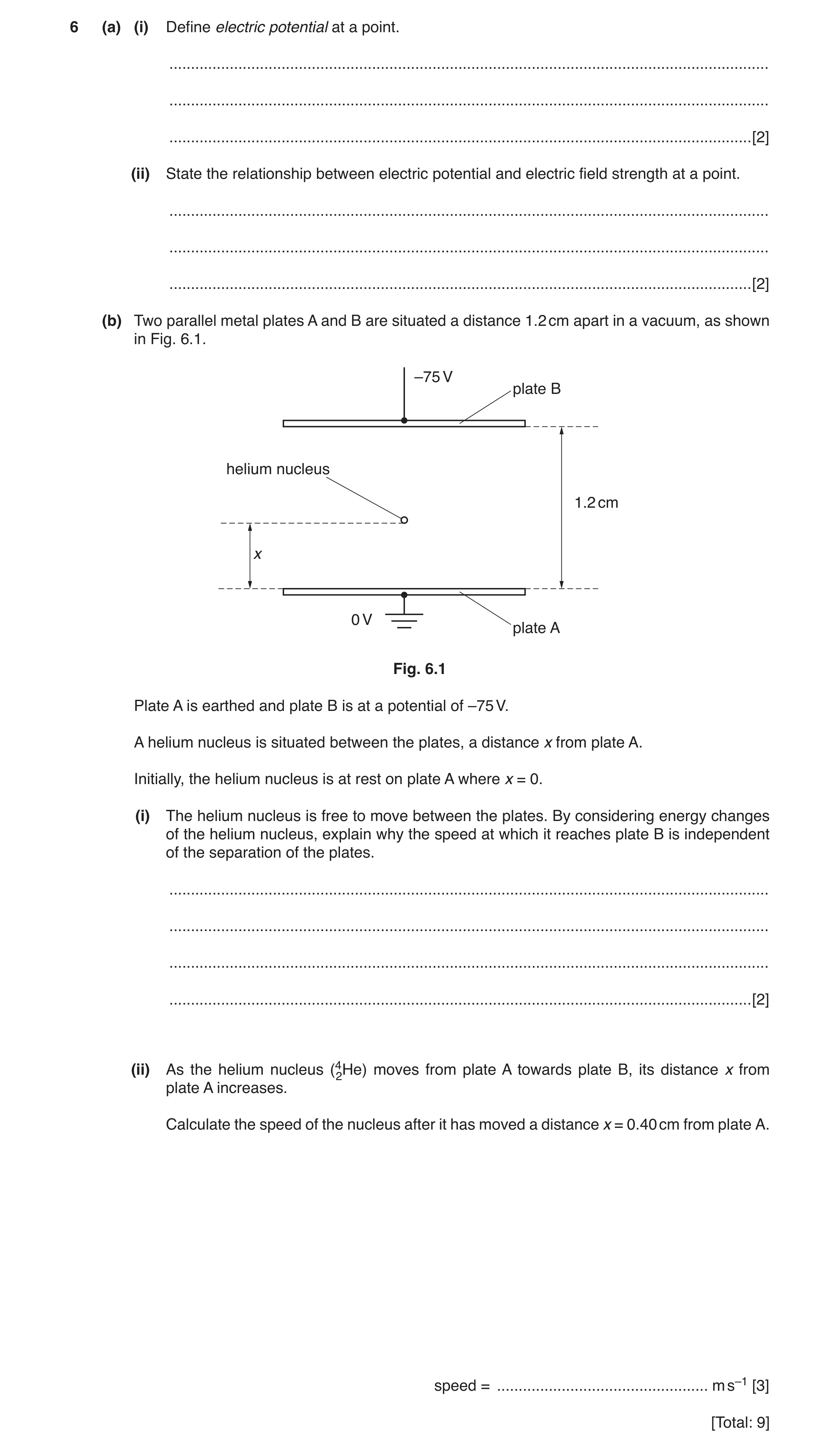
6 (a) (i) Define electric potential at a point. … … … [2] (ii) State the relationship between electric potential and electric field strength at a point. … … … [2] (b) Two parallel metal plates A and B are situated a distance 1.2 cm apart in a vacuum, as shown in Fig. 6.1. –75 V plate B helium nucleus 1.2 cm x 0 V plate A Fig. 6.1 Plate A is earthed and plate B is at a potential of –75 V. A helium nucleus is situated between the plates, a distance x from plate A. Initially, the helium nucleus is at rest on plate A where x = 0. (i) The helium nucleus is free to move between the plates. By considering energy changes of the helium nucleus, explain why the speed at which it reaches plate B is independent of the separation of the plates. … … … … [2] (ii) As the helium nucleus (42He) moves from plate A towards plate B, its distance x from plate A increases. Calculate the speed of the nucleus after it has moved a distance x = 0.40 cm from plate A. speed = … m s–1 [3] [Total: 9]
9 marks
Mark scheme: 6(a)(i) work done per unit charge B1 work done moving positive charge from infinity (to the point) B1 6(a)(ii) field strength = potential gradient M1 ‘–’ sign included or directions discussed A1 6(b)(i) gain in kinetic energy (= loss in potential energy) = charge × p.d. or qV = ½mv2 M1 so v is independent of separation (because separation not in expressions) A1 Question Answer Marks 6(b)(ii) (at x = 0.40 cm), potential = (–) 75 × 0.40 / 1.2 (= (–) 25 V) C1 ½mv2 = qV ½ × 4 × 1.66 × 10–27 × v2 = 2 × 1.60 × 10–19 × 25 C1 or a = Vq / dm and v2 = 2as (C1) v2 = (2 × 75 × 2 × 1.60 × 10–19 × 0.40 × 10–2) / (1.2 × 10–2 × 4 × 1.66 × 10–27) (C1) v = 4.9 × 10⁴ m s–1 A1
This question in 9702/41 Oct/Nov 2018
Q5 · State (i) what is meant by the electric potential at a point, … … … [2] (ii) the… 9702/42 Oct/Nov 2018
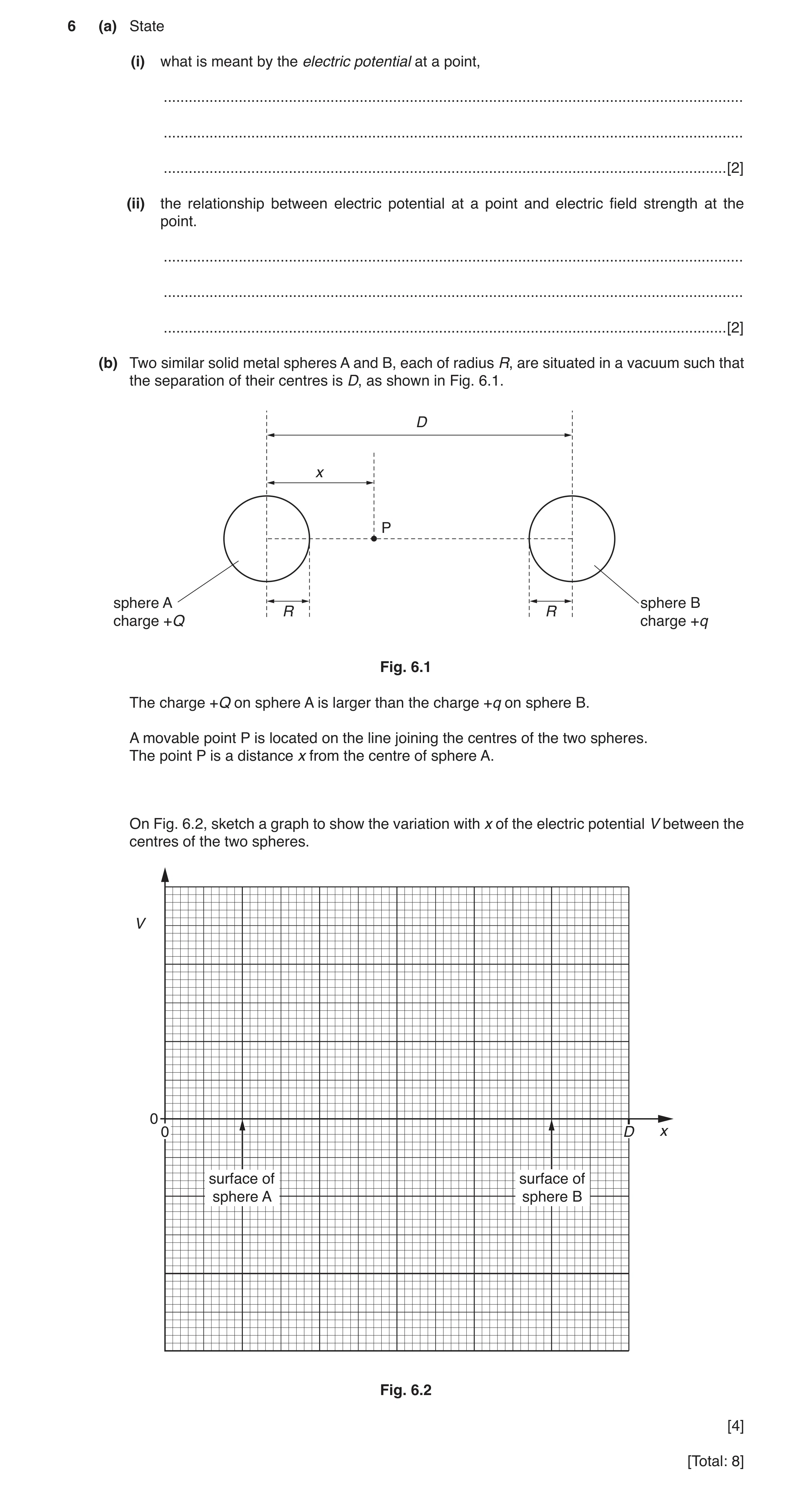
6 (a) State (i) what is meant by the electric potential at a point, … … … [2] (ii) the relationship between electric potential at a point and electric field strength at the point. … … … [2] (b) Two similar solid metal spheres A and B, each of radius R, are situated in a vacuum such that the separation of their centres is D, as shown in Fig. 6.1. D x P sphere A sphere B R R charge +Q charge +q Fig. 6.1 The charge +Q on sphere A is larger than the charge +q on sphere B. A movable point P is located on the line joining the centres of the two spheres. The point P is a distance x from the centre of sphere A. On Fig. 6.2, sketch a graph to show the variation with x of the electric potential V between the centres of the two spheres. V 0 0 D x surface of surface of sphere A sphere B Fig. 6.2 [4] [Total: 8]
8 marks
Mark scheme: 6(a)(i) work done per unit charge B1 work done moving positive charge from infinity (to the point) B1 6(a)(ii) field strength = potential gradient M1 negative sign included or directions discussed A1 6(b) horizontal straight lines, at non-zero potential, within the spheres B1 magnitude of potential greater at surface of sphere A than at surface of sphere B B1 concave curve between A and B, with a minimum nearer to B B1 lines show V positive all the way from 0 to D B1
This question in 9702/42 Oct/Nov 2018
Q6 · Define electric potential at a point 9702/43 Oct/Nov 2018
6 (a) (i) Define electric potential at a point. … … … [2] (ii) State the relationship between electric potential and electric field strength at a point. … … … [2] (b) Two parallel metal plates A and B are situated a distance 1.2 cm apart in a vacuum, as shown in Fig. 6.1. –75 V plate B helium nucleus 1.2 cm x 0 V plate A Fig. 6.1 Plate A is earthed and plate B is at a potential of –75 V. A helium nucleus is situated between the plates, a distance x from plate A. Initially, the helium nucleus is at rest on plate A where x = 0. (i) The helium nucleus is free to move between the plates. By considering energy changes of the helium nucleus, explain why the speed at which it reaches plate B is independent of the separation of the plates. … … … … [2] (ii) As the helium nucleus (42He) moves from plate A towards plate B, its distance x from plate A increases. Calculate the speed of the nucleus after it has moved a distance x = 0.40 cm from plate A. speed = … m s–1 [3] [Total: 9]
9 marks
Mark scheme: 6(a)(i) work done per unit charge B1 work done moving positive charge from infinity (to the point) B1 6(a)(ii) field strength = potential gradient M1 ‘–’ sign included or directions discussed A1 6(b)(i) gain in kinetic energy (= loss in potential energy) = charge × p.d. or qV = ½mv2 M1 so v is independent of separation (because separation not in expressions) A1 Question Answer Marks 6(b)(ii) (at x = 0.40 cm), potential = (–) 75 × 0.40 / 1.2 (= (–) 25 V) C1 ½mv2 = qV ½ × 4 × 1.66 × 10–27 × v2 = 2 × 1.60 × 10–19 × 25 C1 or a = Vq / dm and v2 = 2as (C1) v2 = (2 × 75 × 2 × 1.60 × 10–19 × 0.40 × 10–2) / (1.2 × 10–2 × 4 × 1.66 × 10–27) (C1) v = 4.9 × 10⁴ m s–1 A1
This question in 9702/43 Oct/Nov 2018
Q7 · State what is meant by electric potential at a point 9702/42 May/June 2019
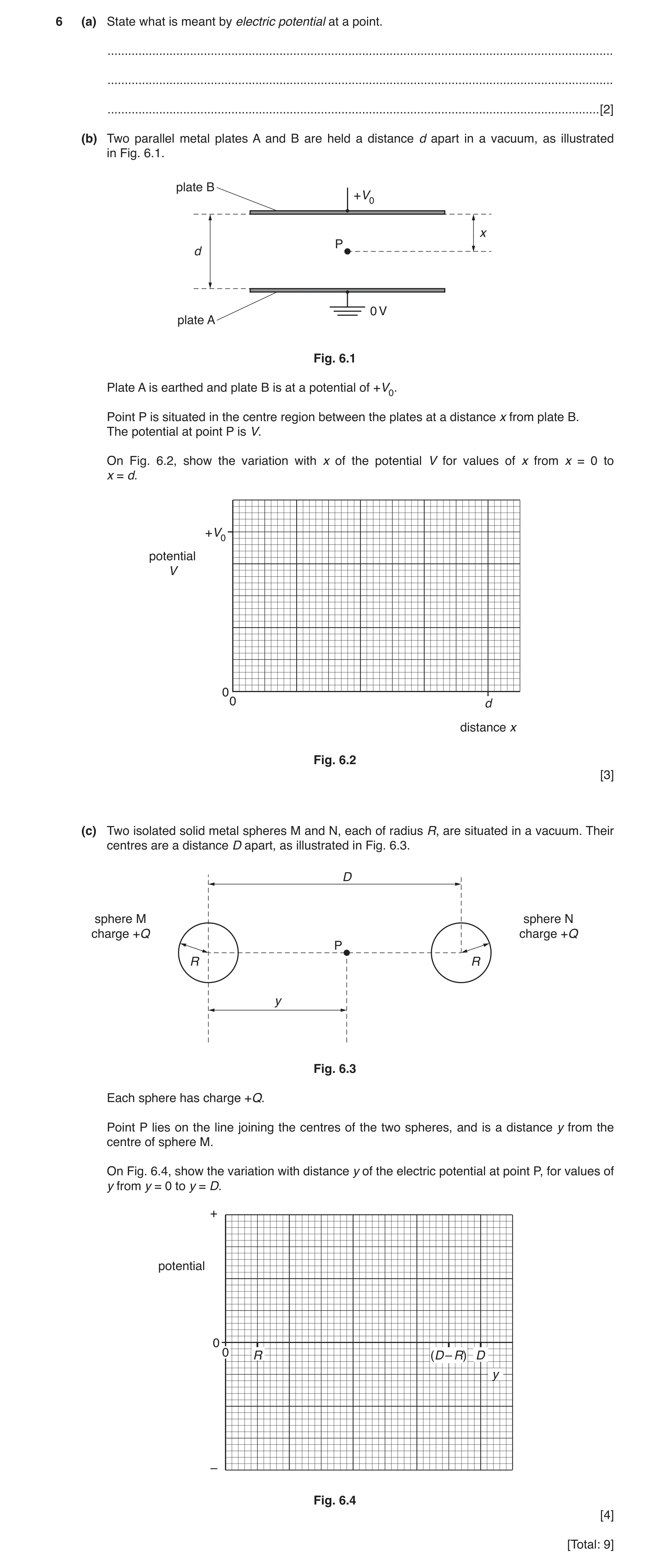
6 (a) State what is meant by electric potential at a point. … … … [2] (b) Two parallel metal plates A and B are held a distance d apart in a vacuum, as illustrated in Fig. 6.1. plate B +V0 x P d 0 V plate A Fig. 6.1 Plate A is earthed and plate B is at a potential of +V0. Point P is situated in the centre region between the plates at a distance x from plate B. The potential at point P is V. On Fig. 6.2, show the variation with x of the potential V for values of x from x = 0 to x = d. +V0 potential V 00 d distance x Fig. 6.2 [3] (c) Two isolated solid metal spheres M and N, each of radius R, are situated in a vacuum. Their centres are a distance D apart, as illustrated in Fig. 6.3. D sphere M sphere N charge +Q charge +Q P R R y Fig. 6.3 Each sphere has charge +Q. Point P lies on the line joining the centres of the two spheres, and is a distance y from the centre of sphere M. On Fig. 6.4, show the variation with distance y of the electric potential at point P, for values of y from y = 0 to y = D. + potential 0 0 R (D – R) D y – Fig. 6.4 [4] [Total: 9]
9 marks
Mark scheme: 6(a) work done per unit charge B1 (work done) moving positive charge from infinity B1 6(b) straight line with non-zero gradient from x = 0 to x = d B1 line with gradient of constant sign and end-points between which ∆V = V0 and ∆x = d B1 line passes through (d, 0) and (0, +V0) with negative gradient throughout B1 6(c) V constant (and non-zero) from 0 → R and from (D – R) → D B1 equal (non-zero) values of (magnitude of) V at R and (D – R). B1 curve (with a minimum) from R to (D – R) with V always positive B1 minimum at mid-point of curve B1
This question in 9702/42 May/June 2019
Q8 · Define what is meant by electric potential at a point 9702/42 Oct/Nov 2019
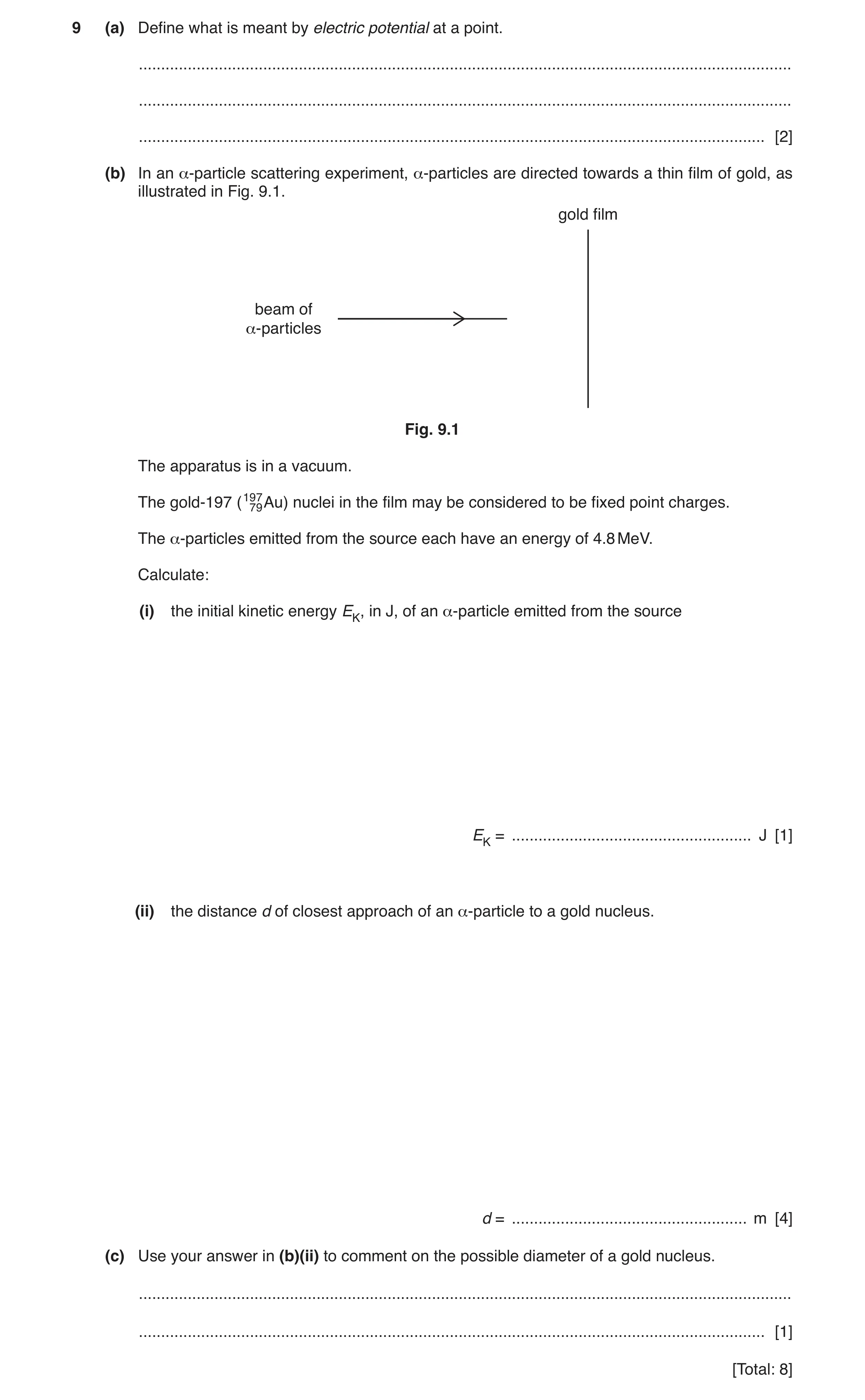
9 (a) Define what is meant by electric potential at a point. … … … [2] (b) In an α-particle scattering experiment, α-particles are directed towards a thin film of gold, as illustrated in Fig. 9.1. gold film beam of α-particles Fig. 9.1 The apparatus is in a vacuum. The gold-197 (19779 Au) nuclei in the film may be considered to be fixed point charges. The α-particles emitted from the source each have an energy of 4.8 MeV. Calculate: (i) the initial kinetic energy EK, in J, of an α-particle emitted from the source EK = … J [1] (ii) the distance d of closest approach of an α-particle to a gold nucleus. d = … m [4] (c) Use your answer in (b)(ii) to comment on the possible diameter of a gold nucleus. … … [1] [Total: 8]
8 marks
Mark scheme: 9(a) work done per unit charge B1 (work done) moving positive charge from infinity B1 9(b)(i) energy = 4.8 × 1.60 × 10–13 = 7.7 × 10⁻¹³ J A1 9(b)(ii) EP = Qq / 4πε0d C1 Q = 79e and q = 2e C1 7.68 × 10–13 = (79 × 2 × {1.60 × 10⁻¹⁹}2 / (4π × 8.85 × 10–12 × d) C1 d = 4.7 × 10⁻¹⁴ m A1 9(c) (diameter must be) less than/equal to 10–13 or 10–14 m B1
This question in 9702/42 Oct/Nov 2019
Q9 · Two positively charged identical metal spheres A and B have their centres separated by a… 9702/42 Feb/March 2020
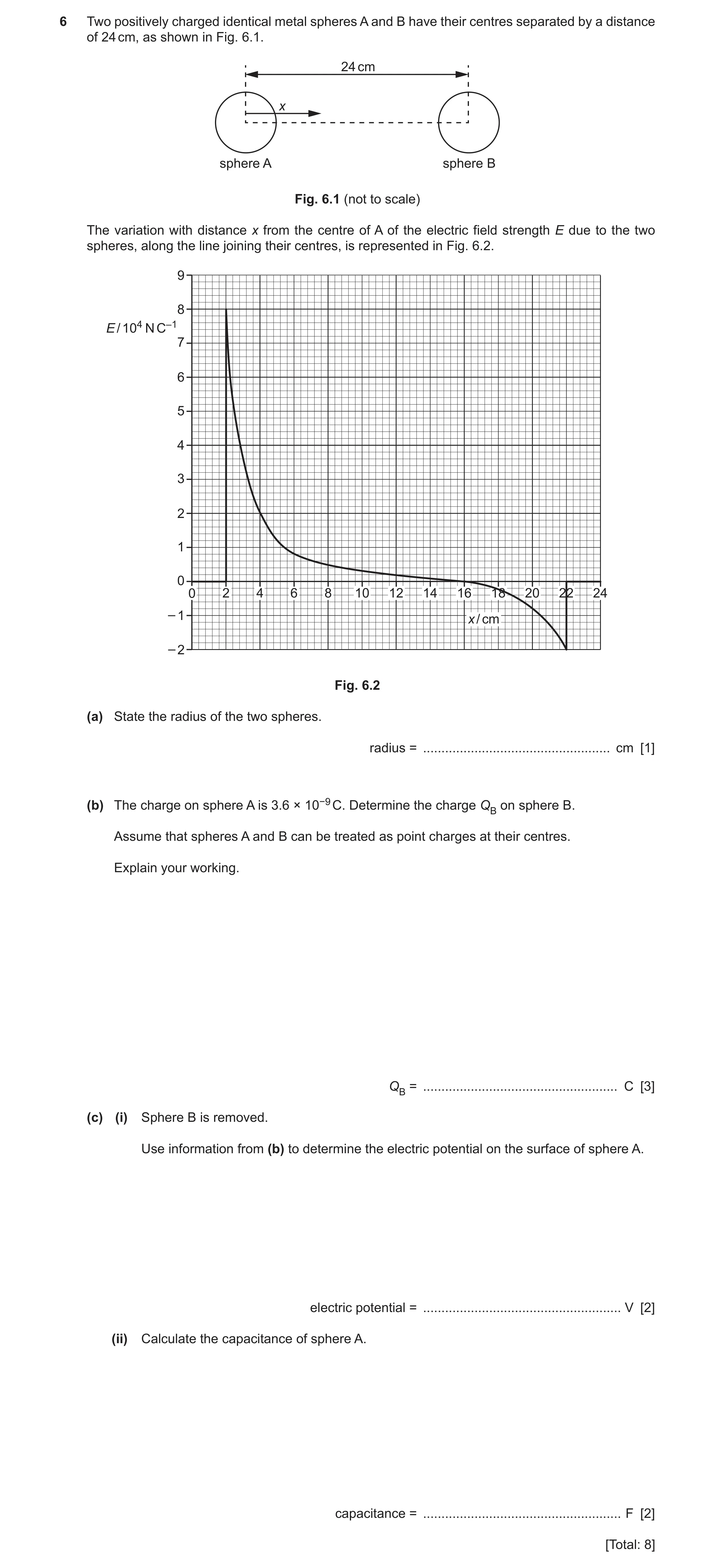
6 Two positively charged identical metal spheres A and B have their centres separated by a distance of 24 cm, as shown in Fig. 6.1. 24 cm x sphere A sphere B Fig. 6.1 (not to scale) The variation with distance x from the centre of A of the electric field strength E due to the two spheres, along the line joining their centres, is represented in Fig. 6.2. 9 8 E / 104 N C–1 7 6 5 4 3 2 1 0 0 2 4 6 8 10 12 14 16 18 20 22 24 – 1 x / cm – 2 Fig. 6.2 (a) State the radius of the two spheres. radius = … cm [1] (b) The charge on sphere A is 3.6 × 10⁻⁹ C. Determine the charge QB on sphere B. Assume that spheres A and B can be treated as point charges at their centres. Explain your working. QB = … C [3] (c) (i) Sphere B is removed. Use information from (b) to determine the electric potential on the surface of sphere A. electric potential = … V [2] (ii) Calculate the capacitance of sphere A. capacitance = … F [2] [Total: 8]
8 marks
Mark scheme: 6(a) 2.0 cm B1 6(b) At 16 (cm) from A the electric fields are equal or EA = EB B1 E = Q / 4πεor2 QA / (4πεorA2) = QB / (4πεorB2) 3.6 × 10⁻⁹ / 0.162 = QB / 0.082 C1 QB = 9.0 × 10⁻¹⁰ C A1 6(c)(i) V = Q / 4πεorA V = 3.6 × 10⁻⁹ / (4 × π × 8.85 × 10–12 × 0.020) C1 V = 1600 V A1 6(c)(ii) C = Q / V = 3.6 × 10⁻⁹ / 1600 C1 = 2.3 × 10⁻¹² F A1
This question in 9702/42 Feb/March 2020
Q10 · Define electric potential at a point 9702/41 Oct/Nov 2020
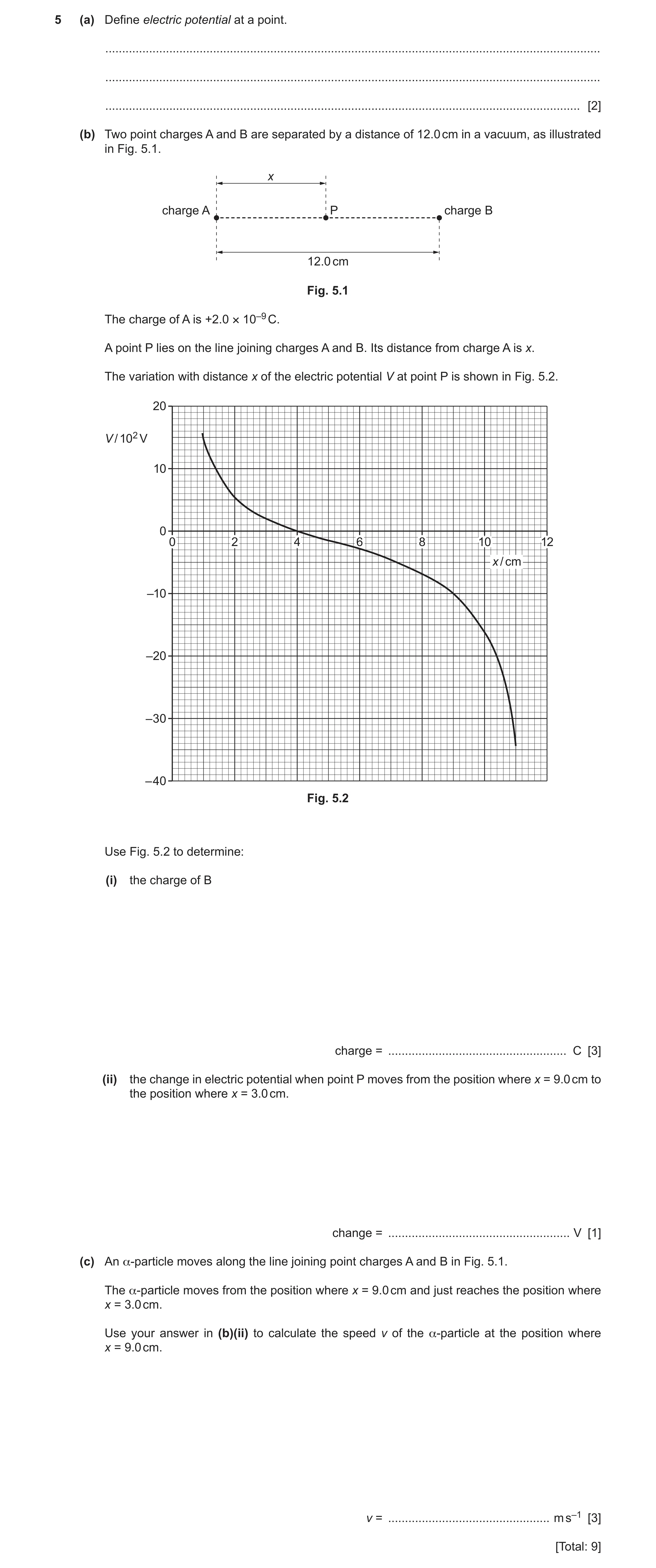
5 (a) Define electric potential at a point. … … … [2] (b) Two point charges A and B are separated by a distance of 12.0 cm in a vacuum, as illustrated in Fig. 5.1. x charge A P charge B 12.0 cm Fig. 5.1 The charge of A is +2.0 × 10⁻⁹ C. A point P lies on the line joining charges A and B. Its distance from charge A is x. The variation with distance x of the electric potential V at point P is shown in Fig. 5.2. 20 V / 102 V 10 0 0 2 4 6 8 10 12 x / cm –10 –20 –30 –40 Fig. 5.2 Use Fig. 5.2 to determine: (i) the charge of B charge = … C [3] (ii) the change in electric potential when point P moves from the position where x = 9.0 cm to the position where x = 3.0 cm. change = … V [1] (c) An α-particle moves along the line joining point charges A and B in Fig. 5.1. The α-particle moves from the position where x = 9.0 cm and just reaches the position where x = 3.0 cm. Use your answer in (b)(ii) to calculate the speed v of the α-particle at the position where x = 9.0 cm. v = … m s–1 [3] [Total: 9]
9 marks
Mark scheme: 5(a) work done per unit charge B1 (work done on charge) moving positive charge from infinity B1 5(b)(i) (2.0 × 10⁻⁹) / 4πε0(4.0 × 10⁻²) + Q / 4πε0(8.0 × 10⁻²) = 0 C1 Q = 4.0 × 10⁻⁹ C A1 Q given with negative sign B1 5(b)(ii) change = 1200 V A1 5(c) ½mv2 = qV C1 ½ × 4 × 1.66 × 10–27 × v2 = 2 × 1.60 × 10–19 × 1200 C1 v = 3.4 × 10⁵ m s–1 A1
This question in 9702/41 Oct/Nov 2020
Q11 · Define electric potential at a point 9702/43 Oct/Nov 2020
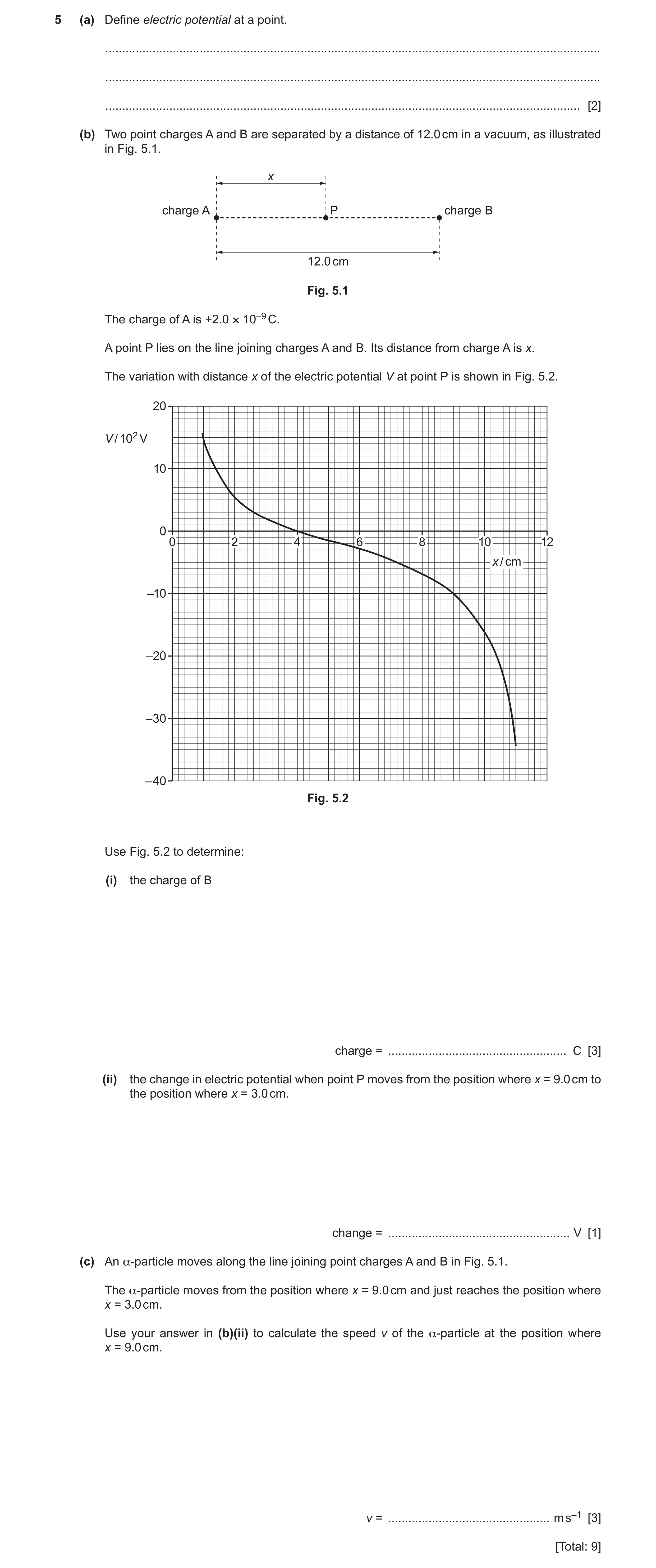
5 (a) Define electric potential at a point. … … … [2] (b) Two point charges A and B are separated by a distance of 12.0 cm in a vacuum, as illustrated in Fig. 5.1. x charge A P charge B 12.0 cm Fig. 5.1 The charge of A is +2.0 × 10⁻⁹ C. A point P lies on the line joining charges A and B. Its distance from charge A is x. The variation with distance x of the electric potential V at point P is shown in Fig. 5.2. 20 V / 102 V 10 0 0 2 4 6 8 10 12 x / cm –10 –20 –30 –40 Fig. 5.2 Use Fig. 5.2 to determine: (i) the charge of B charge = … C [3] (ii) the change in electric potential when point P moves from the position where x = 9.0 cm to the position where x = 3.0 cm. change = … V [1] (c) An α-particle moves along the line joining point charges A and B in Fig. 5.1. The α-particle moves from the position where x = 9.0 cm and just reaches the position where x = 3.0 cm. Use your answer in (b)(ii) to calculate the speed v of the α-particle at the position where x = 9.0 cm. v = … m s–1 [3] [Total: 9]
9 marks
Mark scheme: 5(a) work done per unit charge B1 (work done on charge) moving positive charge from infinity B1 5(b)(i) (2.0 × 10⁻⁹) / 4πε0(4.0 × 10⁻²) + Q / 4πε0(8.0 × 10⁻²) = 0 C1 Q = 4.0 × 10⁻⁹ C A1 Q given with negative sign B1 5(b)(ii) change = 1200 V A1 5(c) ½mv2 = qV C1 ½ × 4 × 1.66 × 10–27 × v2 = 2 × 1.60 × 10–19 × 1200 C1 v = 3.4 × 10⁵ m s–1 A1
This question in 9702/43 Oct/Nov 2020
Q12 · An isolated metal sphere of radius r is charged so that the electric potential at its… 9702/42 May/June 2021
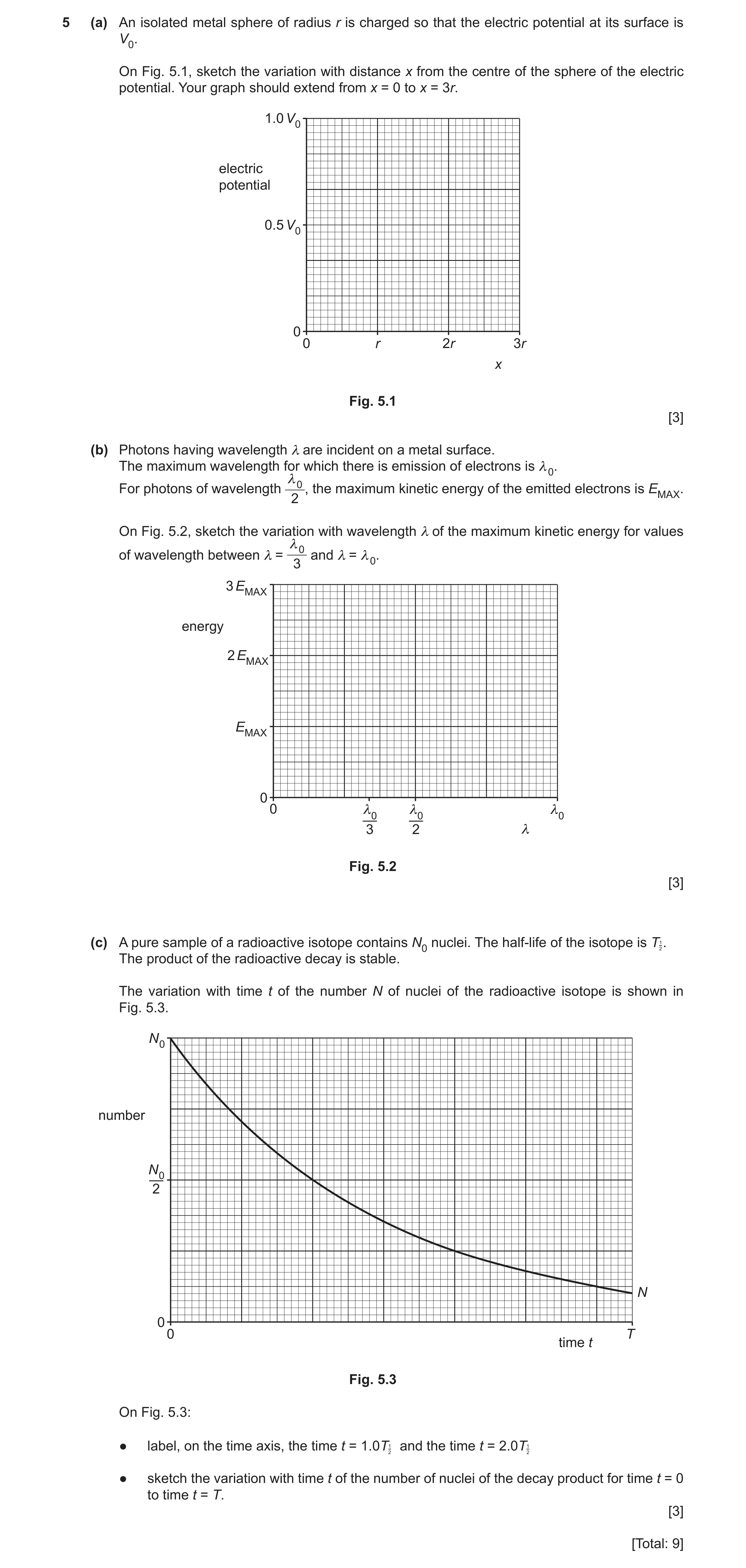
5 (a) An isolated metal sphere of radius r is charged so that the electric potential at its surface is V0. On Fig. 5.1, sketch the variation with distance x from the centre of the sphere of the electric potential. Your graph should extend from x = 0 to x = 3r. 1.0 V0 electric potential 0.5 V0 0 0 r 2r 3r x Fig. 5.1 [3] (b) Photons having wavelength λ are incident on a metal surface. The maximum wavelength for which there is emission of electrons is λ 0. λ 0 For photons of wavelength , the maximum kinetic energy of the emitted electrons is EMAX. 2 On Fig. 5.2, sketch the variation with wavelength λ of the maximum kinetic energy for values λ 0 of wavelength between λ = and λ = λ 0. 3 3 EMAX energy 2 EMAX EMAX 0 0 λ λ λ 0 0 0 3 2 λ Fig. 5.2 [3] (c) A pure sample of a radioactive isotope contains N0 nuclei. The half-life of the isotope is T12. The product of the radioactive decay is stable. The variation with time t of the number N of nuclei of the radioactive isotope is shown in Fig. 5.3. N0 number N0 2 N 0 0 T time t Fig. 5.3 On Fig. 5.3: ● label, on the time axis, the time t = 1.0T12 and the time t = 2.0T12 ● sketch the variation with time t of the number of nuclei of the decay product for time t = 0 to time t = T. [3] [Total: 9]
9 marks
Mark scheme: 5(a) from x = 0 to x = r: horizontal line at V = 1.0V0 B1 from x = r to x = 3r: curve with negative gradient of decreasing magnitude starting at (r, 1.0V0) B1 line passing through (2r, ½V0) and (3r, ⅓V0) B1 5(b) line with negative gradient from λ = ⅓λ0 to λ = λ0 B1 line passing through (λ0, 0) B1 curve with negative gradient of decreasing magnitude passing through (½λ0, EMAX) and (⅓λ0, 2EMAX) B1 5(c) 1.0T½ shown at ½N0 and 2.0T½ shown at ¼N0 B1 line starting at (0, 0) and reaching (T, N0–N) B1 line starting at (0, 0) and reaching original curve at (1.0T½, ½N0) B1
This question in 9702/42 May/June 2021
Question 13 9702/42 Oct/Nov 2021
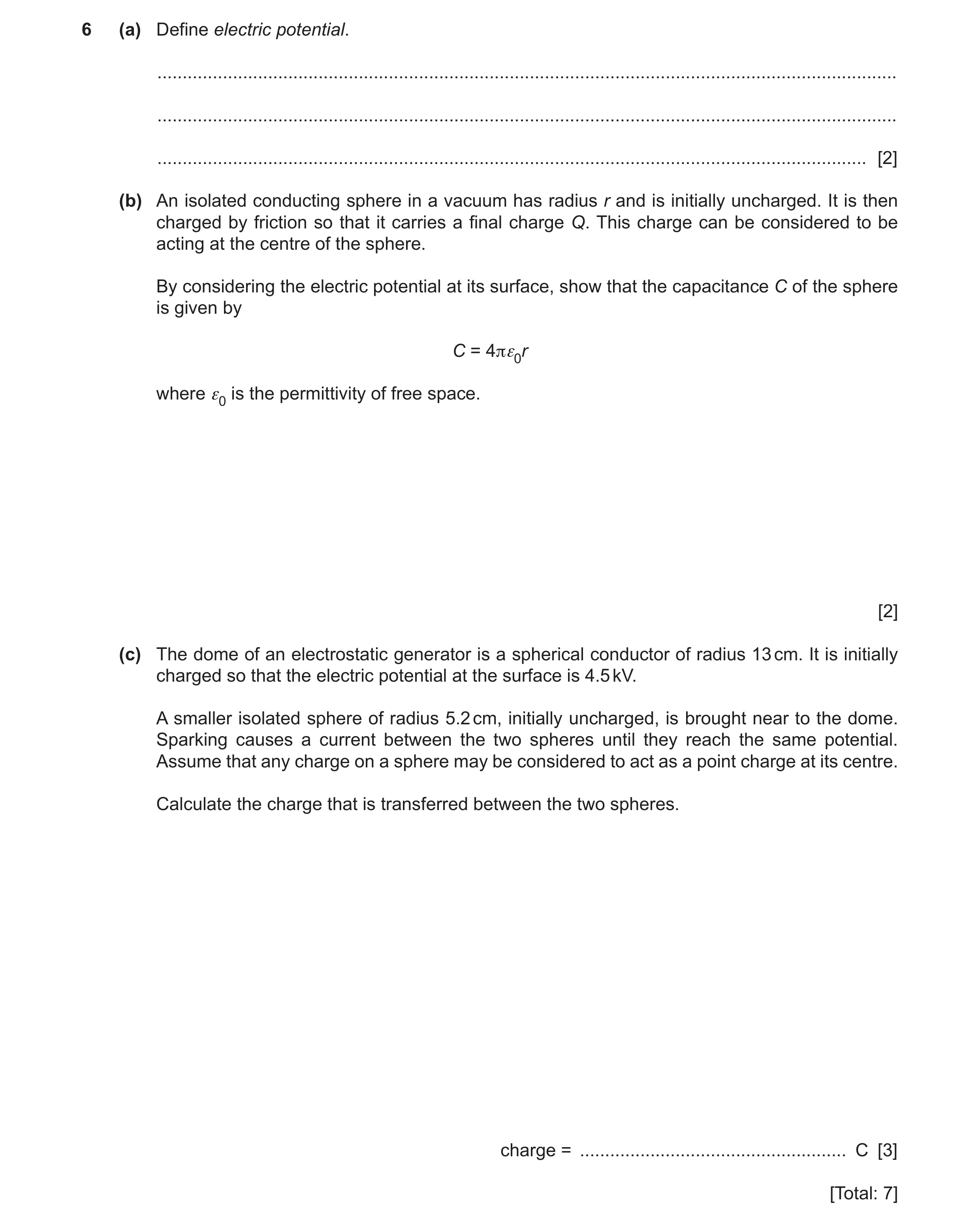
6 (a) Define electric potential. … … … [2] (b) An isolated conducting sphere in a vacuum has radius r and is initially uncharged. It is then charged by friction so that it carries a final charge Q. This charge can be considered to be acting at the centre of the sphere. By considering the electric potential at its surface, show that the capacitance C of the sphere is given by C = 4πε0r where ε0 is the permittivity of free space. [2] (c) The dome of an electrostatic generator is a spherical conductor of radius 13 cm. It is initially charged so that the electric potential at the surface is 4.5 kV. A smaller isolated sphere of radius 5.2 cm, initially uncharged, is brought near to the dome. Sparking causes a current between the two spheres until they reach the same potential. Assume that any charge on a sphere may be considered to act as a point charge at its centre. Calculate the charge that is transferred between the two spheres. charge = … C [3] [Total: 7]
7 marks
Mark scheme: 6(a) work done per unit charge B1 (work done in) moving positive charge from infinity B1 6(b) C = Q / V C1 V = Q / (4πε0r) and so C = Q / [Q / (4πε0r)] = 4πε0r A1 6(c) Q = 4πε0rV = 4π × 8.85 × 10–12 × 0.13 × 4500 ( = 6.5 × 10⁻⁸ C) C1 (Q – q) / 13 = q / 5.2 C1 5.2Q – 5.2q = 13q, so q = (5.2 / 18.2)Q q = (5.2 / 18.2) × 6.5 × 10–8 = 1.9 × 10⁻⁸ C A1 or VT = QT / CT = 6.5 × 10⁻⁸ / [4π × 8.85 × 10–12 × (0.13 + 0.052)] ( = 3210 V) (C1) q = 4π × 8.85 × 10–12 × 0.052 × 3210 = 1.9 × 10⁻⁸ C (A1)
This question in 9702/42 Oct/Nov 2021
Q14 · State what is represented by an electric field line 9702/42 Feb/March 2022
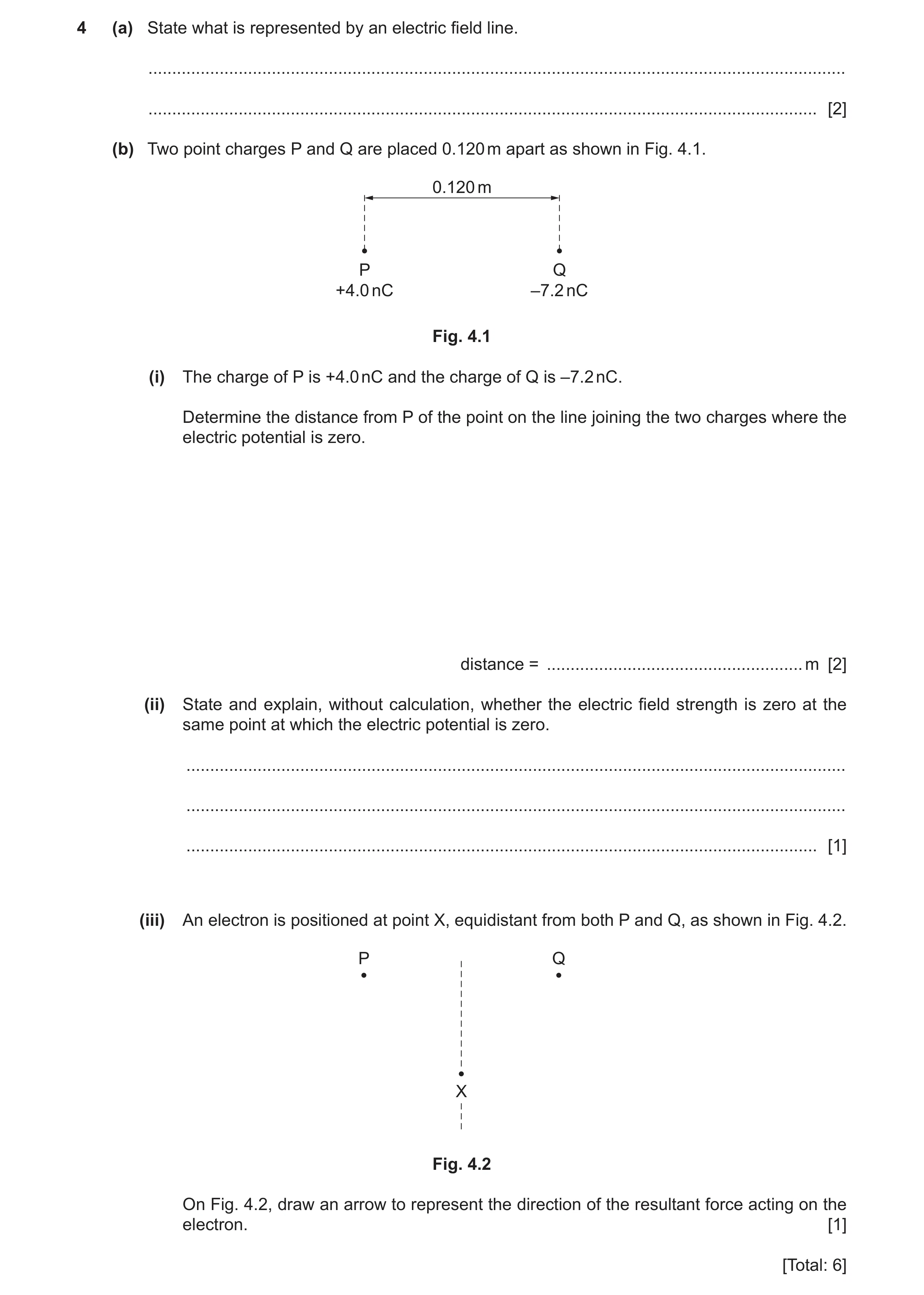
4 (a) State what is represented by an electric field line. … … [2] (b) Two point charges P and Q are placed 0.120 m apart as shown in Fig. 4.1. 0.120 m P Q +4.0 nC –7.2 nC Fig. 4.1 (i) The charge of P is +4.0 nC and the charge of Q is –7.2 nC. Determine the distance from P of the point on the line joining the two charges where the electric potential is zero. distance = … m [2] (ii) State and explain, without calculation, whether the electric field strength is zero at the same point at which the electric potential is zero. … … … [1] (iii) An electron is positioned at point X, equidistant from both P and Q, as shown in Fig. 4.2. P Q X Fig. 4.2 On Fig. 4.2, draw an arrow to represent the direction of the resultant force acting on the electron. [1] [Total: 6]
6 marks
Mark scheme: 4(a) direction of force B1 force on a positive charge B1 4(b)(i) o Q V = 4 r πε 9 9 o o 4.0 10 7.2 10 + = 0 4 x 4 (0.120 x) − − × − × πε πε − ( ) 4 0.120 x = 7.2 x − C1 x = 0.043 m A1 4(b)(ii) fields are in the same direction so no B1 4(b)(iii) straight arrow drawn leftwards from X in direction between extended line joining Q and X and the horizontal B1
This question in 9702/42 Feb/March 2022
Q15 · Define electric potential at a point 9702/42 Oct/Nov 2022
5 (a) Define electric potential at a point. … … … [2] (b) An isolated conducting sphere is charged. Fig. 5.1 shows the variation of the potential V due to the sphere with displacement x from its centre. 0 – 0.3 – 0.2 – 0.1 0 0.1 0.2 0.3 x / m – 250 V / V – 500 – 750 – 1000 Fig. 5.1 Use Fig. 5.1 to determine: (i) the radius of the sphere radius = … m [1] (ii) the charge on the sphere. charge = … C [2] (c) Two spheres are identical to the sphere in (b). Each sphere has the same charge as the sphere in (b). The spheres are held in a vacuum so that their centres are separated by a distance of 0.46 m. Assume that the charge on each sphere is a point charge at the centre of the sphere. (i) Calculate the electric potential energy EP of the two spheres. EP = … J [2] (ii) The two spheres are now released simultaneously so that they are free to move. Describe and explain the subsequent motion of the spheres. … … … … [3] [Total: 10]
10 marks
Mark scheme: 5(a) work done per unit charge B1 work done (on charge) in moving positive charge from infinity (to the point) B1 5(b)(i) radius = 0.060 m A1 5(b)(ii) V = Q / 40x C1 Q = (–) 850 4 8.85 10–12 0.060 or Q = (–) 850 0.060 / 8.99 109 (any correct pair of V and x values from curve) Q = – 5.7 10–9 C A1 5(c)(i) EP = Q2 / 40x C1 = (5.67 10–9)2 / (4 8.85 10–12 0.46) = 6.3 10–7 J A1 5(c)(ii) • force is repulsive so spheres move apart B3 • force in direction of motion so speed increases • potential energy converted to kinetic energy so speed increases • force decreases with distance so acceleration decreases • momentum is conserved (at zero) (and masses are equal) so velocities are always equal and opposite Any three points, 1 mark each
This question in 9702/42 Oct/Nov 2022
Q16 · Define electric potential at a point 9702/41 Oct/Nov 2023
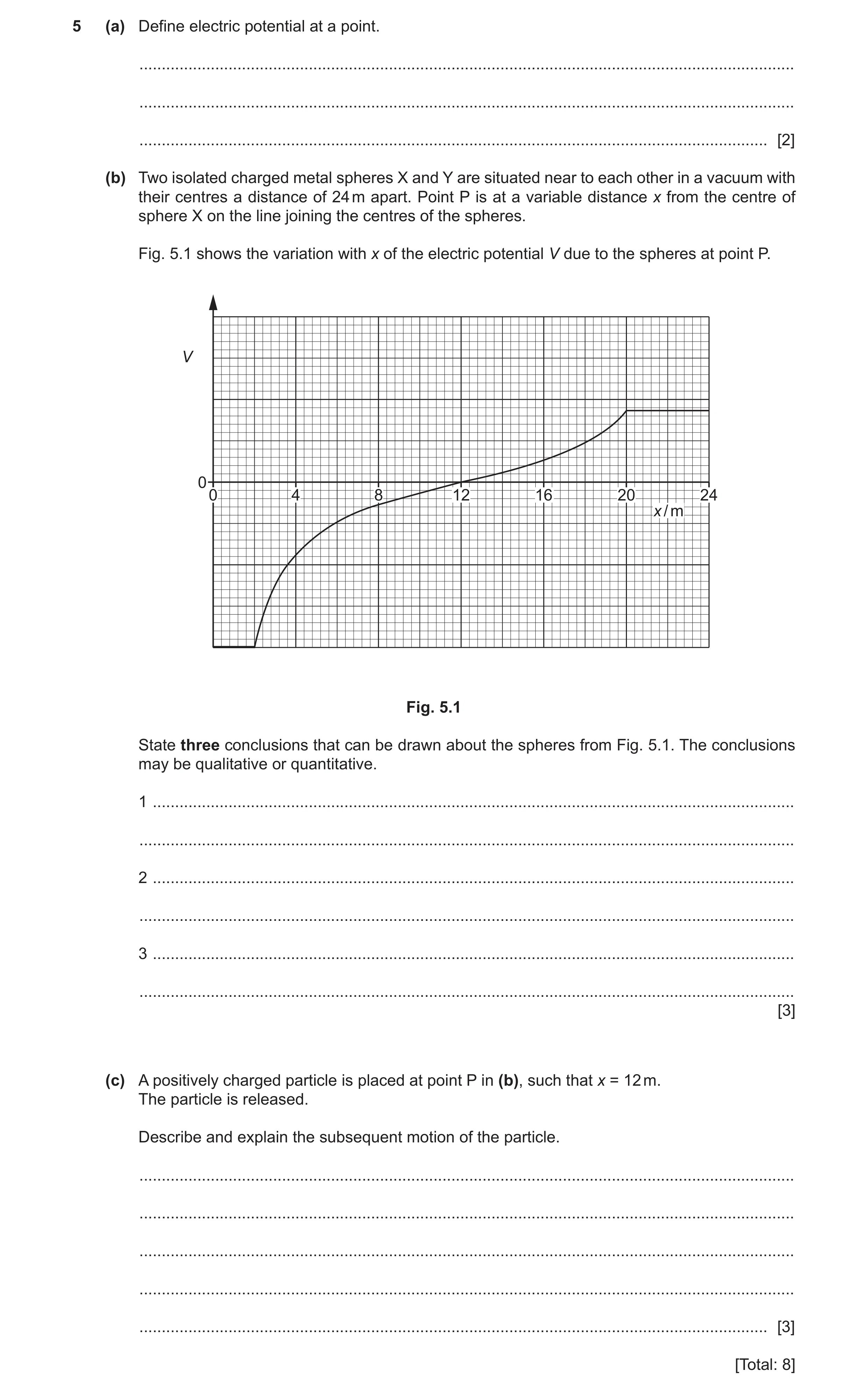
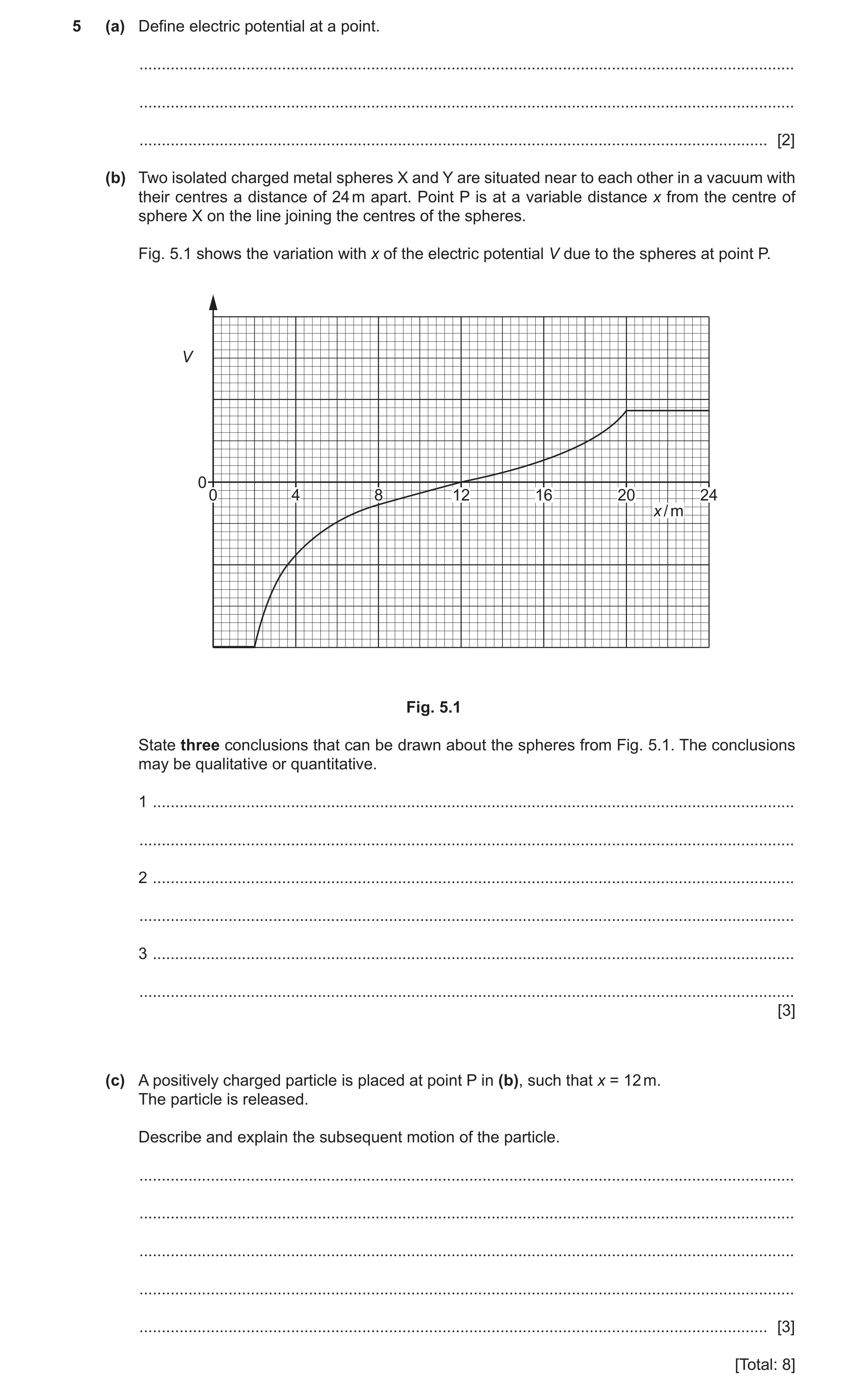
5 (a) Define electric potential at a point. … … … [2] (b) Two isolated charged metal spheres X and Y are situated near to each other in a vacuum with their centres a distance of 24 m apart. Point P is at a variable distance x from the centre of sphere X on the line joining the centres of the spheres. Fig. 5.1 shows the variation with x of the electric potential V due to the spheres at point P. V 0 0 4 8 12 16 20 24 x / m Fig. 5.1 State three conclusions that can be drawn about the spheres from Fig. 5.1. The conclusions may be qualitative or quantitative. 1 … … 2 … … 3 … … [3] (c) A positively charged particle is placed at point P in (b), such that x = 12 m. The particle is released. Describe and explain the subsequent motion of the particle. … … … … … [3] [Total: 8]
8 marks
Mark scheme: 5(a) work done per unit charge B1 work (done on charge) moving positive charge from infinity (to the point) B1 5(b) Any three points from: B3 Up to 2 points from: • radius of sphere X is 2.0 m • radius of sphere Y is 4.0 m • radius of Y is double the radius of X Up to 2 points from: • charge on X is negative • charge on Y is positive • spheres carry opposite charges Up to 1 point from: • magnitudes of charges on the spheres are equal 5(c) particle is attracted to X or repelled from Y B1 or resultant force on particle is towards X / away from Y / to the left particle accelerates towards X / away from Y / to the left B1 (magnitude of) acceleration of particle increases B1
This question in 9702/41 Oct/Nov 2023
Q17 · Define electric potential at a point 9702/43 Oct/Nov 2023
5 (a) Define electric potential at a point. … … … [2] (b) Two isolated charged metal spheres X and Y are situated near to each other in a vacuum with their centres a distance of 24 m apart. Point P is at a variable distance x from the centre of sphere X on the line joining the centres of the spheres. Fig. 5.1 shows the variation with x of the electric potential V due to the spheres at point P. V 0 0 4 8 12 16 20 24 x / m Fig. 5.1 State three conclusions that can be drawn about the spheres from Fig. 5.1. The conclusions may be qualitative or quantitative. 1 … … 2 … … 3 … … [3] (c) A positively charged particle is placed at point P in (b), such that x = 12 m. The particle is released. Describe and explain the subsequent motion of the particle. … … … … … [3] [Total: 8]
8 marks
Mark scheme: 5(a) work done per unit charge B1 work (done on charge) moving positive charge from infinity (to the point) B1 5(b) Any three points from: B3 Up to 2 points from: • radius of sphere X is 2.0 m • radius of sphere Y is 4.0 m • radius of Y is double the radius of X Up to 2 points from: • charge on X is negative • charge on Y is positive • spheres carry opposite charges Up to 1 point from: • magnitudes of charges on the spheres are equal 5(c) particle is attracted to X or repelled from Y B1 or resultant force on particle is towards X / away from Y / to the left particle accelerates towards X / away from Y / to the left B1 (magnitude of) acceleration of particle increases B1
This question in 9702/43 Oct/Nov 2023
Q18 · Define electric potential at a point 9702/42 May/June 2024
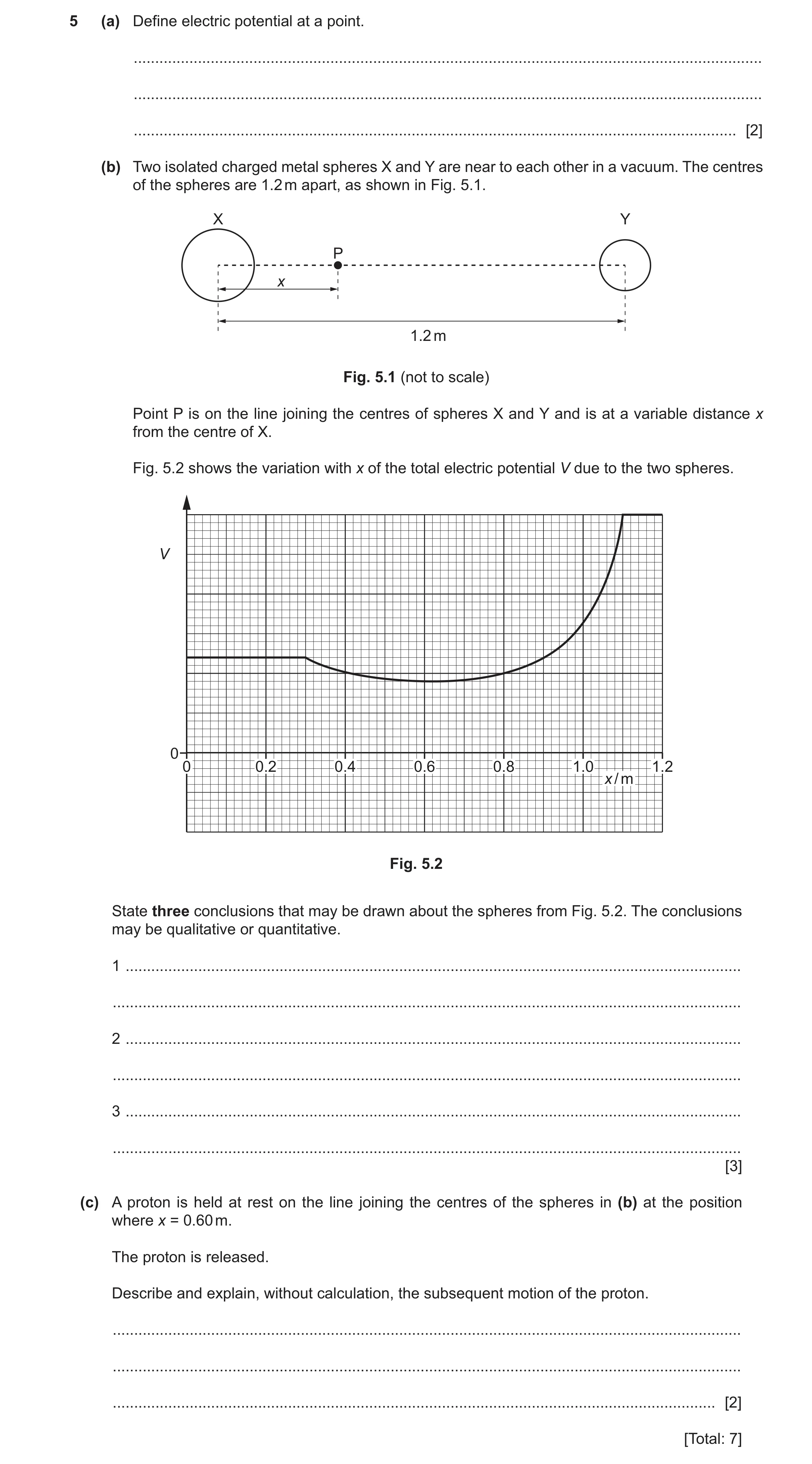
5 (a) Define electric potential at a point. … … … [2] (b) Two isolated charged metal spheres X and Y are near to each other in a vacuum. The centres of the spheres are 1.2 m apart, as shown in Fig. 5.1. X Y P x 1.2 m Fig. 5.1 (not to scale) Point P is on the line joining the centres of spheres X and Y and is at a variable distance x from the centre of X. Fig. 5.2 shows the variation with x of the total electric potential V due to the two spheres. V 0 0 0.2 0.4 0.6 0.8 1.0 1.2 x / m Fig. 5.2 State three conclusions that may be drawn about the spheres from Fig. 5.2. The conclusions may be qualitative or quantitative. 1 … … 2 … … 3 … … [3] (c) A proton is held at rest on the line joining the centres of the spheres in (b) at the position where x = 0.60 m. The proton is released. Describe and explain, without calculation, the subsequent motion of the proton. … … … [2] [Total: 7]
7 marks
Mark scheme: 5(a) work done per unit charge B1 work (done) moving positive charge from infinity (to the point) B1 5(b) Any three points from: Up to 2 points from: radius of sphere X is 0.30 m radius of sphere Y is 0.10 m radius of X is treble the radius of Y Up to 2 points from: charge on X is positive charge on Y is positive spheres X and Y carry charges of the same sign Up to 1 point from: (magnitudes of) charges on the spheres are equal charges on the spheres have the same magnitude B3 5(c) proton remains at rest (in the position of release) M1 potential energy of proton is (already) at its minimum or (electric) forces (from spheres) on proton are equal and opposite or no resultant (electric) force on proton or resultant electric field strength (at proton) is zero A1
This question in 9702/42 May/June 2024
Q19 · State the relationship between electric field and electric potential 9702/41 Oct/Nov 2024
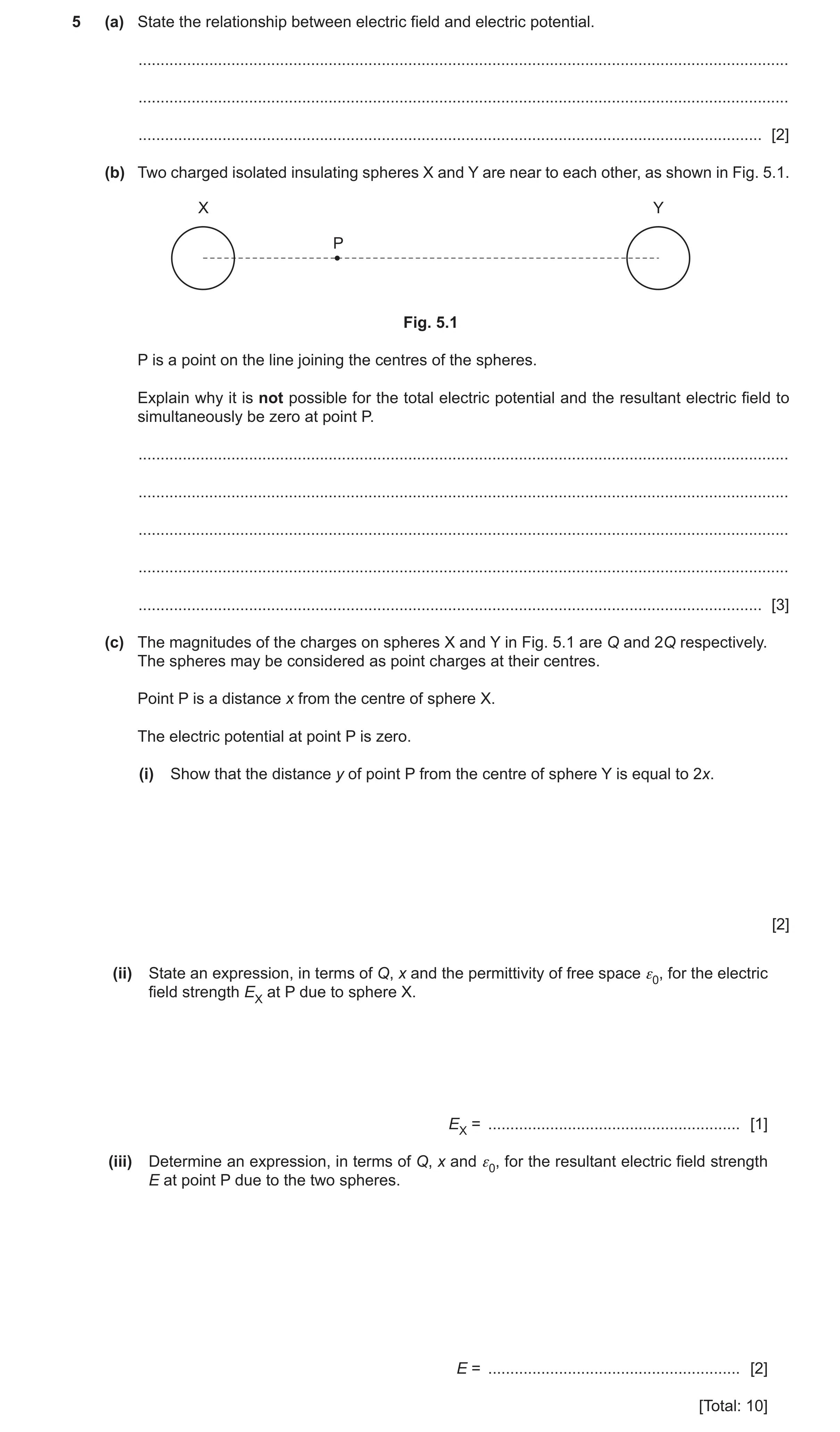
5 (a) State the relationship between electric field and electric potential. … … … [2] (b) Two charged isolated insulating spheres X and Y are near to each other, as shown in Fig. 5.1. X Y P Fig. 5.1 P is a point on the line joining the centres of the spheres. Explain why it is not possible for the total electric potential and the resultant electric field to simultaneously be zero at point P. … … … … … [3] (c) The magnitudes of the charges on spheres X and Y in Fig. 5.1 are Q and 2Q respectively. The spheres may be considered as point charges at their centres. Point P is a distance x from the centre of sphere X. The electric potential at point P is zero. (i) Show that the distance y of point P from the centre of sphere Y is equal to 2x. [2] (ii) State an expression, in terms of Q, x and the permittivity of free space ε0, for the electric field strength EX at P due to sphere X. EX = … [1] (iii) Determine an expression, in terms of Q, x and ε0, for the resultant electric field strength E at point P due to the two spheres. E = … [2] [Total: 10]
10 marks
Mark scheme: 5(a) (electric) field equals (electric) potential gradient M1 reference to minus sign A1 5(b) • for potential to be zero, one potential must be positive and the other potential must be negative B3 • for potential to be zero, the charges must have opposite sign • for field to be zero, the fields (due to X and Y) must be in opposite directions • for field to be zero, the charges must have the same sign • the signs of the charges cannot (simultaneously) be both the same and opposite (so not possible) Any three points, 1 mark each 5(c)(i) VX = (–) Q / 4ε0x and VY = (–) 2Q / 4ε0y C1 (VX + VY = 0 so) Q / 4ε0x = 2Q / 4ε0y leading to y = 2x A1 5(c)(ii) EX = Q / 4ε0x2 A1 5(c)(iii) EY = 2Q / 4ε0(2x)2 C1 ( = Q / 8ε0x2) (opposite charges so fields in same direction so magnitudes add): A1 E = (Q / 4ε0x2) + (Q / 8ε0x2) = 3Q / 8ε0x2
This question in 9702/41 Oct/Nov 2024
Q20 · State the relationship between electric field and electric potential 9702/43 Oct/Nov 2024
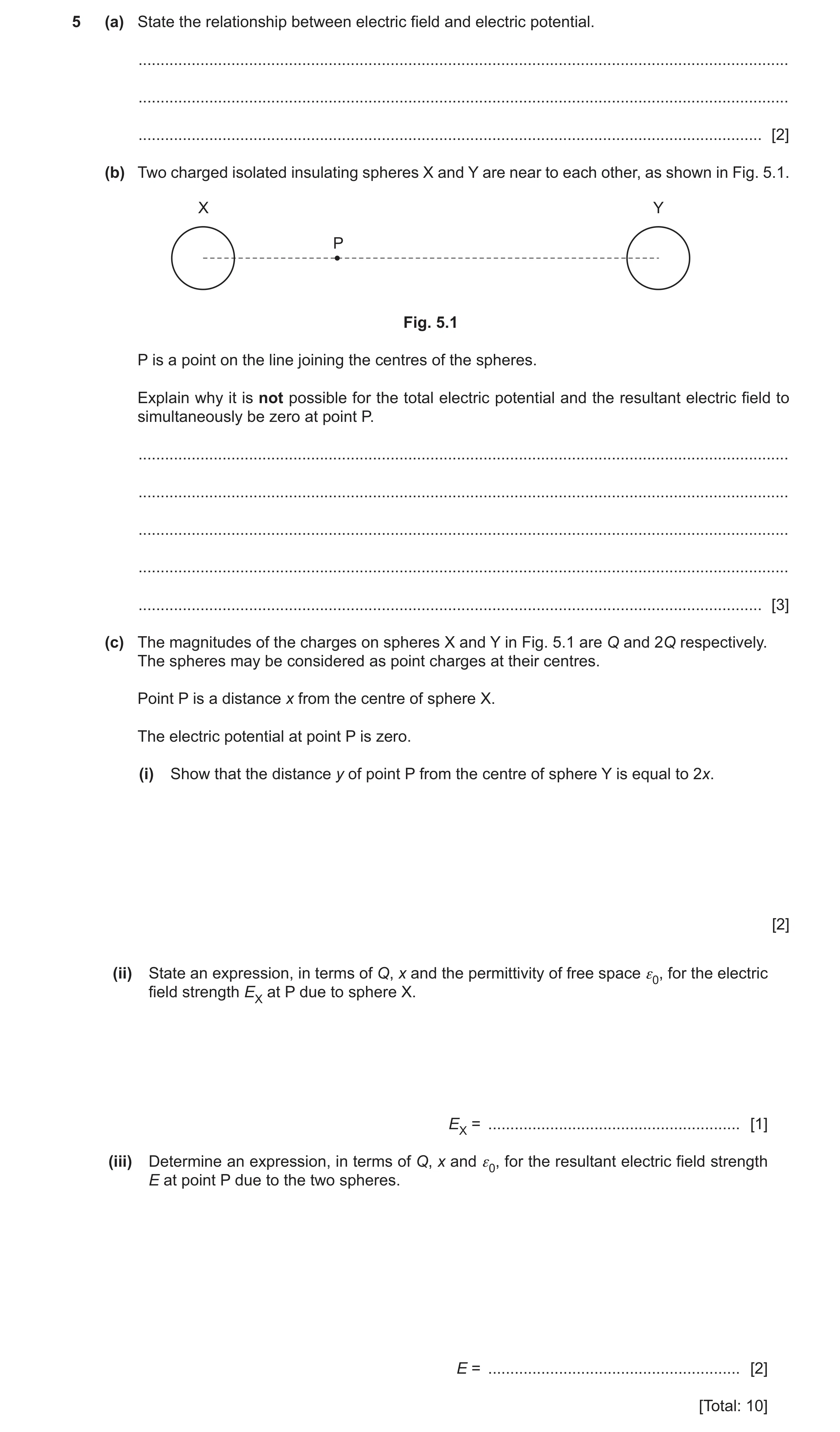
5 (a) State the relationship between electric field and electric potential. … … … [2] (b) Two charged isolated insulating spheres X and Y are near to each other, as shown in Fig. 5.1. X Y P Fig. 5.1 P is a point on the line joining the centres of the spheres. Explain why it is not possible for the total electric potential and the resultant electric field to simultaneously be zero at point P. … … … … … [3] (c) The magnitudes of the charges on spheres X and Y in Fig. 5.1 are Q and 2Q respectively. The spheres may be considered as point charges at their centres. Point P is a distance x from the centre of sphere X. The electric potential at point P is zero. (i) Show that the distance y of point P from the centre of sphere Y is equal to 2x. [2] (ii) State an expression, in terms of Q, x and the permittivity of free space ε0, for the electric field strength EX at P due to sphere X. EX = … [1] (iii) Determine an expression, in terms of Q, x and ε0, for the resultant electric field strength E at point P due to the two spheres. E = … [2] [Total: 10]
10 marks
Mark scheme: 5(a) (electric) field equals (electric) potential gradient M1 reference to minus sign A1 5(b) • for potential to be zero, one potential must be positive and the other potential must be negative B3 • for potential to be zero, the charges must have opposite sign • for field to be zero, the fields (due to X and Y) must be in opposite directions • for field to be zero, the charges must have the same sign • the signs of the charges cannot (simultaneously) be both the same and opposite (so not possible) Any three points, 1 mark each 5(c)(i) VX = (–) Q / 4ε0x and VY = (–) 2Q / 4ε0y C1 (VX + VY = 0 so) Q / 4ε0x = 2Q / 4ε0y leading to y = 2x A1 5(c)(ii) EX = Q / 4ε0x2 A1 5(c)(iii) EY = 2Q / 4ε0(2x)2 C1 ( = Q / 8ε0x2) (opposite charges so fields in same direction so magnitudes add): A1 E = (Q / 4ε0x2) + (Q / 8ε0x2) = 3Q / 8ε0x2
This question in 9702/43 Oct/Nov 2024
Q21 · Define electric potential at a point 9702/44 May/June 2025
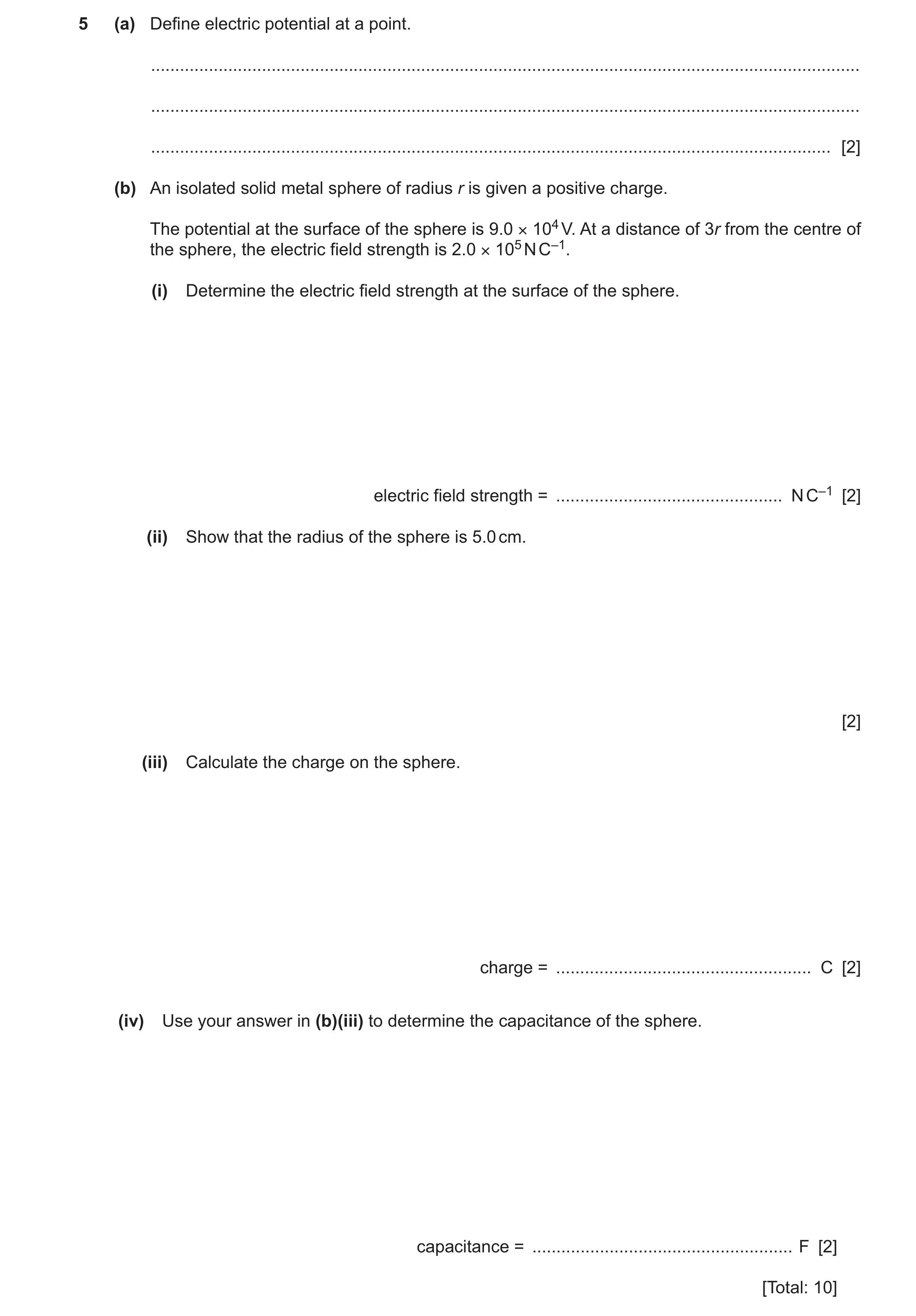
5 (a) Define electric potential at a point. … … … [2] (b) An isolated solid metal sphere of radius r is given a positive charge. The potential at the surface of the sphere is 9.0 × 10⁴ V. At a distance of 3r from the centre of the sphere, the electric field strength is 2.0 × 10⁵ N C–1. (i) Determine the electric field strength at the surface of the sphere. electric field strength = … N C–1 [2] (ii) Show that the radius of the sphere is 5.0 cm. [2] (iii) Calculate the charge on the sphere. charge = … C [2] (iv) Use your answer in (b)(iii) to determine the capacitance of the sphere. capacitance = … F [2] [Total: 10]
10 marks
Mark scheme: 5(a) work done per unit charge B1 work done (on charge) in moving positive charge from infinity (to the point) B1 5(b)(i) electric field strength inversely proportional to distance2 C1 E = 32 2.0 105 A1 = 1.8 106 N C–1 5(b)(ii) V = Q / 40r and E = Q / 40r2 (so E = V / r) B1 r = (9.0 104) / (1.8 106) = 0.050 m = 5.0 cm A1 5(b)(iii) Q = 40Vr C1 = 4 8.85 10–12 9.0 104 0.050 = 5.0 10–7 C A1 5(b)(iv) C = Q / V C1 = (5.0 10–7) / (9.0 104) A1 = 5.6 10–12 F
This question in 9702/44 May/June 2025
Q22 · Define electric potential at a point 9702/41 Oct/Nov 2025
5 (a) Define electric potential at a point. … … … [2] (b) A hydrogen atom may be considered to consist of a proton and an electron separated by a distance of 120 pm, as shown in Fig. 5.1. proton P electron x 120 pm Fig. 5.1 The two particles may be considered as point charges. Point P lies on the line joining the electron and the proton and is at a variable distance x from the proton. (i) Show that the electric potential V at point P when x = 10 pm is equal to 130 V. [2] (ii) Calculate, to two significant figures, V when x = 30 pm. V = … V [2] (iii) On Fig. 5.1, draw a cross (×) at one position, other than infinity, where the electric potential is zero. [1] (iv) On Fig. 5.2, sketch the variation of V with x between x = 10 pm and x = 110 pm. 160 V / V 80 0 10 30 50 70 90 110 x / pm –80 –160 Fig. 5.2 [3] [Total: 10]
10 marks
Mark scheme: 5(a) work done per unit charge B1 work (done) moving positive charge from infinity (to the point) B1 5(b)(i) potential (due to proton) = (1.60 10–19) / (4 8.85 10–12 10 10–12) C1 or potential (due to electron) = (–1.60 10–19) / (4 8.85 10–12 110 10–12) V = [(1.60 10–19) / (4 8.85 10–12)] [(10–1 – 110–1) 1012] = 130 V A1 5(b)(ii) V = [(1.60 10–19) / (4 8.85 10–12)] [(30–1 – 90–1) 1012] C1 = (+) 32 V A1 5(b)(iii) cross drawn midway between the electron and the proton B1 5(b)(iv) line from (10, +130) to (110, –130) B1 curve getting shallower until x = 60 pm, crossing V = 0 at (60, 0) and then getting steeper after x = 60 pm B1 curve passing through (30, ±32) and (90, ±32) B1
This question in 9702/41 Oct/Nov 2025
Q23 · Define electric potential at a point 9702/43 Oct/Nov 2025
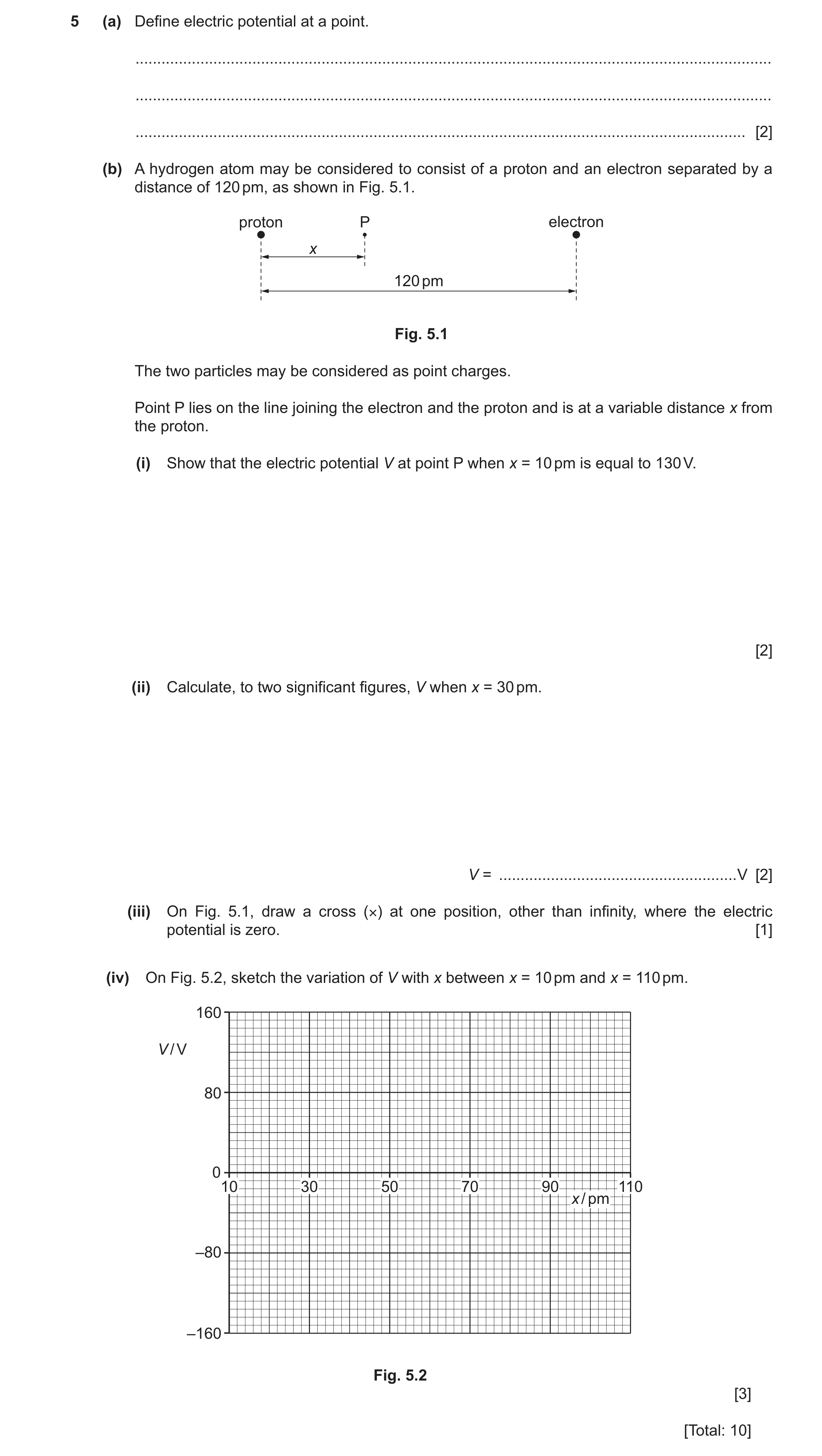
5 (a) Define electric potential at a point. … … … [2] (b) A hydrogen atom may be considered to consist of a proton and an electron separated by a distance of 120 pm, as shown in Fig. 5.1. proton P electron x 120 pm Fig. 5.1 The two particles may be considered as point charges. Point P lies on the line joining the electron and the proton and is at a variable distance x from the proton. (i) Show that the electric potential V at point P when x = 10 pm is equal to 130 V. [2] (ii) Calculate, to two significant figures, V when x = 30 pm. V = … V [2] (iii) On Fig. 5.1, draw a cross (×) at one position, other than infinity, where the electric potential is zero. [1] (iv) On Fig. 5.2, sketch the variation of V with x between x = 10 pm and x = 110 pm. 160 V / V 80 0 10 30 50 70 90 110 x / pm –80 –160 Fig. 5.2 [3] [Total: 10]
10 marks
Mark scheme: 5(a) work done per unit charge B1 work (done) moving positive charge from infinity (to the point) B1 5(b)(i) potential (due to proton) = (1.60 10–19) / (4 8.85 10–12 10 10–12) C1 or potential (due to electron) = (–1.60 10–19) / (4 8.85 10–12 110 10–12) V = [(1.60 10–19) / (4 8.85 10–12)] [(10–1 – 110–1) 1012] = 130 V A1 5(b)(ii) V = [(1.60 10–19) / (4 8.85 10–12)] [(30–1 – 90–1) 1012] C1 = (+) 32 V A1 5(b)(iii) cross drawn midway between the electron and the proton B1 5(b)(iv) line from (10, +130) to (110, –130) B1 curve getting shallower until x = 60 pm, crossing V = 0 at (60, 0) and then getting steeper after x = 60 pm B1 curve passing through (30, ±32) and (90, ±32) B1
This question in 9702/43 Oct/Nov 2025
Q24 · Explain why the electric potential near an isolated proton is positive 9702/44 Oct/Nov 2025
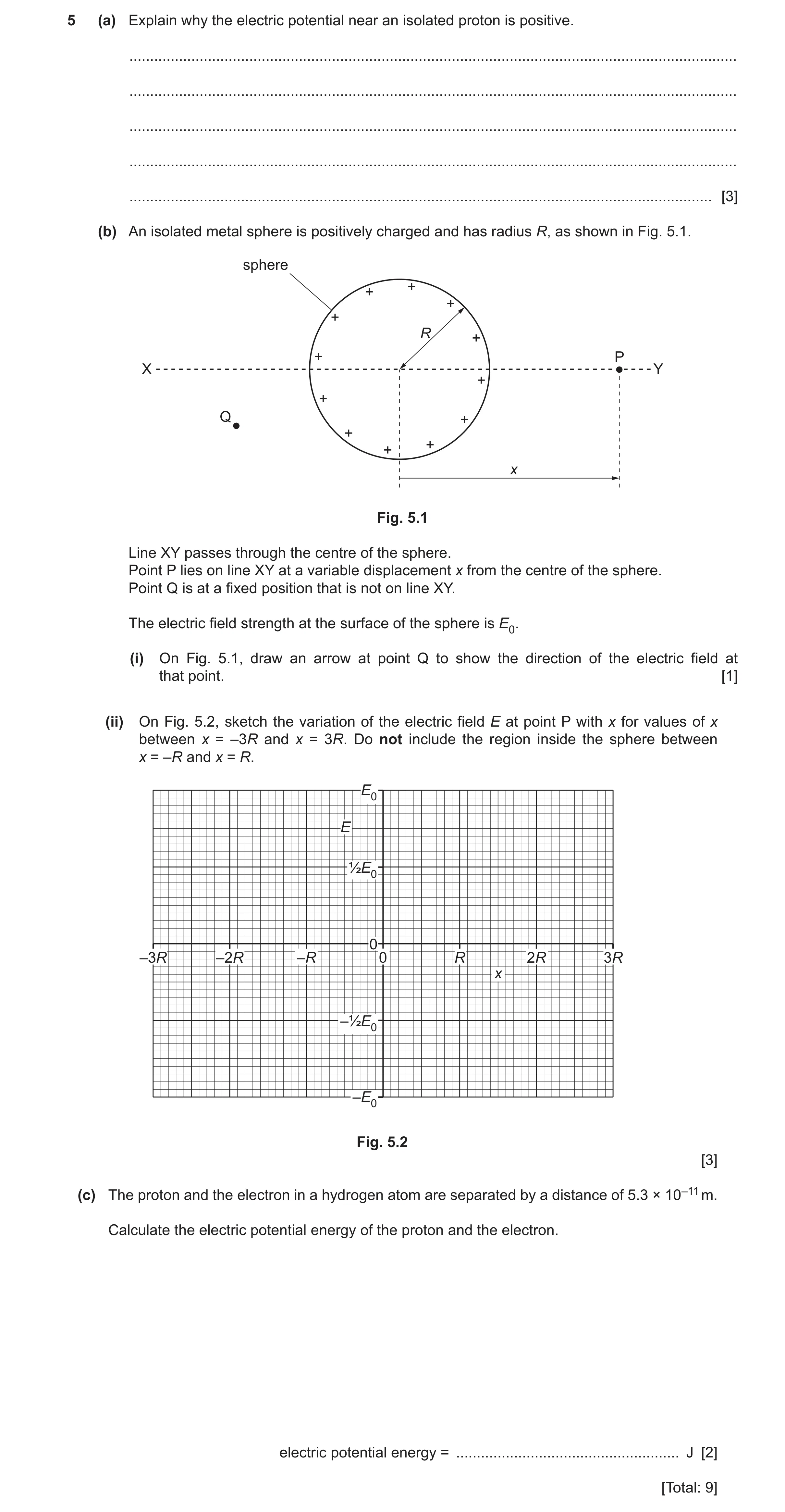
5 (a) Explain why the electric potential near an isolated proton is positive. … … … … … [3] (b) An isolated metal sphere is positively charged and has radius R, as shown in Fig. 5.1. sphere + + + + R + + P X Y + + Q + + + + x Fig. 5.1 Line XY passes through the centre of the sphere. Point P lies on line XY at a variable displacement x from the centre of the sphere. Point Q is at a fixed position that is not on line XY. The electric field strength at the surface of the sphere is E0. (i) On Fig. 5.1, draw an arrow at point Q to show the direction of the electric field at that point. [1] (ii) On Fig. 5.2, sketch the variation of the electric field E at point P with x for values of x between x = –3R and x = 3R. Do not include the region inside the sphere between x = –R and x = R. E0 E ½E0 0 –3R –2R –R 0 R 2R 3R x –½E0 –E0 Fig. 5.2 [3] (c) The proton and the electron in a hydrogen atom are separated by a distance of 5.3 × 10⁻¹¹ m. Calculate the electric potential energy of the proton and the electron. electric potential energy = … J [2] [Total: 9]
9 marks
Mark scheme: 5(a) potential is (defined as) zero at infinity B1 proton has a positive charge and so repels another positive charge B1 work is done on two (positive) charges to move them towards each other B1 or work is done by two (positive) charges as they move apart from each other 5(b)(i) arrow drawn through Q in a WSW direction directly away from the centre of the sphere B1 5(b)(ii) curve in at least one quadrant passing through (R, E0) and (2R, ¼E0) B1 curve between –3R and –R of increasing magnitude of gradient B1 and curve between R and 3R of decreasing magnitude of gradient two lines drawn, one in the top right quadrant, the other in the bottom left quadrant B1 5(c) EP = – (1.60 10–19)2 / [4 8.85 10–12 (5.3 10–11)] C1 = –4.3 10–18 J A1
This question in 9702/44 Oct/Nov 2025
 21 / 36
 22 / 36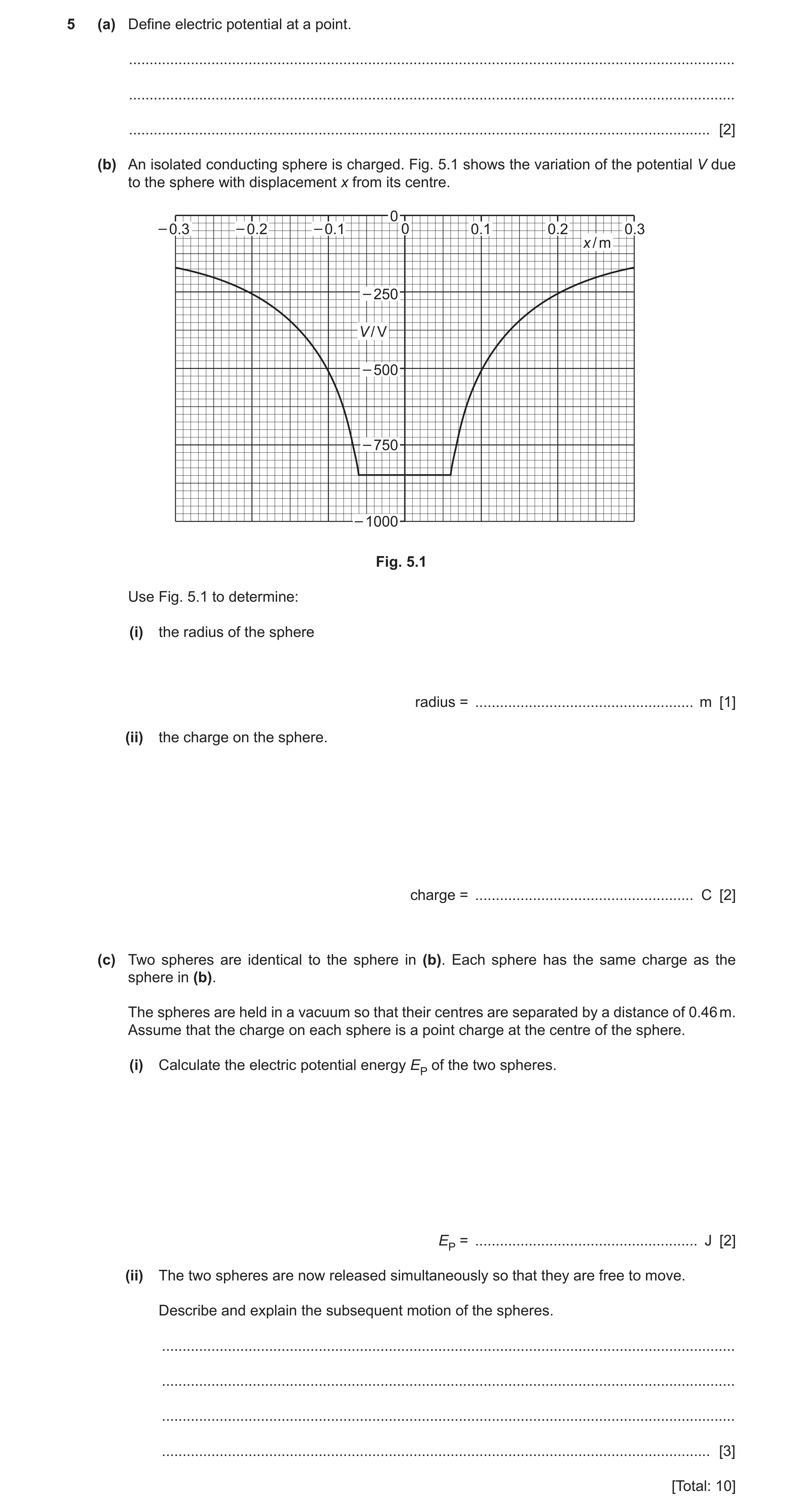
 31 / 36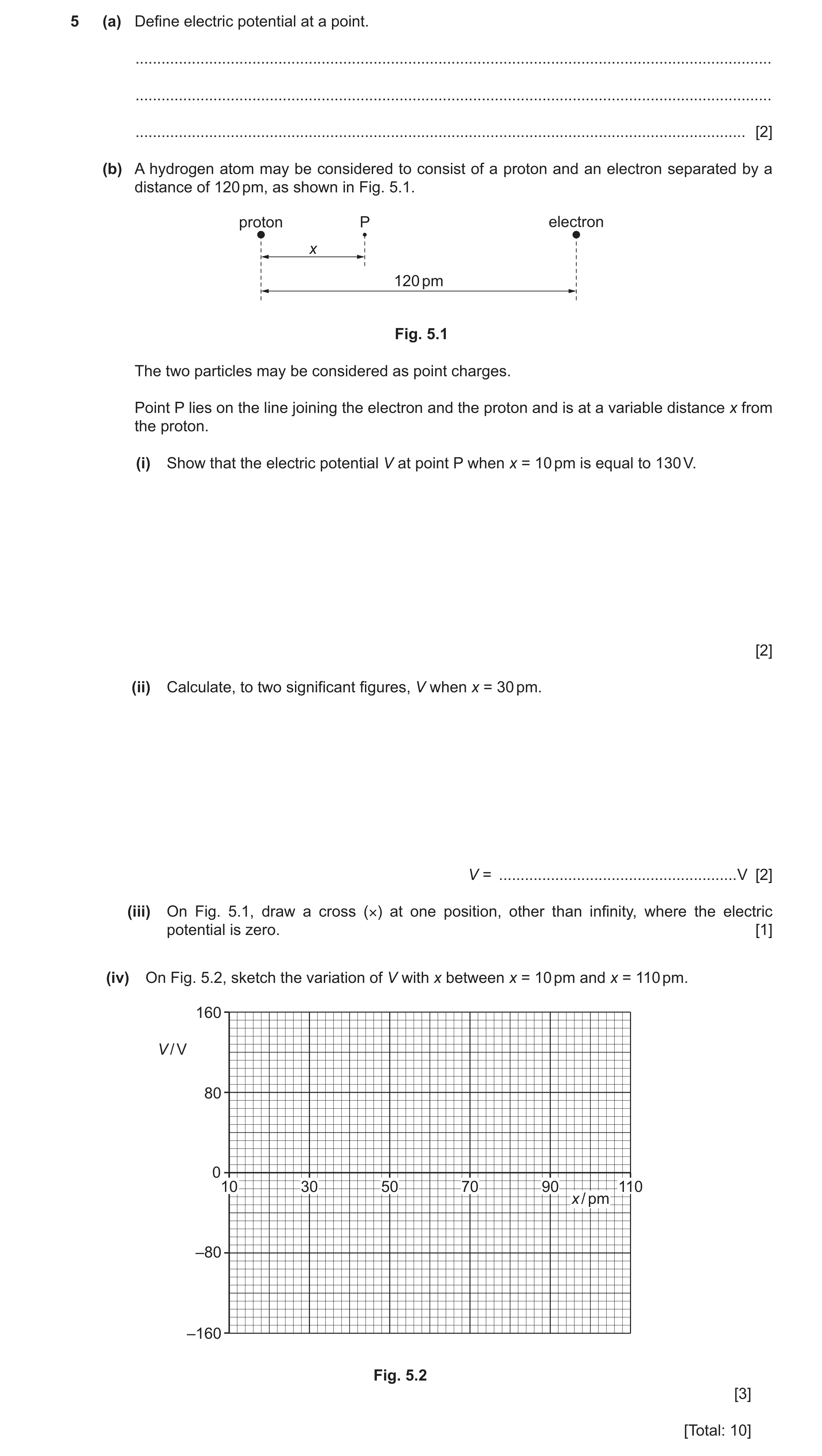
 9
9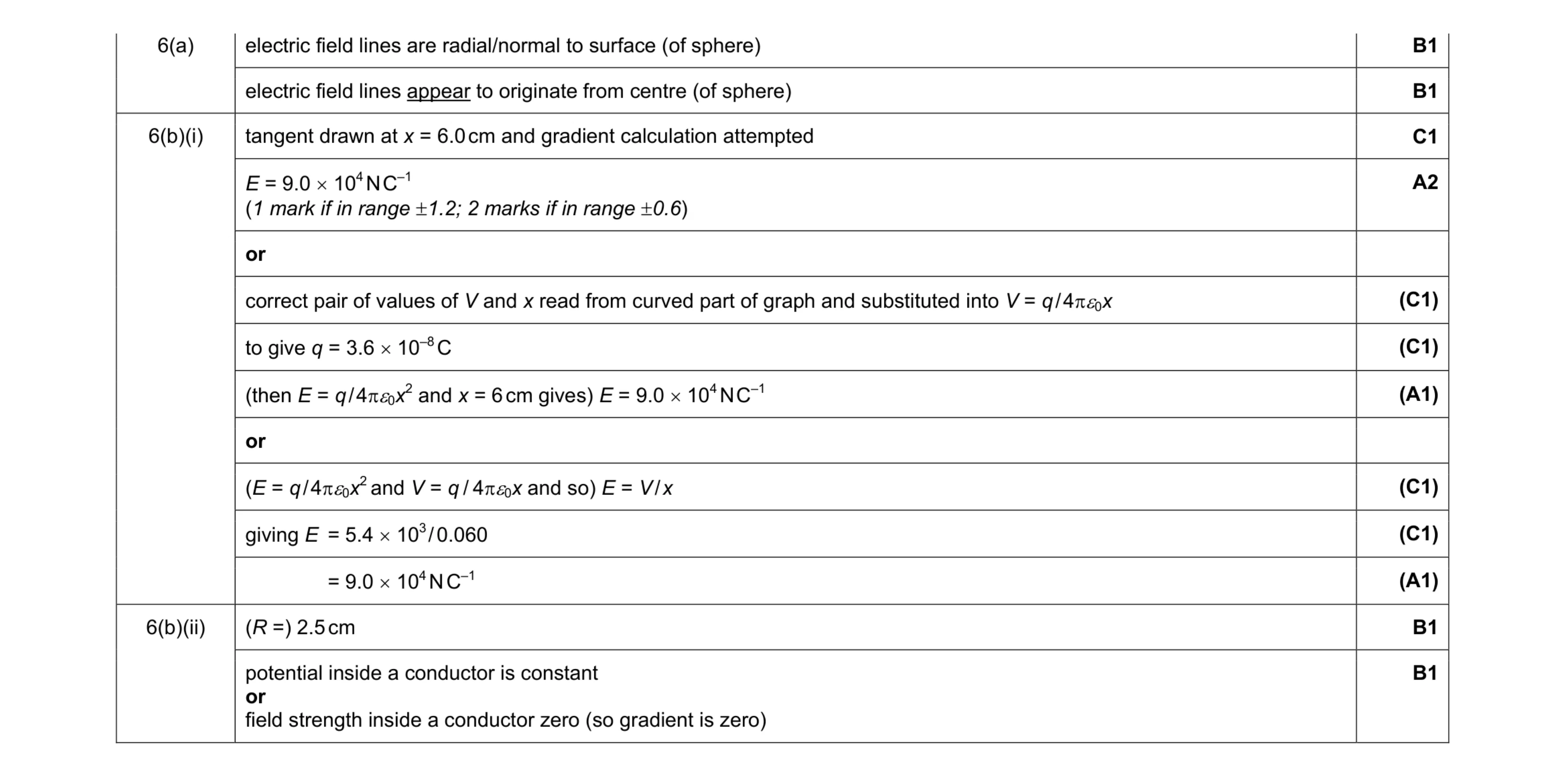 7
7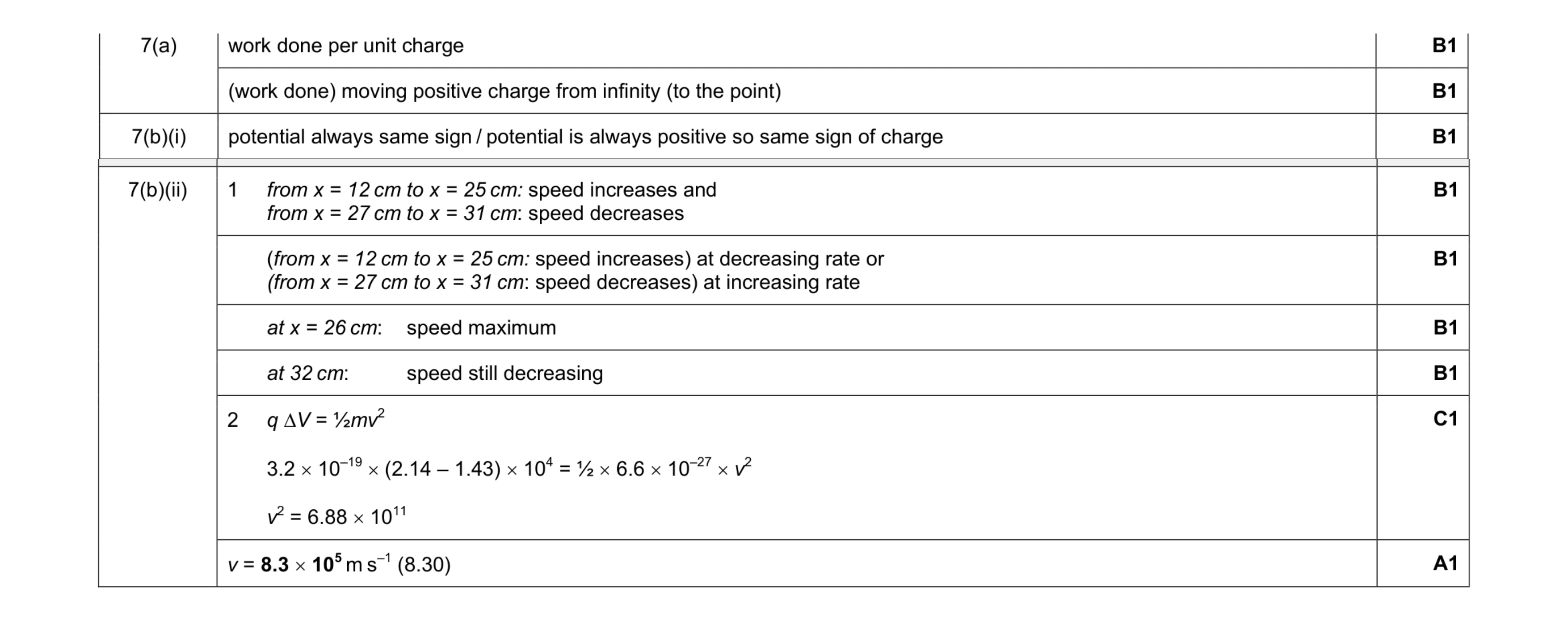 9
9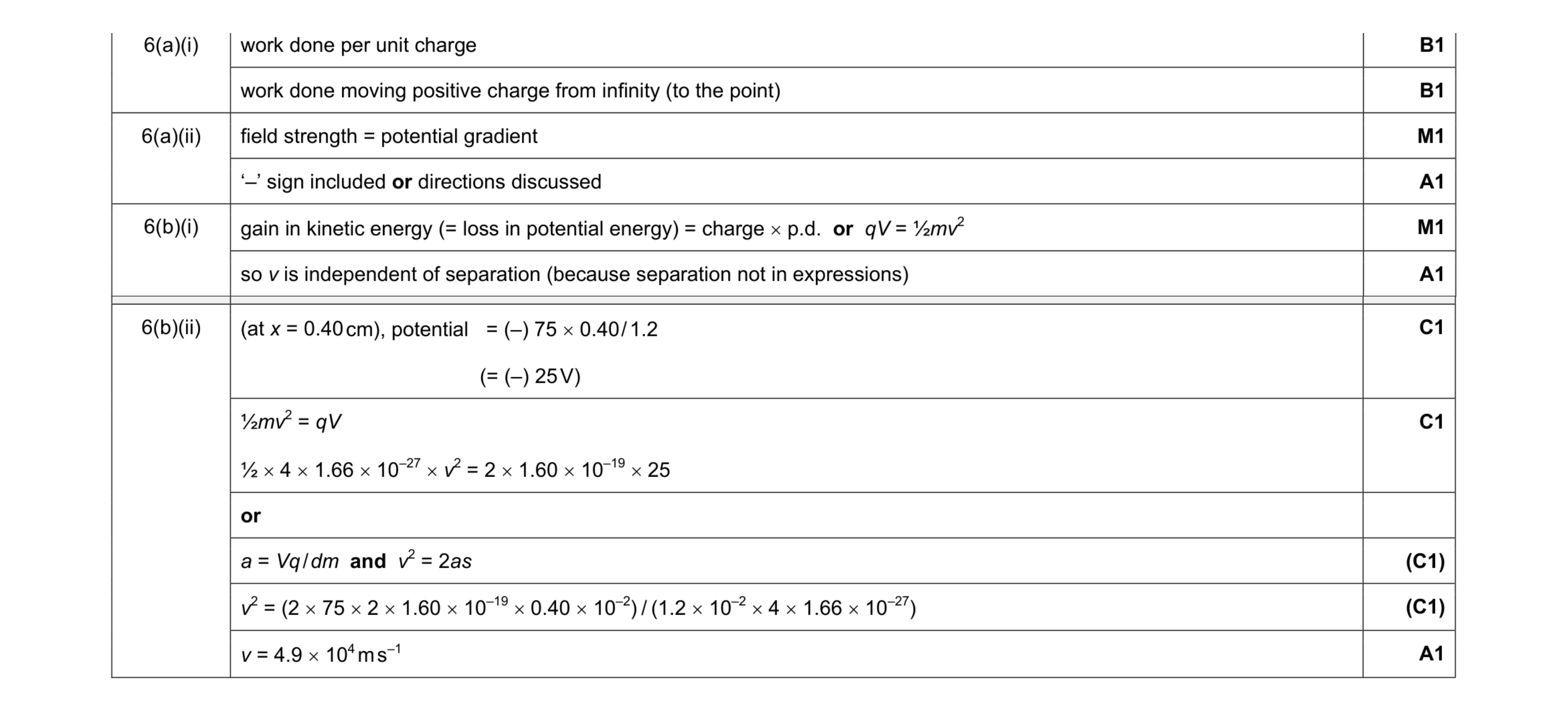 9
9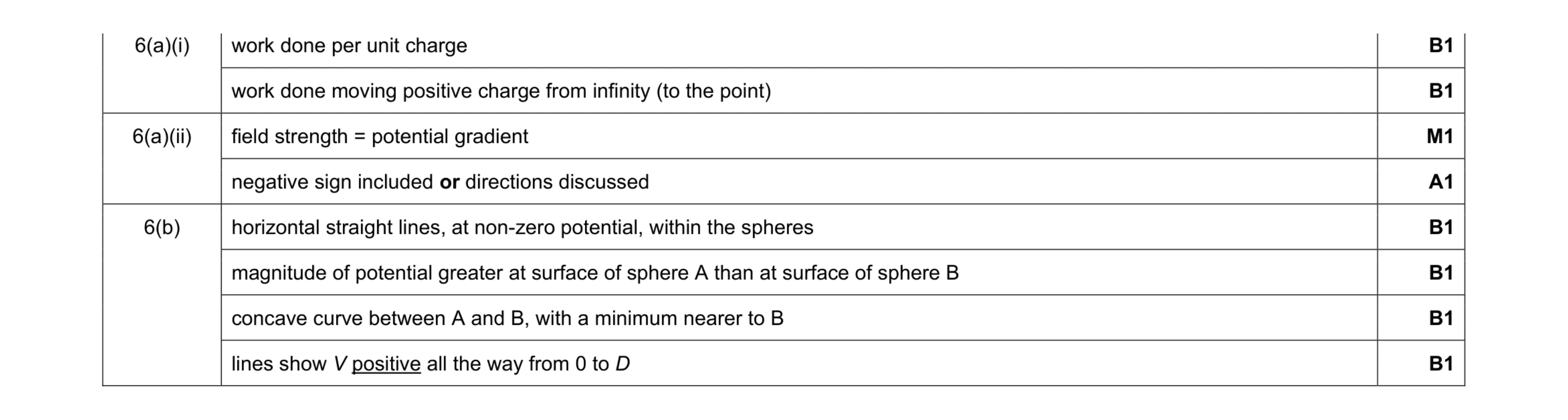 8
8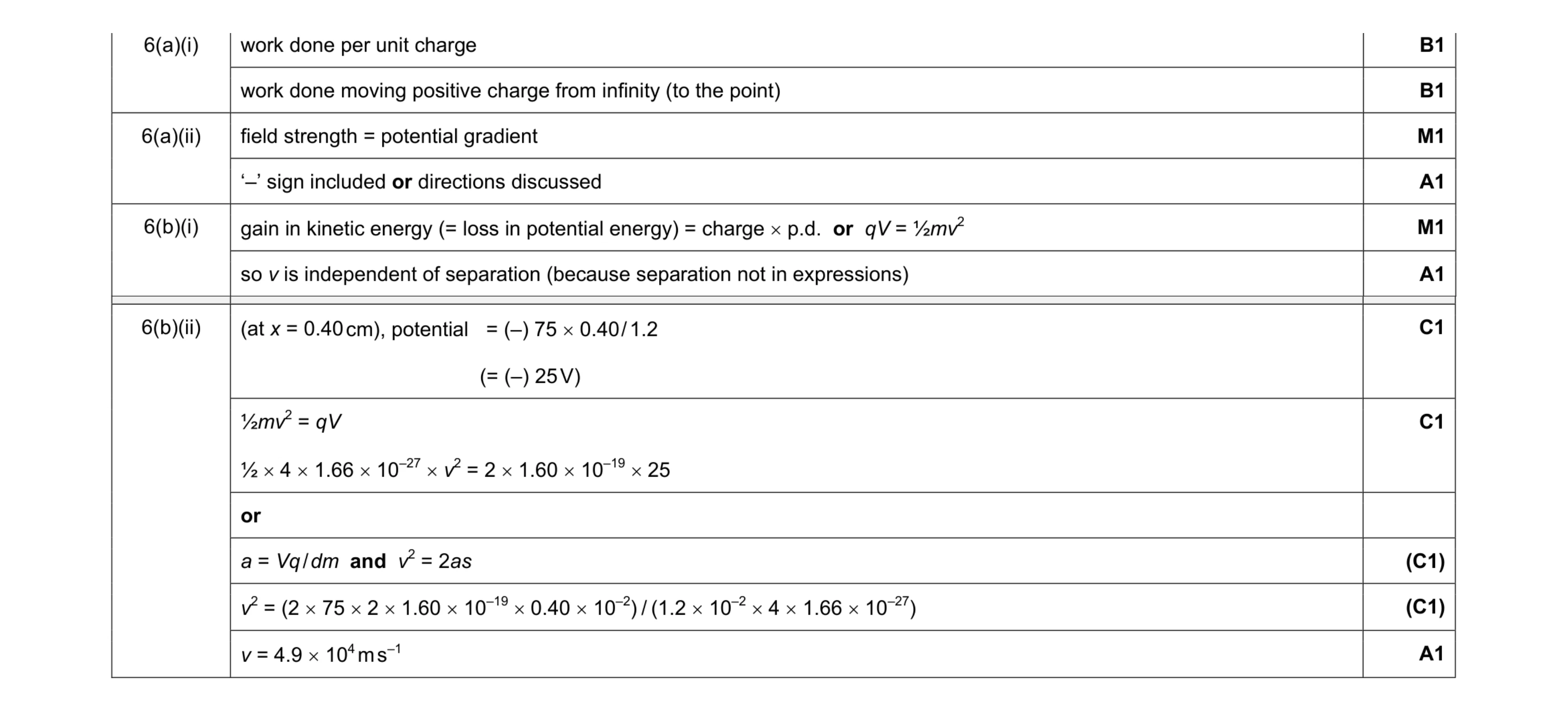 9
9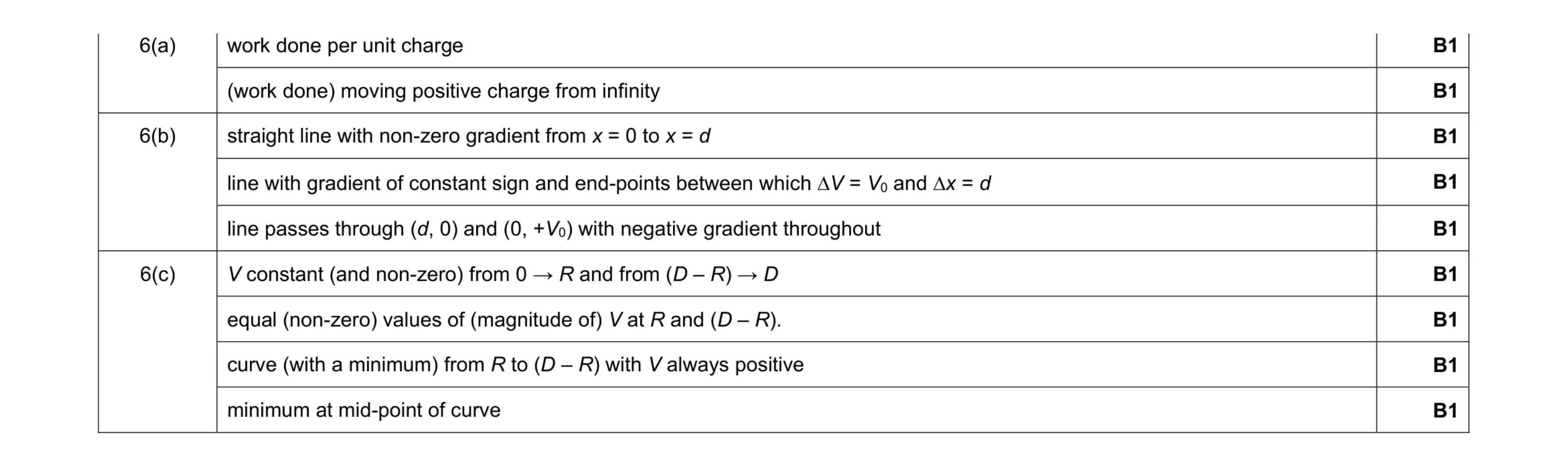 9
9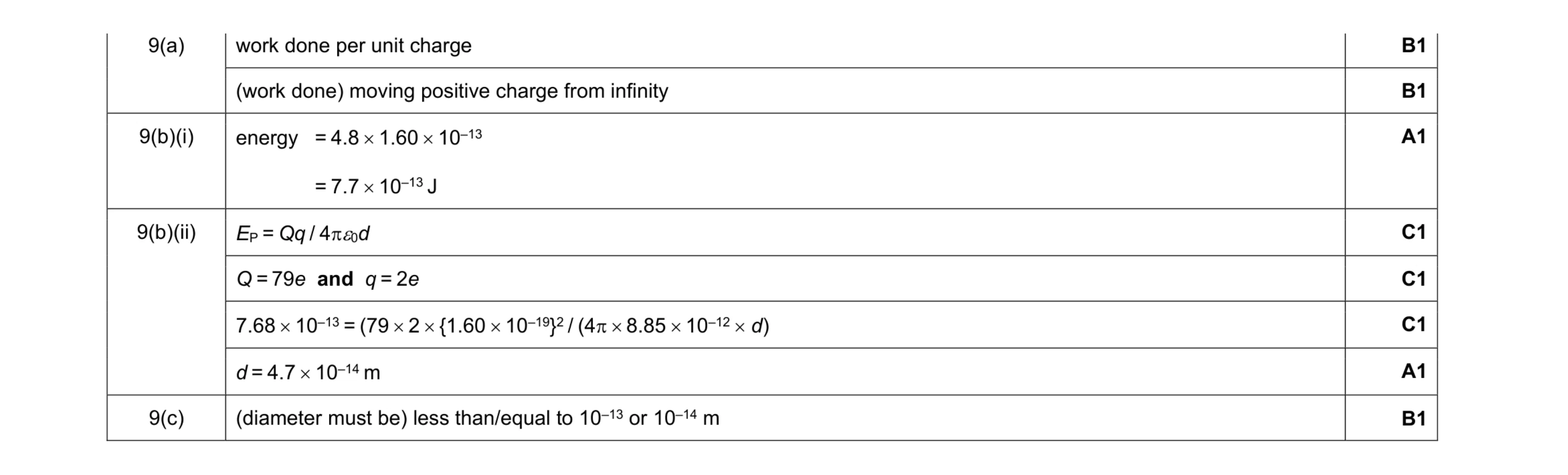 8
8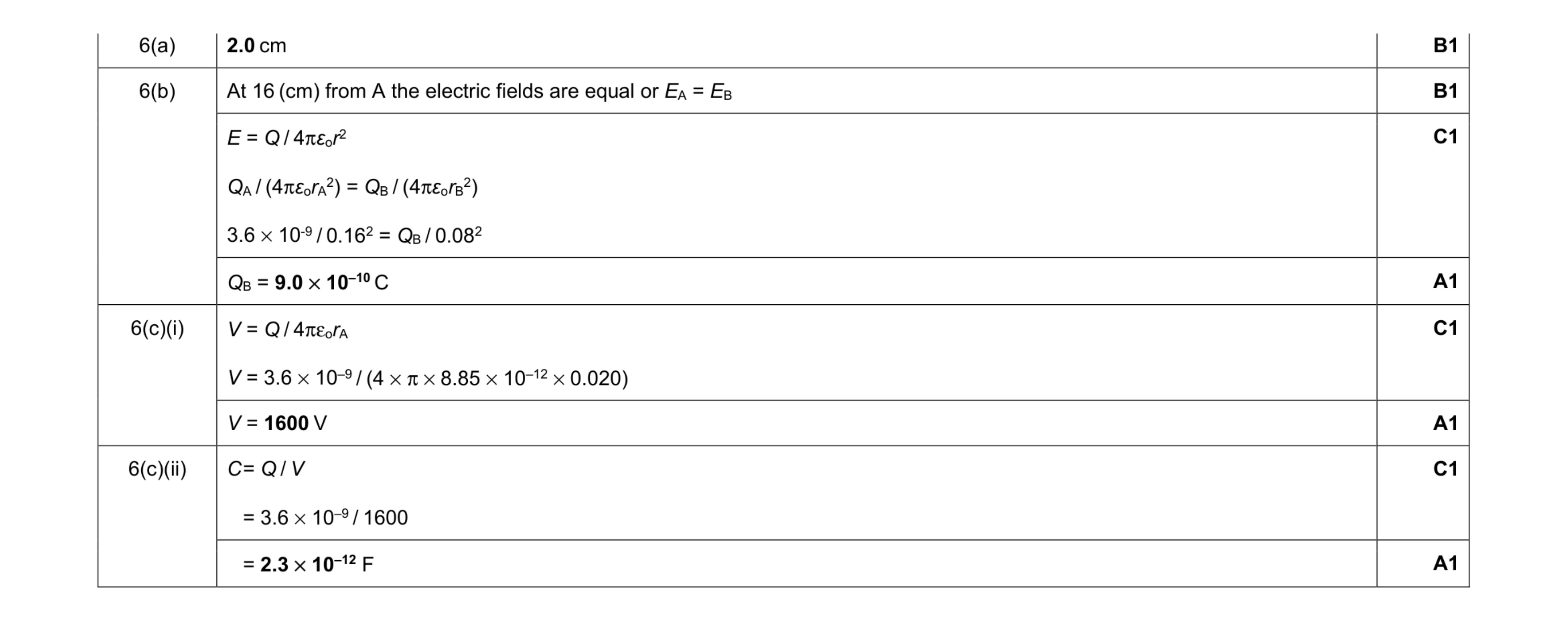 8
8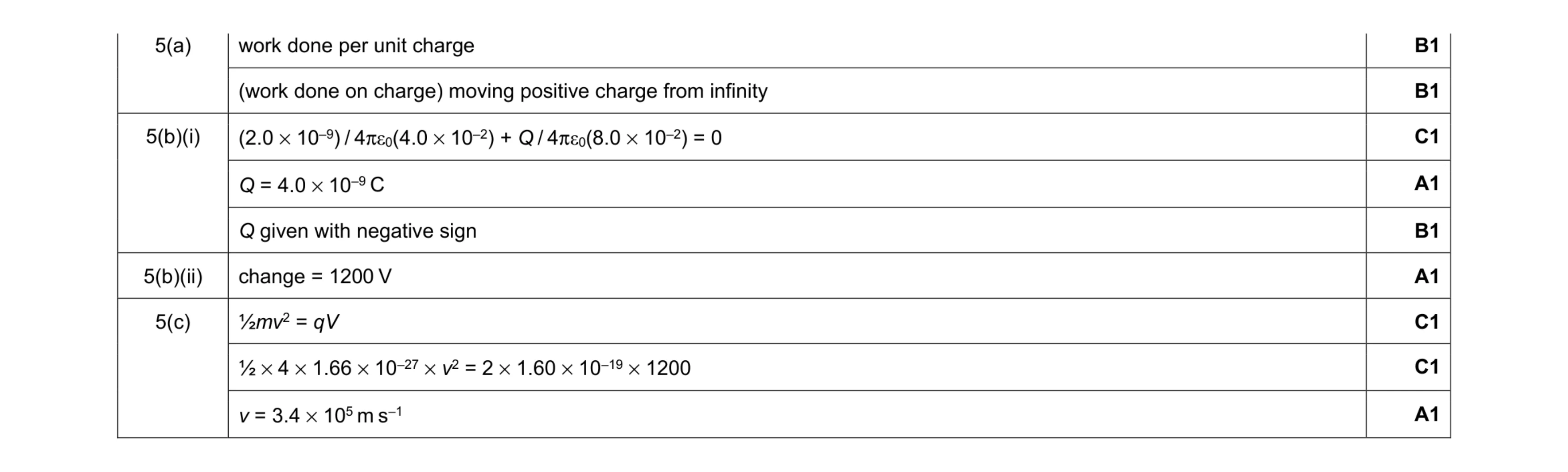 9
9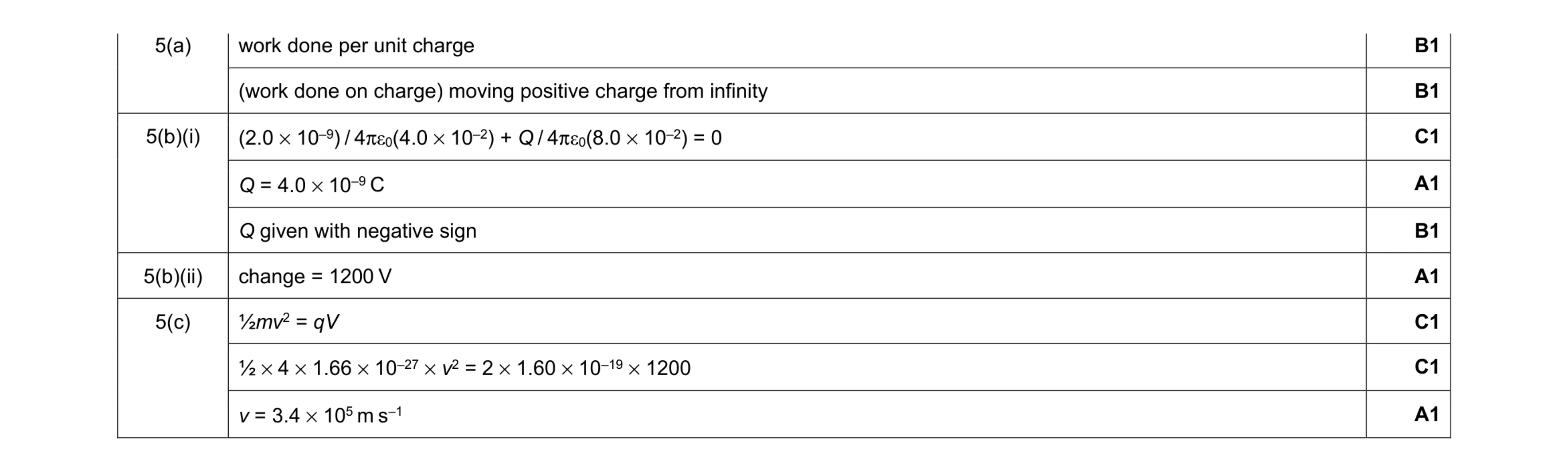 9
9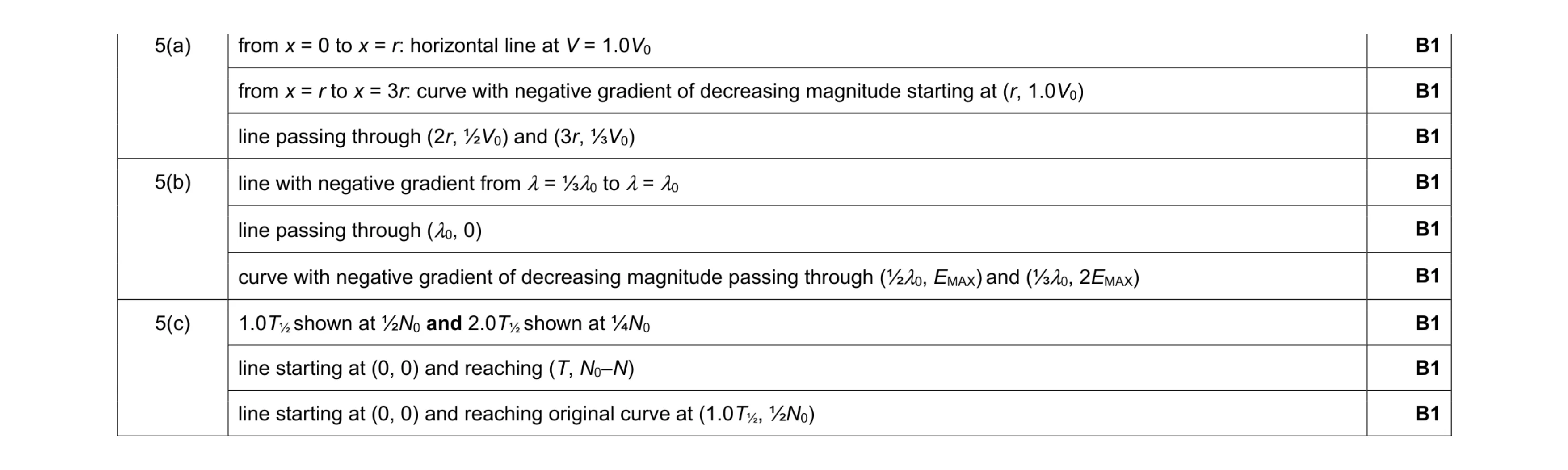 9
9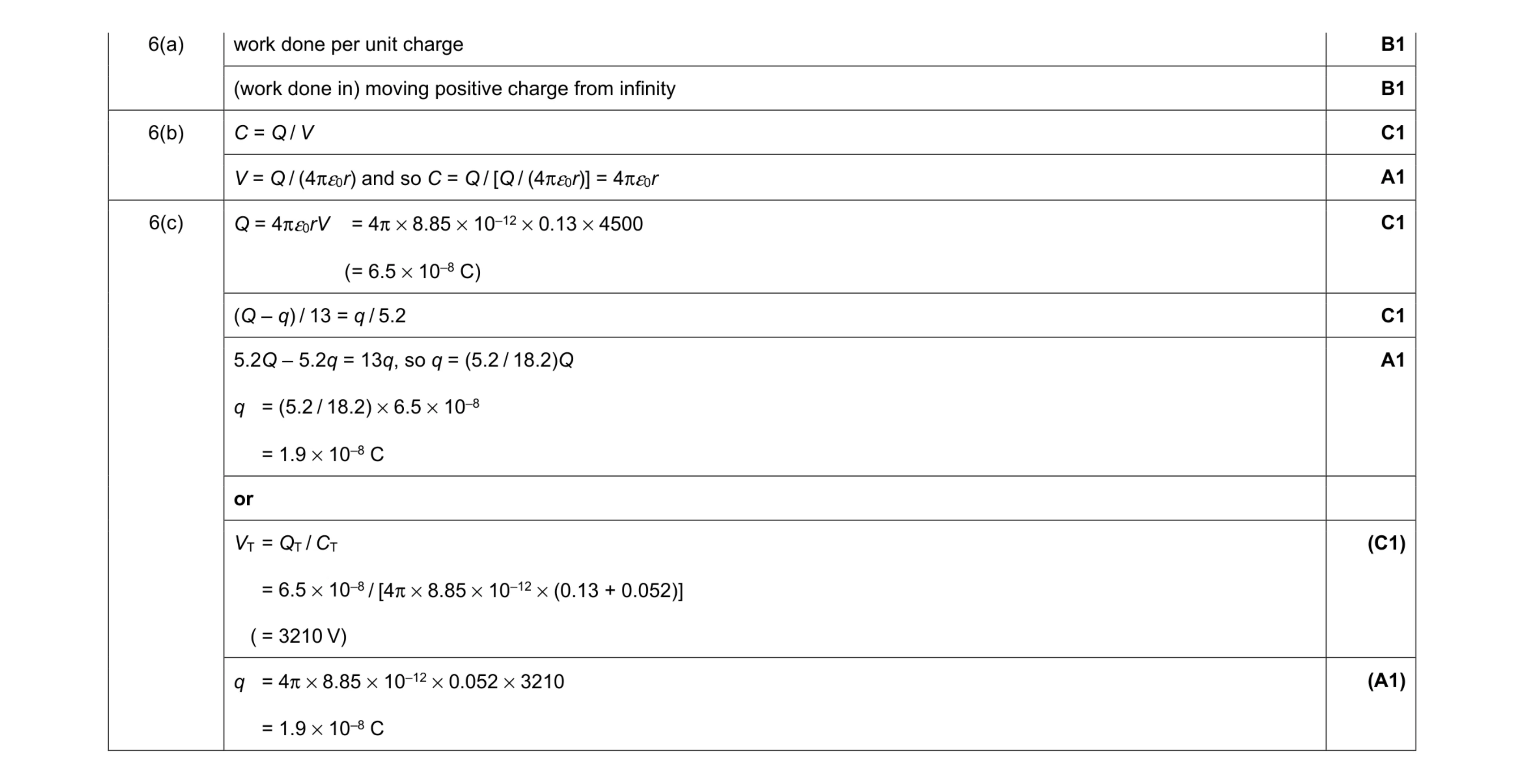 7
7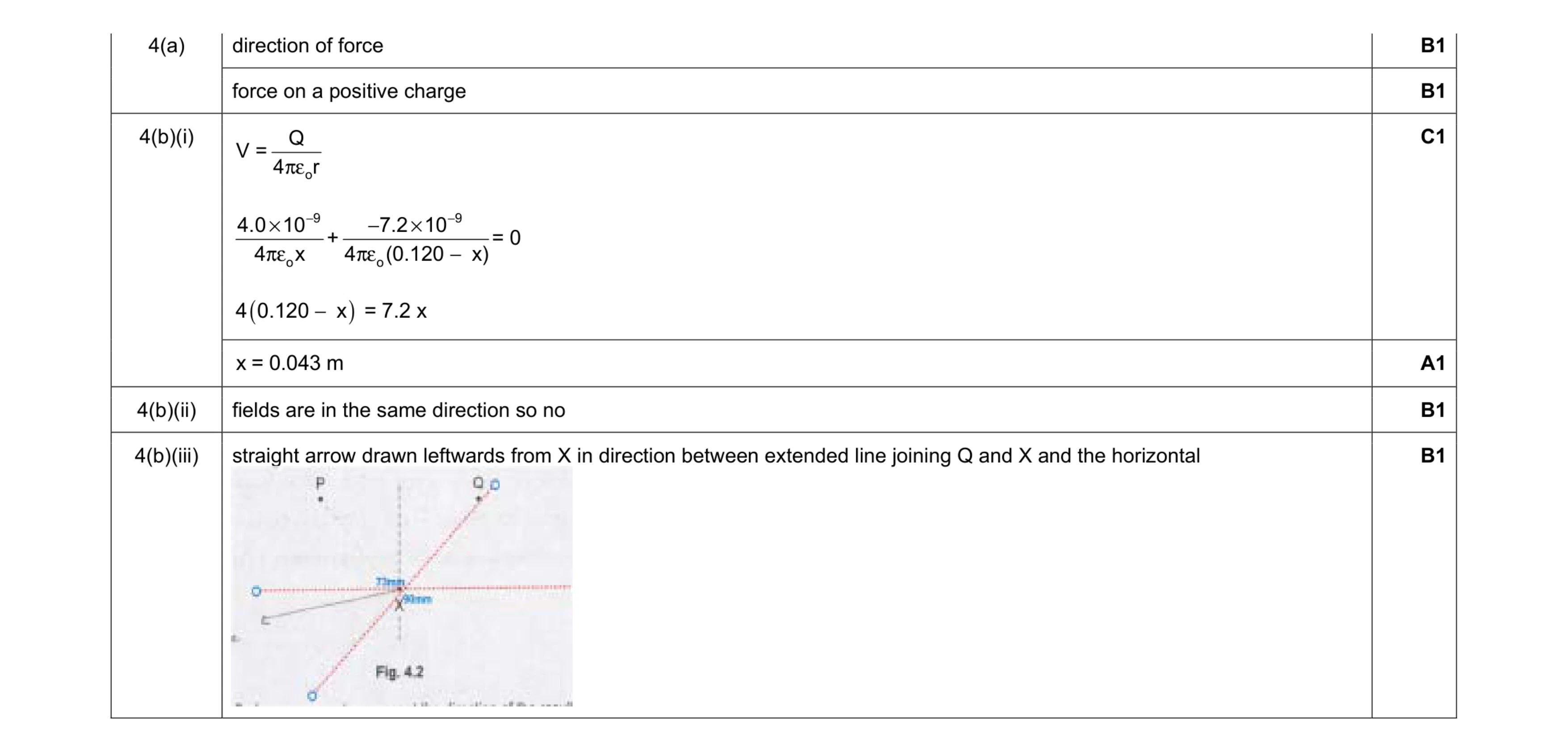 6
6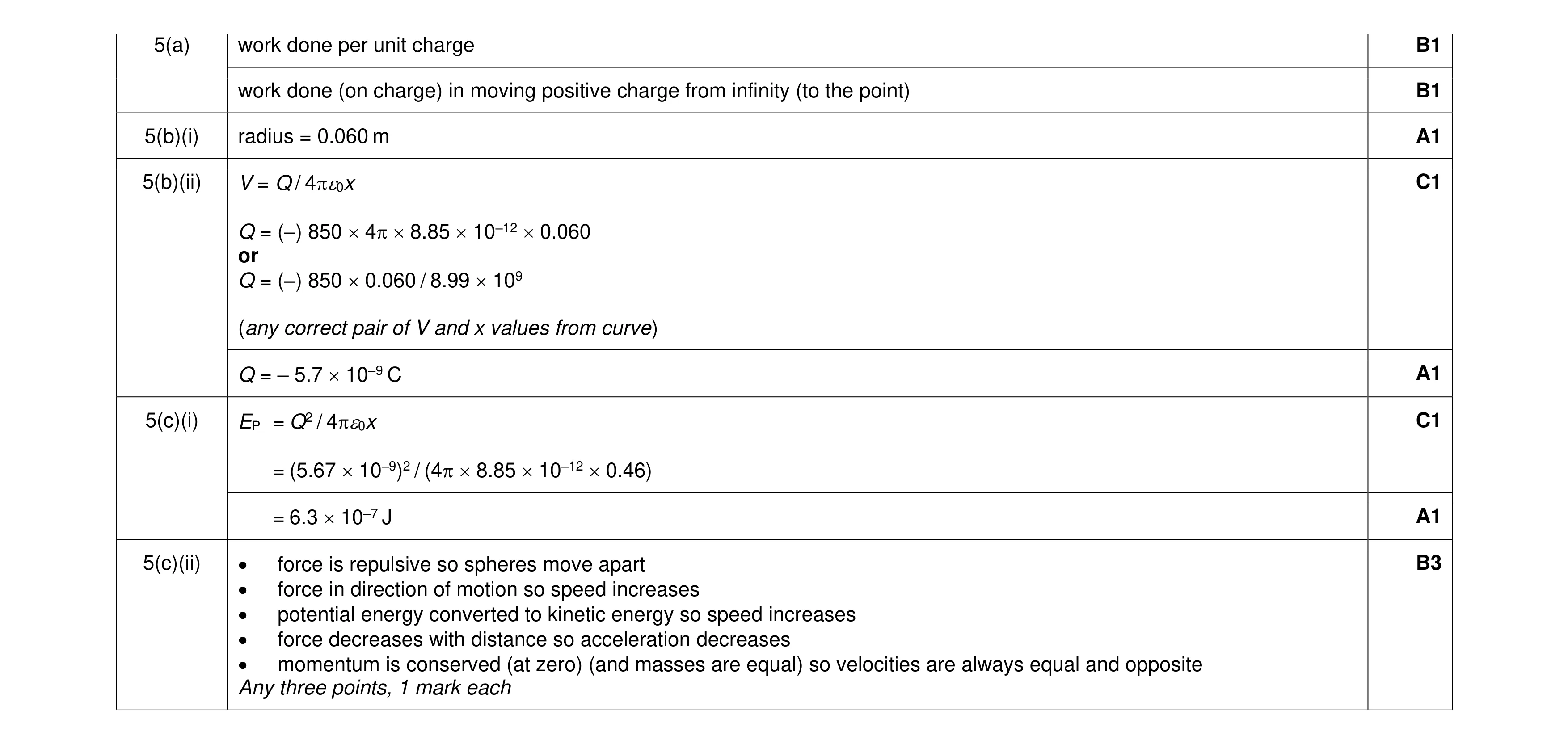 10
10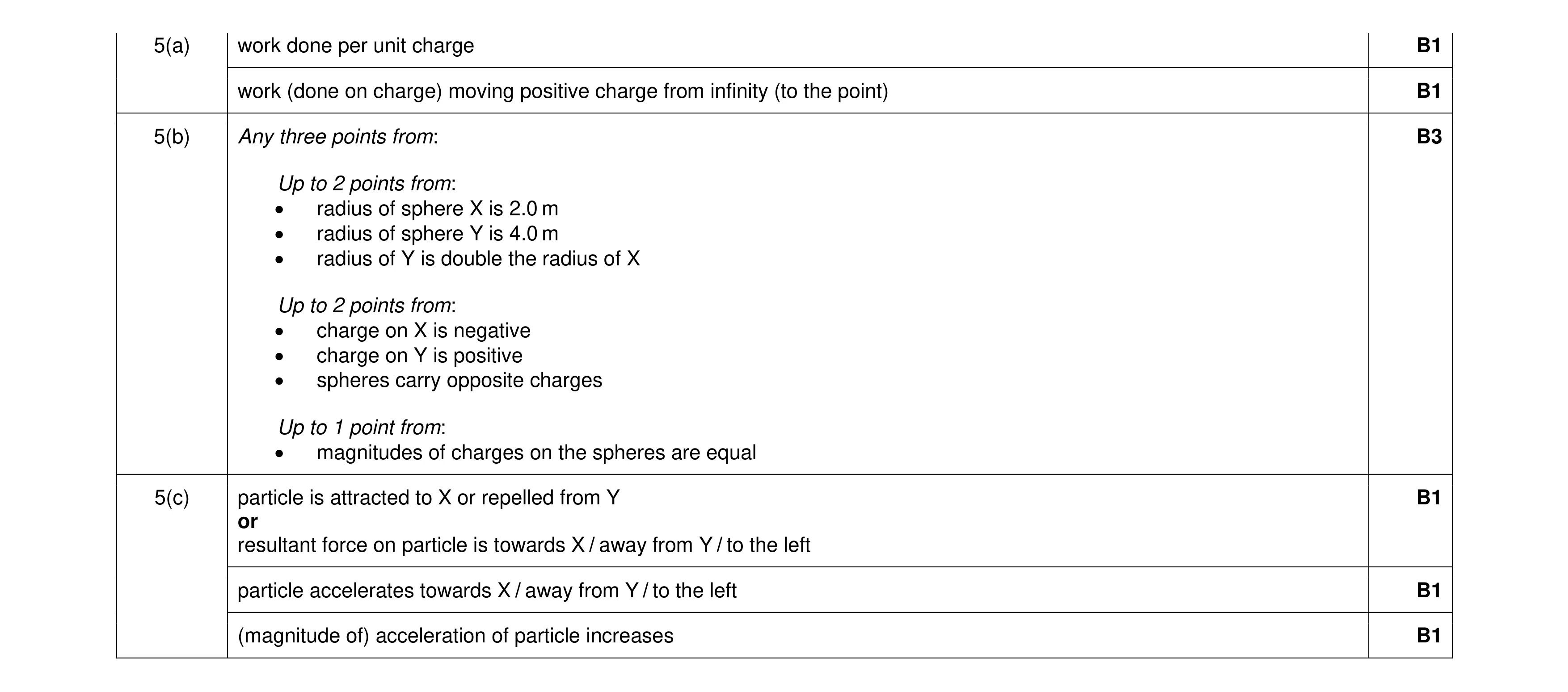 8
8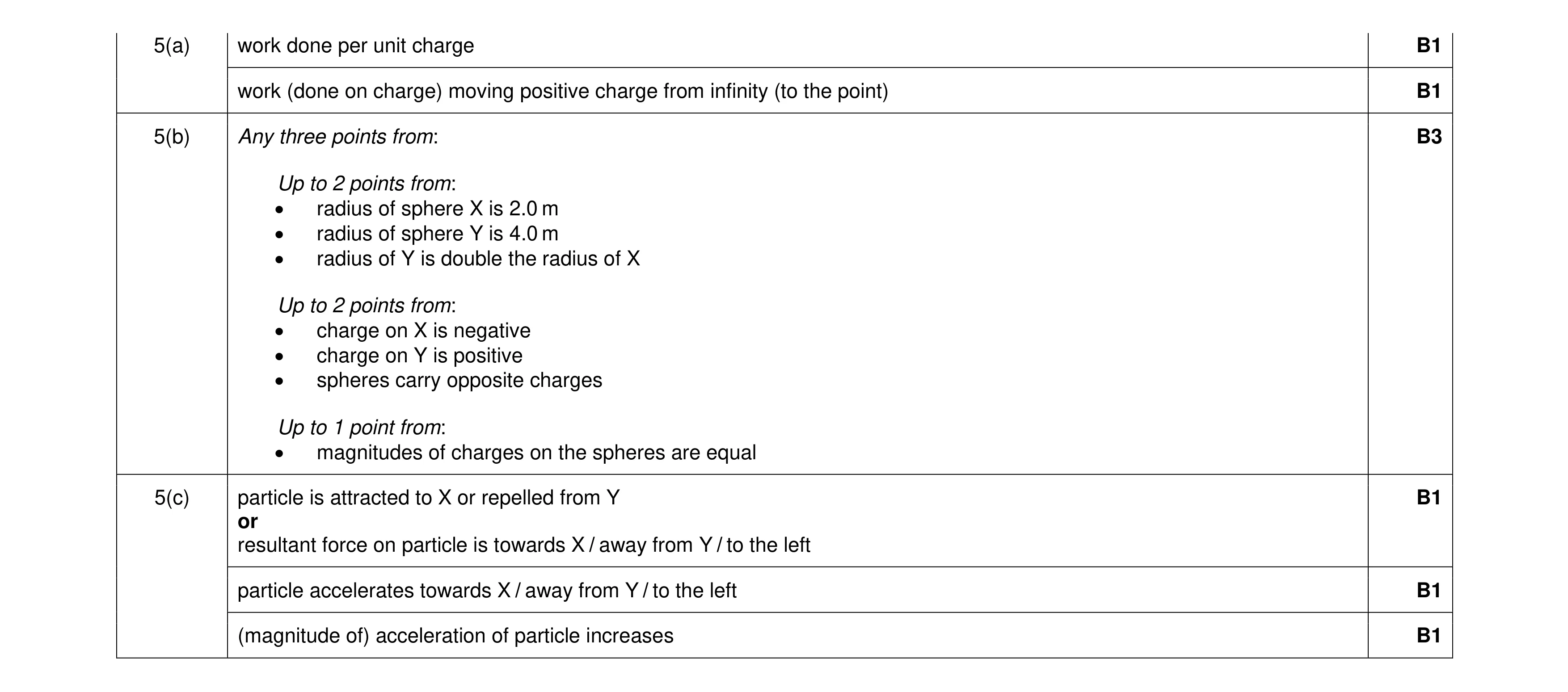 8
8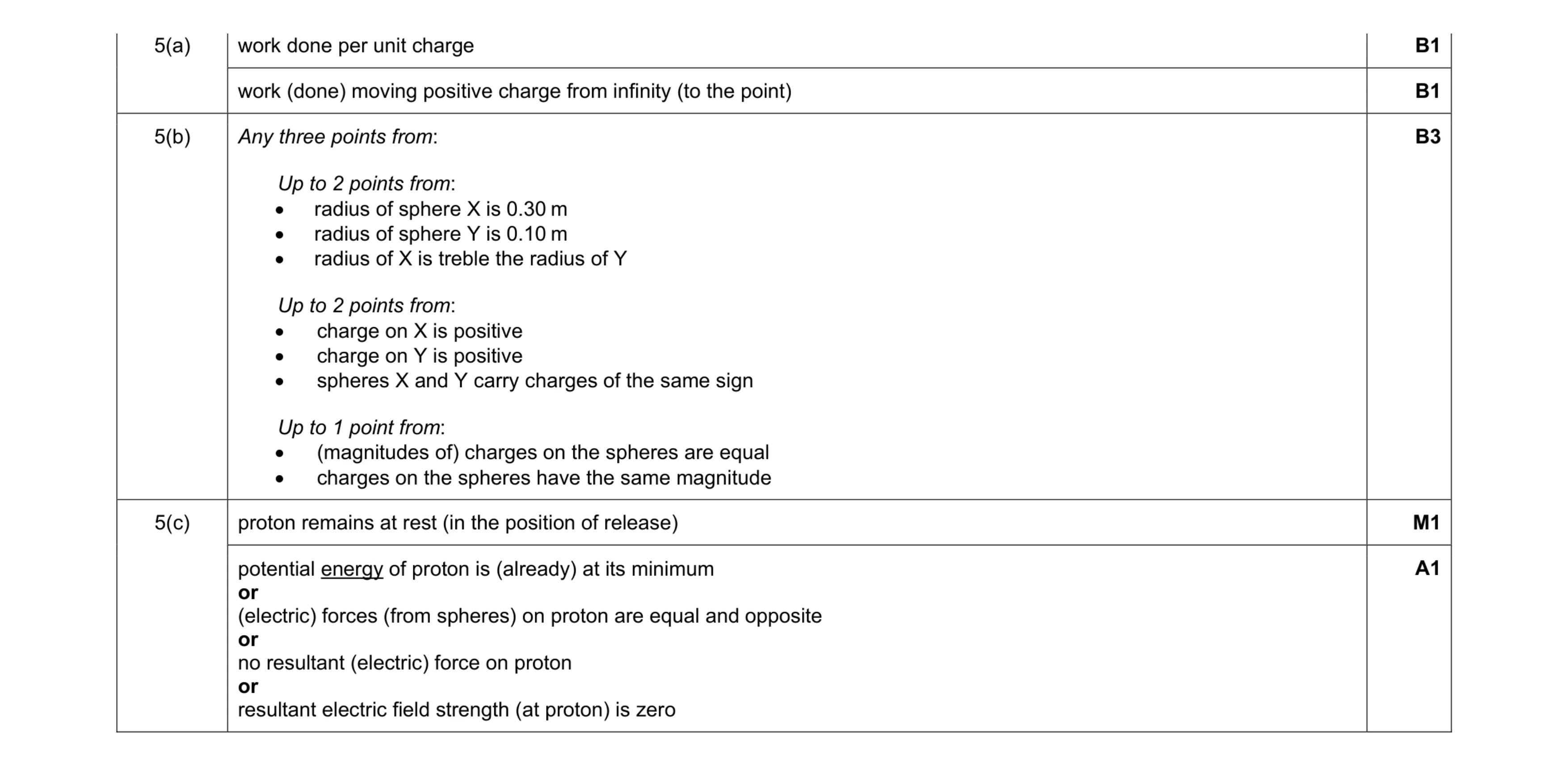 7
7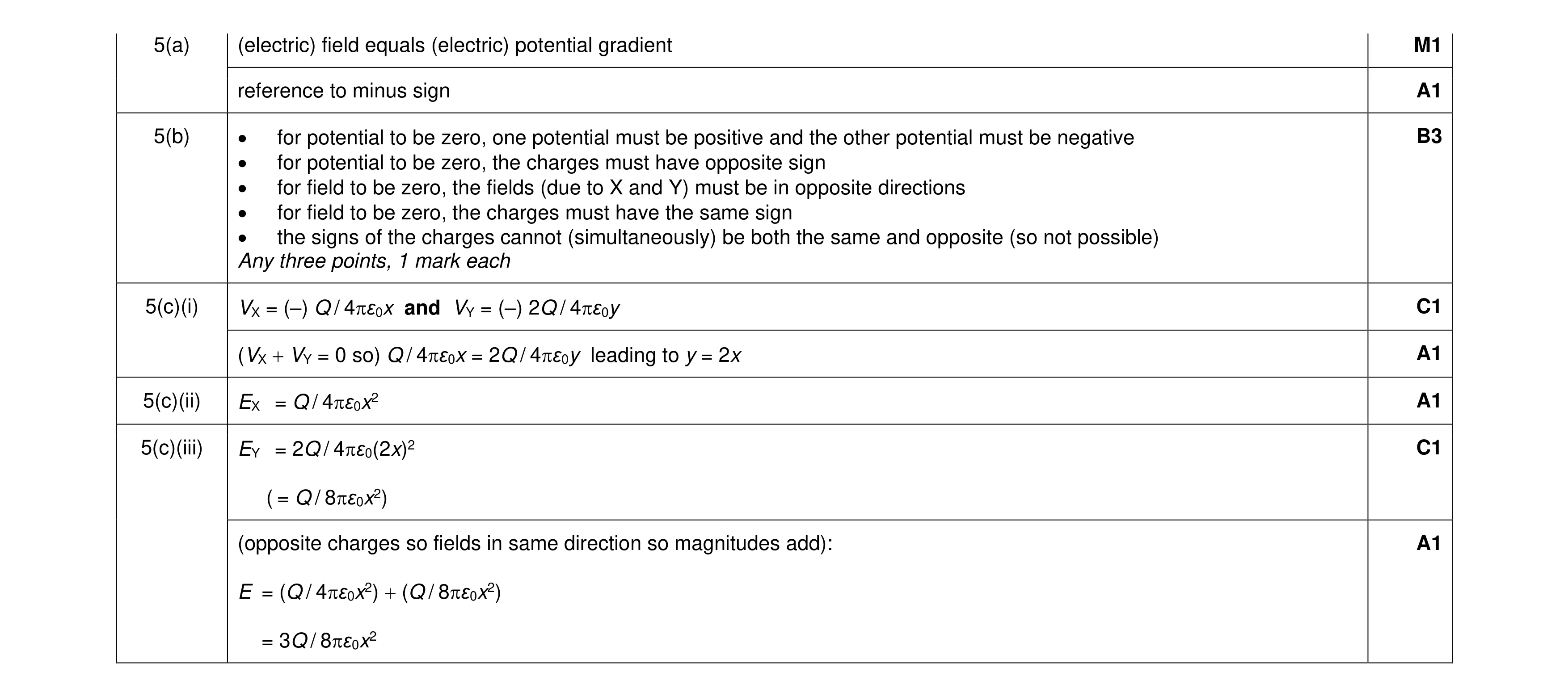 10
10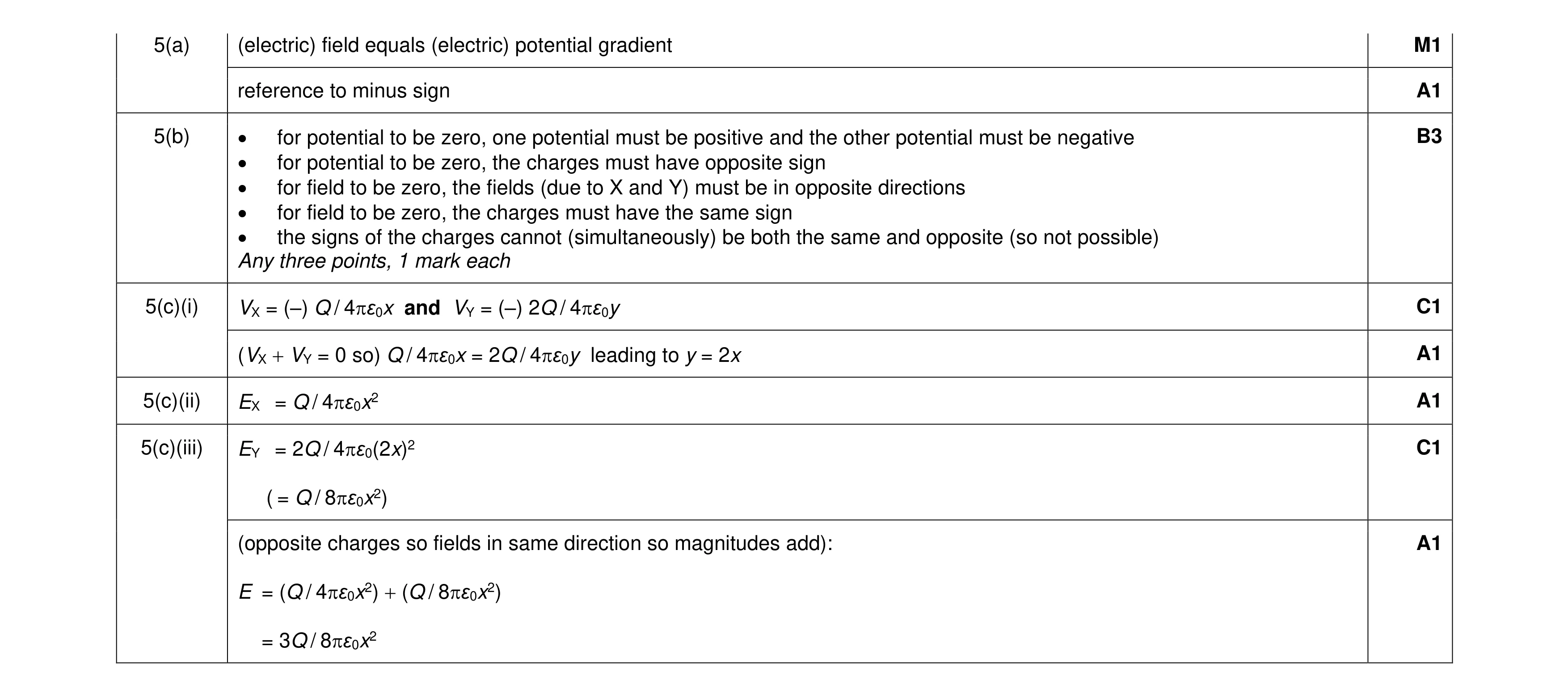 10
10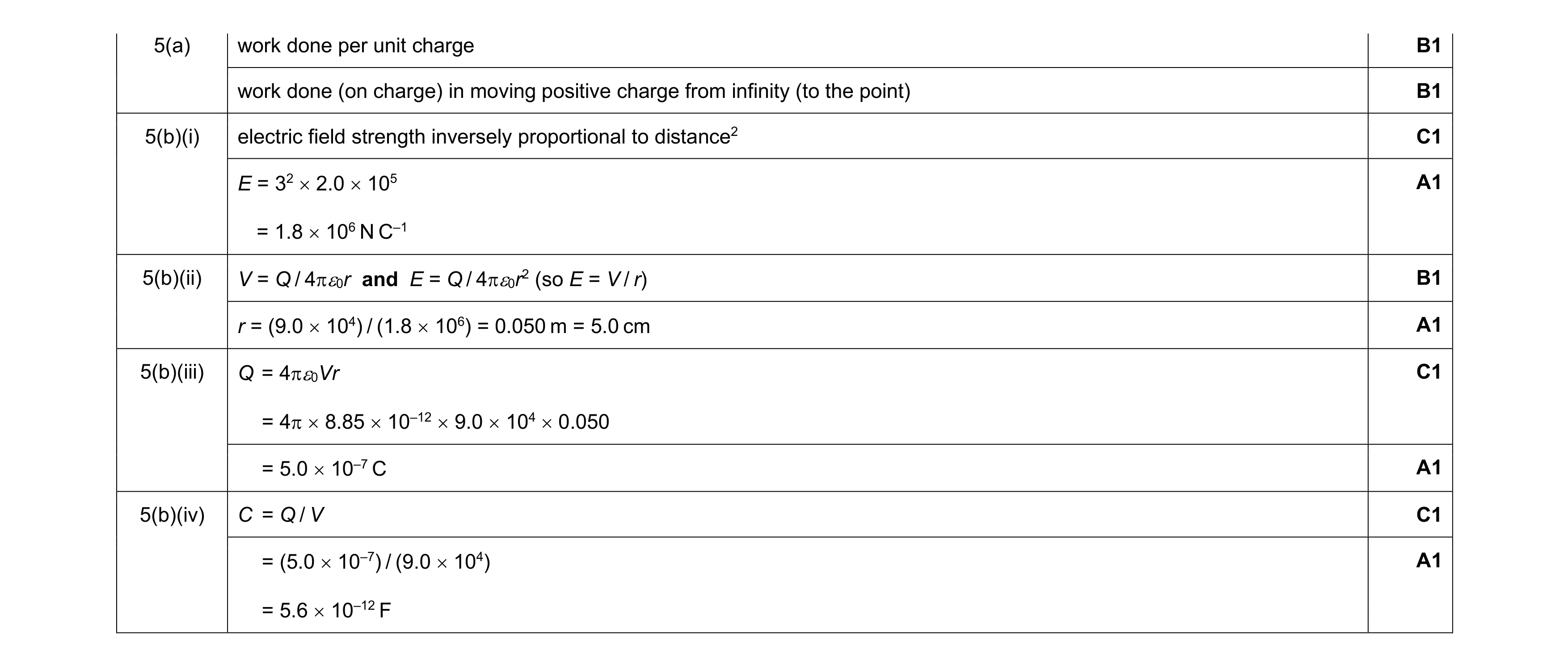 10
10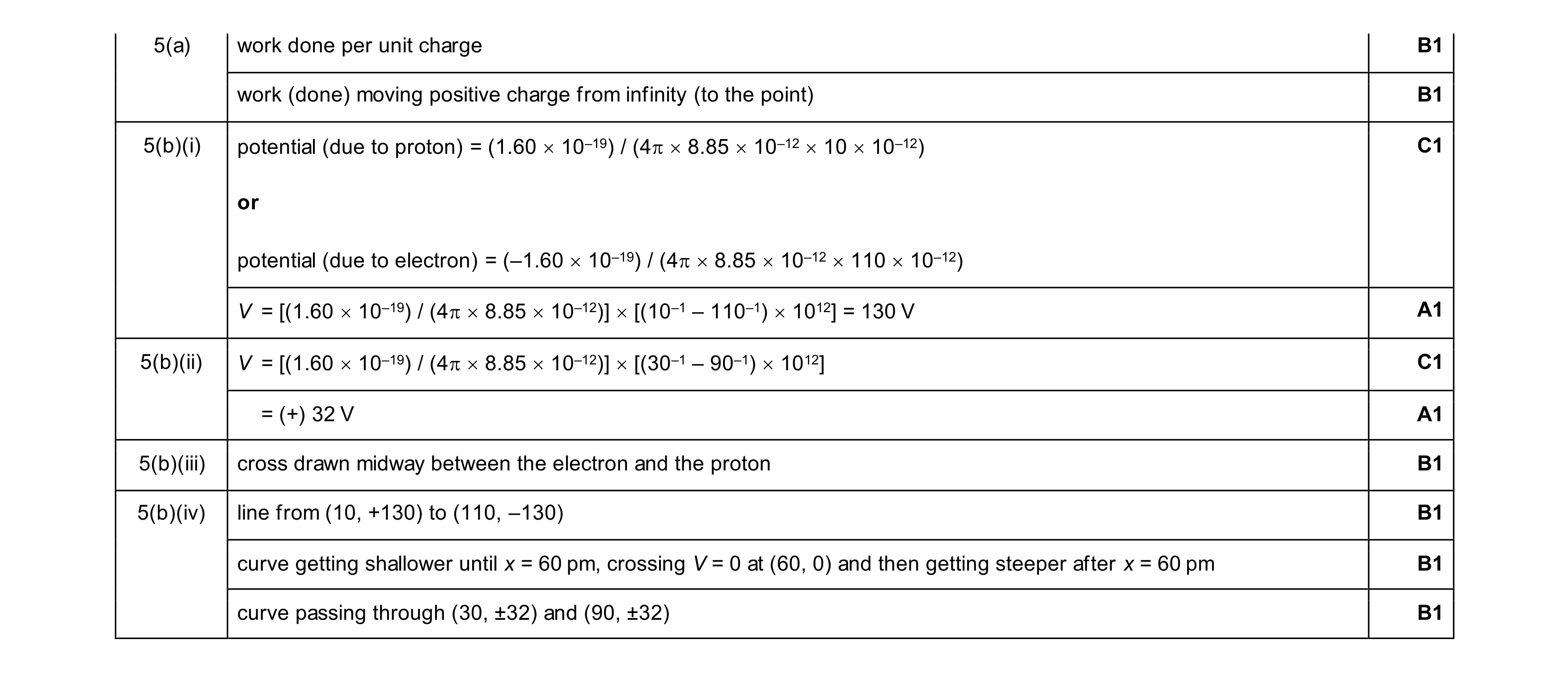 10
10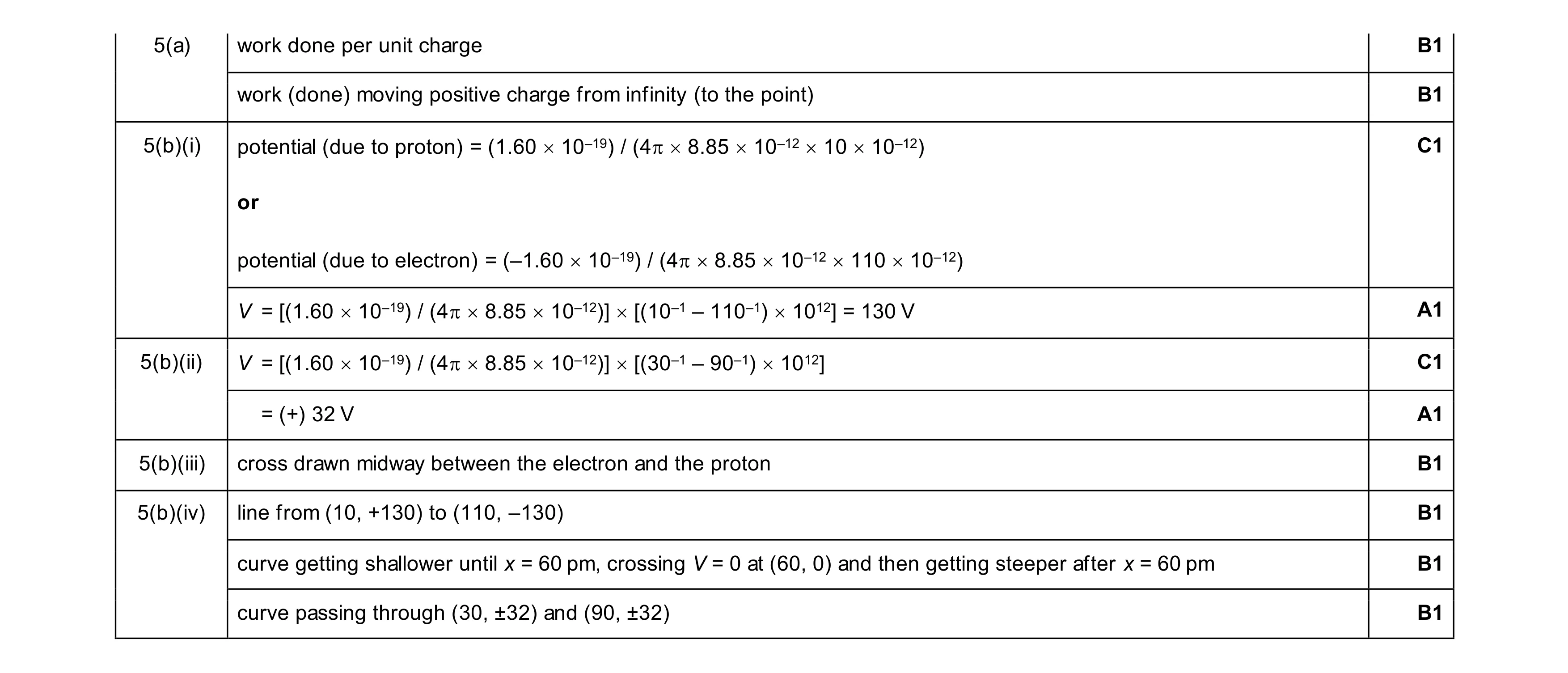 10
10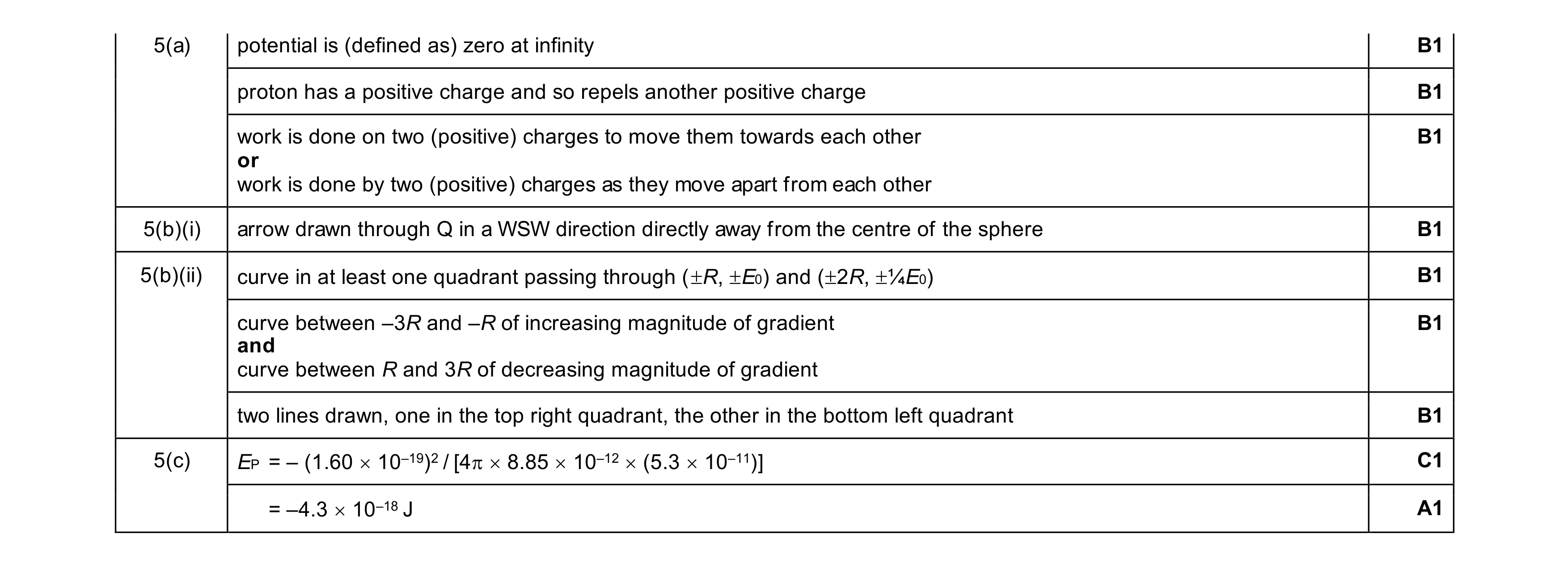 9
9