Questions as text
Q1 · Define gravitational potential at a point 9702/42 Feb/March 2017
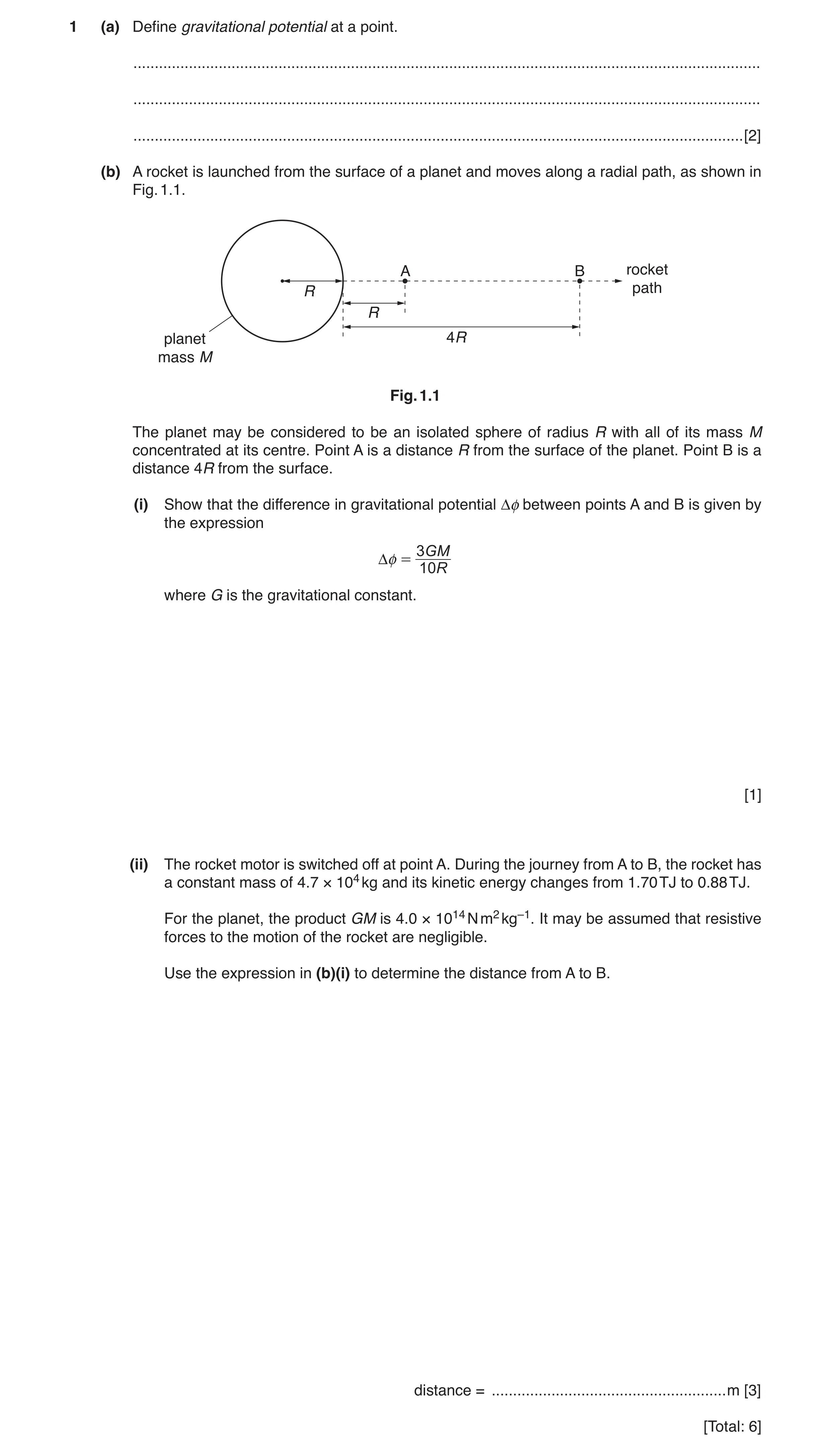
1 (a) Define gravitational potential at a point. … … … [2] (b) A rocket is launched from the surface of a planet and moves along a radial path, as shown in Fig. 1.1. A B rocket R path R planet 4R mass M Fig. 1.1 The planet may be considered to be an isolated sphere of radius R with all of its mass M concentrated at its centre. Point A is a distance R from the surface of the planet. Point B is a distance 4R from the surface. (i) Show that the difference in gravitational potential Δφ between points A and B is given by the expression 3 GM Δφ = 10 R where G is the gravitational constant. [1] (ii) The rocket motor is switched off at point A. During the journey from A to B, the rocket has a constant mass of 4.7 × 10⁴ kg and its kinetic energy changes from 1.70 TJ to 0.88 TJ. For the planet, the product GM is 4.0 × 10¹⁴ N m2 kg–1. It may be assumed that resistive forces to the motion of the rocket are negligible. Use the expression in (b)(i) to determine the distance from A to B. distance = … m [3] [Total: 6]
6 marks
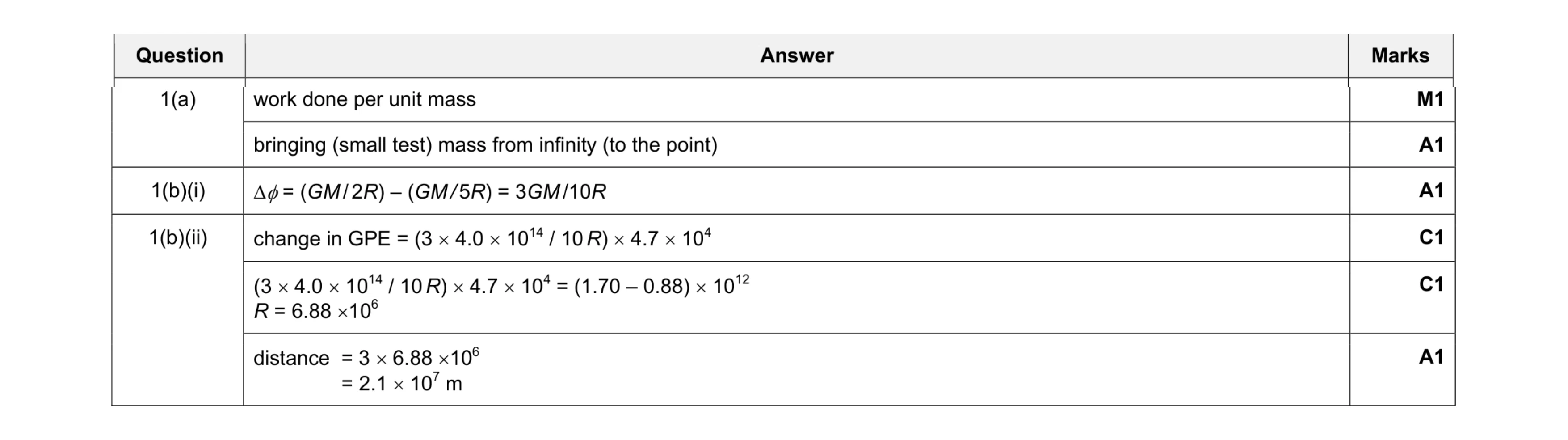
Mark scheme: 1(a) work done per unit mass M1 bringing (small test) mass from infinity (to the point) A1 1(b)(i) ∆φ = (GM / 2R) – (GM / 5R) = 3GM /10R A1 1(b)(ii) change in GPE = (3 × 4.0 × 1014 / 10 R) × 4.7 × 10⁴ C1 (3 × 4.0 × 1014 / 10 R) × 4.7 × 104 = (1.70 – 0.88) × 1012 R = 6.88 ×10⁶ C1 distance = 3 × 6.88 ×106 = 2.1 × 10⁷ m A1
This question in 9702/42 Feb/March 2017
Q2 · State what is meant by gravitational potential at a point 9702/41 Oct/Nov 2018
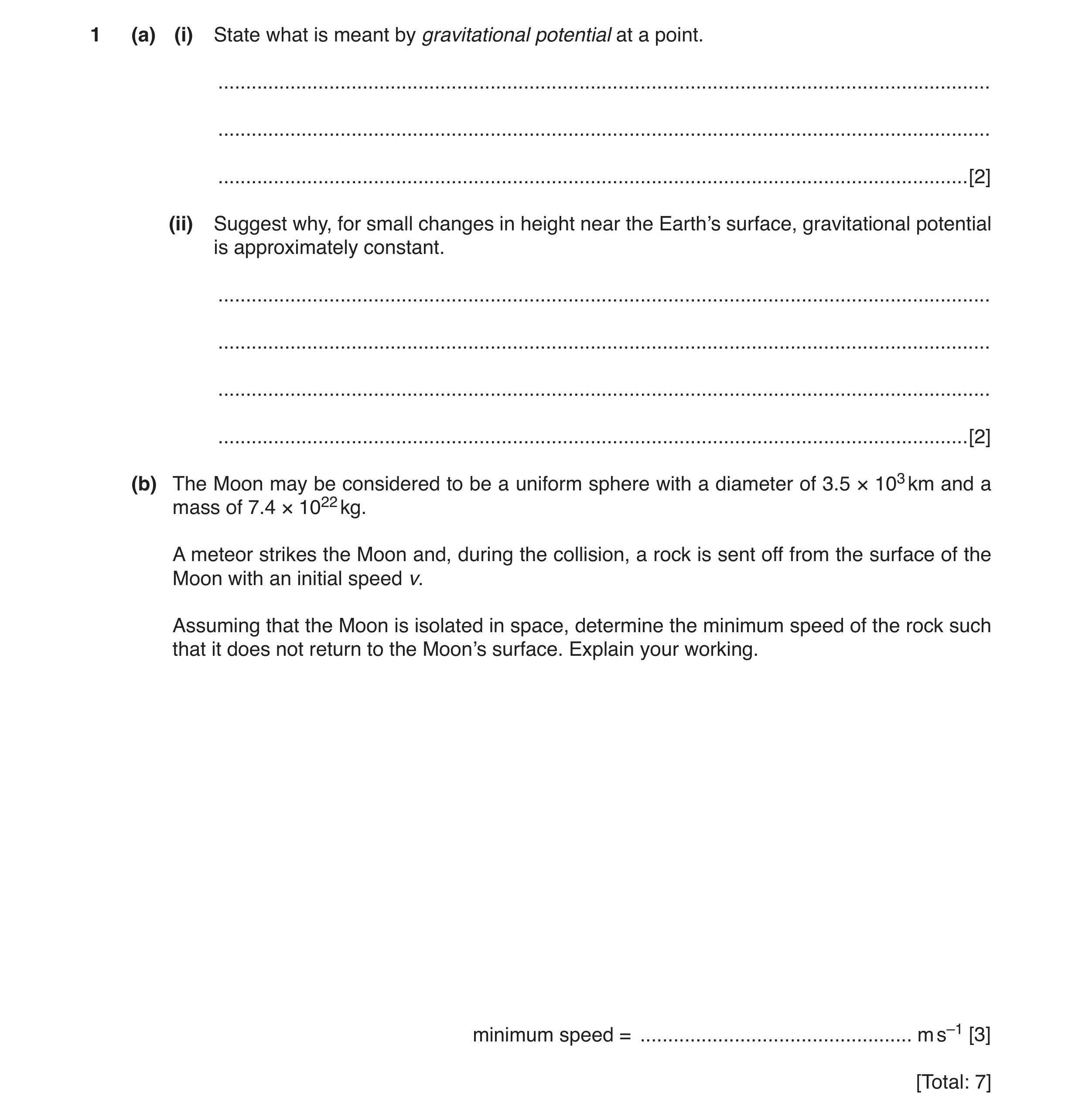
1 (a) (i) State what is meant by gravitational potential at a point. … … … [2] (ii) Suggest why, for small changes in height near the Earth’s surface, gravitational potential is approximately constant. … … … … [2] (b) The Moon may be considered to be a uniform sphere with a diameter of 3.5 × 10³ km and a mass of 7.4 × 10²² kg. A meteor strikes the Moon and, during the collision, a rock is sent off from the surface of the Moon with an initial speed v. Assuming that the Moon is isolated in space, determine the minimum speed of the rock such that it does not return to the Moon’s surface. Explain your working. minimum speed = … m s–1 [3] [Total: 7]
7 marks
Mark scheme: 1(a)(i) work done per unit mass B1 work done moving mass from infinity (to the point) B1 1(a)(ii) (near Earth’s surface change in) height ≪ radius or height much less than radius B1 potential inversely proportional to radius and radius approximately constant (so potential approximately constant) B1 1(b) initial kinetic energy = (–) potential energy (at surface) or ½mv2 = GMm / r B1 v2 = (2 × 6.67 × 10–11 × 7.4 × 1022) / (0.5 × 3.5 × 106) C1 v = 2.4 × 10³ m s–1 A1
This question in 9702/41 Oct/Nov 2018
Q3 · State what is meant by gravitational potential at a point 9702/43 Oct/Nov 2018
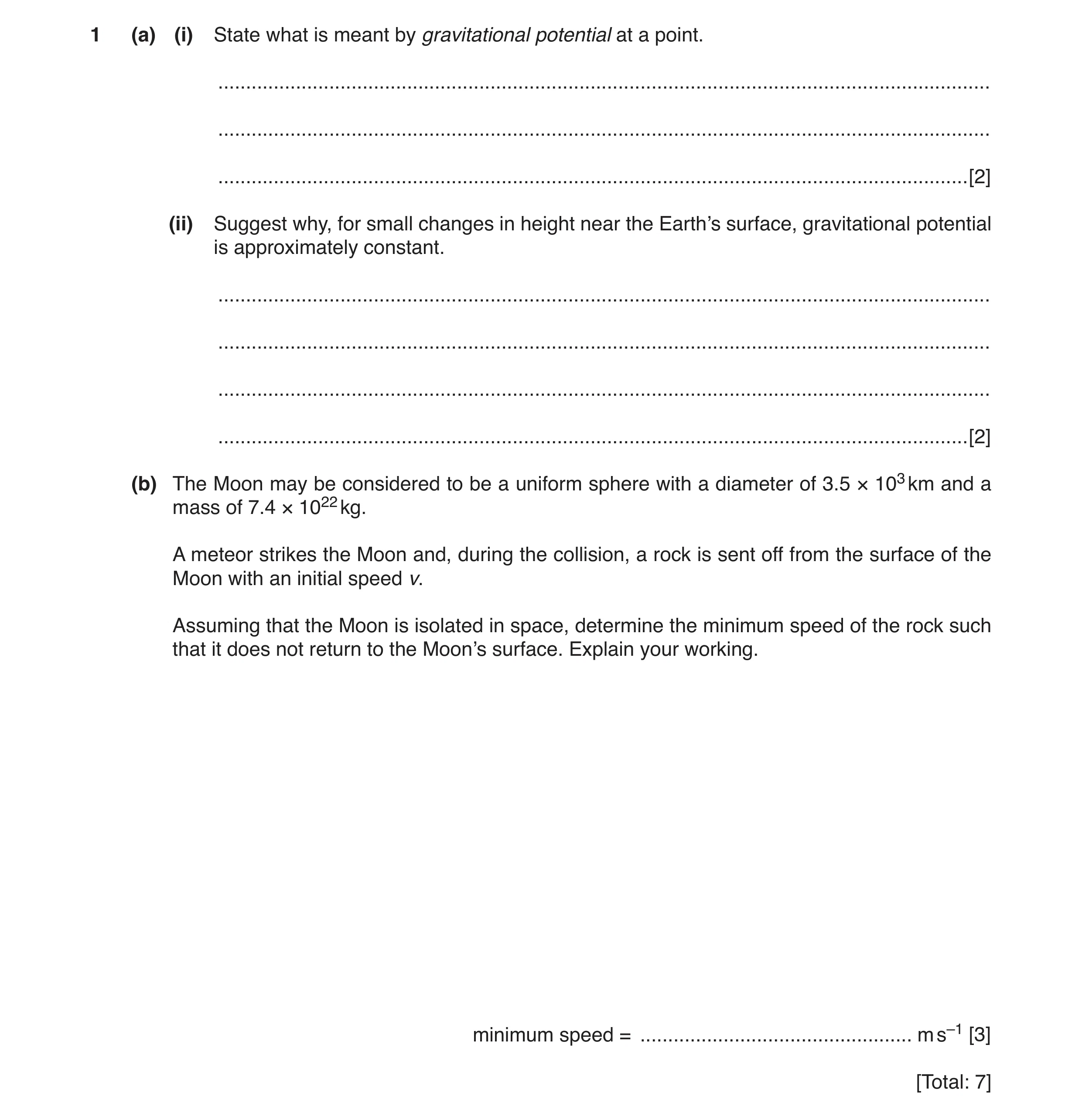
1 (a) (i) State what is meant by gravitational potential at a point. … … … [2] (ii) Suggest why, for small changes in height near the Earth’s surface, gravitational potential is approximately constant. … … … … [2] (b) The Moon may be considered to be a uniform sphere with a diameter of 3.5 × 10³ km and a mass of 7.4 × 10²² kg. A meteor strikes the Moon and, during the collision, a rock is sent off from the surface of the Moon with an initial speed v. Assuming that the Moon is isolated in space, determine the minimum speed of the rock such that it does not return to the Moon’s surface. Explain your working. minimum speed = … m s–1 [3] [Total: 7]
7 marks
Mark scheme: 1(a)(i) work done per unit mass B1 work done moving mass from infinity (to the point) B1 1(a)(ii) (near Earth’s surface change in) height ≪ radius or height much less than radius B1 potential inversely proportional to radius and radius approximately constant (so potential approximately constant) B1 1(b) initial kinetic energy = (–) potential energy (at surface) or ½mv2 = GMm / r B1 v2 = (2 × 6.67 × 10–11 × 7.4 × 1022) / (0.5 × 3.5 × 106) C1 v = 2.4 × 10³ m s–1 A1
This question in 9702/43 Oct/Nov 2018
Q4 · Define gravitational potential at a point 9702/42 Feb/March 2019
1 (a) (i) Define gravitational potential at a point. … … … [2] (ii) Use your answer in (i) to explain why the gravitational potential near an isolated mass is always negative. … … … … … … [3] (b) A spherical planet has mass 6.00 × 1024 kg and radius 6.40 × 10⁶ m. The planet may be assumed to be isolated in space with its mass concentrated at its centre. A satellite of mass 340 kg is in a circular orbit about the planet at a height 9.00 × 10⁵ m above its surface. For the satellite: (i) show that its orbital speed is 7.4 × 10³ m s–1 [2] (ii) calculate its gravitational potential energy. energy = … J [3] (c) Rockets on the satellite are fired for a short time. The satellite’s orbit is now closer to the surface of the planet. State and explain the change, if any, in the kinetic energy of the satellite. … … … … [2] [Total: 12]
12 marks
Mark scheme: 1(a)(i) work done per unit mass B1 idea of work done moving mass from infinity (to the point) B1 1(a)(ii) (gravitational) force is attractive B1 (gravitational) potential at infinity is zero B1 decrease in potential energy as masses approach or displacement and force in opposite directions B1 1(b)(i) Either mv2 / R = GMm / R2 Or v = √( GM / R) v2 = (6.67 × 10–11 × 6.00 × 1024) / (7.30 × 10⁶) C1 giving v = 7.4 × 10³ m s–1 A1 1(b)(ii) VP = – GMm / R C1 = – (6.67 × 10–11 × 6.00 × 1024 × 340) / (7.30 × 10⁶) C1 VP = – 1.9 × 10¹⁰ J A1 1(c) v2 ∝ 1 / r, (r smaller) so v greater M1 and EK greater A1
This question in 9702/42 Feb/March 2019
Q5 · Two point masses are isolated in space and are separated by a distance x 9702/41 May/June 2019
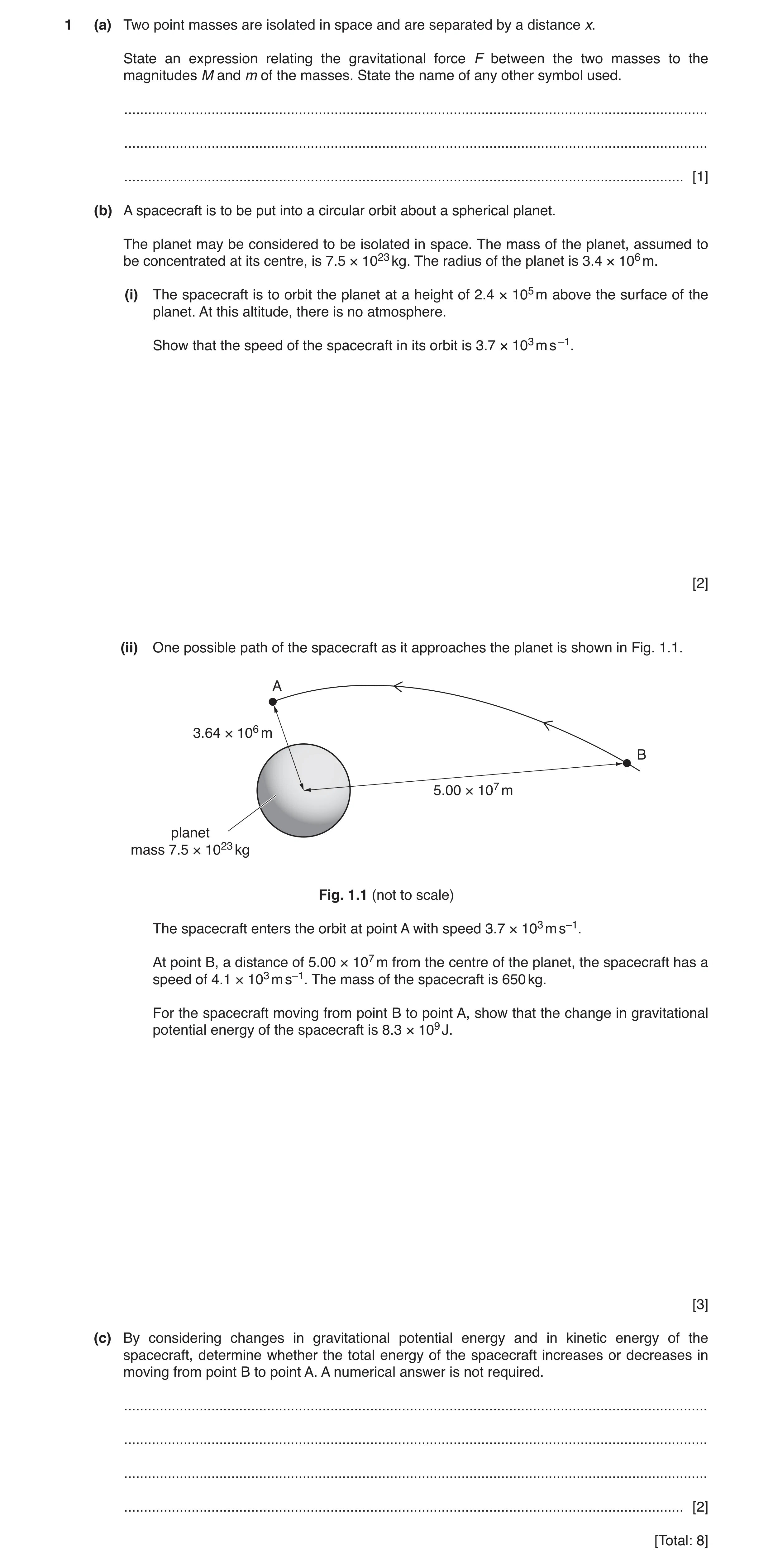
1 (a) Two point masses are isolated in space and are separated by a distance x. State an expression relating the gravitational force F between the two masses to the magnitudes M and m of the masses. State the name of any other symbol used. … … … [1] (b) A spacecraft is to be put into a circular orbit about a spherical planet. The planet may be considered to be isolated in space. The mass of the planet, assumed to be concentrated at its centre, is 7.5 × 10²³ kg. The radius of the planet is 3.4 × 10⁶ m. (i) The spacecraft is to orbit the planet at a height of 2.4 × 10⁵ m above the surface of the planet. At this altitude, there is no atmosphere. Show that the speed of the spacecraft in its orbit is 3.7 × 10³ m s –1. [2] (ii) One possible path of the spacecraft as it approaches the planet is shown in Fig. 1.1. A 3.64 × 10⁶ m B 5.00 × 10⁷ m planet mass 7.5 × 10²³ kg Fig. 1.1 (not to scale) The spacecraft enters the orbit at point A with speed 3.7 × 10³ m s–1. At point B, a distance of 5.00 × 10⁷ m from the centre of the planet, the spacecraft has a speed of 4.1 × 10³ m s–1. The mass of the spacecraft is 650 kg. For the spacecraft moving from point B to point A, show that the change in gravitational potential energy of the spacecraft is 8.3 × 10⁹ J. [3] (c) By considering changes in gravitational potential energy and in kinetic energy of the spacecraft, determine whether the total energy of the spacecraft increases or decreases in moving from point B to point A. A numerical answer is not required. … … … … [2] [Total: 8]
8 marks
Mark scheme: 1(a) (F =) GMm / x2, where G is the (universal) gravitational constant B1 1(b)(i) GMm / x2 = mv2 / x or v2 = GM / x C1 v 2 = (6.67 × 10–11 × 7.5 × 1023) / (3.4 × 10⁶ + 240 × 103) so v = 3.7 × 10³ m s–1 A1 1(b)(ii) potential energy = (–)GMm / x C1 EA = (–)(6.67 × 10–11 × 7.5 × 1023 × 650) / (3.64 × 10⁶) or EB = (–)(6.67 × 10–11 × 7.5 × 1023 × 650) / (5.00 × 10⁷) M1 correct substitution and subtraction EB – EA shown, leading to ∆Ep = 8.3 × 10⁹ J A1 or φ = (–)GM / x and potential energy = mφ (C1) ∆φ = (6.67 × 10–11 × 7.5 × 1023) × [(1 / (3.64 × 10⁶)) – (1 / (5.00 × 10⁷))] ( = 1.27 × 10⁷ J kg–1) (M1) ∆Ep = 1.27 × 107 × 650 = 8.3 × 10⁹ J (A1) 1(c) kinetic energy or potential energy decreases B1 kinetic energy and potential energy decrease so total energy decreases B1
This question in 9702/41 May/June 2019
Q6 · Two point masses are isolated in space and are separated by a distance x 9702/43 May/June 2019
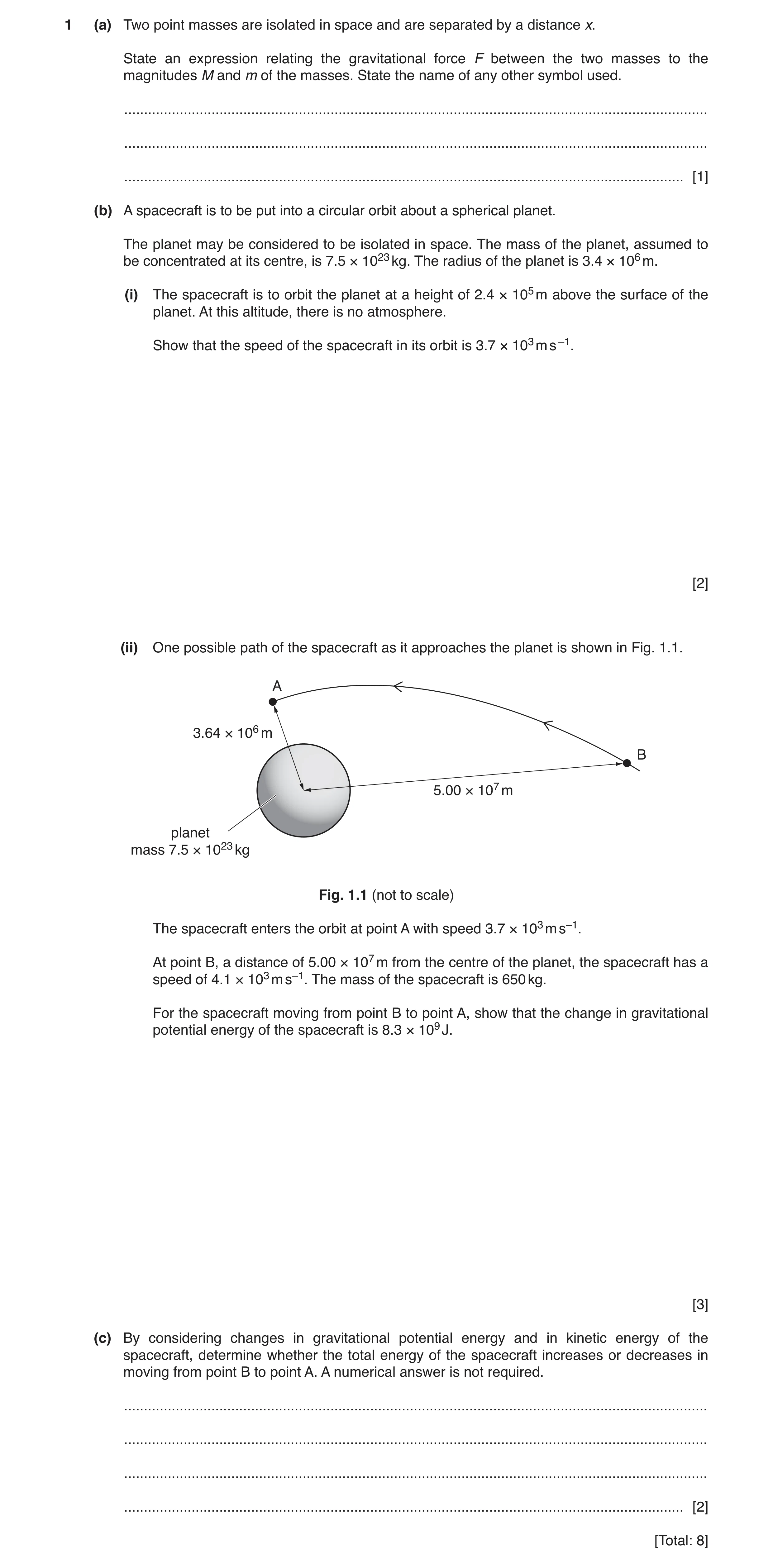
1 (a) Two point masses are isolated in space and are separated by a distance x. State an expression relating the gravitational force F between the two masses to the magnitudes M and m of the masses. State the name of any other symbol used. … … … [1] (b) A spacecraft is to be put into a circular orbit about a spherical planet. The planet may be considered to be isolated in space. The mass of the planet, assumed to be concentrated at its centre, is 7.5 × 10²³ kg. The radius of the planet is 3.4 × 10⁶ m. (i) The spacecraft is to orbit the planet at a height of 2.4 × 10⁵ m above the surface of the planet. At this altitude, there is no atmosphere. Show that the speed of the spacecraft in its orbit is 3.7 × 10³ m s –1. [2] (ii) One possible path of the spacecraft as it approaches the planet is shown in Fig. 1.1. A 3.64 × 10⁶ m B 5.00 × 10⁷ m planet mass 7.5 × 10²³ kg Fig. 1.1 (not to scale) The spacecraft enters the orbit at point A with speed 3.7 × 10³ m s–1. At point B, a distance of 5.00 × 10⁷ m from the centre of the planet, the spacecraft has a speed of 4.1 × 10³ m s–1. The mass of the spacecraft is 650 kg. For the spacecraft moving from point B to point A, show that the change in gravitational potential energy of the spacecraft is 8.3 × 10⁹ J. [3] (c) By considering changes in gravitational potential energy and in kinetic energy of the spacecraft, determine whether the total energy of the spacecraft increases or decreases in moving from point B to point A. A numerical answer is not required. … … … … [2] [Total: 8]
8 marks
Mark scheme: 1(a) (F =) GMm / x2, where G is the (universal) gravitational constant B1 1(b)(i) GMm / x2 = mv2 / x or v2 = GM / x C1 v 2 = (6.67 × 10–11 × 7.5 × 1023) / (3.4 × 10⁶ + 240 × 103) so v = 3.7 × 10³ m s–1 A1 1(b)(ii) potential energy = (–)GMm / x C1 EA = (–)(6.67 × 10–11 × 7.5 × 1023 × 650) / (3.64 × 10⁶) or EB = (–)(6.67 × 10–11 × 7.5 × 1023 × 650) / (5.00 × 10⁷) M1 correct substitution and subtraction EB – EA shown, leading to ∆Ep = 8.3 × 10⁹ J A1 or φ = (–)GM / x and potential energy = mφ (C1) ∆φ = (6.67 × 10–11 × 7.5 × 1023) × [(1 / (3.64 × 10⁶)) – (1 / (5.00 × 10⁷))] ( = 1.27 × 10⁷ J kg–1) (M1) ∆Ep = 1.27 × 107 × 650 = 8.3 × 10⁹ J (A1) 1(c) kinetic energy or potential energy decreases B1 kinetic energy and potential energy decrease so total energy decreases B1
This question in 9702/43 May/June 2019
Q7 · Define gravitational potential at a point 9702/42 Feb/March 2020
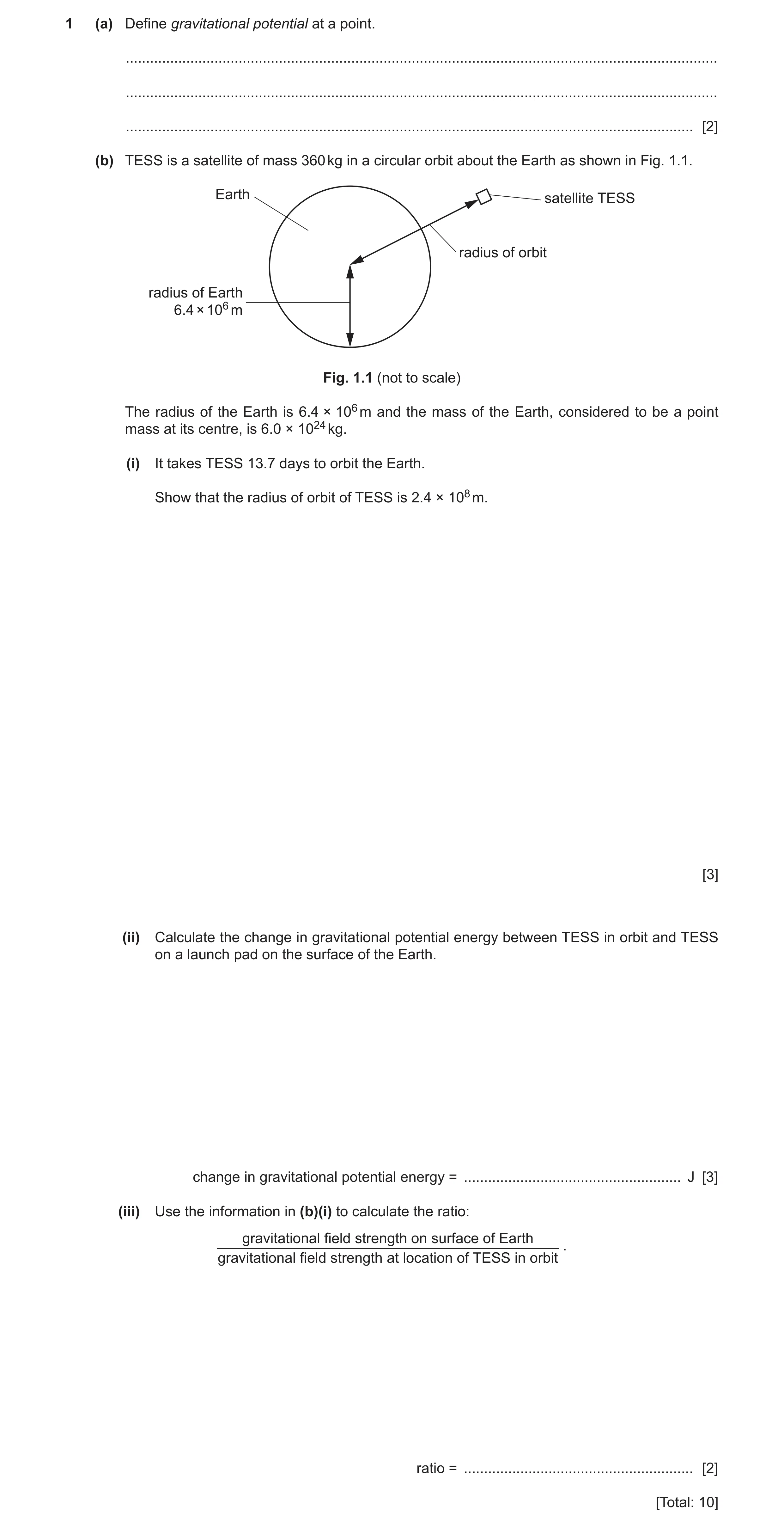
1 (a) Define gravitational potential at a point. … … … [2] (b) TESS is a satellite of mass 360 kg in a circular orbit about the Earth as shown in Fig. 1.1. Earth satellite TESS radius of orbit radius of Earth 6.4 × 10⁶ m Fig. 1.1 (not to scale) The radius of the Earth is 6.4 × 10⁶ m and the mass of the Earth, considered to be a point mass at its centre, is 6.0 × 1024 kg. (i) It takes TESS 13.7 days to orbit the Earth. Show that the radius of orbit of TESS is 2.4 × 10⁸ m. [3] (ii) Calculate the change in gravitational potential energy between TESS in orbit and TESS on a launch pad on the surface of the Earth. change in gravitational potential energy = … J [3] (iii) Use the information in (b)(i) to calculate the ratio: gravitational field strength on surface of Earth . gravitational field strength at location of TESS in orbit ratio = … [2] [Total: 10]
10 marks
Mark scheme: 1(a) work done per unit mass B1 work done moving mass from infinity (to the point) B1 1(b)(i) gravitational force provides centripetal force C1 mv2 / r = GMm / r2 and v = 2πr / T OR mrω2 = GMm / r2 and ω = 2π / T OR r3 = GMT2 / 4π2 C1 r3 = 6.67 × 10-11 × 6.0 × 1024 × (13.7 × 24 × 3600)2 / 4 π2 so r = 2.4 × 10⁸ m A1 1(b)(ii) (EP = –) GMm / r work done = GMm / r1 – GMm / r2 C1 = 6.67 × 10–11 × 360 × 6.0 × 1024 (1/6.4 × 106 – 1 / 2.4 × 10⁸) C1 = 2.2 × 10¹⁰ J A1 1(b)(iii) g = GM / r2 C1 ratio = rTESS2 / rearth2 = (2.4 × 10⁸ / 6.4 × 10⁶)2 = 1400 A1
This question in 9702/42 Feb/March 2020
Q8 · Define gravitational potential at a point 9702/42 May/June 2020
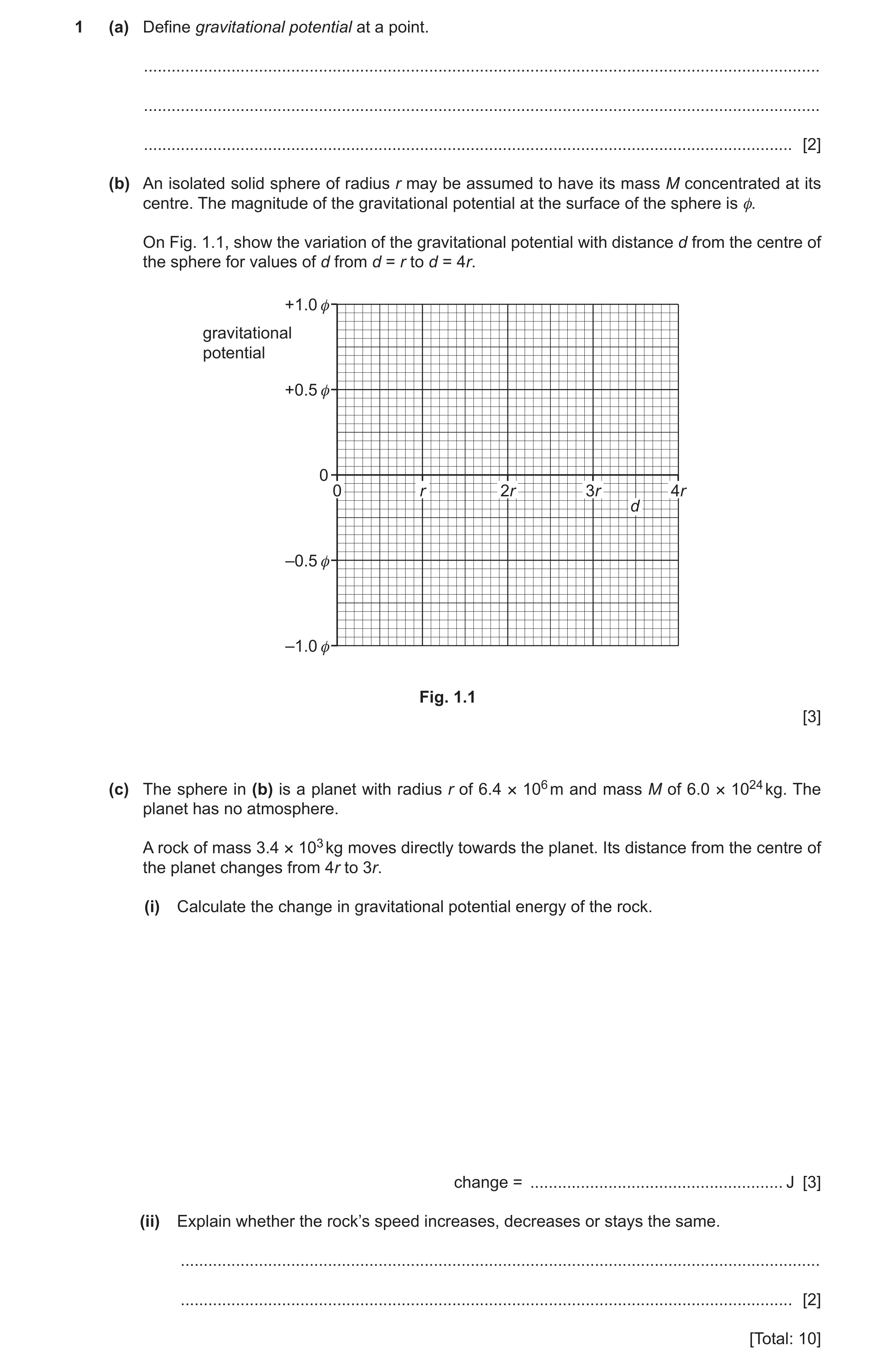
1 (a) Define gravitational potential at a point. … … … [2] (b) An isolated solid sphere of radius r may be assumed to have its mass M concentrated at its centre. The magnitude of the gravitational potential at the surface of the sphere is φ. On Fig. 1.1, show the variation of the gravitational potential with distance d from the centre of the sphere for values of d from d = r to d = 4r. +1.0 φ gravitational potential +0.5 φ 0 0 r 2r 3r 4r d –0.5 φ –1.0 φ Fig. 1.1 [3] (c) The sphere in (b) is a planet with radius r of 6.4 × 10⁶ m and mass M of 6.0 × 1024 kg. The planet has no atmosphere. A rock of mass 3.4 × 10³ kg moves directly towards the planet. Its distance from the centre of the planet changes from 4r to 3r. (i) Calculate the change in gravitational potential energy of the rock. change = … J [3] (ii) Explain whether the rock’s speed increases, decreases or stays the same. … … [2] [Total: 10]
10 marks
Mark scheme: 1(a) work done per unit mass B1 (work done to) move mass from infinity (to the point) B1 1(b) curve from r to 4r, with gradient of decreasing magnitude and starting at (r, ±φ) B1 line passing through (2r, ±0.5φ) and (4r, ±0.25φ) B1 line showing potential is negative throughout B1 1(c)(i) gravitational potential energy = (–) GMm / R C1 change = (6.67 × 10–11 × 6.0 × 1024 × 3.4 × 103) / (6.4 × 106) × [1/3 – 1/4] C1 = 1.8 × 10¹⁰ J A1 1(c)(ii) rock loses potential energy B1 (so) kinetic energy increases so speed increases B1 or force is attractive (B1) moves towards planet so speeds up (B1)
This question in 9702/42 May/June 2020
Q9 · Define gravitational potential at a point 9702/42 Oct/Nov 2020
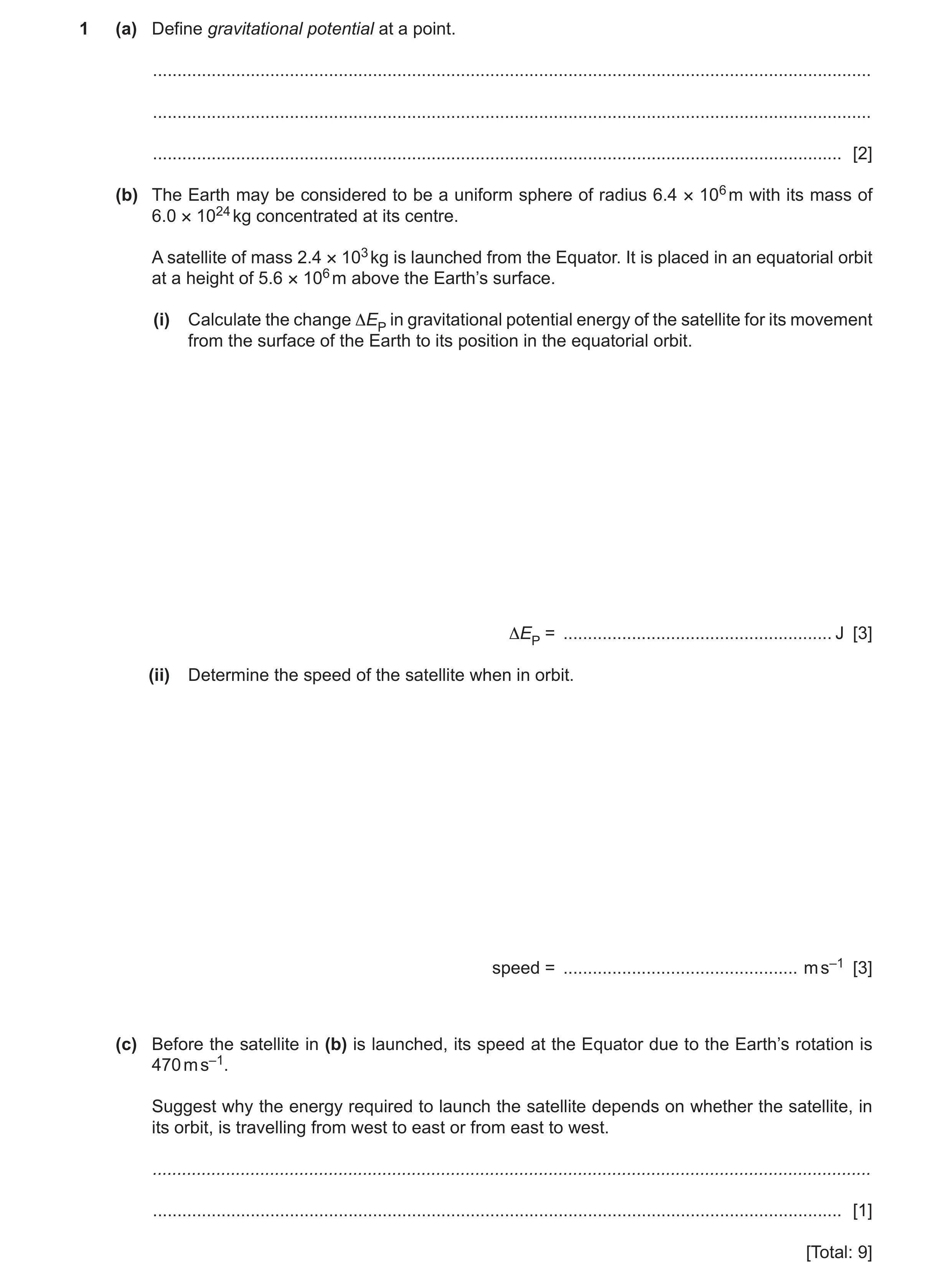
1 (a) Define gravitational potential at a point. … … … [2] (b) The Earth may be considered to be a uniform sphere of radius 6.4 × 10⁶ m with its mass of 6.0 × 1024 kg concentrated at its centre. A satellite of mass 2.4 × 10³ kg is launched from the Equator. It is placed in an equatorial orbit at a height of 5.6 × 10⁶ m above the Earth’s surface. (i) Calculate the change ΔEP in gravitational potential energy of the satellite for its movement from the surface of the Earth to its position in the equatorial orbit. ΔEP = … J [3] (ii) Determine the speed of the satellite when in orbit. speed = … m s–1 [3] (c) Before the satellite in (b) is launched, its speed at the Equator due to the Earth’s rotation is 470 m s–1. Suggest why the energy required to launch the satellite depends on whether the satellite, in its orbit, is travelling from west to east or from east to west. … … [1] [Total: 9]
9 marks
Mark scheme: 1(a) work done per unit mass B1 (work done) moving mass from infinity (to the point) B1 1(b)(i) gravitational potential energy = (–)GMm / r C1 ΔEP = 6.67 × 10–11 × 6.0 × 1024 × 2.4 × 103 × [(6.4 × 10⁶)–1 – (1.2 × 10⁷)–1] C1 or Δφ = 6.67 × 10–11 × 6.0 × 1024 × [(6.4 × 10⁶)–1 – (1.2 × 10⁷)–1] (C1) ΔEP = mΔφ (C1) ΔEP = 7.0 × 10¹⁰ J A1 1(b)(ii) GMm / r2 = mv2 / r C1 v2 = GM / r = (6.67 × 10–11 × 6.0 × 1024) / (1.2 × 10⁷) C1 v = 5800 m s–1 A1 1(c) any one point from: • smaller gain in energy required if orbit is west to east • smaller change in velocity if orbit is west to east • smaller gain in energy if orbit is in same direction as Earth’s rotation • smaller change in velocity if orbit is in same direction as Earth’s rotation • satellite already moving west to east at launch • Earth’s rotation is from west to east B1
This question in 9702/42 Oct/Nov 2020
Q10 · State Newton’s law of gravitation 9702/42 Feb/March 2021
1 (a) State Newton’s law of gravitation. … … … [2] (b) Planets have been observed orbiting a star in another solar system. Measurements are made of the orbital radius r and the time period T of each of these planets. The variation with R3 of T2 is shown in Fig. 1.1. 2.6 2.4 2.2 T2 / year2 2.0 1.8 1.6 1.4 1.2 1.0 0.8 0.6 0.4 0.2 0 0 0.1 0.2 0.3 0.4 0.5 0.6 0.7 0.8 0.9 1.0 1.1 1.2 R3 / 1034 m3 Fig. 1.1 The relationship between T and R is given by T2 = 4π2R3 GM where G is the gravitational constant and M is the mass of the star. Determine the mass M. M = … kg [3] (c) A rock of mass m is also in orbit around the star in (b). The radius of the orbit is r. (i) Explain why the gravitational potential energy of the rock is negative. … … … … [3] (ii) Show that the kinetic energy Ek of the rock is given by Ek = GMm . 2r [2] (iii) Use the expression in (c)(ii) to derive an expression for the total energy of the rock. [2] [Total: 12]
12 marks
Mark scheme: 1(a) (gravitational) force is (directly) proportional to product of masses B1 force (between point masses) is inversely proportional to the square of their separation B1 1(b) correct read offs from the graph with correct power of ten for R3 C1 ( ) 2 34 2 11 4 1.2 10 6.67 10 2.4 365 24 3600 M π − × × × = × × × × × C1 30 3.0 10 kg = × A1 1(c)(i) potential energy is zero at infinity B1 (gravitational) forces are attractive B1 work must be done on the rock to move it to infinity B1 1(c)(ii) 2 2 2 GMm mv GM GM OR v OR v r r r r = = = M1 use of ½ mv2 (e.g. multiplication by ½ m) leading to 2 GMm r A1 1(c)(iii) Ep = φ m and φ = GM r − or p GMm E r − = Total energy = Ek + Ep C1 Total energy 2 GMm GMm r r − = + 2 GMm r − = A1
This question in 9702/42 Feb/March 2021
Question 11 9702/41 Oct/Nov 2021
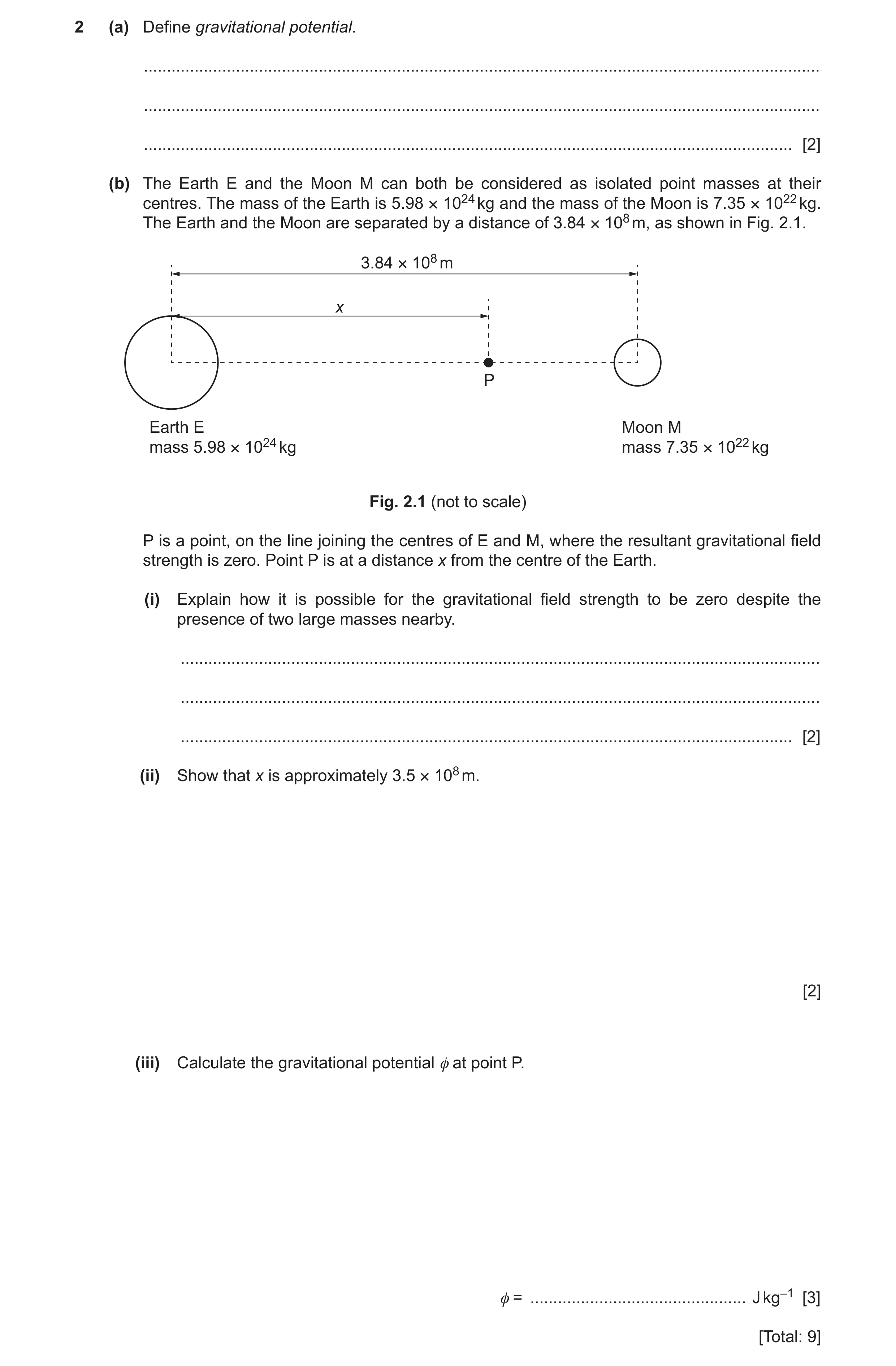
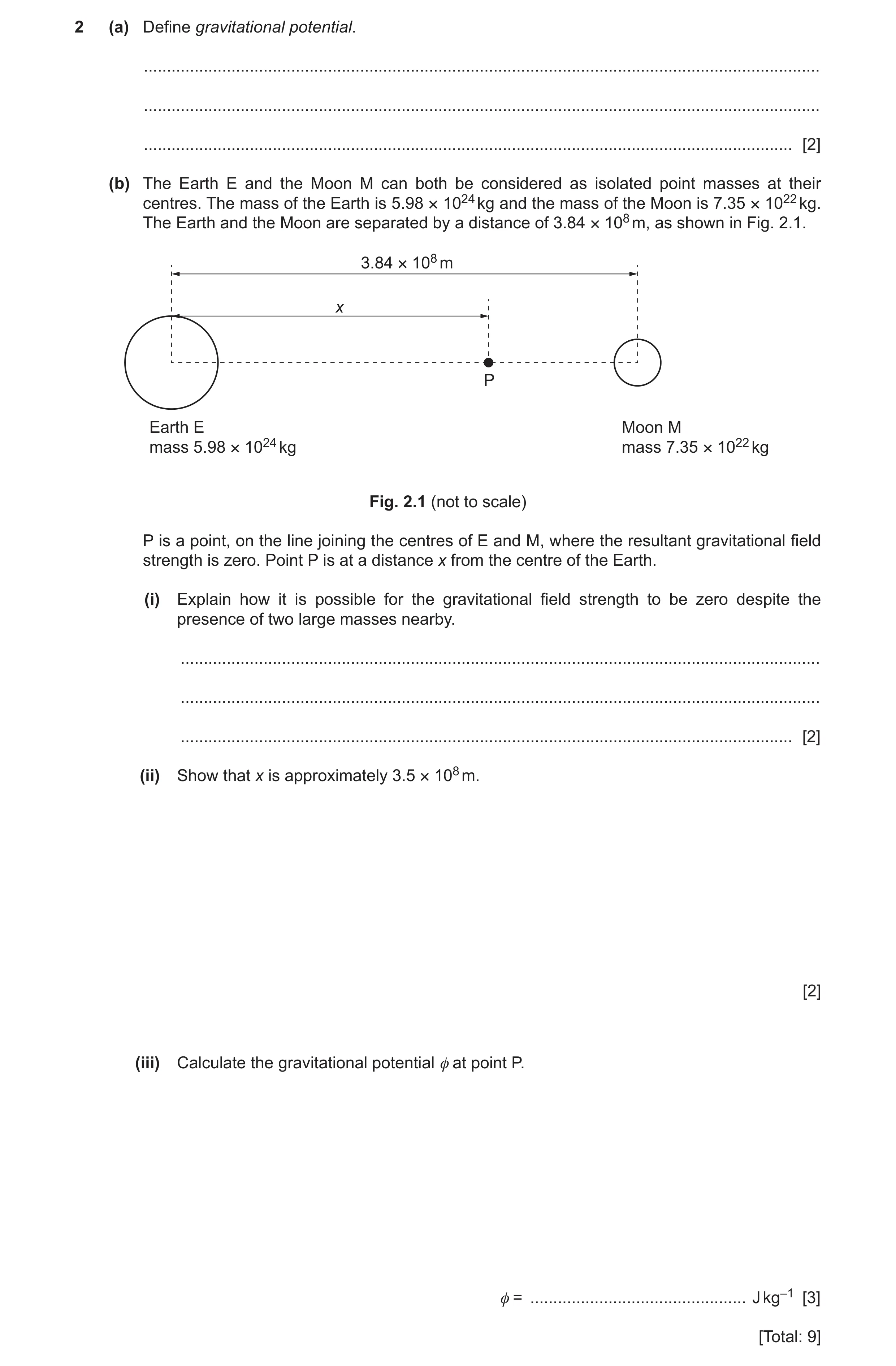
2 (a) Define gravitational potential. … … … [2] (b) The Earth E and the Moon M can both be considered as isolated point masses at their centres. The mass of the Earth is 5.98 × 1024 kg and the mass of the Moon is 7.35 × 10²² kg. The Earth and the Moon are separated by a distance of 3.84 × 10⁸ m, as shown in Fig. 2.1. 3.84 × 10⁸ m x P Earth E Moon M mass 5.98 × 1024 kg mass 7.35 × 10²² kg Fig. 2.1 (not to scale) P is a point, on the line joining the centres of E and M, where the resultant gravitational field strength is zero. Point P is at a distance x from the centre of the Earth. (i) Explain how it is possible for the gravitational field strength to be zero despite the presence of two large masses nearby. … … … [2] (ii) Show that x is approximately 3.5 × 10⁸ m. [2] (iii) Calculate the gravitational potential φ at point P. φ = … J kg–1 [3] [Total: 9]
9 marks
Mark scheme: 2(a) work done per unit mass B1 (work done in) moving mass from infinity B1 2(b)(i) (gravitational) fields from the Earth and Moon are in opposite directions B1 (resultant is zero where gravitational) fields are equal (in magnitude) B1 2(b)(ii) g ∝ M / r2 C1 5.98 × 1024 / x2 = 7.35 × 10²² / (3.84 × 10⁸ – x)2 leading to x = 3.5 × 10⁸ (m) A1 2(b)(iii) φ (Earth) = (–)6.67 × 10–11 × (5.98 × 1024 / 3.5 × 10⁸) and φ (Moon) = (–)6.67 × 10–11 × (7.35 × 1022 / 0.38 × 10⁸) C1 φ = (–)6.67 × 10⁻¹¹ × [(5.98 × 1024 / 3.5 × 10⁸) + (7.35 × 10²² / 0.38 × 10⁸)] C1 = – 1.3 × 10⁶ J kg–1 A1
This question in 9702/41 Oct/Nov 2021
Q12 · State the relationship between gravitational potential and gravitational field strength 9702/42 Oct/Nov 2021
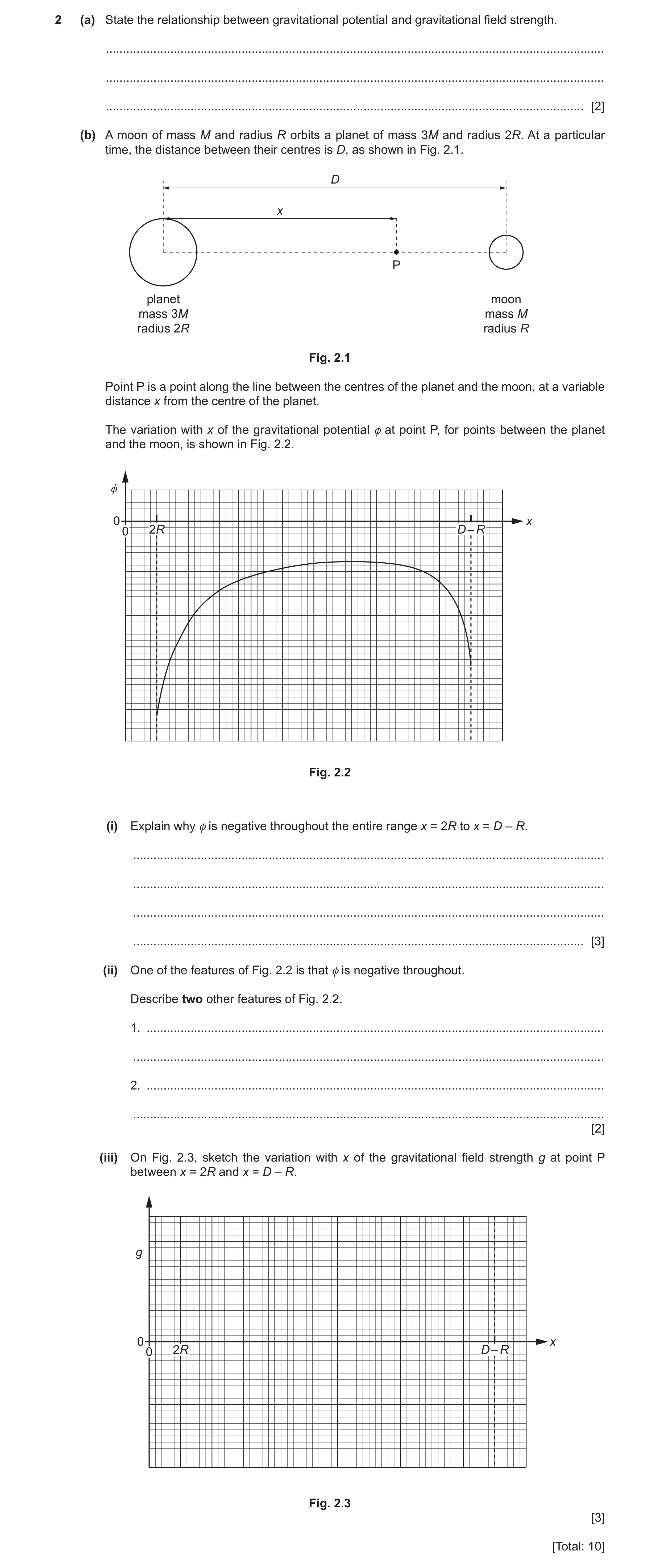
2 (a) State the relationship between gravitational potential and gravitational field strength. … … … [2] (b) A moon of mass M and radius R orbits a planet of mass 3M and radius 2R. At a particular time, the distance between their centres is D, as shown in Fig. 2.1. D x P planet moon mass 3M mass M radius 2R radius R Fig. 2.1 Point P is a point along the line between the centres of the planet and the moon, at a variable distance x from the centre of the planet. The variation with x of the gravitational potential φ at point P, for points between the planet and the moon, is shown in Fig. 2.2. φ 0 x 0 2R D – R Fig. 2.2 (i) Explain why φ is negative throughout the entire range x = 2R to x = D – R. … … … … [3] (ii) One of the features of Fig. 2.2 is that φ is negative throughout. Describe two other features of Fig. 2.2. 1. … … 2. … … [2] (iii) On Fig. 2.3, sketch the variation with x of the gravitational field strength g at point P between x = 2R and x = D – R. g 0 x 0 2R D – R Fig. 2.3 [3] [Total: 10]
10 marks
Mark scheme: 2(a) (gravitational) field strength equals (gravitational) potential gradient M1 reference to minus sign A1 2(b)(i) potential is zero at infinity B1 (gravitational) force is attractive B1 (test) mass getting closer (from infinity) loses potential energy B1 2(b)(ii) • potential at (surface of) planet is smaller than at (surface of) moon • potential gradient at (surface of) planet is smaller than at (surface of) moon • magnitude of potential varies inversely with distance from centre near the spheres • (point of) maximum potential is nearer to moon than planet Any two points, 1 mark each B2 2(b)(iii) sketch: one curve, starting with gradient of decreasing magnitude at 2R and finishing with gradient of increasing magnitude at D – R B1 field strength shown as zero (only) near the point of maximum potential B1 negative field strength near one sphere and positive field strength near the other B1
This question in 9702/42 Oct/Nov 2021
Question 13 9702/43 Oct/Nov 2021
2 (a) Define gravitational potential. … … … [2] (b) The Earth E and the Moon M can both be considered as isolated point masses at their centres. The mass of the Earth is 5.98 × 1024 kg and the mass of the Moon is 7.35 × 10²² kg. The Earth and the Moon are separated by a distance of 3.84 × 10⁸ m, as shown in Fig. 2.1. 3.84 × 10⁸ m x P Earth E Moon M mass 5.98 × 1024 kg mass 7.35 × 10²² kg Fig. 2.1 (not to scale) P is a point, on the line joining the centres of E and M, where the resultant gravitational field strength is zero. Point P is at a distance x from the centre of the Earth. (i) Explain how it is possible for the gravitational field strength to be zero despite the presence of two large masses nearby. … … … [2] (ii) Show that x is approximately 3.5 × 10⁸ m. [2] (iii) Calculate the gravitational potential φ at point P. φ = … J kg–1 [3] [Total: 9]
9 marks
Mark scheme: 2(a) work done per unit mass B1 (work done in) moving mass from infinity B1 2(b)(i) (gravitational) fields from the Earth and Moon are in opposite directions B1 (resultant is zero where gravitational) fields are equal (in magnitude) B1 2(b)(ii) g ∝ M / r2 C1 5.98 × 1024 / x2 = 7.35 × 10²² / (3.84 × 10⁸ – x)2 leading to x = 3.5 × 10⁸ (m) A1 2(b)(iii) φ (Earth) = (–)6.67 × 10–11 × (5.98 × 1024 / 3.5 × 10⁸) and φ (Moon) = (–)6.67 × 10–11 × (7.35 × 1022 / 0.38 × 10⁸) C1 φ = (–)6.67 × 10⁻¹¹ × [(5.98 × 1024 / 3.5 × 10⁸) + (7.35 × 10²² / 0.38 × 10⁸)] C1 = – 1.3 × 10⁶ J kg–1 A1
This question in 9702/43 Oct/Nov 2021
Q14 · Define gravitational potential at a point 9702/42 May/June 2022
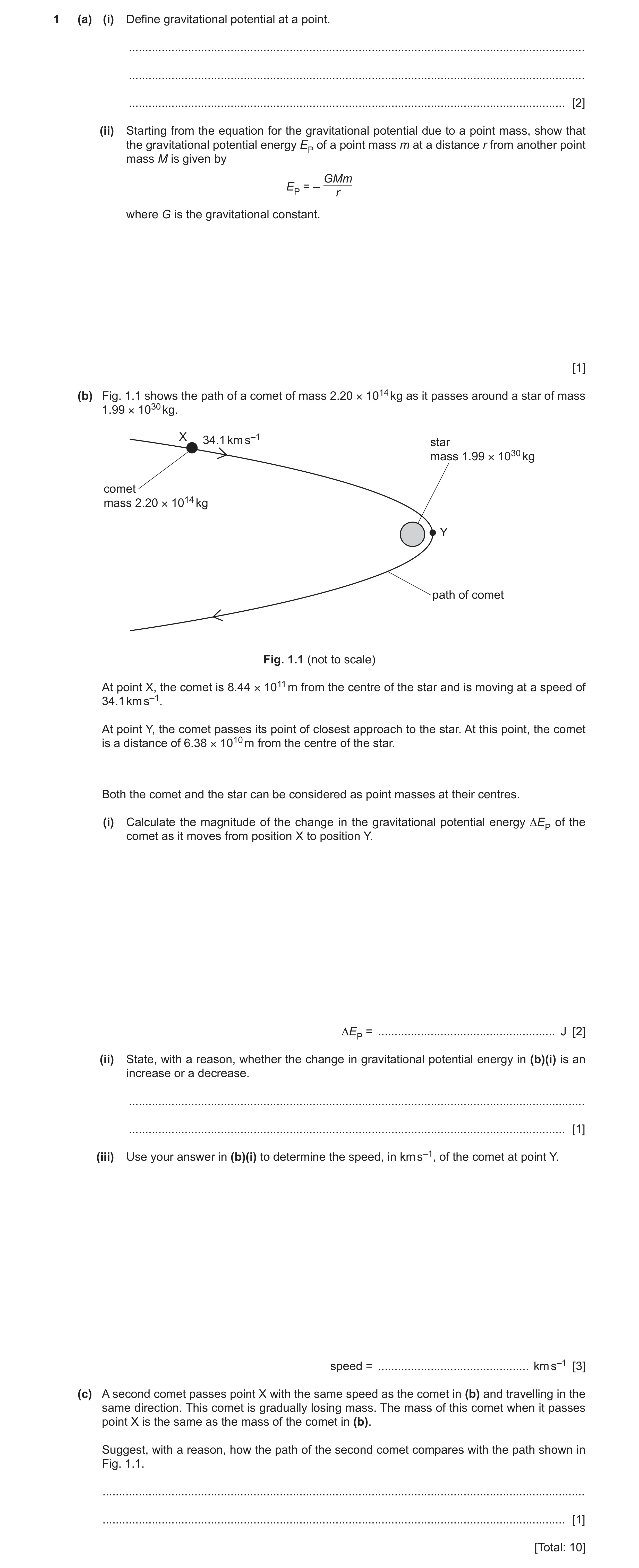
1 (a) (i) Define gravitational potential at a point. … … … [2] (ii) Starting from the equation for the gravitational potential due to a point mass, show that the gravitational potential energy EP of a point mass m at a distance r from another point mass M is given by GMm EP = – r where G is the gravitational constant. [1] (b) Fig. 1.1 shows the path of a comet of mass 2.20 × 10¹⁴ kg as it passes around a star of mass 1.99 × 1030 kg. X 34.1 km s–1 star mass 1.99 × 1030 kg comet mass 2.20 × 10¹⁴ kg Y path of comet Fig. 1.1 (not to scale) At point X, the comet is 8.44 × 10¹¹ m from the centre of the star and is moving at a speed of 34.1 km s–1. At point Y, the comet passes its point of closest approach to the star. At this point, the comet is a distance of 6.38 × 10¹⁰ m from the centre of the star. Both the comet and the star can be considered as point masses at their centres. (i) Calculate the magnitude of the change in the gravitational potential energy ΔEP of the comet as it moves from position X to position Y. ΔEP = … J [2] (ii) State, with a reason, whether the change in gravitational potential energy in (b)(i) is an increase or a decrease. … … [1] (iii) Use your answer in (b)(i) to determine the speed, in km s–1, of the comet at point Y. speed = … km s–1 [3] (c) A second comet passes point X with the same speed as the comet in (b) and travelling in the same direction. This comet is gradually losing mass. The mass of this comet when it passes point X is the same as the mass of the comet in (b). Suggest, with a reason, how the path of the second comet compares with the path shown in Fig. 1.1. … … [1] [Total: 10]
10 marks
Mark scheme: 1(a)(i) work (done) per unit mass B1 work (done on mass) in moving mass from infinity (to the point) B1 1(a)(ii) EP = ϕm EP = (– GM / r) m = – GMm / r or ϕ = – GM / r and EP = ϕm = – GMm / r B1 1(b)(i) EP = 6.67 10–11 1.99 1030 2.20 1014 [1 / (6.38 1010) – 1 / (8.44 1011)] C1 = 4.23 1023 J A1 1(b)(ii) (gravitational) force is attractive so decrease or (gravitational) force does work so decrease B1 1(b)(iii) EP = ½m(v22 – v12) C1 4.23 1023 = ½ 2.20 1014 (v2 – 34 1002) C1 v (= 70 800 m s–1) = 70.8 km s–1 A1 1(c) both PE and KE equations include m, so path is unchanged B1
This question in 9702/42 May/June 2022
Q15 · Define gravitational potential at a point 9702/42 Feb/March 2023
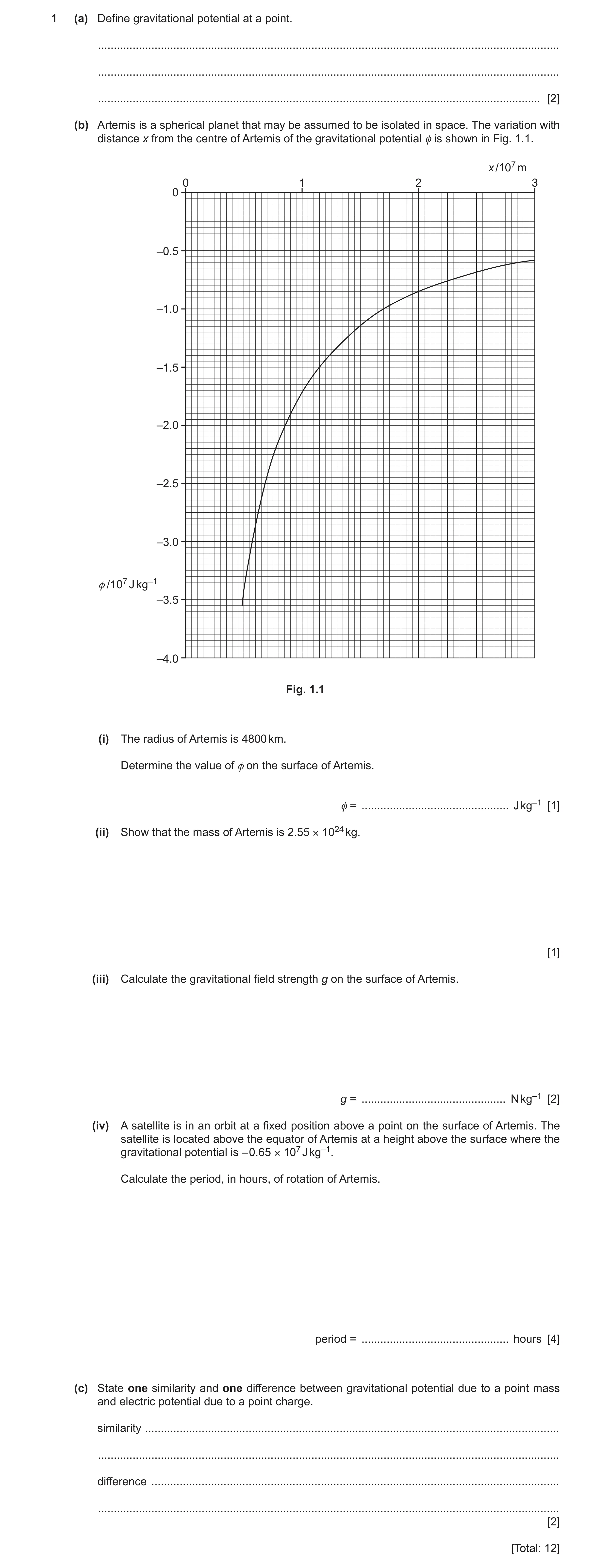
1 (a) Define gravitational potential at a point. … … … [2] (b) Artemis is a spherical planet that may be assumed to be isolated in space. The variation with distance x from the centre of Artemis of the gravitational potential φ is shown in Fig. 1.1. x /107 m 0 1 2 3 0 –0.5 –1.0 –1.5 –2.0 –2.5 –3.0 φ / 107 J kg–1 –3.5 –4.0 Fig. 1.1 (i) The radius of Artemis is 4800 km. Determine the value of φ on the surface of Artemis. φ = … J kg–1 [1] (ii) Show that the mass of Artemis is 2.55 × 1024 kg. [1] (iii) Calculate the gravitational field strength g on the surface of Artemis. g = … N kg–1 [2] (iv) A satellite is in an orbit at a fixed position above a point on the surface of Artemis. The satellite is located above the equator of Artemis at a height above the surface where the gravitational potential is – 0.65 × 10⁷ J kg–1. Calculate the period, in hours, of rotation of Artemis. period = … hours [4] (c) State one similarity and one difference between gravitational potential due to a point mass and electric potential due to a point charge. similarity … … difference … … [2] [Total: 12]
12 marks
Mark scheme: Question Answer Marks 1(a) work done per unit mass B1 work (done on mass) moving mass from infinity (to the point) B1 1(b)(i) –3.55 107 J kg–1 B1 1(b)(ii) GM B1 = − r −3.55 10 7 4 800 000 M = – 6.67 10 −11 = 2.55 1024 kg 1(b)(iii) GM C1 g = or g = − r 2 r 6.67 10 −11 2.55 10 24 3.55 107 A1 = or = 48000002 4800000 = 7.4 N kg–1 1(b)(iv) r in range 2.60 107 to 2.65 107 m C1 mv 2 GMm 2 r GMm 2 C1 = and v = or mr 2 = and = r r 2 T r 2 T 2.65 10 7 )3 C1 2 4 2 r 3 4 2 ( T = = = 4.20 109 GM 6.67 10 −11 2.55 10 24 T = 64 800 s A1 = 18 hours 1(c) similarity – any one point from B1 • inversely proportional to distance (from point) • points of equal potential lie on concentric spheres • zero at infinite distance difference – any one point from B1 • gravitational potential is (always) negative • electric potential can be positive or negative
This question in 9702/42 Feb/March 2023
Q16 · Define gravitational potential at a point 9702/42 Oct/Nov 2023
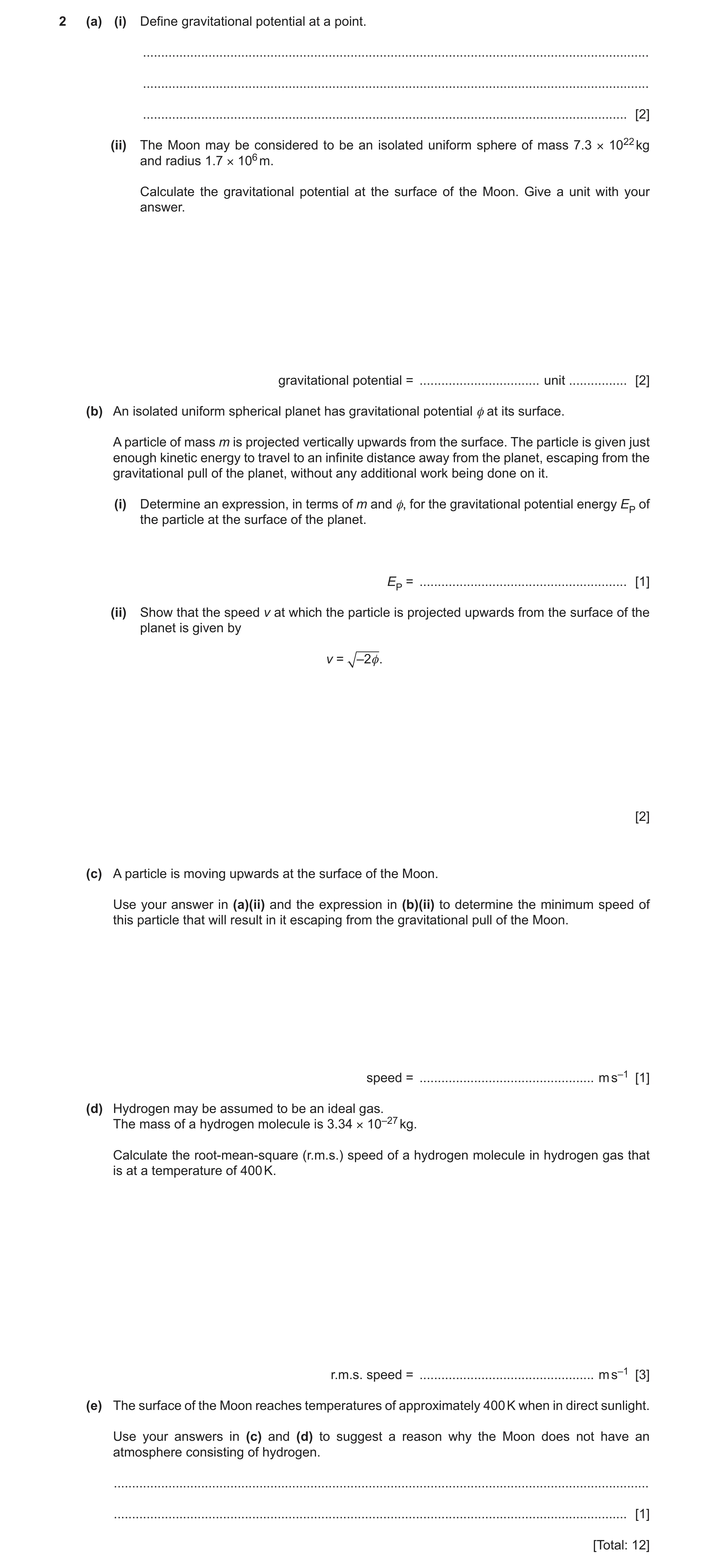
2 (a) (i) Define gravitational potential at a point. … … … [2] (ii) The Moon may be considered to be an isolated uniform sphere of mass 7.3 × 10²² kg and radius 1.7 × 10⁶ m. Calculate the gravitational potential at the surface of the Moon. Give a unit with your answer. gravitational potential = … unit … [2] (b) An isolated uniform spherical planet has gravitational potential φ at its surface. A particle of mass m is projected vertically upwards from the surface. The particle is given just enough kinetic energy to travel to an infinite distance away from the planet, escaping from the gravitational pull of the planet, without any additional work being done on it. (i) Determine an expression, in terms of m and φ, for the gravitational potential energy EP of the particle at the surface of the planet. EP = … [1] (ii) Show that the speed v at which the particle is projected upwards from the surface of the planet is given by v = –2φ. [2] (c) A particle is moving upwards at the surface of the Moon. Use your answer in (a)(ii) and the expression in (b)(ii) to determine the minimum speed of this particle that will result in it escaping from the gravitational pull of the Moon. speed = … m s–1 [1] (d) Hydrogen may be assumed to be an ideal gas. The mass of a hydrogen molecule is 3.34 × 10⁻²⁷ kg. Calculate the root-mean-square (r.m.s.) speed of a hydrogen molecule in hydrogen gas that is at a temperature of 400 K. r.m.s. speed = … m s–1 [3] (e) The surface of the Moon reaches temperatures of approximately 400 K when in direct sunlight. Use your answers in (c) and (d) to suggest a reason why the Moon does not have an atmosphere consisting of hydrogen. … … [1] [Total: 12]
12 marks
Mark scheme: 2(a)(i) work done per unit mass B1 work (done) moving mass from infinity (to the point) B1 2(a)(ii) = –GM / r C1 = – (6.67 10–11 7.3 1022) / (1.7 106) = – 2.9 106 J kg–1 A1 2(b)(i) EP = m B1 2(b)(ii) ½mv2 + m= 0 M1 correct algebra leading to v = √(–2) A1 2(c) speed = √(2 2.9 106) A1 = 2400 m s–1 2(d) ½m<c2> = (3/2)kT C1 3.34 10–27 <c2> = 3 1.38 10–23 400 C1 cr.m.s. = 2200 m s–1 A1 2(e) r.m.s. speed is an average so many molecules have speeds greater than the escape speed B1 or there is a distribution of molecular speeds (around the r.m.s. value) so many molecules have speeds greater than the escape speed
This question in 9702/42 Oct/Nov 2023
Q17 · Define gravitational potential at a point 9702/41 May/June 2024
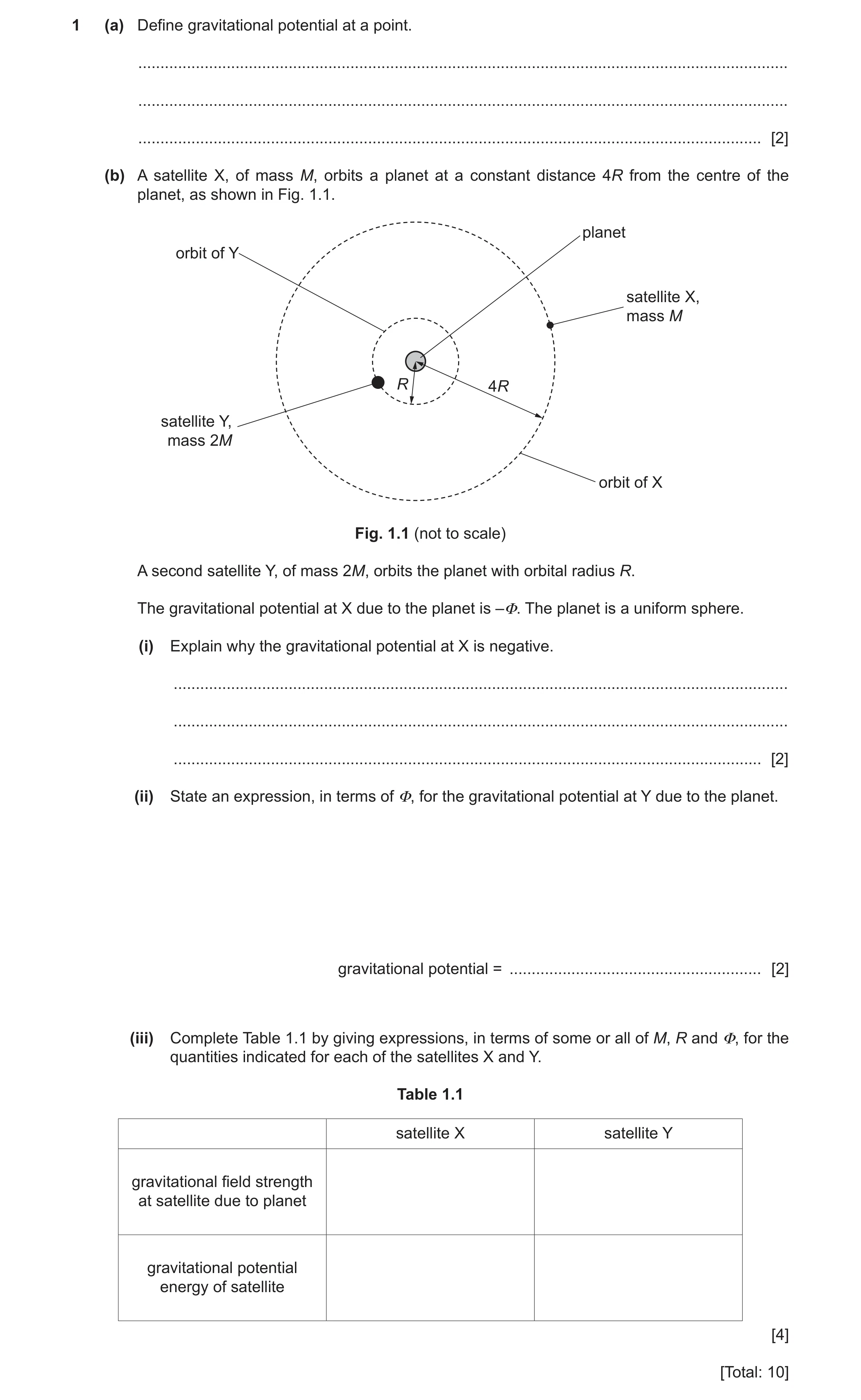
1 (a) Define gravitational potential at a point. … … … [2] (b) A satellite X, of mass M, orbits a planet at a constant distance 4R from the centre of the planet, as shown in Fig. 1.1. planet orbit of Y satellite X, mass M R 4R satellite Y, mass 2M orbit of X Fig. 1.1 (not to scale) A second satellite Y, of mass 2M, orbits the planet with orbital radius R. The gravitational potential at X due to the planet is –Φ. The planet is a uniform sphere. (i) Explain why the gravitational potential at X is negative. … … … [2] (ii) State an expression, in terms of Φ, for the gravitational potential at Y due to the planet. gravitational potential = … [2] (iii) Complete Table 1.1 by giving expressions, in terms of some or all of M, R and Φ, for the quantities indicated for each of the satellites X and Y. Table 1.1 satellite X satellite Y gravitational field strength at satellite due to planet gravitational potential energy of satellite [4] [Total: 10]
10 marks
Mark scheme: 1(a) work done per unit mass B1 work done moving mass from infinity (to the point) B1 1(b)(i) potential is zero at infinity B1 work is done by (two) masses in moving them closer together or work is done on (two) masses in moving them apart B1 1(b)(ii) magnitude of potential shown as 4 B1 potential negative and shown as a multiple of – [potential = –4 if fully correct] B1 1(b)(iii) field strength at X: / 4R A1 field strength at Y: 4 / R A1 potential energy at X: –M A1 potential energy at Y: –8M A1
This question in 9702/41 May/June 2024
Q18 · Define gravitational potential at a point 9702/43 May/June 2024
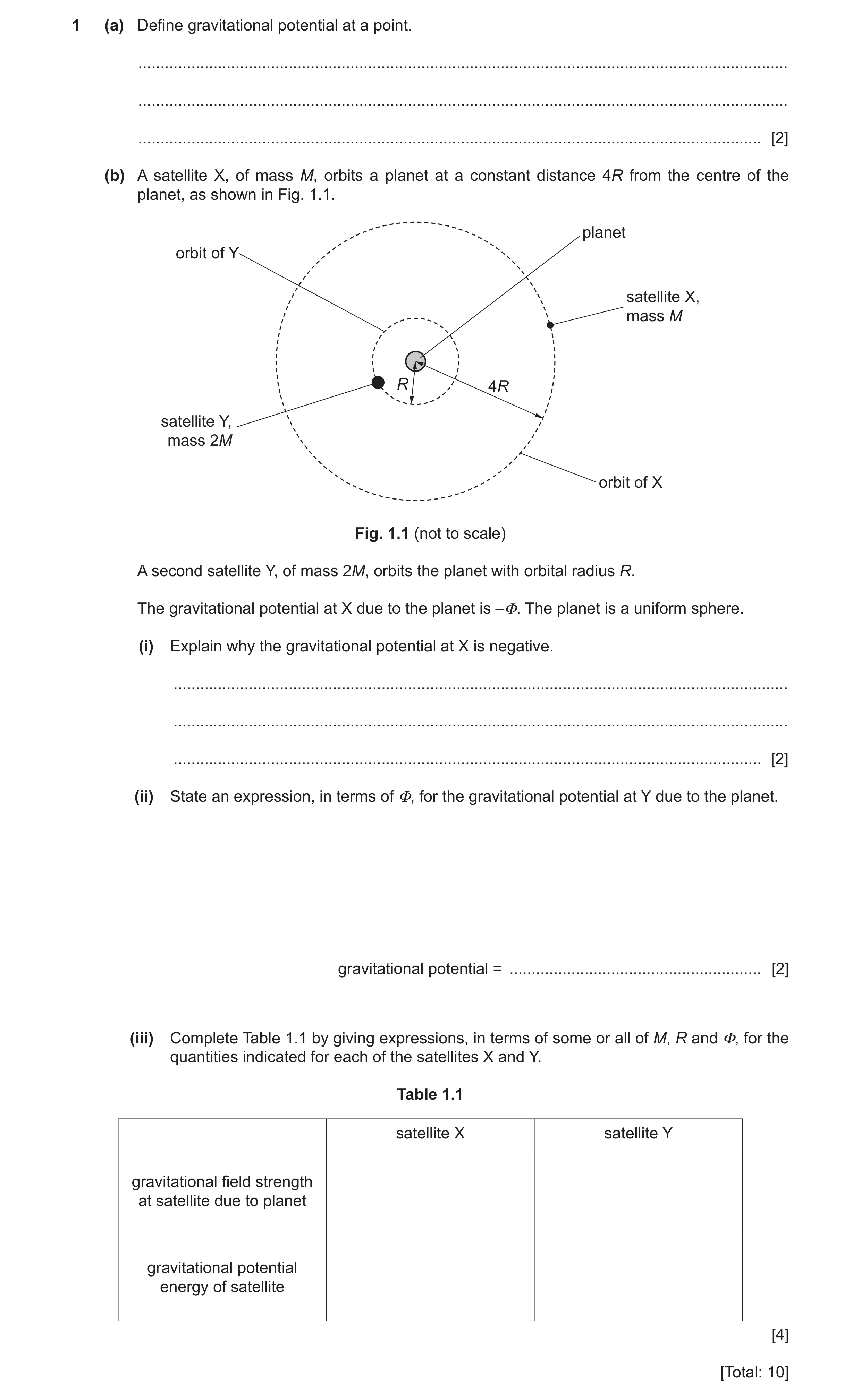
1 (a) Define gravitational potential at a point. … … … [2] (b) A satellite X, of mass M, orbits a planet at a constant distance 4R from the centre of the planet, as shown in Fig. 1.1. planet orbit of Y satellite X, mass M R 4R satellite Y, mass 2M orbit of X Fig. 1.1 (not to scale) A second satellite Y, of mass 2M, orbits the planet with orbital radius R. The gravitational potential at X due to the planet is –Φ. The planet is a uniform sphere. (i) Explain why the gravitational potential at X is negative. … … … [2] (ii) State an expression, in terms of Φ, for the gravitational potential at Y due to the planet. gravitational potential = … [2] (iii) Complete Table 1.1 by giving expressions, in terms of some or all of M, R and Φ, for the quantities indicated for each of the satellites X and Y. Table 1.1 satellite X satellite Y gravitational field strength at satellite due to planet gravitational potential energy of satellite [4] [Total: 10]
10 marks
Mark scheme: 1(a) work done per unit mass B1 work done moving mass from infinity (to the point) B1 1(b)(i) potential is zero at infinity B1 work is done by (two) masses in moving them closer together or work is done on (two) masses in moving them apart B1 1(b)(ii) magnitude of potential shown as 4 B1 potential negative and shown as a multiple of – [potential = –4 if fully correct] B1 1(b)(iii) field strength at X: / 4R A1 field strength at Y: 4 / R A1 potential energy at X: –M A1 potential energy at Y: –8M A1
This question in 9702/43 May/June 2024
Q19 · The magnitude of the gravitational potential on the surface of a planet of radius R is φ 9702/42 Feb/March 2025
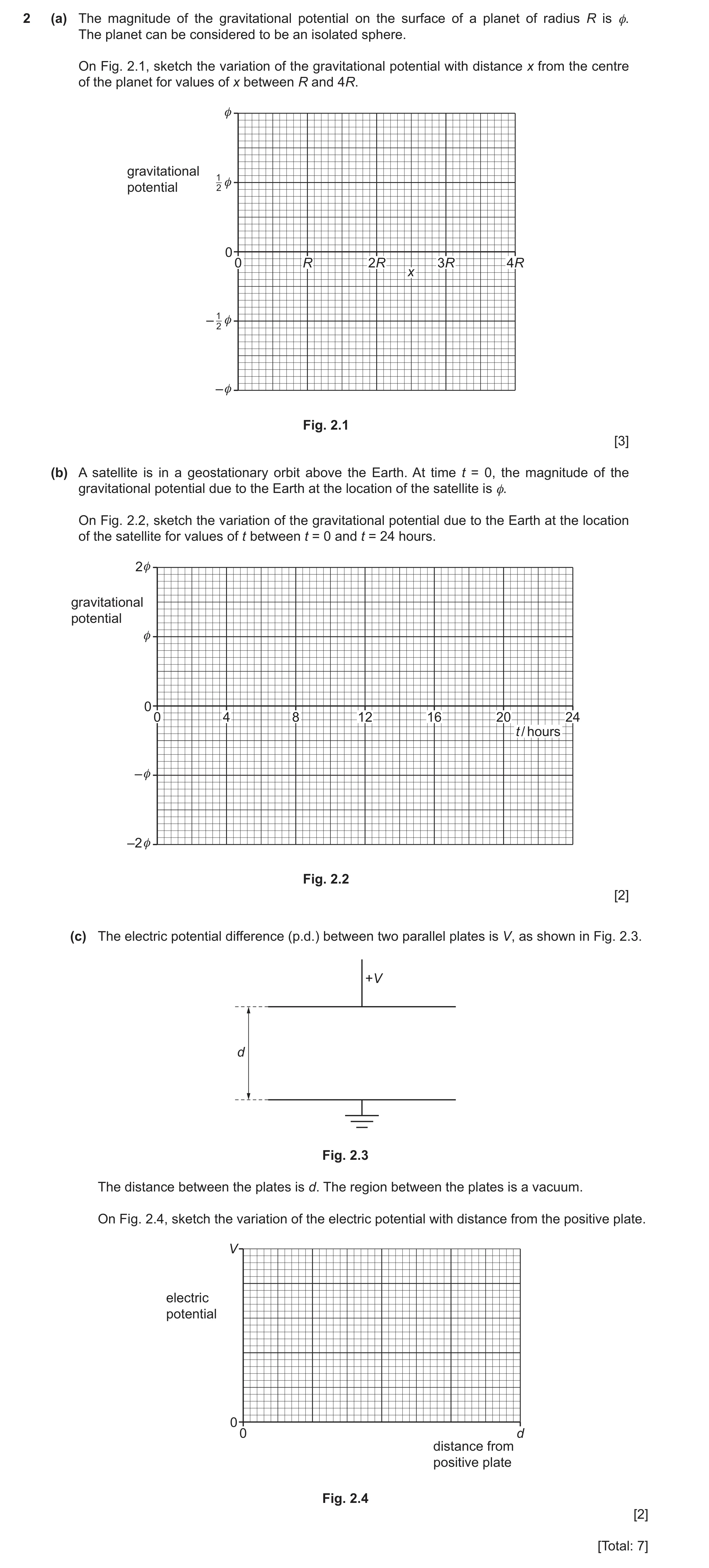
2 (a) The magnitude of the gravitational potential on the surface of a planet of radius R is φ. The planet can be considered to be an isolated sphere. On Fig. 2.1, sketch the variation of the gravitational potential with distance x from the centre of the planet for values of x between R and 4R. φ gravitational 1 φ potential 2 0 0 R 2R 3R 4R x – 1 φ 2 – φ Fig. 2.1 [3] (b) A satellite is in a geostationary orbit above the Earth. At time t = 0, the magnitude of the gravitational potential due to the Earth at the location of the satellite is φ. On Fig. 2.2, sketch the variation of the gravitational potential due to the Earth at the location of the satellite for values of t between t = 0 and t = 24 hours. 2φ gravitational potential φ 0 0 4 8 12 16 20 24 t / hours – φ –2 φ Fig. 2.2 [2] (c) The electric potential difference (p.d.) between two parallel plates is V, as shown in Fig. 2.3. +V d Fig. 2.3 The distance between the plates is d. The region between the plates is a vacuum. On Fig. 2.4, sketch the variation of the electric potential with distance from the positive plate. V electric potential 0 0 d distance from positive plate Fig. 2.4 [2] [Total: 7]
7 marks
Mark scheme: 2(a) sketch: B1 line from x = R to x = 4R entirely in the negative region curve with continuously decreasing magnitude and with gradient of continuously decreasing magnitude, starting at (R, ) B1 line passing through (2R, ½) and (4R, ¼) B1 2(b) horizontal straight line from t = 0 to t = 24 hours B1 line starting at (0, –) B1 2(c) straight line with non-zero gradient from 0 to d B1 line with negative gradient from (0, V) to (d, 0) B1
This question in 9702/42 Feb/March 2025
Q20 · Define gravitational potential at a point 9702/41 May/June 2025
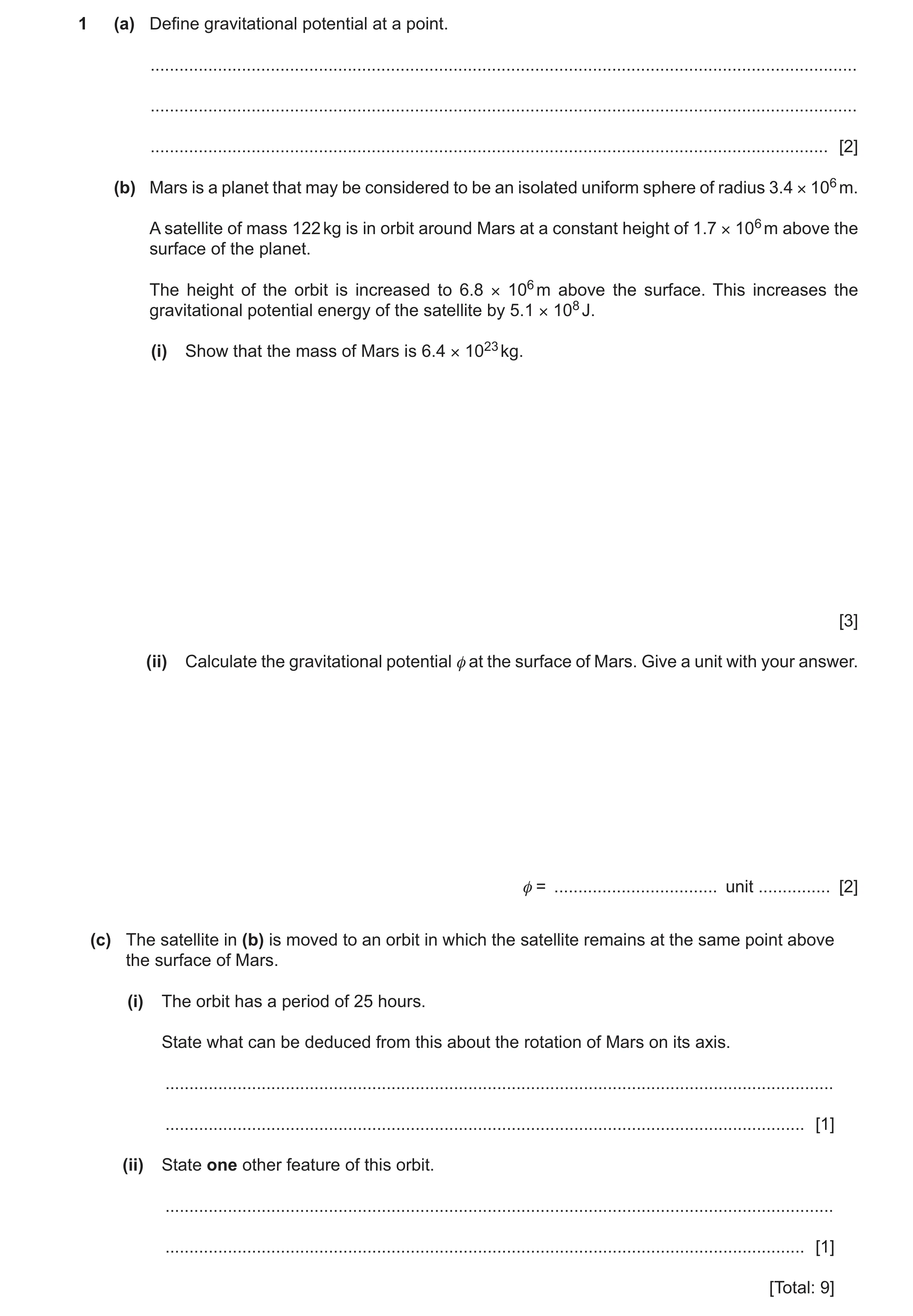
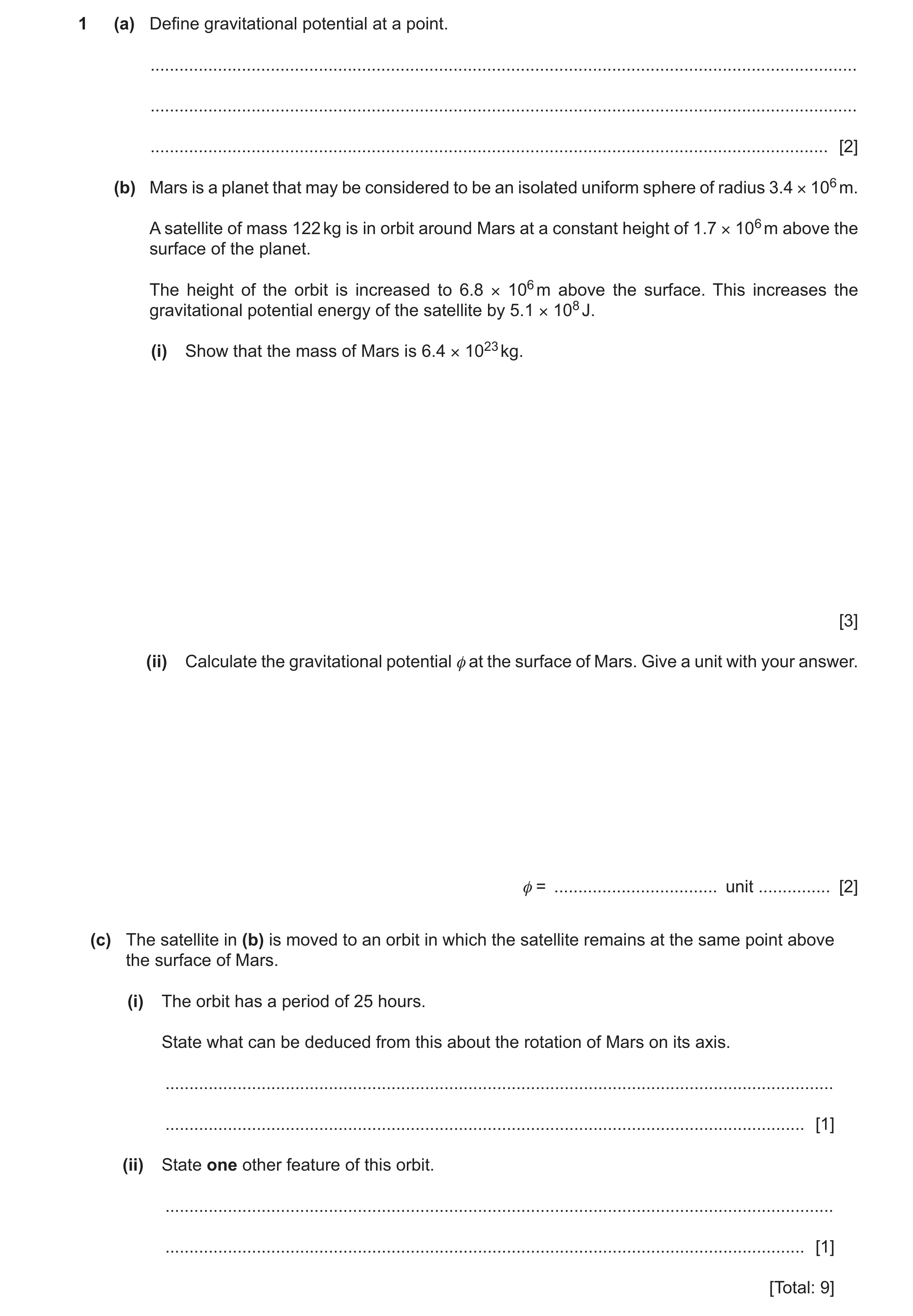
1 (a) Define gravitational potential at a point. … … … [2] (b) Mars is a planet that may be considered to be an isolated uniform sphere of radius 3.4 × 10⁶ m. A satellite of mass 122 kg is in orbit around Mars at a constant height of 1.7 × 10⁶ m above the surface of the planet. The height of the orbit is increased to 6.8 × 10⁶ m above the surface. This increases the gravitational potential energy of the satellite by 5.1 × 10⁸ J. (i) Show that the mass of Mars is 6.4 × 10²³ kg. [3] (ii) Calculate the gravitational potential φ at the surface of Mars. Give a unit with your answer. φ = … unit … [2] (c) The satellite in (b) is moved to an orbit in which the satellite remains at the same point above the surface of Mars. (i) The orbit has a period of 25 hours. State what can be deduced from this about the rotation of Mars on its axis. … … [1] (ii) State one other feature of this orbit. … … [1] [Total: 9]
9 marks
Mark scheme: Question Answer Marks 1(a) work done per unit mass B1 work (done in) moving mass from infinity (to the point) B1 1(b)(i) evidence of addition of 3.4 × 10⁶ to 1.7 × 10⁶ or 6.8 × 10⁶ C1 GM × 122 / (5.1 × 10⁶) or GM × 122 / (10.2 × 10⁶) C1 6.67 × 10⁻¹¹ × M × 122 × [(5.1 × 10⁶)–1 – (10.2 × 10⁶)–1] = 5.1 × 10⁸ A1 leading to M = 6.4 × 10²³ kg 1(b)(ii) = (–) (6.67 × 10–11 × 6.4 × 1023) / (3.4 × 10⁶) C1 = –1.3 × 10⁷ J kg–1 A1 1(c)(i) Mars takes (just under) 25 hours to rotate once on its axis B1 1(c)(ii) orbit is equatorial B1 or orbit is in same direction as direction of rotation of Mars
This question in 9702/41 May/June 2025
Q21 · Define gravitational potential at a point 9702/43 May/June 2025
1 (a) Define gravitational potential at a point. … … … [2] (b) Mars is a planet that may be considered to be an isolated uniform sphere of radius 3.4 × 10⁶ m. A satellite of mass 122 kg is in orbit around Mars at a constant height of 1.7 × 10⁶ m above the surface of the planet. The height of the orbit is increased to 6.8 × 10⁶ m above the surface. This increases the gravitational potential energy of the satellite by 5.1 × 10⁸ J. (i) Show that the mass of Mars is 6.4 × 10²³ kg. [3] (ii) Calculate the gravitational potential φ at the surface of Mars. Give a unit with your answer. φ = … unit … [2] (c) The satellite in (b) is moved to an orbit in which the satellite remains at the same point above the surface of Mars. (i) The orbit has a period of 25 hours. State what can be deduced from this about the rotation of Mars on its axis. … … [1] (ii) State one other feature of this orbit. … … [1] [Total: 9]
9 marks
Mark scheme: Question Answer Marks 1(a) work done per unit mass B1 work (done in) moving mass from infinity (to the point) B1 1(b)(i) evidence of addition of 3.4 × 10⁶ to 1.7 × 10⁶ or 6.8 × 10⁶ C1 GM × 122 / (5.1 × 10⁶) or GM × 122 / (10.2 × 10⁶) C1 6.67 × 10⁻¹¹ × M × 122 × [(5.1 × 10⁶)–1 – (10.2 × 10⁶)–1] = 5.1 × 10⁸ A1 leading to M = 6.4 × 10²³ kg 1(b)(ii) = (–) (6.67 × 10–11 × 6.4 × 1023) / (3.4 × 10⁶) C1 = –1.3 × 10⁷ J kg–1 A1 1(c)(i) Mars takes (just under) 25 hours to rotate once on its axis B1 1(c)(ii) orbit is equatorial B1 or orbit is in same direction as direction of rotation of Mars
This question in 9702/43 May/June 2025
Question 22 9702/44 May/June 2025
1 (a) Define gravitational field. … … [1] (b) The gravitational field strength g at a distance x from the centre of a uniform spherical planet of mass M is given by the expression GM g = x2 where G is the gravitational constant and distance x is greater than the radius of the planet. (i) Describe the pattern of the field lines outside the planet that represent the gravitational field due to the planet. … … … [2] (ii) Explain why, for small changes in vertical height near the surface of the planet, g may be assumed to be constant. … … … [2] (c) Assume that the Earth is a uniform sphere. For the Earth, the product GM is equal to 3.99 × 10¹⁴ m3 s–2. (i) Determine a value, to three significant figures, for the radius R of the Earth. R = … m [2] (ii) Calculate the gravitational potential at the Earth’s surface. Give a unit with your answer. gravitational potential = … unit … [2] (d) Explain why the gravitational potential energy of two point masses is always negative. … … … [2] [Total: 11]
11 marks
Mark scheme: Question Answer Marks 1(a) force per unit mass B1 1(b)(i) radial B1 towards (centre of) planet B1 1(b)(ii) (changes in) height (very) much smaller than radius B1 (radius + height)2 radius2 B1 or field lines are approximately parallel 1(c)(i) 9.81 R2 = 3.99 1014 C1 R = 6.38 106 m A1 1(c)(ii) gravitational potential = – (GM / R) C1 = – (3.99 1014) / (6.38 106) = – 6.25 107 J kg–1 A1 1(d) potential (energy) zero at infinite separation B1 (gravitational) force is attractive B1
This question in 9702/44 May/June 2025
 2 / 31
 3 / 31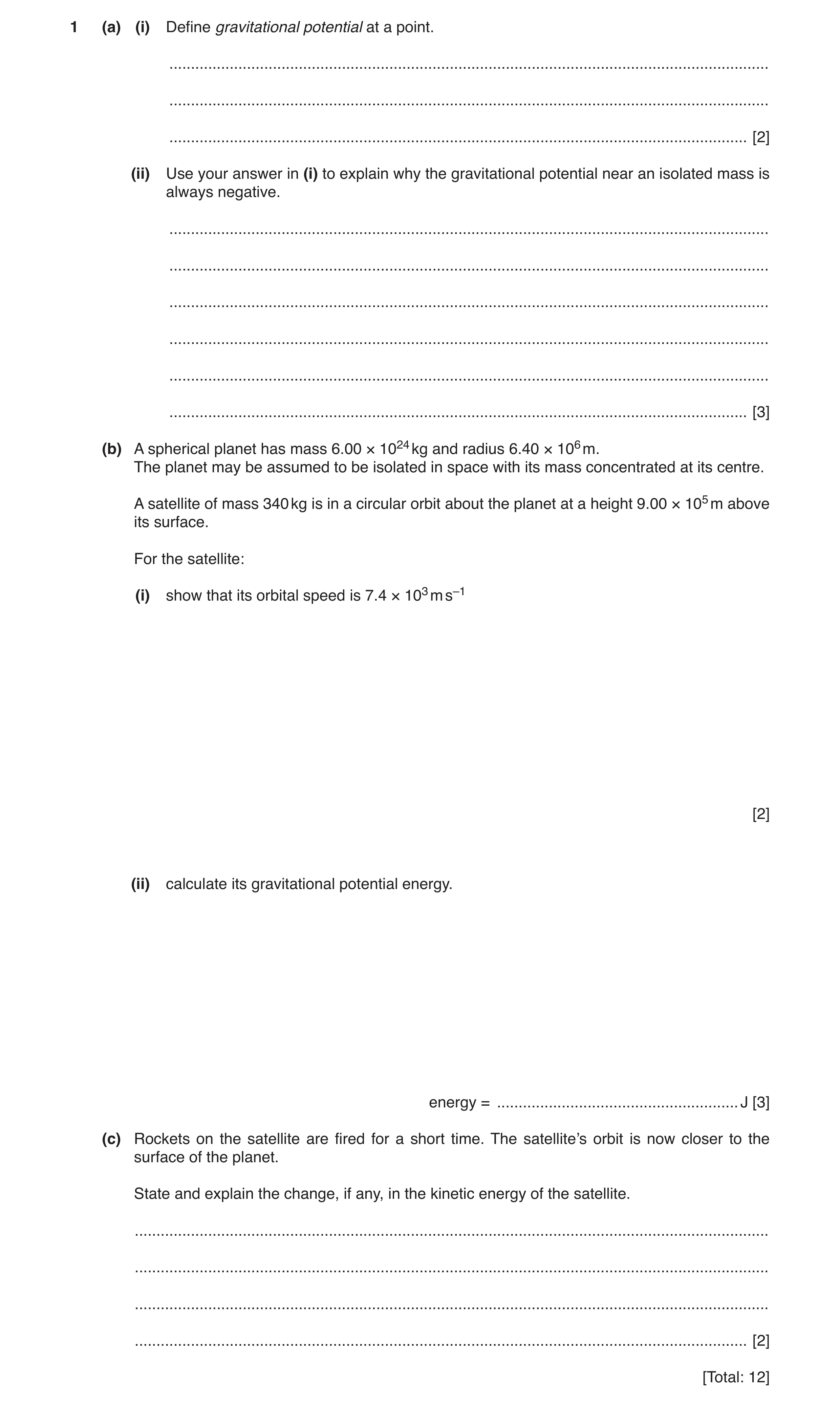
 11 / 31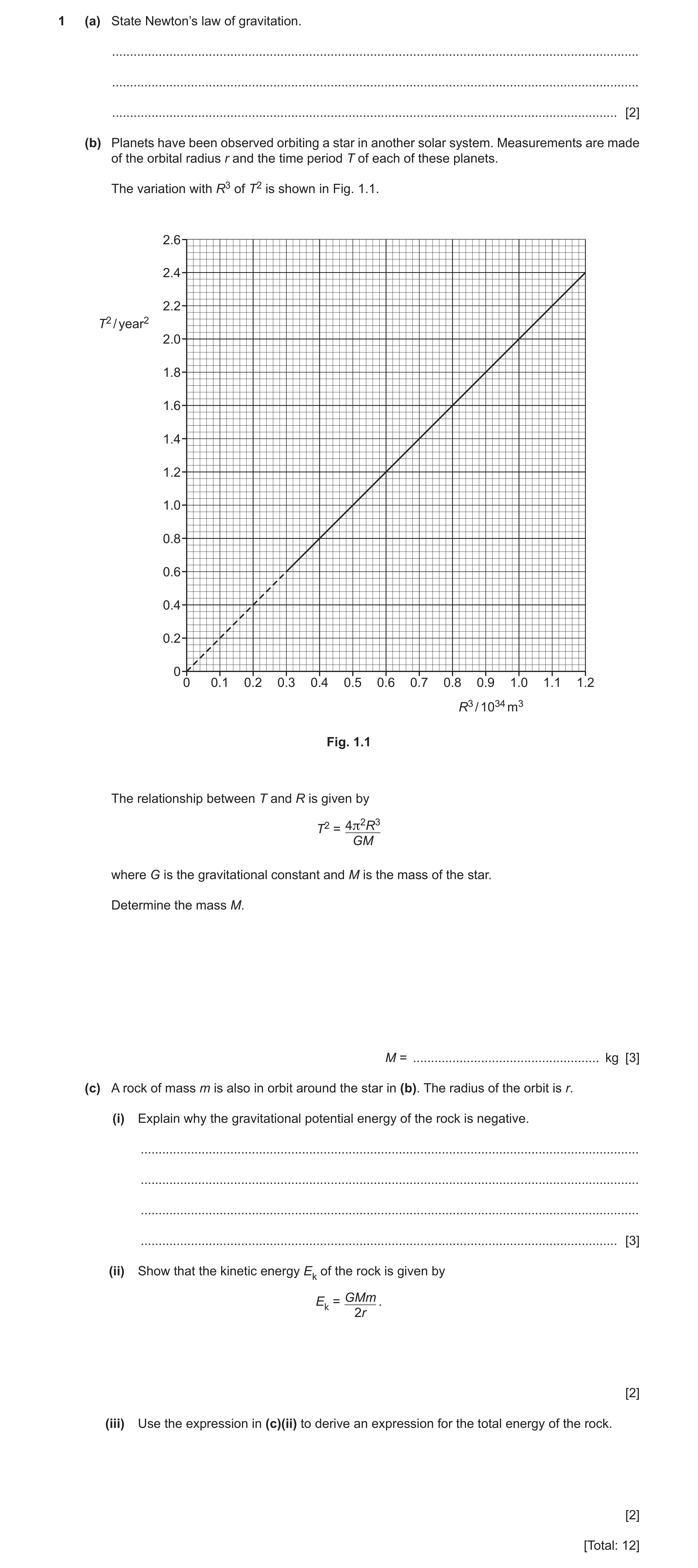
 28 / 31
 29 / 31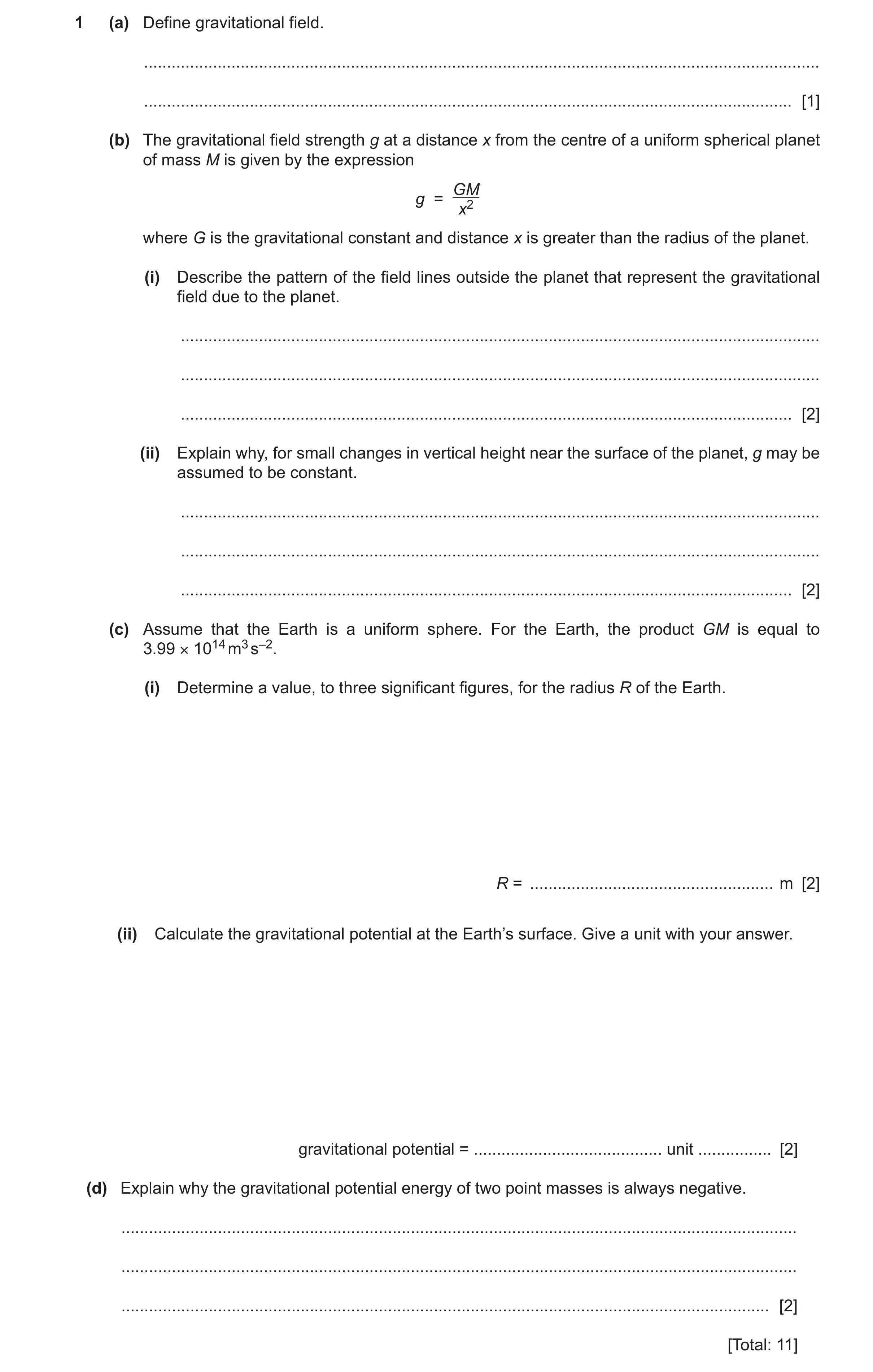
 6
6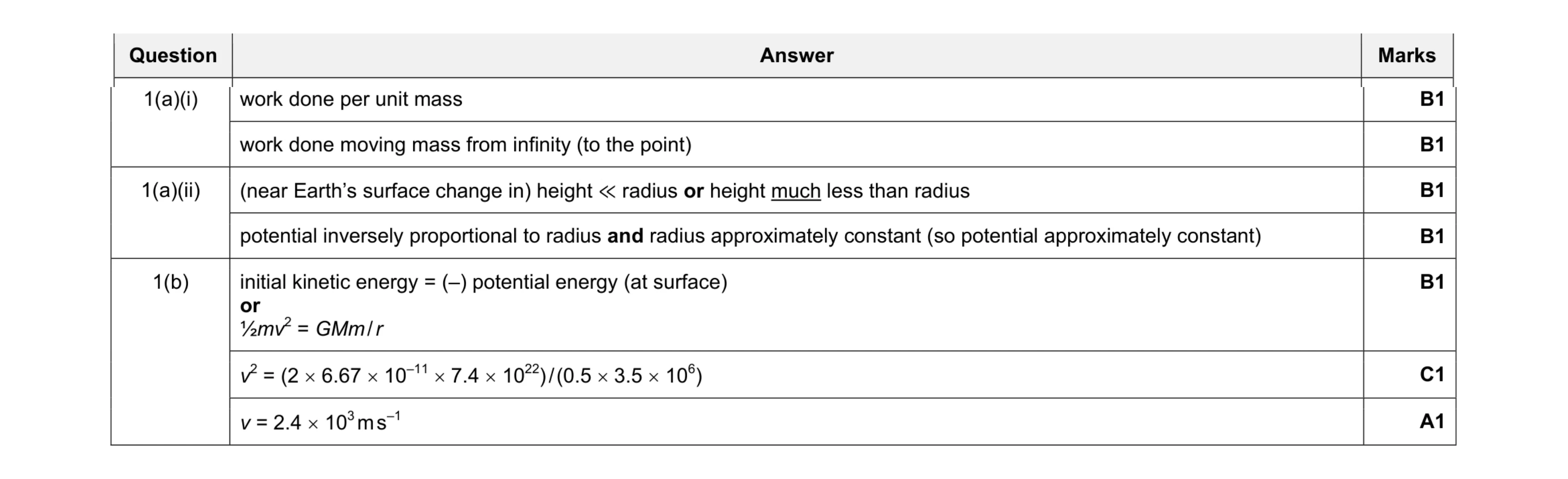 7
7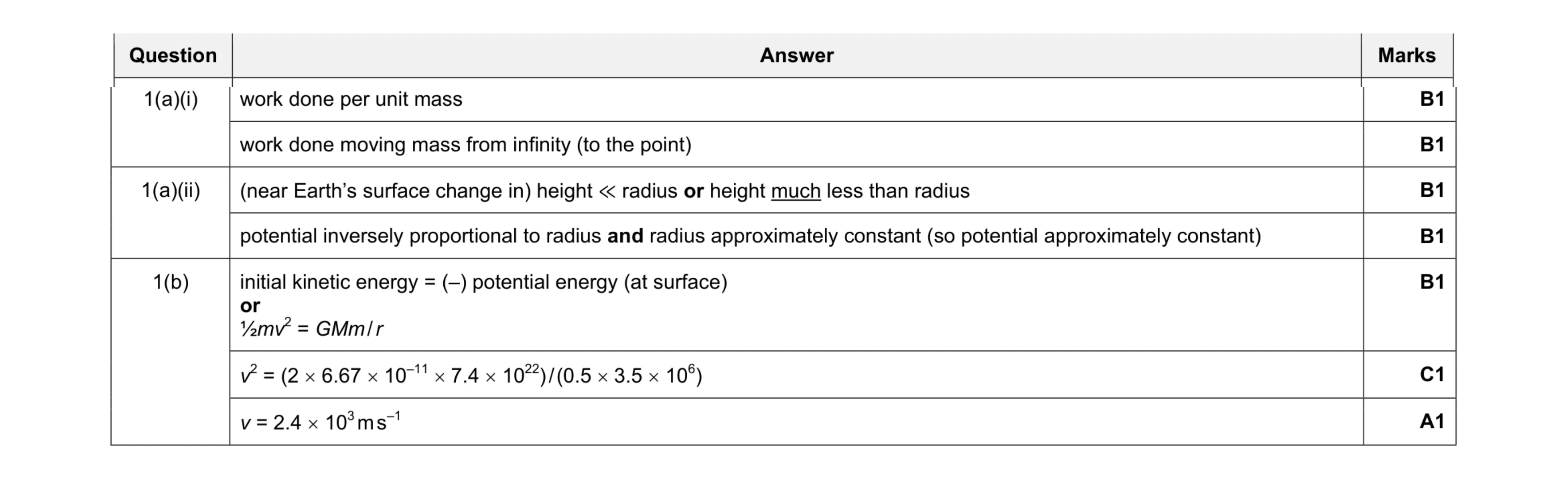 7
7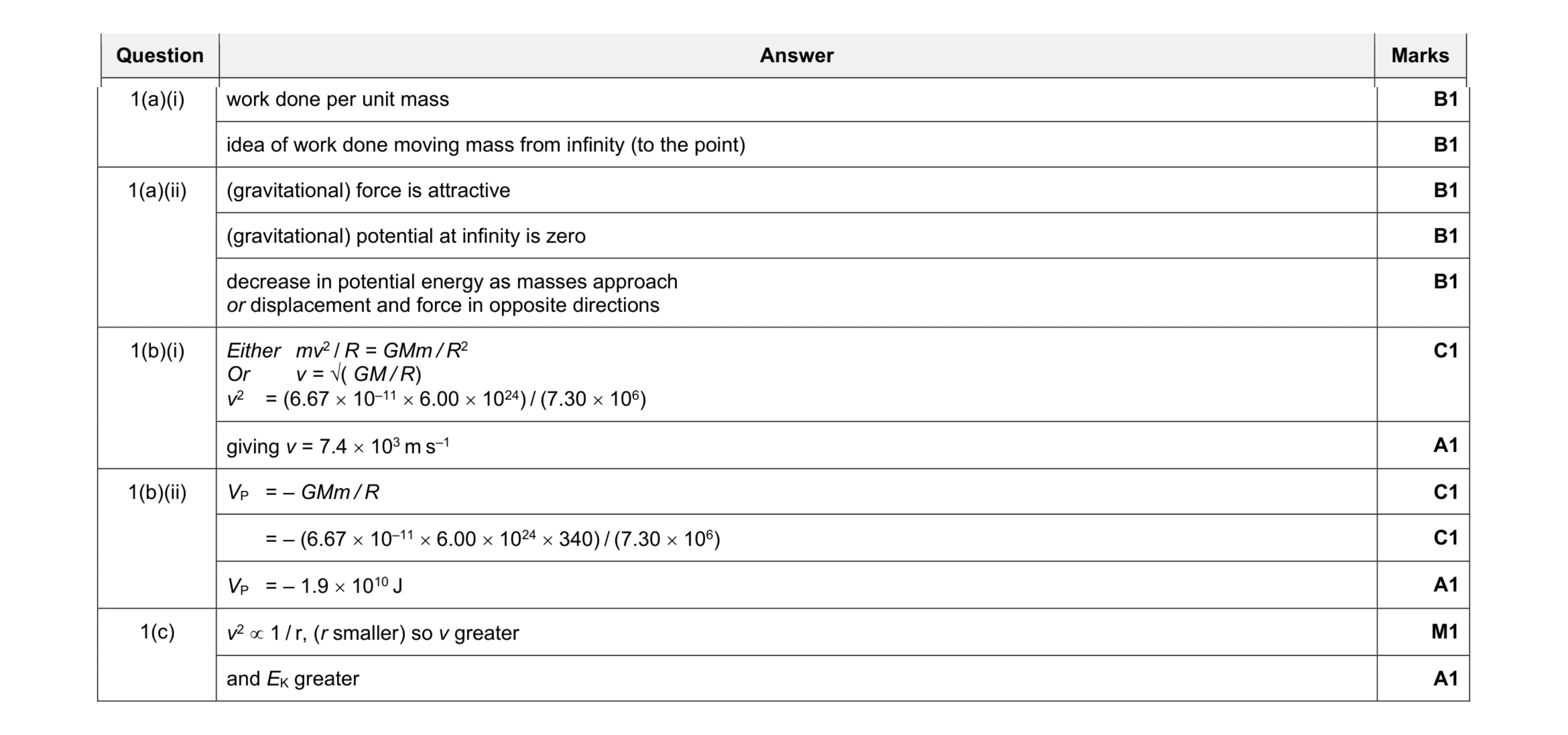 12
12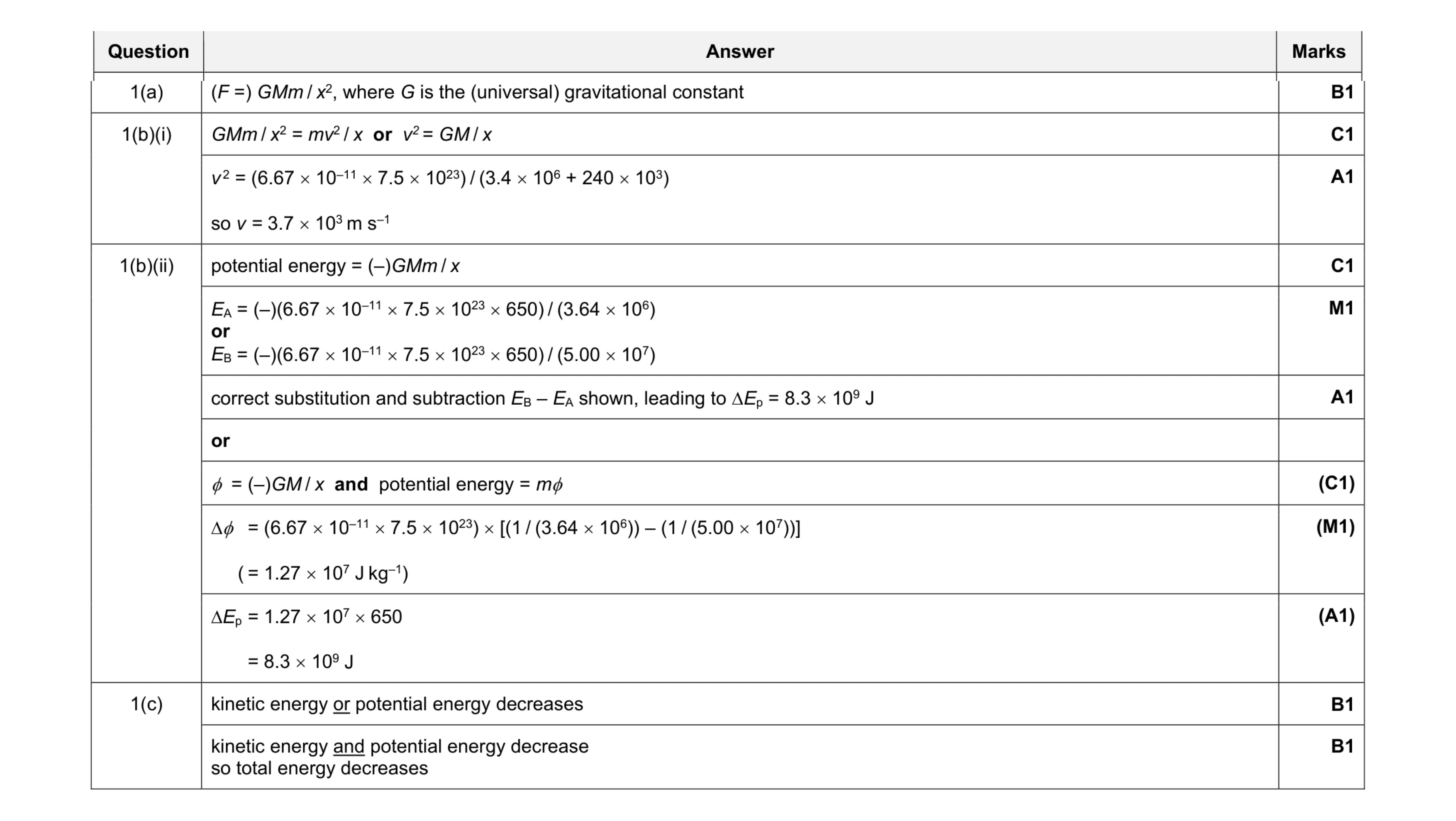 8
8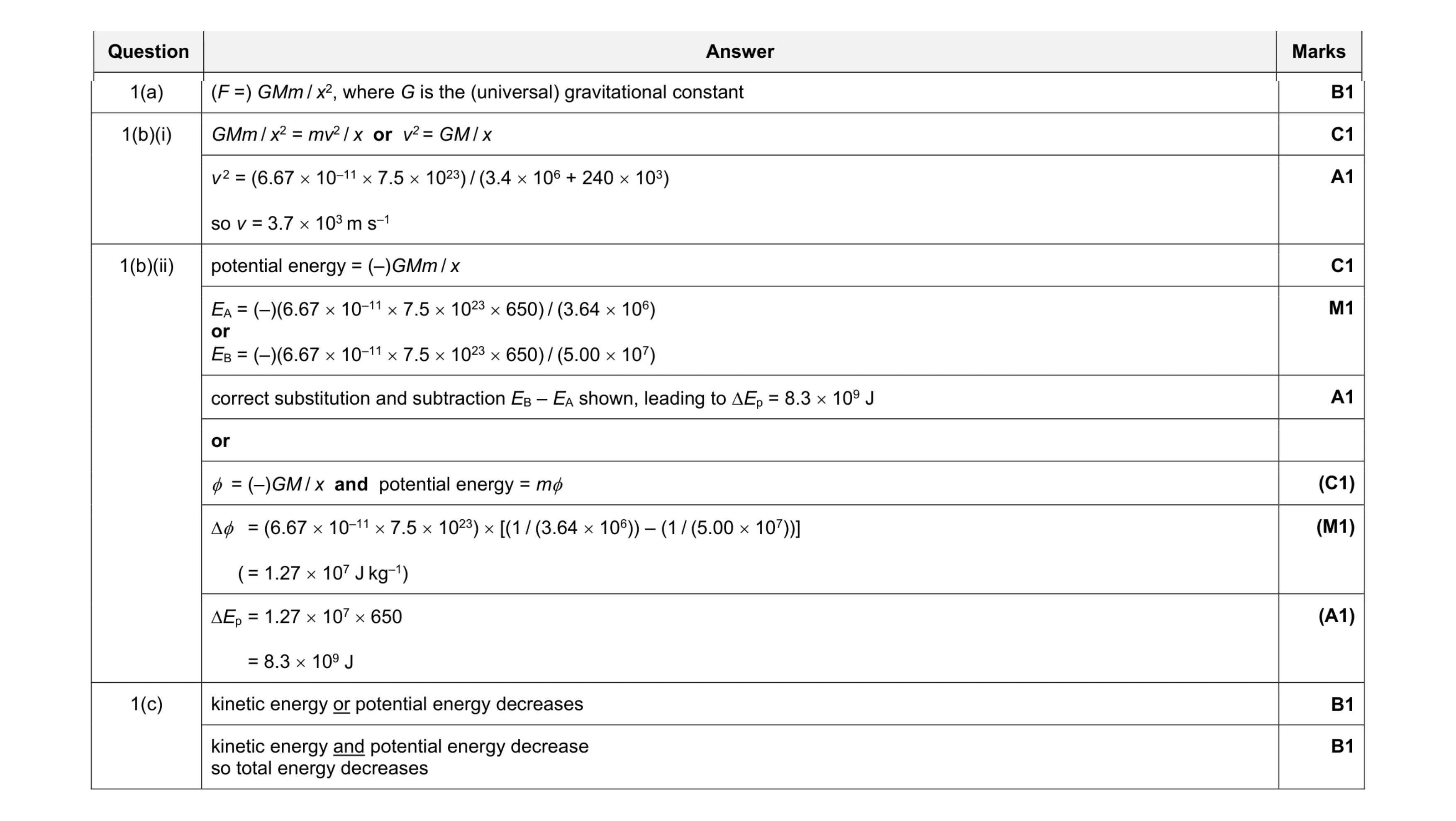 8
8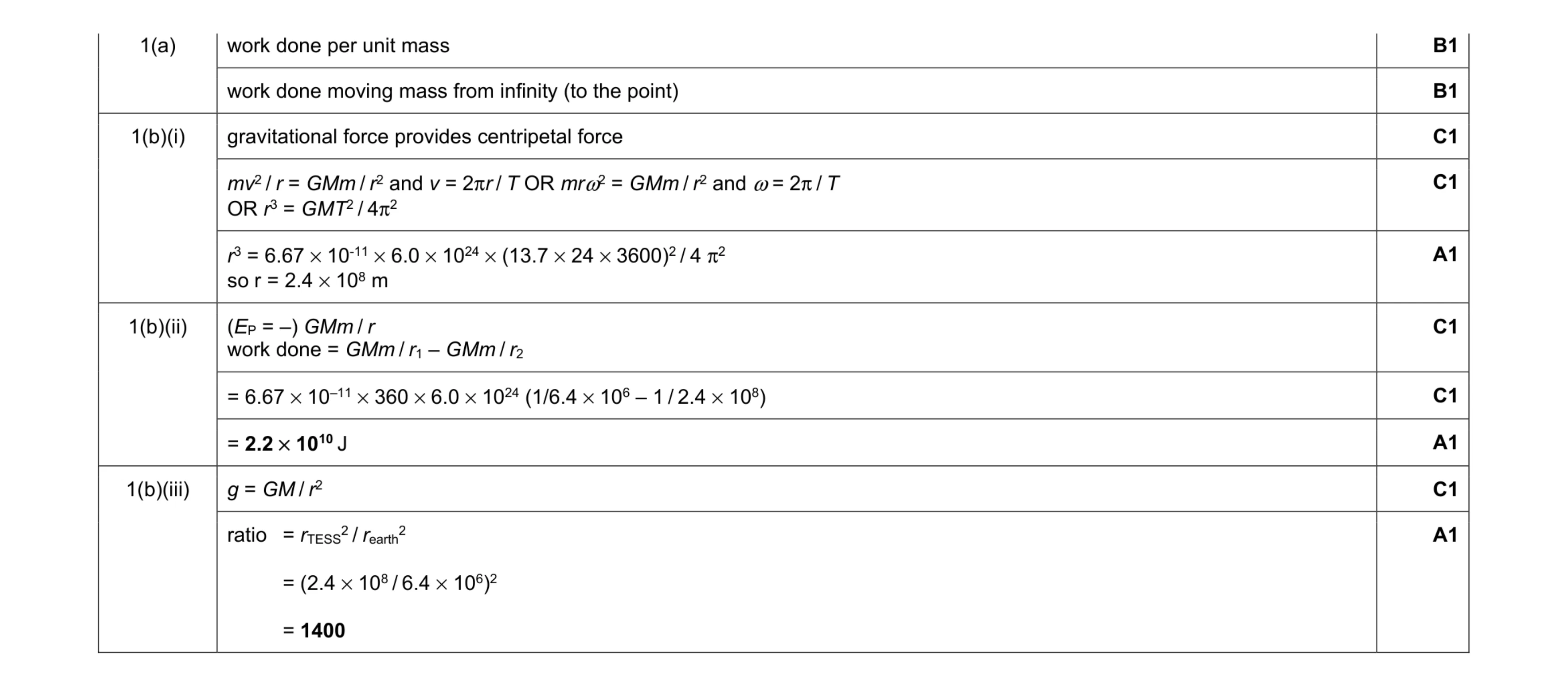 10
10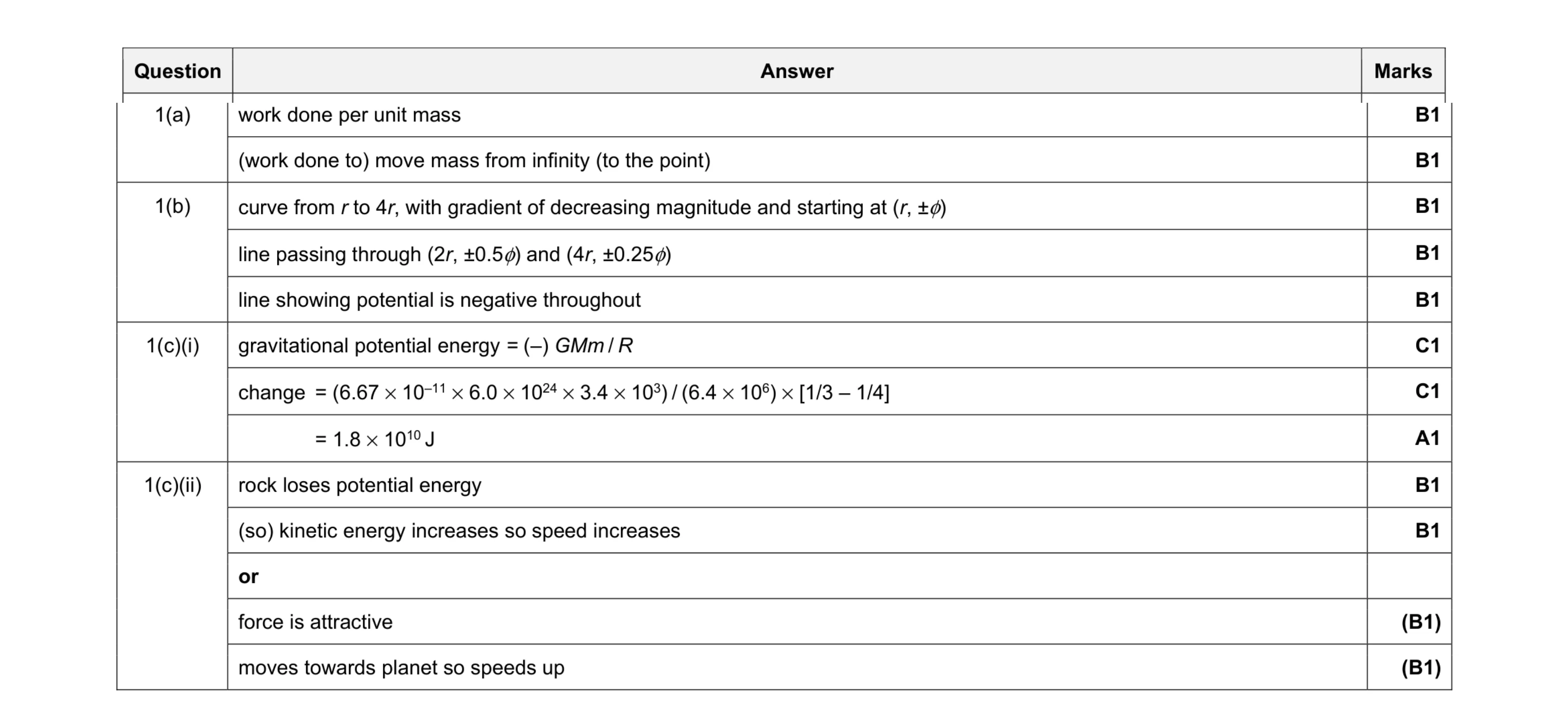 10
10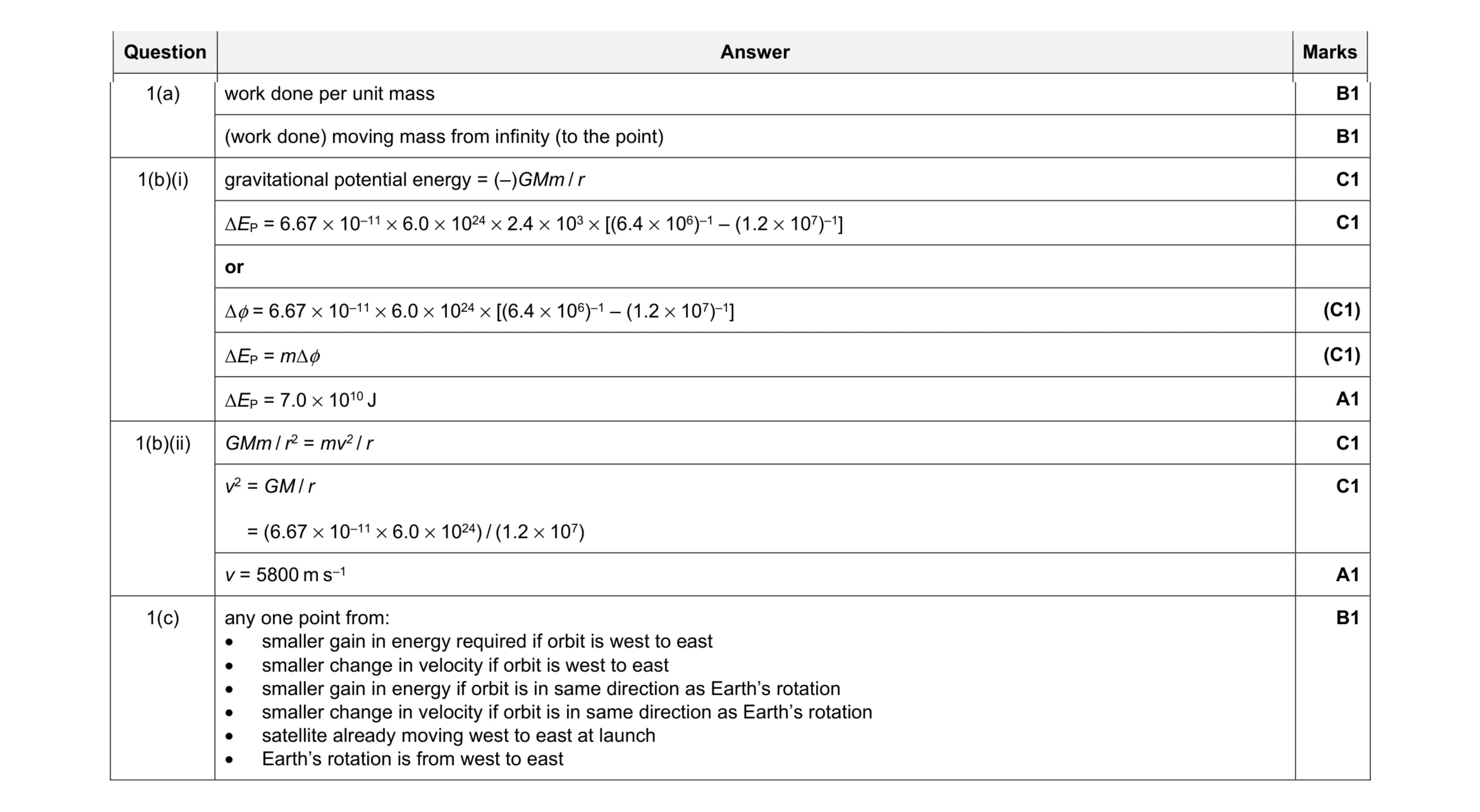 9
9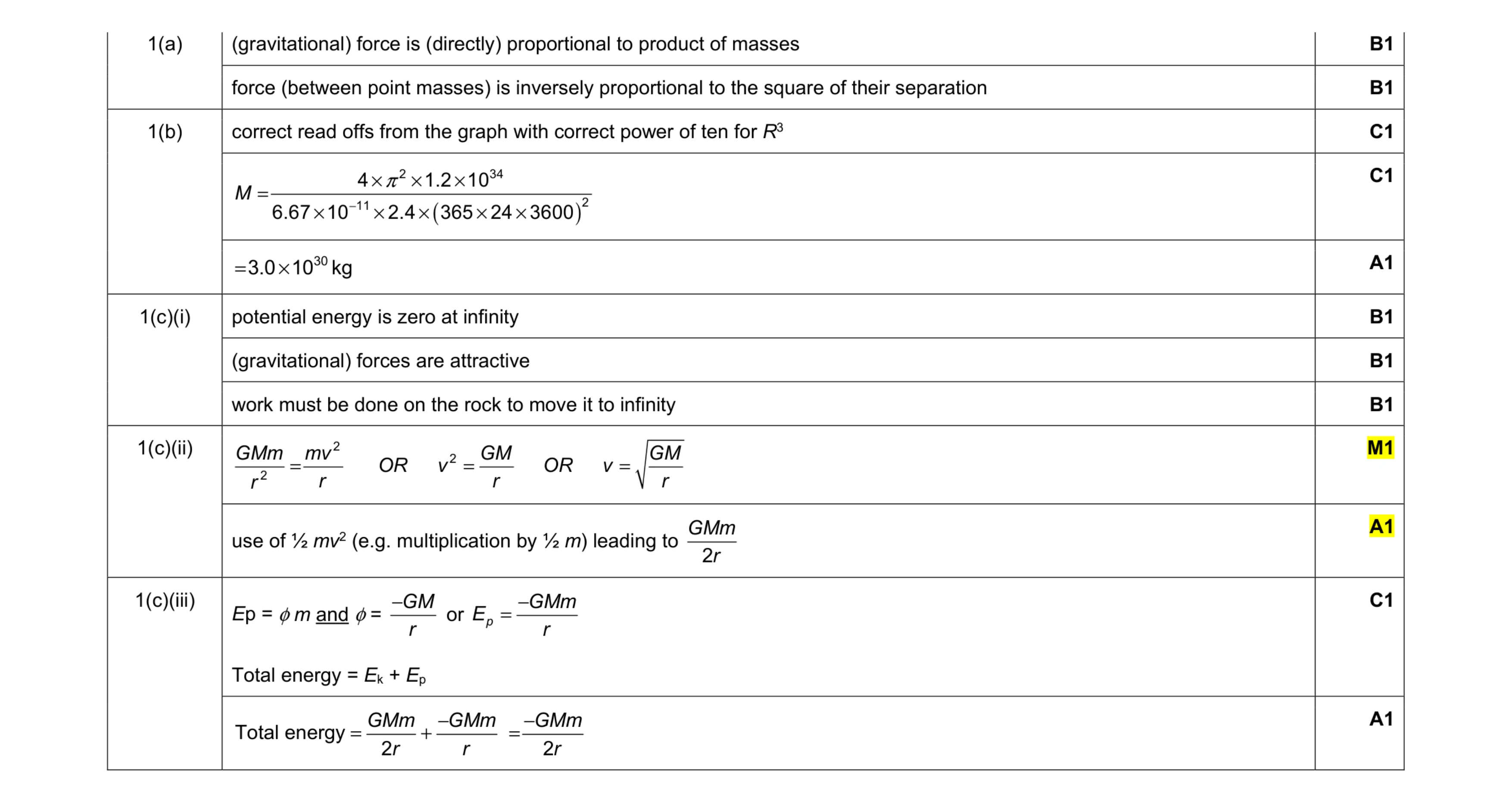 12
12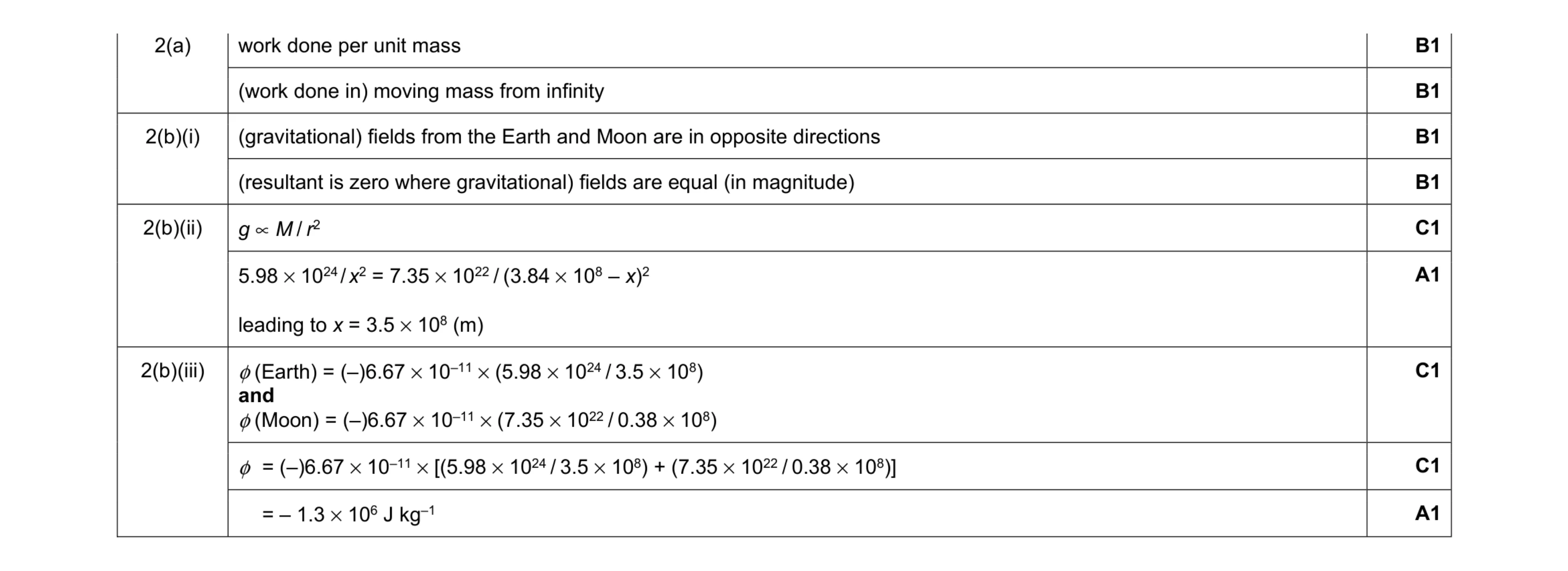 9
9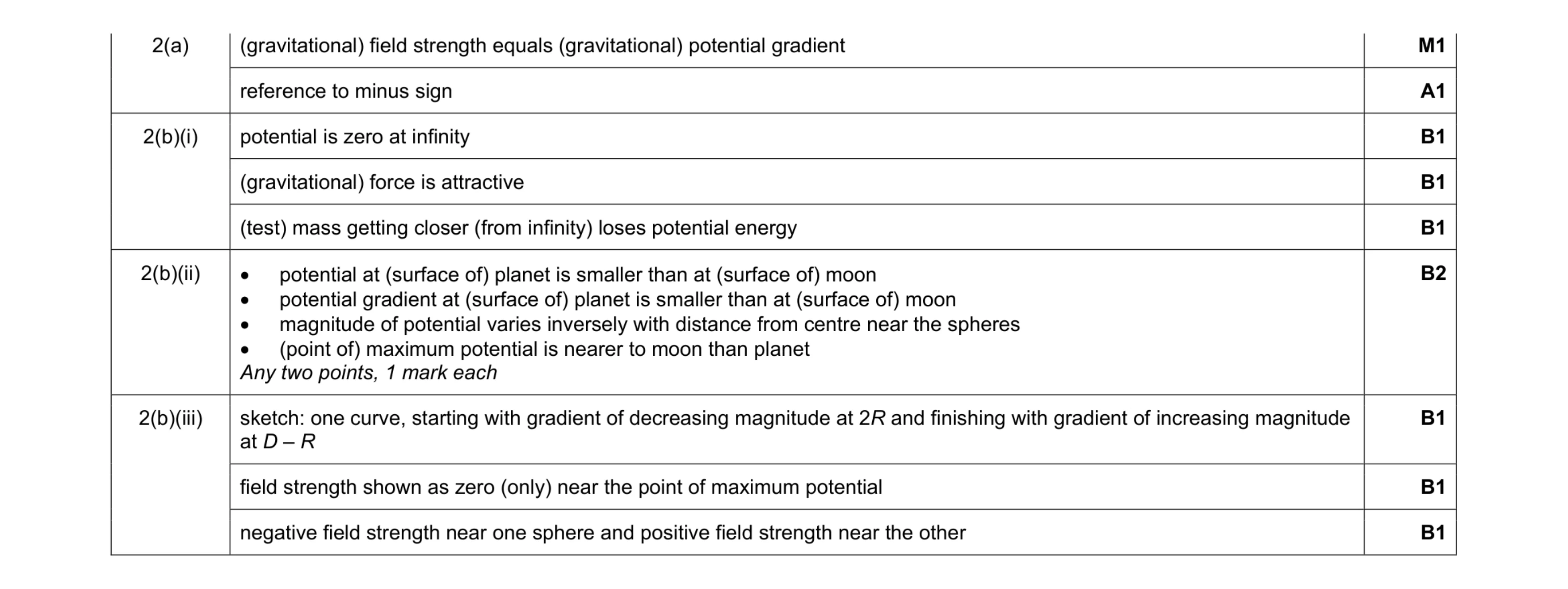 10
10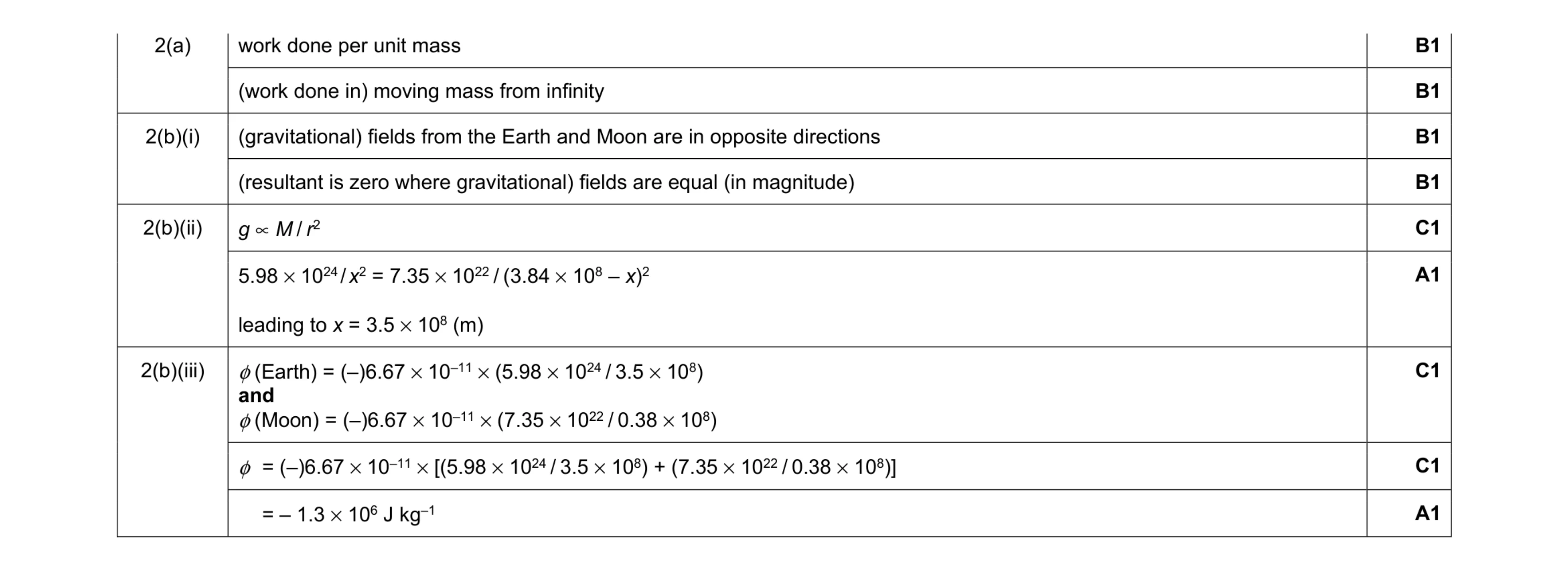 9
9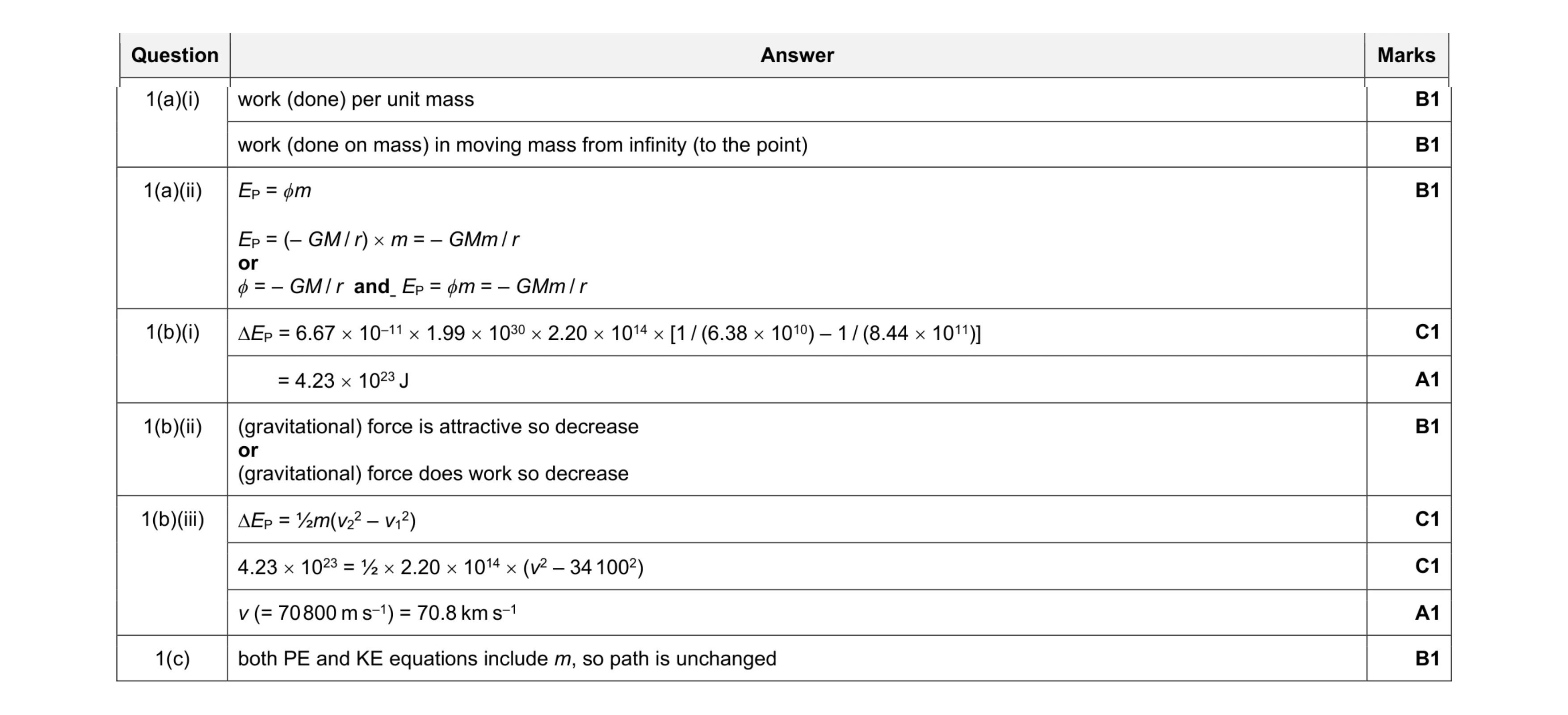 10
10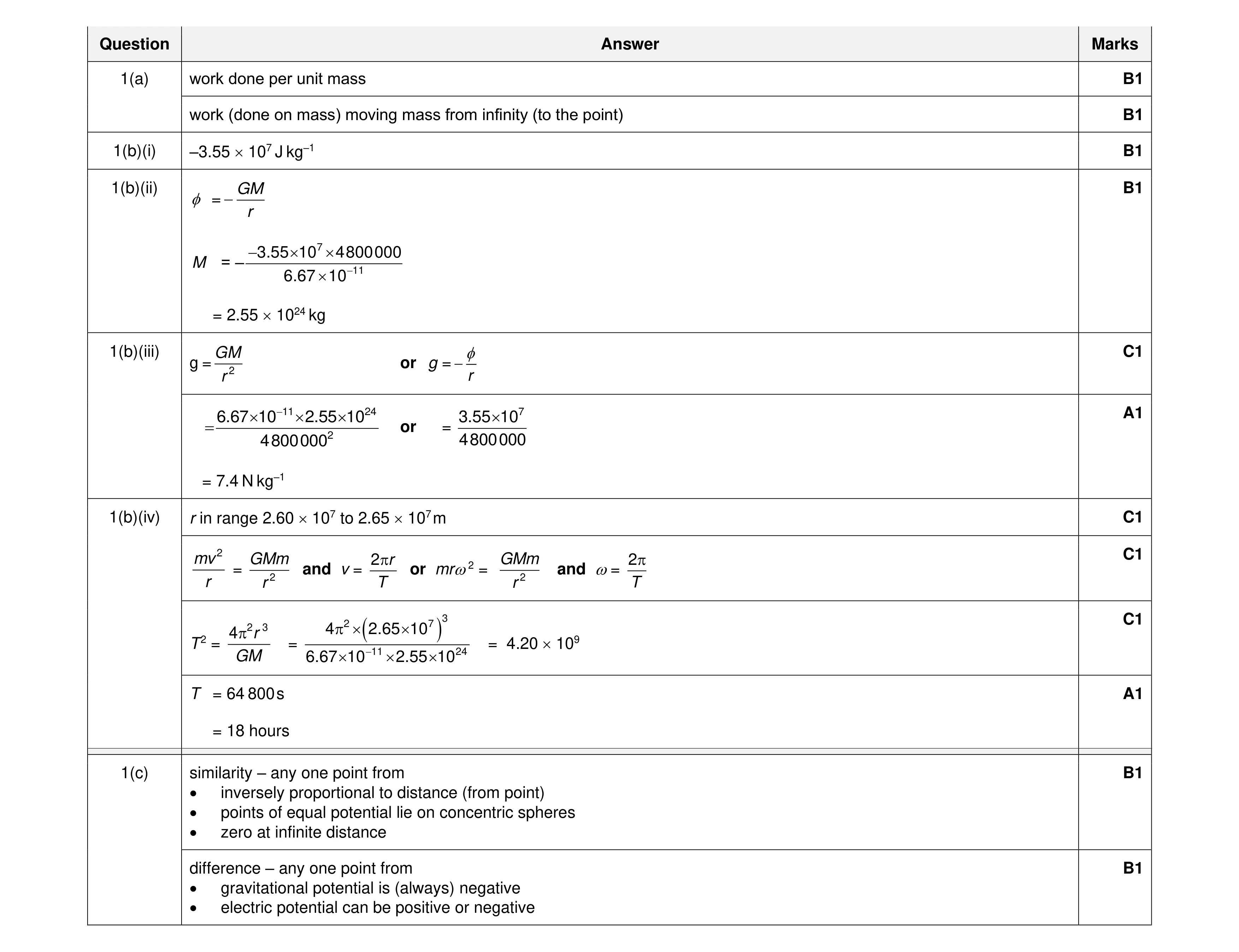 12
12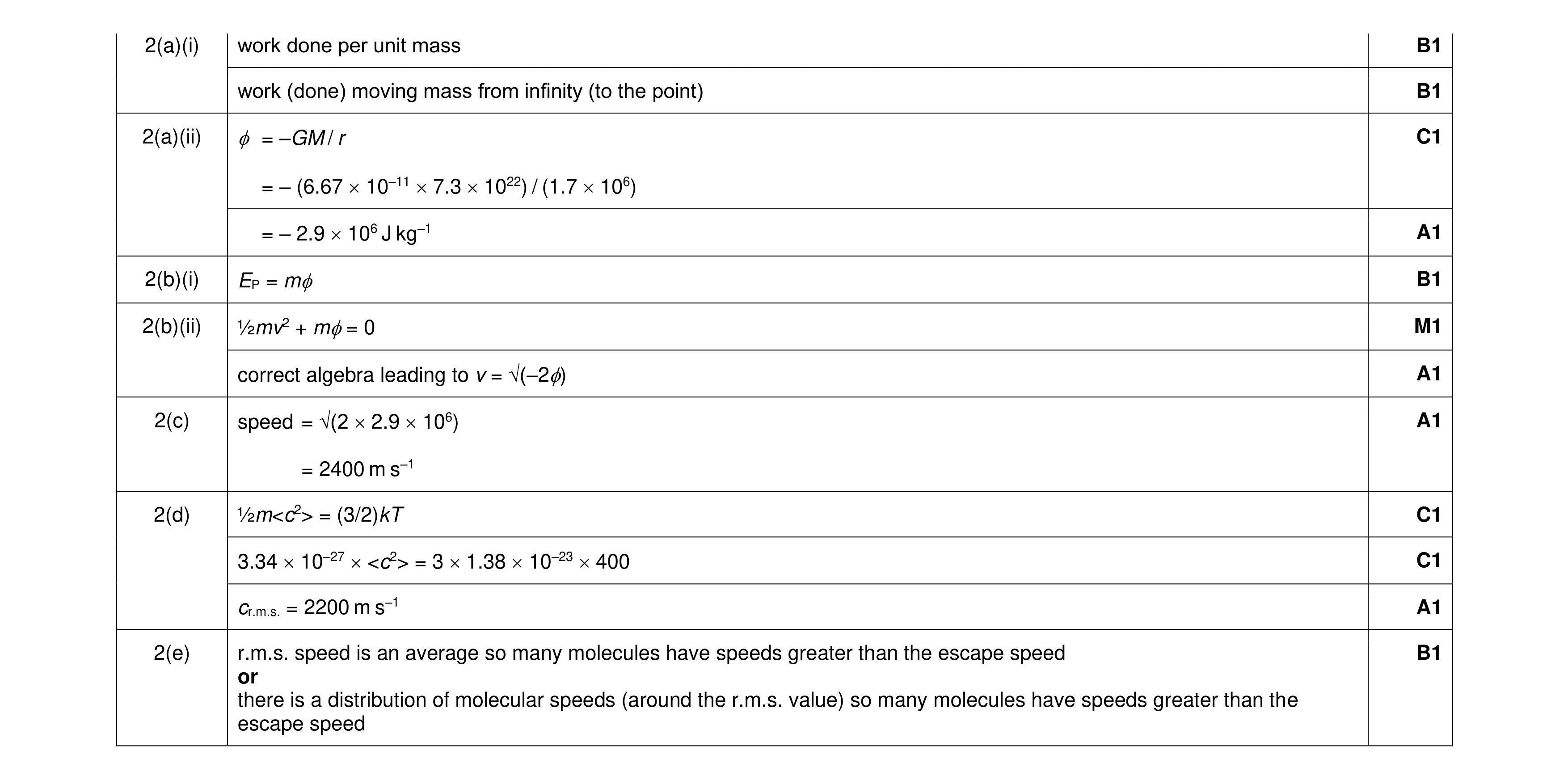 12
12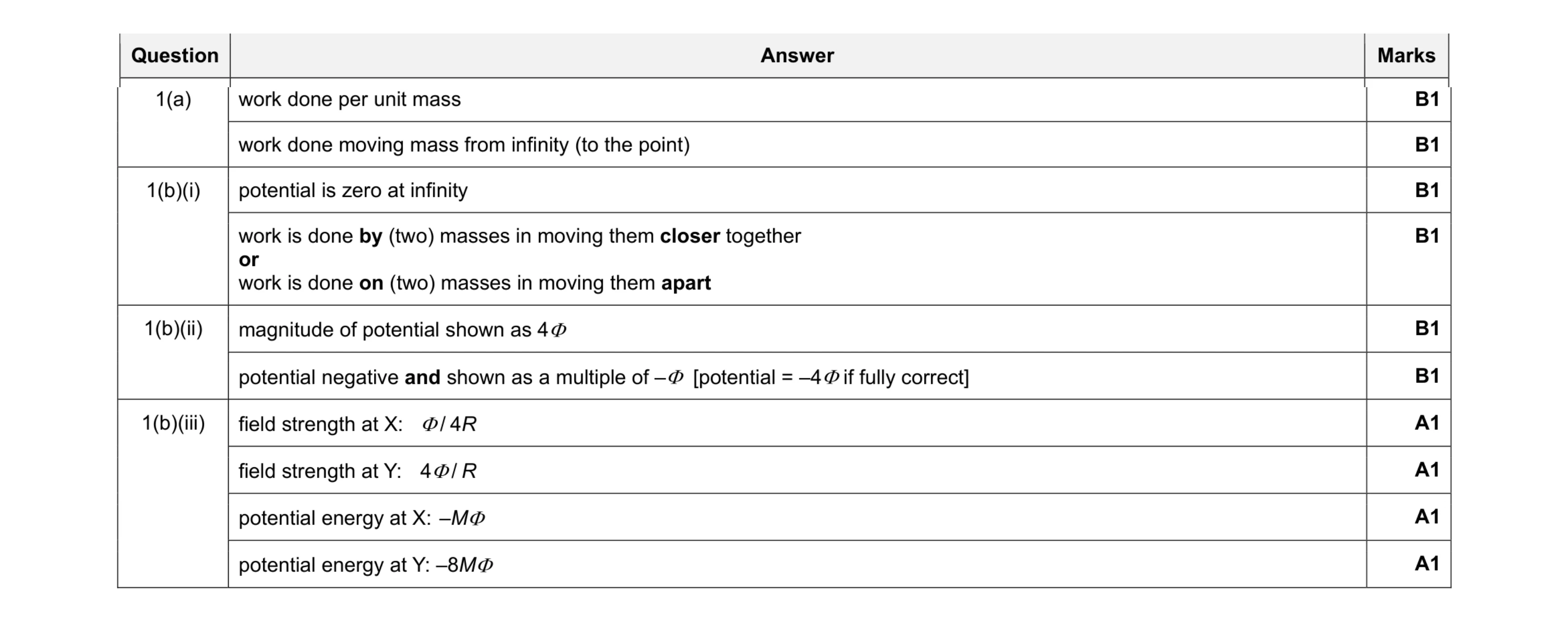 10
10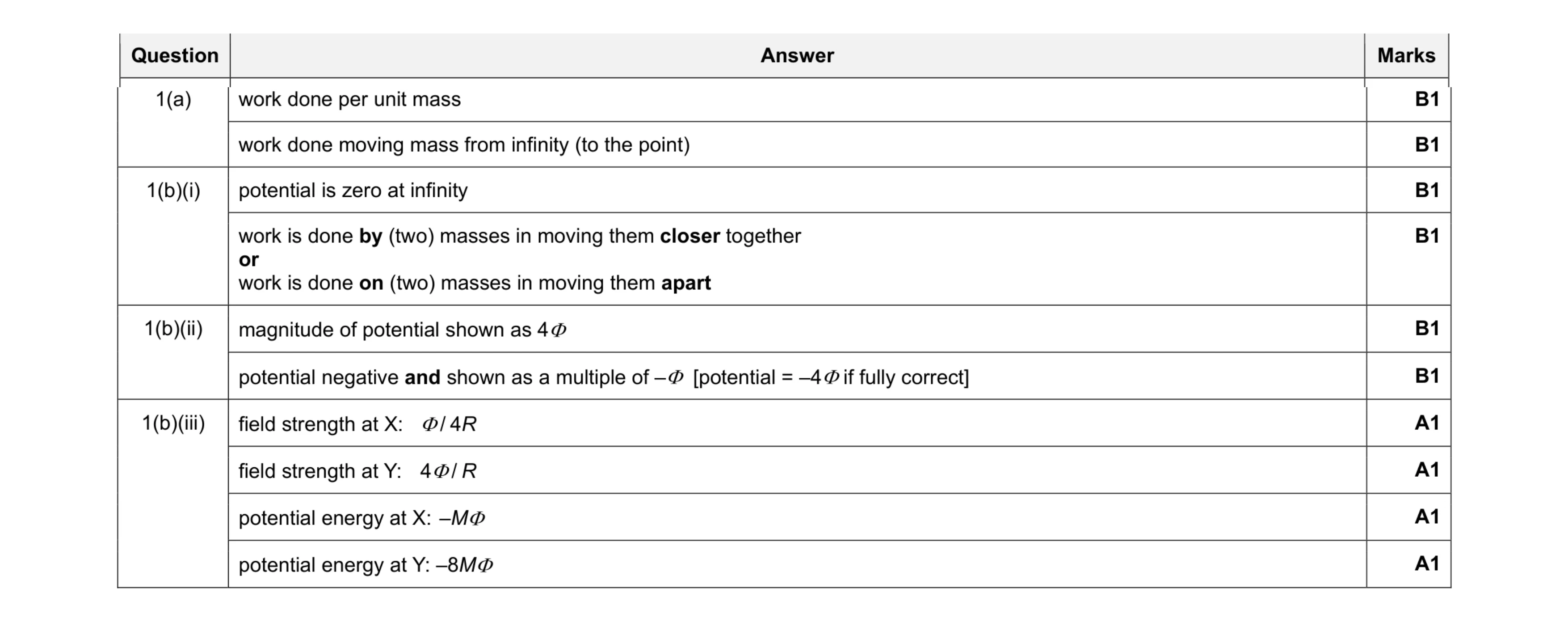 10
10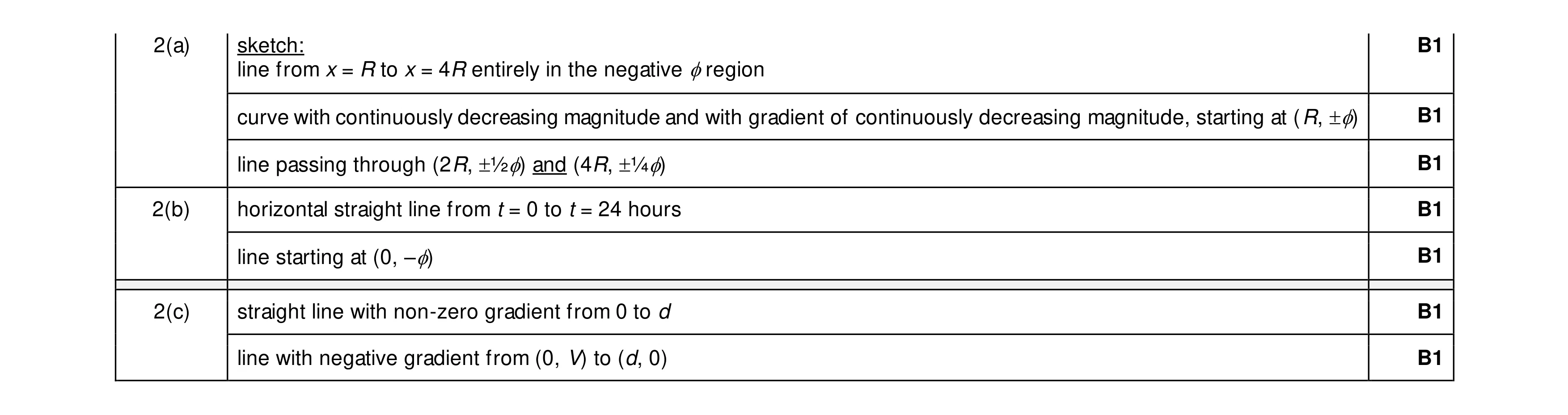 7
7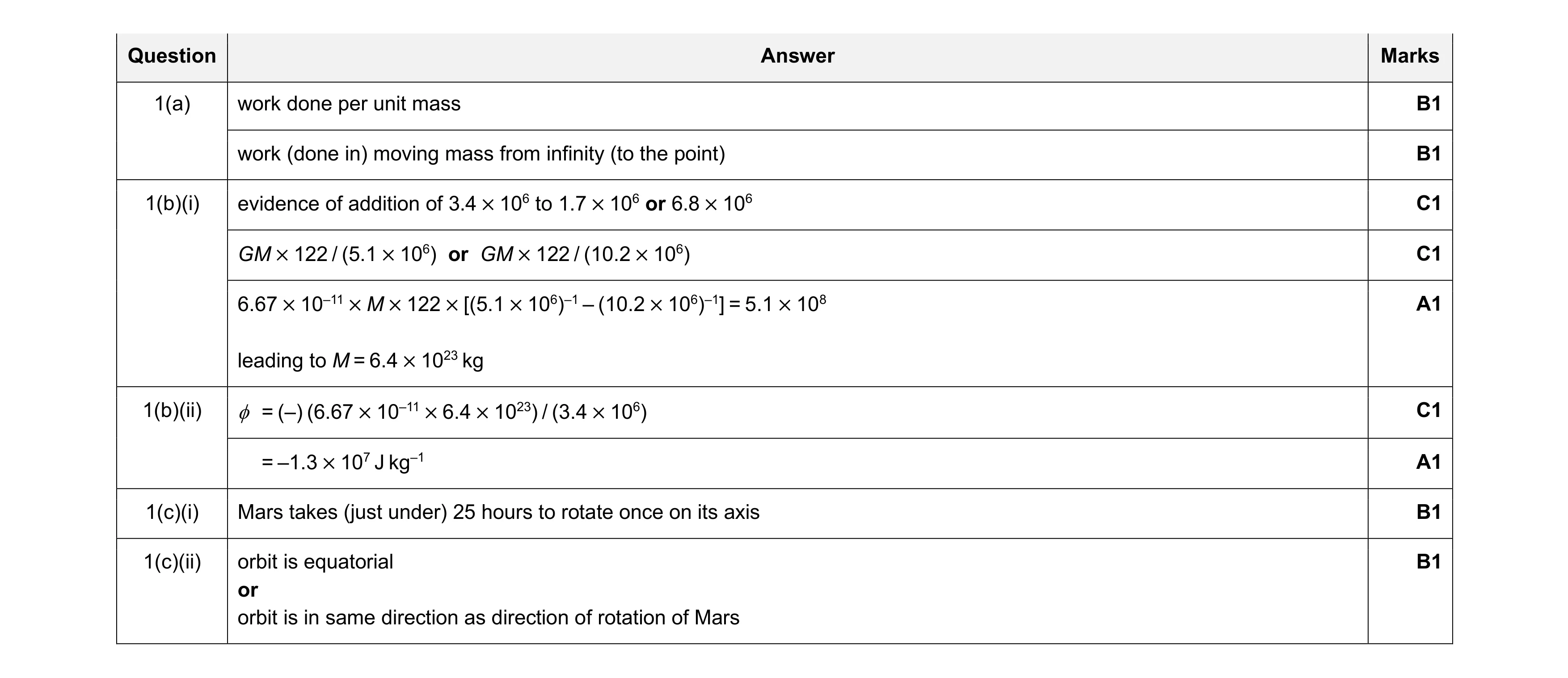 9
9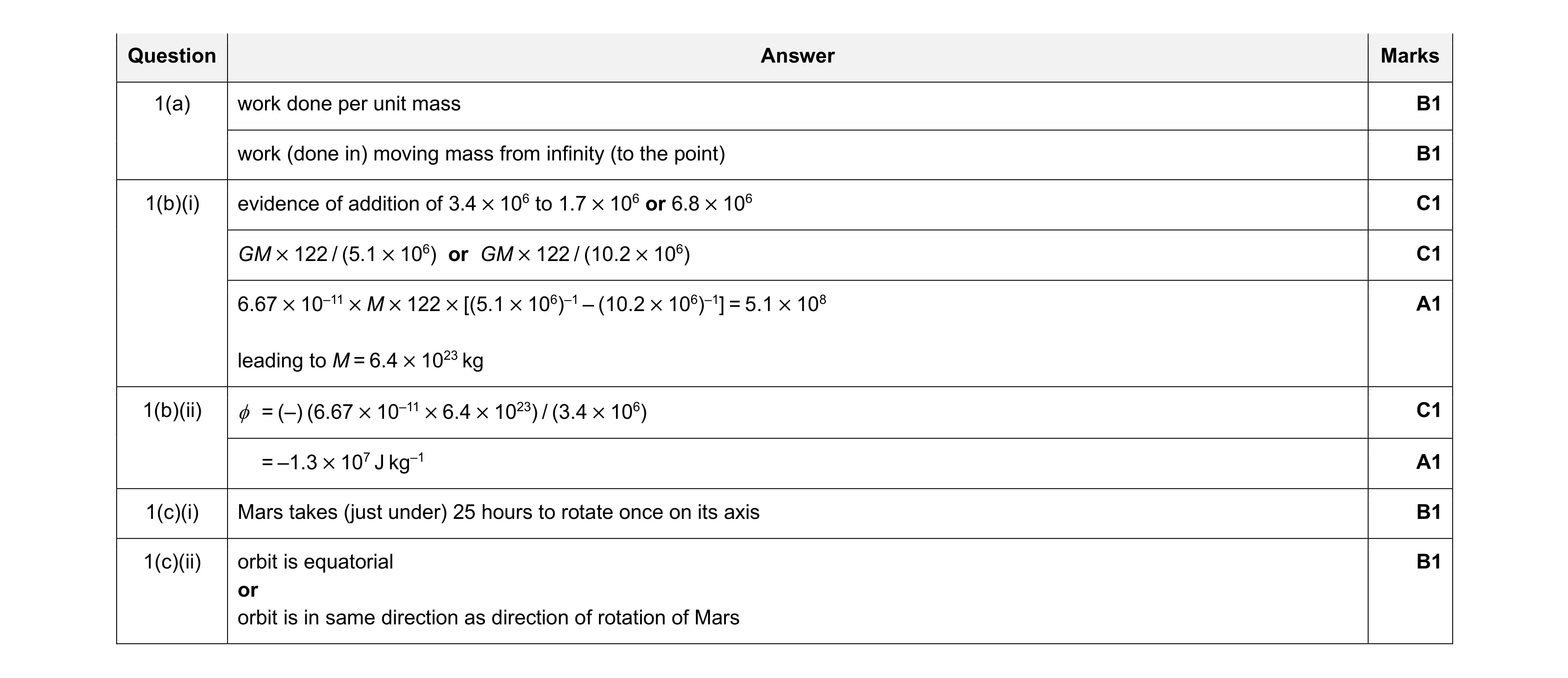 9
9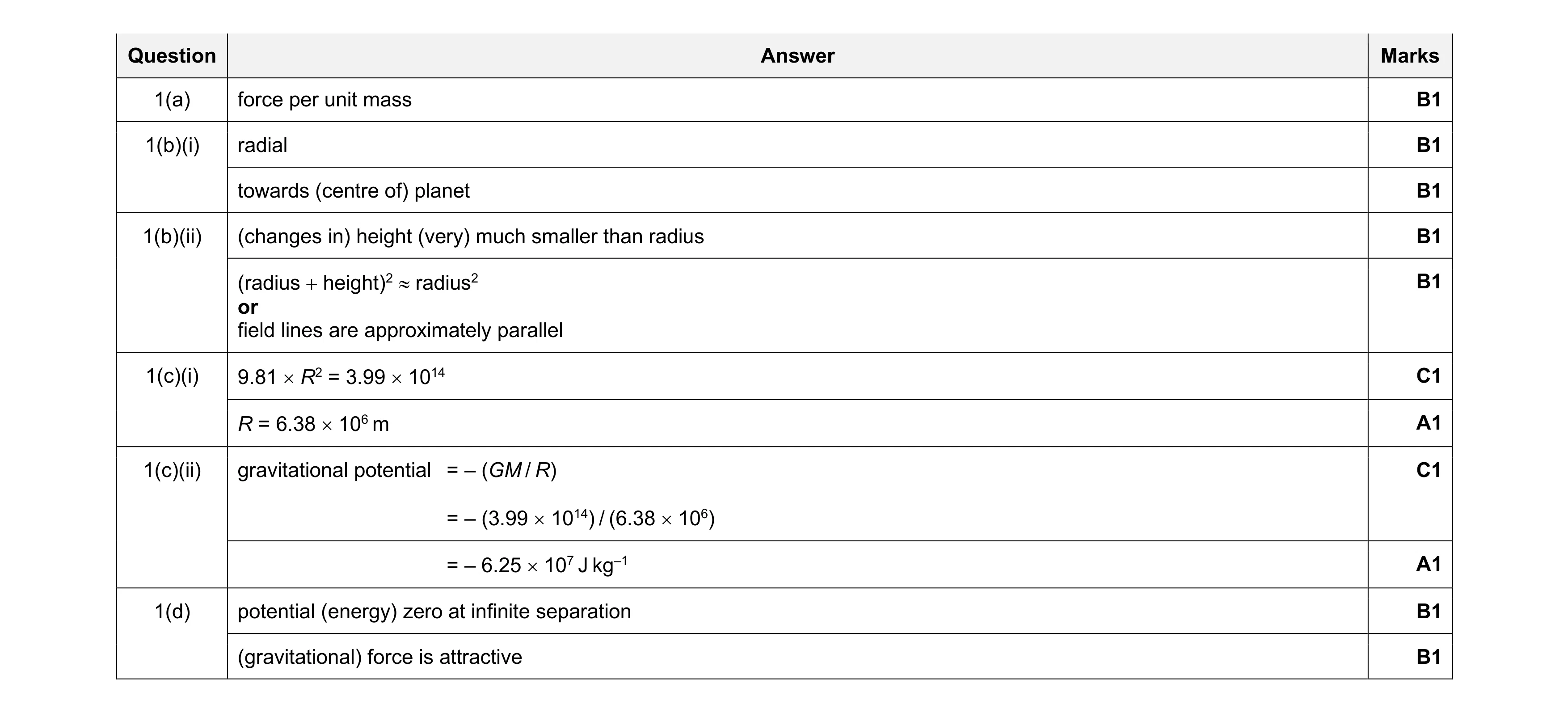 11
11