Questions as text
Q1 · Algae are primary producers and form the base of many food chains in the sea 9693/31 Oct/Nov 2017
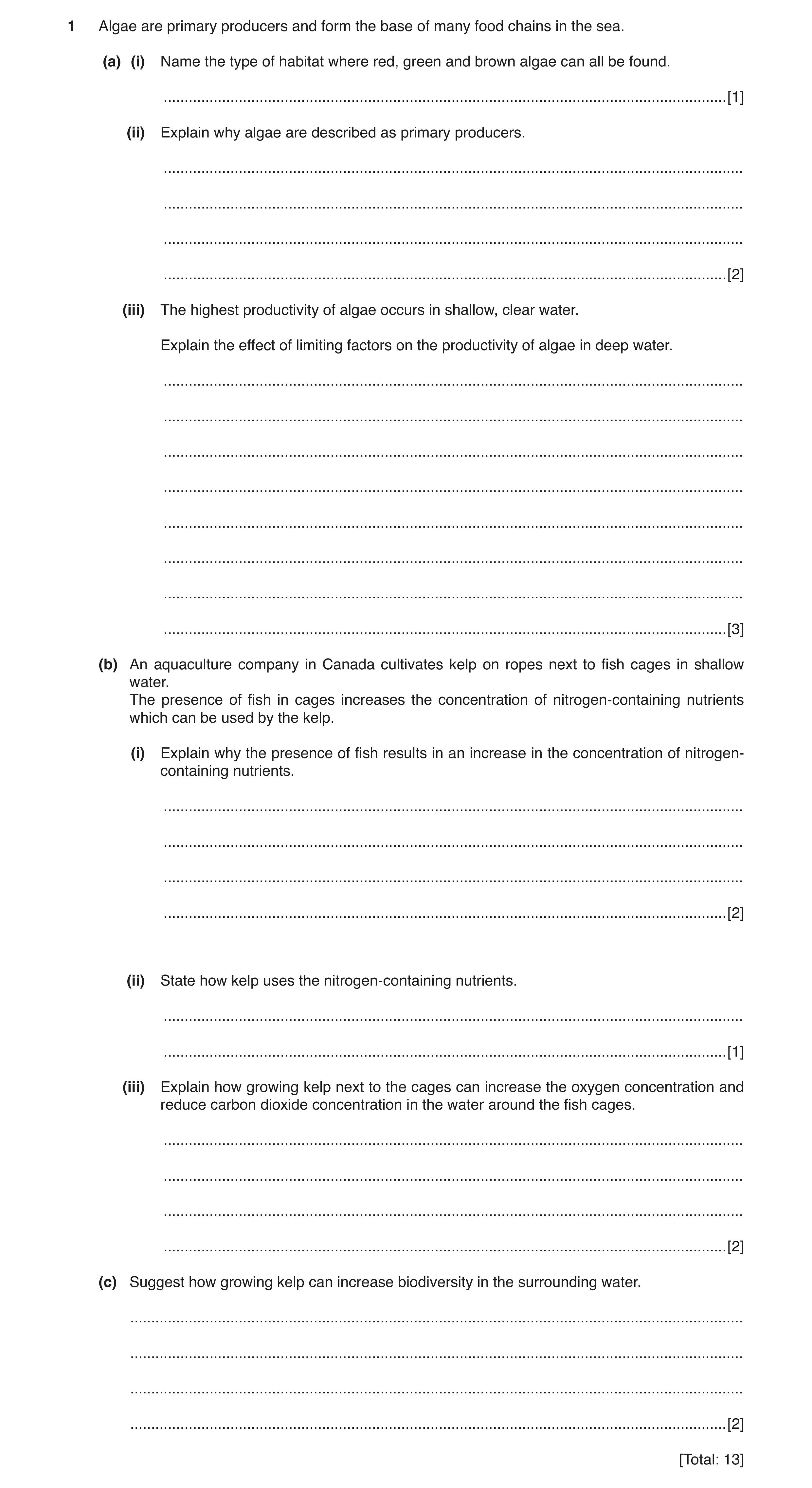
1 Algae are primary producers and form the base of many food chains in the sea. (a) (i) Name the type of habitat where red, green and brown algae can all be found. … [1] (ii) Explain why algae are described as primary producers. … … … … [2] (iii) The highest productivity of algae occurs in shallow, clear water. Explain the effect of limiting factors on the productivity of algae in deep water. … … … … … … … … [3] (b) An aquaculture company in Canada cultivates kelp on ropes next to fish cages in shallow water. The presence of fish in cages increases the concentration of nitrogen-containing nutrients which can be used by the kelp. (i) Explain why the presence of fish results in an increase in the concentration of nitrogen- containing nutrients. … … … … [2] (ii) State how kelp uses the nitrogen-containing nutrients. … … [1] (iii) Explain how growing kelp next to the cages can increase the oxygen concentration and reduce carbon dioxide concentration in the water around the fish cages. … … … … [2] (c) Suggest how growing kelp can increase biodiversity in the surrounding water. … … … … [2] [Total: 13]
13 marks
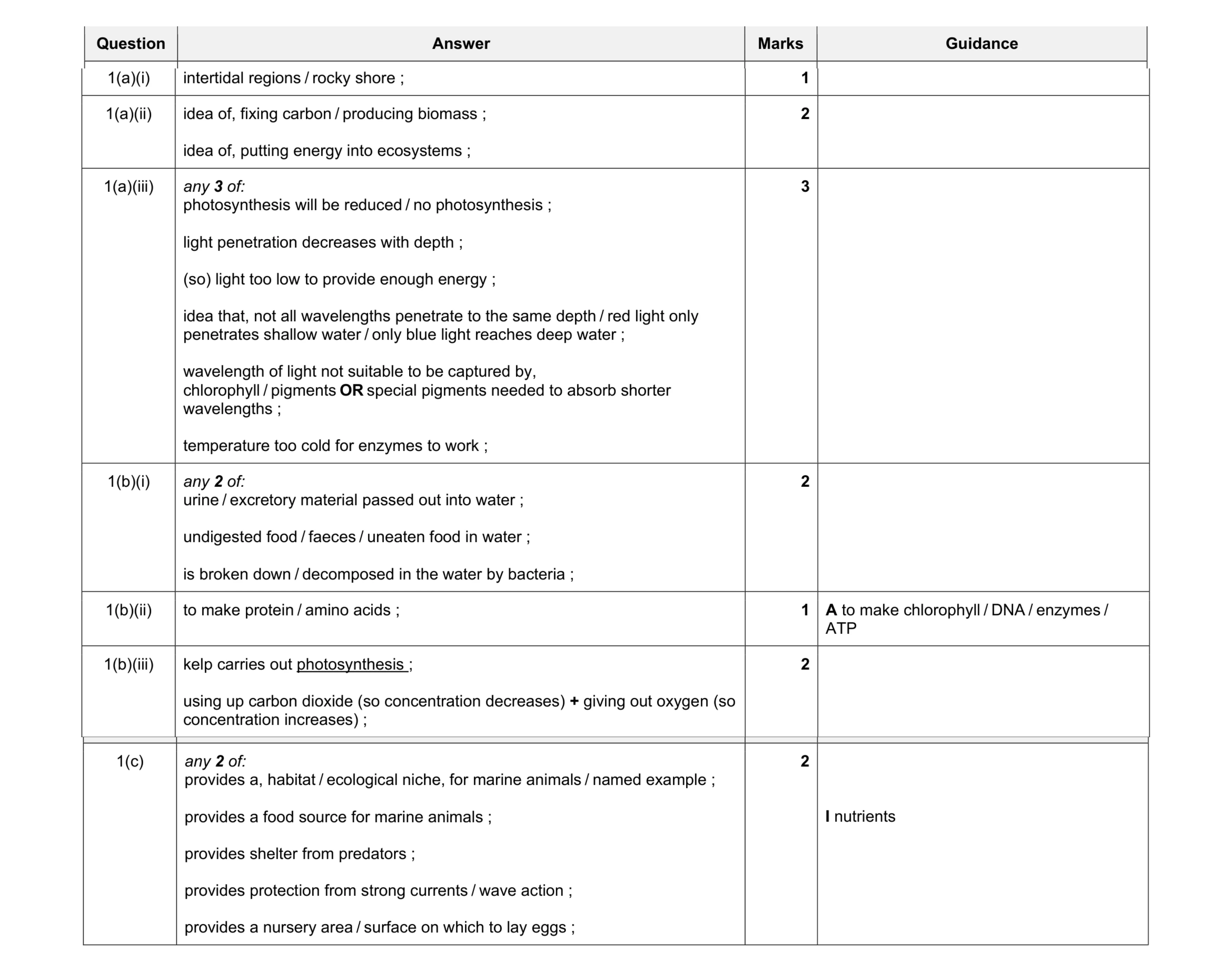
Mark scheme: 1(a)(i) intertidal regions / rocky shore ; 1 1(a)(ii) idea of, fixing carbon / producing biomass ; idea of, putting energy into ecosystems ; 2 1(a)(iii) any 3 of: photosynthesis will be reduced / no photosynthesis ; light penetration decreases with depth ; (so) light too low to provide enough energy ; idea that, not all wavelengths penetrate to the same depth / red light only penetrates shallow water / only blue light reaches deep water ; wavelength of light not suitable to be captured by, chlorophyll / pigments OR special pigments needed to absorb shorter wavelengths ; temperature too cold for enzymes to work ; 3 1(b)(i) any 2 of: urine / excretory material passed out into water ; undigested food / faeces / uneaten food in water ; is broken down / decomposed in the water by bacteria ; 2 1(b)(ii) to make protein / amino acids ; 1 A to make chlorophyll / DNA / enzymes / ATP 1(b)(iii) kelp carries out photosynthesis ; using up carbon dioxide (so concentration decreases) + giving out oxygen (so concentration increases) ; 2 Question Answer Marks Guidance 1(c) any 2 of: provides a, habitat / ecological niche, for marine animals / named example ; provides a food source for marine animals ; provides shelter from predators ; provides protection from strong currents / wave action ; provides a nursery area / surface on which to lay eggs ; 2 I nutrients
This question in 9693/31 Oct/Nov 2017
Q2 · Seaweeds are algae that are important marine producers 9693/30 May/June 2018
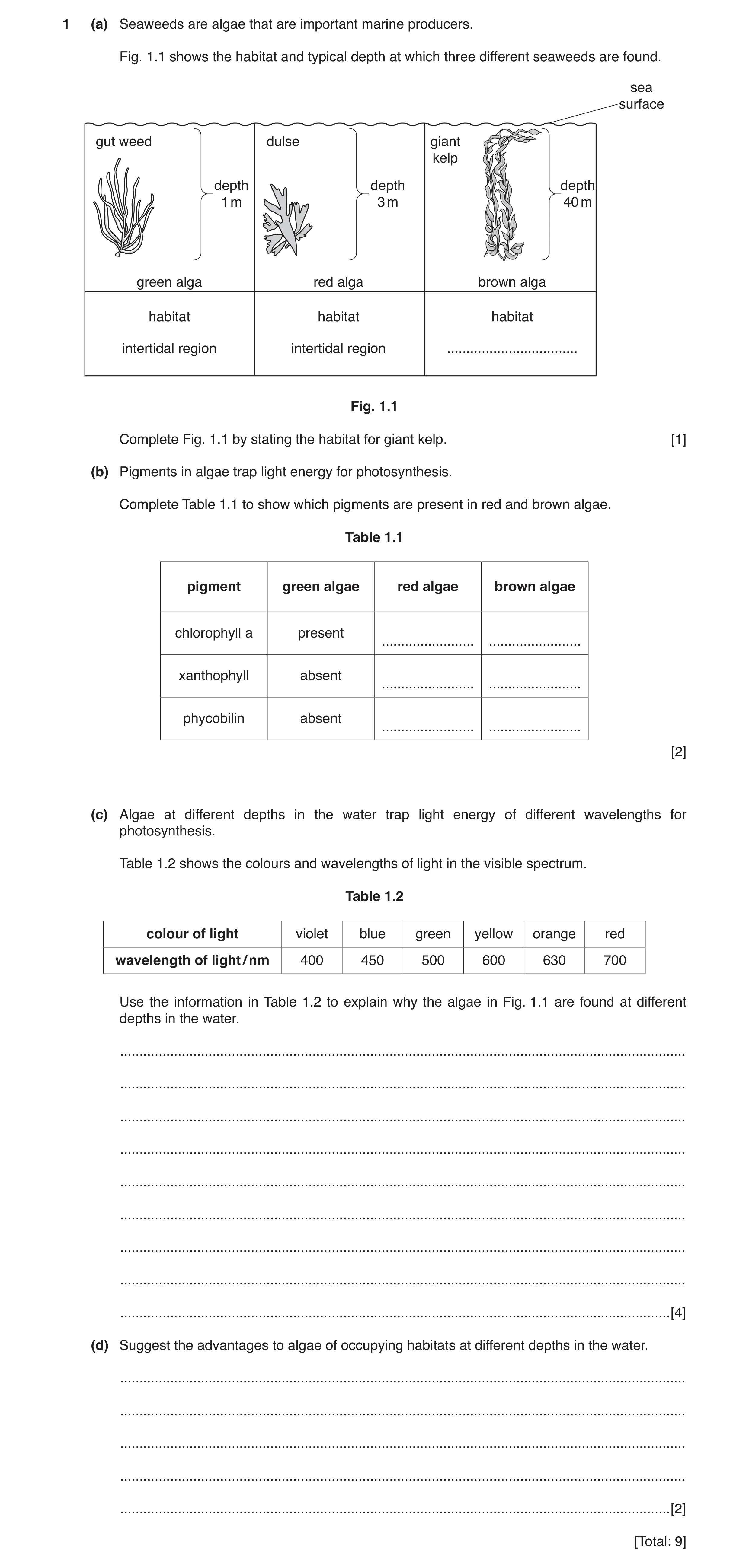
1 (a) Seaweeds are algae that are important marine producers. Fig. 1.1 shows the habitat and typical depth at which three different seaweeds are found. sea surface gut weed dulse giant kelp depth depth depth 1 m 3 m 40 m green alga red alga brown alga habitat habitat habitat intertidal region intertidal region … Fig. 1.1 Complete Fig. 1.1 by stating the habitat for giant kelp. [1] (b) Pigments in algae trap light energy for photosynthesis. Complete Table 1.1 to show which pigments are present in red and brown algae. Table 1.1 pigment green algae red algae brown algae chlorophyll a present … … xanthophyll absent … … phycobilin absent … … [2] (c) Algae at different depths in the water trap light energy of different wavelengths for photosynthesis. Table 1.2 shows the colours and wavelengths of light in the visible spectrum. Table 1.2 colour of light violet blue green yellow orange red wavelength of light / nm 400 450 500 600 630 700 Use the information in Table 1.2 to explain why the algae in Fig. 1.1 are found at different depths in the water. … … … … … … … … … [4] (d) Suggest the advantages to algae of occupying habitats at different depths in the water. … … … … … [2] [Total: 9]
9 marks
This question in 9693/30 May/June 2018
Q3 · Describe how light is used in photosynthesis 9693/30 Oct/Nov 2018
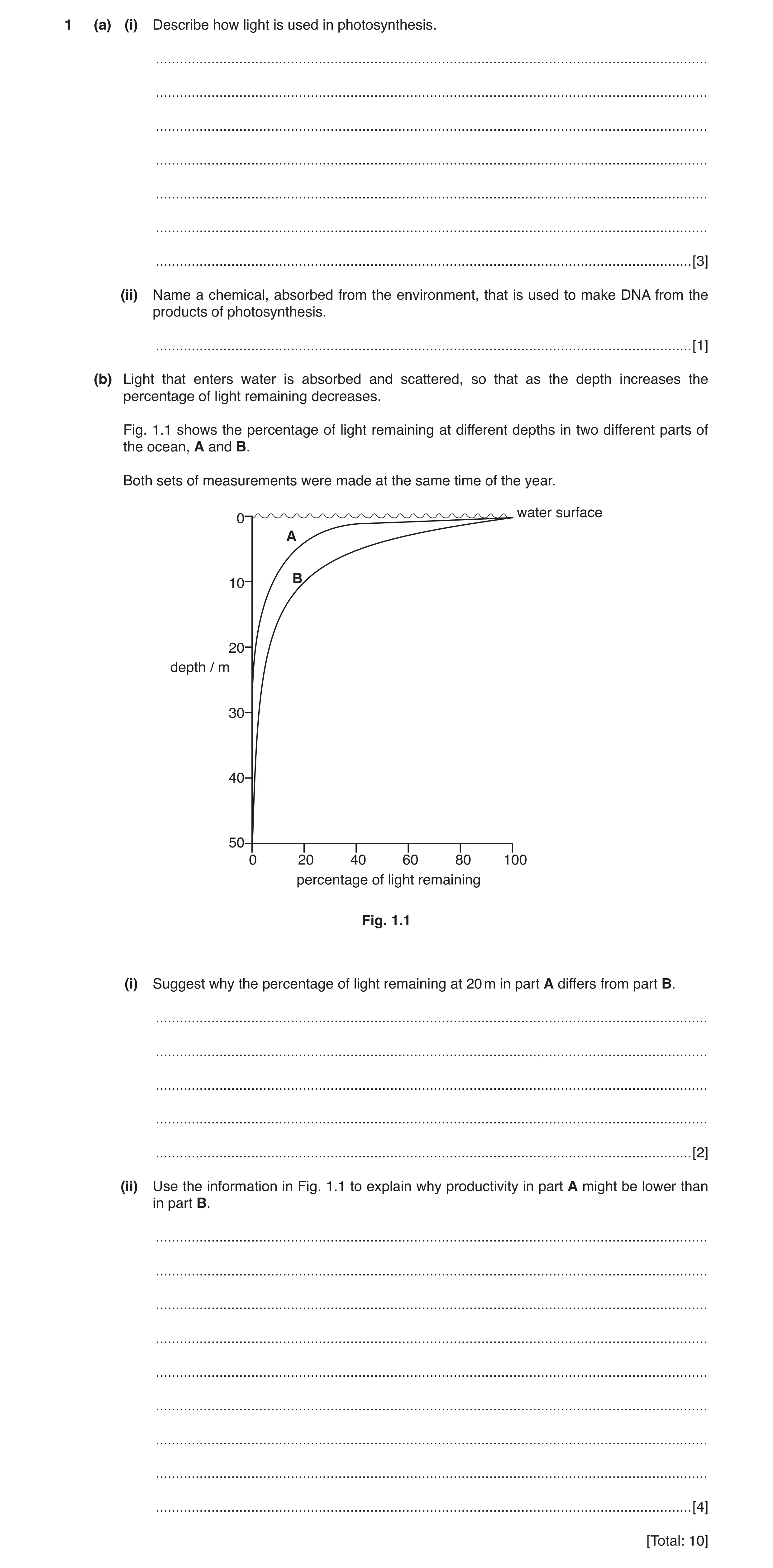
1 (a) (i) Describe how light is used in photosynthesis. … … … … … … … [3] (ii) Name a chemical, absorbed from the environment, that is used to make DNA from the products of photosynthesis. … [1] (b) Light that enters water is absorbed and scattered, so that as the depth increases the percentage of light remaining decreases. Fig. 1.1 shows the percentage of light remaining at different depths in two different parts of the ocean, A and B. Both sets of measurements were made at the same time of the year. water surface 0 A B 10 20 depth / m 30 40 50 0 20 40 60 80 100 percentage of light remaining Fig. 1.1 (i) Suggest why the percentage of light remaining at 20 m in part A differs from part B. … … … … … [2] (ii) Use the information in Fig. 1.1 to explain why productivity in part A might be lower than in part B. … … … … … … … … … [4] [Total: 10]
10 marks
This question in 9693/30 Oct/Nov 2018
Q4 · Phytoplankton are important primary producers in marine ecosystems 9693/30 Oct/Nov 2019
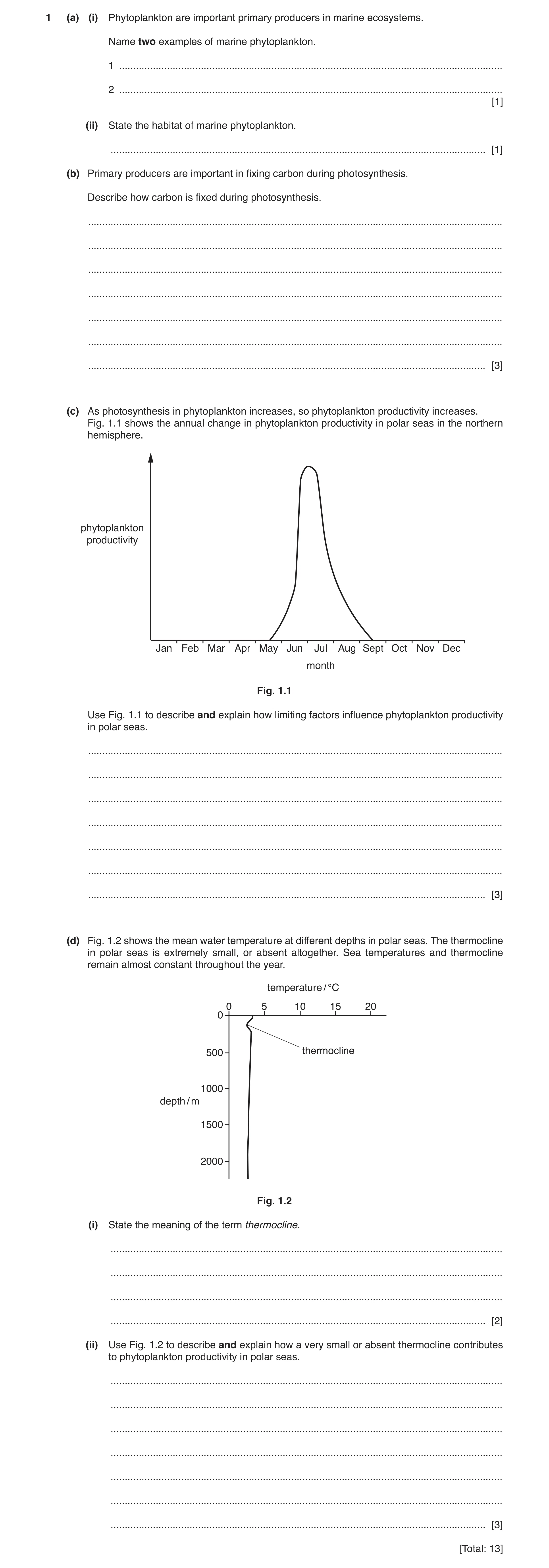
1 (a) (i) Phytoplankton are important primary producers in marine ecosystems. Name two examples of marine phytoplankton. 1 … 2 … [1] (ii) State the habitat of marine phytoplankton. … [1] (b) Primary producers are important in fixing carbon during photosynthesis. Describe how carbon is fixed during photosynthesis. … … … … … … … [3] (c) As photosynthesis in phytoplankton increases, so phytoplankton productivity increases. Fig. 1.1 shows the annual change in phytoplankton productivity in polar seas in the northern hemisphere. phytoplankton productivity Jan Feb Mar Apr May Jun Jul Aug Sept Oct Nov Dec month Fig. 1.1 Use Fig. 1.1 to describe and explain how limiting factors influence phytoplankton productivity in polar seas. … … … … … … … [3] (d) Fig. 1.2 shows the mean water temperature at different depths in polar seas. The thermocline in polar seas is extremely small, or absent altogether. Sea temperatures and thermocline remain almost constant throughout the year. temperature / °C 0 5 10 15 20 0 500 thermocline 1000 depth / m 1500 2000 Fig. 1.2 (i) State the meaning of the term thermocline. … … … … [2] (ii) Use Fig. 1.2 to describe and explain how a very small or absent thermocline contributes to phytoplankton productivity in polar seas. … … … … … … … [3] [Total: 13]
13 marks
This question in 9693/30 Oct/Nov 2019
Q5 · Phytoplankton productivity is reduced in some nutrient-rich oceans 9693/30 May/June 2020
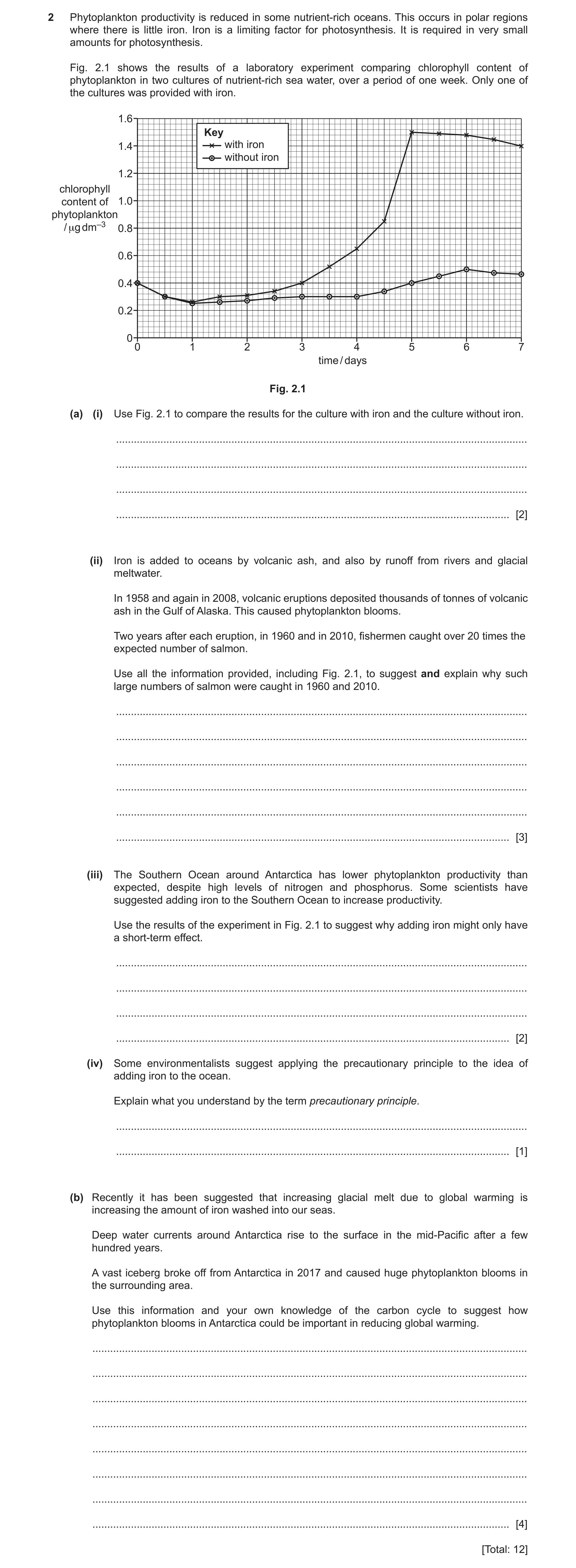
2 Phytoplankton productivity is reduced in some nutrient-rich oceans. This occurs in polar regions where there is little iron. Iron is a limiting factor for photosynthesis. It is required in very small amounts for photosynthesis. Fig. 2.1 shows the results of a laboratory experiment comparing chlorophyll content of phytoplankton in two cultures of nutrient-rich sea water, over a period of one week. Only one of the cultures was provided with iron. 1.6 Key 1.4 with iron without iron 1.2 chlorophyll content of 1.0 phytoplankton / μg dm–3 0.8 0.6 0.4 0.2 0 0 1 2 3 4 5 6 7 time / days Fig. 2.1 (a) (i) Use Fig. 2.1 to compare the results for the culture with iron and the culture without iron. … … … … [2] (ii) Iron is added to oceans by volcanic ash, and also by runoff from rivers and glacial meltwater. In 1958 and again in 2008, volcanic eruptions deposited thousands of tonnes of volcanic ash in the Gulf of Alaska. This caused phytoplankton blooms. Two years after each eruption, in 1960 and in 2010, fishermen caught over 20 times the expected number of salmon. Use all the information provided, including Fig. 2.1, to suggest and explain why such large numbers of salmon were caught in 1960 and 2010. … … … … … … [3] (iii) The Southern Ocean around Antarctica has lower phytoplankton productivity than expected, despite high levels of nitrogen and phosphorus. Some scientists have suggested adding iron to the Southern Ocean to increase productivity. Use the results of the experiment in Fig. 2.1 to suggest why adding iron might only have a short-term effect. … … … … [2] (iv) Some environmentalists suggest applying the precautionary principle to the idea of adding iron to the ocean. Explain what you understand by the term precautionary principle. … … [1] (b) Recently it has been suggested that increasing glacial melt due to global warming is increasing the amount of iron washed into our seas. Deep water currents around Antarctica rise to the surface in the mid-Pacific after a few hundred years. A vast iceberg broke off from Antarctica in 2017 and caused huge phytoplankton blooms in the surrounding area. Use this information and your own knowledge of the carbon cycle to suggest how phytoplankton blooms in Antarctica could be important in reducing global warming. … … … … … … … … [4] [Total: 12]
12 marks
This question in 9693/30 May/June 2020
Q6 · Almost all marine producers carry out photosynthesis 9693/31 May/June 2022
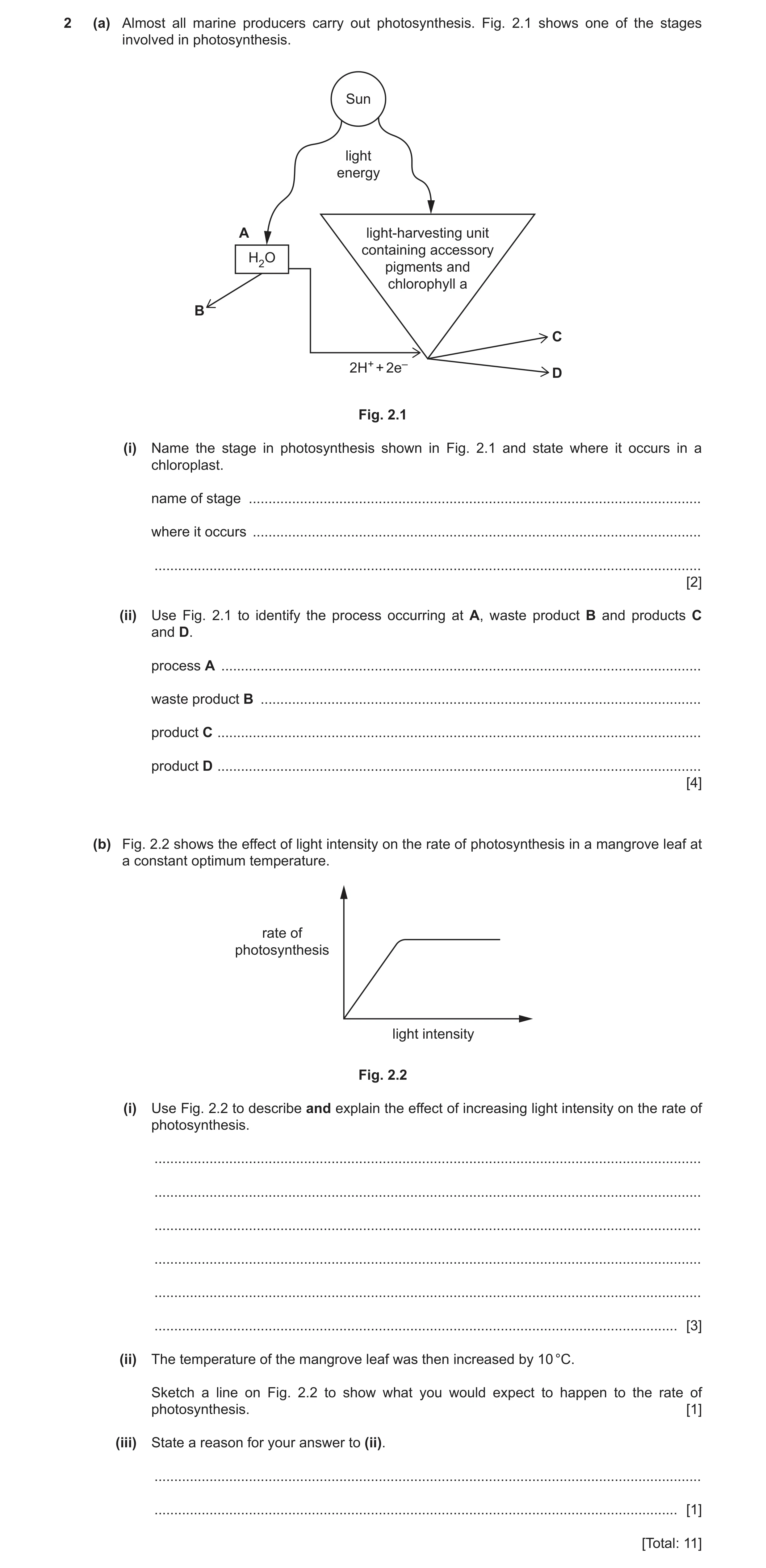
2 (a) Almost all marine producers carry out photosynthesis. Fig. 2.1 shows one of the stages involved in photosynthesis. Sun light energy A light-harvesting unit containing accessory H2O pigments and chlorophyll a B C 2H+ + 2e– D Fig. 2.1 (i) Name the stage in photosynthesis shown in Fig. 2.1 and state where it occurs in a chloroplast. name of stage … where it occurs … … [2] (ii) Use Fig. 2.1 to identify the process occurring at A, waste product B and products C and D. process A … waste product B … product C … product D … [4] (b) Fig. 2.2 shows the effect of light intensity on the rate of photosynthesis in a mangrove leaf at a constant optimum temperature. rate of photosynthesis light intensity Fig. 2.2 (i) Use Fig. 2.2 to describe and explain the effect of increasing light intensity on the rate of photosynthesis. … … … … … … [3] (ii) The temperature of the mangrove leaf was then increased by 10 °C. Sketch a line on Fig. 2.2 to show what you would expect to happen to the rate of photosynthesis. [1] (iii) State a reason for your answer to (ii). … … [1] [Total: 11]
11 marks
Mark scheme: 2(a)(i) name – light-dependent stage ; occurs – in thylakoid membrane ; 2 2(a)(ii) A – photolysis ; B – oxygen ; C – ATP (or reduced NADP / NADPH if not stated for D) ; D – reduced NADP / NADPH (or ATP if not stated for C) ; 4 2(b)(i) any 3 from: rate of photosynthesis increases with increasing light intensity ; as light is a limiting factor ; (increasing light provides) more energy for photoactivation of chlorophyll ; after a certain point it remains constant / plateaus ; as another factor is limiting / light is no longer limiting ; 3 2(b)(ii) line same shape but below existing line on graph 1 2(b)(iii) higher temperature begins to denature enzymes (used for photosynthesis) ; 1
This question in 9693/31 May/June 2022
Q7 · Almost all marine producers carry out photosynthesis 9693/32 May/June 2022
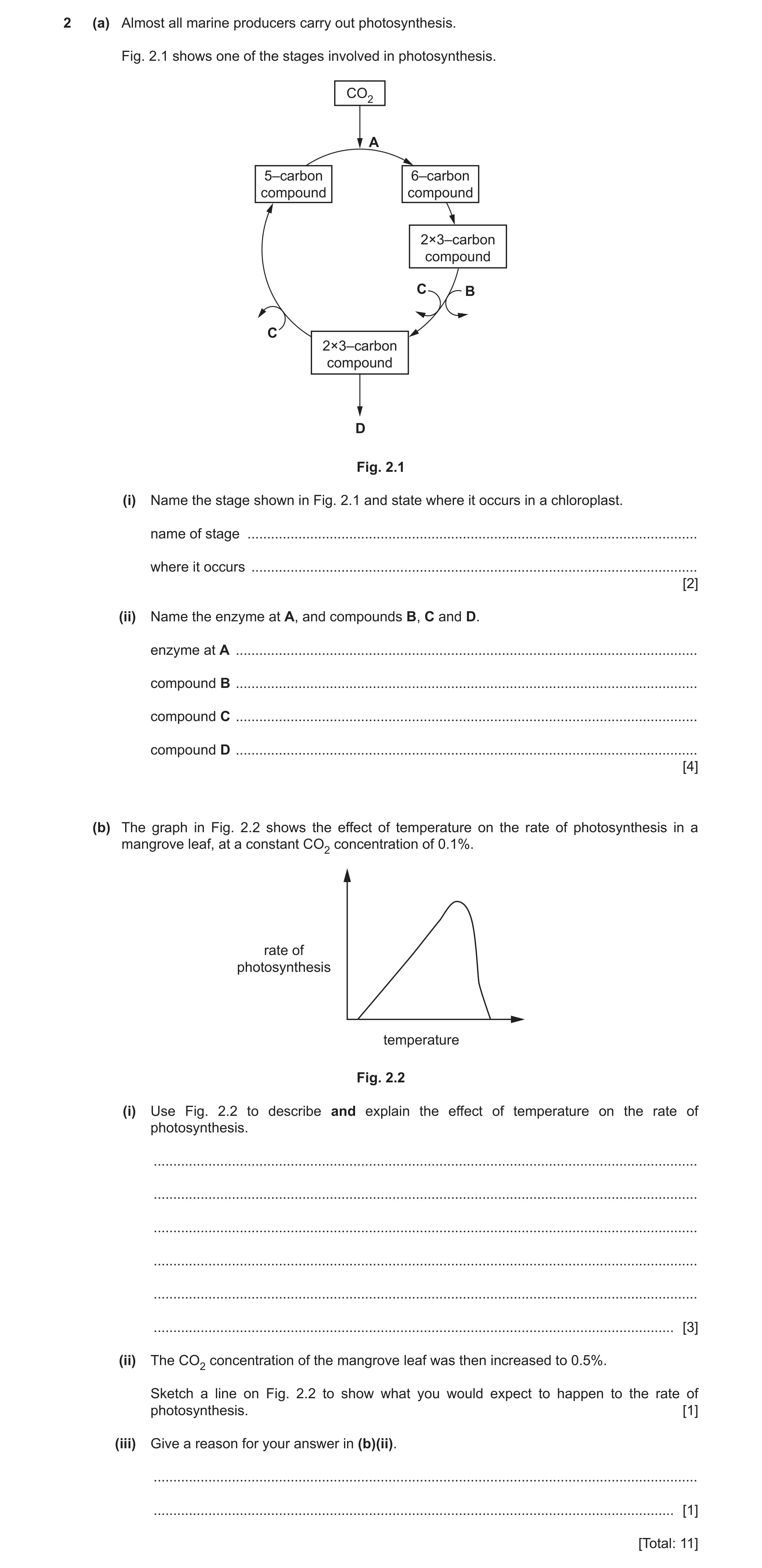
2 (a) Almost all marine producers carry out photosynthesis. Fig. 2.1 shows one of the stages involved in photosynthesis. CO2 A 5–carbon 6–carbon compound compound 2×3–carbon compound C B C 2×3–carbon compound D Fig. 2.1 (i) Name the stage shown in Fig. 2.1 and state where it occurs in a chloroplast. name of stage … where it occurs … [2] (ii) Name the enzyme at A, and compounds B, C and D. enzyme at A … compound B … compound C … compound D … [4] (b) The graph in Fig. 2.2 shows the effect of temperature on the rate of photosynthesis in a mangrove leaf, at a constant CO2 concentration of 0.1%. rate of photosynthesis temperature Fig. 2.2 (i) Use Fig. 2.2 to describe and explain the effect of temperature on the rate of photosynthesis. … … … … … … [3] (ii) The CO2 concentration of the mangrove leaf was then increased to 0.5%. Sketch a line on Fig. 2.2 to show what you would expect to happen to the rate of photosynthesis. [1] (iii) Give a reason for your answer in (b)(ii). … … [1] [Total: 11]
11 marks
Mark scheme: 2(a)(i) light-independent stage / Calvin cycle ; stroma ; 2 2(a)(ii) A rubisco ; B reduced NADP / NADPH ; C ATP ; D glucose ; 4 2(b)(i) any 3 from: rate (of photosynthesis) increases with increasing temperature ; as particles have more (kinetic) energy ; rate decreases, after optimum / when temperature increases further ; as solubility of gases decreases ; 3 Question Answer Marks 2(b)(ii) 1 2(b)(iii) carbon dioxide is a limiting factor for photosynthesis or increasing carbon dioxide increases rate of photosynthesis ; 1 ;
This question in 9693/32 May/June 2022
Q8 · Almost all marine producers carry out photosynthesis 9693/33 May/June 2022
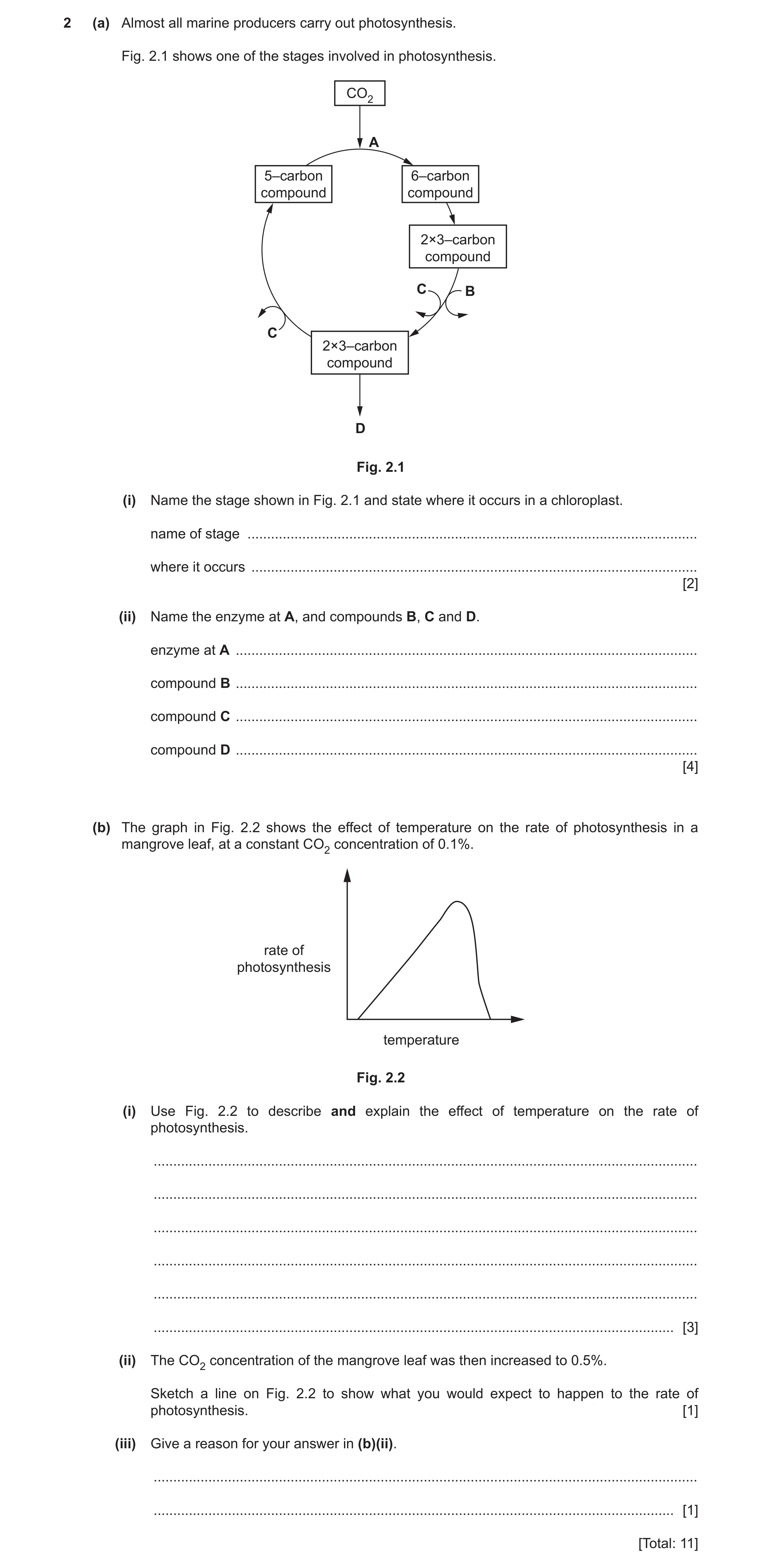
2 (a) Almost all marine producers carry out photosynthesis. Fig. 2.1 shows one of the stages involved in photosynthesis. CO2 A 5–carbon 6–carbon compound compound 2×3–carbon compound C B C 2×3–carbon compound D Fig. 2.1 (i) Name the stage shown in Fig. 2.1 and state where it occurs in a chloroplast. name of stage … where it occurs … [2] (ii) Name the enzyme at A, and compounds B, C and D. enzyme at A … compound B … compound C … compound D … [4] (b) The graph in Fig. 2.2 shows the effect of temperature on the rate of photosynthesis in a mangrove leaf, at a constant CO2 concentration of 0.1%. rate of photosynthesis temperature Fig. 2.2 (i) Use Fig. 2.2 to describe and explain the effect of temperature on the rate of photosynthesis. … … … … … … [3] (ii) The CO2 concentration of the mangrove leaf was then increased to 0.5%. Sketch a line on Fig. 2.2 to show what you would expect to happen to the rate of photosynthesis. [1] (iii) Give a reason for your answer in (b)(ii). … … [1] [Total: 11]
11 marks
Mark scheme: 2(a)(i) light-independent stage / Calvin cycle ; stroma ; 2 2(a)(ii) A rubisco ; B reduced NADP / NADPH ; C ATP ; D glucose ; 4 2(b)(i) any 3 from: rate (of photosynthesis) increases with increasing temperature ; as particles have more (kinetic) energy ; rate decreases, after optimum / when temperature increases further ; as solubility of gases decreases ; 3 Question Answer Marks 2(b)(ii) 1 2(b)(iii) carbon dioxide is a limiting factor for photosynthesis or increasing carbon dioxide increases rate of photosynthesis ; 1 ;
This question in 9693/33 May/June 2022
Q9 · The rates of photosynthesis of a green macroalga in different colours of light 9693/32 May/June 2023
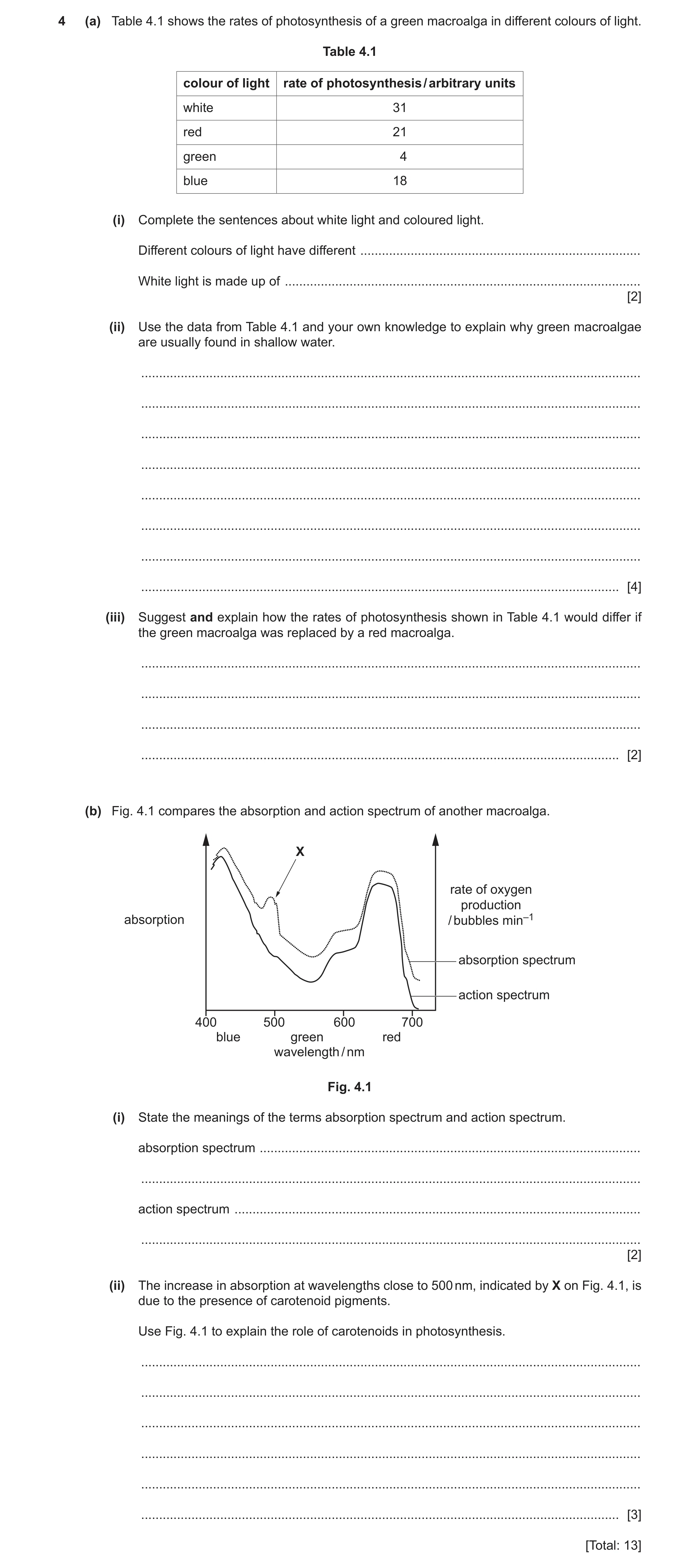
4 (a) Table 4.1 shows the rates of photosynthesis of a green macroalga in different colours of light. Table 4.1 colour of light rate of photosynthesis / arbitrary units white 31 red 21 green 4 blue 18 (i) Complete the sentences about white light and coloured light. Different colours of light have different … White light is made up of … [2] (ii) Use the data from Table 4.1 and your own knowledge to explain why green macroalgae are usually found in shallow water. … … … … … … … … [4] (iii) Suggest and explain how the rates of photosynthesis shown in Table 4.1 would differ if the green macroalga was replaced by a red macroalga. … … … … [2] (b) Fig. 4.1 compares the absorption and action spectrum of another macroalga. X rate of oxygen production absorption / bubbles min–1 absorption spectrum action spectrum 400 500 600 700 blue green red wavelength / nm Fig. 4.1 (i) State the meanings of the terms absorption spectrum and action spectrum. absorption spectrum … … action spectrum … … [2] (ii) The increase in absorption at wavelengths close to 500 nm, indicated by X on Fig. 4.1, is due to the presence of carotenoid pigments. Use Fig. 4.1 to explain the role of carotenoids in photosynthesis. … … … … … … [3] [Total: 13]
13 marks
Mark scheme: 4(a)(i) wavelengths / frequencies ; all (of the different), colours / wavelengths / frequencies ; 2 4(a)(ii) any 4 of: green algae contain chlorophyll ; green algae / chlorophyll, absorbs red and blue light ; red light can only penetrate, shallow water / surface layers ; green algae do not have pigments to absorb, green light / light in middle of spectrum ; so at deeper depths, green algae could only absorb blue light ; higher rate of photosynthesis at surface ; 4 Question Answer Marks 4(a)(iii) any 2 of: rate of oxygen production / photosynthesis in green light would increase ; as red algae contain phycobilins ; which absorb, green light / light in the middle, of the spectrum ; 2 4(b)(i) absorption spectrum – a graph of the absorbance of different wavelengths of light by photosynthetic pigments ; action spectrum – a graph showing the effect of different wavelengths of light on (rate of) photosynthesis / oxygen production ; 2 4(b)(ii) any 3 of: carotenoids are accessory pigments ; absorb wavelengths of around 500 nm ; can transfer energy to chlorophyll a ; not used directly in photosynthesis (in this macroalga) ; as there is no corresponding increase in rate (of photosynthesis) ; 3
This question in 9693/32 May/June 2023
Q10 · The rates of photosynthesis of a green macroalga in different colours of light 9693/33 May/June 2023
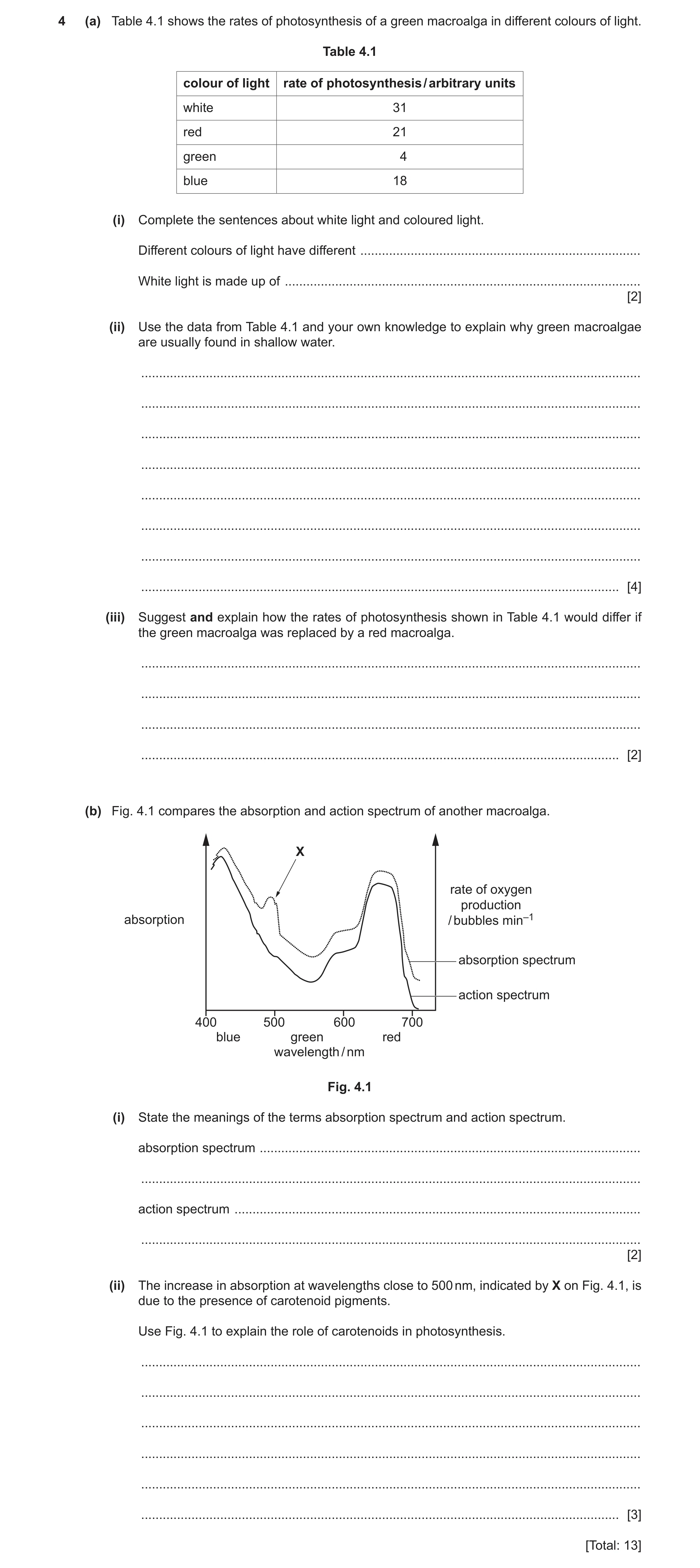
4 (a) Table 4.1 shows the rates of photosynthesis of a green macroalga in different colours of light. Table 4.1 colour of light rate of photosynthesis / arbitrary units white 31 red 21 green 4 blue 18 (i) Complete the sentences about white light and coloured light. Different colours of light have different … White light is made up of … [2] (ii) Use the data from Table 4.1 and your own knowledge to explain why green macroalgae are usually found in shallow water. … … … … … … … … [4] (iii) Suggest and explain how the rates of photosynthesis shown in Table 4.1 would differ if the green macroalga was replaced by a red macroalga. … … … … [2] (b) Fig. 4.1 compares the absorption and action spectrum of another macroalga. X rate of oxygen production absorption / bubbles min–1 absorption spectrum action spectrum 400 500 600 700 blue green red wavelength / nm Fig. 4.1 (i) State the meanings of the terms absorption spectrum and action spectrum. absorption spectrum … … action spectrum … … [2] (ii) The increase in absorption at wavelengths close to 500 nm, indicated by X on Fig. 4.1, is due to the presence of carotenoid pigments. Use Fig. 4.1 to explain the role of carotenoids in photosynthesis. … … … … … … [3] [Total: 13]
13 marks
Mark scheme: 4(a)(i) wavelengths / frequencies ; all (of the different), colours / wavelengths / frequencies ; 2 4(a)(ii) any 4 of: green algae contain chlorophyll ; green algae / chlorophyll, absorbs red and blue light ; red light can only penetrate, shallow water / surface layers ; green algae do not have pigments to absorb, green light / light in middle of spectrum ; so at deeper depths, green algae could only absorb blue light ; higher rate of photosynthesis at surface ; 4 Question Answer Marks 4(a)(iii) any 2 of: rate of oxygen production / photosynthesis in green light would increase ; as red algae contain phycobilins ; which absorb, green light / light in the middle, of the spectrum ; 2 4(b)(i) absorption spectrum – a graph of the absorbance of different wavelengths of light by photosynthetic pigments ; action spectrum – a graph showing the effect of different wavelengths of light on (rate of) photosynthesis / oxygen production ; 2 4(b)(ii) any 3 of: carotenoids are accessory pigments ; absorb wavelengths of around 500 nm ; can transfer energy to chlorophyll a ; not used directly in photosynthesis (in this macroalga) ; as there is no corresponding increase in rate (of photosynthesis) ; 3
This question in 9693/33 May/June 2023
Q11 · Seagrasses have a global distribution 9693/32 May/June 2024
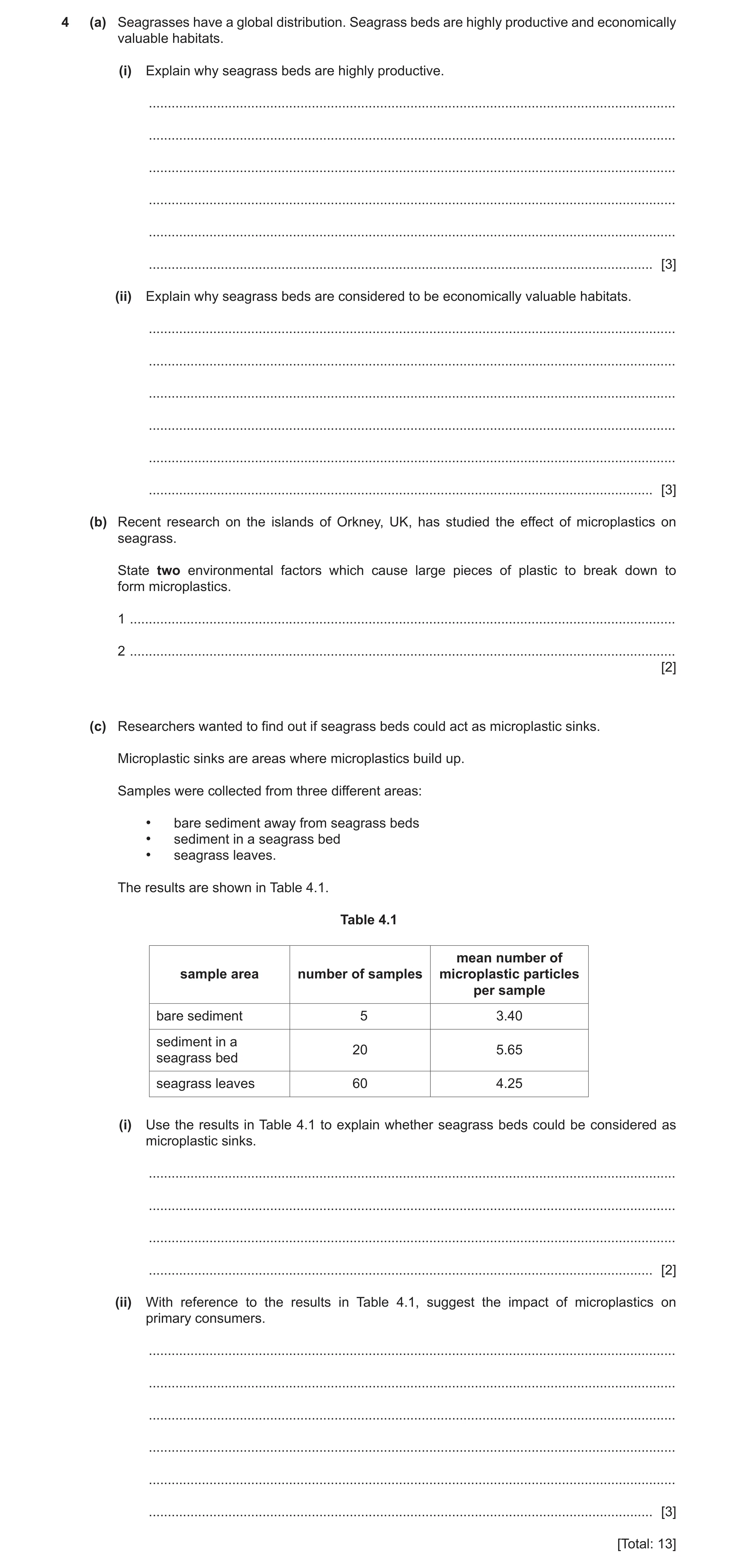
4 (a) Seagrasses have a global distribution. Seagrass beds are highly productive and economically valuable habitats. (i) Explain why seagrass beds are highly productive. … … … … … … [3] (ii) Explain why seagrass beds are considered to be economically valuable habitats. … … … … … … [3] (b) Recent research on the islands of Orkney, UK, has studied the effect of microplastics on seagrass. State two environmental factors which cause large pieces of plastic to break down to form microplastics. 1 … 2 … [2] (c) Researchers wanted to find out if seagrass beds could act as microplastic sinks. Microplastic sinks are areas where microplastics build up. Samples were collected from three different areas: • bare sediment away from seagrass beds • sediment in a seagrass bed • seagrass leaves. The results are shown in Table 4.1. Table 4.1 mean number of sample area number of samples microplastic particles per sample bare sediment 5 3.40 sediment in a 20 5.65 seagrass bed seagrass leaves 60 4.25 (i) Use the results in Table 4.1 to explain whether seagrass beds could be considered as microplastic sinks. … … … … [2] (ii) With reference to the results in Table 4.1, suggest the impact of microplastics on primary consumers. … … … … … … [3] [Total: 13]
13 marks
Mark scheme: 4(a)(i) any 3 of: found in, shallow water / photic zone ; high light intensities ; so high rate of photosynthesis ; biomass increases quickly ; AVP ; 3 4(a)(ii) any 3 of: provide a habitat (for a wide variety of commercially important species) ; idea of, a nursery / spawning area, for these species ; so more available (to harvest / sell) ; ref to income from, tourism / source of medicines / fish sales ; AVP ; 3 4(b) any 2 of: UV radiation ; wind action ; wave action ; 2 4(c)(i) any 2 of: the mean numbers of microplastic per sample is greater in sediment, in a seagrass bed / on seagrass leaves, than surrounding bare sediment ; manipulation of figures ; idea of more data from bare sediment required to make a valid conclusion ; 2 4(c)(ii) any 3 of: microplastic could be ingested by primary consumers ; when they graze on, seagrass blades / phytoplankton (on surrounding sediment) ; many leaves are eaten ; correct ref. to bioaccumulation ; can block intestines / can be absorbed into blood ; ref. to toxins + suitable effect on primary consumer ; 3
This question in 9693/32 May/June 2024
Q12 · Describe the light-dependent stage in photosynthesis 9693/32 May/June 2024
5 Describe the light-dependent stage in photosynthesis. … … … … … … … … … … … … … … … … … … … … [10]
10 marks
Mark scheme: 5 any 10 of: 1 takes place in, thylakoid membrane / granum ; 2 requires light and water ; 3 ref. to light as an energy source ; 4 light absorbed by (chloroplast) pigments ; 5 e.g. chlorophyll a / named accessory pigment ; 6 ref. to trapping specific wavelengths of light ; 7 ref. to photoactivation (of chlorophyll) ; 8 produces (free) electrons ; 9 (for) photophosphorylation ; 10 ADP → ATP ; 11 photolysis / splitting of water molecule ; 12 into hydrogen / protons and oxygen ; 13 oxygen is a waste product ; 14 hydrogen combines with (carrier molecule) NADP ; 15 to form reduced NADP / NADPH ; 16 ATP and reduced NADP are passed to the light-independent stage ; 17 where they are an energy source ; 10
This question in 9693/32 May/June 2024
Q13 · Seagrasses have a global distribution 9693/33 May/June 2024
4 (a) Seagrasses have a global distribution. Seagrass beds are highly productive and economically valuable habitats. (i) Explain why seagrass beds are highly productive. … … … … … … [3] (ii) Explain why seagrass beds are considered to be economically valuable habitats. … … … … … … [3] (b) Recent research on the islands of Orkney, UK, has studied the effect of microplastics on seagrass. State two environmental factors which cause large pieces of plastic to break down to form microplastics. 1 … 2 … [2] (c) Researchers wanted to find out if seagrass beds could act as microplastic sinks. Microplastic sinks are areas where microplastics build up. Samples were collected from three different areas: • bare sediment away from seagrass beds • sediment in a seagrass bed • seagrass leaves. The results are shown in Table 4.1. Table 4.1 mean number of sample area number of samples microplastic particles per sample bare sediment 5 3.40 sediment in a 20 5.65 seagrass bed seagrass leaves 60 4.25 (i) Use the results in Table 4.1 to explain whether seagrass beds could be considered as microplastic sinks. … … … … [2] (ii) With reference to the results in Table 4.1, suggest the impact of microplastics on primary consumers. … … … … … … [3] [Total: 13]
13 marks
Mark scheme: 4(a)(i) any 3 of: found in, shallow water / photic zone ; high light intensities ; so high rate of photosynthesis ; biomass increases quickly ; AVP ; 3 4(a)(ii) any 3 of: provide a habitat (for a wide variety of commercially important species) ; idea of, a nursery / spawning area, for these species ; so more available (to harvest / sell) ; ref to income from, tourism / source of medicines / fish sales ; AVP ; 3 4(b) any 2 of: UV radiation ; wind action ; wave action ; 2 4(c)(i) any 2 of: the mean numbers of microplastic per sample is greater in sediment, in a seagrass bed / on seagrass leaves, than surrounding bare sediment ; manipulation of figures ; idea of more data from bare sediment required to make a valid conclusion ; 2 4(c)(ii) any 3 of: microplastic could be ingested by primary consumers ; when they graze on, seagrass blades / phytoplankton (on surrounding sediment) ; many leaves are eaten ; correct ref. to bioaccumulation ; can block intestines / can be absorbed into blood ; ref. to toxins + suitable effect on primary consumer ; 3
This question in 9693/33 May/June 2024
Q14 · Describe the light-dependent stage in photosynthesis 9693/33 May/June 2024
5 Describe the light-dependent stage in photosynthesis. … … … … … … … … … … … … … … … … … … … … [10]
10 marks
Mark scheme: 5 any 10 of: 1 takes place in, thylakoid membrane / granum ; 2 requires light and water ; 3 ref. to light as an energy source ; 4 light absorbed by (chloroplast) pigments ; 5 e.g. chlorophyll a / named accessory pigment ; 6 ref. to trapping specific wavelengths of light ; 7 ref. to photoactivation (of chlorophyll) ; 8 produces (free) electrons ; 9 (for) photophosphorylation ; 10 ADP → ATP ; 11 photolysis / splitting of water molecule ; 12 into hydrogen / protons and oxygen ; 13 oxygen is a waste product ; 14 hydrogen combines with (carrier molecule) NADP ; 15 to form reduced NADP / NADPH ; 16 ATP and reduced NADP are passed to the light-independent stage ; 17 where they are an energy source ; 10
This question in 9693/33 May/June 2024
Q15 · Discuss the importance of microscopic algae in marine environments 9693/31 Oct/Nov 2024
6 (a) Discuss the importance of microscopic algae in marine environments. … … … … … … … … … … … … … … … … … … … … [10] (b) Explain how the presence of accessory pigments in marine producers is related to the penetration of different wavelengths of light. … … … … … … … … … … … … [7] [Total: 17]
17 marks
Mark scheme: 6(a) any 10 of: 10 1 are phytoplankton ; 2 which carry out photosynthesis ; 3 absorb nutrients from their environment ; 4 productivity limited by available nutrients / light / low temperatures ; 5 use (dissolved) carbon dioxide ; 6 which reduces concentrations in sea water ; 7 reduces effect of ocean acidification ; 8 give out oxygen ; 9 for aerobic respiration in marine organisms ; 10 produce, glucose / carbohydrate / organic compounds ; 11 as food / energy source for zooplankton / consumers ; 12 form a habitat for zooplankton / larvae ; 13 when they die, they fall to ocean floor ; 14 idea of nutrients recycled ; 15 can cause algal blooms / algal overgrowth (if productivity is too high) ; 16 can result in eutrophication ; 17 act as a carbon sink ; 18 so helps reduce global warming ; AW 19 AVP ; 6(b) any 7 of: 7 1 accessory pigments trap / absorb light (energy) ; 2 at different wavelengths ; 3 during light-dependent stage (of photosynthesis) ; 4 pass light energy on to chlorophyll a ; 5 accessory pigments include, chlorophyll b / carotenoids / xanthophylls / phycobilins ; 6 wavelength varies with depth ; 7 red light / long wavelength, only penetrates shallow water AND blue light / short wavelength, penetrates deeper water ; 8 green algae contain chlorophyll ; 9 which absorbs red light / wavelengths of (around) 670 nm AND blue light / wavelengths at (around) 450 nm ; 10 brown algae contain fucoxanthin / xanthophylls ; 11 which absorb wavelengths of (around) 450 nm / in blue end of spectrum ; 12 red algae contain phycobilins / phycocyanin / phycoerythrin ; 13 which absorb wavelengths of between 500 to 600 nm / in yellow – green areas of spectrum ;
This question in 9693/31 Oct/Nov 2024
Q16 · Discuss the importance of microscopic algae in marine environments 9693/32 Oct/Nov 2024
6 (a) Discuss the importance of microscopic algae in marine environments. … … … … … … … … … … … … … … … … … … … … [10] (b) Explain how the presence of accessory pigments in marine producers is related to the penetration of different wavelengths of light. … … … … … … … … … … … … [7] [Total: 17]
17 marks
Mark scheme: 6(a) any 10 of: 10 1 are phytoplankton ; 2 which carry out photosynthesis ; 3 absorb nutrients from their environment ; 4 productivity limited by available nutrients / light / low temperatures ; 5 use (dissolved) carbon dioxide ; 6 which reduces concentrations in sea water ; 7 reduces effect of ocean acidification ; 8 give out oxygen ; 9 for aerobic respiration in marine organisms ; 10 produce, glucose / carbohydrate / organic compounds ; 11 as food / energy source for zooplankton / consumers ; 12 form a habitat for zooplankton / larvae ; 13 when they die, they fall to ocean floor ; 14 idea of nutrients recycled ; 15 can cause algal blooms / algal overgrowth (if productivity is too high) ; 16 can result in eutrophication ; 17 act as a carbon sink ; 18 so helps reduce global warming ; AW 19 AVP ; 6(b) any 7 of: 7 1 accessory pigments trap / absorb light (energy) ; 2 at different wavelengths ; 3 during light-dependent stage (of photosynthesis) ; 4 pass light energy on to chlorophyll a ; 5 accessory pigments include, chlorophyll b / carotenoids / xanthophylls / phycobilins ; 6 wavelength varies with depth ; 7 red light / long wavelength, only penetrates shallow water AND blue light / short wavelength, penetrates deeper water ; 8 green algae contain chlorophyll ; 9 which absorbs red light / wavelengths of (around) 670 nm AND blue light / wavelengths at (around) 450 nm ; 10 brown algae contain fucoxanthin / xanthophylls ; 11 which absorb wavelengths of (around) 450 nm / in blue end of spectrum ; 12 red algae contain phycobilins / phycocyanin / phycoerythrin ; 13 which absorb wavelengths of between 500 to 600 nm / in yellow – green areas of spectrum ;
This question in 9693/32 Oct/Nov 2024
Q17 · Discuss the importance of microscopic algae in marine environments 9693/33 Oct/Nov 2024
6 (a) Discuss the importance of microscopic algae in marine environments. … … … … … … … … … … … … … … … … … … … … [10] (b) Explain how the presence of accessory pigments in marine producers is related to the penetration of different wavelengths of light. … … … … … … … … … … … … [7] [Total: 17]
17 marks
Mark scheme: 6(a) any 10 of: 10 1 are phytoplankton ; 2 which carry out photosynthesis ; 3 absorb nutrients from their environment ; 4 productivity limited by available nutrients / light / low temperatures ; 5 use (dissolved) carbon dioxide ; 6 which reduces concentrations in sea water ; 7 reduces effect of ocean acidification ; 8 give out oxygen ; 9 for aerobic respiration in marine organisms ; 10 produce, glucose / carbohydrate / organic compounds ; 11 as food / energy source for zooplankton / consumers ; 12 form a habitat for zooplankton / larvae ; 13 when they die, they fall to ocean floor ; 14 idea of nutrients recycled ; 15 can cause algal blooms / algal overgrowth (if productivity is too high) ; 16 can result in eutrophication ; 17 act as a carbon sink ; 18 so helps reduce global warming ; AW 19 AVP ; 6(b) any 7 of: 7 1 accessory pigments trap / absorb light (energy) ; 2 at different wavelengths ; 3 during light-dependent stage (of photosynthesis) ; 4 pass light energy on to chlorophyll a ; 5 accessory pigments include, chlorophyll b / carotenoids / xanthophylls / phycobilins ; 6 wavelength varies with depth ; 7 red light / long wavelength, only penetrates shallow water AND blue light / short wavelength, penetrates deeper water ; 8 green algae contain chlorophyll ; 9 which absorbs red light / wavelengths of (around) 670 nm AND blue light / wavelengths at (around) 450 nm ; 10 brown algae contain fucoxanthin / xanthophylls ; 11 which absorb wavelengths of (around) 450 nm / in blue end of spectrum ; 12 red algae contain phycobilins / phycocyanin / phycoerythrin ; 13 which absorb wavelengths of between 500 to 600 nm / in yellow – green areas of spectrum ;
This question in 9693/33 Oct/Nov 2024
Q18 · Photosynthesis takes place in chloroplasts 9693/31 May/June 2025
5 Photosynthesis takes place in chloroplasts. Explain how chloroplast structure is related to this function. … … … … … … … … … … … … … … … … … … … … [10]
10 marks
Mark scheme: 5 any 10 of: 10 1 small in size / approx. 5 µm ; 2 chloroplast has a large surface area to volume ratio ; 3 membranes are thin ; 4 for easy diffusion of gases ; 5 carbon dioxide enters chloroplast AND oxygen removed ; 6 ref. to permeability (of inner / outer membranes) ; 7 allow water to enter by osmosis ; 8 grana / thylakoid (membrane), contain chlorophyll ; 9 light is, absorbed / trapped ; 10 (absorb) red AND blue light / (around) 750 nm AND 450 nm wavelengths; 11 ref. to accessory pigments ; 12 e.g. xanthophyl / phycobilins / phycocyanin / phycoerythrin / fucoxanthin / chlorophyll b ; 13 absorb, ‘other / different’, wavelengths / green / yellow ; 14 grana / thylakoids, have a large surface area ; 15 light-dependent reaction occurs in, grana / thylakoid (membrane) ; 16 light-independent reaction occurs in stroma; 17 ref to, enzymes / rubisco ; 18 required to fix carbon (dioxide) ; 19 AVP ;;;
This question in 9693/31 May/June 2025
Q19 · Phytoplankton play an important role in extensive ponds used for aquaculture, such as… 9693/32 May/June 2025
3 (a) Phytoplankton play an important role in extensive ponds used for aquaculture, such as providing oxygen. State another reason why phytoplankton blooms are important in extensive ponds used for aquaculture but are less important in intensive ponds. … … … … [2] (b) Fig. 3.1 shows the daily pattern of dissolved oxygen concentration in ponds with high and low phytoplankton abundance. 20 Key high phytoplankton abundance low phytoplankton 16 abundance 12 dissolved oxygen concentration / mg dm–3 8 4 0 06:00 12:00 18:00 24:00 06:00 time of day Fig. 3.1 (i) Use Fig. 3.1 to describe how an increased phytoplankton abundance affects dissolved oxygen concentrations in ponds. … … … … [2] (ii) Use Fig. 3.1 and your own knowledge to explain why the dissolved oxygen concentration varies during the day. … … … … … … … … [4] (c) Suggest and explain how increasing winds and increasing temperature would affect the shape of the graph for low phytoplankton abundance. … … … … … … … … [4] [Total: 12]
12 marks
Mark scheme: 3(a) idea that in extensive ponds phytoplankton blooms are a food source on which the aquaculture organisms depend / AW ; 2 in intensive ponds phytoplankton blooms supplement manufactured feed / AW ; 3(b)(i) any 2 of: 2 (increasing phytoplankton abundance) increases the, range / maximum and minimum, values of dissolved oxygen (in a pond) ; correct reference to figures for low and high phytoplankton abundance ; 3(b)(ii) any 4 of: 4 1 highest oxygen concentration during the day and lowest at night ; 2 (during the day) phytoplankton photosynthesises using light (energy) ; 3 oxygen is produced (as a waste product), so concentration increases ; 4 the rate of photosynthesis is greater than the rate of respiration ; 5 at night photosynthesis stops as there is no light ; 6 oxygen is used for (aerobic) respiration, so the concentration falls ; 7 increasing phytoplankton numbers cause more oxygen to be used at night and more produced during the day ; 3(c) any 4 of: 1 idea of: increasing winds would increase the diffusion rate of gases entering the pond (from the atmosphere) ; 2 more carbon dioxide available for photosynthesis (during the day) / more oxygen available for respiration at night ; 3 increased photosynthesis increases the concentration of oxygen (during the day) / increased respiration decreases the concentration of oxygen (at night) ; 4 idea that graph will be, higher / steeper in the day / lower at night ; 5 ref to effect of increased temperature on gas solubility or denaturing enzymes or increasing kinetic energy in molecules 6 effect of change in carbon dioxide or oxygen concentrations on photosynthesis / respiration ; 7 correct ref. to change in dissolved oxygen concentration due to photosynthesis / respiration ; 8 correct ref. to change in graph ;
This question in 9693/32 May/June 2025
Q20 · Phytoplankton play an important role in extensive ponds used for aquaculture, such as… 9693/33 May/June 2025
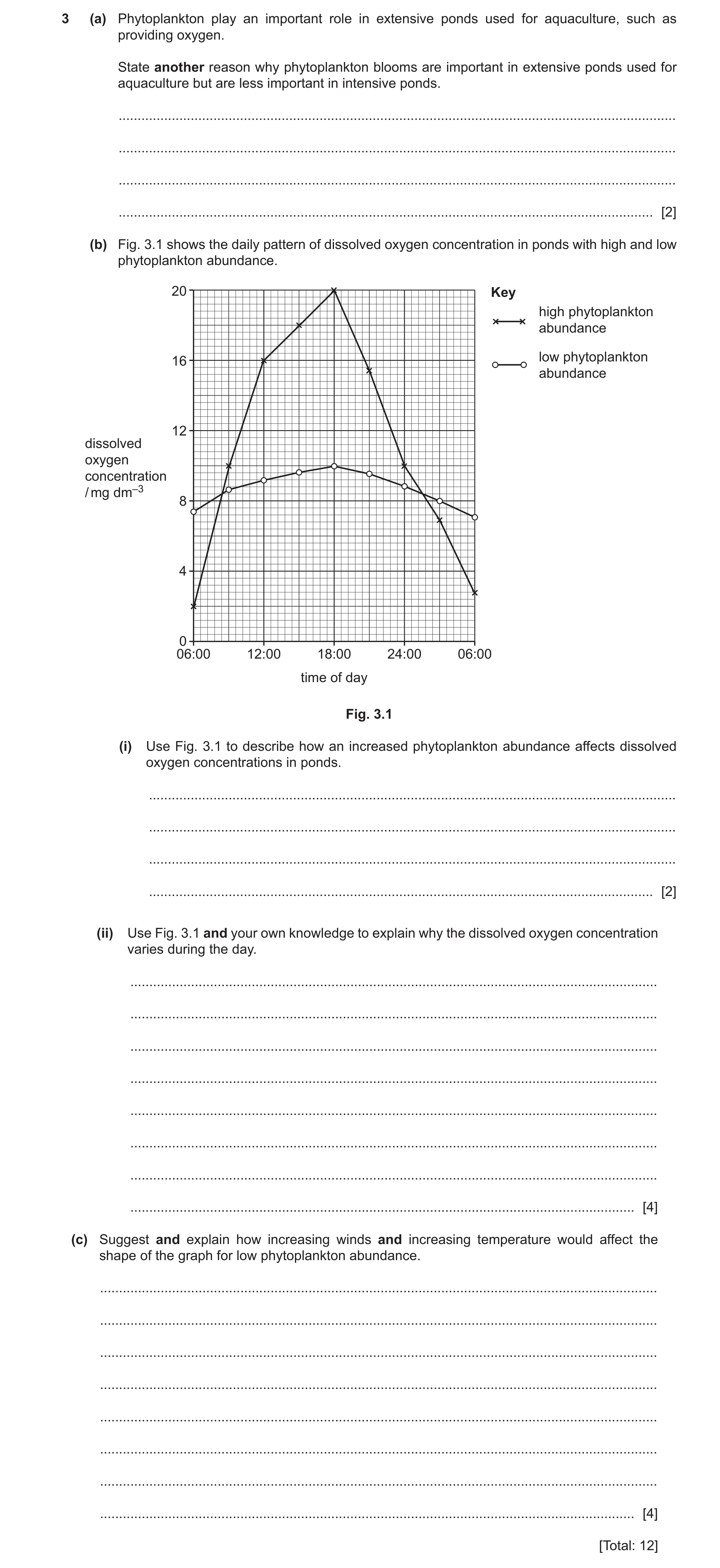
3 (a) Phytoplankton play an important role in extensive ponds used for aquaculture, such as providing oxygen. State another reason why phytoplankton blooms are important in extensive ponds used for aquaculture but are less important in intensive ponds. … … … … [2] (b) Fig. 3.1 shows the daily pattern of dissolved oxygen concentration in ponds with high and low phytoplankton abundance. 20 Key high phytoplankton abundance low phytoplankton 16 abundance 12 dissolved oxygen concentration / mg dm–3 8 4 0 06:00 12:00 18:00 24:00 06:00 time of day Fig. 3.1 (i) Use Fig. 3.1 to describe how an increased phytoplankton abundance affects dissolved oxygen concentrations in ponds. … … … … [2] (ii) Use Fig. 3.1 and your own knowledge to explain why the dissolved oxygen concentration varies during the day. … … … … … … … … [4] (c) Suggest and explain how increasing winds and increasing temperature would affect the shape of the graph for low phytoplankton abundance. … … … … … … … … [4] [Total: 12]
12 marks
Mark scheme: 3(a) idea that in extensive ponds phytoplankton blooms are a food source on which the aquaculture organisms depend / AW ; 2 in intensive ponds phytoplankton blooms supplement manufactured feed / AW ; 3(b)(i) any 2 of: 2 (increasing phytoplankton abundance) increases the, range / maximum and minimum, values of dissolved oxygen (in a pond) ; correct reference to figures for low and high phytoplankton abundance ; 3(b)(ii) any 4 of: 4 1 highest oxygen concentration during the day and lowest at night ; 2 (during the day) phytoplankton photosynthesises using light (energy) ; 3 oxygen is produced (as a waste product), so concentration increases ; 4 the rate of photosynthesis is greater than the rate of respiration ; 5 at night photosynthesis stops as there is no light ; 6 oxygen is used for (aerobic) respiration, so the concentration falls ; 7 increasing phytoplankton numbers cause more oxygen to be used at night and more produced during the day ; 3(c) any 4 of: 1 idea of: increasing winds would increase the diffusion rate of gases entering the pond (from the atmosphere) ; 2 more carbon dioxide available for photosynthesis (during the day) / more oxygen available for respiration at night ; 3 increased photosynthesis increases the concentration of oxygen (during the day) / increased respiration decreases the concentration of oxygen (at night) ; 4 idea that graph will be, higher / steeper in the day / lower at night ; 5 ref to effect of increased temperature on gas solubility or denaturing enzymes or increasing kinetic energy in molecules 6 effect of change in carbon dioxide or oxygen concentrations on photosynthesis / respiration ; 7 correct ref. to change in dissolved oxygen concentration due to photosynthesis / respiration ; 8 correct ref. to change in graph ;
This question in 9693/33 May/June 2025
Q21 · A chloroplast from a red mangrove leaf 9693/31 Oct/Nov 2025
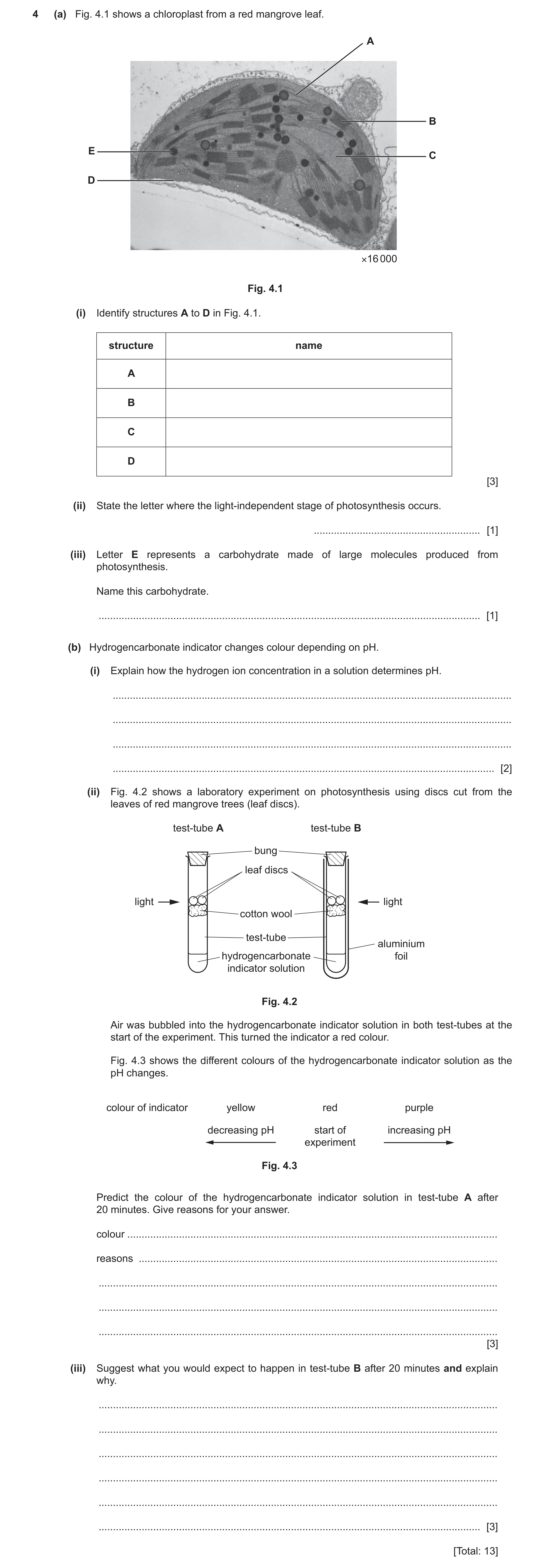
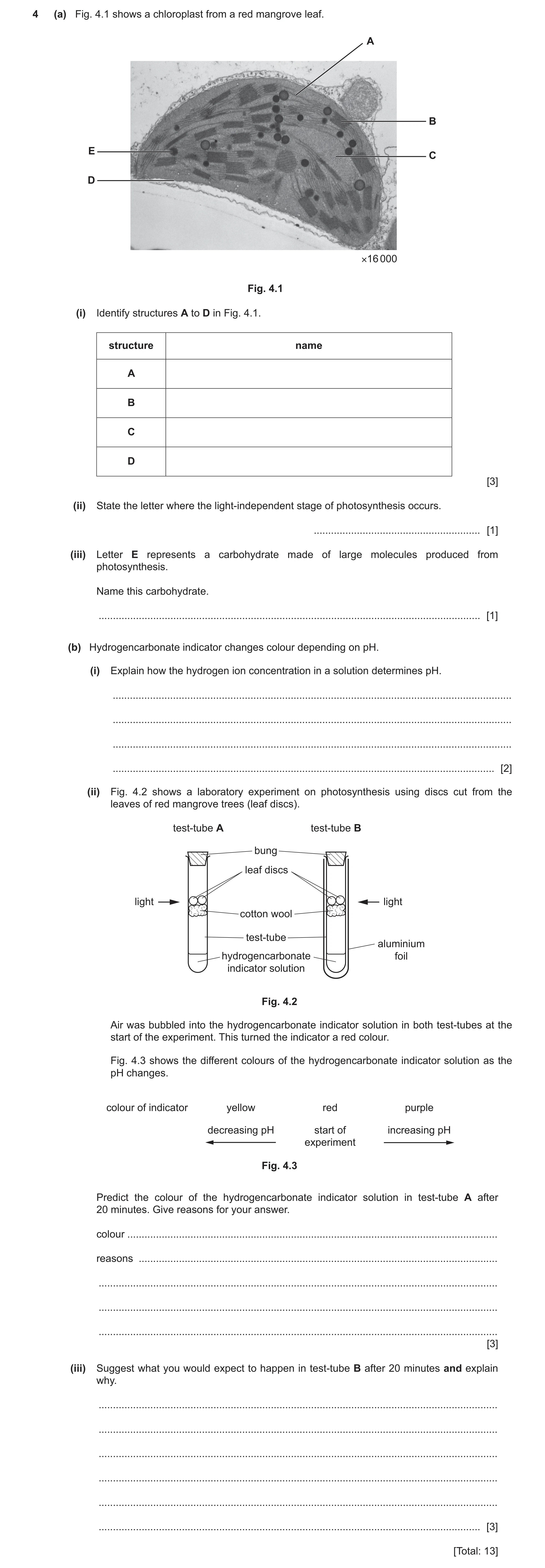
4 (a) Fig. 4.1 shows a chloroplast from a red mangrove leaf. A B E C D ×16 000 Fig. 4.1 (i) Identify structures A to D in Fig. 4.1. structure name A B C D [3] (ii) State the letter where the light-independent stage of photosynthesis occurs. … [1] (iii) Letter E represents a carbohydrate made of large molecules produced from photosynthesis. Name this carbohydrate. … [1] (b) Hydrogencarbonate indicator changes colour depending on pH. (i) Explain how the hydrogen ion concentration in a solution determines pH. … … … … [2] (ii) Fig. 4.2 shows a laboratory experiment on photosynthesis using discs cut from the leaves of red mangrove trees (leaf discs). test-tube A test-tube B bung leaf discs light light cotton wool test-tube aluminium hydrogencarbonate foil indicator solution Fig. 4.2 Air was bubbled into the hydrogencarbonate indicator solution in both test-tubes at the start of the experiment. This turned the indicator a red colour. Fig. 4.3 shows the different colours of the hydrogencarbonate indicator solution as the pH changes. colour of indicator yellow red purple decreasing pH start of increasing pH experiment Fig. 4.3 Predict the colour of the hydrogencarbonate indicator solution in test-tube A after 20 minutes. Give reasons for your answer. colour … reasons … … … … [3] (iii) Suggest what you would expect to happen in test-tube B after 20 minutes and explain why. … … … … … … [3] [Total: 13]
13 marks
Mark scheme: 4(a)(i) A – thylakoid / thylakoid membrane / lamella ; 3 B – granum C – stroma D – chloroplast / inner, membrane ; 4(a)(ii) C ; 1 4(a)(iii) starch ; 1 4(b)(i) increasing hydrogen ion concentration (in water) ; 2 makes the pH more acidic / lowers the pH ; 4(b)(ii) 1 colour – purple ; 3 any two of: 2 pH increases / becomes less acidic ; 3 as carbon dioxide used up for photosynthesis ; 4 any carbon dioxide from respiration was used in photosynthesis ; 5 rate of photosynthesis was greater than the rate of respiration ; 4(b)(iii) any three of: 3 1 no photosynthesis as light prevented from reaching tube ; 2 indicator would change colour to yellow ; 3 as carbon dioxide was produced from respiration ; 4 which produced hydrogen ions ; 5 so decreasing the pH ;
This question in 9693/31 Oct/Nov 2025
Q22 · A chloroplast from a red mangrove leaf 9693/32 Oct/Nov 2025
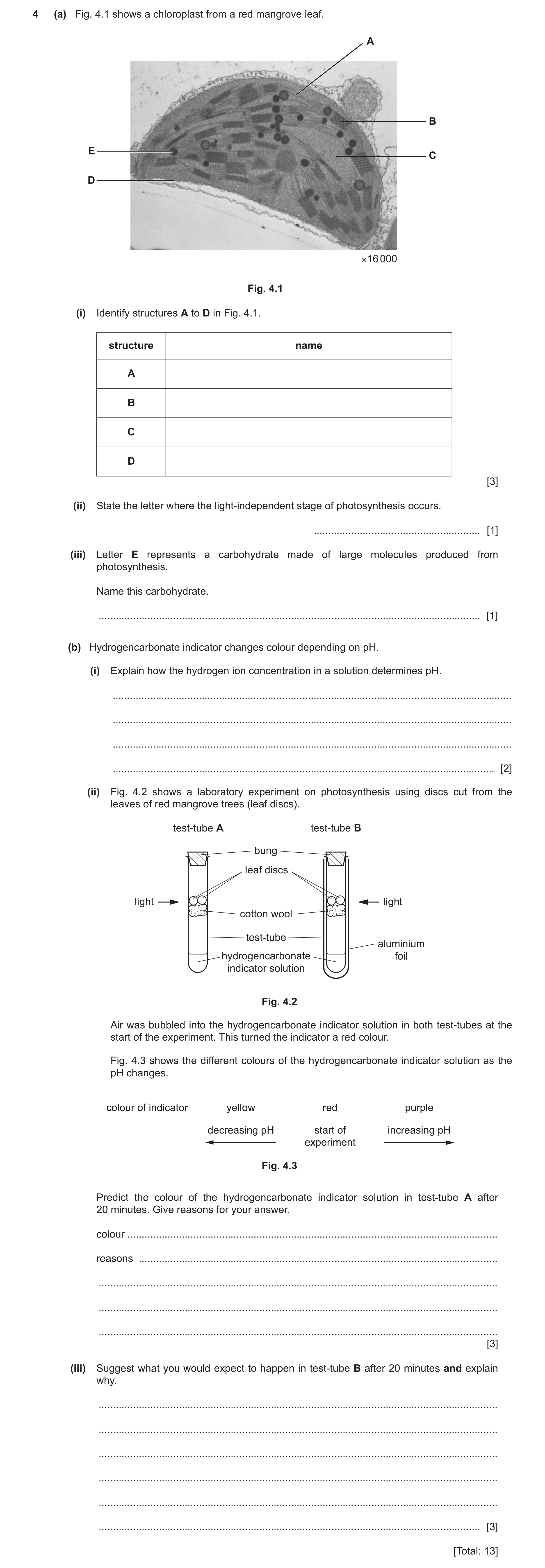
4 (a) Fig. 4.1 shows a chloroplast from a red mangrove leaf. A B E C D ×16 000 Fig. 4.1 (i) Identify structures A to D in Fig. 4.1. structure name A B C D [3] (ii) State the letter where the light-independent stage of photosynthesis occurs. … [1] (iii) Letter E represents a carbohydrate made of large molecules produced from photosynthesis. Name this carbohydrate. … [1] (b) Hydrogencarbonate indicator changes colour depending on pH. (i) Explain how the hydrogen ion concentration in a solution determines pH. … … … … [2] (ii) Fig. 4.2 shows a laboratory experiment on photosynthesis using discs cut from the leaves of red mangrove trees (leaf discs). test-tube A test-tube B bung leaf discs light light cotton wool test-tube aluminium hydrogencarbonate foil indicator solution Fig. 4.2 Air was bubbled into the hydrogencarbonate indicator solution in both test-tubes at the start of the experiment. This turned the indicator a red colour. Fig. 4.3 shows the different colours of the hydrogencarbonate indicator solution as the pH changes. colour of indicator yellow red purple decreasing pH start of increasing pH experiment Fig. 4.3 Predict the colour of the hydrogencarbonate indicator solution in test-tube A after 20 minutes. Give reasons for your answer. colour … reasons … … … … [3] (iii) Suggest what you would expect to happen in test-tube B after 20 minutes and explain why. … … … … … … [3] [Total: 13]
13 marks
Mark scheme: 4(a)(i) A – thylakoid / thylakoid membrane / lamella ; 3 B – granum C – stroma D – chloroplast / inner, membrane ; 4(a)(ii) C ; 1 4(a)(iii) starch ; 1 4(b)(i) increasing hydrogen ion concentration (in water) ; 2 makes the pH more acidic / lowers the pH ; 4(b)(ii) 1 colour – purple ; 3 any two of: 2 pH increases / becomes less acidic ; 3 as carbon dioxide used up for photosynthesis ; 4 any carbon dioxide from respiration was used in photosynthesis ; 5 rate of photosynthesis was greater than the rate of respiration ; 4(b)(iii) any three of: 3 1 no photosynthesis as light prevented from reaching tube ; 2 indicator would change colour to yellow ; 3 as carbon dioxide was produced from respiration ; 4 which produced hydrogen ions ; 5 so decreasing the pH ;
This question in 9693/32 Oct/Nov 2025
Q23 · A chloroplast from a red mangrove leaf 9693/33 Oct/Nov 2025
4 (a) Fig. 4.1 shows a chloroplast from a red mangrove leaf. A B E C D ×16 000 Fig. 4.1 (i) Identify structures A to D in Fig. 4.1. structure name A B C D [3] (ii) State the letter where the light-independent stage of photosynthesis occurs. … [1] (iii) Letter E represents a carbohydrate made of large molecules produced from photosynthesis. Name this carbohydrate. … [1] (b) Hydrogencarbonate indicator changes colour depending on pH. (i) Explain how the hydrogen ion concentration in a solution determines pH. … … … … [2] (ii) Fig. 4.2 shows a laboratory experiment on photosynthesis using discs cut from the leaves of red mangrove trees (leaf discs). test-tube A test-tube B bung leaf discs light light cotton wool test-tube aluminium hydrogencarbonate foil indicator solution Fig. 4.2 Air was bubbled into the hydrogencarbonate indicator solution in both test-tubes at the start of the experiment. This turned the indicator a red colour. Fig. 4.3 shows the different colours of the hydrogencarbonate indicator solution as the pH changes. colour of indicator yellow red purple decreasing pH start of increasing pH experiment Fig. 4.3 Predict the colour of the hydrogencarbonate indicator solution in test-tube A after 20 minutes. Give reasons for your answer. colour … reasons … … … … [3] (iii) Suggest what you would expect to happen in test-tube B after 20 minutes and explain why. … … … … … … [3] [Total: 13]
13 marks
Mark scheme: 4(a)(i) A – thylakoid / thylakoid membrane / lamella ; 3 B – granum C – stroma D – chloroplast / inner, membrane ; 4(a)(ii) C ; 1 4(a)(iii) starch ; 1 4(b)(i) increasing hydrogen ion concentration (in water) ; 2 makes the pH more acidic / lowers the pH ; 4(b)(ii) 1 colour – purple ; 3 any two of: 2 pH increases / becomes less acidic ; 3 as carbon dioxide used up for photosynthesis ; 4 any carbon dioxide from respiration was used in photosynthesis ; 5 rate of photosynthesis was greater than the rate of respiration ; 4(b)(iii) any three of: 3 1 no photosynthesis as light prevented from reaching tube ; 2 indicator would change colour to yellow ; 3 as carbon dioxide was produced from respiration ; 4 which produced hydrogen ions ; 5 so decreasing the pH ;
This question in 9693/33 Oct/Nov 2025
 19 / 37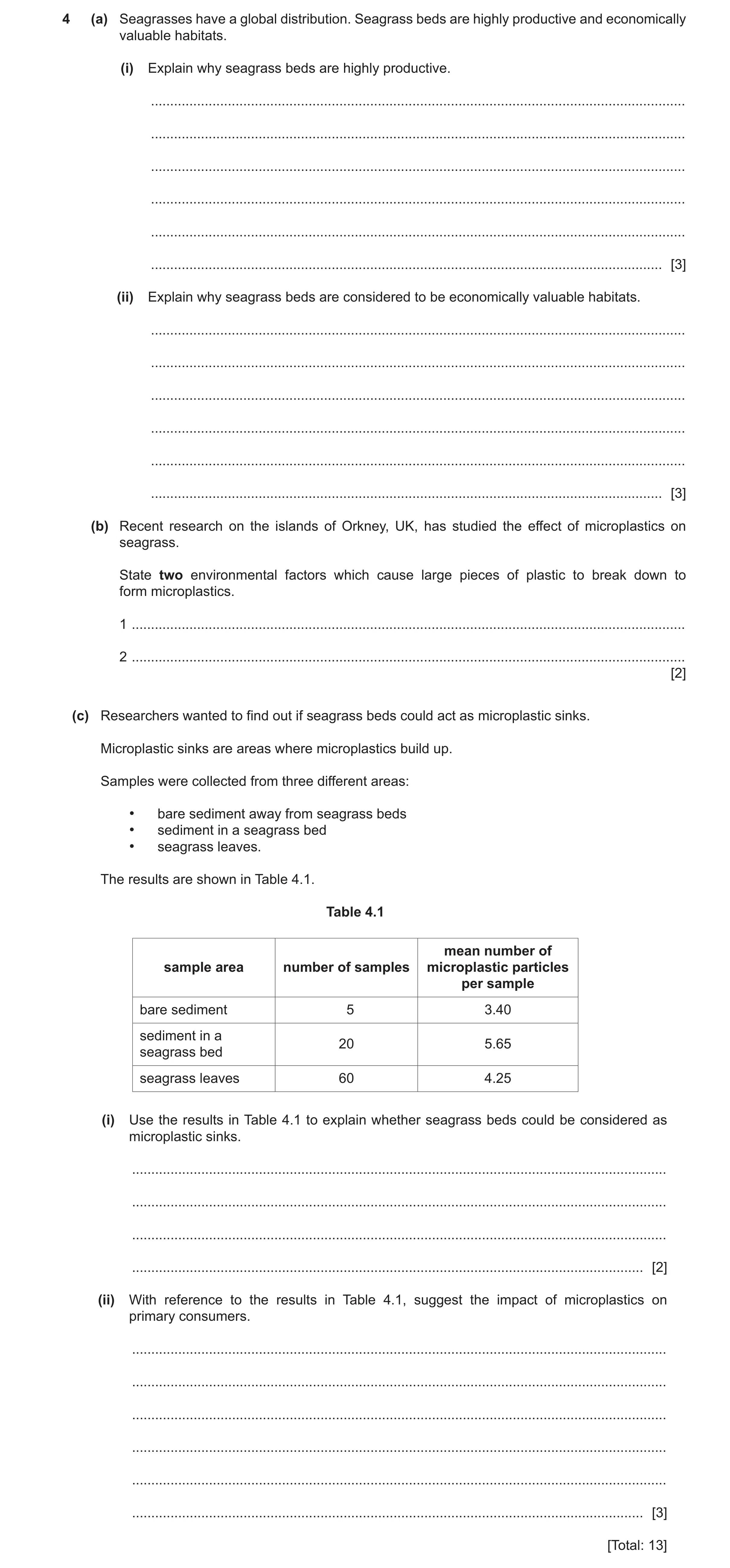
 22 / 37
 27 / 37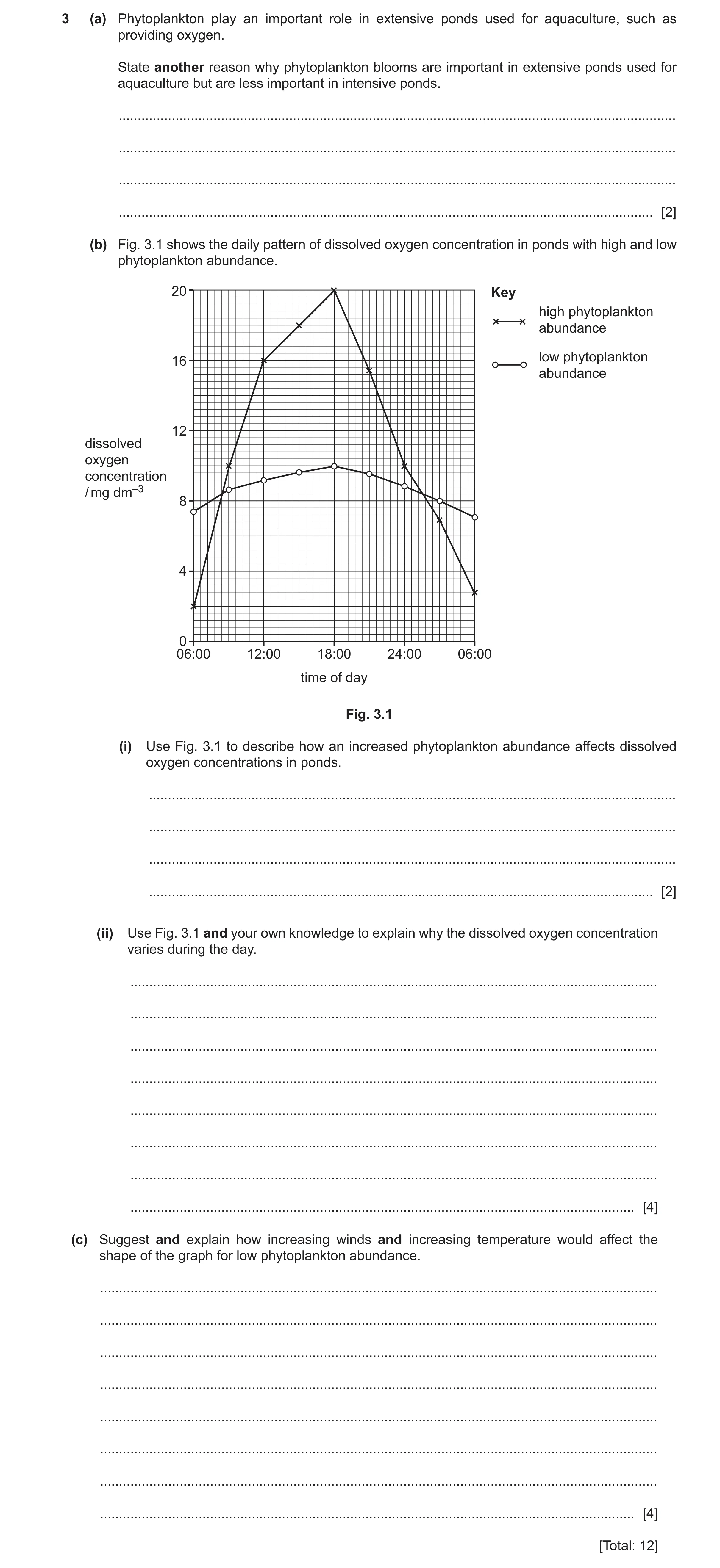
 13
13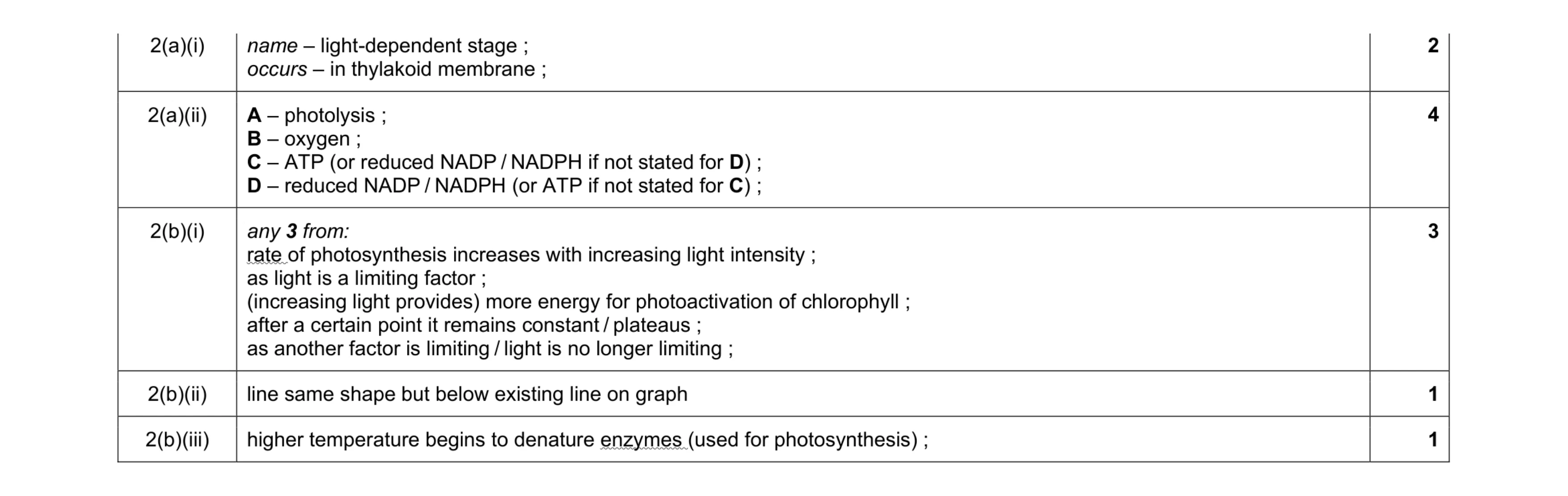 11
11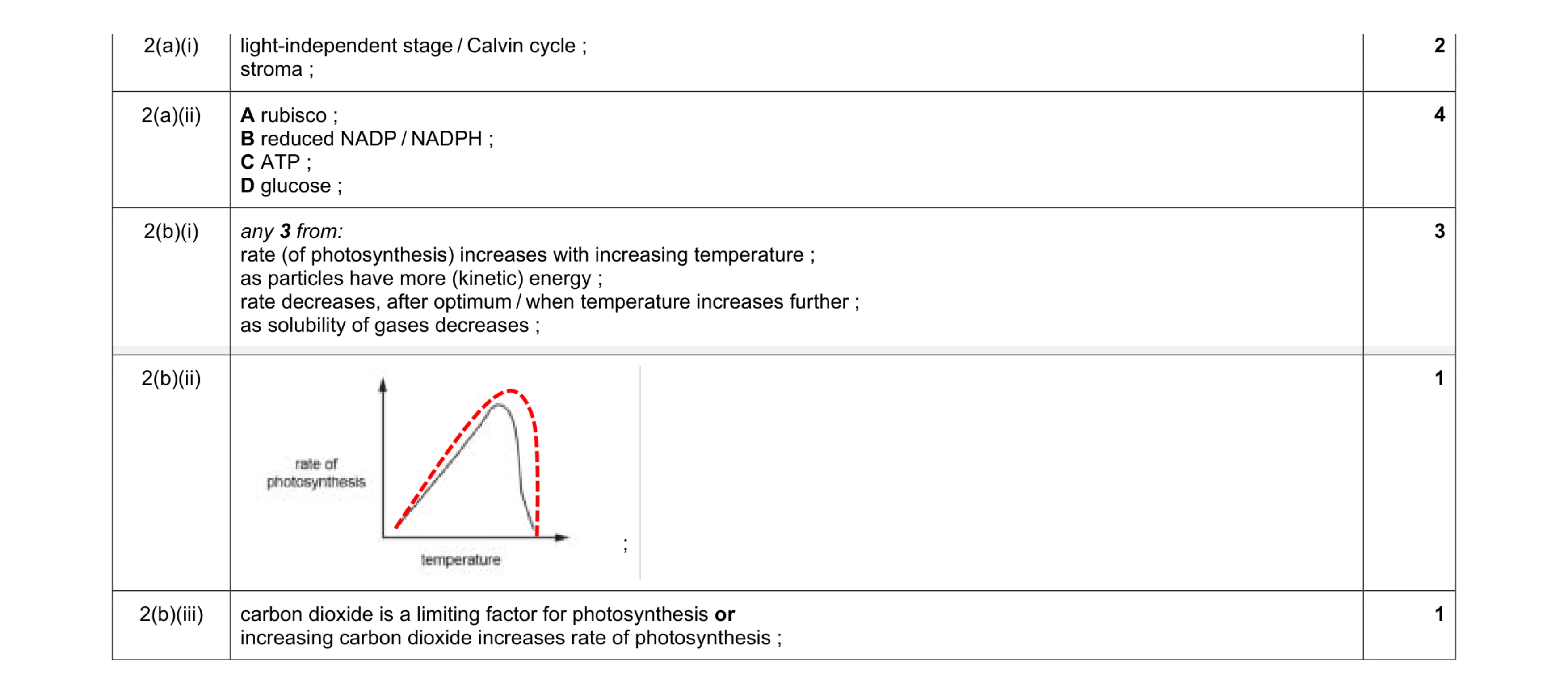 11
11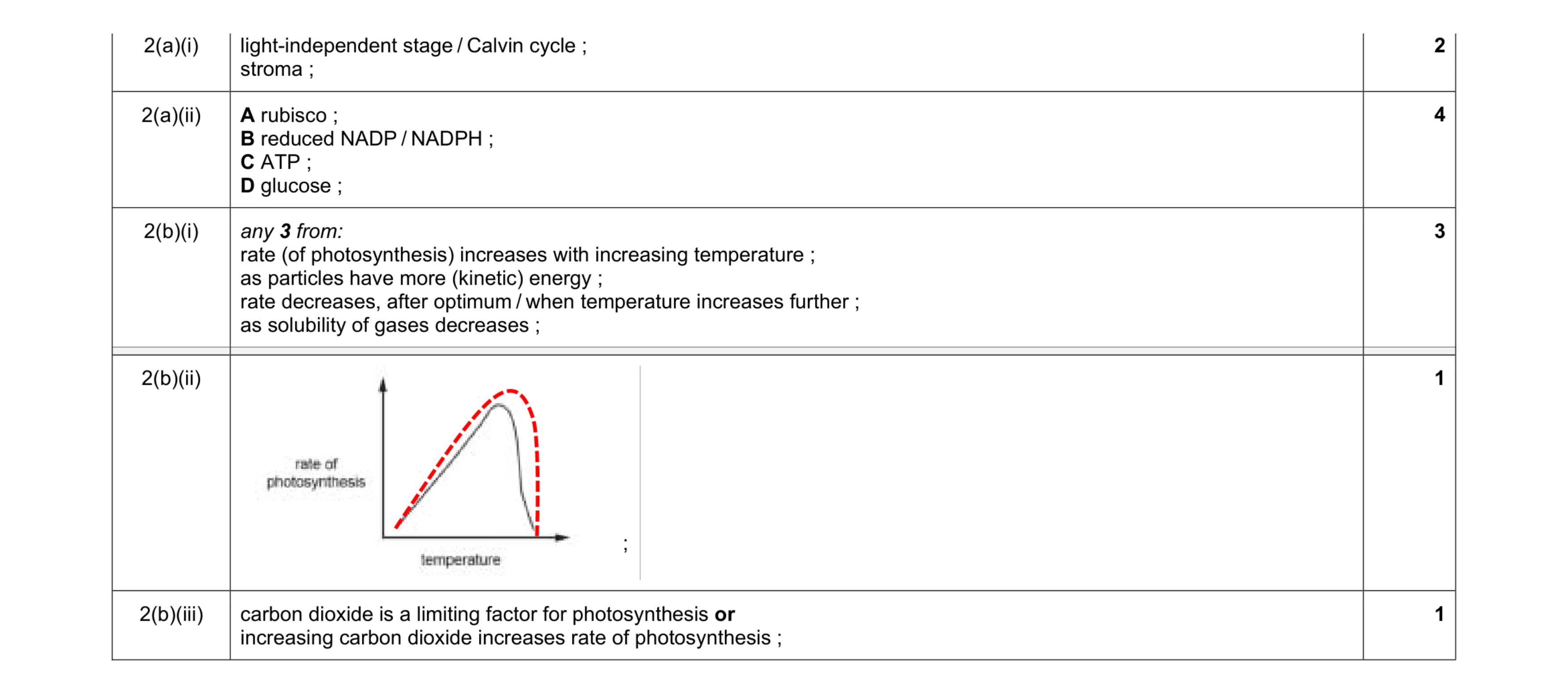 11
11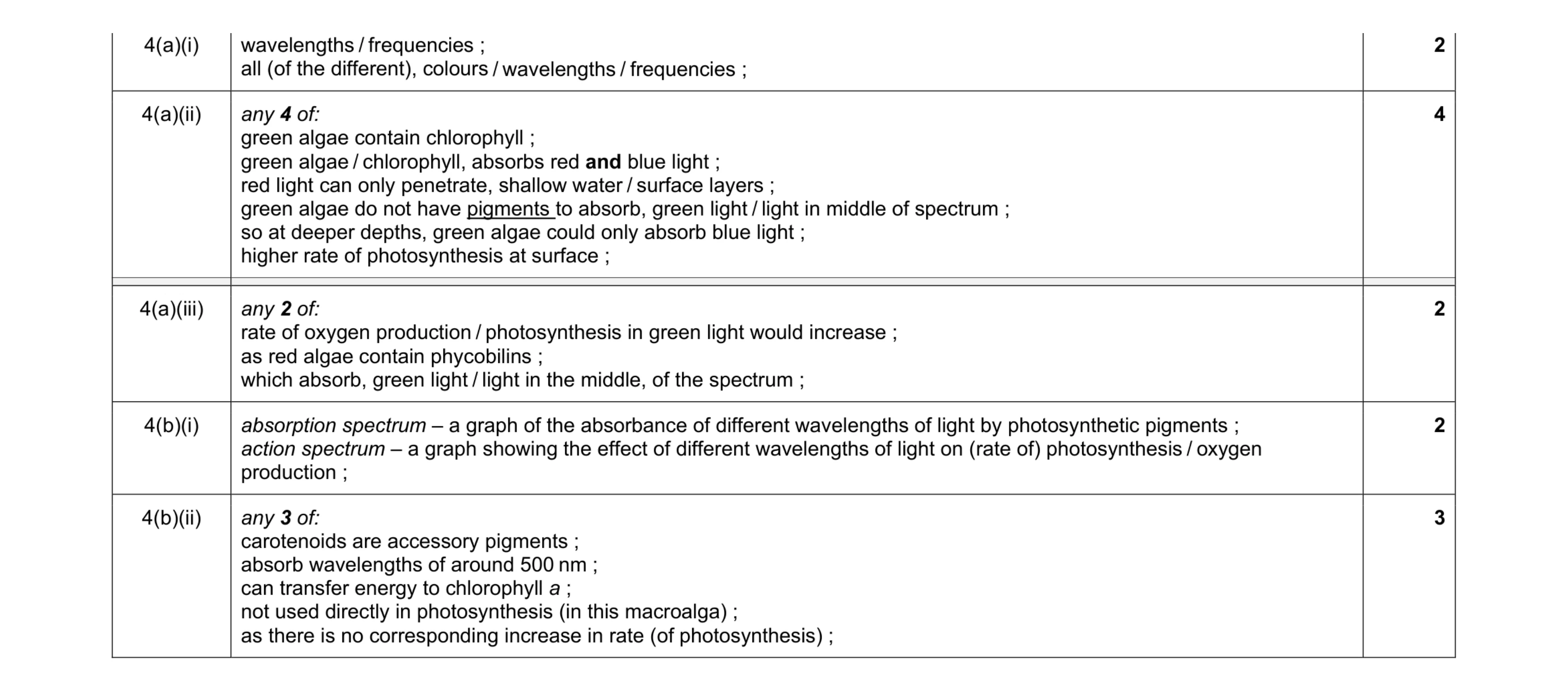 13
13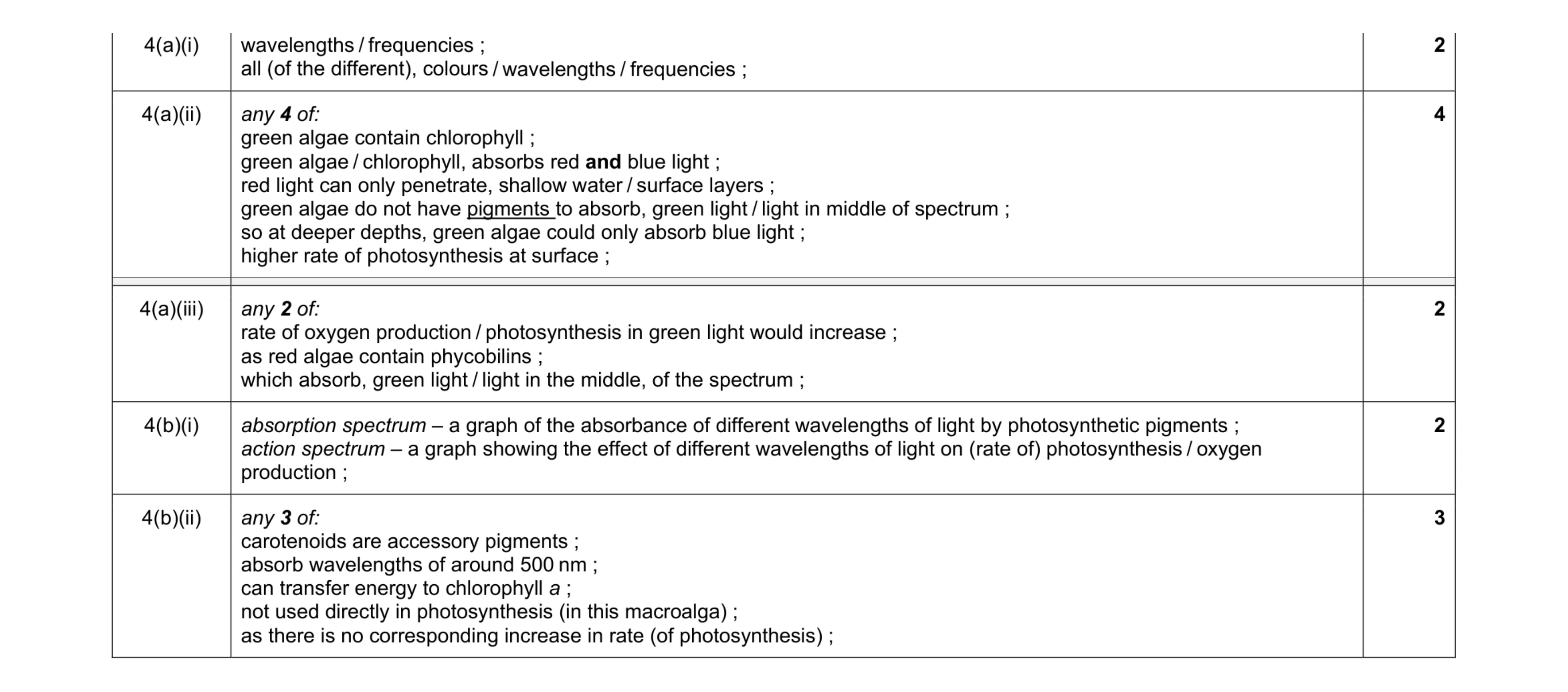 13
13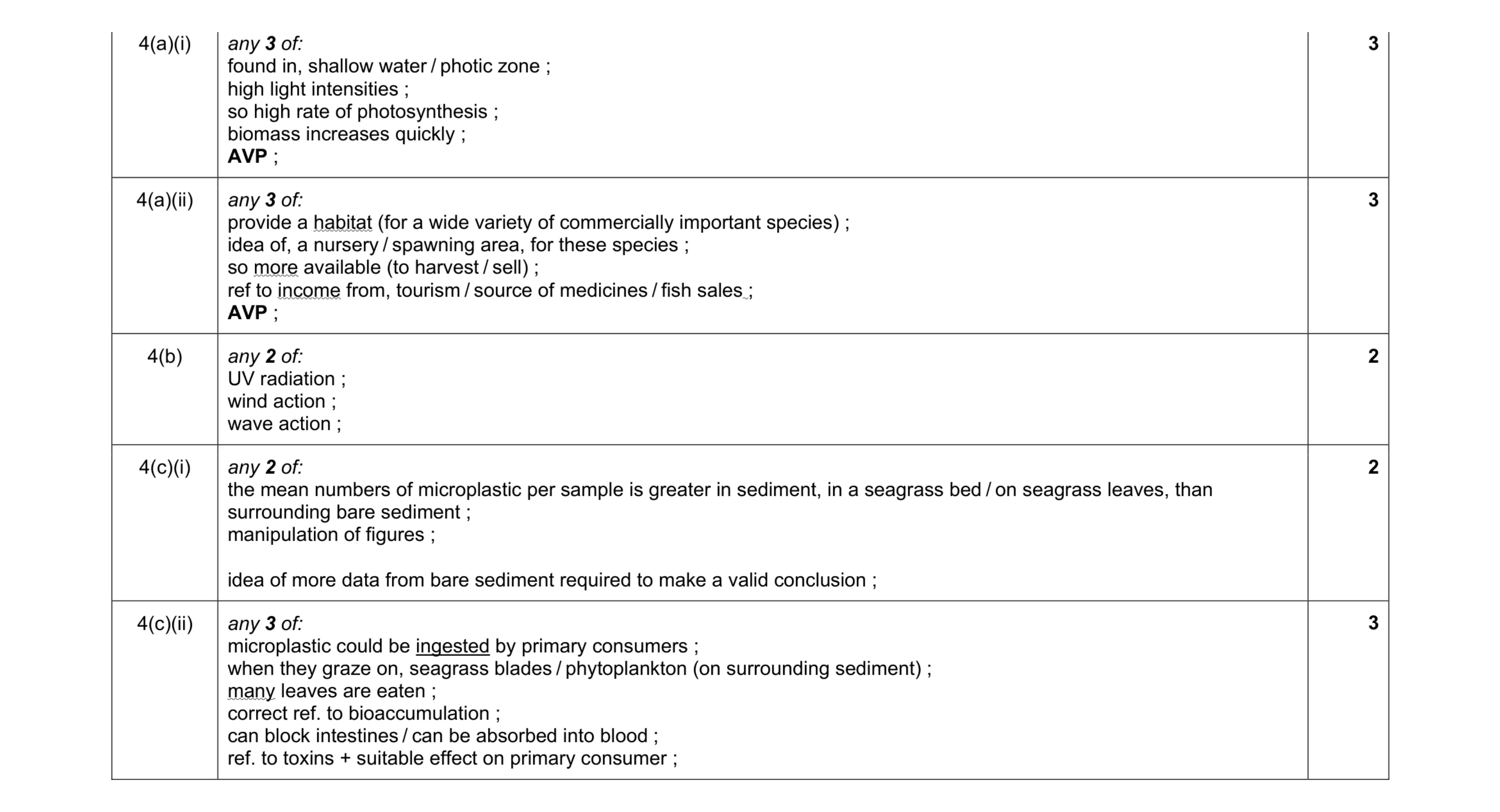 13
13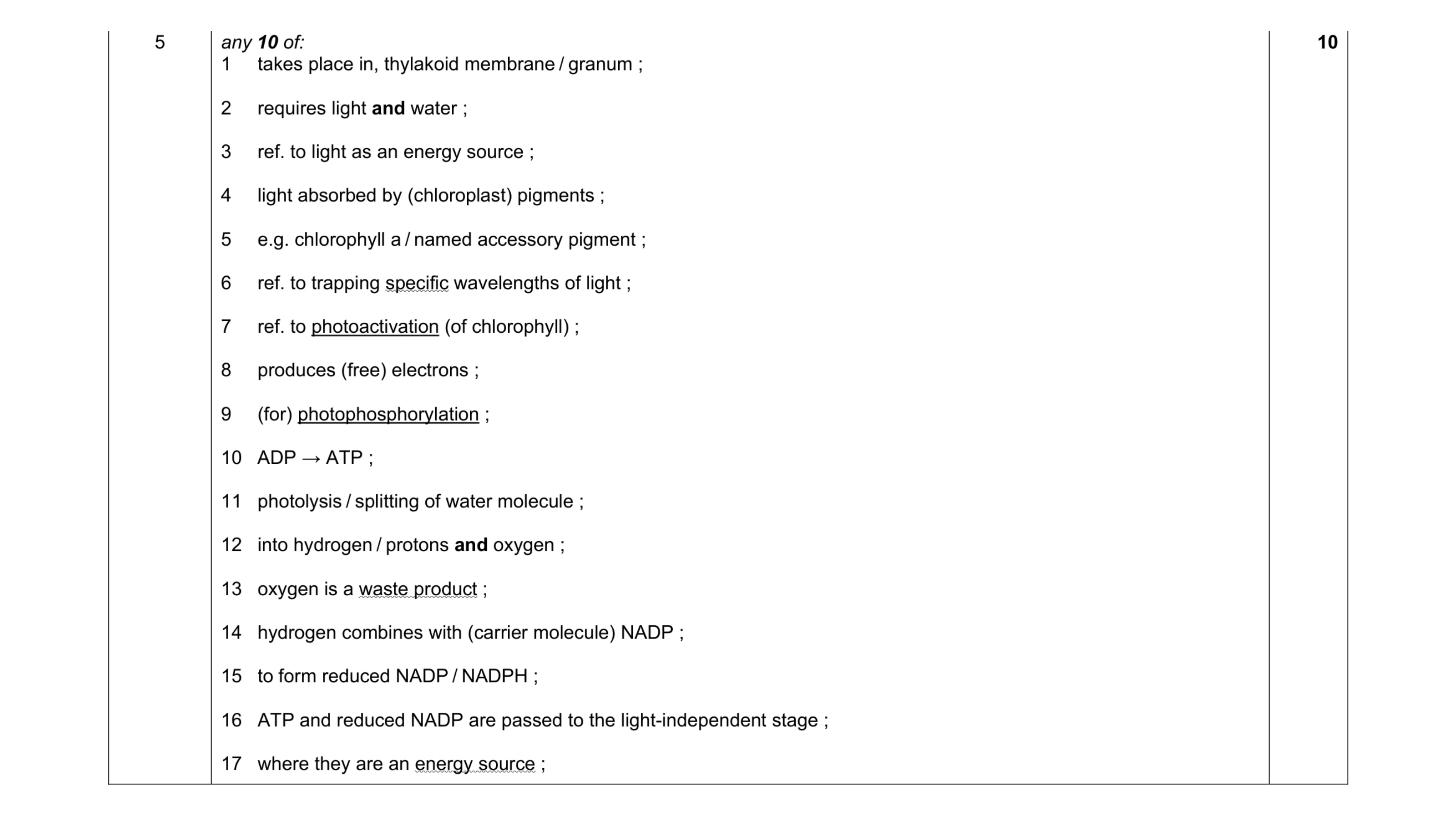 10
10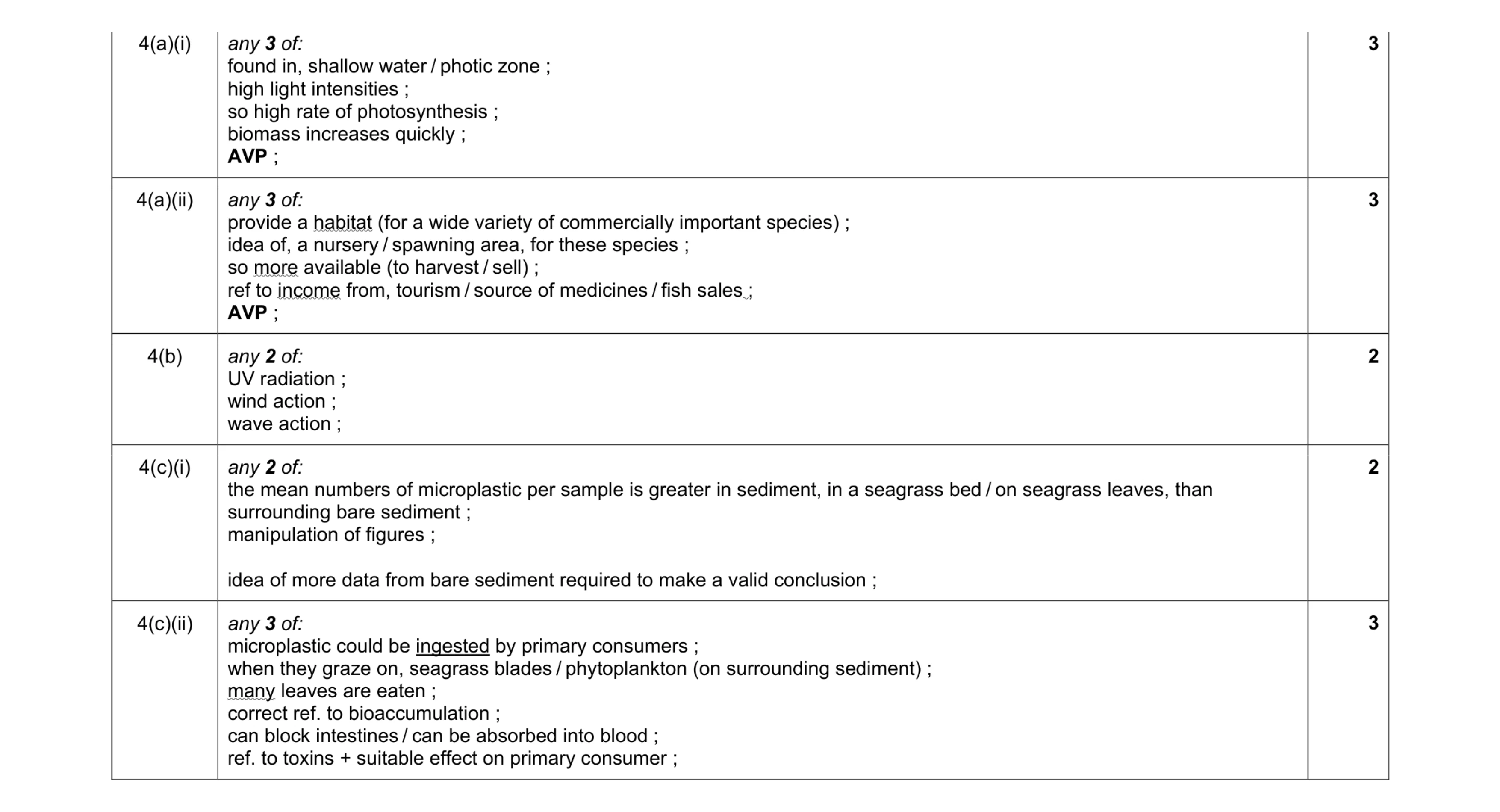 13
13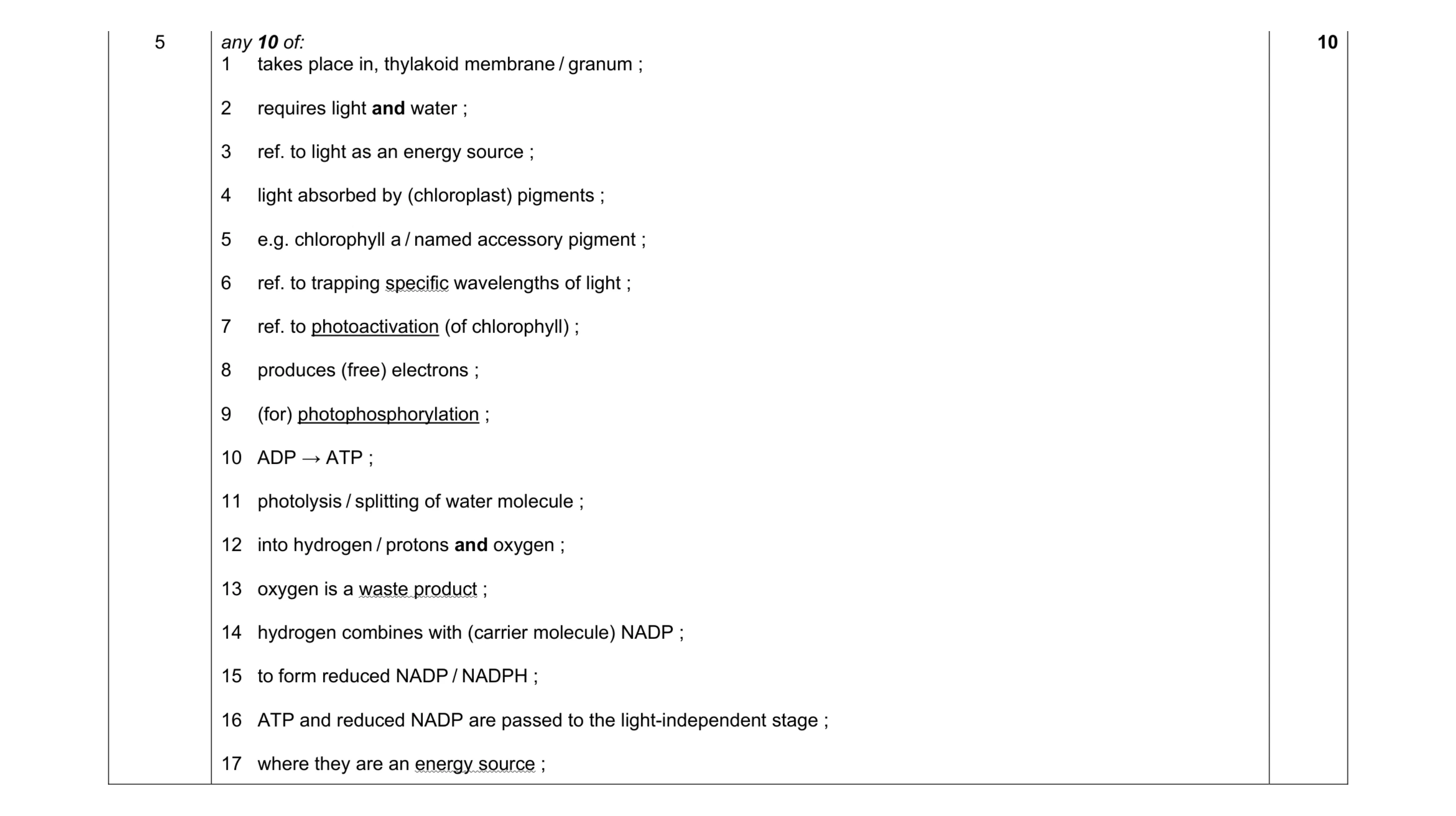 10
10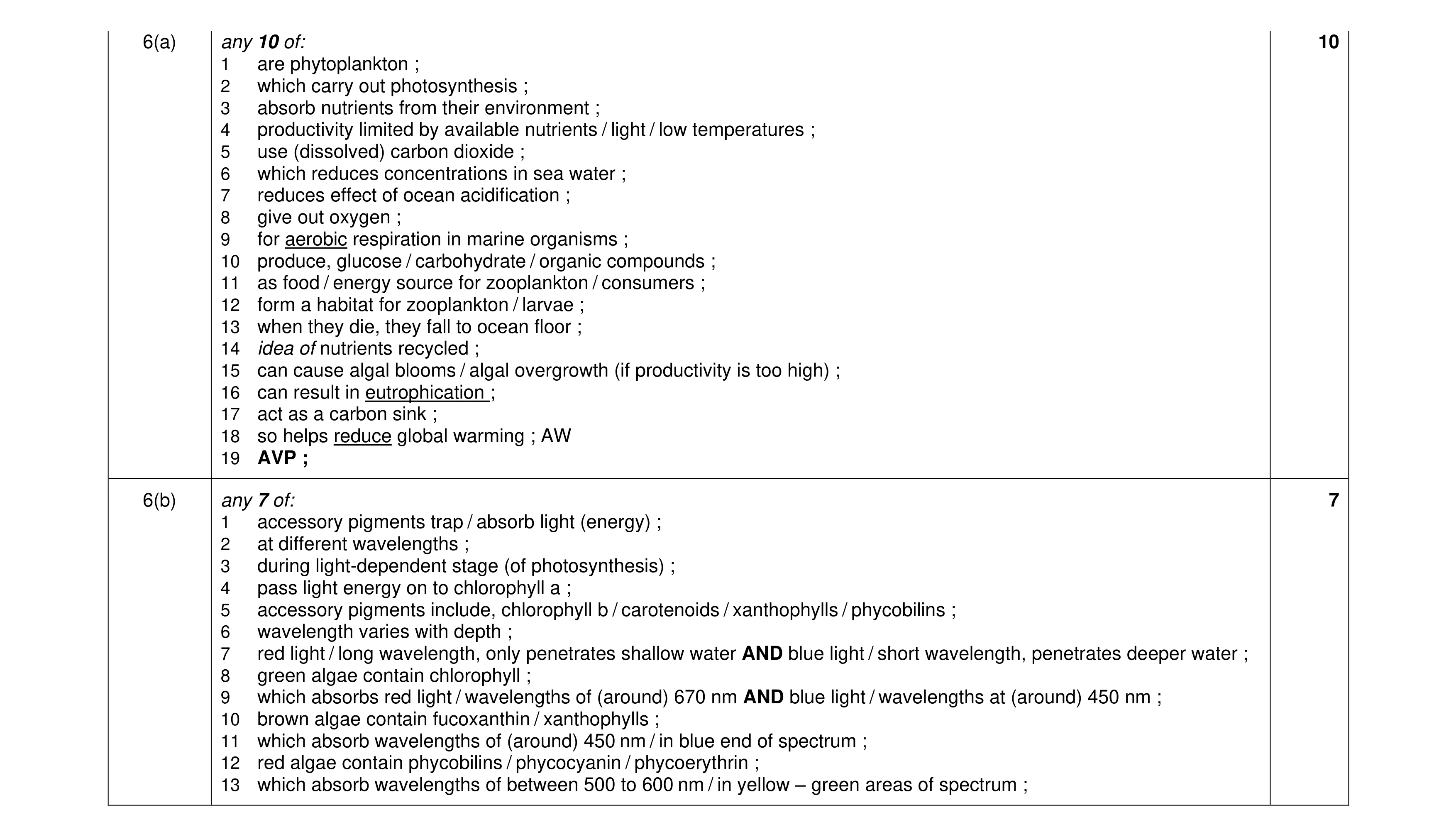 17
17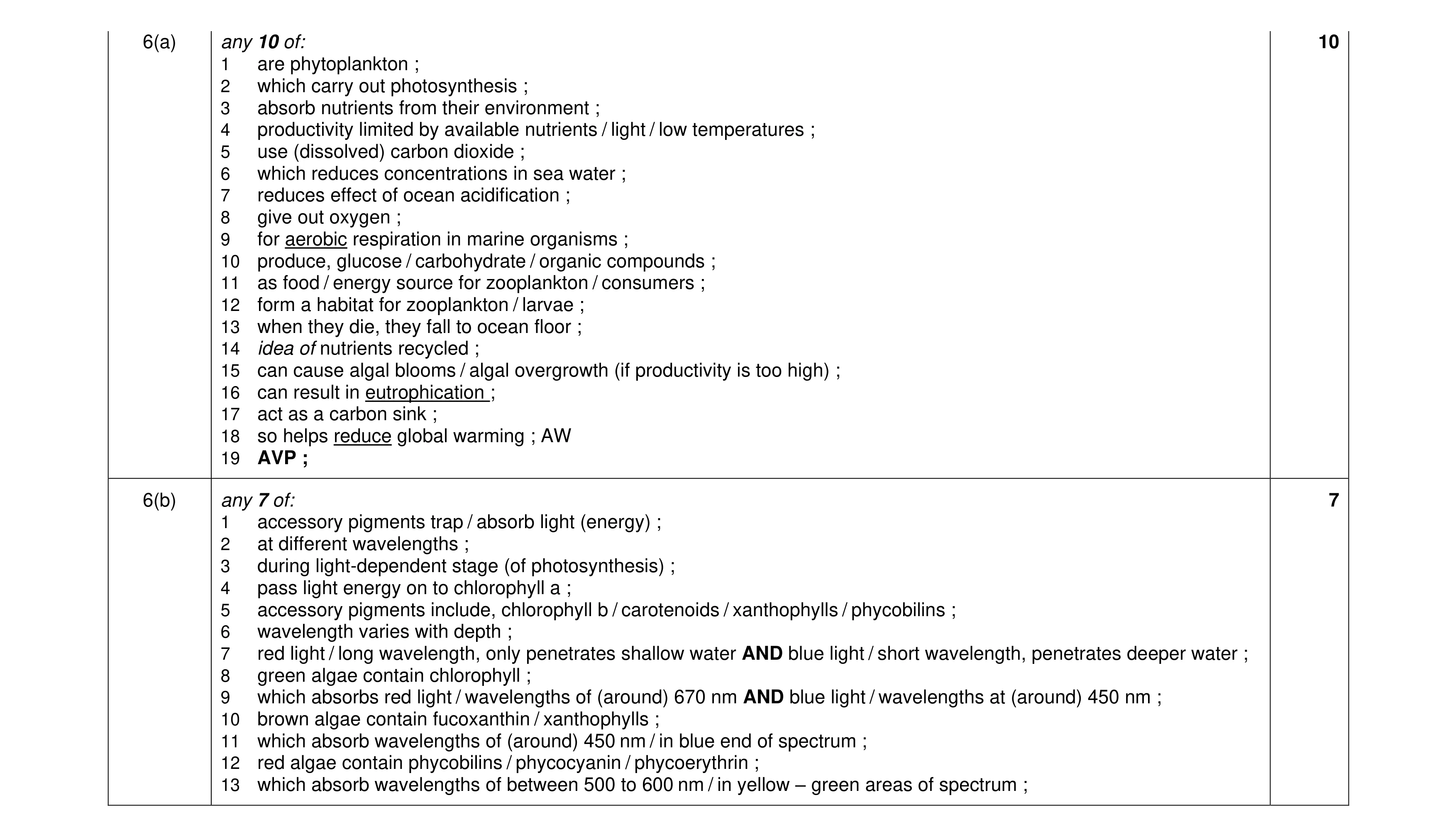 17
17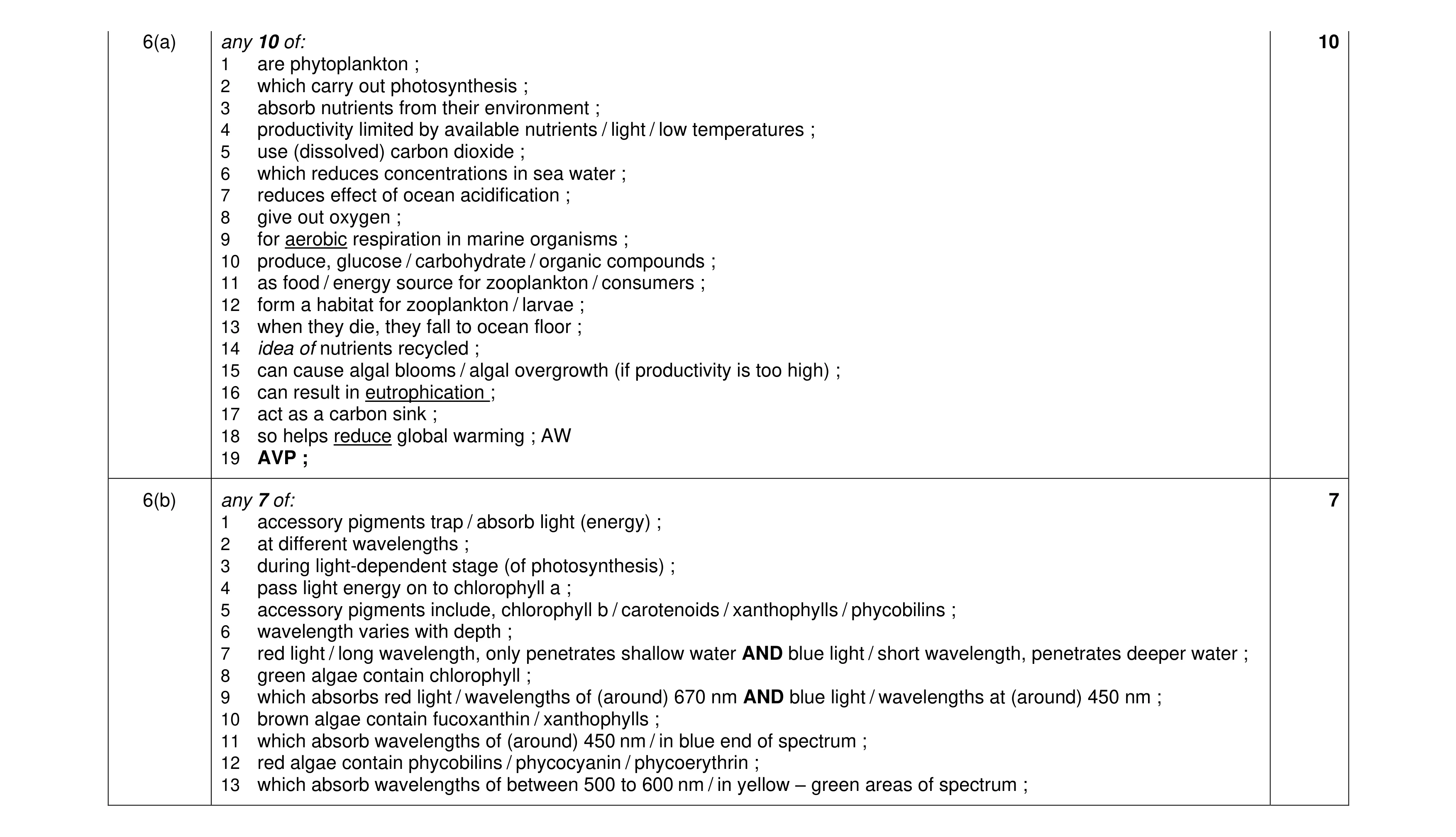 17
17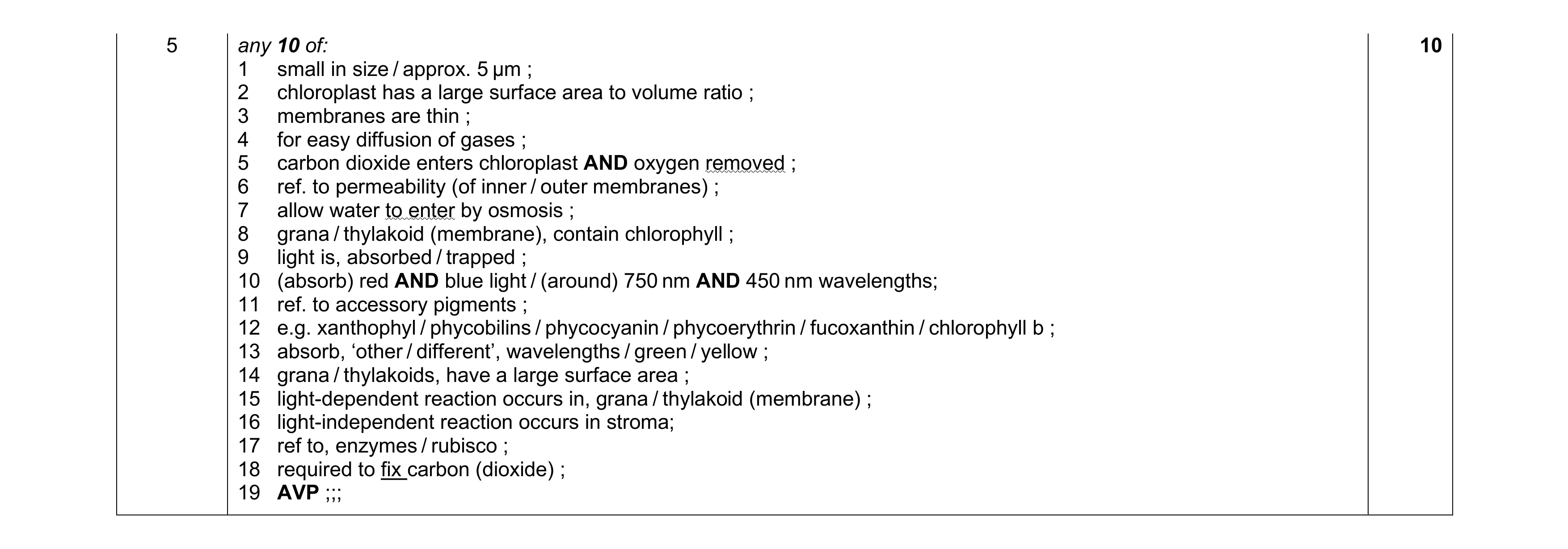 10
10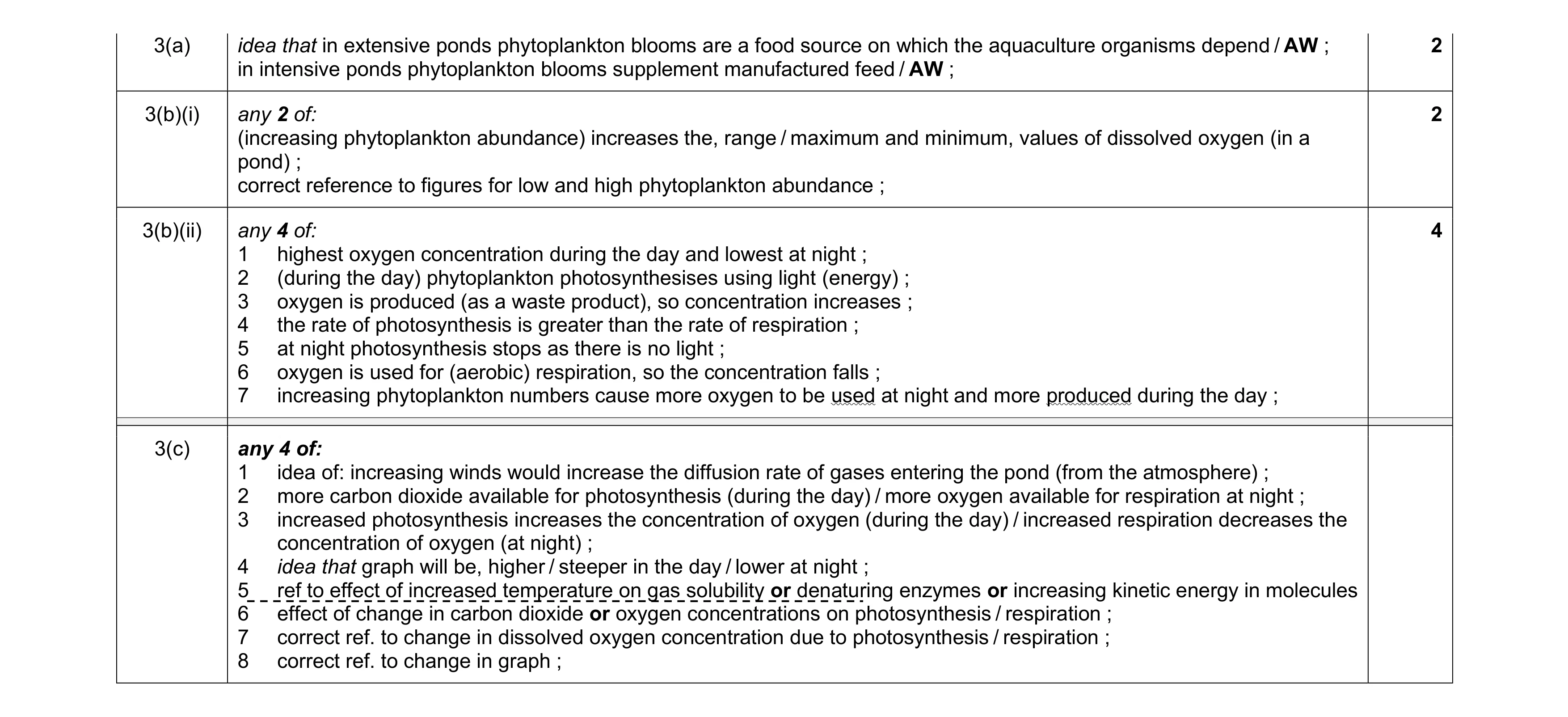 12
12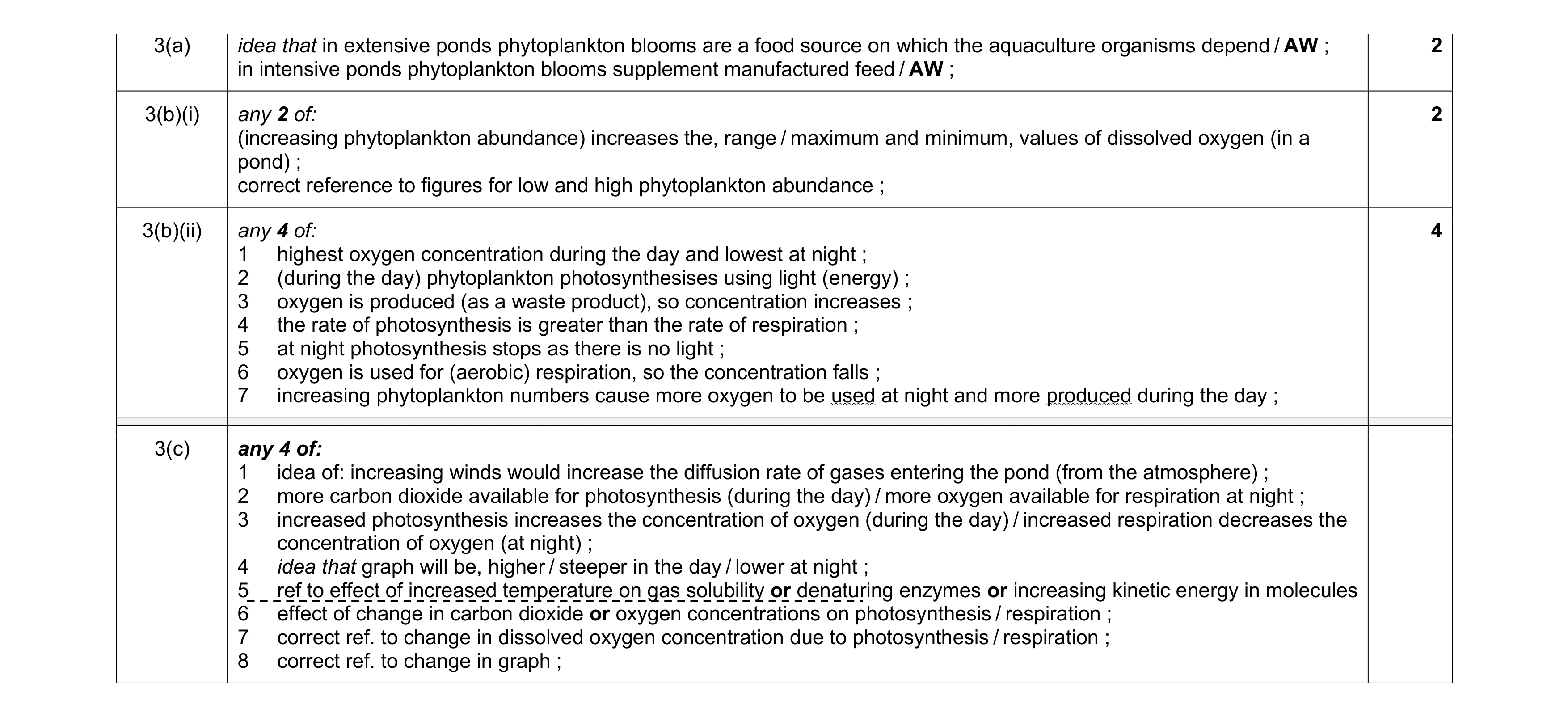 12
12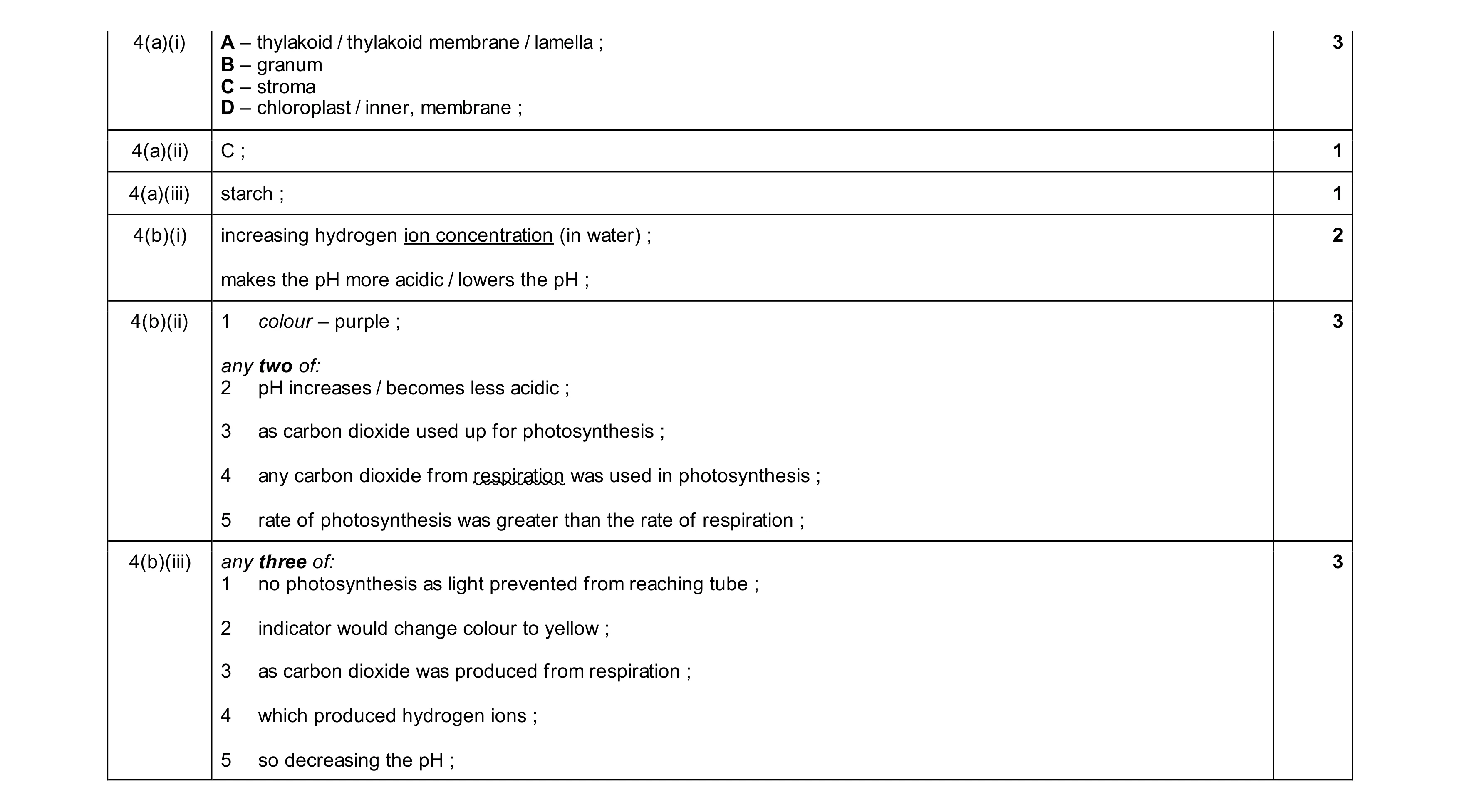 13
13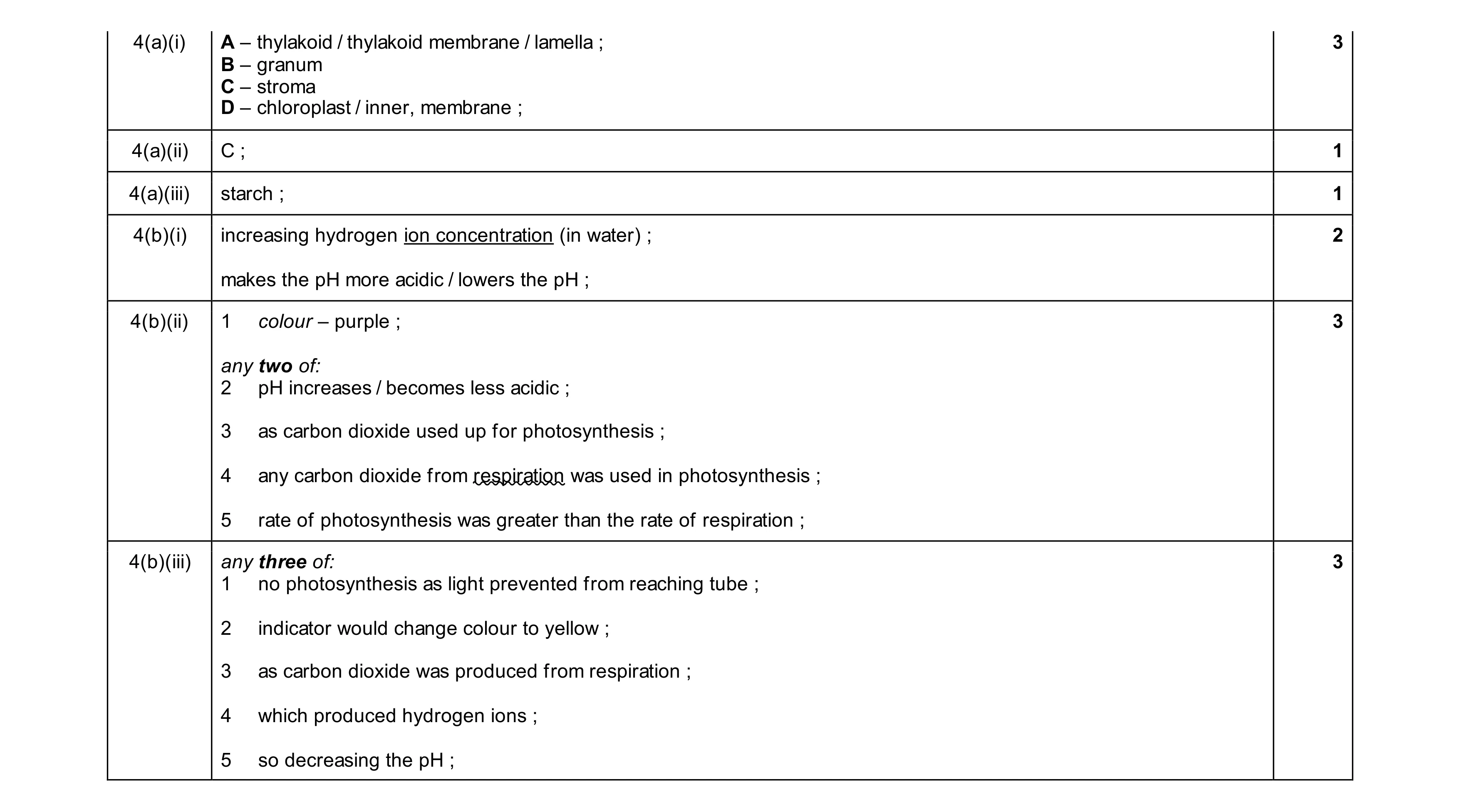 13
13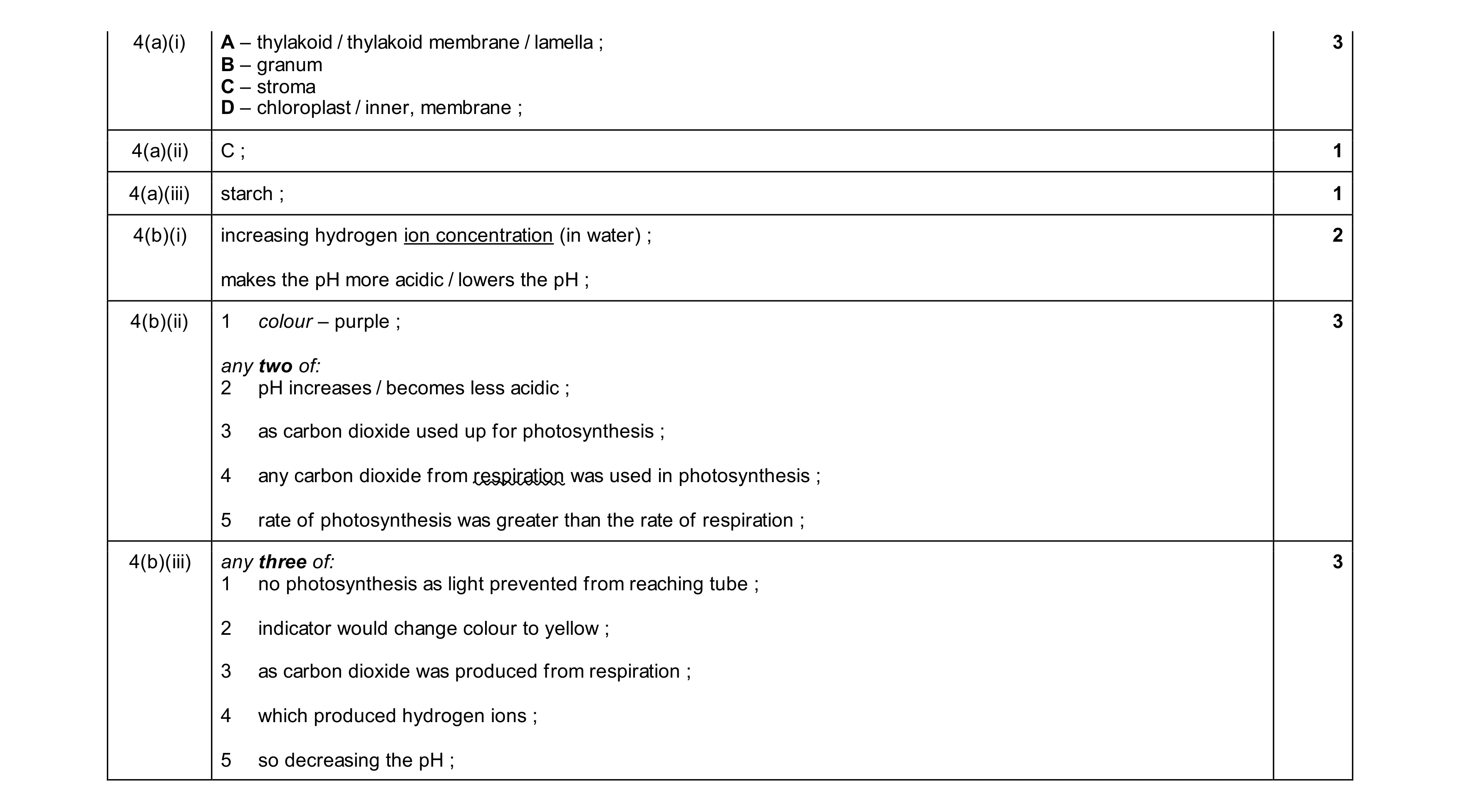 13
13