Questions as text
Q1 · The Russian Revolution, 1894–1921 (a) Explain why Lenin agreed to the Treaty of… 9489/22 Feb/March 2021
3 The Russian Revolution, 1894–1921 (a) Explain why Lenin agreed to the Treaty of Brest-Litovsk in 1918. [10] (b) To what extent did Russian military defeats in the First World War cause the Revolution of February 1917? [20]
30 marks
Mark scheme: 3(a) Explain why Lenin agreed to the Treaty of Brest-Litovsk in 1918. 10 • Lenin believed that Russia was exhausted militarily. This made it impossible for Russia to fight on successfully. To continue fighting would be futile. • He believed if Germany won the war it would retain the Russian territory it now possessed but if Germany lost then Russia would regain its lost lands. The first outcome meant that the Bolsheviks had not made Russia worse off and the second would mean they had made Russia better off. Either outcome would help consolidate their power. • Ideologically Lenin believed history was on the side of the Bolsheviks, a great proletarian revolution was about to sweep Europe. As an international revolutionary he felt only, at best, a very limited sense of national loyalty to Russia. His first concern was spreading the proletarian revolution. Class conflict was going to replace conflict between nations. • Germany had supplied a significant amount of monetary aid to the Bolsheviks between 1914 and 1917. It continued after October 1917. A settlement with Germany would help ensure that this source of revenue for the Bolsheviks would continue. Accept any other valid responses. 3(b) To what extent did Russian military defeats in the First World War 20 cause the Revolution of February 1917? Arguments to support the view could be as follows. In 1914 there was overwhelming support for the war but the, seeming, continuous series of military setbacks such as Tannenberg in 1914, the expulsion of Russian forces from Poland by mid-1915, the failure of the Lake Naroch offensive in 1916 and the slowing down, after early gains, of the Brusilov offensive caused Russian morale to fall. This helped to foster a desire for change. The fact that since 1915 the Tsar had taken personal command at the front meant the responsibility for military setbacks lay, ultimately, with Nicholas II. This led many amongst both the military and the civilian population to feel that the Tsar should no longer head the government. The fact that it was the generals who persuaded the Tsar to abdicate suggests that military defeats caused the revolution of February 1917. This viewpoint, however, can be challenged. The lack of any meaningful constitutional reforms by Nicholas II meant that there was no shared responsibility for key decisions which had led to military defeat. A shared responsibility would have lessened criticism of the Tsar. The Tsar’s decision to personally lead the army at the front was a great mistake. The Tsarina was left in charge, but her German background led to rumours of her being a German spy and the relationship with Rasputin, popularly regard as inappropriate, tarnished the Romanov’s reputation. All this further undermined the allure of monarchy by February 1917. The incompetence of the government further created a desire for change. Supplies needed for the troops rotted in marshalling yards because there were not enough engines available to transport them to the front. Food shortages were created by the lack of men to bring in the harvests as they were dead, wounded, prisoners- of-war or at the front. The priority given to the transport of troops and equipment over that of food to urban areas created more discontent with the regime. Indeed, it was rumours of a further cut in bread supplies in February 1917 that led to strikes and demonstrations in Petrograd, demanding food and an end to the war. This was the start of the February Revolution which led to the Tsar’s abdication on 2nd. March 1917. Accept any other valid responses.
This question in 9489/22 Feb/March 2021
Q2 · The Russian Revolution, 1894–1921 (a) Explain why the New Economic Policy was introduced… 9489/21 May/June 2021
3 The Russian Revolution, 1894–1921 (a) Explain why the New Economic Policy was introduced in 1921. [10] (b) ‘Failure to achieve peace caused the fall of the Provisional Government in October 1917.’ How far do you agree with this view? [20]
30 marks
Mark scheme: 3(a) Explain why the New Economic Policy was introduced in 1921. 10 • The previous policy of War Communism (WC) had helped the Bolsheviks win the Russian Civil War, but it had devastated the economy and led to famine. A change was needed if they were to consolidate their victory. • The hardships produced by WC led to risings against the Bolsheviks, 1920–1921. For example, the hitherto staunchly loyal sailors at the Kronstadt Naval Base rose in revolt. Lenin realised a new policy was needed if the Bolsheviks were to maintain their power. • The New Economic Policy (NEP) was introduced to provide an incentive to the peasants to produce food. They could keep some of their grain to sell at a profit. WC had forced them to hand over their produce. As a result, they either produced the bare minimum, hoarded it, or destroyed it. • Lenin was a realist, as he found that the Party had not been able to structure Russia’s economy along purely ideological lines since 1917. He saw the NEP as a temporary concession to capitalism to meet a specific set of circumstances. That is why large-scale industry, banking and foreign trade remained under Party control (‘the commanding heights of the economy’), as had been the case under WC. Accept any other valid responses. 3(b) ‘Failure to achieve peace caused the fall of the Provisional Government 20 in October 1917.’ How far do you agree with this view? Arguments to support the statement could be as follows. The decision of the Provisional Government (PG) to remain in the First World War and not pursue peace proved to be very unpopular, as military setbacks created discontent. Food supplies were disrupted because Russia was not at peace, and this added to discontent and further eroded support for the PG. The PG seemed to be repeating the errors of the Tsar’s regime. Troops deserted in growing numbers which made them susceptible to increasingly radical ideas. The Bolsheviks’ cry of ‘peace’ highlighted the PG’s failing and undermined support for their continued rule. The continuation of the war meant the further advance of German troops into Russian territory. By August 1917, this posed a serious threat to Petrograd and it brought about the Kornilov Affair. The PG’s handling of it illustrated the weakness of the PG. The lack of peace meant that the PG was not able to respond to popular demands for land reform and this led to loss of support amongst the peasantry, the largest group in Russian society, for the PG. The view, however, can be challenged. Opponents such as the Bolsheviks had a politically astute and determined leadership in the form of Lenin and Trotsky. They employed clever politics, for example, the slogan of ‘Peace, Bread and Land’ proved easy for people to understand as it responded to popular grievances. While not particularly Marxist, it gave the millions of Russians who were suffering something to rally around while offering hope for improvement. In response to the Kornilov Affair, Lenin’s forging of an alliance between the Bolsheviks and the Soviets offered a telling contrast with the uncertainty of the PG, increasing Bolshevik support and eroding PG support. The position of the PG was effectively paralysed from the outset by the dual power, based on Order Number 1, it had to share with the Petrograd Soviet. In addition, the PG was not a uniform body made up as it was of a coalition of almost every political party in Russia. It could not speak with one voice, unlike the Bolsheviks. The lack of peace showed that the PG was ineffective and this only served to highlight the attraction of opponents such as the Bolsheviks. Therefore, the PG fell in October 1917. Accept any other valid responses.
This question in 9489/21 May/June 2021
Q3 · The Russian Revolution, 1894–1921 (a) Explain why the Provisional Government kept Russia… 9489/22 May/June 2021
3 The Russian Revolution, 1894–1921 (a) Explain why the Provisional Government kept Russia in the First World War. [10] (b) ‘Trotsky was key to the Bolsheviks winning the Russian Civil War.’ How valid is this view? [20]
30 marks
Mark scheme: 3(a) Explain why the Provisional Government kept Russia in the First World 10 War. • It reflected notions of honour. A sense of commitment was felt towards the western allies by Kerensky and others in the government. In the summer of 1914, France had met their obligation to support Russia. • Kerensky’s personal ambition. As Minister for War, he would gain prestige from any military victory. • It was a matter of political calculation. The Provisional Government (PG) was aware that if they sought terms with Germany, a high price would be demanded by the Germans. Many people would consider this as betrayal of all those who had fought and died. As a result, the PG’s authority would be undermined. • It reflected a practical need. The PG had to keep Russia in the war to receive supplies and war-credits from the Western allies. The PG was reliant on this aid, as the Tsarist regime had left Russia effectively bankrupt. Accept any other valid responses. 3(b) ‘Trotsky was key to the Bolsheviks winning the Russian Civil War.’ 20 How valid is this view? The following are some possible arguments in support of the viewpoint. Trotsky created the Red Army, which defeated the Bolsheviks’ opponents and won the civil war. Trotsky was the one who forced conscription in the Bolsheviks controlled areas and attached political commissars to the Red Army to report on its political conformity to Bolshevik ideology. Trotsky was able to travel vast distances to supervise his newly formed fighting force because of the use of a specially armoured train at his HQ. He used the military expertise of ex-Tsarist officers, for example Tukhachevsky, rather than have them executed as class enemies. Military discipline was severe with execution for desertion or disloyalty. He ended the practice of electing officers and having soldiers’ committees. The result was a disciplined and well-organised fighting force of 3 million. Trotsky successfully employed a simple and direct strategy. Internal lines of communication were to be defended, opponents’ ability to concentrate large forces in one area was to be thwarted, and their supplies were to be disrupted. This assessment can be challenged. Lenin’s application of the War Communism policy ensured the Bolshevik forces were fed and supplied. The divisions amongst their opponents (e.g., anarchists hated monarchists) meant that they could never successfully combine against the Bolsheviks. The Bolsheviks controlled most of the railway network, which allowed them to move troops and equipment to where it was needed. Their control of Russia’s industrial centres allowed them to access munitions and resources denied to their opponents. The resulting reliance on foreign aid and support by their opponents meant that the Bolsheviks, despite their commitment to the international proletarian revolution, were able to portray themselves as Russian nationalists defending the Motherland, like Alexander Nevsky and Kutuzov. This made them appear to many Russians as the lesser of two evils. Accept any other valid responses.
This question in 9489/22 May/June 2021
Q4 · China and Japan, 1912–45 (a) Explain why the Yan’an Soviet was created in 1936 9489/21 Oct/Nov 2021
9 China and Japan, 1912–45 (a) Explain why the Yan’an Soviet was created in 1936. [10] (b) How far was the rise of the warlords in China caused by the actions of Yuan Shi-kai? [20]
30 marks
Mark scheme: 9(a) Explain why the Yan’an Soviet was created in 1936. 10 The main focus of most responses is likely to be on the Long March, but this can be broken down into a number of related factors: • The effect of the encirclement campaigns and the fall of the Jiangxi Soviet prompted the Long March and the need to find a safe haven away from the KMT. • The poverty of the area meant that the peasants would prove to be supportive of CCP policies regarding redistribution of the land of the landlords. Mao’ had established his authority at the Zunyi conference in January 1935. He saw that CCP success would come through support of the peasants. • After the Long March, the CCP spent several months examining alternative bases in Shaanxi province until deciding upon Yan’an. • There were geographical advantages in siting the soviet at Yan’an. Its semi-desert terrain and its cave-dwellings allowed for a stronger defensive position to be established by the CCP. • Since 1931, Yan’an brought the CCP closer to the Japanese and most of the Chinese viewed Japan as a threat to the country. The Yan’an Soviet would allow the CCP to pose as true Chinese patriots and increase popular support. Accept any other valid responses. 9(b) How far was the rise of the warlords in China caused by the actions of 20 Yuan Shi-kai? Response will need to be built around the basic factors that support and challenge the suggestion that Yuan Shi-kai was responsible for the rise of the warlords. Yuan Shi-kai was responsible because he destroyed the embryonic democratic government by moving the centre of Government to Beijing leaving elected assembly isolated in Nanking. He suppressed the KMT after an attempted ‘second revolution’ in 1913. The KMT was declared an illegal organisation. He attempted to restore imperial government with himself as Emperor, which led to widespread protest and provincial breakaways. He based his control on the strength of the imperial army, not on any democratic mandate. After his death, this force disintegrated and became absorbed into regional warlord forces However, it can be argued that he was not responsible, because regionalism and disintegration of central control was already a real problem in the final years of the Qing dynasty. The strong rule of Yuan and the use of the imperial army kept local ‘warlords’ in check; it was his death that led to their seizure of control. The republican government that theoretically returned to power after Yuan’s death had no means of enforcing its authority. Therefore, it was republican weakness that led to the rise of the war lords. Accept any other valid responses.
This question in 9489/21 Oct/Nov 2021
Q5 · The Russian Revolution, 1894–1921 (a) Explain why Lenin’s leadership was important to… 9489/23 Oct/Nov 2021
3 The Russian Revolution, 1894–1921 (a) Explain why Lenin’s leadership was important to Bolshevik success in October 1917. [10] (b) ‘Political issues caused the 1905 Revolution.’ How far do you agree? [20]
30 marks
Mark scheme: 3(a) Explain why Lenin’s leadership was important to Bolshevik success in 10 October 1917. • After his return to Russia in 1917, Lenin had refused to allow the Bolsheviks to cooperate with the Provisional Government. This meant they were not associated with the failures following February 1917. They offered the potential for a fresh start. • Lenin was a shrewd political operator, his slogan ‘Peace, Bread and Land’ captured perfectly what most in Russia wanted. This led the Bolsheviks to be seen as the party which would get things done. • He was flexible, willing to adjust to circumstances. Land re-distribution went against Bolshevik ideology, but peasant support was vital to achieve his basic aim – seizing power. • He was a good political orator and employed effective propaganda in Pravda which kept the Bolshevik message to the forefront. • Lenin had built up the party and his influence over policy was central to Bolshevik success. Trotsky believed that if he had not been in Petrograd in October 1917 the Revolution would have gone ahead, but only if Lenin was present and in command. Accept any other valid responses. 3(b) ‘Political issues caused the 1905 Revolution.’ How far do you agree? 20 Arguments to support the view could be as follows. The Tsarist regime’s policy of ‘Russification’ was resented by the various non-Russia nationalities. It was this unpopularity which fostered revolution in Georgia, Ukraine and Poland. The killing, on ‘Bloody Sunday, of unarmed men, women and children taking part in a peaceful demonstration, near the front of which a picture of the Tsar was held aloft, showed that the regime was out of touch and needed to change. Amongst the middle classes the lack of any meaningful national representation or consultation caused many to support the Revolution of 1905, as it offered an opportunity to have constitutional rather than autocratic rule. The anger felt towards the regime because of losses in the war with Japan, which fed into events in 1905, reflected the fact that it had decided to go to war with forces which were unprepared. This suggests that the Tsar’s government was lacking politically. The primacy of politics, however, can be challenged. Mutinies in the armed forces were the product of poor conditions, low pay and incompetent leadership by aristocratic officers which created low morale. Social issues were a factor in the Revolution in 1905 due to Witte’s attempts to rapidly industrialise Russia. The resulting working and living conditions of the growing urban proletariat were appalling and led to social unrest and allowed agitators to exploit these frustrations. Economic issues helped to create the conditions for revolution in 1905. Two bad harvests in recent years, the fall in real wages and rise in basic foodstuffs caused severe hardship. Father Gapon’s march was called, in part, to address this hunger. Emancipation had led to high mortgage repayments for the peasantry and had impoverished the majority. By 1905 many amongst them believed that the government was about to repossess the land of those mortgage-holders who had defaulted on their repayments. The result was that in 1905 the Tsarist regime faced the combined opposition of the middle classes, urban proletariat and the peasantry. Therefore, that this occurred would suggest it was the product, ultimately, of political mismanagement by the government. Accept any other valid responses.
This question in 9489/23 Oct/Nov 2021
Q6 · The Russian Revolution, 1894–1921 (a) Explain why the Russian Civil War broke out in 1918 9489/21 May/June 2023
3 The Russian Revolution, 1894–1921 (a) Explain why the Russian Civil War broke out in 1918. [10] (b) How far was the February Revolution of 1917 caused by the Tsar’s lack of commitment to reform? [20]
30 marks
Mark scheme: 3(a) Explain why the Russian Civil War broke out in 1918. 10 Indicative content After the October Revolution of 1917 many groups had formed to oppose the Bolsheviks (monarchists/militarists), collectively referred to as The Whites. The treaty of Brest-Litovsk was seen by many as a clear sign that the Bolsheviks were weak and unfit to govern Russia. Russian nationalist minorities (e.g. Ukrainians/Georgians) fought to establish their independence from Russia. The Bolshevik’s crushing of the Constituent Assembly in January 1918, and subsequent outlawing of all other parties, showed that the Bolsheviks were not prepared to share power. This claim to absolute authority was unacceptable to many. Some claim that Lenin wanted war an all socialist coalition would have made counter revolution inconceivable as the coalition would have rested on the only legitimate authority in Russia, the Constituent Assembly. Some Bolsheviks would have accepted a socialist coalition, but Lenin was not one of them and rejected this course. A worldwide revolution was coming, and compromise would undermine its chances of success. Accept any other valid responses. 3(b) How far was the February Revolution of 1917 caused by the Tsar’s lack 20 of commitment to reform? Indicative content Arguments to support the Tsar’s lack of commitment to reform in causing the February Revolution of 1917 might be as follows. Nicholas II was committed to autocracy from the outset of his reign. It is true he did seem to temper this commitment in 1905 with the October Manifesto. However, these reforms were undermined in April 1906 when the Fundamental Laws were passed. The Tsar reserved the right to rule independent of the Duma when it was not in session and to close it at any point. The Tsar could change, also, the electoral system. Such actions alienated liberal support as they displayed a contemptuous attitude to the Duma. Therefore, reforming the political system could not be done by the Tsar. Therefore, in February 1917 a different system to Tsarism was adopted. However, other factors played a significant part in causing the February Revolution in 1917. The Tsar’s decision, in 1915, to take personal command at the front had proven to be disastrous. He became associated with every military setback. The only way to change the situation lay in removing the one in charge of the war’s conduct. The loyalty of the army which had sustained the Tsar in 1905 was no more by February 1917. Most soldiers wanted to go home, disillusioned with how they had been led. News of land seizures in the countryside added further fuel to this wish. This loss of support meant the Tsar’s government could no longer control Petrograd once the riots and strikes became critical. The Tsar’s absence from the centre of government led to the Tsarina and Rasputin adopting more prominent roles. Rumours of their relationship and their influence on policies undermined further Nicholas II’s position by February 1917. The war caused food shortages and inflation which led to a rising tide of anger and discontent. This culminated in the Women’s Day march (February 23) and city-wide strikes in Petrograd (February 25). On February 27, 1917, the reformed Petrograd Soviet met and the following day the Tsar was prevented from returning to Petrograd to try and personally calm the situation. On March 2nd. 1917 Nicholas II abdicated in favour of his brother Michael. Accept any other valid responses.
This question in 9489/21 May/June 2023
Q7 · China and Japan, 1912–45 (a) Explain why the Chinese Communist Party was able to build a… 9489/21 May/June 2023
9 China and Japan, 1912–45 (a) Explain why the Chinese Communist Party was able to build a strong base in Yan’an. [10] (b) ‘Economic problems were the main cause of Japanese expansionism in the 1930s.’ How far do you agree? [20]
30 marks
Mark scheme: 9(a) Explain why the Chinese Communist Party was able to build a strong 10 base in Yan’an. Indicative content Remote from centre of KMT government. Already a communist base before Long March arrived. Hardened veterans of Long March provided a strong base for building support. Once war with Japan broke out KMT were distracted. After the Long March the CCP spent months examining alternative bases in Shaanxi province. In 1936, they chose the town of Yan’an, as the heart of the new Soviet where the Communists hoped to fight the Japanese invaders and earn the respect of China’s masses. Mao Zedong ended the Long March in charge of the Red Army but the leadership of the party was still in question. Mao’s had rivals, e.g. Wang Ming, sent from Moscow in 1937 to bring the CCP into line and there was also a clique of pro-Western liberals, the ideological children of the May Fourth movement. Mao sought to win over both factions with his own ideas, which later evolved into a broader political philosophy known as ‘Mao Zedong Thought’. Mao argued that Marxist-Leninist theory must be adapted to suit Chinese conditions, to win the hearts and minds of the peasantry so they might become the driving force of the revolution. The good habits Mao had taught the Red Army back in Jiangxi helped gain the support of the peasantry. This stood in contrast to the corruption, lack of empathy and occasional brutality of the Nationalists. Mao encouraged party leaders and intellectuals to live and work among the peasants. At Yan’an Mao was able to establish a safe base which gave him time to rebuild his army. He emerged as the unopposed leader of the Chinese Communist Party. Once the march was over, the Chinese Communist Party had a base to work on and it was mostly unmolested by the KMT. This allowed their movement to survive until the Japanese invaded, and this helped the Communists solidify their hold in Northwest China while the KMT were preoccupied fending off the invading Japanese in 1937. Based in Yan’an from 1936–1949, the CCP was able to change from an orthodox Soviet-style party based in the cities and led by intellectuals and urban workers to a rural-based Maoist revolutionary party composed primarily of peasants and soldiers. The CCP gained the support of many rural peasants by carrying out land reform which redistributed land from landlords. Accept any other valid responses. 9(b) ‘Economic problems were the main cause of Japanese expansionism in 20 the 1930s.’ How far do you agree? Indicative content Discussion of economic difficulties may consider how industrial Japan favoured the expansion of the country’s empire because of the availability of raw materials. When the Great Depression hit the world this caused countries to no longer be able to import products from Japan, which is how Japan made up their economy from. These actions led Japan to fall into and economic crisis. With the industrial expansion goal in mind, Japan established plantations in its colonial territories including those growing sugar in Taiwan, soybeans in Manchuria, and rice in Korea. These commodities helped develop the commercial side of Japan’s economy through trading with the United States and Europe. Eventually, international trade would draw Japan into the Second World War when the United States threatened to cut off oil supplies in 1941. Japan was lacking in natural resources and building space, so their military invaded Manchuria in 1931. Japan then started gaining control in Korea and Taiwan. Japan took these actions because more than 40% of their food and raw materials were imported from these places. As a result of the Great Depression, half of all of Japan’s factories were closed by 1931 because no one was in a position to buy imported products from them. With half of the factories in Japan closing, it left many people without jobs and a way to get food for their family. In desperate moments, children were begging for food to passengers on passing trains and farmers had no choice but to eat tree bark to stay alive. Discussion may also include the role of militarism. Japan’s imperial expansion in the 1930s was due to the long-term view taken by the country’s military elite, argues Louise Young, author of ‘Japan’s Total Empire’. Japanese military leaders believed that seizing control of areas like Korea was vital to securing Japan’s security in the East Asia region. In addition, the reputation of the military was largely based on battlefield successes, meaning imperial expansion boosted military prestige. The move towards imperialism began far earlier in 1868 with the Meiji restoration. The nation began a march towards imperialism and the inherent need for wealth, prestige and reputation that Japan equated with being an imperialistic military power. Then in May 1932 a group of army officers murdered the current prime minister and attacked key government and banking officials. Japan’s military and economic leaders decided to press for further conquests as they were close to going into the Second World War in search to consolidate political control and interests in rich resources that were in other parts of Asia. The military then started organising a Japanese military dictatorship which wasn’t led by a specific leader. Japan became more like a dictatorship but with a group of leaders and not a single person. Accept any other valid responses.
This question in 9489/21 May/June 2023
Q8 · The Russian Revolution, 1894–1921 (a) Explain why the Tsar lost support between 1914 and… 9489/22 May/June 2023
3 The Russian Revolution, 1894–1921 (a) Explain why the Tsar lost support between 1914 and 1917. [10] (b) ‘Agreeing to the Treaty of Brest–Litovsk was a misjudgement by the Bolsheviks.’ How far do you agree? [20]
30 marks
Mark scheme: 3(a) Explain why the Tsar lost support between 1914 and 1917. 10 Indicative content From the outset of the war Russia suffered military setbacks, at times on a catastrophic scale (Tannenberg and the Masurian Lakes). The Tsar’s decision in 1915 to take personal command meant that he would be blamed personally for all defeats. His presence at the front threw attention on his wife who was resented for being German and having a close relationship with Rasputin, which was regarded as unseemly, and the lurid rumours only weakened support further or the Tsar. Russia’s economy was incapable of dealing with the demands put upon it by the war. There was high inflation and food shortages, which combined with the bad news from the front further eroded support for the Tsar. The combination of military setbacks and domestic disharmony led the military to demand the Tsar’s abdication. Accept any other valid responses. 3(b) ‘Agreeing to the Treaty of Brest-Litovsk was a misjudgement by the 20 Bolsheviks.’ How far do you agree? Indicative content Arguments to support the view might consider how the terms of the treaty were punitive for Russia. Her hegemony over the Baltic states was ceded to Germany and they were to become German vassal states under German princelings. In about one third of European Russia, stretching from the Baltic to the Black Sea and including Ukraine (her major grain source) was ceded to Germany or her allies. Russia lost 34% of its population, 54% of its industrial land, 89% of its coalfields and 26% of its railways. In addition, she had to pay a fine of 300m gold marks. Many amongst the Bolshevik leadership were appalled at the terms and Lenin only got his way by a majority of one in a crucial committee division. Whilst the treaty ended the war with Germany it did not mean the end of conflict for the Bolsheviks. The Allied Powers saw the Bolsheviks’ actions as a betrayal of their cause, and this led them to think about military intervention in Russia. Russian nationalists were furious and joined forces to fight the Bolsheviks. Whilst Trotsky might blame ‘petty-bourgeois compromisers’ for the treaty others did not and put the blame on the Bolsheviks. However, there is a case to be made that the acceptance of the treaty was not a misjudgement but served the Bolsheviks’ purpose. Lenin knew that the Russian people were exhausted by the war and wanted peace. This was why ‘Peace’ had been at the forefront of his ‘Peace, Land and Bread.’ Russia was exhausted militarily, and this made it impossible to fight on successfully, it would be futile to do so. Both the Tsar and the Provisional government had been overthrown for continuing to pursue the war and Lenin could not risk this as the Bolsheviks grip on power was quite limited at this stage anyway. The Bolsheviks were international revolutionaries with a limited loyalty to Russia. They believed History was on their side as a great proletarian revolution was about to sweep across Europe. Their first concern was spreading the proletarian revolution. Conflict between nations would be replaced by class conflict. Lenin judged correctly the situation facing the Bolsheviks. If Germany won the war, it would retain the Russian territory it now held, but if she lost then Russia might be able to regain its lost lands. The first outcome meant that the Bolsheviks had not made Russia worse off and the second would mean they had made Russia better off, but even if this did not happen it was still better for the Bolsheviks to use peace to consolidate their hold on power so any possible outcome would be helpful to the Bolsheviks. Accept any other valid responses.
This question in 9489/22 May/June 2023
Q9 · The Russian Revolution, 1894–1921 (a) Explain why Trotsky was important for Bolshevik… 9489/21 Oct/Nov 2023
3 The Russian Revolution, 1894–1921 (a) Explain why Trotsky was important for Bolshevik success in October 1917. [10] (b) How far was the 1905 Revolution caused by economic discontent? [20]
30 marks
Mark scheme: 3(a) Explain why Trotsky was important for Bolshevik success in October 10 1917. Indicative content • He occupied two important posts which allowed the overthrow of the Provisional Government (PG) to occur. He was chairman of the vital Petrograd Soviet and the dominant member of the Military Revolutionary Committee (MRC), allowing him to play a leading role as the organiser and prime motivator for the actual removal of the PG in October 1917. • He was Lenin’s principal supporter against the views of Zinoviev and Kamenev who were opposed to the overthrow of the PG at this time. • On October 23 after a visit by Trotsky the troops of the Peter and Paul fortress, whose cannons overlooked the Winter Palace, were won over to the Bolsheviks, putting a more weapons at the disposal of the Bolsheviks. • Lenin gave the order for the uprising to take place, but it was Trotsky who directed the Red Guards in their seizure of the key installations and vantage points in Petrograd. Accept any other valid responses. 3(b) How far was the 1905 Revolution caused by economic discontent? 20 Indicative content Arguments to support the role of economics could be as follows. There was long standing discontent amongst the peasants. The redemption payments were an increasing burden on their income and in 1903–04 there was a widespread seizure of land in the countryside by the peasants. Famine was a constant fear and in 1901 there was widespread famine, but the peasants were expected, still, to produce surplus grain even though they did not have enough to feed themselves. Russia had undergone significant industrial growth under Witte’s policies. However, by the early 1900s the urban population of Russia had increased fourfold leading to terrible living and working conditions. There was little done to protect the pay and safety of workers, and workers were not allowed trade unions. The economic downturn of the immediate years preceding 1905 led to unemployment and the loss of regular income. It was this distress of the workers in St. Petersburg which prompted Father Gapon to call for strikes throughout the city and led to the organised march on 22nd. January 1905 and the subsequent events of ‘Bloody Sunday.’ However, there were other factors, one of which was political discontent. There was frustration at the lack of consultation over the governing of the country. Thus, in 1904 the Union of Liberation was formed in St. Petersburg and pushed for a constitutional monarchy with the right to vote for all men. From the 1880s Marxist ideas began to spread throughout Russia and led to more radical political groupings being formed. In the years leading up to the 1905 Revolution the Social Revolutionaries carried out some 2000 political assassinations. The defeats in the war with Japan (1904–05) at the Yalu River and the loss of Port Arthur led many to question the government’s competence. The killing of unarmed civilians on ‘Bloody Sunday’ was the final straw and led to riots and strikes throughout the Russian Empire which threatened the continuation of Tsarist rule. Accept any other valid responses.
This question in 9489/21 Oct/Nov 2023
Q10 · The Russian Revolution, 1894–1921 (a) Explain why ‘Bloody Sunday’ weakened the Tsarist… 9489/22 Oct/Nov 2023
3 The Russian Revolution, 1894–1921 (a) Explain why ‘Bloody Sunday’ weakened the Tsarist regime in 1905. [10] (b) To what extent was Bolshevik success in October 1917 caused by the errors of the Provisional Government? [20]
30 marks
Mark scheme: 3(a) Explain why ‘Bloody Sunday’ weakened the Tsarist regime in 1905. 10 Indicative content • The killing of unarmed men, women and children was seen by many as a deliberate act and questioned the Tsar’s image as the ‘Little Father.’ • There was an Empire wide outbreak of disorder in response to the killings and this disorder increased as the year went on. In places (e. g. Poland and Georgia) the Tsarist government almost broke down. • Strikes occurred in all major cities and towns. In the initial stages it seems that there was employer support for the strikers. This suggests that the killings had created serious disillusionment with the regime amongst the middle classes. • The anger created by ‘Bloody Sunday’ became associated with other concerns – defeat by Japan led to mutinies in the army and navy – peasants feared the loss of property for not paying off mortgages taken post emancipation, and so began to seize the gentry’s land in the countryside – workers in several cities, notably St. Petersburg and Moscow, formed soviets to demand better conditions, and became the base for political agitation amongst revolutionaries such as Trotsky. • ‘Bloody Sunday’ was the spark which led to a widespread explosion of opposition to the Tsar’s rule. The October Manifesto was produced in response to this opposition and seemed to signal the end of Tsarist autocracy. Accept any other valid responses. 3(b) To what extent was Bolshevik success in October 1917 caused by the 20 errors of the Provisional Government? Indicative content Arguments to support the central role the Provisional Government’s (PG) errors played in Bolshevik success in October 1917 could be as follows. The PG failure to remove Russia from the First World War lost it a great deal of support. The problems of food shortages and military losses remained. The preoccupation with the war meant that the land issue was not adequately addressed and caused widespread discontent in the countryside. Demand for war production remained high but the problems of pay and working conditions still faced the industrial workers. The situation seemed no different from that experienced under the Tsar. This led to the PG being unpopular and provided ammunition for the Bolsheviks (‘Peace, Land and Bread’). The Kornilov Affair was mishandled by the PG and led to a reinvigorating of the Bolsheviks after the July Days, and by September 1917 they controlled the Petrograd Soviet (PS). However, this view can be questioned. The PG was weak from the outset. It had to share power with the PS which meant it could never establish its authority fully, and so left it vulnerable to a determined opponent like the Bolsheviks. Lenin proved to be an inspired leader. He saw the weakness of the PG and was, therefore, opposed to any cooperation with it. This presented the Bolsheviks as a viable alternative, untainted by avoiding association with the PG. This was enhanced by the policies he advocated after his return to Russia in April 1917. The Bolsheviks favoured ‘All power to the Soviets’ which raised their support within the soviets, and by September 1917 Trotsky was chairman of the Petrograd Soviet. Bolshevik appeal was broadened through the slogan ‘Peace, Land and Bread’ – the people wanted an end to the war – Bolshevik support lay in the cities but offering land to the peasants, the bulk of the population, meant they would be neutral when the Bolsheviks made their bid for power – food shortages would be ended. Trotsky was vital to Bolshevik success in October 1917. His position in the PS allowed him to set up the Red Guard, a Bolshevik militia made up of armed factory workers, soldiers, and sailors. On October 23, he persuaded the garrison of the Peter and Paul fortress to come over to the Bolsheviks. Lenin gave the order for the uprising to begin but it was Trotsky who directed the Red Guard in their seizure of key installations and vantage points in Petrograd. Accept any other valid responses.
This question in 9489/22 Oct/Nov 2023
Q11 · The Russian Revolution, 1894–1921 (a) Explain why the Constituent Assembly was dissolved… 9489/23 May/June 2024
3 The Russian Revolution, 1894–1921 (a) Explain why the Constituent Assembly was dissolved in January 1918. [10] (b) ‘Nicholas II’s decision in 1915 to take personal command of the army caused him to lose power in February 1917.’ How far do you agree? [20]
30 marks
Mark scheme: 3(a) Explain why the Constituent Assembly was dissolved in January 1918. 10 Indicative content Lenin was determined not to jeopardise the Bolsheviks’ newly won power by allowing elections to dictate the pace of revolutionary change. The election results presented an immediate problem – the Bolsheviks had won barely a quarter of the seats to the Constituent Assembly. It was clear to Lenin that it would be impossible for the Bolsheviks to govern effectively alongside an assembly that was overwhelmingly non- Bolshevik. The Bolshevik hold on power was precarious – widespread opposition faced them throughout the country. In such an atmosphere Lenin was not prepared to entertain thoughts of power sharing. Lenin believed that October 1917 was the start of a revolutionary momentum which would sweep across Europe. Determination to see this through non-acceptance of democratic decisions was what was needed. Party dictatorship was to overrule elected democracy. Accept any other valid responses. 3(b) ‘Nicholas II’s decision in 1915 to take personal command of the army 20 caused him to lose power in February 1917.’ How far do you agree? Indicative content Arguments to support this view might take the following form. The Tsar took the decision to make himself the supreme commander without any of the necessary experience or competence, and yet took both strategic and tactical control of huge forces without any awareness of the implications of his decisions. Many of the disasters of 1916 and early 1917 can be attributed directly to his decision-making. Some of the gains made under the Provisional Government in the middle of 1917 show that there was scope for much better leadership. Therefore, the decision did not help Russia’s military position. The decision also undermined the regime at home. The Tsar handed over the day- to-day running of the country to the Tsarina. The people did not trust her because of her German background and the influence that Rasputin had over her. The rumoured intimate relations between them served only to undermine still further the allure of Nicholas II’s rule. The Tsar's ill-advised gamble in publicly associating himself so closely with the success of his army backfired in both showing his personal weakness as a military leader and through failing to ensure that Russia was well governed domestically during the war. This stoked opposition to the regime and a desire to bring about change which came to fruition in February 1917. This view, however, can be challenged. The war revealed Russia’s inadequacies compared to her allies and opponents. Russia was not ready for war in 1914. The infrastructure was not there and the early problems of troops without food or weapons were to last throughout the war. The regime was totally unsuited to conducting a modern war. Therefore, from the outset in 1914 the Tsar’s regime was under pressure. Also, the Tsarina showed herself to be incompetent. She dismissed able ministers and constant ministerial changes led to disorganisation in supplying of food and fuel to the cities. Desperate conditions led to demonstrations in 1917. Indeed, it was rumours of a further cut in bread supplies in February 1917 that led to the strikes and demonstrations in Petrograd, demanding food, and an end to the war. The soldiers turned on the officers and joined the protesters. This was the start of the February Revolution which led to the Tsar’s abdication on 28 February 1917. Accept any other valid responses.
This question in 9489/23 May/June 2024
Q12 · China and Japan, 1912–45 (a) Explain why Chiang Kai-shek’s Extermination Campaigns failed… 9489/23 Oct/Nov 2024
9 China and Japan, 1912–45 (a) Explain why Chiang Kai-shek’s Extermination Campaigns failed to destroy the Communist Party. [10] (b) To what extent was the Kwantung Army’s invasion of Manchuria a result of the weakness of democracy in Japan? [20]
30 marks
Mark scheme: 9(a) Explain why Chiang Kai-shek’s Extermination Campaigns failed to 10 destroy the Communist Party. Indicative content Between 1930 and 1934 Chiang launched five extermination campaign to try and take control of Kiangsi Province form the Communists and destroy the Chinese Communist Party, but these failed because: • In the first four Chiang tried to use traditional methods of armed conflict but the communists resorted to guerrilla tactics so that final victory eluded Chiang. • As part of his anti-communist strategy Chiang broke his links with the Soviet Union. This had been a vital source of weapons and advice that made the Northern Expedition a success and without it Chiang’s forces were significantly weakened. • In 1932 in the midst of the campaign the Japanese launched an attack against Shanghai and bombarded Nanking forcing Chiang to divert resources from the campaign against the Communists. • In the final campaign Chiang changed his tactics and tried to encircle the communist enclave in order to crush them. The CCP leadership decided to organise a retreat from Kiangsi, and this became the Long March which eventually took the CCP under Mao to the relative safety of Yenan. • The increase of Japanese aggression following the seizure of Manchuria increasingly diverted attention from internal conflict to combatting Japanese aggression. Accept any other valid responses. 9(b) To what extent was the Kwantung Army’s invasion of Manchuria a result 20 of the weakness of democracy in Japan? Indicative content Democratic principles were not strongly rooted in Japan and the experience of democratic government did not improve this. By the 1930 democratic government was largely seen as corrupt, inefficient, and in the pockets of big business. In response the Japanese people turned increasingly to the idea of the emperor’s total control and of the army as an instrument of imperial power. The government’s proposals to cut funding to the army and navy as a measure to help economic recovery pushed the army to active opposition. The army saw the resources of Manchuria as vital to the continuing independence of the army from restrictions by outside powers like the USA and so were determined to ignore the government and seize any opportunity to extend their control of Manchuria. Oher factors might include the Great Depression which simply highlighted the failure of government. The economic collapse in Japan was particularly severe as their external trade depended heavily on luxury goods. Widespread unemployment increased support for ultranationalist groups who supported the Kwantung army’s desire to secure vital resources by taking control of the whole of Manchuria on the excuse of protecting their interests in the Mukden railway. The army as particularly concerned about Japan’s vulnerability in the event of a future war and securing the resources of Manchuria would ease these worries. The Great Depression also limited possible response by the other Great Powers. Internal weaknesses of China were also a consideration. China was divided and Chiang was engaged in his ongoing attacks on the CCP. The local warlord had begun taking increasingly hostile measures against the Japanese and his assassination by a Japanese army officer in 1928 only increased anti-Japanese sentiments. Taking control allowed the army to further moves like this. Additionally, the charter of the League of Nations required all members to come to the aid of any member who was attacked, but the weakness of the League, which had been exposed by earlier failures, allowed the Japanese to ignore any attempt that the League might make to prevent their takeover of Manchuria. Accept any other valid responses.
This question in 9489/23 Oct/Nov 2024
Q13 · The Russian Revolution, 1894–1921 (a) Explain why Witte’s industrial reforms were a… 9489/21 May/June 2025
3 The Russian Revolution, 1894–1921 (a) Explain why Witte’s industrial reforms were a success. [10] (b) ‘Lenin’s leadership was the reason for Bolshevik success in October 1917.’ How far do you agree? [20]
30 marks
Mark scheme: 3(a) Explain why Witte’s industrial reforms were a success. 10 Indicative content • Finance – Witte negotiated huge loans, particularly from the French. He encouraged the influx of foreign funds by adopting the gold standard which meant the rouble had a fixed gold content. This gave it strength when exchanged with other currencies. • Use of foreign resources – large numbers of foreign experts and workers to advise on industrial planning and techniques. • There was heavy investment in railways – in 1891 20 000 miles of tracked existed and by 1900 it was over 33 000 miles. This stimulated allied industries (coal/iron/steel) and reduced manufacturing costs through the bulk transport of goods/materials. • Protectionism – nascent Russian industries were protected from foreign competition by placing tariffs on imported foreign goods. • Results – In 1890 coal, pig iron and oil production stood at 5.9, 0.89 and 3.9 million tons respectively. By 1900 they were 16.1, 2.66 and 10.2 million tons respectively. Accept any other valid responses. 3(b) ‘Lenin’s leadership was the reason for Bolshevik success in October 20 1917.’ How far do you agree? Indicative content Arguments in support could be as follows. After his return to Russia in 1917 Lenin had refused to allow the Bolsheviks to cooperate with the Provisional Government. This meant they were not associated with the failures following February 1917. They offered the potential for a fresh start. He was flexible, willing to adjust to circumstances. Land re-distribution went against Bolshevik ideology, but peasant support was vital to achieve his basic aim – seizing power. Lenin was a shrewd political operator, his slogan ‘Peace, Bread and Land’ captured perfectly what most in Russia wanted. This led the Bolsheviks to be seen as the party which would get things done. He was a good political orator and employed effective propaganda in Pravda which kept the Bolshevik message to the forefront. Lenin had built up the party and his influence over policy was central to Bolshevik success. Trotsky believed that if he had not been in Petrograd in October 1917 the Revolution would have gone ahead, but only if Lenin was present and in command. This view can be challenged. The February Revolution of 1917 took Lenin by surprise. The July Days were a serious setback and forced Lenin to flee to Finland and the Bolsheviks went underground. The impact of the First World War (FWW) was profound – almost continuous military setbacks and disrupted and dwindling supplies of food to the major cities. By October 1917 the military had drifted away from the Provisional Government (PG). The PG proved to be incompetent as the FWW continued, there was the Kornilov Affair and the arming of the Soviets. Trotsky proved to be a master tactician and organiser. Lenin gave the order to proceed in October 1917, but it was based on Trotsky’s planning and preparation. Accept any other valid responses. 4(a) Explain why by 1864 the Union had changed its strategy to a war of 10 attrition. Indicative content • The Anaconda Plan had aimed to isolate the CSA diplomatically and cut off trade. The plan was to form an Atlantic and Gulf Coast blockade along the Southern ports, take control of and block the Mississippi River region to cut Confederate forces in half and prevent trade with Mexico. However, this strategy was difficult to implement and while it was ultimately successful it was a slow method that many in the north were not prepared to tolerate. • The strategy was changed to bring about a faster result. When pitched battles were fought there were large numbers of casualties; the Union was not prepared to accept this. Consequently, the Union adopted a strategy that would avoid pitched battles yet destroy the CSA faster than a blockade. • In addition, the war had now moved to the South. The CSA had fewer resources and they would be exhausted more quickly if there was a war of attrition. The CSA would be less able to feed the population, and less able to pay taxes to fund war meaning the war would end sooner. • Appointment of General Grant resulted in a change of strategy. Accept any other valid responses.
This question in 9489/21 May/June 2025
Q14 · The Russian Revolution, 1894–1921 (a) Explain why there was a march on the Winter Palace… 9489/22 May/June 2025
3 The Russian Revolution, 1894–1921 (a) Explain why there was a march on the Winter Palace in January 1905. [10] (b) ‘The Constituent Assembly was dissolved in January 1918 because the Bolsheviks were weak.’ How far do you agree? [20]
30 marks
Mark scheme: 3(a) Explain why there was a march on the Winter Palace in January 1905. 10 Indicative content • The march was led by Father Gapon, a priest, who was concerned deeply about the condition of many of the poor and the industrial workers of St Petersburg in particular. • The majority of workers lived in appalling conditions and were badly paid with long hours in dangerous conditions. There was no welfare system at all. • Russian workers suffered badly in 1904; the price of essential goods rose so quickly that real wages declined by 20%. • The intention was to present a petition to the Tsar, who many still saw as ‘the little father’, a normal practice for the redress of grievances, at the Winter Palace. • The petition addressed wider issues facing Russia – an end to the war with Japan and the right to vote. Accept any other valid responses. 3(b) ‘The Constituent Assembly was dissolved in January 1918 because the 20 Bolsheviks were weak.’ How far do you agree? Indicative content Arguments in support of this view might consider how the election results for the Constituent Assembly (CA) showed that support for the Bolsheviks was very limited. They had won barely a quarter of the seats to the CA. The fact that the Bolsheviks resorted to such a drastic measure as dissolution showed that they were in a precarious position. Argument and debate would not be enough. There was strong and widespread opposition to them inside the country. It can be argued that October 1917 was a coup not a popular uprising. Also, the Allied Powers were set to interfere in Russia should the new government contemplate making a separate peace. However, this view can be questioned. The dissolution reflected Lenin’s philosophy. The Bolshevik Party was created to be capable of seizing power when the opportunity presented itself. Lenin was never interested in winning mass support. This is why he had not joined a broad front opposition before 1917 and consistently ruled out cooperation with the Provisional Government in 1917. The dissolution of the CA reflected Lenin’s understanding of the historical process. October 1917 was the start of, at the least, a Europe-wide revolution. Therefore, to be on the right side of this profound historical change the Bolsheviks could not jeopardise their newly won power by letting elections to the CA dictate the pace of revolution. Democracy was to be overruled by party dictatorship. Accept any other valid responses.
This question in 9489/22 May/June 2025
Q15 · The Russian Revolution, 1894–1921 (a) Explain why Lenin issued his April Theses 9489/23 May/June 2025
3 The Russian Revolution, 1894–1921 (a) Explain why Lenin issued his April Theses. [10] (b) ‘By 1914 the Tsarist regime was secure.’ How far do you agree? [20]
30 marks
Mark scheme: 3(a) Explain why Lenin issued his April Theses. 10 Indicative content • Change of policy – Prior to his return the Bolsheviks had been working with other revolutionary and reformist parties. Lenin opposed this and the April Theses set out future Bolshevik policy. • Ideology – In the April Theses Lenin wanted to reaffirm his core belief that only the Bolshevik Party represented the forces of proletarian revolution. • Politics – Lenin calculated that the Soviets, particularly the Petrograd Soviet, offered the small Bolshevik Party the means by which it could obtain power in the name of the proletariat. • A call to action – Lenin wanted to make clear that a ‘bourgeois’ transition process was not needed. The April Theses were a call for immediate revolutionary change. Thus, from the April Theses came the slogan of ‘Peace, Land and Bread’ which led to a rise in Bolshevik numbers and support. Accept any other valid responses. 3(b) ‘By 1914 the Tsarist regime was secure.’ How far do you agree? 20 Indicative content Arguments to support this view could be as follows. The key issue here is an analysis of the extent to which the Tsar’s regime was secure and likely to last before the outbreak of the war. The period 1905–1914 is seen as a period of stabilisation and progress ended by the outbreak of war in August 1914, a common view is ‘no war – no 1917.’ There was massive repression in the years 1905–1910, and opposition groups and workers organisations were heavily infiltrated by government spies. There was an apathetic and disorganised working class, an extensive and deeply conservative peasantry, overseen by a loyalist Russian Orthodox Church and, by 1914, a middle class apparently prepared to work within the Tsarist structure. The tercentenary of Romanov rule in 1913, whilst propagandist in intent, did show genuine regard for the regime. The enthusiasm for the war in 1914 showed a sense of Russian patriotism which the Tsarist regime seemed to embody. This view is open to question. There was a growing (c. 2.5 million) industrial work force, badly paid and treated, with a growing reputation for striking and radicalism, and hostile to middle class support. Increasingly by 1910, let alone 1914, many reformers were seeing the use of violence as the only way forward and the regime seemed to be getting progressively more reactionary. The policy of Russification did not homogenise the Russian Empire but, rather, alienated the nationalist minorities who grew increasingly vociferous in their call for independence. The Beilis case and the rise of Rasputin showed just how rotten the regime was. Peasants were leaving the land and heading for crowded cities and all that entailed in terms of politicalisation and radicalisation. Repression might seem to show that the regime was secure, but it arguably could have just alienated many more from supporting the Tsarist system. A shock to this system might reveal the true extent of its security. Accept any other valid responses.
This question in 9489/23 May/June 2025
Q16 · The Russian Revolution, 1894–1921 (a) Explain why the Bolsheviks were successful in… 9489/22 Oct/Nov 2025
3 The Russian Revolution, 1894–1921 (a) Explain why the Bolsheviks were successful in October 1917. [10] (b) How important was the war with Japan in the development of the Revolution of 1905? [20]
30 marks
Mark scheme: 3(a) Explain why the Bolsheviks were successful in October 1917. 10 Indicative content • Impact of the war was divisive and military support drained away from the Provisional Government (PG) as it had from the Tsar. • Failings of the PG – continuation of the war, Kornilov Affair and arming of the Soviets. • Trotsky proved essential in the preparation and planning of the seizure of power in October 1917. • Lenin was a key factor – he had built up the party and controlled it fully. He was prepared to think radically (no cooperation with the PG) and his slogan of ‘Peace, Bread and Land’ captured the essentials of what people were seeking. Accept any other valid responses. 3(b) How important was the war with Japan in the development of the 20 Revolution of 1905? Indicative content Arguments to support the view that the war with Japan was central to the development of the 1905 Revolution could take the following form. The numerous humiliations of the war did the regime no good. Nicholas II took the decision to go to war against Japan. The fact that the Tsar was an autocrat and responsible for the actions of his government raised questions about the regime’s fitness to rule. This was compounded by the fact Russian had suffered military defeat at the hands of an Asiatic power. In the racist mindset of the time this was a humiliation that needed those responsible to be punished. Discontent developed, also, because resources diverted to the war lessened the, already, limited supply of grain and fuel. The view can be challenged. The extent to which there was full awareness within Russia of the extent of the disasters is debateable. With a restricted press and mass illiteracy, not much information spread beyond the centres. The Tsar himself bears responsibility for the Revolution of 1905 as he refused to consider any major reform or provide the necessary support to quality ministers such as Witte. He showed a real lack of awareness of the problems facing Russia and its peoples. He supported the pogroms and aggressive Russian nationalism. In addition, with the growth of industry and factories and low wages and poor working conditions, there was scope for the growth of radicalism. The work of Plevhe and the Interior Ministry alienated many, and they came to see the state as immovable and oppressive. With no political parties in the conventional sense, no Trade Unions allowed, there was simply no outlet for any dissent, especially for the growing working class. The legacy of serfdom still dominated the countryside with its attended debts and problems. Middle class anger was fuelled by a rigid caste system which created a massive ‘glass ceiling’ for the able. Accept any other valid responses.
This question in 9489/22 Oct/Nov 2025
Q17 · The Russian Revolution, 1894–1921 (a) Explain why the Kronstadt rebellion threatened… 9489/23 Oct/Nov 2025
3 The Russian Revolution, 1894–1921 (a) Explain why the Kronstadt rebellion threatened Bolshevik power. [10] (b) How far was Kerensky responsible for the collapse of the Provisional Government? [20]
30 marks
Mark scheme: 3(a) Explain why the Kronstadt rebellion threatened Bolshevik power. 10 Indicative content • The sailors had been seen as staunch supporters since October 1917. Their rebellion raised questions about the Bolsheviks’ ability to survive. • The rebellion was a threat to party control as it was an open challenge to the direction taken by the party leadership. • The rebellion appeared to show the party divided. The sailors had taken a lead from the emergence of opposition within the Bolshevik Party (e. g., Shliapnikov and Kollontai). • As part of a general disillusionment with the Bolshevik regime (War Communism/authoritarianism as the norm) it could not be dismissed as an isolated incident. Accept any other valid responses. 3(b) How far was Kerensky responsible for the collapse of the Provisional 20 Government? Indicative content Arguments which assign primacy to Kerensky for the collapse of the Provisional Government might be as follows. Kerensky bears personal responsibility for several reasons. Many of the decisions he took, e.g., over Kornilov’s mutiny and arming of the Soviets, were in retrospect unwise. He failed to understand the crisis at the front or within the army. His grasp of what was happening in the countryside with the peasant seizure of land was limited and he just did not have the knowledge, with his background, to offer any suggestions of how to deal with it. His feeling of commitment towards Russia’s allies, the French in particular, was not shared by most of the Russian people. Someone with liberal ideas and ideals was not suited to dealing with Russia’s problems in 1917. Liberal ideas had little popular resonance. Challenges to this view can be made. Kerensky was pledged to moving towards utilising democratic methods, but it was a country where they had no experience of such ideas. The existence of the Petrograd Soviet undermined the validity of his regime. Facing the massive problems that it did, perhaps only dictatorial methods could stand any chance of solving Russia’s dilemmas. Kerensky had limited powers and inherited a failed state, so he should not really be blamed for its collapse. There was no loyalty felt by institutions such as the army or the Church towards him or his government. The Left had solutions to Russia’s problems which appealed, and he lacked the means to counteract them. Therefore, it could be argued that the legacy of the regime which he was temporarily in charge of was such that no one could manage it. Accept any other valid responses.
This question in 9489/23 Oct/Nov 2025
![Question 1: The Russian Revolution, 1894–1921 (a) Explain why Lenin agreed to the Treaty of Brest-Litovsk in 1918. [10] (b) To what extent did Russian …](https://img.pastlit.com/crops/1ed363be-b9e0-442c-ac52-96baff607b3a/q3.webp)
![Question 2: The Russian Revolution, 1894–1921 (a) Explain why the New Economic Policy was introduced in 1921. [10] (b) ‘Failure to achieve peace caused…](https://img.pastlit.com/crops/13d46c47-39fa-4683-9180-45eba3203b62/q3.webp)
![Question 3: The Russian Revolution, 1894–1921 (a) Explain why the Provisional Government kept Russia in the First World War. [10] (b) ‘Trotsky was key …](https://img.pastlit.com/crops/6c7ef1dc-7c08-460e-b4bd-4c71c646eae8/q3.webp)
![Question 4: China and Japan, 1912–45 (a) Explain why the Yan’an Soviet was created in 1936. [10] (b) How far was the rise of the warlords in China caus…](https://img.pastlit.com/crops/63a88974-9d8b-4fde-90de-0e3bfda623dc/q9.webp)
![Question 5: The Russian Revolution, 1894–1921 (a) Explain why Lenin’s leadership was important to Bolshevik success in October 1917. [10] (b) ‘Politica…](https://img.pastlit.com/crops/3be512a5-fff3-4f44-ae8e-2b50e93415e8/q3.webp)
![Question 6: The Russian Revolution, 1894–1921 (a) Explain why the Russian Civil War broke out in 1918. [10] (b) How far was the February Revolution of …](https://img.pastlit.com/crops/918b9df9-a753-48e6-b28a-da3c8235de60/q3.webp)
![Question 7: China and Japan, 1912–45 (a) Explain why the Chinese Communist Party was able to build a strong base in Yan’an. [10] (b) ‘Economic problems…](https://img.pastlit.com/crops/918b9df9-a753-48e6-b28a-da3c8235de60/q9.webp) 1 / 3
1 / 3![Question 8: The Russian Revolution, 1894–1921 (a) Explain why the Tsar lost support between 1914 and 1917. [10] (b) ‘Agreeing to the Treaty of Brest–Li…](https://img.pastlit.com/crops/dce248f2-057e-4c78-b534-71f14c735ad1/q3.webp)
![Question 9: The Russian Revolution, 1894–1921 (a) Explain why Trotsky was important for Bolshevik success in October 1917. [10] (b) How far was the 190…](https://img.pastlit.com/crops/4a6fbc05-ebbe-451a-9492-81fbb9cb1648/q3.webp)
![Question 10: The Russian Revolution, 1894–1921 (a) Explain why ‘Bloody Sunday’ weakened the Tsarist regime in 1905. [10] (b) To what extent was Bolshevi…](https://img.pastlit.com/crops/1c0289c9-3e5f-4d38-a85a-0247ebc67c41/q3.webp)
![Question 11: The Russian Revolution, 1894–1921 (a) Explain why the Constituent Assembly was dissolved in January 1918. [10] (b) ‘Nicholas II’s decision …](https://img.pastlit.com/crops/1ba80a66-7d3b-4183-b897-f2a4e68305f3/q3.webp)
![Question 12: China and Japan, 1912–45 (a) Explain why Chiang Kai-shek’s Extermination Campaigns failed to destroy the Communist Party. [10] (b) To what …](https://img.pastlit.com/crops/6f253293-5518-447c-bfd7-2df728a3c945/q9.webp)
![Question 13: The Russian Revolution, 1894–1921 (a) Explain why Witte’s industrial reforms were a success. [10] (b) ‘Lenin’s leadership was the reason fo…](https://img.pastlit.com/crops/437c8215-73eb-4aff-b91b-9fe5da52cbf3/q3.webp)
![Question 14: The Russian Revolution, 1894–1921 (a) Explain why there was a march on the Winter Palace in January 1905. [10] (b) ‘The Constituent Assembl…](https://img.pastlit.com/crops/f0ed21d0-0f48-4734-a6b3-a4cb32722fc7/q3.webp) 2 / 3
2 / 3![Question 15: The Russian Revolution, 1894–1921 (a) Explain why Lenin issued his April Theses. [10] (b) ‘By 1914 the Tsarist regime was secure.’ How far …](https://img.pastlit.com/crops/90cfefd7-83ab-449c-94e6-73ab8c94737d/q3.webp)
![Question 16: The Russian Revolution, 1894–1921 (a) Explain why the Bolsheviks were successful in October 1917. [10] (b) How important was the war with J…](https://img.pastlit.com/crops/f34ff3ad-4811-4297-b0bb-1f9e0c2c9aee/q3.webp)
![Question 17: The Russian Revolution, 1894–1921 (a) Explain why the Kronstadt rebellion threatened Bolshevik power. [10] (b) How far was Kerensky respons…](https://img.pastlit.com/crops/2b5bfc49-c8bb-4041-b0c0-cf9d22e3808b/q3.webp) 3 / 3
3 / 3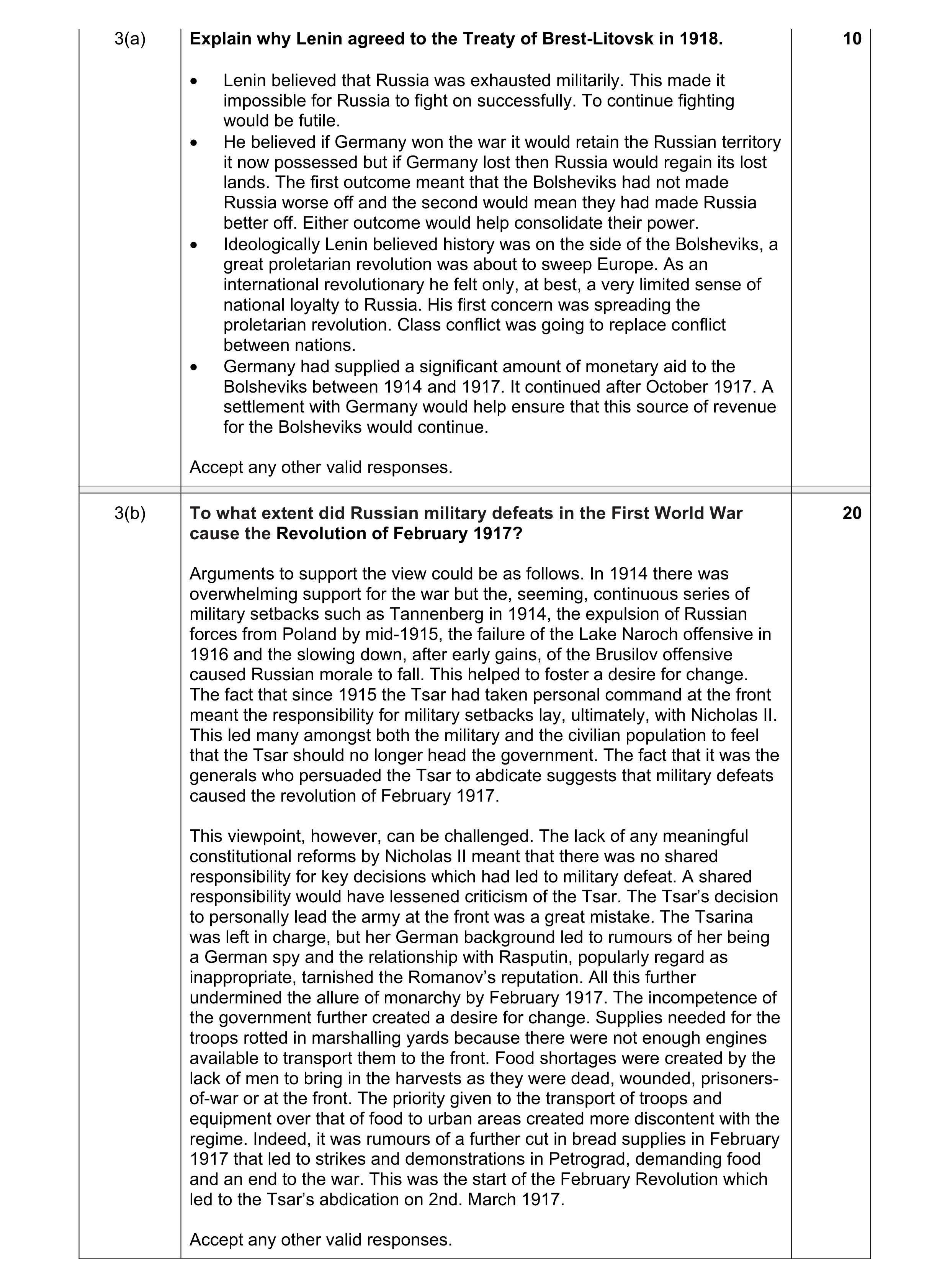 30
30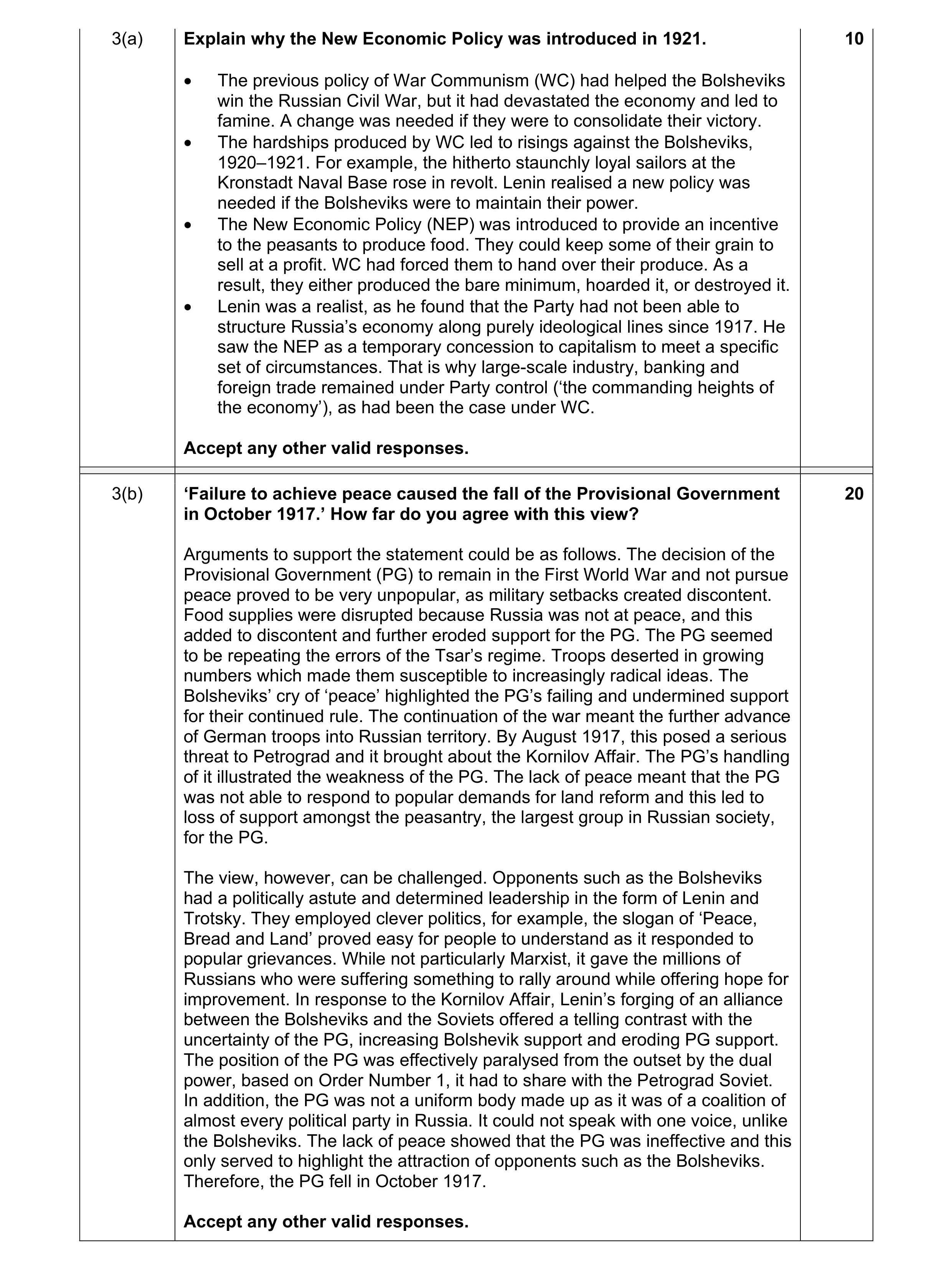 30
30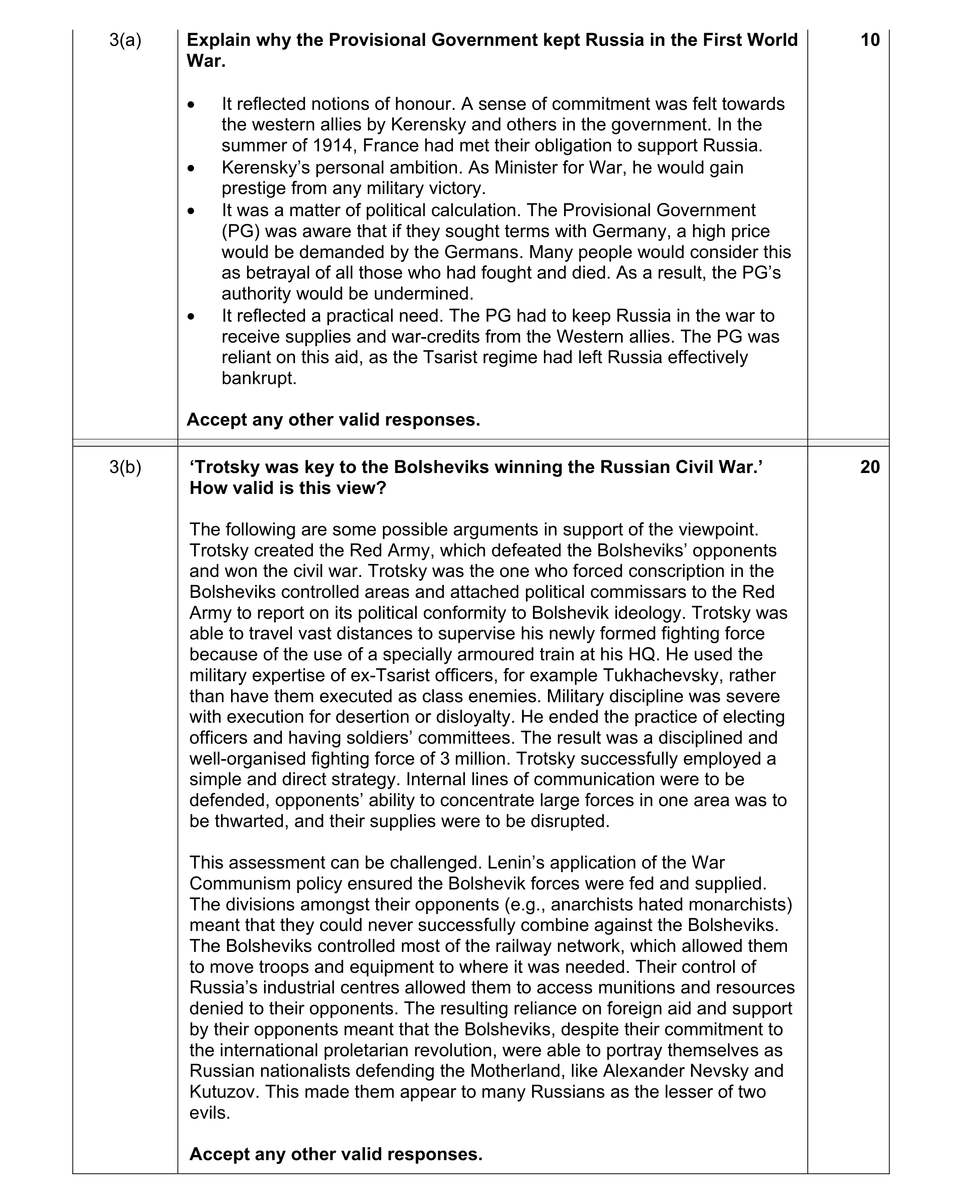 30
30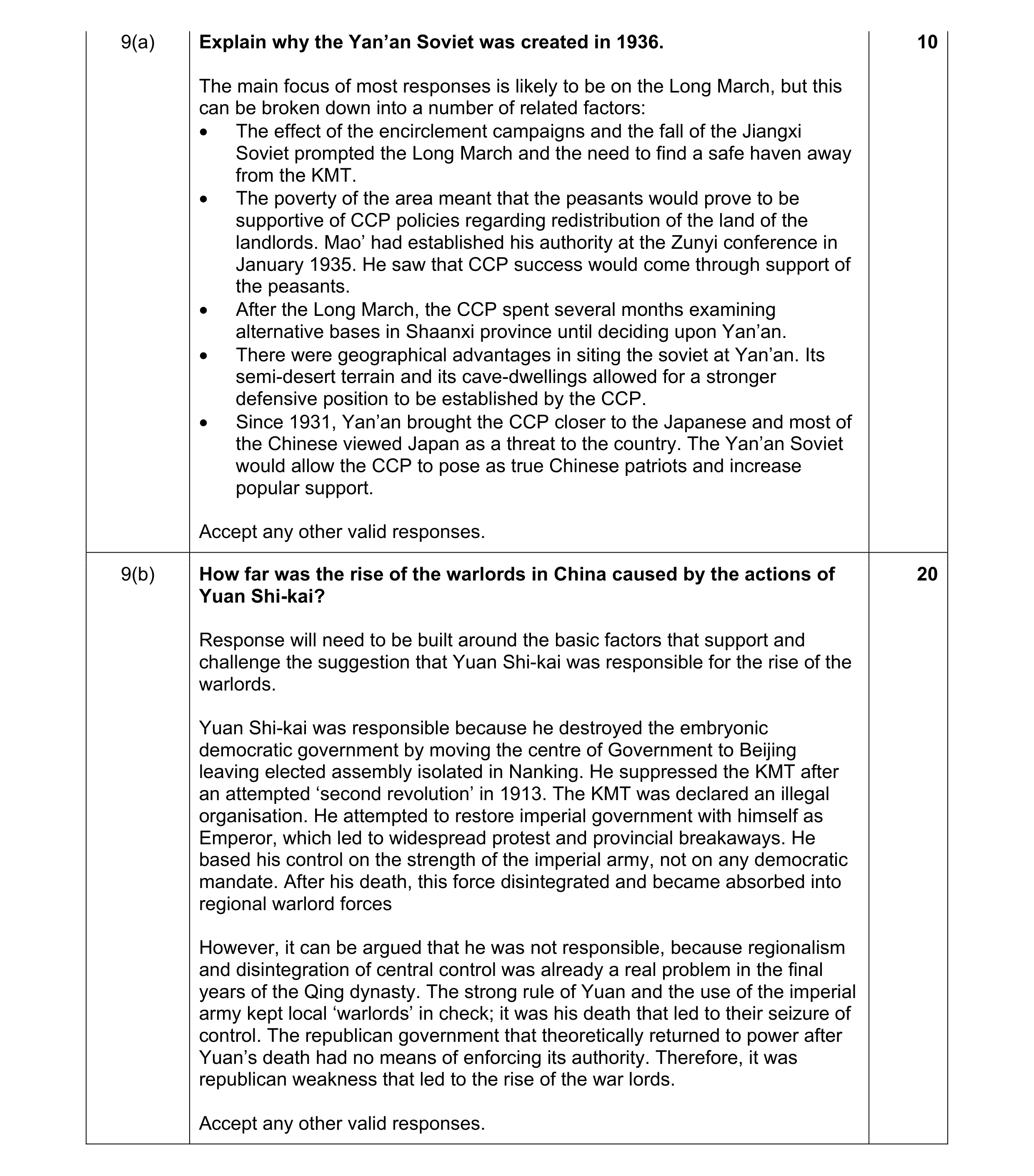 30
30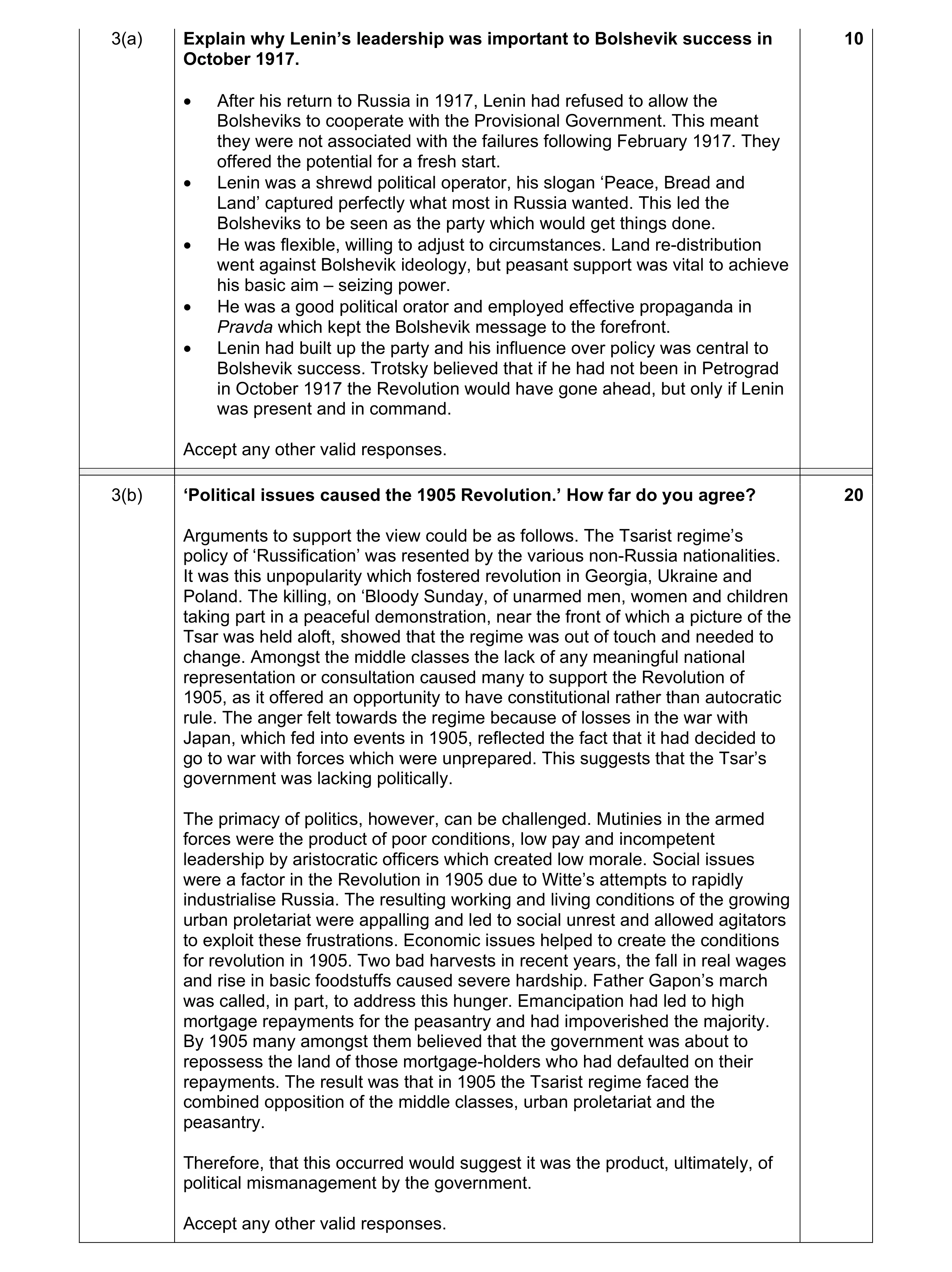 30
30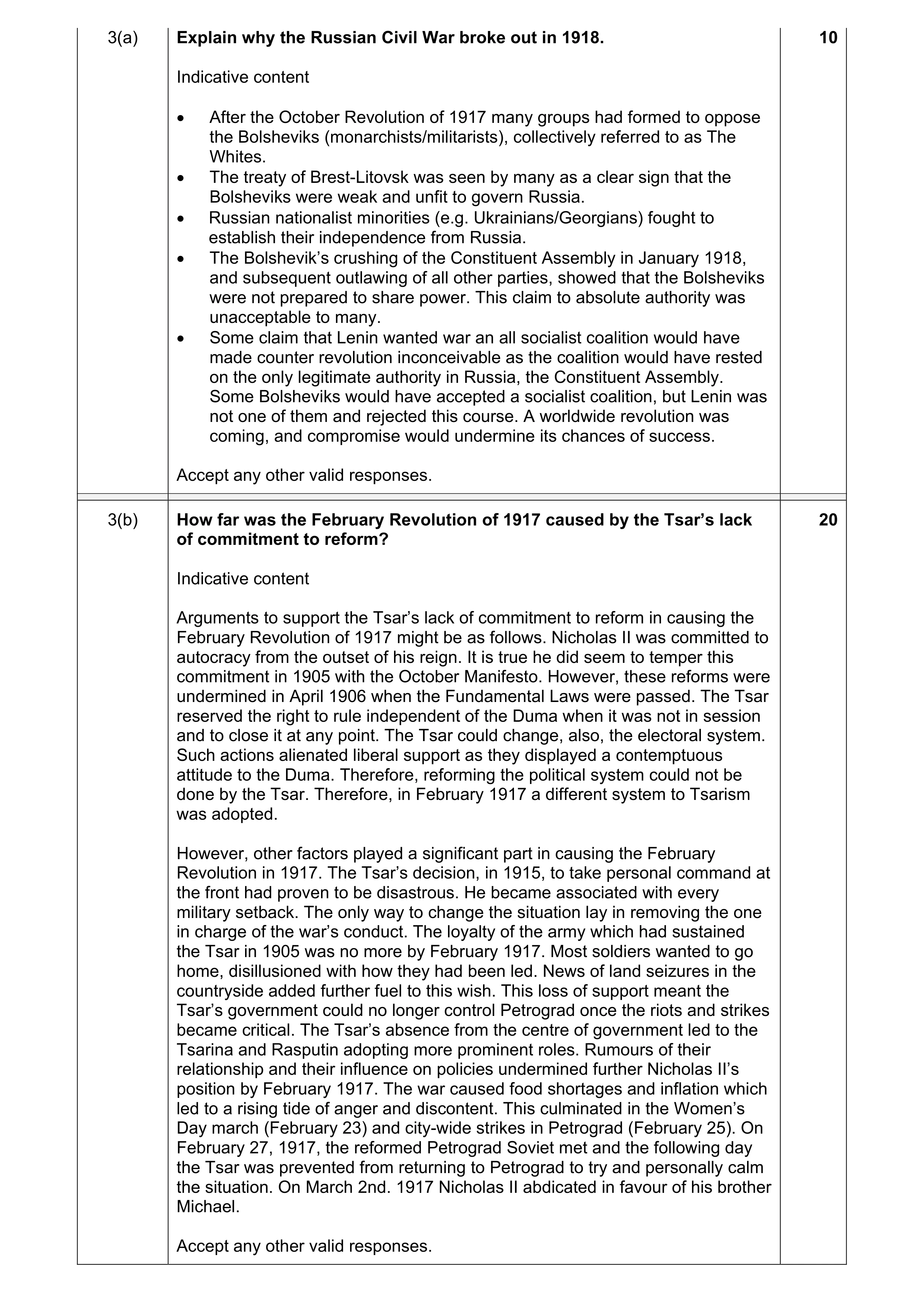 30
30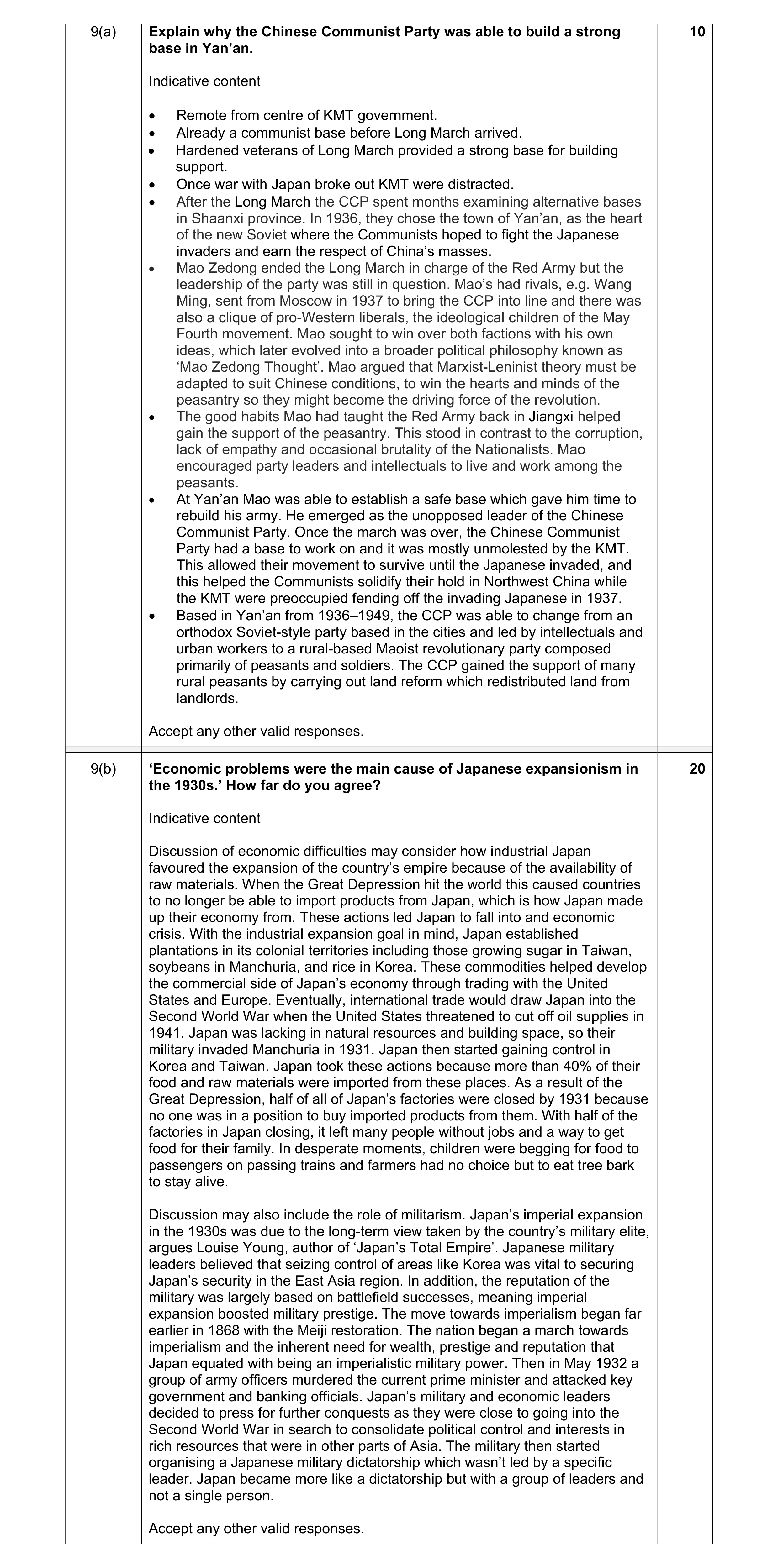 30
30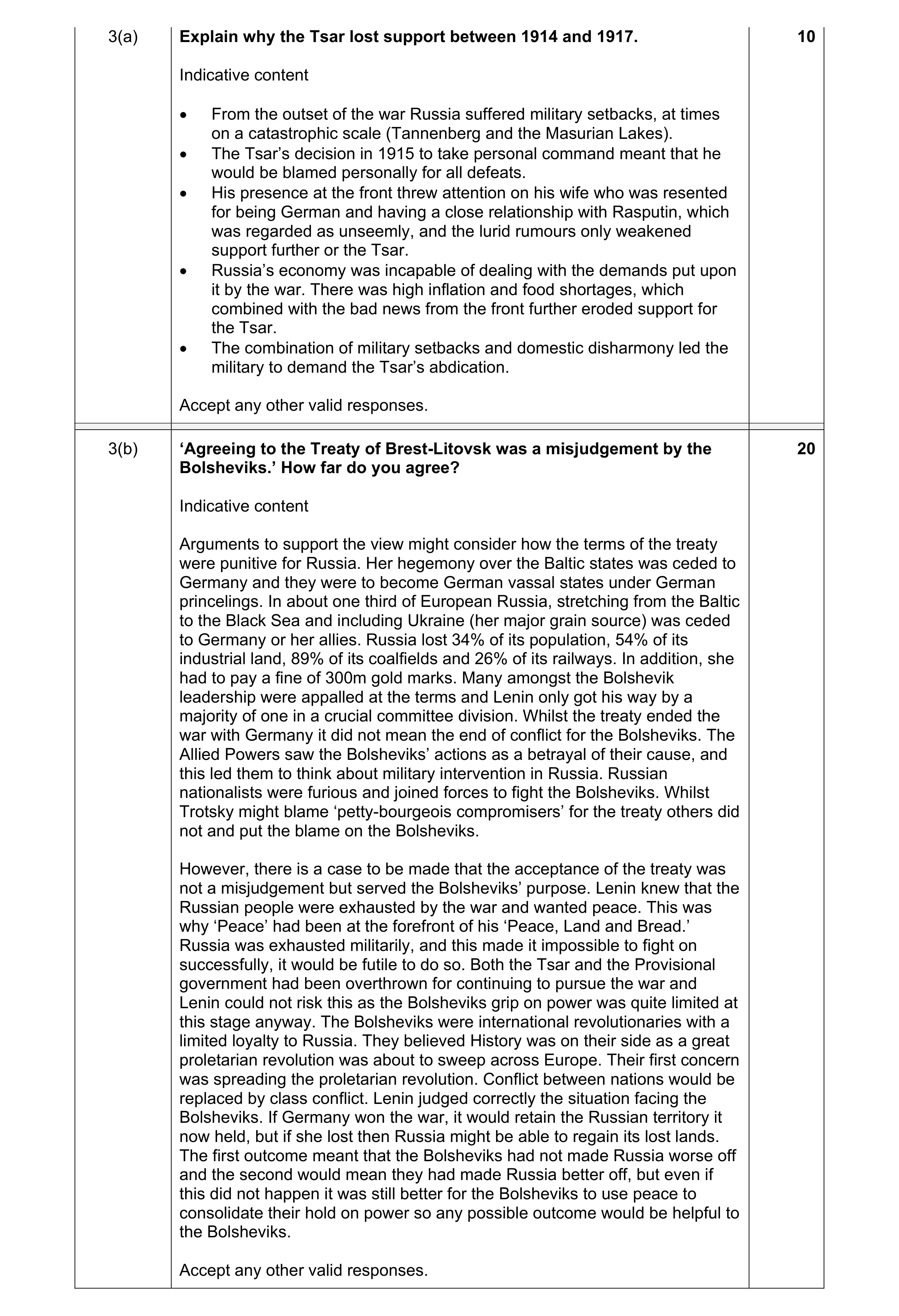 30
30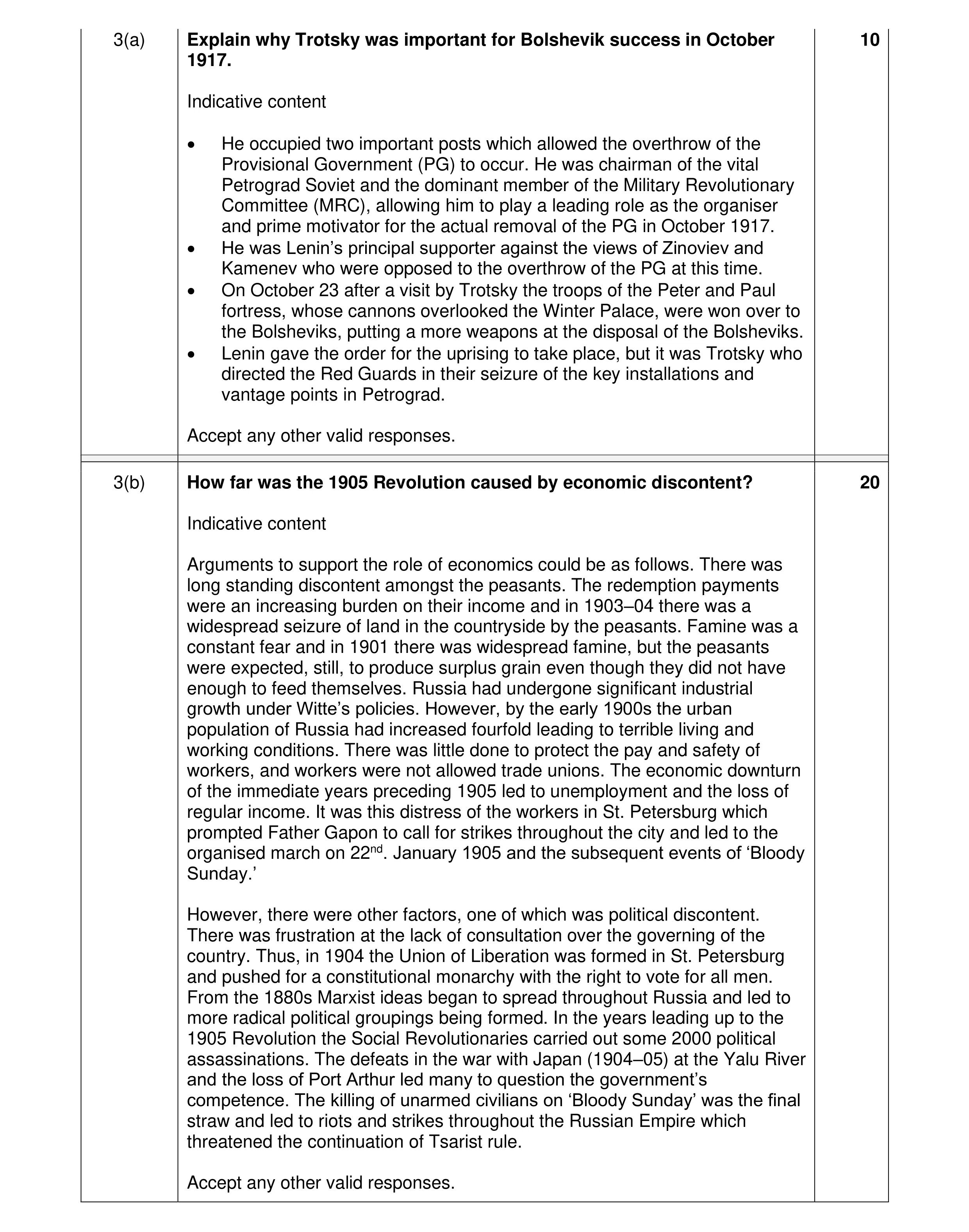 30
30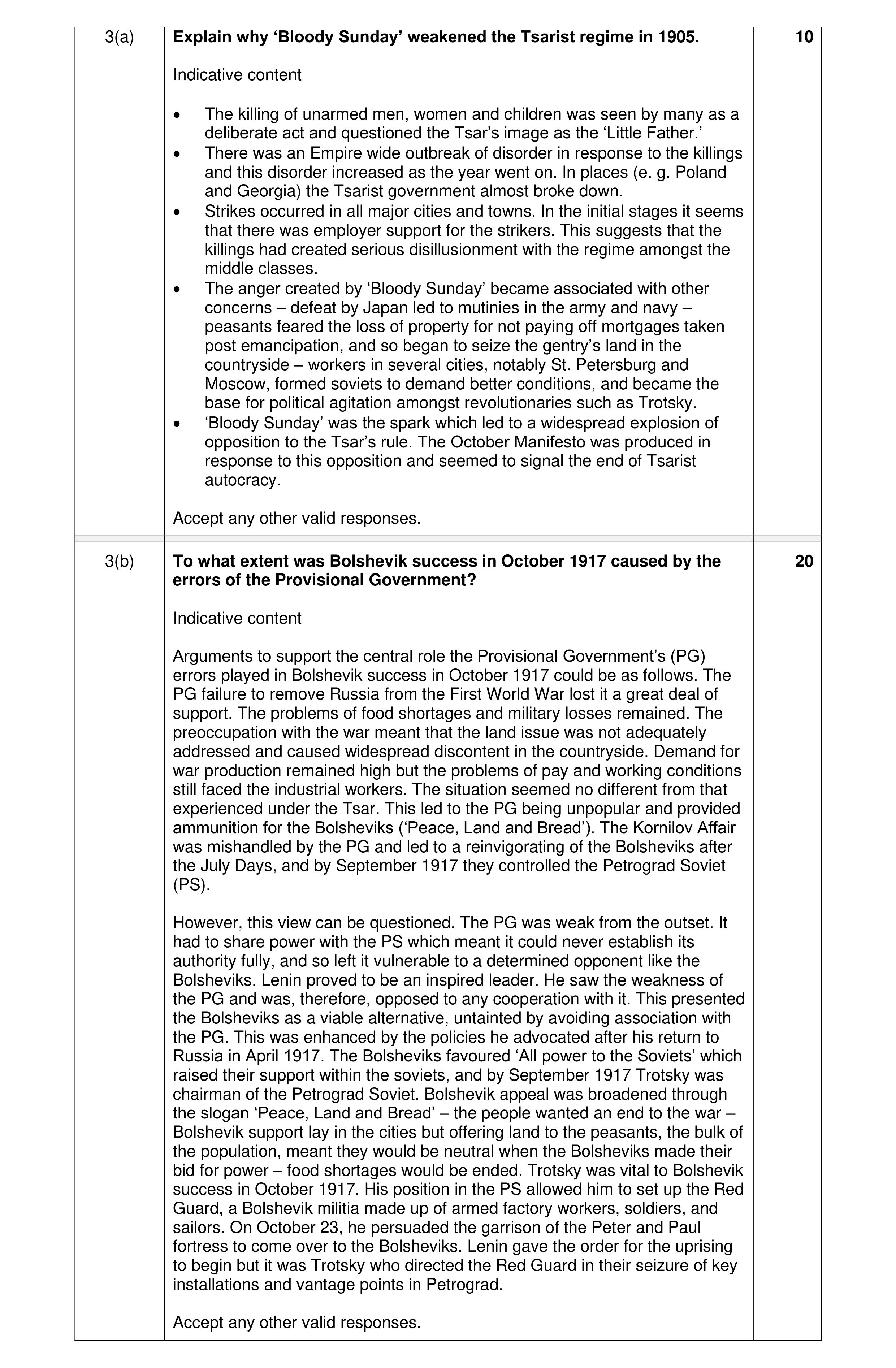 30
30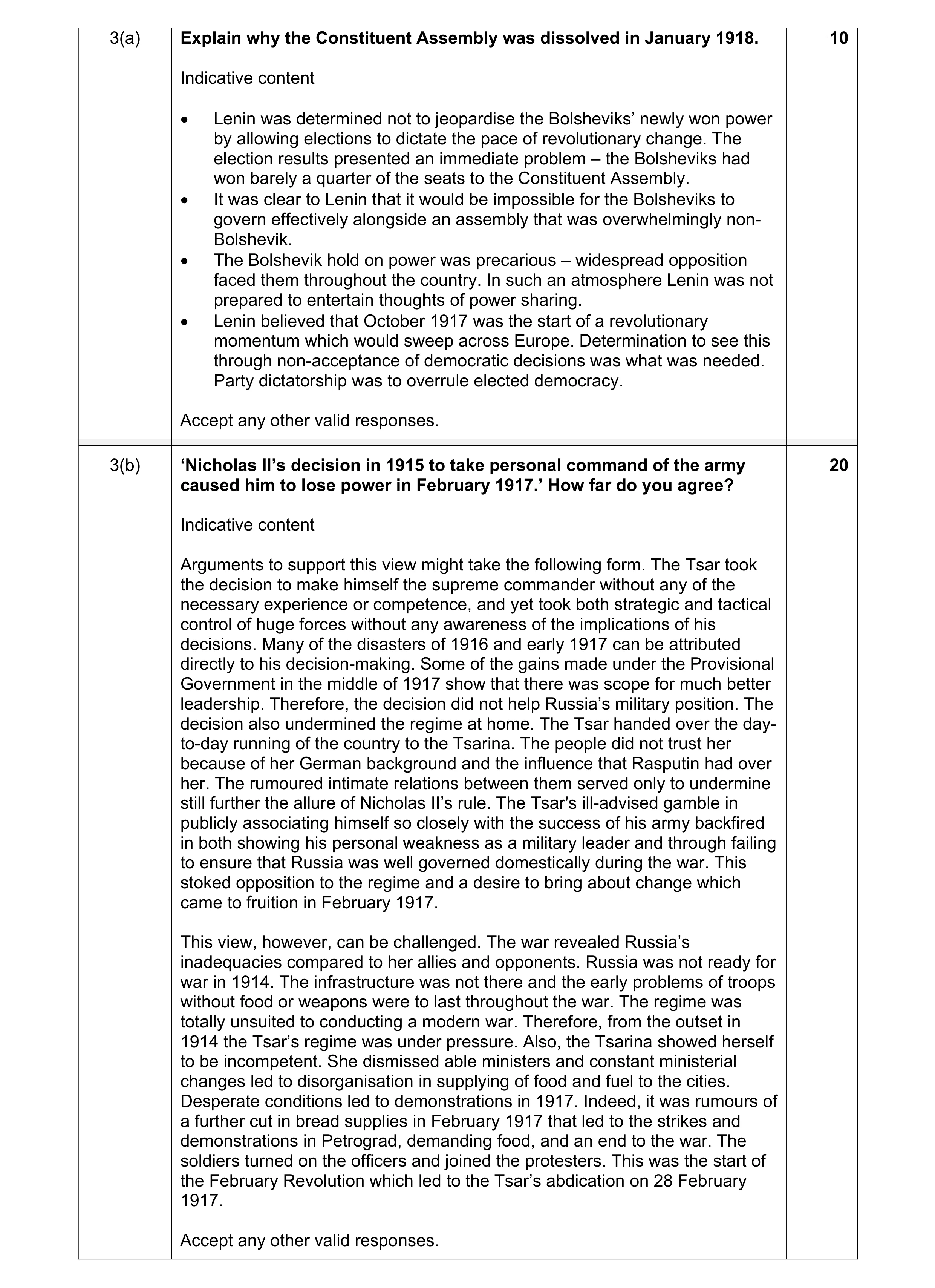 30
30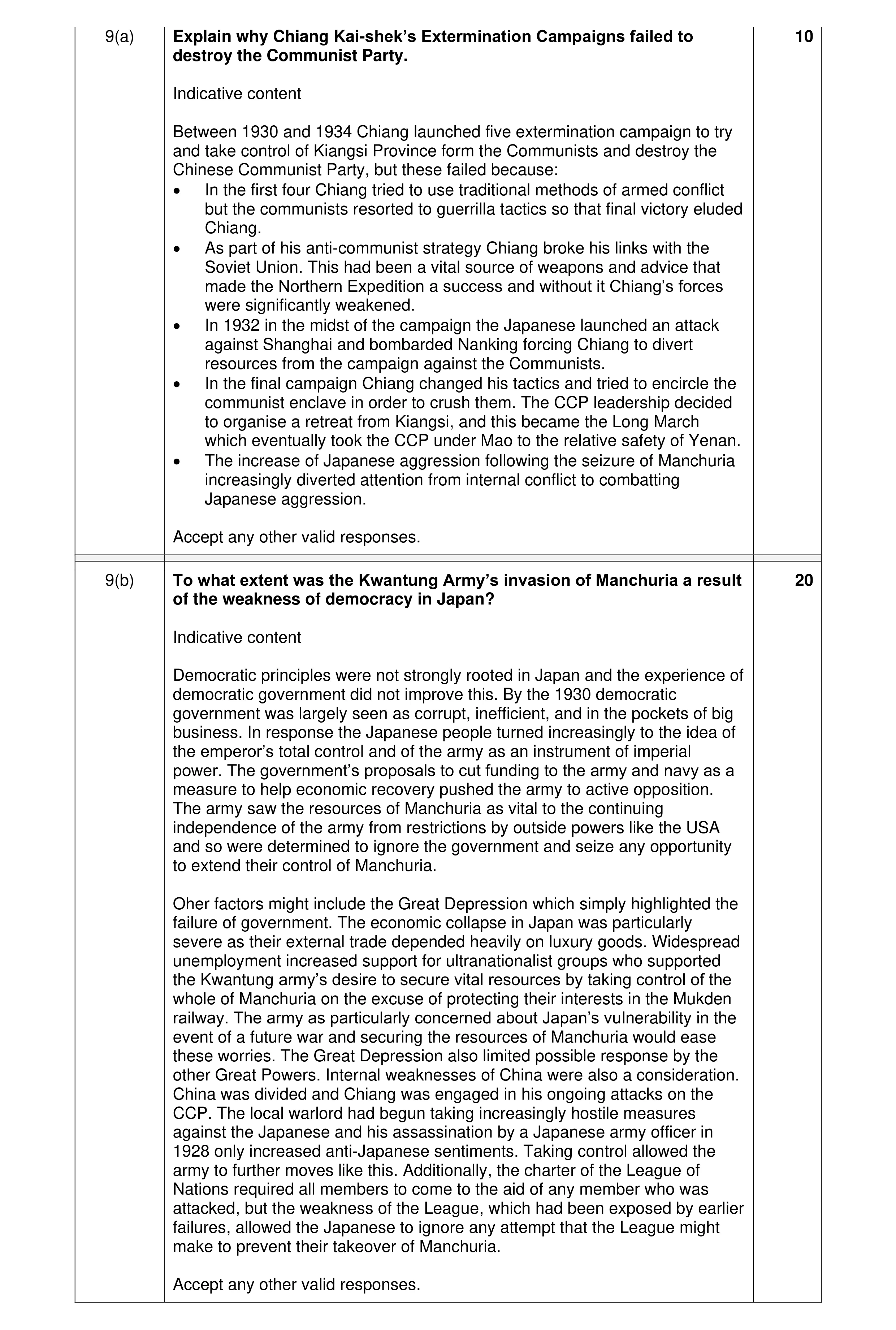 30
30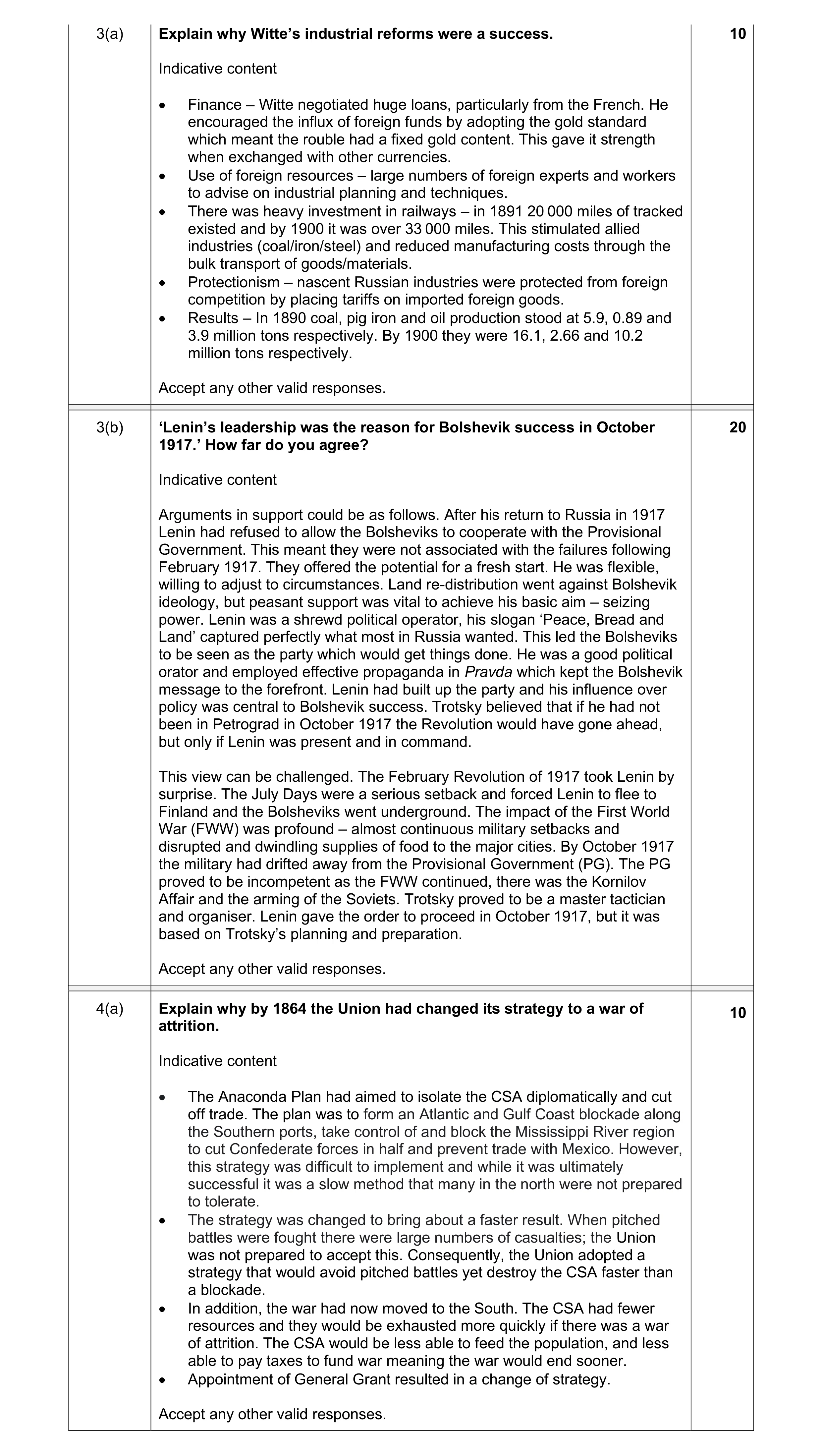 30
30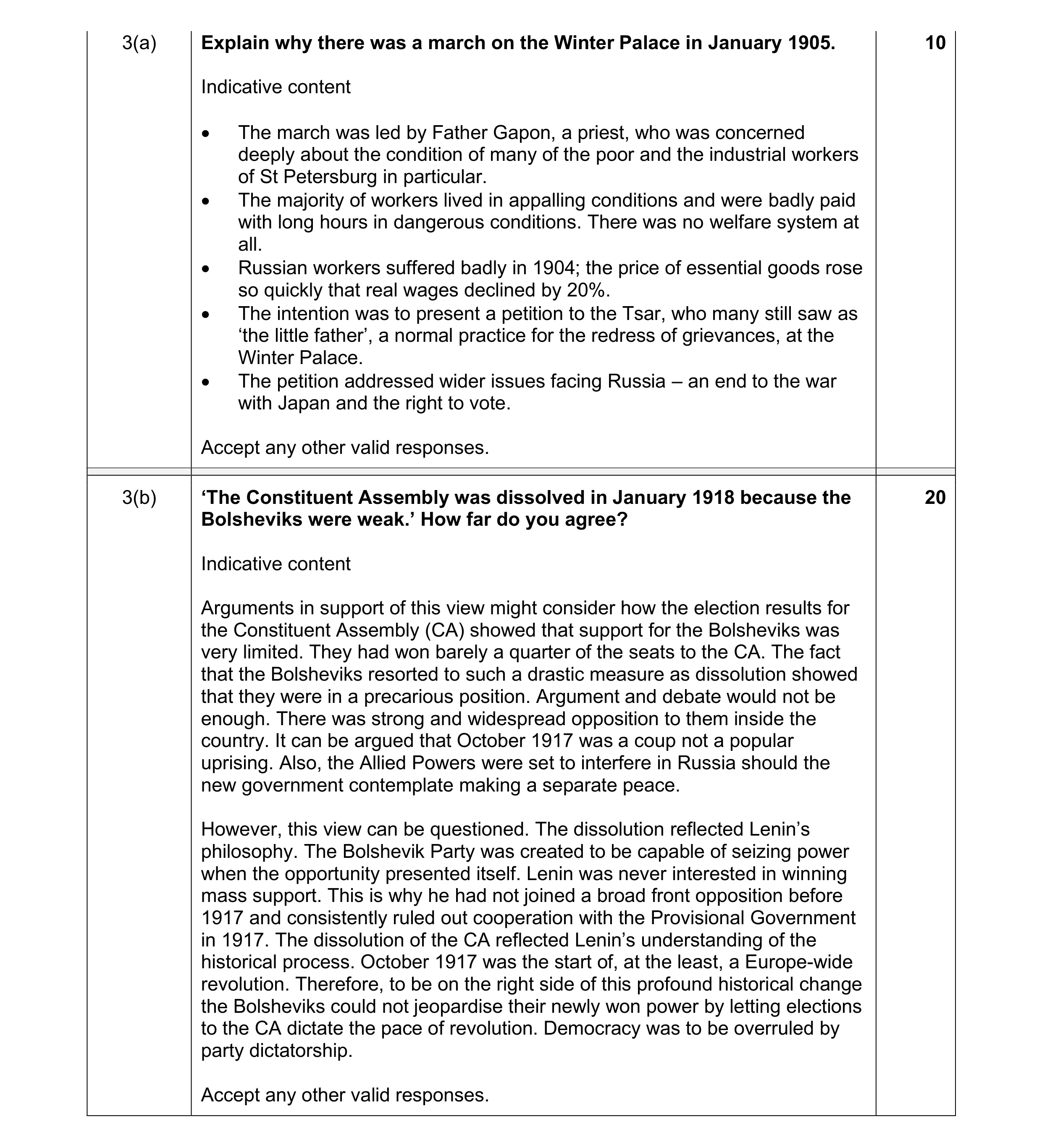 30
30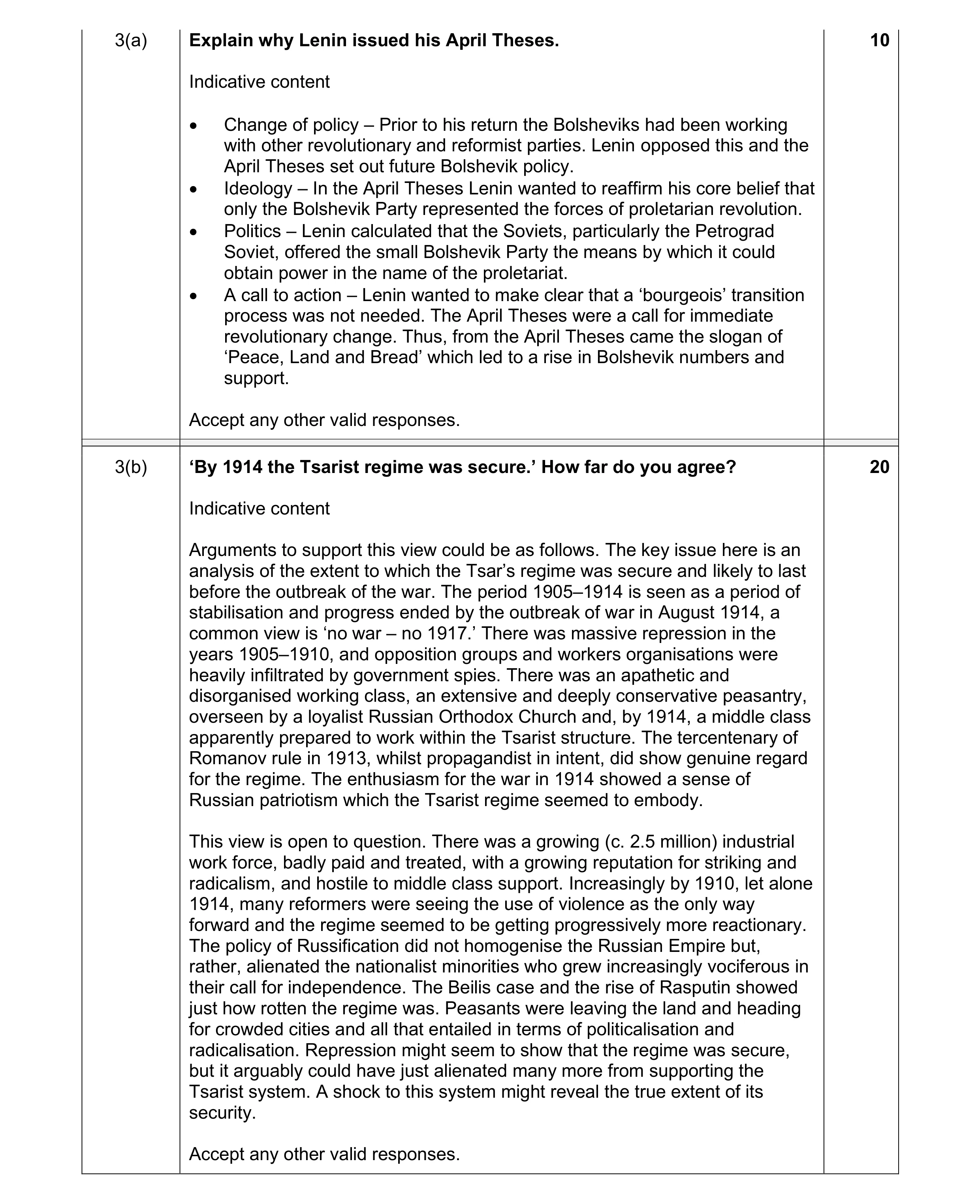 30
30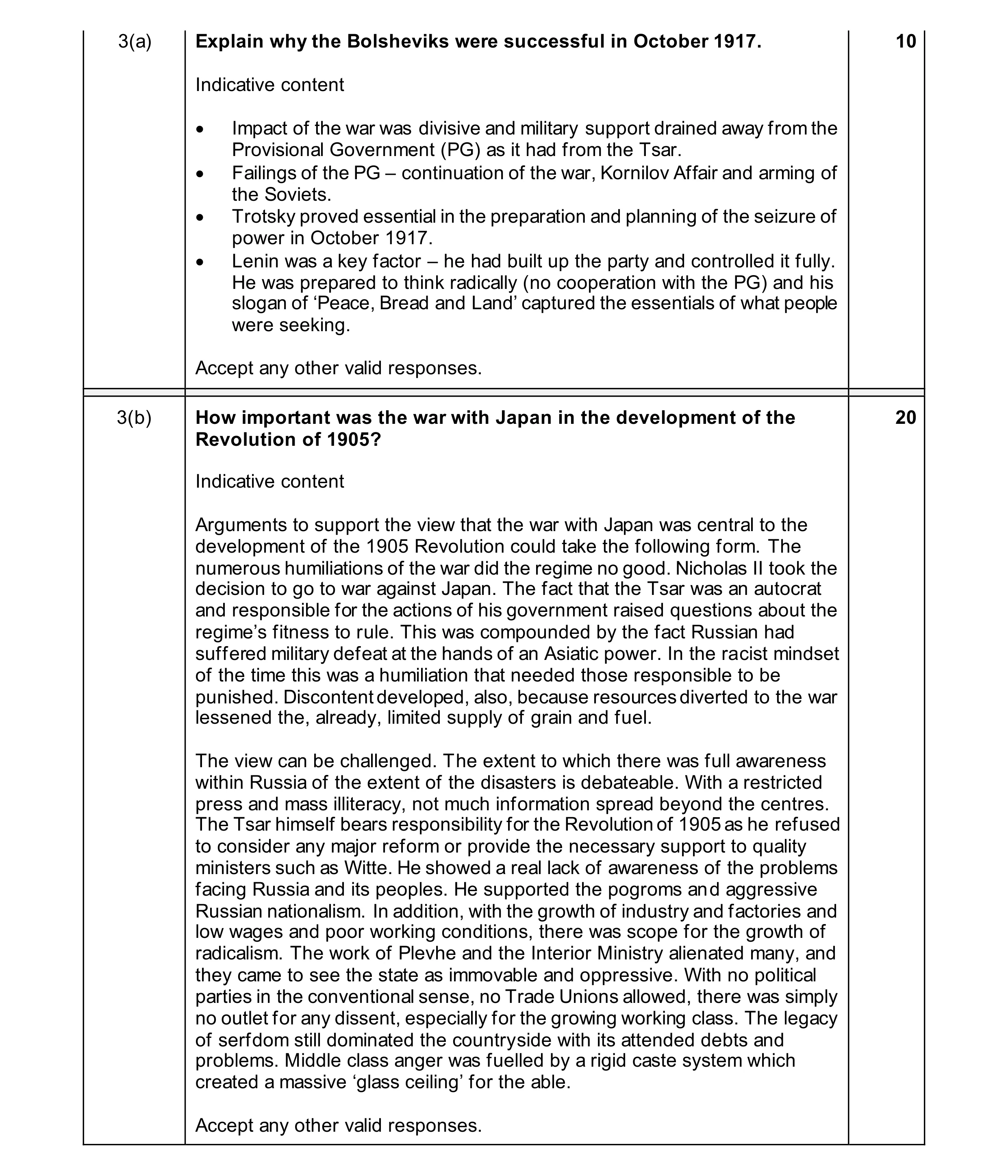 30
30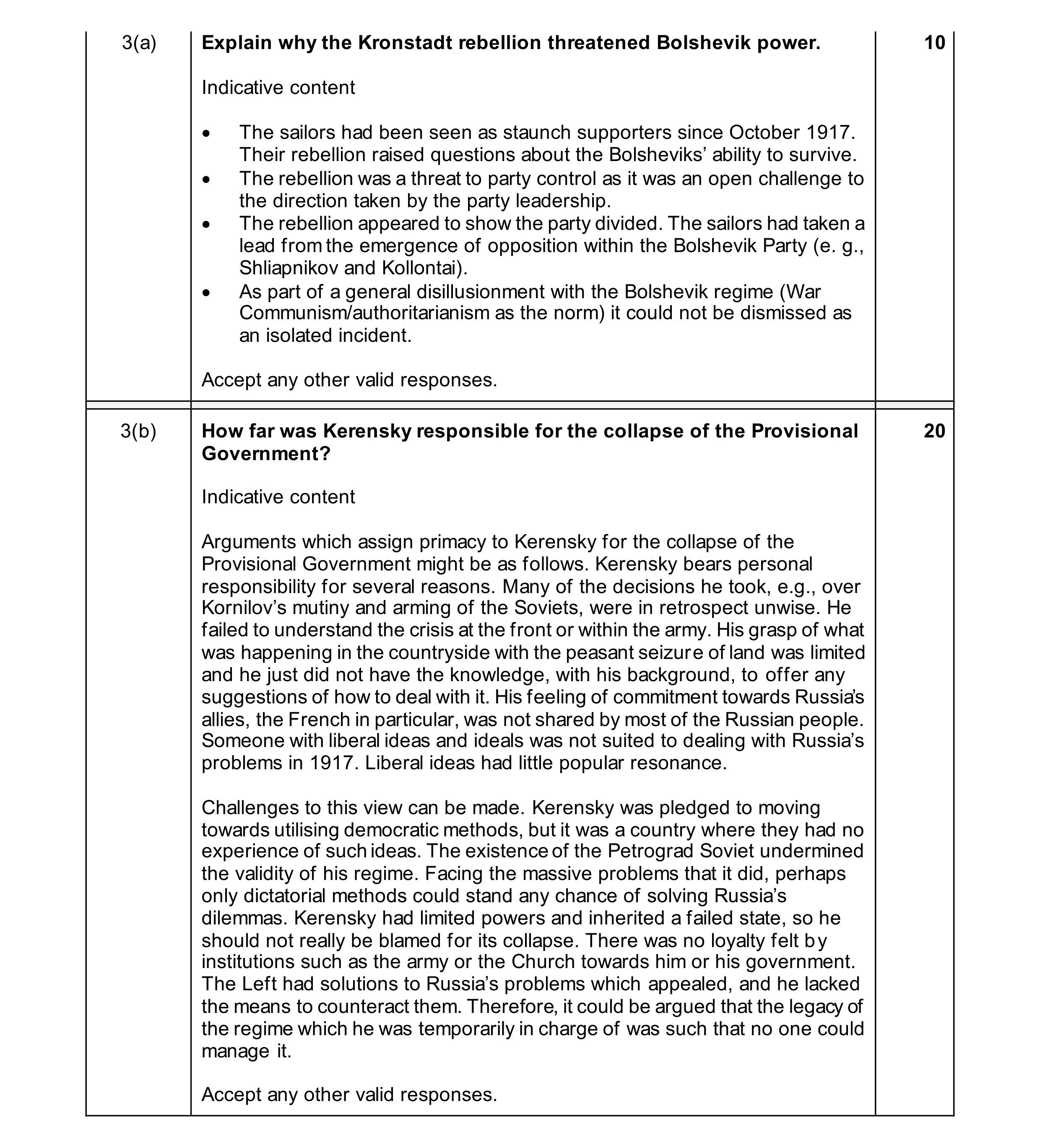 30
30