Questions as text
Q1 · The diagram shows the short-run position of a monopolist who believes that, in the long… 9708/31 Oct/Nov 2009
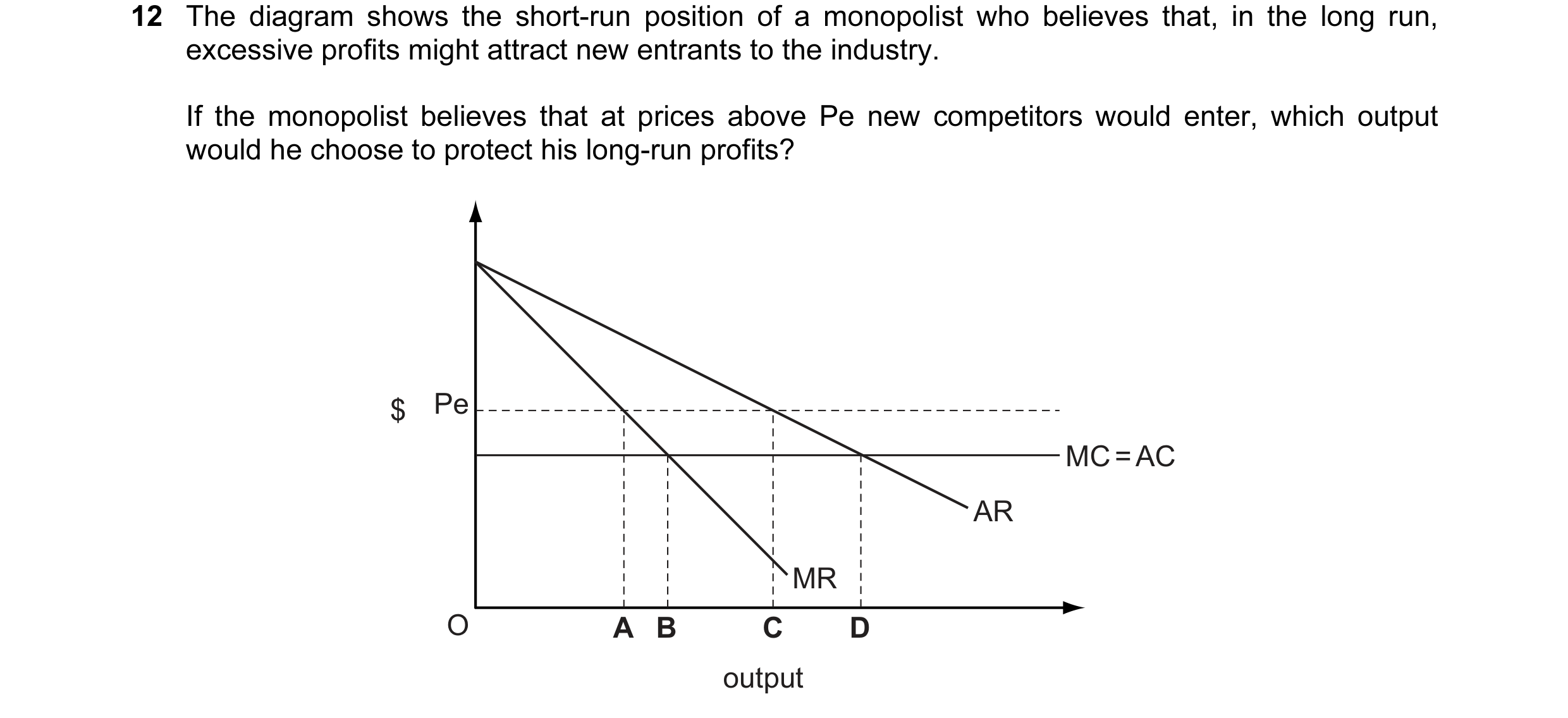
12 The diagram shows the short-run position of a monopolist who believes that, in the long run, excessive profits might attract new entrants to the industry. If the monopolist believes that at prices above Pe new competitors would enter, which output would he choose to protect his long-run profits? $ Pe MC = AC AR MR O A B C D output
1 marks
Answer: C
This question in 9708/31 Oct/Nov 2009
Q2 · The diagram shows the short-run position of a monopolist who believes that, in the long… 9708/32 Oct/Nov 2009
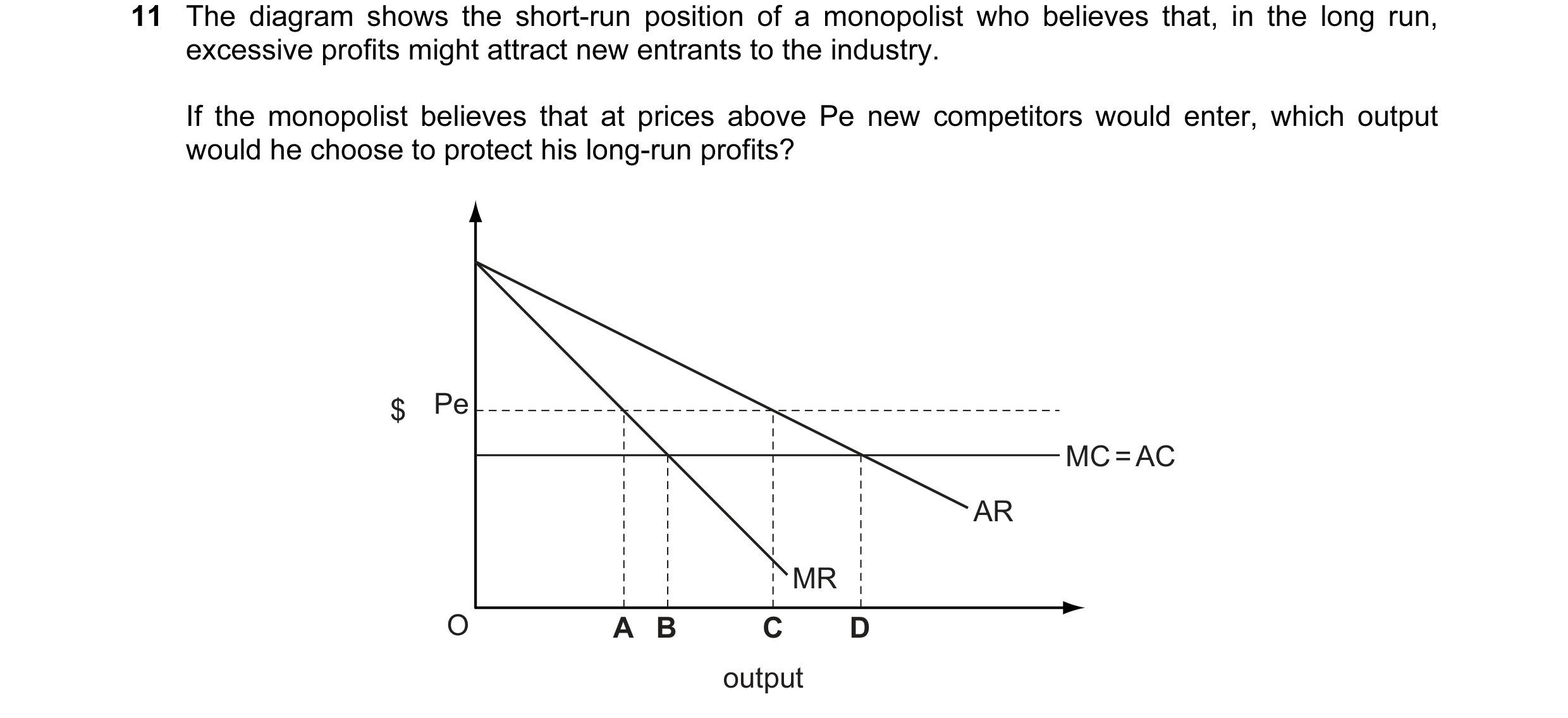
11 The diagram shows the short-run position of a monopolist who believes that, in the long run, excessive profits might attract new entrants to the industry. If the monopolist believes that at prices above Pe new competitors would enter, which output would he choose to protect his long-run profits? $ Pe MC = AC AR MR O A B C D output
1 marks
Answer: C
This question in 9708/32 Oct/Nov 2009
Q3 · The table shows information about a profit-maximising firm 9708/31 May/June 2010
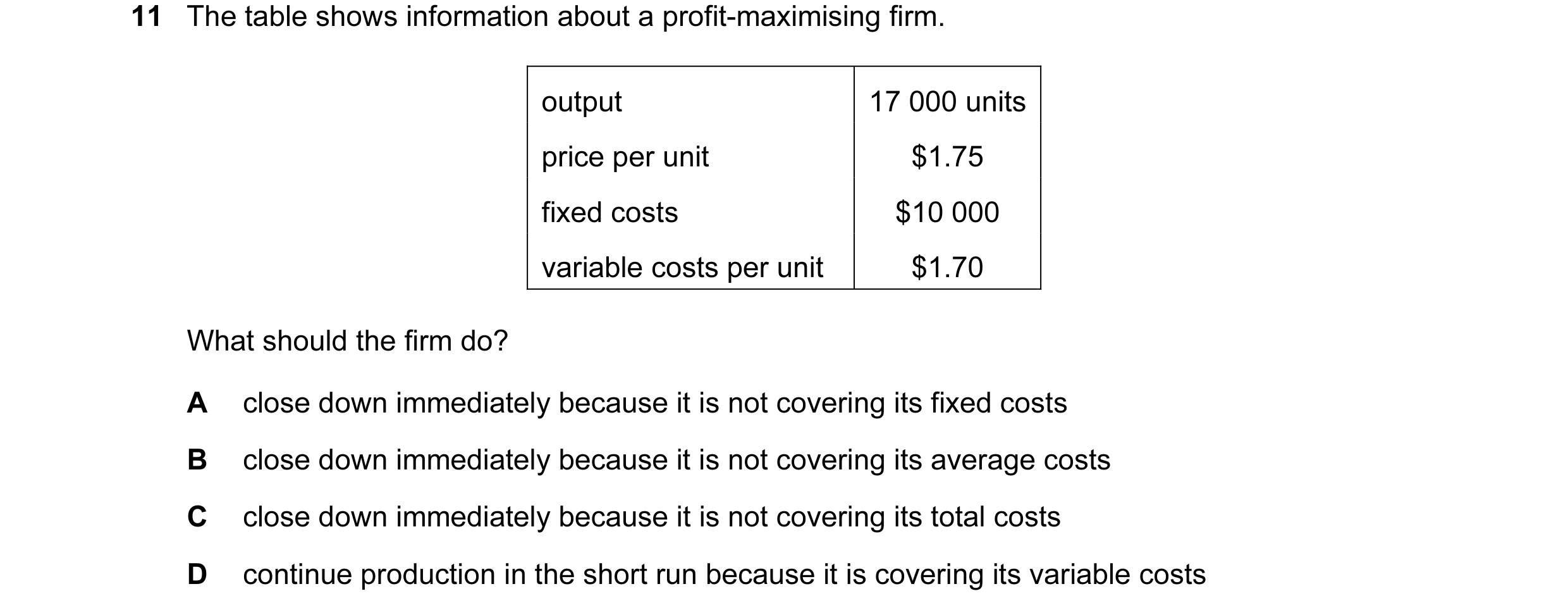
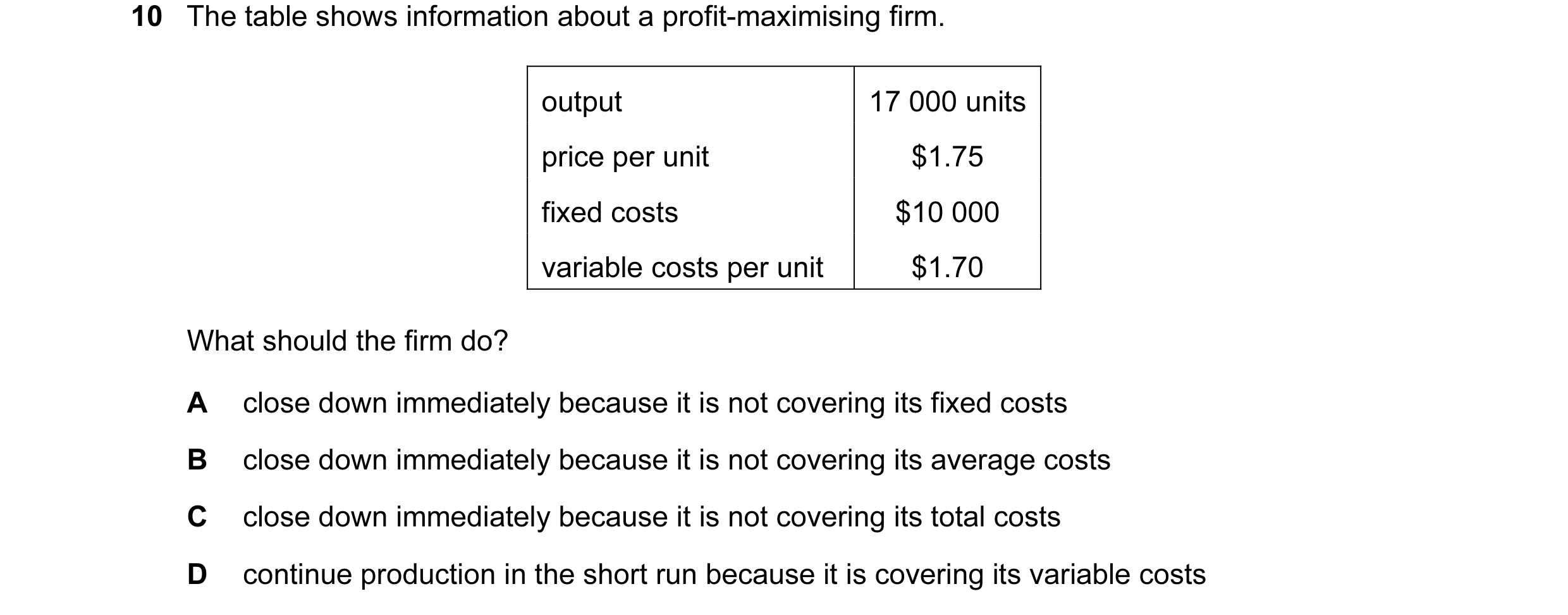
11 The table shows information about a profit-maximising firm. output 17 000 units price per unit $1.75 fixed costs $10 000 variable costs per unit $1.70 What should the firm do? A close down immediately because it is not covering its fixed costs B close down immediately because it is not covering its average costs C close down immediately because it is not covering its total costs D continue production in the short run because it is covering its variable costs
1 marks
Answer: D
This question in 9708/31 May/June 2010
Q4 · The diagram shows a firm’s marginal and average cost curves 9708/31 May/June 2010
12 The diagram shows a firm’s marginal and average cost curves. The firm enters a collusive agreement with other firms in the industry. It is agreed that each firm will charge a common price, OP, and will restrict the level of its output to a production quota set by the industry cartel. The firm is allocated a production quota, Oq. MC AC G H P $ L K M J N O q quantity The firm decides to cheat in order to maximise its profits. What is its short-run increase in profits? A PGKL B PHJL C PHJL minus PGNM D PGKL minus LKNM
1 marks
Answer: C
This question in 9708/31 May/June 2010
Q5 · The table shows information about a profit-maximising firm 9708/32 May/June 2010
10 The table shows information about a profit-maximising firm. output 17 000 units price per unit $1.75 fixed costs $10 000 variable costs per unit $1.70 What should the firm do? A close down immediately because it is not covering its fixed costs B close down immediately because it is not covering its average costs C close down immediately because it is not covering its total costs D continue production in the short run because it is covering its variable costs
1 marks
Answer: D
This question in 9708/32 May/June 2010
Q6 · The diagram shows a firm’s marginal and average cost curves 9708/32 May/June 2010
11 The diagram shows a firm’s marginal and average cost curves. The firm enters a collusive agreement with other firms in the industry. It is agreed that each firm will charge a common price, OP, and will restrict the level of its output to a production quota set by the industry cartel. The firm is allocated a production quota, Oq. MC AC G H P $ L K M J N O q quantity The firm decides to cheat in order to maximise its profits. What is its short-run increase in profits? A PGKL B PHJL C PHJL minus PGNM D PGKL minus LKNM
1 marks
Answer: C
This question in 9708/32 May/June 2010
Q7 · A firm in a perfectly competitive industry employs two factors of production, X and Y 9708/31 Oct/Nov 2010
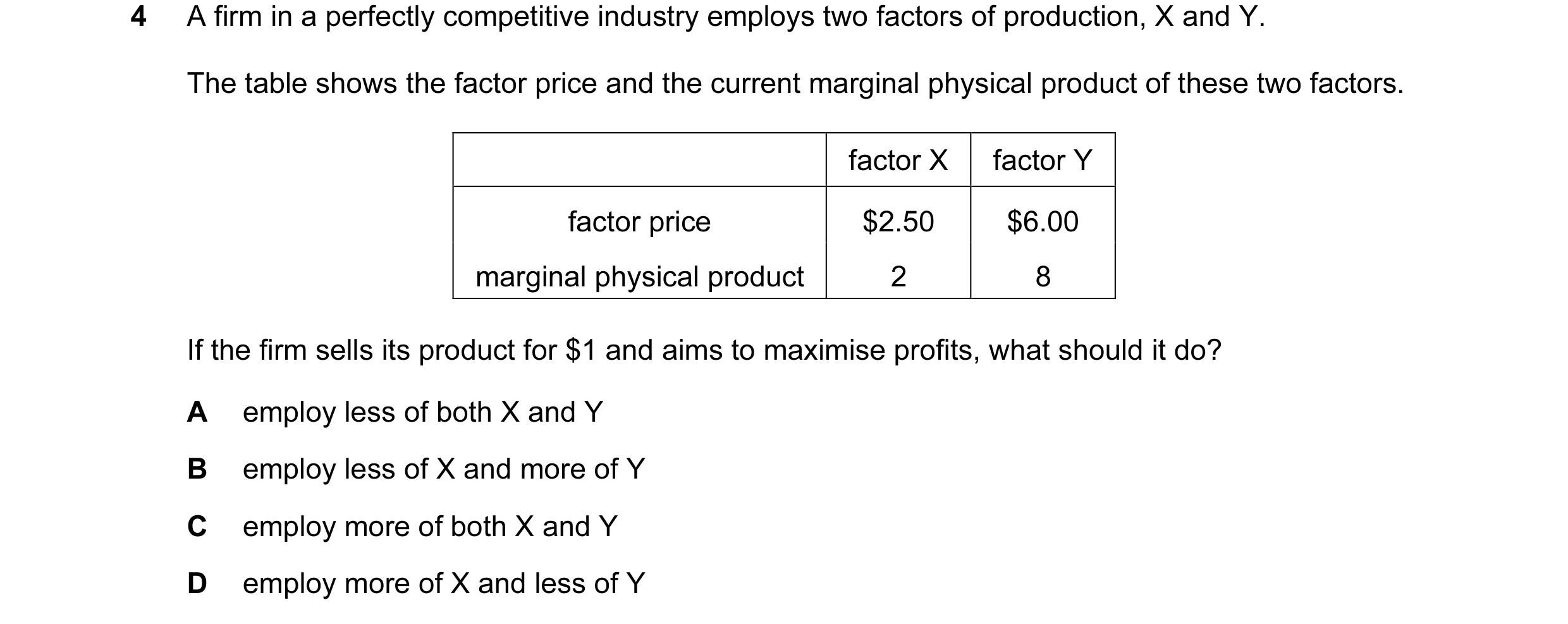
4 A firm in a perfectly competitive industry employs two factors of production, X and Y. The table shows the factor price and the current marginal physical product of these two factors. factor X factor Y factor price $2.50 $6.00 marginal physical product 2 8 If the firm sells its product for $1 and aims to maximise profits, what should it do? A employ less of both X and Y B employ less of X and more of Y C employ more of both X and Y D employ more of X and less of Y
1 marks
Answer: B
This question in 9708/31 Oct/Nov 2010
Q8 · The diagram shows a firm’s cost and revenue curves 9708/31 Oct/Nov 2010
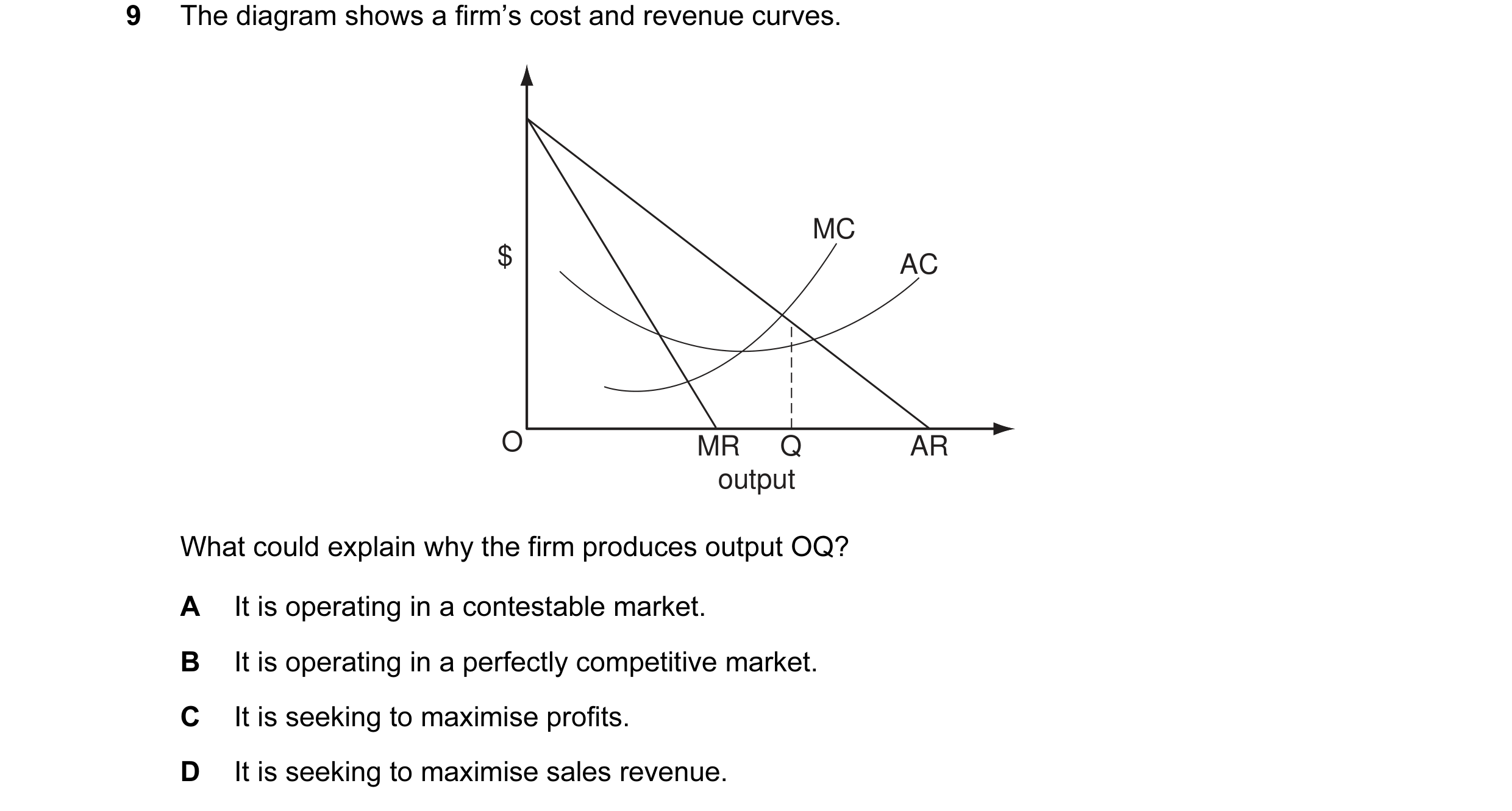
9 The diagram shows a firm’s cost and revenue curves. MC $ AC O MR Q AR output What could explain why the firm produces output OQ? A It is operating in a contestable market. B It is operating in a perfectly competitive market. C It is seeking to maximise profits. D It is seeking to maximise sales revenue.
1 marks
Answer: A
This question in 9708/31 Oct/Nov 2010
Q9 · The diagram shows a firm’s cost and revenue curves 9708/32 Oct/Nov 2010
9 The diagram shows a firm’s cost and revenue curves. MC $ AC O MR Q AR output What could explain why the firm produces output OQ? A It is operating in a contestable market. B It is operating in a perfectly competitive market. C It is seeking to maximise profits. D It is seeking to maximise sales revenue.
1 marks
Answer: A
This question in 9708/32 Oct/Nov 2010
Q10 · The diagram shows a firm’s cost and revenue curves 9708/33 Oct/Nov 2010
8 The diagram shows a firm’s cost and revenue curves. MC $ AC O MR Q AR output What could explain why the firm produces output OQ? A It is operating in a contestable market. B It is operating in a perfectly competitive market. C It is seeking to maximise profits. D It is seeking to maximise sales revenue.
1 marks
Answer: A
This question in 9708/33 Oct/Nov 2010
Q11 · The diagram shows the cost and revenue curves of a monopoly 9708/32 Oct/Nov 2011
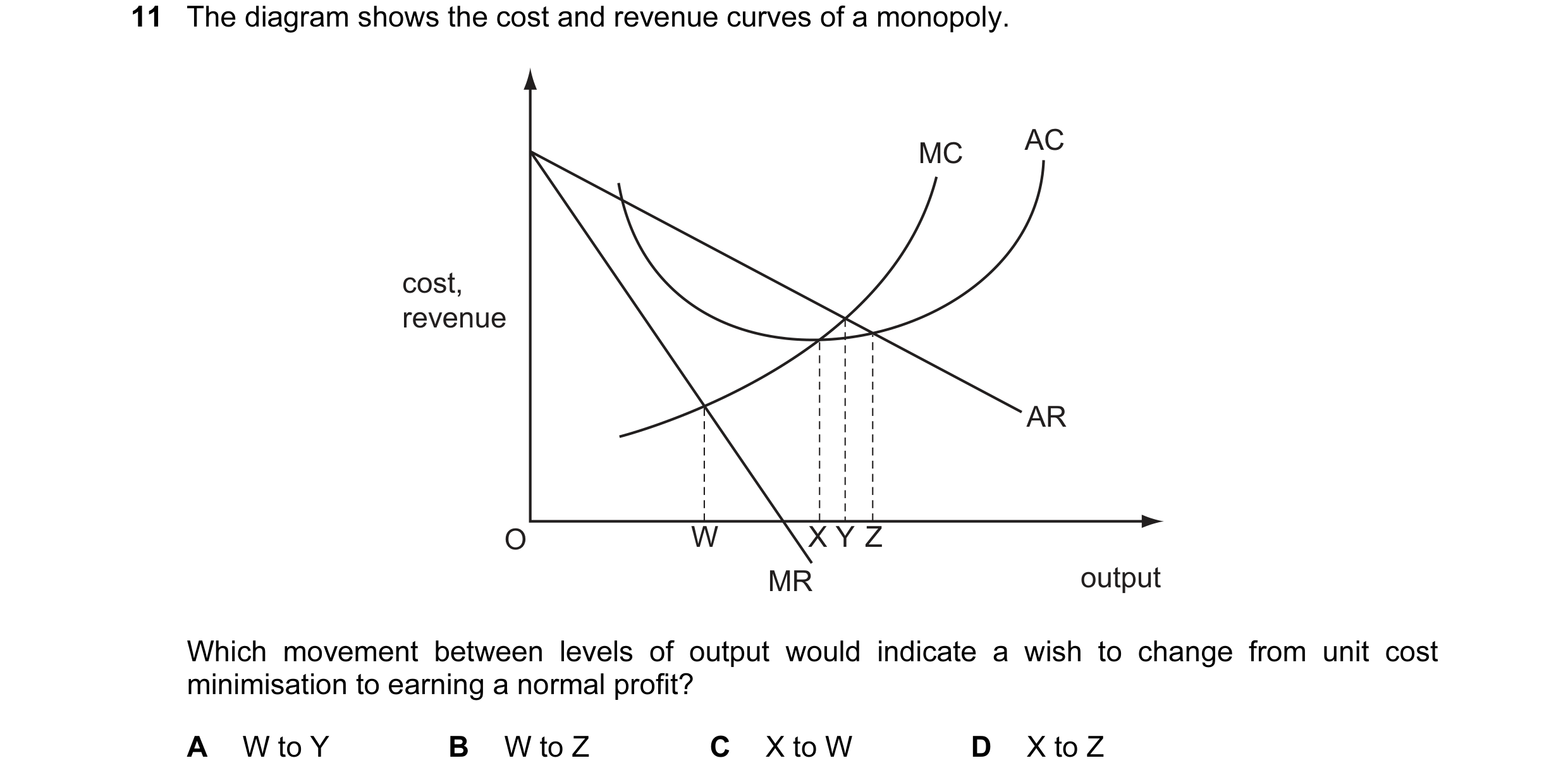
11 The diagram shows the cost and revenue curves of a monopoly. MC AC cost, revenue AR O W X Y Z MR output Which movement between levels of output would indicate a wish to change from unit cost minimisation to earning a normal profit? A W to Y B W to Z C X to W D X to Z
1 marks
Answer: D
This question in 9708/32 Oct/Nov 2011
Q12 · The table shows the total revenue and marginal cost of a firm at different levels of… 9708/33 May/June 2012
12 The table shows the total revenue and marginal cost of a firm at different levels of production. production total marginal (tonnes) revenue ($) cost ($) 2 100 5 3 120 10 4 140 15 5 160 20 6 180 25 7 200 30 Within which output range will the firm’s profits be maximised? A 2-3 tonnes B 3-4 tonnes C 4-5 tonnes D 5-6 tonnes
1 marks
Answer: C
This question in 9708/33 May/June 2012
Q13 · Instead of charging all its customers the same price, a firm decides to charge different… 9708/32 Oct/Nov 2012
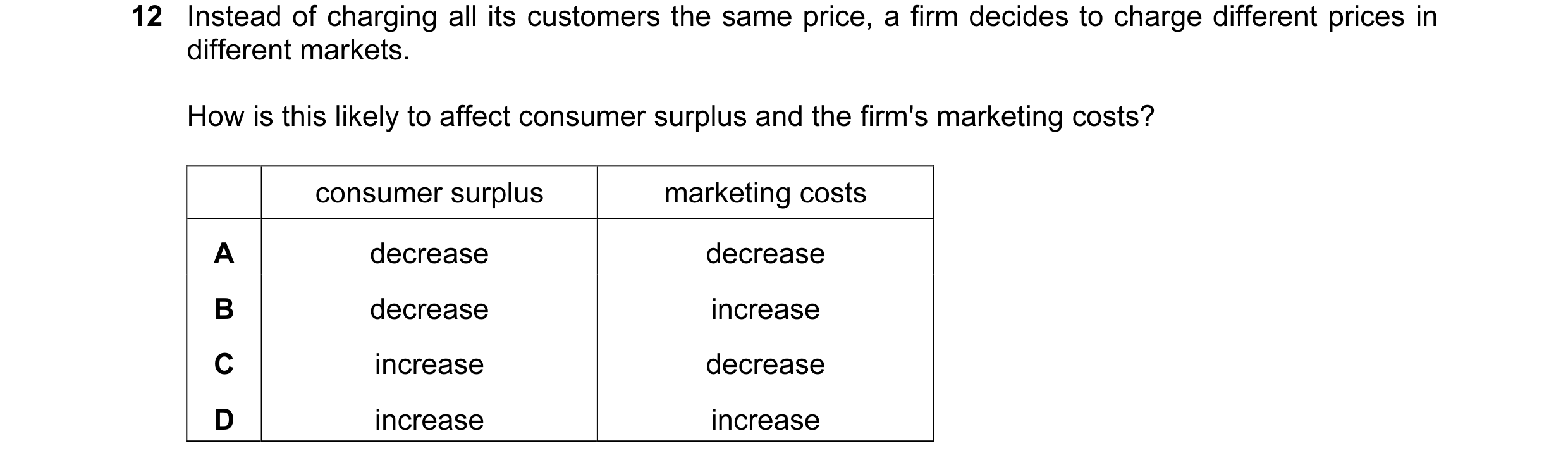
12 Instead of charging all its customers the same price, a firm decides to charge different prices in different markets. How is this likely to affect consumer surplus and the firm's marketing costs? consumer surplus marketing costs A decrease decrease B decrease increase C increase decrease D increase increase
1 marks
Answer: B
This question in 9708/32 Oct/Nov 2012
Q14 · The diagram shows the cost and revenue curves of a monopoly 9708/33 Oct/Nov 2012
9 The diagram shows the cost and revenue curves of a monopoly. MC AC $ MR AR O X output What is the firm’s objective if it produces output OX? A to achieve normal profit B to maximise profit C to maximise total revenue D to minimise average cost
1 marks
This question in 9708/33 Oct/Nov 2012
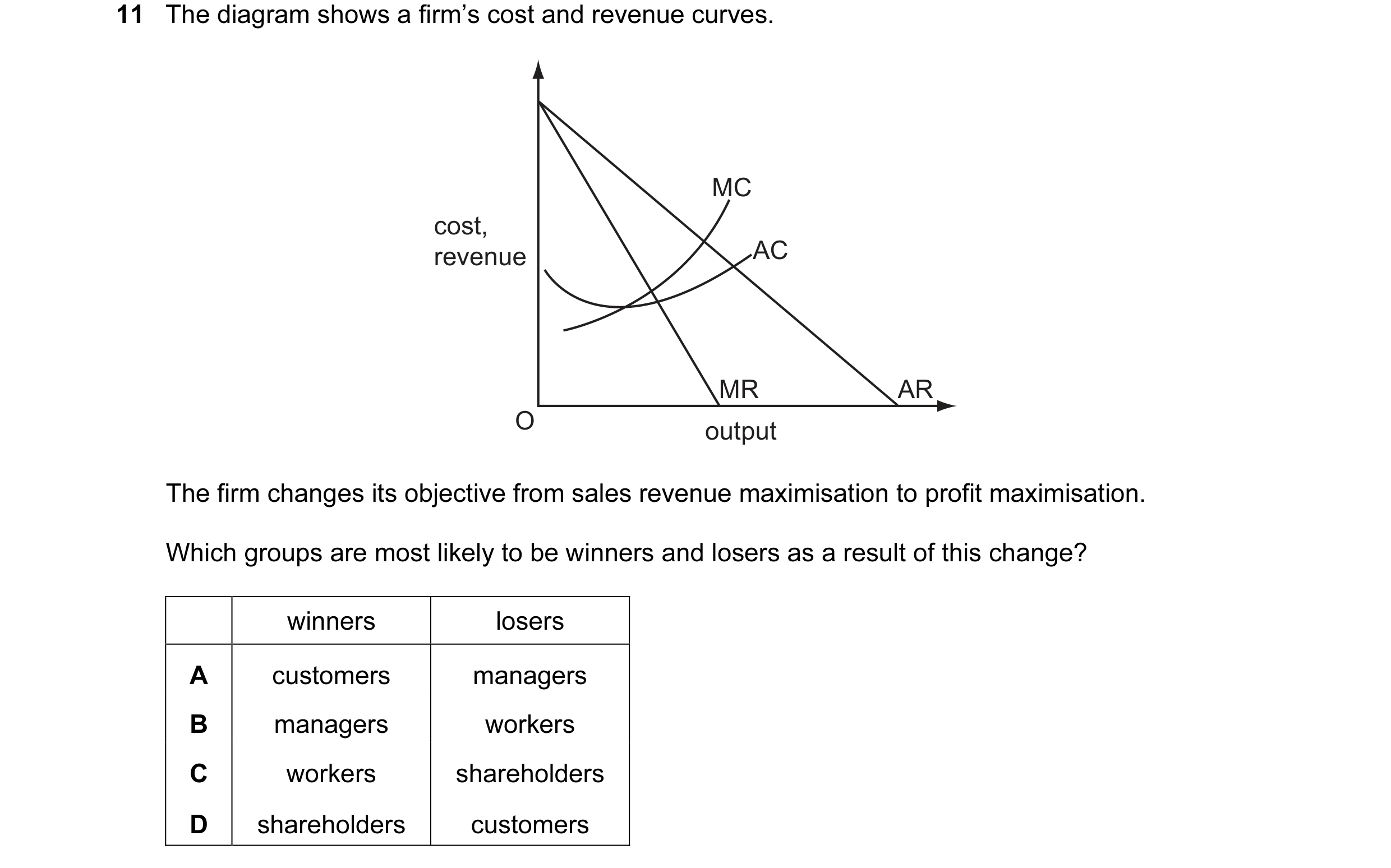
Q15 · The diagram shows a firm’s cost and revenue curves 9708/32 May/June 2013
11 The diagram shows a firm’s cost and revenue curves. MC cost, revenue AC MR AR O output The firm changes its objective from sales revenue maximisation to profit maximisation. Which groups are most likely to be winners and losers as a result of this change? winners losers A customers managers B managers workers C workers shareholders D shareholders customers
1 marks
Answer: D
This question in 9708/32 May/June 2013
Q16 · The diagram shows a firm’s cost and revenue curves 9708/31 Oct/Nov 2013
10 The diagram shows a firm’s cost and revenue curves. MC cost / revenue AC MR AR O output The firm changes its objective from sales revenue maximisation to profit maximisation. How will this affect the net economic welfare of the following groups in the short run? customers workers A fall rise B fall fall C rise rise D rise fall
1 marks
Answer: B
This question in 9708/31 Oct/Nov 2013
Q17 · The diagram shows a firm’s cost and revenue curves 9708/32 Oct/Nov 2013
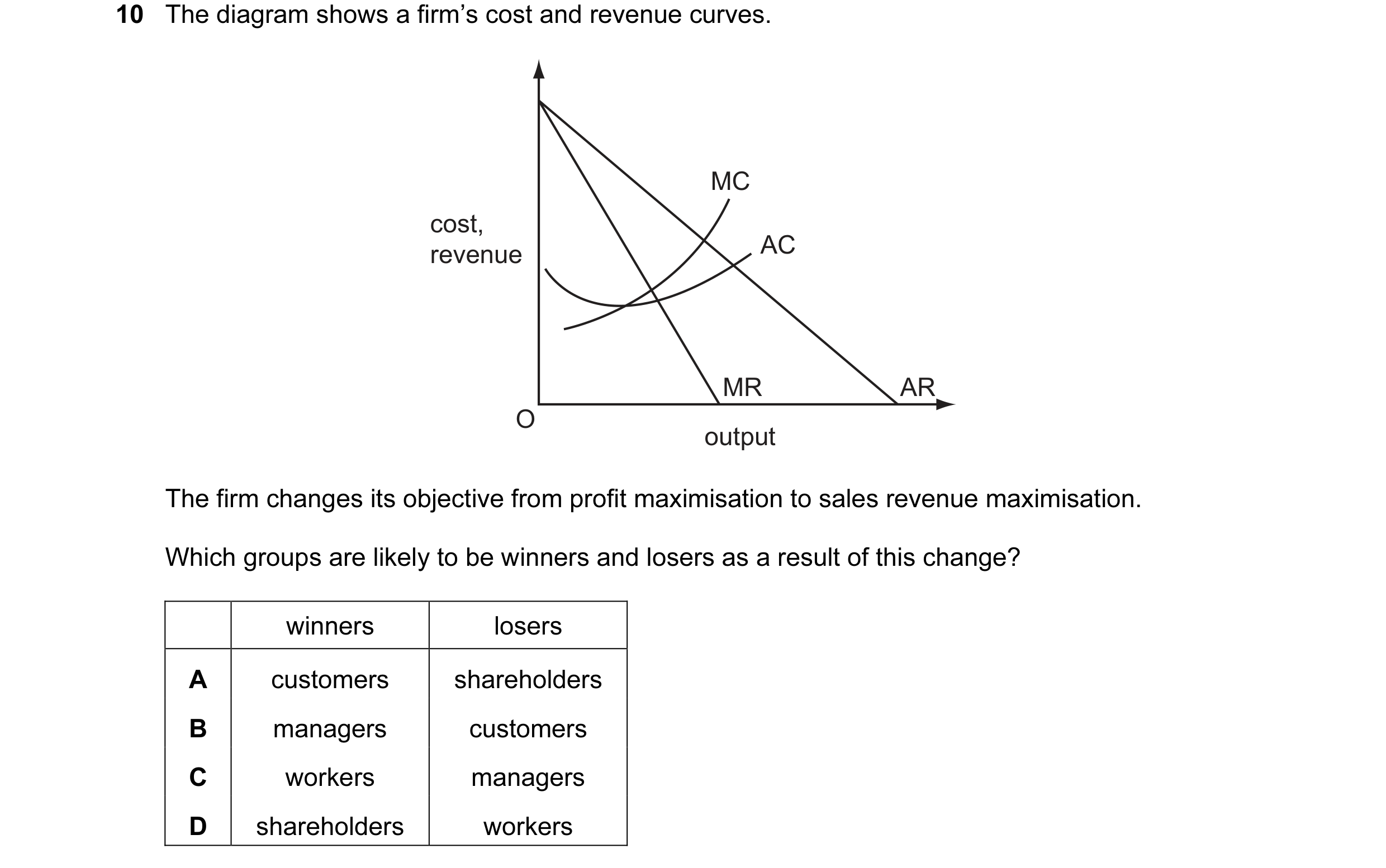
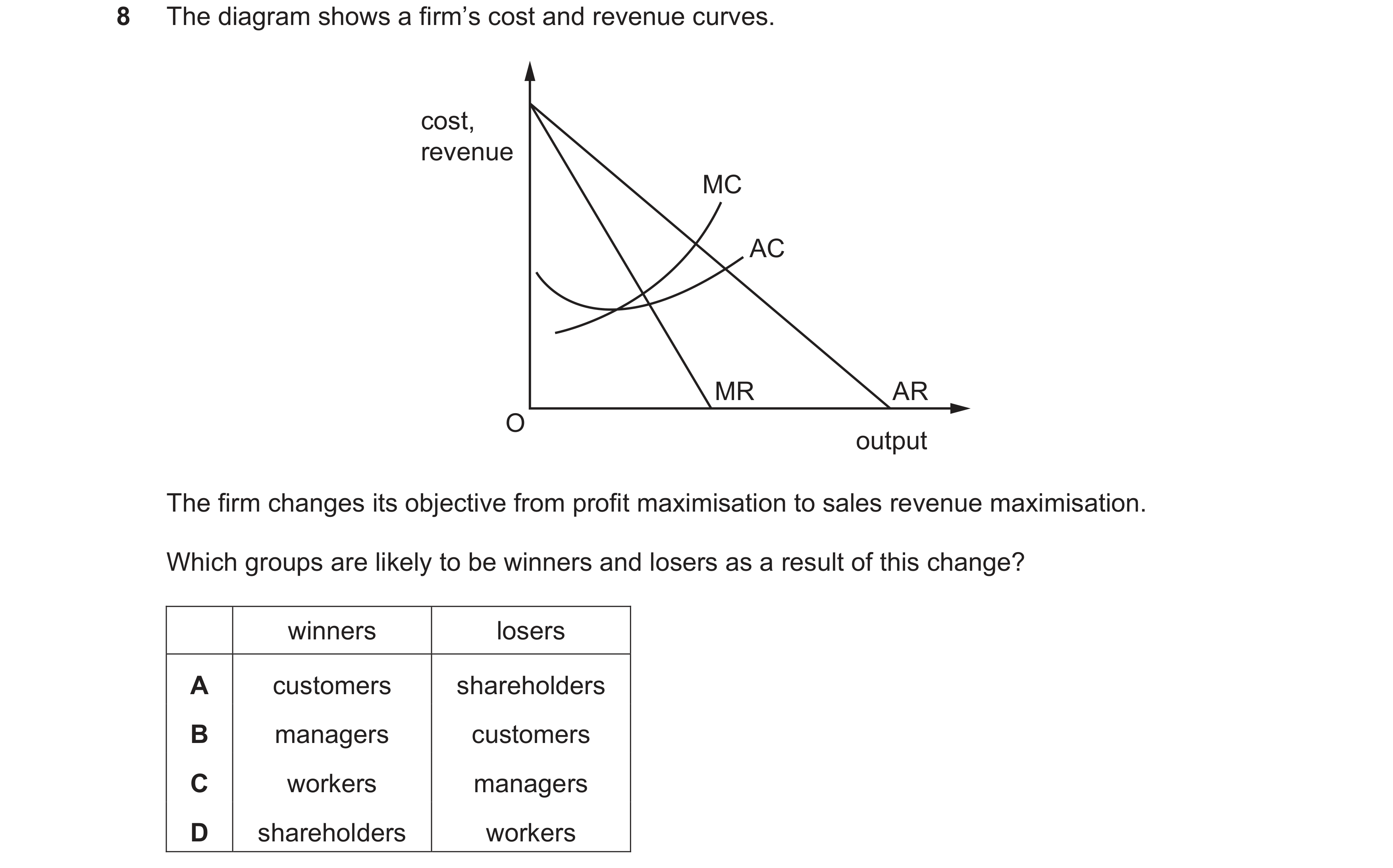
10 The diagram shows a firm’s cost and revenue curves. MC cost, revenue AC MR AR O output The firm changes its objective from profit maximisation to sales revenue maximisation. Which groups are likely to be winners and losers as a result of this change? winners losers A customers shareholders B managers customers C workers managers D shareholders workers
1 marks
Answer: A
This question in 9708/32 Oct/Nov 2013
Q18 · At its current level of output a monopolist is on the price-inelastic part of its demand… 9708/31 Oct/Nov 2014
13 At its current level of output a monopolist is on the price-inelastic part of its demand curve. What would happen to price and output if it maximised its profits? price output A decrease decrease B decrease increase C increase decrease D increase increase
1 marks
Answer: C
This question in 9708/31 Oct/Nov 2014
Q19 · The diagram shows a firm’s cost and revenue curves 9708/33 Oct/Nov 2014
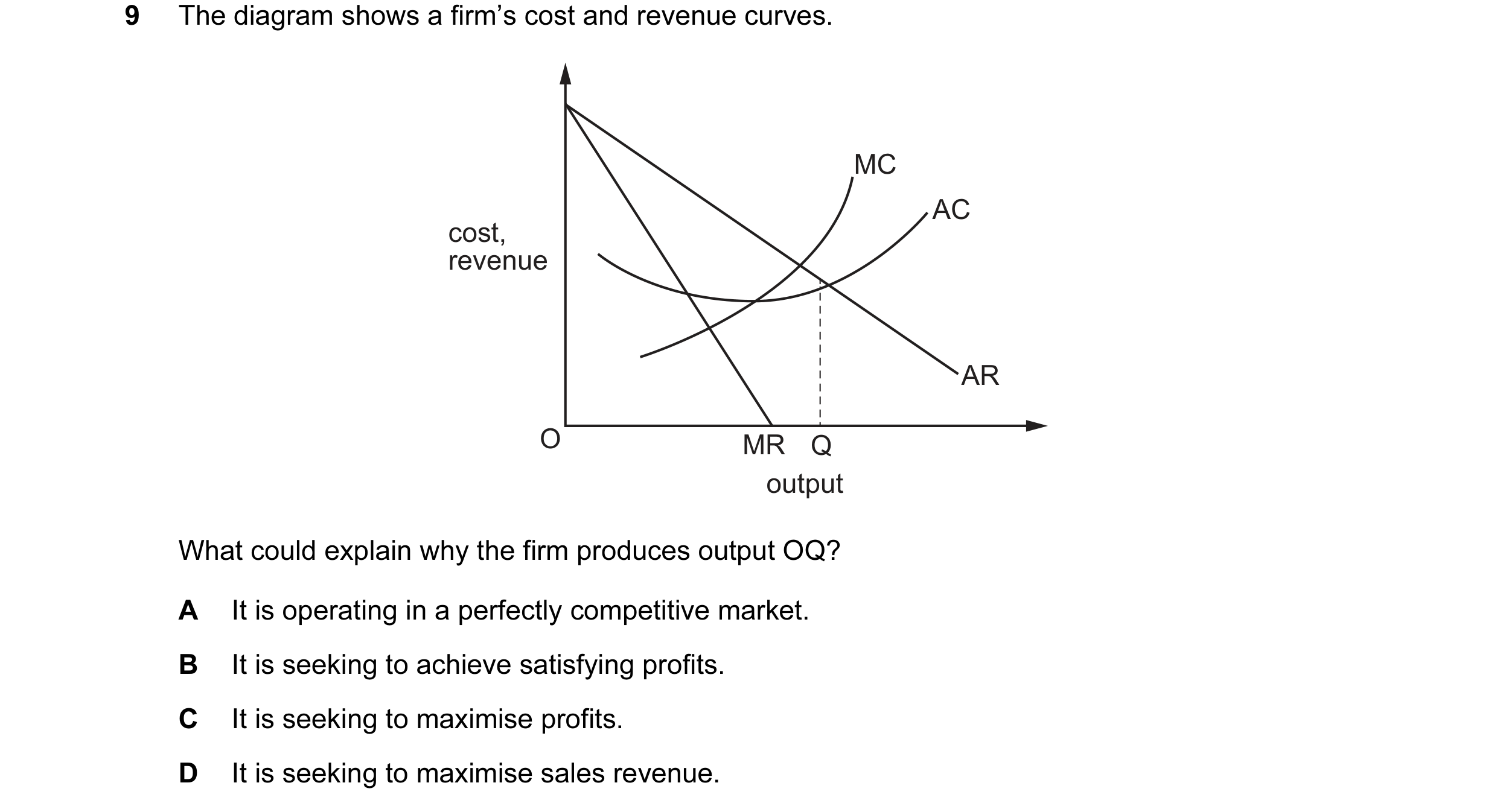
9 The diagram shows a firm’s cost and revenue curves. MC AC cost, revenue AR O MR Q output What could explain why the firm produces output OQ? A It is operating in a perfectly competitive market. B It is seeking to achieve satisfying profits. C It is seeking to maximise profits. D It is seeking to maximise sales revenue.
1 marks
Answer: B
This question in 9708/33 Oct/Nov 2014
Q20 · The table shows the total revenue and marginal cost of a firm at different levels of… 9708/33 Oct/Nov 2014
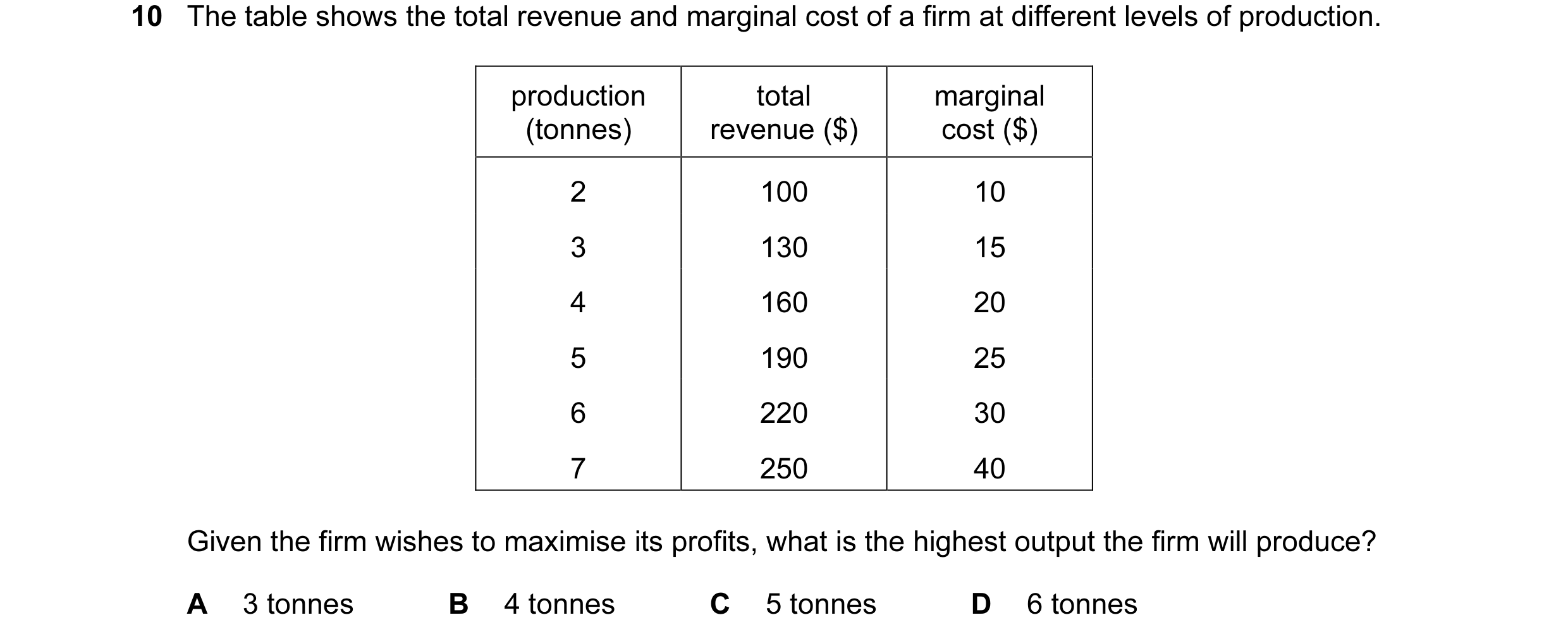
10 The table shows the total revenue and marginal cost of a firm at different levels of production. production total marginal (tonnes) revenue ($) cost ($) 2 100 10 3 130 15 4 160 20 5 190 25 6 220 30 7 250 40 Given the firm wishes to maximise its profits, what is the highest output the firm will produce? A 3 tonnes B 4 tonnes C 5 tonnes D 6 tonnes
1 marks
Answer: D
This question in 9708/33 Oct/Nov 2014
Q21 · The diagram shows the cost and revenue curves of a monopoly 9708/32 May/June 2015
12 The diagram shows the cost and revenue curves of a monopoly. MC AC cost, revenue MR AR O X output What is the firm’s objective if it produces output OX? A to achieve normal profit B to maximise profit C to maximise total revenue D to minimise average cost
1 marks
Answer: C
This question in 9708/32 May/June 2015
Q22 · The diagram shows a firm’s cost and revenue curves 9708/31 Oct/Nov 2015
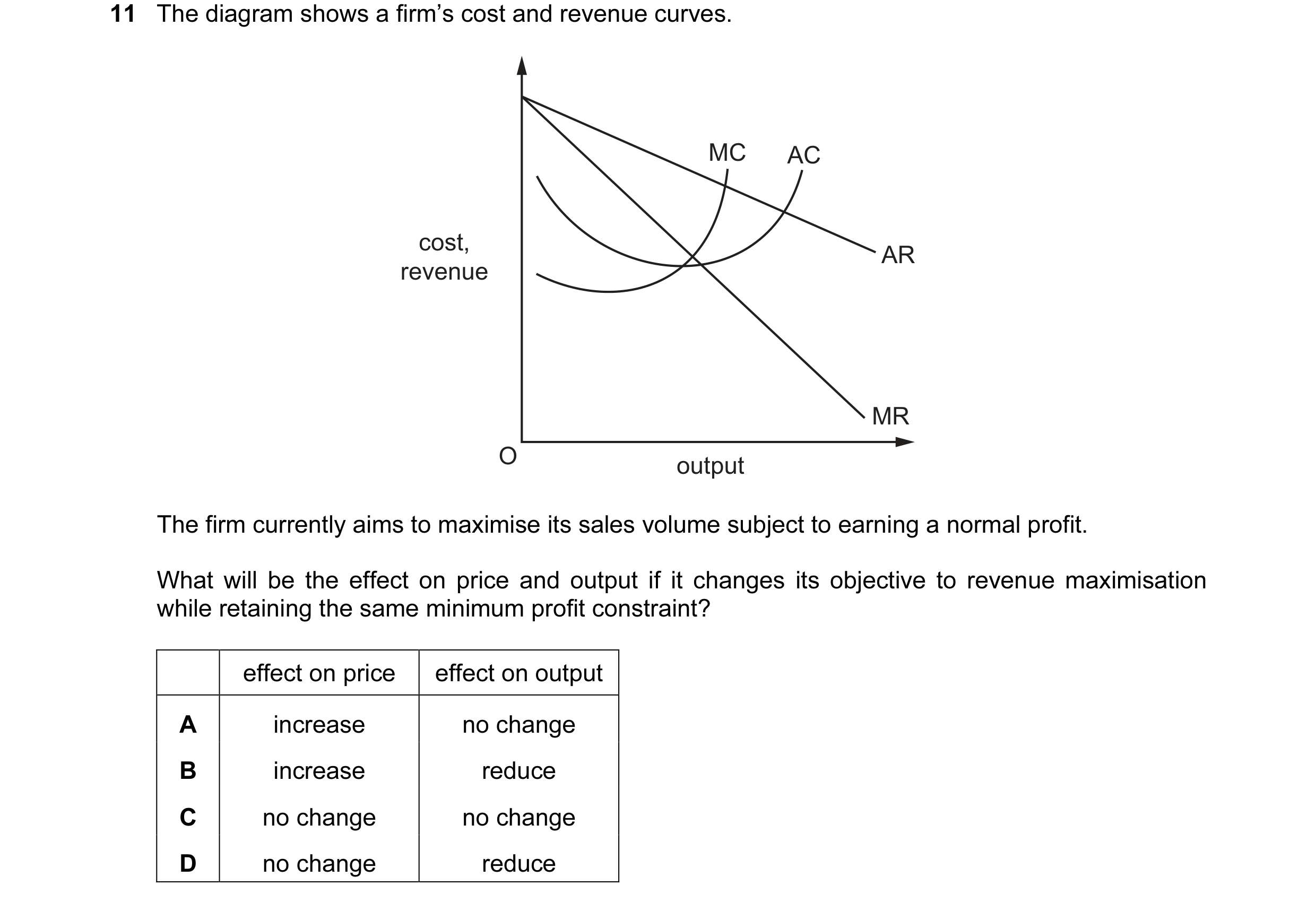
11 The diagram shows a firm’s cost and revenue curves. MC AC cost, AR revenue MR O output The firm currently aims to maximise its sales volume subject to earning a normal profit. What will be the effect on price and output if it changes its objective to revenue maximisation while retaining the same minimum profit constraint? effect on price effect on output A increase no change B increase reduce C no change no change D no change reduce
1 marks
This question in 9708/31 Oct/Nov 2015
Q23 · A firm currently pays its employees on an hourly basis 9708/32 Oct/Nov 2015
6 A firm currently pays its employees on an hourly basis. Even though the management acknowledges that its employees work to the best of their ability and could not work any harder, the firm decides to switch to a piece-rate system of remuneration whereby the wage paid to each employee depends on their level of output. Why might this new system of remuneration result in a significant improvement in labour productivity? A It will dispense with the need for management to monitor the actions of its employees. B It will increase the losses that workers will incur if they are dismissed for not working hard enough. C It will lead to the recruitment and retention of more highly talented workers. D It will strengthen the incentives for workers to increase their earnings.
1 marks
Answer: C
This question in 9708/32 Oct/Nov 2015
Q24 · A firm, operating in an imperfectly competitive market, produces at the level of output… 9708/32 Oct/Nov 2015
11 A firm, operating in an imperfectly competitive market, produces at the level of output where the price elasticity of demand for its product is equal to unity. What has the firm achieved? A normal profit B maximum profits C maximum revenue D maximum sales volume
1 marks
Answer: C
This question in 9708/32 Oct/Nov 2015
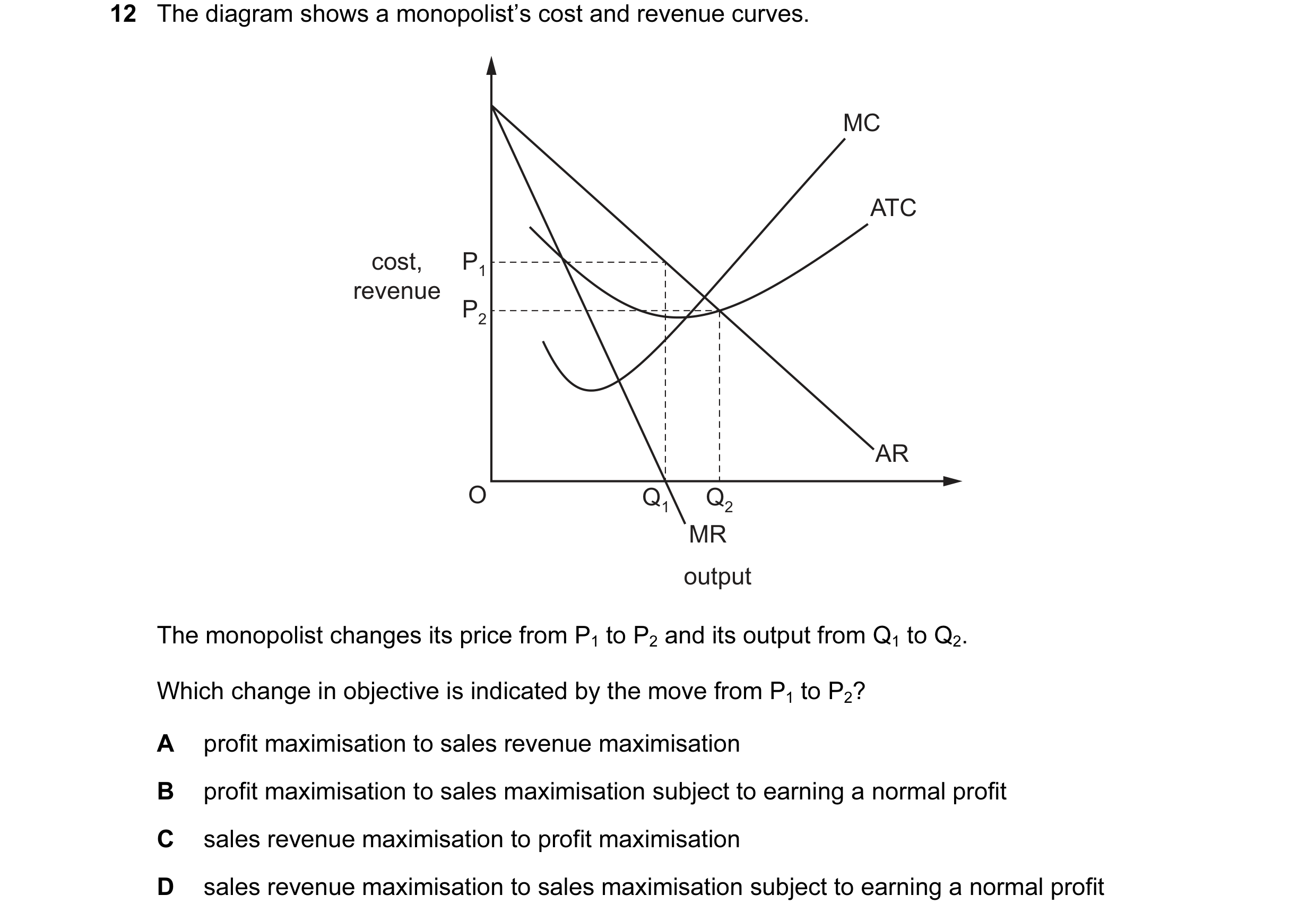
Q25 · The diagram shows a monopolist’s cost and revenue curves 9708/33 Oct/Nov 2015
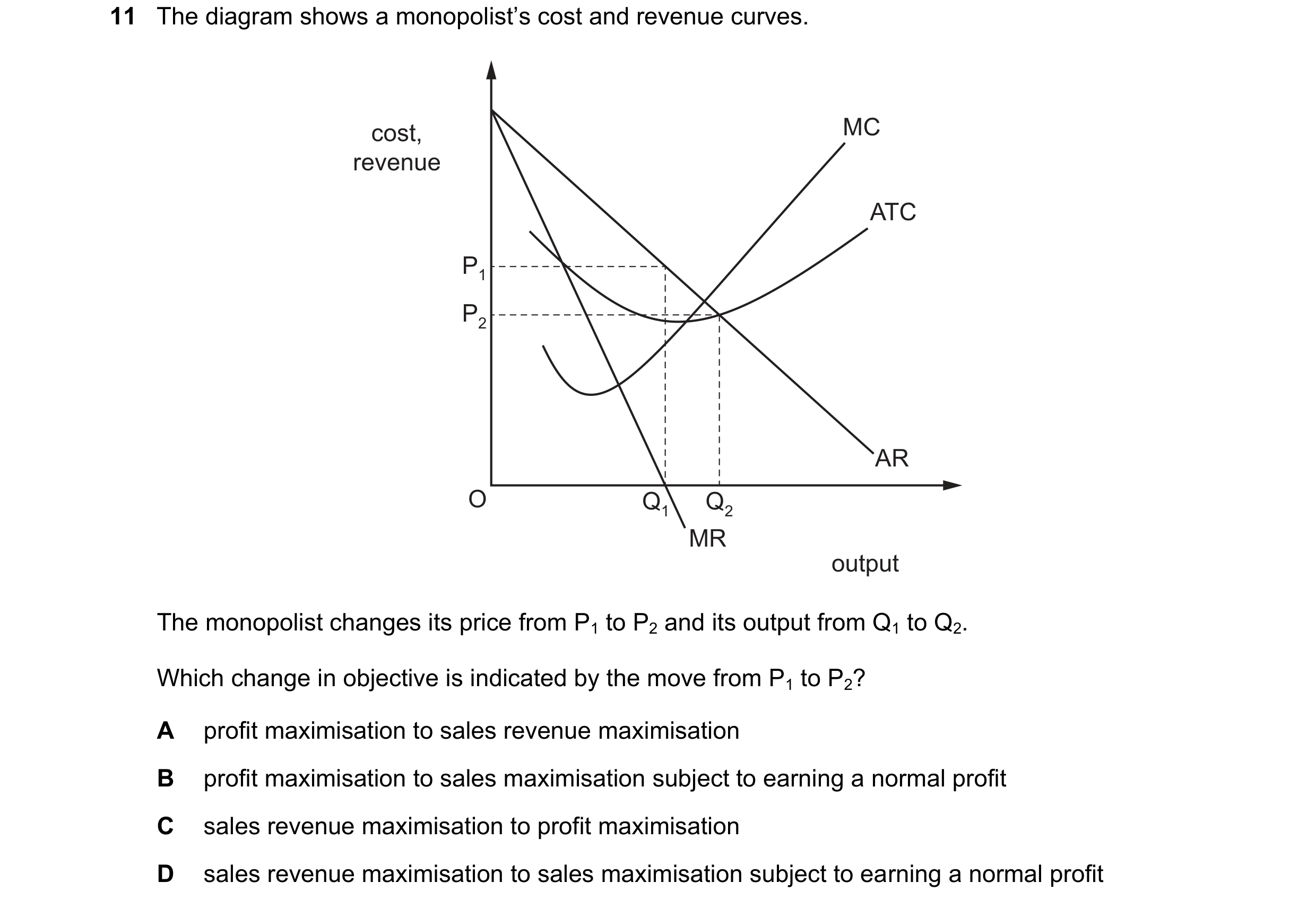
12 The diagram shows a monopolist’s cost and revenue curves. MC ATC cost, P1 revenue P2 AR O Q1 Q2 MR output The monopolist changes its price from P1 to P2 and its output from Q1 to Q2. Which change in objective is indicated by the move from P1 to P2? A profit maximisation to sales revenue maximisation B profit maximisation to sales maximisation subject to earning a normal profit C sales revenue maximisation to profit maximisation D sales revenue maximisation to sales maximisation subject to earning a normal profit
1 marks
Answer: D
This question in 9708/33 Oct/Nov 2015
Q26 · What action by a firm is most likely to raise its dynamic efficiency? 9708/32 May/June 2016
1 What action by a firm is most likely to raise its dynamic efficiency? A distributing all its current profit to its existing shareholders B maximising the labour productivity of its current workers C minimising the average cost of producing its current output D retaining its current profit for product research and development
1 marks
Answer: D
This question in 9708/32 May/June 2016
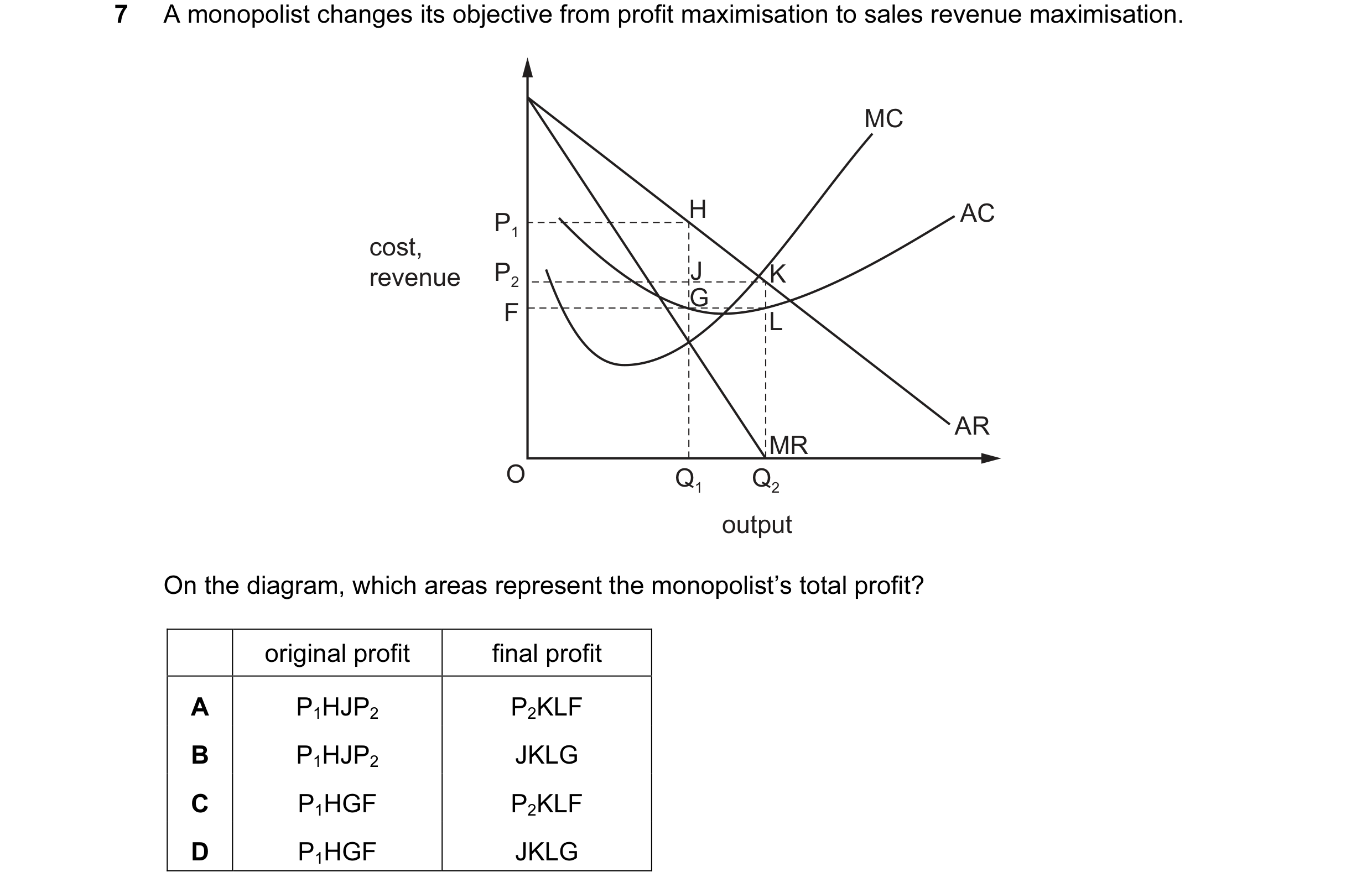
Q27 · A monopolist changes its objective from profit maximisation to sales revenue maximisation 9708/32 May/June 2016
7 A monopolist changes its objective from profit maximisation to sales revenue maximisation. MC H AC P1 cost, revenue P2 J K G F L AR MR O Q1 Q2 output On the diagram, which areas represent the monopolist’s total profit? original profit final profit A P1HJP2 P2KLF B P1HJP2 JKLG C P1HGF P2KLF D P1HGF JKLG
1 marks
Answer: C
This question in 9708/32 May/June 2016
Q28 · What is likely to have its cause in the separation of ownership and control in a firm? 9708/32 May/June 2016
13 What is likely to have its cause in the separation of ownership and control in a firm? A contestable markets B diseconomies of scale C principal-agent problem D prisoner’s dilemma
1 marks
Answer: C
This question in 9708/32 May/June 2016
Q29 · In which circumstances are a firm’s objectives most likely to differ from profit… 9708/33 May/June 2016
12 In which circumstances are a firm’s objectives most likely to differ from profit maximisation? A when a firm finances new investment largely by retained profits B where firms are companies with very active shareholders C where investment banks make takeovers easy to implement D where there are a large number of individual shareholders in a firm run by employed managers
1 marks
Answer: D
This question in 9708/33 May/June 2016
Q30 · What is an example of the principal-agent problem? 9708/33 Oct/Nov 2016
9 What is an example of the principal-agent problem? A the disincentive effect for entrepreneurs of high government tax rates B the existence of a trade union to put forward workers’ views to managers C the lack of consumer knowledge of the quality of firms’ products D the separation of the owners of a firm from the firm’s managers
1 marks
Answer: D
This question in 9708/33 Oct/Nov 2016
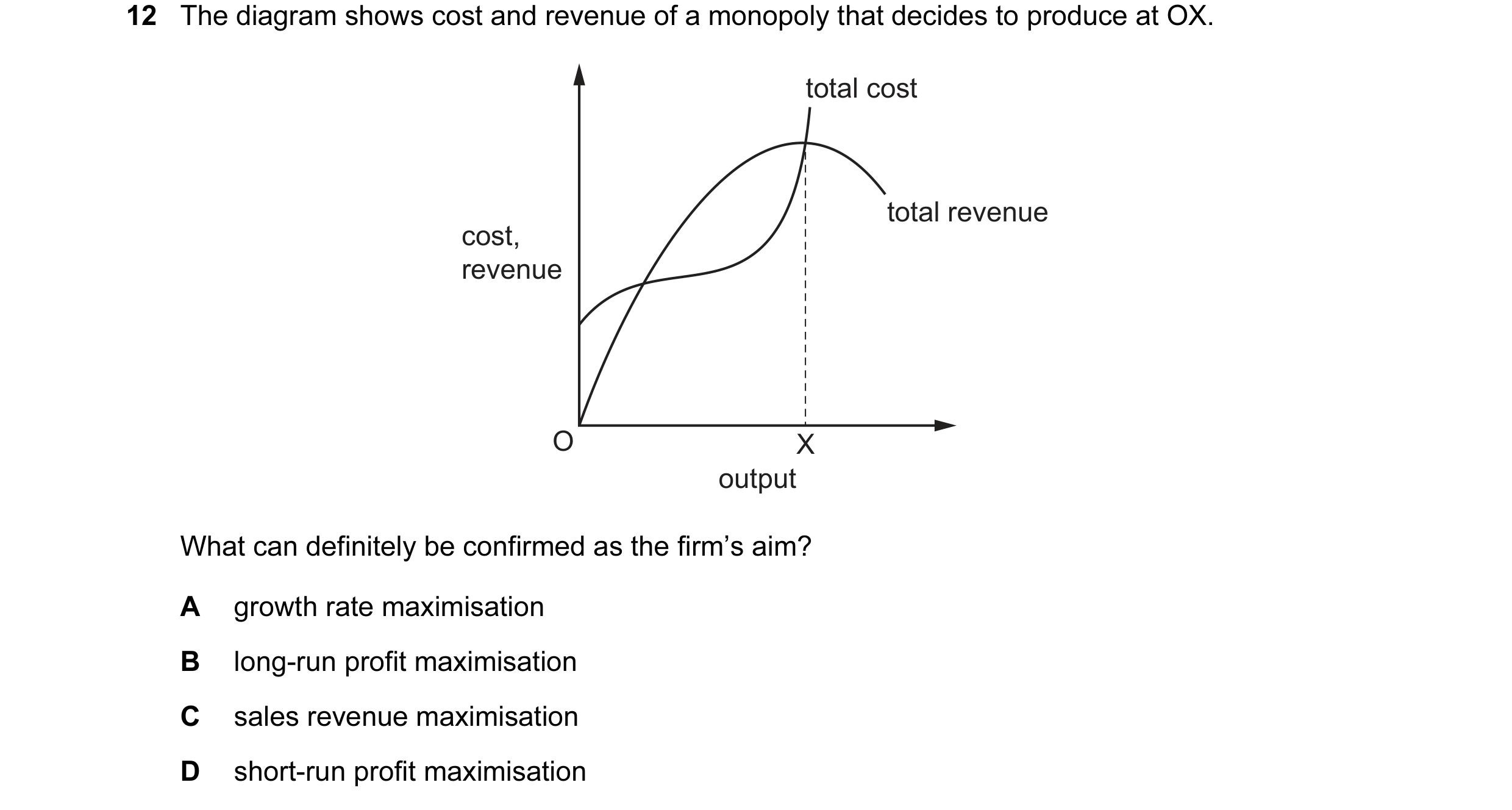
Q31 · The diagram shows cost and revenue of a monopoly that decides to produce at OX 9708/33 Oct/Nov 2016
12 The diagram shows cost and revenue of a monopoly that decides to produce at OX. total cost total revenue cost, revenue O X output What can definitely be confirmed as the firm’s aim? A growth rate maximisation B long-run profit maximisation C sales revenue maximisation D short-run profit maximisation
1 marks
Answer: C
This question in 9708/33 Oct/Nov 2016
Q32 · The diagram shows a firm’s cost and revenue curves 9708/32 May/June 2017
8 The diagram shows a firm’s cost and revenue curves. cost, revenue MC AC MR AR O output The firm changes its objective from profit maximisation to sales revenue maximisation. Which groups are likely to be winners and losers as a result of this change? winners losers A customers shareholders B managers customers C workers managers D shareholders workers
1 marks
Answer: A
This question in 9708/32 May/June 2017
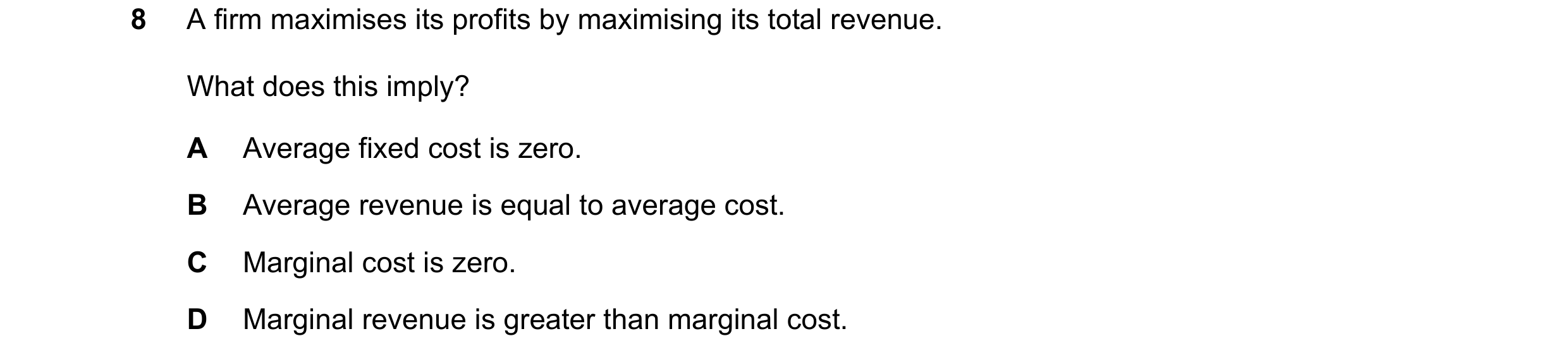
Q33 · A firm maximises its profits by maximising its total revenue 9708/32 Oct/Nov 2018
8 A firm maximises its profits by maximising its total revenue. What does this imply? A Average fixed cost is zero. B Average revenue is equal to average cost. C Marginal cost is zero. D Marginal revenue is greater than marginal cost.
1 marks
Answer: C
This question in 9708/32 Oct/Nov 2018
Q34 · What is the implication of a dominant oligopoly following a limit pricing policy? 9708/32 Oct/Nov 2018
12 What is the implication of a dominant oligopoly following a limit pricing policy? A The industry will be restricted to a target number of firms. B The industry will contract as rival oligopolists are eliminated. C The oligopolist will achieve a satisficing level of profit. D The oligopolist will sacrifice short-term profit for long-term profit.
1 marks
Answer: D
This question in 9708/32 Oct/Nov 2018
Q35 · The diagram shows a profit-maximising monopolist 9708/32 Feb/March 2019
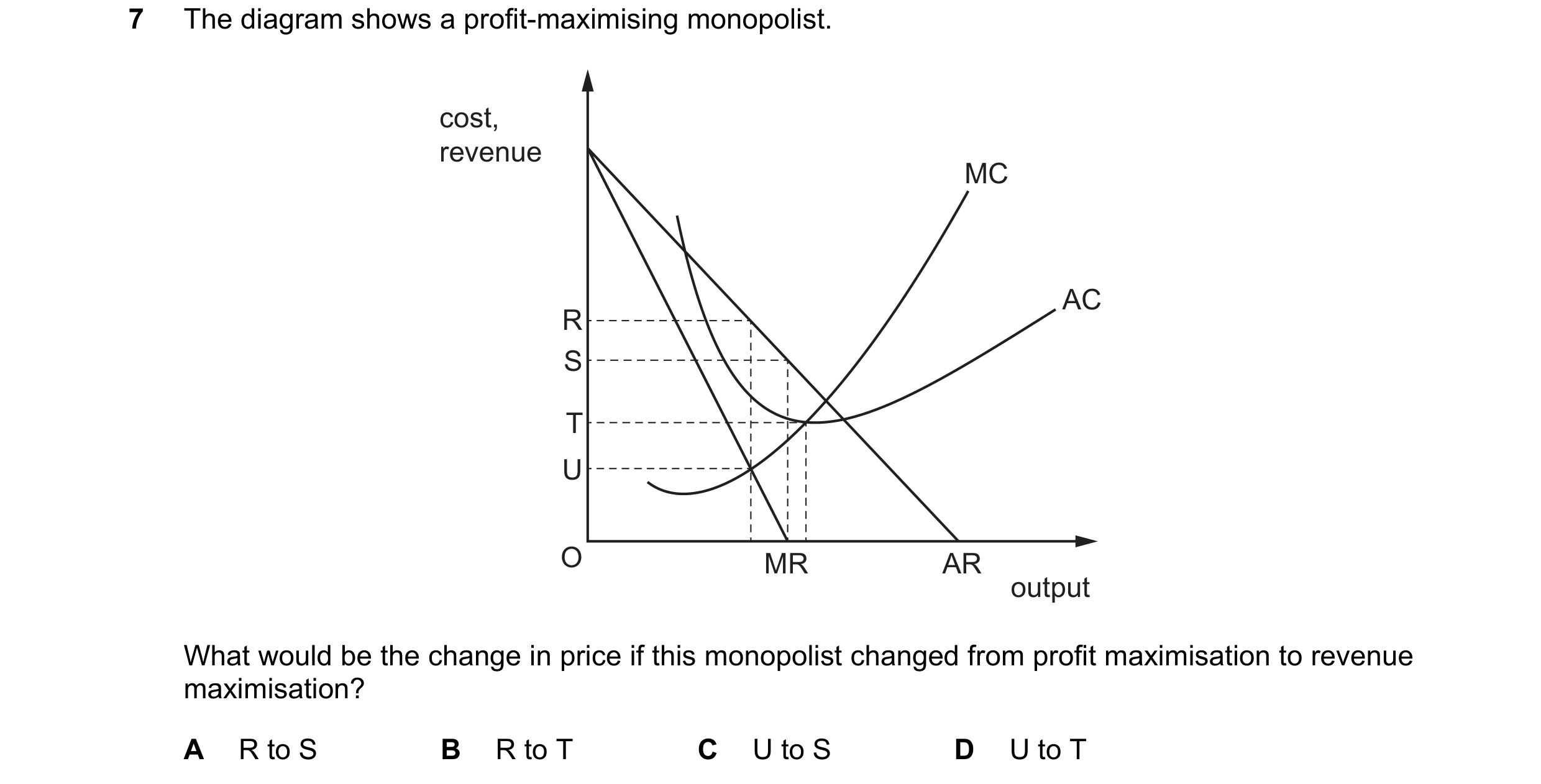
7 The diagram shows a profit-maximising monopolist. cost, revenue MC AC R S T U O MR AR output What would be the change in price if this monopolist changed from profit maximisation to revenue maximisation? A R to S B R to T C U to S D U to T
1 marks
Answer: A
This question in 9708/32 Feb/March 2019
Q36 · The goal of firm X is to make a minimum acceptable level of profit 9708/32 Feb/March 2019
8 The goal of firm X is to make a minimum acceptable level of profit. What does this describe? A profit maximisation B profit satisficing C revenue maximisation D sales maximisation
1 marks
Answer: B
This question in 9708/32 Feb/March 2019
Q37 · A firm has the choice between five levels of output 9708/32 Oct/Nov 2019
8 A firm has the choice between five levels of output. The table shows the total cost and total revenue of producing at each output level. The firm could sell whatever output it produces. output total cost total revenue (units) ($) ($) 1000 8 000 10 000 2000 12 000 18 000 3000 19 000 24 000 4000 23 000 28 000 5000 25 000 25 000 The firm decides to produce 4000 units. What is the firm’s aim? A to maximise profit B to maximise sales C to maximise revenue D to minimise average costs
1 marks
Answer: C
This question in 9708/32 Oct/Nov 2019
Q38 · What is generally associated with the principal-agent problem? 9708/32 Oct/Nov 2019
12 What is generally associated with the principal-agent problem? A Directors prefer company growth to greater shareholder dividends. B Managers ignore workers’ concerns about safety in the workplace. C Shareholders determine the price of products. D Workers go on strike against managers’ reorganisation plans.
1 marks
Answer: A
This question in 9708/32 Oct/Nov 2019
Q39 · The diagram shows the costs and revenues of a firm that is producing output Qe with a… 9708/31 Oct/Nov 2020
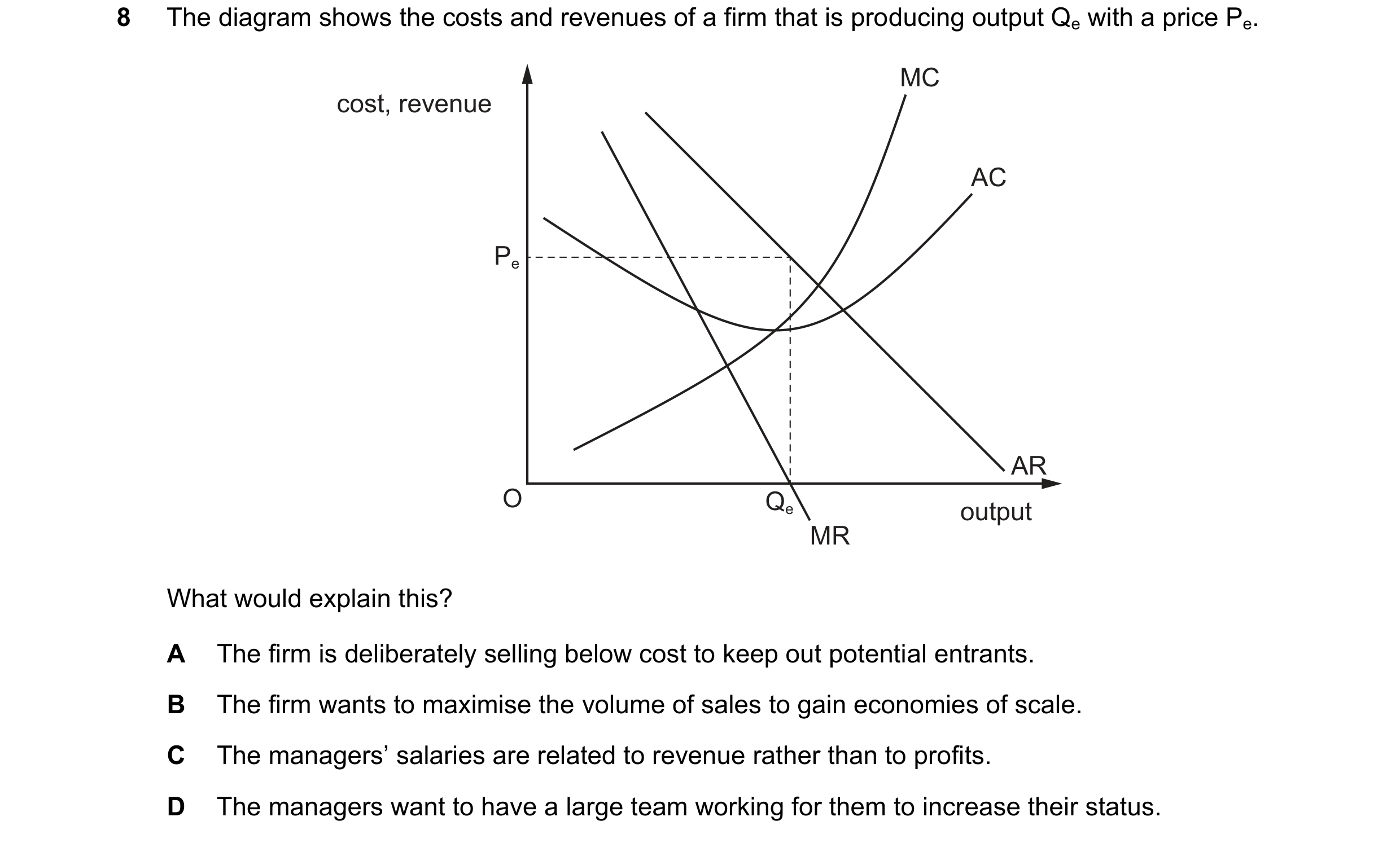
8 The diagram shows the costs and revenues of a firm that is producing output Qe with a price Pe. MC cost, revenue AC Pe AR O Qe output MR What would explain this? A The firm is deliberately selling below cost to keep out potential entrants. B The firm wants to maximise the volume of sales to gain economies of scale. C The managers’ salaries are related to revenue rather than to profits. D The managers want to have a large team working for them to increase their status.
1 marks
Answer: C
This question in 9708/31 Oct/Nov 2020
Q40 · The diagram shows the cost and revenue curves of a monopolist 9708/32 Oct/Nov 2020
11 The diagram shows the cost and revenue curves of a monopolist. price MC AC P1 AR O Q1 quantity MR What would be the aim of the firm if it chose to produce at Q1P1? A revenue maximisation B profit maximisation C sales maximisation D growth maximisation
1 marks
Answer: A
This question in 9708/32 Oct/Nov 2020
Q41 · What is the essential feature of nudge theory? 9708/32 Oct/Nov 2020
13 What is the essential feature of nudge theory? A the aim of satisficing B the establishing of a legal requirement C the existence of a contestable market D the idea of persuasion
1 marks
Answer: D
This question in 9708/32 Oct/Nov 2020
Q42 · The diagram shows the costs and revenues of a profit-maximising cartel 9708/33 Oct/Nov 2020
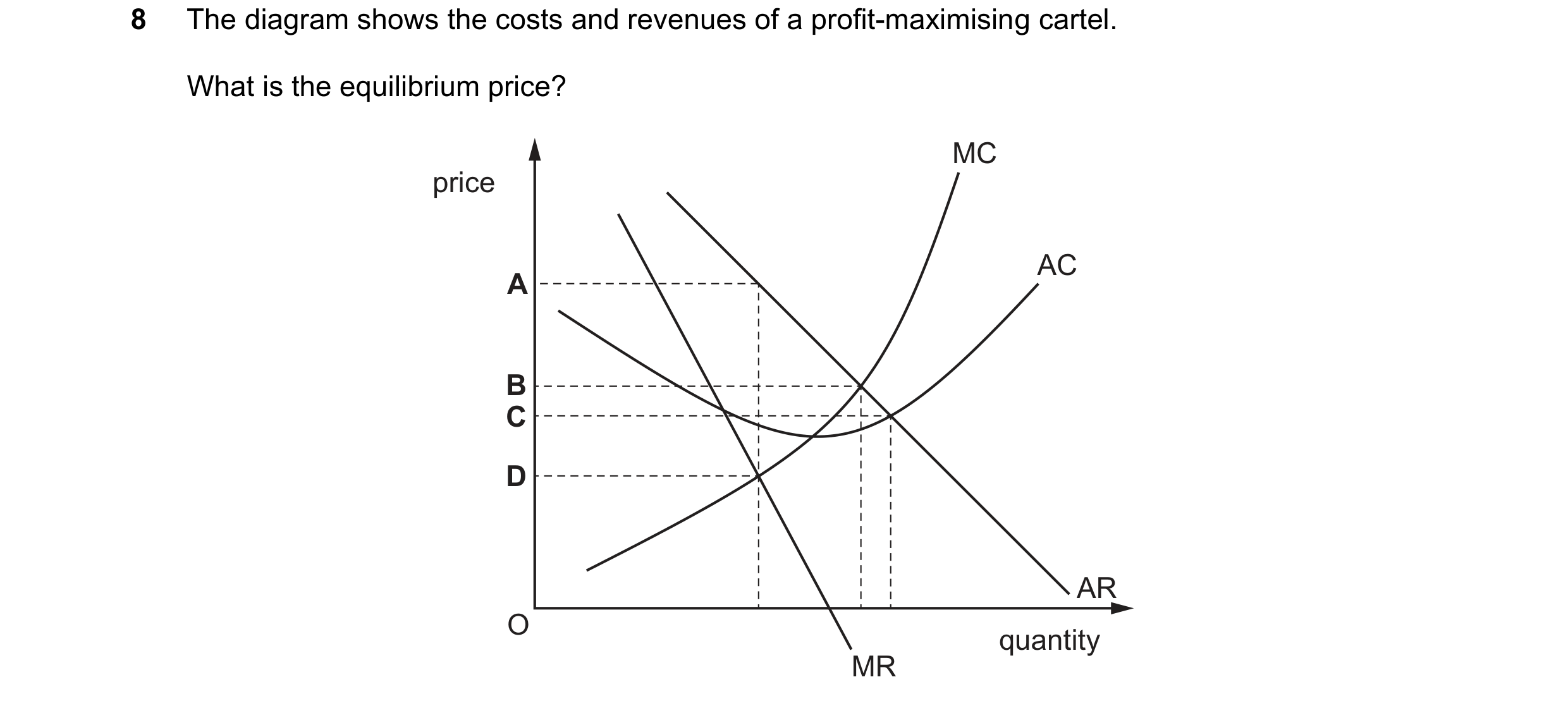
8 The diagram shows the costs and revenues of a profit-maximising cartel. What is the equilibrium price? MC price AC A B C D AR O quantity MR
1 marks
Answer: A
This question in 9708/33 Oct/Nov 2020
Q43 · Which objective involves the managers of a firm operating with just enough profit to keep… 9708/33 Oct/Nov 2020
12 Which objective involves the managers of a firm operating with just enough profit to keep shareholders happy whilst maintaining sales revenue above its profit-maximising level? A achieving below normal profit B maximising the quality of the output C profit satisficing D sales revenue maximisation
1 marks
Answer: C
This question in 9708/33 Oct/Nov 2020
Q44 · The diagram shows a monopolist’s cost and revenue curves 9708/32 Feb/March 2021
11 The diagram shows a monopolist’s cost and revenue curves. cost, MC revenue ATC P1 P2 AR O Q1 Q2 MR output The monopolist changes its price from P1 to P2 and its output from Q1 to Q2. Which change in objective is indicated by the move from P1 to P2? A profit maximisation to sales revenue maximisation B profit maximisation to sales maximisation subject to earning a normal profit C sales revenue maximisation to profit maximisation D sales revenue maximisation to sales maximisation subject to earning a normal profit
1 marks
Answer: D
This question in 9708/32 Feb/March 2021
Q45 · What identifies the output level required to meet the stated aim of a monopoly firm? 9708/31 May/June 2021
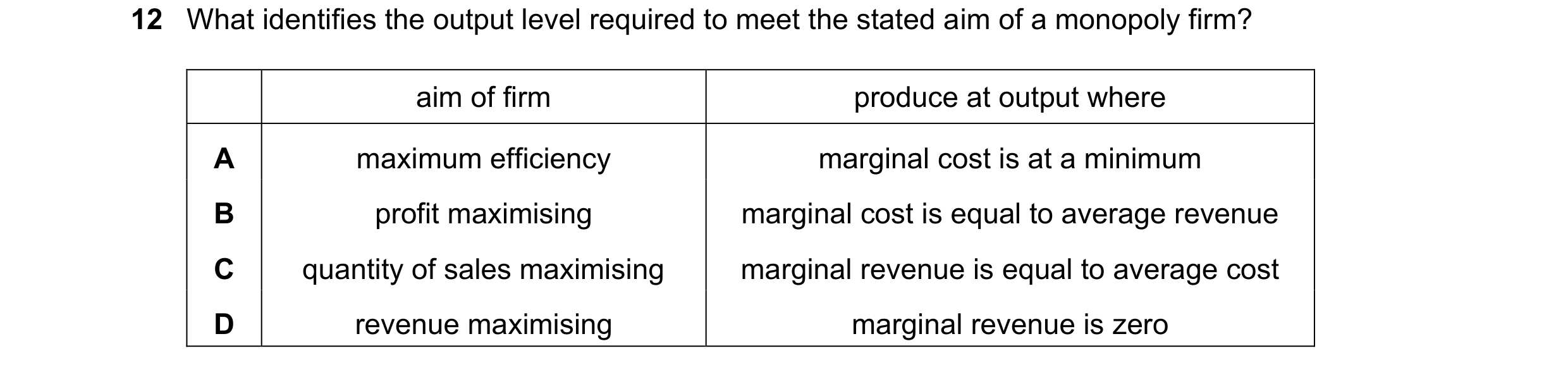
12 What identifies the output level required to meet the stated aim of a monopoly firm? aim of firm produce at output where A maximum efficiency marginal cost is at a minimum B profit maximising marginal cost is equal to average revenue C quantity of sales maximising marginal revenue is equal to average cost D revenue maximising marginal revenue is zero
1 marks
Answer: D
This question in 9708/31 May/June 2021
Q46 · Which statement about a monopoly is correct? 9708/32 May/June 2021
6 Which statement about a monopoly is correct? A Profit maximisation occurs when average cost equals average revenue. B Sales maximisation occurs when marginal cost equals marginal revenue. C Sales revenue maximisation occurs when marginal revenue is equal to zero. D Satisficing occurs when marginal cost is equal to zero.
1 marks
Answer: C
This question in 9708/32 May/June 2021
Q47 · The diagram shows a firm in imperfect competition 9708/32 May/June 2021
12 The diagram shows a firm in imperfect competition. It changed its aim from profit maximising to sales revenue maximising. cost, MC revenue AC AR MR O output Which type of profit was it making in each case? profit sales revenue maximising maximising A normal profit supernormal profit B subnormal profit normal profit C supernormal profit normal profit D supernormal profit supernormal profit
1 marks
Answer: D
This question in 9708/32 May/June 2021
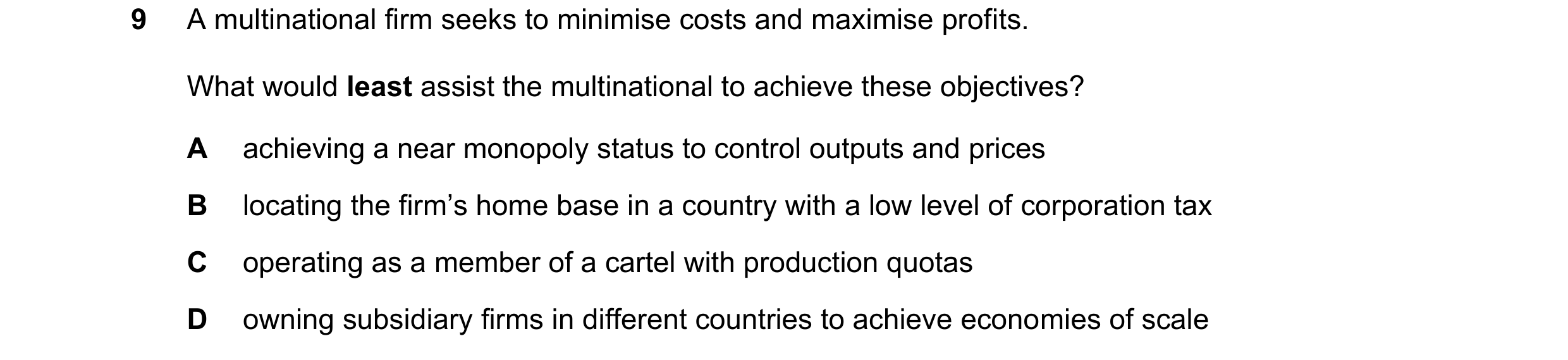
Q48 · A multinational firm seeks to minimise costs and maximise profits 9708/31 Oct/Nov 2021
9 A multinational firm seeks to minimise costs and maximise profits. What would least assist the multinational to achieve these objectives? A achieving a near monopoly status to control outputs and prices B locating the firm’s home base in a country with a low level of corporation tax C operating as a member of a cartel with production quotas D owning subsidiary firms in different countries to achieve economies of scale
1 marks
Answer: C
This question in 9708/31 Oct/Nov 2021
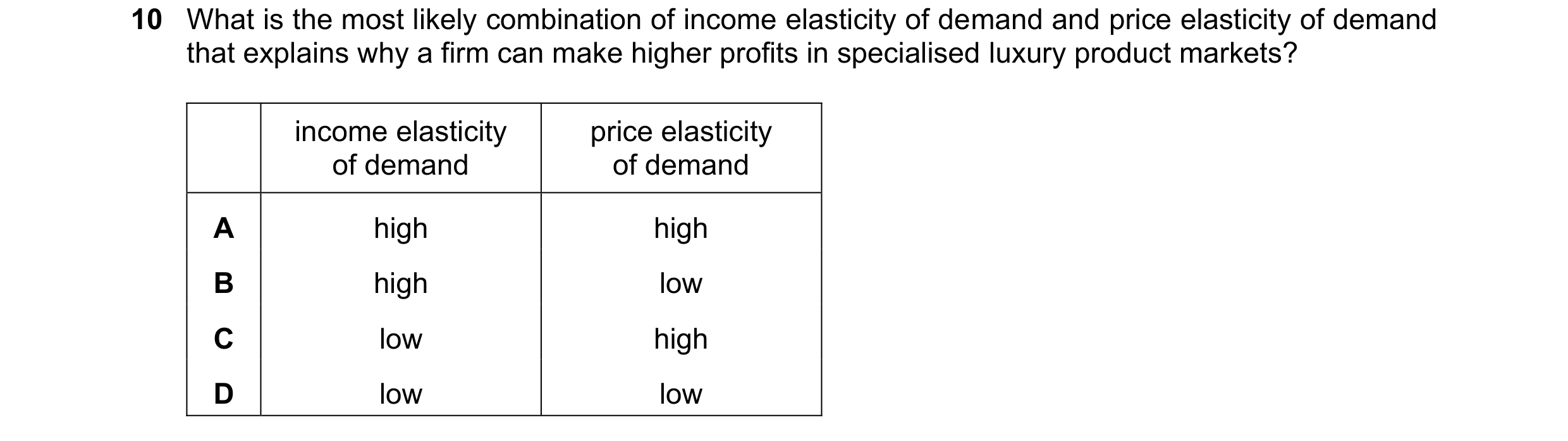
Q49 · What is the most likely combination of income elasticity of demand and price elasticity… 9708/31 Oct/Nov 2021
10 What is the most likely combination of income elasticity of demand and price elasticity of demand that explains why a firm can make higher profits in specialised luxury product markets? income elasticity price elasticity of demand of demand A high high B high low C low high D low low
1 marks
Answer: B
This question in 9708/31 Oct/Nov 2021
Q50 · The diagram shows a firm’s cost and revenue curves 9708/31 Oct/Nov 2021
11 The diagram shows a firm’s cost and revenue curves. cost, revenue MC AC AR MR O output The firm embarks on a single successful $100 million advertising campaign. How will this affect its costs and revenue curves? MR curve AR curve MC curve AC curve A shifts to right shifts to right shifts up unchanged B shifts to right shifts to right unchanged shifts up C unchanged unchanged shifts up unchanged D unchanged unchanged unchanged shifts up
1 marks
Answer: B
This question in 9708/31 Oct/Nov 2021
Q51 · In which circumstances are a firm’s objectives most likely to differ from profit… 9708/31 Oct/Nov 2021
12 In which circumstances are a firm’s objectives most likely to differ from profit maximisation? A when a firm finances new investment largely by retained profits B where firms are companies with very active shareholders C where investment banks make takeovers easy to implement D when a firm has many shareholders and is managed by employees
1 marks
Answer: D
This question in 9708/31 Oct/Nov 2021
Q52 · A firm maximises its profits by maximising its total revenue 9708/32 Oct/Nov 2021
8 A firm maximises its profits by maximising its total revenue. What does this imply? A Average fixed cost is zero. B Average revenue is equal to average cost. C Marginal cost is zero. D Marginal revenue is greater than marginal cost.
1 marks
Answer: C
This question in 9708/32 Oct/Nov 2021
Q53 · What is an example of the principal–agent problem? 9708/32 Oct/Nov 2021
11 What is an example of the principal–agent problem? A the disincentive effect for entrepreneurs of high government tax rates B the existence of a trade union to put forward workers’ views to managers C the lack of consumer knowledge of the quality of firms’ products D the separation of the owners of a firm from the firm’s managers
1 marks
Answer: D
This question in 9708/32 Oct/Nov 2021
Q54 · The diagram shows a firm in imperfect competition 9708/32 Oct/Nov 2021
12 The diagram shows a firm in imperfect competition. MR AR = D MC AC $ O R S T U quantity It changes its objective from profit maximisation to revenue maximisation. What effect will this have on the firm’s output? A decreases from T to R B decreases from U to T C increases from S to T D increases from S to U
1 marks
Answer: C
This question in 9708/32 Oct/Nov 2021
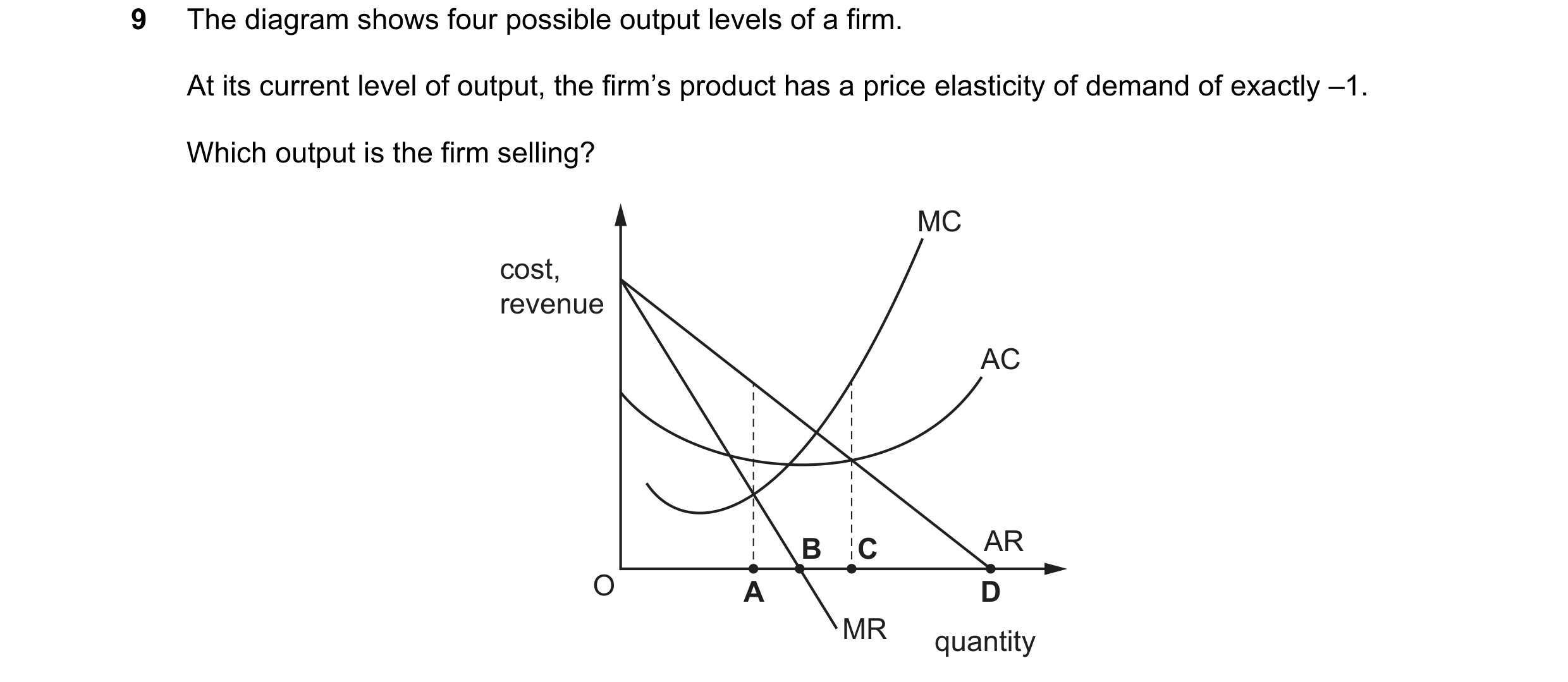
Q55 · The diagram shows four possible output levels of a firm 9708/31 Oct/Nov 2022
9 The diagram shows four possible output levels of a firm. At its current level of output, the firm’s product has a price elasticity of demand of exactly –1. Which output is the firm selling? MC cost, revenue AC B C AR O A D MR quantity
1 marks
Answer: B
This question in 9708/31 Oct/Nov 2022
Q56 · The diagram shows a firm in an imperfectly competitive market 9708/32 Oct/Nov 2022
7 The diagram shows a firm in an imperfectly competitive market. Which level of output would maximise total revenue? AR price $ MR MC AC O A B C D output
1 marks
Answer: B
This question in 9708/32 Oct/Nov 2022
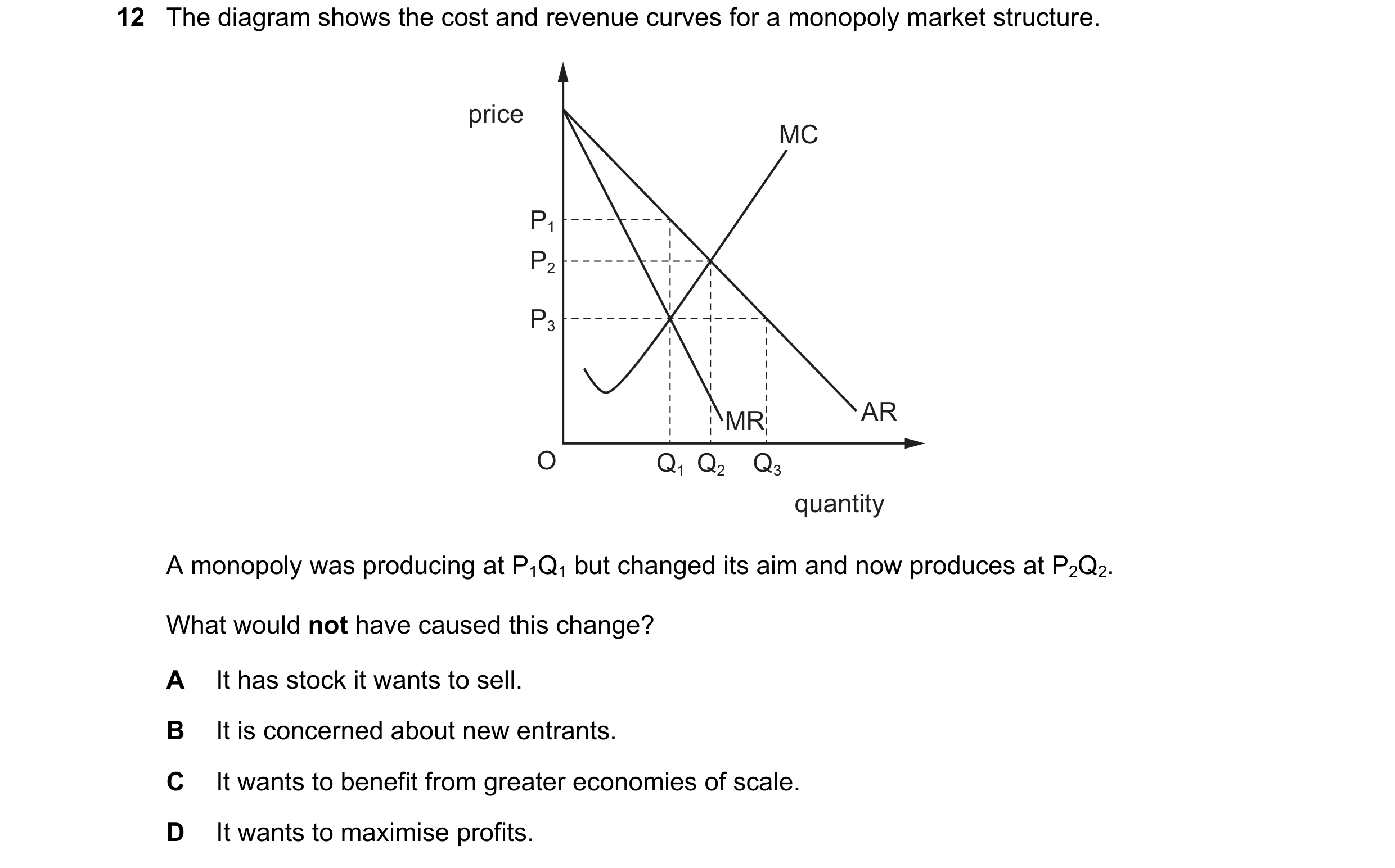
Q57 · The diagram shows the cost and revenue curves for a monopoly market structure 9708/33 Oct/Nov 2022
12 The diagram shows the cost and revenue curves for a monopoly market structure. price MC P1 P2 P3 MR AR O Q1 Q2 Q3 quantity A monopoly was producing at P1Q1 but changed its aim and now produces at P2Q2. What would not have caused this change? A It has stock it wants to sell. B It is concerned about new entrants. C It wants to benefit from greater economies of scale. D It wants to maximise profits.
1 marks
Answer: D
This question in 9708/33 Oct/Nov 2022
Q58 · At which level of output is sales maximisation achieved consistent with earning normal… 9708/32 Feb/March 2023
5 At which level of output is sales maximisation achieved consistent with earning normal profit? MC cost or price AC $ MR AR O A B C D quantity
1 marks
Answer: D
This question in 9708/32 Feb/March 2023
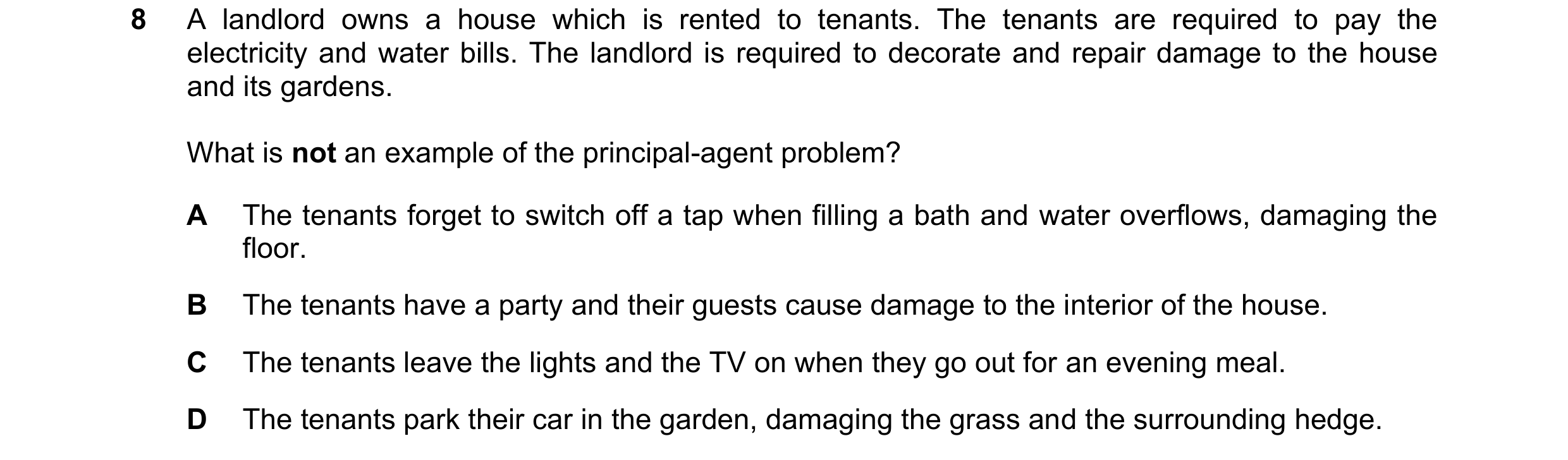
Q59 · A landlord owns a house which is rented to tenants 9708/32 Feb/March 2023
8 A landlord owns a house which is rented to tenants. The tenants are required to pay the electricity and water bills. The landlord is required to decorate and repair damage to the house and its gardens. What is not an example of the principal-agent problem? A The tenants forget to switch off a tap when filling a bath and water overflows, damaging the floor. B The tenants have a party and their guests cause damage to the interior of the house. C The tenants leave the lights and the TV on when they go out for an evening meal. D The tenants park their car in the garden, damaging the grass and the surrounding hedge.
1 marks
Answer: C
This question in 9708/32 Feb/March 2023
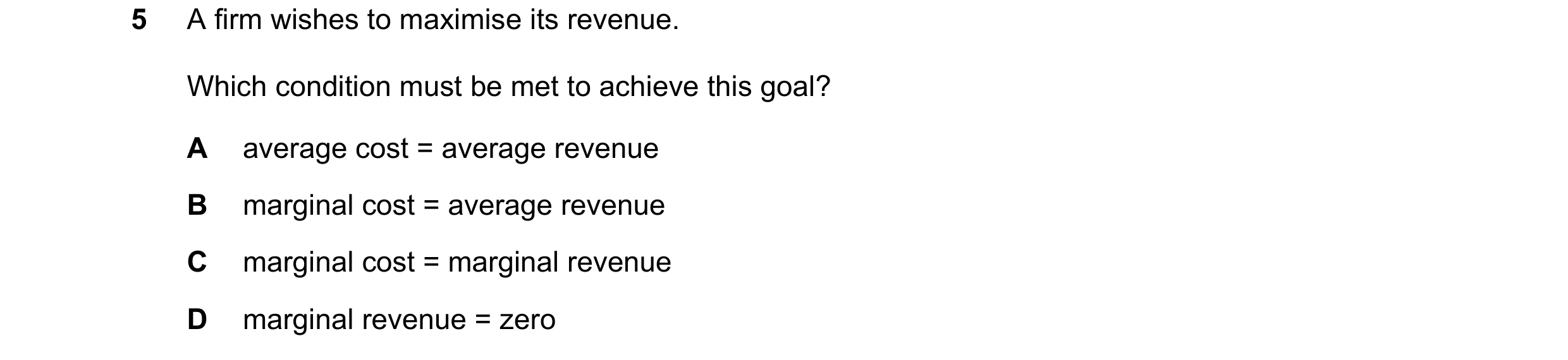
Q60 · A firm wishes to maximise its revenue 9708/31 May/June 2023
5 A firm wishes to maximise its revenue. Which condition must be met to achieve this goal? A average cost = average revenue B marginal cost = average revenue C marginal cost = marginal revenue D marginal revenue = zero
1 marks
Answer: D
This question in 9708/31 May/June 2023
Q61 · What would definitely result from the divorce of ownership and control? 9708/31 May/June 2023
11 What would definitely result from the divorce of ownership and control? A decreased moral hazard B the principal agent problem C greater productive efficiency D increased profit maximisation
1 marks
Answer: B
This question in 9708/31 May/June 2023
Q62 · A firm wishes to maximise its revenue 9708/33 May/June 2023
5 A firm wishes to maximise its revenue. Which condition must be met to achieve this goal? A average cost = average revenue B marginal cost = average revenue C marginal cost = marginal revenue D marginal revenue = zero
1 marks
Answer: D
This question in 9708/33 May/June 2023
Q63 · What would definitely result from the divorce of ownership and control? 9708/33 May/June 2023
11 What would definitely result from the divorce of ownership and control? A decreased moral hazard B the principal agent problem C greater productive efficiency D increased profit maximisation
1 marks
Answer: B
This question in 9708/33 May/June 2023
Q64 · What is most likely to increase the principal–agent problem? 9708/33 Oct/Nov 2023
3 What is most likely to increase the principal–agent problem? A ensuring the actions of agents are known by the managers B linking the rewards of managers with the profitability of the firm C removing from managers the opportunity to hold shares D preparing contracts that compel agents to work in the interest of the principal
1 marks
Answer: C
This question in 9708/33 Oct/Nov 2023
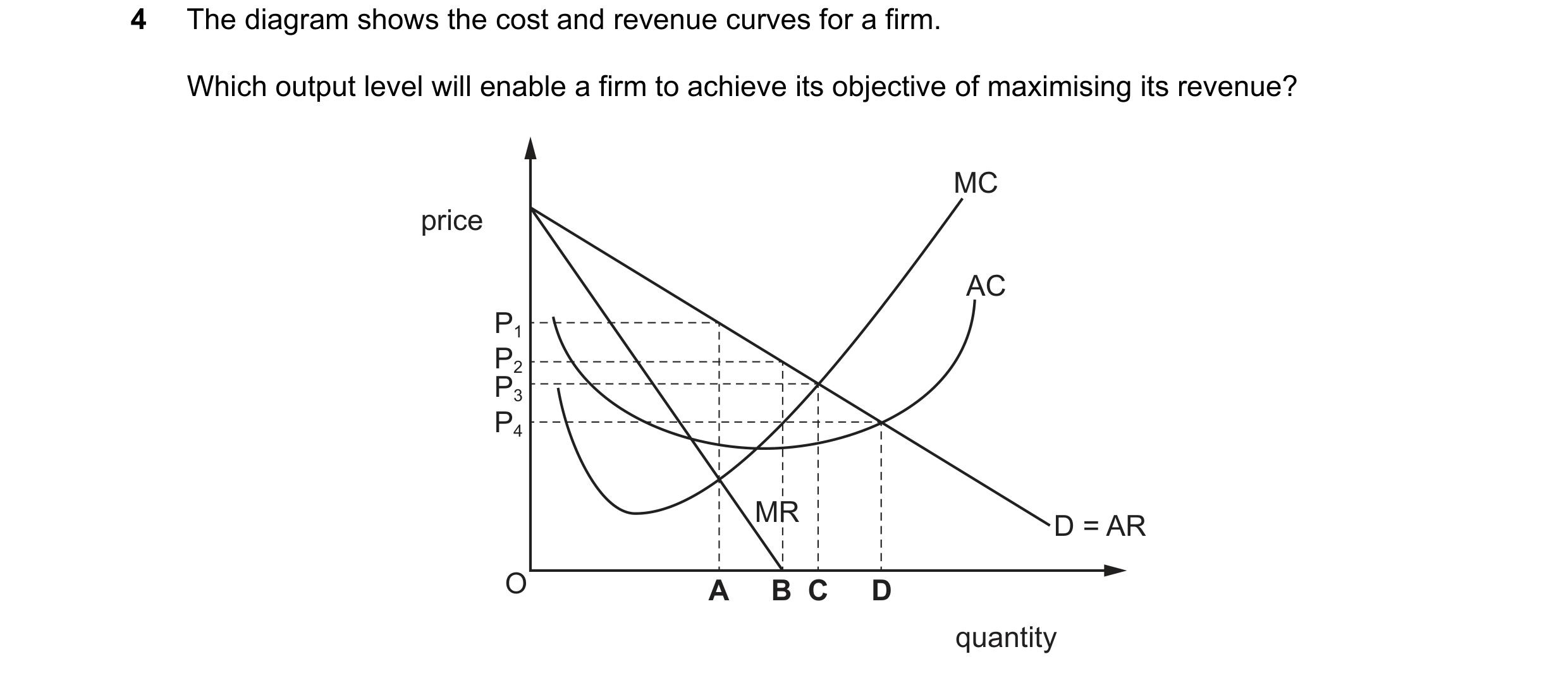
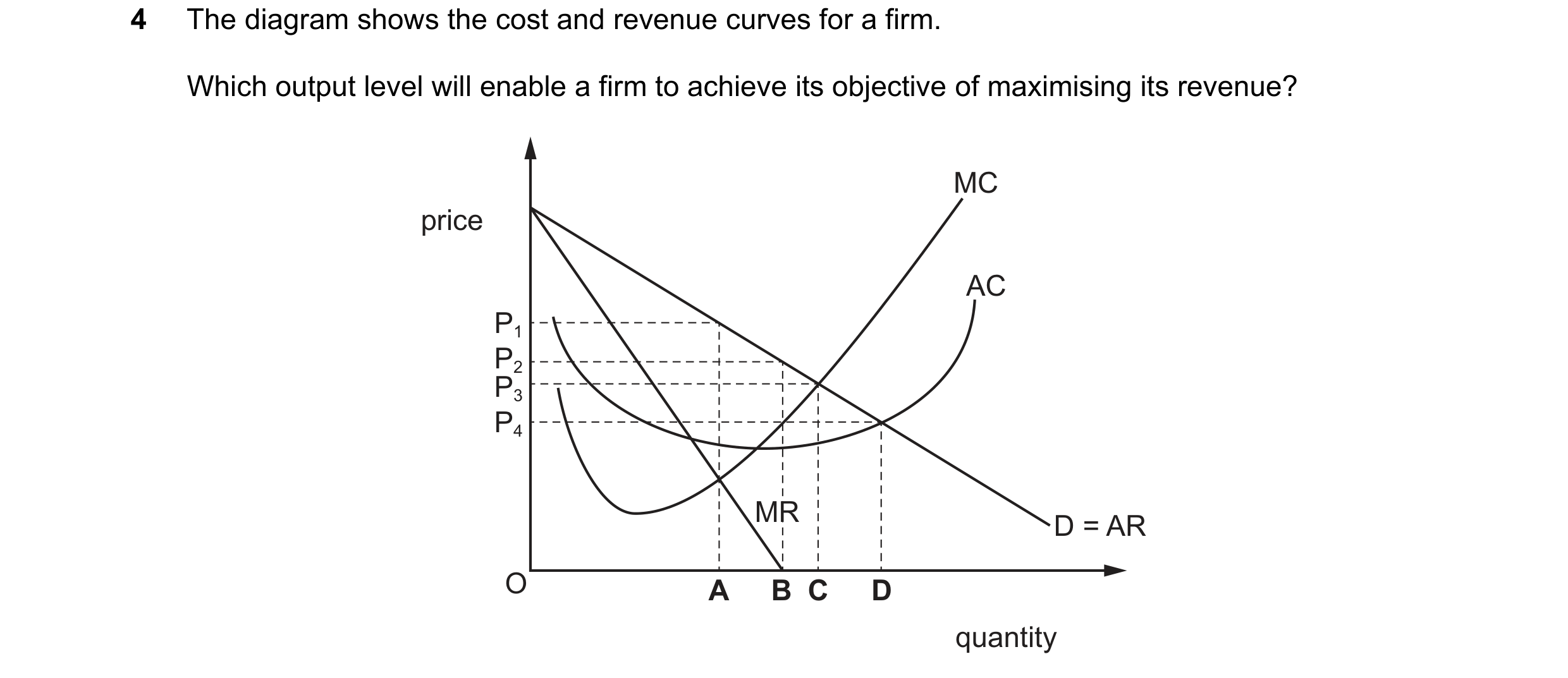
Q65 · The diagram shows the cost and revenue curves for a firm 9708/31 May/June 2024
4 The diagram shows the cost and revenue curves for a firm. Which output level will enable a firm to achieve its objective of maximising its revenue? MC price AC P1 P2 P3 P4 MR D = AR O A B C D quantity
1 marks
Answer: B
This question in 9708/31 May/June 2024
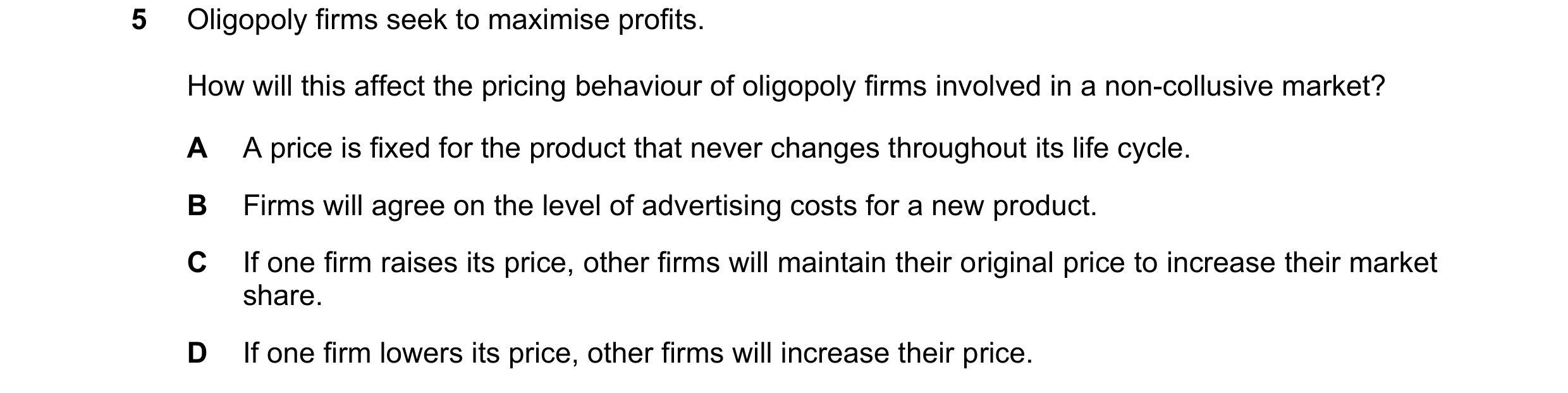
Q66 · Oligopoly firms seek to maximise profits 9708/31 May/June 2024
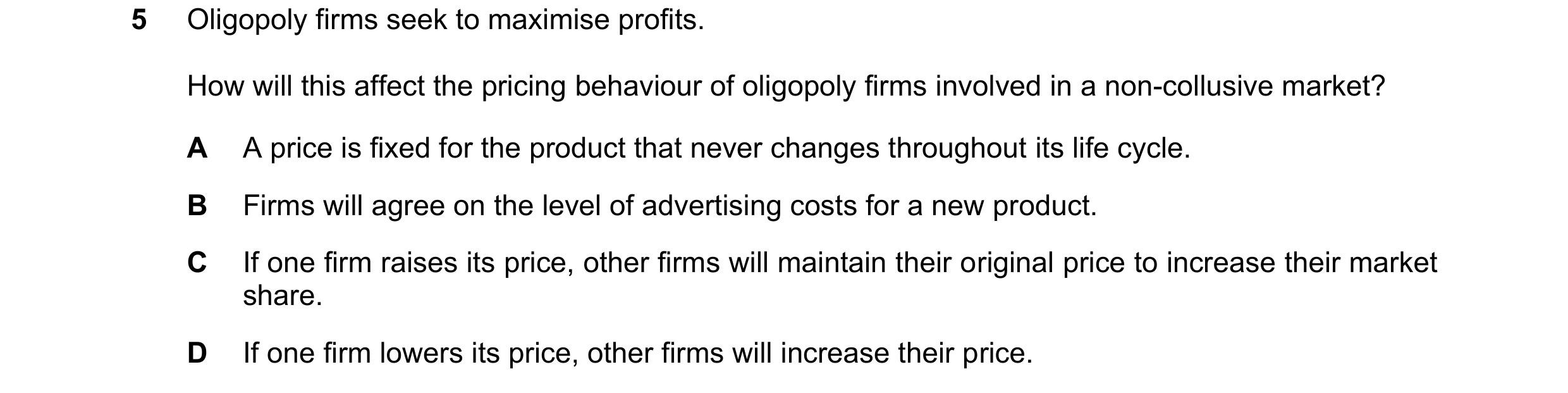
5 Oligopoly firms seek to maximise profits. How will this affect the pricing behaviour of oligopoly firms involved in a non-collusive market? A A price is fixed for the product that never changes throughout its life cycle. B Firms will agree on the level of advertising costs for a new product. C If one firm raises its price, other firms will maintain their original price to increase their market share. D If one firm lowers its price, other firms will increase their price.
1 marks
Answer: C
This question in 9708/31 May/June 2024
Q67 · A firm that raises capital through a share issue has to satisfy both shareholders’… 9708/31 May/June 2024
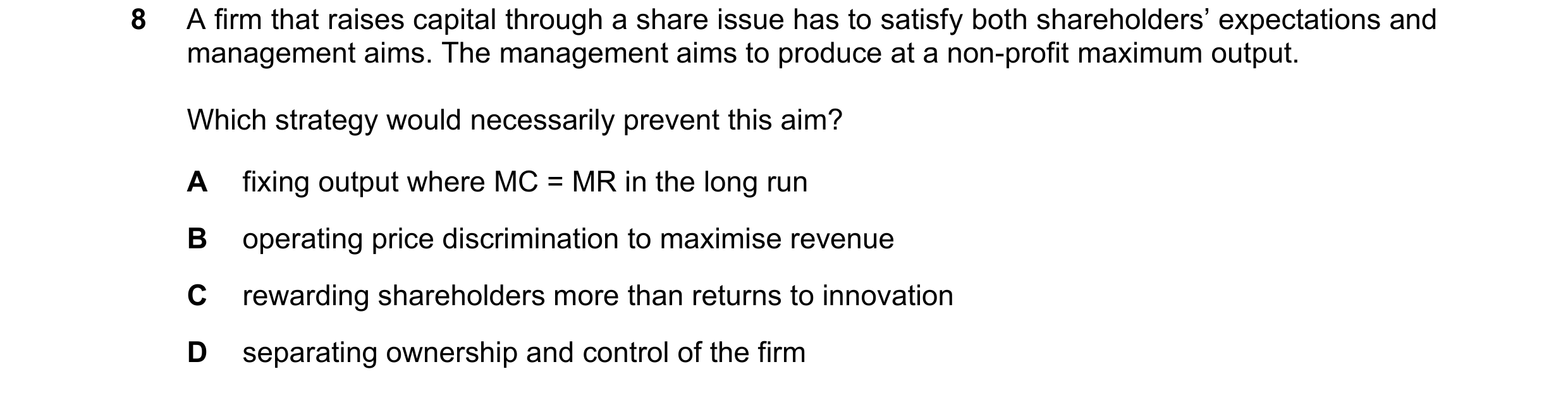
8 A firm that raises capital through a share issue has to satisfy both shareholders’ expectations and management aims. The management aims to produce at a non-profit maximum output. Which strategy would necessarily prevent this aim? A fixing output where MC = MR in the long run B operating price discrimination to maximise revenue C rewarding shareholders more than returns to innovation D separating ownership and control of the firm
1 marks
Answer: A
This question in 9708/31 May/June 2024
Q68 · The diagram shows the cost and revenue curves for a firm 9708/33 May/June 2024
4 The diagram shows the cost and revenue curves for a firm. Which output level will enable a firm to achieve its objective of maximising its revenue? MC price AC P1 P2 P3 P4 MR D = AR O A B C D quantity
1 marks
Answer: B
This question in 9708/33 May/June 2024
Q69 · Oligopoly firms seek to maximise profits 9708/33 May/June 2024
5 Oligopoly firms seek to maximise profits. How will this affect the pricing behaviour of oligopoly firms involved in a non-collusive market? A A price is fixed for the product that never changes throughout its life cycle. B Firms will agree on the level of advertising costs for a new product. C If one firm raises its price, other firms will maintain their original price to increase their market share. D If one firm lowers its price, other firms will increase their price.
1 marks
Answer: C
This question in 9708/33 May/June 2024
Q70 · A firm that raises capital through a share issue has to satisfy both shareholders’… 9708/33 May/June 2024
8 A firm that raises capital through a share issue has to satisfy both shareholders’ expectations and management aims. The management aims to produce at a non-profit maximum output. Which strategy would necessarily prevent this aim? A fixing output where MC = MR in the long run B operating price discrimination to maximise revenue C rewarding shareholders more than returns to innovation D separating ownership and control of the firm
1 marks
Answer: A
This question in 9708/33 May/June 2024
Q71 · The diagram shows a firm’s cost and revenue curves 9708/32 Feb/March 2025
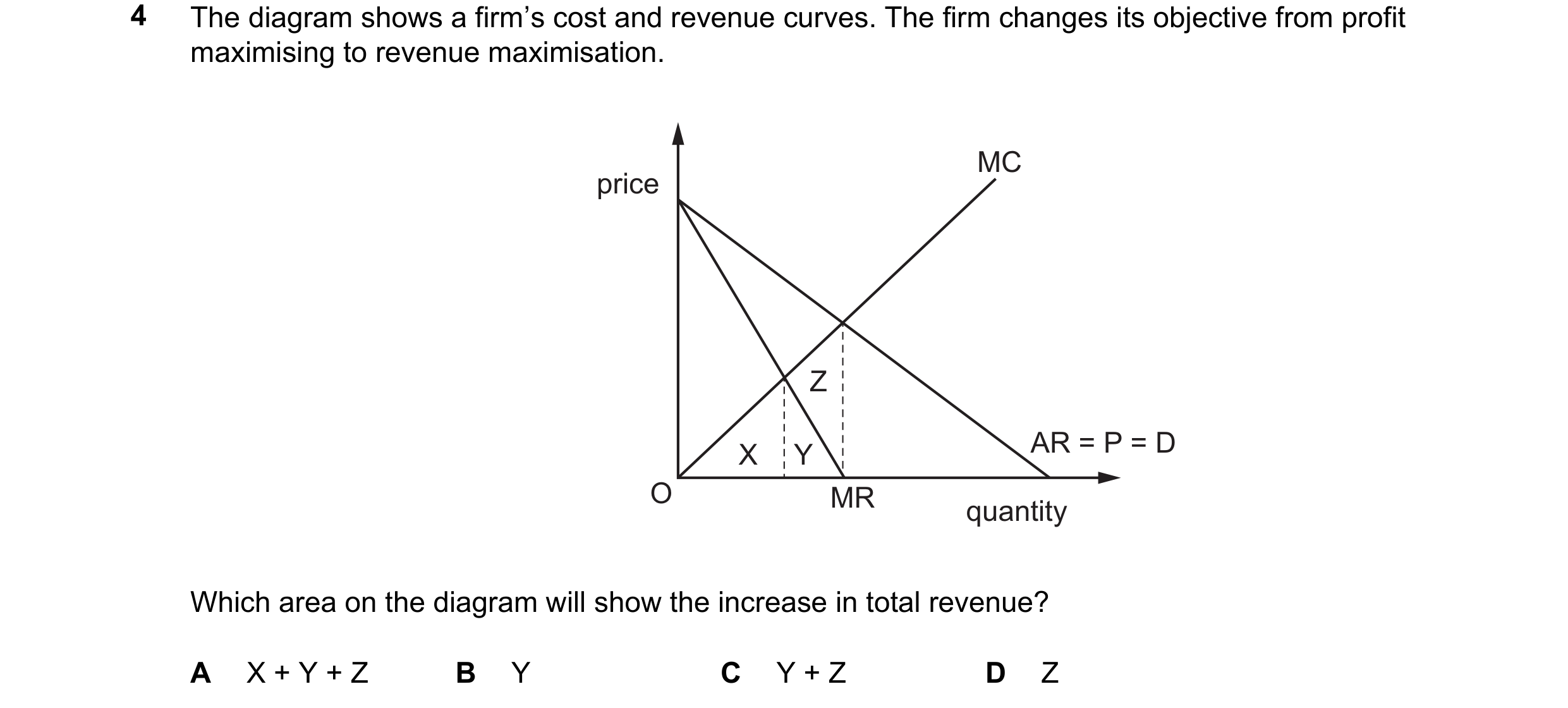
4 The diagram shows a firm’s cost and revenue curves. The firm changes its objective from profit maximising to revenue maximisation. MC price Z X Y AR = P = D O MR quantity Which area on the diagram will show the increase in total revenue? A X + Y + Z B Y C Y + Z D Z
1 marks
Answer: B
This question in 9708/32 Feb/March 2025
 1 / 25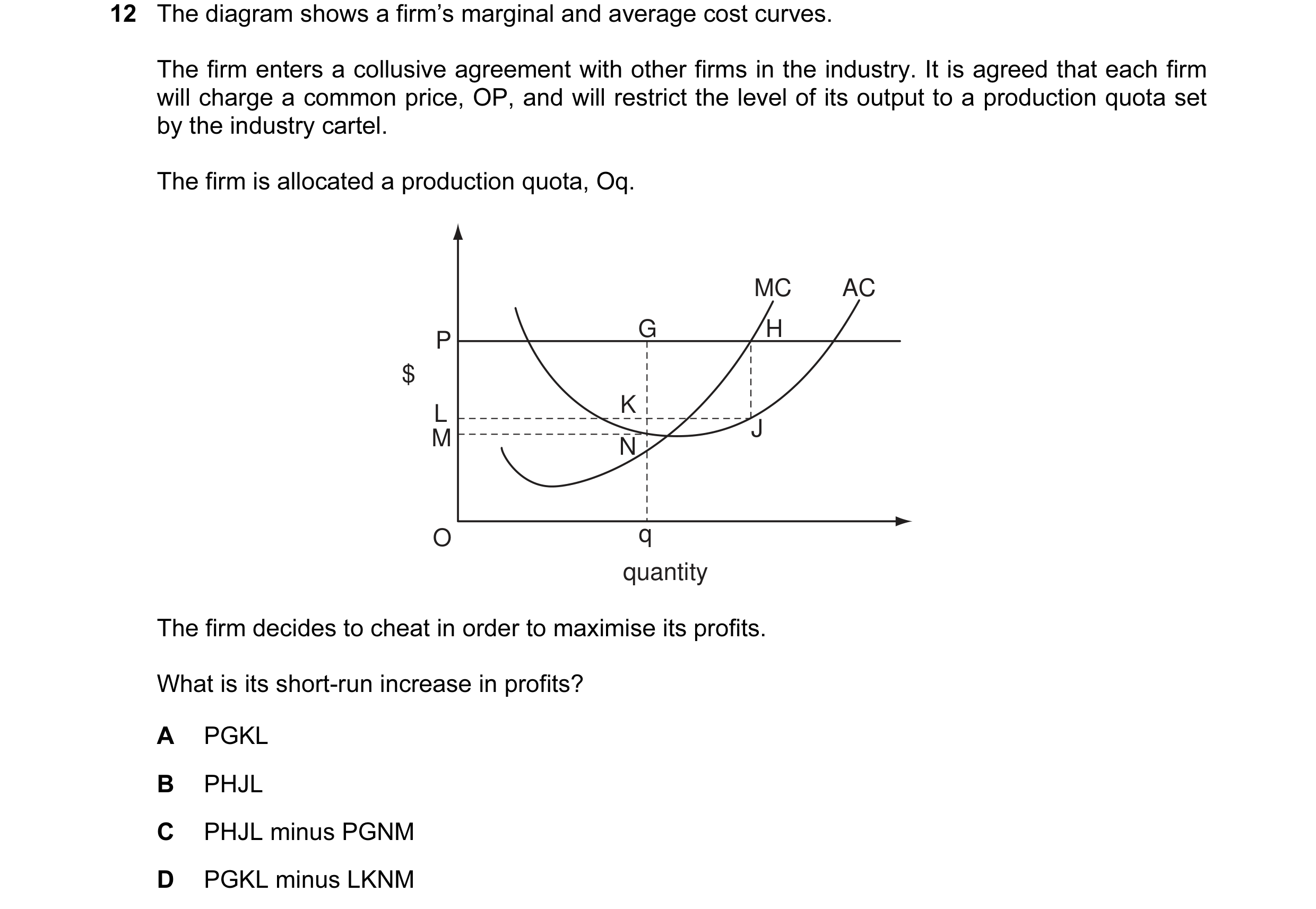
 2 / 25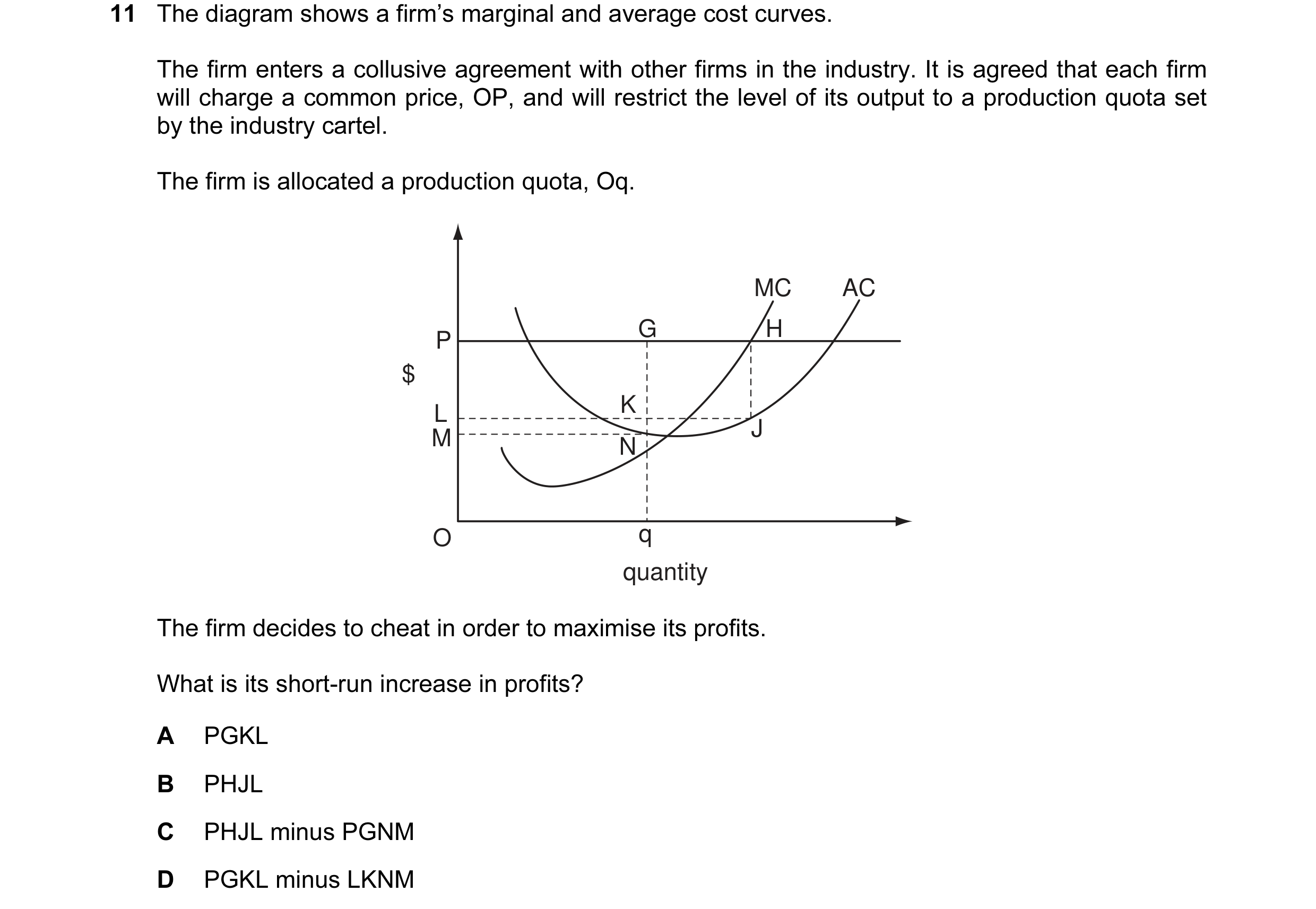
 3 / 25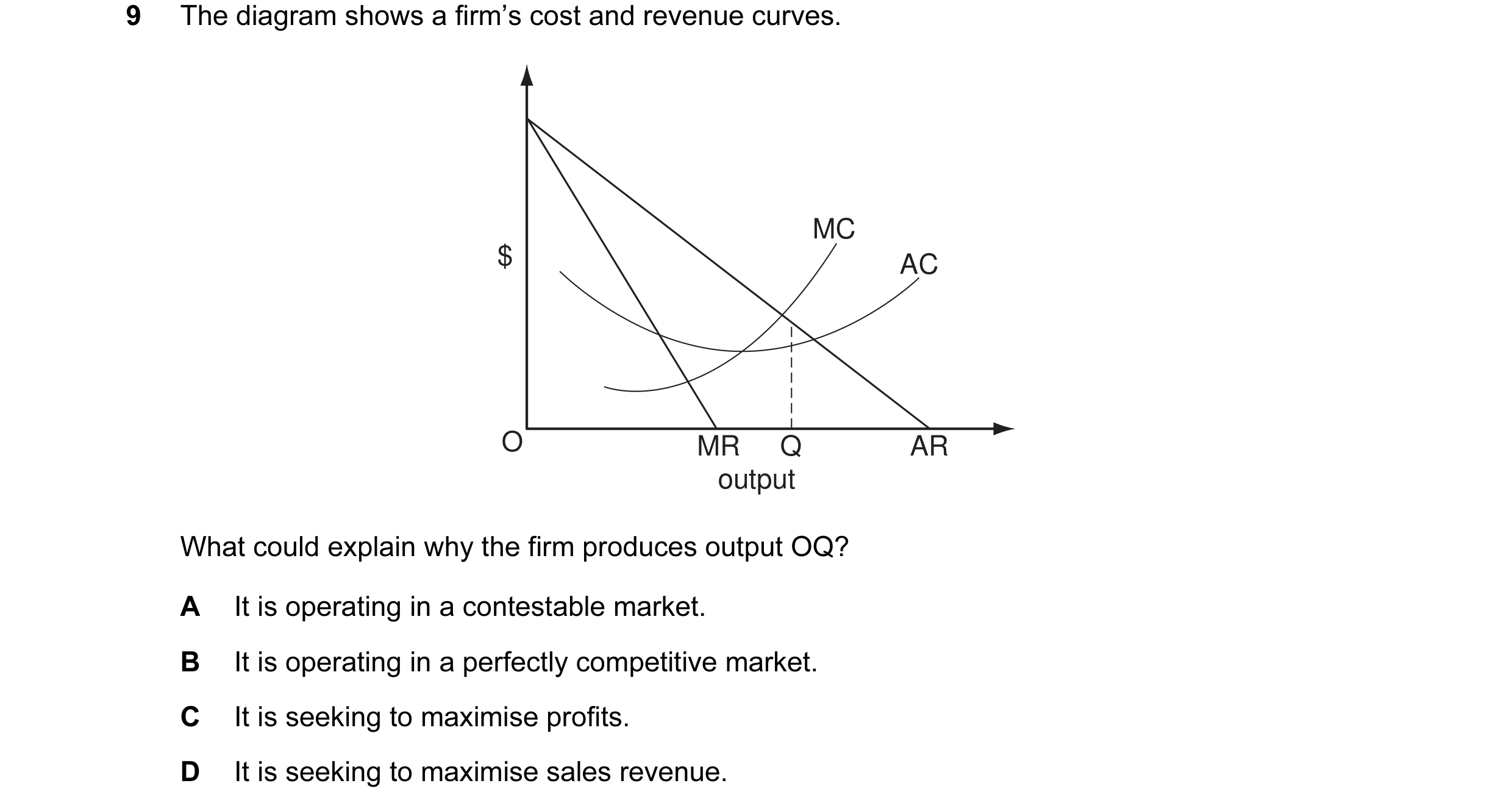
 4 / 25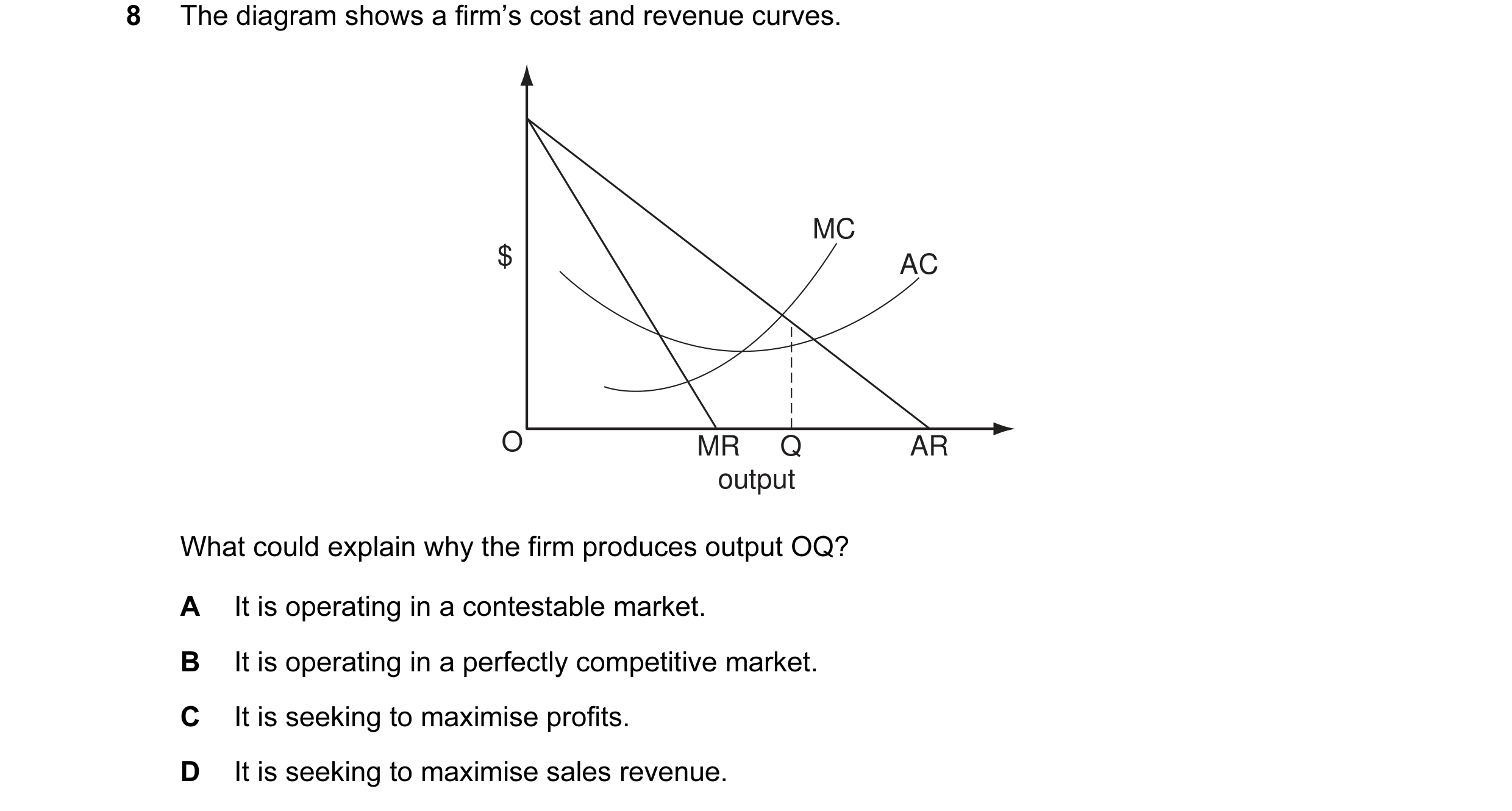
 5 / 25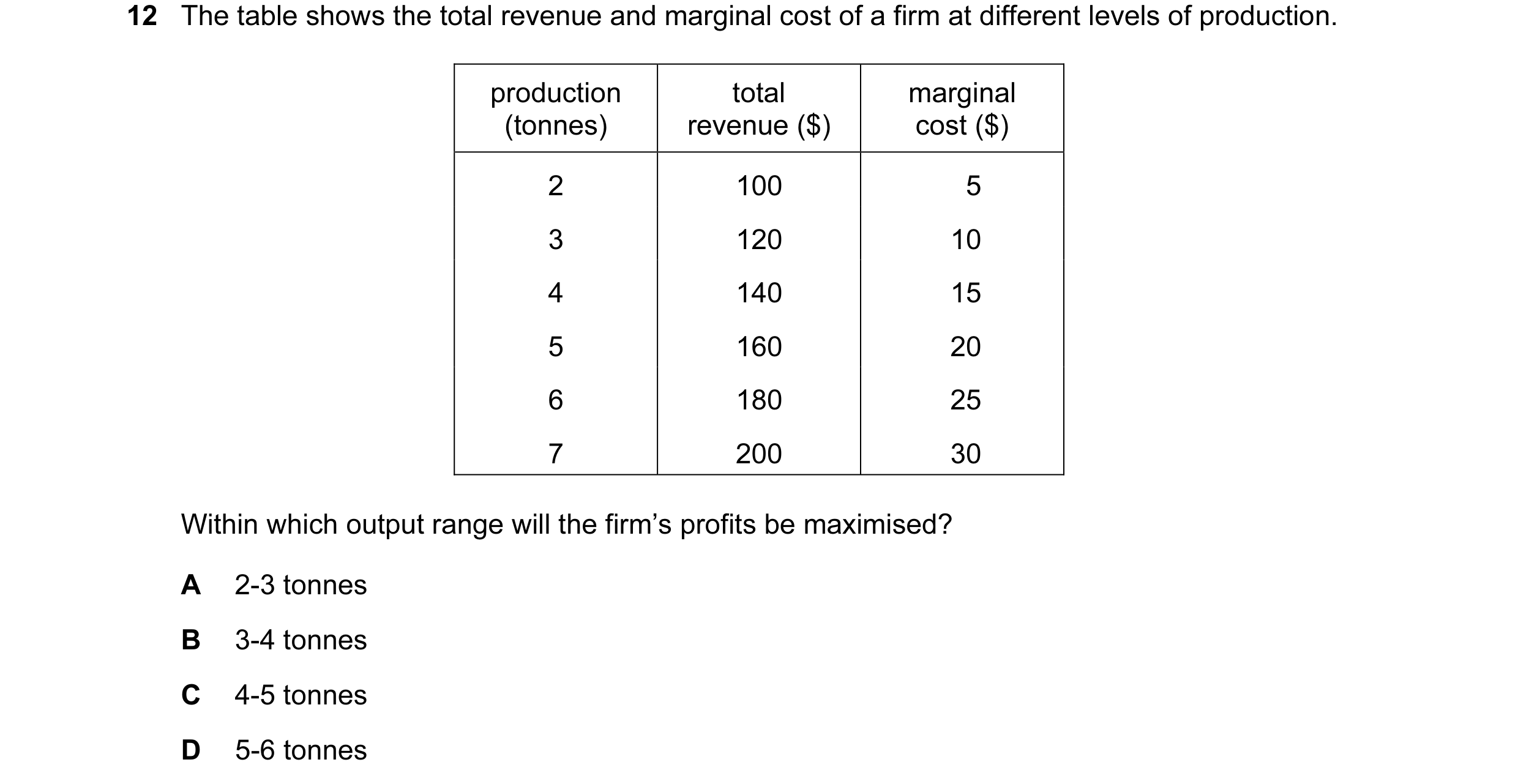
 6 / 25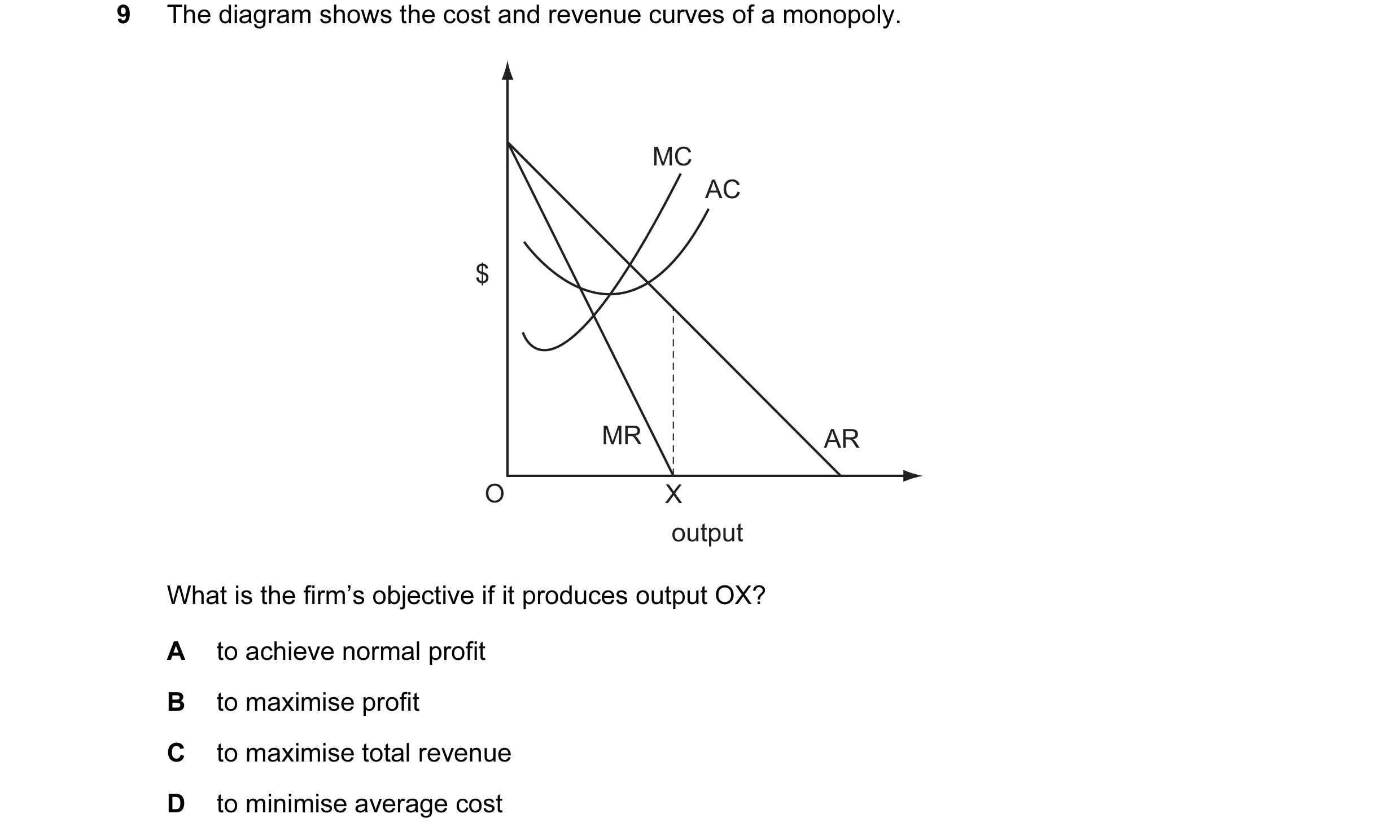
 7 / 25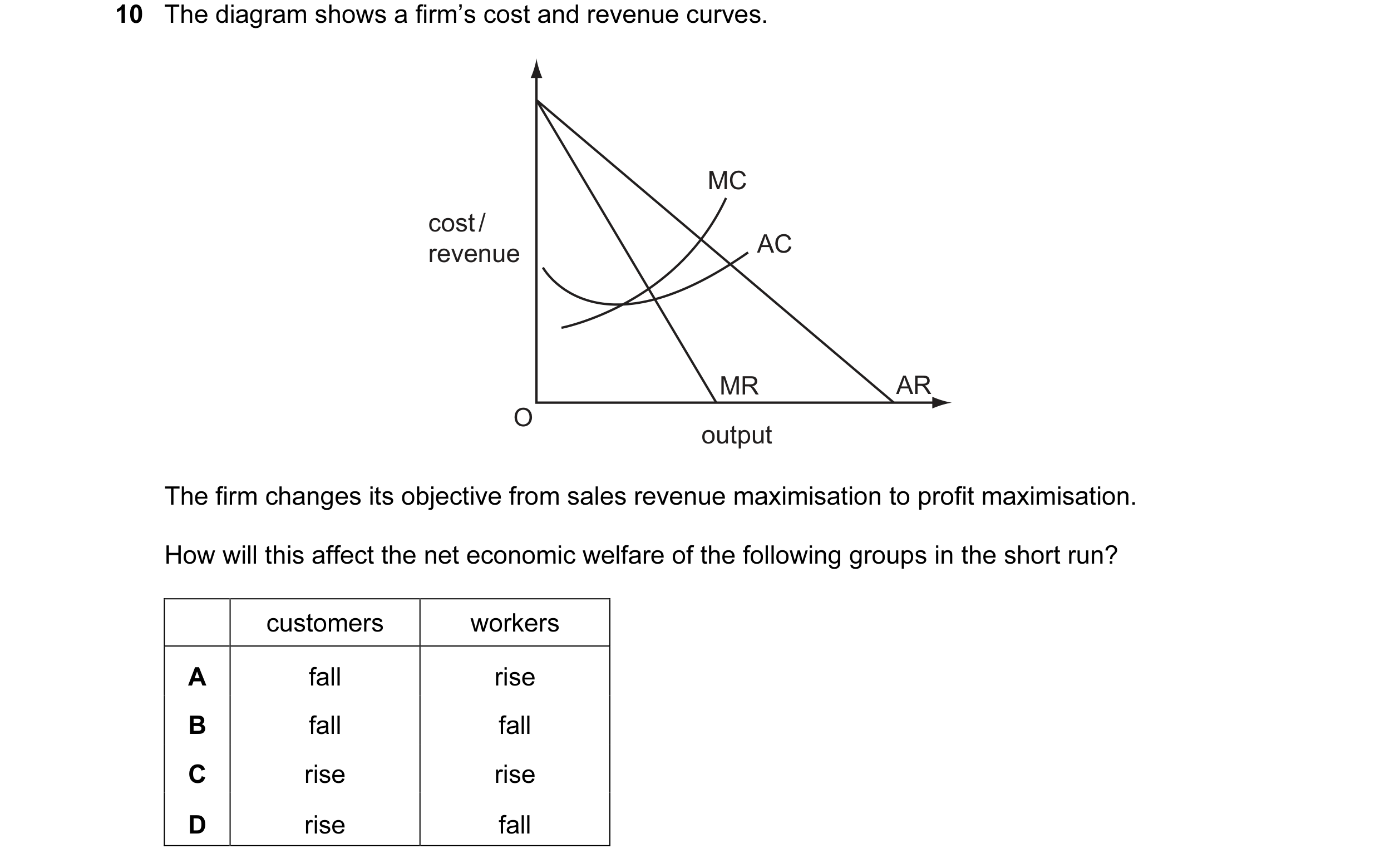
 8 / 25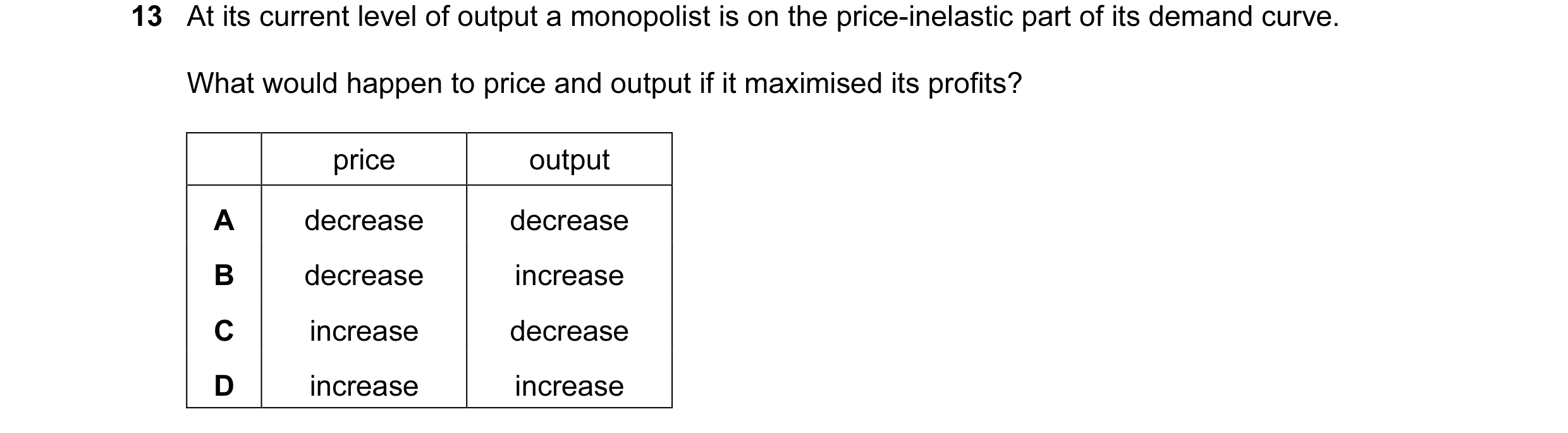
 9 / 25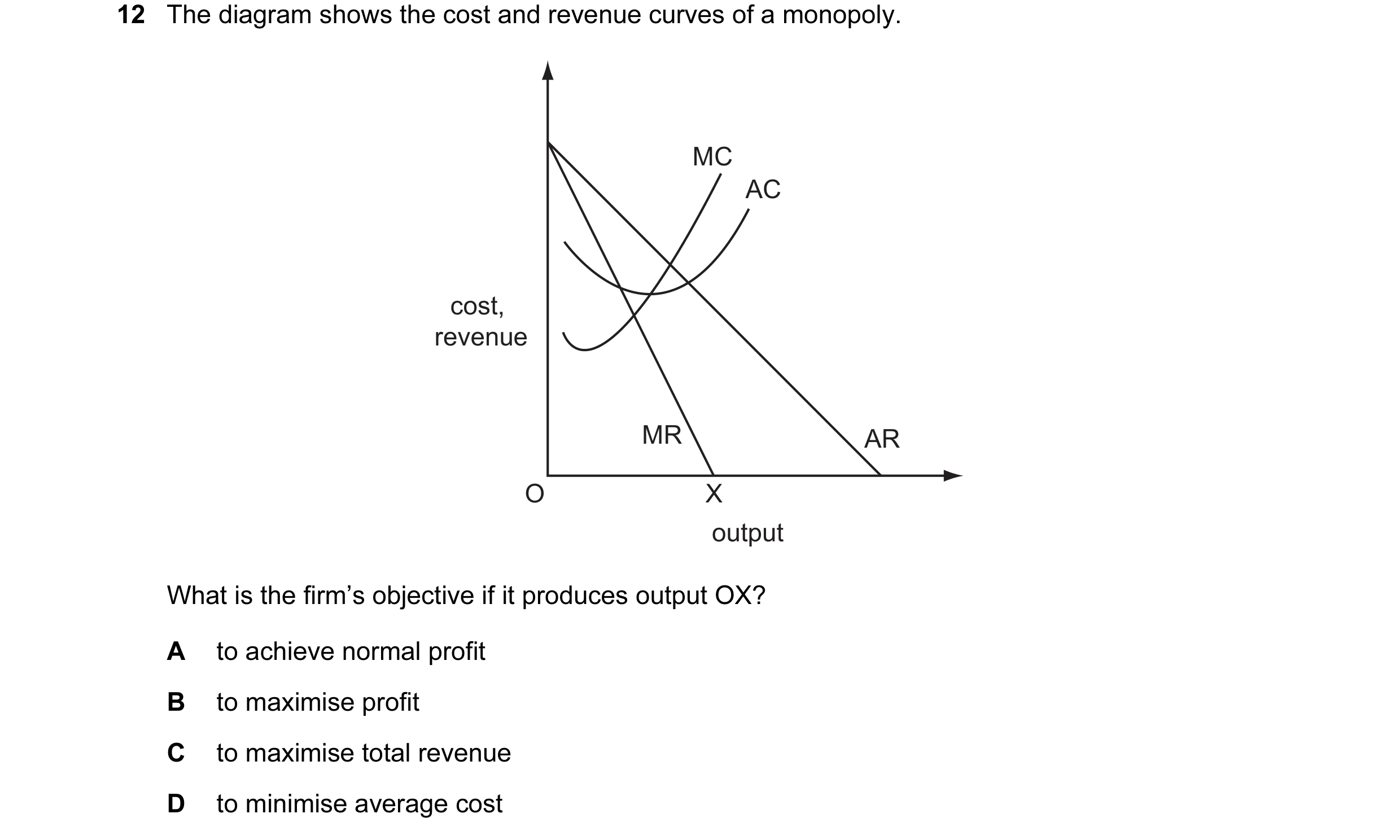
 10 / 25
 11 / 25

 12 / 25
 13 / 25

 14 / 25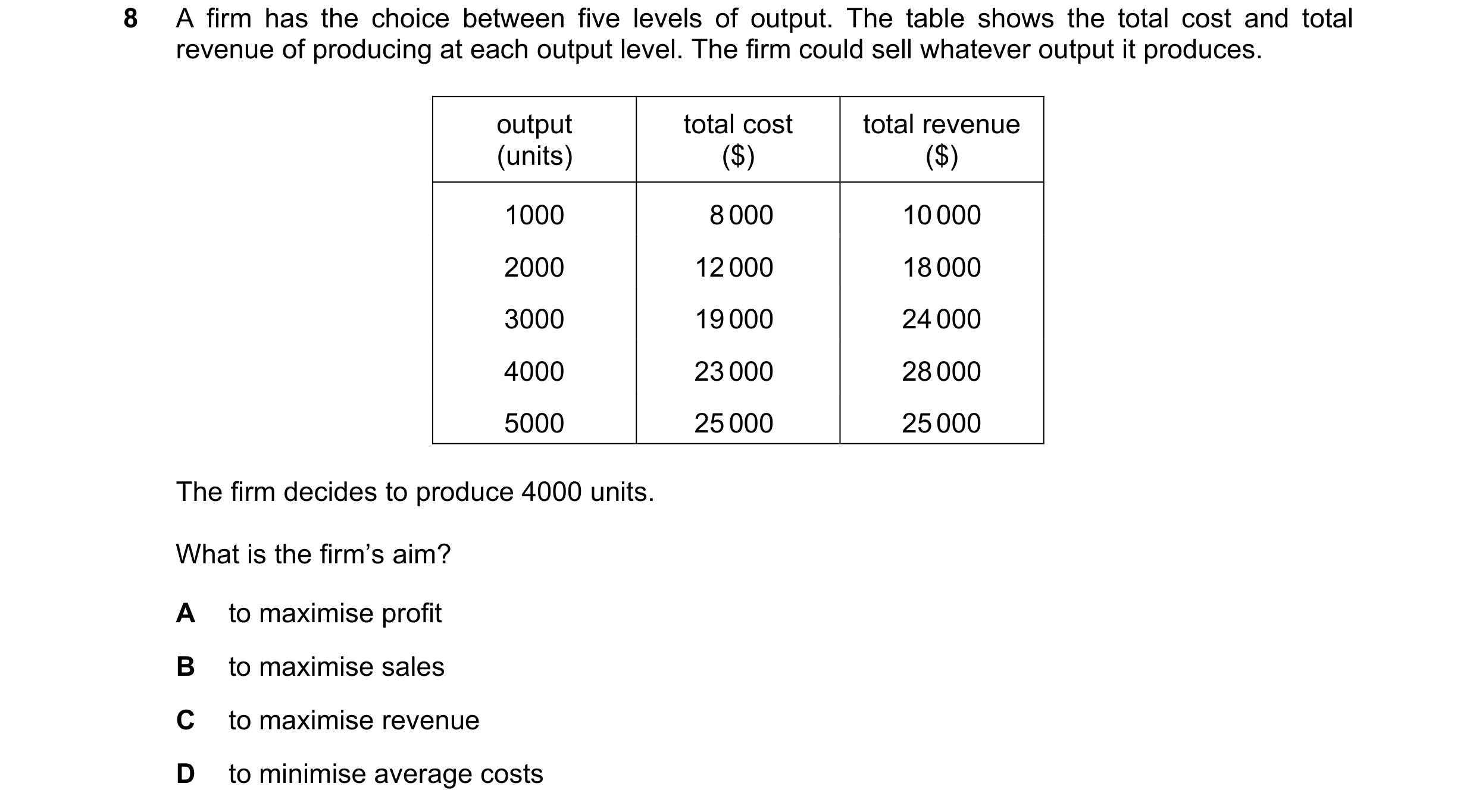

 15 / 25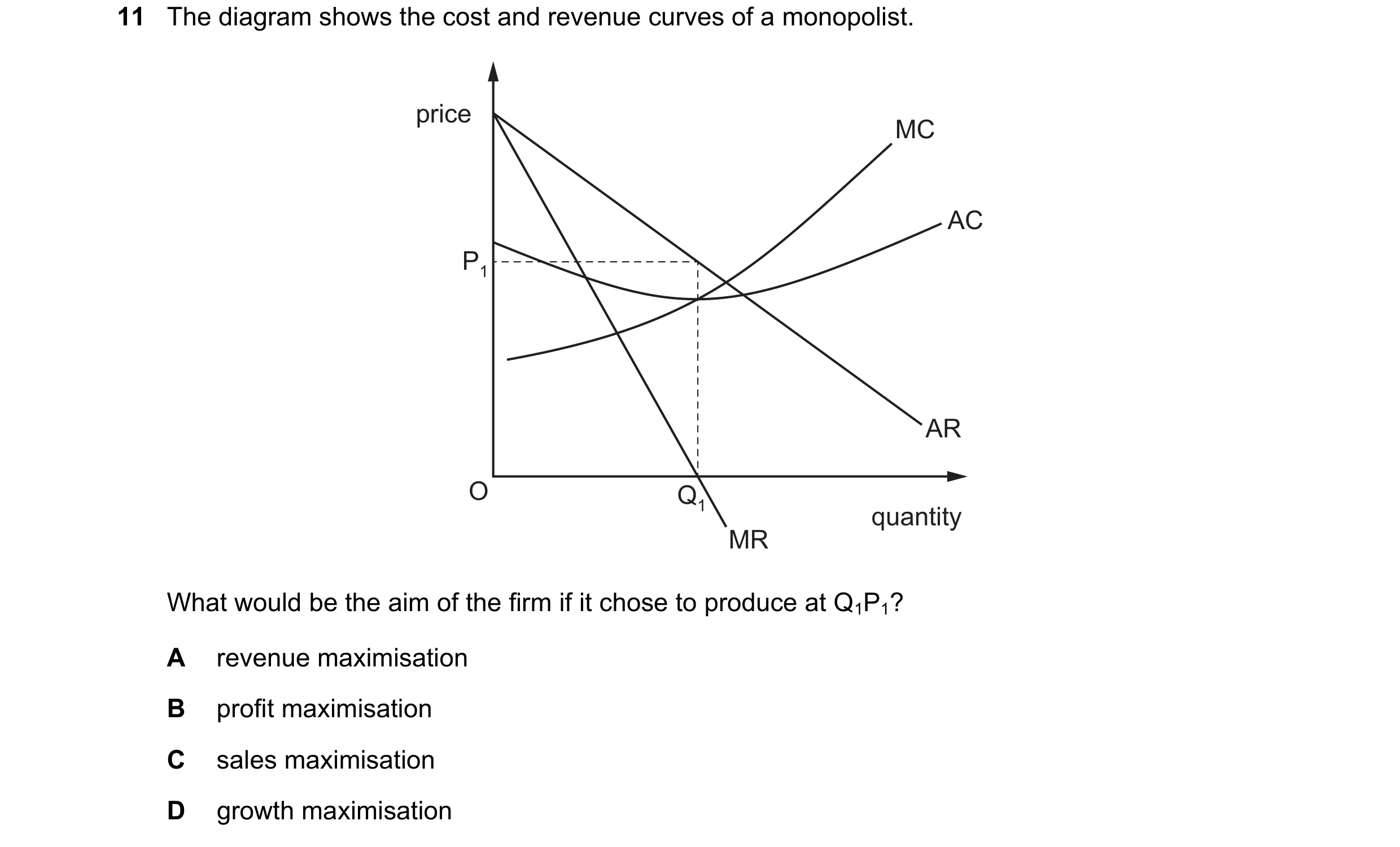

 16 / 25
 17 / 25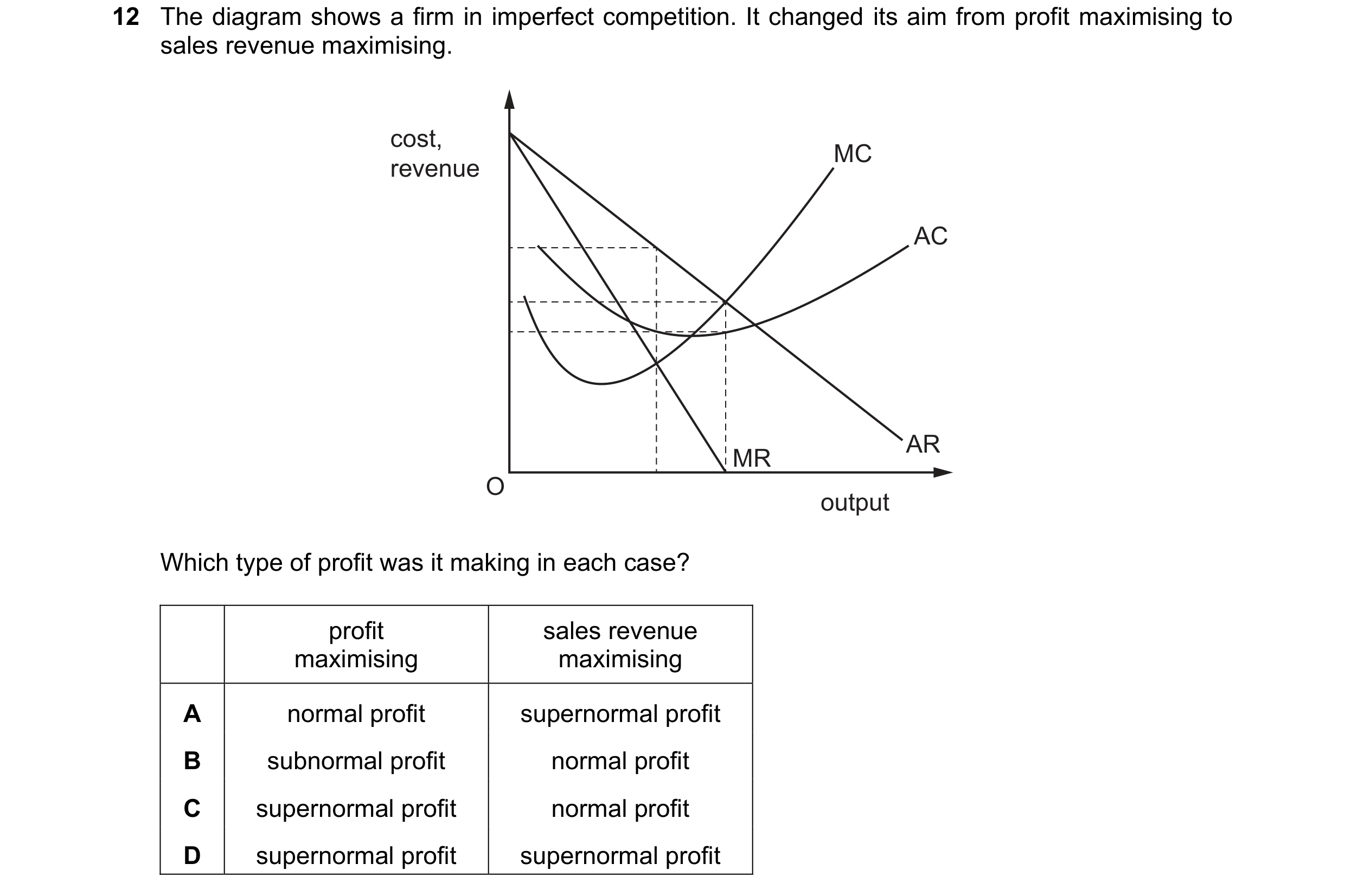
 18 / 25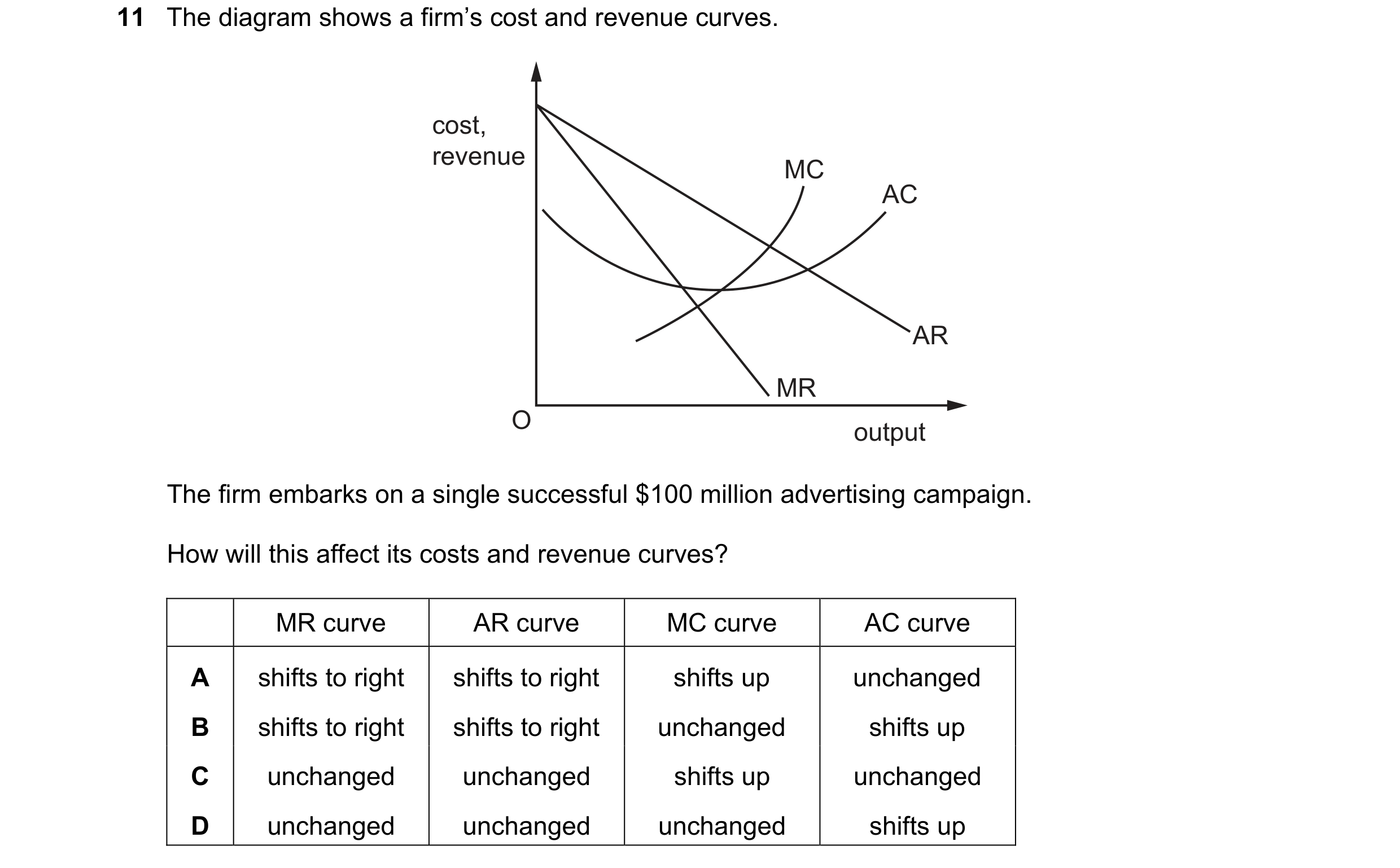

 19 / 25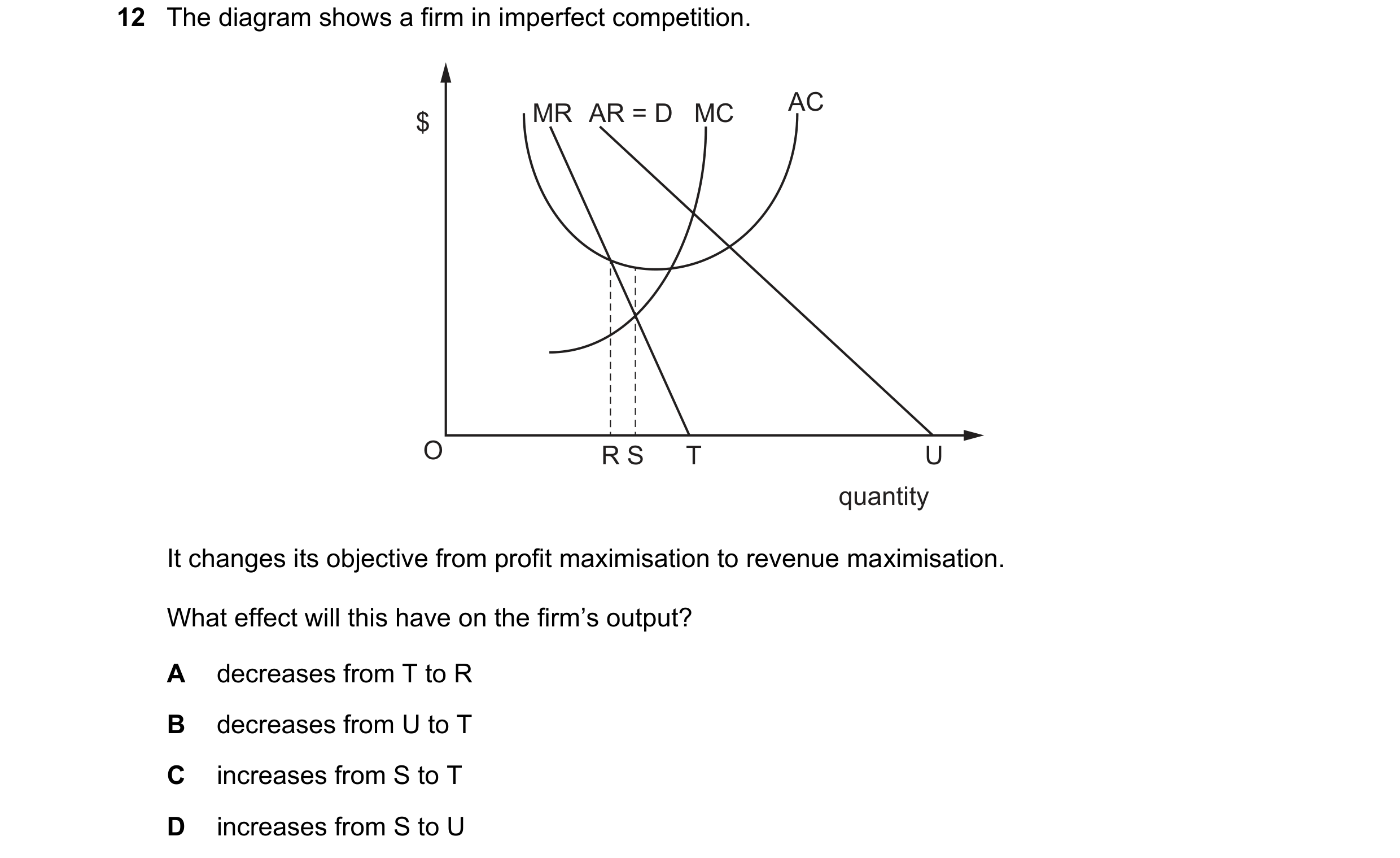
 20 / 25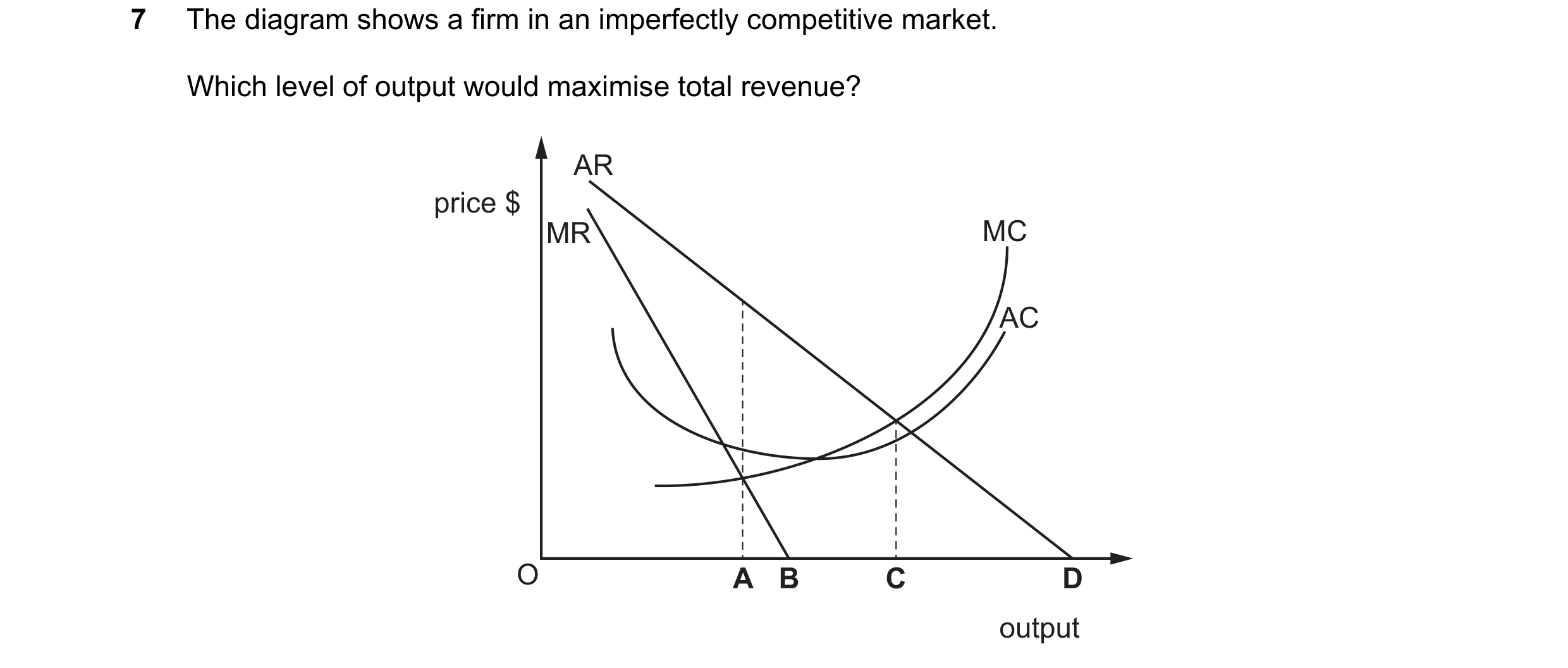
 21 / 25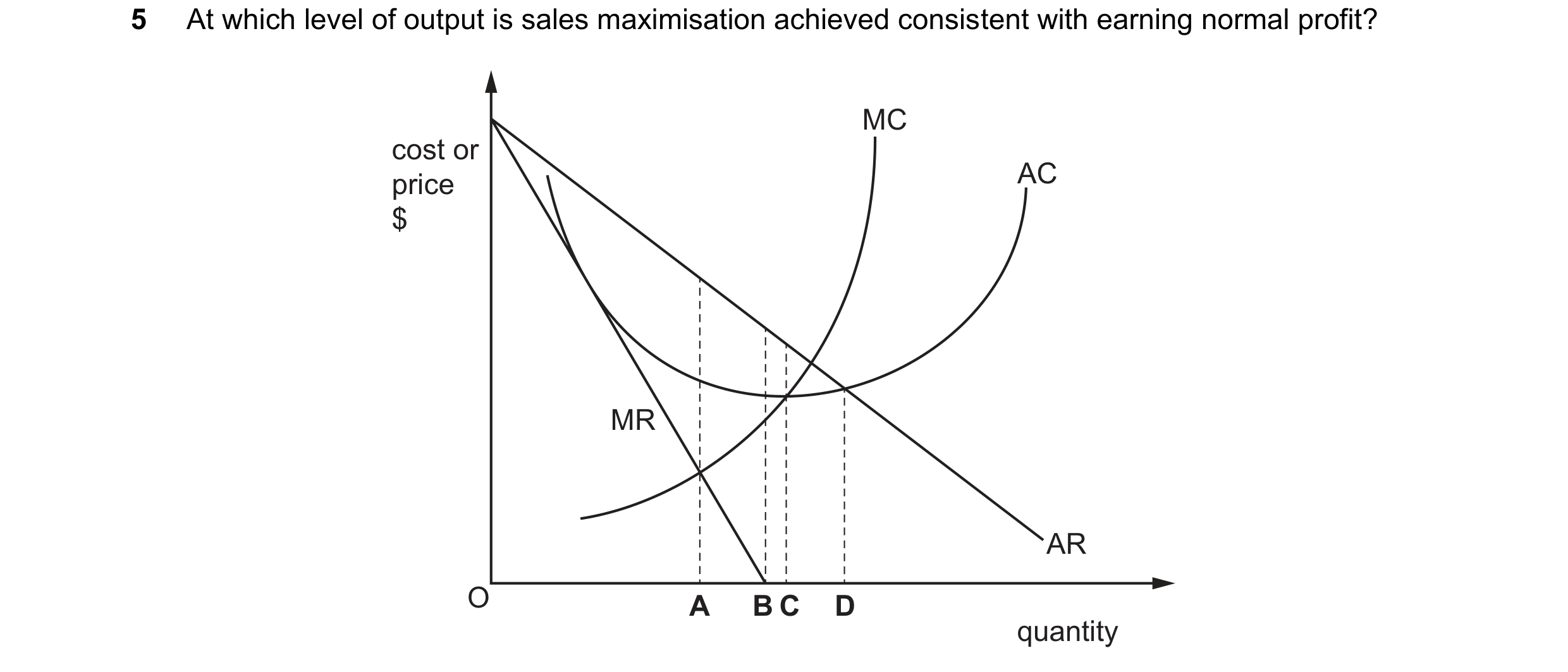
 22 / 25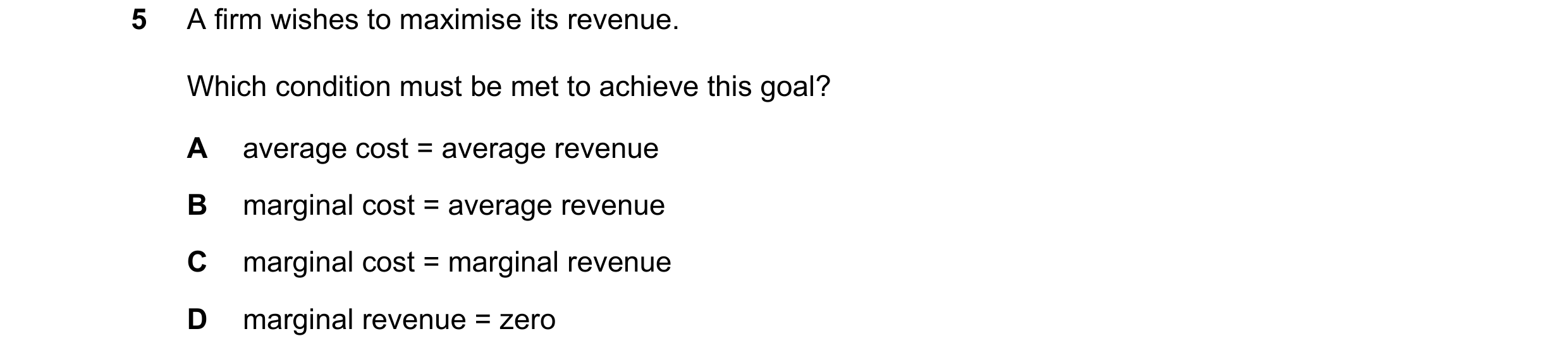


 23 / 25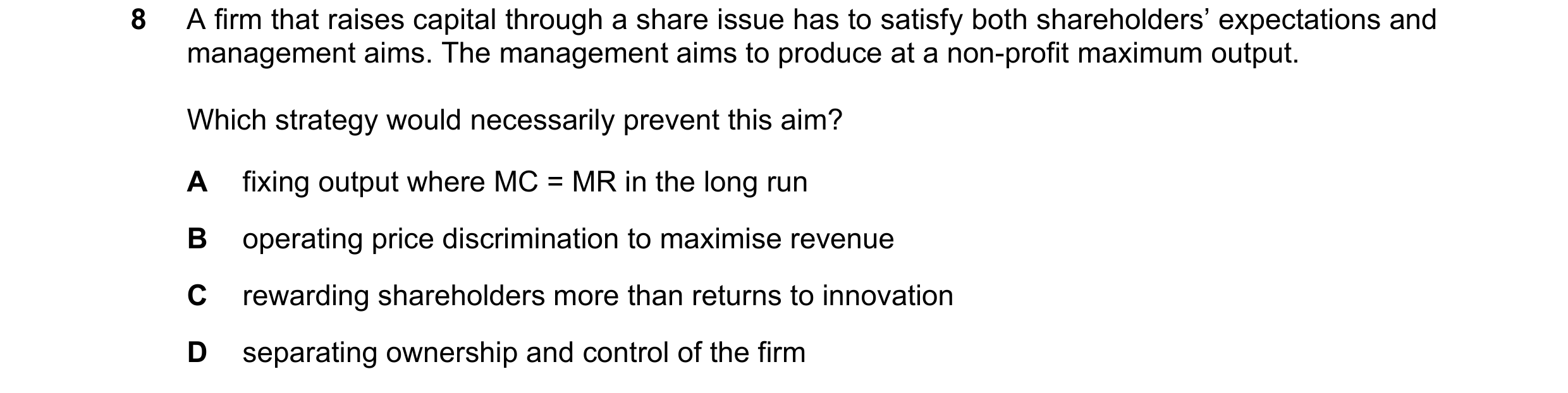
 24 / 25
 25 / 25