Questions as text
Q1 · Some physical properties of five elements, P to T 0654/31 May/June 2017
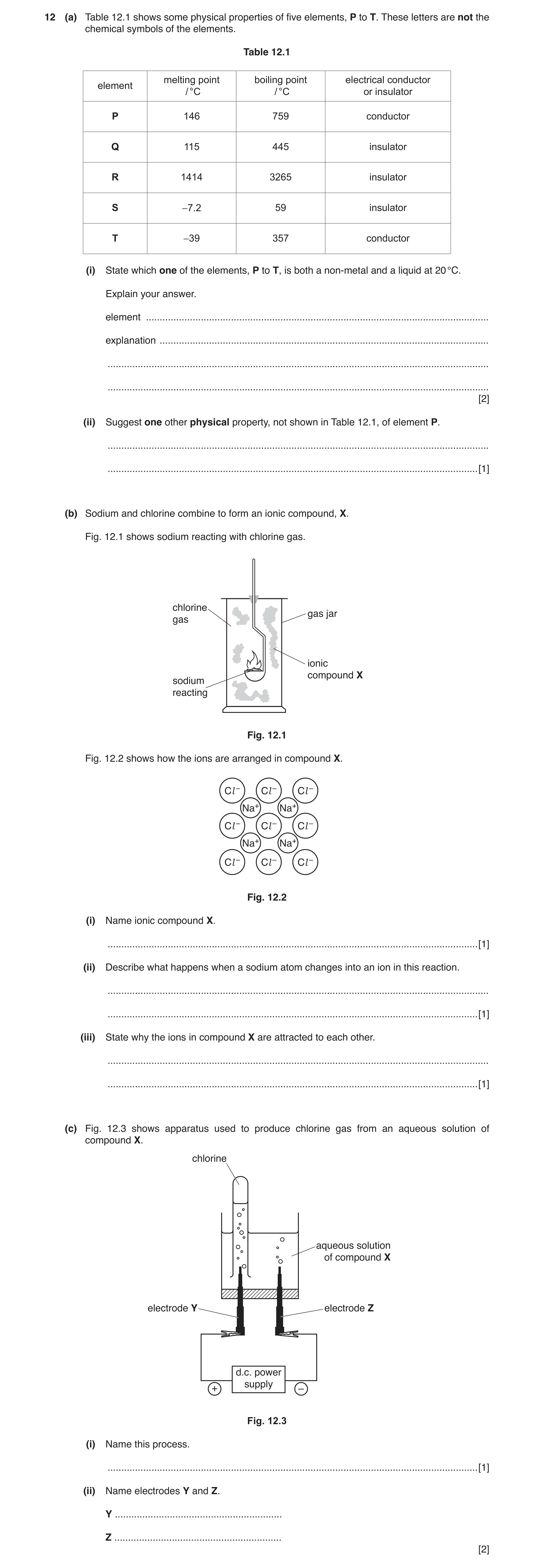
12 (a) Table 12.1 shows some physical properties of five elements, P to T. These letters are not the chemical symbols of the elements. Table 12.1 melting point boiling point electrical conductor element / °C / °C or insulator P 146 759 conductor Q 115 445 insulator R 1414 3265 insulator S −7.2 59 insulator T −39 357 conductor (i) State which one of the elements, P to T, is both a non-metal and a liquid at 20 °C. Explain your answer. element … explanation … … … [2] (ii) Suggest one other physical property, not shown in Table 12.1, of element P. … … [1] (b) Sodium and chlorine combine to form an ionic compound, X. Fig. 12.1 shows sodium reacting with chlorine gas. chlorine gas jar gas ionic compound X sodium reacting Fig. 12.1 Fig. 12.2 shows how the ions are arranged in compound X. Cl – Cl – Cl – Na+ Na+ Cl – Cl – Cl – Na+ Na+ Cl – Cl – Cl – Fig. 12.2 (i) Name ionic compound X. … [1] (ii) Describe what happens when a sodium atom changes into an ion in this reaction. … … [1] (iii) State why the ions in compound X are attracted to each other. … … [1] (c) Fig. 12.3 shows apparatus used to produce chlorine gas from an aqueous solution of compound X. chlorine aqueous solution of compound X electrode Y electrode Z d.c. power supply + – Fig. 12.3 (i) Name this process. … [1] (ii) Name electrodes Y and Z. Y … Z … [2]
9 marks
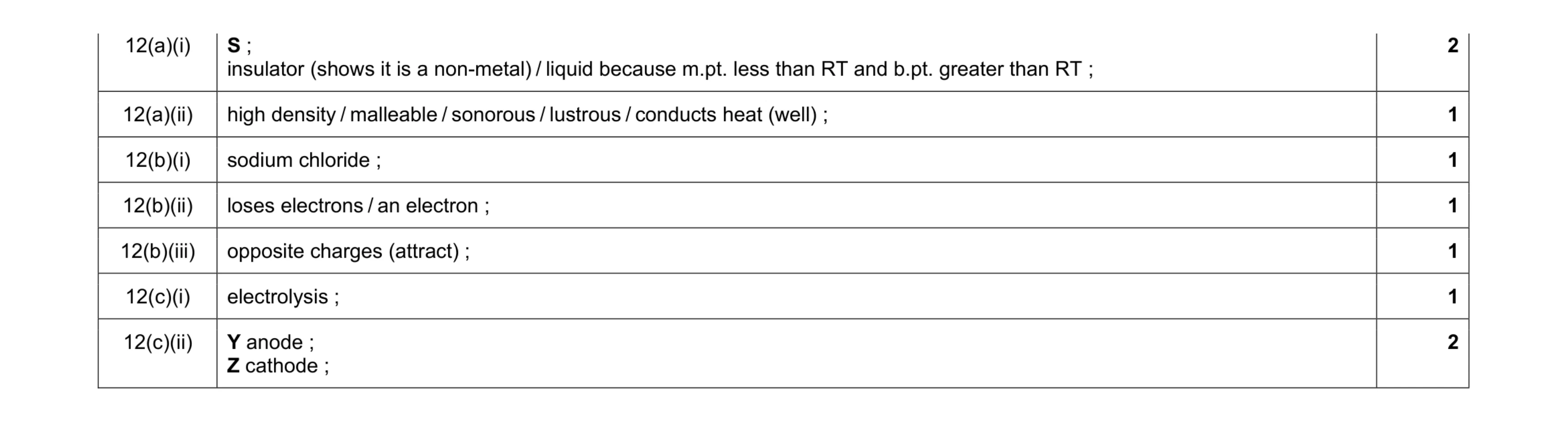
Mark scheme: 12(a)(i) S ; insulator (shows it is a non-metal) / liquid because m.pt. less than RT and b.pt. greater than RT ; 2 12(a)(ii) high density / malleable / sonorous / lustrous / conducts heat (well) ; 1 12(b)(i) sodium chloride ; 1 12(b)(ii) loses electrons / an electron ; 1 12(b)(iii) opposite charges (attract) ; 1 12(c)(i) electrolysis ; 1 12(c)(ii) Y anode ; Z cathode ; 2
This question in 0654/31 May/June 2017
Q2 · Most elements in the Periodic Table are metals 0654/31 May/June 2019
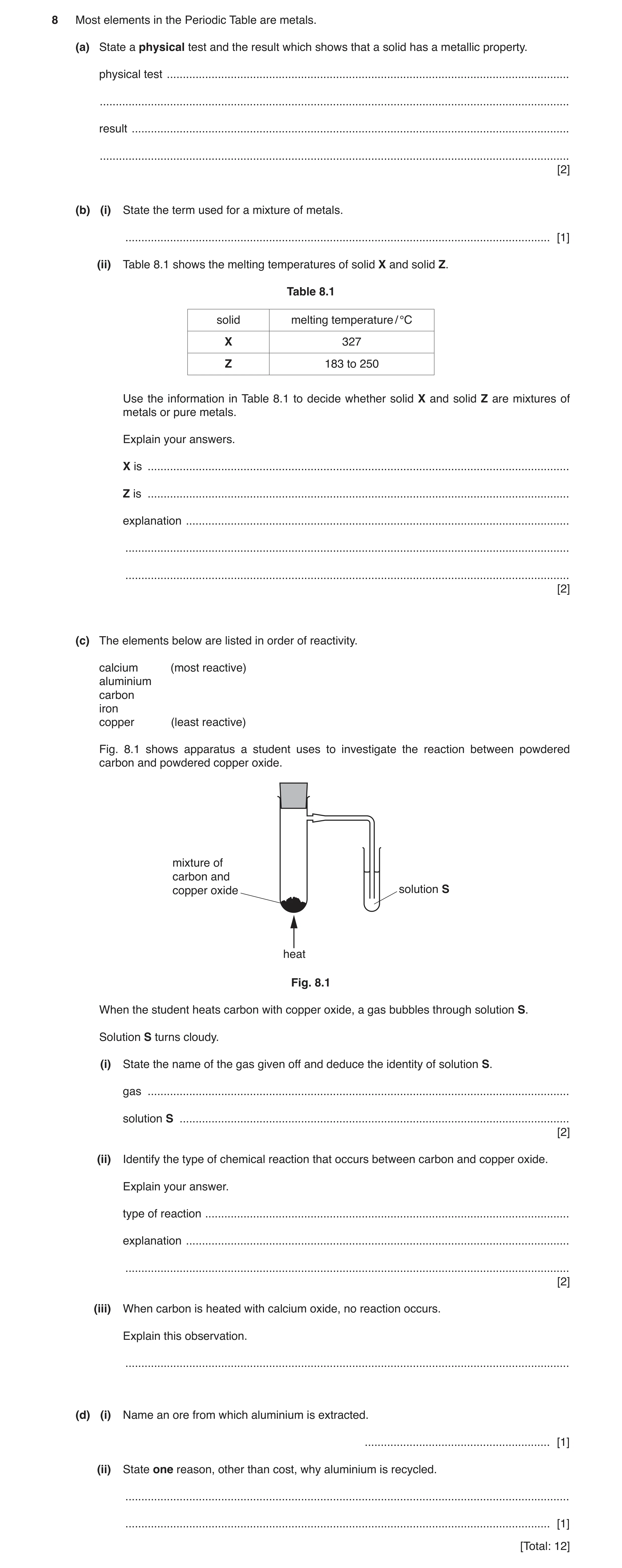
8 Most elements in the Periodic Table are metals. (a) State a physical test and the result which shows that a solid has a metallic property. physical test … … result … … [2] (b) (i) State the term used for a mixture of metals. … [1] (ii) Table 8.1 shows the melting temperatures of solid X and solid Z. Table 8.1 solid melting temperature / °C X 327 Z 183 to 250 Use the information in Table 8.1 to decide whether solid X and solid Z are mixtures of metals or pure metals. Explain your answers. X is … Z is … explanation … … … [2] (c) The elements below are listed in order of reactivity. calcium (most reactive) aluminium carbon iron copper (least reactive) Fig. 8.1 shows apparatus a student uses to investigate the reaction between powdered carbon and powdered copper oxide. mixture of carbon and copper oxide solution S heat Fig. 8.1 When the student heats carbon with copper oxide, a gas bubbles through solution S. Solution S turns cloudy. (i) State the name of the gas given off and deduce the identity of solution S. gas … solution S … [2] (ii) Identify the type of chemical reaction that occurs between carbon and copper oxide. Explain your answer. type of reaction … explanation … … [2] (iii) When carbon is heated with calcium oxide, no reaction occurs. Explain this observation. … (d) (i) Name an ore from which aluminium is extracted. … [1] (ii) State one reason, other than cost, why aluminium is recycled. … … [1] [Total: 12]
12 marks
Mark scheme: 8(a) suitable test for electrical conductivity / thermal conductivity / malleability ; metals conduct electricity / metal conduct thermal energy / metals are malleable ; 2 8(b)(i) alloy ; 1 8(b)(ii) X is a pure metal and Z is a mixture / alloy ; pure metal has unique melting point / a mixture melts over a range of temp ; 2 8(c)(i) carbon dioxide / CO2 ; limewater / aqueous calcium hydroxide ; 2 8(c)(ii) redox / reduction / oxidation ; copper oxide is reduced / loses oxygen / carbon oxidised / gains oxygen ; 2 8(c)(iii) calcium is more reactive than carbon ; 1 8(d)(i) bauxite ; 1 8(d)(ii) saves energy / saves bauxite; 1
This question in 0654/31 May/June 2019
Q3 · Meteorites fall to Earth from space 0654/33 Oct/Nov 2019
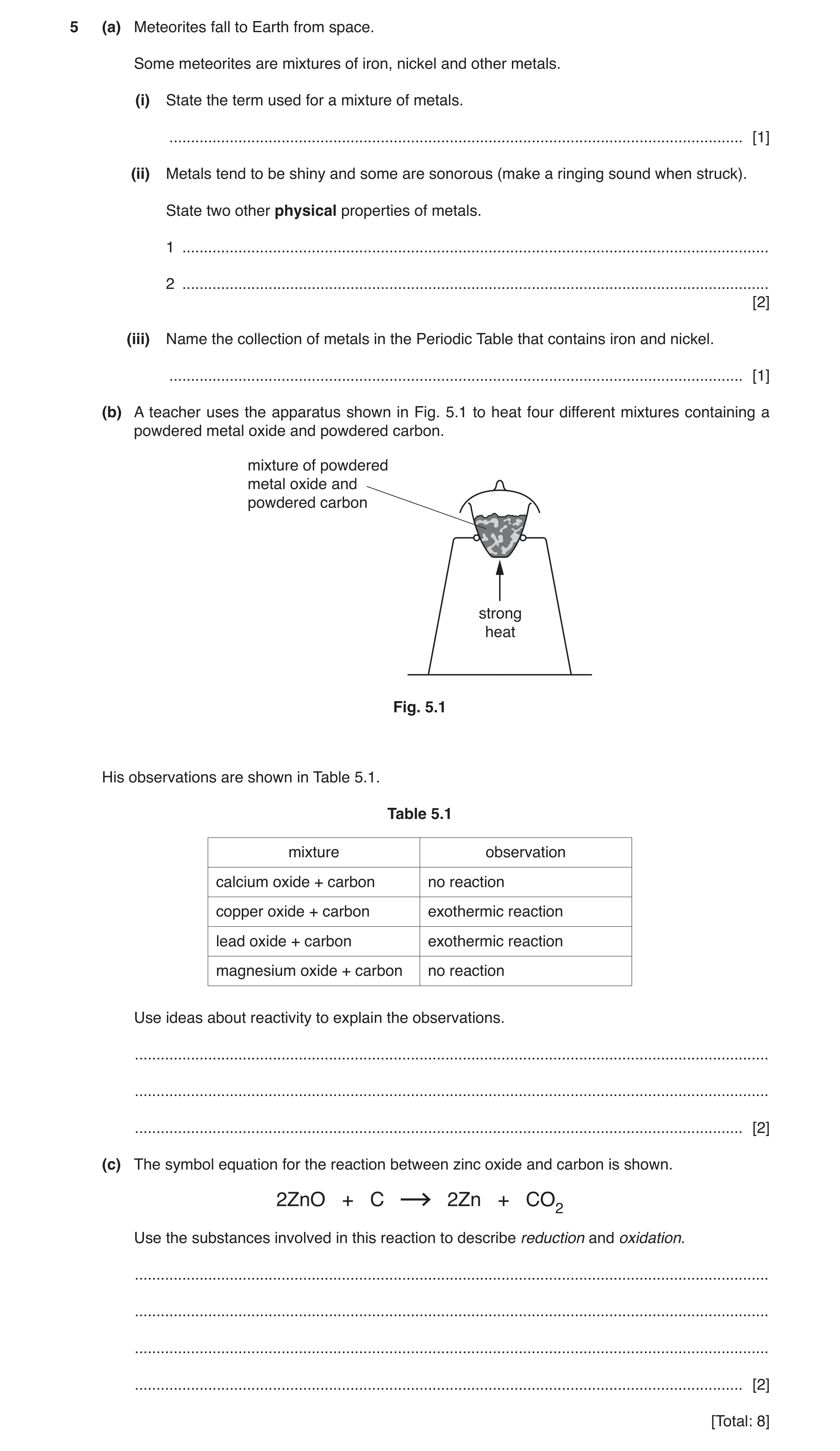
5 (a) Meteorites fall to Earth from space. Some meteorites are mixtures of iron, nickel and other metals. (i) State the term used for a mixture of metals. … [1] (ii) Metals tend to be shiny and some are sonorous (make a ringing sound when struck). State two other physical properties of metals. 1 … 2 … [2] (iii) Name the collection of metals in the Periodic Table that contains iron and nickel. … [1] (b) A teacher uses the apparatus shown in Fig. 5.1 to heat four different mixtures containing a powdered metal oxide and powdered carbon. mixture of powdered metal oxide and powdered carbon strong heat Fig. 5.1 His observations are shown in Table 5.1. Table 5.1 mixture observation calcium oxide + carbon no reaction copper oxide + carbon exothermic reaction lead oxide + carbon exothermic reaction magnesium oxide + carbon no reaction Use ideas about reactivity to explain the observations. … … … [2] (c) The symbol equation for the reaction between zinc oxide and carbon is shown. 2ZnO + C 2Zn + CO2 Use the substances involved in this reaction to describe reduction and oxidation. … … … … [2] [Total: 8]
8 marks
Mark scheme: 5(a)(i) alloy ; 1 5(a)(ii) two from: malleable ; ductile ; good electrical conductors ; good thermal conductors ; high m.pt / b.pt. ; high density ; max 2 2 5(a)(iii) transition elements / metals ; 1 5(b) calcium and magnesium more reactive than carbon (so no reaction) ; carbon more reactive than copper and lead (so reaction observed) ; 2 5(c) zinc oxide has lost oxygen and so is reduced ; carbon has gained oxygen and so is oxidised ; 2
This question in 0654/33 Oct/Nov 2019
Q4 · Calcium and copper are metals 0654/31 May/June 2020
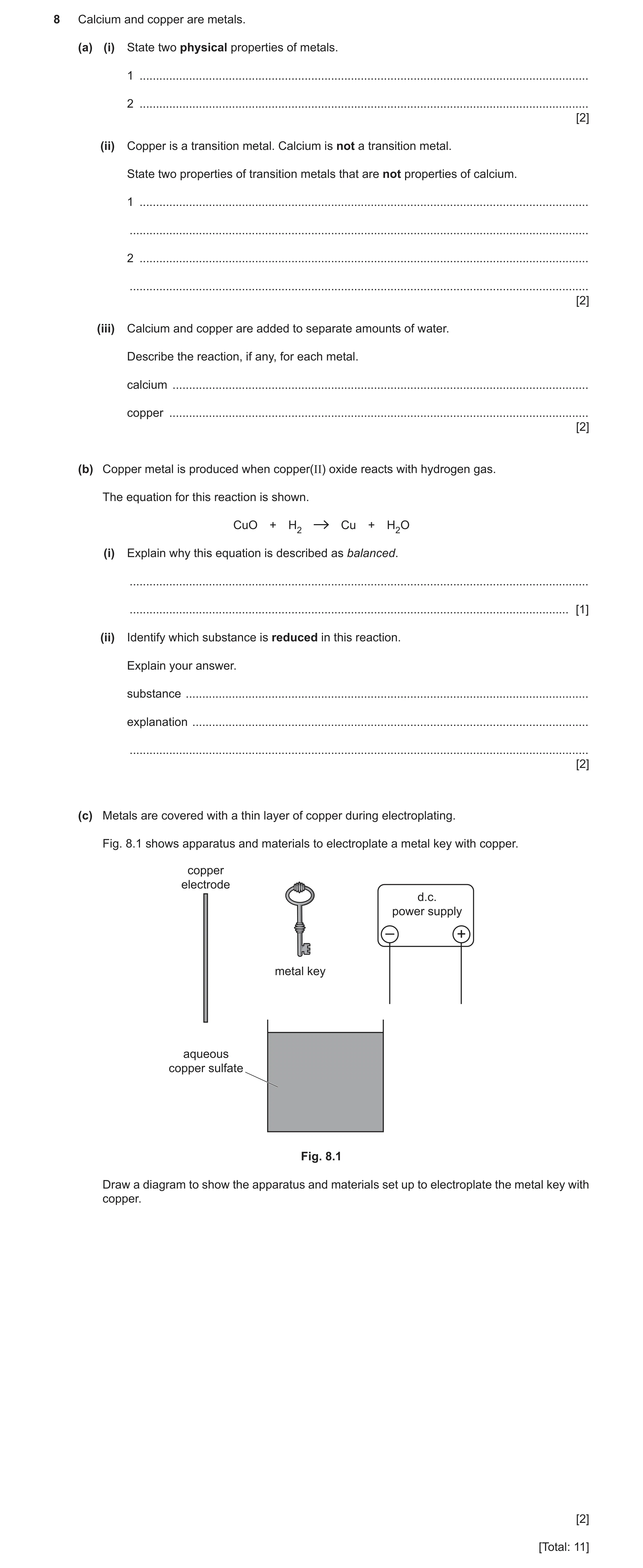
8 Calcium and copper are metals. (a) (i) State two physical properties of metals. 1 … 2 … [2] (ii) Copper is a transition metal. Calcium is not a transition metal. State two properties of transition metals that are not properties of calcium. 1 … … 2 … … [2] (iii) Calcium and copper are added to separate amounts of water. Describe the reaction, if any, for each metal. calcium … copper … [2] (b) Copper metal is produced when copper(II) oxide reacts with hydrogen gas. The equation for this reaction is shown. CuO + H2 Cu + H2O (i) Explain why this equation is described as balanced. … … [1] (ii) Identify which substance is reduced in this reaction. Explain your answer. substance … explanation … … [2] (c) Metals are covered with a thin layer of copper during electroplating. Fig. 8.1 shows apparatus and materials to electroplate a metal key with copper. copper electrode d.c. power supply – + metal key aqueous copper sulfate Fig. 8.1 Draw a diagram to show the apparatus and materials set up to electroplate the metal key with copper. [2] [Total: 11]
11 marks
Mark scheme: 8(a)(i) any two from: (good) electrical conductor (good) thermal conductor solid / high melting / boiling point malleable / ductile lustrous / sonorous ;; 8(a)(ii) (a transition metal ) forms coloured compounds ; can act as a catalyst ; has (relatively) high density / melting point ; max 2 8(a)(iii) (calcium) gas evolved / metal dissolves / white insoluble solid forms ; (copper) no change ; 2 8(b)(i) same number of all types of atom on LHS and on RHS / shown in reactants and products ; 1 8(b)(ii) Cu2+ ; reference to the loss of oxygen ; 2 Question Answer Marks 8(c) key and copper electrode connected and dipping into the solution ; correct polarity ; 2
This question in 0654/31 May/June 2020
Q5 · Metal oxides are formed when metals and oxygen react 0654/31 Oct/Nov 2020
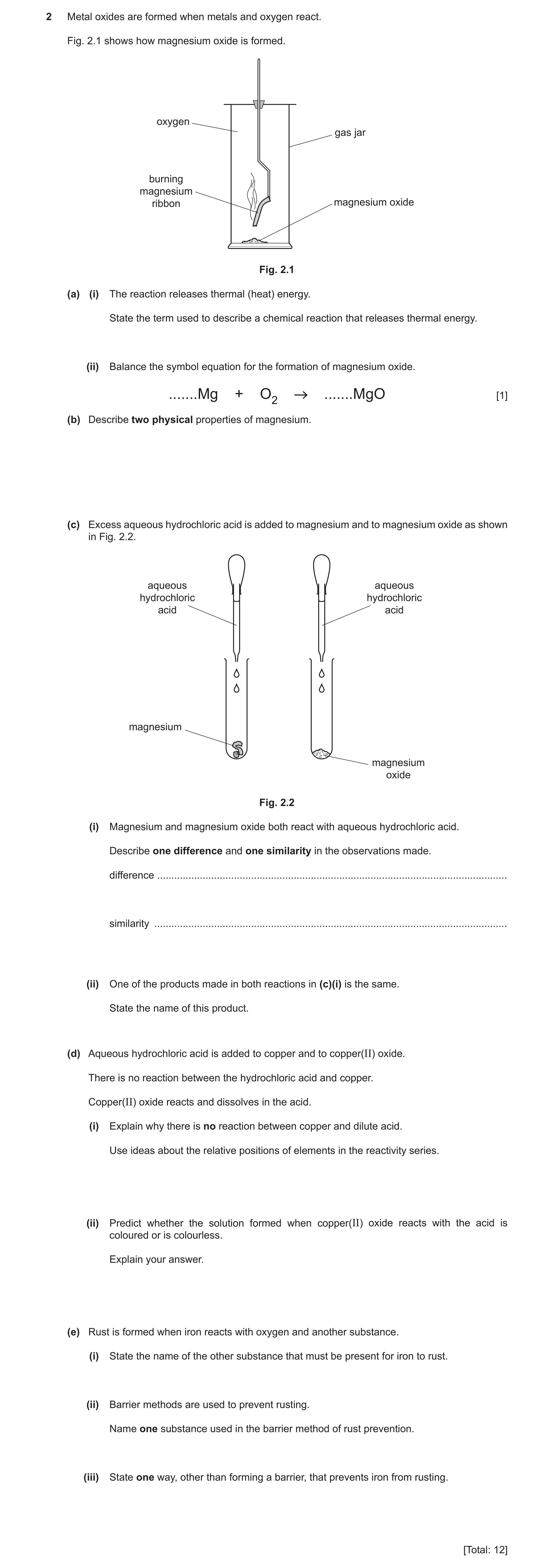
2 Metal oxides are formed when metals and oxygen react. Fig. 2.1 shows how magnesium oxide is formed. oxygen gas jar burning magnesium ribbon magnesium oxide Fig. 2.1 (a) (i) The reaction releases thermal (heat) energy. State the term used to describe a chemical reaction that releases thermal energy. (ii) Balance the symbol equation for the formation of magnesium oxide. [1] … Mg + O2 … MgO (b) Describe two physical properties of magnesium. (c) Excess aqueous hydrochloric acid is added to magnesium and to magnesium oxide as shown in Fig. 2.2. aqueous aqueous hydrochloric hydrochloric acid acid magnesium magnesium oxide Fig. 2.2 (i) Magnesium and magnesium oxide both react with aqueous hydrochloric acid. Describe one difference and one similarity in the observations made. difference �������������������������������������������������������������������������������������������������������������������������� similarity ���������������������������������������������������������������������������������������������������������������������������� (ii) One of the products made in both reactions in (c)(i) is the same. State the name of this product. (d) Aqueous hydrochloric acid is added to copper and to copper(II) oxide. There is no reaction between the hydrochloric acid and copper. Copper(II) oxide reacts and dissolves in the acid. (i) Explain why there is no reaction between copper and dilute acid. Use ideas about the relative positions of elements in the reactivity series. (ii) Predict whether the solution formed when copper(II) oxide reacts with the acid is coloured or is colourless. Explain your answer. (e) Rust is formed when iron reacts with oxygen and another substance. (i) State the name of the other substance that must be present for iron to rust. (ii) Barrier methods are used to prevent rusting. Name one substance used in the barrier method of rust prevention. (iii) State one way, other than forming a barrier, that prevents iron from rusting. [Total: 12]
12 marks
Mark scheme: 2(a)(i) exothermic ; 1 2(a)(ii) 2Mg + O2 → 2MgO ; 1 2(b) (magnesium is) malleable ; ductile ; good (electrical / thermal) conductor ; 2 2(c)(i) difference – gas released with magnesium (and not with the oxide) ; similarity – the solid reacts to form a soluble product / solid dissolves ; 2 2(c)(ii) magnesium chloride / MgCl2 ; 1 Question Answer Marks 2(d)(i) copper is low in the reactivity series ; copper is less reactive than hydrogen ; 1 2(d)(ii) (coloured) copper is a transition metal / transition metal compounds are (usually) coloured / copper compounds are coloured ; 1 2(e)(i) water / water vapour ; 1 2(e)(ii) paint / oil / plastic / (named) unreactive metal ; 1 2(e)(iii) (add other metals to) make it into an alloy / stainless steel ; 1
This question in 0654/31 Oct/Nov 2020
Q6 · Aluminium is used in industry to make many different products 0654/32 Oct/Nov 2020
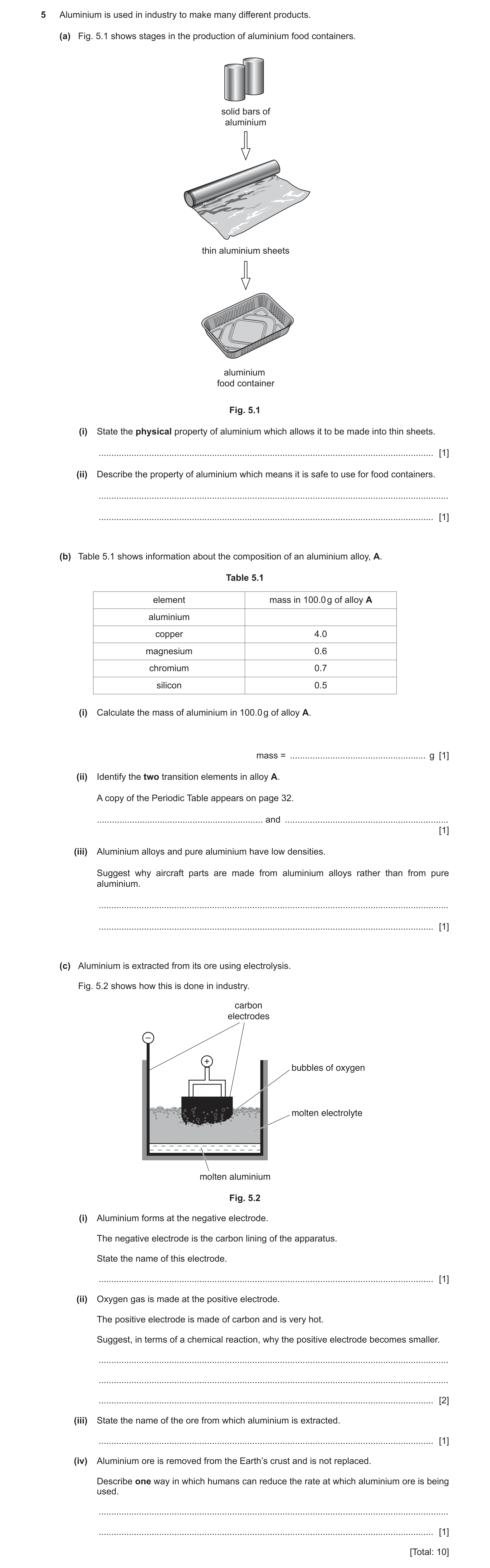
5 Aluminium is used in industry to make many different products. (a) Fig. 5.1 shows stages in the production of aluminium food containers. solid bars of aluminium thin aluminium sheets aluminium food container Fig. 5.1 (i) State the physical property of aluminium which allows it to be made into thin sheets. … [1] (ii) Describe the property of aluminium which means it is safe to use for food containers. … … [1] (b) Table 5.1 shows information about the composition of an aluminium alloy, A. Table 5.1 element mass in 100.0 g of alloy A aluminium copper 4.0 magnesium 0.6 chromium 0.7 silicon 0.5 (i) Calculate the mass of aluminium in 100.0 g of alloy A. mass = … g [1] (ii) Identify the two transition elements in alloy A. A copy of the Periodic Table appears on page 32. … and … [1] (iii) Aluminium alloys and pure aluminium have low densities. Suggest why aircraft parts are made from aluminium alloys rather than from pure aluminium. … … [1] (c) Aluminium is extracted from its ore using electrolysis. Fig. 5.2 shows how this is done in industry. carbon electrodes – + bubbles of oxygen molten electrolyte molten aluminium Fig. 5.2 (i) Aluminium forms at the negative electrode. The negative electrode is the carbon lining of the apparatus. State the name of this electrode. … [1] (ii) Oxygen gas is made at the positive electrode. The positive electrode is made of carbon and is very hot. Suggest, in terms of a chemical reaction, why the positive electrode becomes smaller. … … … [2] (iii) State the name of the ore from which aluminium is extracted. … [1] (iv) Aluminium ore is removed from the Earth’s crust and is not replaced. Describe one way in which humans can reduce the rate at which aluminium ore is being used. … … [1] [Total: 10]
10 marks
Mark scheme: 5(a)(i) malleability / it is malleable ; 1 5(a)(ii) unreactive / does not react with food ; 1 5(b)(i) 100 – (4.0 + 0.6 + 0.7 + 0.5) = 94.2 (g) 1 5(b)(ii) copper and chromium ; 1 5(b)(iii) alloy is stronger ; 1 5(c)(i) cathode ; 1 5(c)(ii) carbon oxidises / carbon burns / C + O2 → CO2 ; the idea that a gaseous product is released ; 2 5(c)(iii) bauxite ; 1 5(c)(iv) recycle (waste) aluminium ; 1
This question in 0654/32 Oct/Nov 2020
Q7 · Metal oxides are formed when metals and oxygen react 0654/33 Oct/Nov 2020
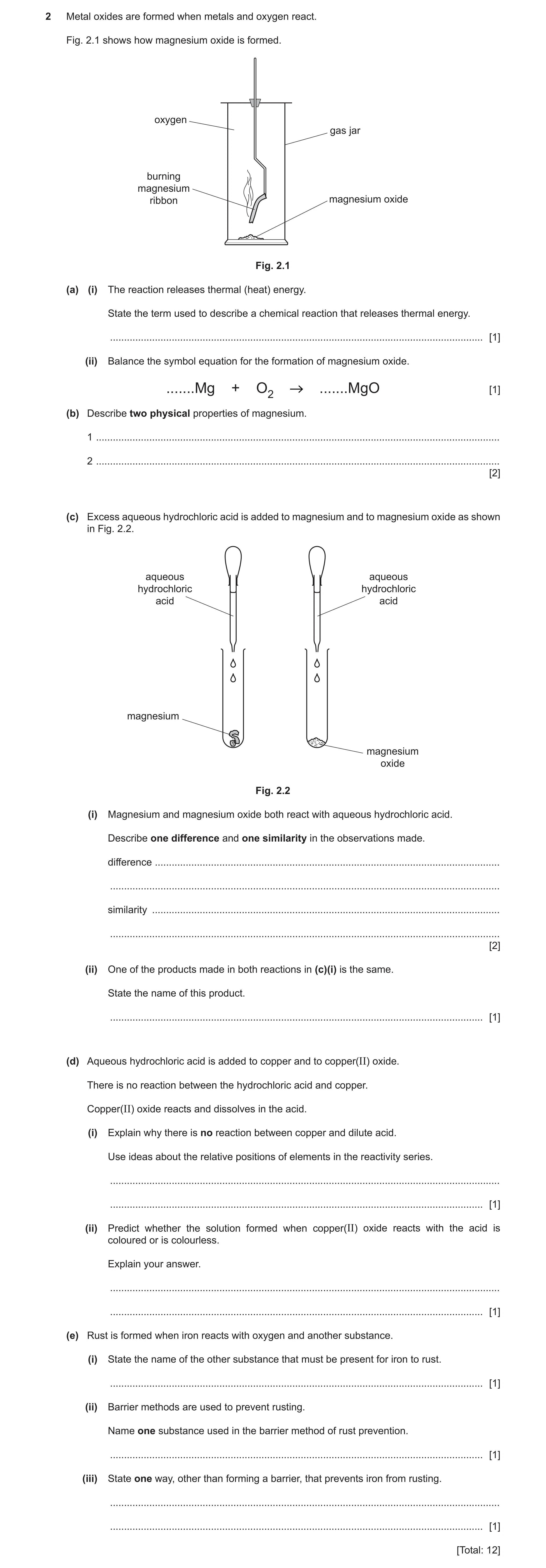
2 Metal oxides are formed when metals and oxygen react. Fig. 2.1 shows how magnesium oxide is formed. oxygen gas jar burning magnesium ribbon magnesium oxide Fig. 2.1 (a) (i) The reaction releases thermal (heat) energy. State the term used to describe a chemical reaction that releases thermal energy. … [1] (ii) Balance the symbol equation for the formation of magnesium oxide. [1] … Mg + O2 … MgO (b) Describe two physical properties of magnesium. 1 … 2 … [2] (c) Excess aqueous hydrochloric acid is added to magnesium and to magnesium oxide as shown in Fig. 2.2. aqueous aqueous hydrochloric hydrochloric acid acid magnesium magnesium oxide Fig. 2.2 (i) Magnesium and magnesium oxide both react with aqueous hydrochloric acid. Describe one difference and one similarity in the observations made. difference … … similarity … … [2] (ii) One of the products made in both reactions in (c)(i) is the same. State the name of this product. … [1] (d) Aqueous hydrochloric acid is added to copper and to copper(II) oxide. There is no reaction between the hydrochloric acid and copper. Copper(II) oxide reacts and dissolves in the acid. (i) Explain why there is no reaction between copper and dilute acid. Use ideas about the relative positions of elements in the reactivity series. … … [1] (ii) Predict whether the solution formed when copper(II) oxide reacts with the acid is coloured or is colourless. Explain your answer. … … [1] (e) Rust is formed when iron reacts with oxygen and another substance. (i) State the name of the other substance that must be present for iron to rust. … [1] (ii) Barrier methods are used to prevent rusting. Name one substance used in the barrier method of rust prevention. … [1] (iii) State one way, other than forming a barrier, that prevents iron from rusting. … … [1] [Total: 12]
12 marks
Mark scheme: 2(a)(i) exothermic ; 1 2(a)(ii) 2Mg + O2 → 2MgO ; 1 2(b) (magnesium is) malleable ; ductile ; good (electrical / thermal) conductor ; 2 2(c)(i) difference – gas released with magnesium (and not with the oxide) ; similarity – the solid reacts to form a soluble product / solid dissolves ; 2 2(c)(ii) magnesium chloride / MgCl2 ; 1 Question Answer Marks 2(d)(i) copper is low in the reactivity series ; copper is less reactive than hydrogen ; 1 2(d)(ii) (coloured) copper is a transition metal / transition metal compounds are (usually) coloured / copper compounds are coloured ; 1 2(e)(i) water / water vapour ; 1 2(e)(ii) paint / oil / plastic / (named) unreactive metal ; 1 2(e)(iii) (add other metals to) make it into an alloy / stainless steel ; 1
This question in 0654/33 Oct/Nov 2020
Q8 · A list of seven metals from the Periodic Table 0654/32 Feb/March 2022
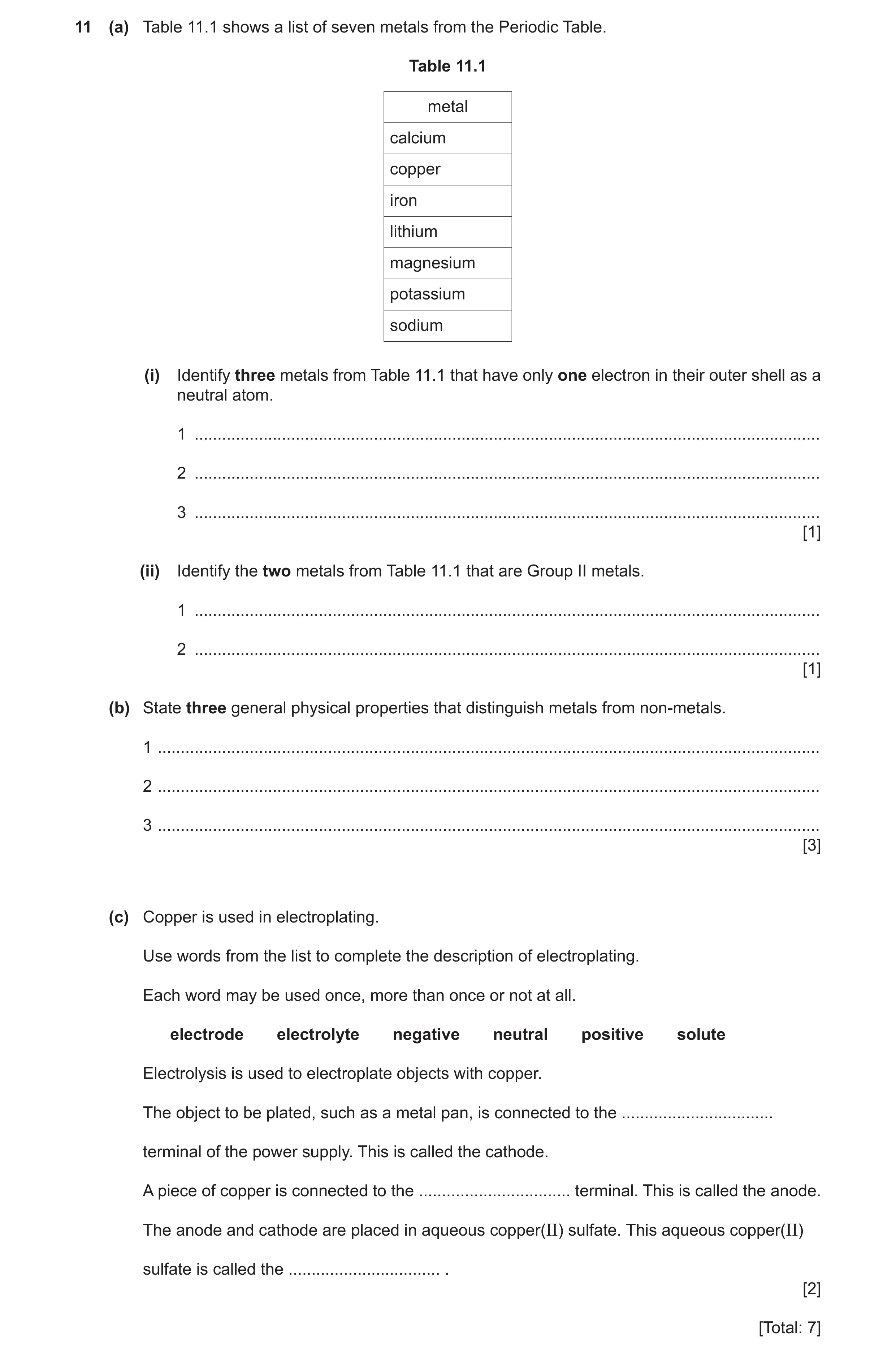
11 (a) Table 11.1 shows a list of seven metals from the Periodic Table. Table 11.1 metal calcium copper iron lithium magnesium potassium sodium (i) Identify three metals from Table 11.1 that have only one electron in their outer shell as a neutral atom. 1 … 2 … 3 … [1] (ii) Identify the two metals from Table 11.1 that are Group II metals. 1 … 2 … [1] (b) State three general physical properties that distinguish metals from non-metals. 1 … 2 … 3 … [3] (c) Copper is used in electroplating. Use words from the list to complete the description of electroplating. Each word may be used once, more than once or not at all. electrode electrolyte negative neutral positive solute Electrolysis is used to electroplate objects with copper. The object to be plated, such as a metal pan, is connected to the … terminal of the power supply. This is called the cathode. A piece of copper is connected to the … terminal. This is called the anode. The anode and cathode are placed in aqueous copper(II) sulfate. This aqueous copper(II) sulfate is called the … . [2] [Total: 7]
7 marks
Mark scheme: 11(a)(i) lithium , potassium and sodium; 1 11(a)(ii) calcium and magnesium; 1 11(b) any three from: good thermal conductors; good electrical conductors; (relatively) high melting point / boiling point; malleable; 3 11(c) negative and positive; electrolyte; 2
This question in 0654/32 Feb/March 2022
Q9 · Aluminium is a metal 0654/31 May/June 2022
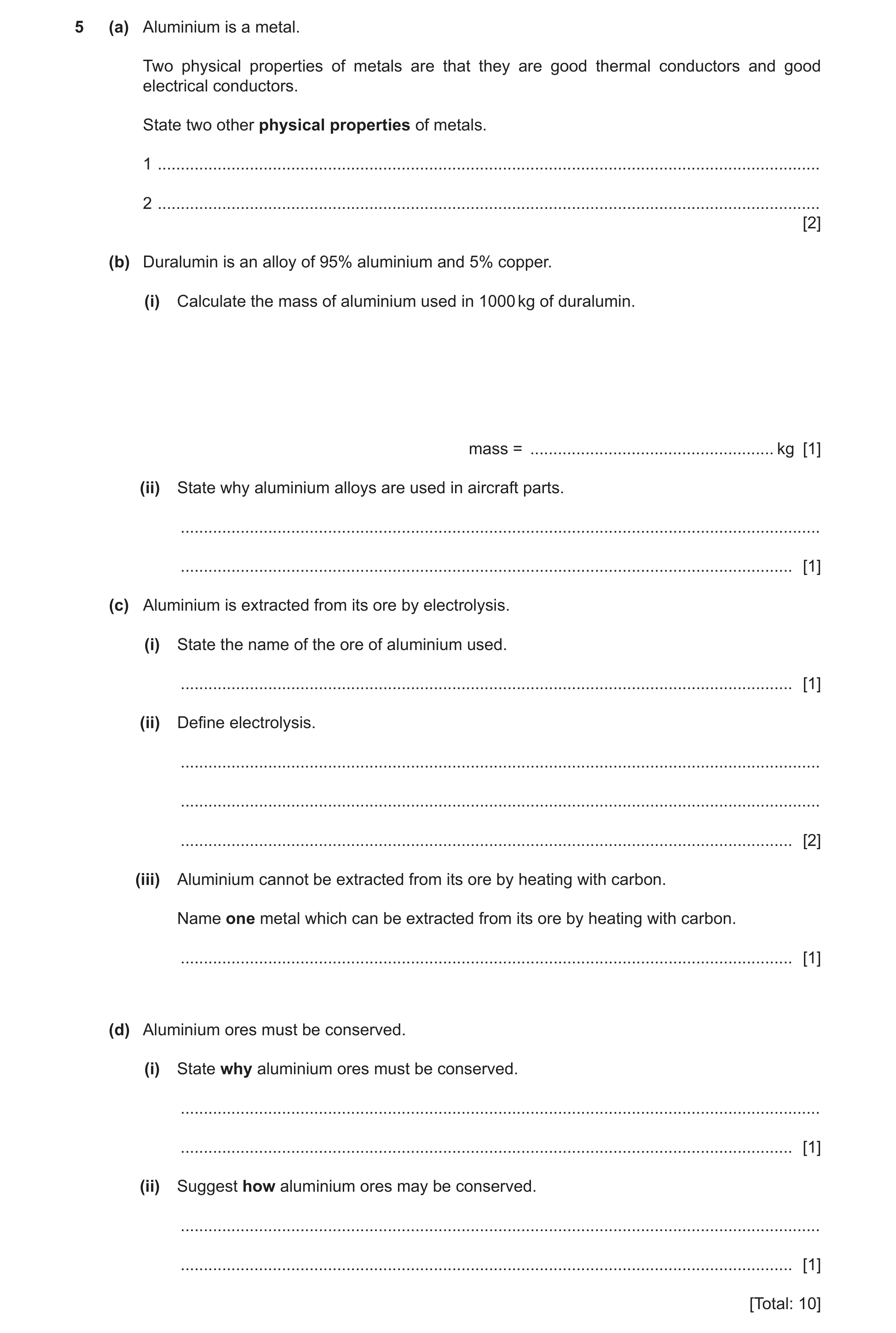
5 (a) Aluminium is a metal. Two physical properties of metals are that they are good thermal conductors and good electrical conductors. State two other physical properties of metals. 1 … 2 … [2] (b) Duralumin is an alloy of 95% aluminium and 5% copper. (i) Calculate the mass of aluminium used in 1000 kg of duralumin. mass = … kg [1] (ii) State why aluminium alloys are used in aircraft parts. … … [1] (c) Aluminium is extracted from its ore by electrolysis. (i) State the name of the ore of aluminium used. … [1] (ii) Define electrolysis. … … … [2] (iii) Aluminium cannot be extracted from its ore by heating with carbon. Name one metal which can be extracted from its ore by heating with carbon. … [1] (d) Aluminium ores must be conserved. (i) State why aluminium ores must be conserved. … … [1] (ii) Suggest how aluminium ores may be conserved. … … [1] [Total: 10]
10 marks
Mark scheme: 5(a) high melting point; high boiling point; malleable; ductile; Max 2 marks 2 5(b)(i) 950 (kg); 1 5(b)(ii) low density / high tensile strength; 1 5(c)(i) bauxite; 1 5(c)(ii) breakdown of an ionic compound; when molten or in aqueous solution; by the passage of electricity; Max 2 marks 2 5(c)(iii) iron; 1 5(d)(i) finite resource / material being used at a faster rate than it can be replaced; 1 5(d)(ii) recycling; 1
This question in 0654/31 May/June 2022
Q10 · A list of six elements 0654/32 May/June 2022
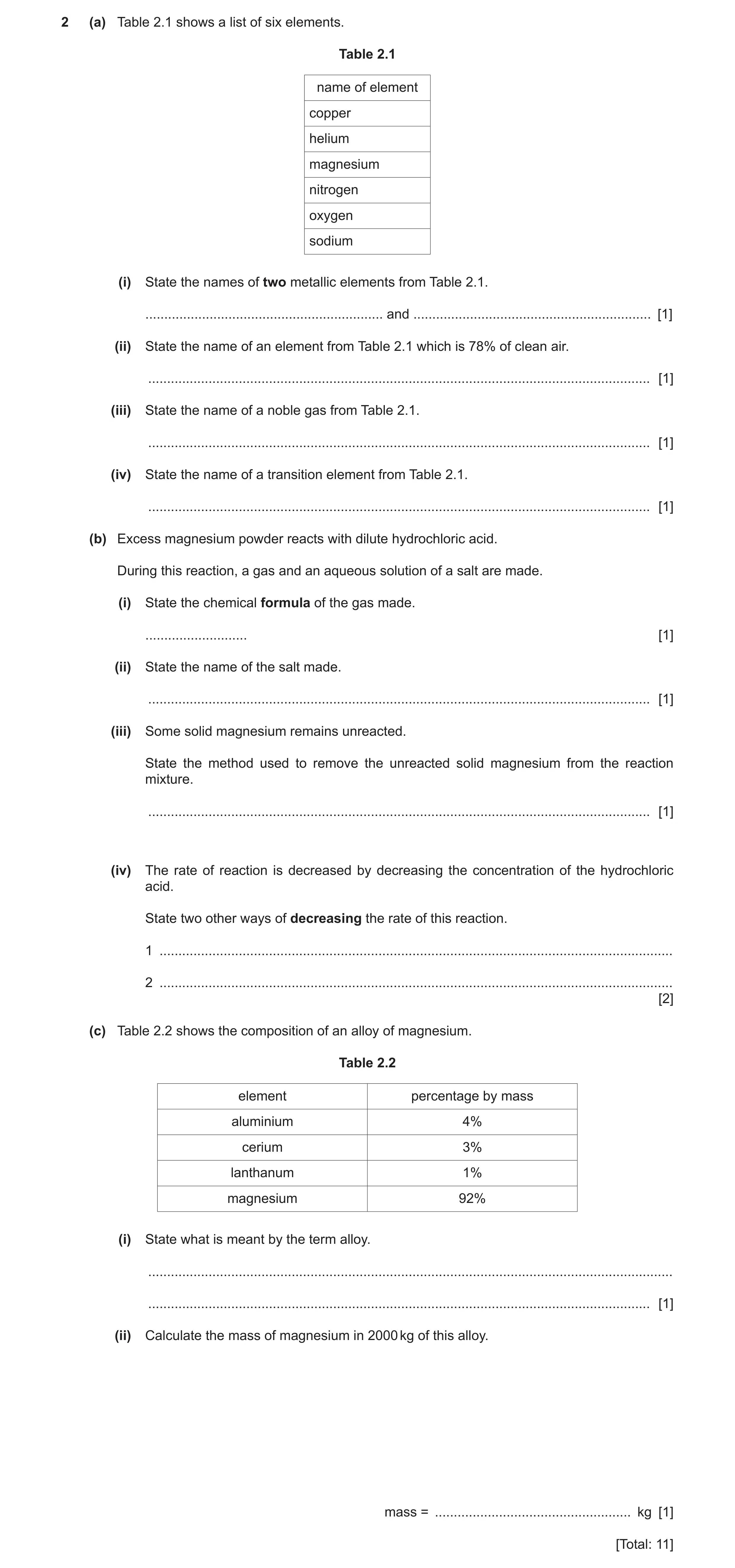
2 (a) Table 2.1 shows a list of six elements. Table 2.1 name of element copper helium magnesium nitrogen oxygen sodium (i) State the names of two metallic elements from Table 2.1. … and … [1] (ii) State the name of an element from Table 2.1 which is 78% of clean air. … [1] (iii) State the name of a noble gas from Table 2.1. … [1] (iv) State the name of a transition element from Table 2.1. … [1] (b) Excess magnesium powder reacts with dilute hydrochloric acid. During this reaction, a gas and an aqueous solution of a salt are made. (i) State the chemical formula of the gas made. … [1] (ii) State the name of the salt made. … [1] (iii) Some solid magnesium remains unreacted. State the method used to remove the unreacted solid magnesium from the reaction mixture. … [1] (iv) The rate of reaction is decreased by decreasing the concentration of the hydrochloric acid. State two other ways of decreasing the rate of this reaction. 1 … 2 … [2] (c) Table 2.2 shows the composition of an alloy of magnesium. Table 2.2 element percentage by mass aluminium 4% cerium 3% lanthanum 1% magnesium 92% (i) State what is meant by the term alloy. … … [1] (ii) Calculate the mass of magnesium in 2000 kg of this alloy. mass = … kg [1] [Total: 11]
11 marks
Mark scheme: 2(a)(i) any two from copper, magnesium and sodium; 1 2(a)(ii) nitrogen ; 1 2(a)(iii) helium; 1 2(a)(iv) copper; 1 2(b)(i) H2; 1 2(b)(ii) magnesium chloride; 1 2(b)(iii) filtration; 1 2(b)(iv) decrease surface area / increase particle size of magnesium; decrease temperature (of acid); 2 Question Answer Marks 2(c)(i) mixture of metals / mixture of a metal and another element; 1 2(c)(ii) 1840 (kg) ; 1
This question in 0654/32 May/June 2022
Q11 · The list gives the names of six compounds 0654/32 May/June 2023
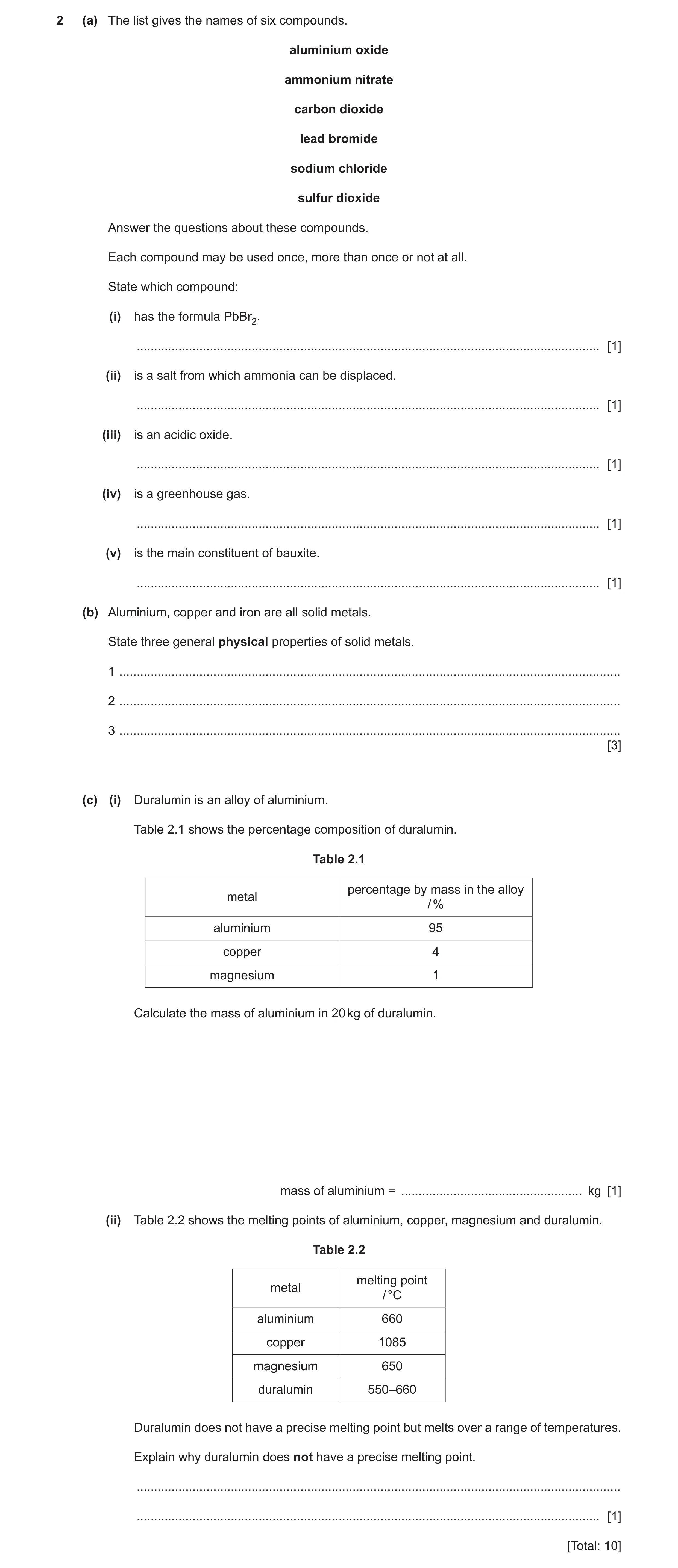
2 (a) The list gives the names of six compounds. aluminium oxide ammonium nitrate carbon dioxide lead bromide sodium chloride sulfur dioxide Answer the questions about these compounds. Each compound may be used once, more than once or not at all. State which compound: (i) has the formula PbBr2. … [1] (ii) is a salt from which ammonia can be displaced. … [1] (iii) is an acidic oxide. … [1] (iv) is a greenhouse gas. … [1] (v) is the main constituent of bauxite. … [1] (b) Aluminium, copper and iron are all solid metals. State three general physical properties of solid metals. 1 … 2 … 3 … [3] (c) (i) Duralumin is an alloy of aluminium. Table 2.1 shows the percentage composition of duralumin. Table 2.1 percentage by mass in the alloy metal / % aluminium 95 copper 4 magnesium 1 Calculate the mass of aluminium in 20 kg of duralumin. mass of aluminium = … kg [1] (ii) Table 2.2 shows the melting points of aluminium, copper, magnesium and duralumin. Table 2.2 melting point metal / °C aluminium 660 copper 1085 magnesium 650 duralumin 550–660 Duralumin does not have a precise melting point but melts over a range of temperatures. Explain why duralumin does not have a precise melting point. … … [1] [Total: 10]
10 marks
Mark scheme: 2(a)(i) lead bromide ; 1 2(a)(ii) ammonium nitrate ; 1 2(a)(iii) carbon dioxide / sulfur dioxide ; 1 Question Answer Marks 2(a)(iv) carbon dioxide ; 1 2(a)(v) aluminium oxide ; 1 2(b) any three from: conducts heat ; conducts electricity ; malleable ; high melting/boiling point ; 3 2(c)(i) 95 / 100 20 = 19 (kg) ; 1 2(c)(ii) because it is not a pure substance / it is a mixture ; 1
This question in 0654/32 May/June 2023
Q12 · The list gives the names of six compounds 0654/33 May/June 2023
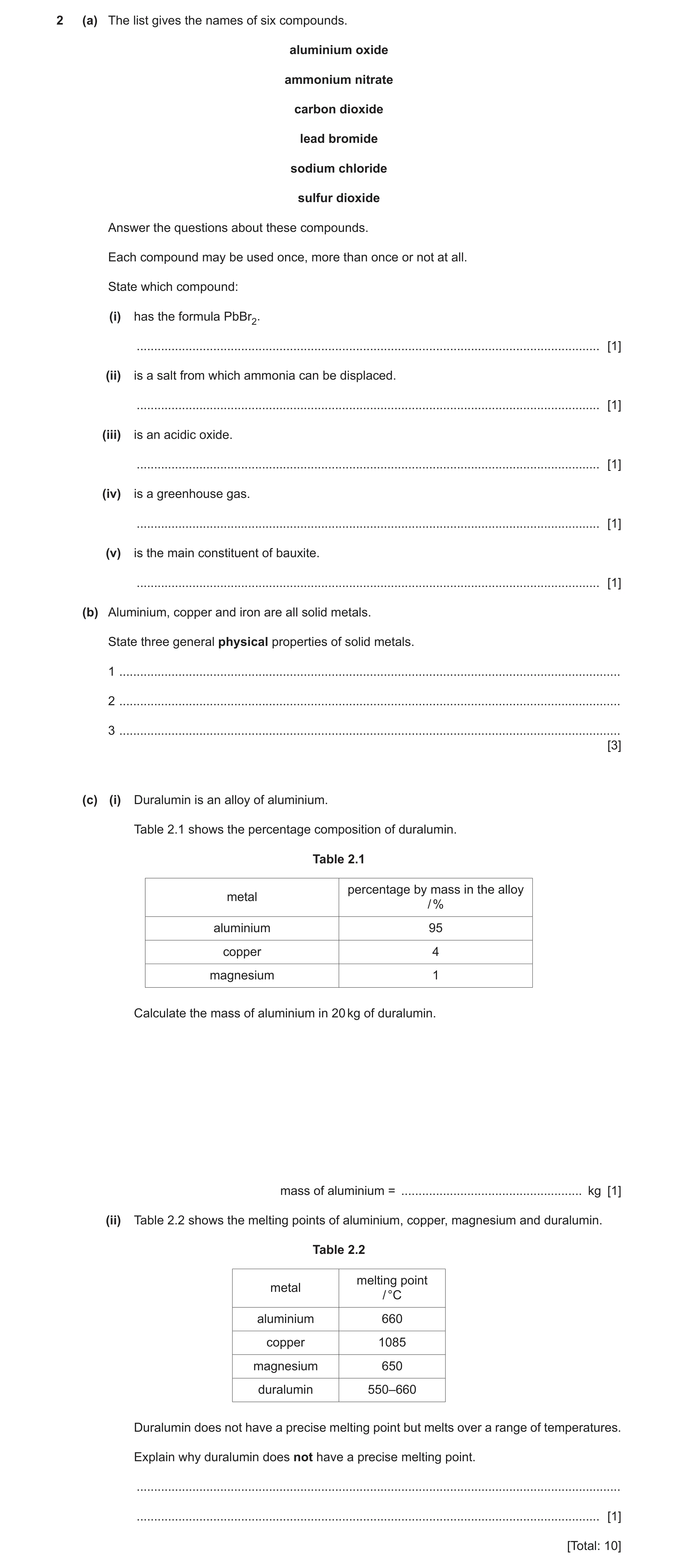
2 (a) The list gives the names of six compounds. aluminium oxide ammonium nitrate carbon dioxide lead bromide sodium chloride sulfur dioxide Answer the questions about these compounds. Each compound may be used once, more than once or not at all. State which compound: (i) has the formula PbBr2. … [1] (ii) is a salt from which ammonia can be displaced. … [1] (iii) is an acidic oxide. … [1] (iv) is a greenhouse gas. … [1] (v) is the main constituent of bauxite. … [1] (b) Aluminium, copper and iron are all solid metals. State three general physical properties of solid metals. 1 … 2 … 3 … [3] (c) (i) Duralumin is an alloy of aluminium. Table 2.1 shows the percentage composition of duralumin. Table 2.1 percentage by mass in the alloy metal / % aluminium 95 copper 4 magnesium 1 Calculate the mass of aluminium in 20 kg of duralumin. mass of aluminium = … kg [1] (ii) Table 2.2 shows the melting points of aluminium, copper, magnesium and duralumin. Table 2.2 melting point metal / °C aluminium 660 copper 1085 magnesium 650 duralumin 550–660 Duralumin does not have a precise melting point but melts over a range of temperatures. Explain why duralumin does not have a precise melting point. … … [1] [Total: 10]
10 marks
Mark scheme: 2(a)(i) lead bromide ; 1 2(a)(ii) ammonium nitrate ; 1 2(a)(iii) carbon dioxide / sulfur dioxide ; 1 Question Answer Marks 2(a)(iv) carbon dioxide ; 1 2(a)(v) aluminium oxide ; 1 2(b) any three from: conducts heat ; conducts electricity ; malleable ; high melting/boiling point ; 3 2(c)(i) 95 / 100 20 = 19 (kg) ; 1 2(c)(ii) because it is not a pure substance / it is a mixture ; 1
This question in 0654/33 May/June 2023
Q13 · A student investigates the reaction between magnesium and dilute sulfuric acid 0654/31 Oct/Nov 2023
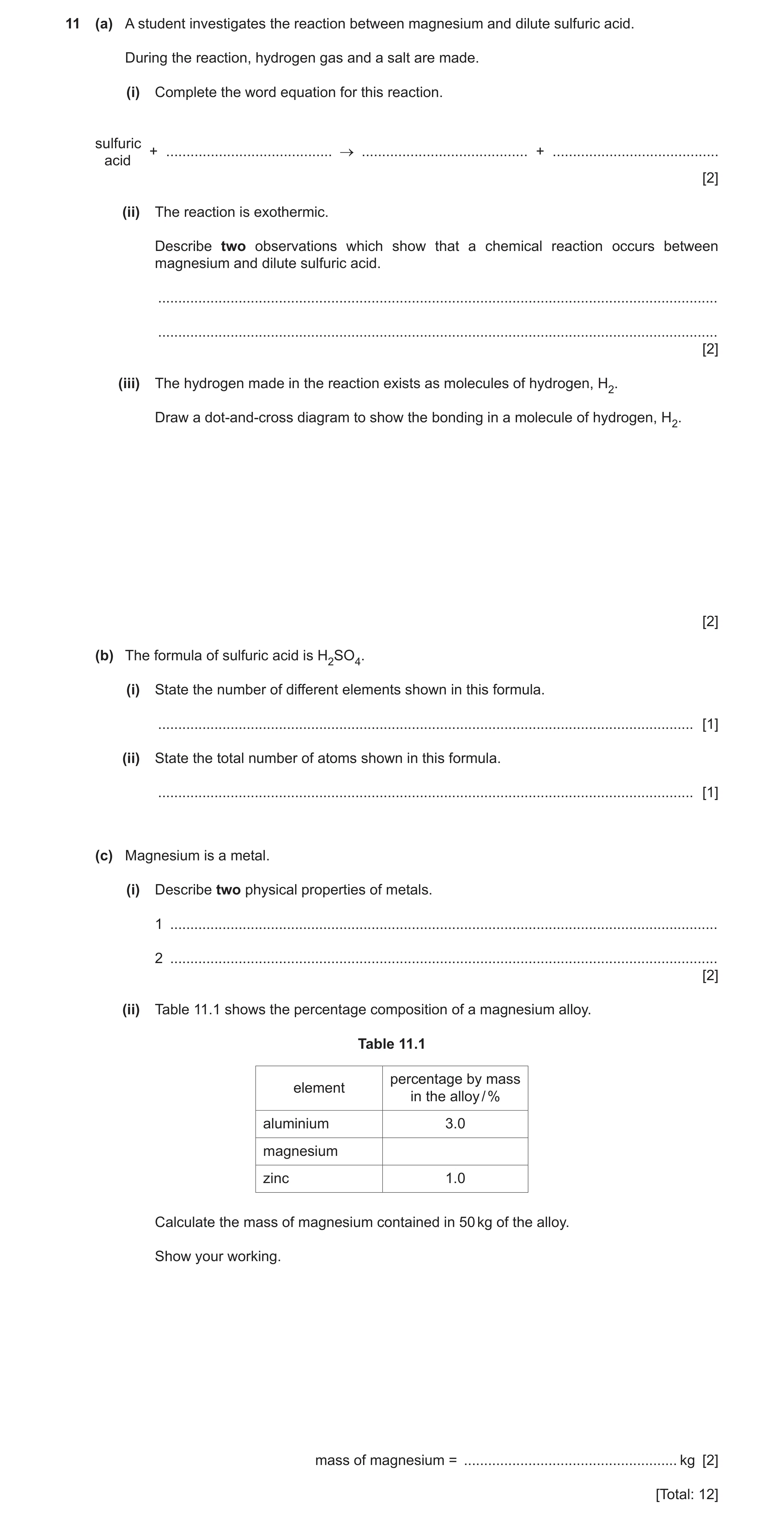
11 (a) A student investigates the reaction between magnesium and dilute sulfuric acid. During the reaction, hydrogen gas and a salt are made. (i) Complete the word equation for this reaction. sulfuric + … … + … acid [2] (ii) The reaction is exothermic. Describe two observations which show that a chemical reaction occurs between magnesium and dilute sulfuric acid. … … [2] (iii) The hydrogen made in the reaction exists as molecules of hydrogen, H2. Draw a dot-and-cross diagram to show the bonding in a molecule of hydrogen, H2. [2] (b) The formula of sulfuric acid is H2SO4. (i) State the number of different elements shown in this formula. … [1] (ii) State the total number of atoms shown in this formula. … [1] (c) Magnesium is a metal. (i) Describe two physical properties of metals. 1 … 2 … [2] (ii) Table 11.1 shows the percentage composition of a magnesium alloy. Table 11.1 percentage by mass element in the alloy / % aluminium 3.0 magnesium zinc 1.0 Calculate the mass of magnesium contained in 50 kg of the alloy. Show your working. mass of magnesium = … kg [2] [Total: 12]
12 marks
Mark scheme: 11(a)(i) (sulfuric acid) + magnesium → hydrogen + magnesium sulfate 2 magnesium and hydrogen ; magnesium sulfate ; 11(a)(ii) gets hot / temperature increases ; 2 fizzing / bubbles / effervescence ; 11(a)(iii) 2 2 hydrogen atoms ; 1 shared pair of electrons only ; 11(b)(i) 3 ; 1 11(b)(ii) 7 ; 1 11(c)(i) any two from: 2 good conductor of electricity ; good conductor of heat ; high melting / boiling point ; malleable ; 11(c)(ii) • 96 (%) seen ; 2 • 48 (kg) ;
This question in 0654/31 Oct/Nov 2023
Q14 · Iron is a metal 0654/32 May/June 2024
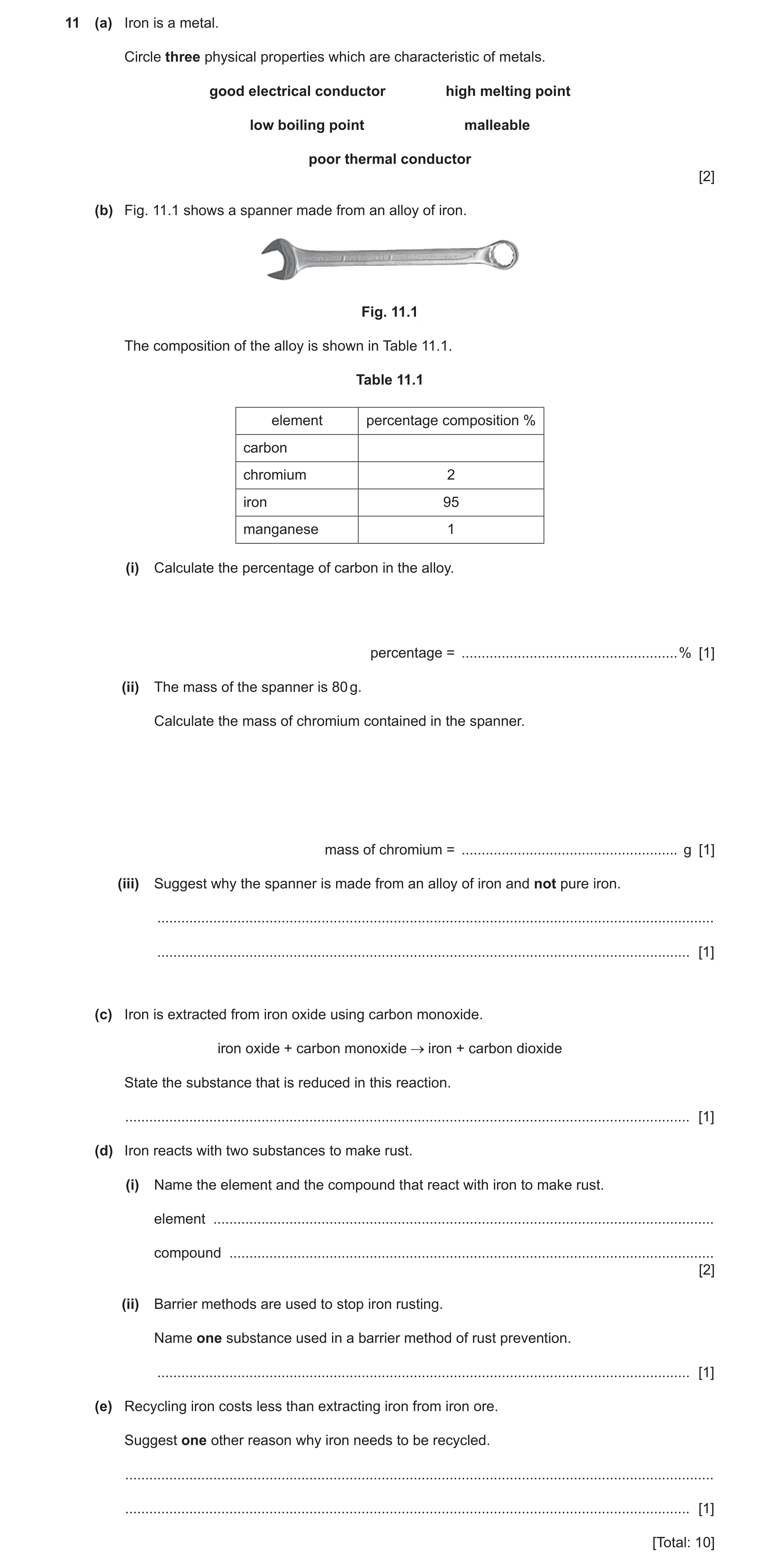
11 (a) Iron is a metal. Circle three physical properties which are characteristic of metals. good electrical conductor high melting point low boiling point malleable poor thermal conductor [2] (b) Fig. 11.1 shows a spanner made from an alloy of iron. Fig. 11.1 The composition of the alloy is shown in Table 11.1. Table 11.1 element percentage composition % carbon chromium 2 iron 95 manganese 1 (i) Calculate the percentage of carbon in the alloy. percentage = … % [1] (ii) The mass of the spanner is 80 g. Calculate the mass of chromium contained in the spanner. mass of chromium = … g [1] (iii) Suggest why the spanner is made from an alloy of iron and not pure iron. … … [1] (c) Iron is extracted from iron oxide using carbon monoxide. iron oxide + carbon monoxide iron + carbon dioxide State the substance that is reduced in this reaction. … [1] (d) Iron reacts with two substances to make rust. (i) Name the element and the compound that react with iron to make rust. element … compound … [2] (ii) Barrier methods are used to stop iron rusting. Name one substance used in a barrier method of rust prevention. … [1] (e) Recycling iron costs less than extracting iron from iron ore. Suggest one other reason why iron needs to be recycled. … … [1] [Total: 10]
10 marks
Mark scheme: 11(a) good electrical conductor high melting point malleable 1 correct ; 3 correct ; 11(b)(i) 2% ; 1 11(b)(ii) 1.6 (g) ; 1 11(b)(iii) stronger ; 1 11(c) iron oxide ; 1 11(d)(i) element–oxygen ; compound–water ; 2 11(d)(ii) paint / oil / grease ; 1 11(e) iron is a finite resource ; 1
This question in 0654/32 May/June 2024
Q15 · Iron is a metal 0654/33 May/June 2024
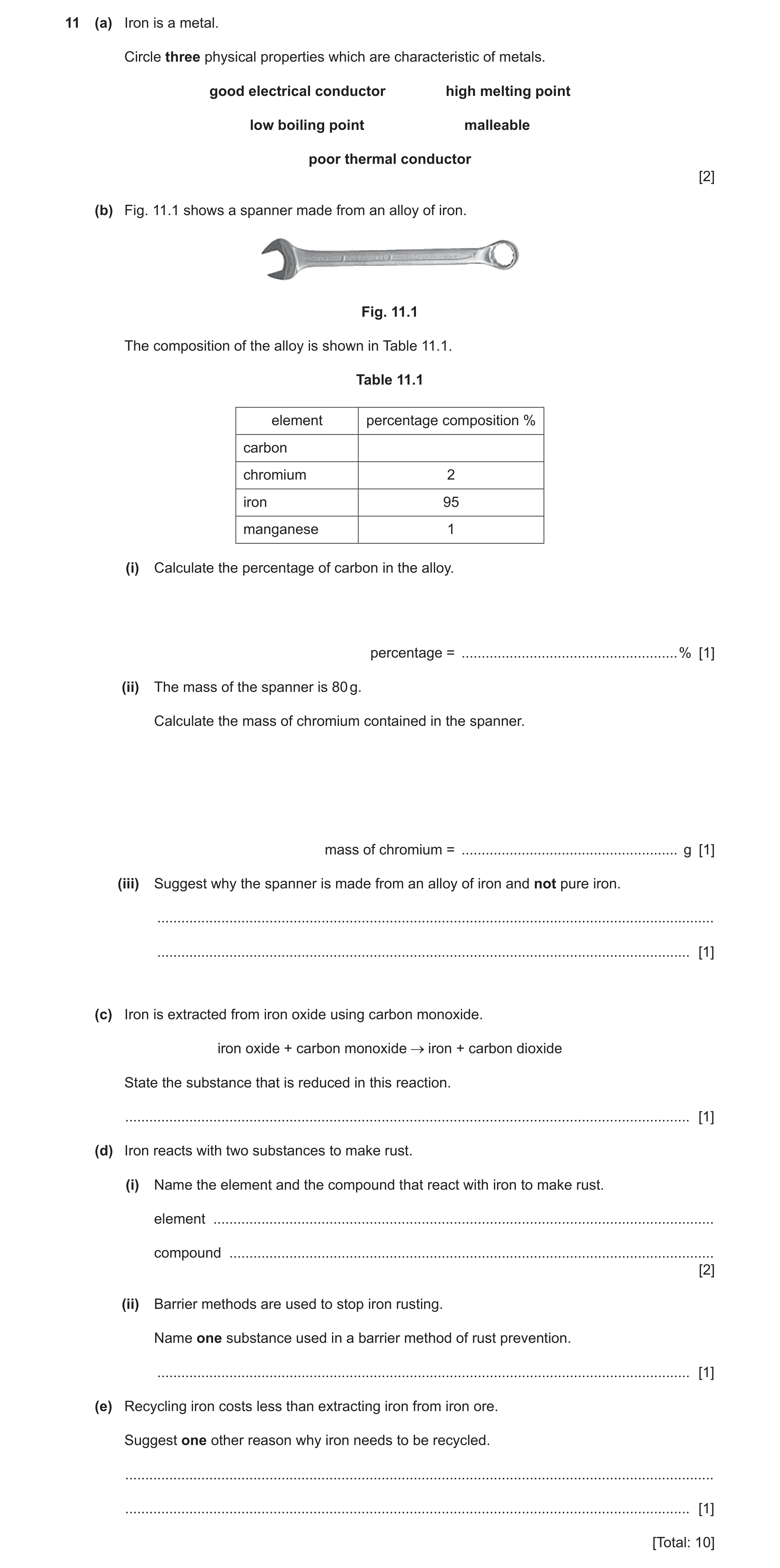
11 (a) Iron is a metal. Circle three physical properties which are characteristic of metals. good electrical conductor high melting point low boiling point malleable poor thermal conductor [2] (b) Fig. 11.1 shows a spanner made from an alloy of iron. Fig. 11.1 The composition of the alloy is shown in Table 11.1. Table 11.1 element percentage composition % carbon chromium 2 iron 95 manganese 1 (i) Calculate the percentage of carbon in the alloy. percentage = … % [1] (ii) The mass of the spanner is 80 g. Calculate the mass of chromium contained in the spanner. mass of chromium = … g [1] (iii) Suggest why the spanner is made from an alloy of iron and not pure iron. … … [1] (c) Iron is extracted from iron oxide using carbon monoxide. iron oxide + carbon monoxide iron + carbon dioxide State the substance that is reduced in this reaction. … [1] (d) Iron reacts with two substances to make rust. (i) Name the element and the compound that react with iron to make rust. element … compound … [2] (ii) Barrier methods are used to stop iron rusting. Name one substance used in a barrier method of rust prevention. … [1] (e) Recycling iron costs less than extracting iron from iron ore. Suggest one other reason why iron needs to be recycled. … … [1] [Total: 10]
10 marks
Mark scheme: 11(a) good electrical conductor high melting point malleable 1 correct ; 3 correct ; 11(b)(i) 2% ; 1 11(b)(ii) 1.6 (g) ; 1 11(b)(iii) stronger ; 1 11(c) iron oxide ; 1 11(d)(i) element–oxygen ; compound–water ; 2 11(d)(ii) paint / oil / grease ; 1 11(e) iron is a finite resource ; 1
This question in 0654/33 May/June 2024
Q16 · Data about six metals 0654/31 Oct/Nov 2025
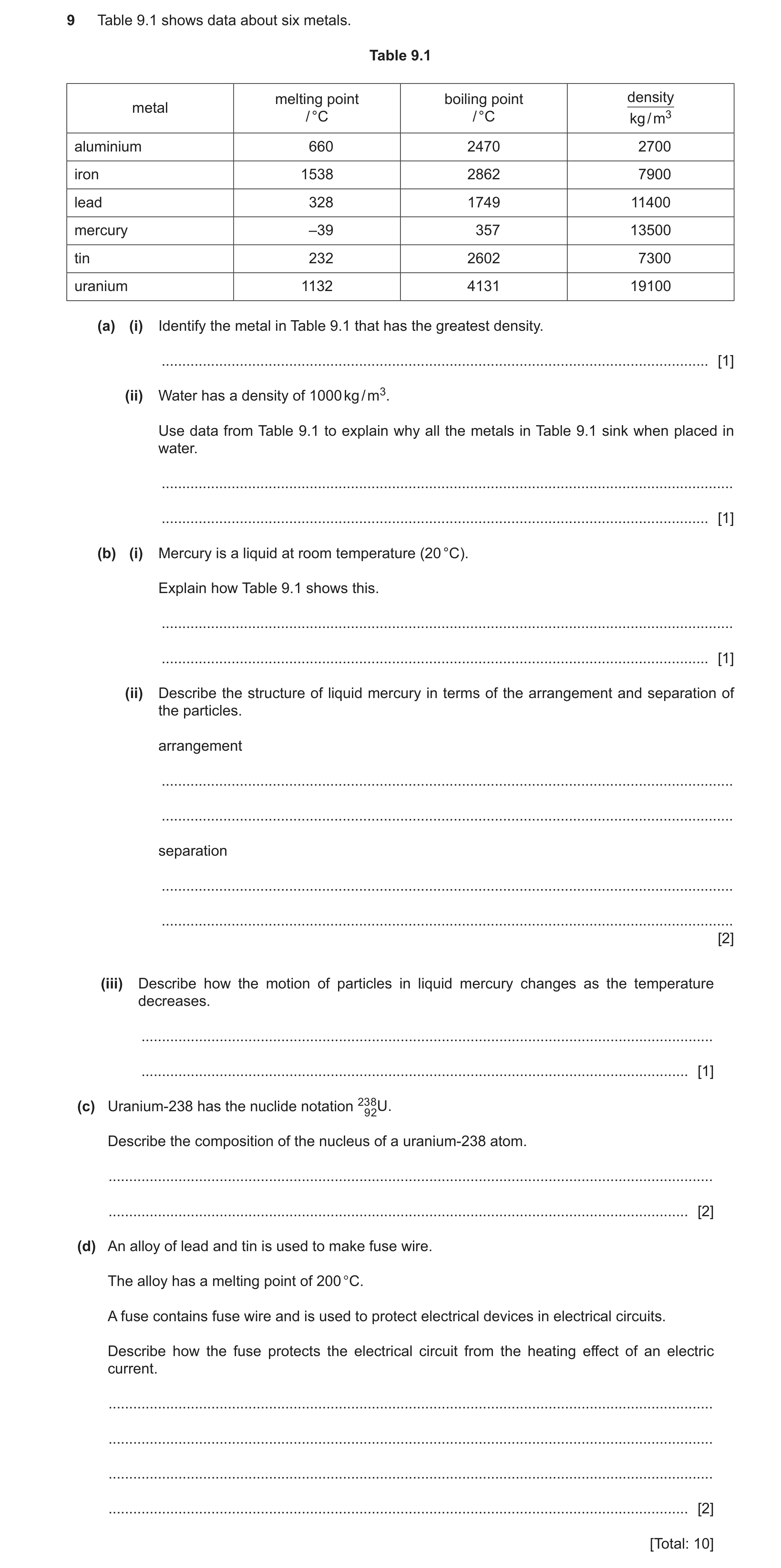
9 Table 9.1 shows data about six metals. Table 9.1 melting point boiling point density metal / °C / °C kg / m3 aluminium 660 2470 2700 iron 1538 2862 7900 lead 328 1749 11400 mercury –39 357 13500 tin 232 2602 7300 uranium 1132 4131 19100 (a) (i) Identify the metal in Table 9.1 that has the greatest density. … [1] (ii) Water has a density of 1000 kg / m3. Use data from Table 9.1 to explain why all the metals in Table 9.1 sink when placed in water. … … [1] (b) (i) Mercury is a liquid at room temperature (20 °C). Explain how Table 9.1 shows this. … … [1] (ii) Describe the structure of liquid mercury in terms of the arrangement and separation of the particles. arrangement … … separation … … [2] (iii) Describe how the motion of particles in liquid mercury changes as the temperature decreases. … … [1] (c) Uranium-238 has the nuclide notation 23 8 9 2U. Describe the composition of the nucleus of a uranium-238 atom. … … [2] (d) An alloy of lead and tin is used to make fuse wire. The alloy has a melting point of 200 °C. A fuse contains fuse wire and is used to protect electrical devices in electrical circuits. Describe how the fuse protects the electrical circuit from the heating effect of an electric current. … … … … [2] [Total: 10]
10 marks
Mark scheme: 9(a)(i) uranium ; 1 9(a)(ii) (all the metals) have a density greater than water / (all the metals) have a density greater than 1000 (kg / m3) ; 1 9(b)(i) melting point is below 20 °C and boiling point is above 20 °C ; 1 9(b)(ii) irregular / random ; 2 close together / most touching ; 9(b)(iii) (move) more slowly 1 9(c) 92 protons ; 2 146 neutrons ; 9(d) any two from: 2 • if too much current ; • fuse wire melts ; • breaks circuit ;
This question in 0654/31 Oct/Nov 2025
 9
9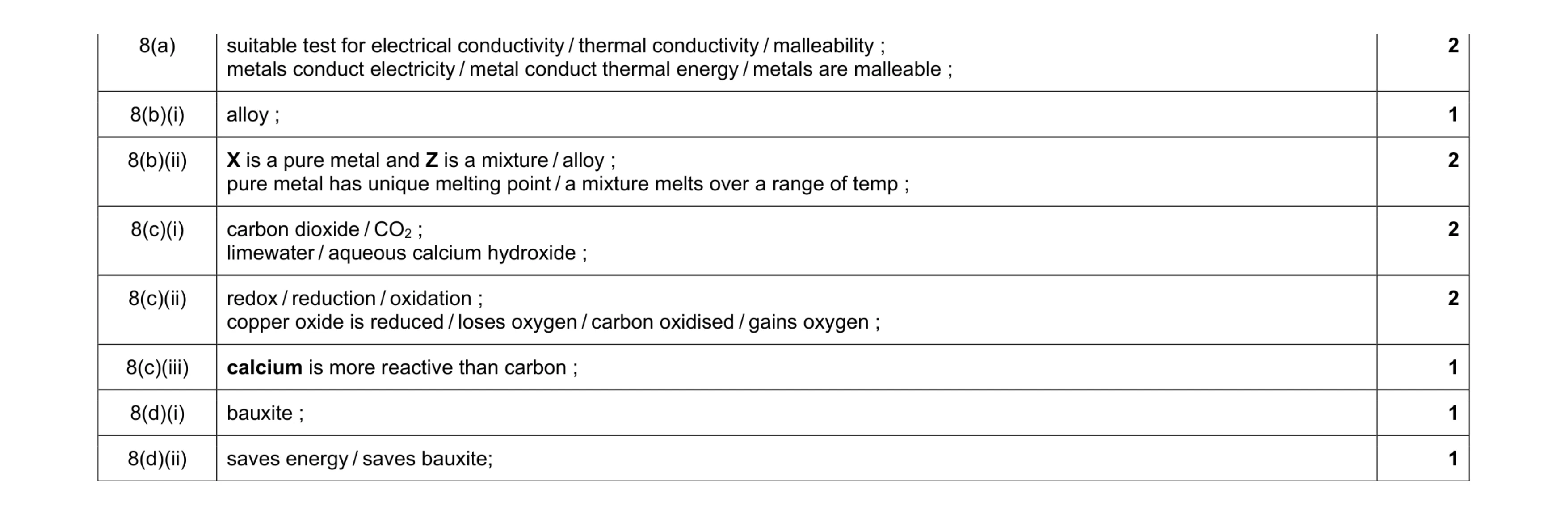 12
12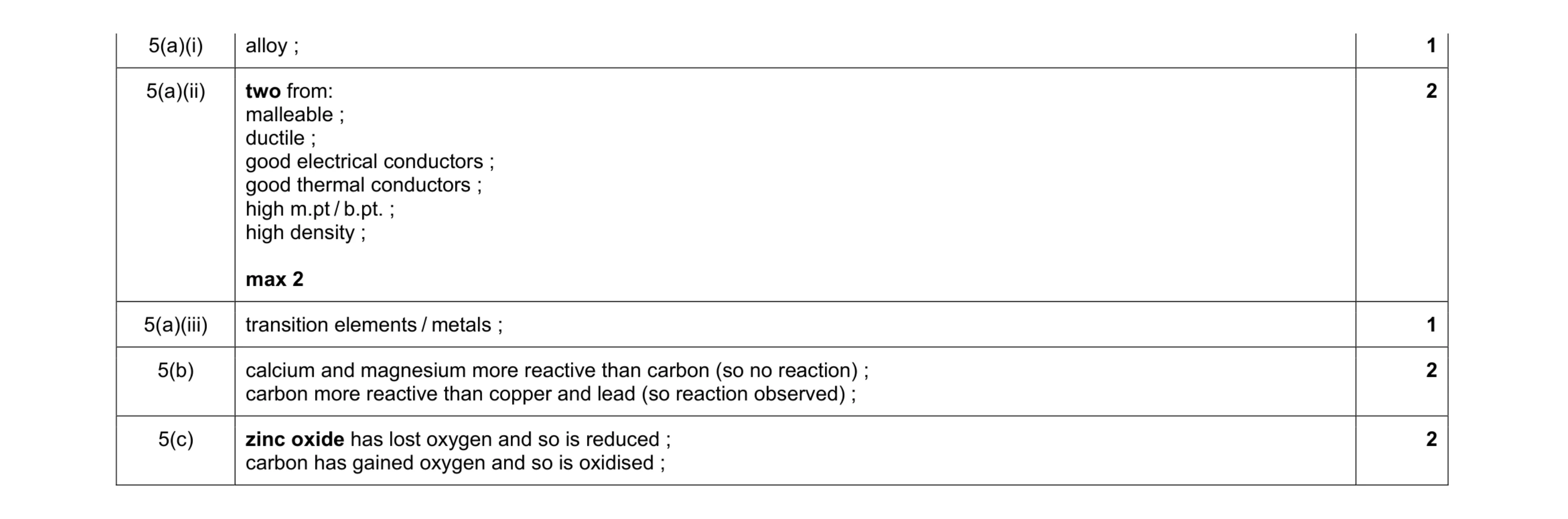 8
8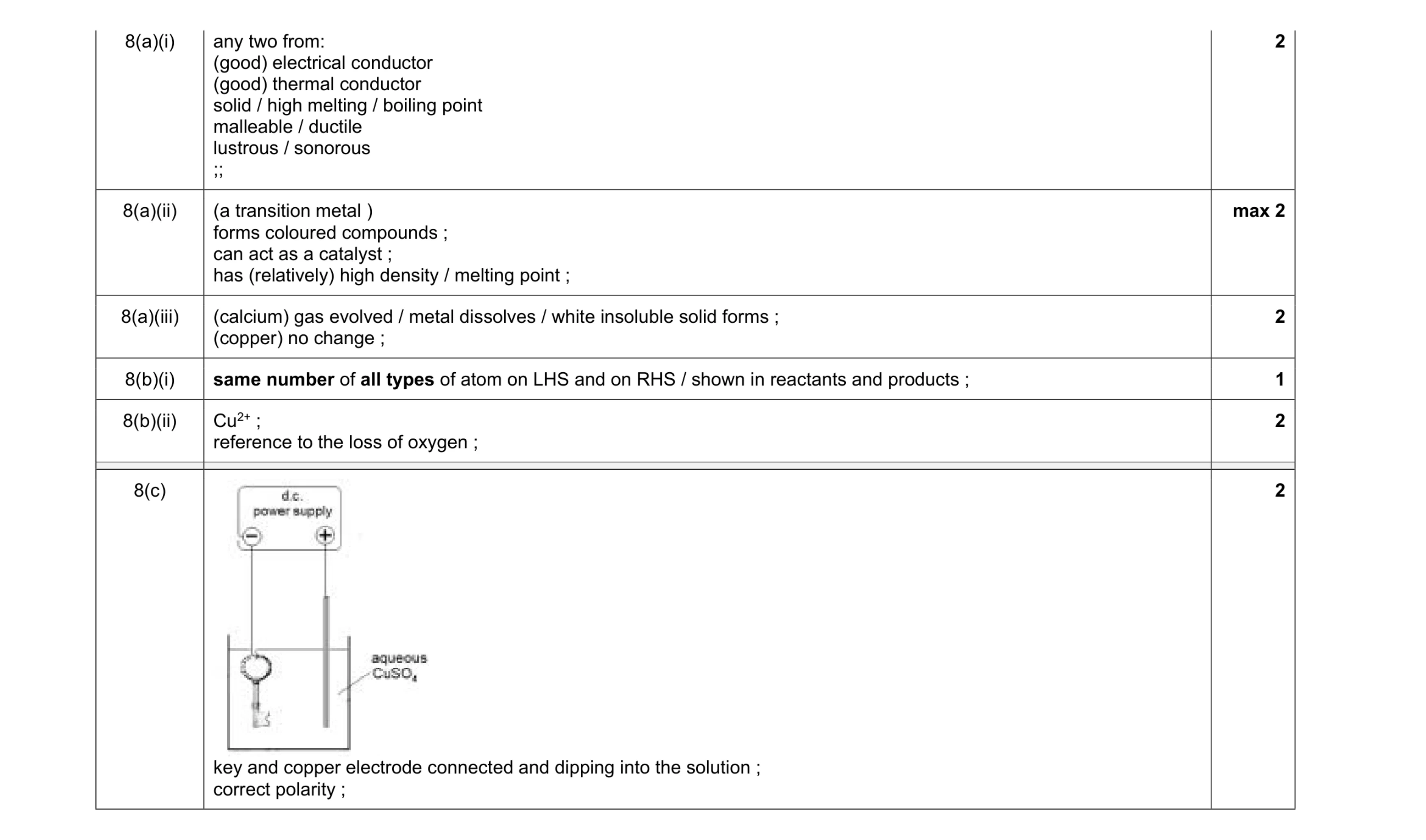 11
11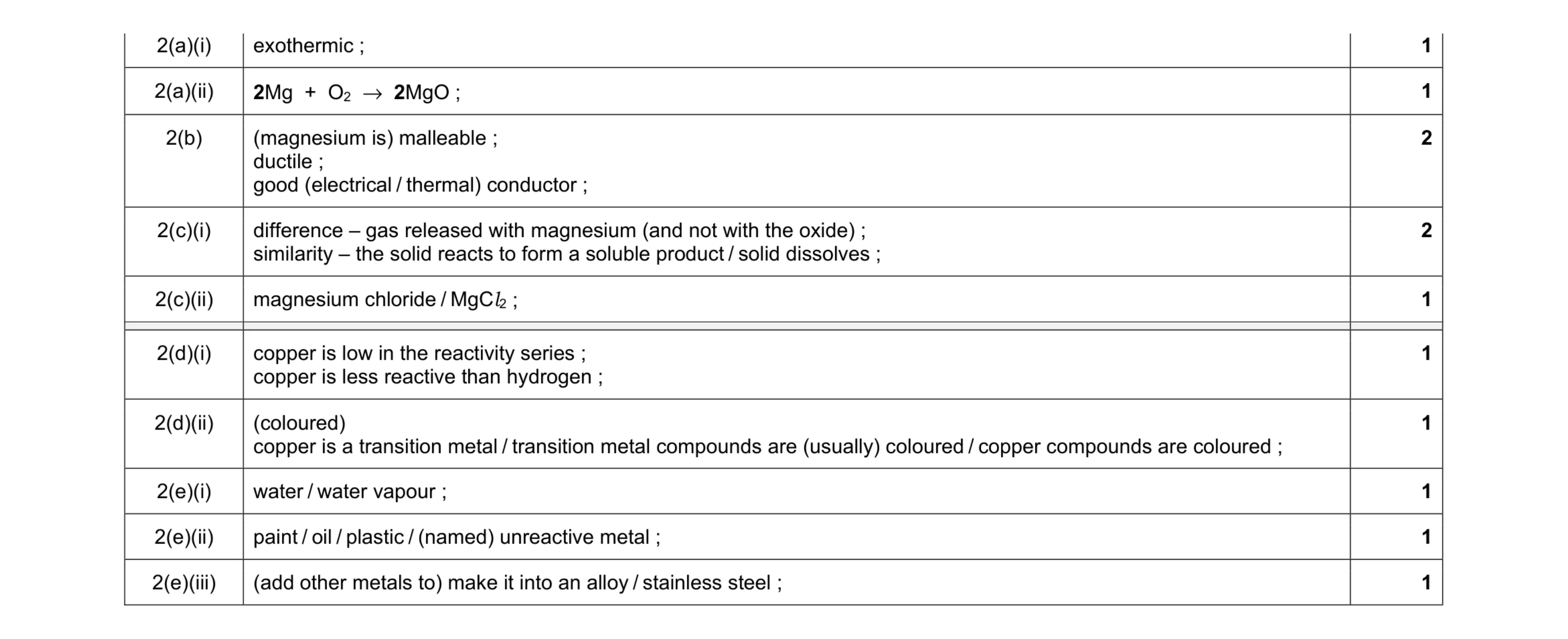 12
12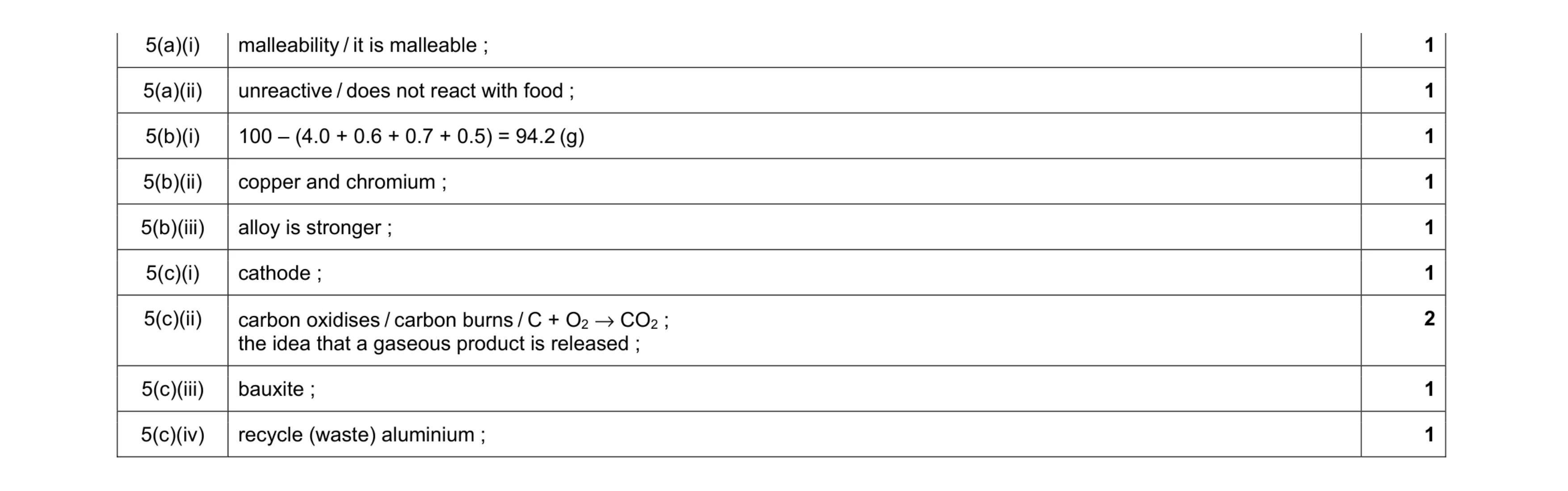 10
10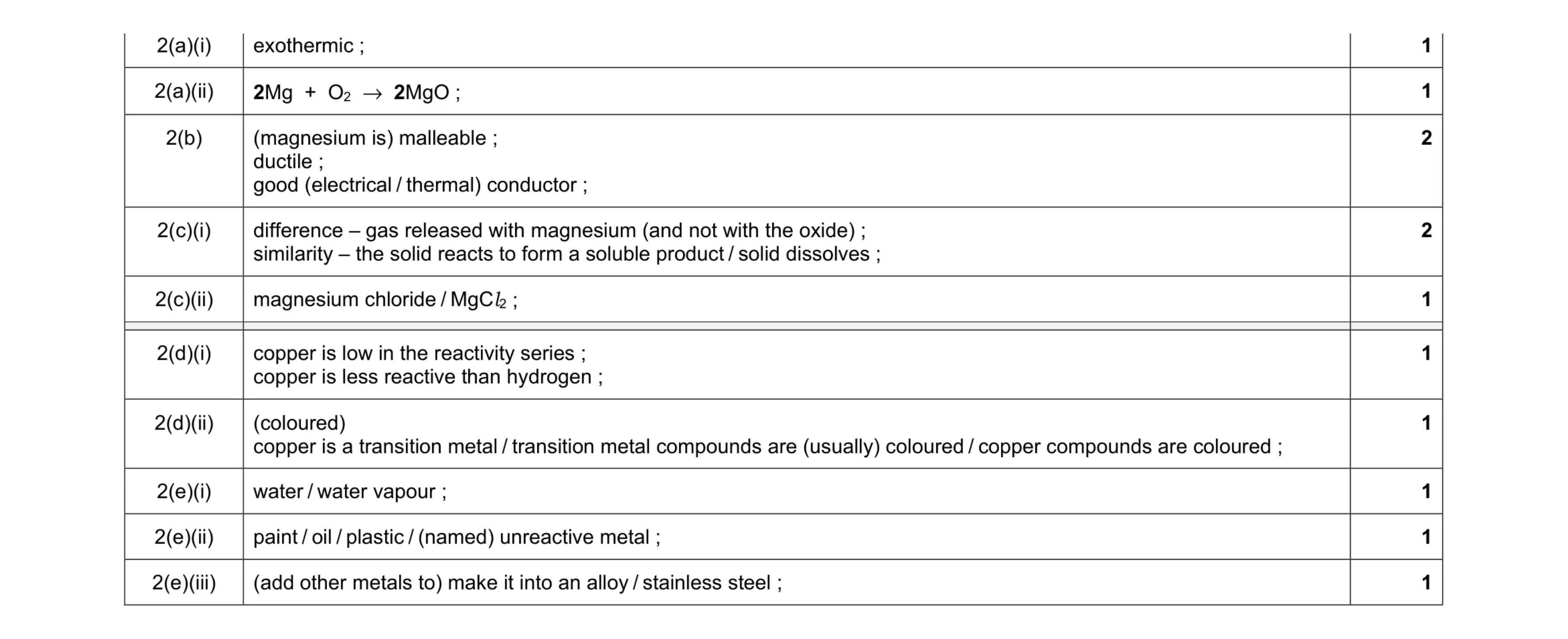 12
12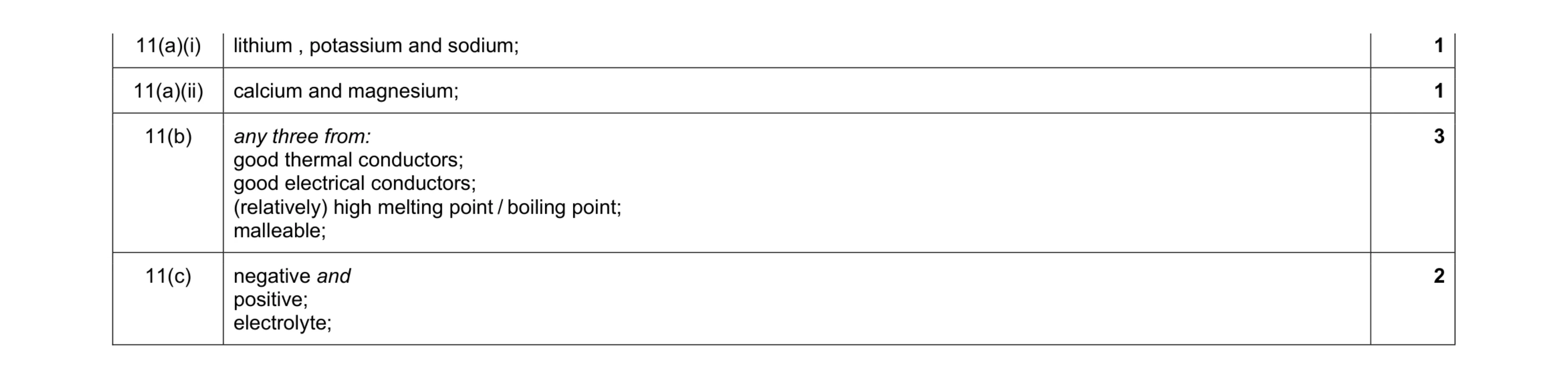 7
7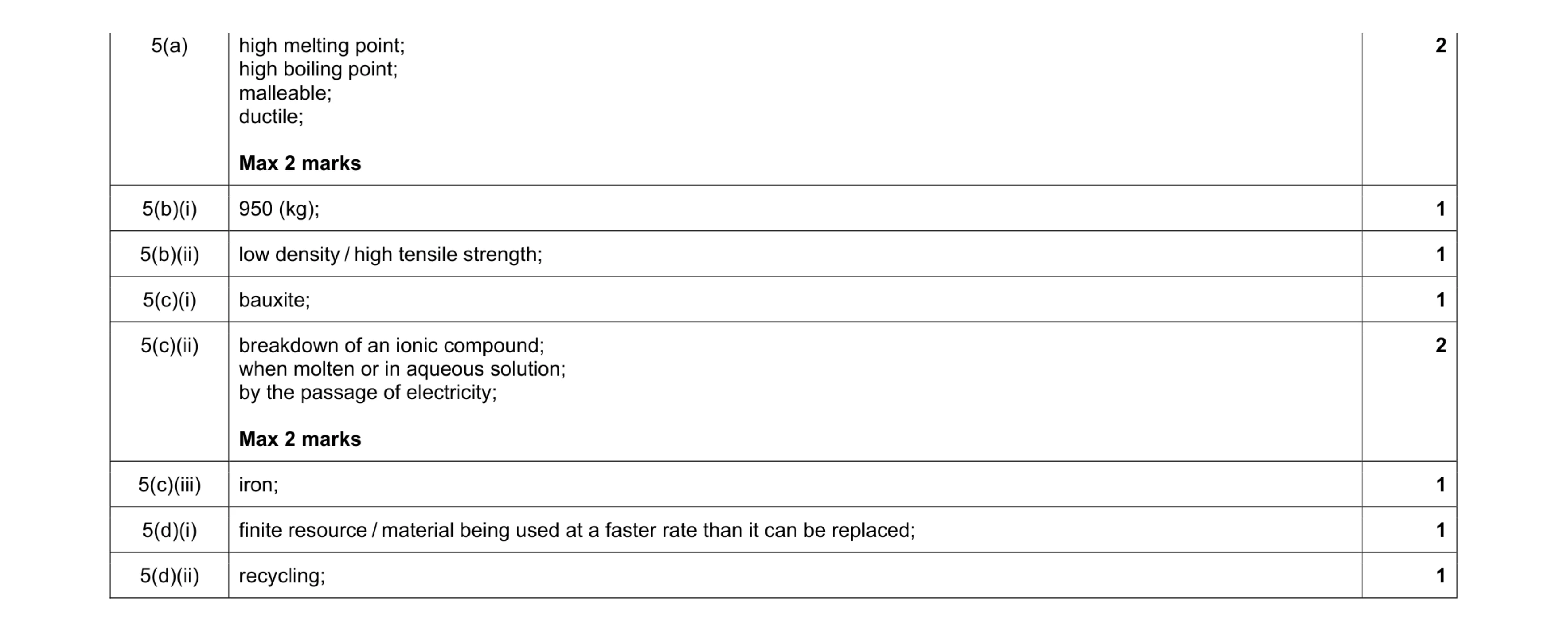 10
10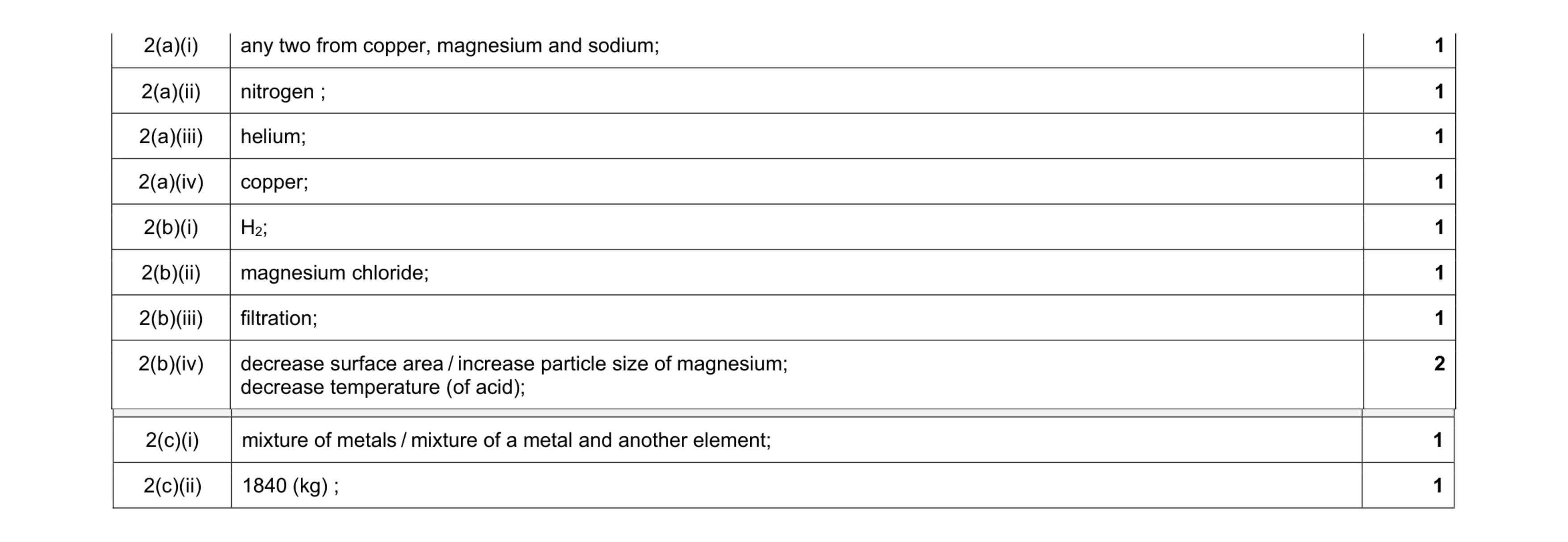 11
11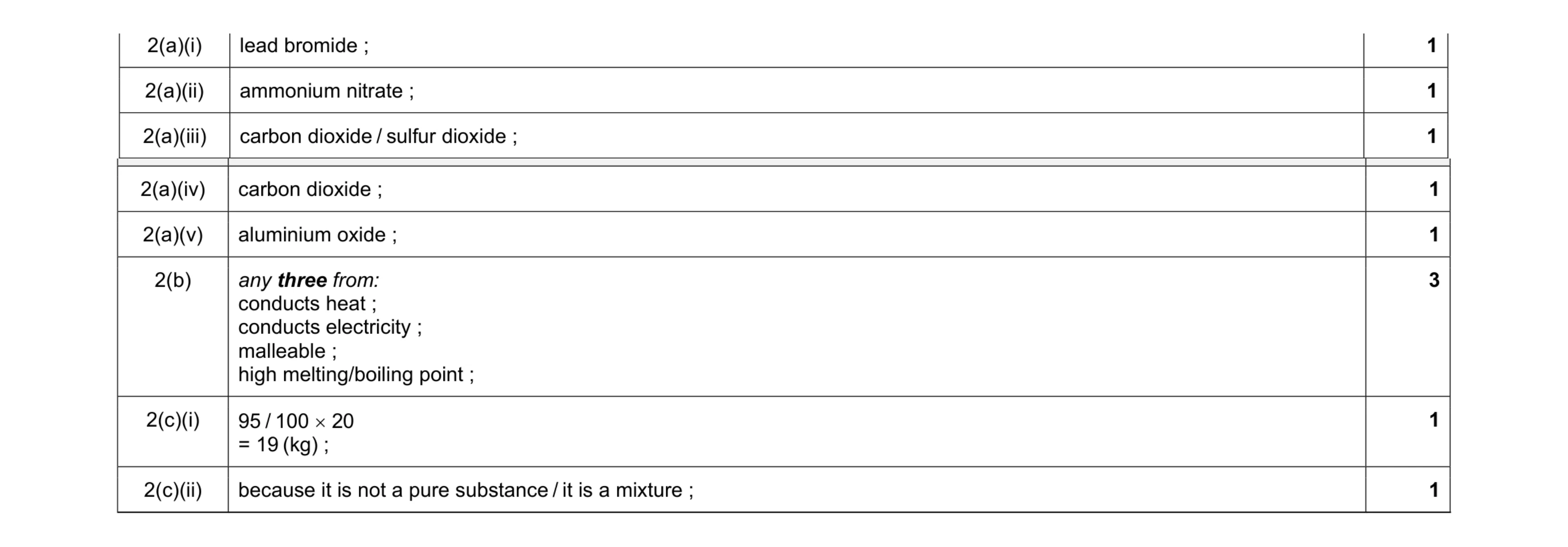 10
10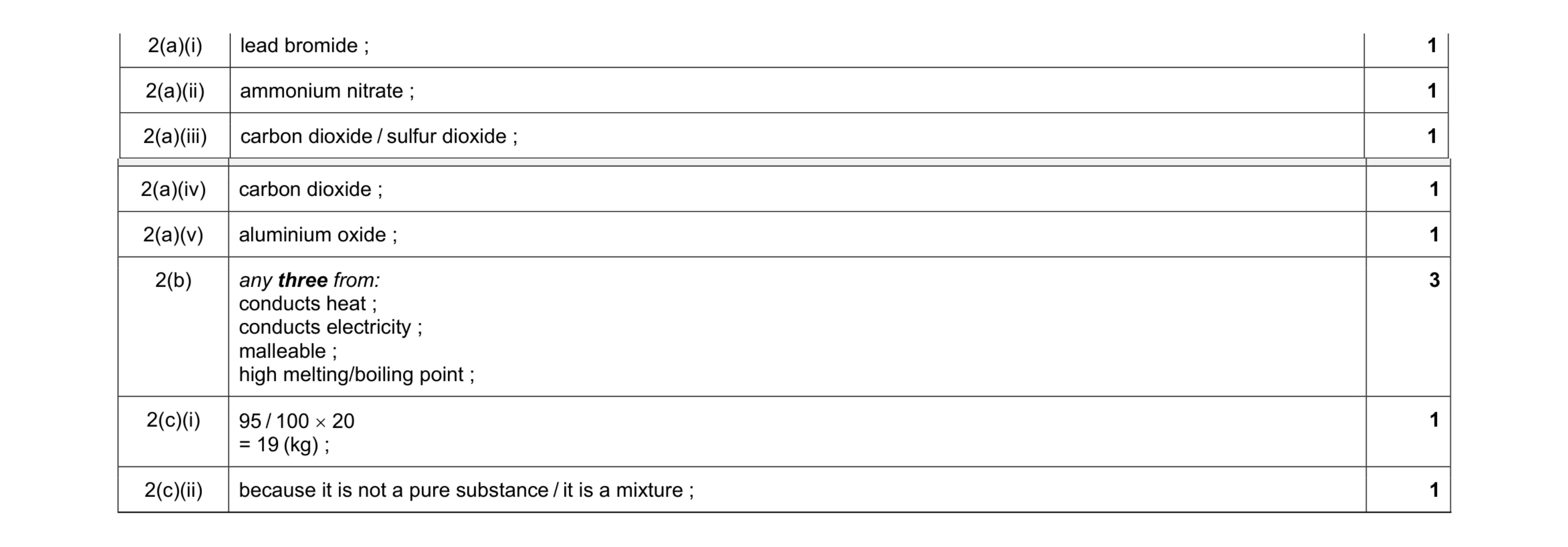 10
10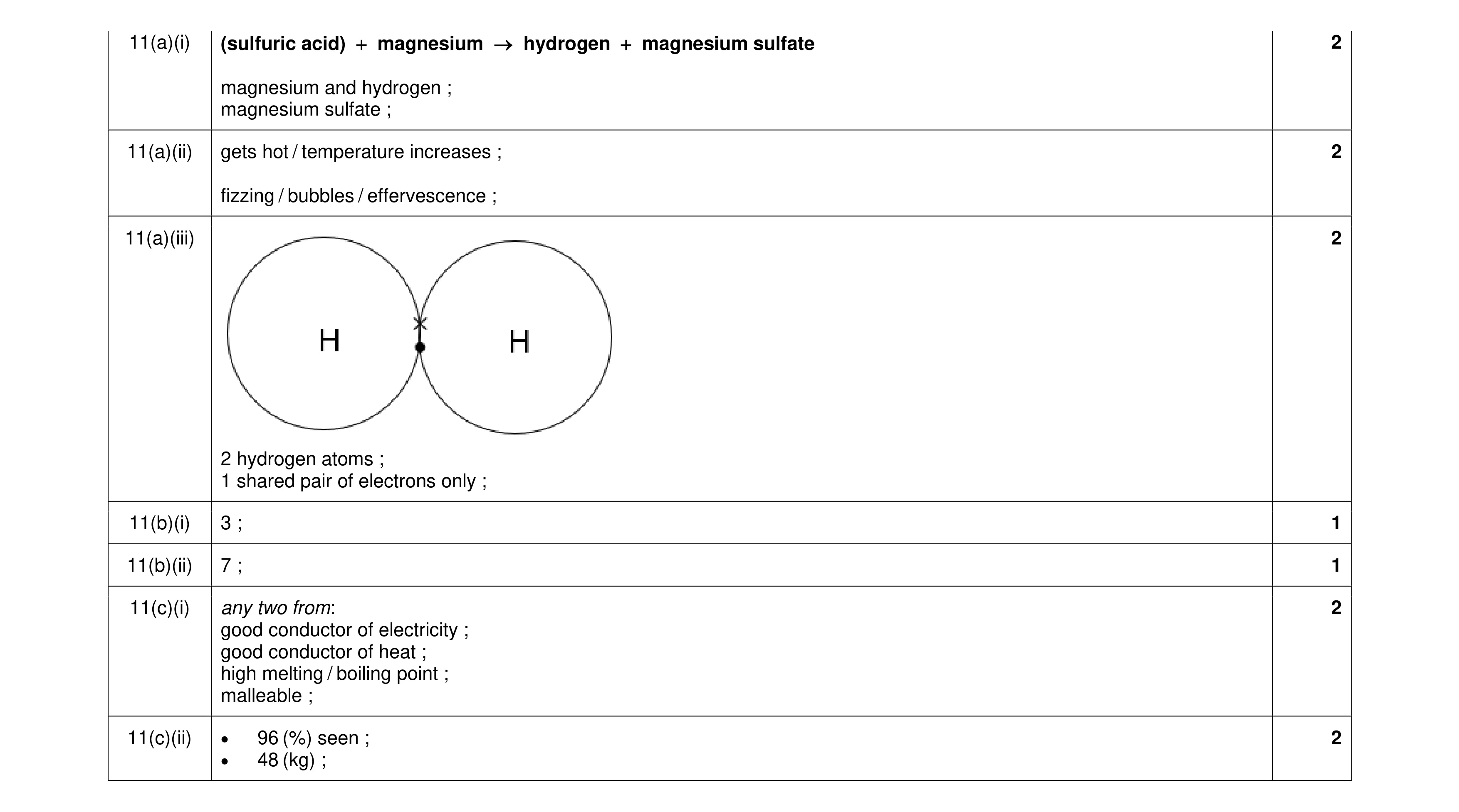 12
12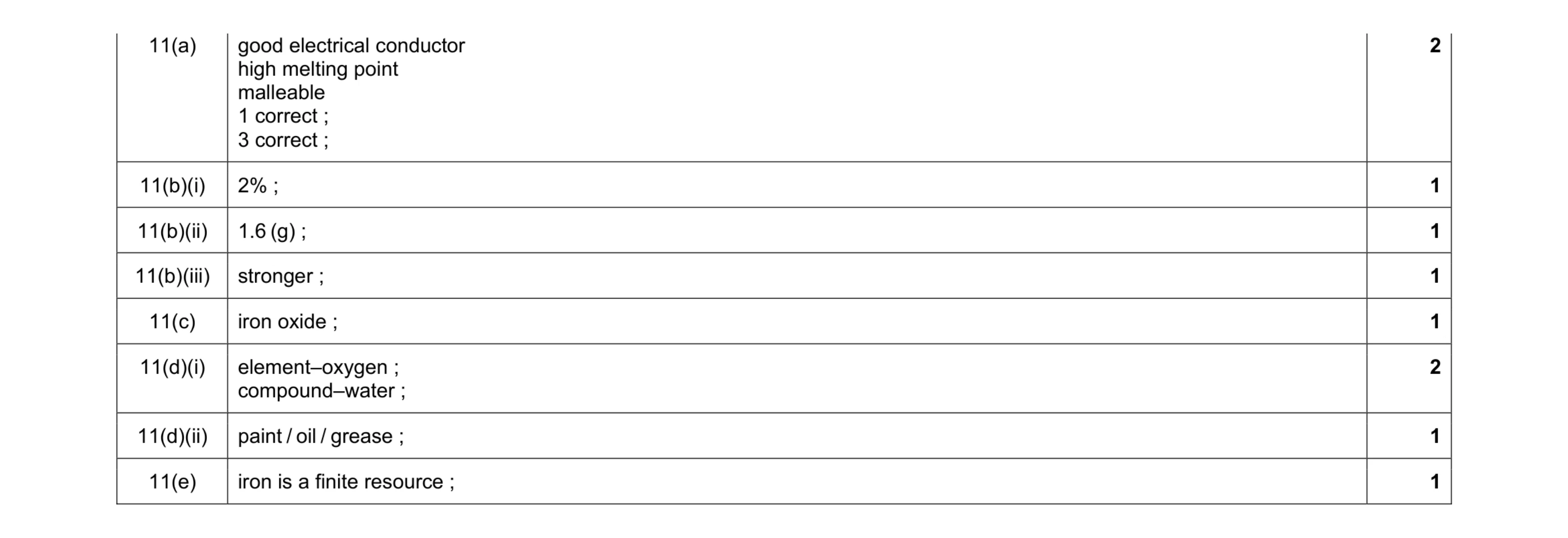 10
10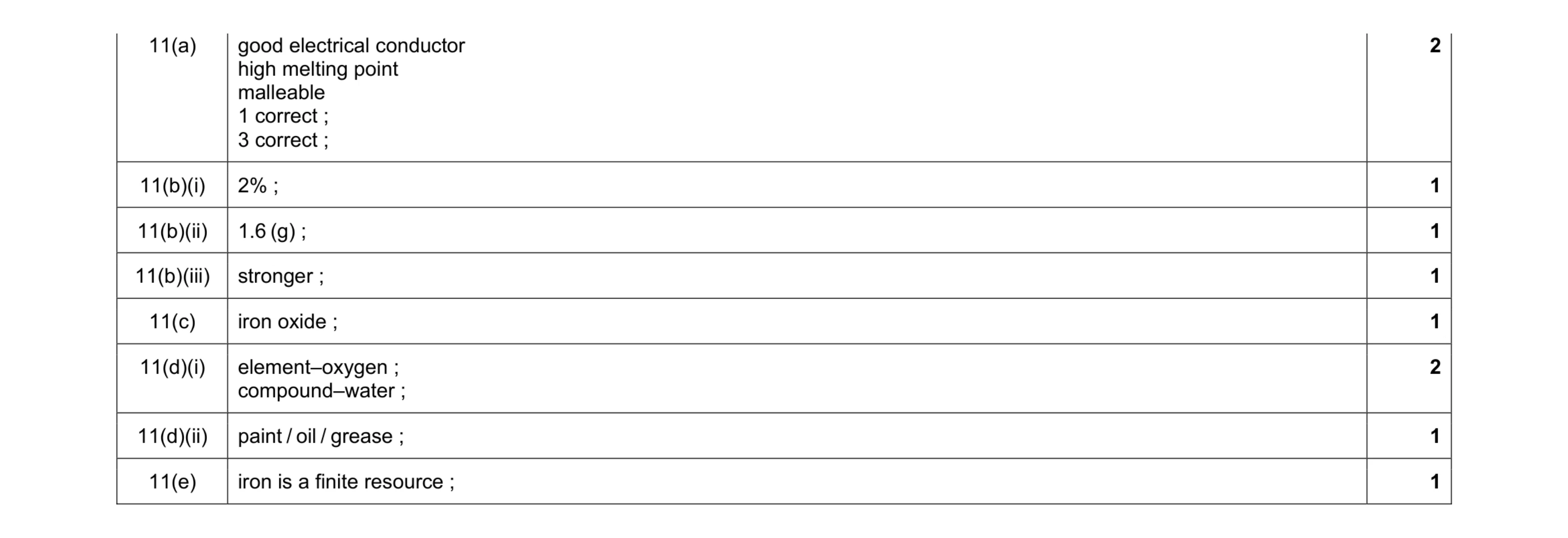 10
10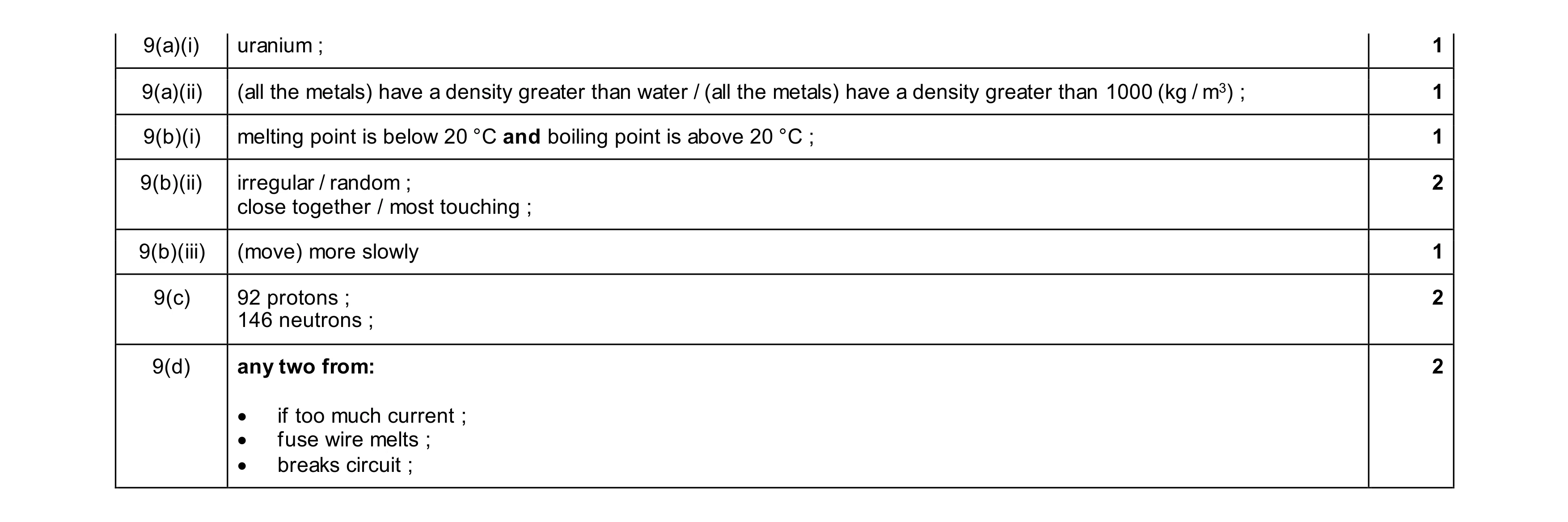 10
10