Questions as text
Q1 · The structure of a molecule of an alkane 0654/42 Oct/Nov 2017
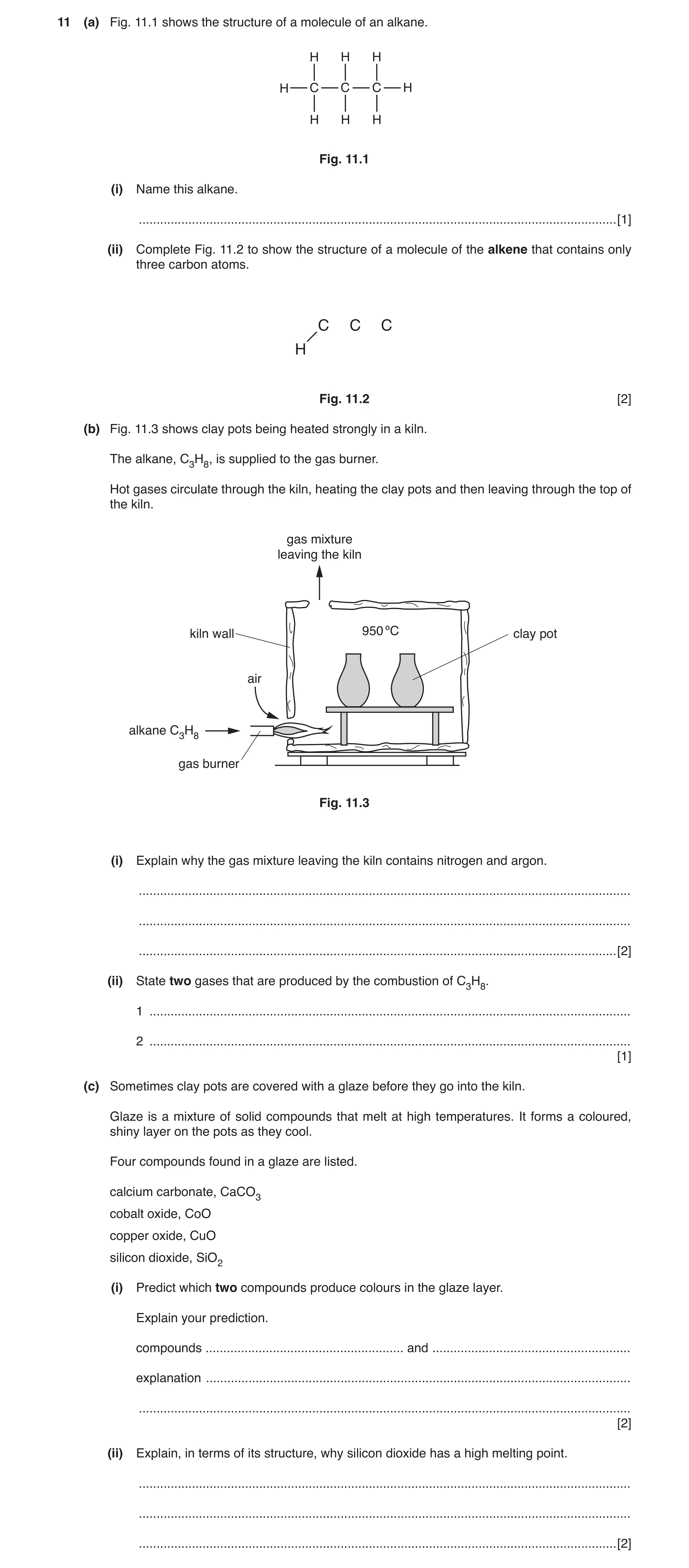
11 (a) Fig. 11.1 shows the structure of a molecule of an alkane. H H H H C C C H H H H Fig. 11.1 (i) Name this alkane. … [1] (ii) Complete Fig. 11.2 to show the structure of a molecule of the alkene that contains only three carbon atoms. C C C H Fig. 11.2 [2] (b) Fig. 11.3 shows clay pots being heated strongly in a kiln. The alkane, C3H8, is supplied to the gas burner. Hot gases circulate through the kiln, heating the clay pots and then leaving through the top of the kiln. gas mixture leaving the kiln kiln wall 950 ºC clay pot air alkane C3H8 gas burner Fig. 11.3 (i) Explain why the gas mixture leaving the kiln contains nitrogen and argon. … … … [2] (ii) State two gases that are produced by the combustion of C3H8. 1 … 2 … [1] (c) Sometimes clay pots are covered with a glaze before they go into the kiln. Glaze is a mixture of solid compounds that melt at high temperatures. It forms a coloured, shiny layer on the pots as they cool. Four compounds found in a glaze are listed. calcium carbonate, CaCO3 cobalt oxide, CoO copper oxide, CuO silicon dioxide, SiO2 (i) Predict which two compounds produce colours in the glaze layer. Explain your prediction. compounds … and … explanation … … [2] (ii) Explain, in terms of its structure, why silicon dioxide has a high melting point. … … … [2]
10 marks
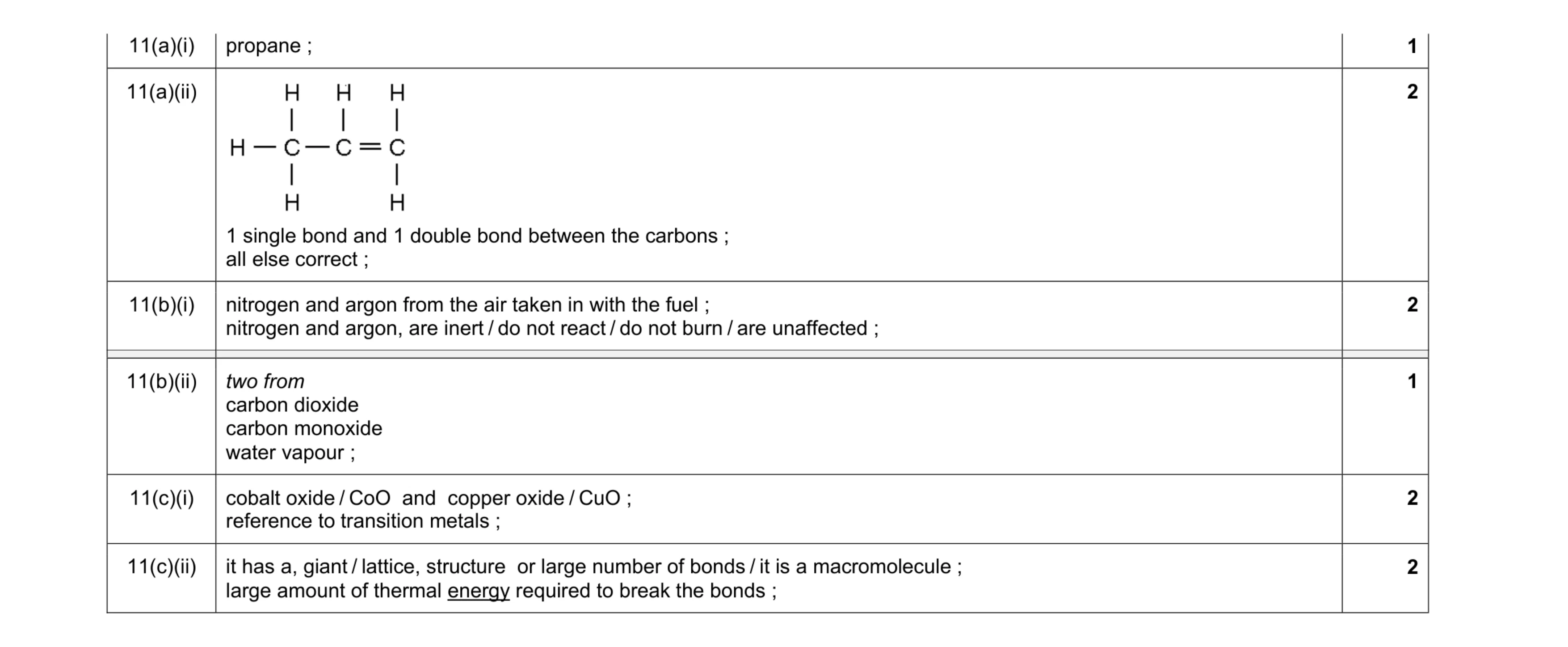
Mark scheme: 11(a)(i) propane ; 1 11(a)(ii) 1 single bond and 1 double bond between the carbons ; all else correct ; 2 11(b)(i) nitrogen and argon from the air taken in with the fuel ; nitrogen and argon, are inert / do not react / do not burn / are unaffected ; 2 Question Answer Marks 11(b)(ii) two from carbon dioxide carbon monoxide water vapour ; 1 11(c)(i) cobalt oxide / CoO and copper oxide / CuO ; reference to transition metals ; 2 11(c)(ii) it has a, giant / lattice, structure or large number of bonds / it is a macromolecule ; large amount of thermal energy required to break the bonds ; 2
This question in 0654/42 Oct/Nov 2017
Q2 · Diamonds, limestone and sand are found in the Earth’s crust 0654/41 Oct/Nov 2018
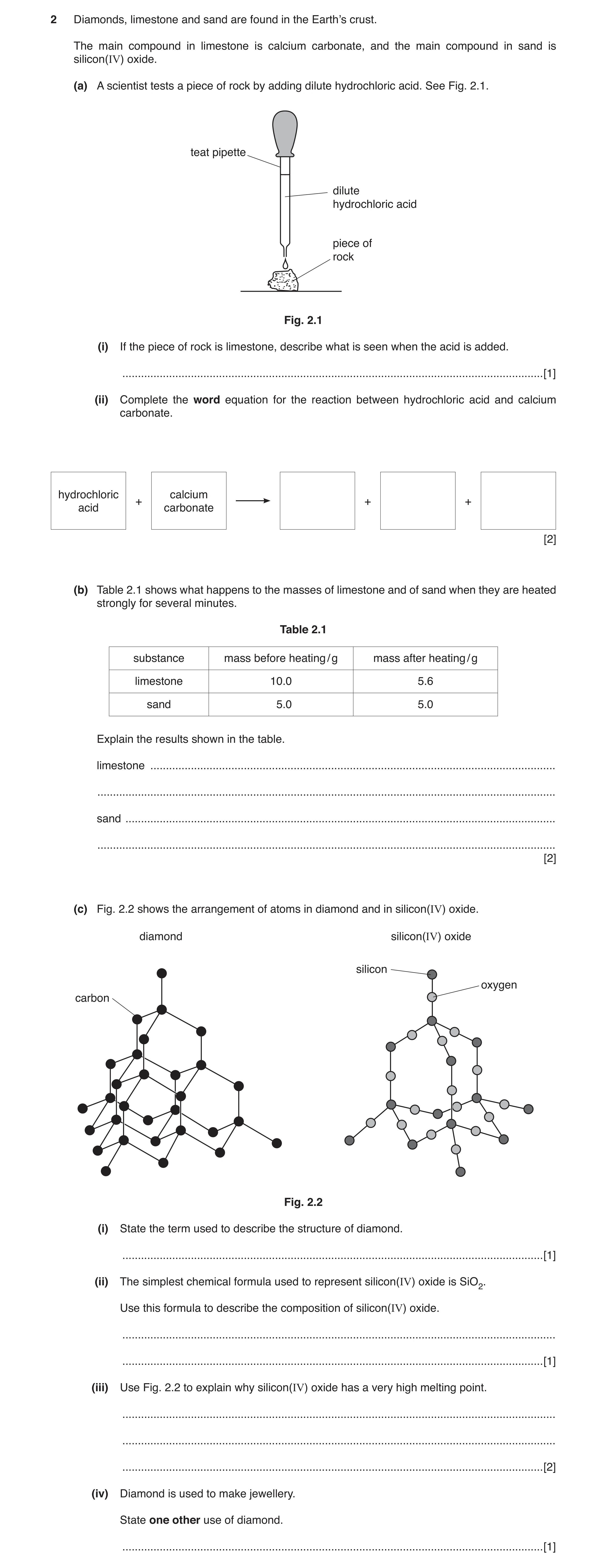
2 Diamonds, limestone and sand are found in the Earth’s crust. The main compound in limestone is calcium carbonate, and the main compound in sand is silicon(IV) oxide. (a) A scientist tests a piece of rock by adding dilute hydrochloric acid. See Fig. 2.1. teat pipette dilute hydrochloric acid piece of rock Fig. 2.1 (i) If the piece of rock is limestone, describe what is seen when the acid is added. … [1] (ii) Complete the word equation for the reaction between hydrochloric acid and calcium carbonate. hydrochloric calcium + + + acid carbonate [2] (b) Table 2.1 shows what happens to the masses of limestone and of sand when they are heated strongly for several minutes. Table 2.1 substance mass before heating / g mass after heating / g limestone 10.0 5.6 sand 5.0 5.0 Explain the results shown in the table. limestone … … sand … … [2] (c) Fig. 2.2 shows the arrangement of atoms in diamond and in silicon(IV) oxide. diamond silicon(IV) oxide silicon oxygen carbon Fig. 2.2 (i) State the term used to describe the structure of diamond. … [1] (ii) The simplest chemical formula used to represent silicon(IV) oxide is SiO2. Use this formula to describe the composition of silicon(IV) oxide. … … [1] (iii) Use Fig. 2.2 to explain why silicon(IV) oxide has a very high melting point. … … … [2] (iv) Diamond is used to make jewellery. State one other use of diamond. … [1]
10 marks
Mark scheme: 2(a)(i) effervescence / bubbles ; 1 2(a)(ii) (calcium carbonate + hydrochloric acid →) calcium chloride ; carbon dioxide and water ; 2 2(b) limestone has decomposed / broken down / released carbon dioxide / a gas ; (silicon (IV) oxide) is stable / does not react / does not decompose ; 2 2(c)(i) giant (covalent) / macromolecule ; 1 2(c)(ii) ratio of Si atoms to O atoms is 1:2 ; 1 2(c)(iii) the idea that (thermal) energy is required to break bonds ; bonds are strong / a large number of bonds (have to be broken) ; 2 2(c)(iv) cutting tools / other correct ; 1
This question in 0654/41 Oct/Nov 2018
Q3 · Diamond and graphite are different forms of the element carbon 0654/42 May/June 2020
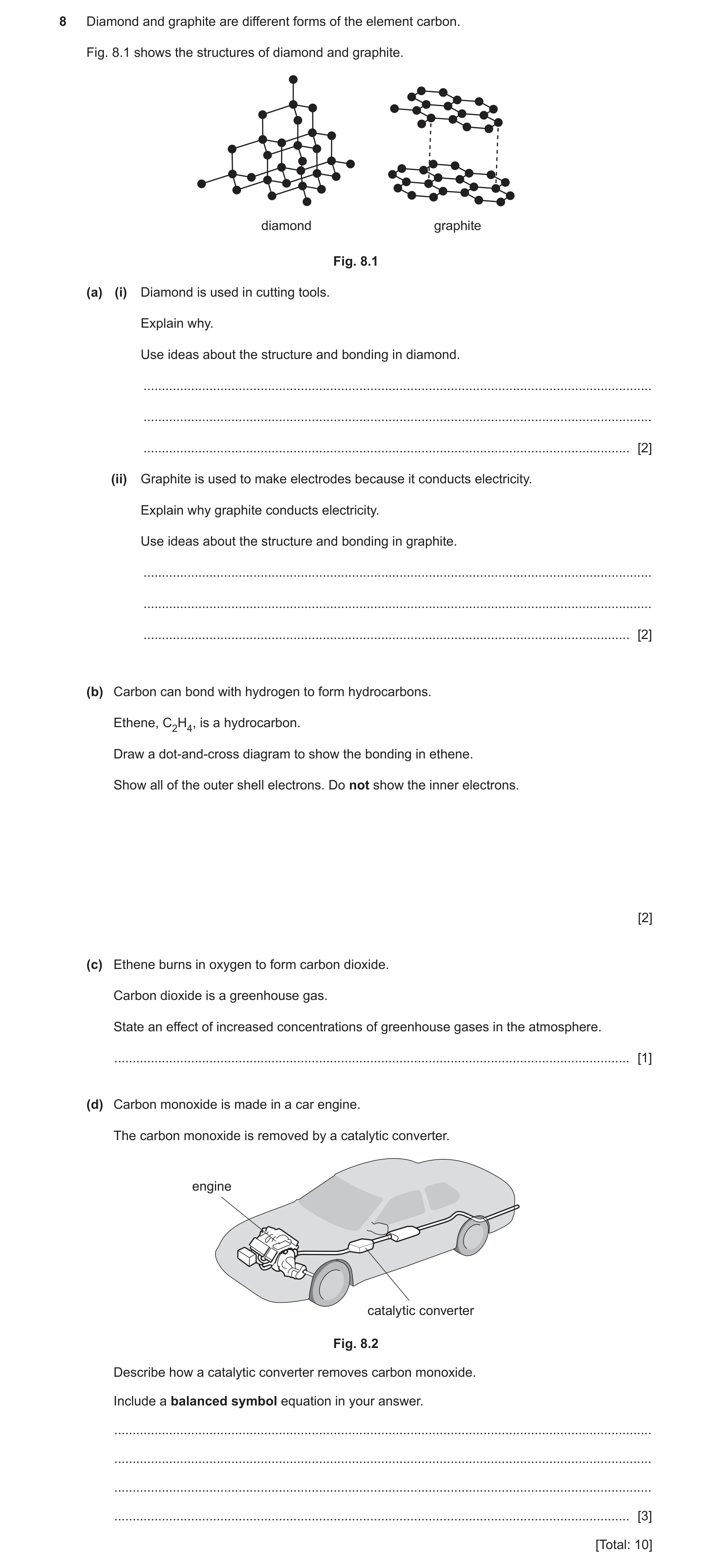
8 Diamond and graphite are different forms of the element carbon. Fig. 8.1 shows the structures of diamond and graphite. diamond graphite Fig. 8.1 (a) (i) Diamond is used in cutting tools. Explain why. Use ideas about the structure and bonding in diamond. … … … [2] (ii) Graphite is used to make electrodes because it conducts electricity. Explain why graphite conducts electricity. Use ideas about the structure and bonding in graphite. … … … [2] (b) Carbon can bond with hydrogen to form hydrocarbons. Ethene, C2H4, is a hydrocarbon. Draw a dot-and-cross diagram to show the bonding in ethene. Show all of the outer shell electrons. Do not show the inner electrons. [2] (c) Ethene burns in oxygen to form carbon dioxide. Carbon dioxide is a greenhouse gas. State an effect of increased concentrations of greenhouse gases in the atmosphere. … [1] (d) Carbon monoxide is made in a car engine. The carbon monoxide is removed by a catalytic converter. engine catalytic converter Fig. 8.2 Describe how a catalytic converter removes carbon monoxide. Include a balanced symbol equation in your answer. … … … … [3] [Total: 10]
10 marks
Mark scheme: 8(a)(i) (diamond) has many strong bonds ; bonds are covalent bonds ; (diamond) is giant molecular / macromolecular / giant tetrahedral (lattice) ; max 2 8(a)(ii) (graphite has) electrons ; that can move / that are delocalised ; 2 8(b) double bond between C atoms ; single bonds between C and H ; 2 Question Answer Marks 8(c) global warming / climate change ; 1 8(d) (catalytic converter) changes carbon monoxide into carbon dioxide ; balanced symbol equation: 2CO + O2 → 2CO2 / 2CO + 2NO → N2 + 2CO2 ;; correct formulae; correctly balanced; 3
This question in 0654/42 May/June 2020
Q4 · The structures of graphite and of silicon(IV) oxide 0654/43 Oct/Nov 2020
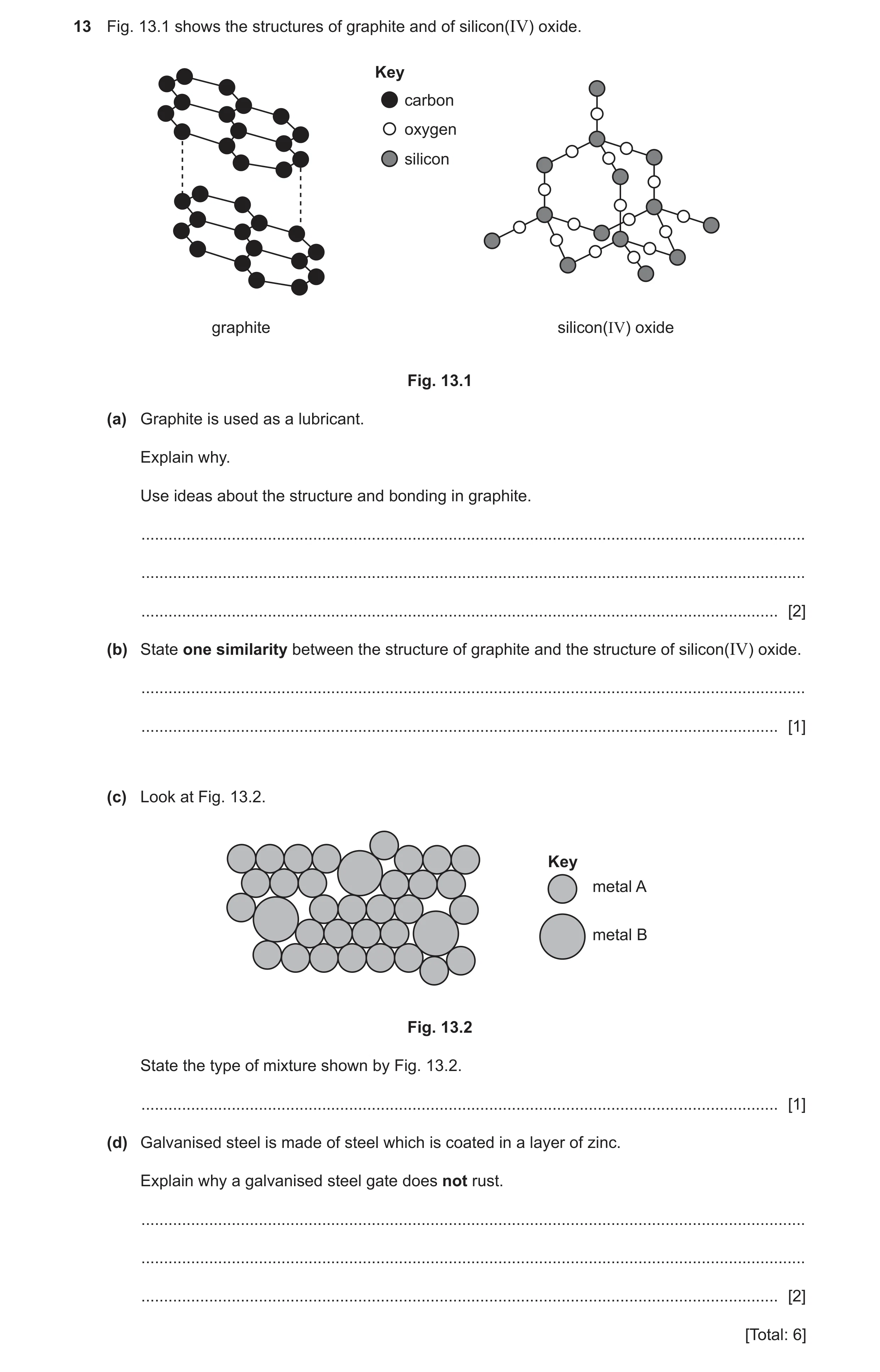
13 Fig. 13.1 shows the structures of graphite and of silicon(IV) oxide. Key carbon oxygen silicon graphite silicon(IV) oxide Fig. 13.1 (a) Graphite is used as a lubricant. Explain why. Use ideas about the structure and bonding in graphite. … … … [2] (b) State one similarity between the structure of graphite and the structure of silicon(IV) oxide. … … [1] (c) Look at Fig. 13.2. Key metal A metal B Fig. 13.2 State the type of mixture shown by Fig. 13.2. … [1] (d) Galvanised steel is made of steel which is coated in a layer of zinc. Explain why a galvanised steel gate does not rust. … … … [2] [Total: 6]
6 marks
Mark scheme: 13(a) weak forces between the layers ; layers can slide over each other / AW ; 2 13(b) both macromolecular / both giant covalent (structures) ; 1 13(c) alloy ; 1 13(d) any two from: zinc stops air / oxygen / water reaching the steel / iron ; zinc acts as a sacrificial metal ; zinc is more reactive than iron ; 2
This question in 0654/43 Oct/Nov 2020
Q5 · A scientist investigates the electrolysis of lead(II) bromide 0654/42 Oct/Nov 2021
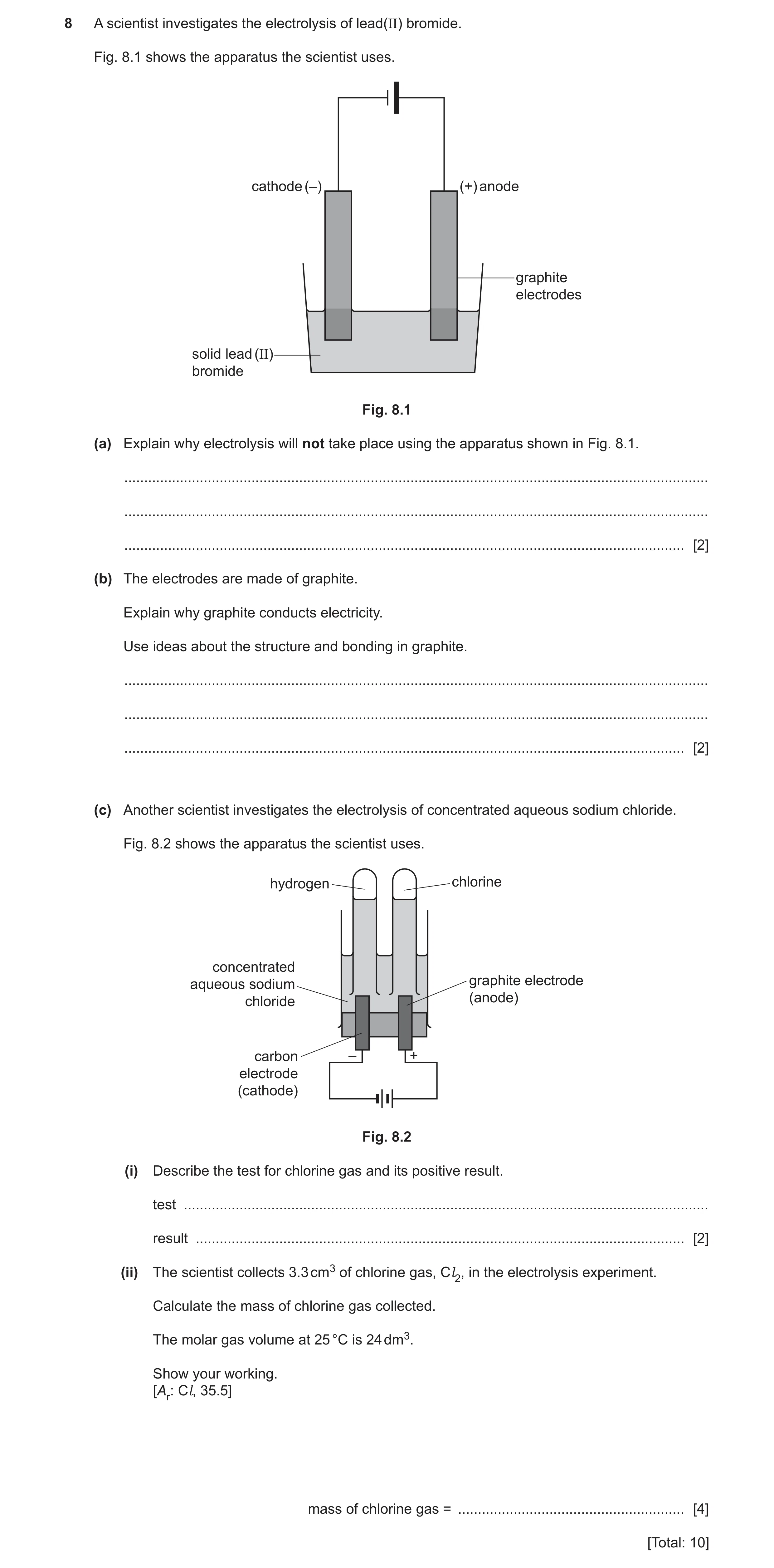
8 A scientist investigates the electrolysis of lead(II) bromide. Fig. 8.1 shows the apparatus the scientist uses. cathode (–) (+) anode graphite electrodes solid lead (II) bromide Fig. 8.1 (a) Explain why electrolysis will not take place using the apparatus shown in Fig. 8.1. … … … [2] (b) The electrodes are made of graphite. Explain why graphite conducts electricity. Use ideas about the structure and bonding in graphite. … … … [2] (c) Another scientist investigates the electrolysis of concentrated aqueous sodium chloride. Fig. 8.2 shows the apparatus the scientist uses. hydrogen chlorine concentrated aqueous sodium graphite electrode chloride (anode) carbon – + electrode (cathode) Fig. 8.2 (i) Describe the test for chlorine gas and its positive result. test … result … [2] (ii) The scientist collects 3.3 cm3 of chlorine gas, Cl2, in the electrolysis experiment. Calculate the mass of chlorine gas collected. The molar gas volume at 25 °C is 24 dm3. Show your working. [Ar: Cl, 35.5] mass of chlorine gas = … [4] [Total: 10]
10 marks
Mark scheme: 8(a) lead(II) bromide is solid / needs to be in solution or molten ; because ions cannot move in the solid / because ions can only move in liquid or in solution ; 2 8(b) graphite’s structure contains layers of carbon atoms / is giant / is (giant) covalent / is a macromolecule ; graphite contains delocalised electrons / description of delocalised electrons / electrons that are free to move ; 2 8(c)(i) damp litmus paper ; (is) bleached ; 2 8(c)(ii) conversion of 3.3 cm³ to 0.0033 dm³ or use of 24 000 dm³ ; moles of Cl2 = 3.3 ÷ 24 000 or 0.0033 ÷ 24 = 0.0001375 ; Mr Cl2 = 71 ; mass of Cl2 = 0.0001375 × 71 = 0.01 ; 4
This question in 0654/42 Oct/Nov 2021
Q6 · Diamond and graphite are two forms of carbon shown in Fig 0654/42 Feb/March 2022
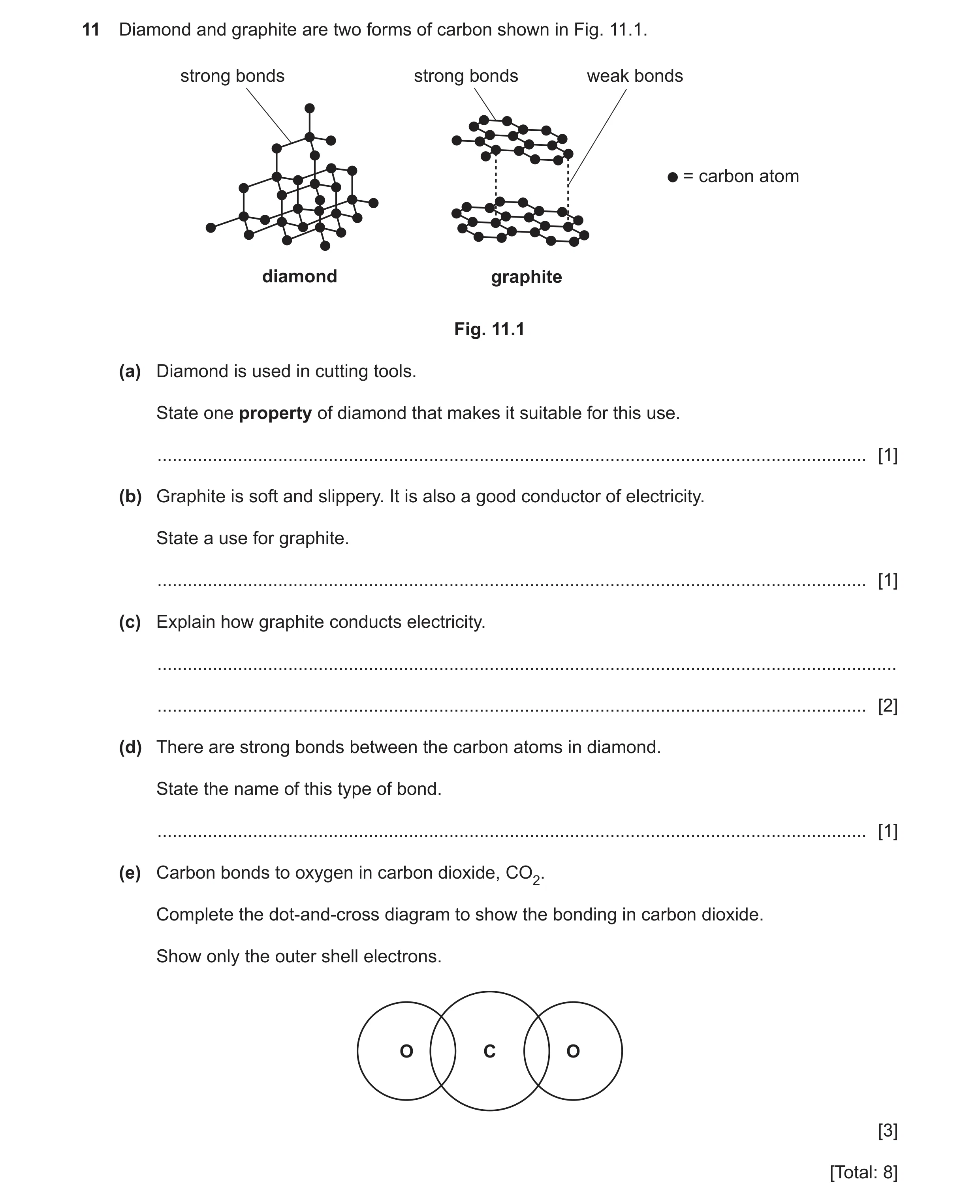
11 Diamond and graphite are two forms of carbon shown in Fig. 11.1. strong bonds strong bonds weak bonds = carbon atom diamond graphite Fig. 11.1 (a) Diamond is used in cutting tools. State one property of diamond that makes it suitable for this use. … [1] (b) Graphite is soft and slippery. It is also a good conductor of electricity. State a use for graphite. … [1] (c) Explain how graphite conducts electricity. … … [2] (d) There are strong bonds between the carbon atoms in diamond. State the name of this type of bond. … [1] (e) Carbon bonds to oxygen in carbon dioxide, CO2. Complete the dot-and-cross diagram to show the bonding in carbon dioxide. Show only the outer shell electrons. O C O [3] [Total: 8]
8 marks
Mark scheme: 11(a) hard ; 1 11(b) lubricant / pencils / electrodes ; 1 Question Answer Marks 11(c) (graphite contains) delocalised electrons / electrons can move through the structure ; movement of charge constitutes a current ; 2 11(d) covalent ; 1 11(e) ;;; 3
This question in 0654/42 Feb/March 2022
Q7 · Diamond is one form of carbon 0654/43 Oct/Nov 2022
11 Diamond is one form of carbon. (a) (i) State the name of another form of carbon. … [1] (ii) Diamond is used in cutting tools such as those shown in Fig. 11.1. Fig. 11.1 State why diamond is used. … … [1] (b) Silicon dioxide, SiO2, has a similar structure to diamond. Fig. 11.2 shows the structure of silicon dioxide. silicon atoms oxygen atoms Fig. 11.2 Describe the structure and bonding in silicon dioxide. Use Fig. 11.2 to help you. … … … [2] (c) One of the isotopes of carbon is called carbon-12 and the other is called carbon-14. Table 11.1 shows some information about carbon-12. Complete the table for carbon-14. Table 11.1 number of number of number of protons neutrons electrons carbon-12 6 6 6 carbon-14 [1] (d) Relative atomic mass, Ar , is defined in terms of a carbon atom. Complete the definition of relative atomic mass. Choose words from the list. Each word may be used once, more than once or not at all. average compound density element formula mass Relative atomic mass is the … mass of naturally occurring atoms of an … on a scale where the 12 C atom has a … of exactly 12 units. [3] (e) Calculate the number of moles in 0.6 g of carbon. [Ar : C, 12;] moles = … [1] [Total: 9]
9 marks
Mark scheme: 11(a)(i) graphite ; 1 11(a)(ii) (diamond is) hard ; 1 11(b) covalent bonding (between the atoms) ; 2 any one from: (silicon dioxide has a) macromolecular / giant structure ; each silicon atoms bonds to 4 oxygen atoms and each oxygen atom bonds to 2 silicon atoms ; 11(c) 1 number of number of number of protons neutrons electrons carbon-12 6 6 6 carbon-14 6 8 6 ; 11(d) average ; 3 element ; mass ; 11(e) (moles = 0.6 ÷ 12 =) 0.05 ; 1
This question in 0654/43 Oct/Nov 2022
Q8 · Element X is found in Group II of the Periodic Table 0654/43 May/June 2023
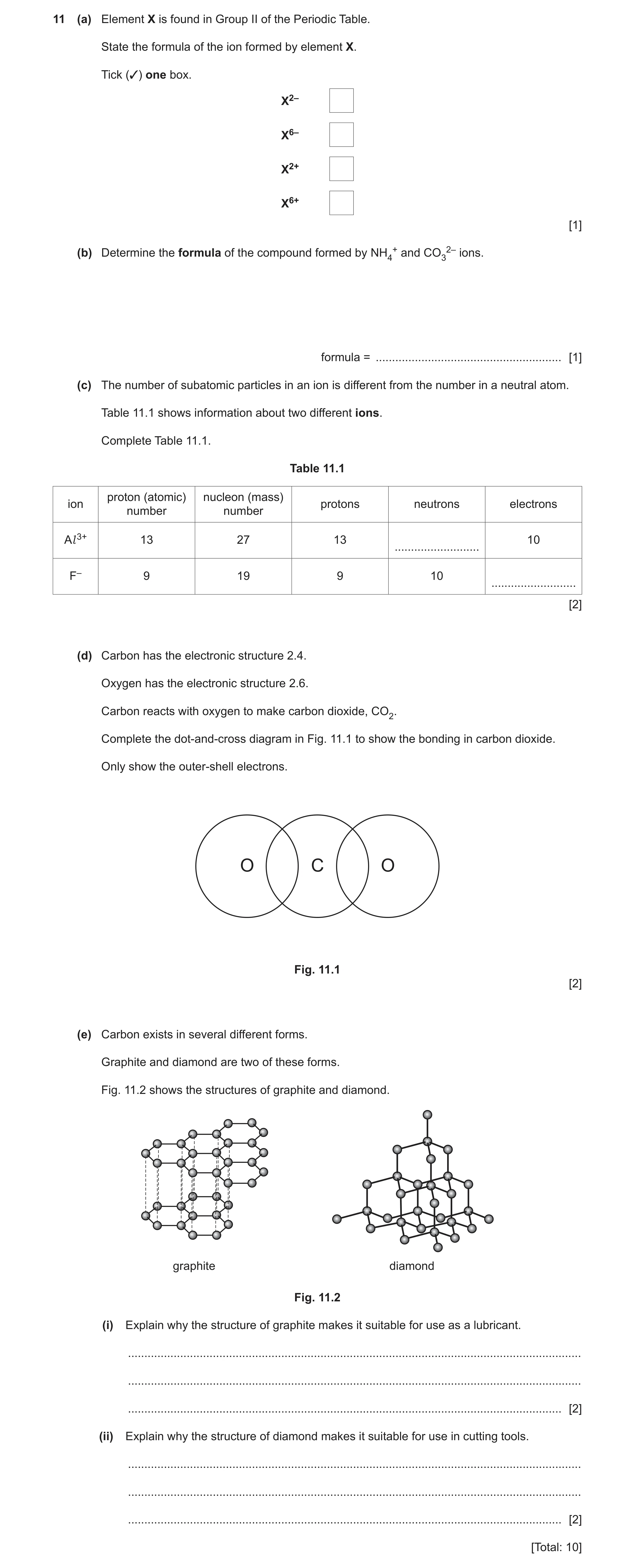
11 (a) Element X is found in Group II of the Periodic Table. State the formula of the ion formed by element X. Tick (3) one box. X2– X6– X2+ X6+ [1] (b) Determine the formula of the compound formed by NH4+ and CO32– ions. formula = … [1] (c) The number of subatomic particles in an ion is different from the number in a neutral atom. Table 11.1 shows information about two different ions. Complete Table 11.1. Table 11.1 proton (atomic) nucleon (mass) ion protons neutrons electrons number number Al 3+ 13 27 13 10 … F– 9 19 9 10 … [2] (d) Carbon has the electronic structure 2.4. Oxygen has the electronic structure 2.6. Carbon reacts with oxygen to make carbon dioxide, CO2. Complete the dot‑and‑cross diagram in Fig. 11.1 to show the bonding in carbon dioxide. Only show the outer‑shell electrons. O C O Fig. 11.1 [2] (e) Carbon exists in several different forms. Graphite and diamond are two of these forms. Fig. 11.2 shows the structures of graphite and diamond. graphite diamond Fig. 11.2 (i) Explain why the structure of graphite makes it suitable for use as a lubricant. … … … [2] (ii) Explain why the structure of diamond makes it suitable for use in cutting tools. … … … [2] [Total: 10]
10 marks
Mark scheme: 11(a) X2+ ; 1 11(b) (NH4)2CO3 ; 1 11(c) ion proton (atomic) number nucleon (mass) number protons neutrons electrons Al 3+ 13 27 13 14 10 F- 9 19 9 10 10 ;; 2 Question Answer Marks 11(d) double bonds between C and O atoms ; rest of structure correct ; 2 11(e)(i) (graphite has) weak forces between the layers ; layers can slide over each other / owtte ; 2 11(e)(ii) any two from: (diamond) has many strong bonds ; bonds are covalent bonds ; (diamond has) giant molecular / macromolecular / giant tetrahedral / lattice / giant covalent, structure ; 2
This question in 0654/43 May/June 2023
Q9 · A toy car that is powered by hydrogen gas 0654/43 May/June 2024
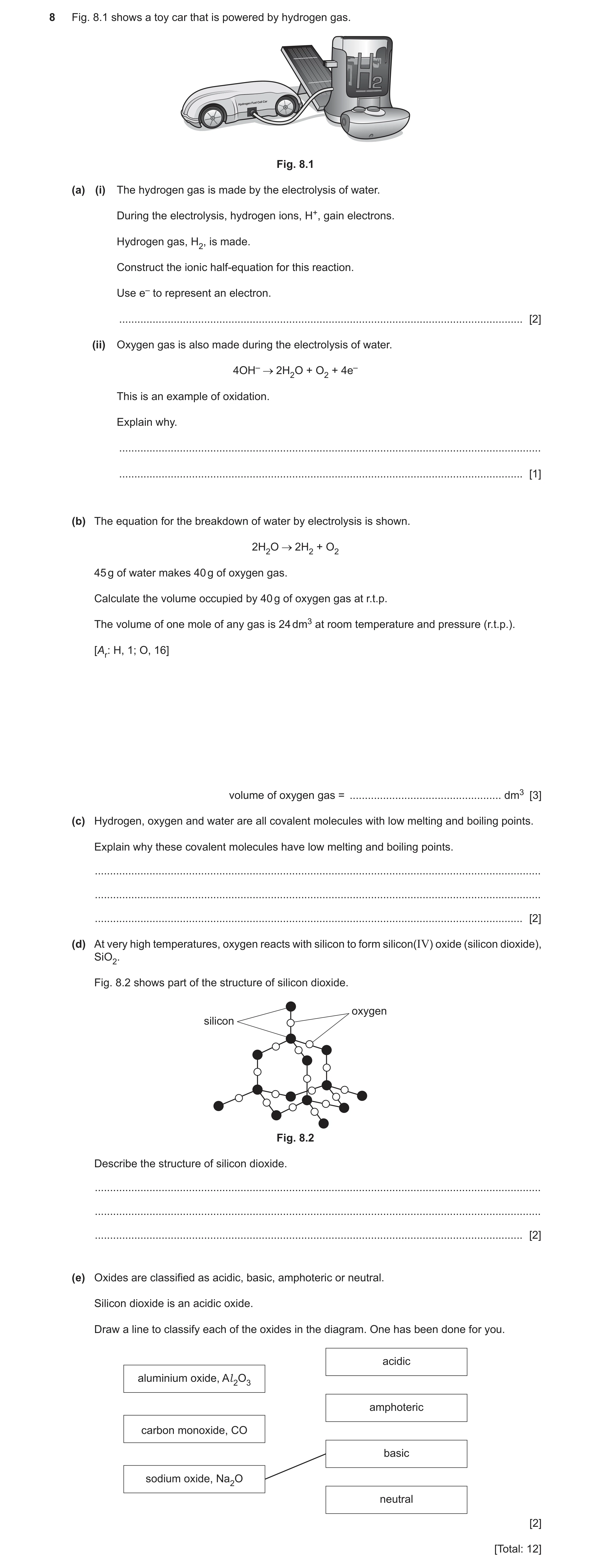
8 Fig. 8.1 shows a toy car that is powered by hydrogen gas. Fig. 8.1 (a) (i) The hydrogen gas is made by the electrolysis of water. During the electrolysis, hydrogen ions, H+, gain electrons. Hydrogen gas, H2, is made. Construct the ionic half-equation for this reaction. Use e– to represent an electron. … [2] (ii) Oxygen gas is also made during the electrolysis of water. 4OH– 2H2O + O2 + 4e– This is an example of oxidation. Explain why. … … [1] (b) The equation for the breakdown of water by electrolysis is shown. 2H2O 2H2 + O2 45 g of water makes 40 g of oxygen gas. Calculate the volume occupied by 40 g of oxygen gas at r.t.p. The volume of one mole of any gas is 24 dm3 at room temperature and pressure (r.t.p.). [Ar: H, 1; O, 16] volume of oxygen gas = … dm3 [3] (c) Hydrogen, oxygen and water are all covalent molecules with low melting and boiling points. Explain why these covalent molecules have low melting and boiling points. … … … [2] (d) At very high temperatures, oxygen reacts with silicon to form silicon(IV) oxide (silicon dioxide), SiO2. Fig. 8.2 shows part of the structure of silicon dioxide. oxygen silicon Fig. 8.2 Describe the structure of silicon dioxide. … … … [2] (e) Oxides are classified as acidic, basic, amphoteric or neutral. Silicon dioxide is an acidic oxide. Draw a line to classify each of the oxides in the diagram. One has been done for you. acidic aluminium oxide, Al 2O3 amphoteric carbon monoxide, CO basic sodium oxide, Na2O neutral [2] [Total: 12]
12 marks
Mark scheme: 8(a)(i) 2 8(a)(ii) loss of electrons / AW ; 1 8(b) Mr of O2 = 32 ; moles of O2 = 40 ÷ 32 = 1.25 ; volume of O2 = 1.25 24 = 30 dm³ ; 3 8(c) weak intermolecular forces / weak forces between molecules ; (weak forces) which require little energy to break ; 2 8(d) giant covalent OR covalent lattice ; each oxygen atom forms bonds with 2 silicon atoms / each silicon atoms forms bonds with 4 oxygen atoms ; 2 8(e) ;; 2
This question in 0654/43 May/June 2024
Q10 · Complete the sentences about the structure of an atom 0654/41 Oct/Nov 2024
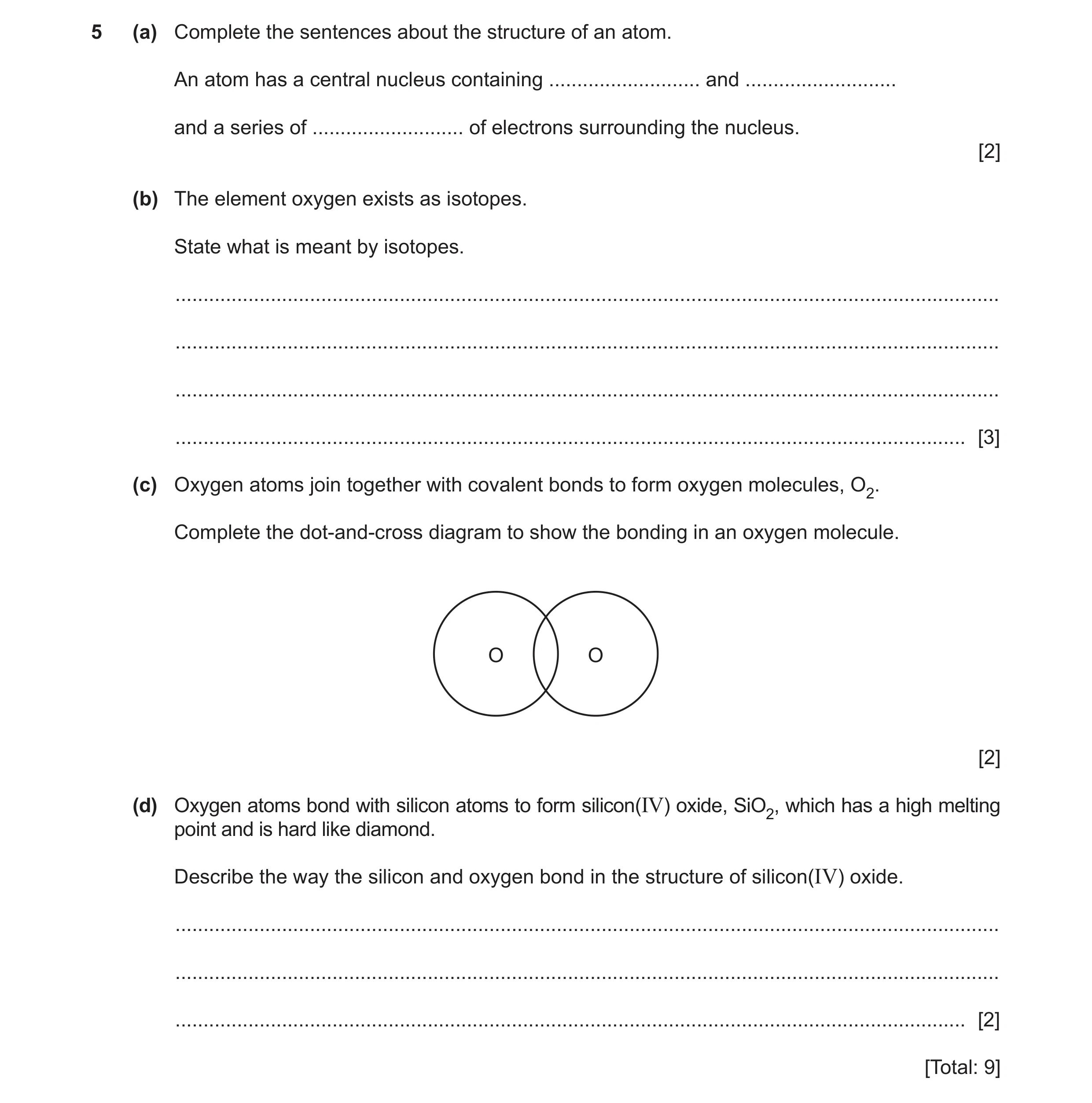
5 (a) Complete the sentences about the structure of an atom. An atom has a central nucleus containing … and … and a series of … of electrons surrounding the nucleus. [2] (b) The element oxygen exists as isotopes. State what is meant by isotopes. … … … … [3] (c) Oxygen atoms join together with covalent bonds to form oxygen molecules, O2. Complete the dot‑and‑cross diagram to show the bonding in an oxygen molecule. O O [2] (d) Oxygen atoms bond with silicon atoms to form silicon(IV) oxide, SiO2, which has a high melting point and is hard like diamond. Describe the way the silicon and oxygen bond in the structure of silicon(IV) oxide. … … … [2] [Total: 9]
9 marks
Mark scheme: 5(a) protons (and) neutrons 2 shells one or two correct for 1 mark three correct for 2 marks ;; 5(b) (idea of) atoms of the same / an element ; 3 which have the same proton / atomic number ; but a different nucleon / mass number ; 5(c) 2 one mark for double bond between oxygen atoms one mark for rest of structure correct ;; 5(d) any two from: 2 macromolecular / (giant) lattice ; each oxygen atom bonds with 2 silicon atoms ; each silicon atom bonds with 4 oxygen atoms ; sharing of electrons / covalent bond ;
This question in 0654/41 Oct/Nov 2024
Q11 · Some information about the structure of atoms 0654/43 Oct/Nov 2024
8 (a) Table 8.1 shows some information about the structure of atoms. Complete Table 8.1. Table 8.1 particle charge relative mass electron –1 … neutron … … proton 1 … [2] (b) Fig. 8.1 shows two forms of the element carbon, diamond and graphite. diamond graphite Fig. 8.1 Put a tick (3) next to the correct description for the structure of diamond and graphite. giant covalent ionic polymer metallic [1] (c) Graphite is used to make electrodes for electrolysis because it is a good conductor of electricity. Explain why graphite is a good conductor of electricity. Use ideas about structure and bonding. … … … [2] (d) There are different isotopes of the element carbon. Two of the isotopes are called carbon-12 and carbon-14. (i) Table 8.2 shows some information about one atom of each of these isotopes of carbon. Complete Table 8.2. Table 8.2 number of protons number of neutrons number of electrons carbon-12 6 6 … carbon-14 … … … [2] (ii) The different isotopes of carbon have the same chemical properties. Explain why. … … [1] (e) Elements are organised in the Periodic Table in groups. Carbon is in Group IV of the Periodic Table. Another element, tellurium, is in Group VI of the Periodic Table. A common compound of tellurium is sodium telluride, Na2Te. Put a tick (3) next to the formula of the tellurium ion in sodium telluride, Na2Te. Te– Te+ Te2– Te2+ Te6– [1] [Total: 9]
9 marks
Mark scheme: 8(a) 2 particle charge relative mass electron –1 0.0005 / negligible / almost 0 / 11835 neutron 0 / no charge 1 proton +1 1 1 mark for each correct column ;; 8(b) giant covalent ; 1 8(c) (graphite has) free / delocalised electrons ; 2 which can move ; 8(d)(i) 2 number of number of number of protons neutrons electrons carbon-12 6 6 6 carbon-14 6 8 6 1 mark for each row ;; 8(d)(ii) they (both) have the same number of electrons in the outer shell / they (both) have 4 electrons in the outer shell / 1 they have the same electron(ic) structure / configuration ; 8(e) Te2– ; 1
This question in 0654/43 Oct/Nov 2024
Q12 · The electrolysis of aqueous copper sulfate using graphite electrodes 0654/42 Feb/March 2025
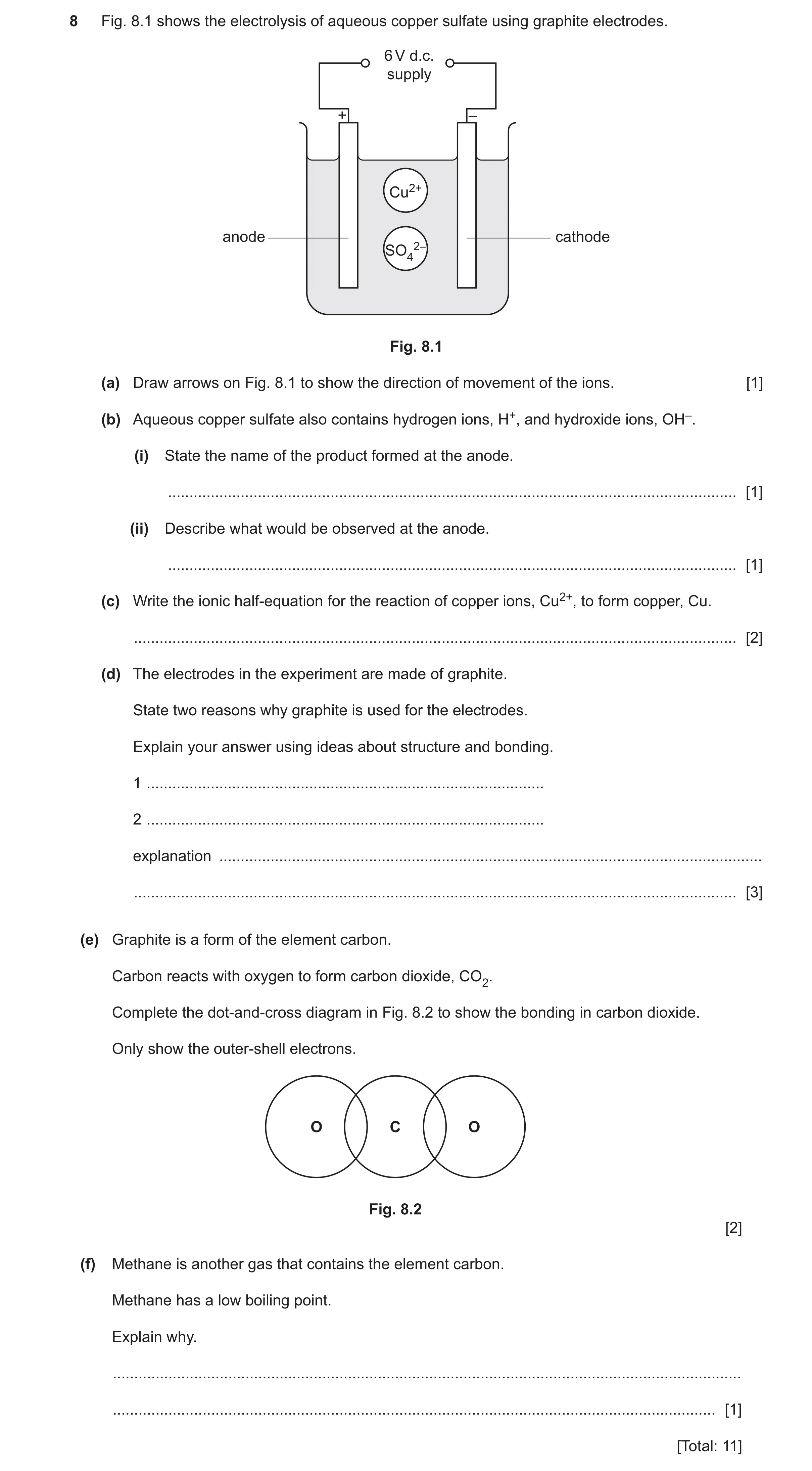
8 Fig. 8.1 shows the electrolysis of aqueous copper sulfate using graphite electrodes. 6 V d.c. supply + – Cu2+ anode cathode SO42– Fig. 8.1 (a) Draw arrows on Fig. 8.1 to show the direction of movement of the ions. [1] (b) Aqueous copper sulfate also contains hydrogen ions, H+, and hydroxide ions, OH–. (i) State the name of the product formed at the anode. … [1] (ii) Describe what would be observed at the anode. … [1] (c) Write the ionic half-equation for the reaction of copper ions, Cu2+, to form copper, Cu. … [2] (d) The electrodes in the experiment are made of graphite. State two reasons why graphite is used for the electrodes. Explain your answer using ideas about structure and bonding. 1 … 2 … explanation … … [3] (e) Graphite is a form of the element carbon. Carbon reacts with oxygen to form carbon dioxide, CO2. Complete the dot-and-cross diagram in Fig. 8.2 to show the bonding in carbon dioxide. Only show the outer-shell electrons. O C O Fig. 8.2 [2] (f) Methane is another gas that contains the element carbon. Methane has a low boiling point. Explain why. … … [1] [Total: 11]
11 marks
Mark scheme: 8(a) arrow from Cu2+ to cathode and arrow from SO42– to anode ; 1 8(b)(i) oxygen ; 1 8(b)(ii) fizzing / bubbling / effervescence ; 1 8(c) Cu2+ + 2e– → Cu ; ; 2 8(d) 1: (graphite) conducts electricity ; 3 2: (graphite) is inert ; (graphite has) delocalised electrons OR because outer shell electrons are used in bonding ; 8(e) 2 ; ; 8(f) (methane has) weak intermolecular forces ; 1
This question in 0654/42 Feb/March 2025
 9 / 19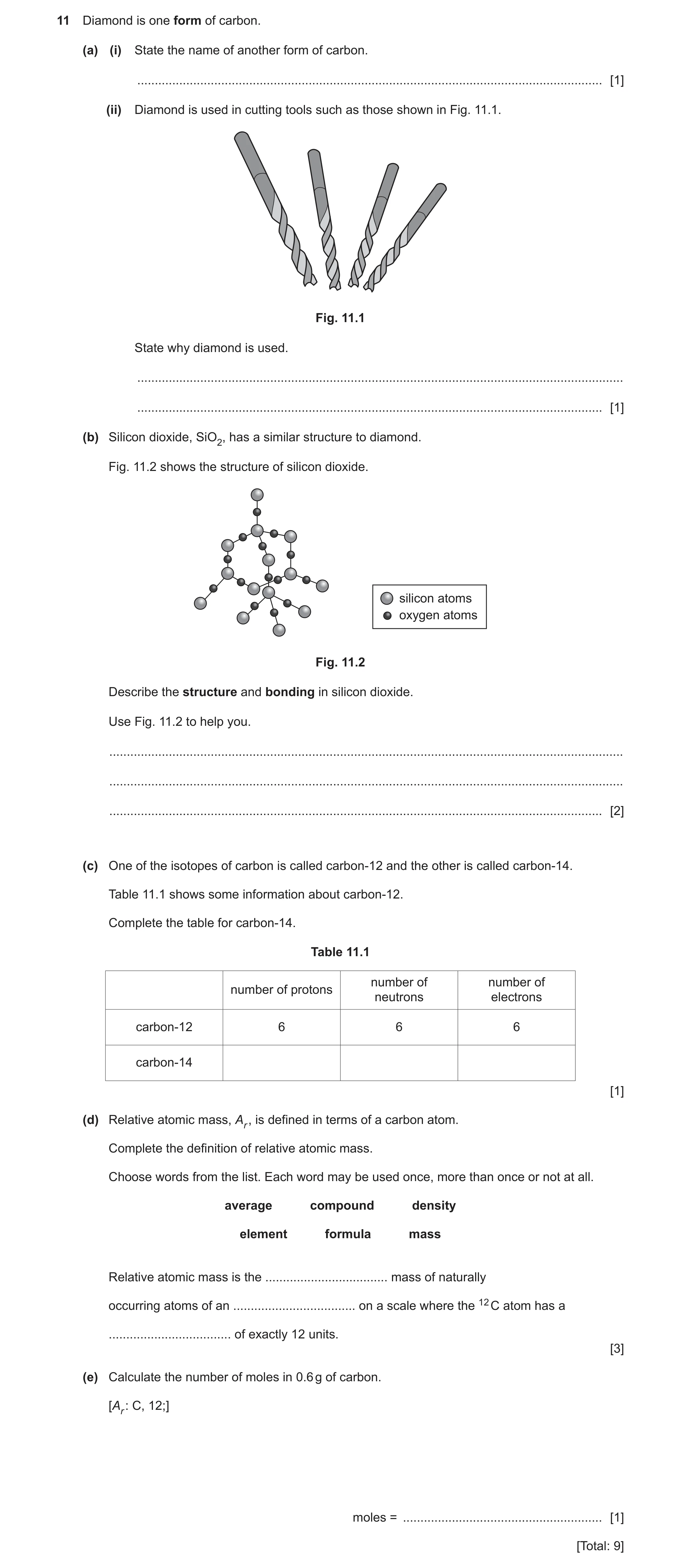
 16 / 19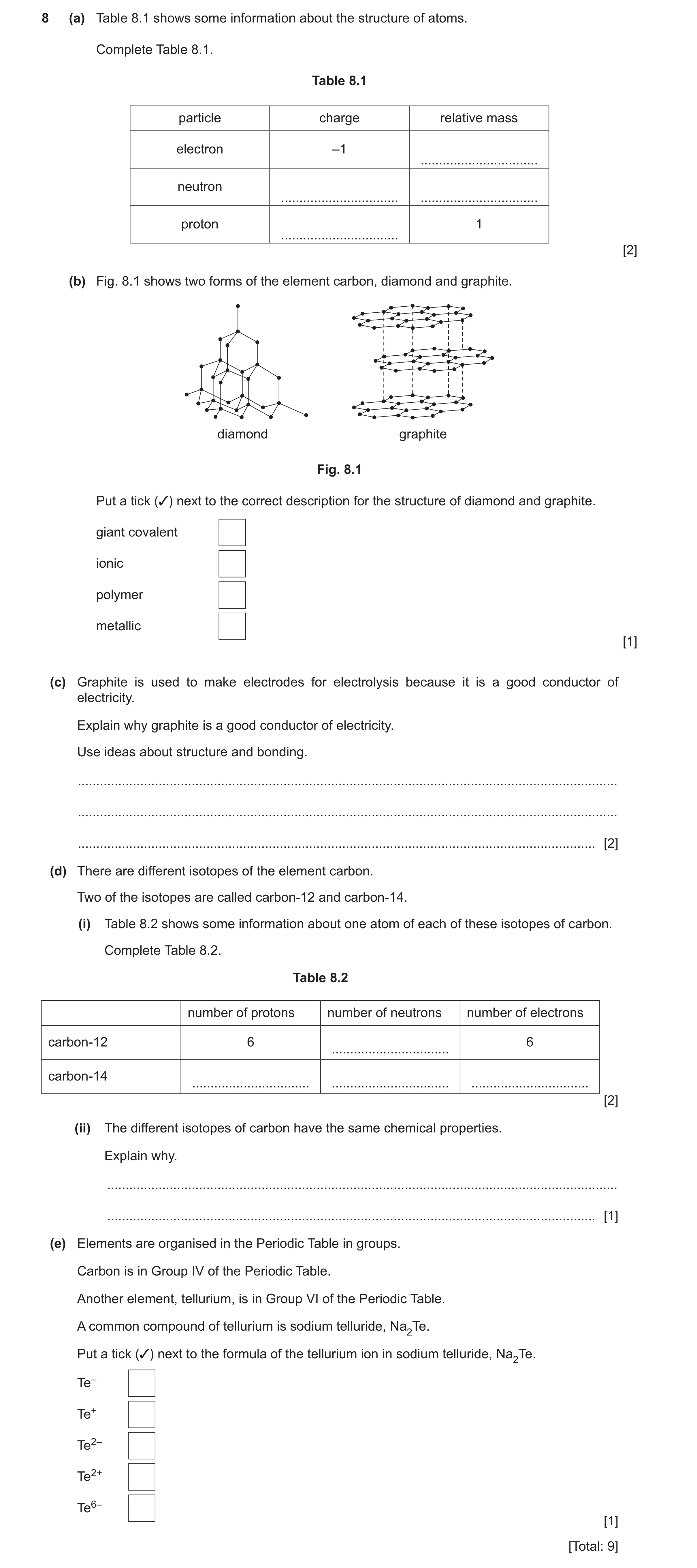
 10
10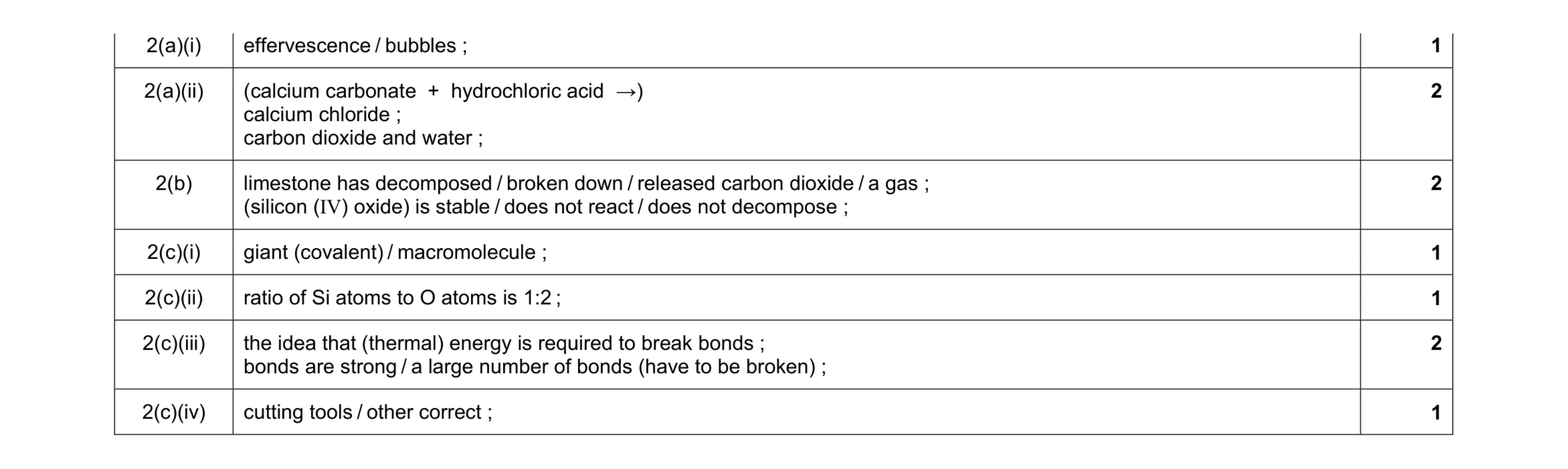 10
10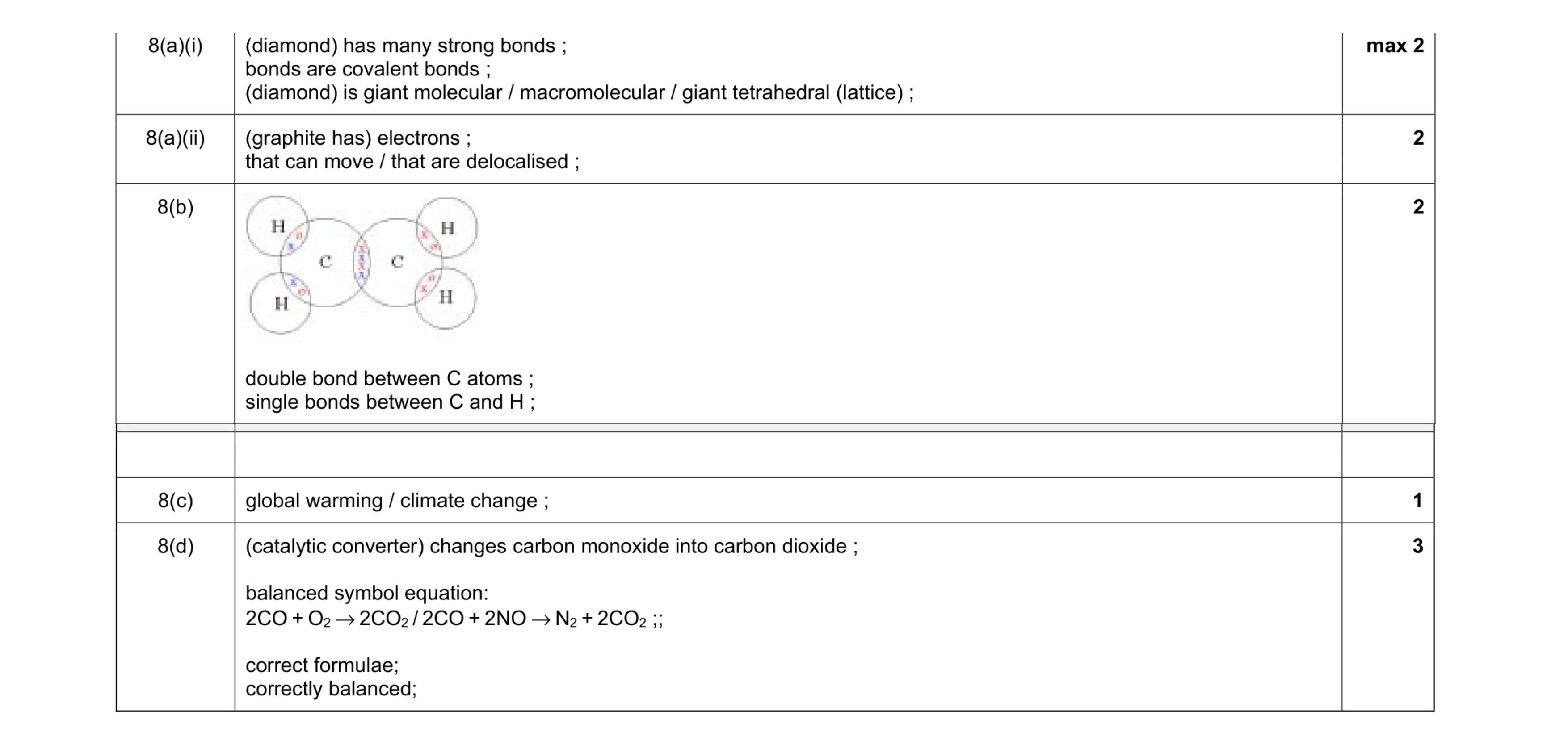 10
10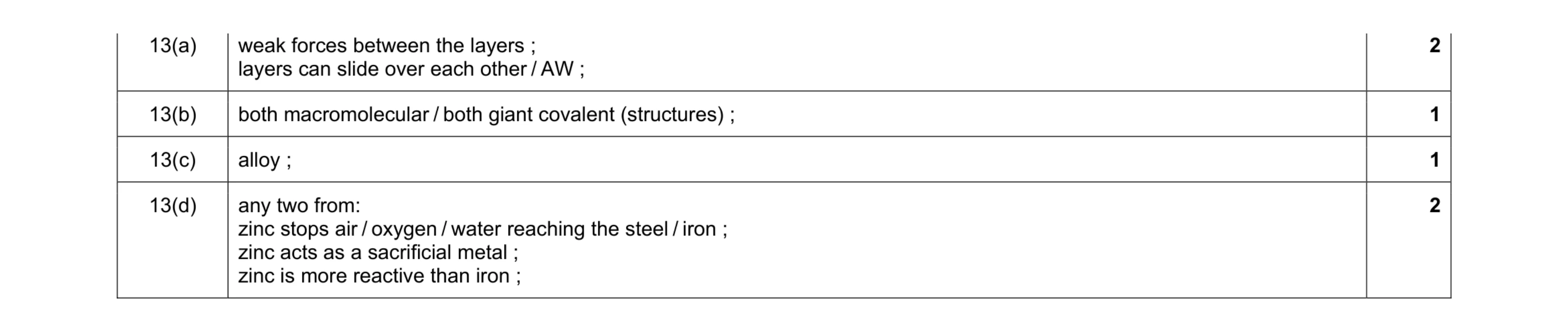 6
6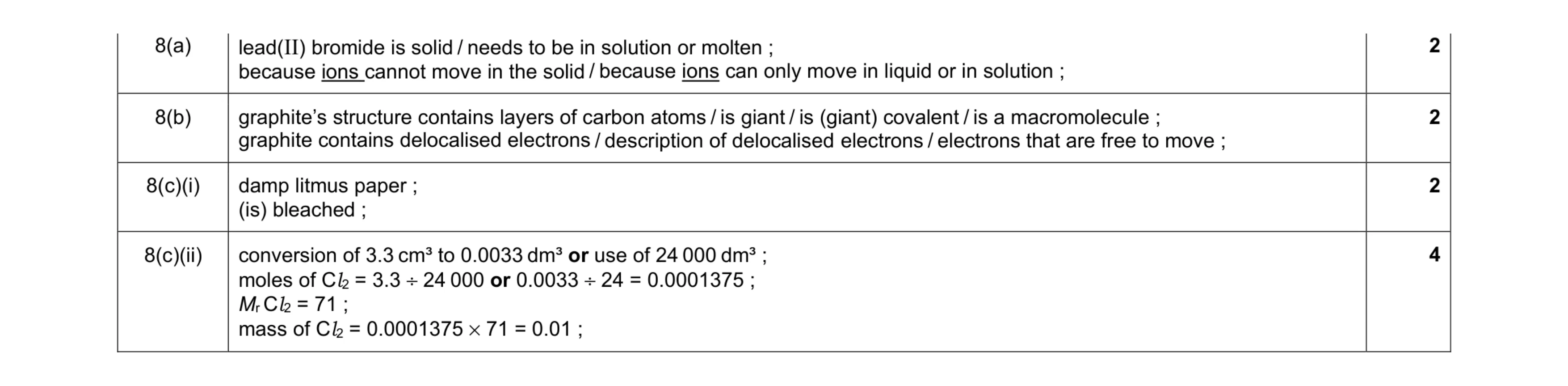 10
10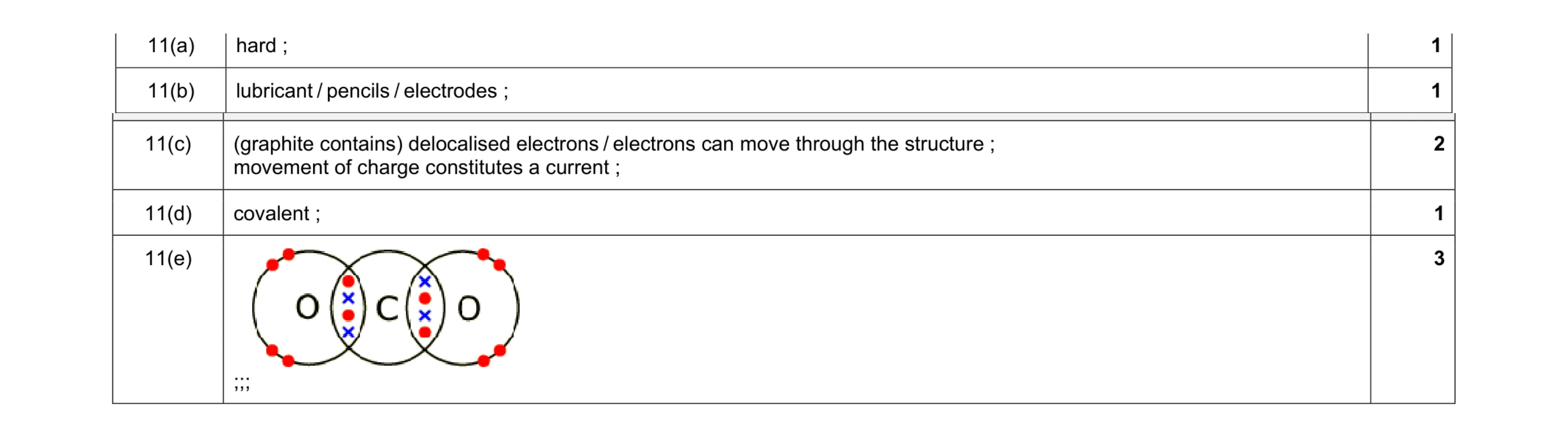 8
8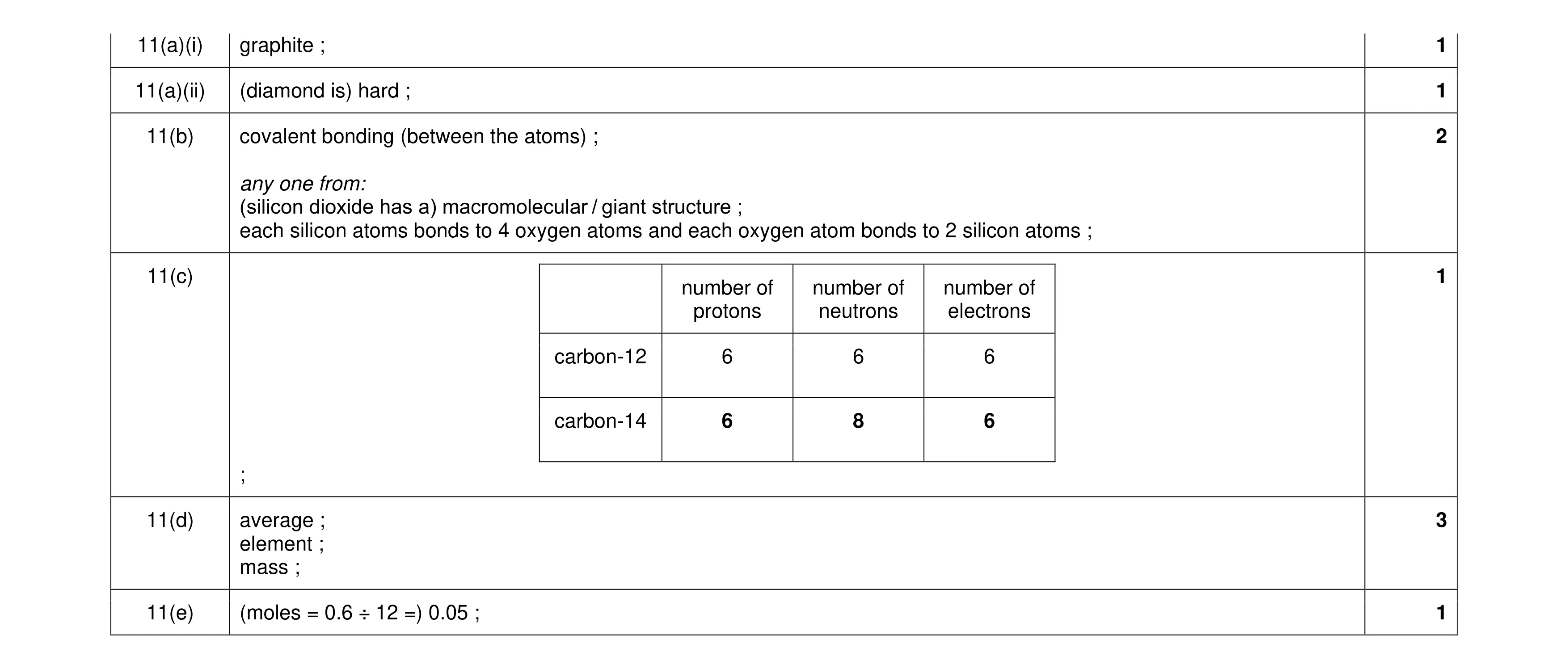 9
9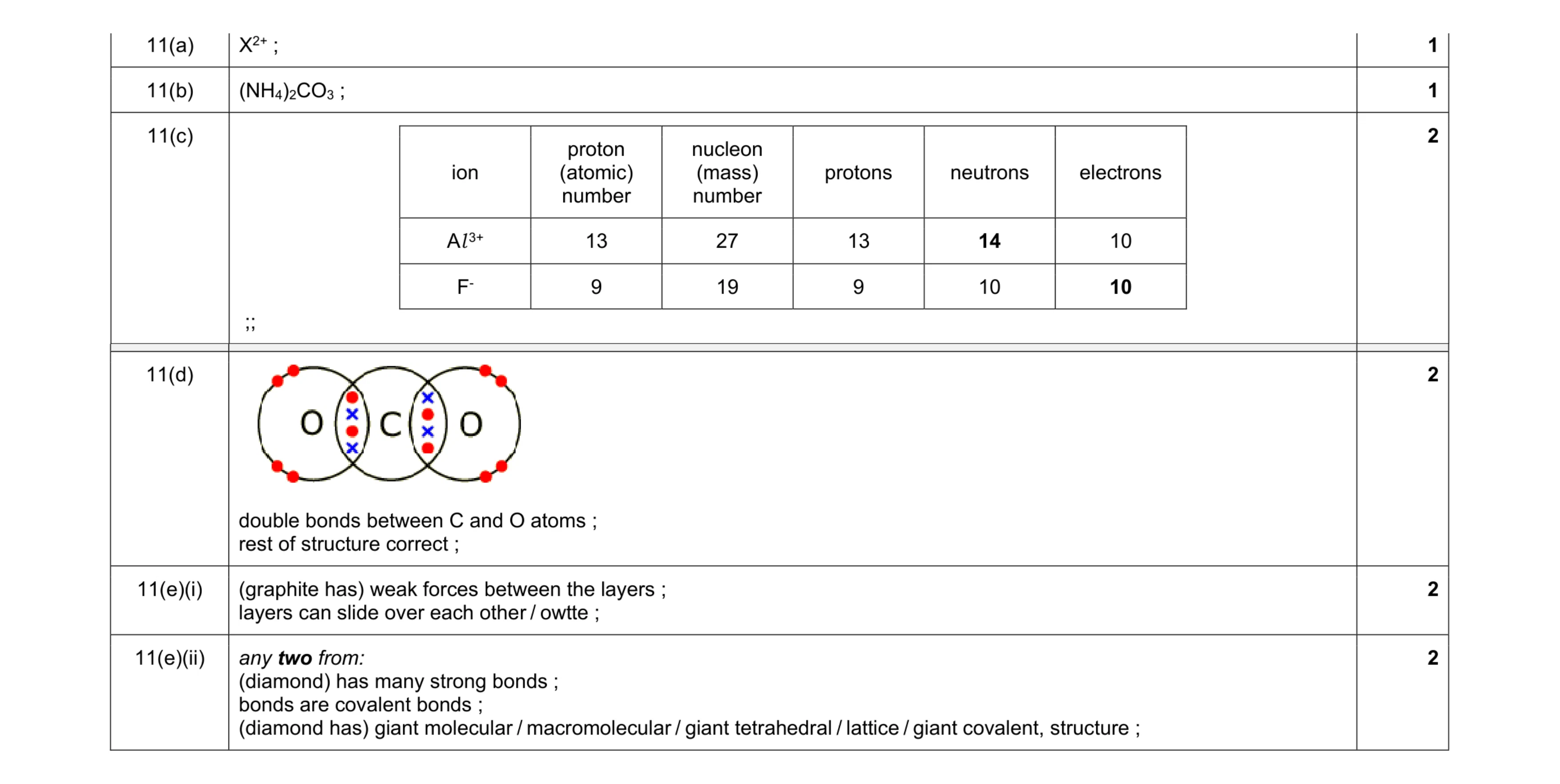 10
10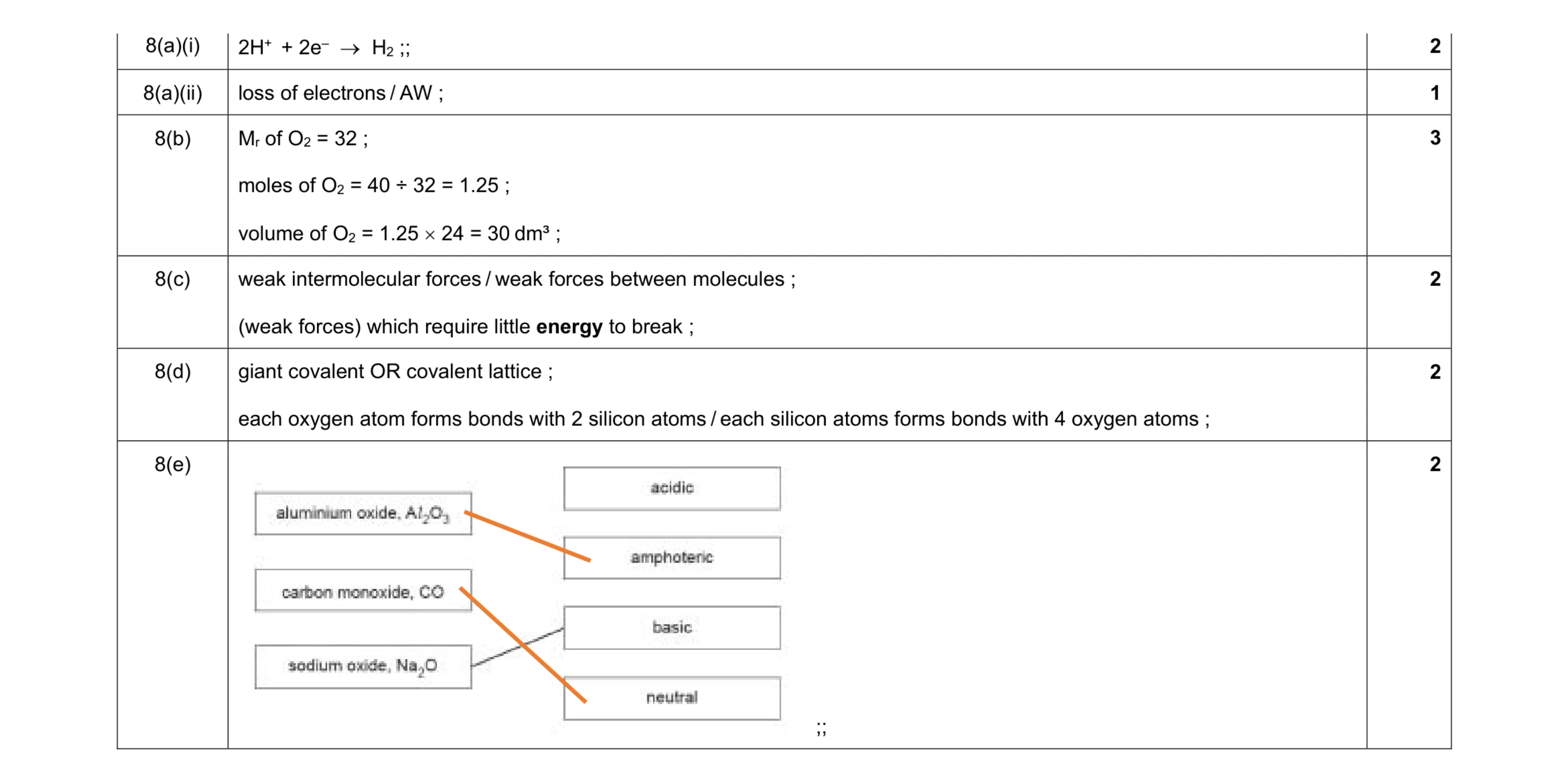 12
12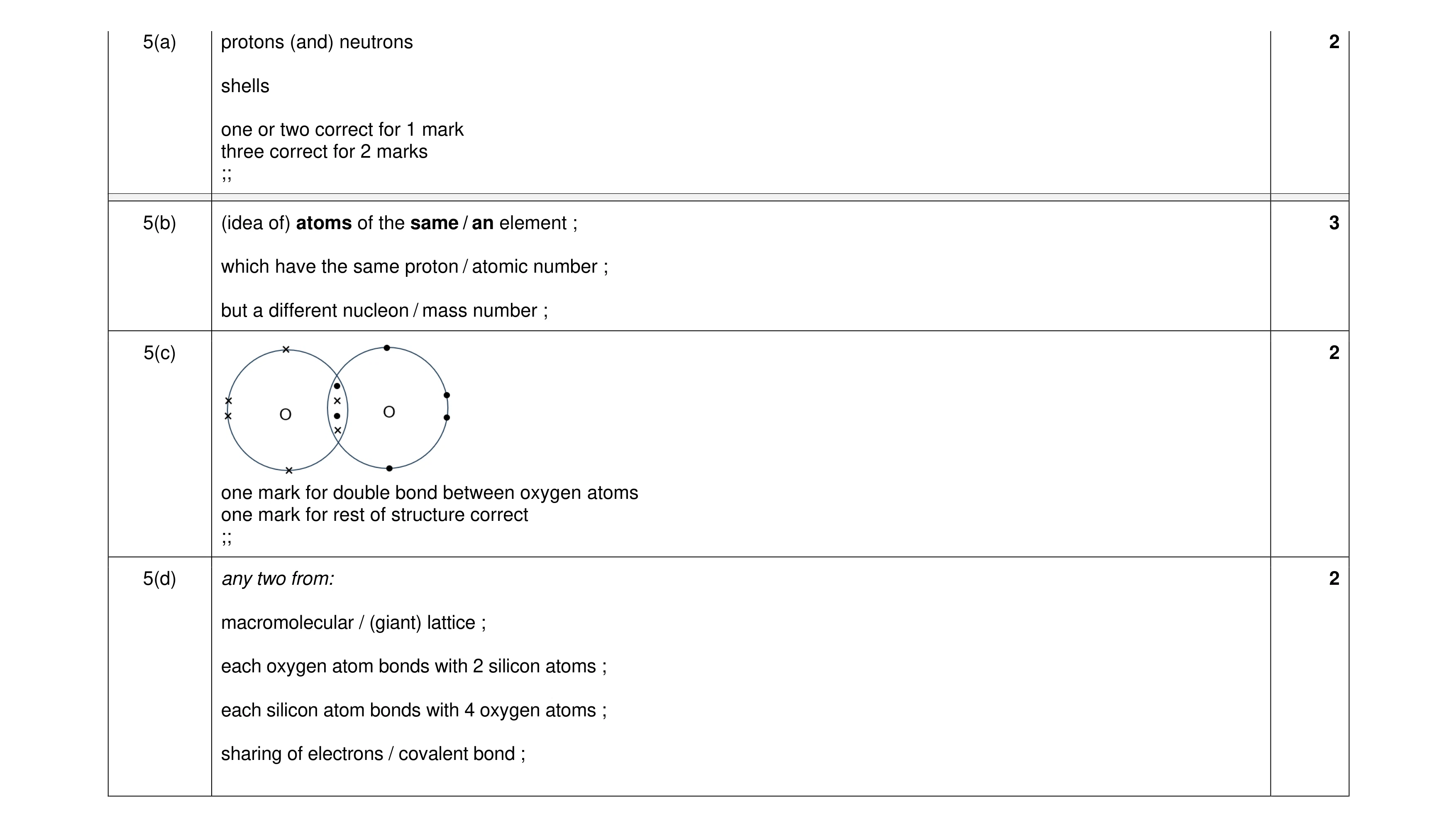 9
9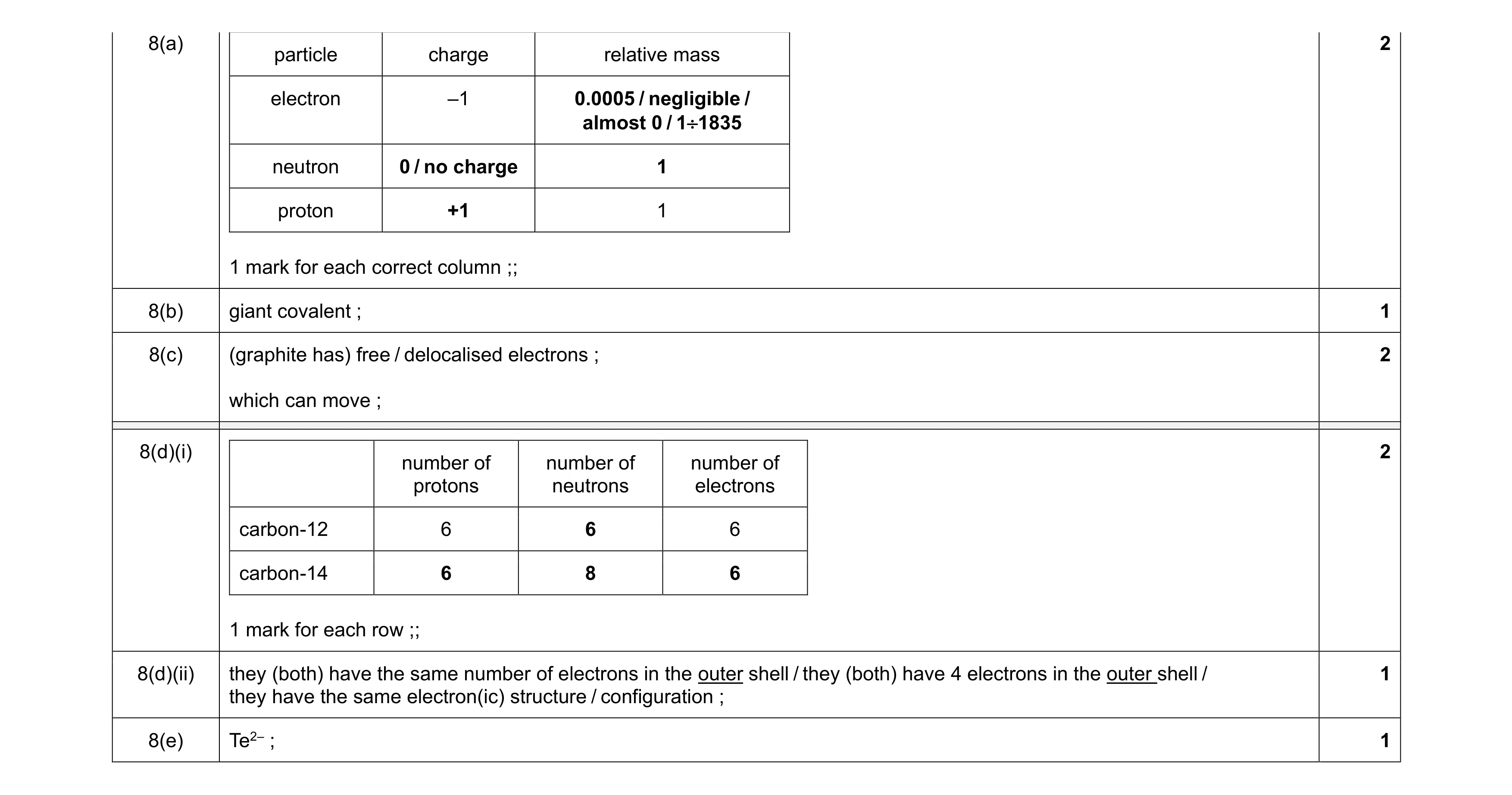 9
9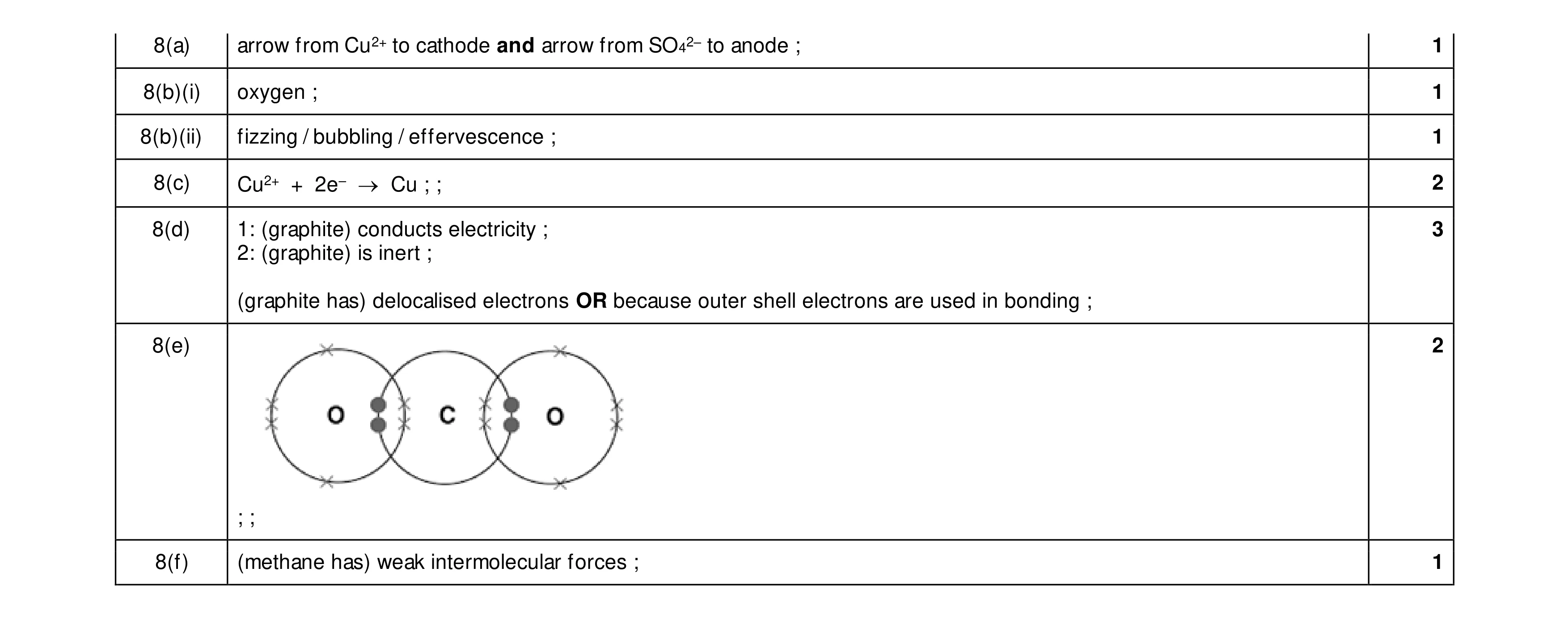 11
11