Questions as text
Q1 · Plants need to use several substances in order to photosynthesise 0654/41 May/June 2017
5 Plants need to use several substances in order to photosynthesise. (a) Write the balanced symbol equation for photosynthesis. … [2] (b) Plants also need mineral ions in order to function efficiently. Describe how the appearance of a plant deficient in nitrate ions would differ from that of a healthy plant. … … [1] (c) Nitrate fertilisers can be applied to the soil. Nitrate ions are taken into the plant and transported with water through the plant. (i) Describe how water and mineral ions are moved from the roots to the leaves in plants. … … … … … [3] (ii) Suggest how an increase in humidity affects the movement of water and ions through the plant. Explain your answer. … … … [2] (d) When nitrate fertilisers are used in excess, they can be washed into lakes and rivers. Describe and explain the effects of excess nitrates on lakes and rivers. … … … … … [3]
11 marks
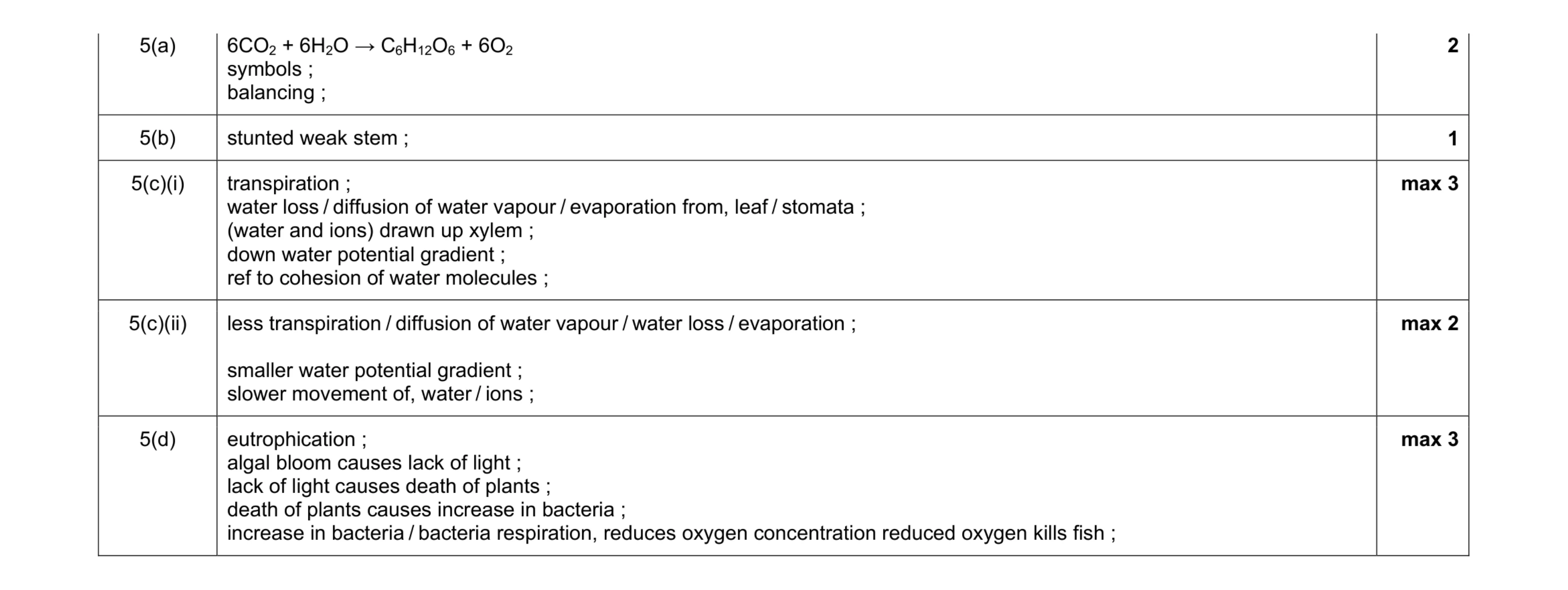
Mark scheme: 5(a) 6CO2 + 6H2O → C6H12O6 + 6O2 symbols ; balancing ; 2 5(b) stunted weak stem ; 1 5(c)(i) transpiration ; water loss / diffusion of water vapour / evaporation from, leaf / stomata ; (water and ions) drawn up xylem ; down water potential gradient ; ref to cohesion of water molecules ; max 3 5(c)(ii) less transpiration / diffusion of water vapour / water loss / evaporation ; smaller water potential gradient ; slower movement of, water / ions ; max 2 5(d) eutrophication ; algal bloom causes lack of light ; lack of light causes death of plants ; death of plants causes increase in bacteria ; increase in bacteria / bacteria respiration, reduces oxygen concentration reduced oxygen kills fish ; max 3
This question in 0654/41 May/June 2017
Q2 · Describe how water is lost from a leaf 0654/41 Oct/Nov 2017
7 (a) (i) Describe how water is lost from a leaf. … … … [2] (ii) Explain how the water lost from leaves causes water to move up the plant. … … … … … [3] (b) A student does an investigation on water loss in leaves. • The student removes four similar-sized leaves, A, B, C and D, from a plant and covers different surfaces of three of these leaves with petroleum jelly, a waterproof substance. • The mass of each leaf is measured and the leaves are left in the same place. • The mass of each leaf is measured again after 5 days. The mass lost from the leaves is an indication of the water loss. Table 7.1 shows the student’s results. Table 7.1 leaf petroleum mass at mass at difference in treatment start / g end / g mass / g A no covering 4.1 3.3 … upper surface B 4.1 3.5 0.6 covered only lower surface C 4.5 4.2 0.3 covered only both surfaces D 4.2 4.2 0.0 covered (i) Complete Table 7.1 by calculating the mass of water lost in leaf A. [1] (ii) Suggest why a smaller mass of water is lost in leaf C than in leaf B. … … [1] (iii) The same investigation is done at a higher temperature. Predict how this would affect the results. … … … [2]
9 marks
Mark scheme: 7(a)(i) water lost, by evaporation / as water vapour ; through the stomata ; ref to transpiration ; max 2 7(a)(ii) transpiration / water loss from leaf« reduces water potential at top of plant ; (causes) movement of water up xylem ; ref to cohesion of molecules ; down water potential gradient ; max 3 7(b)(i) 0.8 (g) ; 1 7(b)(ii) more stomata on lower surface of leaf ; 1 7(b)(iii) more, water / mass loss (from leaves A, B, C) ; no / very little, water / mass loss from leaf D ; 2
This question in 0654/41 Oct/Nov 2017
Q3 · A diagram of a root hair cell 0654/43 Oct/Nov 2017
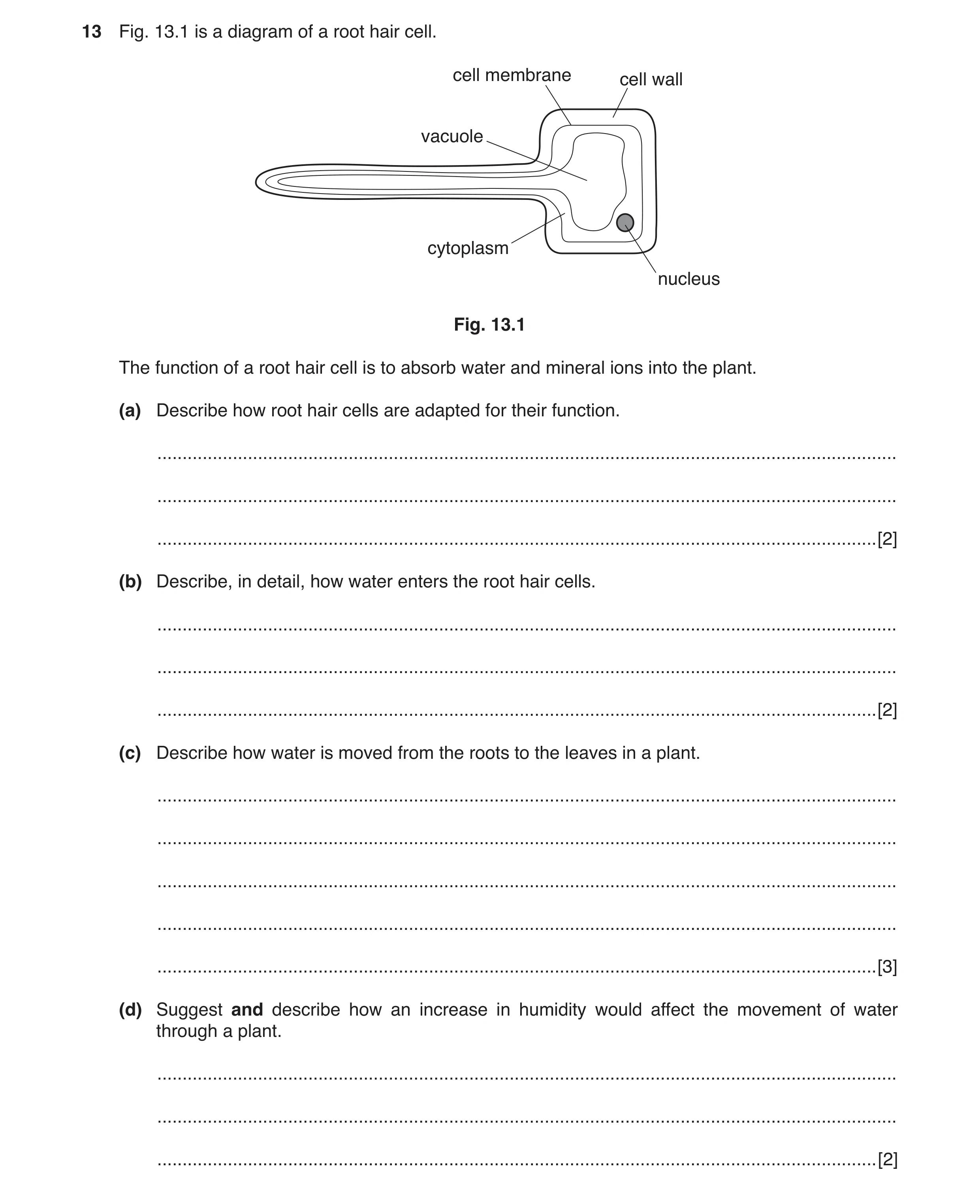
13 Fig. 13.1 is a diagram of a root hair cell. cell membrane cell wall vacuole cytoplasm nucleus Fig. 13.1 The function of a root hair cell is to absorb water and mineral ions into the plant. (a) Describe how root hair cells are adapted for their function. … … … [2] (b) Describe, in detail, how water enters the root hair cells. … … … [2] (c) Describe how water is moved from the roots to the leaves in a plant. … … … … … [3] (d) Suggest and describe how an increase in humidity would affect the movement of water through a plant. … … … [2]
9 marks
Mark scheme: 13(a) elongated / long ; increased surface area (for absorption) ; 2 13(b) ref to osmosis ; movement of water from high water potential to low water potential / down a water potential gradient ; across, partially permeable membrane / cell membrane ; max 2 13(c) transpiration / water loss / evaporation from leaf ; reduces water potential at top of plant ; (causes) movement of water up xylem ; ref to cohesion of molecules ; down water potential gradient ; max 3 13(d) less transpiration / water loss / evaporation ; less / slower movement of water ; 2
This question in 0654/43 Oct/Nov 2017
Q4 · A diagram of the distribution of tissues in a cross-section of a root 0654/42 Oct/Nov 2018
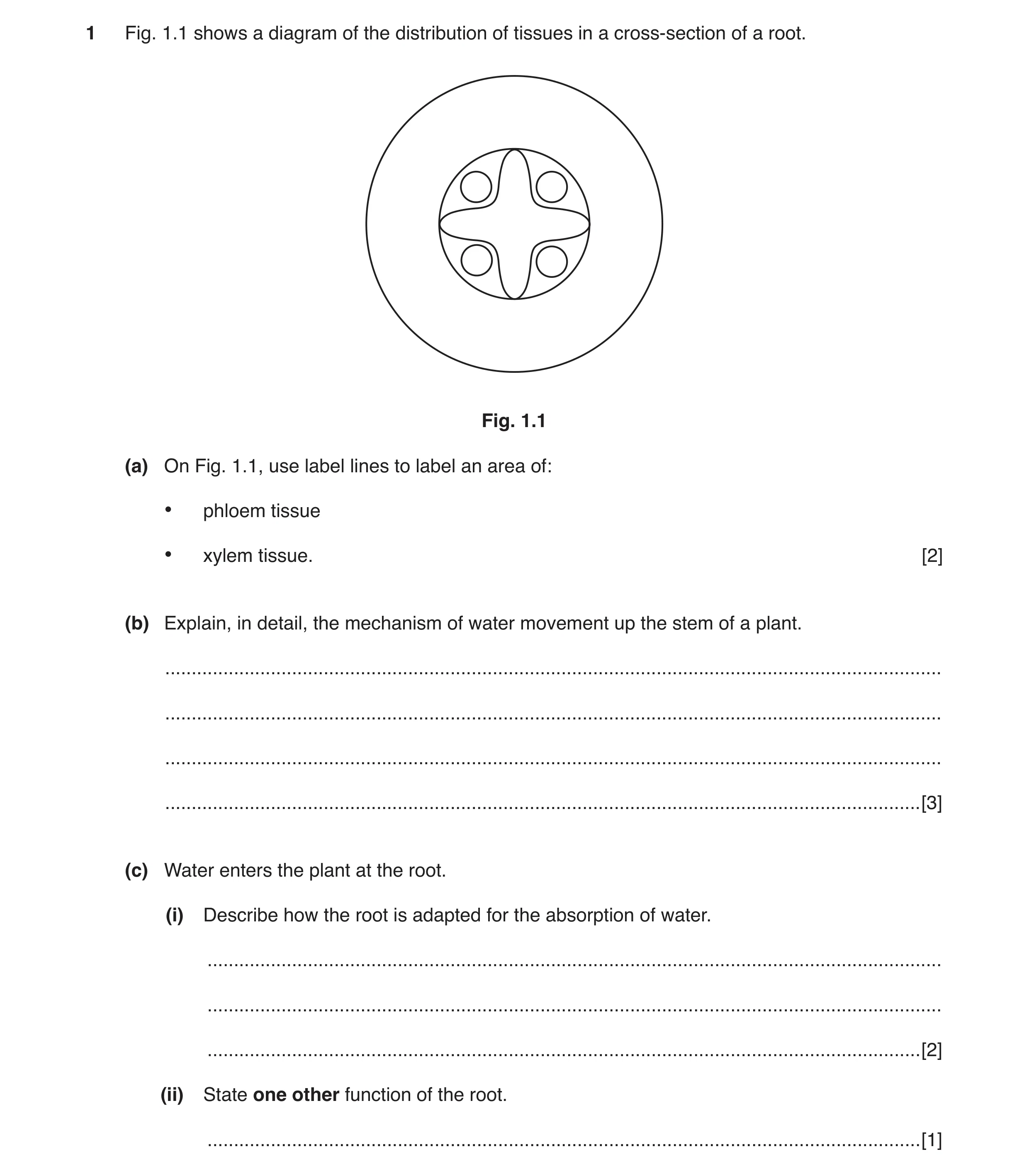
1 Fig. 1.1 shows a diagram of the distribution of tissues in a cross-section of a root. Fig. 1.1 (a) On Fig. 1.1, use label lines to label an area of: • phloem tissue • xylem tissue. [2] (b) Explain, in detail, the mechanism of water movement up the stem of a plant. … … … … [3] (c) Water enters the plant at the root. (i) Describe how the root is adapted for the absorption of water. … … … [2] (ii) State one other function of the root. … [1]
8 marks
Mark scheme: 1(a) xylem labelled ; phloem labelled ; 2 1(b) evaporation from leaves / water loss by transpiration ; creates, water potential gradient / difference in water potential ; pulls water molecules up xylem ; water molecules held together by cohesion ; max 3 1(c)(i) root hair cells ; elongated shape / increase surface area ; 2 1(c)(ii) absorb, mineral (ions) / named mineral ions ; anchorage in soil ; max 1
This question in 0654/42 Oct/Nov 2018
Q5 · A student investigates the effect of temperature on the rate of transpiration 0654/41 Oct/Nov 2019
10 (a) A student investigates the effect of temperature on the rate of transpiration. The apparatus in Fig. 10.1 is used to measure the rate of water uptake by a plant shoot. This is approximately equal to the rate of transpiration. plant shoot reservoir capillary tube air bubble ruler beaker of water Fig. 10.1 The rate of water uptake is determined by measuring the distance travelled by the air bubble in a set time. (i) At 30 °C the air bubble travels 8 mm in 2 minutes. Calculate the rate of water uptake. … mm / min [1] (ii) The student repeats the investigation at different temperatures. Sketch a line on Fig 10.2 to show the expected results. rate of water uptake 0 10 20 30 40 50 temperature / °C Fig. 10.2 [2] (iii) Suggest a reason for the shape of your graph in (a)(ii). … … [1] (b) Describe the mechanism that moves water up the xylem. … … … … … [3] (c) Fig. 10.3 shows a photograph of a plant cell undergoing cell division by mitosis. chromosomes cell A Fig. 10.3 (i) State where chromosomes are found in a cell. … [1] (ii) Complete the sentence about the chromosomes in cell A. The chromosomes on the left-hand side of the cell are genetically … to the chromosomes on the right-hand side of the cell. [1] (d) One of the roles of mitosis is growth. State two other roles of mitosis. 1 … … 2 … … [2] (e) State how the number of chromosomes in a cell produced by meiosis is different to the number of chromosomes in a cell produced by mitosis. … … [1] [Total: 12]
12 marks
Mark scheme: 10(a)(i) 4 (mm / min) ; 1 10(a)(ii) rate increasing ; then levelling off / gradient reducing ; 2 10(a)(iii) increasing temperature causes (more) stomata to open (until other factors limit transpiration) ; increasing rate of evaporation ; increasing transpiration (pull) ; max 1 1 10(b) transpiration pull ; difference in water potential / water potential gradient ; draws up a column of water (molecules) ; water (molecules) held together by cohesion ; max 3 3 10(c)(i) in the nucleus ; 1 10(c)(ii) identical ; 1 10(d) any two from replacement of cells ; asexual reproduction ; repair (of damaged tissue) ; max 2 2 10(e) they would contain half the number of chromosomes (in meiosis) ; 1
This question in 0654/41 Oct/Nov 2019
Q6 · Water is taken into roots through the root hair cells by osmosis 0654/42 Oct/Nov 2019
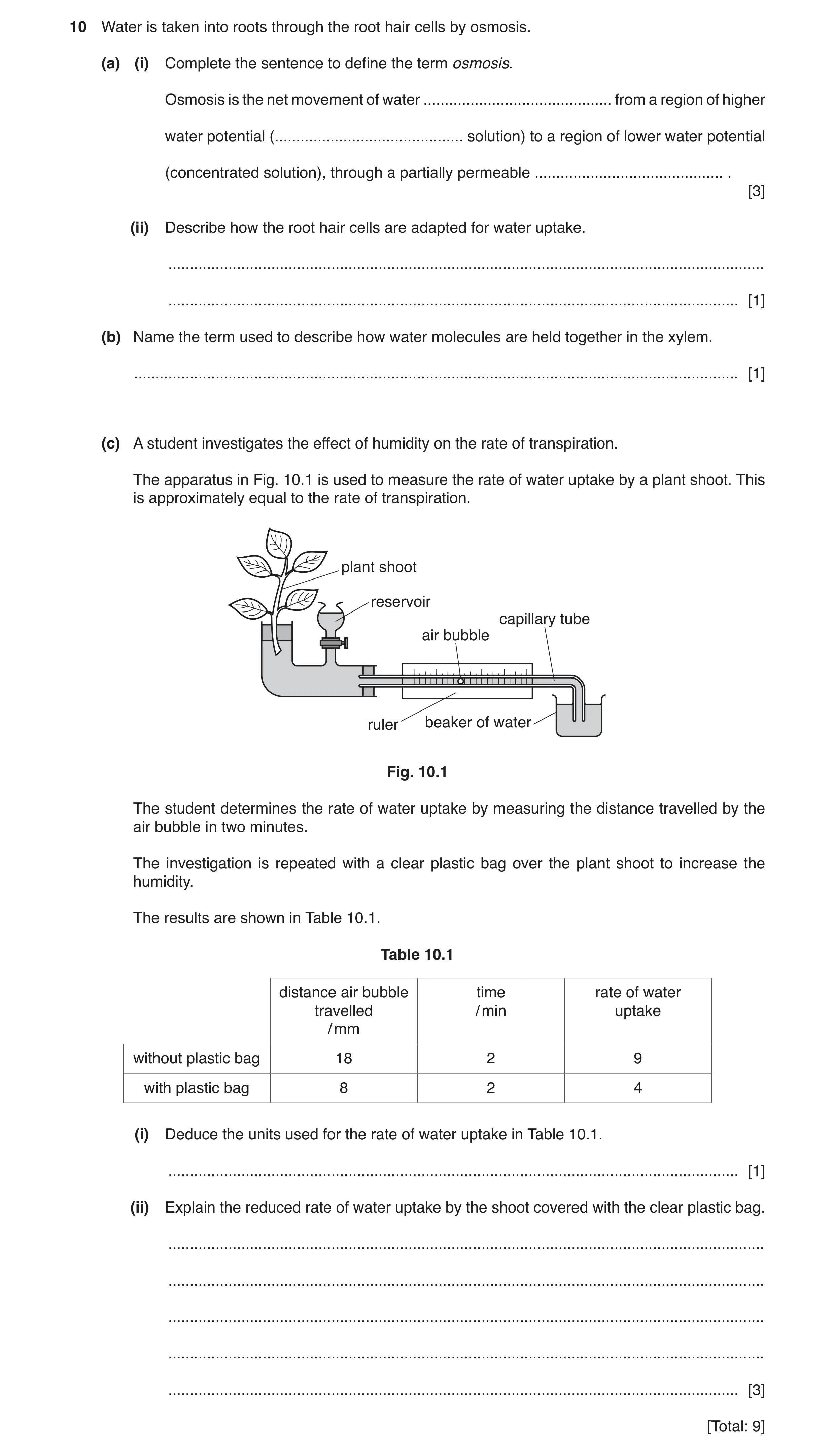
10 Water is taken into roots through the root hair cells by osmosis. (a) (i) Complete the sentence to define the term osmosis. Osmosis is the net movement of water … from a region of higher water potential ( … solution) to a region of lower water potential (concentrated solution), through a partially permeable … . [3] (ii) Describe how the root hair cells are adapted for water uptake. … … [1] (b) Name the term used to describe how water molecules are held together in the xylem. … [1] (c) A student investigates the effect of humidity on the rate of transpiration. The apparatus in Fig. 10.1 is used to measure the rate of water uptake by a plant shoot. This is approximately equal to the rate of transpiration. plant shoot reservoir capillary tube air bubble ruler beaker of water Fig. 10.1 The student determines the rate of water uptake by measuring the distance travelled by the air bubble in two minutes. The investigation is repeated with a clear plastic bag over the plant shoot to increase the humidity. The results are shown in Table 10.1. Table 10.1 distance air bubble time rate of water travelled / min uptake / mm without plastic bag 18 2 9 with plastic bag 8 2 4 (i) Deduce the units used for the rate of water uptake in Table 10.1. … [1] (ii) Explain the reduced rate of water uptake by the shoot covered with the clear plastic bag. … … … … … [3] [Total: 9]
9 marks
Mark scheme: 10(a)(i) molecules ; dilute ; membrane ; 3 10(a)(ii) long and thin / elongated / have a large surface area ; 1 10(b) cohesion ; 1 10(c)(i) mm / min ; 1 10(c)(ii) increase in concentration of water (vapour) outside leaf ; less, diffusion / evaporation, of water ; less transpiration pull / movement of water, through the shoot ; 3
This question in 0654/42 Oct/Nov 2019
Q7 · A sketch graph showing the effect of temperature on the rate of transpiration (loss of… 0654/42 May/June 2020
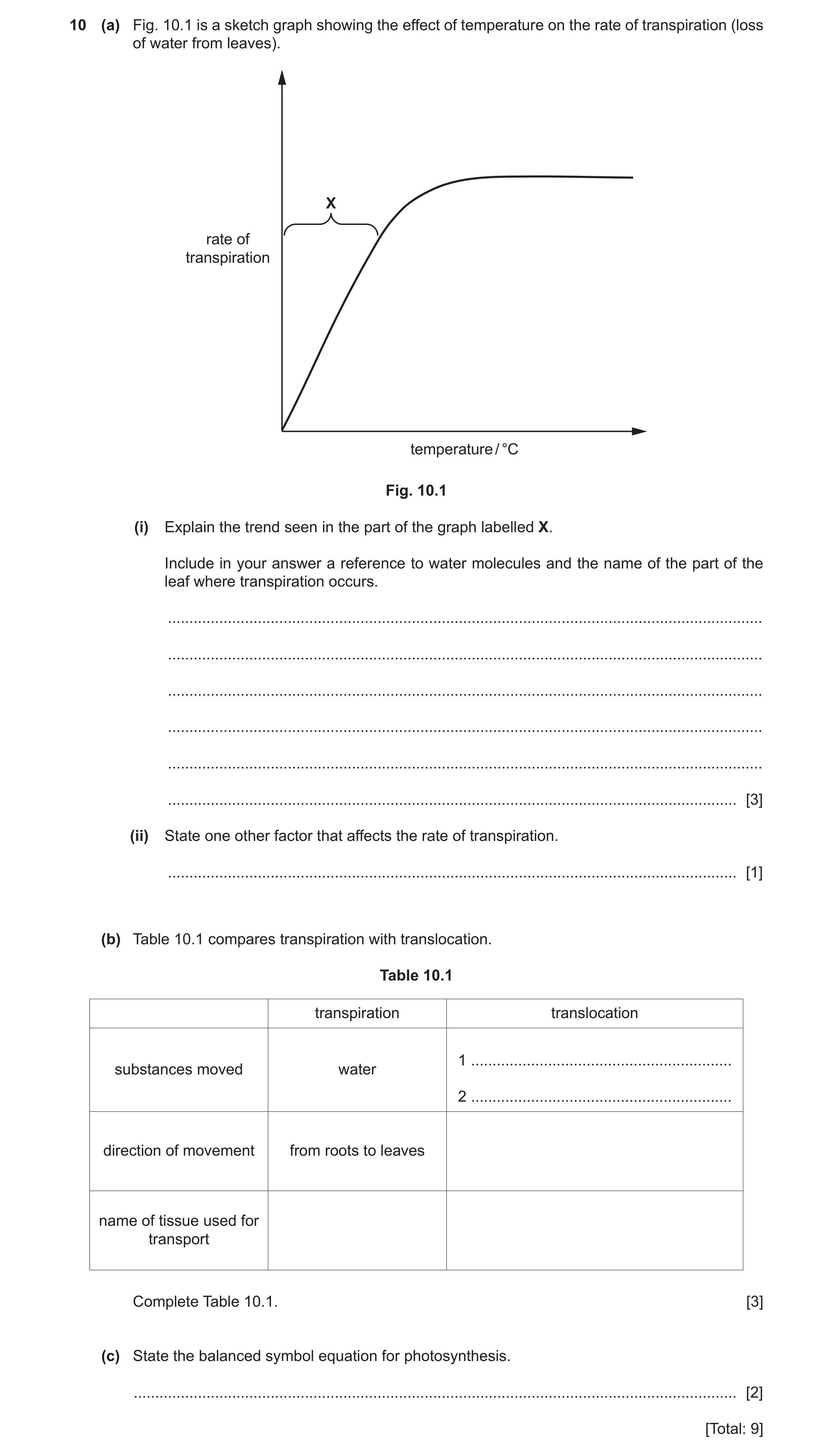
10 (a) Fig. 10.1 is a sketch graph showing the effect of temperature on the rate of transpiration (loss of water from leaves). X rate of transpiration temperature / °C Fig. 10.1 (i) Explain the trend seen in the part of the graph labelled X. Include in your answer a reference to water molecules and the name of the part of the leaf where transpiration occurs. … … … … … … [3] (ii) State one other factor that affects the rate of transpiration. … [1] (b) Table 10.1 compares transpiration with translocation. Table 10.1 transpiration translocation 1 … substances moved water 2 … direction of movement from roots to leaves name of tissue used for transport Complete Table 10.1. [3] (c) State the balanced symbol equation for photosynthesis. … [2] [Total: 9]
9 marks
Mark scheme: 10(a)(i) increase in temperature (no mark) increase in kinetic energy of water molecules ; increased rate of evaporation ; increased loss of water (vapour) through stomata ; 3 10(a)(ii) humidity ; 1 Question Answer Marks 10(b) transpiration translocation substances moved water 1 sucrose 2 amino acids direction of movement from roots to leaves from source to storage / sink name of tissue used for transport xylem phloem ;;; 1 mark for each correct row 3 10(c) 6CO2 + 6H2O → C6H12O6 + 6O2 left hand side ; right hand side ; 2
This question in 0654/42 May/June 2020
Q8 · A diagram of a cross-section of a leaf 0654/42 Feb/March 2021
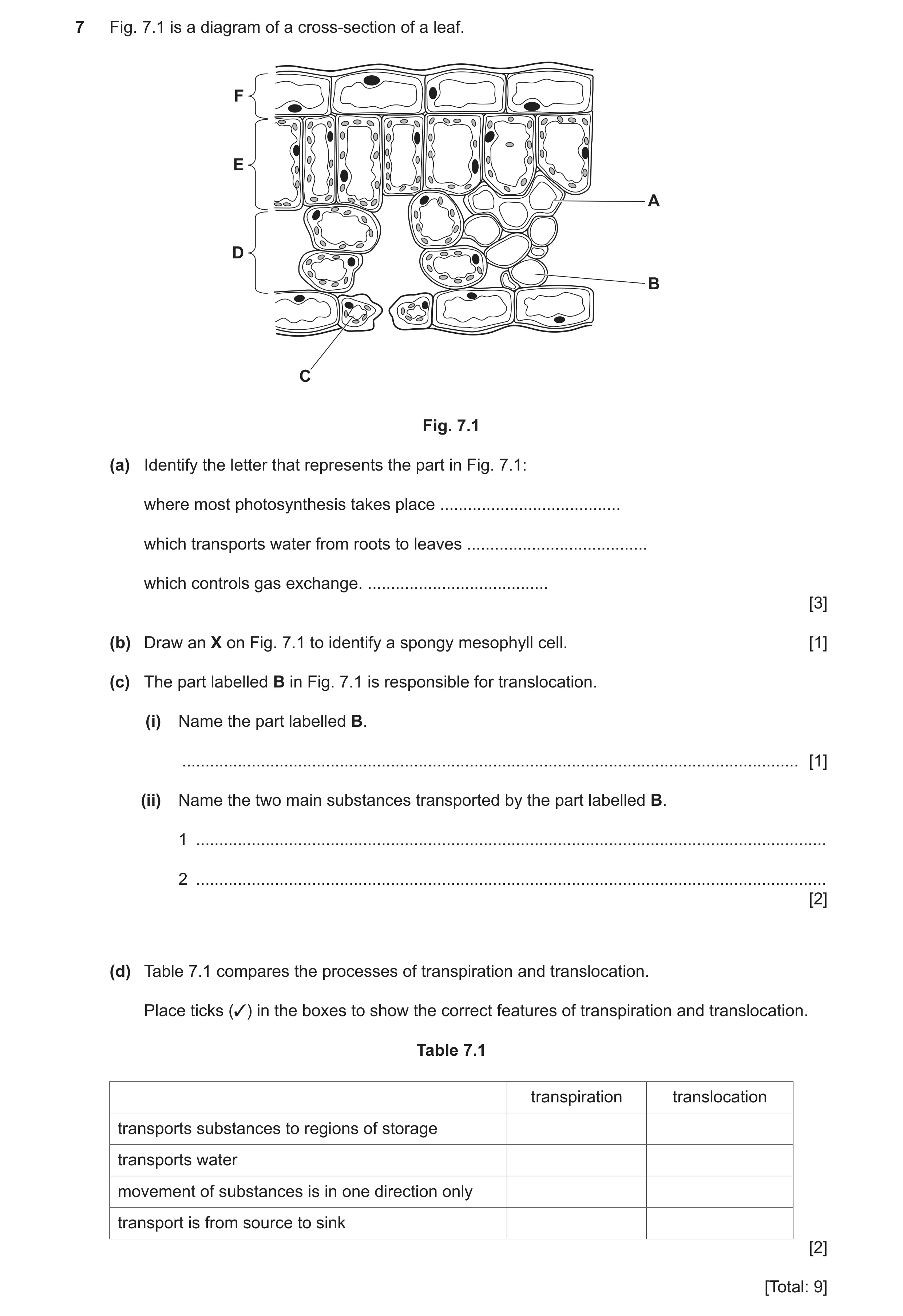
7 Fig. 7.1 is a diagram of a cross-section of a leaf. F E A D B C Fig. 7.1 (a) Identify the letter that represents the part in Fig. 7.1: where most photosynthesis takes place … which transports water from roots to leaves … which controls gas exchange. … [3] (b) Draw an X on Fig. 7.1 to identify a spongy mesophyll cell. [1] (c) The part labelled B in Fig. 7.1 is responsible for translocation. (i) Name the part labelled B. … [1] (ii) Name the two main substances transported by the part labelled B. 1 … 2 … [2] (d) Table 7.1 compares the processes of transpiration and translocation. Place ticks (3) in the boxes to show the correct features of transpiration and translocation. Table 7.1 transpiration translocation transports substances to regions of storage transports water movement of substances is in one direction only transport is from source to sink [2] [Total: 9]
9 marks
Mark scheme: 7(a) E ; A ; C ; 3 7(b) X on one of the spongy mesophyll cells ; 1 7(c)(i) phloem ; 1 7(c)(ii) sucrose ; amino acids ; 2 7(d) transpiration translocation transports substances to regions of storage transports water movement of substances is in one direction only transport is from source to sink ;; 2
This question in 0654/42 Feb/March 2021
Q9 · A student investigates the effect of temperature on the rate of transpiration 0654/42 May/June 2022
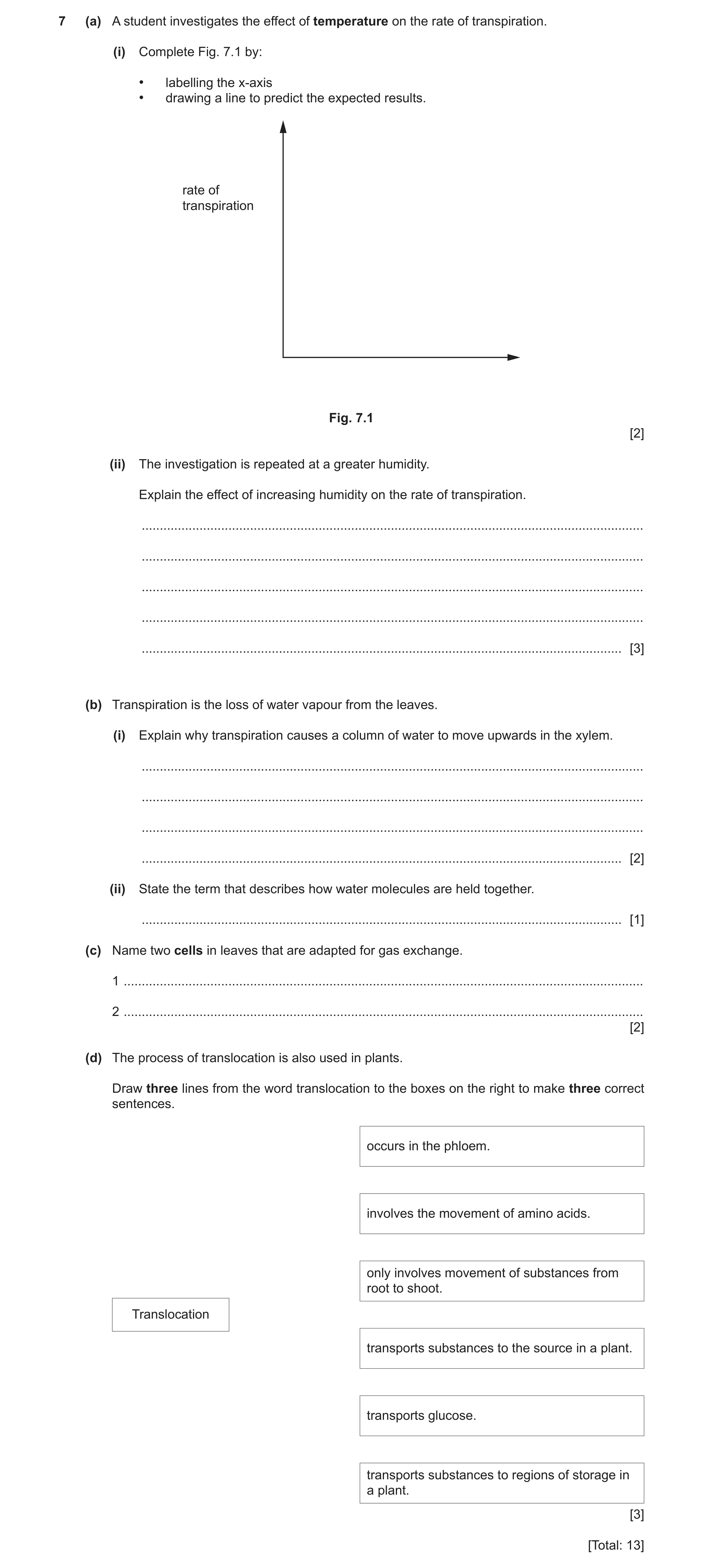
7 (a) A student investigates the effect of temperature on the rate of transpiration. (i) Complete Fig. 7.1 by: • labelling the x‑axis • drawing a line to predict the expected results. rate of transpiration Fig. 7.1 [2] (ii) The investigation is repeated at a greater humidity. Explain the effect of increasing humidity on the rate of transpiration. … … … … … [3] (b) Transpiration is the loss of water vapour from the leaves. (i) Explain why transpiration causes a column of water to move upwards in the xylem. … … … … [2] (ii) State the term that describes how water molecules are held together. … [1] (c) Name two cells in leaves that are adapted for gas exchange. 1 … 2 … [2] (d) The process of translocation is also used in plants. Draw three lines from the word translocation to the boxes on the right to make three correct sentences. occurs in the phloem. involves the movement of amino acids. only involves movement of substances from root to shoot. Translocation transports substances to the source in a plant. transports glucose. transports substances to regions of storage in a plant. [3] [Total: 13]
13 marks
Mark scheme: 7(a)(i) temperature on x-axis ; line showing an increase (and levelling off) ; 2 7(a)(ii) any three from: transpiration rate decreases ; increase in water (vapour) in the, atmosphere / air ; idea of decreases the, water potential / concentration, gradient ; (so) less, evaporation / diffusion ; 3 7(b)(i) transpiration pull ; causes, a water potential gradient / a difference in water potential ; 2 7(b)(ii) cohesion ; 1 7(c) spongy mesophyll (cells) ; guard (cells) ; 2 7(d) translocation linked to: occurs in the phloem ; involves the movement of amino acids ; transport substances to regions of storage in a plant ; 3
This question in 0654/42 May/June 2022
Q10 · A graph showing the effect of temperature on the rate of transpiration in one leaf 0654/43 May/June 2023
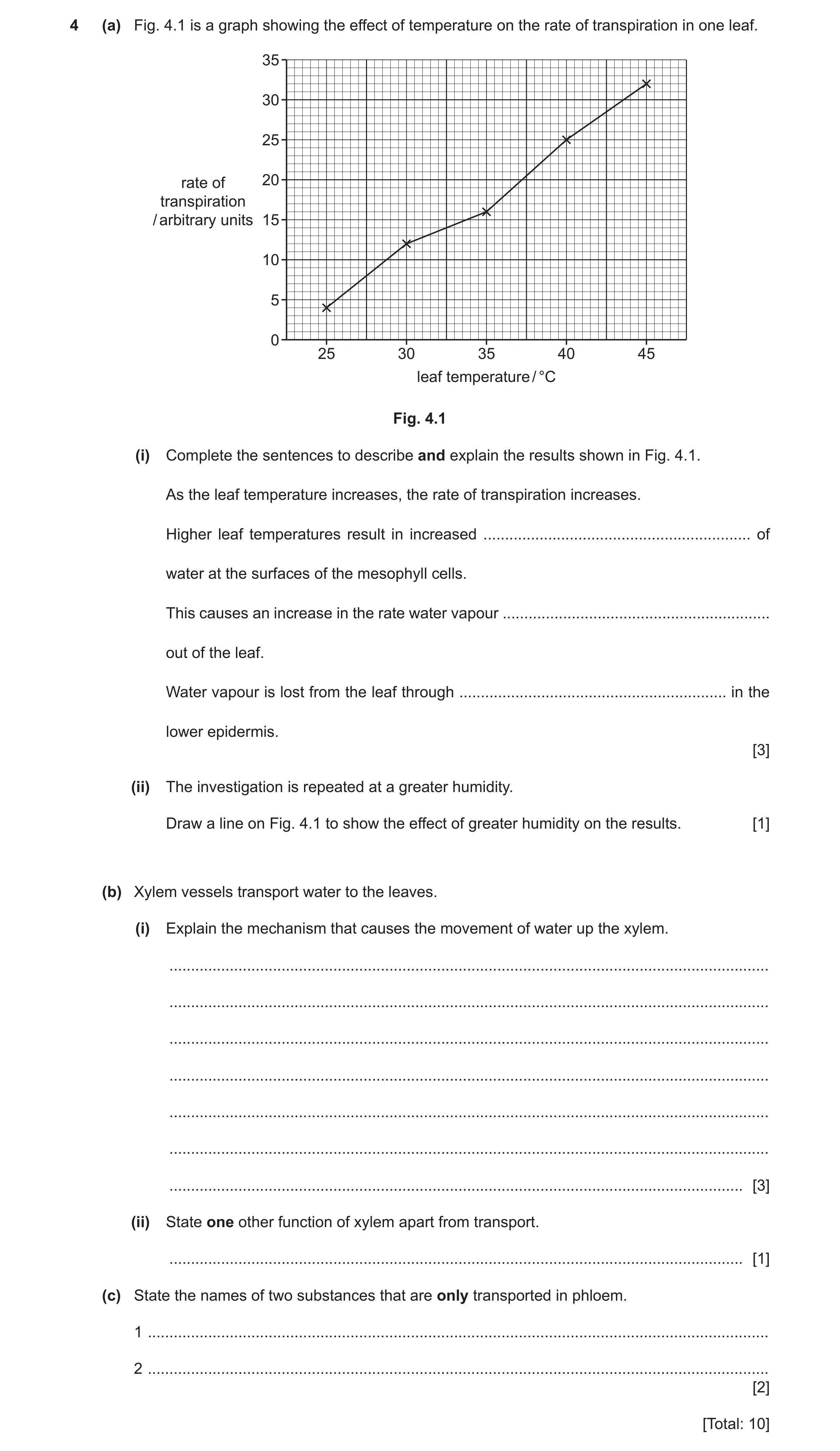
4 (a) Fig. 4.1 is a graph showing the effect of temperature on the rate of transpiration in one leaf. 35 30 25 rate of 20 transpiration / arbitrary units 15 10 5 0 25 30 35 40 45 leaf temperature / °C Fig. 4.1 (i) Complete the sentences to describe and explain the results shown in Fig. 4.1. As the leaf temperature increases, the rate of transpiration increases. Higher leaf temperatures result in increased … of water at the surfaces of the mesophyll cells. This causes an increase in the rate water vapour … out of the leaf. Water vapour is lost from the leaf through … in the lower epidermis. [3] (ii) The investigation is repeated at a greater humidity. Draw a line on Fig. 4.1 to show the effect of greater humidity on the results. [1] (b) Xylem vessels transport water to the leaves. (i) Explain the mechanism that causes the movement of water up the xylem. … … … … … … … [3] (ii) State one other function of xylem apart from transport. … [1] (c) State the names of two substances that are only transported in phloem. 1 … 2 … [2] [Total: 10]
10 marks
Mark scheme: 4(a)(i) evaporation ; diffuses ; stomata ; 3 4(a)(ii) line drawn showing a decreased rate of transpiration ; 1 4(b)(i) any three from: ref to transpiration pull ; creation of a water potential gradient / reduction of water potential at top of the xylem ; that draws up a column of water molecules / AW ; water molecules held together by cohesion ; 3 4(b)(ii) support / AW ; 1 4(c) sucrose ; amino acids ; 2
This question in 0654/43 May/June 2023
Q11 · A student investigates the effect of humidity on the rate of water uptake in plant shoots 0654/42 Oct/Nov 2023
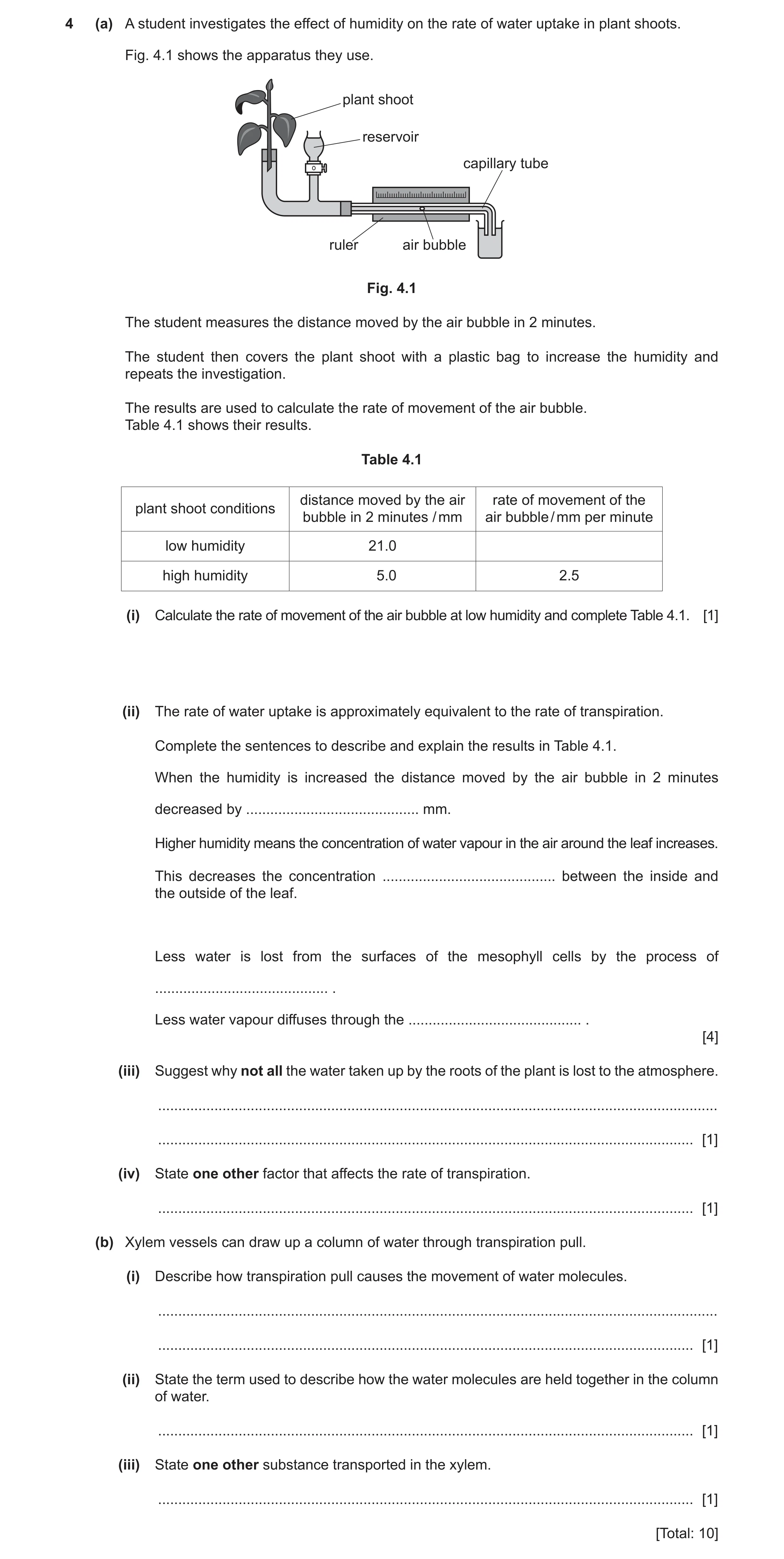
4 (a) A student investigates the effect of humidity on the rate of water uptake in plant shoots. Fig. 4.1 shows the apparatus they use. plant shoot reservoir capillary tube ruler air bubble Fig. 4.1 The student measures the distance moved by the air bubble in 2 minutes. The student then covers the plant shoot with a plastic bag to increase the humidity and repeats the investigation. The results are used to calculate the rate of movement of the air bubble. Table 4.1 shows their results. Table 4.1 distance moved by the air rate of movement of the plant shoot conditions bubble in 2 minutes / mm air bubble / mm per minute low humidity 21.0 high humidity 5.0 2.5 (i) Calculate the rate of movement of the air bubble at low humidity and complete Table 4.1. [1] (ii) The rate of water uptake is approximately equivalent to the rate of transpiration. Complete the sentences to describe and explain the results in Table 4.1. When the humidity is increased the distance moved by the air bubble in 2 minutes decreased by … mm. Higher humidity means the concentration of water vapour in the air around the leaf increases. This decreases the concentration … between the inside and the outside of the leaf. Less water is lost from the surfaces of the mesophyll cells by the process of … . Less water vapour diffuses through the … . [4] (iii) Suggest why not all the water taken up by the roots of the plant is lost to the atmosphere. … … [1] (iv) State one other factor that affects the rate of transpiration. … [1] (b) Xylem vessels can draw up a column of water through transpiration pull. (i) Describe how transpiration pull causes the movement of water molecules. … … [1] (ii) State the term used to describe how the water molecules are held together in the column of water. … [1] (iii) State one other substance transported in the xylem. … [1] [Total: 10]
10 marks
Mark scheme: 4(a)(i) 10.5 (mm / min) ; 1 4(a)(ii) 6(.0) (mm) ; 4 gradient ; transpiration / evaporation ; stomata ; 4(a)(iii) used in photosynthesis / used to support cells ; 1 4(a)(iv) temperature / AVP ; 1 4(b)(i) creates a difference in water potential (gradient between top and bottom of xylem) ; 1 4(b)(ii) cohesion ; 1 4(b)(iii) mineral ions ; 1
This question in 0654/42 Oct/Nov 2023
Question 12 0654/43 Oct/Nov 2024
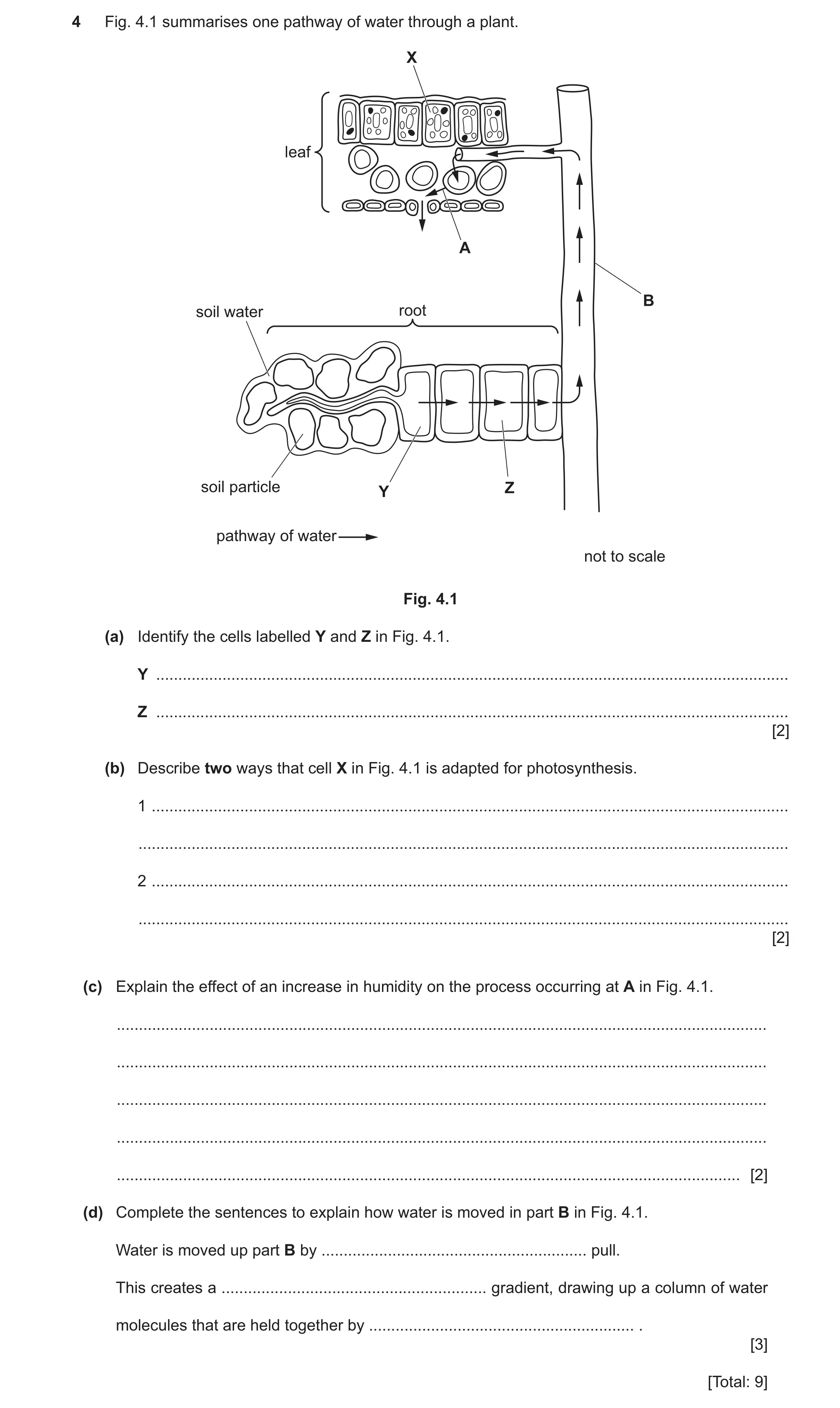
4 Fig. 4.1 summarises one pathway of water through a plant. X leaf A B soil water root soil particle Y Z pathway of water not to scale Fig. 4.1 (a) Identify the cells labelled Y and Z in Fig. 4.1. Y … Z … [2] (b) Describe two ways that cell X in Fig. 4.1 is adapted for photosynthesis. 1 … … 2 … … [2] (c) Explain the effect of an increase in humidity on the process occurring at A in Fig. 4.1. … … … … … [2] (d) Complete the sentences to explain how water is moved in part B in Fig. 4.1. Water is moved up part B by … pull. This creates a … gradient, drawing up a column of water molecules that are held together by … . [3] [Total: 9]
9 marks
Mark scheme: 4(a) Y root hair (cell) ; 2 Z (root) cortex (cell) ; 4(b) contains lots of chloroplasts ; 2 positioned at the top of the leaf (for maximum light) ; column-shaped / AW ; AVP ; 4(c) decrease in evaporation (from the surfaces of mesophyll cells) ; 2 due to a decrease in concentration / diffusion gradient (of water vapour) / AW ; 4(d) transpiration ; 3 water potential ; cohesion ;
This question in 0654/43 Oct/Nov 2024
 1 / 18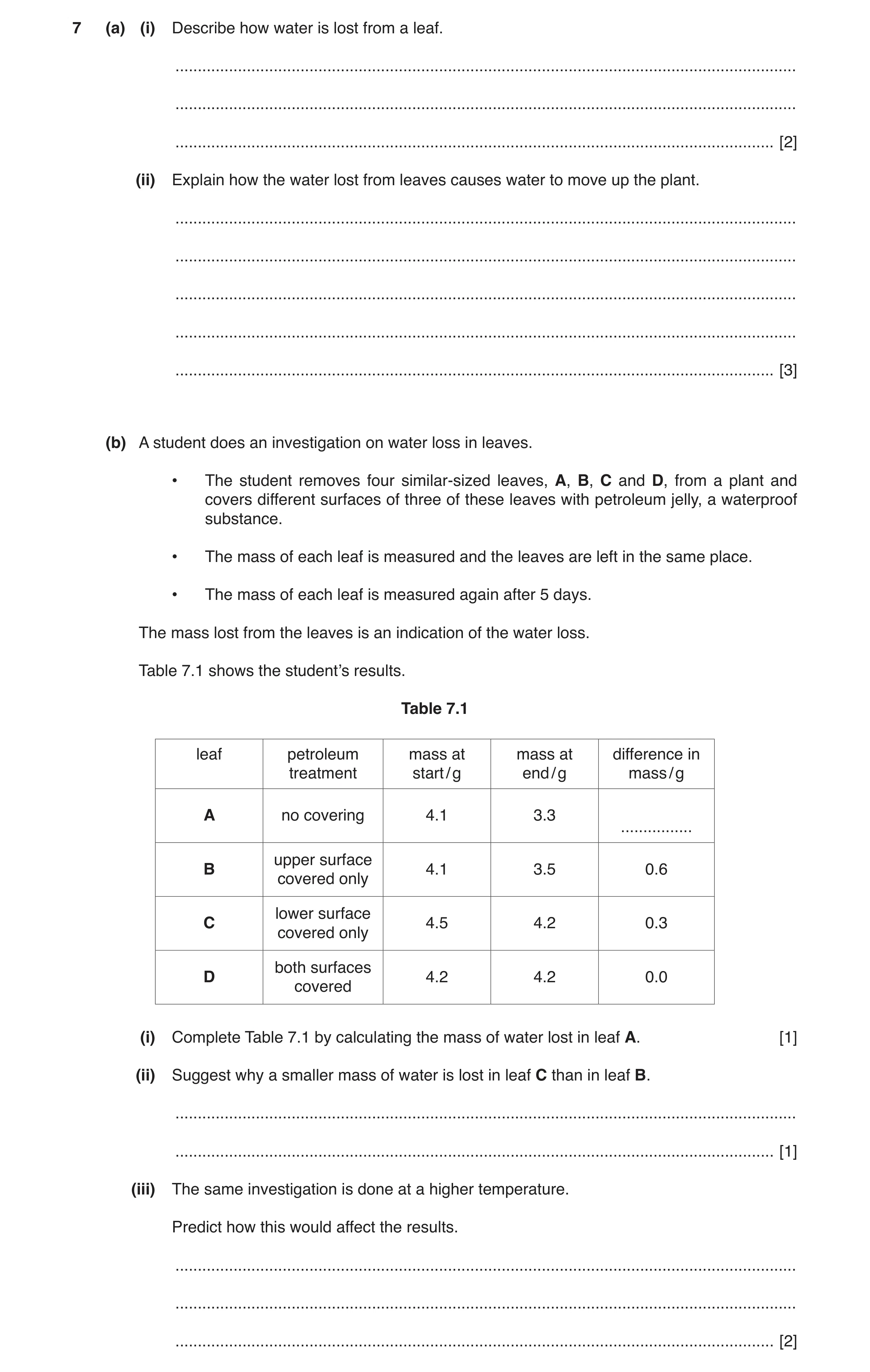
 4 / 18
 5 / 18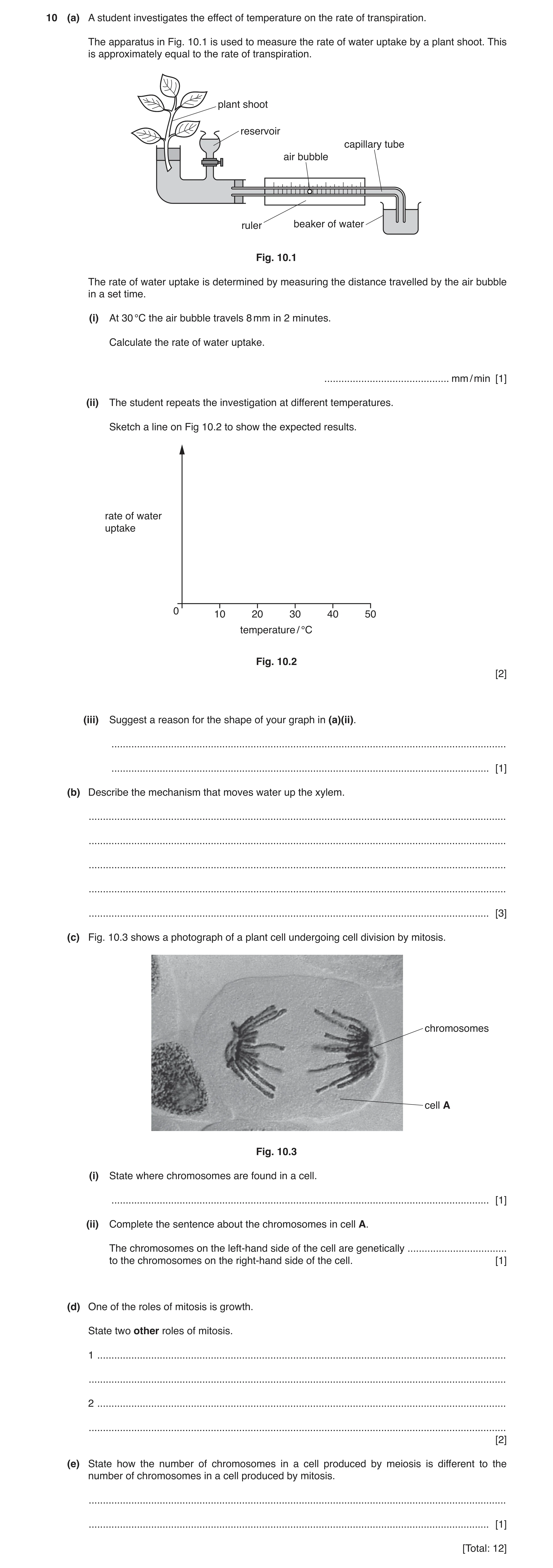
 11
11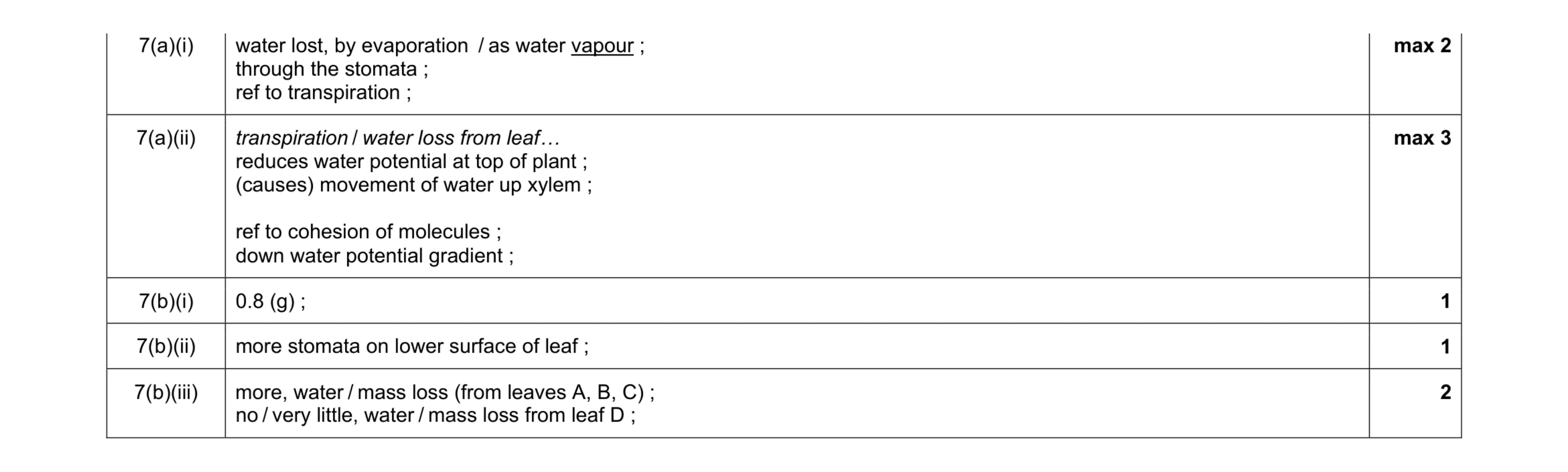 9
9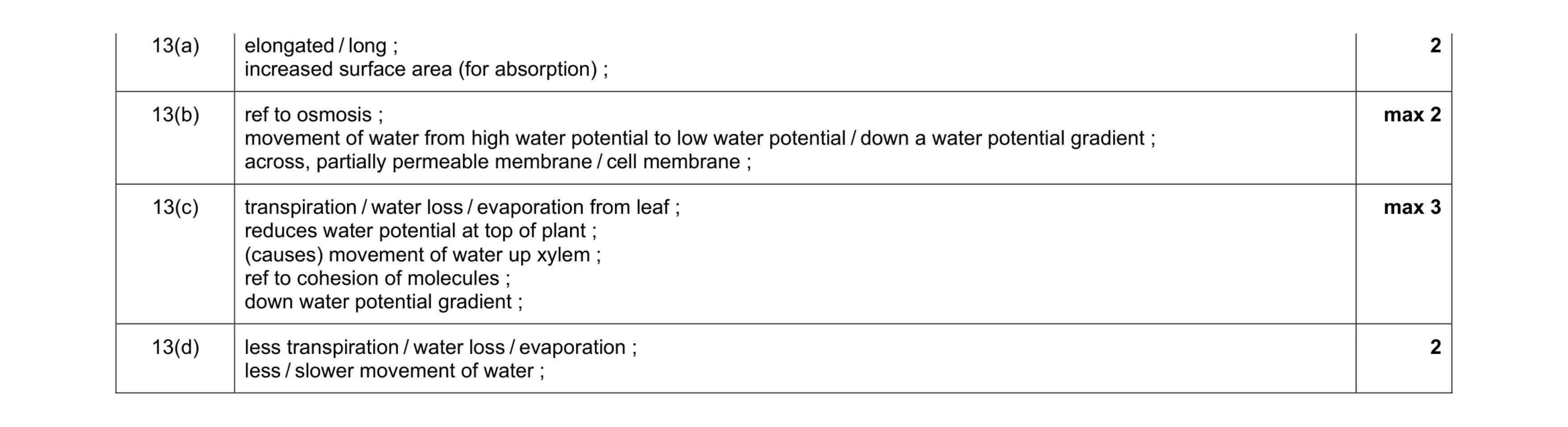 9
9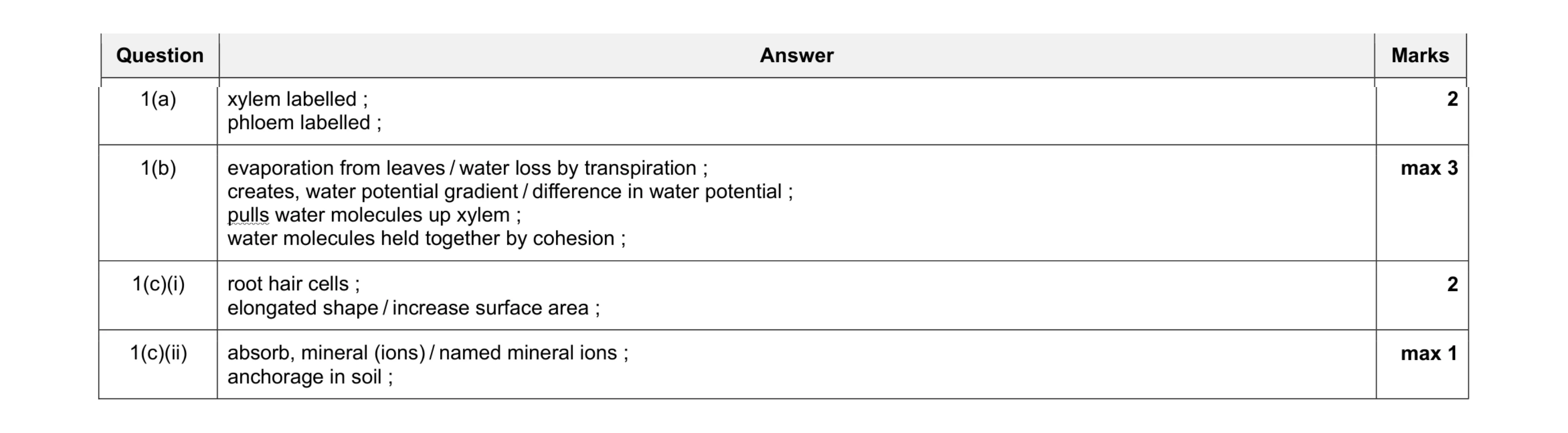 8
8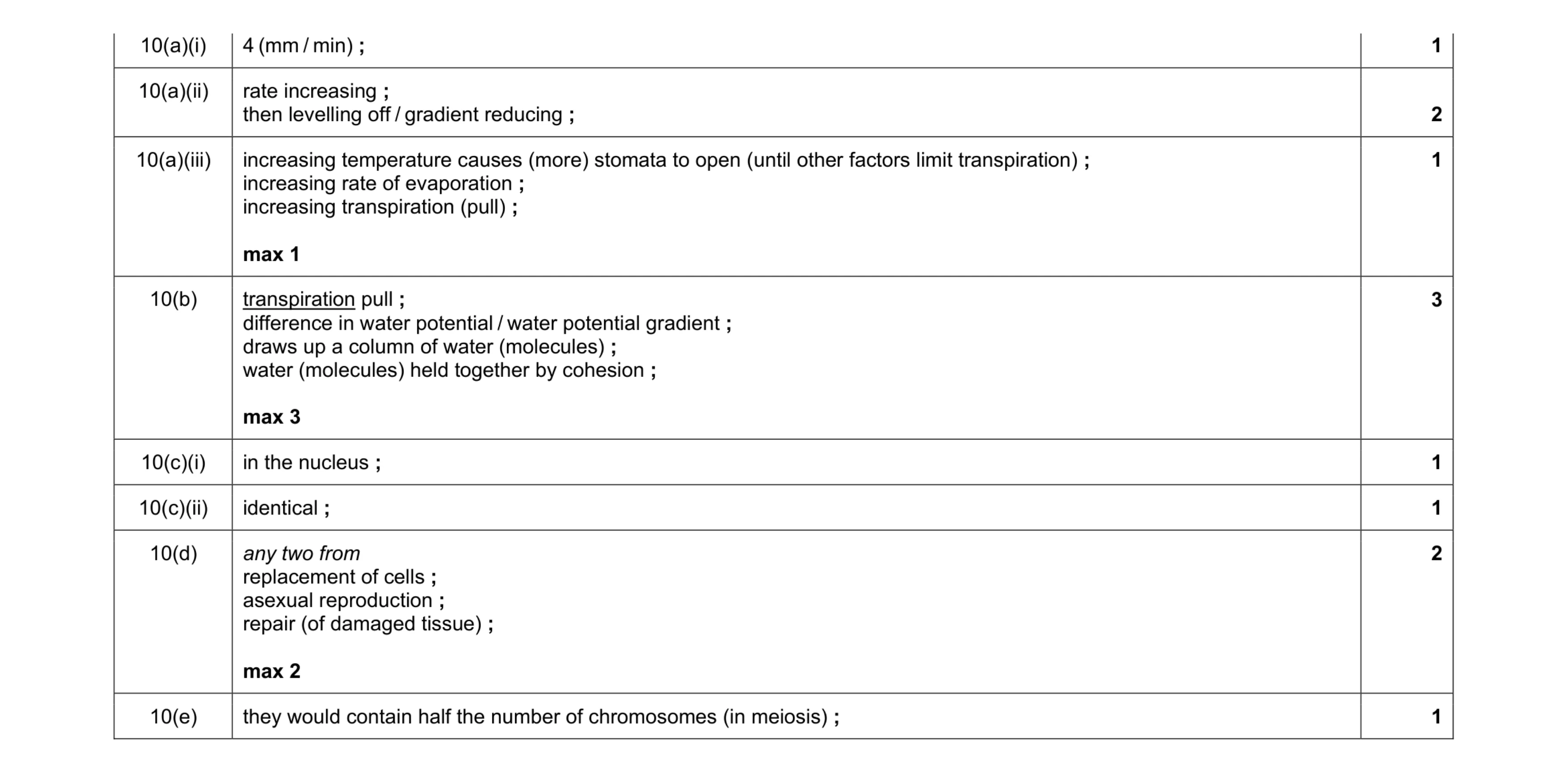 12
12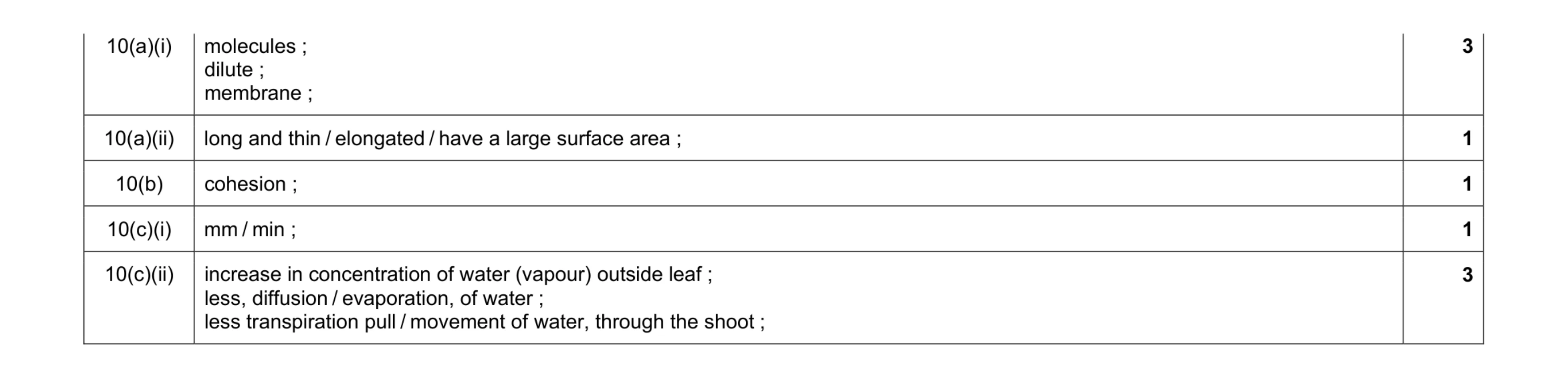 9
9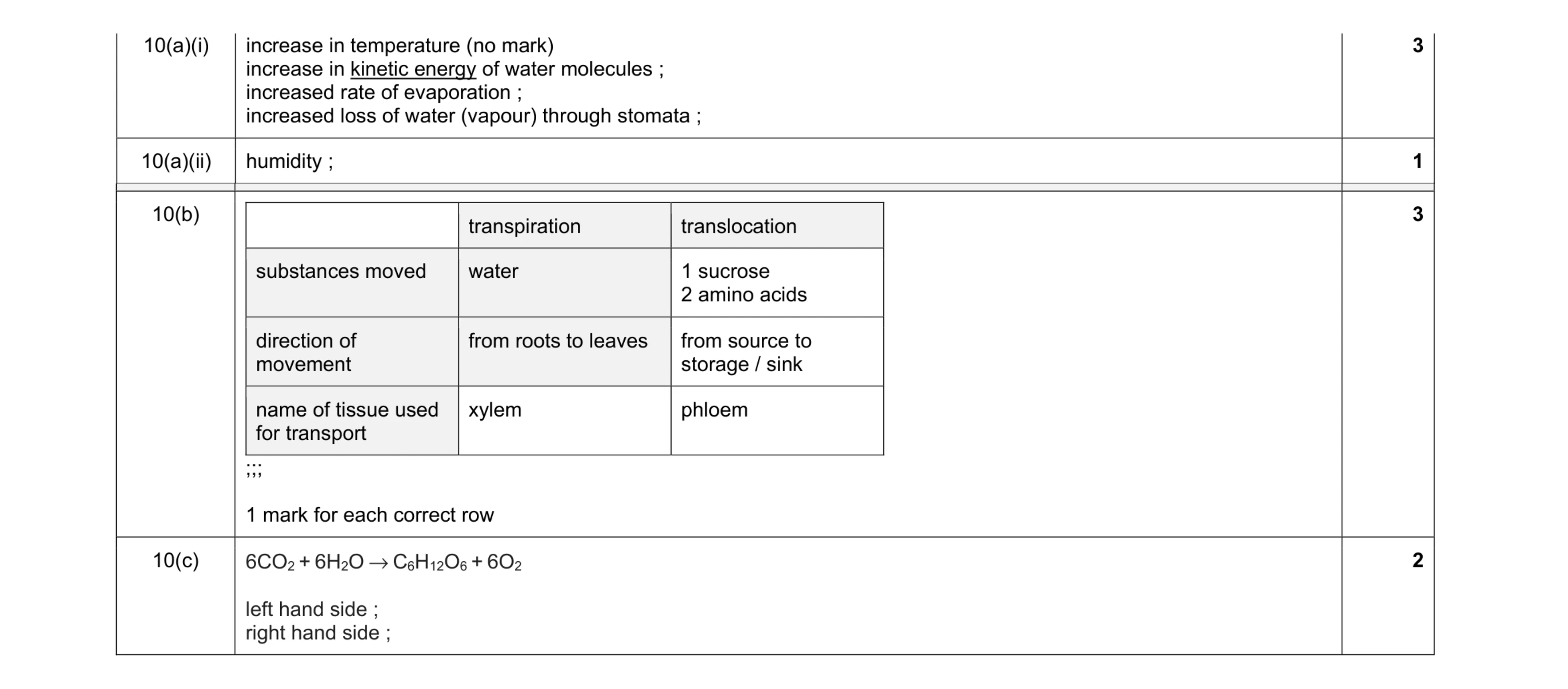 9
9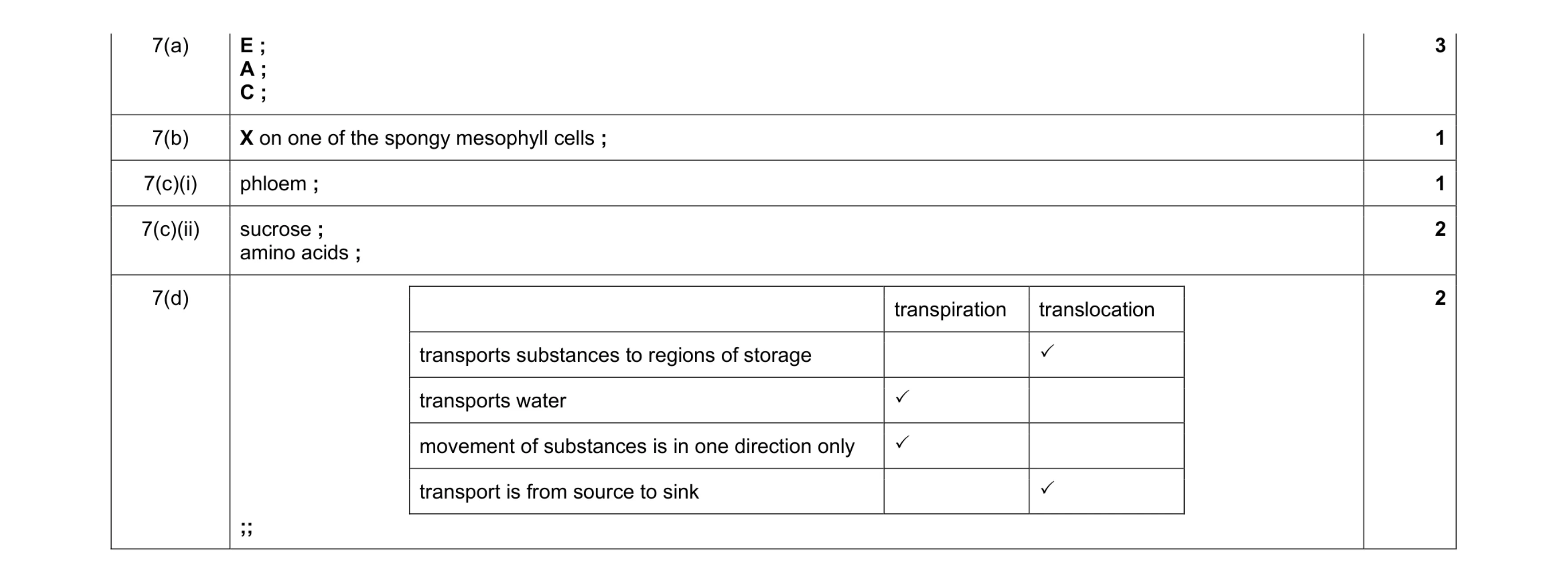 9
9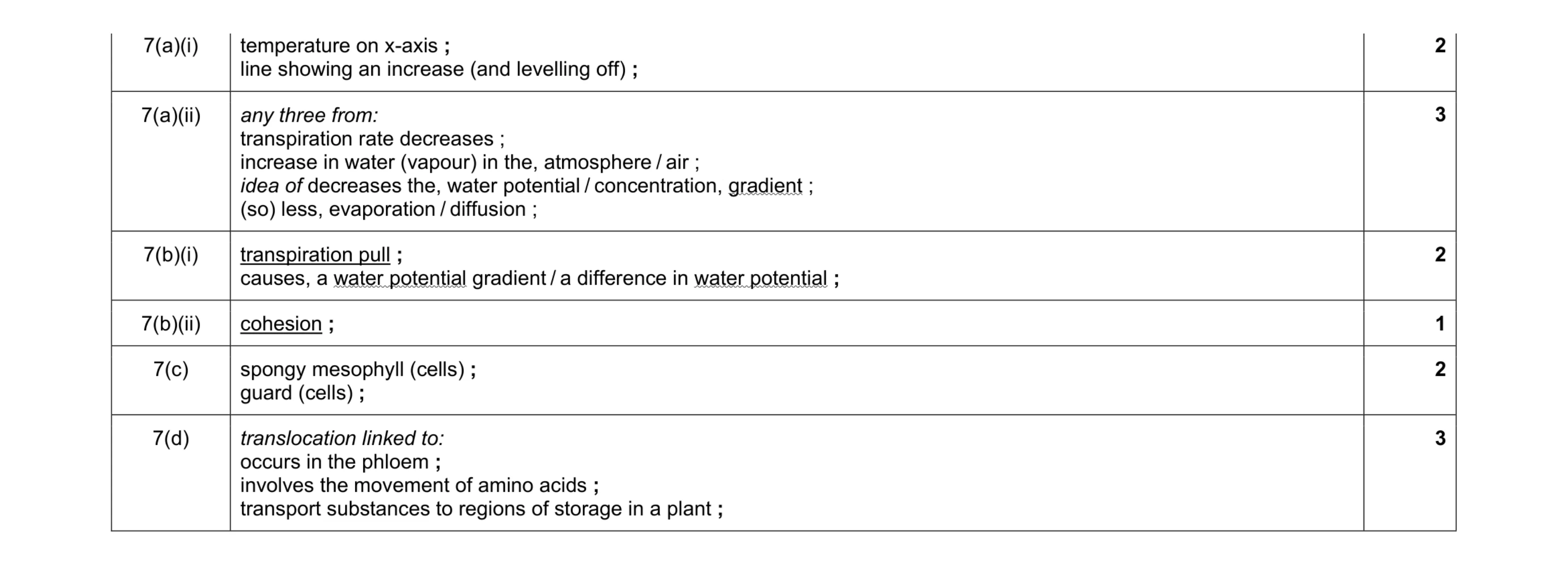 13
13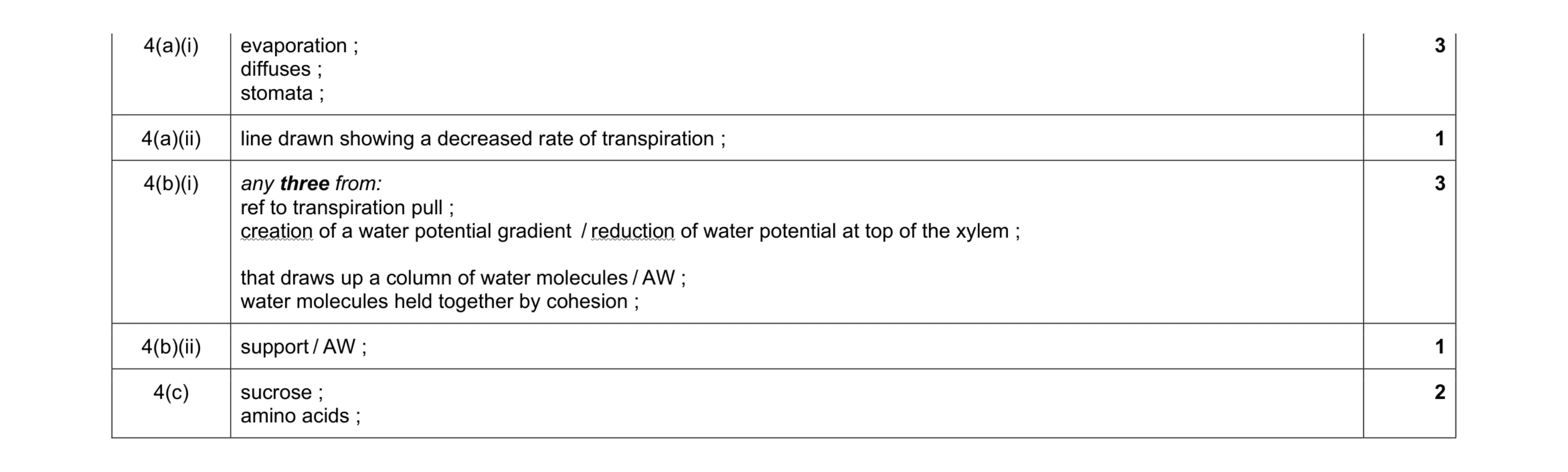 10
10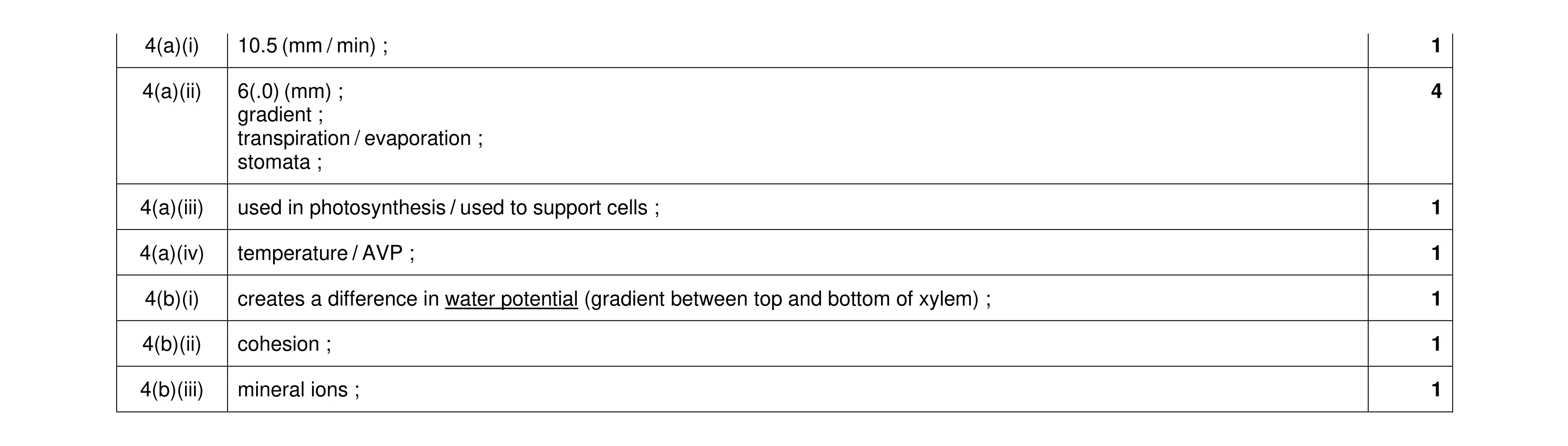 10
10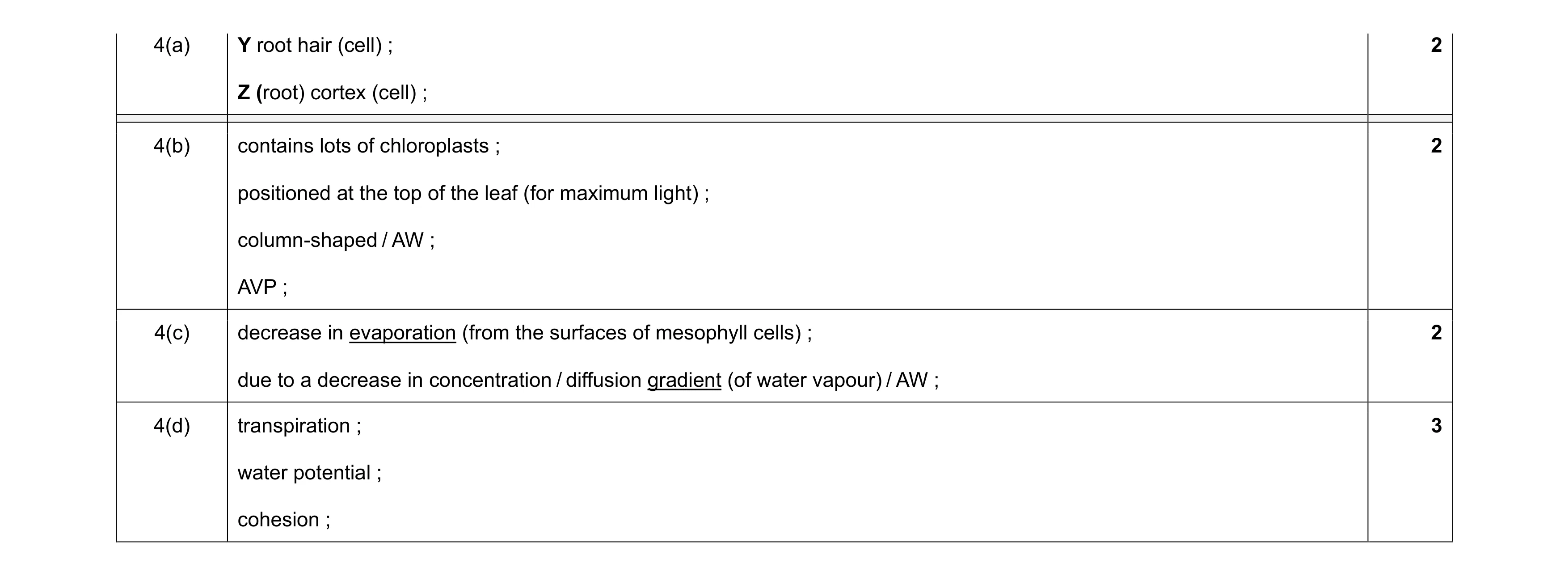 9
9