Questions as text
Q1 · The melting points of the first four Group I metals are shown in Table 8.1 0653/43 May/June 2017
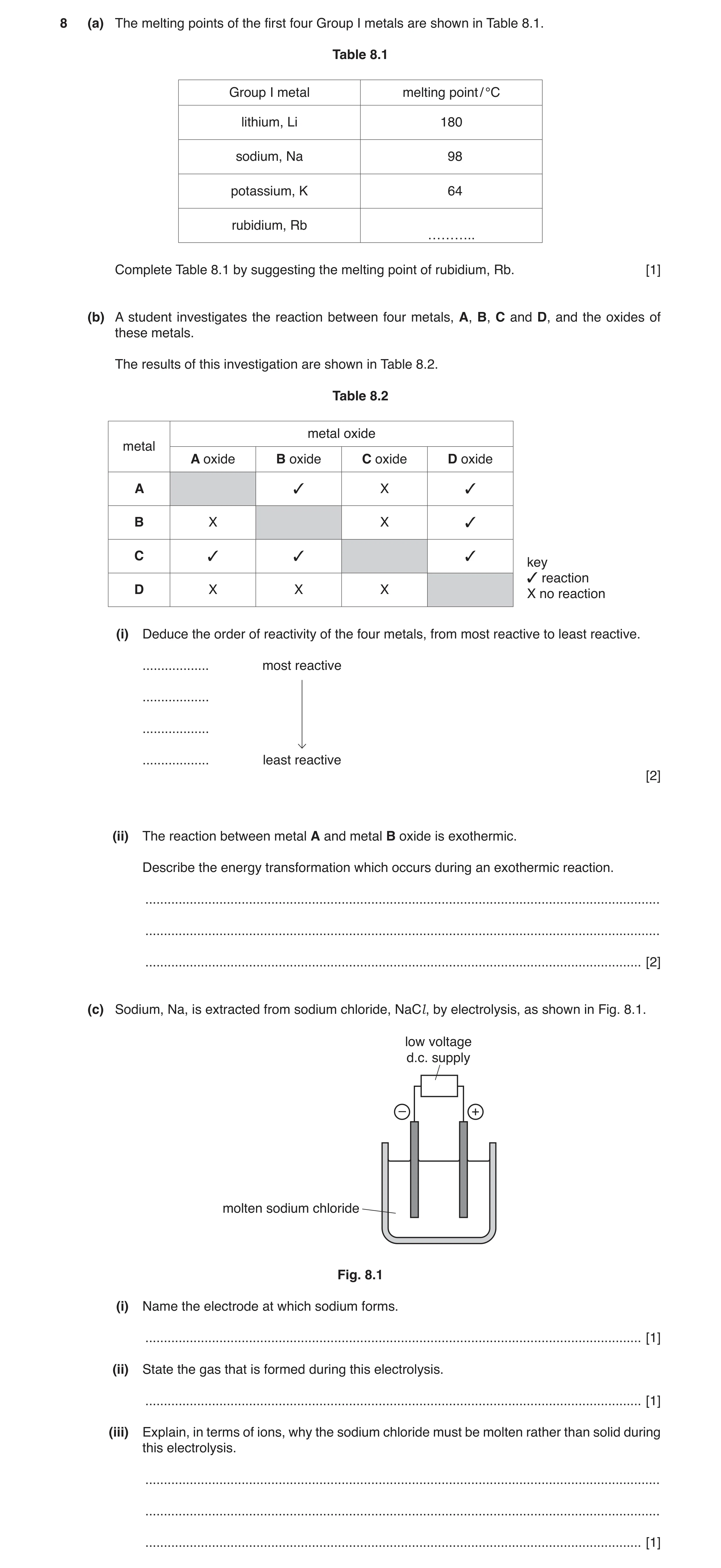
8 (a) The melting points of the first four Group I metals are shown in Table 8.1. Table 8.1 Group I metal melting point / °C lithium, Li 180 sodium, Na 98 potassium, K 64 rubidium, Rb ……….. Complete Table 8.1 by suggesting the melting point of rubidium, Rb. [1] (b) A student investigates the reaction between four metals, A, B, C and D, and the oxides of these metals. The results of this investigation are shown in Table 8.2. Table 8.2 metal oxide metal A oxide B oxide C oxide D oxide A ✓ X ✓ B X X ✓ C ✓ ✓ ✓ key ✓ reaction D X X X X no reaction (i) Deduce the order of reactivity of the four metals, from most reactive to least reactive. … most reactive … … … least reactive [2] (ii) The reaction between metal A and metal B oxide is exothermic. Describe the energy transformation which occurs during an exothermic reaction. … … … [2] (c) Sodium, Na, is extracted from sodium chloride, NaCl, by electrolysis, as shown in Fig. 8.1. low voltage d.c. supply – + molten sodium chloride Fig. 8.1 (i) Name the electrode at which sodium forms. … [1] (ii) State the gas that is formed during this electrolysis. … [1] (iii) Explain, in terms of ions, why the sodium chloride must be molten rather than solid during this electrolysis. … … … [1]
8 marks
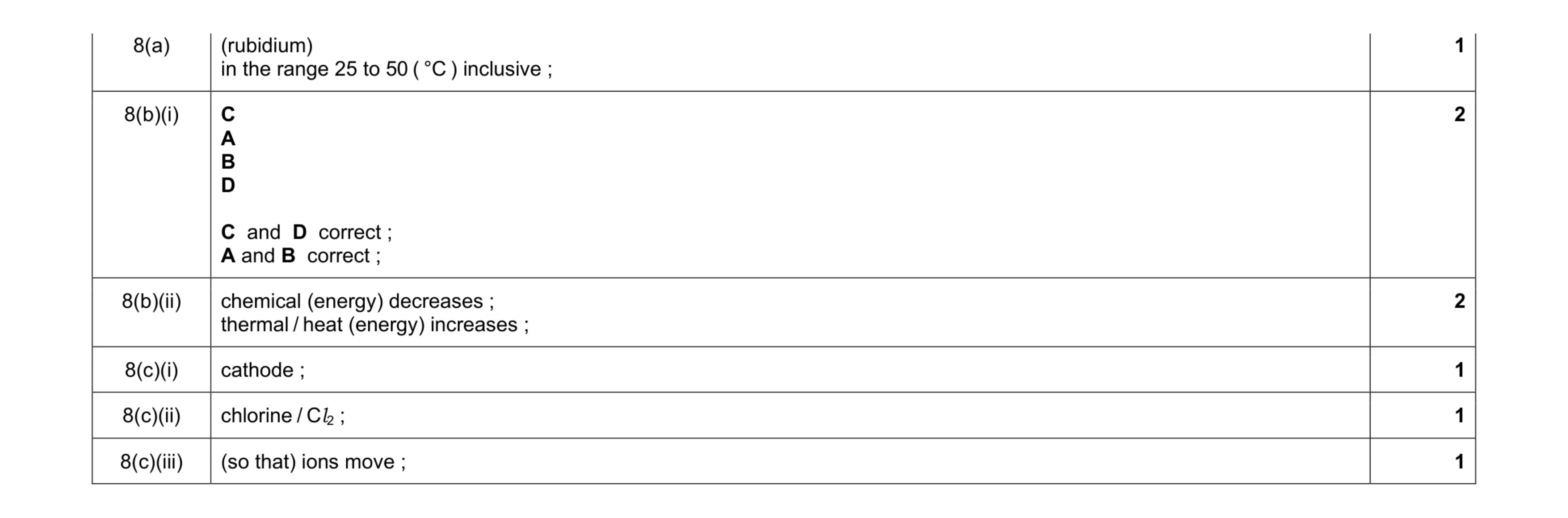
Mark scheme: 8(a) (rubidium) in the range 25 to 50 ( °C ) inclusive ; 1 8(b)(i) C A B D C and D correct ; A and B correct ; 2 8(b)(ii) chemical (energy) decreases ; thermal / heat (energy) increases ; 2 8(c)(i) cathode ; 1 8(c)(ii) chlorine / Cl2 ; 1 8(c)(iii) (so that) ions move ; 1
This question in 0653/43 May/June 2017
Q2 · Elements are arranged in the Periodic Table in atomic number order 0653/42 May/June 2018
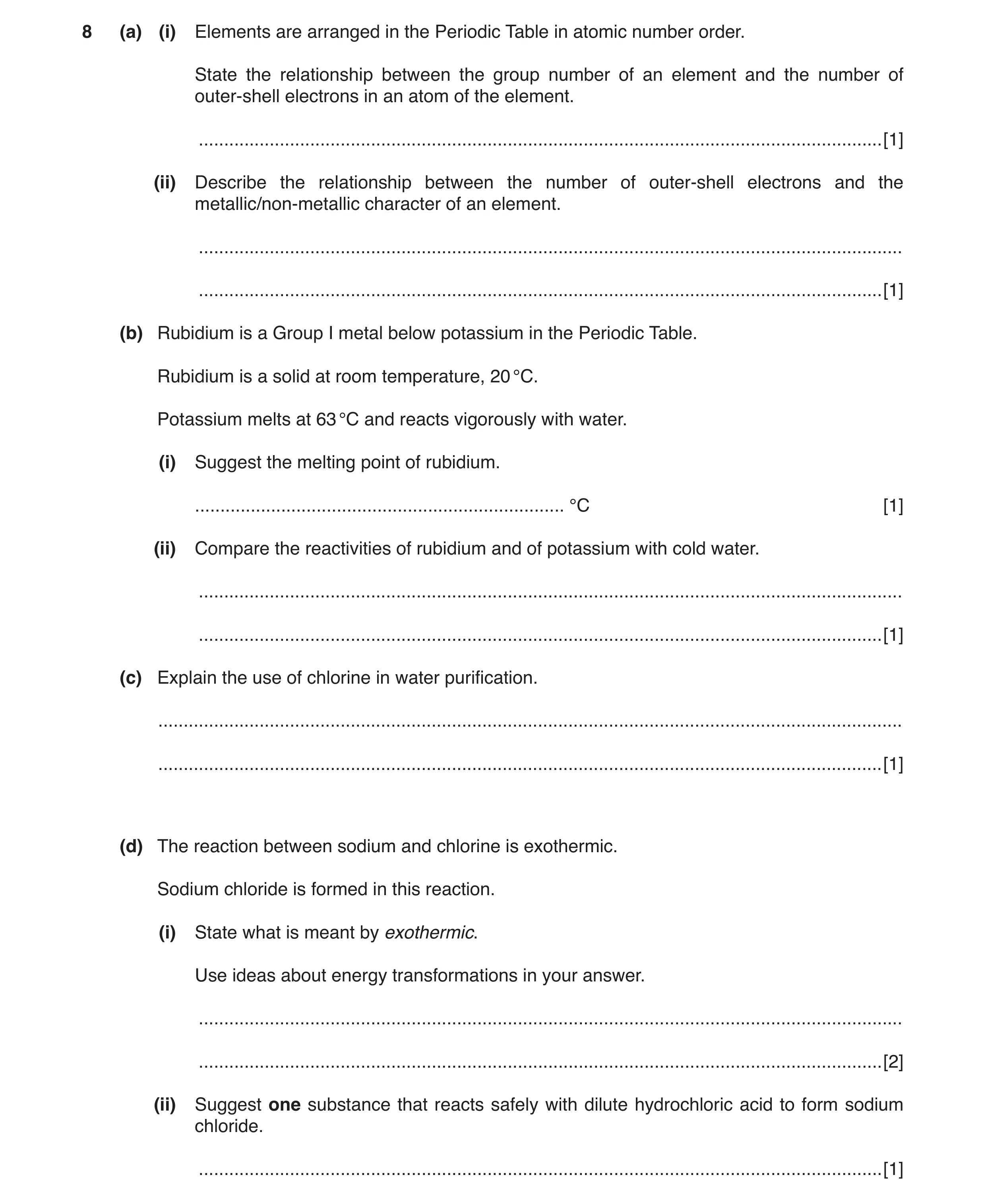
8 (a) (i) Elements are arranged in the Periodic Table in atomic number order. State the relationship between the group number of an element and the number of outer-shell electrons in an atom of the element. … [1] (ii) Describe the relationship between the number of outer-shell electrons and the metallic/non-metallic character of an element. … … [1] (b) Rubidium is a Group I metal below potassium in the Periodic Table. Rubidium is a solid at room temperature, 20 °C. Potassium melts at 63 °C and reacts vigorously with water. (i) Suggest the melting point of rubidium. … °C [1] (ii) Compare the reactivities of rubidium and of potassium with cold water. … … [1] (c) Explain the use of chlorine in water purification. … … [1] (d) The reaction between sodium and chlorine is exothermic. Sodium chloride is formed in this reaction. (i) State what is meant by exothermic. Use ideas about energy transformations in your answer. … … [2] (ii) Suggest one substance that reacts safely with dilute hydrochloric acid to form sodium chloride. … [1]
8 marks
Mark scheme: 8(a)(i) the idea that the number of outer electrons is the same as the group number ; 1 8(a)(ii) more (outer-shell) electrons more non-metallic ; metallic elements have fewer (outer-shell) electrons ; 1 8(b)(i) temperature in range 21–62 (°C) ; 1 8(b)(ii) rubidium is more reactive ; 1 8(c) kill / destroy bacteria / microbes / microorganisms ; 1 8(d)(i) thermal / heat energy released (by chemical reaction) / (chemical reaction causes) temperature increase ; chemical energy converted (to thermal / heat energy) ; 2 8(d)(ii) sodium hydroxide / NaOH / sodium carbonate / Na2CO3 / sodium hydrogen carbonate / sodium bicarbonate / NaHCO3 ; 1
This question in 0653/42 May/June 2018
Q3 · Calcium sulfate is an insoluble salt 0653/41 Oct/Nov 2018
5 (a) Calcium sulfate is an insoluble salt. (i) Name two compounds that react together to form calcium sulfate. 1. … 2. … [2] (ii) Suggest the separation method that is used to separate an insoluble salt from an aqueous reaction mixture. Explain how this separation method removes the solid from the liquid. method … explanation … … … [2] (b) Calcium is in Group II in the Periodic Table. (i) Complete the following sentences using words from the list. Each word may be used once, more than once or not at all. good high low poor Calcium is a … electrical conductor. Calcium has a … melting point. [1] (ii) State the electronic structure of a calcium atom. … [1] (c) Caesium is below potassium in Group I of the Periodic Table. Potassium melts at 63 °C and it reacts rapidly with water. Caesium is a solid at room temperature (25 °C). (i) Compare the rate of the reaction between caesium and water with the rate of reaction between potassium and water. … … [1] (ii) Suggest the melting point of caesium. … °C [1] (d) Describe the reaction, if any, which occurs when copper is mixed with aqueous potassium chloride. Explain your answer. reaction … explanation … … [1]
9 marks
Mark scheme: 5(a)(i) sulfuric_acid / H2SO4 ; calcium oxide / CaO / calcium hydroxide / Ca(OH)2 calcium carbonate / CaCO3 ; 2 5(a)(ii) (technique) filter / filtering / filtration ; (explanation) solid (particles) cannot pass through / remain on filter paper / liquid (particles) can pass through filter paper ; 2 5(b)(i) (electrical conductor) good (melting point) high ; (both required) 1 5(b)(ii) 2, 8, 8, 2 ; 1 5(c)(i) more / very rapid / explosive ; 1 5(c)(ii) any stated value ˃ 25 °C and ˂ 63 °C ; 1 5(d) (reaction) no (visible) reaction (explanation) copper is less reactive than potassium ; (both required) 1
This question in 0653/41 Oct/Nov 2018
Q4 · Sodium burns in oxygen to produce sodium oxide, an ionic compound 0653/41 May/June 2019
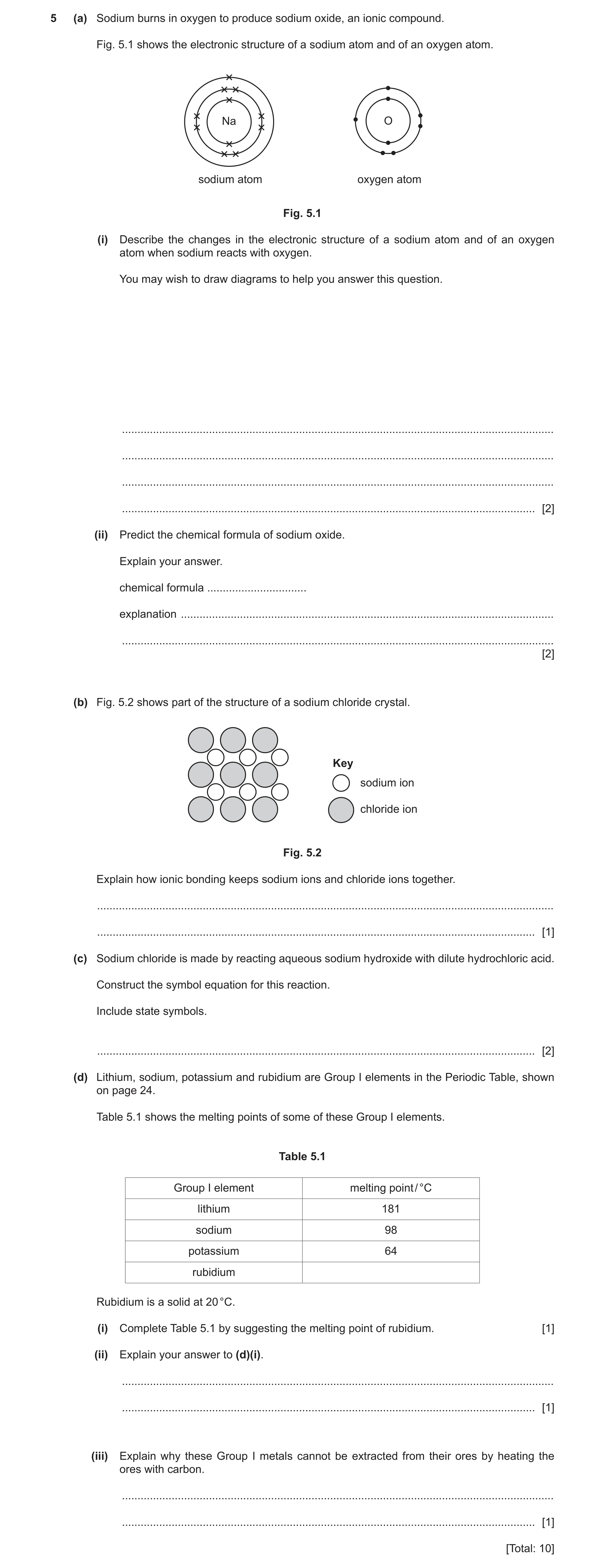
5 (a) Sodium burns in oxygen to produce sodium oxide, an ionic compound. Fig. 5.1 shows the electronic structure of a sodium atom and of an oxygen atom. Na O sodium atom oxygen atom Fig. 5.1 (i) Describe the changes in the electronic structure of a sodium atom and of an oxygen atom when sodium reacts with oxygen. You may wish to draw diagrams to help you answer this question. … … … … [2] (ii) Predict the chemical formula of sodium oxide. Explain your answer. chemical formula … explanation … … [2] (b) Fig. 5.2 shows part of the structure of a sodium chloride crystal. Key sodium ion chloride ion Fig. 5.2 Explain how ionic bonding keeps sodium ions and chloride ions together. … … [1] (c) Sodium chloride is made by reacting aqueous sodium hydroxide with dilute hydrochloric acid. Construct the symbol equation for this reaction. Include state symbols. … [2] (d) Lithium, sodium, potassium and rubidium are Group I elements in the Periodic Table, shown on page 24. Table 5.1 shows the melting points of some of these Group I elements. Table 5.1 Group I element melting point / °C lithium 181 sodium 98 potassium 64 rubidium Rubidium is a solid at 20 °C. (i) Complete Table 5.1 by suggesting the melting point of rubidium. [1] (ii) Explain your answer to (d)(i). … … [1] (iii) Explain why these Group I metals cannot be extracted from their ores by heating the ores with carbon. … … [1] [Total: 10]
10 marks
Mark scheme: 5(a)(i) sodium atom loses one electron ; oxygen atom gains two electrons / oxygen atom achieves filled outer shell by gaining electrons ; 2 5(a)(ii) Na2O ; explanation in terms of balanced charges / implication that charges need to balance ; 2 5(b) opposite / unlike charges (attract) ; 1 5(c) NaOH (aq) + HCl (aq) → NaCl (aq) + H2O (l) all formulae correct ; balanced and at least three correct state symbols ; 2 5(d)(i) in the range 25 °C to 55 °C (inclusive) ; 1 5(d)(ii) melting point decreases down Group 1 ; 1 5(d)(iii) metals are above carbon in reactivity series ; 1
This question in 0653/41 May/June 2019
Q5 · The melting points of some Group I elements 0653/42 May/June 2019
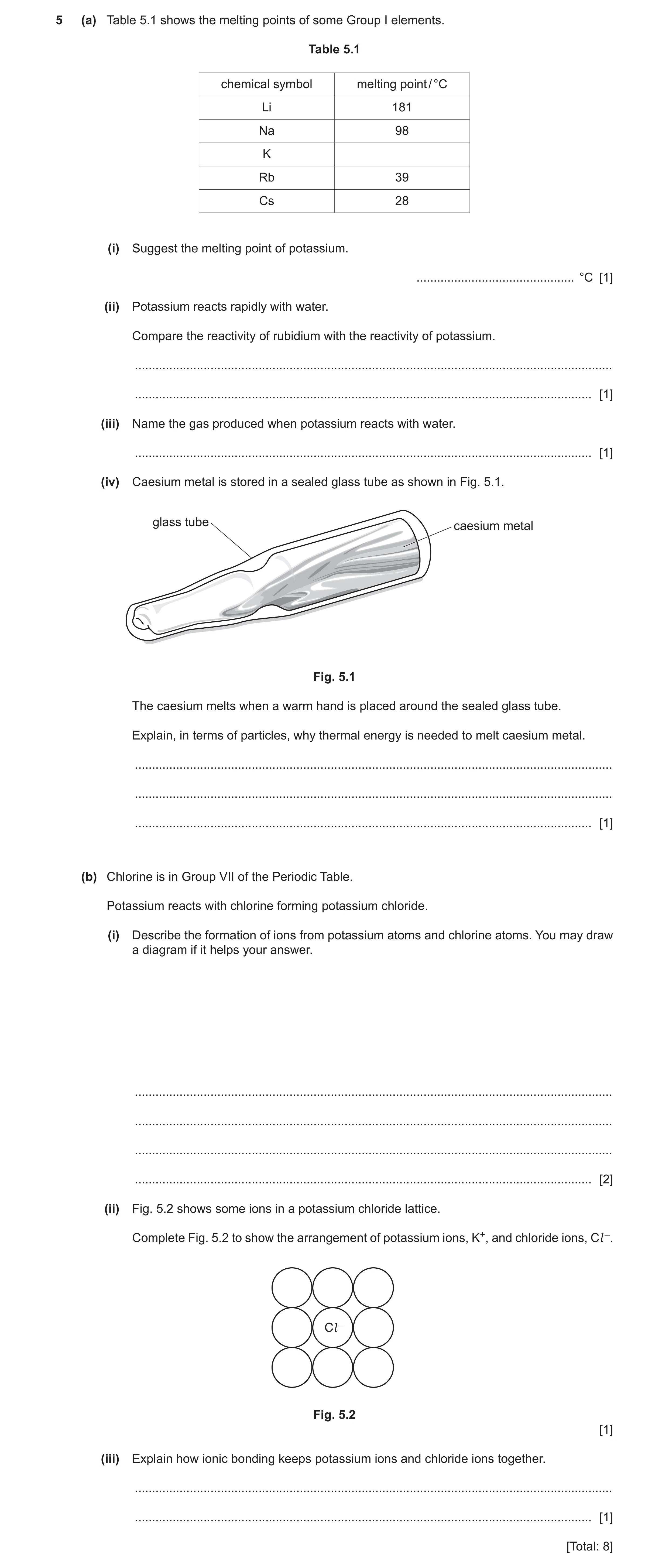
5 (a) Table 5.1 shows the melting points of some Group I elements. Table 5.1 chemical symbol melting point / °C Li 181 Na 98 K Rb 39 Cs 28 (i) Suggest the melting point of potassium. … °C [1] (ii) Potassium reacts rapidly with water. Compare the reactivity of rubidium with the reactivity of potassium. … … [1] (iii) Name the gas produced when potassium reacts with water. … [1] (iv) Caesium metal is stored in a sealed glass tube as shown in Fig. 5.1. glass tube caesium metal Fig. 5.1 The caesium melts when a warm hand is placed around the sealed glass tube. Explain, in terms of particles, why thermal energy is needed to melt caesium metal. … … … [1] (b) Chlorine is in Group VII of the Periodic Table. Potassium reacts with chlorine forming potassium chloride. (i) Describe the formation of ions from potassium atoms and chlorine atoms. You may draw a diagram if it helps your answer. … … … … [2] (ii) Fig. 5.2 shows some ions in a potassium chloride lattice. Complete Fig. 5.2 to show the arrangement of potassium ions, K+, and chloride ions, Cl –. Cl – Fig. 5.2 [1] (iii) Explain how ionic bonding keeps potassium ions and chloride ions together. … … [1] [Total: 8]
8 marks
Mark scheme: 5(a)(i) any suggestion in the range 50–75°C (inclusive) ; 1 5(a)(ii) rubidium is more reactive than potassium; 1 5(a)(iii) hydrogen; 1 5(a)(iv) the idea that attractive forces between particles have to be broken down / decreased / atoms gain speed / KE so they move further apart / owtte ; 1 5(b)(i) outer shell / one electron lost from K atom; outer shell of chlorine gains one electron / outer shell of chlorine atom is filled / completed ; 2 5(b)(ii) alternating K+ and Cl– ions ; 1 5(b)(iii) opposite / unlike charges (attract) ; 1
This question in 0653/42 May/June 2019
Q6 · Rubidium and caesium are Group I metals 0653/43 May/June 2019
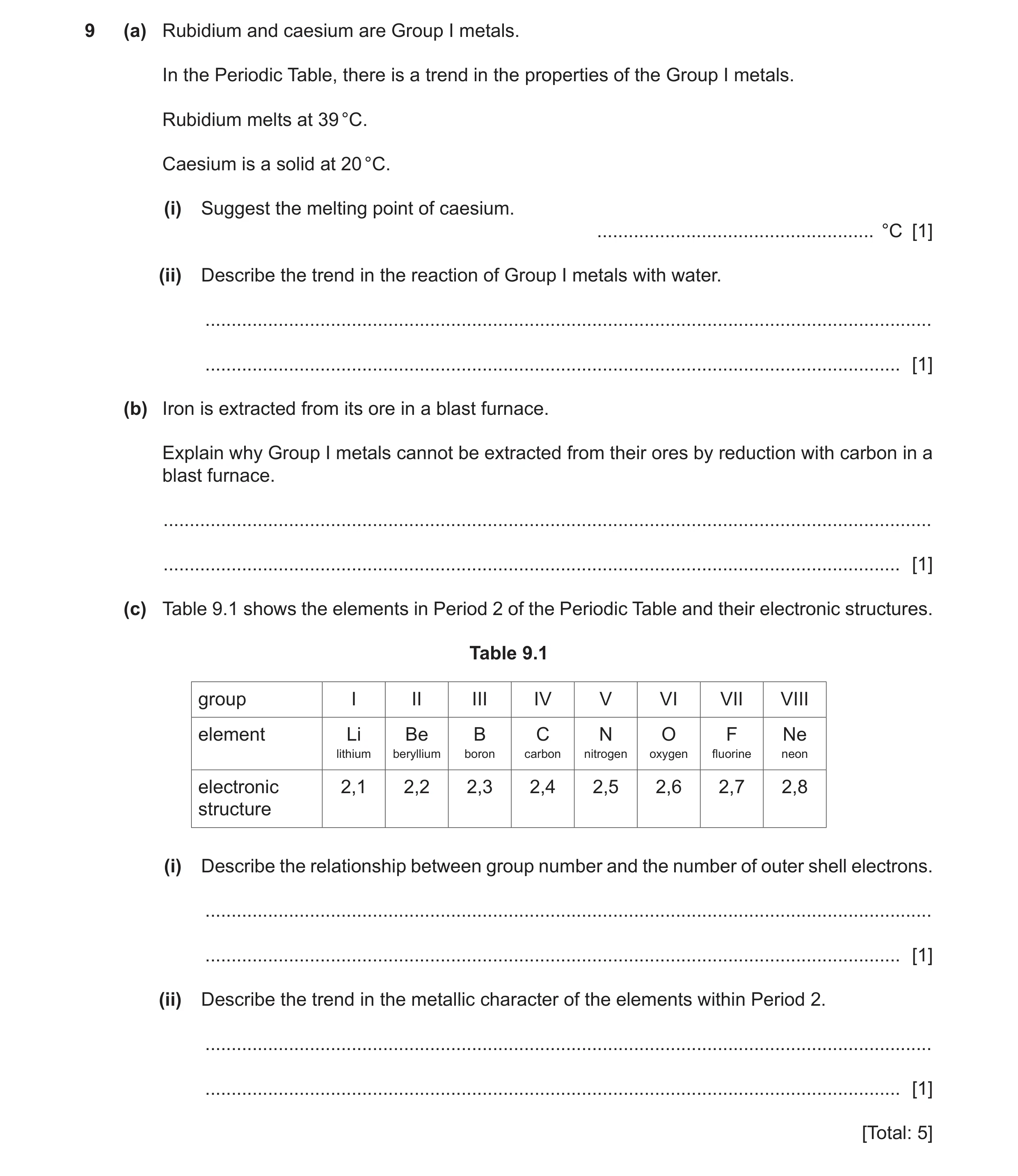
9 (a) Rubidium and caesium are Group I metals. In the Periodic Table, there is a trend in the properties of the Group I metals. Rubidium melts at 39 °C. Caesium is a solid at 20 °C. (i) Suggest the melting point of caesium. … °C [1] (ii) Describe the trend in the reaction of Group I metals with water. … … [1] (b) Iron is extracted from its ore in a blast furnace. Explain why Group I metals cannot be extracted from their ores by reduction with carbon in a blast furnace. … … [1] (c) Table 9.1 shows the elements in Period 2 of the Periodic Table and their electronic structures. Table 9.1 group I II III IV V VI VII VIII element Li Be B C N O F Ne lithium beryllium boron carbon nitrogen oxygen fluorine neon electronic 2,1 2,2 2,3 2,4 2,5 2,6 2,7 2,8 structure (i) Describe the relationship between group number and the number of outer shell electrons. … … [1] (ii) Describe the trend in the metallic character of the elements within Period 2. … … [1] [Total: 5]
5 marks
Mark scheme: 9(a)(i) in range 21 °C to 38 °C ; 1 9(a)(ii) increases as group is descended ; 1 9(b) metals are too reactive / more reactive than carbon ; 1 9(c)(i) The group number is equal to the number of outer shell electrons ; 1 9(c)(ii) metallic character decreases going from left to right ; 1
This question in 0653/43 May/June 2019
Q7 · Data about Group I metals 0653/41 Oct/Nov 2019
8 Table 8.1 shows data about Group I metals. The data for rubidium is missing. Table 8.1 element melting point / °C rate of reaction with water lithium 181 slow sodium 98 moderate potassium 64 fast rubidium caesium 29 very violent (a) (i) Suggest the melting point of rubidium. … °C [1] (ii) Predict the rate of reaction of rubidium with water. … [1] (b) Rubidium reacts with water to form rubidium hydroxide solution and hydrogen. (i) Suggest the formula of rubidium hydroxide. … [1] (ii) Suggest the pH of rubidium hydroxide solution. Explain your answer. pH … explanation … … [2] (c) Rubidium hydroxide has a higher melting point than water. Explain the difference in the melting point of rubidium hydroxide and of water. In your answer refer to the type of bonds and the attractive forces. … … … … … … [3] (d) The reaction between rubidium and water is exothermic. Describe what happens during an exothermic reaction. Use ideas about chemical energy and thermal energy in your answer. … … … … [2] [Total: 10]
10 marks
Mark scheme: 8(a)(i) 30 to 55 °C inclusive ; 1 8(a)(ii) violent / very fast ; 1 8(b)(i) RbOH ; 1 8(b)(ii) in range 8–14 ; the solution is an alkali ; 2 8(c) RbOH is ionic water is covalent ; attractive forces between ions are strong or attractive forces between molecules are weak ; more thermal energy (heat) needed to separate ions less thermal energy (heat) needed to separate molecules ; 3 8(d) temperature increases / thermal energy released ; chemical energy is changed into thermal energy ; 2
This question in 0653/41 Oct/Nov 2019
Q8 · Sodium is an element in Group I of the Periodic Table 0653/42 Feb/March 2021
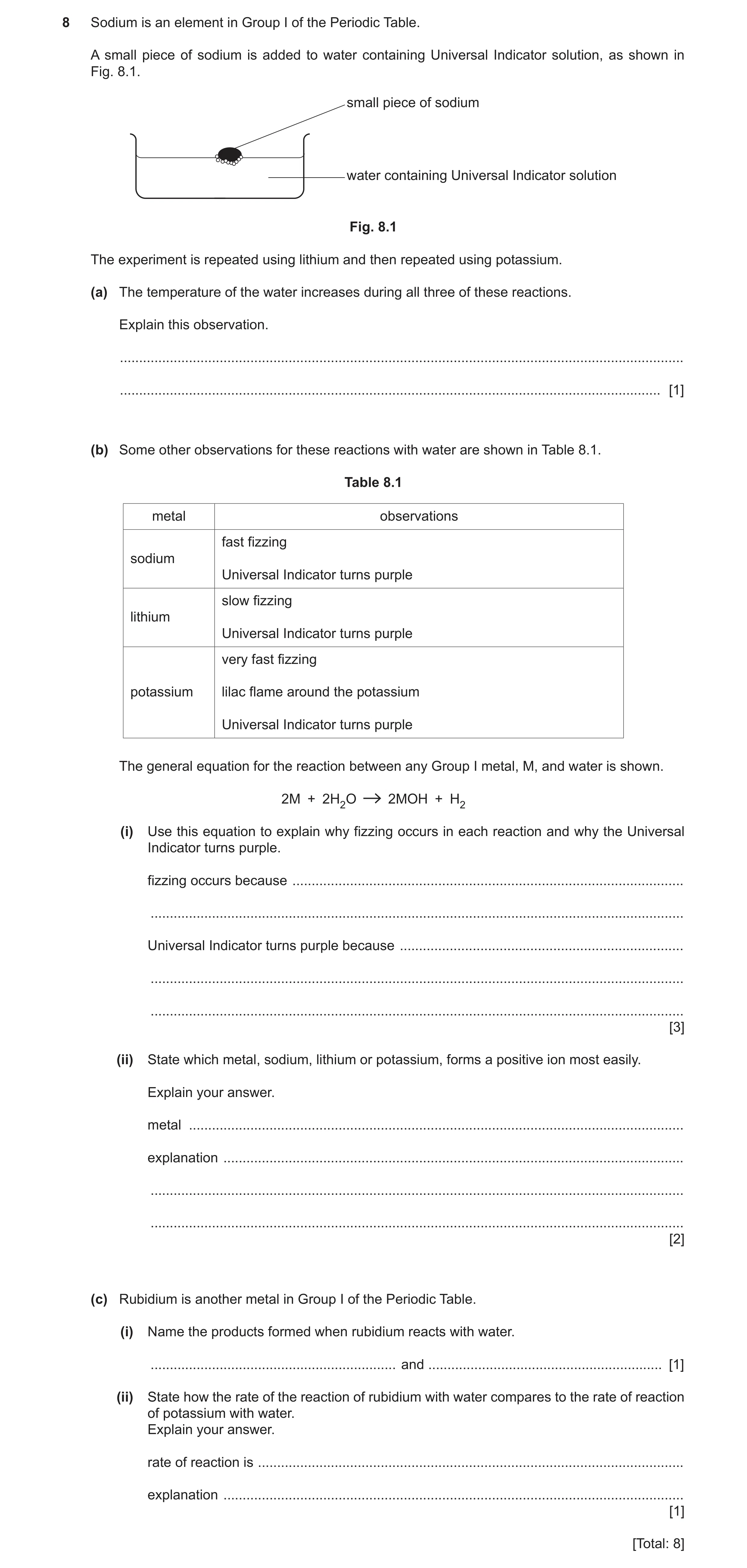
8 Sodium is an element in Group I of the Periodic Table. A small piece of sodium is added to water containing Universal Indicator solution, as shown in Fig. 8.1. small piece of sodium water containing Universal Indicator solution Fig. 8.1 The experiment is repeated using lithium and then repeated using potassium. (a) The temperature of the water increases during all three of these reactions. Explain this observation. … … [1] (b) Some other observations for these reactions with water are shown in Table 8.1. Table 8.1 metal observations fast fizzing sodium Universal Indicator turns purple slow fizzing lithium Universal Indicator turns purple very fast fizzing potassium lilac flame around the potassium Universal Indicator turns purple The general equation for the reaction between any Group I metal, M, and water is shown. 2M + 2H2O 2MOH + H2 (i) Use this equation to explain why fizzing occurs in each reaction and why the Universal Indicator turns purple. fizzing occurs because … … Universal Indicator turns purple because … … … [3] (ii) State which metal, sodium, lithium or potassium, forms a positive ion most easily. Explain your answer. metal … explanation … … … [2] (c) Rubidium is another metal in Group I of the Periodic Table. (i) Name the products formed when rubidium reacts with water. … and … [1] (ii) State how the rate of the reaction of rubidium with water compares to the rate of reaction of potassium with water. Explain your answer. rate of reaction is … explanation … [1] [Total: 8]
8 marks
Mark scheme: 8(a) (thermal) energy / heat, is given out / reaction is exothermic ; 1 8(b)(i) (fizzing occurs because) hydrogen / a gas, is made ; (Universal Indicator turns purple because) an alkali is made / pH > 7 / a basic solution is made ; (metal) hydroxide is made / named metal hydroxide ; 3 8(b)(ii) potassium ; and any one from: quotes comparative observations from the table to show potassium reacts the most vigorously with water ; potassium is the most reactive metal (of the three) / is lower down Group 1 ; 2 8(c)(i) rubidium hydroxide and hydrogen ; 1 8(c)(ii) (rate of reaction is) faster AND (explanation) because rubidium is more reactive / because rubidium is lower down the group ; 1
This question in 0653/42 Feb/March 2021
Q9 · Some properties of three elements in Group VII of the Periodic Table 0653/43 Oct/Nov 2021
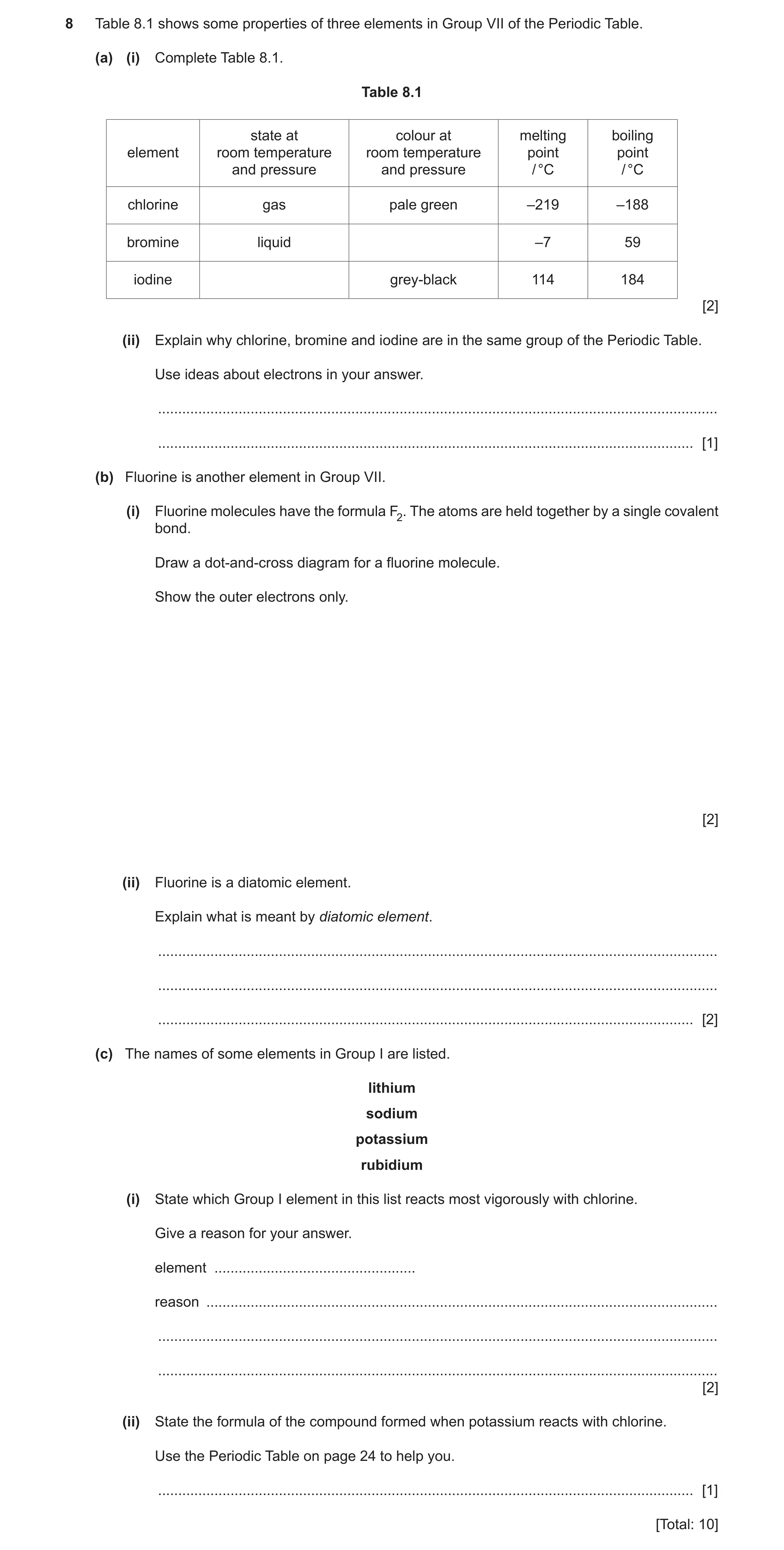
8 Table 8.1 shows some properties of three elements in Group VII of the Periodic Table. (a) (i) Complete Table 8.1. Table 8.1 state at colour at melting boiling element room temperature room temperature point point and pressure and pressure / °C / °C chlorine gas pale green –219 –188 bromine liquid –7 59 iodine grey-black 114 184 [2] (ii) Explain why chlorine, bromine and iodine are in the same group of the Periodic Table. Use ideas about electrons in your answer. … … [1] (b) Fluorine is another element in Group VII. (i) Fluorine molecules have the formula F2. The atoms are held together by a single covalent bond. Draw a dot-and-cross diagram for a fluorine molecule. Show the outer electrons only. [2] (ii) Fluorine is a diatomic element. Explain what is meant by diatomic element. … … … [2] (c) The names of some elements in Group I are listed. lithium sodium potassium rubidium (i) State which Group I element in this list reacts most vigorously with chlorine. Give a reason for your answer. element … reason … … … [2] (ii) State the formula of the compound formed when potassium reacts with chlorine. Use the Periodic Table on page 24 to help you. … [1] [Total: 10]
10 marks
Mark scheme: 8(a)(i) bromine: (dark) orange / brown ; iodine: solid ; 2 8(a)(ii) all contain the same number of electrons (seven electrons) in the outer shell ; 1 8(b)(i) single bond between atoms shown as two shared electrons ; (dependent mark) rest of molecule correct ; 2 8(b)(ii) molecules have only two atoms ; of the same type ; 2 8(c)(i) rubidium ; outer electron (is furthest from nucleus and so) more easily lost / rubidium is further down Group I ; 2 8(c)(ii) KCl ; 1
This question in 0653/43 Oct/Nov 2021
Q10 · Sodium, potassium and rubidium are elements in Group I of the Periodic Table 0653/43 May/June 2022
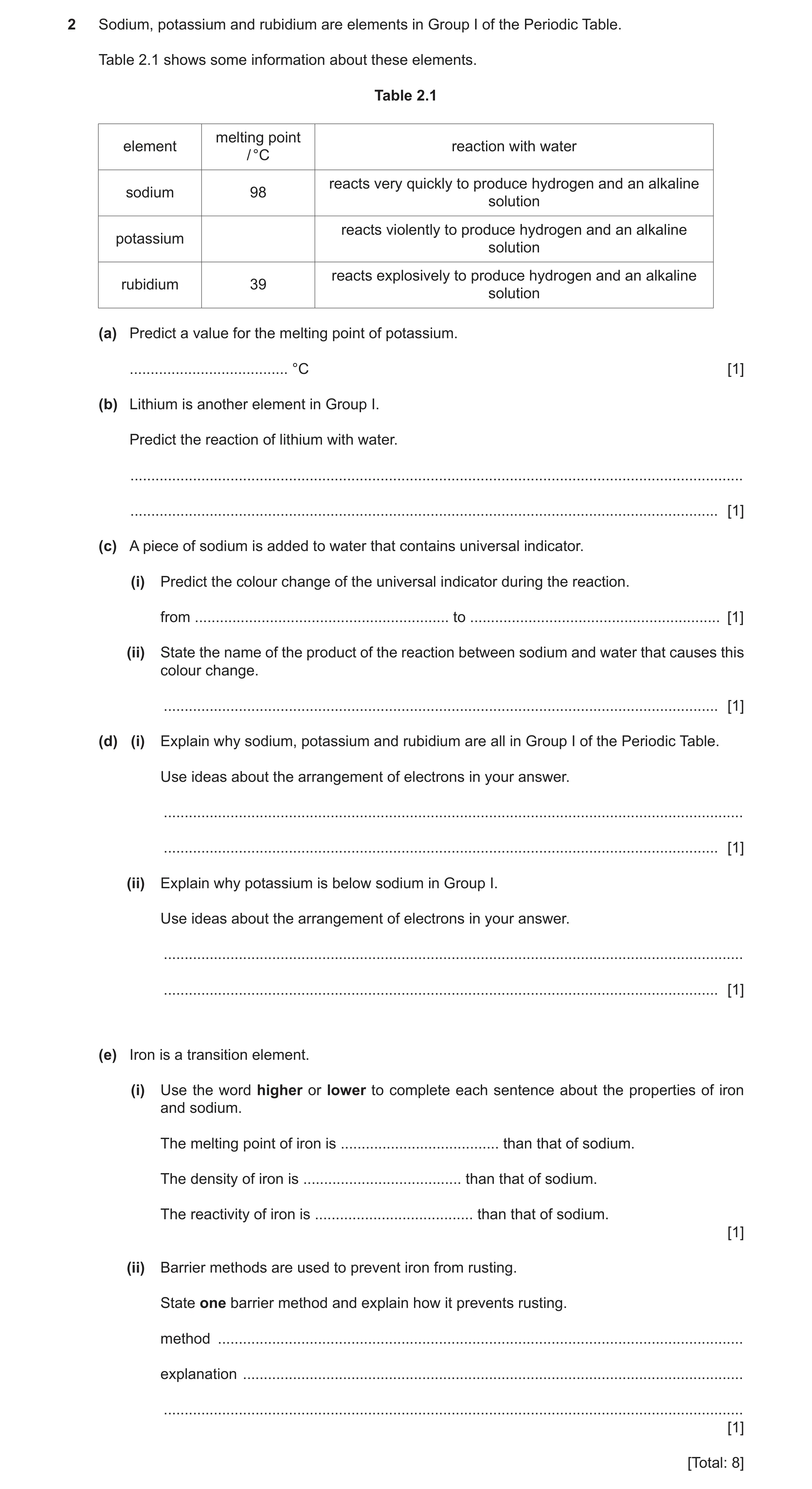
2 Sodium, potassium and rubidium are elements in Group I of the Periodic Table. Table 2.1 shows some information about these elements. Table 2.1 melting point element reaction with water / °C reacts very quickly to produce hydrogen and an alkaline sodium 98 solution reacts violently to produce hydrogen and an alkaline potassium solution reacts explosively to produce hydrogen and an alkaline rubidium 39 solution (a) Predict a value for the melting point of potassium. … °C [1] (b) Lithium is another element in Group I. Predict the reaction of lithium with water. … … [1] (c) A piece of sodium is added to water that contains universal indicator. (i) Predict the colour change of the universal indicator during the reaction. from … to … [1] (ii) State the name of the product of the reaction between sodium and water that causes this colour change. … [1] (d) (i) Explain why sodium, potassium and rubidium are all in Group I of the Periodic Table. Use ideas about the arrangement of electrons in your answer. … … [1] (ii) Explain why potassium is below sodium in Group I. Use ideas about the arrangement of electrons in your answer. … … [1] (e) Iron is a transition element. (i) Use the word higher or lower to complete each sentence about the properties of iron and sodium. The melting point of iron is … than that of sodium. The density of iron is … than that of sodium. The reactivity of iron is … than that of sodium. [1] (ii) Barrier methods are used to prevent iron from rusting. State one barrier method and explain how it prevents rusting. method … explanation … … [1] [Total: 8]
8 marks
Mark scheme: 2(a) value between melting point of sodium and rubidium ; 1 2(b) reacts, quickly / slower than sodium,( to give hydrogen and an alkaline solution ) ; 1 2(c)(i) green/yellow to purple/blue ; 1 2(c)(ii) sodium hydroxide ; 1 2(d)(i) (all their atoms have) one electron in the outer shell ; 1 Question Answer Marks 2(d)(ii) potassium has (one) more shell than sodium ; 1 2(e)(i) higher higher lower ; 1 2(e)(ii) method: oil / grease / paint explanation: keeps out oxygen / water ; 1
This question in 0653/43 May/June 2022
Q11 · Lithium, sodium, potassium and rubidium are elements in Group I of the Periodic Table 0653/42 Oct/Nov 2024
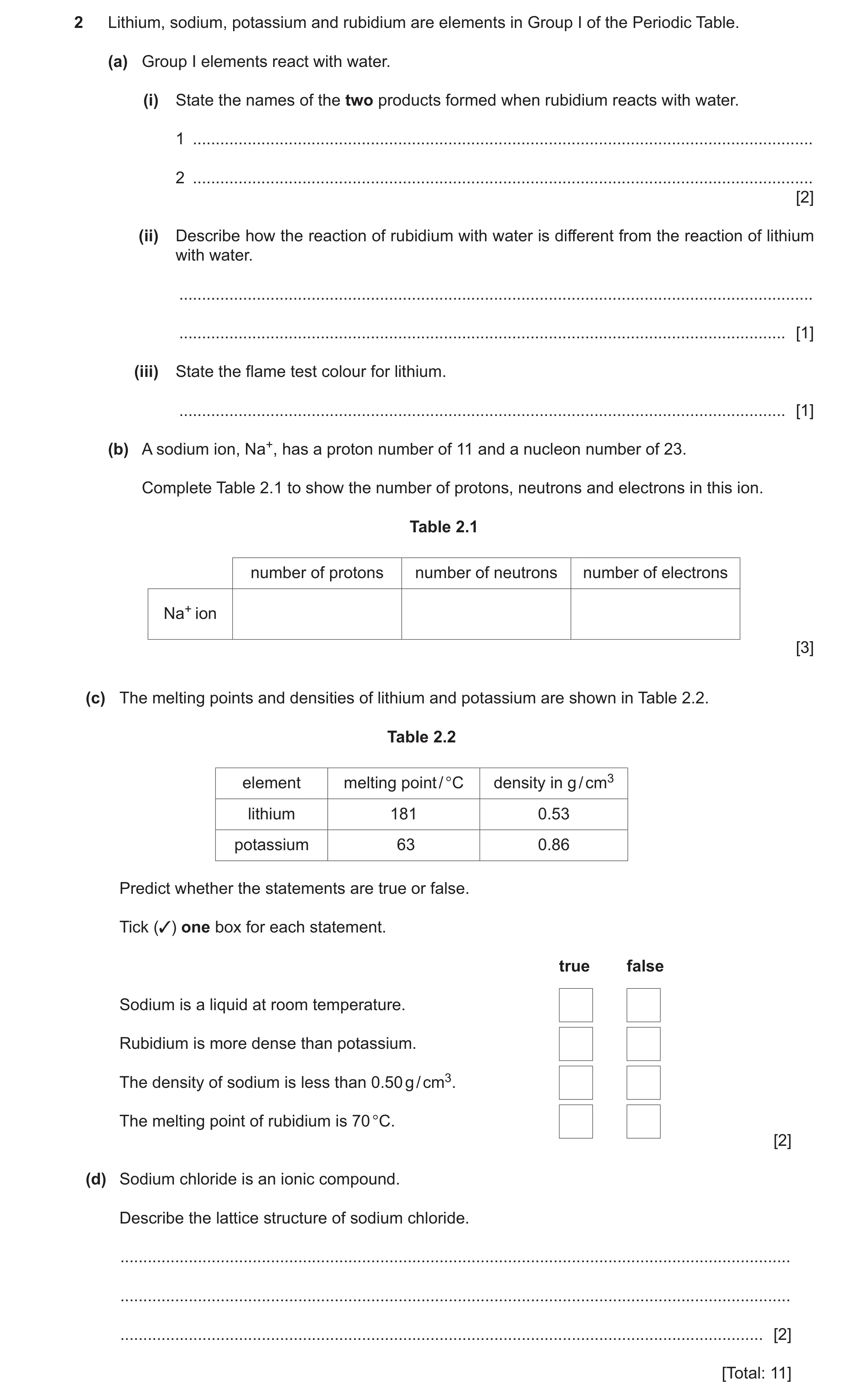
2 Lithium, sodium, potassium and rubidium are elements in Group I of the Periodic Table. (a) Group I elements react with water. (i) State the names of the two products formed when rubidium reacts with water. 1 … 2 … [2] (ii) Describe how the reaction of rubidium with water is different from the reaction of lithium with water. … … [1] (iii) State the flame test colour for lithium. … [1] (b) A sodium ion, Na+, has a proton number of 11 and a nucleon number of 23. Complete Table 2.1 to show the number of protons, neutrons and electrons in this ion. Table 2.1 number of protons number of neutrons number of electrons Na+ ion [3] (c) The melting points and densities of lithium and potassium are shown in Table 2.2. Table 2.2 element melting point / °C density in g / cm3 lithium 181 0.53 potassium 63 0.86 Predict whether the statements are true or false. Tick (✓) one box for each statement. true false Sodium is a liquid at room temperature. Rubidium is more dense than potassium. The density of sodium is less than 0.50 g / cm3. The melting point of rubidium is 70 °C. [2] (d) Sodium chloride is an ionic compound. Describe the lattice structure of sodium chloride. … … … [2] [Total: 11]
11 marks
Mark scheme: 2(a)(i) hydrogen; 2 rubidium hydroxide ; 2(a)(ii) idea that rubidium is more reactive / faster / more vigorous ORA ; 1 2(a)(iii) red ; 1 2(b) 11 ; 3 12 ; 10 ; 2(c) 2 any two correct ; all correct ; 2(d) positive and negative ions ; 2 alternating / regular (arrangement) ;
This question in 0653/42 Oct/Nov 2024
Q12 · Sodium is in Group I of the Periodic Table 0653/42 Feb/March 2025
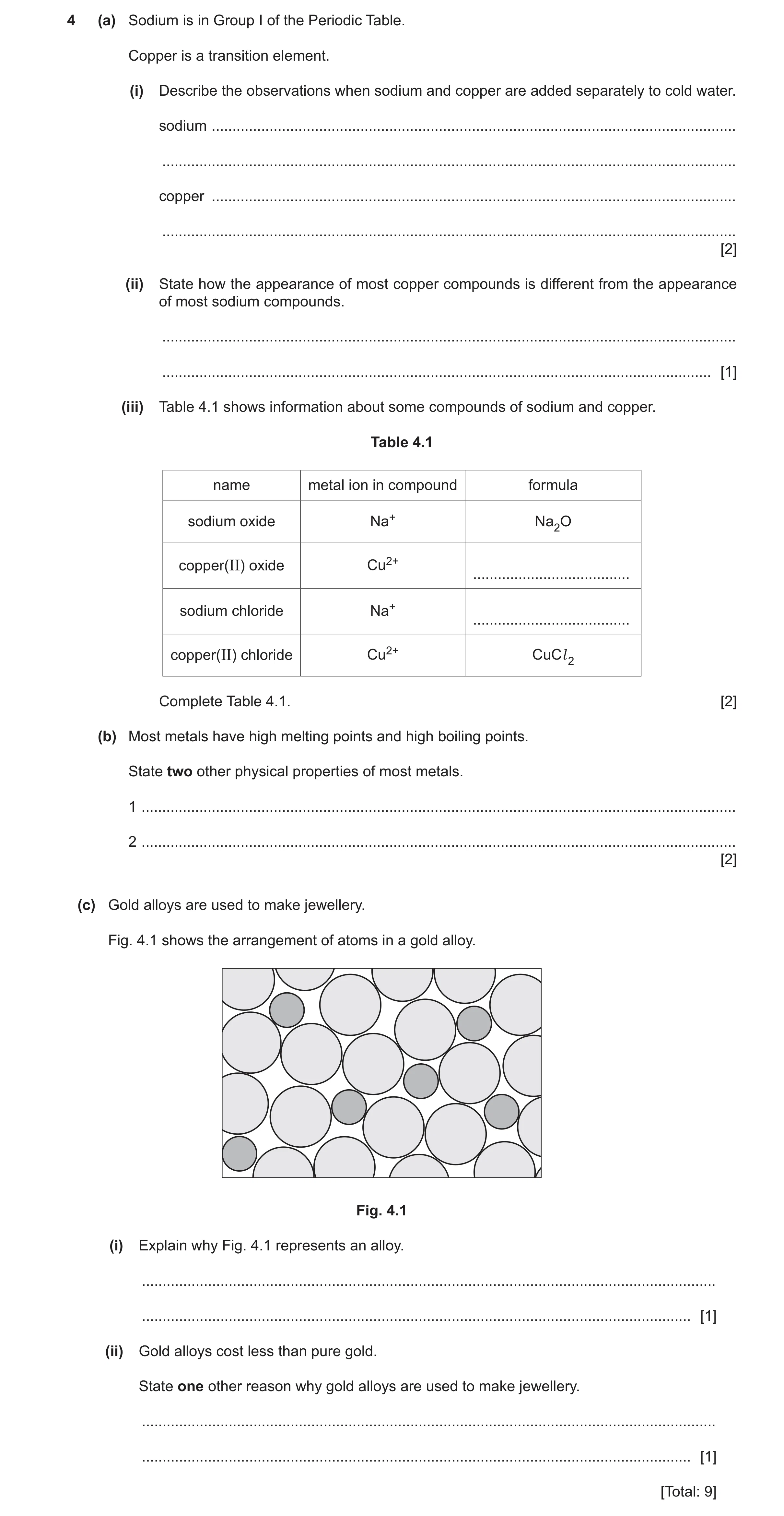
4 (a) Sodium is in Group I of the Periodic Table. Copper is a transition element. (i) Describe the observations when sodium and copper are added separately to cold water. sodium … … copper … … [2] (ii) State how the appearance of most copper compounds is different from the appearance of most sodium compounds. … … [1] (iii) Table 4.1 shows information about some compounds of sodium and copper. Table 4.1 name metal ion in compound formula sodium oxide Na+ Na2O copper(II) oxide Cu2+ … sodium chloride Na+ … copper(II) chloride Cu2+ CuCl 2 Complete Table 4.1. [2] (b) Most metals have high melting points and high boiling points. State two other physical properties of most metals. 1 … 2 … [2] (c) Gold alloys are used to make jewellery. Fig. 4.1 shows the arrangement of atoms in a gold alloy. Fig. 4.1 (i) Explain why Fig. 4.1 represents an alloy. … … [1] (ii) Gold alloys cost less than pure gold. State one other reason why gold alloys are used to make jewellery. … … [1] [Total: 9]
9 marks
Mark scheme: 4(a)(i) sodium: reacts violently / produces effervescence / bubbles / melts / moves around surface / becomes smaller / yellow flame ; 2 copper: does not react with water / no reaction / no change ; 4(a)(ii) (most) copper compounds are coloured (and (most) sodium compounds are colourless / white) ; 1 4 (a)(iii) CuO ; 2 NaCl ; 4(b) any two from: 2 malleable ; ductile ; (good) conductors of heat ; (good) conductors of electricity ; 4(c)(i) shows different atoms / atoms of different sizes / arrangement of atoms is not regular ; 1 4(c)(ii) alloy is, harder / stronger / more hardwearing / more durable / ora ; 1
This question in 0653/42 Feb/March 2025
 3 / 18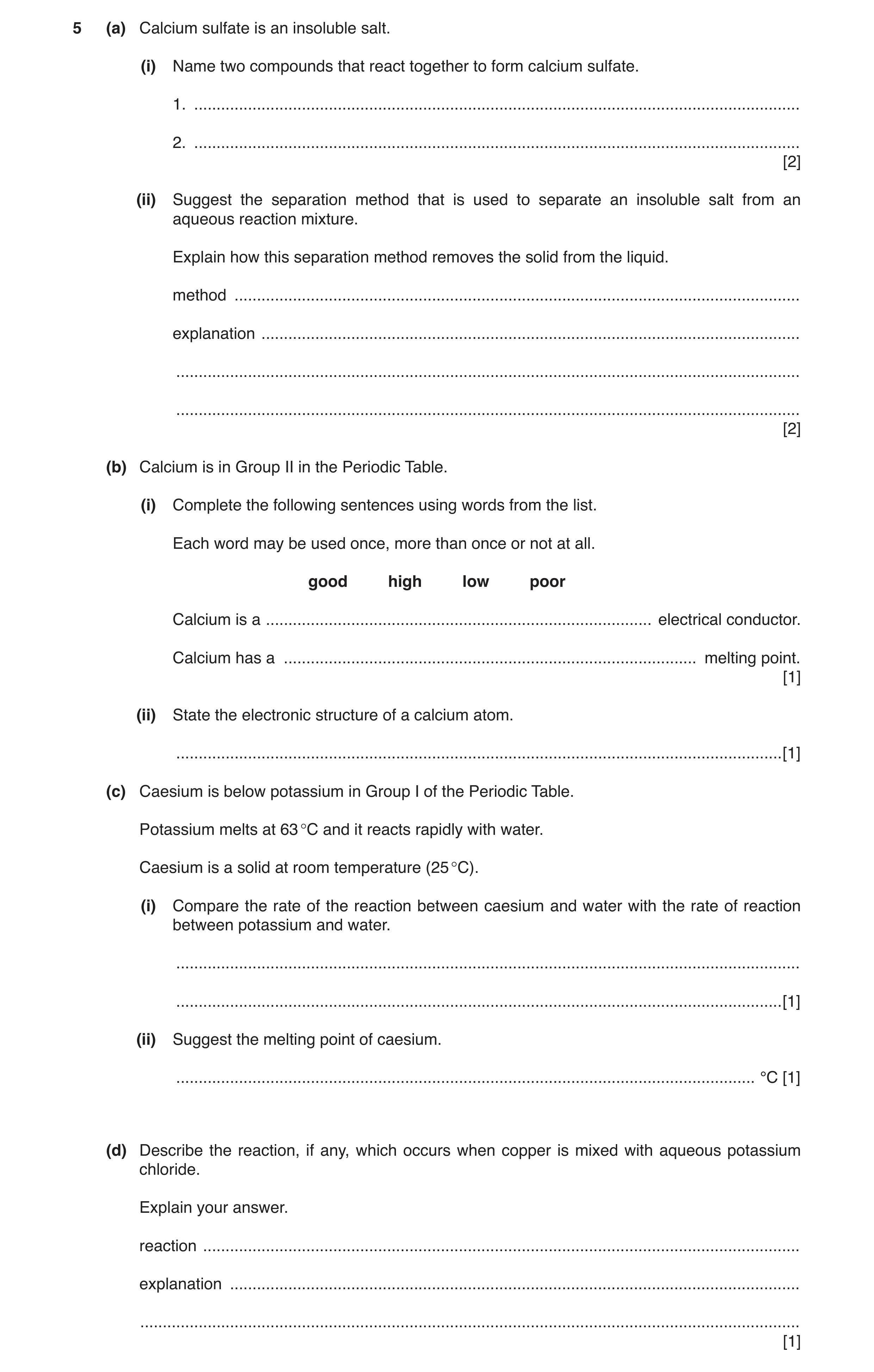
 9 / 18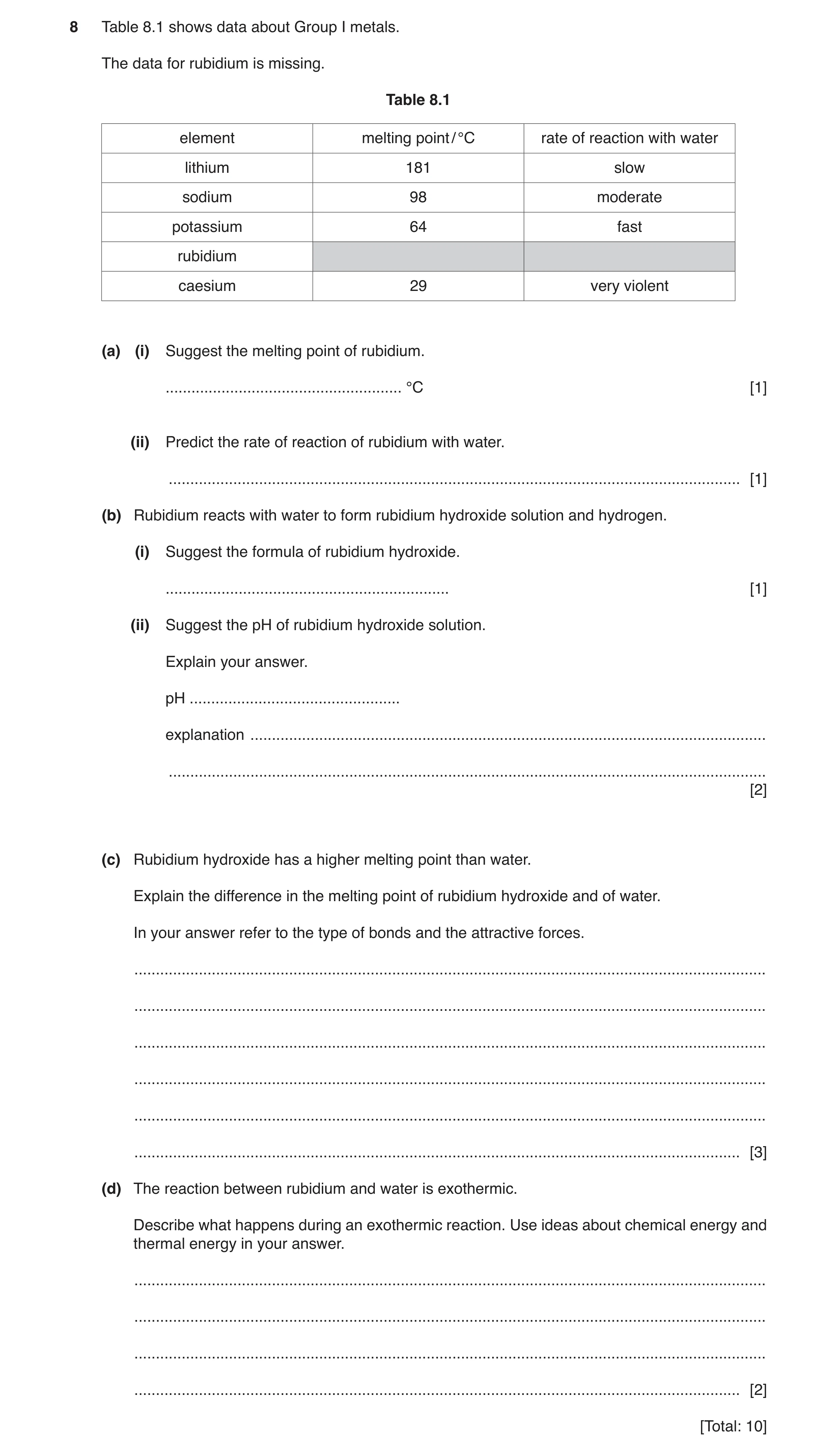
 8
8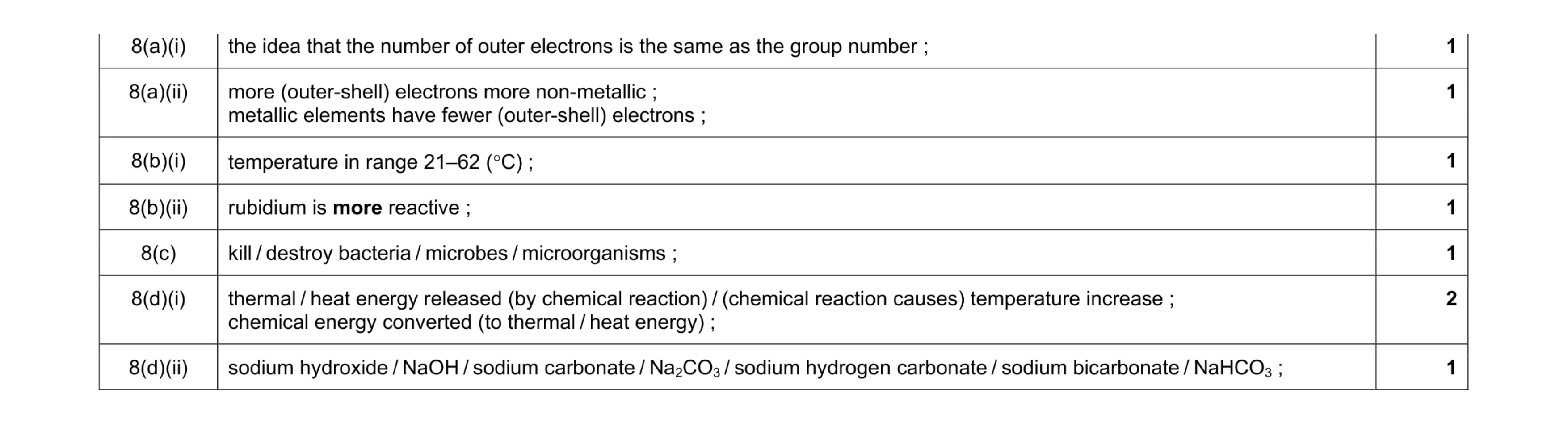 8
8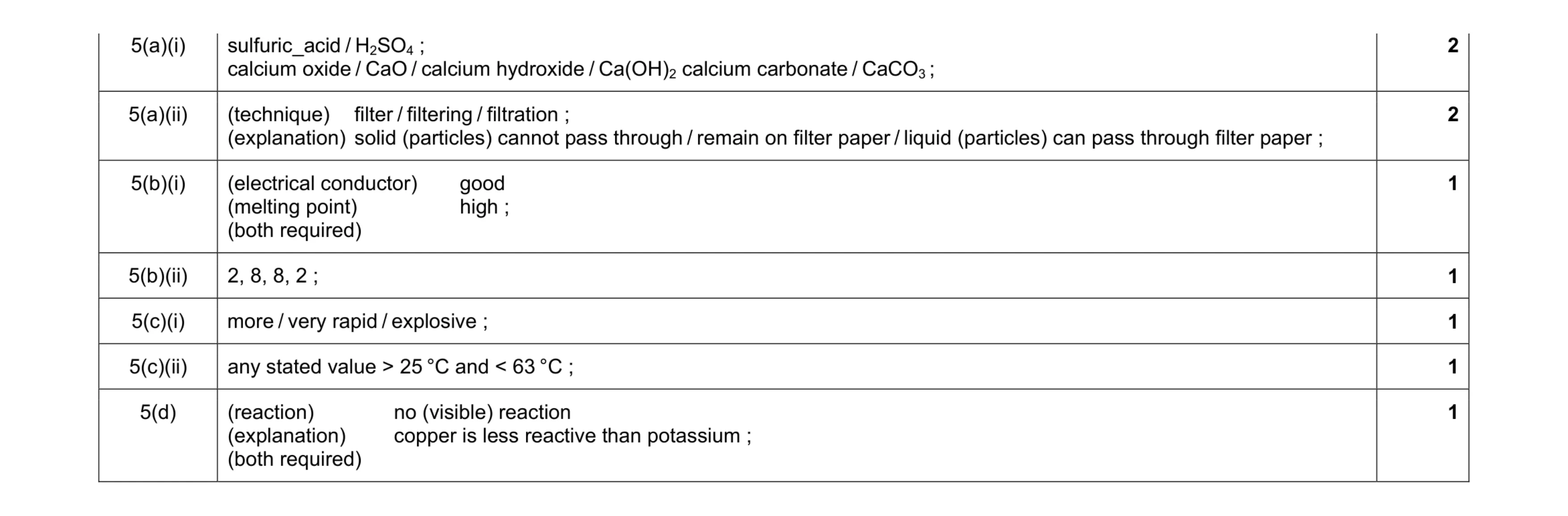 9
9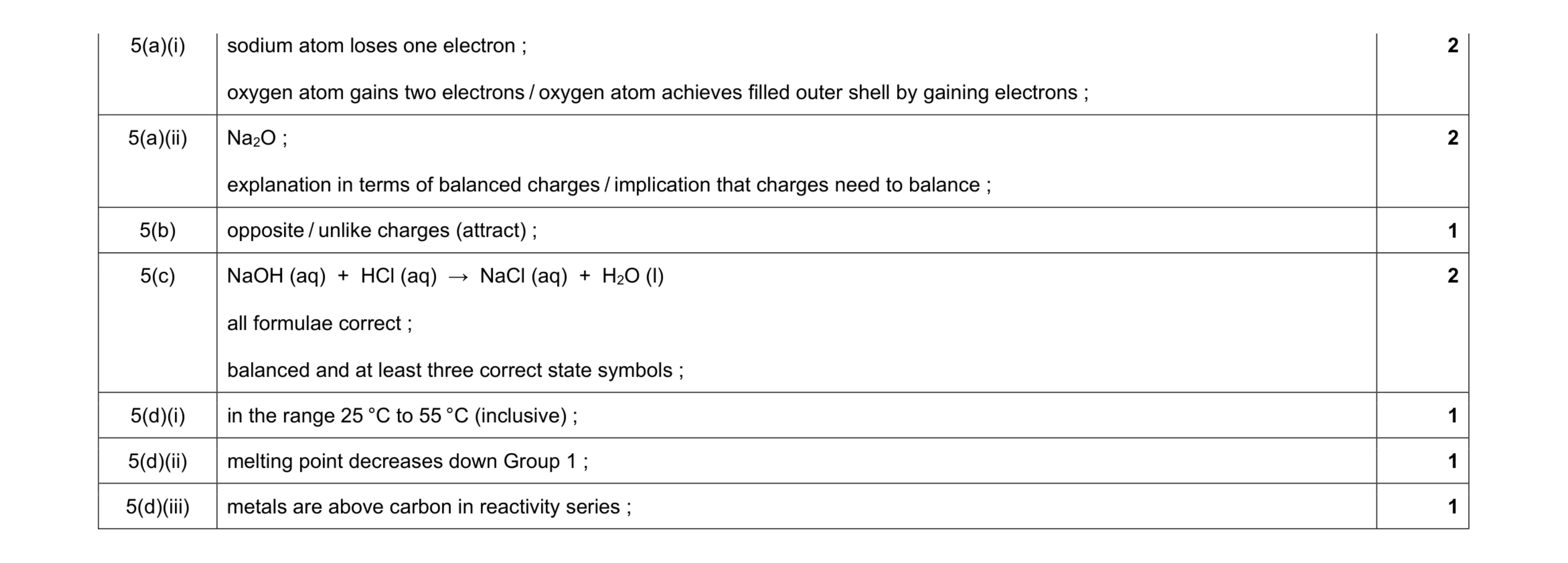 10
10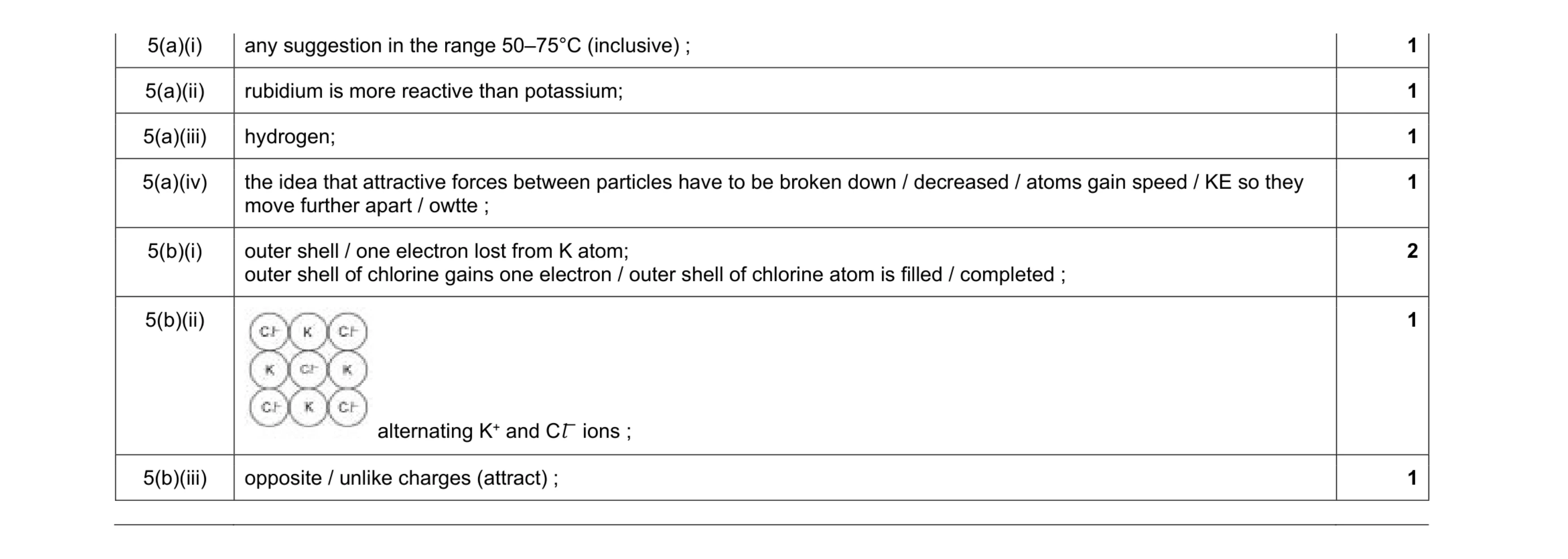 8
8 5
5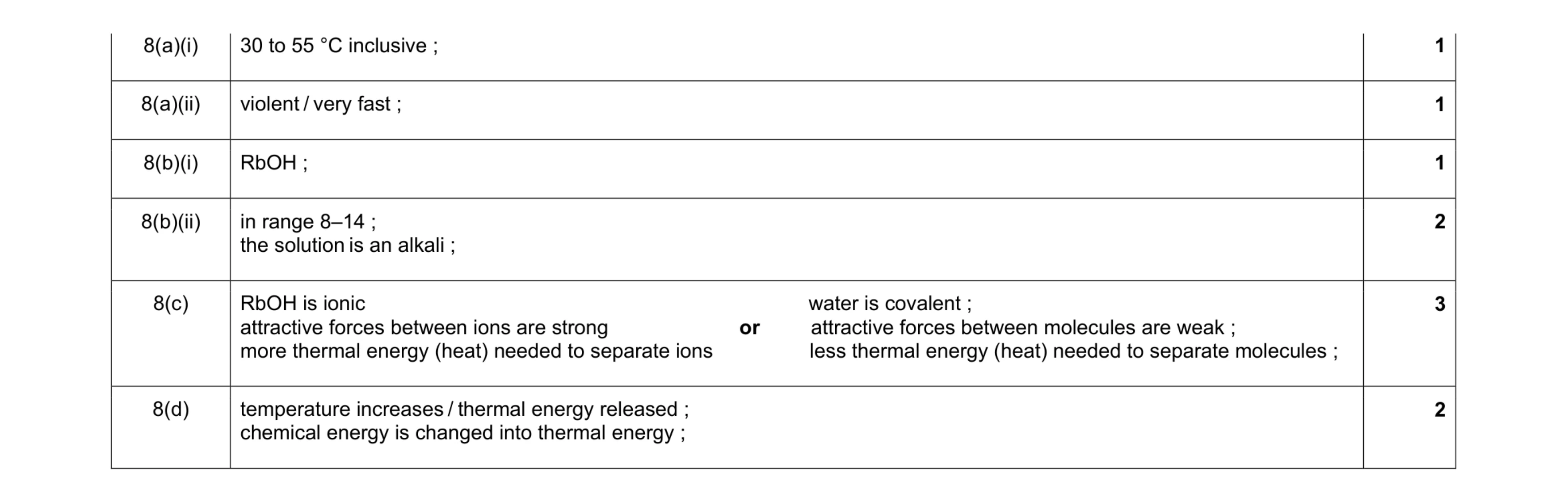 10
10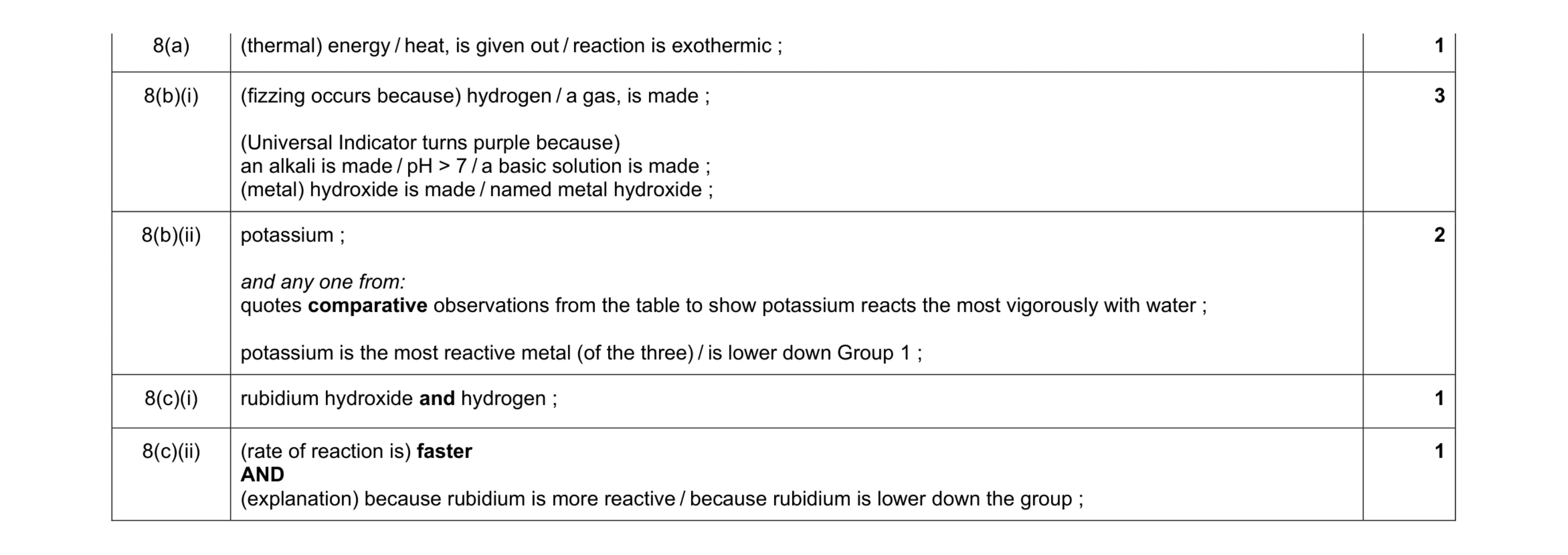 8
8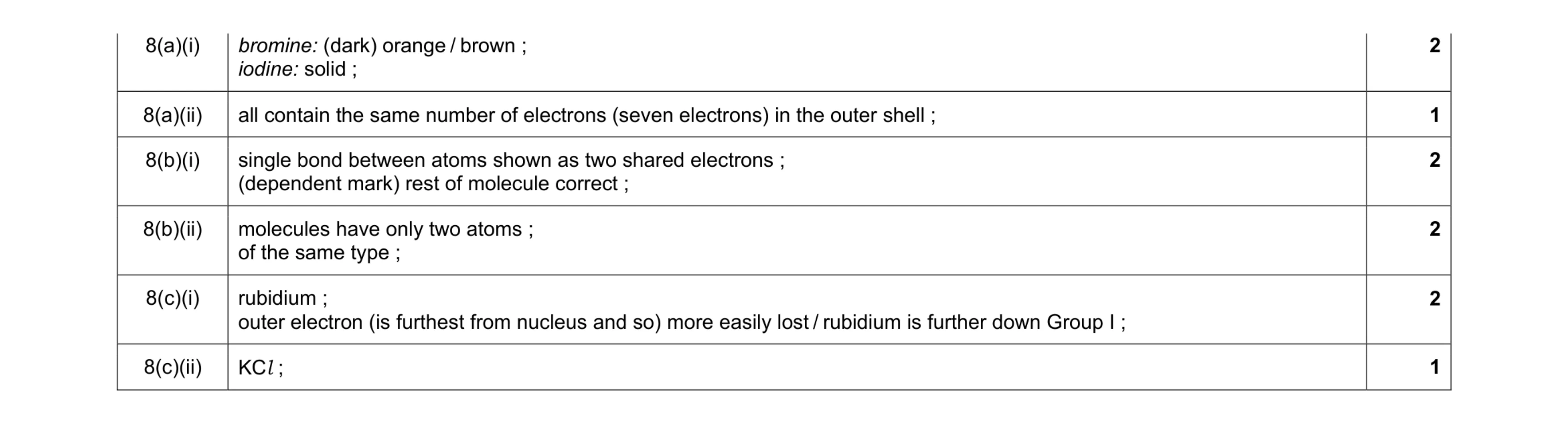 10
10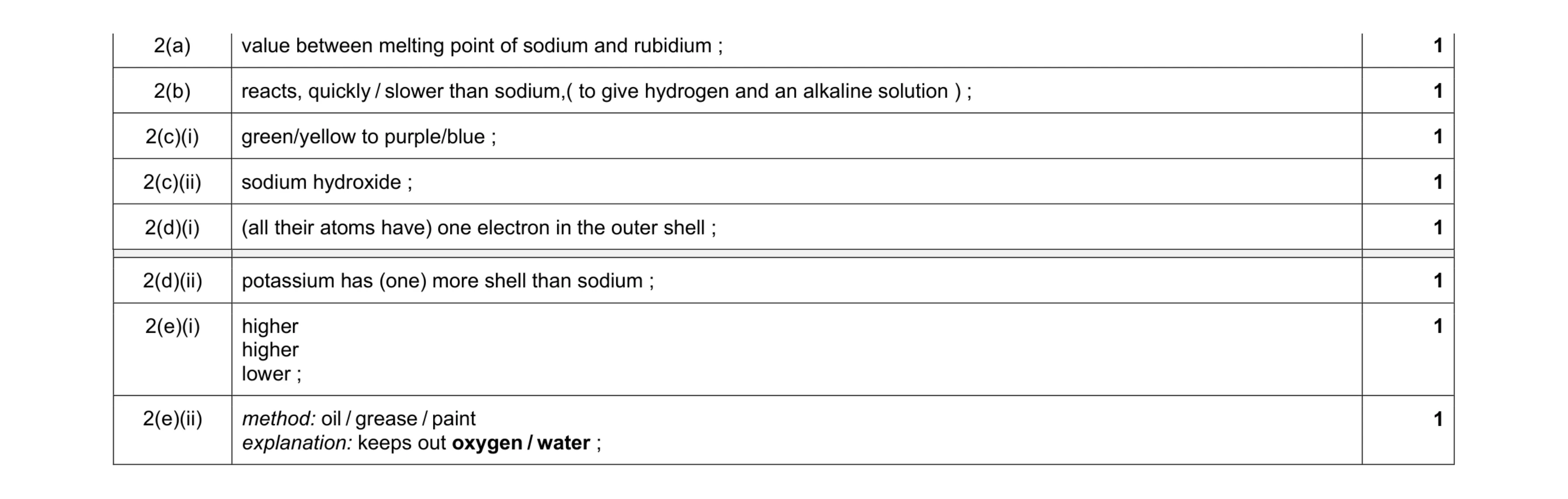 8
8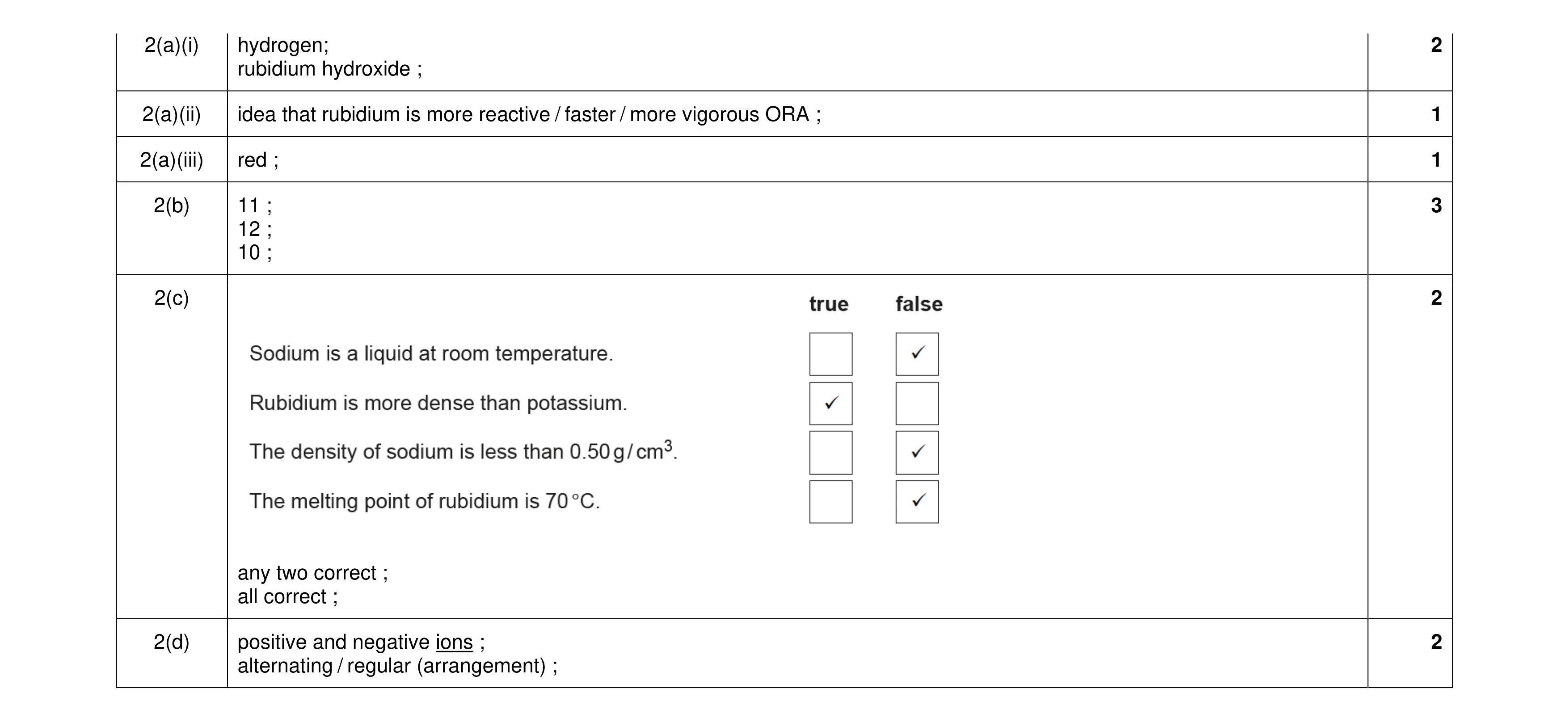 11
11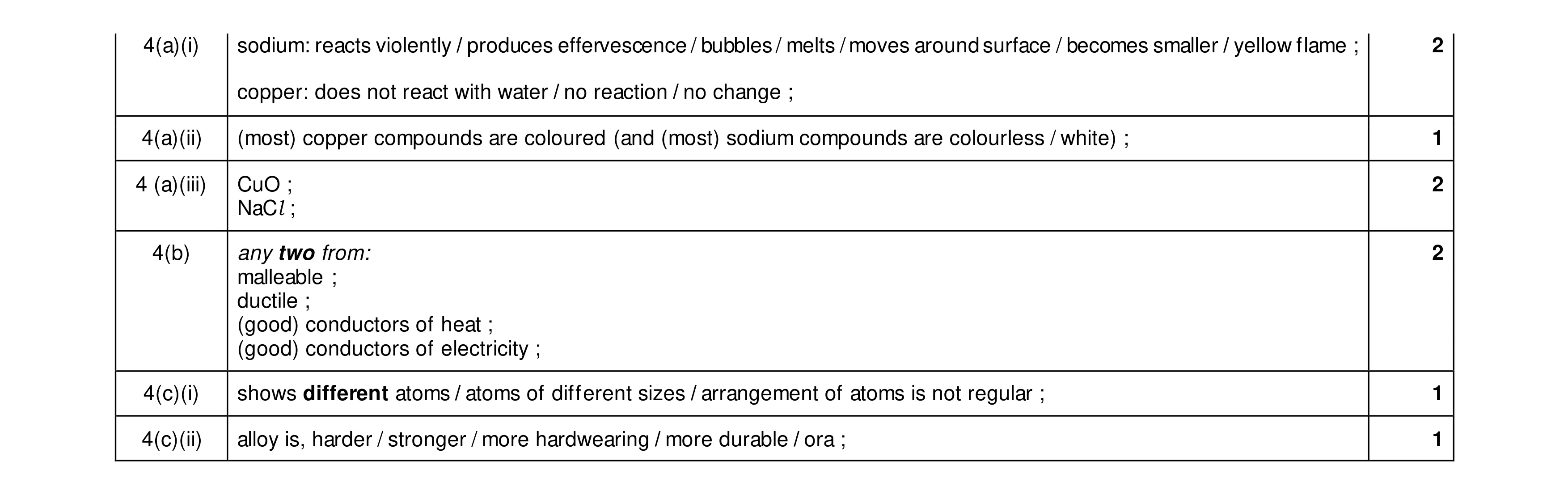 9
9