Questions as text
Q1 · Element X is a very soft solid 0653/22 Feb/March 2017
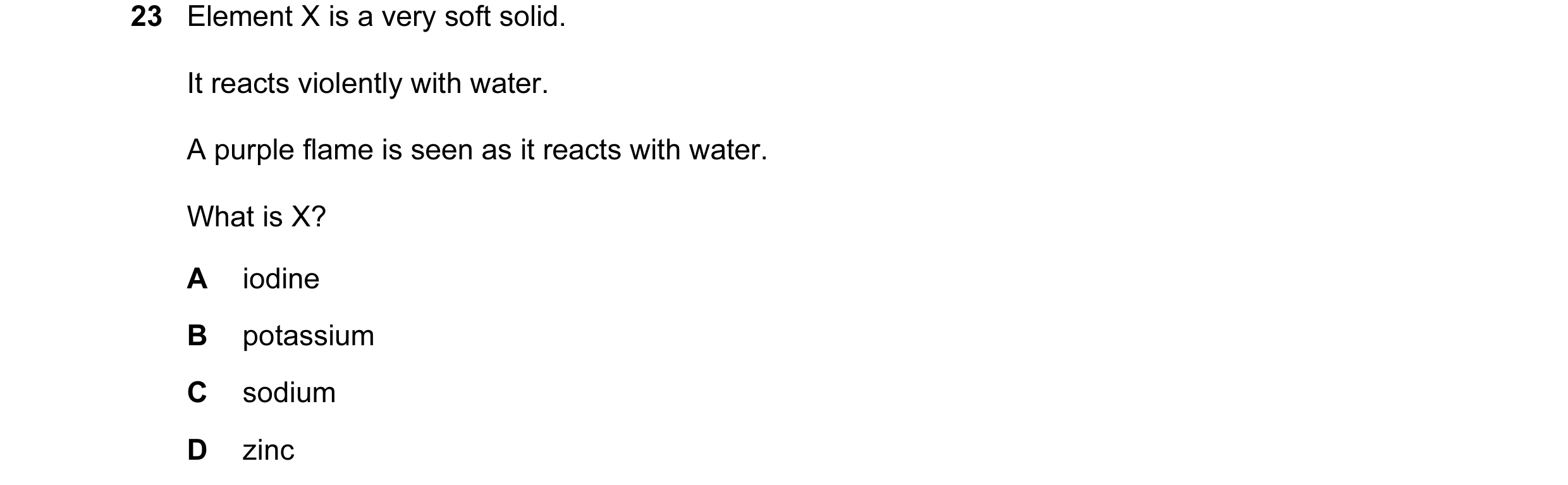
23 Element X is a very soft solid. It reacts violently with water. A purple flame is seen as it reacts with water. What is X? A iodine B potassium C sodium D zinc
1 marks
Answer: B
This question in 0653/22 Feb/March 2017
Q2 · Francium is the element at the bottom of Group I 0653/22 Oct/Nov 2018
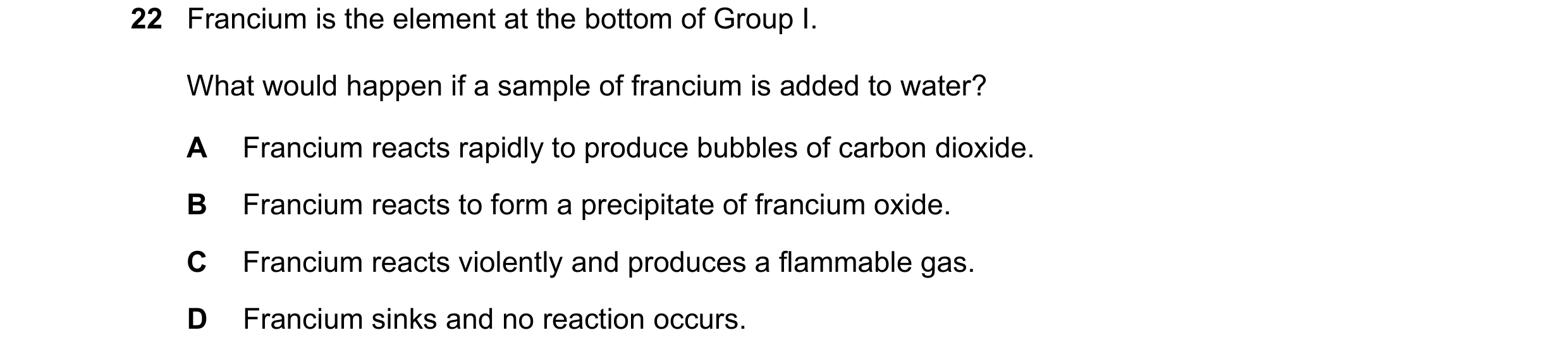
22 Francium is the element at the bottom of Group I. What would happen if a sample of francium is added to water? A Francium reacts rapidly to produce bubbles of carbon dioxide. B Francium reacts to form a precipitate of francium oxide. C Francium reacts violently and produces a flammable gas. D Francium sinks and no reaction occurs.
1 marks
Answer: C
This question in 0653/22 Oct/Nov 2018
Q3 · Rubidium is an element below potassium in Group I of the Periodic Table 0653/23 Oct/Nov 2018
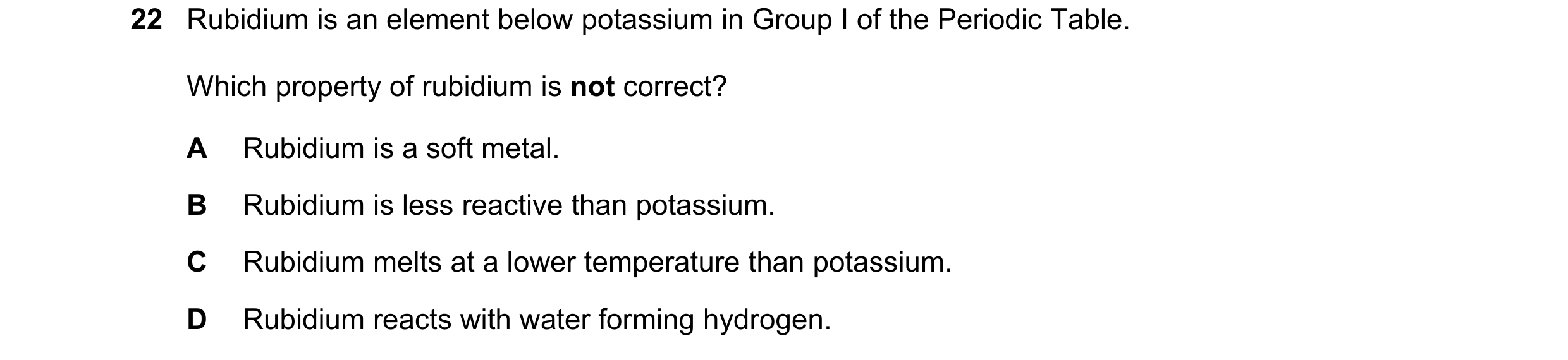
22 Rubidium is an element below potassium in Group I of the Periodic Table. Which property of rubidium is not correct? A Rubidium is a soft metal. B Rubidium is less reactive than potassium. C Rubidium melts at a lower temperature than potassium. D Rubidium reacts with water forming hydrogen.
1 marks
Answer: B
This question in 0653/23 Oct/Nov 2018
Q4 · Some properties of three metals in Group I are shown 0653/22 May/June 2019
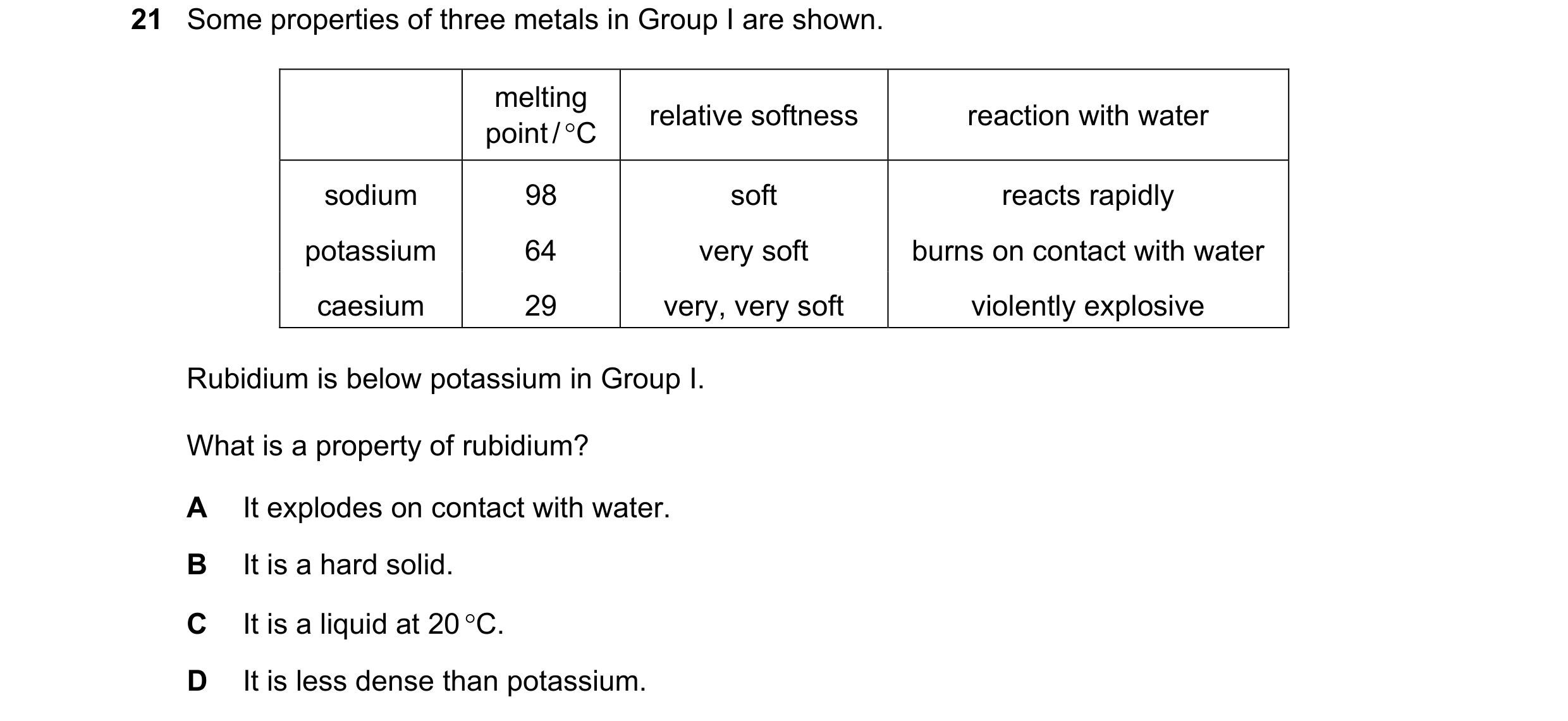
21 Some properties of three metals in Group I are shown. melting relative softness reaction with water point / °C sodium 98 soft reacts rapidly potassium 64 very soft burns on contact with water caesium 29 very, very soft violently explosive Rubidium is below potassium in Group I. What is a property of rubidium? A It explodes on contact with water. B It is a hard solid. C It is a liquid at 20 °C. D It is less dense than potassium.
1 marks
Answer: A
This question in 0653/22 May/June 2019
Q5 · Which statement about elements in the Periodic Table is not correct? 0653/21 Oct/Nov 2019
23 Which statement about elements in the Periodic Table is not correct? A Elements in Group I react by gaining electrons to form ions. B Elements in Group II have two electrons in their outer shell. C Elements in Group VIII are unreactive because they have full outer shells of electrons. D Elements with seven outer shell electrons are non-metals.
1 marks
Answer: A
This question in 0653/21 Oct/Nov 2019
Q6 · Rubidium is a very reactive Group I metal 0653/22 Feb/March 2020
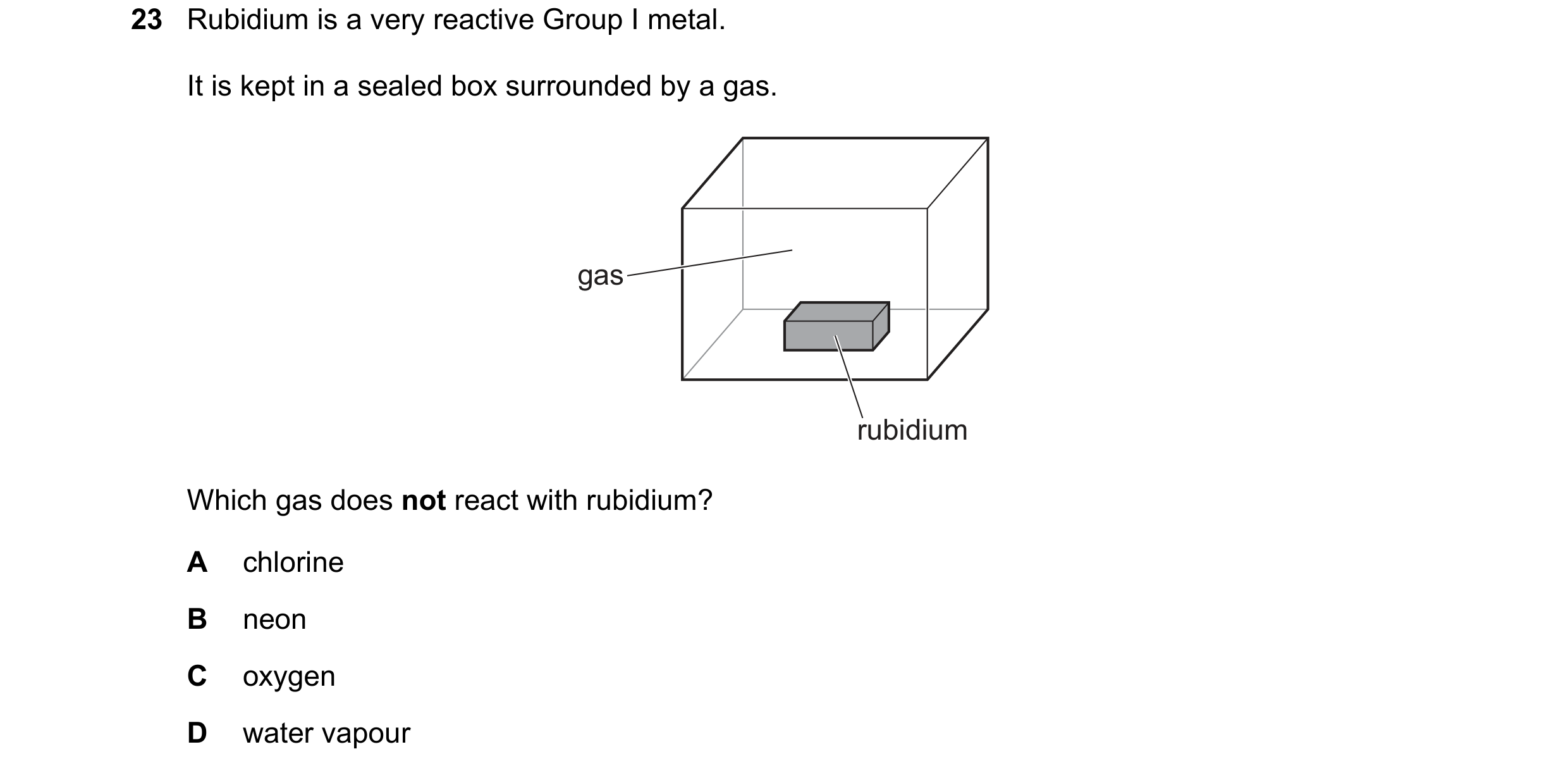
23 Rubidium is a very reactive Group I metal. It is kept in a sealed box surrounded by a gas. gas rubidium Which gas does not react with rubidium? A chlorine B neon C oxygen D water vapour
1 marks
Answer: B
This question in 0653/22 Feb/March 2020
Q7 · Sodium burns in oxygen forming sodium oxide 0653/21 May/June 2020
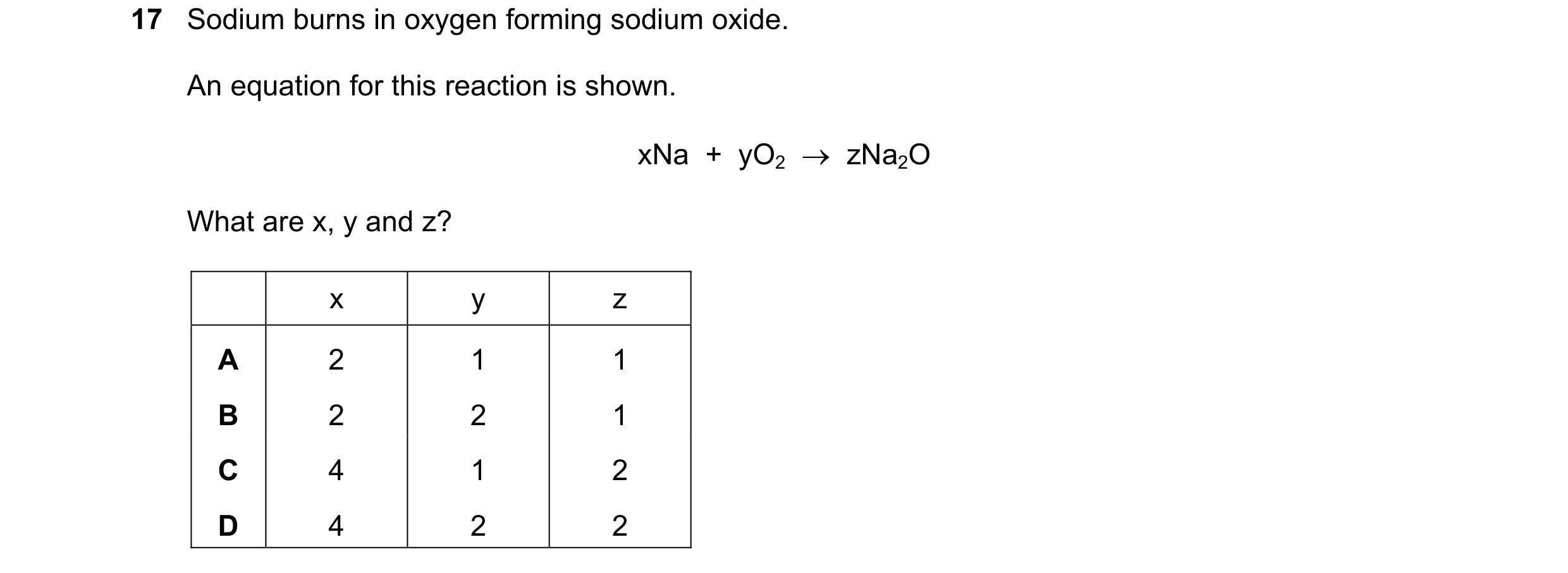
17 Sodium burns in oxygen forming sodium oxide. An equation for this reaction is shown. xNa + yO2 → zNa2O What are x, y and z? x y z A 2 1 1 B 2 2 1 C 4 1 2 D 4 2 2
1 marks
Answer: C
This question in 0653/21 May/June 2020
Q8 · Properties of some Group II elements are shown 0653/21 May/June 2020
24 Properties of some Group II elements are shown. atomic melting reaction number point / °C with cold water Mg 12 Ca 20 850 reacts slowly Sr 38 reacts quickly Ba 56 714 Group II elements show similar trends in melting point and reactivity as Group I elements. Which statement is correct? A Barium reacts violently with cold water. B Magnesium burns brightly when added to cold water. C Magnesium has the lowest melting point. D Strontium is the most reactive.
1 marks
Answer: A
This question in 0653/21 May/June 2020
Q9 · Rubidium and sodium are elements in Group I of the Periodic Table 0653/21 Oct/Nov 2020
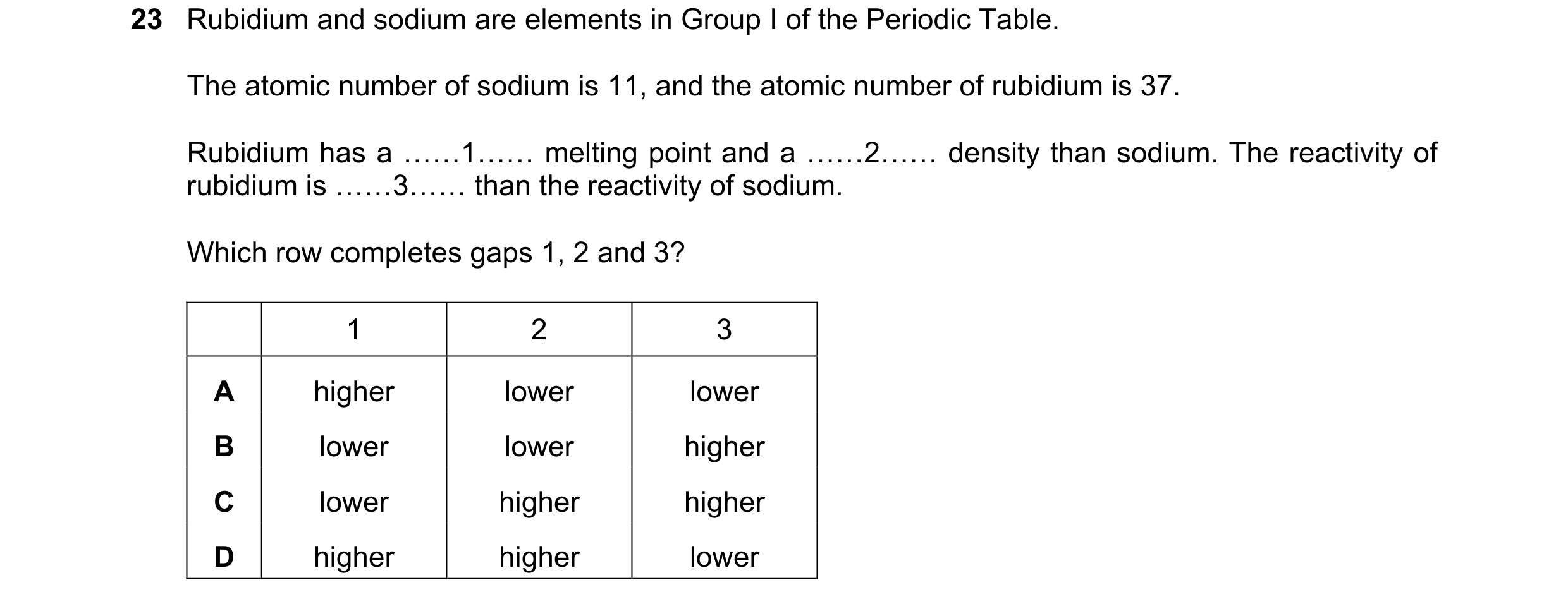
23 Rubidium and sodium are elements in Group I of the Periodic Table. The atomic number of sodium is 11, and the atomic number of rubidium is 37. Rubidium has a ……1…… melting point and a ……2…… density than sodium. The reactivity of rubidium is ……3…… than the reactivity of sodium. Which row completes gaps 1, 2 and 3? 1 2 3 A higher lower lower B lower lower higher C lower higher higher D higher higher lower
1 marks
Answer: C
This question in 0653/21 Oct/Nov 2020
Q10 · Elements in Group I and Group VII of the Periodic Table are listed 0653/21 Oct/Nov 2021
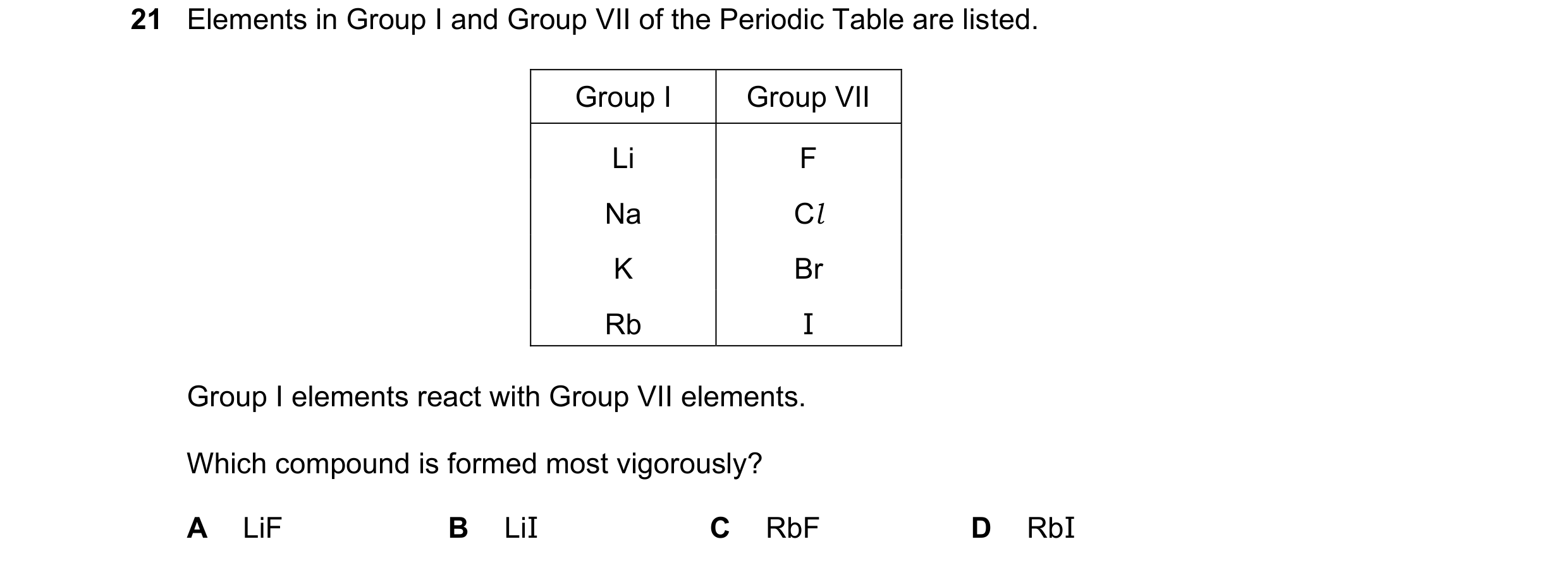
21 Elements in Group I and Group VII of the Periodic Table are listed. Group I Group VII Li F Na Cl K Br Rb I Group I elements react with Group VII elements. Which compound is formed most vigorously? A LiF B LiI C RbF D RbI
1 marks
Answer: C
This question in 0653/21 Oct/Nov 2021
Q11 · Which statements about elements in Group I of the Periodic Table are correct? 0653/22 Feb/March 2022
21 Which statements about elements in Group I of the Periodic Table are correct? 1 They become less reactive going down the group. 2 Sodium forms positive ions more easily than lithium. 3 Their melting points increase going down the group. 4 Rubidium is more dense than sodium. A 1 and 2 B 1 and 3 C 2 and 4 D 3 and 4
1 marks
Answer: C
This question in 0653/22 Feb/March 2022
Q12 · Elements X, Y and Z are in Group I of the Periodic Table 0653/21 May/June 2022
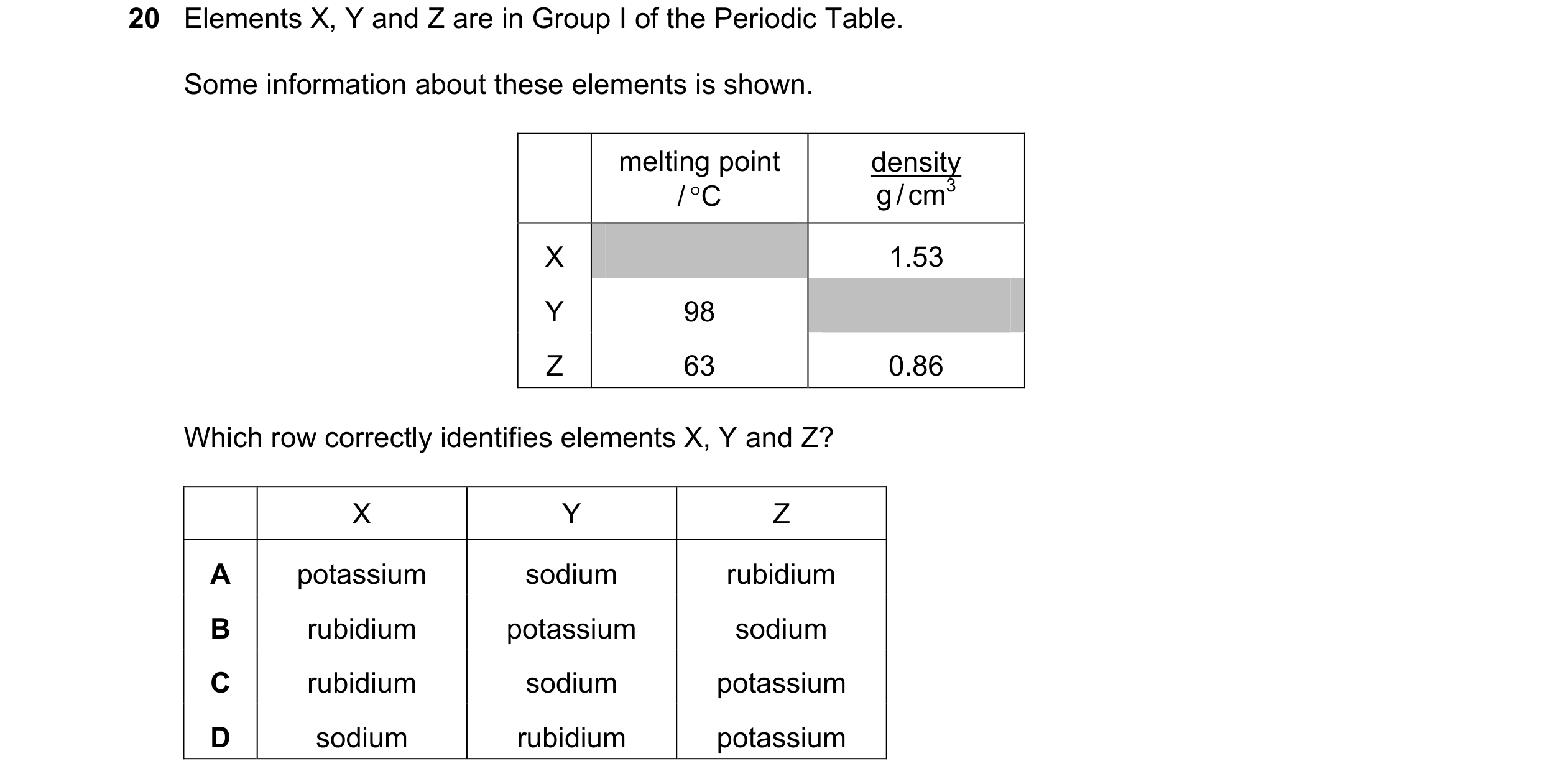
20 Elements X, Y and Z are in Group I of the Periodic Table. Some information about these elements is shown. melting point density / C g / cm3 X 1.53 Y 98 Z 63 0.86 Which row correctly identifies elements X, Y and Z? X Y Z A potassium sodium rubidium B rubidium potassium sodium C rubidium sodium potassium D sodium rubidium potassium
1 marks
Answer: C
This question in 0653/21 May/June 2022
Q13 · Why is potassium more reactive than sodium? 0653/22 Feb/March 2023
24 Why is potassium more reactive than sodium? A Potassium accepts electrons more readily than sodium. B Potassium forms positive ions more readily than sodium. C Sodium accepts electrons more readily than potassium. D Sodium forms positive ions more readily than potassium.
1 marks
Answer: B
This question in 0653/22 Feb/March 2023
Q14 · Information about some elements in Group I, Group II and Group VII of the Periodic Table… 0653/22 Feb/March 2025
22 Information about some elements in Group I, Group II and Group VII of the Periodic Table is shown. Group I element Group II element Group VII element melting point melting point boiling point / °C / °C / °C lithium = 181 beryllium = 1278 fluorine = –188 potassium = 63 calcium = 839 bromine = 59 A metal halide is formed when a metal in either Group I or Group II reacts with a Group VII element. The metal has a melting point of 769 °C. The Group VII element has a boiling point of –35 °C. What is the metal halide? A sodium chloride B sodium iodide C strontium chloride D strontium iodide
1 marks
Answer: C
This question in 0653/22 Feb/March 2025
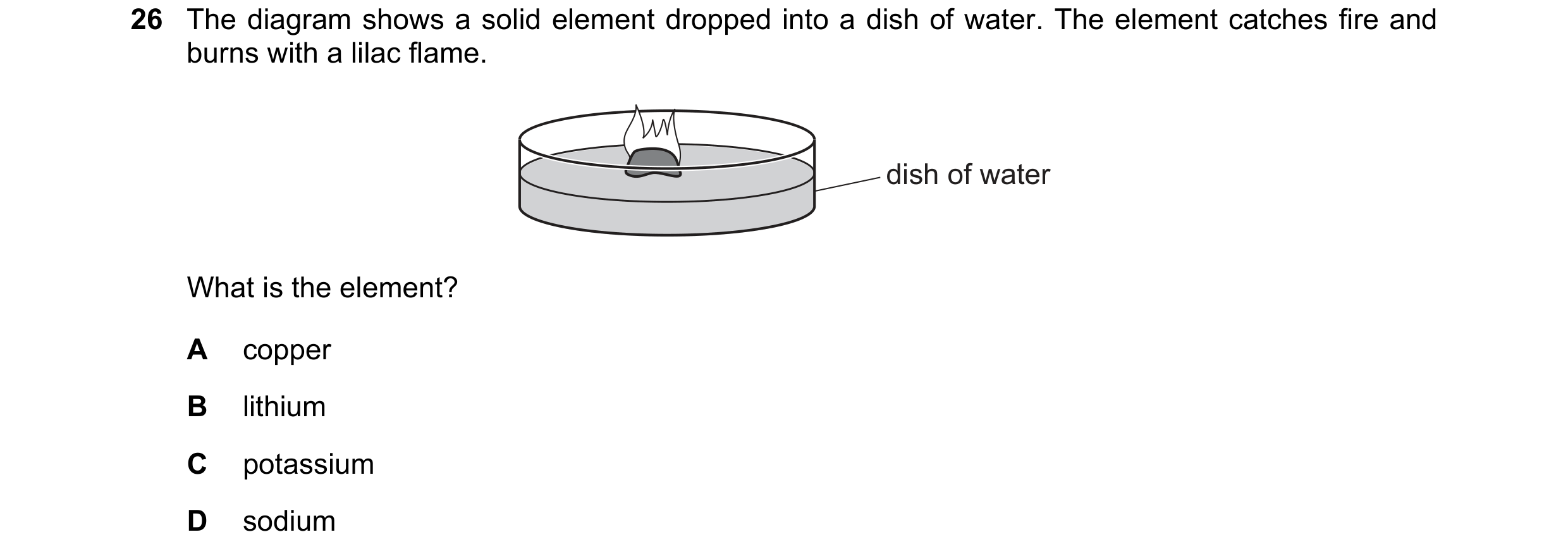
Q15 · The diagram shows a solid element dropped into a dish of water 0653/22 Feb/March 2025
26 The diagram shows a solid element dropped into a dish of water. The element catches fire and burns with a lilac flame. dish of water What is the element? A copper B lithium C potassium D sodium
1 marks
Answer: C
This question in 0653/22 Feb/March 2025
Q16 · Which metal reacts most quickly with cold water? 0653/21 Oct/Nov 2025
19 Which metal reacts most quickly with cold water? A calcium B magnesium C potassium D sodium
1 marks
Answer: C
This question in 0653/21 Oct/Nov 2025
Q17 · Which statement about Group I elements is correct? 0653/22 Oct/Nov 2025
22 Which statement about Group I elements is correct? A Lithium and potassium are poor electrical conductors. B Potassium has a higher density than lithium. C Sodium and potassium are relatively hard metals. D Sodium reacts with water to produce a lilac flame.
1 marks
Answer: B
This question in 0653/22 Oct/Nov 2025
 1 / 5
1 / 5
 2 / 5
2 / 5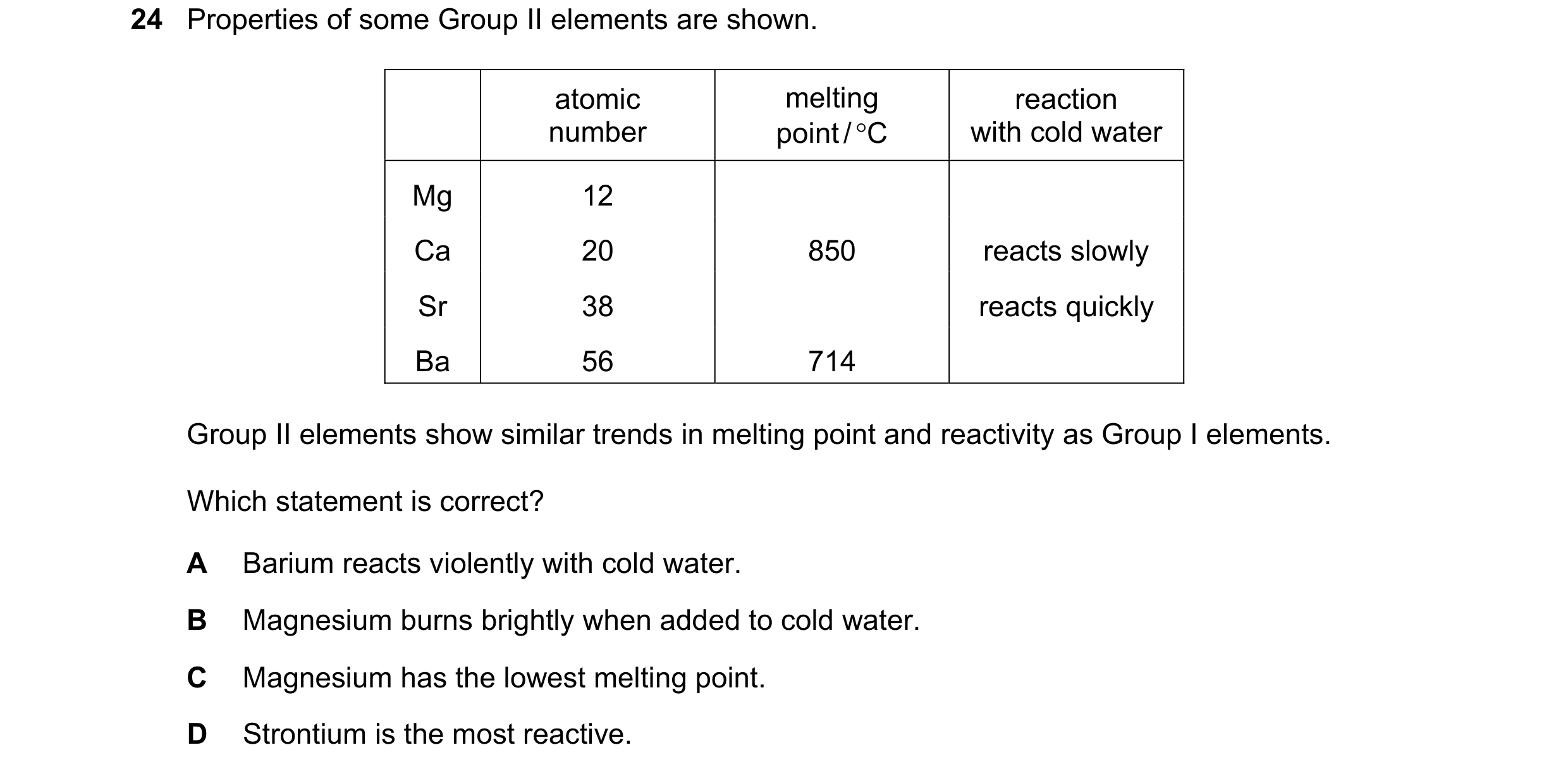
 3 / 5
3 / 5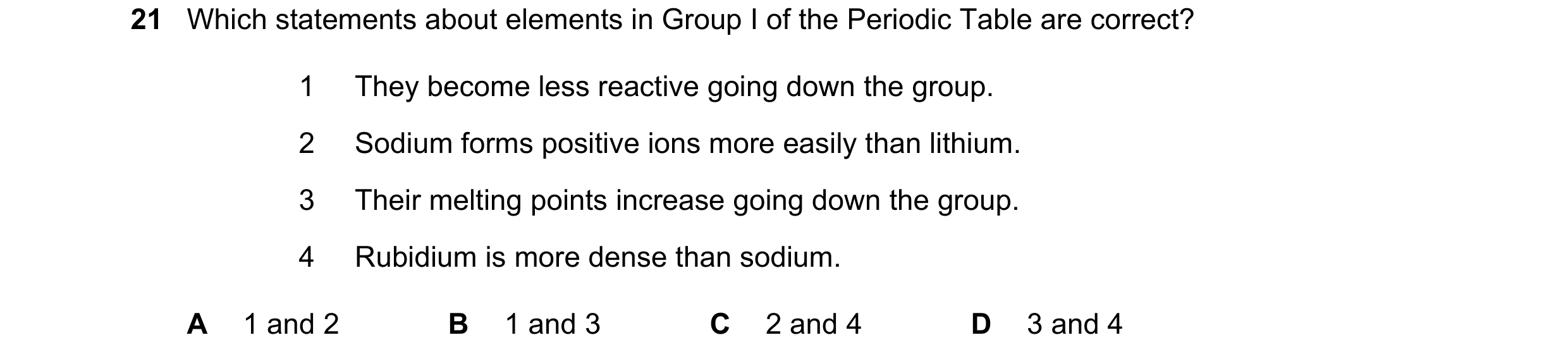
 4 / 5
4 / 5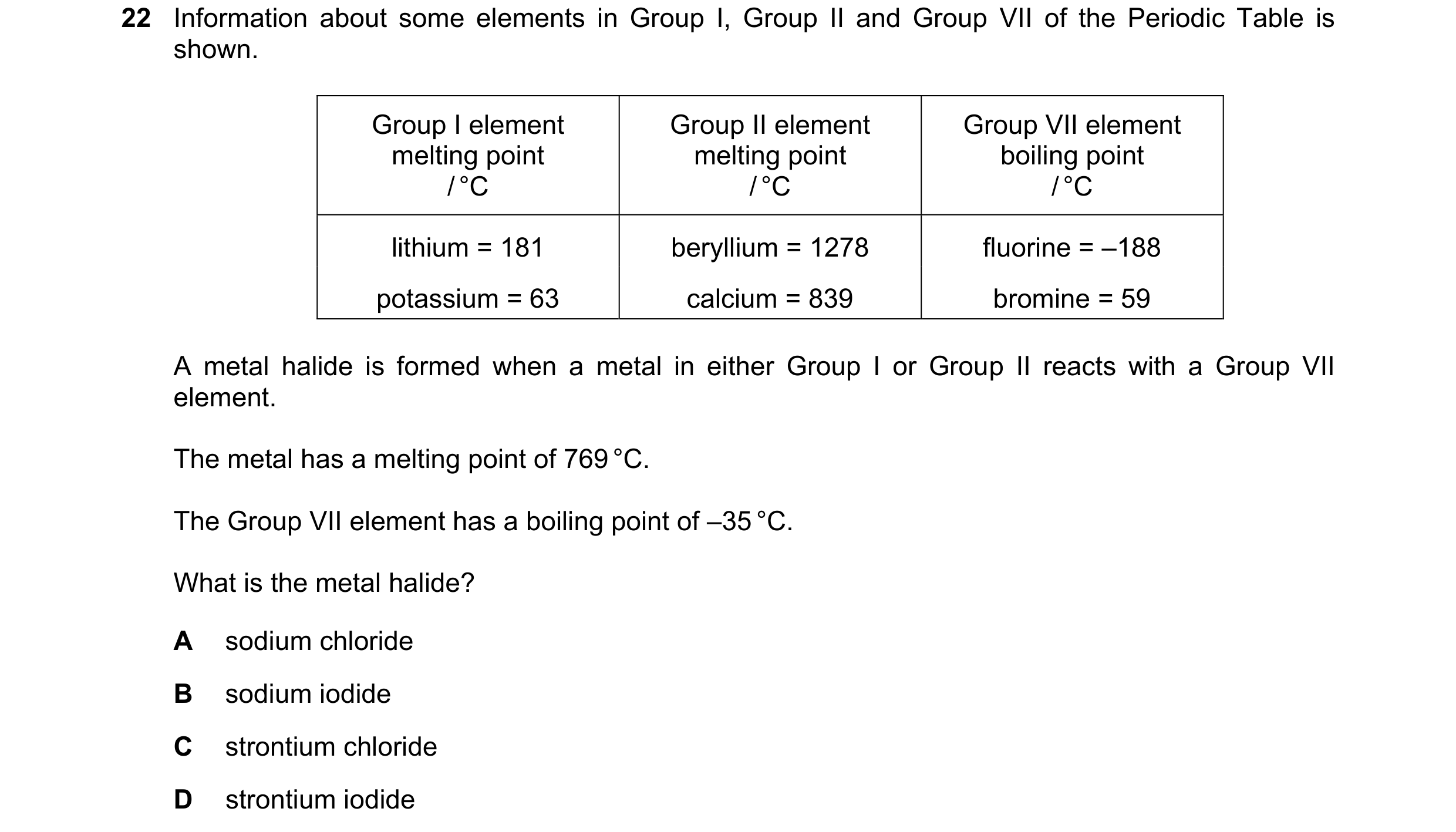

 5 / 5
5 / 5