Questions as text
Q1 · During transpiration water is lost from the leaves of a plant 0653/32 Oct/Nov 2017
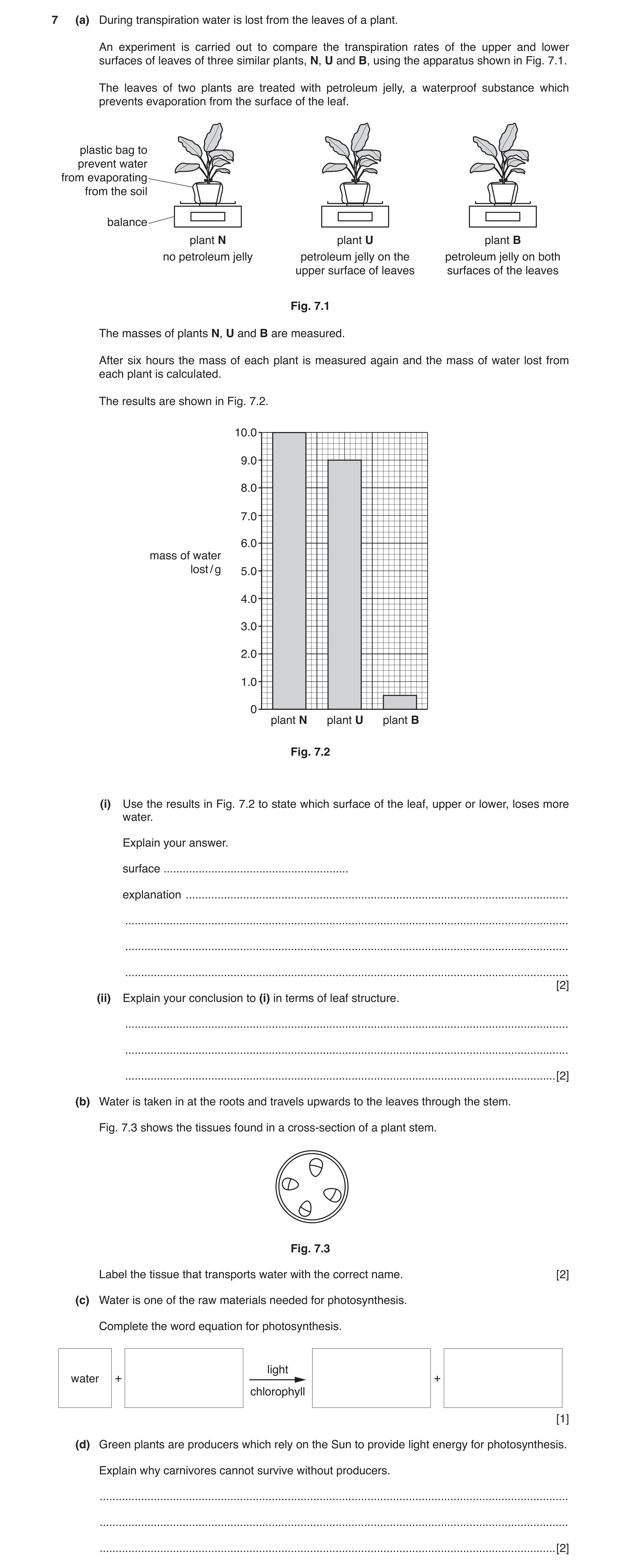
7 (a) During transpiration water is lost from the leaves of a plant. An experiment is carried out to compare the transpiration rates of the upper and lower surfaces of leaves of three similar plants, N, U and B, using the apparatus shown in Fig. 7.1. The leaves of two plants are treated with petroleum jelly, a waterproof substance which prevents evaporation from the surface of the leaf. plastic bag to prevent water from evaporating from the soil balance plant N plant U plant B no petroleum jelly petroleum jelly on the petroleum jelly on both upper surface of leaves surfaces of the leaves Fig. 7.1 The masses of plants N, U and B are measured. After six hours the mass of each plant is measured again and the mass of water lost from each plant is calculated. The results are shown in Fig. 7.2. 10.0 9.0 8.0 7.0 6.0 mass of water lost / g 5.0 4.0 3.0 2.0 1.0 0 plant N plant U plant B Fig. 7.2 (i) Use the results in Fig. 7.2 to state which surface of the leaf, upper or lower, loses more water. Explain your answer. surface … explanation … … … … [2] (ii) Explain your conclusion to (i) in terms of leaf structure. … … … [2] (b) Water is taken in at the roots and travels upwards to the leaves through the stem. Fig. 7.3 shows the tissues found in a cross-section of a plant stem. Fig. 7.3 Label the tissue that transports water with the correct name. [2] (c) Water is one of the raw materials needed for photosynthesis. Complete the word equation for photosynthesis. lightwater + + chlorophyll [1] (d) Green plants are producers which rely on the Sun to provide light energy for photosynthesis. Explain why carnivores cannot survive without producers. … … … [2]
9 marks
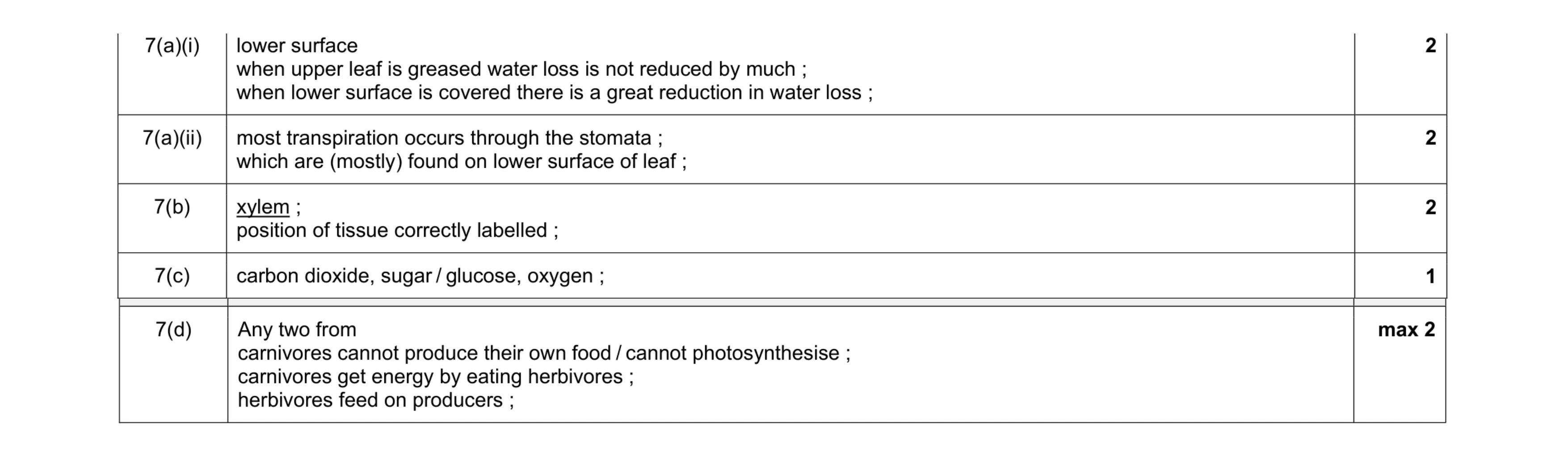
Mark scheme: 7(a)(i) lower surface when upper leaf is greased water loss is not reduced by much ; when lower surface is covered there is a great reduction in water loss ; 2 7(a)(ii) most transpiration occurs through the stomata ; which are (mostly) found on lower surface of leaf ; 2 7(b) xylem ; position of tissue correctly labelled ; 2 7(c) carbon dioxide, sugar / glucose, oxygen ; 1 Question Answer Marks 7(d) Any two from carnivores cannot produce their own food / cannot photosynthesise ; carnivores get energy by eating herbivores ; herbivores feed on producers ; max 2
This question in 0653/32 Oct/Nov 2017
Q2 · Some facts about processes in living organisms 0653/32 Feb/March 2018
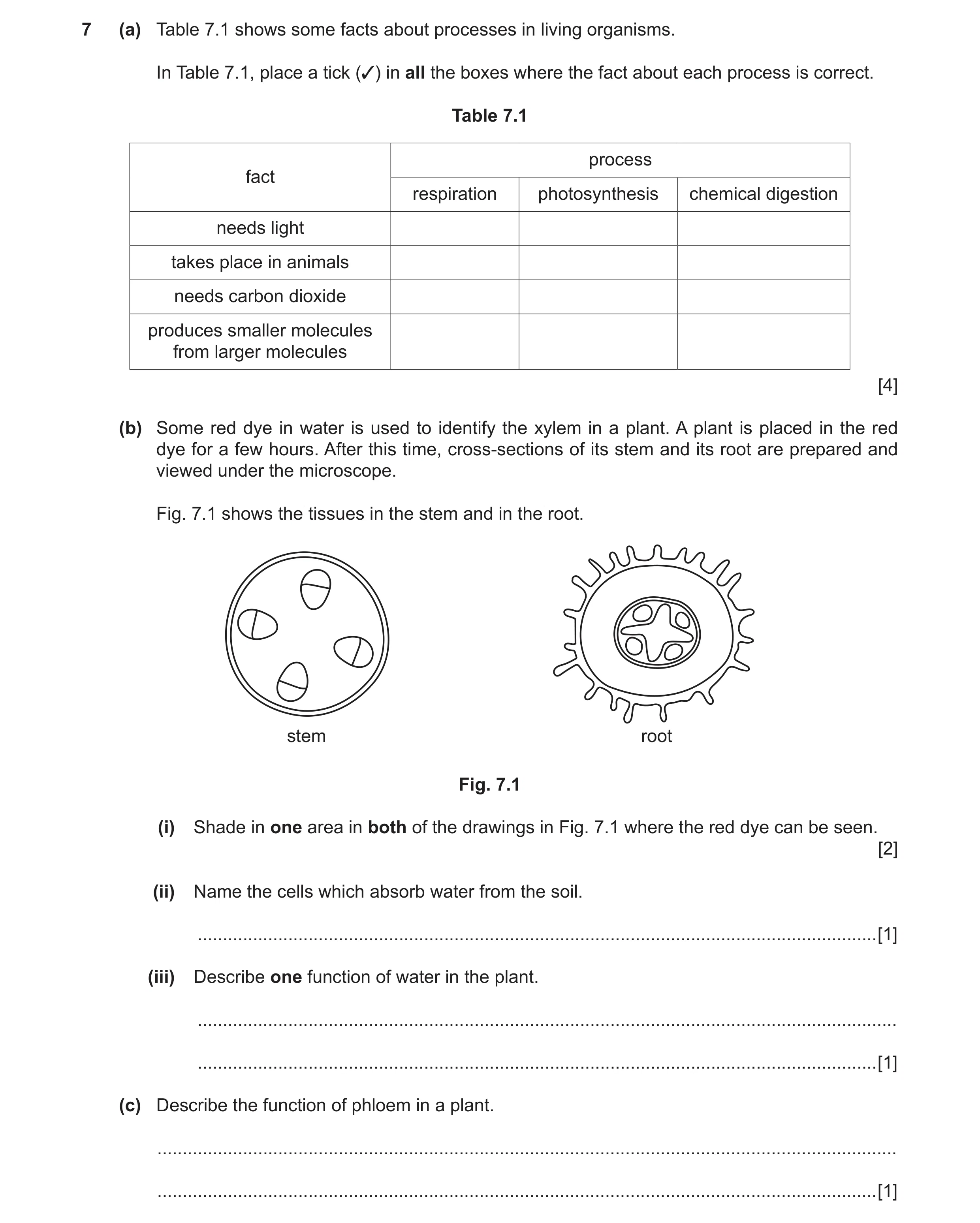
7 (a) Table 7.1 shows some facts about processes in living organisms. In Table 7.1, place a tick (3) in all the boxes where the fact about each process is correct. Table 7.1 process fact respiration photosynthesis chemical digestion needs light takes place in animals needs carbon dioxide produces smaller molecules from larger molecules [4] (b) Some red dye in water is used to identify the xylem in a plant. A plant is placed in the red dye for a few hours. After this time, cross-sections of its stem and its root are prepared and viewed under the microscope. Fig. 7.1 shows the tissues in the stem and in the root. stem root Fig. 7.1 (i) Shade in one area in both of the drawings in Fig. 7.1 where the red dye can be seen. [2] (ii) Name the cells which absorb water from the soil. … [1] (iii) Describe one function of water in the plant. … … [1] (c) Describe the function of phloem in a plant. … … [1]
9 marks
Mark scheme: 7(a) One mark for each correct line of table ;;;; fact process respiration photosynthesis chemical digestion needs light 9 takes place in animals 9 9 needs carbon dioxide 9 produces smaller molecules from larger molecules 9 9 4 7(b)(i) shading in at least one area of xylem in stem ; shading in at least one area of xylem in root ; 2 Question Answer Marks 7(b)(ii) root hair cells ; 1 7(b)(iii) replace water lost in transpiration / prevent wilting ; to carry minerals to all parts of the plant ; raw material in photosynthesis ; max 1 7(c) transports food / sugars / amino acids ; 1
This question in 0653/32 Feb/March 2018
Q3 · Cross-sections through a root and a stem of a flowering plant 0653/32 Oct/Nov 2018
7 (a) Fig. 7.1 shows cross-sections through a root and a stem of a flowering plant. A B Fig. 7.1 (i) State which diagram, A or B, represents the root. Give two reasons for your answer. The root is diagram … reason 1 … … reason 2 … … [2] (ii) On diagram B, in Fig. 7.1, shade in one area where the xylem is found. [1] (b) Use the words or phrases to complete the sentences about transpiration. Each word may be used once, more than once or not at all. cuticle diffuses dissolves guard cells higher lower mesophyll cells stomata similar xylem Water evaporates from the surfaces of … inside the leaf. This gives the air inside the leaf a … concentration of water vapour than the atmosphere. As a result the water vapour … out of the leaves through tiny holes called the … . [4] (c) Water is one of the raw materials for photosynthesis. Complete the word equation for photosynthesis. water + + [2]
9 marks
Mark scheme: 7(a)(i) A no mark presence of root hairs ; xylem / phloem / vascular tissue (stele) found in the central area ; 2 7(a)(ii) one area of xylem correctly shaded in B ; 1 7(b) mesophyll cells ; higher ; diffuses ; stomata ; 4 7(c) carbon dioxide ; sugar / glucose + oxygen ; 2
This question in 0653/32 Oct/Nov 2018
Q4 · Plants make their own food in leaves by the process of photosynthesis 0653/31 May/June 2019
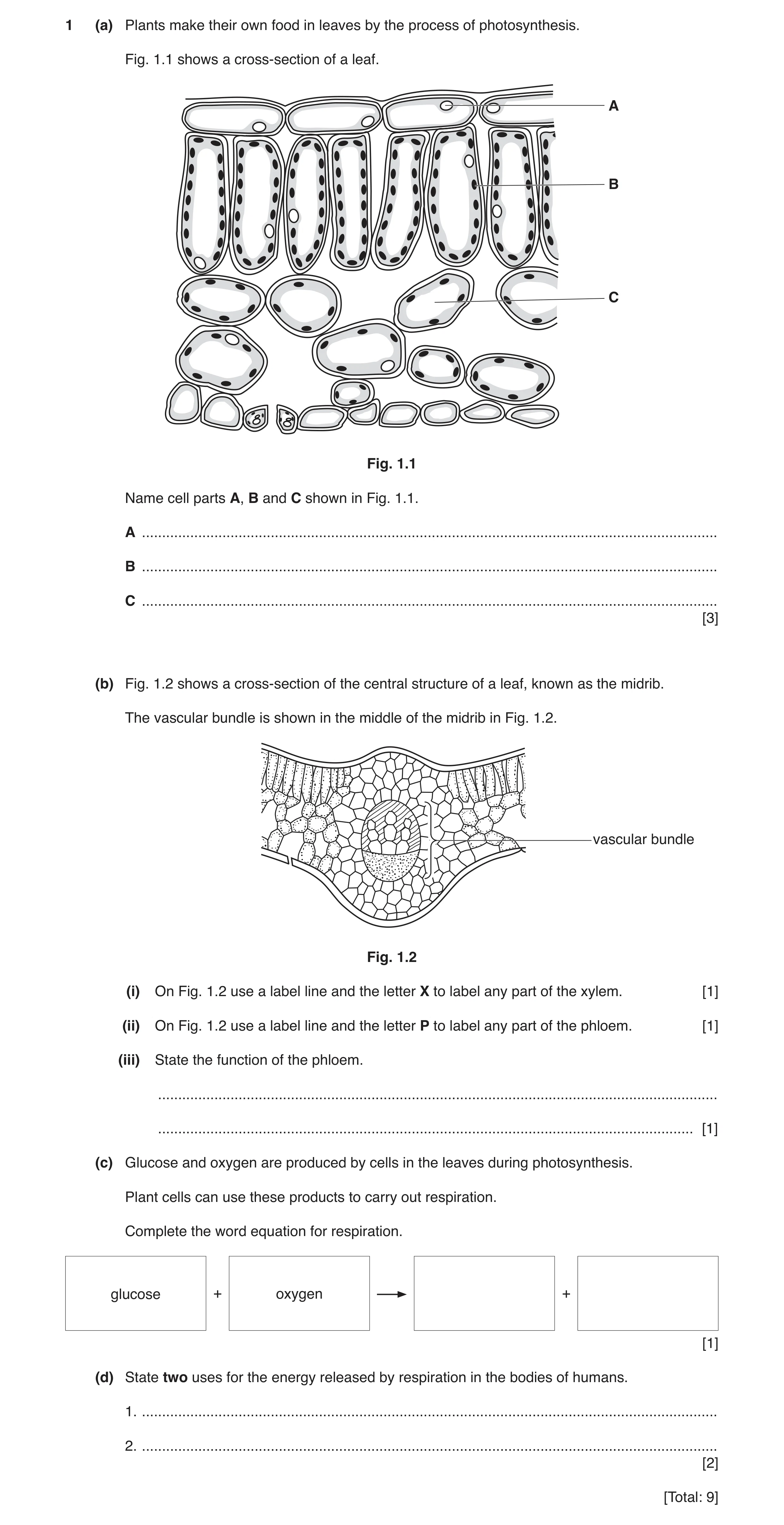
1 (a) Plants make their own food in leaves by the process of photosynthesis. Fig. 1.1 shows a cross-section of a leaf. A B C Fig. 1.1 Name cell parts A, B and C shown in Fig. 1.1. A … B … C … [3] (b) Fig. 1.2 shows a cross-section of the central structure of a leaf, known as the midrib. The vascular bundle is shown in the middle of the midrib in Fig. 1.2. vascular bundle Fig. 1.2 (i) On Fig. 1.2 use a label line and the letter X to label any part of the xylem. [1] (ii) On Fig. 1.2 use a label line and the letter P to label any part of the phloem. [1] (iii) State the function of the phloem. … … [1] (c) Glucose and oxygen are produced by cells in the leaves during photosynthesis. Plant cells can use these products to carry out respiration. Complete the word equation for respiration. glucose + oxygen + [1] (d) State two uses for the energy released by respiration in the bodies of humans. 1. … 2. … [2] [Total: 9]
9 marks
Mark scheme: 1(a) A nucleus ; B chloroplast ; C vacuole ; 3 1(b)(i) label X to any part of xylem area ; 1 1(b)(ii) label P to any part of phloem area ; 1 1(b)(iii) transport food substances (from leaves) ; 1 1(c) carbon dioxide and water ; (either order) 1 1(d) any two of muscle contraction ; protein synthesis ; growth ; maintenance of (a constant body) temperature ; 2
This question in 0653/31 May/June 2019
Q5 · Plants need water to survive 0653/31 Oct/Nov 2019
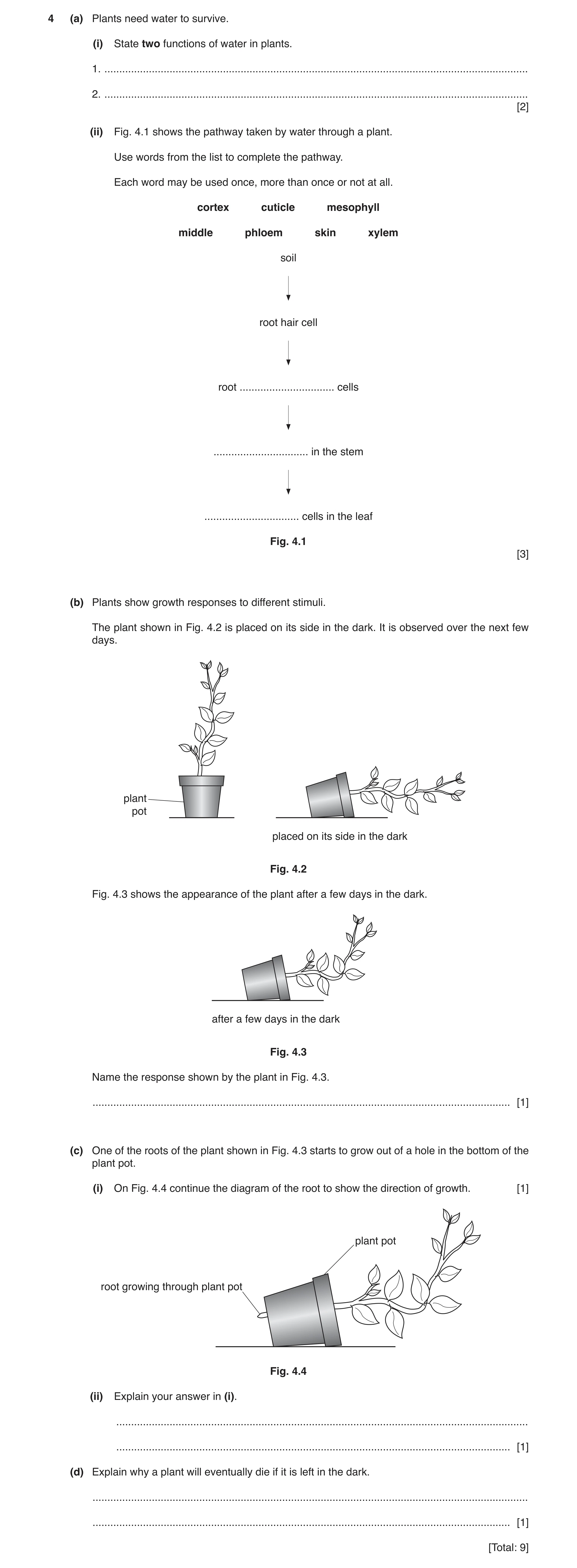
4 (a) Plants need water to survive. (i) State two functions of water in plants. 1. … 2. … [2] (ii) Fig. 4.1 shows the pathway taken by water through a plant. Use words from the list to complete the pathway. Each word may be used once, more than once or not at all. cortex cuticle mesophyll middle phloem skin xylem soil root hair cell root … cells … in the stem … cells in the leaf Fig. 4.1 [3] (b) Plants show growth responses to different stimuli. The plant shown in Fig. 4.2 is placed on its side in the dark. It is observed over the next few days. plant pot placed on its side in the dark Fig. 4.2 Fig. 4.3 shows the appearance of the plant after a few days in the dark. after a few days in the dark Fig. 4.3 Name the response shown by the plant in Fig. 4.3. … [1] (c) One of the roots of the plant shown in Fig. 4.3 starts to grow out of a hole in the bottom of the plant pot. (i) On Fig. 4.4 continue the diagram of the root to show the direction of growth. [1] plant pot root growing through plant pot Fig. 4.4 (ii) Explain your answer in (i). … … [1] (d) Explain why a plant will eventually die if it is left in the dark. … … [1] [Total: 9]
9 marks
Mark scheme: 4(a)(i) any two from: for photosynthesis ; transport in plants ; as a solvent ; 2 4(a)(ii) cortex ; xylem ; mesophyll ; 3 4(b) gravitropism ; 1 4(c)(i) root continued and bending downwards ; 1 4(c)(ii) roots respond to gravity; 1 4(d) no light for photosynthesis ; 1
This question in 0653/31 Oct/Nov 2019
Q6 · Diagrams of a plant cell before and after the cell is immersed in concentrated sugar… 0653/31 Oct/Nov 2020
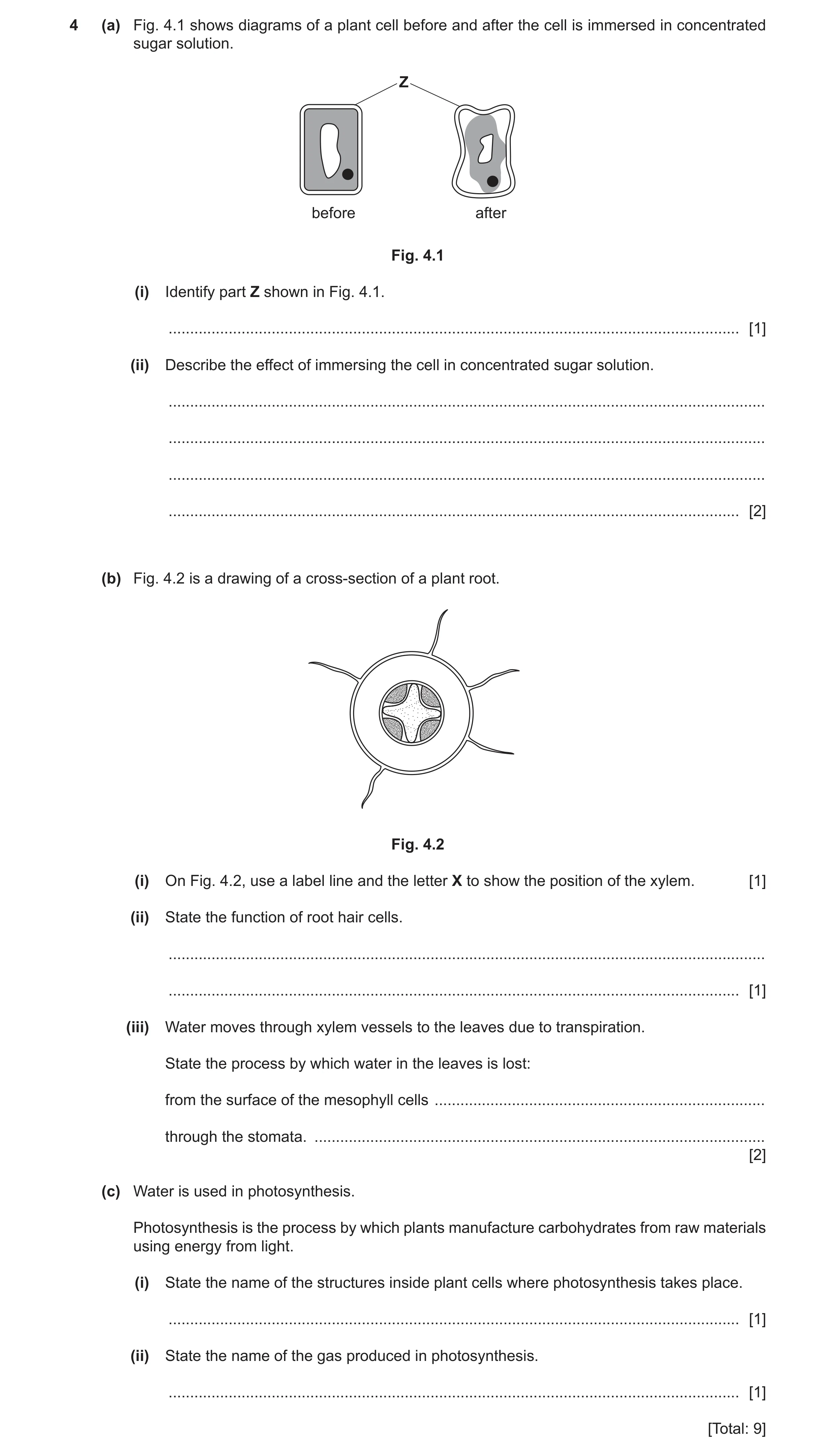
4 (a) Fig. 4.1 shows diagrams of a plant cell before and after the cell is immersed in concentrated sugar solution. Z before after Fig. 4.1 (i) Identify part Z shown in Fig. 4.1. … [1] (ii) Describe the effect of immersing the cell in concentrated sugar solution. … … … … [2] (b) Fig. 4.2 is a drawing of a cross-section of a plant root. Fig. 4.2 (i) On Fig. 4.2, use a label line and the letter X to show the position of the xylem. [1] (ii) State the function of root hair cells. … … [1] (iii) Water moves through xylem vessels to the leaves due to transpiration. State the process by which water in the leaves is lost: from the surface of the mesophyll cells … through the stomata. … [2] (c) Water is used in photosynthesis. Photosynthesis is the process by which plants manufacture carbohydrates from raw materials using energy from light. (i) State the name of the structures inside plant cells where photosynthesis takes place. … [1] (ii) State the name of the gas produced in photosynthesis. … [1] [Total: 9]
9 marks
Mark scheme: 4(a)(i) cell wall ; 1 4(a)(ii) any two from: (cell / cytoplasm / vacuole) shrinks ; water moves out / water moves across partially permeable membrane ; by, osmosis / diffusion ; 2 Question Answer Marks 4(b)(i) label line in any xylem cell ; 1 4(b)(ii) take in, water / mineral ions ; 1 4(b)(iii) evaporation ; diffusion ; 2 4(c)(i) chloroplasts ; 1 4(c)(ii) oxygen ; 1
This question in 0653/31 Oct/Nov 2020
Q7 · A cross-section of a plant stem as seen under a microscope 0653/32 Oct/Nov 2020
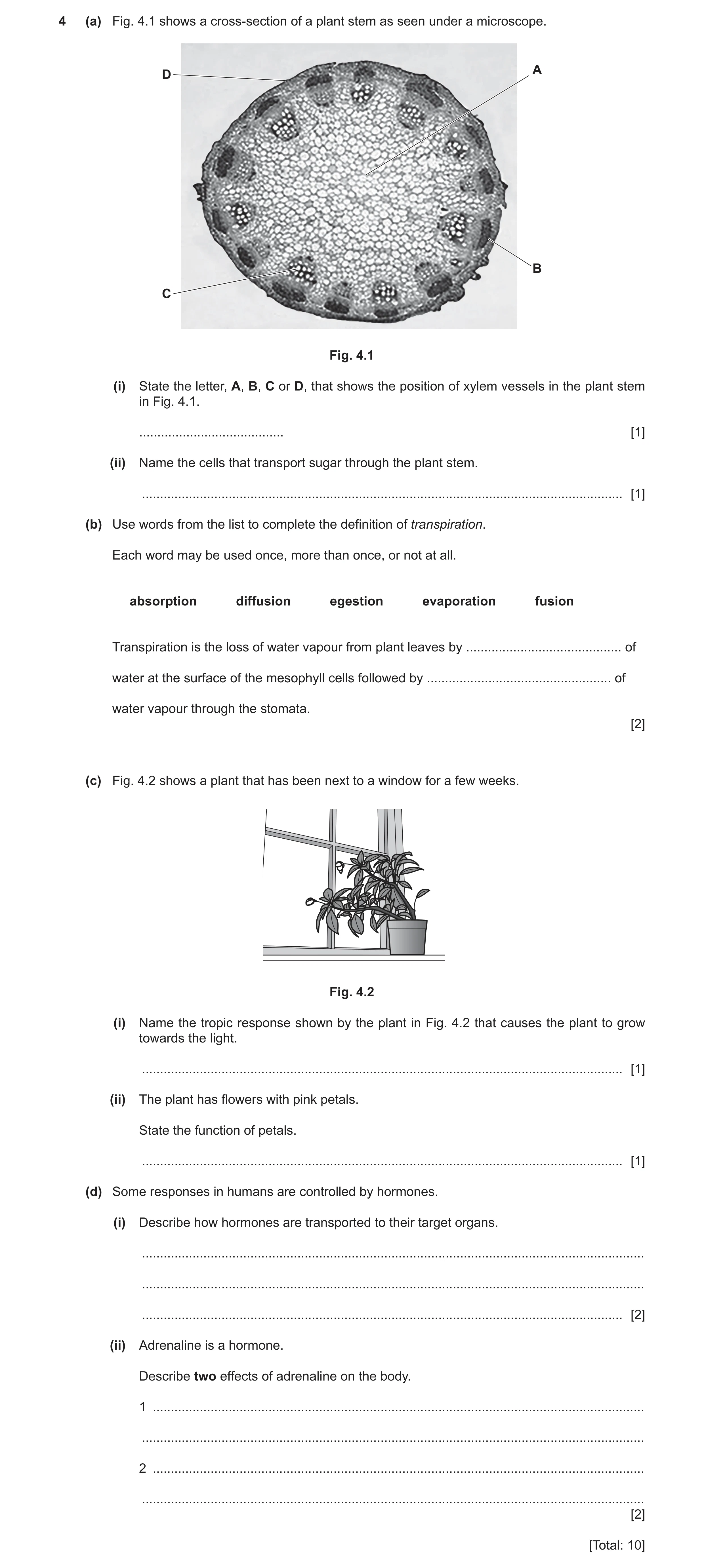
4 (a) Fig. 4.1 shows a cross-section of a plant stem as seen under a microscope. A D B C Fig. 4.1 (i) State the letter, A, B, C or D, that shows the position of xylem vessels in the plant stem in Fig. 4.1. … [1] (ii) Name the cells that transport sugar through the plant stem. … [1] (b) Use words from the list to complete the definition of transpiration. Each word may be used once, more than once, or not at all. absorption diffusion egestion evaporation fusion Transpiration is the loss of water vapour from plant leaves by … of water at the surface of the mesophyll cells followed by … of water vapour through the stomata. [2] (c) Fig. 4.2 shows a plant that has been next to a window for a few weeks. Fig. 4.2 (i) Name the tropic response shown by the plant in Fig. 4.2 that causes the plant to grow towards the light. … [1] (ii) The plant has flowers with pink petals. State the function of petals. … [1] (d) Some responses in humans are controlled by hormones. (i) Describe how hormones are transported to their target organs. … … … [2] (ii) Adrenaline is a hormone. Describe two effects of adrenaline on the body. 1 … … 2 … … [2] [Total: 10]
10 marks
Mark scheme: 4(a)(i) C ; 1 4(a)(ii) phloem ; 1 4(b) evaporation ; diffusion ; 2 4(c)(i) phototropism ; 1 4(c)(ii) to attract insects ; 1 Question Answer Marks 4(d)(i) any two from: in the blood ; in the plasma ; through, the circulatory system / (blood) vessels ; 2 4(d)(ii) any two from: increased, breathing rate / depth of breathing ; increased, pulse rate / heart rate ; widened pupils ; 2
This question in 0653/32 Oct/Nov 2020
Q8 · Part of a food web from a lake 0653/32 Feb/March 2021
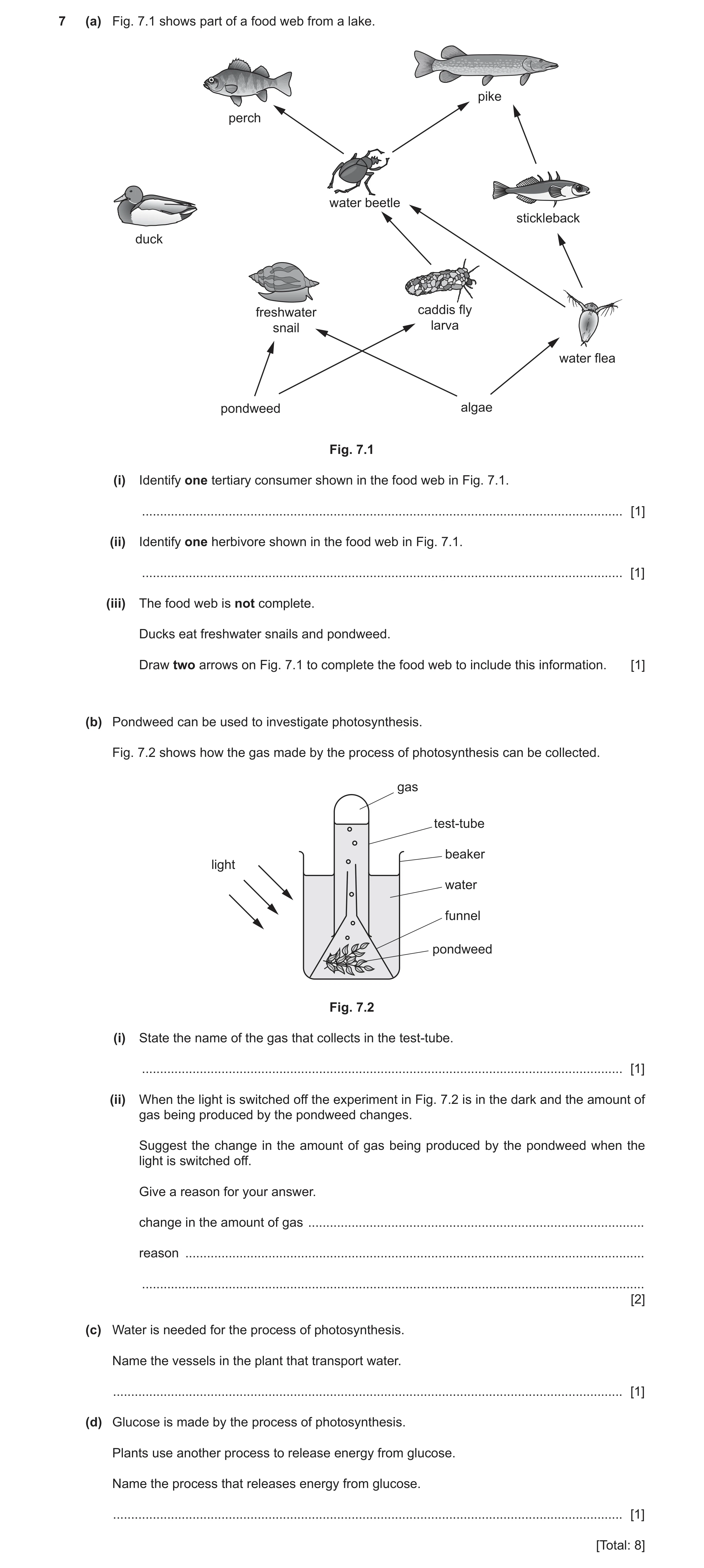
7 (a) Fig. 7.1 shows part of a food web from a lake. pike perch water beetle stickleback duck freshwater caddis fly snail larva water flea pondweed algae Fig. 7.1 (i) Identify one tertiary consumer shown in the food web in Fig. 7.1. … [1] (ii) Identify one herbivore shown in the food web in Fig. 7.1. … [1] (iii) The food web is not complete. Ducks eat freshwater snails and pondweed. Draw two arrows on Fig. 7.1 to complete the food web to include this information. [1] (b) Pondweed can be used to investigate photosynthesis. Fig. 7.2 shows how the gas made by the process of photosynthesis can be collected. gas test-tube beaker light water funnel pondweed Fig. 7.2 (i) State the name of the gas that collects in the test-tube. … [1] (ii) When the light is switched off the experiment in Fig. 7.2 is in the dark and the amount of gas being produced by the pondweed changes. Suggest the change in the amount of gas being produced by the pondweed when the light is switched off. Give a reason for your answer. change in the amount of gas … reason … … [2] (c) Water is needed for the process of photosynthesis. Name the vessels in the plant that transport water. … [1] (d) Glucose is made by the process of photosynthesis. Plants use another process to release energy from glucose. Name the process that releases energy from glucose. … [1] [Total: 8]
8 marks
Mark scheme: 7(a)(i) perch / pike ; 1 7(a)(ii) freshwater snail / caddis fly larva / water flea ; 1 7(a)(iii) arrow from freshwater snail to duck AND arrow from pondweed to duck ; 1 7(b)(i) oxygen ; 1 7(b)(ii) less / no, gas produced ; (because) light is needed for photosynthesis ; 2 7(c) xylem ; 1 7(d) (aerobic) respiration ; 1
This question in 0653/32 Feb/March 2021
Q9 · A student investigates water loss from the leaves of a plant 0653/32 May/June 2021
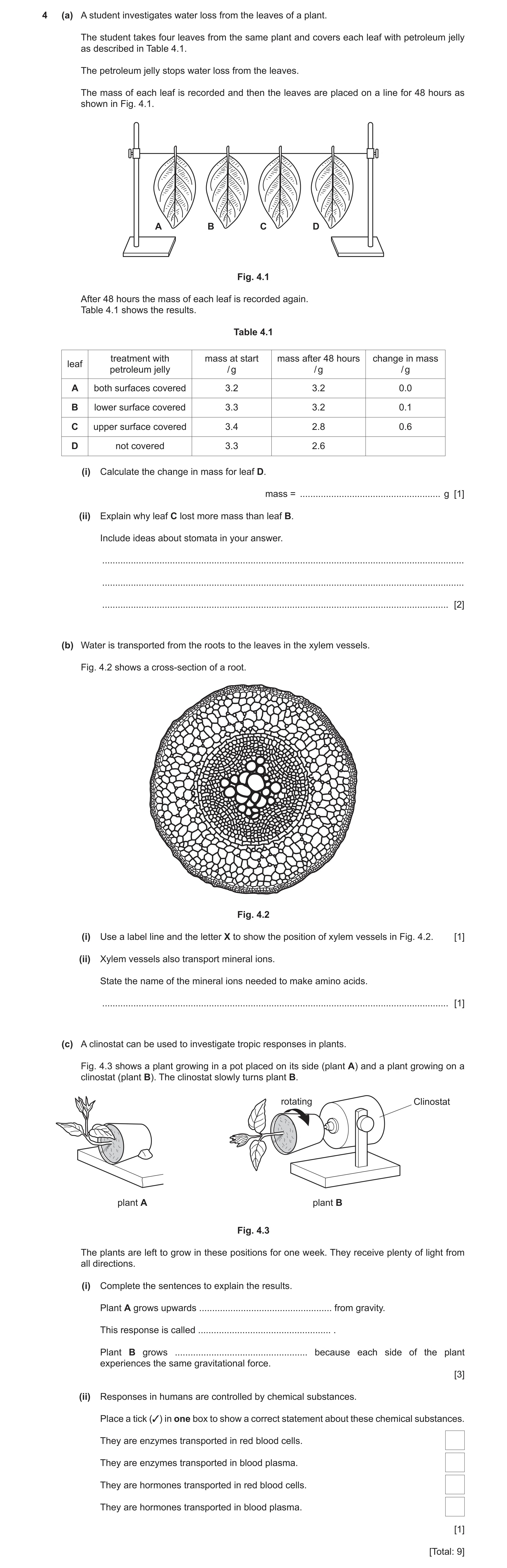
4 (a) A student investigates water loss from the leaves of a plant. The student takes four leaves from the same plant and covers each leaf with petroleum jelly as described in Table 4.1. The petroleum jelly stops water loss from the leaves. The mass of each leaf is recorded and then the leaves are placed on a line for 48 hours as shown in Fig. 4.1. A B C D Fig. 4.1 After 48 hours the mass of each leaf is recorded again. Table 4.1 shows the results. Table 4.1 treatment with mass at start mass after 48 hours change in mass leaf petroleum jelly / g / g / g A both surfaces covered 3.2 3.2 0.0 B lower surface covered 3.3 3.2 0.1 C upper surface covered 3.4 2.8 0.6 D not covered 3.3 2.6 (i) Calculate the change in mass for leaf D. mass = … g [1] (ii) Explain why leaf C lost more mass than leaf B. Include ideas about stomata in your answer. … … … [2] (b) Water is transported from the roots to the leaves in the xylem vessels. Fig. 4.2 shows a cross-section of a root. Fig. 4.2 (i) Use a label line and the letter X to show the position of xylem vessels in Fig. 4.2. [1] (ii) Xylem vessels also transport mineral ions. State the name of the mineral ions needed to make amino acids. … [1] (c) A clinostat can be used to investigate tropic responses in plants. Fig. 4.3 shows a plant growing in a pot placed on its side (plant A) and a plant growing on a clinostat (plant B). The clinostat slowly turns plant B. rotating Clinostat plant A plant B Fig. 4.3 The plants are left to grow in these positions for one week. They receive plenty of light from all directions. (i) Complete the sentences to explain the results. Plant A grows upwards … from gravity. This response is called … . Plant B grows … because each side of the plant experiences the same gravitational force. [3] (ii) Responses in humans are controlled by chemical substances. Place a tick (✓) in one box to show a correct statement about these chemical substances. They are enzymes transported in red blood cells. They are enzymes transported in blood plasma. They are hormones transported in red blood cells. They are hormones transported in blood plasma. [1] [Total: 9]
9 marks
Mark scheme: 4(a)(i) 0.7 ; 1 4(a)(ii) any two from: water is lost from the stomata ; more stomata on lower surface (of leaves) ; more water is lost from the lower surface (of leaves) ; 2 4(b)(i) line drawn to cells at centre of root ; 1 4(b)(ii) nitrate ; 1 4(c)(i) away ; (negative) gravitropism ; horizontally ; 3 4(c)(ii) They are enzymes transported in red blood cells. They are enzymes transported in blood plasma. They are hormones transported in red blood cells. They are hormones transported in blood plasma. ; 1
This question in 0653/32 May/June 2021
Q10 · Nutrition is one of the characteristics of living organisms 0653/33 May/June 2021
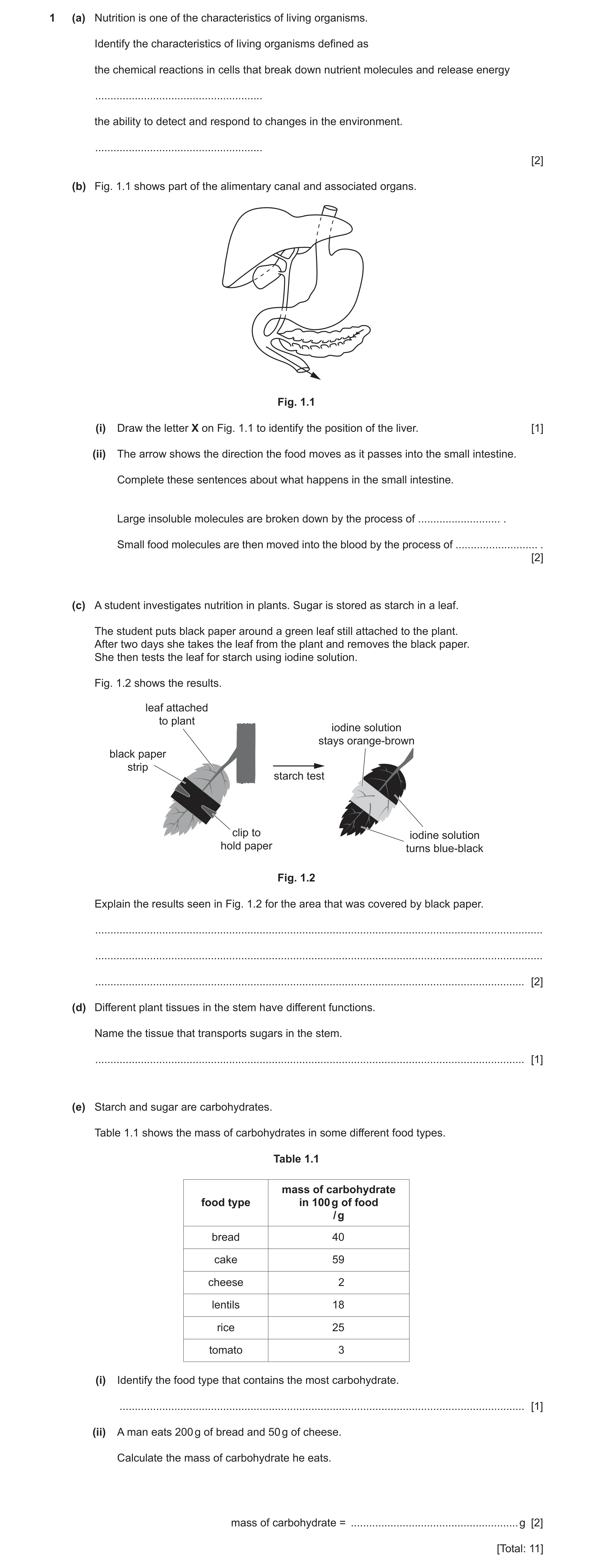
1 (a) Nutrition is one of the characteristics of living organisms. Identify the characteristics of living organisms defined as the chemical reactions in cells that break down nutrient molecules and release energy … the ability to detect and respond to changes in the environment. … [2] (b) Fig. 1.1 shows part of the alimentary canal and associated organs. Fig. 1.1 (i) Draw the letter X on Fig. 1.1 to identify the position of the liver. [1] (ii) The arrow shows the direction the food moves as it passes into the small intestine. Complete these sentences about what happens in the small intestine. Large insoluble molecules are broken down by the process of … . Small food molecules are then moved into the blood by the process of … . [2] (c) A student investigates nutrition in plants. Sugar is stored as starch in a leaf. The student puts black paper around a green leaf still attached to the plant. After two days she takes the leaf from the plant and removes the black paper. She then tests the leaf for starch using iodine solution. Fig. 1.2 shows the results. leaf attached to plant iodine solution stays orange-brown black paper strip starch test clip to iodine solution hold paper turns blue-black Fig. 1.2 Explain the results seen in Fig. 1.2 for the area that was covered by black paper. … … … [2] (d) Different plant tissues in the stem have different functions. Name the tissue that transports sugars in the stem. … [1] (e) Starch and sugar are carbohydrates. Table 1.1 shows the mass of carbohydrates in some different food types. Table 1.1 mass of carbohydrate food type in 100 g of food / g bread 40 cake 59 cheese 2 lentils 18 rice 25 tomato 3 (i) Identify the food type that contains the most carbohydrate. … [1] (ii) A man eats 200 g of bread and 50 g of cheese. Calculate the mass of carbohydrate he eats. mass of carbohydrate = … g [2] [Total: 11]
11 marks
Mark scheme: 1(a) respiration ; sensitivity ; 2 1(b)(i) centre of X must be on liver ; 1 1(b)(ii) digestion ; absorption ; 2 1(c) no starch is made ; as light is needed for photosynthesis ; 2 1(d) phloem ; 1 1(e)(i) cake ; 1 1(e)(ii) (40 x 2) + (2 x 0.5) ; 81 (g) ; 2
This question in 0653/33 May/June 2021
Q11 · A diagram of the human heart 0653/33 May/June 2022
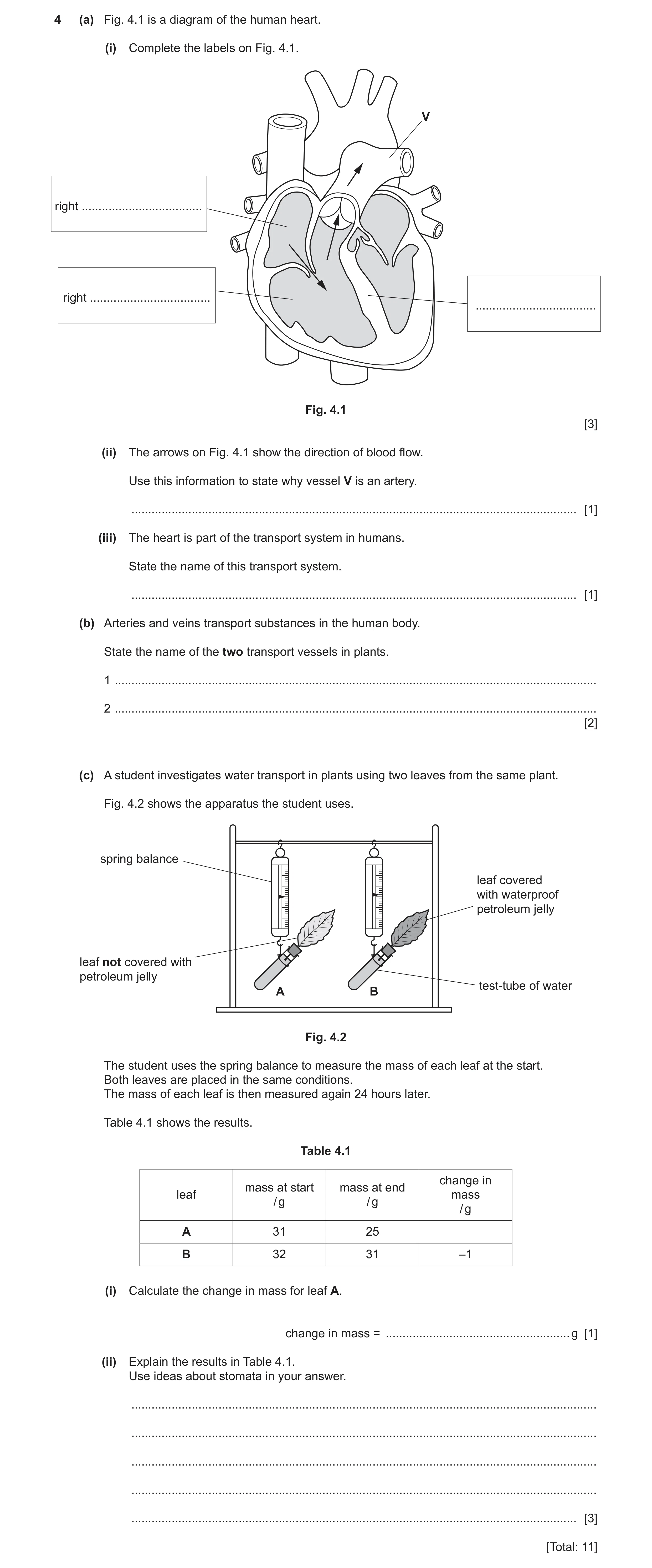
4 (a) Fig. 4.1 is a diagram of the human heart. (i) Complete the labels on Fig. 4.1. V right … right … … Fig. 4.1 [3] (ii) The arrows on Fig. 4.1 show the direction of blood flow. Use this information to state why vessel V is an artery. … [1] (iii) The heart is part of the transport system in humans. State the name of this transport system. … [1] (b) Arteries and veins transport substances in the human body. State the name of the two transport vessels in plants. 1 … 2 … [2] (c) A student investigates water transport in plants using two leaves from the same plant. Fig. 4.2 shows the apparatus the student uses. spring balance leaf covered with waterproof petroleum jelly leaf not covered with petroleum jelly test-tube of water A B Fig. 4.2 The student uses the spring balance to measure the mass of each leaf at the start. Both leaves are placed in the same conditions. The mass of each leaf is then measured again 24 hours later. Table 4.1 shows the results. Table 4.1 change in mass at start mass at end leaf mass / g / g / g A 31 25 B 32 31 –1 (i) Calculate the change in mass for leaf A. change in mass = … g [1] (ii) Explain the results in Table 4.1. Use ideas about stomata in your answer. … … … … … [3] [Total: 11]
11 marks
Mark scheme: 4(a)(i) atrium ; ventricle ; septum ; 3 4(a)(ii) idea it is taking blood away from the heart ; 1 4(a)(iii) circulatory / circulation ; 1 4(b) phloem ; xylem ; 2 4(c)(i) –6 (g) ; 1 4(c)(ii) any three from: water is lost from stomata ; by transpiration ; in B, stomata are blocked / water cannot get through stomata ; (B) less water loss so less mass loss ; Max 3 marks 3
This question in 0653/33 May/June 2022
Q12 · A photograph of an insect‑pollinated flower 0653/32 Oct/Nov 2022
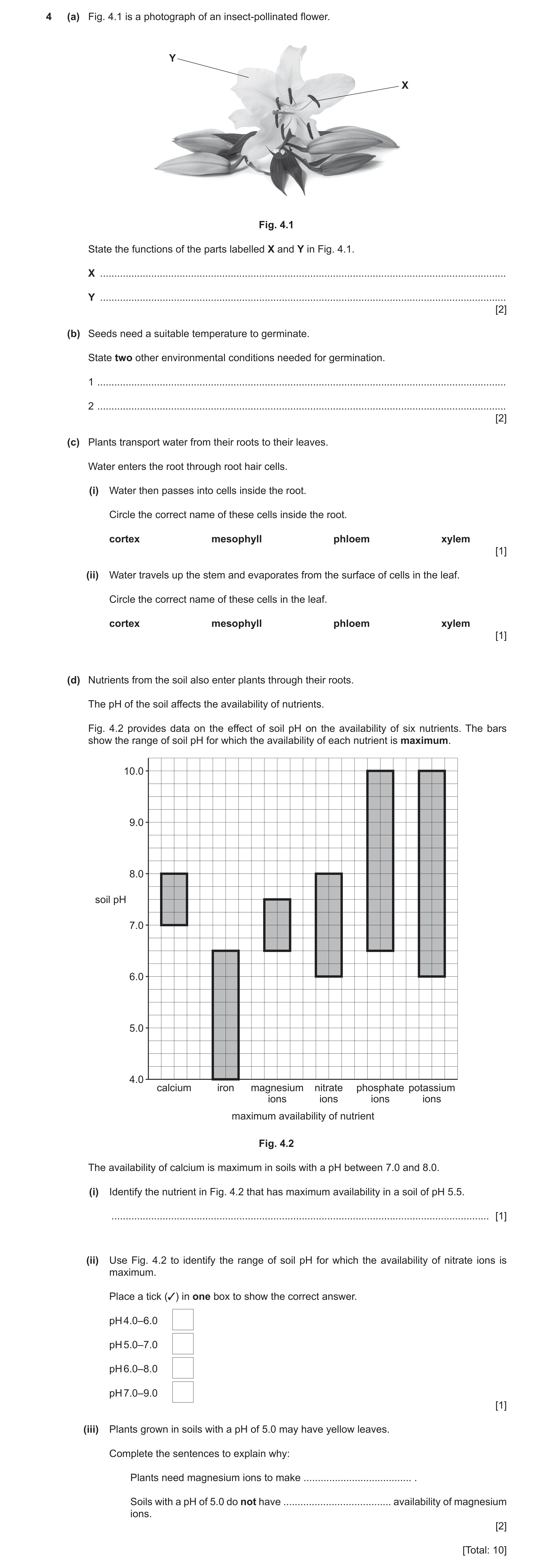
4 (a) Fig. 4.1 is a photograph of an insect‑pollinated flower. Y X Fig. 4.1 State the functions of the parts labelled X and Y in Fig. 4.1. X … Y … [2] (b) Seeds need a suitable temperature to germinate. State two other environmental conditions needed for germination. 1 … 2 … [2] (c) Plants transport water from their roots to their leaves. Water enters the root through root hair cells. (i) Water then passes into cells inside the root. Circle the correct name of these cells inside the root. cortex mesophyll phloem xylem [1] (ii) Water travels up the stem and evaporates from the surface of cells in the leaf. Circle the correct name of these cells in the leaf. cortex mesophyll phloem xylem [1] (d) Nutrients from the soil also enter plants through their roots. The pH of the soil affects the availability of nutrients. Fig. 4.2 provides data on the effect of soil pH on the availability of six nutrients. The bars show the range of soil pH for which the availability of each nutrient is maximum. 10.0 9.0 8.0 soil pH 7.0 6.0 5.0 4.0 calcium iron magnesium nitrate phosphate potassium ions ions ions ions maximum availability of nutrient Fig. 4.2 The availability of calcium is maximum in soils with a pH between 7.0 and 8.0. (i) Identify the nutrient in Fig. 4.2 that has maximum availability in a soil of pH 5.5. … [1] (ii) Use Fig. 4.2 to identify the range of soil pH for which the availability of nitrate ions is maximum. Place a tick (✓) in one box to show the correct answer. pH 4.0–6.0 pH 5.0–7.0 pH 6.0–8.0 pH 7.0–9.0 [1] (iii) Plants grown in soils with a pH of 5.0 may have yellow leaves. Complete the sentences to explain why: Plants need magnesium ions to make … . Soils with a pH of 5.0 do not have … availability of magnesium ions. [2] [Total: 10]
10 marks
Mark scheme: 4(a) X produce / release, pollen ; 2 Y attract insects (for pollination) ; 4(b) (presence of) water ; 2 (presence of) oxygen ; 4(c)(i) cortex ; 1 4(c)(ii) mesophyll ; 1 4(d)(i) iron ; 1 4(d)(ii) pH 6.0–8.0 ; 1 4(d)(iii) chlorophyll ; 2 maximum ;
This question in 0653/32 Oct/Nov 2022
Q13 · Transpiration is loss of water vapour from plant leaves 0653/31 Oct/Nov 2023
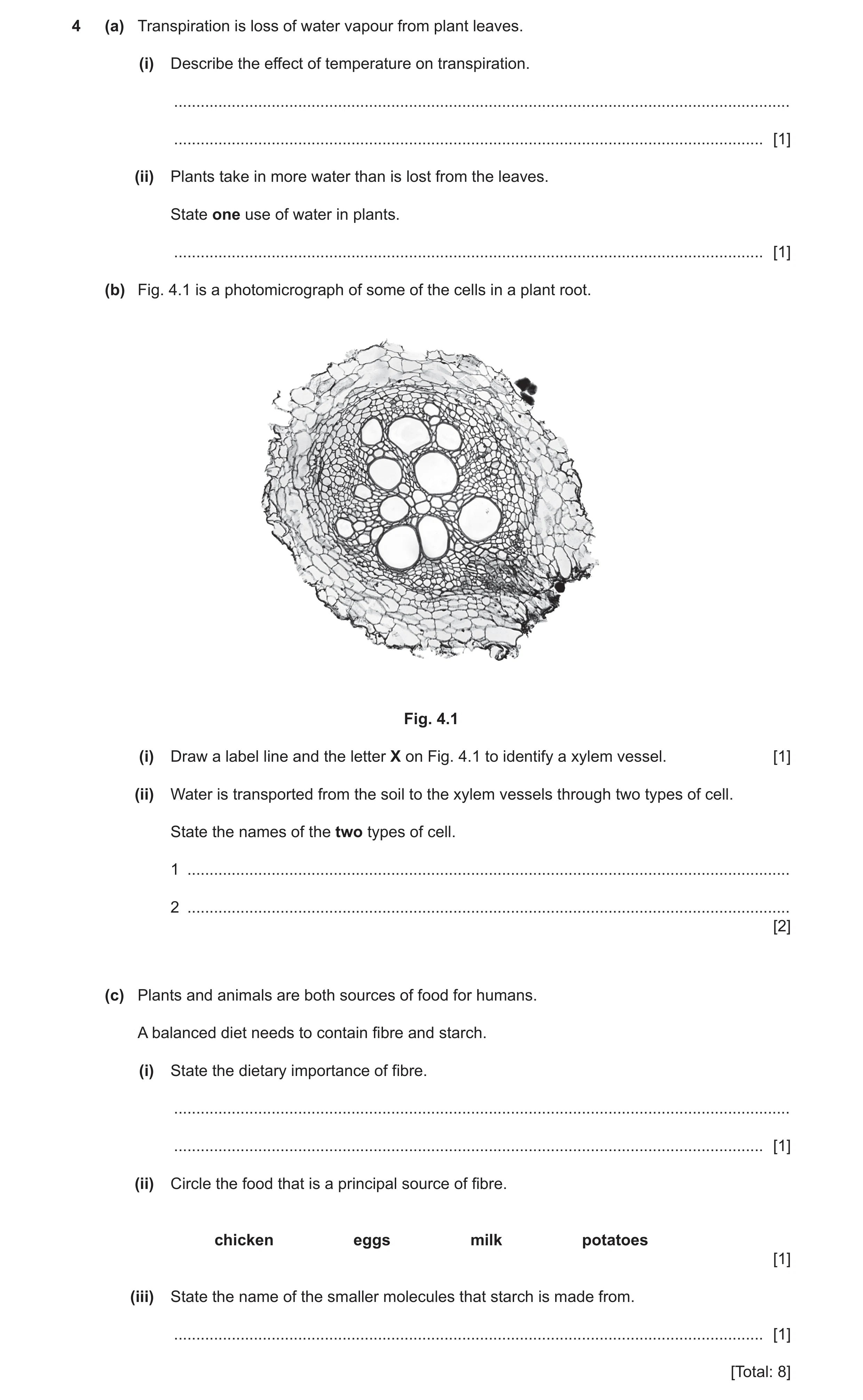
4 (a) Transpiration is loss of water vapour from plant leaves. (i) Describe the effect of temperature on transpiration. … … [1] (ii) Plants take in more water than is lost from the leaves. State one use of water in plants. … [1] (b) Fig. 4.1 is a photomicrograph of some of the cells in a plant root. Fig. 4.1 (i) Draw a label line and the letter X on Fig. 4.1 to identify a xylem vessel. [1] (ii) Water is transported from the soil to the xylem vessels through two types of cell. State the names of the two types of cell. 1 … 2 … [2] (c) Plants and animals are both sources of food for humans. A balanced diet needs to contain fibre and starch. (i) State the dietary importance of fibre. … … [1] (ii) Circle the food that is a principal source of fibre. chicken eggs milk potatoes [1] (iii) State the name of the smaller molecules that starch is made from. … [1] [Total: 8]
8 marks
Mark scheme: 4(a)(i) as temperature increases, transpiration increases / ORA ; 1 4(a)(ii) photosynthesis / AVP ; 1 4(b)(i) any large vessel in centre labelled ; 1 4(b)(ii) root hair (cells) ; 2 cortex (cells) ; 4(c)(i) helps to move food through the alimentary canal ; 1 4(c)(ii) potatoes ; 1 4(c)(iii) glucose ; 1
This question in 0653/31 Oct/Nov 2023
 3 / 23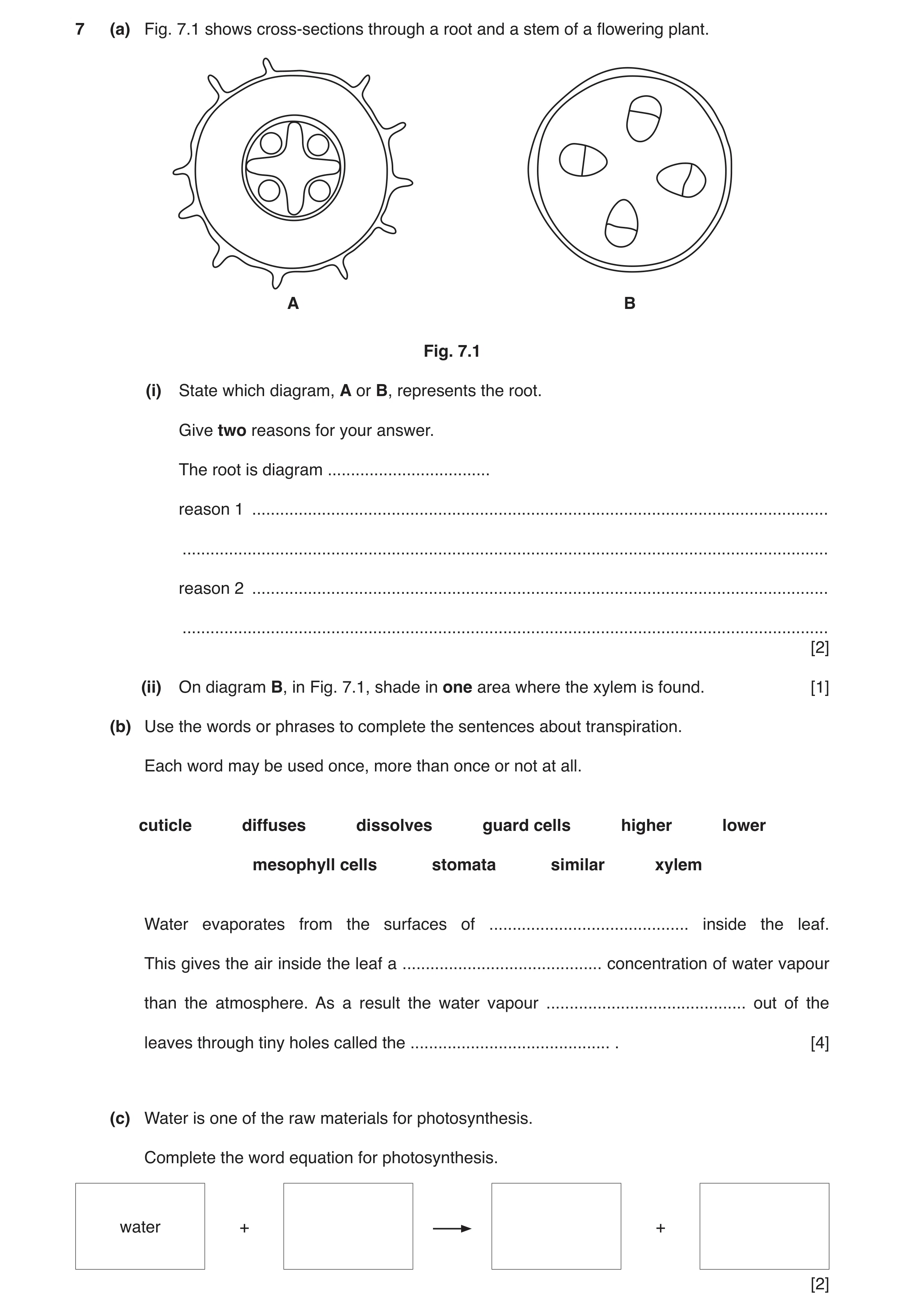
 9
9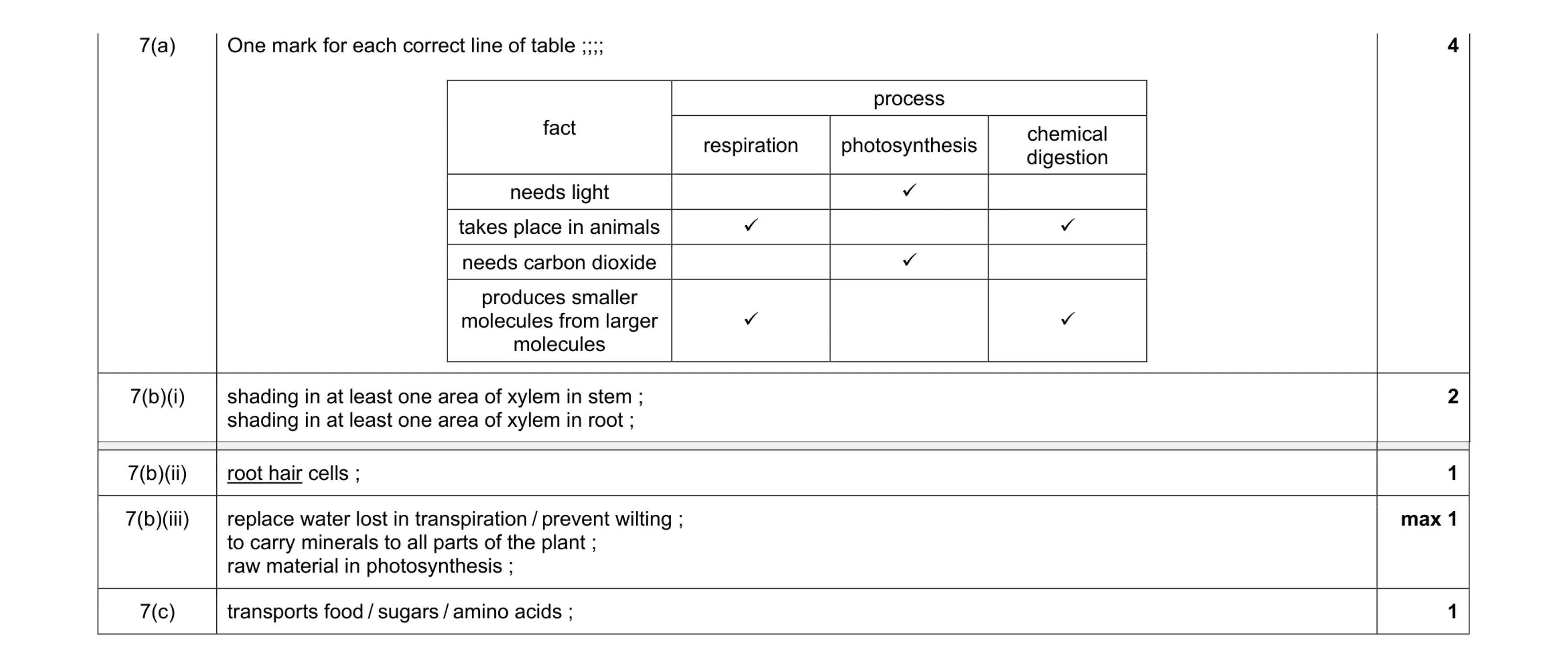 9
9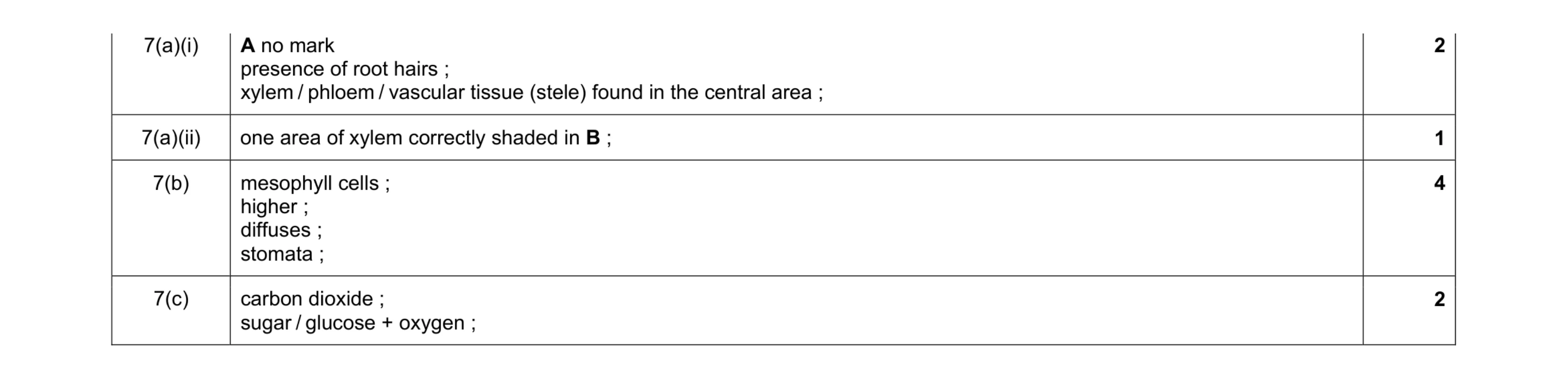 9
9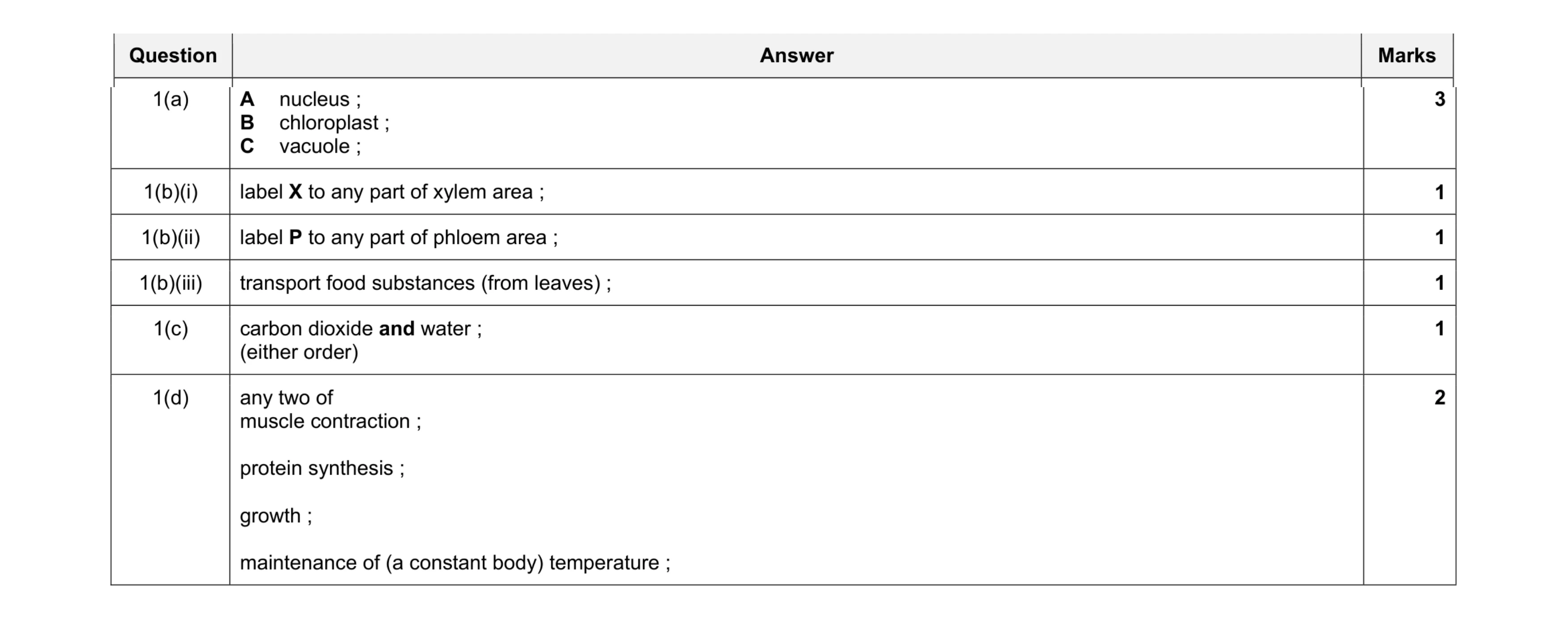 9
9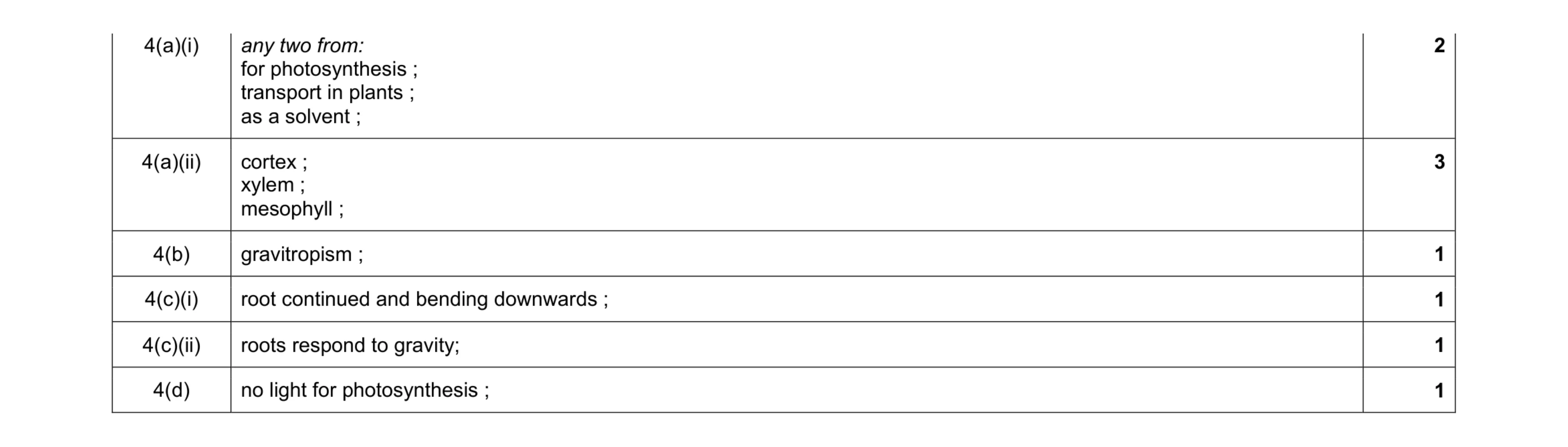 9
9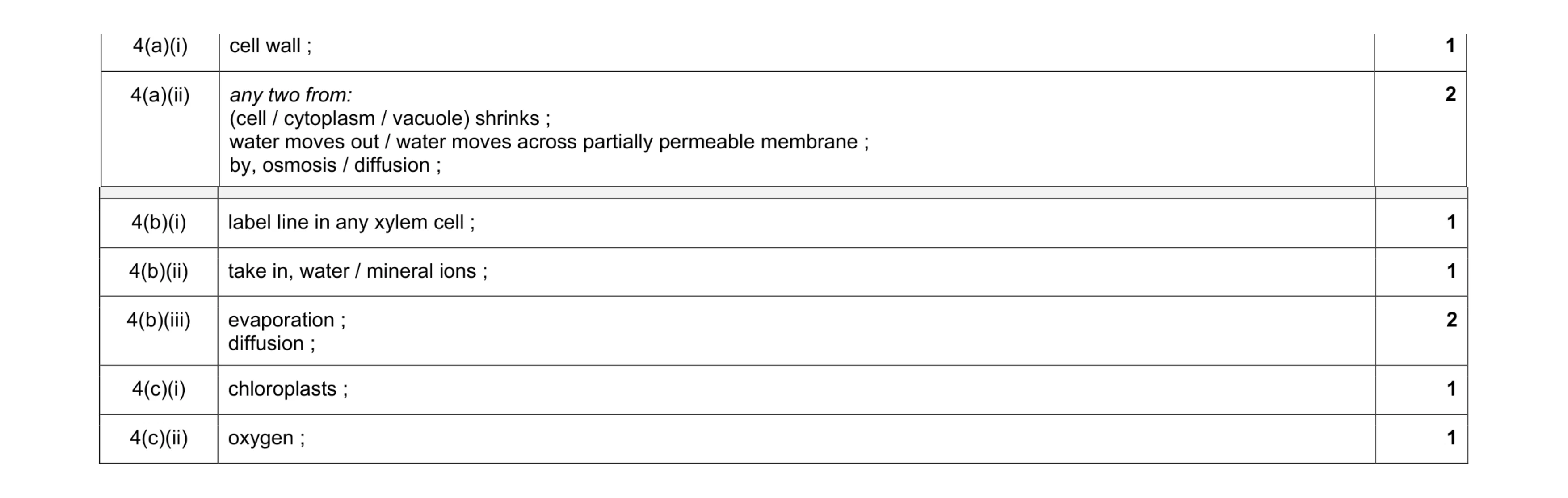 9
9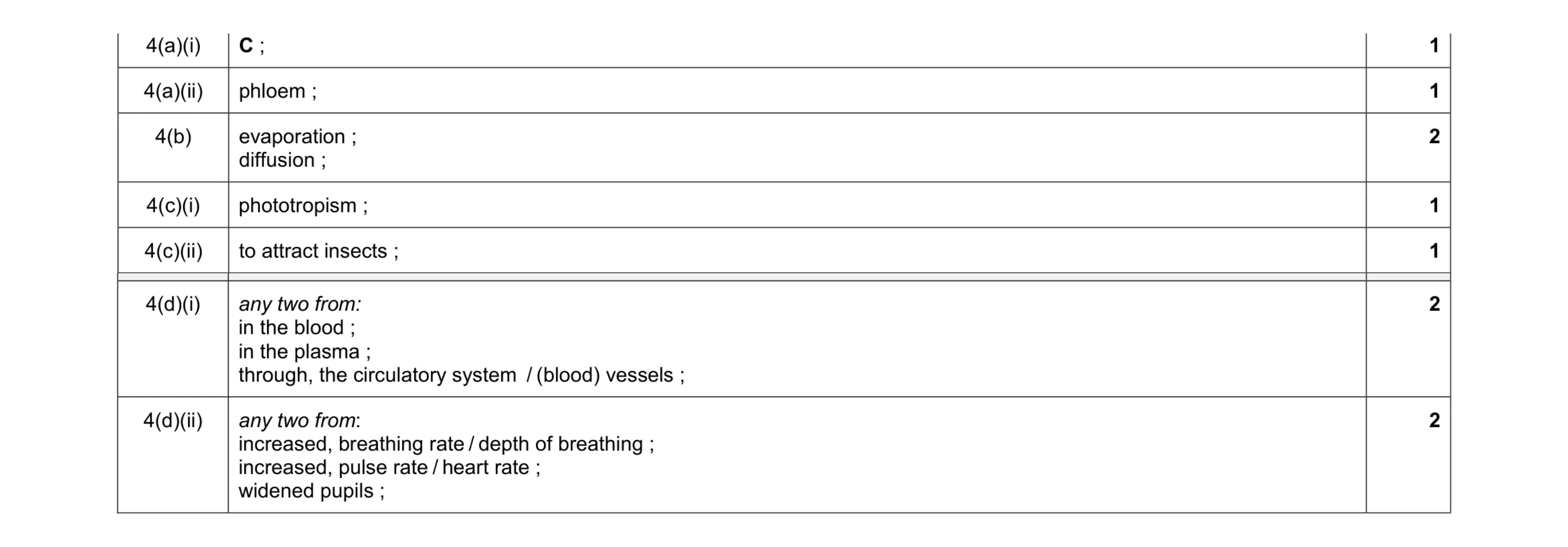 10
10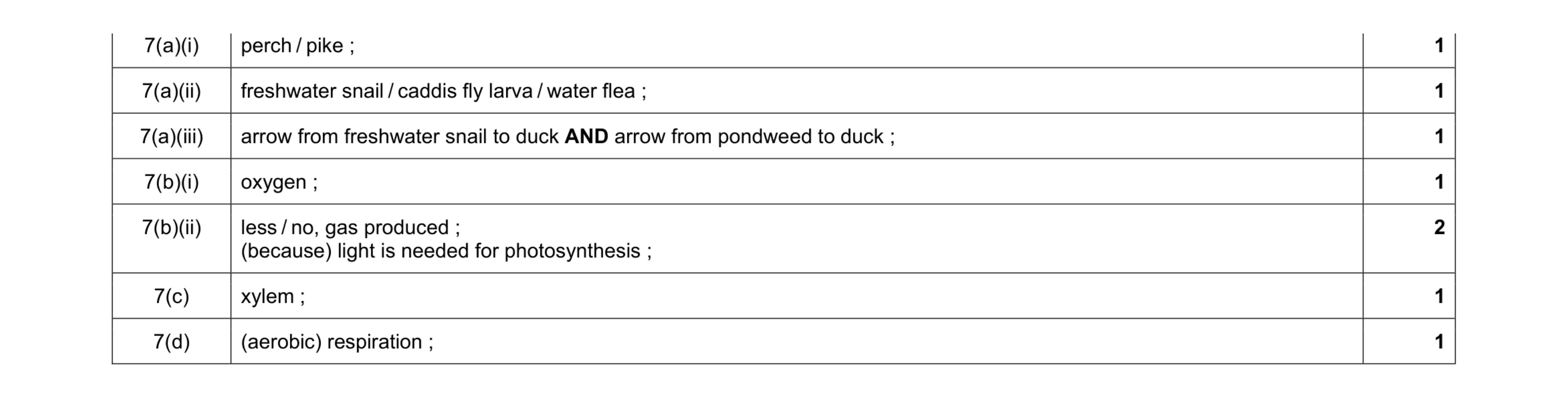 8
8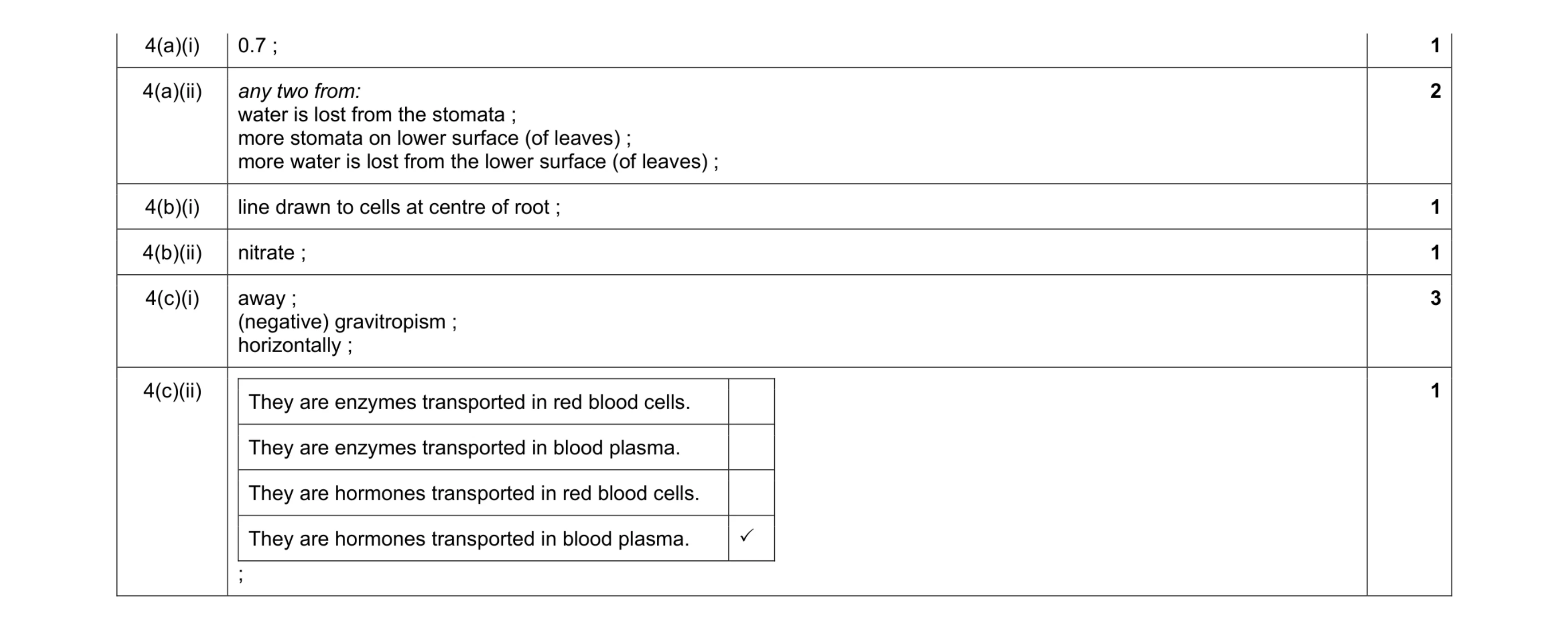 9
9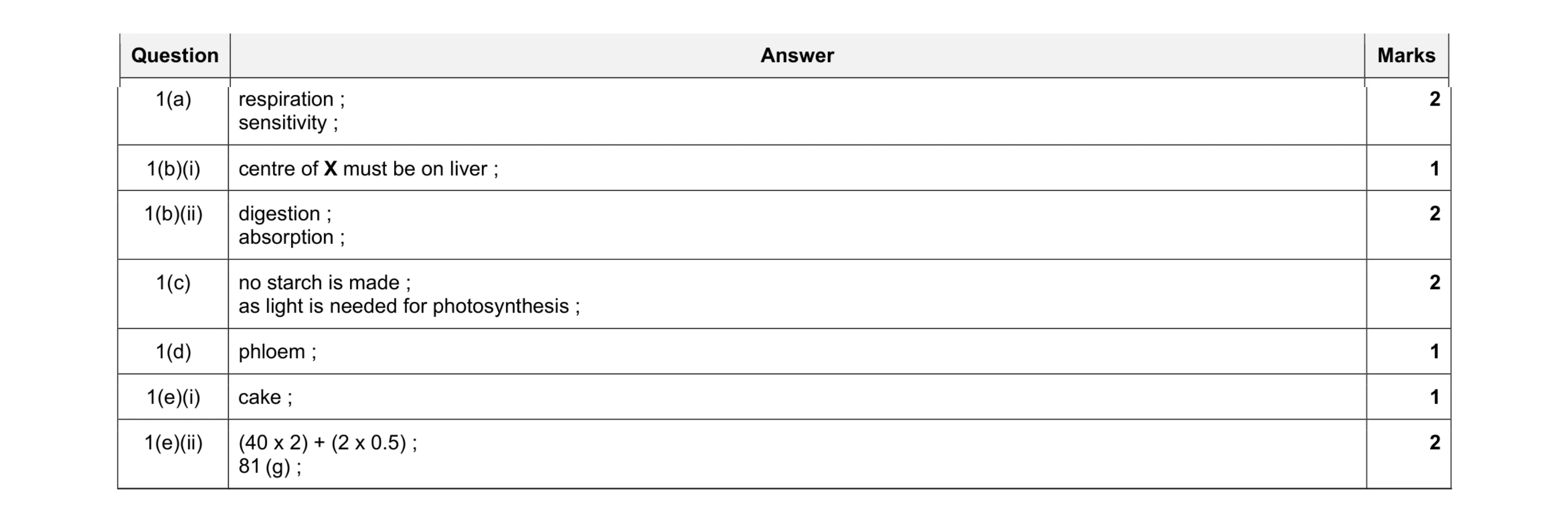 11
11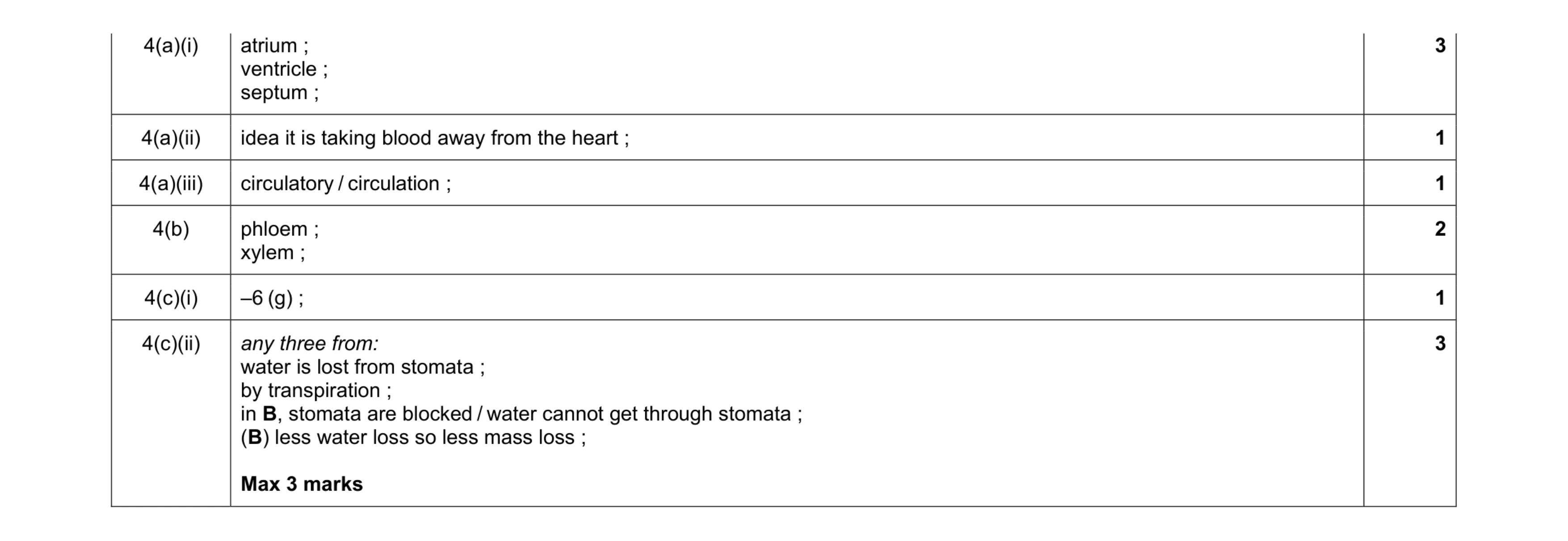 11
11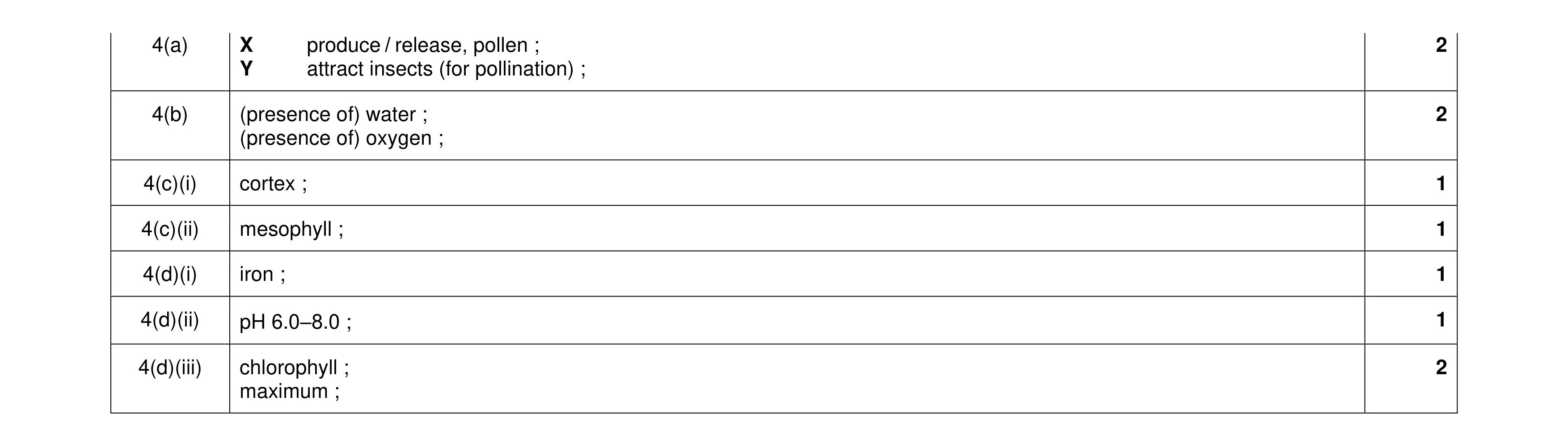 10
10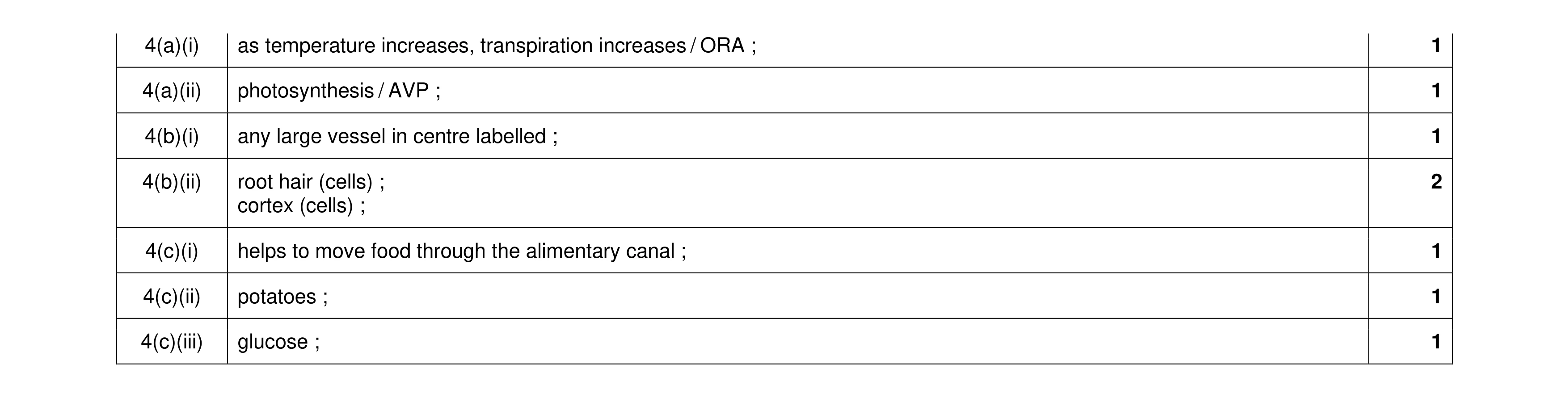 8
8