Questions as text
Q1 · Two astronauts without radios can only communicate in space if their helmets are touching 0652/11 Oct/Nov 2005
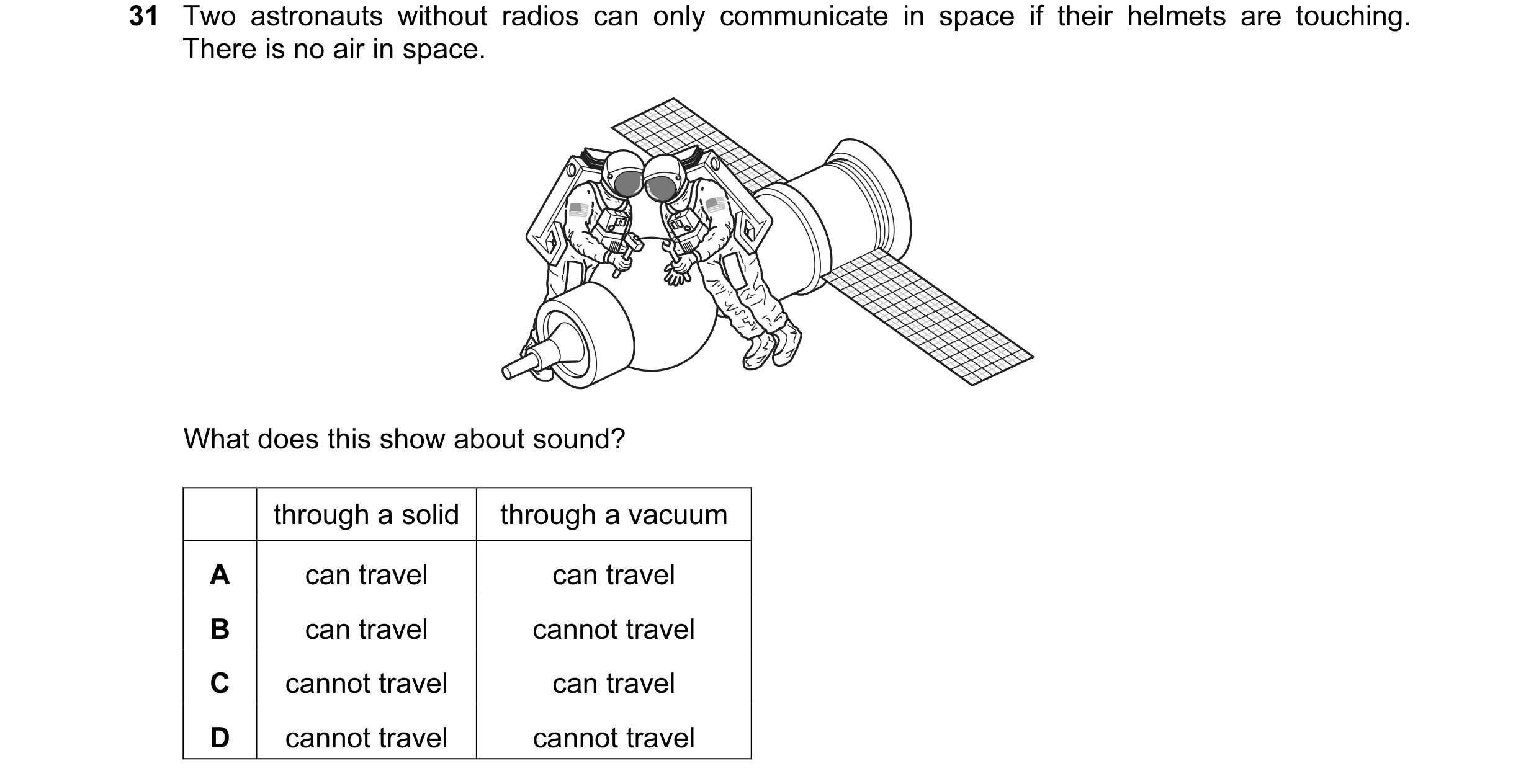
31 Two astronauts without radios can only communicate in space if their helmets are touching. There is no air in space. What does this show about sound? through a solid through a vacuum A can travel can travel B can travel cannot travel C cannot travel can travel D cannot travel cannot travel
1 marks
Answer: B
This question in 0652/11 Oct/Nov 2005
Q2 · Astronaut 1 uses a hammer to mend a satellite in space 0652/11 Oct/Nov 2009
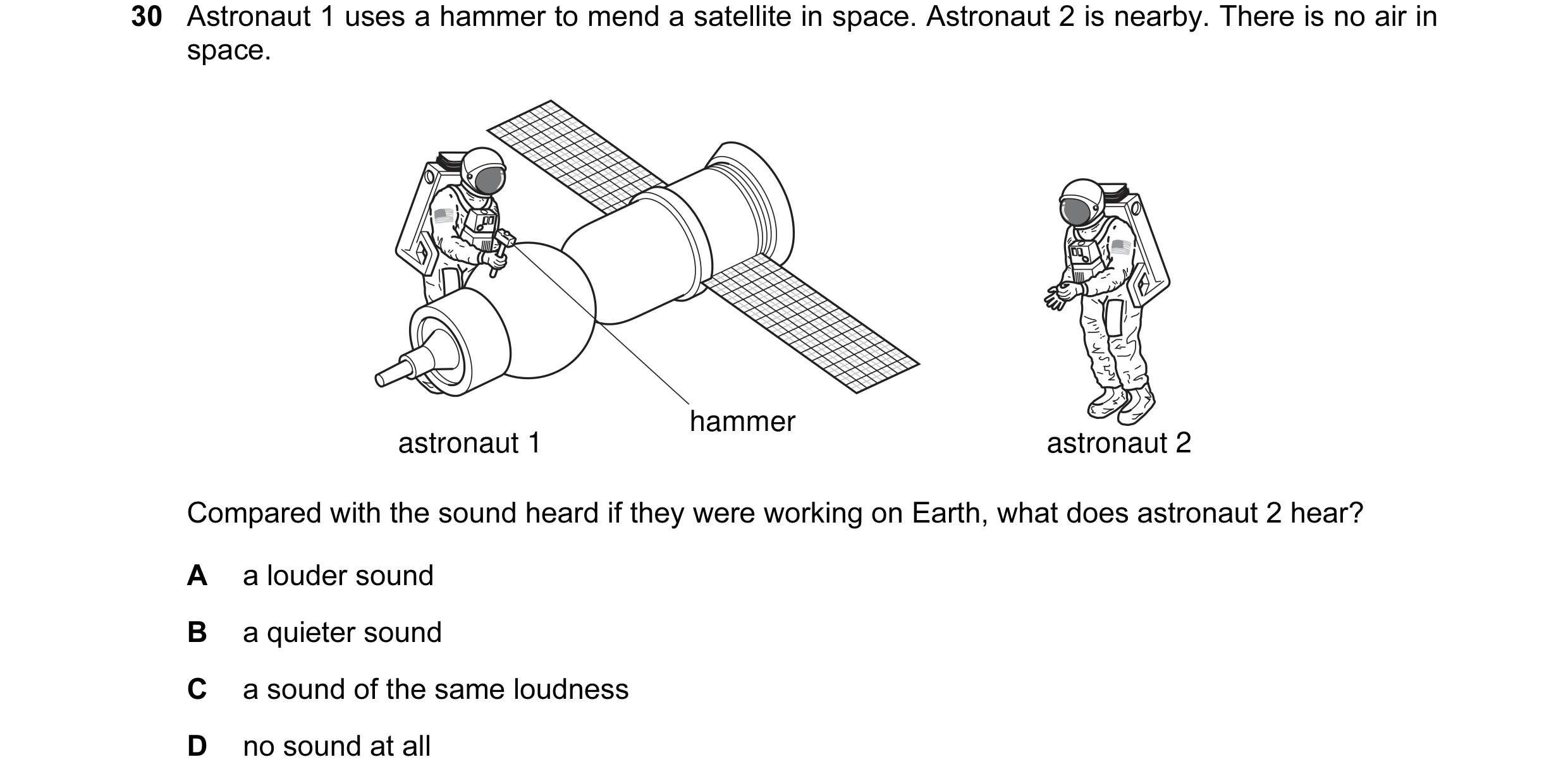
30 Astronaut 1 uses a hammer to mend a satellite in space. Astronaut 2 is nearby. There is no air in space. hammer astronaut 1 astronaut 2 Compared with the sound heard if they were working on Earth, what does astronaut 2 hear? A a louder sound B a quieter sound C a sound of the same loudness D no sound at all
1 marks
Answer: D
This question in 0652/11 Oct/Nov 2009
Q3 · The diagrams represent four different sound waves shown on the screen of an oscilloscope 0652/11 Oct/Nov 2010
32 The diagrams represent four different sound waves shown on the screen of an oscilloscope. The controls of the oscilloscope are set the same in each case. Which diagram represents the sound with the highest frequency? A B C D
1 marks
Answer: C
This question in 0652/11 Oct/Nov 2010
Q4 · A loudspeaker produces waves with the following frequencies 0652/11 Oct/Nov 2014
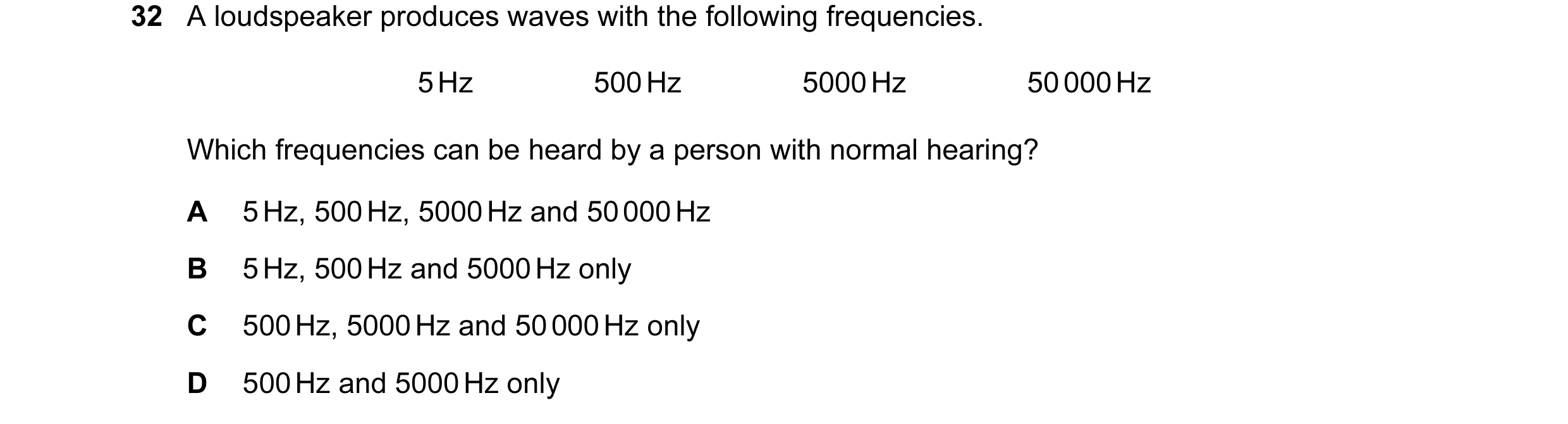
32 A loudspeaker produces waves with the following frequencies. 5 Hz 500 Hz 5000 Hz 50 000 Hz Which frequencies can be heard by a person with normal hearing? A 5 Hz, 500 Hz, 5000 Hz and 50 000 Hz B 5 Hz, 500 Hz and 5000 Hz only C 500 Hz, 5000 Hz and 50 000 Hz only D 500 Hz and 5000 Hz only
1 marks
Answer: D
This question in 0652/11 Oct/Nov 2014
Q5 · A loudspeaker produces waves with the following frequencies 0652/12 Oct/Nov 2014
32 A loudspeaker produces waves with the following frequencies. 5 Hz 500 Hz 5000 Hz 50 000 Hz Which frequencies can be heard by a person with normal hearing? A 5 Hz, 500 Hz, 5000 Hz and 50 000 Hz B 5 Hz, 500 Hz and 5000 Hz only C 500 Hz, 5000 Hz and 50 000 Hz only D 500 Hz and 5000 Hz only
1 marks
Answer: D
This question in 0652/12 Oct/Nov 2014
Q6 · Two astronauts without radios can only communicate in space if their helmets are touching 0652/11 Oct/Nov 2015
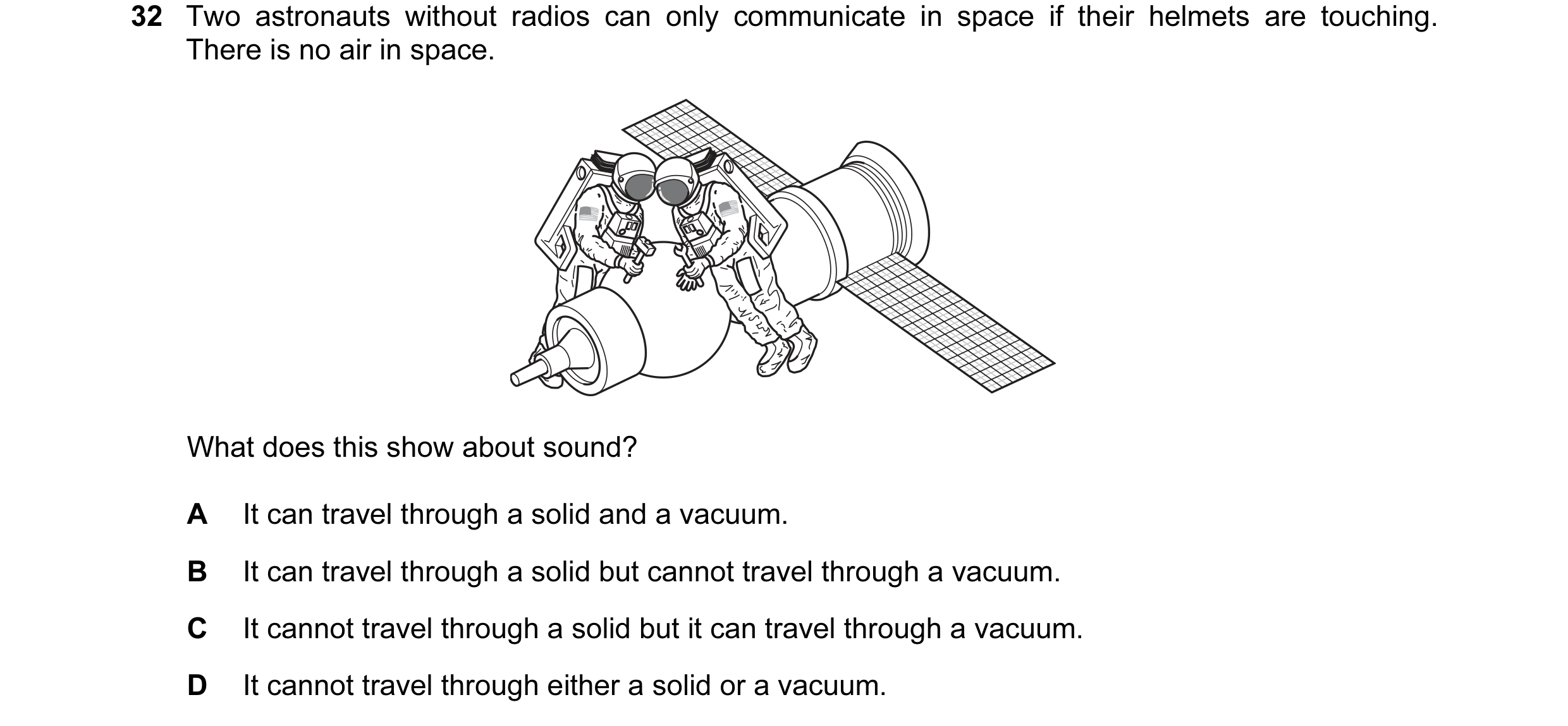
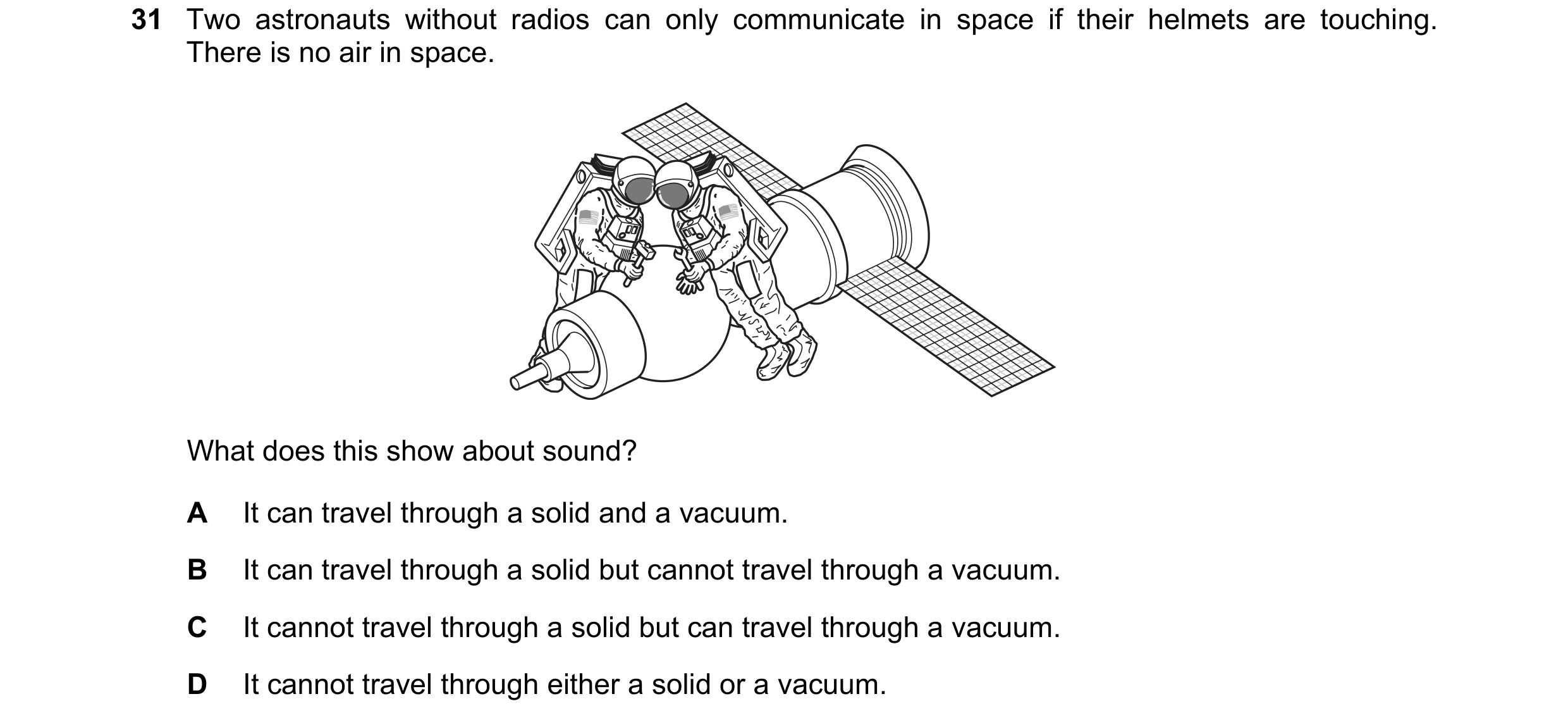
32 Two astronauts without radios can only communicate in space if their helmets are touching. There is no air in space. What does this show about sound? A It can travel through a solid and a vacuum. B It can travel through a solid but cannot travel through a vacuum. C It cannot travel through a solid but it can travel through a vacuum. D It cannot travel through either a solid or a vacuum.
1 marks
Answer: B
This question in 0652/11 Oct/Nov 2015
Q7 · Two astronauts without radios can only communicate in space if their helmets are touching 0652/12 Oct/Nov 2015
32 Two astronauts without radios can only communicate in space if their helmets are touching. There is no air in space. What does this show about sound? A It can travel through a solid and a vacuum. B It can travel through a solid but cannot travel through a vacuum. C It cannot travel through a solid but it can travel through a vacuum. D It cannot travel through either a solid or a vacuum.
1 marks
Answer: B
This question in 0652/12 Oct/Nov 2015
Q8 · Three loudspeakers vibrate at different frequencies of 5 hertz, 25 kilohertz and 50… 0652/11 Oct/Nov 2016
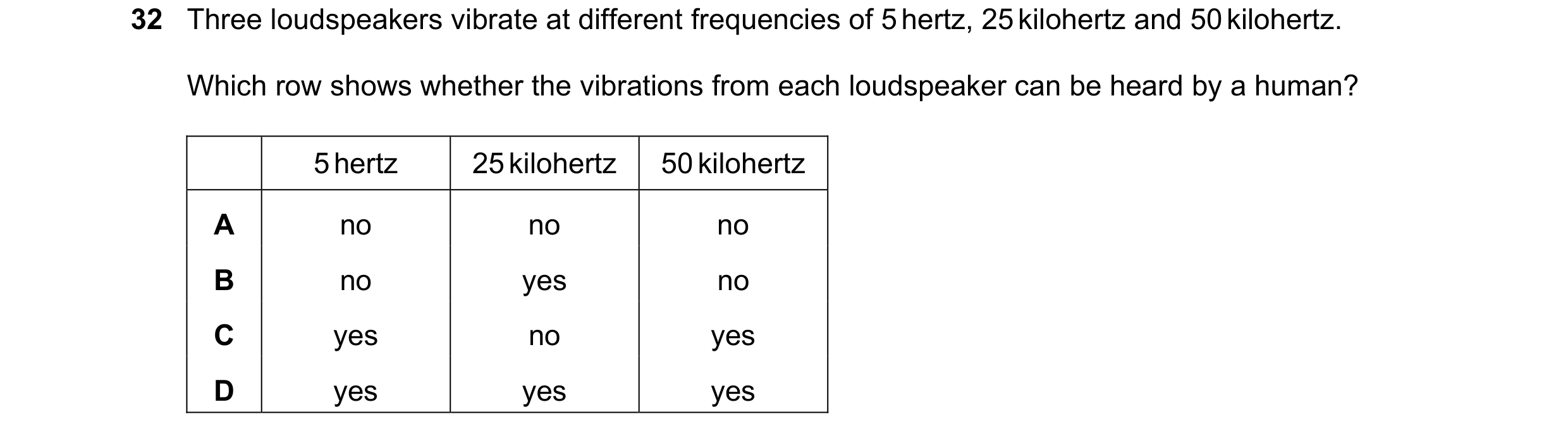
32 Three loudspeakers vibrate at different frequencies of 5 hertz, 25 kilohertz and 50 kilohertz. Which row shows whether the vibrations from each loudspeaker can be heard by a human? 5 hertz 25 kilohertz 50 kilohertz A no no no B no yes no C yes no yes D yes yes yes
1 marks
Answer: A
This question in 0652/11 Oct/Nov 2016
Q9 · Three loudspeakers vibrate at different frequencies of 5 hertz, 25 kilohertz and 50… 0652/12 Oct/Nov 2016
32 Three loudspeakers vibrate at different frequencies of 5 hertz, 25 kilohertz and 50 kilohertz. Which row shows whether the vibrations from each loudspeaker can be heard by a human? 5 hertz 25 kilohertz 50 kilohertz A no no no B no yes no C yes no yes D yes yes yes
1 marks
Answer: A
This question in 0652/12 Oct/Nov 2016
Q10 · Three objects, P, Q and R, vibrate with the frequencies shown and produce longitudinal… 0652/11 Oct/Nov 2017
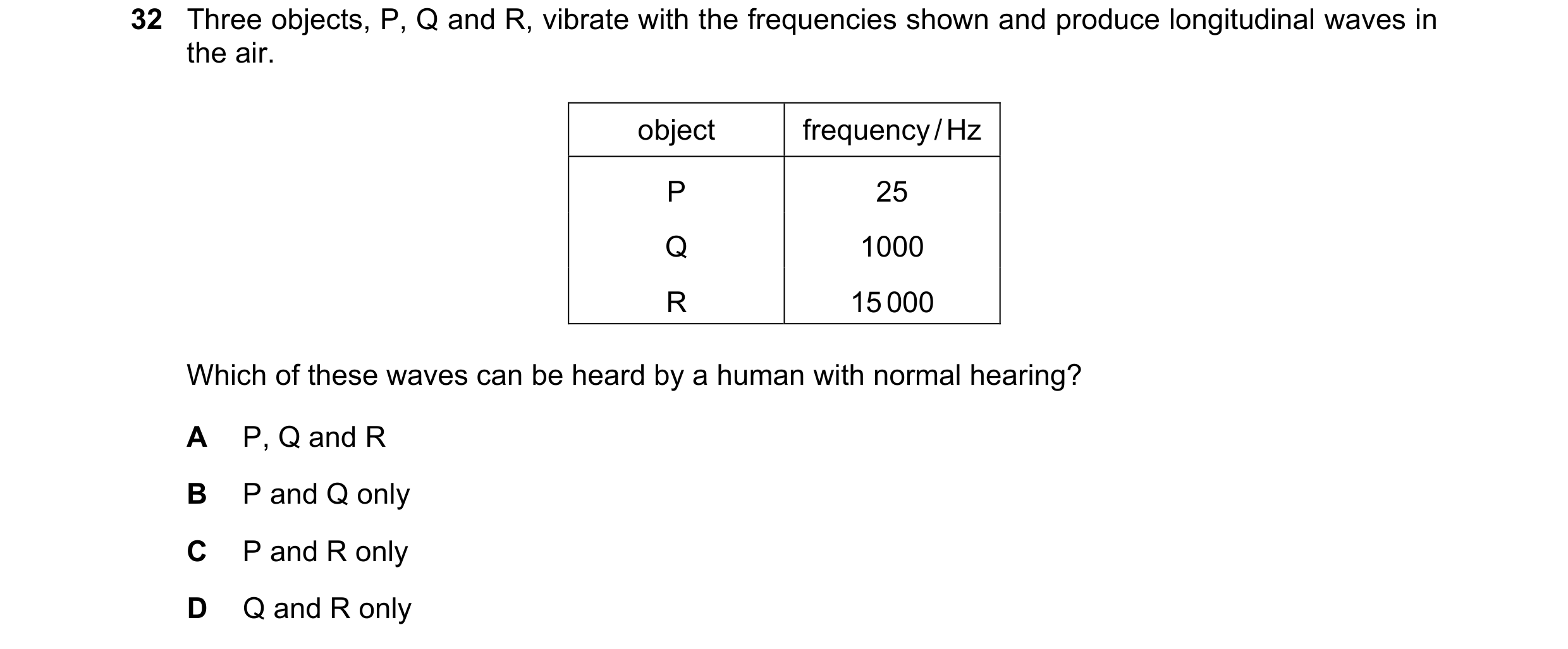
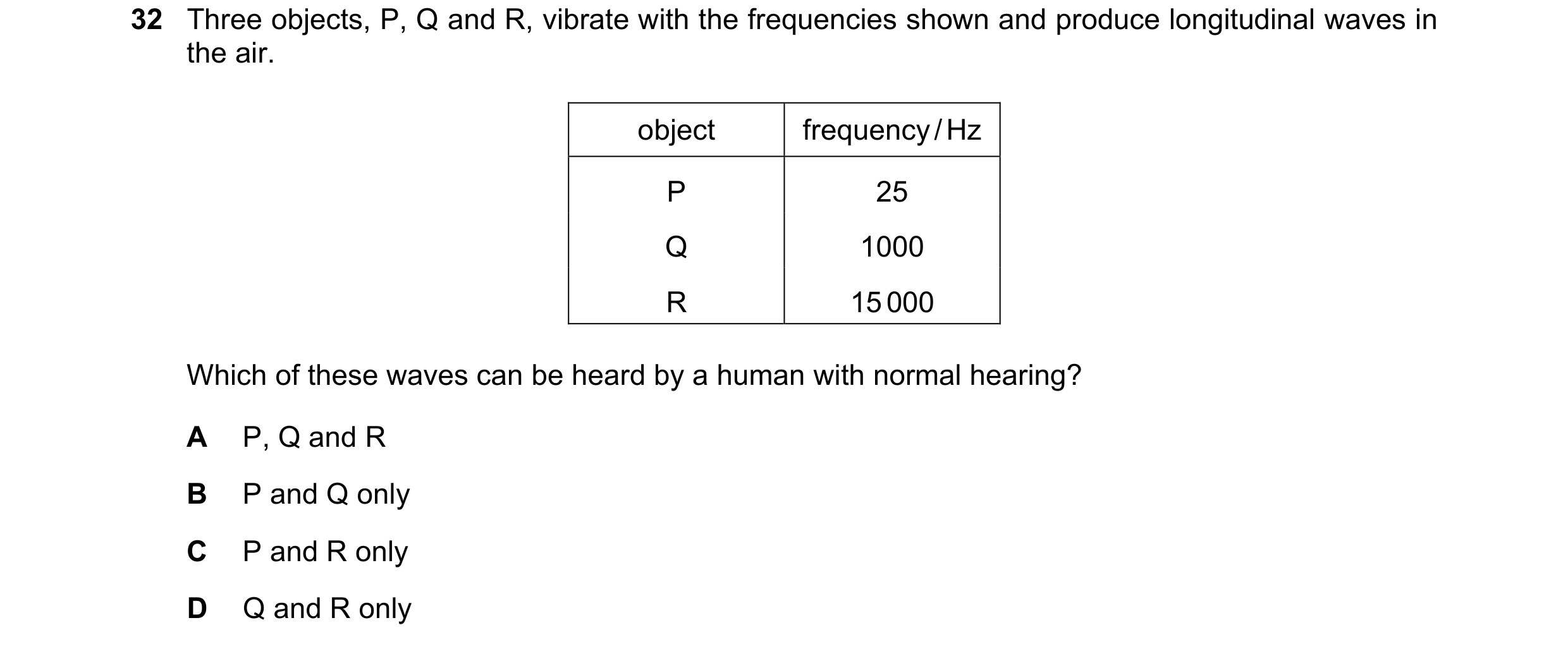
32 Three objects, P, Q and R, vibrate with the frequencies shown and produce longitudinal waves in the air. object frequency / Hz P 25 Q 1000 R 15 000 Which of these waves can be heard by a human with normal hearing? A P, Q and R B P and Q only C P and R only D Q and R only
1 marks
Answer: A
This question in 0652/11 Oct/Nov 2017
Q11 · Three objects, P, Q and R, vibrate with the frequencies shown and produce longitudinal… 0652/12 Oct/Nov 2017
32 Three objects, P, Q and R, vibrate with the frequencies shown and produce longitudinal waves in the air. object frequency / Hz P 25 Q 1000 R 15 000 Which of these waves can be heard by a human with normal hearing? A P, Q and R B P and Q only C P and R only D Q and R only
1 marks
Answer: A
This question in 0652/12 Oct/Nov 2017
Q12 · A vibrating object produces waves of different frequencies in air 0652/11 Oct/Nov 2018
32 A vibrating object produces waves of different frequencies in air. Which frequency is a sound wave that someone with normal hearing is able to hear? A 2.5 Hz B 1000 Hz C 25 000 Hz D 100 000 Hz
1 marks
Answer: B
This question in 0652/11 Oct/Nov 2018
Q13 · A vibrating object produces waves of different frequencies in air 0652/12 Oct/Nov 2018
32 A vibrating object produces waves of different frequencies in air. Which frequency is a sound wave that someone with normal hearing is able to hear? A 2.5 Hz B 1000 Hz C 25 000 Hz D 100 000 Hz
1 marks
Answer: B
This question in 0652/12 Oct/Nov 2018
Q14 · Two astronauts without radios can only communicate in space if their helmets are touching 0652/11 Oct/Nov 2019
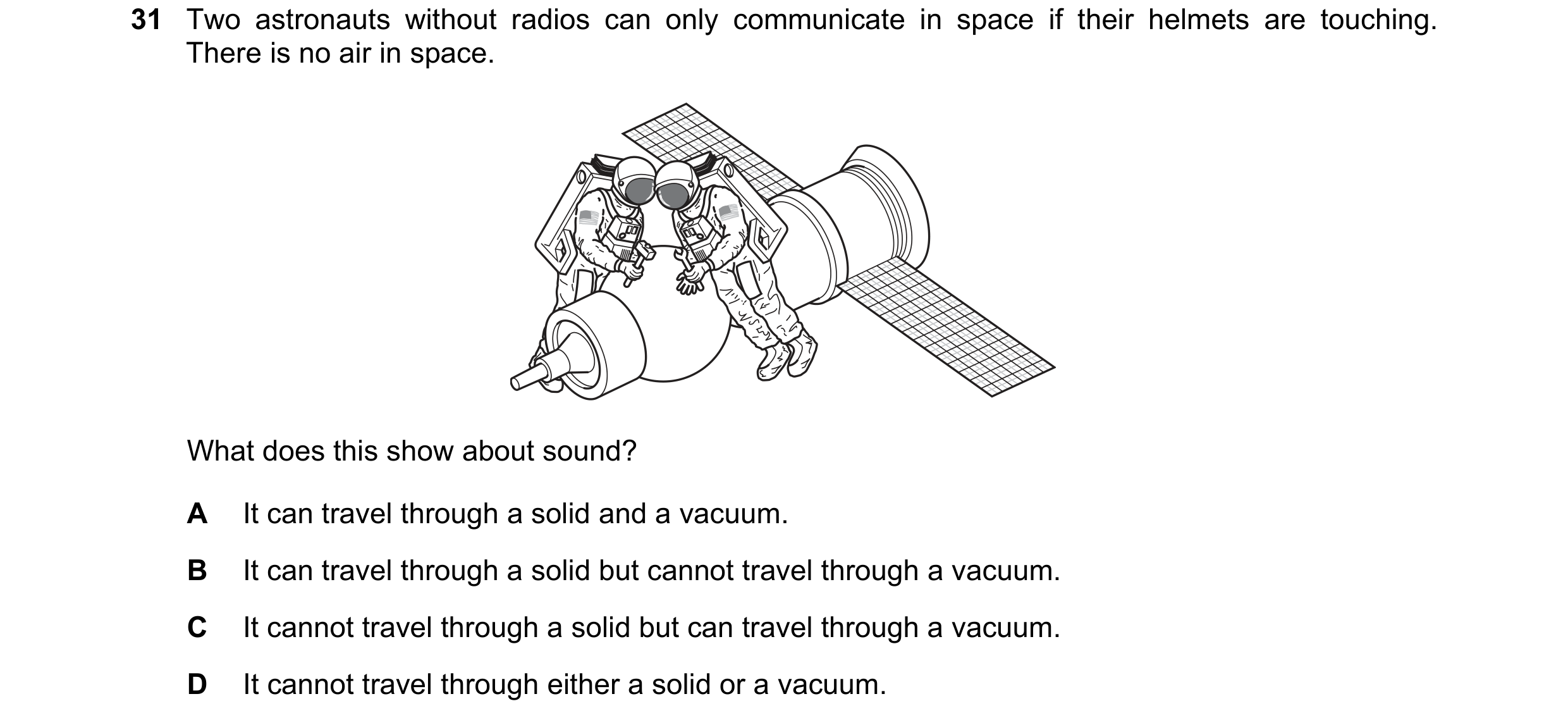
31 Two astronauts without radios can only communicate in space if their helmets are touching. There is no air in space. What does this show about sound? A It can travel through a solid and a vacuum. B It can travel through a solid but cannot travel through a vacuum. C It cannot travel through a solid but can travel through a vacuum. D It cannot travel through either a solid or a vacuum.
1 marks
Answer: B
This question in 0652/11 Oct/Nov 2019
Q15 · Two astronauts without radios can only communicate in space if their helmets are touching 0652/12 Oct/Nov 2019
31 Two astronauts without radios can only communicate in space if their helmets are touching. There is no air in space. What does this show about sound? A It can travel through a solid and a vacuum. B It can travel through a solid but cannot travel through a vacuum. C It cannot travel through a solid but can travel through a vacuum. D It cannot travel through either a solid or a vacuum.
1 marks
Answer: B
This question in 0652/12 Oct/Nov 2019
Q16 · What is the approximate range of frequencies of sound that can be heard by the human ear? 0652/11 Oct/Nov 2020
32 What is the approximate range of frequencies of sound that can be heard by the human ear? A 2 Hz to 2000 Hz B 2 kHz to 2000 kHz C 20 Hz to 20 000 Hz D 20 kHz to 20 000 kHz
1 marks
Answer: C
This question in 0652/11 Oct/Nov 2020
Q17 · Which frequency is outside the range of audible frequencies for a healthy human ear? 0652/11 Oct/Nov 2021
31 Which frequency is outside the range of audible frequencies for a healthy human ear? A 30 Hz B 300 Hz C 3000 Hz D 30 000 Hz
1 marks
Answer: D
This question in 0652/11 Oct/Nov 2021
Q18 · Sound of which frequency is not audible to a healthy human ear? 0652/11 Oct/Nov 2022
32 Sound of which frequency is not audible to a healthy human ear? A 5.0 Hz B 50 Hz C 500 Hz D 5000 Hz
1 marks
Answer: A
This question in 0652/11 Oct/Nov 2022
Q19 · A vibrating object produces waves of different frequencies in air 0652/11 Oct/Nov 2023
32 A vibrating object produces waves of different frequencies in air. Which frequency is that of a sound wave that a human with normal hearing can hear? A 2.5 Hz B 1000 Hz C 25 000 Hz D 100 000 Hz
1 marks
Answer: B
This question in 0652/11 Oct/Nov 2023
Q20 · A vibrating object produces waves of different frequencies in air 0652/12 Oct/Nov 2023
32 A vibrating object produces waves of different frequencies in air. Which frequency is that of a sound wave that a human with normal hearing can hear? A 2.5 Hz B 1000 Hz C 25 000 Hz D 100 000 Hz
1 marks
Answer: B
This question in 0652/12 Oct/Nov 2023
 1 / 6
1 / 6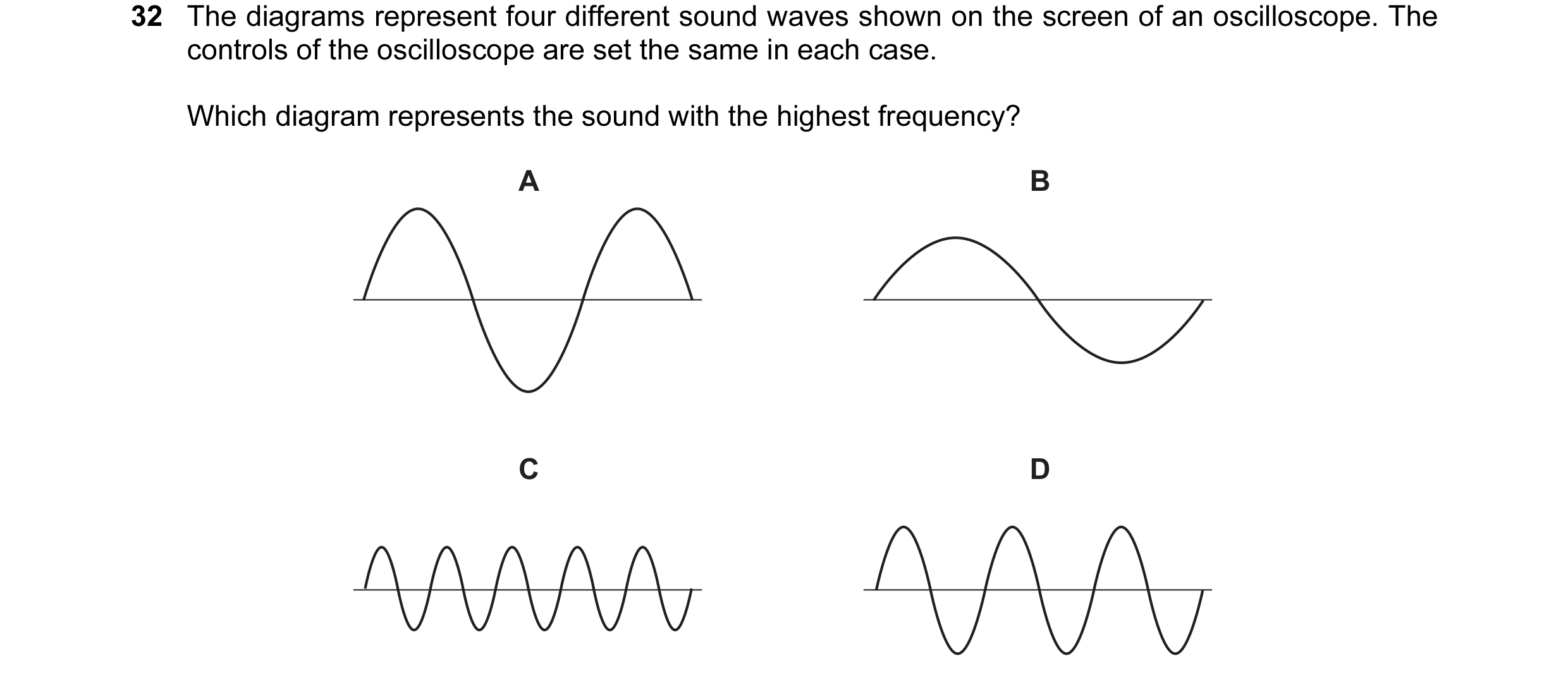
 2 / 6
2 / 6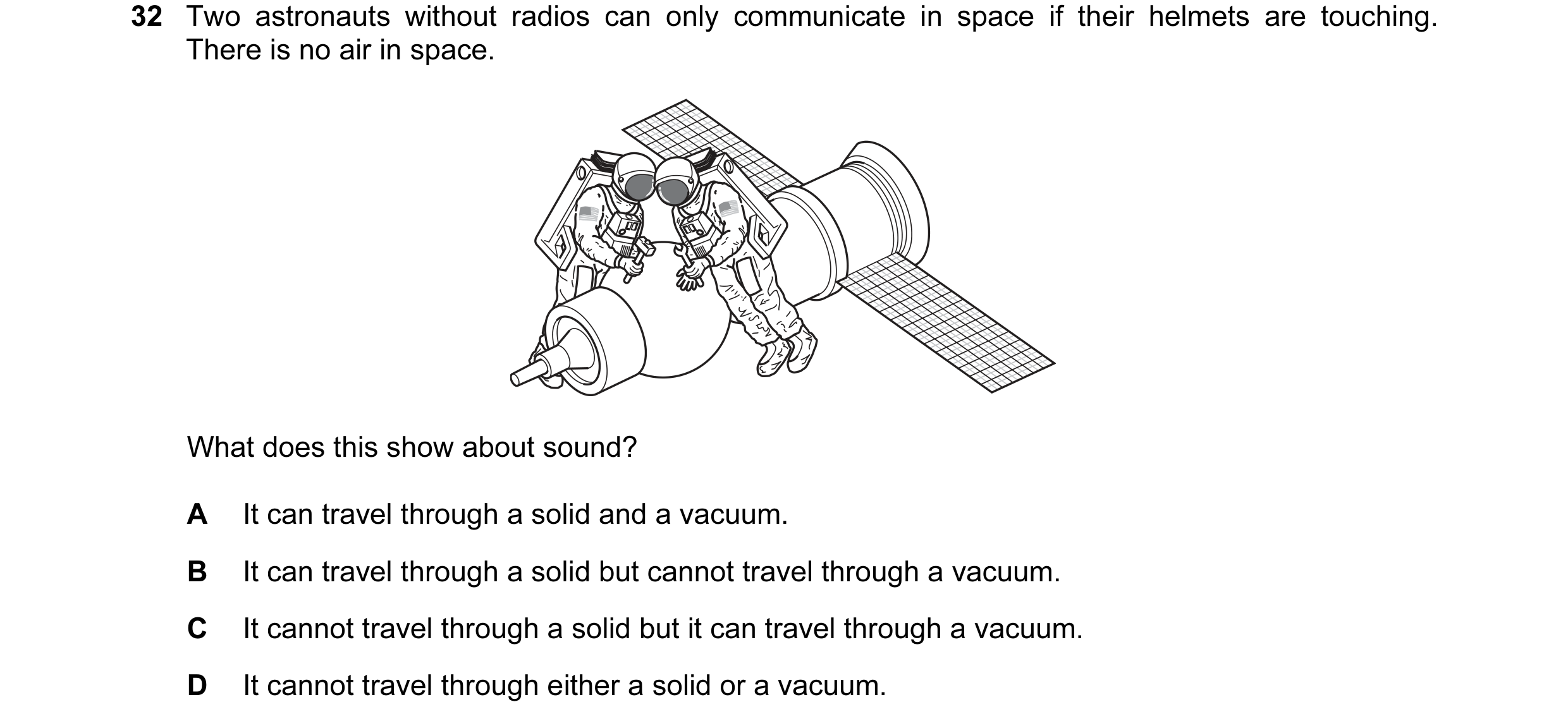
 3 / 6
3 / 6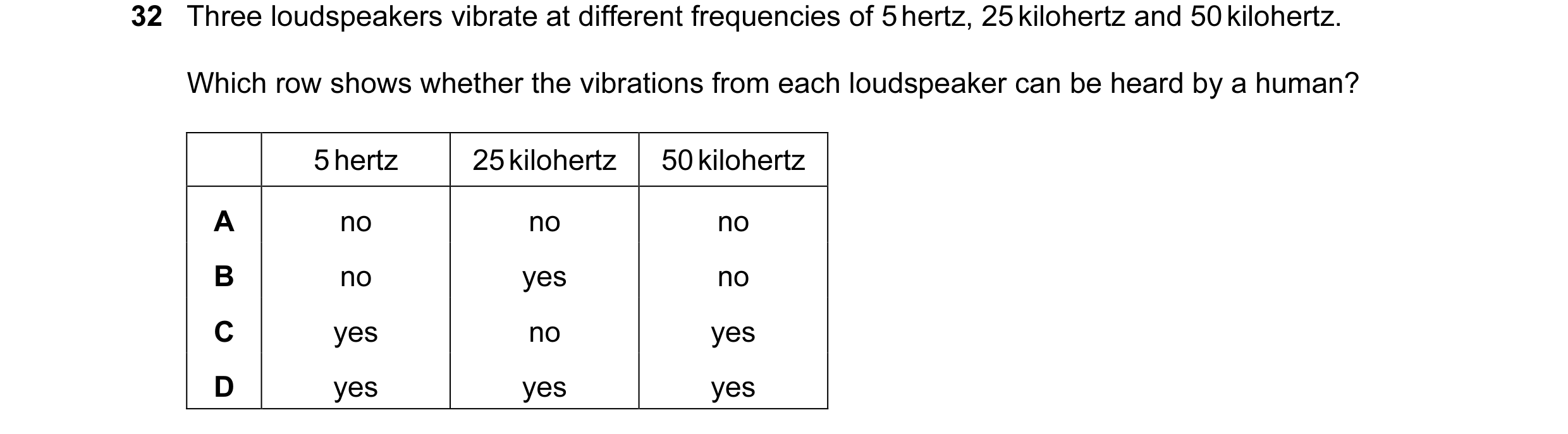
 4 / 6
4 / 6

 5 / 6
5 / 6

 6 / 6
6 / 6