Questions as text
Q1 · Three objects, P, Q and R, vibrate with the frequencies shown and produce longitudinal… 0652/21 Oct/Nov 2017
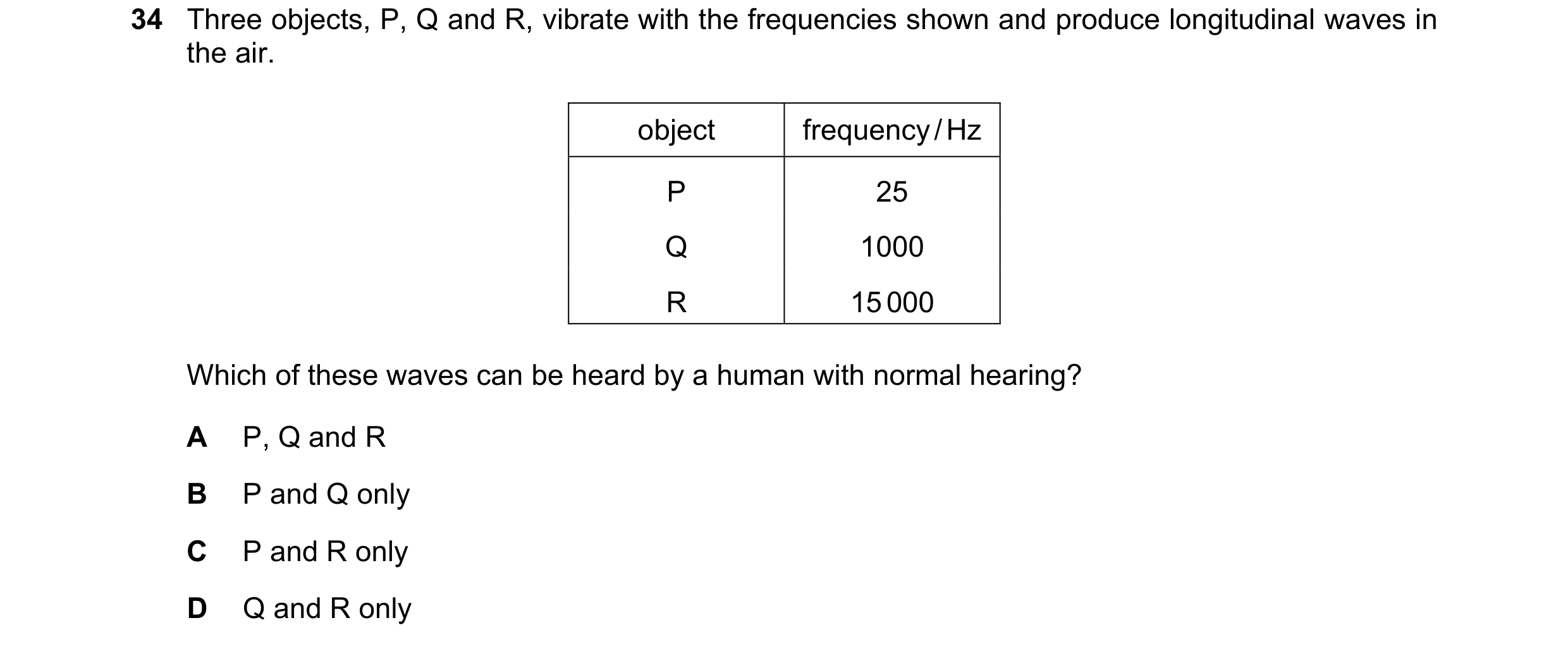
34 Three objects, P, Q and R, vibrate with the frequencies shown and produce longitudinal waves in the air. object frequency / Hz P 25 Q 1000 R 15 000 Which of these waves can be heard by a human with normal hearing? A P, Q and R B P and Q only C P and R only D Q and R only
1 marks
Answer: A
This question in 0652/21 Oct/Nov 2017
Q2 · Three objects, P, Q and R, vibrate with the frequencies shown and produce longitudinal… 0652/22 Oct/Nov 2017
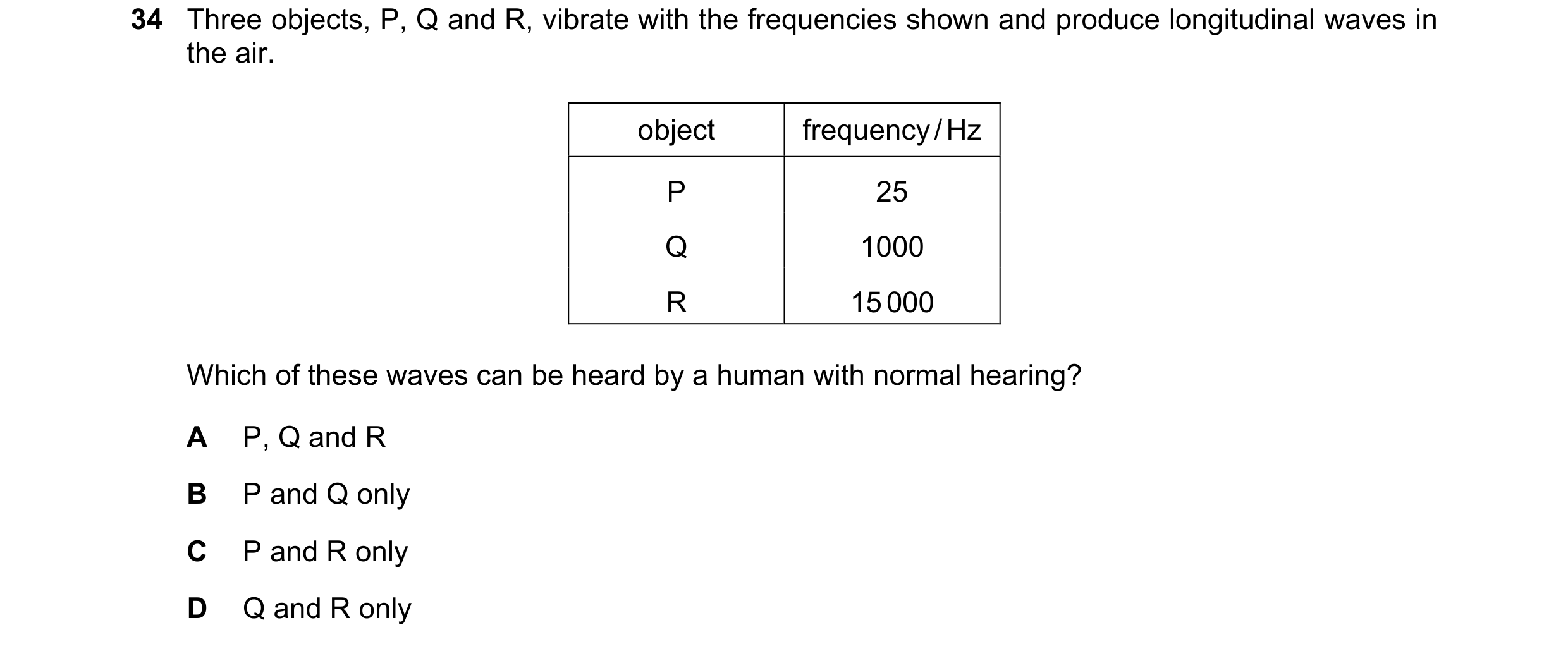
34 Three objects, P, Q and R, vibrate with the frequencies shown and produce longitudinal waves in the air. object frequency / Hz P 25 Q 1000 R 15 000 Which of these waves can be heard by a human with normal hearing? A P, Q and R B P and Q only C P and R only D Q and R only
1 marks
Answer: A
This question in 0652/22 Oct/Nov 2017
Q3 · A vibrating object produces waves of different frequencies in air 0652/21 Oct/Nov 2018
31 A vibrating object produces waves of different frequencies in air. Which frequency is a sound wave that someone with normal hearing is able to hear? A 2.5 Hz B 1000 Hz C 25 000 Hz D 100 000 Hz
1 marks
Answer: B
This question in 0652/21 Oct/Nov 2018
Q4 · A vibrating object produces waves of different frequencies in air 0652/22 Oct/Nov 2018
31 A vibrating object produces waves of different frequencies in air. Which frequency is a sound wave that someone with normal hearing is able to hear? A 2.5 Hz B 1000 Hz C 25 000 Hz D 100 000 Hz
1 marks
Answer: B
This question in 0652/22 Oct/Nov 2018
Q5 · Two astronauts without radios can only communicate in space if their helmets are touching 0652/21 Oct/Nov 2019
32 Two astronauts without radios can only communicate in space if their helmets are touching. There is no air in space. What does this show about sound? A It can travel through a solid and a vacuum. B It can travel through a solid but cannot travel through a vacuum. C It cannot travel through a solid but can travel through a vacuum. D It cannot travel through either a solid or a vacuum.
1 marks
Answer: B
This question in 0652/21 Oct/Nov 2019
Q6 · Two astronauts without radios can only communicate in space if their helmets are touching 0652/22 Oct/Nov 2019
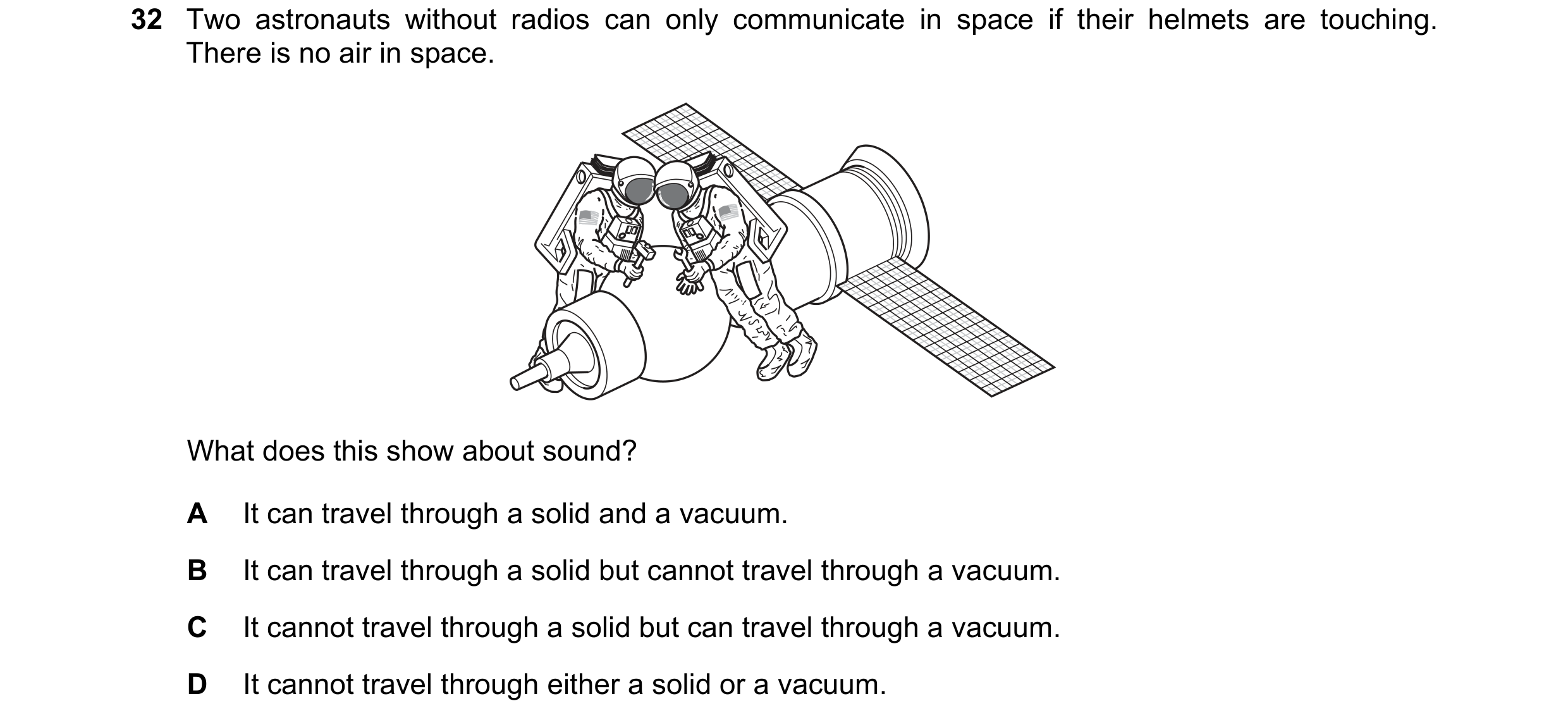
32 Two astronauts without radios can only communicate in space if their helmets are touching. There is no air in space. What does this show about sound? A It can travel through a solid and a vacuum. B It can travel through a solid but cannot travel through a vacuum. C It cannot travel through a solid but can travel through a vacuum. D It cannot travel through either a solid or a vacuum.
1 marks
Answer: B
This question in 0652/22 Oct/Nov 2019
Q7 · What is the approximate range of frequencies of sound that can be heard by the human ear? 0652/21 Oct/Nov 2020
33 What is the approximate range of frequencies of sound that can be heard by the human ear? A 2 Hz to 2000 Hz B 2 kHz to 2000 kHz C 20 Hz to 20 000 Hz D 20 kHz to 20 000 kHz
1 marks
Answer: C
This question in 0652/21 Oct/Nov 2020
Q8 · What is the approximate range of frequencies of sound that can be heard by the human ear? 0652/22 Oct/Nov 2020
33 What is the approximate range of frequencies of sound that can be heard by the human ear? A 2 Hz to 2000 Hz B 2 kHz to 2000 kHz C 20 Hz to 20 000 Hz D 20 kHz to 20 000 kHz
1 marks
Answer: C
This question in 0652/22 Oct/Nov 2020
Q9 · Which frequency is outside the range of audible frequencies for a healthy human ear? 0652/21 Oct/Nov 2021
33 Which frequency is outside the range of audible frequencies for a healthy human ear? A 30 Hz B 300 Hz C 3000 Hz D 30 000 Hz
1 marks
Answer: D
This question in 0652/21 Oct/Nov 2021
Q10 · Three objects, P, Q and R, vibrate with the frequencies shown, producing longitudinal… 0652/21 Oct/Nov 2022
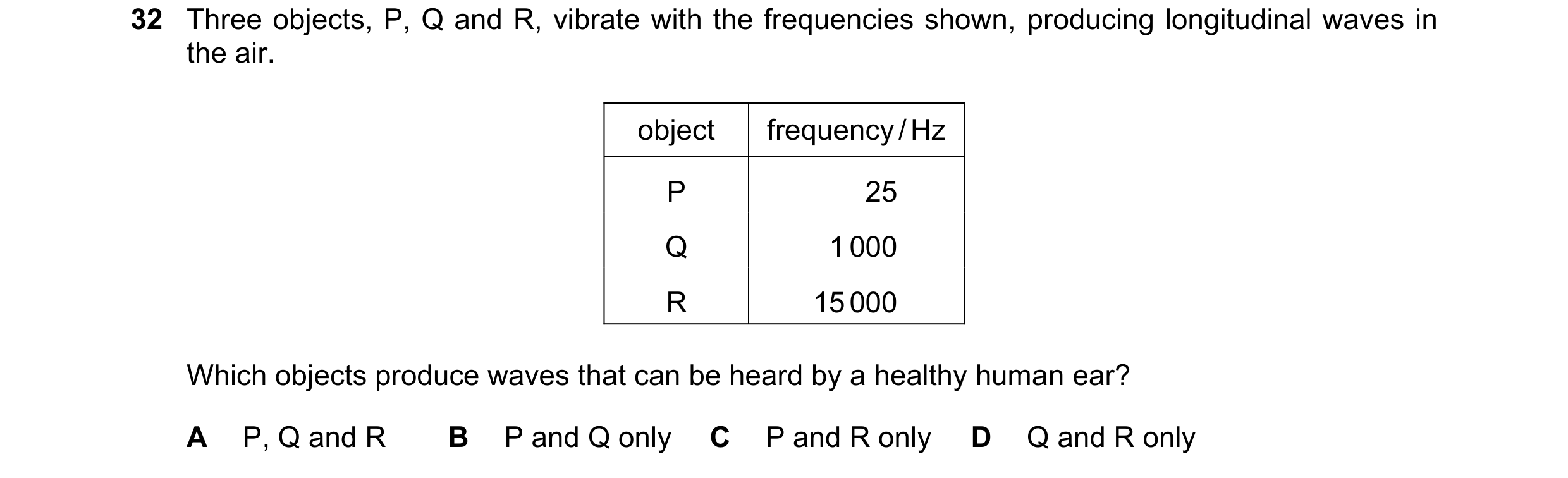
32 Three objects, P, Q and R, vibrate with the frequencies shown, producing longitudinal waves in the air. object frequency / Hz P 25 Q 1 000 R 15 000 Which objects produce waves that can be heard by a healthy human ear? A P, Q and R B P and Q only C P and R only D Q and R only
1 marks
Answer: A
This question in 0652/21 Oct/Nov 2022
Q11 · Three objects, P, Q and R, vibrate with the frequencies shown, producing longitudinal… 0652/22 Oct/Nov 2022
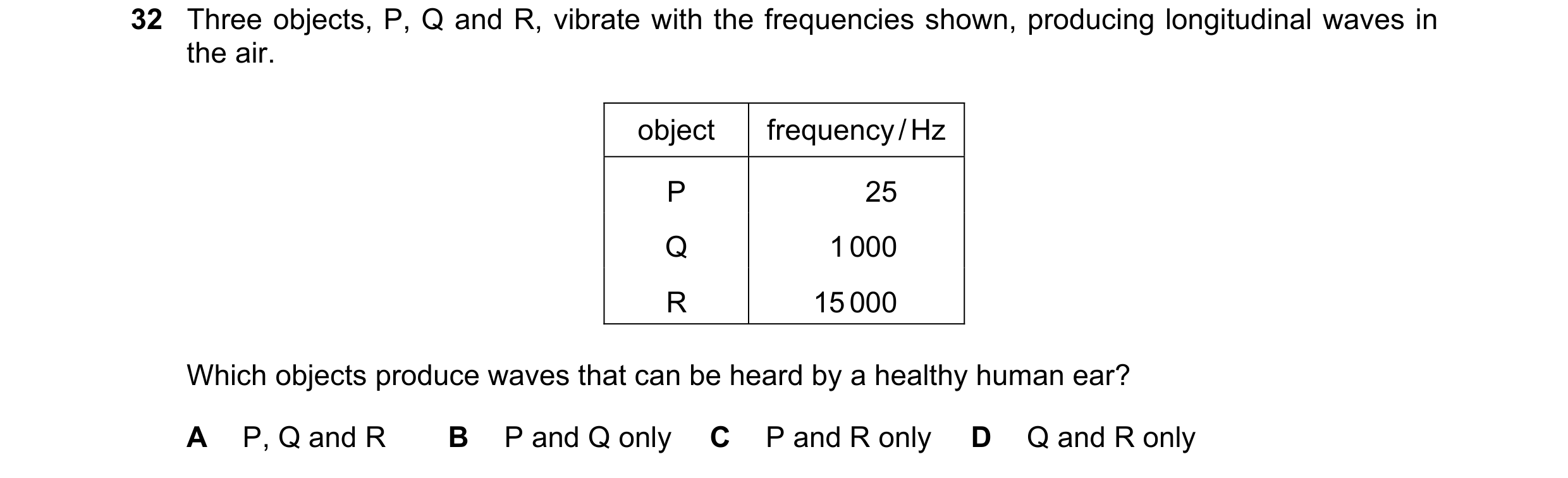
32 Three objects, P, Q and R, vibrate with the frequencies shown, producing longitudinal waves in the air. object frequency / Hz P 25 Q 1 000 R 15 000 Which objects produce waves that can be heard by a healthy human ear? A P, Q and R B P and Q only C P and R only D Q and R only
1 marks
Answer: A
This question in 0652/22 Oct/Nov 2022
Q12 · What is the nature of a sound wave and in which direction do the particles vibrate in… 0652/21 Oct/Nov 2023
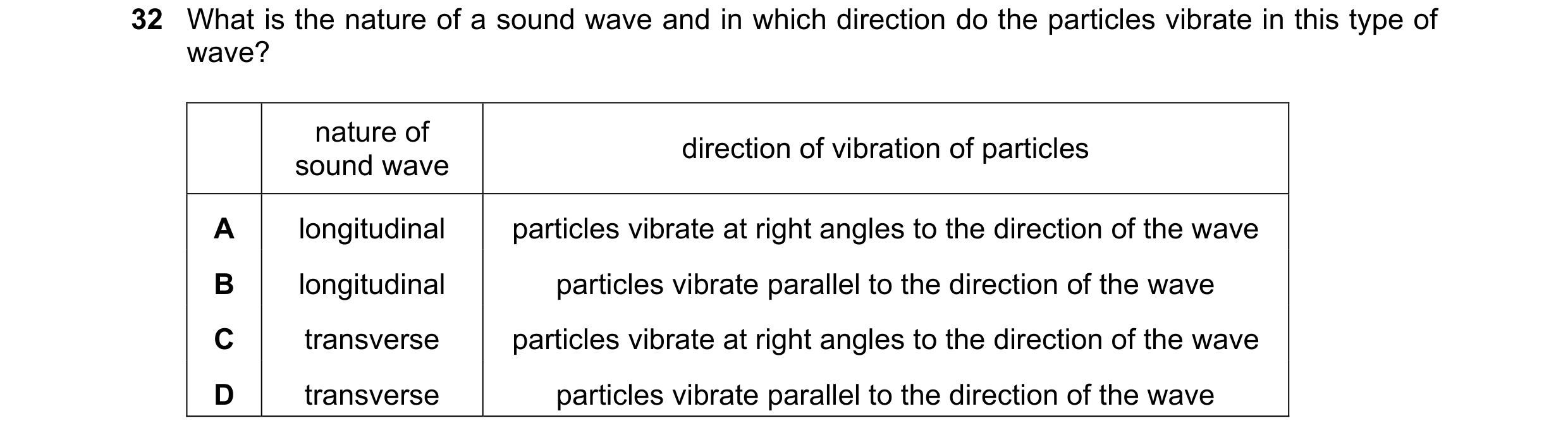
32 What is the nature of a sound wave and in which direction do the particles vibrate in this type of wave? nature of direction of vibration of particles sound wave A longitudinal particles vibrate at right angles to the direction of the wave B longitudinal particles vibrate parallel to the direction of the wave C transverse particles vibrate at right angles to the direction of the wave D transverse particles vibrate parallel to the direction of the wave
1 marks
Answer: B
This question in 0652/21 Oct/Nov 2023
Q13 · A vibrating object produces waves of different frequencies in air 0652/21 Oct/Nov 2023
33 A vibrating object produces waves of different frequencies in air. Which frequency is that of a sound wave that a human with normal hearing can hear? A 2.5 Hz B 1000 Hz C 25 000 Hz D 100 000 Hz
1 marks
Answer: B
This question in 0652/21 Oct/Nov 2023
Q14 · What is the nature of a sound wave and in which direction do the particles vibrate in… 0652/22 Oct/Nov 2023
32 What is the nature of a sound wave and in which direction do the particles vibrate in this type of wave? nature of direction of vibration of particles sound wave A longitudinal particles vibrate at right angles to the direction of the wave B longitudinal particles vibrate parallel to the direction of the wave C transverse particles vibrate at right angles to the direction of the wave D transverse particles vibrate parallel to the direction of the wave
1 marks
Answer: B
This question in 0652/22 Oct/Nov 2023
Q15 · A vibrating object produces waves of different frequencies in air 0652/22 Oct/Nov 2023
33 A vibrating object produces waves of different frequencies in air. Which frequency is that of a sound wave that a human with normal hearing can hear? A 2.5 Hz B 1000 Hz C 25 000 Hz D 100 000 Hz
1 marks
Answer: B
This question in 0652/22 Oct/Nov 2023

 1 / 4
1 / 4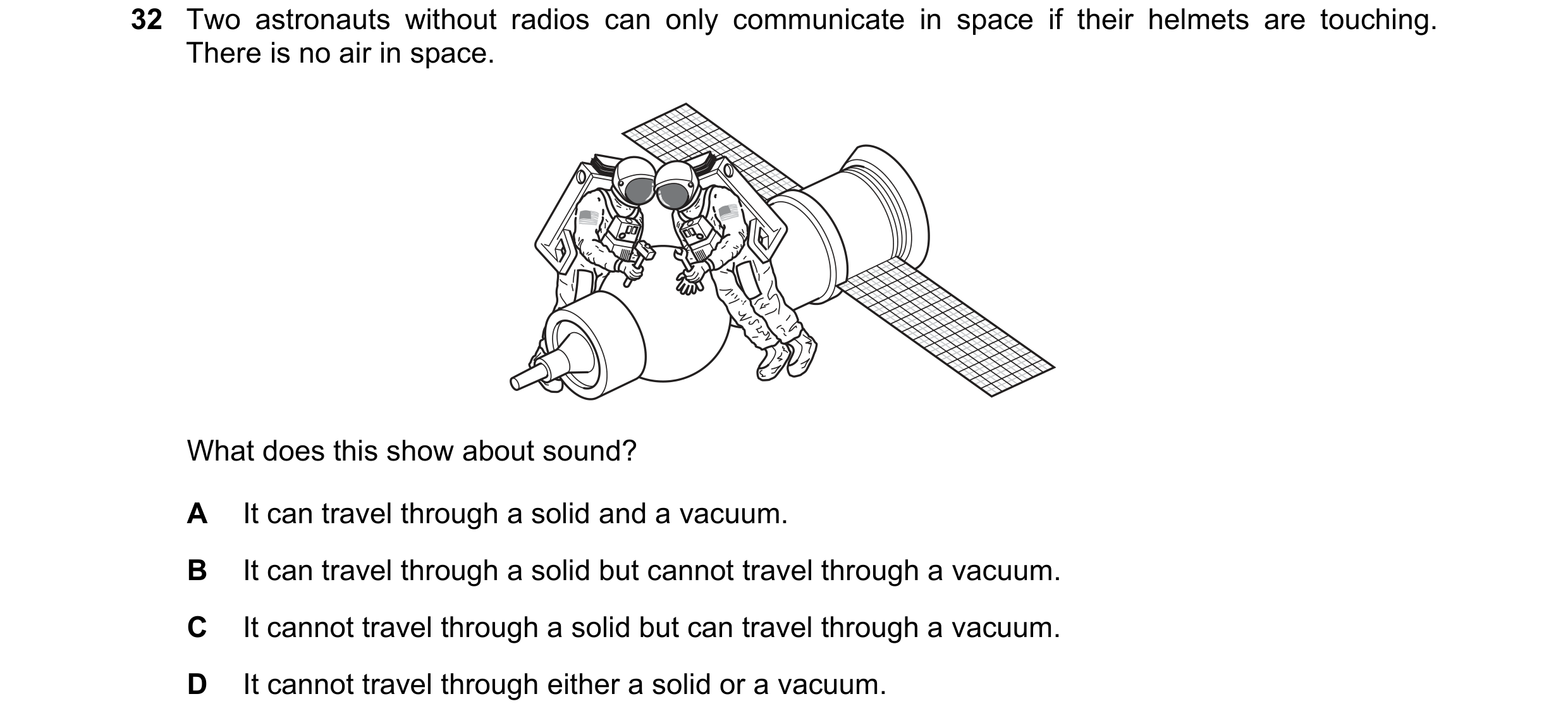

 2 / 4
2 / 4
 3 / 4
3 / 4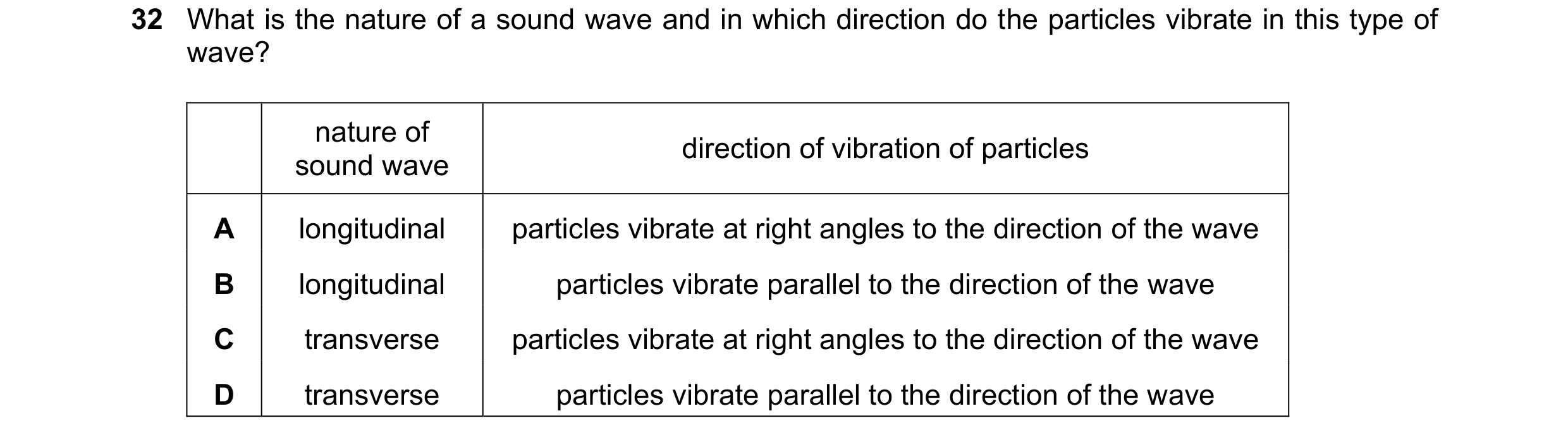
 4 / 4
4 / 4