Questions as text
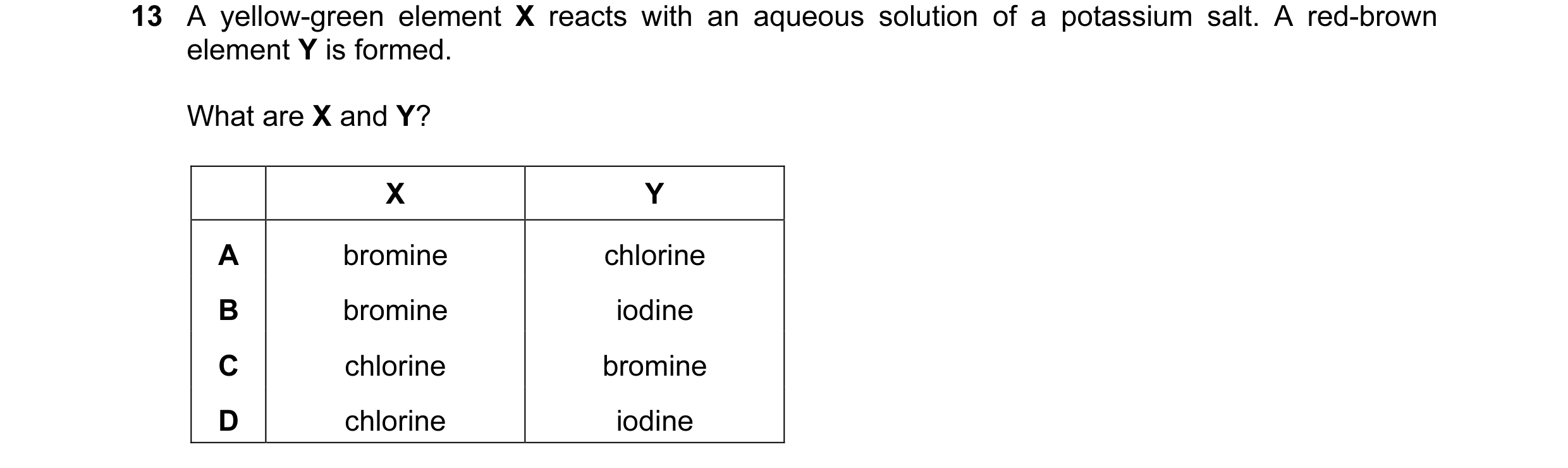
Q1 · A yellow-green element X reacts with an aqueous solution of a potassium salt 0652/11 Oct/Nov 2005
13 A yellow-green element X reacts with an aqueous solution of a potassium salt. A red-brown element Y is formed. What are X and Y? X Y A bromine chlorine B bromine iodine C chlorine bromine D chlorine iodine
1 marks
Answer: C
This question in 0652/11 Oct/Nov 2005
Q2 · Which of the following reacts with aqueous sodium bromide? 0652/11 Oct/Nov 2006
12 Which of the following reacts with aqueous sodium bromide? A chloride ions B chlorine C iodide ions D iodine
1 marks
Answer: B
This question in 0652/11 Oct/Nov 2006
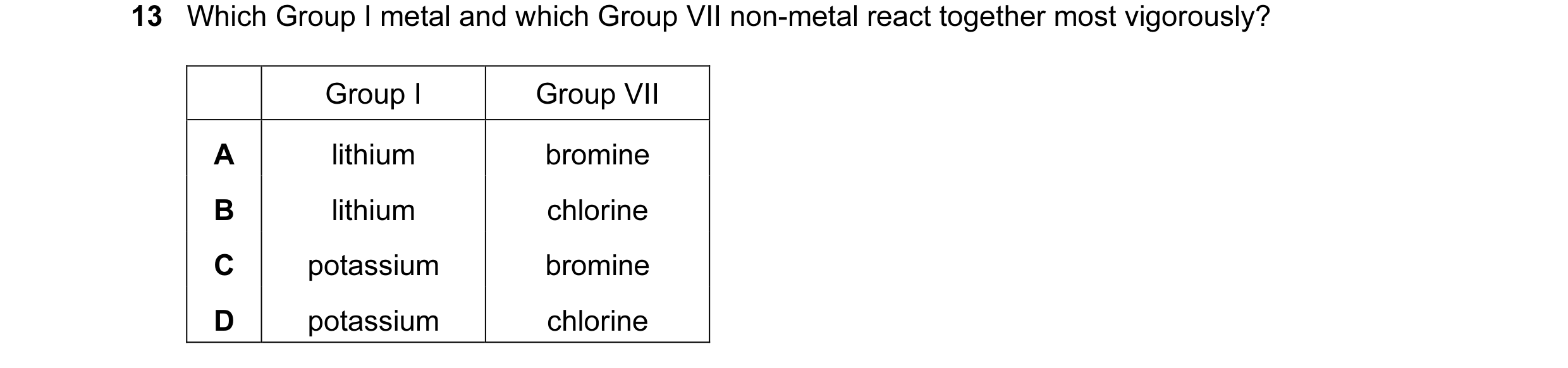
Q3 · Which Group I metal and which Group VII non-metal react together most vigorously? 0652/11 Oct/Nov 2006
13 Which Group I metal and which Group VII non-metal react together most vigorously? Group I Group VII A lithium bromine B lithium chlorine C potassium bromine D potassium chlorine
1 marks
Answer: D
This question in 0652/11 Oct/Nov 2006
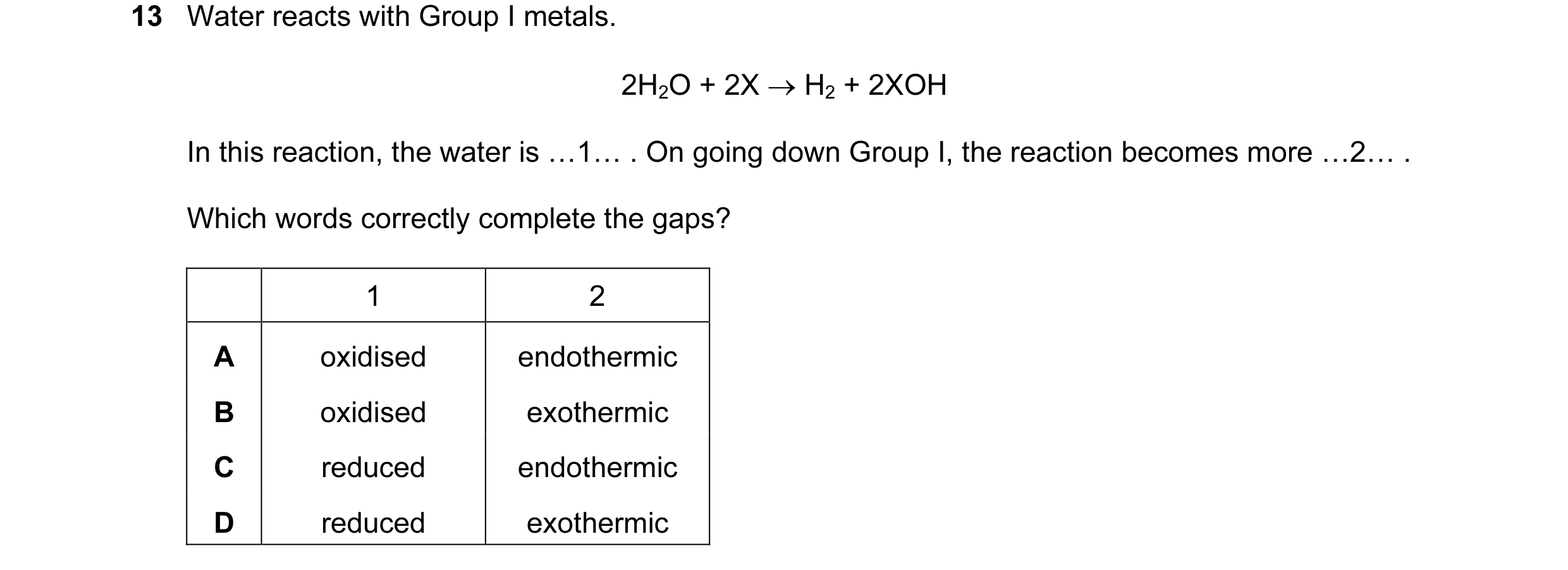
Q4 · Water reacts with Group I metals 0652/11 Oct/Nov 2007
13 Water reacts with Group I metals. 2H2O + 2X → H2 + 2XOH In this reaction, the water is …1… . On going down Group I, the reaction becomes more …2… . Which words correctly complete the gaps? 1 2 A oxidised endothermic B oxidised exothermic C reduced endothermic D reduced exothermic
1 marks
Answer: D
This question in 0652/11 Oct/Nov 2007
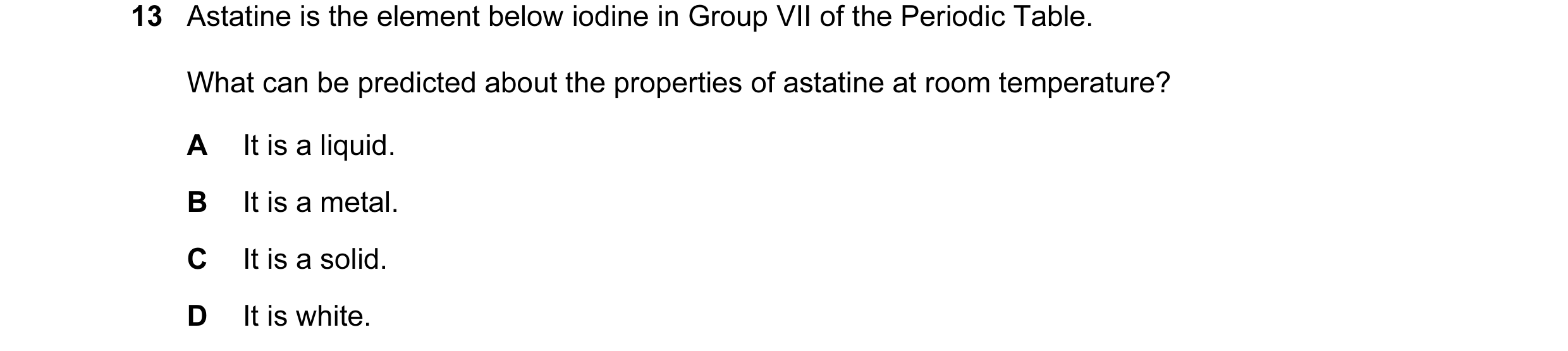
Q5 · Astatine is the element below iodine in Group VII of the Periodic Table 0652/11 Oct/Nov 2009
13 Astatine is the element below iodine in Group VII of the Periodic Table. What can be predicted about the properties of astatine at room temperature? A It is a liquid. B It is a metal. C It is a solid. D It is white.
1 marks
Answer: C
This question in 0652/11 Oct/Nov 2009
Q6 · Elements X and Y each have a proton number greater than 10 but less than 19 0652/11 Oct/Nov 2010
11 Elements X and Y each have a proton number greater than 10 but less than 19.
The proton number of Y is 6 greater than that of X.
Which statements about elements X and Y must be correct?
X is the oon . X and Y
. Y is diatomic
more metallic react together
A Jv Jv x
B Jv x x
Cc x Jv Jv
D x x Jv
1 marks
Answer: B
This question in 0652/11 Oct/Nov 2010
Q7 · Metal X can easily be cut, reacts with chlorine, floats on water 0652/11 Oct/Nov 2010
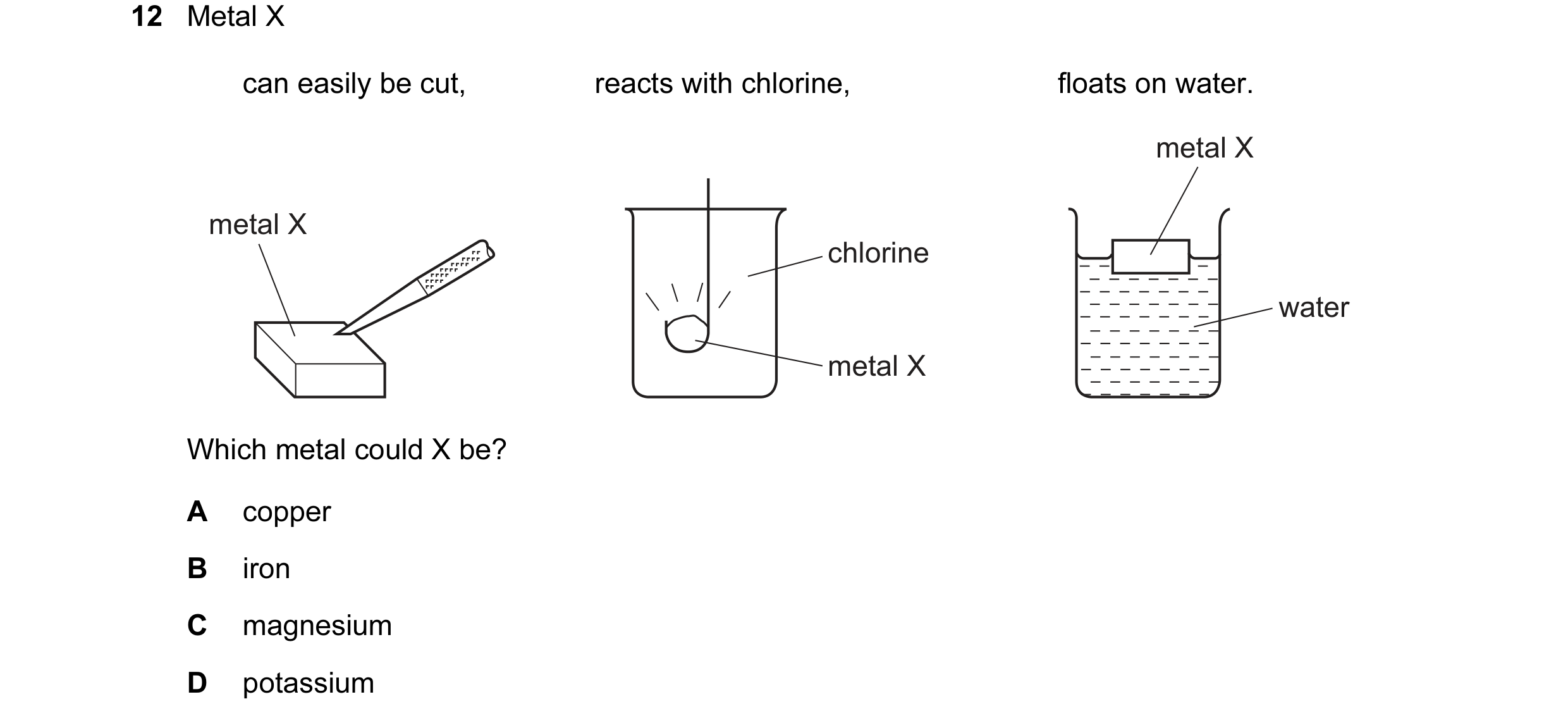
12 Metal X can easily be cut, reacts with chlorine, floats on water. metal X metal X chlorine water metal X Which metal could X be? A copper B iron C magnesium D potassium
1 marks
Answer: D
This question in 0652/11 Oct/Nov 2010
Q8 · The following statements are about rubidium, which is below potassium in Group I of the… 0652/11 Oct/Nov 2011
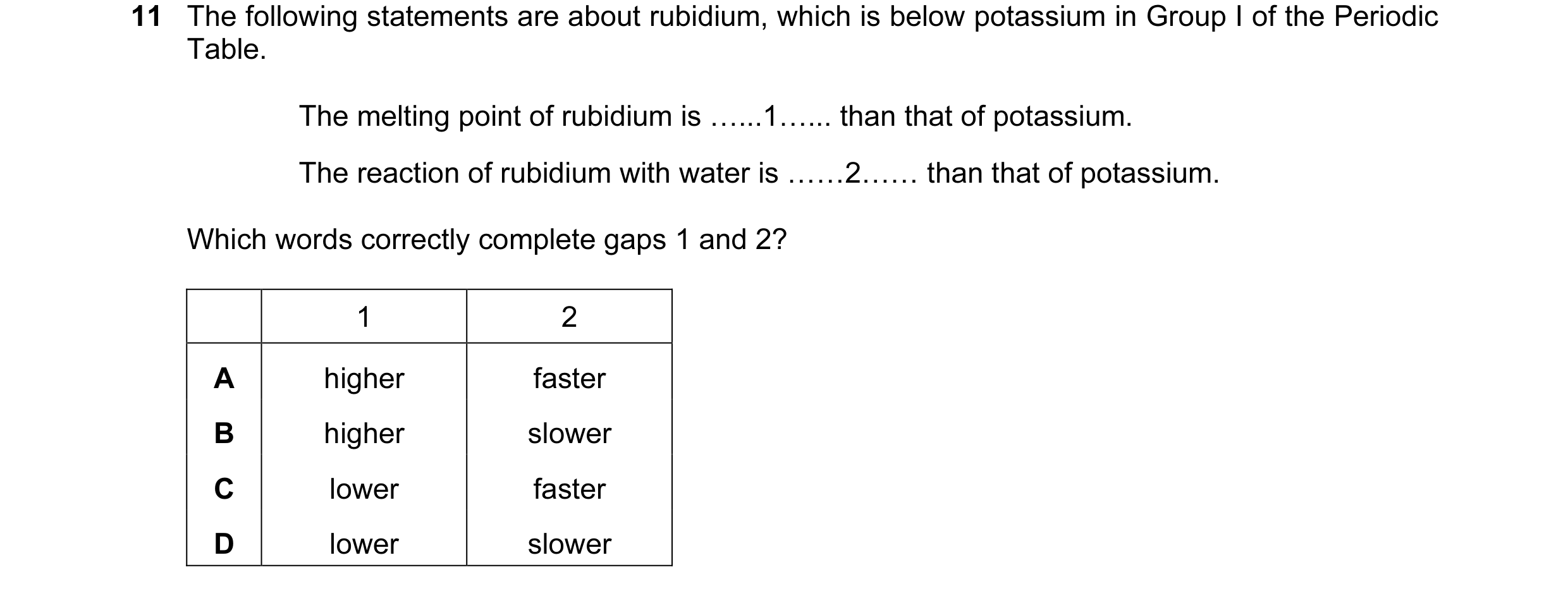
11 The following statements are about rubidium, which is below potassium in Group I of the Periodic Table. The melting point of rubidium is …...1…... than that of potassium. The reaction of rubidium with water is ……2…… than that of potassium. Which words correctly complete gaps 1 and 2? 1 2 A higher faster B higher slower C lower faster D lower slower
1 marks
Answer: C
This question in 0652/11 Oct/Nov 2011
Q9 · The following statements are about rubidium, which is below potassium in Group I of the… 0652/12 Oct/Nov 2011
12 The following statements are about rubidium, which is below potassium in Group I of the Periodic Table. The melting point of rubidium is …...1…... than that of potassium. The reaction of rubidium with water is ……2…… than that of potassium. Which words correctly complete gaps 1 and 2? 1 2 A higher faster B higher slower C lower faster D lower slower
1 marks
Answer: C
This question in 0652/12 Oct/Nov 2011
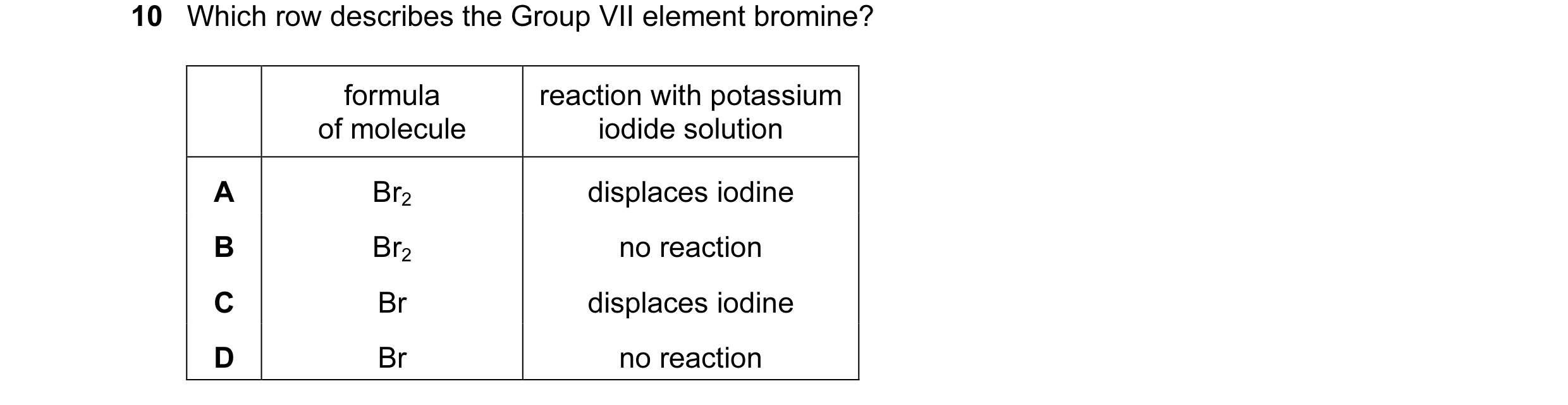
Q10 · Which row describes the Group VII element bromine? 0652/11 Oct/Nov 2014
10 Which row describes the Group VII element bromine? formula reaction with potassium of molecule iodide solution A Br2 displaces iodine B Br2 no reaction C Br displaces iodine D Br no reaction
1 marks
Answer: A
This question in 0652/11 Oct/Nov 2014
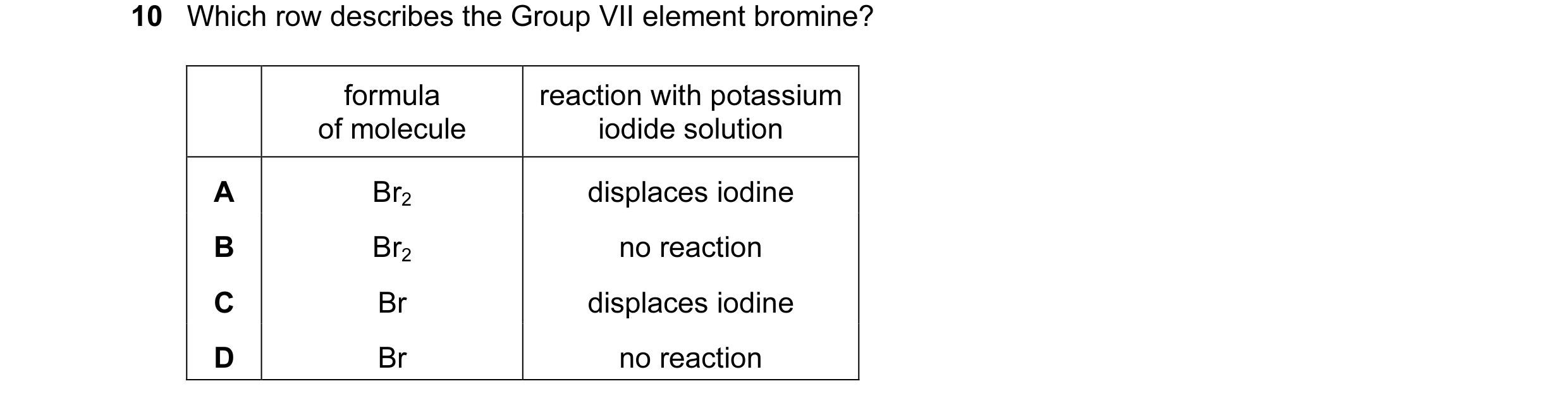
Q11 · Which row describes the Group VII element bromine? 0652/12 Oct/Nov 2014
10 Which row describes the Group VII element bromine? formula reaction with potassium of molecule iodide solution A Br2 displaces iodine B Br2 no reaction C Br displaces iodine D Br no reaction
1 marks
Answer: A
This question in 0652/12 Oct/Nov 2014
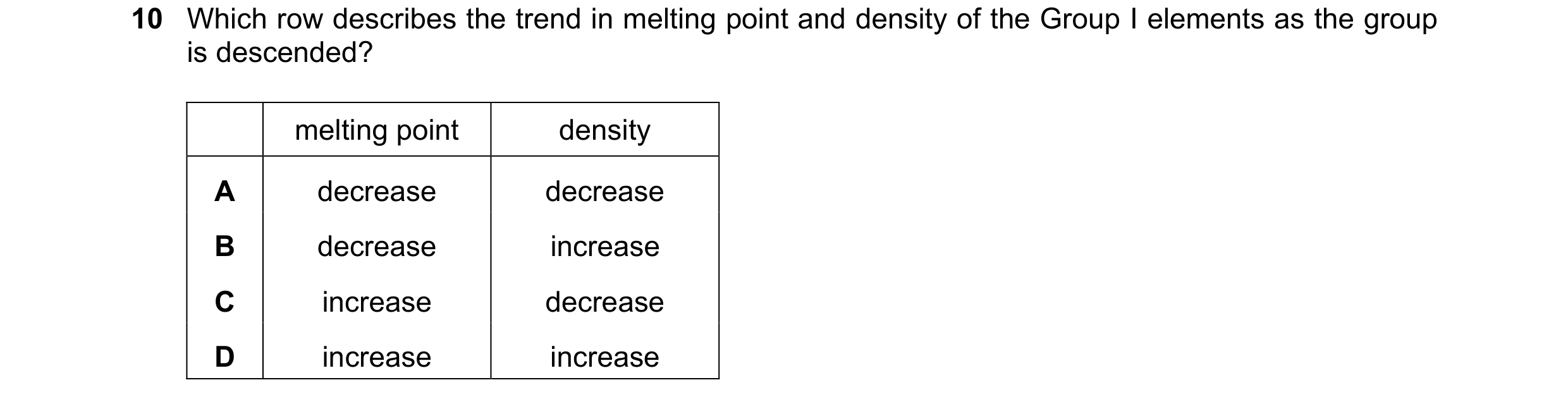
Q12 · Which row describes the trend in melting point and density of the Group I elements as the… 0652/11 Oct/Nov 2017
10 Which row describes the trend in melting point and density of the Group I elements as the group is descended? melting point density A decrease decrease B decrease increase C increase decrease D increase increase
1 marks
Answer: B
This question in 0652/11 Oct/Nov 2017
Q13 · Which row describes the trend in melting point and density of the Group I elements as the… 0652/12 Oct/Nov 2017
10 Which row describes the trend in melting point and density of the Group I elements as the group is descended? melting point density A decrease decrease B decrease increase C increase decrease D increase increase
1 marks
Answer: B
This question in 0652/12 Oct/Nov 2017
Q14 · Which statement about trends down groups in the Periodic Table is correct? 0652/11 Oct/Nov 2018
13 Which statement about trends down groups in the Periodic Table is correct? A The Group I elements become less reactive with water. B The Group I elements show an increase in melting point. C The Group VII elements become darker in colour. D The Group VII elements show an increased ability to displace halide ions.
1 marks
Answer: C
This question in 0652/11 Oct/Nov 2018
Q15 · Which statement about trends down groups in the Periodic Table is correct? 0652/12 Oct/Nov 2018
13 Which statement about trends down groups in the Periodic Table is correct? A The Group I elements become less reactive with water. B The Group I elements show an increase in melting point. C The Group VII elements become darker in colour. D The Group VII elements show an increased ability to displace halide ions.
1 marks
Answer: C
This question in 0652/12 Oct/Nov 2018
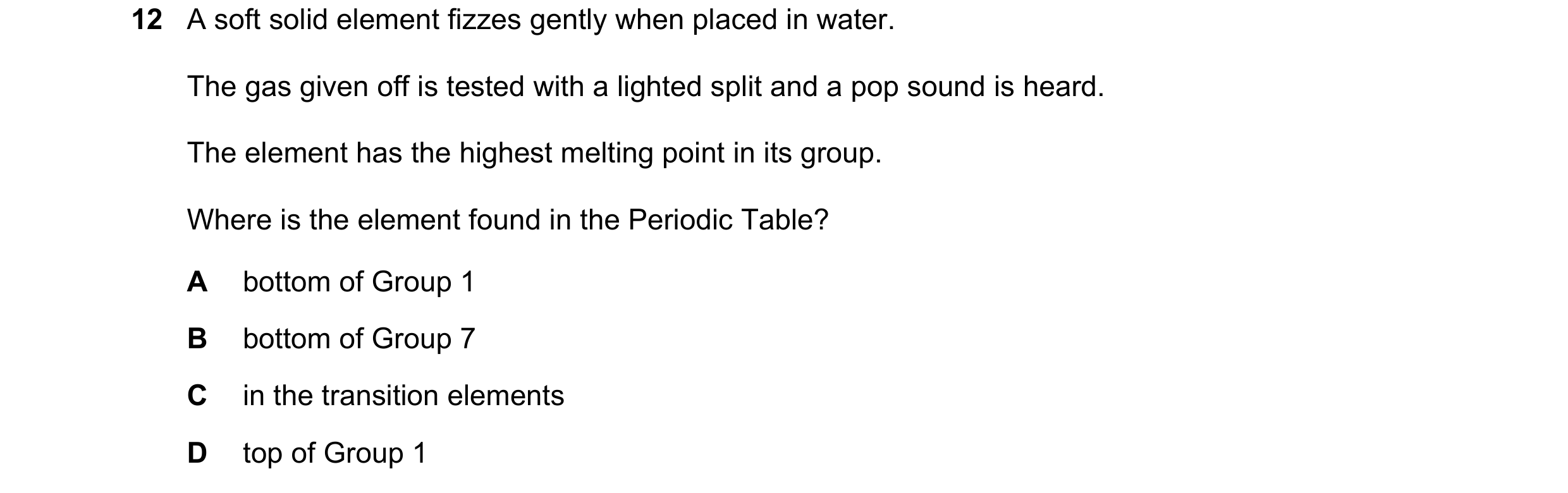
Q16 · A soft solid element fizzes gently when placed in water 0652/12 Oct/Nov 2019
12 A soft solid element fizzes gently when placed in water. The gas given off is tested with a lighted split and a pop sound is heard. The element has the highest melting point in its group. Where is the element found in the Periodic Table? A bottom of Group 1 B bottom of Group 7 C in the transition elements D top of Group 1
1 marks
Answer: D
This question in 0652/12 Oct/Nov 2019
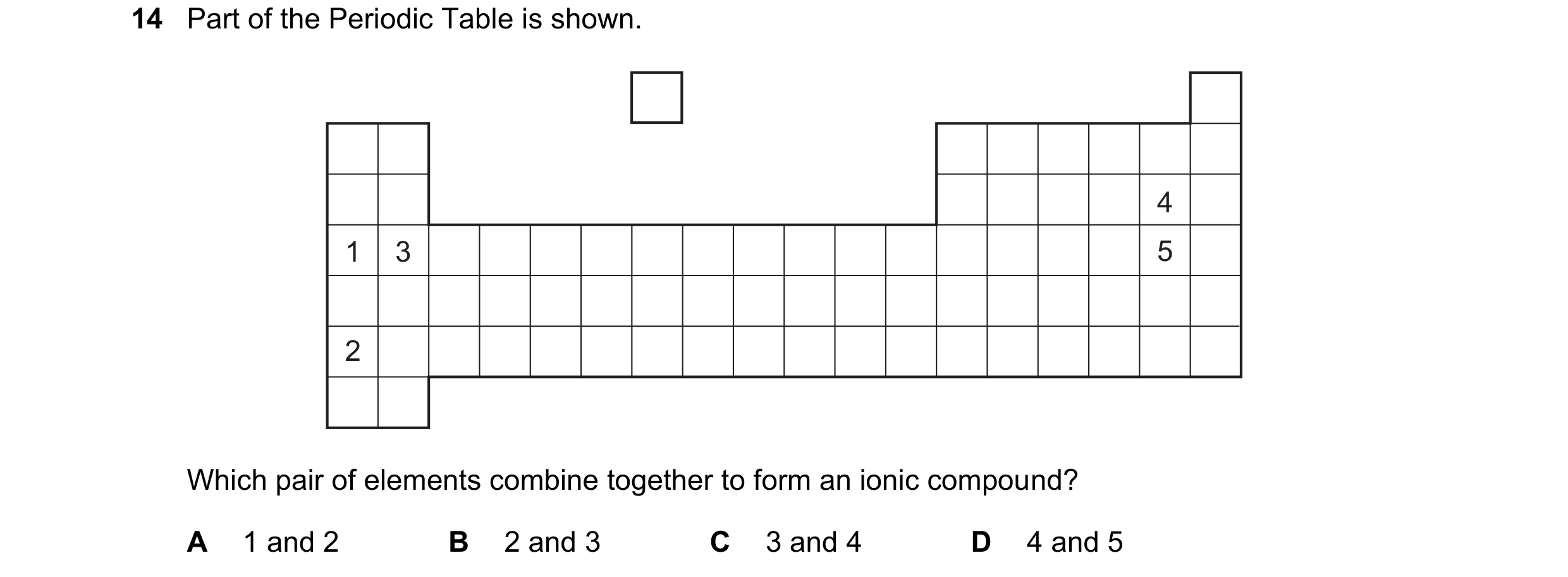
Q17 · Part of the Periodic Table is shown 0652/11 Oct/Nov 2020
14 Part of the Periodic Table is shown. 4 1 3 5 2 Which pair of elements combine together to form an ionic compound? A 1 and 2 B 2 and 3 C 3 and 4 D 4 and 5
1 marks
Answer: C
This question in 0652/11 Oct/Nov 2020
Q18 · Which row describes the trend in properties of the Group I elements down the group? 0652/11 Oct/Nov 2024
13 Which row describes the trend in properties of the Group I elements down the group? melting point density A decreases decreases B decreases increases C increases decreases D increases increases
1 marks
Answer: B
This question in 0652/11 Oct/Nov 2024

 1 / 5
1 / 5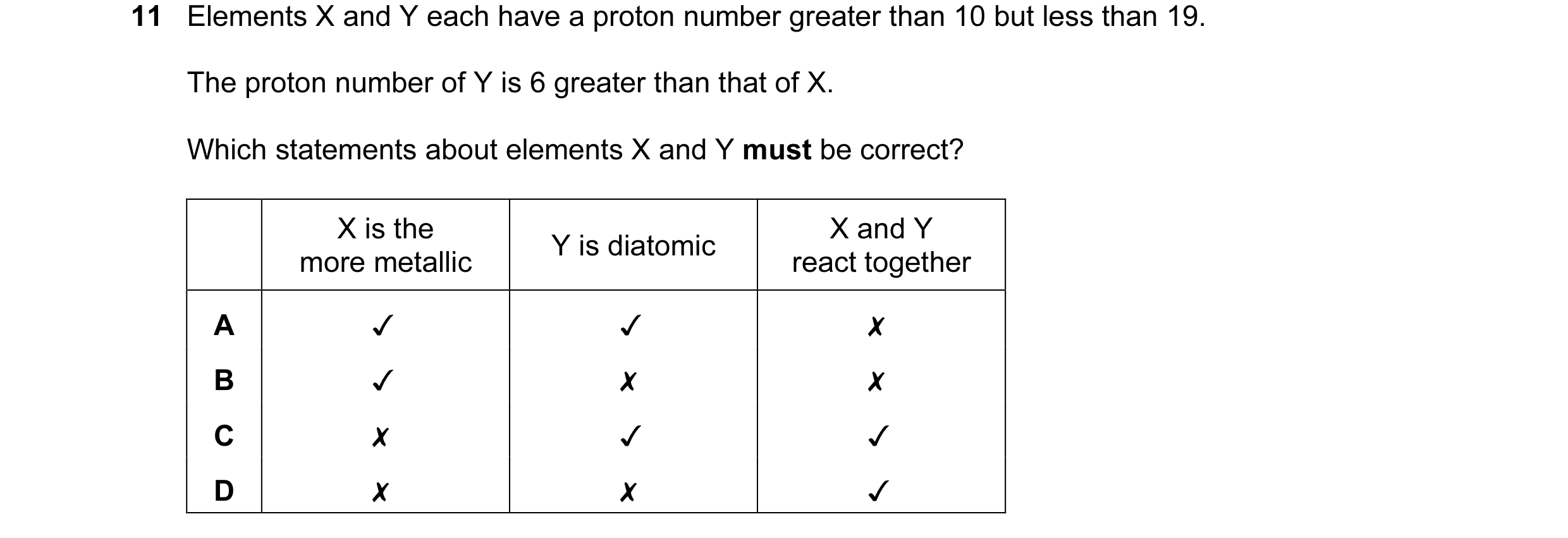
 2 / 5
2 / 5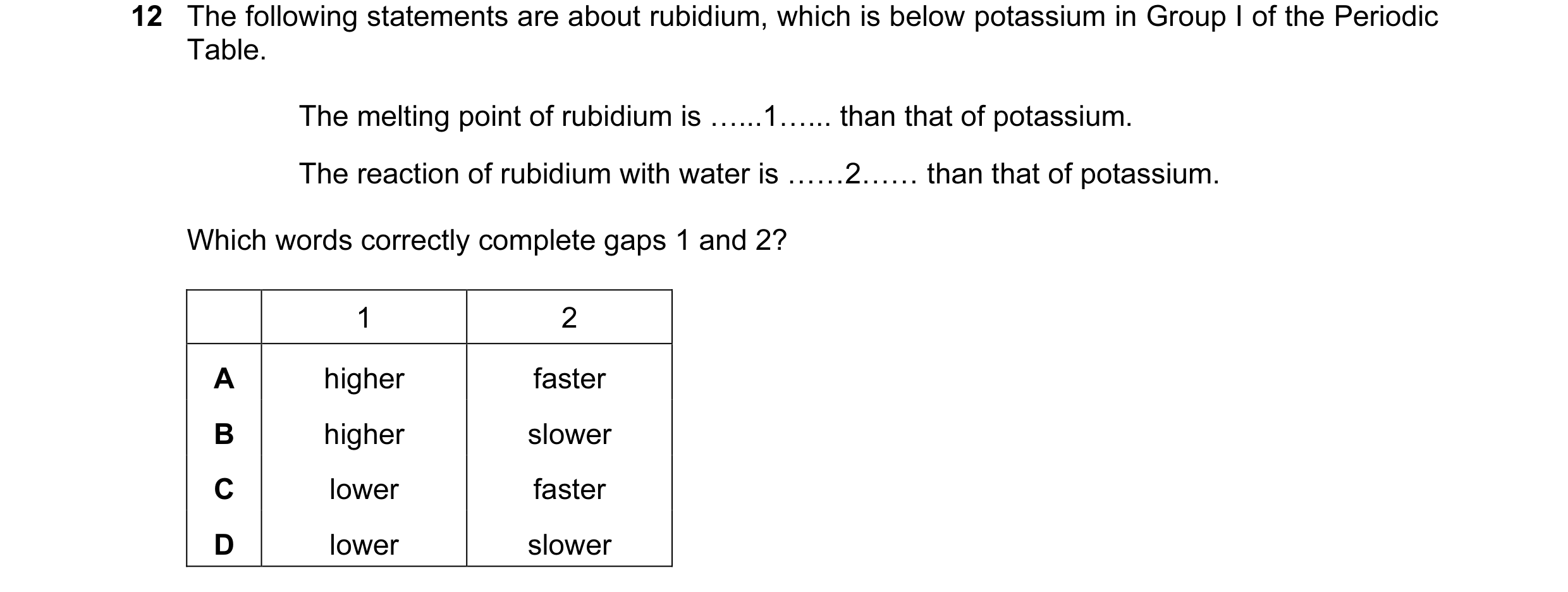
 3 / 5
3 / 5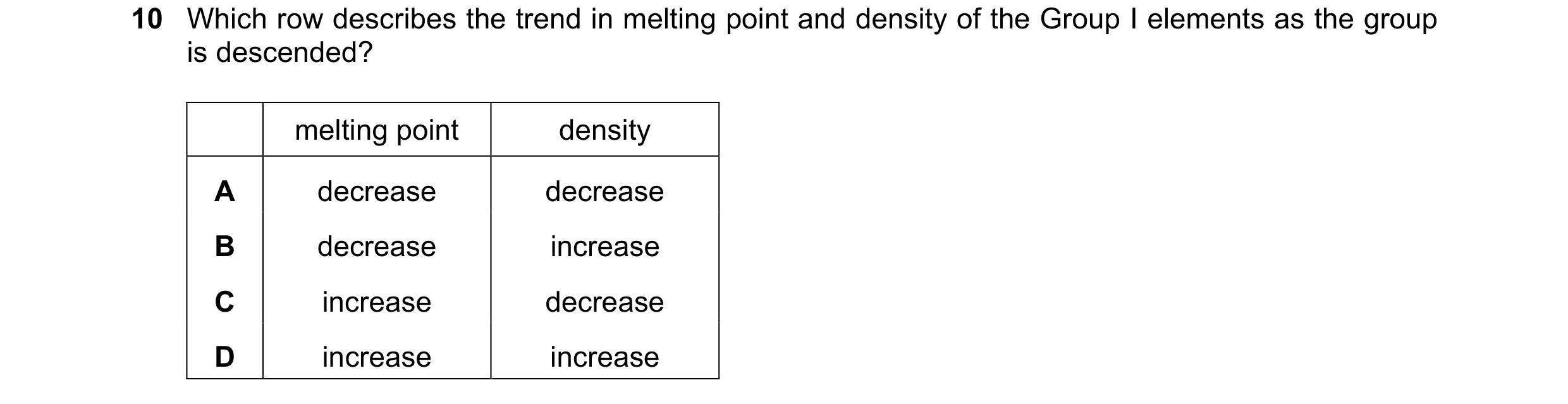


 4 / 5
4 / 5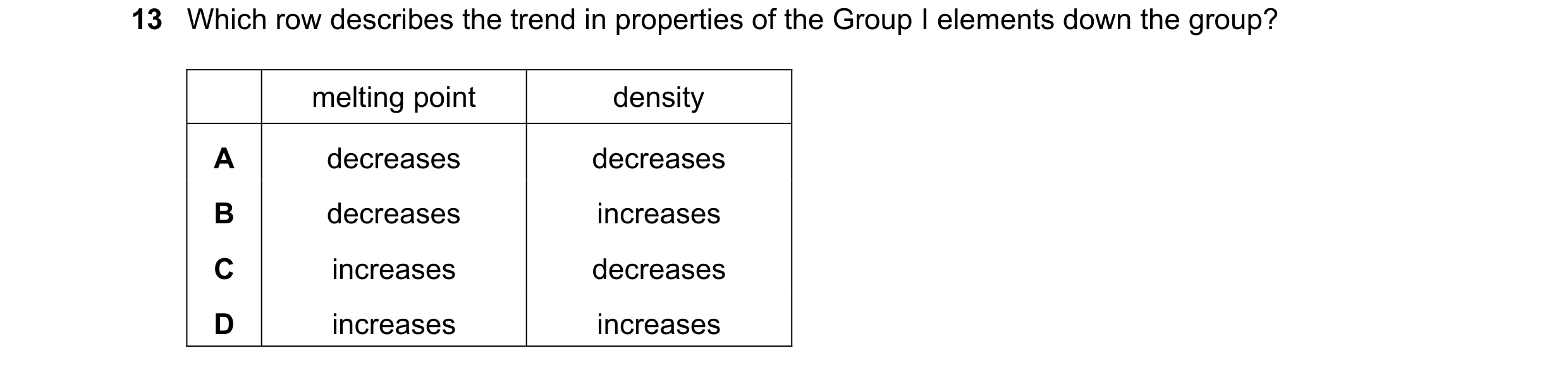 5 / 5
5 / 5