Questions as text
Q1 · An element Z has the electronic structure 2,8,5 0652/21 Oct/Nov 2017
12 An element Z has the electronic structure 2,8,5. In which group in the Periodic Table is Z placed? A 2 B 3 C 5 D 8
1 marks
Answer: C
This question in 0652/21 Oct/Nov 2017
Q2 · The elements in Group VI of the Periodic Table show the same trends as the elements in… 0652/21 Oct/Nov 2017
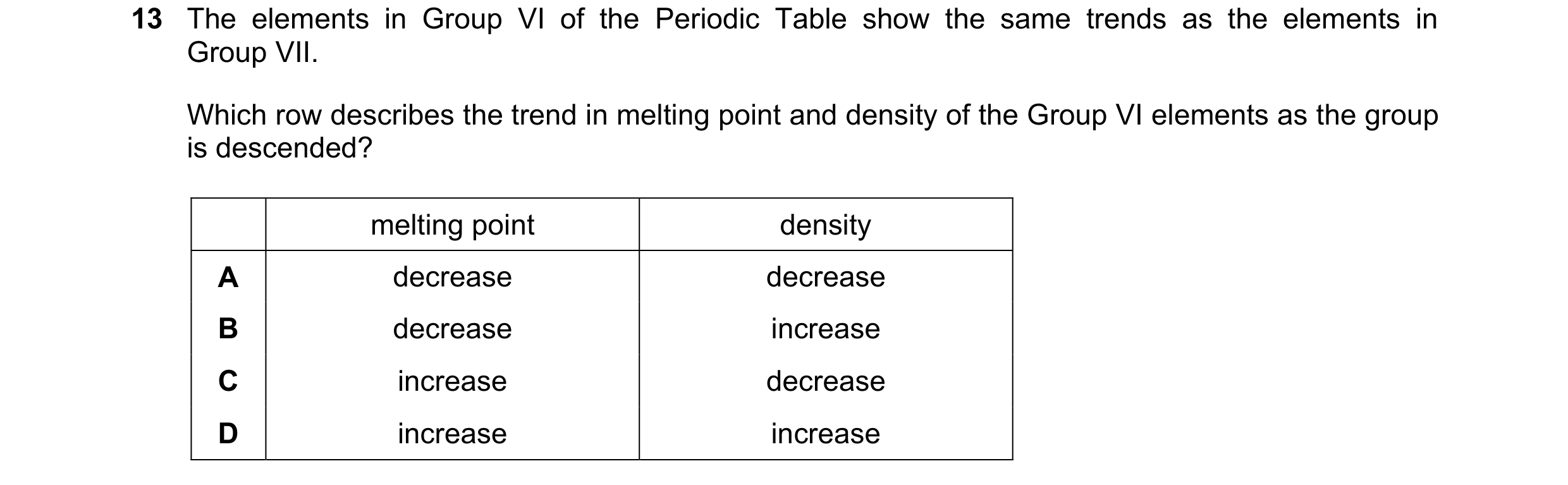
13 The elements in Group VI of the Periodic Table show the same trends as the elements in Group VII. Which row describes the trend in melting point and density of the Group VI elements as the group is descended? melting point density A decrease decrease B decrease increase C increase decrease D increase increase
1 marks
Answer: D
This question in 0652/21 Oct/Nov 2017
Q3 · An element Z has the electronic structure 2,8,5 0652/22 Oct/Nov 2017
12 An element Z has the electronic structure 2,8,5. In which group in the Periodic Table is Z placed? A 2 B 3 C 5 D 8
1 marks
Answer: C
This question in 0652/22 Oct/Nov 2017
Q4 · The elements in Group VI of the Periodic Table show the same trends as the elements in… 0652/22 Oct/Nov 2017
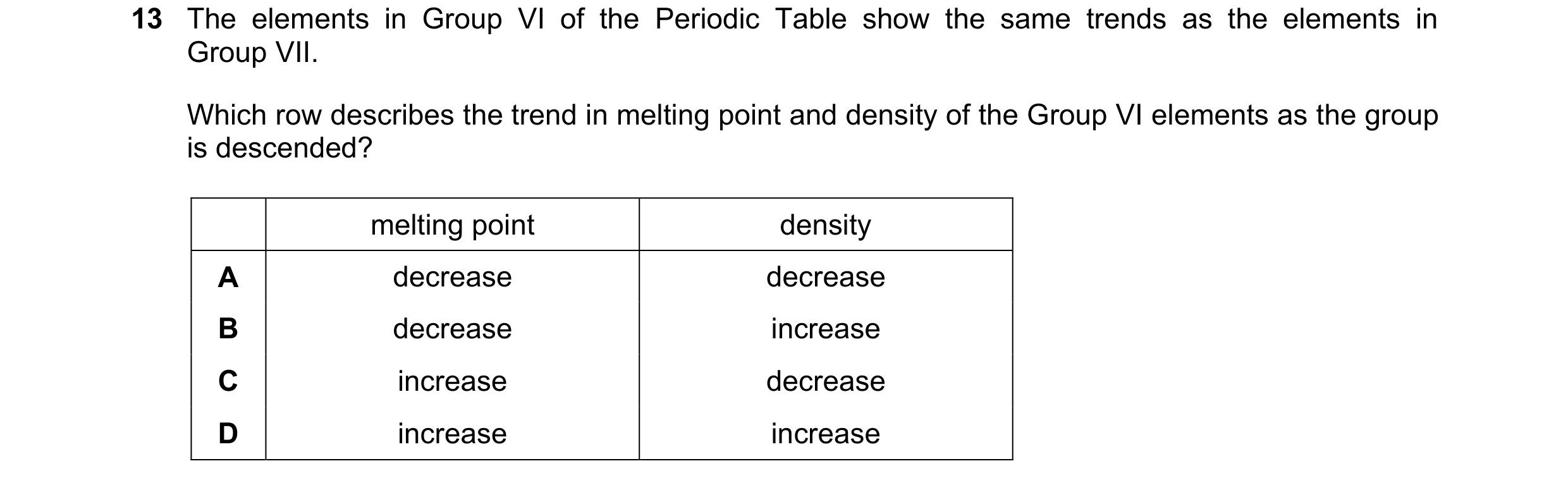
13 The elements in Group VI of the Periodic Table show the same trends as the elements in Group VII. Which row describes the trend in melting point and density of the Group VI elements as the group is descended? melting point density A decrease decrease B decrease increase C increase decrease D increase increase
1 marks
Answer: D
This question in 0652/22 Oct/Nov 2017
Q5 · How are elements with one electron in their outer shell described? 0652/21 Oct/Nov 2019
10 How are elements with one electron in their outer shell described? A Group I metals B Group I non-metals C Group VII metals D Group VII non-metals
1 marks
Answer: A
This question in 0652/21 Oct/Nov 2019
Q6 · Lithium has a lower density than sodium 0652/21 Oct/Nov 2019
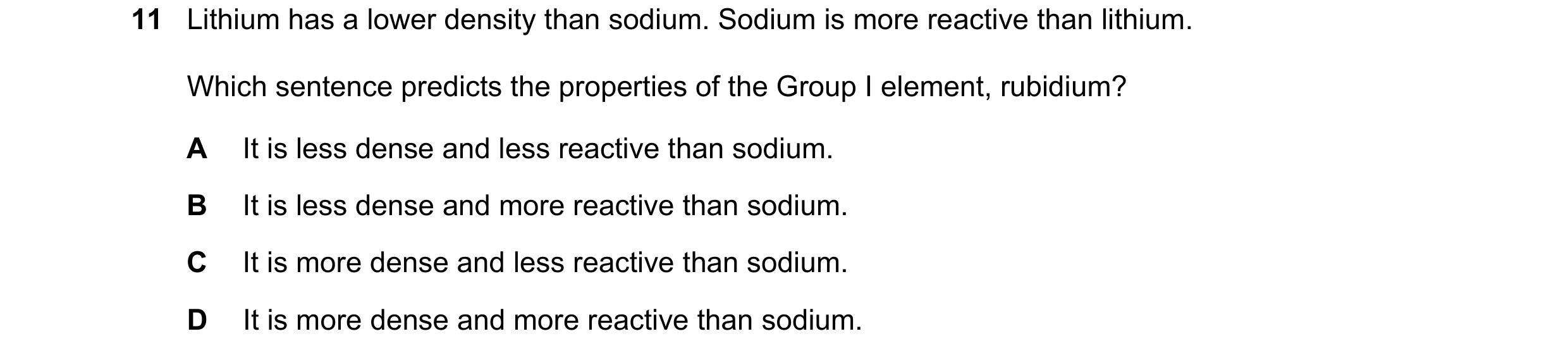
11 Lithium has a lower density than sodium. Sodium is more reactive than lithium. Which sentence predicts the properties of the Group I element, rubidium? A It is less dense and less reactive than sodium. B It is less dense and more reactive than sodium. C It is more dense and less reactive than sodium. D It is more dense and more reactive than sodium.
1 marks
Answer: D
This question in 0652/21 Oct/Nov 2019
Q7 · How are elements with one electron in their outer shell described? 0652/22 Oct/Nov 2019
10 How are elements with one electron in their outer shell described? A Group I metals B Group I non-metals C Group VII metals D Group VII non-metals
1 marks
Answer: A
This question in 0652/22 Oct/Nov 2019
Q8 · Lithium has a lower density than sodium 0652/22 Oct/Nov 2019
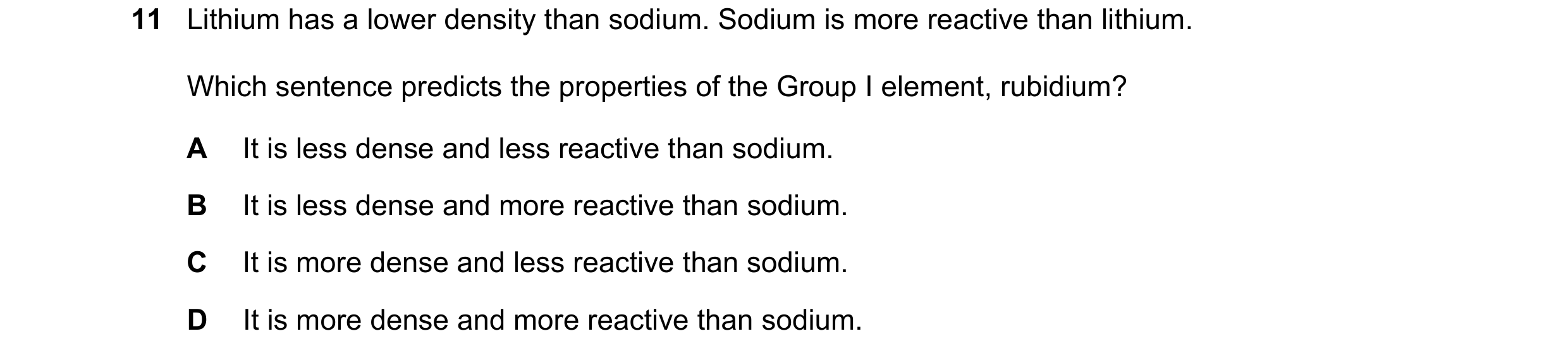
11 Lithium has a lower density than sodium. Sodium is more reactive than lithium. Which sentence predicts the properties of the Group I element, rubidium? A It is less dense and less reactive than sodium. B It is less dense and more reactive than sodium. C It is more dense and less reactive than sodium. D It is more dense and more reactive than sodium.
1 marks
Answer: D
This question in 0652/22 Oct/Nov 2019
Q9 · The elements in Group VII of the Periodic Table are known as the halogens 0652/21 Oct/Nov 2020
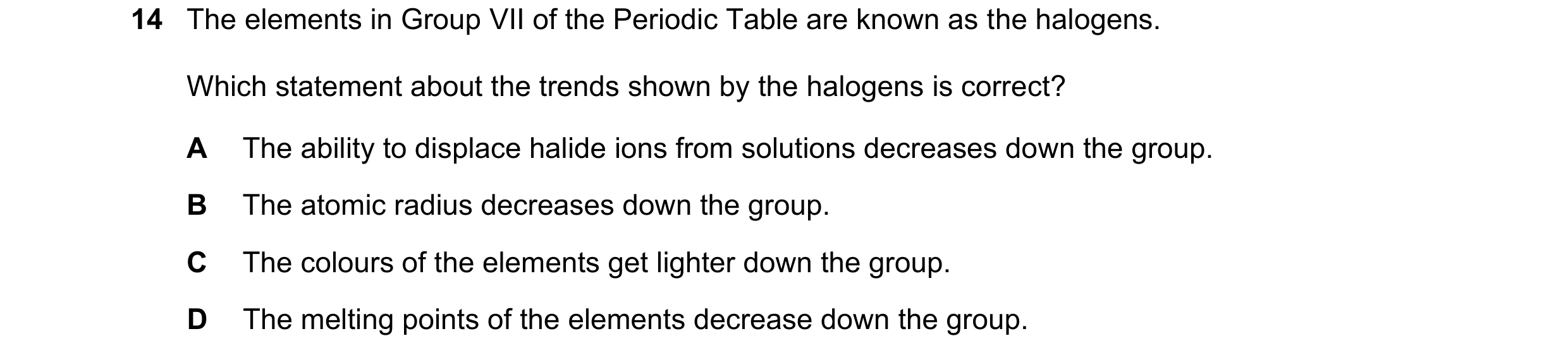
14 The elements in Group VII of the Periodic Table are known as the halogens. Which statement about the trends shown by the halogens is correct? A The ability to displace halide ions from solutions decreases down the group. B The atomic radius decreases down the group. C The colours of the elements get lighter down the group. D The melting points of the elements decrease down the group.
1 marks
Answer: A
This question in 0652/21 Oct/Nov 2020
Q10 · Chlorine, bromine and iodine are three of the elements in Group VII of the Periodic Table 0652/22 Oct/Nov 2020
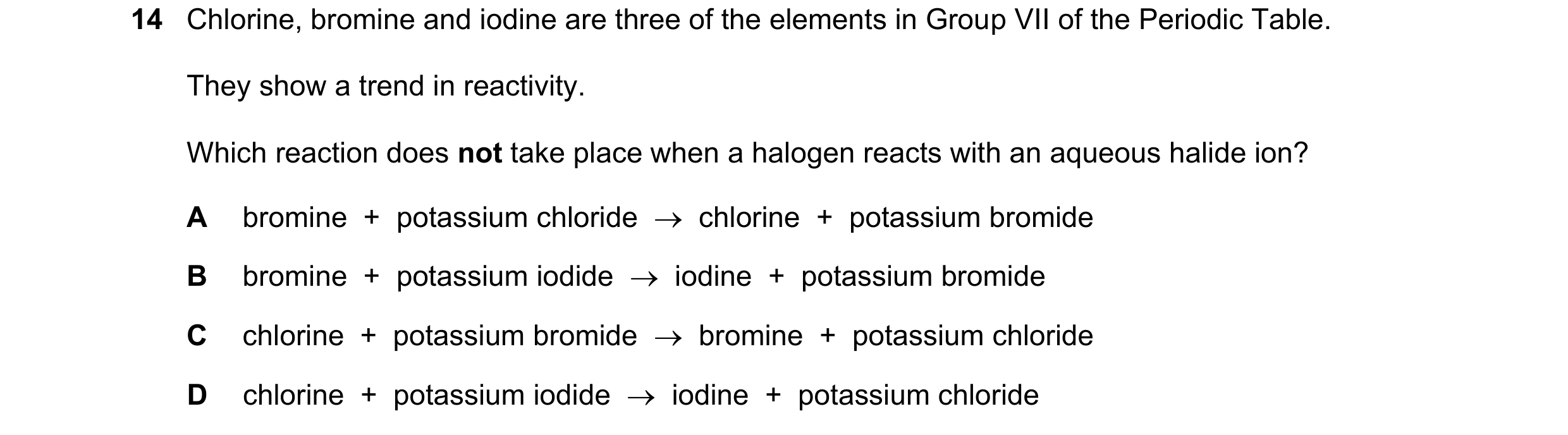
14 Chlorine, bromine and iodine are three of the elements in Group VII of the Periodic Table. They show a trend in reactivity. Which reaction does not take place when a halogen reacts with an aqueous halide ion? A bromine + potassium chloride chlorine + potassium bromide B bromine + potassium iodide iodine + potassium bromide C chlorine + potassium bromide bromine + potassium chloride D chlorine + potassium iodide iodine + potassium chloride
1 marks
Answer: A
This question in 0652/22 Oct/Nov 2020
Q11 · A student mixes aqueous solutions of four halogens with four aqueous solutions of halides 0652/22 Oct/Nov 2022
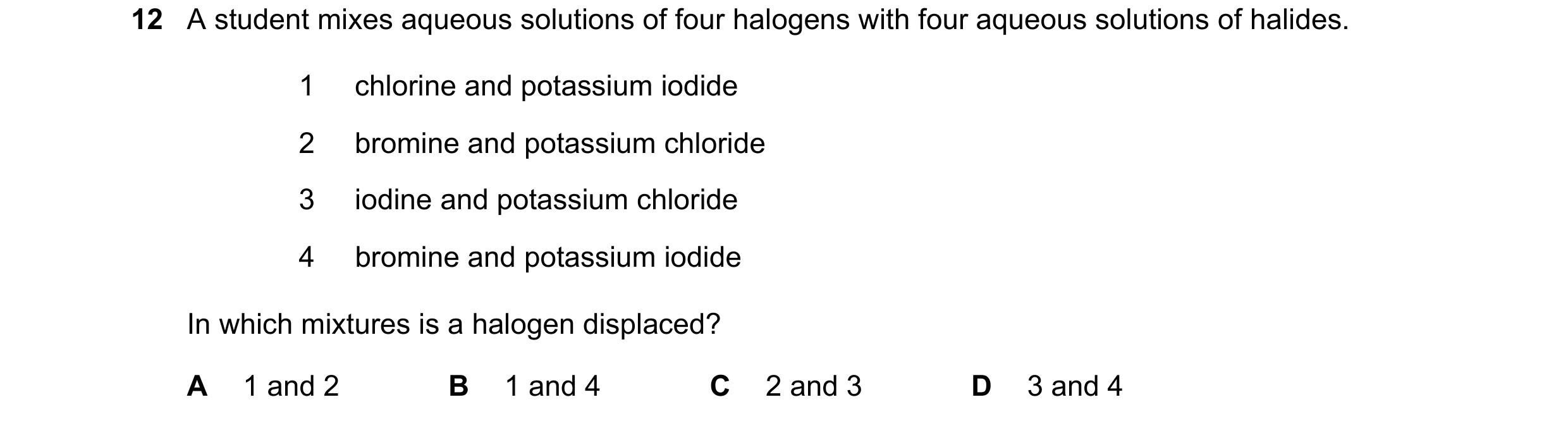
12 A student mixes aqueous solutions of four halogens with four aqueous solutions of halides. 1 chlorine and potassium iodide 2 bromine and potassium chloride 3 iodine and potassium chloride 4 bromine and potassium iodide In which mixtures is a halogen displaced? A 1 and 2 B 1 and 4 C 2 and 3 D 3 and 4
1 marks
Answer: B
This question in 0652/22 Oct/Nov 2022
Q12 · Lithium has a lower density than sodium 0652/21 Oct/Nov 2024
14 Lithium has a lower density than sodium. Sodium is more reactive than lithium. Which statement predicts the properties of the Group I element, rubidium? A It is less dense and less reactive than sodium. B It is less dense and more reactive than sodium. C It is more dense and less reactive than sodium. D It is more dense and more reactive than sodium.
1 marks
Answer: D
This question in 0652/21 Oct/Nov 2024



 1 / 3
1 / 3
 2 / 3
2 / 3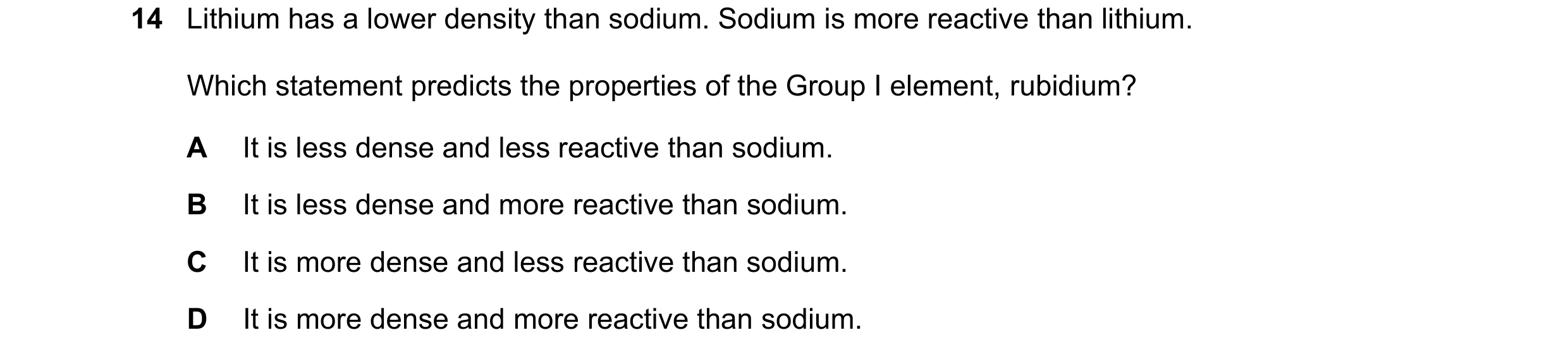 3 / 3
3 / 3