Questions as text
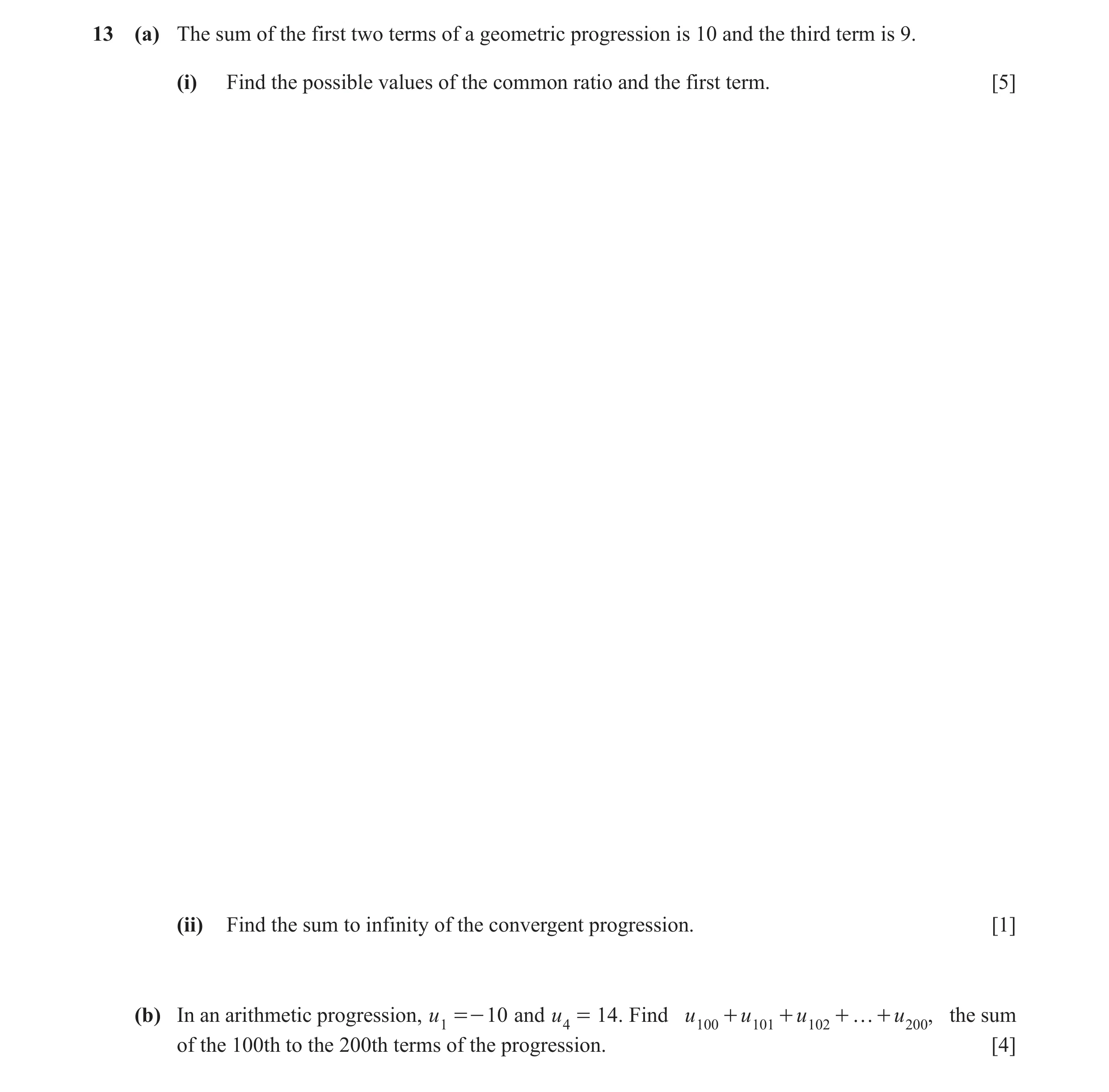
Q1 · The sum of the first two terms of a geometric progression is 10 and the third term is 9 0606/22 Feb/March 2020
13 (a) The sum of the first two terms of a geometric progression is 10 and the third term is 9. (i) Find the possible values of the common ratio and the first term. [5] (ii) Find the sum to infinity of the convergent progression. [1] (b) In an arithmetic progression, u 1 =- 10 and u 4 = 14. Find u 100 + u 101 + u 102 + f + u 200 , the sum of the 100th to the 200th terms of the progression. [4]
10 marks
Mark scheme: 13(a)(i) a + ar = 10 soi B1 ar 2 = 9 soi B1 Solves their equations M1 3 3 A2 3 3 r = − , and a = 25, 4 A1 for either r = − , or a = 25, 4 5 2 5 2 or 3 for r = − and a = 25 or 5 3 for r = and a = 4 2 13(a)(ii) 125 5 B1 or 15.625 or 158 only 8 13(b) d = 8 B1 [ S 200 − S 99 = ] M2 M1 for either sum correct or correct FT their d 200 { 2( −10) + 199(their 8)} − 2 99 { 2( −10) + 98(their 8)} oe 2 119382 cao A1 Alternative method 1 d = 8 (B1 u100 = −10 + 99 × 8 [ = 782 ] and M1 u 200 = −10 + 199 × 8 [ = 1582 ] and n = 101 1 M1 (101)(782 + 1582) 2 119382 cao A1) Alternative method 2 d = 8 (B1 u100 = −10 + 99 × 8 [ = 782 ] and M1 n = 101 1 M1 (101)(2 × 782 + (101 − 1) × 8) 2 119382 cao A1)
This question in 0606/22 Feb/March 2020
Q2 · The first 5 terms of a sequence are given below 0606/22 May/June 2020
10 (a) The first 5 terms of a sequence are given below. 4 - 2 1 - .05 0.25 (i) Find the 20th term of the sequence. [2] (ii) Explain why the sum to infinity exists for this sequence and find the value of this sum. [2] (b) The tenth term of an arithmetic progression is 15 times the second term. The sum of the first 6 terms of the progression is 87. (i) Find the common difference of the progression. [4] (ii) For this progression, the nth term is 6990. Find the value of n. [3] Question 11 is printed on the next page.
11 marks
Mark scheme: 10(a)(i) 4 × ( − 0.5)19 M1 1 6 A1 − or −7.63 ×10− or 131072 −7.62939... ×10−6 rot to four or more figs 10(a)(ii) Valid explanation e.g. B1 the common ratio is between −1 and 1 4 8 B1 = 1 −−( 0.5) 3 10(b)(i) a + 9d = 15( a + d ) B1 6 B1 { 2 a + 5 d } = 87 2 Solves their equations for d e.g. M1 3 2 − d + 5d = 29 7 d = 7 A1 10(b)(ii) a = − 3 soi B1 6990 = their ( −3) + ( n − 1)(their 7) M1 n = 1000 A1
This question in 0606/22 May/June 2020
Q3 · A geometric progression has a first term of 3 and a second term of 2.4 0606/22 Oct/Nov 2020
7 A geometric progression has a first term of 3 and a second term of 2.4. For this progression, find (a) the sum of the first 8 terms, [3] (b) the sum to infinity, [1] (c) the least number of terms for which the sum is greater than 95% of the sum to infinity. [4]
8 marks
Mark scheme: 7 (a) 2.4 B1 a = 3 r = = 0.8 3 3(1 − 0.88 ) M1 Inserts their ܽ and ݎ into ଼ܵ S 8 = (1 − 0.8) = 12.48 awrt or 12.5 A1 7(b) 3 B1 S∞= = 15 (1 − 0.8) 7(c) Sn = 15(1 – 0.8n) > 0.95 × 15 M1 their correctly produced Sn > 0.95S∞ 0.8n < 0.05 A1 oe log0.05 M1 Dep takes logs correctly of their n < or n < log 0.8 0.05 expression with power of n. log0.8 n = 14 A1 nfww
This question in 0606/22 Oct/Nov 2020
Q4 · The sum of the first 4 terms of an arithmetic progression is 38 and the sum of the next 4… 0606/23 Oct/Nov 2020
10 (a) The sum of the first 4 terms of an arithmetic progression is 38 and the sum of the next 4 terms is 86. Find the first term and the common difference. [5] (b) The third term of a geometric progression is 12 and the sixth term is - 96 . Find the sum of the first 10 terms of this progression. [6] Question 11 is printed on the next page.
11 marks
Mark scheme: 10(a) use S4 or S8 M1 4 A1 accept unsimplified S 4 = [ 2 a + 3d ] = 38 ( 2 a + 3d = 19 ) 2 8 A1 accept unsimplified S 8 = [ 2 a + 7 d ] = 38 + 86 ( 2 a + 7 d = 31) 2 or 8 4 S8 – S4 = [ 2 a + 7 d ] − [ 2 a + 3 d ] = 86 2 2 ( 4 a + 22 d = 86 ) solve correct equations for a or d M1 a = 5 and d = 3 A1 10(b) ar 2 = 12 soi B1 ar 5 = −96 soi B1 solve correct equations for a or r M1 r = − 2 and a = 3 A1 insert their a and r into S10 M1 10 3 1 −−( 2 ) ( ) S10 = ) 1 −−( 2 ) –1023 A1
This question in 0606/23 Oct/Nov 2020
Q5 · An arithmetic progression has first term a and common difference d 0606/23 Oct/Nov 2021
9 An arithmetic progression has first term a and common difference d. The third term is 13 and the tenth term is 41. (a) Find the value of a and of d. [4] (b) Find the number of terms required to give a sum of 2555. [4] (c) Given that Sn is the sum to n terms, show that S 2 k - S k = 3k ( 1 + 2 k) . [4]
12 marks
Mark scheme: 9(a) Attempts to solve a + 2d = 13 and a + 9d = 41 oe M2 M1 for a + 2d = 13 and a + 9d = 41 soi d = 4 and a = 5 A2 A1 for d = 4 or a = 5 9(b) n M1 FT their a and their d { 2(5) + ( n − 1)4} soi 2 2 n 2 + 3n − 2555 [*0 ] A1 where * could be = or any inequality sign Solves their 3-term quadratic of the form M1 ax 2 + bx + c [*0] by factorising or formula or their 3-term quadratic of the form ax 2 + bx * c or better if completing the square 35 A1
This question in 0606/23 Oct/Nov 2021
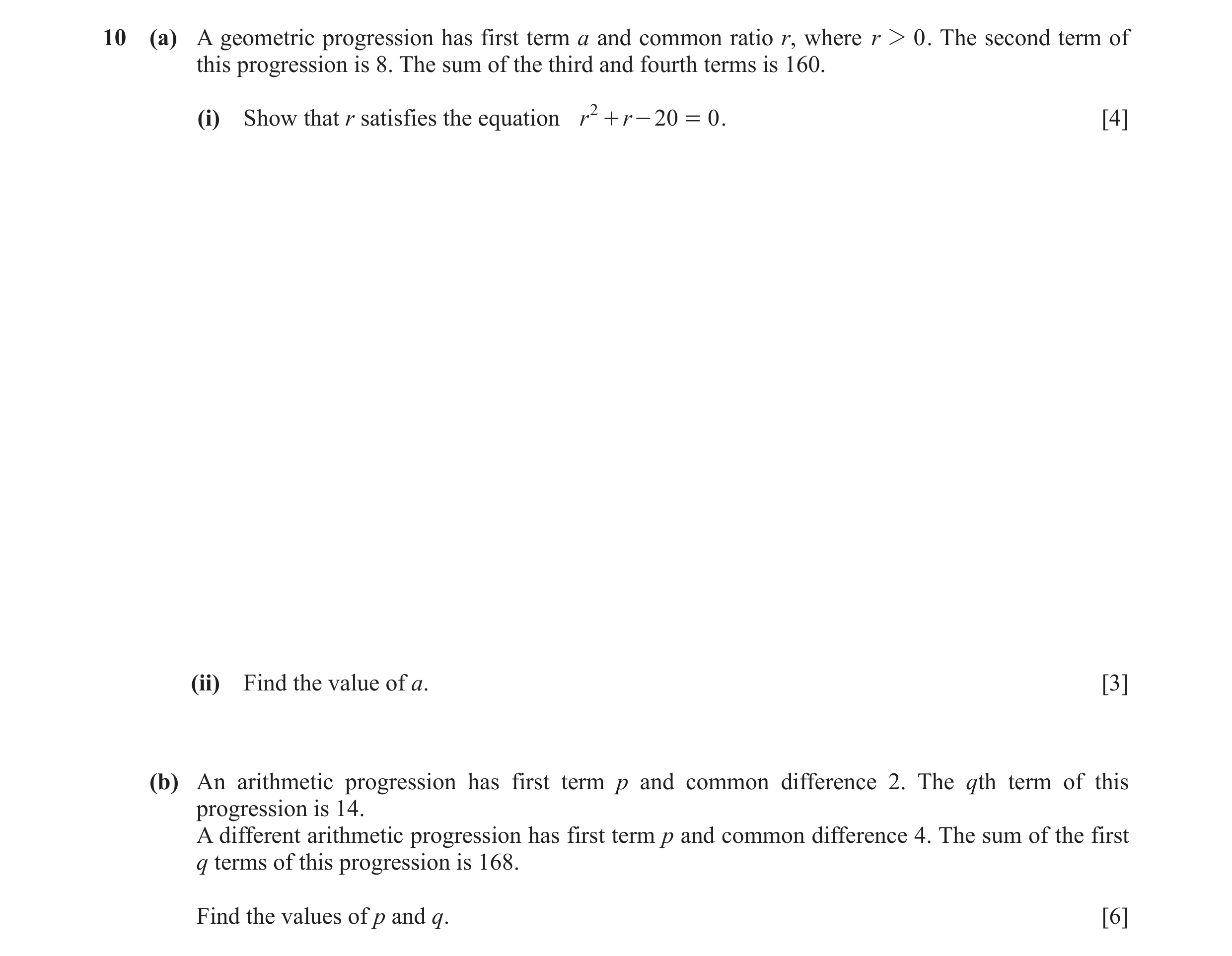
Q6 · A geometric progression has first term a and common ratio r, where r 2 0 0606/22 May/June 2022
10 (a) A geometric progression has first term a and common ratio r, where r 2 0 . The second term of this progression is 8. The sum of the third and fourth terms is 160. (i) Show that r satisfies the equation r 2 + r - 20 = 0 . [4] (ii) Find the value of a. [3] (b) An arithmetic progression has first term p and common difference 2. The qth term of this progression is 14. A different arithmetic progression has first term p and common difference 4. The sum of the first q terms of this progression is 168. Find the values of p and q. [6]
13 marks
Mark scheme: 10(a)(i) ar = 8 and ar2 + ar3 = 160 soi B2 B1 for each Correct unsimplified quadratic equation in r M1 e.g. a 8 and so 8 r 2 8 r 3 160 oe r r r Correct simplification to r 2 r 20 0 A1 10(a)(ii) Factorises or solves: M1 (r + 5)(r – 4) = 0 r = 4 A1 a = 2 A1 Alternative method 5a 2 2 a 16 0 oe (B1) Factorises or solves their 3-term quadratic in (M1) a a = 2 (A1) 10(b) p + 2(q – 1) = 14 oe B1 q B1 2 p 4( q 1) 168 oe 2 Eliminates p or q M1 condone one error in rearrangement of q either equation before substituting e.g. 2(14 2( q 1)) 4( q 1) 168 2 OR simplifies S q : q p 2( q 1) 168 and writes q (14) 168 Correctly solves their equation for their p or M1 dep on previous M1 their q q = 12 and p = 8 A2 A1 for q = 12 or p = 8
This question in 0606/22 May/June 2022
Q7 · The sum of the first 20 terms of an arithmetic progression is 1100 0606/23 May/June 2022
11 (a) The sum of the first 20 terms of an arithmetic progression is 1100. The sum of the first 70 terms is 14 350. Find the 12th term. [6] 1(b) The first three terms of a geometric progression are x + 6 , x - 9 , ( x + 1) . Show that x 2 satisfies the equation x 2 - 43x + 156 = 0 . Hence show that a sum to infinity exists for each possible value of x. [7]
13 marks
Mark scheme: 11(a) 20 B1 S 20 2 a 19 d 1100 oe 2 70 B1 S 70 2 a 69 d 14350 oe 2 Solves their linear equations in a and d M1 dep on at least B1 and an attempt to form the other equation using the sum formula a = 2, d = 6 A2 A1 for each u12 2 11 6 64 B1 11(b) 1 M2 1 ( x 1) ( x 1) x 9 2 x 9 2 M1 for either or ; may x 6 x 9 x 6 x 9 x 9 1 be embedded or ( x 9) ( x 1) x 6 2 x 9 2 1 ( x 6) ( x 1) oe x 6 2 Correct simplification to given equation A1 x 2 43 x 156 0 Factorises or solves: M1 (x – 4)(x – 39) = 0 x = 4, x = 39 A1 1 2 A2 r = r = A1 for either value of r 2 3 |r| < 1 for each progression [and so the sum to infinity exists]
This question in 0606/23 May/June 2022
Q8 · The sum of the first three terms of a geometric progression is 17.5 and the sum to… 0606/21 Oct/Nov 2022
7 The sum of the first three terms of a geometric progression is 17.5 and the sum to infinity is 20. Find the first term and the common ratio. [6]
6 marks
Mark scheme: 7 a (1 − r 3 ) 2 B1 = 17.5 oe or a + ar + ar = 17.5 1 − r oe a B1 = 20 1 − r Correctly eliminates a or eliminates r M1 FT their equations providing at least B1 awarded 20(1 – r3) = 17.5 A1 or a 3 − 60a 2 + 1200a − 7000 = 0 1 A2 A1 for either r = , a = 10 2
This question in 0606/21 Oct/Nov 2022
Q9 · A geometric progression has third term 4.5 and sixth term 15.1875 0606/22 Oct/Nov 2022
10 (a) A geometric progression has third term 4.5 and sixth term 15.1875. Find the first term and the common ratio. [4] (b) Find the sum of ten terms of the progression, starting with the sixteenth term. Give your answer to the nearest integer. [4]
8 marks
Mark scheme: 10(a) ar 2 = 4.5 and ar 5 = 15.1875 soi B1 Correctly eliminates one unknown using M1 correct equations 4.5 5 e.g 2 r = 15.1875 r 4.5 15.1875 or = 5 oe, soi a a r = 1.5, a = 2 A2 A1 for either 10(b) 2(1 − 1.515 ) 2(1 − 1.525 ) B2 M1 FT their a and r S15 = and S 25 = oe 15 1 − 1.5 1 − 1.5 2(1 − 1.5 ) for S15 = 1 − 1.5 2(1 − 1.525 ) or S 25 = oe 1 − 1.5 Correct plan: S25 – S15 oe attempted M1 FT their a and r 99 253 A1 10(b) Alternative 1 first term = (their2)(their1.5)15 and an (M1) FT their a and r attempt at S10 Correct sum (B2) M1 FT their first term and r for 875.7...(1 − 1.510 ) their 875.7...(1 − their1.510 ) S10 = oe S10 = 1 − 1.5 1 − their1.5 99 253 (A1) Alternative 2 Correct sum: (M3) M2 FT their a and r for sum starting 2(1.5)15 + 2(1.5)16+ 2(1.5)17 + 2(1.5)18 + with 2(1.5)15 and ending with 2(1.5)24 2(1.5)19 + 2(1.5)20 + 2(1.5)21+ 2(1.5)22+ with at most one omission or error 2(1.5)23 + 2(1.5)24 oe or M1 FT their a and r for sum or starting with 2(1.5)15 or ending with 2(1.5)15{1 + 1.5+ (1.5)2 + (1.5)3 + (1.5)4 + 2(1.5)24 with at most two omissions or (1.5)5 + (1.5)6+ (1.5)7+ (1.5)8 + (1.5)9} errors 99 253 (A1)
This question in 0606/22 Oct/Nov 2022
Q10 · The third term of an arithmetic progression is 10 and the sum of the first 8 terms is 116 0606/23 Oct/Nov 2022
10 (a) The third term of an arithmetic progression is 10 and the sum of the first 8 terms is 116. Find the first term and common difference. [5]
9 marks
Mark scheme: 10(a) a + ( 3 − 1) d = 10 soi B1 8 2 a + ( 8 − 1) d = 116 soi B1 2 Correct method to eliminate one unknown M1 dep on at least B1 awarded and attempt to solve to find a or d a = 4 and d = 3 A2 A1 for either 10(b) 30 B2 M1 FT their a and their d for S30 = 2 ( 4 ) + 29 ( 3 ) 2 30 S30 = 2 ( their 4 ) + 29 ( their 3 ) 11 2 and S11 = 2 ( 4 ) + 10 ( 3 ) 2 11 or S11 = 2 ( their 4 ) + 10 ( their 3 ) 2 Correct plan S30 − S11 attempted M1 FT their a and their d 1216 A1 10(b) Alternative 1 first term = 4 + 11×3 or 37 (M1) FT their a + 11×their d and an attempt at S19 19 2 ( 37 ) + (19 − 1) 3 oe (B2) M1 FT for their first term and their d 2 19 in 2 ( their 37 ) + (19 − 1) their 3 19 2 or 37 + 91 oe or for their first term and their last 2 19 term in their 37 + their 91 2 1216 (A1) Alternative 2 Correct sum of terms: (M3) M2 FT their a and their d for sum 37 + 40 + 43 + 46 + 49 + 52 + 55 + 58 + 61 starting with their 37 and ending with + 64 + 67 + 70 + 73 + 76 + 79 + 82 + 85 + their 91, with at most one omission or 88 + 91 error or M1 FT their a and their d for sum starting with their 37 or ending with their 91, with at most two omissions or errors 1216 (A1)
This question in 0606/23 Oct/Nov 2022
Q11 · A geometric progression has first term 64 and common ratio 0.5 0606/22 Feb/March 2023
6 (a) A geometric progression has first term 64 and common ratio 0.5. (i) Find the 10th term. [2] (ii) Find the sum of the first 10 terms. [2] (iii) Find the sum to infinity. [1] (b) An arithmetic progression is such that S 20 - 400 = 2 S 10 and u 1| u 6 is 1 : 5. Find the sum of the first 3 terms of this progression. [6]
11 marks
Mark scheme: 6(a)(i) 1 2 M1 for 64(0.5) 9 oe or 0.125 8 6(a)(ii) 1023 2 64(1 − 0.510 ) or 127.875 M1 for oe 8 1 − 0.5 6(a)(iii) 128 1 6(b) 20 10 M2 20 2a + 19d − 400 = 2 2a + 9d M1 for 2 a + 19 d or 2 2 2 oe, soi 10 2 a + 9 d soi 2 5a = a + 5d soi M1 d = 4 A1 a = 5 A1 27 nfww B1 must have earned all previous marks
This question in 0606/22 Feb/March 2023
Q12 · An arithmetic progression has twelve terms 0606/22 Oct/Nov 2023
9 (a) An arithmetic progression has twelve terms. The sum of the first three terms is -36 and the sum of the last three terms is 72. Find the first term and the common difference. [5] (b) The first three terms of a geometric progression are 1, 1.2 and 1.44. Find the smallest value of n such that the sum of the first n terms is greater than 500. [5]
10 marks
Mark scheme: 9(a) Correct pair of simplified linear equations B3 B2 for one correct simplified equation in a and d with terms collected, e.g., or B1 for 3a + 3d = −36 isw or a + d = –12 isw a + a + d + a + 2d = −36 3a + 30d = 72 isw or a + 10d = 24 isw 3 or 2 a + (3 − 1) d = −36 2 or a + 9d + a + 10d + a + 11d = 72 12 9 or 2a + (12 − 1) d − 2a + (9 − 1) d = 72 2 2 or 12a + 66d –9a –36d = 72 3 or 2( a + 9 d ) + (3 − 1) d = 72 2 Solves two linear equations for d or a e.g. M1 FT their linear equations in a and d 27d = 108 → d = … providing at least B1 earned and the or 9d = 36 → d = … equations have a solution or a + 10(–12 – a) = 24 → a = … 27a = –432 → a = … d = 4 and a = −16 nfww A1 9(b) 1.2n *101 B3 where * is any inequality sign or =; [1](1.2 n −1) B2 for *500 (1.2 −1) or B1 for r = 1.2 soi nlog1.2*log101 or log1.2 101soi M1 FT 1.2n * their 101 providing B2 has been awarded and (their 101) > 0 n = 26 A1 dep on all previous marks awarded
This question in 0606/22 Oct/Nov 2023
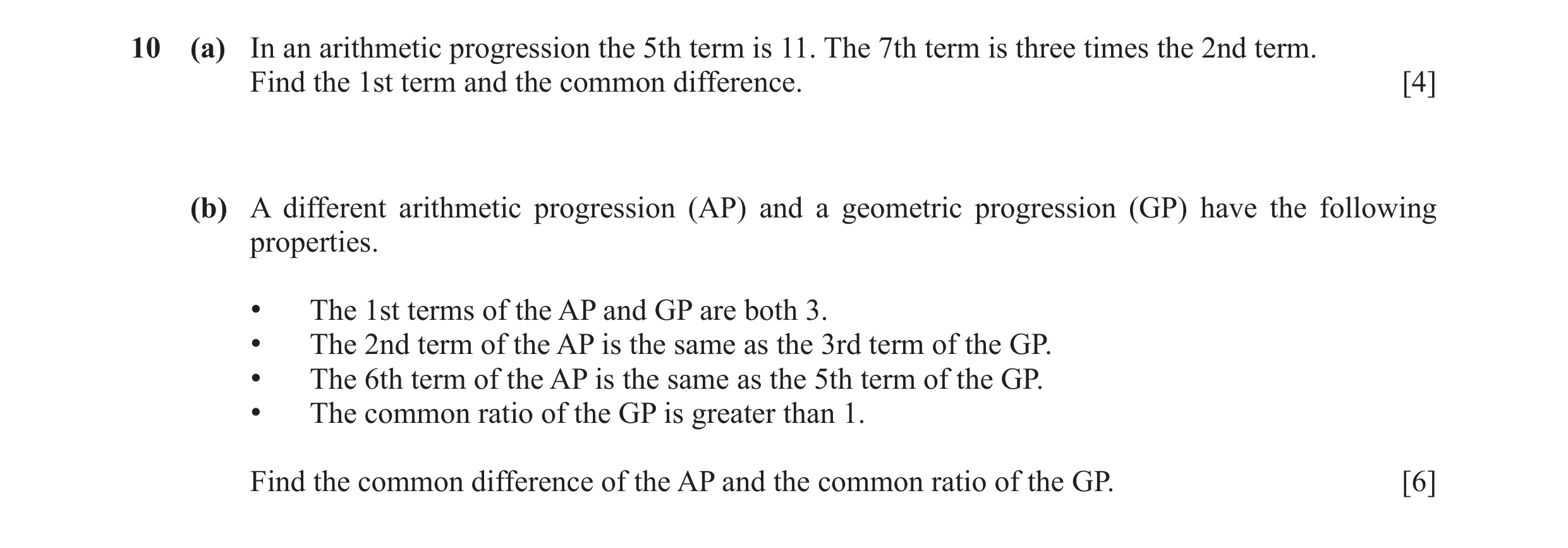
Q13 · In an arithmetic progression the 5th term is 11 0606/23 Oct/Nov 2023
10 (a) In an arithmetic progression the 5th term is 11. The 7th term is three times the 2nd term. Find the 1st term and the common difference. [4] (b) A different arithmetic progression (AP) and a geometric progression (GP) have the following properties. • The 1st terms of the AP and GP are both 3. • The 2nd term of the AP is the same as the 3rd term of the GP. • The 6th term of the AP is the same as the 5th term of the GP. • The common ratio of the GP is greater than 1. Find the common difference of the AP and the common ratio of the GP. [6]
10 marks
Mark scheme: 10(a) a + 4d = 11 oe B1 a + 6d = 3(a + d) oe B1 Correctly eliminates one unknown and solves for a or d M1 FT their linear equations in a and d providing B1 earned. d = 2, a = 3 A1 10(b) 3 + d = 3r 2 B1 3 + 5d = 3r 4 B1 2 M1 3 + d 3 + 5d = 3 oe 3 or 3 + 5 3r 2 − 3 = 3r 4 oe ( ) d 2 − 9d = 0 or 3r 4 − 15r 2 + 12 = 0 A1 d = 9 and r = 2 and no other values A2 A1 for d = 9 and no other value of d or for r = 2 and no other value of r
This question in 0606/23 Oct/Nov 2023
Q14 · In an arithmetic progression, the sum of the first 30 terms is - 1065 0606/21 May/June 2024
8 (a) In an arithmetic progression, the sum of the first 30 terms is - 1065 . The sum of the next 20 terms is - 2210 . Find the first term and the common difference. [5] (b) A geometric progression is such that the first term is 4 and the sum of the first three terms is 7. Find the two possible values of the common ratio and find the sum to infinity for the convergent progression. [5]
10 marks
Mark scheme: 8(a) 30 B1 S 30 2 a 29 d 1065 2 S 50 S 30 B1 50 30 2 a 49 d 2 a 29 d 2210 2 2 50 or S 50 2 a 49 d 2210 1065 2 Solves their linear equations in a and d as M1 dep on an attempt to form their far as a = .. or d = … equations using at least one sum formula Some correct pairs are e.g. 150a + 2175d = –5325 150a + 3675d = –9825 or 30a + 435d = –1065 50a + 1225d = –3275 or 2a + 49d = –131 2a + 29d = –71 a = 8, d = 3 A2 A1 for each 8(b) 4(1 r 3 ) B1 4 + 4r + 4r2 = 7 or 7 oe 1 r 4r 2 4r 3 0 oe B1 Solves or factorises their 3-term quadratic M1 oe e.g. (2r – 1)(2r + 3) [= 0] r = 0.5 , –1.5 A1 4 A1 8 only, nfww 1 0.5
This question in 0606/21 May/June 2024
 1 / 8
1 / 8![Question 2: (a) The first 5 terms of a sequence are given below. 4 - 2 1 - .05 0.25 (i) Find the 20th term of the sequence. [2] (ii) Explain why the su…](https://img.pastlit.com/crops/df541f8c-7fd7-458b-b86d-3a91d723f0af/q10.webp)
![Question 3: A geometric progression has a first term of 3 and a second term of 2.4. For this progression, find (a) the sum of the first 8 terms, [3] (b…](https://img.pastlit.com/crops/8465b13c-7f3e-4646-b6a8-08557fa5a575/q7.webp) 3 / 8
3 / 8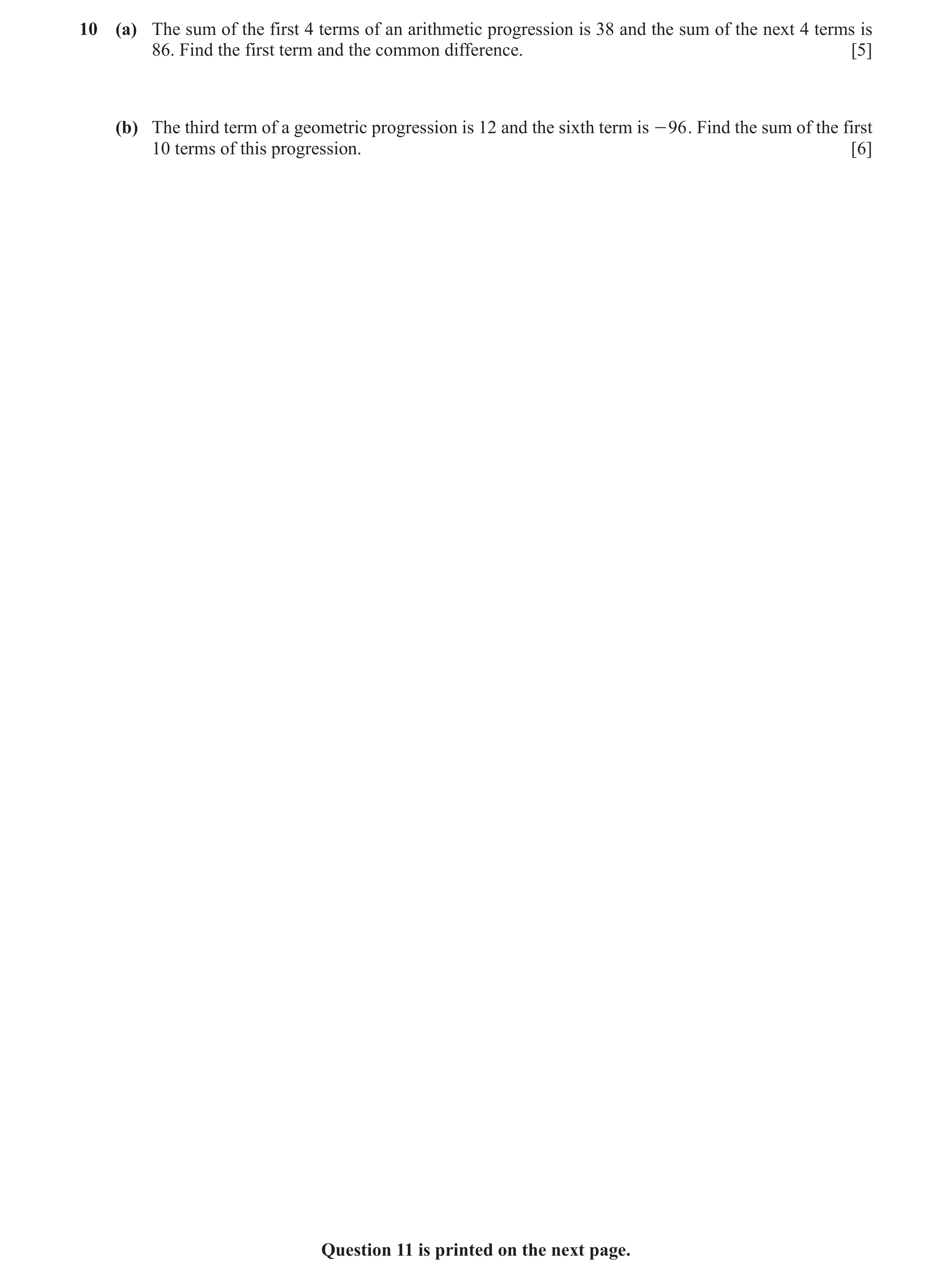 4 / 8
4 / 8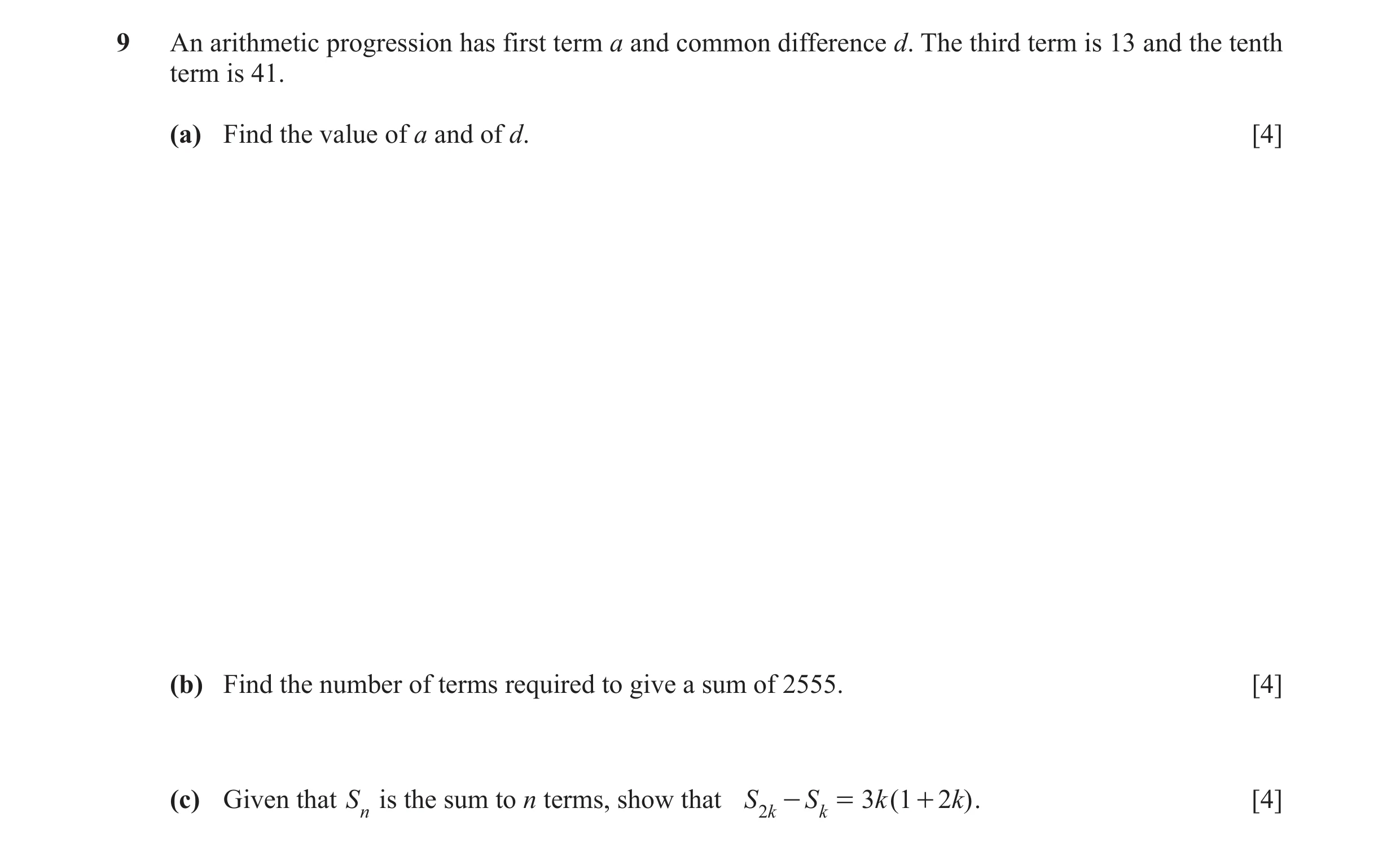
 5 / 8
5 / 8![Question 7: (a) The sum of the first 20 terms of an arithmetic progression is 1100. The sum of the first 70 terms is 14 350. Find the 12th term. [6] 1(…](https://img.pastlit.com/crops/62f40703-a69d-4680-aab0-61a9dff7ecb0/q11.webp)

![Question 9: (a) A geometric progression has third term 4.5 and sixth term 15.1875. Find the first term and the common ratio. [4] (b) Find the sum of te…](https://img.pastlit.com/crops/e36a1872-f189-4339-a01a-4ecdc9b5a659/q10.webp)
 6 / 8
6 / 8![Question 11: (a) A geometric progression has first term 64 and common ratio 0.5. (i) Find the 10th term. [2] (ii) Find the sum of the first 10 terms. [2…](https://img.pastlit.com/crops/d2fa9170-6db2-49c0-9503-849a5d0e40a6/q6.webp)

 7 / 8
7 / 8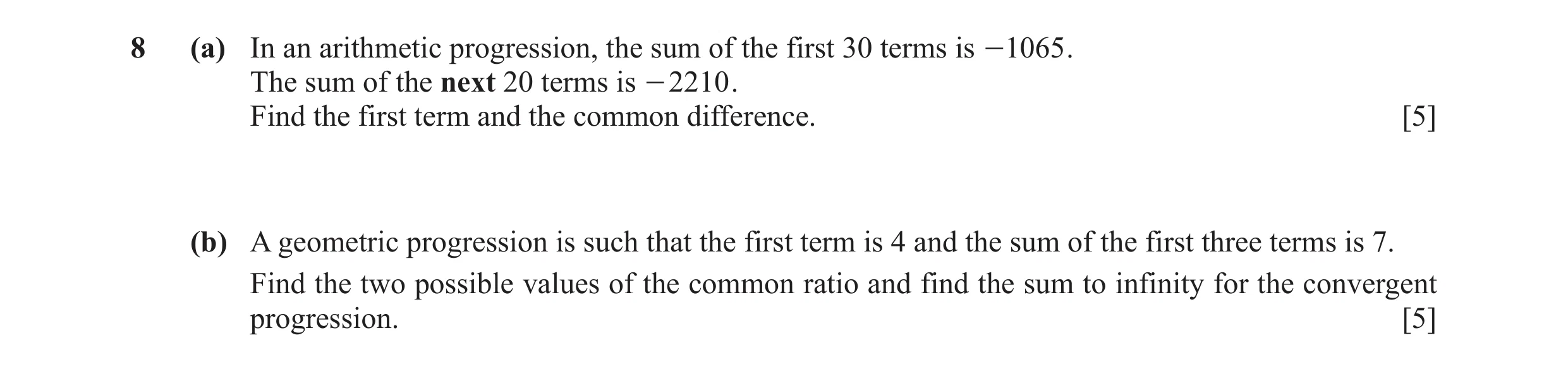 8 / 8
8 / 8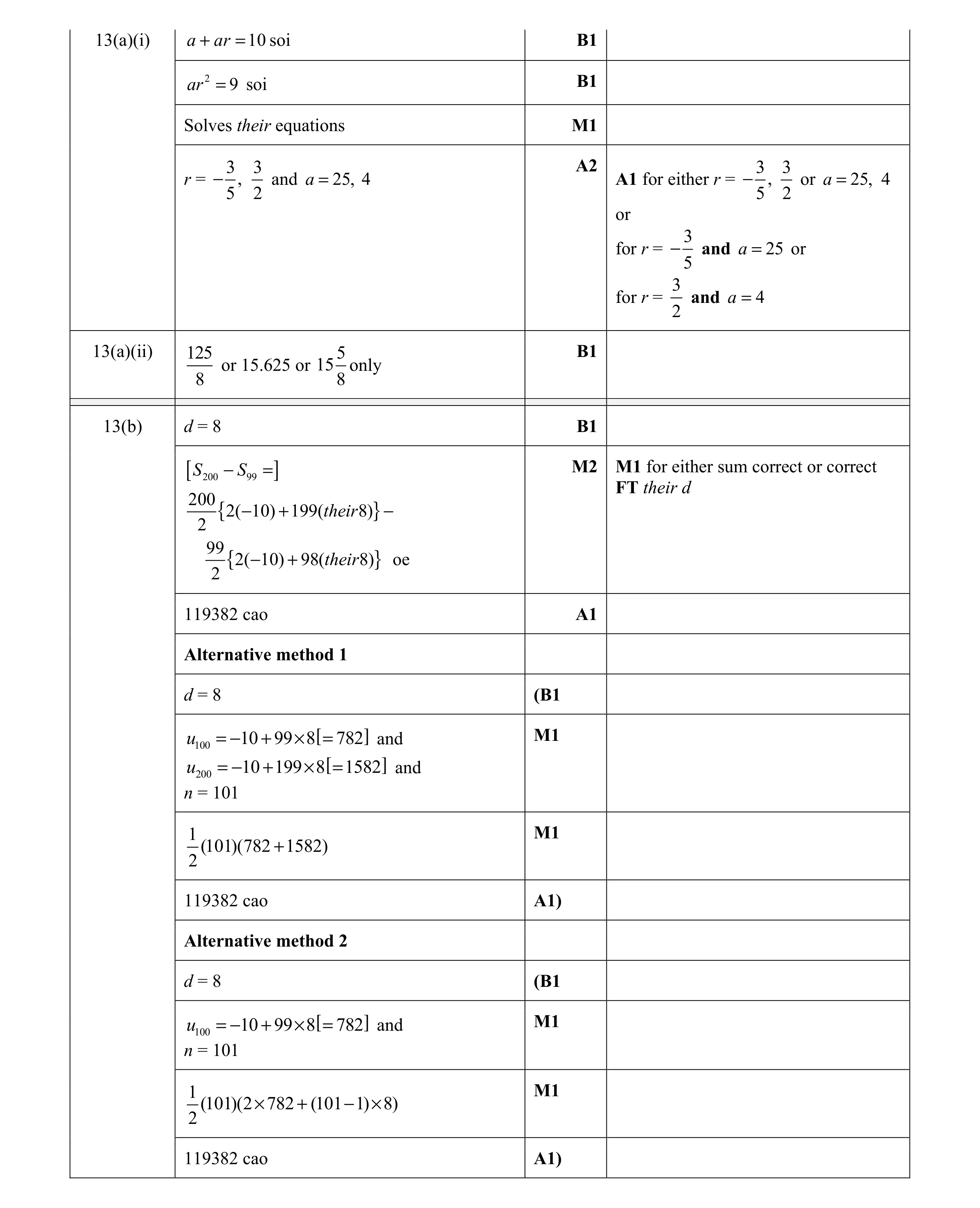 10
10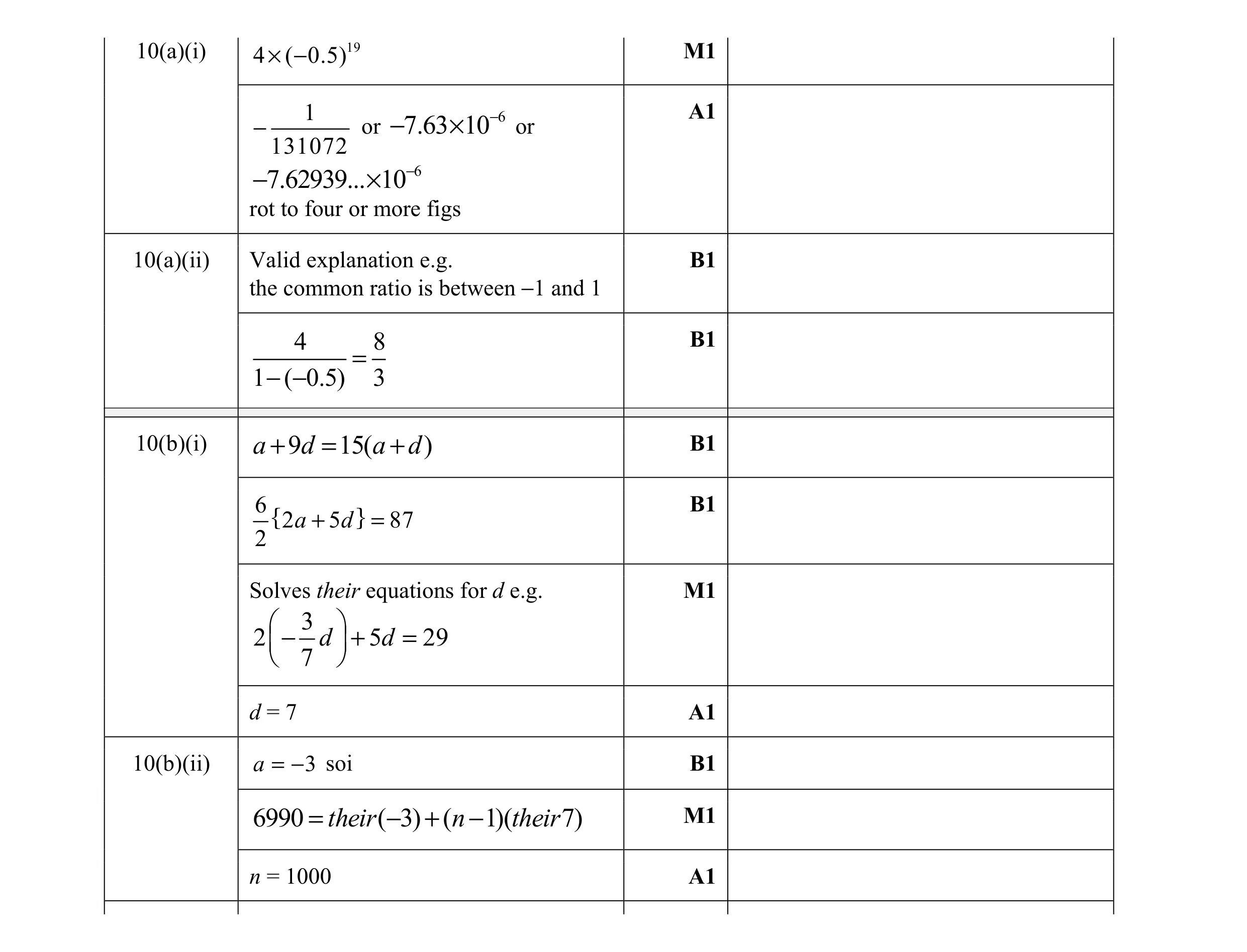 11
11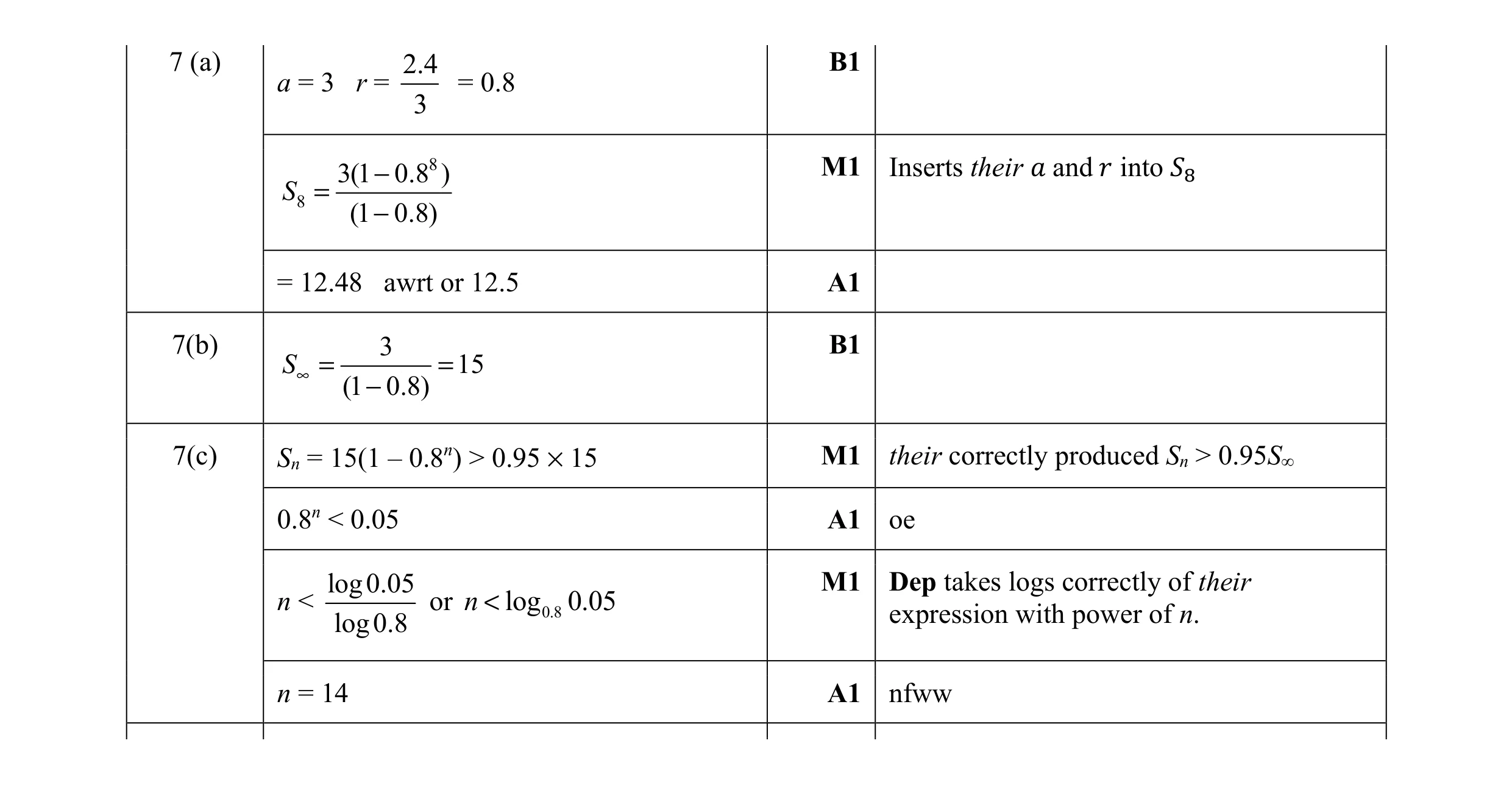 8
8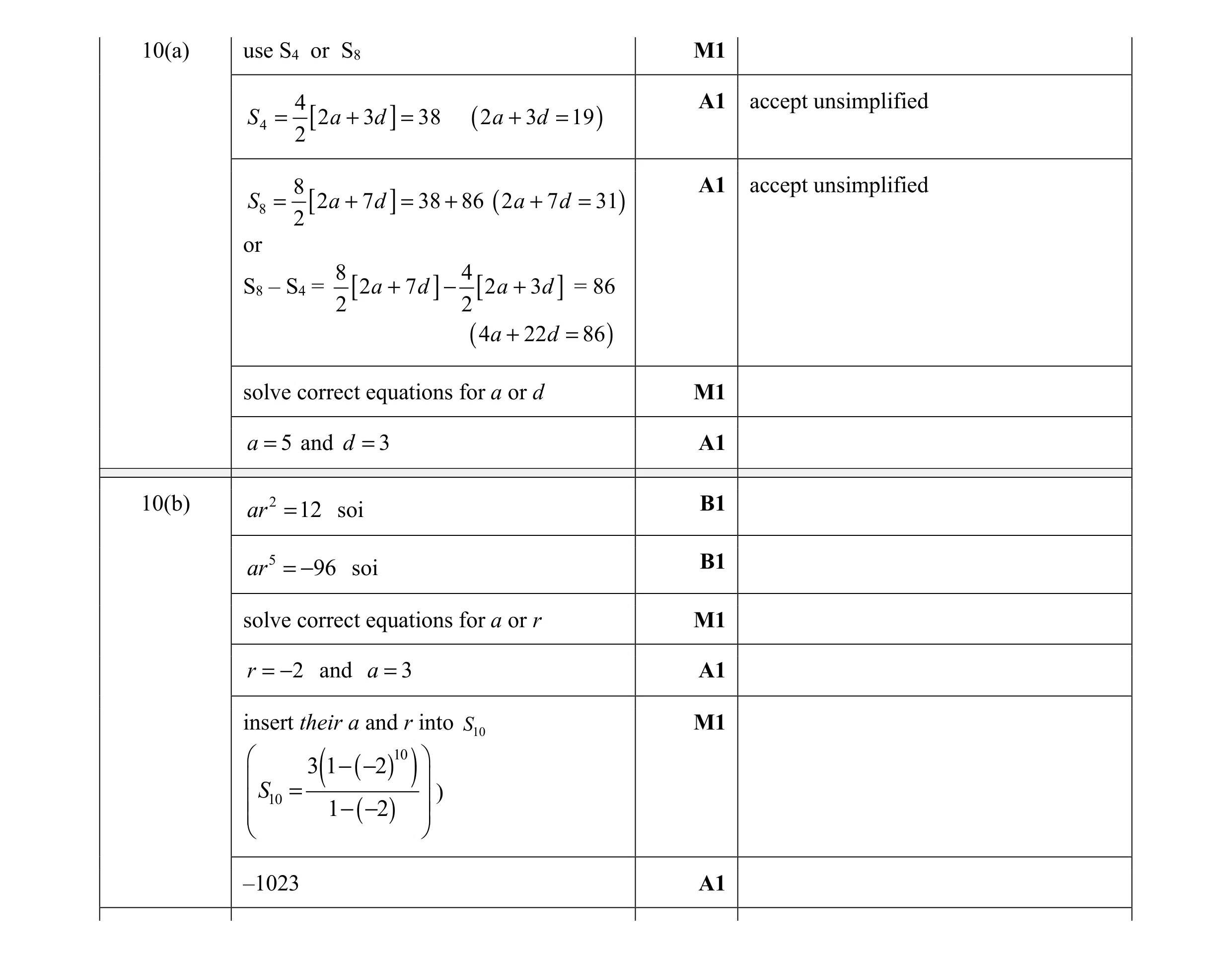 11
11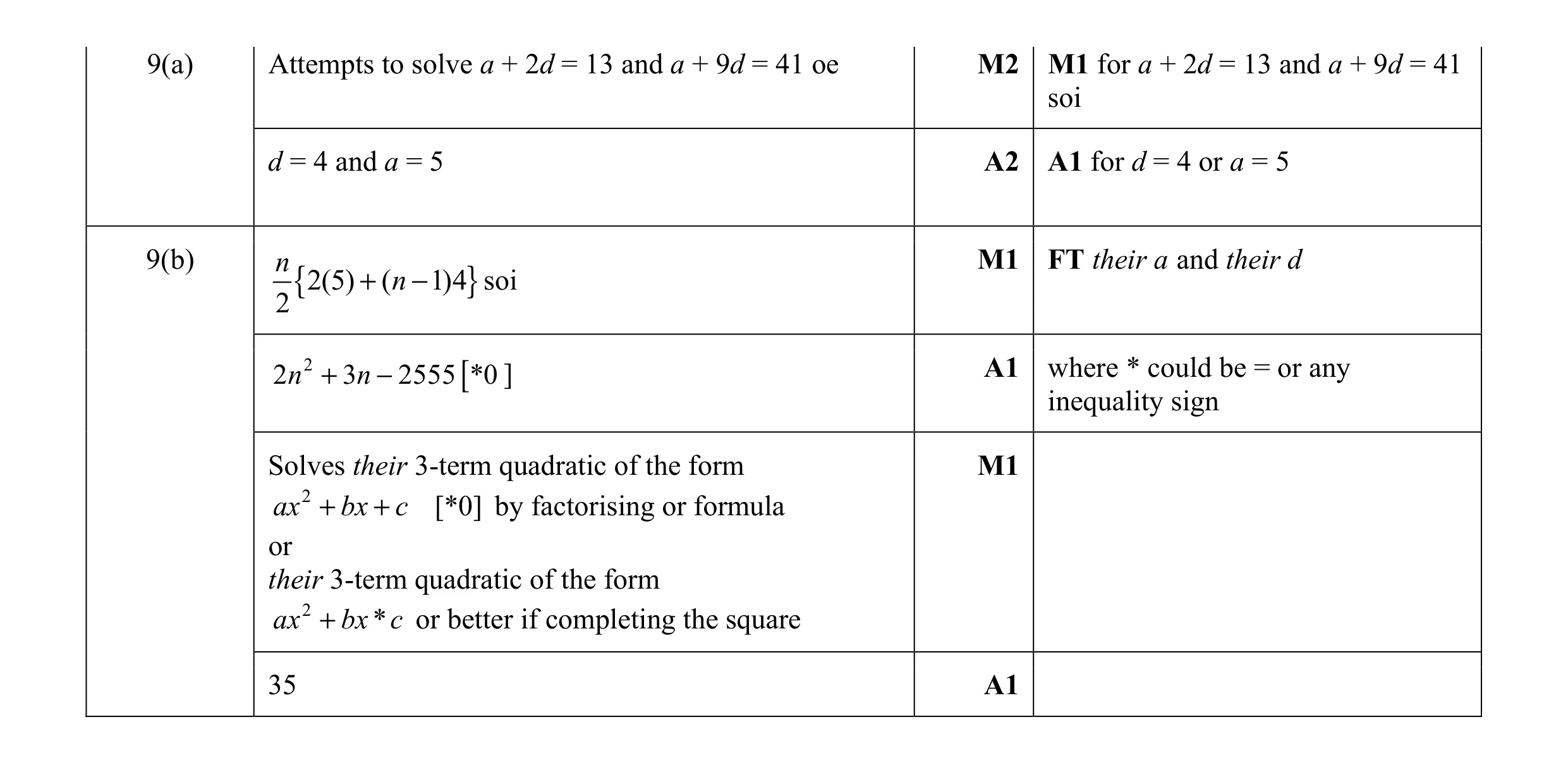 12
12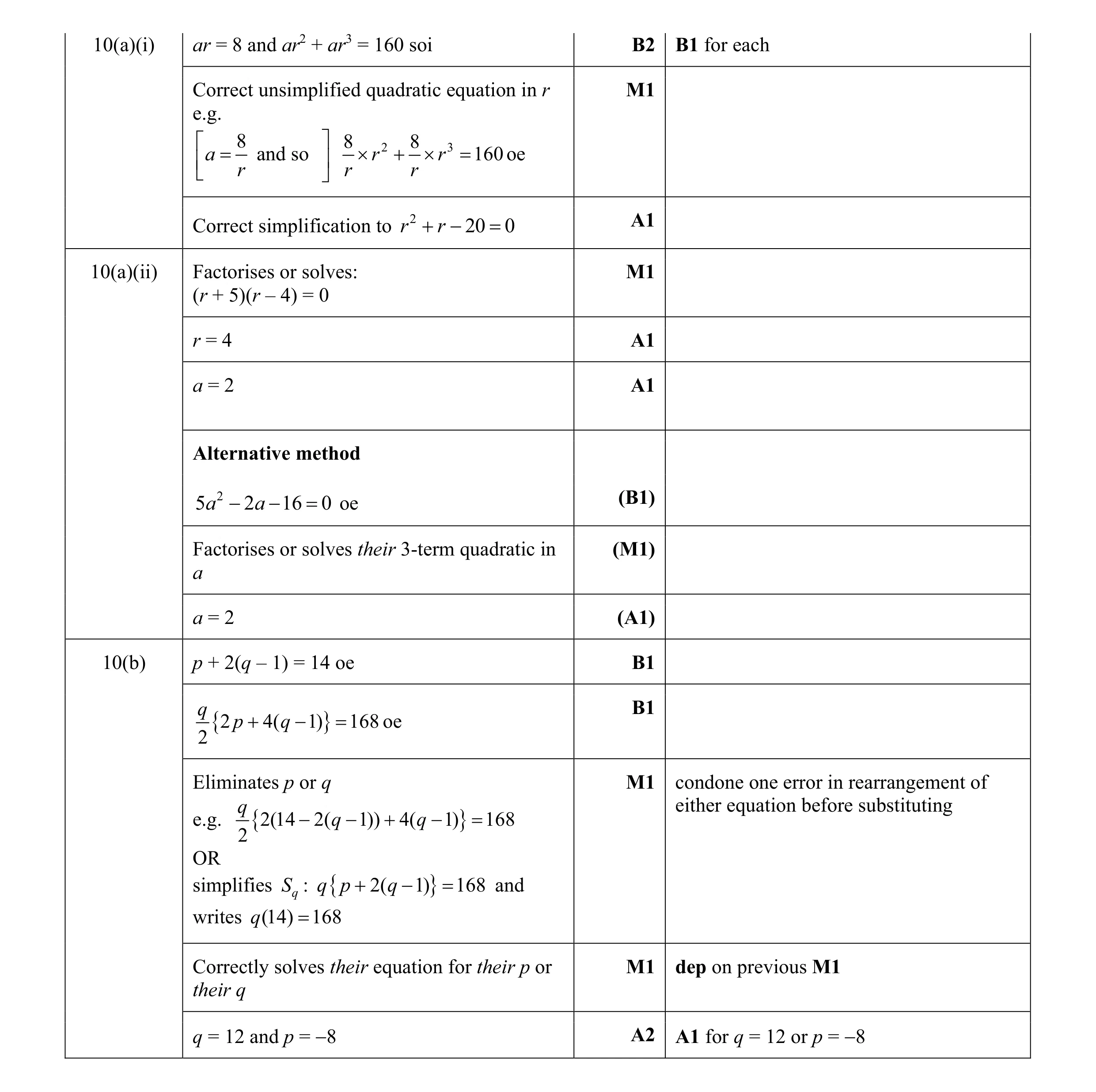 13
13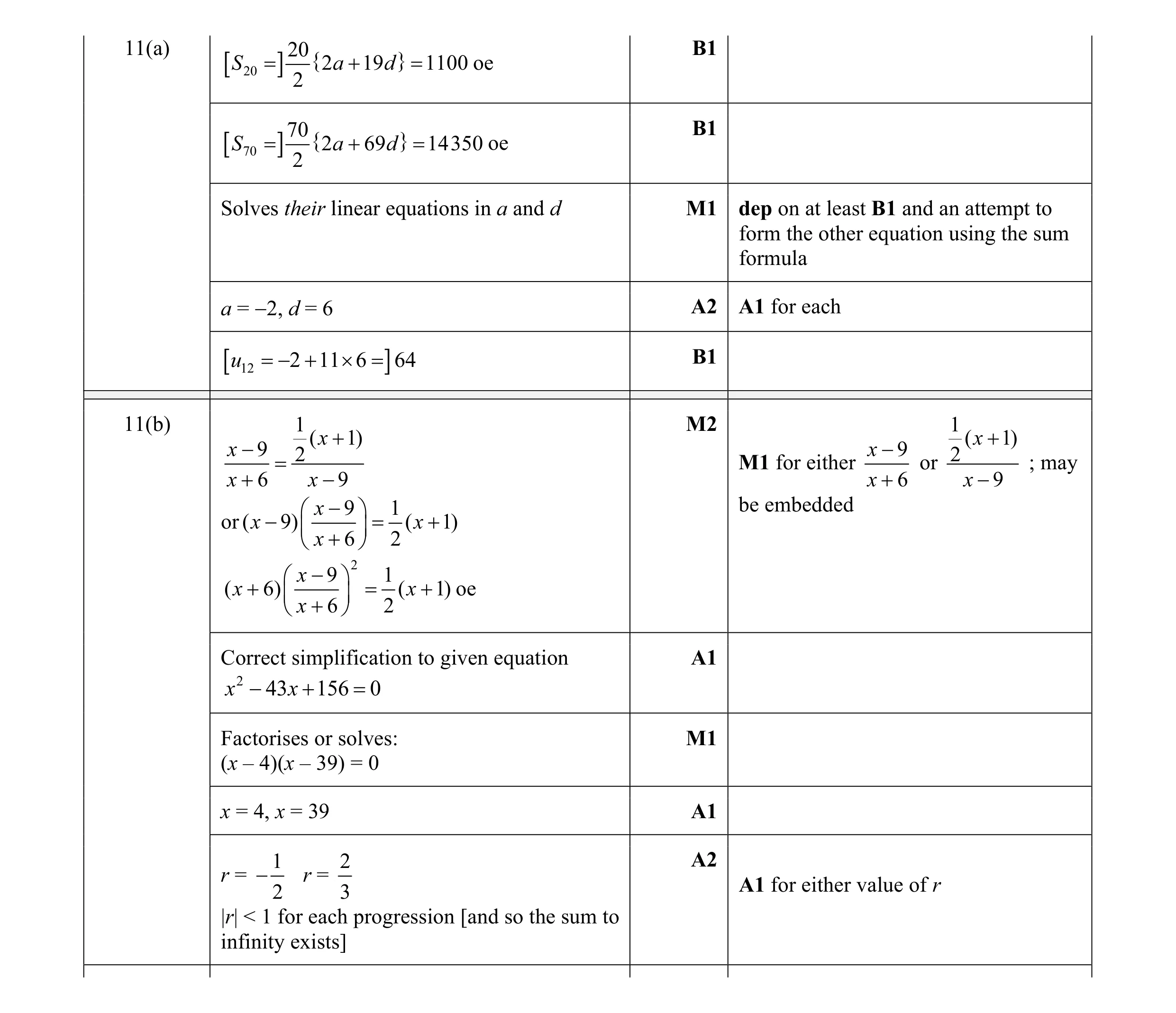 13
13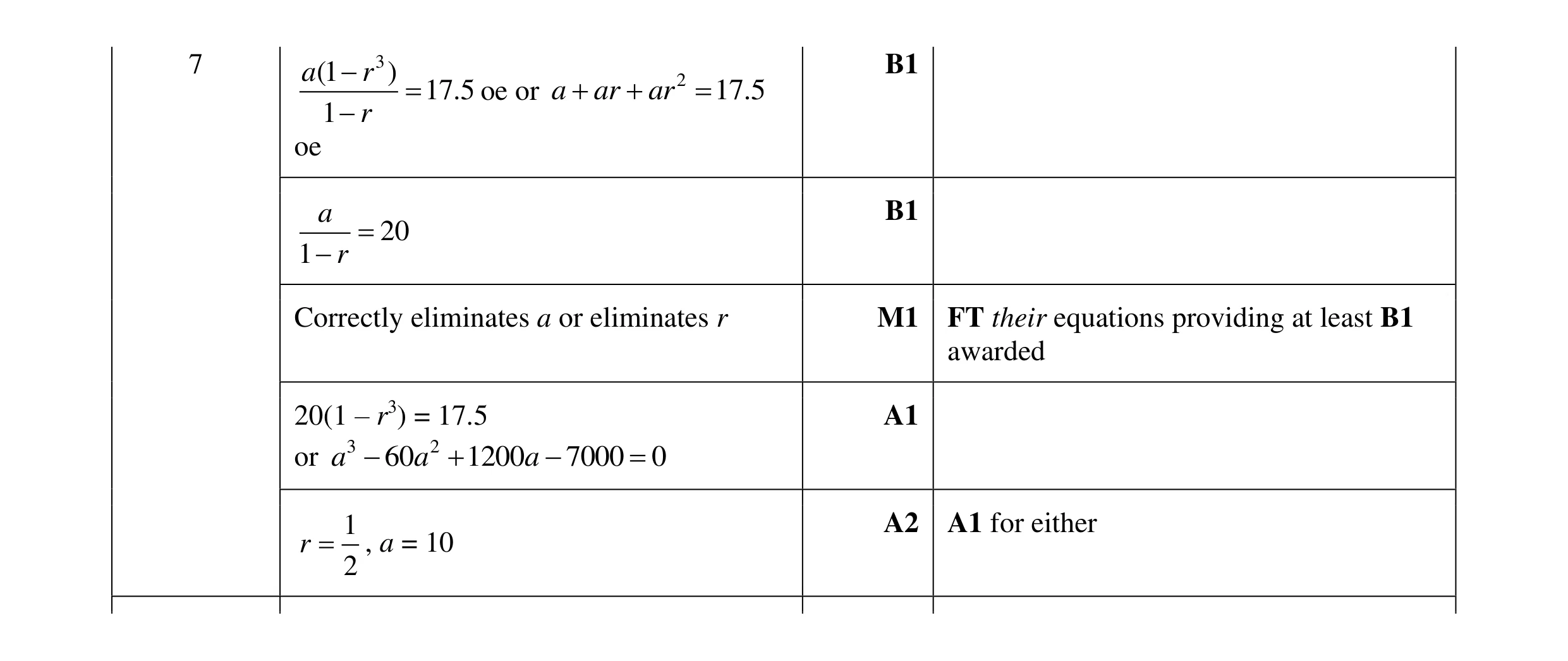 6
6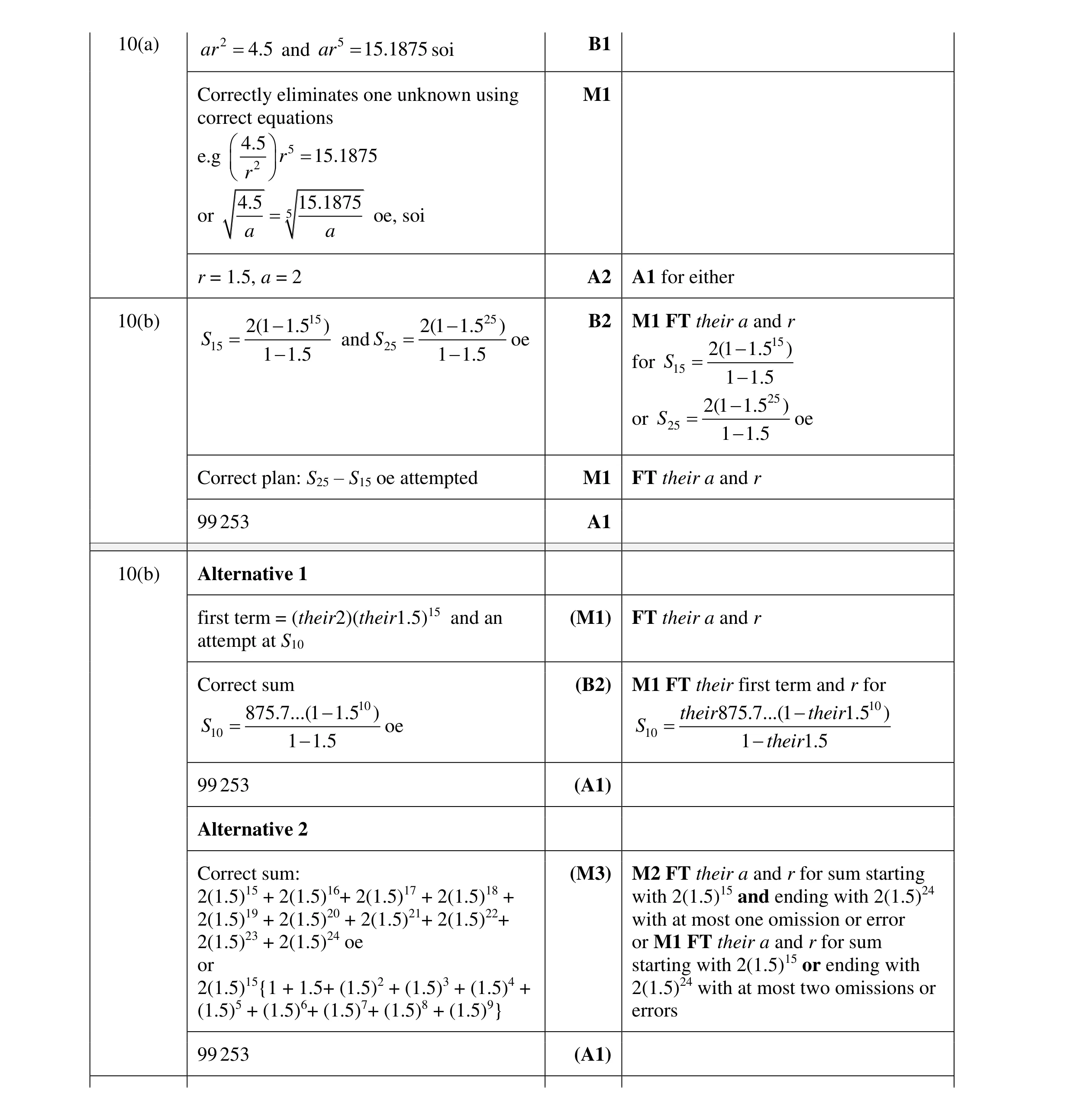 8
8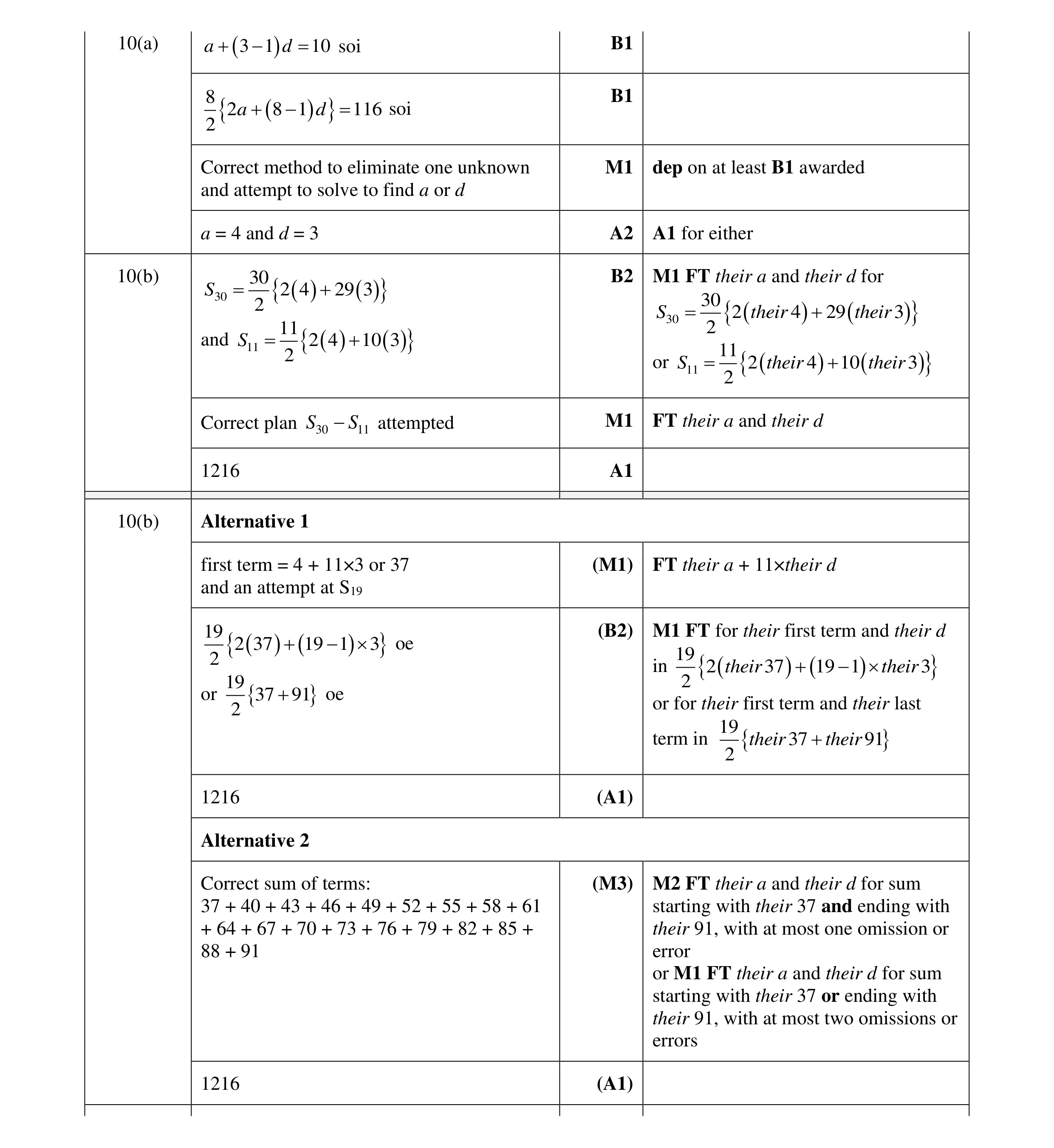 9
9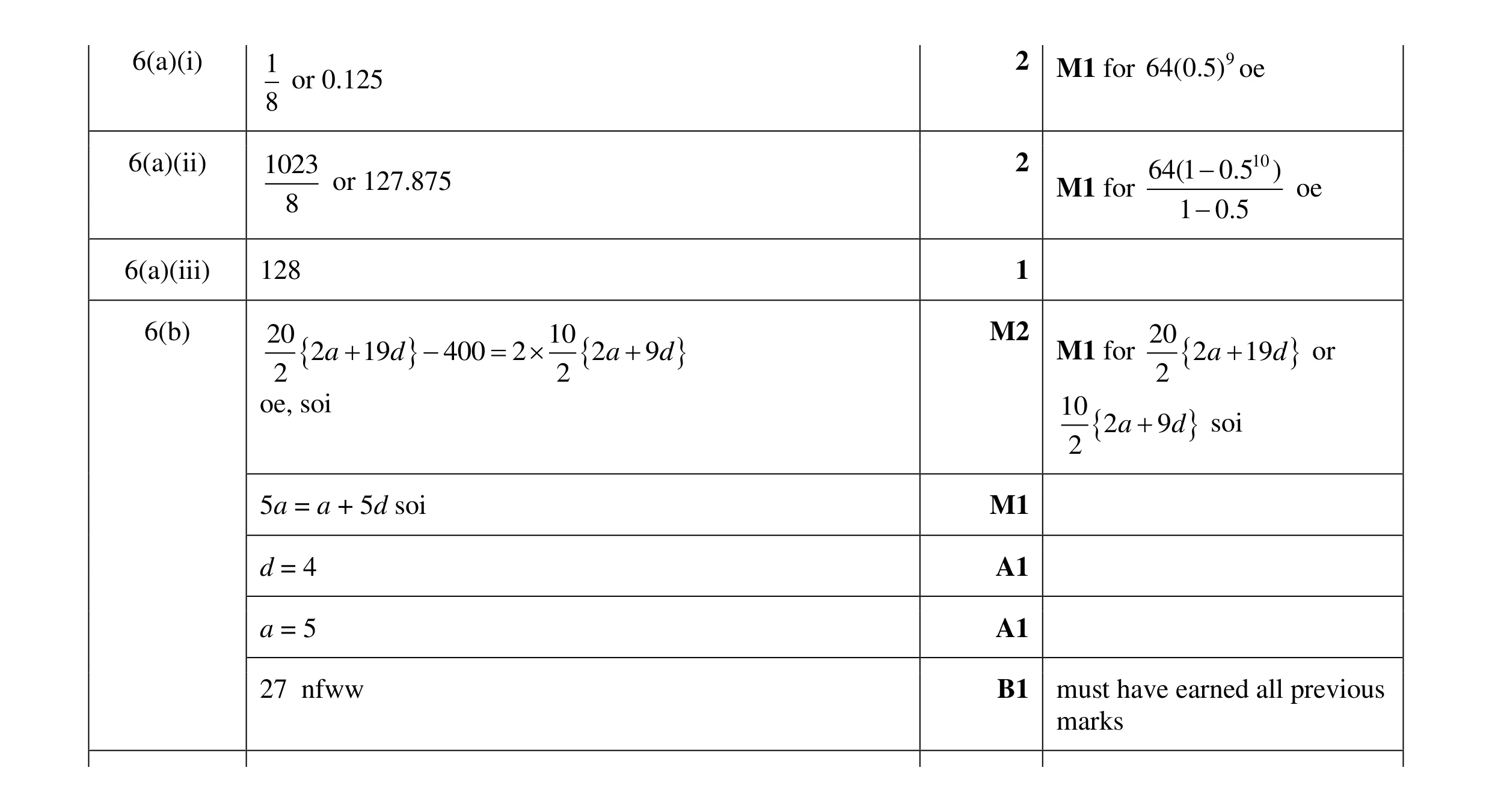 11
11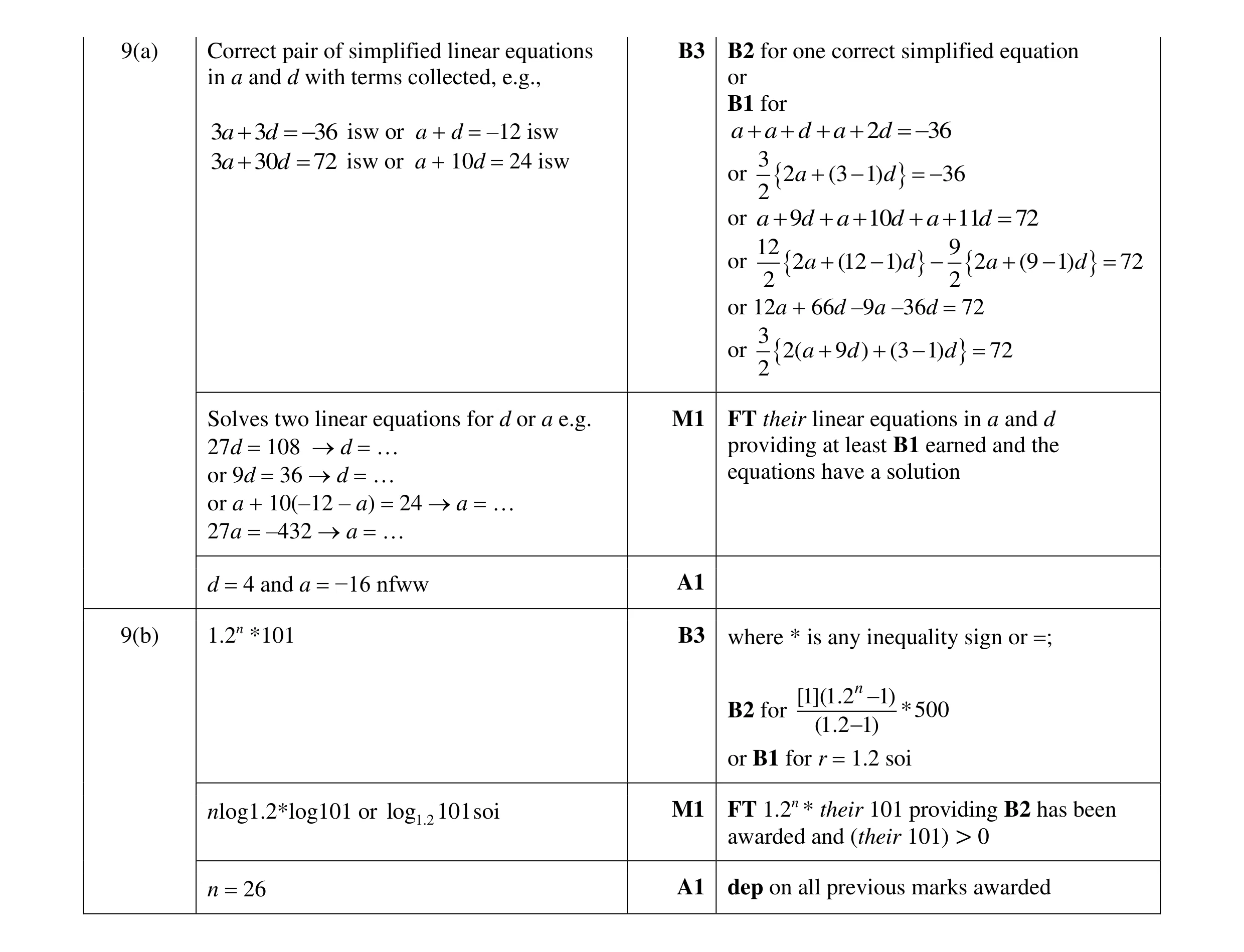 10
10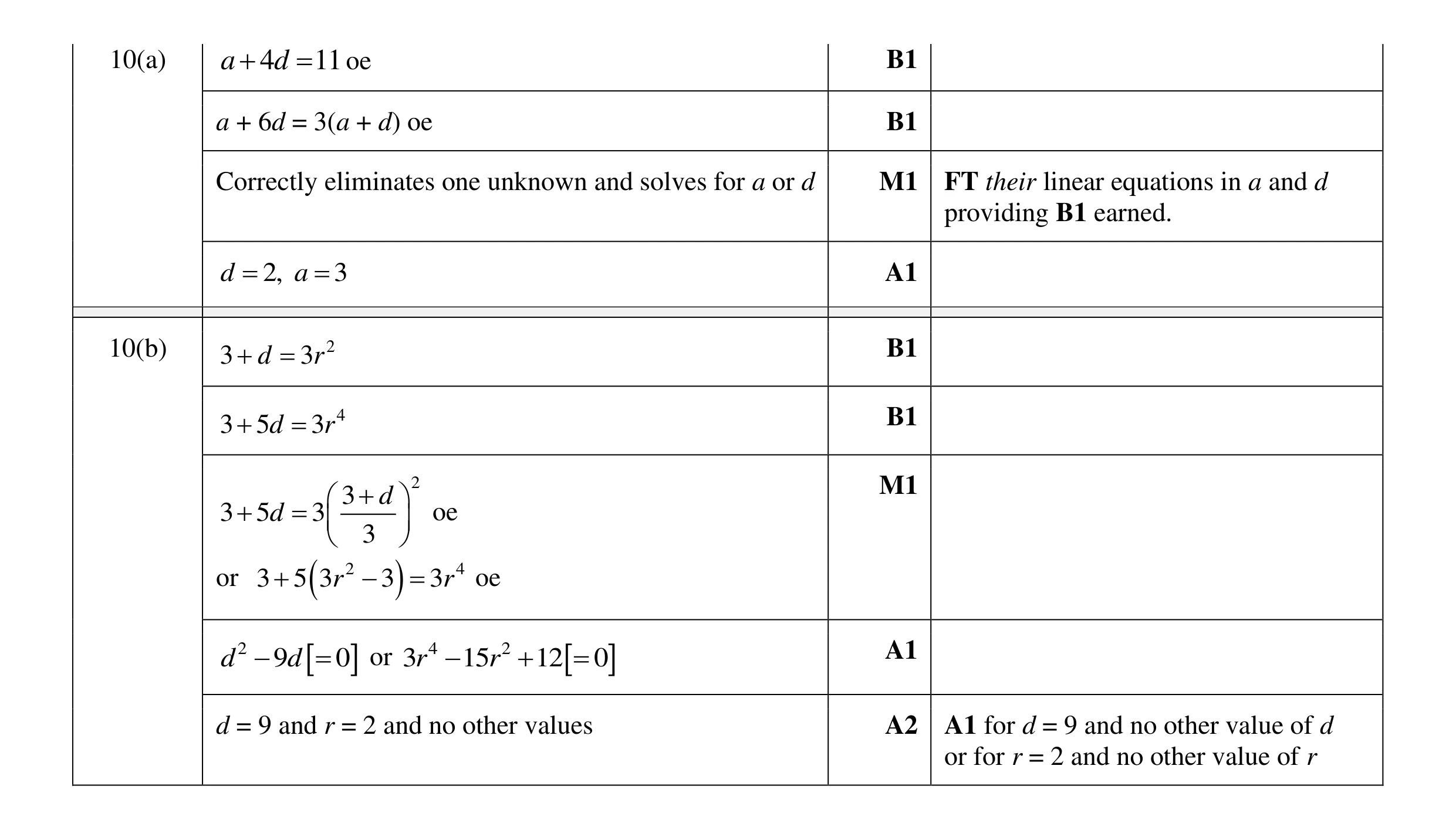 10
10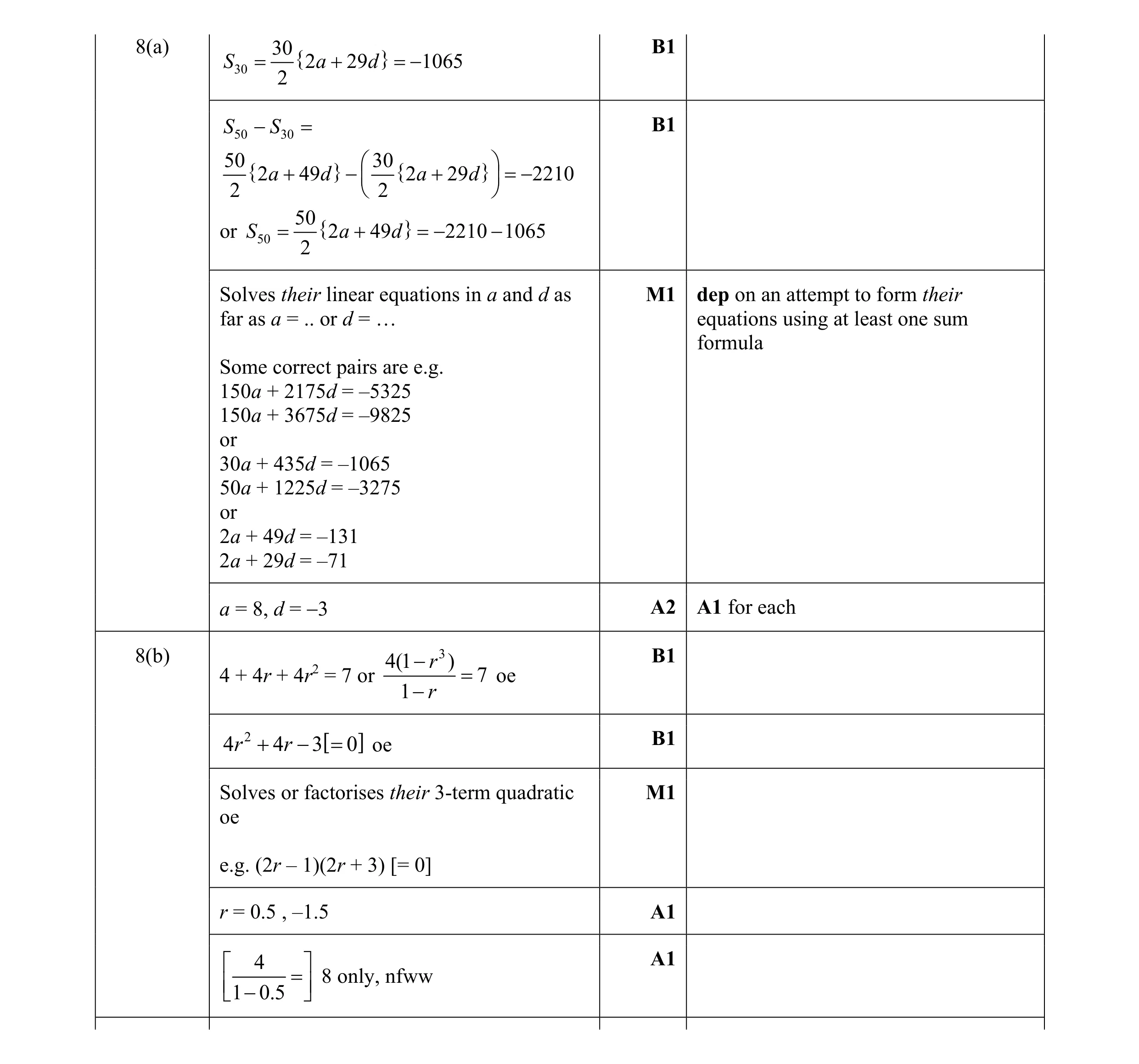 10
10