Cambridge IGCSE Mathematics - Additional 0606 — 2022 Oct/Nov Paper 2 · Variant 3
0606/23/O/N/22 · 9 questions · 80 marks · ≈90 min
The question paper and its mark scheme, free to read here and free to download. This is Cambridge’s own paper, exactly as it was sat.
Question paper16 pages
Mark scheme10 pages
Answers below. Sit the paper first if you are practising.
Questions as text
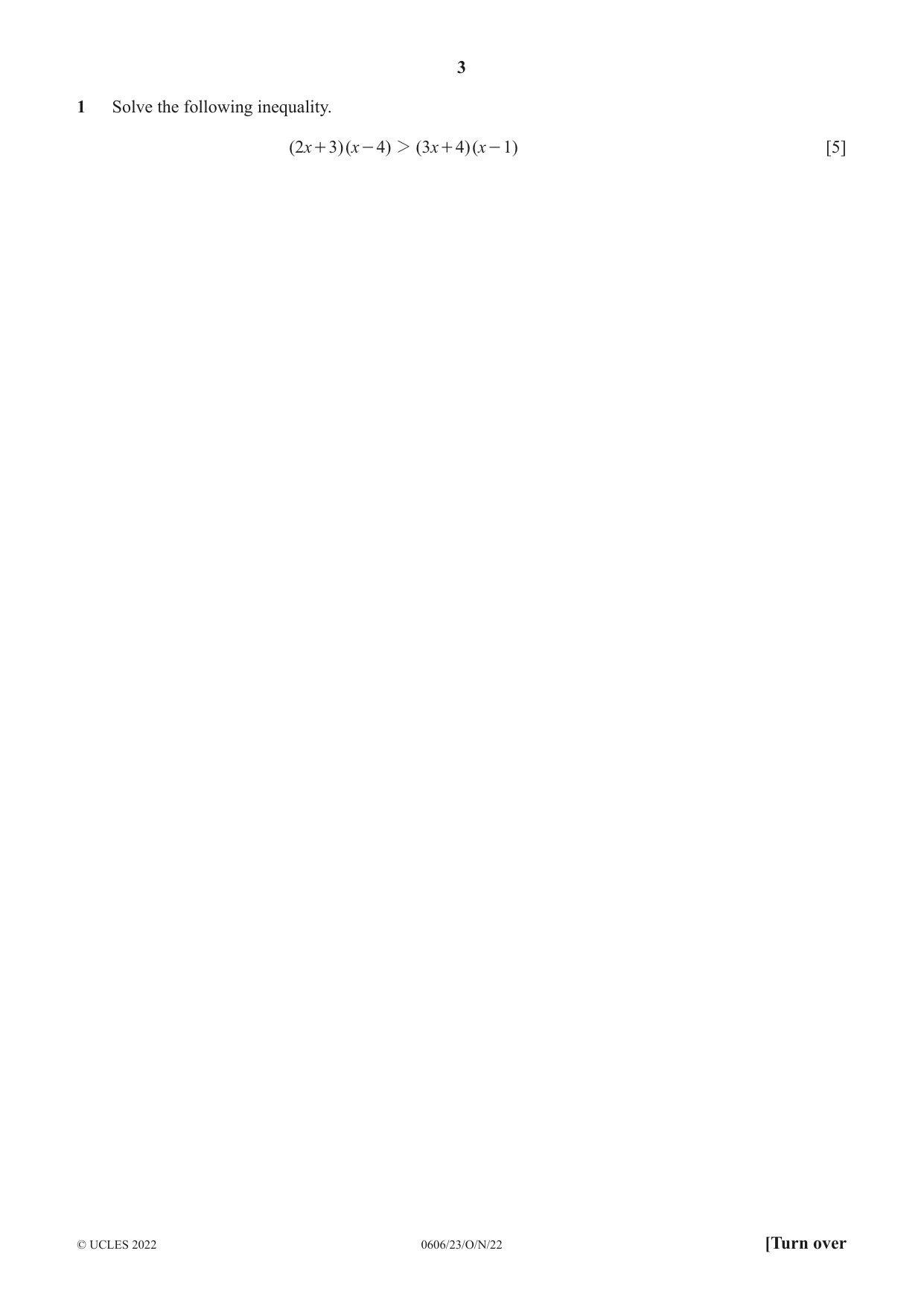
Q1 · Solve the following inequality
1 Solve the following inequality. ( 2x + 3)( x - 4) 2 ( 3x + 4)( x - 1) [5]
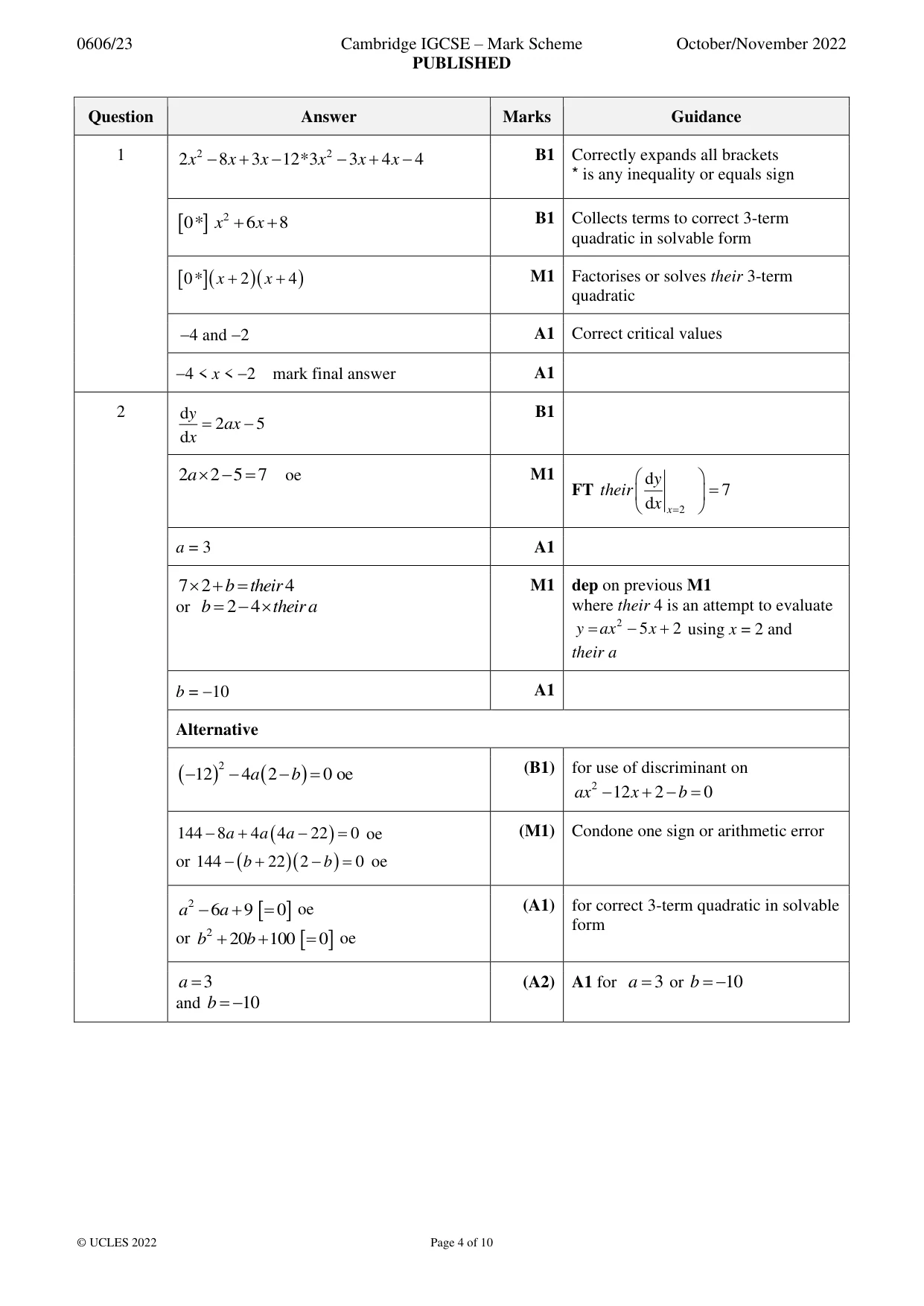
Mark scheme: Question Answer Marks Guidance 1 2 x 2 − 8 x + 3 x − 12 * 3 x 2 − 3 x + 4 x − 4 B1 Correctly expands all brackets * is any inequality or equals sign 0* x 2 + 6 x + 8 B1 Collects terms to correct 3-term quadratic in solvable form 0*( x + 2 )( x + 4 ) M1 Factorises or solves their 3-term quadratic −4 and −2 A1 Correct critical values −4 < x < −2 mark final answer A1
More questions on Find the solution set for quadratic inequalities
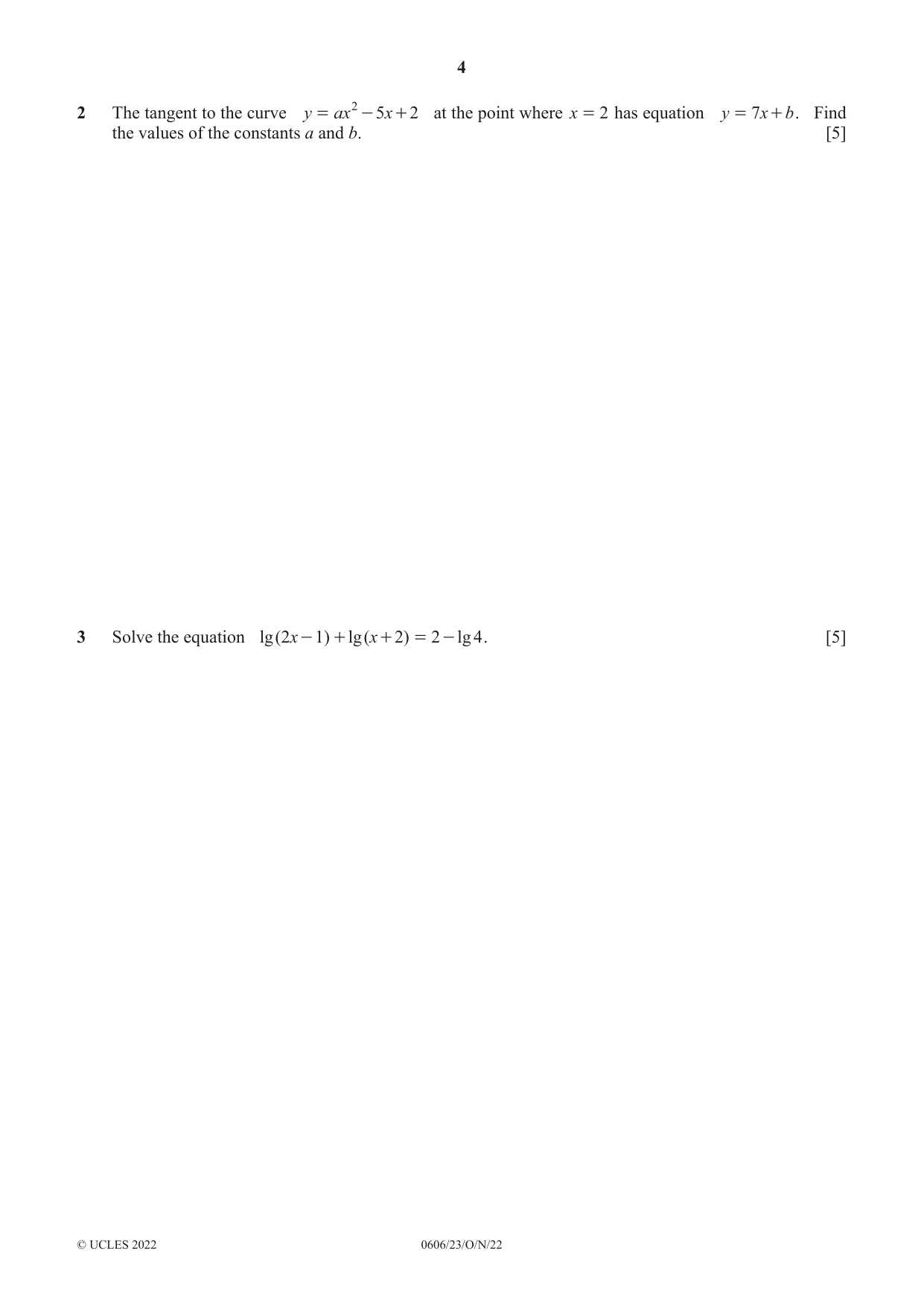
Q2 · The tangent to the curve y = ax 2 - 5x + 2 at the point where x = 2 has equation y = 7x +…
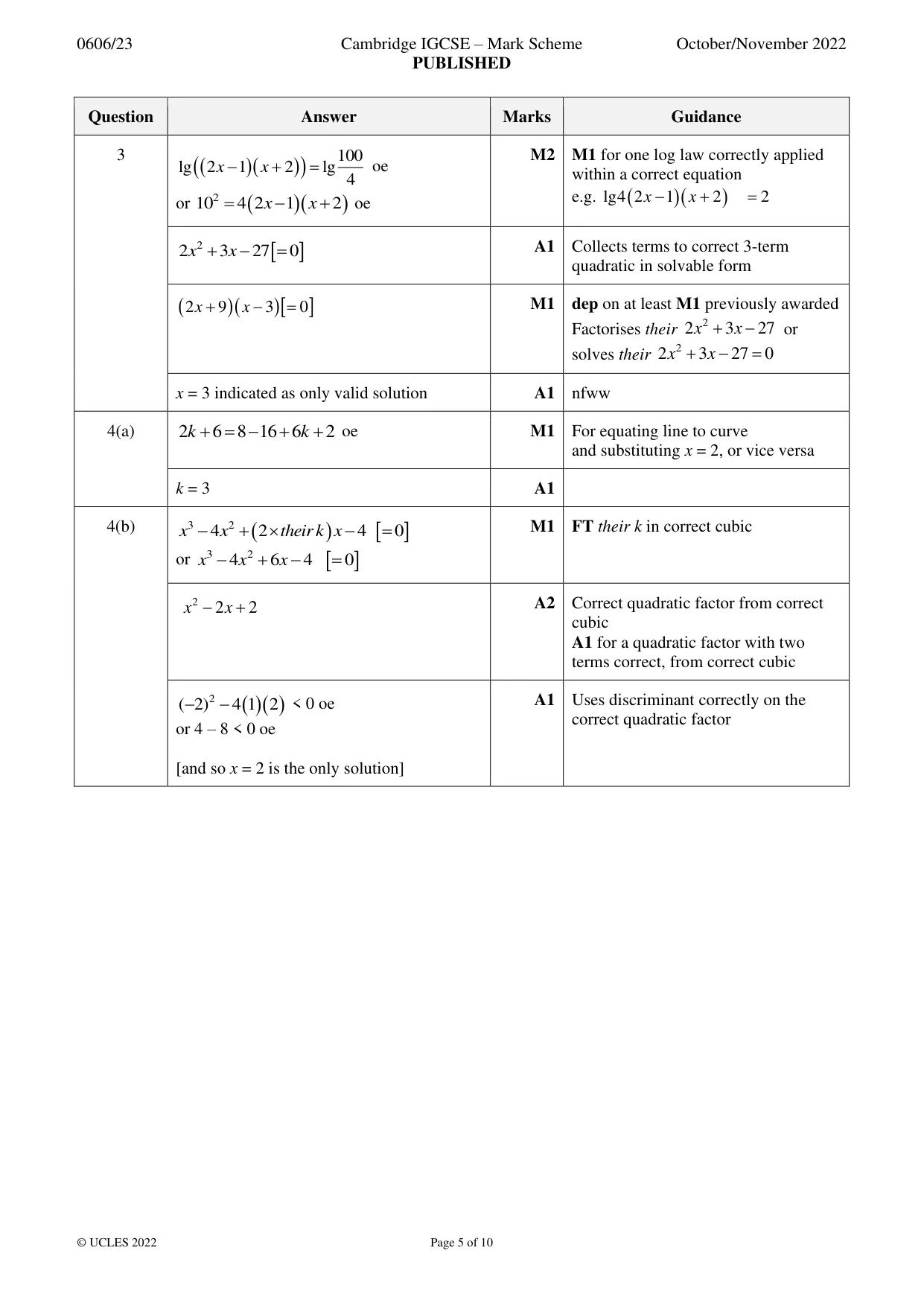
2 The tangent to the curve y = ax 2 - 5x + 2 at the point where x = 2 has equation y = 7x + b . Find the values of the constants a and b. [5]
Mark scheme: 2 dy B1 = 2 ax − 5 dx 2a −=2 5 7 oe M1 dy FT their = 7 dx x = 2 a = 3 A1 7 +2 b = their 4 M1 dep on previous M1 or b = 2 −4 theira where their 4 is an attempt to evaluate y = ax 2 − 5 x + 2 using x = 2 and their a b = −10 A1 Alternative ( −12 )2 − 4a ( 2 − b ) = 0 oe (B1) for use of discriminant on ax 2 − 12 x + 2 − b = 0 144 − 8 a + 4 a ( 4 a − 22 ) = 0 oe (M1) Condone one sign or arithmetic error or 144 − ( b + 22 )( 2 − b ) = 0 oe a 2 − 6a + 9 = 0 oe (A1) for correct 3-term quadratic in solvable form or b2 + 20b + 100 = 0 oe a = 3 (A2) A1 for a = 3 or b = −10 and b = −10
More questions on Use differentiation to find gradients, tangents
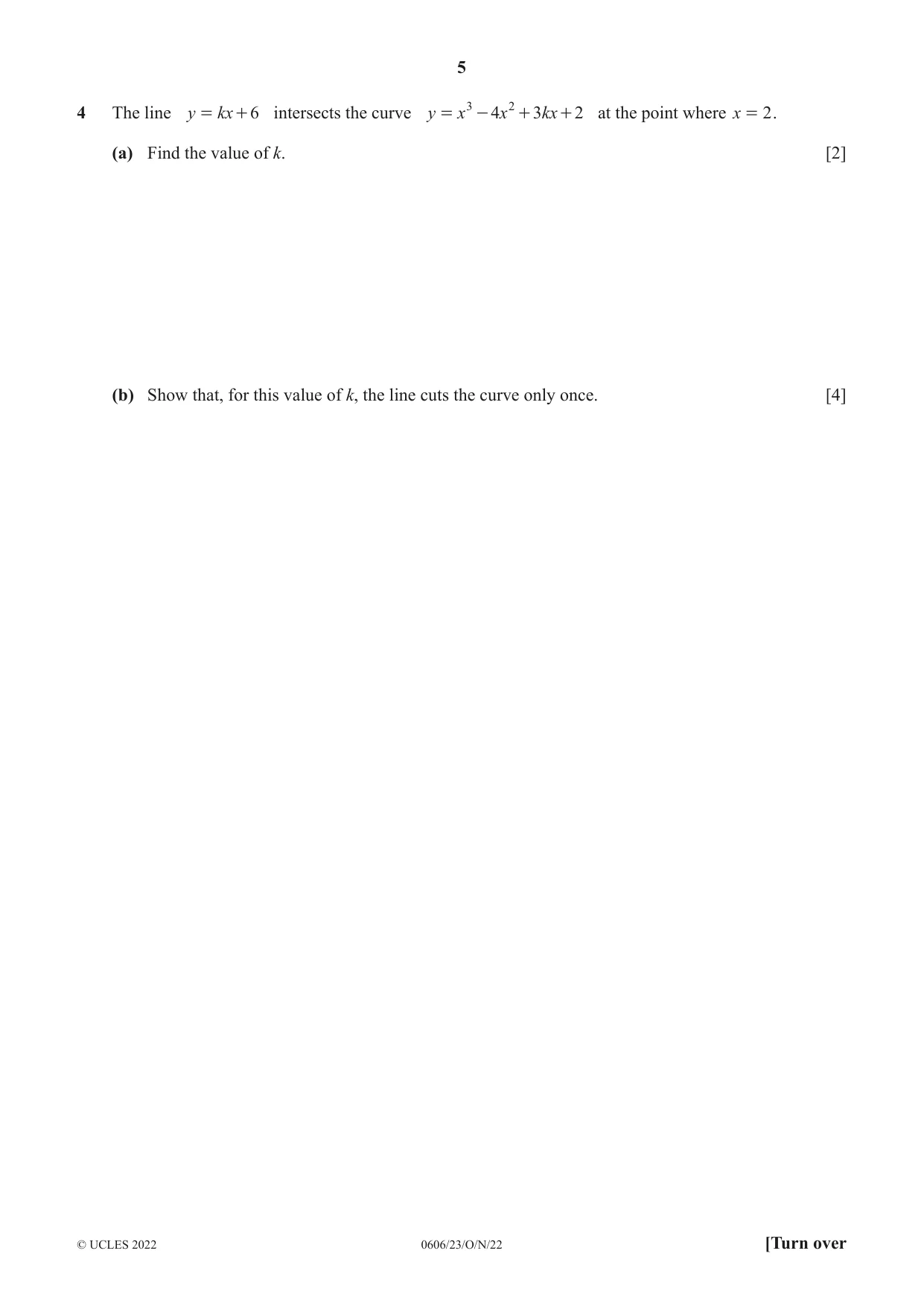
Q4 · The line y = kx + 6 intersects the curve y = x 3 - 4x 2 + 3kx + 2 at the point where x = 2
4 The line y = kx + 6 intersects the curve y = x 3 - 4x 2 + 3kx + 2 at the point where x = 2 . (a) Find the value of k. [2] (b) Show that, for this value of k, the line cuts the curve only once. [4]
Mark scheme: 4(a) 2k + 6 = 8 − 16 + 6k + 2 oe M1 For equating line to curve and substituting x = 2, or vice versa k = 3 A1 4(b) x3 − 4 x 2 + ( 2 theirk ) x − 4 = 0 M1 FT their k in correct cubic or x3 − 4 x 2 + 6 x − 4 = 0 x 2 − 2 x + 2 A2 Correct quadratic factor from correct cubic A1 for a quadratic factor with two terms correct, from correct cubic ( −2) 2 − 4 (1)( 2 ) < 0 oe A1 Uses discriminant correctly on the correct quadratic factor or 4 – 8 < 0 oe [and so x = 2 is the only solution]
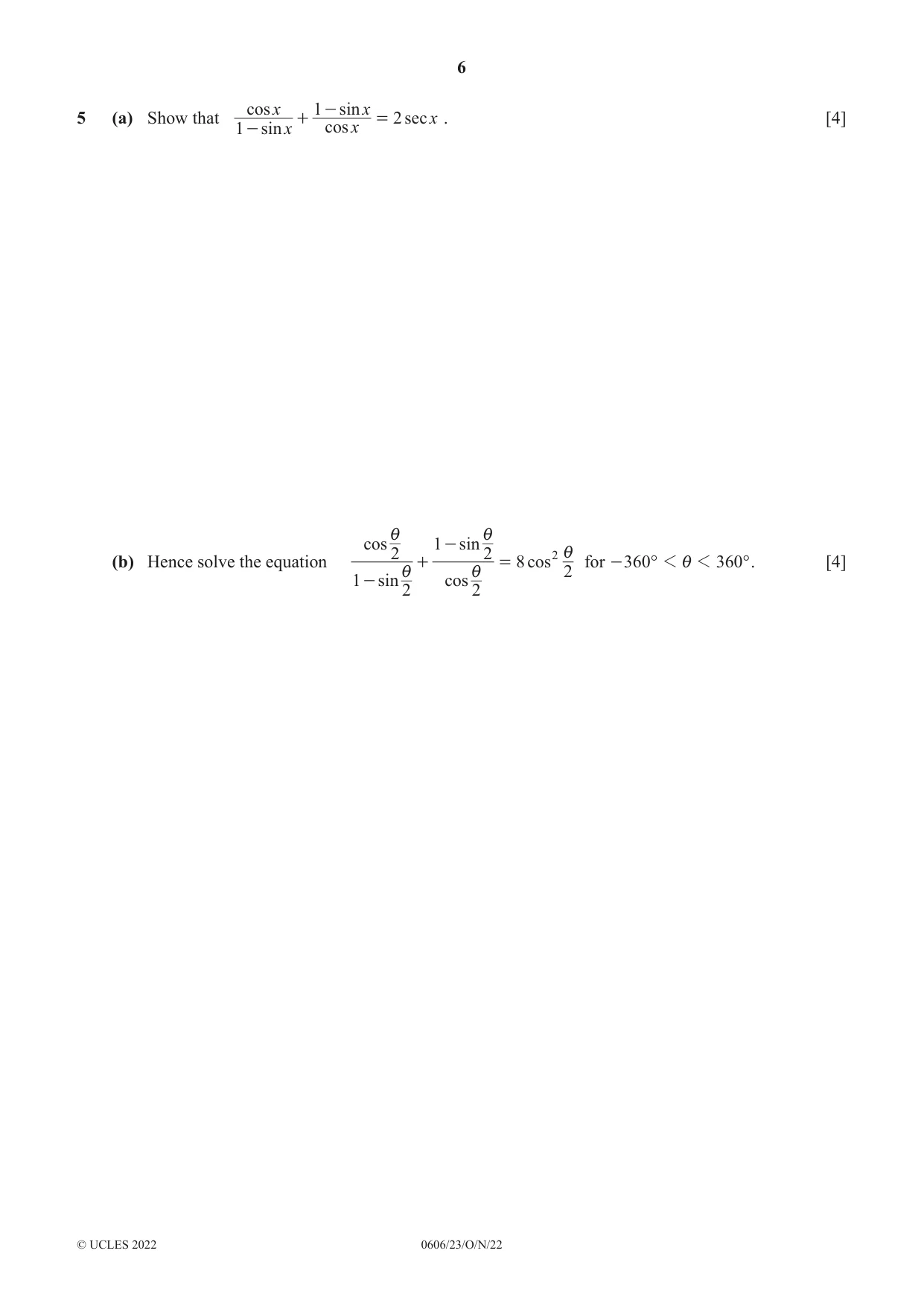
Q5 · Show that + = 2 sec x
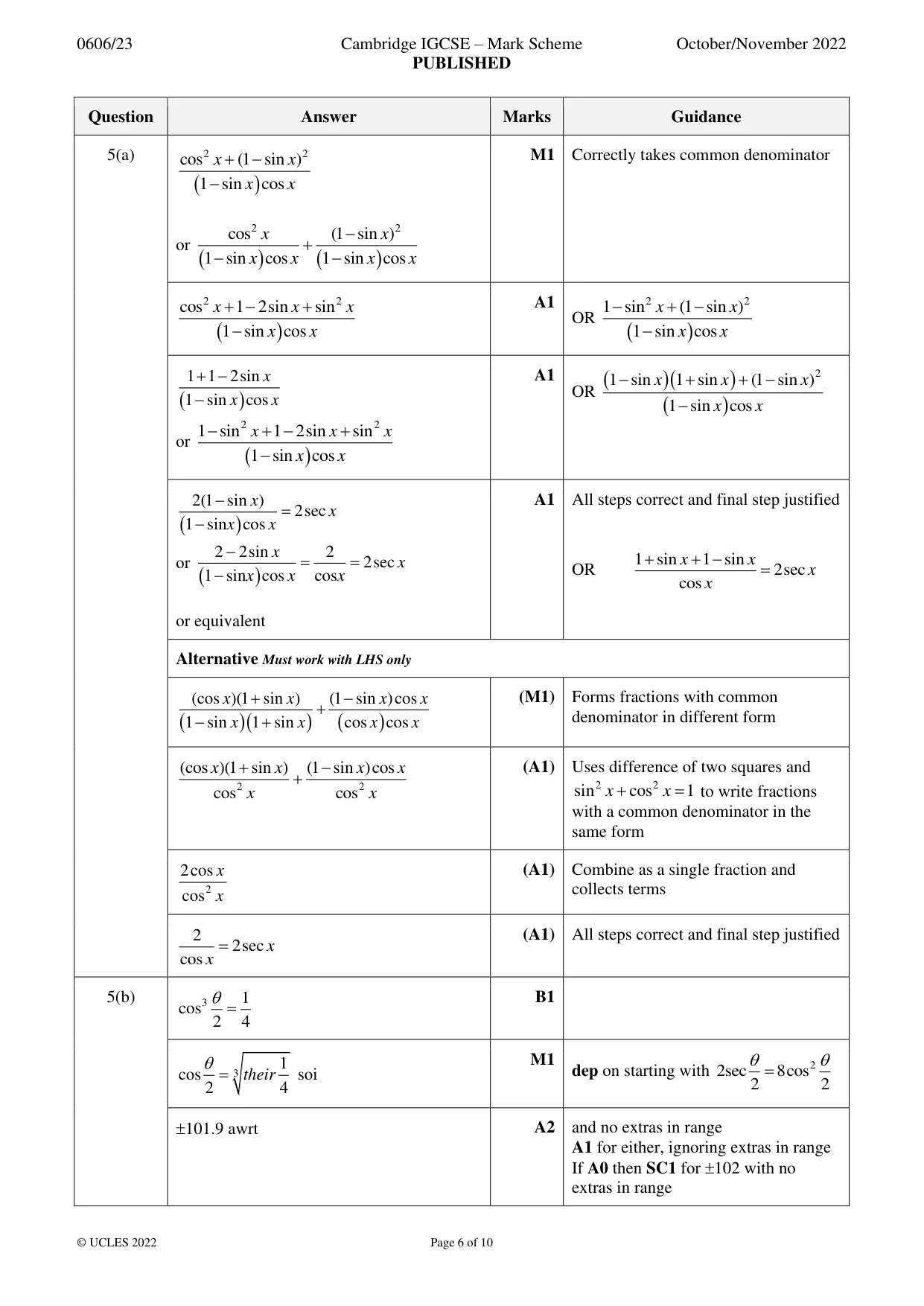
5 (a) Show that + = 2 sec x . [4] 1 - sin x cos x i i cos 1 - sin 2 2 2 i (b) Hence solve the equation + = 8 cos for - 360° 1 i 1 360° . [4] i i 2 1 - sin cos 2 2
Mark scheme: 5(a) cos 2 x + (1 − sin x ) 2 M1 Correctly takes common denominator (1 − sin x ) cos x cos 2 x (1 − sin x ) 2 or + (1 − sin x ) cos x (1 − sin x ) cos x cos 2 x + 1 − 2sin x + sin 2 x A1 1 − sin 2 x + (1 − sin x ) 2 OR (1 − sin x ) cos x (1 − sin x ) cos x 1 + 1 − 2sin x A1 (1 − sin x )(1 + sin x ) + (1 − sin x ) 2 (1 − sin x ) cos x OR (1 − sin x ) cos x 1 − sin 2 x + 1 − 2sin x + sin 2 x or (1 − sin x ) cos x 2(1 − sin x ) A1 All steps correct and final step justified = 2sec x (1 − sin x ) cos x 2 − 2sin x 2 or = = 2sec x 1 + sin x + 1 − sin x (1 − sin x ) cos x cosx OR = 2sec x cos x or equivalent Alternative Must work with LHS only (cos x )(1 + sin x ) (1 − sin x )cos x (M1) Forms fractions with common + (1 − sin x )(1 + sin x ) ( cos x ) cos x denominator in different form (cos x )(1 + sin x ) (1 − sin x )cos x (A1) Uses difference of two squares and + 2 cos x cos 2 x sin 2 x + cos 2 x = 1 to write fractions with a common denominator in the same form 2cos x (A1) Combine as a single fraction and 2 collects terms cos x 2 (A1) All steps correct and final step justified = 2sec x cos x 5(b) 3 1 B1 cos = 2 4 1 M1 2 cos = 3 their soi dep on starting with 2sec = 8cos 2 4 2 2 101.9 awrt A2 and no extras in range A1 for either, ignoring extras in range If A0 then SC1 for 102 with no extras in range
More questions on Prove trigonometric relationships involving the
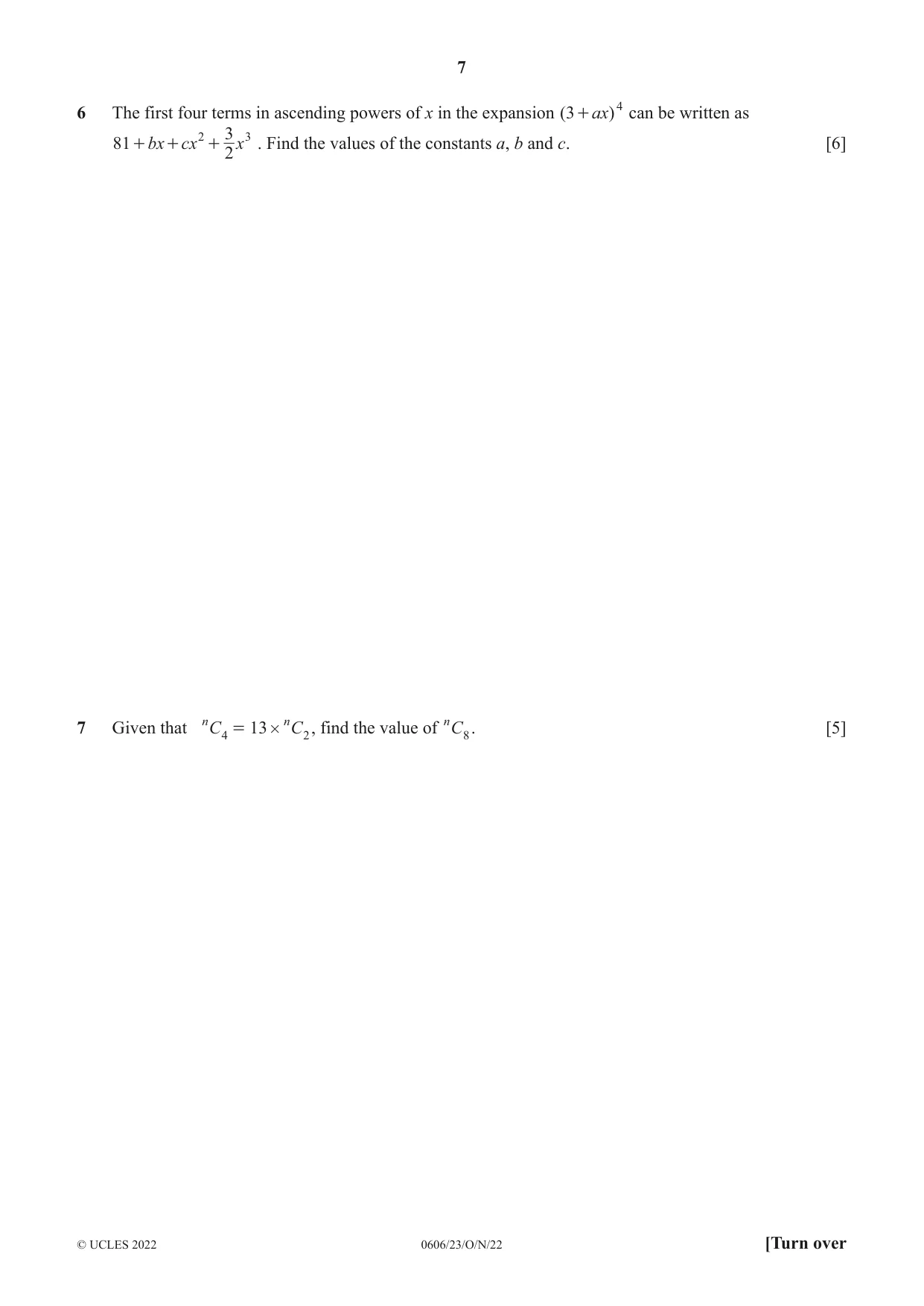
Q6 · The first four terms in ascending powers of x in the expansion ( 3 + ax) 4 can be written…
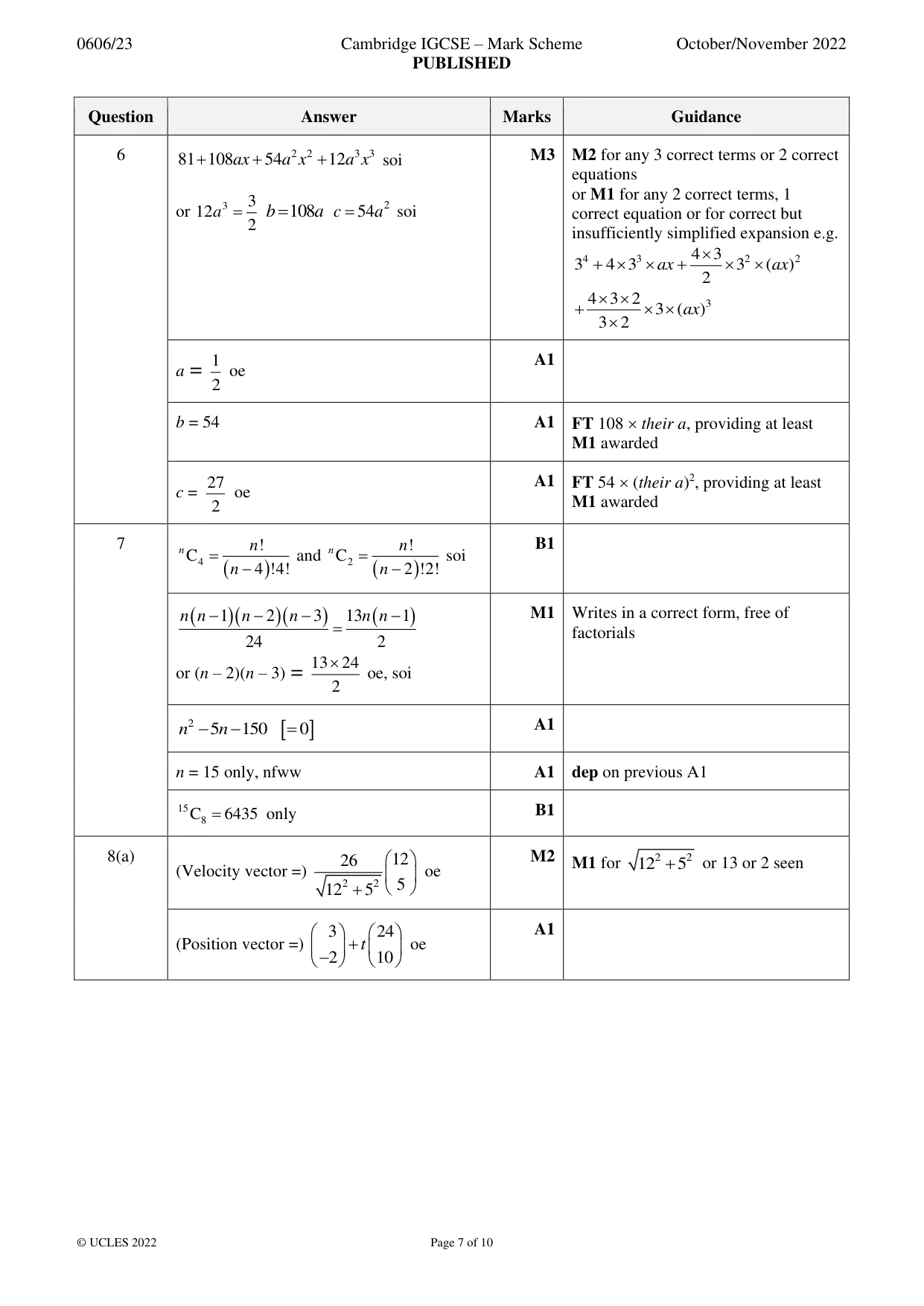
6 The first four terms in ascending powers of x in the expansion ( 3 + ax) 4 can be written as 2 3 3 81 + bx + cx + x . Find the values of the constants a, b and c. [6] 2
Mark scheme: 6 81 + 108ax + 54a 2 x 2 + 12a 3 x 3 soi M3 M2 for any 3 correct terms or 2 correct equations or M1 for any 2 correct terms, 1 3 3 2 or 12 a = b = 108a c = 54 a soi correct equation or for correct but 2 insufficiently simplified expansion e.g. 4 3 4 3 2 2 3 + 4 3 ax + 3 ( ax ) 2 4 3 2 3 + 3 ( ax ) 3 2 1 A1 a = oe 2 b = 54 A1 FT 108 their a, providing at least M1 awarded 27 A1 FT 54 (their a)2, providing at least c = oe 2 M1 awarded
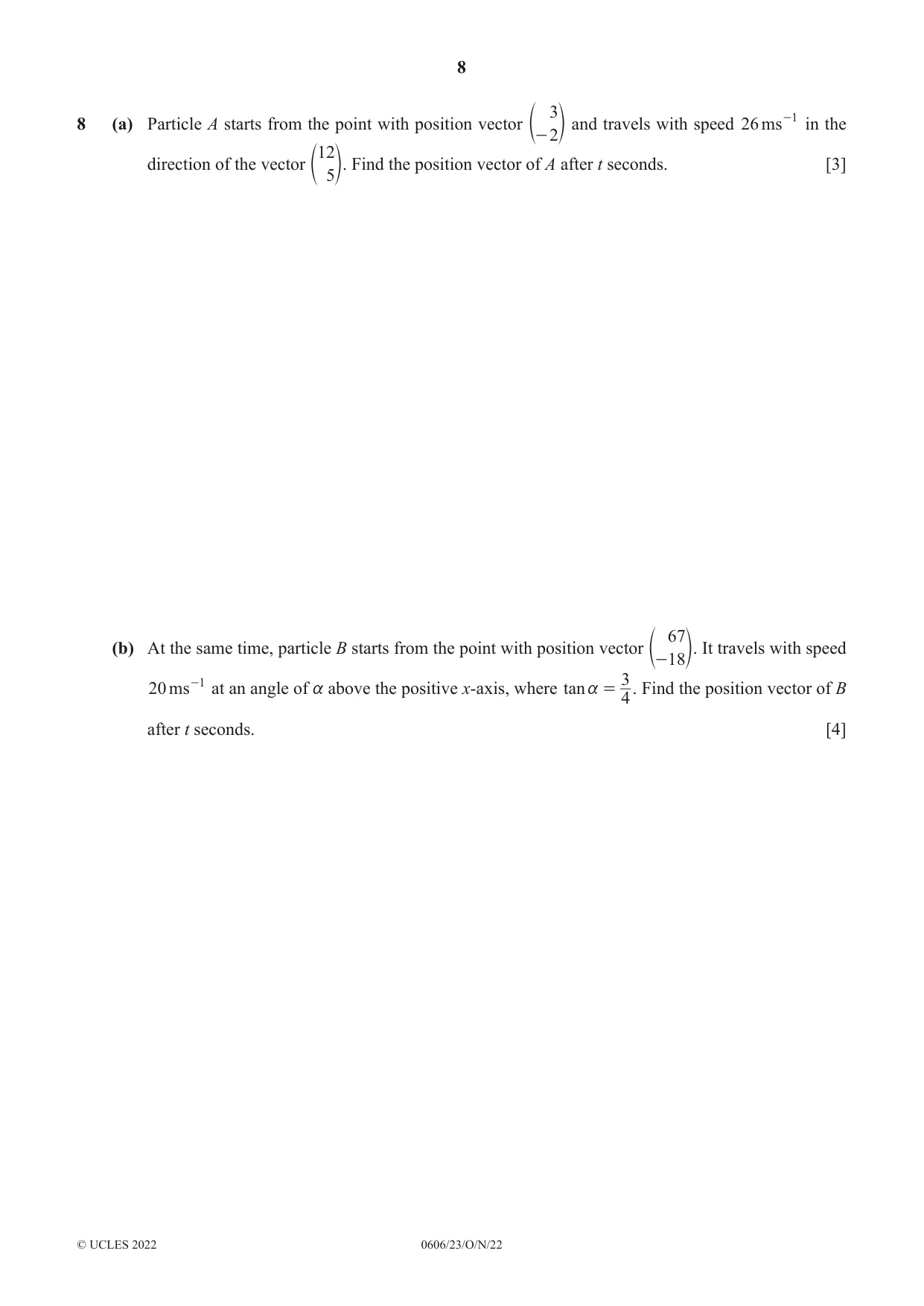
Q8 · Particle A starts from the point with position vector and travels with speed 26 ms -1 in…
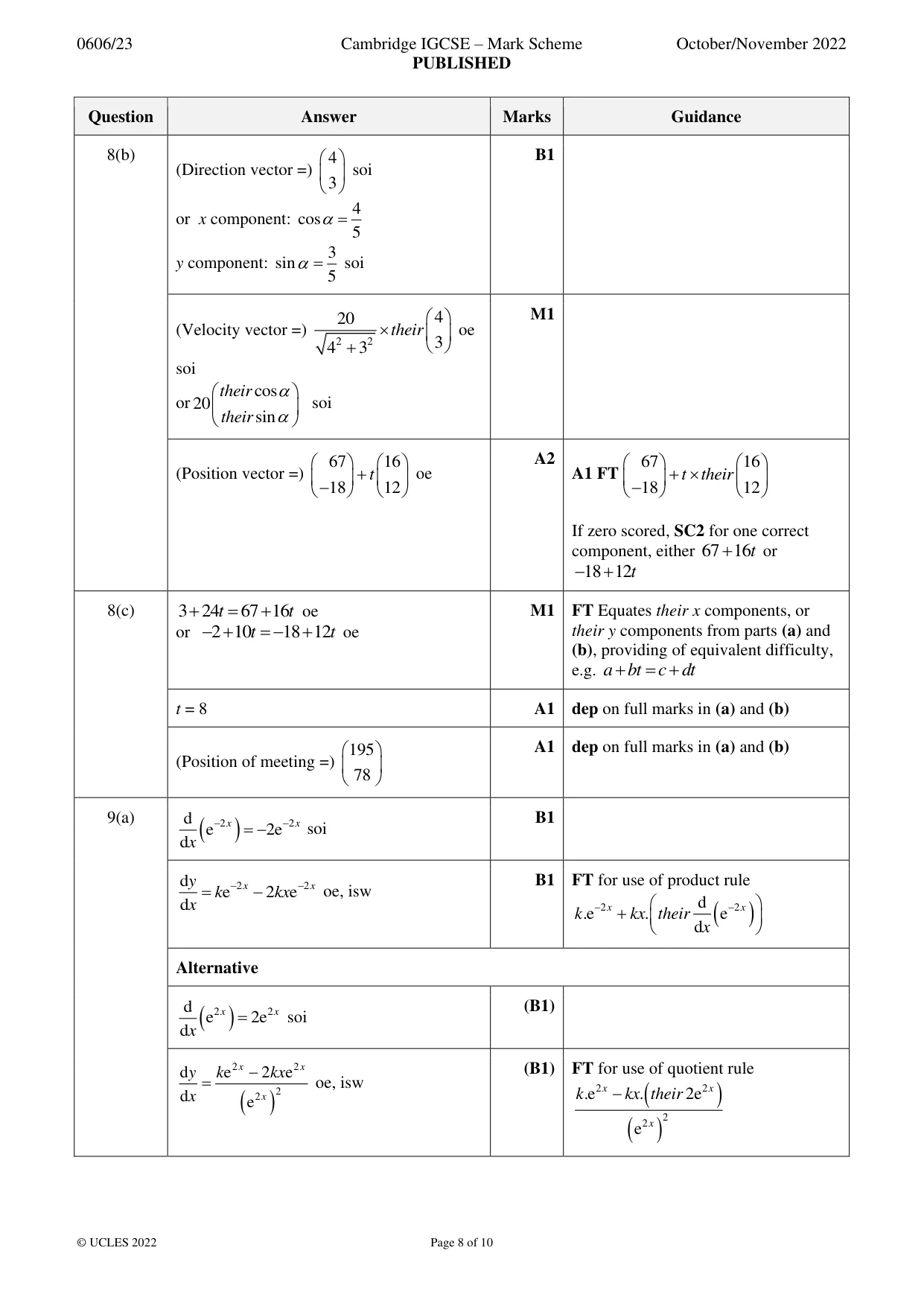
8 (a) Particle A starts from the point with position vector and travels with speed 26 ms -1 in the - 2 12 direction of the vector Find the position vector of A after t seconds. [3] e 5o. 67 (b) At the same time, particle B starts from the point with position vector It travels with speed e- 18o. -1 3 20 ms at an angle of a above the positive x‑axis, where tan a = . Find the position vector of B 4 after t seconds. [4]
Mark scheme: 8(a) 26 12 M2 M1 for 12 2 + 52 or 13 or 2 seen (Velocity vector =) oe 5 12 2 + 52 3 24 A1 (Position vector =) + t oe −2 10 8(b) 4 B1 (Direction vector =) soi 3 4 or x component: cos= 5 3 y component: sin = soi 5 20 4 M1 (Velocity vector =) oe their 3 4 2 + 32 soi their cos or 20 soi their sin 67 16 A2 67 16 (Position vector =) + t oe A1 FT + t their −18 12 −18 12 If zero scored, SC2 for one correct component, either 67 + 16t or −18 + 12t 8(c) 3 + 24t = 67 + 16t oe M1 FT Equates their x components, or or −+2 10t = −18 + 12t oe their y components from parts (a) and (b), providing of equivalent difficulty, e.g. a + bt = c + dt t = 8 A1 dep on full marks in (a) and (b) 195 A1 dep on full marks in (a) and (b) (Position of meeting =) 78
Q9 · The equation of a curve is y = kxe - 2 x , where k is a constant
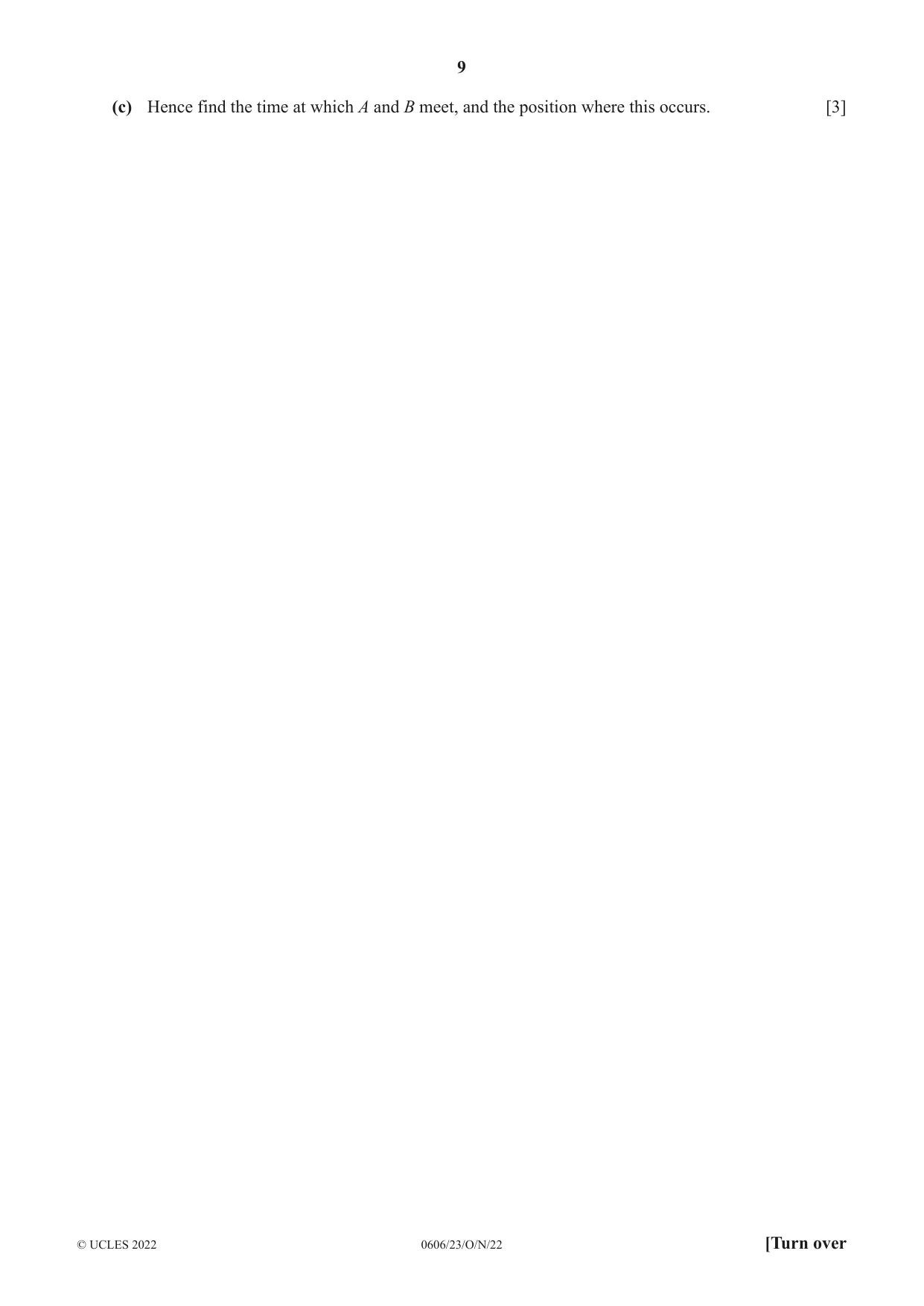
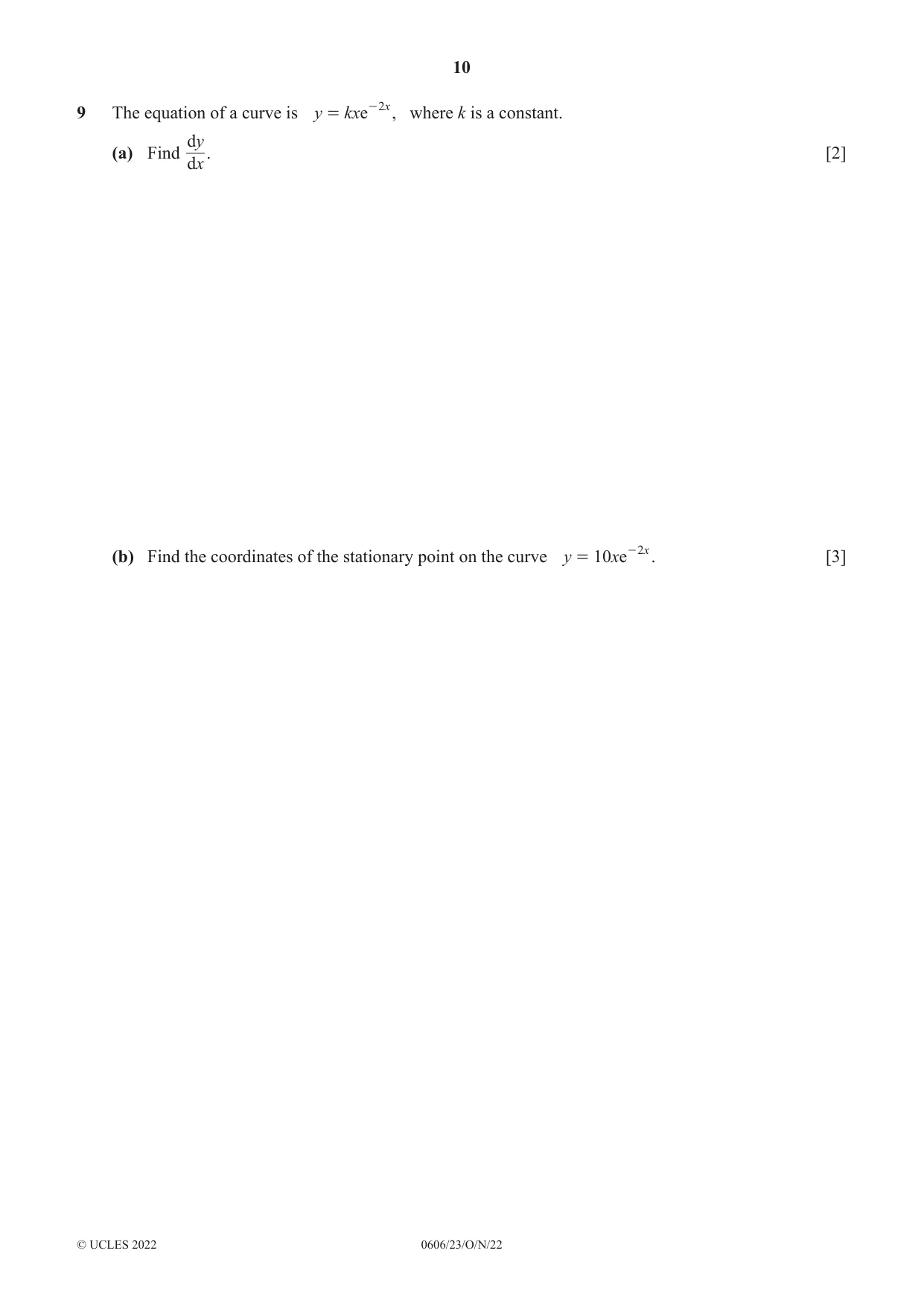
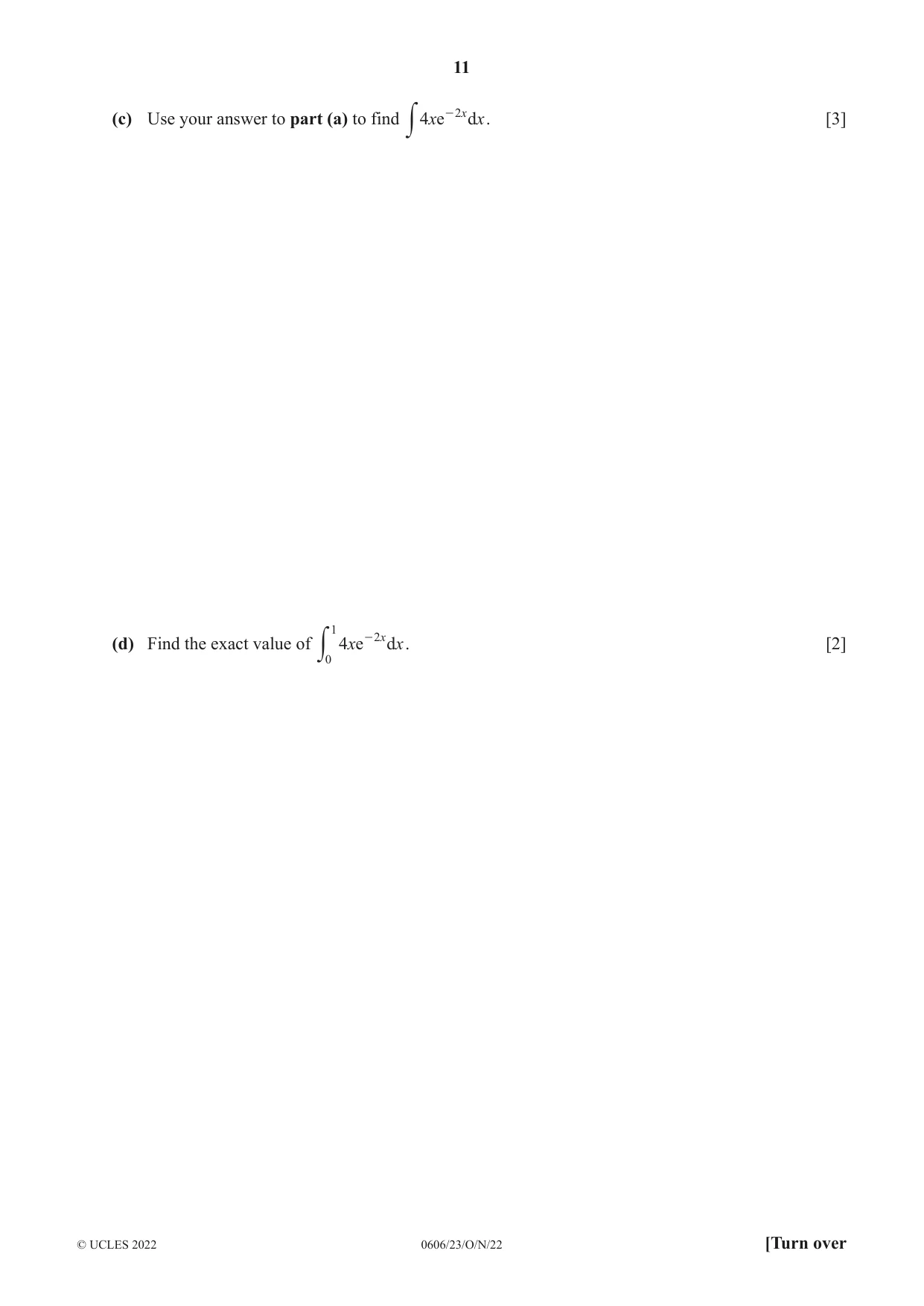
9 The equation of a curve is y = kxe - 2 x , where k is a constant. dy (a) Find . [2] dx (b) Find the coordinates of the stationary point on the curve y = 10xe - 2 x . [3] (c) Use your answer to part (a) to find 4xe - 2 x dx . [3] y 1 (d) Find the exact value of 4xe - 2 x dx . [2] y0
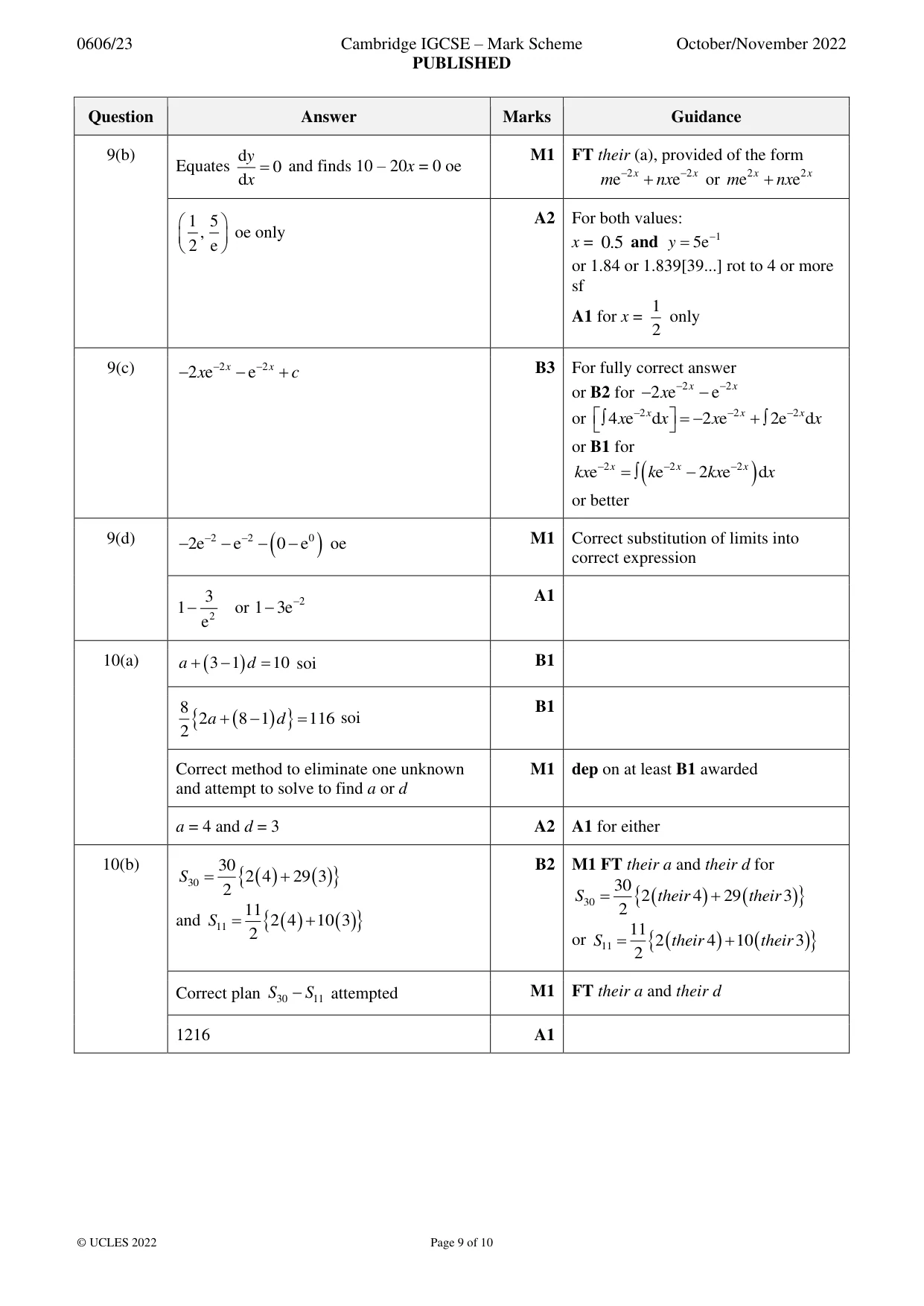
Mark scheme: 9(a) d −2 x −2 x B1 e = −2e soi ( ) dx dy −2 x −2 x B1 FT for use of product rule = ke − 2 kxe oe, isw dx −2 x d −2 x k .e + kx. their e ( ) dx Alternative d 2 x 2 x (B1) e = 2e soi ( ) dx d y k e 2 x − 2 kx e 2 x (B1) FT for use of quotient rule = oe, isw 2 x 2 x 2 k .e − kx. their 2e d x ( ) e 2 x ( ) 2 e 2 x ( ) 9(b) dy M1 FT their (a), provided of the form Equates = 0 and finds 10 – 20x = 0 oe −2 x −2 x 2 x 2 x dx me + nxe or me + nxe 1 5 A2 For both values: , oe only 1 2 e x = 0.5 and y = 5e− or 1.84 or 1.839[39...] rot to 4 or more sf 1 A1 for x = only 2 9(c) −2 xe −2 x − e −2 x + c B3 For fully correct answer or B2 for −2 xe −2 x − e −2 x or 4 xe −2 x dx = −2 xe −2 x + 2e −2 x dx or B1 for kxe −2 x = ke −2 x − 2 kxe −2 x dx ( ) or better 9(d) −2e −2 − e −2 − 0 − e 0 oe M1 Correct substitution of limits into ( ) correct expression 3 2 A1 1 − or 1 − 3e− e 2
More questions on Use differentiation to find stationary points
Q10 · The third term of an arithmetic progression is 10 and the sum of the first 8 terms is 116
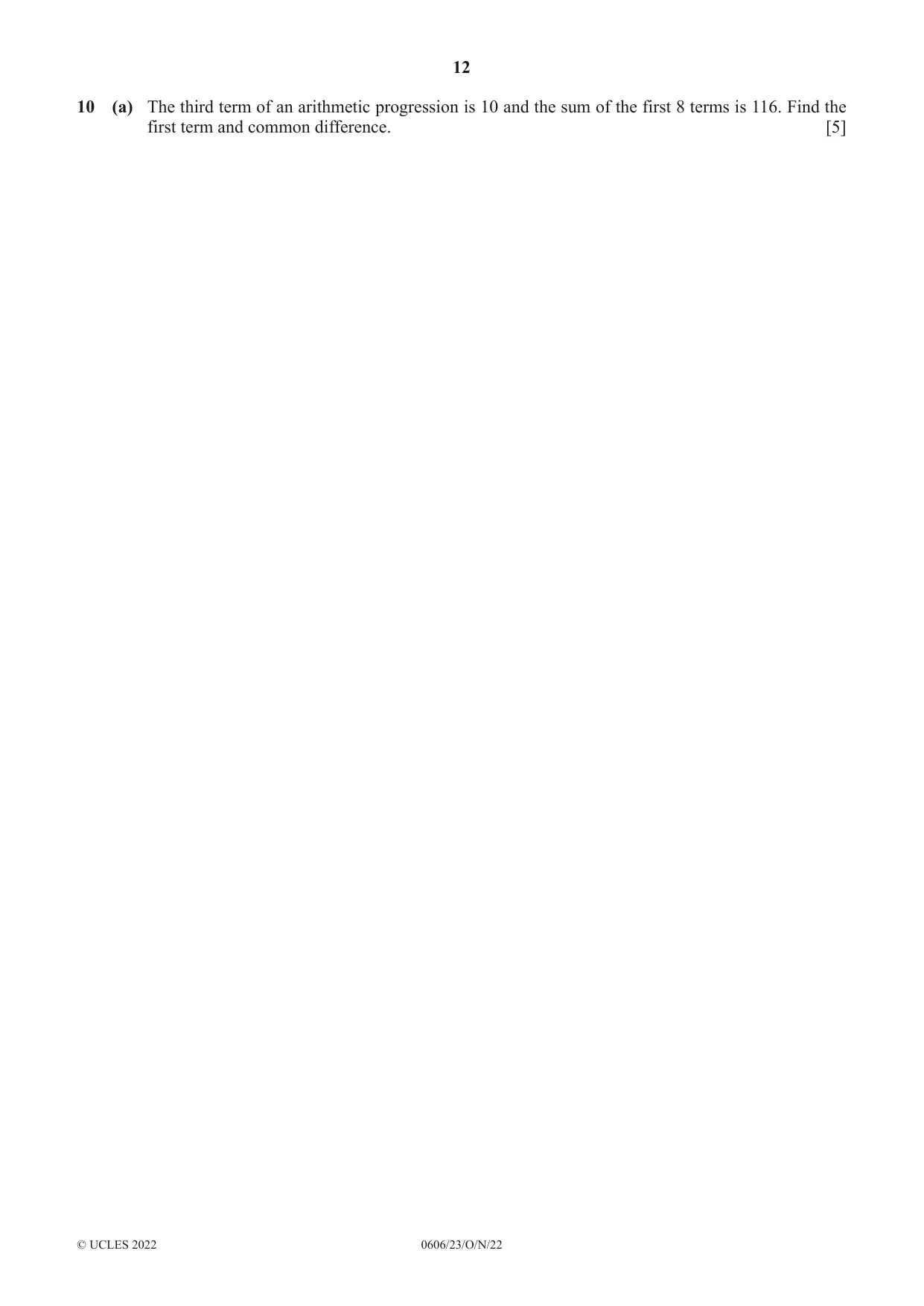
10 (a) The third term of an arithmetic progression is 10 and the sum of the first 8 terms is 116. Find the first term and common difference. [5]
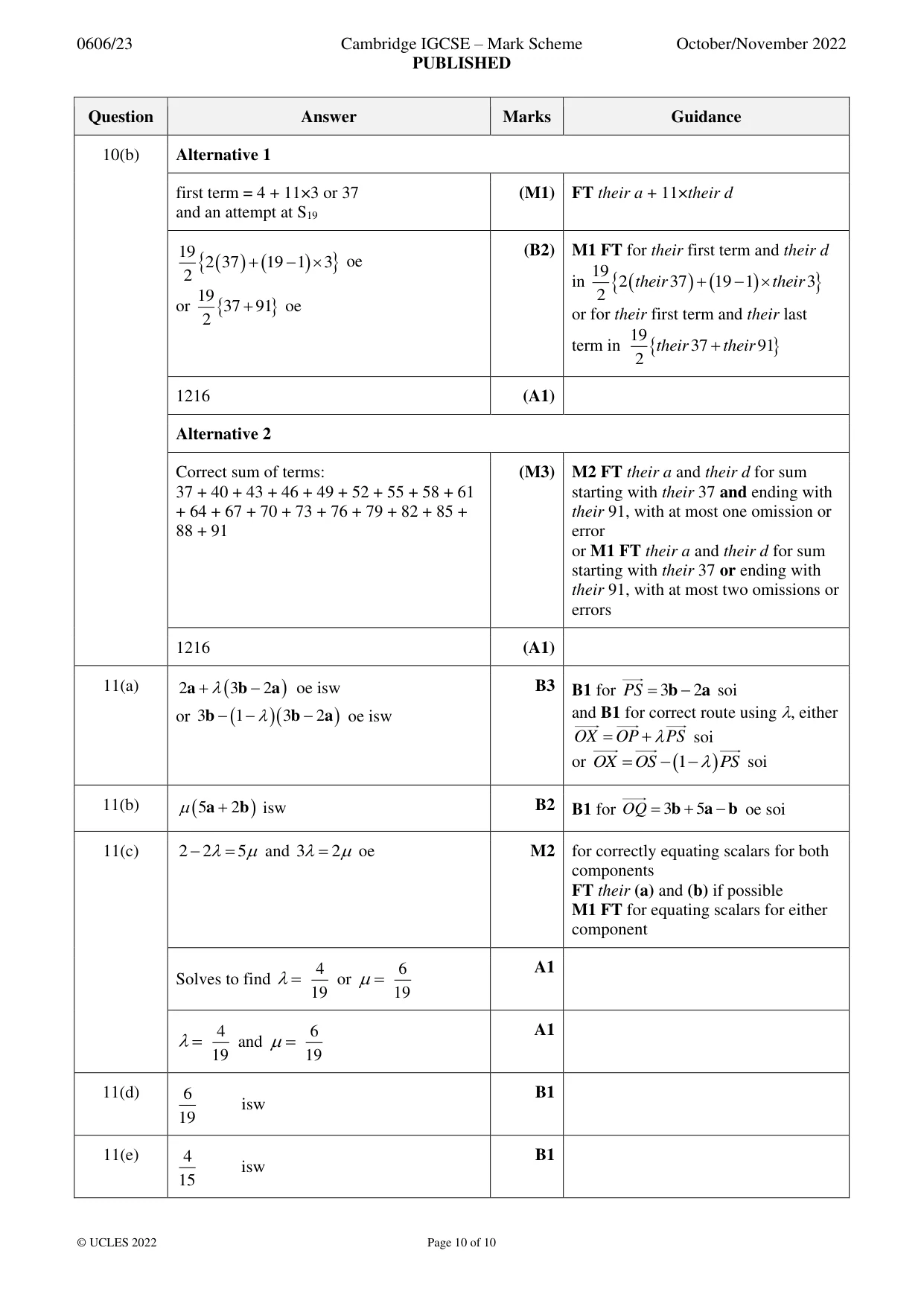
Mark scheme: 10(a) a + ( 3 − 1) d = 10 soi B1 8 2 a + ( 8 − 1) d = 116 soi B1 2 Correct method to eliminate one unknown M1 dep on at least B1 awarded and attempt to solve to find a or d a = 4 and d = 3 A2 A1 for either 10(b) 30 B2 M1 FT their a and their d for S30 = 2 ( 4 ) + 29 ( 3 ) 2 30 S30 = 2 ( their 4 ) + 29 ( their 3 ) 11 2 and S11 = 2 ( 4 ) + 10 ( 3 ) 2 11 or S11 = 2 ( their 4 ) + 10 ( their 3 ) 2 Correct plan S30 − S11 attempted M1 FT their a and their d 1216 A1 10(b) Alternative 1 first term = 4 + 11×3 or 37 (M1) FT their a + 11×their d and an attempt at S19 19 2 ( 37 ) + (19 − 1) 3 oe (B2) M1 FT for their first term and their d 2 19 in 2 ( their 37 ) + (19 − 1) their 3 19 2 or 37 + 91 oe or for their first term and their last 2 19 term in their 37 + their 91 2 1216 (A1) Alternative 2 Correct sum of terms: (M3) M2 FT their a and their d for sum 37 + 40 + 43 + 46 + 49 + 52 + 55 + 58 + 61 starting with their 37 and ending with + 64 + 67 + 70 + 73 + 76 + 79 + 82 + 85 + their 91, with at most one omission or 88 + 91 error or M1 FT their a and their d for sum starting with their 37 or ending with their 91, with at most two omissions or errors 1216 (A1)
More questions on Use the formulas for the nth term and for the
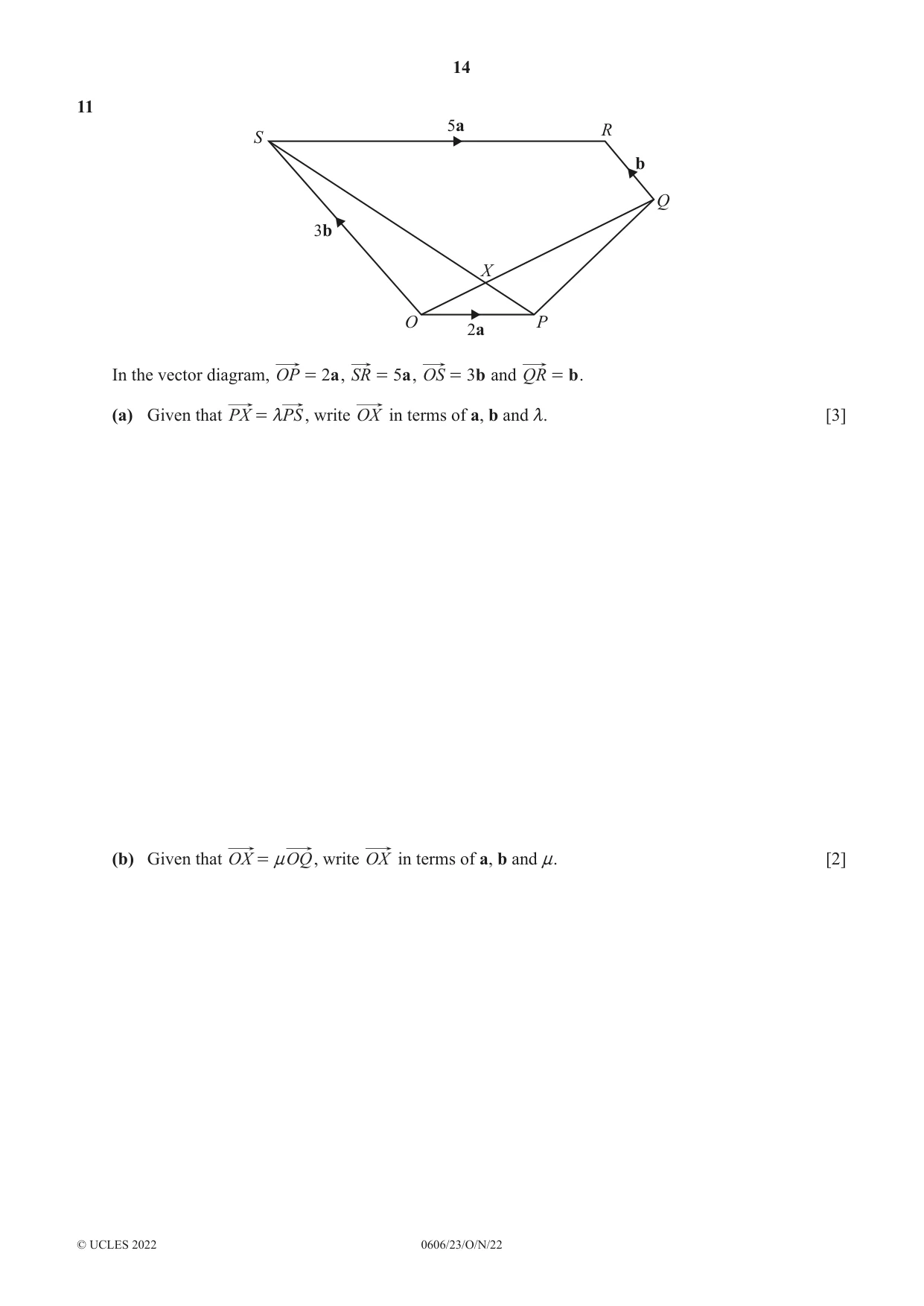
Q11 · 5a R S b Q 3b X O P 2a In the vector diagram, OP = 2a , SR = 5a , OS = 3b and QR = b
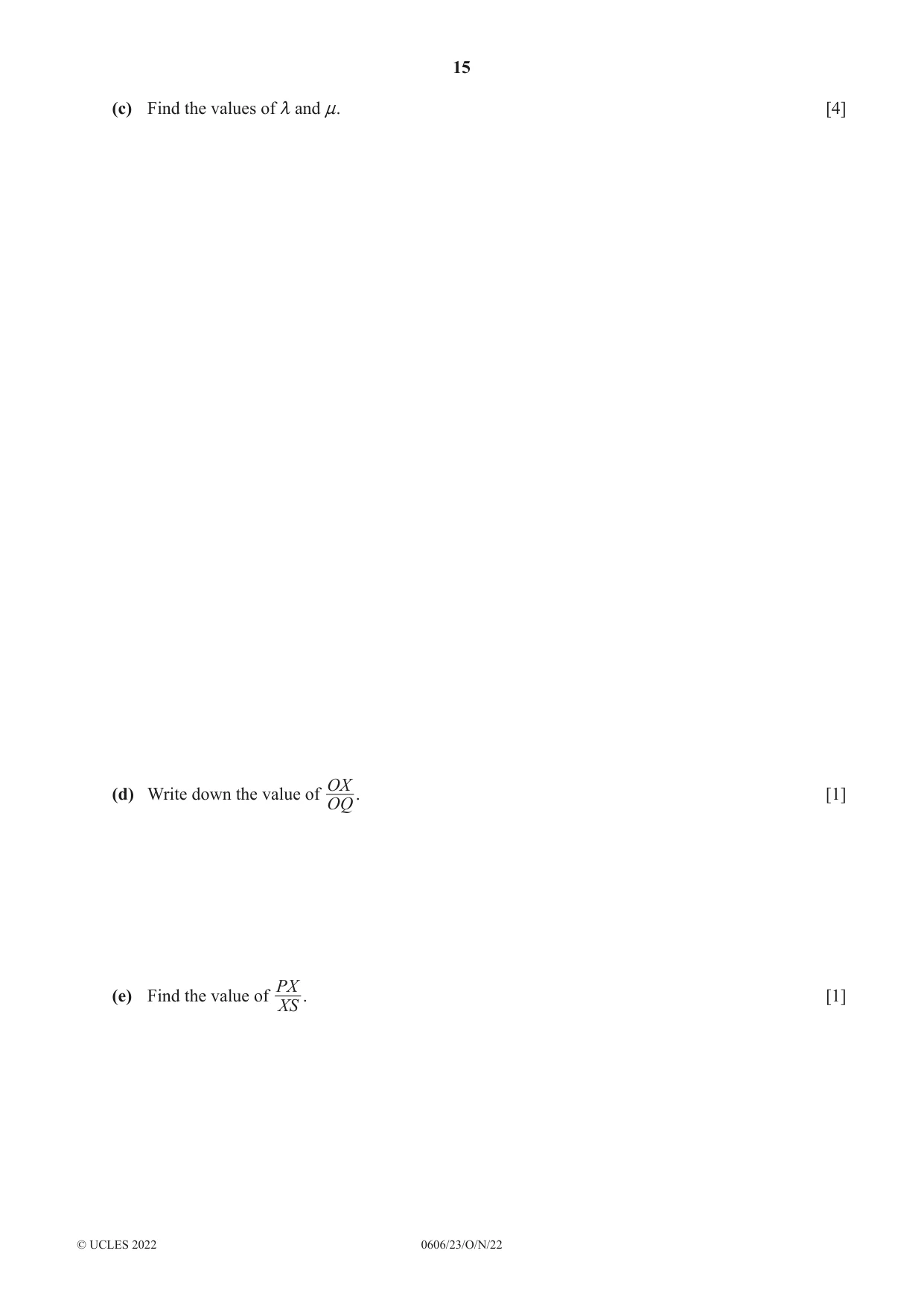
11 5a R S b Q 3b X O P 2a In the vector diagram, OP = 2a , SR = 5a , OS = 3b and QR = b . (a) Given that PX = mPS , write OX in terms of a, b and m. [3] (b) Given that O X = n OQ , write OX in terms of a, b and n. [2] (c) Find the values of m and n. [4] OX(d) Write down the value of . [1] OQ PX(e) Find the value of . [1] XS
Mark scheme: 11(a) 2a + ( 3b − 2a ) oe isw B3 B1 for PS = 3b − 2a soi or 3b − (1 − )( 3b − 2a ) oe isw and B1 for correct route using , either OX = OP + PS soi or OX = OS − (1 − ) PS soi 11(b) ( 5a + 2b ) isw B2 B1 for OQ = 3b + 5a − b oe soi 11(c) 2 − 2= 5 and 3= 2 oe M2 for correctly equating scalars for both components FT their (a) and (b) if possible M1 FT for equating scalars for either component 4 6 A1 Solves to find = or = 19 19 4 6 A1 = and = 19 19 11(d) 6 B1 isw 19 11(e) 4 B1 isw 15
What was in this paper
The subtopics covered by these 9 questions, and how many questions each got. Open one in a new tab to see every Cambridge question on it.
1Find factors of polynomials1Find the magnitude of a vector; add and1Find the solution set for quadratic inequalities1Prove trigonometric relationships involving the1Use differentiation to find gradients, tangents1Use differentiation to find stationary points1Use the binomial theorem for expansion of1Use the formulas for the nth term and for the1What you needed in this session
Cambridge’s own grade thresholds for 2022 Oct/Nov, Paper 2 · Variant 3. A higher threshold means an easier paper — the bar moves with how the cohort did.