Cambridge IGCSE Mathematics - Additional 0606 — 2022 Oct/Nov Paper 2 · Variant 1
0606/21/O/N/22 · 11 questions · 80 marks · ≈90 min
The question paper and its mark scheme, free to read here and free to download. This is Cambridge’s own paper, exactly as it was sat.
Question paper16 pages
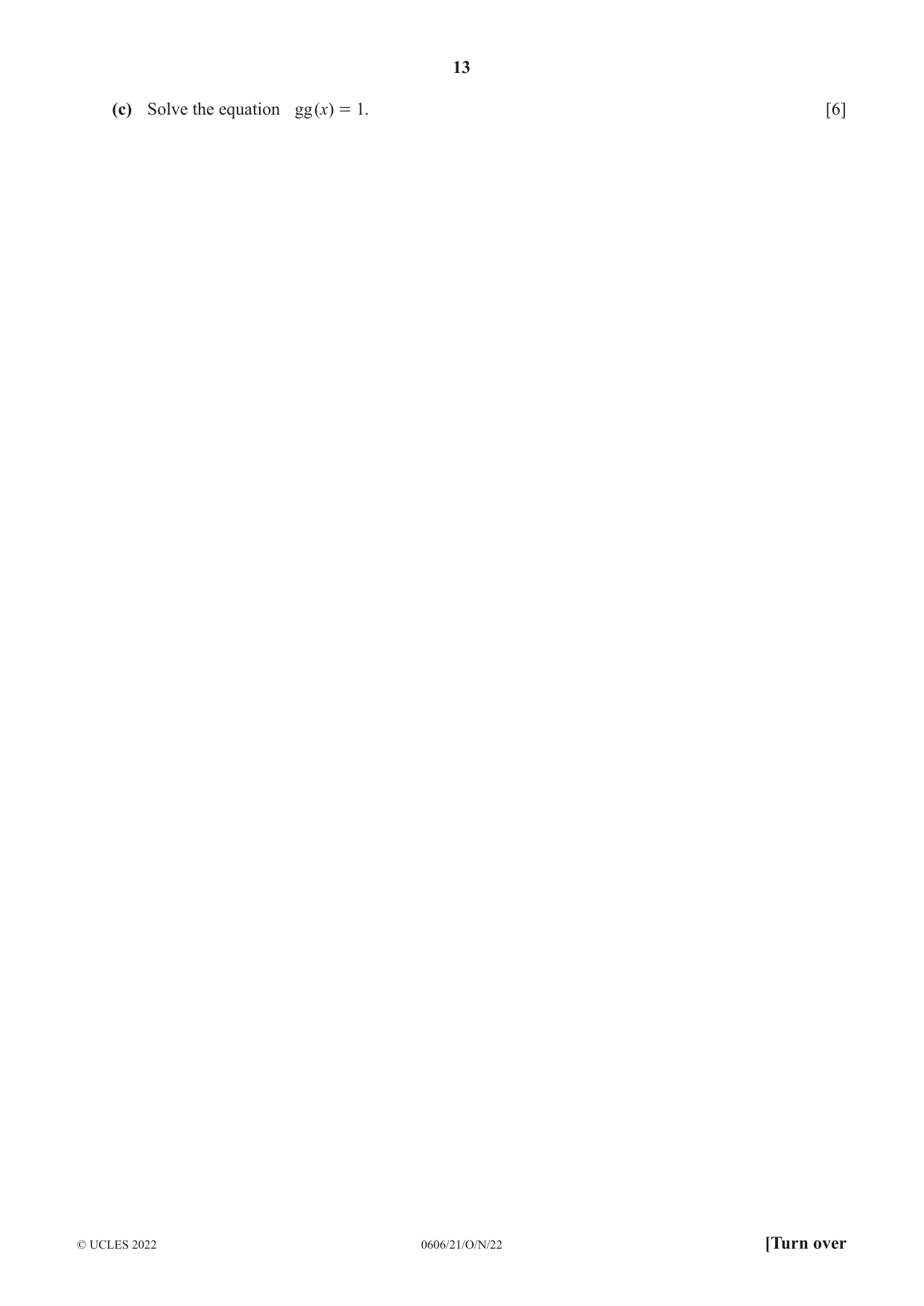
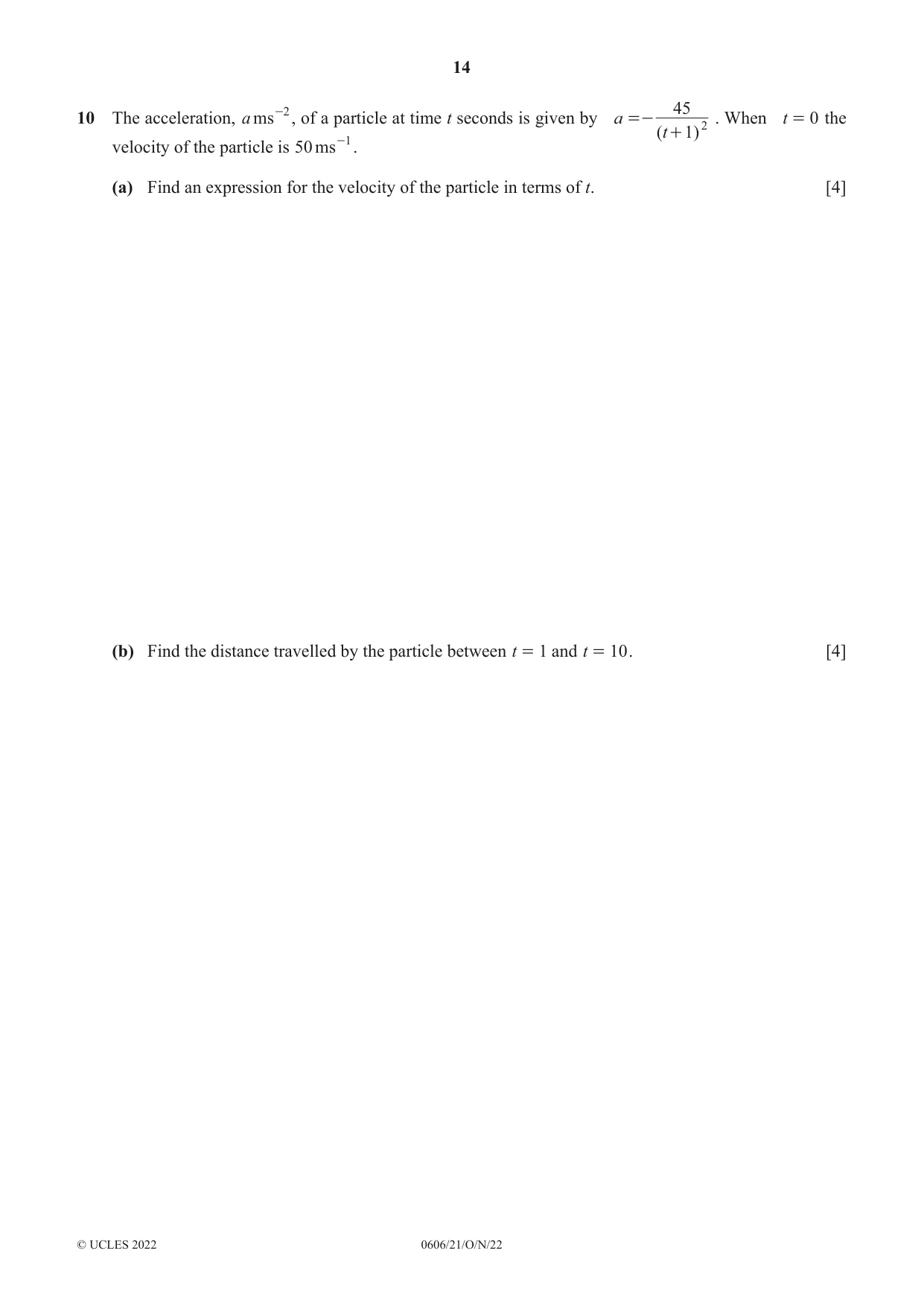
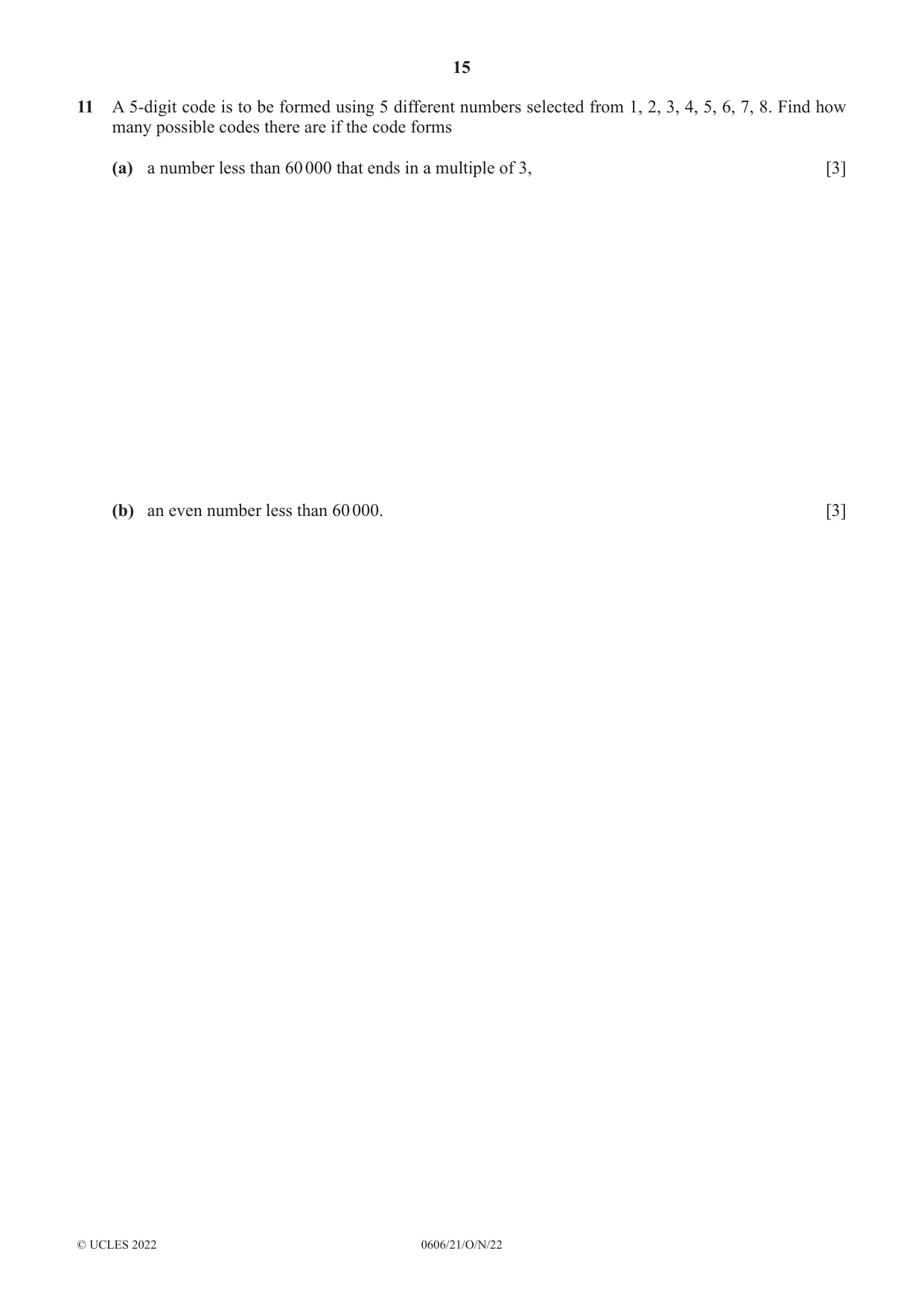
Mark scheme9 pages
Answers below. Sit the paper first if you are practising.
Questions as text
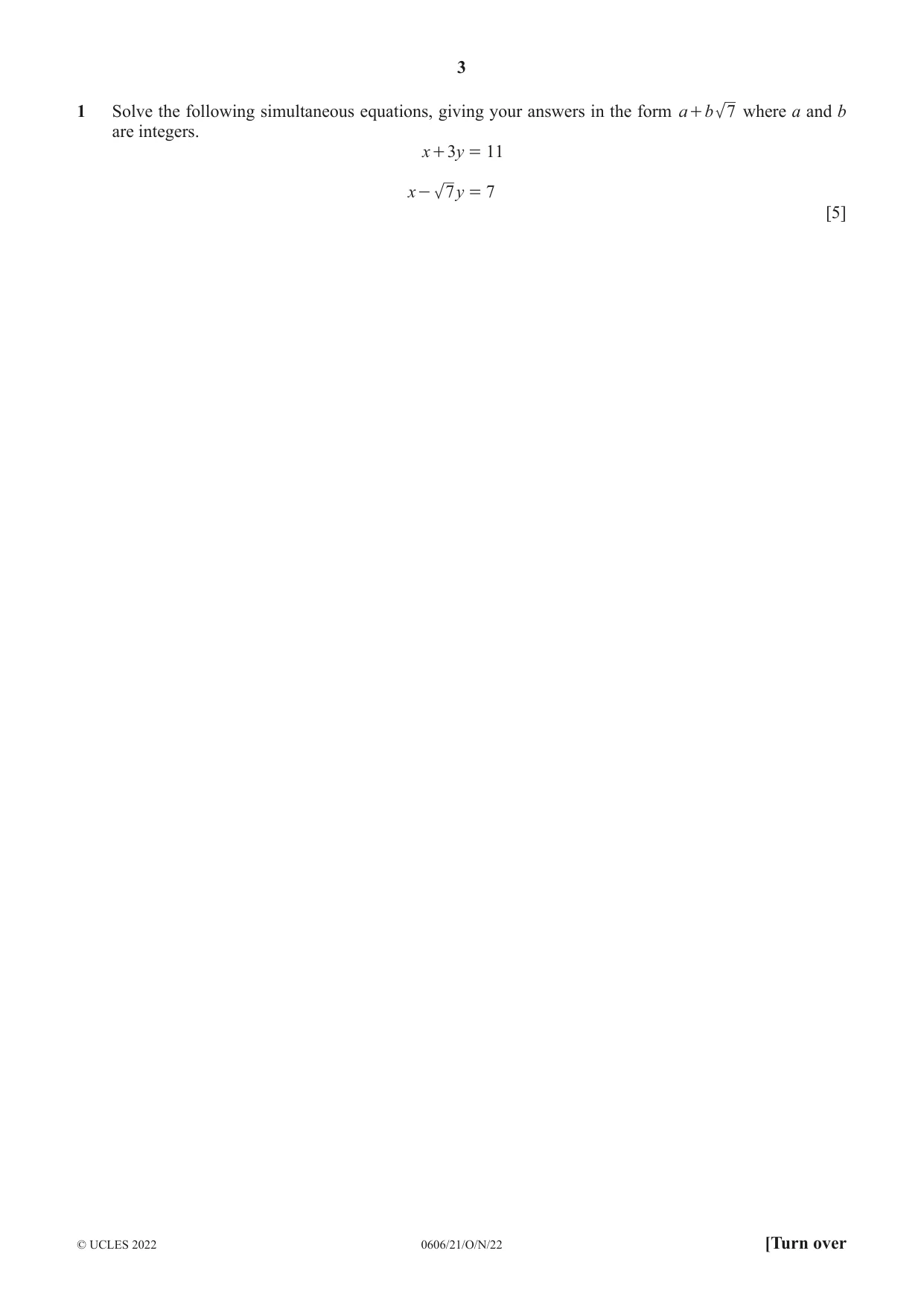
Q1 · Solve the following simultaneous equations, giving your answers in the form a + b 7 where…
1 Solve the following simultaneous equations, giving your answers in the form a + b 7 where a and b are integers. x + 3y = 11 x - 7 y = 7 [5]
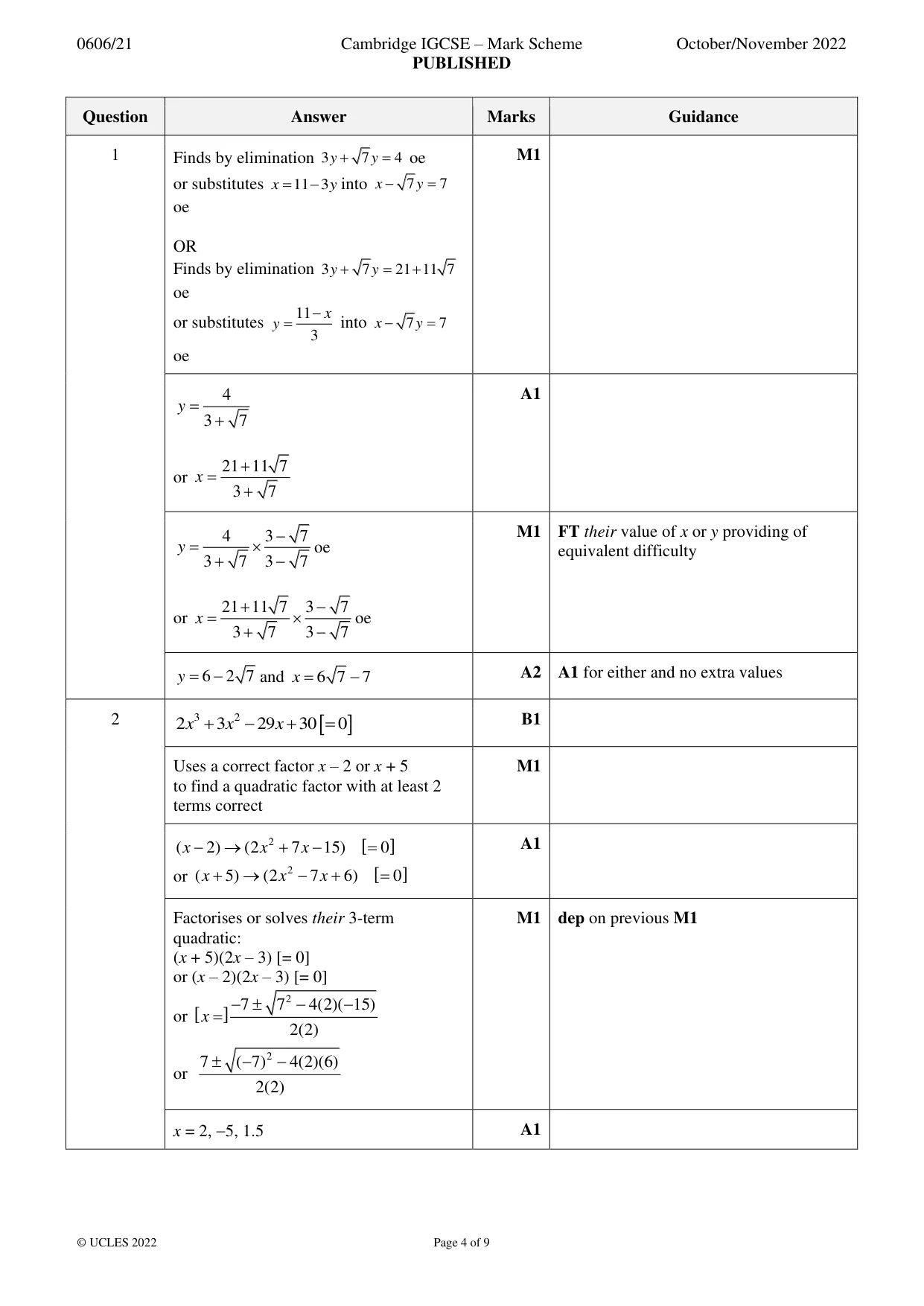
Mark scheme: Question Answer Marks Guidance 1 Finds by elimination 3 y + 7 y = 4 oe M1 or substitutes x = 11 − 3 y into x − 7 y = 7 oe OR Finds by elimination 3 y + 7 y = 21 + 11 7 oe 11 − x or substitutes y = into x − 7 y = 7 3 oe 4 A1 y = 3 + 7 21 + 11 7 or x = 3 + 7 4 3 − 7 M1 FT their value of x or y providing of y = oe equivalent difficulty 3 + 7 3 − 7 21 + 11 7 3 − 7 or x = oe 3 + 7 3 − 7 y = 6 − 2 7 and x = 6 7 − 7 A2 A1 for either and no extra values
Q2 · DO NOT USE A CALCULATOR IN THIS QUESTION
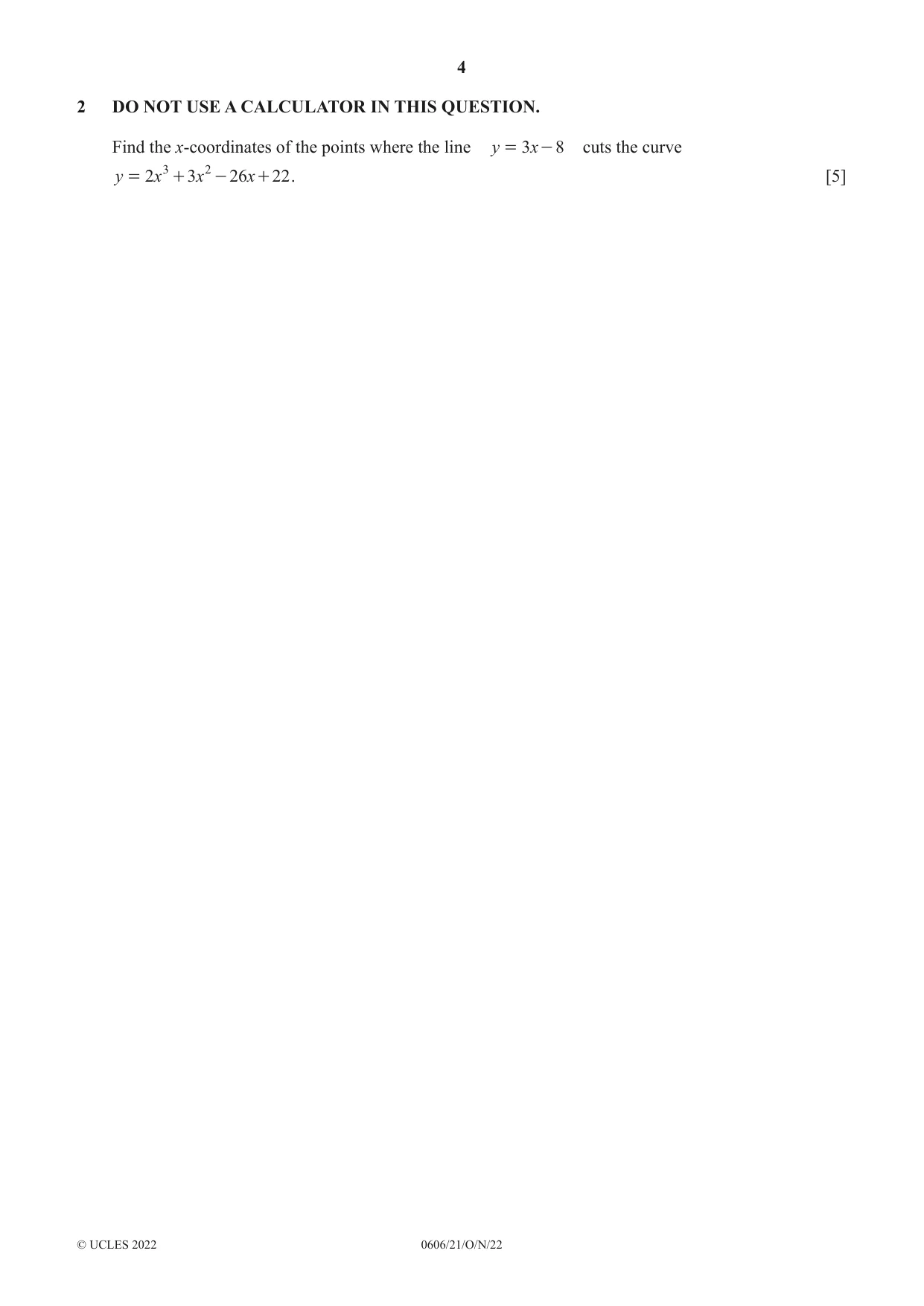
2 DO NOT USE A CALCULATOR IN THIS QUESTION. Find the x-coordinates of the points where the line y = 3x - 8 cuts the curve y = 2x 3 + 3x 2 - 26x + 22 . [5]
Mark scheme: 2 2 x3 + 3x 2 − 29 x + 30 = 0 B1 Uses a correct factor x – 2 or x + 5 M1 to find a quadratic factor with at least 2 terms correct ( x − 2) → (2 x 2 + 7 x − 15) = 0 A1 or ( x + 5) → (2 x 2 − 7 x + 6) = 0 Factorises or solves their 3-term M1 dep on previous M1 quadratic: (x + 5)(2x – 3) [= 0] or (x – 2)(2x – 3) [= 0] −7 7 2 − 4(2)( −15) or x = 2(2) 7 ( −7) 2 − 4(2)(6) or 2(2) x = 2, −5, 1.5 A1
Q3 · Find the coordinates of the point on the curve y = 1 + 3 x where the gradient of the…
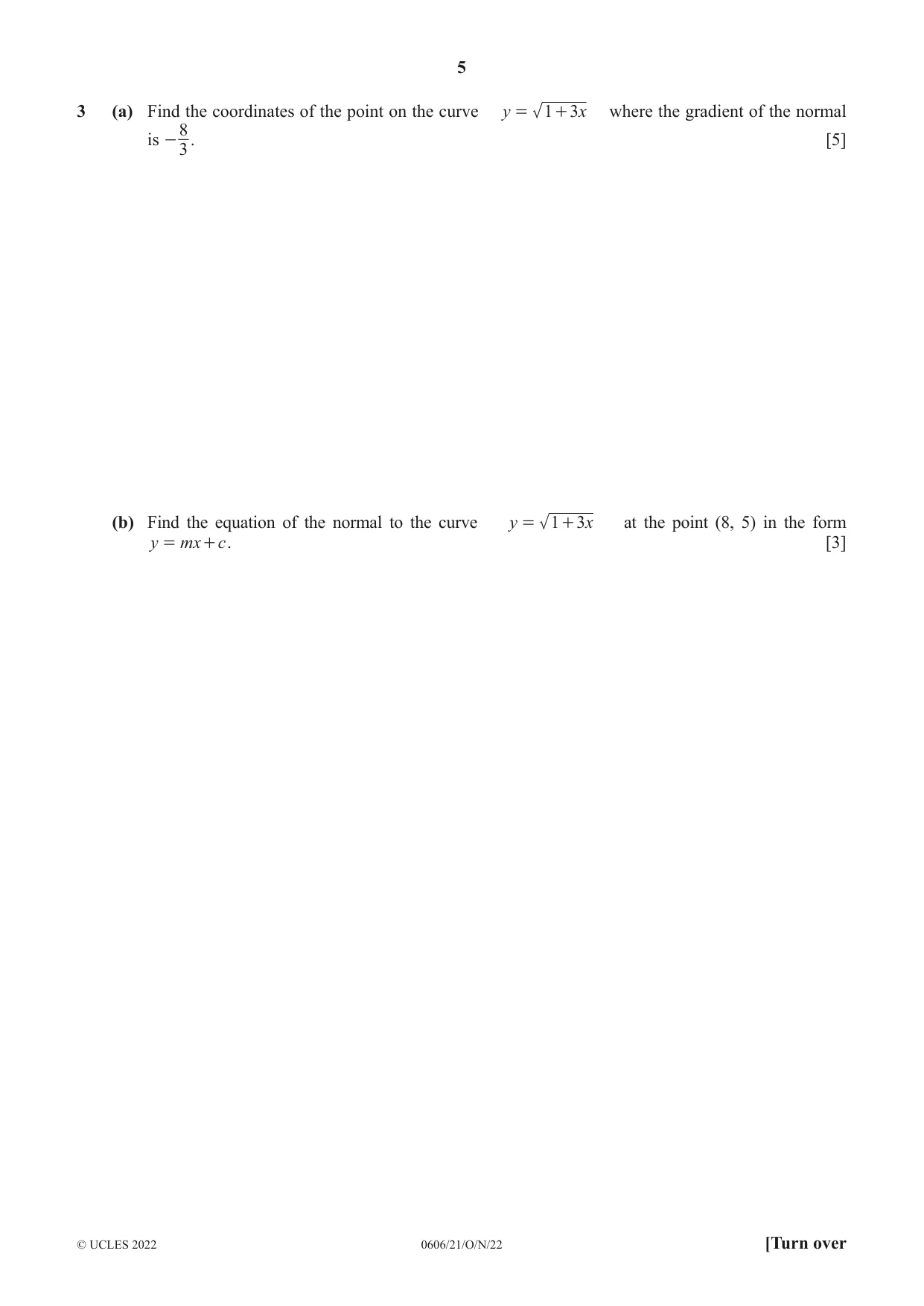
3 (a) Find the coordinates of the point on the curve y = 1 + 3 x where the gradient of the normal 8 is - . [5] 3 (b) Find the equation of the normal to the curve y = 1 + 3 x at the point (8, 5) in the form y = mx + c . [3]
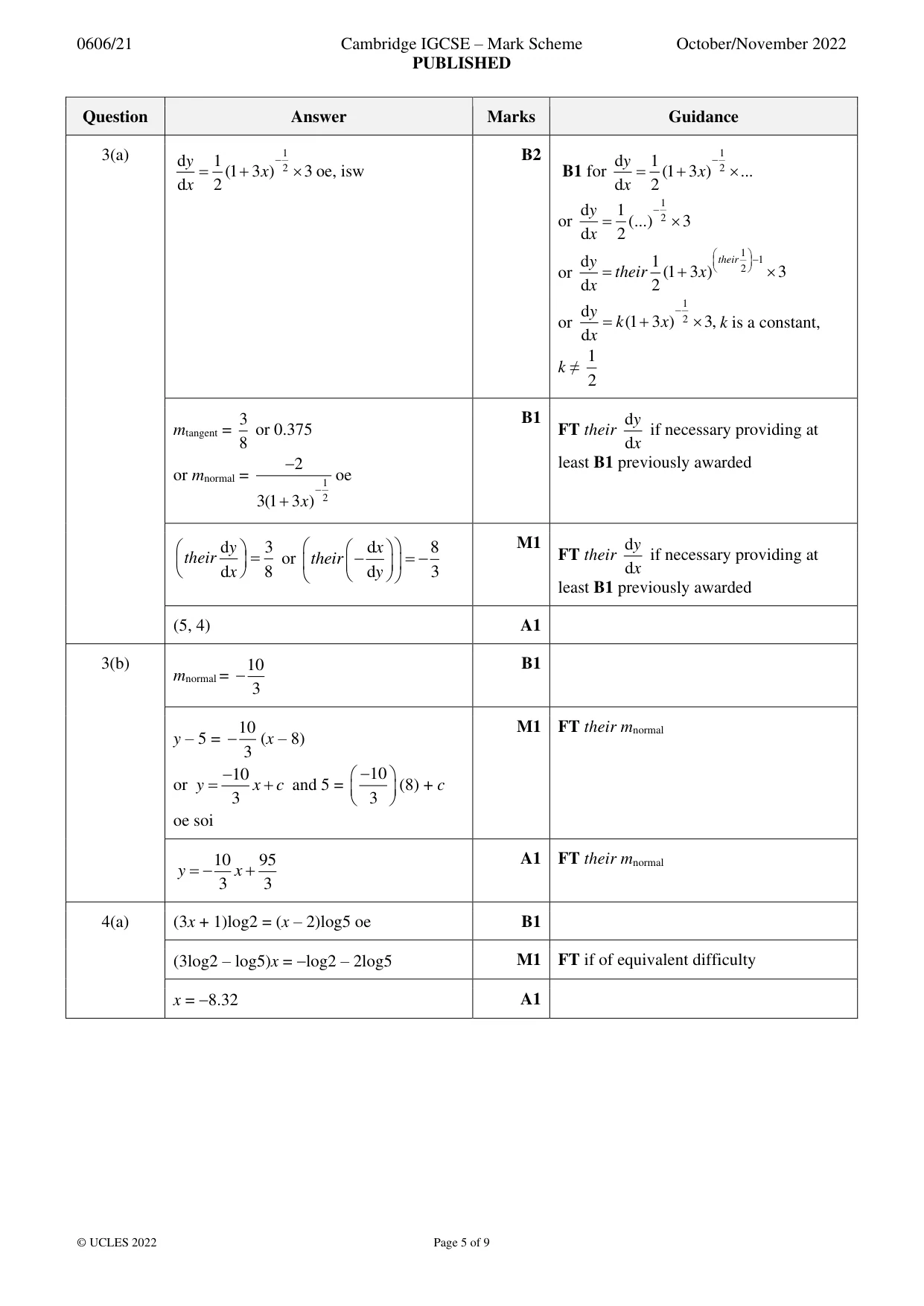
Mark scheme: 13(a) − dy 1 − 12 B2 dy 1 = (1 + 3 x ) 3 oe, isw B1 for = (1 + 3 x ) 2 ... dx 2 dx 2 dy 1 − 12 or = (...) 3 d x 2 1 1 − dy 1 their 2 or = their (1 + 3 x ) 3 d x 2 dy − 12 or = k (1 + 3 x ) 3, k is a constant, dx 1 k ≠ 2 3 B1 d y mtangent = or 0.375 FT their if necessary providing at 8 d x −2 least B1 previously awarded or mnormal = 1 oe − 3(1 + 3 x ) 2 dy 3 dx 8 M1 d y FT their if necessary providing at their − = − = or their d x dx 8 dy 3 least B1 previously awarded (5, 4) A1 3(b) 10 B1 mnormal = − 3 10 M1 FT their mnormal y – 5 = − (x – 8) 3 −10 −10 or y = x + c and 5 = (8) + c 3 3 oe soi 10 95 A1 FT their mnormal y = − x + 3 3
More questions on Use differentiation to find gradients, tangents
Q4 · Solve the following equations, giving your answers to 3 significant figures
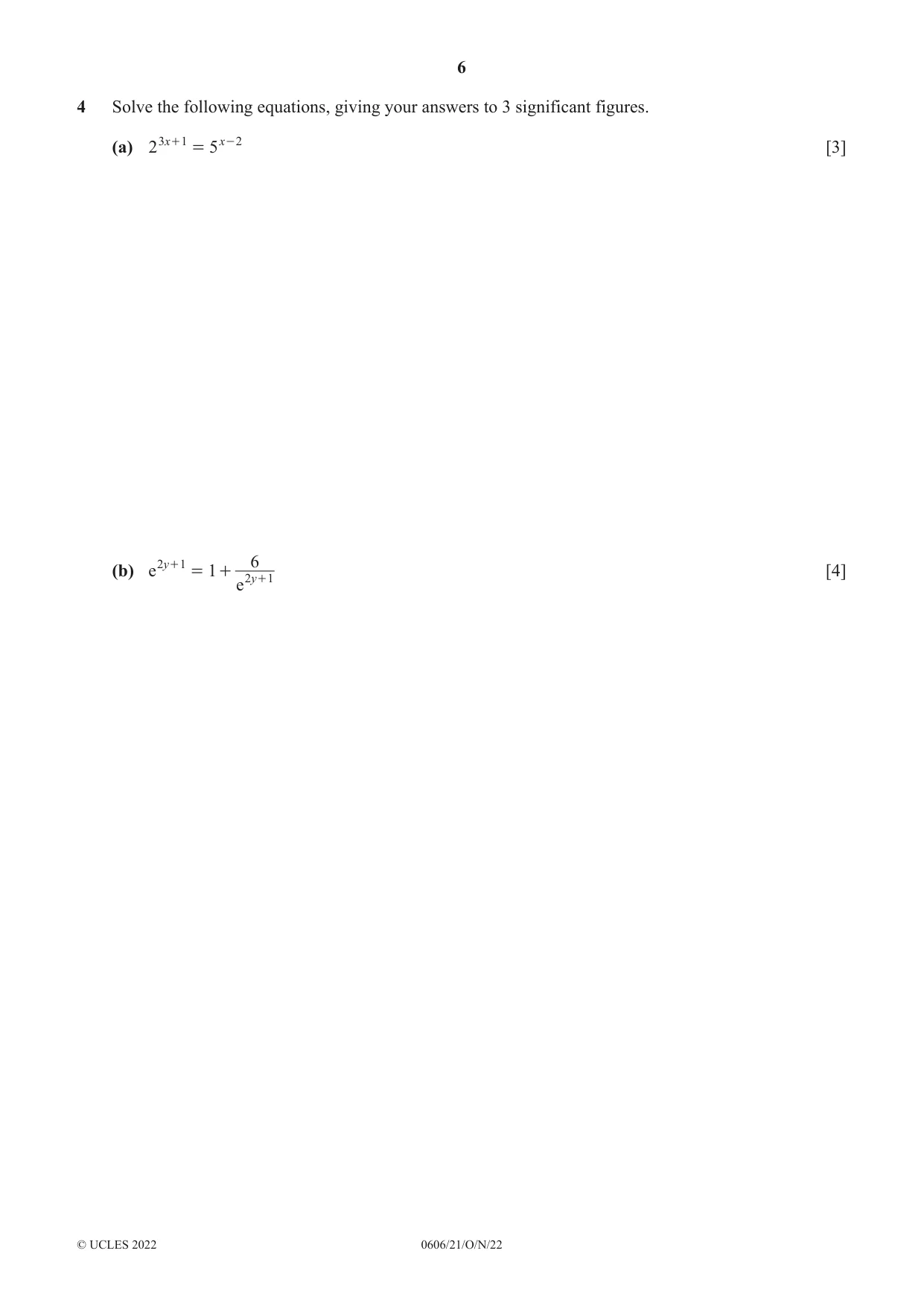
4 Solve the following equations, giving your answers to 3 significant figures. (a) 2 3 x + 1 = 5 x - 2 [3] 2y + 1 6 (b) e = 1 + 2 y + 1 [4] e
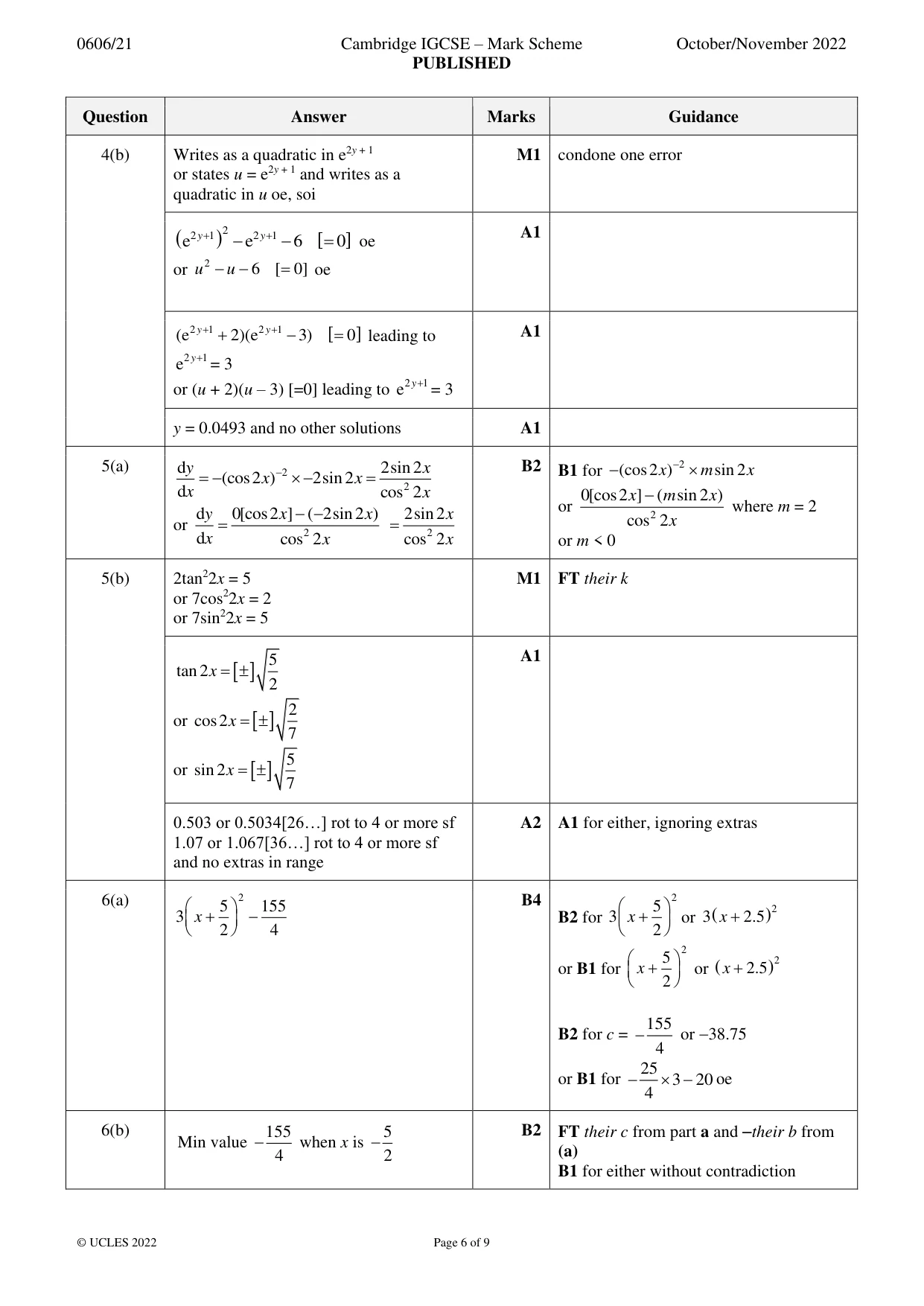
Mark scheme: 4(a) (3x + 1)log2 = (x – 2)log5 oe B1 (3log2 – log5)x = −log2 – 2log5 M1 FT if of equivalent difficulty x = −8.32 A1 4(b) Writes as a quadratic in e2y + 1 M1 condone one error or states u = e2y + 1 and writes as a quadratic in u oe, soi 2 y +1 ( e ) 2 − e 2 y +1 − 6 = 0 oe A1 or u 2 − u − 6 [ = 0] oe (e 2 y +1 + 2)(e 2 y +1 − 3) = 0 leading to A1 e 2 y +1 = 3 or (u + 2)(u – 3) [=0] leading to e 2 y +1 = 3 y = 0.0493 and no other solutions A1
More questions on Use substitution to form and solve a quadratic
Q5 · You are given that y =
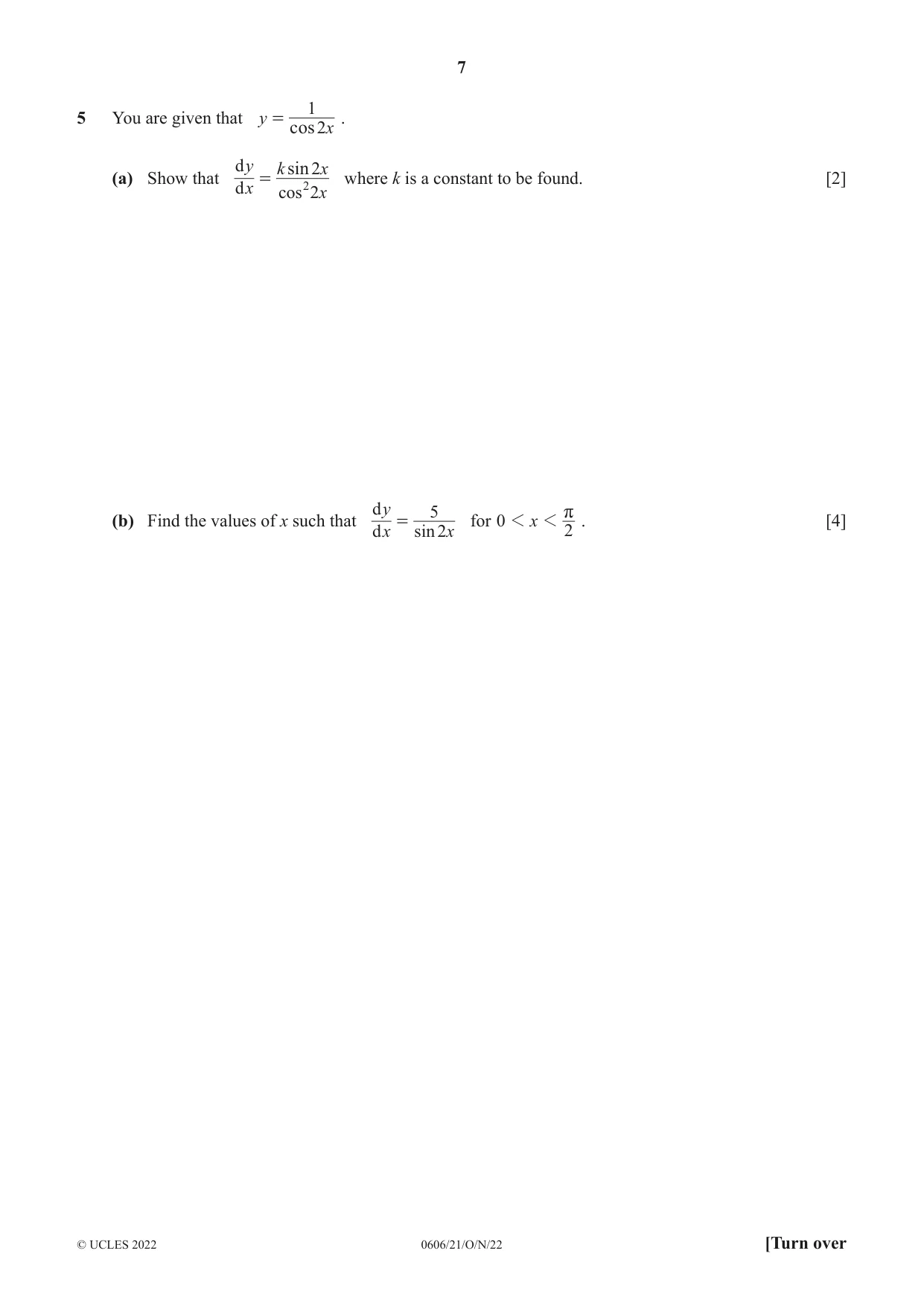
5 You are given that y = . cos 2x d y k sin 2x (a) Show that = 2 where k is a constant to be found. [2] d x cos 2x d y 5 r (b) Find the values of x such that = for 0 1 x 1 . [4] d x sin 2x 2
Mark scheme: 5(a) dy −2 2sin2 x B2 B1 for − (cos2 x ) −2 m sin 2 x = −(cos2 x ) −2sin2 x = dx cos 2 2 x 0[cos2 x ] − ( m sin2 x ) or where m = 2 dy 0[cos2 x ] −−( 2sin2 x ) 2sin2 x 2 or = = cos 2 x dx cos 2 2 x cos 2 2 x or m < 0 5(b) 2tan22x = 5 M1 FT their k or 7cos22x = 2 or 7sin22x = 5 5 A1 tan2 x = 2 2 or cos2 x = 7 5 or sin2 x = 7 0.503 or 0.5034[26…] rot to 4 or more sf A2 A1 for either, ignoring extras 1.07 or 1.067[36…] rot to 4 or more sf and no extras in range
Q6 · Write 3x 2 + 15 x - 20 in the form a ( x + b) 2 + c where a, b and c are rational numbers
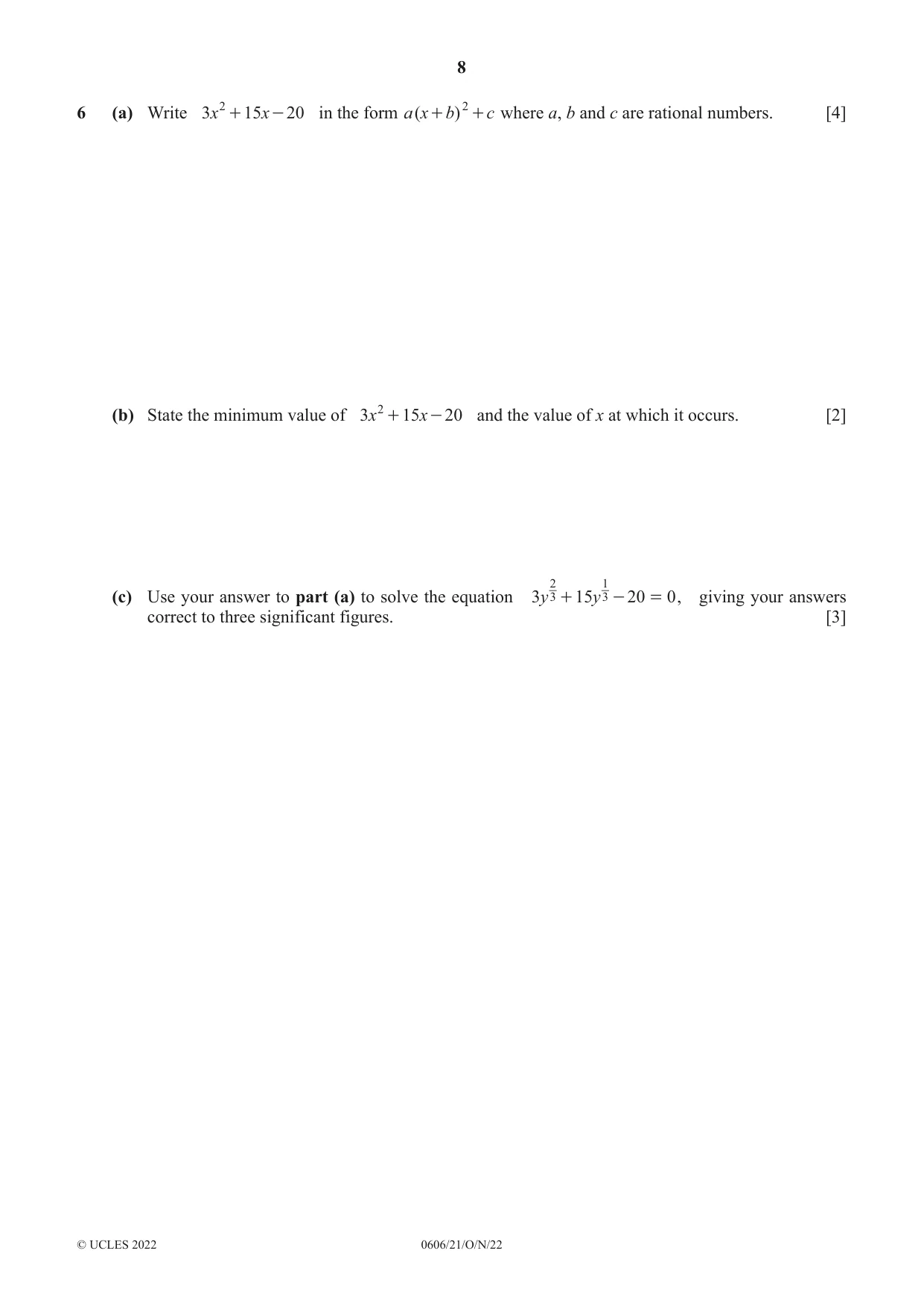
6 (a) Write 3x 2 + 15 x - 20 in the form a ( x + b) 2 + c where a, b and c are rational numbers. [4] (b) State the minimum value of 3x 2 + 15x - 20 and the value of x at which it occurs. [2] 2 1 (c) Use your answer to part (a) to solve the equation 3y 3 + 15y 3 - 20 = 0 , giving your answers correct to three significant figures. [3]
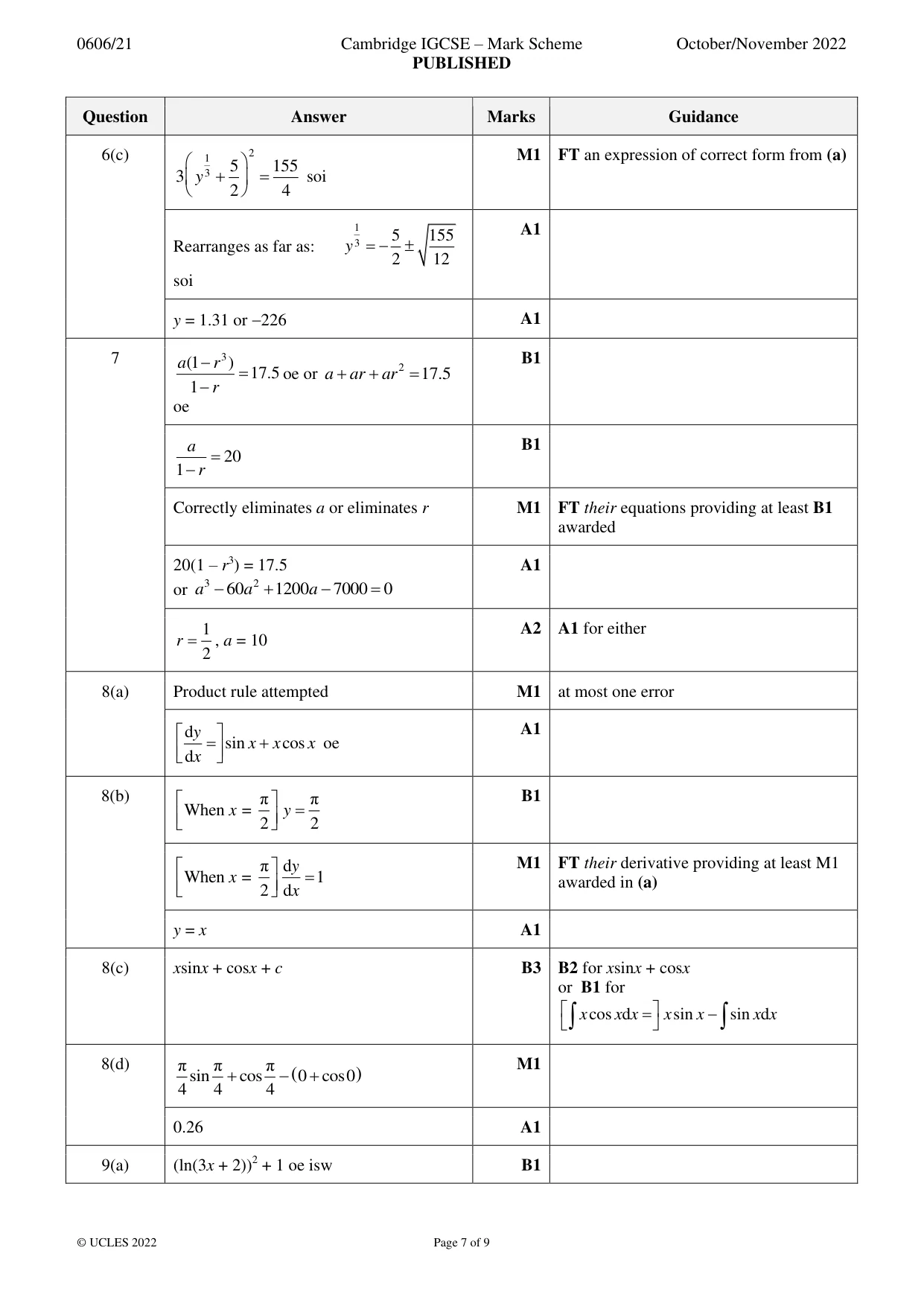
Mark scheme: 6(a) 2 B4 2 5 155 5 3 x + − B2 for 3 x + or 3 ( x + 2.5 )2 2 4 2 5 2 or B1 for x + or ( x + 2.5 )2 2 155 B2 for c = − or −38.75 4 25 or B1 for − −3 20 oe 4 6(b) 155 5 B2 FT their c from part a and −their b from Min value − when x is − 4 2 (a) B1 for either without contradiction 6(c) 1 2 M1 FT an expression of correct form from (a) 155 3 5 3 y + = soi 2 4 1 A1 3 5 155 Rearranges as far as: y = − 2 12 soi y = 1.31 or −226 A1
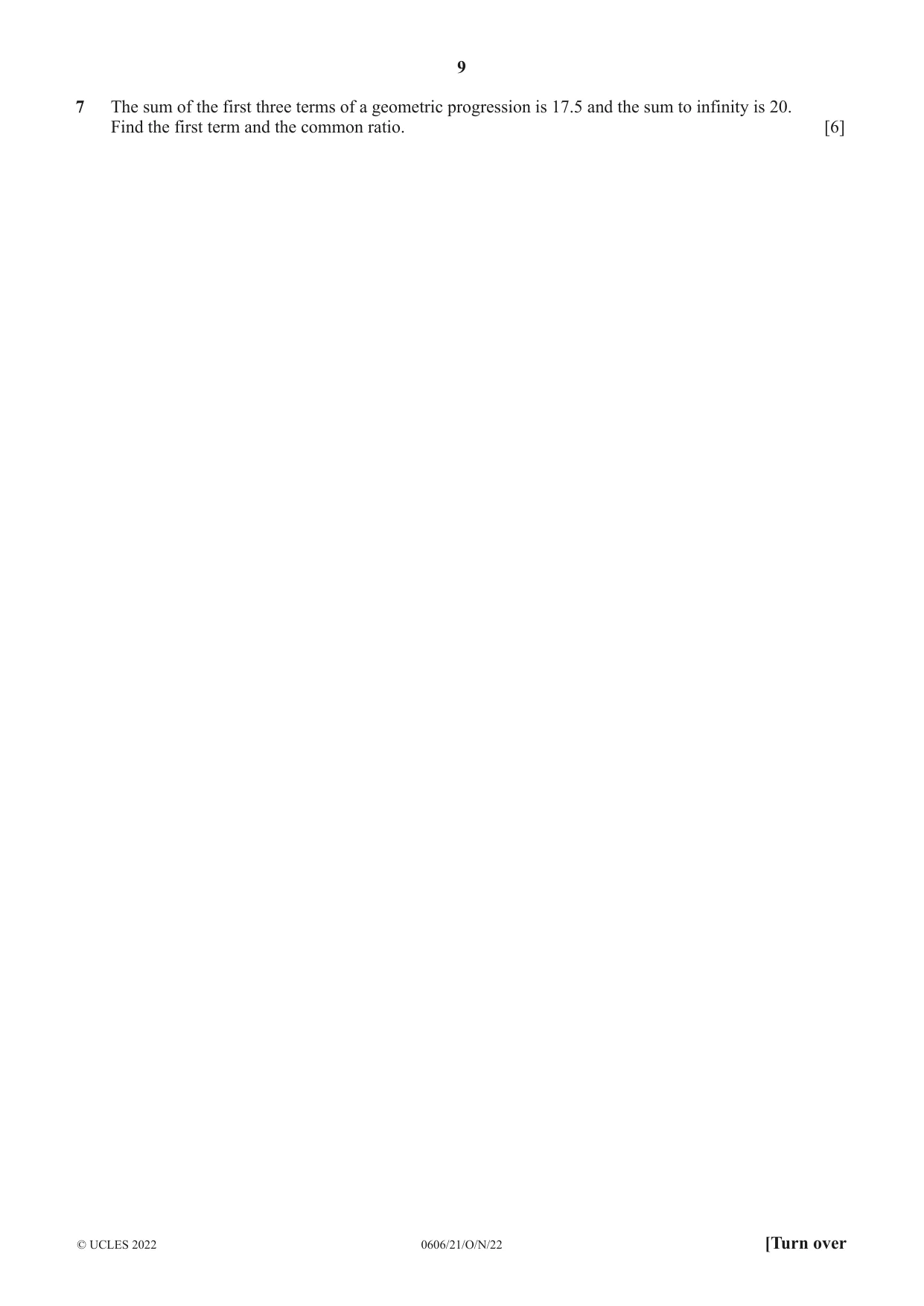
Q7 · The sum of the first three terms of a geometric progression is 17.5 and the sum to…
7 The sum of the first three terms of a geometric progression is 17.5 and the sum to infinity is 20. Find the first term and the common ratio. [6]
Mark scheme: 7 a (1 − r 3 ) 2 B1 = 17.5 oe or a + ar + ar = 17.5 1 − r oe a B1 = 20 1 − r Correctly eliminates a or eliminates r M1 FT their equations providing at least B1 awarded 20(1 – r3) = 17.5 A1 or a 3 − 60a 2 + 1200a − 7000 = 0 1 A2 A1 for either r = , a = 10 2
More questions on Use the formulas for the nth term and for the
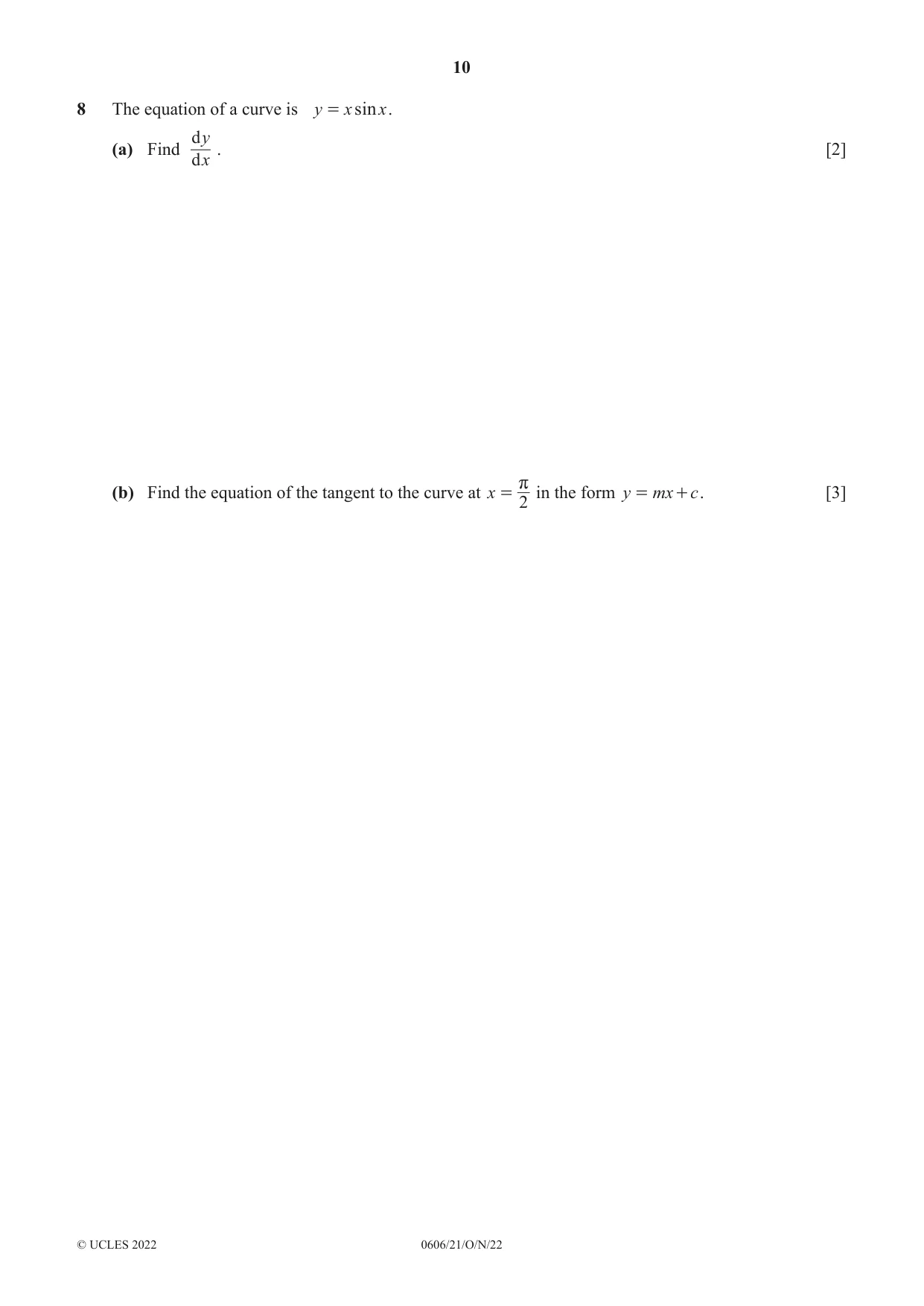
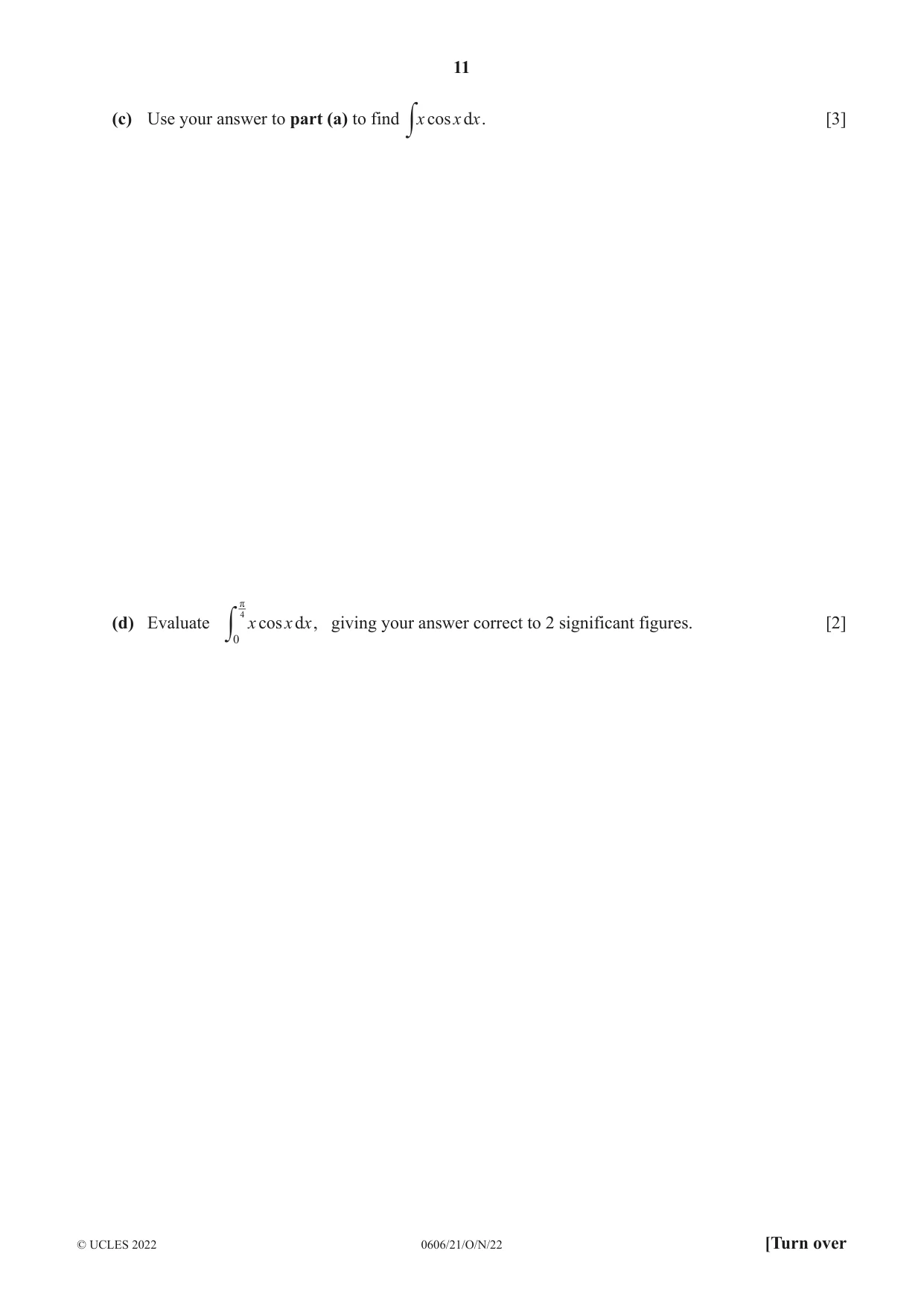
Q8 · The equation of a curve is y = x sin x
8 The equation of a curve is y = x sin x . d y (a) Find . [2] d x (b) Find the equation of the tangent to the curve at x = r in the form y = mx + c . [3] 2 (c) Use your answer to part (a) to find x cos x dx . [3] y r (d) Evaluate x cos x dx , giving your answer correct to 2 significant figures. [2] 4y0
Mark scheme: 8(a) Product rule attempted M1 at most one error dy A1 = sin x + x cos x oe dx 8(b) π π B1 When x = y = 2 2 π dy M1 FT their derivative providing at least M1 When x = = 1 awarded in (a) 2 dx y = x A1 8(c) xsinx + cosx + c B3 B2 for xsinx + cosx or B1 for x cos xdx = sin xdx x sin x − 8(d) π π π M1 sin + cos − ( 0 + cos0 ) 4 4 4 0.26 A1
More questions on Use differentiation to find gradients, tangents
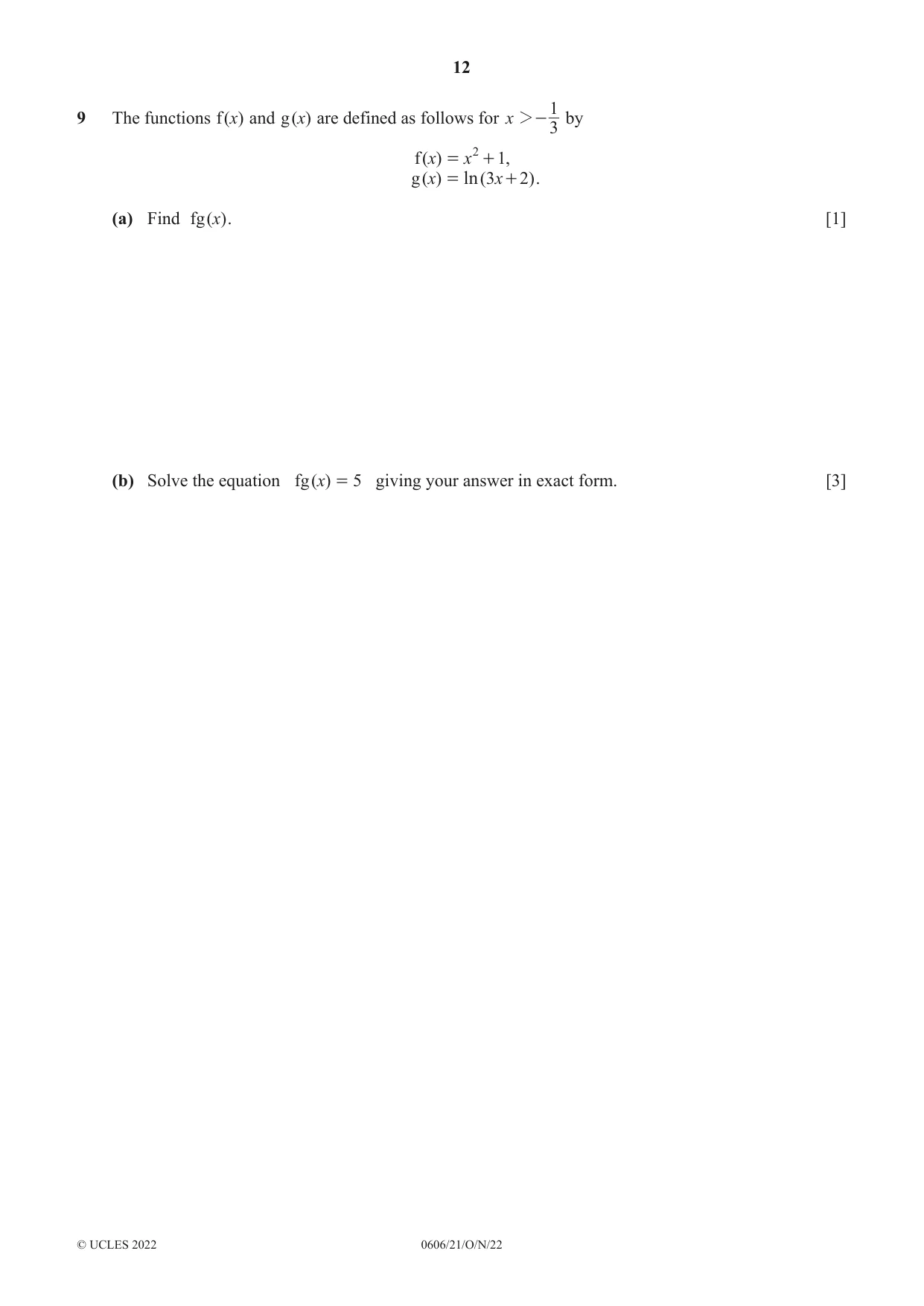
Q9 · The functions f ( x) and g ( x) are defined as follows for x 2- by 3 f ( x) = x 2 + 1, g…
9 The functions f ( x) and g ( x) are defined as follows for x 2- by 3 f ( x) = x 2 + 1, g ( x) = ln ( 3 x + 2) . (a) Find fg ( x) . [1] (b) Solve the equation fg ( x) = 5 giving your answer in exact form. [3]
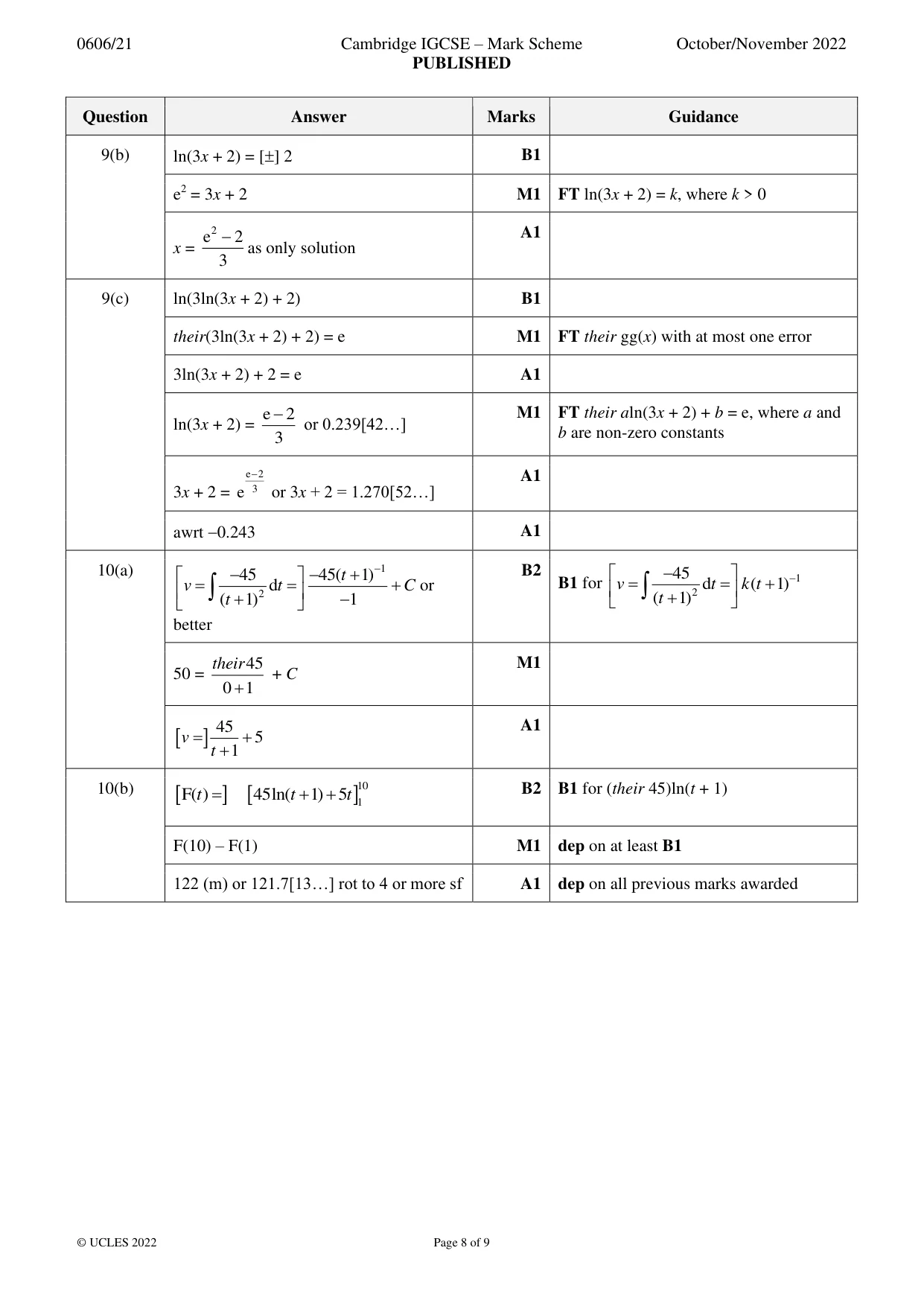
Mark scheme: 9(a) (ln(3x + 2))2 + 1 oe isw B1 9(b) ln(3x + 2) = [] 2 B1 e2 = 3x + 2 M1 FT ln(3x + 2) = k, where k > 0 2e − 2 A1 x = as only solution 3 9(c) ln(3ln(3x + 2) + 2) B1 their(3ln(3x + 2) + 2) = e M1 FT their gg(x) with at most one error 3ln(3x + 2) + 2 = e A1 e − 2 M1 FT their aln(3x + 2) + b = e, where a and ln(3x + 2) = or 0.239[42…] b are non-zero constants 3 e − 2 A1 3x + 2 = e 3 or 3x + 2 = 1.270[52…] awrt −0.243 A1
Q10 · = 0 the10 The acceleration, a ms -2 , of a particle at time t seconds is given by a =- 2
= 0 the10 The acceleration, a ms -2 , of a particle at time t seconds is given by a =- 2 . When t ( t + 1 ) -1 velocity of the particle is 50 ms . (a) Find an expression for the velocity of the particle in terms of t. [4] (b) Find the distance travelled by the particle between t = 1 and t = 10 . [4]
Mark scheme: 10(a) −45 −45(t + 1) −1 B2 −45 −1 dt = k (t + 1) dt = + C or B1 for 2 2 v = (t + 1) v = (t + 1) −1 better their 45 M1 50 = + C 0 + 1 A1 v = 45 + 5 t + 1 10(b) F(t ) = 45ln(t + 1) + 5t 101 B2 B1 for (their 45)ln(t + 1) F(10) – F(1) M1 dep on at least B1 122 (m) or 121.7[13…] rot to 4 or more sf A1 dep on all previous marks awarded
More questions on Understand integration as the reverse process
Q11 · A 5-digit code is to be formed using 5 different numbers selected from 1, 2, 3, 4, 5, 6…
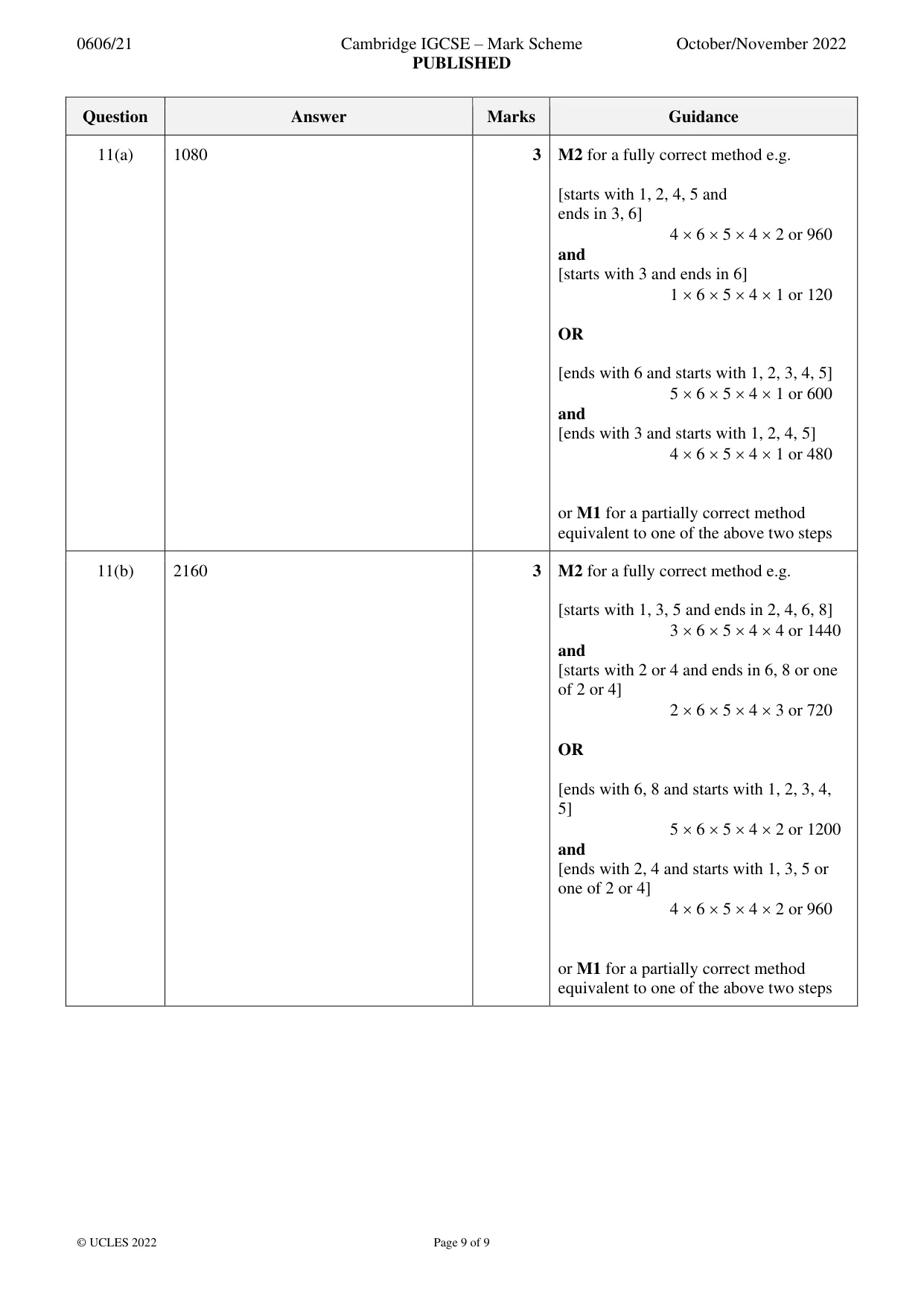
11 A 5-digit code is to be formed using 5 different numbers selected from 1, 2, 3, 4, 5, 6, 7, 8. Find how many possible codes there are if the code forms (a) a number less than 60 000 that ends in a multiple of 3, [3] (b) an even number less than 60 000. [3]
Mark scheme: 11(a) 1080 3 M2 for a fully correct method e.g. [starts with 1, 2, 4, 5 and ends in 3, 6] 4 6 5 4 2 or 960 and [starts with 3 and ends in 6] 1 6 5 4 1 or 120 OR [ends with 6 and starts with 1, 2, 3, 4, 5] 5 6 5 4 1 or 600 and [ends with 3 and starts with 1, 2, 4, 5] 4 6 5 4 1 or 480 or M1 for a partially correct method equivalent to one of the above two steps 11(b) 2160 3 M2 for a fully correct method e.g. [starts with 1, 3, 5 and ends in 2, 4, 6, 8] 3 6 5 4 4 or 1440 and [starts with 2 or 4 and ends in 6, 8 or one of 2 or 4] 2 6 5 4 3 or 720 OR [ends with 6, 8 and starts with 1, 2, 3, 4, 5] 5 6 5 4 2 or 1200 and [ends with 2, 4 and starts with 1, 3, 5 or one of 2 or 4] 4 6 5 4 2 or 960 or M1 for a partially correct method equivalent to one of the above two steps
More questions on Solve problems on arrangement and selection
What was in this paper
The subtopics covered by these 11 questions, and how many questions each got. Open one in a new tab to see every Cambridge question on it.
2Find the maximum or minimum value of the1Solve cubic equations1Solve equations of the form ax = b1Solve problems on arrangement and selection1Solve simultaneous equations in two1Solve, for a given domain, trigonometric1Understand integration as the reverse process1Use substitution to form and solve a quadratic1Use the formulas for the nth term and for the1What you needed in this session
Cambridge’s own grade thresholds for 2022 Oct/Nov, Paper 2 · Variant 1. A higher threshold means an easier paper — the bar moves with how the cohort did.