Cambridge IGCSE Mathematics - Additional 0606 — 2020 May/June Paper 2 · Variant 2
0606/22/M/J/20 · 11 questions · 80 marks · ≈90 min
The question paper and its mark scheme, free to read here and free to download. This is Cambridge’s own paper, exactly as it was sat.
Question paper12 pages
Mark scheme9 pages
Answers below. Sit the paper first if you are practising.
Questions as text
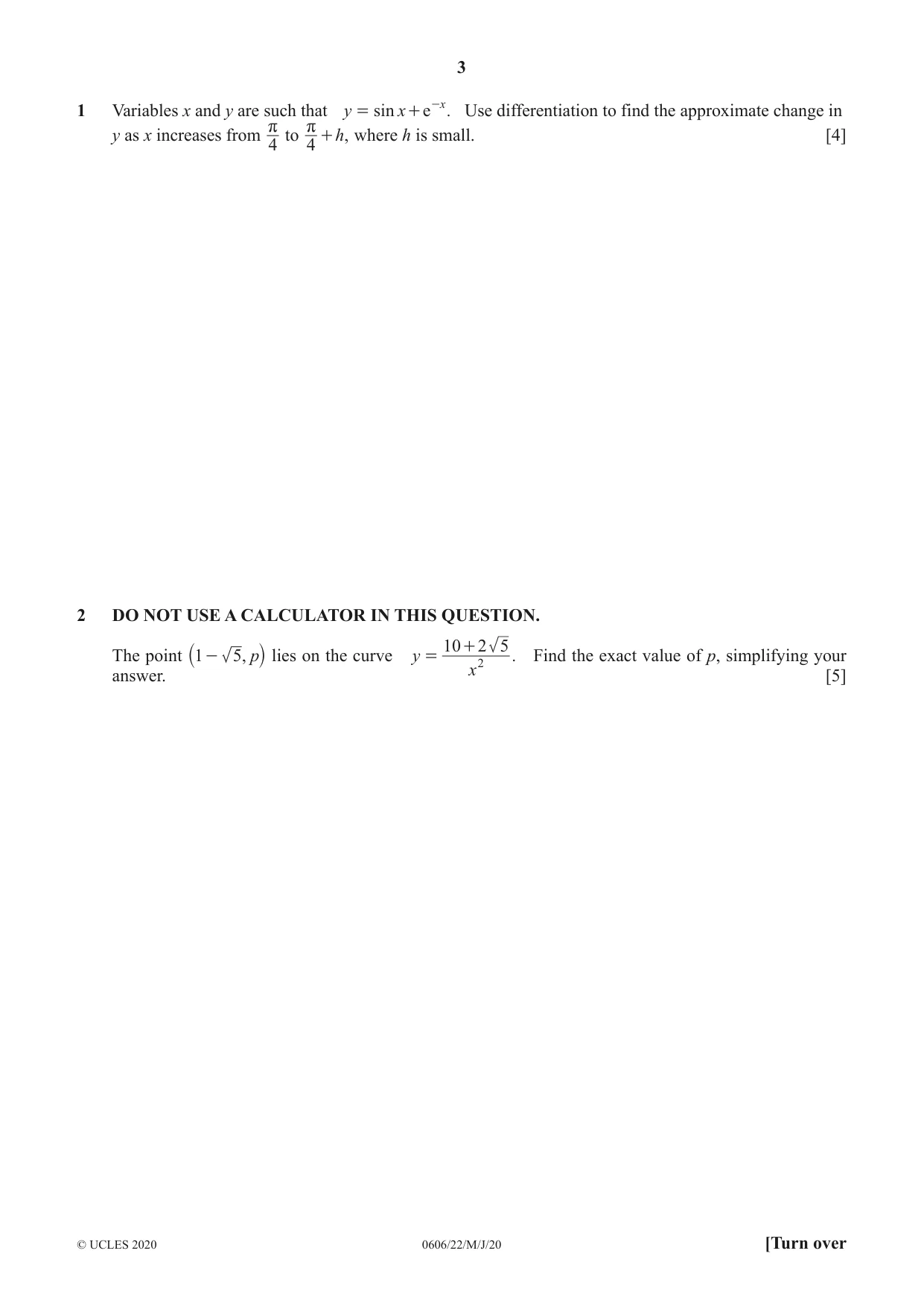
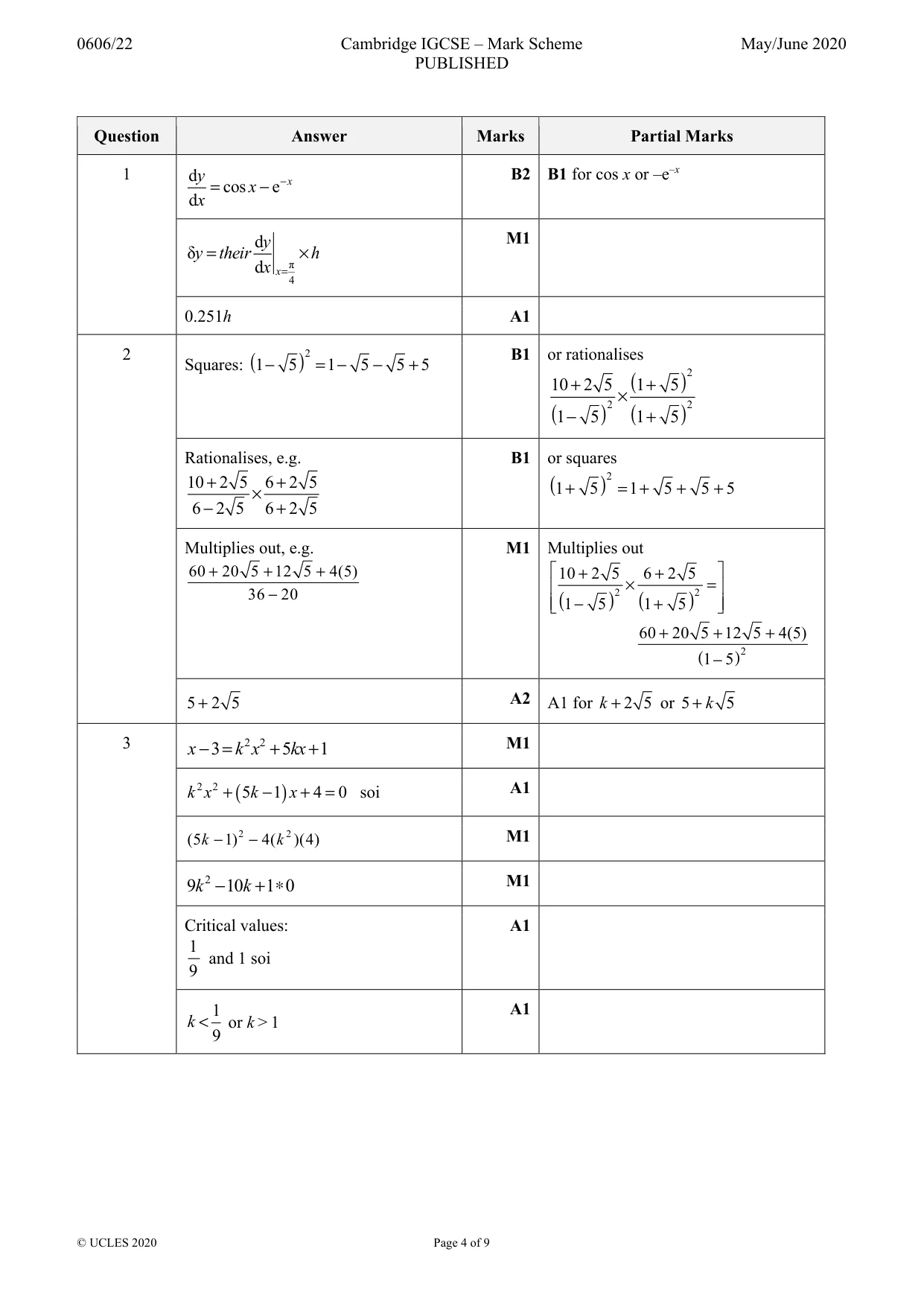
Q1 · Variables x and y are such that y = sin x + e -x
1 Variables x and y are such that y = sin x + e -x . Use differentiation to find the approximate change in y as x increases from r to r + ,h where h is small. [4] 4 4
Mark scheme: Question Answer Marks Partial Marks 1 dy − x B2 B1 for cos x or –e–x = cos x − e dx dy M1 δy = their × h dx x = π 4 0.251h A1
More questions on Apply differentiation to connected rates of
Q2 · DO NOT USE A CALCULATOR IN THIS QUESTION
2 DO NOT USE A CALCULATOR IN THIS QUESTION. 10 + 2 5 The point 1 - 5, p lies on the curve y = 2 . Find the exact value of p, simplifying your ` j x answer. [5]
Mark scheme: 2 2 B1 or rationalises Squares: (1 − 5 ) = 1 − 5 − 5 + 5 10 + 2 5 (1 + 5 ) 2 × (1 − 5 ) 2 (1 + 5 ) 2 Rationalises, e.g. B1 or squares 10 + 2 5 6 + 2 5 (1 + 5 ) 2 = 1 + 5 + 5 + 5 × 6 − 2 5 6 + 2 5 Multiplies out, e.g. M1 Multiplies out 60 + 20 5 + 12 5 + 4(5) 10 + 2 5 6 + 2 5 2 × 2 = 36 − 20 (1 − 5 ) (1 + 5 ) 60 + 20 5 + 12 5 + 4(5) (1 − 5 ) 2 5 + 2 5 A2 A1 for k + 2 5 or 5 + k 5
Q3 · Find the values of k for which the line y = x - 3 intersects the curve y = k 2 x 2 + 5kx…
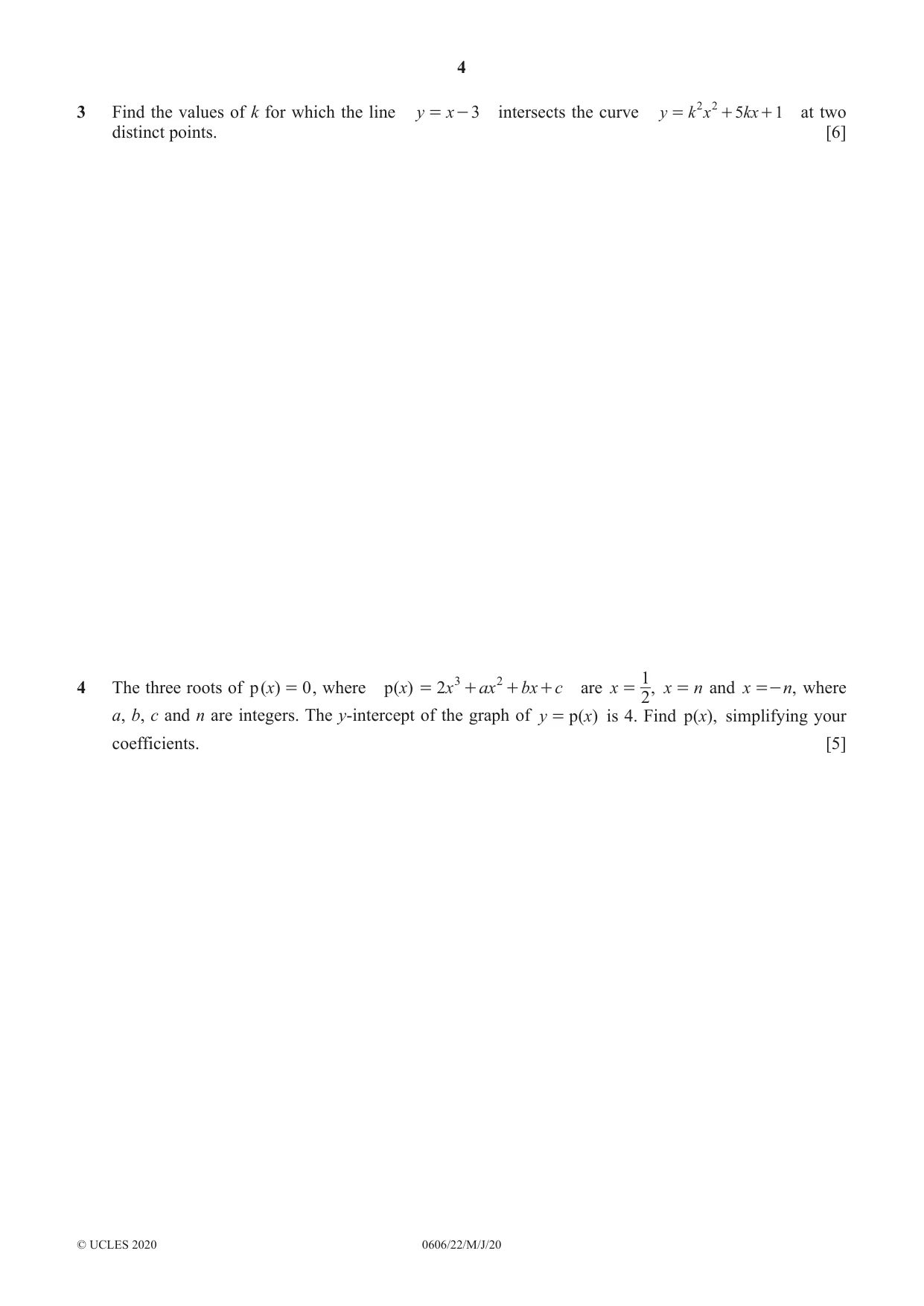
3 Find the values of k for which the line y = x - 3 intersects the curve y = k 2 x 2 + 5kx + 1 at two distinct points. [6]
Mark scheme: 3 x −=3 k 2 x 2 + 5kx + 1 M1 k 2 x 2 + ( 5k − 1) x + 4 = 0 soi A1 (5 k − 1) 2 − 4( k 2 )(4) M1 9k 2 − 10k + 1 ∗ 0 M1 Critical values: A1 1 and 1 soi 9 1 A1 k < or k > 1 9
Q4 · The three roots of p ( )x = 0 , where p ( )x = 2x 3 + ax 2 + bx + c are x = , x = n and x…
4 The three roots of p ( )x = 0 , where p ( )x = 2x 3 + ax 2 + bx + c are x = , x = n and x =- n, where 2 a, b, c and n are integers. The y-intercept of the graph of y = p ( )x is 4. Find p ( x), simplifying your coefficients. [5]
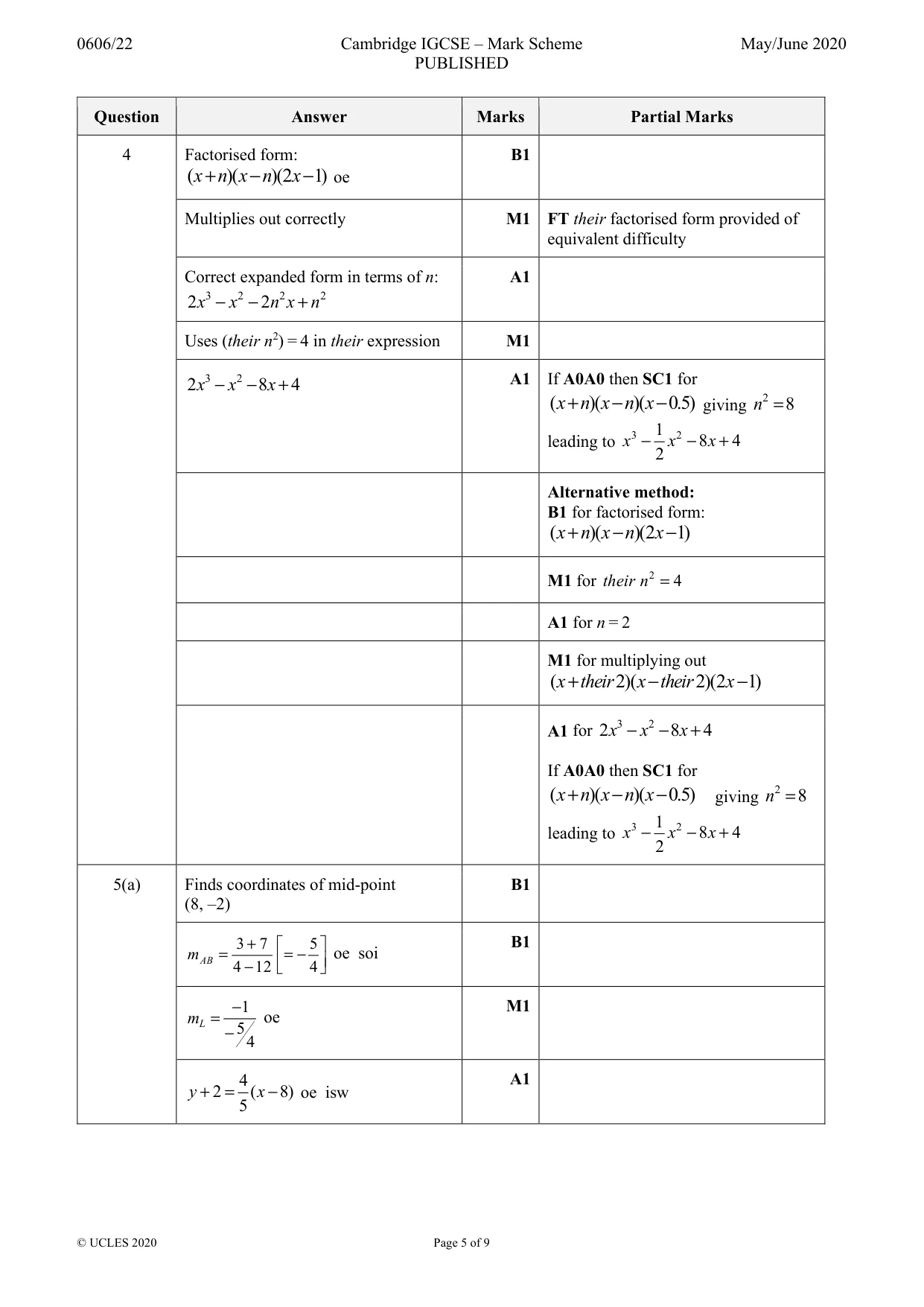
Mark scheme: 4 Factorised form: B1 ( x + n)( x − n)(2x −1) oe Multiplies out correctly M1 FT their factorised form provided of equivalent difficulty Correct expanded form in terms of n: A1 2 x 3 − x 2 − 2n 2 x + n 2 Uses (their n2) = 4 in their expression M1 2 x3 − x 2 − 8 x + 4 A1 If A0A0 then SC1 for ( x + n)( x − n)( x − 0.5) giving n 2 = 8 3 1 2 leading to x − x − 8 x + 4 2 Alternative method: B1 for factorised form: ( x + n)( x − n)(2x − 1) M1 for their n 2 = 4 A1 for n = 2 M1 for multiplying out ( x + their 2)( x − their 2)(2 x − 1) A1 for 2 x3 − x 2 − 8 x + 4 If A0A0 then SC1 for ( x + n)( x − n)( x − 0.5) giving n 2 = 8 3 1 2 leading to x − x − 8 x + 4 2
Q5 · Solutions to this question by accurate drawing will not be accepted
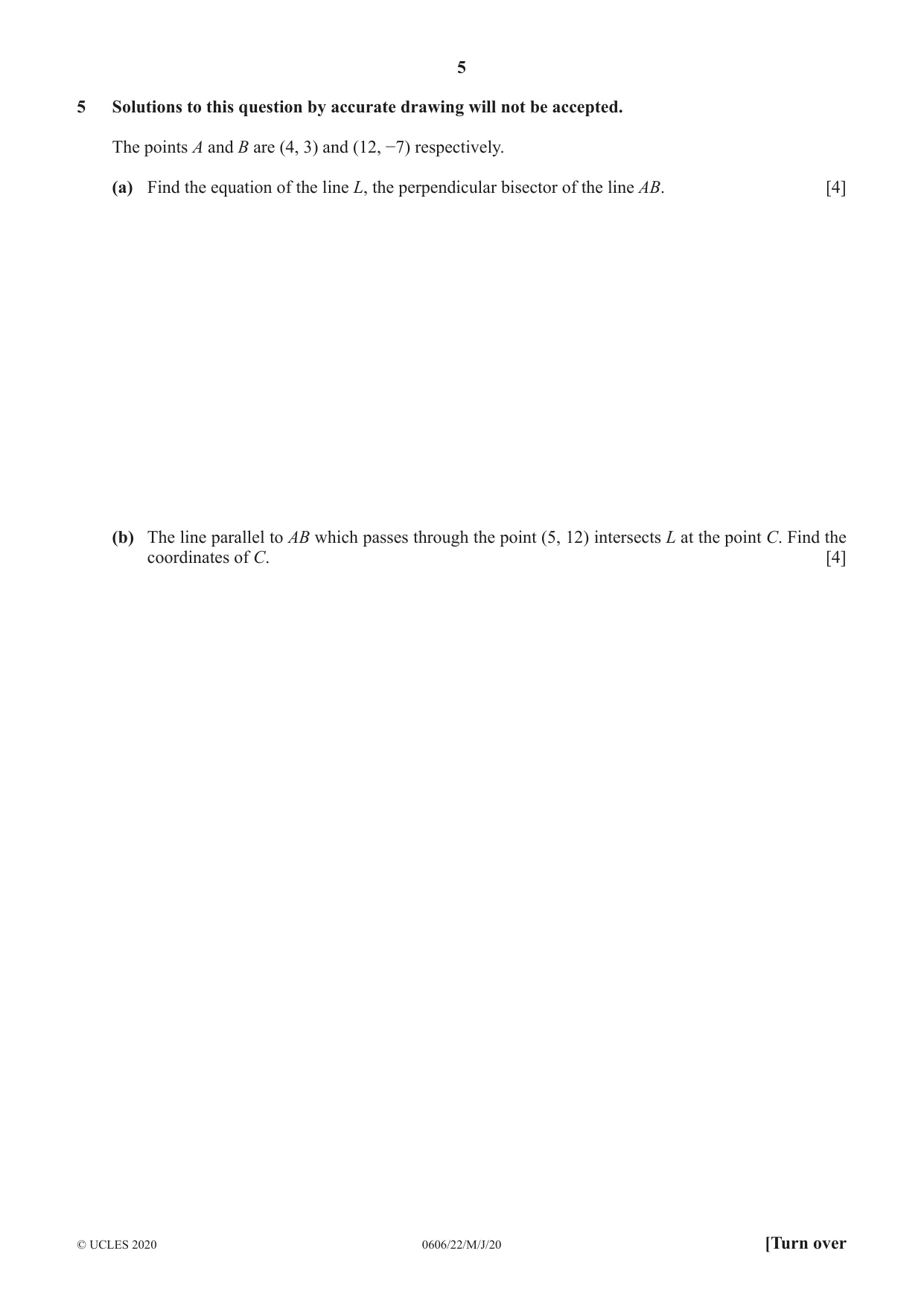
5 Solutions to this question by accurate drawing will not be accepted. The points A and B are (4, 3) and (12, −7) respectively. (a) Find the equation of the line L, the perpendicular bisector of the line AB. [4] (b) The line parallel to AB which passes through the point (5, 12) intersects L at the point C. Find the coordinates of C. [4]
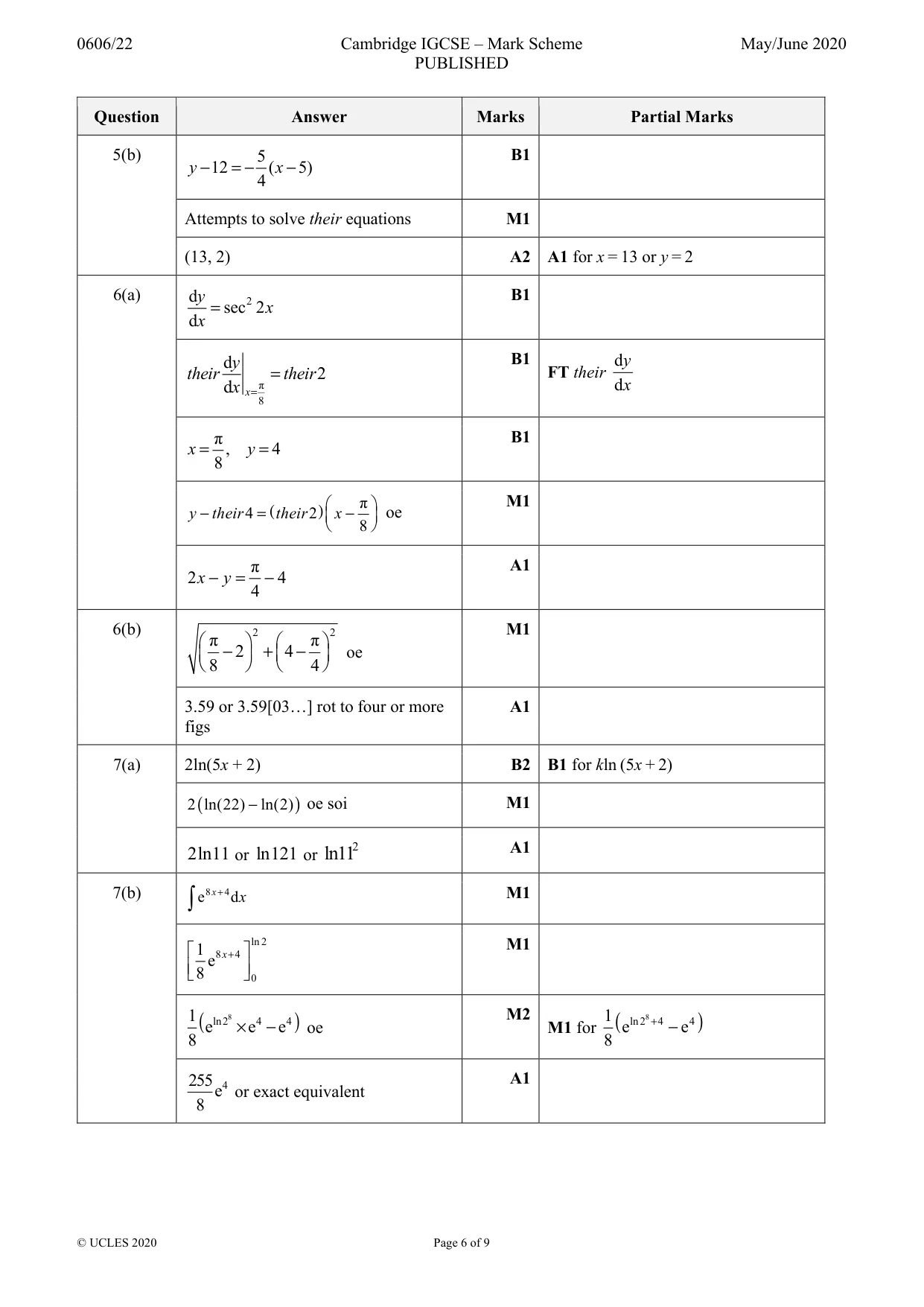
Mark scheme: 5(a) Finds coordinates of mid-point B1 (8, –2) 3 + 7 5 B1 m AB = = − oe soi 4 − 12 4 −1 M1 mL = oe − 54 4 A1 y + 2 = ( x − 8) oe isw 5 5(b) 5 B1 y − 12 = − ( x − 5) 4 Attempts to solve their equations M1 (13, 2) A2 A1 for x = 13 or y = 2
More questions on Know and use the condition for two lines to
Q6 · Find the equation of the tangent to the curve 2y = tan 2x + 7 at the point where x = r
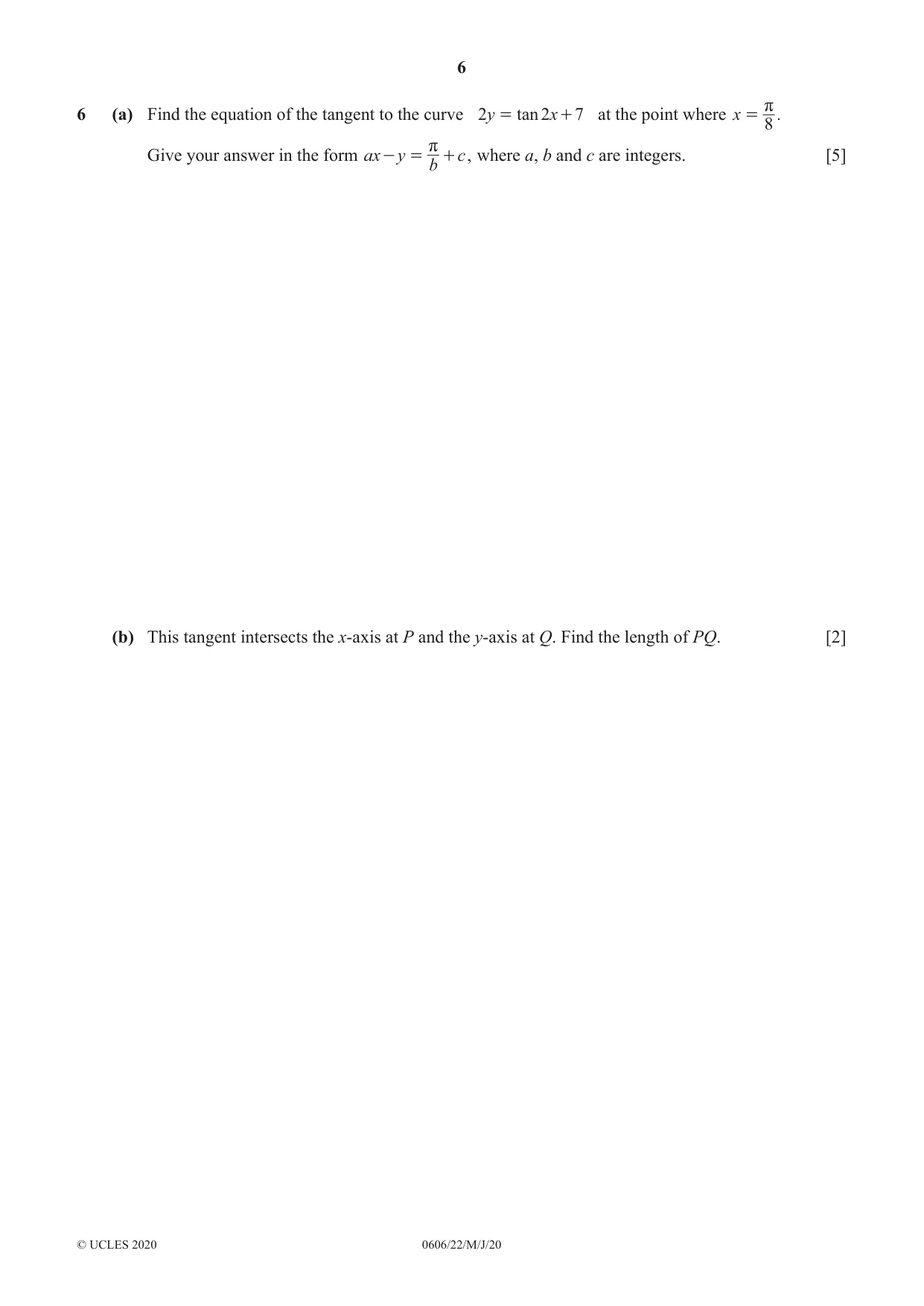
6 (a) Find the equation of the tangent to the curve 2y = tan 2x + 7 at the point where x = r . 8 Give your answer in the form ax - y = r + c , where a, b and c are integers. [5] b (b) This tangent intersects the x-axis at P and the y-axis at Q. Find the length of PQ. [2]
Mark scheme: 6(a) dy 2 B1 = sec 2 x dx dy B1 d y their = their 2 FT their dx x = π d x 8 π B1 x = , y = 4 8 π M1 y − their 4 = ( their 2 ) x − oe 8 π A1 2 x − y = − 4 4 6(b) 2 2 M1 π π − 2 + 4 − oe 8 4 3.59 or 3.59[03…] rot to four or more A1 figs
More questions on Use differentiation to find gradients, tangents
Q7 · Giving your answer in its simplest form, find the exact value of 4 10 (a) dx, [4] y 0 5 x…
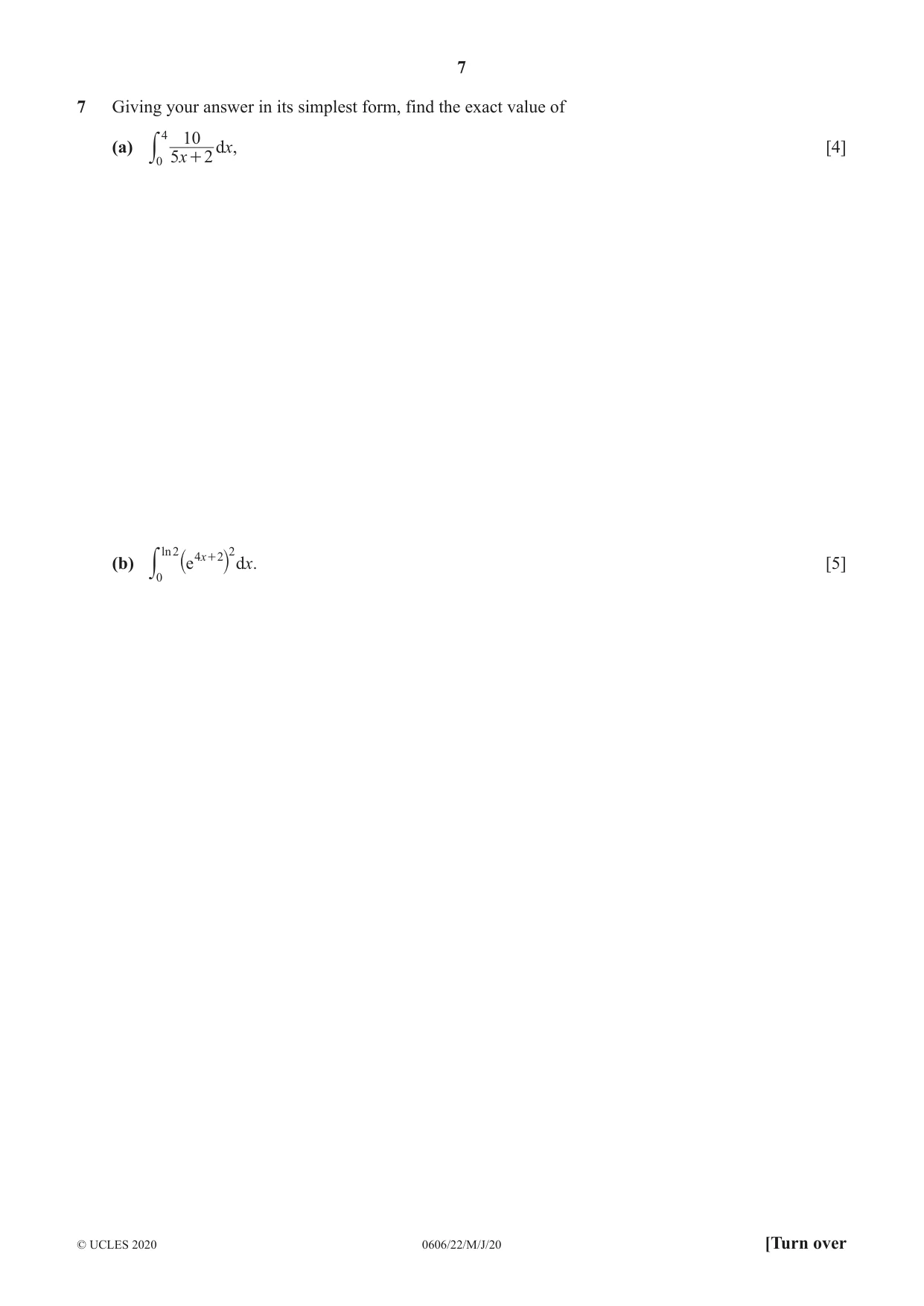
7 Giving your answer in its simplest form, find the exact value of 4 10 (a) dx, [4] y 0 5 x + 2 nl 2 2 4 x + 2 (b) e d.x [5] y 0 ` j
Mark scheme: 7(a) 2ln(5x + 2) B2 B1 for kln (5x + 2) 2 ( ln(22) − ln(2) ) oe soi M1 2 A1 2ln11 or ln121 or ln11 e 8 x + 4 d x M17(b) ln 2 M1 1 8 x+ 4 e 8 0 1 ln2 8 4 4 M2 1 ln2 ( e × e − e ) oe M1 for ( e 8 + 4 − e 4 ) 8 8 A1 255e 4 or exact equivalent 8
Q8 · Solve 3 cot 2 x - 14 cosec x - 2 = 0 for 0° 1 x 1 360°
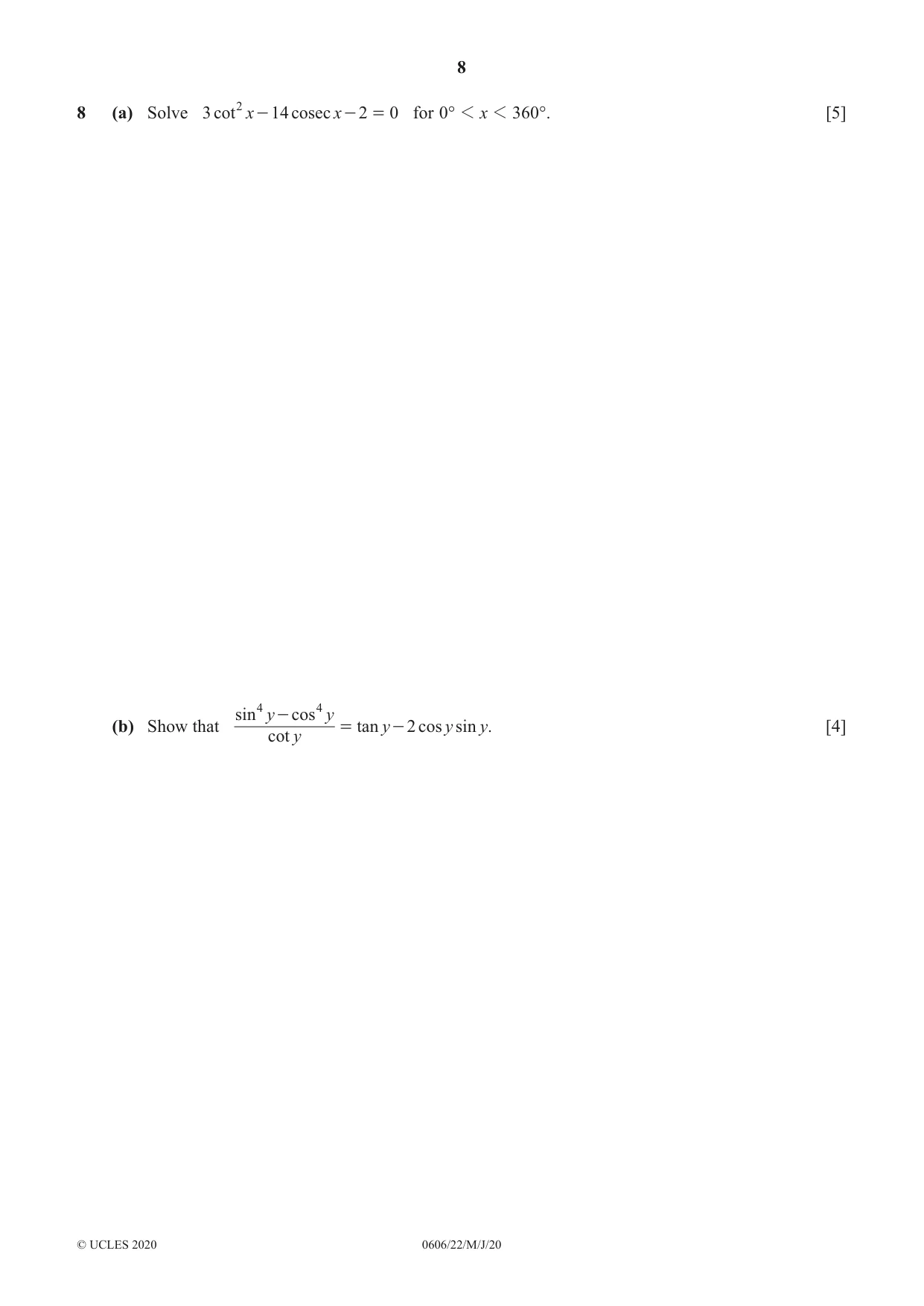
8 (a) Solve 3 cot 2 x - 14 cosec x - 2 = 0 for 0° 1 x 1 360°. [5] sin 4 y - cos 4 y (b) Show that = tan y - 2 cos y sin y. [4] cot y
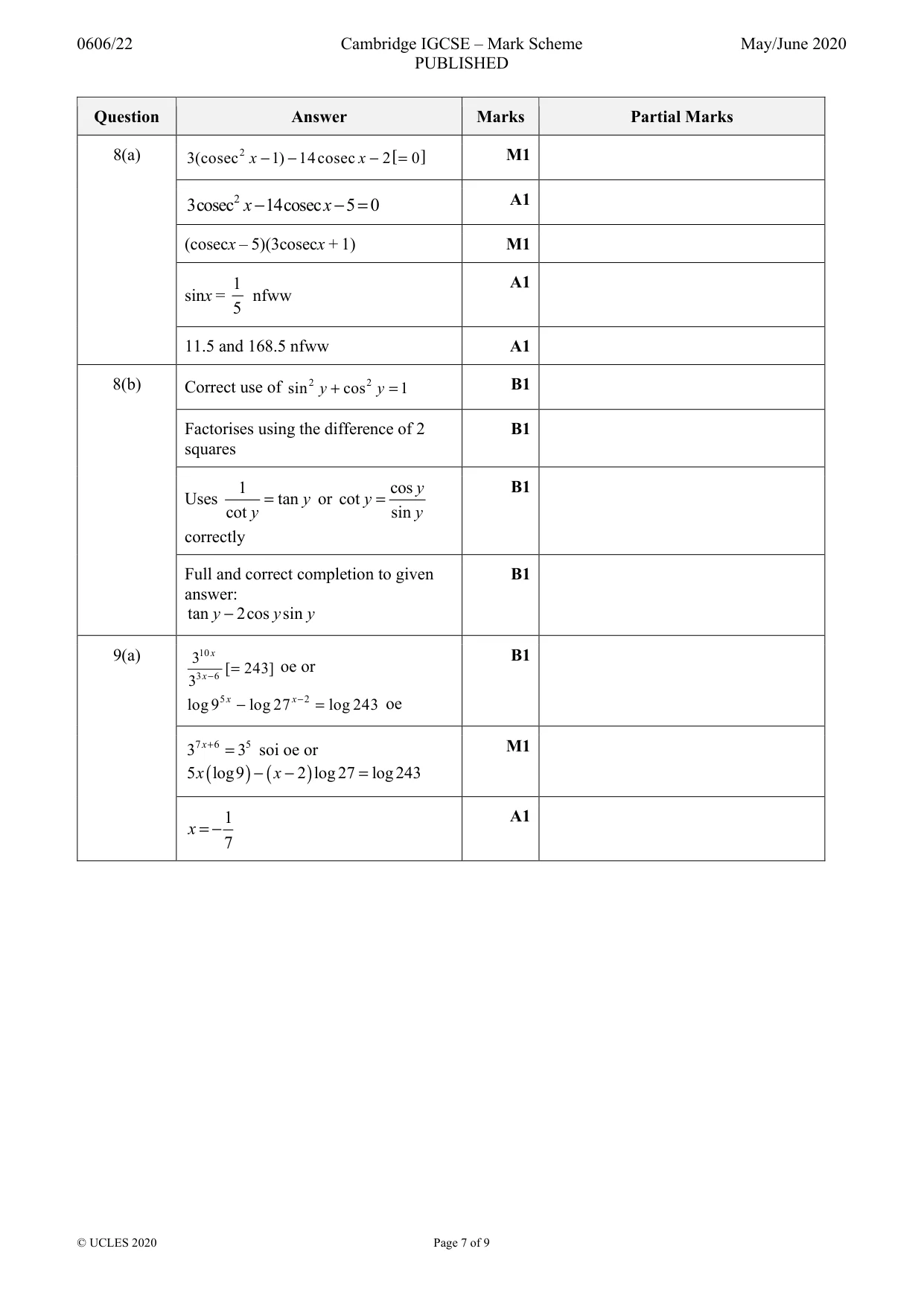
Mark scheme: 8(a) 3(cosec 2 x − 1) − 14cosec x − 2 [ = 0 ] M1 3cosec2 x − 14cosec x −=5 0 A1 (cosecx – 5)(3cosecx + 1) M1 1 A1 sinx = nfww 5 11.5 and 168.5 nfww A1 8(b) Correct use of sin 2 y + cos 2 y = 1 B1 Factorises using the difference of 2 B1 squares 1 cos y B1 Uses = tan y or cot y = cot y sin y correctly Full and correct completion to given B1 answer: tan y − 2cos y sin y
Q9 · Solve the equation x - 2 = 243
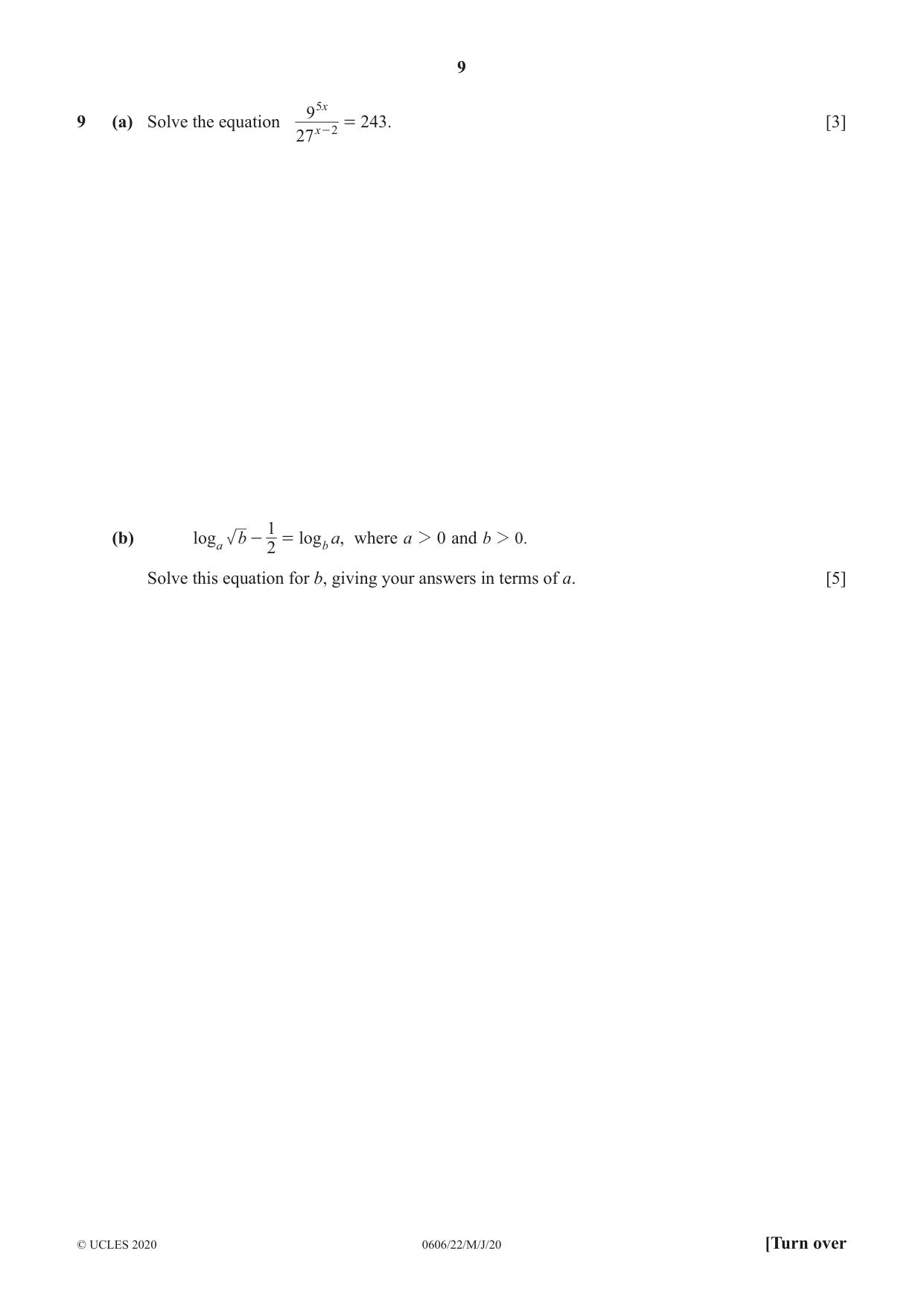
9 (a) Solve the equation x - 2 = 243. [3] 27 1 (b) log a b - = log b a, where a 2 0 and b 2 0. 2 Solve this equation for b, giving your answers in terms of a. [5]
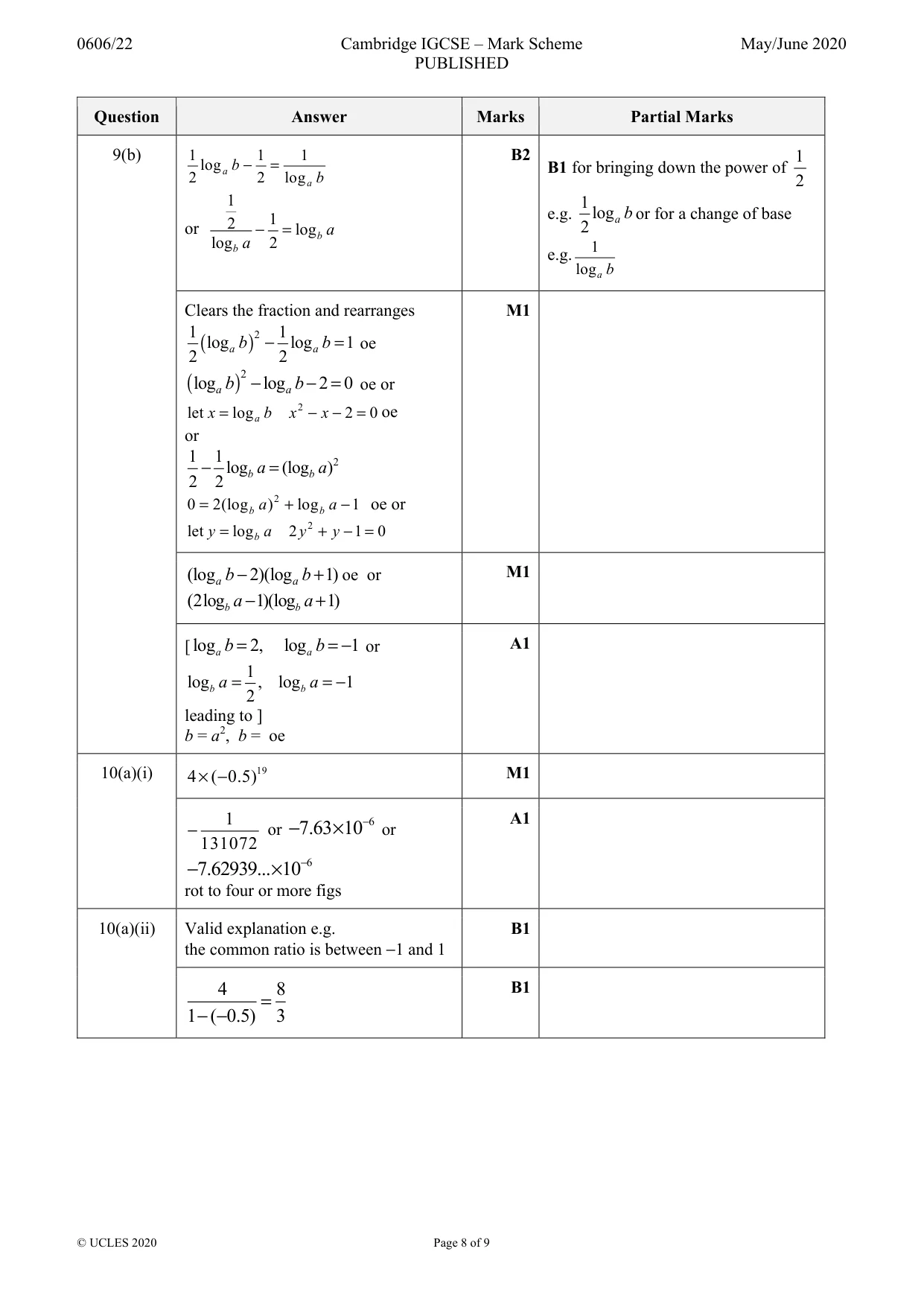
Mark scheme: 9(a) 310 x B1 3 x− 6 [ = 243] oe or 3 log 9 5 x − log 27 x− 2 = log 243 oe 37 x+ 6 = 35 soi oe or M1 5 x ( log9 ) − ( x − 2 ) log27 = log243 1 A1 x = − 7 9(b) 1 1 1 B2 1 log a b − = B1 for bringing down the power of 2 2 log a b 2 1 1 e.g. log a b or for a change of base 1 2 2 or − = log b a log b a 2 1 e.g. loga b Clears the fraction and rearranges M1 1 2 1 ( log a b ) − log a b = 1 oe 2 2 ( log a b ) 2 − log a b − 2 = 0 oe or let x = log a b x 2 − x − 2 = 0 oe or 1 1 2 − log b a = (log b a ) 2 2 0 = 2(log b a ) 2 + log b a − 1 oe or let y = log b a 2 y 2 + y −=1 0 (log a b − 2)(log a b + 1) oe or M1 (2logb a − 1)(logb a + 1) [log a b = 2, log a b = −1 or A1 1 log b a = , log b a = −1 2 leading to ] b = a2, b = oe
Q10 · The first 5 terms of a sequence are given below
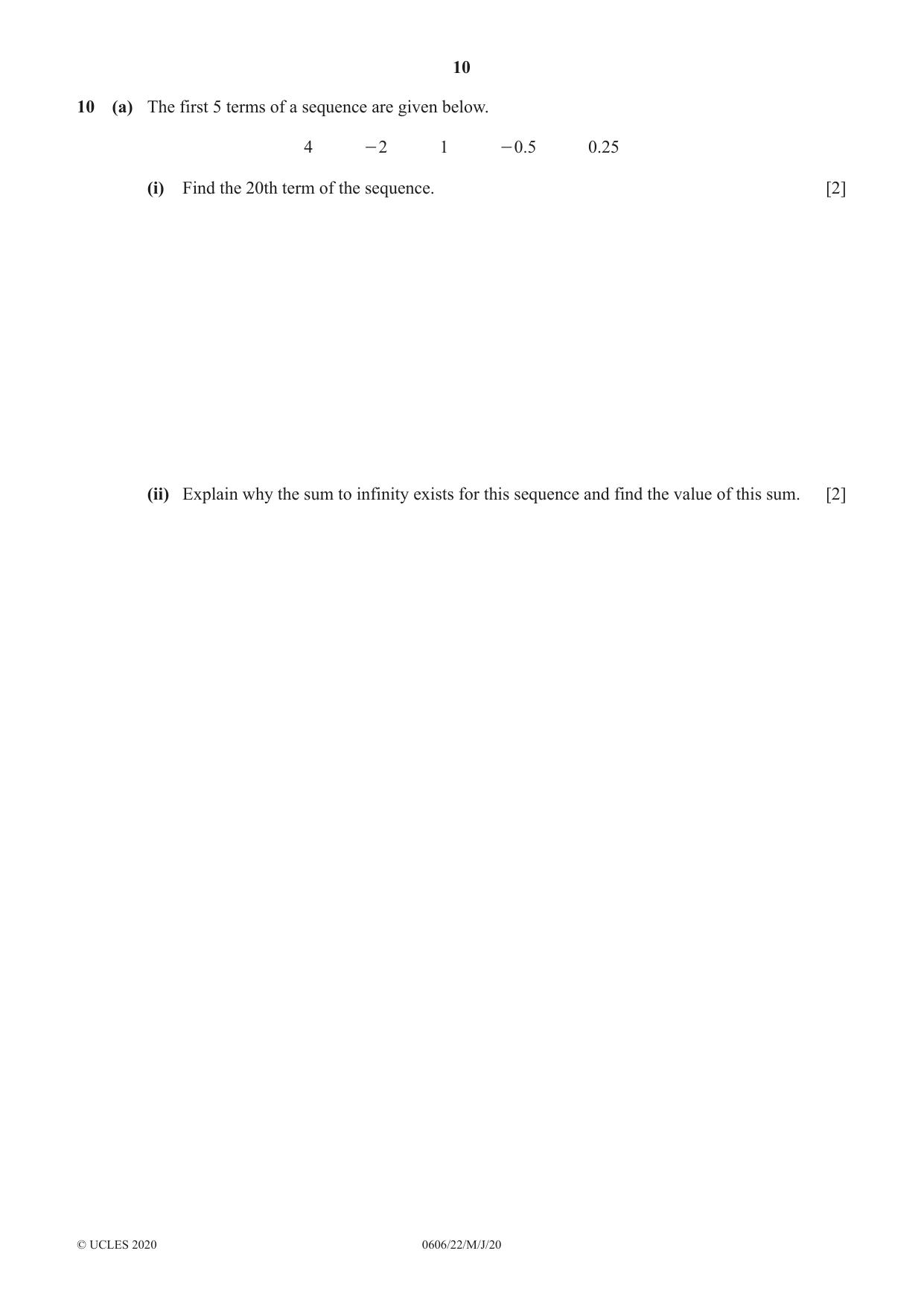
10 (a) The first 5 terms of a sequence are given below. 4 - 2 1 - .05 0.25 (i) Find the 20th term of the sequence. [2] (ii) Explain why the sum to infinity exists for this sequence and find the value of this sum. [2] (b) The tenth term of an arithmetic progression is 15 times the second term. The sum of the first 6 terms of the progression is 87. (i) Find the common difference of the progression. [4] (ii) For this progression, the nth term is 6990. Find the value of n. [3] Question 11 is printed on the next page.
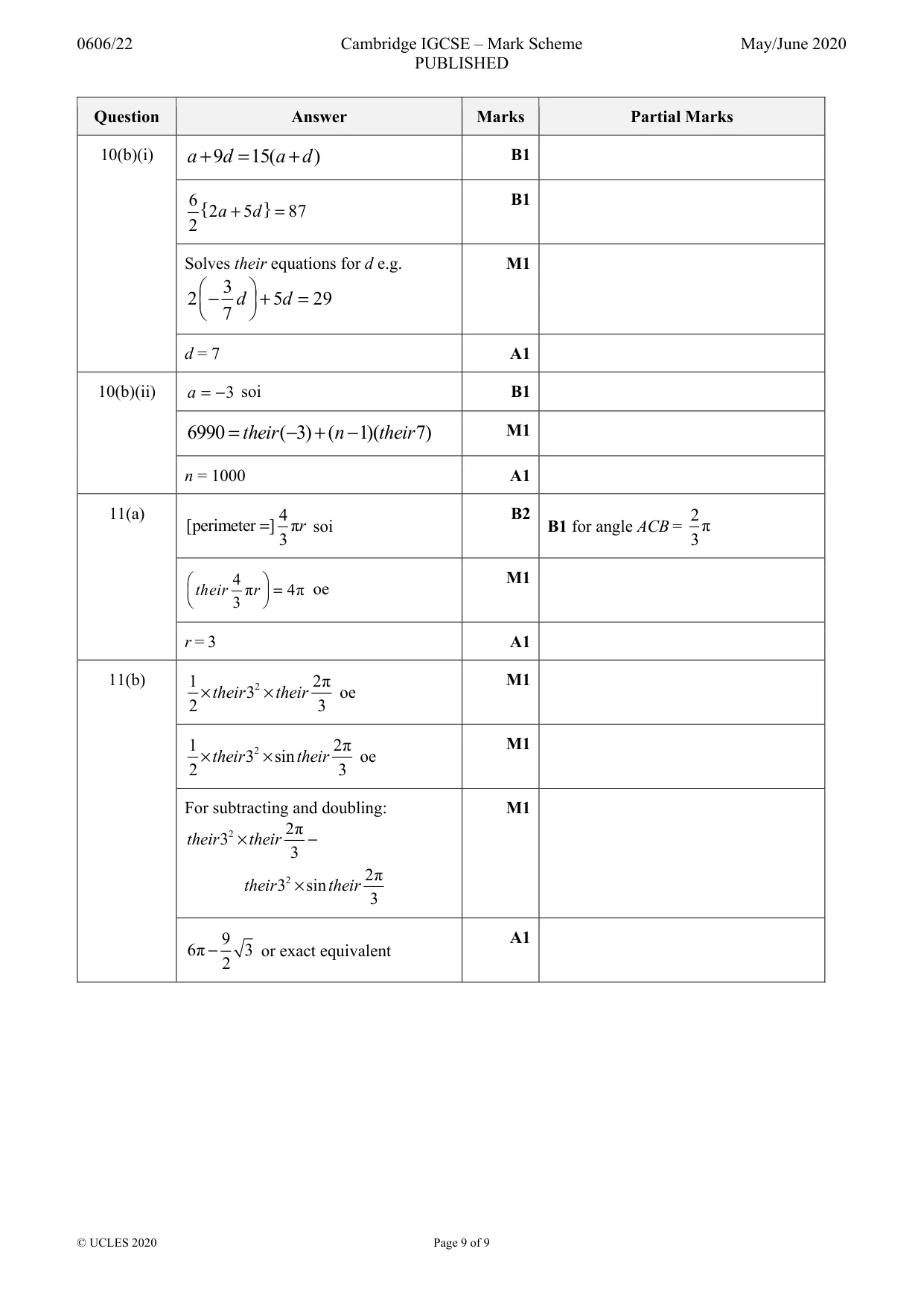
Mark scheme: 10(a)(i) 4 × ( − 0.5)19 M1 1 6 A1 − or −7.63 ×10− or 131072 −7.62939... ×10−6 rot to four or more figs 10(a)(ii) Valid explanation e.g. B1 the common ratio is between −1 and 1 4 8 B1 = 1 −−( 0.5) 3 10(b)(i) a + 9d = 15( a + d ) B1 6 B1 { 2 a + 5 d } = 87 2 Solves their equations for d e.g. M1 3 2 − d + 5d = 29 7 d = 7 A1 10(b)(ii) a = − 3 soi B1 6990 = their ( −3) + ( n − 1)(their 7) M1 n = 1000 A1
More questions on Use the formulas for the nth term and for the
Q11 · A C1 C2 B The circles with centres C1 and C2 have equal radii of length r cm
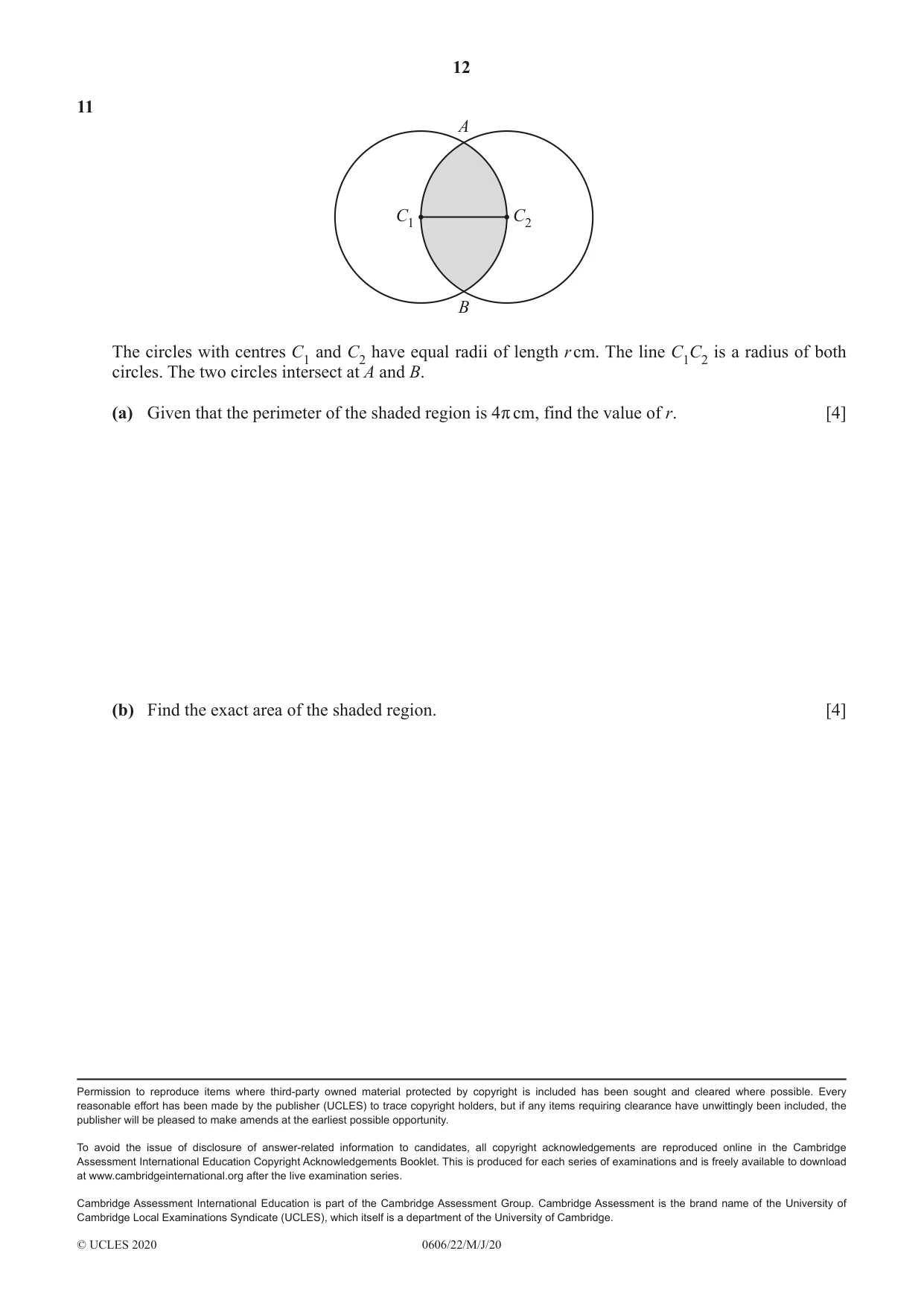
11 A C1 C2 B The circles with centres C1 and C2 have equal radii of length r cm. The line C1C2 is a radius of both circles. The two circles intersect at A and B. (a) Given that the perimeter of the shaded region is 4r cm, find the value of r. [4] (b) Find the exact area of the shaded region. [4]
Mark scheme: 11(a) 4 B2 2 [perimeter =] πr soi B1 for angle ACB = π 3 3 4 M1 t h e ir π r = 4π oe 3 r = 3 A1 11(b) 1 2 2π M1 × their 3 × their oe 2 3 1 2 2π M1 × their 3 × sin their oe 2 3 For subtracting and doubling: M1 2 2π their 3 × their − 3 2 2π their 3 × sin their 3 9 A1 6π − 3 or exact equivalent 2
More questions on Solve problems involving the arc length and
What was in this paper
The subtopics covered by these 11 questions, and how many questions each got. Open one in a new tab to see every Cambridge question on it.
1Evaluate definite integrals and apply1Find factors of polynomials1Know and use the condition for two lines to1Know and use the laws of logarithms1Know the conditions for f(x) = 0 to have1Solve equations of the type1Solve problems involving the arc length and1Solve, for a given domain, trigonometric1Use differentiation to find gradients, tangents1Use the formulas for the nth term and for the1