Cambridge IGCSE Mathematics - Additional 0606 — 2022 May/June Paper 2 · Variant 2
0606/22/M/J/22 · 11 questions · 80 marks · ≈90 min
The question paper and its mark scheme, free to read here and free to download. This is Cambridge’s own paper, exactly as it was sat.
Question paper16 pages
Mark scheme14 pages
Answers below. Sit the paper first if you are practising.
Questions as text
Q1 · DO NOT USE A CALCULATOR IN THIS QUESTION
1 DO NOT USE A CALCULATOR IN THIS QUESTION. 6 + x A curve has equation y = where x H 0 . Find the exact value of y when x = 6 . Give your 3 + x answer in the form a + b c , where a, b and c are integers. [3]
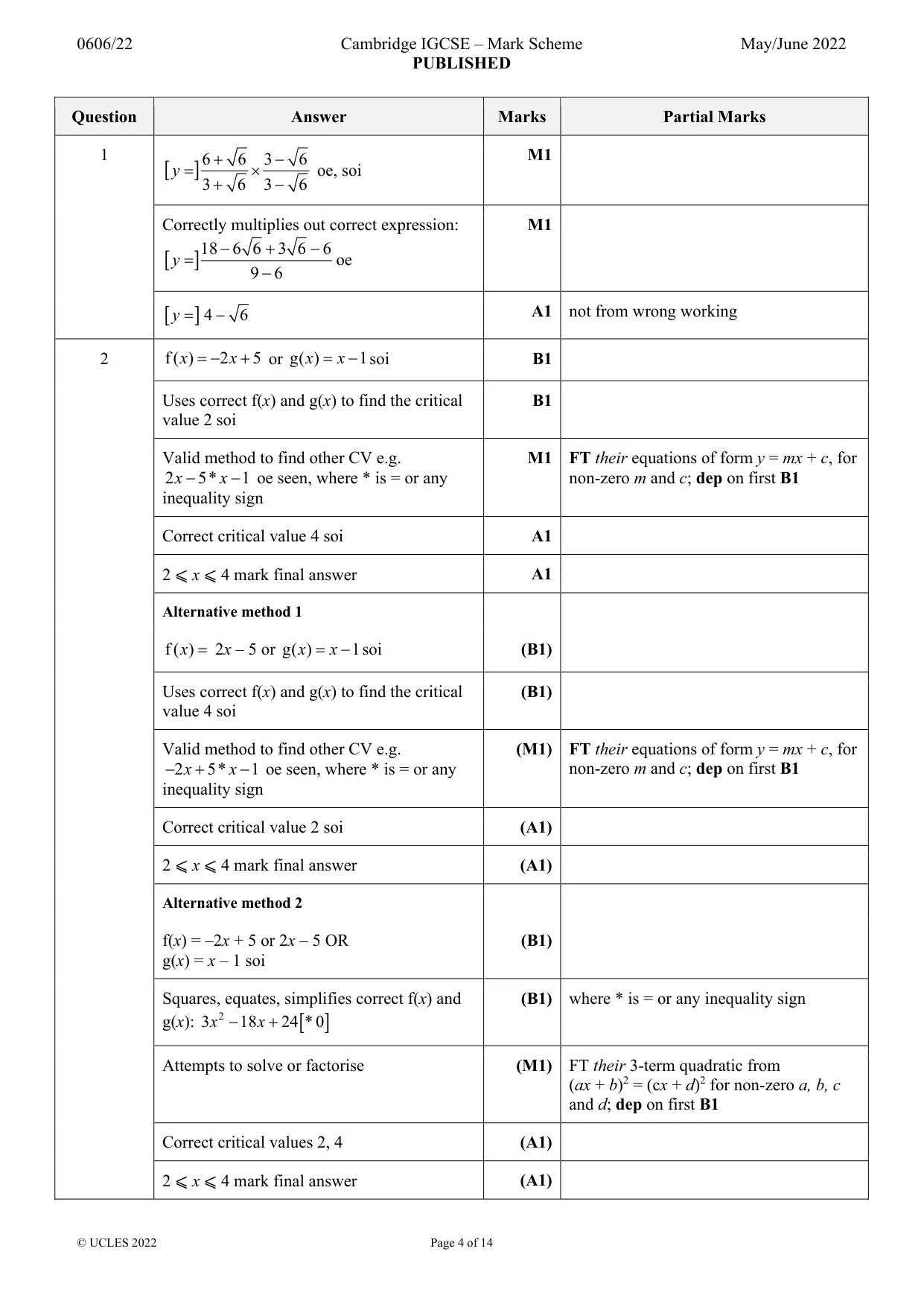
Mark scheme: Question Answer Marks Partial Marks 1 6 3 6 M1 y 6 oe, soi 3 6 3 6 Correctly multiplies out correct expression: M1 6 6 3 6 6 y 18 oe 9 6 y 4 6 A1 not from wrong working
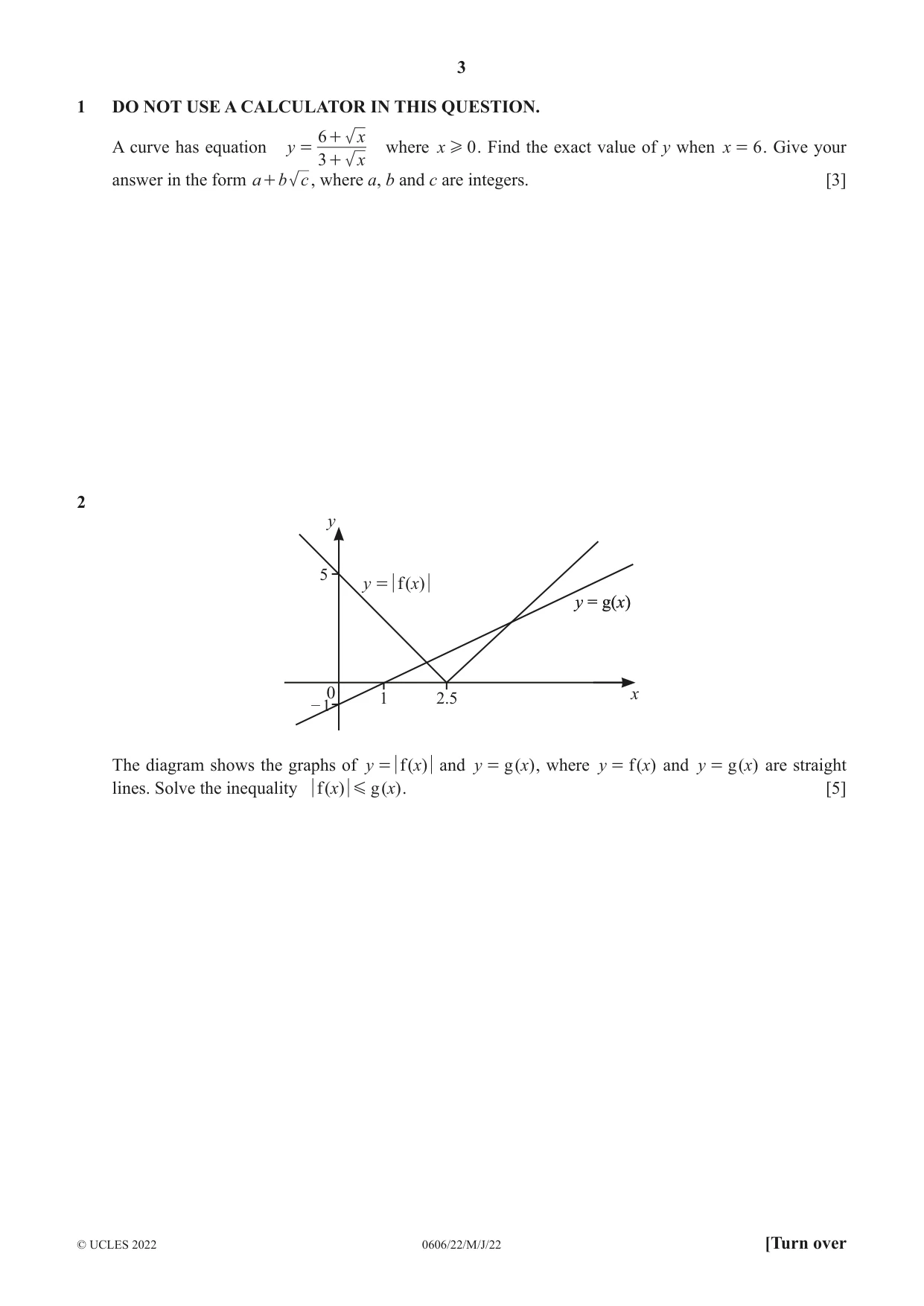
Q2 · Y 5 y = f( x) yy == g(x)g(x) 0 1 2.5 x – 1 The diagram shows the graphs of y = f ( x) and…
2 y 5 y = f( x) yy == g(x)g(x) 0 1 2.5 x – 1 The diagram shows the graphs of y = f ( x) and y = g ( x) , where y = f ( x) and y = g ( x) are straight lines. Solve the inequality f ( x) G g ( x) . [5]
Mark scheme: 2 f( x ) 2 x 5 or g( x ) x 1 soi B1 Uses correct f(x) and g(x) to find the critical B1 value 2 soi Valid method to find other CV e.g. M1 FT their equations of form y = mx + c, for 2 x 5* x 1 oe seen, where * is = or any non-zero m and c; dep on first B1 inequality sign Correct critical value 4 soi A1 2 ⩽ x ⩽ 4 mark final answer A1 Alternative method 1 f ( x ) 2x – 5 or g( x ) x 1 soi (B1) Uses correct f(x) and g(x) to find the critical (B1) value 4 soi Valid method to find other CV e.g. (M1) FT their equations of form y = mx + c, for 2 x 5* x 1 oe seen, where * is = or any non-zero m and c; dep on first B1 inequality sign Correct critical value 2 soi (A1) 2 ⩽ x ⩽ 4 mark final answer (A1) Alternative method 2 f(x) = –2x + 5 or 2x – 5 OR (B1) g(x) = x – 1 soi Squares, equates, simplifies correct f(x) and (B1) where * is = or any inequality sign g(x): 3 x 2 18 x 24 * 0 Attempts to solve or factorise (M1) FT their 3-term quadratic from (ax + b)2 = (cx + d)2 for non-zero a, b, c and d; dep on first B1 Correct critical values 2, 4 (A1) 2 ⩽ x ⩽ 4 mark final answer (A1)
More questions on Solve graphically or algebraically inequalities
Q3 · Find the possible values of k for which the equation kx 2 + ( k + 5) x - 4 = 0 has real…
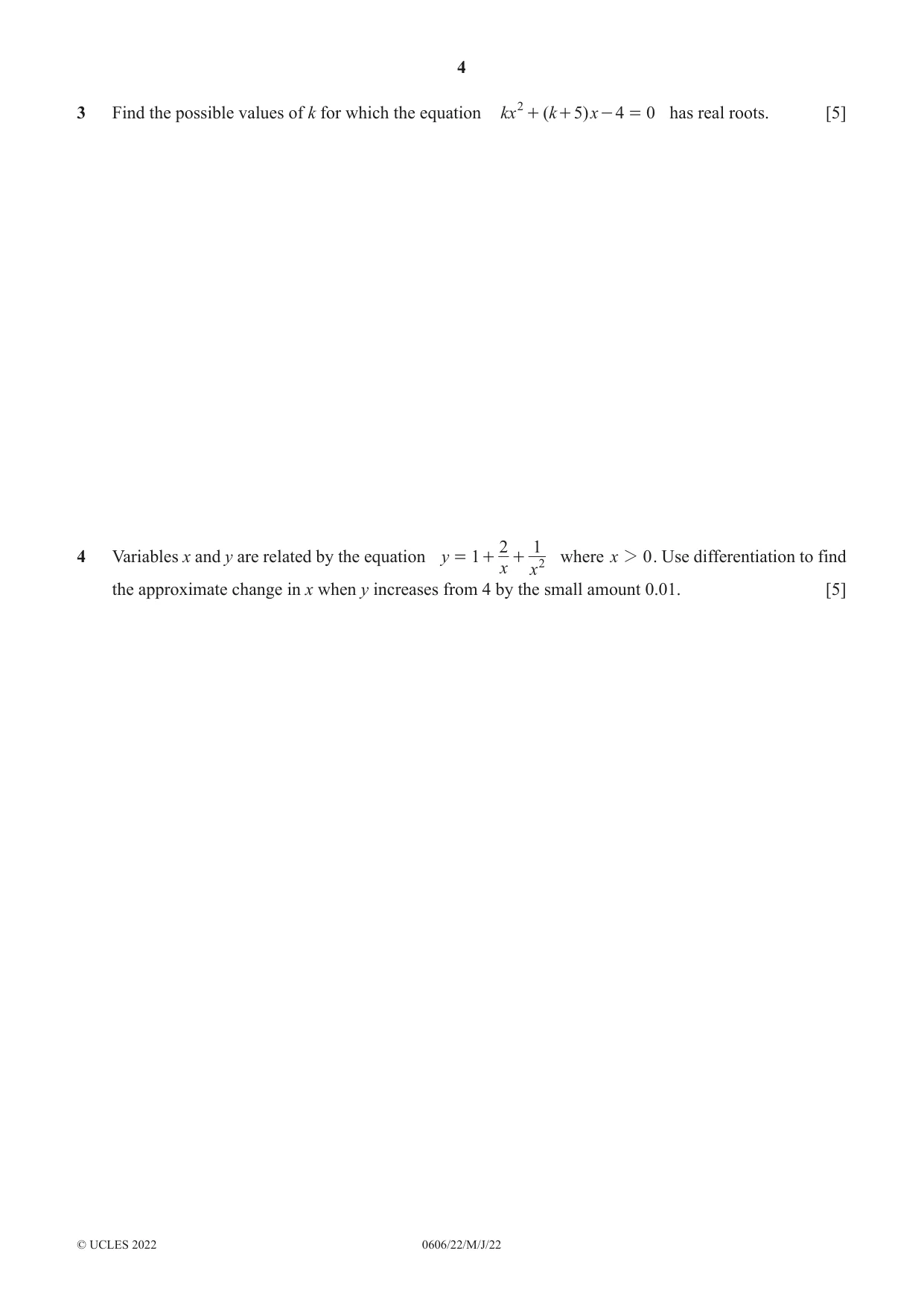
3 Find the possible values of k for which the equation kx 2 + ( k + 5) x - 4 = 0 has real roots. [5]
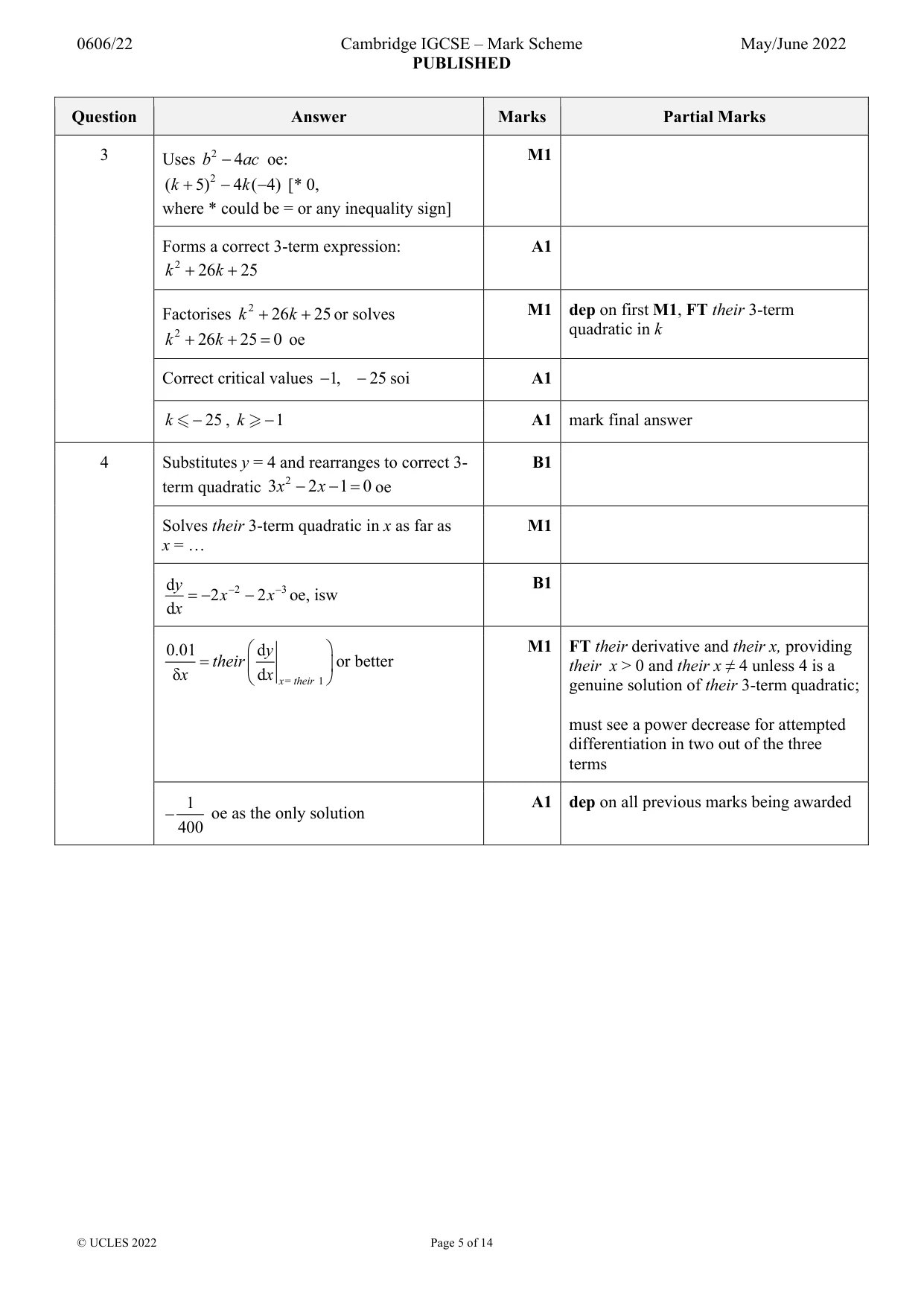
Mark scheme: 3 Uses b 2 4 ac oe: M1 ( k 5) 2 4 k ( 4) [* 0, where * could be = or any inequality sign] Forms a correct 3-term expression: A1 k 2 26 k 25 Factorises k 2 26 k 25 or solves M1 dep on first M1, FT their 3-term 2 quadratic in k k 26 k 25 0 oe Correct critical values 1, 25 soi A1 k 25 , k 1 A1 mark final answer
Q4 · Variables x and y are related by the equation y = 1 + + 2 where x 2 0
4 Variables x and y are related by the equation y = 1 + + 2 where x 2 0 . Use differentiation to find x x the approximate change in x when y increases from 4 by the small amount 0.01. [5] x 3- 1 2
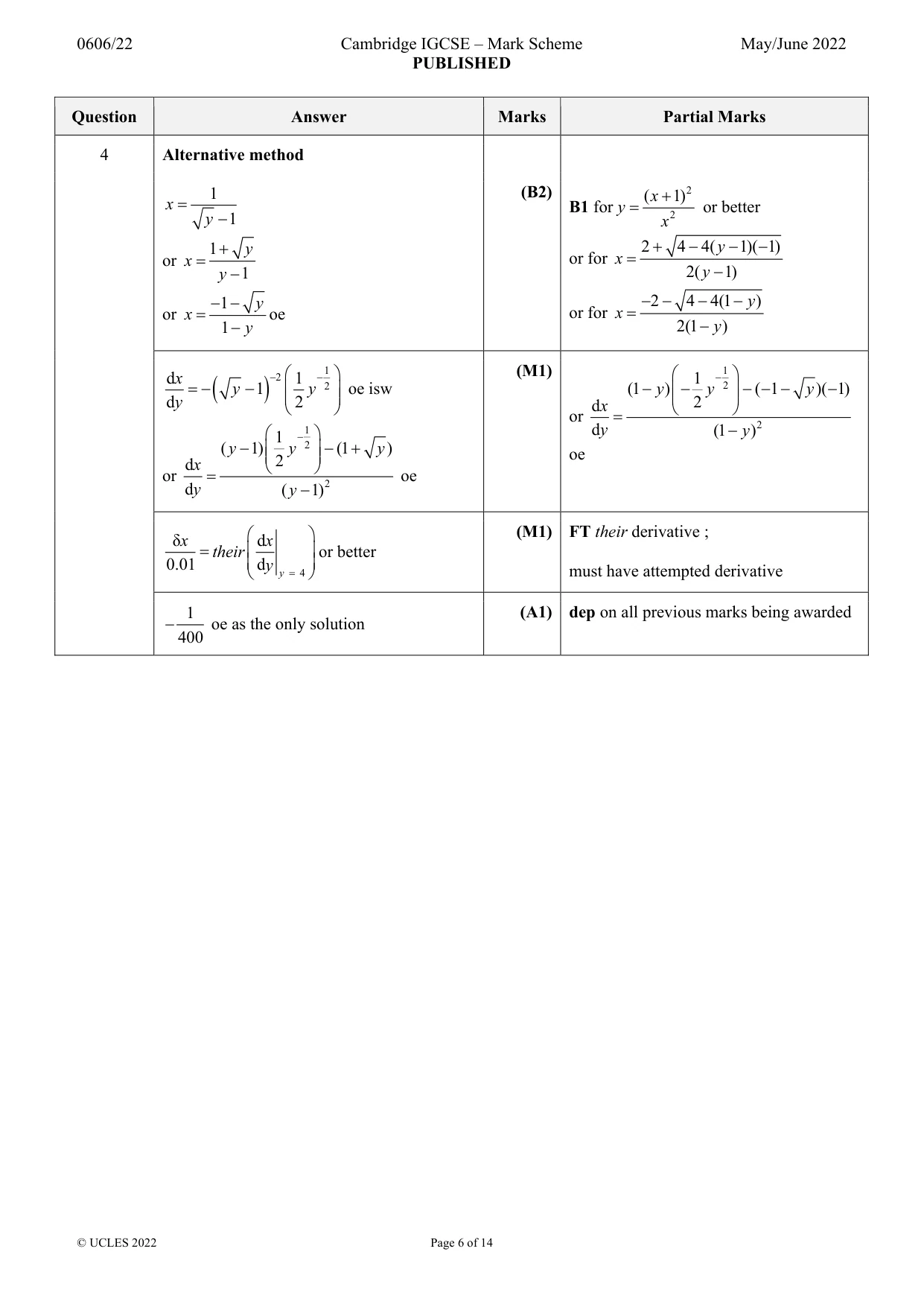
Mark scheme: 4 Substitutes y = 4 and rearranges to correct 3- B1 term quadratic 3 x 2 2 x 1 0 oe Solves their 3-term quadratic in x as far as M1 x = … d y 2 3 B1 2 x 2 x oe, isw d x 0.01 d y M1 FT their derivative and their x, providing their or better their x > 0 and their x ≠ 4 unless 4 is a δx d x x = their 1 genuine solution of their 3-term quadratic; must see a power decrease for attempted differentiation in two out of the three terms 1 A1 dep on all previous marks being awarded oe as the only solution 400 4 Alternative method 1 (B2) ( 1) 2 x B1 for y x or better y 1 x 2 1 y 2 4 4( y 1)( 1) or x or for x y 1 2( y 1) 1 y 2 4 4(1 y ) or x oe or for x 1 y 2(1 y ) 1 2 dx 2 1 12 (M1) 1 ( 1 y )( 1) y 1 oe isw (1 y ) y y 2 dy 2 d x or 1 d y (1 y ) 1 2 2 (1 y ) ( y 1) y oe 2 dx or oe d y ( y 1) 2 (M1) FT their derivative ; δx dx their or better 0.0 1 d y y 4 must have attempted derivative 1 (A1) dep on all previous marks being awarded oe as the only solution 400
More questions on Apply differentiation to connected rates of
Q5 · Solve the equation = 5
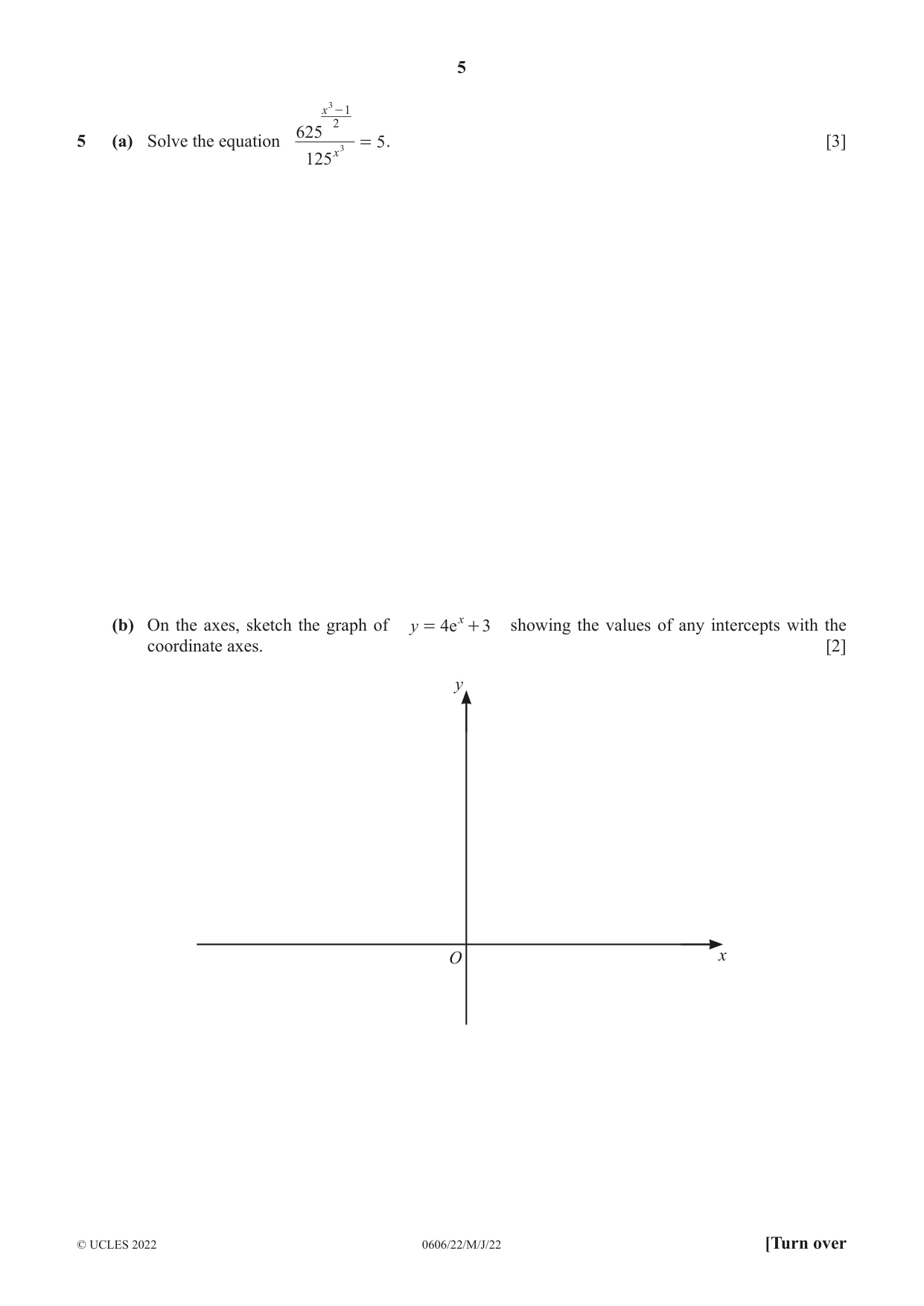
5 (a) Solve the equation = 5 . [3] 125 x3 (b) On the axes, sketch the graph of y = 4ex + 3 showing the values of any intercepts with the coordinate axes. [2] y O x
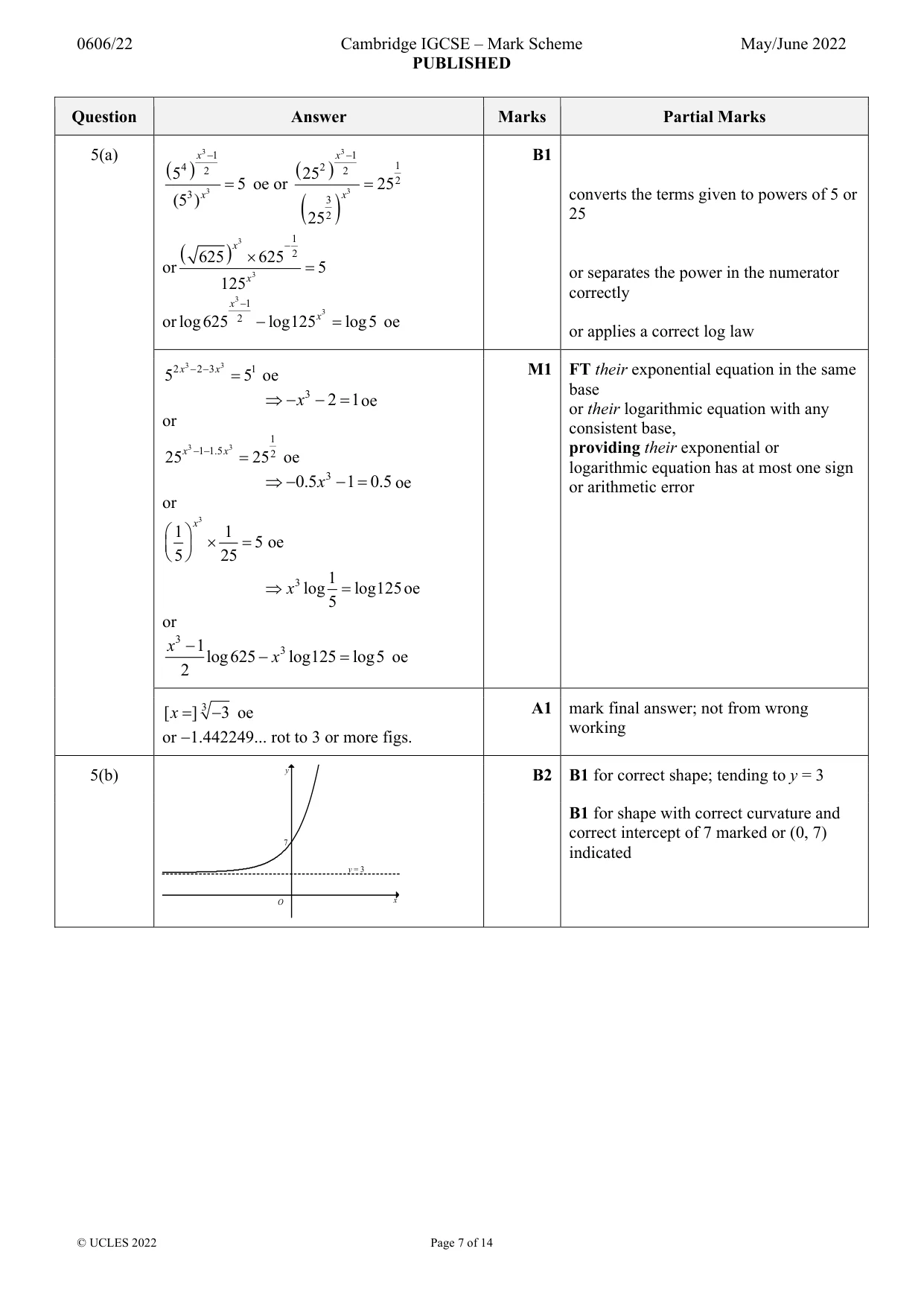
Mark scheme: 5(a) x 3 1 x 3 1 B1 2 4 2 1 2 25 5 2 3 5 oe or 3 25 2 25 (53 ) x 25 3 x converts the terms given to powers of 5 or 3 1 x 2 625 625 or 5 or separates the power in the numerator x 3 125 3 correctly x 1 or log625 2 log125 x 3 log5 oe or applies a correct log law 2 x 3 2 3 x 3 1 M1 FT their exponential equation in the same 5 5 oe 3 base x 2 1 oe or their logarithmic equation with any or consistent base, 1 x 3 1 1.5 x 3 2 providing their exponential or 25 25 oe logarithmic equation has at most one sign 0.5 x 3 1 0.5 oe or arithmetic error or x 3 1 1 5 oe 5 25 3 1 x log log125 oe 5 or x 3 1log625 x 3 log125 log5 oe 2 [ x ] 3 3 oe A1 mark final answer; not from wrong working or 1.442249... rot to 3 or more figs. 5(b) y B2 B1 for correct shape; tending to y = 3 B1 for shape with correct curvature and correct intercept of 7 marked or (0, 7) 7 indicated y = 3 O x
Q6 · In this question, i is a unit vector due east and j is a unit vector due north
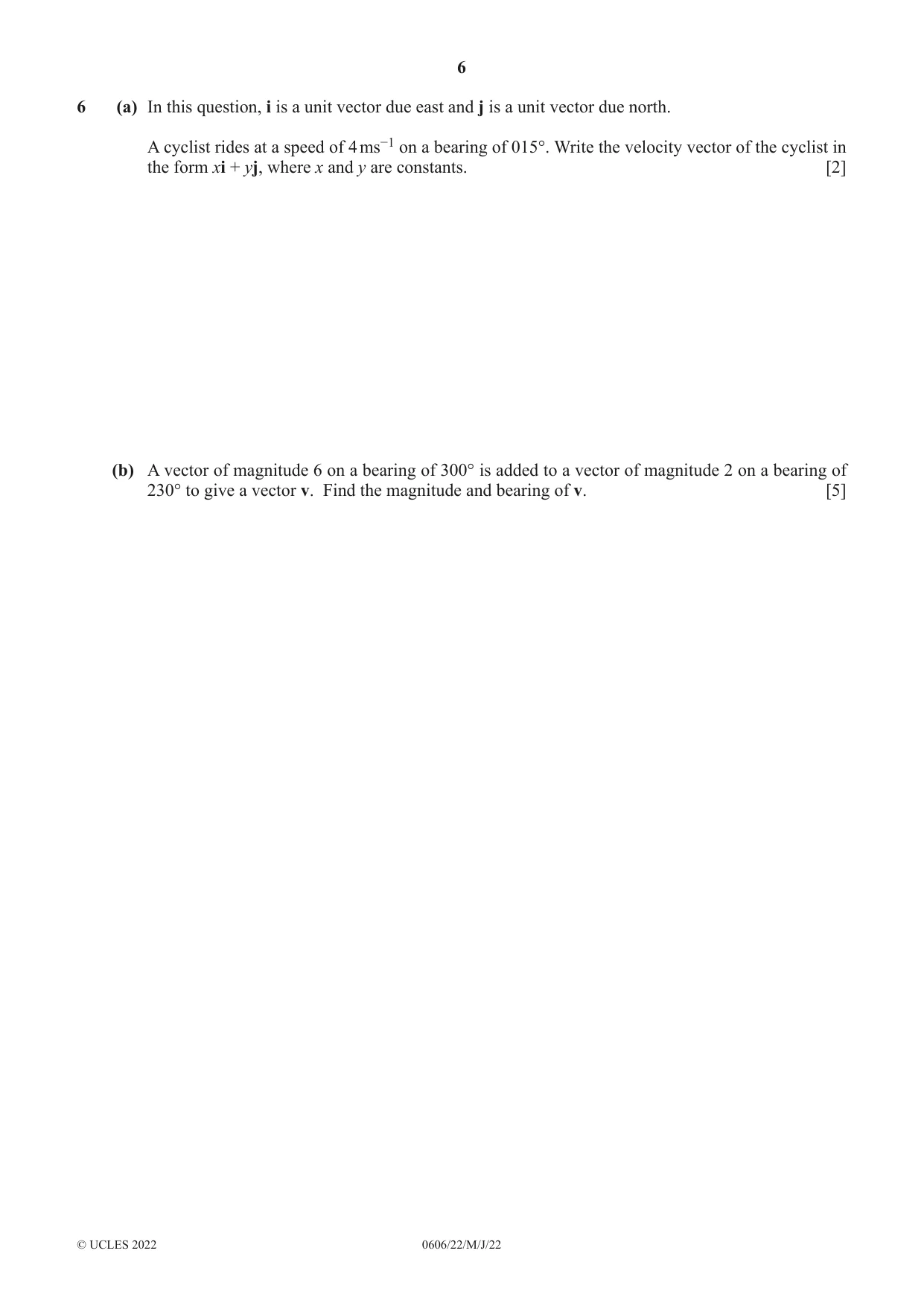
6 (a) In this question, i is a unit vector due east and j is a unit vector due north. A cyclist rides at a speed of 4 ms−1 on a bearing of 015°. Write the velocity vector of the cyclist in the form xi + yj, where x and y are constants. [2] (b) A vector of magnitude 6 on a bearing of 300° is added to a vector of magnitude 2 on a bearing of 230° to give a vector v. Find the magnitude and bearing of v. [5]
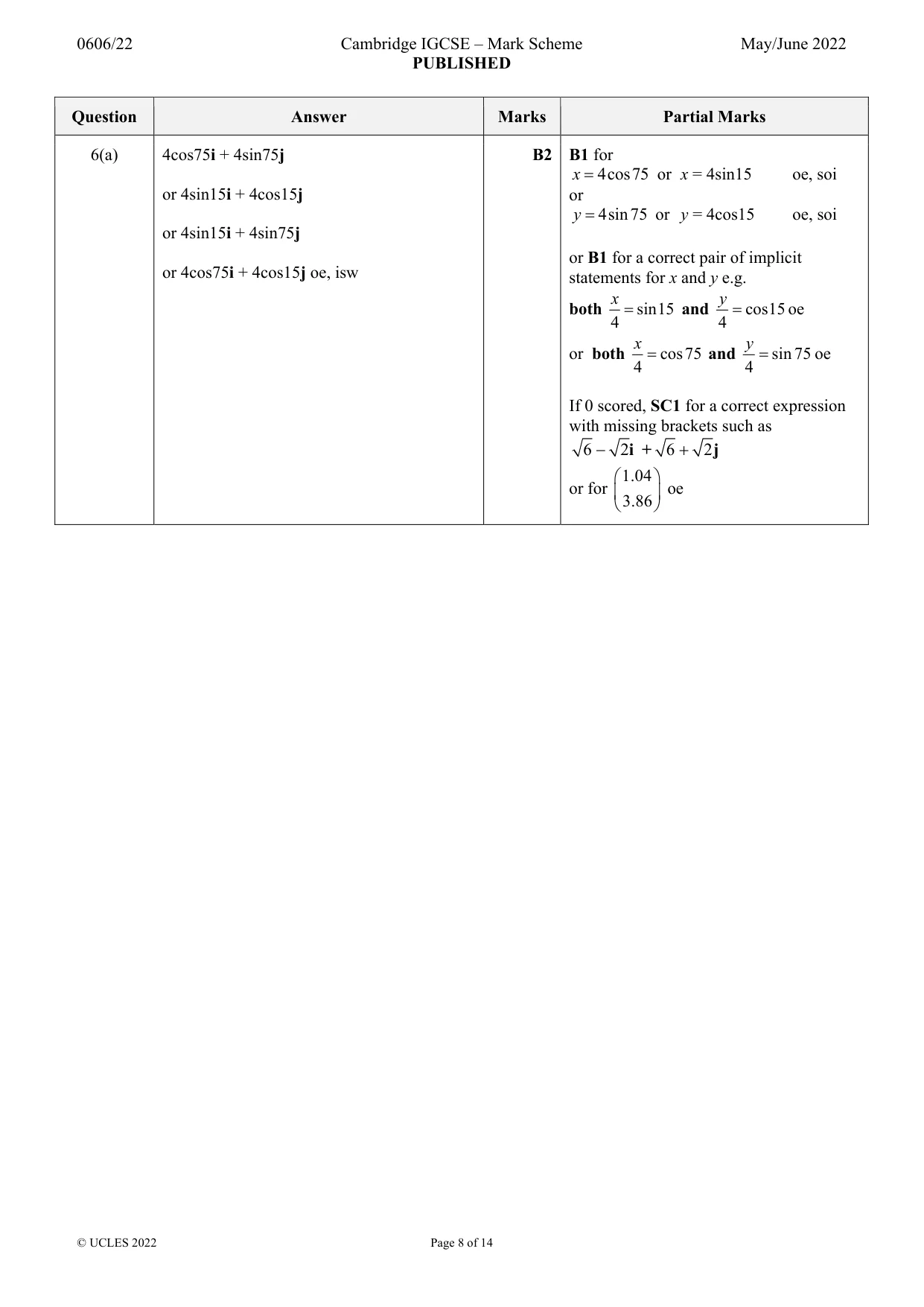
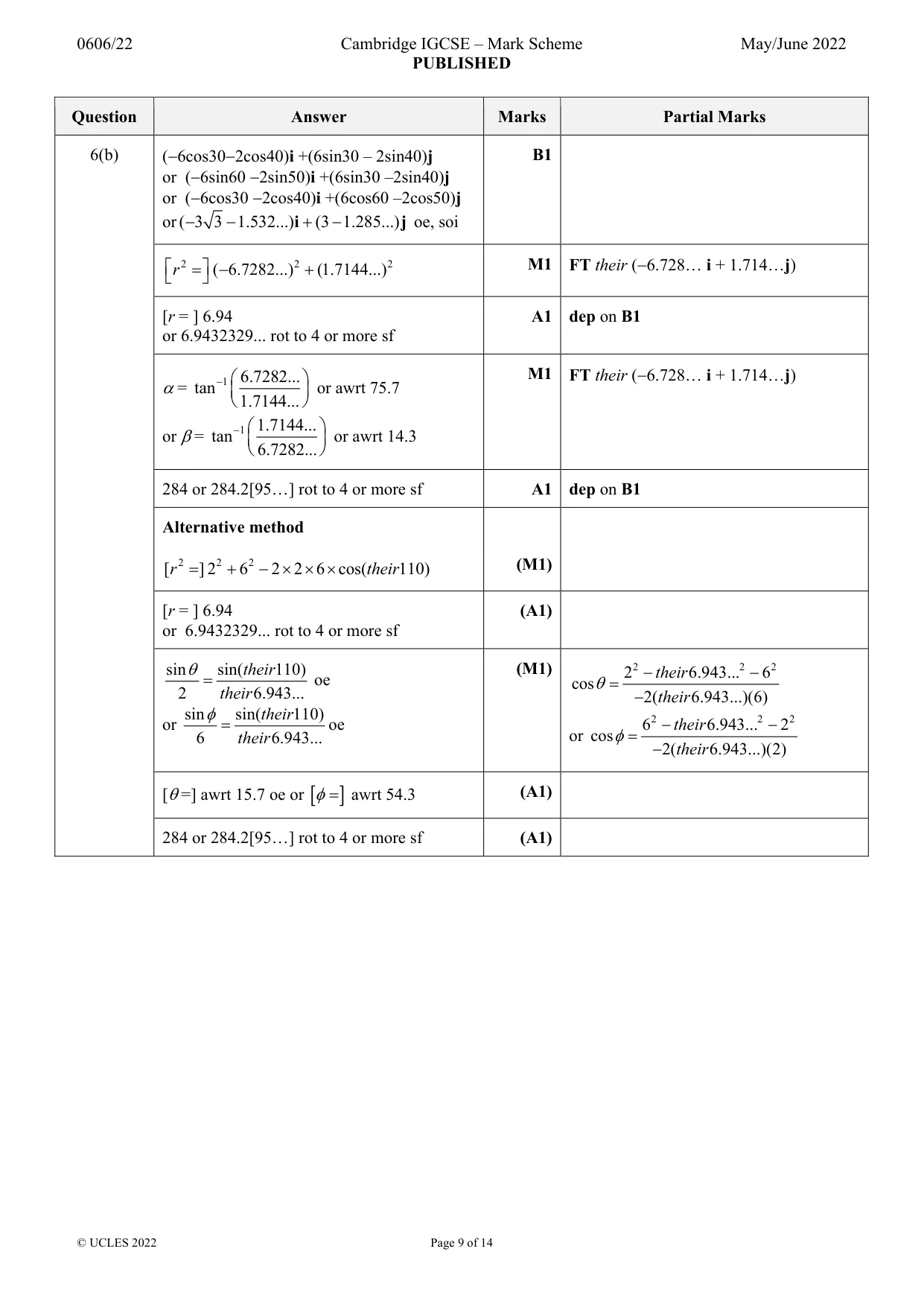
Mark scheme: 6(a) 4cos75i + 4sin75j B2 B1 for x 4cos75 or x = 4sin15 oe, soi or 4sin15i + 4cos15j or y 4sin75 or y = 4cos15 oe, soi or 4sin15i + 4sin75j or B1 for a correct pair of implicit or 4cos75i + 4cos15j oe, isw statements for x and y e.g. x y both sin15 and cos15 oe 4 4 x y or both cos75 and sin75 oe 4 4 If 0 scored, SC1 for a correct expression with missing brackets such as 6 2i + 6 2 j 1.04 or for oe 3.86 6(b) (6cos302cos40)i +(6sin30 – 2sin40)j B1 or (6sin60 2sin50)i +(6sin30 –2sin40)j or (6cos30 2cos40)i +(6cos60 –2cos50)j or ( 3 3 1.532...) i (3 1.285...) j oe, soi r 2 ( 6.7282...) 2 (1.7144...) 2 M1 FT their (6.728… i + 1.714…j) [r = ] 6.94 A1 dep on B1 or 6.9432329... rot to 4 or more sf 1 6.7282... M1 FT their (6.728… i + 1.714…j) = tan or awrt 75.7 1.7144... 1 1.7144... or = tan or awrt 14.3 6.7282... 284 or 284.2[95…] rot to 4 or more sf A1 dep on B1 Alternative method [ r 2 ] 2 2 6 2 2 2 6 cos(their110) (M1) [r = ] 6.94 (A1) or 6.9432329... rot to 4 or more sf sin sin(their110) oe (M1) cos 2 2 their 6.943...2 6 2 2 their 6.943... 2(their 6.943...)(6) sin sin(their110) 2 2 2 or oe 6 their 6.943... 2 6 their 6.943... or cos 2(their 6.943...)(2) [=] awrt 15.7 oe or awrt 54.3 (A1) 284 or 284.2[95…] rot to 4 or more sf (A1)
Q8 · The function f is defined by f ( x) = 3 sin 2 x - 2 cos x for 2 G x G 4 , where x is in…
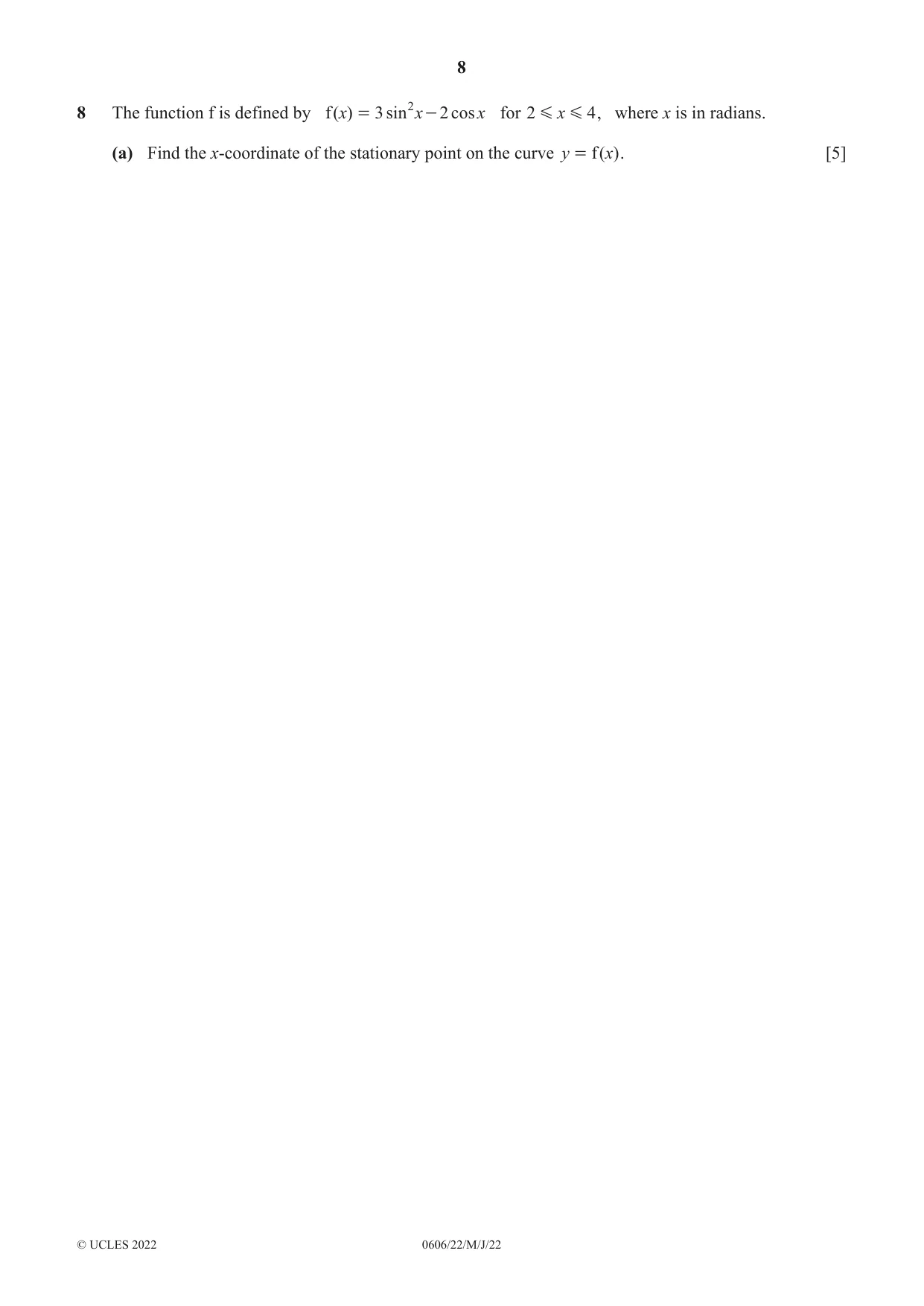
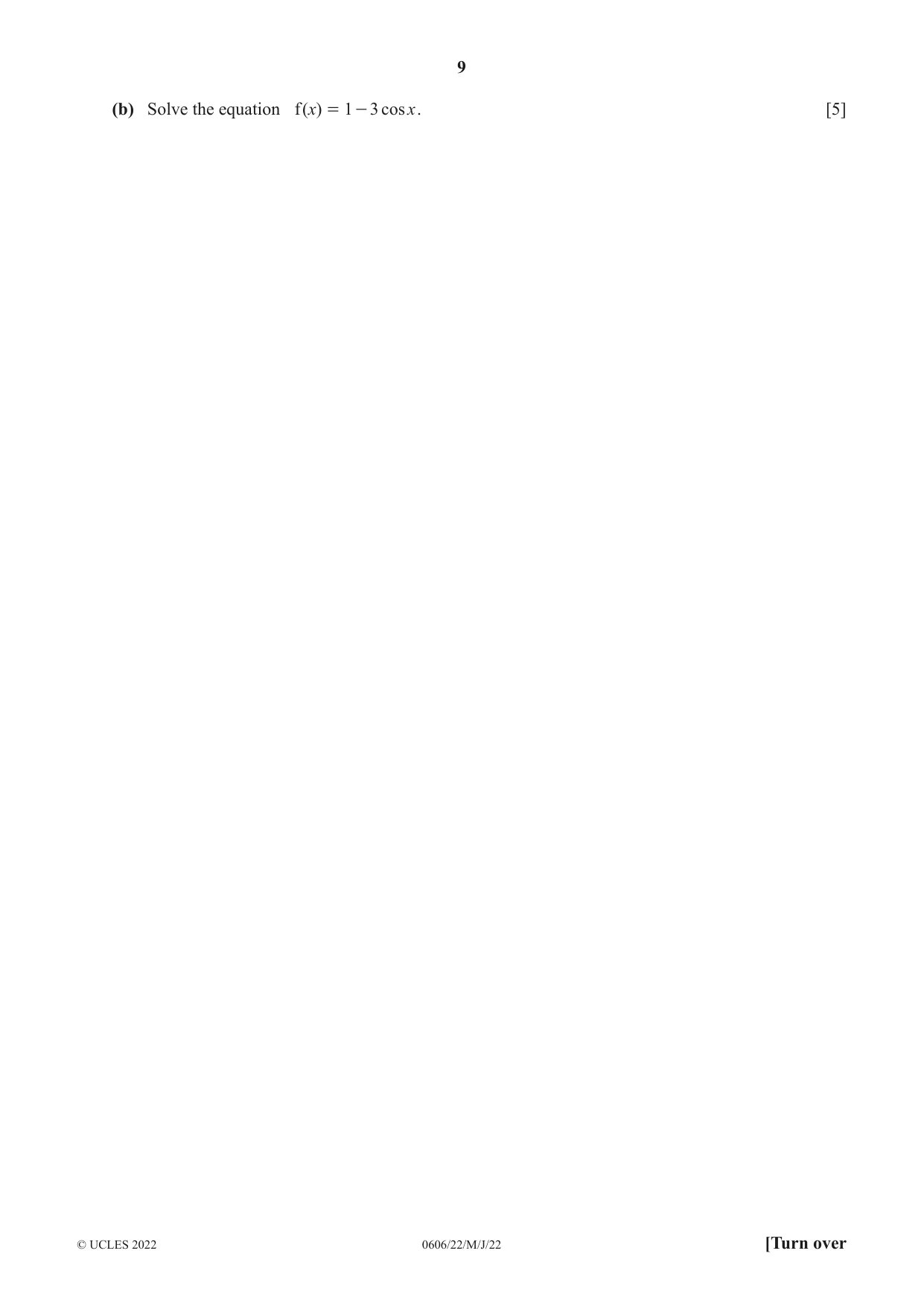
8 The function f is defined by f ( x) = 3 sin 2 x - 2 cos x for 2 G x G 4 , where x is in radians. (a) Find the x-coordinate of the stationary point on the curve y = f ( x) . [5]
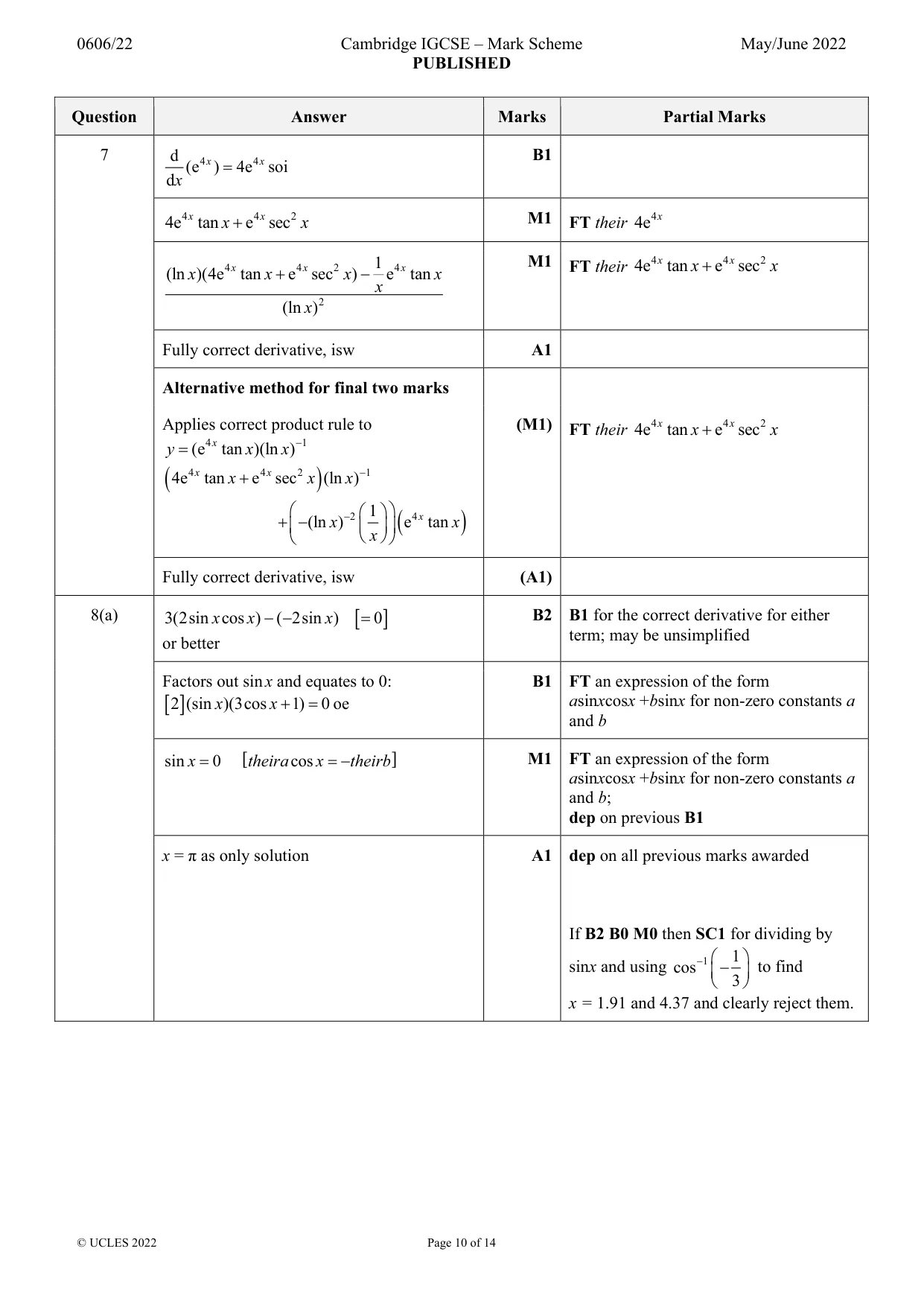
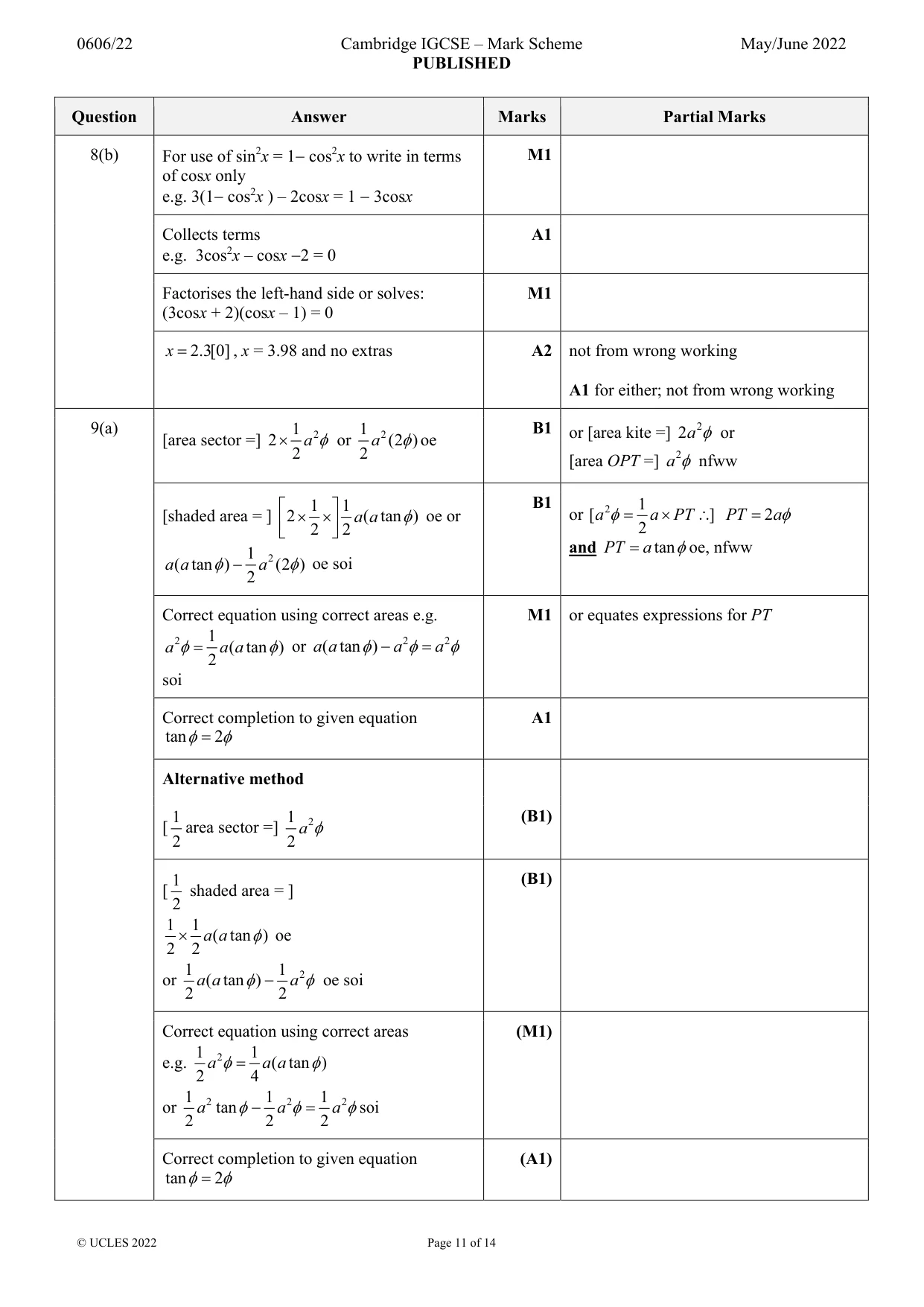
Mark scheme: 8(a) 3(2sin x cos x ) ( 2sin x ) 0 B2 B1 for the correct derivative for either term; may be unsimplified or better Factors out sin x and equates to 0: B1 FT an expression of the form 2 (sin x )(3cos x 1) 0 oe asinxcosx +bsinx for non-zero constants a and b sin x 0 theira cos x theirb M1 FT an expression of the form asinxcosx +bsinx for non-zero constants a and b; dep on previous B1 x = π as only solution A1 dep on all previous marks awarded If B2 B0 M0 then SC1 for dividing by 1 1 sinx and using cos to find 3 x = 1.91 and 4.37 and clearly reject them. 8(b) For use of sin2x = 1 cos2x to write in terms M1 of cosx only e.g. 3(1 cos2x ) – 2cosx = 1 3cosx Collects terms A1 e.g. 3cos2x – cosx 2 = 0 Factorises the left-hand side or solves: M1 (3cosx + 2)(cosx – 1) = 0 x 2.3[0] , x = 3.98 and no extras A2 not from wrong working A1 for either; not from wrong working
More questions on Use differentiation to find stationary points
Q9 · In this question all lengths are in centimetres
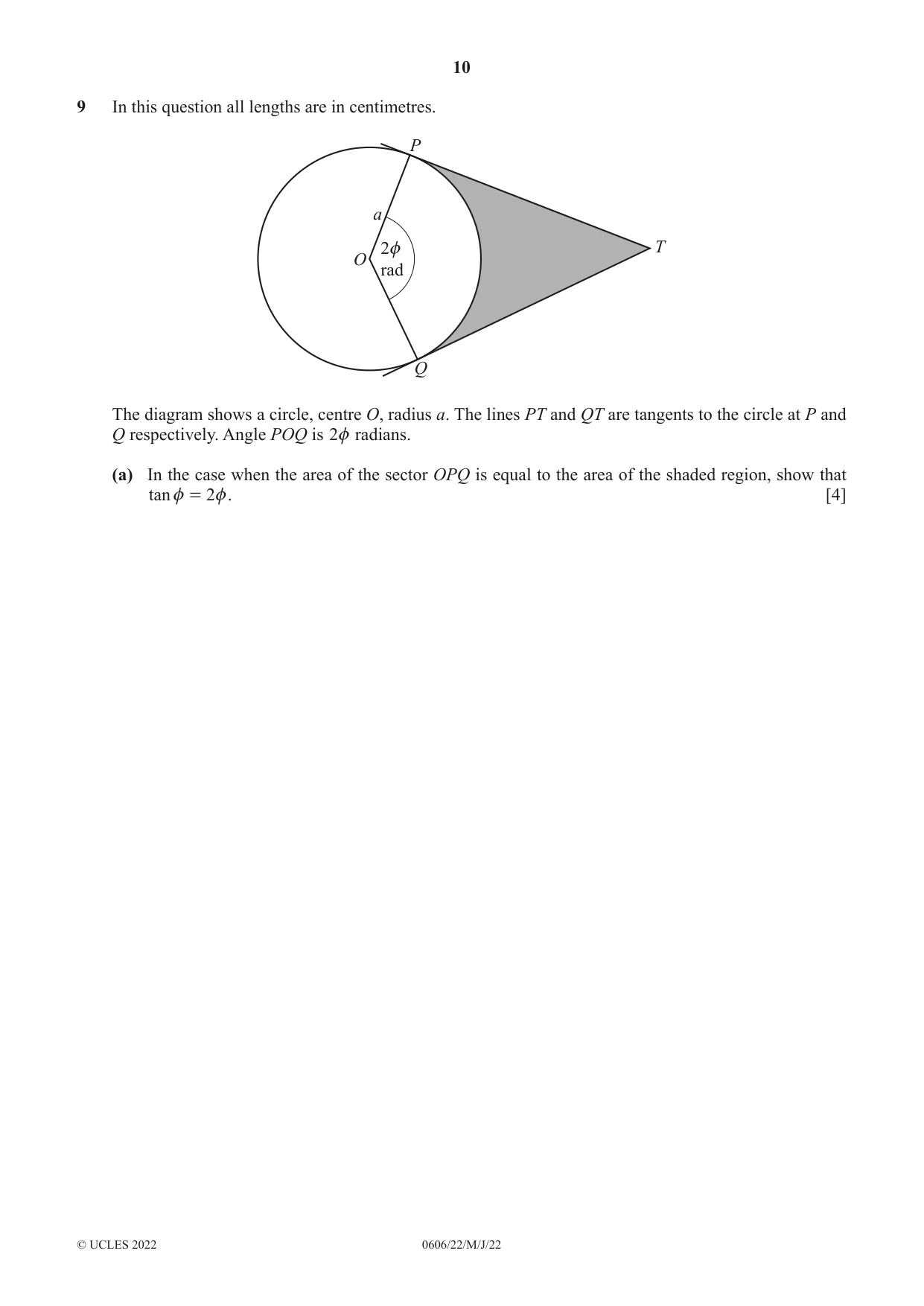
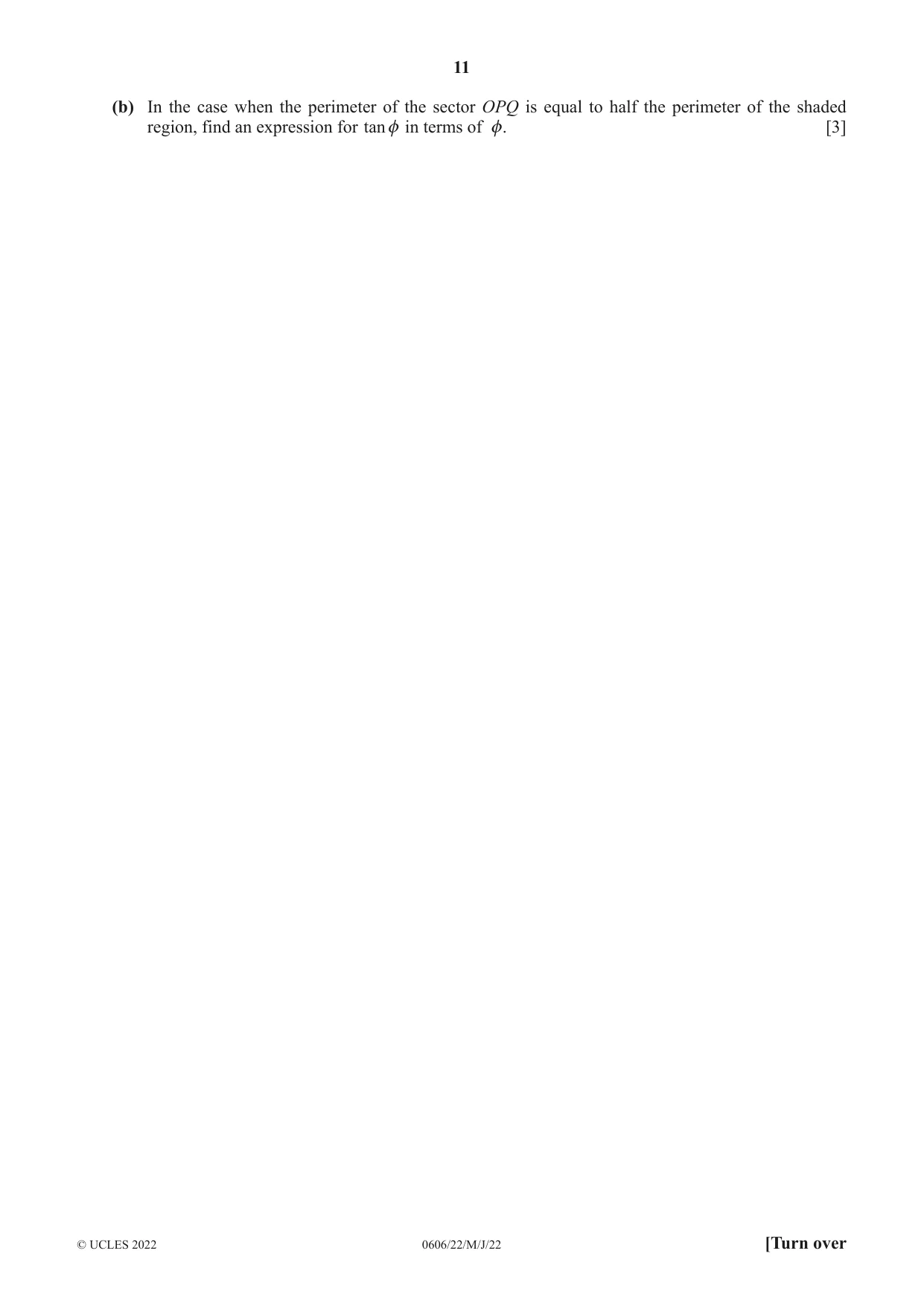
9 In this question all lengths are in centimetres. P a 2z T O rad Q The diagram shows a circle, centre O, radius a. The lines PT and QT are tangents to the circle at P and Q respectively. Angle POQ is 2z radians. (a) In the case when the area of the sector OPQ is equal to the area of the shaded region, show that tan z = 2z . [4] (b) In the case when the perimeter of the sector OPQ is equal to half the perimeter of the shaded region, find an expression for tanz in terms of z. [3]
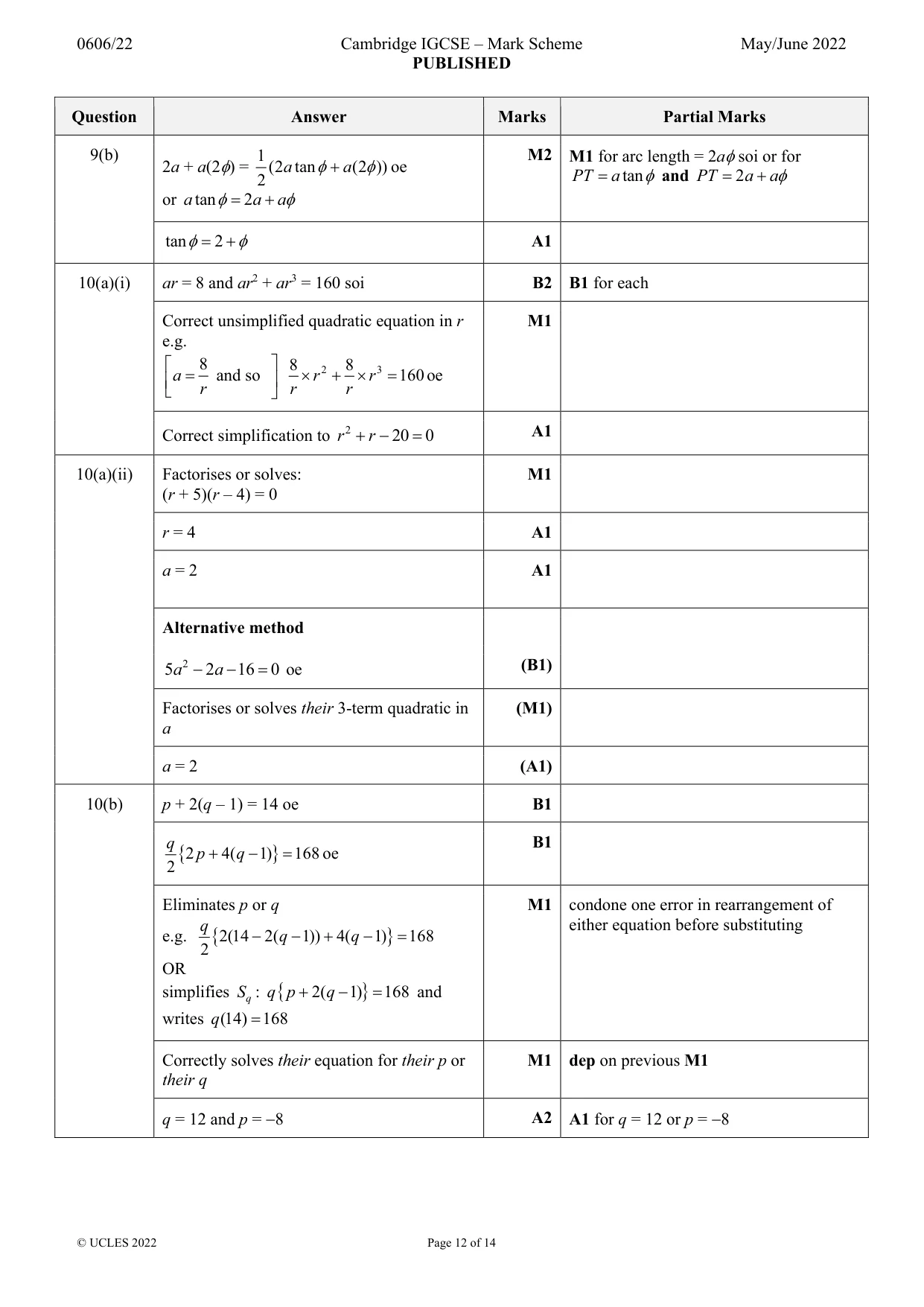
Mark scheme: 9(a) 1 2 1 2 B1 or [area kite =] 2 a 2 or [area sector =] 2 a or a (2) oe 2 2 [area OPT =] a 2 nfww 1 1 B1 2 1 [shaded area = ] 2 a ( a tan) oe or or [ a a PT ] PT 2 a 2 2 2 and PT a tanoe, nfww 1 2 a ( a tan ) a (2) oe soi 2 Correct equation using correct areas e.g. M1 or equates expressions for PT 2 1 2 2 a a ( a tan ) or a ( a tan) a a 2 soi Correct completion to given equation A1 tan 2 Alternative method 1 1 2 (B1) [ area sector =] a 2 2 1 (B1) [ shaded area = ] 2 1 1 a ( a tan ) oe 2 2 1 1 2 or a ( a tan ) a oe soi 2 2 Correct equation using correct areas (M1) 1 2 1 e.g. a a ( a tan ) 2 4 1 2 1 2 1 2 or a tan a a soi 2 2 2 Correct completion to given equation (A1) tan 2 9(b) 1 M2 M1 for arc length = 2asoi or for 2a + a(2) = (2 a tan a (2)) oe 2 PT a tan and PT 2 a a or a tan 2 a a tan 2 A1
More questions on Solve problems involving the arc length and
Q10 · A geometric progression has first term a and common ratio r, where r 2 0
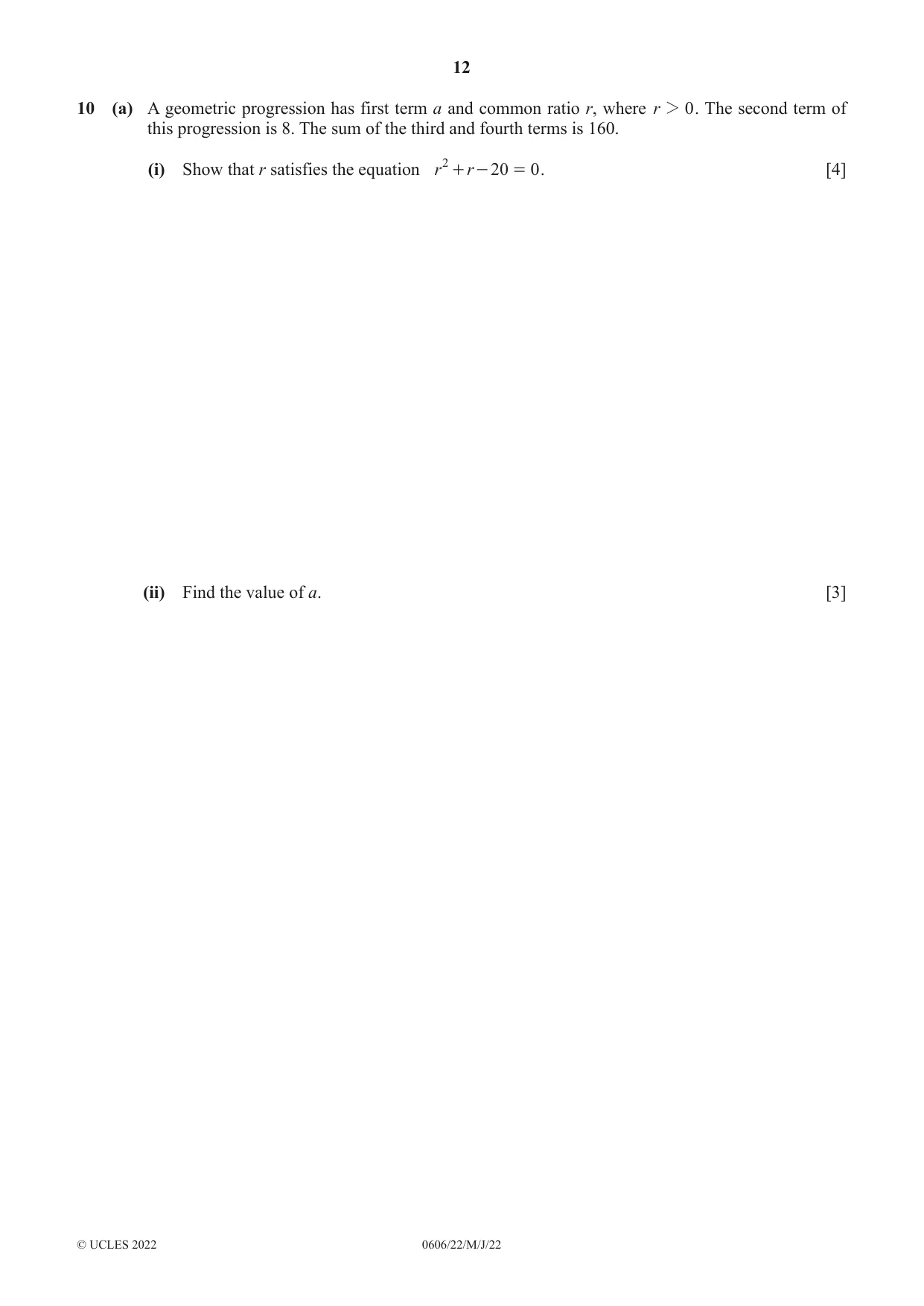
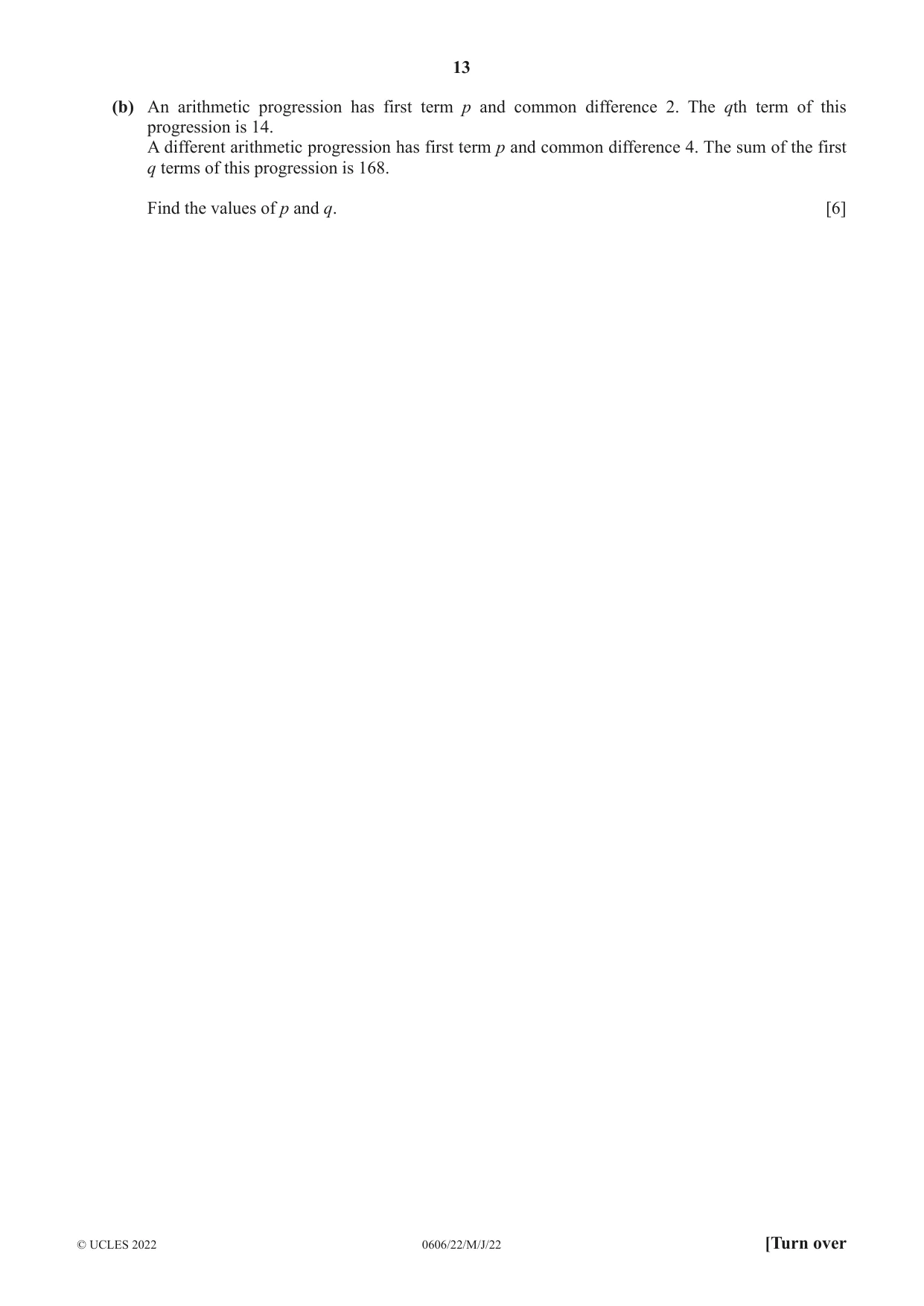
10 (a) A geometric progression has first term a and common ratio r, where r 2 0 . The second term of this progression is 8. The sum of the third and fourth terms is 160. (i) Show that r satisfies the equation r 2 + r - 20 = 0 . [4] (ii) Find the value of a. [3] (b) An arithmetic progression has first term p and common difference 2. The qth term of this progression is 14. A different arithmetic progression has first term p and common difference 4. The sum of the first q terms of this progression is 168. Find the values of p and q. [6]
Mark scheme: 10(a)(i) ar = 8 and ar2 + ar3 = 160 soi B2 B1 for each Correct unsimplified quadratic equation in r M1 e.g. a 8 and so 8 r 2 8 r 3 160 oe r r r Correct simplification to r 2 r 20 0 A1 10(a)(ii) Factorises or solves: M1 (r + 5)(r – 4) = 0 r = 4 A1 a = 2 A1 Alternative method 5a 2 2 a 16 0 oe (B1) Factorises or solves their 3-term quadratic in (M1) a a = 2 (A1) 10(b) p + 2(q – 1) = 14 oe B1 q B1 2 p 4( q 1) 168 oe 2 Eliminates p or q M1 condone one error in rearrangement of q either equation before substituting e.g. 2(14 2( q 1)) 4( q 1) 168 2 OR simplifies S q : q p 2( q 1) 168 and writes q (14) 168 Correctly solves their equation for their p or M1 dep on previous M1 their q q = 12 and p = 8 A2 A1 for q = 12 or p = 8
More questions on Use the formulas for the nth term and for the
Q11 · Y P Q B y = 1 A y = 1 + cos x O R x The diagram shows part of the line y = 1 and one…
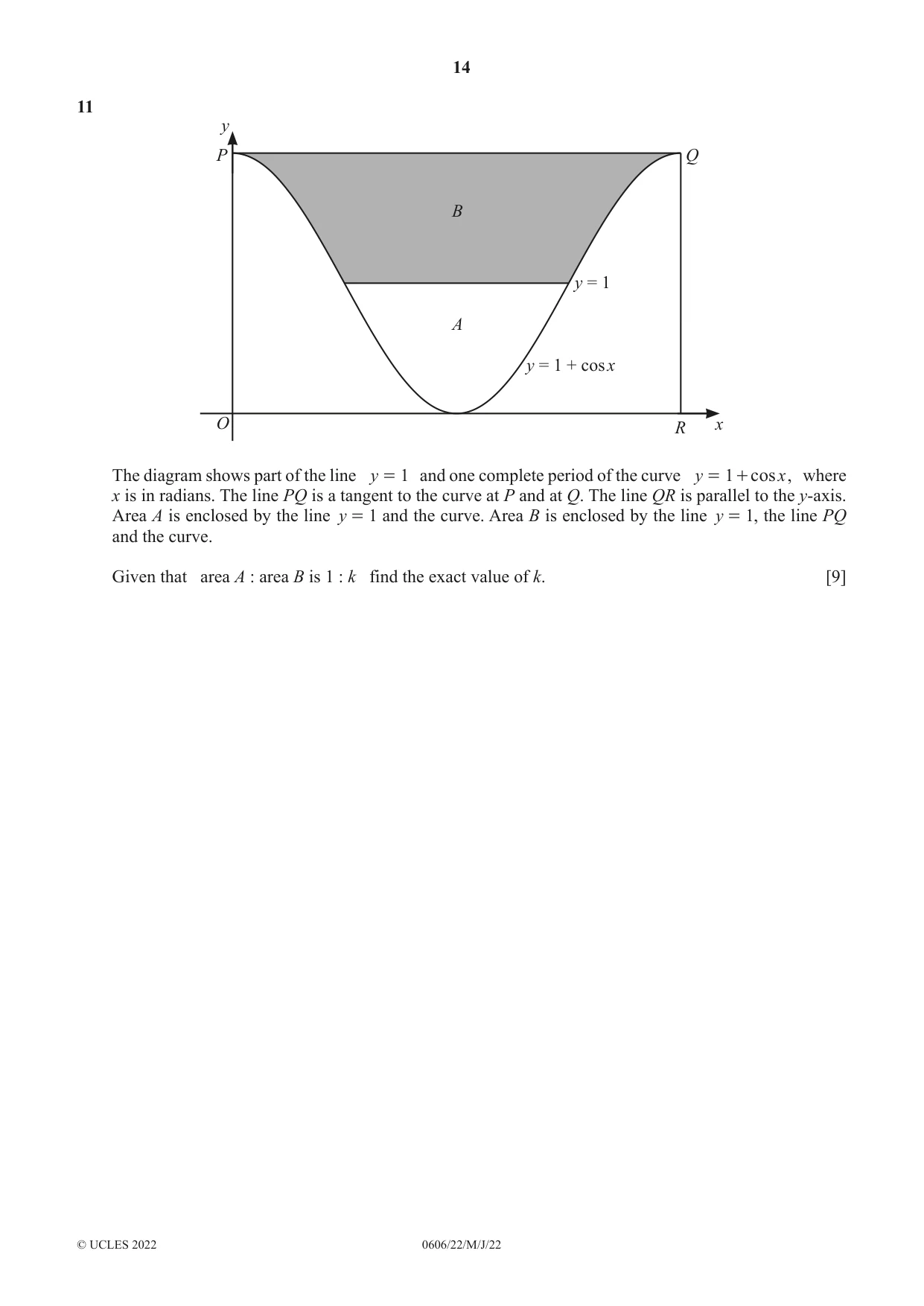
11 y P Q B y = 1 A y = 1 + cos x O R x The diagram shows part of the line y = 1 and one complete period of the curve y = 1 + cos x , where x is in radians. The line PQ is a tangent to the curve at P and at Q. The line QR is parallel to the y-axis. Area A is enclosed by the line y = 1 and the curve. Area B is enclosed by the line y = 1, the line PQ and the curve. Given that area A : area B is 1 : k find the exact value of k. [9] Continuation of working space for Question 11. Question 12 is printed on the next page.
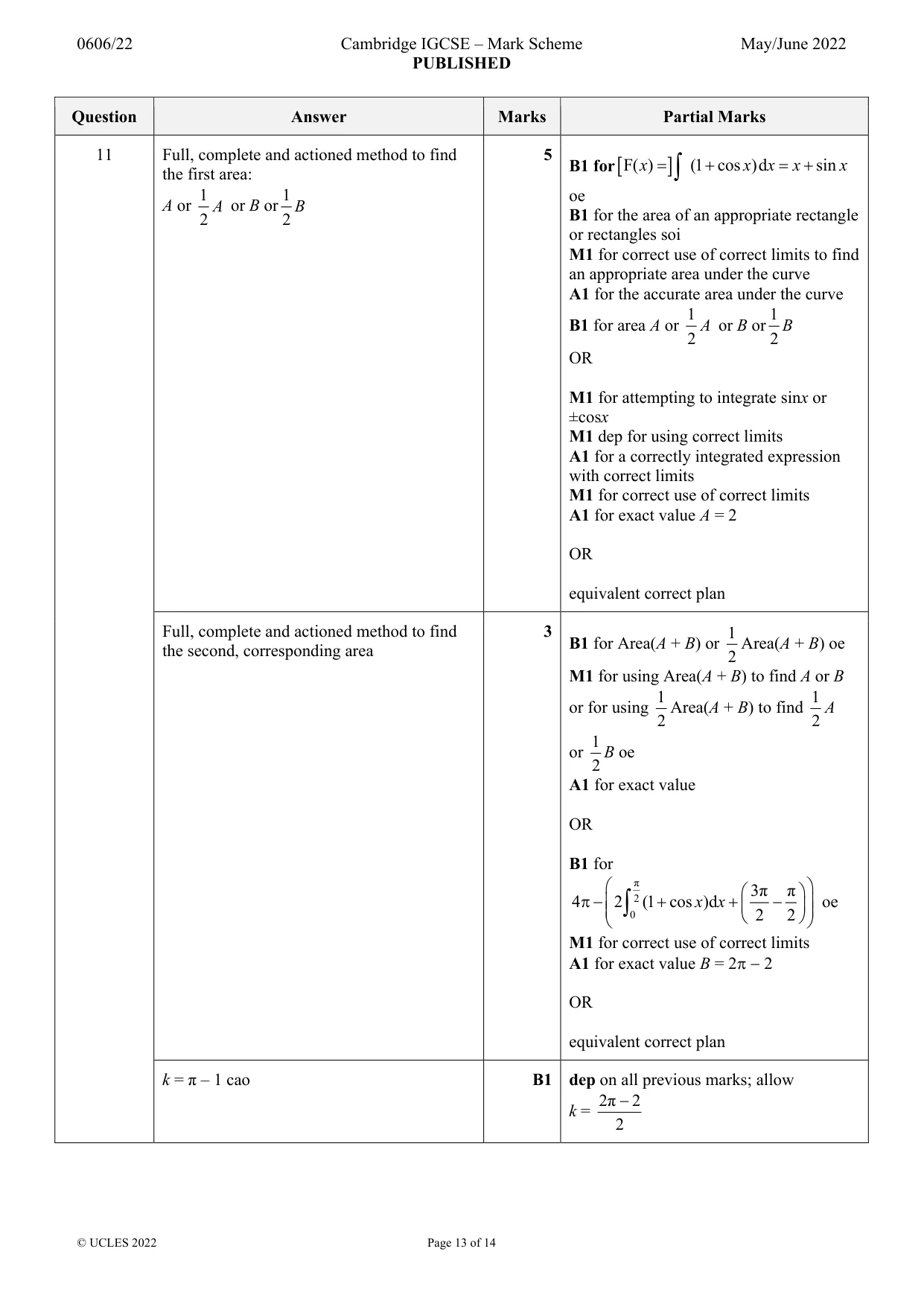
Mark scheme: 11 Full, complete and actioned method to find 5 B1 for F( x ) (1 cos x )dx x sin x the first area: 1 1 oe A or A or B or B 2 2 B1 for the area of an appropriate rectangle or rectangles soi M1 for correct use of correct limits to find an appropriate area under the curve A1 for the accurate area under the curve 1 1 B1 for area A or A or B or B 2 2 OR M1 for attempting to integrate sinx or ±cosx M1 dep for using correct limits A1 for a correctly integrated expression with correct limits M1 for correct use of correct limits A1 for exact value A = 2 OR equivalent correct plan Full, complete and actioned method to find 3 1 B1 for Area(A + B) or Area(A + B) oe the second, corresponding area 2 M1 for using Area(A + B) to find A or B 1 1 or for using Area(A + B) to find A 2 2 1 or B oe 2 A1 for exact value OR B1 for π 2 3π π 4 2 (1 cos x )dx oe 0 2 2 M1 for correct use of correct limits A1 for exact value B = 2 2 OR equivalent correct plan k = π – 1 cao B1 dep on all previous marks; allow 2π 2 k = 2
Q12 · A curve is such that 2 = 4
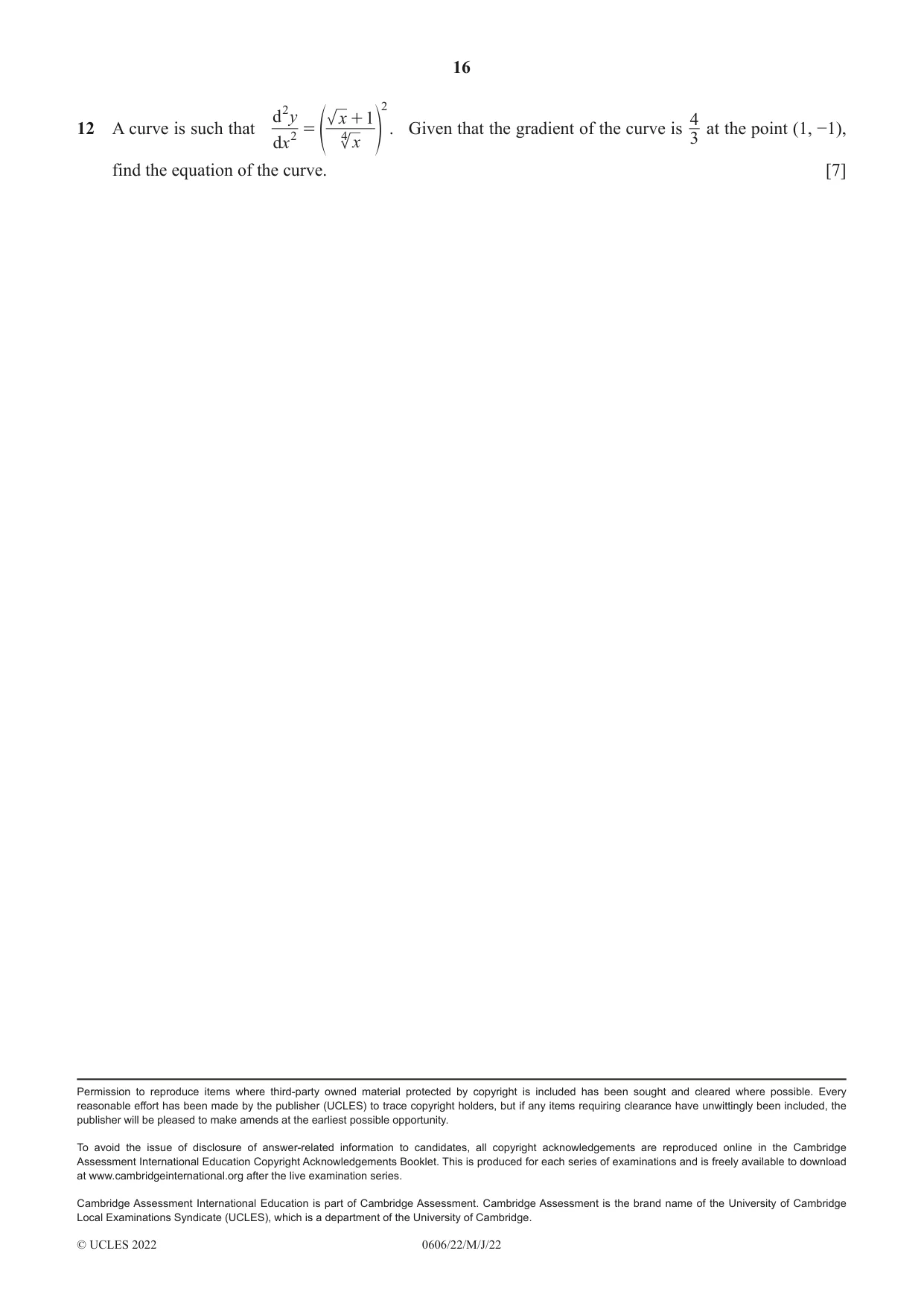
12 A curve is such that 2 = 4 . Given that the gradient of the curve is at the point (1, −1), dx x 3 find the equation of the curve. [7]
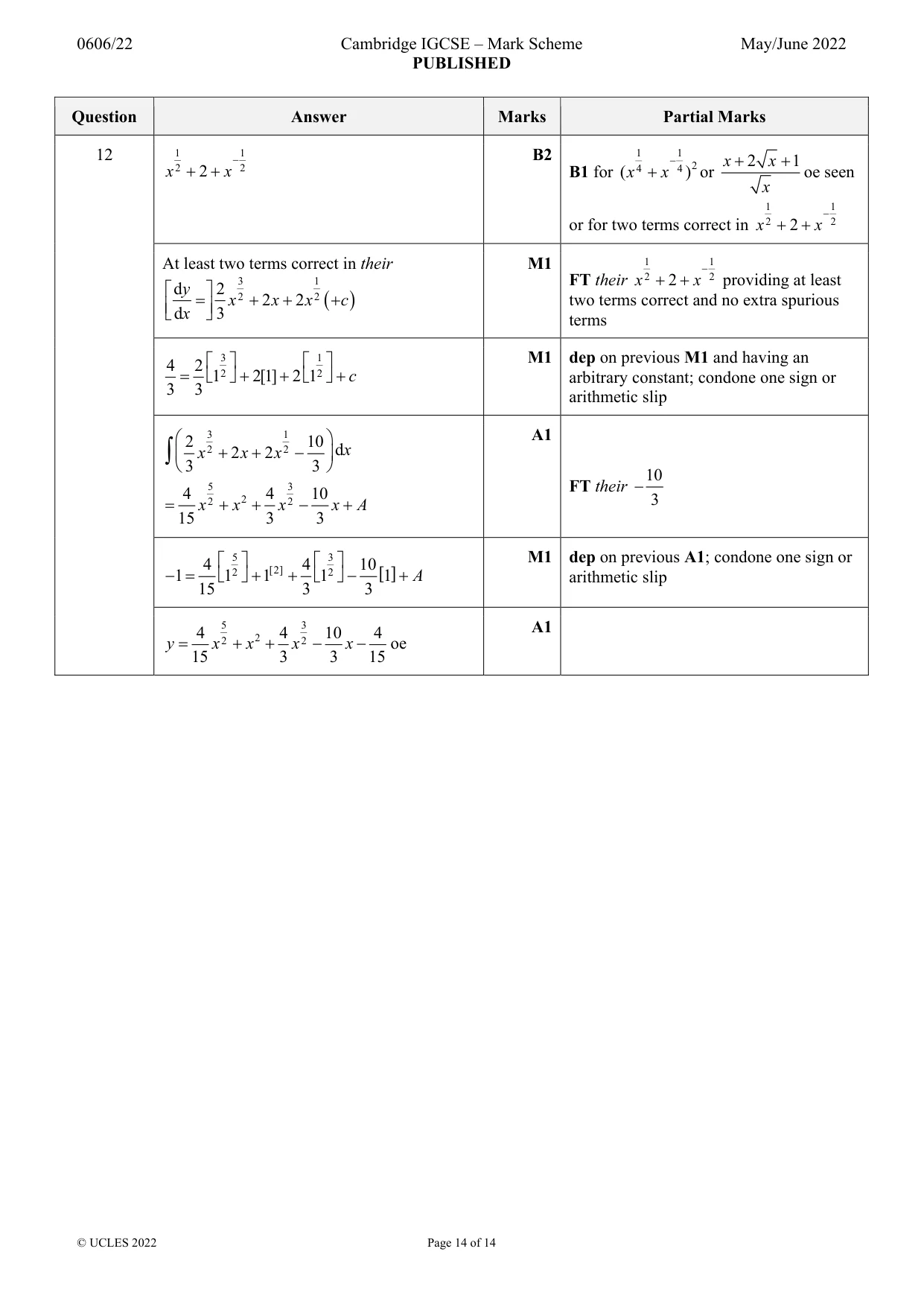
Mark scheme: 1 112 1 B2 1 2 2 4 4 2 x 2 x 1 x 2 x B1 for ( x x ) or oe seen x 1 1 or for two terms correct in x 2 2 x 2 At least two terms correct in their M1 1 1 3 1 FT their x 2 2 x 2 providing at least dy 2 2 2 x 2 x 2 x c two terms correct and no extra spurious dx 3 terms 4 2 32 12 M1 dep on previous M1 and having an 1 2[1] 2 1 c arbitrary constant; condone one sign or 3 3 arithmetic slip 3 1 A1 2 10 x 2 2 x 2 x 2 dx 3 3 10 5 3 FT their 4 2 2 4 2 10 3 x x x x A 15 3 3 5 on previous M1 dep A1; condone one sign or 3 4 4 10 2 1 1 1[2] 12 1 A arithmetic slip 15 3 3 5 3 A1 4 2 2 4 2 10 4 y x x x x oe 15 3 3 15
More questions on Understand integration as the reverse process
What was in this paper
The subtopics covered by these 11 questions, and how many questions each got. Open one in a new tab to see every Cambridge question on it.
1Evaluate definite integrals and apply1Find the magnitude of a vector; add and1Know the conditions for f(x) = 0 to have1Solve equations of the form ax = b1Solve equations of the type1Solve graphically or algebraically inequalities1Solve problems involving the arc length and1Understand integration as the reverse process1Use differentiation to find stationary points1Use the formulas for the nth term and for the1What you needed in this session
Cambridge’s own grade thresholds for 2022 May/June, Paper 2 · Variant 2. A higher threshold means an easier paper — the bar moves with how the cohort did.