Cambridge IGCSE Mathematics - Additional 0606 — 2020 Oct/Nov Paper 2 · Variant 2
0606/22/O/N/20 · 9 questions · 80 marks · ≈90 min
The question paper and its mark scheme, free to read here and free to download. This is Cambridge’s own paper, exactly as it was sat.
Question paper16 pages

Mark scheme8 pages
Answers below. Sit the paper first if you are practising.
Questions as text
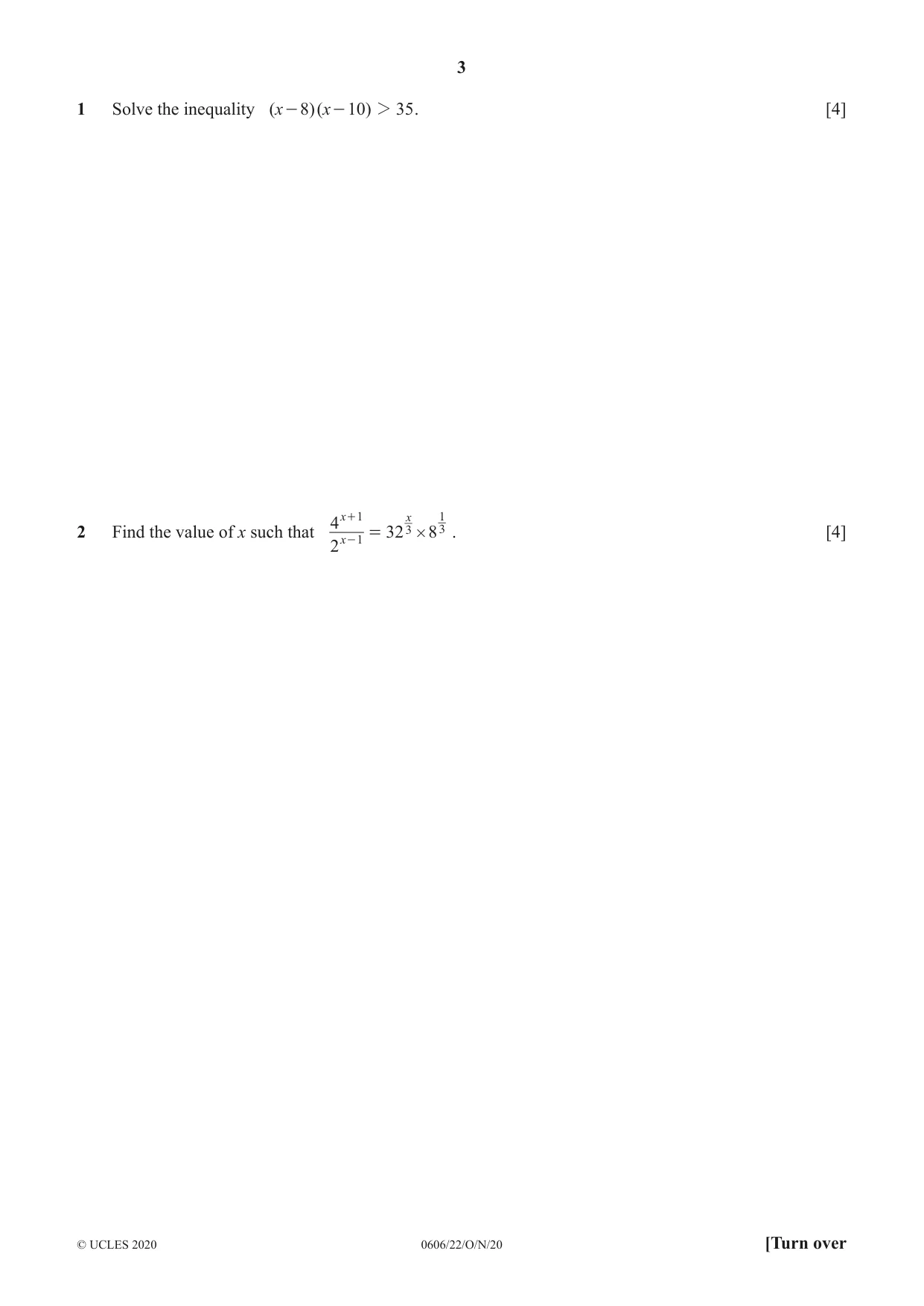
Q1 · Solve the inequality ( x - 8)( x - 10) 2 35
1 Solve the inequality ( x - 8)( x - 10) 2 35 . [4] + 1
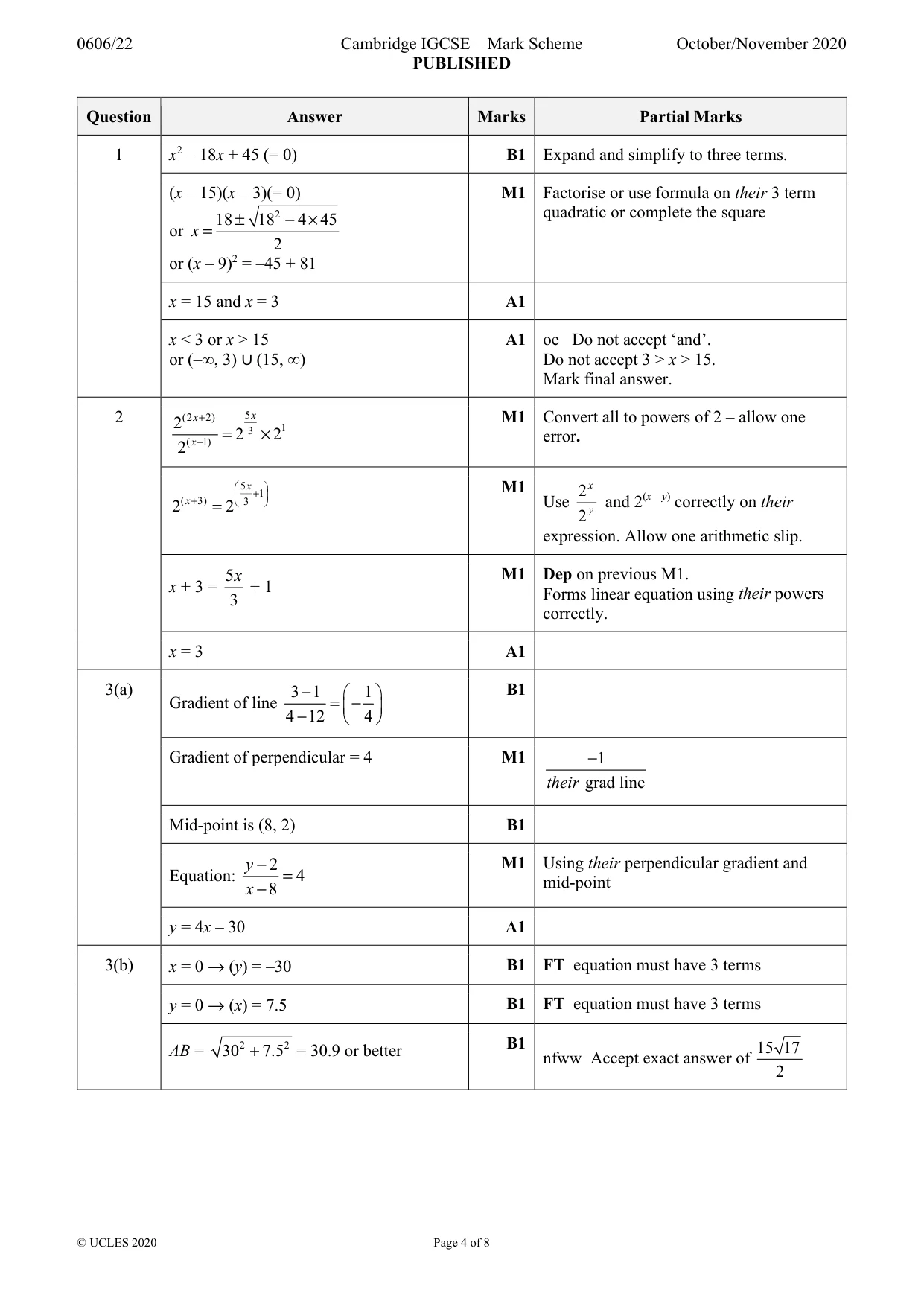
Mark scheme: Question Answer Marks Partial Marks 1 x2 – 18x + 45 (= 0) B1 Expand and simplify to three terms. (x – 15)(x – 3)(= 0) M1 Factorise or use formula on their 3 term 2 quadratic or complete the square 18 ± 18 −×4 45 or x = 2 or (x – 9)2 = –45 + 81 x = 15 and x = 3 A1 x < 3 or x > 15 A1 oe Do not accept ‘and’. or (–∞, 3) ∪ (15, ∞) Do not accept 3 > x > 15. Mark final answer.
More questions on Find the solution set for quadratic inequalities
Q3 · Find the equation of the perpendicular bisector of the line joining the points (12, 1)…
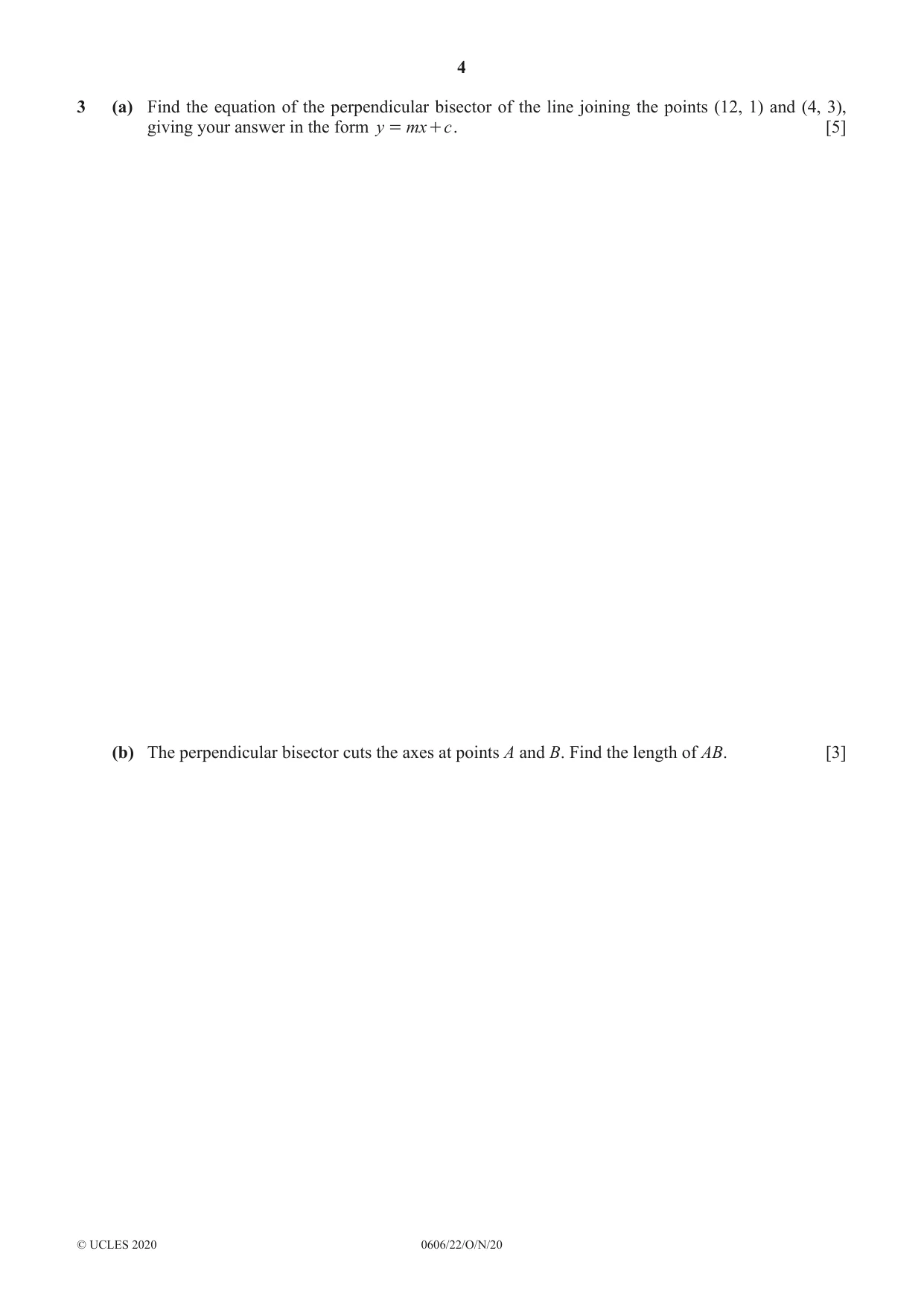
3 (a) Find the equation of the perpendicular bisector of the line joining the points (12, 1) and (4, 3), giving your answer in the form y = mx + c . [5] (b) The perpendicular bisector cuts the axes at points A and B. Find the length of AB. [3]
Mark scheme: 3(a) 3 − 1 1 B1 Gradient of line = − 4 − 12 4 Gradient of perpendicular = 4 M1 − 1 their grad line Mid-point is (8, 2) B1 y − 2 M1 Using their perpendicular gradient and Equation: = 4 mid-point x − 8 y = 4x – 30 A1 3(b) x = 0 → (y) = –30 B1 FT equation must have 3 terms y = 0 → (x) = 7.5 B1 FT equation must have 3 terms B1 15 17 AB = 30 2 + 7.5 2 = 30.9 or better nfww Accept exact answer of 2
More questions on Know and use the condition for two lines to
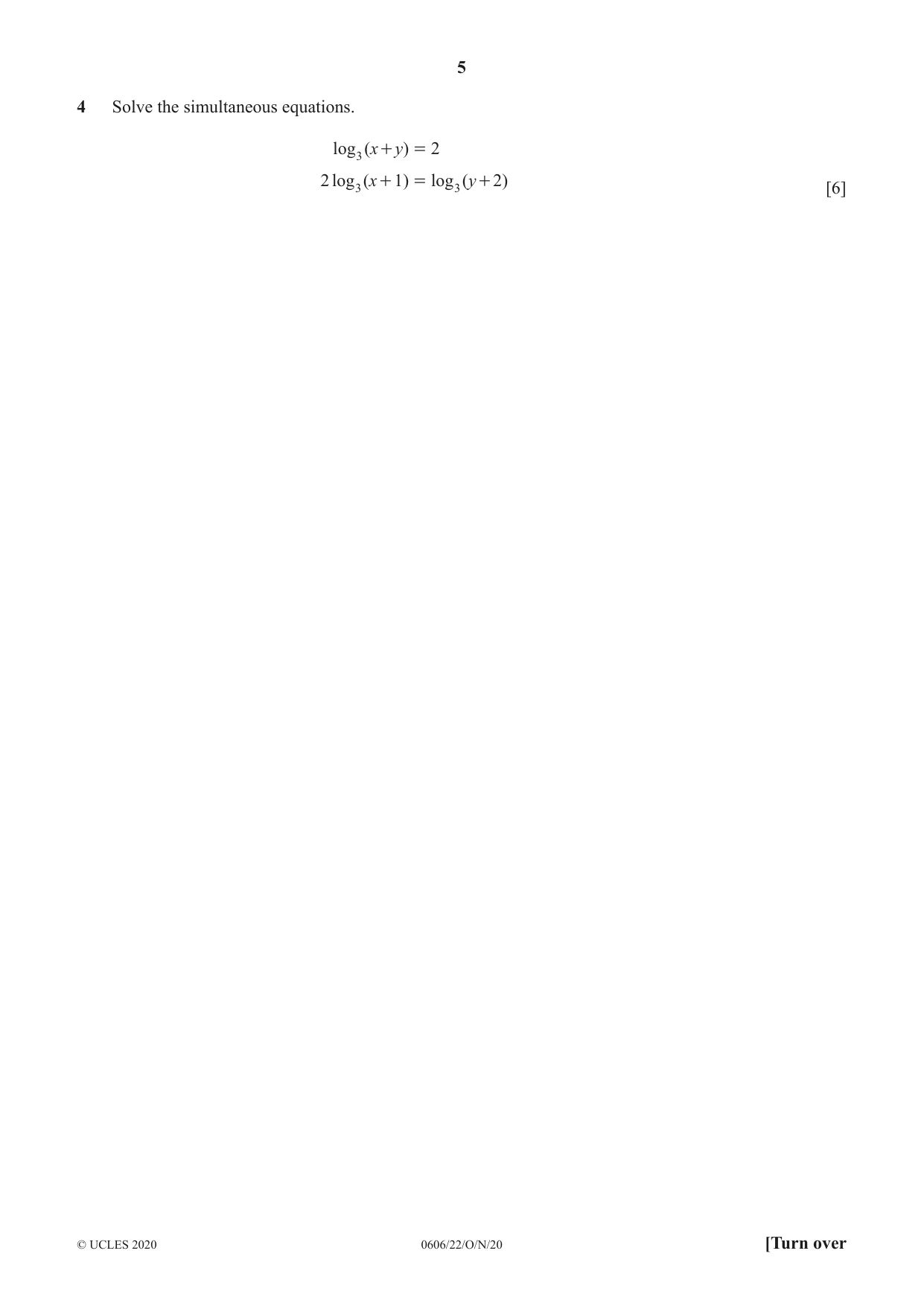
Q4 · Solve the simultaneous equations
4 Solve the simultaneous equations. log 3 ( x + y) = 2 2 log 3 ( x + 1) = log 3 ( y + 2) [6]
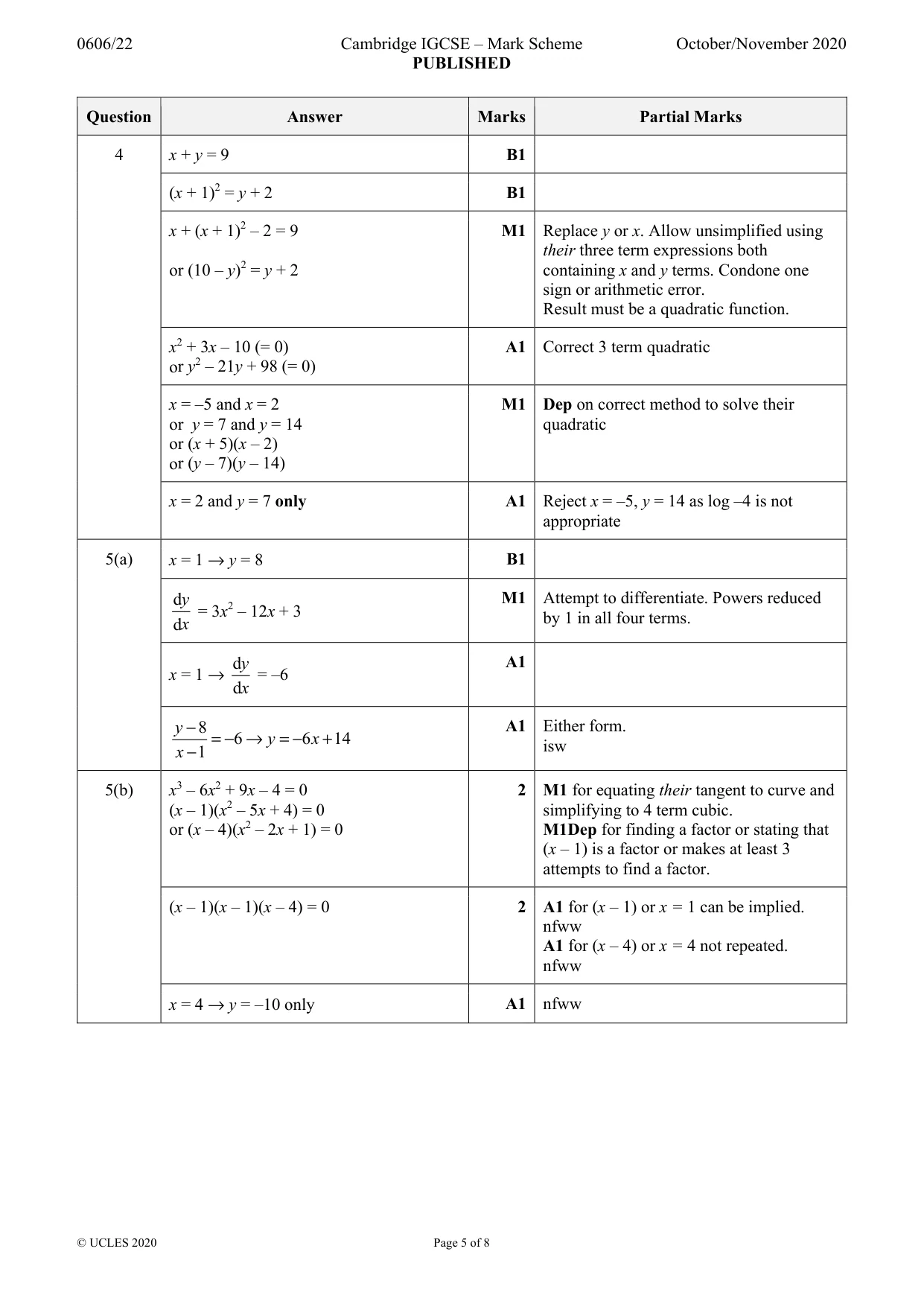
Mark scheme: 4 x + y = 9 B1 (x + 1)2 = y + 2 B1 x + (x + 1)2 – 2 = 9 M1 Replace y or x. Allow unsimplified using their three term expressions both or (10 – y)2 = y + 2 containing x and y terms. Condone one sign or arithmetic error. Result must be a quadratic function. x2 + 3x – 10 (= 0) A1 Correct 3 term quadratic or y2 – 21y + 98 (= 0) x = –5 and x = 2 M1 Dep on correct method to solve their or y = 7 and y = 14 quadratic or (x + 5)(x – 2) or (y – 7)(y – 14) x = 2 and y = 7 only A1 Reject x = –5, y = 14 as log –4 is not appropriate
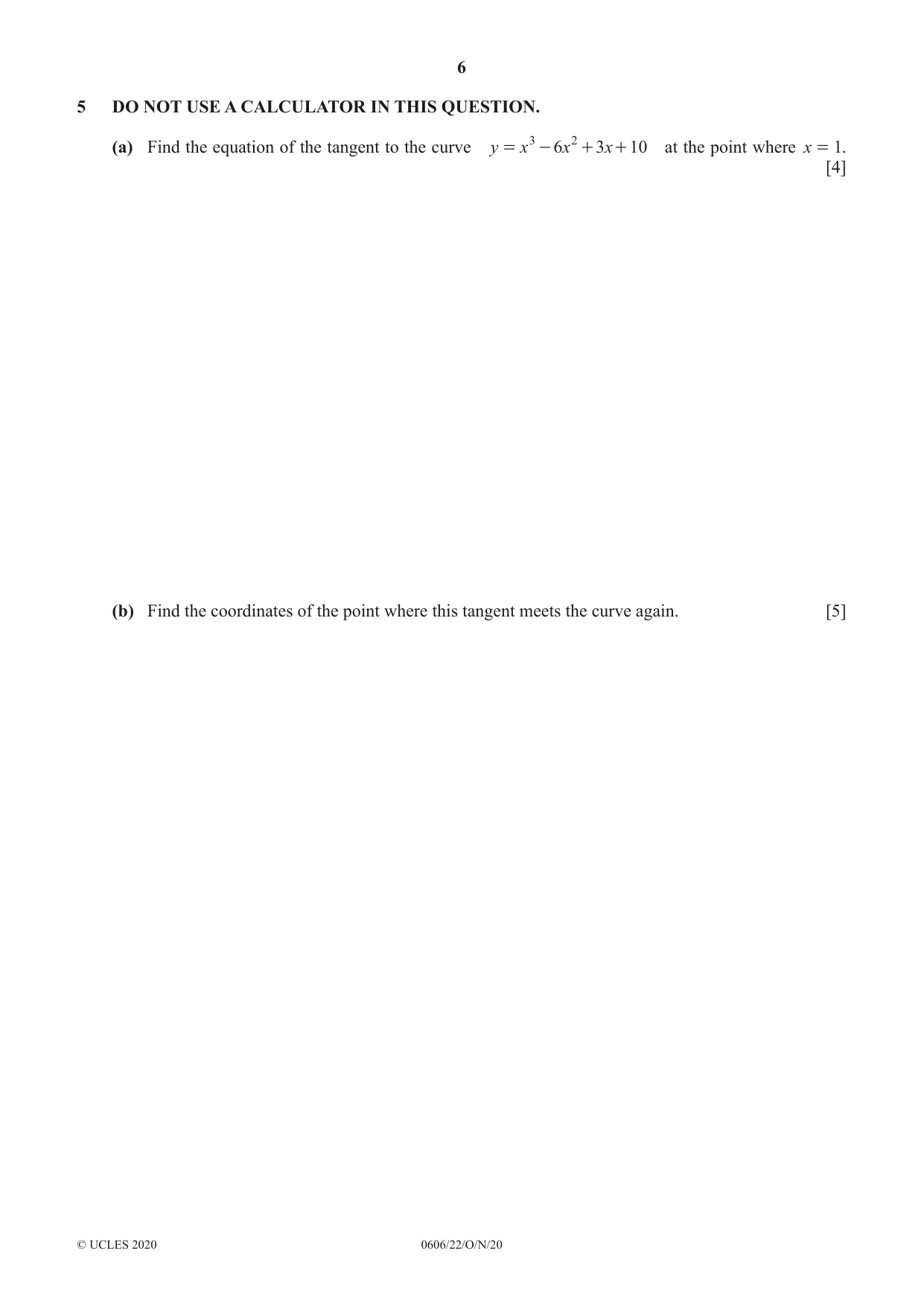
Q5 · DO NOT USE A CALCULATOR IN THIS QUESTION
5 DO NOT USE A CALCULATOR IN THIS QUESTION. (a) Find the equation of the tangent to the curve y = x 3 - 6x 2 + 3x + 10 at the point where x = 1. [4] (b) Find the coordinates of the point where this tangent meets the curve again. [5]
Mark scheme: 5(a) x = 1 → y = 8 B1 dy M1 Attempt to differentiate. Powers reduced = 3x2 – 12x + 3 by 1 in all four terms. dx dy A1 x = 1 → = –6 dx y − 8 A1 Either form. = −→6 y = −6 x + 14 isw x − 1 5(b) x3 – 6x2 + 9x – 4 = 0 2 M1 for equating their tangent to curve and (x – 1)(x2 – 5x + 4) = 0 simplifying to 4 term cubic. or (x – 4)(x2 – 2x + 1) = 0 M1Dep for finding a factor or stating that (x – 1) is a factor or makes at least 3 attempts to find a factor. (x – 1)(x – 1)(x – 4) = 0 2 A1 for (x – 1) or x = 1 can be implied. nfww A1 for (x – 4) or x = 4 not repeated. nfww x = 4 → y = –10 only A1 nfww
More questions on Use differentiation to find gradients, tangents
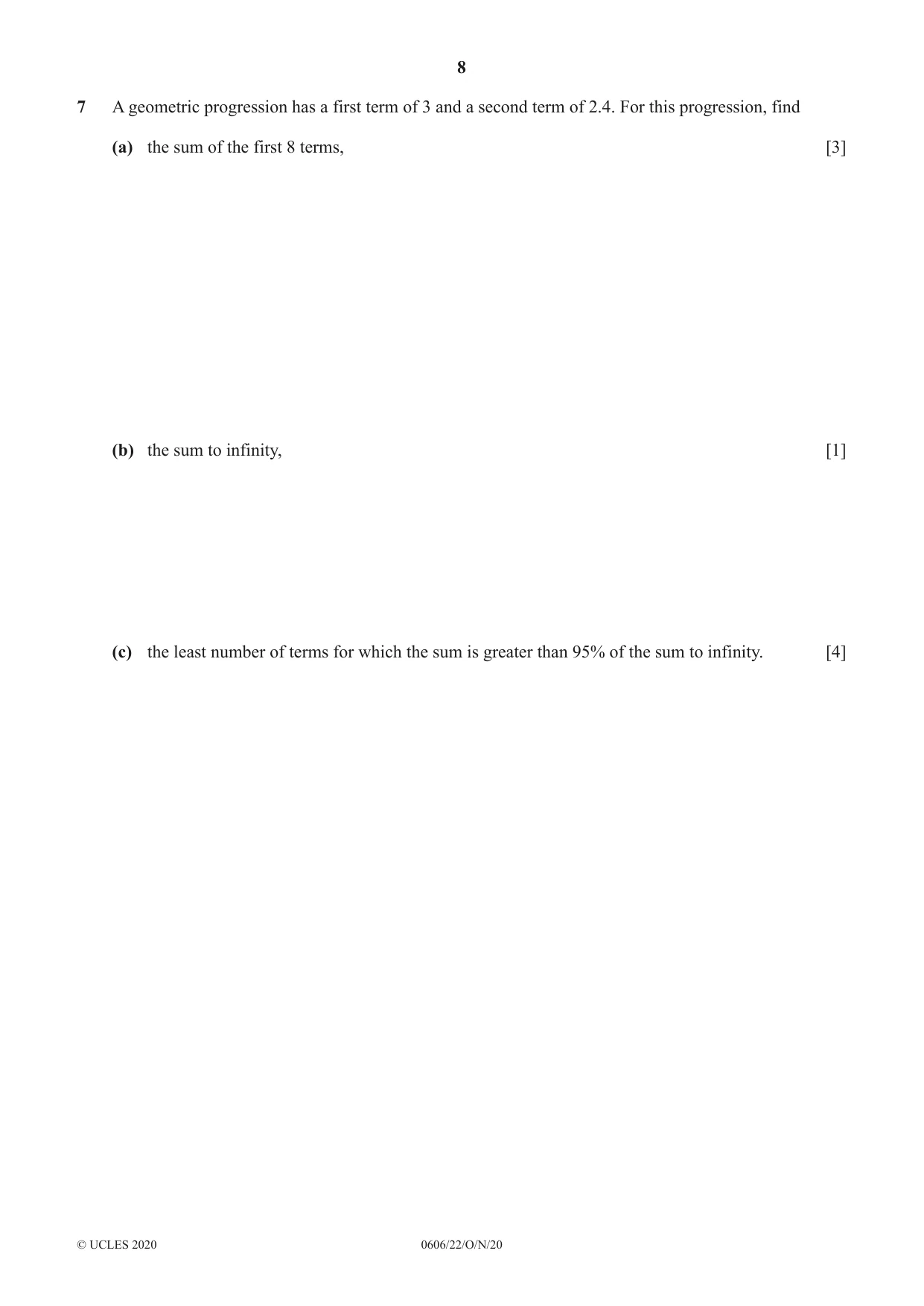
Q7 · A geometric progression has a first term of 3 and a second term of 2.4
7 A geometric progression has a first term of 3 and a second term of 2.4. For this progression, find (a) the sum of the first 8 terms, [3] (b) the sum to infinity, [1] (c) the least number of terms for which the sum is greater than 95% of the sum to infinity. [4]
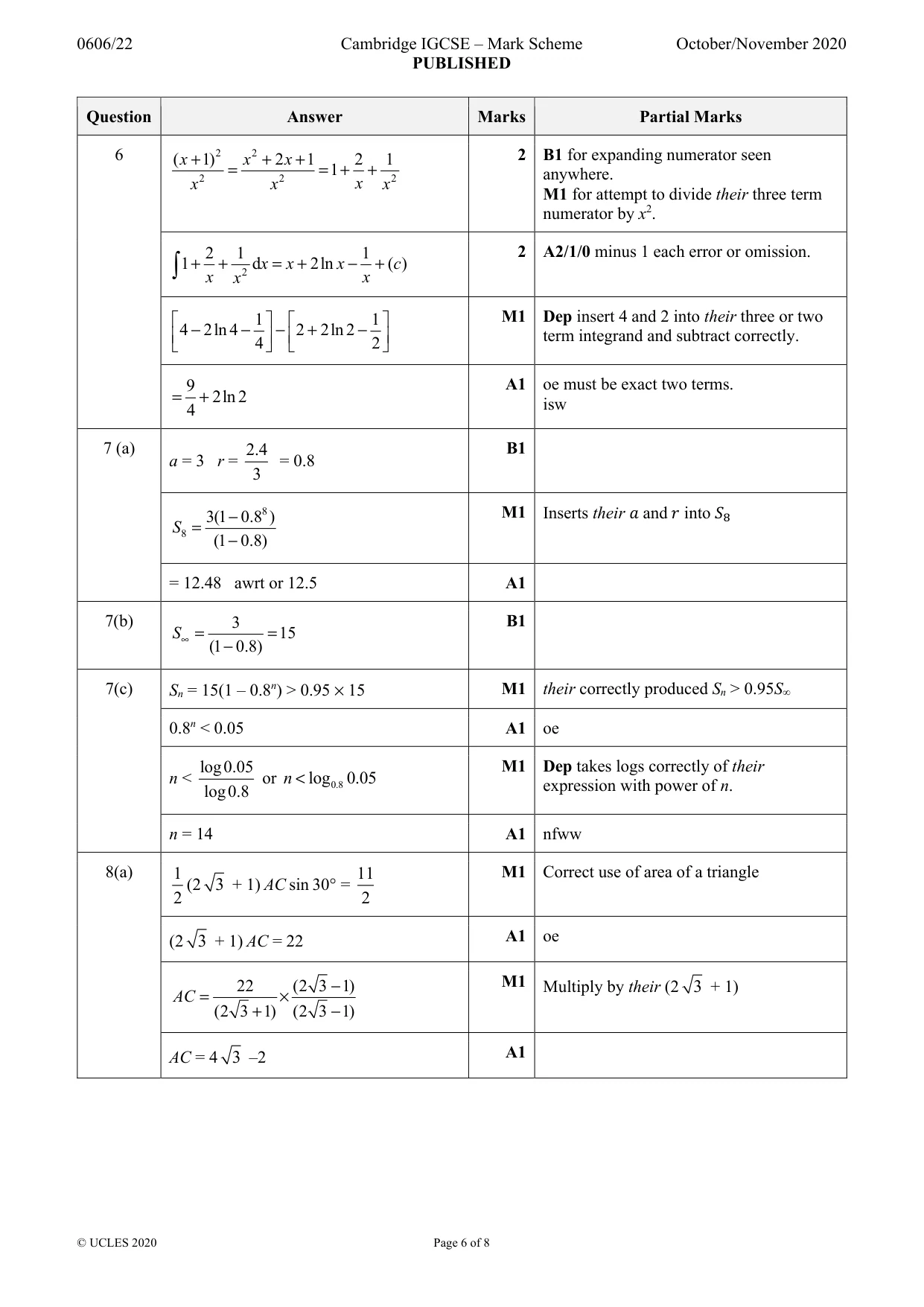
Mark scheme: 7 (a) 2.4 B1 a = 3 r = = 0.8 3 3(1 − 0.88 ) M1 Inserts their ܽ and ݎ into ଼ܵ S 8 = (1 − 0.8) = 12.48 awrt or 12.5 A1 7(b) 3 B1 S∞= = 15 (1 − 0.8) 7(c) Sn = 15(1 – 0.8n) > 0.95 × 15 M1 their correctly produced Sn > 0.95S∞ 0.8n < 0.05 A1 oe log0.05 M1 Dep takes logs correctly of their n < or n < log 0.8 0.05 expression with power of n. log0.8 n = 14 A1 nfww
More questions on Use the formulas for the nth term and for the
Q8 · DO NOT USE A CALCULATOR IN THIS QUESTION
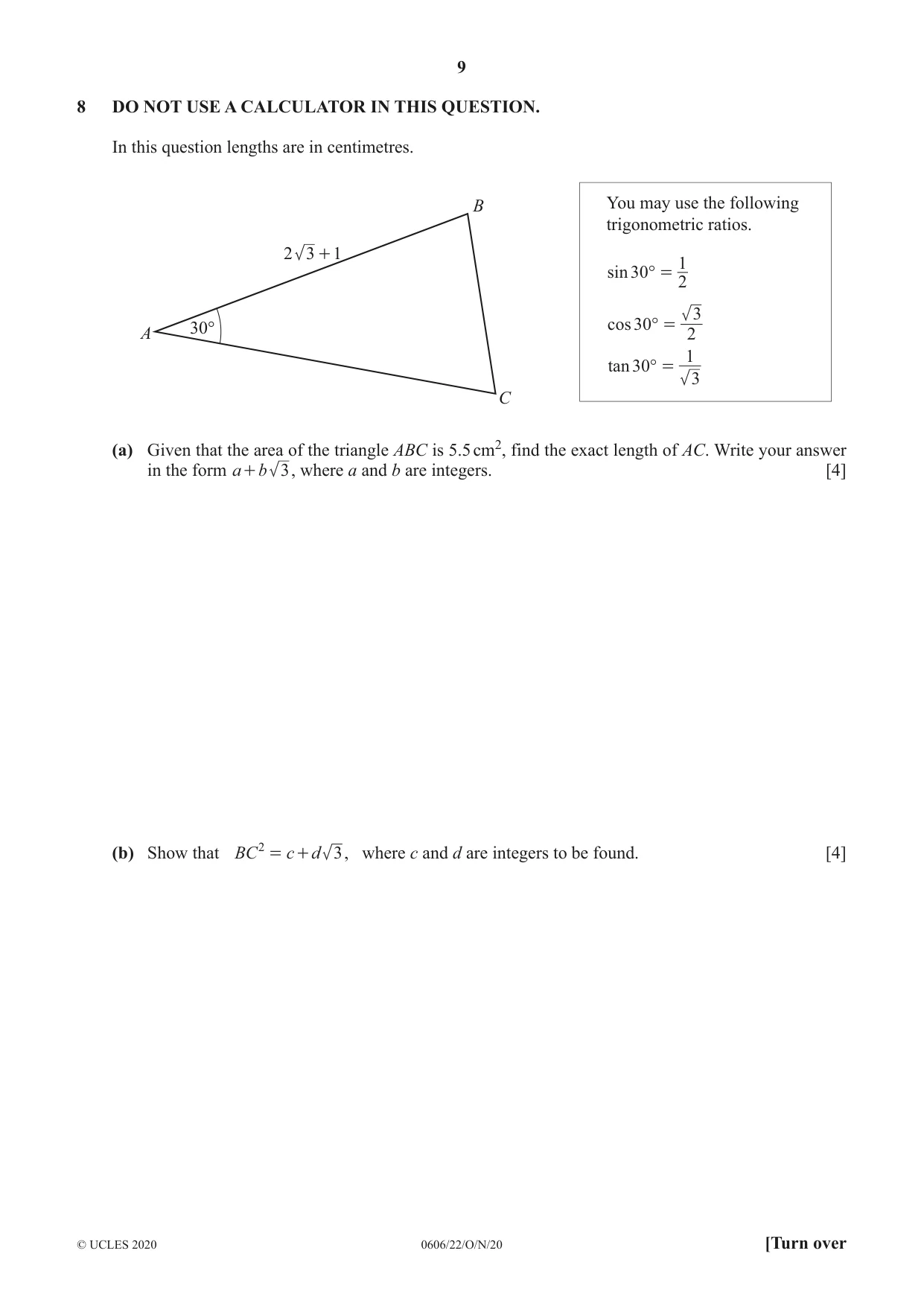
8 DO NOT USE A CALCULATOR IN THIS QUESTION. In this question lengths are in centimetres. B You may use the following trigonometric ratios. 2 3 + 1 1 sin30° = 2 3 30° cos30 ° = A 2 1 tan30° = 3 C (a) Given that the area of the triangle ABC is 5.5 cm2, find the exact length of AC. Write your answer in the form a + b 3 , where a and b are integers. [4] (b) Show that BC 2 = c + d 3 , where c and d are integers to be found. [4]
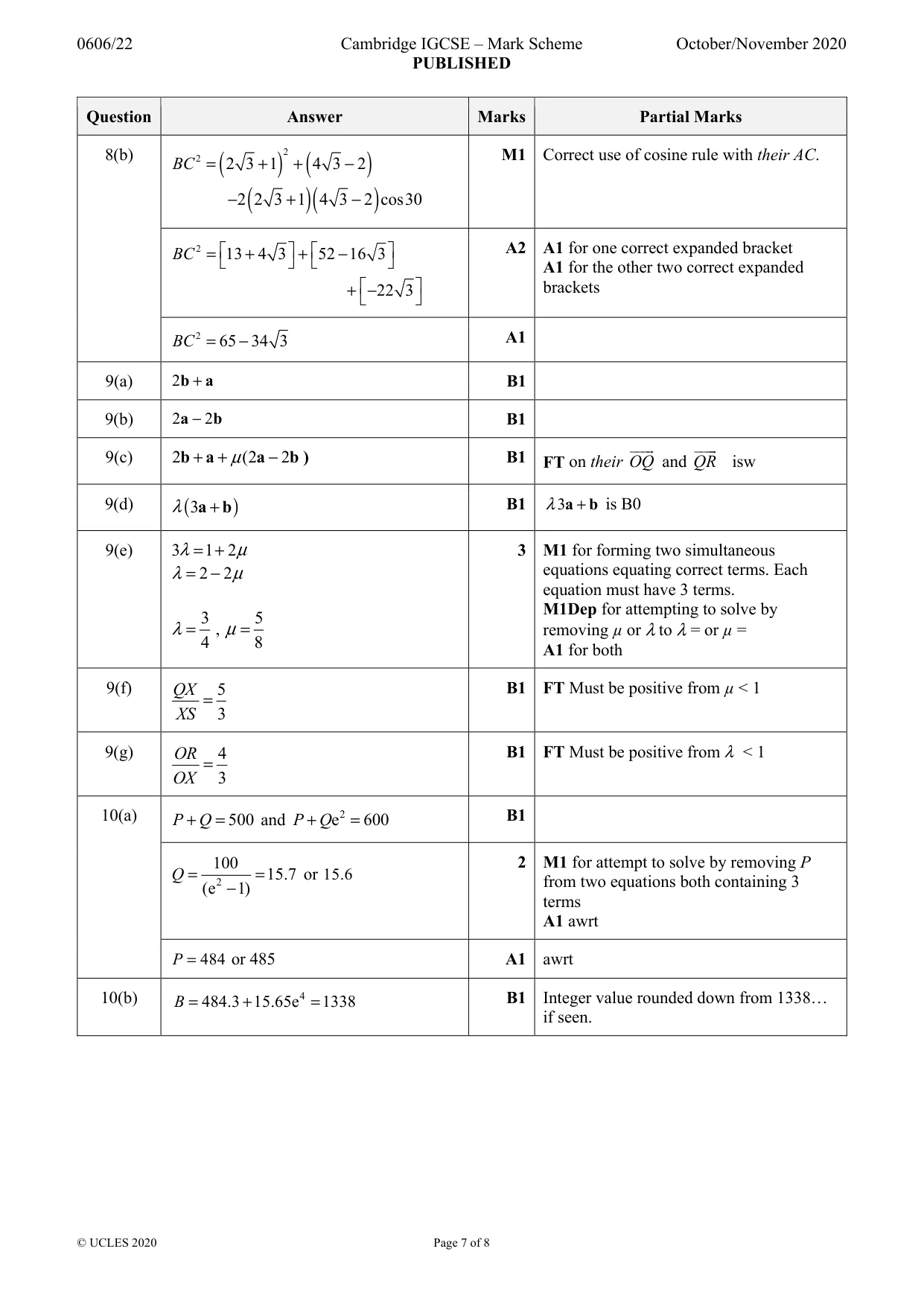
Mark scheme: 8(a) 1 11 M1 Correct use of area of a triangle (2 3 + 1) AC sin 30° = 2 2 (2 3 + 1) AC = 22 A1 oe 22 (2 3 − 1) M1 Multiply by their (2 3 + 1) AC = × (2 3 + 1) (2 3 − 1) AC = 4 3 –2 A1 8(b) 2 2 M1 Correct use of cosine rule with their AC. BC = 2 3 + 1 + 4 3 − 2 ( ) ( ) −2 2 3 + 1 4 3 − 2 cos30 ( )( ) BC 2 = 13 + 4 3 + 52 − 16 3 A2 A1 for one correct expanded bracket A1 for the other two correct expanded + − 22 3 brackets BC 2 = 65 − 34 3 A1
More questions on Know and use the six trigonometric functions
Q9 · P a Q 2b R X b O S 3a In the diagram OP = 2b , O S = 3a , SR = b and PQ = a
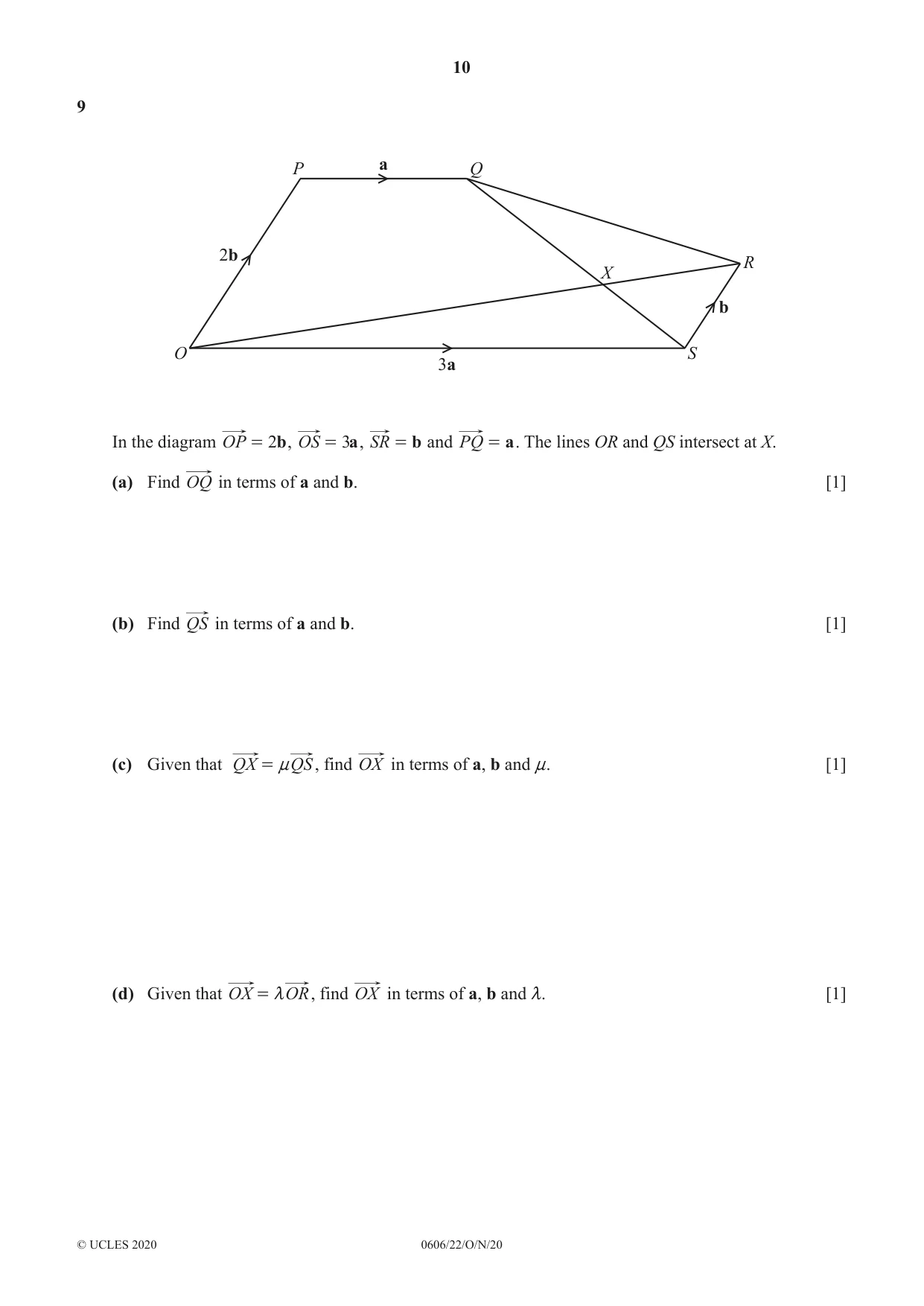
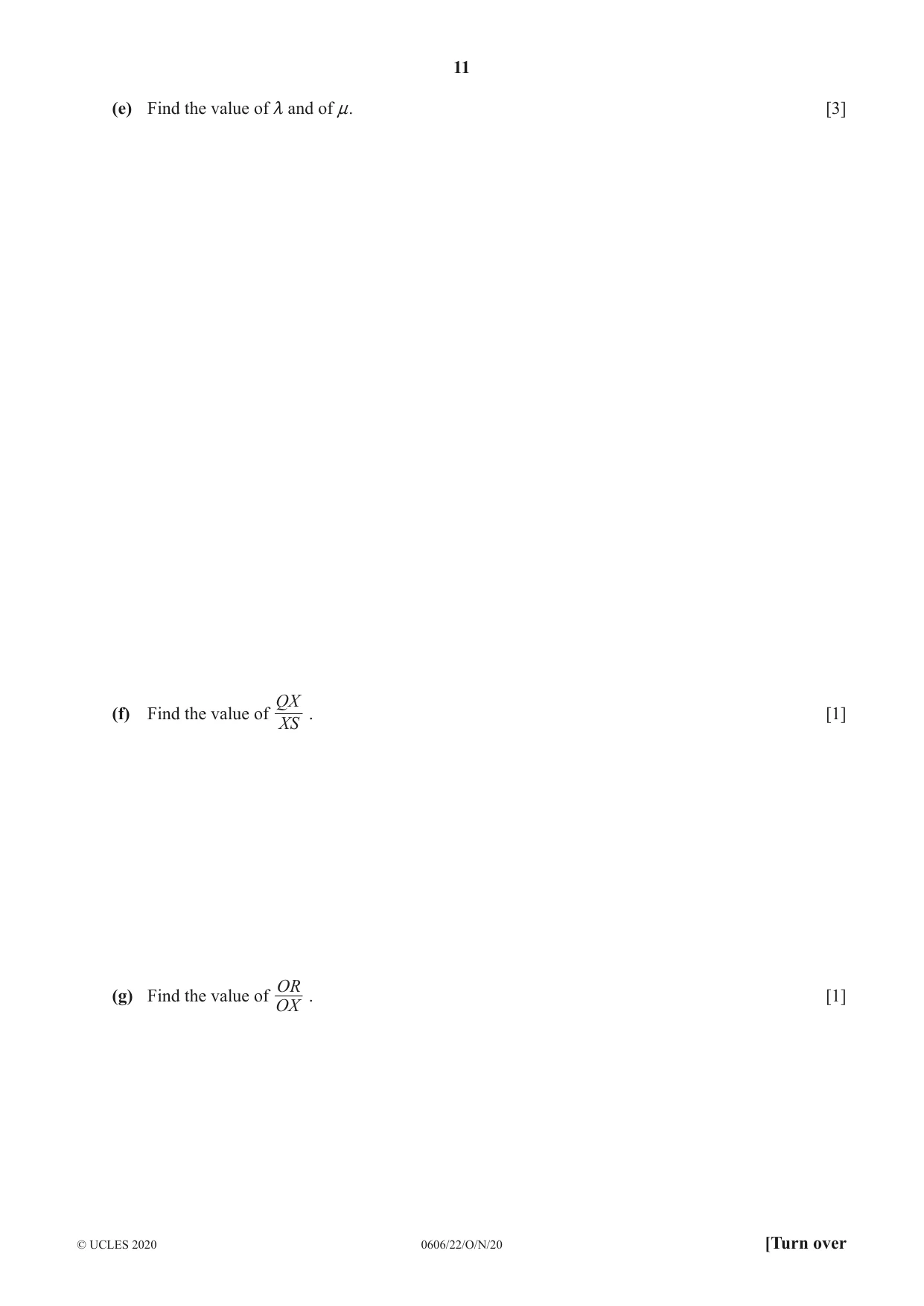
9 P a Q 2b R X b O S 3a In the diagram OP = 2b , O S = 3a , SR = b and PQ = a . The lines OR and QS intersect at X. (a) Find OQ in terms of a and b. [1] (b) Find Q S in terms of a and b. [1] (c) Given that QX = n Q S , find OX in terms of a, b and n. [1] (d) Given that OX = m OR , find OX in terms of a, b and m. [1] (e) Find the value of m and of n. [3] QX (f) Find the value of . [1] X S OR(g) Find the value of . [1] OX
Mark scheme: 9(a) 2 b + a B1 9(b) 2 a − 2 b B1 9(c) 2b + a + μ(2a − 2b ) B1 FT on their OQ and QR isw 9(d) λ( 3a + b ) B1 λ3a + b is B0 9(e) 3λ = 1 + 2μ 3 M1 for forming two simultaneous λ = 2 − 2μ equations equating correct terms. Each equation must have 3 terms. M1Dep for attempting to solve by 3 5 λ= , μ = removing µ or λto λ = or µ = 4 8 A1 for both 9(f) QX 5 B1 FT Must be positive from µ < 1 = XS 3 9(g) OR 4 B1 FT Must be positive from λ < 1 = OX 3
Q10 · The number, b, of bacteria in a sample is given by b = P + Q e t2 , where P and Q are…
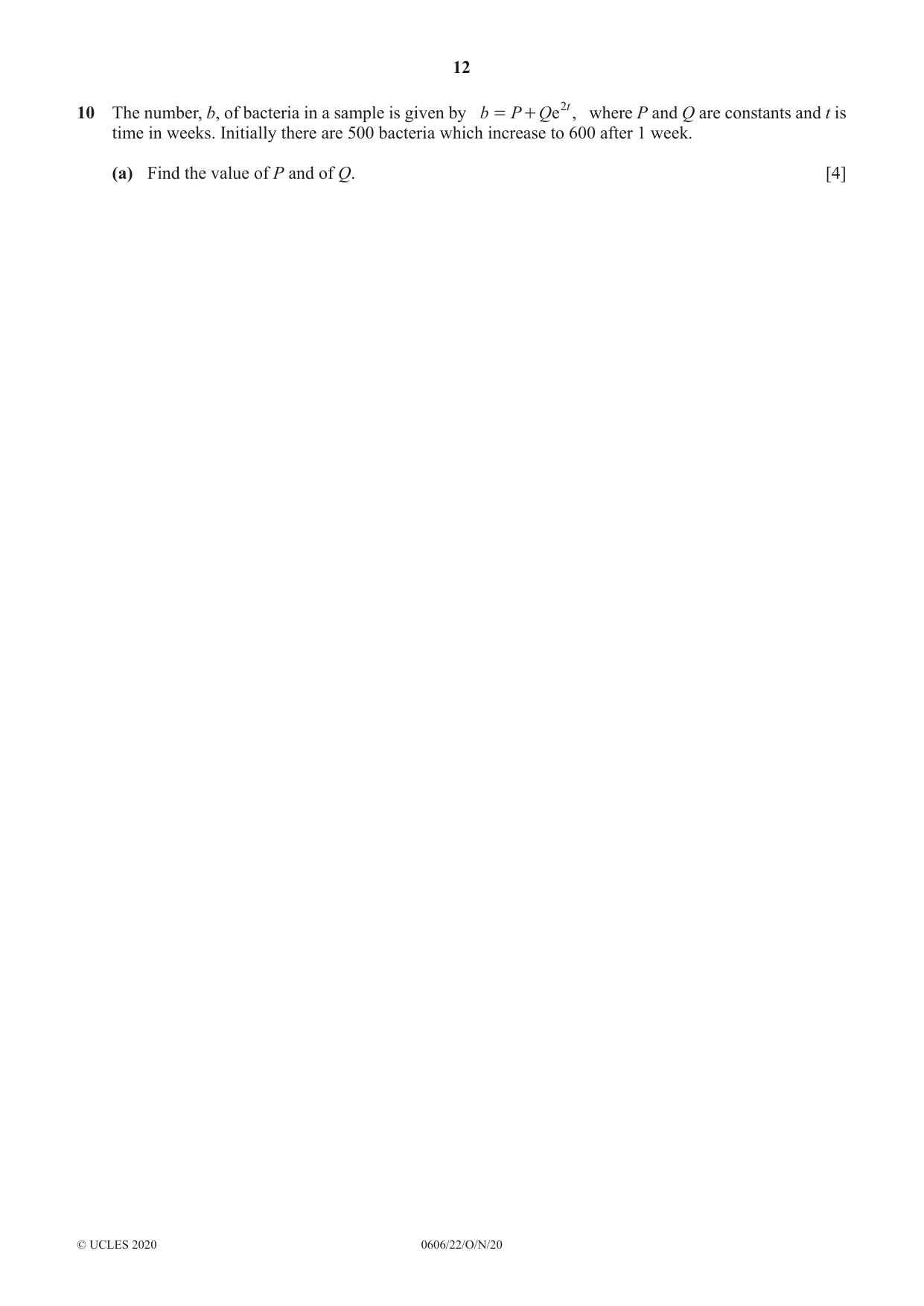
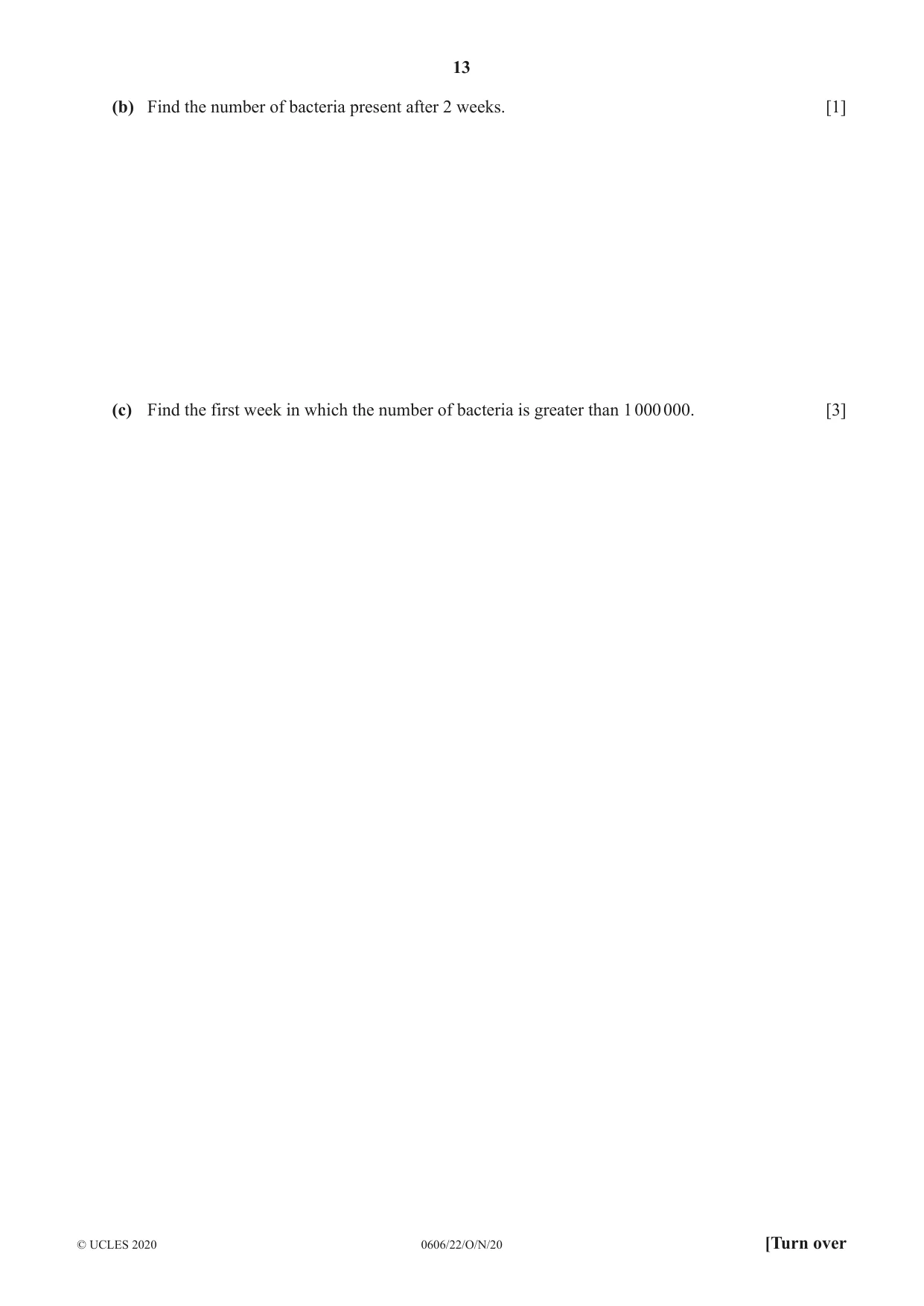
10 The number, b, of bacteria in a sample is given by b = P + Q e t2 , where P and Q are constants and t is time in weeks. Initially there are 500 bacteria which increase to 600 after 1 week. (a) Find the value of P and of Q. [4] (b) Find the number of bacteria present after 2 weeks. [1] (c) Find the first week in which the number of bacteria is greater than 1 000 000. [3]
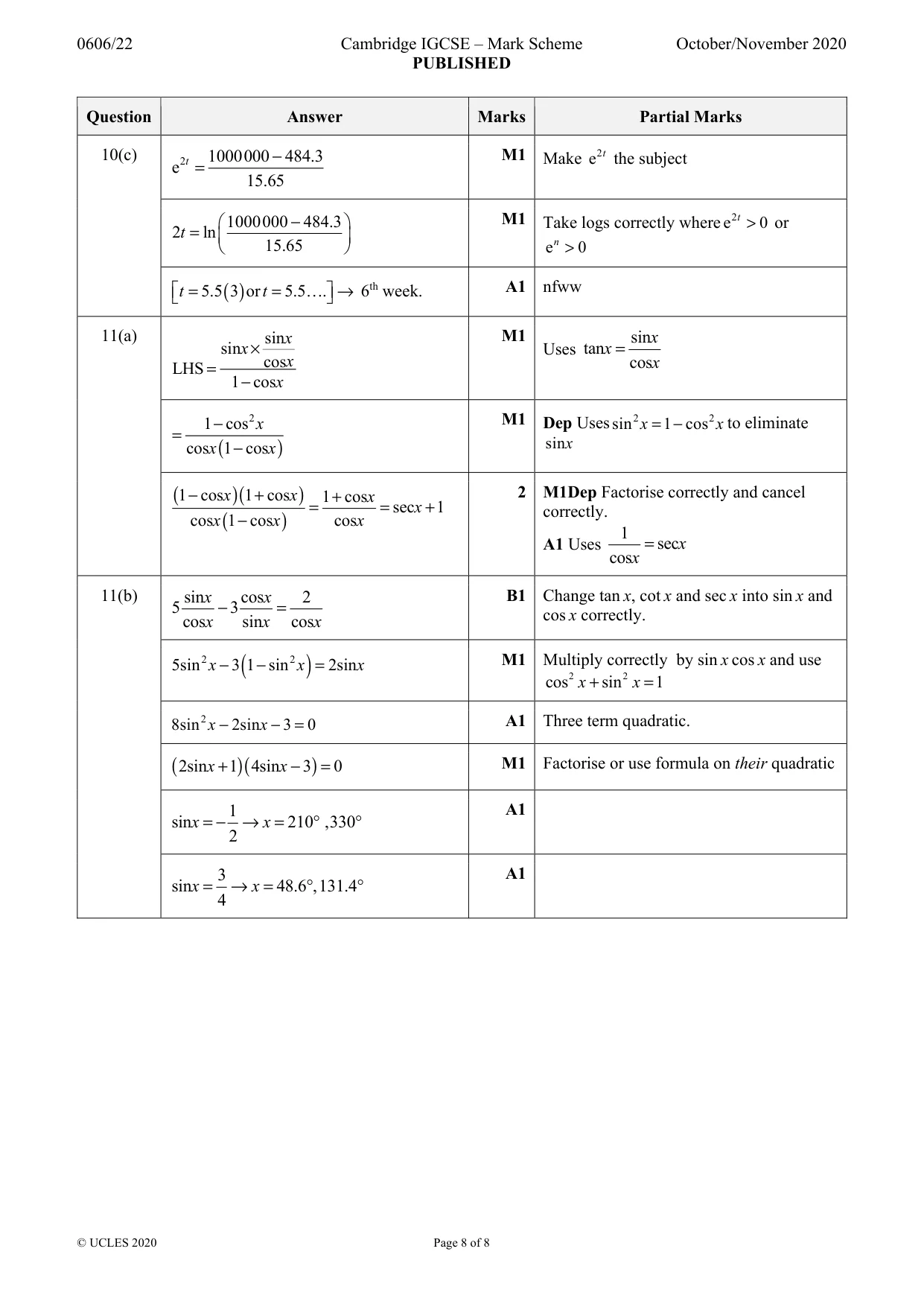
Mark scheme: 10(a) P + Q = 500 and P + Q2e = 600 B1 100 2 M1 for attempt to solve by removing P Q = = 15.7 or 15.6 2 from two equations both containing 3 (e − 1) terms A1 awrt P = 484 or 485 A1 awrt 10(b) B = 484.3 + 15.65e 4 = 1338 B1 Integer value rounded down from 1338… if seen. 10(c) 2 t 1 000 000 − 484.3 M1 Make e 2 t the subject e = 15.65 1 000 000 − 484.3 M1 Take logs correctly where e 2 t > 0 or 2t = ln n 15.65 e > 0 =t 5.5 ( 3 ) or t = 5.5 ….→ 6th week. A1 nfww
Q11 · Solve the equation 5 tan x - 3 cot x = 2 sec x for 0° G x G 360 °
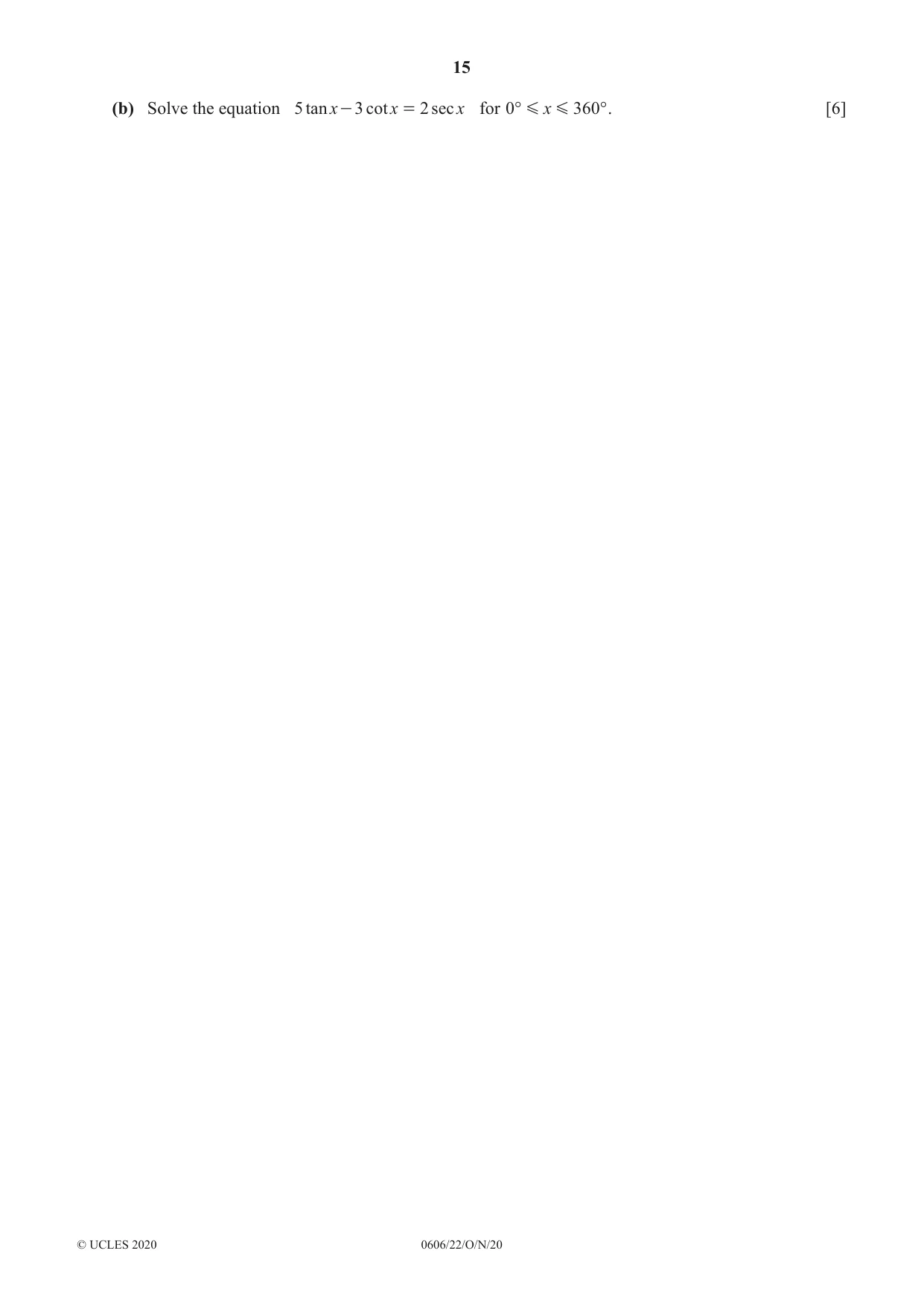
(b) Solve the equation 5 tan x - 3 cot x = 2 sec x for 0° G x G 360 ° . [6]
Mark scheme: 11(a) sinx M1 sinx sinx × Uses tanx = cosx cosx LHS = 1 − cosx 1 − cos 2 x M1 Dep Uses sin 2 x = 1 − cos 2 x to eliminate = cos x (1 − cosx ) sinx (1 − cos x )(1 + cosx ) 1 + cosx 2 M1Dep Factorise correctly and cancel = = secx + 1 correctly. cos x (1 − cosx ) cosx 1 A1 Uses = secx cosx 11(b) sinx cosx 2 B1 Change tan x, cot x and sec x into sin x and 5 − 3 = cos x correctly. cosx sinx cosx 2 2 M1 Multiply correctly by sin x cos x and use 5sin x − 3 1 − sin x = 2sin x ( ) 2 2 cos x + sin x = 1 8sin 2 x − 2sin x − 3 = 0 A1 Three term quadratic. ( 2sinx + 1)( 4sinx − 3 ) = 0 M1 Factorise or use formula on their quadratic 1 A1 sinx = − → x = 210° , 330° 2 3 A1 sinx = → x = 48.6°,131.4° 4
What was in this paper
The subtopics covered by these 9 questions, and how many questions each got. Open one in a new tab to see every Cambridge question on it.
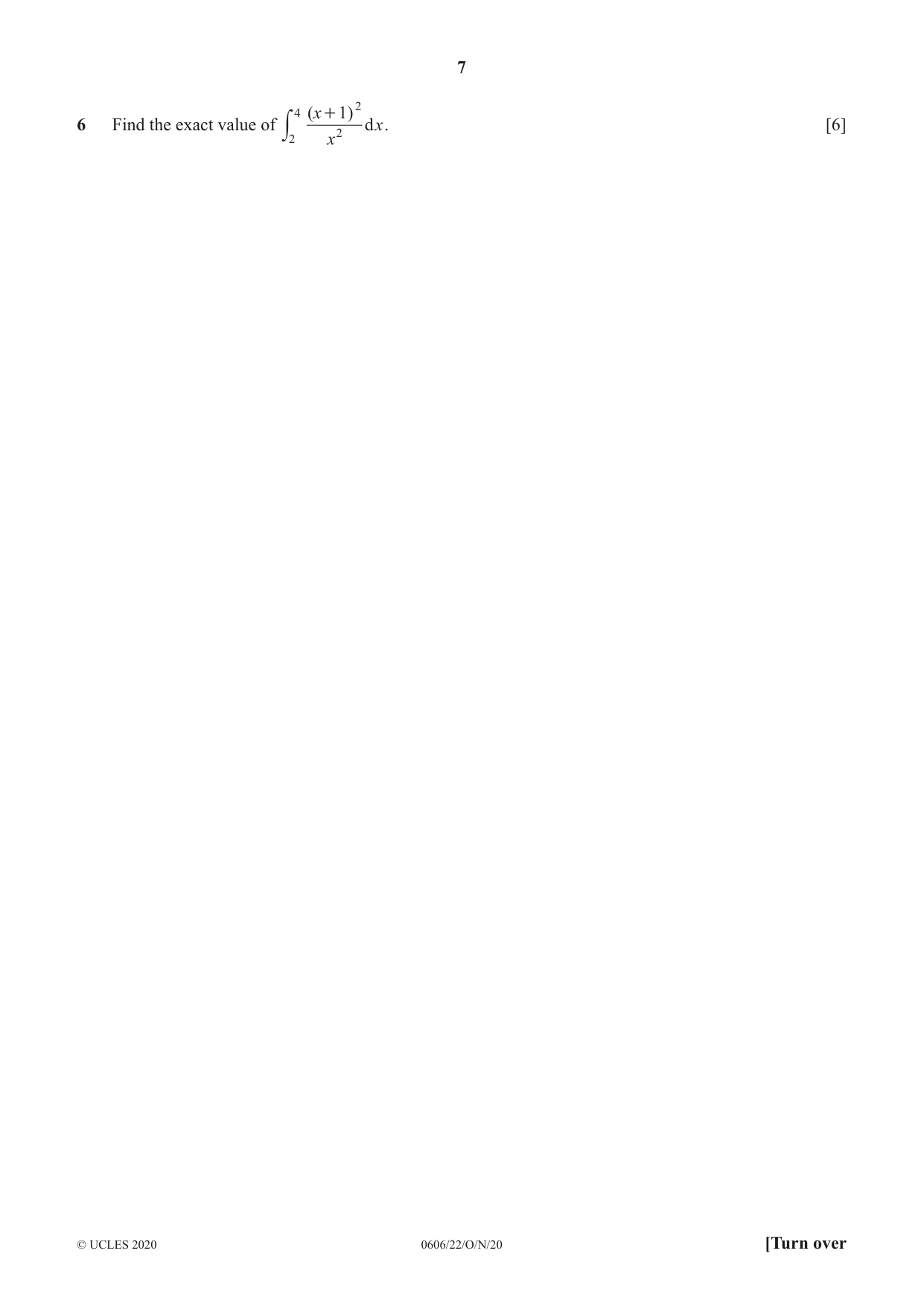
1Find the solution set for quadratic inequalities1Know and use the condition for two lines to1Know and use the laws of logarithms1Know and use the six trigonometric functions1Solve equations of the form ax = b1Solve, for a given domain, trigonometric1Use differentiation to find gradients, tangents1Use the formulas for the nth term and for the1What you needed in this session
Cambridge’s own grade thresholds for 2020 Oct/Nov, Paper 2 · Variant 2. A higher threshold means an easier paper — the bar moves with how the cohort did.