Cambridge IGCSE Mathematics - Additional 0606 — 2020 Feb/March Paper 2 · Variant 2
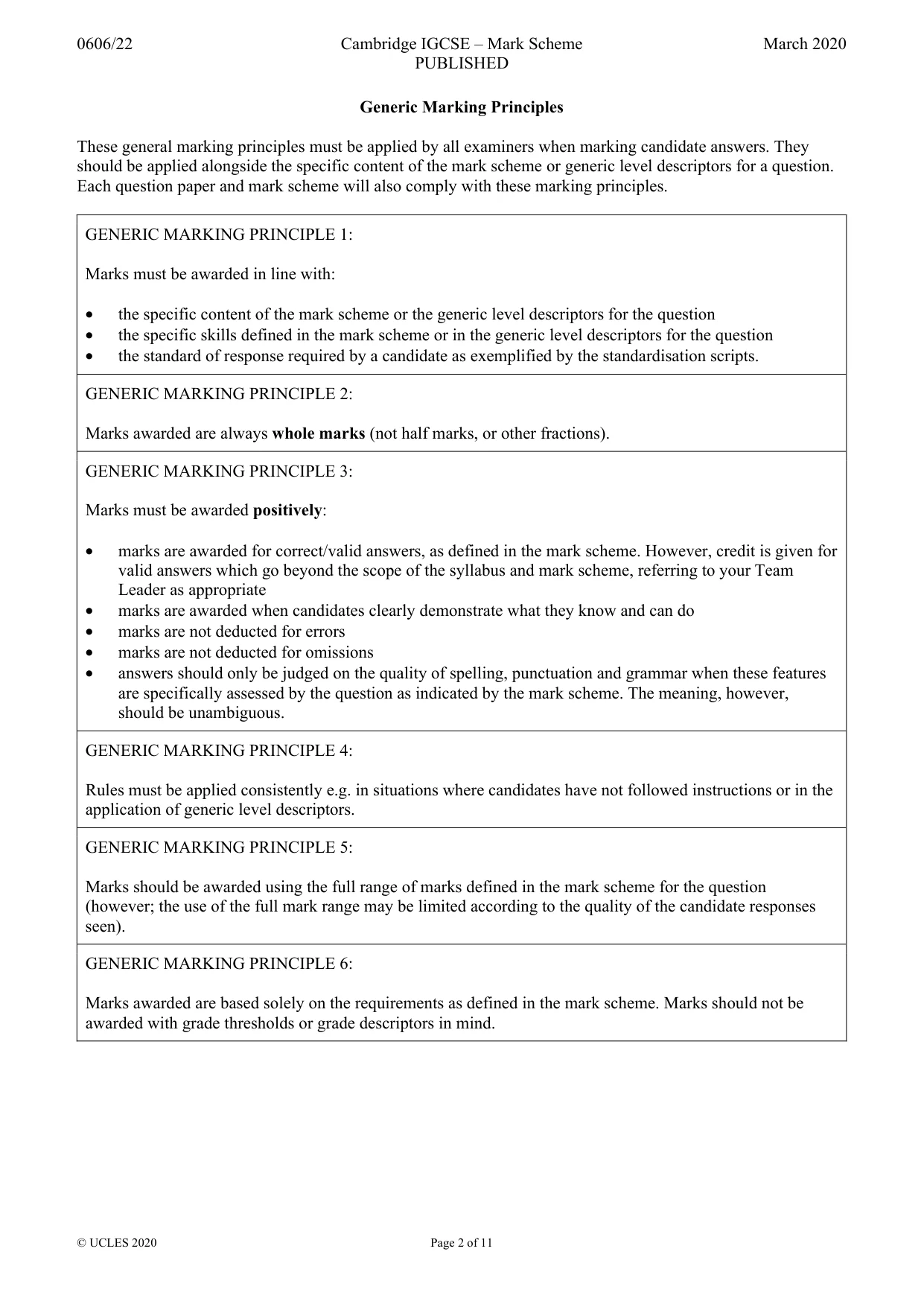
0606/22/F/M/20 · 12 questions · 80 marks · ≈90 min
The question paper and its mark scheme, free to read here and free to download. This is Cambridge’s own paper, exactly as it was sat.
Question paper16 pages

Mark scheme11 pages
Answers below. Sit the paper first if you are practising.
Questions as text
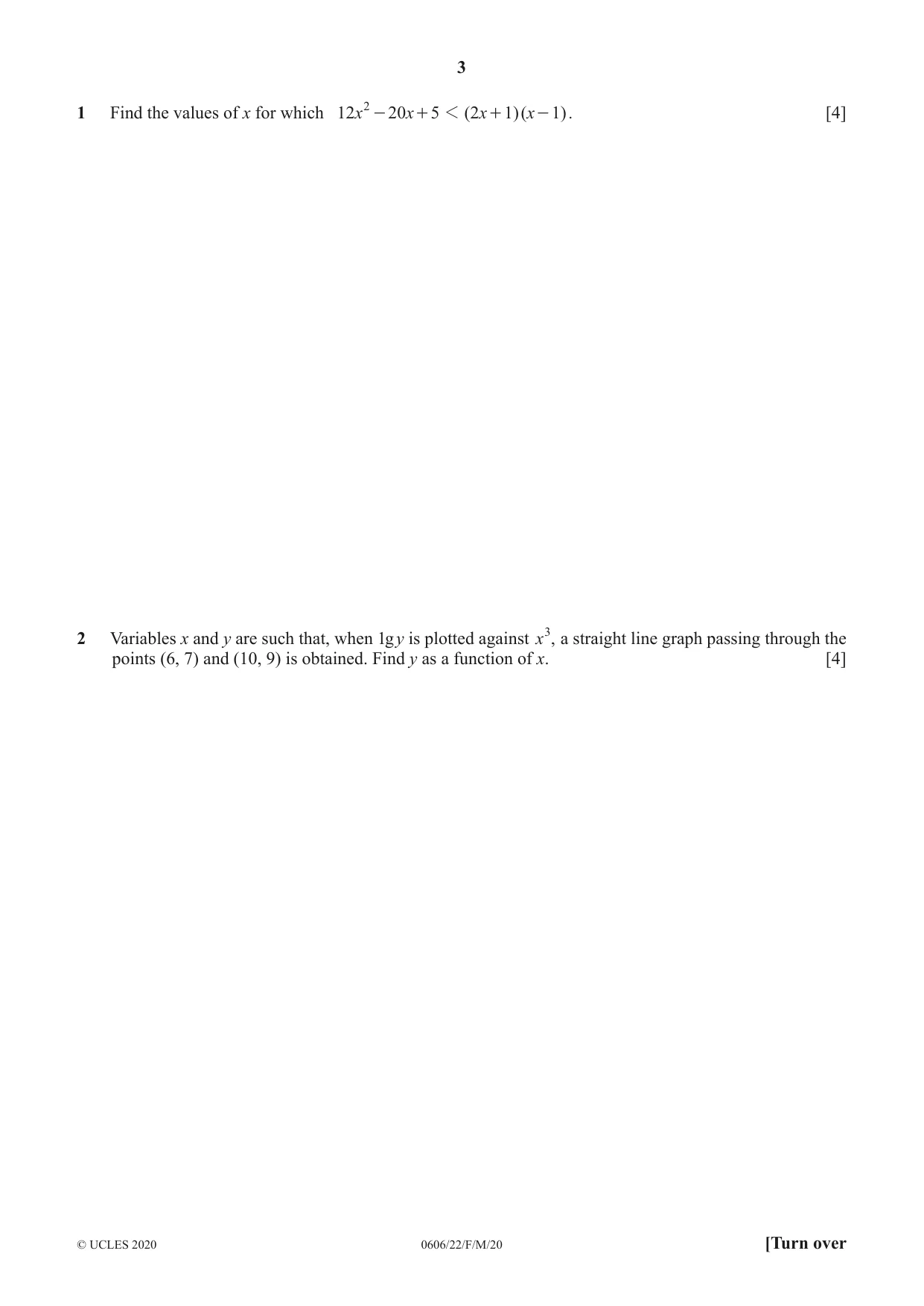
Q1 · Find the values of x for which 12x 2 - 20x + 5 1 ( 2 x + 1)( x - 1)
1 Find the values of x for which 12x 2 - 20x + 5 1 ( 2 x + 1)( x - 1). [4]
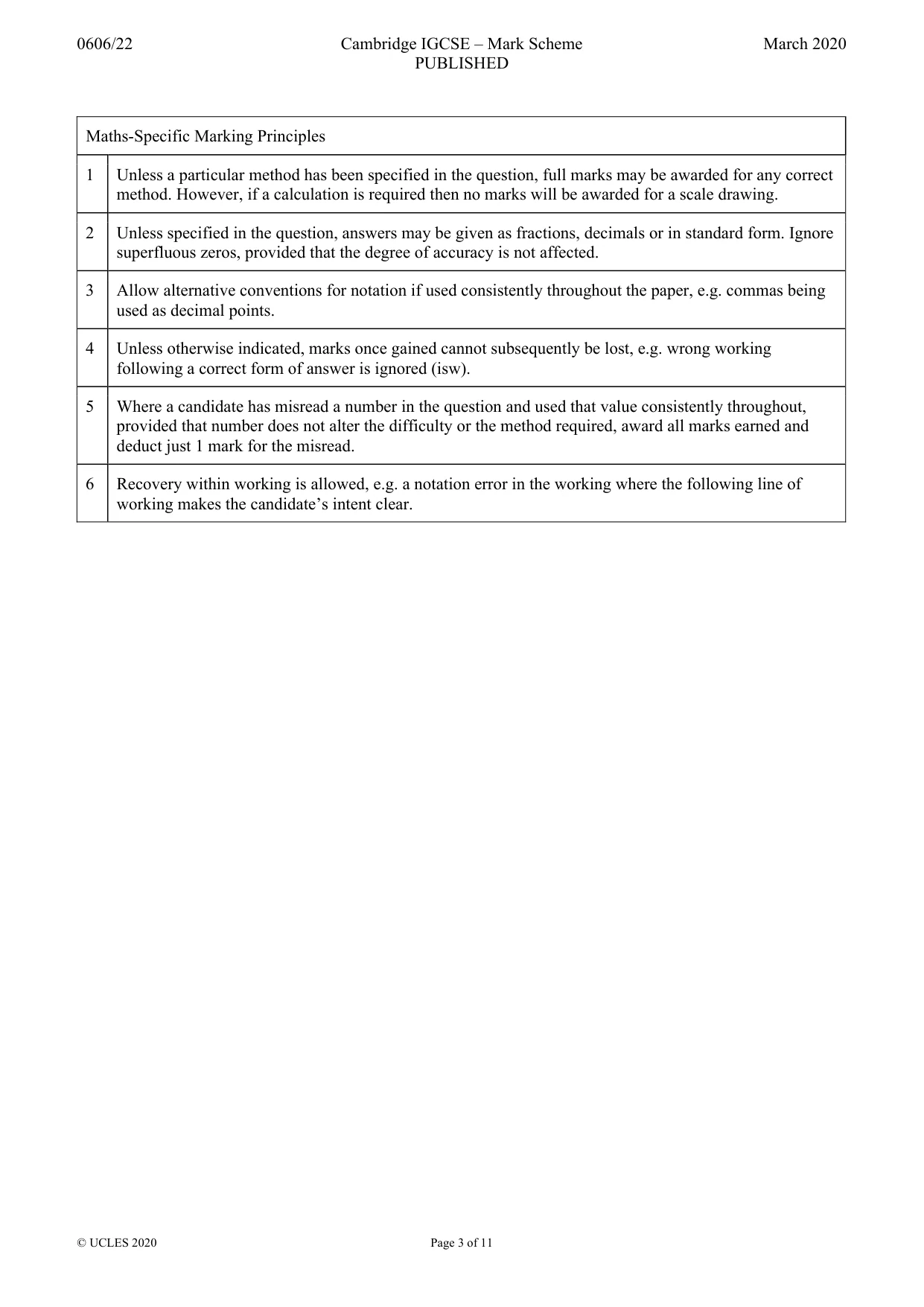
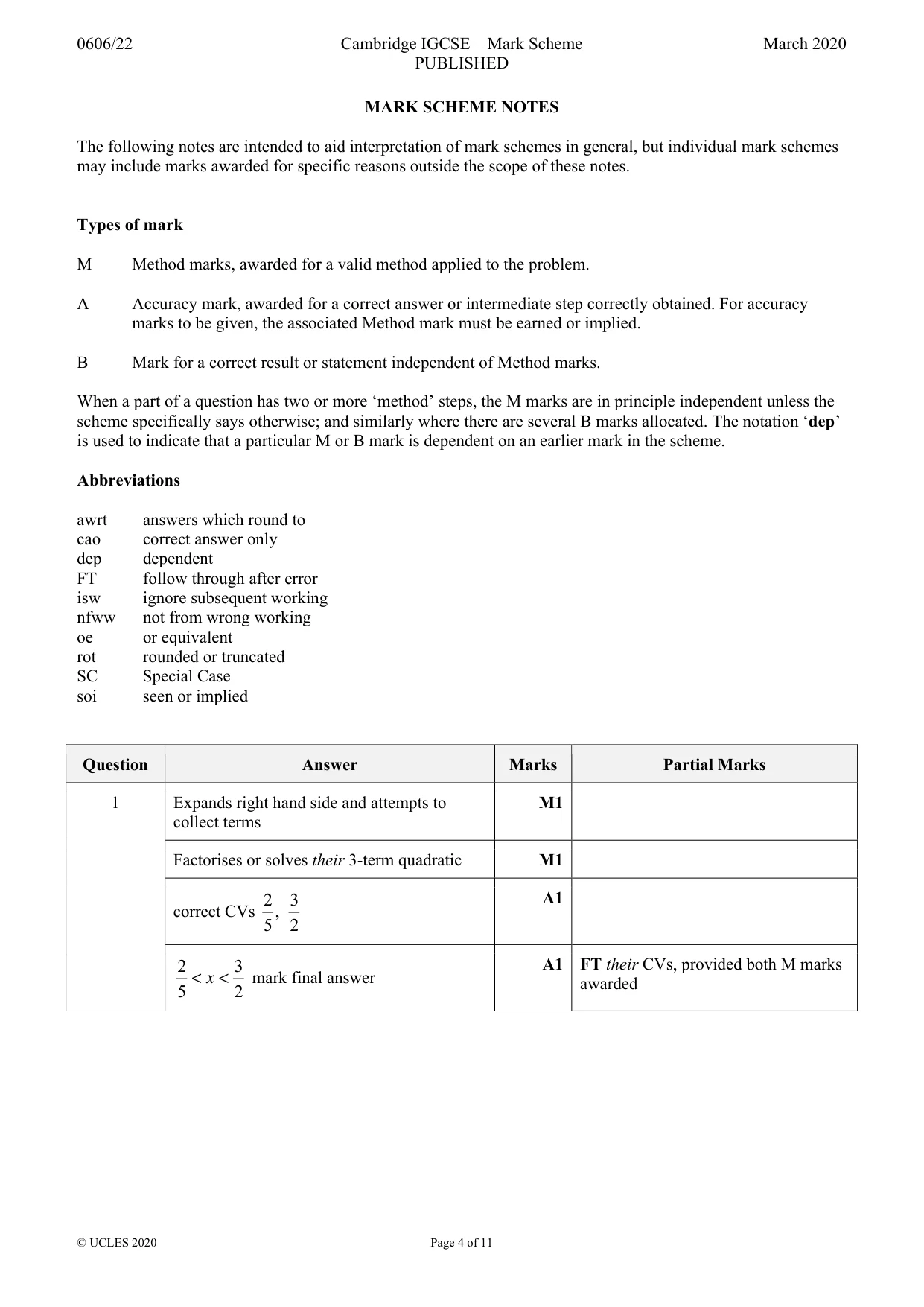
Mark scheme: Question Answer Marks Partial Marks 1 Expands right hand side and attempts to M1 collect terms Factorises or solves their 3-term quadratic M1 2 3 A1 correct CVs , 5 2 2 3 A1 FT their CVs, provided both M marks < x < mark final answer awarded 5 2
More questions on Find the solution set for quadratic inequalities
Q2 · Variables x and y are such that, when 1g y is plotted against x3 , a straight line graph…
2 Variables x and y are such that, when 1g y is plotted against x3 , a straight line graph passing through the points (6, 7) and (10, 9) is obtained. Find y as a function of x. [4]
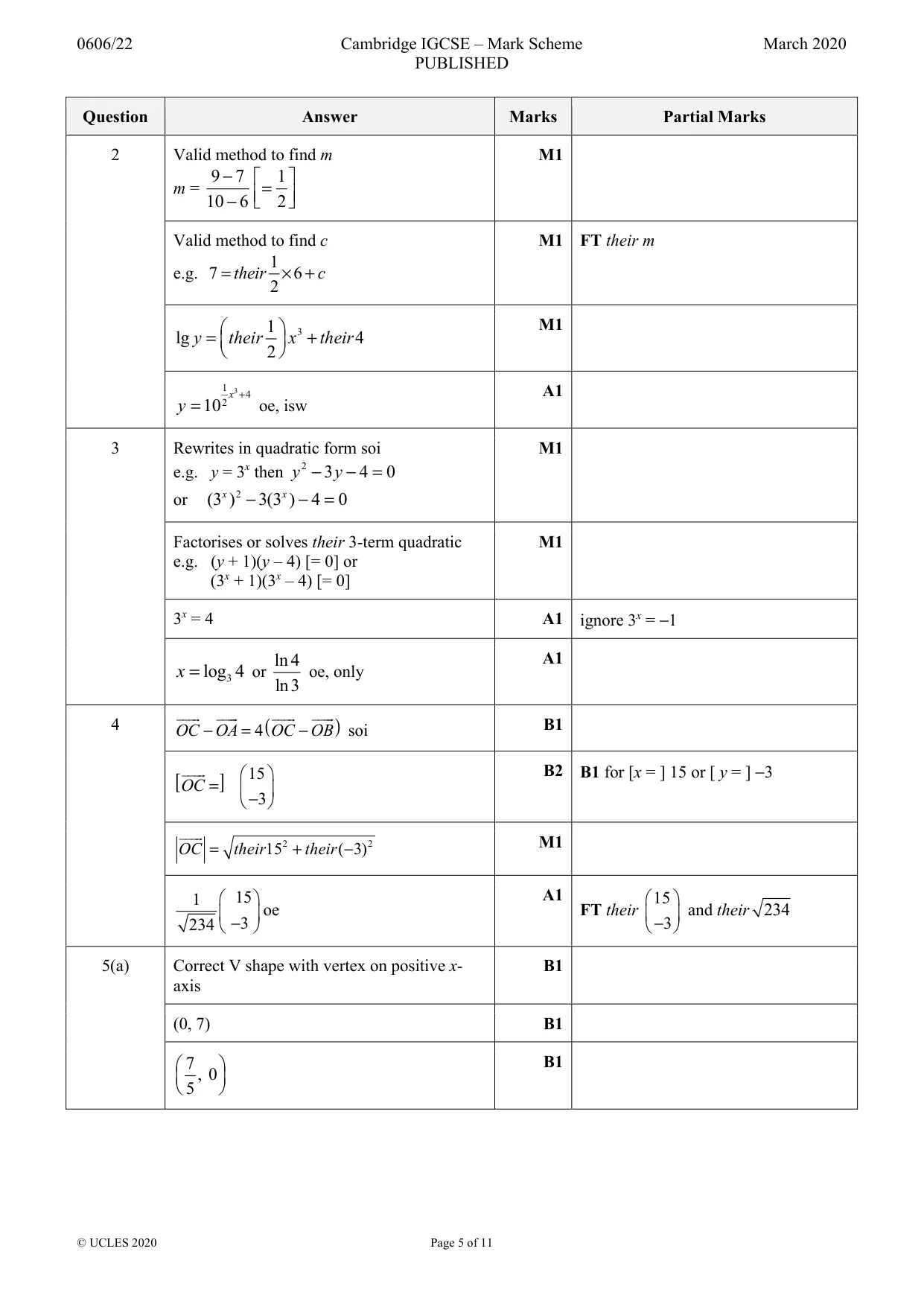
Mark scheme: 2 Valid method to find m M1 9 − 7 1 m = = 10 − 6 2 Valid method to find c M1 FT their m 1 e.g. 7 = their × 6 + c 2 1 3 M1 lg y = their x + their 4 2 1 x 3 + 4 A1 y = 10 2 oe, isw
Q3 · Find the exact solution of 3 2 x - 3 x + 1 - 4 = 0
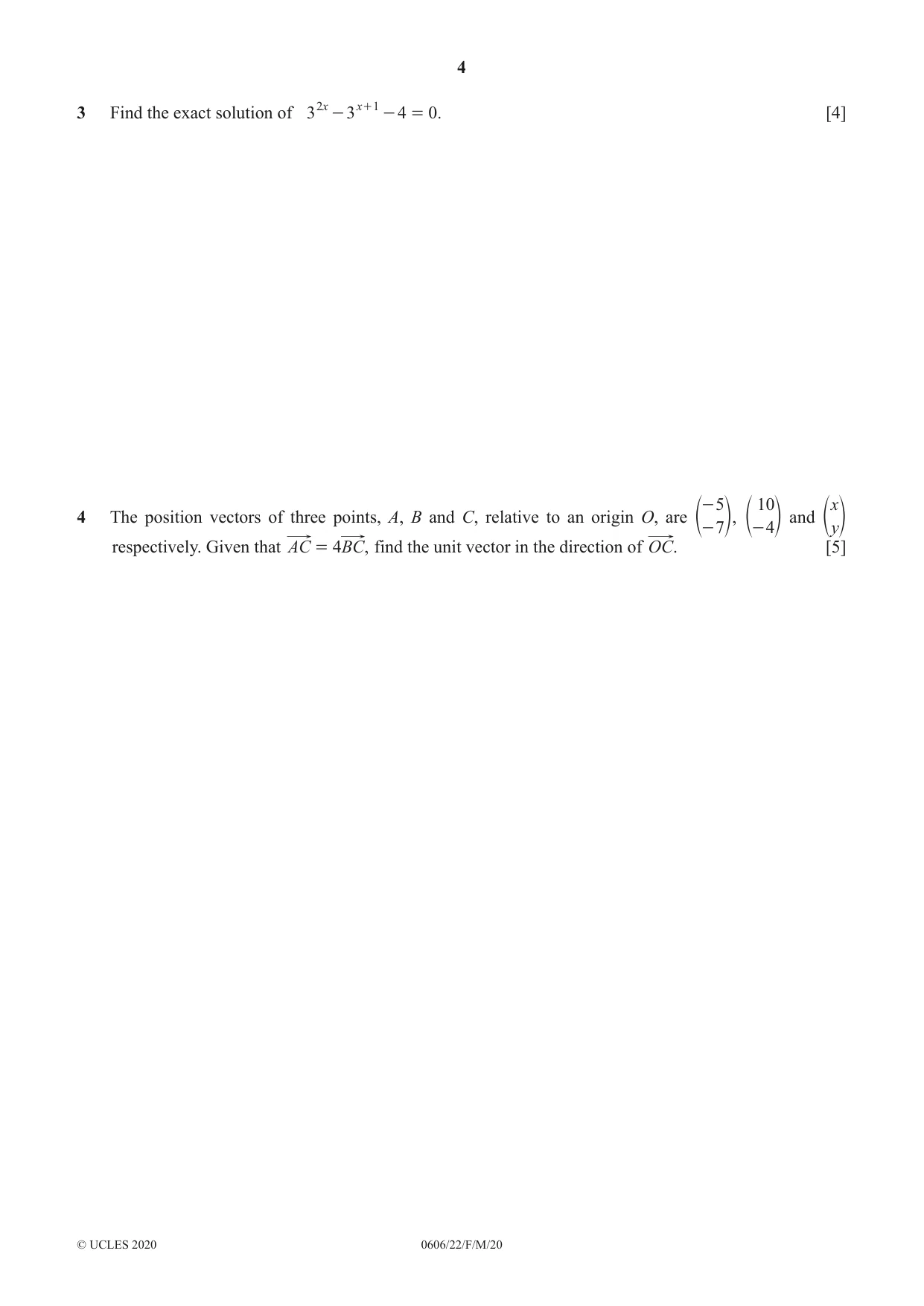
3 Find the exact solution of 3 2 x - 3 x + 1 - 4 = 0. [4]
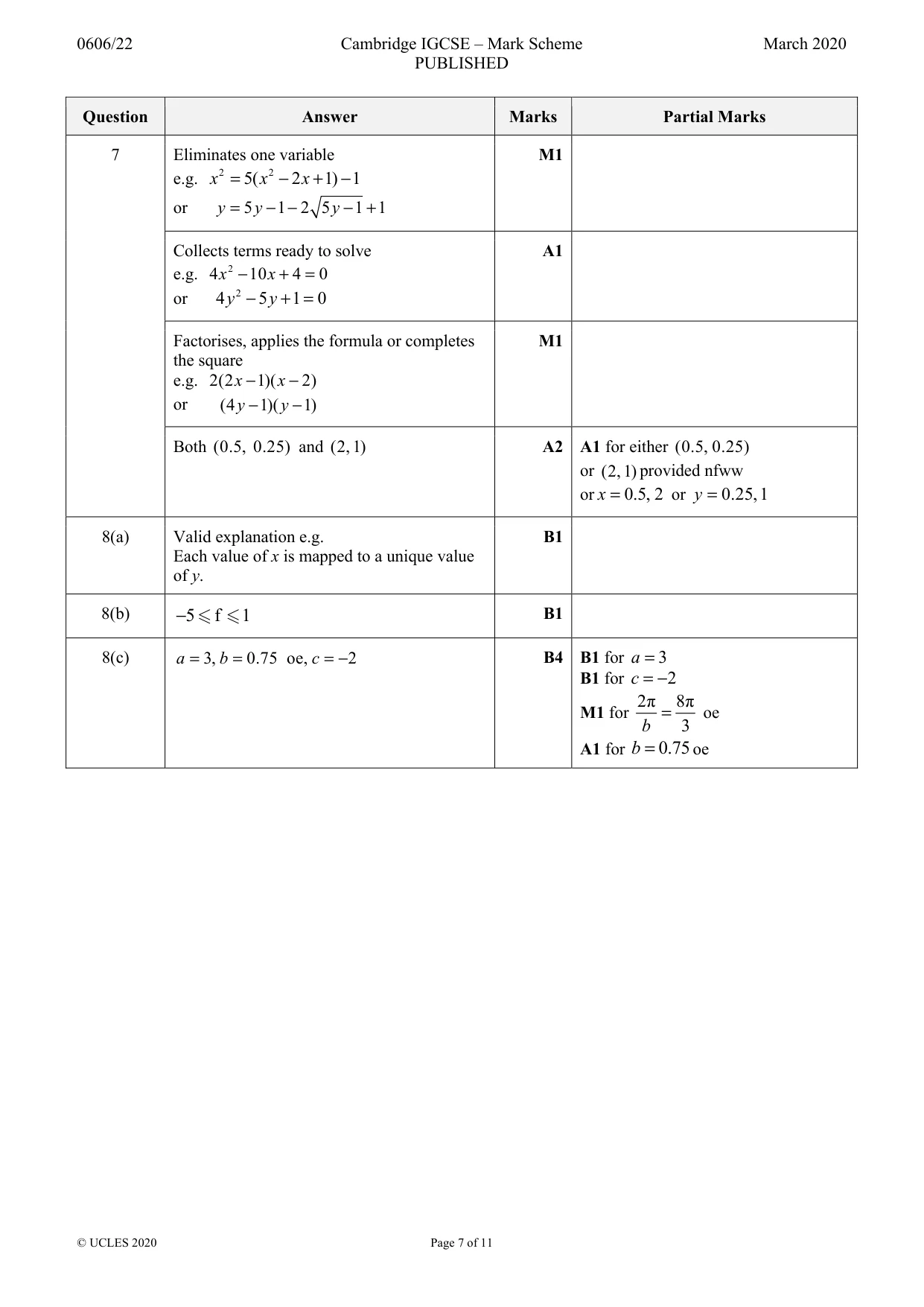
Mark scheme: 3 Rewrites in quadratic form soi M1 e.g. y = 3x then y 2 − 3 y − 4 = 0 or (3 x ) 2 − 3(3 x ) − 4 = 0 Factorises or solves their 3-term quadratic M1 e.g. (y + 1)(y – 4) [= 0] or (3x + 1)(3x – 4) [= 0] 3x = 4 A1 ignore 3x = −1 ln 4 A1 x = log 3 4 or oe, only ln3
More questions on Use substitution to form and solve a quadratic
Q4 · The position vectors of three points, A, B and C, relative to an origin O, are , and - 7…
4 The position vectors of three points, A, B and C, relative to an origin O, are , and - 7 - 4 y respectively. Given that AC = 4BC, find the unit vector in the direction of OC. [5]
Mark scheme: 4 OC − OA = 4 ( OC − OB ) soi B1 15 B2 B1 for [x = ] 15 or [ y = ] −3 [ OC = ] −3 2 2 M1 OC = their15 + their ( − 3) 1 15 A1 15 oe FT their and their 234 234 −3 − 3
Q5 · On the axes below, sketch the graph of y = 5x - 7 , showing the coordinates of the points…
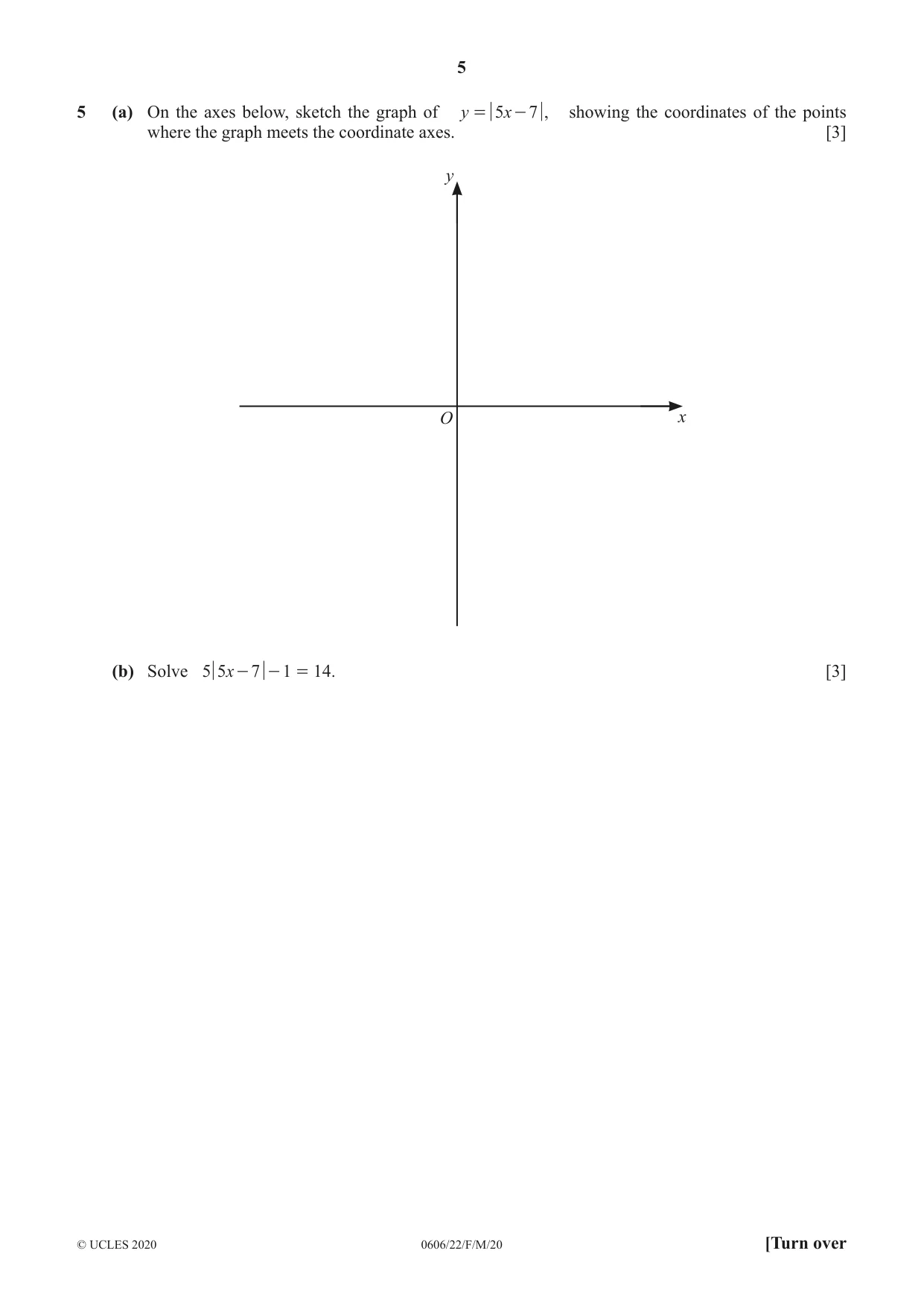
5 (a) On the axes below, sketch the graph of y = 5x - 7 , showing the coordinates of the points where the graph meets the coordinate axes. [3] y O x (b) Solve 5 5x - 7 - 1 = 14 . [3]
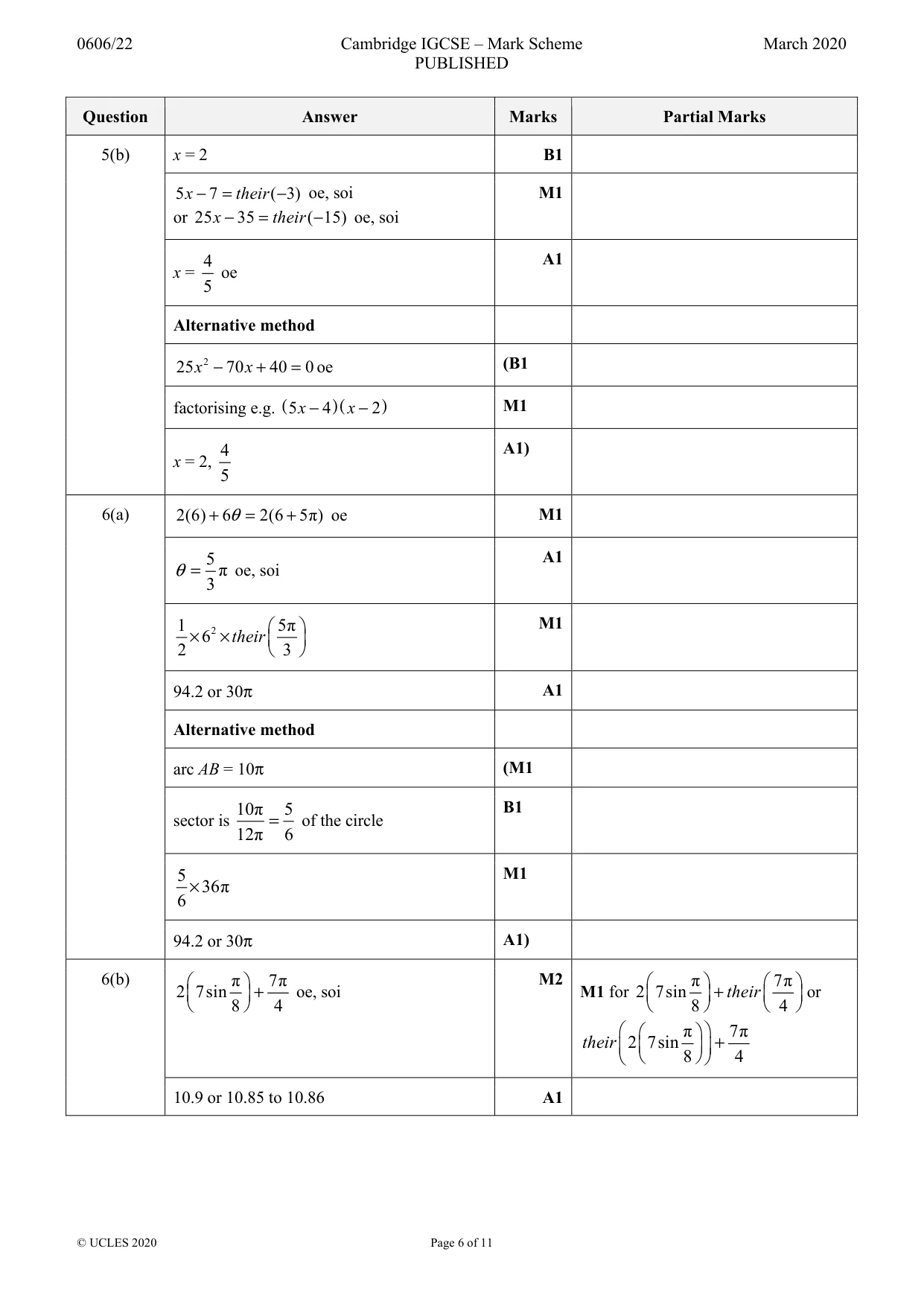
Mark scheme: 5(a) Correct V shape with vertex on positive x- B1 axis (0, 7) B1 7 B1 , 0 5 5(b) x = 2 B1 5 x − 7 = their ( − 3) oe, soi M1 or 25 x − 35 = their ( − 15) oe, soi 4 A1 x = oe 5 Alternative method 25 x 2 − 70 x + 40 = 0 oe (B1 factorising e.g. ( 5 x − 4 )( x − 2 ) M1 4 A1) x = 2, 5
Q6 · A circle has a radius of 6 cm
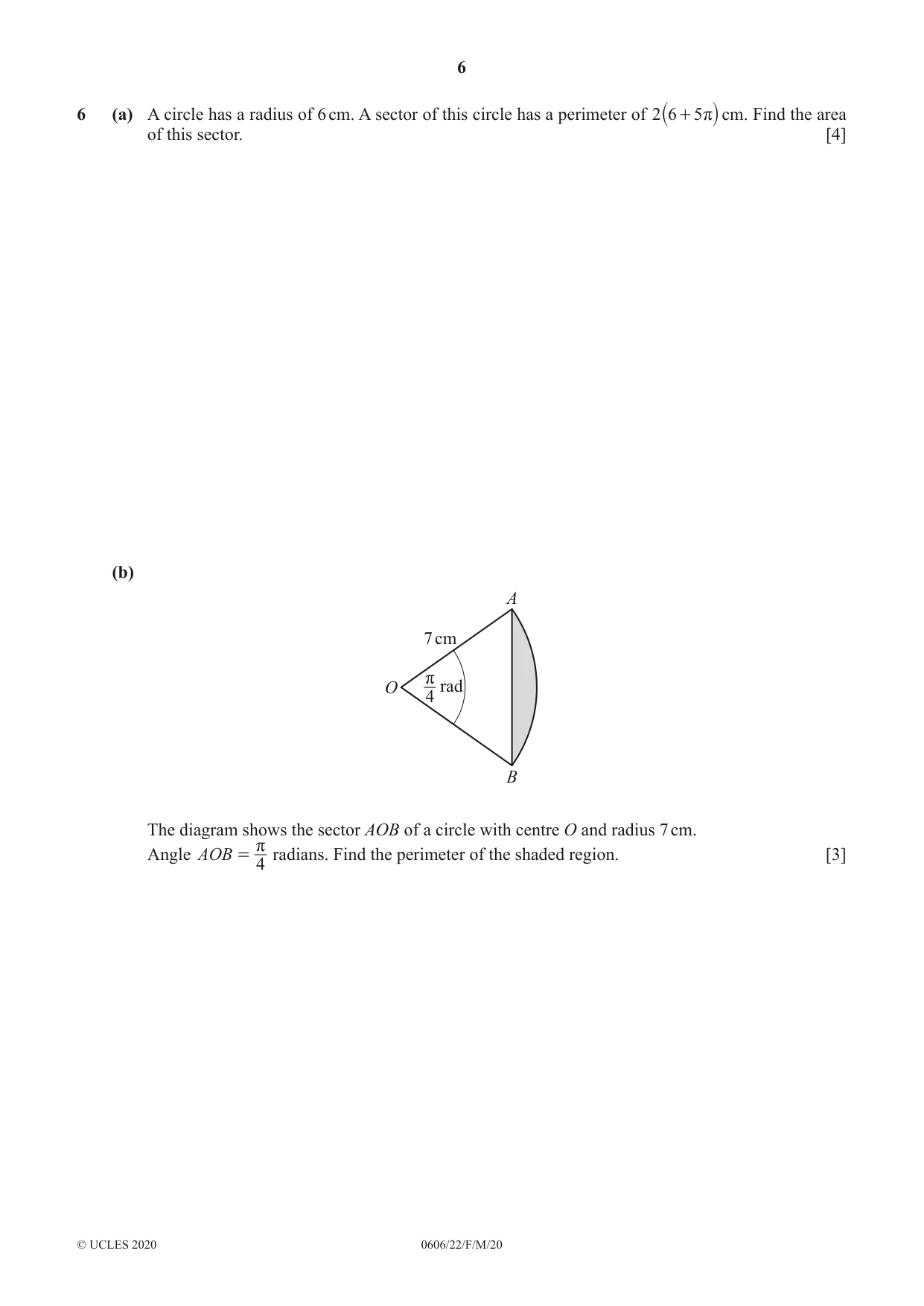
6 (a) A circle has a radius of 6 cm. A sector of this circle has a perimeter of 2 6 + 5r cm. Find the area of this sector. [4] (b) A 7 cm O r rad 4 B The diagram shows the sector AOB of a circle with centre O and radius 7 cm. Angle AOB = r radians. Find the perimeter of the shaded region. [3] 4
Mark scheme: 6(a) 2(6) + 6θ = 2(6 + 5π) oe M1 5 A1 θ = π oe, soi 3 1 2 5π M1 × 6 × their 2 3 94.2 or 30π A1 Alternative method arc AB = 10π (M1 10π 5 B1 sector is = of the circle 12π 6 5 M1 × 36π 6 94.2 or 30π A1) 6(b) π 7π M2 π 7π 2 7sin + oe, soi M1 for 2 7sin + their or 8 4 8 4 their 2 7sin π + 7π 8 4 10.9 or 10.85 to 10.86 A1
More questions on Solve problems involving the arc length and
Q8 · F(x) 2 1 0 x 2r 4r 2r 8r - 1 3 3 3 - 2 - 3 - 4 - 5 - 6 8r The diagram shows the graph of…
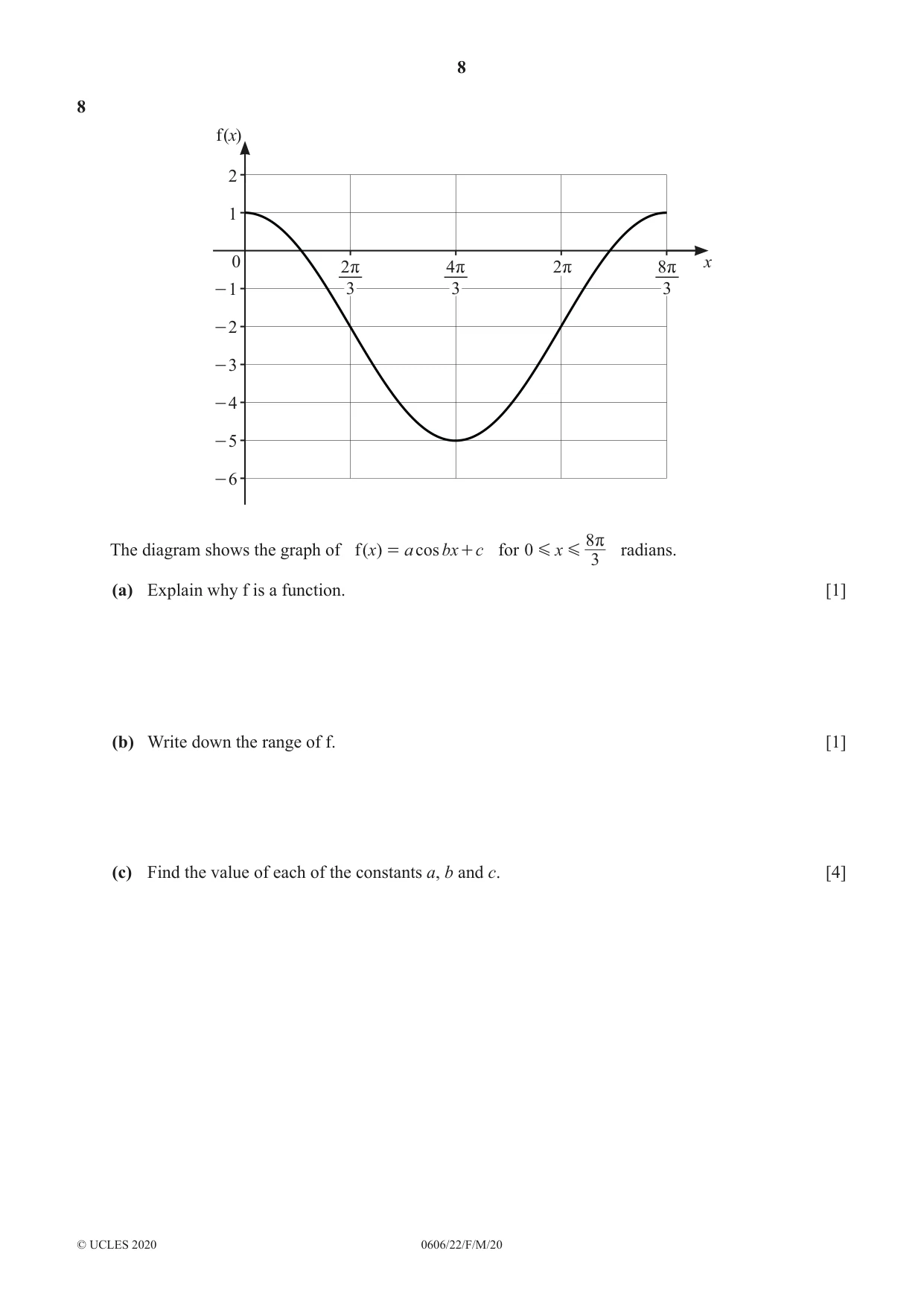
8 f(x) 2 1 0 x 2r 4r 2r 8r - 1 3 3 3 - 2 - 3 - 4 - 5 - 6 8r The diagram shows the graph of f( x) = a cos bx + c for 0 G x G radians. 3 (a) Explain why f is a function. [1] (b) Write down the range of f. [1] (c) Find the value of each of the constants a, b and c. [4]
Mark scheme: 8(a) Valid explanation e.g. B1 Each value of x is mapped to a unique value of y. 8(b) −5 f 1 B1 8(c) a = 3, b = 0.75 oe, c = − 2 B4 B1 for a = 3 B1 for c = −2 2π 8π M1 for = oe b 3 A1 for b = 0.75 oe
Q9 · Variables x and y are such that y =
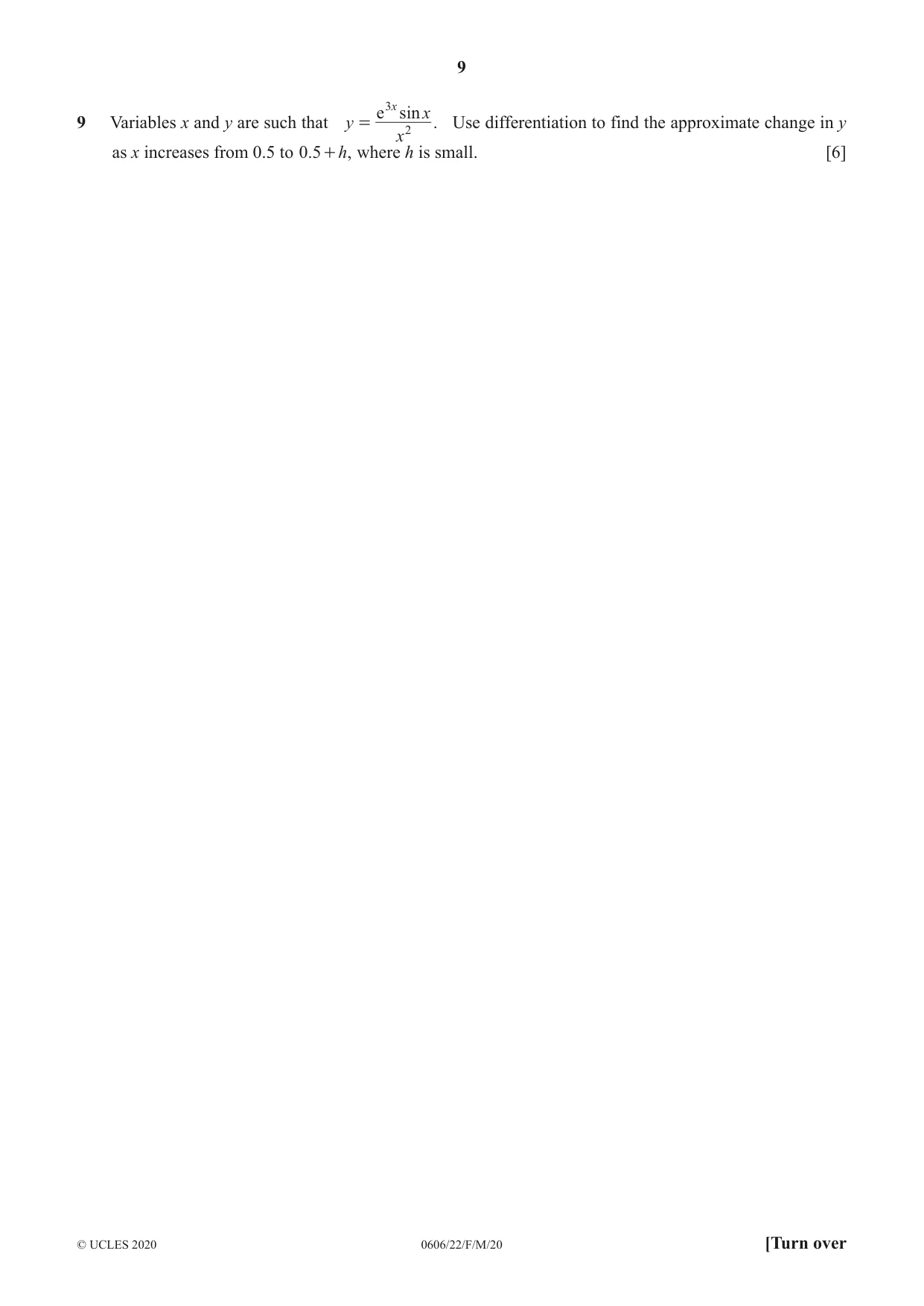
9 Variables x and y are such that y = . Use differentiation to find the approximate change in y x2 as x increases from 0.5 to 0.5+ ,h where h is small. [6]
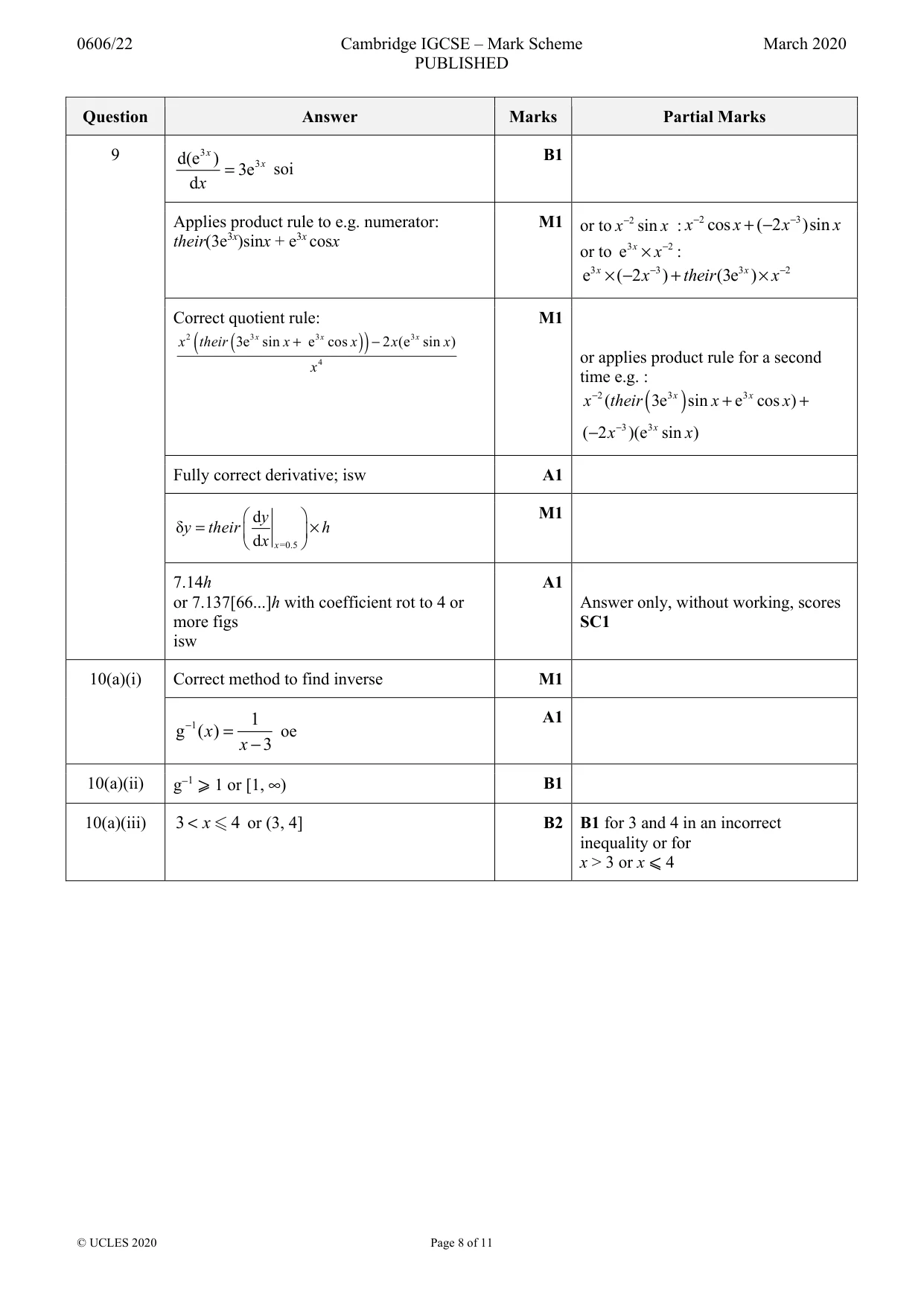
Mark scheme: 9 d(e 3 x ) 3 x B1 = 3e soi d x Applies product rule to e.g. numerator: M1 or to x −2 sin x : x −2 cos x + ( −2 x −3 )sin x their(3e3x)sinx + e3x cosx 3 x 2 or to e × x− : e 3 x × ( −2 x −3 ) + their (3e 3 x ) × x −2 Correct quotient rule: M1 − 2 x ( e 3 x sin x ) x 2 ( their ( 3e 3 x sin x + e 3 x cos x ) ) 4 or applies product rule for a second x time e.g. : x −2 (their ( 3e 3 x ) sin x + e 3 x cos x ) + ( −2 x −3 )( e 3 x sin x ) Fully correct derivative; isw A1 d y M1 δ y = their × h d x x =0.5 7.14h A1 or 7.137[66...]h with coefficient rot to 4 or Answer only, without working, scores more figs SC1 isw
More questions on Apply differentiation to connected rates of
Q10 · G( )x = 3 + for x H 1
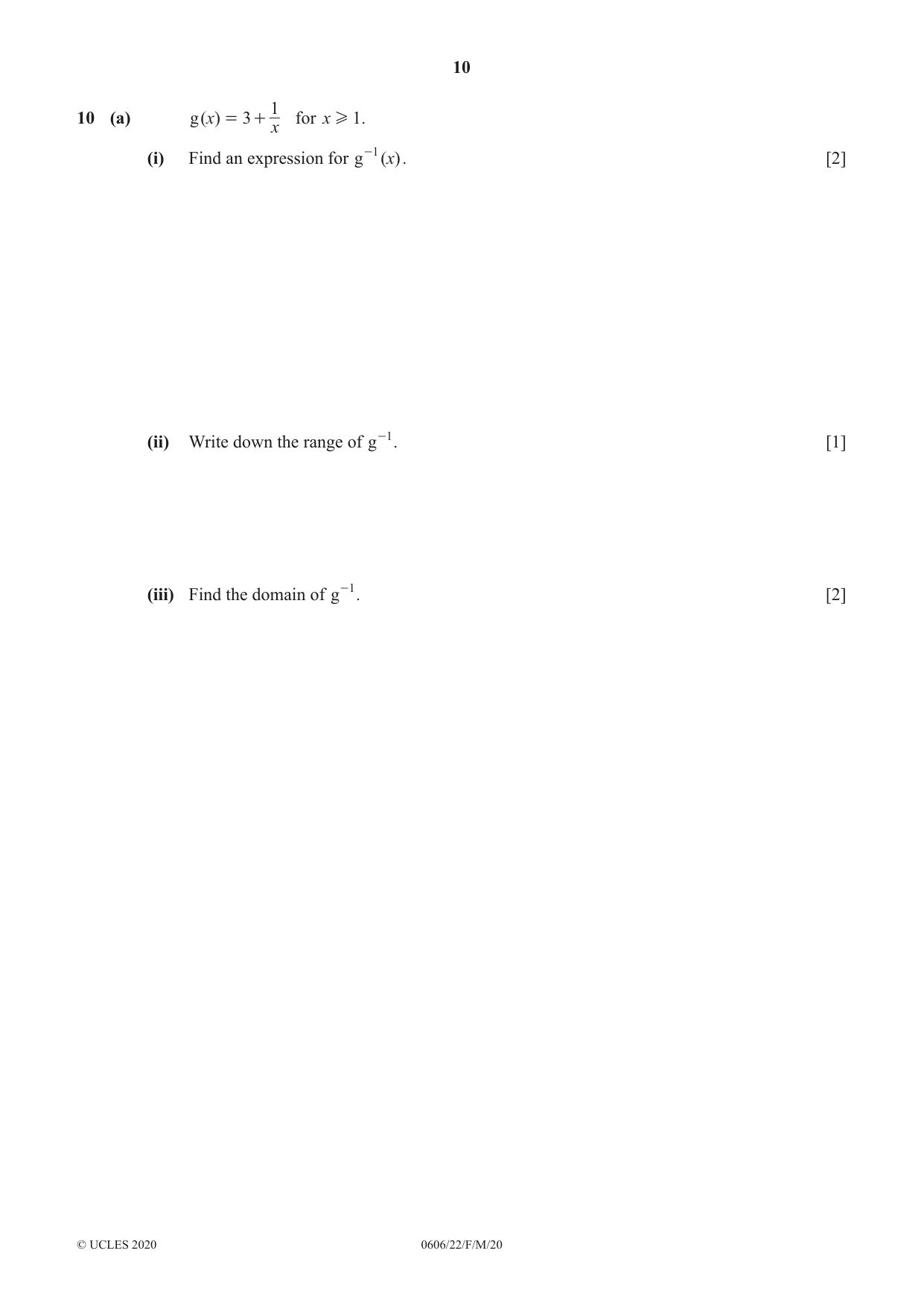
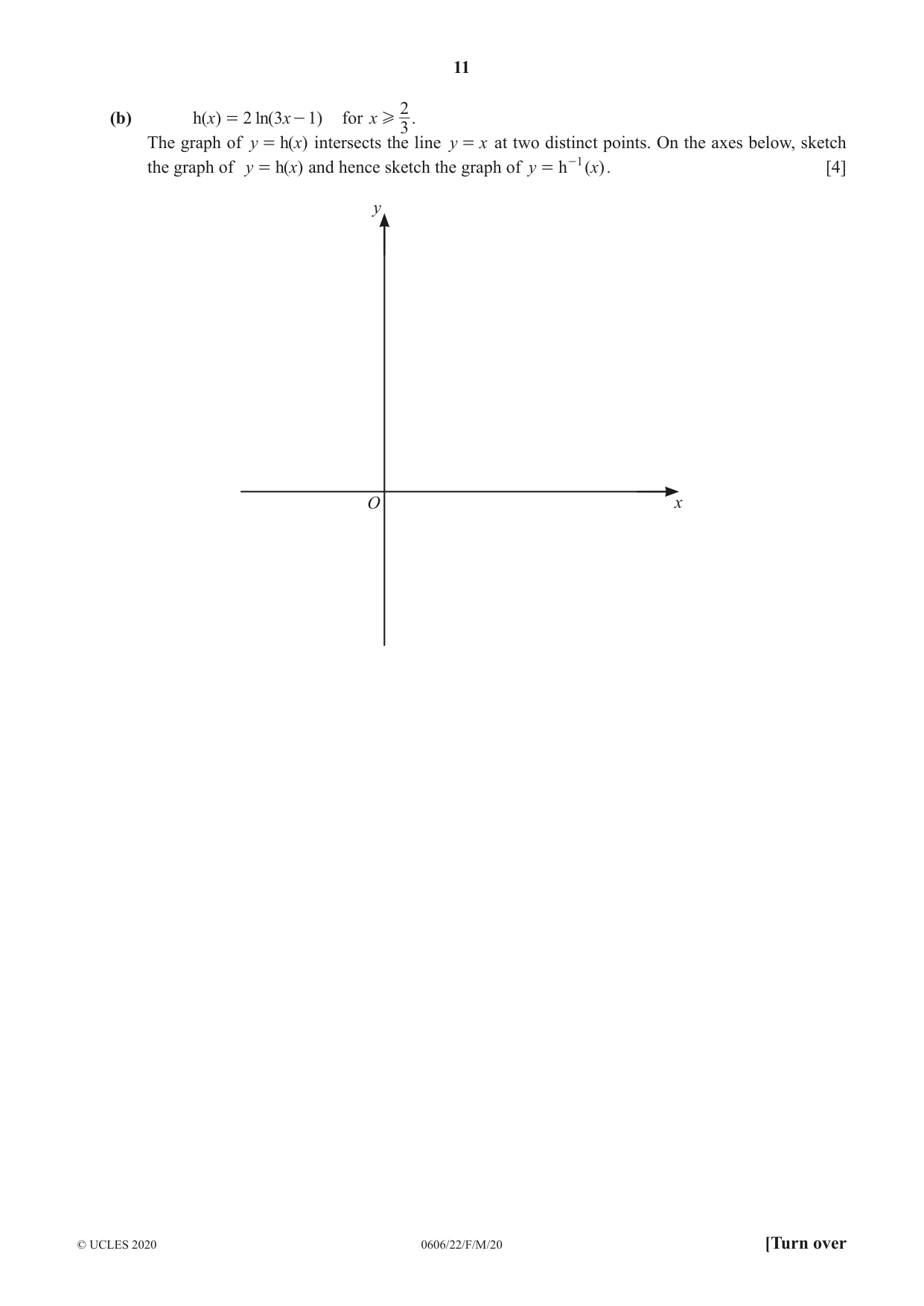
10 (a) g( )x = 3 + for x H 1. x (i) Find an expression for g -1 ( x). [2] (ii) Write down the range of g -1 . [1] (iii) Find the domain of g -1 . [2] 2(b) h( )x = 21n( 3x - 1) for x H . 3 The graph of y = h( )x intersects the line y = x at two distinct points. On the axes below, sketch the graph of y = h( )x and hence sketch the graph of y = h -1 ( x). [4] y O x
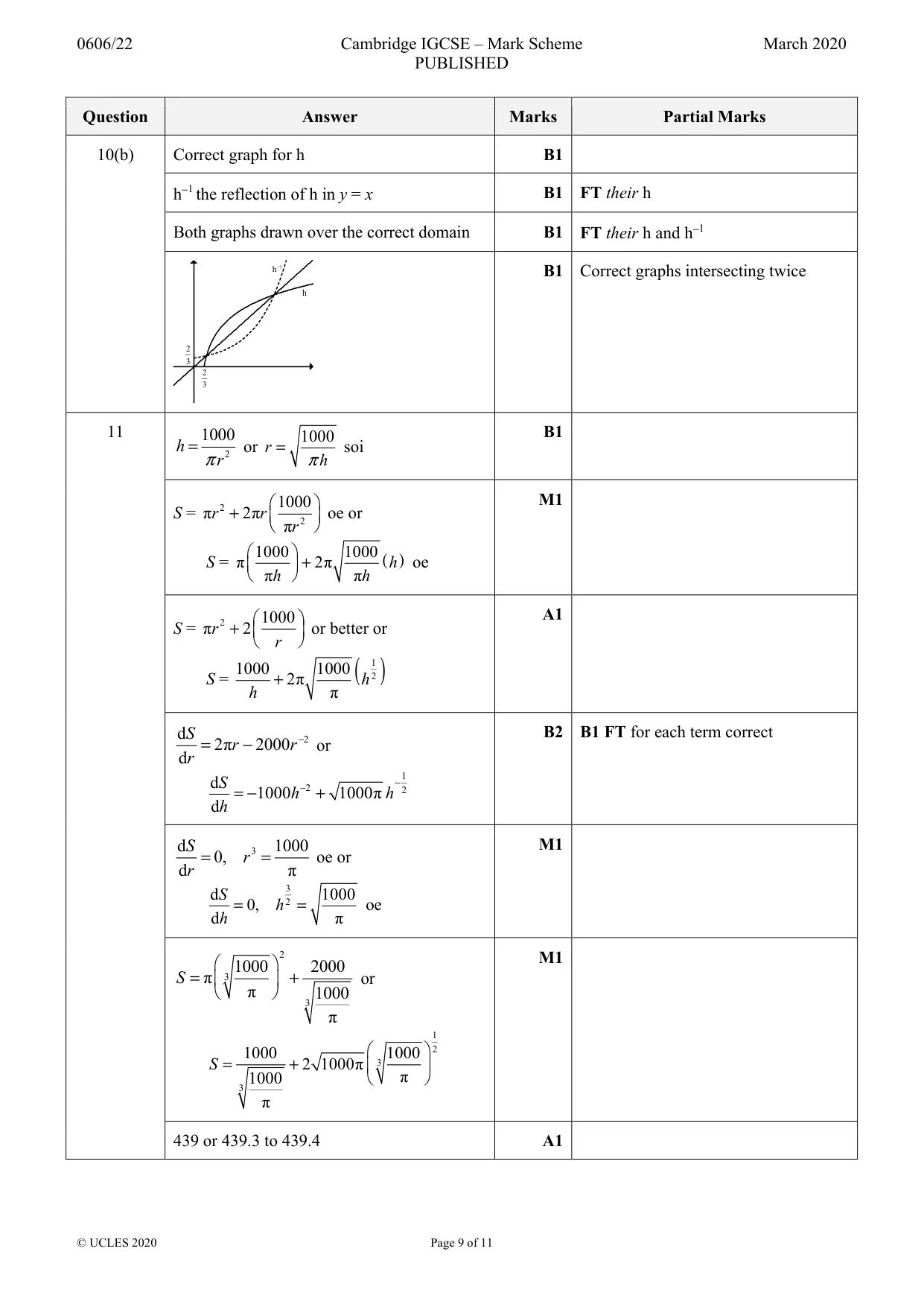
Mark scheme: 10(a)(i) Correct method to find inverse M1 −1 1 A1 g ( x ) = oe x − 3 10(a)(ii) g−1 ⩾ 1 or [1, ∞) B1 10(a)(iii) 3 < x 4 or (3, 4] B2 B1 for 3 and 4 in an incorrect inequality or for x > 3 or x ⩽ 4 10(b) Correct graph for h B1 h−1 the reflection of h in y = x B1 FT their h Both graphs drawn over the correct domain B1 FT their h and h−1 h−1 B1 Correct graphs intersecting twice h 2 3 2 3
Q11 · H r A container is a circular cylinder, open at one end, with a base radius of r cm and a…
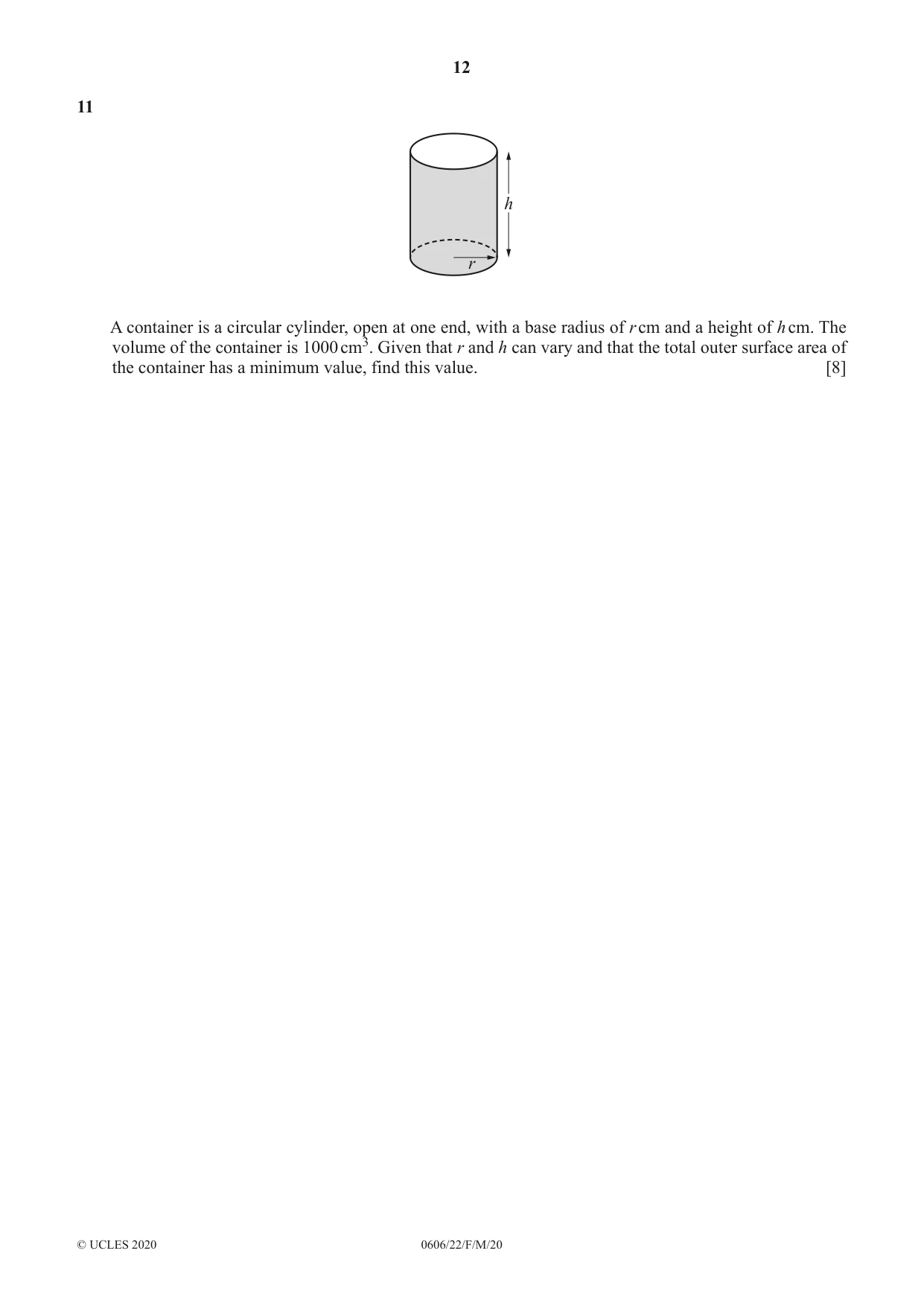
11 h r A container is a circular cylinder, open at one end, with a base radius of r cm and a height of h cm. The volume of the container is 1000 cm3. Given that r and h can vary and that the total outer surface area of the container has a minimum value, find this value. [8]
Mark scheme: 11 1000 1000 B1 h = 2 or r = soi πr πh 2 1000 M1 S = πr + 2πr 2 oe or πr 1000 1000 ( h ) oe S = π + 2π π h πh 2 1000 A1 S = πr + 2 or better or r 1000 1000 2 ) S = + 2π ( h 1 h π dS −2 B2 B1 FT for each term correct = 2πr − 2000 r or dr − d S −2 1 = − 1000 h + 1000π h 2 d h dS 3 1000 M1 = 0, r = oe or dr π d S 32 1000 = 0, h = oe d h π 2 M1 1000 2000 S = π 3 + or π 1000 3 π 1 1000 1000 2 S = + 2 1000π 3 1000 π 3 π 439 or 439.3 to 439.4 A1
More questions on Apply differentiation to practical problems
Q12 · A particle P moves in a straight line such that, t seconds after passing through a fixed…
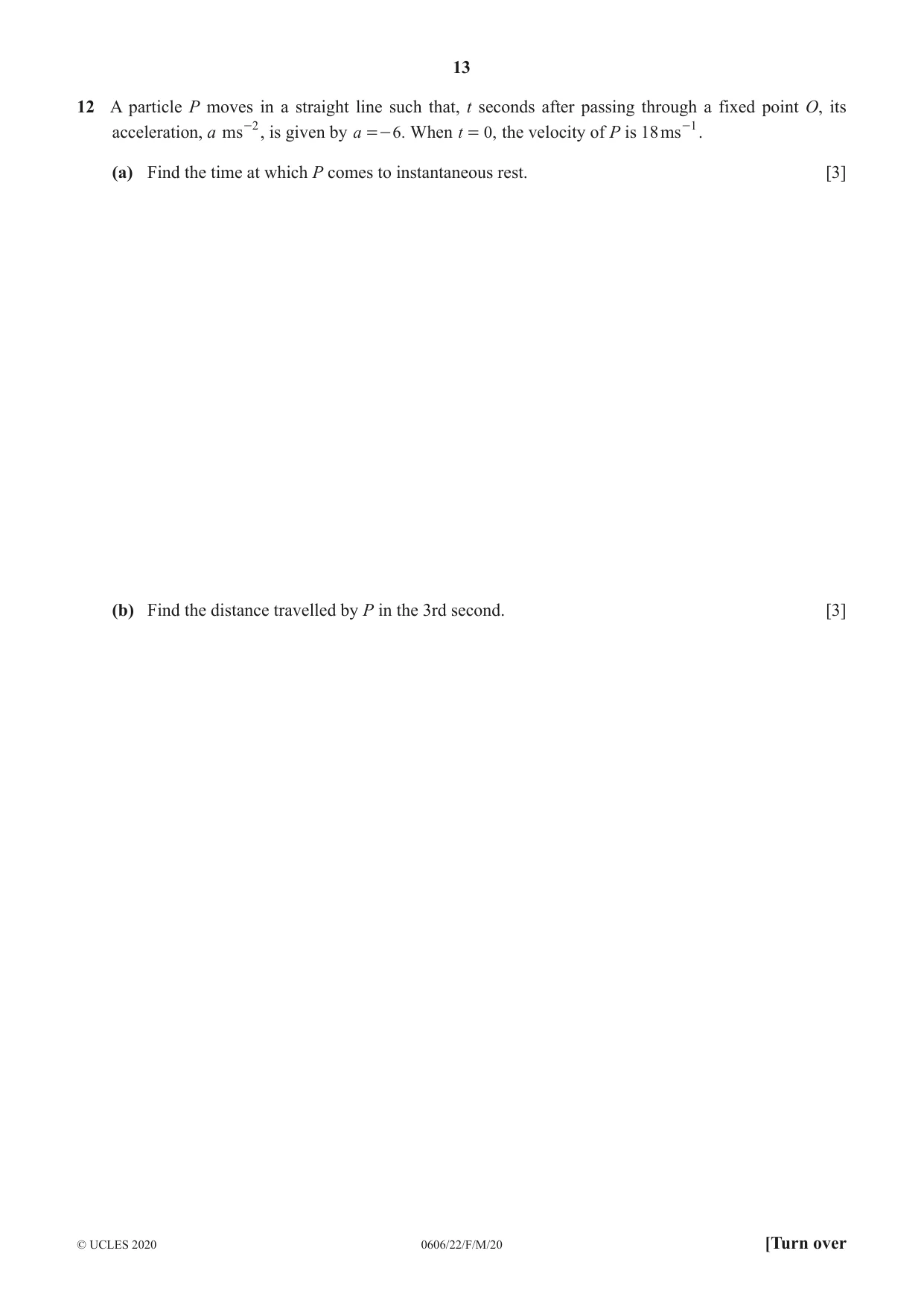
12 A particle P moves in a straight line such that, t seconds after passing through a fixed point O, its acceleration, a ms -2 , is given by a =- 6. When t = 0, the velocity of P is 18 ms -1 . (a) Find the time at which P comes to instantaneous rest. [3] (b) Find the distance travelled by P in the 3rd second. [3]
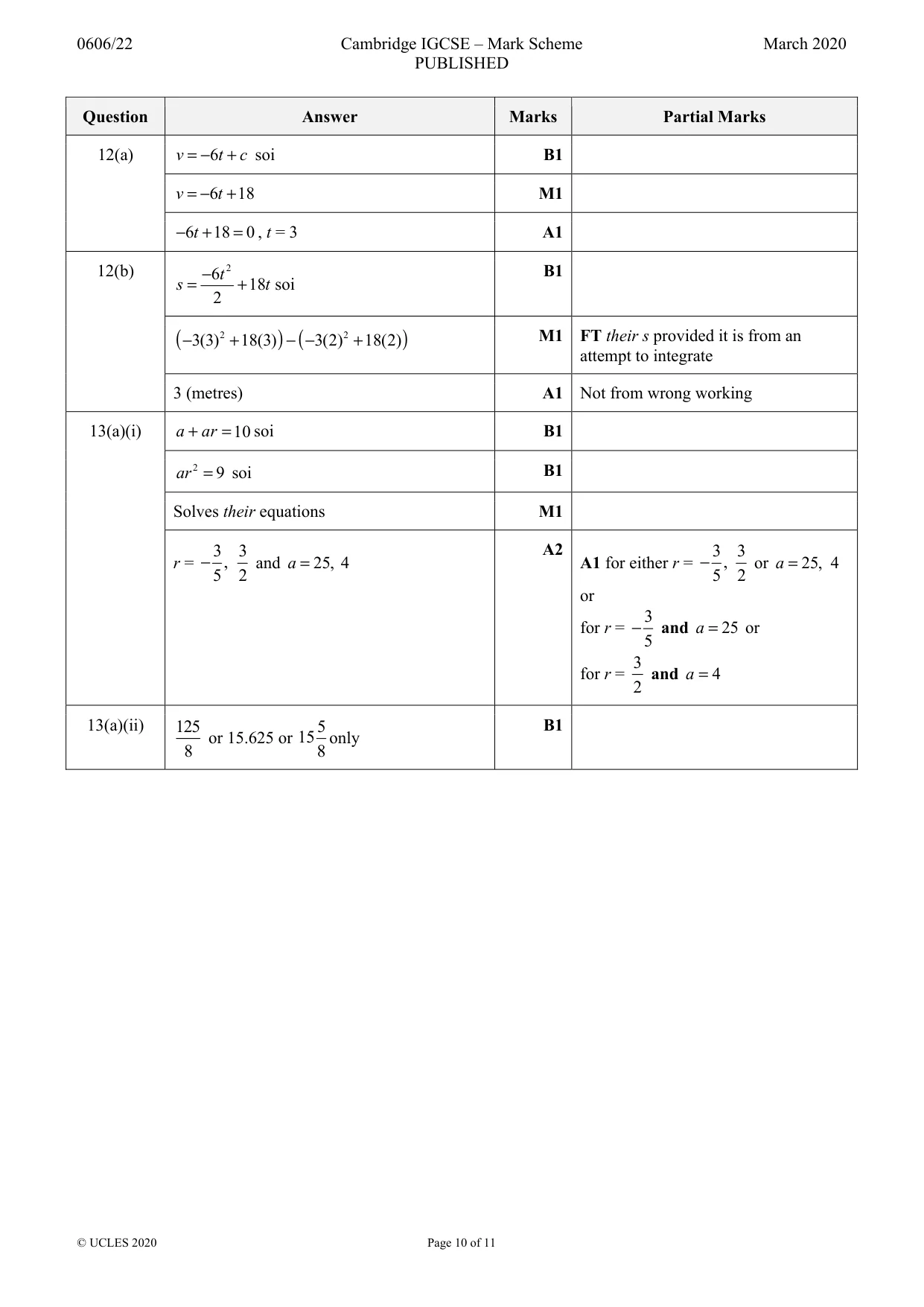
Mark scheme: 12(a) v = −6t + c soi B1 v = −6t + 18 M1 −6t + 18 = 0 , t = 3 A1 12(b) − 6t 2 B1 s = + 18t soi 2 ( −3(3) 2 + 18(3) ) −−( 3(2) 2 + 18(2) ) M1 FT their s provided it is from an attempt to integrate 3 (metres) A1 Not from wrong working
More questions on Understand integration as the reverse process
Q13 · The sum of the first two terms of a geometric progression is 10 and the third term is 9
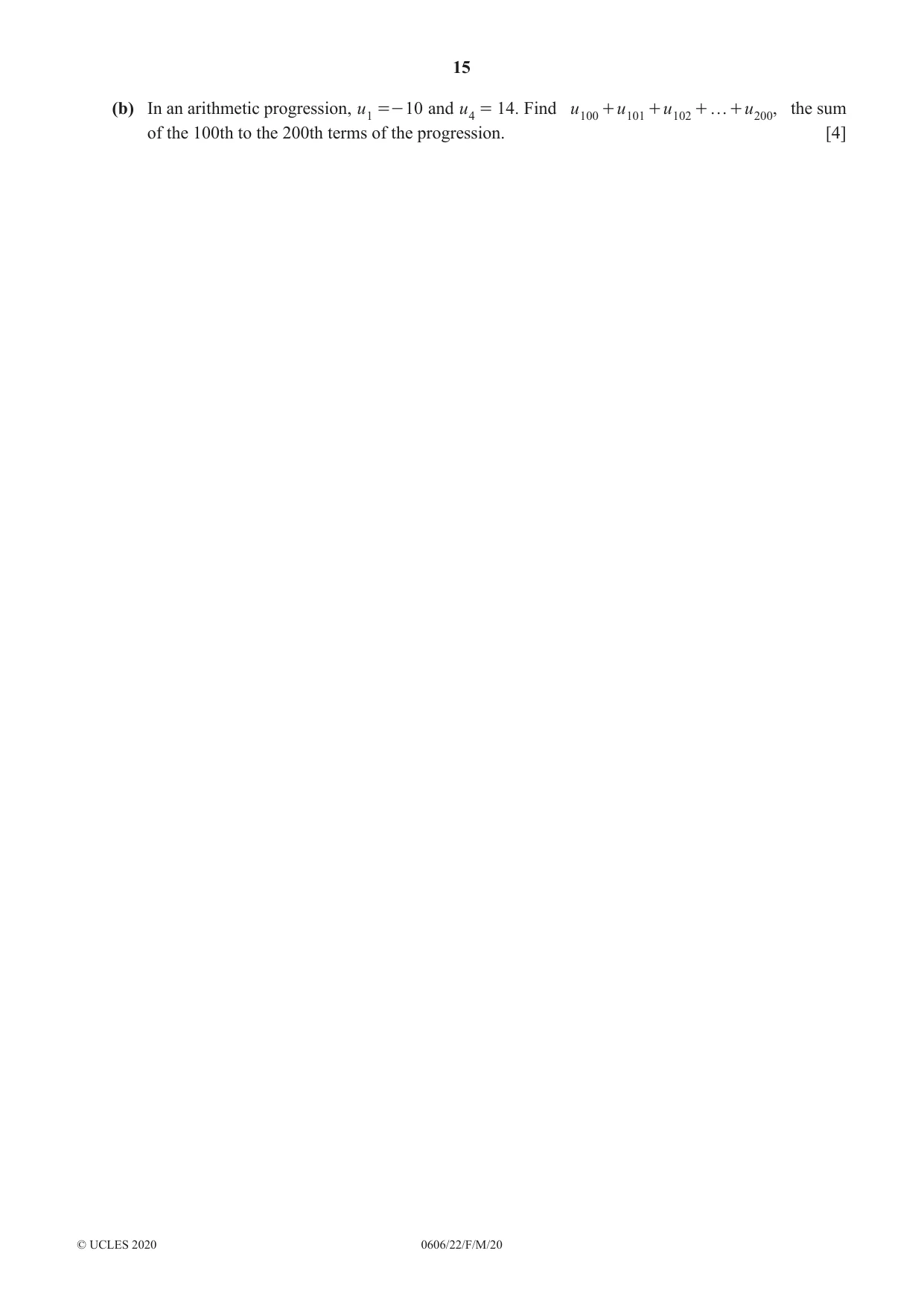
13 (a) The sum of the first two terms of a geometric progression is 10 and the third term is 9. (i) Find the possible values of the common ratio and the first term. [5] (ii) Find the sum to infinity of the convergent progression. [1] (b) In an arithmetic progression, u 1 =- 10 and u 4 = 14. Find u 100 + u 101 + u 102 + f + u 200 , the sum of the 100th to the 200th terms of the progression. [4]
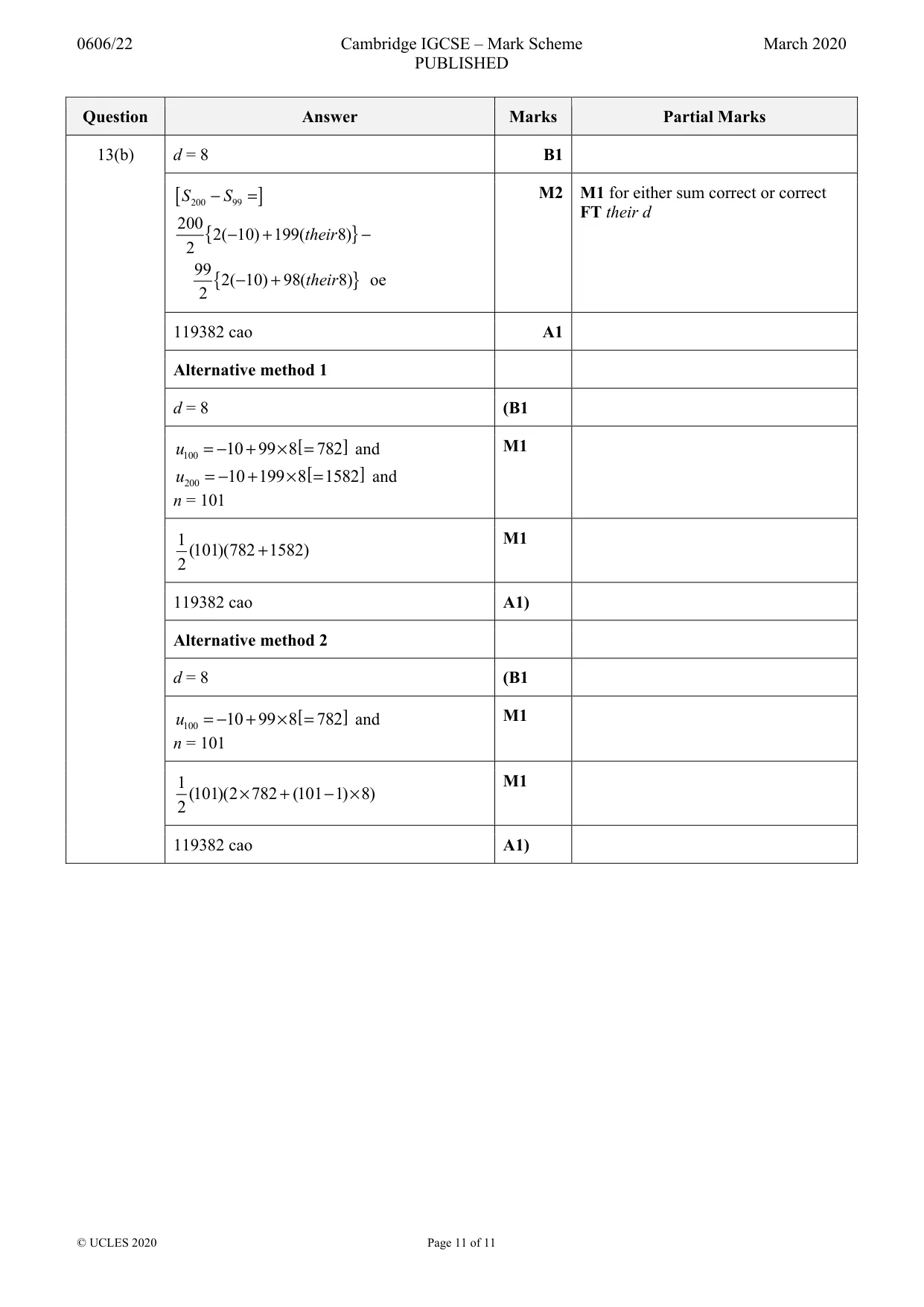
Mark scheme: 13(a)(i) a + ar = 10 soi B1 ar 2 = 9 soi B1 Solves their equations M1 3 3 A2 3 3 r = − , and a = 25, 4 A1 for either r = − , or a = 25, 4 5 2 5 2 or 3 for r = − and a = 25 or 5 3 for r = and a = 4 2 13(a)(ii) 125 5 B1 or 15.625 or 158 only 8 13(b) d = 8 B1 [ S 200 − S 99 = ] M2 M1 for either sum correct or correct FT their d 200 { 2( −10) + 199(their 8)} − 2 99 { 2( −10) + 98(their 8)} oe 2 119382 cao A1 Alternative method 1 d = 8 (B1 u100 = −10 + 99 × 8 [ = 782 ] and M1 u 200 = −10 + 199 × 8 [ = 1582 ] and n = 101 1 M1 (101)(782 + 1582) 2 119382 cao A1) Alternative method 2 d = 8 (B1 u100 = −10 + 99 × 8 [ = 782 ] and M1 n = 101 1 M1 (101)(2 × 782 + (101 − 1) × 8) 2 119382 cao A1)
More questions on Use the formulas for the nth term and for the
What was in this paper
The subtopics covered by these 12 questions, and how many questions each got. Open one in a new tab to see every Cambridge question on it.
1Apply differentiation to practical problems1Find the inverse of a one–one function1Find the solution set for quadratic inequalities1Know and use position vectors and unit1Solve problems involving the arc length and1Transform given relationships to and from1Understand and use the amplitude and1Understand integration as the reverse process1Use substitution to form and solve a quadratic1Use the equation of a straight line1Use the formulas for the nth term and for the1What you needed in this session
Cambridge’s own grade thresholds for 2020 Feb/March, Paper 2 · Variant 2. A higher threshold means an easier paper — the bar moves with how the cohort did.